This summer, the rooftop at the Musée du Quai Branly is home to Bramble bar. Attached to the museum’s Alain Ducasse restaurant, Les Ombres, the bar is overseen by Margot […]
In January 2021, I was a crypto outsider day-trading a few thousand dollars of DOGE on my phone.
By January 2022, my crypto net-worth had ballooned to over $10 million dollars.
Then almost all of it disappeared.
If you want the full story, you should read Crypto Confidential. It takes you through exactly what happened in a fun fast-paced thriller of an adventure that you don’t need to know anything about crypto to enjoy.
But what I want to share today are some important lessons around money, happiness, and sanity that crystalized as I reflected on the events of the book.
When you hold an asset, whether it’s crypto, stock, real estate, gold, Pokemon cards, whatever, you can always check to see what that asset is worth.
You can look at your stock trading app to see what people are buying and selling the stock for, or you can troll eBay to see what a mint-condition Dark Charizard last sold for.
Based on that data, you can add up the value of all your assets and calculate what your net worth is.
But here’s the problem: your net worth is more or less imaginary based on how easily you can actually sell your assets at their supposed value.
The NFT market has been plagued by this problem ever since it crashed in 2022. At the peak of the market in 2022, the cheapest NFT in the “Gutter Cat Gang” collection was 8.5 ETH, about $27,000.
Now the cheapest is 0.25 ETH, about $850. Ouch.
But it gets worse. Imagine you were extremely bullish on Gutter Cats and you bought 100 of them when they were 0.07 ETH. Well then you’re still up 18 ETH, right?
Probably not. There are only 120 Gutter Cats currently for sale, and only 64 sold in the last month. So if you try to list all of yours for sale, a few things will happen:
If you list them all, you’d be doubling the supply of Cats for sale.
Doubling the supply would bring the value of the a Cat down significantly.
Then other people might see the market tanking and rush in to list their Cats, undercutting you and driving the price down further, which could lead to a death spiral in the price.
On top of all that, you might have to wait weeks or months for your Cats to sell.
And if you sold them off slowly to exit it over time and not tank the market, it might take months to fully exit your position for who knows how much along the way.
Even at the peak of the market, there were only 12 sales on the day it hit 8.5. So there’s no way you could have exited for 850 ETH,
But you’re not thinking about that when you see the number on your net worth spreadsheet. You’re thinking “I have almost 1,000 ETH!” But that number only exists in your mind.
The same mistake can happen in real estate, where you see houses around you selling for crazy numbers and start to believe your house is also worth that much. Plenty of people (including me) fell victim to this in 2022.
And it can happen in companies too, where the founder of a company thinks they’re actually worth what all their shares are worth on paper, not realizing how quickly their fortune can turn. That’s what happened to the Bird founder who leveraged his shares to buy a mansion in Miami, only to have to sell it for an $11 million dollar loss when the value of Bird collapsed.
If you’re holding a highly traded stock in your Robinhood account and you don’t have too much of it, that part of your net worth is almost 100% real. You could almost instantly convert your 100 shares of GME to $2,500 or whatever it’s worth when you read this.
But if you dabble in crypto gambling, buy speculative assets, start a company, do anything where there might be some degree of liquidity concerns, you have to remember your wealth is partially imaginary.
Obviously this becomes a big problem for me in the book. But I won’t spoil too much…
There’s a point in time during the story where I’m making tens of thousands of dollars a day. I’m not pulling it out into my bank account of course (because I’m an idiot) but I’m seeing that number in my crypto wallet.
So, what do I do? I convince myself that buying a Rolex Submariner is a perfectly reasonable thing to do. Watches hold value, it cost less than I was making a day, and I just wanted one. Besides, the money was never going to stop coming in. Right?
My watch guy (yes, I briefly had a watch guy, that’s how bad I got), texted me that he had one in, and I went out and bought it that day. I didn’t think twice about spending the ~$15,000 on it.
That absolutely was not me a year or two earlier. And if you had asked me the year before what I would do if I had seen that kind of money coming in, I would have told you that I’d be saving and investing all of it. Not buying watches and doubling down.
But once things started taking off, all I could think about was how much higher it was going to go. I didn’t feel like I was being indulgent by buying a watch or going to the Gucci store. It was a drop in the bucket compared to the paper net worth and how much money I was going to make. I still felt like I was being responsible. You gotta enjoy your money a little, right?
It’s almost impossible to imagine how much your psychology around money will change once you start seeing those kinds of numbers. And no matter how much of a minimalist, smart saver and investor you think you are, you might be surprised by how quickly your attitude can change.
One of the worst mistakes you can make in a mania is buying things for the long-term when everyone else is playing a short-term game.
The big, core assets like Bitcoin and Ethereum are definitely long-term plays. You can buy and hold them and not look at them and feel pretty good about them still being relevant in 10-20 years.
But if you try to take that approach with whatever new fad pops up during the mania, you’re going to be the one left holding the bag.
The “Diamond Hands” meme was one of the most harmful ideologies you could have adopted during the last crypto cycle. When everyone is trying to get rich as quickly as possible, the best way to make sure no one else sells before you do is to convince them that everyone is going to hold onto this asset forever. They’re going to ride it to the moon.
But the reality is that in a speculative mania, you’re playing a giant game of chicken to see how long you can ride it before it collapses. You have to recognize this is true, even if the project behind the token is a fundamentally good one.
This is not just a crypto lesson, it applies to all areas of making money.
The faster the value of something, or the revenue from it, goes up, the faster it can go down too.
The shitcoin that goes up 1,000% overnight might drop 90% the next night.
The website that shoots to the front page of Google overnight might disappear next week.
The Amazon dropshipping opportunity you find and make a ton of money on can be quickly cannibalized by another entrepreneur.
Even the faster you try to learn a language the faster you’ll forget it.
Value and income have a certain invisible “durability” measure.
Buying land and building a parking lot in the middle of Austin is slow, expensive, competitive, but once you have it and it’s making money, it will probably perform for a very long time. It’s durable.
Hacking your way into Twitter followers with engagement bait and algorithm optimizations could build you an audience very quickly, but they’ll jump to the next engagement hacker without thinking twice about it. It’s highly fragile.
Almost everyone who falls for the “passive income” trap eventually realizes this. Yes you can quickly build a business and yes you can make money from it, but that money will go away SHOCKINGLY fast, especially once you stop working on it.
And then you’ll be back to square one and wish you had worked on something more durable in the first place.
You’ll be shocked at how quickly some of the stories in the book turned south. Projects that had hundreds of millions, even billions of dollars in them, could disappear almost overnight. If you tried to put money into them with a long-term investor mindset, you would have gotten cooked.
No matter how smart and rational you think you are, if you start seeing huge dollar amounts attached to something you speculated on, you will get very stupid very fast.
You can’t hope that you’ll make the right decision in that moment. You have to have already made the right decision earlier, before the wave of euphoric success has crashed over you.
Whatever bad impulsive behavior you’re trying to avoid, whether it’s holding a shitcoin too long or not eating desert, the more you can prevent yourself from being able to act impulsively, the better.
One modest version of this is “automatic escalation,” where you can automatically increase the amount that’s deducted from your salary and put into your 401k each year, or with each raise. You won’t notice the small biweekly hit to your income, but over twenty or thirty years it will turn into a significant chunk of change.
There was one way I chose to automate my decision making around selling crypto in the book, and it ended up having a bigger impact than almost anything else I did. If I hadn’t made that one seemingly small choice, I would have been much stupider with my money.
You’re probably thinking “Yeah, duh,” but you’d be surprised by how quickly you forget this fact once you’re in the maelstrom.
And this doesn’t just apply to crypto. Looking at your Stripe dashboard won’t make your business grow. Looking at the scale won’t make you lose weight. You need to check these things occasionally to make sure you’re on the right track, but if you find yourself constantly looking at some metric, it usually means:
Too much is riding on that chart’s short-term performance
You haven’t sufficiently automated your decision making
Sometimes you’re constantly looking at a chart because you’ve over-invested in a speculative asset. In fact this is probably the best sign you’re over-invested. If it suddenly dropping 10-20% is going to stress you out because you need this one to work, you’re taking on way too much risk.
In the same vein, if you need your business to double its revenue overnight, you’re probably taking too much risk with it and don’t have a sufficiently long-term view.
Other times you’re constantly looking at the chart because you’re trying to decide what to do. If that’s the case, then you haven’t sufficiently automated your decision making, and you need to create better rules for yourself. You should never be looking at a price to decide what to do. You should already have your decisions made about what you will do at different prices.
Remember that when you find yourself constantly checking some metric, it means there’s a deeper problem you need to address. I wish I had known that earlier, because constant chart-checking definitely led to some of the worst consequences in the story.
As I mentioned before, there were some periods of insane income during the events of the book.
And during that time, I felt like I was rich. Money felt like it was falling from the sky.
But when the market crashed and the crypto income stopped, I was terrified. I felt awful not having that income anymore.
It was keeping me up at night, making me neurotic, there were periods where I thought I should give up on this writing goal and go find a job.
Here’s the insane thing though: my net worth was actually higher once the income stopped, and over the last two years while I was feeling that terror, my net worth hasn’t changed much.
I felt the poorest when I was actually the wealthiest, purely because I didn’t see new money coming in.
That is INCREDIBLY STRANGE. But it explains why people have such a hard time enjoying the fruits of their hard work and living off their savings and investments. Having wealth does not feel as good or secure as seeing more money come in.
I feel okay about it now, but it’s taken nearly two years to deprogram that relationship. And it was surprisingly brutal to work through it. So it’s another thing to be wary of if you chase making enough money for early retirement or even just being able to take some time off work.
Even if you have enough money to not need to be worried in the short term, you still will be if you don’t see cash coming in.
My friend Khe Hy talks about this extensively. And he should know, he walked away from a $2 million a year salary on Wall Street.
It’s easy to make a spreadsheet where you look at what you currently spend, figure out how much you need to have saved and invested (The Number) to deduct that amount every year until you die, and then try to save up that much so you can quit your job and live off of it.
But it very, very rarely works out like that.
You might get close to The Number, then decide you actually want a better lifestyle and keep grinding (the money is “too damn good”).
You might get close to The Number, then find your lifestyle has gotten more expensive along the way and you need to increase it.
You also might run into unforeseen obstacles along the way and never get close to it!
I had one goal when the story in the book started, and once I hit it, I immediately increased the goal. Then I increased it again when I hit the next goal.
It wasn’t until something very unexpected happened that I realized I’d completely abandoned the original reasonable goal for a completely unreasonable one.
One of the realizations that helped me step out of crypto world and get back to writing was that I was getting good at the wrong thing.
I imagined five, ten, twenty years in the future, and asked myself how I would feel if I never became an extremely successful crypto investor or programmer.
And the truth was, I wouldn’t care. That skillset was near meaningless to me, it was just a means to an end.
But when I imagined not being a successful author that far in the future, I realized I would be filled with regret.
This is how success can become a curse. If you get really good at the wrong thing and you’re making a bunch of money from it, people are telling you how smart and capable and accomplished you are, you might start to think that it is the thing. And then you wake up one day and realize you were duped.
Obviously you probably need to get good at something you’re less thrilled about to put food on the table and get your career started. But don’t forget that it’s merely a tool for the work you really want to do later. Deprioritize it as soon as you can.
We have a very limited time on earth to go after our dream work. And while you should absolutely make sure you can afford to chase it before you do, once you can chase it you’re robbing yourself of future joy by not getting after it.
This is why the inflation of The Number or getting Too Good at the Wrong Thing is so sad. If you’re already 30 and have, say, 60 years left, another year spent chasing The Number is 1.6% of your life. If you’re 50, it’s 2.5% of your life.
If you want to commit to a career which requires a long time to get rolling, like writing or music or building a business, waiting isn’t going to shorten the startup time.
You’re going to have to spend those 2, 5, 10 years getting it going eventually. Start before it’s too late.
Before you go, don’t forget to order Crypto Confidential if you haven’t yet! If you’ve ever enjoyed a piece of my writing, I know you’re going to absolutely love the book.
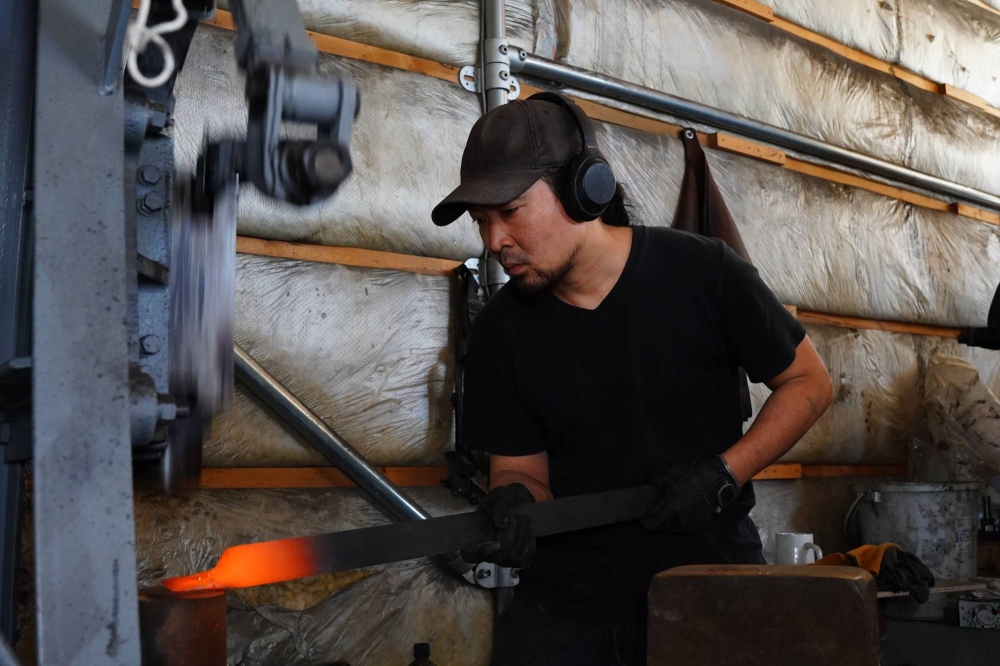
A hammering reverberates through the green fields of Ibaraki Prefecture’s countryside. Inside the spartan workshop at Isamitsu Knives, a blade, glowing red from heat, is being pounded into shape.
The manufacturer, located in Sakuragawa, may be small but it has attracted customers far and wide for its craftsmanship, a reputation earned from its use of high-quality steels known as Aogami Super and Shirogami.
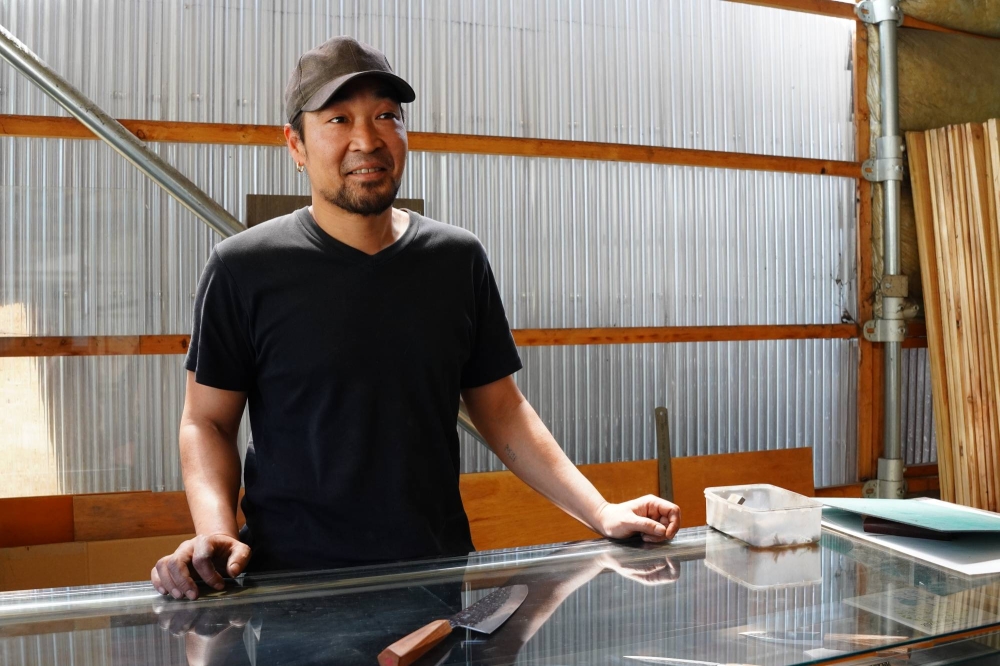
The team at Isamitsu consists of just three smiths: Naoko Abe, Gaku Kanatsu and Isamitsu Abe. After spending 15 years working at a traditional knife workshop in the prefecture, Abe, 45, found himself wanting to start his own company, driven by a desire for autonomy and the freedom to improve upon old techniques.
“I started to notice things that were lacking in the process here and there, and I wanted to do things my own way,” Isamitsu says.
Since 2022, Isamitsu’s knife-making process differs from industrial manufacturers in small but significant ways. For example, when steel drops to a certain temperature after being heated, most smiths no longer hammer it due to risk of breakage. Some workshops might choose to hammer the steel as fast as possible when the temperature is high, but at Isamitsu, they do it differently.
Unlike some other knife workshops that try to attract tourists, Isamitsu Knives is located in a particularly rural part of Ibaraki Prefecture. | CASSANDRA LORD
“Instead, we move between the furnace and the hammer over and over again using a low heat,” Abe says. “By doing so, the steel’s structure becomes denser and tougher. We specifically choose to use the best steels, so we want to use them to their full potential.”
While Abe notes that it’s quite common elsewhere for knife makers to specialize in discrete parts of the process, the small team at Isamitsu necessitates that everyone has a hand in each step.
“When everyone has their own station, it’s hard to know how it will affect the next step,” he says. “This way, we’re thinking about the next step while working on the current one, making it easier to improve the final quality.”
Rather than making each knife one by one, the team makes their knives in batches. Key to this is coke, a special type of slow-burning coal the team uses to forge the knives. Coke takes a long time to cool down — in some cases, coke can burn 45% to 90% longer than normal coal — and forging in batches makes the most of that slow burn, which would otherwise be wasted in making a single blade.
Batch orders can take six months to a year to fulfill, but by intentionally overproducing, remaining knives can go onto the market for the general public. This allows Isamitsu to sell its wares online and via local pop-up stalls.
Isamitsu Abe primarily uses Shirogami and Aogami Super steel in his knives. | CASSANDRA LORD
Still, part of the reason for this deliberate overproduction is an attempt to mitigate one of the drawbacks of working with high-quality Aogami Super and Shirogami metals: They are highly sensitive.
“The metals are hard to use,” Abe says. “If you get the temperature just a tiny bit wrong, they start to crack. When working with fire, the most difficult and most important part is temperature control.”
This is evidenced in the multiple lengths the smiths go to to maintain that careful control. In addition to coke for forging (compressing metal into a desired shape), pine charcoal and mizuyaki (water quenching) are used for quick heating and cooling during tempering (a process that makes steel harder and more elastic).
The many hours of manpower are exactly what you pay for when you buy an Isamitsu knife, and they don’t come cheap. According to its online shop, Isamitsu’s cheapest knife is a 90-millimeter Shirogami paring knife priced at ¥17,600 (about $112), while the most expensive blade is a 330-millimeter Aogami Super gyūtō (butcher’s knife) at ¥189,200 (about $1,203).
In 2022, Isamitsu Abe founded Isamitsu Knives after a stint working at a knife workshop he found too traditional. | CASSANDRA LORD
“When I bought my knife, I wasn’t used to the length,” says Taeko Dada, owner-chef of Dada Shokudo in Tsukuba, Ibaraki Prefecture. “Once I started using it, I realized that the length was effective especially when cutting large pieces of meat. It felt easy to use and cut without a concerted effort.”
The low yen also makes the knives more effective from purchasers overseas, with chefs singing Isamitsu’s praises from as far away as Southeast Asia and Europe.
Nicolas Tam, head chef at Singapore’s one-Michelin-starred Willow, uses a variety of knives at his restaurant but turns to his Isamitsu-made sujihiki (literally, “flesh slicer”) for cutting meat, and as a showpiece when preparing ingredients in front of guests at the counter.
“(My knife) has an amazing heat treat — which allows (it) to hold its edge for a long time — as well as a good grind and a striking and unique appearance,” Tam says. “To be honest, there aren’t any cons I can think of. I use it daily and don’t have any complaints.”
Dutch knife shop owner Elwin de Veld echoed Tam’s praise of an Isamitsu edge.
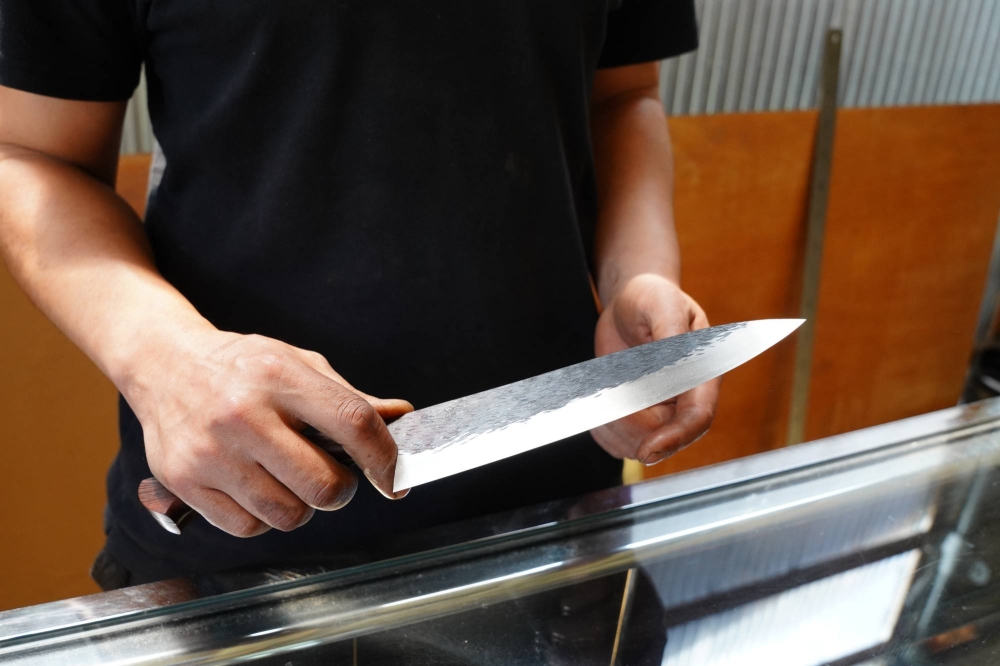
Professional chefs and Japanese knife enthusiasts say that knives from Isamitsu are top-quality blades — if you know how to take care of them. | CASSANDRA LORD
“A good knife is not only about the steel,” says the owner of Rangelrooij, a specialty Japanese knife store located in The Hague. “Many factors will influence the quality. Abe-san knows these factors by heart: thin, razor-sharp edges and a very good geometry.”
The thought and creativity that goes into Isamitsu’s work is another element customers cite in their appraisals. Canadian knife collector Franco Alo, who goes by the moniker “Kitchen Knife Guy” on YouTube, lauds Isamitsu’s modern approach to the craft.
“They are attentive to the needs of the community,” Alo says. “I don’t doubt if you asked me years from now that there would be changes, because they aren’t stuck in the ways of the past.”
Alo points out, however, that the high price point means Isamitsu knives likely “aren’t for everyone.”
“Their knives, given how sharp they are, how thin they are, are for a more experienced kitchen knife user,” he says. “That doesn’t mean you need to be a professional chef, but you need to have proper cutting technique, use the proper cutting surface and know how to maintain your knife well to appreciate an Isamitsu. Fail at any one of those three and you’ll likely chip your knife.”
While word may have already spread overseas about the knives themselves, Abe hopes to inspire others to follow in his footsteps and take up the craft of making knives themselves.
“These days, it’s difficult to find a place where you can learn (knife-making techniques),” he says. “So eventually I want to create a kind of video manual for setting everything up and doing it yourself.”
Last week, reports surfaced that Cold Steel had sent letters to several knife makers over the use of the name ‘San Mai’. Since the 1980s, Cold Steel has successfully registered three US trademarks for the term San Mai, and according to the company San Mai was recognized as incontestably a distinctive trademark associated with the Cold Steel brand. Cold Steel says they have invested millions over the years promoting San Mai and bringing the name to a large international audience. The letter (see image below) informed the makers, who use the name San Mai, of the long standing trademarks and asked them to remove references to San Mai from their websites and social media within 10 days.
On the forums and in social media, enraged knife makers called Cold Steel’s letter “heavy handed” and “corporate bullying” and questioned the company’s exclusive rights to use the term. In response, this morning Lynn Thompson issued an open letter to the knife community that you can read here. The letter is an open apology to the knifemaking community, but it also reaffirms Cold Steel’s exclusive rights to the name San Mai. It’s a delicate balance between defending its trademark rights and relationship with makers and the knife community at large.
Cold Steel just issued the following statement to KnifeNews.com including a note from Lynn Thompson:
There is a lot of confusion between the process of forging or manufacturing three-layered-steel and the name San Mai® as used in America today. These are two very different things.
It’s important to make this very clear. Cold Steel claims no ownership of a process, and is not trying to stop people from making three-layer steel knives or swords.
That is a huge misunderstanding.
However, we are asking people to respect the long standing trademark of the name San Mai® which Cold Steel has promoted for over 30 years.
Lynn first began using the name San Mai® in 1986. Cold Steel was creating a new series of blades featuring 3-layered Japanese steel and Lynn chose a cool Japanese name for that steel and for the blades featuring it. In accordance with US trademark law, he registered it with the US Trademark Office for use here in the USA.
That is the initial registration which you are referring to in your email.
Over the years Cold Steel heavily promoted San Mai® and raised awareness of both the steel and the products that featured it.
We advertised San Mai® worldwide, through magazine ads, our catalogs and our testing videos as well as at live events and trade shows.
We invested millions of dollars promoting the name San Mai® and we went on to expand upon that trademark, registering the name as well as the mark or symbol associated with Cold Steel’s San Mai®.
Cold Steel’s San Mai® became a well-known and world renowned brand, and the U.S. Trademark Office recognized San Mai® as a distinctive trademark associated with Cold Steel knives in 2008.
The Trademarks were also recognized as incontestable by the U.S. Trademark Office in 2014.
In order to retain those trademarks, and in order to expand upon them – to the extent that they are now recognized as incontestably distinctive and associated with Cold Steel – we not only had to promote them but to protect them.
To do this, we are required by law to make a reasonable effort to defend our trademarks.
Since the mid-eighties we have done so numerous times. This has included sending out letters not dissimilar to the ones that went out to a small number of makers last week.
Note from Lynn Thompson, Cold Steel Founder and President: I have a great deal of admiration for custom makers, and it was the pioneering work of the American Bladesmith Society® that inspired me to try and push the limits of performance and durability in my own production knives. No custom bladesmith has ever been sued over the San Mai® name, and it is my sincere hope that such a drastic course of action will never occur.
The letters that were sent out were intended to politely ask people to respect my long standing trademark of the name San Mai®, something I have invested millions of dollars building, and growing for decades.
It was never my intention to appear to be intimidating members of the knife making community, and I’d like to take this opportunity to apologize sincerely to each and every bladesmith for the misunderstanding.
If anyone has any questions or concerns, I’d like to encourage them to write to me via the address below. Thank you!
Lynn C Thompson
Cold Steel Inc. 6060 Nicolle Street Ventura CA 93003
If you’re not familiar with this energetic London neighborhood, it’s worth discovering for its pubs, restaurants, cafes, and these new Soho cocktail bars. Wacky Wombat: A most anticipated of Soho […]
ProPublica is a nonprofit newsroom that investigates abuses of power. Sign up to receive our biggest stories as soon as they’re published.
This story is exempt from our Creative Commons license until July 19.
Kris Hansen had worked as a chemist at the 3M Corporation for about a year when her boss, an affable senior scientist named Jim Johnson, gave her a strange assignment. 3M had invented Scotch Tape and Post-it notes; it sold everything from sandpaper to kitchen sponges. But on this day, in 1997, Johnson wanted Hansen to test human blood for chemical contamination.
Several of 3M’s most successful products contained man-made compounds called fluorochemicals. In a spray called Scotchgard, fluorochemicals protected leather and fabric from stains. In a coating known as Scotchban, they prevented food packaging from getting soggy. In a soapy foam used by firefighters, they helped extinguish jet-fuel fires. Johnson explained to Hansen that one of the company’s fluorochemicals, PFOS — short for perfluorooctanesulfonic acid — often found its way into the bodies of 3M factory workers. Although he said that they were unharmed, he had recently hired an outside lab to measure the levels in their blood. The lab had just reported something odd, however. For the sake of comparison, it had tested blood samples from the American Red Cross, which came from the general population and should have been free of fluorochemicals. Instead, it kept finding a contaminant in the blood.
Johnson asked Hansen to figure out whether the lab had made a mistake. Detecting trace levels of chemicals was her specialty: She had recently written a doctoral dissertation about tiny particles in the atmosphere. Hansen’s team of lab technicians and junior scientists fetched a blood sample from a lab-supply company and prepped it for analysis. Then Hansen switched on an oven-size box known as a mass spectrometer, which weighs molecules so that scientists can identify them.
As the lab equipment hummed around her, Hansen loaded a sample into the machine. A graph appeared on the mass spectrometer’s display; it suggested that there was a compound in the blood that could be PFOS. That’s weird, Hansen thought. Why would a chemical produced by 3M show up in people who had never worked for the company?
Hansen didn’t want to share her results until she was certain that they were correct, so she and her team spent several weeks analyzing more blood, often in time-consuming overnight tests. All the samples appeared to be contaminated. When Hansen used a more precise method, liquid chromatography, the results left little doubt that the chemical in the Red Cross blood was PFOS.
Hansen now felt obligated to update her boss. Johnson was a towering, bearded man, and she liked him: He seemed to trust her expertise, and he found something to laugh about in most conversations. But, when she shared her findings, his response was cryptic. “This changes everything,” he said. Before she could ask him what he meant, he went into his office and closed the door.
This was not the first time that Hansen had found a chemical where it didn’t belong. A wiry woman who grew up skiing competitively, Hansen had always liked to spend time outdoors; for her chemistry thesis at Williams College, she had kayaked around the former site of an electric company on the Hoosic River, collecting crayfish and testing them for industrial pollutants called polychlorinated biphenyls, or PCBs. Her research, which showed that a drainage ditch at the site was leaking the chemicals, prompted a news story and contributed to a cleanup effort overseen by the Massachusetts Department of Environmental Protection. At 3M, Hansen assumed that her bosses would respond to her findings with the same kind of diligence and care.
Hansen stayed near Johnson’s office for the rest of the day, anxiously waiting for him to react to her research. He never did. In the days that followed, Hansen sensed that Johnson had notified some of his superiors. She remembers his boss, Dale Bacon, a paunchy fellow with gray hair, stopping by her desk and suggesting that she had made a mistake. “I don’t think so,” she told him. In subsequent weeks, Hansen and her team ordered fresh blood samples from every supplier that 3M worked with. Each of the samples tested positive for PFOS.
3M Global Headquarters in Maplewood, Minnesota
In the middle of this testing, Johnson suddenly announced that he would be taking early retirement. After he packed up his office and left, Hansen felt adrift. She was so new to corporate life that her office clothes — pleated pants and dress shirts — still felt like a costume. Johnson had always guided her research, and he hadn’t told Hansen what she should do next. She reminded herself of what he had said — that the chemical wasn’t harmful in factory workers. But she couldn’t be sure that it was harmless. She knew that PCBs, for example, were mass-produced for years before studies showed that they accumulate in the food chain and cause a range of health issues, including damage to the brain. The most reliable way to gauge the safety of chemicals is to study them over time, in animals and, if possible, in humans.
What Hansen didn’t know was that 3M had already conducted animal studies — two decades earlier. They had shown PFOS to be toxic, yet the results remained secret, even to many at the company. In one early experiment, conducted in the late ’70s, a group of 3M scientists fed PFOS to rats on a daily basis. Starting at the second-lowest dose that the scientists tested, about 10 milligrams for every kilogram of body weight, the rats showed signs of possible harm to their livers, and half of them died. At higher doses, every rat died. Soon afterward, 3M scientists found that a relatively low daily dose, 4.5 milligrams for every kilogram of body weight, could kill a monkey within weeks. (Based on this result, the chemical would currently fall into the highest of five toxicity levels recognized by the United Nations.) This daily dose of PFOS was orders of magnitude greater than the amount that the average person would ingest, but it was still relatively low — roughly comparable to the dose of aspirin in a standard tablet.
In 1979, an internal company report deemed PFOS “certainly more toxic than anticipated” and recommended longer-term studies. That year, 3M executives flew to San Francisco to consult Harold Hodge, a respected toxicologist. They told Hodge only part of what they knew: that PFOS had sickened and even killed laboratory animals and had caused liver abnormalities in factory workers. According to a 3M document that was marked “CONFIDENTIAL,” Hodge urged the executives to study whether the company’s fluorochemicals caused reproductive issues or cancer. After reviewing more data, he told one of them to find out whether the chemicals were present “in man,” and he added, “If the levels are high and widespread and the half-life is long, we could have a serious problem.” Yet Hodge’s warning was omitted from official meeting notes, and the company’s fluorochemical production increased over time.
Hansen’s bosses never told her that PFOS was toxic. In the weeks after Johnson left 3M, however, she felt that she was under a new level of scrutiny. One of her superiors suggested that her equipment might be contaminated, so she cleaned the mass spectrometer and then the entire lab. Her results didn’t change. Another encouraged her to repeatedly analyze her syringes, bags and test tubes, in case they had tainted the blood. (They had not.) Her managers were less concerned about PFOS, it seemed to Hansen, than about the chance that she was wrong.
Sometimes Hansen doubted herself. She was 28 and had only recently earned her Ph.D. But she continued her experiments, if only to respond to the questions of her managers. 3M bought three additional mass spectrometers, which each cost more than a car, and Hansen used them to test more blood samples. In late 1997, her new boss, Bacon, even had her fly out to the company that manufactured the machines, so that she could repeat her tests there. She studied the blood of hundreds of people from more than a dozen blood banks in various states. Each sample contained PFOS. The chemical seemed to be everywhere.
When 3M was founded, in 1902, it was known as the Minnesota Mining and Manufacturing Company. After its mining operations flopped, the company pivoted to sandpaper and then to a series of clever inventions aimed at improving everyday life. An early employee noticed that autoworkers were struggling to paint two-tone cars, which were popular at the time; he eventually invented masking tape, using crêpe paper and cabinetmaker’s glue. Another 3M employee created Post-it notes to help him bookmark passages in his church hymnal. An official history of 3M, published for the company’s 100th anniversary, celebrated its “tolerance for tinkerers.”
Fluorochemicals had their origins in the American effort to build the atomic bomb. During the Second World War, scientists for the Manhattan Project developed one of the first safe processes for bonding carbon to fluorine, a dangerously reactive element that experts had nicknamed “the wildest hellcat” of chemistry. After the war, 3M hired some Manhattan Project chemists and began mass-producing chains of carbon atoms bonded to fluorine atoms. The resulting chemicals proved to be astonishingly versatile, in part because they resist oil, water and heat. They are also incredibly long-lasting, earning them the moniker “forever chemicals.”
In the early ’50s, 3M began selling one of its fluorochemicals, PFOA, to the chemical company DuPont for use in Teflon. Then, a couple of years later, a dollop of fluorochemical goo landed on a 3M employee’s tennis shoe, where it proved impervious to stains and impossible to wipe off. 3M now had the idea for Scotchgard and Scotchban. By the time Hansen was in elementary school, in the ’70s, both products were ubiquitous. Restaurants served French fries in Scotchban-treated packaging. Hansen’s mother sprayed Scotchgard on the living-room couch.
Hansen grew up in Lake Elmo, Minnesota, not far from 3M’s headquarters. Her father was one of the company’s star engineers and was even inducted into its hall of fame in 1979; he had helped to create Scotch-Brite scouring pads and Coban wrap, a soft alternative to sticky bandages. Once, he molded some fibers into cups, thinking that they might make a good bra. They turned out to be miserably uncomfortable, so he and his colleagues placed them over their mouths, giving the company the inspiration for its signature N95 mask.
First image: Lake Elmo, Minnesota, the town not far from 3M headquarters where Kris Hansen grew up. Second image: Family photos of Paul Hansen, Kris’ father, at 3M functions over the years.
Hansen never intended to follow her father to the company. She spent her childhood summers catching turtles and leopard frogs at the lake and hoped to have a career in environmental conservation. Her first job after earning her chemistry Ph.D. was on a boat, which took her to remote parts of the Pacific Ocean. But the voyage left her so seasick that she lost 20 pounds, and she soon retreated to Minnesota. In 1996, at her father’s suggestion, Hansen applied for a position in 3M’s environmental lab.
After Hansen started her PFOS research, her relationships with some colleagues seemed to deteriorate. One afternoon in 1998, a trim 3M epidemiologist named Geary Olsen arrived with several vials of blood and asked her to test them. The next morning, she read the results to him and several colleagues — positive for PFOS. As Hansen remembers it, Olsen looked triumphant. “Those samples came from my horse,” he said — and his horse certainly wasn’t eating at McDonald’s or trotting on Scotchgarded carpets. Hansen felt that he was trying to humiliate her. (Olsen did not respond to requests for comment.) What Hansen wanted to know was how PFOS was making its way into animals.
She found an answer in data from lab rats, which also appeared to have fluorochemicals in their blood. Rats that had more fish meal in their diets, she discovered, tended to have higher levels of PFOS, suggesting that the chemical had spread through the food chain and perhaps through water. In male lab rats, PFOS levels rose with age, indicating that the chemical accumulated in the body. But, curiously, in female rats the levels sometimes fell. Hansen was unsettled when toxicology reports indicated why: Mother rats seemed to be offloading the chemical to their pups. Exposure to PFOS could begin before birth.
Another study confirmed that Scotchban and Scotchgard were sources of the chemical. PFOS wasn’t an official ingredient in either product, but both contained other fluorochemicals that, the study showed, broke down into PFOS in the bodies of lab rats. Hansen and her team ultimately found PFOS in eagles, chickens, rabbits, cows, pigs and other animals. They also found 14 additional fluorochemicals in human blood, including several produced by 3M. Some were present in wastewater from a 3M factory.
At one point, Hansen told her father, Paul, that she was frustrated by the way senior colleagues kept questioning her work. Paul had recently retired, but he had confidence in 3M’s top executives, and he suggested that she take her findings directly to them. But as a relatively new employee — and one of the few women scientists at a company of about 75,000 people — Hansen found the idea preposterous. When Paul offered to talk to some of 3M’s executives himself, she was mortified at the idea of her father interceding.
Hansen knew that if she could find a blood sample that didn’t contain PFOS then she might be able to convince her colleagues that the other samples did. She and her team began to study historical blood from the early decades of PFOS production. They soon found the chemical in blood from a 1969-71 Michigan breast cancer study. Then they ran an overnight test on blood that had been collected in rural China during the ’80s and ’90s. If any place were PFOS-free, she figured, it would be somewhere remote, where 3M products weren’t in widespread use.
The next morning, anxious to see the results, Hansen arrived at the lab before anyone else. For the first time since she had begun testing blood, some of the samples showed no trace of PFOS. She was so struck that she called her husband. There was nothing wrong with her equipment or methodology; PFOS, a man-made chemical produced by her employer, really was in human blood, practically everywhere. Hansen’s team found it in Swedish blood samples from 1957 and 1971. After that, her lab analyzed blood that had been collected before 3M created PFOS. It tested negative. Apparently, fluorochemicals had entered human blood after the company started selling products that contained them. They had leached out of 3M’s sprays, coatings and factories — and into all of us.
That summer, an in-house librarian at 3M delivered a surprising article to Hansen’s office mailbox. It had been written in 1981 by 3M scientists, and it described a method for measuring fluorine in blood, indicating that even back then the company was testing for fluorochemicals. One scientist mentioned in the article, Richard Newmark, still worked for 3M, in a low-lying structure nicknamed the “nerdy building.” Hansen arranged to meet with him there.
Newmark, a collegial man with a compact build, told Hansen that, more than 20 years before, two academic scientists, Donald Taves and Warren Guy, had discovered a fluorochemical in human blood. They had wondered whether Scotchgard might be its source, so they approached 3M. Newmark told her that his subsequent experiments had confirmed their suspicions — the chemical was PFOS — but 3M lawyers had urged his lab not to admit it.
As Hansen wrote all this down in a notebook, she felt anger rising inside her. Why had so many colleagues doubted the soundness of her results if earlier 3M experiments had already proved the same thing? After the meeting, she hurried back to the lab to find Bacon. “He knew!” she told him.
Bacon’s face remained expressionless. He told Hansen to type up her notes for him. She remembers him telling her not to email them. (In response to questions about Hansen’s account, Bacon said that he didn’t remember specifics. When I called Newmark, he told me that he could not remember her or anything about PFOS. “It’s been a very long time, and I’m in my mid-80s, and just do not remember stuff that well,” he said.)
A few months later, in early 1999, Bacon invited Hansen to an extraordinary meeting: She would have the chance to present her findings to 3M’s CEO, Livio D. DeSimone. Hansen spent several days rehearsing while driving and making dinner. On the day of the meeting, she took an elevator up to the executive suite; her stomach turned as a secretary pointed her to a conference room. Men in suits sat around a long table. Her boss, Bacon, was there. DeSimone, a portly man with white hair, sat at the head of the table.
A photo that Kris Hansen saved shows her father, Paul, with 3M CEO Livio D. DeSimone.
Almost as soon as Hansen placed her first transparency on the projector, the attendees began interrogating her: Why did she do this research? Who directed her to do it? Whom did she inform of the results? The executives seemed to view her diligence as a betrayal: Her data could be damaging to the company. She remembers defending herself, mentioning Newmark’s similar work in the ’70s and trying, unsuccessfully, to direct the conversation back to her research. While the executives talked over her, Hansen noticed that DeSimone’s eyes had closed and that his chin was resting on his dress shirt. The CEO appeared to have fallen asleep. (DeSimone died in 2017. A company spokesperson did not answer my questions about the meeting.)
After that meeting, Hansen remembers learning from Bacon that her job would be changing. She would only be allowed to do experiments that a supervisor had specifically requested, and she was to share her data with only that person. She would spend most of her time analyzing samples for studies that other employees were conducting, and she should not ask questions about what the results meant. Several members of her team were also being reassigned. Bacon explained that a different scientist at 3M would lead research into PFOS going forward. Hansen felt that she was being punished and struggled not to cry.
Even as Hansen was being sidelined, the results of her research were quietly making their way into the files of the Environmental Protection Agency. Since the ’70s, federal law has required that companies tell the EPA about any evidence indicating that a company’s products present “a substantial risk of injury to health or the environment.” In May 1998, 3M officials notified the agency, without informing Hansen, that the company had measured PFOS in blood samples from around the U.S. — a clear reference to Hansen’s work. It did not mention its animal research from the ’70s, and it said that the chemical caused “no adverse effects” at the levels the company had measured in its workers. A year later, 3M sent the EPA another letter, again without telling Hansen. This time, it informed the agency about the 14 other fluorochemicals, several of them made by 3M, that Hansen’s team had detected in human blood. The company reiterated that it did not believe that its products presented a substantial risk to human health.
Hansen recalls that in the summer of 1999, at an annual picnic that her parents hosted for 3M scientists, she was grilling corn when one of the creators of Scotchgard, a gray-haired man in glasses, confronted her. He accused her of trying to tear down the work of her colleagues. Did it make her feel powerful ruining other people’s careers? he asked. Hansen didn’t know how to respond, and he walked away.
Several of Hansen’s superiors had stopped greeting her in the hallways. When she presented a poster of her research at a 3M event, nobody asked her about it. She lost her appetite, and her pleated pants grew baggy. She started to worry that an angry co-worker might confront or even harm her in the company’s dark parking lot. She got into the habit of calling her husband before walking to her car.
A year after Hansen’s meeting with the CEO, 3M, under pressure from the EPA, made a very costly decision: It was going to discontinue its entire portfolio of PFOS-related chemicals. In May 2000, for the first time, 3M officials revealed to the press that it had detected the chemical in blood banks. One executive claimed that the discovery was a “complete surprise.” The company’s medical director told The New York Times, “This isn’t a health issue now, and it won’t be a health issue.” But the newspaper also quoted a professor of toxicology. “The real issue is this stuff accumulates,” the professor said. “No chemical is totally innocuous, and it seems inconceivable that anything that accumulates would not eventually become toxic.”
Hansen was now pregnant with twins. Although she was heartened by 3M’s announcement — she saw it as evidence that her work had forced the company to act — she was also ready to leave the environmental lab, where she felt marginalized. After giving birth, she joined 3M’s medical devices team. But first, she decided to have one last blood sample tested for PFOS: her own. The results showed one of the lowest readings she’d seen in human blood. Immediately, she thought of the rats that had passed the chemical on to their pups.
Hansen told me that, for the next 19 years, she avoided the subject of fluorochemicals with the same intensity with which she had once pursued it. She focused on raising her kids and coaching a cross-country ski team; she worked a variety of jobs at 3M, none related to fluorochemicals. In 2002, when 3M announced that it would be replacing PFOS with another fluorochemical, PFBS, Hansen knew that it, too, would remain in the environment indefinitely. Still, she decided not to involve herself. She skipped over articles about the chemicals in scientific journals and newspapers, where they were starting to be linked to possible developmental, immune system and liver problems. (In 2006, after the EPA accused 3M of violating the Toxic Substances Control Act, in part by repeatedly failing to disclose the harms of fluorochemicals promptly, the company agreed to pay a small penalty of $1.5 million, without admitting wrongdoing.)
During that time, forever chemicals gained a new scientific name — per- and polyfluoroalkyl substances, or PFAS, an acronym that is vexingly similar to the specific fluorochemical PFOS. A swath of 150 square miles around 3M’s headquarters was found to be polluted with PFAS; scientists discovered PFOS and PFBS in local fish and various fluorochemicals in water that roughly 125,000 Minnesotans drank. Hansen’s husband, Peter, told me that, when friends asked Hansen about PFAS, she would change the subject. Still, she repeatedly told him — and herself — that the chemicals were safe.
First image: Hansen. Second image: A sign warns against consuming fish from Eagle Point Lake in Lake Elmo Park Reserve because of PFAS contamination.
In the 2016 book “Secrecy at Work,” two management theorists, Jana Costas and Christopher Grey, argue that there is nothing inherently wrong or harmful about keeping secrets. Trade secrets, for example, are protected by federal and state law on the grounds that they promote innovation and contribute to the economy. The authors draw on a large body of sociological research to illustrate the many ways that information can be concealed. An organization can compartmentalize a secret by slicing it into smaller components, preventing any one person from piecing together the whole. Managers who don’t want to disclose sensitive information may employ “stone-faced silence.” Secret-keepers can form a kind of tribe, dependent on one another’s continued discretion; in this way, even the existence of a secret can be kept secret. Such techniques become pernicious, Costas and Grey write, when a company keeps a dark secret, a secret about wrongdoing.
Certain unpredictable events — a leak, a lawsuit, a news story — can start to unspool a secret. In the case of forever chemicals, the unspooling began on a cattle farm. In 1998, a West Virginia farmer told a lawyer, Robert Bilott, that wastewater from a DuPont site seemed to be poisoning his cows: They had started to foam at the mouth, their teeth grew black and more than a hundred eventually fell over and died. Bilott sued and obtained tens of thousands of internal documents, which helped push forever chemicals into the public consciousness. The documents revealed that the farm’s water contained PFOA, the fluorochemical that DuPont had bought from 3M, and that both companies had long understood it to be toxic. (The lawsuit, which ended in a settlement, was dramatized in the film “Dark Waters,” starring Mark Ruffalo as Bilott.) Bilott later sued 3M over contamination in Minnesota, but the judge prohibited discussion of health repercussions; a jury ultimately decided in 3M’s favor. Finally, in 2010, the Minnesota attorney general’s office filed its own suit, alleging that 3M had harmed the environment and polluted drinking water. The company paid $850 million in a settlement, without an admission of fault or liability. The AG also released thousands more internal 3M records to the public.
The AG’s records helped me report a series of stories for The Intercept about forever chemicals. Much of my reporting, which started in 2015, focused on what 3M and DuPont knew, even as they continued to produce PFAS. But, as I reported on the cover-up, I wondered what it meant for a sprawling multinational company to know that its products were dangerous. Who knew? How much, exactly, did they know? And how had the company kept its secret? For many years, no one inside 3M would agree to speak with me.
Then, in 2021, John Oliver did a segment on his comedy news show, “Last Week Tonight,” about forever chemicals. The segment, which mentioned my reporting, said that they could cause cancer, immune-system issues and other problems. “The world is basically soaked in the Devil’s piss right now,” Oliver said. “And not in a remotely hot way.” One of Hansen’s former professors sent her the segment, and Hansen watched it at her kitchen table — a moment that would eventually lead her to me.
“This actually made me sad as there are so many inaccuracies,” Hansen wrote to her professor in response. But, when the professor asked her what was incorrect, Hansen didn’t know what to say. For the first time, she Googled the health effects of PFOS.
Hansen was deeply troubled by what she read. One paper, published in 2012 in the Journal of the American Medical Association, found that, in children, as PFOS levels rose so did the chance that vaccines were ineffective. Children with high levels of PFOS and other fluorochemicals were more likely to experience fevers, according to a 2016 study. Other research linked the chemicals to increased rates of infectious diseases, food allergies and asthma in children. Dozens of scientific papers had found that, in adults, even very low levels of PFOS could interfere with hormones, fertility, liver and thyroid function, cholesterol levels and fetal development. Even PFBS, the chemical that 3M chose as a replacement for PFOS, caused developmental and reproductive irregularities in animals, according to the Minnesota Department of Health.
Reading these studies, Hansen felt a paradoxical kind of relief: As bad as PFOS seemed to be, at least independent scientists were studying it. But she also felt enraged at the company and at herself. For years, she had repeated the company’s claim that PFOS was not harmful. “I’m not proud of that,” she told me. She felt “dirty” for ever collecting a 3M paycheck. When she read the documents released by the Minnesota AG, she was horrified by how much the company had known and how little it had told her. She found records of studies that she had conducted, as well as the typed notes from her meeting with Newmark.
In October 2022, after Hansen had been at 3M for 26 years, her job was eliminated, and she chose not to apply for a new one. Three months later, she wrote me an email, offering to speak about what she had witnessed inside the company. “If you’d be interested in talking further, please let me know,” she wrote. The next day, we had the first of dozens of conversations.
When Hansen first told me about her experiences, I felt conflicted. Her work seemed to have helped force 3M to stop making a number of toxic chemicals, but I kept thinking about the 20 years in which she had kept quiet. During my first visit to Hansen’s home, in February 2023, we sat in her kitchen, eating bread that her husband had just baked. She showed me pictures of her father and shared a color-coded timeline of 3M’s history with forever chemicals. On a bitterly cold walk in a local park, we tried to figure out if any of her colleagues, besides Newmark, had known that PFOS was in everyone’s blood. She often sprinkled her stories with such Midwesternisms as “holy buckets!”
Hansen at her home in Minnesota
During my second trip, this past August, I asked her why, as a scientist who was trained to ask questions, she hadn’t been more skeptical of claims that PFOS was harmless. In the awkward silence that followed, I looked out the window at some hummingbirds.
Hansen’s superiors had given her the same explanation that they gave journalists, she finally said — that factory workers were fine, so people with lower levels would be, too. Her specialty was the detection of chemicals, not their harms. “You’ve got literally the medical director of 3M saying, ‘We studied this, there are no effects,’” she told me. “I wasn’t about to challenge that.” Her income had helped to support a family of five. Perhaps, I wondered aloud, she hadn’t really wanted to know whether her company was poisoning the public.
To my surprise, Hansen readily agreed. “It almost would have been too much to bear at the time,” she told me. 3M had successfully compartmentalized its secret; Hansen had only seen one slice. (When I sent the company detailed questions about Hansen’s account, a spokesperson responded without answering most of them or mentioning Hansen by name.)
Recently, I thought back on Taves and Guy, the academic scientists who, in the ’70s, came so close to proving that 3M’s chemicals were accumulating in humans. Taves is 97, but when I called him he told me that he still remembers clearly when company representatives visited his lab at the University of Rochester. “They wanted to know everything about what we were doing,” he told me. But the exchange was not reciprocal. “I soon found out that they weren’t going to tell me anything.” 3M never confirmed to Taves or Guy, who was a postdoctoral student at the time, that its fluorochemicals were in human blood. “I’m sort of kicking myself for not having followed up on this more, but I didn’t have any research money,” Guy told me. He eventually became a dentist to support his wife and family. (He died this year at 81.) Taves, too, left the field, to become a psychiatrist, and the trail ended there.
Last year, while reading about the thousands of PFAS-related lawsuits that 3M was facing, I was intrigued to learn that one of them, filed by cities and towns with polluted water, had produced a new set of internal 3M documents. When I requested several from the plaintiff’s legal team, I saw two names that I recognized. In a document from 1991, a 3M scientist talked about using a mass spectrometer — the same tool that Hansen would use years later — to devise a technique for measuring PFOS in biological fluid. The author was Jim Johnson — and he had sent the report to his boss, Dale Bacon.
This revelation made me gasp. Johnson had been Hansen’s first boss and had instigated her research into PFOS. Bacon had questioned her findings and ultimately told her to stop her work. (In a sworn deposition, Bacon said that by the ’80s he had heard, during a water-cooler chat with a colleague, that Taves and Guy had found PFOS in human blood.) What I couldn’t understand was why Johnson would ask Hansen to investigate something that he had already studied himself — and then act surprised by the results.
Jim Johnson, who is now an 81-year-old widower, lives with several dogs in a pale-yellow house in North Dakota. When I first called him, he said that he had begun researching PFOS in the ’70s. “I did a lot of the very original work on it,” he told me. He said that when he saw the chemical’s structure he understood “within 20 minutes” that it would not break down in nature. Shortly thereafter, one of his experiments revealed that PFOS was binding to proteins in the body, causing the chemical to accumulate over time. He told me that he also looked for PFOS in an informal test of blood from the general population, around the late ’70s, and was not surprised when he found it there.
Johnson initially cited “480 pounds of dog” as a reason that I shouldn’t visit him, but he later relented. When I arrived, on a chilly day in November, we spent a few minutes standing outside his house, watching Snozzle, Sadie and Junkyard press their slobbery snouts against his living room window. Then we decamped to the nearest IHOP. Johnson, who was dressed in jeans and a flannel shirt, was so tall that he couldn’t comfortably fit into a booth. We sat at a table and ordered two bottomless coffees.
In an experiment in the early ’80s, Johnson fed a component of Scotchban to rats and found that PFOS accumulated in their livers, a result that suggested how the chemical would behave in humans. When I asked why that mattered to the company, he took a sip of coffee and said, “It meant they were screwed.”
At the time, Johnson said, he didn’t think PFOS caused significant health problems. Still, he told me, “it was obviously bad,” because man-made compounds from household products didn’t belong in the human body. He said that he argued against using fluorochemicals in toothpaste and diapers. Contractors working for 3M had shaved rabbits, he said, and smeared them with the company’s fluorochemicals to see if PFOS showed up in their bodies. “They’d send me the livers and, yup, there it was,” he told me. “I killed a lot of rabbits.” But he considered his efforts largely futile. “These idiots were already putting it in food packaging,” he said.
Johnson told me, with seeming pride, that one reason he didn’t do more was that he was a “loyal soldier,” committed to protecting 3M from liability. Some of his assignments had come directly from company lawyers, he added, and he couldn’t discuss them with me. “I didn’t even report it to my boss, or anybody,” he said. “There are some things you take to your grave.” At one point, he also told me that, if he were asked to testify in a PFOS-related lawsuit, he would probably be of little help. “I’m an old man, and so I think they would find that I got extremely forgetful all of a sudden,” he said, and chuckled.
Out the windows of IHOP, I watched a light dusting of snow fall on the parking lot. In Johnson’s telling, a tacit rule prevailed at 3M: Not all questions needed to be asked, or answered. His realization that PFOS was in the general public’s blood “wasn’t something anyone cared to hear,” he said. He wasn’t, for instance, putting his research on posters and expecting a warm reception. Over the years, he tried to convince several executives to stop making PFOS altogether, he told me, but they had good reason not to. “These people were selling fluorochemicals,” he said. He retired as the second-highest-ranked scientist in his division, but he claimed that important business decisions were out of his control. “It wasn’t for me to jump up and start saying, ‘This is bullshit!’” he said, and he was “not really too interested in getting my butt fired.” And so his portion of 3M’s secret stayed in a compartment, both known and not known.
3M is among the largest employers in Minnesota.
Johnson said that he eventually tired of arguing with the few colleagues with whom he could speak openly about PFOS. “It was time,” he said. So he hired an outside lab to look for the chemical in the blood of 3M workers, knowing that it would also test blood bank samples for comparison — the first domino in a chain that would ultimately take the compound off the market. Oddly, he compared the head of the lab to a vending machine. “He gave me what I paid for,” Johnson said. “I knew what would happen.” Then Johnson tasked Hansen with something that he had long avoided: going beyond his initial experiments and meticulously documenting the chemical’s ubiquity. While Hansen took the heat, he took early retirement.
Johnson described Hansen as though she were a vending machine, too. “She did what she was supposed to do with the tools I left her,” he said.
I pointed out that Hansen had suffered professionally and personally, and that she now feels those experiences tainted her career. “I didn’t say I was a nice guy,” Johnson replied, and laughed. After four hours, we were nearing the bottom of our bottomless coffees.
Johnson has strayed from evidence-based science in recent years. He now believes, for instance, that the theory of evolution is wrong, and that COVID-19 vaccines cause “turbo-cancers.” But his account of what happened at 3M closely matched Hansen’s, and when I asked him about meetings and experiments described in court documents he remembered them clearly.
When I called Hansen about my conversation with Johnson, she grew angrier than I’d ever heard her. “He knew the whole time!” she said. Then she had to get off the phone for an appointment. “So glad I’m going to see my therapist,” she added, and hung up.
I once thought of secrets as discrete, explosive truths that a heroic person could suddenly reveal. In the 1983 film “Silkwood,” which is based on real events, Karen Silkwood, a worker at a plutonium plant, assembles a thick folder documenting her employer’s shoddy safety practices; while driving to share them with a reporter, she dies in a mysterious one-car crash. In another adaptation of a true story, the 2015 film “Spotlight,” a source delivers a box of critical documents to The Boston Globe, helping the paper to publish an investigation into child sexual abuse within the Catholic Church. Talking to Hansen and Johnson, though, I saw that the truth can come out piecemeal over many years, and that the same people who keep secrets can help divulge them. Some slices of 3M’s secret are only now coming to light, and others may never come out.
Between 1951 and 2000, 3M produced at least 100 million pounds of PFOS and chemicals that degrade into PFOS. This is roughly the weight of the Titanic. After the late ’70s, when 3M scientists established that the chemical was toxic in animals and was accumulating in humans, it produced millions of pounds per year. Scientists are still struggling to grasp all the biological consequences. They have learned, just as Johnson did decades ago, that proteins in the body bind to PFOS. It enters our cells and organs, where even tiny amounts can cause stress and interfere with basic biological functions. It contributes to diseases that take many years to develop; at the time of a diagnosis, one’s PFOS level may have fallen, making it difficult to establish causation with any certainty.
The other day, I called Brad Creacey, who became an Air Force firefighter in the ’70s at the age of 18. He told me that several times a year, for practice, he and his comrades put on rubber boots and heavy silver uniforms that looked like spacesuits. Then a “torch man,” holding a stick tipped with a burning rag, ignited jet fuel that had been poured into an open-air pit. To extinguish the 100-foot-tall flames, Creacey and his colleagues sprayed them with aqueous film-forming foam, or AFFF. 3M manufactured it from several forever chemicals, including PFOS.
Creacey remembers that AFFF felt slick and sudsy, almost like soap, and dried out the skin on his hands until it cracked. To celebrate his last day on a military base in Germany, his friends dumped a ceremonial bucket on him. Only later, after working with firefighting foam at an airport in Monterey, California, did he start to wonder if a string of ailments — cysts on his liver, a nodule near his thyroid — were connected to the foam. He had high cholesterol, which diet and exercise were unable to change. Then he was diagnosed with thyroid cancer. “It makes me feel like I was a lab rat, like we were all disposable,” Creacey told me. “I’ve lost faith in human beings.”
To celebrate Air Force firefighter Brad Creacey’s last day on a military base in Germany, his friends doused him with a bucket of the same aqueous film-forming foam they used to extinguish fires. Later, Creacey wondered if a string of ailments was connected to his many years of contact with the foam. Credit: Courtesy of Brad Creacey
It may be tempting to think of Creacey and his peers as unwitting research subjects; indeed, recent studies show that PFOS is associated with an increased risk of thyroid cancer and, in Air Force servicemen, an elevated risk of testicular cancer. But it is probably more accurate to say that we are all part of the experiment. Average levels of PFOS are falling, but nearly all people have at least one forever chemical in their blood, according to the Centers for Disease Control and Prevention. “When you have a contaminated site, you can clean it up,” Elsie Sunderland, an environmental chemist at Harvard University, told me. “When you ubiquitously introduce a toxicant at a global scale, so that it’s detectable in everyone ... we’re reducing public health on an incredibly large scale.” Once everyone’s blood is contaminated, there is no control group with which to compare, making it difficult to establish responsibility.
New health effects continue to be discovered. Researchers have found that exposure to PFAS during pregnancy can lead to developmental delays in children. Numerous recent studies have linked the chemicals to diabetes and obesity. This year, a study discovered 13 forever chemicals, including PFOS, in weeks-old fetuses from terminated pregnancies and linked the chemicals to biomarkers associated with liver problems. A team of New York University researchers estimated in 2018 that the costs of just two forever chemicals, PFOA and PFOS — in terms of disease burden, disability and health-care expenses — amounted to as much as $62 billion in a single year. This exceeds the current market value of 3M.
Philippe Grandjean, a physician who helped discover that PFAS harm the immune system, believes that anyone exposed to these chemicals — essentially everyone — may have an elevated risk of cancer. Our immune systems often find and kill abnormal cells before they turn into tumors. “PFAS interfere with the immune system, and likely also this critical function,” he told me. Grandjean, who served as an expert witness in the Minnesota AG’s case, has studied many environmental contaminants, including mercury. The impact of PFAS was so much more extreme, he said, that one of his colleagues initially thought it was the result of nuclear radiation.
In April, the EPA took two historic steps to reduce exposure to PFAS. It said that PFOS and PFOA are “likely to cause cancer” and that no level of either chemical is considered safe; it deemed them hazardous substances under the Superfund law, increasing the government’s power to force polluters to clean them up. The agency also set limits for six PFAS in drinking water. In a few years, when the EPA begins enforcing the new regulations, local utilities will be required to test their water and remove any amount of PFOS or PFOA which exceeds four parts per trillion — the equivalent of one drop dissolved in several Olympic swimming pools. 3M has produced enough PFOS and chemicals that degrade into PFOS to exceed this level in all of the freshwater on earth. Meanwhile, many other PFAS continue to be used, and companies are still developing new ones. Thousands of the compounds have been produced; the Department of Defense still depends on many for use in explosives, semiconductors, cleaning fluids and batteries. PFAS can be found in nonstick cookware, guitar strings, dental floss, makeup, hand sanitizer, brake fluid, ski wax, fishing lines and countless other products.
In a statement, a 3M spokesperson told me that the company “is proactively managing PFAS,” and that 3M’s approach to the chemicals has evolved along with “the science and technology of PFAS, societal and regulatory expectations, and our expectations of ourselves.” He directed me to a fact sheet about their continued importance in society. “These substances are critical to multiple industries — including the cars we drive, planes we fly, computers and smart phones we use to stay connected, and more,” the fact sheet read.
Recently, 3M settled the lawsuit filed by cities and towns with polluted water. It will pay up to $12.5 billion to cover the costs of filtering out PFAS, depending on how many water systems need the chemicals removed. The settlement, however, doesn’t approach the scale of the problem. At least 45% of U.S. tap water is estimated to contain one or more forever chemicals, and one drinking water expert told me that the cost of removing them all would likely reach $100 billion.
In 2022, 3M said that it would stop making PFAS and would “work to discontinue the use of PFAS across its product portfolio,” by the end of 2025 — a pledge that it called “another example of how we are positioning 3M for continued sustainable growth.” But it acknowledged that more than 16,000 of its products still contained PFAS. Direct sales of the chemicals were generating $1.3 billion annually. 3M’s regulatory filings also allow for the possibility that a full phaseout won’t happen — for example, if 3M fails to find substitutes. “We are continuing to make progress on our announcement to exit PFAS manufacturing,” 3M’s spokesperson told me. The company and its scientists have not admitted wrongdoing or faced criminal liability for producing forever chemicals or for concealing their harms.
A photo of the Hansens: Paul, Kris and her mother, Nancy
Hansen often wonders what her father would say about 3M if he were still alive. A few years ago, he began to show signs of dementia, which worsened during the COVID-19 pandemic. Every time Hansen explained to him that a novel coronavirus was sickening people around the world, he asked how he might contribute — forgetting that the N95 mask he helped to create was already protecting millions of people from infection. When he died, in January 2021, Hansen noticed some Coban wrap on his arm. It was shielding his delicate skin from tears, just as he had designed it to. “He invented that,” Hansen told the hospice nurse, who smiled politely.
After she left 3M, Hansen began volunteering at a local nature preserve, where she works to clear paths and protect native plants. Last August, she took me there, and we walked to a creek where she often spends time. The water is home to three species of trout, she told me. It is also polluted by forever chemicals that 3M once dumped upstream.
For most of our hike, a thick wall of flowers — purple joe-pye weed and goldenrod — made it impossible to see the creek bank. Then we came to a wooden bench. I climbed on top of it and looked down on the creek. As I listened to the gurgling of water and the buzzing of insects, I thought I understood why Hansen liked to come here. It was too late to save the creek from pollution; 3M’s chemicals could be there for thousands of years to come. Hansen just wanted to appreciate what was left and to leave the place a little better than she’d found it.
The conservancy where Kris Hansen began volunteering after leaving 3M. The creek is polluted with forever chemicals that 3M once dumped upstream.
It was said that Thomas Midgley Jr. had the finest lawn in America. Golf-club chairmen from across the Midwest would visit his estate on the outskirts of Columbus, Ohio, purely to admire the grounds; the Scott Seed Company eventually put an image of Midgley’s lawn on its letterhead. Midgley cultivated his acres of grass with the same compulsive innovation that characterized his entire career. He installed a wind gauge on the roof that would sound an alarm in his bedroom, alerting him whenever the lawn risked being desiccated by a breeze. Fifty years before the arrival of smart-home devices, Midgley wired up the rotary telephone in his bedroom so that a few spins of the dial would operate the sprinklers.
In the fall of 1940, at age 51, Midgley contracted polio, and the dashing, charismatic inventor soon found himself in a wheelchair, paralyzed from the waist down. At first he took on his disability with the same ingenuity that he applied to maintaining his legendary lawn, analyzing the problem and devising a novel solution to it — in this case, a mechanized harness with pulleys attached to his bed, allowing him to clamber into his wheelchair each morning without assistance. At the time, the contraption seemed emblematic of everything Midgley had stood for in his career as an inventor: determined, innovative thinking that took on a seemingly intractable challenge and somehow found a way around it.
Or at least it seemed like that until the morning of Nov. 2, 1944, when Midgley was found dead in his bedroom. The public was told he had been accidentally strangled to death by his own invention. Privately, his death was ruled a suicide. Either way, the machine he designed had become the instrument of his death.
Midgley was laid to rest as a brilliant American maverick of the first order. Newspapers ran eulogies recounting the heroic inventions he brought into the world, breakthroughs that advanced two of the most important technological revolutions of the age: automobiles and refrigeration. “The world has lost a truly great citizen in Mr. Midgley’s death,” Orville Wright declared. “I have been proud to call him friend.” But the dark story line of Midgley’s demise — the inventor killed by his own invention! — would take an even darker turn in the decades that followed. While The Times praised him as “one of the nation’s outstanding chemists” in its obituary, today Midgley is best known for the terrible consequences of that chemistry, thanks to the stretch of his career from 1922 to 1928, during which he managed to invent leaded gasoline and also develop the first commercial use of the chlorofluorocarbons that would create a hole in the ozone layer.
Each of these innovations offered a brilliant solution to an urgent technological problem of the era: making automobiles more efficient, producing a safer refrigerant. But each turned out to have deadly secondary effects on a global scale. Indeed, there may be no other single person in history who did as much damage to human health and the planet, all with the best of intentions as an inventor.
What should we make of the disquieting career of Thomas Midgley Jr.? There are material reasons for revisiting his story now, beyond the one accidental rhyme of history: the centennial of leaded gasoline’s first appearance on the market in 1923. That might seem like the distant past, but the truth is we are still living with the consequences of Midgley’s innovations. This year, the United Nations released an encouraging study reporting that the ozone layer was indeed on track to fully recover from the damage caused by Midgley’s chlorofluorocarbons — but not for another 40 years.
We are having trouble retrieving the article content.
Please enable JavaScript in your browser settings.
Thank you for your patience while we verify access. If you are in Reader mode please exit and log into your Times account, or subscribe for all of The Times.
Thank you for your patience while we verify access.
There was a little cafe I used to go to that did the best bacon sandwiches. They came in a soft and pillowy white bap. The bacon, thick-cut from a local butcher, was midway between crispy and chewy. Ketchup and HP sauce were served in miniature jars with the sandwich, so you could dab on the exact amount you liked. That was all there was to it: just bread and bacon and sauce. Eating one of these sandwiches, as I did every few weeks, with a cup of strong coffee, felt like an uncomplicated pleasure.
And then, all of a sudden, the bacon sandwich stopped being quite so comforting. For a few weeks in October 2015, half the people I knew were talking about the news that eating bacon was now a proven cause of cancer. You couldn’t miss the story: it was splashed large in every newspaper and all over the web. As one journalist wrote in Wired, “Perhaps no two words together are more likely to set the internet aflame than BACON and CANCER.” The BBC website announced, matter-of-factly, that “Processed meats do cause cancer”, while the Sun went with “Banger out of Order” and “Killer in the Kitchen”.
The source of the story was an announcement from the World Health Organization that “processed meats” were now classified as a group 1 carcinogen, meaning scientists were certain that there was “sufficient” evidence that they caused cancer, particularly colon cancer. The warning applied not just to British bacon but to Italian salami, Spanish chorizo, German bratwurst and myriad other foods.
Health scares are ten-a-penny, but this one was very hard to ignore. The WHO announcement came on advice from 22 cancer experts from 10 countries, who reviewed more than 400 studies on processed meat covering epidemiological data from hundreds of thousands of people. It was now possible to say that “eat less processed meat”, much like “eat more vegetables”, had become one of the very few absolutely incontrovertible pieces of evidence-based diet advice – not simply another high-profile nutrition fad. As every news report highlighted, processed meat was now in a group of 120 proven carcinogens, alongside alcohol, asbestos and tobacco – leading to a great many headlines blaring that bacon was as deadly as smoking.
The WHO advised that consuming 50g of processed meat a day – equivalent to just a couple of rashers of bacon or one hotdog – would raise the risk of getting bowel cancer by 18% over a lifetime. (Eating larger amounts raises your risk more.) Learning that your own risk of cancer has increased from something like 5% to something like 6% may not be frightening enough to put you off bacon sandwiches for ever. But learning that consumption of processed meat causes an additional 34,000 worldwide cancer deaths a year is much more chilling. According to Cancer Research UK, if no one ate processed or red meat in Britain, there would be 8,800 fewer cases of cancer. (That is four times the number of people killed annually on Britain’s roads.)
The news felt especially shocking because both ham and bacon are quintessentially British foods. Nearly a quarter of the adult population in Britain eats a ham sandwich for lunch on any given day, according to data from 2012 gathered by researchers Luke Yates and Alan Warde. To many consumers, bacon is not just a food; it is a repository of childhood memories, a totem of home. Surveys indicate that the smell of frying bacon is one of our favourite scents in the UK, along with cut grass and fresh bread. To be told that bacon had given millions of people cancer was a bit like finding out your granny had been secretly sprinkling arsenic on your morning toast.
Vegetarians might point out that the bacon sandwich should never have been seen as comforting. It is certainly no comfort for the pigs, most of whom are kept in squalid, cramped conditions. But for the rest of us, it was alarming to be told that these beloved foods might be contributing to thousands of needless human deaths. In the weeks following news of the WHO report, sales of bacon and sausages fell dramatically. British supermarkets reported a £3m drop in sales in just a fortnight. (“It was very detrimental,” said Kirsty Adams, the product developer for meat at Marks and Spencer.)
But just when it looked as if this may be #Bacongeddon (one of many agonised bacon-related hashtags trending in October 2015), a second wave of stories flooded in. Their message was: panic over. For one thing, the analogy between bacon and smoking was misleading. Smoking tobacco and eating processed meat are both dangerous, but not on the same scale. To put it in context, around 86% of lung cancers are linked to smoking, whereas it seems that just 21% of bowel cancers can be attributed to eating processed or red meat. A few weeks after publishing the report, the WHO issued a clarification insisting it was not telling consumers to stop eating processed meat.
Meanwhile, the meat industry was busily insisting that there was nothing to see here. The North American Meat Institute, an industry lobby group, called the report “dramatic and alarmist overreach”. A whole tranche of articles insisted in a commonsense tone that it would be premature and foolish to ditch our meaty fry-ups just because of a little cancer scare.
Nearly three years on, it feels like business as usual for processed meats. Many of us seem to have got over our initial sense of alarm. Sales of bacon in the UK are buoyant, having risen 5% in the two years up to mid-2016. When I interviewed a product developer for Sainsbury’s supermarket last year, she said that one of the quickest ways to get British consumers to try a new product now was to add chorizo to it.
And yet the evidence linking bacon to cancer is stronger than ever. In January, a new large-scale study using data from 262,195 British women suggested that consuming just 9g of bacon a day – less than a rasher – could significantly raise the risk of developing breast cancer later in life. The study’s lead author, Jill Pell from the Institute of Health and Wellbeing at Glasgow University, told me that while it can be counterproductive to push for total abstinence, the scientific evidence suggests “it would be misleading” for health authorities to set any safe dose for processed meat “other than zero”.
The real scandal of bacon, however, is that it didn’t have to be anything like so damaging to our health. The part of the story we haven’t been told – including by the WHO – is that there were always other ways to manufacture these products that would make them significantly less carcinogenic. The fact that this is so little known is tribute to the power of the meat industry, which has for the past 40 years been engaged in a campaign of cover-ups and misdirection to rival the dirty tricks of Big Tobacco.
How do you choose a pack of bacon in a shop, assuming you are a meat eater? First, you opt for either the crispy fat of streaky or the leanness of back. Then you decide between smoked or unsmoked – each version has its passionate defenders (I am of the unsmoked persuasion). Maybe you seek out a packet made from free-range or organic meat, or maybe your budget is squeezed and you search for any bacon on special offer. Either way, before you put the pack in your basket, you have one last look, to check if the meat is pink enough.
Since we eat with our eyes, the main way we judge the quality of cured meats is pinkness. Yet it is this very colour that we should be suspicious of, as the French journalist Guillaume Coudray explains in a book published in France last year called Cochonneries, a word that means both “piggeries” and “rubbish” or “junk food”. The subtitle is “How Charcuterie Became a Poison”. Cochonneries reads like a crime novel, in which the processed meat industry is the perpetrator and ordinary consumers are the victims.
The pinkness of bacon – or cooked ham, or salami – is a sign that it has been treated with chemicals, more specifically with nitrates and nitrites. It is the use of these chemicals that is widely believed to be the reason why “processed meat” is much more carcinogenic than unprocessed meat. Coudray argues that we should speak not of “processed meat” but “nitro-meat”.
“Pure insane crazy madness” is how Coudray described the continuing use of nitrates and nitrites in processed meats, in an email to me. The madness, in his view, is that it is possible to make bacon and ham in ways that would be less carcinogenic. The most basic way to cure any meat is to salt it – either with a dry salt rub or a wet brine – and to wait for time to do the rest. Coudray notes that ham and bacon manufacturers claim this old-fashioned way of curing isn’t safe. But the real reason they reject it is cost: it takes much longer for processed meats to develop their flavour this way, which cuts into profits.
There is much confusion about what “processed meat” actually means, a confusion encouraged by the bacon industry, which benefits from us thinking there is no difference between a freshly minced lamb kofta and a pizza smothered in nitrate-cured pepperoni. Technically, processed meat means pork or beef that has been salted and cured, with or without smoking. A fresh pound of beef mince isn’t processed. A hard stick of cured salami is.
The health risk of bacon is largely to do with two food additives: potassium nitrate (also known as saltpetre) and sodium nitrite. It is these that give salamis, bacons and cooked hams their alluring pink colour. Saltpetre – sometimes called sal prunella – has been used in some recipes for salted meats since ancient times. As Jane Grigson explains in Charcuterie and French Pork Cookery, saltpetre was traditionally used when brining hams to give them “an attractive rosy appearance when otherwise it would be a murky greyish brown”.
In earlier centuries, bacon-makers who used saltpetre did not understand that it converts to nitrite as the meat cures. It is this nitrite that allows the bacteria responsible for cured flavour to emerge quicker, by inhibiting the growth of other bacteria. But in the early 20th century, the meat industry found that the production of cured meats could be streamlined by adding sodium nitrite to the pork in pure form. In trade journals of the 1960s, the firms who sold nitrite powders to ham-makers spoke quite openly about how the main advantage was to increase profit margins by speeding up production. One French brand of sodium nitrite from the 60s was called Vitorose or “quick-pink”.
Nitro-chemicals have been less of a boon to consumers. In and of themselves, these chemicals are not carcinogenic. After all, nitrate is naturally present in many green vegetables, including celery and spinach, something that bacon manufacturers often jubilantly point out. As one British bacon-maker told me, “There’s nitrate in lettuce and no one is telling us not to eat that!”
But something different happens when nitrates are used in meat processing. When nitrates interact with certain components in red meat (haem iron, amines and amides), they form N-nitroso compounds, which cause cancer. The best known of these compounds is nitrosamine. This, as Guillaume Coudray explained to me in an email, is known to be “carcinogenic even at a very low dose”. Any time someone eats bacon, ham or other processed meat, their gut receives a dose of nitrosamines, which damage the cells in the lining of the bowel, and can lead to cancer.
You would not know it from the way bacon is sold, but scientists have known nitrosamines are carcinogenic for a very long time. More than 60 years ago, in 1956, two British researchers called Peter Magee and John Barnes found that when rats were fed dimethyl nitrosamine, they developed malignant liver tumours. By the 1970s, animal studies showed that small, repeated doses of nitrosamines and nitrosamides – exactly the kind of regular dose a person might have when eating a daily breakfast of bacon – were found to cause tumours in many organs including the liver, stomach, oesophagus, intestines, bladder, brain, lungs and kidneys.
Just because something is a carcinogen in rats and other mammals does not mean it will cause cancer in humans, but as far back as 1976, cancer scientist William Lijinsky argued that “we must assume” that these N-nitroso compounds found in meats such as bacon were also “carcinogens for man”. In the years since, researchers have gathered a massive body of evidence to lend weight to that assumption. In 1994, to take just one paper among hundreds on nitrosamines and cancer, two American epidemiologists found that eating hotdogs one or more times a week was associated with higher rates of childhood brain cancer, particularly for children who also had few vitamins in their diets.
In 1993, Parma ham producers in Italy made a collective decision to remove nitrates from their products and revert to using only salt, as in the old days. For the past 25 years, no nitrates or nitrites have been used in any Prosciutto di Parma. Even without nitrate or nitrite, the Parma ham stays a deep rosy-pink colour. We now know that the colour in Parma ham is totally harmless, a result of the enzyme reactions during the ham’s 18-month ageing process.
Slow-cured, nitrate-free, artisan hams are one thing, but what about mass-market meats? Eighteen months would be “a long time to wait on hotdogs”, as the food science expert Harold McGee comments. But there have always been recipes for nitrate-free bacon using nothing but salt and herbs. John Gower of Quiet Waters Farm, a pork producer who advises many British manufacturers of cured meats, confirms that nitrate is not a necessary ingredient in bacon: “It’s generally accepted that solid muscle products, as opposed to chopped meat products like salami, don’t require the addition of nitrate for safety reasons.”
Bacon is proof, if it were needed, that we cling to old comforts long after they have been proven harmful. The attachment of producers to nitrates in bacon is mostly “cultural”, says Gower. Bacon cured by traditional methods without nitrates and nitrites will lack what Gower calls that “hard-to-define tang, that delicious almost metallic taste” that makes bacon taste of bacon to British consumers. Bacon without nitrates, says Gower, is nothing but “salt pork”.
Given the harm of “nitro-meat” has been known for so long, the obvious question is why more has not been done to protect us from it. Corinna Hawkes, a professor of Food Policy at City University in London, has been predicting for years that processed meats will be “the next sugar” – a food so harmful that there will be demands for government agencies to step in and protect us. Some day soon, Hawkes believes, consumers will finally wake up to the clear links between cancer and processed meat and say “Why didn’t someone tell me about this?”
The most amazing thing about the bacon panic of 2015 was that it took so long for official public health advice to turn against processed meat. It could have happened 40 years earlier. The only time that the processed meat industry has looked seriously vulnerable was during the 1970s, a decade that saw the so-called “war on nitrates” in the US. In an era of Ralph Nader-style consumer activism, there was a gathering mood in favour of protecting shoppers against bacon – which one prominent public health scientist called “the most dangerous food in the supermarket”. In 1973, Leo Freedman, the chief toxicologist of the US Food and Drug Administration, confirmed to the New York Times that “nitrosamines are a carcinogen for humans” although he also mentioned that he liked bacon “as well as anybody”.
The US meat industry realised it had to act fast to protect bacon against the cancer charge. The first attempts to fight back were simply to ridicule the scientists for over-reacting. In a 1975 article titled “Factual look at bacon scare”, Farmers Weekly insisted that a medium-weight man would have to consume more than 11 tonnes of bacon every single day to run the faintest risk of cancer. This was an outrageous fabrication.
But soon the meat lobby came up with a cleverer form of diversion. The AMI – the American Meat Institute – started to make the argument that the nitrate was only there for the consumer’s own safety, to ward off botulism – a potentially fatal toxin sometimes produced by poorly preserved foods. The scientific director of the AMI argued that a single cup of botulism would be enough to wipe out every human on the planet. So, far from harming lives, bacon was actually saving them.
In 1977, the FDA and the US Department of Agriculture gave the meat industry three months to prove that nitrate and nitrite in bacon caused no harm. “Without a satisfactory response,” Coudray writes, “these additives would have to be replaced 36 months later with non-carcinogenic methods.” The meat industry could not prove that nitrosamines were not carcinogenic – because it was already known that they were. Instead, the argument was made that nitrates and nitrites were utterly essential for the making of bacon, because without them bacon would cause thousands of deaths from botulism. In 1978, in response to the FDA’s challenge, Richard Lyng, director of the AMI, argued that nitrites are to processed meat “as yeast is to bread”.
The meat industry’s tactics in defending bacon have been “right out of the tobacco industry’s playbook”, according to Marion Nestle, professor of nutrition and food studies at New York University. The first move is: attack the science. By the 1980s, the AMI was financing a group of scientists based at the University of Wisconsin. These meat researchers published a stream of articles casting doubt on the harmfulness of nitrates and exaggerating the risk from botulism of non-nitrated hams.
Does making ham without nitrite lead to botulism? If so, it is a little strange that in the 25 years that Parma ham has been made without nitrites, there has not been a single case of botulism associated with it. Almost all the cases of botulism from preserved food – which are extremely rare – have been the result of imperfectly preserved vegetables, such as bottled green beans, peas and mushrooms. The botulism argument was a smokescreen. The more that consumers could be made to feel that the harmfulness of nitrate and nitrite in bacon and ham was still a matter of debate, the more they could be encouraged to calm down and keep buying bacon.
The botulism pretext was very effective. The AMI managed to get the FDA to keep delaying its three-month ultimatum on nitrites until a new FDA commissioner was appointed in 1980 – one more sympathetic to hotdogs. The nitrite ban was shelved. The only concession the industry had made was to limit the percentage of nitrites added to processed meat and to agree to add vitamin C, which would supposedly mitigate the formation of nitrosamines, although it does nothing to prevent the formation of another known carcinogen, nitrosyl-haem.
Over the years, the messages challenging the dangers of bacon have become ever more outlandish. An explainer article by the Meat Science and Muscle Biology lab at the University of Wisconsin argues that sodium nitrite is in fact “critical for maintaining human health by controlling blood pressure, preventing memory loss, and accelerating wound healing”. A French meat industry website, info-nitrites.fr, argues that the use of the “right dose” of nitrites in ham guarantees “healthy and safe” products, and insists that ham is an excellent food for children.
The bacon lobby has also found surprising allies among the natural foods brigade. Type “nitrate cancer bacon” into Google, and you will find a number of healthy eating articles, some of them written by advocates of the “Paleo” diet, arguing that bacon is actually a much-maligned health food. The writers often mention that vegetables are the primary source of nitrates, and that human saliva is high in nitrite. One widely shared article claims that giving up bacon would be as absurd as attempting to stop swallowing. Out of the mass of stuff on the internet defending the healthiness of bacon, it can be hard to tell which writers have fallen under the sway of the meat lobby, and which are simply clueless “nutrition experts” who don’t know any better.
Either way, this misinformation has the potential to make thousands of people unwell. The mystifying part is why the rest of us have been so willing to accept the cover-up.
Our deepening knowledge of its harm has done very little to damage the comforting cultural associations of bacon. While I was researching this article, I felt a rising disgust at the repeated dishonesty of the processed meat industry. I thought about hospital wards and the horrible pain and indignity of bowel cancer. But then I remembered being in the kitchen with my father as a child on a Sunday morning, watching him fry bacon. When all the bacon was cooked, he would take a few squares of bread and fry them in the meaty fat until they had soaked up all its goodness.
In theory, our habit of eating salted and cured meats should have died out as soon as home refrigerators became widespread in the mid-20th century. But tastes in food are seldom rational, and millions of us are still hooked on the salty, smoky, umami savour of sizzling bacon.
We are sentimental about bacon in a way we never were with cigarettes, and this stops us from thinking straight. The widespread willingness to forgive pink, nitrated bacon for causing cancer illustrates how torn we feel when something beloved in our culture is proven to be detrimental to health. Our brains can’t cope with the horrid feeling that bacon is not what we thought it was, and so we turn our anger outwards to the health gurus warning us of its hazards. The reaction of many consumers to the WHO report of 2015 was: hands off my bacon!
In 2010, the EU considered banning the use of nitrates in organic meats. Perhaps surprisingly, the British organic bacon industry vigorously opposed the proposed nitrates ban. Richard Jacobs, the late chief executive of Organic Farmers & Growers, an industry body, said that prohibiting nitrate and nitrite would have meant the “collapse” of a growing market for organic bacon.
Organic bacon produced with nitrates sounds like a contradiction in terms, given that most consumers of organic food buy it out of concerns for food safety. Having gone to the trouble of rearing pigs using free-range methods and giving them only organic feed, why would you then cure the meat in ways that make it carcinogenic? In Denmark, all organic bacon is nitrate-free. But the UK organic industry insisted that British shoppers would be unlikely to accept bacon that was ‘“greyish”.
Then again, the slowness of consumers to lose our faith in pink bacon may partly be a response to the confusing way that the health message has been communicated to us. When it comes to processed meat, we have been misled not just by wild exaggerations of the food industry but by the caution of science.
On the WHO website, the harmfulness of nitrite-treated meats is explained so opaquely you could miss it altogether. In the middle of a paragraph on “what makes red meat and processed meat increase the risk of cancer”, it says: “For instance, carcinogenic chemicals that form during meat processing include N-nitroso compounds.” What this means, in plain English, is that nitrites make bacon more carcinogenic. But instead of spelling this out, the WHO moves swiftly on to the question of how both red and processed meats might cause cancer, after adding that “it is not yet fully understood how cancer risk is increased”.
This caution has kept us as consumers unnecessarily in the dark. Consider sausages. For years, I believed that the unhealthiest part in a cooked English breakfast was the sausage, rather than the bacon. Before I started to research this article, I’d have sworn that sausages fell squarely into the “processed meat” category. They are wrongly listed as such on the NHS website.
But the average British sausage – as opposed to a hard sausage like a French saucisson – is not cured, being made of nothing but fresh meat, breadcrumbs, herbs, salt and E223, a preservative that is non-carcinogenic. After much questioning, two expert spokespeople for the US National Cancer Institute confirmed to me that “one might consider” fresh sausages to be “red meat” and not processed meat, and thus only a “probable” carcinogen. (To me, the fact that most sausages are not processed meat was deeply cheering, and set me dancing around the kitchen with glee thinking about toad in the hole.)
In general, if you ask a cancer scientist to distinguish between the risks of eating different types of meat, they become understandably cagey. The two experts at the National Cancer Institute told me that meats containing nitrites and nitrates have “consistently been associated with increased risk of colon cancer” in human studies. But they added that “it is difficult to separate nitrosamines from other possible carcinogens that may be present in processed meats like bacon”. These other suspects include haem iron – a substance that is abundant in all red meat, processed or not – and heterocyclic amines: chemicals that form in meat during cooking. A piece of crispy, overcooked bacon will contain multiple carcinogens, and not all are due to the nitrates.
The problem with this reasoning, as I see it, is that it can’t account for why processed meat is so much more closely linked to cancer than cooked red meat. For that, there remains no plausible explanation except for nitrates and nitrites. But looking for clear confirmation of this in the data is tricky, given that humans do not eat in labs under clinical observation.
Most of what we know about processed meat and cancer in humans comes from epidemiology – the study of disease across whole populations. But epidemiologists do not ask the kind of detailed questions about food that the people who eat that food may like answers to. The epidemiological data – based on surveys of what people eat – is now devastatingly clear that diets high in “processed meats” lead to a higher incidence of cancer. But it can’t tell us how or why or which meats are the best or worst. As Corinna Hawkes of City University comments, “The researchers don’t ask you if you are eating artisanal charcuterie from the local Italian deli or the cheapest hotdogs on the planet.”
I would love to see data comparing the cancer risk of eating nitrate-free Parma ham with that of traditional bacon, but no epidemiologist has yet done such a study. The closest anyone has come was a French study from 2015, which found that consumption of nitrosylated haem iron – as found in processed meats – had a more direct association with colon cancer than the haem iron that is present in fresh red meat.
It may be possible that epidemiologists have not asked people more detailed questions about what kind of processed meats they eat because they assume there is no mass-market alternative to bacon made without nitrates or nitrites. But this is about to change.
The technology now exists to make the pink meats we love in a less damaging form, which raises the question of why the old kind is still so freely sold. Ever since the “war on nitrates” of the 1970s, US consumers have been more savvy about nitrates than those in Europe, and there is a lot of “nitrate-free bacon” on the market. The trouble, as Jill Pell remarks, is that most of the bacon labelled as nitrate-free in the US “isn’t nitrate-free”. It’s made with nitrates taken from celery extract, which may be natural, but produces exactly the same N-nitroso compounds in the meat. Under EU regulation, this bacon would not be allowed to be labelled “nitrate-free”.
“It’s the worst con I’ve ever seen in my entire life,” says Denis Lynn, the chair of Finnebrogue Artisan, a Northern Irish company that makes sausages for many UK supermarkets, including Marks & Spencer. For years, Lynn had been hoping to diversify into bacon and ham but, he says, “I wasn’t going to do it until we found a way to do it without nitrates.”
When Lynn heard about a new process, developed in Spain, for making perfectly pink, nitrate-free bacon, he assumed it was another blind alley. In 2009, Juan de Dios Hernandez Canovas, a food scientist and the head of the food tech company Prosur, found that if he added certain fruit extracts to fresh pork, it stayed pink for a surprisingly long time.
In January 2018, Finnebrogue used this technology to launch genuinely nitrate-free bacon and ham in the UK. It is sold in Sainsbury’s and Waitrose as “Naked Bacon” and “Naked Ham”, and in M&S as “made without nitrites”. Kirsty Adams, who oversaw its launch at M&S, explains that “it’s not really cured”. It’s more like a fresh salted pork injected with a fruit and vegetable extract, and is more perishable than an old-fashioned flitch of bacon – but that doesn’t matter, given that it is kept in a fridge. Because it is quick to produce, this is much more “economically viable” to make than some of the other nitrate-free options, such as slow-cured Parma ham. The bacon currently sells in Waitrose for £3 a pack, which is not the cheapest, but not prohibitive either.
I tried some of the Finnebrogue bacon from M&S. The back bacon tasted pleasant and mild, with a slight fruitiness. It didn’t have the toothsome texture or smoky depth of a rasher of butcher’s dry-cured bacon, but I’d happily buy it again as an alternative to “nitro-meat”. None of my family noticed the difference in a spaghetti amatriciana.
Nitrite-free bacon still sounds a bit fancy and niche, but there shouldn’t be anything niche about the desire to eat food that doesn’t raise your risk of cancer. Lynn says that when he first approached Prosur about the fruit extract, he asked how much they had sold to the other big bacon manufacturers during the two years they had been offering it in the UK. The answer was none. “None of the big guys wanted to take it,” claims Lynn. “They said: ‘It will make our other processed meats look dodgy’”.
But it also remains to be seen how much consumer demand there will be for nitrite- or nitrate-free bacon. For all the noise about bacon and cancer, it isn’t easy to disentangle at a personal level just what kind of risk we are at when we eat a bacon sandwich. OK, so 34,000 people may die each year because of processed meat in their diet, but the odds are that it won’t be you. I asked a series of cancer scientists whether they personally ate processed meat, and they all gave slightly different answers. Jill Pell said she was mostly vegetarian and ate processed meats very rarely. But when I asked Fabrice Pierre, a French expert on colon cancer and meat, if he eats ham, he replied: “Yes, of course. But with vegetables at the same meal.” (Pierre’s research at the Toxalim lab has shown him that some of the carcinogenic effects of ham can be offset by eating vegetables.)
Our endless doubt and confusion about what we should be eating have been a gift to the bacon industry. The cover-up about the harm of meat cured with nitrates and nitrites has been helped along by the scepticism many of us feel about all diet advice. At the height of the great bacon scare of 2015, lots of intelligent voices were saying that it was safe to ignore the new classification of processed meats as carcinogenic, because you can’t trust anything these nutritionists say. Meanwhile, millions of consumers of ham and bacon, many of them children, are left unprotected. Perhaps the most extraordinary thing about this controversy is how little public outrage it has generated. Despite everything, most of us still treat bacon as a dear old friend.
In an ideal world, we would all be eating diets lower in meat, processed or otherwise, for the sake of sustainability and animal welfare as much as health. But in the world we actually live in, processed meats are still a normal, staple protein for millions of people who can’t afford to swap a value pack of frying bacon for a few slivers of Prosciutto di Parma. Around half of all meat eaten in developed countries is now processed, according to researcher John Kearney, making it a far more universal habit than smoking.
The real victims in all this are not people like me who enjoy the occasional bacon-on-sourdough in a hipster cafe. The people who will be worst affected are those – many on low incomes – for whom the cancer risk from bacon is compounded by other risk factors such as eating low-fibre diets with few vegetables or wholegrains. In his book, Coudray points out that in coming years, millions more poor consumers will be affected by preventable colon cancer, as westernised processed meats conquer the developing world.
Last month, Michele Rivasi, a French MEP, launched a campaign – in collaboration with Coudray – demanding a ban of nitrites from all meat products across Europe. Given how vigorously the bacon industry has fought its corner thus far, a total ban on nitrites looks unlikely.
But there are other things that could be done about the risk of nitrites and nitrates in bacon, short of an absolute veto. Better information would be a start. As Corinna Hawkes points out, it is “surprising” that there hasn’t been more of an effort from government to inform people about the risks of eating ham and bacon, perhaps through warning labels on processed meats. But where is the British politician brave enough to cast doubt on bacon?
By
Alan Sytsma,
food editor at New York Magazine
who has been covering restaurants and the way we eat since 2006
Atomix, the “best” restaurant in America.
Photo: Daniel Krieger
The annual unveiling of the World’s 50 Best Restaurants took place last night in Las Vegas, but you’d be forgiven if you were already in bed by the time the news was announced. Some notable establishments to make the ranking include Alchemist in Copenhagen, DiverXO in Madrid, OssoRio in Cape Town, the Chairman in Hong Kong, and Mingles in Seoul.
I completely made up one of the places above, but can you spot the fake name without cheating? Here’s a surprising hint: It’s not the restaurant called “DiverXO.”
The actual winner, I promise, is Disfrutar in Barcelona, and anyone who’s been watching the list can tell you that this accomplishment was a foregone conclusion, since the restaurant — where “table theater and interaction are frequent,” the 50 Best write-up warns — was ranked No. 3 in 2022 and No. 2 in 2023. Since the list-makers implemented a rule a few years back that forbids places from reappearing after having hit No. 1, Disfrutar’s eventual arrival on top was inevitable.
The list used to be an interesting counterpoint to Michelin’s longstanding dominance within the staid world of high-expense fine dining: Anointing Noma among the “best” restaurants on planet Earth at a time when the tire company’s inspectors were still warming to it sent a clear message that the culture of global gastro-tourism was evolving in ways that disrupted any traditional hierarchy. Now, by inching the same handful of spots up the ranks every 12 months, the 50 Best list itself has become predictable to the point of irrelevance.
Anyone who’s been watching this space knows we have long considered the entire exercise to be basically stupid, but imagine if the Motion Picture Academy, instead of giving Oscars to new films each spring, simply handed out awards to the same couple of dozen movies year after year after year. It would be a welcome development for anyone waiting to see Phantom Thread finally get its due as Best Picture but easy enough for everyone else to ignore.
The good news, of course, is that this means Atomix, the lone inclusion from New York and currently ranked No. 6, will become the “best” restaurant in the world in 2029. And a hearty congrats to DiverXO, which is on track to become the winner in just three years, despite possessing a website that looks like what would happen if an Aphex Twin album came to life.
The World’s 50 Best Restaurants List Is Broken
Things you buy through our links may earn Vox Media a commission.
Men are using abortion bans to control and abuse women in their lives for "consensual sexual intercourse"
Ken Paxton | University of Texas at Austin (Photo illustration by Salon/Getty Images)
");
}
]]>
A pair of Texas professors figured out that their female students have sex and, boy, they do not like it. So now the philosophy professor and finance professor are suing for the right to punish their students who, outside of class, have abortions.
"Pregnancy is not a disease, and elective abortions are not 'health care,'" University of Texas at Austin professor Daniel Bonevac sneers in a federal court filing with professor John Hatfield. Instead, Bonevac writes, because pregnancy is the result of "voluntary and consensual sexual intercourse," students should not be allowed time off to get abortions. If the students disobey and miss class for abortion care, the filing continues, the professors should be allowed to flunk students. Additionally, Bonevac asserts that he has a right to refuse to employ a teaching assistant who has had an abortion, calling such women "criminals."
The sexual hang-ups of abortion opponents are rarely far from the surface, but even by those low standards, the unjustified male grievance on display in this new Texas lawsuit is a doozy. At issue are federal regulations, called Title IX, first signed into law by President Richard Nixon in 1972. They currently bar publicly funded schools from discriminating on the basis of sex or gender. This means that schools cannot penalize students for health care based on sex. As a male student would be granted leave if he had to travel for surgery, so must a female student, the federal statute requires. The two men argue that granting students an excused absence in such cases violates their First Amendment rights.
Even though the plaintiffs suing for the right to flunk female students for abortion include boilerplate arguments in which they feign concern that abortion is "killing," the legal filing makes it clear that what really outrages Bonevac and Hatfield is that Title IX prevents them from controlling the private lives of students. Along with their anger about abortion, they grouse about not being allowed to punish students "for being homosexual or transgender." They also argue they should be able to penalize teaching assistants for "cross-dressing," by which they appear to mean allowing trans women to wear skirts.
Want more Amanda Marcotte on politics? Subscribe to her newsletter Standing Room Only.
As Jessica Valenti at Abortion, Every Day wrote, the language of the legal complaint is "downright petulant." The picture painted is of two men obsessed with controlling student lives based on what they're packing inside their underwear. It should be common sense that college students should be graded on their performance in class, not whether or not their professor resents their sex life or sexual identity. Alas, because the Supreme Court overturned Roe v. Wade and Texas banned abortion, it's created a pretext for every busybody who wants to spend less time grading papers and more time working himself into an angry froth over the imagined sexual exploits of his students.
Even though Bonevac and Hatfield work in Austin, Texas, they filed their lawsuit 486 miles away in Amarillo, Texas. The reason for this is not mysterious: Donald Trump-appointed judge Matthew Kacsmaryk. The right-wing judge has a long and frankly unhinged history of screeching at top volume about the evils of "sexual revolutionaries." (Yes, that does sound like a compliment, but he doesn't mean it as such.) It takes very little to draw Kacsmaryk's sexualized condemnation. Premarital sex, for instance, makes one a "sexual revolutionary." Using contraception within marriage also makes one an irredeemable pervert. In his legal writings, Kacsmaryk is very clear that sex is only for procreation within marriage, and anything outside of that should draw legal sanction. He has not weighed in on whether there should be restrictions on what sexual positions are legally permissible within the procreation-only marital sex, but give him time.
Unfortunately, the Dobbs decision, which ended abortion rights, didn't just empower professors who are overly preoccupied with the sex lives of undergraduates. Texas has swiftly turned into a case study in how abortion bans aren't really about "life" at all, but about giving abusive misogynists a whole new set of tools to use in controlling women. As Melissa Gira Grant at the New Republic wrote earlier this month, domestic "[a]busers have noticed and taken advantage" of how abortion bans mean the "legal system itself" is now "an instrument of abuse." Operators at domestic violence hotlines have seen a surge in calls from victims whose abusers who "use state anti-abortion laws to intimidate and threaten partners" who have had or are considering an abortion.
One would think the Republicans who wrote the abortion bans might want to distance themselves from terrible men using the laws as leverage to force women into sexual relationships. Instead, Republicans are embracing the cause of men who believe coercion is an acceptable substitute for romance. Jonathan Mitchell, the former Texas solicitor general who wrote one of the two major Texas abortion bans, has been representing men who don't even bother to hide that they are motivated by a belief that women simply don't have a right to say no to them.
We've covered the first case, of Marcus Silva, extensively at Salon. Court filings accuse Silva of extensive abuse of his ex-wife, including getting drunk at her work party and calling her misogynist names in front of colleagues. Her friends document how he reportedly knew his ex-wife was going to abort a pregnancy, but didn't try to stop her. Instead, he wanted to use her abortion as leverage. Text messages show him threatening to turn her and her friends into the law after her abortion unless she returned to do his laundry and have sex with him. Mitchell is representing Silva in a lawsuit against his ex-wife's friends for "aiding and abetting" an abortion that made it easier for her to leave him.
Turns out Mitchell is quickly creating a cottage industry of using the Texas law to help men harass ex-girlfriends. As the Texas Tribune reported earlier this month, Mitchell is representing two more men who want to use legal action to punish their ex-girlfriends for traveling out of state to get a legal abortion. In one case, the woman's lawyers argued it was part of a "scheme to harass an ex-girlfriend who has moved on from her relationship with him." Even if Mitchell never moves to sue the women, their providers, or their friends who helped, by filing legal motions, a legal expert told the Tribune, Mitchell can put "the woman in front of a court reporter and force her to answer questions." Making a woman sit through humiliating questioning at the hands of an abusive ex-boyfriend is clearly a punishment in and of itself. And, again, for using her legal and moral right to terminate an unwanted relationship.
In the decades after Roe v. Wade, the Christian right insisted stridently that their opposition to abortion was about "protecting life," and was not about restoring male dominance over women. That this was a lie was always evident to those willing to look even a centimeter below the surface. These same forces also organized against sex education and affordable contraception, both far more effective at preventing abortion than abortion bans. But in the aftermath of Dobbs, there can be no doubt. After red states started banning abortion, the abortion rate rose, fitting the pattern seen in other countries with severe abortion restrictions, because anti-abortion states also tend to be hostile to pregnancy prevention.
These series of legal maneuvers in Texas further flesh out what's really going on here. Nosy right-wing professors and angry ex-boyfriends are not, despite their feeble protestations to the contrary, just really into babies. For people who actually care about children, there are plenty of volunteer opportunities that aid real kids who need food to eat and opportunities to grow. Instead, the throughline is anger at women, whether students in their classrooms or ex-girlfriends who don't return their calls, for living their lives outside of the control of the men who feel entitled to dominate them.
After the pandemic began and lockdowns bound many of us to our homes, interest surged in kitchen knives and Japanese ones in particular. Increased demand strained an already limited supply. Forum chatter increased as searchers cast their nets wider in response to shortages. On KitchenKnifeForums (KKF), a user named Omega rose to prominence thanks to a series of posts about the Konosuke company. His intensive research put him in contact with vendors and craftsmen in Japan and North America — that combined with exhaustive data collection made others look to him as an expert and his article on Konosuke is still cited today across KKF, Facebook knife groups, and r/chefknives.
But in late 2020, he was publicly chastised for his research on social media. In response to clarifications about a knife’s steel provenance, a respected North American vendor stepped in to transmit a clear message from Japanese craftsmen and industry professionals: knock it off. From the post comments, “If you don’t speak the language well…you should probably refrain from making public comments about [this]…please moving forward, try to avoid posting about things you don’t truly understand or grasp. It’s important for all of us to know our limits.”
To knife fans, the Omega melodrama lands somewhere between confusing and fascinating. In an arena with such demand for information and commentary, his contributions seem like some of the few resources that combine factual data and citations with actual narrative commentary. So where did the backlash come from?
I want to shed some light on the story. My aim is to answer three questions:
Why do forums care so much about brands, craftspeople, and secrets of tradecraft?
Why such a harsh response from the industry?
Is enthusiast investigation of knife production ultimately a doomed enterprise?
One last thing before jumping in — those familiar with the Omega controversy tend to feel quite strongly about it and already have an opinion. If you feel the same way — either righteous fury toward the craftspeople/vendors or schadenfreude that a naïve forum poster got his comeuppance — I invite you to put aside those feelings and approach the story fresh. You may be surprised.
Part 1: Why do forums care so much?
Let’s begin by reviewing common knowledge about production. In general, there are separate entities involved in the production and sale of your knife. Common entities are as follows:
Steel manufacturer: produces ready-to-use steel, generally in flat or round stock.
Smith: sometimes called a “blacksmith,” this expert generally forges steel from blanks into shape. Optionally, the steel may be composited (forged) by the smith from raw iron or existing blanks; however the vast majority are forged or stamped from blanks. The smith also heat treats blades
Sharpener/polisher: uses abrasives to continue shaping the knife after forging/stamping, largely responsible for the final geometry and aesthetic finish.
Trading house and/or wholesaler: an interface between craftsmen and vendors; a typical production step here involves installing handles and chiseling/engraving marks into the steel. They also have large influence over what kinds and quantities of knives will be ordered and which vendors receive stock.
Vendor: stocks and sells to customers; they tend to be the only interaction end-users have with production and hence are responsible for more written information than others.
Flat bar steel stock produced by a Japanese manufacturer
Example: Tokyo Knives is a wholesaler (#4) that places an order with Bunji the blacksmith (#2) and Satoru the sharpener (#3). Bunji has some older Takefu (#1) steel in stock that matches specifications but warns he only has half as much as he needs and the next batch won’t be identical. Tokyo Knives decides to brand them as two separate lines to avoid the confusion and labels one “vintage carbon” while using Takefu’s designation for the other. They have an existing relationship with three storefronts (#5) domestically in Japan and one in North America and advise them of the upcoming line’s availability.
How it affects customers
Why are we talking about the basics of production? It’s because most veteran forum members are acutely aware of all this and want to find details about each of these entities. After all, a rushed sharpening job could mean a lemon of a knife and a novice blacksmith may miss crucial mistakes introduced during forging. Hence you see posts such as “who is your favorite blacksmith?” and “did this knife line change sharpeners?” plastered all over knife forums and groups. They want the best (but also inexpensive) people working on their knives!
Enthusiasts care deeply about this. They feel if they can nail down each aspect of production, they’ll get better, cheaper knives than the unwashed masses. It’s a common problem in watches, motorcycles, musical instruments, and many other industries. Yet in many cases, the enthusiasm may ultimately be overvalued, wrong, and/or clash with Japanese industry practices.
Let’s explore the specifics of our example scenario above. What happens when speculation about Bunji’s “vintage carbon” runs wild online? A popular figure on Instagram comments they love their vintage line knife and a YouTuber does a three-part series on how great of edge retention it has. Forums are inundated with requests for a “Bunji the Blacksmith Vintage Carbon” knife in stock and before long the price doubles. Nothing about the knife or production has inherently changed; it’s strictly information (or rather, lack thereof) at cause. A perceptive buyer could get essentially the same knife for half the price — hence an intense interest in all stages of production and sale.
Everybody lies a little
Those outside production and sales for Japanese knives tend to fall victim to misleading information about manufacture. Unfortunately, even when we do have information from craftsmen or vendors about the production of a given knife, much of it is purposefully vague or only partially true. Combined with runaway speculation in secondary markets and forums, godspeed to anyone trying to untangle facts from marketing.
Craftspeople work behind identities: until now the word “entity” helped avoid specifics on who makes knives. Knife production — especially Japanese manufacturing — varies greatly:
A tonya (trading/branding house) in Sanjo may be the sole entity handling forging, sharpening, and branding for most cases and even steel production/customer interfacing in others (a custom tamahagane order)
A trading house in Sakai may employ 10+ sharpeners with very similar work and label them all as the same entity. This may seem deceptive, but many businesses in North America work the same way — don’t expect Mr. Goldman to be managing your 401k or Ralph Lauren to make your $35 polo shirt
There are a number of one-person operations in Japan though very, very few. Simply suspecting a knife was produced by a single craftsman will raise its prestige and value
Two of the most famous knifemakers out of Japan in the last 30 years, both are named Fujiwara (Teruyasu and Yoshiaki respectively). Except that’s not the real name of either man. Both are pseudonyms adopted for work.
Unfortunately this last point is encouraged by a certain mysticism in customers who sincerely want to believe their knife was lovingly produced by a single master craftsman, ideally wearing traditional clothing, and swinging a hammer at a piece of steel made from iron ore on-site. If a customer manages to get hold of such a knifesmith they are likely to hear exactly the lie they so desperately want to hear.
As my wife gently reminds me about her nine months when ‘we’ were pregnant, sometimes oversimplifying production can leave out crucial details for the sake of a narrative:
A legendary sharpener supervises employees who do the bulk of the work, but still releases the work as his alone
A namesake blacksmith (e.g. Tanaka, Fujiwara) slowly begins to outsource certain lines to other workshops and does quality inspection on them
Obviously these kinds of practices make good business sense, but they also have a serious impact on price. What happens, for example, when a vendor spills the beans about the legendary sharpener and admits all his knives from the past five years were sharpened by others? Resellers can kiss their market value goodbye and customers who valued their knife based on its provenance will be upset.
Wholesalers misdirect information: because buyers want to hear certain things about their knives, wholesalers figure out a way to let them hear it. Consider the following (fictional) interchange:
Retailer: I’m interested in placing an order on these knives from your brochure. Can you tell me the craftsmen involved for my product description? They look very similar to Bunji’s work from last year.
Wholesaler: You are very observant!
Retailer: …so they are made by Bunji?
Wholesaler: <launches into a story about visiting Bunji’s shop five years ago and how far his work has come along>
Even if the wholesaler doesn’t outright lie (some do), the retailer is given plenty of information to support the idea that Bunji was the smith who forged these blades. In reality, it may be a competitor or colleague doing the actual work, but the wholesaler is motivated to move product and is not obligated toward transparency.
Selections from the Instagram page of Morimoto Hiromi (nicknamed Morihiro), a sharpener who worked for various wholesalers including Sakai Kikumori and Konosuke. In recent years he’s transitioned to primarily mentoring young craftspeople — speak to a few of them and you’ll hear little other than praise and affection for Morihiro-san. Forum posts abound of resellers bragging that their knife was personally sharpened by him in attempts to increase the perceived value — likely a misdirection by wholesalers passed on to retailers.
Quick note: the average forum reader would be astonished by how many wholesalers are involved in knife retail. Few retailers buy directly from craftspeople and certain knives cannot be bought direct at all. Wholesalers can be very aggressive and territorial in their business practices.
Vendors exaggerate: look at how vendor descriptions affect perception. One retailer in Canada is known to exaggerate the reputation of Echizen knifemakers to comical extremes before their annual “sales” where prices conveniently aren’t discounted. Another North American retailer has a reputation for finding cheap, high-markup knives and writing astonishing claims about their quality that border on Asian mysticism. Again, take the example we gave above involving the fictional Tokyo Knives order with Bunji the Blacksmith. A vendor might write “The vintage carbon line is considered some of the best work that Bunji has ever produced, hammered by hand over a thousand times. Once it sells out, it’s gone for good!” Perception of scarcity and laborious production are good for business, even if conjured out of thin air.
Vendors may omit information: To state the obvious, publicizing wholesale prices and the network of wholesalers/trading houses that get them to market is akin to showing customers how sausage is made. It’s not good business to share such information. But even some information which seems perfectly reasonable to ask may cross boundaries that a vendor won’t answer:
A customer on a forum writes about a knife they purchased from a vendor. They claim to have visited the knife factory and met the smith who made their knife which is not identified on the vendor’s site. If the vendor was asked not to identify the smith, how can they respond?
What happens when a vendor receives a new batch of knives in the same line that are fundamentally different? The wholesaler claims it’s the same craftspeople changing up their style, but the vendor suspects that not to be true and thinks he recognizes a new craftsman. How should they go about marketing the knife?
How should a retailer change their marketing when they observe a single craftsperson suddenly outputting thousands of knives more per year than should be humanly possible? Do they keep attributing these knives to that single craftsperson? Should they risk customers abandoning their orders even though other vendors keep up the (apparent) falsehood? Would their supplier be upset and refuse to work with them if they changed their attribution?
Customers lie for prestige and market advantage: customers are in many ways the most responsible for moving the needle in terms of misinformation because they fill niches that official sources cannot. Bunji doesn’t have any public contact info and the vendor won’t tell you more about the vintage carbon line? You can write a review on a forum claiming the knife is made of 12th century bloom steel and you’ll be the only source for people to read.
This problem is only exacerbated by opaque business practices — a customer who travels to visit their favorite quasi-celebrity blacksmith is more likely to meet the equivalent of a company mascot than a craftsman day-to-day. I visited one factory where forging and hammering were on full display — I fell just as naively into the mystique gaijin joy as the rest of the group until realizing that the smith was working a piece of wrought iron (much softer and cheaper than steel) and tossing the results into a bin. Away from the tourists was where the real work was done — knives stamped by the dozens from sheet metal. You’ll understand I left that part out of the narrative shared with friends and family back home. It doesn’t make for much of a wow factor.
Promotional material from the Tojiro Open Factory in Tsubame-Sanjo, Japan. Despite my jibes, it’s a thoroughly enjoyable experience for any knife geeks and the employees there are fun to speak with.
Finally, we need to acknowledge that the secondary market is plagued by misinformation so that benefactors can resell knives at profit. From the naive (misidentifying cladding lines as hamons) to malicious (coordinating months worth of social media content/forums posts hyping up a target line), there is always a subset of end users who think of their purchases as a speculative investment. Their best interest is in tying the narrative of the knife’s production back to the idealized Japanese mysticism we’ve mentioned prior — and unfortunately it works all too well.
Enter Omega
You can still find the KKF post online that inspired all this. It is an amazing work that embodies the principle that “everybody lies a little” in Japanese production. Indeed, Omega relied on facts from vendors and craftsmen that couldn’t be independently verified. The article also falls victim to much of the marketing trap that it had hoped to set straight. Yet it was one of the few examples I’ve ever read that came close to a true analytical history with sources, cross-checked timelines, visual examples, and pages upon pages of measurements. I suspect Omega did all of this hoping that readers would recognize it as a meaningful, highly curated resource — a little prestige in return for a true labor of love.
In the comments for the public response, the aforementioned vendor seemed annoyed that forum members care so much and tend to overextend their knowledge:
“Online culture tends to create environments where people feel the need to show off what knowledge they have gleaned, share secrets not intended to be shared, etc.”
I hope Part 1 shows compelling reasons why online culture is so gossipy: end users want information they shouldn’t know so that they can benefit their own knife collections.
To put it boldly: if customers are snoopy, then it’s a problem of the industry’s own making. The industry is built upon secrets and acts shocked when those secrets are probed.
Having now reviewed many ways in which the industry passes down misinformation to customers, ask yourself: is all this secrecy and mysticism worth preserving? What right do retailers have to a monopoly of information?
Part 2: Why did craftspeople/vendors become upset?
At this point it’s worth pointing out that this article is written for a forum audience — not Japanese vendors or craftsmen. The intent of Part 1 was to represent the viewpoint of forum readers and hopefully capture frustrations that have lingered quietly in long-time knife geeks. That meant portraying Japanese industry and their North American partners in a negative light. The aim of Part 2 is to flip this narrative. I hope this reversed perspective surprises you.
Most “secrets” don’t matter
It’s not always clear where bad information starts, but much of the “inside scoops” that customers want are based more on marketing than practice. The secret identity of a sharpener, source of steel, who trained who, etc. all really matter quite little.
Let’s start with steel, as it’s relevant to the Omega story. Most people are familiar with designations of various steel types including White Paper #3, Super Gold 2, 52100, etc. along with some rarer types like tamahagane, YXR33, and Togo Reigo. The last one was the crux of why things came to a head in our story — a vendor sold a knife with the material listed as Togo Reigo and Omega saw a contradiction between sources. One vendor claimed this knife was made with Togo Reigo while another vendor claimed Togo Reigo was vanishingly rare and required documentation to qualify as a collector’s item. Believing the latter, Omega pushed for documentation from the smith.
Funnily enough, both sources were partially correct — there is a historic steel named Togo Reigo that was imported from Andrews Steel Company in the early 20th century (Togo is the product line and “Reigo” simply designates the highest quality within that line). Google the name online and you’ll soon be frantically trying to buy some — one site claims that a single smith left in Japan has the skill to forge it while another states that the remaining supply is thanks to a single blacksmith who found a hidden trove over 40 years old. These are astonishing claims and also convenient since the writers tend to own or sell the materials. They also play straight to the theme of Japanese mysticism.
Screenshot from Japan Tool, the original English language source for Togo Reigo steel. Note the claims are difficult to disprove and seem custom-tailored to encourage a rapid sale.
In the end, the type of steel matters less than some may think. A knife maker (especially a good one) will push their materials to the limits in ways that a collector would shudder to imagine. They’ll crack blanks and snap centimeters off edges, repeatedly bend and straighten knives, and otherwise experiment their way toward success. Compare it to a musician struggling to refine their style in a given genre and you’ll have some idea why individual skill matters more than materials — everybody loves to hate on disco music but damn if “Boogie Wonderland” won’t get even the ardent critics on their feet.
“So Trent,” I hear you say. “You admit that the skill of a craftsman does matter? Why shouldn’t we find out if a legendary sharpener farms out his work? Isn’t that a super important secret?”
Secrets about identities or specific work arrangements are largely unimportant personal matters. Craftspeople can be confused why their identity matters so much to the end user. Most are perfectly happy never meeting a customer (more on that later) and just want to get their work done quickly and well. No line cook, programmer, or house builder would be blamed for wanting to avoid customer interaction and they all know that managing others lets you scale up pay and impact. Yet collectors also don’t want to pay Legendary Sharpener bucks for a knife made by his apprentice. Though it’s painful to acknowledge, a little ignorance has its benefits — quality control and training can lead to a much better knife than if the legendary sharpener were actually doing the work alone, especially once that sharpener is past their prime.
Another shot of Morihiro because he’s a treasure. PC: @konosuke_sakai on Instagram
To drive this point home, let me suggest that any mystery we enjoy observing the secretive nature of knife production will begin to lose its luster the closer we examine it. Most craftspeople think of their job the same way as you do — a way to pay bills. And in Japan, many craftspeople are pitifully underpaid.
Most employees just want to get their jobs done
Speaking of being underpaid, most craftspeople are not paid by the hour. They give a quote for an order and then are paid once they complete that order. This means a lot of unpaid overtime and years of tight budgets building revenue streams to keep stride with rising material costs. A blacksmith, then, makes zero extra money from interacting with customers. But, it’s a cost they keep paying especially if they want to build a reputation with end-users.
Many here have worked in commercial kitchens before. So imagine if you had regular customers peering through the door and wanting to watch you work, asking you questions such as:
Why does your labor cost so much? I can make almost the same thing at home.
Are those actual all-clad pans? Or just imitation ones from China?
Do you have invoices to document that this fish came from the Alaskan coast?
My guess is that most of us would politely ask our manager to get those customers the hell out of our work area so we can focus. Very few of us will ever trade on our own reputation, and for the same reasons listed above actual interaction with customers may wind up harming personal branding more than it helps.
Before moving on, it’s worth pointing out one exception to this rule: young knifemakers. Those without decades of reputation staked into their work may require some publicity in order to increase demand. Young craftspeople working with Takefu Knife Village or starting their own shops throughout Japan are much more likely to open Instagram accounts or take direct orders with options to communicate with customers. Part of this may be an increasing fluency among younger people in English, but I suspect the larger part is economic — their potential for pay increases goes way up if they can offer “custom” services to loyal clients. Consider that the most in-demand Japanese makers only conservatively increase their prices whereas their Western counterparts on Instagram can double prices seemingly overnight.
Most vendors are also enthusiasts tasked with marketing knives
If you took the arguments of Part 1 to an extreme, it would mean stripping product descriptions of all non-factual text, leaving purely measurements and lifeless text: “Weight 180g, 240mm x 48mm, made in Japan with carbon steel.” Not a particularly compelling sales pitch.
Not all vendors are equal in their familiarity with craftspeople and knife quality, but certainly all would consider themselves knife fans. The same critics who lambast exaggerated product descriptions also tend to be some of the richest providers of exaggerated knife descriptions. I count myself among them.
If you’re feeling confident, try describing the knife you’re most excited about in a way that would induce others to purchase it. Then, if you’re successful, try doing so for a few dozen more knives. Before long it’s easy to slip into truisms and exaggerations such as “one of the most exciting new smiths” or “an unparalleled work made by the King of Aogami Super.”
To think about it a little differently, consider how vendors need to sell all their knives, not just the ones they love the most. While certainly shop owners would love to limit their offerings to a few curated lines, the reality of supply is that nobody can stay in business without diversity of selection. This means, yes, attracting customers who are lured in with promises of cheap, beautifully ground carbon damascus and then selling them inexpensive Tosa knives when they realize their first pick is OOS. My friend, a major car geek, loves repeating the phrase “car brands build their reputation on limited availability sports cars, but it’s SUVs and commuters that pay the bills.” So too with knife shops.
Most vendors with good reputations are honest about these types of distinctions. If you speak with them about your needs, they’ll help you understand the tradeoffs. Be aware that their business need is to sell knives, but they are also passionately interested in them.
Why might some unimportant details still be secret?
There is a final class of “secrets” that we haven’t mentioned until now that are less about facts than sources. In these matters, it’s more important how we know the information than what the actual information is.
The relatively rare steel type for a new knife line may not be a secret, but the way it was obtained is. For example, it may have been passed on to the smith because of an undisclosed retirement or as part of an agreement with a steelmaker to kickstart a new product offering of theirs
A vendor begins selling a new house line with what feels like forced enthusiasm, odd since somebody in the forums says they’re made by the same factory as a shop favorite. The factory may not be secret, but the fact they strong-armed the vendor into ordering and promoting this new line is not meant for the public to learn
If these examples seem shocking, consider that your apartment lease agreement is likely several times more complicated than the typical business agreement in knife production. With demand, availability, and costs in constant variation, relationships are far more important than a few percentage points of margin.
Conclusion: are forums a doomed source of information?
A wonderful irony in writing this article is that observing the state of knife forums is in itself a recursive subject for study. Doubtless, the content will upset both some forum readers and some industry professionals. But if the only kosher way to inspect vendors and craftspeople is puff pieces with zero fact checking, how can we recognize honest practices and the real standouts?
For now the best sources of information are duplicitous — either knifemakers/vendors with conflicting interests or interlopers with just enough knowledge to get themselves into trouble. I don’t know whether forums are ultimately a good place for this kind of investigation to be presented, especially given the high-stakes environment where a click and 30 seconds of reading lead to purchase decisions. But it is clear that forum contributors and vendors need to maintain a delicate distance if everyone wants to remain happy.
Despite having written…nearly 5,000 words about the way we communicate information about knives, I don’t really have an answer for what happens from here. Can we trust what’s written in forums? Do we believe retailer descriptions? I think the biggest takeaway is neither is entirely reliable and that needs to be said even at the cost of a good conclusion.
Microplastics have been found in human testicles, with researchers saying the discovery might be linked to declining sperm counts in men.
The scientists tested 23 human testes, as well as 47 testes from pet dogs. They found microplastic pollution in every sample.
The human testicles had been preserved and so their sperm count could not be measured. However, the sperm count in the dogs’ testes could be assessed and was lower in samples with higher contamination with PVC. The study demonstrates a correlation but further research is needed to prove microplastics cause sperm counts to fall.
The particles could lodge in tissue and cause inflammation, as air pollution particles do, or chemicals in the plastics could cause harm. In March, doctors warned of potentially life-threatening effects after finding a substantially raised risk of stroke, heart attack and earlier death in people whose blood vessels were contaminated with microscopic plastics.
“At the beginning, I doubted whether microplastics could penetrate the reproductive system,” said Prof Xiaozhong Yu, at the University of New Mexico in the US. “When I first received the results for dogs I was surprised. I was even more surprised when I received the results for humans.”
The testes analysed were obtained from postmortems in 2016, with the men ranging in age from 16 to 88 when they died. “The impact on the younger generation might be more concerning” now that there is more plastic than ever in the environment, Yu said.
The study, published in the journal Toxicological Sciences, involved dissolving the tissue samples and then analysing the plastic that remained. The dogs’ testes were obtained from veterinary practices that conducted neutering operations.
The human testicles had a plastic concentration almost three times higher than that found in the dog testes: 330 micrograms per gram of tissue compared with 123 micrograms. Polyethylene, used in plastic bags and bottles, was the most common microplastic found, followed by PVC.
“PVC can release a lot of chemicals that interfere with spermatogenesis and it contains chemicals that cause endocrine disruption,” Yu said. The human testes had been routinely collected by the New Mexico Office of the Medical Investigator and were available following a seven-year storage requirement after which the samples are usually discarded.
Obviously, it’s a horrific conspiracy theory that you have to be devoid of human empathy to even entertain. But I have absolutely no problem presuming that Rodgers does hold those beliefs. In fact, I’d be shocked to learn he didn’t believe it.
That’s because I recently listened to the New York Jets quarterback’s appearance on the Look Into It with Eddie Bravo podcast. Currently only available behind a paywall, I plunked down the $14.99 (ugh) necessary to listen to this show’s full episodes, which feature “uncensored conversations with ‘red-pilled’ martial arts stars, comedians, rock stars, and conspiracy theorists.”
You might have heard about the episode as some details made their way onto aggregation sites, news sites, and social media. The list of topics discussed during the three-hour episode certainly paints a picture.
After sitting through that entire discussion, I was left with two very distinct realizations.
At the time, it didn’t seem worth writing about as there wasn’t an inherent sports media angle. However, since then, Rodgers has (somehow) become a potential vice presidential running mate, and the aforementioned Sandy Hook story has brought the depth of his conspiratorial thinking to the limelight. So the other tidbits that Rodgers candidly discussed on the podcast suddenly seem to have journalistic merit, confusing as they can be to juxtapose against one another.
I will do my best below to summarize what other things Aaron Rodgers believes, in his own words.
On Immigrants
After a long back-and-forth between Bravo and Rodgers about how the COVID-19 virus was fake, the COVID vaccine hurt people, and the entire pandemic was some kind of conspiracy, Rodgers gets extremely passionate about a conspiracy theory recently floated by Bret Weinstein on The Joe Rogan Experience that certain types of immigrants are attempting to enter the U.S. to join the military to gain citizenship and then turn against Americans.
“How bout when [Weinstein] is talking about the two different migration groups, right?” asked Rodgers. “You have the Spanish-speaking group and you have the Chinese group. And he’s talking about the scary thing, which I actually thought about for years. I said, no American-loving soldier is going to turn on their people, right? But who would turn on their people?
“And he mentioned that… on the podcast. What happens if they offer citizenship for military service? That’s a fucking scary thought. And what bill was just brought into the Congress, I believe yesterday, the day before? That exact type of bill offering citizenship for immigrants.”
Rodgers is offering a very dark view of the “Courage to Serve Act,” which is sponsored by Rep. Pat Ryan, D-N.Y., and Rep. John James, R-Mich.
Just Push the Parasites Out
Bravo goes on a rant about how germ theory is fake and viruses “are not what you think they are.” He seems to be on the train of thought that there’s no need for vaccines or even medicine because any sickness is just something your body needs to “push out.”
“When you take antibiotics…you’re stopping the process of your body pushing out all these toxins that it collected from your diet or from the air,” said Bravo. “And it seems like it healed, like, you took antibiotics, oh, it’s gone. But all you did was stop the process of pushing it out. And then your body just saves it.
“Now it’s still in your body. And they believe that possibly there’s links to cancer. Like, maybe that’s what cancer is. Like, tumors and stuff, you never let your body push that stuff out. And we have a cold, same thing. When you have a cold, your body’s pushing out toxins.”
“Same thing with parasites, right?” asks Rodgers. “Have you looked into that part too?”
Bravo then explains that there are “at least 20 studies” that prove people can’t get one another sick, using Alex Jones’ rant about how they’re “putting chemicals in the water that turn the freakin’ frogs gay!” as an example to back up his point.
There’s then a long back-and-forth about how the pandemic shutdown happened so that Anthony Fauci could make a vaccine that isn’t actually a vaccine for a virus that wasn’t real even though people died but maybe people didn’t actually die and every doctor in America was on the take. (Or something like that. Honestly, it’s impossible to keep track of all the strings, not to mention the constant flip-flops).
“Experimental Gene Therapy”
Eventually, Rodgers arrives at his belief that the COVID-19 vaccine is, in fact, “experimental gene therapy” that “changes your DNA.”
“They vaxxed millions and millions of Americans, right? Who knows what this is going to do to us?” ponders Rodgers. “There was a gentleman early on, there’s a video you can find… He basically admits if we’ve called this what it is, experimental gene therapy, maybe 5 percent of people would have signed up for it.
“But when you tag the term ‘vaccine’ to it, then you open up this whole other thing. So if you question a vaccine, now you’re anti-science, now you’re a tinfoil hat-wearer, now you’re a quack, and you’re anti-medicine, anti-health, right? And that’s what they did. That’s what they did. And then they can vilify whoever they want to vilify.
“I mean, all the shit. Remember this is shit that they said? This is a pandemic of the unvaccinated. President Weekend at Bernie’s Biden went on TV and said it’s going to be a winter of death for the unvaccinated. That’s what he fucking said. Are you kidding me? Do people not remember this? Do you not have a problem with this? Do you not think any of this is a little bit strange?
“They shut the country down. The largest transfer of wealth ever. These pharma companies made billions and billions and billions of dollars for an experimental gene therapy that changes your DNA. That you have bizarre extra death numbers going on.
“If you follow diet suddenly, and you follow and you track healthy, youngish, or even healthy athletes who got jabbed, just dying. Not to question any of it. Like, any, this is a little bit strange. You’d probably be the same people in the 80s going, yeah, nothing wrong with AZT.”
Young Athletes Had To Retire Due to the Vaccine, Apparently
Rodgers followed that last part up with some thoughts on the many, many athletes who died or were forced to retire because of the vaccine.
“There’s plenty of young people and not just who’ve died, but have had episodes on the field, had to retire, had to stop playing. But then now you’re vilified to even question, like, back in the day, this is how fucking crazy and backward this shit is. There was a witchhunt to see in the NFL, who’s vaccinated, who’s not vaccinated, what vaccine you got, shit on the people who aren’t vaccinated, right?
“Like, the first question was like, when you got to the campus, are you vaccinated? And now somebody has a heart episode or dies, unfortunately. And if you happen to be like, wonder if they were vaxxed? You’re a fucking terrible person. You have no empathy. And it’s like, no, I have all the empathy in the world. These people were vilified and scared to death to get vaccinated. And how many people actually would have wanted to?”
Citation needed, to say the least.
Trump Sucks Too, Apparently
“Trump’s an outsider, all the right rhetoric, we’re going to drain a swamp and go after the corruption. And I don’t think a lot happened. And what I fault him for is Tony Fauci because he is an establishment pharmacrat since he got in, and he’s been in forever, and he’s the highest-paid government official. And… not only did Trump push the vaccine, Operation Warp Speed or whatever the fuck it was, but he let Fauci stay in charge and shut the country down.
“So my thing on politics is I’ve always thought it’s a fucking sham because the majority of them are all juiced in, and it’s run by the big banks, the big pharma, the lobbyists, the big everything, right? That doesn’t give a shit deep down about the American people, all they care about is profits, power, and control.
“So my antidote to that is RFK, Jr.”
This is All JFK’s Fault
Speaking of RFK, Jr., Rodgers shared that his appreciation of conspiracy theories goes back to the granddaddy of them all, JFK’s assassination.
“The last real President was the first President I studied, which was JFK,” said Rodgers. “And that’s what got me into questioning things because I did a sophomore project on JFK, life and death. And when I read, back in the day in 1998 or 9… you read the story about Lee Harvey Oswald being the sole gunman of the president and this magic bullet theory, I remember thinking to myself in the sophomore class, ‘That’s fucking bullshit.’ And that got me into questioning things.
“And now when you go back, and I’ve read a ton of books about JFK, about his life, he was trying to do some real shit. He was trying to decrease the power of the Fed and get us back on a metal standard. He was going after corruption. He wasn’t letting the OSS, which turned into the CIA, get us into World War III with Operation Northwoods, which you can go research.
“He fired Alan Dulles. And then if you research Alan Dulles’ background and know his connection to the Bushes and how he basically went from banking to espionage to bringing Operation Paperclip, which brought the scientists, the German scientists, into the States… which turned some of them into MK Ultra.
“And again, these are not conspiracy. These are all proven things, although conspiracy is a term which gets slighted. Conspiracy theories have been right about a lot of things in the last couple of years, if you go back and look at it.”
Trump, Biden, Doesn’t Matter
“Trump got four years. I don’t know how much this swamp got drained. It seemed like there are certain members of the establishment who stayed in power or got to power. Biden. I mean, he’s a puppet. I don’t know who’s actually running the country, whether it’s somebody else, but he can barely put his sentences together.”
How Many Viewers?
“[Biden] goes up on a press conference the same night, coincidentally enough, that Tucker [Carlson] is doing his [Vladimir] Putin interview that got 200 million viewers. He goes out there and can’t put a sentence together and confuses Mexico and Egypt.”
Note – The “200 million viewers” notion was popularized by Donald Trump and is, of course, not true. Do better research.
Every 16-Year-Old’s U.S. Election Rant
“Here’s my thing, because I’ve said this before, but why in the world can you not have an election day that’s a national holiday? There’s no excuses about going to vote, right? It’s a national holiday. There’s no work. That’s the day you go vote. They’re all tallied on the same day. You show some form of ID to vote. I don’t think that’s racist. I don’t think that’s preferential. Everybody knows, all right, November 4 is going to be Election Day.
“You have to have some form of ID for that. It’s a day off. If you want to vote, you vote. It all gets tied on the same day. What happened? I mean, how many days after have we seen over the years, whether it’s Bush-Gore in Florida or a bunch of the swing states this last election where they couldn’t get the votes counted until a day after, two days after, a week after, they’re still going through this stuff. That’s crazy. Make people go, hmm, something’s going on here. They call the race the counting at three in the morning and you wake up the next day and it’s totally flipped.”
“Way More Free Speech”
“How are people getting the news now? They’re listening to podcasts, and Joe [Rogan] is number one. They’re watching X and Elon [Musk] has created a platform that has way more free speech now (Ed. note – Perhaps not?). There’s still some issues with it, for sure, but if you just look at the fucking Twitter Files and the collusion that was going on between the Alphabet companies and censoring of, like, legitimate experts in fields who were just stating their professional opinions. It’s fucking crazy.”
Tartarian Empire Conspiracies
Later on, Bravo and his producer launch into several conspiracies (flat earth, human beings didn’t evolve from monkeys, giants were real) that come together around the Tartarian Empire, a pseudohistorical conspiracy theory that has been described as “the QAnon of architecture” and often appeals to racists and antisemites.
Bravo goes off on a rant about how cathedrals built in the 1800s couldn’t have been built without power tools when Rodgers chimes in.
“The World’s Fair is part of it too,” said Rodgers. “It’s interesting.”
As for what Rodgers is referring to, “one canonical belief of Tartarian aficionados is that the elaborate temporary pavilions built for late 19th century and early 20th century World’s Fairs were, in fact, Tartarian capital cities,” per Zach Mortice.
“That’s very interesting stuff,” Rodgers continued. “I think that’s the best part of kind of going through life with just a curiosity and a skepticism almost about certain things is… ‘Look at this. It’s crazy.’
“I think it starts with the curiosity about our history and what is actually true that we’ve been told and what is a lie. Why does that fucking matter? It’s because if they can lie about that, what else can they lie about? And what are we actually doing on this planet?
“Where do we come from? And why don’t we care about things that actually should matter? And why are we so distracted, and why are they trying these different things for power and control? It goes back to what is real in this world and what can we actually go, ‘You know what? I really believe in this.’
“Tartaria is interesting to me because I have a natural skepticism paired with a true curiosity about history. I studied history in college. When I was nine years old, I studied Egypt. And that’s why I’m so fascinated by Graham Hancock and Randall Carlson and their theories about Egypt. I love their podcast with Joe.
“And why does that history matter? Because there’s been probably thousands and thousands and thousands and tens and hundreds of thousands maybe years of extremely advanced civilizations. Why does that change things? Because everything that they’ve told us could be a lie.
“A lot of the stuff, you mentioned Rockefeller. You look into the history of some of those families and what they’ve done to this country and just look at it from a medicine standpoint. Like, if you know the history of medicine in this country, there’s a great book called Dissolving Illusions, which touches on some of this stuff.
“But if you look at Rockefeller’s influence on history and education…very fascinating. Many buildings and structures and islands around the world and country have been named after a lot of these ruling families in a more of a positive light. But there’s been some interesting things that they brought to this country that maybe aren’t in our best interest. And I just like to question things.
“I think it’s interesting when you go to a big city, whether we play a lot of big cities, and you look at some of the architecture, you’re like, man, that’s fucking crazy. But doesn’t match some of the other stuff in the same time period. It’s very strange. What is this all about?
“And then you look at just looking at the world. It orients you and it gives you a curiosity to question what they’ve been telling you about various structures around the world, and there’s some things I look at, and I’m like, did we have Avatar-style home trees here? You look at some of these mountains that are flattened off that look like petrified pieces of trees.
“What would the world look like with free energy and time travel that he was working on? All the other crazy inventions that Nikola Tesla was bringing to this planet. And what would it look like? We knew the real history of what happened to the Library of Alexandria and what was written there. What’s in the library of the Vatican? What secrets are they hiding there that could move this forward?”
“…So I’m fascinated in the Tartarian empire, just like I’m fascinated with what happened with the Greeks and the Egyptians and America and what’s going on in Antarctica and what happened there. There’s a lot of really interesting things that pique my interest, but the buildings especially.
“I notice it every time I go into big cities, the architecture is very fascinating from just pure esthetic standpoint. They’re gorgeous, they’re beautiful buildings. But then you look at some old photos, and you’re like, what else [indecipherable].”
—–
In all seriousness, one of the things that becomes abundantly clear when you listen to Rodgers talk long enough is that he doesn’t know what he doesn’t know, and he’s more than happy to continue not knowing it. He sees so much of the world through the lens of someone who has never had to get in the muck and deal with reality.
His “common sense” ideas have occurred to everyone, but he lacks the grounding to understand why they’re not in place, not to mention who is responsible for that. And he presumes that it means everyone else must be dumber than him, rather than concluding that he needs to educate himself further. Not to mention it becomes clear that while he appreciates being able to “question things,” he very clearly focuses that skepticism on specific areas and not others. He truly embodies the “college sophomore problem.”
If nothing else, living your life as if EVERYTHING is a conspiracy just sounds depressingly exhausting.
Note: The information shown is Edamam’s estimate based on available ingredients and preparation. It should not be considered a substitute for a professional nutritionist’s advice.
In a small pan, heat ¼ cup of the oil and the cinnamon stick over medium-high for 5 minutes, until the oil is hot and the cinnamon stick is lightly bubbling. Add the ginger, Aleppo pepper flakes, garlic, soy sauce, cumin and Sichuan peppercorns and cook for 30 seconds, then remove from the heat and leave to marinate.
Step 3
Mix the tomatoes and 1-inch scallion pieces with 1 tablespoon of oil and ¼ teaspoon of salt and roast on a baking sheet for 20 minutes, until lightly charred. Set aside.
Step 4
While the tomatoes roast, toss the mushrooms with ½ teaspoon salt and the remaining ¼ cup oil and spread on a parchment-lined baking sheet. Set in the oven along with the tomatoes to roast for 15 minutes, turning halfway through, until lightly golden and cooked through. Set aside.
Step 5
In a medium saucepan, bring 4 ¼ cups water to a boil over high heat. Add the polenta and 1 teaspoon of salt and whisk until the mixture comes back to a boil. Turn the heat down to medium and cook for 2 minutes, whisking regularly, until the mixture has thickened. Remove from the heat and allow to sit for a few minutes.
Step 6
Remove the cinnamon stick from the chile oil and gently reheat the oil for 1 minute over medium heat, until loosened.
Step 7
To serve, pour the polenta onto a lipped platter, then scatter the mushrooms and the tomato mixture over. Top with the hot oil, thinly sliced scallions and the cilantro.
A Knifemaker's Secret to Perfect Steak, Chicken and Pork
Listen. I’m a meat and potatoes kinda guy. And I've made steak in hundreds of different ways, experimenting with various techniques, marinades, and cooking methods. One of my favorite methods involves sous vide cooking the steak for a few hours, then searing it at 2000 degrees in my forge to achieve the perfect crisp. I thought this was the pinnacle of steak perfection—until I stumbled upon baking soda.
Bear with me as I take you on a journey through the science and magic behind this kitchen hack that has changed my life, making every bite so much more tender…
Thanks for reading! Subscribe for free to receive new recipes and support my creativity.
How Baking Soda Works on Proteins
Proteins in meat have a natural tendency to contract and tighten when exposed to heat. This contraction squeezes out moisture, leading to tougher, drier meat. Baking soda works its magic by altering the pH level of the meat, making it more alkaline.
It's like having a mini tenderizer that works on a molecular level, ensuring each bite is a delight.
Here’s a breakdown of the process:
Raising pH Levels: When you sprinkle a teensy bit of baking soda on meat, it raises the pH on the surface, creating a more alkaline environment. This higher pH level affects the proteins' behavior, making them less likely to bond tightly.
Breaking Down Protein Strands: Proteins are long chains of amino acids that naturally fold into specific structures. These structures are held together by various chemical bonds, including hydrogen bonds and disulfide bridges. In an alkaline environment, some of these bonds begin to break. This process is known as denaturation. In an alkaline environment, the protein strands in meat begin to break down (denature). Denatured proteins lose their structure and are less capable of tightening during cooking. This leads to the tenderest texture.
Retaining Moisture: By preventing the proteins from contracting too tightly, baking soda helps the meat retain more moisture. This is crucial for maintaining juiciness!
Chicken, particularly white meat like breasts, can often become dry and tough when cooked. Applying baking soda to chicken works similarly to steak. It raises the pH, denatures the proteins, and helps retain moisture. For best results, sprinkle a small amount of baking soda on the chicken, let it sit for 15-20 minutes, rinse thoroughly, and then cook as usual. This method is especially effective for stir-frying or grilling. Pork chops and tenderloin can benefit greatly from baking soda’s tenderizing effects. The lean nature of these cuts makes them prone to drying out. By treating pork with baking soda, you can achieve a more tender and juicy texture. Again, apply a small amount, let it sit, rinse well, and cook. This method works wonders for producing pork that is both flavorful and succulent. You can also add a bit of baking soda to all of your steak, chicken and pork marinades and let the meat chill in your refrigerator overnight. The baking soda raises the pH on the outside of the meat as it marinates, in a process known as velveting.
The Ultimate Recipe for Perfect Steak in the Cast Iron Skillet
Now that you understand the science, let's start cooking. Here's my foolproof recipe for a perfect steak with a crispy outside and a tender, juicy center, using baking soda and a cast iron skillet.
Ingredients:
1 ribeye or New York strip steak, about 1 inch thick
1/2 teaspoon baking soda (I know, it seems like it’s not enough, but trust me, it is)
Salt and pepper (to taste)
2 tablespoons vegetable oil
2 tablespoons unsalted butter
4 cloves garlic, smashed
2 sprigs fresh thyme or rosemary
Instructions:
Prep the Steak: Pat the steak dry. Sprinkle the baking soda evenly on both sides of the steak. Let it sit for 15 minutes. Then, season your steak with salt and pepper to your liking.
Heat the Skillet: Place a cast iron skillet (I recommend Lodge for its excellent heat retention) on the stove over high heat. Add the vegetable oil and heat until just smoking.
Cook the Steak: Carefully place the steak in the skillet. Cook for 2-3 minutes on each side until a brown crust forms. Reduce the heat to medium, add the butter, garlic, and thyme or rosemary. Tilt the skillet and use a spoon to baste the steak with the melted butter and aromatics for another 1-2 minutes per side, or until the steak reaches your desired doneness (125°F for medium-rare).
Rest and Serve: Remove the steak from the skillet and let it rest for 5 minutes. This allows the juices to redistribute, ensuring every bite is flavorful and juicy. Slice against the grain and serve!
Loading...
I hope you enjoyed exploring the culinary science behind using baking soda to tenderize meat. This little trick will revolutionize the way you cook steak, chicken, and pork. Seriously, once you try it, you’ll never go back.
And don't miss my next article, where I'll be revealing the secrets to making the perfect steamed cake for my son's graduation party. Spoiler alert: it’s going to blow your mind! The recipe drops next Wednesday, which, fun fact, is also when I take my piano lessons. 🎹
By the way, all my delicious recipes on this Substack are totally free 99.
Thanks for reading.
It would mean a lot to me if you forwarded this recipe to someone who you think needs more tender meat.
If you enjoy what I'm doing and would like to support my culinary and creative endeavors, consider subscribing for just $5 a month. It's like treating me to a vanilla latte (my favorite) and hanging out with me, except it's through a screen because we're both so busy, haha. As a subscriber, you'll receive exclusive access to my paid posts, including my newest vlogs, behind-the-scenes content, knife secrets, playlists curated by me featuring my favorite music, and more. I want to share more about myself, and I've never felt like my kitchen knife website or product newsletter was the right place to do so. This space encourages me to build a stronger community and connection, which is what I hope to cultivate and create!

 Login
Login