Login
Login
Ausgabe 38
21 June 2024 at 01:00


This week on my podcast, I read my Microsoft DRM talk, first delivered 20 years and one day ago in Redmond, Washington. It was a viral hit in the nascent blogosphere and became a defining document in the fight against DRM.
Greetings fellow pirates! Arrrrr!
I’m here today to talk to you about copyright, technology and DRM, I work for the Electronic Frontier Foundation on copyright stuff (mostly), and I live in London. I’m not a lawyer — I’m a kind of mouthpiece/activist type, though occasionally they shave me and stuff me into my Bar Mitzvah suit and send me to a standards body or the UN to stir up trouble. I spend about three weeks a month on the road doing completely weird stuff like going to Microsoft to talk about DRM.
I lead a double life: I’m also a science fiction writer. That means I’ve got a dog in this fight, because I’ve been dreaming of making my living from writing since I was 12 years old. Admittedly, my IP-based biz isn’t as big as yours, but I guarantee you that it’s every bit as important to me as yours is to you.
Here’s what I’m here to convince you of:
1. That DRM systems don’t work
2. That DRM systems are bad for society
3. That DRM systems are bad for business
4. That DRM systems are bad for artists
5. That DRM is a bad business-move for MSFT
Cory Doctorow's recent discussion of "Real Innovation vs Silicon Valley nonsense" is just great... as far as "Silicon Valley nonsense" is concerned. The "real innovation" parts, instead, is great too but it doesn’t spell out a crucial point, whose omission may mislead people.
Among other things, Doctorow asks "Why are we paying so much attention to Silicon Valley pump-and-dumps and ignoring all this incredible, potentially planet-saving, real innovation?", and then quotes a great answer from the Apperceptive newsletter:
Just an invitation... is a reader-supported publication. To receive new posts and support my work, consider becoming a free or paid subscriber.
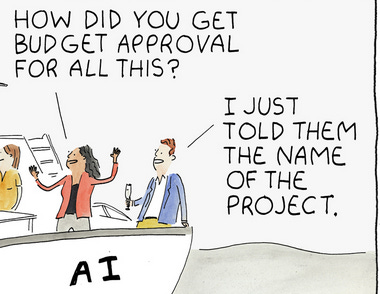
"Silicon Valley is the place where you get rich without creating jobs. It's run by investors who hate the idea of paying people. That's why AI is so exciting for Silicon Valley types: it lets them fantasize about making humans obsolete."
On that, I couldn't agree more. I have said myself that few things look as obsolete as "innovation" today, that the Metaverse is not progress but a reactionary idea and that the only thing AI Tech Bros created is themselves.
Doctorow observes that "if there was any area where we needed a lot of "innovation," it's in climate tech. We've already blown through numerous points-of-no-return for a habitable Earth, and the pace is accelerating", but *"there's a far more dynamic, consequential, useful and _exciting_ innovation revolution underway, thanks to muscular public spending on climate tech", and that is a "green energy revolution - funded by the Bipartisan Infrastructure Act, the Inflation Reduction Act, the CHIPS Act and the Science Act - [that] is accomplishing amazing feats, which are barely registering amid the clamor of AI nonsense and other hype." Examples of this revolution include:
2023 saw 32GW of new solar energy come online in the USA (up 50% from 2022)
Wind increased from 118GW to 141GW;
Grid-scale batteries doubled in 2023 and will double again in 2024
EV sales increased from 20,000 to 90,000/month.
Again, there is no doubt that the biggest problem with "AI non sense and other hype" from Silicon Valley is that it sucks all the oxygen in the room, leaving no time to even consider different issues. However (click on the "(S)" at the end of each quote to see its source):
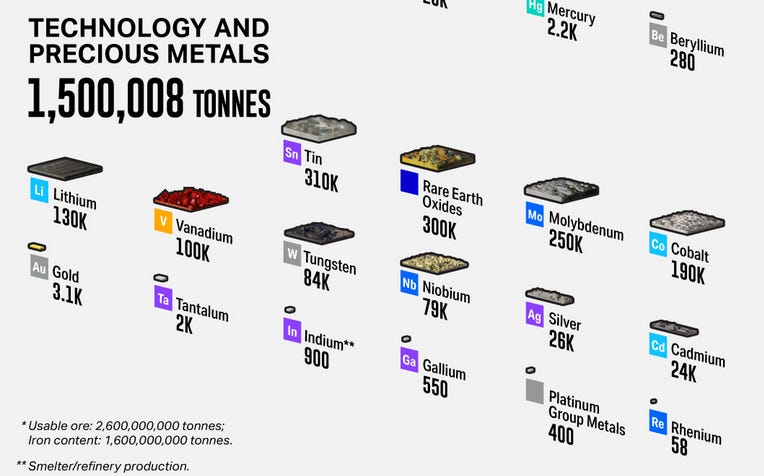
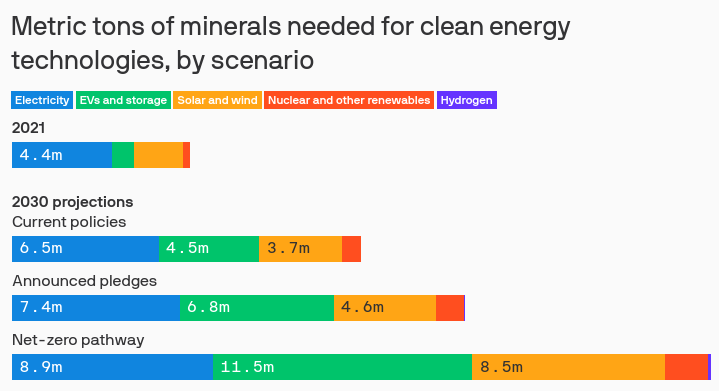
To get to Net Zero by 2050 we’ll need to utilize from seven to 4.5 times the minerals we used in 2021 - up from 4.4 million metric tons to 30.9 million (S)
Smart grids mean higher copper and aluminum use than you could possibly imagine (S)
The copper demand alone for building enough solar panels just to maintain steady-state replacement in a full-scale solar deployment would rival present-day global copper extraction indefinitely (S)
Seafloor nodules could dramatically reduce the environmental impact of extracting the billions of tons of metals needed for a clean-energy transition (S), but that impact would still be huge, and in any case those nodules are another non-renewable resource that, once taken, could take millions of years to come back (S)
If today's demand for EVs is projected to 2050, the lithium requirements of the US EV market alone in 2050 would require triple the amount of lithium currently produced for the entire global market (S)
Even ignoring "rare" metals... Steel, concrete, plastic, and fertilizer (that is, food) are fundamental to modern civilization yet we have no idea how to make any of them at required scale without fossil fuels (S). The literal stuff of our daily lives-no idea how to manufacture it, at scale, without fossil fuels. (S)
A low-carbon power grid requires much more steel (and other materials) than an infrastructure based on fossil fuels. (S)
It is impossible to produce all the new steel that would be needed in electric arc furnaces, simply because there is not enough scrap steel available, and there cannot be, by definition, until steel demand continues to grow (S). Besides, a low carbon grid cannot be made from recycled steel S
Beyond a certain penetration level (and well below 100%), adding more renewables becomes prohibitively expensive, and eventually stops (S)
Renewables only address electricity generation - at least on paper. The main problem is, that the share of electricity in our final energy consumption is around 20%, and the remaining 80% of our energy use still comes from fossil fuels. (S)
That is, the energy transition depends entirely on the availability of fossil fuels. And lacking an energy miracle, it will continue to do so (S), but with oil extraction returning ever less net energy over time... to a point (called "called energy cannibalism") that may make any transition to any other energy source impossible (S). The moment when the world starts to be short of financially sustainable oil could be quite close (S), and possibly come at the same time as peak metals (S)
The least-impossible, least-unsustainable, less slow, large-scale miracle of that kind should be cheap nuclear power (S), but even doubling the number of plants completed in 2022 every year for the next 27 years would increase nuclear to only 16% of total electric power generation (S). That's unlikely to happen, even if my own "Liberty Plan for Small Nuclear Reactors" was 100% correct and started tomorrow
Quoting Doctorow, "All of those [climate tech] workers are out there moving stuff around: solar panels, wires, batteries" and that's the problem. Let's bring in all the real innovation we can in those fields, please, and let's do it as soon as possible! No question about that! Especially if "much of the net zero roadmap is based on technologies that do not exist today". I do agree that "the "social savings" of climate tech are massive. No issue there.
Now, never mind that lots, if not the majority of the raw matter needed to do all that stuff to move around are not inside "first world" countries, but in places like China, Iran, Afghanistan, New Caledonia, the bottom of contested seas and so on. Never mind that "EVs can't be built on a foundation of geopolitical fragility"". Never mind that.
The point is, if even half of those twelve bullets above are true, and even if all the figures they mention were wrong and the real ones were all half bad as that... there would still be simply not enough raw materials in the world to make all that stuff that should be moved around.
Ditto for workers. Doctorow rightly writes that climate tech is "a profoundly physical kind of technology. It is labor intensive. It is skilled. The workers who perform it have power, both because they are so far from their employers' direct oversight and because these fed-funded sectors are more likely to be unionized than Silicon Valley shops.".
Again: good, but will there be enough such workers to make and deploy all that physical technology he quotes, soon enough? Can that happen, in countries rapidly aging, that already cannot find enough electricians (S) to expand electric grids as expected by climate tech (S) and electrify everything as needed (S)? Can that happen, in countries whose young people are less and less every year, but still too often running after education" myths"?
I think it's likely that Doctorow not only already knows all the problems I mentioned here, but also agrees with their magnitude, and indeed the links at the end of his piece do mention those problems. But this is stuff that is never repeated enough, partly because "It Ain't Over 'Til It's Over", and partly because things can still be much better than it may seem by those ominous estimates.
Sensible uses of already existing AI can do a lot of good, but sensible climate tech and a rebooted agriculture are urgently needed, much more than any superhuman artificial "intelligence", and there are not enough raw stuff and people to do both in time. That's it, really. This does not mean that there is no hope and that life can only get worse from now on, no matter what. It only means that there are not enough raw stuff and people to do both in time... until the goal remains "Business as Usual".
Writing WITHOUT abusing any stochastic parrot is how I earn a living. If you appreciate my work, please consider a paid subscription, or read below.
It means, to make just the quickest of many examples, acknowledging that keeping the smartphone or computer you are reading this piece on with for twenty more years instead of one or two wouldn't be a big deal at all. Society-wise, it means to tackle, with appropriate tech and policies instead of Sci-Fi dreams, the real problems we already have, with approaches similar to those I outlined at the end of my previous post. The situation is bad, but life can still be good.
Usual final call: the more direct support I get, the more I can investigate and share content like this with everybody who could and should know it. If you can’t or don’t want to do it with a paid subscription, you may fund me directly via via PayPal (mfioretti@nexaima.net), LiberaPay, or in any of the other ways listed here. And to finish…:
Just an invitation... is a reader-supported publication. To receive new posts and support my work, consider becoming a free or paid subscriber.
A couple of weeks ago, the Honest Sorcerer discussed "the end of science as a useful tool". I would like to contribute with my own reasons why, even if it were true, it wouldn't be a big deal. Science as useful tool is ending, says the Sorcerer, because:
anything like the newest smartphone is not a sign of “unstoppable progress”, just the "industrial scale refinement of technologies based on a set of already established principles".
"when the entire industry you're in keeps hitting the repeat button with every product release, then you know that you are in trouble. A big one."
"Based on the pace of scientific progress till the 1960’s, we ought to be driving flying cars powered by anti-gravitational engines by now. On Mars. But we don’t."
(quoting a 2010 study on Complexity and the productivity of innovation) "Our investments in science have been producing diminishing returns for some time" (more on this later)
"AI will certainly generate material prosperity to a select few, but not to society as a whole" (of COURSE, I say)
The Sorcerer then mentions Sabine Hossenfelder’s three hypotheses for lack of scientific progress (denialism, actual lack of more stuff to discover and a badly broken way to do science) and adds his own: "I would argue, and many teachers would certainly agree: we are already well past our peak in human mental capabilities as a culture." (A newer video by Hossenfelder about the genius who is rebuilding physics on the axyom that 1+1 = 2 would support that hypothesis)
The Sorcerer then moves to the much bigger issue that's outside of science as such, presented in Hossenfelder's video about flat earthers:
“[F]lat earthers are the first symptom of a much bigger problem. They show us what happens when people realize they can’t understand modern science, don’t trust scientists and therefore throw out even the most basic scientific knowledge on the rationale of skepticism. […] Sometime in the middle of the 20th century or so we reached a point where modern science just stopped being comprehensible to anyone without a special degree.
This is important because, of course, it isn't limited to science. Borrowing from Srinivasan and Bardi:
"The faith in the State is plummeting in parallel with that in Science"
"Science, religion, the law system of a state, and some other elements of society we normally take for granted... are all communication tools. You could define them as "languages.""
The Honest Sorcerer rightly points out that "Technology is not science. It is the application of scientific discoveries." For ordinary people, however, science and technology are pretty much the same thing, and in any case the useful tool whose end would really matter for them is technology, not science. Are they ending? I can't exclude that, having said myself that these days there is little as obsolete as what the most visible people call innovation, and even stuff like the Metaverse is just narrow-minded, reactionary thinking.
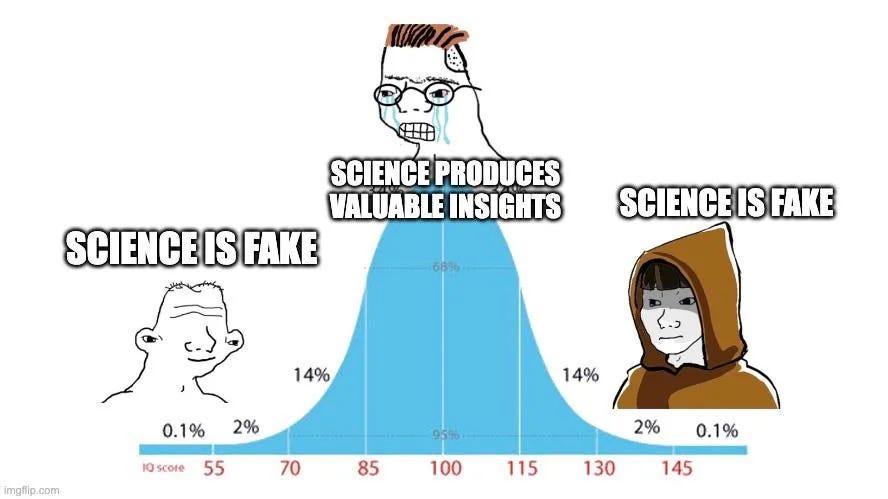
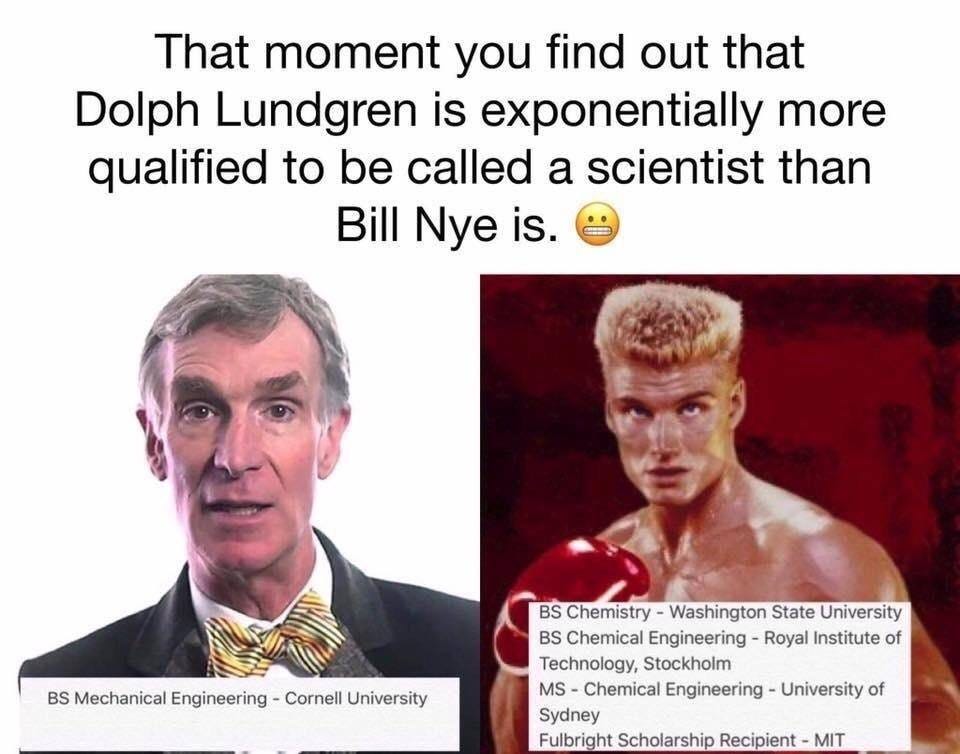
Now, let me add my own hypothesis. Hossenfelder is surely right to say that science stopped being comprehensible to anyone without special degrees. However, I don't think that's why people don't trust scientist, or something we should seriously worry about anyway.
To begin with, I argue that common people lost faith in both technology and science not because they do not understand them anymore, but because they do not understand the problems that those disciplines triumphantly declare they solve, or will solve.
That is, the problem is not that quantum physics is impossible to master without years of hard study powered by the right genes, which it is. The problem is when those "languages" are used, by the usual suspects who suck all the oxygen in the media, just to talk, no: sell crap. Especially if it's the crap only they sell.
The problem is that, even if we are tricked to buy them, we are frustrated from the impossibility to understand what's the damned REAL problem and need that e.g foldable smartphones, home appliances that can be bricked WITHOUT your consent or fake autonomous vehicles are supposed to solve and fill. Attempts to really, sincerely believe that certain innovative, maybe even AI-powered services may work at scale better than what we used before can be equally disheartening. Dating apps, anyone?
This post is public, so please share it as much as you can, inside and outside Substack.
Apart from that, what's hard to see through all those smokescreens is that there would be nothing bad, even if we really weren't smart enough to do more science, or science really had nothing new and useful to offer anymore.The full paragraph (quoted by the Sorcerer too!) of that 2010 study says:
"Our investments in science have been producing diminishing returns for some time. Within a few decades, our results suggest, we will have to find new ways to generate material prosperity and solve societal problems."
Exactly! Even if that were true, in every field of technology, so what? Really, what would the actual problem be? We reached the end of development of scissors, cups and everything other "oldest mostly-unchanged tools that we still use" centuries ago, but so what? Did those things stop to be useful?
We just have to replace "find new ways" with "go back to, or rediscover" certain ways.
The only way in which the end of science and technology would really be a problem is if they really were the only "way to generate material prosperity and solve societal problems", instead of "the way most fashionable today". But first, that is obviously false: human beings and humanity have always been much more than science and technology. If anything, the problem has always been to see science as THE first or sufficient tool to generate prosperity etc etc.., instead of stuff like solidarity, common sense and real politics in general.
Second, there is still so much to with the science and technology we already have to make us accept any "end" or more exactly temporary stop of science for a few decades. We already have all the science we need to solve REAL problems we actually have now. We already have all the "science" we need to, if not to solve, at least make much more manageable, problems like, in random order:
Writing WITHOUT abusing any stochastic parrot is how I earn a living. If you appreciate my work, please consider a paid subscription, or read below.
city traffic, with public transit and reserved lanes for bikes and, of course, scooters done right
AI religion (not AI!), with common sense
costs and slowness of nuclear power, with an SMR Liberty Program
Impulse shopping, Amazon's monopoly and carbon footprint with making of Amazon a SLOW standard, and Singapore-style shipping
the end of work, with seeing things in the right order
almost all the problems created by social media and smartphones, with understanding that they are not the same thing, that RSS is good and so would be really personal clouds
obesity and some mental health issues, with the good old "Eat Food. Not Much. Mostly vegetables" rule, combined with slowness, at alll levels
PLEASE, do add other big problems and their solutions with appropriate technology in the comments!
Demand policies like those that from your political representatives, and 99.99999% of any sadness you may feel because science is ending will go away.
Usual final call: the more direct support I get, the more I can investigate and share content like this with everybody who could and should know it. If you can’t or don’t want to do it with a paid subscription, you may fund me directly via via PayPal (mfioretti@nexaima.net), LiberaPay, or in any of the other ways listed here.
This week on my podcast, I read Against Lore, a recent piece from my Pluralistic blog/newsletter, about writing and the benefits of nebulously defined backstories.
Warning: the last few minutes of this essay contain spoilers for Furiosa. In the recording, I give lots of warning so you can switch off when they come up.
One of my favorite nuggets of writing advice comes from James D Macdonald. Jim, a Navy vet with an encylopedic knowledge of gun lore, explained to a group of non-gun people how to write guns without getting derided by other gun people: “just add the word ‘modified.'”As in, “Her modified AR-15 kicked against her shoulder as she squeezed the trigger, but she held it steady on the car door, watching it disintegrate in a spatter of bullet-holes.”
Jim’s big idea was that gun people couldn’t help but chew away at the verisimilitude of your fictional guns, their brains would automatically latch onto them and try to find the errors. But the word “modified” hijacked that impulse and turned it to the writer’s advantage: a gun person’s imagination gnaws at that word “modified,” spinning up the cleverest possible explanation for how the gun in question could behave as depicted.
In other words, the gun person’s impulse to one-up the writer by demonstrating their superior knowledge becomes an impulse to impart that superior knowledge to the writer. “Modified” puts the expert and the bullshitter on the same team, and conscripts the expert into fleshing out the bullshitter’s lies.
Hello, everyone. Very sorry I’ve neglected you. I’m working on a big new trad-WTG post, things have just gotten…complicated in my world. So I thought maybe something lighter and more fun would be a nice palette cleanser while I finish up both the post and the convention in Denmark where I am currently Guest of Honor and Not In My Time Zone. (Hey if you did not know, I am also a science fiction and fantasy writer!)
Yeah, so, well…depending on how many other streams you follow me on, you may or may not know that I have separated from my partner—it its a very stressful, anxiety-churning, financially ulcerating, and uncertain time in my world. I have no other way to excuse my silence but by saying there is pain, and there are ways through it, and not all of them are out loud.
So I made some stupid meaningless art, because that’s the only thing I know how to do when I’m lost. And I thought I’d share it round.
When I had the original idea to do this, several deadlines ago, I figured I'd post it under a paywall. Maybe people would give a little something for original micro-micro fiction.
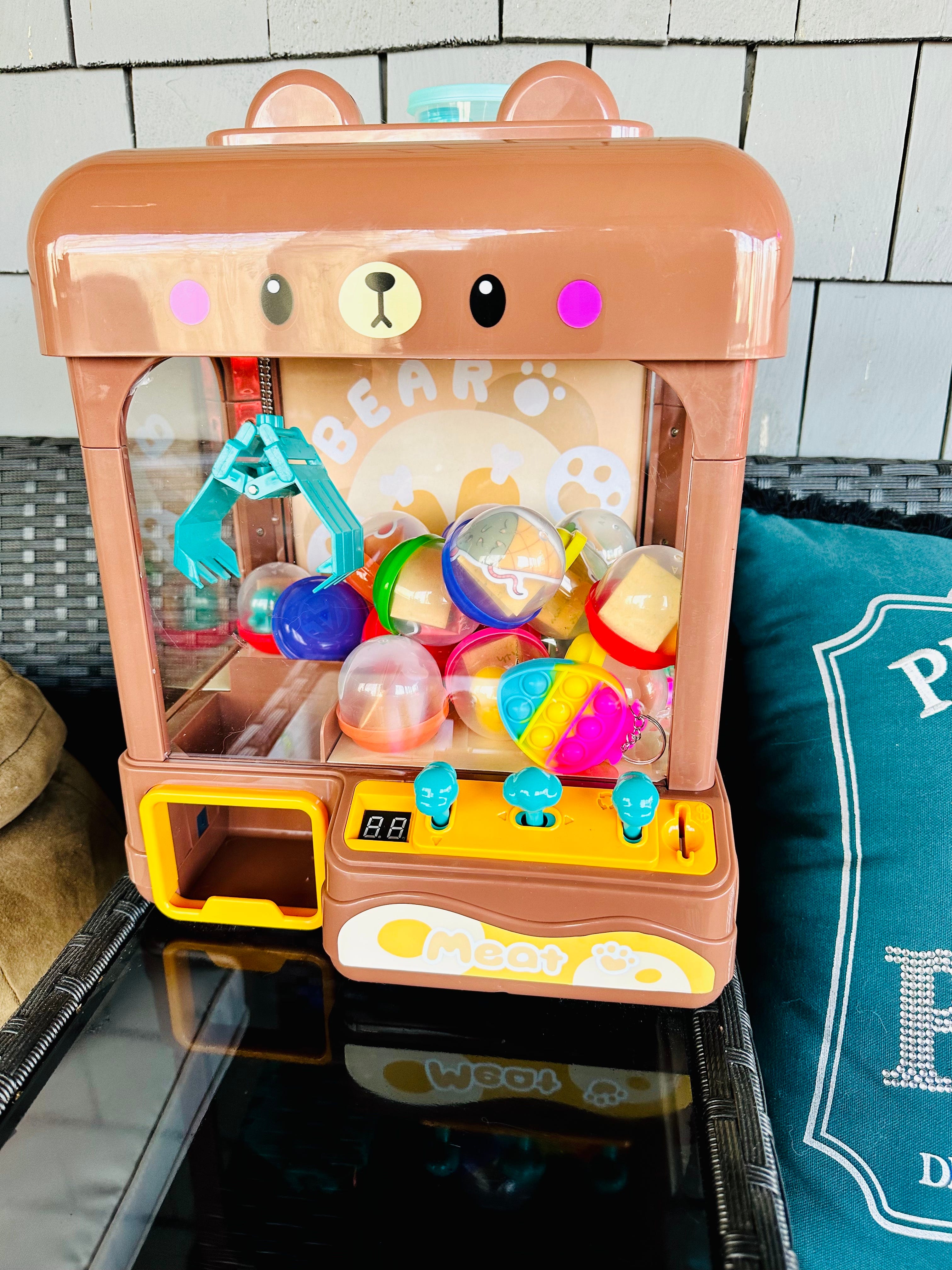
But honestly I'm just so pleased with it I'm making it an open post so everyone can see what, specifically, is wrong with me that I would, while literally and actually losing hair over multiple by-wooshing deadlines and struggling to pay the cat's medical bills, feel compelled to buy a novelty claw machine which IN NO WAY TAKES REAL MONEY, and fill it with hand-written fortunes/mini-stories as a stress-reliever.
OKAY SO FIRST OF ALL.
Depending on how long you've known me, been following me, and/or reading my fiction, you may or may not know about my THING with claw machines.
My thing is I always win at them.
Now, I have strategies and philosophies about it, and a little knowledge of how the machines work as a last-ditch if none of the aforementioned philosophies or strategies seem likely to work out AND YEAH I MEAN OBVIOUSLY THE PHILOSOPHIES ARE CONVENIENTLY RELATABLE TO LIFE IN GENERAL I AM WHAT I AM. (Number one rule: you cannot care what you get. The goal is not to win a specific prize, it's to beat the machine. To get a prize at all. If you happen to want a prize that's advantageously positioned, good for you, but the ways of the machine are wily. If you care what you get, you've already become attached to an outcome that's mostly outside your control and the machine has won.)
But that all came later, reverse engineered from, and to explain, the fact that since I was about 10 years old, 9 times out of 10, if I walk up to a claw machine, I'm not walking away empty handed.
That bit of The Difference Between Love and Time where the protagonist is ten years old in Ocean Shores, WA, wins at the Time Claw, gets approached by a tiny kid asking her to win for him, which she does and goes forth always able to from then on? THAT SHIT IS ACTUALLY TRUE. It really happened, in that place, when I was 10, and ever since it's probably the only real superpower I got.
I FUCKIN LOVE CLAW MACHINES.
Do I want a real life-size actual one in my house? Of COURSE I do. But those bad boys are anywhere from $2000-$4000 and ain't nobody got cash for that. Not in this economy.
But awhile ago, while I was building the Speakeasy, I had this notion that maybe I could find a little wee dinky one. And when people came to the Speakeasy, they could get a fortune. And clearly they would be super rad cool original fortunes/mini-fictions/tone-poems by me, and in my head all this was just unassailably awesome.
Turns out, you can get a little wee dinky one for a cool $40.
Especially if, for no reason any human could ever fathom, it says BEAR MEAT in large, friendly bubble letters on the front. With a cute cartoon paw print for punctuation.
Spoiler: it did not come pre-loaded with bear jerky.
There were a lot of color and design options available but COME ON YOU KNOW I HAD TO GET THE WEIRD BEAR MEAT ONE. I probably would have given it a whimsical little name, too, but it says BEAR MEAT right on it, and bears have claws, so there's some logic there, and you're just never going to beat that in the Naming Inanimate Things Olympics.
I thought I was ready to go. But the capsules that came with it were way too small to hold folded up pieces of paper comfortably (ridiculously small, like they'd have been lucky to handle a single lonely Skittle) so I had to go order larger ones to achieve my dumb-ass dreams. Dreams that, at that point, I did worry were a bit out of my reach. I didn't have any ideas for shit to write in there, I was way overworked and no idea not immediately applicable to a book or story dared show its face in my brain. But whatever. My brain usually shows up on the night, even if it takes its SWEET GODDAMNED TIME.
So I found a kit full of capsules and toys and stickers that was the same price as plain capsules without toys and stickers, and I have a five year old, so hell yeah I chose that one.
Oh my god, the stickers and toys in that kit saved the whole half-baked scheme. THEY WERE ALL WEIRD AS SHIT. I mean, I guess there were a few fidget poppers and finger skateboards in there, but almost everything in the box looked like it arose unbidden from some seemingly-adorable-but-secretly-highly-disturbing anime I'd never heard of.
Why the fuck is that rat in an ice cream cone. I ask you. THAT IS NOT WHERE RATS GO. F SAFETY RATING FROM THE HEALTH BOARD.
Coming up with fortunes turned out to be not much of a problem at all, given inspiration like that. I spent about an hour writing out whatever popped into my head. I made myself rules no one else cares about but I NEED RULES OKAY. No discarding or editing, composed in pen so no erasing, No longer than five minutes to make each one, then on to the next. Bastian picked the sticker or toy, handed it to me, I wrote the mini-fic to go with it, sealed it up, popped it into the back of BEAR MEAT, and by dinnertime we were in business.
By which I mean not in business at all, as this thing takes only fake plastic novelty coins so it's not like any income whatsoever will ever be generated here, it's just...I don't know. I was moved to do this dumb crap, and now there's BEAR MEAT on my porch.
Now people pull a fortune when they come over and...well, honestly, they rarely know what to do with what they just read. I modeled the style a bit on this old horoscope column that used to run in the Sacramento indie rag when I was a teenager. I highly doubt they were ever based on real astrology, but we loved them for how weird they were. So sometimes people just look at me like I stabbed them in the heart when they read one and I FIND THAT VERY SATISFYING WHAT CAN I SAY?
My last job before I became a full-time writer was as a professional fortune teller (also a thing that sounds fictional but is not, and honestly, kind of amazing training for writing short fiction), and now I get to be that again a little.
Now I know a whole lot of folk pooh-pooh any and all mysticism or "woo" and that's fine. Much like the Claw Machine, I was always weirdly good at it, and while I had strategies and philosophies (YES YES ALSO APPLICABLE TO LIFE), mainly, they were reverse-engineered from what I quickly came to understand people were actually after: a little comfort, a little confirmation that whatever they'd already decided to do was the right choice, a little connection, a little touch of magic, or even the hope of magic, in an unremarkable day.
So don't get mad like I'm claiming to actually predict the future with these. Part of what I have always found very real and sacred about all forms of prognostication, regardless of culture, is the bedrock assumption that there can be and is divinity in randomness. That the card you draw, the stalk you case, the dice you roll, the stars' position at your birth, the flip of a coin, any simple action, has personal and significant meaning. That is so fundamental to the entire concept of fortune-telling it doesn't even get acknowledged or discussed. Without a silent agreement to try to believe that for a second, it all falls apart. Sure, some people believe a subset of humans is just straight-up psychic, but most fortune-tellers use tools that are designed to be randomly arranged/selected/mixed/drawn. And the Schrodinger's Faith the reader and the querent share for a brief moment is that this randomness is not truly random. If we try, we can understand the order this randomness expresses.
It's a terribly human search for, and conscious manufacture of, literary foreshadowing in real life.
Which is why I never called myself a psychic and don't like the word, even when I break out the cards now. I'm not psychic. But I'll tell you your fortune, and on a long enough timeline, it'll probably foreshadow something in your life pretty eerily well.
Stories do that.
And we all need a little hope of magic. Hope that the randomness of life might not be completely pulled out of the ass of the galactic core.
These are some of my favorite fortunes. I know my handwriting is a bit idiosyncratic and many internet folk have visual or other issues that make image-only problematic (which I 100% just typed as problemeatic THE BEAR STRIKES AGAIN), so I've transcribed them for ease of giggles.
There's obviously a lot more than these, but LIKE THE GENIUS I AM I forgot to take photos of each one before loading up the machine, and ADHD means always having a brain that won't go back and re-do a task even if /especially if the fix is very simple because awwwwww but I already diiiid that. So I wait til someone draws one and make them send me a photo of what they got. So this is what's been "won" so far.
I hope you enjoy these as much as I have been enjoying making them. I'll restock BEAR MEAT soon and continue to share the fortunes if you guys enjoy them--I'm oddly proud of this little extreme, pretty pointless, micro-fiction experiment. POINTLESS ART IS ACTUALLY PRETTY IMPORTANT IN THIS FALLEN WORLD. It's just so much fun to be a Forest Witch with a Cauldron of Destiny next to the mulch and the mosquito repellent!
PLEASE TO ENJOY BEAR MEAT IT IS DELICIOUS AND PORTENTOUS.
Nothing random. Only not yet understood.
***************************
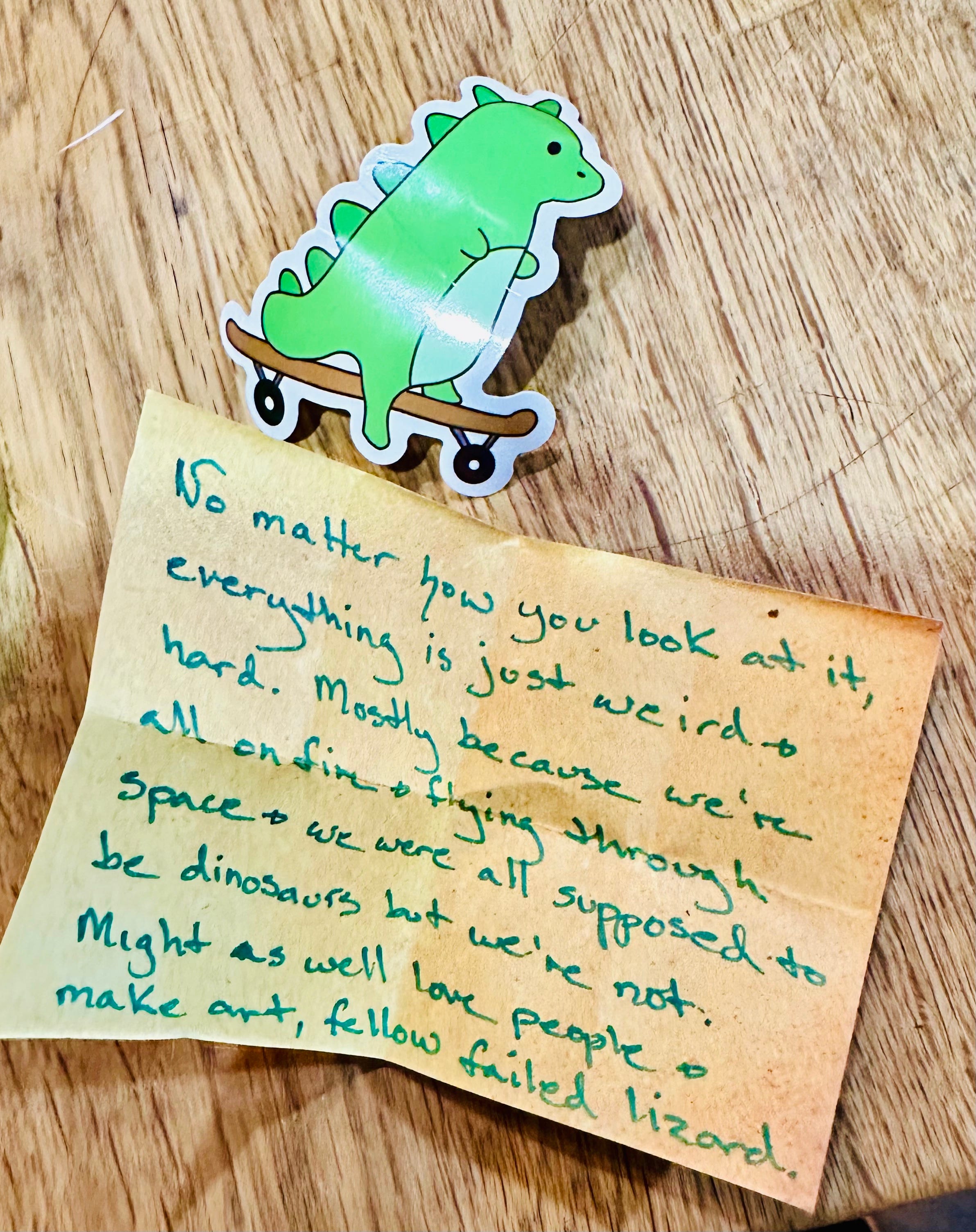
No matter how you look at it, everything is just weird and hard. Mostly because we're all on fire and flying through space and we were all supposed to be dinosaurs but we're not. Might as well love people and make art, fellow failed lizard.
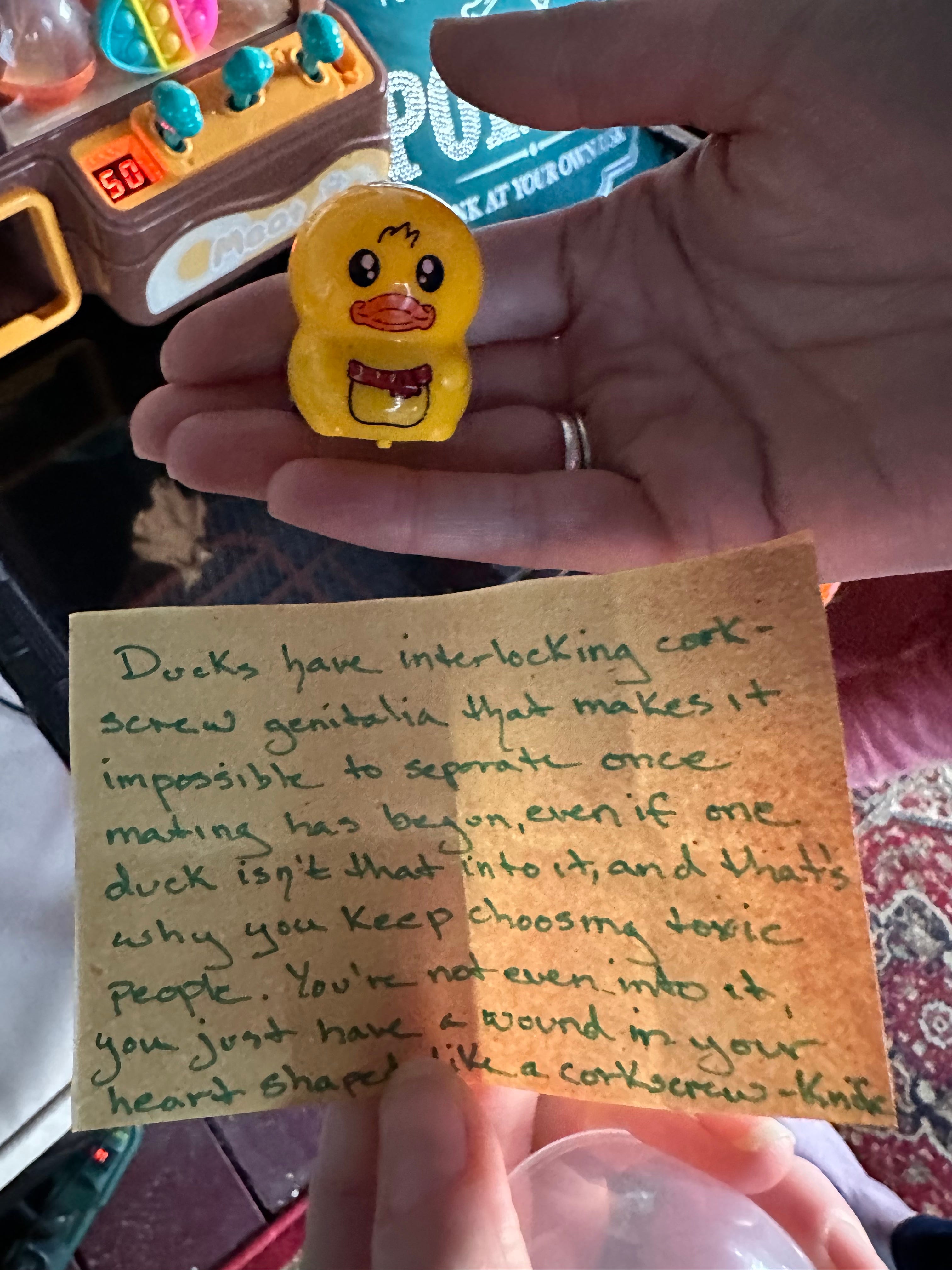
Ducks have interlocking corkscrew genitalia that makes it impossible to separate once the act of mating has begun, even if one duck isn't that into it, and that's why you keep choosing toxic people. You're not even into it, you just have a wound in your heart shaped like a corkscrew-knife.
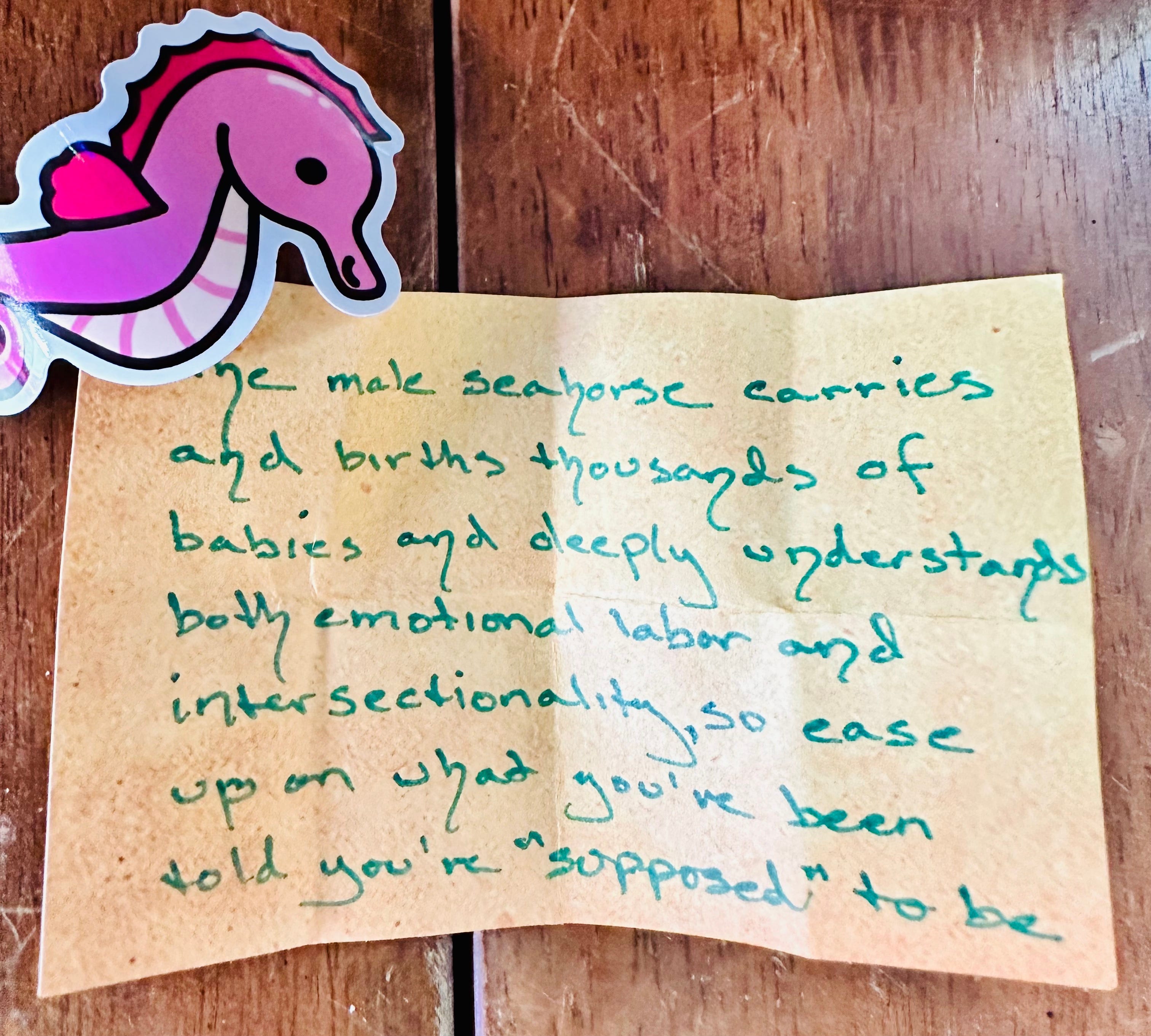
The male seahorse carries and births thousands of babies and deeply understands both emotional labor and intersectionality, so ease up on what you've been told you're "supposed" to be.
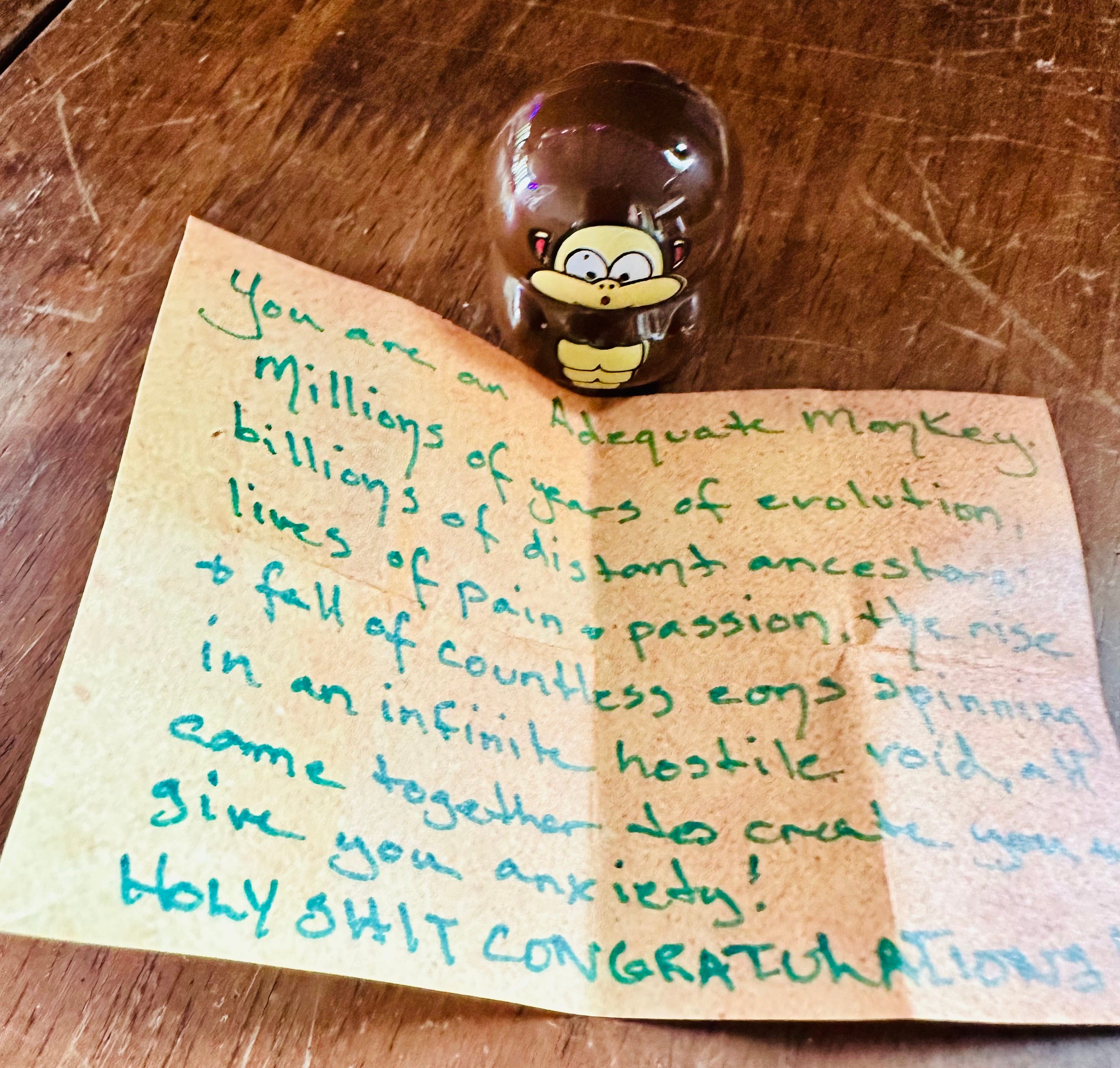
You are an Adequate Monkey. Millions of years of evolution, billions of distant ancestors' lives of pain and passion, the rise and fall of countless eons spinning in an infinite hostile void, all came together to create you and then give you anxiety. HOLY SHIT, CONGRATULATIONS!
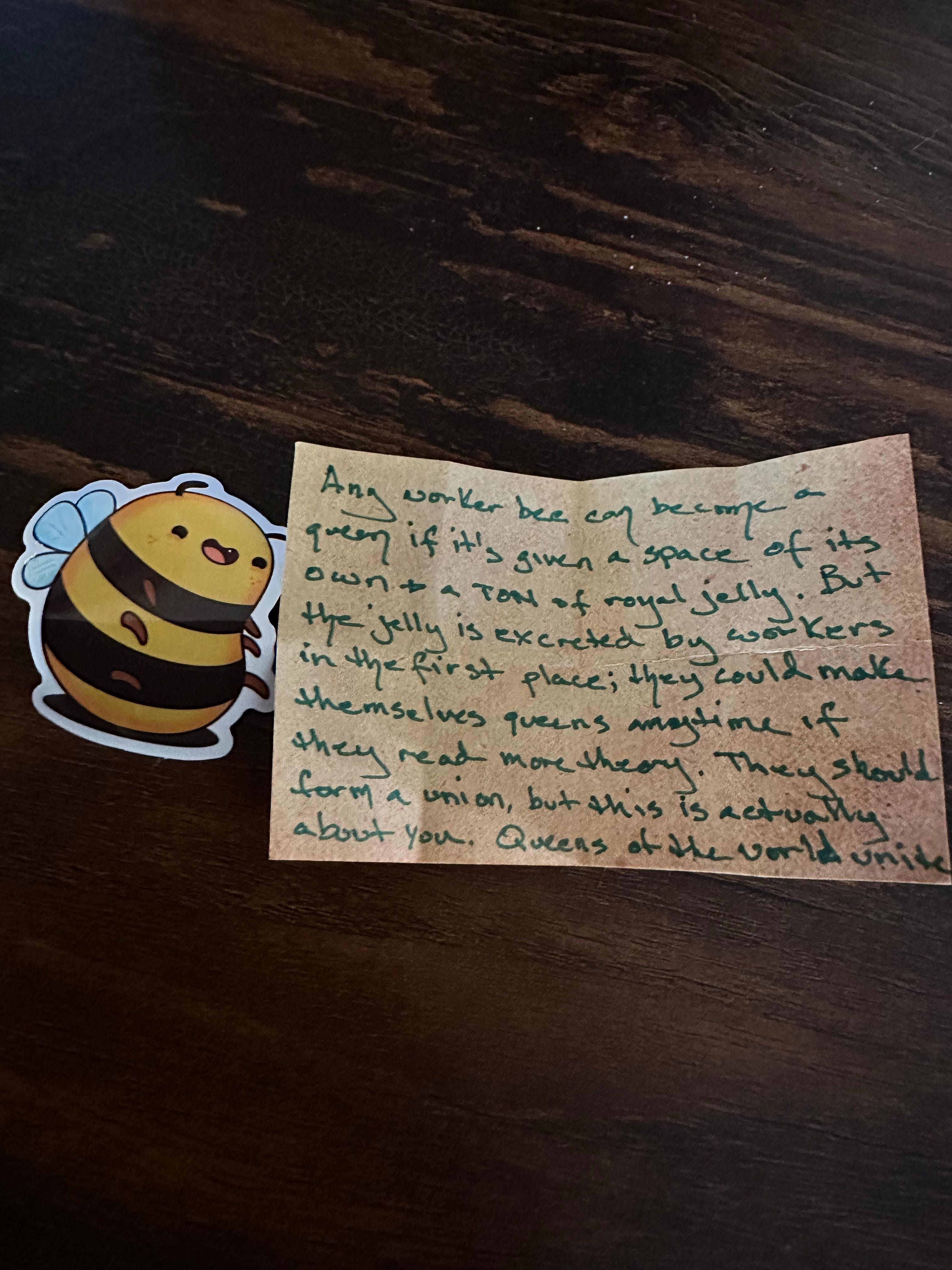
Any worker bee can become a queen if it's a space of its own and a TON of royal jelly. But the jelly is excreted by the worker bees in the first place; they could make themselves queens anytime if they read more theory, They should form a union. But this is actually about you. Queens of the World Unite.
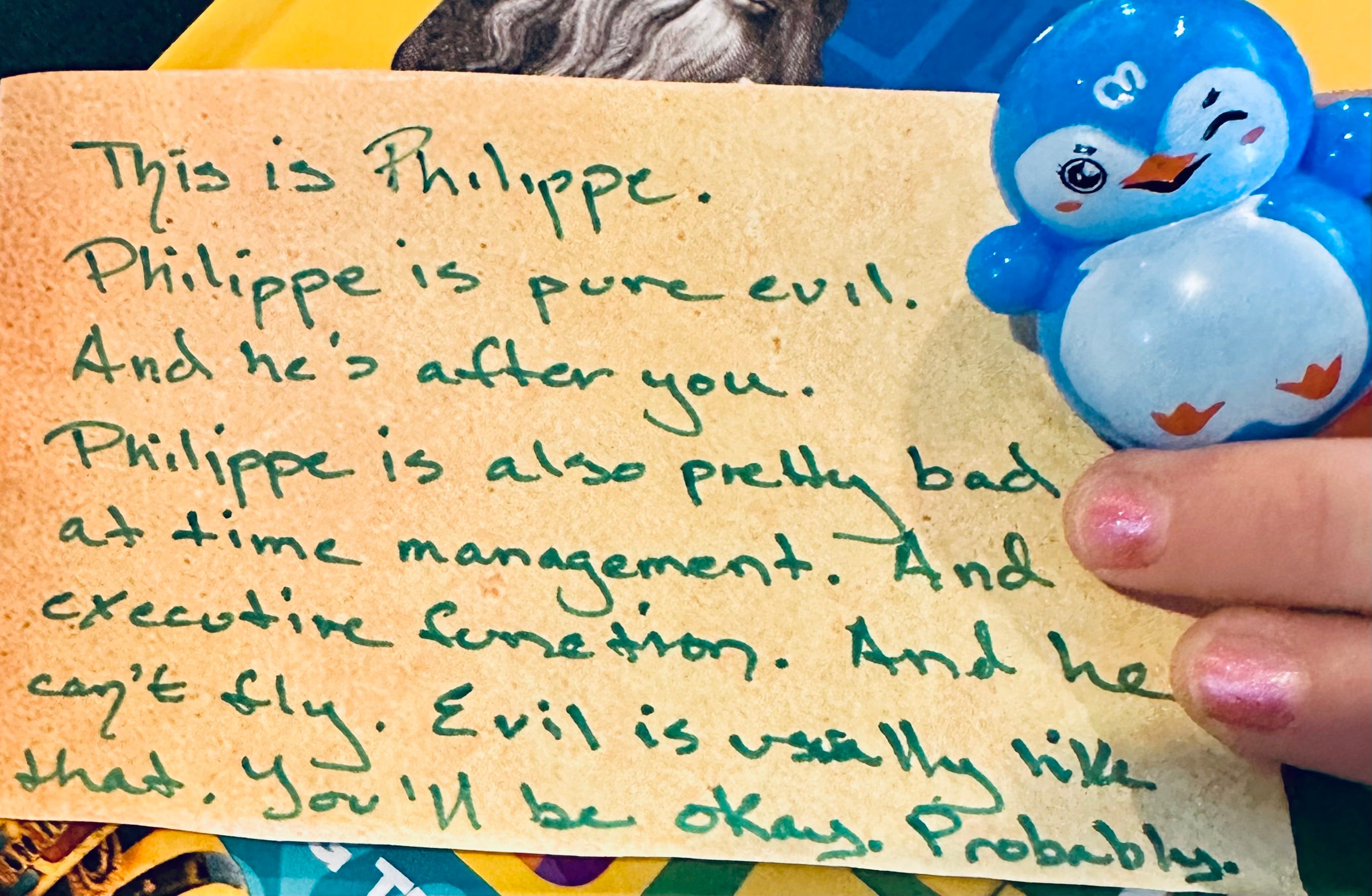
This is Philippe. Philippe is pure evil. And he's after you. Philippe is also pretty bad at time management. And executive function. And he can't fly. Evil is usually like that. You'll be okay. Probably.
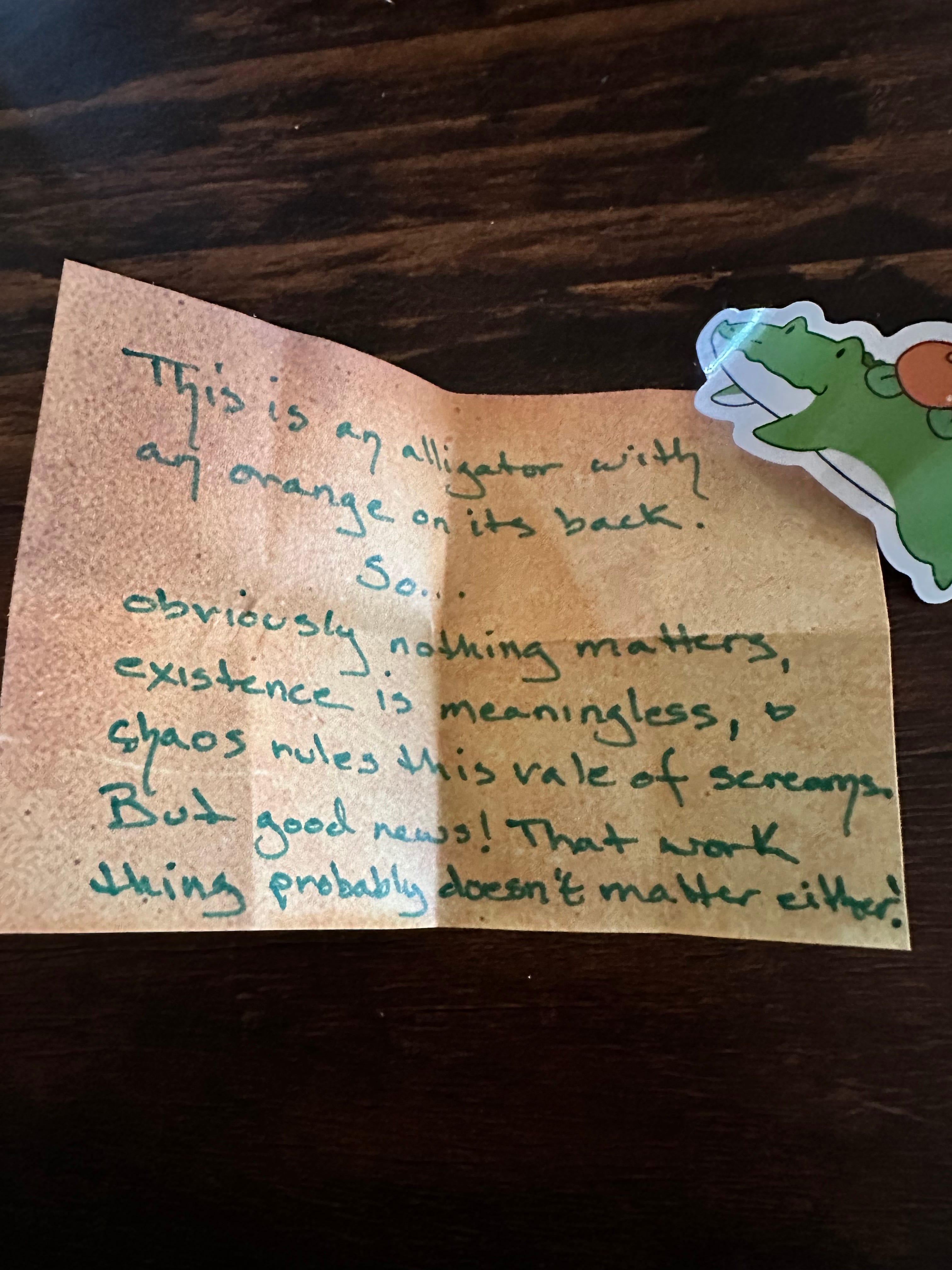
This is an alligator with an orange on his back. So...obviously nothing matters, existence is meaningless, and chaos rules this vale of screams. But good news! That work thing probably doesn't matter either!
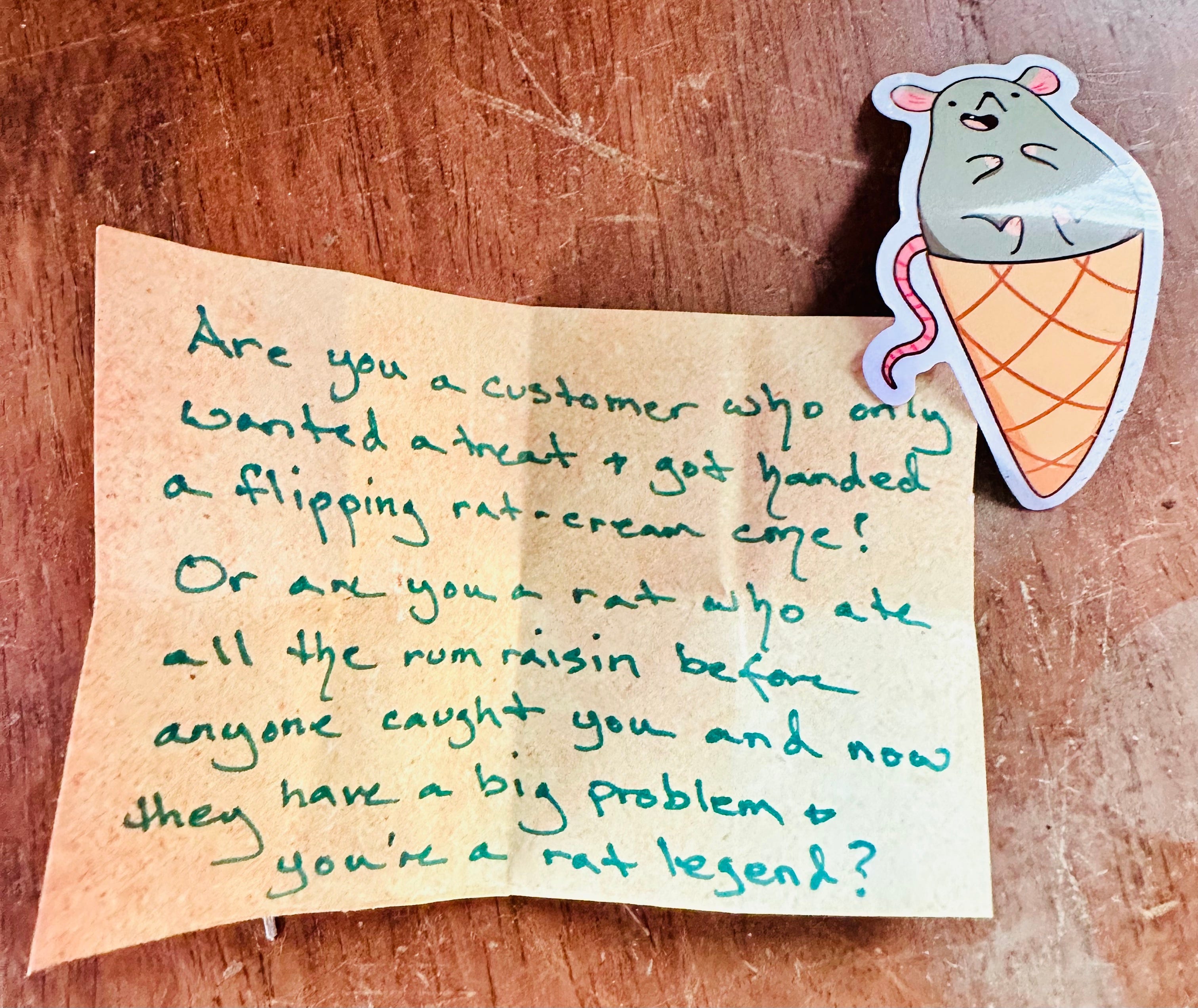
Are you a customer who only wanted a treat and got served a flipping rat-cream cone? Or are you a rat who ate all the rum raisin before anyone caught you and now they have a big problem and you're a rat legend?
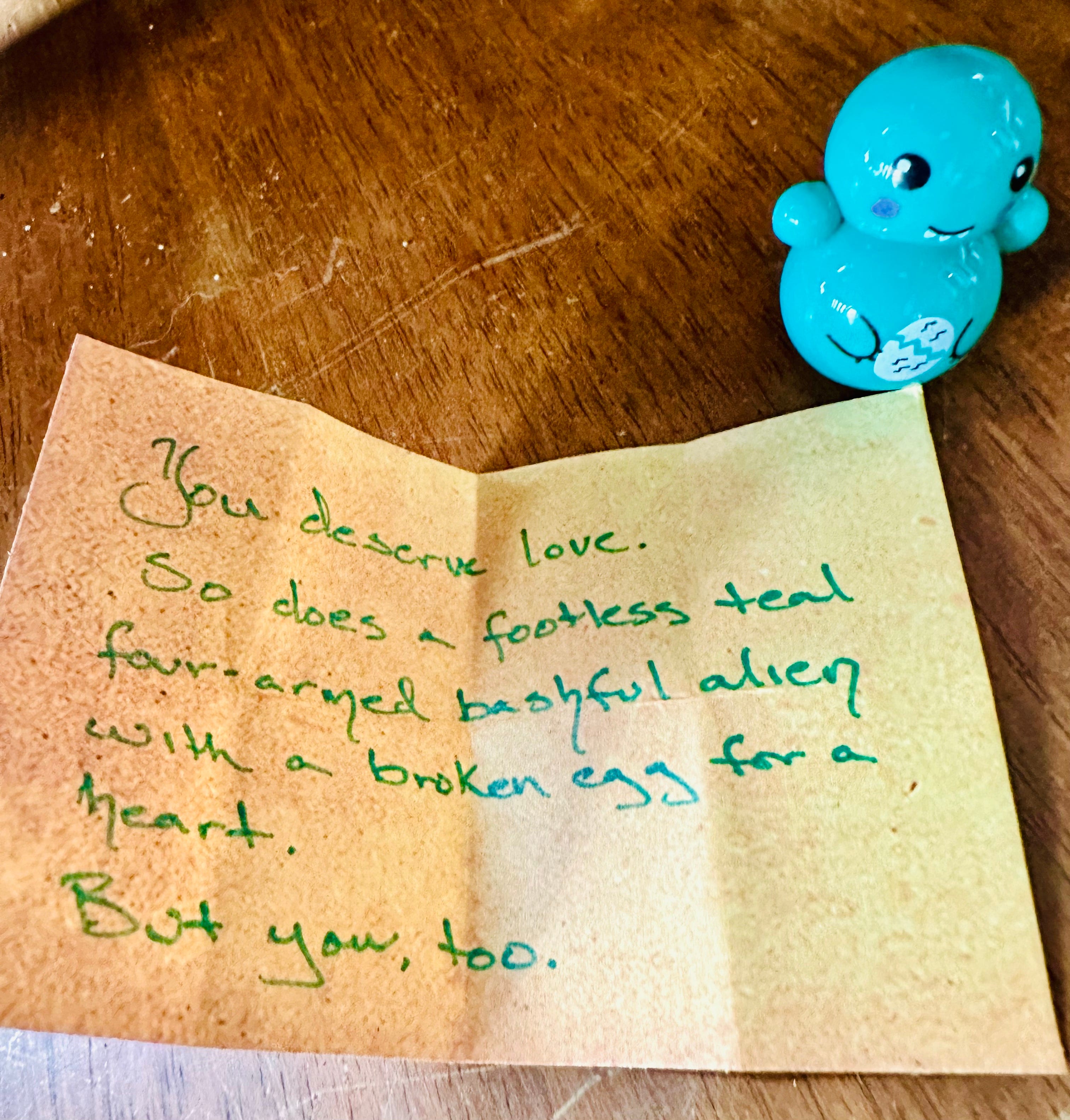
You deserve love. So does a footless teal four-armed bashful alien with a broken egg for a heart. But you, too.
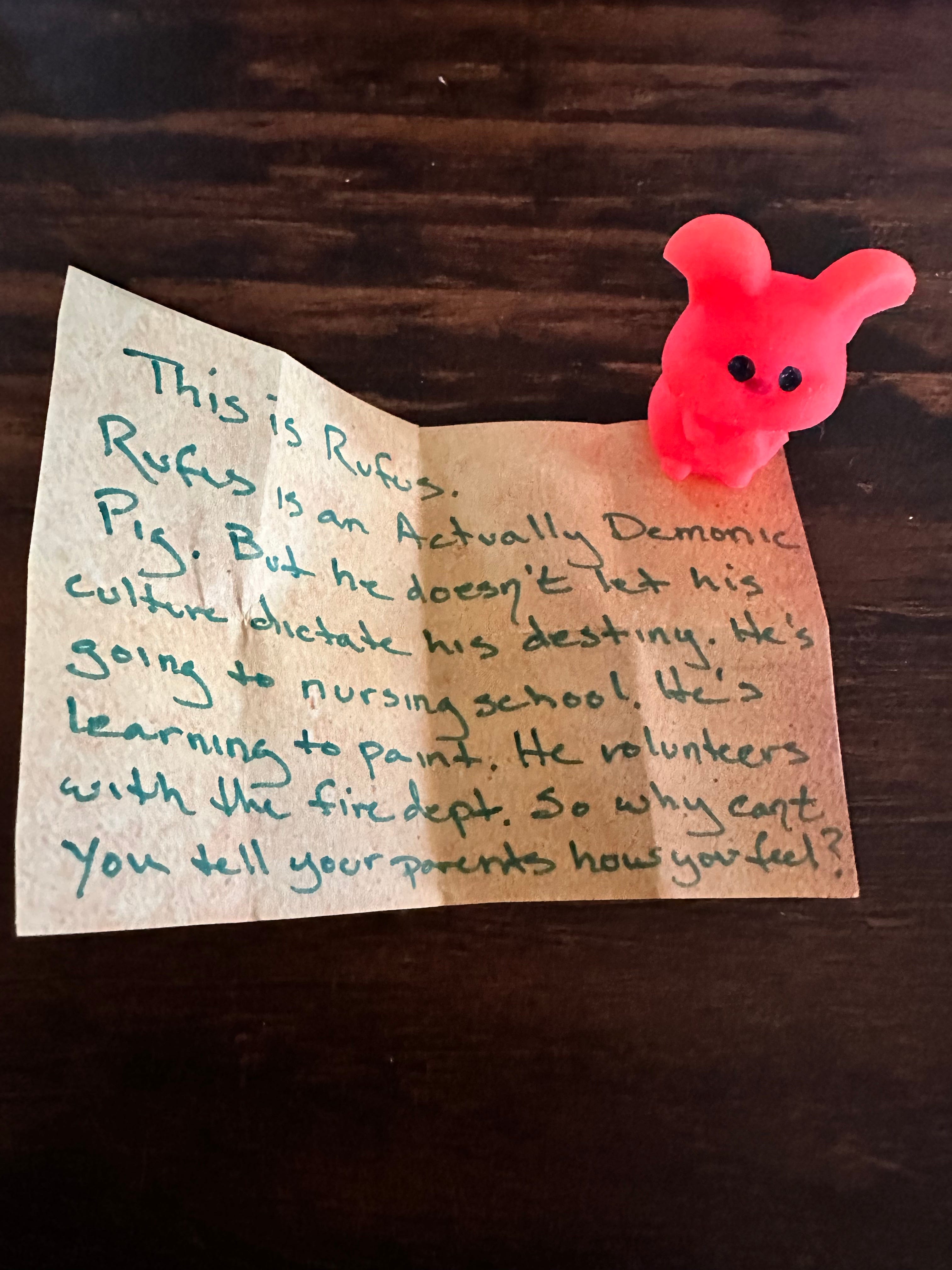
This is Rufus. Rufus is an Actually Demonic Pig. But he doesn't let his culture dictate his destiny. He's going to nursing school. He's learning to paint. He volunteers with the Fire Department. So why can't you tell your parents how you feel?
Welcome to Garbagetown is a reader-supported publication. To receive new posts and support my work, consider becoming a free or paid subscriber.
Thank you for reading Welcome to Garbagetown. This post is public so feel free to share it.
Some days ago I heard a radio interview to workers and union representatives of a FIAT/Stellantis car manufacturing plant in Italy, that was halting production because it is not convenient anymore. The thing that impressed me the most in the interviews were people declaring that “in Italy we produce too few cars!”, because I was listening while completely stuck in traffic: I had hundred of cars in front of me, behind me and on my sides.
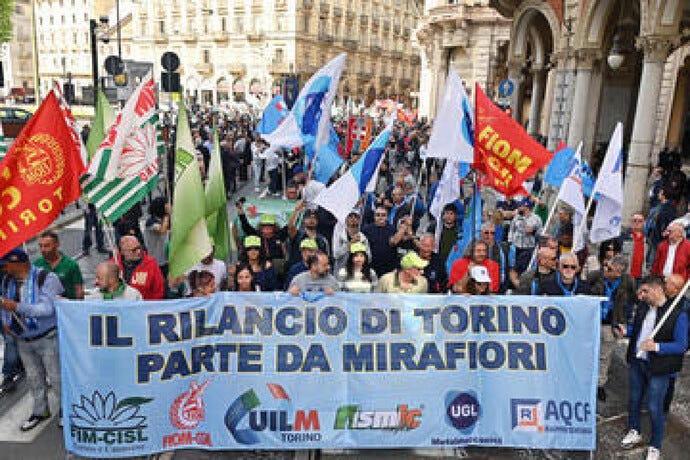
Here’s the trick: the most important part of the paragraph you just read is that I did not write it this month of May 2024, when Stellantis stopped the assembly line of the electric FIAT 500 in Turin. I wrote it almost fifteen years ago, when FIAT, its workers and their unions were playing exactly the same script about the stop of another FIAT plant, in Termini Imerese. As in, we really haven't learned anything in fifteen years.
But maybe now we are to the point where there is nothing to learn, just an already well established reality to see. We need to see what comes after the car and who will do it, because the car as a mass phenomenon is already dying, for all the reasons I wrote here, and all these that came later:
High borrowing costs are eroding Americans' appetite for big pickups
The enormity of many cars, not just American ones, also is a "desire to wall oneself off from the world, to float above degraded infrastructure and the threat of violence even as one contributes to both". That is, a mental and social health issue to solve as soon as possible
Signals that we already are in the "early days of decrossoverification" and that the "End of Private Cars" has already begun even in American cities keep coming
More people want what the Dutch already have : "streets that everyone, from the youngest children to the most elderly adults, would feel safe using."
More and more people will drive their current cars till they fall apart, not because doing so does save a LOT of money, but simply because they cannot afford otherwise.
For many others, their first electric car may be just the gas-powered one they are driving now
Smart cars are still so dumb that they may cost you hundreds of dollars just for something as stupid as fuses for talking to satellites that shouldn't even exist (1)
Driverless will never be really driverless (not soon enough to matter for those who would really want to make or use driverless cars now, at least): not if, as we can learn from the NHTSA investigation, the Waymo company with "an overwhelming lead in making autonomous cars that work", is the same Waymo company that is "not even close" to dealing with road construction and road emergency situations
Even bigger fantasies like air taxis remain luckily unviable, because if they did become real, they would just move traffic jams up in the air (me, 2018) (2)
Ford is "shifting its strategy for EVs as demand wanes". The 2024 New York International Auto Show was unimaginable even a few years ago: "no Chrysler, Dodge, Ram, Fiat, Alfa Romeo, or Maserati...[almost no] German manufacturers".
I said this years ago, and I'll repeat it now: I fail to see how carmaker stocks can still be considered a long- or even medium term good investment. The mass car of 2024 is just another culture that "rose to the top of their arcs of progress… Only to experience a fall and a subsequent dark age thereafter. And most ironically... developed their most sophisticated technologies right before their demise" (source).
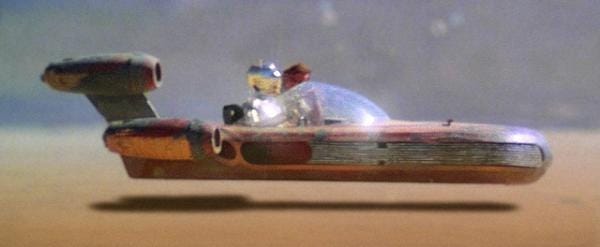
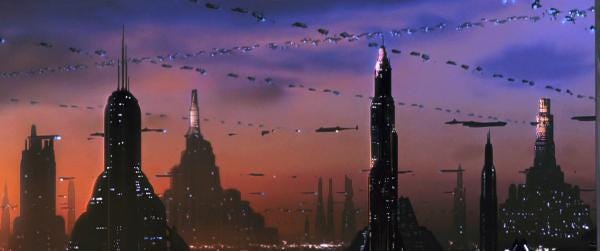
What comes after the cars of today may not even be cars. If you ask me, if cars for mass private transits weren’t dying period, personal hovercrafts would be a cool, real life version of Luke Skywalker's landspeeder, that would be perfect in the real towns of our real world that are already reducing paved infrastructures. On a more realistic level, the vehicles that are powering an EV revolution in India, and generally electrifying faster than basically any other type are not cars, but highly effective rickshaws. An even bigger, even cheaper and easier revolution may be subsidized PRIVATE scooters.
But sticking to cars... The engine type doesn't matter. A mass car industry can exist only if car remains a mass product. In a world where population keeps concentrating in cities, rural residents may certainly still need and keep huge SUVs or pickups, but they would very likely have to build them by themselves, Mad Max style, or pay them as much as a house.
The only "mass" cars that can survive are cars that will bury all current car makers. First, simply because of cost and lack of space, there will be too few, mostly shared cars where most people are going to live (cities) to keep Car Business As Usual profitable. Second, because those cars will have to be beyond the capability of most current carmakers to adapt.
These are crucial matters! Please share this public post as much as you can, both in and outside Substack!
We have billions of battery-operated devices of all sort because their batteries, being small, fungible commodities that only exist in a few tens of fully standardized models, can go inside any device made for them, and even be moved from device to device, anywhere in the world. To survive, cars must become like those batteries.
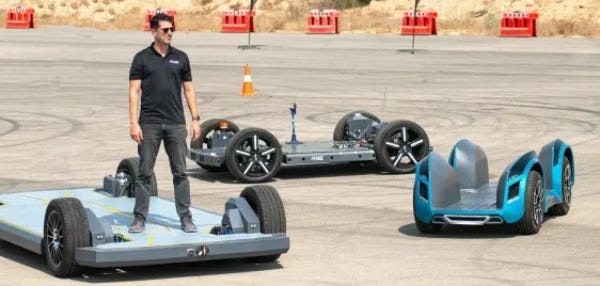
Imagine a "car" that is only a flat platform you can plug "inside", that is below, any car body you ordered separately, including ones you may rent for special occasions, e.g. going to a fancy wedding.
Imagine a car like that, much simpler, much cheaper because it's much more modular, based on few standardized frames shipped in flat packages like Ikea furniture.
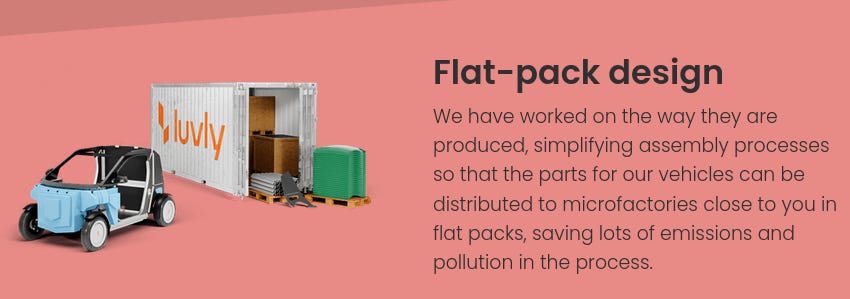
Imagine such a car coupled with laws that make its repair by any independent technician really easy and affordable for decades, with open protocols that directly connect buyers and sellers of spare parts.
Such real innovation is the only way for cars to survive, and at some point it WILL happen simply, if nothing else because all the alternatives are already withering away. To make it happen in the least traumatic way possible though, two things are necessary, starting yesterday:
Lots of future-, not market-oriented regulation and standardization
Super-optimized manufacturing and distribution
The only organization that has both enough influence and is not close, but less distant than any other to the right mindset to make the first point start now is the European Union. The EU just loves to regulate, and this is its real, not perfect but usually beneficial soft power. The only organization that can do the second point soon enough is China. Assuming it’s not already doing just that, of course. Says here, about a Chinese car that sells around $12,000 in China, with craftsmanship comparable to vehicles that cost three times as much:
Any car company that’s not paying attention to BYD as a competitor is going to be lost when they hit their market
"Chinese EVs are so good that without trade barriers, they will pretty much demolish most other car companies in the world”
Summing up, the solution, or more exactly the only unavoidable future for a car industry that is also sustainable, whatever you mean by sustainable, looks a lot like managed "rightsizing" by EU-driven regulation of Chinese production of EV, or at least hybrid cars. A hugely difficult task, yes. Wars have happened for much less. But if the EU and China were smart enough to partner on this... Wow!
At the personal level, this means that, wherever you live, your last car will very likely be Chinese but..
Writing WITHOUT abusing any stochastic parrot is how I earn a living. If you appreciate my work, please consider a paid subscription, or read below.
Does it really matter, since your next car will likely be your LAST car anyway? Would that be really bad? For whom? If there is one thing we know for sure, is that no matter how the car industry evolves, most of its current employees won't make it to retirement anyway. Their personal livelihood must be guaranteed, but that is a separate problem that would exist and be urgent even if nothing described here happened.
As far drivers and consumers are concerned, a car is just a tool like a screwdriver, not one's dignity. What would be wrong if everybody who needs a car got even better solutions, or a car so good that "pretty much demolishes most other car companies in the world" and lasts at least 25 years, in a world that doesn't make him or her want to wall themselves off?
Usual final call: the more direct support I get, the more I can investigate and share content like this with everybody who could and should know it. If you can’t or don’t want to do it with a paid subscription, you may fund me directly via via PayPal (mfioretti@nexaima.net), LiberaPay, or in any of the other ways listed here.
On May 8th, 1945, what was still standing of an abominable regime that must never return signed its unconditional surrender to allies from all over the world.
Among other things that surrender, celebrated as "Victory in Europe Day" on May 8th or May 9th, also led to the Schuman Declaration of May 9th, 1950, that the European Community and its successor, the European Union, celebrate as Europe Day since 1985.
For these reasons, and because I strongly feel that a better understanding of "Europe" could be really useful for all human beings (including those against any "Europe") no matter where they live, I celebrate this Victory Day/Europe Day relaunching an idea I had sometime in 2015.
Back then, through this article, I discovered the existence of a book titled “Cultural Literacy: What Every American Needs to Know, ”written in 1987 by a Mr E. D. Hirsch Jr..
That book, which contains the “5,000 essential concepts and names - 1066, Babbitt, Pickwickian - that educated (American) people should be familiar with”, was written because “children in the United States are being deprived of the basic knowledge that would enable them to function in contemporary society. They lack cultural literacy - a grasp of background information that writers and speakers assume their audience already has”.
As soon as I read that article, I thought that an European version would be really useful, but had no time to propose it until 2017. Since it didn't succeed, but I dare think it would be even more useful today than in 2017, here it is again. In a nutshell:
everybody suggests through this poll one or more of the 5000 concepts, people, books, events, works of art, ecosystems, industries, places etc... they think every European should know in 2024 (you can read all the submissions so far here)
once there are 5000 suitable submissions, I automatically download and reformat as one e-book all the corresponding entries from Wikipedia, and make it available online free of charge, with the same license as Wikipedia
If you feel such a book would be useful… please share this as much as you can, in and outside Substack!
To know why I would do this in this particular ways, and all other details, please read the "How I will build 5000 concepts for Europe, and why" part of my original post and the corresponding FAQs. Before that, however, allow me to outline...
There are at least six big reasons:
BECAUSE what Hirsch called "cultural literacy" almost forty years ago is even more necessary in an age of deep fakes, crucial elections and highly polarized culture or politics wars, both in and outside Europe
BECAUSE, even if what I wrote right after the Brexit referendum were false, that is: even if in 2016 young UK voters were not “betrayed” from their own non-voting peers, it's almost certain that at least many Brexiters were not informed enough, and could have used such a book
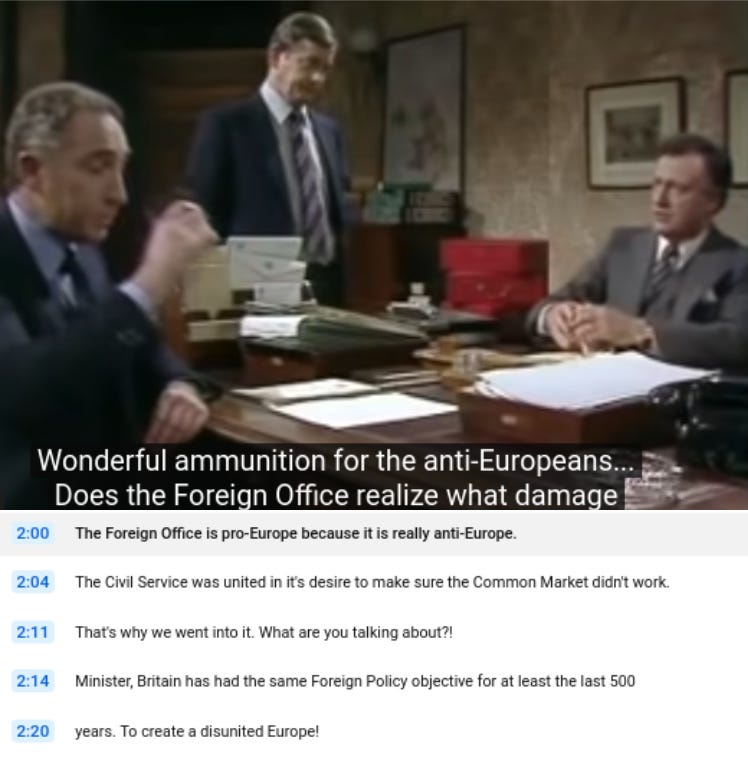
In other words: BECAUSE, willing or not, Europeans and their more or less informed choices (starting with the upcoming European Elections) play a non-negligible part in world affairs, and that part will be even more relevant (for better or for worse, is anybody's guess) in a multipolar world. Understanding where those decisions come from, historically and culturally, is helpful even for non-Europeans.
Also BECAUSE, since Europe sits just besides the only (BIG) part of the world where population will grow, a book like that may make integration of the millions migrants that will reach Europe whether Europeans like it or not a bit easier.
BECAUSE, whatever Eurosceptics worldwide may believe, the European Union never was about straigthening bananas and similar Euromyths, or about merely making business easier. The real goal of Europe, as A. Cottica said much better than me:
"Europe was never about standards - though they support innovation and growth, and give consumers and business confidence. Standards are just a tool to develop the European single market. And the single market itself is just a machine designed to prevent war.
Europe is about peace. Peace initiatives have happened before, but the European Union is self-reinforcing. Over the decades, EU institutions have enabled, and we the people have built, a dense web of relationships. First it was international trade; then education (Erasmus, anyone?); then business partnerships; then thousands and thousands friendships and marriages. War has become unviable, unthinkable. This was never meant to stop at our borders."
Last but not least, a book with the 5000 words that every European (or anti-European) should know would be useful BECAUSE, from its General Food Law, Hazardous Substances (RoHS) and Right to Repair directive to GDPR, the Digital Service Act, and this year the Artificial Intelligence Act, not only the European Union already is a regulatory powerhouse (see "about peace" above), but also aims to become a "superpower of digital growth".
We can discuss the "growth" part another time, but it's impossible to deny that an European soft/digital "superpower" would counterbalance the very few, extremely powerful companies from just one or two countries that right now dominate every aspect of digital life across the whole planet. That is, if you care about anything digital, any background info on how Europeans came to see certain matters differently from both the US and China could be useful, or at least interesting.
Writing (WITHOUT any AI support!) is how I earn a living. If you appreciate my work, please consider a paid subscription.
Those above are my own reasons to have "5000 words for Europe" in one book. I do hope I can complete this project. But even if you completely disagree with every one of those reasons, hate the EU or live on the other side of the planet, I hope you’ll agree that "Europe" is something everybody should know better, even if only to cricitize or fight it. So, thanks in advance for submitting your own suggestions, and for sharing as much as possible this invitation!
Usual final call: the more direct support I get, the more I can investigate and share content like this with everybody who could and should know it. If you can’t or don’t want to do it with a paid subscription, you may fund me directly via via PayPal (mfioretti@nexaima.net), LiberaPay, or in any of the other ways listed here.
No one was more surprised than I was when the American Dialect Society named ‘‘enshittification’’ – my dirty little coinage to describe how everything on the internet is (suddenly, simultaneously) getting (much) worse – to be its Word of the Year. But though the news was a surprise, it was a very pleasant one.
My early writings on enshittification focused on its symptoms, the way platforms decay. The progression of ...Read More
Journalism and classic media in general are in trouble. That's no news, of course, in all the senses "no news" may have. However, there is an interesting development that may come from SOME of those media.
Two weeks ago, P. Fahri wrote in the Atlantic that "Right-Wing Media Are in Trouble", because "the flow of traffic to Donald Trump’s most loyal digital-media boosters isn’t just slowing; it’s utterly collapsing."
In that article, Fahri first summarizes a report describing how readership of the 10 largest american conservative websites fell down 40 percent since 2020, then tries to answer "why the falloff has been especially steep on the right side of the media aisle."
In a nutshell, Fahri argues that the obvious culprit is Facebook, because:
since 2018, Facebook has been "deemphasizing news content, giving greater priority to content posted by friends and family members", also on Instagram and Threads
conservative digital media are much more dependent on social-media referrals than "prominent mainstream and liberal sites", simply because the former are newer.
Just for the record, that "deemphasizing" from all social media is THE reason why I was forced to open this Substack, since newsletters are the next best thing to do, if not the only way left, until people refuse the solution explained below.
Back to Fahri, his thesis is that, when social media (and Google!) started to strangle publishers and adult discourse in general, "prominent mainstream and liberal media" already had already, much more than right-wing ones, established brands, lots of staff and paying subscribers to weather that storm. Therefore, they are suffering, but much less than the on average much younger right-wing outlets, for which the only way to be visible was to excel at "injecting irresistibly outrageous, clickable nuggets into people's feeds".
This makes sense, but even if it were completely wrong it would not matter for this post. Here, I want to speculate about one specific consequence that this collapse of right-wing reach may have for the web at large. A consequence that would be surely beneficial for everybody, regardless of their political opinions.
What I hope is that, if the surveillance and censorship of social media is really hurting them so much more than their adversaries, right-wing media will conclude that they have no other way to survive than go back to the future.
You see, there has always been a way to see all the news from all your favorite sources in one place. A way that is much more efficient, much less distracting and much, much harder to control or block than social media. Oh, and also much less expensive to for publishers, at least in the long run, than any other alternative.
That way, available for more than twenty years now, is good old plain websites, with RSS feeds and RSS newsreaders.
An RSS feed is a small text file that contains titles and possibly excerpts of all the latest posts or comments from the website that publishes it. EVERY website management software existing today generates RSS feeds automatically, every time it's necessary, unless its webmaster deliberately turns them off (and if he does, he should be fired right away)

With RSS, every web user can automatically download and read all the headlines or comment notifications from every source she wants, as one unaltered timeline, in one window, with dedicated software programs, or web services, called RSS newsreaders, or RSS aggregators. With such programs, everybody can do that without enduring any advertising, centralized surveillance or any middlemen. Even without subscribing.
Reading all the news only, say, twenty minutes per day, at whatever time is best for YOU, is as easy with RSS aggregators as it's impossible with social media that only make your world smaller and harmfully faster. Indeed, many problems of social media of today would disappear if they just removed instantness and important people could post online only two minutes per day. If everybody started reading and commenting news only via RSS, and started using "social media" or instant messaging only to share (as little as possible) really personal stuff, like "Pizza tonight?" or "Here's my holiday pics", life and politics would be much more productive. But let's go back again to right-wing media and their collapse.
That's simple: any website that manages to convert its readers to RSS can merrily tell Facebook, Twitter and every other similar platform to f * * ck off. And it can keep 100% of any advertising revenue they may find.
Of course, you may ask, if RSS is so great, why are more and more website editors and owners so stupid to not display the links to their RSS feeds to all their followers, alongside those to their social media accounts? Why don't they put the RSS feed icon before those of Facebook, Twitter, Instagram and what not? Doing it is extremely easy and surely not harmless, not doing it is unbelievably stupid.
The answer is, I don't know. All I can say is that the problem isn't limited to right-wing media. So many publishers of all kinds (including "most effective communicators"!) do this stupid mistake that if I wanted to list them all in the ”Snob RSS” Hall of Shame I proposed years ago, it would be a full time job.
The biggest sin of ALL media in the last 15 years is not promoting or failing to denounce Trump, Orban, Le Pen, Meloni... or the woke, or the anti-woke, or everything else you may dislike. It has been to not tell their readers, every day, "this idea of connecting via social media is totally cretin and suicidal, both for us and for you. Follow us with RSS instead".
Writing (WITHOUT any AI support!) is how I earn a living, and every subscription makes a difference to how much I can share through this newsletter. If you appreciate my work, please consider a paid subscription.
What I hope is that Breitbart, Daily Caller, Drudge Report, The Federalist, Fox News, and all the other right-wing media quoted or not in that piece are really suffering social media so much to finally realize, before their adversaries...
... that the only way to survive, that is to remain always, surely, directly visible to their followers that is already available and stable since 2002, the only way that (with the exception mentioned below) won't cost them a dime whatever kind of website they already have, is to:
give up any hope that other "platforms" may save them
tell all their readers, every day starting yesterday, "let's meet directly, without those damned liberals in the middle: get an RSS newsreaders NOW, it's free"
tell all their current or potential sponsors and advertisers "give your money to us, not Big Tech", because even at cheaper rates they'd get to keep all the money
The exception is that doing so implies having to host and moderate readers' comments. To that, I answer that yes, it is a cost, but since it's exactly the refusal to pay it that brought publishers to social media, that is to their ruin, it's still a much better deal than dying.
So, I sincerely hope that right-wing media switch back to RSS en masse, and are successful, which is NOT the same as "I sincerely hope right-wing politics win". This is only about getting a World Wide Web where politics and everything else are less hysterical, a bit more mature than kindergarden tantrums and without omnipotent gatekeepers.
If right-wing social media recover influence and financial sustainability thanks to RSS, I can't exclude that some morons will propose to outlaw RSS. The Streisand effect that would unavoidably follow would help RSS, but it's not necessary. If right-wing media recover thanks to RSS, everybody else will be forced to notice how much better a way to stay informed RSS is.
Right-wing media may help everybody to Make the Web Great Again.
Why not? Stranger things have happened. And while we're at this, let me present you...
Right-wing websites, and extremists sites in general, don't hide their content behind paywalls, and are also happy to pass it to AI bots. Now, I KNOW that writers must be paid (please consider a paid subscription or donations, see below!) and I am no friend of AI as it is today. But it's impossible to complain that AI just amplifies prejudices and biases, or that people are gullible, misinformed “baskets of deplorables” and so on, if only one side regularly gives both people and bots all they could read:
Usual final call: the more direct support I get, the more I can investigate and share content like this with everybody who could and should know it. If you can’t or don’t want to do it with a paid subscription, you may fund me directly via via PayPal (mfioretti@nexaima.net), LiberaPay, or in any of the other ways listed here.
Earlier this week, Henry Oliver wrote a passionate piece to argue that smartphones are not the source of all social ills. I fully agree, but I also think that, especially as far as children are concerned, he made a bad job overall to describe certain issues and how to deal with them, for at least a couple of reasons.

Here are, in italic, six quotes from Oliver's piece, with my comments attached.
1: This is two quotes actually, separate but related:
Tech companies are called attention merchants and algorithmic exploiters.
I prefer smartphones to what came before. It’s easier to be uncontactable
With all we know in 2024 about how tech companies work, I doubt they themselves would question the "attention merchants" label, and if I listed here half the bookmarks I have about the first sentence, this post would be three times longer. On the same topic, the second sentence, and the whole piece in general, doesn’t mention at all that, if it's easier to be uncontactable by humans, it's almost impossible to be untraceable by the same companies, which in the big picture is probably a bigger problem.
2: [N]ow the psychologist Jonathan Haidt is promoting the idea that smartphones and social media have “rewired” the brains of a generation of children, which makes them depressed and anxious. ... But Haidt’s claims are not uncontroversial... The evidence is less certain than it appears.
In a world that's still arguing about stuff that's way easier to measure, from superconductivity to average temperatures, expecting any claim on social science issues like these to be really uncontroversial does not seem realistic to me, but never mind. What I am sure about, from both my own experience as parent and decades of volunteering for teenagers, is that the solutions that Haidt proposes have merits of their own, and above all that they are much, much more feasible and scalable than what Oliver suggests. I'll get back to this in the final part of this post.
3: Do we really believe that the effects of this new technology are so different to, say, the arrival of landline phones and cars?
(at least) As far as children are concerned... Hell, yes. No one, child or adult, could ever influence, or be influenced by, hundreds to millions of peers simultaneously with one phone call. As far as cars are concerned, and without negating what Oliver says about them in the next point, the same children who hurt themselves with smartphones know pretty well by themselves how stupid it is to run in front of a car, not to mention that children don't get to drive cars wherever they want, whenever they want, when they are still in primary schools.
4: The most persuasive argument isn’t that phones cause unhappiness on their own, but that it exacerbates an existing trend. Children used to be much more free to play outside and take risks. Cars ended that. It is impossible to allow modern children the run of their neighbourhoods as they had in the 1950s when we have traffic levels (with heavier, faster cars) of modern times... Similarly, teenagers began reading far fewer books decades before smartphones were invented. Phones may have exacerbated that trend, but they certainly didn’t cause it.
This part makes much more sense. Please check the "Stranger Things" part of this proposal of mine to see how I suggest to rebuild cities to fix the "play outside" problem. However, it still leaves important things out, and doesn't end looking in the right direction anyway. The last sentence is true, but not a valid reason to have a personal smartphone before one is 14 or older. Even the reading issue is true, but does it prove that smartphones aren't bad for children in many other ways? If anything, that's an argument for giving every child not smartphones but ebook readers, that is devices that would bring thousands of books right on their nightstands, but without openings to cyberbullying.
Again on cars: yes, they do make kid's lives much harder, but what ended outside play (yes, since decades before smartphones) is overparenting that suffocates children with parents' fears of everything that may lie outside, from aliens to scratches, with parents' pressures to be champions in as many fields as possible, as early as possible, and with parents attaching smartphones to their children just to control them every minute. Still, none of this justifies the confusion I'll cover shortly.
5: Without the danger of passing cars, [her daughter] has something closer to an old fashioned childhood: free time, where she takes risks, without being constantly supervised. If we can solve that problem, many children will likely be much happier. It isn’t all about phones.
I've said myself that parents must let children play alone outdoors, before worrying about social media. This said, allow me to complete, not criticize, the "danger of passing cars": I obviously do not know how things are where Oliver lives. But I've seen lots of neighborhoods, in Italy and abroad, where the same children who wouldn't live long if they tried to play in the middle of the streets could safely walk on sidewalks and pedestrian crossings, to school or to some friend's place, if only their parents hadn't been made paranoid or snob by systemic pressures (coming also, who would have known, through smartphones).
6: And amongst all this clamouring, we risk overlooking the immense benefits of phones and social media.
Standing up against the overmighty state is much easier with social media.... There’s a reason why access is limited in China and Russia.
On a more mundane level, phones and social media give us access to the world in a way that was unimaginable to previous generations:
This is one of the weakest part of Oliver's piece. Point 6.1 is true in theory, not in a world where much top-down political control happens just through social media that government have learned how to turn into partners, or block altogether, since at least the Arab Spring. As far as children are concerned, instead, the same point is just irrelevant, because it just doesn't matter how many good things adults may do with a smartphone. To see it, take that sentence, replace "social media" with "assault rifles in every home", then go check how many of the same people who do think that's the best idea ever would give their children an assault rifle to use unattended, 24/7.
For the other point, which is one of the two main issues I have with Oliver's piece, here is how he describes that unimaginable access:
In the last few days social media has meant I booked tickets to a Sally Rooney event, discovered a new piano recording by Vikingar Ólafsson, watched the science explainer videos of Sabine Hossenfelder, messaged a scientist on Twitter and been sent their research paper, discovered and read a short story by Somerset Maugham, learned that Beethoven had a low genetic predisposition towards musical accomplishment, discovered a magazine of Nigerian literary criticism, and watched a video with my children of a komodo dragon eating a pony whole (recommended). Other things I have done include reading a poem by John Donne, using AI to explain a technical article I didn’t understand, chatting with subscribers to my Substack about Shakespeare, and writing about how late bloomers find their calling in life. And this is not to mention the pictures of my baby nephew that I get sent on WhatsApp.
The problem here, that Oliver himself lays out very clearly, is that he is not a meaningful sample on which to base any conclusion or policy on these issues. Not at all, and I say so as a compliment. Oliver is a successful writer with, quoting the first endorsement on his own website, "a rare talent: smart, funny and insightful".
In the same days when Oliver and every other adult with comparable natural skills, birth lottery luck, education and income as Oliver were doing all those marvelous things above, many more human beings of all ages, as in "one to ten thousands times more", were using the same phones and social media for little more than losing sleep to kitten videos, conspiracy theories, culture wars and so on.
Oliver himself tells us that he homeschools his children, that is that his children are automatically shielded from all the pressures or worst they'd have to endure in a classroom full of peers with smartphones. Again, good for them, but hardly a valid sample for general conclusions.
The other example Oliver makes, a woman evidently born with all it took to make "her passion become her career" as a social media strategist (that is an active user, among masses of passive ones of phones and social media) further strengthens the same point: what Oliver and everybody else like him can achieve only thanks to "phones and social media" is wonderful, no doubt. But it's no evidence on which anybody should base any policy or advice for the other 99 point something per cent of human beings.
Yes, of course adults and kids who lock themselves inside smartphones wouldn't do it if the rest of their lives didn't suck. We can also accept, at least as first approximation, that "phones and social media" just exacerbated pre-existing negative trends, rather than creating them. That's nothing else than the very nature of everything digital: it greatly, greatly amplifies and accelerates everything it touches, both good and bad.
But there is digital, and then there is digital. In his piece, Oliver does outline the solution, that is "find ways of maximising the benefits and minimising the negatives - as we do with many things", but doesn't tell, or see, what the most effective ways are and why.
Here is the most important point that is completely absent from Oliver's piece, and so many still fail to see: the internet, the Web, social media, personal "stationary" computers (including laptops) and smartphones or tablets are five SEPARATE things, that must remain as separate as possible, at least in the minds of parents, educators and policymakers. The dumbest tech-related mistake done in the last 15 years may be just the equation internet = smartphone, which reached the status of law of nature for NO reason whatsoever, except digital ignorance.
Look again at all the wonderful things that Oliver did with “social media”: first of all, none of those things requires social media to work in ways that, no matter how personally immune Oliver is, are designed to be addictive. But even if social media were not addictive and were able and willing to filter out toxic content, the most important truth to grasp is that:
anybody, children included, can do all those things with a stationary device placed in one's kitchen or living room, instead of a smartphone
and that that mere change of device makes a world of difference
To see how big that difference would be for adults, imagine a world with all the same social media and online services as ours, but without smartphones, just with camera-equipped good old cellphones. That is, a world where you'd still be reachable wherever you are, and able to do everything Oliver wrote, but... in order to engage in flamewars, or share on Instagram all the food pictures taken in some fancy restaurant, you'd have to wait until you're back home, where you could attach your camera to your computer. In such a world, would you waste more or less time and stress than today?
Back to my main beef with Oliver's piece, that is Haidt and children with smartphones: regardless of the validity of his data, Haidt is not saying that smartphones, the internet or even social media should disappear. When you cut to the chase, the main if not only thing that Haidt says is only that giving uncontrollable personal smartphones to children less than 14/16 years old was a huge mistake that should end yesterday.
But this does not mean at all to give up all the good things children can do online. There is a lot that children can and should learn since primary school about the internet, the web, online communication, digital creativity and so on. But NOTHING of that requires a personal smartphone, with its intrinsic illimitability. This is what Oliver seems to completely ignore, or at least to completely fail to communicate, when he writes that "As with so many of the things teenagers start discovering, the aim should be to teach them the best use of it". What's the point of teaching or promoting the best use of the internet... just with the one tool that is much more dangerous than all the others, but not necessary at all?
The right thing to do is just what Oliver himself leaks out in a couple of sentences, that get hidden by all the rest. The first is when he writes to be "appalled that my thirteen year old brother has a smartphone and is allowed to waste so much time on it."
That's where the solution is. The difference between giving children a family computer they can use, possibly while other family members are around, only between homework and dinner, and a smartphone is very simple. It's the same difference there is between telling a child "hey come here and help me cut the bread with this knife", and giving her the same knife to carry around, 24/7 unattended, to use in any way hers or some stranger's brain may suggest.
In the first cases, the children get to learn and do cool, useful things, with almost no risk. In the others, "what could possibly go wrong?" is not even funny.
Writing WITHOUT any AI support is how I earn a living, and every subscription makes a difference to how much I can share through this newsletter. If you appreciate my work, please consider a paid subscription.
Adults are another story for another day. As far as children go, the reality we all actually live in is the one in which:
almost all real children less than 14/15 years old do not have the skills AND the education AND, above all, parents with enough skills AND time to help, to use smartphones without harm (ditto for teachers, in case you're thinking schools could or should ever do enough)
therefore, the children for whom a smartphone is at best an expensive ballast, at worst a mental health polluter and always an electronic tag are surely many more than those who can and do use smartphones to enrich themselves without any negative consequence
both categories of children could do almost everything Oliver does from a normal computer in their living room, which just by its own nature, location and built-in "time limits" would eliminate almost all the dangers
Corollary of all of the above: at the end of the day, it doesn't even matter how accurate Haid's data are. Or, as I wrote four months ago, it doesn't really matter whether "social media" is good or bad for "kids". Even if all THIS critic of Haidt's work, newer than those linked by Oliver, was all true, there is nothing to lose and lots to gain (even financially...) from giving children less than 14/15 years old only stationary home computers and broadband, NO smartphones. Only the first devices give access to pretty much everything positive children could need or want, age too quickly but still much slower than smartphones but block, just by being stationary where relatives can walk by, a BIG LOT of exposure and opportunities for negative outcomes.
So, please learn to distinguish between "smartphone" and "internet" or "social media". Give children stationary internet soon, but delay as much as possible the uncontrollable, unsuperviseable access to the whole internet and to the continuous, digitally distorted pressures from equally unprepared peers that smartphones couldn't avoid being, even if their makers wanted.
Who should do it? Easy: follow Oliver, again, when he writes "I don’t want to ban my brother from using... the internet wisely." This is NOT something that laws or mandatory "age verification" schemes that would never work as advertised could or should do. Thanks, but no thanks. Not giving children a smartphone before they are 14/15 years old is something that only parents can and must do. It's as simple as that, really.
Usual final call: the more direct support I get, the more I can investigate and share content like this with everybody who could and should know it. If you can’t or don’t want to do it with a paid subscription, you may fund me directly via via PayPal (mfioretti@nexaima.net), LiberaPay, or in any of the other ways listed here.
Please share this post among as many PARENTS as possible, in and outside Substack!
*How is it harmful, again? For which people?
The extremely (not) surprising key findings of a a paper about "Robots, meaning, and self-determination", says the Register, would be that "robots harm work meaningfulness and autonomy". It seems to me that such findings, or at least the way they are presented, overlooks something that should be even more obvious.
The study focused not on the purely monetary impacts of industrial automation, but on how industrial robots affect both the meaning of work, and the self-determination of workers.
What it found is that the adoption of industrial robots "takes a mental toll on workers, especially those with repetitive jobs [and] routine responsibilities". That toll consists of diminished need for creative problem solving, reduced worker autonomy and reduced human interactions to the detriment of work relationships.
Quantitatively speaking, the study found that the average increase in robotization between 2005 and 2020 was almost a four-fold (389%), and as much as 26 times in industries like mining and quarring, and that doubling the presence of robots lead to a 0.9 percent decline in work meaningfulness and a 1 percent decline in autonomy.
The authors also concluded that one way to mitigate the loss of autonomy is to give workers control: "Specifically, working with computers completely offsets the negative consequences of automation for autonomy". That is, robots make workers feel worse - unless they control (or "teach", that is program) the machines, robotics or not.
Robots are just software, after all. Whatever the exact amount of alienation from industrial robots is, the problem surely exists, and exists with every kind of automation and, albeit in different forms, in almost every sector of the economy, including retail or any kind of office or "knowledge" work.
When it comes to interaction between workers and their end users or customers, for example, much automation just hides and alienates the former, rather than replacing them. The last perfect example of this issue is the Amazon Just Walk Out stores which only seemed completely automated, because they had more than 1,000 people in India, obviously paid much less than western cashiers, watching and labeling videos to ensure accurate checkouts.
In factories, warehouses and offices, instead, "reduced human interactions that harm work relationships| are the unavoidable consequence of one fact, that's much older than computers and software. In order to understand, reproduce and manage any kind of complex process, from photosynthesis to satellite building, science and technology must split that process into as many elementary parts as possible.
When coupled with capitalism, mass production and bureaucratization of life, that fact unavoidably leads to more meticulous division of labor, where every person has their own defined task, until every worker only needs to depend on some machine. As an acute Japanese writer observed more than 30 years ago, automation like this has caused "every individual to find their determined position in the great societal machine...This is the strongest organizational force in modern society. While it lies outside the confines of politics and law, it is nonetheless very powerful".
Did you notice the last two sentences one of the best definitions of Big Tech one may give? But I digress.
Writing WITHOUT any AI support is how I earn a living, and every subscription makes a difference to how much I can share through this newsletter. If you appreciate my work, please consider a paid subscription.
The story goes that yes, automation creates alienation and eventually unemployment, but that's not a problem, because it always creates even more new, surely better jobs. Yeah, right. But for whom, and how usable? All this displacement by software and robots would not be a problem IF:
jobs were not the only way to pay one's rent, mortgage, food and clothes (or, put another way, if we didn't insist to get concepts like UBI and AI in reverse order)
ENOUGH decent jobs that COULD be taken by the RIGHT people, that is workers displaced by automation, COULD not just exist but above all be taken WHEN those workers would need; that is, as soon as possible, not after some magic "upskilling" that in most cases would have to be so advanced that it would fail in most cases, or so long that it would cost taxpayers much more than unemployment insurance
The reality today is (quoting someone else now , not me) that we won't be able to retrain the majority of the workforce fast enough to take the new jobs in emerging industries. Not in a world where, unlike in previous industrial revolutions, the older workers are much more than the younger(aspiring) ones, would need much more training, and "entire industries' disruptions in periods that are shorter than election cycles".
A while ago, I almost spit my tea when I read that automation is freeing time, because, "there is a sports equipment boom in the USA, and how was the time to use it freed, if not through machines?" One answer to this "argument" may be that those who can afford sport equipment, or state of the art gym memberships are less than those work of many more working poors. If automation is freeing time, how come most families are forced to have every adult member working full time just to make ends meet? Another answer may be that if there are so many people who lose weight by making drugs like Ozempic scarcer and more expensive for those who would really need them instead of practicing some sports, is because automation just gave them more money, but not enough time to spend it decently.
While we are at this... Another symptom of how much confusion and hype there is on robotic automation and related issues is the interest, which I fail to share outside of science fiction, in humanoid robots. Most industrial robots or machines have no need whatsoever to be human-shaped, and never will. If they did, they'd probably be less effective, not more: "you don't make [humanoid] robots to fix all plumbing, you design all plumbing to be fixable by robots". Outside factories, what automation would be better? Better appliances, or housemaid-shaped robots that have the same probability of mastering the billion situations they would meet in real homes as "driverless" cars of becoming really able to drive autonomously on all real roads? Ditto for warfare, office work and so on...
Robots with similar shapes to animals would be much better, for at least two reasons. One is that certain animal shapes would actually be better for certain jobs. Four -legged or serpentine robots, for example, could explore and monitor caves, oil pipes, ship bilges and thousands more similar environments, much better than anything human shaped, human or robot.
The other and most important reason is that the less robots look like humans, the easier it is to avoid confusing what being human or machine means. Robots looking like humans make it easier to treat even humans like robots. Having "someONE", not someTHING, to dominate, or to alleviate one's need of actual humans, hardly seems an easier path to positive human growth. As proof of that, we can just look at the biggest, already existing market for "something that looks like a human to boss around":
Back to the links between displacement and automation displacement by robots, AI or anything else, I recently read here, that "technology's displacement effects can be outweighed if new tasks are created where labor has an advantage over automation. This is a huge if."
No, that's not a huge "if". It's a huge "WHY???"
Let's be clear: we do need much more automation than today, albeit of a very different nature than most startuppers or venture capitalists would like you to buy. I am pretty sure that the miners of 150 or even just 50 years ago would give some year of life they couldn't enjoy anyway, displacement be damned, to work in the much better, much safer conditions that highly automatized mining can provide today. There are still plenty of actually necessary, but dangerous jobs that can and should use more automation. It's equally obvious that even the bare maintenance of existing vital infrastructures, from ports to bridges and power lines will need much more automation, if you consider how quickly populations are aging worldwide, and how many of their younger members, the ones best suited for certain jobs, are still blinded by getting a good degree, just to win a "great job".
This said, the same author who wrote:
"They only need to depend on a machine"
"working with computers completely offsets the negative consequences of automation for autonomy"
also left something critical out when he wrote something that science and technology "guaranteed the values of individualism" and "improved the status of individuals, increased individual self-consciousness, and strengthened the sense of individual responsibility".
The problem is that "need to depend" can mean two terribly different things: one is need to depending on having a machine to do one's work, be it a computer to blog, a circular saw to build cabinets or a synthesizer to play music. The other is to depend as in "subordinate, being managed by", without responsibilities.
It's just the difference between "working with" and "working for/under", but it's huge. The first scenario is good, the other is the dystopia where (regardless of its appearance) a computer is in charge, bossing a human around "at a robotic pace, with robotic vigilance"One gets increased individual self-consciousness and all that ONLY if and when what automation provides are tools that extend one's capabilities, not inhuman bosses and controllers.
The final and most serious problem about automation that that study leaves unsaid is the one that Dante Alighieri explained seven centuries ago:
"Call to mind from whence ye sprang: 'Ye were not form'd to live the life of brutes, 'But virtue to pursue and knowledge high.' (Inferno, CANTO XXV)
There is no amount of control or "creative problem solving" that can avoid mental tolls if, as it happens more and more frequently, the end product or "mission" itself of one's job is inherently pointless or outright superfluous. I suspect that this is the displacement, lack of meaning or whatever you want to call it that automation often just exposes, rather than create: maybe automation scares a lot of people not (just) because it makes them lose their jobs, but because it makes impossible to ignore that their jobs themselves were worthless to begin with.
Of course, that's a problem only until full time work for every adult remains a dogma, and only for those who must absolutely have a job, instead of a purpose, to feel they are worth something.
Usual final call: the more direct support I get, the more I can investigate and share content like this with everybody who could and should know it. If you can’t or don’t want to do it with a paid subscription, you may fund me directly via via PayPal (mfioretti@nexaima.net), LiberaPay, or in any of the other ways listed here.
Substacks quoted here: SK Ventures and T. Greer.
Just an invitation... is a reader-supported publication. To receive new posts and support my work, consider becoming a free or paid subscriber.
Note: the way this Substack works is that every public essay has a follow up piece under a paywall for the part I wanted to say but either didn’t have space for or, more often, didn’t want to deal with drive-by goblin-screaming by bad-faith internet vultures. This piece, somewhat unusually, follows on from two: Take My Life, Please: The Media's Will They/Won't They Love Affair with American Fascism Prepares For Its Terrible Wedding Night and Stop Talking to Each Other and Start Buying Things: Three Decades of Survival in the Desert of Social Media
A little over a year ago, I started this digital space with an essay on, well, digital spaces. It was two months after Musk had taken over Twitter—oh halcyon days of innocence and youth! Everyone I knew, followed, was professionally connected to or wanted to be, whose politics I agreed with, whose morals I admired, all of them were very busy at that moment in time, very loudly proclaiming that they could not possibly stay on Twitter given Musk’s obvious econo-cultural malfeasance and vividly telegraphed nasty intentions.
It felt inevitable. A sorrowing sort of twilight moment. We were sure we’d lose track of each other, because it was just so clear no one could possibly support that new incarnation of Twitter being run into the ground by braying, slobbering, panting jackasses in jackboots.
Because purity is so important, you see.
We simply cannot support anything or anyone who slips up a bit ideologically, even a little bit. There’s no such thing as a necessary moral compromise, don’t you know? No situation ever has or ever shall occur in which a good person might make a politically fraught choice in order to further the cause of progress. Every stance, every word, every action, must exist in perfect virtue, without one single solitary speck of ethical contamination, a thing which a real living human person can definitely do. Every position and policy must hover at the absolute bleeding edge of tomorrow’s most enlightened progressive thought. Doing otherwise will bring fury raining down from the digital heavens. Managing to thread the needle will be rewarded with absolutely nothing, certainly not votes or political support or even a slight nod of acknowledgement.
Because obviously I just can’t vote for Joe Biden. Yes, the alternative is grinding, authoritarian far-right fascism. I feel just peachy about letting that happen (to other people, I literally cannot imagine it ever affecting me, why yes I am the working class proletariat salt of the earth, you’re too kind), but I will not, not ever, NEVER OH NEVER SHALL I check a box next to someone who…has had to suck it up and quietly work with people they don’t like and profoundly disagree with in order to accomplish any version at all of the things I keep saying I want!
AND I’M ABOUT TO TELL YOU ALL ABOUT IT FROM THE PAID ACCOUNT I NEVER DELETED ON ELON MUSK’S CRATERED HEARTLESS NAZI-INFECTED HAZMAT DUMPSITE TWITTER WITH A STRAIGHT FUCKING FACE.
In conflict, we find clarity.
We all hold contradictory views: We love our families, but they drive us crazy. We want more housing in our cities, but we don’t want our property values to decrease with expanded supply. We want better schools, but we recoil from a 0.1% municipal levy to fund them.
It’s normal to hold contradictory views, but when those views come into conflict, how we act shows ...Read More
Of course AI is a bubble. It has all the hallmarks of a classic tech bubble. Pick up a rental car at SFO and drive in either direction on the 101 – north to San Francisco, south to Palo Alto – and every single billboard is advertising some kind of AI company. Every business plan has the word “AI” in it, even if the business itself has no AI in ...Read More
It’s tempting to think of the Great Enshittening – in which all the internet services we enjoyed and came to rely upon became suddenly and irreversibly terrible – as the result of moral decay. That is, it’s tempting to think that the people who gave us the old, good internet did so because they were good people, and the people who enshittified it did so because they are shitty people. ...Read More
I was surprised as anyone when I found myself accidentally using a large language model (that is, an “AI” chatbot) to write some prose for me. I was twice as surprised when I found myself impressed by what it wrote.
Last month, an airline stranded me overnight in New York City when my flight to LA was canceled due to an air traffic control snafu. The airline rep at the ...Read More