 Login
Login
Live w/ Robert Reich
15 June 2026 at 19:38


Over the weekend, I did an interview about my forthcoming book The Reverse Centaur's Guide to Life After AI (a book about being a better AI critic), and the interviewer said she was surprised that I wasn't an AI booster, based on my demographics and work history:
https://us.macmillan.com/books/9780374621568/thereversecentaursguidetolifeafterai/
I could see where she was coming from. I encountered computers in the mid-seventies, as a small child. My first computer was a CARDIAC, a working, Turing-complete, mechanical computer made entirely of cardboard, that I spent endless hours with:
https://www.instructables.com/CARDIAC-CARDboard-Illustrative-Aid-to-Computation-/
Then I graduated to a teletype terminal and acoustic coupler connected to a minicomputer at the University of Toronto. My mom, a kindergarten teacher, used to smuggle home 1,000' rolls of paper towel from the kids' bathroom. I'd get 1,000' feet of computing up one side, then another 1,000' down the other side, then I'd carefully re-roll the paper towel so she could put it back in the bathroom for the kids to dry their hands on.
After that, I got an Apple ][+ in 1979, and shortly thereafter acquired a modem, and that was it: I was hooked for life. I became an amateur programmer, then a professional programmer. I hosted forums on dial-up BBSes where I distributed software and offered support to strangers who wanted to connect their computers to the internet. I got a job as a gopher developer, then a web developer, then a CIO-for-hire, helping wire up small businesses and connect them to the net. Eventually, I co-founded a free/open source software startup, before transitioning to 25 years as a digital rights activist with the Electronic Frontier Foundation. And for most of that time, I was energetically writing science fiction, eventually becoming associated with a school sometimes called "post-cyberpunk":
https://en.wikipedia.org/wiki/Rewired:_The_Post-Cyberpunk_Anthology
The force that energized all this work was a dialectical one, the contradiction that powered cyberpunk literature itself. For all that cyberpunk was undeniably enamored with the coolness and combustibility of new technology, it was also terrified of how technology could be a force for oppression, surveillance and control. As William Gibson says, "cyberpunk was a warning, not a suggestion."
Gibson's more famous quote, of course, is "the street finds its own use for things." In Gibson's novels (and in my own life in technology) all the most interesting things happen when users of technology (often without formal training or credentials) find ways to adapt the technology they use to suit their needs:
https://pluralistic.net/2026/03/17/technopolitics/#original-sin
This is why I remain an ardent fan of Hypercard, Scratch and other meta-tools that are designed to allow non-programmers to write software that exactly conforms to their desires. Whatever the apps produced by these tools lack in sophistication and efficiency is more than offset by the fact that they give everyday people the power to directly control the tools they rely upon.
If "epistemic humility" means anything, it means acknowledging that no amount of "requirements gathering" can capture the needs of people totally unlike yourself as faithfully as those users can capture their own needs. Giving people the tools to produce their own software is always going to make tools – vernacular, idiosyncratic, homespun – that are more suited to their own hands and minds than anything a technologist working on their behalf could make.
The ancient dictum of "nothing about us without us" – born in 16th century Poland and taken up by the modern disability rights movement – asserts the right of people to control their own living conditions, and also the unique capacity of people to understand their own needs. You know what's even better than being consulted on the design of the technology you use? Having direct control over that technology!
This is why I was so suspicious of the iPad. The iPad's much-lauded "ease of use" was entirely about how easy it was to use an iPad to consume technology. But the iPad remains the single most user-innovation-hostile technology in modern history, a device designed to make it impossible to produce technology without permission from a remorseless multinational corporation. This is cyberpunk as a demand, not a warning:
https://memex.craphound.com/2010/04/01/why-i-wont-buy-an-ipad-and-think-you-shouldnt-either/
The technology I've championed all my life is technology that gives more control to its users. One of my immutable precepts is that people who are different from me know things I can't know, and the only way I can get the benefit of their unique knowledge and perspective is if they are free to make and share things that matter to them. As Dan Gillmor said, back when he was inventing the study of citizen journalism, "My readers know more than I do":
https://www.oreilly.com/openbook/wemedia/book/ch00.pdf
And while I am broadly very skeptical of AI, and deeply alarmed by the proliferation of "vibe coded" software in production environments, vibe coding for personal projects is a useful and exciting addition to the lineage of tools that let computer users decide how their computers will work. For people making personal projects, vibe coding extends the power of shell scripting, cron jobs, Applescript, and other desktop automation tools to a wider audience.
One of the journalists I spoke to last week about my book described how he had vibe coded an app that showed him an alert every time a plane flew over his house, giving the tail number and other details of the flight. This is information that I have no need for and no interest in, and that I'm therefore excited to learn about, because its very existence affirms that the world is full of people who are delightfully, irreducibly, amazingly different from me, and moreover, that their unique needs can be directly met using their imaginations and their personal computers.
I recently sat down with my colleague Naomi Novik, a brilliant author who also co-founded Archive of Our Own. Naomi demoed her followup to AO3 for me: Wreccer, a system to help you find small groups of people with taste similar to your own, in order to facilitate media recommendations within that group – a kind of personal, relationship-driven alternative to massive, centralized, monolithic algorithmic recommendation systems:
Naomi told me that Wreccer was being built using the same design ethos that the original Twitter embraced. When Twitter launched, it was an API first, and the official Twitter front end was built on that API – but anyone could build their own front end for Twitter that worked in the way they wanted it to. Now, the word "anyone" is doing a lot of work in that sentence, because most people don't even know what an API is, and of the people who do, most of them were not capable of writing their own software front end for Twitter.
But Wreccer is being designed for the age of vibe coding, and the API will really allow anyone who uses the service to design their own interface to the system, one that elevates and centers the features they find useful and tucks away the ones they're not interested in. Your personal, custom front end could also bring in other data-sources – pulling in your Mastodon messages, for example, or even showing you an alert with the tail-number of any plane flying over your home.
This is the part of vibe coding that I'm quite excited about, but it's not the part the industry focuses on. Instead of hearing about how personal, homemade software utilities can be an end unto themselves, we hear about vibe coded projects as prototypes for commercial production code. We hear about clueless bosses vibe coding software products and services that run fine for one user on a siloed desktop computer, and then demanding to know why it takes 50 engineers a year to make the same thing work for millions of users on the public internet. We hear about people who vibe code and submit patches to free/open-source software projects with millions of users, overwhelming project maintainers with slop code that is riddled with security vulnerabilities.
Of course, there's an obvious reason why the industry wants to focus on the potential for vibe coded software to replace production code. The AI bubble has burned up $1.4t to date, while bringing in mere tens of billions of dollars per year, even as its unit economics grow steadily worse:
To keep the bubble inflated, AI hucksters must promise massive economic returns to the technology. They want investors to believe that vibe code is about to replace working programmers, who are skilled, high-waged, high-demand workers. Their pitch is that for every million dollars' worth of programmers that an AI salesman and a boss conspire to fire, half a million dollars will go to the AI company whose bots shit out that vibe code.
That's par for the course with the AI bubble, whose focus is entirely on how AI can centralize, control and homogenize our lives. Whereas early desktop publishing, web publishing and social media gave us a glorious higgledy-piggledy of chaotic, weird and transgressive hobbyist media and retina-searing designs, AI art and design are instantly recognizable at a thousand yards, and it all looks the same, boring, and washed:
https://pluralistic.net/2024/07/20/ransom-note-force-field/#antilibraries
AI companies have released open weight/open source models that can run on your own computer, but these are treated as side-shows and toys and demos. The real action, we're told, is in "frontier models," which is industry-speak for "a piece of software whose running costs exceed the GDP of most countries":
https://pluralistic.net/2026/02/19/now-we-are-six/#stock-buyback
Perhaps this is why the dynamics of AI are so different from the early dynamics of the web. Early web users were workers, who demanded that their bosses allow them to use the web and so devolve more power to people doing their jobs. By contrast, today's most ardent AI boosters are bosses, who threaten workers who don't use AI enough in the course of their duties:
https://pluralistic.net/2026/05/26/the-ai-will-continue/#until-morale-improves
Where we do see idiosyncrasy emerging from AI usage, it's often terrible. AI can help you create a folie-a-un in which you and a chatbot team up to reinforce your delusions and drive you deeper into a world of dangerous mirage:
https://pluralistic.net/2026/06/03/mission-space/#gsd
There's a (false) story that's told about people who championed the early internet: that we were blithely certain that technology could only be a force for good, and negligently disinterested in the possibility that technology could control, extract and harm. That's demonstrably untrue: recall cyberpunk's dualism of "the street finds its own use for things" and "cyberpunk is a warning, not a suggestion."
More true is to say that early internet champions were alive to the importance of the internet, and therefore both excited about the possibilities of the internet to deliver a world of connection, idiosyncrasy, love and solidarity; and about the danger of the internet as a dystopian system of surveillance and manipulation:
https://pluralistic.net/2025/02/13/digital-rights/#are-human-rights
History isn't finished. Long after the AI bubble pops, there will be local models and people vibe coding homemade software that respond directly to their needs. The stuff we make on our own computers, for ourselves, is deplatformed from its inception. It's part of the life we can build in technology's "shadowy corners" that we used to just call "technology." The fact that this stuff is utterly unsuited to be production code makes it inherently unmonetizable. It's how the street finds its own use for things:
https://pluralistic.net/2026/02/23/goodharts-lawbreaker/#no-metrics-no-targets
Shame On You https://www.change.org/p/an-open-letter-to-the-american-diabetes-association-shame-on-you
Keycap Quarry https://keycapquarry.com/shop/
The Threat of Big Insurance https://prospect.org/2026/06/11/threat-of-big-insurance-lobbying-congress-donations/
End Citizens United’s Tiffany Muller on fighting big money in politics https://www.citationneeded.news/end-citizens-uniteds-tiffany-muller-on-fighting-big-money-in-politics/
#25yrsago Disney characters win right to clean underwear https://web.archive.org/web/20010707023727/https://www.sfgate.com/cgi-bin/article.cgi?file=/news/archive/2001/06/07/state1339EDT0171.DTL
#20yrsago Lampooning the American dismissal of Gitmo suicides https://fafblog.blogspot.com/2006/06/610-changed-everything-run-for-your.html
#20yrsago LA’s South Central Farm under police siege right now https://web.archive.org/web/20060616085732/http://www.southcentralfarmers.com/index.php?option=com_content&task=view&id=160&Itemid=2
#15yrsago Transparent Pontiac for sale https://web.archive.org/web/20110610113919/http://blog.hemmings.com/index.php/2011/06/07/the-tin-indian-that-wasnt-rm-to-offer-see-through-pontiac/
#15yrsago Pulp Fiction edited down to just the cussing https://www.youtube.com/watch?v=5PcAQbhnGNs
#15yrsago New York State to pet cemeteries: no pet owners’ ashes allowed https://web.archive.org/web/20110614133359/https://www.foxnews.com/us/2011/06/11/new-york-tells-pet-cemeteries-to-stop-taking-in-humans/#ixzz1PAZoGS6l
#15yrsago A dog with persistence-of-vision LEDs in her shirt writes my novel Makers in the park at night https://web.archive.org/web/20110618011346/https://i.document.m05.de/?p=970
#15yrsago Head of UN copyright agency says fair use is a “negative agenda,” wants to get rid of discussions on rights for blind people and go back to giving privileges to giant companies https://memex.craphound.com/2011/06/14/head-of-un-copyright-agency-says-fair-use-is-a-negative-agenda-wants-to-get-rid-of-discussions-on-rights-for-blind-people-and-go-back-to-giving-privileges-to-giant-companies/
#10yrsago Air Force loses access to database tracking fraud investigations to 2004 https://arstechnica.com/information-technology/2016/06/database-corruption-erases-100000-air-force-investigation-records/
#10yrsago Peter Thiel’s lawyer threatens Gawker for talking about Donald Trump’s “hair” https://web.archive.org/web/20160615022004/https://gawker.com/now-peter-thiels-lawyer-wants-to-silence-reporting-on-t-1781918385
#10yrsago Samantha Bee on Orlando shooting: angry and uncompromising https://www.youtube.com/watch?v=t88X1pYQu-I
#10yrsago Goldman Sachs bribed Libyan officials with sex workers, private jet rides, then lost all their money https://www.theguardian.com/business/2016/jun/13/goldman-sachs-hired-prostitutes-to-win-libyan-business-court-told
#10yrsago Net Neutrality Wins: Federal Court Upholds FCC Open Internet Rules https://www.techdirt.com/2016/06/14/cable-industry-proclaims-more-competition-hurts-consumers-damages-economic-efficiency/
#10yrsago Microsoft will buy Linkedin for $26.2B https://arstechnica.com/information-technology/2016/06/microsoft-will-acquire-linkedin-for-18-5b/
#10yrsago Lin-Manuel Miranda’s Tony Awards sonnet for the Orlando shooting victims https://www.rollingstone.com/tv-movies/tv-movie-news/see-lin-manuel-mirandas-stirring-tribute-to-orlando-victims-103131/
#10yrsago China’s online astroturf is mostly produced by government workers as “extra duty” https://web.archive.org/web/20160613194153/http://arstechnica.com/information-technology/2016/06/red-astroturf-chinese-government-makes-millions-of-fake-social-media-posts/
#10yrsago Rio: your quadrennial reminder that the Olympics colonize host-states with Orwellian surveillance and human rights abuses https://web.archive.org/web/20160614122124/https://motherboard.vice.com/read/the-olympics-are-turning-rio-into-a-military-state
#5yrsago A Monopoly Isn’t the Same as Legitimate Greatness https://pluralistic.net/2021/06/13/a-monopoly-isnt-the-same-as-legitimate-greatness/
LA: The Reverse Centaur's Guide to Life After AI with Brian Merchant (Skylight Books), Jun 19
https://www.skylightbooks.com/event/skylight-cory-doctorow-presents-reverse-centaurs-guide-life-after-ai-w-brian-merchant
Menlo Park: The Reverse Centaur's Guide to Life After AI with Angie Coiro (Kepler's), Jun 21
https://www.keplers.org/upcoming-events-internal/cory-doctorow-2026
Toronto: The Sovereignty Debate (IAB Canada's State of the Nation), Jun 23
https://iabcanada.com/state-of-the-nation-2026
Toronto: The Reverse Centaur's Guide to Life After AI (Osler Records/Type Books), Jun 23
https://www.eventbrite.com/e/cory-doctorow-book-launch-and-talk-tickets-1991501299998
NYC: The Reverse Centaur's Guide to Life After AI with Jonathan Coulton (The Strand), Jun 24
https://www.strandbooks.com/cory-doctorow-the-reverse-centaur-s-guide-to-life-after-ai.html
Philadelphia: The Reverse Centaur's Guide to Life After AI with David Williams (Fitler Club/Philadelphia Citizen), Jun 25
https://www.eventbrite.com/e/cory-doctorow-book-event-tickets-1990110326559
Chicago: The Reverse Centaur's Guide to Life After AI with Rick Perlstein (Exile in Bookville), Jun 26
https://exileinbookville.com/events/50628
Edinburgh International Book Festival with Jimmy Wales, Aug 17
https://www.edbookfest.co.uk/events/the-front-list-cory-doctorow-and-jimmy-wales
South Bend: An Evening With Cory Doctorow (Notre Dame), Oct 6
https://franco.nd.edu/events/2026/10/06/an-evening-with-cory-doctorow/
Cory Doctorow's digital jail-break (DW In Focus)
https://www.dw.com/en/cory-doctorows-digital-jail-break/audio-77414035
Why the Internet Got Worse and What to Do About It (Jim Rutt) (RIP)
https://www.jimruttshow.com/cory-doctorow-3/
On Enshittification – and what can be done about it (Re:publica)
https://www.youtube.com/watch?v=KhINQgPMVSI
EFFecting Change: How to Disenshittify the Internet (EFF, with Wendy Liu)
https://archive.org/details/effecting-change-enshittification
"Enshittification: Why Everything Suddenly Got Worse and What to Do About It," Farrar, Straus, Giroux, October 7 2025
https://us.macmillan.com/books/9780374619329/enshittification/
"Picks and Shovels": a sequel to "Red Team Blues," about the heroic era of the PC, Tor Books (US), Head of Zeus (UK), February 2025 (https://us.macmillan.com/books/9781250865908/picksandshovels).
"The Bezzle": a sequel to "Red Team Blues," about prison-tech and other grifts, Tor Books (US), Head of Zeus (UK), February 2024 (thebezzle.org).
"The Lost Cause:" a solarpunk novel of hope in the climate emergency, Tor Books (US), Head of Zeus (UK), November 2023 (http://lost-cause.org).
"The Internet Con": A nonfiction book about interoperability and Big Tech (Verso) September 2023 (http://seizethemeansofcomputation.org). Signed copies at Book Soup (https://www.booksoup.com/book/9781804291245).
"Red Team Blues": "A grabby, compulsive thriller that will leave you knowing more about how the world works than you did before." Tor Books http://redteamblues.com.
"Chokepoint Capitalism: How to Beat Big Tech, Tame Big Content, and Get Artists Paid, with Rebecca Giblin", on how to unrig the markets for creative labor, Beacon Press/Scribe 2022 https://chokepointcapitalism.com
"Enshittification, Why Everything Suddenly Got Worse and What to Do About It" (the graphic novel), Firstsecond, 2026
"The Post-American Internet," a geopolitical sequel of sorts to Enshittification, Farrar, Straus and Giroux, 2027
"Unauthorized Bread": a middle-grades graphic novel adapted from my novella about refugees, toasters and DRM, FirstSecond, April 20, 2027
"The Memex Method," Farrar, Straus, Giroux, 2027
Today's top sources:
Currently writing: "The Post-American Internet," a sequel to "Enshittification," about the better world the rest of us get to have now that Trump has torched America. Third draft completed. Submitted to editor.
"The Post-American Internet," a short book about internet policy in the age of Trumpism. PLANNING.
A Little Brother short story about DIY insulin PLANNING
This work – excluding any serialized fiction – is licensed under a Creative Commons Attribution 4.0 license. That means you can use it any way you like, including commercially, provided that you attribute it to me, Cory Doctorow, and include a link to pluralistic.net.
https://creativecommons.org/licenses/by/4.0/
Quotations and images are not included in this license; they are included either under a limitation or exception to copyright, or on the basis of a separate license. Please exercise caution.
Blog (no ads, tracking, or data-collection):
Newsletter (no ads, tracking, or data-collection):
https://pluralistic.net/plura-list
Mastodon (no ads, tracking, or data-collection):
Bluesky (no ads, possible tracking and data-collection):
https://bsky.app/profile/doctorow.pluralistic.net
Medium (no ads, paywalled):
Tumblr (mass-scale, unrestricted, third-party surveillance and advertising):
https://mostlysignssomeportents.tumblr.com/tagged/pluralistic
"When life gives you SARS, you make sarsaparilla" -Joey "Accordion Guy" DeVilla
READ CAREFULLY: By reading this, you agree, on behalf of your employer, to release me from all obligations and waivers arising from any and all NON-NEGOTIATED agreements, licenses, terms-of-service, shrinkwrap, clickwrap, browsewrap, confidentiality, non-disclosure, non-compete and acceptable use policies ("BOGUS AGREEMENTS") that I have entered into with your employer, its partners, licensors, agents and assigns, in perpetuity, without prejudice to my ongoing rights and privileges. You further represent that you have the authority to release me from any BOGUS AGREEMENTS on behalf of your employer.
ISSN: 3066-764X

Friends,
Elon Musk has just become the world’s first trillionaire. Donald Trump is America’s first dictator. But they have more in common than their economic and political dominance.
To describe both as selfish narcissists would be a wild understatement. Both are maniacally obsessed with increasing their own personal wealth, power, and control.
Both have been willing to break laws, norms, and other social constraints in pursuit of these goals. Both have manipulated, bribed, conned, robbed, and bullied their ways to dominance.
Trump tried to overturn the results of the 2020 election, was impeached twice, and was found criminally liable for cooking his corporate books and civilly liable for sexual abuse.
Musk paid a quarter of a billion dollars to get Trump elected president, then ran Trump’s illegal and hugely destructive DOGE. Musk’s SpaceX has all the hallmarks of a gigantic Ponzi scheme in which insiders pocket the winnings and leave latecomers holding the bag.
Both pride themselves on paying little or no taxes. Trump famously said that paying not paying federal income taxes “makes me smart.” Musk paid zero taxes in 2018.
Both are notoriously lacking in empathy; they view all relationships as transactions. Trump refuses to be a “consoler-in-chief” in national tragedies and openly withholds sympathy for families of political opponents who die. (When Rob Reiner and his wife were murdered, Trump asserted they were killed “due to the anger [Reiner] caused others through his massive, unyielding, and incurable affliction with a mind crippling disease known as TRUMP DERANGEMENT SYNDROME.”)
Musk has stated that “the fundamental weakness of Western civilization is empathy” — arguing that a society can only afford to practice broad empathy if it operates from a position of systemic strength.
Both regard themselves as omnipotent and invincible. Both lash out verbally or physically at anyone who crosses them, often getting into raging disputes and fights.
To the extent they have any belief beyond their own omnipotence, it’s white male nationalism. “Whites are a rapidly dying minority,” Musk wrote his 240 million followers in a January post on X. In a February post, he declared that “there has been unrelenting hate and poisonous propaganda in the West against anyone White, straight or male over the past decade or more,” adding, “No more guilt trips. ENOUGH.”
Musk has suggested that race plays a detrimental role in hiring. He’s touted the role of white people in eliminating slavery. He’s accused public figures of racism against white and Asian people.
In recent months, Musk has increased his online posts about perceived threats to whiteness, or what he views as calls for a “genocide” against white people. Over the past seven months, he has posted 850 times about race, nearly daily and triple the rate for the previous two years.
Trump also has a well-documented history of white supremacist actions and rhetoric, including the 1973 lawsuit brought against Trump management for allegedly discriminating against Black renters; his full-page ads in 1989 calling for the death penalty for the five Black and Latino teenagers eventually exonerated in the Central Park jogger case; his leading role in the debunked, racially charged conspiracy theory that Barack Obama was not born in the United States; his 2016 accusation that Mexican immigrants were criminals and “rapists”; his 2017 “Muslim ban”; his “fine people on both sides” of the violent white supremacist rally in Charlottesville; his view of Haiti, El Salvador, and African nations as “shithole” countries; his determination to erase Black history from America’s classrooms; and his campaign against diversity, equity, and inclusion.
Both Musk and Trump have pushed the conspiracy theory that Democrats are seeking to import undocumented immigrants so they can take over the U.S. government forever.
Both have fomented white nationalism abroad. Trump was an enthusiastic ally of Viktor Orbán, who saw Western civilization as threatened by Muslim immigration into Europe. Many people in Trump’s circle continue to support and encourage leaders of the European far-right.
Musk, too, encourages white nationalism abroad. During the recent anti-immigrant protests and riots in the United Kingdom — particularly in Belfast and London — Musk posted that “civil war is inevitable” and urged British protesters to “fight back or die” (prompting British Prime Minister Keir Starmer to condemn Musk’s comments as “dangerous”). In response to the recent killing in Belfast, Musk blamed “murderous migrants beheading innocent people in their home town.” He shared an image of the stabbing suspect, who is Black, alongside the caption declaring “millions must go.” And he reposted messages claiming that Starmer “hates white people.”
Researchers from the nonprofit watchdog Center for Countering Digital Hate report that “Musk’s amplification” of anti-migrant narratives to his hundreds of millions of followers was “instrumental” in provoking the violence in Belfast: “No individual played a bigger role in spreading [hateful] content on X than Musk himself.”
Both Trump and Musk also have long histories of misogyny.
Throughout his business and political careers, Trump has frequently disparaged women, describing female opponents and journalists as “disgusting,” “slobs,” and “piggy.” He has a well-documented history of sexual aggression. A federal jury found him liable for sexual abuse and defamation against writer E. Jean Carroll, awarding her millions in damages. And he has appointed conservative judges instrumental in rulings that overturned long-standing reproductive rights.
Musk, too, has faced frequent claims of misogyny and sexism. Eight former SpaceX engineers filed a lawsuit detailing a pervasive “’Animal House’” culture — accusing Musk of creating a hostile environment, treating female employees as sexual objects, and retaliating when employees challenged his sexism. Separate reports have also emerged alleging that Musk engaged in inappropriate relationships and persistent advances toward employees, including asking them to bear his children.
Musk has 14 kids with different mothers and talks about them as a “legion,” as in a Roman military unit. “To reach legion-level before the apocalypse,” he told one of his partners, “we will need to use surrogates.” He has frequently drawn ire for promoting a “bro culture” and mocking femininity. He sparked a major online debate by stating that “Instagram is for girls” and has repeatedly shared or amplified sexist theories and extremist content regarding traditional gender roles.
**
The question, then, is why have two such loathsome men come to dominate America and much of the rest of the world at this point in history? Is there something about American capitalism or culture in the 21st century that has given both such extraordinary power?
Part of the answer, it seems to me, is a loss of our sense of common good — a decline of the role of public honor and public shame and a disintegration of public morality — that has allowed, even encouraged, these two dangerous men to acquire such untrammeled wealth and power.
The idea of “the common good” was once widely understood and accepted in America. After all, the U.S. Constitution was designed for “We the people” seeking to “promote the general welfare”— not for “me the selfish jerk seeking as much wealth and power as possible.”
To be sure, the Gilded Age, which ran from the late 1880s to the 1910s, was dominated by a few extraordinarily wealthy men who violated social norms and monopolized the economy. “The public be damned,” said William Henry Vanderbilt, head of the New York Central Railroad.
But the reign of these “robber barons” ended when the American public — outraged by their abuses of wealth and power — rose up to demand reform and a return to the common good.
Subsequently, during the Great Depression of the 1930s and World War II, Americans faced common perils that required that we work together for the common good. Many of us — including both white and black Americans — were motivated to fight for civil rights and voting rights in the 1960s. And a sense of common good moved many of us to act against the injustice of the Vietnam War, and others of us to serve bravely in that besotted conflict.
Yet the common good is no longer a fashionable idea. The phrase is rarely uttered today. It feels slightly corny and antiquated if not irrelevant. There is no longer any restraint on aggressive men (almost all of them men) using whatever means possible to accumulate vast wealth and power on a scale that exceeds even the Gilded Age.
This moral breakdown is not one of personal, private, religious morality. It’s a breakdown in public morality — in a broad understanding of what we owe one another as members of the same society. Trump and Musk exemplify that breakdown. The wealth and power accumulated by these two deeply flawed men is evidence of how far we’ve fallen, and the scale of the challenge we face to rectify it.

Friends,
Trump again claims victory in Iran. He’s claimed victory before, but now he has a so-called “agreement” with Iran.
That agreement, which appears to be no more than a memo of understanding — that is, a set of principles to which Iran and the United States have agreed — stops the fighting and reopens the Strait of Hormuz, but it does not deal with the issue that caused Trump to initiate the conflict: Iran’s nuclear program.
Keep that in mind as you hear various renditions of what’s been decided. Recall that the Strait of Hormuz was open before Trump began bombing Iran. At best, the agreement Trump is touting restores the status quo to where it was when he commenced hostilities. Remember also that Iran had agreed to limit its development of nuclear-grade materials in its treaty with the Obama administration, which Trump revoked in 2018.
So what has been accomplished? Iran now is under the control of a more extremist regime than when Trump started this war. Oil prices are far higher and will take some time to return to where they were before it began (if they ever do). Meanwhile, Trump has caused the United States to be more dependent on fossil fuels than we were prior to his inauguration for a second time, and the high oil prices brought on by his war have enriched Vladimir Putin’s regime.
The war with Iran has cost the United States an estimated $90 billion, and that’s a conservative estimate. It has caused widespread suffering throughout the Middle East. It has put Israel in a more precarious situation than it was before — and much of that is due to Benjamin Netanyahu, who is not a party to, and has not approved, the agreement.
This doesn’t look like a victory. Compared to where the United States and the Middle East were on February 28, when Trump began this war, it’s a terrible failure.
Friends,
Sorry this is a bit late today. Please submit your caption in the Comments section and, as before, please use the Comments section only for captions.
Winners will be announced next Sunday. For consideration, please post your caption by Monday at 9 pm PT, 12 midnight ET.
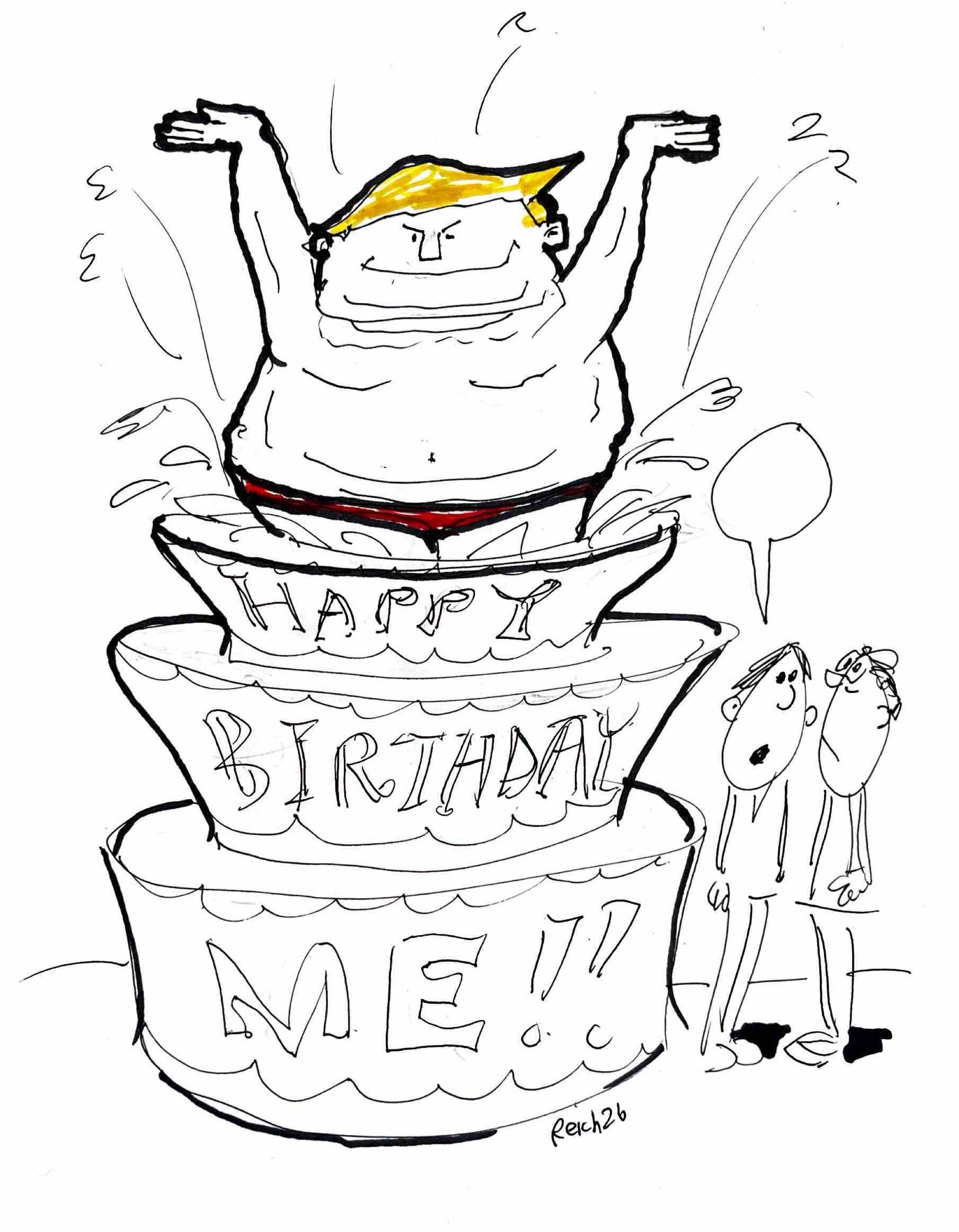
Last week’s winner:
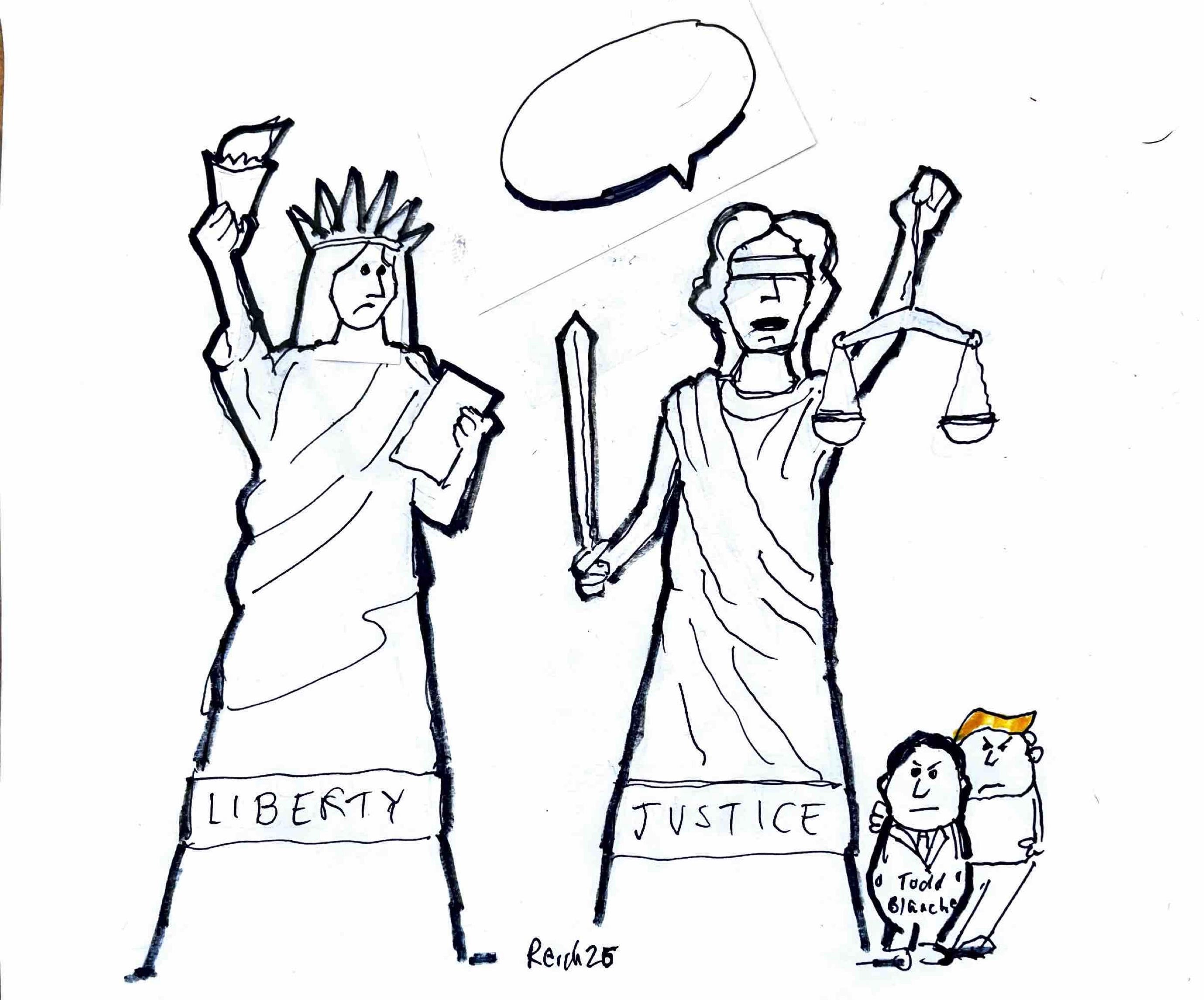
“There’s a reason why women were trusted to represent liberty and justice.”
(Congratulations, Sue Schneider).
Runners up:
“I may be blind but something smells disgusting.”
(Congratulations, Adam Laurie).
“Together girl, we can take that fool down. That’s what we were created for.”
(Congratulations, Beverly Clark).
“Justice may be blind, but I can smell a rat!”
(Congratulations, Diane Fogarty).
“I so envy you, Lady Liberty. I wish I could be standing on an island away from these clowns!”
(Congratulations, Whereabouts Unknown).
“They hate it when women get together.”
(Congratulations, Wyrd Folk).
“I’m not so blind that I can’t see what they’re doing!”
(Congratulations, Edwin Darling).
“OMG It’s supposed to be Justice is Blind NOT Blind to Justice!”
(Congratulations, Renais Winter).
“I’m blind, but I’m not deaf and dumb.”
(Congratulations, Brooks Keogh).
“I can see that Todd has no understanding of justice, and neither does the guy who nominated him.”
(Congratulations, Laurence Hoffmann).
“Just found out you can legally remove the Statue of Liberty... Or you could change the slogan on it, to: ‘Give me your wealthy, your corrupt, your bribers, yearning to avoid taxes.’”
(Congratulations, Lynn E Levine).
“If I drop these scales right now, I can make the world a better place.”
(Congratulations, James Coyle).
This week on my podcast, I read a recent post from my Pluralistic newsletter, “The World Has Moved On,” which analogizes Stephen King’s Dark Tower series to the Enshittification hypothesis.
In the Dark Tower novels, we crisscross a fallen world in which decay is all around us. The buildings are rotten, the machines have stopped working and no one knows how to fix them, babies and livestock alike are frequently born with deadly congenital defects. Much of the world has fallen into wasteland, cracked and barren. An army of wreckers, led by the demagogue John Farson (who styles himself “The Good Man”) are slowly but surely conquering the land, laying waste to those few remaining outposts of civilization and conscripting the young men in the conquered lands to march on their neighbors.It wasn’t always this way. There was a time when the world was defined by hope and virtue and light, when the machines were fixed and the crops were harvested. Life wasn’t golden – there were still squabbles and sorrows and even wars – but life was good.
And then the world moved on.
For reasons that no one truly understands, the normal push/pull of decay and renewal turned into a one-way, irreversible process in which everything that crumbled or snapped or burned up couldn’t be repaired or replaced or recovered. Our mysterious ability to beat back the Second Law of Thermodynamics – an absurdity we probably should have always treated as an aberration – has collapsed. The world has moved on.
Delayed today because I’m out doing errands. Will draw and post as soon as I’m back! (Thanks for your patience.)
