Normal view

Linus Torvalds: ‘AI Is a Tool, Just Like Other Tools We Use. And It’s Clearly a Useful One.’

17 July 2026 at 20:13

Linus Torvalds:

I realize that some people really dislike AI, but this is an area where I’m willing to absolutely put my foot down as the top-level maintainer.

Linux is not one of those anti-AI projects, and if somebody has issues with that, they can do the open-source thing and fork it.

Or just walk away.

AI is a tool, just like other tools we use. And it’s clearly a useful one.

It may not have been that “clearly” even just a year ago, but it’s no longer in question today.

There are other questions around AI (like what the economy of it will actually look like in the end), but “is it useful” is no longer one of those questions. Anybody who doubts that clearly hasn’t actually used it.

BBEdit 16

17 July 2026 at 19:31

Speaking of BBEdit, version 16 dropped just before WWDC, and adds a slew of nifty improvements, headlined by vastly expanded support for Shortcuts. You can also search for text in images, use the W3C HTML syntax checker, and of all things, use vi keyboard emulation. There’s a lot more, of course — and as always the changes, improvements, and additions are copiously documented in the release notes.

New licenses are $60, upgrades from v15 cost $30, and upgrades from older versions are $40. In the Mac App Store it’s a $5/month or $50/year subscription.

See also: Jason Snell at Six Colors and Adam Engst at TidBITs.

ArtfulType: Markdown Writing App for the 68K Macintosh

17 July 2026 at 19:05

Sean Malseed — “Action Retro” on YouTube — created a Markdown editor for the original Macintosh. Source code on GitHub; intro video on YouTube. It’s written in C, not Pascal, and uses the modern Retro68 GCC-derived compiler.

I absolutely love that this exists. I don’t like the actual app at all. I guess “full screen” mode is the point of some “distraction free” editors, but I for one would never look twice at a Mac app that didn’t use windows. Full-screen mode just wasn’t a thing back then, except for games. ArtfulType is not a Mac-assed 1984 Mac app.

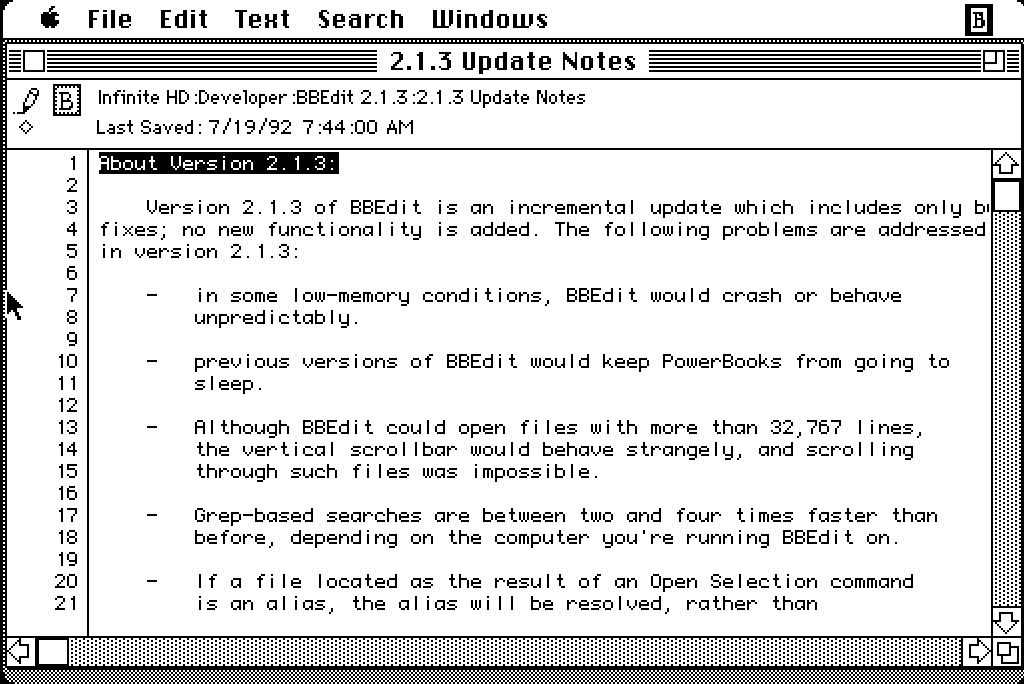
If I wanted to write in Markdown on a classic Mac, I’d use BBEdit, which was the app I originally created Markdown for use in. And one of two apps I primarily still use it in. But BBEdit won’t run on an original 128 KB Macintosh, because Rich Siegel didn’t create it until 1989, and the earliest public version was BBEdit 2 in 1992. BBEdit 2.1.3 does run in System 5 on Infinite Mac, but crashes if launched on System 3. I 100 percent see the appeal of using a 1980s retro Mac, but I don’t see the appeal of using one that can’t run System 6.

Google and Epic Give Up Fighting — Third-Party Android App Stores Are Coming Next Week

17 July 2026 at 17:53

Sean Hollister, reporting for The Verge (gift link):

Here’s Google’s full statement on withdrawing its proposed modifications to Judge Donato’s permanent injunction, via Google spokesperson Dan Jackson:

We’ve agreed with Epic to withdraw our motion to modify the US Court’s injunction rather than prolonging this process which creates uncertainty for the ecosystem. This allows us to focus on executing our recently announced global business model evolution to deliver greater app store choice, lower prices, and more opportunities for developers and users. We remain committed to maintaining Android’s industry-leading security and fostering a competitive ecosystem where every app store and developer has the freedom to compete. In parallel, we continue to comply with the US Court’s injunction.

Google had previously announced that it would launch its sideloaded Registered App Store program in the rest of the world, beginning with the new version of Android later this year. That means there may be two different tracks for Android: stores-within-a-store in the United States and Registered App Stores everywhere else.

Google is already informing US app developers that their apps and game listings will automatically be provided to third-party app stores starting July 22nd, unless they opt out, and it’s launched a specific page for its Play Catalog Access Program for third-party app stores to enroll.

I presume that this new agreement between Google and Epic includes ripping up the “no criticism of Play Store” gag order that the highly principled Tim Sweeney had agreed to in exchange for $800 million back in March?

Anyway, it will be interesting to see what developers do. My guess is that all the big app developers will opt out of this. Games, though, maybe not?

European Commission Adds Exemptions for Watches and Earbuds to Portable Battery Removal Rules

17 July 2026 at 04:01

The European Commission:

The European Commission adopted a delegated act today (14 July) introducing new rules that exempt additional products from EU requirements on the removability and replaceability of portable batteries.

Under the EU’s Batteries Regulation, portable batteries in products sold in the EU must generally be removable and replaceable by consumers. This helps extend products’ lifetime by allowing battery replacements and supports recycling by making it easier to collect used batteries. [...]

The Commission is now adding six new product categories to the existing list of exemptions. This includes wearable devices such as smartwatches and fitness trackers, electric toys, and products within the scope of the ATEX Directive (equipment used in explosive atmospheres such as explosion-proof motors, sensors, pumps or forklift trucks).

See, exemptions aren’t hard, especially to stupid regulations.

Quiche Browser Now Defaults to No-AI Web Search Results

17 July 2026 at 02:17

Quiche Industries (Greg de J.):

Starting today, Quiche Browser disables AI overviews in search results by default, out of the box.

Compare how much space and time they waste. I love the web too much to let that nonsense bury links to real websites made by humans.

This is my modest contribution to the fight against the dead internet theory. Why no other browser does that is beyond me.

To elaborate a bit:

• It simply opens search results in the AI-free versions of Google, DuckDuckGo, Bing, and Brave, whenever they’re selected as the default search engine. • No content blocker involved. Search results are served as-is. • AI features can be turned back on in Settings → Search.

I wrote about Quiche Browser a few months ago, praising it for, amongst numerous other features and aspects, its built-in JavaScript toggle. This is another killer feature. Traditional no-AI web search is a splendid default. Making it an option to enable if that’s what you want is the right way to do this.

Dithering: ‘Apple Sues OpenAI’

17 July 2026 at 01:28

Cover art for Dithering in July 2026. Two young women jumping and frolicking in the summer.

Tuesday’s episode of Dithering was a good one, especially for the DF audience, so we’ve moved it outside the paywall and made it free-to-listen on the web. (We don’t (yet?) have an RSS feed that you can put in your podcast player for these occasional free episodes, alas.) I have a slightly different take on Apple’s lawsuit against OpenAI than I’ve seen expressed elsewhere.

If you don’t subscribe to Dithering, you probably should. Two episodes per week, 15 minutes per episode. Not a minute less, not a minute more. $7/month or $70/year — or, get it included with the Stratechery Plus bundle.

OpenAI Takes a Second Crack at a Response to Apple’s Trade Secret Theft Lawsuit

16 July 2026 at 21:44

OpenAI, in a statement to Bloomberg this week:

“While we take these allegations seriously, we’re not aware of any evidence that this complaint has merit. We believe in fair competition and allowing people the freedom to work wherever they choose, and we’re focused on building innovative technology that empowers people everywhere.”

“We’re not aware of any evidence that this complaint has merit” is very different from, say, “This complaint has no merit.” Again, a curious response.

Lawyer for Apple Mixed Up Two OpenAI Employees’ Names, Sent One Email to the Wrong Guy, Back in February

16 July 2026 at 21:34

David Ingram, reporting for NBC News (which recently added a paywall without gift links, alas):

Apple alleged in a lawsuit last week that OpenAI “never responded” to its concerns this year about what Apple believed was trade secret theft. But emails reviewed by NBC News show that’s not the full story: OpenAI did respond in February to Apple’s initial outreach. The communications became bogged down and, according to OpenAI, abruptly stopped after an outside attorney representing Apple mixed up the names and email addresses of two OpenAI employees who had the last names Wang and Chang.

The emails show that Gabriel Gross, a lawyer for Apple with the law firm Weil, Gotshal & Manges, intended to email an OpenAI employee with the last name Wang but instead emailed a different employee with the last name Chang and confused their interactions. Gross apologized a day later for his mistake, but the interaction appeared to upset OpenAI’s general counsel, who asked Apple to remove the outside counsel from the matter. Apple declined. [...]

By the next morning, a Tuesday, Gross had realized his error and wrote a third email to Chang. He said he had intended to send the second email to the former Apple employee who had gone to work at OpenAI.

“After we had emailed Mr. Wang yesterday about retaining Apple information, he promptly called me and offered to cooperate with Apple in resolving any issues. I then intended to email him again, but accidentally replied to my email chain with you instead. I apologize for the confusion that likely caused,” Gross wrote.

Based on that email, Chang believed the issue had been resolved and didn’t respond, according to Pusateri, the OpenAI spokesperson.

It’s slightly embarrassing to conflate two rhyming surnames and mistakenly send an email intended for one person to the other, but I don’t see how this is a big deal. And I definitely don’t see how it refutes Apple’s claim that OpenAI didn’t respond to Apple’s February letter laying out their initial accusations. The back and forth seems to have gone like this, paraphrasing:

Apple lawyer: Here’s a letter and three exhibits where we lay out our claims of trade secret malfeasance at OpenAI.

Apple lawyer, to the wrong person: Thanks for the phone call.

OpenAI lawyer, who had not yet responded: WTF? I never called this guy.

Apple lawyer: Sorry, that second email wasn’t for you, I made a mistake.

And then at that point, we’re to believe that the OpenAI lawyer presumed the entire matter was settled? That makes no sense. If this is OpenAI’s defense they’re in bigger trouble than I thought. And why did NBC News think this was exculpatory in any way?

Louie Mantia: ‘The Shape of Apps’

16 July 2026 at 20:07

Louie Mantia, with a thoughtful essay on app icon design and the squircle-jail controversy on the Parakeet blog:

It’s worth noting that some of the platform’s best icons look worse, while some of the platform’s worst icons look better.

Ultimately this is what I object to with the squircle mandate. It favors the bottom of the heap by restricting the top. It makes bad icons mediocre but pushes great icons toward mediocrity too. That’s not The Macintosh Way.

Masking all of these app icons to a squircle, and even applying Liquid Glass effects to them, aims to solve this problem. And this follows the same principle of iOS 7, which is to make it easier for all apps to fit in on the platform, especially apps built by designers and developers who aren’t familiar with how to make an icon that looks great next to first-party icons.

Just so I’m clear about my preference, I would love if Apple provided a way for designers to poke outside that squircle boundary. Some of my favorite app icons did that. But also some of my least-favorite app icons ignored this shape entirely, when it was used for every system icon in the last five years. Whenever those apps showed up in my Dock, it was like a stain on my shirt I couldn’t get out.

Despite the genuine loss associated with the squircle restriction, there’s more than one way to design with it.

What a wonderful piece, and of course, it’s replete with example icons. It’s a compelling defense of the direction Apple has taken Mac app icon design.

OpenAI Releases Codex Micro, a Stupid $230 Hardware Keypad

16 July 2026 at 19:45

Remember back in March when then-co-CEO Fidji Simo announced to the company that “We cannot miss this moment because we are distracted by side quests”? And then weeks later they spent “low hundreds of millions” to purchase the TBPN YouTube show? In their continuing effort to focus on core product, they’re now selling a $230 hardware keypad ostensibly for working with Codex, which is no longer an app but just a tab in their craptacular super app.

Quinn Nelson:

No way, that’s crazy. I’ve just been using the keyboard and trackpad that came on my laptop for free like a stupid idiot.

Gurman on OpenAI’s Upcoming Hardware Product: ‘Movable, Screenless Speaker Built as AI Companion’

16 July 2026 at 01:02

Mark Gurman, reporting for Bloomberg:

OpenAI believes the product’s defining feature will be its personality and ability to connect on a humanlike level with users. The speaker incorporates mechanical elements that can move on their own, creating a sense that it is alive and not just an object responding to commands. The machine also will draw on personal information such as emails to better understand its owner.

The goal is for the device to feel like a companion and become a physical manifestation of OpenAI’s ChatGPT. Still, the exact plans could change as the company works through the development and legal process. [...]

Another central difference is that the device includes a rechargeable battery, allowing it to be carried from room to room throughout the day. A user could bring it into the laundry room while doing chores, move it into the kitchen for cooking assistance, and later place it in a living room or bedroom to have it play music. It can also remain plugged into a single room if the customer chooses.

This description doesn’t sound compelling at all to me. If it’s able to move at all, then it ought to be autonomous. Star Wars-style droids are, in my opinion, the end game here. That’s ambitious though. I don’t think either AI or robotics are there yet. But if it can’t move itself, it needs to be wearable, not luggable.

No one wants a companion they need to lug around.

Eric Seufert: ‘Did Apple Just Signal a Third-Party Expansion of Apple Ads?’

16 July 2026 at 00:52

Eric Seufert, Mobile Dev Memo:

The new language could simply accommodate the availability of Apple-owned services on the web and through third-party devices and operating systems; the Apple TV app, for instance, is available on smart TVs, streaming devices, and game consoles. But the addition of “other properties” is conspicuously broad and appears to give Apple the contractual latitude to distribute ads beyond its own services entirely. This would allow for a material expansion of the company’s advertising surface area.

Further, if Apple does indeed plan to expand Apple Ads to third-party surfaces, it would explain why the company did not reveal an update to its AdAttributionKit (AAK, formerly SKAdNetwork, or SKAN) attribution framework at this year’s WWDC.

That would be one way to go.

Apple Updates Advertising Services Policy With New Rules for Ads in Maps

16 July 2026 at 00:48

Sarah Perez, TechCrunch:

In a newly published Apple Advertising Services policy, effective as of July 14, 2026, the iPhone maker shares its rules for advertising on Apple Maps. Notably, it prohibits the broad category of home services businesses, like plumbing, electrical, locksmith, HVAC, pest control, roofing, and general contracting services, among others. [...]

The broader policy also prohibits deceptive or profane ads, political ads, and ads featuring weapons, violence, controlled substances, defamatory material, and more.

Although Apple may expand to other ad categories over time, its initial approach positions Maps and its ads as a more curated, navigation-focused product, rather than an extension of a web search engine.

The easiest way to keep scammy and predatory ads out of Apple Maps would be, you know, not to sell ads in Apple Maps.

Apple Intelligence OK’d to Launch in China, Using AI Models from Baidu and Alibaba

16 July 2026 at 00:35

Ben Jiang, reporting from Beijing for the South China Morning Post:

Chinese regulators have granted Apple a long-awaited licence to roll out its artificial intelligence service on iPhones in the country, with Alibaba Group Holding and Baidu serving as technical partners.

The Cyberspace Administration of China (CAC), the country’s internet watchdog, published a notice on Wednesday confirming the licence for Apple Intelligence — the AI feature used to summarise emails, draft reports, edit images and perform other tasks. It was granted alongside six other smartphone-based AI services, including those for Samsung and Huawei Technologies.

An Alibaba representative told the South China Morning Post on Wednesday that its Qwen large-language model would “be integrated into Apple Intelligence experiences within iOS, iPadOS, macOS and visionOS for users in China”. This would allow users to access the model’s capabilities such as text and image generation, the representative said. Alibaba owns the South China Morning Post.

A Baidu representative also told the SCMP on Wednesday that it was working with Apple to develop AI features for Apple Intelligence in China.

This isn’t about Siri AI, announced last month at WWDC for iOS 27 — this is the initial approval for Apple Intelligence, which was announced two years ago and rolled out in iOS 18. It’s unclear in any of this coverage today whether this is a green light for Siri AI this year too.

[Sponsor] Paper

Paper is a professional design tool where every layer is real HTML and CSS. Your design is already code, which means fewer handoffs and fewer translations between what you design and what ships.

Paper works both ways: code to design, and design to code. Connect any agent through MCP and it can read and edit your designs. Or use Paper Snapshot to capture your live site as editable layers and make new iterations.

Agents handle the tedious work so you can focus on your craft and the decisions that matter.

Try Paper at paper.design.

How to Estimate Knife Steel Properties

By: Larrin
13 July 2026 at 19:26

Patreon

Thanks to our new Patreon supporters!

Kyle

Paxton Irving

Patrick Chase

Robert Angerer

Willow Cheney

Chris Cramer

Paul Nawashar

Video

There is also a video that presents the same information:

Knife Steel Tests and Ratings

I have tested many knife steels over the past several years and reported the results in many articles. I also have an article where I created ratings for each steel based on those past experiments. In that article I spent quite a bit of space on what is behind the properties of each steel. For example, I showed an equation I developed that predicts the CATRA edge retention of different steels based on carbide types, carbide volume, steel hardness, and the edge angle of the blade. I wanted to try to demystify the ratings a bit to show that steel results are somewhat predictable based on certain factors. Of course there are always many counter-examples where we test a steel and are surprised by a result, usually in the negative direction. With enough investigation it is possible to find out why a result was different than the expectation, though of course we don’t always have the resources to do that.

So in an ideal world we would have experimental data for each steel and don’t have to speculate on how good the steel might be. Before I started doing my testing there was very little 3rd party data available for comparing steels between companies. So Crucible or Uddeholm, etc. might compare the general properties between their own steels but generally not between their steels and the competitors’. And the companies rarely have data for everything about a steel, many data sheets are missing wear resistance or toughness experimental results, etc. But can the average knife enthusiast look at a steel composition and make a reasonable estimate of its properties? Can it be done just by looking at one or two elements and then checking with a chart? (As opposed to complicated equations). I decided to see if such a thing could be possible. I will also point out some of the cases where the estimates break down and why.

This might be my worst idea ever, as now my comments will be filled with people asking about every possible outlier in the predictions. At least you will be better at predicting steel properties than AI.

Compositions

So for these predictions, I am trying to find the best correlations I can using only the published elemental composition of each steel. These are available in many places, such as the steel manufacturer websites, in articles on my website, in Knife Engineering 2nd edition, or Zknives.com has a huge database of them. For the high alloy steels, it also lists whether it is “ingot” (conventional steelmaking) or PM (powder metallurgy), which will be relevant for the toughness predictions.

Carbon Steels

Low Alloy Steels

High Alloy Steels

High Speed Steels

Stainless Steels

Edge Retention

Edge retention seems to be the favorite property of knife enthusiasts so we will start there. I have a big article on CATRA edge retention here that discusses a lot of the individual grades and why they land where they do.

One thing I showed was a chart comparing some different stainless and non-stainless steels to each other and the overall amount of carbide to show that more carbide leads to higher wear resistance and edge retention:

Those different color dots correspond to different amounts of chromium and vanadium because those are important factors for edge retention:

You can see micrographs of the steels to get an idea of the increase in carbide volume:

CPM-3V

CPM-4V

CPM-10V

CPM-15V

The steels with low chromium (5-7.5%) and vanadium additions form a very hard vanadium carbide, and because of the high hardness of those carbides they have a stronger effect on edge retention for a given carbide volume. Chromium carbides are significantly softer and so you need a lot more carbide to achieve the same level of wear resistance. Increasing amounts of chromium in the steel reduces the amount of vanadium carbide formed for a given amount of vanadium, and replaces it with the softer chromium carbides. However, because the total carbide volume is generally higher for those grades, the edge retention is actually pretty consistent for a given amount of vanadium:

However, this is not perfect of course. Most of the steels I “normalized” to a hardness of 61 HRC so we are comparing the steels and not the steel and hardness at the same time. The effect of hardness on CATRA edge retention is relatively predictable if you look at the angled grey dashed lines on the CATRA chart. Z-Max, Maxamet, and Rex 121 are above the line for the other steels because they have a lot of tungsten/molybdenum carbide in them and also because they were tested at very high hardness levels and aren’t really designed to be used at lower hardness. So I didn’t normalize them to 61 HRC. Also when you look at the 0% vanadium region it ranges all the way from 300 to 750 mm or so. This is because there are steels with little or no vanadium that can have a lot of chromium carbide and still have relatively high wear resistance. Those steels still need high carbon to form all of those carbides, however, which also includes those extreme high speed steels like Rex 121. So I found that carbon was actually the simplest predictor of edge retention:

There are still some steels that are relatively low compared to others, such as the cluster of steels in the 300 mm range at 1-1.5% carbon. Those are low alloy steels with very soft iron carbides called cementite. So I broke out the steels into different categories and the predictions get even better:

So to get an estimate of edge retention based on composition you follow this process:

  1. Does the steel have less than 3% Cr? If yes it is a “low alloy” steel, otherwise it is a “high alloy steel.”
  2. Does the steel have a significant vanadium addition? If so look at the “High Alloy >1%V” line, otherwise look at the grey line.

Nothing is perfect of course but that can give you an idea of where the properties might land. Note that it is not separated by stainless vs carbon steel, all of the stainless steels are within the “high alloy” category in this case. Could also probably break out steels designed to be used at over 66 HRC but this is close enough for our purposes I think. This does not factor in nitrogen since there are very few steels with which to build an estimate. Nitrogen could probably be added to the carbon, or perhaps use 6/7 multiplied by nitrogen because of the atomic weight difference.

Toughness

Toughness is also greatly controlled by steel hardness and carbide volume. However, the carbide hardness matters a lot less for toughness, and instead it is the carbide size that is very important in this case, which we didn’t discuss at all for edge retention. One of the big differentiators here is the technology used to make the steel. The most expensive knife steels are made with powder metallurgy, which leads to a smaller carbide size. So you can get higher toughness for a given amount of carbide. One example would be D2 steel made with conventional steelmaking, powder metallurgy, or an in-between technology called sprayform. You can see the difference in carbide size and toughness below:

CPM-D2 (powder metallurgy)

PSF27 (sprayform D2)

D2 (conventional steelmaking)

The amount of carbide matters just as much as the size as the carbides, however. More carbide reduces toughness because they are very hard particles, and are the sites where cracks will initiate and grow. Here is a chart showing powder metallurgy steels and the strong correlation with toughness and carbide volume:

However, we do not know what the carbide volume is just based on the composition, so we need some other factor for estimating. The closest we have is again looking at the carbon content, since you need more carbon to form more carbide:

So that gives us a reasonably good estimate of toughness though not perfect of course. While you can see that toughness drops relatively rapidly up to 1.5% carbon this can be somewhat misleading. In terms of expected performance, toughness behaves more on a log scale. Plotting it that way shows the following:

As an example of how even a relatively low carbon steel can end up with poor toughness look at 1.4116, which is a stainless steel with 0.5% C,15% Cr, and a small amount of Mo and V. With the low carbon content we would predict a relatively high toughness value. However, it only tested about 8 ft-lbs even though it was only 57 HRC. When analyzing the microstructure I found there were some very large carbides. These large carbides will of course limit the toughness. It is likely possible with better processing to reduce or eliminate these large carbides, but poor processing can turn a good steel into a bad steel.

A large carbide I found in 1.4116 stainless steel

I tried to break it down further so the spread for each carbon content is smaller though it does start to get messy:

The conventional steels, whether high or low alloy are relatively close to powder metallurgy below about 1% carbon but rapidly drop. The high alloy steels see this steep drop because the carbide size becomes more and more difficult to control as the carbide volume increases. Low alloy steels have significantly less carbide for a given amount of carbon but they have more issues with “plate martensite” above about 0.85% carbon. You can read more in this article about forging knife steels. The biggest counterexample is 52100 which is the blue dot at 1% carbon and ~30 ft-lbs. The 1.5% Cr makes it less prone to having plate martensite.

The highest points on the chart are the yellow ones which are the powder metallurgy non-stainless steels. Both PM high speed (light blue) and PM stainless steels (orange) are significantly below. The reason is that the stainless steels have a significant amount of chromium carbide, and in powder metallurgy steels the chromium carbides are significantly larger than the vanadium carbides. The amount of carbide for a given carbon content is also generally higher, probably because the high chromium leads to more overall carbide. The high speed steels instead have significantly amounts of tungsten/molybdenum carbides which are also larger than vanadium carbides. Counterexamples for the above are MagnaCut, MagnaMax, and CPM-M4. MagnaCut and MagnaMax were designed to not have chromium carbides, so they behave more similarly to the non-stainless steels. CPM-M4 has less tungsten/molybdenum carbide than most other high speed steels, and is overall more balanced than other high speed steels.

Corrosion Resistance

I have a previous article about corrosion resistance testing and the factors that lead to high corrosion resistance. I also wrote about corrosion resistance and tested a bunch of steels for the MagnaCut article. Of course one of the most basic aspects of a stainless steel is having at least 10.5% Cr. However, the chromium content alone does not tell you the corrosion resistance because not all of that chromium will go towards the corrosion resistance but instead will end up as chromium carbides (which are detrimental to corrosion resistance). But the correlation is still pretty good with bulk chromium:

MagnaCut has high corrosion resistance for a given chromium content for two reasons: 1) all of the chromium is in solution rather than being locked up in a carbide, and 2) it has no chromium carbides in the heat treated condition and those carbides are bad for corrosion resistance. D2 and ZDP-189 have low corrosion resistance for their level of chromium. These steels have very high carbon and thus form a lot of chromium carbide, reducing the amount of chromium in solution available for creating the chromium oxide protective film at the surface. So I tried to plot Cr divided by carbon and see if that gave a better correlation, since D2 and ZDP-189 have a low Cr/C ratio:

The trend now does not show those outliers that are too low but has a bunch of values that are above the trendline. Also Vanax and LC200N have a significant amount of carbon replaced by nitrogen so it is hard to plot them with the others. One reason there are many values that are above the trend line is because they have significant amounts of vanadium and thus much of that carbon is going toward the formation of vanadium carbides rather than chromium carbides. So I broke them out by whether the steels had sizeable vanadium additions:

Definitely not getting perfect predictions but not terrible. You should be able to get a decent idea of the corrosion resistance by looking at the ratio of Cr over C from the bulk composition. Anything over a “7” or so would be stainless. One check of this chart would be an old steel called K190 which is a powder metallurgy version of an even older steel called D7, which is a non-stainless with 12.5% Cr and 4% V, which puts it into the high vanadium group. However, its Cr/C is still only 5.4 which would still predict it to be non-stainless. MagnaCut would be a 9.3 despite its relatively low Cr content so that still predicts it to be stainless, though that predicts it to be roughly an 8 out of 10 rather than its true 9.5. MagnaMax prediction is significantly worse even though its corrosion resistance is roughly the same, because it has much more carbon than MagnaCut, though with more V and Nb it still does not form chromium carbides. So as with all of the above estimates there are going to be outliers that do not work with the predictions.

Toughness-Edge Retention Balance

Of course you can see that our best correlations for both edge retention and toughness were with carbon. In other words, increasing carbon leads to an increase in edge retention but a reduction in toughness. And of course increasing one property leads to a reduction in the other. However, some things can improve the edge retention-toughness balance such as using vanadium alloying and powder metallurgy production.

Summary and Conclusions

So surprisingly you can get a decent estimate of knife steel properties including edge retention, toughness, and corrosion resistance just by looking at the carbon, chromium, and vanadium content. It was a fun exercise though I’m still not completely sure how much utility it has. Of course this isn’t perfect and there are so many hundreds of caveats to this estimate that you can’t take any estimate like this as gospel. But hopefully it will lead to fewer people believing that “steel X has crazy high edge retention!!!” because they can check the carbon content and know right away that their claim is questionable.

The post How to Estimate Knife Steel Properties appeared first on Knife Steel Nerds.

Remember Musk’s Suit Alleging a Conspiracy Between Apple and OpenAI?

13 July 2026 at 17:24

Ashley Belanger, reporting for Ars Technica back in August 2025:

After a public outburst over Grok’s App Store rankings, on Monday, Elon Musk followed through on his threat to sue Apple and OpenAI.

At first, Musk appeared fixated on ChatGPT consistently topping Apple’s “Must Have” app list — which Grok has never made — claiming Apple seemed to preference OpenAI, an Apple partner, over all chatbot rivals. But Musk’s filing shows that the X and xAI owner isn’t just trying to push for more Grok downloads on iPhones — he’s concerned that Apple and OpenAI have teamed up to completely dash his “everything app” dreams, which was the reason he bought Twitter.

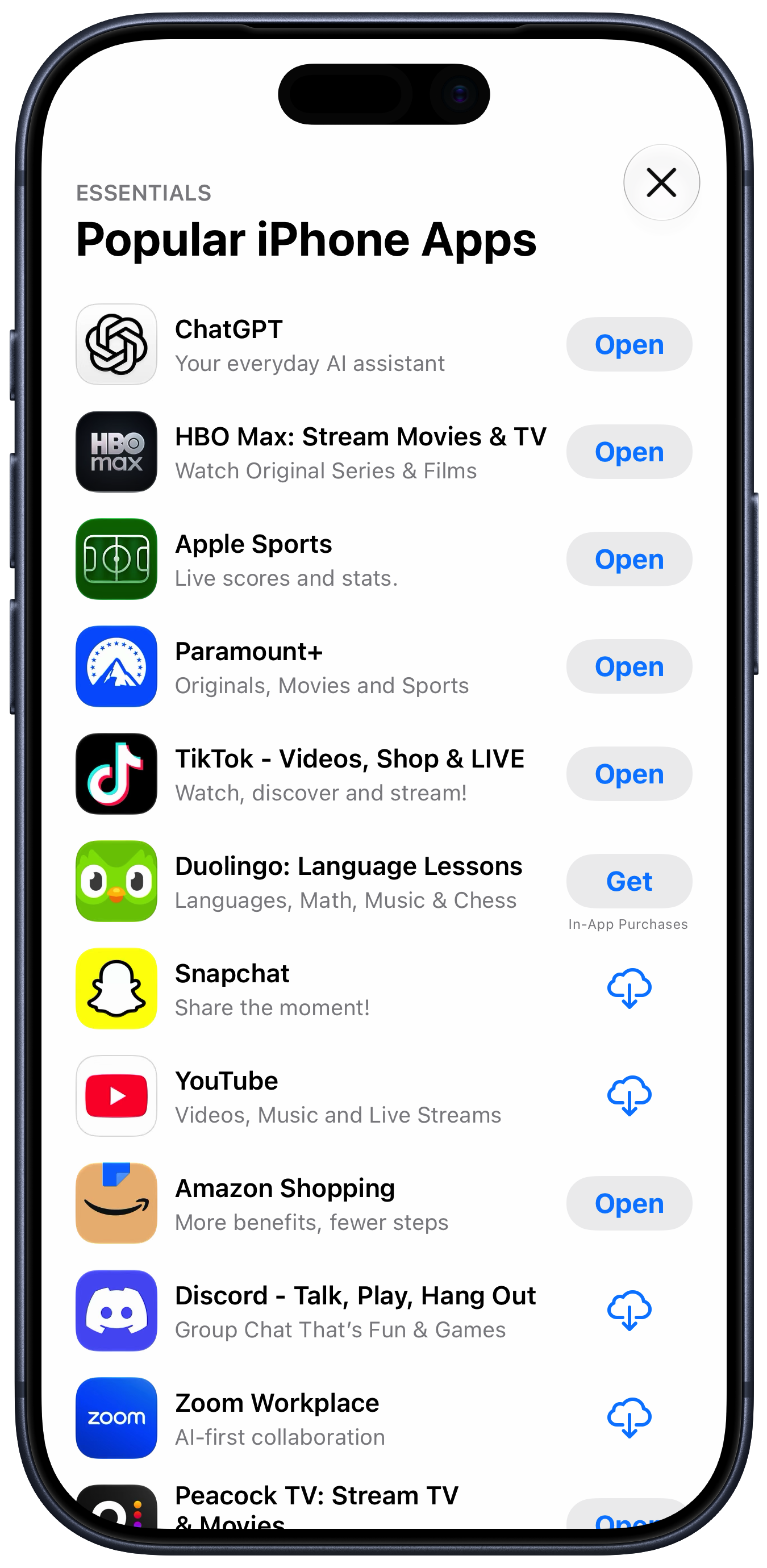
For what it’s worth, I just looked at the App Store editorially-curated “Popular iPhone Apps” list, and ChatGPT is in the top spot. Given the lawsuit Apple filed against OpenAI last week, I’d say this is pretty good anecdata that these editorial decisions in the App Store aren’t driven by favoritism. The top 10 downloads list for free iPhone apps currently looks like this (for me here in the U.S. App Store):

  1. Paramount+
  2. Netflix Game Controller
  3. ChatGPT
  4. Kalshi: Trade the World Cup
  5. Peacock TV: Stream TV & Movies
  6. Netshort - Popular Dramas & TV
  7. Threads
  8. TikTok Pro - Events
  9. Freecash - Get Paid Real Money
  10. Depop - Buy & Sell Clothes

There are some real winners on that list. But only one AI app: ChatGPT.

Musk alleges that the top downloads list is crooked too. That’s just projection. If Musk ran a popular App Store he’d put his thumb on the scale to make sure his own apps always top the list. That’s what he’s done with his personal account, and accounts aligned with his politics, on Twitter/X. Because that’s what he would do, he thinks that’s what Apple does. I really do think he believes the App Store’s top download lists are fixed, and that Grok is on the wrong side of the fix. Crooks think everyone is crooked. It’s just one of several ways that Musk is not hooked up right.

I suspect, though, that he’s no longer worried that Apple is putting its thumb on the scale to favor OpenAI. Maybe he should never-mind this lawsuit.

WorkOS Pipes

13 July 2026 at 00:17

My thanks, once again, to WorkOS for sponsoring DF last week. Users expect apps and agents to reach the tools they already work in. Every integration that gets you there is a different OAuth flow, a different token lifecycle, and weeks of infrastructure before you write a line of product code.

WorkOS Pipes handles it with one API call. Pre-built connectors for GitHub, Slack, Salesforce, Google Drive, and more. Pipes handles OAuth, token refresh, and credential storage. You call the real provider API with a fresh token, every time.

Connect to 100+ providers with WorkOS Pipes.

❌