Normal view

[Sponsor] WorkOS MCP: Manage Your Auth Platform From Any AI Agent

Debugging SSO, managing users, adjusting auth policies, configuring branding: every configuration task has lived behind a UI that only a human can drive.

The WorkOS MCP server gives agents the same access as your dashboard login. Hundreds of operations, discoverable at runtime. Connect in one command via OAuth, with scoped tokens instead of a master API key. Pass a screenshot of your marketing site and ask your agent to match the login page. If a human had to do it before, an agent can do it now.

Connect your agent →

‘Who’s Afraid of Chinese Models?’

20 July 2026 at 18:27

Ben Thompson, on the hype regarding Kimi K3, at Stratechery:

This is a point that bears repeating: because U.S. open weight model makers must follow the frontier labs’ terms of service, they (1) are worse than Chinese alternatives and (2) end up distilling the distillation, just with a detour through Chinese labs. Wouldn’t it be better if western open weight model makers could go to the source?

To that end, here’s an even more interesting question around distillation: why exactly is it bad? After all, what are large language models but the distillation of all of the knowledge on the open Internet, scraped by the frontier labs and distilled into the models that are themselves being distilled? Who is exactly being wronged here?

In fact, this paradox is the solution. I believe that open weight models are good for innovation (and, per the above, I think that labs on the frontier will be fine), but it’s a problem to be dependent on China. The U.S. should pass a law that (1) makes explicit that collecting data for training models is fair use, and (2) bars terms of service that forbid distillation, for U.S. companies at a minimum. Stopping distillation — which is literally just querying the API — is nearly impossible; the U.S. should go the other way and lean into a new copyright policy that both indemnifies the labs and also guarantees that what they learned fuels further innovation for everyone else.

To be clear — and Thompson emphasizes this point too — the leading Chinese models like K3 aren’t good only because of distillation. They’re not entirely rip-offs. But distillation is clearly an essential part of the formula they’re using to keep releasing models that are 6–9 months behind the U.S. frontier state of the art. So the Chinese treat all models as “open”, regardless of the terms of service. But anyone in the U.S. or other western countries that respect copyright — or contracted terms of service — who wants to distill a good model has to wait for the Chinese to release their models, like K3.

And that second paragraph I quote above distills (sorry) exactly why I want to bring out the world’s smallest violin to play a sad song for OpenAI and Anthropic regarding their objections to their frontier models being distilled against their terms of service.

Paper

20 July 2026 at 00:31

My thanks to Paper for sponsoring last week at DF. Paper is a new professional design tool where every layer is real HTML and CSS. Your design is already code, which means fewer handoffs, translations, and layers of abstraction between what you design and what you actually ship.

Paper works both ways: code to design, and design to code. Connect any AI agent through MCP and the agent can read and edit your designs. Or use Paper Snapshot to capture your live site as editable layers and make new iterations. Agents handle the tedious work so you can focus on your craft and the decisions that matter.

Try Paper at paper.design (great domain name), and check out the documentation and FAQ for more info.

9to5Mac Uncovers Dozens of Disguised Gambling Apps on the App Store in Brazil

19 July 2026 at 19:18

9to5Mac:

Brazilian users browsing the App Store rankings in categories such as Navigation, Travel, and Weather have noticed a growing number of poorly made games appearing among the top results, many of them featuring AI-generated illustrations of animals as their app icons.

As it turns out, these are so-called jacket apps, which are just a front for hidden betting and gambling apps. A 9to5Mac investigation has uncovered more than 60 apps that behave exactly as depicted in their App Store screenshots when accessed from virtually anywhere in the world, except Brazil.

When opened from a Brazilian IP address, the same apps instead reveal online betting platforms, as shown in the example below, which is currently the top app in the Weather category.

Obviously the main problem is that these apps disguise themselves Trojan Horse-style, and slip through App Store review undetected. I don’t think it’s reasonable to think App Store review could catch every attempt at this sort of thing though — if the horses are disguised well-enough, some of them are going to slip through. That’s actually fine.

But the first example 9to5Mac cites isn’t well disguised at all. What sense does it make that “PotatoPlot Puzzle” — a game featuring a rabbit potato farmer — is a weather app? How is that not a red flag right there?

Also, this app rose to become not just popular, but the number one weather app in Brazil, a nation with over 200 million citizens. In my yearslong argument that Apple should commission an internal bunco squad dedicated to hunting down scammers in the App Store, I always mention that the point of such a squad shouldn’t be to make the App Store 100 percent scammer-free — which I believe is an impossible goal that would set the team up for failure. The point should be only to make the App Store free of successful scams. Focus on the most popular apps and the most lucrative apps. There’s simply no feasible excuse for PotatoPlot Puzzle to have become the most popular “weather app” in Brazil.

Update: Apple issued a statement to 9to5Mac:

The company thanked 9to5Mac for its investigation and added that, prior to our reporting, it had already investigated and taken action against 25 similar apps, while also terminating the developer accounts associated with them.

★ Mornings in Cupertino Have the Aroma of Napalm Once Again

19 July 2026 at 02:38

‘It Seems You Have a Different Policy’

Ben Thompson, in a subscriber-only Stratechery update Tuesday:

I got a fun email from former Apple executive, Nest founder, and one-time Stratechery Interview subject Tony Fadell in response to yesterday’s Update about Apple suing OpenAI (published with permission):

Good article as always… This is Apple’s typical tactic to scare Apple employees — either former or current. I heard this lawsuit was driven by the Apple board.

Steve threatened to file a lawsuit against Nest for poaching 80-100 Apple employees. He called me, screamed for a while with lots of accusations. Then I said, “Steve, it’s Apple’s job to retain its talent, not mine.” He stopped his rant and then we went on to talk about our families and vacation plans. We kept hiring…

This sounds about right — and in terms of the Steve Jobs angle, John Gruber made a compelling case on Dithering that this lawsuit may very well have been driven by John Ternus channeling his inner Jobs.

Fadell, of course, is correct that it’s Apple’s job to retain its talent. Recent reporting from Mark Gurman suggests that John Ternus is keenly aware of this, at least as it pertains to Apple’s industrial design team, which has been ground zero for the Apple-to-OpenAI recruitment pipeline. (And the Dithering episode Thompson references is the one we made free-to-listen this week.)

Playing hardball when it comes to poaching is deeply embedded in Apple’s DNA. Steve Jobs hated Apple employees getting poached. In 2005 he sent this email to Adobe CEO Bruce Chizen:

From: Steve Jobs
To: Bruce Chizen
Date: Thursday, May 26, 2005 9:36 AM
Subject: Recruiting

Bruce,

Adobe is recruiting from Apple. They have hired one person already and are calling lots more. I have a standing policy with our recruiters that we don’t recruit from Adobe. It seems you have a different policy. One of us must change our policy. Please let me know who.

Steve

After one back-and-forth exchange with Jobs, Chizen agreed Adobe would change its policy.

A more contentious example came in August 2007, when Jobs sent an email to Palm CEO Ed Colligan that read:

From: Steve Jobs
To: Ed Colligan
Date: Sunday, August 26, 2007 11:42 am
Subject: Fwd: Your proposal

Ed,

This is not satisfactory to Apple. It is not just a matter of our employees deciding they want to join Palm. They are being actively recruited using knowledge supplied by Jon Rubenstein [sic] and Fred Anderson, with Jon personally participating in the recruiting process. We must do whatever we can to stop this. I’m sure you realize the asymmetry in the financial resources of our respective companies when you say: “We will both just end up paying a lot of lawyers a lot of money.”

Just for the record, when Siemens sold their handset business to BenQ they didn’t sell them their essential patents but rather just gave them a license. The patents they did sell to BenQ are not that great. We looked at them ourselves when they were for sale. I guess you guys felt differently and bought them. We are not concerned about them at all. My advice is to take a look at our patent portfolio before you make a final decision here.

Steve

That’s a good email. Information dense. My favorite part isn’t the “I’m sure you realize the asymmetry in the financial resources of our respective companies”, although that’s good. It’s the “I guess you guys felt differently and bought them.” Stone cold.

Some backstory on the players:

Colligan, of course, is Mr. “PC guys are not going to just figure this out. They’re not going to just walk in.” He was a business guy who thought product guys didn’t matter in an industry that was about to be taken over by product guys. Sort of like Steve Ballmer, without the charisma, at a much smaller company.

Jon Rubinstein1 was a hardware engineering executive at Apple, overseeing Mac hardware during the comeback years after Steve Jobs returned, then switching to oversee the newly-created iPod division in 2004. (Mac hardware then went under the supervision of a then-little-known operations executive referred to in the announcement as “Timothy Cook”.) Rubinstein left Apple in early 2006, citing exhaustion.2 His departure was announced six months earlier, alongside the promotion of Cook to COO. By 2007 Rubinstein was involved with Palm, by way of Elevation Partners, an investment firm that took a 25 percent stake in Palm. He became CEO of Palm in 2009, tried to turn it around, and then wasted a few years as an executive at HP after HP bought Palm’s carcass thinking it was still alive.

Fred Anderson was Apple’s CFO from March 1996 (almost a year before the NeXT reunification) to June 2004 — the nail-biting, at-times-near-bankruptcy turnaround years. Anderson took the fall, perhaps unfairly, for the stock options backdating scandal under Steve Jobs and, after leaving Apple, paid a $3.5 million fine in a settlement with the SEC. Needless to say, in the summer of 2007, there was bad blood between Anderson and Apple. Anderson, post-Apple, was a co-founder of Elevation Partners and had recruited Rubinstein to join.

Some bad blood. Some former high-level Apple executives putting a team of ex-Apple engineers and designers together to take on the iPhone. History doesn’t repeat, but it often rhymes.

If in addition to thinking that this sounds familiar, you also think these emails sound illegal, you may recall that in 2015, Apple (along with Google, Adobe, Intel, and other companies) paid a collective $415 million penalty to settle a class-action anti-poaching lawsuit. That they settled doesn’t mean they regret playing hardball. Rules are only followed by those who fear the penalties.

Jobs liked to fight, and wasn’t afraid to let his temper show. Tim Cook has a fierce temper and steel nerves, but he arguably only once, ever, showed it in public. I do not think he relishes a fight. He’s a diplomat, not a general. I suspect there’s no undiscovered tranche of Jobs-style stone-cold threatening emails from Cook to competing CEOs.

Steve Jobs’s oft-cited parting advice to Tim Cook was “Don’t ask what I would do. Just do the right thing.” Cook has largely lived by that mantra. But maybe — maybe — by taking that advice to heart, he has at times deliberately steered the company in ways Jobs would not have, just for the sake of steering it in a different way. I think maybe John Ternus is more of a “Hey, what would Steve have done here?” kind of guy.

On the one hand, this lawsuit is a bad look for Apple. It could be perceived that Apple does not think their employees are free to leave and compete against them. On the other hand, Apple could use a booster shot of Steve Jobs’s “us against the world” attitude. It might be wrong to start a war, but it’s never wrong to finish one after being attacked.

What would Steve Jobs do with this OpenAI situation? He’d go to war.3

‘This Is Not Satisfactory to Apple’

The early history of the Macintosh GUI went something like this: When the Macintosh debuted in 1984 it didn’t hit like Apple had hoped it would. (That’s when Steve Jobs was run out of the company.) But by the late 1980s it had caught on, especially in markets like design and desktop publishing. It was the only GUI game in town — command-line DOS PCs were popular, but Windows 1.0 was almost too primitive to believe and Windows 2 wasn’t much better. Apple was certain that the WIMP GUI was the future of computing, and because the Macintosh was the only credible GUI then on the market, Apple owned the future of computing. They were correct about one of those things. Because then came Windows 3, which still sucked — still was ugly, still was terribly designed, still severely limited compared to the Mac in its UI grace and vocabulary of actions — but, it didn’t suck as much. It wasn’t good but it was good enough for the corporate IT market, and the corporate IT market drove the industry at the time.

In the early 1990s John Sculley filed and pushed the infamous “look and feel” lawsuit against Microsoft. One year out from the launch of Windows 95 — which at least looked pretty good4 — Apple’s response was to try to argue in court that they owned the copyright and patent rights to the very concepts of the GUI and the desktop metaphor. The court handed Apple its ass. Apple soon found itself 90 days away from bankruptcy and in desperate need of a new modern operating system, which they themselves had proven incapable of creating. Windows 95 launched with such anticipation that customers lined up overnight outside retail stores to buy it the morning it launched.

That lawsuit was the low point in the entirety of Apple’s history. It was incoherent and, worse, pathetic. Incoherent because Apple was simultaneously arguing in marketing that the Mac remained vastly superior to Windows (“C:\ONGRTLNS.W95”), while arguing in court that Windows was a feature-for-feature clone. It couldn’t be both. I would argue that the former was true — the Mac remained superior in many ways — but actions speak louder than words and Apple’s action was to sue Microsoft and lose. It was pathetic because you know who loses? Losers.

The correct response to the competitive threat of Windows wasn’t to futilely attempt to argue that Windows should not be allowed to exist. It was to make the Macintosh so much better than it already was — to inject so much new innovative insane greatness — that customers would line up overnight to buy Mac software (and watch Apple keynotes). What Microsoft had in 1995 that Apple could not muster was vast customer enthusiasm. That cannot be bought. It cannot be faked. It can only be earned. And you sure as shit cannot stop it with a lawsuit.

Earning that sort of consumer enthusiasm — in spades — is exactly how Steve Jobs pulled Apple out of its nosedive. It took the better part of a decade.

When Apple announced this new lawsuit last week against OpenAI, I wondered, at first, whether it had a whiff of that 1994 look-and-feel loser desperation. Is it Apple’s position that the only way to stop its talent exodus to OpenAI is in court? Upon consideration, I think not. First, it’s not incoherent. There’s no conflict between what Apple is saying about its products or itself as a company that is at odds with this lawsuit. They’re just saying, “Fuck you, you goddamn traitors. You want to fuck with us? We’ll fuck with you.” When you poke a bear — 400 times — you better be ready for the bear to eventually react.

Further, while Apple can only have one CEO at a time, and that CEO remains Tim Cook until September 1, there’s no way that John Ternus doesn’t fully approve of this lawsuit. Cook has gone out of his way to leave Ternus with a clean plate. It would be insane to file this suit six weeks ahead of Ternus taking the helm if Ternus is anything short of fully on board.

I’m not saying it’s a good look for Apple. I’m certainly passing no judgment on the merits of the case, which OpenAI hasn’t yet responded to legally. But it is a very different and much more emotional reaction than we’ve seen under Tim Cook. Those anti-poaching emails Steve Jobs sent to Adobe, Palm, and Google weren’t good looks for Apple either. But that doesn’t mean they were bad for Apple. A bad look can be a good thing. Passion is powerful, and in and of itself, inspiring. This is a passion-fueled lawsuit. I saw some commentators speculate that, already hemorrhaging cash on a daily basis, OpenAI will surely spew some of that in the direction of Cupertino and just settle it. But Apple doesn’t need cash. This is a lawsuit that I believe OpenAI cannot settle, because there is no settlement Apple would accept short of a dissolution of their entire hardware division.

Apple claims in their complaint that the trade-secret chicanery they’ve already documented “is the tip of the iceberg”. If Apple is wrong, and OpenAI has recruited above the board and hired 400 former Apple employees fair and square (or even just mostly fair and mostly square), they have nothing to fear, and John Ternus will look like a petty little jealous bitch, and a feckless one at that. If Apple is right, however, all bets are off. I said earlier that rules are only followed by those who fear the penalties. But some never consider the penalties in the first place because they believe the rules don’t apply to them. Sometimes they find out otherwise.

I’m not saying OpenAI cannot win. I’m saying they can’t get Apple to settle — at least not until Apple is satisfied the whole iceberg has been revealed through discovery. Until then, John Ternus’s offer to Sam Altman is nothing — not even the fee for the gaming license, which he would like Altman to put up.


  1. Jobs might be forgiven for misspelling Rubinstein’s surname in his email to Colligan. Everyone called him “Ruby”. Perhaps akin to misspelling Greg Joswiak’s name as “Jozwiak” because everyone just calls him “Joz”. ↩︎

  2. I think it’s more likely that Rubinstein wore out his welcome at Apple. Here, I turn to Walter Isaacson’s Steve Jobs, which has some remarkable reporting on the situation. Quoting from Chapter 35, “Round One” (which chapter title refers to Jobs’s first bout with the cancer that eventually did him in), pp. 459–460 in the print edition:

    In the fall of 2005, after returning from his medical leave, Jobs tapped Cook to become Apple’s chief operating officer. They were flying together to Japan. Jobs didn’t really ask Cook; he simply turned to him and said, “I’ve decided to make you COO.”

    Around that time, Jobs’s old friends Jon Rubinstein and Avie Tevanian, the hardware and software lieutenants who had been recruited during the 1997 restoration, decided to leave. In Tevanian’s case, he had made a lot of money and was ready to quit working. “Avie is a brilliant guy and a nice guy, much more grounded than Ruby and doesn’t carry the big ego,” said Jobs. “It was a huge loss for us when Avie left. He’s a one-of-a-kind person — a genius.”

    Rubinstein’s case was a little more contentious. He was upset by Cook’s ascendency and frazzled after working for nine years under Jobs. Their shouting matches became more frequent. There was also a substantive issue: Rubinstein was repeatedly clashing with Jony Ive, who used to work for him and now reported directly to Jobs. Ive was always pushing the envelope with designs that dazzled but were difficult to engineer. It was Rubinstein’s job to get the hardware built in a practical way, so he often balked. He was by nature cautious. “In the end, Ruby’s from HP,” said Jobs. “And he never delved deep, he wasn’t aggressive.”

    There was, for example, the case of the screws that held the handles on the Power Mac G4. Ive decided that they should have a certain polish and shape. But Rubinstein thought that would be “astronomically” costly and delay the project for weeks, so he vetoed the idea. His job was to deliver products, which meant making trade-offs. Ive viewed that approach as inimical to innovation, so he would go both above him to Jobs and also around him to the midlevel engineers. “Ruby would say, ‘You can’t do this, it will delay,’ and I would say, ‘I think we can,” Ive recalled. “And I would know, because I had worked behind his back with the product teams.” In this and other cases, Jobs came down on Ive’s side.

    At times Ive and Rubinstein got into arguments that almost led to blows. Finally Ive told Jobs, “It’s him or me.” Jobs chose Ive. By that point Rubinstein was ready to leave.

    There’s a strong whiff of “You can’t fire me, I’m retiring” in the air when someone claims they were ready to leave after Jony Ive issued a “him or me” ultimatum. That’s like saying you’re ready to leave the pub after the bartender rings the bell for last call.

    I’d end this footnote here, but the very next passage is too apt to omit:

    He and his wife had bought property in Mexico, and he wanted time off to build a home there. He eventually went to work for Palm, which was trying to match Apple’s iPhone. Jobs was so furious that Palm was hiring some of his former employees that he complained to Bono, who was a cofounder of a private equity group, led by the former Apple CFO Fred Anderson, that had bought a controlling stake in Palm. Bono sent Jobs a note back saying, “You should chill out about this. This is like the Beatles ringing up because Herman and the Hermits have taken one of their road crew.” Jobs later admitted that he had overreacted. “The fact that they completely failed salves that wound,” he said.

    ↩︎︎

  3. One can argue that this whole situation never would have happened if Steve Jobs were still alive, because if he were, Jony Ive, Tang Tan, Evans Hankey, et al. would still be at Apple, and there would be no io. But that’s like saying maybe if someone in the 1910s had given Hitler more encouragement as a painter, none of this would have happened either. I enjoy fictional alternative histories as much as the next guy, but I’m more interested in the question of how Jobs would respond, right now, to the actual current situation. ↩︎︎

  4. A small irony is that the look-and-feel of Windows 95 borrowed much more from NeXTStep than it did from System 7. The look and layout of windows themselves; the use of gray, not white, as the default background color for the UI chrome; the chiseled 3D look — it’s almost inarguable that the Windows 95 look was ripped off from NeXT. Microsoft even copied from NeXT the window-close button going in the top right, not top left, and marking it with an “×” glyph, which the Mac never did. ↩︎︎

Apple Sends Letters to Dozens of Former Employees Now at OpenAI

19 July 2026 at 00:47

Michael Acton, reporting for the Financial Times from San Francisco:

About 40 former employees now working at OpenAI have been sent letters directing them to preserve documents and communications and demanding meetings with Apple’s lawyers, according to multiple people familiar with the matter. Apple and OpenAI declined to comment.

The decision to hit employees with personal legal letters highlights Apple’s aggressive tactics after it last week launched a blockbuster lawsuit accusing OpenAI and two employees of stealing secret hardware plans.

Apple Books and Amazon Are Lousy With AI-Generated Books Ripping Off Legitimate Authors

18 July 2026 at 02:33

Joanna Stern at New Things, last month:

Last month, just days after my book went on sale, AI knockoffs of the ebook version flooded Apple Books. There was Joanna Stern On I Am Not A Robot by Sophie Mercer. I AM NOT A ROBOT by Finn Tech. I AM NOT A ROBOT by Joana Stern — with one “n.” (Watch our latest video showing all these titles and more.)

In total, I found ten AI-generated ebooks clearly riding on mine, with AI-generated covers mimicking the style of my real one — the same blue, yellow and red color palette. Most were priced at $9.99, but some have gone as high as $20.99. [...]

After I contacted Apple about my own book’s clones back in May, the knockoffs quickly disappeared. [...] But now, a month after that first Apple cleanup, the problem is back. At the start of this week, there were at least three other I AM NOT A ROBOT counterfeits on Apple Books. (They seem to have since been removed.)

And I’m not alone. Lena Dunham’s Famesick has multiple lookalikes on the platform. Haley Sacks’s Future Rich Person has copycats that even use AI generated images of women on the cover that resemble the real author.

Kashmir Hill at The New York Times today (gift link):

Recently, I received a strange text from a new acquaintance. “You have your own biography???” it read. “How did you neglect to tell me this?”

This was news to me. I went to Amazon to investigate. There it was. A biography of Kashmir Hill — title: “The Biography of Kashmir Hill” — had been released nearly a year earlier, in August 2025. My life story had a mottled brown cover and a publisher I’d never heard of before. It had no reviews until I wrote one, asking, as the subject of this work, if I could please speak to the author. The hardcover cost $26.99, which seemed a bit steep, but my editor splurged on a copy and I was forced to read it.

My biography is 90 pages long and should be shorter. It combines facts about me that are widely available on the internet, such as where I grew up, with generic insights that could be true of anyone, like a horoscope spread over dozens of pages. “You cannot understand Kashmir Hill without understanding her contradictions,” my biographer wrote, along with an excruciatingly long description of my elaborate coffee-making ritual. (Fact check: My husband does it.)

It’s not just an e-book problem. Printing services are so cheap nowadays that some of these mooks (like one “author” Hill spoke to) are commissioning print editions for hundreds of these slopfests.

Google Runs Out of Appeals, Must Pay Record $4.7 Billion EU Antitrust Fine

18 July 2026 at 01:47

Arjun Kharpal, reporting for CNBC, back on July 2:

Europe’s top court on Thursday upheld Google’s fine of around 4.1 billion euros ($4.67 billion) over alleged anti-competitive practices.

In 2018, the European Commission slapped Google with the record-breaking penalty on the grounds that it abused Android’s mobile dominance to give unfair advantage to its own apps via pre-installation deals with smartphone makers.

Google has been appealing the ruling through the EU court system. But the European Court of Justice (ECJ), Europe’s top court, dismissed Google’s appeal. Google has no further right to appeal.

Google last year booked $132 billion in profit; this fine is about 3 percent of that. But in 2018, when the fine was initially assessed, Google booked “just” $31 billion in profit — this fine, if they’d paid it then, would have been about 15 percent of their annual profit. (And they booked only $13B, $19B, $16B, and $14B in profit going back from 2017 to 2014.)

There’s never a reason not to string the appeal process out, but it’s especially true when your profits are growing at an exceptional rate. By growing their profits around 5×, they’ve reduced the relative sting of this fine by 5×.

And that’s ignoring the effects of inflation — which over the last eight year have been significant.

Roblox Set to Introduce AI Game-Building Feature, Including on iOS

17 July 2026 at 23:20

Roblox executives Nick Tornow and Vlad Loktev, on the Roblox blog:

Twenty years ago, Roblox launched with a simple idea: “You make the game.” At the time, that was a radical proposition — most games were made by studios and professionals, and the idea that anyone could be a creator was far from obvious. But we believed it. And the millions of creators who built on Roblox proved it. As we look to a future where any one of Roblox’s 132 million daily active users could come up with the next hit game, we’re taking that original idea further than we ever have. Over the coming months, we’ll share a series of announcements that will give every creator a clear runway to go further and fulfill the promise of “You make the game” for more people than ever before.

Today, we’re announcing Build, a new mobile-first creation tab within the Roblox app, and a new suite of AI-powered tools within Studio for creators of every level. On July 28, we’ll begin testing these new agentic tools. With Build and Studio, creators can delegate the parts of development that don’t require their full attention.

This sounds really cool and fun. But you know what else was really cool and fun? AI coding apps that ran on iOS, like Bitrig, Replit, and Vibecode — all of which Apple put the kibosh on back in the winter. You of course are free to use any tool you want to build apps for iOS on a desktop computer, but Apple decided to disallowing building iOS apps on iOS.

But it’s OK for Roblox to allow AI-assisted game generation on iOS ... because Roblox is already so big and popular? How can Apple justify allowing Roblox to do this while disallowing anyone else?

OpenAI’s Product Shake-Up Put the Complexifiers in Charge

17 July 2026 at 22:27

Wired, back on May 15:

OpenAI says it’s folding ChatGPT, its AI coding agent Codex, and its developer-facing API into one core product team. The company says that Codex is increasingly powering its consumer and enterprise offerings, which are gaining the ability to perform digital tasks autonomously on behalf of users.

Other OpenAI leaders are also taking on larger roles at the company as part of the changes. OpenAI’s head of Codex, Thibault Sottiaux, has been tapped to lead the company’s core product and platform teams. Sottiaux was a key leader in building Codex into one of the company’s fastest-growing products of all time. He’s also one of the leaders overseeing development of OpenAI’s forthcoming “super app,” which aims to combine Codex, ChatGPT, and the company’s Atlas web browser into a unified desktop application.

I’ll give them credit for sticking with a plan for two whole months to get this out the door. But the problem is they went the wrong way. Instead of putting the eggheads from Codex in charge of ChatGPT, they should have put the product-minded people from ChatGPT in charge of Codex. Codex, I’m finally learning, is sprawling and confusing. It needs a strong dose of focus, clarity, and coherence — attributes that ChatGPT exhibited in spades. Instead, by putting the Codex dorks in charge, they’ve injected ChatGPT with confusion, incoherence, and sprawl.

Claude, the app OpenAI’s leadership is obsessed with copying now, is so goddamn confusing that it has Extensions, Plugins, Capabilities, Skills, and Connectors — and they’re all different things. You’ve let your own AI overuse turn your brain to mush if you think that makes sense, but even more so if you think that’s the model to copy.

I’ve been waiting for a while now for someone to explain all of this clearly and succinctly, worried that maybe it was my job to figure it out and do the clear succinct explaining. All of this dogshit from OpenAI and Anthropic presents itself as though it can be explained clearly and succinctly. But it’s just a veneer of coherence. It’s all just been thrown together in an AI blender and poured out as mush.

MG Siegler: ‘OpenAI Makes ChatGPT ChatGPT Again’

17 July 2026 at 21:48

MG Siegler, writing at Spyglass:

In that light, we can see the dilemma. But there were also probably about a dozen better ways to do this roll-out — as highlighted by how fast they’re fixing these things — and they just missed the mark. While they undoubtedly knew there would be some backlash, they probably didn’t realize there would be this much. Again. All that points to perhaps a disturbing trend where OpenAI doesn’t really understand their user base. Which you almost can understand given how they clearly stumbled into ChatGPT in the first place. Still, here they are with those billion users. A problem that all of their competitors would love to have. But still a problem if you want to fundamentally change what you are as a product.

But those are bigger, existential issues. All I wanted was chat back in the ChatGPT app. Front and center. And I got it. It’s not perfect. It’s still bloated. But at least it’s usable again now and not a confusing mess of ideas out of the box.

MG is pretty scathing, but I still think he’s taking it too easy on OpenAI for what a colossal fuck-up this remains. There was nothing wrong with the way things were, with two apps — the simple ChatGPT and the complex Codex. (Well, the Codex Mac app being an Electron turd was wrong, but that complaint seems quaint at this point.)

Adding “ChatGPT” as a tab to Codex is fine. Renaming Codex to “ChatGPT” is stupid. They have not made ChatGPT “ChatGPT” again.

There is nothing — not one single tiny feature — in the new ChatGPT app that makes me want to use it instead of ChatGPT Classic. And there is so much in ChatGPT Classic that works better or just isn’t available in the new ChatGPT. You can’t even just delete a chat in the new app — you have to “archive” it first, then fish around to find the archive and delete it there.

I don’t think the problem is that OpenAI “doesn’t really understand their user base”. I think it’s that decisions are now being made by AI research eggheads who don’t understand their own products. They think this makes sense. So of course they don’t understand their user base — who uses the ChatGPT product — either. I mean what sense does it make that the ChatGPT app for iOS and Android is still the old ChatGPT, which on the Mac is now “ChatGPT Classic”, but there’s a totally different app that is an entire order of magnitude more complicated on the Mac now named “ChatGPT”?

The only good solution is to pretend this last week didn’t happen and go back to calling ChatGPT “ChatGPT” and Codex “Codex”. If they want to give one of them a new name, don’t call ChatGPT “ChatGPT Classic” — instead rename Codex “ChatGPT Codex”. There, done. All problems solved.

The Codex app is clearly capable of amazing things. But the reason that there are a billion users of ChatGPT but only a few million users of Codex — by OpenAI’s own accounting — is because ChatGPT is simple and focused and based on a single coherent concept: chat. The frustration of the eggheads now running product at OpenAI is obvious: how come these hundreds of millions of morons using ChatGPT aren’t running Codex instead? Somehow they thought they could fix this by giving Codex the ChatGPT name. This is like if Apple had gotten rid of the Messages app on the Mac and replaced it with Xcode, which they renamed to “Messages”. Now they’ve put an “iMessage” tab in the Xcode sidebar and re-released the Messages app everyone knew and loved as “Messages Classic”.

OpenAI separated itself from its competition — especially Anthropic — by being good at product. Now their product decisions are being made by people who don’t understand why Apple makes both iMovie and Final Cut Pro, or GarageBand and Logic Pro.

OpenAI Starts Cleaning Up the Utter Mess It Made of ChatGPT

17 July 2026 at 21:10

Thibault “Tibo” Sottiaux, the OpenAI engineering lead who’s taking the most public credit for this and thus probably deserves the most blame, on Twitter/X:

Evening! We’ve gotten lots of great feedback on the new ChatGPT desktop app (which we didn’t get totally quite right on the first try), and as a result, we’ve made some changes.

1/ ChatGPT conversation history and projects are now visible in the sidebar. Also, your Chat and Work history now sync across web, mobile, and desktop. Local tasks still stay on your computer.

How in the world did they ship this without sync?

2/ You can now easily switch between Chat and Work modes inside ChatGPT on desktop, which is now also consistent with how it shows on web and mobile.

Bringing back “chat” to ChatGPT is literally the least they needed to do. Hiding chat in an obscure corner of the interface from an app named “ChatGPT” would be like removing text editing from TextEdit.

The updates OpenAI shipped yesterday address some of the abject incoherence of the initial rollout of the “new” ChatGPT, but it’s still dogshit. The new app remains a 1.5 GB Electron monstrosity (and if it’s not technically Electron that’s because they’ve created another bloated layer of abstraction around Electron — Sottiaux oversees the only engineering group in the world that looked at Electron and thought it was too slim and close to the metal).

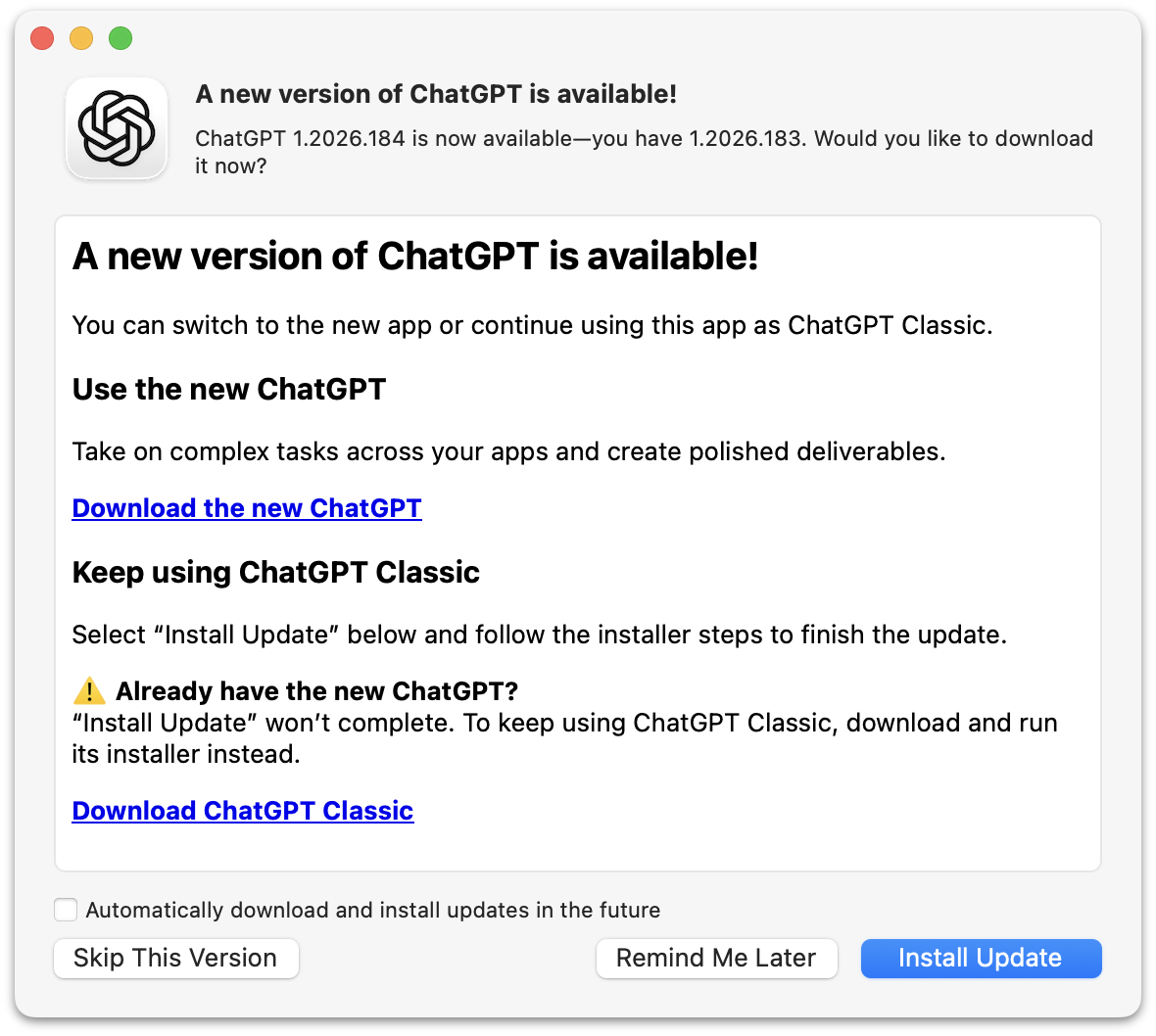
Here’s the software update dialog I saw today in the old version of ChatGPT, which is now named ChatGPT Classic:

Screenshot of the last pre-“Classic” ChatGPT app’s Check for Updates dialog, with confusing instructions.

What they’re trying to say here is that if you’ve ever installed the new ChatGPT the “Install Update” button in this dialog will do nothing. It will take some time to do nothing, but ultimately do nothing. Except quit ChatGPT.

If you’ve never installed the new ChatGPT, this dialog box will update the old ChatGPT to the latest version, which is now renamed “ChatGPT Classic”. If you have tried the new ChatGPT, you need to install ChatGPT Classic manually, even though you’re seeing this update dialog box in a slightly older version of the app you want to keep using. But at least they now offer a supported way to install ChatGPT Classic.

This whole thing makes the “New Coke”/”Coke Classic” fiasco from the 1980s look like a well-thought-out change.

Linus Torvalds: ‘AI Is a Tool, Just Like Other Tools We Use. And It’s Clearly a Useful One.’

17 July 2026 at 20:13

Linus Torvalds:

I realize that some people really dislike AI, but this is an area where I’m willing to absolutely put my foot down as the top-level maintainer.

Linux is not one of those anti-AI projects, and if somebody has issues with that, they can do the open-source thing and fork it.

Or just walk away.

AI is a tool, just like other tools we use. And it’s clearly a useful one.

It may not have been that “clearly” even just a year ago, but it’s no longer in question today.

There are other questions around AI (like what the economy of it will actually look like in the end), but “is it useful” is no longer one of those questions. Anybody who doubts that clearly hasn’t actually used it.

BBEdit 16

17 July 2026 at 19:31

Speaking of BBEdit, version 16 dropped just before WWDC, and adds a slew of nifty improvements, headlined by vastly expanded support for Shortcuts. You can also search for text in images, use the W3C HTML syntax checker, and of all things, use vi keyboard emulation. There’s a lot more, of course — and as always the changes, improvements, and additions are copiously documented in the release notes.

New licenses are $60, upgrades from v15 cost $30, and upgrades from older versions are $40. In the Mac App Store it’s a $5/month or $50/year subscription.

See also: Jason Snell at Six Colors and Adam Engst at TidBITs.

ArtfulType: Markdown Writing App for the 68K Macintosh

17 July 2026 at 19:05

Sean Malseed — “Action Retro” on YouTube — created a Markdown editor for the original Macintosh. Source code on GitHub; intro video on YouTube. It’s written in C, not Pascal, and uses the modern Retro68 GCC-derived compiler.

I absolutely love that this exists. I don’t like the actual app at all. I guess “full screen” mode is the point of some “distraction free” editors, but I for one would never look twice at a Mac app that didn’t use windows. Full-screen mode just wasn’t a thing back then, except for games. ArtfulType is not a Mac-assed 1984 Mac app.

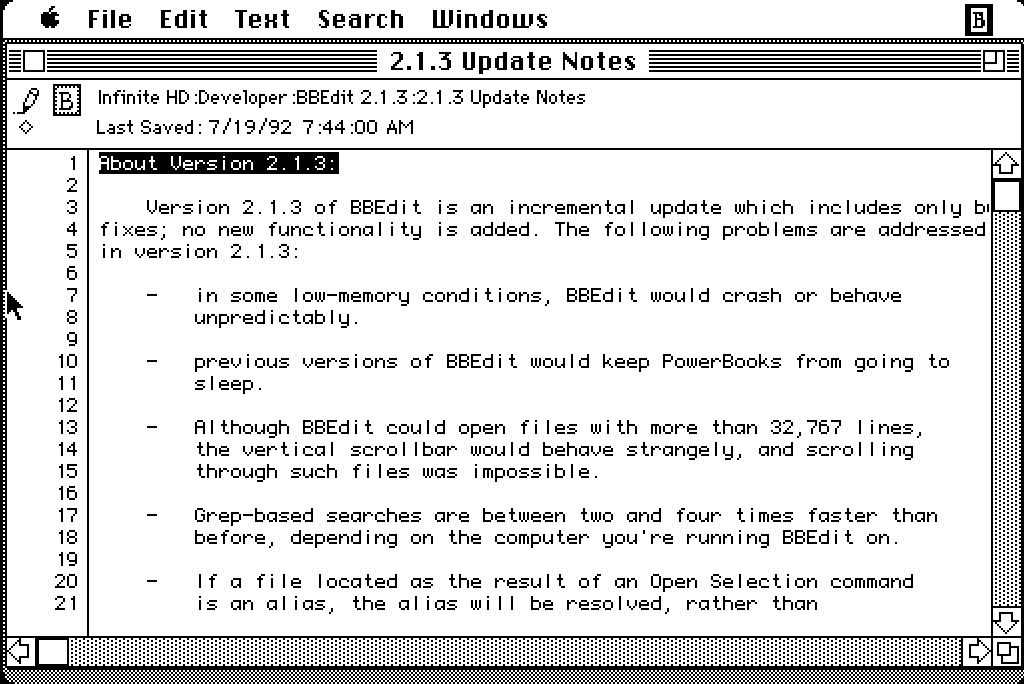
If I wanted to write in Markdown on a classic Mac, I’d use BBEdit, which was the app I originally created Markdown for use in. And one of two apps I primarily still use it in. But BBEdit won’t run on an original 128 KB Macintosh, because Rich Siegel didn’t create it until 1989, and the earliest public version was BBEdit 2 in 1992. BBEdit 2.1.3 does run in System 5 on Infinite Mac, but crashes if launched on System 3. I 100 percent see the appeal of using a 1980s retro Mac, but I don’t see the appeal of using one that can’t run System 6.

Google and Epic Give Up Fighting — Third-Party Android App Stores Are Coming Next Week

17 July 2026 at 17:53

Sean Hollister, reporting for The Verge (gift link):

Here’s Google’s full statement on withdrawing its proposed modifications to Judge Donato’s permanent injunction, via Google spokesperson Dan Jackson:

We’ve agreed with Epic to withdraw our motion to modify the US Court’s injunction rather than prolonging this process which creates uncertainty for the ecosystem. This allows us to focus on executing our recently announced global business model evolution to deliver greater app store choice, lower prices, and more opportunities for developers and users. We remain committed to maintaining Android’s industry-leading security and fostering a competitive ecosystem where every app store and developer has the freedom to compete. In parallel, we continue to comply with the US Court’s injunction.

Google had previously announced that it would launch its sideloaded Registered App Store program in the rest of the world, beginning with the new version of Android later this year. That means there may be two different tracks for Android: stores-within-a-store in the United States and Registered App Stores everywhere else.

Google is already informing US app developers that their apps and game listings will automatically be provided to third-party app stores starting July 22nd, unless they opt out, and it’s launched a specific page for its Play Catalog Access Program for third-party app stores to enroll.

I presume that this new agreement between Google and Epic includes ripping up the “no criticism of Play Store” gag order that the highly principled Tim Sweeney had agreed to in exchange for $800 million back in March?

Anyway, it will be interesting to see what developers do. My guess is that all the big app developers will opt out of this. Games, though, maybe not?

European Commission Adds Exemptions for Watches and Earbuds to Portable Battery Removal Rules

17 July 2026 at 04:01

The European Commission:

The European Commission adopted a delegated act today (14 July) introducing new rules that exempt additional products from EU requirements on the removability and replaceability of portable batteries.

Under the EU’s Batteries Regulation, portable batteries in products sold in the EU must generally be removable and replaceable by consumers. This helps extend products’ lifetime by allowing battery replacements and supports recycling by making it easier to collect used batteries. [...]

The Commission is now adding six new product categories to the existing list of exemptions. This includes wearable devices such as smartwatches and fitness trackers, electric toys, and products within the scope of the ATEX Directive (equipment used in explosive atmospheres such as explosion-proof motors, sensors, pumps or forklift trucks).

See, exemptions aren’t hard, especially to stupid regulations.

Quiche Browser Now Defaults to No-AI Web Search Results

17 July 2026 at 02:17

Quiche Industries (Greg de J.):

Starting today, Quiche Browser disables AI overviews in search results by default, out of the box.

Compare how much space and time they waste. I love the web too much to let that nonsense bury links to real websites made by humans.

This is my modest contribution to the fight against the dead internet theory. Why no other browser does that is beyond me.

To elaborate a bit:

• It simply opens search results in the AI-free versions of Google, DuckDuckGo, Bing, and Brave, whenever they’re selected as the default search engine. • No content blocker involved. Search results are served as-is. • AI features can be turned back on in Settings → Search.

I wrote about Quiche Browser a few months ago, praising it for, amongst numerous other features and aspects, its built-in JavaScript toggle. This is another killer feature. Traditional no-AI web search is a splendid default. Making it an option to enable if that’s what you want is the right way to do this.

❌