Login
Login
Too few jobs and too many people? Naah
I think that two very common beliefs of our time are, if not actually wrong, quite misplaced.
One of those beliefs is that, thanks to AI and other causes, there is not enough work anymore that’s fit or available for humans. The other (which some would say is another cause of the first) is that there would be too many people to feed, house and employ them all.
Not enough work? You sure?
With work, the problem is not that there is not enough work. The truth is just the opposite: there is just too much work that should be done urgently, but nobody (me included) can or wants to do, alongside too much work that too many people are doing right now, but shouldn’t.
I recently saw a pretty good example of necessary work that may never be done in a post about how the UK should tackle the same serious crises that afflict many other countries. That post argued that, in order to regenerate its ecology AND feed all its citizens AND solve its serious housing crisis, the UK should:
“rewild 30% of the UK [AND] increase food production by 50% [AND] build five new towns worth of houses every year.”
Problem is, the post continued, the UK “might be able to do one of those things, but only at the expense of not doing the other two”, and in any case none of those endeavours could succeed unless the UK started solving the overpopulation problem first.
Meanwhile, the people dying earlier are those whose jobs are most needed, much of the “first” world lacks tradespeople to maintain or remake roads, bridges or power grids and, inside the current system, no country could solve those problems soon and well enough by merely importing foreign workers.
The work that shouldn’t exist is even more
There are millions and millions of people doing work that shouldn’t exist to begin with, or as a minimum should be done and treated very, very differently. Most of those people are those trapped in low-paid, increasingly precarious jobs that rob them first of all of time, since “not only do they have no time perks, they must also use a lot of time searching for short-term jobs, trying to upgrade or maintain skills, and waiting around, at the ready.” (1)
The future of workers with “stable” jobs doesn’t look much brighter, because:
“The techniques used to extract the maximal gig worker productivity for minimal pay—such as individualized pay, schedules, benefits, and individualized behaviorally-based incentive structures—are on the verge of being imported to the formal employment sector”, making of gig work “increasingly the nature of work itself” (source)
Lack of life, meaning and peace of mind isn’t accelerating only among the lower classes though. This confession:
“Sometimes work looped back on itself like a recursive function. Sometimes it was a dead-end street. Worst of all - a highway that ends midair. It never added up to anything”
was written by a professional who was making “$250,000, plus benefits, equity, and remote work” and saw enough executives and managers in the same situation to wonder “How much of the white collar economy is actually fake?”
The intermediate steps of corporate ladders look the same, just with much less money:
“The analyst knows their model is largely guesswork. The consultant knows their framework is just common sense in a matrix. The manager knows the workshop is theater. But they all need each other to maintain the illusion.” (source)
The same perspective looms over China, where ‘lying flat” is a thing, just like quiet quitting in the West. What’s more, the awareness that much “work” isn’t worth it is (finally!, if you ask me) spreading to much more glamorous sectors. Even Instagram “influencers” are starting to feel how fake and life-sucking their “work” is:
“One minute, someone’s telling you that abundance is your birthright. The next, they’re ghosting their Airbnb host after trashing the villa. It’s “good vibes only” until accountability shows up.”
Sadly, much of this - both the work that’s not done and the work that should not be done - is happening because, instead of going for the trades, too many kids and their parents are still saddling themselves with as much stress and debt they can to get the “best” degrees they can find, even those that may well cost more than they’ll pay out in a lifetime, or lead to almost the same career and salaries as much less expensive degrees. For more on today’s education myths, click here.
How to get done only the work that SHOULD be done
Some people say that, since AI (that is, the few who control it) will soon destroy all jobs, we need a Universal Basic Income. Current AI is a really fragile, surely avoidable scam, but even if that weren’t the case, those people get UBI, AI and reality backwards. We deserved a Universal Basic Income well before AI or even capitalism appeared period, and AI done right is only one of the tools that may finally make UBI happen.
In the context of this post, UBI is by far the least impossible way to make sure that fake work disappears, and necessary work becomes finally doable.
Now, about population...
The guy who wrote that Facebook post was really worried about ecological overshoot and what he considers one of its major causes, overpopulation. I agree about the ecological concerns, and disagree about overpopulation, because I call demography “the science that tells today what you should have done thirty years ago to get the population you’d like now”.
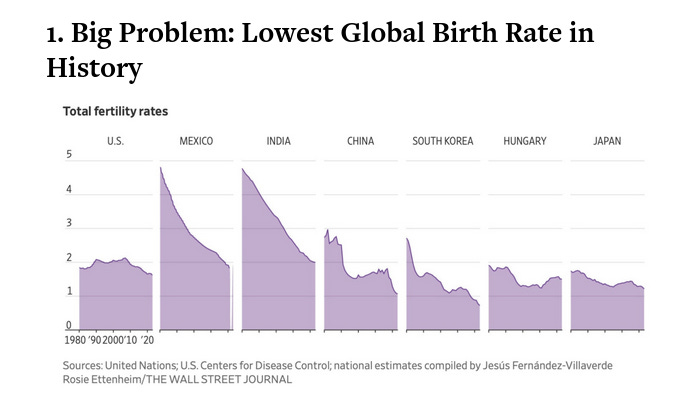
Yes, we are in ecological overshoot, but in 2025 we also are in depopulation overshoot. Before continuing, please note that everything that follows:
surely applies at least in the so-called “First World”, but also in many other parts of the world, China and maybe even India included
it’s valid regardless of any immigration that may realistically happen in any country without being an actual invasion, since most migrants fall towards the fertility rates of their host society too quick to make enough of a difference
Fifty years ago, it made actual sense to worry about overpopulation. Today, in much of the world, it’s overdue to do the opposite, because humanity has never been this old in its million year history. Two or three decades from now, the acceleration of this change in the composition of societies will impact the lives of everybody alive today at least as much as climate change, often much more, and the time to handle it humanly is now.
How? First, we must stop talking of “children per woman”, and start looking at children per person. Men and women have the same responsibilities here. Second, we must promote the right reasons to have kids, which are not the pronatalist ones from Silicon Valley but stuff like:
(for individuals) being actually able to do what you really want to do with your life. Including full time parenting
(for societies) keep things running humanly and fairly, for all humans
Third - of course - guaranteed, real freedom, both to have and not to have as many kids as one would handle if they could. Enough of policies that -being explicitly based on the asinine assumption that everybody should work full time because “the economy” - deliberately stop at making it just a bit less unsustainable for every couple to have one, maybe two children: what’s needed, and would work better, is policies that finally make having three, four or more children really sustainable, without any financial worries, for parents who would actually want to have them.
If we want to solve the real problems we have today, launching policies like those today is not enough, but is absolutely necessary. We need those policies to have, in the 2050s and beyond (remember what I said about demography?) enough humans of the right ages to protect what we must absolutely protect, from our collective mental and physical wellbeing to the environment.
If you worry that such policies would make the overpopulation problem continue, think again. The people who would be happier if they could afford three, four or more kids are many more than you may think, but not enough to make that happen. Not anymore, in almost all countries. As things stand now, even if those people did all breed like rabbits, all they could do is make societies younger again, not bigger. Which is precisely what we’ll need in the next decades, to get done (see above) all and only the meaningful work that must continue to exist and no AI or robot could do.
Not convinced? Let’s talk! If you can think of any other way to keep running a world worth living in, without pressuring in any way the people who do not want to have children, let me know in the comments, or via good old email.
Extra food for thought: The Age of Depopulation - Surviving a World Gone Gray
A request: the more concrete support I get, the more paywall-free popularization like this I can do. Thanks in advance if you’ll go for a paid subscription, but as I’ve said before, direct donations or any of the other actions you can see here are even more welcome!
That sentence is a quote too, but I lost the source. If you know it, please add it in the comments, thanks!
Just an invitation... is a reader-supported publication. To receive new posts and support my work, consider becoming a free or paid subscriber.