
 Login
Login
The list of countries that get social media wrong keeps growing...
A few weeks ago Turkey passed a bill to restrict social media use for children under 15, thus joining the group of (as of May 1st, 2026) at least 24 states that have imposed similar age restrictions, or are actively moving in that direction.
All those 24 states are wrong. To see why, imagine a society that at some point finds itself full of huge, very crowded shopping malls with these characteristics:
Thanks for supporting my writing with paid subscriptions, free subscription, or in any other way (see below)
the necessary and sufficient condition to enter those malls is to carry a gun. That is, literally everybody can enter, as long as they have a gun with themselves. No gun, no entrance.
just being in the malls makes visitors wish to use their guns, because the walls leak some invisible gas that makes most humans very nervous and intolerant
outside the malls, giving personal guns to kids as young as 8/9 years old has become almost a dogma. Almost all kids have a gun and are expected to carry it along at all times, often to make their parents feel safer
after a dozen years of gun-enabled violence in those malls, the governments of that society finally realize what’s happening and, pressured by the same enraged parents that armed their children, finally move to protect at least all kids from that violence...
...but, for technical reasons not relevant right now, it’s impossible to verify the age of who wants to get into the malls without spending lots of money to turn the whole society around the malls into a machine for ever-increasing surveillance and censorship
But governments can’t ignore the problem anymore, and so they decree that, in order to end kids dying inside the malls, everybody can keep visiting the malls carrying a gun (because, of course, the economy!)... as long as the malls keep the armed kids outside, using age verification systems, consequences of point 4 above be damned.
And they all do that with a straight face, instead of going for the single, hugely simpler, hugely cheaper measure that should be implemented before anything else even if the malls weren’t toxic, that is:
forbid kids younger than 15 to have guns, before guns don’t belong in children hands period, so not only said kids can’t enter the malls (see point 1 above), but they finally cannot hurt each other anymore outside the malls.
This absurdity in that hypothetical society is exactly what Turkey and all those other countries are doing right now in our world: imposing age verification systems on social media instead of doing the same for personal smartphones.
Don’t like the malls analogy? Try these then
When we invented cars and highways, nobody dreamed for a moment to prevent kids under 16 or 18 from driving their own cars on the highways, by checking everybody’s age at the tollbooth. We said the right thing, that is “never mind highways! Until you’re tall enough to see over the hood and mature enough to handle something lethal, NO CAR FOR YOU, NOWHERE”.
Ditto for weapons. Nobody, not even the most fanatical advocates of pro-gun rights ever demanded laws that would allow children to have their own gun and use it everywhere... except inside shopping malls.
Not enough? Try tobacco or alcool then. Imposing age limits on social media instead of smartphone possession makes as much sense as making selling cigarettes to minors legal, but setting age limits to enter designated smoking areas.
As someone else said, “Honestly, it’s the phones”
The reasons why no sensible adults thinks that, as long as we forbid them to use those products in certain places, children could own cars, weapons, cigarettes or liquors are obvious: everybody can see the risks, and everybody gets that preventing the possession of any of those products is hugely easier than regulating any possible damage that may happen by using them.
Of course, smartphones do not directly cause physical harm. However, after almost two decades of exposure, it’s impossible to deny that personal (that is: uncontrollable) smartphones in children hands too often trigger, or at least amplify, equally important negative effects, including many (e.g. facilitating self-isolation, insufficient sleep, exposure to sexting and cyberbullying, inability to focus, peer pressure to be always “on stage”, excessive gaming, personality-altering AI support for everything from homework to dating advice...) that would exist even if social media didn’t exist at all.
Finally, smartphones in children hands are a powerful part of adultification, that is treating children, for somebody else’s profit of course, “as if they are an adult, usually in a way that is wrong or harmful”.
I’ll say even more clearly: even if we all finally acknowledged - as we really, really should - that way too often the primary or major causes that eventually led kids to suffer all those problems online are offline, social factors like poverty, lack of outdoor playgrounds, or parenting shortcomings of whatever kind and origin... giving the victims a device that in almost every real case would make those problems bigger and more likely to occur makes as much sense as forcing someone who must use crutches because he broke a leg... to wear roller skates.
Governments imposing age limits on social media instead of smartphones is like seeking shelter from a storm in a house with all the doors and windows open, and trying to keep it warm by manually closing only the front entrance, instead of closing everything at once, by pushing the right button on the home automation remote control.
Enough with analogies. Why is this colossal mistake happening?
So far, the only reasons why we haven’t treated smartphones as those other products that are intrinsically unsuitable for children are, in no particular order:
these days, if let free to decide by themselves, almost all governments don’t dare - or can’t afford - to propose any solution to any problem that will make people spend less in purchases or taxes
still in general, we adults have been all groomed to consider every step back in the deployment of any technology as a really uncool, really boor act that no well-educated, well-mannered person would do.
that’s especially true with digital technology. Showing off a smartphone and posting on Instagram has become cooler (even in the USA) than having a car or a gun. Take any two adults with diametrically opposite political or cultural ideas, and the two things they’ll most likely still have in common will be a smartphone in their pockets, and not enough understanding of its true, long-term social impacts
Mind you, I say this without any contempt for the average smartphone user. The three bullets above are just the unavoidable consequence of everything going digital at the same time, way too fast for everybody’s good.
As far as children, smartphones and social media are concerned, however, this is not an excuse anymore to keep acting in the wrong, intrinsically dumbest way. On to action now.
There are only two things that are good in age verification policies
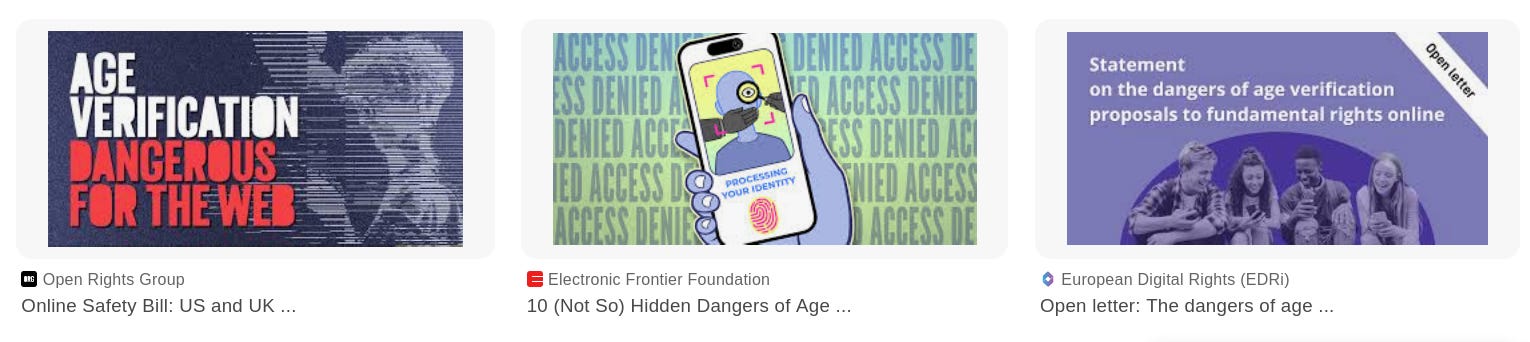
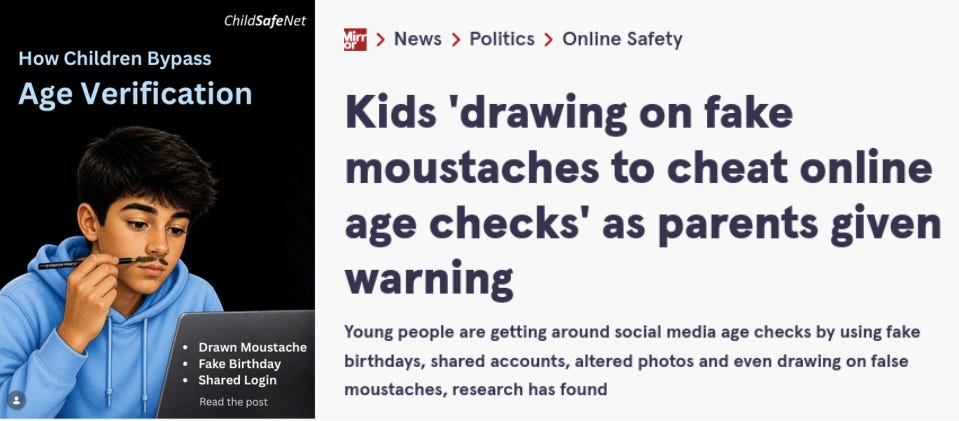
One is that age verification motivates kids to acquire skills that may come useful later:
The other good thing of hugely misplaced age verification laws is... that it is really easy to make them irrelevant and unnecessary. All it takes is for parents to wake up and push that one button that closes all the doors and windows of that house exposed to the storm: that is, to stop letting their kids have personal smartphones before they are 15 or 16 years old.
That’s a measure that parents have no excuse anymore to avoid, for four excellent reasons. First, see above, age verification laws for social media are too little, too late and too off-target. As things stand now, age verification laws for social media are just Rube Goldberg machines built to fight YESTERDAY’s battles.
Second, while not having a smartphone does not guarantee 100% protection from all the problems I listed, it surely makes avoiding them much, much easier, and the urgent necessity of real solutions to the root problems (e.g. more outdoor play) much harder to ignore, at all levels.

Third, the huge cost-benefit ratio and lack of meaningful side effects: not giving a child a personal smartphone before she’s 15 is one simple act that’s 100% legal everywhere, it’s more than free because it saves money and doesn’t need any law or anybody’s permission to work. At the same time, not having a personal smartphone wouldn’t deprive children of any of the real benefits of the internet or of any actually valuable digital skill. That’s all stuff they could and indeed should still learn and practice as soon as possible, but without any risk of overexposure, that is with desktop or laptop computers at home or in schools, libraries and so on.
Yes, I DO know that for some really special kids 24x7 internet access via smartphone can be a real, effective lifeline. But the solution is to find better lifelines for those kids or making exceptions for them. It cannot be to keep all the other kids in a state that is, as a minimum, a waste of time and sleep._
Fourth, and maybe most important: this is a job for parents only, not governments. There are cases when outsourcing parental responsibilities can be positive, or at least unavoidable, or cheaper. But this is not one of them. No way.
Thanks for sharing this post both in and OUTSIDE Substack. ALL parents must read it.
If I had to do this myself...
If I ruled the world, which thanks God I don’t, I’d spare kids from the hassle and leash of having any electronic tag, sorry: I meant “any portable phone” until they’re 14 or 15 years old. For the record, that’s what I actually did with my own kids, in years when all their peers were already playing with smartphones. I walked the walk, and it did pay off. But that’s not why I’d say no to any portable phone.
I would do that because I am damn sure that the fact that their children could not be instantly reachable was the last or almost last concrete concern of every parent from the advent of Homo Abilis to your own parents or grandparents. I also happen to think that being on their own was beneficial for the kids.
But if you are different, that’s OK, really: give your kids a normal cellphone, without internet connectivity, cameras and geolocation, and it will still be a huge improvement. You’ll be much less stressed, they’ll still be reachable when it’s actually necessary, and the physical impossibility to get lost alone in less than healthy online spaces, self-inflicted narcissism and similar hassles will open up much better worlds for your kids.
However, even if I did rule the world, I wouldn’t issue any law that forbids smartphones for children. I would launch a massive educational campaign for parents to voluntarily do it themselves, because this is their responsibility. Governments must not impose this part of education, only create support for it. Doing otherwise, as all those states are proudly doing now to look as if they care, can only waste money to produce all sorts of harmful side effects. Including lessening the very meaning and terrible beauty of parenting.
Thanks in advance for helping me to contribute to this education, via direct funding, webinars, speaking engagements or any other work. To discuss these possibilities or just suggest new topics, please email me at mfioretti@nexaima.net.
Just an invitation... is a reader-supported publication. To receive new posts and support my work, consider becoming a free or paid subscriber.

