By now, you know Vietnamese nuoc cham dipping sauce, well yes? I shared all my tips and recipes for how to make the versatile sauce in a March PTFS dispatch. I hope you’ve made good use of the recipes👇!
Let’s boost your Viet cooking game with dipping sauces that are sort of an insider’s secret. They’re popular in Vietnam, where people buy them and make them at home too. They require few ingredients and in 2 minutes, you can conjure up a spicy, sweet, tangy, creamy condiment that goes with practically anything!
Originally from Nha Trang, a coastal city in the southern part of central Vietnam with lots of fresh seafood, these sauces involve an unusual combination of ingredients that includes sweetened condensed milk. You can make either a green or reddish-orange sauce depending on your chile preference. The more popular one is green and called Muối Ớt Xanh — literally green chile salt, but in English, it’s often called “Green Seafood Sauce”.
Indeed, there’s truth in advertising — Green Seafood Sauce goes well with seafood. However, it also goes with other animal proteins and veggies too. Ditto for the red version.
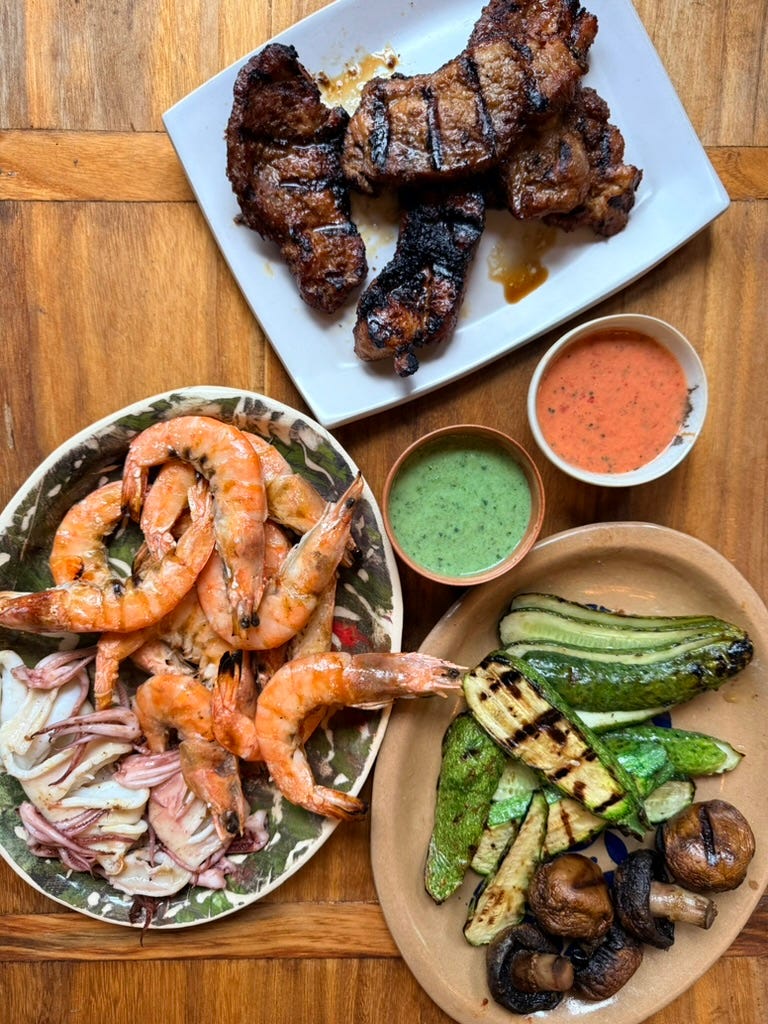
I experimented with the sauces by trying both with a mixed grill this week that included shrimp, squid, veggies, and Viet restaurant-style lemongrass pork (thịt heo nướng sả), a free 🆓 recipe on my website.
The well-seasoned pork has layered flavors and this sauce amplified them, rather than overwhelm. Remarkably, the sauces punched up the flavors of everything. The shrimp was briny sweet, the squid was delicate, and the veggies each had their personal flavor characteristics. (All those items cook up fast so along with cooked rice that was heated up in the microwave, we had dinner in little time.)
The sauce colors are outrageous and all natural, I swear!
So, you should have my versatile formulas for these sauces in your back pocket for grilling season and beyond (they go well with steamed seafood, and roast chicken and steamed chicken, I’ve heard!). While you’re at it, try brushing these sauces on food while they’re grilling. Why not?
Translation note: The green sauce is often translated into English as “Green Seafood Sauce” but the red one is awkwardly called “Red Chile Salt Sauce”. They both go well with seafood so I’m just calling them Green and Red Seafood Sauce. If you want to be 100 percent correct, call them by their Vietnamese names:
❇️ Muối Ớt Xanh (“moo-ee uht sann”)
🅾️ Muối Ớt Đỏ (“moo-ee uht daw”)
Below you’ll find this suite of information for you to enjoy what I prepared and to riff on it!
5 recipes: Green Seafood Sauce + Red Seafood Sauce recipes + guidance on how to make simple Grilled Shrimp + Grilled Squid + Grilled Veggies
Recipes are in text and as a downloadable PDF
A techniques video on how to trim shell-on, head-on shrimp like a pro
Ingredient explainers and strategies for dialing in a heat level to match your taste buds
I’m keeping jars of these sauces in my fridge this summer and so should you!
Curious cooks, readers and eaters fuel this newsletter. The dispatch was created for paid subscribers who sponsor PTFS. To get all the saucy details, fully use the recipe index plus get other benefits, become a paid subscriber. Your support makes a big impact.
I can’t remember if we had El Nino or La Nina last year but the weather yielded a bumper crop of apricots in Santa Cruz. One of my neighbors is out of the country and I’ve been gleaning the fruit that’s fallen off his trees. Successive windy days knocked lots of the delicate Royal Blenheims off his trees. So far, my windfall ‘harvest” has yielded about 30 pounds of apricots. If I didn’t gather the fruit, the ants would have feasted and I would have cried.😆
At home with the fruit, I sorted them into piles of soft (eat or cook soon) and firm (hold). Blenheims are known for their intense aroma and sweet flavor. They bruise easily so I keep them refrigerated in recycled shoe boxes.
Add to that, another neighbor texted that he was leaving town and I was welcomed to glean what remained on his apricot tree. He even left his picker out for us to grab the fruit at the top of the tree.
We’re eating lots of apricots now to savor their summertime splendor; they’re a delicious, fiber-filled fruit. Plus, I’ve been cooking with them in various recipes. For instance, I’m experimenting with making umeboshi apricots, which will take till July or so to finish. Instead of red shiso, I’m using Vietnamese shiso (tia to), which is garnet and green. This Japanese recipe and this other recipe are serving as my guides.
Here are three other recent apricot projects of mine from this past week that you may be interested in!
The first time I shared a jar of apricot ginger jam with my dad, he ate it right off the spoon. His eyes widened and a big grin spread across his face. The jam was and is that good. It’s not too sweet and has enough lemony tang and gingery bite to balance the flavors and make it taste super special. It’s one of my favorite ways to preserve apricots for winter when I’m needing some sweet sunny summer cheer.
Use apricots from your tree (or someone else’s!), the farmer’s market (ask for jam-quality fruit to save money), or the supermarket. Make a half batch with just 2 1/2 pounds (1.1kg) of fruit, if you like! The jam makes a great gift too so bank your efforts for the holiday gift giving season. The stellar recipe is 🆓 on my website for you to use!
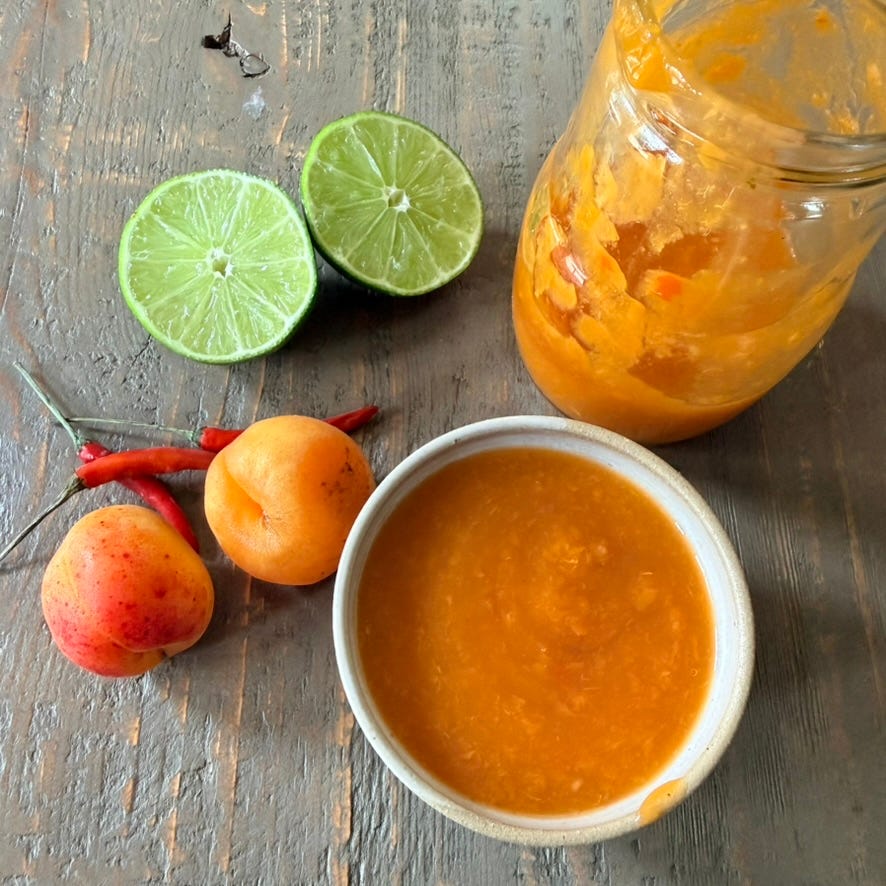
💎 Spicy fresh apricot sauce
Thank for this saucy idea that she suggested on Substack Notes — make a fresh apricot sauce with chile and fish sauce for grilled seafood. I did just that and it was great — even on rice, which reminded me of when my mom used to serve us kids sliced ripe mango with rice and a smidgen of fish sauce. It was Mom’s clever way to get us it to “get the rice to go down.” I’ve adored the fruity-funky combo ever since I was 5 years old! Rory is new to the idea and loved the sauce on rice too.
Enjoy the apricot sauce at room temperature as a dipping sauce or chutney-ish relish. Keep scrolling for the recipe . . .
Spicy Fresh Apricot Sauce Recipe
In a small food processor blend together:
8 ounces (225g) pitted ripe apricots (soft ones are welcomed!)
1 Thai chile, coarsely chopped
2 Tbsp fresh lime juice, plus more to taste
1 Tbsp fish sauce, plus more to taste
1 very small clove garlic, finely chopped
Taste and adjust the flavor with extra lime juice by the to tame sweetness or fish sauce to add savory umami-ness. Incrementally add each by the 1/2 Tbsp (1 1/2 tsp). Use immediately or store in a jar for up to 1 week.
Support Pass the Fish Sauce! Join us for free or upgrade to a become a paid subscriber to enjoy 150+ professionally developed recipes, seed new content, and get future class discounts. Thanks for your enthusiasm!
💎 Almond Apricot Cake (gluten free)
Apricots are from Central Asia and China and almonds may have hailed from those regions too. They are destined to be together in a sweet treat. I wanted an easy cake to combine and celebrate the two ingredients and created this delight. I riffed on ’s almond butter cake recipe from her brilliant Gluten-Free Flavor Flours cookbook, but baked fresh apricots right into the cake, an idea poached from the French moelleux of summer fruits, a cake recipe that wrote about a number of years ago.
One cake serves 8, if you decide to share it.
The fruit sank into the bottom and didn’t turn totally mushy; it added a tangy contrast to the cake that was wonderful to eat. The top baked to a delicate crispness that finished the cake with a truly special crust. (Yes, I think you can make this vegan too!)
I shared some with neighbors, two of whom enjoyed it to celebrate their baby’s 6 month birthday (their baby is also named Rory).
Like the popular PTFS easy lime pound cake recipe, this one is also made in the processor. (I’m a somewhat lazy cake baker.) I’ve just written the 🆓 recipe up at the website for you to bake it up yourself. You can easily play with it too. Make this almond apricot cake recipe your summer go-to!
Coming up for this Sunday Special are ideas for the grilling season that is now upon us!
Woks were invented in China about two thousand yeas ago but they remain a mystery to many cooks. That’s why my stir-fry recipes specify that you can cook the dish in a large wok or skillet. My recipe developer’s heart is always hoping that you’ll use a wok because that’s how the dish was meant to be cooked. A skillet will do but the explosive action of a good wokked stir-fry fills the kitchen with sizzling sounds, smells and then savors that a skillet cannot provide!
I’ve been spending more time on Substack’s Notes app and chatting with some of you. Earlier this week, remarked that she aspired to having a well-seasoned wok like the one I used in the kung pao chicken recipe video.
That tickled me because I don’t consider myself a master of the wok. Vietnam has being heavily influenced by Chinese culture but wok cooking is not a thing for many Vietnamese cooks. Most people choose skillets over woks, though as reminded me, some Viet pro cooks use woks for making sizzling rice crepes (bánh xèo). In the main, folks use skillets for those crepes and countless other dishes.
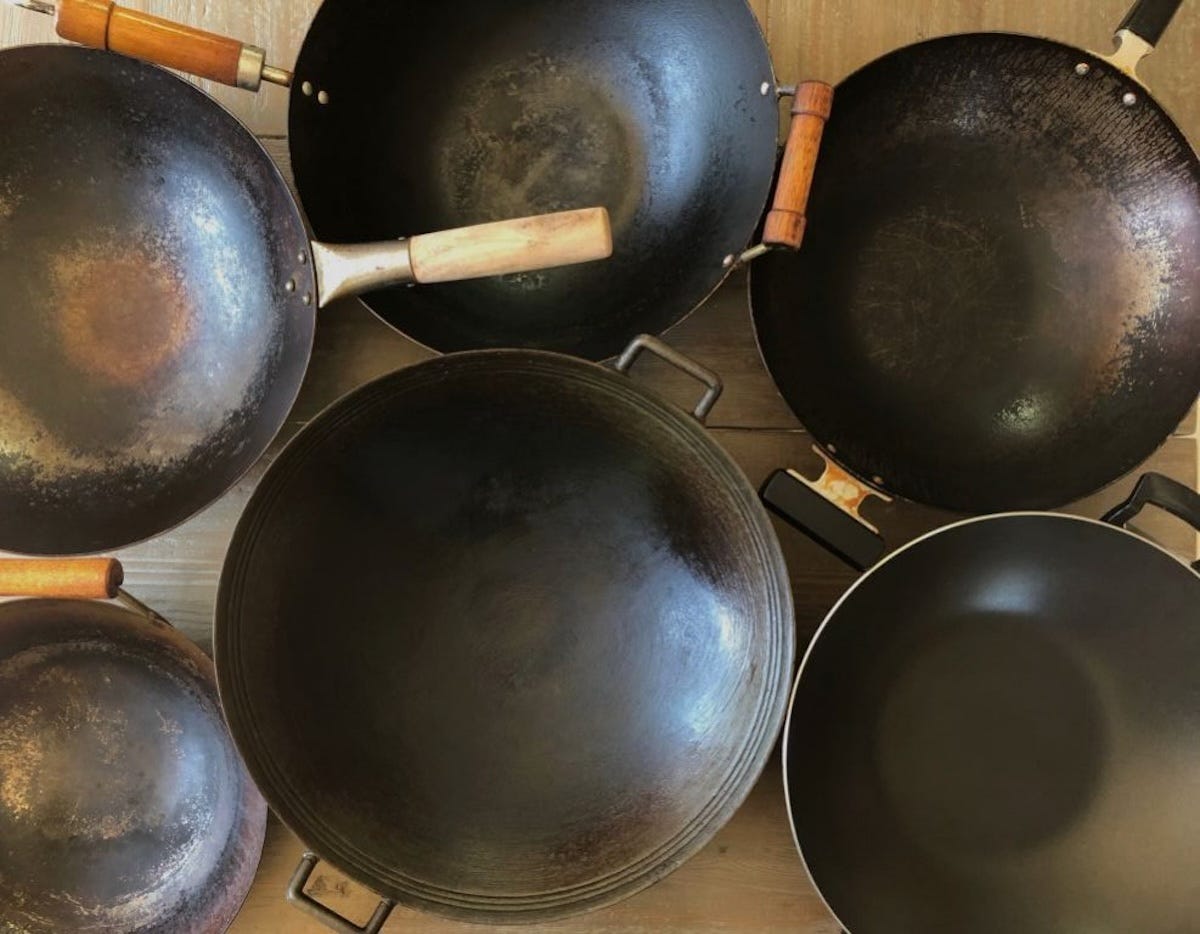
As I was growing up, my mom didn’t even have a wok. When you watch a video of me ‘effortlessly’ using mine, that’s the product of didactic practice. Over the years I’ve owned at least a dozen woks, and currently keep three (3) in my kitchen on rotation. Tinker and play with wok cooking to hone your skills.
Top, left to right, are carbon steel woks. Bottom left is a carbon steel wok. Center bottom is a lightweight traditional cast iron won. Bottom left is an electric teflon coated wok. I’ve owned and tried these and more!
In this post, I’m going to offer my pointers on:
Selecting a good wok
Buying pre-seasoned carbon steel woks
Seasoning and re-seasoning a wok
Wok cooking and cleaning tools
Plus, I have a baker’s dozen (13) wok recipes for you to wok away!
How to choose a good wok
Woks are workhorses in the kitchen. They heat up in a flash and can cook food quickly or be used for braising, frying, smoking, or maybe even steaming, though that will wipe out much of the patina that you’ve built up.
When shopping for a wok, consider:
Round or flat-bottom wok? Both round and flat-bottom woks work great on gas stoves. If your stove is electric coil or induction, choose a flat-bottom pan so it will have maximum contact with the heat surface.
What is a good wok made of? Choose a metal that can heat up fast and effectively — the bottom and sides of the wok should get hot because you use all that surface area to cook with.
Carbon steel woks are king. They’re known for their durability, weight options (light or heavy, more below), and endurance (you can heat it until ripping hot and you can neglect it and it’ll come back to serve you well). BUT, a carbon steel wok often requires maintenance by way of seasoning to maintain a nonstick surface.
Coated nonstick woks seem dreamy but the only coated nonstick skillet worth considering is the Joyce Chen Excalibur nonstick wok, which I reviewed on my website (🆓). After using it for nearly five years, I ‘retired’ it to my mom’s house so I can use it when I visit. Carbon steel woks rock. Second to that are old school cast iron woks.
Chinese lightweight traditional cast iron woks are thin and lovely to cook with — lots of swooshes and sizzling noises to propel you ahead! Heavy cast iron woks, like those made by Lodge, are unwieldy for tossing food around and take too long to heat. The only cast iron wok I own is a small 9-inch one that I bought to test drive single portion recipes.
asked: What about stainless steel woks and why does mine stick so much? Stainless steel pans, like ones by All Clad, require a long preheating until they are super hot (to test: flick water onto the surface and it should literally dance around, not pool). Once sufficiently hot, then you add oil/fat to film and start cooking. There should be minimal sticking (practice by frying an egg.) My mom use a thin, stainless steel wok for deep-frying. I’ve only used her wok for stir-frying greens but it didn’t perform as well as others.
I’m nudging you toward carbon steel for a good reason.
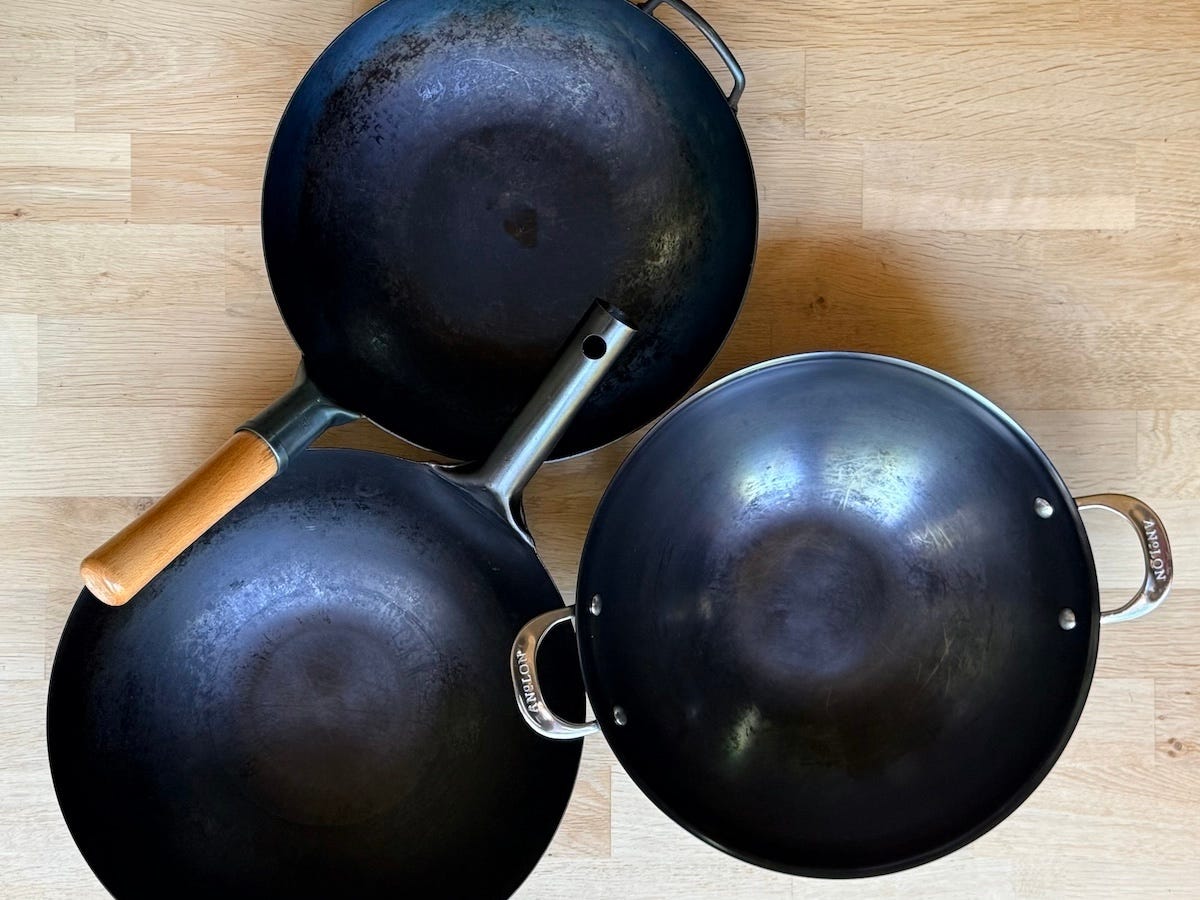
For the past two years, I’ve been road testing three carbon steel woks that are impressively good. Though they are are not all labeled as “pre-seasoned” they require very little elbow grease to prepare them for your wokking pleasures.
3 pre-seasoned carbon steel woks in rotation these days in my kitchen: the Yosukata (top), Anolon EverLast (bottom right), and a Japan iron wok/Beijing wok (bottom left).
Two are heavy duty and the third is lightweight. The lightweight Japan iron/Beijing wok is perfect for cooks who love to toss and flip food.
asked about a wok for cooks with carpal tunnel. My wrist issues are minimal but if I had wrist or hand pain, I would reach for the light Japan/Beijing carbon steel wok. It’s easier to maneuver than other woks, though it had its disadvantages. I put it to work in this kung pao chicken recipe video.
All three carbon steel woks are joys to cook with. I wrote up my review of each carbon steel wok (it’s 🆓 and at my website). Here’s the down and dirty on how they stack up:
When you’ve found a wok you like, you learn its strengths and identify its quirks. Unless a wok is Teflon coated, it needs to be seasoned. Even if a wok comes “pre-seasoned”, it still requires a little seasoning. It’s like with cast iron — you must maintain and cultivate the metal to ensure a lifetime of good cooking.
What exactly is seasoning a wok? Seasoning a wok involves heating the metal (carbon steel or cast iron) so it expand a bit to receive oil or fat, which gets into the microscopic crevices to form a film. This happens during a purposeful seasoning process as well as through regular usage. Overtime, as oil gets into the metal, a patina develops and the pan surface becomes more slick. As a pan gets seasoned, it may change color, depending on the metal.
To season a wok, I use one of these methods, depending on the pan and needs:
Cook with the wok regularly (I do it twice a week, at least) to keep the seasoning going. Aside from stir-frying, fry an egg or better yet — sear beef steaks or cook fish fillet in a wok.
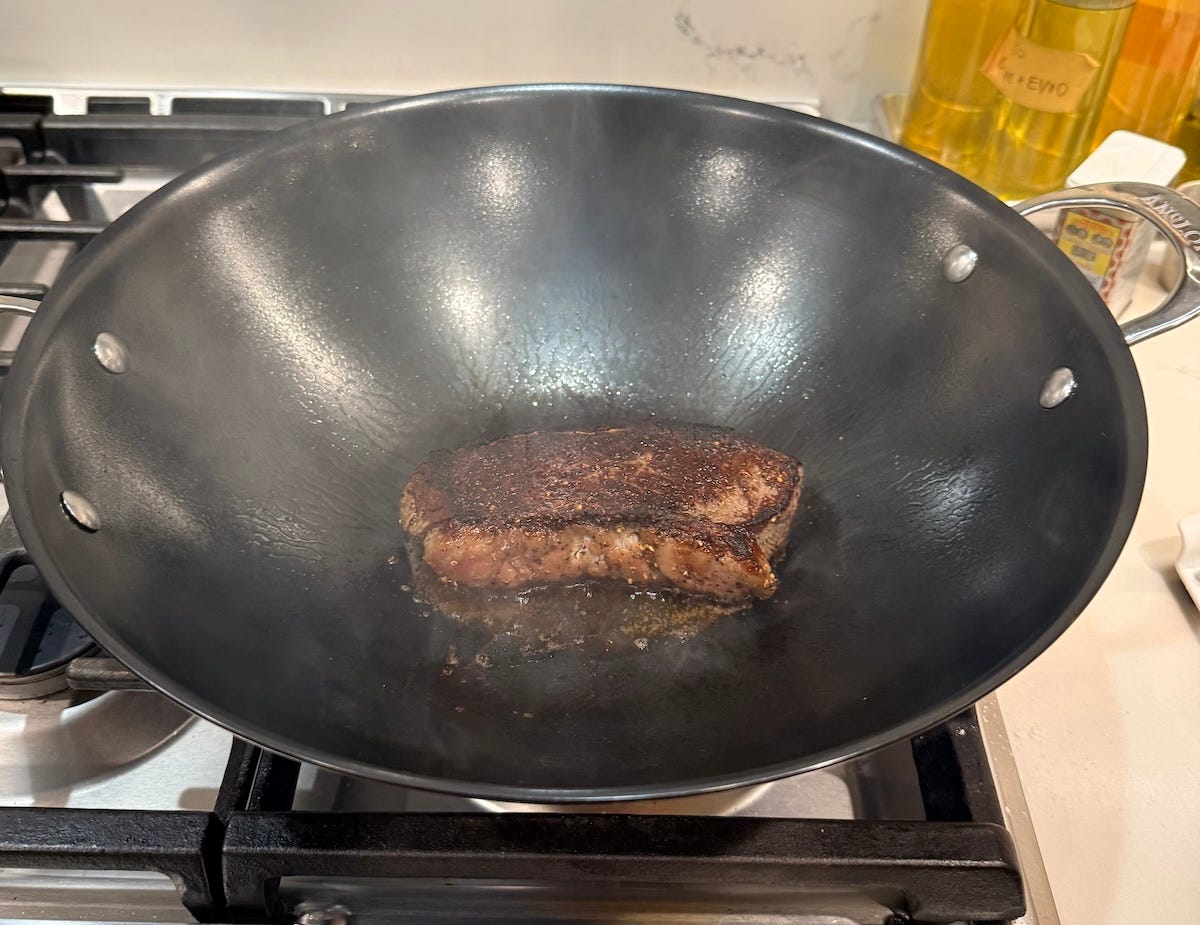
Why sear steaks or fish in the wok? Because (1) the hot heat creates a crisp well browned exterior, (2) you can easily baste the food with butter or another fat that will pool in the bottom and (3) most oil droplets fall back down into the wok so there’s less of a mess to clean up.
I simply salted and peppered this steak well and added a drizzle of soy sauce to promote browning. Then I left it to sit out for about 30 minutes while I cooked other parts of the meal.
When and how to re-season a wok? I think of re-seasoning as refreshing the wok, only you’re not starting from scratch.If a wok looks dry or if food is sticking too much during repeated uses, re-season the wok. When I neglect to wash the wok well and black bits flake off during cooking, it’s time to re-season.
Here’s my quick “oil smear” re-seasoning process: Wash the pan well with coarse salt and soap, then I dry it over medium heat, add a tiny bit of oil, use paper towel to smear it all over, let the pan keep heating up till it smokes, then turn the heat off and leave the wok to cool. This whole process takes literally only a couple of minutes.
If the pan is super gross, then I may boil water and a little vinegar in it to thoroughly remove the gunk. Then I’d do one of the three seasoning methods instead of the oil smear.
A good wok talks to you over its lifetime of service in your kitchen. Sometimes it may need some extra love to perform better for you!
This free article was sponsored by paid newsletter subscribers. Join us to seed new content, fully use the recipe index, get class discounts, and more. I value your support at all levels! Thanks for being here.
Wok cooking and cleaning tools
To wok well, you don’t just need something that matches the shape of the wok to scoop, push, flip, and help you quickly move food around. In the photo below, my metal wok spatula has a gentle edge so it does not scratch or ding the wok much when I’m swiftly cooking. The handle is long so you can stand back from the stove and still cook easily. A broad wood spatula works well too!
For cleaning a wok, I love a good bristle brush. A favorite dish scrub brush works too. The handled brush in the above photo is a bona fide wok cleaning brush purchased from a restaurant supply shop.
How I clean my woks
Let the wok briefly cool after you dish out the food. Then hit it with a spray of hot water, a drop of dish soap, lots of active scrubbing and a good rinse to remove all debris; finish with drying on the stove over a low flame or wiping with a dishtowel, depending on the surface.
When stuff is super stuck on the wok, let the dirty pan soak with some water in it while you’re eating. Clean up will be lots easier. Re-season with the “oil smear” method if needed.
If a wok was used for deep-frying, let the oil cool then strain to reuse; or, stir in oil solidifier while the oil is still hot, let it harden, then discard the oil.
Get wokking with 13 recipes
A wok gets better the more you use it. Yes, food will occasionally stick but you’ll befriend the wok and know how to heat it just enough and how to use its best qualities to make great food. Here is a special collection of favorite recipes on my website (🆓) and this newsletter. Jam packed PTFS recipe dispatches often have multiple recipes so there’s lots of versatility built in.
For those of you who wondered how long the Taiwanese sesame noodle sauce lasts, I’m confirming that it’s freezable. I froze a jar of it for a week, then drove it to my mom’s house in Southern California where I whipped up the noodles for a fast lunch. The sauce tasted like it was freshly made! So go ahead and make a double batch of the cold sesame noodles sauce and use one now. Freeze the balance as 1/3 cup (80ml) portions for single servings and faster thawing.
Using egg strips for the sesame noodles reminded me how useful egg sheets are as a protein-rich addition to East Asian noodles, dim sum, and rice dishes. I grew up with trứng tráng (egg sheets in Vietnamese) in sophisticated Hanoi-style bún thang noodle soup and cheery mixed rice (cơm trộn).
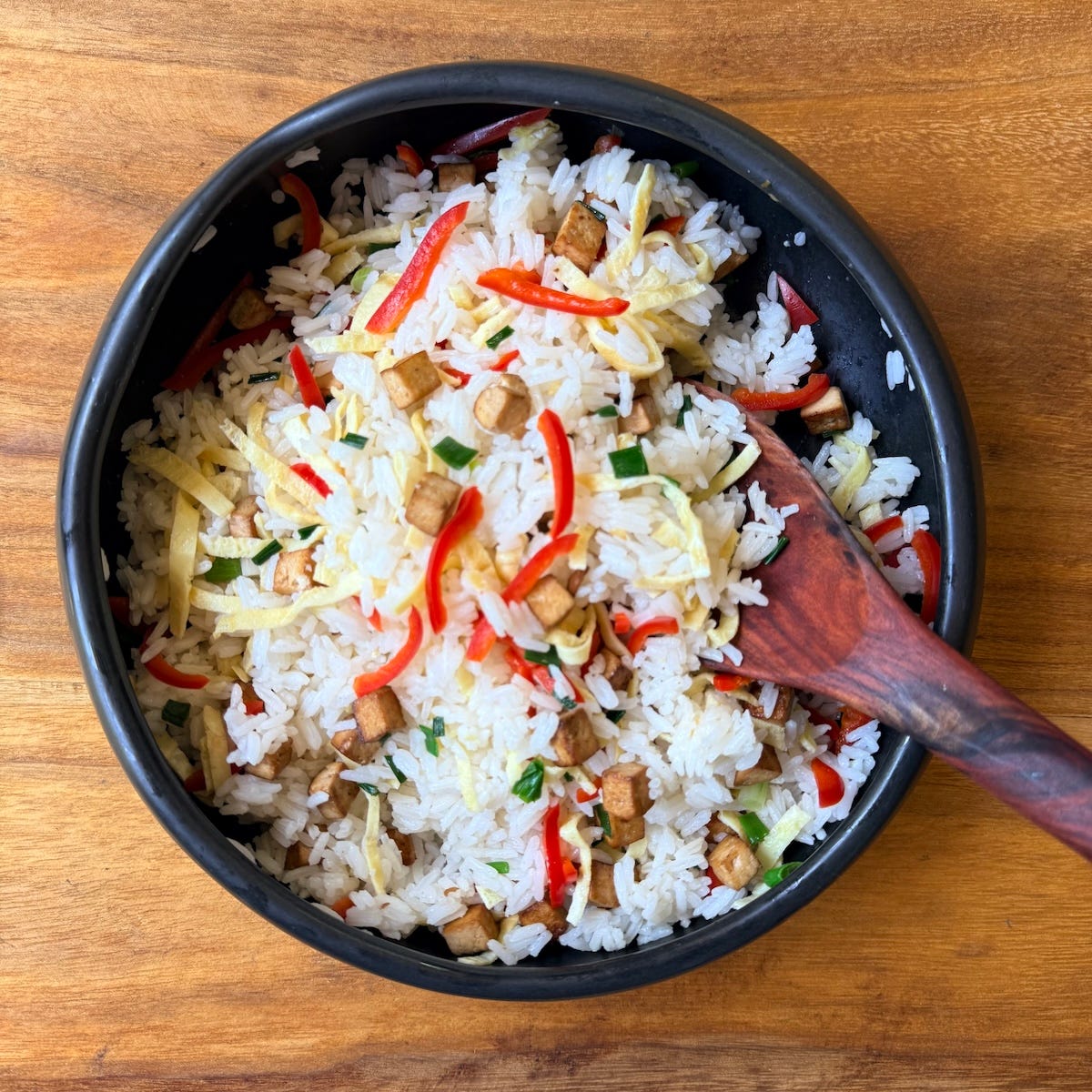
My mom regularly prepared the rice dish, which is easy breezy and healthier than fried rice. Cơm trộn is simply hot rice mixed with add-ins but done in a particular fashion so it tastes special and fun. In the photo below, the red strips are a quick pickled sweet pepper which lends a crunch, piquant note to the rice.
Vegetarian mixed rice (cơm trộn chay) with seared tofu. I’ve prepared it with grilled leftovers during summer and thrown in a handful of fresh herbs too. The sky’s the limit with mixed rice so get the blueprint and make it!
Feeling nostalgic and hungry the other day, I threw together a vegetarian batch of cơm trộn for an easygoing lunch. However you make mixed rice, it’s lite and can be served warm or at room temp. It was so good that I shared my blueprint recipe and tips on the website for you to craft your own. When you make my mixed rice, look for the link to the recipe for egg sheets too (you’re welcome). Get friendly with the Viet mixed rice recipe this summer!
This week’s big cooking star was kung pao. I challenged myself to come up with a stellar kung pao chicken recipe that:
Can be used as a plug-and-play template to feature other proteins or be vegan
Includes enough vegetables so it can be eaten with rice as a satisfying, wholesome meal
Allows nuts to shine, not just be minor decor as they usually are in takeout versions
Breaking kung pao rules (sort of)
In Mandarin Chinese, 宫保鸡丁gōngbǎo jī dīng literally means “Palace Guardian Chicken Cubes”. It was a favorite dish of an 18th century provincial governor named Ding Baozhen (1820–1886). Parsing the Chinese name:
宫保 gōng bǎo (Palace Guardian) was part of Ding Baozhen’s official title
鸡 jī means chicken
丁 dīng means cubes and also is a pun on the man’s surname, Ding
Kung pao chicken, the Sichuanese spicy, tangy chicken stir-fry that we know today, likely originated from the time the governor spent his youth in Guizhou (a southwestern Chinese province located north of Vietnam). Modern cooks in Guizhou season kung pao with fermented bean sauce and chili-garlic-ginger paste. No nuts are included in Guizhou kung pao. And, there are versions with chicken, shrimp, potatoes, and even pig’s stomach.
Ding loved chicken stir-fries so much he told his cooks to include it on menus for guests. When he governed northeastern Shandong province, he enjoyed a chile-less version with walnuts or cashews instead of peanuts.
His last post was in Sichuan, which explains why the popularized version of kung pao chicken includes dried chile, Sichuan peppercorns, peanuts, and Chinkiang vinegar. Those ingredients are found in other Sichuan favorites.
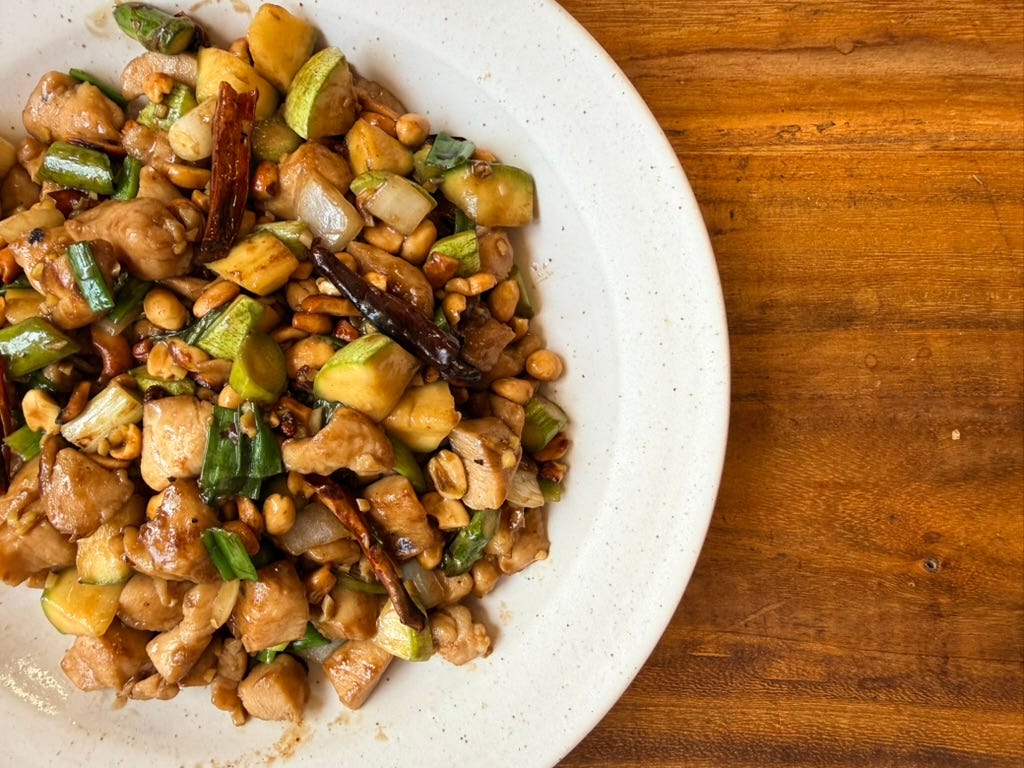
My version of Sichuan kung pao chicken.
Compared to other Sichuan dishes like mapo tofu, kung pao chicken is not overly spicy or fiercely hot. Perhaps the governor’s cook incorporated all the ideas from the three provinces where governor Ding had been posted? He and his family moved about the country with a staff, including cooks, who likely adopted his favorite chicken dish to local tastes and ingredient availability, writes Fuchsia Dunlop in an article for the Los Angeles Times1.
As a result, nerdy kung pao fans will recognize Guizhou, Shandong and Sichuan versions. I’ve not graduated to nerdish level and am stuck in the Sichuan level so I focused on that iconic iteration for the foundation of my recipe. That said, kung pao has a rich backstory that makes it much more interesting than what we may normally think. You can play with it.
After formulating my kung pao chicken recipe, I used it to make scallop kung pao and a mushroom kung pao. From one recipe, I got three (3) surprisingly delicious kung pao stir fries. AWESOME.
To prime you to flex your kung pao muscles, watch me make the stir-fry and preview the techniques.
Below you’ll find:
My master kung pao chicken recipe in full text and downloadable PDF
Notes for making Kung Pao Scallop and Kung Pao Mushroom
Ingredient tips for chiles and peppercorns
Pointers for getting kung pao’s vinegary tang just right
Paid subscribers sponsor PTFS. This kung pao tour de force is for them. Upgrade to paid status to get the whole shebang, mine the full newsletter recipe index, and gain so much more. Thanks for your considerations.
It’s been a nutty and seedy time my kitchen these days. I mean that in good culinary ways. Two recipes got me thinking about how we transform nuts and seeds to use their lusciousness in foods. More often than not, we think of chopping nuts. Seeds are added whole to dishes.
But if you take a minute to pound or grind nuts or seeds, you’ll release their aroma and oils so they can efficiently enrich dishes. For instance, I pound sesame seeds for a last minute flourish in my Vietnamese pomelo salad (gỏi bưởi). It’s such a lean salad that it needs fattiness to help balance and unite all the components. Pounded sesame seeds enrich without making the salad slick and oily; the seeds are rendered into teeny tiny bits, not a liquid.
Vietnam is the world’s leading exporter of cashews but traditional Vietnamese recipes employ whole or chopped cashews only for stir-fries or candy. Andy Baraghani got me thinking otherwise. He grinds cashews for a creamy nuoc cham sauce that’s voluptuous, tangy, a little hot and a lot umami.
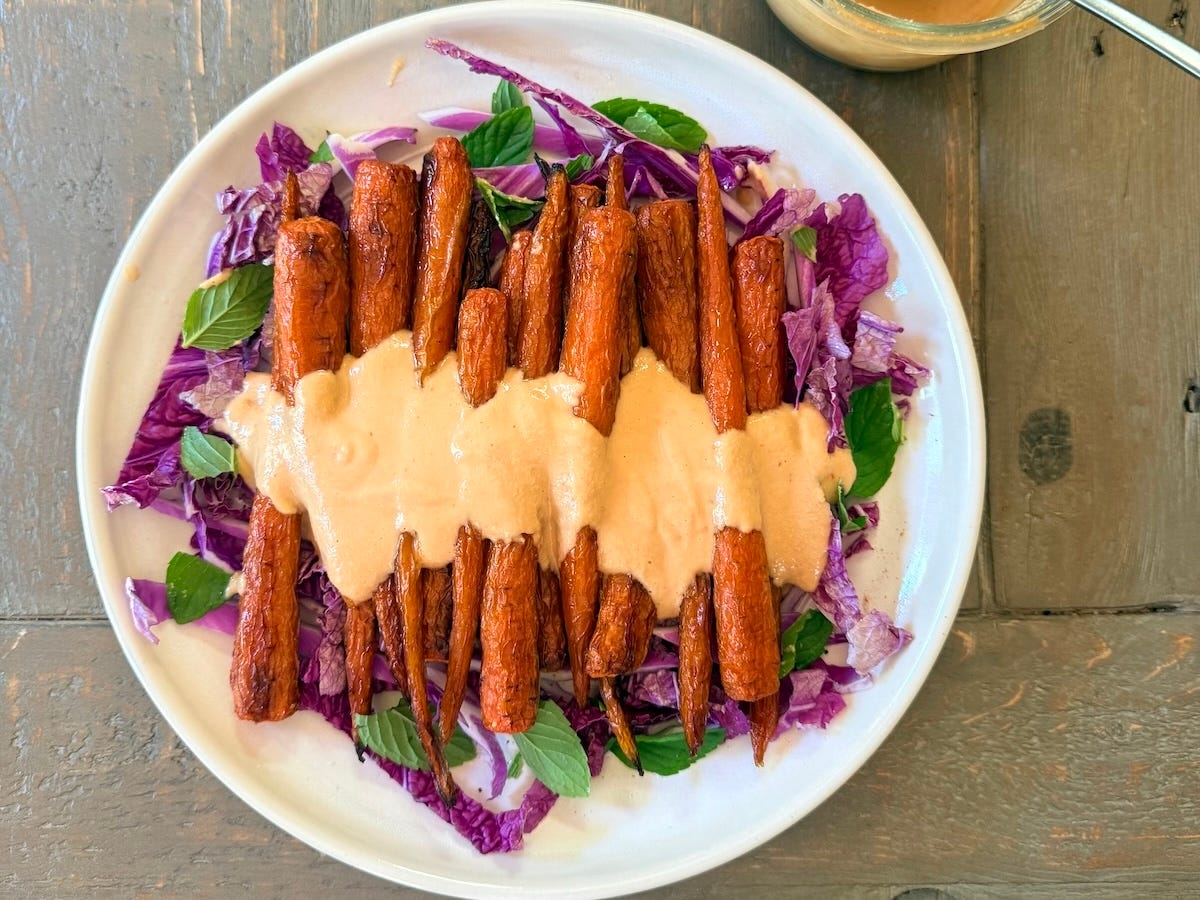
Cashews have a natural fattiness and mild sweetness so grinding them up for the sauce unlocks those qualities and then some. In the photo below, you wouldn’t know that cashews are behind the melon-colored sauce atop the roasted carrots, napa cabbage and mint. (There’s a hint of fish sauce in there but you could sub soy sauce, if you like!)
The purple napa could have been regular napa, mild radicchio, frisee, arugula, Romaine, iceberg or a mixture of them. I was inspired by springtime carrots at our local market and the mint growing with abandon in our garden.
Rory devoured nearly 75 percent of that plate. I should have doubled the recipe. He deemed the dish a keeper. I admitted that I’d simply riffed on the roasted carrots and creamy nuoc cham recipe at my website (which you should bookmark!). I added this iteration to the write up so you have my formula.
Note that the roasted carrots and creamy nuoc cham keeps for days in the fridge (hello meal prep!). Roast the carrots in the evening or early morning if it’s hot where you are. Double, triple, or quadruple the recipe for a crowd. Tinker with it because it goes with many other veggies and even lettuce wraps.
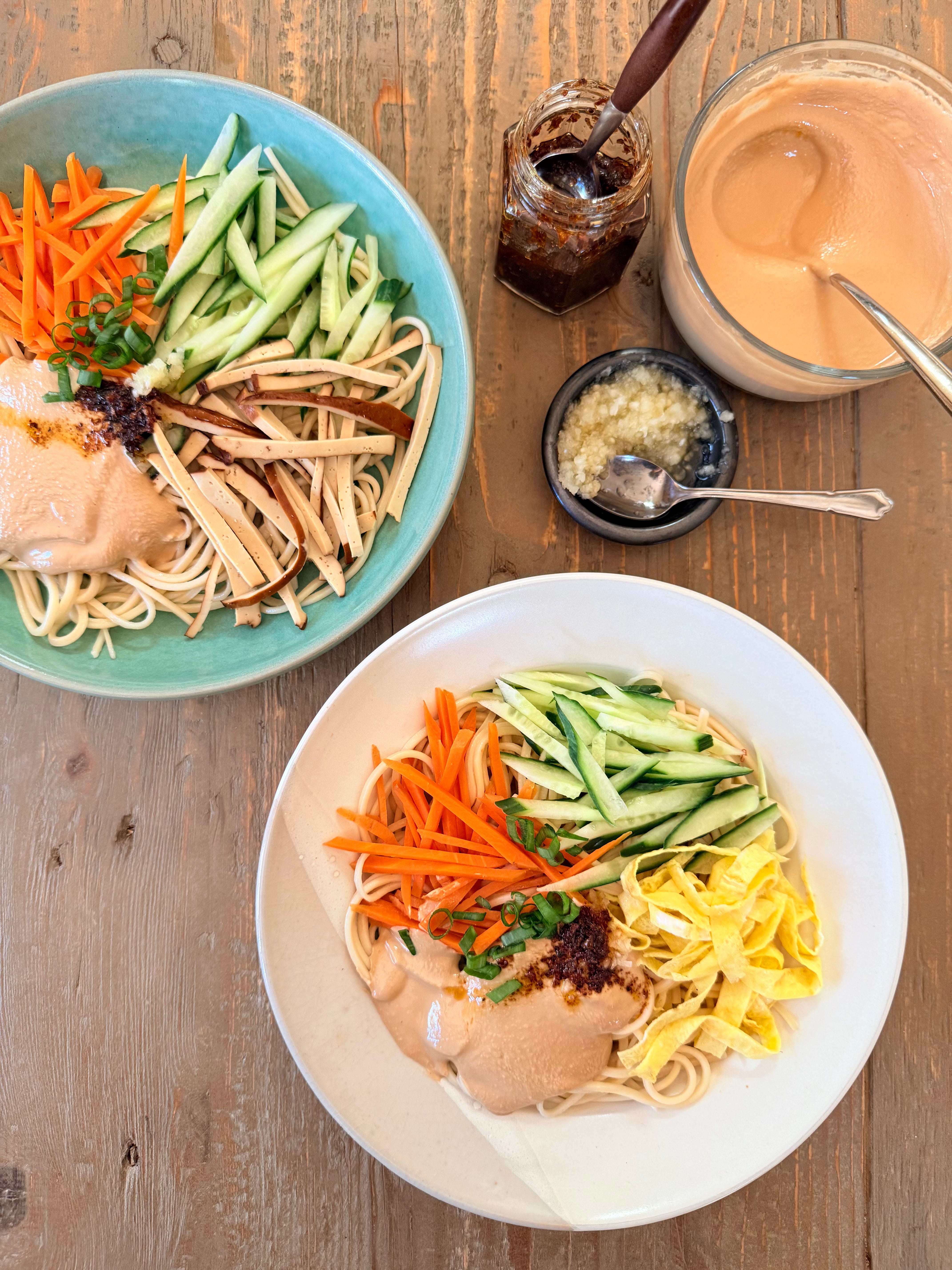
From that nutty sauce, I turned to a seedy recipe for Taiwanese sesame cold noodles (涼麵 Liáng Miàn, literally “Cold Noodles”), published in and Ivy Chen’s Made in Taiwan cookbook. Their recipe headnote (introduction):
There’s a cold noodle vendor called Liu Mama’s 劉媽媽麵館 in Taipei that’s open exclusively from 9:30 p.m. to 9:00 a.m. By virtue of their hours, they serve a distinct class of night owls who crave sesame-drenched noodles with scoops of julienned cucumbers. It sounds bland in comparison to the typical and perhaps more comforting repertoire of greasy late-night skewers, but there’s something both fortifying and refreshing about finishing off a really late night with a large plate of cold noodles. These noodles are also very much a popular lunch staple. So popular, in fact, that you can buy them refrigerated and ready-to-eat at all convenience stores across the country.
Noodles morning, noon and night? I’m in. I’ve used sesame paste for similar noodle dishes but theirs called for roasted sesame seeds and throwing all the sauce ingredients into the blender. So easy and I happen to have sesame seeds in the freezer!
Ivy and Clarissa’s sesame noodles had a wonderful depth of flavor that I’d not experienced before. It was because of the freshly roasted sesame seeds and their sauce formula. The seeds lent flavor and body to the thick sauce, which was plop-able. Optional garlic and chile garnishes allow you to layer on flavors. WOW.
Even if you’re not a vegetarian or vegan, you’ll love these noodles.
However, we wanted more vegetables and a little less noodles and sauce. I remade the sesame cold noodles several times to tweak it to fit our lifestyle. Additionally, I came up with a shortcut sauce(!), if you don’t want to start from seeds and nuts.
After going multiple rounds with the recipe, I realized that you can take sesame cold sesame noodles many directions — vegetarian, vegan, or with chicken, if you like! I bet you’ll craft more ways to play with the versatile sauce.
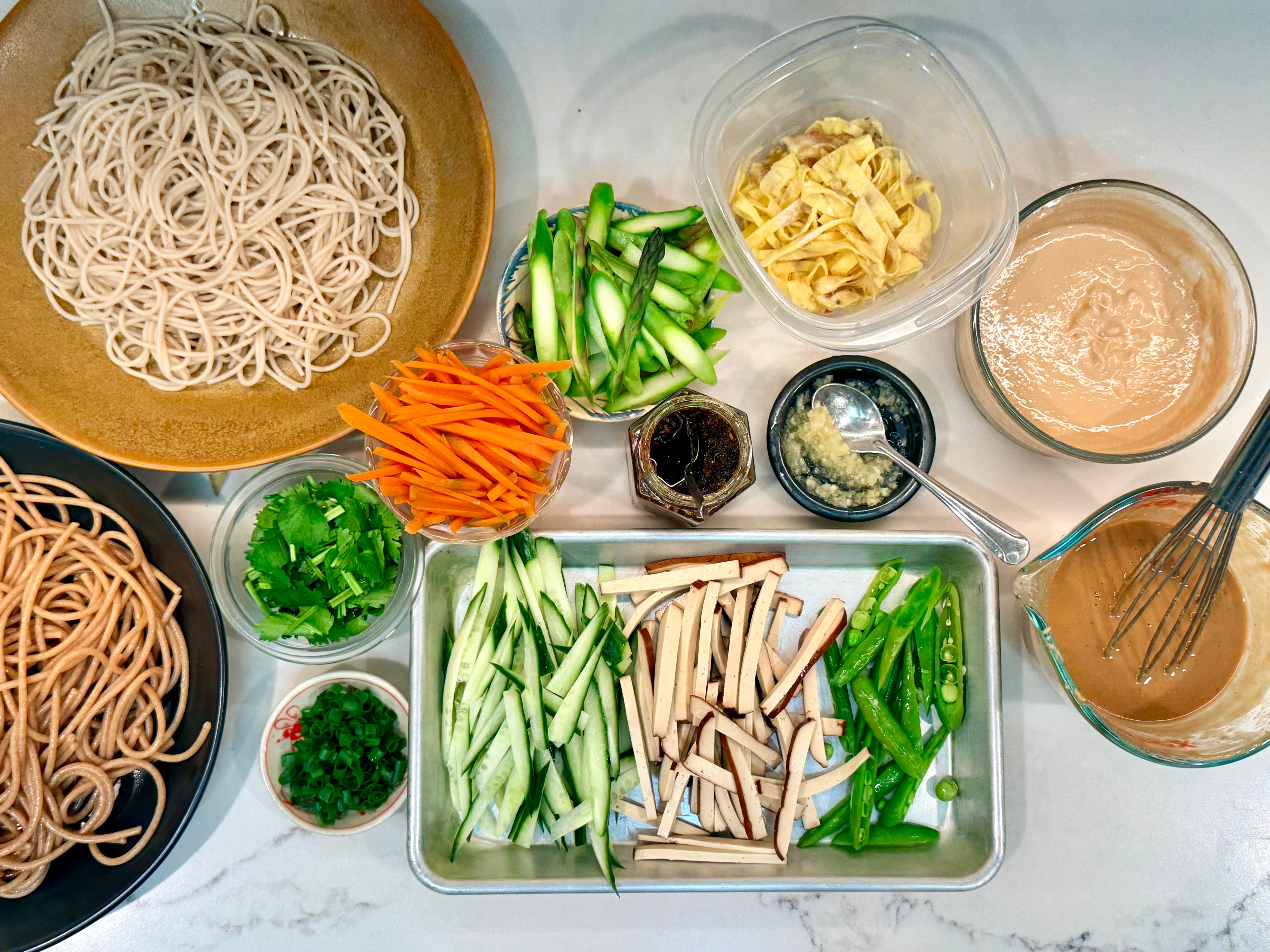
Part of my recipe development was trying all toppings, noodles, and sauces.
Below you’ll find:
Sesame Cold Noodles recipe in full text + a downloadable PDF
Shortcut sesame noodle sauce recipe in full text + a downloadable PDF
Sesame seed shopping and toasting tips
Noodle selection tips to go vegan, gluten-free, or whole grain + a pro-tipe for making them ramen-esque chewy
Keep this recipe handy for the summer for easy meals, entertaining, potlucks or taking on a picnic. You can have so much fun with it.
Paid subscribers sponsor this newsletter and this sesame noodle package is for them. Join us to access this complete post, mine the recipe index, and gain so much more. Thanks for your considerations.
Hello there! I hesitated to send a Midweek Gem this week because I realized that Substack sends you a lot of emails about the livestreams that I’ve been doing. Moving forward with the livestreams, I’m going to curtail those emails.
That said, I wanted to share some exciting news with you! Something called an “advance copy” of Cooking Thai recently arrived on my doorstep.
The book is still being printed overseas but my publisher gets a handful of copies. Chef Pim and I each got one and we’re totally gobsmacked about holding the actual book baby in our hands!
What’s on the cover? One of our favorite recipes in the book — Massaman Curry, based on a time tested recipe by Pim’s grandmother. Pim’s curry pastes are stellar and we developed recipes for you to make it with meat or meatless. There are tips to tweak the heat level so you don’t have to have a Thai built-in heat shield to enjoy this food!
A number of Cooking Thai recipe testers are also PTFS subscribers. We were overwhelmed by their positive response to the flavors and techniques.
It’s been quite a journey to bring Cooking Thai to print. Lots of thrills and near spills. We’ve built it as a solid guide for your Thai cooking adventures for years to come. That’s how Pim and I intend to use the book so we hope you’ll do the same!
How and when can you get the book?Cooking Thai releases on August 25, 2026. The printer is in Asia but luckily the books won’t be shipped through the Strait of Hormuz!
To get a copy ASAP, pre-order it from your favorite book store, cookbook shop, or a vendor like the ones listed here. Pim is planning the book tour so more news will come as things develop. Thanks for your ongoing interest and support.
Congratulations to for winning the giveaway. She cooks lots of Cantonese food so I’ll be curious to know what she thinks of adding Taiwanese flavor to her recipes.
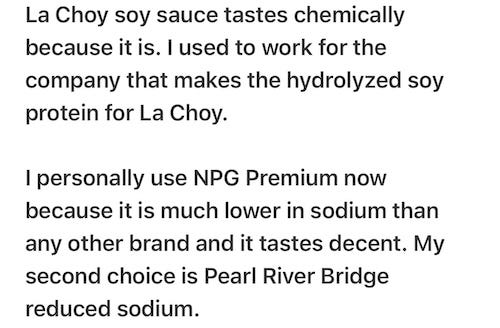
Thanks to all of you who shared your soy sauce brands. And, also to who shed light on La Choy soy sauce and then some.
💎 Focaccia di Recco (one of the best things I’ve ever eaten)
If you live in the Santa Cruz area, get yourself to Mentone in Aptos and order the focaccia di Recco off the specials menu! I’d love for chef David Kinch to permanently add the bedsheet thin flatbread-cracker-quesadilla filled with milky crescenza cheese on the menu. My photo on the right does not do the focaccia justice. 😩
I was so taken by it — a marvel in dough management and manipulation — that I looked up how to make it when we got home from dinner. There are a handful of recipes out there but Janet Fletcher has the scoop from Lidia Bastianich’s recipe. It’s all here on Janet’s website. To get a sense of how it’s made, watch this:
Support Pass the Fish Sauce! Join us for free or upgrade to a become a paid subscriber to enjoy 150+ professionally developed recipes, seed new content, and get future class discounts. Thanks for your enthusiasm!
Coming up for this Sunday Special is a cool noodle dish that Rory and I have been enjoying all week long and we’ve not tired of it.
It’s a long weekend in the United States as we celebrate Memorial Day. I know you’re all busy but I just wanted to thank all the folks like Jim Christol, , , , , and who attended my live video with ! The full video playback is above.
PTFSers asked great questions that got answered and then some. When you watch the video, you’ll glean information about:
When soy sauce got to Taiwan and how colonization impacted the condiment and the island nation’s cuisine
There’s a soy sauce fermentation index that’s akin to the N in fish sauce!
Black soybeans versus yellow soybeans
How fat and protein determine soy sauce flavor
What is tamari? Bottom vat soy sauce? Soy paste?
Taiwanese soy sauce flavor distinctions and how they factor into Heydoh, Clarissa’s new soy sauce company
Single and double fermentation of soy sauce
Soy sauce shopping and storage tips
Heydoh Soy Sauce Tasting Notes and Giveaway
During the interview, I tasted Clarissa’s new soy sauce, Heydoh (named for the Chinese word for black soybean). It was delicious — full of layered savoriness, umami, and with a hint of sweetness. Compared to other regular soy sauces, Heydoh is about 20% lower in sodium.
Heydoh is the first soy sauce I’ve tasted that made me want to just sip it! The Classic is terrific for cooking and dipping sauces. The Silky is double fermented and good for finishing dishes, and drizzling — even on ice cream. Seriously. (I do have a sweet-savory tofu ice cream recipe inspired by a trip to Japan!)
The Classic and Silky are sold at the Heydoh website, where you can also check the store locator to see if it’s sold near you. Meantime, Clarissa generously offered to gift a PTFS subscriber Heydoh soy sauce!
The Heydoh giveaway lowdown:
What is being given away: A complimentary soy sauce duo set
Who is eligible: Anyone with a valid mailing address in the United States: the 50 States, D.C., Puerto Rico, and the Virgin Islands.
When the giveaway closes: Wednesday, May 27 at 10am PST. I’ll randomly pick a winner and notify the person via email.
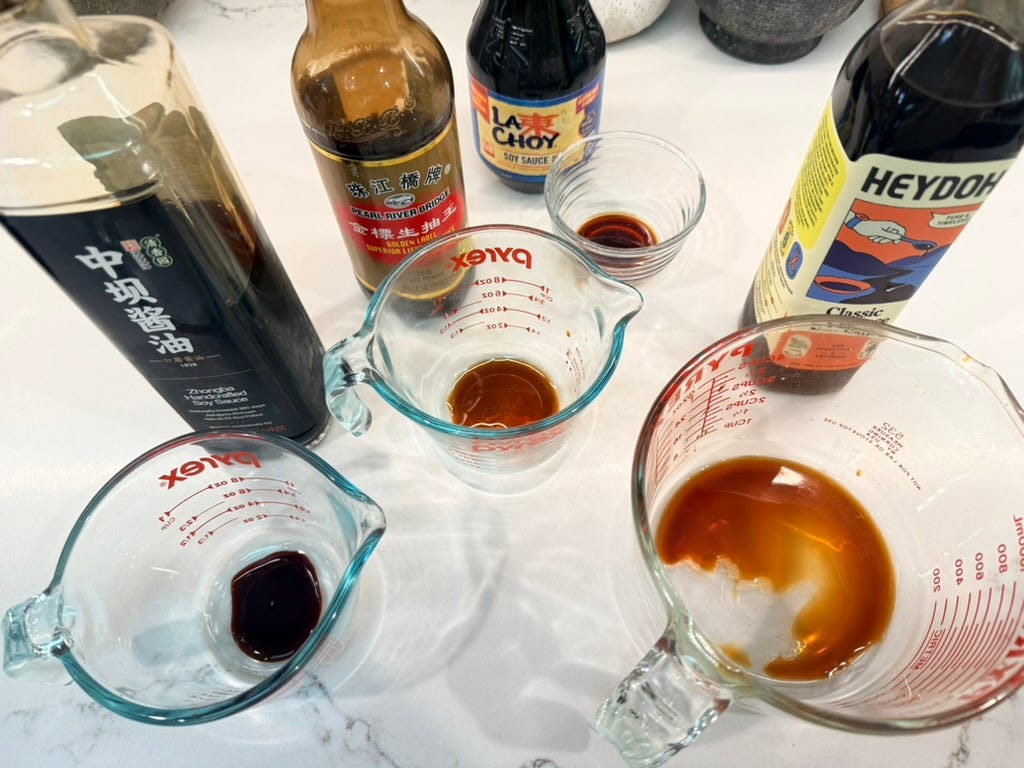
One thing Clarissa mentioned was the color in soy sauce. It’s one of ways you can sense quality. I was struck by Heydoh’s beautiful amber cast, a result of careful soybean selection and fermentation. After our chat, I compared it to a few other soy sauces I have.
La Choy is not my favorite brand. I keep it around to benchmark what my family first used when we got to America in 1975. It’s not naturally brewed like traditional soy sauce and has stuff that’s not normally found in soy sauce. The color is dark and the flavor is sharp, somewhat chemically.
Pearl River Bridge Special Golden Label is a darker brown than HeyDoh and it’s made in a mainland Chinese/Cantonese style. It’s not as complex tasting as Heydoh but is very good and my go-to for cooking and recipe development.
Zhongba Soy Sauce is the darkest because it contains a special mushroom from Sichuan. The flavor is very deep and intense, as is the viscosity. Look how Zhongba keeps its amoeba-like shape with rounded edges. It is only available through the Mala Market.
So, not all soy sauces are alike. As Clarissa says, and I have echoed about fish sauce, you want to find one that you like for dishes that you like to cook! Check in with my Mega Soy Sauce Buying Guide to delve into the many kinds of soy sauces available.
Pass the Fish Sauce relies on smart, curious cooks, readers and eaters for support. Join us at any level. Become a paid subscriber to gain extra useful content as you sponsor my work. Thank you!
Wood Ear Salad and Beginner’s Guide
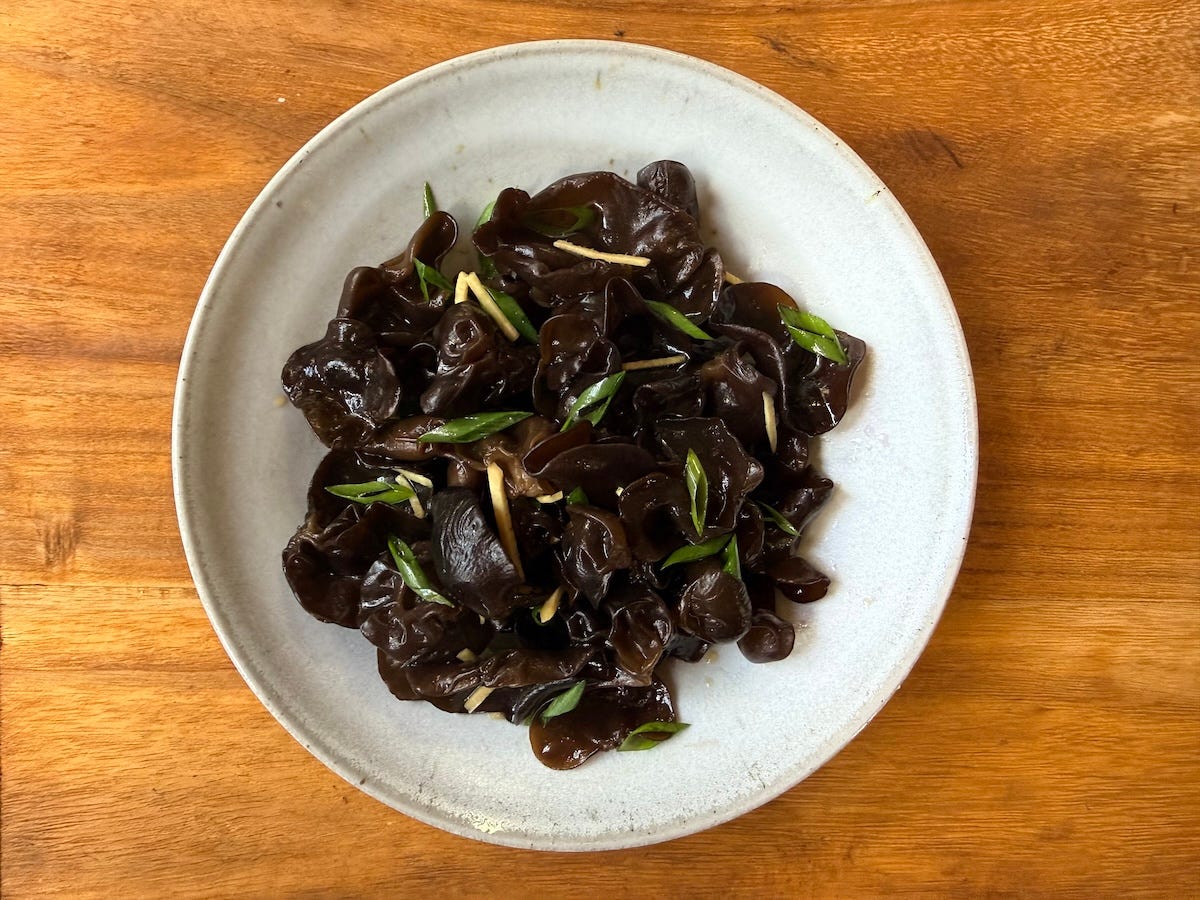
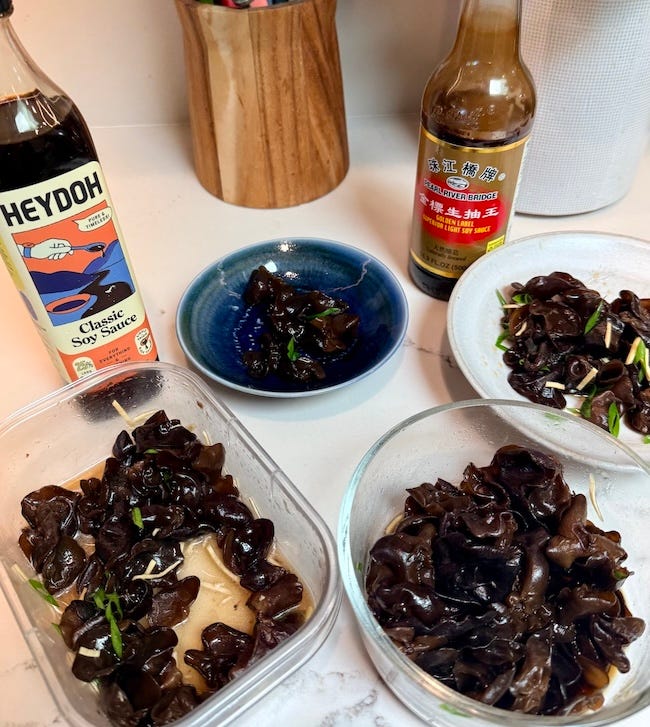
In the aftermath of the soy sauce chat, I test drove Heydoh against Pearl River Bridge (PRB) in a Wood Ear Mushroom Salad. If you've been to dumpling restaurants like Din Tai Fung, you’ve seen it on the menu and perhaps have tried it. It’s handsome, crunchy, slithery, and tangy savory.
Wood Ear Mushroom Salad done at home is leagues better than what a restaurant churns out! Get the recipe at my website.
Clarissa and Ivy Chen’s recipe in their book Made in Taiwan is much better than what I’ve ever had at restaurants. Wood ear salad (liang ban hei mu er) is not just for eating with dumplings. It’s a nice nibble to go with a rice plate, noodles, or even a green salad dressed with olive oil, as Rory and I had it yesterday.
It’s also super easy to make and you can keep it in the fridge for a good 4 days, if not a week! It’s got ginger for a nice bite too.
The salad was excellent with PRB as it was with Heydoh Classic Soy Sauce, though I had to add just a little drizzle extra of Heydoh to bring the salinity up. Once I made the adjustment, the salad popped with extra nuanced flavor. You don’t need Heydoh soy sauce to make the salad. As Clarissa says in her book, Kimlan or Kikkoman will work for her recipes. Make the wood ear mushroom salad recipe at my website.
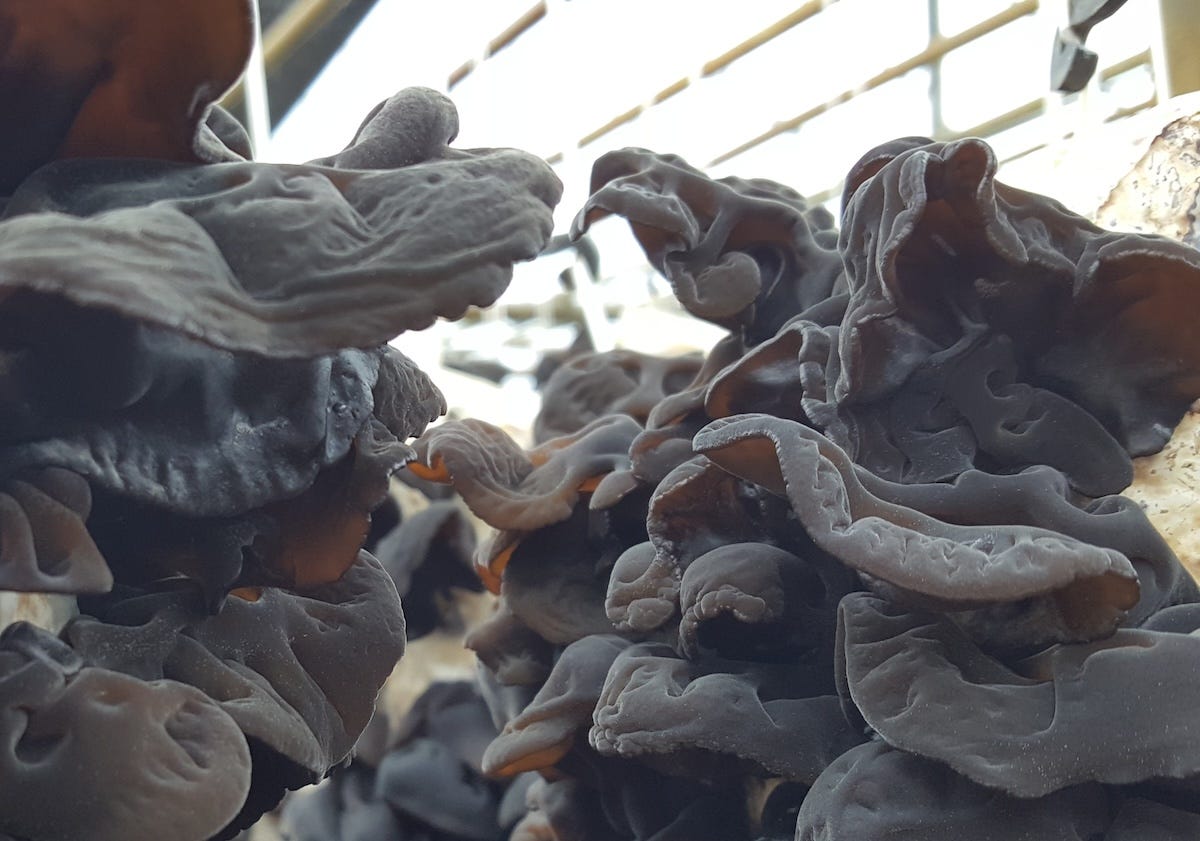
What are wood ear mushroom?
You know shiitake but what about wood ear mushrooms? They’re ebony or dark brown, crunchy, and loaded with health benefits while being low in calories. Sometimes they are called black fungus, which sounds scary and lacks the charm of wood ear 🪵 👂. They’re used throughout East and Southeast Asia in a variety of dishes, such as the above salad and classic hot and sour soup (suan la tang).
Unlike women of my mother’s generation, I’ve never killed a live chicken. However, I have cut up a lot of whole birds to hone my cooking skills, save money, and prepare extraordinary foods.
I was inspired by watching my mom who was inspired by supermarket whole chicken sales. She’d send my dad and me to buy six or so birds. She’d then go at them with her sharp knife — all of which would result in a pot of comforting chicken pho (pho ga), garlicky Maggi roasted chicken (ga ro ti), and a whole host of Vietnamese charcuterie that we’d put into banh mi and much more.
Naturally, when Rory and I started living together, I began buying on-sale whole chickens to experiment on cutting them up myself. I practiced in our tiny apartment in West Los Angeles, and our eating life became full of stocks, stews, liver pate, and roast chicken dinners. He was a poor grad student and I was a low-level university administrator but we at a diet rich in chicken-y foods. (This year marks our 30th wedding anniversary so I guess he didn’t mind my chicken obsessions.)
From cutting up whole chickens, I learned bird anatomy and became and expert carver of roasted chicken, duck, and turkey. I also became a better chicken shopper (When are bigger or smaller birds better?) and cook (What cut works better for which dish?).
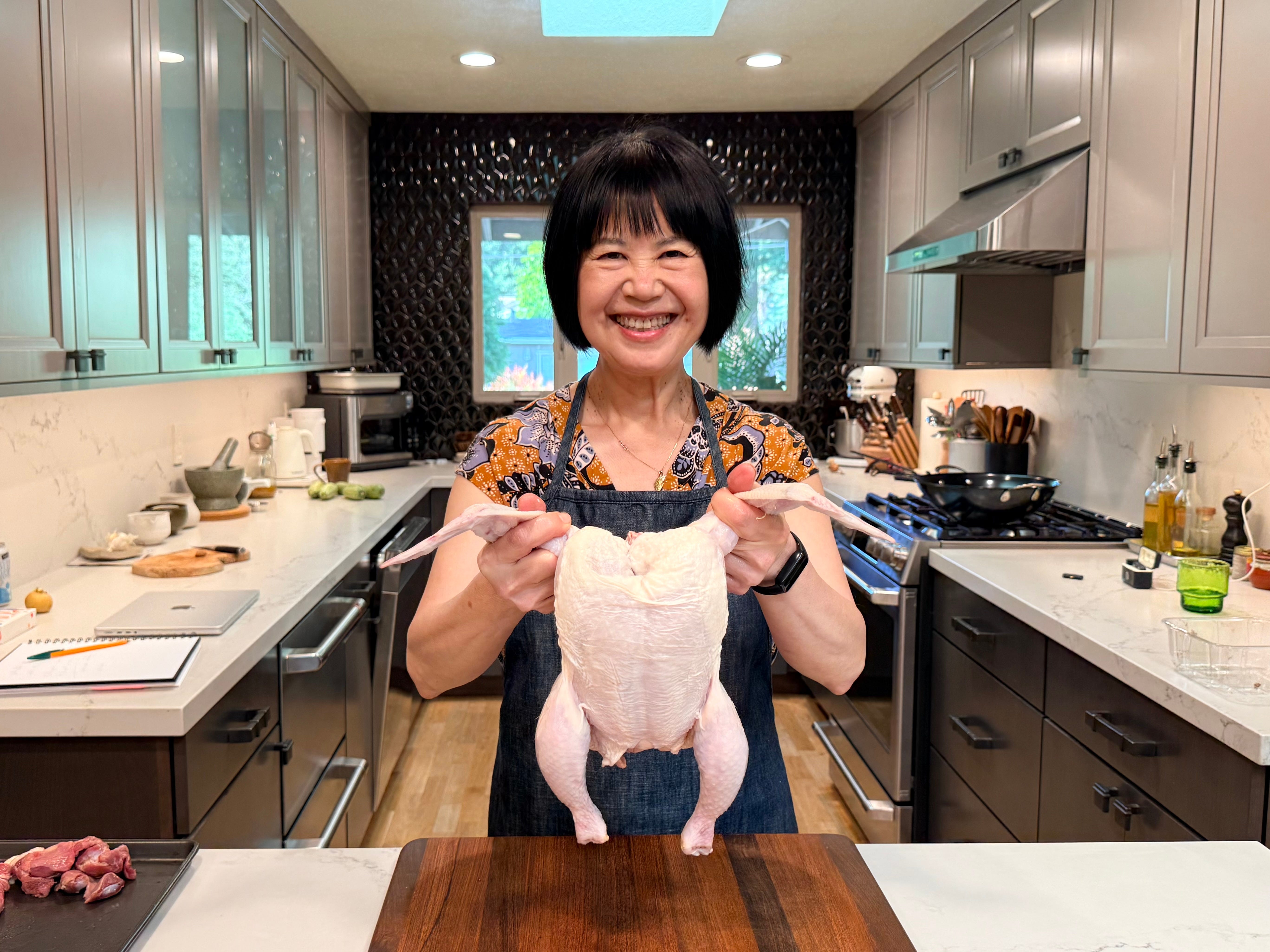
My Julia Child moment at home.
Butchering chicken is a cooking lifeskill that unless you are a vegetarian, you ought to master. Unfortunately, most modern cooks do not know how to break down a chicken and make the most of it.
PTFS subscribers have expressed keen interest in learning how to break down a chicken. I’ve had it on my to-do list but something I saw last week kicked me into high gear: Whole Foods was selling boneless skinless chicken thighs for $10.99 a pound! Meanwhile, the WF whole chicken was $2.69 per pound.
A whole chicken is like manna from Heaven. A whole bird can seed many more delicious meals than a pound of deboned, skinless chicken. I bought several chickens and recruited Rory to help me make the four (4) videos in this dispatch:
Chicken rinsing (yes or no and how?)
How to cut up a whole chicken (+ what size and kind of bird to buy)
Cutting and deboning chicken parts (for good flavor and cuts that you can only get at specialty markets)
Chop chicken bones like a boss (for better broth and excellent pho, whack away!)
These videos will also help you with:
food safety issues
buying chicken intelligently
getting better flavor
specialty-style cuts
broth/pho technique
cooking confidence to deal with bones, boning knives, and cleavers
Feel free to share your knowledge and tips too!
These four Chicken Butchering videos comprise a mini class, which is free to paid subscribers. They seed and sponsor PTFS knowledge. Join us to access this complete post, mine the recipe index, and gain so much more. Thanks for your considerations!
On the heels of our fish sauce 101 livestream a couple weeks ago, I reached out to cookbook author and now entrepreneur , who recently co-founded Hey Doh, a new artisanal soy sauce company. Clarissa is among my go-to experts on Taiwanese and Chinese cooking. A former Los Angeleno, she’s now based in Taipei, Taiwan.
She sent me Hey Doh products that I’m going to taste for the first time on Thursday, May 21 during a livestream! I’ve also got lots of soy sauce questions because despite using it regularly, I don’t know enough about it.
Due to our time difference, I’ve scheduled the livestream for 6pm PST / 9pm ET / 9am TPE — it’ll be happy hour or breakfast, depending on where you are. The interview will run 30 to 45 minutes.
To recap, on Thursday, May 21, at 6pm PST, you’ll get a Substack email about the livestream. Click on the link to join our chat about Hey Doh, soy sauce making, and why Taiwanese soy sauce is distinctive.
💎 Weeknight Vegetable Stir-Fry Blueprint
I’ve been adding asparagus to many recipes of late because it’s one of my favorite spring-time vegetables. Why not indulge till you’re nearly satiated? Susan M. wrote last week and reminded me of a terrific stir-fry from Ever-Green Vietnamese. It’s the Weeknight Vegetable Stir-Fry on page 195, in the sides chapter. I love that chapter because I could make a meal of sides.
I originally conceived of this stir-fry in spring, when our farmers harvest super delicious asparagus, carrots, and radishes. (Yes, you can cook radishes and they’re good. Chef David Chang got me doing it it years ago and I’ve never looked back.)
I set up the stir-fry recipe as a blueprint for you to plug and play with it. If you don’t yet have the book, I just published the recipe on my website. Make the Weeknight Vegetable Stir-Fry recipe a couple times and you’ll be riffing on it endlessly.
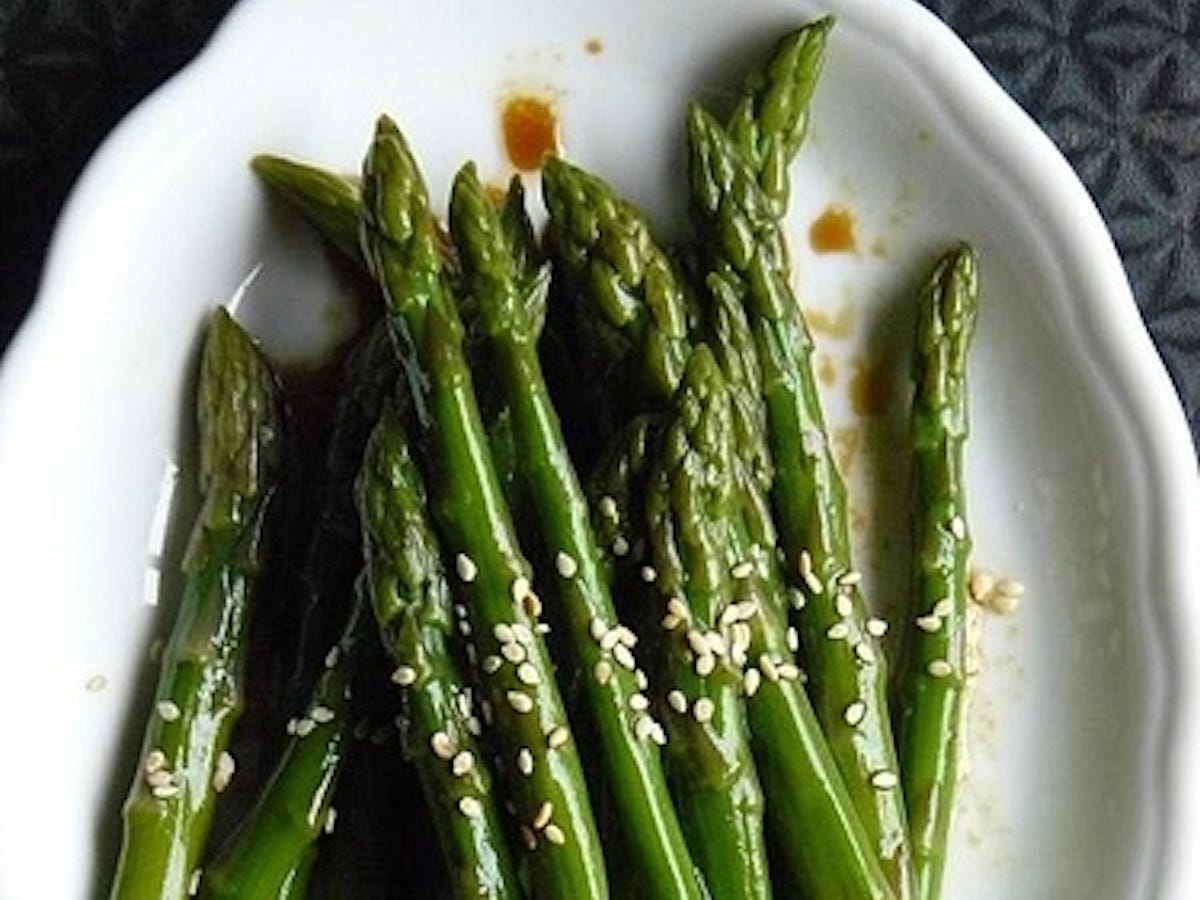
If you want an asparagus only side dish to serve at room temp, look to my very easy asparagus dressed up with a veil of soy sauce and sesame oil. It’s a great combination of asparagus’s natural umami with that of soy sauce, all of which is made fragrant and enriched by the power of sesame.
I return to this Chinese-ish asparagus annually. I have it on my mind because of next week’s conversation with Clarissa. Get the asparagus with soy sauce and sesame recipe. (P.S. It’s naturally vegan, like the Weeknight Vegetable Stir-Fry!)
💎 Recipe recap from the last 2 months
No wonder March and April flew by. I cooked up a lot for you to play with. Here are the recipes mentioned in my dispatches to you. Below are PTFS recipes as well as those posted at the website. I’ve updated the PTFS recipe index to include them too!
And, don’t forget the mega Fish Sauce FAQ and buying guide at the website. It’s not a recipe but the ingredient figures into so many recipes nowadays.
Support Pass the Fish Sauce! Join us for free or upgrade to a become a paid subscriber to enjoy 150+ professionally developed recipes, seed new content, and get future class discounts. Thanks for your enthusiasm!
Coming up for this Sunday Special are some butchering tips I owe you.
Hey there! If you want to watch me crack jokes, discuss cooking and travel in Vietnam with , here’s the playback of our livestream. He interviewed me on a wide range of topics but it always came back to how food makes a difference in our lives.
Among the people mentioned in the interview was my mom and her recipe notebook. Moms impact our nourishment from the get go.
And with that, Happy Mother’s Day to all the brave humans who’ve birthed and shepherded new life into this world. I am in awe of you all who have loved and nurtured your flock into adulthood, despite the odds.
In the photo below my Mẹ Già (Elder Mother, a Viet term of endearment) is looking pretty 🔥. She’s in her element at a Viet grocery store! (We were at Green Farm in Garden Grove, CA, that day.)
💭 “These opo squash — I will turn them into a quickie canh soup when I get home!”
A few notes on my mom’s new stove: Before the stove arrived, I made sure she’d be ready to cook so I ordered her a welcome present: a 5-liter jug of premium fish sauce! She usually doesn’t like gifts but that was one she couldn’t refuse.
Speaking of fish sauce, I just published a mega fish sauce guide and FAQ that includes substitutes, brand suggestions, recipes, plus the video playback of our PTFS nuoc mam livestream. Head to “Fish Sauce: What is it? Plus, how to buy, store, use, and sub for it” at the website.
After delivery of her new stovetop, Mom set out to làm bạn (literally make friends) with it. She initially reheated leftovers and found out that her steamer didn’t need to go on the power burner, unless she wanted overcooked food. Then she deep-fried a batch of tofu to perfection, she reported.
“The stove designers have researched and thought all this through for years,” Mom said. “It all makes sense and works well.”
One of the things mothers do well is to remind us the importance of trying new things for a lifetime of learning.
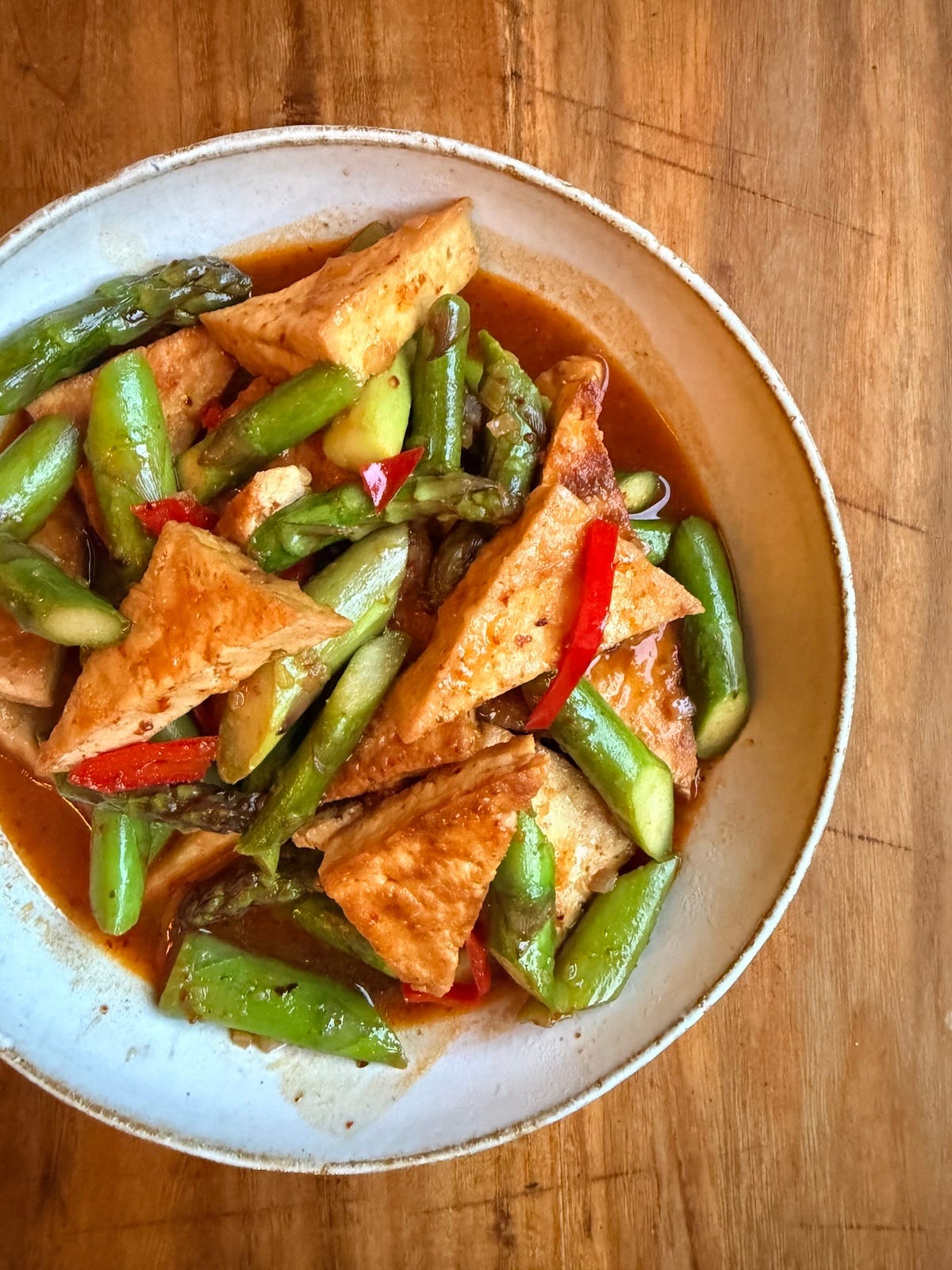
That, along with Mom mentioning fried tofu, inspired me to "‘get acquainted’ with a Vietnamese tofu dish that I’d never made before — Spicy Braised Tofu in Coconut Water (Đậu Hũ Khìa Nước Dừa).
With chile heat and the sweet lilt of coconut water, this handsome main dish strongly reflects southern Vietnamese cooking. Though the tofu looks deep fried, a modicum of oil was involved.
Yep, you can make this with veggies other than asparagus! See my ideas below.
This tofu features an uncommon Vietnamese braising technique using the refreshingly sweet juice from a young (green) coconut — aka coconut water. Most people think of drinking coconut water. I’ve used it for nuoc cham dipping sauce and have used it in cooking too — just not in this delightful new manner.
There’s always a moment when you’re cooking a new dish when you ask yourself how is this going to taste? How does it work? I was kind of skeptical about this braise, called dau hu khia nuoc dua. There’s a lot of gurgling as things cook because it comes together fast. But after the mildish sauce cooked down and worked its magic, the tofu and veggies were absolutely delicious.
Unlike most Viet braises featuring caramel sauce, this one is very low sugar. It’s great for diabetics and anyone looking to cut back on refined sugar. Other reasons for praising this braise:
One batch serves four, which in our home means that Rory packs some for lunch with rice, and I enjoy the rest with a salad or turn it into banh mi!
The tofu is terrific hot, warm or at room temperature.
You can make this recipe with ingredients from the supermarket.
Ready the ingredients days ahead then braise when you need an easy, quick main dish for dinner
To equip you to make this tofu recipe, I’m providing the following:
A flexible braised tofu in coconut water recipe in full text and downloadable PDF (this tofu dish can be make vegan or not!)
Explainer on the tofu prep technique, which differs from my normal playbook
Vegetable swaps because we won’t be in asparagus season forever
Ingredient tips (what’s the best coconut water?)
Advance prep pointers
I hope you’ll get well acquainted with this Viet tofu winner!
Thanks for being here. Paid subscribers sponsored this Sunday Special dispatch. Join us at any level to get in on the action. Become a paid subscriber to enjoy the full braised tofu lowdown plus many other recipes, insights, and benefits. Your support matters.
Several follow-ups this week to last week, unbeknownst to me, my mother was among the folks who attended my fish sauce 101 livestream last Wednesday. I didn’t catch on my screen so she was a stealthy attendee! Mom got an email notification from Substack and clicked on the button to join. “It was so easy. Congratulations on your show!” 🥰 A mother’s love. I asked if she’d ever do one with me and she demurred.
That’s all good to know for next Wednesday, May 6, at 9am PST / 12pm EST, when my friend of Milk Street Kitchen will host me for a Substack Live. We have great chats about food, cooking, and culture; the upcoming livestream will last 45 to 60 minutes. When you get the email or app notification, hop on to watch and/or ask questions.
One thing I forgot to mention in last week’s súp măng tây (Viet asparagus soup) dispatch is that the term súp is the Vietnamization of French soupe. Viet folks consider any súp dish as special, high-end, and high-class. I presented two weeknight-friendly asparagus soup recipes to you but their silky, slinky texture and umami-laden flavors are suitable for entertaining!
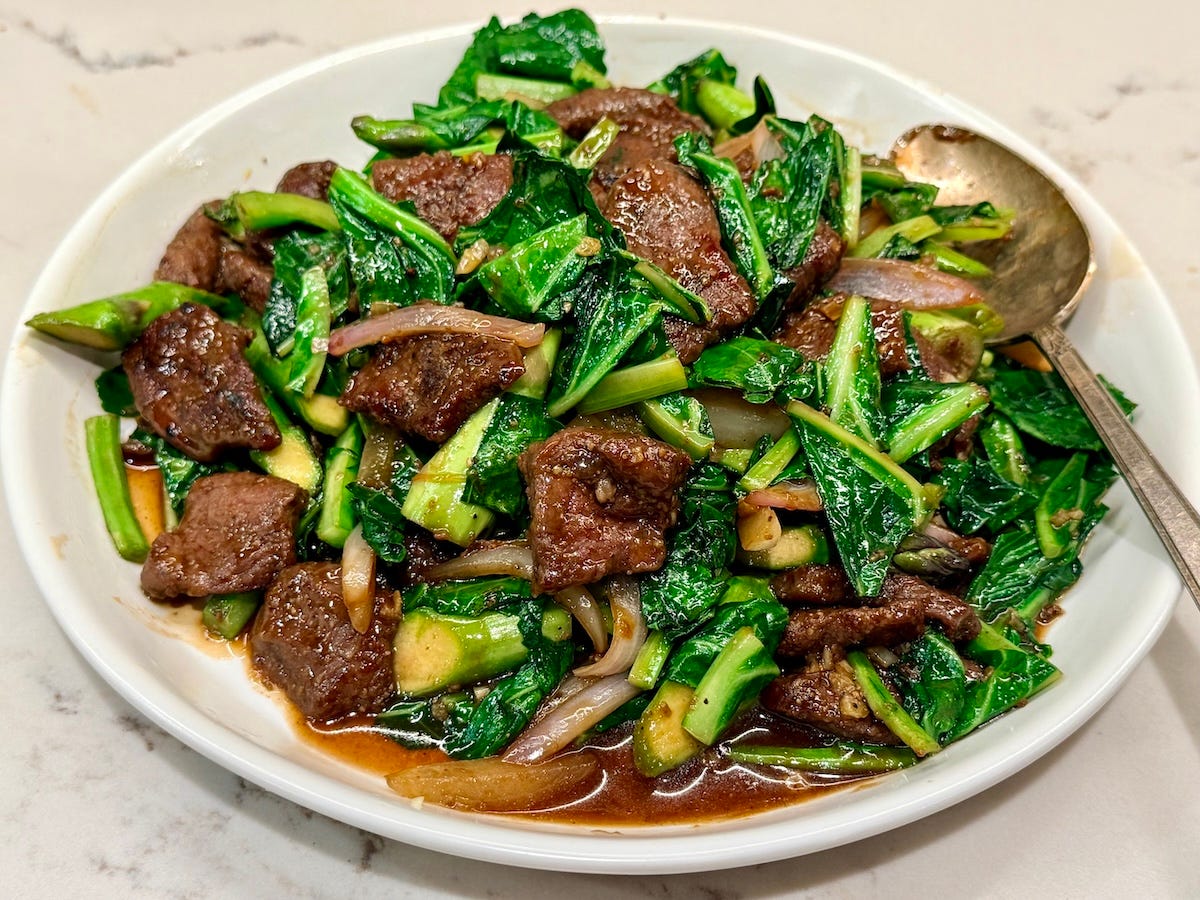
Another favorite way that Viet people enjoy asparagus is in a stir-fry with beef – a luxe protein in Vietnam. In the main, the cattle in Vietnam tend to be lean and pasture raised. In the early part of the twentieth century, French colonialists ‘harvested’ lots of cows for their bifteck pleasures. They left the scraps for resourceful Viet and Chinese cooks to turn into new foods, as I wrote in the History of Pho article at my website. Steak was foreigner’s food.
Even nowadays, when Vietnam is wealthier, it’s rare for Viet people to sit down to a dinner of bít tết (beefsteak, from French bifteck) in which each person gets their own slab of tender beef cooked to their specifications. Moreover, domestically raised cattle in Vietnam tend to yield firm, lean meat because they are traditionally work animals.
I went looking for a fun stock photo of cows in Vietnam. I came up empty. Then I remembered I had a shot of some in a small town in Buon Ma Thuot during my 2024 trip to Vietnam.
That said, beef consumption is rising in Vietnam; in 2022, it was shy of 9 pounds, or 4kg per person! Here in the U.S. our annual beef consumption is approximately 50lbs per person!
If there’s a steak on the Viet table, it’s likely to be sliced up for sharing. After all, beef is expensive and in general, meat is enjoyed in small amounts.
I didn’t fully realize that until a few years ago. While I was writing my plant-forward book, Ever-Green Vietnamese, my mom shared that she only used 300 grams (10 ounces) of meat to prepare main dishes for our family. Our family of seven, was well fed, mostly on vegetables and grains, not on animal protein. It wasn’t until we arrived in America in 1975 that we’d have steak dinners on a weekly basis; and even so, we served it sliced up to divvy up and easily manage with chopsticks at the table.
Wanting to stretch the asparagus season and do a twist on a Viet classic, I made a delicious beef and asparagus stir-fry recipe. You don’t have to use fancy expensive steak to yield excellent results.
The marinade and seasoning employed yields tender, super flavorful results. In the recipe and video below, I’ll share how I pull certain levers to render small pieces of beef into supple flavorful morsels packing potent flavors. There are also certain techniques I use to ensure the asparagus express their best crispness and color.
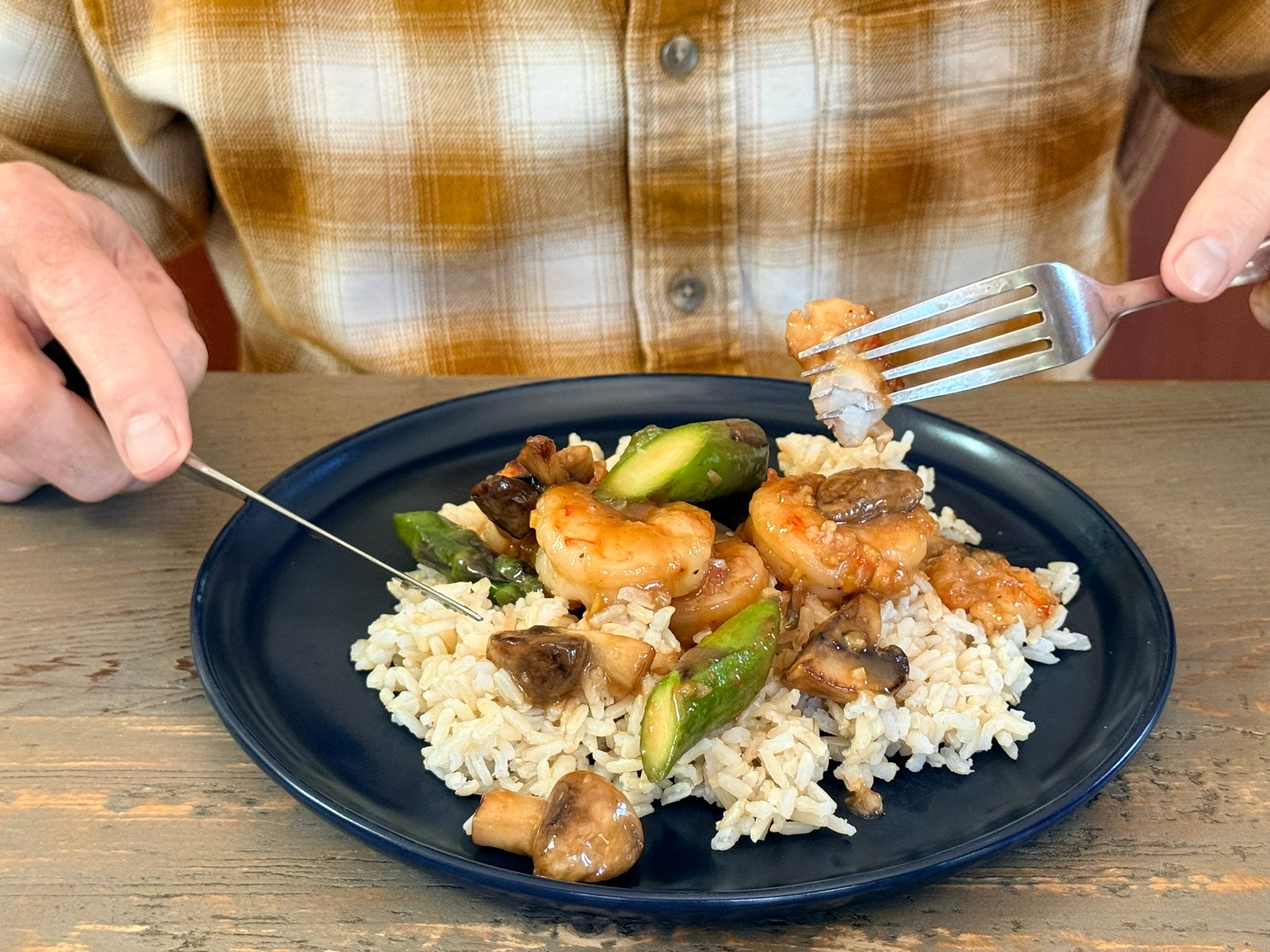
With lots of asparagus on hand, I prepared a rendition with shrimp. The flavors and texture were wowza terrific. Rory gobbled it up and said it was somewhat lobster-ish, which he never ever said about a cheffy asparagus and shrimp stir-fry I used to make.
Go ahead and enjoy the stir-fry with fork and knife! The big shrimp are easier to deal with. Ditto for the beefy stir-fry.
Beef or shrimp? It was hard to decide which is better so I’m offering you both this week. Below you’ll find:
Beef and Asparagus Stir-Fry + Shrimp and Asparagus Stir-Fry recipes in text and downloadable PDF
A how-to video to help you craft great stir-fries
What to look for in beef and shrimp that will stir-fry well
Ingredient swaps galore + advance prep tips too
Stir-fry both for a surf-and-turf feast that celebrates the season.
Thank you for being here. Paid subscribers sponsored this Sunday Special dispatch. Join us at any level to get in on the action. Become a paid subscriber for these two recipes plus many other recipes, insights, and benefits. Your support matters.
Well, I’d never done a livestream on Substack until yesterday morning and it was fun. It wasn’t as nervous making as live cooking demos I’ve done on Instagram. Nor was it hair raising like the time my hairdresser taught me how to trim my bangs during the pandemic!
A big hug and thank you to , , , , , and the more than 80 other folks for tuning in for the fish sauce Q&A and virtual tasting. (Your nuoc cham Viet dipping sauce recipe may never the the same again!)
As I said at the top of the session, I didn’t know who would or could attend. With everyone’s busy lives and time differences, who knows when to schedule anything anymore? And what interests you?
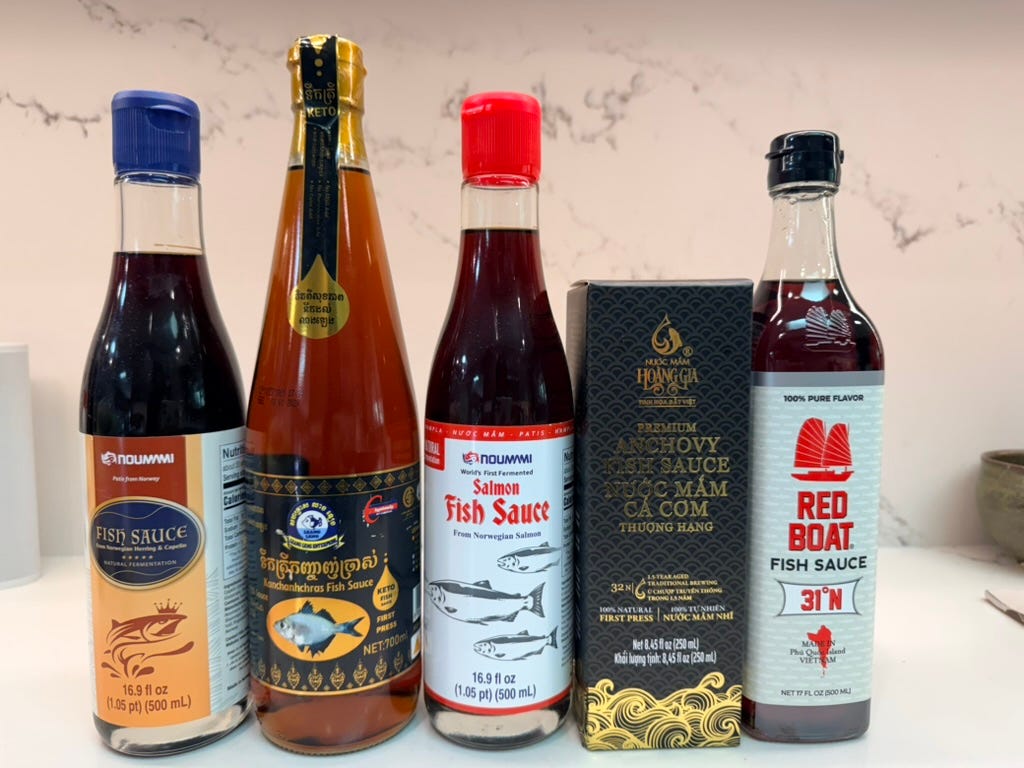
Uncommon fish sauce from Norway, Cambodia, and Vietnam. I taste tested them during the live video.
I plan to do more and will keep you posted. Join me for my next live video in the app. If you don’t have the app yet, here’s a handy link.
Get more from Andrea Nguyen in the Substack app
Available for iOS and Android
💎 Stir-Fry your Collard Greens
Another thing I did recently that turned out better than I thought it would was stir-frying collard greens! I thought they always needed a long simmer or prolonged steam saute. Turns out, as I learned from a recipe by Ronald Hsu (the scrumptious chicken-and-rice casserole chef in Atlanta with a new Chinese American cookbook), collards work swimmingly well in stir-fries. It all depends on how you treat them.
Pass the Fish Sauce exists for curious cooks, readers, and eaters. To receive new posts and support my work, become a free or paid subscriber.
💎 Food and Cooking in Poetic Form
Speaking of the American South, the Southern Foodways Alliance’s spring 2026 issue of Gravy is choc-a-block full of provocative poetry about what we cook and eat. If you’re an SFA member, you’ve received the recent quarterly journal. If you’re not in SFA, check out Gravy back issues here.
But right now, I’m highlighting a poem by the very talented Adrienne Su.
Coming up on Sunday are two more Viet ways to celebrate springtime asparagus. Some of you may have asparagus already and if you’re like Kate and Nate in Maine, you’re still waiting. Well, I hope last weekend’s recipes and this coming weekend’s recipes will figure into your cooking schedule sooner or later.
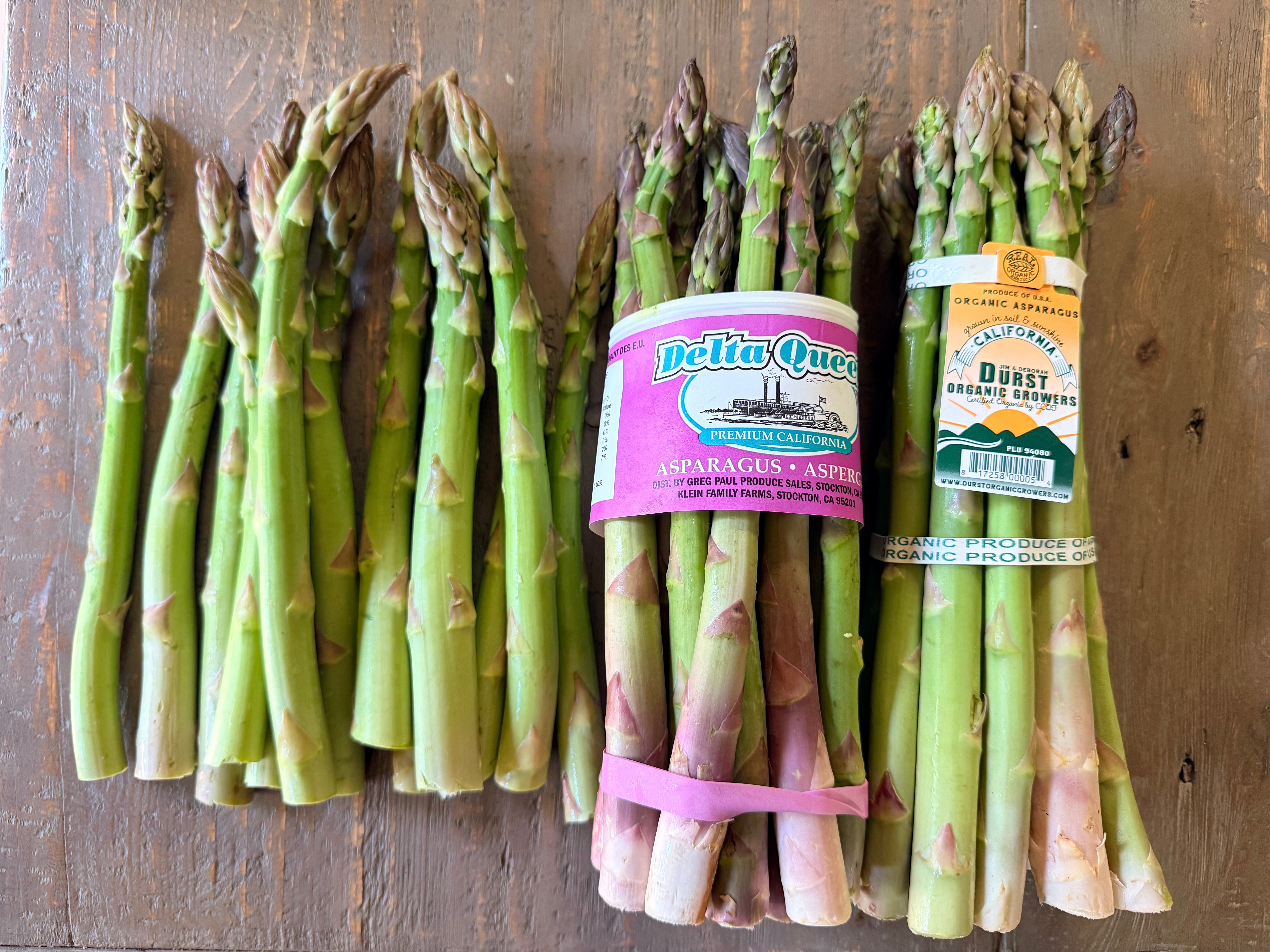
It happens every year. Asparagus appears at the farmer’s market and supermarket and I overbuy. My family loves asparagus, which was introduced to Vietnam by the French. Because asparagus spears shoot out from the soil like bamboo, Viet people called the vegetable măng tây (French bamboo). The disyllabic word is much easier to pronounce than ‘asparagus’.
Because asparagus requires particular conditions to thrive, it wasn’t widely grown in Vietnam. My mom didn’t see fresh asparagus in Saigon until the years close to when we fled in 1975. It was grown in Da Lat along with other Western crops like artichokes, she said. She recalls fat white asparagus that were delicious. For most people, if they could afford asparagus in Vietnam, it came from a can imported from far away.
Asparagus was a foreign ingredient for much of the 20th century. Given that, Viet asparagus recipes in the 1940s leaned mostly toward French-inspired dishes. One asparagus salad recipe called for reheating an unopened can of asparagus (to preserve its shape and texture, I suppose) and then tossing the spears with a simple vinaigrette. That doesn’t sound tasty.
An elegant delicate icon
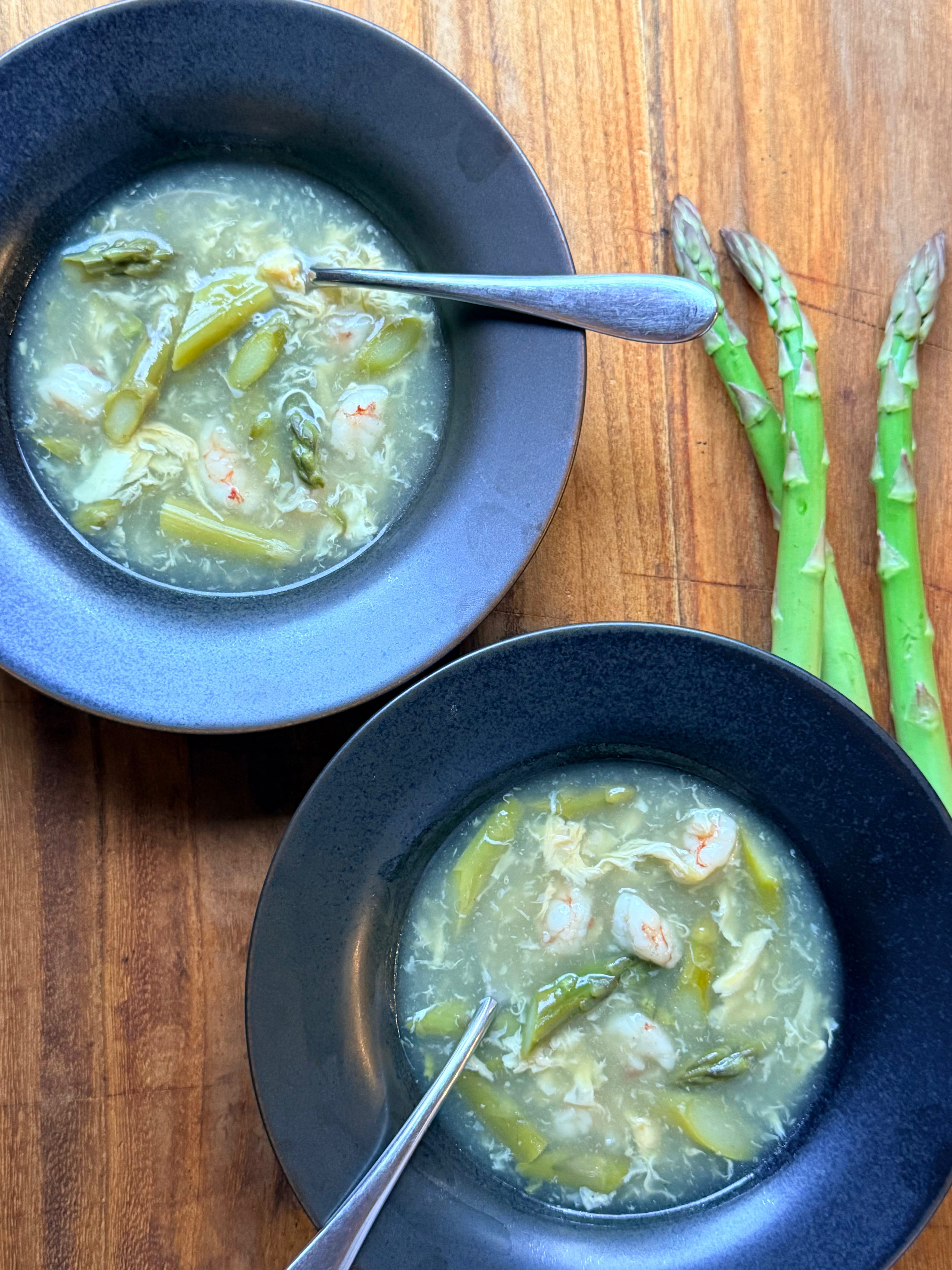
The better tasting asparagus dish that became a fixture in the Vietnamese repertoire was súp măng tây cua — an elegant soup loaded with asparagus and crab. It was and still is considered special-occasion fare because asparagus is a luxe, pricey ingredient.
People traditionally prepared the soup with canned asparagus. Resourceful cooks maximized the asparagus flavor by adding both the spears and their canning liquid to the soup. I know it sounds gross but it tasted good to us.
After we fled Vietnam and resettled in America in the 1975 where there’s fresh asparagus, my mom still made the soup with canned asparagus. She also used canned crab for convenience. We had it as our go-to soup for fancy parties but after indulging in fresh asparagus, I found the canned asparagus soup to be monochromatic in flavor. Over time, my mom just stopped making the soup.
Fresh asparagus is the better way to go for the soup and I’ve turned to making it with fresh spears for years. I’ve also converted my mother.
I thought my approach went against Vietnamese conventions but noticed that Vietnam has recently been growing asparagus to export to Taiwan, China, Japan and South Korea. Cultivating asparagus, a pricey vegetable, is building economic opportunities for impoverished parts of Vietnam. It’s been dubbed as the “king of vegetables” and “green gold”.
Exports are one thing but more cooks in Vietnam are experimenting with fresh asparagus recipes. Asparagus is healthful, which Viet people (like everyone else) dig. It’s low-cal, high-fiber, and antioxidant rich. Its high folate content is good for fighting cancer. I just eat the spears for flavor but heck, I’ll take the health boost too.
All of that cheered me to no end. It’s one thing for me as a recipe developer to adapt and evolve ingredients for my expatriate situation, but knowing that people in Vietnam are using similar ingredients means that my ideas jive with what’s going on in the motherland.
This past week, I experimented with my favorite asparagus soup recipe to make it super weeknight friendly. I had a lot of asparagus on hand and ended up devising two super flavorful recipes that you can take in many directions. You’ll be well covered by the contents of this dispatch, which includes:
2 flexible asparagus recipes to please omnivores, pescatarians, vegetarians, or vegans
A how-to video to walk you through the trickiest part of the recipe
No-waste cooking tips because asparagus and seafood are expensive
Explainer on how this umami-laden soup’s flavor comes together (so you can apply those ideas elsewhere)
Advance prep pointers that enable you to easily slide this recipe into your rotation
If you love the springtime vegetable as much as I do, now is our moment to fully enjoy their unique flavor, texture, and healthful benefits.
Thank you for being here. Paid subscribers sponsored this Sunday Special dispatch. Join us at any level to get in on the action. Become a paid subscriber for the full Viet asparagus soup plus many other recipes, insights, and benefits. Your support matters.
Among my 2026 goals is to try Substack’s live streaming function. Let’s do it next week:
When: Thursday, 4/30, 11-11:30am PST / 2pm EST / 7pm UK
What: Ask Me Anything (AMA) about Fish Sauce + uncommon fish sauce (I have some unusual fish sauce that I’ve never tasted before so why not register my opinion to you on the spot?!)
How to attend: You’ll get an email ping when I go live. I will also schedule it in Substack’s Notes app. Attend to ask your questions in the chat function. If you can’t attend and have a question, leave a comment in this dispatch. After the livestream, I’ll share the video so everyone will get the recording.
Now, as for my mom’s stove . . .
When you cook a lot, your stove is your BF (best friend). My parents bought a new tract house in the late 1980s and it came with an ok cooktop. By the early 2000s, my mom had put that cooktop through its paces and it was crapped out. She soldiered on because the first house she and my dad bought in the late 1970s still had had its original stove from the early 1960s. So anything was an improvement! Mom learned to cook using rice straw (really!) and can bake cakes using indirect coal heat and a flimsy metal box. My how times have changed!
Around 2010, a lady in the neighborhood was doing a kitchen renovation project and set her old cooktop out on the sidewalk with a “For Sale $100” sign.
That neighbor owned a swank home appliance shop, my mom said. The shop’s appliances were nice so my mom figured that the stove was good. After the cooktop languished for a few days with no takers, the sign changed to “Free”.
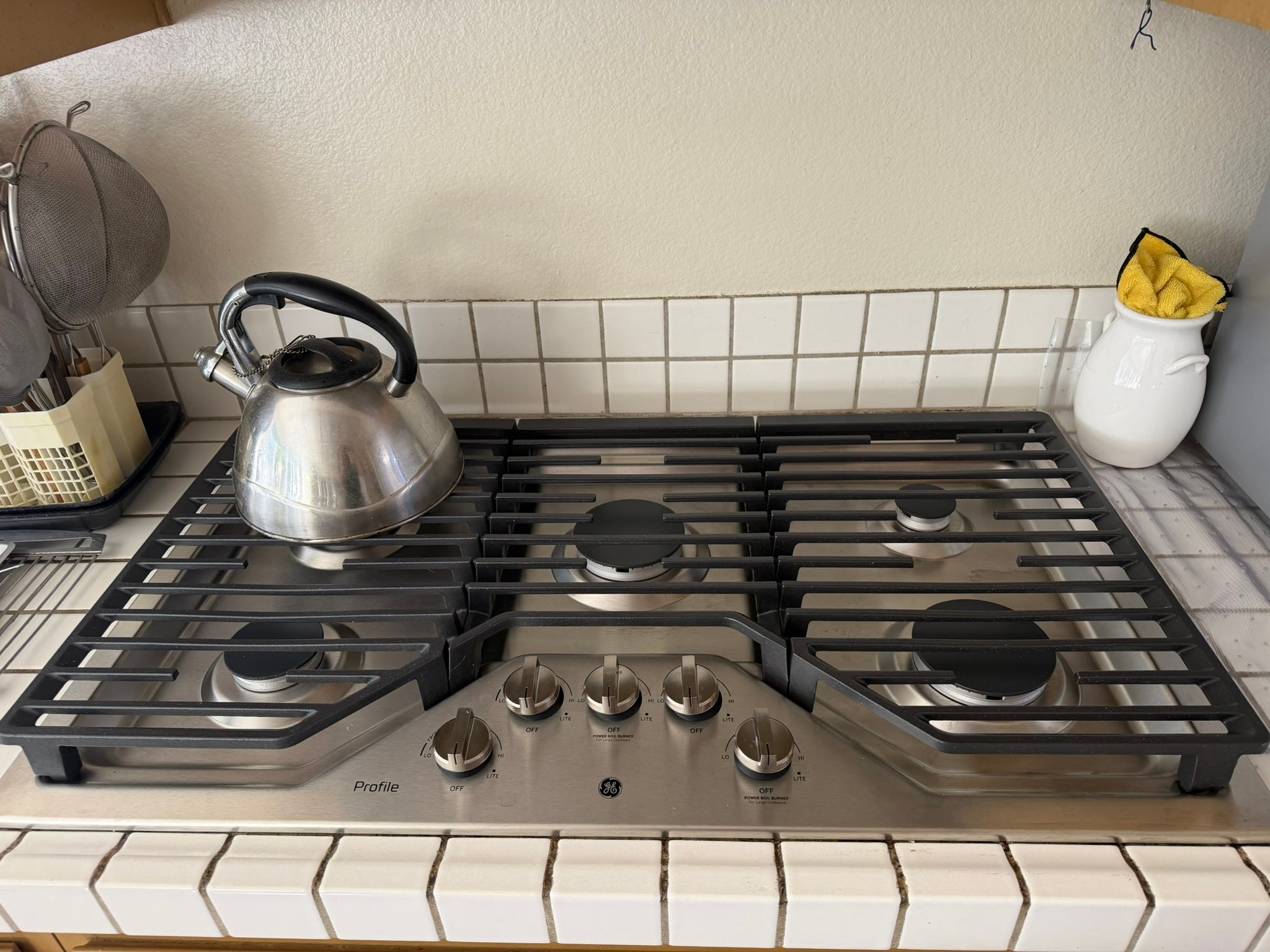
My dad promptly went over and brought the cooktop home. A handyman happened to be working for my parents that day, so within an hour, my mom had a “new” stove — a fancy-ish 36-inch, five-burner GE Profile.
The stove was well used before Mom got it but was reliable. She’s cooked on it for big family feeds, to prepare my dad’s last meals, and now, to cook for herself and her children whenever we’re around.
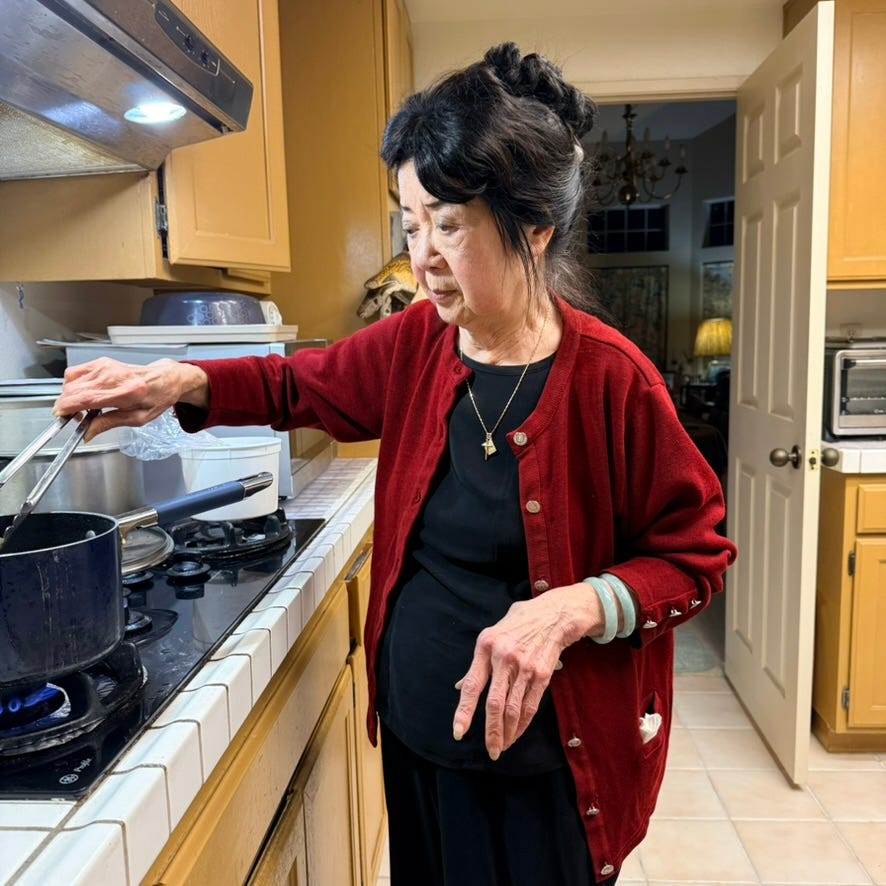
Mom at her very well used stove.
A couple weekends ago, we visited my mom and after we came back from a walk, Rory and I both smelled gas in the house. My mom was watching Viet shows on YouTube. I marched over to the stove and turned all the nobs to check. Sure enough, one of them was not fully turned off.
Thankfully, the smell dissipated right away.
“I smelled something and went to the stove to check but could not figure out how to stop it,” my mom said. “The same thing happened not long ago.”
The next morning, to my surprise mom said, “If you’re not busy today, would you take me shopping for a new stove?” Heck yes. I had lots of experiencing going back to when I selected my dream stove.
I’ll look online first to research, I told her. Her major caveat is that she wanted to touch the stove before deciding, she said.
Mom, Rory and I drove to Lowe’s where we considered the arrangement of the burners. Why were some curved and others straight? Thinking about how we cook and the pots and pans we have, my mom and I realized this: a curved arrangement of the burners means you can fit bigger pans along with smaller ones on the cooktop.
Additionally, the grates vary in weight and height. My mom lifted the grates of various cooktops and some were very heavy — even for 30-inch models. She had to get a 36-inch cooktop so she knew the grates would weigh more. “I will manage them,” she said.
The burners on her old stove were wimpy (none were more than 9,000 BTU but the cast iron grates heated up fast. The stove that Mom chose . . . a GE Profile was the priciest of the lot but she decided based on function and design. After 51 years of scrimping and saving, she bought herself a fancy new stove! I was so happy and excited for her.
The new stove!
She and my niece dealt with the installer who arrived a few days later. The grates sit up pretty high, as you can see. The flatness of the grates allow her to drag heavy pots across the stove easily, if she wants.
HOWEVER, once she started “making friends with the stove” my mom said that the burners were taking longer to heat up the pans than her old stove. The new stove’s flames heat up the grates so it takes longer to conduct heat to the pans. But after everything heats up, things stay very hot for a long time.
Moreover, when the knobs are on, there’s a blue backlight. That’s a fabulous reminder to turn off the stove.
“Your sisters wanted me to replace the toilets in the house so we did. But this stove is a more important purchase for me,” she said.
My mom is in the autumnal season of her life. Decades ago we talked about beginnings and nowadays, discussions lean toward endings. This stove, however, energizes my mom. She’s excited about learning to use it well for her cooking needs.
I told her, “Well, you better stick around longer to teach me how to cook more dishes!”
Remember our discussion about aging and maintaining the Japanese notion of ikigai (生き甲斐) — a life purpose? Turns out, ikigai can come in the form of a new stove.
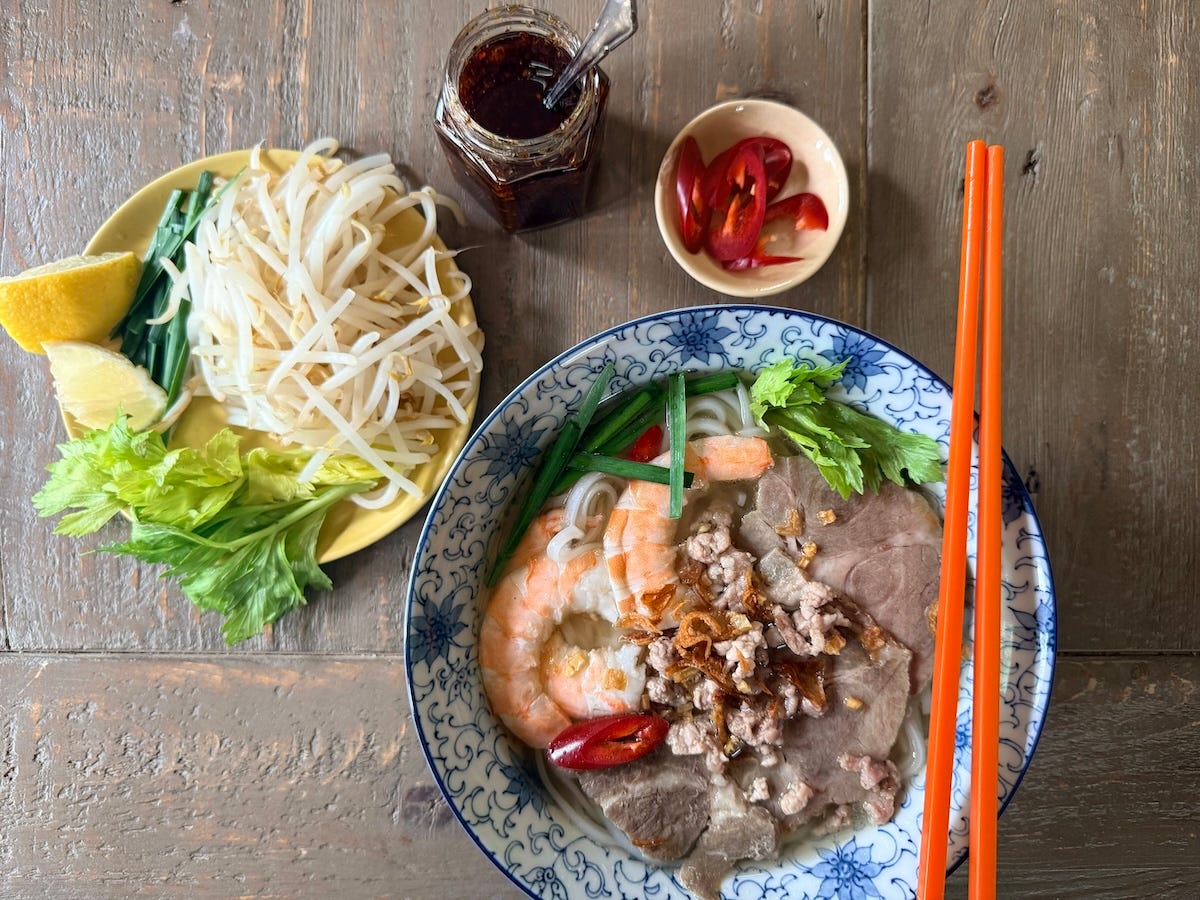
Even though my mom is northern Vietnamese to the core, she does appreciate a good bowl of hu tieu, the iconic southern Vietnamese noodle soup. There are many renditions but the one our family enjoys most it hu tieu Nam Vang — Phnom Penh-style hu tieu. It’s a Chinese-Cambodian-Southern Vietnamese surf and turf combo.
Hu Tieu Nam Vang — a surf-and-turf classic southern Viet noodle soup.
I don’t make it often but thinking about what I’d like to make for my mom on her new stove, I made hu tieu this past week from a recipe that my family has relied on for many years. Unlike pho, it’s very versatile. I updated the recipe to offer tips and pointers so you can plan ahead and tweak it as you like. Get the Hu Tieu Noodle Soup recipe at the website!
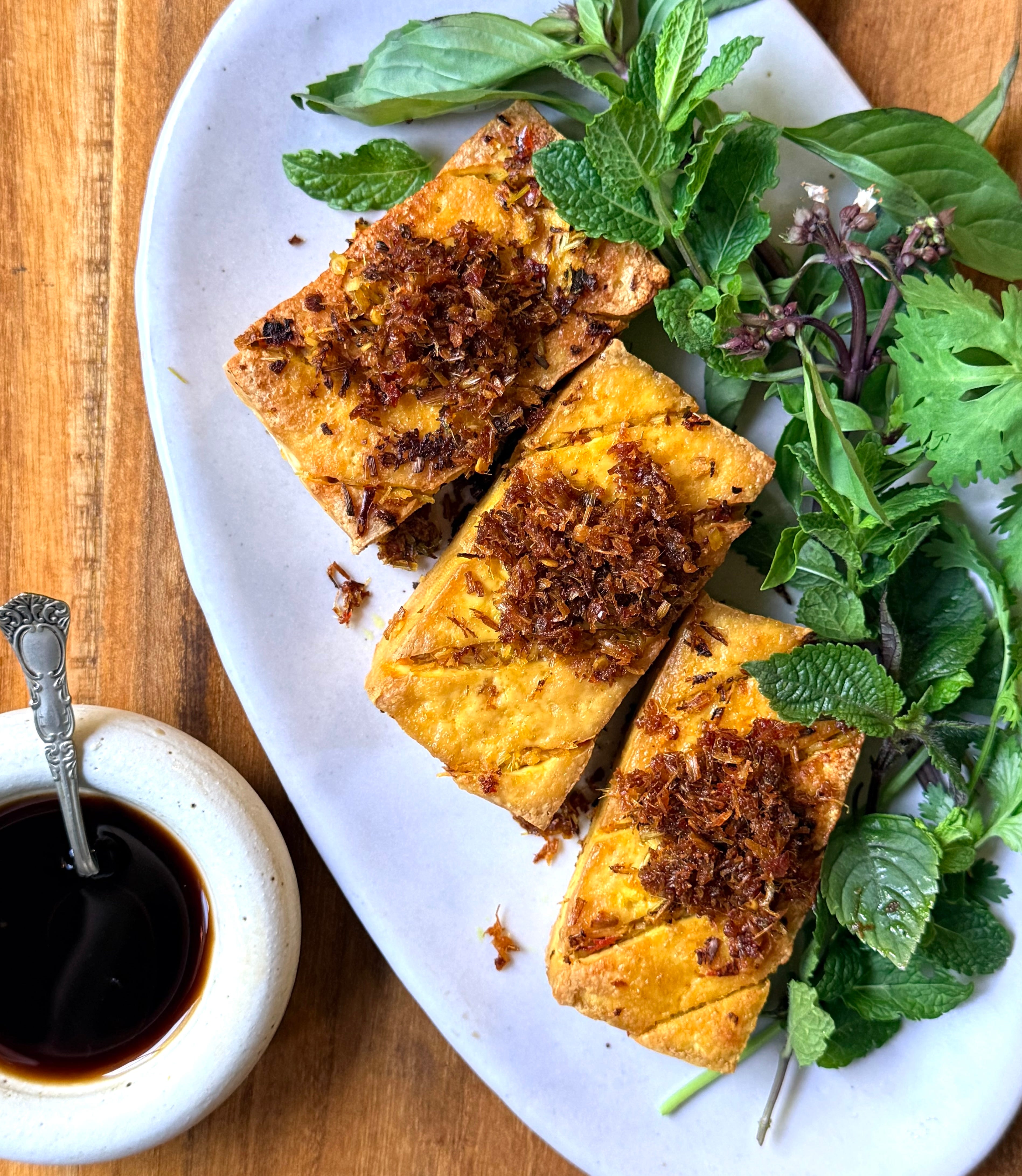
💎 Stress-testing lemongrass tofu
As a recipe tester, I leave food in the fridge to determine how long it stays fresh. That’s to say, I stress test my recipes. I’m happy to report that the crispy lemongrass tofu and its crispy lemongrass-y topping can be kept refrigerated for five days. I kept the stuffed tofu in one container and the topping in another. I finished the tofu in the pan and served it up for dinner on Wednesday. So, it’s extra handy for meal planning or even just to top a salad. Head to the PTFS Crispy Lemongrass Tofu recipe!
Support Pass the Fish Sauce! Join us for free or upgrade to a become a paid subscriber to enjoy 125+ professionally developed recipes, seed new content, and get future class discounts. Thanks for your enthusiasm!
Coming up for this Sunday Special are recipes and ideas to celebrate a precious springtime vegetable.
My toe is healing up well and thankfully I wasn’t limping at last weekend’s Viet Book Fest in Orange County’s Little Saigon. Alas, I’m still not quite up for my usual long daily walks.
Not being as active as I’d like to, I’ve been trying to eat a bit lighter. I’ve been air-frying lots of tofu in the Ninja Combi oven, which excels at air-frying without leaving foods desiccated and chewy awful.
Feeling lucky, I reworked my Vietnamese chili-lemongrass tofu (đậu hủ chiên xả ớt) recipe so it’s prepped in the air-fryer. I love this dish, which I first ate as a deep-fried bar snack (món nhậu) in Ho Chi Minh City years ago. At the brewpub near our hotel, everyone sipped beer from utilitarian bowls. My travel buddy Karen and I joined in on the fun and ordered a bunch of snacks to make a dinner. This lemongrass tofu was the evening’s standout.
Even though I developed a recipe for this tofu several years ago, this past week, I retooled it to air-fry the tofu and make it easier and crispier! Shazam, it was even better. ⚡️
Make lots then dole it out over days! That’s the extra beauty of this recipe.
This fried lemongrass tofu tofu is so good that I made a lot, actually too much. In the process, I realized that it can be totally prepped in advance for easy meals during the week. Trot it out to enjoy with jasmine rice as a main dish, or feature it in a bun rice noodle bowl or grain bowls. Add Viet daikon and carrot pickle for refreshing crunch.
Like Rory, you probably worry about my crush on the Ninja Combi oven. I was skeptical about the steam oven but it’s does do a lot for your for $200. As I’ve played with it, I’ve discovered that one of its most outstanding functions is air-frying. In particular, it outperforms by trusty Cuisinart to air-fry tofu to a golden crisp.
The Ninja combi doesn’t just blow hot wind on food. It smartly air-fries food to circulate the heat and bit of oil that you put on the food. The result is wonderful crispiness. And, with no wiry air-fry baking tray to deal with, food doesn’t stick and clean up is so much easier.
Here’s the Ninja Combi air-frying tofu for today’s recipe:
Don’t have the Ninja Combi or an air-fryer yet? You can still make this terrific lemongrass tofu recipe. Use your regular air-fryer or use the conventional instructions in the recipe to cook the tofu on the stove! The crispness won’t be quite the same as with the Ninja oven. But either way, I’ve got you covered.
Lemongrass tofu for lemongrass 💘 and crispy tofu lovers
In this dispatch, expectthe following:
Lemongrass tofu recipe in full text and downloadable PDF with air-frying and pan-frying instructions
Two (2) videos on tofu butchering and potentially tricky steps
Make-ahead pointers so you can add this tofu into your rotation or make it for your next party
Ingredient sourcing tips
If you love lemongrass, this recipe highlights its citrusy flavor super well. It’s naturally vegan and appeals to omnivores like my mother who ate seconds and then guarded the leftovers!
Let’s make it.
Thank you for being here.Paid subscribers sponsored this Sunday Special dispatch. Join us at any level. Become a paid subscriber for the full lemongrass tofu lowdown plus many other recipes, insights, and benefits. Your support matters.
Last Sunday I had a gardening accident. A large rock fell on my big toe as Rory and I were trying to maneuver a heavy pot. There was blood and pain and I also fainted from the shock of it all. Rory woke me with a gentle slap to my face.
X-rays showed I luckily had no broken bones or fractures. The kind Urgent Care folks sent me home with instructions for “wound care” and to take it easy.
The accident was caused by a very, very stoopid move, one that even a professional gardener would not do. We were rushing because that’s what we do nowadays – try to rush to squeeze everything in during our waking hours. Does that rush yield a better life? My toe and the rock reminded me to take time to unwind, learn new and fun things, but still focus on fundamentals.
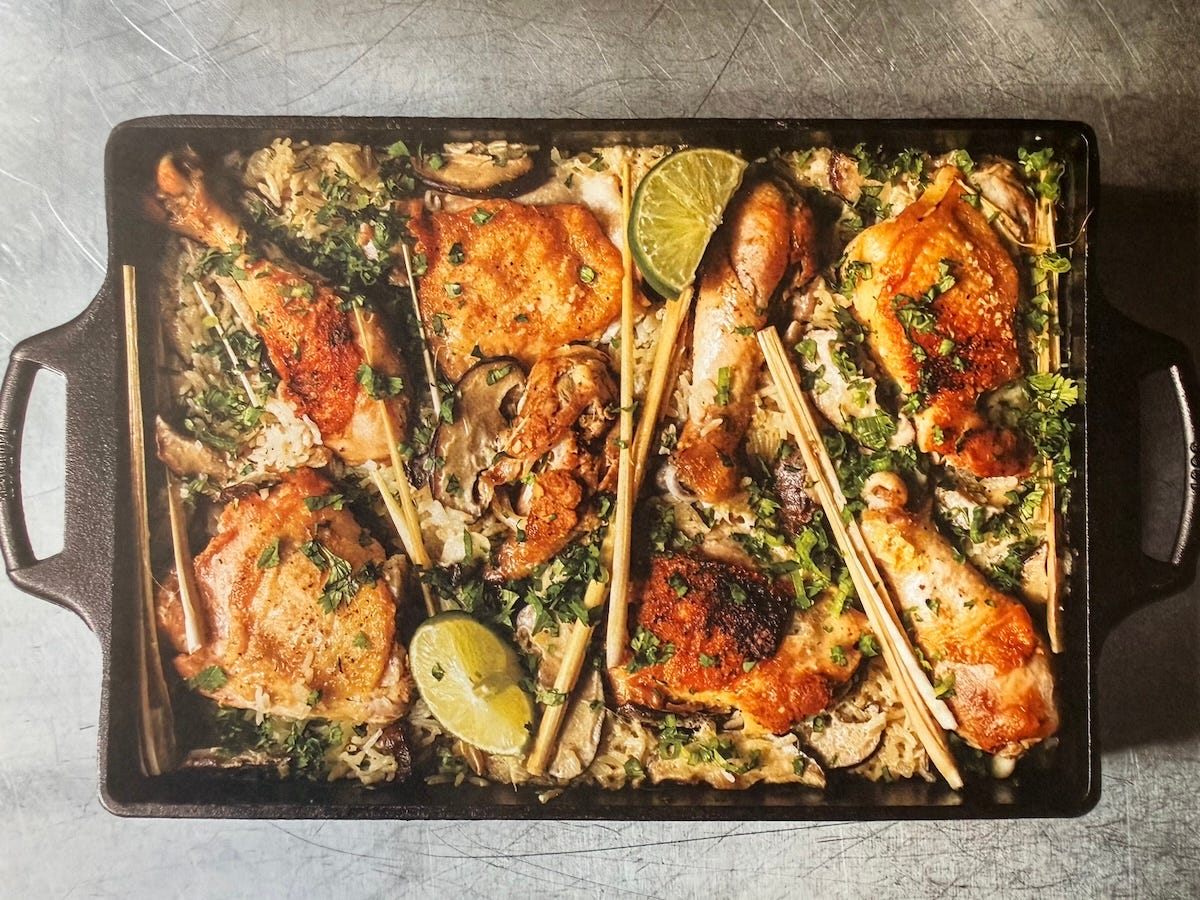
That’s how I got to playing with rice. First, I experimented with adapting chef Ron Hsu’s chicken and rice casserole for the Ninja Combi oven. I was curious about its Sear/Saute function plus something called “Combi Crisp.” The little machine has its beeping quirks but surprisingly, it produced a casserole with an incredible rice crust at the bottom. The chicken skin was delicately crisp too.
What the Ninja Combi produced was was an excellent reason to indulge in lots of white rice! Instead of using the stove and oven to make the dish, I prepped and organized the ingredients, turned on the combi, and played with its various functions. It’s pretty amazing for a countertop appliance. Head to the website to grab the recipe and watch my video of how the dish comes together. (Ron’s conventional recipe for the casserole is also at the website.)
Rory asked me how I dialed in cooking the rice so well in the combi, an appliance that cooks fast and furious and sometimes seems to be out of control. The machine is forgiving but also, I know how to cook rice in a pot on the stove as well as in the microwave.
Why cook rice in a pot if a rice cooker is around?
When I’m in a hurry, I cook rice in my Cuckoo rice cooker. It’s a good machine but to be honest, the cooked, while good, is shy of great. When I take time to cook rice on the stove, I can coax the grains into tender-chewy, fluffy perfection. I don’t consider it a feat of daring do.
Cooking rice the old fashioned way is not only a survival skill (someday, you may lack electricity for that cooker!) but also an opportunity to practice the craft of making good food. What you learn from cooking rice on the stovetop is portable knowledge to apply elsewhere — for a paella, risotto, and sushi rice, for instance. No matter how fancy the rice dish is, cooking rice is simply hydrating and heating up grains. You just need confidence in manipulating the cooking process to meet your needs.
Every person has a cooked rice ideal based upon their cuisine, culture, and personal preference.
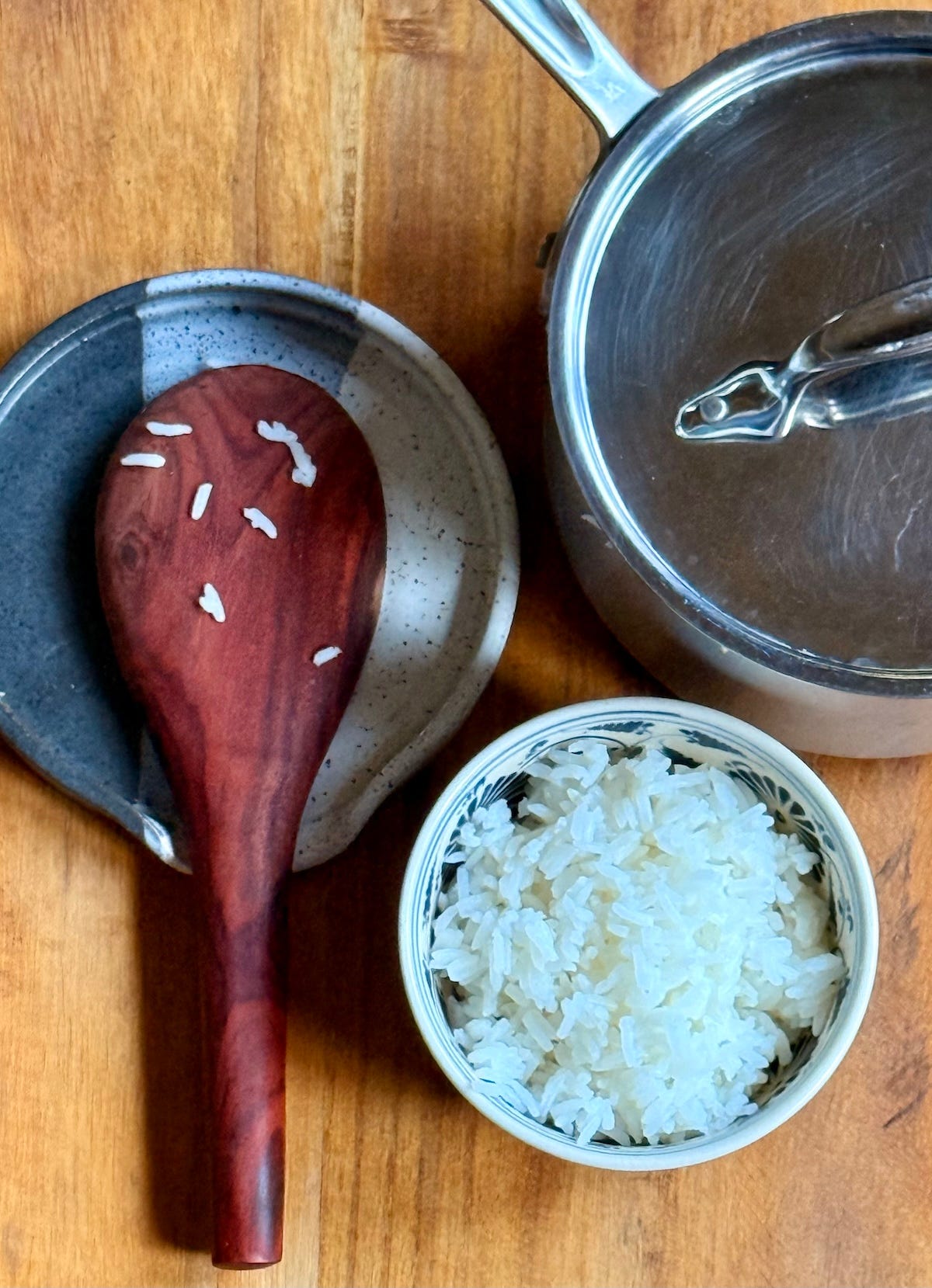
For my everyday eating, I like chewy tender grains of Thai jasmine rice that stick together ever so slightly. They’ll hold together as a mass when you’re dishing up the rice from the pot but when you look at them, you can clearly distinguish their shape. Such grains are more receptive to sauces and other flavors that hit them on the plate or in a bowl. (When I’m cooking Japanese, Korean, or South Asian dishes, I use different kinds of rice.)
In this dispatch, you’ll find:
Rice cooking myth busting to help you confidently cook rice
Pointers on rice and pan selection
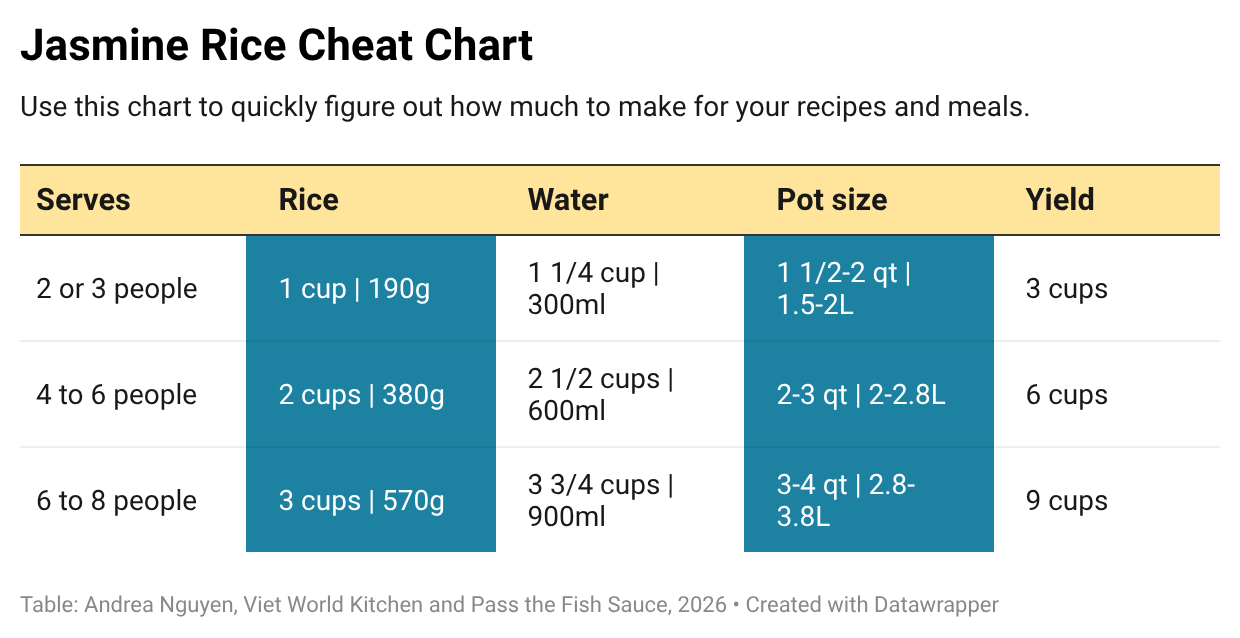
A scalable chart for you to make as much as you need
My perfect jasmine rice recipe in full text and downloadable PDF
Troubleshooting tips for you to craft your ideal pot of rice
Pass the Fish Sauce is 💯 reader-supported. Paid subscribers sponsored this dispatch, which is free to everyone. Join us at any level to satisfy your culinary curiosity. Become a paid subscriber to pitch in, gain extra insights, and enjoy extra perks. Your support matters.
Let’s bust 3 myths about cooking rice
My mom first taught me how to make long-grain rice in a basic National rice cooker. When I asked her about cooking rice on the stove, she told me about her unplugged another, which I followed before eventually developing my own recipe. When I’ve made rice with friends, they’re often surprised that I break the golden rules of cooking rice.
Wash the rice until the water runs clear. Washing the grains rids them of some starch so they taste fresh and clean. I wash and rinse white rice about three times and these photos show the progression. The water is never fully clear when you’re washing white rice. Just get close to it then move on to cook the rice!
Measure water by your knuckle. There is no universal knuckle and universal pot for all people who cook rice. The water level depends on the pot, the amount of rice you’re cooking, and your personal knuckle! Cook the same amount of rice in the same pot for a month or so to gauge the water level that works for you. Then try eyeballing the water level. Only you and your personal knuckle can truly know your equipment, ingredients, and taste preference.
Don’t lift the lid before the rice is done. Rice cooks by gentle steam action so a heavy pot with a secure lid helps. If you cook rice in a not-so-good pot with a loosey goosey lid, you’ll have a hard time retaining the heat if you open the pot up during cooking. With good modern pots, you can open and close the lid often without ruining the rice. Go ahead and peek!
My default rice for everyday eating is white or brown jasmine rice grown in Thailand. Usually, the rice is Three Ladies brand. Regardless of brand, look for handsome grains with a slight polished sheen, very few broken grains, and a good flavor, aroma, and texture. Private label supermarket jasmine rice is great too, so long as it’s from Thailand.
Jasmine rice grown in the United States is unfortunately not as aromatic or flavorful as Thai-grown rice. That said, cook up Lundberg jasmine or Jazzmen rice, if you like. When my family first came to America, we cooked Texas long-grain rice.
As for the pot, use a heavy one with a lid that will sit tightly on top. You want good heat circulation to cook the grains evenly. Choose your pot to be about twice as big as the yield. That ensures you have space to easily stir, fluff and cook the grains.
My 10-10-10 Rice cooking method
Some people boil and drain rice like pasta, but that rids too much of the sweet starches that define the grains’ comforting texture and flavor. I prefer an approach that involves a heavy pan and a gradual lowering of the heat.
To easily remember the method’s cooking and resting times, one of my friends and long-time recipe testers, Alex Ciepley, dubbed them the “10-10-10”. Use the mnemonic to cook rice in the same pot and eventually you’ll just eyeball the water level. And, after practicing this method and recipe, you’ll confidently apply it to cooking rice in claypot and donabe ceramic vessels.
💯 👌 jasmine rice!
Jasmine rice and water ratio
To yield grains that aren’t too firm or too soft, opt for a 4-to-5 ratio of rice to water. In the Asian kitchen, salt isn’t typically added to plain rice because other dishes will season it at the table. Use this chart for an easy rice cooking life!
When you wash rice, the grains absorb some water. That’s why my rice-to-water ratio may differ from that of people who do not wash their rice before cooking.
Hold on. When you fluff the finished rice, there may be a Goldilocks moment to manage. For instance:
If the grains are too firm and dryish, sprinkle on water, fluff to incorporate, then cover. Set the pot over low heat for 10 minutes to hydrate; let it rest about 5 minutes, then re-fluff.
If the rice is mushy, eat it up and tweak your next batch by decreasing the water by 1 tablespoon per 1 cup of raw rice.
If the rice smells burnt, you had the heat on way too high. I’ve accidentally done that a few times while trying to get a crusty bottom. If the rice smells and tastes acrid and burned throughout, I’m sorry. Start a new pot in a heavier pan and/or lower the heat.
Tinker to find the best rice-to-water ratio for your tastes. Jot down your ratio for future batches.
After reading all that, you’re definitely ready to cook a perfect pot of rice! There are extra pointers below so don’t scroll too fast.
RECIPE
10-10-10 Perfect Jasmine Rice
✅ Managing leftovers: Refrigerate leftover rice for up to 5 days, or freeze for a good month and thaw to eat. To reheat, sprinkle the rice with a little water, cover with a microwave splatter guard (or loosely cover with a silicone lid or parchment or wax paper), then microwave on high at 30 to 60 second blasts. If the grains compress, let briefly cool and fluff to serve. Always re-fluff before serving!
✅ Making rice for fried rice: When specifically making rice for fried rice, turn the cooked rice onto a rimmed baking sheet, spreading it out to allow the grains to dry quickly so they will fry up nicely. Let cool completely, uncovered, 1 to 2 hours at room temp (or freeze for about 20 minutes), before frying. Or, cover the baking sheet with plastic wrap and refrigerate overnight.
✅ CookingThai-grown brown jasmine rice: Use a 2-to-3 ratio of rice to water. Wash and rinse the rice once, drain and return the grains to the pan. (The bran is intact, so one rinse is enough; no starch release.) Add 1 1/2 cups (360ml) water for every 1 cup (190g) of raw rice. Bring to a boil, and then lower the heat to medium. Simmer briskly, partially covered, for about 5 minutes, stirring occasionally, until the liquid is opaque light beige and slightly thick. Turn the heat to low, completely cover, and cook for 20 minutes. The rest remains the same, with resting and fluffing.
1 cup | 190g white jasmine rice or similar type of long-grain rice
1 1/4 cups |300ml water
Instructions
Wash the rice: Putthe rice in a small (1 ½ to 2-quart | 1.5 to 2L) heavy pot and add water to cover by about 1 inch (2.5cm). Vigorously stir with your fingers to loosen surface starch then pour off the water (I save it to water our garden). Repeat two or three times, or until the water is nearly clear -- it will never be crystal clear. Dump the rice into a mesh strainer, shake to expel excess water, and return the rice to the pan.
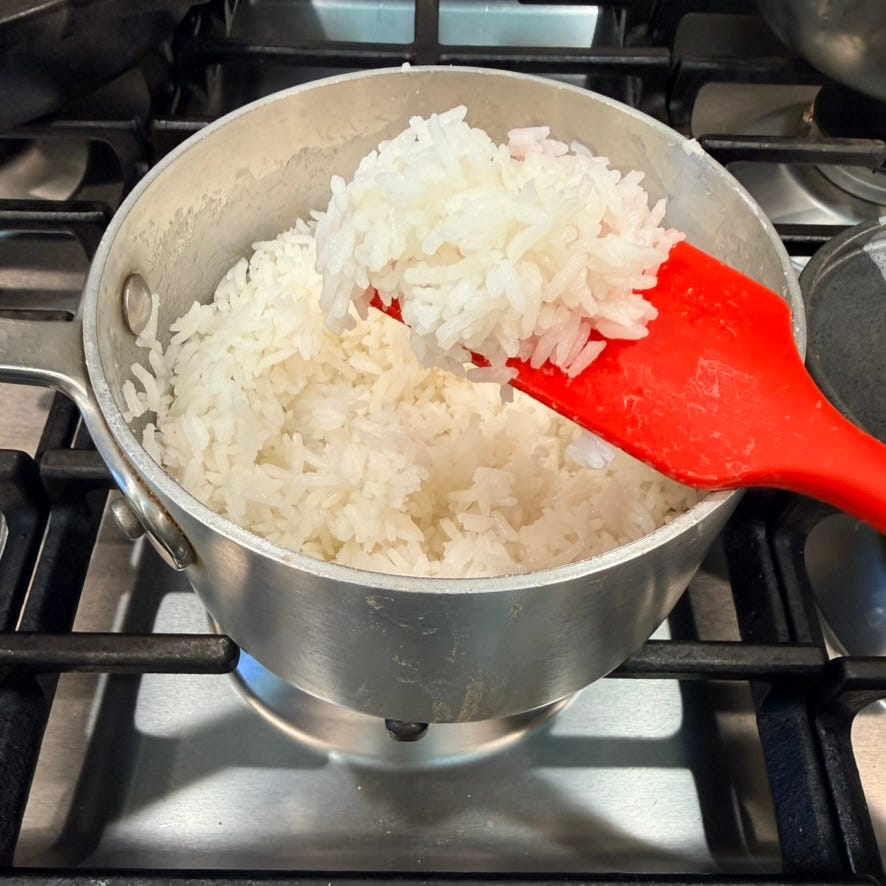
Cook for 10: Add the 1 1/4 cups (300ml) water to the pan. Bring to a boil over high heat, stirring now and then with a silicone spatula or chopsticks to prevent clumping. Lower the heat slightly to maintain a brisk simmer for 1 to 3 minutes, stirring often to scrape bottom and circulate the grains, until glossy on top. (It’s normal for a few craters to form.) Decrease the heat to low, cover the pan, and cook for 10 minutes.
Rest for 10, fluff, rest for 10: Turn off the heat. Leave the rice to gently cook on the burner’s residual heat or 10 minutes. Uncover, fluff with chopstick, a fork, or spatula to circulate the grains. Re-cover and let rest again for 10 minutes to firm up the grains and finish cooking. Keep covered and cozy warm for up to 30 minutes. Re-fluff before serving.
While working on our taxes I needed a fun, easy dinner and landed on chef Ron Hsu’s uncommonly good chicken and rice casserole.
His recipe in Down South + East cleverly layers gingery, garlicky, umami notes into a one-pan dish that’s doable on a weeknight. He’s also loaded the keeper recipe with great pro-chef ideas. Get Ron’s recipe for chicken and rice casserole.
Ron’s casserole recipe got me thinking about dishes that get assembled in a deep dish. Although tiramisu doesn’t require baking, it’s traditionally put together in a casserole dish. It’s made of layers of coffee soaked savoirdi biscuits (crisp ladyfinger cookies, not the soft ones) bound together by a heavenly, slightly sweet cream; it’s finished with a dusting of cocoa powder and maybe chocolate too. Tiramisu needs to sit overnight to age into excellence, making it an utterly easy and impressive make-ahead sweet.
Traditional tiramisu involves whipping egg yolks and sugar to a thick consistency much like you’d do for Vietnamese egg coffee. Thinking about casseroles and egg coffee led me to buy a large (400g) package of savoirdi biscuits at Eataly. (Note that there are gluten-free biscuits made with rice flour nowadays, too!)
When Rory saw me holding the savoirdi, he sweetly said, “Maybe you’ll make tiramisu for me?”
Spousal mind meld moment. However, I’d give my tiramisu a Viet touch!
In Vietnam, there are mousse cakes called bánh Tiramisu but I wanted to devise a Viet take on the Italian icon, which has a fuzzy history.
Tiramisu may have originated in the 1800s at a brothel in Treviso, Italy, as an aphrodisiac; if that’s true, it gives new meaning to the name’s literal meaning as a ‘pick me up’. Or perhaps someone invented it in the 1930s. No one really knows, but what is clear is tiramisu’s incredible popularity, which started in the 1980s. It’s now known internationally, with endless iterations.
By the end of the week, I had gone three rounds with tiramisu.
What I learned was this: Tiramisu is elastic and foolproof. All of the trials tasted very good, though they have their pluses and minuses, which I detail below.
It was hard to decide which to present to you so this tiramisu recipe allows you to choose for yourself. Shape your Vietnamese coffee tiramisu for your needs and interests! Regardless, the result will be a delicious Italian-Viet dessert. (Rory is very happy and so are our neighbors with all three versions.)
This dispatch fully equips you to make a killer good tiramisu. You’ll find the following:
Vietnamese Coffee Tiramisu recipe in full text and as a downloadable PDF
Three ways to craft tiramisu (old school, low sugar, or high protein)
Ideas for making vegan tiramisu
Pointers for building Vietnamese coffee flavor, scaling up this small-batch recipe, and how to serve tiramisu gracefully
Ingredient swaps and advance prep ideas to save time
Thank you for being here. Full access to this tiramisu recipe is for paid subscribers who sponsored this recipe and much, much more. Join us to pitch in and benefit in many ways. I appreciate your support on all levels.
Paula Wolfert, the cookbook author and expert on Mediterranean cuisines, once told me that she didn’t like marginalia in cookbooks. The notes and scribbles soiled the book, she said. I didn’t respond because I was thinking of the countless times I’d jotted down notes in cookbooks. I didn’t want to forget my tweaks and preferences.
For me, handwritten notes and scribbles signal that a cookbook had value for the cook. I like finding marginalia in used cookbooks too because they feel more like artifacts. For those reasons, Pat’s email tickled my fancy.
It’s a cookbook author’s dream to know that their recipes are part of other people’s rotation. Feel free to email me your marginalia!
💎 PTFS in Parade Magazine!
A PTFS recipe got into Parade magazine last week! It was the one for Vietnamese egg coffee, which I wrote up alongside Vietnamese salt coffee in this dispatch.
Jessica Wrubel reached out to interview me for the story. Unknown to me, egg coffee has been making the trendy caffeinated rounds in the States. I’m totally stoked because ca phe trung (egg coffee) is a fun, different way to experience Vietnamese coffee culture. Read Jessica’s story and get the recipe.
Egg coffee is enjoyed in smallish amounts so you can have it in moderation while still adhering to a healthy diet, which brings us to . . .
💎 American Heart Association’s Dietary Guidelines
The Trump Administration’s dietary guidelines under RFK, Jr is full of holes for many reasons. The American Heart Association (AHA) recently weigh in. When I read about it in a Wall Street Journal article this week, I had to mark up the salient points.
If you can’t read the article by enlarging the image, here’s a gift link to the full story (click to close the subscription window so you’ll get to the story). The AHA aligns with the government’s definition of a healthy diet BUT pushes for less red meat and less full-fat dairy. The heart association’s guidelines make better sense for human and environmental health reasons and is more affordable and accessible to more people. Tallow and grass-fed beef are pricey!
Below is the AHA’s guidelines which showcases tofu as a healthy protein!
Early last year I realized that DOH! — “enriched” flour had to had stuff added to it because wheat’s original nutrition had been removed during the modern milling process. I began playing with baking with whole grain flours.
One of the experiments was with a fluffy roll, which I adore making from Chris Tan’s hot rolls recipe. It’s lofty, tender and rich. When I substituted half of the regular flour with 50 percent whole wheat flour, the texture remained the same as usual but the flavor was much more complex. The rolls had bigger personality.
I’ve used the rolls as a side with ham or turkey. They’re also killer good with char siu pork steak or char siu chicken from Vietnamese Food Any Day (if the book is handy in your kitchen).
The rolls keep well for days and you can freeze them too. Decorate them with crosses to make hot cross buns for Easter. But I would make the rolls anytime, not just to celebrate a Catholic holiday or bunnies. Get the hot rolls recipe at the website. Play with the recipe!
💎 Down South + East Asian cooking
Recently, I wrote about Chinamaxxing, why I learned Mandarin, and how Chinese and Vietnamese cultures have rubbed shoulders and commingled for eons. Chinese chefs usually don’t discuss Vietnamese food unless they are Vietnamese Chinese. But then Chef Ron Hsu’s new cookbook arrived. Written with Hugh Amano, Down South + East offers Ron’s unique life experiences through recipes.
When I first opened the book, it fell open Ron’s take on Vietnamese caramel pork (pictured below); his version is somewhat like mine but he’s added his imprint by using sorghum syrup (a southern staple) plus makrut lime leaves and lemongrass. And he says it’s great with rice or grits. How is that?
His Malaysian-Chinese parents owned multiple beloved Chinese restaurants in the Atlanta area and Ron began peeling onions for those kitchens at a very young age. He got hooked, went to culinary school, cooked at Le Colonial, a Vietnamese restaurant in Manhattan, and then rose to be creative director for chef Eric Ripert at Le Bernardin, one of the best restaurants in America.
But Ron’s roots are in Atlanta, Georgia, where he now runs his Michelin-starred Lazy Betty. I’ve dined there and figured that Ron would showcase his cheffy chops in his debut book.
I was wrong. Down South + East is thoughtfully written for home cooks. It aims to simply present America’s cross-cultural flavors through the palate of a talented Asian American chef.
The book’s riffs on classics thoughtfully and matter-of-factly combine southern and East and Southeast Asian flavors and techniques. Tweaks are intentional — his mother’s take on Southern fried chicken includes lots of cornstarch, an Asian secret for crunchy coating. There are more great pro-chef tips tucked into the book.
Support Pass the Fish Sauce! Join us as a free or upgrade to a become a paid subscriber to enjoy 125+ professionally developed recipes, seed new content, and get future class discounts. Thanks for your enthusiasm!
Coming this Sunday, I’ll share something I’ve cooked from Down South + East plus a sweet treat that Rory requested.
The weather in Santa Cruz swung back to being chilly, which is why if you see me, I may be wearing this super soft and cozy cashmere ascot. It’s designed by Kitty Nguyen of Semifinalist.
We’ve had a spate of hot weather here in California and it instantly turned my attention to lighter eating. In Vietnam, people enjoy noodle soup year round because it comforts and satisfies without weighing you down. Chicken pho is tonic like and speaks to spring more than beef pho. You can make it from a whole chicken using my Instant Pot chicken pho recipe to feed four, or brew a more traditional pho ga in a big stockpot to serve eight.
Quick chicken pho photographed by John Lee, styled by Karen Shinto.
But if you just want a quick pho for one or two, use my recipe for fast chicken pho (phở gà nhanh). I made it this week it’s splendid — chickeny, fresh tasting, and soulful in less than 45 minutes. It’s so much better than the “instant pho” sold at supermarkets, which you have to doctor up big time for it to be meaningful.
I originally published the recipe in The Pho Cookbook and this week, shared it at my website with lots of bonus tips. Go pho the fast chicken pho recipe and you won’t regret it! 😆
I adore last week’s classic bún chả for how the pork develops a smoky umami and lends those savors to the nuoc cham sauce. That’s the brilliance of the classic Hanoi rice noodle dish. But after spending a week thinking about and developing the recipe for the newsletter, I realized that the meat was simply a conveyor for the distinctive marinade. How could I make a plant-based version that tastes đặc biệt (special)? How could I craft a version that rivaled the meaty original? Do you need meat to make great bún chả?
Substituting an alt-meat such as Impossible Meat for the pork is not good enough. It has a strong flavor that’s not copacetic with bún chả flavors.
For an exciting, wholesome bún chả chay (“chay” means vegetarian in Vietnamese), I turned to tofu and springtime vegetables. I also rejiggered the marinade formula to be naturally vegan and to make the vegetables taste extra good and look very sexy.
At the end of a week of ruminating and recipe testing, I have a great recipe for you! Rory remarked how it perfumes the kitchen with wonderful aromas of caramelization, just like the meaty bún chả does. When we ate the tofu and grilled veggies, they had an uncanny meaty quality. A big veggie win!
You’re looking at brown rice noodles for this bún chả. Fiber things up, if you want to!
Full of sensory razzmatazz, my bún chả chay is remarkably tasty and satisfying without being heavy. Meat does not have to define the dish’s appeal.
It’s also fun to eat because the various vegetables offered distinctive flavors and textures; go ahead and fish around the sauce bowl for different things! The best plant-based dishes fire on all cylinders to hit all your food pleasure points.
I’m so happy to present you with this recipe and all the accompanying elements so you can craft your own head-turning bún chả chay. This successful vegetarian riff underscores a culinary truth: Foundational Viet cooking lends itself to creativity so long as you understand the parameters of a dish.
For instance, with the recipe and insights below, you can:
Vary the vegetables, depending on what’s on sale or growing in your garden and what you enjoy grilling!
Serve this version alongside traditional pork bún chả to create an extra special, festive low-meat meal. You’ll thrill vegetarians and vegans while impressing jaded omnivores.
If you’re calling the classic pork version the “Obama Special”, then nickname this one the “Michelle Obama Special” as an ode to the former First Lady’s health initiative for kids and White House vegetable garden.
Yes, the kitchen garden that Michelle Obama started in 2009 is still around. More at the National Park Service site.
Supermarket ingredients go into this bún chả chay (pronounced “boon chahh chay”) to make it very accessible. If you want to use Asian market ingredients, by all means do. Here’s all you need for your vegetarian bún chả adventure:
Bún Chả Chay recipe in full text and as a downloadable PDF
Scalable Vegan Bún Chả Marinade formula and recipe for you to serve 2 or 10!
Pointers on prep and vegetable butchering to help you succeed
The same noodle prep video that’s in the meat version so you don’t have to click back (you’re welcome!)
Ingredient swaps and advance prep ideas to save time
Make bún chả to enjoy Vietnam in your own kitchen, on your own terms!
Pass the Fish Sauce is a 💯 reader-supported! Support it any way you can. Become a paid subscriber to get the full bún chả lowdown along with many other recipes in past and future dispatches, plus other perks! 🙏
Vietnamese food doesn’t have to be complicated. In fact, the greatest dishes are ones that taste fantastic but feature minimal ingredients. There’s technique involved but not too much as to make the dish undoable by mere mortal cooks. Bún chả, the Hanoi-style rice noodle dish served with grilled pork that’s cooked two ways, to be among those great dishes. It’s simple and brilliant.
I know what you’re thinking. You’ve eaten Vietnamese grilled pork rice noodles bowls labeled “bún thịt nướng” on restaurant menus. You’ve doused it with plenty of nuoc cham. Maybe you’ve also made the salad-y rice noodle dish at home. What’s different about bún chả?
Compared to southern-Vietnamese (Saigon) bún thịt nướng, bún chả uses similar but fewer ingredients but it tastes more luxe and extra umami. Two cuts of pork are used – sliced fatty pork and pork patties, for you to experience different textures and flavors. The meat is juicy and seasoned by a savory sweet marinade, reflecting northern (Hanoi) flavor preferences. Sweet-savory flavors are what you typically taste in southern-style bún bowls.
Northern cooks cleverly craft bún chả’s sauce as an extra umami, delicious veil of flavor on everything that it touches. Despite similar ingredients as a southern bowl of bún thịt nướng, a meal of northern bún chả offers more nuance and depth.
Bún chả also has class. It’s eaten in a languid manner. When traditionally served, the components are served separately for diners to compose smallish bowls of greens, noodles, and grilled pork. Because there’s a certain formality involved, bún chả can be a celebratory one-dish meal or main feature of a complex party menu. In contrast, Saigon-style bún bowls are considered a casual one-and-done dish that you can eat on the run.
A bún chả meal invites lingering and coaxes conversation too. It’s the dish that Barack Obama and Anthony Bourdain shared in Hanoi in 2016.
If you venture to Bún Chả Hương Liên in Hanoi where they ate, you can’t sit at their table because it’s enshrined in plexiglass, I hear. However, you can order the “Obama Special”.
But to be honest, the version Obama and Bourdain ate doesn’t look fabulous: the meat hasn’t gotten the caramelized bits of char that comes from careful cooking and a good marinade. And, in Hanoi there’s a modern convenient method of eating bún chả in a big bowl with lots of soupy sauce (there are fewer dishes to set and wash for the restaurant operator!) However, the sauce is diluted and strangely bland. It’s not what I grew up with or read about in old Vietnamese cookbooks. You can do better!
In fact, you can make bún chả (pronounced “boon chahh”) with supermarket ingredients, if you want! Today’s dispatch equips you with the following for a most excellent bún chả adventure:
Explainer on how to achieve brilliant bún chả
Bún chả recipe in full text and as a downloadable PDF
Scalable marinade chart and recipe for you to serve 2 or 10!
Swaps and advance prep suggestions to fit bún chả into your life
Lots of prep tips and ingredient pointers
Video for noodle prep that you can (and should) use elsewhere to make solid Viet food!
Time to get bún chả-ing.
Pass the Fish Sauce is a 💯 reader-supported! Support it any way you can. Become a paid subscriber to enjoy The Full Monty of this recipe along with others in the past and future dispatches, plus other perks! 🙏

 Login
Login