Trump’s war in Iran is entering its third month. Gas is $1.50 more at the pump than it was before February 28. Other prices are rising. The American economy is showing signs of the dreaded stagflation (the combination of inflation and stagnation that’s difficult to overcome). There’s a loud outcry over revelations about Trump’s self-dealing, including his $1.8 billion slush fund and permanent immunity from any IRS audits of him and his family.
Given all this, some political observers I rely on tell me Trump has finally overplayed his hand. He’s a lame duck who’s now facing the beginning of the end. His power is disappearing. Not all political observers I’ve been consulting agree.
Hence, this week’s Office Hours question: In your view, has Trump finally overplayed his hand, and, if so, what are the likely consequences for him, America, and the world?
I’ve grouped the responses I’ve received from seasoned political observers into several categories, which I’ve summarized below. I’d appreciate your thoughts.
The 2026 Billionaire Tax Act initiative recently submitted enough signatures to be put on the California ballot for the November 2026 elections. Its goal is to raise revenue by imposing a one-time 5 percent wealth tax on California billionaires to offset large cuts to California’s Medicaid caused by the Trump regime and Congress when, in July 2025, they cut federal taxes mainly on the wealthiest.
The reason for targeting California billionaires for new revenue is their wealth has grown faster than anyone else’s in recent years and they currently pay low taxes relative to their large wealth gains. Many borrow against their wealth for living expenses (banks are delighted to lend to them), enabling them to claim little or no taxable income.
As a result, taxing billionaires can both raise substantial revenue and restore tax progressivity at the very top. California is in the vanguard of what the nation must do. I believe they will do it when Democrats are back in control, and when they enact campaign finance reforms so no member of Congress is necessarily dependent on the super-wealthy for the bulk of their campaign contributions.
The following oped appeared in today’s New York Times. It was written by two of my colleagues at Berkeley, Professors Emmanuel Saez and Gabriel Zucman (who is also at the Paris School of Economics). I have reproduced it in its entirety, with permission, and have highlighted paragraphs I believe to be particularly important.
They make the case for the billionaire wealth tax in California, and indirectly for a billionaire wealth tax nationwide. They also answer the arguments against the tax, such as that California billionaires may leave the state in expectation that such wealth taxes would be renewed, possibly reducing future income tax revenue to the state and reducing its economic dynamism as the engine of tech innovation.
With wealth inequality now surging beyond anything ever witnessed in America, the dictum attributed to Justice Louis D. Brandeis has become dramatically relevant: “America faces a choice: We can have great wealth in the hands of a few, or we can have a democracy, but we cannot have both.” A wealth tax is a necessary precondition for everything else.
***
The billionaire class in California includes roughly 250 households, a mere 0.001 percent of the state’s families. Yet its wealth now amounts to more than half of California’s entire annual economic output.
This means that if these billionaires spent all of their wealth, they could buy more than half of the goods and services produced in a year in the entire state.
This extraordinary wealth does not translate into extraordinary tax contributions.
From 2019 to 2025, California billionaires’ wealth grew an average of over 15 percent per year, while they paid, on average, just 0.26 percent of their wealth annually in state income taxes. Their income tax payments accounted for only 2.4 percent of California’s income tax revenue.
For the very richest individuals, the effective burden was even lower. The four wealthiest Californians — former Google co-founder Sergey Brin, Nvidia’s Jensen Huang, former Google CEO Larry Page, and Facebook’s (Meta’s) Mark Zuckerberg — paid an average of just 0.07 percent of their wealth annually in California income tax over that period, according to our analysis of Securities and Exchange Commission records on stock sales and executive compensation from their companies.
California’s tax system fails to effectively tax ultrahigh-net-worth individuals. The same is true of the United States’ tax system and those of other countries.
The problem is that billionaires’ fortunes are largely held in assets (mainly stocks) that rise in value over time. This rise in value is not taxed unless the assets are sold. Under current law, when billionaires don’t sell their stock, wealth accumulates while taxes on their gains are deferred indefinitely and sometimes avoided entirely.
To understand how California’s billionaires have become so unfathomably rich, it’s helpful to think of their fortunes as icebergs. Some earnings are easy to see — and tax. From 2019 to 2025, Mr. Zuckerberg reported more than $7.1 billion in income from Meta: $181 million in compensation, $1.4 billion in dividends and $5.6 billion in gains from selling stock.
Despite making so much money, Mr. Zuckerberg was taxed a combined state and federal rate of just 27 percent on that income. That’s not much higher than the average California household’s effective tax rate of about 20 percent.Mr. Zuckerberg’s tax rate was relatively low in large part because most of his income was in the form of capital gains — what he made from selling stock that had risen in value. Capital gains are taxed federally at a lower rate than ordinary income.
Most of Zuckerberg’s wealth is hidden from income taxes. Since 2019, Meta has made hundreds of billions of dollars in profit. As Meta’s chief executive, Mr. Zuckerberg has invested much of that money back into the company, of which he owns about 13 percent. These profits have been taxed at a relatively low 17 percent, Meta’s effective corporate income tax rate. Their reinvestment has boosted the company’s value and, therefore, the value of its shares. This caused Mr. Zuckerberg’s wealth to rise by tens of billions of dollars.
The same is true of the wealth Mr. Zuckerberg accumulated as Meta grew and investors became more bullish about the company. This dynamic increased the value of his shares by an additional $142 billion. Unless Mr. Zuckerberg sells his shares, all of this growth remains untaxed.
But he can put his gains to use without selling them, borrowing tax-free against his holdings at low interest rates, as he did in 2023, when he pledged $3.1 billion worth of his Meta shares as collateral for a loan.
California’s other top billionaires have similarly structured fortunes. Without a wealth tax, these tech barons will continue to hoard the rewards of the state’s economic growth while its cities cut services and its workers lose health care.
Google’s founders, Mr. Brin and Mr. Page, are the state’s richest individuals, with more than $600 billion in wealth between the two of them — up from $345 billion last September. They have come out against the wealth tax initiative while making moves to leave the state. They benefit from the status quo.
Mr. Brin has funded the political campaign against the measure and has funded signature collection for two competing ballot initiatives that could undercut the wealth tax, spending at least $57 million to fight it.
They stepped down from day-to-day management at the end of 2019. That year and in 2020 and 2023, each got from Alphabet, Google’s parent company, only $1 per year in executive compensation.
They didn’t sell stock, and they didn’t receive dividends or any other compensation relating to Alphabet, so they paid no income tax on their wealth related to the company. But their stock wealth rose by $133 billion, driven in part by the reinvestment of their share of company profits, which amounted to $20 billion in those three years. Scenarios like this show why some of the very wealthiest people in America are among the least taxed.
This arrangement violates basic principles of fairness, deprives the government of revenue it needs for public services and fuels wealth concentration.
Overwhelming wealth becomes power — power to influence the direction of corporate behemoths, power to sway society through donations and media ownership, power to steer politics through unlimited campaign contributions to super PACs.
Elon Musk’s recent adventures in the executive branch, after spending hundreds of millions of dollars to help elect Donald Trump, demonstrate how quickly concentrated wealth can transmute into political control.
We don’t imagine that a one-time 5 percent tax on the wealth of California billionaires, as proposed in the 2026 Billionaire Tax Act, would fix all these problems. But it could raise nearly $100 billion in revenue for California. This amount would make up for the funding the federal government is taking away from the state over the next five years. It would also be tiny relative to billionaires’ recent wealth gains.
In the past three years alone, the total wealth of California’s billionaires grew by a staggering 144 percent, to over $2 trillion.
Taking such a small bite out of billionaires’ exponentially growing tech wealth wouldn’t doom Silicon Valley because the value of California’s concentrated tech talent dwarfs the proposed wealth tax. Nvidia’s chief executive, Mr. Huang, who would be one of the biggest payers of the tax, said he would be “perfectly fine” with it.
Other myths about the proposal need to be dispelled. It would tax only billionaires. It has been carefully written to respect the California and U.S. Constitutions. It contains provisions designed to prevent taxation beyond 5 percent of the fair market value of anyone’s shares and to avoid hitting start-ups hard. Billionaire entrepreneurs, with sizable illiquid stakes in newly founded private companies, would be able to defer payments until they began to cash out.
It is too late for superrich Californians to flee the state to avoid the tax. If approved in November, the tax would apply to billionaires who were residents of California as of Jan. 1, 2026. Some affected taxpayers might have left between the ballot initiative’s introduction, in late October 2025, and the end of the year. But it is improbable that any significant number of billionaires fully cut ties with California in that short period.
Critics of the ballot measure have voiced concerns that even a small number of billionaires leaving the state would lead to lower state tax revenues overall. Their math doesn’t add up. California’s billionaires currently pay such a low tax rate that even if all of them left the state, it would take 25 years for the loss of their tax payments under the current set of rules to surpass the amount the state would raise if the one-time tax succeeds this fall.
In 2025, California collected $4.1 billion in income tax from its billionaires. We estimate that California would collect about 25 times that much revenue — about $103 billion — from the proposed wealth tax.
While billionaires who no longer run their businesses day to day may choose to eventually leave California, uprooting an established business that relies on the pool of California’s tech talent and tech ecosystem would be much harder: While Mr. Page and Mr. Brin may leave for Florida or Nevada, there are no discussions of Google leaving Mountain View.
California’s tech sector produces billionaires faster than any other state’s. Its superrich — who have benefited from the state’s infrastructure, universities and networks of people and businesses — have accumulated enormous fortunes almost tax-free. The proposed billionaire tax would finally make them contribute in modest proportion to their gains.
In November, California’s voters should show the nation the way forward.
He’s no longer even trying to hide it. He makes a deal with himself for a $1.8 billion slush fund to reward loyalists willing to defy the law and commit violence on his behalf, and for a pardon of himself and his family for any illegal self-dealing and financial wrongs “FOREVER” (it’s in all caps in the document).
Then, when the deal is widely criticized, he posts:
“I gave up a lot of money in allowing the just announced Anti-Weaponization Fund to go forward. I could have settled my case, including the illegal release of my Tax Returns and the equally illegal BREAK IN of Mar-a-Lago, for an absolute fortune. Instead, I am helping others who were so badly abused by an evil, corrupt, and weaponized Biden Administration, receive, at long last, JUSTICE! President DJT.”
Does he really believe he could have settled his case for an absolute fortune — the case that he brought against himself — the case a federal judge doubted was even a “case” because he was on both sides of it?
Last week, a disclosure form showed that Trump’s investment portfolio executed more than 3,600 trades in the first three months of this year alone, many involving companies that he has favored with access or policies.
America is slouching toward the 250th anniversary of our revolution against arbitrary power with a president who shamelessly exercises it. Never before have we witnessed this degree of self-dealing, bribe taking, usurpation of congressional authority, and open defiance of federal courts.
It’s an unconstitutional slippery slope. If Trump can get away with creating for himself a $1.8 billion slush fund that Congress never approved and courts cannot oversee, and wantonly trade the shares of companies his policies are favoring, what’s to stop him from creating a $10 billion or $10 trillion self-dealing slush fund?
If he can get away with preemptively pardoning himself and his family for any and all future financial wrongdoing, what’s to stop him from pardoning himself and his family for any future criminal acts?
These are only a part of the slippery slope we’re on. If he can abduct a foreign president without Congress’s permission, what’s to stop him from abducting anyone? If he can order the U.S. military to kill a foreign head of state without even Congress declaring a war, what’s to stop him from ordering the military to kill anyone?
If he can target political enemies for criminal prosecution, what’s to stop him from jailing or murdering his opponents?
If he can unilaterally decide that someone on a boat in the high seas is an “enemy combatant” and summarily kill them, what’s to stop him from calling anyone he dislikes an enemy combatant and having them killed?
If he can put his name on buildings all over Washington and take a wrecking ball to the East Wing of the White House, what’s to stop him from taking a wrecking ball to the entire edifice and putting up a Trump tower?
He feels unstoppable because there’s no one around him to tell him no. Instead, he’s surrounded by sycophants who tell him yes. He gets blind loyalty from his lapdogs — his vice president, his Cabinet, and most Republicans in Congress — who work for him rather than for the American people.
He feels indomitable because his billionaire backers — Jeff Bezos, Elon Musk, Larry and David Ellison, Mark Zuckerberg, and Rupert Murdoch, among others — have stuffed his PAC with their money and silenced criticism of him on their media platforms, in order to garner his favors. Meanwhile, his followers feast on his white Christian nationalism and regard him as godlike.
He feels invincible because he was reelected president even though he was impeached twice and has been found guilty of 34 felony counts, and the Supreme Court has shielded him from further criminal prosecution for “official” acts (which he takes to mean any actions while he’s president). Congress is barely an obstacle because, as he demonstrated as recently as last week, he has a chokehold over the Republican Party. He even says he “doesn’t need Congress.”
He feels invulnerable because he’ll never directly face voters again, and therefore will never lose — nor, he assumes, ever be held accountable for anything.
My friends, this is full-frontal neofascism. I suggest we respond in these ways:
On July 4, the 250th anniversary of the nation’s independence, we wear black armbands to acknowledge the near death of our democracy and the rule of law under Trump.
In the weeks and months leading up to the midterm election on November 3, 2026, we commit to getting the largest voter turnout in American history, to take back Congress and stop the neofascist in the White House. Not just a blue wave but a blue tsunami.
On Election Day 2028, we elect a president whose character and temperament are consistent with the founding ideals of the United States — someone both humble and honorable, who’s committed to strengthening democracy and the rule of law, who will revive the self-governing institutions that Trump has shat on and refocus the nation on our vast unfinished agenda of inclusion, rather than exclusion.
Beyond these, we will do whatever we can to learn from this catastrophe and help America learn. We will teach our children and grandchildren the truth of what has happened and how close we’ve come to losing our democracy. And we will educate future generations on what we owe one another as citizens of this great land.
To accomplish all this we mutually pledge to each other our lives, our fortunes, and our sacred honor.
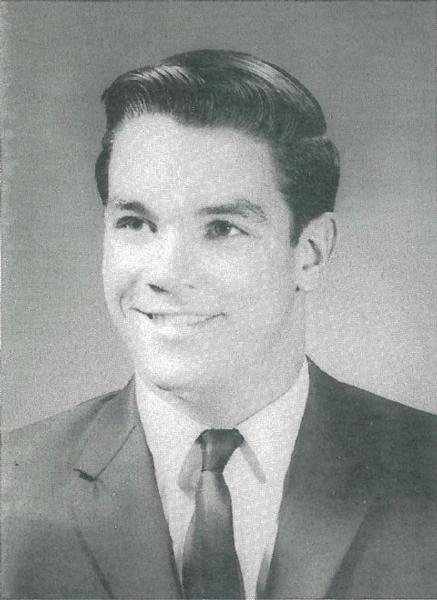
I met him in our dormitory the day we entered college in 1964. He saw me struggling to carry my big luggage crates up the two flights of stairs to my dorm room and, without saying a word, grabbed one and hauled it to the second floor.
“Thank you!” I stammered when we reached the landing.
“Don’t mention it,” he said with a broad smile, and then offered his hand. “I’m Robbie.”
“Bob,” I said, shaking his hand.
“Good to meet you, Bob!”
He must have noticed I was exhausted by the effort, and lonely to boot. “It’s close to dinner time,” he said. “Wanna walk over to the dining hall?”
“Sure!”
That was the start of our friendship.
Robbie was intuitively and naturally kind. He combined a remarkable warmheartedness with a degree of compassion I had never known before. And it wasn’t only toward me. Every young man in our dorm, and many in our class, came to admire and depend on Robbie.
Robbie went missing in action in Vietnam on October 12, 1972. His body has never been recovered.
I think of Robbie on Memorial Day, as I do of others who died while serving in the United States Armed Forces.
I was strongly opposed to the Vietnam War. I demonstrated and marched against it. I was too short to be drafted, but I detested the cruel absurdity of that war, the lies with which it was sold to the American people, the utter waste of it. In the end, more than 58,000 Americans and millions of Vietnamese lost their lives in it. Many more were grievously wounded.
But when I think of Robbie, I also remember his sense of duty. Duty was inseparable from his kindness. Whatever the situation, Robbie was eager to help.
What do we owe one another as members of the same society? To me, that question lies at the heart of this Memorial Day.
Our current president apparently believes we owe each other nothing. To him, everything is a transaction — a deal in which each of us is in it for as much money and power as we can get.
During the 2016 presidential campaign, Trump denigrated Senator John McCain, whose plane was shot down over Hanoi in 1967.
McCain became a prisoner of war. The North Vietnamese offered him early release because McCain’s father was commander of all U.S. forces in Vietnam at the time. But the young McCain refused the offer in order to uphold the Code of Conduct, which stipulated that prisoners of war should be released in the order they were captured. As a result, he remained in North Vietnam for nearly five additional years, during which time he was put into solitary confinement and tortured.
“He’s not a war hero,” Trump said of McCain during the 2016 presidential campaign. Then he altered his comment: “He’s a war hero because he was captured. I like people that weren’t captured, OK?”
Trump avoided serving in Vietnam by claiming he had a bone spur in his heel. As Michael Cohen, Trump’s “fixer,” told members of the House Oversight Committee in 2019:
“Trump claimed [his medical deferment] was because of a bone spur, but when I asked for medical records, he gave me none and said there was no surgery. He told me not to answer the specific questions by reporters but rather offer simply the fact that he received a medical deferment. He finished the conversation with the following comment: ‘You think I’m stupid, I wasn’t going to Vietnam.’”
Trump and his family business are now planning a $1.5 billion golf complex outside Hanoi and a Trump skyscraper in Ho Chi Minh City — the Trump family’s first projects in Vietnam. The two projectsare part of a global moneymaking enterprise that no family of a sitting American president has ever before attempted.
Robbie was never in it for himself. He did what he did because he felt he had an obligation to do it, a duty to the nation he loved. It’s why I remember and honor Robbie today.
I keep hearing that one of America’s biggest problems is we’re “divided and polarized.” For example, New York Times columnist David French: “We’ve known for a long time that America is deeply polarized, and we’ve known the problem is only getting worse.”
This is bullsh*t. The problem is not that we’re divided and polarized.
The problem is that a significant portion of America is buying Trump’s violent, hateful, lawless crap. Some of those buying it are white supremacists. Others are conservative fundamentalist Christians. Others are xenophobic nationalists.
I feel compassion for those who’ve been seduced into supporting Trump after being brutalized and mistreated for years by employers, big corporations, Wall Street, and America’s oligarchs. As I warned 32 years ago, widening inequalities of wealth, income, and opportunity would eventually persuade some on the losing side to support a demagogue.
But an explanation for why some of Trump’s followers have bought into his neofascism isn’t a justification for them to do so. And it’s certainly no reason for us to put aside our differences and compromise with them.
As you undoubtedly know, Trump has created a violent police state inside America. He is conducting an illegal war abroad. He has usurped the powers of Congress and defied court orders. He is taking bribes. He’s criminally prosecuting his enemies and pardoning his criminal supporters (he has even set up a slush fund to compensate them). He has gotten his Justice Department to immunize him and his family from any future tax audits. He is silencing critics. He is fomenting racism and bigotry.
None of us should fall for the false equivalency between this, and opposition to it. The contest today is not between “right” and “left,” as the two sides have traditionally been understood in America. It’s not even between “Republicans” and “Democrats,” as we’ve defined the two major parties over most of the past century.
No, the contest today is between democracy and authoritarianism. It’s between tolerance and bigotry. Between a multiracial, secular, inclusive society and one that believes in white Christian nationalism. Between the rule of law and neofascism.
The two sides in this contest do not merit equal weight. If we are going to have a decent society, the nation must come down on the former side.
As long as Trump has followers who support his bigotry, racism, corruption, and violence, the nation will remain divided and polarized. That is necessary and proper.
We shouldn’t “reach out, or “meet halfway,” or “find middle ground,” or “split the difference,” or any other of today’s hackneyed expressions for putting aside what divides us and agreeing.
Generations of Americans fought and died for the ideals of democracy, freedom, social justice, the rule of law, and equal opportunity. We have never fully achieved them, but they remain our ideals. Tomorrow we celebrate Memorial Day to honor those ideals and the memories of those who died for them.
There cannot be, must not be, any compromise with neofascism.
My grandmother Minnie as a young woman, circa 1911
Friends,
Thinking you might need a break from the ongoing horrors of Trump and his regime, I’m going to tell you about an incident involving my grandmother Minnie.
Minnie was weird and wonderful, neurotic and nonsensical, fragile and funny.
When she was 97 and had been a widow for as long as anyone could remember, an elderly gentleman who was almost her age asked Minnie out to dinner.
This threw her into a panic.
She phoned me, her oldest grandson. I was then in my late 30s, married and with two little children. The last thing I expected was to be giving dating advice to my grandmother.
“What am I supposed to do?” she asked in a voice even more tremulous than usual.
I encouraged her to accept. “If you like him, of course go out to dinner with him.”
“But I haven’t been on a date in 75 years!” she exclaimed. “I don’t know what people do on dates now!”
I tried to calm her. “Look, he probably hasn’t been on a date in years, either. Just be natural. Be yourself.”
After a long pause, she said okay, she’d accept. The date was to occur in two weeks.
The next week, my grandmother phoned again. Now she was worried about the details.
“Are we supposed to split the check?” she asked.
I suggested she let him pay; he had asked her out. But if she had any doubts, she could offer to split the check, and let him be the one to say he’d pay.
“How long should the dinner go?”
I said that if the restaurant weren’t too crowded, she and the gentleman could continue talking for a while after dessert.
“What should I wear? I haven’t worn anything fancy in decades!” I could hear her anxiety growing.
I told her she could wear anything she felt comfortable in. This was just a first date, and I was sure it would be informal.
“What if he asks me out again?”
“Don’t worry about that now. Just have a good time.”
“What happens if he wants to, to .…” She paused. I waited for her to continue, but there was only silence.
“Don’t be embarrassed, grandma,” I said, softly. “You want to know what you should do if he wants to kiss you when he brings you home?”
She whispered, “Yes.” And then, even more quietly: “I hear all kinds of things. What if he wants to go … further?”
How wonderful. I was now giving sex advice to my 97-year-old grandmother.
“Well, a kiss isn’t normally done on a first date,” I said as gently as I could. “But if you really enjoyed being with him, and if a kiss feels natural, sure, go ahead and let him kiss you. Nothing more.”
“Oh!” she blurted out in exasperation, “I don’t know why I have to do this!”
“Look, grandma, no one is making you do this,” I said. “But if I were you, I’d think of it as a special occasion. You might try feeling flattered that he wants to have dinner with you.”
She thanked me and quickly got off the phone.
As the day approached, I expected to hear from her again, but she didn’t phone.
Nor did she phone the next day.
Nor even on the day of the date. Nor the day after.
Two days later, bursting with curiosity, I phoned her.
“So, grandma, how did it go?”
“What go?” she asked.
“Your date! How did it turn out?”
“Oh, there was no date,” she said, as matter-of-factly as if she were referring to a canceled appointment with a hairdresser.
“What happened?” I asked.
“He died,” she said.
“He died?”
“His son called me three days ago to tell me he passed away. He was 95, after all.”
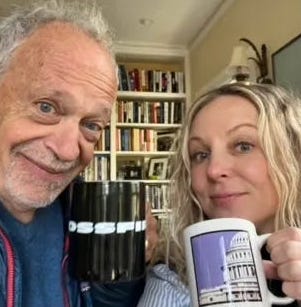
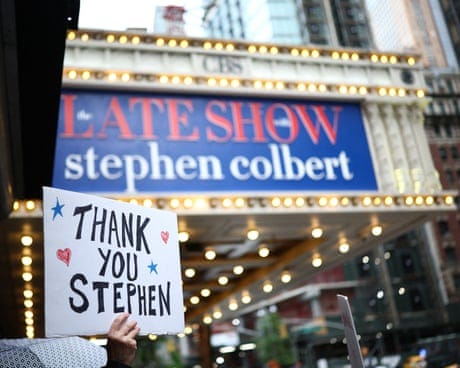
Today Michael and I take a deep dive into Trump’s corruption — beginning with CBS’s merger deal with Skydance that was conditioned, in part, on its canceling Stephen Colbert’s show (which is why I’m wearing a T-shirt I got when I appeared on Colbert’s “The Late Show”).
We then examine whether Jeff Bezos — the fourth-richest person in the world — is a knave or a fool for going on network television claiming that the richest 1 percent of Americans pay 40 percent of all taxes (a Trump-like lie).
And, as long as we’re talking about rogues and corruption, we look at Trump’s Acting Attorney General Todd Blanche’s $1.8 billion Trump slush fund and immunity from all future IRS audits — and its political fallout.
All that and more on today’s Coffee Klatch. So pull up a chair, grab a cuppa, and join in the discussion.
I watched Stephen Colbert’s last “The Late Show” episode last night with a mixture of laughter, sadness, and anger — anger at the cowardly and craven executives of CBS and its new corporate owner, Skydance. And at Skydance’s robber-baron Trump suck-ups Larry and David Ellison.
CBS says they canceled Colbert for financial reasons, which is utter bullshit (they made gobs of money from selling the show to affiliates). They canceled because they wanted to sell the network to Skydance and worried that Trump would block the deal unless they got rid of Colbert, who Trump despised because Colbert has been a courageous Trump critic.
Colbert hosted more than 1,800 episodes of “The Late Show” after taking over the mantle from David Letterman. This week Letterman called CBS’s decision to cancel Colbert a “huge mistake.”
To add insult to this corrupt injury, CBS is putting Byron Allen into Colbert’s 11:35 p.m. time slot.
Never heard of Byron Allen? Well, besides being a self-described comic, Allen is also a billionaire media mogul who owns The Weather Channel, BuzzFeed, and HuffPost.
Allen promises that his late-night humor on CBS won’t be “political” — that is, he won’t skewer Trump. He won’t even mention Trump. Allen claims that “people are totally good with not doing political humor. They just want to watch. For me, I don’t care who you vote for and I’m not trying to push an agenda. You’re going to vote for who you want to vote for. Just show up if you want to laugh.” For Allen, it’s just about making money: “This is business show, not show business. You have got to make the numbers work.”
CBS executives claim the deal will provide “immediate profitability” for the network.*
Well, duh. That’s because CBS won’t be paying Allen. Allen will ignominiously be paying CBS for Colbert’s time slot; CBS will “lease” Colbert’s time slot to Allen, and Allen will pocket whatever advertising revenue the show brings in.
Going from Colbert’s trenchant satire of America’s first dictator to billionaire media mogul Byron Allen’s jejune rental agreement is a stunning comedown. It’s also a perfect manifestation of an era in our nation’s history when greed and power have merged into a huge force that’s collaborating with authoritarianism. (For further evidence, look at Jeff Bezos’s insistence that his Washington Post not editorialize against Trump.)
Allen’s rental agreement is also an example of how the media is rapidly shifting from a public-centered model of broadcasting to a privatized, anyone-rich-enough model.
That public-centered model was hardly ideal. I’m old enough to remember when, in 1961, then FCC commissioner Newt Minow castigated TV broadcasters for prioritizing profits over public service. Minow said that if the media executives watched an entire broadcast day without distractions, they’d observe a “vast wasteland” filled with game shows, mindless violence, formulaic westerns, and endless commercials.
Newt Minow would be turning in his grave if he saw his vast wasteland turn into an arm of neofascist capitalism.
I strongly suggest you boycott Byron Allen’s show. Hell, boycott CBS.
Here’s a memo to Democrats as they begin campaigning in earnest for control of the House and Senate in the midterm elections. (Please send to any candidates you care about.)
***
TO: Democratic candidates in the 2026 midterm elections
RE: Connect Trump’s lousy economy to his corrupt regime.
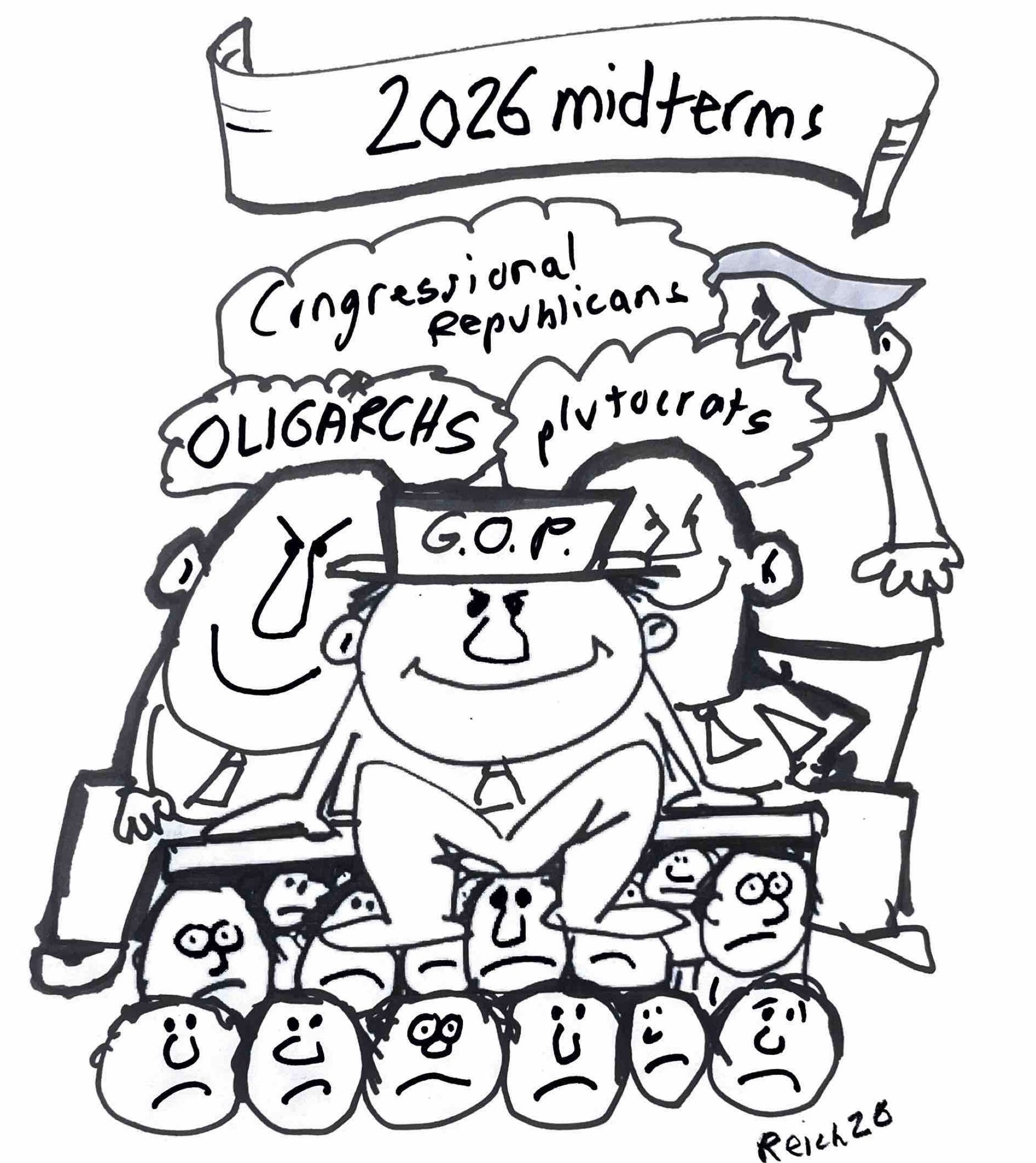
The purpose of this memo is to help you shape your midterm message around the crisis of affordability and Trump Republican corruption. I urge you to present these two issues as aspects of the same underlying problem: The economy is lousy for most Americans because Trump Republicans are enabling super-rich oligarchs to siphon off most of its gains while exerting increasing control over it. Their — and Trump’s — self-dealing is undermining trust and confidence in the U.S. economic system.
1. Republicans in the House and Senate have put oligarchs in charge of America.
House and Senate Republicans have allowed Trump’s war and his tariffs to drive up prices and Trump’s corruption to undermine faith in the economy. They’ve allowed Trump to gild his White House in gold leaf, plan a giant Arc de Trump, throw lavish parties, and build a Billionaire’s Ballroom — at a time when most Americans can’t afford gas or groceries.
They raided Medicaid to pay for Trump’s giant tax cut, whose benefits are going mostly to the rich. Legislative efforts advanced by House Republicans and signed into law have targeted up to $2 trillion in federal health care cuts, forcing millions of Americans off Medicaid rolls to pay for these tax reductions.
They refused to extend Affordable Care Act subsidies. This is causing average premiums to more than double and has already pushed 1.2 million people off coverage because they can’t afford it. Coverage losses are mounting as many who initially selected a plan or who were automatically reenrolled have to drop coverage.
Big Tech oligarchs — centi-billionaires Bezos, Musk, Zuckerberg, Ellison, and other robber barons — paid for Trump’s 2024 election, his inauguration, and his ballroom and are major donors to Senate and House Republicans. They’ve shown up at Trump’s inauguration, White House dinners, and official visits to China.
In return, these oligarchs have been allowed to monopolize and drive up the prices we pay and silence Trump critics.Bezos’s Amazon, for example, won’t allow any seller on the site to post lower prices on any other site, and Bezos won’t allow his Washington Post editorial pageto criticize Trump. Larry and David Ellison have bought CBS and sanitized “60 Minutes” of Trump criticism and effectively canceled Stephen Colbert. After buying X (formerly Twitter), Musk turned it into a pro-Trump voice box.
The AI oligarchs have bribed Trump and congressional Republicans to allow unfettered and unregulated growth of AI and its data centers, threatening millions of jobs and posing potential dangers to human life itself.
The crypto oligarchs have bribed Trump and congressional Republicans to allow them to create the world’s largest Ponzi scheme — which is enriching Trump and his family while providing a means for criminals to hide insider trades, child trafficking, and drug deals.
The Big Oil and aerospace oligarchs have bribed congressional Republicans to allow Trump to go to war in Iran, resulting in massive profits for Big Oil — while the rest of us pay $1.50 more per gallon of gas — and giant profits for giant military contractors.
This war spending has also contributed to higher inflation, which the rest of us pay for in higher mortgage rates and higher rates on car loans and education loans. The average 30-year fixed mortgage rate has surged to over 6.6 percent, reaching its highest level in nearly nine months, driven by rising Treasury yields, higher oil prices, and broader economic inflation concerns stemming from the war in Iran. The major beneficiaries of these higher rates — who pocket the higher payments we have to make — are the biggest banks and super-rich who make the loans.
Oligarchs have also bribed Trump and congressional Republicans to (1) get no-bid contracts, (2) deregulate Wall Street, (3) roll back environmental safeguards and worker safety, and (4) get massive subsidies for their corporations — all of which have made them even richer while making life for the rest of us more dangerous and more costly.
2. Republicans have created crony capitalism on steroids.
The system is an extreme form of crony capitalism. Congressional Republicans have rubber-stamped Trump’s corruption or pretended not to notice it, while average Americans get shafted and billionaires do better than ever. Corporate profits have never been higher. But wages aren’t keeping up with prices, which means most people are getting poorer, and the confidence of average consumers has never been lower.
Trump and his family’s corruption are leading the pack, setting an example for the rest of the American oligarchy.
Congressional Republicans have been silent in the face of bribes paid to Trump and his family. They didn’t raise a word about Jeff Bezos’s outright bribe to Melania Trump of $40 million for her film rights and $35 million to promote it, for a total of $75 million, when the best-case scenario is that Bezos’s Amazon earns $10 million on it.
But that’s just one example of the bribes coming Trump’s way. Qatar gifted Trump a Boeing 747 luxury jet valued at $400 million. Days before Trump’s second inauguration, the United Arab Emirates’ “Spy Sheikh” secretly bought 49 percent of the Trump family’s crypto firm. Months later, the administration handed over America’s most sensitive AI chip technology to the United Arab Emirates despite national security concerns. The Trump cryptocurrency business has rolled out a stablecoin called (USD1) pegged to the U.S. dollar. The stablecoin was utilized in a subsequent $2 billion investment into the cryptocurrency exchange Binance by MGX, an Abu Dhabi government fund. And so on.
Congressional Republicans have been silent as Trump has executed thousands of stock trades, many in individual stocks affected by his regime’s policies. And congressional Republicans won’t pass legislation to stop the regime from profiting off its policies. They’ve been silent as Trump praises and boosts corporations (as he did Apple on March 11) on the same day he invests in them and won’t hold Trump or the regime to any ethical standards.
Congressional Republicans have been silent in the face of the Trump family’s looting of America. In his first year of his second term of office, Trump increased his net worth by almost $4 billion to $7.8 billion by the end of 2025, according to TIME. Forbes estimated that in 2025, Eric Trump became 10 times richer, ending up worth some $400 million, and Donald Trump Jr. became six times richer, ending up worth some $300 million. Even Barron Trump, while still in college, reportedly ended up worth some $150 million in 2025.
Congressional Republicans have also been silent about Trump’s “agreement” with the Justice Department to create a $1.8 billion slush fund and immunity to all future IRS audits of Trump and his family. The agreement was based on Trump’s withdrawal of his absurd $10 billion lawsuit against the IRS for damages (after a contractor leaked Trump’s tax information during his first term), when the federal judge to which the case was assigned indicated she’d throw it out because Trump can’t be in charge of both sides of the lawsuit.
So Trump’s own Justice Department then offered him — not as an official legal “settlement” but as a kind of consolation prize — a $1.8 billion slush fund, enabling him to compensate anyone he feels has been unfairly convicted. Likely beneficiaries would include fat-cat contributors to the Republican Party, as well as those who attacked the U.S. Capitol on January 6, 2021. The Justice Department has also offered Trump and his family immunity from any IRS audit ever again — allowing him and his family to permanently bury any and all illegal bribes they’ve received.
This is outright robbery from the citizens of the United States. Billions of dollars that Trump and his family have pocketed — from foreign governments, billionaires, and corporate supplicants — are now untraceable, unaccounted for, and hidden for good.
Republican members of Congress are reportedly unhappy with this agreement, presumably because their constituents are furious about it. But they won’t take any action or even say anything about it for fear of angering Trump; their silence about it is deafening.
3. The larger Republican scam is to replace our economy with bribes.
The Republicans’ increasingly corrupt political system — rife with crony capitalism, corporate welfare, and payoffs to the powerful — inevitably produces a corrupt economy. That’s because politics determines the rules by which an economy functions — and if those rules are products of corruption, the economy is corrupted.
In such an economy, investors can no longer rely on a system of stable rules and reliable laws. Everything depends on bribes and personal deals made by the biggest Republican loyalists and grifters, oligarchs and plutocrats, billionaire and multi-billionaires, and monopolists.
This inevitably leads to economic sclerosis and decline, as political and economic deal-making become personal transactions. Greed and payoffs replace trust. It’s happened before, after America’s first Gilded Age (see the Great Crash of 1929, leading to the Great Depression).
4. A lesson: Péter Magyar’s victory over Viktor Orbán relied on connecting the economic problems of ordinary Hungarians with Orban’s corruption.
Finally, recall that the key to Péter Magyar’s remarkable defeat of Viktor Orbán’s entrenched regime was Magyar’s ability to connect the economic problems faced by ordinary Hungarians to Orbán’s corruption.
Magyar showed how Hungary’s soaring cost of living and crumbling public services were linked to the illicit enrichment of Hungary’s ruling elite. He exposed how state resources were siphoned into a “mafia state” and showed that Hungary’s crumbling healthcare system, dilapidated schools, and failing infrastructure were a consequence. The inner circle of Orbán-aligned oligarchs had amassed immense fortunes while ordinary Hungarians suffered from high inflation, stagnant growth, and an erosion of their purchasing power.
Magyar’s anti-corruption message resonated because he presented elite graft not merely as a moral or governance issue, but as the root cause of Hungary’s cost-of-living crisis and declining standards of living.
Democrats should do the same. The parallels between what happened under Orbán and what’s happened under Trump and the Republicans are almost exact.
5. The Republican Party is responsible for the corruption. Democrats must respond with a plan to revive the economy and end the corruption.
The Democrats’ record on corruption is not perfect, to be sure, but Republicans are now in charge of the entire government — and we have never before witnessed corruption on this scale. The twin issues of an economy that’s unaffordable for most Americans and a system overwhelmed with corruption are closely linked, and Trump and his Republican Congress are largely responsible.
Most Americans are beginning to catch on, but Democrats need to hammer this home — and propose ways to lower prices while fighting the corruption.
Democrats should propose: (1) more vigorous anti-monopoly enforcement, including busting up giant corporations, (2) prohibiting insider trading by all elected officials and their families, (3) getting big money out of politics (see here), (4) raising taxes on the super-wealthy, including a wealth tax, and (5) using the proceeds to improve the lives of average working Americans through Medicare for all, universal childcare, paid leave, and free public higher education.
I was born just after the end of World War II. The first half of the 20th century marked a particularly difficult, violent era.
But the 21st century so far has been, well, one trauma after another.
It started with 9/11, followed by the grim wars in Iraq and Afghanistan. Then the Wall Street crisis of 2008 and subsequent Great Recession. The COVID pandemic of 2020 and its own economic crisis. The attack on the Capitol on January 6, 2021.
Then, beginning in 2024, Trump’s full-scale attack on democratic institutions, followed by his war on Iran and soaring prices. Soon to come: Artificial Intelligence invading all aspects of our lives.
At the same time, we’ve been experiencing widening inequalities of income, wealth, and opportunity, along with a growing climate crisis.
When a nation’s people experience these sorts of stresses, they begin expecting stress. They gird themselves for the next crisis. They shut down their capacity to be shocked or appalled.
Trump’s lies swirl around us in the daily flow of hyper-digital noise. His attacks on democracy and his abject cruelty have by now become expected features of politics. The corruption, too, has come to be normalized, along with the public cynicism that accompanies it.
According to a survey from the American Psychological Association, 76 percent of Americans are concerned about the future of the nation. This is now the leading cause of stress, above the economy or work or money. Anxiety has moved from being a psychological disorder to becoming part of a seemingly natural order. We no longer see the degree of stress we’re under as exceptional because we’re enveloped in it.
Trump is not the only cause of stress. In fact, anxieties that have grown over the last four decades may explain why so many Americans voted for him in the first place — a so-called “strongman” who assured them he would take care of their troubles (he obviously didn’t; he added to the troubles).
Job tenures have become shorter and incomes more volatile. That’s because economic disruption has moved from the periphery of our economy to its center.
Marriages are postponed and births are falling because the future is too uncertain to make lifelong commitments.
Counselors, therapists, doctors, and pharmaceutical companies now focus on problems that are consequences of chronic anxiety — heart ailments, chronic headaches, ulcers and bowel issues — rather than traditional ailments.
We are becoming a PTSD nation. We are no longer shocked by the shocking circumstances we find ourselves in, but we are frightened by them all the same. We are seemingly numb to painful realities all around us that nonetheless keep us up at night.
I can’t help wonder: Have we silently relinquished a major reason we joined together in the first place, more than two centuries ago — to ensure domestic tranquility?
Have we unwittingly entered a Faustian bargain? We are paying an exorbitant price for aspects of our system we’ve been told are indubitably good or over which we have no control: the constant stream of new “stuff.” So-called “economic efficiencies,” economic growth, and technological disruption. Digital access 24 hours a day, wherever you are. Social media. An exciting (and exhausting) “what-has-he-done-now?” politics that substitutes for entertainment.
Maybe the tradeoff isn’t worth it.
In addition to ridding ourselves of Trump, we’ll also need to turn down the noise. Seek more peace, quiet, and stability in our lives.
Do we really need AI? Do we have to work this hard? Is all this stuff really necessary? Can’t this rich nation afford to give everyone at least a universal basic income? Can’t we just elect quiet, humble, capable leaders?
Republican congressman and Trump critic Thomas Massie lost Tuesday to Trump-backed challenger Ed Gallrein in the most expensive House primary in U.S. history (total cost was more than $32 million from combined campaign and super PAC spending).
Massie lost by a 10-point margin after being outspent 2-to-1 for most of the race. Pro-Israel groups (AIPAC, RJC) accounted for just over 30 percent of outside spending in the race, while Trump’s own super PAC accounted for another 30 percent.
This is just Trump’s latest victory on what has been dubbed his “revenge tour.” Other Trump victories include:
The retirement of North Carolina Republican Senator Thom Tillis, who announced last summer he would not run for reelection after voting against Trump’s Big Ugly Bill.
The primary defeat of all but one of the Indiana Republicans who stood up to Trump by opposing Trump’s demand for redistricting.
The primary defeat of Louisiana’s Republican Senator Bill Cassidy, who voted to impeach Trump for January 6.
The potential loss of Texas Republican Senator John Cornyn to Trump-endorsed Ken Paxton in next Tuesday’s runoff. (Trump says he decided to back Paxton because Cornyn was “very late in backing me” in 2024, despite Cornyn’s record of voting for everything Trump has wanted.)
Incumbent Georgia Republican Secretary of State Brad Raffensperger, who opposed Trump’s plot to “find 11,780 votes” in Georgia in 2020 and declined to seek reelection to another term as secretary of state in favor of running for governor, was easily trounced in the Republican primary for governor. (The GOP secretary of state primary in Georgia is headed to a June 16 runoff, with both candidates having promoted voter fraud conspiracies.)
These purges cement Trump’s stranglehold over the GOP. They send a clear signal to all Republicans who seek office or who are planning to run for reelection that they must be a rubber stamp for Trump to gain or remain in power.
They have thereby converted the official Republican Party from a political party into an extension of Trump’s regime — further eroding American democracy.
Trump’s retribution victories have encouraged him to settle additional scores. He’s now demanding that Senate Republicans fire parliamentarian Elizabeth MacDonough after she ruled that funding for the White House ballroom cannot be included in Republicans’ party-line immigration enforcement bill.
When Senate Majority Leader John Thune said Trump’s threat against MacDonough was “concerning,” Trump doubled down — posting this morning on Truth Social: “Get smart and tough Republicans, or you’ll all be looking for a job much sooner than you thought possible!”
Trump also reiterated his threat to seek revenge against Rep. Lauren Boebert (R-Col.), an “America Firster” who broke with Trump by pushing to release the Jeffrey Epstein files and campaigning with Massie last weekend. (Boebert declared last night on X after Massie’s defeat that “Trump is my President!”)
Trump is also threatening Pennsylvania Rep. Brian Fitzpatrick, who last week criticized Trump’s ballroom funding request. Fitzpatrick is a moderate Republican from a must-hold district if the GOP hopes to defend the House majority. “He likes voting against Trump,” Trump said. “You know what happens with that — doesn’t work out well.”
**
But the purges in Congress could also make Trump a premature lame duck over the next six months if Tillis, Cassidy, Massie, and Cornyn break with him for the remainder of their terms.
And why shouldn’t they, if they have left a shred of integrity?
They’re already showing some courage. Since his loss, Cassidy has rebuked Trump by voting against ballroom funding and voting for a procedural vote to advance a war powers resolution aimed at limiting Trump’s military action in Iran. The resolution forces Trump to either end hostilities or seek congressional authorization. The motion to advance the resolution passed by a 50-47 vote, marking the first time Democrats successfully advanced this measure.
In addition to Cassidy, other Senate Republicans who broke party lines with their May 19 procedural vote to advance a war powers resolution were Susan Collins, Lisa Murkowski, and Rand Paul. Notably, Thom Tillis and John Cornyn were absent from the vote. (Pennsylvania Senator John Fetterman, who’s fast becoming a DINO, was the sole Democrat to vote with most Republicans against the resolution.)
If Cornyn loses in Texas, the rift between Trump and Thune is likely to deepen — thereby threatening Senate passage of the second reconciliation bill (which incorporates a huge funding increase for ICE as well as $1 billion for Trump’s ballroom).
I was honored to be selected to give the commencement address at Berkeley. For any of you who’d like to see and hear what I said, I’m posting the address above (and the written version below). I’d be very interested in your reactions, so please don’t hesitate to comment.
**
Faculty, staff, administrators, alumni, parents, significant others and insignificant others, and finally and most importantly, members of the great class of 2026.
It is a profound honor to be here with you today. Now, I know every commencement speaker probably says this. The graduates down on that little farm in Palo Alto will probably find someone to say how honored they are to speak there.
But as we all know, those other places are not Berkeley, the best university in the world. I may be accused of some bias. I had the privilege of teaching here for 17 wonderful years. Yet as someone who attended and taught in other places, I can honestly say that nowhere is quite like Berkeley.
Yes, it’s beautiful. Yes, the weather is superb. Yes, its faculty are world renowned. But more than anything, this place is the best because of you, the best students I have ever had the honor of teaching. You are exceptionally curious, remarkably kind, amazingly smart, and you care extraordinarily about each other.
Three years ago, I taught my last big undergraduate course, in Wheeler Hall. Some people call what happened next “retirement.” I hate that word. I didn’t retire. I just graduated into the next phase of life.
But the truth is I’ve missed you. So, like many Berkeley graduates, I found excuses to never leave here. Maybe one of the reasons you selected me as your speaker is that you took pity on this old guy roaming the campus telling anyone who would listen how much he missed you.
There’s a reason why both professors and students have such affection for this place. While your time here is relatively brief -- in the span of what will hopefully be a long and happy lifetime -- the bonds formed here, the people you met, the way you learned to think, the passage from childhood to adulthood, will never leave you.
Do you remember beginning your formal education? Maybe the first day of kindergarten? My memory is a bit fuzzy because it was back when Abraham Lincoln was president. But if you think that you’re now leaving your student days behind, I want to let you in on a little secret. You may have had your last final exam and your last term paper, but the most important thing we’ve taught you is to be a student as long as you’re alive. Life is about learning.
While our job as professors has been to teach you, what makes being a professor so rewarding, especially in a place like this, is that we are also learning from you. To be a teacher is also to be a student. To be a student is to be a teacher. Two parts of the same impulse – to engage with a world continuously replenished by curiosity and community. I see in teaching and learning an embrace of life itself. Think about how much of who you are now, you’ve learned from the people now sitting next to you in their caps and gowns. And think of what you’ve been able to teach them.
A question that often haunts me is who the teachers of tomorrow will be. Not only in the formal classroom sense, although classroom teachers are desperately needed. But also in the larger sense of helping make sense of the world and showing the way forward. That is, leading.
You don’t need to be cloaked in formal authority to be a leader. You don’t need a fancy title or a big office. You certainly don’t need to be a Cabinet secretary to be a leader. Many of our most important leaders through history had no formal title. Martin Luther King, Jr., Dolores Huerta, Rosa Parks, W.E.B. DuBois, Susan B. Anthony. To be a leader you need to understand where we should be heading and why, what we need do to get there, and how to summon the intelligence and energies of many people to help accomplish it. Leadership is a moral vocation.
We live in a world obsessed with doing things. We’ve invented incredible tools -- machines, robots, now AI. But a much more important and interesting problem than what we are doing is why we’re doing it.
Engineers are already designing headphones that can simultaneously translate other languages. It’s remarkable. But the purpose of learning a foreign language is not just to order a beer in Belgium. It’s to teach ourselves how to see the world from different perspectives and connect with people who have other ways of living and knowing. As I used to tell my students, the best way of learning anything is to talk with people who disagree with you.
The purpose of so much of what you have learned, and will learn, is not just to master complicated concepts or solve difficult problems but to understand why you have mastered these concepts and problems, what you might do with your mastery, and how they might help you connect with others in mastering or at lease improving your community, your society, the world.
I didn’t discover much of this until I was in my 50s. That’s when I came to teach here, the best university in the world.
I was running for governor of Massachusetts and came to the Bay Area to raise money for my campaign (the part of campaigning I hated most). I stopped for a cup of coffee at Cafe Strada, and it suddenly hit me: I didn’t want to be governor of Massachusetts. I wanted to be a professor at Berkeley, a public university that prizes education as a public good, where I could teach a diverse group of brilliant students who would help heal the world.
Thankfully, the good people of Massachusetts saw the light and decided they didn’t want me to be their governor. And luckily, the Berkeley faculty decided they did want me to be a professor, here.
So, I left Massachusetts and came to Berkeley. Amazing. It was like that moment in the movie the Wizard of Oz when Dorothy opens the window of her house that’s fallen into Oz, and everything’s in technicolor.
That’s really what it’s about. Sometimes getting caught up in a tornado, occasionally coming down with a crash, and, if you’re fortunate, opening your window and seeing the beauty of the world you’ve landed in.
One lesson you have taught me is that you are part of an incredible wave of youthful energy, empathy, and intelligence. Whenever I despair – which, these days, is more often than I’d like to admit -- I just take a stroll through campus, past the Campanile, through Sproul Plaza, under the towering redwoods, and I see the flyers on the bulletin boards, the intricate group dances being rehearsed, I see you going to or coming from classes. And I have a feeling that the nation and world are not just going to be okay, you will also make them better. Much, much better.
But I’d be remiss if I didn’t tell you, if you hadn’t noticed, that we’re in trouble right now. With each passing day, the systems that have been in place in this nation for nearly 250 years to advance democracy and prevent authoritarianism are under ever-greater strain.
Why is democracy so important and authoritarianism so dangerous? Because the moral purpose of a civilized society is to prevent the stronger from attacking or exploiting the weaker. Otherwise, we’d be permanently immersed in a brutish war in which only the fittest and most powerful could survive.
This moral imperative lies at the center of America’s founding documents. It’s also at the core of the postwar international order championed by the United States – emphasizing multilateralism, human rights, and the rule of law.
It’s an aspiration we have not always lived up to. Maintaining it has required that the powerful possess sufficient integrity and civic virtue that they not abuse their power -- and if they do, they are held accountable.
Yet we now inhabit a society and world grown vastly more unequal. This itself invites the powerful to exploit the weaker, because in an extremely unequal society and world, some of the powerful come to feel omnipotent.
But unfettered might does not make right. It makes for instability, upheaval, depravity, and war.
History shows that laws and norms designed to constrain the powerful also protect them. Without such constraints, their insatiable demands for more power and wealth eventually bring them down – along with their empires, dynasties, or nations. And threaten the entire world.
It is the responsibility of every one of us – and of this great university -- to do whatever we can to preserve democracy, fight authoritarianism, protect freedom of speech and expression, and treat all workers well.
It is the responsibility of all of us to seek the truth and speak truth to power, regardless of any pressures and threats the powerful may place on us. And it is our responsibility to work toward a society based on inclusion rather than exclusion.
Mind you, these ideals do not belong to one political party or one part of America. They are fundamental. They underpin the education you have received. They form the basis of our lives together. They are central to the meaning of a good society.
I’m not going to minimize the challenges you face – from authoritarianism to climate change, to the job market, and a world in turmoil. But I know that you will take what you have learned at this wonderful place, and teach others what is worth doing, how to do it better, how to protect the powerless and how to hold accountable the powerful.
This is the great unending chain of inspiration and responsibility. All of you are products of it and all of you have the capacity to keep it going.
No pressure at all, but we’re counting on you. We believe in you.
We also love you. The people who have gathered here today to see you get your degrees – your families, friends, and significant and insignificant others -- love you. We the faculty who have poured our hearts into teaching you and have learned so much from you, we love you.
And those of you embarking on the adult part of your life today – the part where you’re on your own, when your life is really yours – well, treat it as you would someone you love, too. Not in order to boast or gloat. Not to look down on anyone else. Not to be rich or famous. But to learn to be you, authentically you. To know yourself. To be patient and kind to yourself. And to be the best version of yourself you can possibly be. You are the teachers and the leaders the world needs.
I’ve been spending much of the last month watching and listening to Democrats trying to find their core message for the upcoming midterms.
The sad truth is that (with a few exceptions, such as Bernie, Elizabeth Warren, and AOC) a clear Democratic message isn’t getting through about the dangers Trump poses to America and the world, and what must be done.
So I’ve begun to look farther afield for effective messengers.
Several individuals in the media are doing an excellent job educating the public about the dangers of Trump. Among the most effective are Amy Goodman, co-founder, host, and executive producer of the independent news program “Democracy Now!”Also, Substack’s Heather Cox Richardson, MSNBC’s Lawrence O’Donnell and Ali Velshi, Jimmy Fallon, Seth Meyers, and John Oliver of “Last Week Tonight” (on HBO).
I’d add New York Times columnists Jamelle Bouie and Michelle Goldberg, Dana Milbank (formerly with TheWashington Post and about to join a new Allbritton-backed news organization), actor Robert DeNiro, and The View co-host Alyssa Farah Griffin.
But my candidates for the people who have been most successful in educating the public about the dangers Trump poses are listed below. In my view, each can teach us a great deal about how to be effective communicators and powerful voices against the neofascist takeover of this nation and world.
Hence, your Office Hours assignment today is to select from the following list the person you think has been the most effective of all, or suggest someone else and explain why. Here’s the list:
Recently, people have been asking me who I’m voting for in the California gubernatorial primary. Normally, I prefer to stay out of the primaries (I myself was involved in a contested primary way back when, but that’s another story).
Like most voters I know in California, I’ve been holding onto my ballot. It’s been an especially bruising campaign season, and folks are tired of the attack ads.
But it’s now time to commit. California voters must support a candidate for governor who will do the job the way it should be done.
I’m voting for Tom Steyer.
You may be thinking: a billionaire? Hear me out. Steyer is the only candidate with a plan to tax the wealthy and corporations to invest in public services.
Yes, the billionaire is the only candidate with a plan to tax billionaires.
Steyer is the only candidate who has said he’d vote for the billionaire wealth tax, and he’s also said we need to go even further. Under his revenue plan, he’d raise taxes on corporations and other billionaires to fund schools and healthcare.
Steyer understands that economic growth depends on a strong middle class, not trickle down nonsense.
On the issue of artificial intelligence, Steyer is the only candidate with a plan to tax Big Tech and share the gains with working people. Under Steyer’s plan, he will guarantee every worker impacted by AI has a good-paying job.
When it comes to single-payer healthcare, Steyer is also committed to making California a model for the rest of the nation.
But don’t take my word for it. Steyer’s progressive policies have won him the support of nurses, teachers, and other labor unions across the state. At the same time, PG&E, Chevron, and MAGA billionaires are spending millions against him.
We’ve had wealthy Democratic politicians before. FDR and JFK had tremendous fortunes, yet they enacted some of the most progressive policies in American history.
Meanwhile, the other candidates in the race for governor haven’t taken a stand on the billionaire wealth tax. Why? I fear it’s because they don’t want to upset the wealthy donors and corporations backing their campaigns. It’s that simple.
I love California. It’s been my home for nearly 30 years. We need progressive change, not more of the same.
Tom Steyer is the only viable candidate to deliver that change in Sacramento.
Donald Trump just stole over A BILLION DOLLARS from you and me and every other taxpayer. And he’s using it to reward cronies and criminals who committed violence on his behalf.
If this sounds corrupt as hell, that’s because IT IS corrupt as hell.
The Justice Department announced that it is establishing a taxpayer-funded $1.8 billion dollar “Anti-Weaponization Fund.”
The massive slush fund will give violent criminals and crooks pardoned by Trump a way to seek payouts over bogus claims that the government was “weaponized” against them.
This includes the FIFTEEN HUNDRED insurrectionists charged or convicted of storming the U.S. Capitol on January 6. And it includes some of the fraudsters Trump pardoned after they made huge donations to his Super PAC.
This so-called “weaponization” fund was created after Trump agreed to drop his egregious $10 billion lawsuit against the IRS over his leaked tax returns.
In addition, the Justice Department revealed today that it has agreed not to pursue any legal matters against Trump and his family, including those involving Trump’s tax returns, that are currently pending — such as any audits of Trump or his family. In 2024, TheNew York Timesreported that a loss in an IRS audit could cost Trump more than $100 million.
Remember: Donald Trump was literally suing his own government for damages, while lawyers from his own Justice Department handled the lawsuit. Hello?
The case was rightfully facing skepticism from the judge presiding over it. So, instead of pressing forward, Trump and his regime have established the weaponization fund to effectively get around the judge.
Now, Donald Trump will control a five-person commission that decides on how the $1.8 billion, taxpayer-funded slush fund will be spent with little to no oversight.
Some Democrats in the House are trying to block this outright theft from the American taxpayer. Impeachment should be on the table too.
Friends, I’ve been around politics for over 50 years. I’ve never seen anything as brazenly crooked and corrupt as what Trump and his cronies did yesterday.
Donald Trump makes Richard Nixon look like a choir boy.
Call your members of Congress and tell them not to allow this travesty. Phone (202) 224-3121. The operator can connect you directly to the office of any representative or senator.
Stephen Colbert’s last show is this Thursday evening.
CBS refused to renew his contract, and you know exactly why: He mocked and criticized Trump.
CBS says it’s ending “The Late Show” because the show was costing CBS some $40 million a year. That’s utter bullsh*t. Colbert enabled CBS to charge higher fees to local affiliates, because he attracted millions of viewers to those affiliates’ 11 p.m. news programs in anticipation of his “The Late Show” airing right after. The show was also a promotional gold mine for CBS, whose series stars were often interviewed by Colbert. No wonder CBS was “feverish” to lock Colbert into a new contract only three years ago.
What really happened couldn’t be clearer. Führer Trump was furious at Colbert’s mocking, and publicly called for CBS to cancel him (or “put him to sleep NOW” as Trump wrote in one social media post). At the same time, CBS’s parent company, Paramount, was on the verge of a lucrative merger deal that Trump could interfere with.
Paramount had already sucked up to Trump by offering him $16 million to settle a lawsuit he brought against CBS News’s “60 Minutes,” although he had almost no chance of prevailing in court.
In a monologue, Colbert called the settlement a “big fat bribe,” which it was. Days later he got word he’d been canceled. About a week after that, the deal was approved.
***
Before Colbert started at CBS, he hosted Comedy Central’s “The Colbert Report,” where he played a right-wing, blowhard, curmudgeonly TV host.
I was often a guest, presumably because I was a good foil for the blowhard that Colbert was acting. (I’ve also been a guest on his “The Late Show.”)
The first time I came to do “The Colbert Report,” I was nervous. I didn’t know how to respond to someone who’d be acting as a conservative asshole but wasn’t one in real life.
I was sitting alone in the greenroom when Colbert popped in. He introduced himself, sat down, and then, smiling, said, “Just wanted to warn you that I play a real jerk out there.”
“Oh, I know,” I said. “I’ve watched the show.”
“Good. Don’t argue with me. Just play along,” he counseled.
“I’ll try not to argue,” I said. “But I go on so many of these combative shows that I may automatically start arguing.”
Colbert laughed. “That’s fine. Just let me do the heavy lifting. I’ll be so obnoxious that viewers will see the wisdom in your argument!”
“Sounds good,” I said, still nervous.
“Just have fun!” Colbert advised, before vanishing to his set.
Here’s one of our discussions:
Colbert was anything but a right-wing jerk. In fact, as I’ve come to know him over the years, he’s remarkably self-effacing and wicked smart. He’s progressive in his politics, of course, but never dogmatic. Even when he skewers Trump on his “The Late Show,” he does it with gentle humor and no trace of anger or bitterness.
I’ve done many thousands of interviews over my adult life. Some interviewers, like the late Bill Moyers, have been so thoughtful and well-prepared that I’ve barely had to think; I just fall into a natural conversation with them. Others are so stilted or slick that they hardly listen to what I say, and the interview has the tortuous feel of gears grinding from one topic to another.
Colbert is like Moyers in being well-prepared and listening intently. But he adds a rapid-fire wit that can make a serious point while putting an audience in stitches.
When Colbert interviewed me last August about my latest book, CBS had just announced that his contract wouldn’t be renewed and that by late May the show would be off the air for good.
A stagehand met me at the side door to the old Ed Sullivan Theater. As he led me to the greenroom, I asked him how everyone there was taking the news.
“Not well,” he said. After a pause he said, “We’re like a family here.”
Some time later, Stephen came by the greenroom. I asked him how he was doing. “Oh, I’m fine,” he said. “I’ll find something else to do. But there are about a hundred people here who will be out of jobs, and frankly I’m worried about them.”
They are like a family — Stephen Colbert, his executive producer, the segment producers and directors, showrunners, writers, cameramen, gaffers, grips, lighters, stagehands, custodians, musicians. Stephen has treated them like a family. His respect and concern for them is unusual in the business but consistent with the courtesy and kindness I discovered the first time I met him.
In sharp contrast is the way CBS and Paramount’s new owners, Larry and David Ellison, have treated Colbert and all those who have made “The Late Show” such an important part of our entertainment and political firmament.
Behind the Ellisons lurks Trump, who treats everyone like shit except strongmen he can’t control such as Vladimir Putin and Xi Jinping.
After this Thursday’s show, the Ed Sullivan Theater will go dark, and we’ll lose one of the nation’s funniest and most courageous, truthful, and gentlemanly critics of Trump and his lawless regime. Our society and democracy will be the worse for it.
On Saturday, Trump took revenge on Louisiana senator Bill Cassidy for Cassidy’s vote five years ago to convict Trump, in his second impeachment, for instigating an attack on the U.S. Capitol.
Cassidy thereby became the first GOP senator defeated by a Trump-endorsed candidate in a Republican primary. (Other Republican senators who have stood up to Trump — such as North Carolina’s Thom Tillis and Utah’s Mitt Romney — saw the writing on the wall and didn’t seek reelection.)
Trump’s purge of Cassidy comes in the wake of Trump’s purges of House Republicans who stood up to him, such as Wyoming’s Liz Cheney.
Trump’s next Republican target in the House is Kentucky representative Thomas Massie, who had the guts to oppose U.S. military involvement in Iran, demand release of the Epstein files, and criticize Trump’s spending bills for adding to the national debt. Massie appears likely to be defeated by a Trump-backed opponent in Tuesday’s Kentucky primary.
Trump is marshaling the full force of his MAGA machine — spending more than $30 million on a House Republican primary — to purge another of his political enemies from the Republican House. Even Secretary of “War” Pete Hegseth is flying to Kentucky today to campaign for Massie’s challenger. It’s all seen as an investment in intimidating and disciplining Republican office-holders who might otherwise think of straying.
Trump has also purged state legislators who have refused to do his bidding, such as the seven Indiana Republicans who refused to redistrict the state as Trump demanded they do, and who Trump insured were defeated in their recent primaries.
The message is clear to every current or aspiring Republican politician: Be a toady to Trump, or you’re out.
In his concession speech Friday night, Cassidy stated the obvious reference to Trump:
“Our country is not about one individual. It is about the welfare of all Americans, and it is about our Constitution. And if someone doesn’t understand that and attempts to control others through using the levers of power, they’re about serving themselves. They’re not about serving us. And that person is not qualified to be a leader.”
Nicely put but sadly irrelevant because Trump — who’s clearly serving himself rather than the American public — now possesses all levers of power in the official Republican Party.
As Republican senator Lindsey Graham said yesterday on Meet the Press,“There’s no room in this party to destroy [Trump’s] agenda.”
Former generations of Republican politicians had principles, beliefs, ideals. They thought the federal government too large. Or believed it spent too much money. Or was too lenient on criminals. Or was too eager to support the civil rights of Black people. Or any number of issues with which Democrats disagreed.
Today’s Republican Party no longer has any purpose other than achieving whatever Trump wants, which is mainly to make Trump richer and more powerful. The GOP is now Trump’s; it is no longer America’s.
Today’s Republican voters, by contrast, are showing increasing frustration with Trump. Those who think of themselves as traditional Republicans don’t like Trump’s expansive use of federal power. Those who are fiscally conservative, like Thomas Massie, are upset by Trump’s wanton spending, tax cuts, and soaring debt. “America-first” Republican voters are concerned about Trump’s intrusions into Iran, Venezuela, Cuba, and elsewhere. And they want the rest of the Epstein files released.
Yet for elected Republicans, survival now depends on personal loyalty to Trump.
All of which raises a fundamental question: Has the official Republican Party — now nearly purged of anyone willing to reflect the concerns of Republican voters rather than Trump’s will — become complicit in Trump’s criminality? Is it aiding and abetting Trump’s lawlessness?
A case can be made that the official Republican Party is indeed complicit.
For Trump, the first and most basic sign of loyalty to him — and therefore survival as a politician in Trump’s Republican Party — is a willingness to publicly proclaim as truth what we know to be two big lies: that Trump won the 2020 election, and that he did not seek to overturn its results by illegal means. As a result, almost all congressional Republicans are now election deniers.
Trump has also made it clear that loyalty to him bars any criticism of his unlawful immigration dragnet, which has so far resulted in the murders of three U.S. citizens by ICE agents and the detention and deportation, without a hearing, of people suspected of being in the U.S. illegally.
To Trump, loyalty requires full support of his foreign policy — including the abduction of a foreign leader, an undeclared war with Iran, and the killing on the high seas of people only suspected of smuggling drugs, in violation of international law.
Loyalty also demands unquestioned support for other of his lawless acts — using the Justice Department to prosecute his political opponents, building a mammoth White House ballroom, issuing no-bid contracts to his friends, promoting his family’s businesses and implementing policies favorable to them, accepting gifts from foreign powers, and defying court orders.
Is it fair to conclude from all of this that today’s official Republican Party — the people who are in office because Trump has put them there, or who maintain their office because they back whatever Trump wants — has in effect become a criminal organization, analogous to the mafia or a drug cartel, whose members are blindly loyal to their criminal bosses?
My first quote of the week comes from Trump on Air Force One, on his way back from Beijing on Friday — telling David Sanger of The New York Times:
“I had a total military victory. But the fake news, guys like you, write incorrectly. You’re a fake guy. We had a total military victory. I actually think it’s sort of treasonous what you write. You should be ashamed of yourself. I actually think it’s treason.”
Note Trump’s use of the pronoun “I.” He didn’t say “we” had a military victory. Trump’s malignant narcissism is worsening.
Also take note of his blatant lie. His war in Iran has been anything but a victory. His delusions and deceptions about the war are escalating.
Americans are far worse off today than we were before Trump started his war. We’re now paying $1.50 a gallon more for gas, on average. Paying even more, indirectly, for the diesel fuel powering trucks that transport much of what we buy. Food costs are also rising because the fertilizer used to grow much of the food we eat can’t move through the Strait of Hormuz. The soaring cost of jet fuel is also being passed on to those of us who fly.
And none of these costs will come down soon, even if the war ends tomorrow, because the price for oil is largely set in a global market, and much of the oil infrastructure of the Middle East is in ruins.
Trump has made it harder for us to switch from oil and gas to renewable sources of energy, in which China is excelling. Trump loves fossil fuels — he’s subsidizing oil and gas and has ended subsidies for renewables (remember his election deal with Big Oil?) — but the future lies with wind, solar, and biomass, and the batteries that store them.
And note the not-so-subtle threat Trump directed at Sanger — that Sanger could be accused of treason if he continued to report that Trump’s war is failing. Trump’s dangerous accusations are intensifying.
Which brings me to my other quote of the week — Trump’s comment just before leaving for China that:
“I don’t think about Americans’ financial situation. I don’t think about anybody. I think about one thing: We cannot let Iran have a nuclear weapon. That’s all. That’s the only thing that motivates me.”
I believe the first part, that Trump doesn’t think about Americans’ financial situation; he never has and never will. But it can’t possibly be that the only thing motivating him is preventing Iran from having a nuclear weapon.
I say this because we were much closer to achieving this goal when Iran was still observing the nuclear deal it struck with Barack Obama — in which Iran agreed to limit its nuclear activities, including reducing its enriched uranium stockpile and modifying reactors to prevent the production of weapons-grade plutonium. (In exchange, the United States, United Nations, and European Union agreed to lift international economic and financial sanctions on Iran.)
But Trump pulled out of that deal. And Iran’s new leadership is hellbent on creating a nuclear weapon. Trump’s and Israel’s aggression apparently have proven to Iran’s new (and more extremist) leaders how much they need it. And the Trump regime has no idea where Iran is storing its near-weapons-grade plutonium.
Friends, a madman is in charge of American foreign policy — but almost no Republican member of Congress, no major CEO or university president or head of a major foundation, and certainly no member of Trump’s regime is willing to sound the alarm. They are all cowards.
I mentioned to you earlier this week that I had dinner with a group of political operatives who gave 30 percent odds that JD Vance and Marco Rubio would lead a coup within the next three to four months, invoking the 25th Amendment to get rid of the madman. Those odds may be higher now.
But you and I are not powerless. We can achieve the next best outcome — limiting Trump’s power to do more damage — by getting out the vote on or before November 3 and throwing the cowardly Republican senators and representatives out on their assets.
We have less than six months to get the largest midterm turnout in American history — a blue tsunami that will start the process of repair, reform, and return to sanity.
I know how frightening and discouraging all of this has been. I know how daunting the forces of cruelty and corruption can sometimes feel. I also know how hard you’ve been fighting, while at the same time working to keep yourself, your family, and your community on an even keel. And I thank you for it.
Despite Trump, please do not feel shame in America. Feel pride in the ideals we share. Feel honored that you are an activist warrior on the right side of history. Feel strength in our conviction. Feel power in our cause.
Have no doubt: We will prevail against the madman-in-chief and his lawless regime.

 Login
Login