Trump’s war with Iran is back on, but in reality it never ended.
Renewed attacks by both sides this weekend continued today with new Iranian assaults on U.S. military bases and assets in Bahrain, Jordan, Kuwait, and Oman.
This prompted Trump to declare that the U.S. will take over the Strait of Hormuz, reintroduce its naval blockade of Iranian ports, and, for the first time, charge a 20 percent fee on maritime cargo, mirroring Iran’s tolls on traffic in the Strait of Hormuz.
(Didn’t Marco Rubio say less than three weeks ago that charging tolls on international waterways violates international law?)
Oil prices have already risen about 5 percent. Although they’re still below this spring’s highs, American consumers will surely be hit by steadily higher prices for gas and for food (because food production depends on fertilizer, and many components of fertilizer also depend on ships moving through the strait).
The new fighting was inevitable because the so-called “memorandum of understanding” signed by the U.S. and Iran on June 17 reopened the Strait of Hormuz on the condition that Iran was in control of it.
The memo said Iran would “make arrangements using its best efforts for the safe passage of commercial vessels” through the strait. Conspicuously missing from the agreement was any guarantee that ships could safely sail any portion of the strait.
It prohibited the charging of tolls or fees for only 60 days while negotiations toward another agreement continued.
The final line of the memorandum formally ceded to Iran a central role in managing the strait: “The Islamic Republic of Iran will conduct dialogue with the Sultanate of Oman to define the future administration and maritime services in the Strait of Hormuz, in discussion with other Persian Gulf littoral states, in line with the applicable international law and the sovereign rights of coastal states of the Strait of Hormuz.”
This is what we get with a president who’s desperate to get gas prices down before the midterm elections, a vice president who knows nothing about negotiating treaties and insists “we have all the cards” when the deck is loaded for the other side, a secretary of defense capable only of ordering more bombs be dropped, and a State Department that isn’t even at the table.
So what now? Iran is suffering economic pain, but it’s a fierce dictatorship, so it’s willing to endure pain to hold on to its trump card — control over the strait.
But America is still a democracy, and we’re not willing to endure a lot of pain simply to restore the status quo we had before the brainless egomaniac in the Oval Office decided to attack Iran.
We’ll start voting in three months, and most of us can be expected to vote out the bums in Congress who have supported him. Then Congress can pass a resolution revoking Trump’s power to pursue this costly and unnecessary war, which is the only way to end it.
Unless, of course, he converts us into a dictatorship before then.
This Wednesday, Acting Attorney General Todd Blanche heads to the Senate Judiciary Committee for his confirmation hearing to become attorney general.
If the rule of law means anything, the Judiciary Committee should not send Blanche’s name to the Senate for confirmation. And under no circumstances should the Senate confirm Blanche as attorney general.
Blanche, who used to be Trump’s private lawyer, has treated the Justice Department as Trump’s private law firm. He still acts as though Trump — not the United States — is his client.
Consider what Blanche has done for Trump, rather than for the United States.
1. Illegally suppressed the Epstein files
Blanche has conceded that the Department of Justice violated the Epstein Files Transparency Act by making improper redactions in the public release of Jeffrey Epstein’s records but continues to drag his feet. Under Blanche, the department is currently battling lawsuits from journalists and demands from the state of New Mexico to unseal the unredacted documents.
U.S. District Judge Emmet Sullivan ordered the department to either unredact and release specific files — including emails, potential co-conspirators, and interview notes summarizing allegations against President Trump — or justify why they must remain withheld. But under Blanche’s direction, the department has repeatedly missed or delayed fulfilling orders to unredact the records completely, leading plaintiffs and transparency advocates to accuse Blanche of ongoing noncompliance.
Blanche also personally interviewed Epstein’s longtime associate, Ghislaine Maxwell, in prison, before Maxwell was transferred to a minimum-security facility. Minimum-security prisons are generally reserved for inmates with far shorter sentences than Maxwell’s 20 years. Did Blanche make a bargain with her? We don’t know.
2. Prosecuted Trump’s “enemies”
Blanche has assured White House officials that he will move faster and more efficiently against Trump’s targets, and at executing other White House priorities, than did his predecessor, Pam Bondi. Bondi was fired presumably because she didn’t deliver what Trump wanted quickly enough.
At Trump’s insistence, Blanche is moving ahead with investigations into several targets whom Trump regards as enemies — including John O. Brennan, the former CIA director who helped investigate Russian interference in Trump’s 2016 campaign.
Blanche is overseeing the Brennan inquiry, examining whether he lied to Congress in testimony in 2023, and relating to what Trump’s allies have cast as Brennan’s involvement in a “grand conspiracy” by Obama and Biden administration officials to keep Trump out of office each time he ran.
Blanche has also given the green light to inquiries into Cassidy Hutchinson, a young former White House aide who outraged Trump four years ago after she implicated him in the violence that erupted at the Capitol on January 6, 2021.
Under Blanche, prosecutors have also revived a botched attempt to bring charges against James B. Comey, the former FBI director, after a federal judge threw out charges last year that Comey had lied to Congress.
Blanche’s new indictment of Comey is for posting on social media an image of seashells he took while walking on a North Carolina beach. Blanche’s prosecutors are casting it as threatening because the image spelled “86 47” (the number “86” is slang for “getting rid of” someone or something, while “47” refers to Trump). Comey says that he quickly deleted the post as soon as he heard that the numbers were associated with violence.
There appears to be nothing Blanche won’t do that Trump wants done. Blanche is prosecuting the Democratic fundraising organization ActBlue. He’s prosecuting the Southern Poverty Law Center, a civil rights nonprofit in Alabama. In terms of turning the Department of Justice into the Department of Trump’s Grievances, Bondi was bad, but Blanche is far worse.
3. Sought to erase January 6, 2021
Blanche is also doing Trump’s bidding in seeking to erase from the public record the January 6, 2021, attack on the U.S. Capitol. Blanche delivered Trump’s pardons to those who were found guilty and sentenced to prison.
Under Blanche’s direction, the Department of Justice has even removed from its website news releases about the criminal cases related to what occurred on that fateful day, calling the information about the prosecutions “partisan propaganda.”
Blanche also signed off on a $1.8 billion fund that could have been funneled to those who stormed Congress as part of the so-called “settlement” agreement between Trump and, well, Trump, after Trump sued the Internal Revenue Service. After lawmakers from both parties criticized the deal, Blanche said, during a June 2 hearing before the House, “We are not moving forward with the fund, period.” But his flat refusal to put his reversal in writing is an indication that he could devise an alternative.
Today, Judge Kathleen Williams of the United States District Court for the Southern District of Florida said that the Justice Department’s actions — essentially, Blanche’s actions — in devising a “settlement” of the case Trump brought against the IRS were “untenable” and that officials abdicated their responsibility to defend the U.S. government’s interests. If there were any doubt about whom she was speaking, she said she’s be forwarding her decision to the New York bar for its continuing investigation of Todd Blanche.
Meanwhile, Blanche has said there’s a “ton of evidence” the 2020 presidential election was rigged against Trump, though he couldn’t provide a “definitive answer” and has pointed to ongoing investigations in Georgia and Florida as possibly answering the question.
4. Tried to immunize Trump and his family
Blanche personally signed — and was the only name on — the “settlement” document that would immunize Trump and his family from all future prosecutions. The breadth of this agreement is staggering. It prohibits the U.S. government from looking into any of the corrupt sh*t Trump and his family have gotten into.
And there’s a lot of corrupt sh*t. Trump is easily the most corrupt president in American history. Since being in office for a second time, he’s so far increased his wealth by an estimated $4 billion, and his sons’ and daughters’ wealth by billions more.
If the immunity part of the “settlement” remains in force, we may never know the true extent of Trump’s corrupt transactions, because the agreement — devised and signed by Blanche — may result in the largest cover-up of presidential wrongdoing and illegality in American history.
5. Overseen the largest exodus of talent in the department’s history
Blanche’s tenure has seen the departure of a record number of Department of Justice attorneys, including the termination of personnel who previously worked on January 6 cases or on special counsel Jack Smith’s investigations.
The resignations and departures amount to over a quarter of what had been the department’s entire legal staff. For example, roughly 70 percent — 250 — of the Civil Rights Division’s attorneys have departed. Two-thirds (69 out of 110) of the lawyers tasked with defending executive actions have either resigned or announced their exit. Staffing of the Voting Section unit has fallen from 30 attorneys to just three. High-level resignations have also occurred in the Southern District of New York and the Public Integrity Section.
For all these reasons, Blanche should not be confirmed as attorney general of the United States.
If you’re with me on this, please contact your senator’s office and tell them to vote NO on confirming Blanche. Your senators need to hear from you, now. Please do it today.
The Senate switchboard is (202) 224-3121. Elected officials prioritize their own voters, so please share your name and your city/town so the staff knows you live in their state.
“That flag needs to start leaning to the left more”
(Congratulations, Susan McArthur.)
Runners-up:
“Shouldn’t it be upside down?”
(Congratulations, Mary B of Pasadena.)
“Old Glory should be flying at ‘half graft!’”
(Congratulations, Don Buckter.)
“I recognize the flag, but I don’t recognize the country anymore.”
(Congratulations, Karen Cooper.)
“Thank goodness he doesn’t want his face on it too, yet.”
(Congratulations, jefryclair.)
“On Our 250 4th, many Tall Ships majestically sailed into New York Harbor -- and one orange dipshit obscenely curtailed the National celebration in DC. Par for the regime of 47 👎.”
(Congratulations, Linda.)
“Sure, it’s leaning to the right now, but we can fix it!”
(Congratulations, John Powell.)
“I heard he signed an executive order to make the stars gold.”
(Congratulations, Marvel.)
“When did our flag become a Republican symbol?”
(Congratulations, Karen Gross.)
“Betsy Ross called, she said since MAGA are using her design as marketing for their brand, they owe her royalties.”
(Congratulations, Adam Laurie.)
“Sadly, it was hijacked and turned into just another MAGA rally by the narcissist in chief.”
(Congratulations, Laurence Hoffmann.)
“Scorching heat and thunderbolts? — Is somebody sending a message?”
(Congratulations, Kathleen Weber.)
“The flag is so embarrassed it can’t stand straight.”
(Congratulations, joanne brininstool.)
“It’s amazing how one piece of fabric can mean two different countries.”
It’s tempting in these perilous times to say bad things about Republican leaders who have died. Trump has no trouble demeaning and ridiculing opponents who have passed. But Trump shouldn’t be our guide on this or anything else.
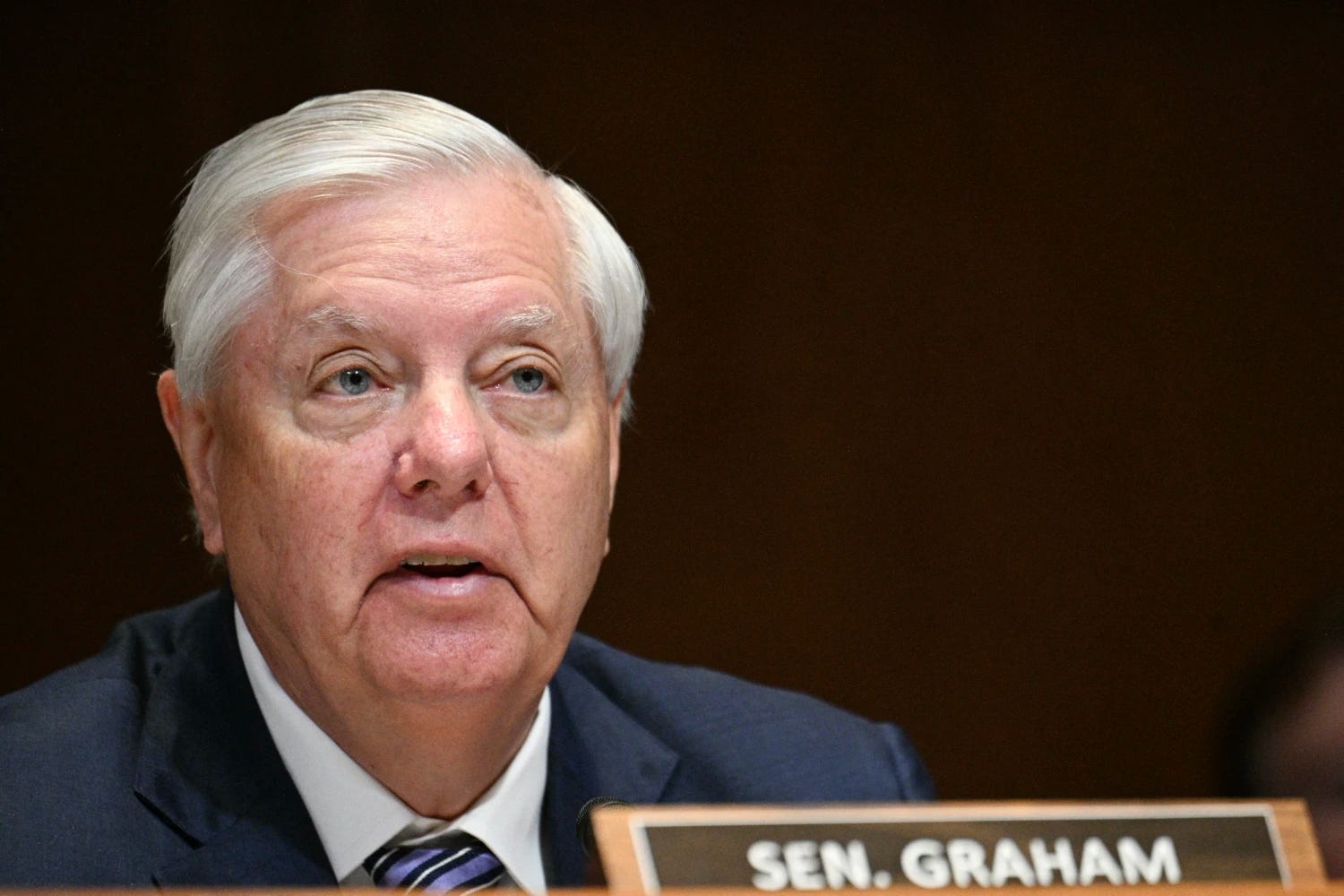
One of the best things I can say about Lindsey Graham is that he counseled Trump to remain supportive of Ukraine, even when Trump wanted to abandon the nation. Graham had been one of Ukraine’s staunchest backers in Washington. He died just hours after returning from Ukraine, where he met with President Volodymyr Zelensky. He told reporters in Kyiv on Friday that a bipartisan group of senators had reached an agreement with the White House to impose new sanctions on Russia in an effort to end that country’s long-running war with Ukraine.
I’ve criticized Graham as an opportunist and worse. I remember being impressed with the position he took in 2106, when he was one of the few Republicans to say publicly that Trump was unfit to serve as president. Then, after Trump won the Republican nomination, Graham chose to vote for third-party candidate Evan McMullin rather than Trump.
Yet Graham emerged as one of Trump’s key Senate supporters, defending Trump’s conduct and policies.
Where is the line between opportunism and pragmatism? After January 6, 2021, Graham appeared to break with Trump, saying on the Senate floor, “Count me out. Enough is enough.” A few months later, he acknowledged Trump’s continued hold over the Republican Party. “Can we move forward without President Trump? The answer is no,” he said. “I’ve determined we can’t grow without him.”
Graham was a moderate on immigration and was part of a bipartisan effort in 2013 to overhaul the system that passed the Senate but failed to gain support in the more conservative House. He tried repeatedly to give Dreamers — the immigrants brought to the U.S. illegally as children — a pathway to citizenship, and he almost succeeded during Trump’s first term before hard-liners helped blow up the effort.
I remember how close Graham was to Senator John McCain, one of my personal heroes and among the most principled people ever to serve our nation. Graham often cited McCain as his closest friend and mentor, crediting McCain with teaching him how to learn from failure and the importance of working together across the aisle.
Graham’s 71st birthday was Thursday. Lindsey Graham, R.I.P.
I just got back from a long walk. At this moment, I’m feeling grateful.
I took the walk because I had to calm myself after listening to Trump this week and fuming about the lapdogs in his Cabinet, his sycophants in Congress, and the cynical ideologues in his Supreme Court majority.
My particular problem, if you want to call it that, is I’ve served in a president’s Cabinet, spent a great deal of time in the White House and on Capitol Hill, worked in the Justice Department and the Federal Trade Commission, and argued before the Supreme Court.
I know what it’s like to do these jobs. And I’m furious at people who are helping Trump trash these institutions.
Earlier this week I asked many of you who you believed to be the worst elected official in America, other than Trump. Of the 6,630 of you who chose from the four finalists I offered, 51 percent picked JD Vance; 20 percent picked Texas Attorney General Ken Paxton; 19 percent chose Texas Governor Greg Abbott; many of you in your comments picked Mitch McConnell.
What do all of them have in common? A cynical contempt for the people of the United States.
So, where does my gratitude come from today?
While on my walk, I thought about many of the public servants with whom I’ve had the privilege of working over the last fifty years. Among them, Teddy Kennedy, Paul Wellstone, Michael Pertschuk, Barack Obama, Nancy Kassebaum, Michael Dukakis, Judge Frank Coffin, Pat Moynihan, Gabby Giffords, Bernie Sanders, Bill Clinton, Alan Simpson, and my dedicated colleagues at the Labor Department and the FTC.
I remembered how hard they worked for this country. I didn’t agree with all of them all the time, but I admired their selfless dedication. I’m grateful to them all.
They provide a sharp contrast to the cynical ass-kissers, cowards, sadists, and bigots Trump has used to turn America into a place I barely recognize.
We will take this country back. There are far more of us than there are of them.
The great sleeping giant of America is waking up and seeing Trump for who he is — a dangerous sociopathic conman. If polls are to be believed, a strong majority of the public is thoroughly disgusted by him and his regime.
I also see a new generation of public servants waiting in the wings — people with integrity and humility, who possess the values and commitment America needs, who will rebuild the country from the rubble Trump has created, who will make America far better.
It may take a generation to undo the damage Trump and his lackeys have wrought, but it will be done. We will prevail.
It had been created by Congress in 2002 after the Florida recount marred the 2000 presidential election and effectively pushed it into the Supreme Court to decide. In 2016, after Russia’s election interference, the commission targeted cybersecurity, supporting states as they reviewed and improved safeguards on their voting machines.
Trump has also overseen major cuts at the Cybersecurity and Infrastructure Security Agency, also intended to review and improve safeguards on voting machines. The cybersecurity agency has not had a Senate-confirmed director since Trump returned to the White House.
The two major points of nonpartisan help for state and local elections officials — the Election Assistance Commission and the Cybersecurity and Infrastructure Security Agency — are now effectively gone.
The Trump regime says it had the right to fire the commissioners, under the Supreme Court’s recent Slaughter decision (the name fits), which gave a president the authority to fire commissioners from what had been independent regulatory agencies. But the high court did not authorize Trump to eliminate an entire agency wholesale.
2. Eliminate all constraints on big money
On June 30, the Republican-appointed majority on the Supreme Court in NRSC v. FEC ruled against any spending limits on coordinated party expenditures. That means political parties can now spend unlimited money in direct coordination with their candidates. A donor who could give a candidate $7,000 directly can now route a million dollars or more through the party to cover that same candidate’s bills, and the candidate can solicit exactly it.
The case was filed in 2022 by JD Vance. Although those spending limits were contained in an act of Congress, the Trump regime’s Justice Department refused to defend it when it reached the court. (I used to argue Supreme Court cases before the Supreme Court, and I’m hard-pressed to think of another case in which an administration has refused to defend an act of Congress before the Supreme Court.)
3. Intimidate voters
Make no mistake: ICE is intended to intimidate potential voters who have every right to vote. ICE is now arresting an average of 2,000 people a day — twice its rate just a year ago — and has three times the resources it had then. Some 70,000 people are now in detention centers.
Some of them are American citizens.
The Justice Department is also prosecuting Americans who have protested against ICE. Eight were convictedon domestic terrorism charges following an incident last year in which a police officer was shot during an anti-ICE protest outside the Prairieland Detention Center in Texas. A ninth defendant in that case, Ines Soto, was recently sentenced to 50 years in prison for “providing material support to terrorists” because he had transported political pamphlets in his car.
Fifteen Minnesota protesters pled not guilty last week to conspiracy charges stemming from protests in January. Activist and healthcare worker Isaac Sant, one of the accused, said the trial was “a naked attempt to silence our voices, to squash dissent and to have a chilling effect on organizing here in the Twin Cities,” which, he noted, “is not going to work.”
ICE recently shot dead Lorenzo Salgado Araujo in Houston. Earlier this year, it murdered Alex Pretti and Renee Good. None of these murders is being investigated by the FBI or the Justice Department.
All of this has been dressed up as immigration policy, but it has a much baser motive: to normalize the presence of federal forces deployed against civilians in Democratic cities, in preparation for federal troops monitoring polls in these cities. These will inevitably be followed by fraud investigations if, as expected, these cities nonetheless vote for Democratic candidates.
4. Investigate and arrest alleged leftist “terrorists”
Secretary of State Marco Rubio has invited senior ministers from more than 60 countries to a meeting next week about what the Trump administration views as a major peril: the “resurgence of transnational far-left terrorism.”
The administration’s counterterrorism czar, Sebastian Gorka, has had discussions with colleagues about using foreign terrorismlabels for antifa to justify going after Americans with links to the movement, a loosely knit association of far-left activists who militantly oppose fascism and right-wing ideologies,three current and former U.S. officials said.
A linkage to foreign terrorist groups “can unlock certain investigative tools,” such as surveillance, one U.S. counterterrorism official told TheWashington Post.
5. Make it harder to vote and control how ballots are counted
Trump’s Justice Department has already demanded voter rolls from secretaries of state. Trump is demanding that Republicans in Congress enact his so-called “SAVE America” act, which would impose strict ID requirements — including showing passports or birth certificates — in order to vote. And his Department of Homeland Security has warned state election officials they can face criminal penalties if non-citizens are permitted to vote.
So far, district courts have struck down Trump’s demands for voter rolls, and Republicans in Congress have resisted his demands for the so-called SAVE Act.
6. Cast doubt on the outcome of the midterms
Trump will use every opportunity over the next 90 days to claim that Democrats are cheating — as he did in early June when claiming on NBC News’s “Meet the Press” that the California primary elections were rigged and that NBC correspondent Kristen Welker and her network were “playing right into their hands” by questioning him about the basis for his claims that elections were “crooked” in Democratic states.
He wants to cast doubt on the outcome of the midterms and impose control over how ballots are counted, so that after Democrats win the House and possibly the Senate, Trump will demand recounts or audits.
What you can do, now:
1. Join with local get-out-the-vote groups to make sure everyone who’s legally entitled to register to vote in your city or county is registered.
2. Before Election Day on November 3, join with local get-out-the-vote groups to literally get out the vote. Give people rides to voting places, if they need them. Make sure they know where to vote. Help them get whatever voting information they need.
3. If you become aware of any irregularities — any attempts to discourage or intimidate people who are entitled to vote from voting — alert the offices of your state attorney general and secretary of state.
4. Make sure your city, county, or state Democratic organization has lawyers ready and willing to litigate illegal efforts to obstruct the vote. Every county election office should know which state officials to call and, if necessary, file an emergency complaint.
5. Finally, let me also quote Rick Wilson, who for many years was a Republican operative:
“For the love of God, stop trying to shame the Republican Party into decency. I watched this party from the inside for thirty years. There is no bottom, there is no invisible line of conscience, and there is no cavalry of Serious Republicans waiting for permission to do the right thing. The ones with even marginally functioning consciences already left.
What remains is an apparatus that responds to exactly two stimuli: power and fear of losing it. Every hour spent crafting the perfect appeal to their better angels is an hour donated to the opposition. They are not going to be shamed. They can only be beaten.
Here’s the strategic core, and it’s the oldest rule in the book: cheating operations work on the margins. They flip close races. They exploit recounts, certification fights, faithless officials, and friendly courts. What they cannot do, what no operation in American history has ever managed to do, is steal a landslide.
A three-point race in Wisconsin can be litigated, delayed, “investigated,” and strangled in a certification meeting. An eight-point race cannot. The math of the steal collapses when the margin exceeds the degree of MAGA fuckery. …
You have the numbers. You have the law. And you have about ninety days.”
Welcome back to our 250th-plus-one-week anniversary edition! Hope you have had a good week, despite the cacophony out of Washington.
Today, Heather and I try to understand the real source of Trump’s power — his power to berate the heads of state at this week’s NATO and yet have them defer to him. His power to conduct a war in Iran that’s increasingly bogged down and which the American people don’t support. And his power to keep Republicans in Congress quietly neutered while much of his Republican base is outraged at his never-ending war, the soaring prices of gas and groceries, and his continuing refusal to release half of the Epstein files.
Trump is on an escalator heading downward at great speed, but his power seems to be intact. Why? We’ll get into that. Please pull up a chair, grab a cuppa, and join in the conversation.
Through the end of June, about $3.2 trillion in AI deals have occurred this year. That’s a 45 percent jump from a year earlier, according to Dealogic, a data provider. It’s the most spent on deal-making over a half-year period in at least a decade.
Many of these were truly giant deals — 44 were larger than $10 billion, including takeovers.
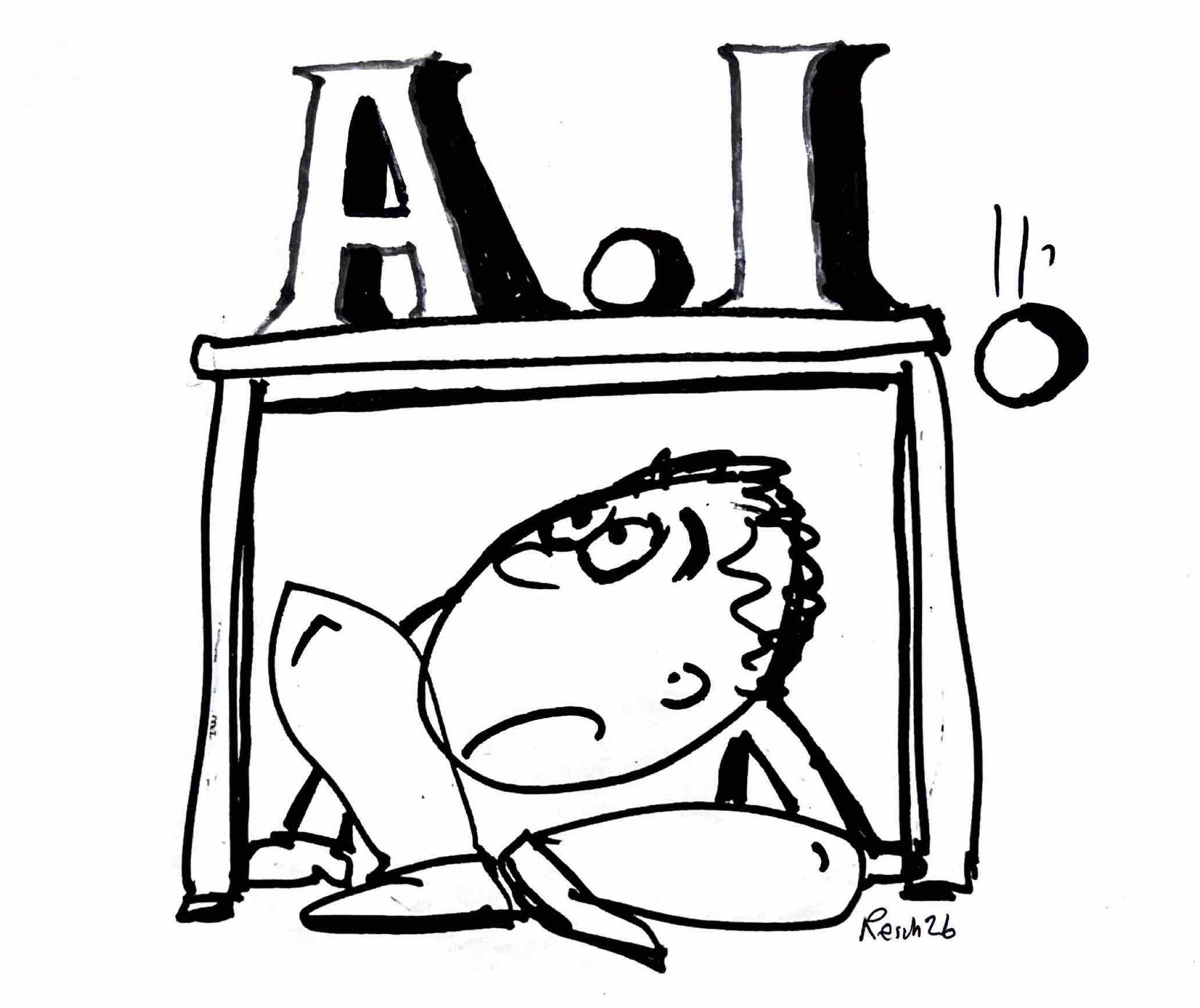
Is this a bubble that’s going to burst?
Because I’m located in the Bay Area, I often come across people who are deeply involved in AI. They rhapsodize over it.
But when I ask them who’s going to buy all the wondrous AI products and services — especially after AI destroys millions of jobs and decimates the American middle class —they have no answer.
And AI will destroy millions of jobs and decimate the middle class. Already, Cisco, Block, Coinbase, HP, IBM, and Salesforce have cited AI as a reason for mass layoffs.
Two weeks ago, Anthropic CEO Dario Amodei published a sweeping policy memo warning that AI will produce labor market disruptions larger and longer-lasting than any previous technological shift.
Earlier this week, noted short-seller Carson Block predicted that AI-driven job losses could eliminate 15 percent of knowledge worker positions within three years. He warned that this disruption could rival the worst economic crises in modern history.
AI corporations are of little value without enough demand for AI products and services. Yet unless people have enough income, they won’t be able to afford AI products and services.
Where will the demand for AI come from if AI erodes what remains of the American middle class and much of the working class?
I’m told we’ll just need to reduce work hours. But this answer doesn’t solve the riddle, because corporations aren’t going to reduce hours and continue to pay the same weekly or yearly salaries they paid before. They’ll pay less.
Zoom’s Eric Yuan told The New York Times that “A.I. can make all of our lives better, why do we need to work for five days a week? Every company will support three days, four days a week. I think this ultimately frees up everyone’s time.”
Jamie Dimon, CEO of JPMorgan Chase, says advancing technology could push the workweek down to just three and a half days. Microsoft co-founder Bill Gates openly wonders whether a two-day workweek could be the future.
Elon Musk pushes the idea to the extreme (as he does everything else): “In less than 20 years — but maybe even as little as 10 or 15 years — the advancements in AI and robotics will bring us to the point where working is optional.” Even better: “There will be no poverty in the future and so no need to save money,” says Musk. “There will be universal high income.”
All of this is pure rubbish. Even if AI yields big productivity gains, it’s far from clear that workers will see much, if any, of the benefits.
If productivity rises, as it’s supposed to do when the workplace becomes immersed in AI, each worker will generate more value, by definition. And supposedly with more value, we’re all better off.
Not so. Although worker productivity has been rising for years, the median wage has barely risen, when adjusted for inflation.
Here’s the truth: the four-day workweek will most likely come with four days’ worth of pay. The three-day workweek, with three days’ worth. And so on.
So, as AI takes over much of their current work, workers will get poorer or have to take additional jobs to maintain their current pay.
So, back to my question: Where will the demand for AI come from when most of us won’t be able to afford it?
You’d think that Amodei or Sam Altman (CEO of OpenAI) or even Elon Musk would take the lead in trying to come up with an answer to this riddle. But so far, nothing. Nor is there any conversation about what we should be doing to help the next generation of young people survive the specter of mass technological unemployment.
The distribution issue can’t be ignored. Unless the broader American public gets a share in the productivity gains from AI, profits will go to an ever-smaller circle of owners — leaving the rest of us with less money to buy what can be produced.
We may see a dazzling array of products and services spawned by AI, but few of us will be able to buy them.
There’s no shortage of ideas for how AI’s productivity gains might be redistributed. Those gains could be redistributed through wealth taxes financing childcare, elder care, and healthcare.
Or they could be redistributed via a sovereign wealth fund owning half of all AI shares of stock, that distributes yearly dividends to every citizen.
Or a Universal Basic Income financed by high taxes on the profits of America’s biggest corporations.
There are lots of ways to do it. The real question is where the political will is expected to come from to do it.
Surely part of the answer depends on the leaders of AI realizing how much they will need a consuming public with enough income and wealth to buy all the wondrous things AI will be able to deliver.
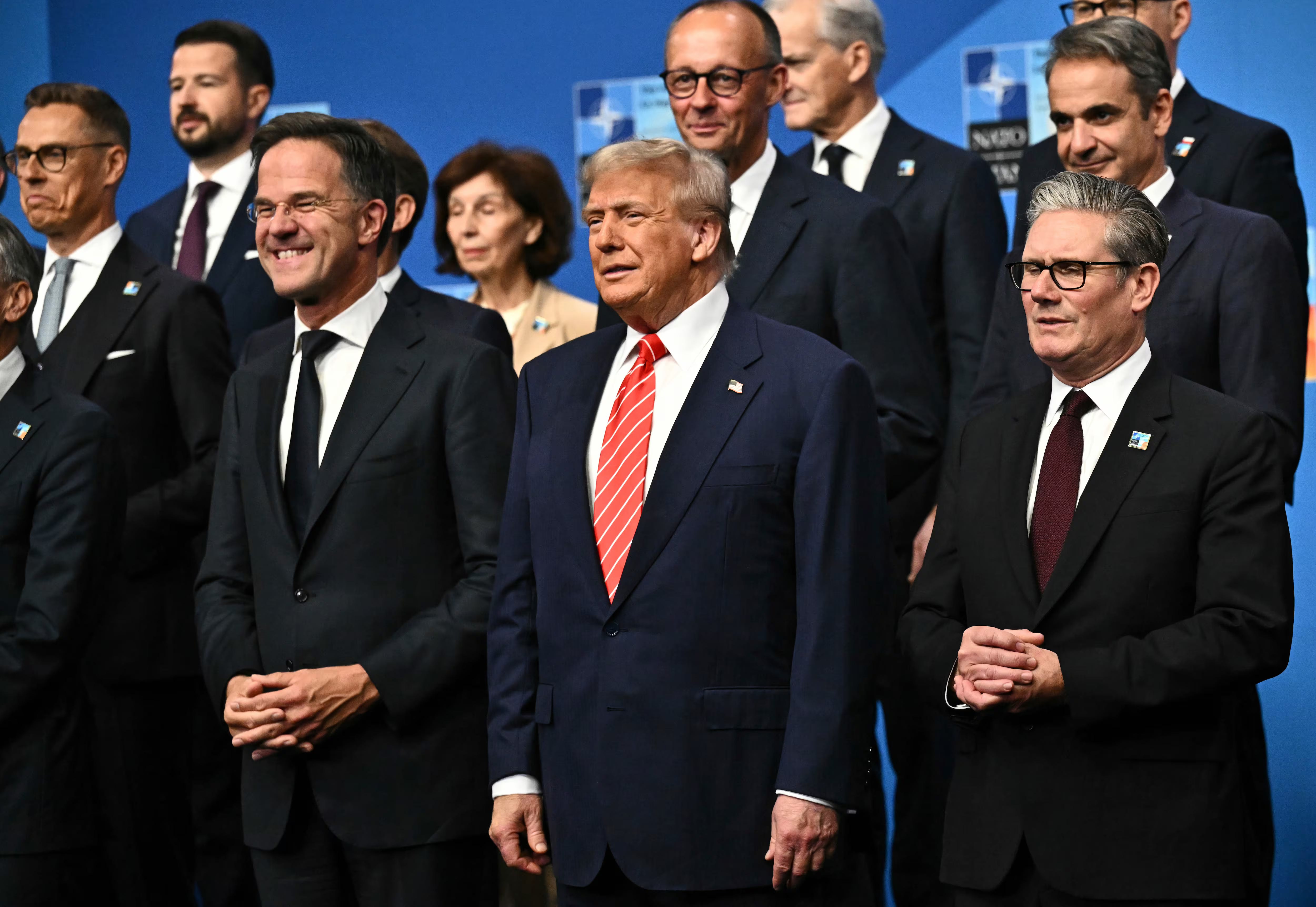
At the NATO summit just ended, Trump lashed out at other NATO members, saying he was “very disappointed with NATO” and asking “Why are we spending hundreds of billions of dollars, and they’re not there for us?” He reiterated his desire to take over Greenland, blasted European energy and immigration policies, insulted Spain, and worried allies by declaring that the fighting between Kyiv and Moscow “doesn’t affect us.”
Yet throughout the proceedings, Trump was treated by other NATO powers with as much deference as any U.S. president has ever received from NATO — perhaps more. “It was a great meeting, there was a lot of love in that room, a lot of unity,” Trump crowed when it was over.
What happened? It’s important to understand the source of Trump’s power.
His power doesn’t come from his being president of the most powerful nation in the world. In fact, his arbitrary tariffs, absurd war in Iran, and outright abduction of Nicolás Maduro and his wife have reduced America’s standing in much of the world.
Nor does his power come from his MAGA base, which is now having second thoughts about supporting someone who got the U.S. involved in another Middle Eastern war, caused prices to rise, and still refuses to release the complete Epstein files.
Nor does his power flow from his strategic brilliance or cunning. Of all U.S. presidents in modern times, he easily ranks as the stupidest.
Trump’s power comes from his willingness to violate all the norms, rules, and laws about how American presidents are supposed to act — to do anything that helps him accumulate more wealth, power, and glory, and wreak vengeance on anyone who has tried to get in the way.
The NATO presidents and prime ministers treated Trump with extraordinary deference because they’re afraid of what he might do if he doesn’t get what he wants.
Whether it’s NATO, Iran. the World Cup, the 2020 election, making billions off his presidency — or anything else — he’s unconstrained by norms, rules, treaties, and laws.
When the global community of World Cup fans objected to his intervention last weekend on the side of the U.S., he responded, “If [Belgium] beat us, then they can be really proud. The other way, if they beat us, we’ll say it was — I’d say — it was rigged, just like the election was rigged in 2020.”
Note how he corrected himself — from we’ll say to I’d say. Ethics is all about “we” — our collective judgment about what’s right or wrong. Trump doesn’t give a fig for the world’s or the nation’s judgment about right or wrong. He doesn’t think about right or wrong.
We’ve been missing the boat by characterizing Trump as breaching ethical standards. Ethics assumes some sort of agreed-upon standards against which a breach can be defined and measured. But Trump doesn’t have any standards at all. His entire approach to life, to business, and now to the presidency, has nothing whatever to do with standards. It’s about winning at all costs. Whatever it takes.
Trump isn’t unethical. He’s non-ethical. He isn’t immoral. He’s amoral.
It’s hard for most of us to conceive of living in a Trumpian world without standards, norms, rules, or laws — a world composed only of transactions and calculations in which the only test is what’s in it for me and at what cost.
And that difficulty most of us have of imagining such a world is itself the key to Trump’s power.
Whether you’re president of the United States or anyone else, it’s always possible to extract personal benefits by being the first to break a widely accepted norm.
Think of a small town where people don’t lock their doors or windows because of the unwritten rule that no one steals. Under these circumstances, the first thief to commit robberies operates at a huge advantage. He can effortlessly get into anyone’s house.
This first-mover advantage disappears as soon as people catch on and start locking their doors and windows. But the thief doesn’t bear the costs of the locks or the hassle of locking all the doors and windows. He exploits the community’s trust. Then, once he destroys that trust, he leaves it to them to protect themselves against such future violations.
That asymmetry — small cost for the violator of trust, large costs for everyone who has to thereafter protect themselves — is the very essence of Trump’s MO. He gains wealth, power, and glory for himself by shattering norms, after which everyone else has to pick up the pieces.
As president, he has far bigger norms to shatter than does a small-down thief, and at far greater benefit to himself
As president, his thuggery has paid off, at least for himself. But it has also damaged all sorts of institutions that America and the world have relied on — from NATO to FIFA to the U.S. Department of Justice — institutions based on the trust that no American president would ever do what he’s done.
He’ll be remembered as the most powerful president America has ever had, but also the worst.
When he’s gone, all of us will be paying to clean up the mess. We’ll have to buy an infinite number of locks for an endless number of doors and windows, and spend huge amounts of our time installing them and then keeping them locked.
By now you’ve probably heard the latest news that Iran’s Revolutionary Guard has officially surrendered to Trump and American soldiers are now occupying Tehran.
I just made that up. But who the hell knows? Two weeks ago, Trump declared: “For the first time in 3,000 years, we are going to have peace in the Middle East.”
Today, he declared that the ceasefire is “over.”
Weeks ago we had a ceasefire and a “memorandum of understanding” with Iran that, according to Trump, gave us everything we wanted, including an end to Iran’s nuclear program.
But the so-called “memo of understanding” left almost everything to be negotiated, including Iran’s nuclear program, its missile program, its support for terrorist groups, and its repression of its own people.
Before that — at the end of February — we had the promise of a quick “four-to-six-weeks” intervention.
The cold, hard fact is that America is far worse off today than we were before Trump started this conflict — without consulting with Congress or our allies. The Strait of Hormuz is once again effectively closed. Oil prices are moving upward.
Iran’s nuclear stockpile remains hidden. The regime in Tehran is more extreme and resolute about gaining a nuclear bomb than ever before.
Meanwhile, 13 Americans have been killed and some 425 have been wounded in action. Over 3,400 Iranians have been killed, including 120 schoolchildren, and 26,000 Iranians have been injured. The Pentagon has already asked Congress for about $70 billion to cover the early operations around Iran, and the cost rises every week.
Trump never gave the American people a good reason for attacking Iran in the first place. He had no objective and no exit strategy.
The likeliest future is a low-level continuation of this conflict as far as the eye can see — coupled with sporadic announcements from Trump that it’s over and America has won, which are then contradicted by another set of attacks by Iran’s missiles and drones, followed by another round of American aggression and Iranian retaliation.
This is the “forever war” that Trump criticized when he ran for office in 2024.
The question is whether he and the spineless Republican Congress that have supported this debacle will be held to account.
Many of you have already signed up for tonight’s final free live watchalong of The Last Class film — about my final semester of teaching (after more than 40 years), and also about education, democracy, leadership, and the arc of life.
I’ll be joining Elliot Kirschner (the film’s director) and Heather Kinlaw Lofthouse (executive director of Inequality Media Civic Action and also the film’s producer), as we watch it along with you — starting at 5:30 p.m. PT / 8:30 p.m. ET.
We’ll introduce the film, offer a bit of commentary during it, and answer questions at the end. They’ll also show a sneak peek of our next film.
If you’re like me, you don’t want to think about anything Trump is doing that you don’t have to think about. The horrific domestic police called ICE, for example, appears to have quieted down. So we can erase it from our minds, right?
Wrong. ICE has not quieted down. It’s even worse. It’s just become less visible.
ICE has quietly doubled its immigrant arrest quota. It’s now arresting 2,000 people per day.
But you’re not hearing about it because the new head of the Department of Homeland Security, Markwayne Mullin, has decided to quietly spread ICE agents around the country instead of targeting one Democratic-controlled city at a time.
Rather than fueling media spectacles, lawsuits, and community backlash, ICE is now going about its ruthless business in more hushed tones.
But every day, more of our neighbors — and more people who are in the United States legally — are being swept up at immigration check-ins, traffic stops, workplaces, and public spaces. Raids have intensified in Los Angeles, San Diego, Houston, Dallas, McAllen, Brownsville, New York City, Newark, Passaic, Plainfield, Milwaukee, Waukesha, Nashville, Charlotte, Chicago, and even in Minneapolis.
Local media continue to report what’s happening, but the national media seem to have lost interest. Among raids reported by local media are:
ICE’s cold-blooded murder yesterday, July 7, of Lorenzo Salgado Araujo in Houston, Texas.
The mass arrest of more than 30 workers at the Scholar Crafts plant in Birmingham, Alabama.
The arrest of at least three people during immigration check-ins at New York City courthouses last week in violation of federal court orders explicitly barring such arrests.
And so on.
Refugee communities are bracing for additional ICE raids in the wake of the Supreme Court’s decision revoking Temporary Protected Status of asylum seekers from Haiti and Syria, which could affect at least 356,000 people. (Haitian asylum seekers in Springfield, Ohio, are expecting “the mother of all ICE raids” after Stephen Miller voiced enthusiastic support for “finally removing all those Haitian illegal immigrants.”)
Community groups in Texas expect increased crackdowns after the conviction of eight activists on domestic terrorism charges following an incident last year in which a police officer was shot during an anti-ICE protest outside the Prairieland Detention Center. A ninth defendant in that case, Ines Soto, was sentenced last week to 50 years in prison for “providing material support to terrorists” because he had transported political pamphlets in his car.
Fifteen Minnesota protesters also pled not guilty last week to conspiracy charges stemming from protests in January. Activist and healthcare worker Isaac Sant, one of the accused, said the trial was “a naked attempt to silence our voices, to squash dissent and to have a chilling effect on organizing here in the Twin Cities,” which, he noted, “is not going to work.”
Meanwhile, ICE’s budget has tripled. The House narrowly voted in June to direct roughly $70 billion to the Department of Homeland Security for ICE and Border Patrol — more than three times its last annual budget. The money comes with few stipulations on how and when it should be spent. It includes:
$38 billion for ICE to hire, pay, train, and equip its officers and agents. That includes $7 billion for Homeland Security Investigations and $31 billion for immigration enforcement work like hiring more attorneys, supporting local law enforcement who coordinate with ICE, and technology like body cameras;
$22 billion for Border Patrol to pay, train, recruit, and equip agents and personnel. That includes $13 billion specifically for immigration enforcement work;
$5 billion for border security technology and screening, including artificial intelligence.
ICE is now using facial recognition technology and has already scanned thousands of immigrants’ and protesters’ faces. This kind of street-level surveillance raises profound legal questions about what are in effect warrantless searches.
The Department of Homeland Security appears to be creating a vast database of people who merely object to its actions.
How else to explain how federal agents tracked down Rochester resident David Streever last month when he was visiting New York City with his daughter? They gave Streever a warning notice alleging that he had potentially violated the law when he wrote a three-paragraph email to Todd Lyons, former head of ICE, criticizing ICE’s mass deportation program and comparing Lyons to a Nazi.
Similarly, during New York State’s primaries in June, ICE agents arrived at a polling site in Syracuse to question Paigelynne Gonyea, a poll worker. Gonyea, an American citizen, says the agents were concerned about an Instagram post she supposedly made in January identifying Jonathan Ross as the ICE agent who shot and killed Renee Good during the federal incursion in Minneapolis this winter.
Well, I’m criticizing ICE for these violations of the First Amendment rights of Americans. Come arrest me for my public criticism!
The Trump regime continues to open new detention centers, including a 528-bed holding facility for migrant families and unaccompanied children next to an airport hub in Alexandria, Louisiana, to speed up deportations. ICE is calling the facility a “staging area,” not a detention center, and says people would only be there a few days at most. But immigration advocates worry that children could be held at the new facility for weeks or months.
ICE is bigger and worse than ever, although the major media have stopped reporting on it. Not only is ICE’s reign of terror intimidating many undocumented immigrants and their families — preventing them from seeking the healthcare they need or attending school or going to court — but ICE is also sweeping into its maw many American citizens who are protesting Trump’s police state.
Hence, my request to you:
1. Please continue to protect the vulnerable in your communities. Make sure they have Red Cards / Tarjetas Rojas from the Immigrant Legal Resource Center informing them of their rights.
2. Report ICE sightings to your local Rapid Response Network (RRN) to ensure the community is alerted and those affected receive legal support. You can also submit and track anonymously and locally using the ICE Activity Tracker. (When making a report, be sure to note the specific location — intersections or addresses — the number of agents, the types of vehicles, and whether anyone is being detained. Document the activity if it can be done safely from a distance.)
3. Report all ICE activities in your area to your local newspaper, radio, and other local media. Take videos of what ICE is doing — again, doing it safely and from a distance. Share with your local media and ask them to pass it on to their affiliated national broadcast networks.
4. Alert your members of Congress. (Again, to connect directly with the office of you representative or senators, call the U.S. Capitol Switchboard at (202) 224-3121 (or the House direct switchboard at (202) 225-3121). An operator will answer and route your call after you state the name of the lawmaker you wish to reach. Before calling, you can look up your specific representatives using your ZIP code on the House Finder Service or search for your elected officials on Congress.gov.)
5. Above all, do not be intimidated by ICE and the police state Trump and his assistant Stephen Miller are creating. Its purpose is to intimidate. We have a responsibility to one another and to future generations to resist it with the same sort of courage and commitment to democracy our founders summoned just over 250 years ago.
Today, on their first day of trading on the Nasdaq-100 stock index, SpaceX’s shares dropped 6.8% to $149.47. That’s above their IPO price of $135, but down from a peak above $200, and below the $150 price where shares began trading on June 12.
SpaceX’s decline disappointed investors who wagered that inclusion in major indexes would provide a boost to the shares.
But, what about all the Americans who didn’t even know they were buying into SpaceX, but whose savings are in index funds linked to SpaceX and the Nasdaq-100? They’ve been taken for a ride.
On May 1, the Nasdaq 100 implemented a new “fast entry” rule that included companies among the top 40 most highly valued in the U.S. — which put SpaceX on board automatically.
The result: A big chunk of Americans’ retirement savings and pensions (as well as university endowments) are now automatically tied to SpaceX’s market value.
At the same time, all that automatic infusion of investment was expected to jack up the value of SpaceX, at least in the short term.
If today’s launch is an indication, that didn’t happen.
SpaceX insiders — such as Musk and, reportedly, senior Trump officials — can sell their shares sooner than is usually the case with an IPO, because that’s the way the SpaceX IPO has been structured. Which means they can enjoy the stocks’ upward tide as the major indices have essentially forced millions of investors to buy it, and then they can still exit SpaceX before the tide runs completely out.
If this sounds to you like a Ponzi scheme, it does to me, too. SpaceX may turn out to be the universe’s biggest Ponzi scheme — with the possible exception of Trump meme coins.
Of course, the Nasdaq’s overall weakness today didn’t help. Weighed down by semiconductor stocks, the Nasdaq composite fell 1.2%. The S&P 500 dropped 0.4%. The Dow Jones Industrial Average slipped 0.2%.
But investors have been nervous about SpaceX for weeks. The rocket company started to veer off course with a report out on June 22 that, notwithstanding all the hoopla surrounding its IPO’s raising $85 billion in its first trading days, SpaceX wasn’t really flying all that high.
In fact, it was floating a $20 billion bond sale to refinance its debts (mostly from its acquisition of X, on which Musk had put a lofty valuation). The sale seemed to go well initially, but the bonds dropped in the secondary market to a degree rarely seen by investors, driving up their yield premium (or spread) to U.S. Treasurys.
So SpaceX investors are now confronting several big unknowns, including how much cash SpaceX will burn and how much borrowing it will do going forward.
Which means average Americans who hold their savings in index funds are flying blind, even if they don’t yet know it. They may even be lost in space.
Private equity firms are buying up all sorts of things that fire departments rely on — and jacking up their prices.
This is particularly harmful to volunteer fire departments, which make up about 85 percent of fire departments in the country and operate on shoestring budgets.
Even modest price increases on software can limit a fire department’s ability to protect the public. One Connecticut volunteer fire department reported that after a private equity firm bought the software platform it used to track emergencies, the yearly price skyrocketed from $795 to $5,000.
By now we should all know that when private equity gets involved, prices go up and quality goes down — whether it’s housing or healthcare or even local newspapers.
Private equity managers get rich as they plunder vital industries and then take advantage of the carried interest loophole, which lets them pay a lower tax rate by classifying their incomes as investments.
Fire departments all over America are now facing higher costs, which makes it harder for them to replace aging equipment, train firefighters, and provide emergency services. Some firefighters even report going out on calls in fire engines with faulty brakes.
Can you imagine?
And even if they can afford new equipment, they have to wait longer for it. Sometimes years for a fire truck.
Let me ask you, honestly: Are private equity profits really more important than public safety?
States can and should prohibit private equity firms from sinking their teeth into vital public goods and services.
And Congress must follow through on eliminating the carried interest tax loophole that lets private equity managers get away with paying less in taxes.
We must not let private equity firms cash in while our communities burn.
Today I’m going to ask you to make a difficult decision: name the worst elected official in America today, other than Trump.
The point of this exercise is not for you to become any more discouraged with American politics but to highlight that Trump is hardly the only horrendously awful elected official in America. A second purpose is to name (and shame) elected officials who deserve to be better known for the horrible things they’ve said and done. Finally, it’s to stimulate a candid discussion about why voters have chosen these loathsome people (and why eligible voters who wouldn’t have chosen them don’t vote).
It’s been difficult to pare the list down. I’ve had to eliminate Ted Cruz because two other finalists are from Texas, and I didn’t want to make this solely about the Lone Star State. I’ve also eliminated members of the House Freedom Caucus because there’s no meaningful way to differentiate their bigotry and fanaticism from one another. I’ve included Marjorie Taylor Greene, who’s technically no longer a public official — she resigned from Congress on January 5 — because her influence continues, and she’s now talking about forming a third party.
So here are the finalists for the worst elected official in America today, other than Trump:
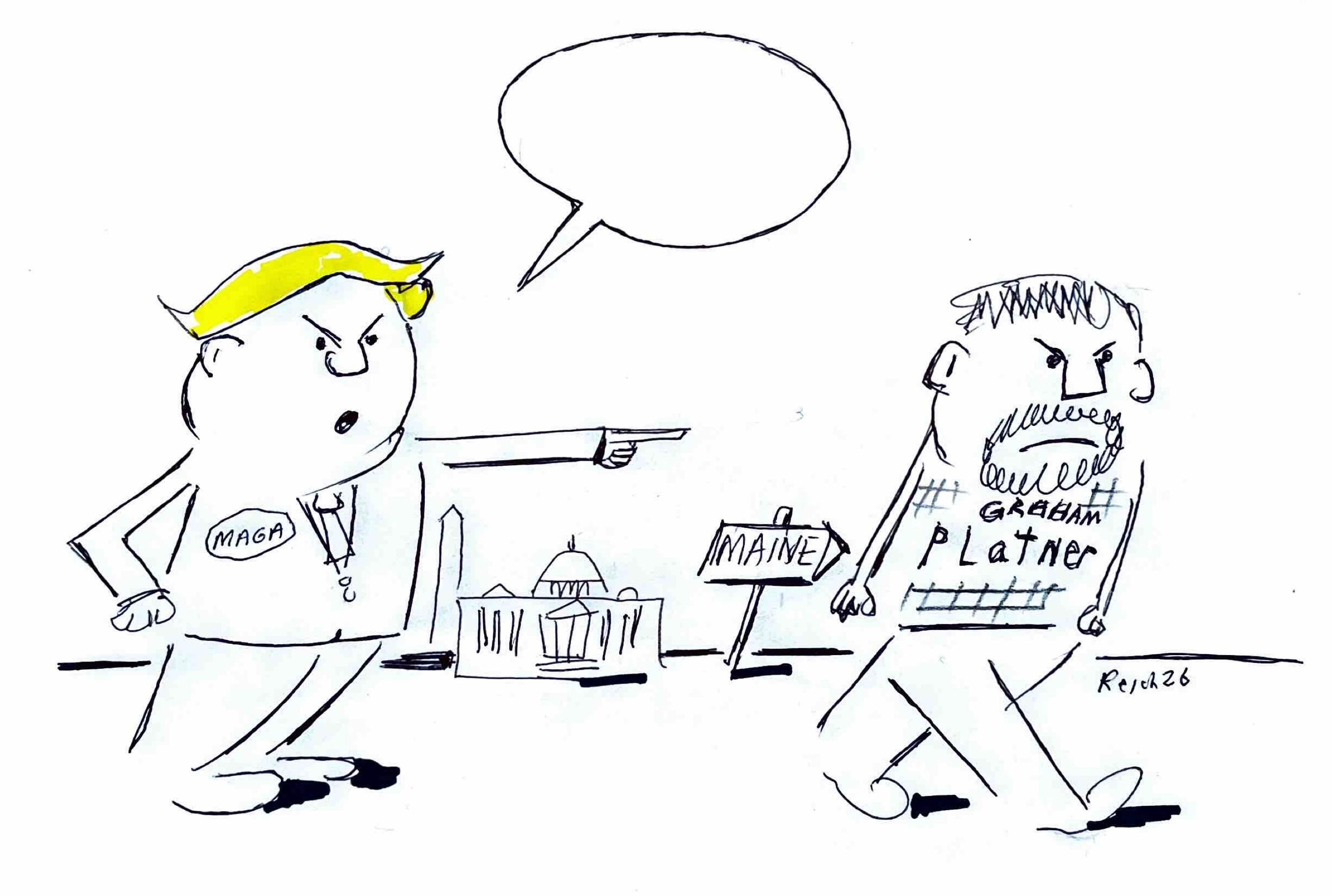
I’ve been an enthusiastic proponent of young progressives who are now taking on establishment Democrats — and winning. But lest there be any doubt about where I stand on the candidacy of Maine’s Graham Platner, I want to make it clear. He should exit the race, and exit now. The evidence against him appears credible — and it’s appalling. The people of Maine deserve to be represented by someone whose character is exemplary. I hope that the Democratic Party of Maine moves quickly to find a replacement.
Make no mistake. I’m rooting for the U.S. as we take on Belgium today in Seattle for a place in the World Cup quarterfinals.
But the game isn’t what it was — before Trump got FIFA president Gianni Infantino to lift the suspension of America’s top scorer, striker Folarin Balogun, who got a red card in a match against Bosnia and Herzegovina and would otherwise have been suspended from tonight’s match.
“Thank you to FIFA for doing what was right, and reversing a great injustice!” Trump clucked on social media Sunday afternoon.
When my two boys were young and just learning to play games, they were very competitive — as children often are. When one of them was losing, he often asked me to intervene. “Dad! Adam cheated!” “Dad! Sam cheated!”
Unless the so-called “cheating” was obvious, I gently explained that I wouldn’t weigh in. I wanted them to understand that one of the purposes of learning to play games is to accept losses, even if the result may seem unfair.
Later, when they became teenagers and played soccer or Little League baseball, there were times when they didn’t agree with a referee’s call. On a few of these occasions, they came to me in tears of outrage and self-righteousness, wanting me to say something to the referee.
I did not. “We have to rely on referees,” I remember saying. “That’s part of the game.”
The purpose of the game wasn’t just to win. The purpose of any game is to have fun, to enjoy the sport. It’s also to appreciate the contestants on both sides — their skill and excellence. And to follow the rules.
Yet now Trump is showing the world once again that America doesn’t play by the rules. We don’t accept losses, and we don’t accept referees’ calls.
I don’t know about you, but Trump’s intervention in the World Cup has ruined the game for me.
How can anyone ever again trust that the United States has won a game fair and square? How can the fine athletes representing us rejoice in a victory when the president of the United States has used his political power to change a referee’s call?
We try to teach our children morality. We explain to them the difference between winning and playing honorably and well. We try to inculcate in them a sense of fairness.
We want them to trust that in the game of life they may be rewarded for their skill and their tenacity, but they may not always be. We also want them to play the game of life with honesty and compassion.
We don’t want them to bully their way to success, as Trump has done his whole life.
Bullies who abuse their power by altering the rules of a game to favor themselves end up spoiling the game for everyone.
They destroy the trust on which any system — be it a World Cup competition, or a political race, or a market economy — ultimately depends.
Now we have a World Cup in which an American president has put his thumb on the scale. As a result, he has forever tarnished the integrity of the game.
Like his big lies about the 2020 election and the attack on the Capitol on January 6, 2021, Trump has also tarnished the integrity of America.
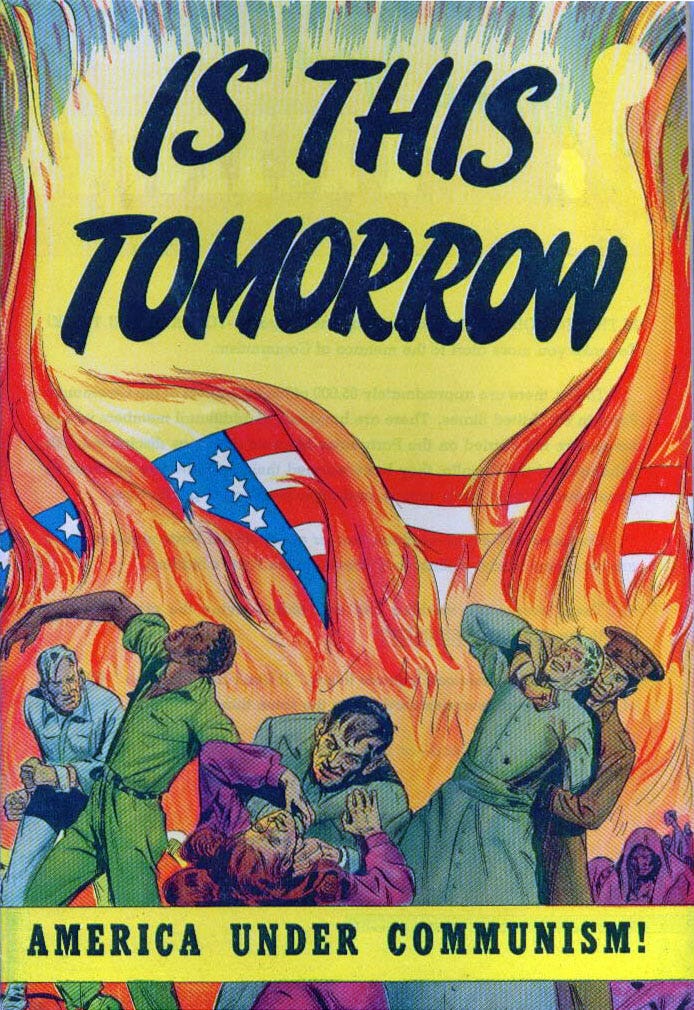
The cover of “Is This Tomorrow,” an anti-communist comic book published in 1947, suggests the chaos and ruin that would follow a communist takeover of the United States. The publications reflected a fevered politics that prevailed after World War II and through the 1950s. (Image via Wikimedia Commons)
Friends,
Trump has run out of cards to play in the midterm elections, which is why he’s now talking about the “communist menace.”
He can’t talk about the economy, because prices continue to rise faster than wages, which means most Americans are getting poorer. He can’t talk about foreign policy, because his war in Iran has been a debacle, his tariffs are an utter failure, and he obviously hasn’t settled the war in Ukraine on “Day 1.” He can’t talk about immigration, because his raids and mass deportations have become so unpopular.
So, facing the midterm elections, what’s left?
He’s resorting to the oldest of right-wing tropes — accusing Democrats (especially a rising generation of new, young, vigorous Democratic politicians) of being commies.
He kicked off America’s 250th anniversary celebrations on Friday with a speech at Mount Rushmore extolling American culture and warning of a resurgence of the “communist menace.” With the granite faces of four of his predecessors behind him, Trump took aim at what he called “radicals” and “extremists.”
“There is now a resurgence of the communist menace in our land, including from newcomers to our country who embrace ideas totally opposed to our way of life and our great success. You can be a communist, or you can be a patriot. You cannot be both.”
Oh, please.
For years, Trump has been trying to scare Americans about progressive Dems who advocate Medicare for All, universal childcare, free public higher education, and higher taxes on the super-wealthy to pay for them (all of which the rising young Democrats are advocating).
But he hasn’t gotten anywhere because these initiatives are supported by most Americans.
So now he’s throwing the commie label at the wall and seeing if it sticks.
Communism was the scare word used by right-wingers after World Wars I and II to crack the whip on the left. It provoked witch hunts and ruined careers.
It made former Wisconsin Senator Joe McCarthy a one-man bomb squad in the early 1950s, when he ridiculed the “pitiful squealing” of “those egg-sucking phony liberals” who “would hold sacrosanct those Communists and queers,” and forced American citizens to “name names.”
McCarthyism was a by-product of the Republican Party’s postwar effort to eradicate the New Deal. The GOP had portrayed the midterm election of 1946 as a “battle between Republicanism and communism,” and the Republican National Committee chairman claimed that the federal bureaucracy was filled with “pink puppets.”
Southern segregationist Democrats joined in the red-baiting. Mississippi senator Theodore Bilbo, a Klansman who filibustered to block anti-lynching legislation, described multiracial labor unions’ advocacy for civil rights as the work of “northern communists.” Representative John Elliott Rankin, a racist and antisemitic Mississippi Democrat who helped establish the House Committee on Un-American Activities, called labor unions’ Southern organizing campaign “a communist plot,” fearing it would result in more Black people voting. “We’re asleep at the switch,” he warned. “They’re taking over this country; we’ve got to stop them if we want this country.”
The red-baiting was temporarily successful. In the 1946 midterms, Democrats lost control of both chambers of Congress. Wisconsin sent Joe McCarthy to the Senate. California sent to the House a young Republican lawyer who had already figured out how to use red-baiting as a political tool: Richard Nixon. Four years later it sent Nixon to the Senate.
It’s likely that Trump’s earliest political memories are of Joe McCarthy’s red scare. Trump and I are the same age, and those are among my earliest memories.
On June 9, 1954, I sat at my father’s side on our living room couch watching the Army-McCarthy hearings. McCarthy had accused the U.S. Army of having poor security at a top-secret facility, hinting at communist subversion. He charged that one of the young attorneys on the staff of Joseph Welch, who was representing the Army, was a communist. The charge could destroy the young man’s career.
“Son-of-a-bitch!” my father shouted at McCarthy on television. I hid my head.
As McCarthy continued his attack on the young attorney, Welch broke in: “Until this moment, Senator, I think I never really gauged your cruelty or your recklessness.”
I was only 8 years old, but I was spellbound.
McCarthy didn’t stop attacking the young attorney.
“Son-of-a-bitch!” my father shouted, even louder.
At this point, Welch demanded that McCarthy listen to him. “Let us not assassinate this lad further, Senator,” he said. “You have done enough. Have you no sense of decency?”
Almost overnight, McCarthy imploded. Welch had aroused the decency of the American people. McCarthy’s national popularity evaporated. Three years later, censured by his Senate colleagues, ostracized by his party, and ignored by the press, McCarthy drank himself to death, a broken man at the age of 48.
During those hearings, McCarthy’s chief counsel was Roy Cohn, who had gained prominence as the Department of Justice attorney who successfully prosecuted Julius and Ethel Rosenberg for espionage, leading to their executions in 1953.
After McCarthy’s downfall, Cohn reinvented himself as a power broker in New York who survived scandals, indictments, and accusations of tax evasion, bribery, and theft — eventually to become Trump’s mentor.
So of course Trump would reach for the communist scare card when he has no other cards left to play.
The problem for Trump is that the new stars of the Democratic Party whom Trump wants to defile have nothing whatsoever to do with communism. They barely have anything to do with socialism.
New York’s Zohran Mamdani, AOC, Seattle’s Katie Wilson, Colorado’s Melat Kiros, and dozens of others — including many who have won recent primaries — are popular because they’re taking on corporate America, attacking political corruption by big money, and dealing with the real problems of ordinary Americans.
Labels are becoming irrelevant, anyway. In an Axios-Generation Lab poll of young Americans, 67 percent say they have a positive or neutral association with the word “socialism” compared with 40 percent who are positive or neutral toward “capitalism.” A new national survey from the Cato Institute finds Zoomers more supportive of socialism (53 percent) than capitalism (45 percent).
I can understand Gen Z’s growing disillusionment with capitalism. They can’t afford a home of their own. They struggle to afford health insurance. The job market is horrendous. They can’t afford to start a family. In many ways, capitalism — or whatever you want to call our current system — has failed them. And they’re the future of America.
So I doubt Trump’s resurgent red-baiting is going to help Republicans in the midterms.
To the extent Americans are thinking about the American system as a whole, they seem more concerned about Trump’s self-dealing than about socialism or communism. That same new Cato poll finds 56 percent of Americans worried that the U.S. could stop being a free country within the next 50 years because of corruption and abuses of power at the highest reaches of government.
Trump himself has no ideology, of course. He doesn’t give a fig about capitalism, and he’s not worried about communism or socialism. He’s a fanatical practitioner of narcissism, of the especially malignant variety.
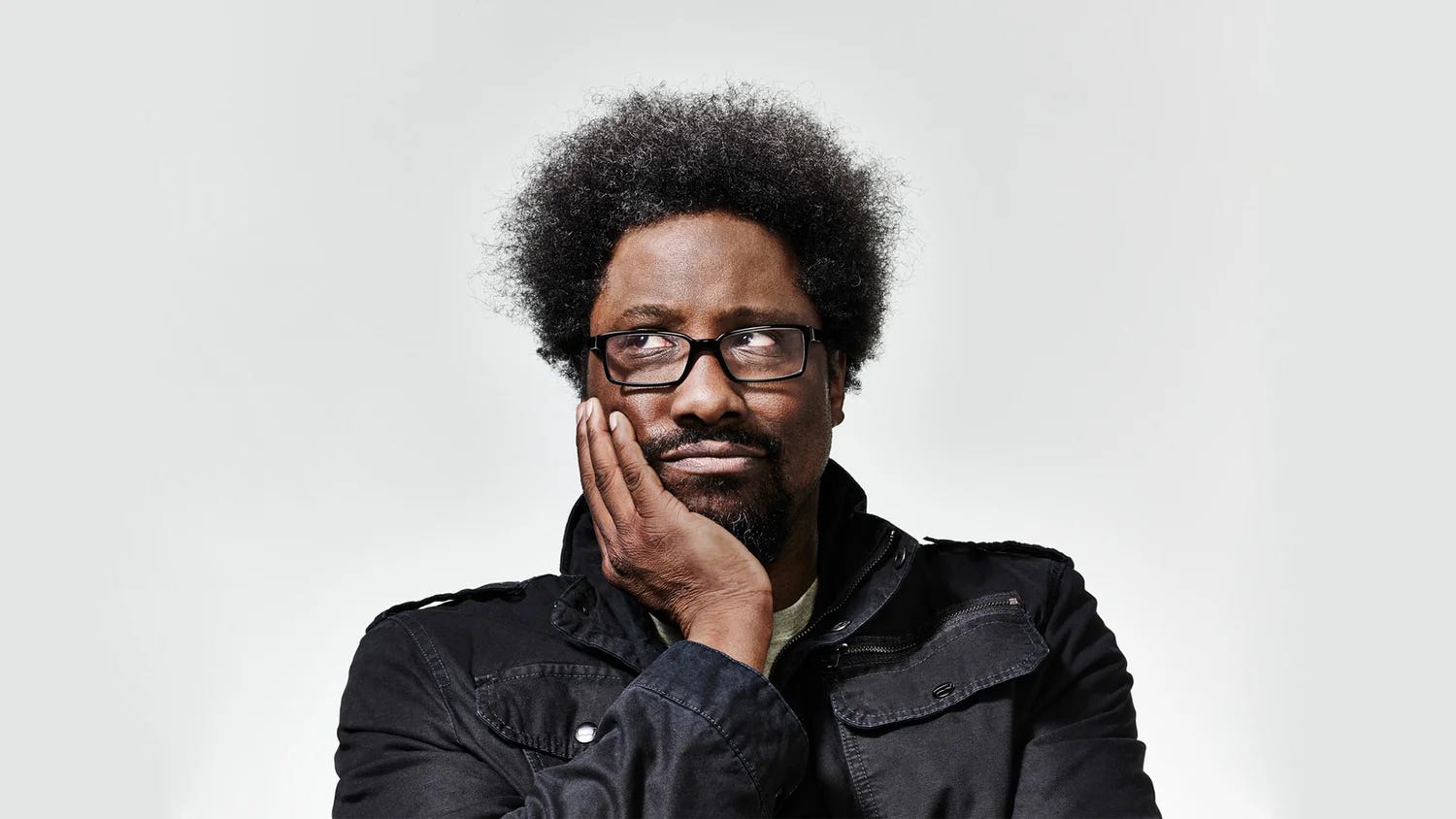
As you likely know, I’m a big fan of W. Kamau Bell, the stand-up comedian, director, all-around insightful thought leader, and television host who sometimes visits us on The Coffee Klatch. His news commentary is ruthless and irreverent, and important.
He invited me to be on the latest episode of his new podcast WHO’S WITH ME? which came out today.
If you aren’t already following Kamau here on Substack, I recommend you sign up for “Who’s With Me?” here.

 Login
Login