Make no mistake. I’m rooting for the U.S. as we take on Belgium today in Seattle for a place in the World Cup quarterfinals.
But the game isn’t what it was — before Trump got FIFA president Gianni Infantino to lift the suspension of America’s top scorer, striker Folarin Balogun, who got a red card in a match against Bosnia and Herzegovina and would otherwise have been suspended from tonight’s match.
“Thank you to FIFA for doing what was right, and reversing a great injustice!” Trump clucked on social media Sunday afternoon.
When my two boys were young and just learning to play games, they were very competitive — as children often are. When one of them was losing, he often asked me to intervene. “Dad! Adam cheated!” “Dad! Sam cheated!”
Unless the so-called “cheating” was obvious, I gently explained that I wouldn’t weigh in. I wanted them to understand that one of the purposes of learning to play games is to accept losses, even if the result may seem unfair.
Later, when they became teenagers and played soccer or Little League baseball, there were times when they didn’t agree with a referee’s call. On a few of these occasions, they came to me in tears of outrage and self-righteousness, wanting me to say something to the referee.
I did not. “We have to rely on referees,” I remember saying. “That’s part of the game.”
The purpose of the game wasn’t just to win. The purpose of any game is to have fun, to enjoy the sport. It’s also to appreciate the contestants on both sides — their skill and excellence. And to follow the rules.
Yet now Trump is showing the world once again that America doesn’t play by the rules. We don’t accept losses, and we don’t accept referees’ calls.
I don’t know about you, but Trump’s intervention in the World Cup has ruined the game for me.
How can anyone ever again trust that the United States has won a game fair and square? How can the fine athletes representing us rejoice in a victory when the president of the United States has used his political power to change a referee’s call?
We try to teach our children morality. We explain to them the difference between winning and playing honorably and well. We try to inculcate in them a sense of fairness.
We want them to trust that in the game of life they may be rewarded for their skill and their tenacity, but they may not always be. We also want them to play the game of life with honesty and compassion.
We don’t want them to bully their way to success, as Trump has done his whole life.
Bullies who abuse their power by altering the rules of a game to favor themselves end up spoiling the game for everyone.
They destroy the trust on which any system — be it a World Cup competition, or a political race, or a market economy — ultimately depends.
Now we have a World Cup in which an American president has put his thumb on the scale. As a result, he has forever tarnished the integrity of the game.
Like his big lies about the 2020 election and the attack on the Capitol on January 6, 2021, Trump has also tarnished the integrity of America.
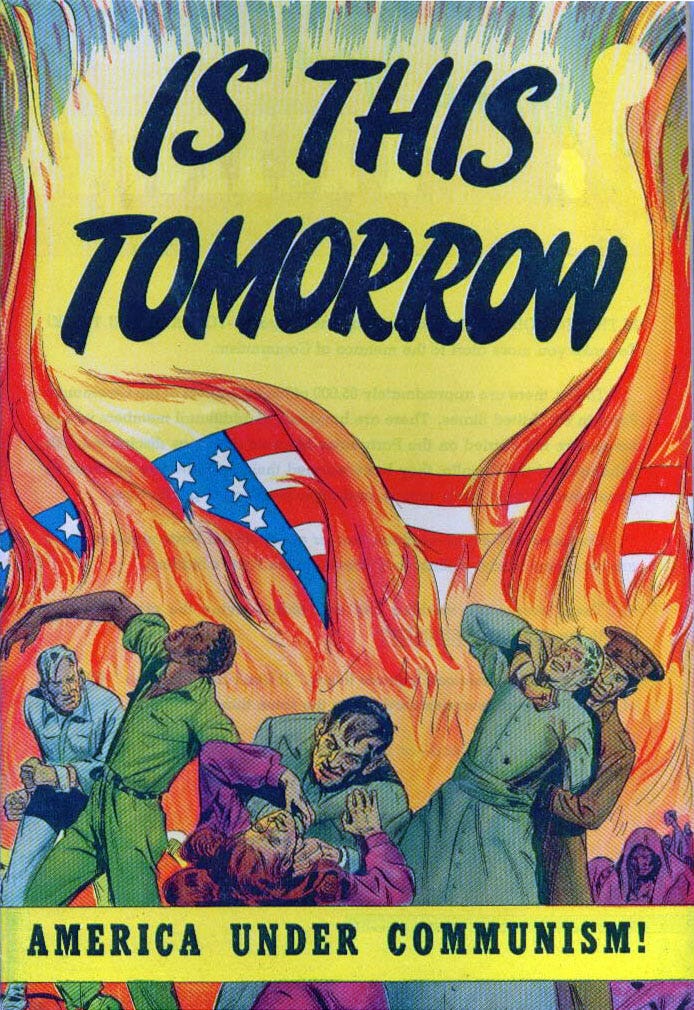
The cover of “Is This Tomorrow,” an anti-communist comic book published in 1947, suggests the chaos and ruin that would follow a communist takeover of the United States. The publications reflected a fevered politics that prevailed after World War II and through the 1950s. (Image via Wikimedia Commons)
Friends,
Trump has run out of cards to play in the midterm elections, which is why he’s now talking about the “communist menace.”
He can’t talk about the economy, because prices continue to rise faster than wages, which means most Americans are getting poorer. He can’t talk about foreign policy, because his war in Iran has been a debacle, his tariffs are an utter failure, and he obviously hasn’t settled the war in Ukraine on “Day 1.” He can’t talk about immigration, because his raids and mass deportations have become so unpopular.
So, facing the midterm elections, what’s left?
He’s resorting to the oldest of right-wing tropes — accusing Democrats (especially a rising generation of new, young, vigorous Democratic politicians) of being commies.
He kicked off America’s 250th anniversary celebrations on Friday with a speech at Mount Rushmore extolling American culture and warning of a resurgence of the “communist menace.” With the granite faces of four of his predecessors behind him, Trump took aim at what he called “radicals” and “extremists.”
“There is now a resurgence of the communist menace in our land, including from newcomers to our country who embrace ideas totally opposed to our way of life and our great success. You can be a communist, or you can be a patriot. You cannot be both.”
Oh, please.
For years, Trump has been trying to scare Americans about progressive Dems who advocate Medicare for All, universal childcare, free public higher education, and higher taxes on the super-wealthy to pay for them (all of which the rising young Democrats are advocating).
But he hasn’t gotten anywhere because these initiatives are supported by most Americans.
So now he’s throwing the commie label at the wall and seeing if it sticks.
Communism was the scare word used by right-wingers after World Wars I and II to crack the whip on the left. It provoked witch hunts and ruined careers.
It made former Wisconsin Senator Joe McCarthy a one-man bomb squad in the early 1950s, when he ridiculed the “pitiful squealing” of “those egg-sucking phony liberals” who “would hold sacrosanct those Communists and queers,” and forced American citizens to “name names.”
McCarthyism was a by-product of the Republican Party’s postwar effort to eradicate the New Deal. The GOP had portrayed the midterm election of 1946 as a “battle between Republicanism and communism,” and the Republican National Committee chairman claimed that the federal bureaucracy was filled with “pink puppets.”
Southern segregationist Democrats joined in the red-baiting. Mississippi senator Theodore Bilbo, a Klansman who filibustered to block anti-lynching legislation, described multiracial labor unions’ advocacy for civil rights as the work of “northern communists.” Representative John Elliott Rankin, a racist and antisemitic Mississippi Democrat who helped establish the House Committee on Un-American Activities, called labor unions’ Southern organizing campaign “a communist plot,” fearing it would result in more Black people voting. “We’re asleep at the switch,” he warned. “They’re taking over this country; we’ve got to stop them if we want this country.”
The red-baiting was temporarily successful. In the 1946 midterms, Democrats lost control of both chambers of Congress. Wisconsin sent Joe McCarthy to the Senate. California sent to the House a young Republican lawyer who had already figured out how to use red-baiting as a political tool: Richard Nixon. Four years later it sent Nixon to the Senate.
It’s likely that Trump’s earliest political memories are of Joe McCarthy’s red scare. Trump and I are the same age, and those are among my earliest memories.
On June 9, 1954, I sat at my father’s side on our living room couch watching the Army-McCarthy hearings. McCarthy had accused the U.S. Army of having poor security at a top-secret facility, hinting at communist subversion. He charged that one of the young attorneys on the staff of Joseph Welch, who was representing the Army, was a communist. The charge could destroy the young man’s career.
“Son-of-a-bitch!” my father shouted at McCarthy on television. I hid my head.
As McCarthy continued his attack on the young attorney, Welch broke in: “Until this moment, Senator, I think I never really gauged your cruelty or your recklessness.”
I was only 8 years old, but I was spellbound.
McCarthy didn’t stop attacking the young attorney.
“Son-of-a-bitch!” my father shouted, even louder.
At this point, Welch demanded that McCarthy listen to him. “Let us not assassinate this lad further, Senator,” he said. “You have done enough. Have you no sense of decency?”
Almost overnight, McCarthy imploded. Welch had aroused the decency of the American people. McCarthy’s national popularity evaporated. Three years later, censured by his Senate colleagues, ostracized by his party, and ignored by the press, McCarthy drank himself to death, a broken man at the age of 48.
During those hearings, McCarthy’s chief counsel was Roy Cohn, who had gained prominence as the Department of Justice attorney who successfully prosecuted Julius and Ethel Rosenberg for espionage, leading to their executions in 1953.
After McCarthy’s downfall, Cohn reinvented himself as a power broker in New York who survived scandals, indictments, and accusations of tax evasion, bribery, and theft — eventually to become Trump’s mentor.
So of course Trump would reach for the communist scare card when he has no other cards left to play.
The problem for Trump is that the new stars of the Democratic Party whom Trump wants to defile have nothing whatsoever to do with communism. They barely have anything to do with socialism.
New York’s Zohran Mamdani, AOC, Seattle’s Katie Wilson, Colorado’s Melat Kiros, and dozens of others — including many who have won recent primaries — are popular because they’re taking on corporate America, attacking political corruption by big money, and dealing with the real problems of ordinary Americans.
Labels are becoming irrelevant, anyway. In an Axios-Generation Lab poll of young Americans, 67 percent say they have a positive or neutral association with the word “socialism” compared with 40 percent who are positive or neutral toward “capitalism.” A new national survey from the Cato Institute finds Zoomers more supportive of socialism (53 percent) than capitalism (45 percent).
I can understand Gen Z’s growing disillusionment with capitalism. They can’t afford a home of their own. They struggle to afford health insurance. The job market is horrendous. They can’t afford to start a family. In many ways, capitalism — or whatever you want to call our current system — has failed them. And they’re the future of America.
So I doubt Trump’s resurgent red-baiting is going to help Republicans in the midterms.
To the extent Americans are thinking about the American system as a whole, they seem more concerned about Trump’s self-dealing than about socialism or communism. That same new Cato poll finds 56 percent of Americans worried that the U.S. could stop being a free country within the next 50 years because of corruption and abuses of power at the highest reaches of government.
Trump himself has no ideology, of course. He doesn’t give a fig about capitalism, and he’s not worried about communism or socialism. He’s a fanatical practitioner of narcissism, of the especially malignant variety.
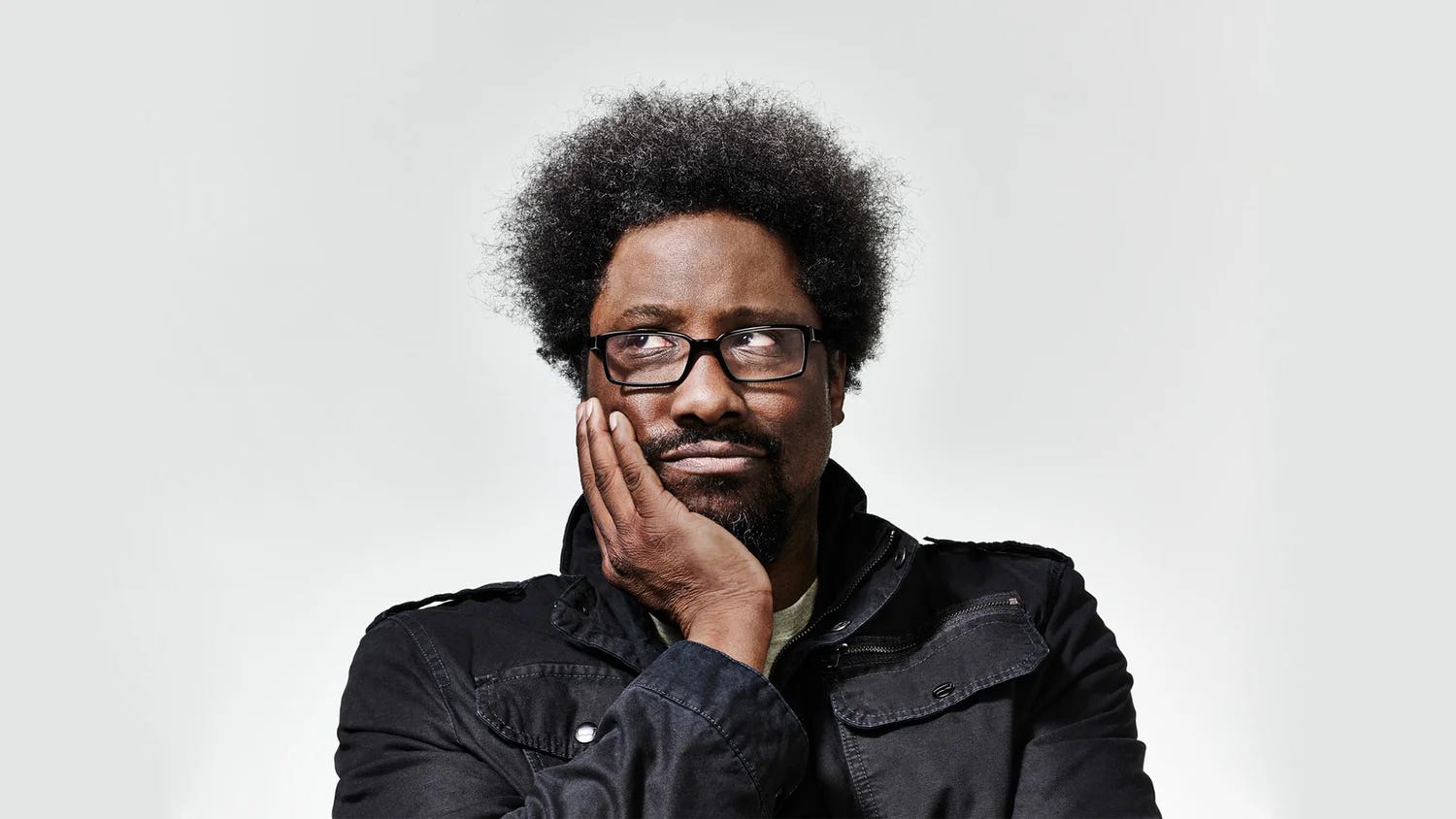
As you likely know, I’m a big fan of W. Kamau Bell, the stand-up comedian, director, all-around insightful thought leader, and television host who sometimes visits us on The Coffee Klatch. His news commentary is ruthless and irreverent, and important.
He invited me to be on the latest episode of his new podcast WHO’S WITH ME? which came out today.
If you aren’t already following Kamau here on Substack, I recommend you sign up for “Who’s With Me?” here.

 Login
Login