Happy Saturday! Overtime is for everyone. If you’re a Bulwark+ member: thank you. If you’re not, there’s no better time to subscribe to Bulwark+ than today. If you like today’s issue, you can share this newsletter with someone you think would value it.
Come hang with gang—Sarah, Tim, JVL, Sam and friends—during our Good Fight Tour.
October 16-20 we’re bringing Bulwark LIVE to Columbia, SC, Charlotte, NC and Atlanta, GA. Tickets are on sale now through TheBulwark.com/Events.
Let’s be together.
ICYMI: Here are links to each newsletter section so you can quickly get back to that edition you may have missed this week.
ICE has come to Springfield… ICE has already targeted a popular Haitian pastor and around 30 people are being housed in suburban Cincinnati at a jail handling ICE prisoners. Pastor Carl Ruby of Springfield’s Central Christian Church observes: “This arrest shows how low ICE will stoop to incite panic among people who came here peacefully, came here legally and offered nothing but good to our community. Earlier this week, he told The NY Times: ‘Their real goal is to incite fear, hoping that people will go back to Haiti.’” I plan to head to Springfield next week and will report back.
Come join us in the subscriber chat to get to know fellow Bulwarkers going to these events. Join the subthread for the event in your city to say hi and introduce yourself to the community of folks who are going. Who knows, a comment pal you’ve chatted with might be coming to that show! Hope to see you there.
YEA or NAY? Longtime readers know I am a bit of a Senate snob, it was my preferred chamber back in my staffer days. So imagine my interest when a new game called YEA or NAY was introduced by Alexander Goddard. It is not a mindless game one can play quickly! I asked Goddard what inspired him to make it, and he tells me “I am a big fan of daily trivia and wordle style games in general, especially Tradle from Observatory of Economic Complexity. I’ve built several prototype games over the years but when I began to play the prototype of Yea or Nay I found it interesting how difficult it was to get a perfect score as Senators, especially in the past, do not always vote along their party lines.” Such votes are more of a rarity these days, but fun to play and to remember.
Happy Saturday! Overtime is for everyone. If you’re a Bulwark+ membmer: thank you. If you’re not, there’s no better time to subscribe to Bulwark+ than today. If you like today’s issue, you can share this newsletter with someone you think would value it.
Well, it’s the end of summer… Our tradition, since moving here, has been to get to King’s Island before the regular season closes. Growing up in Cleveland, I am a big roller coaster fan (as most are). After a week of storms (and a derecho!) it was a gamble, but it turned out to be a beautiful, uncrowded day.
As seasons change, I get a little nostalgic, turning into Chris Stevens from Northern Exposure who once opined:
We look behind us to see how far we’ve come, and we realize that our past isn’t a solitary trail through secret woods, but a vista… as big and expansive as the ocean itself, with our experiences stretching to the horizon, like tiny dot-like sailboats sucked up into the enormous sea.
A good perspective from a great old show. But now that school and election season is in full swing, it’s good to know from whence you came, but clear about the path forward.
If you’re thinking: what’s something I can do? There’s an easy answer if money and time are tight: volunteer to be a poll worker. In 2023, I wrote an article on a great group called “Power to the Polls” trying to fill the ever present need for people to step up and administer our elections.
Happy Saturday! Overtime is for everyone. If you’re a Bulwark+ member: thank you. If you’re not, there’s no better time to subscribe to Bulwark+ than today. If you like today’s issue, you can share this newsletter with someone you think would value it.
This week, I wrote two items on our gubernatorial race. When I got my start in politics (checks calendar) 27 years ago, I was an active participant in campaigns. Now, I observe them and write about them. It’s been an interesting trip down memory lane for me, but more on that in a bit. I hope you enjoy the Buckeye coverage and will join me in the comments for some #OhioTalk.
Join Mona Charen and Bill Kristol for the next edition of The Bulwark Book Club LIVE at 1:30 p.m. EDT. This month’s pick is Mark Twain’s Pudd’nhead Wilson. Read it this weekend–it’s a quick read–then drop your questions, comments, thoughts on it for Bill and Mona through the comments of this post. We are excited for an afternoon of book talk and community with you.
Much like any job… Being a former political operative is not unlike working at McDonald’s. Once you’ve operated the fryer or manned a drive-thru window, you’ll never look at ordering fast food the same way.
For me, since politics is everywhere, being back in Ohio, where I grew up and worked in politics since I could drive, there’s a lot more I can’t unsee. Parades, county fairs, festivals. You watch the present-day practitioners and inevitably think back to your own glory days, perhaps even glamorizing the good old days a little. (The merch these days is way better.)
As I was waiting for Vivek Ramaswamy in Clermont County, I scanned the audience like I was doing advance work, making note of the potential disruptors. Not because I was worried about a heckler, but because I was curious about their perspective. And in Cincinnati, as I waited for Amy Acton to arrive at the local union hall, I kept thinking about a police union hall I was in 20 years ago, wondering if it had the same architect.
Suffice to say, if you read my two pieces, only one candidate, Amy Acton, has nostalgia on offer, the Ohio of yesterday. Vivek Ramaswamy seems to be “conservativemaxxing” hoping that decades of Republican rule will pay off for him. But it’s hard to be the candidate of change when your party has run the joint for decades.
As we saw in Missouri this week, voters rejected a ballot initiative to phase out the income tax. In Ohio, too, as I watched voters ask Vivek questions about his multitude of plans to make you pay less (or zero) for things that make the state and local governments run, I had a shred of hope.
Nobody loves paying income taxes or property taxes. But even people who have a sort of ironic disconnect who will laugh off extreme rhetoric as part of the game realize that at the end of the day, we have to pay for things. (Vivek had not yet announced his “free electricity in exchange for data centers” plan.)
In these 88 days until election day, I look forward to reporting more from the trail here in the Buckeye state on these campaigns, as well as from Springfield. It’s been so nice to hear from longtime members in my inbox and in the comments about their Ohio memories. And I’ve even met some readers who used to live in my Cincinnati neighborhood.
So this week’s comment prompt is: What do you miss about the politics of yesteryear? How much of that can we bring back, and how do you convince people to #Believe?1
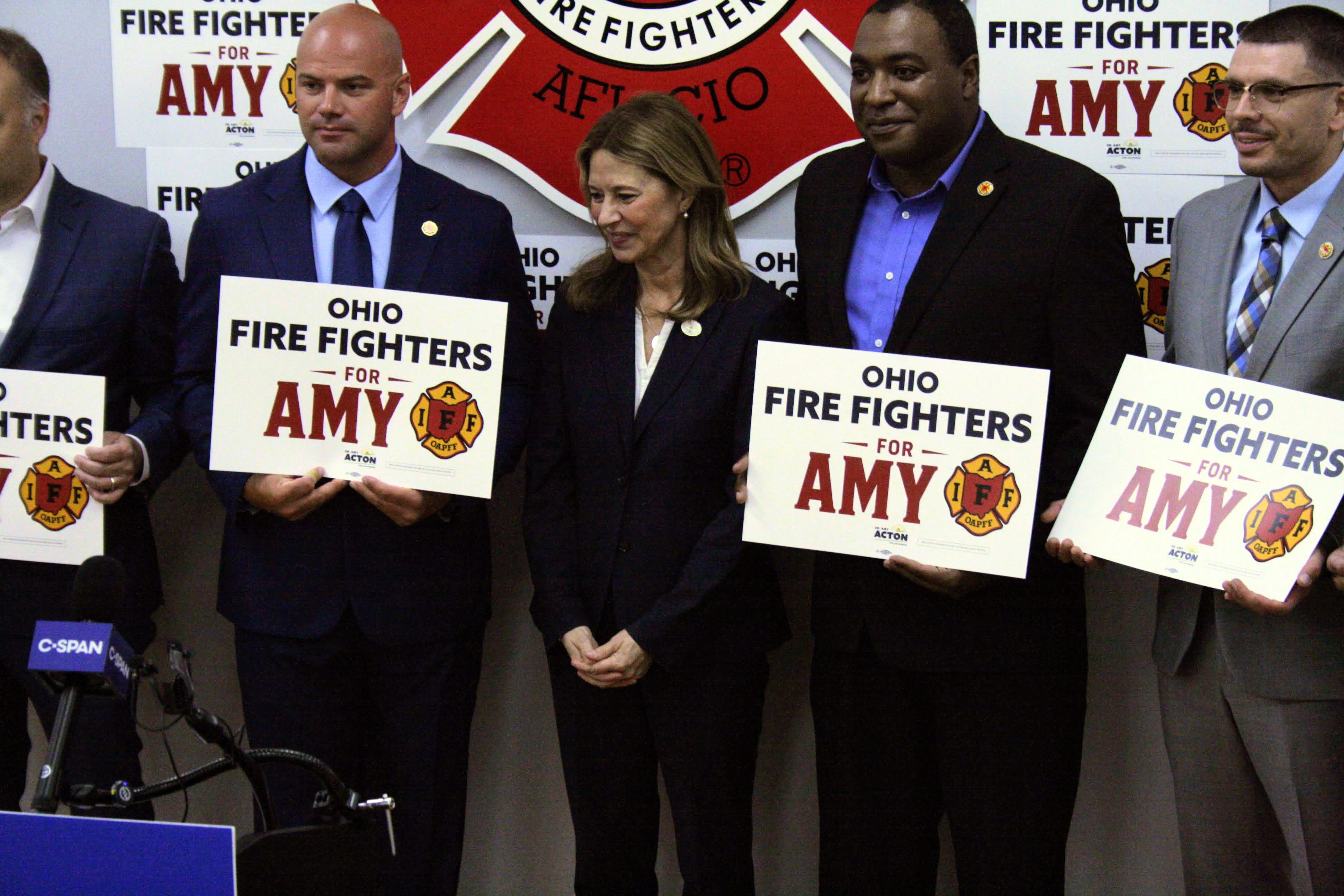
Cincinnati, Ohio AMY ACTON PICKED UP A BIG ENDORSEMENT Monday in a union hall on the city’s west side. In a room decorated with historical mementos honoring Cincinnati’s fire department, the oldest professionalized municipal fire department in the country, Acton was surrounded by a dozen or so union leaders as the Ohio branch of the International Association of Fire Fighters threw its support behind her gubernatorial bid.
This year, the cops-and-firefighters split is stark in Ohio. The state’s Fraternal Order of Police gave Republican Vivek Ramaswamy its endorsement, which it also extended to every other Republican running statewide. And while the firefighters have in the past gone in for both Republicans and Democrats, for most of the last decade and a half—ever since then-Gov. John Kasich in 2011 pushed for and signed a law (later repealed) sharply curtailing public employees’ collective-bargaining rights—they’ve placed their bets pretty firmly with Democrats. This fall they are all-in on Acton.
On this hot summer day I’ve come to the Fire Fighters Union Local 48 hall to see Acton in action and grab her for a chat after. The event, closed to the public but open to some members of the press, will be the first chance I’ve gotten to observe the candidate up close.
(Photo by Jim Swift)
The first thing to grab my attention is a reminder from the president of Columbus’s Local 67, Steve Stein, of how Acton, a physician who was director of Ohio’s Department of Public Health from 2019 to 2020, responded to the pandemic. For Republicans, seething over COVID public health interventions has become de rigueur. There was some freshness, then, in hearing words of praise for a public servant who did battle with a deadly virus against which we were initially almost defenseless:
We weren’t sure if we were going to lose half of our workforce responding to this [COVID]. And every single one of our members said, “We’ll see you tomorrow.” And it was leadership—proven leadership—[from] people like Dr. Acton, Gov. DeWine and the team, and the hard work of our firefighters, EMTs, and paramedics, that responded to every single Ohioan, no matter where they lived. . . . Those decisions weren’t partisan. They were decisions about safety. They were decisions about serving other people.
Stein wouldn’t be offering this praise if Acton didn’t welcome it, which suggests the candidate is going to respond to Republicans’ COVID-related attacks by refusing to cede the ground of science and memory to them. A preference for the truth shouldn’t be extraordinary in mainstream political candidates, but in 2026, it’s a promising opener for anyone who would prefer not to be gaslit about that recent episode of extraordinary suffering and death.
When Acton gets up to speak, she makes clear she is less interested in relitigating the pandemic than in talking about the Ohio she wants to build. But as she gives her values-forward stump speech, it’s tempting to let your mind wander backwards, to a time before the pandemic and before MAGA. In some ways, the future Ohio envisioned by Acton sounds an awful lot like the one she knew during childhood.
“When I was growing up in Youngstown, we didn’t know what party you were in,” she says. “We knew what union you were in.”
Fearless reporting. Sharp analysis. And commentary that helps you see around corners. Make sure you miss nothing—join Bulwark+.
In the Youngstown of Acton’s memory, partisan affiliation was an abstract feature of a person’s identity. The concrete things about you had to do with the institutions down the street: unions, yes, but also churches, neighborhoods, and civic organizations, and underneath all that, the general expectation that you and your neighbors would look out for one another. It’s the spirit of small-town Ohio—a pretty faithful impression, even if the warts have been removed.
Life in such a setting can be far from idyllic, of course. Acton and her brother experienced a childhood marked by abuse and neglect—the subject of her first campaign ad. For a time, they lived in a tent during a Youngstown winter. This morning, she emphasizes that it was often first responders and neighbors who intervened to make sure the pair of kids were okay. Some would even invite them onto their front porch for an impromptu breakfast “just because we were hungry.”
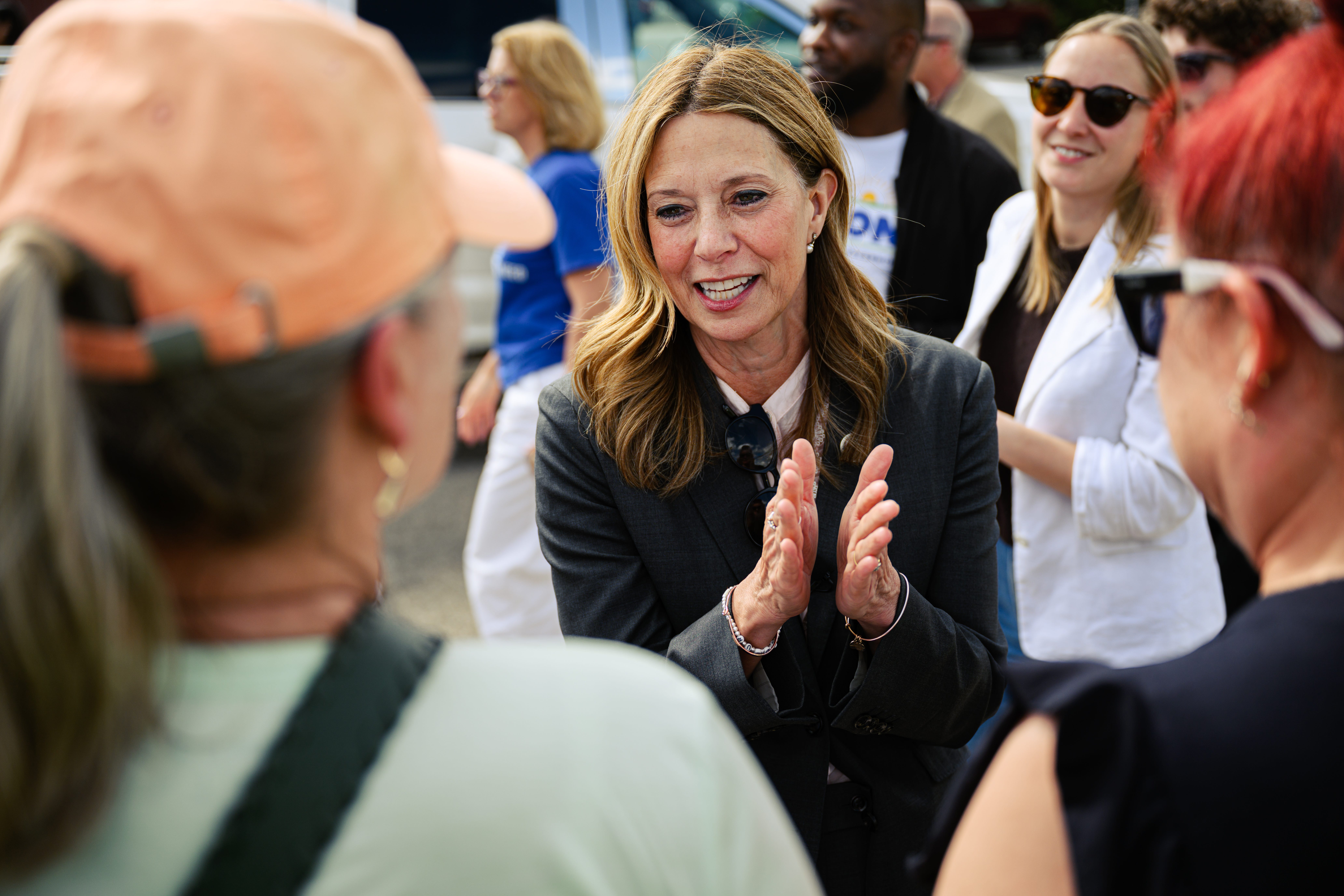
It might be because of this hardscrabble background, but Acton’s empathy doesn’t feel like an act in the way it so often does with other candidates out on the campaign trail. “I’m a doctor. I’m not much of a politician,” she says, adding, “I’m becoming one right in front of your eyes.” Watching Acton, it seems to me that she doesn’t work a room so much as observe it, and in a way that reminds me of the moment a physician looks you over before starting the conversation during an exam. In response to questions, she sometimes pauses to take in the questioners for so long that it’s almost physically discomfiting. Call it retail bedside manner.
The doctor’s diagnosis is that the state has an acute infection of political acrimony that needs to be addressed in order to treat a deeper underlying condition: economic malaise. “Everywhere we go, people are longing for public servants again, and they’re longing for this hate and chaos and vitriol and purposeful pitting against one another to end,” she says. “The issues they talk about—95 percent of them—no one would disagree on: It’s the cost of living, housing, educational costs, childcare, property taxes.”
She cites a Clermont County family with premature twins who had accumulated $300,000 in medical debt from a neonatal intensive care stay. They had done everything right, she says, yet still found themselves financially overwhelmed. Anecdotes like this frame Acton’s defense of her medical debt–relief policy, which Ramaswamy recently seized on as proof that she is a socialist of some kind.
It’s a stark contrast to Ramaswamy—who recently was booed by an audience of conservatives for claiming his generation is “going to be fine” and has “already made it.”1
“For pennies on the dollar, we’re renegotiating that debt,” Acton says—noting that “Illinois spent $10 million of state funding, and they alleviated a billion dollars of people’s debt.”
After this, Acton moves through a cavalcade of pocketbook-focused policies, concluding with her proposal for a “circuit breaker” rebate for middle-income homeowners facing steep tax increases. After that, a moment of vintage Americana.
“This endorsement means everything to me,” she tells the firefighters. “You’ve been my heroes, and I promise that I’ll be fighting so that no one in this state is ever unseen.”
SITTING DOWN WITH ME after her speech, Acton reiterates that she isn’t a natural politician. “My last office I ran for was in high school,” she tells me. “The instincts of being a 60-year-old doctor and doing public health and preventive medicine—it’s always about going to ground. It’s always about the community as your patient. That was my instinct all along, and I started going around listening even before I filed my paperwork to make the decision to run.” In her Toledo-built Jeep Wrangler, she says, “I’ve been to every county in Ohio. . . . I wanted to meet people where they are.”
Meet them she did. At a recent Democratic dinner in Fulton County that normally draws a few dozen people, more than three hundred attendees turned out. Many, she recalls, introduced themselves not as Democrats but as lifelong Republicans. Acton believes some of her draw, and some of the willingness of those guests to put aside partisan loyalties, traces back to the pandemic.
“It’s a deep bond that formed around going through such a very hard time. It’s very unique. I don’t think a politician could intentionally create this kind of connection,” she reflects.
That experience of collective suffering—and Acton’s presence in communal memories of it—also helps explain why, she says, “I’ve never been in a room in two and a half years where someone doesn’t cry.”
Every campaign has its unique rhythms and quirks; regular weeping from eventgoers is far from the strangest I’ve encountered over my years of following national politics. But it provides a curious point of contrast with the aversive reaction associated with Ramaswamy’s campaign.
“My opponent was just out last week with the whole, ‘victors not victims, you’re whiny and complaining’ stuff,” she tells me. I point out that, during his humiliating performance at YALCon, there were quite a few whiners in the crowd.
FOR ALL THE ATTENTION PAID to Acton’s public health role during Ohio’s experience of the pandemic, it is easy to forget that it represents only a small chapter in her career. She has worked with five governors—Republicans and Democrats—and her experiences have given her a zest for (reasonable) bipartisanship.
If elected, she says, she will appoint Republicans to her cabinet, because Ohioans should expect their governor to work with anyone willing to solve everyday problems.
One former Republican governor in particular genuinely excites her: Bob Taft.2 Acton and her running mate, lieutenant governor candidate David Pepper, recently met Taft for lunch. The former governor arrived carrying a crumpled, coffee-stained sheet of paper on which he’d listed everything he’d hoped to accomplish when he became governor in 1999.
Together, Acton tells me, the three of them walked through the list. The Taft of yesteryear had set his sights on constructive, reasonable goals: new parks, initiatives to encourage economic development, and other long-term projects of the sort that rarely dominate campaign speeches but can shape a state for decades.
Acton explains that she didn’t see this as an exercise in nostalgia. Rather, she takes it as a reminder that governors once measured success by what they built. In a time of endless, unproductive scrapping, that seems like a useful thing to recall.
But in addition to the economic and material considerations informing Acton’s policy offer and her own desire for building up Ohio, she has a priority issue in the area of cultural politics. The question: Why are we all so bummed out? Acton’s answer: because we are so damn lonely.3
Ohioans are “absolutely exhausted of hate, chaos, and vitriol, and being pitted against one another,” she tells me. “We are hardwired for human connection.” As an exhausted and angry Ohioan, I am inclined to agree.
She invokes Bowling Alone, sociologist Robert Putnam’s landmark study of America’s fraying civic life and declining social capital that has been helping people see those problems more clearly for over a quarter century. Putnam’s book is “about the fabric of our civic society. I was talking earlier about [how] people didn’t know what party you were in; they knew what union you were in,” she tells me. “They also knew what hat you wore, if you were an Elk or a Moose or whatever. There’s so much pride, and people wanna have pride again in Ohio.”
As an Elk (and a fan of Putnam, who has been a Bulwark Daily guest), I heard Acton speaking to me in my own born-again Ohioan’s language. Our state’s politics, culture, and even our sports teams are subject to derision and often made the butt of hostile jokes. People still laugh about the Cuyahoga River catching on fire. But damn it, I still love Ohio. I moved back here, after all. It’s clear that Acton does, too.
“I always say when I’m going around the country, it’s the United States of Ohio,” she says. “We’re the test market. We represent the whole United States.” That’s part of what being the “Heart of It All” is all about. But the heart is deceitful above all things, and it’s got reasons that reason does not know—all of which is to say, it’s going to be another three months of weeping and whining before we know the road ahead for Ohio, and for the United States thereof.
It’s certainly understandable that Ramaswamy would have a loose grasp of on-the-ground issues for Ohioans, given that he appears to have spent almost half his time during this campaign outside the state.
Owensville, Ohio FRESH OFF A HUMILIATION, last week saw Vivek Ramaswamy barnstorming Ohio’s county fairs.
On Wednesday, Ramaswamy attended an annual convention of Young Americans for Liberty, a libertarian group for college students, at Xavier University in Cincinnati. (Think of it as a Temu TPUSA.) It did not go well. He came across less like a traditional politician in campaign mode than a too-confident debater who assumes the way to win an audience is to out-argue it. He was booed. He was heckled.
I had seen Ramaswamy face an unfriendly audience at a Turning Point USA event back in April. At the time, it felt jarring to watch him struggle with a room that, at least ostensibly, should have been full of allies. YALCon was far worse.
Using a stump speech about “winners and whiners,” Ramaswamy exhorted the audience to choose winning over grievance. Alas, the audience, which did not see itself as a collection of whiners, whined.
In his 2022 book Nation of Victims, Ramaswamy invokes the “Nacirema” (“American” backwards), the fictional tribe from Horace Miner’s famous anthropology satire. “They died out eventually under the weight of their own insecurities,” Ramaswamy writes. “It’s hard to understand how the Nacirema managed to exist for as long as they did under the burdens they imposed on themselves.”
His point is that contemporary Americans have been consumed by insecurity and victimhood politics. The irony here is that, in our political life today, the people who are most driven by their insecurity and most outspoken about their victimhood are in today’s Republican party, which has moved beyond the original iterations of MAGA toward one grounded in the grievances of Donald Trump, whatever they happen to be that day.
So following his unpleasant experience at YALCon, I was curious to see how Ramaswamy would perform in a more neutral setting, like the Clermont County Fair. His campaign has largely avoided contentious public events, yet somehow keeps finding controversy in unexpected places. Would the gubernatorial candidate, born and raised in nearby Cincinnati, come across as normal and friendly, or off-putting and argumentative?
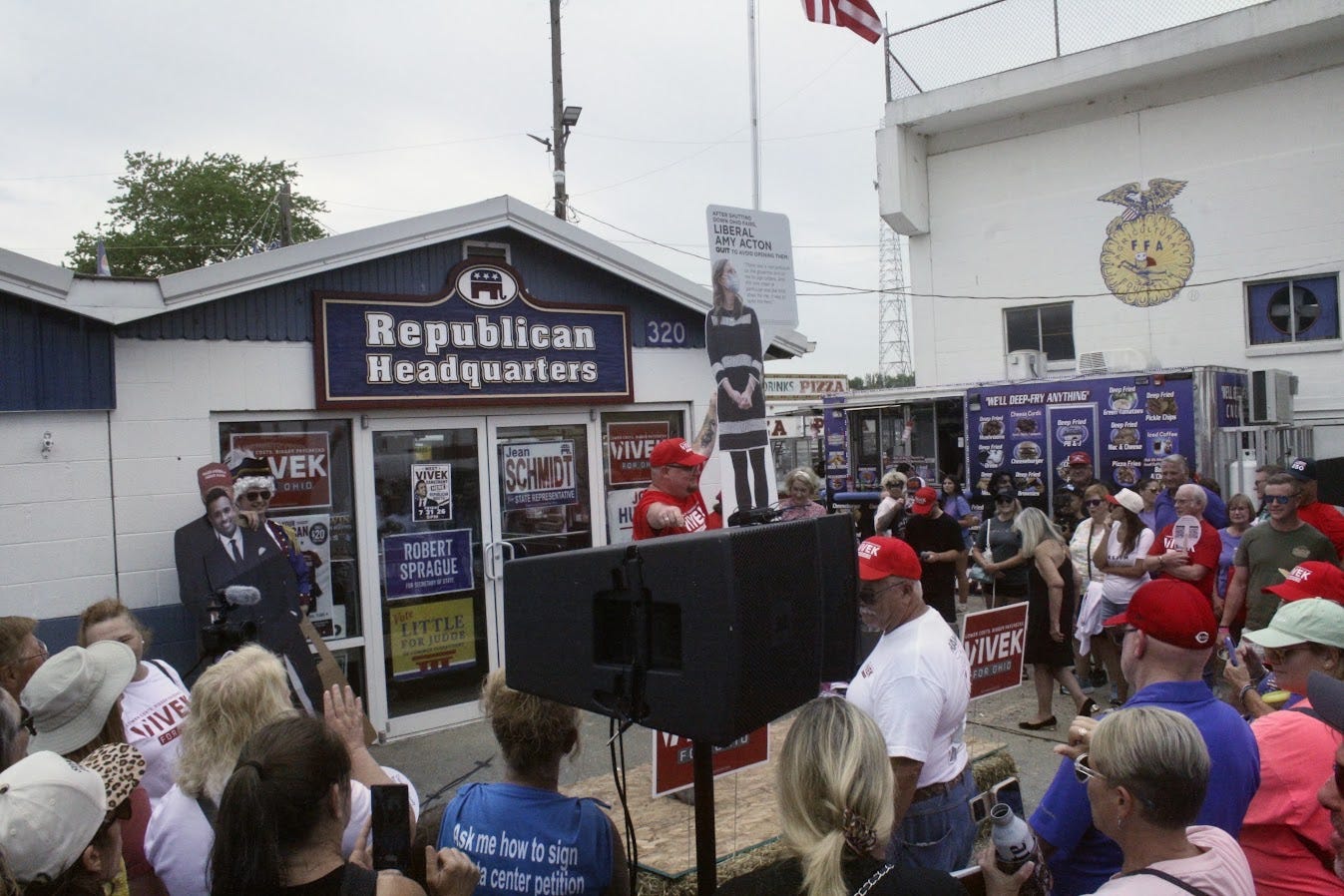
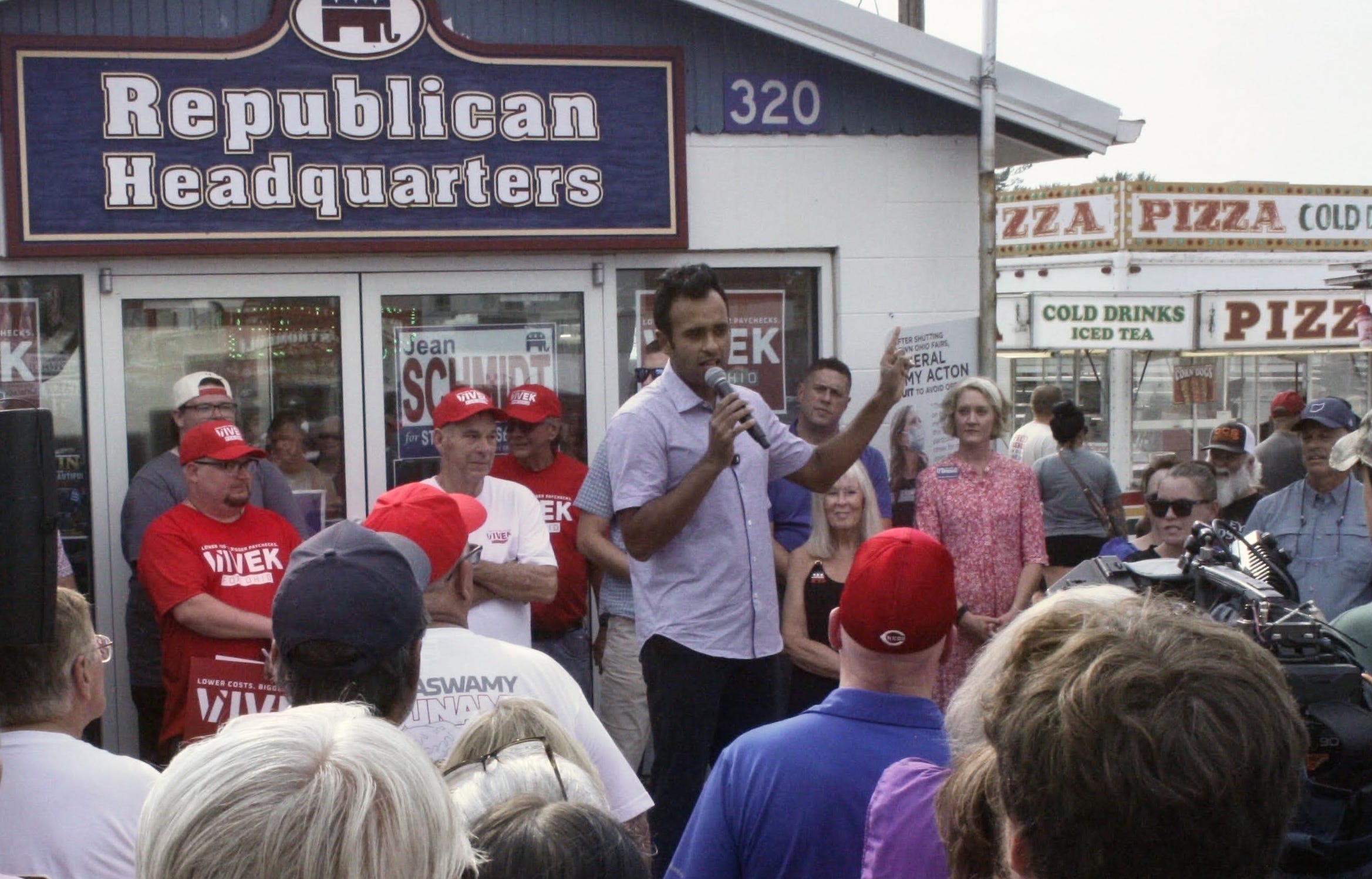
THE CLERMONT COUNTY REPUBLICAN PARTY headquarters is a permanent structure tucked behind the main grandstand, at the intersection of two of the fair’s busiest walkways. About two hundred people crowded around it on Friday afternoon to hear Ramaswamy speak.
The crowd starting to gather in advance of Vivek Ramaswamy’s remarks on July 31, 2026 at the Clermont County Fair in Ohio. (Photo by Jim Swift)
A man in colonial garb and a tricorn hat stood guard at the door, carrying two copies of Ramaswamy’s book. Since fairgoers had to pay to get into the fair, this event was not quite as ‘open to the public’ as Ramaswamy’s TPUSA event was earlier this year. Still, the crowd offered a pretty good cross section of this mostly Appalachian county—although of course the crowd that gathered to hear him talk slanted Republican.
Clermont is a mix of old river towns and rural communities that has increasingly become an exurb of Cincinnati, complete with subdivisions, office parks, and even a few major companies. One of them is the trucking logistics firm TQL, whose name adorns the stadium where Cincinnati’s Major League Soccer team has played for the last five years.
Ramaswamy’s press secretary quickly marked me as a reporter. We had a polite chat, but when he told me there was unlikely to be a press scrum, I was disappointed: I had hoped to ask Ramaswamy whether he realized the Nacirema problem he identified had consumed his own party.
As the audience waited for the candidate’s arrival, I heard a man standing near me—a guy double-fisting lemonades, including a half-gallon jug—tell his friend that he agrees with “95 percent-ish” of what Ramaswamy says. There are some doubters here, too, which makes sense: The booth for the Clermont County Democrats was just around the corner, near the fair entrance.
Lemonade is something of a cultural phenomenon at Ohio county fairs: People even bring back cups from previous years to get the refill price.1 While we were waiting, the man with the lemonades standing near me was visited by his daughter and son, who came by to retrieve a refill cup and to get some money for food. The man forks over $20 apiece, along with some fatherly advice: “Ask how much it is before you hand over the money. And then do your change. If it’s not right, you say, ‘Hey, it doesn’t add up.’ Re-add it.”
He had no way of knowing it, but he had just offered the perfect advice for the audience about to listen to Ramaswamy speak.
Pop this article into a friend’s inbox or post it to social media:
Shortly before Ramaswamy arrived, a man associated with the local GOP brought up cutouts of Donald Trump and Vivek Ramaswamy, holding them up one by one to gauge the amount of cheers. It was also a useful way to identify troublemakers, as some people are booing. Ramaswamy’s cutout, predictably, didn’t get the same level of cheers as Trump’s did. (The cutouts might be to scale, as the one for Trump—who in real life is eight inches taller than Vivek—is noticeably taller.)
Then, the man puts up a cutout of Ramaswamy’s opponent, Amy Acton. The speech bubble on the sign says “AFTER SHUTTING DOWN OHIO FAIRS, LIBERAL AMY ACTON QUIT TO AVOID OPENING THEM.” It provides a quote from Acton about the pressure by the state legislature to change course during COVID. “There was a real pressure on the governor and on me to sign orders. And this one order in particular was the final straw for me. It was to open the fairs.”
The quote isn’t new—it comes from a 2025 interview she gave when she entered the race, and it’s about the events of 2020—but Republicans seem to hope that it may convince fairgoers, paying $15 a pop to get in, that Amy Acton just hates county fairs.
Booing (and cheering) the Amy Acton cutout. (Photo by Jim Swift)
In fact, Acton wasn’t in favor of a complete closure of the fairs back in 2020, when she was the director of the state’s health department. She proposed county fairs be opened in a smaller capacity, along the lines of 4-H and Future Farmers of America–style activities. Not the crowded nightly smorgasbord from Charlotte’s Web.
Much of the crowd boos the Acton cutout, although some, presumably the Democrats, cheer. With the crowd semi-warmed up and potential agitators—like the woman wearing a t-shirt asking people to sign her data center petition in the front row—identified, we are ready to get started.
Ramaswamy arrived flanked by private security and Clermont County Sheriff’s deputies. Rep. Dave Taylor, the area’s congressman, kept his introduction short, billing Ramaswamy as “probably the brightest rising star in the Republican party” and a man who would unlock southern Ohio’s “unimaginably untapped” potential.
As Ramaswamy took the mic, he was immediately heckled by a woman in the front row. Here we go again, I thought.
But Ramaswamy, perhaps having learned from the YALCon failure, was able to right the ship a bit quicker. “We are Republicans. We’re respectful,” he said, promising to take questions and instructing the heckler to wait her turn.
What followed was a compact and polished stump speech built around the theme of restoration. Ramaswamy invoked Cincinnati’s machine tools, Dayton’s computing power, Toledo’s glass, Akron’s rubber and northeast Ohio’s steel. Ohio had once powered the country, he argued, and could do so again. Then came the promises: high-paying jobs, a zero-percent income tax (eventually), the largest property-tax cut in state history, cheaper electricity, and billions recovered from Medicaid fraud. He would make Ohio the state that Texas, Florida, and Tennessee looked up to rather than the other way around. I’d heard a version of this speech before in Columbus; it landed better here.
How he would pay for all this was left to the question-and-answer period. The fairgoers, to their credit, asked.
The state’s Republicans are dealing with a hard-to-control populist movement that wants to entirely eliminate property taxes in the state. This would be a first in the country: While a handful of states have no income taxes, and several states have very low property taxes, no state has zero property taxes. And while Ramaswamy does support moving toward zeroing out income taxes, he doesn’t support zeroing out property taxes.
Ramaswamy blamed inflation for soaring home values and promised to restore property-tax bills to their pre-pandemic level, then cap their growth. But Ohio’s property taxes don’t fund the state government; they fund local schools and local governments. One analysis of Ramaswamy’s plan to roll back property taxes to where they were at the start of the decade puts the immediate loss at roughly $4 billion a year. When you add on his longer-term promise to push toward entirely eliminating the state income tax—a tax that puts more than $10 billion into the state’s coffers annually—Ramaswamy’s plans are shaping up to be a fiscal disaster, leaving a combined state and local revenue hole of at least $14 billion a year, equivalent to nearly a third of Ohio’s general fund.
One fairgoer, Becky, wearing American flag aviators, said she supported Ramaswamy but was a little unclear about how his tax plans would work in practice:
I like what you say, and I like how you say it. I’m all for you, 100 percent. But I just would like to understand: When you talk about rolling back income tax to where it’s zero, and property tax is zero, how does that work? What’s the math there?
Ramaswamy corrected her, saying he was proposing a rollback in property taxes, not eliminating them. He said schools could absorb the lost revenue by cutting bureaucracy and directing more money toward classroom instruction. As for the income tax, he argued that previous cuts had generated more revenue than projected by keeping residents, spending, and investment in Ohio. He conceded that zero would not happen overnight, instead describing an eight-to-ten-year phaseout beginning with the elimination of the capital gains tax in 2027, too.
In other words, the tax cuts would largely pay for themselves. (Having been a Republican tax staffer in the late 2000s, I had heard this slogan a couple million times.)
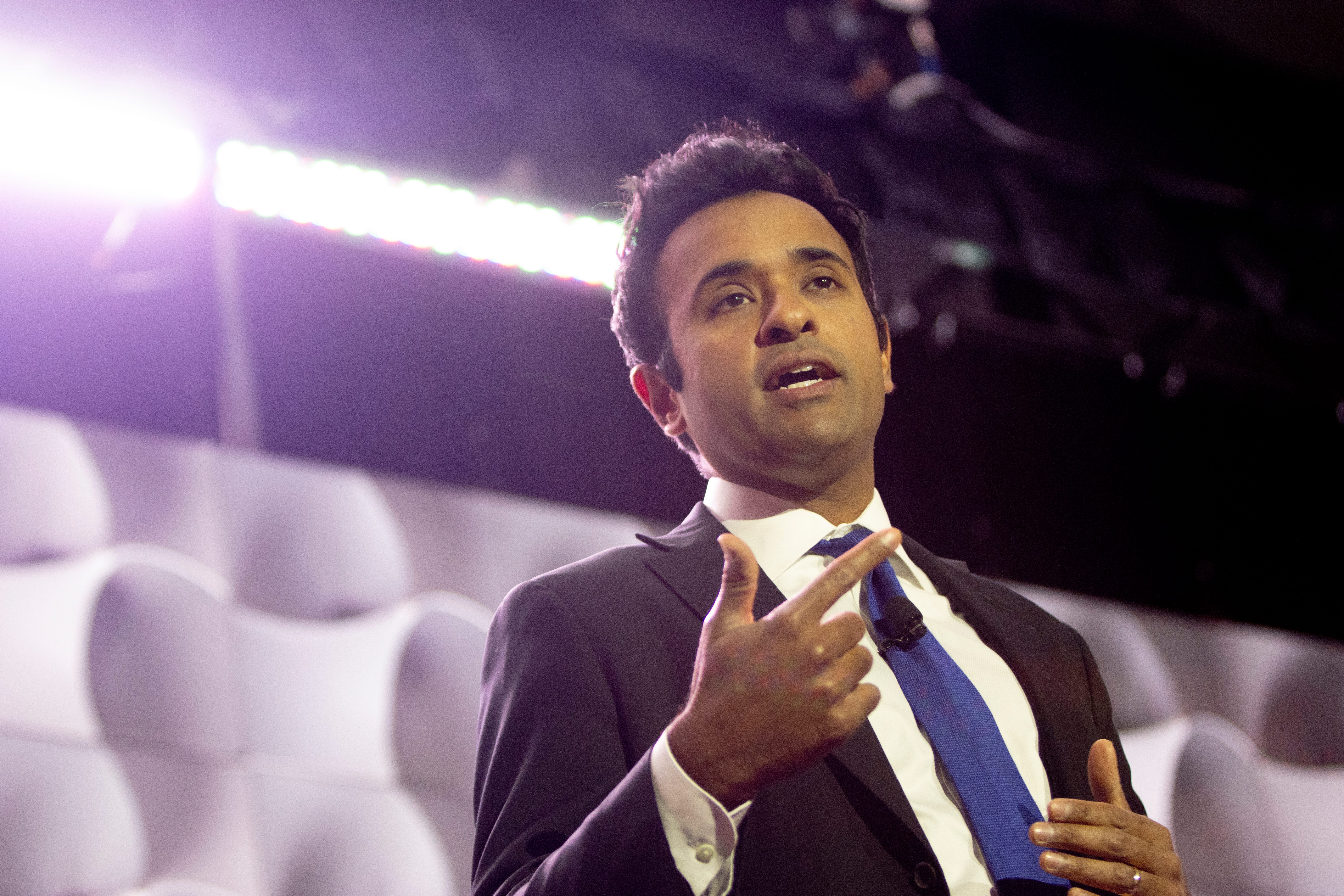
Vivek Ramaswamy. (Photo by Jim Swift)
When another fairgoer, Vera, a caregiver for people with developmental disabilities, asked about higher Medicaid reimbursements for badly underpaid workers, Ramaswamy was very sympathetic to her, calling her a “hero” and saying he understood how bad things are in her field. (Ramaswamy’s wife is a doctor.)
But surprise: Ramaswamy has in mind another enormous pot of money that would pay for his proposed changes. He claimed Ohio sends at least $4.7 billion a year to hospice, nursing-home, and home-health providers that “don’t even exist.” He would prosecute the fraud, recover the money, and persuade Washington to let Ohio keep it.
Ramaswamy revealed he had hosted Dr. Mehmet Oz, the celeb doc who now heads the Centers for Medicare and Medicaid Services, in his backyard six weeks earlier to discuss “the deal we’re gonna do with the federal government.” He predicted the arrangement would return $3 billion to $4 billion a year to Ohio. Assuming his assessment of the scale of the fraud problem is remotely close to correct, and assuming a deal with the federal government can actually be struck, and assuming the deal withstands legal challenges, how long it would take to prosecute and recover those billions is anyone’s guess. In other words, a lot of “ifs.”
No credible campaign against “waste, fraud, and abuse” could make up the difference of what Ramaswamy is proposing. A spending gap of the sort his plans would create would almost certainly result in historic cuts to schools—think firings, school closures, delayed upgrades, leaky roofs, etc.—and Medicaid and local services.
Unless, that is, the money came from somewhere else—like, say, a dramatically higher and broader sales tax. Innovation Ohio, a progressive policy group, estimates that replacing the income tax alone would require a 65 percent increase in state sales tax collections. Separately, Jared Walczak, a senior fellow at the Tax Foundation, has estimated that replacing all of Ohio’s property taxes would require a 14.5 percent state sales tax rate, before local taxes. (Republicans have previously flirted with a sales-tax based economy, as I’ve written before. The idea is stupid, regressive, and unlikely to happen.)
The questions kept coming. Dave Loback of Anderson Township pointed out that much of his own property tax bill came from levies approved by local voters. Would Ramaswamy’s rollback eliminate those, too?
“The property tax question gets a little bit complicated,” Ramaswamy conceded. “I don’t even have a whiteboard here to lay it all out.”
So instead of getting into those details, he returned to his overarching promise: However the state accomplished it, each Ohioan’s total property tax bill would return to its pre-pandemic level, and for taxes outside the governor’s direct control there would be refunds. The details could wait. The money, somehow, would come back.
Ramaswamy’s answers were just like what the Lemonade Dad told his kids to watch out for: “If it’s not right, you say, ‘Hey, it doesn’t add up.’”
TAXES WEREN’T THE ONLY THING Ramaswamy was asked about. On data centers, Ramaswamy was more cautious. Jessica, the woman in the front row with the petition, asked him to sign it. He promised only to read it. Communities that wanted data centers should be allowed to have them, he said, while communities that did not should not have them forced upon them. He promised legislation on the matter within his first six months as governor, after he had met with people on both sides.
It was a more recognizably political answer—which is to say, it acknowledged complications rather than wishing them away. “This issue has changed so much in the last year and a half, like the facts every day, it’s a new one popping up, new facts,” Ramaswamy said.
Donald Trump almost entered the discussion. One member of the audience, a film student making a documentary, had been following Ramaswamy to recent public events. This was his first shot at a question. He began by praising Ramaswamy’s campaign against “fraud and waste and corruption,” then asked how he reconciled that message with reports that Trump had made $2 billion the previous year. Before he could finish, a woman in the crowd suffered a medical problem. Ramaswamy stopped to make sure she was okay. And when the questioning resumed, he moved on to someone else.
Trump, unlike property taxes, never came back up. In fact, Ramaswamy never mentioned Donald Trump once.
Ramaswamy did take some shots at Acton, calling her a “socialist” and challenging her to join him at Ohio’s county fairs, again trying to plant the idea that she is weirdly hostile to the fairs themselves because of the debate over pandemic-era restrictions.2
Ramaswamy, after finishing with the audience, chatted with some 4-H members, and even paid a visit to the Democratic booth—resulting in an ‘I’m relatable, not hateable’ clip he could post to social media.
This was not YALCon. Ramaswamy controlled the interruptions, delivered a disciplined speech, and took unscripted questions from supporters and skeptics. He was markedly better with, well, grownups from a somewhat mixed public audience than he had been with the young, extreme activists who used to be his allies.
Yet the county fair crowd was, in a way, harder. This was not an audience asking about conspiracy theories, or making arguments about Jews, or wanting to debate whether they were winners or whiners. This was an audience that had their wallets on their minds. They wanted to know how the math worked.
Correction (August 5, 2026, 8:00 a.m. EDT): As originally published, this article incorrectly stated Amy Acton was slated to be at the Brown County Fair on August 9, 2026. It is a different event.
Happy Saturday! Overtime is for everyone. If you’re a Bulwark+ member: thank you. If you’re not, there’s no better time to subscribe to Bulwark+ than today. If you like today’s issue, you can share this newsletter with someone you think would value it.
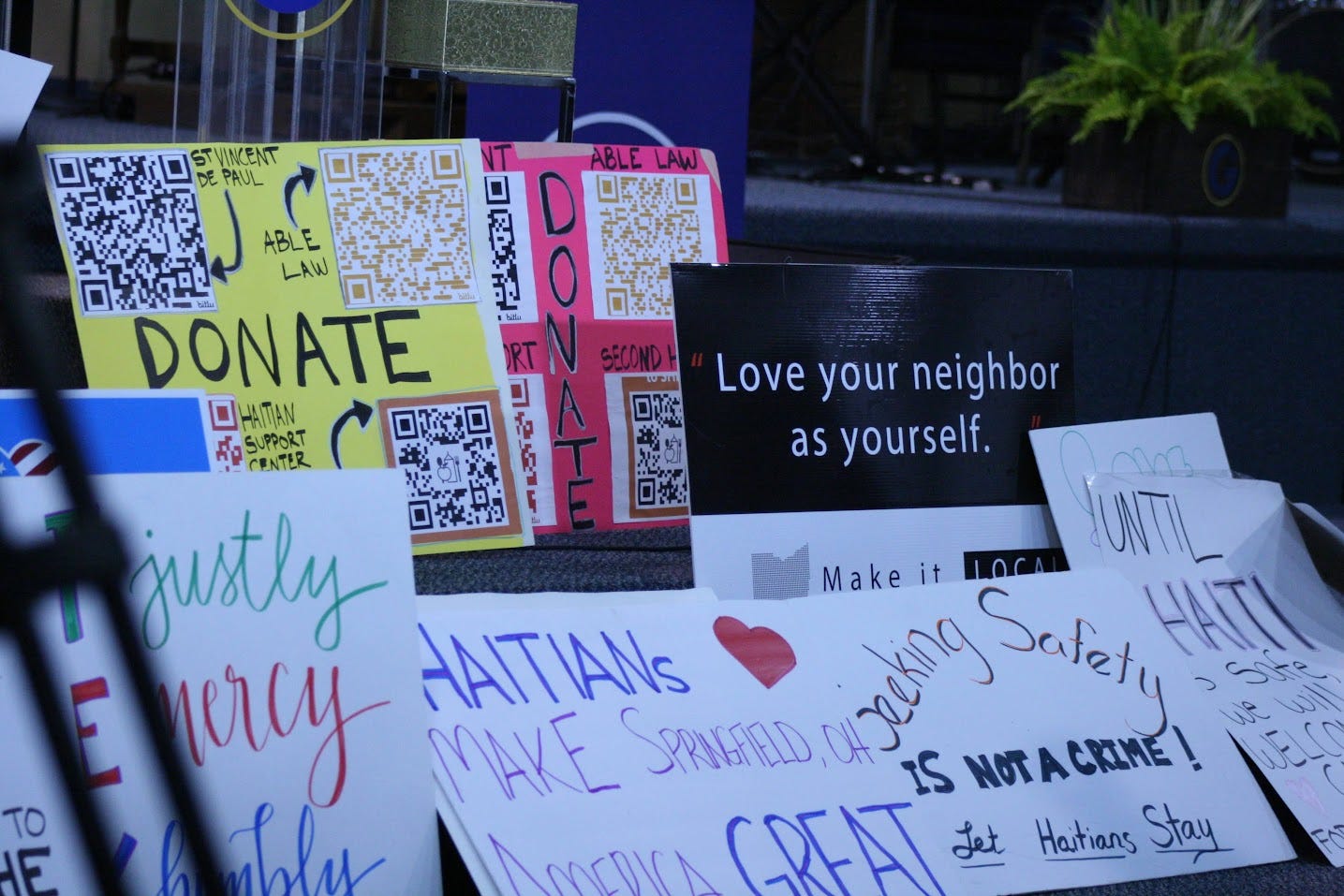
Signs at the G92 press conference earlier this week, encouraging donations.
The Importance of Being There…
When I moved back to Ohio two years ago, I didn’t move back for work. And while I’m on the complete opposite end of the state from where I grew up, being here has had its advantages.
It’s not just the tri-state nature of Cincinnati, which puts me within easy reach of three states and three distinct political cultures. Some of it has simply been chance. Vivek Ramaswamy becoming the Republican nominee for governor? I saw that one coming a mile away and moved here in spite of it.
Take Springfield. I couldn’t have predicted that JD Vance and Donald Trump would take a heinous lie about hard working Haitian immigrants, refuse to ever walk it back or apologize, and essentially bully a town whose comeback owed so much to those very immigrants. That story found me.
Yesterday, my friend Asawin Suebsaeng of Zeteo, who also lives here in Cincinnati1 and has spent time in Springfield, shared a few observations that I couldn’t get out of my head:
Springfield right now—we can use Megyn Kelly as one of the most resplendently annoying examples—shows a stunning amount of contempt for small American cities like Springfield.
Are there people in the Springfield area who love Trump and want the Haitians cleansed and rounded up? Sure. But the idea that if you rip away all the Haitian immigrants (who have/had documents, by the way!), you’re going to make that city better for the everyday people who live and work there... I don’t know, man. Visit Springfield once and tell me that that is a common-sense conclusion to make.
I’m not saying you have to visit someplace to have a valid political opinion, but I’m not asking you to visit Kyiv. This is, like, right there for a lot of these Two Minutes Hate people.
Being here matters. Being able to see and talk to the people living through this matters a lot. It’s also something both readers and people there have told me: “Thanks for being there.” Or simply, “Thanks for coming.”
Remote punditry is easier than ever these days. Going to their grocery stores, their Walmart, the Eagles Club, walking Buck Creek as the community gathered for a concert, spending time in their thrift stores, pizza parlors2, and places of worship? It changes you.
If I had to write about TPS and what’s happening from Virginia, I could probably write similar stories. But meeting people like Viles Dorsainvil, Carl Ruby, our reader Rick, Marjory Wentworth, and others? It motivates me. It also makes me madder about what’s happening, and about chucklefucks like Megyn Kelly spouting truly awful things from the safety of her air-conditioned studio that SiriusXM helps fund for some reason. Infuriating.
If I thought she were a good-faith actor at this point, I’d encourage her to visit. But I don’t. The good people of that fine city deserve better visitors.
I’ve gotten emails and texts from readers asking how they can help. Unless you’re local and have the time and capacity to help, they need your money. Money is the only thing that will make a material difference right now for Haitians in Springfield.
Happy Saturday! Overtime is for everyone. If you’re a Bulwark+ member: thank you. If you’re not, there’s no better time to subscribe to Bulwark+ than today. If you like today’s issue, you can share this newsletter with someone you think would value it.
FC Cincinnati defeated the Vancouver Whitecaps 4-3 in a return to MLS play earlier this week.
Congrats to our World Cup Winner… David Belkin, a OG Bulwark member. While he didn’t correctly pick Spain winning it all, he was in the 94th percentile of players. Impressive! He wins a free year’s access and some surprise goodies. While the World Cup is over, baseball is back, and the summer of soccer continues (for some of us.)
Welcome to our newly redesigned site! Everyone here is genuinely excited about the new look, the refreshed logos, and all the improvements that came with the redesign. I’ve lived through a number of site overhauls over the years, and none have gone as smoothly as this one. Kudos to everyone who made it happen. I am impressed and what I see makes me proud as one of our original employees.
We’re still ironing out a few minor kinks, but you’ll notice the navigation bar has been reorganized (for the better!) so it’s easier to get where you want to go, including our members-only chats. The account page, in particular, is much better organized, allowing you to change what you want to get and how. And the “Read to Me” feature you may already know from the app? It’s available on the website now, too.

 Login
Login