Bill Kristol welcomes Epstein survivor Dani Bensky to discuss her private meeting with Todd Blanche, her communications with Senators Tillis and Cornyn, and whether any GOP Senators will do the right thing.
(Photo illustration by Bill Kuchman/The Bulwark | Photos: Getty, Shutterstock)
AS DEMOCRATIC NATIONAL COMMITTEE members gathered at the end of last week to discuss the 2028 presidential primary calendar, their chair, Ken Martin, had another topic on his mind.
The DNC’s latest fundraising numbers had come out, showing the committee yet again falling far behind its GOP counterpart. After the latest update, the committee had $2 million of debt compared to the Republican National Committee’s more than $128 million on hand. And the already embattled Martin was mindful that some of those gathered in a conference room at the Salamander Hotel weren’t particularly supportive of his tenure and were increasingly concerned about the state of the committee.
In between discussions about leading the primary calendar with either Nevada or South Carolina, Martin urged DNC members to read and share a Substack article he’d posted defending the committee’s dismal financial situation. He re-emphasized the main points: that it was “simply wrong” to say the DNC was in financial trouble; that the committee was raising an average of $8.6 million per month and spending it on important projects; and that they were building campaign infrastructure, not just tending to a healthy balance sheet.
To the national committee members and party officials I spoke with—including several who were at the Salamander meeting—Martin’s post came off as
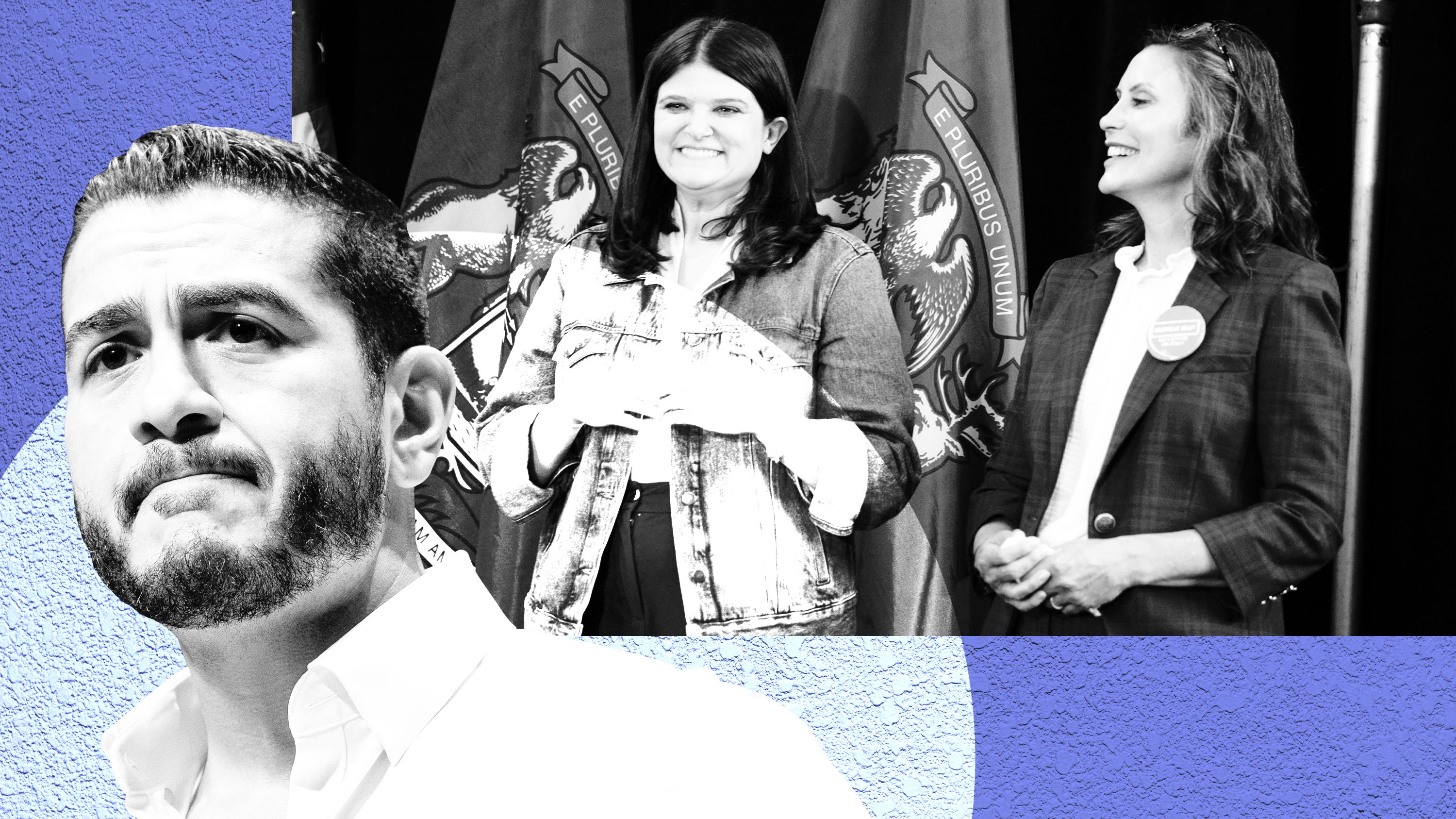
(Photo illustration by Bill Kuchman/The Bulwark | Photos: Getty, Shutterstock)
Detroit, Michigan ANOTHER JOLT JUST HIT the highest-profile Democratic Senate primary in the country: Big Gretch entered the conversation.
That’s the affectionate nickname for Gretchen Whitmer, the two-term Democratic governor who is by most reckonings the most popular statewide elected official in Michigan. On Friday, she announced that she was endorsing Haley Stevens, the four-term House Democrat who has been running in a tightly contested, increasingly bitter campaign against former Detroit and Wayne County public health director Abdul El-Sayed.
Whitmer made the announcement in a video—and then in person about three hours later, during a campaign event at a Teamsters union hall in Detroit, where she said “Michiganders need a fighter in Washington.” Never once in either case did she mention El-Sayed. But she alluded to him indirectly during the speech when she said the top priority for Democratic voters was keeping the open Senate seat—now occupied by Gary Peters, who is not seeking re-election—in the party’s hands.1
“Democrats cannot take back the Senate without winning the state of Michigan,” Whitmer said, as a crowd of about a hundred supporters cheered. “We don’t hold this seat, we can’t fight back against Medicaid cuts. We can’t fight back against tariffs, against skyrocketing gas and grocery prices. We can’t fight back against the chaos and division and political gamesmanship that have consumed our country for too long.”
That argument cut right to the heart of the question that for many Michigan Democrats is the most important: Which candidate has the best chance of winning? Supporters of Stevens have said she’s the one, citing her record of winning in swing districts and the difficulties El-Sayed would have defending a left-wing platform in a closely divided state. El-Sayed’s backers counter that his populist message actually speaks to many conservatives, while Stevens’s support from wealthy outside groups ties her to an establishment that infuriates voters across the ideological spectrum.
Whitmer at the Friday appearance didn’t have to spell out which side of the argument she finds compelling. But she did drop a reminder of why she has some authority to speak on the matter—as “someone who won statewide twice,” pausing and drawing out that last word for emphasis, and holding up two fingers for effect.
Just how seriously Michigan voters will take this advice is a separate question. Endorsements certainly don’t have the power they did in the old days. Just ask the editors of the Detroit Free Press, whose compelling endorsement of the campaign’s third candidate, state Sen. Mallory McMorrow, appeared exactly six days before she dropped out of the race.
Meanwhile, more than 690,000 Michiganders have already voted via mail or absentee ballot, according to official figures.2 And Whitmer’s reputation has recently taken a hit thanks to in-state controversies over her support for data-center construction and her veto of several budget amendments. The former has pissed off progressives, environmentalists, and local activists. The latter has pissed off longtime Whitmer allies in the state legislature and key interest groups like labor.
But there are still plenty of reasons to think Whitmer’s endorsement will matter, maybe quite a lot.
We know—paywalls are a pain. But there’s an easy way around this one: Sign up for a free trial of Bulwark+ membership. You’ll be able to read the rest of this newsletter covering the Michigan primary, participate in the comments section, and enjoy our other locked content for two weeks without paying a penny. We bet you’ll like it.
Thomas Edsall tells Mona Charen Democrats can recover from Trump's bad ratings by moderating on three fronts: transgender policy (affirm two sexes, restrict sports/prisons/youth surgery), immigration (pro-legal, pro-enforcement), and crime (oppose lenient DAs and no-bail policies).
His diagnosis: the party's become too elitist and needs working-class voters back to beat MAGA.
Bulwark Book Club pick for August: Mark Twain’s Pudd’nhead Wilson. Join Mona Charen and Bill Kristol to discuss this classic that explores racism and slavery. Published in 1894, the novel tells the story of two boys – one born into slavery, the other the master’s son – who were switched at birth. Send your questions, comments, and thoughts on the book here.
Watch your inbox for details on when the episode will drop.
The Mona Charen Show is a weekly, one-on-one discussion that goes in depth on political and cultural topics. New shows drop Saturdays. Find this show wherever you get your podcasts and on YouTube. Add the show to your player of choice, here.
Ad-free editions of The Mona Charen Show are exclusively available for Bulwark+ members. Access this member edition in the Bulwark App—now available on Apple and Google. Or set up the ad-free edition of this Bulwark show on your player of choice using your private RSS feed here.
Trump took the stage at the White House Correspondents’ Dinner and delivered one of the most uncomfortable speeches of his political career. Sam Stein and Will Saletan break down the jokes that bombed, the attacks on Kaitlan Collins and other targets that crossed the line from comedy into cruelty, the surreal Wall Street Journal/Epstein moment, and what happened when Trump faced an audience that simply stopped laughing.
As always: Watch, listen, and leave a comment. Bulwark+ Takesis home to short videos, livestreams, and event archives exclusively for Bulwark+ members.
Add Bulwark+ Takes feed to your player of choice, here.
Happy Saturday! Overtime is for everyone. If you’re a Bulwark+ member: thank you. If you’re not, there’s no better time to subscribe to Bulwark+ than today. If you like today’s issue, you can share this newsletter with someone you think would value it.
FC Cincinnati defeated the Vancouver Whitecaps 4-3 in a return to MLS play earlier this week.
Congrats to our World Cup Winner… David Belkin, a OG Bulwark member. While he didn’t correctly pick Spain winning it all, he was in the 94th percentile of players. Impressive! He wins a free year’s access and some surprise goodies. While the World Cup is over, baseball is back, and the summer of soccer continues (for some of us.)
Welcome to our newly redesigned site! Everyone here is genuinely excited about the new look, the refreshed logos, and all the improvements that came with the redesign. I’ve lived through a number of site overhauls over the years, and none have gone as smoothly as this one. Kudos to everyone who made it happen. I am impressed and what I see makes me proud as one of our original employees.
We’re still ironing out a few minor kinks, but you’ll notice the navigation bar has been reorganized (for the better!) so it’s easier to get where you want to go, including our members-only chats. The account page, in particular, is much better organized, allowing you to change what you want to get and how. And the “Read to Me” feature you may already know from the app? It’s available on the website now, too.
In Pennsylvania, Gov. Josh Shapiro is on track for a pretty big win in November. And he can’t do that without winning over a lot of former Trump voters, including the ones in our focus group. Cook Political Report editor-in-chief Amy Walter returns to the show to discuss how our Pennsylvania focus group felt about Shapiro, AND Sen. John Fetterman’s possible party switch, and about the Trump administration. They also break down whether Democrats should be concerned about the generic ballot polling we’re seeing right now.
There are more tickets to see Sarah and JVL on September 8 in NYC! We are about to sell out the orchestra section—but we want to sell out the balcony, too. It’s a point of pride. Come hang with us. Tickets are here.
Full ad-supported episodes of The Focus Group Podcast are available wherever you get your podcasts and YouTube. Hit that like 🤍 button and share this episode with a friend.
Ad-free editions like this one are available exclusively for Bulwark+ members on the site, the Bulwark App, via your member-only RSS feeds, and the Substack mobile and TV Apps. Upgrade now to listen without ads and to join the community in the comments.
JVL joins Destiny for his first-ever political stream to talk about how MAGA media manufactures reality, why mainstream outlets keep playing by obsolete rules, and how Democrats kill their own messages before voters ever hear them.
As always: Watch, listen, and leave a comment. Bulwark+ Takes is home to short videos, livestreams, and event archives exclusively for Bulwark+ members.
Add Bulwark+ Takes feed to your player of choice, here.
Plus: Some questions for Tom Homan about shooting January 6 insurrectionists; Haley Stevens and authenticity; and the Mitch McConnell conspiracy theory. Also, a conversation about raising good men.
But the big topic is the Department of Defense suddenly removing the names of four dead soldiers from the Iran war casualty list because they were killed after Trump declared a ceasefire in April—because there are now apparently two distinct Iran wars. Even though neither of them is, for legal purposes, a “war.”
The Secret Podcast with JVL and Sarah is exclusively for members of Bulwark+. To watch or listen to future episodes and join the Secret community in the comments become a Bulwark+ member today. The only way through is together.
(Photo illustration by Bill Kuchman/The Bulwark | Photos: Getty, Shutterstock)
WHEN SEN. GARY PETERS QUESTIONED Defense Secretary Pete Hegseth about the administration’s handling of the conflict with Iran, Hegseth responded by accusing Peters of denigrating the military.
That wasn’t what Peters was doing. In fact, even before Peters asked Hegseth a question, he offered comfort to the families of those who had given their lives in the Iran war. “I want to begin by first echoing my colleagues’ comments,” he said, “and joining them in mourning the loss of American service members who were killed in action these few days. My thoughts are with their families, with the service member who remains missing, and with all those injured during the strike. And I will continue to pray for their families.” He very quickly went out of his way to express admiration for the service members carrying out extraordinarily difficult missions: “I have long said the United States has the strongest military in history, in the world, and I have no doubt that our brave service members can execute any mission and prevail in any battle.” His criticism was directed not at the troops, but at the civilian leadership responsible for defining the mission, establishing the strategy, and honestly describing the results. That distinction matters.
No tribal allegiances. No false equivalency. Just straight talk about saving democracy. Join us.
When I was a young lieutenant, stationed in Germany on my first assignment, I had a conversation with an old veteran in my unit who had been a medevac helicopter crew chief in Vietnam. He was highly decorated, and he was relaying some of the adventures that were reflected in the medals he wore on his chest.
He was young when he got drafted. He didn’t want to go to war, but he answered his country’s call. He flew hundreds of missions, saved untold numbers of lives, was wounded, recovered, and after a year of service, eventually came home. He told me he was proud of all he did in service to his country—proud enough to choose to make a career in the military—but when his plane landed in San Francisco and he stepped into the terminal wearing his khaki uniform, he experienced something disheartening. As he walked through the airport, strangers cursed him, called him baby killer, and even spat on him.
Then, in a changing mood, he looked down and quietly said something that has stayed with me ever since: “It made that whole year seem like a waste. I didn’t agree with the war, either, but it seemed my fellow citizens were confusing the war with the warrior.”
His disappointment wasn’t rooted in the hardship of combat, because soldiers understand hardship. It was his realization that many Americans could not distinguish between the man who had served and the policy that had sent him there. That confusion reappeared during Secretary Hegseth’s testimony this week.
In our constitutional system, the military does not choose the wars it fights. Soldiers, sailors, airmen, marines, guardians, and coasties execute lawful orders issued by civilian leaders. Their professionalism lies in carrying out those missions to the best of their ability, regardless of the politics and the policies surrounding them. Supporting the military does not require supporting every military operation, nor does questioning the wisdom of a campaign diminish the courage of those asked to fight it.
In fact, the opposite is true.
One of the highest forms of respect all citizens can show our military is demanding that our armed forces be committed only to missions with clear objectives, realistic plans, sufficient resources. This is especially true for those who serve in government who make the decisions—or non-decisions—about war and peace. For our leaders, respecting the military means telling the American people the honest truth about progress and setbacks, casualties and costs. For the rest of us, holding civilian leaders accountable for those responsibilities is our way of honoring those in uniform.
Too often, political leaders blur these lines. When strategy is challenged, they wrap themselves in the valor of the troops. When operational shortcomings are exposed, they imply that criticism somehow insults those risking their lives. This may be an effective political argument, but it is a dangerous civic one. The sacrifice of those in uniform should never become a shield protecting policymakers from legitimate scrutiny.
We owe our warriors gratitude, respect, and every resource necessary to accomplish the missions. We owe our civilian leaders rigorous oversight, honest debate, and accountability for their actions and the missions they assign.
We also owe ourselves, as citizens of a great republic, a government that is responsive to our needs and expectations. That applies to the military as much as to anything else. We respect the troops by ensuring that their missions are aligned with the priorities of the country, and we respect ourselves by ensuring that the bravery and sacrifice of those in uniform doesn’t cause us to forget why their calling is called “service.”
Tom Holland, Christopher Nolan, and Matt Damon at the premiere of The Odyssey in Mumbai, India on July 11, 2026. (Photo by Prodip Guha/Getty Images)
A COUPLE OF MONTHS BACK, I highlighted the strange reaction to Christopher Nolan’s then-upcoming film, The Odyssey, in certain portions of the conservative media ecosystem. Particularly among the grifter set on Twitter, where Elon Musk had whipped people into a fury over the casting of Lupita Nyong’o as Helen of Troy (because Helen of Troy couldn’t possibly be black and to suggest otherwise is a betrayal of Western civilization) and Elliot Page as a Greek soldier (because a trans actor couldn’t possibly play a Greek soldier).
I was fascinated by this story because it combined so many of my different interests: social media as a vector for disinformation, as chuds insisted that Page was playing Achilles even though no one associated with the production had suggested anything of the sort; conservatives turning against Christopher Nolan, who had long been seen on the right as, if not a fellow traveler, at least sympathetic to classically liberal/Tory-ish ideals; and amateur box office sleuths predicting disaster in the face of all evidence that Nolan and his studio, Universal, had a triumph on their hands via massive presales.
But the reason they felt so confident attacking Nolan was, ultimately, because they fundamentally misread the effect of previous outrage campaigns against major motion picture releases. They looked at the outrage directed at 2022’s Lightyear (because the film featured a brief lesbian kiss), last year’s Snow White (because the actress playing Snow White is Hispanic and had said she didn’t much care for the original), and this year’s Supergirl (because the lead actress said male audiences have a problem with strong superheroines), and concluded that those films all failed because loud people were angry on Twitter.
This impulse is, perhaps, understandable. It was also, quite obviously, incomplete. I think it’s safe to say that those movies failed because they were movies that nobody wanted, really. Lightyear was a weird digression from the Toy Story franchise featuring none of the previous films’ voice actors that was too complicated to explain to audiences in a one-sentence pitch. The original Snow White (1937) is too old to hit the nostalgia sweet spot, where parents take kids to see the live-action versions of movies that they themselves grew up with (like Aladdin or Beauty and the Beast). And no one is interested in Supergirl because outside of a handful of big names (like Superman or, as we’ll see next week, Spider-Man), the superhero boom seems to be over.
I’m bringing this back up not to take a victory lap—though I will do that in a second—but as a reminder that we all live in bubbles that we’ve built for ourselves on social media and elsewhere. And the Odyssey bubble on Twitter was exacerbated by the fact that someone at the site must have juiced the algorithm to highlight content about the film: Anecdotally, everything I tweet about the movie does huge numbers. These people were absolutely convinced that The Odyssey was going to bomb, that they were going to claim a great triumph for Western civilization by waging war on the forces of woke. They were blinded by a number of very obvious signals that this movie was going to put up numbers, like near-record presales.
And here’s where the victory lap comes in: In its first six days of release, The Odyssey has grossed nearly $200 million domestically. It’s running roughly 60 percent ahead of Oppenheimer at the same point, a gap that suggests this film will gross in the neighborhood of $500 million domestically and could make a run at $600 million. This means that, with the worldwide grosses included, the film will likely earn well over a billion dollars, in the range of $1.2–$1.4 billion. This means that it will handily make money for Universal, which reportedly spent about $375 million on production and advertising. Even if you assume theaters are keeping half of the take, that means that the film “only” needs to gross $750 million or so worldwide to edge into the black . . . and I don’t think any serious observer thinks it won’t get there. Elon Musk and his chud brigade have been soundly defeated.
The lesson, as always, is this: Twitter is not real life, and we should all keep in mind the bubbles we live in and what they blind us to.
One of the things we try to do here at The Bulwark is poke holes in bubbles. Right now we’ve got a deal going: New subscribers get fourteen days for free. That’s two weeks of bubble-busting. Sign up and hang out in the comments section with the rest of the cool kids:
I could’ve talked about this Odyssey nonsense on a thousand podcasts; I just love the story so much. But I’ll limit myself to linking to the video on the topic I did with Sam Stein and Will Sommer. It’s a fun one; I think you’ll enjoy it.
SPEAKING OF FUN PODCASTS, I had Nate Jones from Vulture on to discuss his new feature ranking the hundred most powerful directors. Check it out and leave your picks in the comments!
Review: Motor City
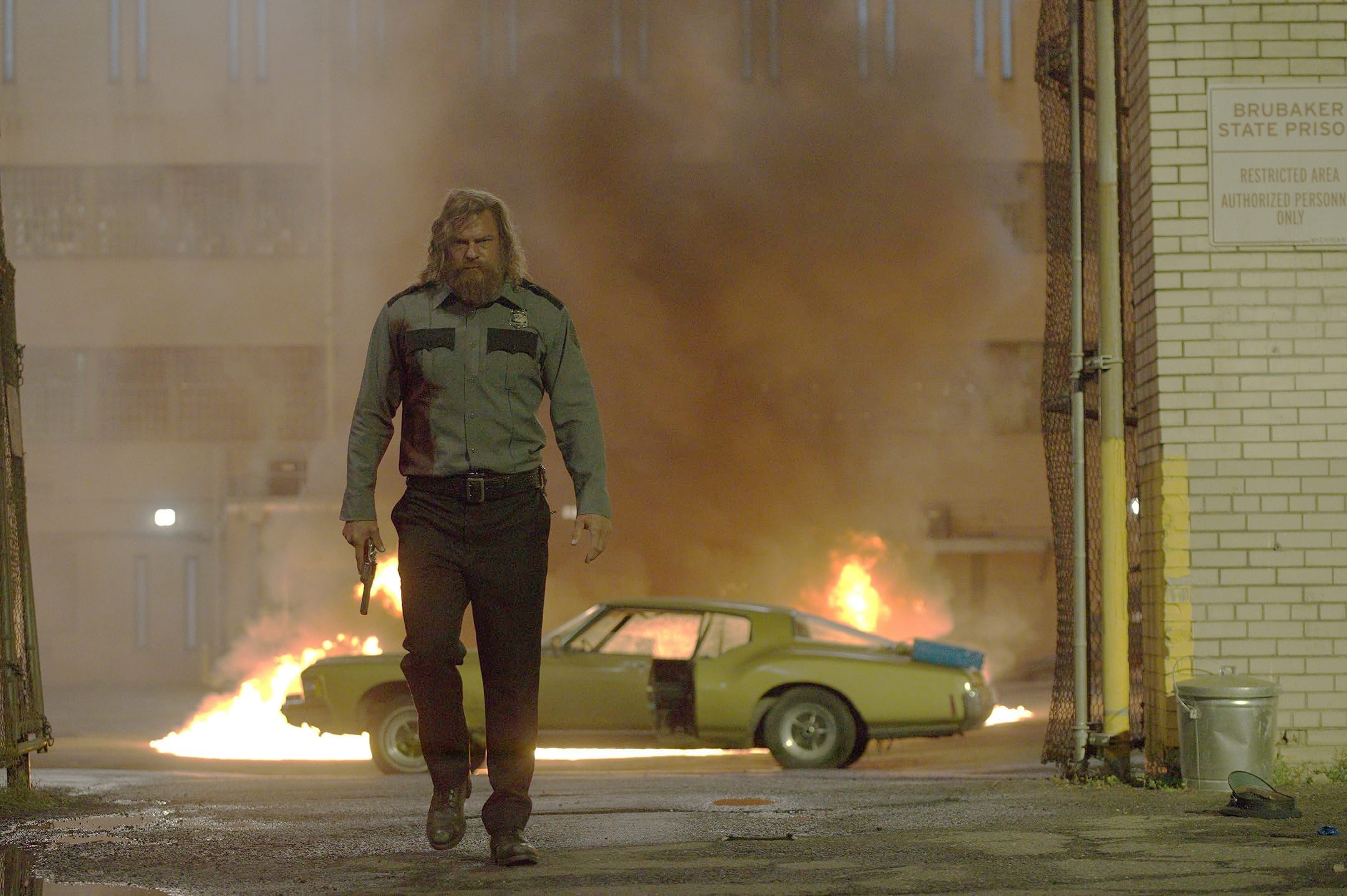
Alan Ritchson in Motor City. (Courtesy IFC)
MOST MOVIES CLEARED OUT this weekend since it’s smack-dab in between The Odyssey and Spider-Man: Brand New Day. But there are a couple of new things in theaters. The new Nicolas Winding Refn flick, Her Private Hell, is out now. Not really my cup of tea, though I’m always there for a new Refn in the hopes that he recaptures that Drive/Bronson/Only God Forgives vibe, and I dug The Neon Demon.
More to my liking is Motor City, a movie made from a script that hit the Black List almost two decades ago but took a while to get off the ground. Probably because of the film’s gimmick: It is almost entirely free of dialogue, telling its story simply through the visual imagery onscreen. From my review:
What’s fascinating about Motor City is that it works almost entirely because we understand the language of cinematic tropes that St. John and Ponciroli are playing with. The wronged ex-con, the crooked cops, the loyal friends, the misled ex-girlfriend, etc. One could argue that this renders the film little more than a collection of clichés, nothing more than formulae designed to move things along. One could also invert this argument, arguing that St. John and Ponciroli are exposing these tropes, and commenting upon them with the silent structure.
Personally, I prefer to take the story simply as it’s presented: Motor City hits its emotional beats and revels in its “every shot a painting” aesthetic, luxuriating both in the slow-motion movement and in soaking in the faces on the screen. And there are some great faces in this movie. Ritchson, best known for his three seasons as Jack Reacher, looks as though he’s carved from granite, while Woodley embodies a sort of fierce, soft sadness. Ben McKenzie has aged into his post-O.C. roles with real grace: he looks weary and righteous as a cop who takes it upon himself to free Miller from his unjust imprisonment. And Miller’s buddies—Lionel Boyce (of The Bear fame)and Amar Chadha-Patel play two pals who fought with him in Vietnam and help spring him from prison—are perfectly expressive and emotive. Patel in particular embodies a sort of wild joy that accompanies the pursuit of justice.
It’s in theaters now. If you’ve already seen The Odyssey—or you’re waiting to see it on IMAX—you could do much worse than Motor City.
(Photo illustration by Bill Kuchman/The Bulwark | Photos: Shutterstock)
A VAGUELY OMINOUS BUT LITTLE-NOTICED regulatory filing issued in late June could have a profound impact on business, immigrants, and the balance of power in our country.
The filing was a notification that the Trump administration had drafted new rules governing the decennial census. The actual specifics of those new rules remain scant. But from conversations I’ve been having with people close to the process, it is widely expected that the administration will try to recategorize millions of immigrants (both unauthorized and legal) as not actually living here in the United States.
Why would they do that? For several reasons.
The first is a longstanding animus that the president and his top aides have to the immigrant population. The administration has unleashed unprecedented border crackdowns and interior enforcement measures, in the service of a vast project of mass deportation. Through the census, it can continue the spirit of that campaign. Put another way: If you can’t deport every immigrant, you can at least remove evidence they exist.
The second is power.
An “actual Enumeration” of the entire U.S. population is required by the Constitution’s Census Clause.It’s pretty clear that the Constitution requires counting the full population, based on the use of the word “Persons” in this spot in the original text (rather than “Citizens” as used elsewhere), and similar language—“the whole number of persons”—in the Fourteenth Amendment.1
Join Bulwark+ to support independent media built by readers who refuse to be anyone’s plaything.
The resulting census is hugely important to the functioning of our government. It determines how many congressional representatives each state gets and how districts are drawn. It thereby also affects how many votes each state has in the Electoral College process used in presidential elections. And it plays a role in how trillions of federal dollars are allocated each year, since census data are used to calculate funding levels for health care programs, nutrition, highways, housing, school lunches, etc.
The stakes, in other words, are incredibly high. Which makes this rules submission process so profoundly important.
And here’s the kicker: So far, virtually no one has noticed.2
Let me warn you that this issue gets a little weedy. That’s by design; the administration wants you to not understand what they’re doing, so you won’t notice you’re being disenfranchised and robbed until it’s too late.
MAGA may be rallying behind Andrew and Tristan Tate, but the White House isn’t interested in spending political capital on protecting the manosphere sex pests from rape charges in the UK. Asked yesterday whether the White House would block the brothers’ extradition, Press Secretary Karoline Leavitt was terse: “No. We’ve already answered that question.”
Some housekeeping: You may have noticed that Morning Shots looks a little different today. This is part of a wider refresh for The Bulwark that we’re excited to share with you today. We hope you like what you see, but as with all home renovations, there’s always a punch list. Happy Friday.
Join JVL and special guest Paul Krugman for Receipts Live at 12:30 p.m. EDT today on Substack and YouTube.
(Photo illustration by Sarah Rogers/The Bulwark | Photos Getty)
Cancel Culture at the Pentagon
by William Kristol
1st Lt. Tyler James Feehan, 25, of Hawaii.
Pvt. Isabella Gonzales, 19, of Texas.
Sgt. Angel Rampersad, 28, of New York.
Sgt. Michael Emmanuel Swinton, 30, of North Carolina.
These soldiers died in the past week in the war against Iran. Lt. Feehan, Sgt. Rampersad, and Pvt. Gonzales were killed by an Iranian ballistic missile attack in Jordan. Sgt. Swinton died as a result of the demolition of an Iranian drone in Iraq. Their service to our nation should be honored. It certainly should not be erased.
But Donald Trump’s Defense Department has tried to erase these four service members from its official list of Iran war casualties.
As the New York Times reported last night, on Wednesday, the Pentagon’s casualties website listed eighteen service members who had been killed during the war with Iran. By Thursday, the Defense Department had lowered that number to fourteen—apparently excluding Lt. Feehan, Pvt. Gonzales, Sgt. Rampersand, and Sgt. Swinton.
(Photos: Department of Defense)
Three military officials told the Times that “one reason behind the change was that the Trump administration decided to remove four service members killed this past weekend from the list—three in Jordan and one in northern Iraq—because their deaths occurred after President Trump declared a cease-fire in the war in April.”
Trump’s Defense Department responded to the Times report on Thursday evening by claiming that the change was due to “temporary data disruptions” and that “these site anomalies are currently being resolved in coordination with the Military Services.”
But as I write on Friday morning, the “anomalies” haven’t been “resolved.” The Pentagon’s Defense Casualty Analysis System website still lists only fourteen deaths as a result of the Iran conflict—even though the Pentagon’s press release earlier in the week in connection with the dignified transfer of the four soldiers’ remains stated, “The deaths are related to Iranian aggression.”
But the administration, from the president on down, has been preoccupied with trying to downplay the costs of Trump’s war. The president has been regularly posting and talking about how many fewer casualties there have been compared to prior conflicts. And he has gone out of his way to call the war an “excursion” or a “skirmish.”
And the administration does have a particular interest in pretending these latest deaths aren’t somehow part of the Iran war. At his appearance Tuesday before the Senate Appropriations Committee, Hegseth was once again challenged about the lack of congressional authorization for the war. Then on Thursday, there were votes in both the House and Senate on war powers resolutions. One of many disingenuous arguments the Trump administration made to try to beat back demands for congressional authorization was that the clock for requiring congressional approval should restart after pauses in the war. The claim that these four soldiers’ deaths can’t be attributed to Trump’s Operation Epic Fury because they happened after the collapse of the ceasefire is part of the effort to avoid congressional accountability.
But it is also, of course, part of a broader phenomenon. As retired Army Lt. Gen. Ben Hodges told the Times, “The administration seems to have a real hard time being honest about what is going on—not just about casualties, but about the whole war in general.” And about much else besides.
The erasure of the deaths of Lt. Feehan, Pvt. Gonzales, Sgt. Rampersand, and Sgt. Swinton is only one of many, many instances of the dishonesty of the Trump administration—though it’s an extraordinarily petty and a strikingly callous one. It goes without saying that the administration’s dishonesty cannot diminish the honor due to these soldiers. But it does stain the honor of our country.
On Wednesday, the landmark nuclear agreement permitting Saudi Arabia to develop a civilian nuclear program with American uranium looked like a done deal: agreed to, signed, and announced with great fanfare by both nations. One day later, Trump threw the whole thing into confusion with—what else?—a post on Truth Social. The deal, he now said, would be “totally subject to Saudi Arabia joining the very respected and successful Abraham Accords.” In other words: No deal unless Saudi Arabia agrees to diplomatically recognize Israel. Why sandbag the Saudis with this extra demand after the agreement was signed, rather than as part of the negotiating process? Who knows? Art of the deal, baby!
Whatever the reason, the White House insists—for now—that Trump’s eleventh-hour concern is official U.S. policy. What U.S. negotiators said until now matters little, White House Press Secretary Karoline Leavitt told reporters yesterday: Trump alone is the “final dealmaker.” “If they don’t join the Abraham Accords,” Leavitt said, “the deal is off.”
What happens next is far from clear. The Saudis have not publicly tipped their hand, although one Saudi source suggested to veteran foreign policy reporter Laura Rozen that they may try to stare Trump down: A deal “was signed, so nothing to renegotiate,” the source said. “Tweets don’t overturn signed agreements.” (I’m sorry: Have they met this guy?)
We’ve had this guy’s number from the start. We don’t do empty both-sidesism or pretend that things are normal. Join us.
Trump has never been shy during his presidency about ripping up other people’s deals—NAFTA, say, or the JCPOA. Lately, though, the deals he’s ripping up have been his own. The same thing happened last month with Iran: The ink was barely dry on the memorandum of understanding before he was assuring his hawkish critics that the U.S. would hold Iran to stricter concessions than Iran had actually agreed to. It didn’t matter that Iran hadn’t agreed to permanently dismantle its nuclear program, Trump insisted: “If it’s not, we will bomb them. . . . We’re going to bomb the hell out of you.”
This shouldn’t come as a surprise, exactly. Dating all the way back to his pre-political business career, Trump has never seen his word as his bond; contracts and agreements, to him, aren’t so much mutually binding pledges as momentary branding exercises intended to get a little leverage. An ordinary negotiator gets the best deal he can, then goes home and tries to sell the deal to the public; Trump, by contrast, is willing to jettison whole portions of any deal he strikes if he senses it would make the selling-to-the-public bit easier. If the other party objects, well, that’s their problem.
This is a terrible characteristic in anybody, of course—nobody wants partners in life, in business, or in politics that can’t be trusted even to try to abide by their commitments. But in a would-be American emperor, it’s ruinous. Trump wants the entire world to run on his IOUs. When he’s gone, will there be a single country left that hasn’t learned a hard lesson about trusting the United States again?
A High-Stakes Primary in Wisconsin’s Race for Governor… Will the Democrat who wins the party’s gubernatorial nomination August 11 be too progressive to beat a sycophantic Trump crony? BILL LUEDERS reports.
FUN WITH TARIFFS: Ever since the Supreme Court overturned his “Liberation Day” tariffs back in February, Donald Trump has been trying to keep his protectionist trade regime with the legal equivalents of duct tape and-chewing gum. One temporary authority expired last night at midnight; accordingly, he issued a new set of tariffs on a new authority to go into effect against more than eighty countries at 12:01 a.m. today. Here’s the New York Times:
The duties were issued under Section 301 of the Trade Act of 1974, which allows the president to impose tariffs on foreign countries that engage in unreasonable or discriminatory trade practices. The administration has cited the failure of foreign countries to pass or enforce laws banning the importation of goods made by forced labor into their own countries, saying that disadvantages U.S. businesses that do follow such laws.
Canada, which is subject to a 10 percent tariff under the arrangement, already prohibits importing forced labor goods. The European Union, also at 10 percent, has a ban that is scheduled to take effect in December 2027. But Trump officials say that the governments have not effectively enforced those laws.
Obviously, these are invented post-hoc rationalizations: Trump and his team are merely saying they care about forced labor because forced-labor concerns are what you need to have to unlock this particular tariff authority. One weird trick to running the government more or less by fiat is you can just lie about things!
EVERYBODY’S WHIPPING BOYS: They’re not the most sympathetic group in the world, but there’s a certain pathos to the plight of Senate Republicans right now—the group Trump has spent his disappointing second year back in office scapegoating for the paralysis of his domestic agenda. “I’ve never seen people so mad,” Sen. Roger Marshall (R-Kan.) said this week on 13th and Park, the podcast of top D.C. lobby shop Ballard Partners (yes, they have a podcast). “The job of the national media, what they try to do is make my parents mad. They sit at home and they watch Fox News and Newsmax, and guess what? They’re mad at me, they’re mad at John Thune, they’re mad at Mitch McConnell.”
“I mean, like, there’s this purity test,” Marshall went on. “So I feel this anger. More than ever before.”
It’s not every day a sitting Republican senator openly airs his frustration with Fox News. But the strain on the larger GOP apparatus is getting harder to ignore. After White House Press Secretary Karoline Leavitt castigated Senate Republicans for failing to pass the SAVE America Act yesterday, Senate Majority Leader John Thune quipped to reporters: “She or somebody else ought to get on the phone and get the votes, right?”
“Instead of pointing the finger at Republicans, they might think about going after the people who are stopping it on the floor, which is the Democrats,” Thune added. “And if there are Republicans that they think are gettable, get on the phone. Let’s get them to yes.”
SHUT UP, MOMS: Brandon Herrera, the Texas gun-nut YouTuber and GOP congressional nominee, has a long history of ludicrous loudmouth takes. But none have raised more eyebrows than a clip that resurfaced this week of Herrera offering an extraordinarily vulgar reaction to the gun-control group Moms Demand Action—and by extension on moms participating in political discourse at all. (Seriously, it’s gross—don’t say we didn’t warn you.)
“Just because you let somebody creampie you doesn’t mean I have to give a shit about your political opinions,” Herrera said in the clip, cocking an eyebrow in front of a wall of guns. “The fact that you kept your cum trophy doesn’t make you any less wrong about the dumb shit that you say.”
It’s not exactly news that America’s political realignment has left some very strange social-policy bedfellows in the Republican tent—after all, the coalition purporting to stand up for traditional values, morality, religion, and Western civilization has been helmed for a decade by a faithless philanderer and pathological liar who’s never opened a book in his life.
But those contradictions are only growing stronger and stranger as the GOP imports a new coalition of young men that are disproportionately nihilistic, terminally online edgelords. Is the GOP a party that prizes motherhood as a high calling, as so many old-school social conservatives suggest? Or is it one that sneers off mothers who dare participate in the political process as people who just “kept their cum trophies”? Apparently, it’s both!
Photo Illustration by Bill Kuchman/The Bulwark | Photos: Getty, Shutterstock
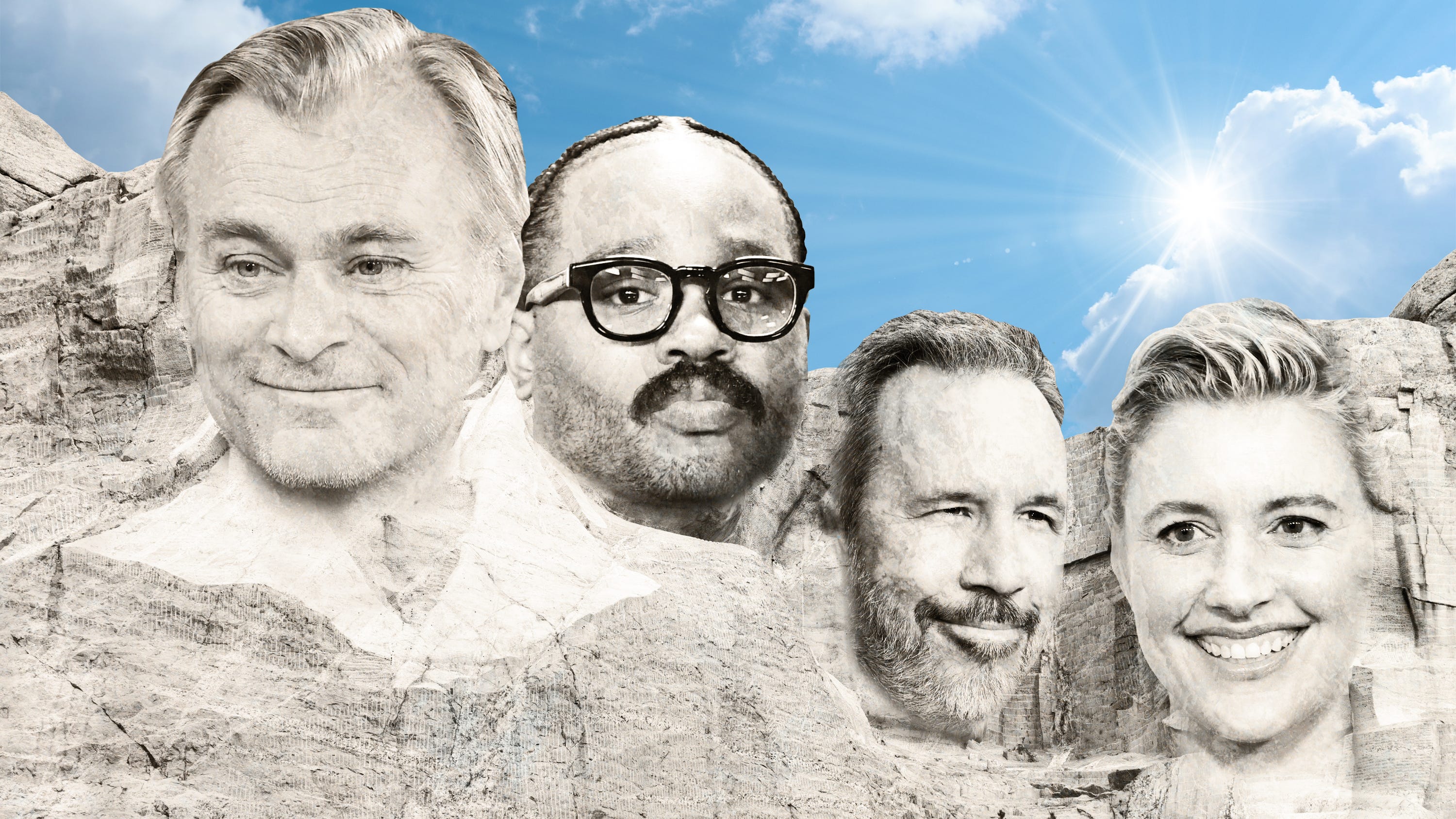
On this week’s episode, I’m joined by Nate Jones of Vulture to discuss his monumental effort to rank the 100 most powerful directors in Hollywood. We discussed how the audience has shifted from stars to IP to maybe, now, directors, and what that means for the industry. Plus: Who did his inside sources think he rated too highly … and too lowly? All that and more on this week’s (if I do say so myself) very fun episode. Debate amongst yourselves: Who has the most juice in Hollywood … and who should have the most juice?
What our country is going through now—a soul-ripping, mind-rending nightmare of corrupt authoritarianism in which a far-right candidate takes power on the back of economic discontent and culture wars and then uses his victory to claim a mandate for a sweeping, lawless assault on democracy itself—happened first in Wisconsin.
Wikler’s book, now awash in nationalattention, draws parallels between Wisconsin’s experience under Governor Scott Walker and the United States under President Donald Trump. Walker, swept into office with the Republican tsunami of 2010 that put both houses of the state legislature under GOP domination, demonized public employee unions, especially teachers, as part of a “divide and conquer” strategy. Trump, similarly, has demonized immigrants who are not members of his immediate family.
Both Walker and Trump used the levers of power to redraw voter district boundaries to their party’s advantage, while doctrinaire conservative justices on the Wisconsin Supreme Court and U.S. Supreme Court nodded in approval. Wisconsin was left as what was often labeled the most heavily gerrymandered state in the nation. Republicans were able to maintain huge majorities in both houses of the state legislature despite Wisconsin being almost equally politically divided between the two major parties.
Walker served two terms before being ousted in 2018 by Democrat Tony Evers, who now, at age 74, has decided not to seek re-election after serving two terms himself. That sets up an eventual contest between the presumptive Republican nominee, U.S. Rep. Tom Tiffany, and whoever emerges victorious from a pack of five Democrats competing for their party’s nomination in the August 11 primary.
What happened in Wisconsin, thanks in large part to Wikler’s capable leadership, is that, beginning in 2023, the Democrats were able to leverage a series of wins for liberals on the officially nonpartisan state Supreme Court, putting the state’s rigged voting districts in the crosshairs. Republican legislative leaders ultimately agreed to accept maps drawn by Evers—mainly to avoid having the court, now controlled by liberals, redraw maps that would go even further in eroding the Republicans’ deliberately unfair advantage.
We’re big fans of fairness over here. That’s why we’re offering you two weeks of Bulwark+ for free—give us a fair shake, and then decide whether our annual subscription is a fair deal.
Heading into the fall elections, Wisconsin Democrats have a good chance of reclaiming the state senate and at least a fighting chance of winning control of the assembly for the first time since 2011. Tiffany, a shameless election denier who in January 2021 voted against certifying Joe Biden’s victory over Trump in two swing states and even signed on to a legal brief that sought to overturn the election result, could emerge victorious. Like most members of his party, Tiffany refuses to acknowledge that Biden won the race fair and square, citing an ongoing need to investigate “the improprieties that happened.”
ALL FIVE OF THE RACE’S Democratic primary contenders, culled from an initial field of nine, have a reasonable shot at garnering the most votes and advancing to the general election in November. They are: former Lieutenant Gov. Mandela Barnes, former state Department of Administration secretary Joel Brennan, Milwaukee County executive David Crowley, state Rep. Francesca Hong, and state Sen. Kelda Roys.
Crowley dropped out of the race on July 8 only to jump back in less than two weeks later when the state’s current lieutenant governor, Sara Rodriguez, whom he had endorsed, ended her campaign amid a scandal that erupted over her campaign manager’s filing of significantly incorrect financial reports. Evers, who had previously not endorsed any of his potential successors, promptly came out in support of Crowley, much to the annoyance of the other candidates and their supporters.
“This Hail Mary serves no purpose other than playing spoiler and handing our state to Trump’s handpicked candidate in Tom Tiffany,” groused Barnes’s campaign manager, Darby O’Connor. Barnes was Evers’s lieutenant governor during his first term.
Barnes and others have speculated that Evers’s endorsement of Crowley is meant to undermine the candidacies of more progressive candidates, prominently including Hong, who identifies as a democratic socialist.
Even Paul Fanlund, publisher and president of the once–proudly progressive Capital Times newspaper, has sounded an alarm about Hong’s support “from a narrow but hard-core far left” that holds little sway “beyond the sanctimonious, progressive bubble of Madison.” As Fanlund sees it, “Tiffany appears to be a weak, extremist candidate in what looks like a Democratic wave election cycle, but Democrats appear capable of screwing this up.”
According to a Marquette Law School Poll released July 22, Hong leads the field with 26 percent support, with Barnes following at 15 percent. The poll, conducted during the brief period between Crowley’s exit and re-entry into the race, found that nearly half (45 percent) of likely Democratic primary voters remain undecided. Another finding: “Two-thirds of Democratic voters say having a candidate who can win in November is ‘extremely important.’”
Hong, in a statement, crowed about the poll results. “Our working-class movement is leading this race,” she said. “Even our opponents’ own polling confirms that Wisconsinites are responding to our positive campaign and our vision of permanent affordability.”
Anthony Chergosky, a political science professor at the University of Wisconsin-La Crosse, has come up with campaign nicknames for the Democratic contenders to highlight points of distinction between them, as he discussed with a reporter for an article in the Capital Times.
Brennan, a straitlaced former state bureaucrat (and incidentally the only white male in the race, which is remarkable given that Wisconsin has never elected a nonwhite or female governor), could call his campaign “Evers 2.0.” Hong, who has dubbed herself “The Wild Card,” might also latch on to “The Surprise Frontrunner.” Crowley could be “The Local Executive” on account of his experience in local government. Roys, who has served in the state legislature for nine years and ran for governor once before, could be “The Experienced Madisonian.” And Barnes, who won election to statewide office as lieutenant governor only to lose a race against Ron Johnson for U.S. Senate, could be “The Comeback Candidate.”
WIKLER, IN HIS BOOK, observes that it’s not just Democrats who see Wisconsin as playing an oversized role in shaping the nation’s—perhaps even the world’s—political fortunes. This was also the position adopted by billionaire-on-his-way-to-briefly-becoming-a-trillionaire Elon Musk in March 2025, just before a state Supreme Court election that would determine whether liberals or conservatives controlled the court for years to come.
Musk, at a rally in Green Bay, expressed his belief that this race would “affect the entire destiny of humanity.” He put his big money where his big mouth was, pumping at least $20 million (Wikler puts the total at $56 million) into what was far and away the most expensive judicial election in U.S. history. This he did on behalf of conservative candidate Brad Schimel, formerly the state’s Republican attorney general.
To gin up interest in the race, Musk handed out two $1 million checks to rallygoers in exchange for their votes. The state’s Democratic attorney general, Josh Kaul, sued to stop this “blatant attempt” to secure votes through bribery. But the liberal-dominated Wisconsin Supreme Court—being dominated by, you know, liberals—refused to take action to block this giveaway.
Schimel lost to liberal Susan Crawford by a 10-point margin.
And now Musk stands to come out a loser in more ways than one. Earlier this month, the Wisconsin Elections Commission, on a bipartisan vote of 5–1, found probable cause to believe that Musk’s $1 million checks violated state election-bribery laws. It referred the case to the district attorney’s office in Brown County, which includes Green Bay, to determine if criminal charges are warranted. The Brown County prosecutors have forty days to report their findings back to the commission.
Democratic lawmakers are now urging Brown County DA David Lasee, a Republican, to bring charges. “With just four months to go before the midterms, we must send a message, loud and clear, that Wisconsin’s votes are not for sale,” said state Rep. Lee Snodgrass. Musk is also being sued by a government watchdog group that seeks to bar him from ever again offering cash payments in Wisconsin, lest the state’s elections “become an open auction.”
In fact, there is a good chance that Wisconsin will not only beat a Trump acolyte amid the president’s raging unpopularity, but also deliver real-world consequences for the equally disliked Elon Musk. I propose a working campaign nickname: “Wisconsin’s Time to Shine.”
ONCE, UPON THE ARRIVAL of an unusually handsome man in town and all the ensuing flustrations, I proposed a business idea to my friend: We would found a residential program for women who wanted to learn to cope with handsome men. Our clients, by residing at a remote wilderness work camp with a bevy of male models, would learn to act normal no matter what species of jaw and brow and forearm confronted them. After, these women would return to their everyday lives immunized against the possibility of spilt coffees, logorrhea, elaborate pratfalls, and other farcical hazards. There would be nothing untoward, nothing creepy. (Possibly, we were already overoptimistic on this front.) It would be exposure therapy only. We would call it the Dude Ranch.
Little did I know that in the course of these conversations, not only was I exercising my spectacularly ill-advised entrepreneurial instincts—I was also participating in an instance of what Phoebe Maltz Bovy calls “the himbo plot.”
In the sixth chapter of The Last Straight Woman, she explains:
The himbo, a dim (or just chill) and good-looking man, is himself a trope, but the himbo plot is something more. It’s a narrative structure based around the effect a spectacular-looking man has on the women around him. Everything’s going along the way it normally does, the regular characters doing their usual thing, when suddenly there is a handsomeness situation afoot. A man’s beauty, and nothing else about him, sets forth plot developments, romantic or otherwise.
The Last Straight Woman is several things: a tour of the last ten years of internet gender discourse; an attempt to dispel a vaporous sense that there is something inherently cringey—or worse, retrograde—about the mere fact of wanting a man; a vindication of the rights of the much-overlooked female schlub; an attempt to articulate a feminist account of straight female desire; an argument against the premise that desire needs a political justification in the first place. All these different threads come together in a loose sprang weave, with each chapter addressing a different clutch of phenomena pulled from the spools of straight womanhood.
The himbo plot is one of these concepts, and it is key to The Last Straight Woman’s project in two ways.
First: Insofar as The Last Straight Woman has a unified thesis, rather than a bundle of related questions and observations, it is that the current most salient problem with female heterosexual desire is not its failure to be something other than heterosexual desire—or, really, a problem with female heterosexual desire itself at all. Instead, the problem is a larger cultural refusal to treat women by default as desirers rather than as desirees.
Get more of our independent political and cultural journalism—including entertaining and thoughtful review-essays like this one—by signing up for a free or paid subscription:
Second: The Last Straight Woman is as much an appreciation of British sitcoms, and an ode to the blue-haired, polyester-clad matrons who inhabit them, as it is anything else. And the himbo plot, as it turns out, is fertile ground for exploring the quirks and nuances of Maltz Bovy’s favorite forms of media. There is no getting around this aspect of the book: It will either work for you or it will not. I found it delightful.
There are, however, downsides to using television as a lens to explore female heterosexuality. Sometimes it seems to land Maltz Bovy in what is often called “heteropessimism.” In the introduction, she writes “Life expectancy for Canadian women is over eighty. This means of approximately seventy man-liking years, a woman may spend ten of them in love-interest mode herself.” Perhaps this is true for those dealing with casting agents, but for the rest of us, surely it overstates the case. I cannot be the only one who witnessed her grandparents, in the midst of all the vicissitudes of old age and all the typical domestic squabbles over misplaced bills and expired milk, spend their declining years in a passionate romance. Beyond any question of whether women should lead interesting romantic lives—including romantic lives as objects of desire—past the first blush of nubility, the observable fact is that, without fanfare, glamor, or pretension to the role of permanent universal ingénue, women regularly do lead such lives.
Again in this heteropessimistic strain, she writes, “Everyone gets that a man does not lose his pre-existing sexual orientation upon making a commitment, and that the most that can be asked of him is that he not be too careless with his web browser.” Is it, really?
Maltz Bovy is correct that the most direct and object-oriented form of straight female desire is real, and often ignored. But I am skeptical that designating this direct and object-oriented mode—the mode of straight women’s desire that most symmetrically corresponds to the way straight men tend to desire—as the real, legitimate form of hetero female sexuality will cure straight womanhood of its indignities and embarrassments.
Men and women usually want the same things in different ways, and sex is no different. If we think for a moment in terms of desired outcomes rather than desired persons, a straight woman’s desired sexual outcome often might look something like melting in the enfolding embrace of the werewolf with a heart of gold, or what have you. Enfolding the werewolf, however willing he may be, is less likely to make the cut.
Part of the problem for straight women is accessing a cultural imaginary—or, absent something ready to hand, building one—wherein desire from the receptive end of the heterosexual seduction structure is not considered the absence of sexuality; or an indiscriminate and mechanical response; or a mandate for a publicly owned and scrutinized sexual attractiveness (by which, one way or another, they can always be humiliated); or mere passivity.
Ultimately, this surprisingly evasive positive account of desire is one that figures straight women as agents who actively shape their own romantic and sexual destinies, including when specific content of their desires might still be read as receptive. This presents a challenge Maltz Bovy doesn’t consistently meet.
For instance, Maltz Bovy asks “And if female sexuality is responsive, what even is a no, anyway?” Perhaps this is true for the most extreme imaginable version of what “responsive” means. But why would “responsive” mean “non-desiring,” let alone “non-consenting”? Why would it be the case that, simply because a hypothetical woman’s strongest sexual arousal tends to occur with a man’s initiation rather than spontaneously, she should be presumed incapable of deciding whether this particular man, and the particular woo he’s pitching, is working for her?
For that matter, I do not think the fact that many straight men feel confirmed in their potency only upon seeing it manifest as a woman’s pleasure—with all the psychological vulnerability that this entails—is evidence of some kind of abject disassociation from their own sexuality. The hard categories of active and passive, subject and object, doer and done, probably better describe violent or unpleasant sex than the entangled, mutable, and somewhat mysterious dynamism of reciprocally pleasurable heterosexuality.
UNFORTUNATELY, VIOLENT AND UNPLEASANT SEX is as much a part of the heterosexual story as the reciprocally pleasurable, and gets its due in The Last Straight Woman with a chapter on #MeToo. It is a mixed bag.
On one hand, Maltz Bovy teases out something I have not seen anyone else get at. When reporting allegations of abuse, harassment, and assault, journalists often present those actions within a context of everything the perpetrator ever did that might conceivably have been a red flag. The intent, I imagine, is to narrate the interior trajectory that often corresponds to these kinds of violations: Something seems a little off about a guy in a way you can’t put your finger on, so you ignore it, until you can’t. But for the person reading the article, the effect is that the real, substantial allegations come to visibility midway through the narrative, and then disappear again into a background haze of bad vibes.
On the other hand, though, Maltz Bovy has her own somewhat distracting way of blending the weighty with the trivial: making a serious claim, then coyly retreating into Britcoms. She writes:
There can also be—and here’s where things get really awkward—a wishful-thinking element to women’s discussion of men’s forwardness. . . . I don’t dare bring up real-life instances of this but will do the discreet thing of pointing you instead to a 1991 episode of Britcom Waiting for God (“Young People”).
Nodding along in faux-agreement while your friends bewail the plenitude and overexcitement of their suitors, as Maltz Bovy cops to doing in a very funny anecdote, is one thing. But if she is accusing women of actually confabulating instances of male sexual aggression in order to be thought pretty, she should name names and share on what grounds she believes that they are telling falsehoods.
In general, the chapter suffers from a tendency to treat #MeToo violations as a referendum on desirability:
I have been in elevators once or twice in my life but, barring other cues, have never reacted this way to sharing one with a strange man. A man would need motive, not just opportunity, and for reasons doubtless as particular to myself as Kwon’s are to hers, I do not assume a man would find proximity to me a source of such temptation.
I believe the reason that most women are not especially afraid of elevators—certainly the reason I am not especially afraid of elevators—is that even among rapists, the man who will assault a total stranger in a well-trafficked semi-public place is a minority. I calibrate my perceived threat level according to the low probability of sharing any given elevator with a particularly extreme sub-type of rapist, not according to whether or not I think I look rapeable today. I do not dispute the claim that, in general, gorgeous twentysomethings experience more street harassment than little old ladies, but it would be a mistake to use trends that occur at an aggregate level to adjudicate likelihood or unlikelihood in any specific given case, especially when so many other more dispositive factors are almost certainly in play. Maltz Bovy’s own street harassment story occurs when she is a pre-teen; many women experience their highest incidence of predatory behavior from men around this time, probably due to some mix of visible vulnerability combined with the coinciding of aggression and deviance in predatory men. Presumably we can all agree that it is not because 11-year-olds are hot stuff.
But I found myself less outraged than confused by passages like the one containing her elevator musings above. It is hard to know what the end game is here. I cannot imagine that what Maltz Bovy wants is for reporting harassment to be equated with calling yourself hot; or for some sort of plausibility test to be applied to women’s looks, some sort of social tribunal to decide whether she was really pretty enough to be groped on the subway. I cannot imagine how this could be construed as a victory for the vast majority of women who are not Emily Ratajkowski–type supermodels.
What is the alternative, then? How do we address the fact that some women receive large amounts of hostile and negative attention, while some receive very little? I do not think the desire to be desired, the desire to be seen as beautiful, is trivial. But I also do not think there is a good answer to this specific tension, except the same one women must learn, again and again, vis-à-vis the fashion and entertainment industries, vis-à-vis the purveyors of eating disorders, vis-à-vis middle school cliques, vis-à-vis men who reduce you to a numbered scale, who solicit images of your nude body and use them to demean you: Resist the perverse instinct to treat as the authority on your beauty the people who want you dead.
But The Last Straight Woman is probably better conceived as an exploration of tensions than an attempt to resolve them, which is why, despite this long and incomplete list of disputes, I thoroughly enjoyed it. A book that is comfortable with ambivalence, that is a pleasure to quarrel with, that channels a kind of Ephronesque spirit of plainspoken inquiry into everyday absurdities—this is a rare gift. You never know exactly what Maltz Bovy is going to think about something until you read her: in the world of opinion journalism, a rarer gift still.
Send this review-essay to someone who thinks deeply about the nature of desire, plus someone else you know who thinks very superficially about it.
MOTOR CITY DERIVES FROM A SCRIPT that earned a spot on the Black List—a competition highlighting unique and unproduced screenplays—in the late ’00s. Virtually dialogue-free and entirely dependent upon the staging and the action to get its point across, the film bounced around Hollywood for the last decade and a half, garnering interest and helping the writer earn gigs like London Has Fallen and Peppermint (an entirely underrated revenge thriller), but never attracting a studio brave enough to execute on the vision of the delightfully named Chad St. John.
Eventually the stars aligned and the script found its way to also delightfully named Potsy Ponciroli (who directed the grimly intense Old Henry) and a bucket of cash from, among others, the free-spending indie distributor Black Bear. It’s obvious, though, that the unconventional nature of the screenplay—the very thing that made it so compelling to so many script readers looking for something new and interesting in a sea of boring sameness—made it a hard sell to audiences.
Indeed, I remember seeing the trailer for this in theaters with a paying audience and thinking, “Oh, cool choice, no dialogue in the trailer.” I did not realize that it was less a choice than a necessity, given the dialogue-bereft nature of the film. I can imagine regular filmgoers finding it off-putting, given that CinemaScore audiences gave John Woo’s Silent Night, which has a similar conceit—minimal dialogue, action-driven plot, lots of killing—a disastrous C.
The setup is pretty straightforward: It’s Detroit in the 1970s, and after an in medias res opening in which the hulking John Miller (Alan Ritchson) is seen tossing guys off roofs and firing a shotgun shell that seems to have been topped with an engagement ring—I imagine this will reappear—we flash back to the before times. Miller is wrapping up parole and about to get engaged (well, that was fast) to waitress Sophia (Shailene Woodley). Miller is set up to take the fall for a drug stash he had no knowledge of by corrupt cop Lieutenant Savick (Pablo Schreiber), leading Sophia right back into the arms of local drug kingpin Reynolds (Ben Foster). Can Miller win her back? More to the point: How many people will he have to kill on the way to winning her back?
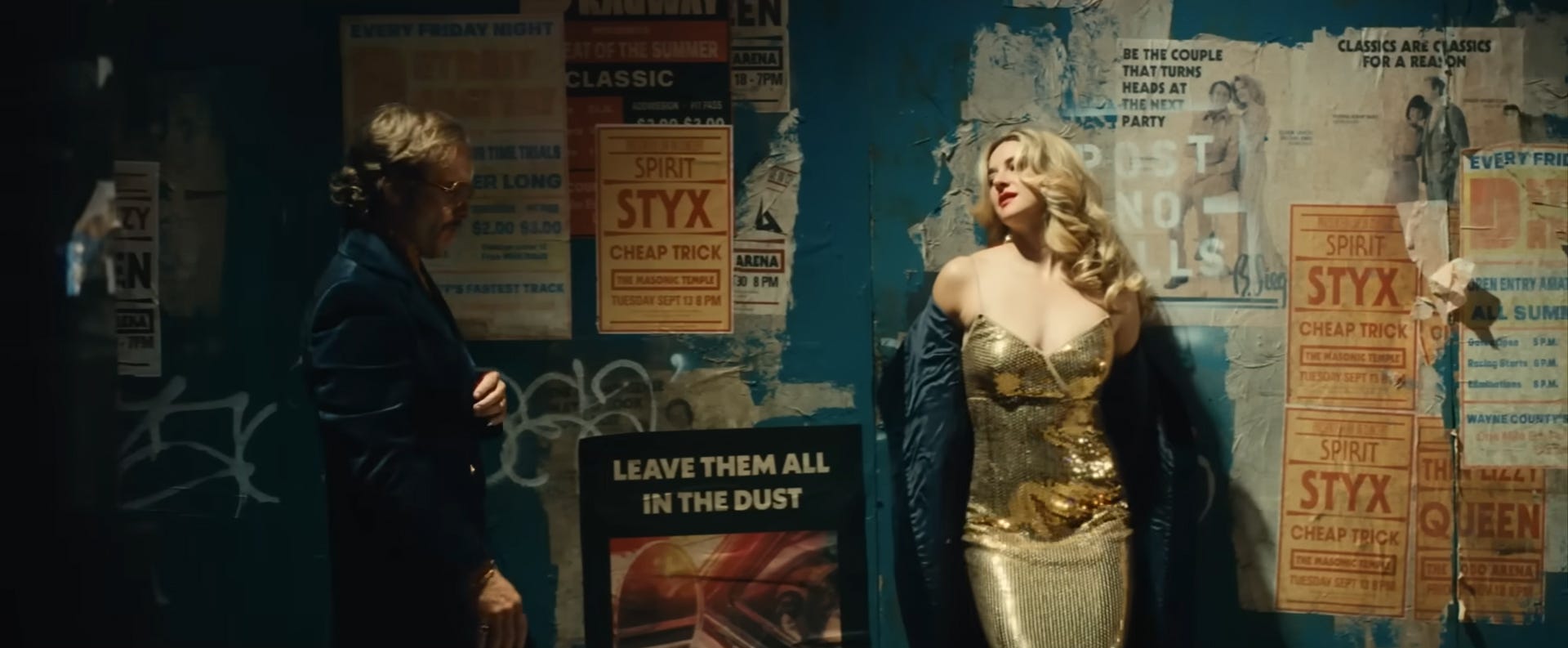
Ben Foster and Shailene Woodley in Motor City. (Courtesy IFC)
What’s fascinating about Motor City is that it works almost entirely because we understand the language of cinematic tropes that St. John and Ponciroli are playing with. The wronged ex-con, the crooked cops, the loyal friends, the misled ex-girlfriend, etc. One could argue that this renders the film little more than a collection of clichés, nothing more than formulae designed to move things along. One could also invert this argument, arguing that St. John and Ponciroli are exposing these tropes, and commenting upon them with the silent structure.
Personally, I prefer to take the story simply as it’s presented: Motor City hits its emotional beats and revels in its “every shot a painting” aesthetic, luxuriating both in the slow-motion movement and in soaking in the faces on the screen. And there are some great faces in this movie. Ritchson, best known for his three seasons as Jack Reacher, looks as though he’s carved from granite, while Woodley embodies a sort of fierce, soft sadness. Ben McKenzie has aged into his post-O.C. roles with real grace: he looks weary and righteous as a cop who takes it upon himself to free Miller from his unjust imprisonment. And Miller’s buddies—Lionel Boyce (of The Bear fame)and Amar Chadha-Patel play two pals who fought with him in Vietnam and help spring him from prison—are perfectly expressive and emotive. Patel in particular embodies a sort of wild joy that accompanies the pursuit of justice.
I am sure there will be people who are annoyed by the lack of dialogue in this film, though not for a lack of understanding: You really have to give Ponciroli and St. John credit for making this thing perfectly legible despite being able to count the lines of dialogue on one hand. That very simplicity may spark a backlash. But I quite enjoyed it. It’s a nice little spin on a familiar genre. I hope you give it a shot in theaters this weekend.
Sam Stein and Ben Parker give their takes on why the DOJ abruptly withdrew its subpoenas against three New York Times reporters and their family members over reporting on security flaws in Trump’s Qatari-gifted Air Force One. But the losses in court don't stop there, the administration also quietly dropped its demand for a list of Jewish faculty and students at UPenn, and a Trump-appointed judge just blocked the White House from obtaining Kentucky’s voter rolls. Plus, in a scene straight out of Pyongyang: Trump finishes a speech, and the applause just… doesn’t stop. A full uncomfortable minute of a room too scared to be the first one to sit down.
As always: Watch, listen, and leave a comment. Bulwark+ Takes is home to short videos, livestreams, and event archives exclusively for Bulwark+ members.
Add Bulwark+ Takes feed to your player of choice, here.

 Login
Login