Savanna Cannon has become one of the fastest-rising viral personalities in right-wing media, but is politics really what she's selling? Will Sommer joins Brendan Hartnett to break down how Cannon's provocative MAGA videos have ignited a civil war on the right, with conservative influencers arguing over sex appeal, authenticity, and the growing influence of OnlyFans in the MAGA ecosystem. They explore how creators are using political content to build massive audiences, why conservative media can't seem to look away, and what Cannon's success reveals about the incentives driving online right-wing culture.
(Photo illustration by Sarah Rogers/The Bulwark | Photos: Getty, Shutterstock)
REPUBLICANS HAVE BEEN TRYING for five years to rewrite the history of Donald Trump’s two biggest moral crimes. One was his violent attempt to overturn the 2020 election. The other was his deadly mismanagement of COVID.
Since Trump returned to power, his party has fallen in line. It has echoed or acquiesced to his nutty tale of a “rigged election.” Republicans have defended or accepted his pardons of the January 6th felons, as well as his persecution of the public servants who investigated those felons.
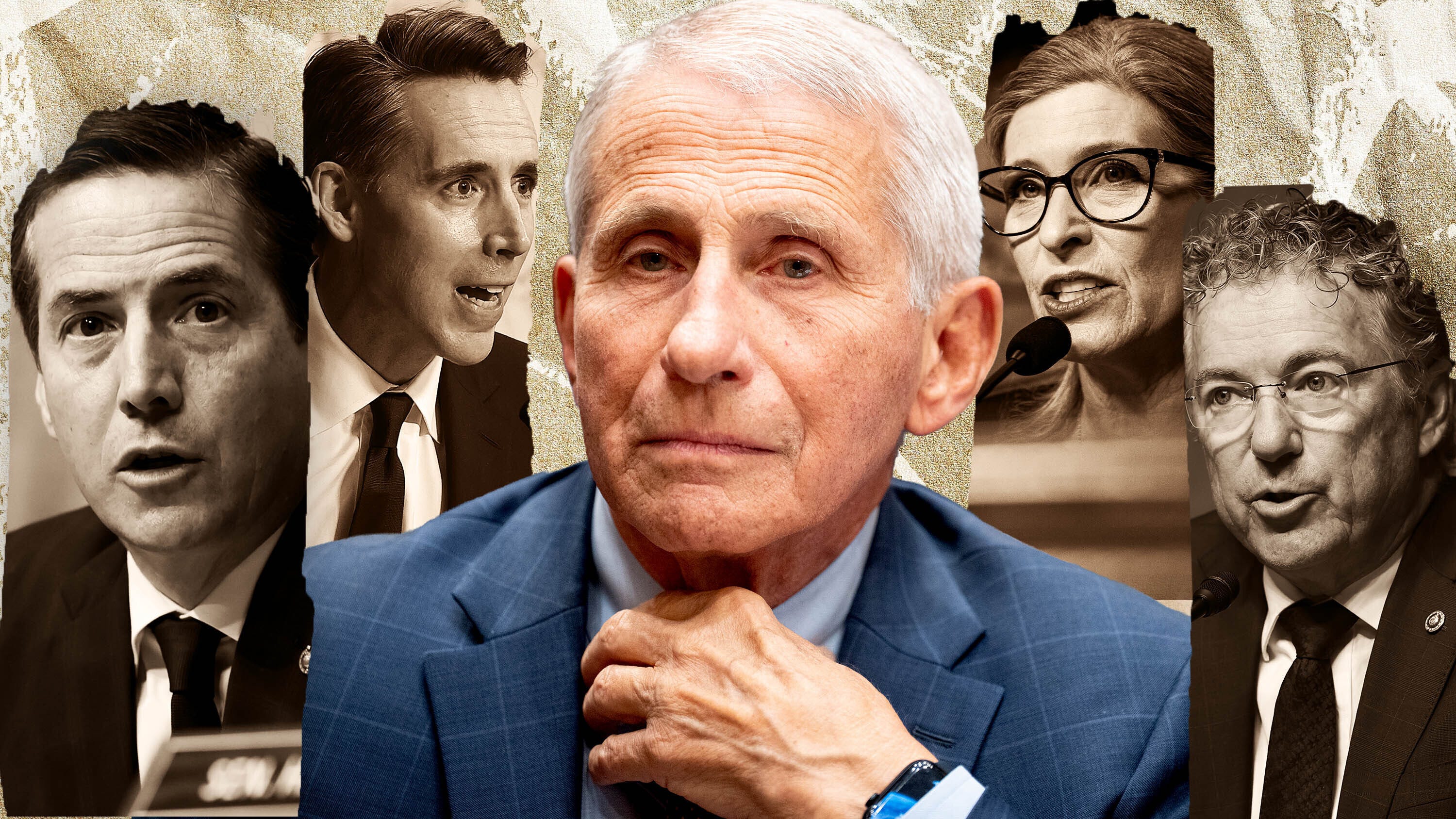
Yesterday’s Senate hearing on COVID—which saw Dr. Anthony Fauci, who led the government’s response to COVID, subjected to hours of lies and insults—showed that the GOP has now fully embraced the other revisionist story: the one about the pandemic. In this twisted narrative, the villain isn’t Trump, China, or even the virus. It’s Fauci.
Sen. Ron Johnson (R-Wisc.), the second-ranking Republican on the Homeland Security and Governmental Affairs Committee, insisted that the COVID vaccines were “experimental gene therapy.” (They aren’t.) As evidence of their putative lethality, he cited a poll in which 24 percent of Americans supposedly claimed to know someone who had died from the vaccines. That’s 82 million people. Hiding such a colossal death toll would be, to put it politely, impossible.
The committee’s chairman, Sen. Rand Paul (R-Ky.), claimed that Fauci’s advice to New York Gov. Andrew Cuomo “led to the deaths of hundreds of thousands of people—or tens of thousands of people.” Paul referred to the elderly, making it clear that he was talking about Cuomo’s disastrous practice of sending infected patients back to nursing homes. Paul’s numbers were wildly off—the real death toll was about 6,400—and his attempt to blame Fauci was completely backward. Multiple reports found that Fauci had norole in the nursing-home policy. In fact, Fauci had recommended the opposite.
Paul accused Fauci of having denied the plausibility of the lab-leak theory, which holds that the COVID virus developed at the Wuhan Institute of Virology. That’s not true, either: Fauci didn’t buy the theory, but he routinely said it was plausible. Sen. Ashley Moody of Florida repeated another Republican talking point: that Fauci’s change of advice on masks—first opposing their use in the general population, then encouraging it—was based only on the availability of masks, not on evidence that they worked. In reality, Fauci has consistently explained that such evidence was a major factor in his decision.
Meanwhile, Johnson spewed conspiracy theories. He suggested, with no apparent basis, that a pulmonary infarction suffered by Fauci in 2021 was caused by COVID booster shots. The senator also claimed that harm from the vaccines was vastly undercounted because a government “algorithm” systematically hid the evidence. But Johnson’s vigilance was selective: He dismissed the known risks and side effects of his favorite drug, hydroxychloroquine.
THE SENATORS’ CONSPIRACY THEORIES ABOUT COVID intersected at some points with Republican conspiracy theories about
Fight fear with facts. Join Bulwark+ today to read the rest of this newsletter—and get your first two weeks on us.
At the very least, Hegseth's refusal to acknowledge that it was our Tomahawk missile that killed 120 schoolchildren on the very first day of the war makes him unfit to serve as secretary of defense. Army JAG veteran Margaret Donovan says civilian casualties are a tragic reality in war and the public has the right to know what went wrong. The U.S. military prides itself on its excellence and precision, and that is what separates our fighting forces from those of our enemies. But Hegseth is also dragging this vital institution down because of the munition depletions, the lack of dignity being shown to fallen soldiers, his hare-brained schemes and war crimes in the Caribbean, and his undermining of military discipline by brushing off recent dangerous flyovers in civilian areas.
As always: Watch, listen, hit the like button or leave a comment. We want to hear from you.
Ad-free editions of The Bulwark Podcast are available exclusively for Bulwark+ members.
The Bulwark Podcast with Tim Miller is available wherever you get podcasts and on YouTube. New shows drop each weekday afternoon. If you like the show, leave a comment and ⭐⭐⭐⭐ wherever you listen. Add The Bulwark Podcast to your player of choice, here.
Photo Illustration by Sarah Rogers/The Bulwark | Photos Getty, Wikimedia Commons
1. Political Violence
Because irony is dead, two weeks ago, the Trump administration hosted an international conference on “The Resurgence of Political Terrorism.”
This would be the same Trump administration whose first act was to pardon hundreds of political terrorists who attempted a violent coup. The administration headed by a man who summoned thousands of people to Washington for the express purpose of carrying out a coup. A man who, on January 6, 2021, after being warned that members of his mob were armed, directed them to march on the Capitol where Congress was attempting to ratify the results of the election and said:
[Y]ou'll never take back our country with weakness. You have to show strength and you have to be strong. . . .
If we allow this group of people to illegally take over our country because it's illegal when the votes are illegal when the way they got there is illegal when the states that vote are given false and fraudulent information. . . .
And we fight. We fight like hell. And if you don’t fight like hell, you’re not going to have a country anymore.
An administration headed by a man who has expressly called for violence against his opponents over, and over, and over:
But this conference—the administration tried to class it up by referring to it as a “ministerial”—wasn’t about all political violence. It was about one very specific sub-class: “Left-wing” political violence.
I know. You are not shocked by this.
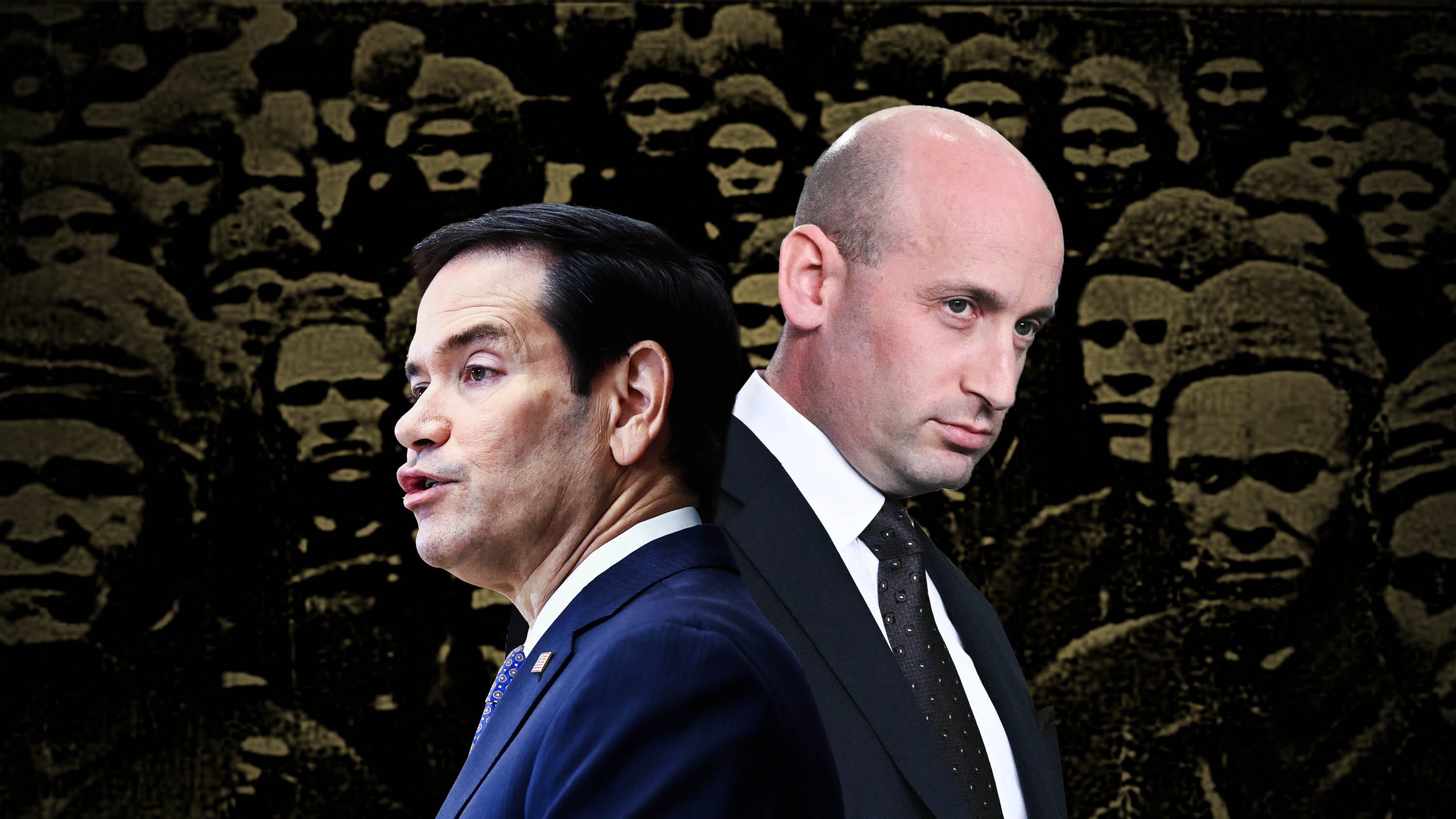
What will shock you are the words spoken by Marco Rubio and Stephen Miller in their prepared remarks to the “ministerial.” Because they weren’t just shameless, or hypocritical.
(Photo Illustration by Bill Kuchman/The Bulwark | Photos: Getty, Instagram)
THERE’S A NEW MAGA PERSONALITY on the scene: Savanna Cannon.
Parroting talking points about wacko liberals and often wearing a Charlie Kirk–style “Freedom” shirt, Cannon looks and sounds like she came straight out of the Turning Point USA or PragerU conservative influencer pipelines.
“People who don’t like what I say are, more than likely, braindead,” Cannon declared in one video last week that sums up her facts-don’t-care-about-your-feelings style.
But Cannon has one big advantage over her rival conservative commentators: she sits in an unusual way.
Cannon typically records her videos leaning back in a chair while wearing yoga pants, with her legs pulled up on either side of her. It’s a pose that highlights everything a more prurient viewer might hope to see: her bare feet and—forgive me, I am only reporting the facts here—the faint outline of her genitals.1
(Photo: X.com)
Cannon’s recumbent poses put her groin right in the center of the vertical-video frame.
“This person sits like this every time,” one Instagram commenter wrote this week. “It’s really weird.”
Cannon isn’t subtle about it. Scroll through her Instagram page and a good 80 percent of the posts are her sitting in that pose, wearing yoga pants, often pulling them up to make them fit tighter. “My videos are for straight men,” she explained.
And lest you have any lingering doubt about the audience Cannon is cultivating, it is probably settled by knowledge of Cannon’s other career: She also posts sexual photos of herself on the subscriber site OnlyFans.
The OnlyFans gig actually came first for Cannon. She tried to grow her presence on the site by, among other things, posting videos of herself working out in the gym. But it can be tough out there for an OnlyFans girl. In search of a large, particularly male audience with a track record of falling for a pretty face, she made a play to become a MAGA influencer. It was a smart call. Pro-Trump social media is a rich field for finding new, smitten subscribers—or, in the language of the industry, “simps”—who could end up following you on OnlyFans, too. While Cannon’s gym page has 42,000 followers on Instagram, her political Instagram page has 285,000. (The number of followers she has on her OnlyFans accounts is not publicly listed.)
Politically, Cannon is offering the kind of unremarkable conservative opinions you might hear on Fox News or Ben Shapiro’s Daily Wire, such as saying that being transgender is a mental illness, or that Democrats are the real racists.
“It’s probably an AI script, go in, talentless, there’s nothing being contributed,” podcaster Steven Crowder said of Cannon’s videos on his show Wednesday. “There’s nothing of value.”
CANNON’S UNSUBTLE APPROACH to combining politics with sex appeal is just the latest in the symbiotic relationship developing between right-wing commentators eager to grow their male audiences and aspiring OnlyFans models hoping to grow subscriber bases through any form of online attention. The Venn diagram of their potential audiences is almost a circle, including even those spaces where pro-Trump commentators claim to want a return to more traditional values.
Take the short-form video content produced by manospheric dating podcasts like “Whatever” or “Fresh and Fit.” Those podcasts typically feature one or two conservatives, usually men, facing off around a gigantic semicircle table with numerous scantily clad women. The conservatives ask the women titillating, often rude questions, like how many men they’ve slept with. Firing Line this is not!
What kind of woman would subject themselves to that kind of treatment? Often, the answer is OnlyFans models looking to gain monetizable internet infamy, even from “trad” men. In a 2023 video, the hosts of the Miami-based Fresh and Fit—whose podcast has featured figures like Candace Owens and Milo Yiannopoulos in the designated conservative role—defended themselves from a viewer asking why they hosted so many OnlyFans models hoping to get rich off of their audiences.
“To get the most eyeballs. Unfortunately, sex sells,” host Amrou Fudl (aka Myron Gaines) said. “There is a method to the madness, and to get eyeballs on us, sometimes we have to bring in certain girls, whatever it may be.”
Fudl argued that their fight for traditional values was still being accomplished if they could draw in “simps and suckers” and direct even a fraction of them toward the less-sexualized media products they put out. Products like “Money Monday” and, I kid you not, “Womanizer Wednesday.”
The Los Angeles-based Whatever podcast runs on a similar model, featuring conservative commentators like the Daily Wire’s Michael Knowles facing off against OnlyFans models eager to promote their accounts. In 2024, YouTube commentator Daniel Keem described the podcast’s business model as “line up some only fans sluts to roast.”
WHAT CANNON’S BEEN DOING seems to be working for her: She appears to have built a successful customer funnel for her OnlyFans by getting political. After posting conservative videos for just a few months, she now regularly gets tens of thousands of views on every short video on Instagram, as well as adoring comments and thousands of likes on each.
But not everyone on the right has been thrilled by her success.
“Conservative female talking heads are just a bunch of shallow, disgusting skanks spewing low-IQ takes,” complained far-right commentator Lauren Witzke on Tuesday, posting a video of Cannon’s legs-akimbo pose.
Crowder, displaying his usual respect for women, said Cannon’s pelvis-centric posing was merely a matter of degrees difference from female TPUSA influencer “ambassadors” or Fox News hosts.
“This is the sex appeal nuclear arms race,” Crowder said.
Cannon didn’t respond to a request for comment.
You could write dozens of dissertations on the gender politics going on here. But clearly the growing symbiosis between OnlyFans models and conservative activists—many of them ostensibly opposed to OnlyFans on religious grounds—has proven successful for all parties involved. Florida GOP gubernatorial candidate James Fishback saw his first major burst of attention when he called for a 50 percent tax on OnlyFans models’ income. That started a “feud” with OnlyFans star Sophie Rain (a Florida resident) and a debate between her and Fishback on Piers Morgan’s show. It was a win-win. Fishback was platformed on a popular news program. Rain got more exposure to atypical audiences.
White nationalist Nick Fuentes—not incidentally, a regular guest on Fresh and Fit—has also benefited from a largely one-way association with Rain. On his show, Fuentes frequently talks about how hot he finds Rain.
“Dude, she was bad as fuck. Did you see her at the fashion show?” Fuentes asked his fans.
When Fuentes’s incel-heavy fanbase revolted over his “simping,” he persisted.
“It’s like, dude, if she spit in your direction, you’d be all over that,” Fuentes told his followers.
After a viewer named “Miami Groypette” gave him $10,000, Fuentes speculated that it could be Rain.
“Who is this mystery woman?” Fuentes said. “Chat, is it Sophie Rain? Dude, that would be crazy.”
In return, Rain has courted Fuentes’s groypers. She reposted a photoshopped picture of herself in groyper merchandise that praised her as hotter than the usual “chopped groypettes,” and thanked Fuentes for the compliments.
“Can someone explain to me what a groyp is and what’s going on here 😭,” Rain wrote on X.
If anything, Cannon stands out because she merges the two roles. Rather than being an OnlyFans model subject to the whims of a dating podcast host or a feud with a far-right pundit, she is creating the MAGA content on her own. Perhaps it was only a matter of time before some enterprising ingénue tapped this particular market.
And apparently, she’s pleased with how it’s going for her. After critics accused her of taking money from Israel this week, Cannon responded in a video that she didn’t need foreign money to state her opinions.
As evidence mounts that the Iran war is strangling the economy—new Commerce Department data shows that annualized growth slowed to 1.5 percent in the second quarter of this year—the war itself continues to expand. Saudi Arabia joined in striking Iran for the first time yesterday, while Iran continues to lash out around the region, including in missile strikes against Jordan and Kuwait and an apparent drone attack in Egypt. Meanwhile, the Strait of Hormuz remains practically closed, and threats of Houthi attacks have slowed shipping through the Red Sea. Happy Thursday.
The Bulwark promises you three things: Facts about the world, honesty about ourselves, and a commitment to freedom and democracy. Support our work by becoming a Bulwark+ member.
(Photo Illustration by Bill Kuchman/The Bulwark | Photos: Jim Swift, Shutterstock)
Springfield Needs Your Help
by Jim Swift
Springfield, Ohio—Most of the routes from Cincinnati to Springfield, Ohio pass by Springfield-Beckley Municipal Airport, home to the region’s general aviation traffic and the Ohio Air National Guard’s 178th Wing. I stopped by on my way to Greater Grace Temple, where members of the G92 coalition, a network of churches that support the local Haitian community, were going to address the media about the imminent expiry of temporary protected status (TPS) for more than ten thousand Haitian immigrants in the region.
As probably always happens when a stranger shows up to a small half-military airport with no luggage and starts taking pictures, an airport employee asked me, politely, what I was doing. I told him I think this quiet airport could soon become the setting of one of the biggest stories in America: deportation flights carrying Springfield’s Haitians. He shakes his head. “I seriously doubt that,” he says. I tell him I hope he’s right.
The consequences of TPS expiring are already rippling through Springfield. Rick, a reader I met earlier this month, texts me about tearful conversations with friends whose Haitian coworkers and neighbors are suddenly being let go.
“People can’t believe this is happening to their friends and neighbors,” he says.
I got to Greater Grace a few minutes early. TV cameras were already lined up. Clergy mingled with reporters, waiting for the event to begin. Before long, eight Christian pastors and a Cincinnati rabbi took turns making the case that Springfield’s Haitian community deserves compassion.
Rev. Carl Ruby of Central Christian Church set the tone: “We’re here to respectfully ask Homeland Security and ICE to do what President Trump has repeatedly promised, and that’s focus only on the worst of the worst.”
“People in Springfield are getting letters asking them to go to Cincinnati for a check-in,” Ruby related. “Once they get there, they are asked to wear ankle monitors.” Similar requirements have drawn lawsuits from immigrant-rights groups elsewhere.
Those who have already lost their TPS and their jobs don’t qualify for unemployment benefits or most forms of government assistance. As Ruby explained, that burden has fallen almost entirely on Springfield’s churches, food pantries, and nonprofits.
Rev. Michelle Boomgaard of Christ Episcopal Church and the Springfield Neighbors United coalition reminded the room: “From our earliest days, Springfield has welcomed immigrants,” she said, noting that the city’s recent economic revival owes much to Haitians and other immigrants.
Marjory Wentworth then read a statement on behalf of Haitian community leader Obed Lafaille. “Behind every policy are real people,” the statement began. “Springfield is more than the place we live. It is the community we have helped build together.” It continued:
We work here. We raise our children here. We worship here. We volunteer here. We contribute to this city’s economy and culture. What will happen to the lives we have built here? What will happen to the businesses that depend on our labor? What will happen to the children who call Springfield home?
Rev. Tim Voltz of Champion City Church challenged those in attendance to imagine the situation in their own congregation. “If tomorrow morning the federal government had taken away the rights of one-third of your church congregation,” Voltz asked, “what would you do? . . . What do you think Jesus would call you to do?”
Pastor Jimmy Pierre of Gospel Grace Baptist Church, who is Haitian, said the uncertainty is taking a toll far beyond immigration paperwork. “The emotional burden is overwhelming,” he said. Many families, he explained, are dealing with anxiety, depression, and emotional exhaustion as they try to navigate an uncertain future. “Some have built small businesses, purchased homes, and invested years of work into this community.”
Pierre pointed out that Springfield’s Haitian community did not create the legal limbo it now finds itself in. TPS does not itself provide a pathway to permanent legal status, he said, so many families have few realistic options as the program comes to an end.
The only shred of hope is that a bill to extend TPS that passed the House might somehow pass the Senate, and then Donald Trump might decide to counteract one of his signature policies. It’s not really even much of a shred.
Pastor Ruby praised Gov. Mike DeWine, who called ending TPS “a mistake,” and Springfield Mayor Rob Rue, for urging Congress to preserve legal protections for Haitians who have built lives in the city. Both DeWine and Rue are Republicans.
People ask us all the time, What can we do? Small things matter. Share this newsletter.
Ruby’s attitude toward Ohio’s Senate delegation was, by contrast, righteously indignant and furious.
“Sen. Moreno has made it clear he’s not going to support the bill. That’s between him and his God,” Ruby said. “But Sen. Husted has not yet spoken, and we have a right to know where he stands on that bill, and just want to publicly ask him today to come out with a statement making that clear.” Husted, appointed by DeWine to fill Vice President JD Vance’s vacant Senate seat, faces longtime former Sen. Sherrod Brown this fall.
Asked what would happen if immigration authorities came to Springfield, Ruby said the coalition would encourage peaceful protest and that some were prepared to put themselves “between ICE and people who are targets for detainment and deportation.” He emphasized that any resistance would be nonviolent. “We believe that a part of civil disobedience is a willingness to pay the consequences,” Ruby said. “There are people and pastors in Springfield who are committed to doing that, no matter what it costs.”
Ruby closed with an appeal for immediate financial help. G92 itself was not seeking donations, but local organizations are: the Haitian Community Help & Support Center, St. Vincent de Paul, and Second Harvest Food Bank were facing enormous demand. “These are all people who wanted to support themselves and who were supporting themselves,” Ruby said. “But now we have to come up with money to pay rent. We have to help families put food on the table.”
Asked how long local groups could keep providing that support, he was blunt: “Money’s running out quickly,” adding that “they need millions of dollars.”
As Jim notes above, Congress could act to stop or limit the Trump administration’s cruel and destructive mass deportation policies. Legislation to extend temporary protected status for Haitians living here has already cleared the House, with ten Republicans joining united Democrats in support. Right now, as Jim notes, it looks unlikely that the Senate will pass that bill—or choose to extend TPS for other groups like Salvadorans, whose protections are set to expire in September.
On the other hand, it seemed unlikely until last night that Republican defections would pose a threat to Todd Blanche’s confirmation as attorney general. But the sweetheart IRS immunity deal granted to Donald Trump and his family has turned out, at least for now, to be a bridge too far for departing Republican Sens. John Cornyn and Thom Tillis.
Could there be similar Republican defections ahead, perhaps by senators up for reelection, on other issues including mass deportation? It’s more possible today than it seemed a couple of weeks ago.
That’s because, after temporarily stabilizing for a few months, Trump’s popularity has started falling again. The latest AP/NORC poll, released this morning, shows Trump with a 33 percent approval rating. A new CNN/SSRS poll, in the field late last week, has Trump at 34 percent approval and 66 percent disapproval among registered voters. A Quinnipiac survey also conducted late last week among registered voters has him at 32 percent approval vs. 58 percent disapproval, with 10 percent not offering an opinion. In both polls, Trump’s approval is at a new low.
Immigration policy, once a bastion for Trump, has collapsed. His support on immigration isn’t quite down to the levels on some other issues—but in politics it’s as damaging when you lose your advantage on a good issue as when you do even worse on bad ones. At the beginning of Trump’s second term, he had an edge in the CNN poll in approval of his handling of immigration of 51 percent to 48 percent. Now he’s fallen to 39 percent approval, 61 percent disapproval. And Quinnipiac has very similar results, with Trump now at 40 percent approval and 57 percent disapproval on immigration.
Moreover, Immigration and Customs Enforcement, the face of Trump’s mass deportation policy, is strikingly unpopular. CNN finds Americans saying by a margin of 50 percent to 30 percent that enforcement actions by ICE are making cities less safe rather than more safe. Quinnipiac has 37 percent of voters approving of the way ICE is doing its job, while 60 percent disapprove.
Could this lead some Republican senators, especially ones on the ballot in November, to vote to extend protections for Haitians or others? Could they be pressured to support other measures to make ICE accountable and responsible? It’s worth testing that proposition when Congress returns in September. And it’s worth making that argument throughout August.
The economy and the Iran war remain Trump’s greatest vulnerabilities. But flipping immigration from a positive to a negative issue for Trump, and hammering home the fact that Republicans in Congress are refusing to do anything to stop his excesses, could turn a Republican defeat in November into a rout.
Todd Blanche’s New Grip on the Federal Prison System… Critics worry a little-noticed policy shift could let the attorney general reward allies, punish enemies, and sideline longstanding Bureau of Prisons processes, writes MATTESON EPSTEIN.
86 47: James Comey’s attorneys this week released a trove of documents detailing Donald Trump’s Justice Department’s nakedly retaliatory attempt to put him in prison over an “86 47” Instagram post. The outrageous behavior they detailed could fill an entire newsletter: The documents, for instance, depict the complete collapse of all barriers to political influence in federal enforcement. To take just one example of many, the Secret Service officers tailing and surveilling Comey passed along regular updates to Trump’s personal protection detail to keep the president informed in real time.
For our money, though, the funniest chestnut came the day after Comey’s post, when Trump took to Fox & Friends to fume that “He knew exactly what that meant. A child knows what that meant. . . . That meant assassination and it says it loud and clear. . . . He’s calling for the assassination of the president.”
Trump’s comments, per Comey’s team’s filing, appear to have prompted an immediate change in Secret Service threat-monitoring policy. “Effective immediately, please include ‘8647’ in manual keyterm searches for threats to POTUS Trump. . . . ‘8647’ could be coded threat language for ‘kill the 47th President’. . . . The language itself could constitute a threat and it also could constitute unusual behavior.”
The new policy lasted barely twelve hours. That same night, a new directive came down from an assistant director for the Secret Service: “I appreciate the team’s effort on this. As we figured, this is a lot and we can’t, nor should be expected to document all of these references to 8647. We should go back to business as usual, unless someone is inciting violence along with those numbers or adding egregious and threatening language.” The government’s official policy: When Comey says it, it’s a true threat to imminently assassinate the president. When anyone else says it, it isn’t even worth keeping a log of. (Which is good, because Congress or the Cabinet should absolutely 86 47.)
FAUCI RELITIGATED: Perhaps the only surprising thing about Republicans’ abrupt attempt to relitigate the COVID-era culture war over Anthony Fauci is that it hadn’t happened until now. Unlike, say, James Comey, Fauci wasn’t a top target for retribution upon Trump’s return to office—the president had never considered him a personal enemy, and at any rate Joe Biden had issued the eminent epidemiologist a preemptive pardon.
But for some other Republicans, Fauci has remained public enemy number one—particularly Sen. Rand Paul, who chairs the Senate Homeland Security and Governmental Affairs committee. Paul has long blamed Fauci—rather than Trump—for spearheading the government’s cautious approach to the early COVID pandemic, and has accused him, among other things, of wrongfully trying to smother the theory that the disease escaped from a Chinese lab. Paul has long sought to compel Fauci’s testimony before his committee, and yesterday he got his wish. Ahead of the hearing, Paul heightened the spectacle by releasing thousands of pages of Fauci’s personal journals—supposedly on the grounds of highlighting difference between Fauci’s private and public communications about the pandemic at the time, but transparently also hoping to embarrass the doctor by revealing, among other things, his bemused journaling about the public spotlight he’d suddenly found himself thrust into.
Fauci showed up, but not to cooperate. In his opening statement, he cited Paul’s “unhinged obsession with me” to argue that “the sole reason he is calling me before this committee is to get me to say something—anything—that could vindicate his repeated public pledges that I end up, in his words, ‘behind bars.’” As a result, Fauci said, he would decline to answer any and all questions put to him by the committee, citing his Fifth Amendment right against self-incrimination. Paul wasn’t pleased. After the hearing, he suggested that Republicans would pursue contempt charges against Fauci for his refusal to answer their questions. “Maybe the Fifth Amendment doesn’t attach when you have a pardon in place,” Paul said.
NEW CHAIR, SAME AS THE OLD CHAIR: New Fed Chair Kevin Warsh isn’t giving Donald Trump what he wants, but the president isn’t holding it against him—yet.
Trump spent more than a year making Jerome Powell, Warsh’s predecessor, miserable over what he saw as Powell’s unforgivable slowness in bringing down interest rates. But he’s also dealt Warsh an impossible hand this year by adding heaps of inflationary strain to the economy via tariffs and the Iran war, making speedy rate cuts all but impossible. Yesterday, the Fed board voted for the second time under Warsh to hold rates steady—with three dissenting votes that would have favored a rate hike.
Trump, of course, doesn’t agree that cuts would risk runaway inflation. But he’s remained gracious to Warsh the only way he knows how: By blaming the rest of the Fed governors for a change. “Kevin’s fantastic, but he’s got a board,” Trump told reporters yesterday. “He’s got a board, and it’s a political board. And they want to keep rates up.”
(Photo illustration by Bill Kuchman/The Bulwark | Photos: Getty, Shutterstock)
ACTING ATTORNEY GENERAL TODD BLANCHE was grilled during his confirmation hearing over the controversial transfer of convicted sex offender Ghislaine Maxwell to a lower-security prison last year—a move that took place just one week after Blanche met with Maxwell to discuss her associations with Jeffrey Epstein.
In a heated exchange with Blanche, Sen. Cory Booker (D-N.J.) argued the transfer “seems clearly like a reward” after Maxwell appeared to distance President Donald Trump from Epstein’s criminal activities during her interview with the then-deputy attorney general.
Booker had reason to pound this point.
At her new facility—dubbed “Club Fed”—Maxwell reportedly has a service puppy, specialized workout hours, and customized meals delivered directly to her housing unit. She is also the only one of more than 20,000 current federal sex offenders to have been approved for placement in such a federal minimum-security prison camp, according to Maureen Baird and Janet Perdue, former senior Bureau of Prisons officials with sixty-two years’ combined experience (who now run the firm Baird Perdue & Associates Prison Consultants).
Several of the lawmakers and experts whom I spoke to for this article believe Maxwell’s move was a top-down directive from Department of Justice leadership rather than a bottom-up Bureau of Prisons decision. “Todd Blanche had just interviewed Maxwell for several hours before this transfer occurred, so it doesn’t take a rocket scientist to connect the dots,” Rep. Deborah Ross (D-N.C.) told me. Even so, she acknowledged that no evidence has emerged—including during his confirmation hearings—that Blanche personally directed Maxwell’s transfer.
Some critics say Blanche’s own description of his role only heightens concerns that he was inappropriately involved in Maxwell’s transfer. Asked about Maxwell during a December appearance on Meet the Press, Blanche said that he is “responsible for the Bureau of Prisons” and that “every decision” made by the BOP “lands on my desk to the extent it needs to.”
But certain experts and members of Congress say Maxwell’s transfer is just the tip of the iceberg: the most visible example of a broader policy change that centralizes—and, in some cases, politicizes—federal prison placement authority under the attorney general. They warn that the policy could be used not only to reward allies of the administration, as they argue happened with Maxwell, but also potentially to punish its perceived enemies. And given the Justice Department’s recent record investigating political adversaries, they say the policy deserves a hard look. Here’s why.
The Bureau of Prisons, a component of the Justice Department, has traditionally handled prison placement decisions. It has a 116-page manual of guidelines detailing the degree of supervision different prisoners require.
As Booker observed in Blanche’s hearing two weeks ago, BOP regulations generally prohibit housing convicted sex offenders like Maxwell in minimum-security facilities. Baird, who helped develop BOP’s prison classification policies in the 1990s, told me these standards were set precisely to ensure “an individual convicted of a sex crime was housed in at least a low-security prison and never at a minimum-security prison camp” because “sex offenders pose a risk to the community.”
A BOP spokesperson disputed that a transfer of this kind is unprecedented but could not provide statistics or examples to support the claim.
At his confirmation hearing, Blanche said Maxwell was moved because of concerns about her physical safety in prison. Booker responded that, if safety were truly the issue, BOP’s standard response would be to send her to protective custody or another low-security prison—not to reassign her to a minimum-security camp.
On June 17, BOP tweeted a public statement claiming that the decision to transfer Maxwell had been made “independently by BOP,” with “no preference, special treatment, or political influence” playing any role. A BOP spokesperson told me the transfer was based on the “general observation” that lower-security prisons have fewer violent incidents but could not identify any specific security measures making her new prison safer.
DEMOCRATS AND LEGAL OBSERVERS unconvinced of the BOP’s independence point to a May 6 BOP policy change, quietly issued under Blanche’s supervision as acting attorney general, that they say gives the attorney general carte blanche over federal prison placement. They contend that, by allowing the attorney general (in unspecified circumstances) to designate an inmate’s place of imprisonment, the policy shifts prison placement authority from the BOP’s traditional role and established processes.1The policy change was made with no public announcement.2
The revision also lets the BOP facilitate communication between prisoners and the Office of the Attorney General. Rep. Raskin (D-Md.) told me in a phone interview this specific provision appears both backward- and forward-looking—as if it were designed to retroactively “normalize the extraordinary nature of Blanche’s contact with Ghislaine Maxwell” while simultaneously enabling BOP to facilitate similar interactions between future attorneys general and federal prisoners.
But to Raskin, the policy’s real stakes are a larger institutional usurpation. “Maxwell is just a small window into the kind of total power the president wants to exercise over the penal system,” he said.
Raskin joined Rep. Ross and Rep. Ro Khanna (D-Calif.) in a June letter to the BOP director arguing that the policy change marked “a significant departure” from its longstanding inmate classification framework. “They cannot explain how this improves the process other than to give the attorney general, and therefore the president, the power to favor their friends or harm their enemies,” Raskin told me.
Raskin was just one of several experts and lawmakers I spoke to who worried that as a result of these changes, a well-connected prisoner could receive more favorable prison placement—such as a camp or halfway house—while one of the president’s perceived adversaries could face harsher confinement than career BOP officials would otherwise recommend.
“The change that was made here is just absolutely stunning in scope and potential impact,” former Justice Department pardon attorney Liz Oyer told me. Oyer, who testifiedagainst Blanche and first broke the news of the policy shift, said it “essentially gives the attorney general the authority to override the entire manual at his complete discretion.”
NOTABLY, CONGRESS MANDATES that BOP show “no favoritism” toward prisoners of “high social or economic status” when making transfer decisions—a legal requirement that the DOJ must follow.3
When I asked BOP how the attorney general would comply with that requirement, a spokesperson offered no explanation, instead responding with a rationale for the policy change. It made no mention of Maxwell.
The spokesperson said the revision was intended to “formally memorialize” the attorney general’s statutory authority over prison placement in light of ongoing litigation regarding the redesignation of federal inmates whose death sentences were commuted by President Joe Biden.
That litigation began after Trump issued a day-one executive order, modeled on a Project 2025 recommendation, directing the attorney general to move many of Biden’s death-row commutations to more restrictive prisons. Some legal critics argued that Trump implemented the executive order specifically to diminish the practical effect of Biden’s clemency.
To Mark Osler, a professor at the University of St. Thomas School of Law and an expert in clemency, the fact that Blanche is using this authority to fulfill a specific Trump directive only adds to the concerns about favoritism. “The transfer of commuted death row prisoners was clearly for political reasons,” he said.
Rep. Ross echoed that view: BOP’s explanation “only reinforces why this policy raises serious concerns.” She also noted that, because the policy doesn’t spell out whether the attorney general can take into account politics or instructions from the White House, it would “allow the attorney general to move inmates to either higher- or lower-security facilities without any clear standards or safeguards against political favoritism or abuse.”
Mark Allenbaugh, a former staff attorney for the Sentencing Commission, said that the BOP’s recent planned closure of six lower-security prisons raises the stakes. With fewer lower-security beds, inmates who would otherwise qualify for them—including former national security advisor and Trump critic John Bolton, Allenbaugh said—are increasingly likely to end up in higher-security institutions.
Allenbaugh also told me the change has the potential to affect not just where prisoners are held but the practical length of their sentences, since access to earned-time credits depends heavily on recidivism programs available at a particular prison. Because those programs vary widely by institution, some inmates have far less practical access than others. “The attorney general could absolutely effectively extend the time an inmate would otherwise serve,” he said.4
WHATEVER ITS PRACTICAL IMPACT may ultimately be, the BOP policy is already drawing scrutiny in Blanche’s confirmation process. In a series of written questions, Sen. Dick Durbin (D-Ill.), the top Democrat on the Judiciary Committee, asked Blanche about why the policy change was made and how he plans to use his prison placement power.
In his written responses, Blanche left several key questions unresolved. While he said he would not wield the authority for political purposes, he did not describe any measures he would take to prevent favoritism. And in response to Durbin’s question about why the policy had been changed, Blanche did not mention the ongoing litigation over the death-row prisoners—the justification given to me by the BOP spokesperson. Instead, he said only that “decisions of this kind are made based on legitimate considerations, including safety and security.”
His answers aren’t enough for some lawmakers. “If this change was simply meant to reflect existing authority, why was it adopted more than a year after the Trump administration began exercising that authority and only after it was facing litigation and intense public scrutiny over Ghislaine Maxwell’s transfer to a lower security facility?” Rep. Ross demanded.
The BOP spokesperson did not respond to my request to identify whether or how the attorney general’s designation authority has been used so far, and the Justice Department denied my request for expedited processing of a FOIA request seeking records about Maxwell’s transfer and the policy change’s implementation.5 A BOP spokesperson did confirm that under the revised policy, future placement decisions—including whether to house convicted sex offenders in minimum-security prison camps—will be made on a “case-by-case basis.”
These responses, according to the lawmakers I spoke with, only strengthen the need for congressional action. Ross said she would consider legislation restoring exclusive prison placement authority to the BOP. “All options are on the table,” she noted.
For Raskin, this issue extends beyond Maxwell’s case or Blanche’s confirmation or even the Trump administration. “The moment that political favoritism governs the conditions of confinement, then everyone immediately tries to curry favor with the people in power,” Raskin said. “It’s a return to monarchical and feudal relationships, where it’s all about the fury or the mercy of the king. . . . That’s what confinement is like in authoritarian societies.”
The policy also strikes out language requiring that the attorney general follow BOP’s longstanding inmate classification system, a change Baird called “perplexing” given that it had been used for decades.
Ron Levin, an administrative law expert at the Washington University School of Law, said the notice appears to be a procedural rule that simply shifts decision-making authority to the attorney general, rather than creating a new prison placement policy—meaning it did not have to go through the public notice-and-comment process. Long story short, the Justice Department likely was not required to publicly propose or justify the change notice before adopting it.
Not everyone I spoke with shared Allenbaugh’s concern. Mark Osler, the University of St. Thomas law professor, agrees that placement can affect time served but considers it highly improbable that an attorney general would wield this placement authority vindictively to alter a prisoner’s period of incarceration.
(Photo illustration by Bill Kuchman/The Bulwark | Photos: Getty, Creative Commons, Shutterstock)
EMBATTLED DEMOCRATIC NATIONAL COMMITTEE Chair Ken Martin is “open” to the idea of bringing on additional help from an experienced party leader to address the committee’s ongoing fundraising problems, according to a DNC official.
What role that person would play—let alone if it will happen before the midterms—remains unclear. But the willingness to entertain such a change comes as operatives in the party have begun broaching the idea of bringing on a co-chair at the committee to deal with fundraising as well as media appearances.
Martin has been beset by constant complaints over his struggles in these two areas—complaints that crested with a trio of stories over the weekend highlighting the DNC’s financial challenges and his increasingly erratic behavior.
Operatives across the party have come to believe that the best path forward is to bring on board someone who has credibility with donors and is capable of appearing on podcasts and cable news, which is itself a major fundraising function since top donors are particularly addicted to shows like MS NOW’s Morning Joe. Those in favor of bringing on a new hire in addition to Martin said it would take the pressure off him to fill the more public-facing responsibilities and allow him to focus on the day-to-day operations inside party headquarters. They noted that during the Clinton years, it was common to have DNC co-chairs with differing responsibilities. They see the need for a co-chair as acute right now, but downright paramount as the 2028 presidential primary season nears.
The best way to keep on top of breaking news inside the Democratic party: Join Bulwark+. We’ve got you covered.
But even as the DNC is now expressing some openness to fresh blood at the committee, there remain questions as to whether Martin—who would have to sign off on it—will ultimately get on board.
“There’s been talk of an intervention or of adding a co-chair—but all these ideas are ideas that Ken Martin will not agree to,” one DNC member told me. “His ego just won’t allow for that.”
Another party operative said that they actually encouraged Martin to bring on bigger party names to the DNC earlier this year in a role akin to a co-chair. But their suggestion then was ignored. “That whole operation is just in a bunker right now,” the strategist said.
That Martin may be softening on this is a testament to how rocky and untenable his tenure has become. Martin stepped into the role of DNC chair with the backing of many state party chairs but without a national profile or the national connections that are essential for fundraising. Rather than adjust, he’s adopted a go-it-alone approach, contributing to the DNC’s insularity and furthering the image that he is hampered by his own insecurity.
His troubles are well documented at this point, illustrated regularly when the DNC files its financial reports. But they’re amplified by the fact that he has done little to build alliances throughout the party. Multiple operatives said they were frustrated that the only time they’ve heard from Martin’s team has been when his staffers asked them to stop publicly criticizing him on cable and social media.
“After founding Moms Demand Action, helping to raise $11 million for Kamala Harris’s campaign, hosting fundraisers at my home, donating individually, and becoming a member of the DNC Finance Committee, I assumed he’d reach out—if for no other reason than to ask me for more money,” posted Shannon Watts, who founded the gun-safety group after the Sandy Hook tragedy in 2012.
“Nope, never heard from him,” she added in the post. “However, about six months into his tenure, he did have a DNC staff member call me to tell me he didn’t like something I’d tweeted.”
Another problem with changing up the DNC’s leadership is that even if Martin were to ultimately agree to a co-chair, it’s unclear who would want to be responsible for digging the DNC out of $2 million of debt while navigating low staff morale and a toxic workplace environment. Those challenges haven’t stopped frustrated operatives from wishcasting. Among the names tossed around in conversations these past few weeks are Donna Brazile, Pete Buttigieg, Terry McAuliffe, Howard Dean, and Jon Tester. But the name I’ve heard mentioned most frequently is Rahm Emanuel.
“We all know who it should be: It’s Rahm,” said a progressive Democratic strategist. “Even the progressives know that Rahm doesn’t fuck around and he raises a shit-ton of money and is very organized. It’s the perfect job for him. He has his enemies for sure, but even the people on the progressive side of the party want a functional, credible DNC.”
Emanuel is currently in the midst of exploring a presidential run and is extremely unlikely to drop that idea for a co-chair gig at the DNC. And the other people whose names have been floated are, for the most part, either enjoying retirement, don’t want to deal with the DNC’s problems, or also have their sights set on running for president.
Still, operatives I spoke with aren’t giving up hope that one of the longer-shot presidential contenders could be convinced to take on fixing the DNC.
“I think you can say: ‘Look, you fucking clean this place up. You do a badass job. You raise money. And then you position yourself and make it very clear that you’re in this because you want to serve in the next administration,’” said a veteran strategist, noting that Ron Brown was elected chair of the DNC in 1989 and then appointed secretary of commerce by President Bill Clinton after his 1992 election.
“That would require a risk, of course, and you do have to forgo the presidential campaign. But I also think there’s an opportunity to do something there.”
Fling this newsletter into a friend’s inbox or flash it up onto social media:
WHETHER OR NOT MARTIN brings on a big name—or even a co-chair—he is almost certainly staying put himself. Though senior lawmakers aren’t happy with the DNC’s dysfunction, they also don’t seem interested in forcing him out this close to the midterm elections. But that sentiment could quickly shift post-November, especially if the DNC’s fundraising hasn’t significantly improved.
In anticipation of that, party officials are still adding names to informal short lists of who could step into Martin’s role after the election. Some Democratic donors recently started floating Skye Perryman, the president and CEO of Democracy Forward, as a potential Martin replacement, noting that she was able to grow the nonprofit’s fundraising from $17 million in 2024 to $65 million in 2025.
The real gut-check on Martin’s future will come next month when DNC members travel to Austin, Texas, for their annual summer meeting. Aside from Martin resigning voluntarily, the only other way to force him out would be for a majority of the DNC’s roughly 450 members to vote in favor of removing him.
DNC members I spoke to said that since members are spread out across the country, much of the discussion about how to handle Martin’s chairmanship had been happening through various group chats and Signal chains. That made it hard to get a good read on whether anything nearing a majority of members favored ousting him. But they emphasized that Martin’s strongest critics would be working the crowd at the August meeting to get a sense of members’ willingness for action.
The conventional wisdom among DNC members has been that state party chairs, who are DNC members, have remained loyal to Martin because many of them have received an influx in funding under his leadership—and because Martin himself was once a state party chair. And given that state delegations typically follow the lead of their state chairs, there hasn’t been a real groundswell of support to vote him out. But some operatives are beginning to question whether state chairs will start to decide that the dysfunction and ongoing negative attention—all of which undermines the operations they’re trying to stand up on the local level—is no longer worth the promise of extra cash.
“More people are realizing that he can’t stay,” said another DNC member. “This will be the topic in Austin.”
The Democratic National Committee is facing growing criticism from within its own ranks—and now one of the party's most prominent fundraisers is speaking out. Sam Stein sits down with veteran Democratic fundraiser Rufus Gifford to discuss why he believes DNC Chair Ken Martin is failing at the two most important parts of the job: raising money and delivering a clear message. Gifford explains why he thinks the committee is spending too much on long-term party-building while critical Senate and House battlegrounds need every available dollar ahead of the midterms.
Tim’s back next week but in the meantime enjoy this ad-free preview of The Bulwark Podcast—today with JVL and Robert Kagan. Upgrade to watch the full show—ad free—and join the Bulwark community in the comments. Ride with us.
At a little-noticed conference on political violence a couple of weeks ago, Marco Rubio and Stephen Miller employed the dehumanizing rhetoric of the Soviets and Nazi mastermind Joseph Goebbels to attack the left. And while they might want us to think they were just talking about the DSA, it sure seems that they meant Democrats generally—including those who might be legitimately protesting Trump's efforts to try to steal an election. Plus: Iran is not acting like it fears the United States, Lindsey Graham probably did more harm than good, and the Fauci drama is the latest example of the MAGA double standard about telling the truth.
As always: Watch, listen, hit the like button or leave a comment. We want to hear from you.
Ad-free editions of The Bulwark Podcast are available exclusively for Bulwark+ members.
The Bulwark Podcast with Tim Miller is available wherever you get podcasts and on YouTube. New shows drop each weekday afternoon. If you like the show, leave a comment and ⭐⭐⭐⭐ wherever you listen. Add The Bulwark Podcast to your player of choice, here.
Jonathan Cohn takes on the Fauci hearing spectacle, where Rand Paul grilled the former NIH chief over newly obtained diaries—and Fauci pled the Fifth. Cohn joins MS Now to separate legitimate oversight from what he calls a political show trial aimed at Trump-era vengeance.
Lt. Gen. Mark Hertling (Ret.), Ben Parker and special guest Ret. Rear Adm. John Kirby went live to discuss the U.S. intercepting an attack by Iran, Trump’s response to the attacks, and the concern on U.S. missile stockpiles as the war drags on.
Drawing on his own experience in the Navy, John breaks down what it’s really like to defend the Strait of Hormuz, why Iran continues to threaten global shipping despite months of U.S. strikes, and how a lack of clear strategy is putting American readiness at risk.
Plus, a look at how the Pentagon’s silence and the White House’s inconsistent public statements are undermining public trust at a moment when Americans deserve honest answers about the war.
Donald Trump’s legal apparatchiks at the Justice Department have insisted for months that the criminal indictment against former FBI Director James Comey—one of the personal enemies Trump most longs to see punished—goes beyond the “86 47” Instagram post they ludicrously insist constituted an imminent threat on the president’s life.
“Rest assured that it’s not just the Instagram post that leads somebody to get indicted,” Acting Attorney General Todd Blanche said on Meet the Press in May. There had been a full investigation by “the career FBI agents, the career Secret Service agents,” and who knows what damning evidence they might have found?
Now, thanks to a series of court filings last night from Comey’s lawyers, we finally know what that investigation entailed: a ludicrous snipe hunt in which federal officials sought high and low to find people who would testify that “86” is an old mob threat, interviewing old mobsters and Comey associates to prove he should have known as much—because after all, hadn’t he prosecuted organized crime? They’ve got him on the ropes now! Happy Wednesday.
Join Mark Hertling and Ben Parker—with special guest Rear Adm. John Kirby—for Command Post at 10:00 a.m. EDT today. Watch on Substack or YouTube.
Morning Shots is free—as is most of what The Bulwark publishes. Because you can’t save democracy from behind a paywall. Our work depends on the support of Bulwark+ members. Join today to help us grow—and get two weeks free as an expression of our thanks.
(Photo Illustration by Sarah Rogers/The Bulwark | Photos Getty, Shutterstock, Truth Social)
Bomb, Rinse, Repeat
by Andrew Egger
Yesterday morning, after Donald Trump called in to Fox & Friends to show off his latest peacenik turn—insisting implausibly that the late Sen. Lindsey Graham’s dying wish was a peace deal with Iran, grousing at Israeli Prime Minister Benjamin Netanyahu for stating publicly that Iran seemed ready to start rebuilding its nuclear facilities—I messaged the Morning Shots editors that I had a headline for today’s newsletter: “Trump, Iran, and the Definition of Insanity.”
Ben Parker wrote back, confused: Hadn’t we used that exact phrase before? And yeah, pretty much:
Such is life for the poor put-upon newsletter grinder in the dog days of Donald Trump’s endless Iran war. While Iran presents a steady, ironclad negotiating front—your sanctions must go, your troops must go, your nuclear demands must go, and we get the Strait of Hormuz—Trump finds himself trapped in an endless reboot loop, orbiting hopelessly around two demonstrably failed positions: If we bomb the hell out of them, they’ll give us what we want. If we stop bombing them, they’ll give us what we want. And we find ourselves scrabbling for something new to say about the same old grotesque status quo of America’s slow-motion pantsing on the world stage.
This morning, the New York Times wrote up a short history of Trump’s “Whiplash War” in Iran, laying out in stark data-viz form just how erratically Trump has toggled between his two strategic modes. In late March, just weeks after the war began, he was already threatening to blow up Iranian power plants. By early April, he was threatening genocide. Those threats gave way to a two-week ceasefire—which fell apart nearly at once after Iran continued to fire on ships in the Strait of Hormuz, leading Trump to declare an economic blockade of his own.
After a May marked by periodic bursts of attacks, June brought the vague “Memorandum of Understanding” that led Trump to declare the mission accomplished: “The Deal with the Islamic Republic of Iran is now complete. Congratulations to all!” he exulted on June 14. “Ships of the World, start your engines. Let the oil flow!”
Days later, missiles were flying again. The ceasefire was momentarily resumed on June 28—before Trump declared it truly dead July 8, leading to the heaviest period of bombardment since the opening days of the war. Then came the brief respite beginning this past weekend, which now appears to be over after Iran launched missiles at a U.S. base last night: “We are going to beat the fucking shit out of them,” Trump told Fox News this morning. “We’ll be hitting them hard. They’re going to get a beating.”
The definition of insanity, per the bumper sticker, is supposed to be doing the same thing over and over and expecting a different outcome. But I’m worried that watching Trump do the same thing over and over, fully aware the outcome will be no different, is a recipe for insanity, too.
“I could knock out the power plants within one day,” Trump said yesterday, reiterating a threat he first made on March 21, more than four months ago. “All of their power plants would be gone. And I let ‘em know that, you know, with negotiations. . . . So I think we have a very strong position right now. They know I’m going to do that if they don’t make a deal.”
I challenge anyone to spend so many months submerged in this sort of suspended reality without feeling like they’re losing their mind.
Alone, we go crazy. That’s why we started a new kind of pro-democracy community. Join us.
The basic problem is that while Trump’s approach to the war is cyclical, its damage is cumulative. Petroleum reserves, missile stockpiles, global trust in the U.S.-led world order—these are finite resources that are all being spent down at alarming rates.
More happily, American confidence in this utterly incompetent con artist turns out to be a finite resource too. Trump continues to plumb new depths in his popularity at home. And as Republicans grimly pivot their political messaging from fantasies about a Trump GOLDEN AGE to trite rabble-rousing about the threat of Democratic communism, it’s plain they too are losing hope that Trump will pull off some unexpected miracle to win the war—much less restore Americans’ confidence in his leadership.
Somehow, someday, I believe that the war will come to some sort of end. It’s all but guaranteed to be a bad end for America, but at least we can look forward to getting off the interminable psychic treadmill. It is extremely unlikely, I keep telling myself, that—as I keep suffering in dreams—I will wind down my last days on this earth decades hence hearing regular updates on President Barron Trump’s insistence that the Sixty Years’ War will be over any day now—because, after all, Iran knows we could just knock out their power plants. Forever wars only happen to stupid presidents.
BUCKS COUNTY, Pa.—Before Pennsylvania Gov. Josh Shapiro can run for president, he must win re-election against Republican Stacy Garrity, the current state treasurer who claimed Trump won the 2020 election and even pushed the Big Lie at a January 5, 2021 rally in Harrisburg.
Garrity is almost certainly headed toward an electoral calamity. Recentpolling shows her getting trounced by double digits. She raised only $1 million in the first quarter of 2025, leaving her with just $1.5 million cash on hand. Shapiro has $50 million.
To see what the energy around the doomed campaign was like I went to a Veterans for Garrity campaign event here on Monday. An older crowd of about fifty was greeted in a humid firehouse by speeches from local party leaders and a playlist of the most popular songs played at Trump rallies.
Garrity herself was not an impressive orator, but she knew her audience. Her speech lasted about fifteen minutes and focused primarily on veterans’ issues. She only attacked her opponent once—possibly a tacit acknowledgment of the futility of trying to drive down Shapiro’s high favorability ratings.
Trump clearly values his endorsements highly as a political weapon—and he likes to keep it sharp by not wasting it on sure losers. I won’t be too shocked if he finds a reason to un-endorse Garrity between now and November.
—Brendan Hartnett is a rapid response editor at The Bulwark.
Trump Is Making Government Worse on Purpose Instead of seeking to simplify and improve citizens’ lives, this administration keeps creating new obstacles and burdens, JILL LAWRENCE writes.
NO DISASTER AID FOR YOU: Unequal treatment of red and blue states has been a consistent story of Donald Trump’s second term; just yesterday, we noted how the government had admitted to canceling more than $8 billion in clean energy grants last year based solely on the fact that those grants were headed to states that voted for Kamala Harris. This hasn’t stopped. Just this month, Trump blocked petitions to FEMA for disaster aid from four blue states: New York, New Jersey, Massachusetts, and Rhode Island. In at least three of these cases, the denials came despite FEMA determining the states should qualify for aid under law. Here’s Politico, which broke the story:
Trump’s rejections came after regional offices of the Federal Emergency Management Agency and NOAA determined that the states met government thresholds for receiving aid following a record-breaking snowstorm in February. . . .
Presidents since George W. Bush approved all 69 state requests for snow assistance that met FEMA standards except for a 2016 request from New Mexico, which was being investigated for mishandling FEMA funds, according to a POLITICO analysis of agency records. . . .
“If the federal government is paying for regular operations like snow removal, what next? Garbage removal?” a FEMA spokesperson said in a statement about the recent denials. “The federal government’s role is not to fund routine functions.”
UGLY NUMBERS: The polling clunkers just keep piling up for Donald Trump. Although the long Spring slide of his approval numbers had stabilized somewhat in recent weeks, he’s back to finding new depths as Americans come to terms with the disastrous effects of his Iran war. This week’s Economist/YouGov poll put his net approval rating at an astonishing -28 percent—a record low for either Trump term. Only 34 percent of Americans either strongly or somewhat approve of the president’s second-term performance.
Here’s an equally astonishing way to slice the numbers: In the past two weeks of YouGov polling, Trump has recorded his lowest-ever approval ratings from his core demographic: white Americans without college degrees. Last week, the poll found him at -10 among this group; this week, he was at -9.
West Point undergraduates are reflected in a pool of rain water during the United States Military Academy commencement ceremony in Michie Stadium at the U.S. Military Academy on May 23, 2026 in West Point, New York. (Photo by Adam Gray/Getty Images)
DOES CHARACTER COUNT FOR ANYTHING in public life anymore? It’s a question that’s come up, it seems, more and more frequently in the past decade, as almost every politician seems eventually to face one kind of scandal or another. Ditto celebrities, professional athletes, leading scholars and scientists, business leaders, and other prominent people. As David French recently summed it up on an episode of TheFocus GroupPodcast: “Do American voters really care about character? No. . . . Does character really matter? Yes.”
I’ll leave it to David and others to analyze the priorities and virtues of the American voter. But I think, when considering the role of character in our society and politics, it’s important to keep in mind that good character isn’t a finite natural resource, but something that can be—and must be—developed intentionally in every person.
Character is easy to admire when it appears and easy to condemn when it fails. But it does not suddenly emerge when an individual runs for office. It is not conferred by elections, and it should not be judged because of promotions, uniforms, titles, wealth, or fame. It is, rather, built patiently over years, long before it is ever tested. The real question may not be whether we still value character, but whether we still understand what it is and how it is formed.
For me—like, I think, for many Americans of my generation—character formation started at home and continued at school, in athletics, in church, and in other civic institutions (in my case, the Boy Scouts). By the time I entered West Point in the summer of 1971, my family and a whole series of institutions had already imprinted themselves on me. The United States Military Academy did not begin the work of building my character; it assumed that work had already started and deliberately sought to deepen it.
WEST POINT’S MISSION WAS NEVER simply to educate engineers or produce tactically proficient Army officers. Its larger purpose was to prepare young men—and, beginning soon after my graduation, young women—to bear extraordinary responsibility for the lives of others and the trust of the nation.
What distinguished West Point is not that it claimed a monopoly on character development, but that it recognized that technical competence without moral development can become dangerous. The academy could teach engineering and history, the proper employment of artillery, and how to write a clear operations order. But none of those skills matter if the person exercising them lacks integrity, humility, and an unwavering sense of duty.
Nowhere was that pedagogical philosophy clearer than in the Honor Code: “A cadet will not lie, cheat, steal, or tolerate those who do.”
Those words establish that trust is the currency of leadership. A leader who cannot be trusted with the truth can never be trusted with soldiers’ lives. Every future decision—reporting casualties honestly, assessing an enemy accurately, advising a superior candidly, accepting responsibility for failure—rests upon that foundation.
The academy reinforced that lesson through its motto: “Duty, Honor, Country.” Those three words described an order of priorities. Duty came before personal ambition. Honor governed how duty was carried out. Country reminded future officers of the purpose that was larger than themselves.
There was one more influence that has remained with me for more than five decades. When I entered West Point, chapel attendance was still mandatory. A federal court later ended that practice on the grounds that it violated the Constitution, but to me, the lasting lesson was never about compulsory worship. It was the academy’s belief that officers entrusted with the lives of others should regularly reflect upon questions larger than themselves. They should wrestle with humility, conscience, courage, and moral responsibility long before confronting those challenges in combat.
That conviction found its clearest expression in the Cadet Prayer:
Strengthen and increase our admiration for honest dealing and clean thinking and suffer not our hatred of hypocrisy and pretense ever to diminish.
Make us choose the harder right instead of the easier wrong and never be content with a half-truth when the whole truth can be won.
Endow us with courage that is born of loyalty to all that is noble and worthy . . .
Written by Chaplain Colonel Clayton Wheat in 1920, those words have stayed with me far longer than engineering equations or military history lessons. They endure because they speak not to what a leader knows, but to who a leader is.
West Point isn’t the only institution of higher education that seeks to develop the character of its students in addition to their minds, nor is it always successful—either in forming good leaders or in living up to its own standards. No institution composed of human beings ever reaches perfection. But the academy’s expectation, its aspiration, is unmistakable: Leadership begins not with authority but with trustworthiness. I now realize that West Point was not replacing the lessons I learned from parents, teachers, coaches, or scoutmasters. It was building upon the foundations others laid. The academy assumed that character formation had already begun and sought to deepen it for a greater purpose.
In the 1970s, this was somewhat countercultural. So much of that era was about self-expression and psychological authenticity—much like today. When so much of society urges, Be true to yourself, West Point demands, Improve yourself. It’s still countercultural. And it’s still, to my mind, better advice.
THE ARMY HAS LONG DESCRIBED ITSELF as a profession of arms, and rightly so. Like medicine, law, education, journalism, or the ministry, it is a profession because society entrusts it with responsibilities carrying profound consequences for others. Technical competence is indispensable, but character ultimately determines how that competence is exercised. That is why I have come to believe that service in the military does not create character, but tests it.
Sometimes those tests appear in quiet, almost invisible moments: admitting a mistake no one else noticed, giving honest advice when a superior hopes for a different answer, accepting responsibility for a failed mission instead of blaming a subordinate. Those decisions seldom attract attention, but they shape organizations and establish trust.
Occasionally the tests become far more demanding. Combat strips away pretense with remarkable efficiency. Exhaustion, fear, uncertainty, and grief have little patience for carefully constructed public personas. Soldiers quickly discover whether their leaders possess moral courage to match their physical courage. They watch to see whether leaders share risk, tell the truth when the news is bad, care for the wounded before themselves, write the letters no commander wishes to write, and remember that every casualty report represents a family whose life has changed forever. Those moments do not suddenly produce character. They reveal whether it was there all along.
Thinking back across nearly four decades in uniform, the officers and noncommissioned officers I admired most were rarely remembered for dramatic speeches or outsized personalities. They earned confidence through consistency. They treated people with dignity regardless of rank. They accepted responsibility without hesitation. They remained calm in crises because their values had already been settled long before a crisis arrived. Soldiers followed them not because regulations required it, but because experience had convinced them those leaders could be trusted.
Only after leaving active military service did I fully appreciate that those lessons extend well beyond the Army. For more than a decade after leaving active military service, I spoke about leadership to a variety of audiences, initially healthcare providers, now graduate business students. The dean of a business school invited me to join their faculty because he believed that modern MBA programs devoted enormous attention to finance, strategy, and management while spending far too little time discussing ethical leadership and character. He wanted me to help change that, and that is a worthy mission.
The private sector “uniforms” are different, the language is different, and the tasks are different. But the essential requirements of character and leadership remain unchanged. Competence is expected in every profession, in every industry. Great organizations define what competence looks like and usually train and teach it well. What separates good organizations from exceptional ones is their understanding that competence alone is insufficient. Character—one of the key attributes of any leader—determines whether knowledge is used with wisdom, whether authority is exercised with humility, and whether success is measured not only by achievement but also by service.
Looking back across that journey—from family and school to coaches and scoutmasters, from West Point to the Army and eventually the private sector—I realize that none of those institutions believed character development was someone else’s responsibility. Each accepted a share of the task. Each expected young people to become a little more than they had been the year before. Most importantly, each reinforced lessons that had begun elsewhere.
Most Americans, regardless of political affiliation, still admire leaders whose actions consistently match their words, whose integrity survives public pressure, and whose decisions reflect something larger than personal ambition. We may disagree passionately about policy or ideology, but few would argue that honesty, humility, courage, and responsibility are obsolete virtues.
FOR GENERATIONS, AMERICANS BENEFITED from an informal partnership among families, schools, faith communities, youth organizations, athletic programs, neighborhoods, professions, and military service. Together, they created countless opportunities for young people to practice responsibility, to show their character, before being entrusted with a leadership role. Some of those institutions remain vibrant today. Others struggle. Technology, social media, and cultural change have transformed the environment in which young people mature.
I’m not suggesting we can—or should—recreate the America of my youth. Every generation must prepare its citizens for the world they will inherit, not the one their parents knew. But one principle has not changed: Character development doesn’t just happen. It grows where families, schools, coaches, employers, congregations, professions, and communities intentionally cultivate it and then expect it. Parents who insist that integrity matters when no one is watching. Teachers who refuse to lower standards. Coaches who value sportsmanship as highly as championships. Mentors who teach service before recognition. Employers who reward honesty as much as performance. Professionals who understand that authority is ultimately an act of stewardship.
Am I living in a dream world to think we can somehow recreate or strengthen all of these? Not for a minute. But if we want character to matter, and I think we do, we all need to contribute to its growth in others. If we want better character in our leaders, there is only one solution: to promote better character in each other, especially young people. If each person sees teaching others, especially the next generation, wisdom, humility, respect, conscientiousness, duty, and service as part of their basic responsibility as a citizen—as a person—then we will end up with fewer individuals of low character seeking positions of power. And those who do will have smaller constituencies.
Character is rarely noticed while it is being formed. But it becomes unmistakable when it stands before us—and its presence is every bit as obvious as its absence. And that matters. Forming character has always been the quiet work of a free society. It’s necessary work if we are to remain a free society.
(Photo illustration by Bill Kuchman/The Bulwark | Photos: Getty, Shutterstock)
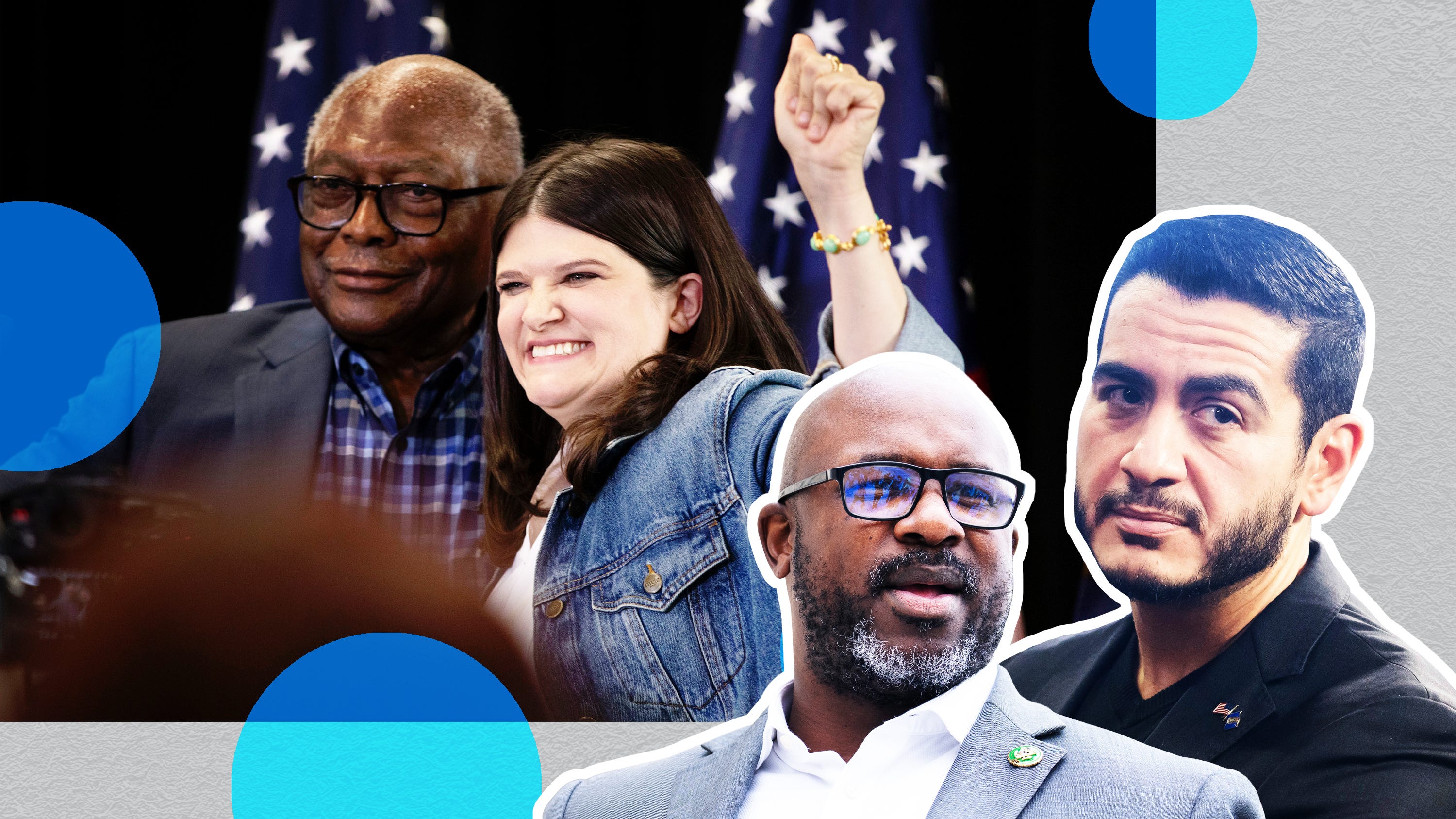
Detroit, Michigan ABDUL EL-SAYED STOOD AT THE EDGE of a picnic pavilion in Detroit’s largest urban park on Sunday, making his case for why he is the Democratic Senate candidate best positioned to help the city’s voters.
El-Sayed, who is locked in a tight contest with four-term House Democrat Haley Stevens, is a doctor and epidemiologist who has served as public health director for Detroit and then (separately) its surrounding county. He reminded the crowd that in those two positions he supplied kids with free eyeglasses so they could see in school, went after polluters whose emissions were causing asthma, and spearheaded an effort to remove lead from water pipes that were slowly poisoning several city neighborhoods.
“I have been showing up for Detroit since I first stepped into the city as its health director back in 2015,” said El-Sayed, “and I intend to show up for Detroit every single day when I walk into the Capitol as your next U.S. Senator.”
The gathering in Rouge Park was one of several “Knock Out the Vote” events El-Sayed has held in these final two weeks before the August 4 primary. Judging by the cheers and scattered “amens,” it was a success. But it was also hard not to notice the complexion of the group. It was
Hey, guys — I know paywalls are a drag. But this one is easy to get around: Just sign up for a free trial of Bulwark+. You’ll be able to read this whole newsletter and enjoy all our other locked content for two weeks without paying a cent. And if you do sign up today, drop me a line in the comments!
- Mitch McConnell's SECOND proof of life photo, and what's really going on with him. - The White House Correspondents' Dinner do-over, Trump's comments about Kaitlan Collins, why anyone goes to it anymore, and how the whole thing seems to be playing into Trump's hands. - The drama inside the Democratic National Committee, and how (and whether) having a strong national party committee matters anymore. - The proposed new primary calendar for the 2028 Democratic primaries. - The final stretch of the Michigan Senate primary.
This ad-free video version of The Next Level is exclusively for Bulwark+ members. Click the learn about setting up this show, ad-free, on your podcast player of choice. Or watch in the new Bulwark App—available now in the Apple and Google App stores.
The Justice Department's case against Olympic canoeist David Hearn may have a major problem and it comes from the government's own witness. Sam Stein is joined by NBC News justice reporter Ryan Reilly to take on new court filings showing the prosecution's key witness reportedly acknowledged the reflecting pool was already damaged before Hearn allegedly touched it. If that's true, can DOJ still prove the felony charge against him? They discuss why the $1,000 damage threshold is so important, what Jeanine Pirro's office has to prove, and why Hearn's attorneys argue the grand jury may have been misled.
Stephen Miller has a free hand to pump out his racist policies; Trump regularly says blatantly offensive things that are way past a dog whistle; and one-time insurgents at the Heritage Foundation and other MAGA institutions are muscling out people who aren't comfortable with openly embracing bigotry. The groypers are running today's Republican Party. At the same time, Trump's Iran war has opened divisions within the administration, and the leaks are coming fast and furiously. Plus: the gullible people who think their bribes will keep them safe from Trump, Rod Dreher's falling out with JD Vance, the ties between the Tates and the White House should be a bigger scandal, Mitch McConnell may be doing the most Mitch McConnell thing of all, and how Cincinnatians fought back against DHS to protect a local chaplain.
Zeteo’s AsawinSuebsaeng joins guest host Will Sommer.
As always: Watch, listen, hit the like button or leave a comment. We want to hear from you.
Ad-free editions of The Bulwark Podcast are available exclusively for Bulwark+ members.
The Bulwark Podcast with Tim Miller is available wherever you get podcasts and on YouTube. New shows drop each weekday afternoon. If you like the show, leave a comment and ⭐⭐⭐⭐ wherever you listen. Add The Bulwark Podcast to your player of choice, here.
(Photo illustration by Bill Kuchman/The Bulwark | Photos: Getty, Shutterstock)
DONALD TRUMP HAS BEEN TRYING for months now to shrink the number of Americans who can vote. So far his efforts have been in vain, but this might be the week he succeeds.
The SAVE Act that Trump is pushing is not simply a voter ID bill. It’s part of his administration’s larger drive to make government interactions as frustrating, time-consuming, and clunky as possible—with the end goal of netting financial or political gain for Trump, his family, his friends, and his enablers.
For instance, the SAVE Act would require would-be voters to present a birth certificate or passport to prove their citizenship. People who don’t have such documents would have to figure out how to get and pay for them. That could include, among others, those born at home or in other countries, and anyone who has changed their name—such as the vast majority of married women.
As someone who recently spent weeks trying to locate birth certificates and other documents for parents born nearly a century ago, I can relate. Notably, every step of every process has been easier because I didn’t change my name when I got married.
Still, I needed two birth certificates and so did my brothers and father. That’s because he changed our family name when we were kids. My mother would have needed three, for her birth name, her married name, and her new married name. If the SAVE Act had been in place, those documents would have been required to prove her citizenship and re-register to vote each time she changed her name or the five times she moved.
And trust me, she would have wanted to make sure she could vote. You might call voting my family’s religion. My mother voted in 2024 and listened to political news until just a few weeks before she died this month at nearly 97.
All of which is to say, the SAVE Act is deceptively complicated and would guarantee fewer voters if it passed. The only questions are how many voters and which party would be hurt more. Trump & co. seem certain it would help Republicans, and that’s completely possible.
On the other hand, are lower-income, less-educated voters less likely to have passports? Which party’s women are more likely to change their names when they marry? Will rural voters be close enough to the right offices to get the right documents? Which age group will be more motivated?
Nobody knows for sure, but it seems at least possible that the SAVE Act—which has passed the House and could come up for a Senate vote soon—would keep some prospective Republican voters at home. What’s certain is that the broader project—of continually adding weight to the administrative burden in ways that penalize people who struggle with it and give up—has a bright future in this administration.
Fearless reporting.
Sharp analysis.
Clear explanations of complicated stories.
Support independent journalism—with a two-week FREE trial of Bulwark+.
The latest headline to set me off was this one from Nathan Tankus’s “Notes on the Crises” newsletter: “BREAKING: HUD is Planning on Hobbling Federal Financial Assistance for Housing by Burying it in Paperwork.” The idea is to “create enormous and duplicative reporting requirement burdens and subject HUD grants to unprecedented centralized control by the federal government.” The collateral damage, beyond high costs and potentially erroneous AI fraud findings, could include exposure of sensitive personal information.
There are plenty more examples of this sort of thing. Last year’s big tax-and-spending law (the so-called “Big Beautiful Bill”) added work as a condition of Medicaid and nutrition aid, with onerous reporting requirements that guaranteed many actual workers would quit trying and lose benefits. The GOP goal was to save hundreds of billions of dollars.
And it’s working, in a way. The New York Times recently wrote up Arizona as a cautionary preview of the law’s crackdown on SNAP, the Supplemental Nutrition Assistance Program. The state feared that errors could trigger new financial penalties stiff enough to shut down its whole program. So it cut staff to save money and increased paperwork for applicants to try to minimize errors.
The upshot is that some 440,000 people—half the state’s caseload—lost their food aid, though many were still eligible for it, and services collapsed. The opening horror story alone, about a grandmother raising three teenagers, recounts several months waiting for a renewal, a hundred phone calls no one answered, the case closed over a mistaken document, no time to fix it because of the state’s delay, and, now, four months into an appeal.
The Medicaid requirements don’t kick in until 2027, after the midterm elections. It’s a strategic choice that’s hopefully fooling few people. Most people on Medicaid already work and we know from research and real life that work requirements push people off coverage in droves. That puts their health, productivity, and the hospitals they use at risk. Most administrations would think that’s a bad thing. But not this one. Its view of paperwork and conditions is the more, the better, and real-life consequences be damned.
The former Soviet republic of Estonia jumped into my brain when I saw that housing headline. I blame a book I helped edit eleven years ago about digital government.
Estonia was the first European country to adopt online voting, William D. Eggers wrote in that 2016 book, Delivering on Digital. Estonian citizens “can register a new company online and, in less time than it takes to finish a cup of coffee, start conducting business.” Every citizen has “a unique online identity” for interacting with their government. They never have to fill out the same information twice, they control who can view their data, and public officials can go to jail if they view it without permission. Oh, and “it takes only five minutes to file Estonian taxes online.”
That’s now down to three minutes, according to the Estonian agency that promotes innovation in government. The agency’s website also boasts that all public services in the country are available online 24/7, providing “a hassle-free environment for businesses and residents alike.”1
It is true that Estonia is small, with a population of just 1.3 million, which makes it somewhat easier to roll out certain high-tech government services. In addition, Estonia had the advantage of standing up a newly independent government in the 1990s as the internet and personal computers took off.
The size and scale of the United States make everything more complicated and expensive, especially replacing cumbersome legacy systems with more efficient and secure technology. But that doesn’t account for Trump and his teams reversing gains that have been made in some areas, while adding paperwork and regulations openly intended to reduce access to government programs. The goal isn’t programs that work well, it’s to save money for their priorities—military interventions, tax breaks for rich people and corporations, and immigration dragnets, deportations, and detentions.
Our self-owns are real and beyond depressing. Estonians have been able to pay taxes online since 2000. The United States was just getting there last year with IRS Direct File, a Biden-era pilot program that consumers adored. The free program saved users substantial time and money, but Trump killed it after lobbying by tax-prep and software companies.
On top of that, by mid-2025, Elon Musk’s disastrous, Trump-approved DOGE crew had forced out 31 percent of the auditors needed to ensure the richest people and corporations in America, with the most sophisticated ways to evade taxes, weren’t nudged or hounded to pay up. A year later, Musk became the world’s first trillionaire—and the IRS, unable to cope with its workload after getting rid of 28,000 employees last year, received accelerated hiring authority to quickly bring on 8,000 people.
But the cutbacks had already helped protect tax evaders and tax preparers. To Trump and his tech and MAGA cronies, “reinventing government” means maximizing profit for themselves and people like them, while making it maximally punitive and exhausting for everyone else.
Don Moynihan and Pamela Herd, writing in the “Can We Still Govern?” newsletter, had a darkly funny take last fall on administrative burdens in the private and public sectors. They boosted the idea of “Admin Night” parties for people to gather and do their paperwork, floated the problem as ripe for collective action—a “politics of burden reduction”—and suggested giving credit “to politicians who commit to making things work better.”
Trump and his allies are not those people, and this won’t take off while he’s president. But close your eyes and think of Estonia. If they can do it, surely we can, too.
(Photo illustration by Sarah Rogers/The Bulwark | Photos: Getty, Shutterstock)
Hey fam: Get your questions for the next mailbag show in today, please? Leave them in the comments here. As always, my ask is that you take a minute to read the questions others have left. Upvote the ones you like best. And if you have follow-on questions, thread them as a reply to the existing questions.
1. Abdication
Last week I wrote that, as a political matter, Trump’s best option on Iran is to simply walk away:
What Trump should do is walk away. Swallow the loss, regroup, “liberate” Cuba, get into an online slap fight with the Spanish national team. Whatever. Take the L and all of the geostrategic consequences that come with it.
Some readers responded by saying that Trump can’t, because Iran won’t let him. Nick Catoggio wrote an interesting column about how walking away from Iran would be, for Trump, like declaring bankruptcy. Meaning: In theory, an attractive option.
But Catoggio concluded that it’s not possible:
[T]he president would happily choose the bankruptcy option, I’m sure, if only the Iranians would offer it to him. By signing last month’s humiliating peace agreement, he showed that he’s willing to accept the public embarrassment of admitting that a project he championed has failed, as bankruptcy requires. But bankruptcy is supposed to release him from the financial obligations created by that project, which in this case would mean oil commerce returning to prewar levels in the strait before November’s midterms. And the Iranians simply refuse to do that.
I’m not certain this is true? Today I want to interrogate whether or not Trump could abdicate America’s position in Iran. Could he really just . . . walk away?
In this newsletter I always try to help you see around corners. And now here’s a tip for how you can see around this paywall: We’re offering a two-week free trial of Bulwark+. If you’ve ever considered membership, give it a try now. And if you do sign up, pop me a note in the comments—I’d love to hear from you.

 Login
Login