Both the left and center-left are acting like the other faction within the party is the enemy—and not Donald Trump. Democrats need to keep their eye on the ball: Trump and the corruption, lying, and incompetence across his administration. In the past couple of days, the massive dishonesty has included Doug Burgum’s doubling down on the Reflecting Pool lies and Todd Blanche’s sham document on the IRS and the J6 weaponization fund. And why is Schumer signing off on a deal with Republicans to keep the government open? Plus: Max Miller is finally a national story, and Tim unloads on getting dragged into the Michigan Senate race as well as AIPAC’s massive spending on behalf of Haley Stevens.
As always: Watch, listen, hit the like button or leave a comment. We want to hear from you.
Ad-free editions of The Bulwark Daily are available exclusively for Bulwark+ members.
Tim Miller’s Bulwark Daily is available wherever you get podcasts and on YouTube. New shows drop each weekday afternoon. If you like the show, leave a comment and ⭐⭐⭐⭐ wherever you listen. Add The Bulwark Daily to your player of choice, here.
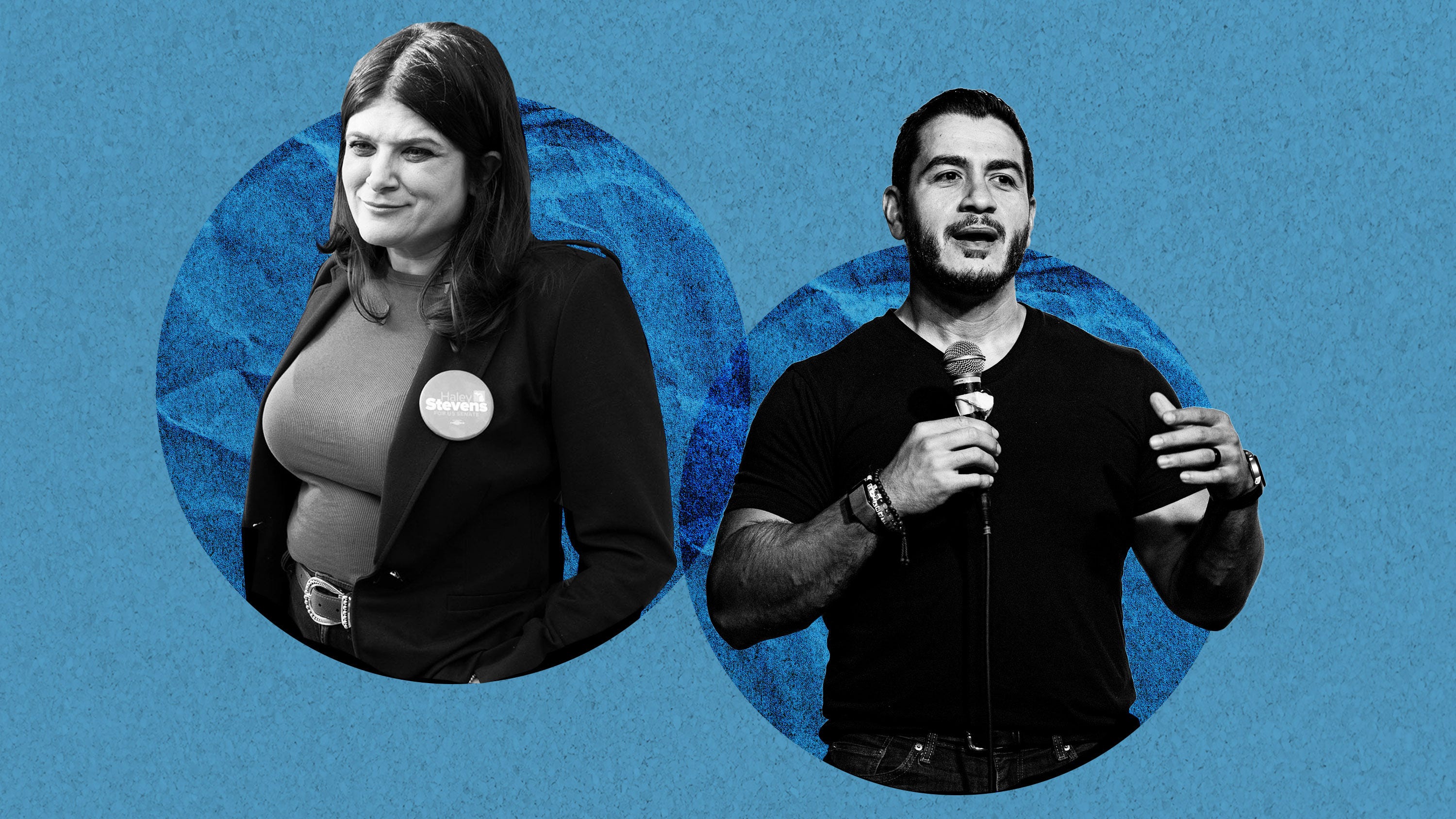
(Photo illustration by Sarah Rogers/The Bulwark | Photos: Getty, Shutterstock)
HALEY STEVENS’S AND ABDUL EL-SAYED’S campaigns are wildly different in ways that are pitting Democratic voters’ heads against their hearts.
And with polls showing El-Sayed leading by double digits, I wonder if the heart is pulling away. Focus groups help shed light on the way voters reconcile their personal preferences with strategic calculations, in a way that polling can’t.
We conducted three focus groups—one each in April, June, and July—with Michiganders who had voted for Kamala Harris in 2024 and planned to vote in the Democratic primary for the Senate race. We wanted to get a deeper sense of how they were feeling about tomorrow’s election.1
One of our participants, Amanda, summed up a tension she’s feeling between idealism and pragmatism:
Not yet a Bulwark+ member? Skip right past this paywall by signing up for a two-week free trial:
(1) I have an idea for how to fix our post-Trump political system.
(2) There’s an opening in the Reflecting Pool case to send someone from the Trump administration to jail.
This is as close to Optimistic JVL as you’re ever going to get. Let’s dive in.
By the end of this week America will forget about the case of David Hearn, the man Donald Trump blamed for the failure of his Reflecting Pool.
Quick catchup for anyone who has already forgotten:
Trump is obsessed with the physical beauty of Washington, D.C., and so is trying to turn the downtown area into a presidential palace compound.
Part of this project involved his revulsion that the Reflecting Pool by the Lincoln Memorial resembled an actual patch of water and not a hyper-idealized artist’s rendering.
So Trump gave a no-bid contract to “fix” the Reflecting Pool to a vendor no one knew anything about.
Within days of the project’s completion, the Reflecting Pool failed in a spectacular and embarrassing manner.
Trump needed to blame the failure on someone; he claimed that the project had been physically attacked and vandalized (despite having previously promised it would be vandalism-proof). He set his Justice Department on the case of finding someone to prosecute for this imagined crime.
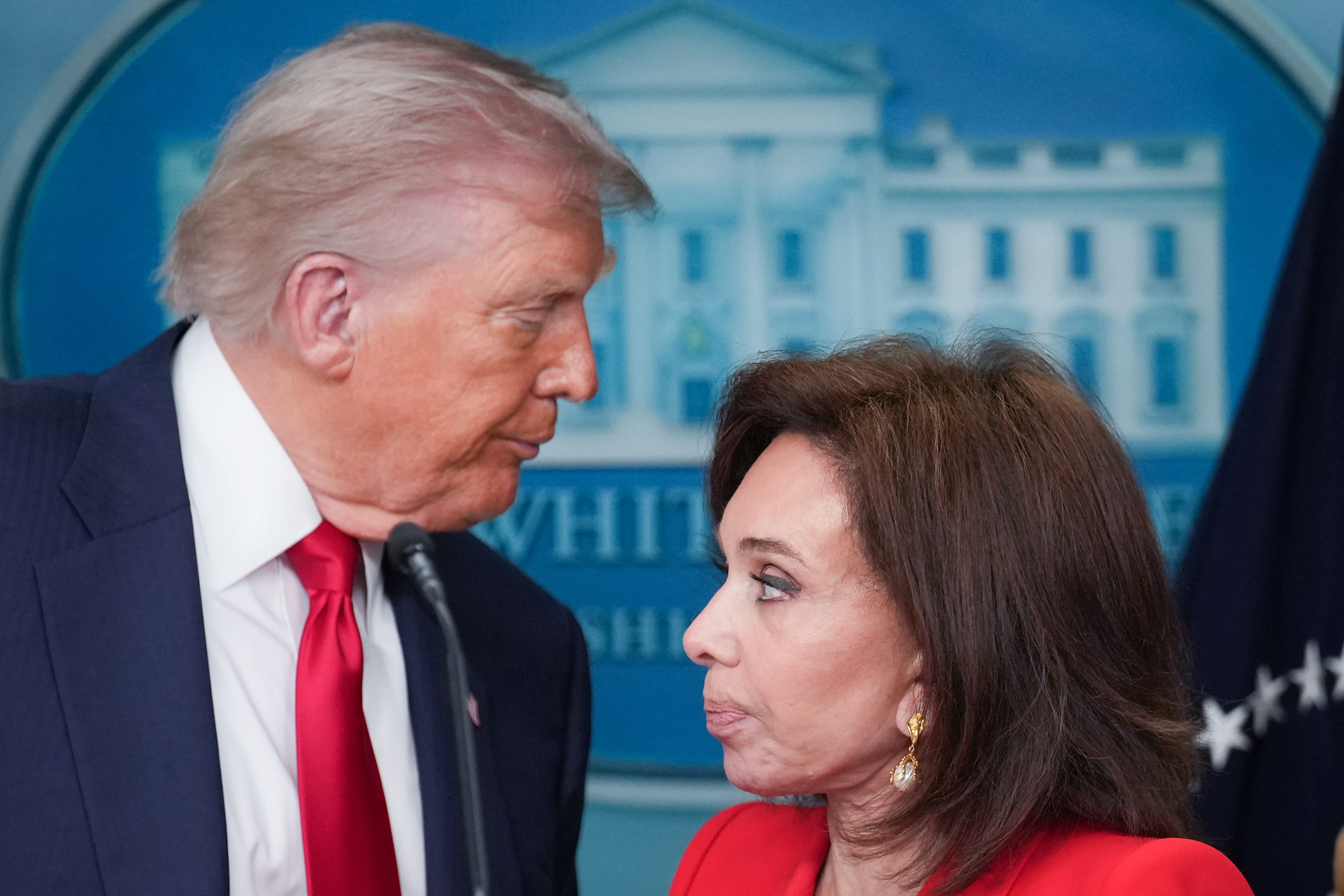
U.S. Attorney for the District of Columbia (and former TV lawyer) Jeanine Pirro looked around and decided to charge David Hearn with a felony—thus bringing the full weight and power of the American government against a blameless citizen purely to satisfy the narcissism of the president.
I want to underline this: Hearn faced up to ten years in prison for these charges.
On Friday Pirro’s office withdrew its case against Hearn, claiming that its own charges were baseless—that the Reflecting Pool failed because of the contractor, not because of vandalism, and that a different branch of the Trump administration had hidden these facts from the prosecution.
I encourage you to read the motion for dismissal. I am not a lawyer, but it seems to me that either someone from the Department of the Interior should go to jail, or someone from the Department of Justice should be disbarred. (Or both?) We’re going to talk about why that is and who it might be in a moment.
“The defendant, Hearn, ripped a piece of recently installed sealant on the bottom of the Reflecting Pool at the Lincoln Memorial. The evidence shows, and we will prove beyond a reasonable doubt, that Hearn willfully destroyed property at the Lincoln Memorial Reflecting Pool.”
“Our evidence further shows that the National Park Service employees observed Hearn actually forcefully and violently pulling up and removing the bottom liner with both hands.”
After Pirro’s prepared remarks she took questions from reporters. She insisted that, “There was an effort, a violent effort, to rip up the sealant from the bottom of the pool.”
When a reporter pressed her, pointing out the trove of video evidence existing that showed the Reflecting Pool failing prior to Hearn’s arrival on the scene, Pirro mocked the reporter:
Reporter: Did he have any tools or was it just his bare hands?
Pirro: Right now, we believe it’s his bare hands, both hands.
Reporter: So does that indicate in your belief that it was probably damaged before or do you believe that he—
Pirro: Oh, he damaged it.
Reporter: —further, but do you believe it had already been damaged before—
Pirro: He damaged the pool.
Reporter: —before he touched it.
Pirro: He damaged this pool.
Reporter: But there had been, you know, all these videos.
Pirro: Well, good. I’m glad you’ve got that evidence. Come on in the grand jury, you can testify.
By the Justice Department’s own admission, we can now say—definitively—that these were falsehoods. Pirro lied. She lied about a private citizen in the course of a criminal prosecution against him.
It’s outrageous. But it also tells us how we can fix almost everything in American politics going forward:
Will Sommer, Sam Stein and Andrew Egger went live to cover the growing calls on the right for GOP Rep. Max Miller to resign, whether Jeanine Pirro will be fired over the botched Reflecting Pool case, Tucker speaking with foreign agents, and the audience collapse among right-wing MAGA media figures.
How much of an eyesore will Donald Trump’s coveted Triumphal Arch be? A National Park Service assessment found that the planned 250-foot arch will intrude on the views from “dozens of historic sites around the capital,” per new reporting from the Washington Post. But look on the bright side: Think of all the flexibility you’ll have finding a good seat to watch them knock it down later. Happy Monday.
Start your week off right: Come irradiate your brain with MAGA Mondays! Will Sommer and Andrew Egger are live on Substack and YouTube at 10 a.m. EDT.
(Photo by Win McNamee/Getty Images)
Of Lemons and Lemonade
by William Kristol
I’ve never had much interest in Dale Carnegie, the relentlessly upbeat and optimistic American self-help guru. I’ve ignored advice during my time in Washington that I could benefit from studying his 1936 bestseller, How to Win Friends and Influence People. I’ve resisted the counsel of some friends, concerned for my well-being in the age of Trump, to take a look at his 1948 treatise, How to Stop Worrying and Start Living.
I’m too old to change my ways. No Dale Carnegie for me.
But perhaps some Democratic politicians could benefit from a dose of Dale? They are, after all, in the business of trying to win friends and influence people.
They might take a glance at the famous passage from How to Stop Worrying on lemons and lemonade. Carnegie warns against the attitude of the person who, finding life has handed him a lemon, gives up and says: “I’m beaten. It is fate. I haven’t got a chance.” Then, Carnegie writes, “He proceeds to rail against the world and indulge in an orgy of self pity.”
By contrast, Carnegie explains—using a phrase he helped popularize—when a wise man is handed a lemon, he asks, “How can I turn this lemon into a lemonade?”
Late last night, the American people were handed a lemon: A capitulation by Republican senators John Cornyn of Texas and Thom Tillis of North Carolina that makes confirmation of Todd Blanche as attorney general likely. Blanche provided them a fig leaf, a written order formally rescinding the proposed $1.8 billion fund for alleged victims of political prosecutions and a statement allegedly limiting the provision of the agreement that shields Trump, his sons, and their businesses from tax claims.
These assurances will presumably be enough for Blanche to make it out of the Senate Judiciary Committee Tuesday on a straight party-line vote. He’s then likely—though not certain—to get the 50 votes he’ll need to be confirmed by the whole Senate, probably at the end of the week.
So this lemon will be added to a whole bushel of other lemons in Trump’s cabinet. Todd Blanche will join Jay Clayton, Pete Hegseth, Kash Patel, and Markwayne Mullin as confirmed leaders of the key national security agencies of Trump’s executive branch. Having loyal and determined apparatchiks like them in positions of real power for the next two and a half years is not a good thing.
On the other hand: There is lemonade to be made here. Trump’s polls have been sinking. Republicans are almost certain to lose the House this fall, and the Senate majority is up for grabs. Democratic control of both houses would help check Trump’s authoritarian schemes. And the fact that the entire Senate Republican conference will have to cast a high-visibility vote to confirm Todd Blanche can help in turning the Senate Democratic.
Assuming Mitch McConnell remains absent, Republicans can only afford two defections in the Senate. They may lose Lisa Murkowski and Susan Collins. So incumbent GOP senators in tossup or somewhat contested races, like Jon Husted in Ohio, Dan Sullivan in Alaska, Ashley Moody in Florida, Roger Marshall in Kansas, and Pete Ricketts in Nebraska will have to vote to confirm Blanche. And Republican candidates in open seats like Michigan, North Carolina, Texas, Iowa, and Montana will presumably have to express support for Blanche.
It’s possible there will be a revolt among a few GOP senators against this man who sought to shovel taxpayer money to the January 6th assailants, who has initiated and presided over blatantly political prosecutions, and who was at the very center of the Jeffrey Epstein coverup. On this last front, Epstein survivor Dani Bensky put it bluntly last week: “You can’t say that you want to make sure that sex offenders and sex traffickers are behind bars and then vote for him. Every vote for Blanche is really a vote against survivors.”
If there is a revolt and Blanche loses, it will be an embarrassment for Trump. But if Blanche is confirmed, it could do more damage to Republicans. It will be visible proof, if proof were still needed, that if Republicans are left in control of the Senate, there will be no check on Trump’s coverups and corruption and lawlessness.
So Democrats need to make this next week as visible and painful as possible for the GOP. They should drag out matters on the Senate floor to keep the issue of Blanche front and center as long as possible, and then hammer his confirmation during the recess as a key example of the truth that a Republican Senate will never stand up to Trump.
Thanks for reading The Bulwark. Help us grow this community by sharing Morning Shots with someone.
I see only one obstacle to this exercise in lemonade-making. Needless to say, it’s been created by the Democrats themselves. Yesterday, Senate minority leader Chuck Schumer and Appropriations Committee vice chair Patty Murray announced their support for a continuing resolution to fund the government through December 11. They envision cooperating with Republicans to bring it to the floor and pass it this week.
Leave aside that, in my judgment, it’s a bad agreement on substance—with no restrictions on Trump’s war, on lawlessness at the Justice Department, or on the behavior of ICE agents.
But it’s also politically foolish. Funding for the government doesn’t run out for two more months. There’s plenty of time to deal with this question in September. Why allow Republican senators to go home for recess taking credit for a bipartisan budget deal? Why give them what they will tout as an example of successful bipartisan governance under Republican leadership?
This shouldn’t be complicated: First, Democratic senators should kill the deal on the continuing resolution. Then they need to use the Blanche confirmation to highlight the truth that a Republican Senate will simply be a rubber stamp for Trump over the next two years. Todd Blanche may well get confirmed. But if they don’t get in their own way, Democrats can turn that sour lemon into sweet, tart lemonade.
Not yet a Bulwark+ member? Consider joining today with two free weeks:
Those of us who spend a lot of time observing right-wingers have been predicting an outbreak of internecine conflict. And lo, behold an outbreak of intra-Nicene conflict.
Certain sectors of the right are this close to dusting off images of mitre-headed bishop crocodiles ambling ashore to turn America into a Catholic theocracy. This isn’t a reaction to the first American pope; it’s a fight about the ideological makeup of right-wing elites and, as is often the case, Vice President JD Vance’s place among them. (It’s not even the only proxy fight about Vance among right-wing intellectuals right now.)
Vance has a long-running game of footsie with post-liberalism and the theocratic Catholicism of “integralist” intellectuals like Adrian Vermeule, who may not have a large electoral coalition but have openly strategized about installing conservative Catholic elites in the government and administrative state. The aim is something like a government of, by, and for Catholic converts, and Vance is their blue-eyed boy.
As with so many right-wing dustups, this one involves an anonymous X account, “CappyAmerica,” which declared itself “Never Vance. Never the Post-liberal Papal Integralist Socialist thin-skinned jerk Vance.” (The account has about 1,300 followers.) The Daily Wire’s Michael Knowles detected a “neo-Know-Nothing contempt for Catholics” in the anti-Vance tweet, comparing it to coded antisemitism. (This is news to me, a parishioner at my local church, as it would be to Cardinal Christophe Pierre, former apostolic nuncio to the United States, who issued a correction to key post-liberals by name.) Knowles in turn was mocked by non-integralist Catholic conservatives, who are able to easily distinguish their politics from aspiring theocrats. Thomas D. Howes, coauthor of Why Post-Liberalism Failed, commented: “Lol, no.” The Blaze’s Auron MacIntyre, a self-described “great respecter of the [anti-Catholic] Know-Nothing tradition” also rejected the comparison to antisemitism. Anti-Catholic authoritarians generally seem to see the post-liberals and integralists as rivals in their preferred authoritarian future.
Erick Erickson, who describes himself as a “Christian broadcaster” and “Conservative truth-teller,” didn’t really even seem to know what was going on, bless him.
But Knowles did have some allies. National Review’s Michael Brendan Dougherty and the activist Christopher Rufo, in a parallel social media spat, both weighed in to defend a sanitized version of the post-liberal position, which turned into a days-long debate over the meaning of “the Common Good.” Post-liberals and their defenders maintain that fostering the Common Good ought to be the authentic end of politics; critics recognize it’s an ideological Trojan horse for post-liberals’ coercive project.
These are mere skirmishes in a larger war dividing the religious right: the role of Holy Mother Church. While Catholicism may be struggling in the provinces, conversion and Mass attendance are political and social markers among young conservatives in Washington. In a report last week on the Heritage Foundation, New York Times contributing writer Elisabeth Zerofsky highlighted complaints about Heritage head honcho Kevin Roberts’s efforts to enforce strict Catholic social teachings at the think tank and, by extension, the conservative movement. Is this the direction of American conservatism? And, by God, is it electorally viable?
Perhaps it doesn’t matter so long as Catholics make up the vanguard of right-wing politics. As Nate Weisberg points out in New Yorkmagazine, Catholics constitute “more than a third of the members of Trump’s second-term Cabinet, including Secretary of State Marco Rubio, Secretary of Transportation Sean Duffy, CIA director John Ratcliffe, and Education Secretary Linda McMahon.” Not to mention non-cabinet figures, including “press secretary Karoline Leavitt and border czar Tom Homan.” That’s not to say these figures buy into—or are even aware of—post-liberal integralist dreams, though some in Vance’s and Rubio’s orbit do, and there are at least some young White House staffers who consciously think of themselves in this way.
Part of the zest here, as the original tweeter makes clear, is about positioning for 2028. The Heritage Foundation, Zerofsky reports, “is investing heavily in its relationship” with Vance, the foremost political figurehead of hard-right weirdness who has made his adult conversion to Catholicism a key part of his story. There is a long tradition of conservatives crossing the Tiber, but the way Vance has engaged with authoritarianish social conservatives, both here and abroad, suggests a genuine affinity for post-liberal politics.
In the immediate fight, it’s pretty clear that conservatives who want Rubio (or someone else entirely) to lead the party post-Trump have fallen one way, while those lining up behind Vance have fallen the other.
As for us, we’re Never Vance too—though for strictly non-sectarian reasons.
A Blistering Critique of the Roberts Court, From Hawaii’s Supreme Court… In an extraordinary opinion, the state justices accuse the SCOTUS majority of undermining democracy, writes KIM WEHLE.
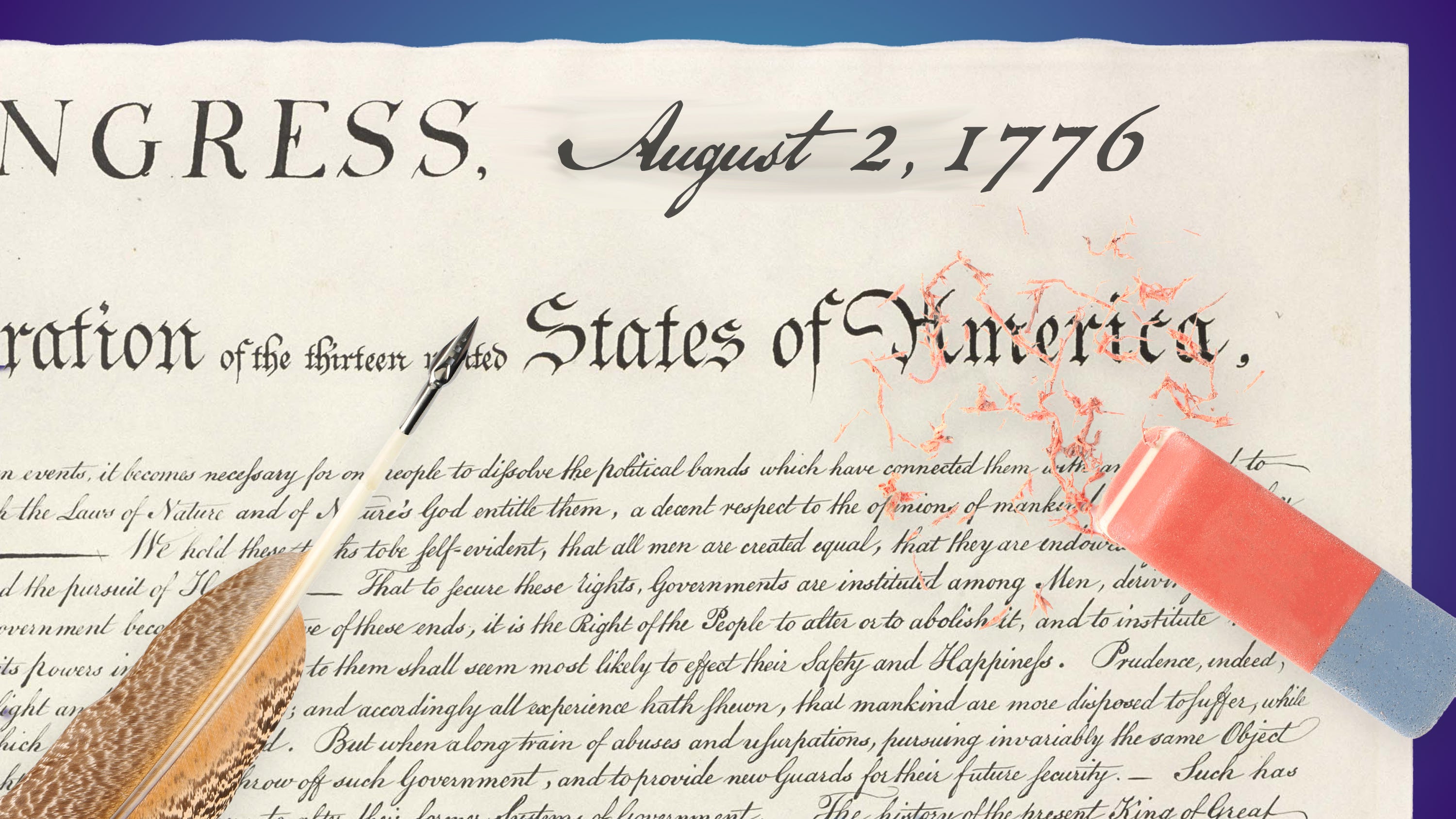
Happy Declaration-Signing Day… Nobody signed America’s birth certificate on July 4, 1776, explains DAVID HEAD: John Hancock didn’t put down his John Hancock until August 2.
Quick Hits
TRUTH API GOES LIVE: One act of outrageous corruption ends; another arrives. Donald Trump may have formally renounced his plans for the “anti-weaponization fund” for taxpayer-funded payouts to J6ers and other allies, but he’s thought up another way to rob the public instead. This time, however, the money is flowing straight into his own pocket.
Over the weekend, Trump Media, the president’s company that runs Truth Social, launched its new Truth API feature, which promises faster access to Trump’s social media posts to companies that fork over a reported $100,000 a month. The company is explicitly billing this as a way for financial firms to get an edge in trading over their competitors by being the first to see the president’s “most market-moving Truths.”
From top to bottom, the whole concept is so corrupt you almost struggle to get your head around it. Donald Trump, in his official role as president, chooses to communicate about his official acts not through official channels but on a private platform he himself owns. Now, he is using that platform to sell premium access to knowledge about the workings of the U.S. government. This is pure rent-seeking; there’s no value-creating service here, just Trump finding a way to charge for something—knowledge of the working of the government—that should already belong freely to Americans by right.
And it’s true: Trump’s posts do send markets careening around, and traders do run the risk of being left in the dust if they’re slower than their competitors to react to Trump’s posts. As a result, many companies will doubtless be willing to pony up. They may even be eager to, seeing this as one more protection-racket payment—like donating to Trump’s super PACs or ballroom fund—to help them stay personally on the president’s good side.
This money isn’t coming out of the U.S. Treasury. But it’s not coming out of the pockets of hedge funders either. Trump is just skimming off the top of the entire financial system—which is to say, the U.S. economy at large. “Truth API” is public robbery no less than if Trump had created a new tax for Americans to pay him personally.
DOJ ADMITS OBVIOUS ON REFLECTING POOL: Hey, remember when Donald Trump resurfaced the Reflecting Pool, the new surface started falling apart instantly, and the government started thuggishly arresting people it pretended had “vandalized” the pool to try to save itself from embarrassment? They were always obviously lying, but now, per the Hill, their story is falling apart faster than a new American Flag Blue pool liner:
The Department of Justice (DOJ) moved Friday to drop its criminal prosecution of a former Olympian charged with destroying the Lincoln Memorial Reflecting Pool, saying the damage was instead the result of a “rushed and botched installation.”
U.S. Attorney Jeanine Pirro’s office blamed the contractor for overspraying and delamination.
In a new court filing, the office indicated it no longer stands behind its case against David Hearn, a three-time Olympic canoeist who pleaded not guilty to felony destruction of property earlier this month.
Remarkably, the Justice Department’s filing blames the Interior Department for initially covering up the fact that the pool had already begun to peel. “Given all of this newly discovered information,” prosecutors wrote, “it is difficult to attribute the widespread damage to the Reflecting Pool to vandalism, let alone to establish that fact beyond a reasonable doubt.”
Hilariously and insanely, the parts of the government that aren’t currently speaking on penalty of perjury in court are still trying to keep up the vandalism story. After the DOJ threw Interior under the bus, Interior Secretary Doug Burgum took to X to insist they were mistaken: “The evidence is clear, vandals have repeatedly caused damage to the Reflecting Pool. . . . We won’t back down to deranged people who want to destroy, deface, or degrade our monuments.” You want to testify to that effect, Doug?
OHIOANS PUSH BACK ON ICE: As the Trump administration begins to ramp up immigration enforcement in Ohio, hundreds of Ohioans turned out this weekend to protest ICE activities in the Buckeye state. In Akron, roughly 200 protesters posted up Sunday outside of Akron-Canton Airport to protest ICE flights from the airport.
In Cincinnati, outside of the Blue Ash ICE facility, nearly 550 people, including a number of clergy, came out to protest. Carl Ruby, who has been frequently cited in these pages, was there, accompanying a member of his congregation who was called in by ICE for an appointment. Ruby prayed outside the entrance where his congregant entered. “I want the ICE agents to look out and see me praying,” Ruby told the Cincinnati Enquirer.
An attendee / reader tells The Bulwark that the protest was well organized, with protesters careful not to give law enforcement a pretext to crack down: “We could only stand on the grass. We couldn’t even touch the cement because we didn’t want the police to shut us down.” They weren’t shut down, and they hope to be there next weekend too.
Ruby got his wish. The attendee reports: “All these ICE people kept coming to the door and looking out and peering out the windows.”
(Photo illustration by Sarah Rogers/The Bulwark | Photos: Shutterstock)
WAR TENDS TO BE BAD FOR BUSINESS. Investment dries up and talented workers flee. So it has proved in the Persian Gulf, where the war with Iran has driven out foreigners, snarled supply chains, and destroyed local infrastructure. This might seem an odd time, then, for the United States to start exporting millions of expensive and sophisticated AI computing chips to the United Arab Emirates. Data centers in the UAE were, after all, some of the first targets of Iranian drones.
The Trump administration apparently sees things differently. Last month, it removed all restrictions on the sale of advanced AI chips—along with a host of other sensitive technology and military equipment—to the Emirati government and its national AI champion, G42. For years, the UAE has been begging Washington to let it buy more chips. The country is eager to turn itself into a global provider of AI services; it wants to be the AI version of an oil state, able to use its control of computing power for economic and political leverage.
The Trump administration seems determined to make that happen. This most recent favor to the UAE is just the latest in a sequence of self-defeating decisions. To recap: In May 2025, Trump announced deals with the Gulf states to boost their AI ambitions, approving the construction of some of the largest AI data centers in the world in the UAE and Saudi Arabia. These deals were always risky: The Gulf states have close ties to China and a track record of technology leakage and masssurveillance. And the administration never had a good plan for how to protect these enormous data centers filled with fragile electronics from drone strikes. But it at least promised that exports would be conditioned on “robust” security measures.
As it turned out, the administration couldn’t deliver on its pledges. It struggled to implement the deals, failing to process chip export licenses on time. Negotiations stalled over security requirements and investment commitments. Chip companies and Gulf governments alike grew frustrated.
Then came the war. In February, Trump’s military campaign against Iran put the entire business model behind the Gulf AI deals in jeopardy. It’s hard to build and operate cloud infrastructure in a war zone. Foreign workers left, regional ports were disrupted, and insurance costs soared. Iran, looking for economic targets, bombed Amazon’s data centers in the UAE and Bahrain, and threatened additional strikes on OpenAI’s Stargate UAE, the centerpiece of the administration’s Gulf ambitions. Months after the outbreak of the fighting, Amazon’s Middle East servers are still offline.
BY THIS POINT, ANOTHER ADMINISTRATION might have rethought the strategy of offshoring America’s AI infrastructure to the Gulf. The Trump administration doubled down. On July 10, it removed all restrictions on the sale of advanced chips and other sensitive technology to the Emirati government, lifting controls that had been in place since before the recent AI boom. State-backed Emirati companies can now buy millions of AI chips, build massive data centers at home and abroad, and host leading AI models within their territory—all without the security restrictions the Trump administration once touted. If powerful models sit on Emirati soil, the U.S. government will lose influence over how they are used, and it will be far harder for U.S. companies and security agencies to prevent the model weights—the model’s core intellectual property—from being stolen.
The giveaway goes beyond AI. The end of restrictions on the sale of other military technology may allow the UAE to buy American arms more easily than Saudi Arabia and, in some cases, even Israel—a likely unsustainable situation. Washington may well find itself forced into further concessions to keep the region onside.
What the United States got in return is hard to see. The Trump administration’s announcement identified no new security commitments from the UAE, no new restrictions on technology transfers, and no concessions on the UAE’s relationship with China. Key figures in President Trump’s circle, however, appear to have benefited handsomely from the UAE. Shortly before the United States initially approved the sale of more chips to the Gulf, for example, the UAE’s national security advisor Sheikh Tahnoon bin Zayed al-Nahyan purchased a 49 percent stake worth half a billion dollars in World Liberty Financial, a cryptocurrency venture founded by relatives of Trump and his Middle East envoy, Steve Witkoff.
It’s hard to know what exactly is driving the Trump team’s decision-making, but opening the taps on one of America’s most advanced technologies makes neither strategic nor economic sense. There are many more reliable allied countries where U.S. companies can build major data centers. And giving away the store on AI is a high price to pay to keep the UAE onside during a war the United States had no pressing need to start in the first place. For all its claims to put America first, the Trump administration has given the Emiratis the deal of the century.
In the space of a year, the Trump administration has managed to make promises it couldn’t keep, start a war that destroyed the economic case for the original bargain, and then give away all of its leverage to compensate for the damage. For a president who talks endlessly about deal-making, giving away one of the crown jewels of American technology and getting nothing in return is a remarkable achievement.
(Photo illustration by Bill Kuchman/The Bulwark | Photos: Getty, Shutterstock)
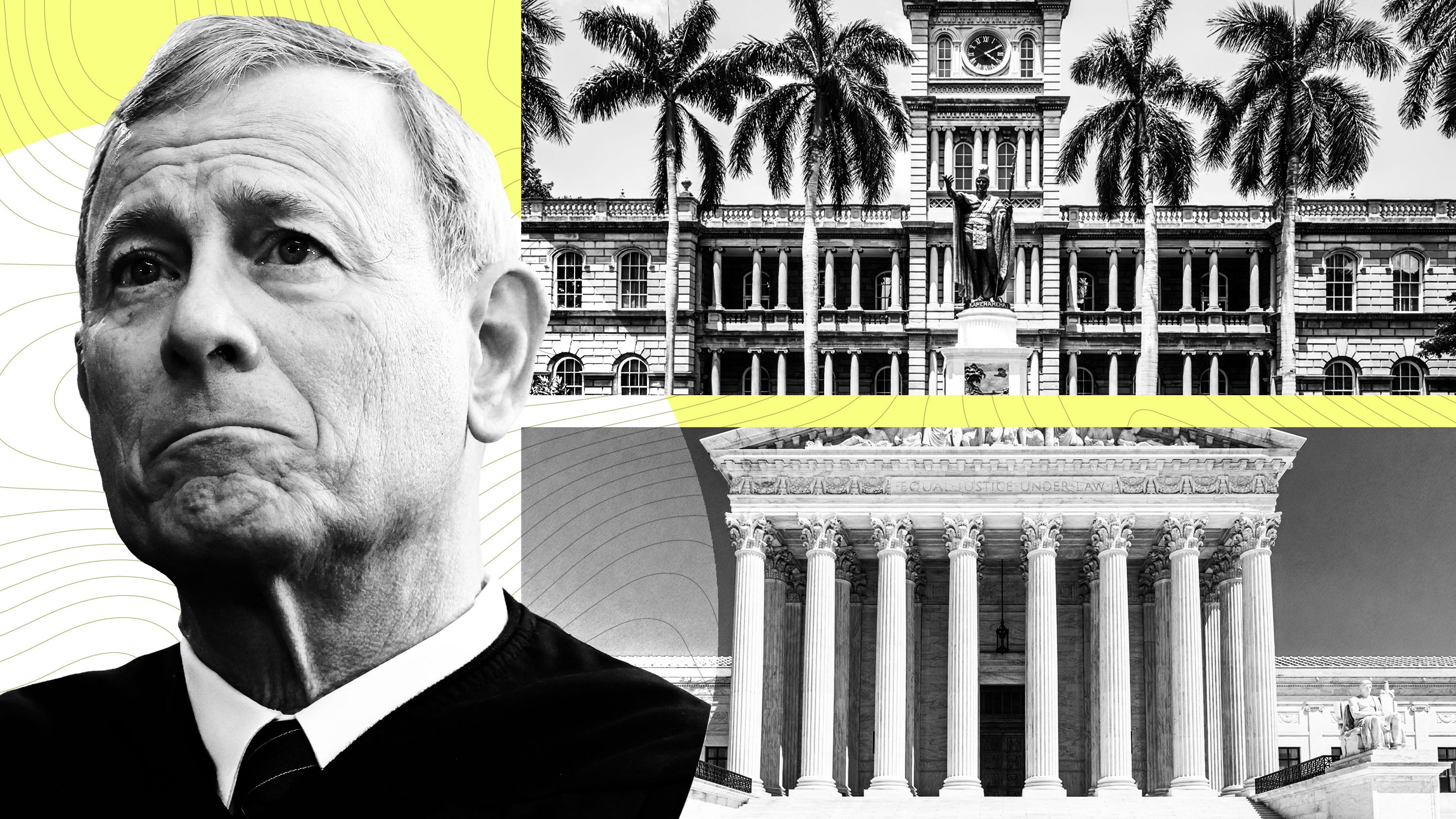
THE HAWAII SUPREME COURT issued a stunning opinion last month that said explicitly something that many other judges across the country have been thinking: Donald Trump is not the only snake in the garden. The justices in the majority on the United States Supreme Court are a danger to democracy too.
Anyone worried about the future of American democracy should take some time to read the opinion.
The case, Granillo v. State of Hawaii, involved a Maui man’s motion for a new trial following his 1990 conviction on charges of kidnapping and sexual assault. He was sentenced to forty years in prison. On appeal, the Hawaii Supreme Court found that “the prosecution used hair and fiber evidence” that “science has since proven . . . false,” so “his right to a fair trial was violated.” The decision to grant him a new trial was unanimous.
The argument I want to call your attention to is buried deep in the 91-page majority opinion—starting on page 72, where Associate Justice Todd Eddins turns his sights on the nation’s highest court.
U.S. Supreme Court precedent holds that the government’s unknowing use of false evidence doesn’t violate a defendant’s constitutional rights. That precedent would seem to apply in the case of the wrongly accused Maui man. But should it apply? Justice Eddins writes that the relevance of U.S. Supreme Court cases “ultimately depends on the premise that the federal constitutional doctrine controls this court’s interpretation of [the Hawaii Constitution]. It does not.”
Had Eddins stopped there, his opinion would have amounted to an unremarkable affirmation of a basic principle of federalism—of the idea that the due process clause in the state’s constitution can be more expansive than “the United States Supreme Court’s construction of the federal Due Process Clause.” But what comes next is nothing short of astonishing: a damning indictment of the U.S. Supreme Court’s right-wing majority.
Eddins begins by quietly invoking the history of racial discrimination in this country: “The Court that now defines federal due process does not honor the work of 1954,” he wrote. “It revives the work of 1857. The work of 1896.”
In case your memory of what you learned in high school history is rusty, let me remind you about each of those years. In 1857, the Supreme Court handed down its infamous Dred Scott ruling, holding that no black American descended from slaves could ever be a U.S. citizen. In 1896, the Court constitutionalized racial discrimination in Plessy v. Ferguson, an opinion affirming the use of whites-only railroad cars. And in 1954, the Court overturned Plessy with Brown v. Board of Education, banning the “separate-but-equal” construction of the Fourteenth Amendment that tolerated racial segregation in education.
Original reporting. Sharp analysis. Honest commentary. Keep up with all our work—sign up for a Bulwark+ membership and get your first two weeks free.
Eddins notes that Dred Scott relied on notions of originalism—that “the Constitution must be interpreted ‘according to its true intent and meaning when it was adopted’”—and charges that “today’s hubristic originalists use the same method to control modern life.” “The Court overrides what Congress passed,” he wrote. “It overrides what the people chose. All to serve its own ends.”
“We take no guidance on the meaning of due process from a court that gutted due process protections in Dobbs v. Jackson Women’s Health Org.,”Eddins writes, which “erased a ‘generations-long constitutional right, stripping autonomy from half of the population, and empowering states to force birth.’” (He is here quoting a decision he wrote in another case last year.)
And now, he writes, “the same jurisprudence has cratered democracy itself.”
“The Roberts Court did what Congress never would. It rewrote the Voting Rights Act of 1965, a cornerstone of American civil rights, democratically enacted and repeatedly reauthorized.” This “judicial demolition” began in 2013 with Shelby County v. Holder, in which the Court “invent[ed] a textually unsupported equal-sovereignty fiction and str[uck] down preclearance on a hunch that the law worked too well.” In 2021, the Court “fabricated ‘guideposts’ nowhere in Section 2 [of the Voting Rights Act] to greenlight racial discrimination in voting.” And this past June, in Louisiana v. Callais, the Court “buried what remained of the crown jewel of the civil rights movement. Pretend law for a real statute.”
And the right-wing majority didn’t stop there, Eddins writes. “The Court then ditched its own thirty-two day default for releasing decisions and hustled out its judgment mid-primary, a favor granted over objection only twice in twenty-five years.” “Weeks later, on its shadow docket, the Court tossed an eleven-day trial record built on fifty-one witnesses, 790 exhibits, 2,600 pages of testimony, and a 270-page opinion by a three-judge court.” In throwing out that case, which involved a Voting Rights Act challenge to Alabama’s congressional districts, the Court “resurrected a tainted congressional map the three-judge factfinders found deliberately entrenched racial bias against Black voters.”1
Eddins then ticks through a series of other cases in which the Roberts Court has remade the face of American politics by rewriting the law itself: Citizens United, in which the Court in 2010 “claimed fidelity to text, history, and tradition while invalidating yet another democratically vetted law, handing corporations the same speech rights as flesh-and-blood Americans and letting dollars talk louder than voters”; Rucho v. Common Cause, in which it “abandoned partisan gerrymandering to the gerrymanderers, refusing for the first time to remedy a constitutional violation because it believed the task beyond judicial competence”; Trump v. United States, in which “it placed a president above the law”; and this year’s NRSC v. FEC, which “made Citizens United look quaint, shredding coordinated spending limits . . . and ensuring that those who bankroll elections drown out the ordinary person. Billionaires spend tobe repaid. Everyone else just votes. The Roberts Court hasmade sure one’s wealth counts more than another’s vote.”
“Rulings run in one direction, time after time,” Eddins concludes. “Weakening protections for those with less power. Fortifying those with more. The pattern speaks for itself. A court that systematically dismantles democratic safeguards, steamrolls constitutional liberties, and tramples human dignity” is one “driven by agenda and intent on swiping power that belongs to the people.”
THE CASE BEFORE the Hawaii Supreme Court did not warrant such an impassioned condemnation of the U.S. Supreme Court. But Eddins and his colleagues wanted to send a message to the country. While the world frets over Trump’s incompetence, corruption, and carnage, the justices of the U.S. Supreme Court enjoy a deference that obscures their role in causing permanent damage. Presidents come and go. The Constitution is enduring, amended only through supermajorities in both Houses of Congress and state legislatures. Or by radical ideologues in robes.
In another passage worth noting, Eddins critiques the Roberts Court’s use of the language of “colorblindness.” As a judicial concept it can be traced back at least to Justice John Marshall Harlan’s famous dissent in Plessy (“Our Constitution is color-blind, and neither knows nor tolerates classes among citizens”). Harlan used the language of colorblindness to dispute the majority’s pretense that racial segregation favoring whites is tolerable under an amendment designed to remedy hundreds of years of enslaving people on the basis of race.
Now, though, colorblindness has become the distorted rationale that the Roberts Court has used to kill consideration of race in college applications and, just this past term, what remained of the landmark Voting Rights Act of 1965. Any consideration of race, the justices have declared, is unconstitutionally discriminatory—even if it’s designed to remedy systemic racial discrimination.
Eddins puts it this way:
The Roberts Court sees only white. It refuses to acknowledge who the Equal Protection Clause was written to protect. The freed people, their descendants, and all others denied equal citizenship. It turns its back on what is in plain sight. The Fourteenth Amendment is not colorblind. It never was. The Court calls the Constitution colorblind while engineering the dilution of Black votes, the unraveling of hard-fought civil rights remedies, and the erasure of Black history. That is not blindness. That is white sight, by design.
A Constitution interpreted this way is not colorblind. It is whatever the Court needs it to be. A way to advance its partisan project.
Eric begins with major show news before pivoting to the jackassery of the week with Eliot. They then analyze Trump’s interactions with Bibi Netanyahu and Vladimir Zelensky at Lindsey Graham’s funeral and discuss the ways in which the Iranian and Ukrainian wars are increasingly intertwined. The two discuss Iran’s ongoing unwillingness to “take yes for an answer” as evidenced by their recent strikes across the region. Historian and Professor Robert Parkinson then joins the show to discuss his recent book Tyrants and Rogues: Understanding the Declaration of Independence. Parkinson explains his focus on the twenty-seven colonial grievances listed in the Declaration, the crown’s misjudgments in attempting to address colonial discontent, and Thomas Jefferson’s additional two grievances that were edited out--among other topics.
Greg Jaffe & Kate Kelly in the New York Times on Adm. Daryl Caudle:
(Photo illustration by Sarah Rogers/The Bulwark | Photos: Shutterstock, X.com)
WHEN DEMOCRATIC OPERATIVES and ad makers began mapping out their midterm campaign strategies last year, they went looking for a villain beyond Donald Trump—a bogeyman who could motivate voters.
Elon Musk played the role for a while. Then Robert F. Kennedy Jr. took center stage in the midterm messaging. Other operatives have floated making JD Vance or Trump family members the bête noire.
But as the midterms near, it turns out it’s not a person who Democrats are villainizing, but a place.Or, rather, the concept of them.
Data centers are the Democratic party’s en vogue bad guy, increasingly demonized bycandidates running in competitive races, along with the corporations racing to build them around the country.
A sampling:
Ohio Senate candidate Sherrod Brown released two ads last month alonegoing after data centers for raising utility bills and attacking his Republican opponent, Sen. Jon Husted, for seeking to bring data centers to the state.
In the northeast corner of Pennsylvania, Paige Cognetti, who is hoping to unseat first-term Republican Rep. Rob Bresnahan, released a campaign ad slamming data center developers.
James Talarico, the Democratic Senate nominee in Texas, held a news conference two weeks ago calling for tighter regulations on data centers.
And in Florida, David Jolly, the former Republican member of Congress running for governor as a Democrat, made waves when he called for a moratorium on the construction of data centers.
These are just a few examples of what has become a major talking point for Democratic candidates across much of the country.
“Voters were already looking for a fight over high utility bills, and then data centers walked in the door and gave voters a target to take out that anger on,” said Zac McCrary, a Democratic pollster. (McCrary’s clients include Tennessee state legislator Justin Pearson, another candidate who has made data centers a focal point of a congressional campaign.)
There are several reasons Democratic campaign officials believe data centers are a potent political issue. First,
Ugh, paywalls, amirite? But wait—there’s an easy way around this one: Just click below to get two FREE weeks of Bulwark+. You can finish this newsletter and enjoy our other locked content.
Andrew Egger and Will Sommer give their takes on the stunning new developments surrounding GOP Rep. Max Miller. After facing mounting abuse allegations, Miller launched a livestream to defend himself and released a Dropbox full of what he claimed was exculpatory evidence. Instead, his response appears to have intensified scrutiny. Ohio Sen. Bernie Moreno, Miller's former father-in-law, publicly condemned the congressman, saying he should no longer serve in office. Andrew and Will examine Miller's unusual defense and why Republicans are just now beginning to distance themselves.
ICYMI: JVL and Jasmine just dropped the latest edition of The Triad Mailbag. We hope you'll take a minute to watch this free preview so you can find out why Bulwark+ members like C. Hanson say:
The Triad Mailbag is an excellent addition to The Bulwark. Always informative and interesting. It struck me while watching today’s segment that it gives a deeper insight to JVL’s values and thought process. I always appreciate his informed take on the issues and these Mailbag spots help uncover the how and why behind it. Please keep it going!
To watch the whole thing and join the Triad community in the comments, upgrade today and get the next TWO WEEKS FREE to kick the tires on a Bulwark+ membership. Cancel anytime.
Hey, y’all! JVL and I are back with another installment of the Triad Mailbag. As always, thank you for your excellent queries!
In this episode we cover:
From Dave Y.: DSA candidates have gotten a lot of publicity lately. What is your take on them? (starting around 0:28)
From Judy B.:What can be done to protect the 2030 census? (starting around 8:09)
From JennyB:What do you think about Ross Douthat joining ‘60 minutes’?(starting around 9:21)
From Stephen R.: Do you agree with the theory that Republican voters want authoritarianism because they believe that left-wing authoritarianism is out to destroy them? (starting around 15:12)
From In The Age of Now:In the Secret Pod, you said “We’re going to lose, but you have to go down fighting.” This reminded me of Tolkien’s idea of “the long defeat” in the fight against evil. Does Tolkien’s idea resonate with you? (starting around 18:15)
From Kate B.:Why aren’t you a fan of Ezra Klein? (starting around 22:16)
From tupper:What problems was the website’s redesign trying to solve? (starting around 27:25)
From SJ:Could you take a minute and gush about another member of The Bulwark? (starting around 31:18)
From Alejandro M.:What World Cup jerseys have you been sporting? (starting around 34:10)
From E.J. Joseph:Have you considered writing another book? (starting around 35:20)
From Jessica E.:Do you play any instruments? Does anyone in your family? (starting around 35:58)
Also from Jessica E.:Who are your favorite musicians/bands? (starting around 36:54)
From MCM:What are your favorite comic book series? (starting around 37:15)
From Smike:What is something in arts/culture that you hate and everyone else seems to love, or you love it and everyone else seems to hate it? (starting around 39:20)
Triad Mailbags are posted in the member-only Bulwark Takes feed for our audiophiles and include a transcript, edited for clarity and concision, here.
Join the best community on the internet and support independent media, built by readers who refuse to be anyone’s plaything.
Will Saletan fact-checks the GOP's Fauci diary attacks, debunking RFK Jr.'s vaccine claims, Fox News's selective editing, and conspiracy theories about lab leaks, school closures, and vaccine sabotage—showing why these "gotcha" moments collapse under scrutiny.
Join Bill Kristol and Ron Brownstein as they cover Trump's awful polling, Democrats' chances in the Senate, and whether we could see a blue Tsunami in November.
(Photo illustration by Sarah Rogers/The Bulwark | Photos: Getty)
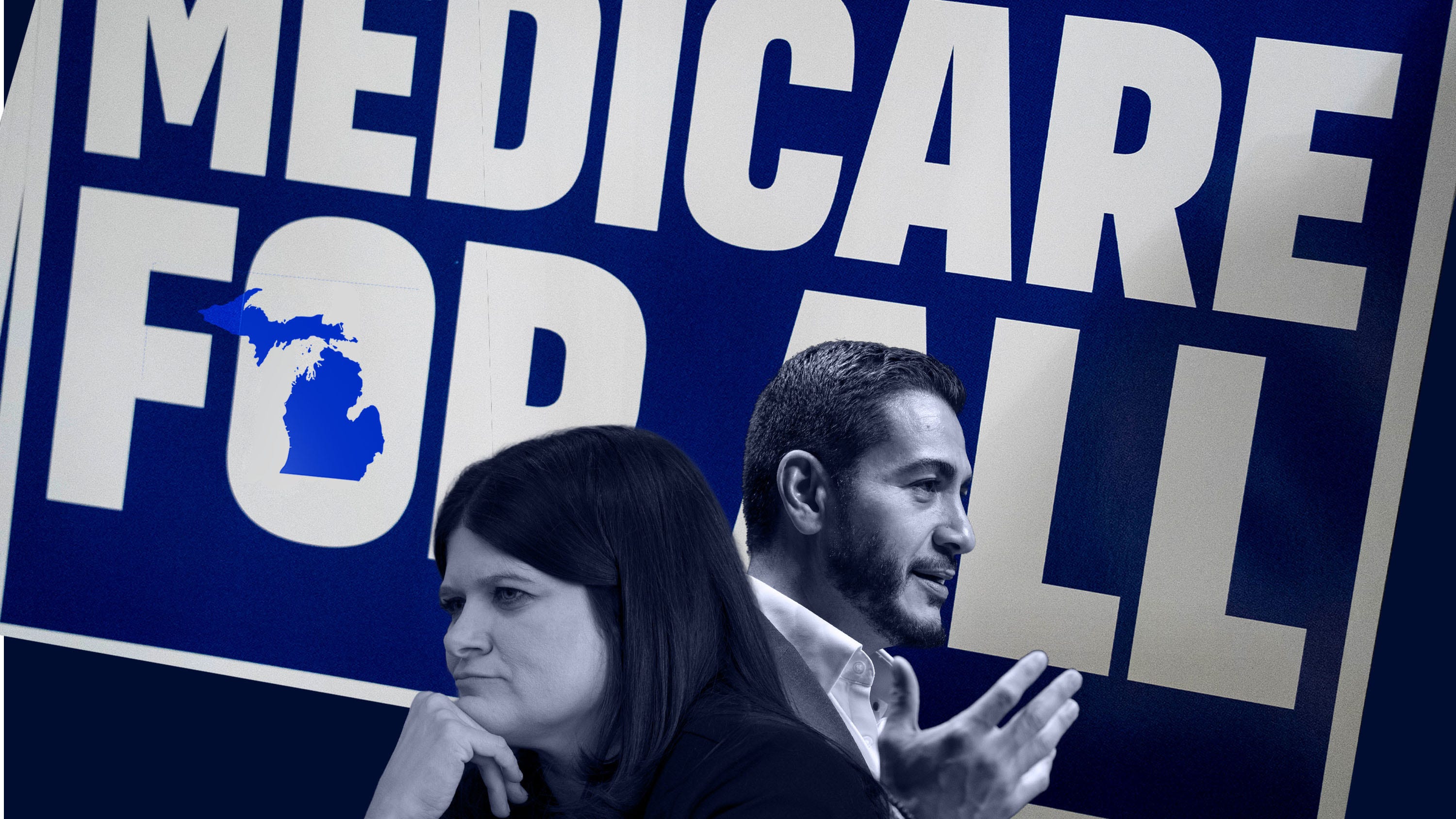
Detroit, Michigan ABDUL EL-SAYED HAS BEEN RUNNING to become Michigan’s Democratic Senate nominee for more than fifteen months. And if there’s been one constant over that period it’s been his promotion of “Medicare for All” as a way to make sure all Michiganders—and all Americans—have access to affordable, quality health care.
It’s a big focus of his stump speech, something he usually raises right at the beginning. It’s all over his campaign signage. And it’s the only specific policy promise in his three-part campaign slogan, which he and supporters invoke constantly:
Money out of politics. Money in your pockets. Medicare for All.
Medicare for All—a proposed version of universal health care that would have the government cover everybody directly, mostly doing away with private health insurance—has been part of the policy conversation among Democrats since the 1940s, when Harry Truman proposed a national health plan that included a prototypical version of the idea.
In the last few decades, partly as a nod to real-world political constraints, Democrats have leaned more toward hybrid plans with both private and public insurance as the surest path to universal coverage. That approach gave us the Affordable Care Act in 2010, which alongside Medicare and Medicaid—and with some financial reinforcements put in place during the Biden administration—reduced the uninsured rate to a record low.1 It’s as close as America has ever come to a place where health care is a right, not a privilege.
But even then, millions of Americans didn’t have insurance or couldn’t cover their out-of-pocket costs. And that was before Donald Trump and the Republicans started hacking away at the existing programs, exposing even more people to crushing medical bills. Partly in reaction to those realities—and partly thanks to high-profile advocacy by the likes of Senator Bernie Sanders, the Vermont democratic socialist—over the last decade or so the idea of a full reset through Medicare for All has gotten increasing attention from the Democratic faithful.
On Tuesday, those sorts of voters in Michigan will get a chance to weigh in on this debate when they decide between El-Sayed, who is a former public health director in Detroit and Wayne County, and Haley Stevens, who is a four-term House Democrat. Stevens is from the wing of the party that prefers to work within and around existing arrangements, whether that means trying to repair the damage from Trump or creating a new, optional public insurance program for people who want an alternative to private coverage.
For voters here who care about health care, weighing the two candidates means considering the different policy paths they recommend, including the merits of Medicare for All itself. But it also means pondering something that hasn’t gotten as much attention: exactly what kind of senator El-Sayed and Stevens would each likely turn out to be, and what history teaches us about how their distinct styles would play out in the current political landscape.
Original reporting.
Sharp analysis.
Honest commentary.
Stick with us through the midterms and beyond—sign up for a Bulwark+ membership and get your first two weeks free.
IT WOULD BE DIFFICULT to overstate how central health care is to El-Sayed’s identity.
The political origin story he tells involves his journey through medical school when, while working in a New York City hospital, he saw the difference between the lavish attention to wealthy patients on the top floor and the shabby treatment that the destitute got down in the emergency room. One of his staple campaign lines is that the life expectancy in the country of his parents, Egypt, is roughly the same as it is in parts of Detroit.
He says it convinced him to focus on public health rather than the practice of medicine—which, in turn, drew him to Medicare for All. “In public health, we’re always in this position where we’re underfunded and underinvested-in,” El-Sayed told me during a phone interview Saturday, while driving between campaign stops. “That’s because our current health care system sucks so much money into the care part of things rather than the prevention part of things.”
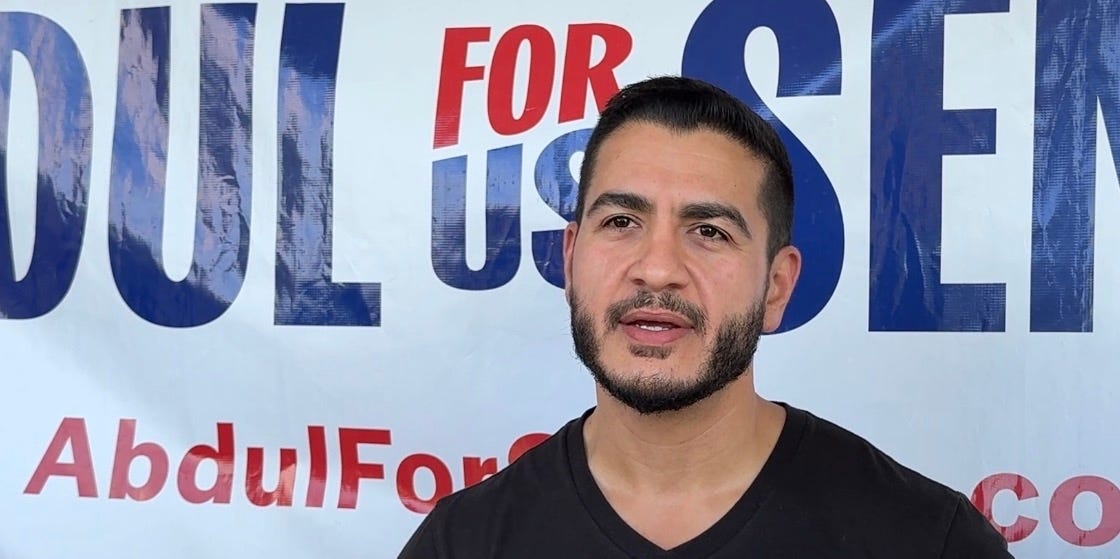
Abdul El-Sayed speaks to reporters after a canvassing event in Canton, Michigan, on Wednesday. (Photo: Jonathan Cohn)
A few years ago, El-Sayed collaborated with a physician-researcher on Medicare for All: A Citizen’s Guide, a book that briefly explains how America’s health care system evolved, then sketches out the broad outlines of a Medicare for All system, including benefits and financing.2
The pitch El-Sayed makes in his speeches and appearances doesn’t get into the policy weeds; it is more like a general pitch for the idea of universal coverage, which is something that takes a variety of forms abroad. Many countries’ systems include significant roles for private insurance, and some have considerable out-of-pocket spending. At the same time, even the hybrid systems of countries like France or the Netherlands have more in common with the single-payer systems of Canada, Taiwan, and Sweden than they do with the American patchwork.
One way to think about Medicare for All—and to evaluate El-Sayed’s support for it—is to imagine, as a thought experiment, what it would be like to transplant one of those systems here. You’d have to account for all kinds of cultural differences, including among medical practitioners, that can have profound effects on the economics of health care. You’d also have to account for the transition, which may be the hardest part of the equation because health care represents one-sixth of the economy and even modest changes would entail massive disruption.
Spend any time with the numbers and you’ll discover Medicare for All, like all health care systems, including America’s status quo, would require making difficult tradeoffs. Throw in the political obstacles to any kind of substantial health care reform—a list that includes the power of monied interests, the skewed representation of the Senate, and the public’s fear of change3—and the chances of actually enacting Medicare for All anytime soon is slim at best, even if El-Sayed gets to the Senate.
Some people act like the only way to support universal coverage as a goal is to support Medicare for All, as if anyone who doesn’t back Medicare for All isn’t truly committed to universal coverage. That would surprise the likes of Ted Kennedy, the legendary Massachusetts Democratic senator who was the patron saint of universal coverage while he was alive, yet was a key orchestrator of multiple compromises including early work on the legislation that became the Affordable Care Act.4
El-Sayed hasn’t done anything to dispel this notion, and probably reinforced it by dismissing narrower proposals like one Democratic-aligned think tank’s call to make primary care free. But in our phone interview he said he understands the technical challenges and would, if elected, seek to help Democratic colleagues work through them.
He also said he understands the political challenge, which is why he routinely refers to Medicare for All as a “Mount Everest” to be scaled in stages. “I’ve been very clear that I want to get to Medicare for All, and I also believe that we’ve got to take a pathway there. To me, as long as it reduces the power of the health care corporations, expands health care, and does so publicly, I’m for it, and would be glad to work with likeminded partners on that path.”
FOR A MODEL OF WHAT this might look like in practice, you need look no further than Sanders, who is not just Medicare for All’s most visible champion but also El-Sayed’s, having endorsed both his 2018 gubernatorial bid and now his Senate run. The Vermont senator played a key role in shaping the prescription drug reforms that Democrats passed and Biden signed in 2022.
Sanders’s harping on persistently high health care costs during the 2016 presidential primaries frustrated Democrats who were preparing to defend the Affordable Care Act against possible repeal, and back in 2009 he held off supporting the law until the final stages of Senate debate. But he came around to yes, as the Obama White House and Senate leaders knew he would, with his one big ask being an $11 billion investment in community clinics entirely consistent with the law’s spirit. And in 2017, once the repeal effort got underway, Sanders proved an enthusiastic and effective defender of the law.
Another Sanders accomplishment was a landmark 2014 reform of veterans health services. That was a bipartisan effort, one that he negotiated with the late John McCain, and it’s an open question how much interest El-Sayed would show in such deal-making, or how much capacity he has for it. It requires EQ as much as IQ, and not disparaging adversaries in the way he has treated Stevens multiple times—most recently just this week, when he described the four-time election winner as the “least capable candidate in America.”
Stevens in many ways illustrates the opposite archetype. She has a proven record of bipartisanship. In fact, that’s been the main thrust of her campaign: that she’s a workhorse who gets stuff done, winning recognition as an effective legislator precisely because she makes deals on legislation targeting particular needs or groups of constituents.
Health care is not as central an issue for Stevens’s campaign or her public identity as it is for El-Sayed. (To be fair, you could say that of most politicians. In Stevens’s case, industrial policy is her thing, and she’ll hold forth on it for hours if you let her.) If Sanders is a prototype of who El-Sayed might be, a more likely role model for Stevens would be Debbie Stabenow, who represented Michigan in the Senate from 2001 to 2025.
Stabenow, who has endorsed Stevens, also focused on issues other than health care. But she did leave her mark in a few spots. One of those was the treatment of mental illness; over the course of years, she built a bipartisan coalition for legislation that now funds mental health clinics around the country, in a way that appears to be providing much-needed care while easing the burden on local law enforcement.
Other than that, Stabenow supported whatever health care measures Democratic leaders promoted. Most likely Stevens would too, because that’s how she’s conducted herself in the House whenever health votes came up. That includes the 2022 law giving the federal government power to negotiate some drug prices in Medicare. Stevens voted yes, notwithstanding some (relatively small) campaign donations from drug companies she has taken over the years.
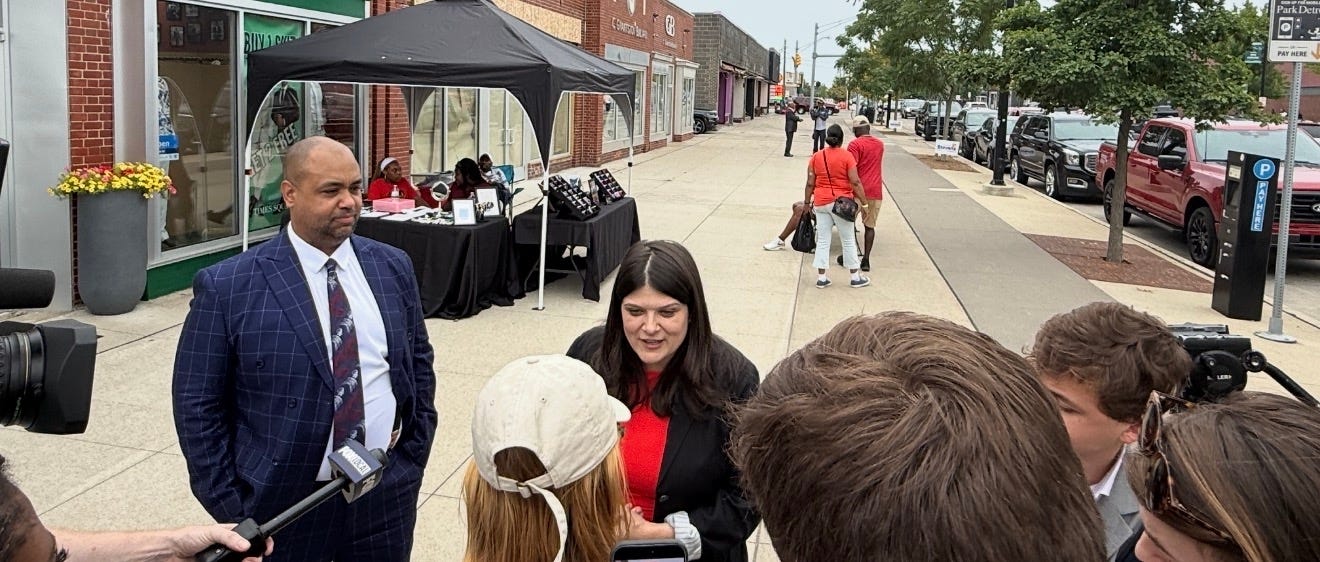
Haley Stevens appears with one of her backers, Detroit City Council President Pro Tem Coleman Young II, during the city’s Jazz on the Avenue festival Saturday. (Photo: Jonathan Cohn)
Insofar as the Democrats stay on the path they’ve been on—using the policy architecture now in place to finally get to universal coverage—Stevens as senator figures to be another lawmaker helping that journey along. And she would come to office with legislative experience, something one of her key backers told me gave her an advantage over El-Sayed.
“She’s the only person that actually passed legislation,” Coleman Young II, president pro tem of the Detroit City Council, told me during a joint appearance with Stevens on Saturday. “If we were talking about who could be the best public health director, we’d be in trouble. We’re campaigning for who’s going to be the best United States senator. This is a legislative position, and Haley Stevens has the record.”
Pop this newsletter into a friend’s inbox or post it to social media:
WHAT STEVENS WOULD CLEARLY not do as a senator is try to push the boundaries of debate over health care in the way that El-Sayed would. He has said repeatedly that if he is elected, he would try to use his platform to build support for his agenda—including Medicare for All—to national audiences, to the point of visiting other states where lawmakers might not be with his program.
Stevens has suggested that makes El-Sayed more interested in making headlines than making progress. And there was a time, certainly, when that kind of advocacy would look to fellow members of the Senate like grandstanding, making it difficult to accumulate power and negotiate—and, eventually, to pass laws that could benefit constituents.
But lawmaking in 2026 is different from, say, 2016 or 2006. More now than ever before, attention is political currency. In the hands of somebody committed to a cause like Medicare for All, it can change the agenda, sometimes substantially. The proof is Sanders, whose persistent advocacy for Medicare for All—even when he was the only nationally recognizable figure pushing for it—is a big reason it’s a central part of the conversation among Democrats.
In that sense, the main impact of electing El-Sayed would be adding to that chorus another, younger version of Sanders—somebody who would push the whole caucus in the direction of expanding health care access, and who could inherit the Medicare for All movement whenever Sanders, now 84, decides to hang up his democratic socialist spurs. And it is safe to assume that merely electing El-Sayed would have a galvanizing effect on the national debate, by challenging old conceptions of what’s politically possible in a swing state campaign.
But first El-Sayed would have to win the general election, while running in a state far less hospitable to his politics than Vermont has been for Sanders. And it doesn’t take a ton of imagination to see how difficult that could be.
Just for starters, El-Sayed would have to overcome an onslaught of negative advertising even more overwhelming than the one he’s facing now. And this time it would feature the sort of attacks fellow Democrats would never make but Republicans make all the time. Example: El-Sayed has said undocumented workers should get coverage if they pay taxes. The position is highly defensible as a substantive proposition but highly difficult to defend politically.
El-Sayed, never lacking in confidence, thinks he can win this fight. And he is well equipped to do that—especially in a campaign against presumptive GOP nominee Mike Rogers, a former GOP House member who took money from pharmaceutical companies and has a long record of supporting Republican bills to take health care away from people.
El-Sayed could leverage his background as a doctor and epidemiologist who has literally spent years helping people to get health care. And unlike Stevens, he could present himself as somebody who has never taken money from corporate PACs. Those are all powerful rhetorical tools, especially in the hands of a communicator as deft as El-Sayed.
ELECTABILITY IS A TOUGH THING TO PREDICT. Its consequences aren’t. Just look at the recent history of health policy debates.
One more Democratic senator in 2009 would have given the Affordable Care Act’s architects leverage to pass a more generous bill, one that got closer to delivering what Medicare for All would. And in 2021, one more Democratic senator would have allowed leaders to muscle through a program for home health care they had to drop, to expand the universe of drugs subject to government price negotiation, or to fund more years of the temporary Obamacare subsidies Republicans have since allowed to lapse.
By contrast, with one fewer Democratic senator in 2017, the Affordable Care Act probably wouldn’t have survived repeal. And with one fewer Democratic senator in 2009, it might not have become law at all.
There are countless more examples like that on other issues, all highlighting the same essential reality that is true on health care. The effect of nominating El-Sayed instead of Stevens as nominee would be substantial—for better or worse, depending on your perspective. But it would be small relative to the impact of putting up a losing candidate in the general election. For health care especially, the cost of turning Michigan’s Senate seat red could be catastrophic.
Excerpts from an interview with Abdul El-Sayed on August 1, 2026, lightly edited for clarity.
JONATHAN COHN: One of the things I want to do is predict for people—on health care—what you would be like in the Senate. And I was thinking back to when we had a video interview a few months ago, when I asked you whom you thought of as role models. You mentioned Bernie Sanders and Elizabeth Warren. Looking at them, are they a pretty good preview of how you would like to operate in the Senate?
ABDUL EL-SAYED: And I mentioned a third, Senator Chris Van Hollen. Yes. I think our work is about getting the nuts and bolts of the policy right, making the moral and political argument, and then working to line up the votes because you’ve moved the ground underneath the U.S. Senate and public policy. I want to be able to do my part on all three of them, working alongside colleagues who’ve been thinking about this and doing this work for a long time. I think about Senator Sanders, of course, and Congresswoman [Pramila] Jayapal and Senator Warren, and then many others. I hope that folks can rely on me to be a bona fide policy student, somebody who’s taking what I’ve learned as a researcher and an expert to build that into public policy. And then also an advocate on the ground, to use the broader public conversation around what all of us can believe in and should fight for when it comes to health care. And then working alongside somebody like a Senator Van Hollen to say, okay, how do we start to think about building the coalition for this in the Senate, to line up the votes that we need to get it done.
COHN: You look back at Bernie Sanders, he obviously is talking constantly about Medicare for All. But he also did a big bipartisan veterans bill with John McCain. And he worked on the prescription drug price negotiation. Do you imagine yourself being someone who would work on things like this that are not Medicare for All, and really put your muscle into them?
EL-SAYED: For sure. I’ve been very clear that I want to get to Medicare for All, and I also believe that we’ve got to take a pathway there. To me, as long as it reduces the power of the health care corporations, expands health care, and does so publicly, I’m for it, and would be glad to work with likeminded partners on that path. I think the mistake is sometimes to say, ‘Okay, we’ve made these changes and therefore we’re good to go. We’re not good to go until we have Medicare for All. But you know on the pathway—the steps along the way—I’ll be working hard with my colleagues to try to get those things done too. . . . When it comes to making the VA whole, when it comes to funding our investment in affordable prescription drugs, when it comes to our investment in medical science, you’re going to see me right at the forefront.
COHN: You’ve talked a lot about how you want to be going into other districts and states, making the case for Medicare for All, and other priorities too. Does that include fellow Democrats? Would you go to a Democratic district or state if you feel like a senator is pulling in a different direction?
EL-SAYED: I think we have a responsibility to fight for the things we need and deserve. In the end, politics is about a competition of ideas. I think you lose that competition if you’re not willing to take your ideas and present them to a broader public, and I think it’s important for voters to have an alternative to somebody who’s corporate bought. Now, that means beating Republicans big time. But it also means standing up within our own party, like I’m doing in this primary, when it is the power of corporations buying our own party against the will of the broader public. . . . I’m focused on the best interests of the people of Michigan. And to achieve the things I need for the people of Michigan, it’s going to be really important that we have the kind of movement inside the U.S. Senate to be able to pass the legislation that is in service of people here in my state. So the question is: Am I afraid of what colleagues might think of my advancing my ideas? I tell them: Bring better ideas.
COHN: I know some people are worried you’re more excited about attacking Democrats and fighting out a factional war in the party, rather than beating Republicans.
EL-SAYED: Give me thirteen weeks and ask them if they think that after I’ve dispatched Mike Rogers.
The low point was measured in 2023, when just 7.2 percent of the population had no insurance. That corresponded to 23.7 million people, a significant portion of them undocumented immigrants not eligible for public programs.
The book stresses that, in El-Sayed’s vision, the new program would fill in benefit gaps of the existing Medicare program (which doesn’t cover vision, hearing, or dental, for example, and has no out-of-pocket limit). It proposes financing from a combination of repurposed spending from existing programs, administrative savings, government regulation of payments to providers, and progressive taxes that in theory would not force lower- or middle-income people to pay more than they do now.
Polling results on Medicare for All can vary a lot depending on wording. And as a recent Zeteo/Searchlight survey showed, people get more skittish when they learn Medicare for All would mean giving up their existing insurance.
As the Atlantic’s Jonathan Chait has noted, one effect of this rhetoric is to minimize—or even erase—the Democratic party’s consistent commitment to universal coverage, which also traces back to the Truman era.
(Photo illustration by Bill Kuchman/The Bulwark | Photos: Creative Commons, Shutterstock)
A FUNNY THING YOU MIGHT HAVE NOTICED about the semiquincentennial: Most Americans don’t know what happened 250 years ago that’s being celebrated this year. And even among those who have a general sense, there’s a lot of fuzziness about the details. Some people think Independence Day commemorates the day representatives from the thirteen colonies voted to separate from the United Kingdom—but that happened on July 2, 1776. The date we honor, July 4, is instead the day the Continental Congress settled on the wording of the Declaration of Independence.
The signing of the Declaration is an iconic moment, of course—but that wasn’t July 4. The Declaration wasn’t yet ready to be signed on that day. In fact, this weekend marks the 250th anniversary of the start of the signing of the Declaration, on August 2, 1776—with a few stragglers adding their names months later.
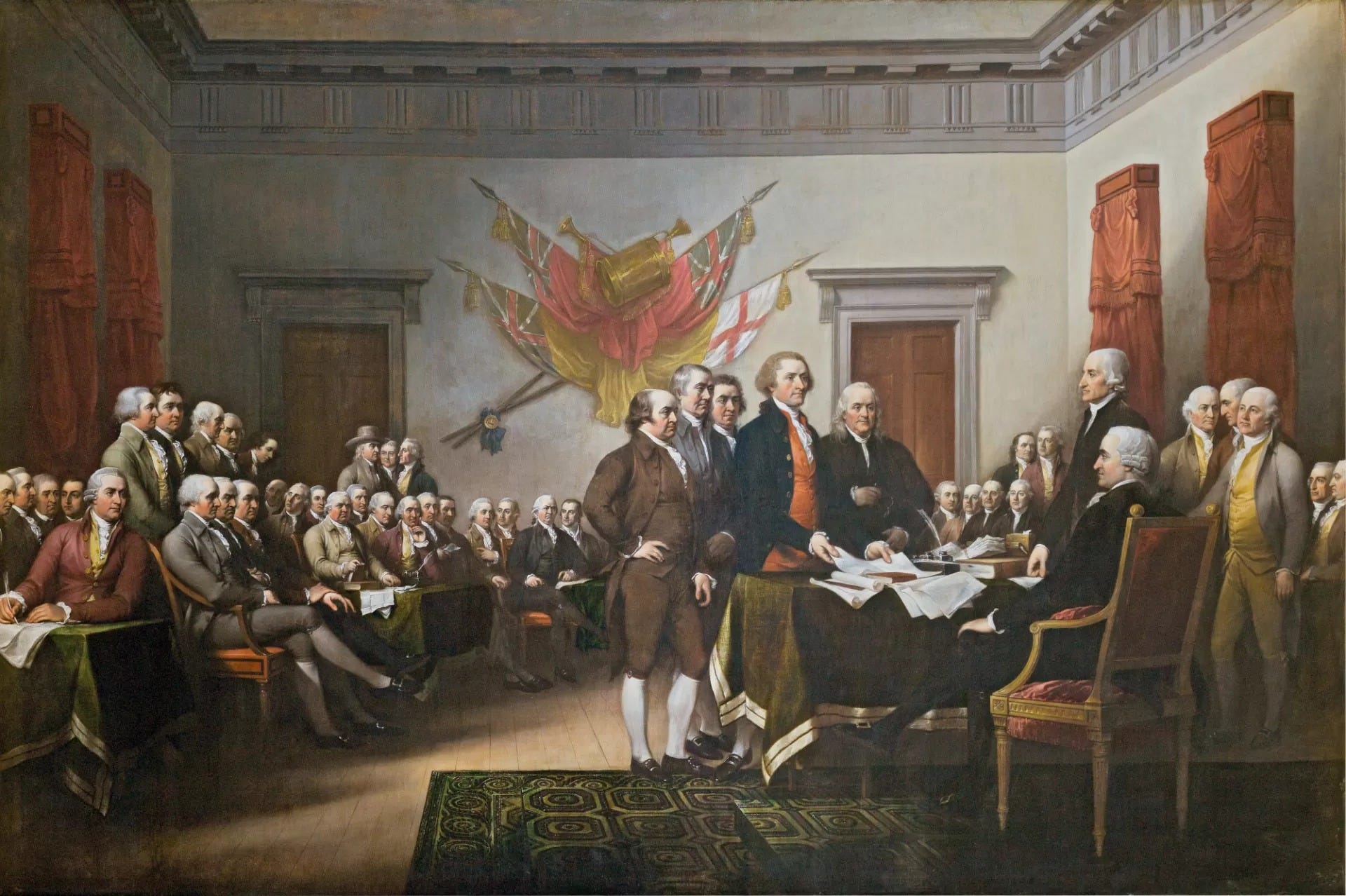
And speaking of iconic moments, maybe when you think about the Declaration being signed, you envision this famous 1817 painting by John Trumbull, which was adapted for the back of the two-dollar bill:
John Trumbull’s Declaration of Independence (1817) hangs in the Rotunda of the U.S. Capitol.
Except the scene Trumbull painted isn’t the signing of the Declaration. It depicts the events of June 28, 1776, when the five-member committee tasked with composing a declaration presented its draft to the other members of the Continental Congress.
All this confusion over the timeline should serve as a reminder for us that independence was not a single moment but a process that took sustained effort to achieve.
SO HOW DID THE SIGNING of the Declaration of Independence actually happen?
After the Continental Congress on July 4 agreed on the wording of the Declaration as the announcement of the new country’s birth and the official explanation for separating from Britain, a copy of the text was given to Philadelphia printer John Dunlap, who began producing broadsides of the document. George Washington had the Declaration read to the troops stationed in New York on July 9 “as a fresh incentive to every officer, and soldier, to act with Fidelity and Courage, as knowing that now the peace and safety of his Country depends (under God) solely on the success of our arms.”
But Congress did not authorize a formal parchment copy to be created, or “engrossed,” until July 19. The delay most likely resulted from Congress’s desire to make the Declaration speak with one voice. New York’s delegation, bound by old instructions from their state, abstained from the vote on July 4.
Once New York’s approval arrived, Congress ordered that an official copy “with the title and stile of ‘The unanimous declaration of the thirteen United States of America’” be produced, “and that the same, when engrossed, be signed by every member of Congress.” Timothy Matlack, a Philadelphia merchant with a reputation for beautiful handwriting (he’d engrossed other documents), most likely got the job. On August 2, his parchment was ready for the delegates’ ink.
John Hancock, the president of the Continental Congress, signed first: in the center, big and bold—but, contrary to legend, not to make it easy for the king to read. About another forty men followed suit, affixing their names by states. The precise number of signers on August 2, 1776 is not certain, however. The congressional records only say that “The declaration of independence being engrossed and compared at the table was signed.”
Some delegates were verifiably absent from Philadelphia in early August and couldn’t have signed with the rest. Richard Henry Lee, for example, arrived at the end of the month from Virginia; Oliver Wolcott of Connecticut came in October. Thomas McKean of Delaware was the last to put quill to parchment, most likely in December 1776 or January 1777—though it’s possible he didn’t sign until as late as 1781. We just don’t know.
Meanwhile, other delegates who had been present on July 4 did not sign the Declaration. Pennsylvanian John Dickinson, for one, opposed independence and so did not sign. Robert Livingston, who had been one of the five members of the committee that drafted the Declaration, was simply absent—he had returned to New York after independence was declared—and never got around to signing. Other permutations occurred, too. George Read of Delaware did not support independence on July 4 but ended up signing the Declaration anyway on August 2. Eight men, including Benjamin Rush of Pennsylvania and Marylander Charles Carroll of Carrollton, signed the Declaration even though they had joined Congress after July 4.
THE SIGNING OF THE DECLARATION was not an empty symbolic act. It was important to manifesting the Declaration’s authority to create a new nation. As the document’s final paragraph notes, the delegates were “the Representatives of the United States” acting “by Authority of the good People of these Colonies.” Numerous states, towns, and counties across the land had already drafted their own statements calling for independence, and now, by a messy but distinctively democratic process devised on the fly, the country had come together in this new expression of nationhood. As Pauline Maier argued in American Scripture: Making the Declaration of Independence, declaring independence was the work of the people as much as it was the work of a small group of Founders. It was not abstract or anonymous but the real sentiments of real people, flowing through the signers to the larger world.
Similarly, the Declaration’s inspirational closing—“we mutually pledge to each other our Lives, our Fortunes and our sacred Honor”—was no mere rhetorical flourish. For men who prized their honor as their most valuable possession, risking all for each other and for the Declaration validated the cause.
Looking back at how the Declaration was signed reminds us that independence was not the work of a single day but a process that unfolded as the United States asserted its right to be respected as a nation. Securing that independence was a dangerous ordeal involving five more years of fighting. Almost till the very end, an American defeat was the most likely outcome. Indeed, even as Washington’s men assembled to hear the ringing words of the Declaration for the first time, they were under attack by the British, who landed en masse on Staten Island in July. They nearly trapped Washington’s army on Manhattan. The revolution might have ended even before the Declaration was finished being signed. (What’s more, nine of the signers died before independence was achieved.)
The Declaration rightfully holds a special place in our culture, and it’s a fitting centerpiece of the America 250 celebrations. But as the story of the Declaration’s signing reminds us, the founding of the United States was the work not of a day but of months and years. Our commemorations should reflect that by continuing not just through this year but through the entirety of the anniversary of the war that made our independence a reality.
That’s good news for anyone who still has the semiquincentennial spirit: You still have years left to celebrate the Revolution. Start today: Give a huzzah for August 2, the day the Declaration began to be signed.
This audio-only bonus episode is available exclusively to paid members of The Bulwark.
Sarah Longwell and Andrew Weissmann discuss the Trump Justice Department’s subpoenas targeting New York Times reporters and their families, the criminal referral against Jack Smith, and the firing of a Seattle U.S. attorney minutes after a court appointment. They also consider reforms to curb political prosecutions, the courts’ role in checking executive power, and concerns about the integrity of the 2026 and 2028 elections.
The Illegal News with Sarah Longwell is available wherever you get your podcasts and on YouTube. Leave us a review and ⭐⭐⭐⭐⭐ so more people can find this important show from The Bulwark.
Access to this show’s community comments and ad-free editions is available exclusively for Bulwark+ members here and on the Bulwark App—available now in the Apple and Google App stores.
Bulwark+ members can also listen ad-free on your podcast player of choice—click SET UP here.
Mona Charen speaks with The Atlantic’s Idrees Kahloon about how Trump’s immigration, university, trade, fiscal, and foreign-policy agenda could weaken the foundations of long-term American prosperity and global influence. They also discuss China, alliances, executive power, political corruption, and Kahloon’s reconsideration of campaign-finance reform in an era of small-donor-driven extremism and weakened political parties.
Bulwark Book Club pick for August: Mark Twain’s Pudd’nhead Wilson. Join Mona Charen and Bill Kristol to discuss this classic that explores racism and slavery. Published in 1894, the novel tells the story of two boys – one born into slavery, the other the master’s son – who were switched at birth. Send your questions, comments, and thoughts on the book here.
Watch your inbox for details on when the episode will drop.
The Mona Charen Show is a weekly, one-on-one discussion that goes in depth on political and cultural topics. New shows drop Saturdays. Find this show wherever you get your podcasts and on YouTube. Add the show to your player of choice, here.
Ad-free editions of The Mona Charen Show are exclusively available for Bulwark+ members. Access this member edition in the Bulwark App—now available on Apple and Google. Or set up the ad-free edition of this Bulwark show on your player of choice using your private RSS feed here.
Sonny Bunch and Bill Kristol take on the dismissed felony vandalism case against Olympic canoeist David Hearn—who was accused of damaging the Reflecting Pool—after government officials acknowledged problems with the work itself. They consider what the case reveals about political pressure, government misconduct, the costs of defending against unjust prosecutions, and Trump’s fixation on remaking Washington.
Happy Saturday! Overtime is for everyone. If you’re a Bulwark+ member: thank you. If you’re not, there’s no better time to subscribe to Bulwark+ than today. If you like today’s issue, you can share this newsletter with someone you think would value it.
Signs at the G92 press conference earlier this week, encouraging donations.
The Importance of Being There…
When I moved back to Ohio two years ago, I didn’t move back for work. And while I’m on the complete opposite end of the state from where I grew up, being here has had its advantages.
It’s not just the tri-state nature of Cincinnati, which puts me within easy reach of three states and three distinct political cultures. Some of it has simply been chance. Vivek Ramaswamy becoming the Republican nominee for governor? I saw that one coming a mile away and moved here in spite of it.
Take Springfield. I couldn’t have predicted that JD Vance and Donald Trump would take a heinous lie about hard working Haitian immigrants, refuse to ever walk it back or apologize, and essentially bully a town whose comeback owed so much to those very immigrants. That story found me.
Yesterday, my friend Asawin Suebsaeng of Zeteo, who also lives here in Cincinnati1 and has spent time in Springfield, shared a few observations that I couldn’t get out of my head:
Springfield right now—we can use Megyn Kelly as one of the most resplendently annoying examples—shows a stunning amount of contempt for small American cities like Springfield.
Are there people in the Springfield area who love Trump and want the Haitians cleansed and rounded up? Sure. But the idea that if you rip away all the Haitian immigrants (who have/had documents, by the way!), you’re going to make that city better for the everyday people who live and work there... I don’t know, man. Visit Springfield once and tell me that that is a common-sense conclusion to make.
I’m not saying you have to visit someplace to have a valid political opinion, but I’m not asking you to visit Kyiv. This is, like, right there for a lot of these Two Minutes Hate people.
Being here matters. Being able to see and talk to the people living through this matters a lot. It’s also something both readers and people there have told me: “Thanks for being there.” Or simply, “Thanks for coming.”
Remote punditry is easier than ever these days. Going to their grocery stores, their Walmart, the Eagles Club, walking Buck Creek as the community gathered for a concert, spending time in their thrift stores, pizza parlors2, and places of worship? It changes you.
If I had to write about TPS and what’s happening from Virginia, I could probably write similar stories. But meeting people like Viles Dorsainvil, Carl Ruby, our reader Rick, Marjory Wentworth, and others? It motivates me. It also makes me madder about what’s happening, and about chucklefucks like Megyn Kelly spouting truly awful things from the safety of her air-conditioned studio that SiriusXM helps fund for some reason. Infuriating.
If I thought she were a good-faith actor at this point, I’d encourage her to visit. But I don’t. The good people of that fine city deserve better visitors.
I’ve gotten emails and texts from readers asking how they can help. Unless you’re local and have the time and capacity to help, they need your money. Money is the only thing that will make a material difference right now for Haitians in Springfield.
At the end of one of the most expensive Democratic primaries for Senate in American history, Abdul El-Sayed appears to be pulling away. We've been talking to Democratic primary voters in Michigan about El-Sayed and Rep. Haley Stevens, and what they like (and don't like) about each candidate.
Jonathan Cohn, author of the newsletter The Breakdownand The Bulwark's resident Michigander, joins the show to discuss a primary that Sarah thinks has gone on for way too long.
There are more tickets to see Sarah and JVL on September 8 in NYC! We are about to sell out the orchestra section—but we want to sell out the balcony, too. It’s a point of pride. Come hang with us. Tickets are here.
Full ad-supported episodes of The Focus Group Podcast are available wherever you get your podcasts and YouTube. Hit that like 🤍 button and share this episode with a friend.
Ad-free editions like this one are available exclusively for Bulwark+ members on the site, the Bulwark App, via your member-only RSS feeds, and the Substack mobile and TV Apps. Upgrade now to listen without ads and to join the community in the comments.

 Login
Login