SEVERAL HOURS AFTER I BIT THE BULLET and bought third-row tickets for a 7:30 a.m. screening of The Odyssey in 70mm IMAX,1 the powers that be extended that film’s run in the format for another month or so, into the middle of September. So good news for those of you, like me, who had been lax in picking up tickets in the system.
For those of you who are blissfully unaware, 70mm IMAX is a vanishingly rare format at movie theaters: There are only twenty-five screens in America that can play the massive reels of film, and a small (but increasing) number of auteurs have begun to prize getting releases in the boxy 1.43:1 aspect ratio. Dallas is lucky enough to have one of these screens, and I’ve made sure to check out nearly every film released in the format since I moved here, from Oppenheimer to Sinners to One Battle After Another.
The tiny number of screens worldwide combined with enormous demand for the films has led to a pretty basic supply-and-demand problem: Tickets were sold out weeks in advance aside from a handful of terrible showtimes and awful seats, and IMAX literally cannot build more of the projectors that play the film. This in turn led to rich tech bros suggesting that the real problem here is that IMAX isn’t charging people more efficiently and thus leaving money on the table. If you don’t let the wealthy throw money at their FOMO, are you even trying to gougemaxx?
As I noted on Twitter at the time, a better solution is simply to extend the run, which is what wound up happening. Win-win: More showtimes, meaning more money for theaters equipped to play the format, all without sacrificing film’s status as the last truly mass medium.
Still, some theater owners are worried that the emphasis on IMAX is, ultimately, bad for the theatrical experience. As Matthew Frank reported in the Ankler, there’s concern that the emphasis on premium large format (PLF) screens like IMAX and Dolby is creating the impression that screen size and general loudness are the best and most important reason to go to the theater. As Frank noted, “One exhibition exec [says] their theater is ‘very careful’ not to brand too hard around PLFs in order to avoid ‘deterring a customer who may think, If I can’t see it in a PLF, I shouldn’t see it in a theater.’”
I’ll be honest: This is an understandable concern, and one that’s at least partly of the exhibitors’ making. You know if you go see a movie on IMAX or Dolby or one of the other proprietary formats like Cinemark’s XD or Alamo’s The Big Show, you simply know you’re not going to have to worry about little things like projector-bulb brightness or blown speakers. This is . . . not always the case in the average multiplex shoebox.
That said, I’ll just repeat a point I’ve made before: The best reason to go to the theater isn’t the size of the screen or the quality of the surround sound, though those things are nice. The reason to go to the theater is that it’s one of the few places you have permission to unplug from the world, to put the phone down and lock in on one screen, to revel in joy and sadness and excitement with strangers in the dark. I prize going to the theater because it’s one of the last places you can really focus on a movie and just the movie.
Still: A giant screen will help you focus even better. So get those 70mm IMAX tickets while you can!
Our Bulwark+ members make possible our growing coverage of movies, books, arts, and culture. Sign up to become a member yourself, with this free trial:
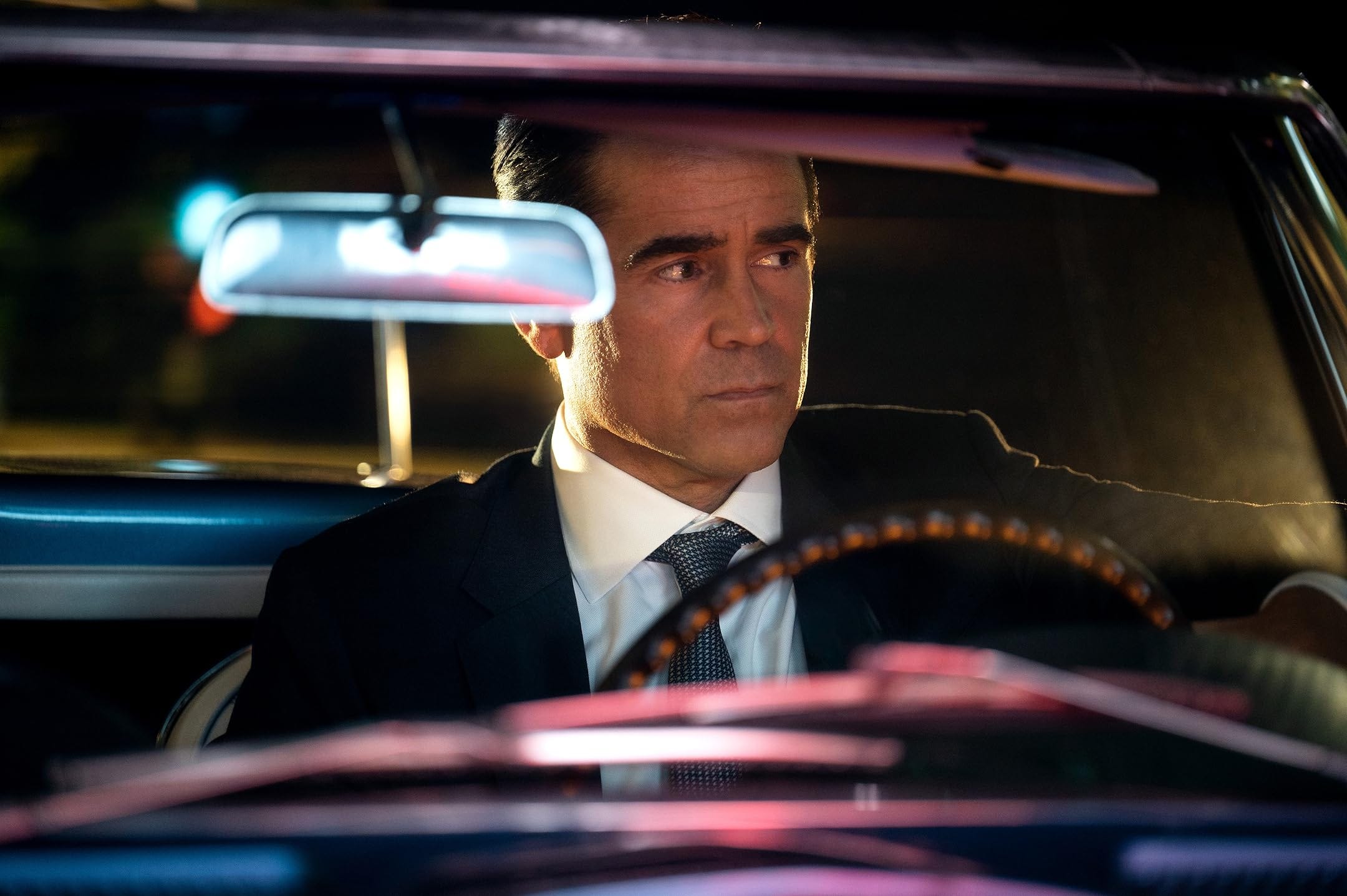
ON THIS WEEK’S EPISODE of The Bulwark Goes to Hollywood, I talked to Sam Catlin, the showrunner on the second season of the Apple TV show Sugar. For those of you who don’t know, Sugar is one of the best shows on television, a neo-noir starring Colin Farrell with a sci-fi twist. That twist, which came in the sixth episode of the first season, alienated some viewers, but I thought it was a nice little deke and when you rewatch that first season, it pays off tremendously.
One of the things Catlin and I discussed was the modest resurgence in noir, at least as an additive for certain types of storytelling. As it happens, I reviewed Prime Video’s Spider-Noir this week, a sort of alternate universe Spider-Man story set in the 1930s in which Nicolas Cage stars as private dick Ben Reilly, aka “The Spider.” This is a show with a murder mystery, yes, and a femme fatale, sure, but it’s also about crime and corruption and the way the mob and the mayor collude to ensure they both remain in power.
In the second season of Sugar, a similar idea manifests in the world of construction, where political favors and outright police corruption commingle with drug dealing and the elimination of the homeless population.
“A big part of noir is this idea that there’s something that’s always going to be bigger going on out of sight, just over the horizon that, like, you may get this guy, you may get that guy, but there’s a bigger contamination that’s going on out there that you’ll never be able to get your hands around,” Catlin said. “And I feel like that’s very much in the zeitgeist now, which is like: powerful forces out of our control . . . and you have to fight against a sense of futility.”
This is, of course, very much in line with the origins of the genre, which rose out of simmering unease following the end of World War II.
“The nation’s sigh of relief on V-J Day ought to have inspired a flood of ‘happily ever after’ films,” Eddie Muller wrote in the introduction to his history of the genre, Dark City. “But some victors didn’t feel good about their spoils. They’d seen too much. Too much warfare, too much poverty, too much greed, all in the service of rapacious progress. Unfinished business lingered from the Depression—nagging doubts about ingrained venality, ruthless human nature, unchecked urban growth throwing society dangerously out of whack.”
And these sentiments settle then recur: in the 1970s, with classics like Chinatown and The Long Goodbye, and again in the 1990s with L.A. Confidential and Fargo and Bound. That we seem to be in another prominent cycle of noir—in our age of rampant, unchecked corruption at the federal level and clear feelings of impotence and uselessness at the local and state levels—should not be surprising to anyone who is familiar with the genre or its trappings.
As alluded to in my 2024 piece about Interstellar during its 70mm IMAX run that year, I am an inveterate procrastinator when it comes to actually buying tickets for movies.
Triad Mailbags will be posted in the Bulwark Takes feed for our audiophiles and a transcript can be found below for the readers among us.
In this episode we cover:
From Dave Y.: DSA candidates have gotten a lot of publicity lately. What is your take on them? (starting around 0:28)
From Judy B.:What can be done to protect the 2030 census?(starting around 8:09)
From JennyB:What do you think about Ross Douthat joining ‘60 minutes’?(starting around 9:21)
From Stephen R.: Do you agree with the theory that Republican voters want authoritarianism because they believe that left-wing authoritarianism is out to destroy them? (starting around 15:12)
From In The Age of Now:In the Secret Pod, you said “We’re going to lose, but you have to go down fighting.” This reminded me of Tolkien’s idea of “the long defeat” in the fight against evil. Does Tolkien’s idea resonate with you? (starting around 18:15)
From Kate B.:Why aren’t you a fan of Ezra Klein? (starting around 22:16)
From tupper:What problems was the website’s redesign trying to solve? (starting around 27:25)
From SJ:Could you take a minute and gush about another member of The Bulwark? (starting around 31:18)
From Alejandro M.:What World Cup jerseys have you been sporting? (starting around 34:10)
From E.J. Joseph:Have you considered writing another book? (starting around 35:20)
From Jessica E.:Do you play any instruments? Does anyone in your family?(starting around 35:58)
Also from Jessica E.:Who are your favorite musicians/bands?(starting around 36:54)
From MCM:What are your favorite comic book series?(starting around 37:15)
From Smike:What is something in arts/culture that you hate and everyone else seems to love, or you love it and everyone else seems to hate it?(starting around 39:20)
The transcript, edited for clarity and concision, is below, but you can also read the PDF version here:
Jasmine poses Triad readers’ questions to JVL: What do you think about the DSA? What can be done to protect the 2030 census from Republican meddling? Why does the right crave authoritarianism? Why did The Bulwark change its website? All that and more (like JVL’s hidden backstory as an opera singer) in this week's mailbag.
(Photo Illustration by Bill Kuchman/The Bulwark | Photos: Shutterstock, Getty)
WHEN AN ICE AGENT is involved in a deadly, high-profile shooting, you should now assume that the government’s initial story is packed with lies—and that the truth will only come out over time as the spotlight fades.
That’s been the case, yet again, in the two most recent episod…
With his Middle East crisis spiraling out of control, his domestic agenda totally stalled, and popularity in the sewer, Donald Trump is keeping his eye on the prize. “Almost every night in the White House,” the Wall Street Journal reports, “President Trump calls his fundraiser, Meredith O’Rourke, for an update. Trump asks O’Rourke which companies and donors have cut checks and which haven’t, and for how much.”
The donations come in by the millions and tens of millions—for his presidential library, his ballroom project, his political action committees. Trump may be a president, but America’s CEO class knows it’s still much safer—and more profitable, in the long run—to treat him like a king. Happy Friday.
Join Catherine Rampell and JVL for Receipts Live on Substack and YouTube today at 12:30 p.m. EDT.
If you’ve been enjoying Morning Shots, there’s a lot more where this came from. Try out a Bulwark+ membership free for two weeks—we bet you’ll want to stick around.
(Photo Illustration by Sarah Rogers/The Bulwark | Photos Getty, X.com)
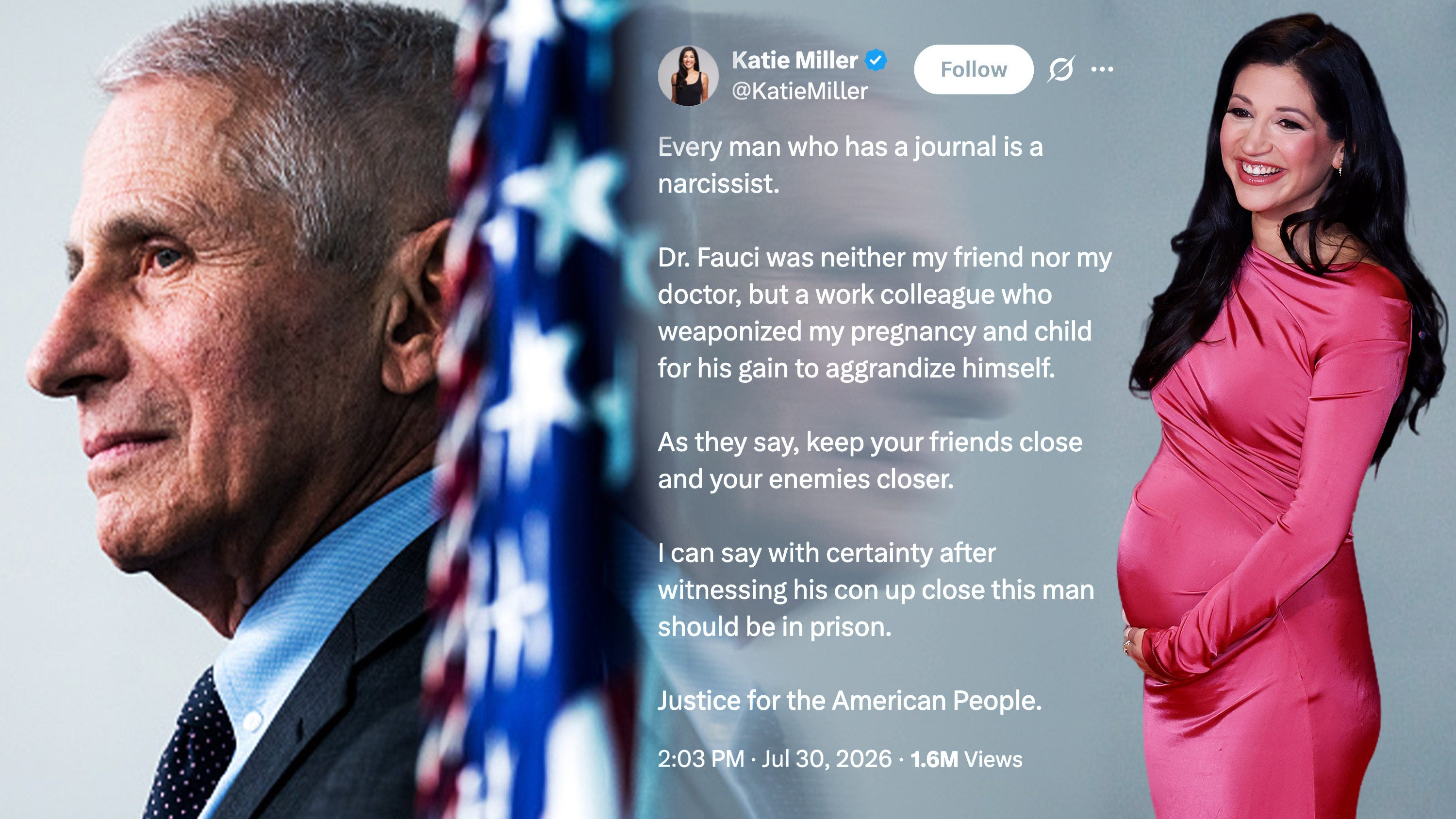
Fauci’s Diary Made Katie Miller Look Human. She Can’t Have That.
by Andrew Egger
By now you’ve probably read plenty about congressional Republicans’ latest struggle session against Anthony Fauci—the mean-spirited publication of his COVID-era diary, the barrage of ridiculous and misleading questions at his Senate hearing, the crude spectacle of HHS Secretary Robert F. Kennedy Jr. tweeting a photoshopped image of himself clapping the doctor in handcuffs.
Yesterday, though, my attention was captured by a far smaller, sadder side plot in the Fauci affair spotlighted by NOTUS—one involving Katie Miller.
During Trump’s first term, Miller was a senior aide to Vice President Mike Pence, and therefore a close colleague of Fauci’s on the White House’s Coronavirus Task Force, which Pence chaired.
From his journal entries, it’s clear that Fauci quickly took a liking to Miller, whom he viewed as a bright young colleague and for whom he developed an almost grandfatherly affection. “Katie Miller is great (tough, smart, but great),” he wrote in March 2020. “Katie Miller and I laugh at each other in the Sit Room,” he wrote two months later.
The work of grappling with a brand new, barely understood pandemic was stressful, both professionally and personally—after all, the task force could get the virus too. At several points, Miller leaned on Fauci for medical advice. “I am calling Katie frequently to check on her couple times per day,” Fauci wrote after Miller tested positive for COVID in May 2020. “She is very anxious about getting very ill since she is 10 weeks pregnant. Tonight she had an anxiety reaction. I calmed her over the phone.”
This was still awfully early days in the pandemic, when little was yet known about the relative risks COVID presented to various groups. Think of how genuinely terror-stricken Miller must have been. Think of how reassuring it must have been to have America’s top infectious-disease expert on hand not just to advise her, but to show personal concern for her physical and mental health. Miller, NOTUS reports, went back to Fauci repeatedly for medical advice throughout the pandemic: later that year when her husband tested positive for COVID, and again when their newborn experienced an unrelated medical episode. In the latter instance, Fauci records, he called the baby’s doctors directly to ensure she was getting good care.
Miller purports to feel differently now. “Dr. Fauci was neither my friend nor my doctor, but a work colleague who weaponized my pregnancy and child for his gain to aggrandize himself,” she wrote on X yesterday. “As they say, keep your friends close and your enemies closer. I can say with certainty after witnessing his con close up this man should be in prison. Justice for the American People.”
Miller’s claim here—that she was only relying on Fauci’s pro bono medical advice to “keep her enemies closer”—beggars belief. Nor does her explanation of his behavior make a bit of sense: Apparently, he “weaponized [her] pregnancy and child” to “aggrandize himself” by . . . showing concern for her well-being and going out of his way to help her out from time to time. And he kept it all private even as the Millers and the rest of the Trump movement turned him into a bogeyman.1 Sinister!
Share this story with someone who opposes MAGA, or just likes a good character drama.
Still, it’s easy to see why Miller is twisting herself in these sorts of knots. Fauci has become one of the MAGAsphere’s chief villains, while she’s become one of its influencers, with hundreds of thousands of followers and an odd soft-focus podcast aimed at MAGA moms. The ecosystem she’s chosen to live in is one dominated by political paranoia and intramural accusations of secret disloyalty. Fauci’s diary drop must have been a nasty shock. What if some clout-chasing rabble-rouser used it to try to expose her as some sort of Deep State plant? Better to get ahead of the accusations by cooking up some ridiculous “cover story” for associating with Fauci—and to call for his jailing too, just to be on the safe side.
Now, of course, Miller does a lot of things that I personally find a little difficult to wrap my head around. This, after all, is a woman who has tried to get the FBI to criminally investigate her neighbors. This is a woman who once lost her cool in a TV debate and started threatening her interlocutor with deportation. This is a woman who married Stephen Miller.
Still, it’s interesting to see a human side of Miller emerge in Fauci’s diary entries—and incredibly depressing to see her treat that human side as a four-alarm PR fire. What a bummer way to make a living, swimming in this revolting internet ecosystem. Hard to imagine she’s having a lot of fun.
“You miss 100 percent of the shots you don’t take.” This lesson comes to us courtesy of Wayne Gretzky, perhaps the greatest hockey player ever. Gretzky credits this sage advice to his father, Walter, who was driving him to practice one day and wanted to encourage young Wayne to shoot more.
It’s a good hockey lesson. It’s also a good politics lesson.
When Donald Trump announced his nomination of Todd Blanche as attorney general almost two months ago, the prospect of blocking his confirmation in the Senate seemed grim. This Republican Senate has routinely confirmed almost all of President Trump’s nominees. Republican senators have expressed qualms and objections—and then routinely caved.
But as of now, Sens. John Cornyn of Texas and Thom Tillis of North Carolina haven’t folded. They may still, and Blanche may still become attorney general in a permanent capacity, as opposed to his current acting capacity, in which position he’s already done a great deal in service of the Trumpist corruption of the Department of Justice. That corruption will continue under Blanche or any Trump-appointed successor. So this victory may only be transient, and in any case will be limited in its practical effects.
Still. For now, Blanche is blocked. Even if he eventually makes it, he will have been weakened. And in any case the protracted and well-publicized fight over Blanche has been a setback for Trump and Trumpism. The public has been made more aware of Trump’s determination to transform the Department of Justice into a Department of Retribution, Weaponization, and Election Subversion. The disgraceful Epstein coverup, which Blanche coordinated, is back in the news.
And since Blanche is being blocked by two Republican senators who are lame ducks, and since the GOP conference in the Senate will be even more uniformly Trumpist in 2027 than it is now, the case for Democratic control of the Senate if voters want any check on Trump for the next two years has been reinforced.
The sequence of events that has so far blocked Blanche wasn’t inevitable. The key issue for Cornyn and Tillis has been the corrupt deal negotiated between Trump’s current personal lawyers and his former personal lawyer, one Todd Blanche. The deal resolved a meritless lawsuit Trump filed against the IRS by giving Trump, his family, and his businesses broad immunity against IRS audits, saving them perhaps hundreds of millions of dollars.
But a key moment that slowed down the momentum towards confirmation had to do with a different issue, Epstein.
In response to Epstein survivor Dani Bensky’s testimony against Blanche, Tillis made it a condition for his support that Blanche meet with the Epstein survivors. The meeting went badly, and Epstein survivors explained how dismissive and condescending Blanche was. Tillis, who’d said he wanted to “get to Yes” on Blanche, then joined Cornyn—who has been a longtime and sincere champion in the fight against human trafficking and sexual exploitation, and who listened intently to Bensky’s testimony—in his objection to Blanche.
Trump then refused to allow Blanche to put the guarantees Cornyn wanted about the non-audit agreement in writing. Cornyn and Tillis dug in as Trump insulted them—including in a post just hours ago—and we’re now at an impasse.
It was all a somewhat unpredictable—and unexpected—course of events. It needn’t have happened as it did. But it did only because the Epstein survivors, along with other groups focused on other issues, all rallied to fight, even though the odds were against them.
In April 2025, Alex Ovechkin passed Wayne Gretzky as the leading all-time NHL goal scorer. But partly because Gretzky put so many shots on goal that created rebounds and scoring opportunities for teammates, he remains by far the all-time leader in assists and career points. And his teams won four Stanley Cups.
Politics is full of smart people who routinely overthink things. Overthinking tends to lead to caution. For me, the lesson of the Blanche fight is that of Gretzky père et fils: Take your shots. Some of them will be on goal. Maybe you’ll score. Maybe your teammate will score on a rebound. Maybe the goalie or the defense won’t clear the puck successfully, leading to another scoring opportunity. Or maybe you’ll just miss this time and have to try again later. But keep taking shots.
Here Are the Republicans’ Biggest Lies From Their Fauci Show Trial… In Press Pass, WILL SALETAN writes: In their retelling of the COVID story, the doctor was the bad guy, the vaccines were deadly, and Trump did everything right.
INFIGHTING ON IRAN: As American prospects in Iran grow fainter, the war of words between the hawks and doves in the MAGA coalition over who’s to blame is heating up again.
Writing in the Washington Post yesterday, columnist Marc Thiessen—a former George W. Bush speechwriter who is among President Trump’s most hawkish supporters—sketched out a view of the war in which the powerful, muscular actions of the president and his advisers like Marco Rubio, Scott Bessent, and Pete Hegseth were annihilating Iran, only to be repeatedly let down by the quisling dovishness of Vice President JD Vance. “Like Lucy and the football, Trump keeps getting told that this time the Iranians are finally ready to make a deal—only to be set up for failure yet again,” Thiessen wrote. “Indeed, by elevating a deal as the definition of victory, Vance has given Iran a veto over America’s ability to declare victory. All it has to do is refuse to agree—which it is doing.”
This view is a self-serving hallucination, of course—Trump has been just as eager to get a deal as Vance, as he has told us over and over in public. Just as Thiessen is eager to make Vance a scapegoat for the failures of the war, so Vance fans have been eager to do the same with Thiessen himself. “Thiessen is smart enough to know he can’t attack Trump, so he’s pushing a lie that Vance is acting independently of the president,” tweeted GOP strategist Ryan Girdusky, an ally of the nationalist right. “He was also one of the people who lobbied Trump the hardest to get into the war and Trump is tired of his bullshit.”
WISCONSIN ON A WING: Francesca Hong, a Democratic Socialist representing Madison in the Wisconsin State Assembly, is all but certain to be the Democratic nominee for governor of Wisconsin. She also wants to “Cancel Thanksgiving.”
In a since-deleted tweet, Hong wrote in November 2020, “Cancel Thanksgiving. Should have done this in 1621. If it takes a worldwide pandemic for us to realize we should stop celebrating colonialism and the original superspreader event that killed Indegenous [sic] folx and women so be it.”
This isn’t the first time Hong has handed the Republican Governors Association ready-made attack-ad material. Hong previously called to “Abolish the Senate.” CNN also found numerous tweets from Hong in which she called for things like “defunding the police as a first step towards abolishing the police.”
She repeated these opinions on camera. In a July 2020 interview, Hong said she supports “eliminating” police funding entirely: “If eliminating the police budget is not on the table, divesting and reinvesting into community control is what I would push for.”
In another interview days later, Hong said, “More police training won’t work. Reforming the current system isn’t the answer. We need to be dismantling the current system. Police officers enforce the law with state-sanctioned violence . . . Defund the police.”
On Tuesday, Politico’s Jonathan Martin asked Hong if she still wants to abolish police in the long term. She dodged: “I believe that we have to be serious about public safety.”
Hong won’t be the first Democratic Socialist with a history of insane comments to win a Democratic nomination, but unlike those who recently won primaries in deep-blue districts, she’s running in a state Trump carried just two years ago.
Perhaps Hong will pull it out in November over Rep. Tom Tiffany—himself an extremist who objected to certifying the 2020 election. But if she fails, an election denier will be tasked with signing the certificate of ascertainment for the 2028 presidential results in a pivotal swing state.
This week, I’m joined by Sugar showrunner Sam Catlin to discuss the second season of Apple TV’s underappreciated gem. If you haven’t watched the show, you should; season one is available in full and the penultimate episode of season two airs today. It’s a neo-noir with a sci-fi twist, a show about how media can shape us as people, and one of the best-acted programs on television. (Seriously: There’s a whole TV show with Colin Farrell doing A-List work and people aren’t talking about that nearly enough!) I hope you give the show a watch and give this episode a listen.
(Photo illustration by Bill Kuchman/The Bulwark | Photos: Getty, Shutterstock)
THE PROSECUTION OF JAMES COMEY is dead, to begin with. There is no doubt whatever about that. It is as dead as a doornail.
The manner of its death has yet to be determined, to be sure. But there is no doubt that it is dead. This must be distinctly understood, or nothing terrifying can come of the story I am going to relate.
To be sure, its death is, in some ways, disappointing. Who does not yearn for a full-blown public trial where the government’s proof is exposed for the bag of vacuous nonsense that it is? The spectacle would sell popcorn by the bucketful—and with good reason. Consider just a couple of the showstoppers that we are going to miss (summarized from Comey’s motion to dismiss and motion to suppress):
Comey was, infamously, indicted for posting a picture of some seashells that formed the phrase “86 47.” The government’s charge claims that the use of the number “86” was a true threat against President Trump—an incitement to violence and a reference to assassination or murder.
Leaving aside First Amendment issues, the government’s prosecution of Comey faces an extremely difficult factual problem: proving that to “86” someone or something actually means to kill or destroy it, and that this destructive meaning is what Comey intended to convey. The question is fraught because the origin of the phrase, in the 1930s, refers to the much more benign idea of asking someone to leave, or reporting that an item is out of stock.
To bolster the argument, the prosecutors went to the trouble of contacting well-known mafioso Salvatore “Sammy the Bull” Gravano. But he said that the mob would never use “86” to mean to kill someone because it was “too obvious.”
True facts. Sharp analysis. Honest opinions. Make sure you miss none of The Bulwark—join Bulwark+ today.
The Bull went on to suggest that DOJ contact John Gleeson, one of the most famous, longtime mafia prosecutors in recent history. DOJ didn’t do so, but Comey’s team did— and Gleeson told them that “the claim that ‘86’ is mafia jargon for ‘kill’ is preposterous.”
Or consider the problem known today as “Person-1.” Person-1 (who knew Comey’s wife, Patrice) has said that he is convinced that Comey knew the meaning of the “86” and intended it in its more violent meaning. But Person-1’s initial reaction was that “86” had the food-service meaning of being out of stock. Only after listening to an episode of Rudy Giuliani’s podcast did he come to believe that Comey (who worked on mafia prosecutions) must have known that “86” was code for murder.
Imagine how amusing, entertaining, and painful a live cross-examination of Person-1 would be:
Defense counsel: Did you talk with Mr. Comey?
Person-1: No I did not.
Defense counsel: Then how do you know he meant the malicious meaning of “86”?
Person-1: He must have known it from his mafia prosecution days.
Defense counsel: Well, then would it change your mind if you knew that the foremost mafia prosecutor in America said that the mafia would never use “86” to mean “kill”?
Person-1: [Blank stare; stuttering; cold sweats.]
It is a shame that we will be deprived of this sort of magical public moment. But whether on this basis or because the indictment is deemed a vindictive prosecution, we are never going to see this show. The Comey prosecution is dead—its death sentence just hasn’t been written yet.
ALL OF WHICH MAKES THIS EPISODE both pathetic and still, in some ways, frightening. The case against Comey is shockingly weak, and it comes as the Senate considers the nomination of Todd Blanche, the Trump-appointed lawyer who approved the prosecution and pushed it forward at his master’s behest, to be attorney general. The terror comes not from the prosecution itself but from the almost casual way in which such vacuous prosecutions have become commonplace—so much so that Blanche may yet be confirmed, and if he is not confirmed, it will not be because of his politically biased use of the law but only because of Trump’s rapacious graft.
For an attorney general to bring even one of these cases would have been an impeachable transgression in any other administration (arguably including even Trump 1.0). Today, such abuses have become normalized—so much so that they have gotten nary a mention in the ongoing Blanche confirmation fight.
Virtually all of these benighted assaults on neutrality and the rule of law occurred on Todd Blanche’s watch as deputy attorney general and now acting attorney general. He has lied, almost casually, about their provenance. We now know, for example, that emails from the day of Comey’s Secret Service interview show that the agents were sending real-time updates to Trump on Air Force One. And now we find out that the Secret Service initially declined the matter, and that Blanche’s aides directed the renewed investigation.
Nevertheless, Blanche has had the chutzpah to deny that Comey was prosecuted for political reasons. Earlier this year he told CBS News that the case was being brought by “local prosecutors” in North Carolina (it was a Trump-appointed prosecutor and his hand-picked assistant originally from New Jersey, but I suppose everyone is local to somewhere). When asked in another CBS interview whether Trump directed the indictment, Blanche said: “Of course not, absolutely, positively not.”
All of this used to matter. The rule of law and the neutral application of prosecutorial authority used to be bedrock principles of American jurisprudence. Yet, today, Blanche is running the Department of Justice. He may yet be denied Senate confirmation—but it will not, sadly, be because Republican senators have finally had enough of political prosecutions.
In considering Blanche’s nomination, senators see the ghosts of political prosecutions past and present. But they do not reject the ghosts of prosecution future. By not rejecting Blanche on this basis alone, the senators are, in effect, allowing their silence to speak volumes of acquiescence in aberrant behavior.
The prosecution of Comey is dead. Of that there can be no doubt. But the fact that a majority of Republican senators do not care that it is dead on arrival and are willing to countenance the confirmation of its architect means something far more terrifying, for them and for the country: The rule of law is now also almost dead.
(Photo illustration by Bill Kuchman/The Bulwark | Photos: Getty, Shutterstock)
IN A DISPLAY OF STOCKHOLM SYNDROME, the White House Correspondents’ Association invited Donald Trump to be the keynote speaker at its annual festival of self-appreciation. Because he is who he is, he did not take the opportunity to do the kind of gentle ribbing of the press that past presidents have engaged in, and he certainly declined to engage in the self-deprecating humor that charmed audiences in the old days. Instead, he delivered a string of puerile insults that would be beneath a fifth-grader.
The tuxedo and ball gown–clad lads and ladies were forced to sit through Trump’s meandering gibberish about the White House UFC fight, the weather forecast, the White House ballroom, why he hadn’t attended the Correspondents’ Association dinner in the past, and how “hot” America is now. Then he let loose with a string of gross insults:
But I can exclusively reveal to you this evening that for the heaviest of the heavyweights, we will have Sloppy Chris Christie, one of the sloppiest human beings you’ll ever meet. Fighting, I would say, I could mention the governor of Chicago [sic], but I’m going to mention instead Jerry Nadler. And they’re fighting for a big piece of cheesecake, big fat piece of cheesecake.
But we had a contest for who had the lowest ratings and the lowest IQ on television. And that was actually Don Lemon, I think. When I said that he’s the dumbest man on television, I said, “When you say some things, you never make a comeback.”
But this year, the association decided not to have a comedian. So they considered using Jimmy Kimmel. Jimmy Fallon. These guys, they’re terrible. They’re terrible. Steven Colbert, these are people without talent. They get a lot—they have talent—you know who has talent? Their agent getting them the money they get. They have no talent. But they are not comedians. They’re not funny people. They’re angry people. They’re sick people.
The president also noted that he “hated . . . Adam ‘Shifty’ Schiff,” calling him “a terrible person. He’s a liar. And I called him Watermelon Head because he is the largest head I’ve ever seen with the smallest neck, pencil neck. How does that big, fat, ugly head stand on a little pencil neck?”
Why do I dwell on Trump’s remarks? Because many people, even those who abhor Trump, say he’s funny.
I confess I’ve never seen the evidence. People often laugh at transgression. It’s not that they find it funny (though some may) but that laughter is often a reaction to surprise. I’ve noticed in meetings that when people use the f-bomb, others tend to smile, not because it’s funny but because it’s surprising in the circumstances (or at least it used to be before that word became the all-purpose placeholder in modern speech).
So perhaps Trump’s gross insults and vile gibes evoke a certain shock and therefore laughter? I don’t know. Certainly some of his fans enjoy the grossness and cruelty, but that ain’t wit.
We have seen wit in politicians in the past, and one must wonder whether our age would even recognize the real thing.
Come ride with us. Join Bulwark+ today and get two weeks free.
Sen. Bob Dole, who was crippled fighting in Italy during World War II, had a deadpan delivery. After he received just 607 votes in the 1980 New Hampshire Republican presidential primary, he said, “The day after New Hampshire, I went home and slept like a baby. Every two hours I woke up and cried.” He coined the much-repeated line “The most dangerous place to be in Washington is between Chuck Schumer and a TV camera.”
Others did self-deprecating humor with grace. George W. Bush performed an eleven-minute routine alongside Steve Bridges, a hilarious Bush impersonator. Both poked fun at the president’s malapropisms and poor pronunciation.
Several years later, Obama invited Keegan-Michael Key to be his “anger translator.” While not quite as self-effacing as Bush’s skit, it did poke fun at Obama’s cerebral, detached, sometimes even robotic delivery.
Running against World War II hero Dwight Eisenhower cannot have been easy. But Adlai Stevenson brought a certain élan to the task. In a 1952 Fresno speech he said, “I have been thinking that I would make a proposition to my Republican friends . . . that if they will stop telling lies about the Democrats, we will stop telling the truth about them.” On another occasion, when a supporter approached him and declared, “You are every thinking man’s candidate,” he replied, “Thank you madam, but I require a majority.”
When Dick Tuck lost a California state senate primary, he called a press conference and deadpanned “The people have spoken—the bastards.” Rep. Mo Udall later borrowed that line, and also quipped that “the only cure for presidential fever is embalming fluid.”
New York Mayor Ed Koch offered a variation on Tuck’s theme when he lost re-election in 1989: “The people have spoken . . . and they must be punished.”
Republican Sen. Alan Simpson, Wyoming’s unfailing wag, once described the political parties this way: “We have two political parties in this country, the Stupid Party and the Evil Party. I belong to the Stupid Party.” He also said, “Those who travel the high road of humility are not troubled by heavy traffic.”
And the frequently droll Sen. John McCain, responding to a young man who asked whether he wasn’t too old to run for president (he was 63), quipped “Thanks for the question you little jerk.” That was tart but not cruel, because the point was that the question had hit a nerve.
I don’t know about you, but I would give a lot for a politician of genuine wit right now.
Trump said the White House Correspondents Association didn’t hire a comedian this year. True, but they did invite a clown.
We laugh together, we cry together, we make sense of the news together. Help grow our pro-democracy community by sharing this article:
Nicolas Cage in Spider-Noir. (Courtesy Prime Video)
Spider-Man: Brand New Day is about to blow the roof off the box office, proving once again that there’s nothing quite as valuable as the goofy webslinger from Queens. It is more or less as review-proof as a movie can get: You’re going to see it, or you aren’t, so what do you need my opinion for?1 But if you’re holding off a week to avoid crowds or get better seats—or maybe you’re seeing The Odyssey this week as audiences flood to see Peter Parker’s latest adventure—and still desire some hot spider action, allow me to suggest staying in and checking out Spider-Noir on Prime Video. I can sell it to you in one sentence: Nicolas Cage plays a private eye who is also Spider-Man.
Or maybe not: As I noted a few years back in an essay titled “The Nicolas Cage Paradox,” Cage’s very name is both a selling point for studios looking to make a quick buck on streaming and a warning for folks who have been burned too many times by middling fare. All I can say is that Ben Reilly is the role the comic book-loving actor has waited his whole career to sink his teeth into, allowing him to deliver the sort of performance over eight episodes that demonstrates a breadth of influences. Yes, yes: comic books and all that. But also Jimmy Cagney and Humphrey Bogart. And, on top of that, creature feature horror flicks that range from classic monster movies like Them! (1954) to David Cronenberg’s version of The Fly (1986).
It’s a comic book–inflected, body-horror noir informed by the world-destroying wreckage of World War I and the bleakness of a post-nuclear age, and Cage wears every one of those influences right on his face.
Our Bulwark+ members make possible our growing coverage of movies, books, arts, and culture. Sign up to become a member yourself, with this free trial:
When the show begins, Cage’s Ben Reilly2 is a private eye struggling to keep the phone ringing and the lights on in a New York City headed toward economic collapse in the 1930s. He’s also the Spider, a masked hero who fought the city’s criminal element, though he has been retired for some time following the tragic death of his fiancée at the hands of one of the criminals he had caught. But the Spider is forced out of retirement thanks to a tough case involving crime boss Silvermane (Brendan Gleeson), femme fatale lounge singer Cat Hardy (Li Jun Li), and a series of foes whose superpowers are leading them into an early grave.
Showrunners Oren Uziel and Steve Lightfoot have crafted an intricate, though not overly complex, mystery here, one with all the traditional noirish hallmarks: Needless to say, the Spider’s own powers are connected to these mysterious newcomers, and figuring out precisely how is key to solving the whole puzzle. There are double crosses and crooked cops and tough-talking hoodlums and street urchins looking for a buck. Robbie Robertson (Lamorne Morris) is a freelance journalist looking to work his way back into the good graces of the Daily Bugle; he’s also black, giving the show (and his pal, Reilly) an entrée into the world of not-quite-integrated New York City.
Nicolas Cage and Li Jun Li in Spider-Noir. (Courtesy Prime Video)
The show’s a stylistic treat, all Dutch angles and smoky rooms, though you have a choice to make: Do you want to watch it in black and white, like the films from which it draws inspiration, or “True-Hue Full Color,” a sort of saturated, Technicolor-mimicking tint. The show was always intended for black and white, but my sense is someone at Amazon got cold feet, see, and they panicked, right? Couldn’t handle the heat that would come with making a black-and-white show for modern audiences, yeah, that’s the ticket. I went with the black and white myself, but I’m old-school like that; kids today, they need their crayons and their markers, so why not give it to them good and bright.
There’s substance, too: It’s a show that’s deeply concerned about the appeal of populism in a broken society, one with a populace uncertain and on the edge. Silvermane is more than just a mob boss; he’s a political power broker, working the mayor for his benefit. (That these two occupations merge more often than we might like is at least part of the show’s resonance for us in 2026.)
All that said, Cage is the reason to watch this. It’s not just that he’s clearly having the time of his life; this is a man, after all, who nearly played Superman and made two Ghost Rider movies before superhero movies had become a sure thing. More importantly, it’s the sort of show that plays perfectly into his weirdly idiosyncratic twitchiness. The sort of show where Nicolas Cage pretends to be a spider with its legs curled up into its abdomen and you may currently be envisioning what that means—you’ve seen a dead spider before, after all—yet you simply cannot quite prepare yourself for what that actually looks like onscreen. Again, there’s a very strong element of body horror here, of a man losing control not only of his emotions but his actual physical state.
And there are, quite simply, very few actors who are better equipped to embody that sort of disembodiedness than Nicolas Cage.
I’d review it anyway—I know you actually do yearn for my opinion!—but I have a conflict so I have to sit this one out, as I sat out the previous entry in the series.
Cage originated a version of this role in Spider-Man: Into the Spider-Verse, but you don’t have to have seen that animated movie to watch the new series.
President Trump’s approval rating is collapsing, and new polling shows voters are increasingly unhappy with his handling of the issues that matter most: the Iran war and the economy. Sarah Matthews gives her take on the three new polls showing Trump stuck in the low 30s, with voters questioning his decision to launch military action against Iran, his broken promise to avoid new wars, and his failure to deliver on his pledge to lower costs. Trump is out of touch with everyday Americans and the numbers paint a grim picture for the White House heading into the midterm elections.
JVL and Andrew Egger discuss Todd Blanche’s stalled attorney general confirmation, as Senators John Cornyn and Thom Tillis seek assurances that the Trump administration will not revive a proposed “anti-weaponization” fund for allies and January 6 defendants. They also consider Trump’s response, Blanche’s political strategy, and the senators’ reluctance to confront the president directly.
(Photo illustration by Bill Kuchman/The Bulwark | Photos: Shutterstock)
STOP ME IF YOU’VE HEARD THIS ONE BEFORE: Republicans are on the verge of finally fixing our out-of-control budget deficits.
But first they need to get just one more unfunded spending binge out of their system—and then (they swear) they’ll get around to that purge.
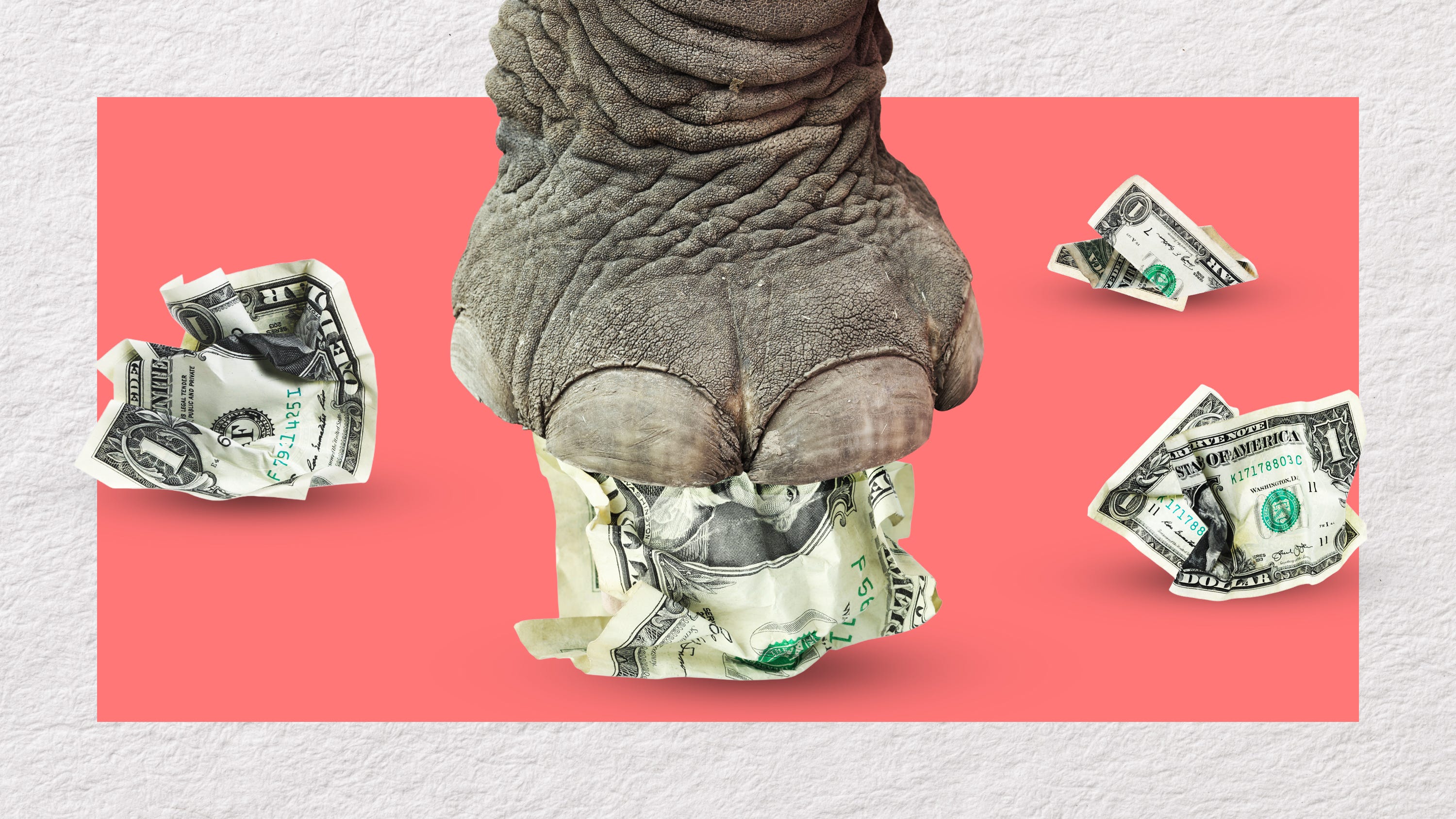
This is the story we’ve been hearing from supposed fiscal hawks in the GOP about why they have repeatedly voted to jam costly budget bills through the fast-track process known as “reconciliation.” Once a rarely used procedural tactic, reconciliation allows a budget bill to get through with only a simple-majority vote. In recent years, the majority party has typically pulled the reconciliation trick at most once per Congress, when it’s trying to expedite some big, splashy, high-priority measure or a must-pass budget bill; in this Congress, however, Republicans are trying to do it a record four times.
To wit:
Last year, the Republican fiscal hawks were unhappy that reconciliation 1.0 (aka Donald Trump’s “One Big Beautiful Bill”) didn’t have sufficient spending cuts to offset its enormous tax-cut costs. As a result, the bill added more than $4 trillion to deficits over a decade. But Republicans voted “yes” amid promises that their fiscal corrective would come in reconciliation 2.0.
Then, this year, reconciliation 2.0 had no spending cuts, only $70 billion in new spending for Trump’s deportation machine. The Republican fiscal hawks were again unhappy. But they voted “yes” anyway, when promised that fiscal probity would come in reconciliation 3.0.
We are today on reconciliation 3.0. Still no spending cuts, or other forms of deficit reduction.1 And yet again, the Republican fiscal hawks in the House said they were unhappy. Some, like Rep. Eric Burlison (R-Mo.), demanded pay-fors as a condition for their votes. Rep. Warren Davidson (R-Ohio) declared the budget resolution “DOA,” saying that there was “no path” to passage without some sort of offsets.
Lo and behold, no offsets materialized, yet still somehow a path was found: Leadership promised that spending cuts would come in . . . reconciliation 4.0.
“We’re right now looking at a reconciliation 4.0 to do the things that are left out of this one,” Majority Leader Steve Scalise said last week, right before nearly every member of his conference2 voted for reconciliation 3.0.
While the budget resolution for reconciliation 3.0 ultimately sailed through the House, it does appear to be at an impasse in the Senate. That’s in part because some Republican senators are demanding it be paid for. Sample objection, courtesy of Sen. Bill Cassidy (R-La.): “Obviously our country is having a problem with deficit spending, so it should be offset.”
We’ll see how long this professed commitment to fiscal discipline lasts.
Careful reporting.
Savvy commentary.
And a growing pro-democracy community.
Become a Bulwark+ member today, starting with two free weeks.
AS I MENTIONED, IT’S UNUSUAL to have this many bites at the reconciliation apple, at least in one Congress, though theoretically the rules have always allowed for an unlimited number of reconciliation bills (at least with enough technical machinations). There have been only a handful of times over the past forty years that two reconciliation bills have passed in the same Congress, and just once has a Congress (the 97th, back in the early 1980s) passed three, according to the Congressional Research Service.
Four would be a new milestone, and a sign of just how broken our budget process has become. What was once an arcane procedural measure designed as a deficit-discipline mechanism is now one of the primary tools for getting bills through—and for adding billions or trillions to deficits.3
This is hardly the only way the budget process appears irreparably broken. As Congress fumbles its constitutional duty to control the power of the purse, Trump is openly stealing it away.
As Cerin Lindgrensavage and David A. Super explained last week in the Hill, Office of Management and Budget Director Russell Vought has been unilaterally refusing to spend congressionally appropriated funds. His maneuvers are plainly illegal. But Vought is claiming he is empowered by obscure budgetary tools created in the late nineteenth and early twentieth centuries, intended for different purposes, that have remained on the books.4
“He’s throwing all sorts of other monkey wrenches in there, in particular saying, ‘You can’t spend this without prior approval from us,’ and then not answering his phone—figuratively, anyway,” said Super, a professor at Georgetown Law. “That’s how he’s whacked the Smithsonian and a bunch of other stuff he doesn’t like.”
Unsurprisingly, the GOP-controlled Congress is not fighting back.
The reasons why are multifold: Most Republican lawmakers are too spineless to oppose Trump, who might (heaven forbid) withhold his endorsement or sic the MAGA mob on them. To avoid blowback from their own voters, some lawmakers have cut side deals to protect programs in their districts or states that might otherwise be felled by Vought’s axe.5
“Russ Vought cultivates this image as Dr. No and an absolutist and all that, but I think the reality is that he is willing to make just enough deals to have members decide it’s in their interest to play ball,” Super adds.
Indeed, some lawmakers may appreciate having Vought provide them a fig leaf of fiscal rectitude.
But it is just a fig leaf: When you hear that Trumpers are slashing funds for the Smithsonian, Community Development Financial Institutions, USAID, medical research grants, and so on, you might think they are substantially slimming down budgets. In reality, while these cuts will devastate the individual programs themselves, the dollars in question represent pocket change in the grand scheme of federal spending and tax-cut costs. But Trump and GOP lawmakers can still claim to be “saving money” when questioned about their unfunded tax cuts, wars, deportation machine, and farmer bailouts.
And make no mistake: Even if Republicans’ professed concern for the federal debt is disingenuous, the federal debt itself is very much real and very much a problem. Earlier this year, it surpassed 100 percent of GDP. And the cost of managing that debt is growing more expensive, too, given that 30-year Treasury yields just hit their highest level in nearly two decades.
Not to worry; presumably the next reconciliation bill will take care of it.
— The U.S. Bureau of Economic Analysis is reworking how it calculates prices in some parts of the economy, in a manner that is expected to lower official readings of inflation. This will take some pressure off the Federal Reserve to raise rates. Economists suggest there are sound reasons for the methodological change but the optics still aren’t great. Which is what happens when you try to politicize independent statistical agencies: Even legitimate changes start to look suspect.
— Speaking of politicization: The Fed held interest rates steady at its meeting this week, with three regional Fed presidents dissenting because they thought rates should be higher. Unsurprisingly, Trump claimed his newly chosen chair Kevin Warsh (who voted to keep rates as they are) really truly wanted to cut rates but was stymied by a “political board.” Trump’s attack dog Peter Navarro likewise lamented “how much work remains to educate a central bank still too slow to recognize the power of Trumponomics.” Meanwhile markets still widely expect rates to be raised by the end of this year; how will Team Trump react if and when Warsh presides over a rate hike?
— The Trump administration is considering adding a whopping $100,000 fee to the program that allows international students to work for a time after graduation while still on their student visas. This is in addition to a recent regulatory change limiting student visas to four years, regardless of how long an academic program takes. (Most STEM Ph.D. programs, for example, take more than five years.) The Great American Brain Drain continues.
— Diamonds are apparently not forever after all: In 2001, De Beers was valued at more than $18 billion. Today the company is in talks to be sold off for $1 billion.
— Hmmm: Andrew Crapuchettes, founder of RedBalloon, received an unsolicited message from a State Department official urging him to bid on a contract to help identify (MAGA-friendly) candidates for the U.S. foreign service. RedBalloon won the contract. Just coincidentally, Don Jr. is an investor.
— Tariff revenue turned negative in June, after refunds finally began to flow, thanks to the Supreme Court decision ruling Trump’s tariffs unconstitutional. He is trying to rebuild his tariff wall with other authorities nonetheless.
Although budgetmaking via reconciliation bills is hardly the norm, that doesn’t mean that the rest of the time lawmakers are meeting their obligations to debate and pass annual budgets in an orderly and timely way. In recent years, the budgeting process has usually been a matter of brinkmanship over shutdowns. As James C. Capretta wrote in The Bulwark four years ago, “According to the rules now in effect, Congress is supposed to approve separate bills reported by each relevant appropriations subcommittee before October 1 (there are now twelve such bills). Congress has not met that deadline since 1997, and in fact has met it only four times since 1977. The new normal is the late . . . approval of a phone-book length measure, negotiated behind closed doors by a small group of leaders, covering the entire federal enterprise (and often much else besides).”
The “apportionment process” is a tool intended to prevent the government from blowing too quickly through funds Congress has appropriated, and then coming back to lawmakers, hat in hand, asking for more money. It was designed to prevent overspending; instead, Vought is weaponizing it to underspend.
Sen. Mike Rounds (R-S.D.), for instance, had initially opposed measures clawing back funding for public radio and TV, which were at first unilaterally executed by the White House. Then he cut a side deal protecting funds for tribal broadcast stations in his own state, and voted for a rescissions package formally blessing the clawback.
Sam Stein and George Conway discuss James Comey’s challenge to the “8647” prosecution, Donald Trump’s Supreme Court bid to overturn E. Jean Carroll’s $83 million defamation judgment, and the administration’s push for new restrictions on mail-in voting. They also cover the withdrawal of subpoenas targeting New York Times reporters and the delayed Paramount-Warner Bros merger.
The Illegal News with Sarah Longwell is available wherever you get your podcasts and on YouTube. Leave us a review and ⭐⭐⭐⭐⭐ so more people can find this important show from The Bulwark.
Access to this show’s community comments and ad-free editions is available exclusively for Bulwark+ members here and on the Bulwark App—available now in the Apple and Google App stores.
Bulwark+ members can also listen ad-free on your podcast player of choice—click SET UP here.

 Login
Login