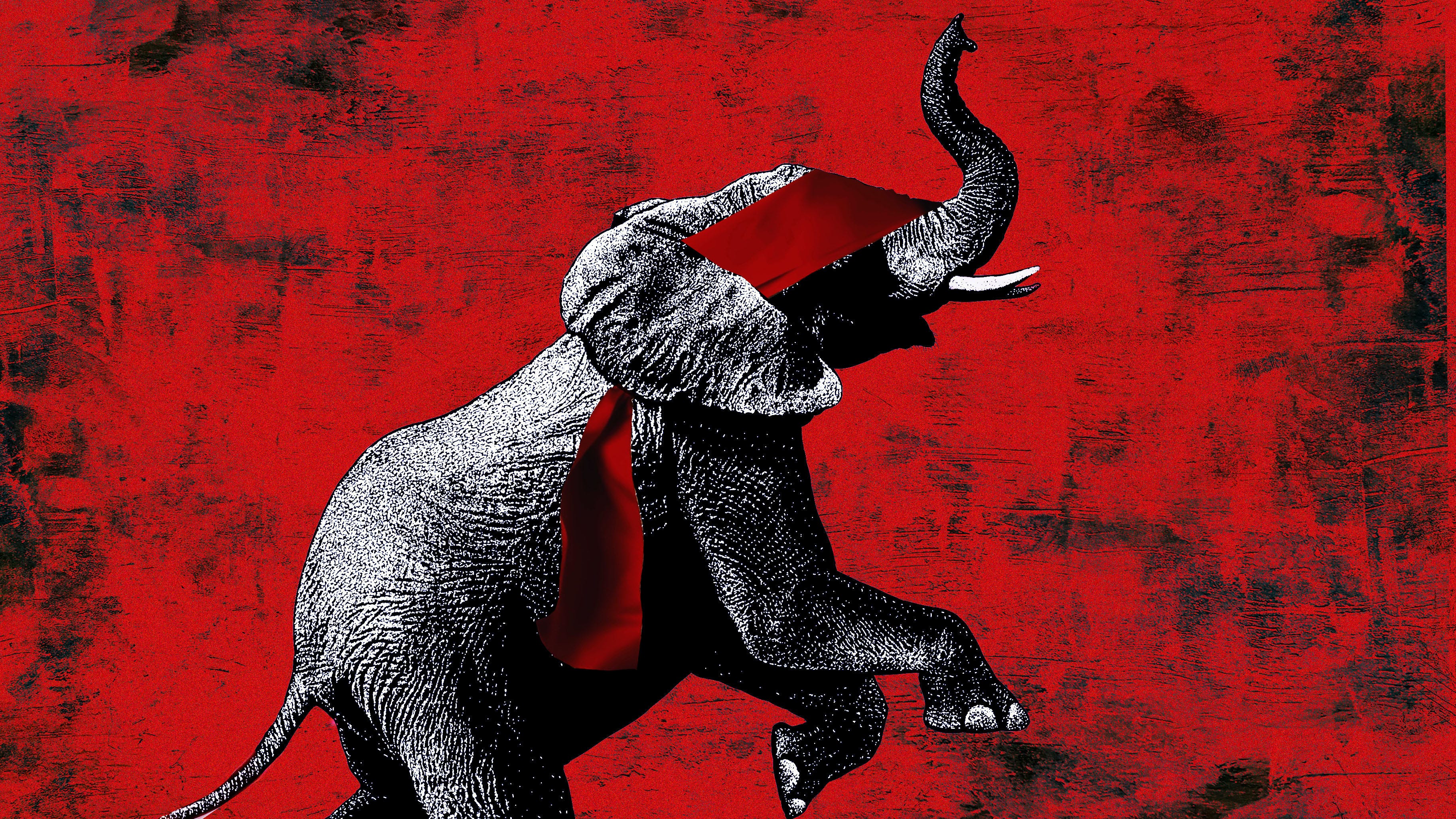
The party is sticking with Max Miller despite the very credible domestic abuse allegations. Not only is this a gift to his Democratic opponent, Brian Poindexter, in that red district in Ohio, it’s also likely to impact the Senate and governor's races there as well. Meanwhile, Tucker and MTG are talking about creating a third party for 2028. And Trump is losing to Iran so badly he can’t even make a coherent argument about the war for his biggest fans. Plus: the ankle monitoring of Haitian immigrants is very Soviet-era Eastern Bloc, defense contractors don’t want Ukraine making Patriot missiles because they can do it for less money, Trump is literally giving Mexico territory so he can build his corrupt border wall through Big Bend National Park, and Tim keeps his promise and shares some history on bananas.
As always: Watch, listen, hit the like button or leave a comment. We want to hear from you.
Ad-free editions of The Bulwark Daily are available exclusively for Bulwark+ members.
Tim Miller’s Bulwark Daily is available wherever you get podcasts and on YouTube. New shows drop each weekday afternoon. If you like the show, leave a comment and ⭐⭐⭐⭐ wherever you listen. Add The Bulwark Daily to your player of choice, here.
Will Saletan gives his take on Trump’s new NIH director, Dr. Jay Bhattacharya, becoming a loyalist defender of the Trump administration’s most controversial and absurd health claims. Bhattacharya repeatedly blames Anthony Fauci for COVID-era school closures, declining vaccine confidence and other public-health failures, even when the record doesn’t support those claims. He also refuses to clearly say that vaccines do not cause autism and dodges questions about anti-vaccine misinformation and the CDC shooting. What happens to science when the people running America’s health agencies become more focused on defending Trump and RFK Jr. than following the evidence?
(Photo illustration by Sarah Rogers/The Bulwark | Photos: Shutterstock)
1. South Carolina
On The Focus Group this weekend, Sarah hunkered down with some folks from South Carolina. These were three-time Trump-voting Republicans. They offered their thoughts about Lindsey Graham, Donald Trump, and much else.
In that offering they provided more data points for a proposition that I frequently champion: Everybody lies.
That’s my shorthand for a longer, slightly more complicated argument. We’re going to tax your patience here and go pretty dark. So if you’re willing to take the ride today, strap in.
One of the things Sarah and Tim often say is that people are messy. They are full of contradictions. They don’t reason deductively or follow trains of logic. They are idiosyncratic.
I understand this argument. I do not think it goes far enough.
Will Sommer and Sam Stein went live to cover the right’s freakout over AOC deciding to freeze her eggs, Max Miller refusing to drop out of his re-election bid, Sen. Mike Lee fuming at Coca-Cola, and Trump mocking Joe Biden after it was announced that his cancer had spread.
In an interview over the weekend, Hunter Biden shared some rough news: Joe Biden’s metastatic prostate cancer has spread to “his bones and further.” “It’s very painful and it’s very debilitating in many respects,” the younger Biden told the BBC. “But he’s still out there.”
Cancer is brutal; our thoughts and prayers are with the former president. Happy Monday.
Join Will Sommer and Sam Stein at 10:00 a.m. EDT today for MAGA Mondays on Substack and YouTube.
(Photo Illustration by Sarah Rogers/The Bulwark | Photos Shutterstock)
Eyes Wide Shut
by William Kristol
“The Party told you to reject the evidence of your eyes and ears. It was their final, most essential command.”
Thus George Orwell. But we’re not yet living in Orwell’s totalitarian society. So the members of our ruling party don’t quite reject the evidence of our eyes and ears. They simply avert their eyes and ears from the evidence around them. They minimize its importance and rationalize its significance. And above all, they do nothing about it.
Ohio Rep. Max Miller’s Republican colleagues are well aware of his behavior. They know of what Sen. Bernie Moreno, his ex-father-in-law, calls “the clear pattern of abuse [Miller] has left in his wake.” They understand why Moreno said that Miller “should not serve in the House of Representatives.” They could easily have spoken up last week and told Miller to leave. They could have said they wouldn’t endorse his re-election. They could have announced they wouldn’t help fund his race.
But Miller wants to stay in the House and on the ballot, and President Trump and Speaker Mike Johnson have stood by him. And so House Republicans don’t want to deal with the matter. Indeed, as the Washington Postreports, “most of his GOP colleagues in the House refuse to discuss the allegations against him.”
After all, they presumably figure, Miller represents a Republican district, so he may be able to win. He’s wealthy and has announced he’s lending his campaign $1 million, so that should help. And as their speaker has helpfully reminded them, “people have domestic disputes.” Indeed, “It’s part of being flawed humans.”
We’re all flawed. But we’re trying to get better—to build something better. That’s what The Bulwark is all about. Join us.
Meanwhile, over in the Senate, fifty out of fifty-two Republicans voted early Saturday morning to confirm Todd Blanche as attorney general. This probably shouldn’t have been a surprise. The GOP-controlled Senate had previously voted to confirm Pam Bondi for that job, along with rubber-stamping other flawed humans like Kristi Noem, Tulsi Gabbard, Kash Patel, and Pete Hegseth for various positions.
But as conservative lawyer Gregg Nunziata, executive director of the Society for the Rule of Law, pointed out, in way the vote for Blanche was worse:
The one meaningful difference here is with respect to the others senators could claim they were deferring to POTUS and hoping for the best, with Blanche they’ve seen how he operates in this role, abusing power, and they’ve chosen to ratify it. Craven and despicable.
But what was craven to Nunziata was a privilege to Louisiana Sen. Bill Cassidy, the deciding vote in favor of Blanche. Cassidy explained to Margaret Brennan yesterday that “I would read history books and I would read about these great decisions on the Senate floor. . . . The fact that I, Bill Cassidy, was able to do that, I am so privileged, and whenever I just for a second am hit by the gravity of that, and the honor of that, I get emotional.”
Cassidy got emotional about the privilege of casting his historic vote. He chose not to get emotional about Blanche’ s coverup of the Epstein scandal. As Lisa Rubin notes,
Prior to his speech, neither Cassidy nor his staff met with survivors of Jeffrey Epstein, despite their repeated entreaties. Notwithstanding that, Cassidy said during his floor speech that among the reasons to support Blanche was that leaving him as an acting AG without Senate confirmation could risk DOJ’s progress on . . . human trafficking.
Perhaps Cassidy agreed with his colleague, Texas Sen. John Cornyn, the deciding vote in getting Blanche reported out of committee. When Cornyn was asked to respond to Epstein survivors who said a yes vote on Blanche would have a chilling effect on survivors of sexual assault coming forward, Cornyn replied: “I don’t believe there is anything we could do to assuage them at this point. . . . That’s one of those things that cannot be remedied by a ‘no’ vote.”
So what’s the point, if you’re a Republican senator, of voting against a cabinet nominee central to a sexual assault coverup? What’s the point, if you’re a Republican House member, of speaking up against Max Miller?
I began with the great social democrat George Orwell. I end with the great liberal John Stuart Mill. Mill was concerned about the fate of personal liberty and public spirit in modern democracy. In his 1867 inaugural address at the University of St. Andrews, he remarked that “Bad men need nothing more to compass their ends, than that good men should look on and do nothing.”
But one has to ask: If they do nothing but look on as bad men compass their ends, are they still good men?
In our lunatic age, you sometimes run into headlines that you know at once will make people lose their minds. So it was this weekend when the internet was informed that Rep. Alexandria Ocasio-Cortez is freezing her eggs.
In a series of Instagram videos, the congresswoman said she had made the decision to “feel more in control of my life,” and had chosen to be public about it “to show more depictions of women having full lives in every context and every choice,” particularly against the backdrop of the Trump administration’s anti-abortion policies. As she gave herself a hormone shot, she admonished her viewers: “Don’t be weird about this, even though I know you all will be.”
Obviously, she was right. Egg-freezing is an increasingly common procedure—AOC isn’t even the first congresswoman to do it—but MAGA influencers went berserk over the news, with reactions ranging from handwringing to grossly leering.1
Fertility discourse, understandably but stupidly, tends to go like this. Everyone treats it as just another culture-war cudgel: The right accusing the left of insufficient concern for family formation amid cratering birthrates, the left accusing the right of faking concern over families to try to squish women’s rights. Boring, boring, boring!
So I’m going to sidestep the whole mess and simply use it as an excuse, as I do whenever I get the opportunity, to bring up one of the most impactful things I’ve ever read, which I think everyone should read, which is in no small part responsible for my and my wife’s own decision to start having kids young, which if it were up to me they’d teach in schools: a 2018 article by lefty writer Tom Scocca titled “Your Real Biological Clock Is You’re Going to Die.”
In our social world, in our cultural class, at our point in history, people are brought up . . . to structure their lives as if time were something a person accumulated. . . .
But this idea of certainty is a sham, a distraction, something to turn your attention away from the only truly certain thing, which is that your time will run out. If you intend to have children, but you don’t intend to have them just yet, you are not banking extra years as a person who is still too young to have children. You are subtracting years from the time you will share the world with your children. . . .
Life and the making of more life appears as a technical problem; where the body’s ability to stall falters, cryogenics can take over. Perhaps zygotes can be spun up from ordinary DNA. Science is doing its best to push back the limits. Look to the wealthy and the entitled and see the future: Mick Jagger just sired a baby at age 73.
Now look to the future: when that baby turns 10, Mick Jagger will be 83. When that baby turns 20, Mick Jagger will be 93. When that baby turns 30, 40, 45—Mick Jagger will be almost certainly dead, all but definitely dead, unquestionably dead.
As the child of a spectacularly wealthy man, Mick Jagger’s baby will surely be provided for. But not by its dad, not in person.
I don’t begrudge AOC (or anyone else!) the fertility decisions she makes. I admire her for being public and open about these decisions—an act of actual bravery given the insane culture-war football she no doubt knows she’ll be turned into when she does. Still, if we were friends, and she asked my opinion, I’d send her the article.
Precision Has a Price… When we burn through expensive precision weaponry, we lose some of our ability to keep distance between American service members and the enemy, observes MARK HERTLING.
Trump to Supreme Court: Make Me… His new assault on birthright citizenship will test whether Supreme Court rulings mean anything when a president decides they don’t, writes KIM WEHLE.
Book club reminder! Our August book club will discuss Mark Twain’s very interesting late novel, Pudd’nhead Wilson. The live show is Wednesday, August 12 at 1:30 p.m. ET with Mona Charen and Bill Kristol. More info here: Bulwark Book Club for August: Mark Twain’s Pudd’nhead Wilson
A DIPLOMATIC SHELLACKING: It’s honestly fascinating, the degree to which Donald Trump is ready to surrender to Iran if he can get the tiniest fig leaf to do so—and how unwilling Iran appears to be even to give him that. The hopes of a breakthrough nuclear deal have all but vanished, but the Wall Street Journal reports that Trump is ready to declare victory and walk away anyway, if he could just figure out how to reopen the Strait of Hormuz first.
But even this hope seems to be slipping away. On Saturday, Iran issued its largest heap of demands yet: America would need to permanently end the war, withdraw forces from the region, end all Iran sanctions and release all frozen Iranian assets, pay reparations, and suspend attacks on Iran’s regional proxies before Iran will consent to reopen the waterway—and even then, Iran insists, it will maintain operational control of the strait going forward. These demands were quickly followed yesterday by multiple missile attacks on ships trying to transit the strait.
Iran is plainly betting that—all Trump’s saber-rattling aside—the president has completely lost his nerve for additional military escalations in the conflict. That might be a bit premature. Trump is already beaten, but that doesn’t mean he won’t rediscover his bellicose side if Iran pushes him hard enough. If there’s one thing we know about Trump, it’s that he’s perfectly willing to push all strategic thinking to the side to try to punish anyone who makes him look like a fool.
SEN. QUISLING (R-LA.): Incredibly, Sen. Bill Cassidy is at it again. The Louisiana senator has endured two years of nonstop humiliation after his pivotal vote to confirm HHS Secretary Robert F. Kennedy Jr., a vote he agreed to after he said Kennedy had promised not to pursue anti-vaccine policy at HHS. Kennedy immediately broke his promise, and Trump immediately endorsed a primary challenger and ended Cassidy’s career anyway. Cassidy apparently thinks Todd Blanche will be different, though.
But don’t worry, America: Cassidy wants you to know it was a hard choice. Blanche’s attempt to permanently immunize Trump and his family from IRS investigations almost got him to a “no” vote, he told CBS’s Margaret Brennan yesterday: “That is wrong—and no American should be targeted by the law, but no American should be above the law.” When Brennan asked if he was confident Blanche would “uphold the Constitution with the upcoming elections,” Cassidy replied: “Of course there’s always an existential anxiety. . . . I can’t predict the future.”
Oh, is there always an existential anxiety about the presidential administration tearing up the Constitution to brute force its way to more favorable election results? We’d sort of thought that was a recent development.
LEOPARD EATS PARTY MEMBER’S FACE: “John Gannon is a 75-year-old businessman and lifelong Republican who supported President Trump in 2024,” reports CBS News.
But, Gannon says, “I wouldn’t do that again, not after this fiasco.”
What fiasco is Gannon talking about? There are so many from which to choose.
It turns out the one Gannon meant was the arrest—and possible pending deportation—of his 45-year-old fiancée, an immigrant from Venezuela with a pending asylum application. Gannon said his reaction to hearing the news of her arrest was “total disbelief.”
Really? Maybe Gannon had missed it when the candidate he supported called for “mass deportations.” Maybe he missed it when the delegates at the 2024 Republican National Convention waved signs bearing the phrase “mass deportations now.” Maybe he had missed the actual mass deportations, and the many stories of innocent immigrants being hounded, detained, and deported by ICE—including some to foreign torture chambers. Maybe he had missed that the people carrying out these deportations had killed two American citizens and untold numbers of immigrants, whether in detention centers or in broad daylight in the streets of major American cities. One of the most recent cases was about a month ago. In Houston. Gannon’s hometown.
Gannon should be reunited with his fiancée as soon as possible, and her asylum application should be reviewed according to the law and as speedily as fairness will allow. But then maybe the future Mr. and Mrs. Gannon should have a long conversation about what merits “total disbelief.”
But he shouldn’t expect the Trump administration to help him resolve this “fiasco.” After CBS aired its interview, a White House staffer, who tweets under an anonymous account, mocked Gannon for not realizing what a “headache” Trump’s ICE goons had saved him from.
Benny Johnson went with the YouTube headline “AOC Shocks Internet: Lifts Up Her Shirt to Reveal Her Medical Treatment, alongside the thumbnail text “AOC’s Big Reveal.” Stay classy, Benny!
Donald Trump and his deputy chief of staff Stephen Miller in the Oval Office announcing new executive orders relating to birthright citizenship on August 6, 2026. (Photo by Alex Wong/Getty Images)
IN HIS QUEST TO BECOME THE KING OF AMERICA, Donald Trump made it clearer than ever last week that he doesn’t really care what the Supreme Court has to say.
First, he has decided to renew his effort to fire Lisa Cook, the Federal Reserve Board governor he first tried to fire a year ago. The Supreme Court, in a 5–4 decision this June, smacked down that previous attempt to fire her and have her immediately removed from the board, concluding that the president could fire her “for cause” but that he had failed to follow the legally required termination process. The Court left in place a lower court’s injunction that said a mere allegation of mortgage fraud against Cook did not suffice to remove her. So now he’s decided to make it look like he’s following the legal process—with one of his hatchetmen writing to Cook last week to inform her she’s on the chopping block. But this new attempt is based on the same allegation, with no new information.
Second, and even more troublingly, Trump finally did what he’s been gunning for since his first term: He defied the Court’s authority to issue binding rulings against him. Rejecting another 5–4 ruling from June, Trump last week issued two executive orders purporting to deny birthright citizenship to several categories of individuals who are squarely covered by his sweeping loss before the Court.
In Trump v. Barbara, the majority held that babies born in the United States are automatic citizens under “the ordinary meaning of the text” of the relevant part of the Fourteenth Amendment, which states: “All persons born or naturalized in the United States, and subject to the jurisdiction thereof, are citizens of the United States and of the State wherein they reside.” The Court rejected Trump’s argument that birthright citizenship applied only to former slaves, and that parents must somehow show “allegiance” to the United States before children born on U.S. soil can be citizens. “All,” in other words, actually means “all.”
Trump has decided to go ahead anyway.
This has been a long time coming. In response to the 2019 ruling in Department of Commerce v. New York blocking his plan to add a citizenship question on the 2020 census, Trump tweeted that he was “absolutely moving forward” anyway. An administration official later indicated that he would take action by executive order. Trump ultimately backed down.
Keep up with all our articles, newsletters, podcasts, and livestreams—sign up for a free Bulwark subscription today:
This time, announcing his executive orders from the Oval Office, Trump said that the Supreme Court had made “a bad decision, very unfair decision . . . and we’re ending in a different way.” An August 6 executive order accordingly “identifies, non-exhaustively, and prescribes action concerning certain categories of children of aliens who do not fall within the rule of birthright citizenship as announced by the Supreme Court.” The problem is that his categories do fall within that ruling. Trump has taken steps to do what the Supreme Court held the Constitution does not permit.
Defending the maneuver, Stephen Miller claimed that the Fourteenth Amendment “was passed exclusively in the aftermath of the Civil War, so as to ensure that the children of slaves would be citizens.” But Chief Justice Roberts rejected that historical reading in his majority opinion in Trump v. Barbara, explaining that the amendment constitutionalized birthright citizenship “without any reference to race or color.”
Trump’s order claims to expand the narrow exceptions to birthright citizenship the Court carved out back in 1898. In that year’s United States v. Wong Kim Ark, it ruled that three categories of individuals are not “subject to the jurisdiction” of the United States under the text of the Fourteenth Amendment even if born on U.S. soil: individuals born to foreign diplomats (who have diplomatic immunity from liability under U.S. law), born to members of sovereign Indian tribes (later superseded by statute), or born to enemy forces occupying a U.S. territory. None of these are overtly in play under Trump’s new executive orders.
Trump claims to expand these exceptions to include (a) children of foreign embassy employees, (b) children of employees for foreign governments “in an official capacity,” (c) children whose parents work for organizations “that possess international-organization immunity,” and (d) children of parents who “engage[d] in a commercial transaction to ensure that the person’s mother is present in the United States, or a territory of the United States, to give birth.” Trump and Miller pejoratively refer to the latter practice as “birth tourism.” (A second executive order from the same day directs the secretaries of state and homeland security to deny or revoke visas to anyone attempting “birth tourism,” or to deport anyone “who previously engaged or plans to engage” in it.)
All of these categories involve babies born on U.S. soil. Except for the children of accredited diplomats, all of them are citizens by birth under Trump v. Barbara. Trump’s executive order is thus blatantly unconstitutional. If given the opportunity, federal judges will once again readily declare it so. But the fact remains that Trump and Miller apparently believe that they are the bosses of the Supreme Court.
The practical impact of their maneuver is basically null. In 2020, the State Department issued regulations restricting tourist visas for people suspected of entering the U.S. for purposes of giving birth. In June 2026, the Trump administration used those regulations to revoke over a hundred visas allegedly tied to “birth tourism.” And the federal government has no authority to issue birth certificates, which are handled by the states. So what is Trump seeking to accomplish with his latest round of birthright citizenship orders?
The answer is obvious: propaganda. Trump is bleeding support in the polls due to his disastrous war in Iran and Americans’ surging cost of living. He desperately needs a distraction. Flouting a Supreme Court ruling gets him there.
But more disturbingly, by taking this step Trump has quietly declared yet another “new normal” for the vanishing rule of law. Thanks in part to the Supreme Court’s grant of immunity for presidential criminal acts, he knows he can do whatever he wants and get away with it. Already, he has defied lower federal court orders dozens of times. The U.S. Supreme Court was next up. One has to wonder whether crossing this red line will finally convince holdout optimists to give up the pretense that America is still a functioning constitutional democracy.
A Precision Strike Missile is launched in June 2024 during a joint live-fire exercise in Palau that marked the first use of a PrSM outside the United States. (Photo by Sgt. Perla Alfaro, U.S. Army)
FOR GENERATIONS, SENIOR MILITARY officers attending professional military education have been taught a simple but enduring truth: Logistics establishes the art of the possible. No commander can conduct operations without the fuel, ammunition, and other resources needed to sustain the fighting force. Napoleon learned it. Eisenhower mastered it. Every successful military campaign has depended as much on logistics as on tactical brilliance.
That principle has not changed, but modern warfare has evolved and added another dimension. Today, inventories of long-range precision strike weapons and advanced missile-defense interceptors increasingly establish the art of the possible, as well. They determine how far a commander can reach, how effectively American forces can defend themselves and their allies, and ultimately how much risk servicemen and women must assume in combat. Precision has fundamentally changed the character of war, but in doing so created a new dependency. When those specialized inventories of weapons are constrained, the tremendous advantage that the precision technological revolution provides—the ability to put distance between friendly forces and the enemy—begins to shrink.
Recent operations against Iran have demonstrated both the extraordinary value of precision weapons and the extraordinary difficulty of replacing them.
President Trump has repeatedlyinsisted that he rebuilt America’s military and that the depleted munitions used to fight this war in Iran can be rapidly replaced because his administration is now building an unprecedented number of ammunition plants and factories. Defense Secretary Pete Hegseth has similarly dismissed concerns about degraded inventories, even while acknowledging that U.S. forces have conducted strikes on more than 15,000 targets during operations against Iran and have expended large numbers of missile-defense interceptors protecting American forces and regional partners from thousands of Iranian missiles and drones fired at their location.
These statements have received increased scrutiny from the public and the press—and that’s appropriate. Not because the United States lacks military strength, but because military capability, industrial capacity, and political credibility are inseparable. When leaders describe one inaccurately, confidence in the others suffers. And our leaders have been describing our capability inaccurately.
Support our independent political and cultural journalism by signing up for a free or paid Bulwark subscription.
THE ISSUE IS NOT that the American military is running out of ammunition. It is not. The United States maintains enormous inventories across thousands of categories of conventional munitions. But there is a far narrower and far more consequential concern. Modern campaigns rely disproportionately on a relatively small family of sophisticated weapons that provide capabilities conventional ammunition simply cannot replicate. Long-range precision strike missiles allow commanders to destroy critical sites like command posts, logistics hubs, missile batteries, and other targets hundreds of miles from friendly forces. In defense, interceptors destroy incoming aircraft, missiles, and drones before they can strike. These systems are not interchangeable with artillery shells or unguided rockets.
I saw the beginning of that evolution firsthand during Operation Desert Storm in 1991. When intelligence identified an Iraqi artillery battalion threatening the advance of our units, destroying it generally required a massed artillery attack. A battalion of Multiple Launch Rocket Systems (MLRS)—the predecessor to today’s long-range precision strike capabilities—would fire dozens of rockets that would cover an area the size of a football field with a targeted strike. Airpower could accomplish similar effects, but doing so entailed a host of complications—pilots, aerial refueling, electronic warfare support, suppression of enemy air defenses, and careful coordination among multiple headquarters. We could achieve the desired effect simply by concentrating large amounts of firepower from the MLRS strike.
That equation changed dramatically over the next three decades. The Army introduced ATACMS, a short-range tactical ballistic missile that allowed a single launcher to strike targets nearly two hundred miles away with remarkable precision—within feet of the point of aim. Today’s Precision Strike Missile (PrSM) extends that reach even farther while maintaining the accuracy. A single PrSM round accomplishes what once required an entire MLRS battalion firing a volley of rockets.
The technological revolution behind precision munitions allowed commanders the ability to attack vital targets deep inside hostile territory without exposing aircraft or ground maneuver forces to unnecessary risk. It is the kind of tactical evolution that each war brings when new technology is applied to the battlefield.
Military technological innovation has consistently sought one objective: increasing the distance between friendly forces and the enemy (while maintaining the ability to destroy that enemy more effectively). A suit of armor puts distance and protection between the human body and a foe’s blade. The longbow extended striking distance beyond the sword or spear. Rifled bullets extended the range and accuracy of the musket ball. Aircraft extended strikes beyond the range of artillery, and precision-guided missiles extended it farther still. Every advance sought the same outcome: strike the enemy at greater distance before he could strike you. Precision weapons became the latest expression of the centuries-long evolution of warfare.
But every technological advance creates new dependencies. Precision substitutes quality and accuracy for quantity. While a single PrSM may accomplish what once required an entire MLRS battalion firing dozens of rockets, each missile becomes far more strategically valuable—and also much more difficult and expensive to build. When inventories of those weapons become constrained, commanders cannot simply substitute conventional ammunition and expect similar results. They either employ larger numbers of less capable weapons (and with them, the increased logistical demands), or they accept that some targets will survive until friendly forces can move closer.
In Iraq, a longtime friend once described close combat associated with the counterinsurgency we were fighting as getting “coffee-breath close” to the enemy. The colorful phrase captures something true about warfare. Every precision strike conducted at distance is one less enemy position American soldiers have to assault at close range. Every command post eliminated deep behind enemy lines with precision disrupts the coordination of those who would otherwise be fighting face-to-face with American troops. But when our long-range precision or “deep strike” capabilities diminish, that protective distance erodes. More missions fall to ground maneuver forces, and history suggests that when armies get coffee-breath close, casualties rise significantly.
The same principle applies defensively. Interceptors do far more than protect installations. They preserve operational freedom by allowing commanders to keep airfields open, ports functioning, logistics hubs moving, and headquarters operating despite missile attack. When these interceptors are depleted or constrained because of another evolution of warfare—massed drones or enemy ballistic missiles—commanders must decide which facilities receive protection, which allied bases assume greater risk, and which critical capabilities must be relocated farther from the fight. Shrinking inventories of U.S. air defense, like the very expensive Patriot or the even more expensive THAAD interceptors, again translates into shrinking distance between the battlefield and those we are trying to protect.
NONE OF THIS SUGGESTS the United States is defenseless. Far from it. The question is whether our nation can sustain the specialized capabilities upon which our force increasingly depends. Thousands of long-range strikes against Iran and thousands of defensive interceptions represent an enormous expenditure of our precision weapons. The exact inventories remain appropriately classified, but the operational reality is obvious: Every missile launched must eventually be replaced, and these kinds of weapons are very difficult to replace.
That brings us back to logistics and our defense industrial base.
The administration is correct that the Pentagon is working to replenish expended inventories. Congress has been asked for substantial appropriations for additional munitions procurement. Defense contractors are increasing production rates by negotiating long-term contracts intended to provide greater manufacturing stability. These necessary initiatives should not be confused with being able to rapidly replace the capabilities consumed during sustained combat operations.
Publicly available evidence does not support the claims of the president and secretary of defense about munitions and defense production. The administration may have held meetings with defense executives in the White House, and there has been some expansion of capacity within existing defense-industry factories, but we have yet to see a corresponding wave of publicly documented new facilities or related delivery of replacement weapons.
That distinction matters because manufacturing precision-guided missiles is fundamentally different from producing conventional ammunition. Our advanced precision systems rely upon rocket motors, seekers, guidance electronics, specialized software, precision machining, and highly specialized subcontractors that are spread throughout an intricate industrial network. At every stage, each component must meet exacting standards. A shortage of a single critical component from within a complicated supply chain can delay an entire production line. Constructing an entirely new missile-production facility requires a dizzying array of contracts, tooling, staffing, training, and years of integration before reaching efficient production. The administration cannot simply announce industrial mobilization. It must be built.
Independent defense analysts conclude that rebuilding our precision weapon inventories will likely require years because the existing defense industrial base was never designed to—and has yet to adapt to—sustain prolonged expenditures at the scale modern warfare is demanding.
The strategic consequences of this reality extend well beyond the Middle East. Reports that Patriot and THAAD interceptor batteries have been shifted from Europe and the Indo-Pacific to support operations in CENTCOM reflect the prioritization that occurs when a nation goes to war in a specific area. Yet every unit and its related ammunition moved into one theater is—temporarily—unavailable somewhere else for any other contingency. As we know, deterrence depends not only upon possessing advanced capabilities but also upon having enough to reassure allies and complicate the calculations of adversaries across multiple regions simultaneously.
It’s not a weakness to acknowledge these realities: it’s good planning. Every commander continuously assesses combat power, ammunition expenditures, logistics, replacement timelines, and future contingencies. Honest assessments allow sound strategy. Political narratives do not replenish inventories.
Precision has a price. It’s not measured only in millions of dollars per missile, but in every factor—the technological investment, the complex supply chains, the skilled workers, the procurement process, and the industrial capacity—that goes into their production. Most importantly, it is also measured in credibility. When political leaders insist that the expenditure of weapons have produced no meaningful degradation in ammunition stocks, or they suggest that years of industrial investment can be compressed into months, they undermine confidence in both military preparedness and national leadership.
The War College lesson remains as relevant today as it was generations ago: Logistics establishes the art of the possible. In the twenty-first century, that art is also determined by the precision weapons that allow American forces to fight at distance and the industrial base capable of sustaining them. If that foundation erodes, the battlefield changes. The distance between American servicemen and women and the enemy begins to close—coffee-breath close. The American people know it by another name: sending more of our sons and daughters into harm’s way than should be necessary because our leaders didn’t plan well, and they didn’t adapt to the realities of the battlefield.
Eric and Eliot begin with reflections on recent domestic political developments and the “horseshoe theory” uniting political extremes around isolationism and anti-Israeli sentiment. They then discuss the ongoing negotiations over the Strait of Hormuz and the difficulties the Iranian government and Trump administration have created for themselves. From there they move to the recent cyberattacks on American water systems and the seemingly blasé response by both the Trump administration and the larger public. The two also highlight Russia’s ongoing hybrid war with Europe and the tightening links among Russia, China, Iran, and North Korea. They revisit the continuing degradation of Turkish democracy before wrapping up with thoughts on the recent migrant surge into the Spanish exclave of Ceuta.
THIS TUESDAY’S GUBERNATORIAL PRIMARY in Wisconsin may seem like the latest chapter of an internecine fight among Democrats over the philosophical direction of the party. And it is that.
But there’s much more on the line as well: The fallout from the Wisconsin election could extend nationally, by making it possible for Trump-allied Republicans to screw with the presidential election results in ways they tried, but failed, to do in 2020.
On the line is the Democratic Party of Wisconsin’s decade-and-a-half-long effort to claw its way back to a unified state government, as well as the opportunity to add more safe Democratic House seats to the next congressional map. Beyond that, however, is another hugely consequential prize: the capacity to ensure that the state’s 2028 presidential election results will be properly certified. Wisconsin’s governor will play a critical role in that, much as the current outgoing governor—Democrat Tony Evers—did when Donald Trump contested the state in 2020. There are real fears in Democratic circles that Wisconsin Democratic voters aren’t quite appreciating these stakes as they head to the polls this go-around.
“The critical importance of defeating Tom Tiffany for the future of American democracy is hard to overstate,” said Ben Wikler, the former state party chair, referring to the expected GOP nominee for governor.
Wikler’s fears aren’t imaginary. Tiffany, a House Republican who is cruising to the nomination, has a lengthy history of embracing Trump’s election lies. He voted to overturn the results of the 2020 election, peddled lies that “hundreds of thousands of illegal votes” were cast in Wisconsin, and signed on to Texas Attorney General Ken Paxton’s lawsuit seeking to bar Wisconsin and other swing states from voting in the Electoral College. More recently, he’s suggested that those convicted in the January 6th riot could possibly be owed restitution and he’s continued to back an FBI probe into Wisconsin’s 2020 election workers. He remains unwilling to definitively state that Trump lost the 2020 race.
“It is very clear that Tom Tiffany has a real issue when it comes to democracy,”said Devin Remiker, the current chair of the state Democrats. “Under Governor Tom Tiffany, I don’t know if we would be able to count on him doing the right thing and ensuring that that certification was properly done if he didn’t like the outcome.” And it’s not just the presidential election that may be at risk, Remiker notes: In Wisconsin the governor’s signature is necessary to certify even U.S. Senate elections—so it’s conceivable that Tiffany might interfere with the results of the 2028 Senate election.1
The potential for an electoral-count crisis in the 2028 presidential election looms over several critical states as candidates connected to Donald Trump’s undying lie about the stolen 2020 election are running for governorships. Rep. Andy Biggs, who tried to overturn the 2020 results, is the GOP nominee for governor in Arizona, another critical presidential state.2 And the Republican gubernatorial nominee in Pennsylvania, State Treasurer Stacy Garrity, has publicly called into question the results of the 2020 election.
But unlike in Wisconsin, where Evers decided not to run for a third term, Biggs and Garrity are both up against popular Democratic incumbents. And while national Democrats are fretting about election-denying GOP governors possibly having a hand in presidential election certification in a swing state, it’s not clear to local Democrats if that prospect is factoring into voters’ calculations.
“I don’t know if people are fully grasping the stakes,” said Joe Zepecki, a Milwaukee-based Democratic strategist. “Tiffany is not someone who just went along with the lies in 2020 to keep Trump’s favor. He has continued to push these conspiracies through 2026.”
If you find value in this kind of journalism, stick with us through the midterms and beyond—grab a Bulwark+ membership.
ALSO ON THE LINE in this fall’s Wisconsin election: The possibility of another round of congressional map-drawing in early 2027.
The nationwide clash over redrawing congressional districts over the last year saw red states make their maps redder and blue states make their maps bluer (with a handful of states’ redrawn maps rejected by the courts). Wisconsin Democrats entered 2026 optimistic about their chances of flipping the state Assembly and state Senate as well as keeping the governorship—which would allow them to redraw maps ahead of 2028 that could net additional safe Democratic House seats. (Wisconsin’s U.S. House delegation currently has six Republicans and two Democrats.) Losing the governor’s chair would imperil that, even if the party were to flip the state houses. And if Republicans were to win a trifecta of their own—controlling the governorship and both houses of the state legislature as they did from 2011 to 2018—they could just as easily redraw congressional lines that wipe Democratic House seats off the map.
“Wisconsin might be the single state with the biggest possible swing in what happens with House maps based on what happens in the midterms,” said Wikler.
Given those stakes, a panic has set in among some Democrats that the party appears to be on the verge of nominating Francesca Hong, a DSA candidate—someone who has called for canceling Thanksgiving, abolishing the Senate, and eliminating police funding entirely—as its gubernatorial nominee.
Hong’s defenders argue that she’s not the risk that her critics insist she is. They say she can marshal populist support to counter any losses she may suffer among the moderate suburban voters who might not find her socialist-tinted policies to their comfort or liking. They point to the swelling of support for Hong in the primary as evidence that she can succeed in the general election, should she get there—as the polls strongly suggest she will:
The last five relevant surveys of registered voters (the Marquette poll) and likely voters (the other four polls). (Via the New York Times)
But Hong’s success is also owed, in part, to the screwups of the establishment and the moderate wing of the party. A few months ago, Democrats believed that a competitive primary field for governor was a good thing and that the strongest candidate would ultimately emerge from it. The likely beneficiary, they believed, would be Lt. Gov. Sara Rodriguez—especially after Milwaukee County Executive David Crowley ended his campaign and endorsed her.
But Rodriguez stunned Wisconsin Democrats when she announced she was suspending her campaign after discovering that her campaign manager had mishandled the campaign’s financial reports. Crowley jumped back in the race. And Evers quickly endorsed him.
Anti-Hong Dems debated whether to rally around Crowley or former Lt. Gov. Mandela Barnes—a decision that was made for them when Barnes dropped out of the race amid reporting by the Milwaukee Journal Sentinel into allegations that he leveraged his role in the party to have sexual encounters with young adult women. Republicans weren’t just enjoying the schadenfreude as the moderate and establishment flanks of the party crashed out. They were actively trying to engineer an outcome to their liking. A super PAC tied to Republicans has spent millions of dollars on ads boosting Hong’s candidacy.
“Fran has run a very good campaign. She was the most aggressive in spending early, and the fact that she is not a traditional Democrat allowed her to be a safe haven for people who are frustrated with the Democratic party,” said Zepecki. “Everything the establishment tried to do happened too late.”
In the final few days of the primary, Wisconsin Democrats have debated whether the race is baked and the only option is to get Hong all the help possible to prepare her for the general—or if going all-out for Crowley in a Hail Mary attempt to keep Hong from securing the nomination is the better path. Some Democratic officials saw Abdul El-Sayed’s closer-than-expected victory in the Michigan Senate primary as evidence that Hong’s support may be softer than polls suggest.
Whoosh this newsletter into a friend’s inbox or whisk it around social media:
Still, even Hong’s critics privately acknowledged to me last week that, given her big lead in the polls, Crowley probably does not have enough time to turn around the race. Instead, the conversation among Wisconsin Dems has slowly turned into a brainstorming session about what can be done to take Hong from a candidate regarded by a good chunk of the state as unserious, and convincingly reintroduce her as a legitimate politician prepared for the gravity of the job. They insist that it’s not an impossible task and that she could still win in a matchup against Tiffany, particularly given how blue this cycle is trending and how close Tiffany is to the increasingly unpopular president. Remiker told me that the state party, which has remained neutral in the primary, is already planning a statewide tour for the nominee and is prepared to lend staff to the nominee’s campaign.
“Fran may not have been the candidate or the nominee that people expected, but I don’t think that takes away from the possibility of still winning in November,” said Madison-based Democratic strategist Scott Spector, who managed Sen. Tammy Baldwin’s successful 2018 and 2024 re-election campaigns. “There’s so much on the line that you’re not going to have folks who are going to sit on their hands and say ‘We’ll see what happens in four years.’ People are going to do everything they can to take advantage of this historic opportunity in November.”
The opportunity that Spector is referring to is the chance for Democrats to win a governing trifecta for the first time since 2010, when Wisconsin Republicans gained majorities in the U.S. House delegation, State Assembly, State Senate, and took control of the governorship with the election of Scott Walker.3 As Wisconsin Democrats see it, they’ve been working ever since then to undo Walker’s legacy—from his gerrymandered congressional and legislative maps to his efforts to gut the state’s public employee unions.
“When Scott Walker and the GOP took control of Wisconsin in 2010, Wisconsin experienced a miniature version of the political crisis that the whole country is experiencing right now [with Donald Trump],” Wikler told me. “It’s taken sixteen years and thousands of people organizing in every corner of the state to unrig the state’s legislative maps and reach this moment when a Democratic trifecta is possible.”
It would be a cruel fate for Wikler and others to see all the hard work they put in to flip Wisconsin back to Democrats come up short right at the finish line. It would be particularly difficult for it to happen in a cycle when Democrats are expected to make major gains across the country. But that pain may be overshadowed by the damage that could come two years later, when a presidential contest comes down to a few key states—especially if the outcome of that contest depends on whether Trump allies are able to interfere in the election in ways they tried and failed to do in 2020.
“The 2026 [cycle] has had a huge circle around it,” as Wikler put it—a big, bright warning that the stakes are high, even if the voters haven’t caught on yet.
Ben Wikler, the former state Democratic chair, indicated last month that he may run for the U.S. Senate in 2028. The incumbent whose seat will be up that cycle, Republican Ron Johnson, has not announced whether he will run for re-election—and suggested last year that he would rather not.
Biggs is running against incumbent Gov. Katie Hobbs. Hobbs won in 2022 by defeating Kari Lake—who went from being a 2020 election denier on behalf of Trump to denying her own defeat by Hobbs in 2022.
The current Republican majority in the Wisconsin Senate is 18–15. Of the 17 seats up for election in 2026, 12 are currently held by Republicans; Democrats need to pick up 2 to have a majority in the chamber. In the Wisconsin Assembly, where all 99 seats are up for election, the current Republican majority is 54–45.

 Login
Login