Tim Miller is back in DC and it's somehow crazier than he left it. With National Guard troops patrolling Dupont Circle, Tim recruits Will Sommer for a scavenger hunt through Trump's Washington: a $500K-to-join MAGA club co-founded by Don Jr., the bar where Rand Paul's son got into it with Rep. Mike Lawler, the strip mall club where Bessent allegedly threatened to punch out Bill Pulte, and a visit to Mitch McConnell's house, where nobody's quite sure who's home.
Programming note: The tickets presale for our upcoming Bulwark LIVE events is now active for Bulwark+ members. If you want to get in on the presale, join Bulwark+ today:
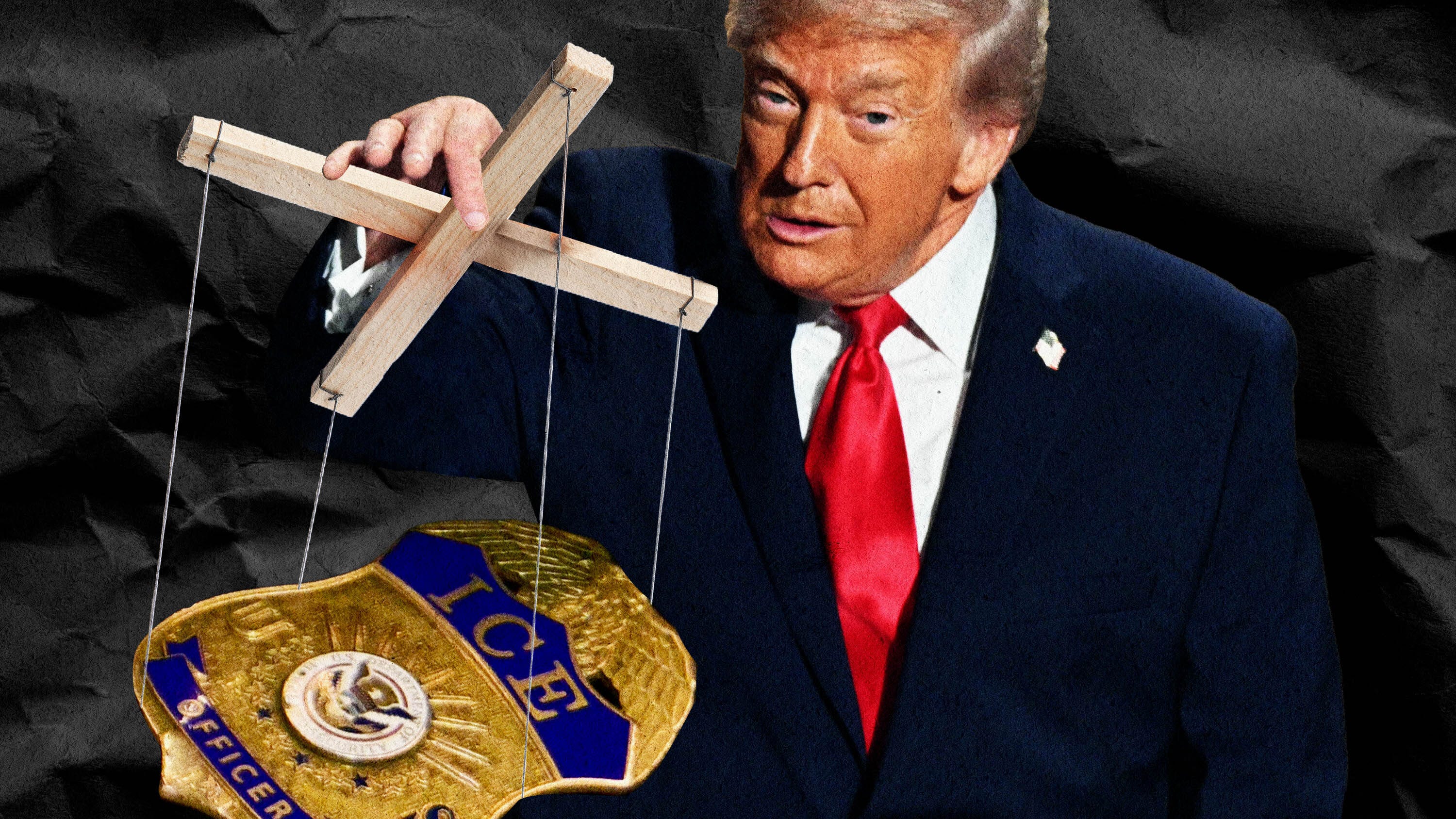
(Photo illustration by Sarah Rogers/The Bulwark | Photos: Getty, Shutterstock)
1. Shameful. Joyous.
What is it we say about bad things happening to bad people?
Meet Brent Jindra, a California tech salesman who voted for Donald Trump three times because of his promises to rid America of immigrants. Last year Brent met Galina Bobreneva, a nice Russian girl. They got married.
In July the couple took a domestic flight from San Francisco to Burbank. When they got off the plane government agents were waiting for Galina. First, they told her she had been selected for a “secondary screening.” Then, after getting her to a back room, she was handcuffed and hustled off to an unmarked vehicle. She spent the night on the floor of a jail cell in Los Angeles and was eventually sent to an internment camp in the Mojave desert.
And now Brent is upset because his wife isn’t that kind of immigrant. “She did not jump a wall, she did not swim a river,” he says.
This story has so many layers that I don’t even know what metaphor to use. It’s like watching a guy at the zoo jumping the fence and running full-speed toward a hot stove inside the leopard enclosure. It’s terrible. It’s karmic. And you can’t take your eyes off of it.
Andrew Egger and Ben Parker went live to cover the Republican election deniers in 2020 now running for office, the company that put out a bogus poll on purpose, Trump’s latest threats against an American ally, and the White House response to a question about Natalie Harp.
It’s a tough year to run for governor of a swing state as a Republican. The folks elected this year will supervise their state’s elections in 2028, and many voters reasonably wonder: What did you do last time Donald Trump tried to steal an election? If he tries to do it again, will you stand in his way?
At least some candidates are plainly feeling the pressure. In 2020, Wisconsin Rep. Tom Tiffany, now Republican nominee for governor, strongly supported Trump’s efforts, backing a lawsuit to overturn the election results and voting against certifying them on January 6th. Last year, he said he supported the Trump FBI’s muckraking efforts into finding “improprieties” in the 2020 election; earlier this year, he refused to answer the question of if Biden had won in 2020.
Now, though, Tiffany’s had an apparent change of heart. “Joe Biden won,” he told CNN in a statement. “I’ll cooperate with law enforcement on investigations because Wisconsinites deserve full transparency and the ability to see the facts. . . . In 2028, I’ll certify whoever wins the most votes in Wisconsin.” In 2026, admitting Trump lost and insisting you’ll do your job if elected is apparently how you pivot to the general. Happy Tuesday.
Busy morning here at Bulwark HQ. Our Bulwark+ presale for members for The Good Fight Tour stops in Columbia, Charlotte, and Atlanta opens at 10 a.m. in the East. Head to TheBulwark.com/Events to get early access to tickets. General admission sales open on Friday.
Morning Shots Live: Andrew Egger and Ben Parker will be live on Substack and YouTube starting at 10:00 a.m. EDT. A replay will be posted on the site and the Bulwark Takes feed.
(Photo illustration by Sarah Rogers/The Bulwark | Photos: Shutterstock)
Who Would Want to Be Friends with America Now?
by Mark Hertling
Over the weekend, President Trump made a point of complimenting our enemy, North Korea, and antagonizing our ally, South Korea. Continuing the pattern, yesterday he threatened to bomb another longtime American security partner, Oman.
Asked about Oman’s talks with Iran concerning the Strait of Hormuz, which borders both countries, President Trump reportedly told Fox News reporter Trey Yingst, “If Oman gets in the way, we’ll bomb the shit out of them.” He seemed to double down on the threat later yesterday in the Oval Office.
The president is threatening to bomb a country that for nearly half a century has quietly provided the United States with military access, logistical support, diplomatic assistance, and something increasingly rare in the Middle East: the ability to communicate with friends as well as enemies. For decades, Oman hasn’t been in the way, it has often been the way.
The modern Omani–American military relationship dates to 1980, when Oman became the first Persian Gulf state to sign a formal agreement allowing American forces access to its military facilities. That access was particularly valuable during the “Tanker War” of the 1980s. When the Reagan administration launched Operation Earnest Will in 1987 to protect reflagged Kuwaiti tankers from Iranian attack, Oman was one of the few Gulf countries with agreements already in place for military access and prepositioning.
That cooperation continued through Desert Storm, Afghanistan, and Iraq. In 2019, Washington and Muscat expanded the relationship again, giving American forces access to the ports at Salalah and Duqm. The latter is especially important in the Gulf: Duqm is a deep-water port capable of handling large American warships and sits outside the Strait of Hormuz.
That close cooperation in no way means that Oman is an American puppet. Oman is friendly with the United States while maintaining relations with Iran. That balancing act sometimes frustrates Washington and Oman’s Arab neighbors, but it has also made Muscat a useful intermediary when Americans and Iranians cannot—or will not—talk to one another.
Being independent means we get to say what we think is true, no matter what. To support our work, become a Bulwark+ member.
Oman helped establish the secret channel between Washington and Tehran during the negotiations that produced the 2015 Iran nuclear agreement, and it has helped secure the release of Americans held hostage by Iran. When Washington and Tehran needed an intermediary during the current crisis, Oman stepped forward again.
Which makes Trump’s threat especially bizarre. Just one day earlier, Trump ordered the Pentagon to substantially reduce the Ulchi Freedom Shield exercises with South Korea, criticizing Seoul for failing to support his Iran policy while again emphasizing his relationship with North Korean dictator Kim Jong Un. Meanwhile, NATO countries in Europe have been confronting increasingly brazen drone activity and suspected Russian provocations, without any kind of presidential threat directed toward Moscow. An emerging pattern is taking shape, and America’s friends are certainly noticing it.
Japan, the Philippines, Australia, and other Indo-Pacific partners will watch what happens to South Korea and wonder what it says about America’s commitments to them. So will leaders in Riyadh, Abu Dhabi, Doha, Manama, and Kuwait City. Those governments have spent decades building relationships with Washington, have cooperated with American administrations of both parties, and all understand that partnerships sometimes involve disagreements. But alliances and partnerships depend on something more fundamental than agreement. They depend on predictability and trust.
No nation expects the United States to agree with it on everything. What nations must be able to expect is that a disagreement with Washington will remain a disagreement—not suddenly become the dissolution of an alliance or even a threat of military attack.
A larger lesson here is about American leadership. Alliances are relationships built over years, administrations, wars, crises, and disagreements. Presidents inherit them from their predecessors, sustain them for their successors, and occasionally strengthen them through careful diplomacy.
But presidents can also destroy them. That destruction rarely occurs with a formal announcement. More often, trust corrodes incrementally. An exercise is canceled. An ally is publicly berated. An adversary is praised. A partner wonders whether Washington will respond to help during a crisis. Another begins looking elsewhere for security or diplomatic support.
And America loses a partner, an ally, or a friend.
AROUND THE BULWARK
How Baseball Marks the Time… The seasons change. Children grow up. Years fly by. Yet somehow you can still remember exactly where you were when the ball cleared the wall, writes MARK HERTLING.
THE REAL FAKE POLLS: Political polling is in dire straits for a bunch of reasons. Nobody can figure out how to get surveys in front of representative samples of voters now that people don’t pick up cold calls from unknown numbers anymore. And with reliable results seeming out of reach, fewer and fewer outfits are even trying to run high-quality polls—which leaves narrative gaps for poorer and more partisan polls to influence public perceptions of a race.
Or even downright frauds. A group calling themselves Median Polling supposedly conducted a couple polls this month, including one in Wisconsin supposedly showing Francesca Hong up 20-plus points on David Crowley and another in the L.A. mayoral race showing incumbent Karen Bass leading challenger Nithya Raman by double digits. But with skeptical reporters digging into them, the group admitted yesterday that the polls were fakes.
“All previously published polling releases have been withdrawn and should not be cited or treated as genuine polling data,” it said in a statement. “Median Strategies was created as a short-term social experiment examining how purported polling information could enter and spread through the political information ecosystem without independent verification.”
In fact, Median’s “experiment” had raised red flags from the start, at least among polling experts. But their hoaxed information did make it into broader ecosystem here and there: Bass shared Median’s bogus poll showing her comfortably in the lead on social media, even whipping up an infographic to help it pop. “Doing the work, showing up, and gaining momentum,” Bass tweeted. “Let’s do this, LA!”
NATALIE IN THE SPOTLIGHT: Donald Trump’s personal aide Natalie Harp has always been a strange figure in Trump’s orbit—a worshipful assistant dubbed the “human printer” who seems to serve as the president’s security blanket, keeping him well-supplied with printouts of flattering tweets and news clippings as well as personal letters left around his quarters. On Sunday, Sen. Jon Ossoff took a shot at the pair’s relationship, saying in one of his now-routine campaign speeches that Trump, instead of doing his job, “wants to build his ballroom and travel with Natalie on their apparently defenseless flying palace gifted by the Emir of Qatar.”
Republicans fumed that Ossoff was smearing a young aide with baseless insinuations. And the White House went berserk. After CNN’s Kristen Holmes asked Trump if he wanted to respond to Ossoff’s comments yesterday, Trump’s “Rapid Response 47” account called her a “disgraceful, humiliating embarrassment to her alleged procession.”
“Someday, your children will come across your disgusting and inhumane question,” the account spluttered. “They will be sickened and embarrassed to have a parent be so callous and vindictive.”
(Photo illustration by Bill Kuchman/The Bulwark | Photos: Getty, Shutterstock)
ON SATURDAY AFTERNOON AT WRIGLEY FIELD, a 23-year-old named Joshua Báez stepped to the plate for the St. Louis Cardinals for the first time in his major-league career. The very first pitch he saw, he belted 449 feet into the center-field seats. That was in the first inning. In the fourth inning, he did it again, this time to the left-field bleachers. And then, impossibly, in the sixth, he did it a third time, to right field.
Three home runs in his first three major-league at-bats. No player in the long history of Major League Baseball had ever done that before. Báez drove in five runs as the Cardinals beat the Cubs, 8–4, and somewhere along the way, a baseball game in August became something people will remember.
I certainly will.
Maybe I am especially susceptible to baseball nostalgia at the moment because the “Field of Dreams” game had been played in Iowa last week, and my wife and I once again watched the 1989 movie that inspired it. Like many baseball fans, I’ve seen that film more times than I can count. And every time, James Earl Jones’s magnificent speech gets me: “The one constant through all the years, Ray, has been baseball.” America changes, he says, but baseball “has marked the time.”
For me, that time has been marked by being a fan of the team with the birds on the bat. I’ve been a Cardinals fan since I was a boy, and when I think about my life, I can mark parts of it by home runs.
I was listening on KMOX radio as a boy of 11 in 1964 when Ken Boyer hit his grand slam against the Yankees in Game 4 of the World Series, turning a 3–0 deficit into a 4–3 Cardinals victory. Three years later, Bob Gibson—my boyhood hero—did something that somehow seemed perfectly normal for Bob Gibson: He pitched a complete-game victory in Game 7 of the World Series at Fenway Park, struck out ten, and hit a home run, too.
By 1982, I was an Army officer, married with children, when rookie Willie McGee hit two home runs in Game 3 of the World Series—and robbed Milwaukee’s Gorman Thomas of one. Baseball had marked the time.
Then came Mark McGwire. Any baseball fan old enough to remember 1998 will recall the anticipation as he and the Cubs’ Sammy Sosa approached Roger Maris’s record of 61 home runs, and the explosion at Busch Stadium when McGwire’s number 62 barely cleared the left-field wall. Today we know much more about baseball’s steroids era, and that complicates the record. But it doesn’t erase the memory of that night—or the extraordinary summer when seemingly everyone was watching baseball, and the game had been reborn in American society.
Another unique event, and still a major-league record, happened in 1999 at Dodger Stadium: The Cards’ Fernando Tatís (senior) became the first—and still the only—player in Major League history to hit two grand slams in the same inning. Both came off the same pitcher, Dodgers starter Chan Ho Park.
Who can forget Albert Pujols, nicknamed “El Hombre” as a nod to Cards legend Stan “The Man” Musial from a half-century earlier. Albert was a master, but when he hit an almost unbelievable home run off Brad Lidge in Houston—two outs in the ninth, with the Cardinals facing elimination—he became a legend. The ball landed above the train tracks at Minute Maid Park. One of the most intimidating HRs I’ve ever seen. Then his three home runs in Game 3 of the 2011 World Series, a feat previously accomplished in the Series only by Babe Ruth and Reggie Jackson.
All Cardinals fans remember David Freese’s two-out, two-strike triple in the ninth inning of a later game in that same 2011 World Series in which Pujols worked his magic. And then, in the eleventh inning, Freese came up again and this time drove the ball over the center-field wall, winning the game. Joe Buck’s call echoed his father’s famous 1991 World Series call: “We will see you tomorrow night.” The Cardinals won Game 7 and their eleventh championship.
There have been so many other great memories. Fan favorite Adam Wainwright homering on the first pitch of his first major-league at-bat at the start of a masterful pitching career. Yadier Molina breaking a ninth-inning tie against the Mets in Game 7 of the 2006 NLCS. Pujols—who had left the Cardinals for the Angels—returning in 2022 for one final, magical season and reaching 703. Each is connected in my mind not simply with where the ball landed but with where I was in life when it did. Like the changing of the seasons, like the birthdays and anniversaries and holidays that dot the calendar, the pacing of baseball—the pitches and outs, the games and series, the seasons and careers—mark a life over time.
That’s the magic of Field of Dreams, too. The movie isn’t really about Shoeless Joe Jackson, or a crazy ballfield in an Iowa cornfield, or even, ultimately, baseball. It’s about fathers and sons, growing older, memory, reconciliation, and the things that somehow remain constant while everything in America changes.
Saturday, Joshua Báez added another marker.
I don’t know what kind of career he will have. That’s another of the beautiful things about baseball: There are no guarantees. But I know that decades from now, some Cardinals fan will remember the Saturday afternoon at Wrigley when a 23-year-old rookie, making his major-league debut, swung at the first pitch he ever saw—and started making history.
Tim Miller shares the story of a Venezuelan family — a pregnant mother, father, and their 7-year-old daughter — who have spent weeks detained at the Dilley detention facility in Texas, despite doing everything the Trump administration has asked of immigrants seeking to leave the country. The family followed every legal step: they applied for asylum, never missed an ICE check-in, and when they decided to return to Venezuela, they went through the official self-deportation process. Instead of being sent home, they were arrested and detained.
For more on the Texas Immigration Law Council: https://txilc.org/ Call Sen. Katie Britt: 202-224-5744
JVL and Andrew Egger give their takes on Donald Trump’s latest chaotic press conference, from his bizarre claims about talking with Kim Jong Un to his demand that South Korea pay up for U.S. protection. They also look at Trump’s latest comments on the Iran war, the state of the USS Abraham Lincoln, and his increasingly strange defense of his White House ballroom. Plus: Trump lashes out at a CNN reporter, calls the press “fake news,” and insists his ballroom will be bulletproof and missile-proof.

 Login
Login