Normal view

App Store Scam of the Week: ‘TabControl Extension’ for Safari

12 August 2026 at 17:06

Jeff Johnson:

These purported reviews, all but one of which is 5 stars, are all in English. Yet none of them is in the US App Store. I also looked at other English-speaking countries such as Australia and Canada but found no reviews. Also suspicious is that the name of every reviewer was a first name followed by an initial for the last name. If you’ve ever looked through App Store user reviews, it’s unusual to find this naming format. In most cases, the name on App Store user reviews is a uniquely chosen username, with no space character, often suffixed by a number.

The final and most conclusive evidence that these reviews are fake, totally invented out of thin air by the developer (or more likely, by an LLM), is that the dates on the reviews, such as “Mar 12,” predate the release of TabControl Extension in the App Store!

God only knows what this obvious AI slop scam is doing with the data from users’ Safari tabs. It’s currently the 12th or 13th most popular Safari extension in the App Store.

Nature Is Healing

12 August 2026 at 16:43

Basic Apple Guy:

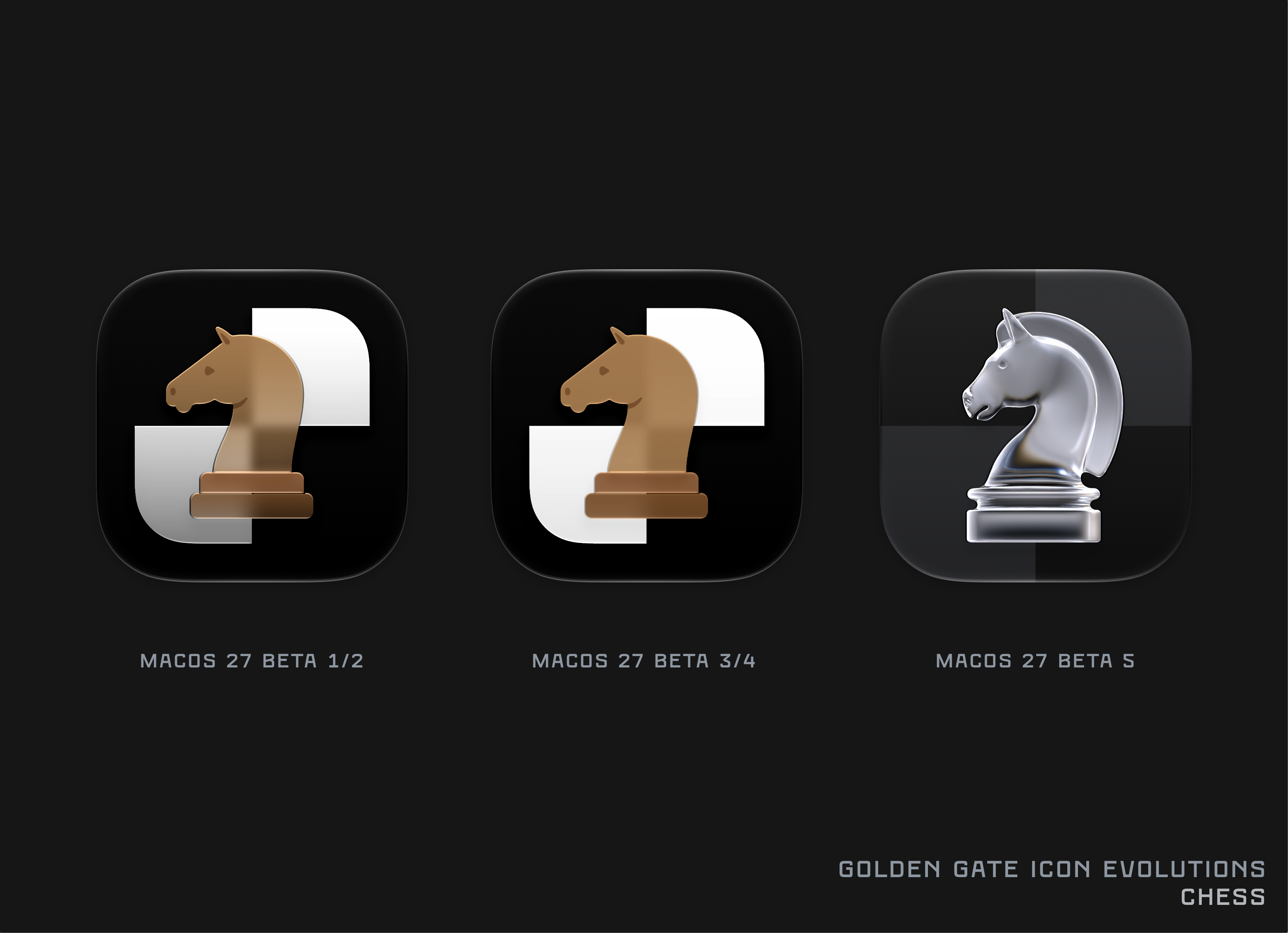
Apple just dropped the hardest icon glow-up for the new Chess icon in macOS 27 Beta 5.

Comparison of the Chess app icons in MacOS 27 Golden Gate: betas 1/2, betas 3/4, and an all new-icon for beta 5. The earlier ones show a flat brown knight. The new one in beta 5 shows a fully-articulated 3D silvery knight. The new one looks great. The previous ones look like shit.

This is not just a tweak or small improvement. This is the difference between total shit and a really nice icon.

The Economist: ‘How to Spot AI Writing’

11 August 2026 at 23:37

The Economist (‘twas a gift link, but alas, I guess gift views have been used up — here’s an archive link in case the gift link is vexing you):

You can discover AI’s hallmarks by comparing the writing of man and machine. To do this you need a baseline that is distinctive and familiar. The Economist turned to prose that we’re sure is human and that readers will recognise: our own. We designed a study to ask top LLMs — OpenAI’s ChatGPT, Anthropic’s Claude, Google’s Gemini and xAI’s Grok — to write versions of our articles without consulting the web. (As a prompt, we gave them the AI-generated summaries that we have experimentally added to some of our articles.)

This gave us a corpus of human and AI creations and we compared them across 55,940 sentences and 1.2m words. To make sure we were detecting AI quirks rather than our own, we also checked the AI texts against journalism from CNN, the New York Times and the Washington Post. Excerpts from hit novels published between 1950 and 2022 offered another test.

Our findings are surprising. AI prose is distinguishable by word and punctuation choice as well as sentence and paragraph structure. But its hallmarks are not what you might expect, partly because its writing style has changed with software updates. That does not mean that LLMs are great writers: their prose lacks lucidity and elegance and is often formulaic. So those aspiring to be impressive (human) storytellers should avoid the following peculiarities in their own prose.

On point for today.

Some specific findings:

Much of this language could be described as what George Orwell called “pretentious diction”. He railed against writers who “dress up simple statements” with complicated words and jargon to sound clever. Such pontificating penmen, Orwell observed, also believe that “Latin or Greek words are grander than Saxon ones”. (Bots agree: more Latinate suffixes crop up in their writing than in human texts.)

Then look at punctuation. Many believe LLMs stuff their prose with em-dashes, but that is not true after the most recent updates. Today only Claude uses more em-dashes than human writers, with ChatGPT using markedly fewer than any other writer in our study. Humans rejoice — and start using dashes again.

A better way to spot AI-generated writing would be to look for texts without much punctuation at all. LLMs are very Joycean about it: they use fewer commas and semicolons than humans (and hardly any parentheses). They use less punctuation in part because they write longer sentences — “and” is their most overused word — and in part because they do not quote experts.

Alex Micek on BMW’s iDrive ‘Special Surprises’

11 August 2026 at 21:56

Alex Micek:

In the future, I will feel angry if my car strands me on the side of the road.
I will feel angry if the motor brushes fail expectedly.
I will feel angry if it leaks water.

By contrast, I don’t feel anger when the car tricks me into seeing an advertisement. Instead, I feel a deep, smothering, let-down at the promise of futurism. Bottomless despair is probably inappropriate; a symptom of the misanthropy I should grow out of. But. In the meantime, I feel helpless, discouraged, deeply sad.

Such a good take. I should not let 19 years pass again between linking to his writing.

BMW Probably Paid Sony for the Spider-Man Dashboard Ads, Not the Other Way Around

11 August 2026 at 21:46

This didn’t occur to me but should have — BMW paid Sony to place BMWs throughout the new Spider-Man: Brand New Day movie. They’re not just in the movie but part of the story. So it’s probably the case not that Sony paid BMW to put Spider-Man animations in the dashboards of every late model BMW on the road, but that BMW offered to do it as part of the promotional deal they paid Sony. So BMW probably paid Sony for something that ultimately infuriated a bunch of BMW’s own customers. Geniuses.

Mark Zuckerberg Posts 6,500-Word AI Essay

11 August 2026 at 21:36

Two weeks ago Zuckerberg published a 1,000-word essay, “The AI Future Is for Everyone”. This week he published an expanded 6,500-word version of the essay on Meta’s website. Somehow it almost says nothing more than the original. This tidbit, however, struck me as notable:

For example, in Richland Parish, Louisiana, where Meta is building a large data center, teachers received a $50,000 bonus this year because of the increased tax revenue from our investment. The superintendent told us that teachers are now moving there from across the country and he believes it will become one of the nation’s best school districts.

Unlike the concern about knowledge work displacement, there is a shortage of skilled tradespeople like carpenters, electricians, and construction workers to support the demand for infrastructure buildout. Meta has created America’s Workforce Academy to provide free training for skilled tradespeople and guaranteed high-paying jobs in the areas we’re building data centers.

Those $50K bonuses to public-school teachers are real, and they’re more than most of those teachers’ annual salaries. That’s the sort of thing that could turn public sentiment on data center construction around. But it hasn’t turned around yet.

The Talk Show: ‘Getting the Snack Right’

11 August 2026 at 21:00

Chance Miller returns to the show. Topics include iOS 27’s progress over summer, live baseball in Vision Pro, the RAM crisis, Apple’s trade secret lawsuit against OpenAI and io, and the EU/DMA situation.

Sponsored by:

  • Squarespace: Save 10% off your first purchase of a website or domain using code TALKSHOW.
  • Factor: Healthy eating, made easy. Get 50% off and one free breakfast item per box for one year, with code talkshow50off.
  • Notion: The collaborative AI workspace where teams and agents work side by side, with a Developer Platform teams can build on.

Netflix Has Peaked

11 August 2026 at 20:54

Andrew Sharp, writing at Sharp Text last month after Netflix’s earnings, asking “Is Netflix Washed Now?”:

I offer this observation as a swirl of heightened anxiety surrounds the company, so let me clarify one thing up front: I’m not predicting imminent doom. Netflix content reaches a staggering 85% of American viewers and has 325 million subscribers globally. Growth is slowing, but that’s the law of large numbers. If practically everyone in America and much of the world is already subscribed to some version of Netflix, and churn rates are still low, then any concern is relative. Going forward: cable is still dying, and even if the biggest premium distribution platform in the world can’t make great content of its own, it can still license movies, TV and sports rights. Netflix can then spread those costs across hundreds of millions of subscribers and a steadily growing ads business, seeing more engagement in a week than Apple TV sees in a year.

So no, the company’s not doomed today or destined for collapse tomorrow. Instead, I think what’s interesting to consider is that Netflix has almost certainly peaked. As a cultural force, as a business success story, and as an entertainment death star destined to swallow Hollywood whole, the arrows are all pointing the wrong direction.

Sometimes the problem with a company isn’t that it isn’t a good business, but merely that it isn’t as good a business as it holds itself up to be. A billion-dollar business ought to be a good thing, but it’s a disaster if the company is valued by investors as a trillion-dollar business. That’s Netflix.

To me it’s backwards that Netflix is valued at $300 billion, roughly the 50th most valued company in the world, and Disney is valued at $180 billion, roughly 120th. Netflix has a streaming video service and owns some IP, like Stranger Things and Squid Game. Disney owns two streaming video services (Disney+ and Hulu), and owns some IP. Little stuff like Mickey Mouse, Star Wars, Marvel, the Disney princesses, and everything from Pixar. Netflix has started dabbling in sports; Disney owns ESPN. Disney owns the world’s biggest and best theme parks and an entire cruise ship line.

It’s true that Netflix’s streaming service is by far the biggest in the world, and likely will remain so for the foreseeable future. But Disney+ combined with Hulu is clearly in second place globally.

For the most recent 12 months:

DisneyNetflix
Revenue$97 B$48 B
Net Profit$11 B$14 B
Net Margin11.5%28%

Netflix is generating slightly more profit on half the revenue. With its theme parks, resorts, and cruise ships, big parts of Disney are effectively hardware, not software — so it’s almost inevitable its margins will be lower than a pure software play like Netflix. But those “hardware” businesses diversify Disney. How confident are you that Netflix will remain the undisputed leader in streaming 10 years from now, or 25? I’d bet good money that Walt Disney World will be the world’s biggest, best, and most profitable theme park 50 years from now. And it’s a joke to compare the value and longevity of the two companies’ IP.

I don’t know that Disney is undervalued by the market, but I sure think Netflix is overvalued. And as for quality, I’ve watched a bit more Netflix original content this summer than I had of late. David Attenborough’s A Gorilla Story was a splendid documentary, but nature documentaries don’t pay the bills. A few other things I watched (or at least watched part of) were absolute dreck. Not high-quality fun trash like Tiger King but amateur-hour I’m-worried-I-lost-a-few-IQ-points-by-watching-it trash. We pay $27/month for Netflix premium and I can say unequivocally that it’s not worth it. I continue paying for it because I’m willing to overpay for it the same way I am for beverages at a hotel — it’s money I’m willing to squander, knowing full well I’m squandering it.

It feels to me like Mr. Market is getting increasingly skeptical whether Netflix justifies its valuation, and Netflix is getting a little squirrelly and desperate trying to come up with an answer. Simple question: what’s their moat? It sure isn’t content quality.

Anthropic Posts ‘How Claude Marks AI-Generated Content’ Without Explaining How Claude Marks AI-Generated Content

11 August 2026 at 19:59

Anthropic support page:

Anthropic has signed the EU AI Act’s Article 50(2) Code of Practice on Transparency of AI-Generated Content, as a provider of both generative AI models and generative AI systems. This article describes how we’re planning to put those commitments into practice, how marking works, and what its limitations are. We’ll update this article and publish more detailed technical guidance as it becomes available.

Regarding generated plain text output:

When a supported Claude model generates text, it weaves an imperceptible watermark directly into the text itself. You won’t see it, and it doesn’t change the meaning, quality, or readability of Claude’s response.

Because the watermark is part of the text, it will travel with the text when it’s copied and pasted elsewhere, and may persist through some editing. Watermarking will be applied at the model level, which means it will be present no matter which Claude product or surface the text comes from. [...]

We’re also working to enable users and other third parties to detect Claude’s embedded watermarks and provenance metadata. Detection checks whether a piece of text or a file carries a supported Claude mark. If a supported mark is found, it indicates that the content may have been processed by Claude.

We’ll share details on detection mechanisms in forthcoming technical documentation.

Anthropic is claiming this is for compliance with an EU law but that “Marking will apply to output from supported models wherever Claude is offered, worldwide.”

This is infuriatingly opaque. I won’t speak to the “signed provenance metadata” they say they’ll be embedding in generated files like PDFs, SVGs, PNGs, and JPEGs. That’s important but it’s complex. Plain text is simple. A string of text is just one character followed by another. At first I presumed that Claude is going to start “embedding” invisible characters/byte sequences between visible characters — which would unavoidably cause immediate problems.

Let’s say I have Claude generate the phrase “Hello world”. (Two words is surely too short to bother with “AI generated” detection — I’m using a two-word phrase here for simplicity in the example.) Claude creates the string of characters “Hello«invisible characters that comprise a “watermark” here» world”. I paste this on the web. Humans who look at it will see “Hello world” but the invisible characters are there. Character-count-limited social media platforms will show that the string contains more than the 11 visible characters in “Hello world”.

If the “watermark” is not comprised of invisible characters but rather visible ones, how in the world does this jibe with their claim that it’s “imperceptible”? This Reddit thread claims that’s how it will work — “It’s a form of steganography where the model subtly biases its word choice to create a statistical pattern that can be detected later.” How in the world can that be squared with “it doesn’t change the meaning, quality, or readability”? And any sort of semantic detection like this is going to cause false-positive problems.

If I ask a tool to generate text or suggest text for me, I expect that tool to generate the best possible word choices it can. Not corrupt its output for the sake of watermarking. If they go through with this, this ought to be poison to the Claude brand.

What happens if you copy my text and quote it in something you write, by hand? Now you’ve got a watermark in your prose, invisible characters or something, that implicates that your prose is AI-generated? Even though you didn’t use AI and just copy and pasted text from me? Madness.

They obviously need to explain exactly what they’re embedding in text if anyone is actually going to detect it, but if they explain it, anyone can simply remove it. And what happens, for example, if someone just OCRs Claude-generated text rather than selects and copies it? This is all so stupid. I have never been happier that I’ve never actually used Claude for anything.

What’s New in iOS 27 Beta 5

10 August 2026 at 23:54

Zac Hall at 9to5Mac has a good rundown of new features and changes in beta 5. Some app icons got tweaks (the Siri app in particular looks much cooler now), and a bunch of the existing American and British Siri speaking voices now have the Pace and Expressivity adjustment sliders.

Also interesting: the OS 27 releases were stuck at beta 4 for 22 days. That’s a week longer than usual. Will Hains (my Kotoba friend) maintains a wonderful single-page website tracking iOS version release date history. For these summer “next big version” comparisons, it’s best to filter by “*.0” releases. Do that at Hains’s website and you can see a fairly clear pattern: betas 1 through 4 typically last about two weeks each; then starting with beta 5, Apple switches to a roughly weekly schedule until the end of the beta cycle. I wouldn’t read anything into that other than to expect beta 6 next week and beta 7 the week after that.

‘Friday Night Baseball’ Will Start Broadcasting Games Live, in Apple Immersive, on Vision Pro

10 August 2026 at 22:47

Apple Newsroom:

For the first time, baseball fans can take in all the action of “Friday Night Baseball” live in Apple Immersive on Apple Vision Pro, leveraging 3D video recorded in 8K with a 180-degree field of view. On August 28, viewers with Vision Pro will experience the iconic Red Sox vs. Yankees rivalry from unique camera angles that place viewers right in the game, immersed in the drama of each at-bat, the celebrations in the dugout after a big hit, close plays at the outfield wall, and more.

The experience features bespoke commentary from Paul Severino (play-by-play), Xavier Scruggs (analyst), and Michelle Margaux (sideline reporter); dedicated replays; and an immersive graphics package that includes team lineups and stats floating in the viewer’s space. During breaks in the action, the broadcast remains live, immersing viewers in the stadium experience from all angles as ambisonic microphones capture sounds in Spatial Audio.

Hot damn, they even picked the best rivalry in sports to kick it off.

Michael Tsai on My Retraction of the Astrology/Astronomy App Store Rejection Story

10 August 2026 at 22:18

Michael Tsai:

I’m really unhappy about this, both for my role in spreading a false story and because I think it will hurt the cause of reforming App Review. I know there are many crazy rejections and have experienced some first-hand. This story was believable because of that well-known history and because Godier didn’t seem like a nobody trying to get attention — he was the developer of another highly regarded app. But now people are going to point to true developer stories and accuse them of being fakes, too.

Same.

‘The Problem With Vibe-Coded Flattery’

10 August 2026 at 18:42

Ernie Smith at Tedium:

I’m seeing email after email suggesting these users built a thing they’re truly passionate about. But if we can’t trust that this passion is real, legit, and from the heart, we’re in trouble.

Take a step back. Is this thing you built a reflection of you?

I think it’s fun and exciting that I’m getting a lot more emails about a lot more new apps. But a fair chunk of those emails are themselves clearly written by an AI chatbot. It’s so obvious. Those go straight in the trash.

The NYT and WSJ on Apple, China, and the RAM Crisis

10 August 2026 at 17:21

Kalley Huang, reporting from San Francisco, and Ana Swanson, from Washington, for The New York Times (gift link):

Apple, which has cited the memory chip shortage for recent price increases, is working with other consumer electronics companies to push for permission to buy memory chips from China, which faces certain restrictions, seven people said.

Apple was in talks in 2022 to buy memory chips from Yangtze Memory Technologies Corporation, or YMTC, but those efforts fizzled under pressure from U.S. lawmakers.

Many officials appear unsympathetic to Apple’s desire to buy Chinese chips, because the company has promised for years to move more of its supply chain to the United States but has made only small steps toward that goal, four people said. Other critics of the plan said that China was also experiencing a similar chip crunch, and had proved itself to be a risky supplier when it restricted its mineral exports last year.

Raffaele Huang and Rolfe Winkler, reporting for The Wall Street Journal (also a gift link):

Apple has been testing memory chips from China’s CXMT across product lines including iPhones and MacBooks, according to people familiar with the matter, as the U.S. company addresses a memory crunch during the artificial-intelligence boom.

Apple has held early talks with CXMT about supplying components with the goal of using them in some devices sold in China, the people said. Apple hopes to win the White House’s blessing to do business with the Chinese company. [...]

Apple often tailors components to its devices to maximize performance. Using standard CXMT memory chips could force Apple to redesign certain parts of its products. Industry analysts also say CXMT’s technology still trails its foreign competitors, in part because the company’s access to the most sophisticated chip-making equipment is restricted.

At present, CXMT wouldn’t be a panacea for Apple. The Chinese company has maxed out its production capacity this year, leaving little room for new international clients, the people familiar with the matter said.

The gist of both reports is that just like in 2022, Apple might not get permission from the U.S. government to use Chinese RAM, even for devices sold in China. And, even if they do secure permission, it might not actually help much with the supply crunch.

WorkOS: Connect Your Agents to Your API

10 August 2026 at 01:54

My thanks to WorkOS for, once again, sponsoring DF last week. What’s the best way to connect AI agents to your API? REST is great for human developers; MCP serves the agents. Many teams treat REST and MCP as competing standards, and through choice or necessity, pick one. But they ought not be considered rivals. They’re separate layers. Most MCP servers just call REST internally to do the real work. The best ones don’t convert every endpoint into a tool, they focus on what the agents are actually trying to accomplish.

That layered approach also means shipping OAuth 2.1 with scoped tokens. WorkOS AuthKit already speaks that spec, so you skip building an auth provider on top. Check out WorkOS’s breakdown on MCP vs. REST.

★ Retraction: The App Store Rejection of the Week That Was, in Fact, a Correct Rejection

9 August 2026 at 05:16

Yesterday I published an article titled “App Store Rejection of the Week: Dark Hours”. I have retracted it. Its premise was so fundamentally wrong that there’s no point merely correcting or editing it. Even the title, as I explain below, was inaccurate. Although the original is now retracted, I’m not memory-holing it. The text of the original story is available, for transparency and accountability, in plain text (Markdown, natch) and PDF (preserving original presentation). Both of those versions include a preface at the top linking to this retraction. The URL for the original story now redirects to this one that you are currently reading.

To the best of my recollection, this is the first post I’ve retracted in the 24 years I’ve been writing Daring Fireball. I hope it’s the last. I was misled, both overtly and through omissions, in several ways, but what I publish is my responsibility, and I apologize for the error.

Terry Godier first came to my attention in February, when I linked to his excellent interactive essay on RSS feed reader design, “Phantom Obligation”, which essay introduced Current, Godier’s new RSS reader that he made to exemplify the ideas from his essay. Current is, deservedly, a bit of a breakout hit. (E.g., David Pierce, at The Verge, put it on a very short list of iOS-exclusive indie apps that keep him from switching to Android.) In March I linked to another interactive essay from Godier, “The Last Quiet Thing”, and again in April to a post regarding the App Store’s 5-star review system. I struck up an iMessage correspondence with Godier around when I first linked to his work.

Yesterday Godier posted “Browsers Have Standards, the App Store Has Judgment”. As originally published, that post contained these two paragraphs:

A while ago I tried to submit an iOS app for Dark Hours, my astronomy website for normal people. It was rejected on the grounds that it was astrology.

It has no tarot function, no horoscopes, and nothing that I, or anyone else I’ve asked, would associate with astrology.

Those paragraphs, at this writing (August 8, 11:00 pm ET), have been deleted and replaced by this:

Note: the original version of this post had a section here about an astronomy app I am working on that began as an astrology app and was rejected after having the astrology content removed. App store [sic] review reached out to me and let me know that they had apparently never been given the updated build and that the app should be fine to submit now.

You can now see the problem that has led me to fully retract my original post, given that my post was entirely predicated on the premise that Godier’s original description of the rejected app was true — that the app “has no tarot function, no horoscopes, and nothing that I, or anyone else I’ve asked, would associate with astrology.” The truth is, the app, as originally submitted by Godier to the App Store (under the name “Asterly”, not “Dark Hours”), was entirely dedicated to astrology, not astronomy, and did in fact include a “Tarot card of the day” feature amongst other occultist horseshit.

The grounds of Apple’s original App Store rejection of the app, and the rejection’s upholding by the App Review Board, were correct.1 I wrongly took Godier at his word, both in his public blog post and in private iMessage correspondence yesterday, that the rejection wasn’t just merely debatable, but completely and rather preposterously ungrounded. Whether Godier ever submitted a build of “Asterly” to the App Store that contained no occult horseshit and only the hard-science astronomy features that were present in his “Dark Hours” website that was available for the last week, I don’t know. But I have no reason to believe that he did.

My disdain for astrology is so utter, and my esteem for Godier’s previous work so high, that it simply never occurred to me that he might have actually made and submitted to the App Store an astrology app, let alone that he’d then feign surprise and frustration that an astrology app was rejected for being an astrology app. I showed him a draft of my post before publication, to make sure I had the story straight, and he offered not a word of caution, only gratitude for my drawing attention to the matter.

It gets messier. Godier’s astrology app that he submitted to the App Store back in January was named “Asterly”. That was still the name when the App Review Board upheld its rejection in April. According to Godier, frustrated by the App Store’s rejection, he ported the astronomy version to the web, launching it last week under the name “Dark Hours” at the domain darkhours.io. (This is why it was incorrect for me, in the very title of my post, to claim that Apple had rejected an app named “Dark Hours”. They rejected an app named “Asterly” and had never seen an app from Godier named “Dark Hours”.) Yesterday, after I linked to Godier’s post and Hacker News then linked to my post, Godier’s “Dark Hours” (with a space) came to the attention (and justifiable surprise) of Miguel Beher, creator of an open-source “astrophotography and dark-sky planner” project named DarkHours (no space). Beher’s GitHub project contains the source code, and the actual web app is freely available at the domain darkhours.app. In an uncomfortable exchange between Beher and Godier on Bluesky, Beher pointed out that Godier’s Dark Hours had the same bug as Beher’s that routed people to “random fields in Mexico”. Earlier today, Godier took his web app down and redirected his darkhours.io domain to Beher’s darkhours.app.

At the end of my now-retracted post yesterday, assuming I had righteously and rightly skewered Apple for an egregiously erroneous App Store review rejection, I wrote:

Mistakes happen. But in a functioning system mistakes get corrected, and mistakes as obvious as this one get corrected almost instantly and include a quick apology for the conflation.

Obviously it was I who was mistaken. This article is my correction, and I apologize to all who read and believed my now-retracted post, and to the reviewers at the App Store whose competence (if not literacy) I besmirched. I am deeply sorry about that. Won’t happen again.


  1. Regardless of one’s opinion regarding pseudoscience and occultist horseshit — pro, con, or indifferent — one might reasonably think it wrong for Apple to disallow or discourage such apps from the App Store. In fact, there exist plenty of such apps in the App Store, and Apple has even run “Best Astrology Apps” editorial features. Apple’s stance is basically that the App Store has enough of these apps (and I suspect they’re a common source of scams, given that by their very nature they target the gullible). Guideline 4.3(b) states (emphasis added):

    Certain kinds of apps, such as dating, flashlight, sound effects, wallpaper, simple timers, and fortune telling, are well established on the App Store and we will not accept new submissions unless they offer a meaningfully different or improved experience. We may remove these apps from the App Store going forward if they are not updated, improved, or do not attract customers. Other kinds of apps, such as drinking games, Kama Sutra, fart, and burp apps, are mediocre, low-quality, or low-effort and do not add value to the App Store.

    That serial comma, ever useful, gives hope to anyone hard at work on a “fart and burp” app. ↩︎

Corrupt Minds Think Alike

8 August 2026 at 22:32

Tariq Panja, reporting for The New York Times:

The five men should have been in a celebratory mood. FIFA had just pulled off a World Cup that broke records on a number of fronts. Its spectacular culmination, the final, was a day away from kickoff.

But their mood was anything but jubilant. The men, a group of top directors known as the FIFA bureau of the management board, had been summoned to a hastily organized meeting at the Waldorf Astoria hotel in Manhattan, according to three people familiar with the discussions speaking on condition of anonymity because the talks were private. The directors had until midnight to sign off on a plan that threatened to change soccer forever and would almost certainly lead to a major schism among the sport’s leaders.

The project purported to sell a 20 percent stake in FIFA to a group of investors led by Joshua Kushner, the brother of President Trump’s son-in-law Jared Kushner. Such a move would put into private hands a portion of the World Cup, an event that has been run and controlled by FIFA, a nonprofit in Zurich, for 96 years.

I don’t know what’s dumber — this stupid corrupt scheme to privatize the World Cup, or me, for not assuming from the start that the Trump family was involved in it somehow.

Maybe ‘Steal Underpants by Blowing a Fortune on AI Tokens’ Is, in Fact, Not a Good Business Plan

8 August 2026 at 21:31

Joseph Cox, writing for 404 Media (paywalled, sans gift links, alas):

Consulting giant Accenture is trying to figure out how to stop non-technical workers from blowing through companies’ AI token budget on trivial tasks like converting PDFs to presentation slides, according to leaked audio obtained by 404 Media. Across the industry Accenture is seeing “soaring token spend,” according to the audio. [...] It also undercuts the narrative that superpowered engineers generating mountains of code are behind the AI boom. In many cases it is non-technical staff burning through tokens for non-specialized tasks. [...]

At one point in the meeting, Kwak and Eduardo Salamanca de Diego, senior manager of product management at the company’s Center for Advanced AI, start presenting about what is described as “token ops.”

Kwak says he knows people aren’t using slides these days, but he has some. As he appears to be preparing to present, Stuart Henderson, Accenture’s client group lead, interrupts. He jokes he hopes Kwak didn’t just convert a PDF into images and then into Markdown files. “I’m learning that’s one of the big token chewers,” Henderson says. “Turning PDFs into Markdown: is that right?”

That’s when Kwak says that’s what Accenture’s own data shows.

My impression of consulting giants like Accenture (McKinsey, Bain, Deloitte, KPMG...) has always been that they are very good at looking smart but in fact very bad at actually being smart. The idea that they’re spending serious money on AI tokens to turn PDFs and PowerPoint decks into Markdown only makes me think I’ve overestimated the median intelligence of the people who work there. I really thought Markdown couldn’t get more successful but this takes the cake. I love it that my little baby is helping burn these companies’ cash. This is so stupid it hurts to think about.

Markdown is something you start with because it’s easy to write and universally readable. You write Markdown and use that to make slides — like, say, with iA Presenter — not the other way around.

(Via Simon Willison.)

❌