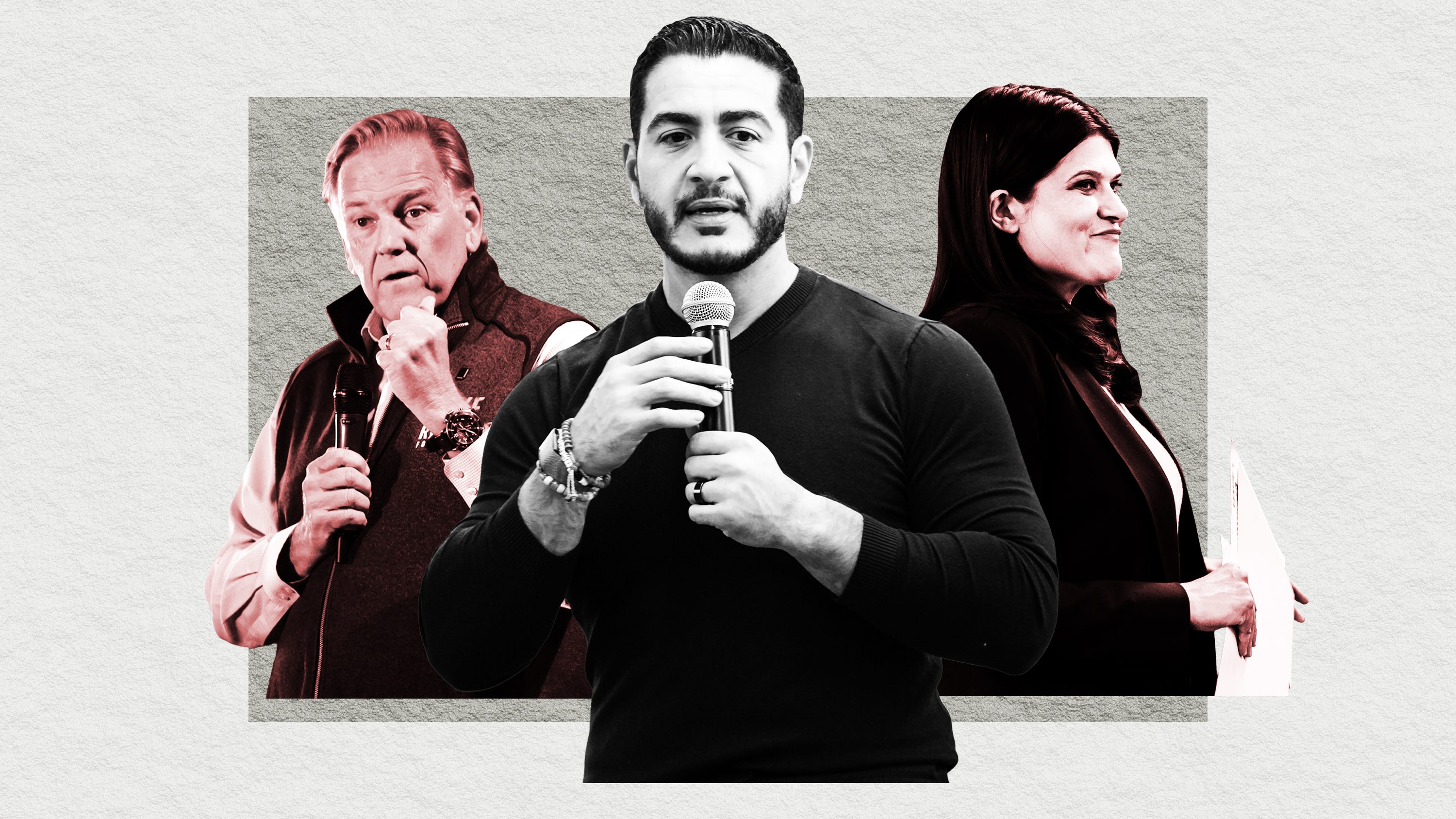
Trump and Vance threw everything they had at Abdul El-Sayed, but Michigan voters elected him to the U.S. Senate by seven points. In an exclusive interview with Jonathan Cohn, El-Sayed reflects on the anti-Muslim attacks against him, why he believes Republicans’ strategy failed, and his plans to challenge Trump and shake up Democratic leadership.
(Photo illustration by Bill Kuchman/The Bulwark | Photos: Getty, Shutterstock)
Detroit, Michigan ABDUL EL-SAYED STOOD on the steps of a small brick church, staring at the dozens of cameras and microphones pointed in his direction—and strangely defiant in what was shaping up to be the worst day of his U.S. Senate campaign.
It was early Sunday afternoon, just hours after his onetime rival for the Democratic nomination, Rep. Haley Stevens, had announced she was endorsing Republican nominee Mike Rogers. Just to make things worse, Stevens had announced her endorsement by joining Rogers at a large black community church, making a play for voters that El-Sayed had lost to Stevens in the primary and that he was struggling to win over fully in the general.
The church where El-Sayed appeared was also a black congregation. The whole point of the day’s “Souls to the Polls” event was to rally those still-skeptical black voters. And to do that, El-Sayed had brought key supporters including James Clyburn, the senior House Democrat and civil rights veteran who had endorsed Stevens in the primary.
Now, after Stevens’s bombshell, attention wouldn’t be on Clyburn’s support, or El-Sayed’s proposals for black Michiganders. All anyone seemed to care about was the rift between El-Sayed and Stevens. Amid the bustle, El-Sayed refused to concede the rhetorical ground, reacting instead as he always does when he doesn’t like the question: He challenged the assembled reporters to ask something different.
“None of this matters—guys, guys, guys,” El-Sayed said, trying to shush the crushing mob of reporters that left poor Don Lemon standing in a shrub.
“There’s a family—you can go like fifteen minutes that way, or fifteen minutes that way, or fifteen minutes that way,” he said, pointing left, right, and straight ahead. “And there are families who are preparing to send their kids to schools tomorrow that look like they did fifty years ago. They’re worried about what they’re going to feed their kids for lunch. They’re worried that if one of their kids gets sick, they’re not going to be able to pay the bills. Those are the things that matter.”
The gambit did not work. After two futile attempts to solicit questions about something other than the Stevens saga, Roxie Richner—El-Sayed’s 24-year-old communications director—declared the press conference over. El-Sayed and the assembled dignitaries retreated back into the church for the proceedings, in what looked like a prelude to bigger defeats.
And maybe it was. The Rogers campaign has shown signs of life in just the last two weeks, for the first time attracting modest crowds to its events. Rogers himself has seemed more at ease in his speeches and interviews, having finally gotten some practice after dodging scrutiny while running uncontested in his party’s primaries.
Meanwhile, ads attacking El-Sayed as too extreme are saturating the airwaves and internet, and filling Michiganders’ mailboxes. Many tap unabashedly into anti-Arab or anti-Muslim bigotry.
But by Sunday evening, there were signs that El-Sayed might get through the Stevens fiasco just fine, or maybe even in a stronger position. It was a scenario that El-Sayed advisers and supporters had suggested after news of the Stevens endorsement broke, and it hadn’t seemed especially plausible until a loud, furious chorus of her fellow Democrats started denouncing her. Later came word from the El-Sayed campaign that it had raised $2.4 million in the hours following the Stevens news and the publication of the final New York Times/Siena poll, historically among the most reliable, showing El-Sayed ahead by 11 points.
And then later in the evening, Stevens went on CNN to talk about her Rogers endorsement—in a performance even her longtime allies described as a train wreck.
It was a wild twist to a wild day, following a wild few days that showcased both the promise and the peril of El-Sayed’s candidacy, on which not just Michigan’s Senate seat but a potential Democratic majority could depend.
Enjoy on-the-ground reporting and serious honest analysis by joining The Bulwark.
STEVENS HAD MOSTLY VANISHED from the news until last week, and she had not been on the campaign trail stumping for fellow Democrats, either. Her absence was conspicuous, given that the third Democratic candidate from the primary, Mallory McMorrow, was making regular and enthusiastic appearances. But it also made sense given how heated the primary between El-Sayed and Stevens had become by the end, and the ongoing controversies over the subjects that had most divided them: El-Sayed’s position and rhetoric on issues tied to Israel.
The issue flared up again last week, following a series of events—including the appearance on October 23 of an anti-Rogers ad almost impossible not to see as antisemitic. The ad was not put out by El-Sayed’s campaign, but by a PAC started by left-wing commentator Cenk Uygur. That’s when Stevens’s fiancé, a lawyer and disability advocate named Jason Turkish with a record of donations to pro-Israel candidates of both parties, announced he was endorsing Rogers because he found El-Sayed’s views so objectionable. Turkish did so at a meeting of the Republican Jewish Coalition in Oakland County, the Democratic-leaning northern Detroit suburb with a large Jewish population.
Stevens told friends and her political contacts that she wasn’t abandoning El-Sayed, then went on CNN to say so publicly—although, when she did, she qualified her endorsement by saying he needed to say more to denounce antisemitic rhetoric, presaging a day of ambiguity and indecision from Stevens. Party leaders, including Michigan’s veteran House Democrat Debbie Dingell, intervened at that point, eyeing Clyburn’s coming visit as a chance for El-Sayed and Stevens to appear jointly and demonstrate party unity.
Exactly who said what to whom at this point remains unclear. But the public sequence went something like this: Stevens released a statement confirming she would be appearing with El-Sayed but calling on him to “apologize” for statements linking Israel to affordability concerns in Michigan, and to “take down” an ad his own campaign put out that included a brief clip of Tucker Carlson. In reply, El-Sayed put out a statement making clear he wasn’t about to relitigate a primary he had already won. And then plans for the joint appearance went poof.
El-Sayed’s statement referenced the tens of millions of dollars that AIPAC had spent against him on Stevens’s behalf during the primary, in what party officials and consultants told each other—and in some cases, me directly—was an unnecessary escalation. But already it was Stevens’s behavior drawing the most scrutiny from fellow Democrats—including McMorrow, who in a CNN interview of her own said, “I have no idea what the hell Haley Stevens is doing.”
By this point, speculation about Stevens’s plans was circulating widely in political circles, especially after Rogers and Donald Trump praised Stevens on social media. When multiple reporters and pols reached out to her, the message back remained the same as late as Sunday morning: Stevens was still on Team Abdul. Which is why all of those contacts were shocked to see Stevens show up at church with Rogers, and even more shocked to see a social media post from Stevens endorsing him. In a handheld video recorded in the seat of a car, Stevens noted that El-Sayed did not want her to campaign with him.
In my conversations with smart political folks in the state, it’s clear that the political danger from the Stevens endorsement was less about Jewish voters, who comprise a small portion of Michigan voters and had likely either made up their minds or aren’t going to be swayed by what Stevens says. Rather, the worry was about the potentially much larger universe of black voters still hesitant about El-Sayed—whether because of Metro Detroit’s history of tense black-Arab relations, the lingering impact of attack ads on El-Sayed that targeted black voters during the primaries, or a larger general antipathy toward more left-wing politicians.
I found evidence of that black hesitation toward El-Sayed inside the church while talking to Gloria Jones, 77, a retired nurse who said she appreciated El-Sayed’s background in public health, and the way “he speaks freely and frankly” without “beating around the bush.” But while she described herself and her husband as strong supporters of the candidate, she acknowledged she knew quite a few neighbors who weren’t.
“It’s not a big difference, not a lot of people, but it’s more than usual,” she said.
CLYBURN ACKNOWLEDGED the gap too when I caught up with him after the proceedings, and he said he was “disappointed” with Stevens, calling her theatrics a “distraction” and adding, “I just hate to see this come about because it’s not who I knew her to be.” Then Clyburn reiterated his own endorsement of El-Sayed, citing his support for expanding access to housing and health care, and his determination to stand up to Trump.
“Anybody who is going to be a ‘yes man’ for this administration should not get the endorsement of any Democrat and should not get a single vote from any African American,” Clyburn said.
Tyrone Carter, a veteran state legislator and black politician from Detroit, also acknowledged the hesitancy some black voters feel about El-Sayed, pointing to the history of tension between the black and Arab communities. But he also said he didn’t think Stevens’s endorsement would ultimately matter, given how many people had already voted early or made up their minds—and the possibility that it might even persuade some uncertain voters to back El-Sayed, because they would see Stevens’s actions as a betrayal.
“What it does to people who were on Team Stevens, as I was, is that it comes off as a sore loser,” Carter told me.
Stevens’s congressional staff seemed to agree with Carter. They resigned en masse following her endorsement of Rogers, and former advisers criticized her openly—including Joetta Appiah, who had served as her campaign spokesperson.1
“Haley Stevens is walking back on everything her campaign stood for,” Appiah told me via text. “Michiganders deserve better, and they need to stay focused on what matters, which is electing Abdul.”
EL-SAYED’S CHURCH EVENT went so long, between the media scrum and lengthy speeches that included multiple local and national leaders, that his campaign scrubbed plans for a walk to the polls. Instead, he went straight to the next planned event, at a local food pantry, and then for a final “knock out the vote” rally in nearby Southfield. A primetime appearance on MS NOW followed, in which El-Sayed was even more disciplined than he had been outside the church—repeating that he saw the controversy as a distraction and was focused on kitchen-table issues for Michiganders.
But that wasn’t the cable interview that had everybody talking. Instead, it was Haley Stevens’s interview with Anderson Cooper on CNN. Over the course of fifteen minutes she gave rambling, halting explanations for why she had decided to endorse Rogers—suggesting, at one point, her endorsement didn’t matter because she represented just one vote—and refusing repeatedly to answer Cooper’s question about how and when she changed her mind.
“Anderson,” Stevens finally said, “that is nice editorializing and nice bits of information about what’s going on. . . . I had an opportunity to go to a church service and have a prayerful moment. It was Sunday. It was very beautiful. It was about friendship, of which I have many incredible friends in the Democratic party, and I care a lot about them.”
The performance did nothing to raise her credibility, while raising lots of questions—in private texts, some of them to me, and then aired on social media—about her mental well-being. Among those concerned was Dingell, who appeared immediately after Stevens on CNN and seemed visibly startled by what she had seen.2 “That was one of the most painful interviews I have ever watched,” Dingell told Cooper. “I have been worried about her all last week. She’s a human being. I’ve had multiple conversations with her.”
Concern for Stevens’s well-being was all over social media, including a post from her longtime friend Jordan Acker, a University of Michigan Regent, who said he found her actions inexplicable. “It is painful to watch someone you care about go through something like this. It is even more painful to worry about the influence of those closest to her,” Acker went on to say, referring to Stevens’s fiancé, Jason Turkish.
“I’ve heard serious concerns about his [Turkish’s] treatment of Haley’s staff, friends, and allies,” Acker tweeted. “My own experiences have only deepened those concerns.”
Dingell reiterated her own worries to me on Sunday night, calling the previous twenty-four hours “one of the hardest days of my career.” And she said she had become genuinely concerned about the rhetoric used in the campaign generally—and the fears she described hearing from members of the Arab, Jewish, and black communities alike.
But she said she was even more committed to electing the Democratic ticket, including El-Sayed, whom she has been promoting ever since the conclusion of the primary (in which she remained neutral). And she said she was struck by the reactions she saw on Sunday during events at a union hall and a local NAACP meeting.
“People are angry,” she said. “This might just backfire.”
PLENTY OF DEMOCRATIC OFFICIALS and strategists wondered in recent days whether the whole conflict might have been avoidable if, somewhere along the way, El-Sayed had made more public gestures to embrace Stevens, even if they were purely cosmetic. Or if he had been clearer and more vocal in his condemnations of rhetoric like the controversial ad, rather than always wrapping it in language about how much he hates being asked to “renounce” and “condemn” things or why he sees the whole issue as a distraction.3
But that is not who El-Sayed is. He likes to say he believes in “radical honesty,” portraying himself as a politician who won’t bend from his principles, in a way that supporters find inspiring and critics find self-righteous.
At his last event Sunday night, a canvassing launch inside a union hall, El-Sayed was hoarse but still on message and invoking one of his favorite speech lines: “It shouldn’t be this hard.”
It’s a reference to the financial struggles Americans face, not the political difficulty of candidates running for office. But this campaign didn’t have to be this hard, either—not in a year when conditions nationally are as favorable to Democrats as they’ve been in recent memory, and not when his opponent is a generic Republican congressman-turned-corporate-strategist who already lost once.
It’s entirely possible that an equally generic Democrat would be cruising to victory right now, as would one who didn’t have to overcome anti-Arab or anti-Muslim sentiments. The final vote count may suggest as much, though it could also suggest something like the opposite: That his ability to inspire young voters, present as a political outsider, and rally Michigan’s Arab community made this election a lot easier than conventional wisdom holds.
Either way, it is clear that El-Sayed has sometimes chosen to do things the hard way, because that’s his personality. And that his positions on everything from health care to energy to Israel have put him on the opposite side of some powerful lobbies now spending literally tens of millions of dollars against him. Which means that while some of his campaign difficulties are surely self-inflicted, some are a product of what he’s trying to do—for better or worse, or maybe both, depending on what you believe.
Update (November 2, 2026, 8:50 p.m. EST): Tonight, more than twenty former campaign staffers (one named, the rest anonymous) released an open letter recalling Stevens’s past criticism of Rogers as a “corrupt career politician who would blindly rubber-stamp Donald Trump’s chaos.” They write: “It’s infuriating to watch her become the very thing she once condemned.”
El-Sayed’s campaign did make a point of distancing him from the controversial ad last week, but he was still being asked by reporters for more explicit statements condemning the ad as recently as yesterday.
(Photo illustration by Bill Kuchman/The Bulwark | Photos: Getty, Shutterstock)
Ypsilanti, Michigan THE MIDTERM ELECTION IS ABOUT a lot of things: gas prices and groceries, the spread of corruption, and the future of democracy. And yet, as much as any single issue, it’s about health care.
You can tell bylisteningtoalltheDemocratstalking about high deductibles, drug costs, and insurance companies as they campaign around the country.
Or you can tell by reading all the public-opinion surveys in which votersconsistentlyrank health care as one of their top concerns.
But if you really want to know why this is a health care election, your best source isn’t the politicians or the pollsters. It’s the people on the front lines.
One of them is Raymond Rion, a family medicine physician and executive director of Packard Health, a small network of clinics spanning Ann Arbor and Ypsilanti on the western outskirts of the Detroit metro area. Packard is what’s known as a Federally Qualified Health Center, where anybody can get care regardless of income or insurance status. And like similar safety-net providers all over America, for the past decade it has benefited directly from the Affordable Care Act.
“We almost went bankrupt in 2011,” Rion told me in a conversation last week, recalling how in the old days staff at Packard would work the phones furiously to get supplies and find specialists who would take referrals. Now many more patients have either Medicaid or private coverage they’ve purchased through HealthCare.gov, the online marketplace that the law created, so that the proportion of uninsured patients has fallen from around one in three to one in ten.
It’s a lot easier to find referrals for these insured patients, though thanks to the infusion of paying customers Packard can do much more on its own. In particular, Rion said, the organization has opened two new branches, started a pharmacy, begun offering prenatal services, and vastly expanded behavioral health care by bringing on a half-dozen new doctors, nurses, and case workers.
Now a retrenchment is underway. Coverage options on the HealthCare.gov marketplace got more expensive because Donald Trump and the Republicans refused to renew temporary subsidies that had been reducing the price of insurance. On top of that, the first cuts to Medicaid as part of last year’s “One Big Beautiful Bill” are starting to take effect.
Rion told me Packard has already laid off a provider in anticipation of less revenue next year.1 Patient volume is down, he went on to explain, in part because uninsured patients sometimes avoid care altogether out of fear a single visit will lead to more treatments with more bills. And postponing care in that way can have serious medical consequences, as his colleague Ron Romero told me.
“So you have somebody with diabetes, their chronic condition isn’t getting cared for,” said Romero, who like Rion is a family physician. “Their sugars rise, and they end up having other medical problems. Their kidneys start to get damaged. They start to have eye damage. They increase risk for heart attacks and strokes. . . . They end up in the emergency room.”
And things are likely to get worse. Partly that’s because next year most of the remaining Medicaid cuts will take full effect, throwing more people off coverage. And partly it’s because forces that have nothing to do with Trump or Republican actions are making medical care more expensive for everyone, including those with employer insurance and Medicare. That will lead to still more people delaying or skipping care, ending up in the emergency rooms, and putting yet more cost pressure on providers.
Rion wasn’t taking a position on the election or political parties, he made clear. He was just describing the reality he sees around him: “The whole system is being pressured. Nobody is immune to this stuff.”
He’s right. And here’s the thing: This has all happened before. We know happens next.
(Photo illustration by Bill Kuchman/The Bulwark | Photos: Getty, Shutterstock, El-Sayed campaign website)
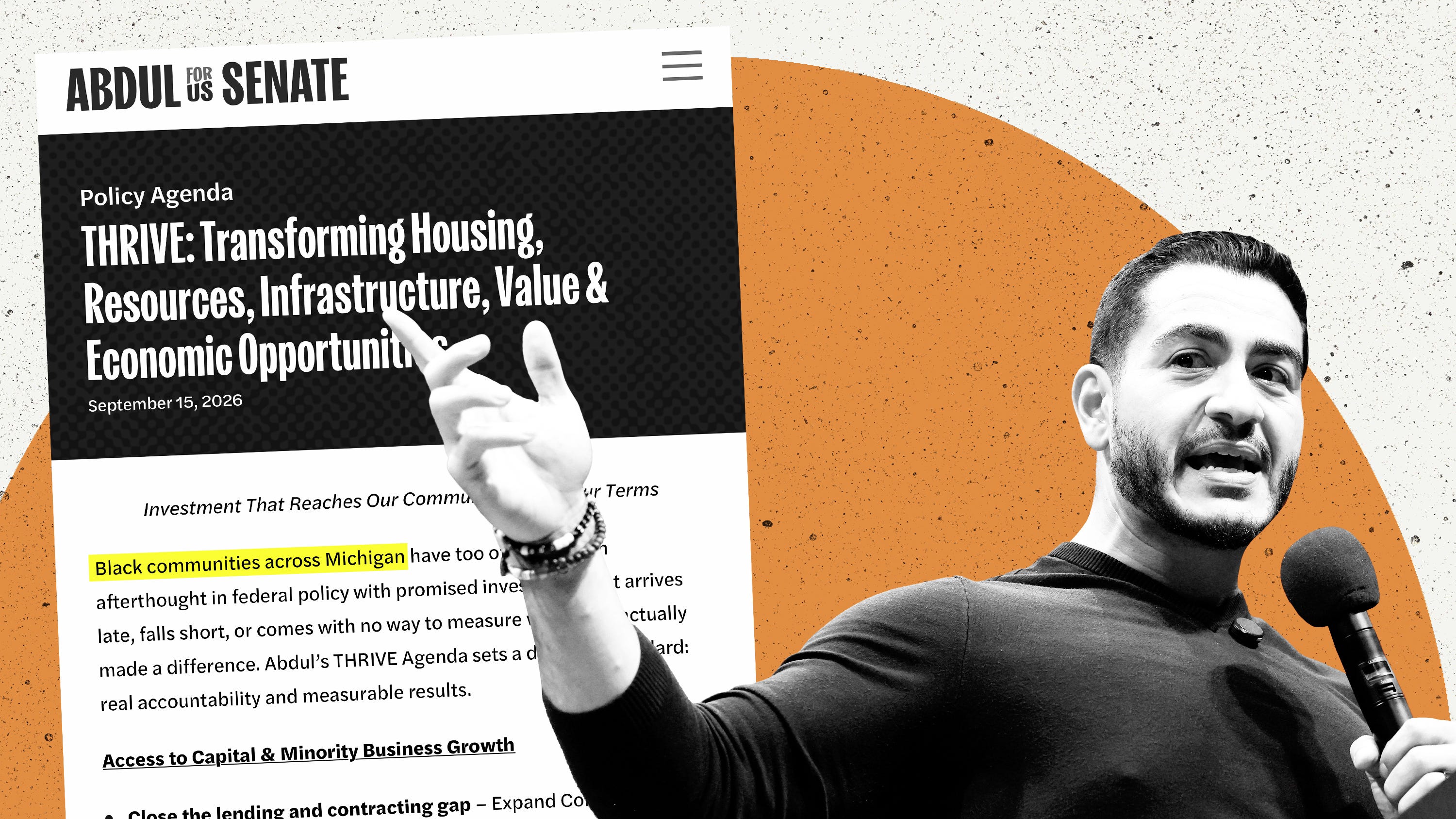
A NEW ADVERTISEMENT running against Abdul El-Sayed in Michigan’s Senate race targets black voters by arguing the Democratic nominee takes them for granted.
“Abdul El-Sayed’s platform is nearly five thousand words,” says a narrator. “He names fifteen foreign countries he cares about. A single mention of black people? Not once.” The narrator then lists issues like housing and school choice as important to black voters on which El-Sayed allegedly says nothing. “He can’t find the words to talk about us,” the narrator concludes, “and he wonders why we don’t trust him.”
The ad’s central premise is an abject lie. If you type “El-Sayed agenda black Americans” into Google, literally the very first hit is a page from his campaign website called “Abdul El-Sayed Announces Policy Agenda to Empower Michigan’s Black Communities.” The page summarizes (and links to a longer version of) what El-Sayed has called his “THRIVE” agenda, released in September.1 It includes a twenty-one-point plan to help black Michiganders through a variety of programs, including housing assistance and education reform.
But the ad has extra political significance because of its target audience.
To win in Michigan, Democrats have in modern times needed both overwhelming support of black voters and high turnout, too. El-Sayed struggled with these voters during the primary, and his Republican opponent, former congressman Mike Rogers, has been trying to exploit that weakness by appealing directly for their support.
The contest for Michigan’s black voters has gotten a tonofmediaattention (including from me!). It’s a genuinely important story that sheds light on larger, deeper issues, like historical tensions between black and Arab communities in Michigan and the way black voters think about progressive versus moderate politics in the Democratic party.
But something important is missing from the current dialogue: What the two candidates
(Photo illustration by Bill Kuchman/The Bulwark | Photos: YouTube, texasgop.org)
REPUBLICANS KEEP SAYING their campaign against Abdul El-Sayed isn’t trying to exploit fear and hatred of Muslims.
Then they keep doing things to prove that it is.
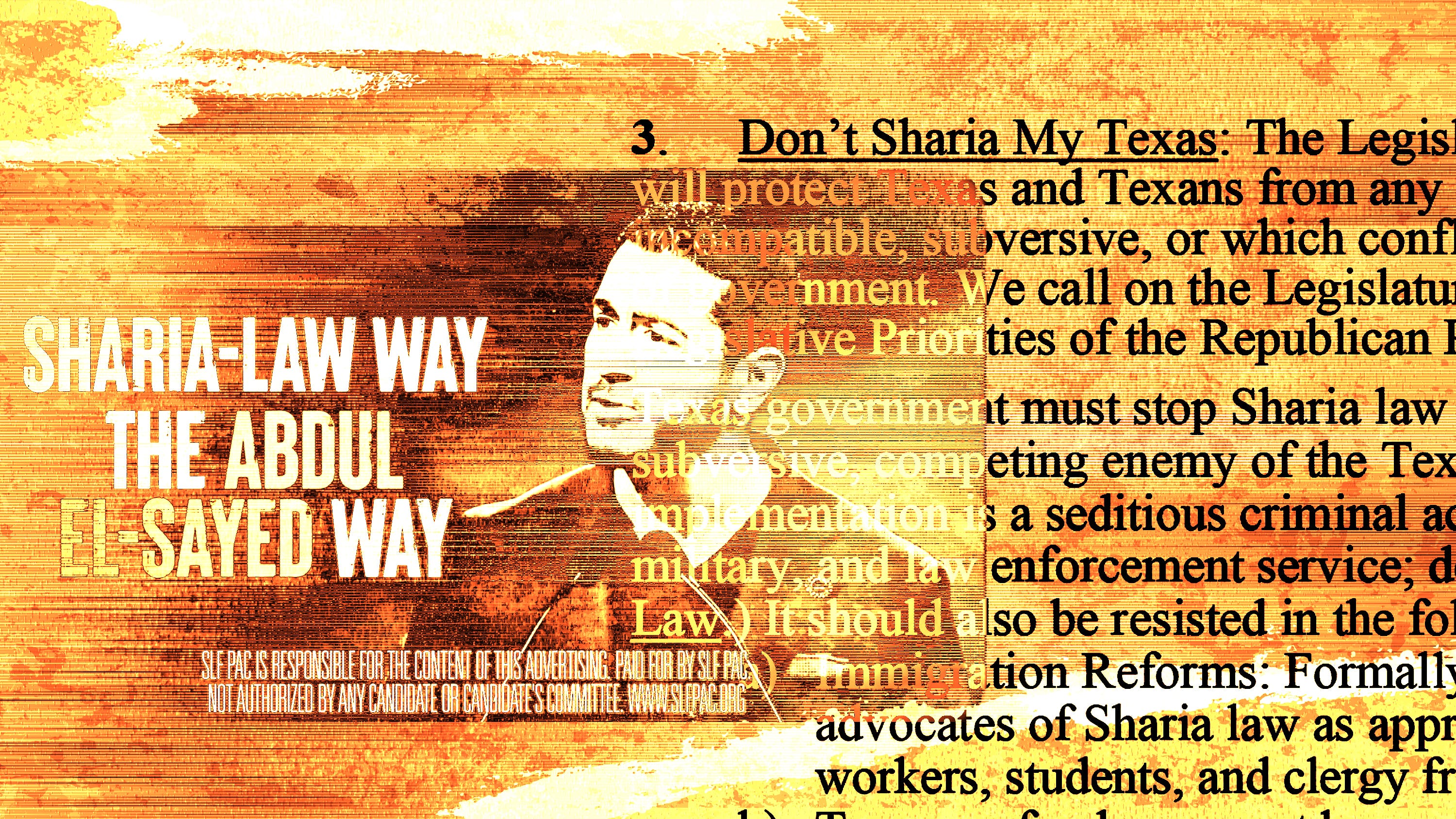
They’ve been at it for months—literally since the first hours after El-Sayed won the Democratic nomination in early August, when the GOP launched ads referring to him by his full first name, “Abdulrahman.” But they may have hit a new low last week, with an attack ad that’s all over the internet and television. Its central claim is that El-Sayed wants to impose sharia law, the religious code of Islam, on the rest of America.
The ad and the effort behind it are worth examining in detail, regardless of whether you care about Michigan’s Senate race—or, for that matter, how you feel about El-Sayed potentially becoming Michigan’s next senator. That’s because the campaign against him is an example of a destructive, dangerous trend visible all over America: Republicans and their allies not even pretending to observe traditional standards of accuracy, civility, and basic decency in politics, especially when it comes to Muslims.
Those standards have never been particularly high, to be clear, and Republicans aren’t alone in twisting facts to suit their political agendas. But the freedom that they feel to describe Islam and its adherents as menaces—along with their willingness to exploit the truth-bending capabilities of social media—makes for an especially toxic mix.
You can see it in Georgia, where a Republican candidate for lieutenant governor put out an AI-generated ad of Muslims invading a suburban neighborhood.
You can see it in Alabama, where a GOP candidate for attorney general proclaimed in a campaign spot that anybody who supports “radical Islam” can “Allahu Akbar your butt all the way back to the Middle East.”
You can see it in Texas, where the state GOP platform literally calls for passing “Don’t Sharia My Texas” legislation.
The rhetoric and strategy are all over the U.S. Capitol, too, where some Republicans have formed a “Sharia-Free America Caucus.” And that’s not to mention what you’ll hear from Donald Trump himself, who has repeatedly—including this past Friday—called El-Sayed “a violent, vicious jihadist.”
Trump and the others may actually believe El-Sayed is some kind of threat. Or not. Who knows. But this much is clear: Their willingness to bash Muslims and Islam shows they believe the strategy works, and they are sure to keep at it if the midterms go their way.
SO LET’S TALK ABOUT that Michigan ad, which you can watch here:
The narrator begins by quoting something El-Sayed once told the New York Times: “When I die and I stand before God and go through everything I did in my life, I don’t want to say I did it the easy way instead of the Sharia-compliant way.”
Dark, intense music, the kind you’d expect from an overdramatized thriller or horror film, plays in the background while the narrator asks: “The Sharia law way: What’s that?” Then comes the answer, words appearing in red and white against the backdrop of a woman in a black niqab: “Using government to dictate how women dress, requiring they have a guardian, or prohibiting women from filing for divorce.”
“The Sharia-law compliant way,” the narrator concludes. “Abdul El-Sayed’s way.”
It’s difficult to capture the full dishonesty of the ad. But a good starting point is what El-Sayed was actually saying in that quote, and what he was not. It comes from an interview El-Sayed gave seventeen years ago, to a reporter writing about a Michigan bank that offers customers a special kind of home loan for Islamic customers.
The article itself is actually quite heartwarming. It tells the story of an Ann Arbor banker who learned from a customer that Islamic law forbids the charging or payment of interest. The banker, who is Catholic, adopted some alternative financial packages (like loans that build interest into the selling price) that made mortgages technically compliant with Muslim law. El-Sayed appears briefly in the article—quoted once, near the end—because he had recently taken out one of those loans.
When El-Sayed, then a 24-year-old medical student, said he wanted to conduct himself in “the sharia-compliant way,” he meant using the religious code as a guideline for his personal life. It’s similar to the way a Catholic might describe following the Church’s dogma and doctrine, as several scholars explained to me, or to the way a Jew might describe observing “Halakhah,” which covers everything from prayer to diet.1
Here’s how Andrew March, professor of political science at the University of Massachusetts and a widely cited expert on Islam, put it to me in an email:
Obviously, and this cannot be stressed enough, whenever an individual Muslim, particularly one living in a non-Muslim country, speaks about living a “shari’a-compliant life” he or she is speaking about their own personal morality and behavior. This could be not drinking alcohol or eating pork, not having sex outside of marriage, not taking out loans that scholars may regard as usurious, performing the pilgrimage when it is possible, being loyal to one’s parents, and other matters that pertain to an individual’s own behavior.
Halakhah is an especially useful analogy here, because it too has a prohibition tied to financial transactions, though it applies only to loans between Jews. And as with sharia, there are financial workarounds—like structuring loans as business agreements—for those who observe.
One other parallel to Jewish law is that there is no single, universally agreed-upon version. Jewish law is the product of an ongoing debate among rabbis, literally going back thousands of years, with interpretations today varying depending on which authority you trust. And it’s the same way with Islam, as David Cook, a professor of religion and expert on Islam, told me in a phone interview.
“The people that are making the most blatant comments about sharia appear to present it as if it’s something unified, something like the U.S. Constitution that you could apply ‘sharia’—which, from a classical point of view, is really quite laughable,” Cook said.
Noah Feldman, a Harvard Law School professor who has written on Islamic law and public life, agrees. “Islam, much like Judaism, has many different overlapping claims to authority,” Feldman told me in a phone interview. “And none is the final word.”
Elections are supposed to be contests of ideas, not contests to see who can get away with the most bullshit.
That’s why independent journalism matters. We ask questions, check claims, and call out lies, hypocrisy, and prejudice.
With the midterms just days away—and another presidential election on the horizon—there’s plenty of work to do.
And we’d rather do it alongside people who believe in democracy and still think honesty matters.
BUT THE QUESTION that matters for voters in Michigan is not how El-Sayed observes or interprets his faith. It’s whether he intends to impose that faith on the rest of America. He has said repeatedly, unequivocally he would not—including in a now-viral moment at a recent town hall when answering a question from an audience member, later revealed (by reporter Marisa Kabas) to be a former Republican Capitol Hill staffer and son of a major GOP operative.
“I’m not running to be a Muslim senator—I’m running for U.S. Senate and happen to be Muslim,” El-Sayed said, echoing what John F. Kennedy said when people suggested his Catholicism might create divided loyalties. El-Sayed went on to say the “Constitution is the guiding light. It guarantees me the right to pray as I choose to pray, or not pray at all. It guarantees you the right to pray as you choose to pray, or not pray at all.”
The premise for the question was El-Sayed’s position on the Muslim Brotherhood, the cultural and political movement that seeks to organize government and society according to its understanding of Islamic law. Republicans and their allies have turned “Muslim Brotherhood” into a synonym for violent jihadism, once again glossing over complications like the fact that it’s an array of different groups (some more organized than others) whose members and sympathizers across countries hold a variety of views.
Its history does include political violence, and it has spawned violent offshoots (Hamas is one). The Trump administration recently designated several Muslim Brotherhood chapters as terrorist organizations. But the original, Egyptian branch formally renounced violence decades ago as a means of domestic political change, and nonviolent political participation is a substantial current within the ideological family of the Brotherhood.
It wasn’t long ago that establishment figures from both parties talked about engaging with elements of the Muslim Brotherhood in certain situations. And it so happens one of those figures was Mike Rogers, the former House Republican running against El-Sayed. As Detroit Metro Times recently reported, after a Muslim Brotherhood leader became president of Egypt in 2012, Rogers said, “Do I think there are moderate Muslim Brotherhood individuals we are going to have to reach out to and talk to? Yes.”
It is still entirely fair to interrogate El-Sayed about his opinion on the organization today and its place in the Middle East, just as it’s fair to ask him why he has declined to say whether Iran is a bigger national security threat than Israel. It’s also fair to ask why he said he has no family ties to the Muslim Brotherhood, even though (as reported by the Free Beacon) his half-sister once tweeted that their mother, who is Egyptian, talked about her involvement with “MB” in college.2
But El-Sayed has now answered those questions—noting, among other things, that his parents divorced when he was just 3 and that it was his father and father’s family who raised him. And whether or not you find those answers satisfying, any theory that he’s secretly part of, or sympathetic to, jihadist groups looking to impose their visions on gender and sexuality has to account for his strong defense of LGBTQ rights, not to mention his marriage to a highly educated, accomplished physician.
Here in the United States, his positions put him at odds with the Republican party, which actually does have a constituency looking to align public life with a religion. Examples include GOP state officials trying to post the Ten Commandments in courtrooms and classrooms, and House Speaker Mike Johnsoncalling homosexuality “inherently unnatural” and same-sex marriage “a dark harbinger of chaos and sexual anarchy that could doom even the strongest republic.” To justify his position, Johnson said, “I am a Bible-believing Christian. . . . Go pick up a Bible off your shelf and read it—that’s my worldview.”
Budget director Russ Vought, one of the Trump administration’s most powerful figures, has described America as a “Christian nation” and once wrote an essay called “Is There Anything Actually Wrong with ‘Christian Nationalism’?” Defense Secretary Pete Hegseth routinely invokes Christianity and talks about his crusade against the “godless left,” while making policy changes at the Pentagon—like dramatically reducing the number of recognized religions—widely understood as an effort to marginalize many non-Christian religions.
But nobody asks Rogers why he’s part of a party where leaders seem so willing to impose their faith on society.3
HONEST CRITICS have no shortage of material to invoke in their arguments against El-Sayed. They don’t have to attack Islam or Muslims, and it wasn’t that long ago that some Republican leaders vocally rejected such a strategy—including after 9/11 when, as my colleague Cathy Young wrote last month, George W. Bush drew a sharp distinction between Islam and Islamic-inspired terrorism, and then visited a mosque to emphasize the point.
“The face of terror is not the true faith of Islam,” Bush said back then. “That’s not what Islam is all about. Islam is peace.”
But that was twenty-five years ago, and a very different Republican party. The MAGA version enjoys singling out groups of Americans and beating up on them. It is also deeply invested in the idea that America is under assault from foreign invaders, with Muslims playing much the same role in Trump’s worldview as Mexicans and other Latin American migrants.
There’s a desperation behind these new Republican ads. Polls show GOP candidates behind in a bunch of key races, including Michigan’s. They need to change the dynamics or they’re going to lose both houses of Congress. But there’s a confidence too—a conviction that scapegoating Muslims taps into biases many Americans still feel, and that it will be enough to alter some outcomes.
It’s a depressing assessment of the state of American politics. The outcome on Election Day could help us determine whether it’s correct.
Feldman in our interview made this point about Islamic extremism: “There are extremists, so the first thing you’ve got to do is just fully acknowledge that outright. It’s been a scourge in the Islamic world for the last thirty-five years, and it has been a disaster. It has been bad for the world. That kind of jihadi Islam needs to be fought against. . . . But it would be strange to say the problem is with Islam, because every single social movement, set of values, set of beliefs, religious you-name-it has crazies.”
(Photo illustration by Bill Kuchman/The Bulwark | Photos: Getty, Shutterstock)
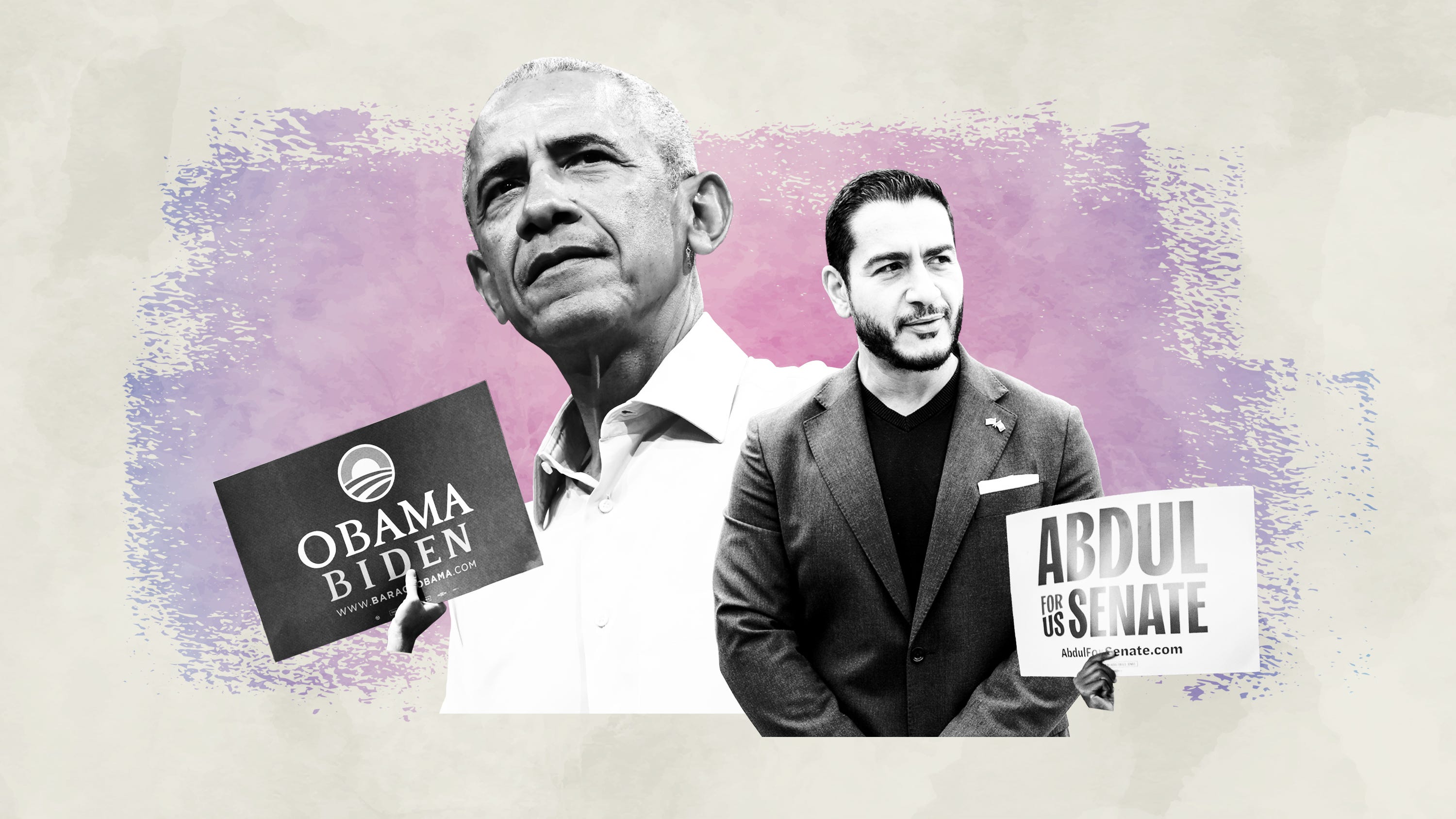
Along I-75 in Southeastern Michigan ABDUL EL-SAYED REMEMBERS EXACTLY where he was the first time he saw Barack Obama. It was July 2004 and El-Sayed was 19, standing at the kitchen sink of his parents’ house outside Detroit while the Democratic National Convention in Boston was playing on the television.
Obama, then a Senate candidate, was giving the primetime keynote address—an ode to hope, unity, and American pluralism that would go on to launch his career in national politics. But El-Sayed, who at the time was on the pre-med track at the University of Michigan, says the speech had a more personal significance for him. It made him believe a minority kid with a funny-sounding name could speak to and be accepted by much larger audiences, kindling an interest in politics that eventually would lead him to become this year’s Democratic nominee for Michigan’s open Senate seat.
“I was doing dishes, after I got home late and was eating on my own,” El-Sayed recalled this past Sunday, as we spoke on board his campaign bus in between events. “And I remember the TV being on and just being like holy . . . wow . . . I’ve never seen that before. And the speech was so good. And it was the first time I was thinking, ‘Bro, you’re talking about me.’”
This coming Saturday, El-Sayed will get a chance to tell Obama about this moment directly when the former president comes to Detroit to campaign for the Michigander. It will be the first time the two have met in person and only the second time they have spoken, following a phone conversation after El-Sayed won the nomination in August in which Obama called to pledge his support.
But for all of the gracious words they have said about each other in public and (reportedly) to each other in private, the fact remains that El-Sayed is part of the Democratic party’s progressive wing. And among progressives, the predominant sentiment about Obama’s presidency is a combination of ambivalence, disillusionment, and occasional hostility.
The premise is that Obama was too timid, that he failed to shake up institutions or distance himself from a party establishment bankrolled by corporate America—if not from a lack of fortitude, then at least from a lack of ambition. He may be the most popular politician alive, but there’s this long list of things he got wrong. He should have punished banks and bankers for their role in the 2008 financial crisis. He shouldn’t have embraced tough border control for the sake of bipartisan immigration reform that Republicans were bound to oppose. He shouldn’t have heeded advisers and members of his own party urging him to make deficit reduction a priority. And so on.
Progressives aren’t the only Democrats who express versions of these sentiments. But they are the ones who do so most loudly and frequently, and that includes El-Sayed, who during graduate studies in 2012 said of Obama’s re-election bid that he “was not the right choice—he just wasn’t the wrong one.” El-Sayed struck a somewhat more measured tone in his 2020 memoir, Healing Politics, praising Obama’s character and some of his policies accomplishments. But even then, he bemoaned the “inspiring intentions unfulfilled or reversed.”
During our conversation, El-Sayed didn’t exactly take back any of these sentiments. But he also expressed an appreciation for Obama’s leadership and the accomplishments of the Obama presidency not so evident in his past writing.
That evolution could be purely cosmetic, in order to avoid awkwardness now that Obama is on the way to campaign for him. Or it could be political expediency as El-Sayed tries to rally the Democratic faithful, especially black voters who have not embraced him with the enthusiasm they have Democratic candidates in the past.
Many of those voters remember ads from the bruising primary that made it appear (disingenuously) that El-Sayed had attacked Michelle Obama over the health initiatives she led as first lady. The former president’s blessing could go a long way to making those memories go away, and tilt what looks like a tight race in El-Sayed’s direction.
Jonathan Cohn sits down with Michigan Senate candidate Abdul El-Sayed to discuss his admiration for Barack Obama, the shortcomings of the Obama presidency, and the lessons he hopes to carry into the Senate. El-Sayed explains why he believes Obama made it possible for people like him to run for office, where he thinks Obama fell short on health care and other issues, and why Democrats need to stop assuming Republicans will negotiate in good faith.
Plus, El-Sayed discusses standing up to Trump, why he believes Americans are less divided than they think, and his philosophy of fighting bullies without becoming one himself.
(Photo illustration by Bill Kuchman/The Bulwark | Photos: Getty, Shutterstock)
ONE REASON HEALTH CARE is such a good issue for the Democrats in this year’s midterms is that pretty much everybody from the party’s different factions agrees on the problem and the solution.
For the moment.
In the short term, the problem is that Donald Trump and the Republican party cut Medicaid, then refused to extend enhanced Affordable Care Act subsidies, putting health care at risk for tens of millions of Americans.
The solution is to undo the cuts and renew the subsidies, which is precisely what Democratic leaders say is at the top of their agenda for a hypothetical new Congress and—if Trump won’t go along—a hypothetical trifecta two years later.
But the American health care system had big problems even before Trump and the Republicans delivered those blows to Medicaid and “Obamacare.” Millions of people lacked insurance, though far fewer than before the Affordable Care Act, and millions more struggled with high premiums or out-of-pocket costs.
That’s why Democrats are talking about next steps for finally getting to truly universal coverage—which, in turn, has restarted old arguments about whether to seek a total health care sector reset with Medicare for All or to seek more incremental changes, some of which would still be highly ambitious and some of which would not.
That debate got a ton of attention in the primaries. And while it has subsided a bit since, because it’s now Democrats versus Republicans rather than Democrats against each other, it is sure to kick up as soon as the midterms are over.
One person who has been thinking a lot about that debate is Andy Kim, the Democratic junior senator from New Jersey. He’s already got an idea for how the party should move forward if it gets the chance to legislate: He wants to act quickly to guarantee health insurance to all children as a first step toward bigger and more comprehensive reforms, through a proposal he calls “MediKids.”
It sounds intuitively simple, which is a bit deceptive once you get into the policy weeds. The thirteen-page bill Kim and three cosponsors introduced in July comes with all kinds of unanswered questions and, if implemented, would force all kinds of tradeoffs. Those include possible effects on existing private insurance and, naturally, the fiscal impact.
But those things would be true of any major health care proposal, as they would be for sticking with the status quo. And MediKids has plenty going for it, including the potential to keep the party united and to build some momentum for bigger changes, all while helping a bunch of children get health care they desperately need.
As Kim made clear to me in an interview—which you can watch below—that’s not a bad sales pitch.
KIM, WHO HAS BEEN IN CONGRESS for less than ten years and in the Senate for less than two, is not especially well known either to the public at large or inside the wonky world of health policy. But he sits on the Health, Education, Labor and Pensions Committee. And health care has played a key role in his political career, which started in 2017 when the newly elected Trump and the Republican Congress set out to repeal the Affordable Care Act.
At the time, Kim’s wife was pregnant with their second child, whom doctors had determined was seriously underweight and at risk of severe health problems, and possibly not surviving at all. “The doctors came in and talked to us, and they said, ‘You know, there’s a problem,’ which is the last thing you want to hear when you’re there for an ultrasound,” Kim told me.
“It was devastating to get this news,” Kim went on to say, “and while I’m there taking my wife to the hospital constantly for different therapies, to see what we can do to get the weight up, I was watching the TV and I was watching the news, and my own congressman from New Jersey is leading the charge on trying to gut pre-existing condition protections.”
Kim was referring to Tom MacArthur, a House Republican whose deal with GOP leaders, hatched quietly when it appeared negotiations had broken down, got legislation through the House and over to the Senate. Repeal never got through the upper chamber, stopped there by the dramatic thumbs-down vote of Arizona Republican John McCain. But Kim ran for Congress, making a defense of the Affordable Care Act and its protections for people with pre-existing conditions the centerpiece of his campaign.
Kim’s victory was part of the 2018 blue wave, in which the backlash to repeal played a major part. Since then he has continued to talk about health care reform and developed a special interest in children’s coverage—very much because, he told me, he’s a young father who understands what’s at stake.
“Thankfully my baby was born, we’ve been able to manage his health challenges, now he’s an all-star on his soccer team, and I’m really proud of that,” Kim said. “But ever since then, it really just stuck with me—the concerns about health care for everybody, but in particular when it comes to kids, when it comes to those who are most vulnerable, those who can’t look out for themselves, those that we as adults have a responsibility for.”
Kim, a Rhodes Scholar, also made it his business to learn about policy and the history of reform—leading him to propose MediKids, which, among its other virtues, is relatively simple to explain. It would automatically enroll every newborn into a new insurance program, giving parents the chance to opt out if they have alternative coverage in place. Kids could then stay on the program until they are 26 years old.1
Automatic enrollment, which would start two years after the law’s enactment, is the crucial element. Most children are eligible for some kind of insurance already, thanks to not just the Affordable Care Act but also to expansions of Medicaid and the Children’s Health Insurance Program, a 1997 reform. But because the patchwork of existing programs can be extraordinarily difficult to understand and navigate, kids fall through the cracks constantly, which can mean (among other things) that they miss out on screenings, checkups, and other preventive measures that keep them healthier later in life.
More children are bound to lose coverage in the future thanks to Trump and the Republicans: The “One Big Beautiful Bill” requires would-be beneficiaries to go through even more onerous enrollment processes—and pushes states to question eligibility a lot more aggressively. That’s one reason most analysts predict more children are about to become uninsured. Automatically enrolling children would prevent that kind of slippage from happening.2
Kim emphasized to me that he does not see MediKids as a stopping point for reform, or an alternative to any of the more sweeping proposals that would seek to insure people 26 and older. On the contrary, he said, he imagines this as a chance for Democrats to move fast and deliver benefits quickly to a politically sympathetic group before turning their attention to more ambitious changes.
Critically, Kim said he believed that covering all children would create a public “expectation” of universal coverage that would create support for filling in the gaps at other ages—perhaps, again, through some kind of automatic enrollment.3
“Are you really going to have this type of care,” Kim asked, “and then all of a sudden—when you’re [26] years old—want to give it up? I think it’s going to be something that’ll absolutely put us on that path for universal care.”
KIM IS BY NO MEANS the first politician to think of reaching universal coverage this way. Many of Medicare’s original champions, back in the 1960s, envisioned gradually expanding the program to cover people at different ages until eventually it covered everybody. Democrats in Congress and running for president in the early 2000s also proposed kids-first strategies.
In fact, two of them, former West Virginia Sen. Jay Rockefeller and former California Rep. Pete Stark, actually also called their proposal “MediKids.”4
A distinguishing element of Kim’s proposal is that he wants to cover children through Medicaid, not Medicare.5 The reason is a sign that he’s thought about this proposal seriously. The benefit package for basic Medicare has large out-of-pocket costs (that’s why most people have some kind of supplemental coverage, or enroll in “Medicare Advantage” private plans, which fill in the biggest gaps).
Medicaid, by design, has virtually no out-of-pocket spending and comes with a much broader set of benefits, including coverage for services like testing for lead poisoning, which is especially critical for babies and children with developing brains vulnerable to damage from such toxins. “Over 23 million kids are underinsured, which means their coverage isn’t meeting their needs,” Kim said. “That’s absolutely an abomination, in my opinion.”
Kim said he was also trying to be practical, by trying to expand coverage “in a way that isn’t trying to create some brand new agency, department, bureaucracy.” But Medicaid has some well-known weaknesses, too. Among other things, it can be hard for beneficiaries to find specialists who will accept it, because it pays providers so little.
Kim says boosting those payments would be an essential part of any legislation. That would add to his program’s costs—as would the possibility that some employers would stop offering coverage to dependents, so that the public sector would effectively be absorbing some of the health care expenses that employers now bear.
“Democrats will be looking for ideas that could represent additional steppingstones to universal coverage, and kids are a sympathetic group and relatively inexpensive to insure,” Larry Levitt, executive vice president at the health policy research organization KFF, told me over email. But, he noted, “Providing universal coverage to a group like kids who in many cases already have private insurance raises thorny issues about what happens to the money employers are paying into the system now.”
Kim said he hadn’t gotten a Congressional Budget Office estimate yet, but said it’s important to keep in mind the program’s long-term benefits. “I think of health care for children in particular being really an investment in this country,” Kim said. “Healthier kids mean healthier adults, which means a healthier workforce, which means a more productive economy.”
THERE WAS A TIME, not so long ago, that insuring children was a bipartisan cause. But it’s hard to imagine many Republicans going for a plan of even modest cost, let alone one that offers coverage to undocumented immigrants, as MediKids would.
Kim said he crafted his plan with that in mind, figuring it could pass through the reconciliation process—in other words, with just a simple majority in the Senate, rather than the sixty votes it would take to overcome a filibuster. “This is not a messaging bill,” he said. But getting all the Democrats on board could present its own challenges.
In most states, private insurers run Medicaid plans under contract, making MediKids a potentially tougher sell with progressives who are reluctant to support expansions that build on any form of private coverage. And while Kim envisions passing MediKids as a quick, targeted action, there’s no guarantee it couldn’t bog down a new president and Congress as much as bigger reforms might, potentially squandering the chance to do more.
Those political questions are important for Democrats to consider, as are the policy and budgetary implications of MediKids. But with any real chances of enactment likely two years away, now is the perfect time for Kim to showcase his idea, and see how it holds up to scrutiny.
The legislation calls for making Medicaid available to anybody under 26, though it would enroll only newborns automatically. It’s not hard to imagine a version that would include aggressive outreach to boost enrollment among older children born before the plan took effect.
The Republicans’ One Big Beautiful Bill “uses technology to create added friction, barriers, and redetermination hurdles to make eligibility harder to maintain,” Bruce Lesley, president of an advocacy group called First Focus that helped shape the MediKids plan, wrote after Kim introduced it in July. “MediKids removes those barriers to care for children and, as Medicare does for seniors when they turn 65, creates a default and expectation of enrollment at birth, guaranteed, continuous coverage, no annual paperwork barriers, no churn, and no families navigating a bureaucracy to keep a child covered.”
Rockefeller and Stark were some of the most dedicated and relentless champions for universal coverage of their time. You can read more about Stark, who died in 2020, here.
Medicaid is the program for low-income people, operated by the states in partnership with the federal government. Medicare is the program for seniors and people with disabilities, which the federal government runs on its own. Some people qualify for both, because—for example—they are both elderly and low-income.

 Login