Normal view

Kumquat Marmalade

By: David
19 January 2025 at 15:41

kumquat marmalade recipe

I’ve been on a marmalade bender lately. Well, it’s actually been for the last few weeks. Winter, of course, is marmalade season and the markets in Paris are heaped with citrus: Corsican clementines, pretty yellow bergamots, hefty pink grapefruits from Florida (although some infer appellations from elsewhere – namely, the Louvre), leafy lemons from Nice, and lots and lots of oranges.

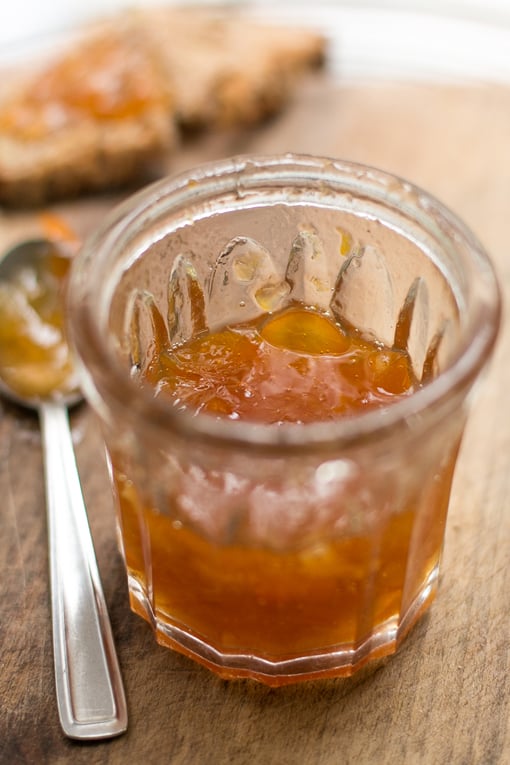
Kumquat marmalade

The stands are so piled up that it’s not uncommon to be walking down the aisle and have an orange roll off of the piles and land on your foot. (Which is why it is a good idea to wash any fruit before you use it.) This means I’ve got so many jars of marmalade, that when my friend Luisa stopped by and saw the jars piled on top of a shelf in my bedroom, she said “I’ve doing the same thing ” at her apartment in Berlin. Sometimes I think jam-making could be classified as an epidemic and if so, there’s ample evidence that I’m ready for an intervention.

kumquat marmalade recipe

While kumquats were once classified with their look-alike citrus brethren and sistern (admittedly, it can be hard to tell as it’s difficult to get a look under their navels), they are now placed in another genus category (Fortunella), even though they share many characteristics of citrus fruits.

Kumquat marmalade

One of those characteristics is that they are winter fruits. And another is that they are très bon pour la santé (good for your health), containing lots of vitamin C. And they also make you feel happier, since not only does their tangy-bitter flavor brighten up even the darkest of winter day, nothing makes me happier than to wake up in the morning and gaze at my shelf of marmalade first thing in the morning.

Kumquat marmalade

I was especially happy when I was doing my shopping at the outdoor market and came across a big bin of kumquats. I scooped up a nice-sized bag of them and brought them home, where they patiently waited in the refrigerator until I decided what to do with them.

Originally I’d considered giving them a quick-candying and strewing them over poached prunes with a scoop of ice cream. But I ended up sticking my fingers into the bowl of prunes a few too many times during the week and ended up with a small puddle of cinnamon-spiced dark syrup pooled in the bottom of a container in my refrigerator, which I didn’t think would go with anything.

Kumquat marmalade

So I decided to get out my little serrated knife, slice up my Fortunella fruits, and make marmalade. I added a couple of lemons not just to bulk it up, but because I thought with the added sugar, the marmalade would benefit from some extra acidity.

Kumquat marmalade

I normally spoon my marmalades on morning toast, but after I made this batch, I had cleaned up the kitchen and was going to reward myself to a nice bowl of split pea soup for lunch with some Comté cheese and – like most good ideas (and a few of the bad ones) – it suddenly occurred to me that the tart marmalade might be nice with the nutty cheese I was cutting into batons.

Kumquat marmalade

And sure enough, it was. Fortunately I have three nice jars of marmalade to add to my collection. So far this year I’ve made Seville orange marmalade (eight jars) and four jars of mixed marmalade, using the bergamots and citron that were plucked off a tree in Sicily. After all that slicing, seeding, and simmering, the last pot of marmalade has been jarred and stored; they’ll last me through the winter. And if I am prudent, a number of spring and summer mornings as well.

Kumquat marmalade

Print

Kumquat Marmalade

Many of the little rings of kumquats will, unfortunately, come apart as you cook the marmalade. The reward, however, is gorgeous jars of tangy marmalade that you’ll be happy to spread on your morning toast or serve with a bit of cheese after dinner. I served mine with Comté, but a nice goat cheese or another nutty mountain cheese, like Gruyère, would pair nicely with it. It takes a bit of patience to slice and pluck out all the seeds from the kumquats, but you can get 2 to 3 jars of marmalade for your efforts. I use a small serrated knife to slice off the stem end, then start slicing the kumquats crosswise, until I get close to the center. Finally, I stick the tip of the knife into the area where the seeds are and slip them into a small bowl. Because the seeds are rather large, any that you miss you can usually find just by doing a little scanning of your pile of sliced kumquats. I use oval Nagami kumquats, which are more puckery than the round Meiwi kumquats, which you sometimes come across. Do try to get organic or unsprayed fruit from your local market or natural food store. The kirsch is optional, but it does nicely round out the flavor of the marmalade. You can substitute another liquor, such as gin, Grand Marnier or Cointreau, light rum, or a dash of brandy. Or it can be omitted, if you wish.

Ingredients

  • 2 lemons stemmed, halved lengthwise, seeded, and very thinly sliced
  • 1 pound (450g) kumquats stemmed, seeded, and sliced
  • Reserve the seeds from the lemon and kumquats
  • 5 1/2 cups (1.3L) water
  • 2 cups (400g) sugar
  • pinch of salt
  • Optional: 1/2 teaspoon kirsch or other liquor

Instructions

  • Put the lemon slices in a large non-reactive pot. Cover with cold water and bring to a boil. Reduce the heat and simmer until the lemons are translucent, about 5 minutes. Drain. (Discard the water.)
  • Put the blanched lemons back in the pot. Tie the seeds from the lemons and kumquats securely in a piece of cheesecloth and add the seed sack to the pot along with the sliced kumquats and water. Bring to a boil; remove from heat, cover, and let stand 24 hours.
  • The next day, put a small plate in the freezer.
  • Add the sugar and salt to the pot, and cook the marmalade for 30 to 45 minutes over medium heat. Remove the bag of seeds and when it’s cool enough to handle, squeeze the seeds in the cheesecloth using your hands or place it in a ladle and press it with the back of a soup spoon (being careful not to break the fabric and release the seeds) over the jam pot to so the pectin goes directly into the marmalade mixture.
  • Continue cooking until it has reached the jelling point, about 220ºF (104ºC) degrees, if using a candy thermometer. To test the marmalade, turn off the heat and put a small amount on the plate that has been chilled in the freezer and briefly return it to the freezer. Check it in a few minutes; it should be slightly jelled and will wrinkle a bit when you slide your finger through it. If not, continue to cook until it wrinkles slightly on the chilled plate when you nudge it.
  • Remove from heat, then stir in the kirsch (if using), and ladle the mixture into clean jars.

Notes

Note: I store my jams and marmalades in a cool place, often the refrigerator if not planning to use them within a few weeks. if you wish to can or preserve them, you can check out these canning tips.

Related Recipes

Kumquat Marmalade (Recipe Girl)

Kumquat Marmalade with Star Anise (Drizzle & Dip)

Sunday Morning Kumquat Jam (Amateur Gourmet)

Small Batch Kumquat Marmalade (Food in Jars)

Maple Kumquat Marmalade (A Bloggable Feast)

Cranberry Sauce with Candied Oranges

By: David
16 November 2024 at 21:55

Cranberry Sauce recipe-6

It’s easy to forget about Thanksgiving in Paris. There are no bags of stuffing mix clogging the aisles in the supermarkets. If you asked a clerk where is the canned pumpkin, they would look at you like you were fou (crazy). And if you open the newspaper, you won’t come across any sales on whole turkeys. In fact, it’s quite the opposite; a friend saw a 5 kilo turkey, an 11 pound bird, at the market the other day for €68kg, or €340 ($424).

(Although I think if you spent over four hundred dollars on a turkey, you wouldn’t forget it for a long, long time.)

Cranberry Sauce with Candied Oranges

I suggested that the turkey vendor perhaps forgot a comma because whole turkeys are, indeed, available in Paris, and they actually excellent since most are fermier, not the plump whoppers you see in the states. The only thing you have to be careful about is that one turkey might not be enough if you’re feeding a large crowd, say, a group of over six people.

Savvy Americans know to order a whole turkey in advance from their butcher and – get this: You can ask them to cook it for you. Yes, since the butchers usually have spits with roasting chickens on them, it’s usually not a problem for them to slide a turkey on there. That’s especially nice because most people in Paris just have one oven and it’s hard to tie it up for the entire day with just a bird roasting in it when you’ve got so many other things to bake and cook off.

Cranberry Sauce with Candied Oranges

The reason I am sharing this recipe today, rather than days ago when everyone was in a tizzy posting recipes, shopping and preparing their menus, is that I kind of forgot that it’s Thanksgiving. Actually, I didn’t quite forget, but wasn’t swept up in the frenzy because this week, and today, are just like any other week or day in Paris.

People go to work and school, banks and stores are open, and no one is setting their alarms for le vendredi noir (Black Friday), although that’s starting to happen in France ever since the government loosened their restrictions on allowing sales more than the government mandated twice-yearly ones, as they did before the economy took a dip. (Tomorrow, I suspect at least one vendor selling an expensive turkey in Paris is going to have to offer a serious mark-down if he wants to sell that bird.)

Cranberry Sauce with Candied Oranges

So we’re celebrating tomorrow night with some friends who are making dinner. I’m pitching in and doing some baking, as well as bringing a nice bottle of Sauternes. I also happened to have a few cans of cranberry sauce that I had brought back from the states, that I was planning to bring, just for fun.

I sent my hostess a photo and she wrote back right away, threatening to blackmail me by making my canned contraband photo public. I beat her to the punch, posting it on Instagram. But when I noticed that of the four ingredients in the can, two were industrial sweeteners, I decided to take matters into my own hands.

Cranberry Sauce with Candied Oranges

Fortunately I had a stash of fresh cranberries in my freezer, since if a turkey was €68 a pound, I’d have to dig deeper into my pockets if I was going to have to buy fresh cranberries in Paris on Thanksgiving Day.

Cranberry Sauce with Candied Oranges

I candied some organic orange slices (which were normally priced), simmered up a syrup with the sharpness of cider vinegar and a hit of dark rum, then added my precious canneberges, cooking them ’til they popped. I stirred in the candied oranges, then packed it up, ready to go – getting a recipe in just under the wire.

Happy Thanksgiving!

Print

Cranberry Sauce with Candied Oranges

Note that the orange slices may fall apart as they get close to being done. Not to worry; they’re just going to be chopped up later. If you want, you can substitute 3/4 cup (180ml) orange juice for the water that you cook the cranberries in. I use dark rum, but whiskey, bourbon, or an orange-flavored liqueur, such as Grand Marnier or Cointreau, would work nicely in its place. You can double or triple the recipe if you wish.

Ingredients

  • 1 large naval orange preferably unsprayed, or another variety, with seeds removed
  • 3/4 cup (180ml) water, plus 3/4 cup (180ml) water
  • 1/2 cup (100g) granulated sugar
  • 1/2 cup, packed (90g) light brown sugar
  • 2 tablespoons dark rum
  • 1 stick cinnamon
  • 1 1/2 tablespoons cider vinegar
  • 1/8 teaspoon ground allspice
  • 1 cup (110g) fresh or frozen cranberries

Instructions

  • Lop off the two ends of the orange. With a sharp, serrated knife, cut the orange into 1/3-inch (1cm) slices.
  • In a medium-sized nonreactive saucepan, cover the orange slices with cold water. Bring to a boil, reduce heat, and cook at a low boil for 10 minutes. Drain. Return the oranges to the saucepan. Cover with water again, bring to a boil, and cook for another 10 minutes. Drain and rinse with cold water.
  • Return the orange slices to the saucepan, add 3/4 cup of water and granulated sugar. Bring to a boil then reduce the heat to a low boil and cook until the liquid is reduced to a thick syrup. During cooking, turn the oranges a few times in the reducing syrup so that they candy evenly.
  • As the liquid cooks down, close to when there is very little in the saucepan, monitor them closely turning them frequently to avoid burning them. Remove from heat once most of the liquid is evaporated. Tilt the oranges into a colander and let cool.
  • In the same saucepan, add the other 3/4 cup water, brown sugar, rum, cinnamon stick, vinegar, and allspice. Bring to a boil, add the cranberries, then reduce the heat slightly and cook until the cranberries pop and just start to fall apart. Chop the candied oranges into little pieces about the size of peas and add the candied oranges to the cranberries. Cook for about a minute, then remove from heat.

Notes

Serving: Pluck out the cinnamon stick and serve the sauce warm or at room temperature.
Storage: The sauce can be made up to one week in advance and refrigerated. Bring to room temperature before serving.

Related Recipes

Cranberry Sauce with Red Wine and Figs

Chocolate Pecan Pie

Mom’s Roast Turkey (Simply Recipes)

Cranberry Chutney

By: David
13 December 2023 at 15:17

Have you ever gone away for a few weeks and found out that you’d left the freezer door ajar? Well, I did. And let me tell you, it wasn’t pretty.

Before traveling, since I’m anti-gaspillage (against food waste), I jammed whatever I could into my already-stuffed freezer, including a half-eaten tomato tart, which I thought would be nice to have ready-and-waiting upon my arrival home, partially-used blocks of butter, and the miscellaneous leftover ends of bread that one collects when one constantly buys too much bread. When I returned, I realized that one of those bread pieces had been caught in the door and kept it from sealing closed.

Oddly, the fridge doors have an alarm, which beeps if they’re not completely shut, but the freezer door doesn’t. Coming home to an array of items that were half-frozen, half-defrosted (with gloopy liquid oozing out of them), possibly defrosted and then refrozen, and a few that were unidentifiable, was a bummer.

Some things I knew had to go – like sausages, stock, and a rather moldy half-eaten tomato tart, that I was sure could be reheated when I returned from my travels. (I won’t share a picture of that, but it looked like it needed a good shave.) But I also had several precious bags of cranberries that I’d stashed away for Thanksgiving and while they weren’t completely defrosted, I didn’t want to (or know if I could) refreeze them, so I decided to make chutney…and a whole lotta it.

Fortunately, all my candied and dried fruits were in fine condition and since I was cleaning my freezer, I also did a little purge of my drawers of things that weren’t sparking joy in my kitchen, and cooked them all up with some spices, some honey, orange juice, and vinegar, to make this tangy-tangy condiment.

(Just a note that dried fruits always spark joy in me. But a drawerful of little crinkled up cellophane bags with thirteen raisins or two dried apricots in them, don’t.)

To share my joy with you, I whittled my catastrophe-size recipe down to a reasonable recipe, but you’re welcome to double, triple, or quadruple it. Although it’ll keep for a few weeks in the refrigerator, I had so much that tightly sealed the overload into freezer bags and placed them back in the congélateur. However next time I’m headed out of town, I’m going to make sure my freezer is tightly sealed, because I’d be a bummer to lose those.

Print

Cranberry Chutney

Feel free to use any type, or combination, of dried fruit. Dates, figs, raisins, apricots, candied ginger, dried cherries, cranberries, pineapples, or other favorites, work well. (Of course, there's no need to chop the raisins or dried cranberries or cherries, if using.) You could also include chopped candied orange or lemon peel in the mix. Any tart apple is fine to use, but if using Golden Delicious apples, make sure to chop them very fine (unless you like chunks of apples in your chutney) as they don't break down as other apples do. If using frozen cranberries, no need to thaw them in advance. Just add them frozen and cook as directed. An interesting addition is to cook the chutney with a very small branch of rosemary. It'll lend an herbaceous note to the chutney. Remove it after the chutney is cooked. Or a tipple of whiskey (or an anise-based spirit, such as pastis) added right before the end of cooking could also be nice.
Course Side Dish
Keyword chutney, cranberry, sauce
Servings 3 cups (750ml)

Ingredients

  • 12 ounces (340g) cranberries fresh or frozen (if using frozen, no need to defrost before using)
  • 1 cup (125g) diced dried fruit (see headnote)
  • 1 tart apple cored, and finely diced (peeled or unpeeled)
  • 2/3 cup firmly-packed (140g) light brown sugar
  • 1/2 cup (125ml) orange or apple juice
  • 6 tablespoons (90ml) apple cider vinegar plus more if desired
  • 1 tablespoon honey
  • 1/4 teaspoon ground cinnamon
  • 1/4 teaspoon ground dried ginger
  • 1/8 teaspoon ground cloves
  • pinch red chile flakes
  • pinch salt

Instructions

  • Mix all the ingredients together in a large saucepan.
  • Cook over medium-high heat, stirring frequently, until the cranberries pop and begin to break down and release their juices, and the apple pieces are cooked through. Time will vary but it'll take about 10 minutes or so.
  • Remove from heat and when the chutney is cool enough, taste and add 1 (or 2) tablespoons additional vinegar, if desired.

Notes

Serving: Serve with turkey (at Thanksgiving or another holiday), or with poultry, pork, roasted vegetables, or even cheese.
Storage: Store in jars in the refrigerator until ready to use. The chutney should keep for at least a month. It can also be frozen for up to six months. If you wish to can it, you can find guidelines at the National Center for Home Food Preservation website.
 
❌