The moon has a brand new crater as of Wednesday, thanks to a rogue SpaceX rocket that crashed into Earth’s nearest neighbor at 5,400 miles an hour. Originally part of a 2025 mission to launch a pair of lunar landers for U.S. and Japanese companies, the rocket was supposed to fall back to Earth. Instead, it strayed off course and eventually reached its final resting place on the moon’s surface.
According to the Guardian, astronomers were unable to confirm the impact, “possibly because the impact site was close to the visible edges of the moon.” A day later, a Korean lunar orbiter captured images of the impact, but it will still take time to confirm the size of the crater, which is expected to be about 60 feet wide and 12 feet deep.
This isn’t the first time this has happened, for the record. In March 2022, a rocket slammed into the moon, creating a double crater about 95 feet wide. That object was later identified as part of China’s Long March 3C rocket, which propelled the Chang’e 5-T1 mission around the moon in 2014. In fact, there’s been trash on the moon ever since humans first landed there, which some scientists cite as evidence of the Anthropocene, a new geological era defined by how badly humans have messed up the planet and its nearby neighbors.
NEWS 🚨: A Korean lunar orbiter has photographed the crash site of a SpaceX Falcon 9 second stage on the Moon pic.twitter.com/chI8hpWdsv
Indeed, it’s difficult to estimate how space junk is currently orbiting our planet. By one count, there are more than 17,000 metric tons of objects in Earth orbit, including nearly 19,000 satellites. Every time we shoot more stuff up into space, we risk it hitting something else, as in a giant game of billiards. That threatens to create a cataclysmic chain reaction, in which every collision creates more space debris and also risks damaging satellites and space stations we’d like to keep operational. This might make future space launches unsafe (such as the planned Artemis IV moon landing mission) and could render GPS devices completely useless. If you think Google Maps is glitchy now, just wait.
This hypothetical scenario is called Kessler Syndrome, but I propose renaming it Tesla Syndrome, given that Elon Musk’s Starlink has nearly 11,000 satellites in orbit, with eventual plans to launch as many as 42,000. Musk’s car is still floating out there somewhere, too. The statistical probability of a company owned by the world’s richest man making our space trash problem even worse is high, so we’d better keep crossing our fingers for more near misses — and, just maybe, a future in which humans behave less like slobs.
Federal officials said the two states had failed to provide sufficient evidence that a number of disputed medical claims were legitimate. These include bills for in-home care and other services covered by the two states’ Medicaid programs for low-income residents.
Medicaid administrators say the funds can be recovered if the states supply the requested documentation. But the action is highly unusual: Typically, Medicaid officials partner with states to conduct an audit when they suspect fraud, a careful process that often takes years.
I’m a historian of social policy who led the first comprehensive historical overview of Medi-Cal, California’s statewide Medicaid system. I’ve found that U.S. leaders have long used the language of fraud and abuse to blur the line between correcting very real failures within Medicaid and – as I believe the Trump administration is currently doing – discrediting and defunding the program itself.
Who pays when Medicaid is cut? It affects children’s health care, nursing home care, disability services and health insurance.
Researchers estimate that almost 12 million people, on top of the estimated 28 million without health insurance in 2025, could become uninsured by 2034 due to these changes. By mid-2026, more than 3 million people had already lost their insurance coverage due to Republican changes to the Affordable Care Act.
‘Padlocking’ the ‘cookie jar’
In February 2026, Vice President JD Vance, Health Secretary Robert F. Kennedy Jr. and Dr. Mehmet Oz, the administrator of the Centers for Medicare & Medicaid Services, or CMS, announced a new anti-fraud initiative called Comprehensive Regulations to Uncover Suspicious Healthcare.
Also known by its rather unsubtle acronym, CRUSH, this initiative is taking unprecedented steps to withhold and defer funds in response to suspected fraud. “CMS is done trying to catch fraudsters with their hands in the cookie jar,” Oz said in announcing CRUSH’s formation. “Instead, we’re padlocking the jar and letting them starve.”
To be sure, Medicaid fraud, waste and abuse – such as providers billing Medicaid for services that are unnecessary or never rendered – are very real problems that cost taxpayers billions of dollars annually. They do divert funds from the low-income and disabled Americans enrolled in the program.
But the Trump administration’s latest moves are part of a much broader history of weaponizing Medicaid fraud and abuse – both real and imagined. I see them as a politicized attempt to prove that Medicaid itself is wasteful, that state governments cannot be trusted to administer federal money, and that public benefits inevitably invite dishonesty.
Secretary of Health and Human Services Robert F. Kennedy Jr. speaks about alleged Medicaid fraud and charges in Minneapolis in May 2026. Christopher Juhn/Anadolu via Getty Images
Providing little oversight at the start
Medicaid was established, along with Medicare for older adults, in 1965 as part of President Lyndon B. Johnson’s “Great Society” reforms. Despite providing millions of Americans with health insurance coverage for the first time, these programs had few centralized mechanisms for the kind of federal oversight that could prevent and catch fraud and abuse.
And the sheer scale and complexity of the Medicaid system – joint federal-state funding, varying eligibility requirements, millions of enrollees and thousands of providers – created opportunities for questionable billing practices among providers.
The 1970s saw a number of highly publicized Medicaid scandals involving nursing homes, laboratories, pharmacies and so-called “Medicaid mills” – healthcare providers that sought to bill the government for large numbers of Medicaid patients for shoddy and often fraudulent care.
The state-run Medicaid Fraud Control Units received generous federal matching funds to investigate and prosecute fraud.
The most serious Medicaid fraud was generally committed by healthcare providers and contractors, not patients. Medicaid Fraud Control Units were principally responsible for investigating providers, while also prosecuting the abuse and neglect of patients whose care was billed to Medicaid.
At the same time, however, Medicaid was becoming entangled in a broader political debate over social spending, whether many Americans were becoming too dependent on government benefits, and the alleged use of benefits by people who should not have received them. In the 1980s and 1990s, widely circulated stories about Medicaid exposed fraud and malfeasance by providers.
But disproportionately, they also highlighted the comparatively few instances of fraud by people enrolled in the program, such as cases where they submitted false receipts for covered medically related travel or sold drugs they obtained through Medicaid for free or at low cost.
Using Medicare fraud to justify spending cuts
The distinction between Medicaid and cash assistance programs, such as the Aid to Families with Dependent Children “welfare” program, frequently disappeared in political rhetoric. False or exaggerated stories that portrayed African American single mothers living extravagantly while fraudulently claiming welfare benefits became potent symbols of supposed government failure.
While campaigning as a presidential candidate, Ronald Reagan seized on this trope of the “welfare queen” in his attacks on social spending.
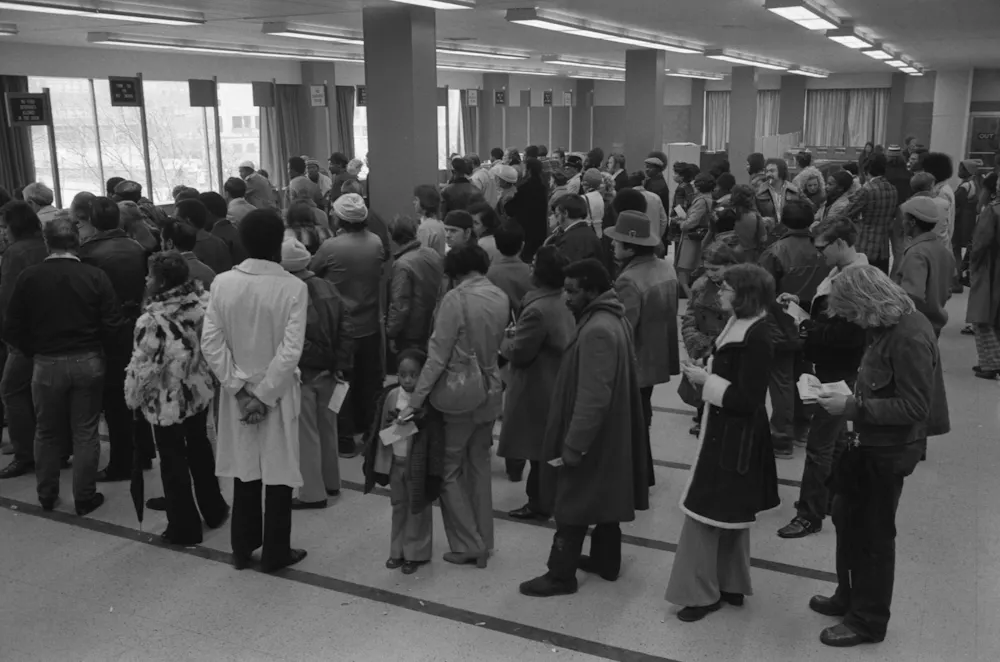
People line up at the Baltimore City Welfare Office in 1975, years before concerns about social spending led to big cuts to safety net programs. O’Halloran/Library of Congress via Getty Images
By the mid-1990s, opposition to welfare programs had become increasingly bipartisan. Politicians in both parties often used tales of Medicaid fraud on the part of providers and recipients to justify tighter eligibility rules and spending cuts.
Concerns about Medicaid’s “integrity” became highly politicized in the debates surrounding the ACA. Critics of Medicaid expansion argued that increasing the number of people who could get health insurance through the program would increase fraud and improper enrollment. Supporters of expanding Medicaid to help more Americans gain health insurance maintained that anti-fraud rhetoric often disguised ideological opposition to the program’s expansion.
Blurring distinctions then and now
For the six decades that this program has helped millions of low-income Americans get healthcare, politicians have blurred the distinction between protecting Medicaid from abuse and using abuse to discredit Medicaid itself.
In my view, the Trump administration’s campaigns against California and Minnesota continue that pattern. It is using real weaknesses within Medicaid to advance much broader political arguments: that Democratic states cannot be trusted, that public benefits naturally invite abuse, and that withholding funds is itself a form of reform.
The result will no doubt be that fewer low-income Americans will be able to get the healthcare they need.
If you need any proof that climate change is not some far off problem for future generations — it’s our disastrous present — look no further than the unfolding wildfire crisis gripping the globe. In Spokane County, Washington alone, three major wildfires have devastated the area, prompting the evacuation of almost 65,000 people and destroying more than 700 homes. But there are at least 14 other fires raging throughout the state. In nearby Oregon, a record-shattering 2 million acres have burned, with 102 new fires reported across the nation on Aug. 2 alone, seven of which are large. Meanwhile, across the pond, Europeans are battling their own record-breaking wildfires in the U.K., France, Greece and elsewhere, where two crew members were killed in a midair collision.
High winds and hot, dry weather have fueled the blazes, but these conditions have been worsened by climate change. Fires are a natural phenomenon, of course, but what’s unnatural is their intensity and the level of heat. Every time we burn fossil fuels, it adds more chemicals to the atmosphere that trap more heat, creating a positive feedback loop that makes everything hotter and drier.
Indeed, months of drought and heat waves tend to foreshadow the fiercest wildfires. As a recent analysis found on fires in Spain, Portugal, Turkey, Cyprus and Greece, “human-caused climate change was a key driver of the fire weather conditions, primarily through its influence on exceptionally high temperatures, but also by exacerbating drought conditions.”
The circumstances that make these wildfires so severe are becoming more and more common across the world. “Anywhere can burn under the right conditions, and unfortunately all of those conditions are changing,” Erica Smithwick, a climate scientist at Pennsylvania State University, told Scientific American recently. All of this serves as a warning. The question remains if anyone is still listening.
Health and Human Services Secretary Robert F. Kennedy Jr. repeatedly clashed with CNN’s Dana Bash on Sunday’s “State of the Union” over vaccines, COVID-19, autism research and the nation’s growing measles outbreak, with the veteran anchor challenging the health secretary’s claims by citing decades of scientific research and public health data.
The contentious interview came as the United States experiences its second consecutive record-breaking year for measles cases, with Bash noting on-air that infections have reached a 35-year high and that roughly 93% of cases have occurred among unvaccinated people.
Asked whether he accepted any responsibility for the resurgence after years as one of the country’s most prominent vaccine skeptics, Kennedy responded, “Absolutely not,” arguing the outbreak is part of a broader international trend and pointing to higher per-capita case rates in several other countries.
Kennedy instead blamed the COVID-19 lockdown period for reduced childhood vaccination rates, arguing that missed immunizations during the pandemic created today’s vulnerable populations. He also maintained that his department has responded quickly to outbreaks by deploying federal public health teams to affected states.
Throughout the interview, Bash repeatedly interrupted Kennedy to challenge claims she said conflicted with the broader scientific consensus, particularly on COVID-19 vaccines and autism research. At one point, she told Kennedy that “study after study after study” has found no link between vaccines and autism, citing findings from the National Academy of Sciences and the American Academy of Pediatrics.
Kennedy rejected those conclusions, arguing existing research has not adequately examined vaccines administered during the first six months of life and accusing Bash of relying too heavily on experts rather than the underlying research.
The exchange grew increasingly tense after Kennedy accused CNN of contributing to misinformation during the COVID-19 pandemic and suggested Bash was repeating claims without independently examining the evidence. Bash pushed back, defending her role as a journalist.
“My job is to find out and tell the truth,” she said.
The interview also touched on a Wall Street Journal report that President Donald Trump has encouraged Kennedy to pursue additional research examining possible links between vaccines and autism. Kennedy confirmed Trump supports further study while also saying his department is investigating a broader range of potential environmental factors that may contribute to autism.
The nearly 20-minute interview ended with Bash defending the role of scientific expertise in public health reporting while Kennedy maintained that federal health agencies should continue reexamining longstanding assumptions about vaccine safety and other medical issues.
A statement was released by a CNN spokeperson to Salon regarding this interview.
Dana Bash is a veteran journalist who conducted a newsmaking interview with Secretary Kennedy in which he stated that he supports parents getting their children vaccinated against measles and addressed President Trump’s push for further study into autism and vaccines. Asking tough, substantive questions to those in power is the job of every journalist, and Dana did hers incredibly well today. We stand behind Dana, her reporting, and CNN’s overall coverage of the COVID-19 pandemic.
UPDATED: Aug. 2, 2026 at 2:12 p.m. to include statement from CNN.
Six years ago, Match.com released an ad in which the devil met his true love: 2020. The couple spent their courtship sharing fun Covid-era activities, like stealing toilet paper, enjoying empty cinemas and stadiums, and taking selfies in front of dumpster fires, all to the tune of Taylor Swift’s “Love Story.” In a memorable tagline, Satan said, “I just don’t want this year to end.” Released in December, only weeks after the presidential election between Donald Trump and Joe Biden, it reflected the national mood perfectly: horror at what we’d all been through, and vast relief that it was almost over.
Sadly, it seems we are destined to live in that damned year until the end of our days.
The year ended on a high note. Biden was elected president, the new Covid-19 vaccines were about to become available and we felt we could look forward to a day in the not-so-distant future when going to the grocery store didn’t come with a potential death sentence. Many people were back at work in one way or another, and the government had managed to get the American people through the crisis without suffering economic ruin. But it soon became clear Trump was unable to admit he had lost his reelection bid, and by January he and his army of surrogates and influencers had worked his MAGA followers into such a frenzy that they stormed the Capitol to stop certification of the election results.
At the same time, the MAGA faithful at home, which had, with the president’s help, pushed snake oil cures and conspiracy theories about the virus for months, were unwilling to move on from their various obsessions. They were set to turn the anti-vaccine movement into a juggernaut that would be ready to take on the entire American public health system and challenge medical science in general. The “do-your-own-research” crowd had felt their power, and they liked it.
Still, most of the country eventually moved on. Things had changed in some ways. Working from home is now a regular feature of the work world, Zoom calls are an everyday thing, and digital learning and telehealth have become mainstream.
Imagine my surprise, then, to awaken on Wednesday to a Senate hearing featuring Dr. Anthony Fauci in which he was being asked about hydroxychloroquine and Ivermectin. I had to check to make sure I wasn’t accidentally watching a documentary about the pandemic. But no: Rand Paul, Kentucky’s GOP senator had decided to scrape off the scab yet again by calling Fauci to face a grilling by Republicans on the Senate Homeland Security and Governmental Affairs Committee. Fauci looked the same. Paul looked the same. The daft conspiracy theories sounded the same. It was as if the last six years never happened. Déjà vu all over again.
Before leaving office, Biden preemptively pardoned Fauci — and for good reason. The doctor had become the whipping boy of the MAGA right, commonly accused of personally creating Covid-19 (in cahoots with Chinese communists, naturally) and then making a vaccine that they insist killed more people than the virus. It’s all nonsense, of course. There are still debates about the origins of the virus, but the idea that Fauci created or enabled it in some way is ridiculous. The hearing, ostensibly called to get to the bottom of all this, is actually just the latest step in Rand Paul’s petty vendetta against Fauci that began when they sparred in a series of confrontations during the crisis.
Despite being a doctor, Paul has always had, shall we say, an eccentric view of medical science, and he could never get the better of Fauci in their meetings. But the senator wanted the last word, and he got it.
Despite being a doctor, Paul has always had, shall we say, an eccentric view of medical science, and he could never get the better of Fauci in their meetings. But the senator wanted the last word, and he got it. Ignoring Biden’s pardon, Paul threatened Fauci with perjury if he “lied” during this latest hearing, a charge he claimed would not be covered by the pardon. In fact, the whole hearing was obviously a perjury trap.
Paul had released Fauci’s 1,000-page private pandemic diaries — helpfully provided to him by Health and Human Services Secretary Robert F. Kennedy Jr. — which had been stored on government servers. The senator knew there would likely be inconsistencies between Fauci’s memory and what he wrote at the time. Fauci’s attorney wisely told him to assert his Fifth Amendment rights, which he did. Paul threw that attorney out of the hearing for attempting to explain why.
The senator’s Republican colleagues piled on in their questioning of Fauci. Ohio’s Bernie Moreno was especially grotesque, bellowing “Who the f**k do you think you were?” at the 85-year-old scientist. Even Trump was less harsh in his commentary about the hearing, merely saying that he stopped listening to Fauci after a while.
But the hearing wasn’t the only recent time warp. Trump has spent the last six years attempting to rewrite the 2020 election, and apparently it’s not enough that he made one of the greatest political comebacks in history. He needs to erase the fact that he ever lost in the first place, so he has deployed the intelligence community to find proof that he didn’t. and decided to give a primetime presidential address on July 16 to reveal the findings.
To no one’s surprise, it was a dud. The information he presented was mostly old news, and he failed to provide any proof that domestic or foreign actors had any impact on the election that year — because they didn’t. Even his MAGA media ecosystem was left unimpressed.
But Trump remains undaunted. He’s been willing to completely blow up the legislative session going into November’s midterms unless he gets his way with the SAVE America Act, legislation designed to suppress the vote, which Senate Republicans have so far refused to pass. (It will suppress their own voters too.)
For Trump and Republicans, the worst year in living memory will never end, and it’s easy to see why. Like the devil in that famous ad, it’s their idea of a good time.
Imagine this conversation with your spouse or roommate: “Dude, what is that smell? It stinks like burning diapers. Did you forget to pay the air?” Sounds like something from a knockoff episode of “Black Mirror,” right? Canned air was actually used as a bit in “Spaceballs,” with the joke being how absurd it is to pay for something we breathe freely.
While I claim no clairvoyant skills, given the ever-diminishing quality of the air we breathe, purified air could definitely become a commodity someday. Air subscription probably wouldn’t work exactly like other utilities, such as internet service or natural gas, where it gets pumped directly into your house, but then again, who is to say? The future could be as weird as the present and when it comes to air quality, things are changing fast.
At the moment, a new front in the endless culture wars concerns whether air conditioning is ethical or even necessary. That comes in the wake of yet another record-breaking heat wave that has pummeled the Northern Hemisphere. Europeans aren’t big fans of AC, it turns out, but things have gotten so hot that many people are now making the switch. It’s become a selling point for far-right figures like French presidential candidate Marine Le Pen, who has promised to blanket Europe in cool air, while British conservatives want to deregulate building codes that restrict AC.
Most forms of air conditioning are highly energy-intensive and, depending on its power source, can belch even more carbon into the atmosphere, trapping more of the sun’s heat and causing more intense heat waves. That feedback loop is likely part of the reason why temperatures previously considered extreme or impossible are now becoming the norm all over the world — but the suffering might be too great to ignore the benefits of AC.
The June heat wave carried a death toll of more than 10,000 people across 27 countries, according to data from EuroMOMO, a mortality monitoring network with backing from the World Health Organization and the European Centre for Disease Prevention and Control. Over 9,000 of those deaths were people aged 65 and older. Such extreme heat usually kills people via heatstroke, or by inflaming heart and lung diseases. Whatever the specific causes of death, this was a mass casualty event, on par with the earthquakes that hit Venezuela a few weeks ago. Climate scientists universally agree that this summer’s heat waves would have been “virtually impossible” without climate change.
This summer’s Northern Hemisphere heat wave has been a mass casualty event, on a par with the recent earthquakes in Venezuela.
On this side of the ocean, the U.S. is sweltering under its own heat domes, which have been made worse by more than 100 wildfires in Canada and Minnesota that are smothering the East Coast in toxic, deadly smoke, turning the July skies an earwax yellow. Dramatic videos of members of the Namaygoosisagagun First Nation in Ontario fleeing their homes by boat have flooded the internet because the images are truly apocalyptic.
Views of just one of the wildfires ripping across Ontario, Canada yesterday. Similar fire behavior is expected today.
Fires in Minnesota and Canada have made air quality across the east coast of the United States “unsuitable for everyone.”
At least 18 states have issued air quality alerts, as they should, because wildfire smoke wreaks havoc on the body, from the brain to the heart and lungs to the kidneys. The small particles in wildfire smoke are an escalating threat to global health, increasing risks of other diseases like COVID. As noted in a recent review in the journal Air Quality, Atmosphere & Health, these effects are not evenly distributed. Poor folks, immigrants, women, children, the elderly and ethnic and racial minorities are disproportionately exposed to these hazards.
But we’re all kind of used to this by now, right? And that’s a big problem. We now deal with wildfire smoke every year, in a “season” that stretches longer and longer each year thanks to warmer and drier conditions. Air pollution, wildfire smoke, industrial disasters like the East Palestine, Ohio train wreck and extended pollen seasons are all reasons why people are increasingly concerned with making their indoor environments actually breathable. The result is that air itself is increasingly becoming a luxury item.
The World Health Organization estimates that around 7 million people die from air pollution annually, while 99% of the world’s population lives somewhere that is exposed to air pollution levels above WHO health guidelines. So we stock up on air purifiers, now an $18 billion industry, along with indoor air quality monitors and subscription air filter services. While AC seems ubiquitous to middle-class Americans, approximately 34 million people in the U.S. struggle to afford it, which doesn’t account for the high-tech HVAC systems the ultra-rich indulge in. The issue of quality air access is increasingly linked privilege and wealth. Startups with names like Air Factory and FreshAir are already starting to crop up aiming to fill this growing market demand.
So what will the future really look like? Will people start wearing N95 masks indoors, or have breathing apparatuses hooked up to their chests like fighter pilots? Will air become a municipal service, or a luxury commodity like canned kombucha? If you miss your monthly payment to Amazon Oxygen, will you choke to death? Given the way things are trending, none of that would be entirely surprising. Summer 2026 is already on track to be the hottest in recorded human history, topping 2024, which edged out 2023’s record. (We saw a slight dip in average temperatures in 2025; it didn’t last.) This might well be the hottest summer of your lifetime, and also might be the coolest summer of the rest of your life. Read that sentence again: If you think things are bad now, wait a year. Or five.
My imaginary scenario could still be decades in the future, but a reality where people pay for air doesn’t seem like a joke anymore. We could decide to treat this sci-fi possibility seriously right now by working to cut down air pollution at the source. That would mean, at the very least, sharply reducing the use of fossil fuels — indeed, ending it, sooner rather than later — and choosing to protect forests instead of chopping them down for toilet paper, which is a big factor in why so much of Canada is burning in the first place.
The good news here — and there is some, believe it or not — is that we’re still in the middle of a global green energy revolution, even if it’s being diminished or undercut by the out-of-control AI industry. As much as the Trump administration denies the reality of climate change while catering to the fossil fuel industry, the Iran war and its resulting spike in energy prices are accelerating the transition to renewable energy. We can’t be sure if that’s happening rapidly enough to make a difference, but it remains true that every decision we make now to lower emissions will help to create a more livable future. Of course it’s absurd to imagine breathable air as something you can put a price tag on. The same could be said about food, water and healthcare. We can at least keep air in the realm of absurdity by fighting for a greener future, which we can still see ahead, even through the smoke.
American voters desperately want relief from rising prices — especially the increasingly unaffordable cost of healthcare. Democrats have a plan for that.
Massachusetts Sen. Elizabeth Warren recently introduced the Break Up Big Medicine Act with Sen. Josh Hawley, R-Mo., a bill that would split up the huge conglomerates that have made the current healthcare system so expensive and frustrating to navigate. Businessman Mark Cuban recently quipped that breaking up these near-monopolies could bring costs down by 40%.
If Democrats run on this healthcare affordability agenda, we stand a good chance of flipping not just the House, but the Senate too.
Insurers like UnitedHealth or Cigna don’t just sell coverage. They’ve consolidated power over virtually every part of our healthcare system, operating hospitals, clinics and pharmacy networks. And they use that control to generate billions in profits — by pushing patients toward care at the facilities they control.
UnitedHealth Group, for example, generates about 40% of its revenue — about $180 billion — from transactions between its thousands of subsidiaries. Its insurance branch steers patients to its roughly 90,000 affiliated doctors, and pressures those physicians to refer patients to its affiliated hospitals and clinics rather than lower-cost independent providers. And that’s not all. The company’s pharmacy benefit manager (PBM) arm pushes patients to affiliated pharmacies. Those pharmacies frequently upcharge patients for medicines, sometimes by 10 times the acquisition cost.
UnitedHealth Group is the largest of these conglomerates, but it’s hardly the only firm that operates this way. CVS Health owns Aetna, one of the nation’s largest insurers, in addition to the more than 9,000 CVS pharmacies it’s best known for. It also owns CVS Caremark, one of the nation’s largest PBM.
In theory, PBMs exist to save employers money by overseeing all the drug-related details of health insurance plans, and using their bulk-buying power to negotiate with pharmaceutical companies for big discounts and rebates. PBMs often tell employers that they pass along all the discounts and rebates they receive to the employer, minus a small fee for their services.
What they typically don’t mention is that many PBMs are affiliated with foreign-based entities called “group purchasing organizations.” In 2025, the House Oversight Committee launched an investigation into whether PBMs are using these overseas entities to skirt government oversight. Lawmakers have raised concerns that these arrangements allow PBMs to retain rebate-related revenue and fees within opaque corporate structures, rather than transparently passing those savings on to employers and patients.
Meanwhile, insurers continually deny coverage for treatments and procedures that patients need. They often force doctors to get insurer approval — known as prior authorization — before prescribing, or they force patients onto less effective drugs. That places an immense administrative burden on physicians, who can spend an average of 12 hours per week completing prior authorizations, time that they’d certainly rather spend with patients.
Prior authorization can have dire consequences for patients. More than eight in 10 patients that face prior authorization simply give up on treatment. About a quarter of doctors say that prior authorization delays have led to a serious adverse event for a patient in their care — whether that’s hospitalization, permanent damage or death.
Breaking up the healthcare conglomerates that have enriched themselves by immiserating patients and cheating employers is good policy.
Polls show that voters overwhelmingly support bold healthcare reform. According to a recent poll, nearly seven in ten insured Americans identified either lowering out-of-pocket costs or nixing prior authorization as the single most important change they want from their health insurance. It would be a mistake for Democrats to content themselves with merely tweaking the Inflation Reduction Act, the party’s last major healthcare reform, which primarily focused on reducing the federal government’s pharmaceutical spending.
That kind of incrementalism won’t work — Democrats cannot win by being Republican-lite. We need to target the insurer and PBM practices that directly drive up Americans’ out-of-pocket costs and force too many people to choose between filling their prescriptions and filling their gas tanks.
If Democrats are looking for a 50-state strategy for the midterms — something I insisted on as chair of the Democratic National Committee during the 2006 blue wave — Sen. Warren’s bill offers a great place to start.
Caregivers in the U.S. are paid just under $26,000 a year on average for the most important work there is. And this June, we learned the government drew up a plan to mark many of them dead.
Let’s back up: When someone who receives Social Security dies, the government owes nothing for the month of the death, even if she lived to its final day. Benefits run a month behind, so her last payment lands after she’s gone, and the bank is told to send it back. We have a system that can find a dead woman’s last dollar and claw it back inside a month. It’s made to ignore the living woman who bathed her, fed her, and sat with her at the end.
And now we know just how little this government values her.
Last month, The Washington Post reported on a whistleblower disclosure from senior Social Security Administration executive Jeremiah Schofield, filed with Sens. Elizabeth Warren, D-Mass. and Richard Blumenthal, D-Conn. It describes a plan, devised by Elon Musk’s DOGE and the Department of Homeland Security, to enter nearly 2.7 million living immigrants into the Social Security Administration’s Death Master File, the database used by banks, employers and agencies to confirm who has died. To be marked dead is to be severed from wages, banking and all social benefits.
That was the point: make immigrants miserable enough to self-deport. Two memos reportedly from then-Homeland Security Secretary Kristi Noem to the acting Social Security Commissioner, Leland Dudek, waved off the legal warnings, the disclosure says, stating “death is a state of ineligibility.” It didn’t matter that the people were alive.
The agency says the plan wasn’t carried out. But roughly 6,000 immigrants were marked dead last year, some of whom had to walk into a government office and prove they were still breathing. And when they did, Immigration and Custom Enforcement was there waiting to arrest them.
Even without the fear that this stunt evoked, aides and the night nurses are already leaving — their protections revoked, status in question — but the need for them isn’t shrinking. Over the next decade, the U.S. will have 10 million openings in direct care. We’ll squeeze this need into the margins.
Even without the fear that this stunt evoked, aides and the night nurses are already leaving — their protections revoked, status in question — but the need for them isn’t shrinking.
The care crisis will be intensified by the Supreme Court’s June 25 ruling in Mullin v. Doe, which clears the way to revoke the Temporary Protected Status of roughly 350,000 Haitians and 6,000 Syrians by July 10. This decision has been covered as a healthcare-staffing crisis, and it is that. But that is smaller than the truth: This will be a whole-lifespan problem, as the same workforce holds up both ends of American caregiving, elder care and childcare.
The PHI, a national research organization for the direct-care workforce, has already warned that without immigrant care workers, family caregivers will be forced to leave the workforce or cut their hours to fill the gap. That loss lands hardest on women across every sector and level of the workforce — caregiving is already the number one reason women voluntarily leave their jobs, cited by 42% of those who quit, according to Catalyst research — at a moment when women’s declining labor force participation is already draining the U.S. economy to the tune of an estimated $650 billion a year, or 2.9% of GDP.
New York and Massachusetts sit among the states with the most engaged care policy in the country. Florida and Ohio sit near the opposite end of that spectrum. It hardly matters. Take the caregivers out, and all four states end up in the same place: families with no one to turn to. No state legislates its way out of this loss. Without a caregiver, there is no care. Hard stop.
In much of East Asia, however, shaped by Confucian ideals of filial duty, and in Latino families bound by familismo, tending to the old and the dying is a calling claimed with pride. In the Philippines, which sends caregivers to the whole world, the work is a point of honor.
Other societies put public money in the place of reverence. The Netherlands has covered long-term care under universal insurance since 1968 and now devotes more of its GDP to it, about 4%, than any country tracked by the Organization for Economic Cooperation and Development. Sweden, Norway and Denmark similarly fund it as a public good, not a private scramble.
In Japan, the two meet. A Confucian, deeply familial culture, it wrote care into law, requiring every citizen over 40 to carry long-term care insurance, and spending, in 2020, 67% more of its economy on that care than we did. Reverence and infrastructure, together.
The U.S. managed neither. We file care work under menial; overwhelmingly staff it with women, people of color, and immigrants; and pay as if they could feed their families on the sheer joy of being useful.
The reverence born in other countries arrives here, carried by the first generation, and finds nothing to hold onto: no paid leave, no funded care, no status, no relief. If it survives, it does so against the steady pull of a country that degrades and ignores caregiving. The further individuals get from arrival, the easier it becomes to forget cultural standards. That is not immigrants shedding their values. It is a country that imports devotion and budgets nothing to keep it alive.
One in five of the people caring for our children are immigrants — more than 40% in New York City, half in LA — more than half of whom are not citizens. When these hands go, the need remains. Intense work lands on the daughter, the wife, the sister, who absorbs the collapse, on top of her own life and career, uncompensated. It lands on the Panini Generation, pressed between aging parents and young children without paid leave or reprieve.
That daughter is often the one the family was proudest to send away. Education carries a woman farther from home — two to three times farther from her family, research finds, than her less-schooled peers. In her memoir, “My Life In Full,” Indra Nooyi, who left her parents in India to ultimately run PepsiCo, wrote that her mother raised her with “one foot on the accelerator and one on the brake, to go succeed and then come back to family.”
So, we lose. We lose in our communities, as neighbors disappear and businesses shutter with a workforce afraid to show. We lose in our homes, where we need those extra, loving hands. We lose in our accounts, drained by the care no one will fund. We lose in our companies, as women leave when caregiving can’t be negotiated. We lose in our relationships. We lose our people. And then, we reach our melting point and quietly lose ourselves.
The U.S. machine can find the dead and reclaim their last dollar inside a month. It purposefully leaves destitute the people who rocked, fed, bathed, lifted and bury us. Whose hands have caught everything this country dropped and asked almost nothing back. That’s what they get — and we lose.

 Login
Login