❌

Normal view

Pluralistic: Priceful (28 Sep 2026)


Today's links

  • Priceful: So worthless we can tell you what it's worth.
  • Hey look at this: Delights to delectate.
  • Object permanence: Nasdaq allows post-9/11 penny stocks; USAF can shoot down civilian aircraft; TSA bans calling Kip Hawley an idiot; Wells Fargo sued for firing fraud-refusing tellers; The real AI apocalypse; Encryption didn't cause 9/11; Bat-person costume; British Library on DRM and CC; NYT v OWS; "The Brave Little Toaster"; Bounty for Trump's tax return; Chinese real-estate bubble; Corbyn's Labour conference speech; HP blinks; "Are you calling me a racist?"; "Yuge"; Debts that can't be paid won't be paid.
  • Upcoming appearances: Edmonton, Boston, Brighton, Virtual, South Bend, Hudson, Calgary, Winnipeg, Paris, OVancouver, Victoria, Ottawa, Kilkenny, Montreal.
  • Recent appearances: Where I've been.
  • Latest books: You keep readin' em, I'll keep writin' 'em.
  • Upcoming books: Like I said, I'll keep writin' 'em.
  • Colophon: All the rest.


A pastoral landscape with a cablecar system running overhead. A procession of old-timey cash registers are being moved through the sky on it.

Priceful (permalink)

Digital rights activists have long railed at the use of the term "IP," criticizing it for being deceptively imprecise and also rhetorically dishonest. I get where these objections are coming from, but I think they're misguided.

Start with "deceptively imprecise." "IP" covers a lot of legal ground, from the "big three" of copyright, trademark and patent, to a whole arcane bestiary: anticircumvention, noncompete, trade secrecy, nondisparagement, database and publicity rights, and more. Each of these has a radically different policy basis and radically different contours.

Take copyright and trademark. Copyright is designed to allow companies (and the creators they hire or contract with) to commercially exploit creative works. In the US, copyright is a creature of the Constitution, Article 1, Section 8, Clause 8:

https://constitution.congress.gov/browse/essay/artI-S8-C8-3-2/ALDE_00013064/

Fun fact: there are only two clauses in the Constitution that include a rationale: the Second Amendment ("A well regulated Militia") and the copyright clause ("To promote the Progress of Science and useful Arts"). Everything else is one of those "truths" that the framers "held to be self-evident." In these two cases, they decided to explain their thinking.

So the point of copyright is to incentivize investment in creative works, and its mechanism is a set of limited rights over those works, for limited times. Copyright expires, and it is subject to "limitations and exceptions," including "fair use," a very broad set of highly situational rights to use works even if the rightsholder objects:

https://pluralistic.net/2026/02/07/aimsters-revenge/#effective-means-of-access-control

Now consider trademark: trademark could not be more different from copyright! Trademark is a consumer protection rule: it empowers companies to sue competitors who engage in deceptive conduct that could confuse their customers. The idea here is that if you get a pair of fake Nikes that fall apart within a matter of days, or eat at a fake McDonald's whose food is (somehow?) even worse than regular McDonald's food, you are unlikely to take action. You're not going to hire a lawyer over a hamburger.

So trademark deputizes companies to sue on behalf of customers who have been or might be deceived by unscrupulous competitors whose merchandising and marketing are likely to confuse the public. Unlike copyright's "fair use," trademark has other defenses, like "nominative use" ("This case fits an iPhone" is not a trademark violation, provided it's true). Also, many trademark claims can be dispensed through simple disclaimers: for example, my debut novel Down and Out in the Magic Kingdom features a prominent notice informing readers that it wasn't endorsed by the Walt Disney Company. No confusion, no problem.

Unlike copyright, which (eventually) expires, a trademark can carry on for so long as it is associated with a company's products or services. Procter & Gamble's moon logo has enjoyed trademark protection since the mid-19th century, 50 years before the first federal trademark law, and 100 years before the Lanham Act, the current federal trademark law.

This is where the imprecision comes in. There are many activities that are legal under trademark and prohibited under copyright, and vice-versa. By claiming an "IP" violation, you can induce confusion in your target's mind about which rule you're discussing.

If you say, "That's my copyrighted image and your use of it is confusing my customers," I might reply, "Well, that sounds like a trademark issue. Do you have a trademark, too?" Whereas if you say, "That's my IP and you're confusing my customers," that's some tactically useful ambiguity. I can't know if you're talking about copyright, patent, trademark, or, you know, a sui generis broadcaster's right under the Treaty of Rome.

I might walk away from my creative, expressive activity even though it's totally legal, because you've got me to conflate the restrictions of copyright and trademark. This makes "IP" a kind of bully's charter, whose imprecision lets you invoke all weird rights we call "IP," no matter whether they apply to the situation at had.

That's the first objection, then: this deceptive and corrosive imprecision. It's a fair point. But then there's the other objection: the use of the world "property" to describe this motley assortment of regulatory fiats.

"Property" is the established catechism of the Church of Late-Stage Capitalism. "Property" is the most sacrosanct right in public orthodoxy, elevated above every other right. My property right lets me destroy perfectly good food while you starve outside my door:

https://pluralistic.net/2026/07/08/wilhoitian/#human-rights-v-property-rights

Before "IP" came into wide usage, we didn't generally try to group this miscellany under one umbrella, but when we did, the term we used wasn't "IP," it was monopolies. These regulatory fiats were (correctly) considered to be government-granted, government-enforced monopolies. The adoption of IP was a branding exercise, a very successful attempt to transform the public's perception of these rules as natural, freestanding property rights that the law merely ratified – not a set of regulatory gifts designed to protect the self-interest of commercial firms.

I get it. Between the tactical confusion and the invocation of "property," "IP" feels like terrain worth fighting over. Once you let your adversary frame the debate in terms of property, you've already lost half the battle.

For many years, I bought into this. But lately, I've grown more skeptical of this matter. Back in 2020, I published a long essay proposing that far from being confusing or ambiguous, "IP" has a crisp, widely understood meaning: "Any law that lets me reach beyond the walls of my company to exert control over my competitors, critics and customers":

https://locusmag.com/feature/cory-doctorow-ip/

This is the common factor that binds together that mess of legal oddments, from trademark/copyright/patent to nondisparagement and noncompetes to anticircumvention and personality rights.

I think this is both true and a powerful framing. It correctly puts IP in the category of "things corporations do to control you and the rest of the world."

I've been trying this out for six years now, and I think it's a winner. But it was only a month or two ago that I realized there was a way in which the use of "property" can also be used to undermine the bullying, censorship and extraction of corporations wielding their IP.

Property rights may be our state religion, but they are also the worst tool for several important jobs that need doing. Think of privacy: the standard for privacy is for you to click through an "agreement" that nominally trades your privacy rights for some product or service. Google spies on you constantly for ad-targeting, you get to see Youtube videos (after watching a bunch of ads).

This is a catastrophe. Virtually every vendor you engage with, from your landlord to your corner deli, wants you to install an app whose terms of service requires you to sign away all of your privacy rights, forever, in exchange for nothing. You get the same sandwich, but you "pay" more, in the form of all your private data, which is flushed into the unregulated data-broker sector to be weaponized against you in a thousand ways, including higher prices and lower wages:

https://pluralistic.net/2026/07/11/your-risk/#my-reward

Worse: because you have "entered into a contract" to "sell" your privacy rights, anything you do to claw those rights back is violation of your end of the contract. Using a tracker blocker like Privacy Badger makes you the cheater:

https://privacybadger.org/

Even if you could get actually paid for the use of your private information, the sums involved would round to zero. Companies like Facebook make pennies from your private data, and inflict harm on you that totals up to hundreds of times more than they actually make. The commercial surveillance industry are poster children for corruption: concentrated gains that are far exceeded by diffuse harms:

https://locusmag.com/feature/cory-doctorow-zucks-empire-of-oily-rags/

But just because privacy doesn't fit well into a property rights framework, it doesn't follow that there's no way to do privacy well. We have lots of other rights frameworks besides property, and it's taken the concerted work of generations to get us to forget that these rights exist at all.

Imagine if our privacy regime was modeled on the human rights system we rely on when it comes to sex, bodily autonomy and consent. In this framework, no one is allowed to do anything to you unless you give your continuous, informed consent, which you can withdraw at any time. "I changed my mind" is a perfectly valid thing to say in the middle of a sexual encounter. It's not a violation of your contract. Quite the opposite: someone who ignores your withdrawal of consent is guilty of criminal assault.

If we apply a consent regime (not a property regime) to privacy rights, then the entire commercial surveillance industry would cease to exist. There's no way you can give "informed consent" to a laundry-list of terms of service that are as impenetrable as they are lengthy, and even if you did, you could withdraw that consent at any time, and Facebook et al would have to immediately stop processing your private information and disgorge it.

Like all forms of property rights, "IP" has severe limitations that can only be addressed by applying a different framework to your disputes. Think of the way that the expansion of copyright has failed creative workers. For 50 years, we've monotonically expanded copyright in every dimension, so that today, copyright covers more works, restricts more uses and inflicts higher statutory penalties.

Over those 50 years, media companies have gotten richer and more profitable while the creative workers whose art these media companies sell have gotten poorer, both in real terms and as a share of the earnings our labor generates for our bosses. This seems like a paradox at first, but really, it's just a built-in feature of property law: that people who have assets but lack bargaining leverage end up selling those assets for peanuts.

In a market dominated by five publishers, four studios, three labels, two app companies and one ebook/audiobook company, giving a creative worker more to bargain with is just giving them more to bargain away. Giving us more copyright is like giving a bullied schoolkid more lunch money: no amount of lunch money will get that kid fed.

This is why arguments about copyright and AI training are such a dead-end. Even if you stipulate that AI training isn't fair use (far from a certainty), or if you want legislative action to establish that every creator gets to decide whether their work can be used to train an AI, you won't help creative workers win the class struggle against AI companies.

Remember the Hollywood writers' strike? It's the only time in history that creative workers have defeated AI, so it's worthy of close study. Specifically, remember that workers on those picket lines weren't striking against the AI companies, they were striking against the studio bosses, artist-hating billionaires like Warner's David Zaslav and Disney's Bob Iger, whose careers have been defined by a relentless quest for ways to pay creative workers less. It was studio bosses, not AI bosses, who wanted to replace screenwriters with AI.

These are the same studio bosses who are now suing AI companies for copyright infringement. That's not because the studio bosses want to get rid of AI models or keep them out of the writers' room. They absolutely want to fire writers and replace us with AI. The studio lawsuits over AI training want to make training a licensable activity so that the studios can get paid for the use of "their" training data to make models that they absolutely want to use to fire most of their writers and then knock down the wages of the survivors of the AI layoffs.

Many creative workers have cheered on these media companies as they chase the AI companies through the courts, and some artists' groups have even submitted amicus briefs on their behalf. But the New York Times – a company that has repeatedly used the dirtiest union-busting tactics imaginable against its workers – is not suing OpenAI to ensure that creative workers don't lose wages to AI. They're suing to make sure that the Times gets a bigger piece of the action when that happens.

If the Times, Disney and Warner prevail, they will immediately amend their standard, non-negotiable contracts to require every creative worker who does any work for them to exclusively and irrevocably sign over the right to train AI with our labor, and the resulting models will be used to attack our jobs and wages.

In other words, the media company/AI company lawsuits are a fight to see who gets the biggest piece when creative workers get eaten for dinner. We don't want either side to win: we want to be taken off the menu altogether.

Which is exactly what the Hollywood writers accomplished, and they didn't use copyright to do it. They used something far more important and powerful: labor rights.

Like all the Hollywood guilds, the Writers Guild of America has a nearly unheard-of labor right. They are able to engage in something called "multi-employer bargaining," itself a weak form of "sectoral bargaining," which is when all the workers in a sector bargain with all the bosses in that sector. Sectoral bargaining was made practically illegal under the 1947 Taft-Hartley Act, and its last vestiges are to be found in Hollywood.

But as vestigial as Hollywood's unique labor rights system may be, it was still enough to let thousands of freelancers beat back AI in their writers' rooms. Indeed, they even retained the right to use (or not use) AI if they chose, without any threat to their wages or headcount:

https://pluralistic.net/2023/10/01/how-the-writers-guild-sunk-ais-ship/

This is something you can only get with labor rights, not copyright and certainly not property rights. If we limit ourselves to property rights, the only question we need to ask is "Who owns that writers' room?" And since the answer is "the studio" then whatever the studio says goes.

It's precisely because labor rights get workers benefits at their bosses' expense (and copyright cannot) that we have been subjected to generations of pro-copyright messaging, told that we aren't workers at all – we're small businesses, LLCs with MFAs!

Creative workers have been taken for a ride. We've been told that we're not workers, so we shouldn't advocate for labor rights. We've been told that copyright is better than labor rights, because copyright is a property right. It puts a price on your work, which means you can get paid.

But prices are things we assign to things that are so worthless that we can say what they're worth. The most valuable things in the world aren't property, and describing them as property would cheapen them. Human beings aren't property. The fact that we're not property doesn't mean we're worthless, it means we're priceless. That's why "murder" isn't "theft of life" and "rape" isn't "theft of sex." Your life and bodily integrity are worth too much to be bought and sold.

Property rights have a role to play in the assertion of human rights and other rights, but it is a subordinate role. Property rights might someday end the barbaric practice of homeless encampment sweeps and the confiscation of all the worldly goods of the poorest, most vulnerable people in our midst:

https://projects.propublica.org/impact-of-homeless-sweeps-lost-belongings/

But property rights must be subordinate to human rights, otherwise they'll let landlords evict tenants willy-nilly.

Which is all to say, by all means, let our adversaries claim "IP." Let them admit that they have this doctrine by which they attempt to assert control over their critics, customers and competitors. They can assert control, and we'll keep autonomy and consent. Let them say that they have property rights over things so cheap they can have a price. They can be priceful, we can be priceless.


Hey look at this (permalink)


A shelf of leatherbound history books with a gilt-stamped series title, 'The World's Famous Events.'

Object permanence (permalink)

#25yrsago Nasdaq allows sub-$1 shares to avoid mass delisting after 9/11 https://www.nytimes.com/2001/09/28/business/moratorium-by-nasdaq-on-listing-rules.html

#25yrsago USAF makes it much easier to shoot down civilian aircraft https://www.chicagotribune.com/2001/09/28/rules-revised-for-downing-airliners/

#25yrsago Don't blame encryption for 9/11 https://web.archive.org/web/20010930005338/http://news.cnet.com/news/0-1272-210-7320099-1.html

#20yrsago Disneyland parking structure repeatedly robbed at gunpoint https://web.archive.org/web/20061031031505/https://www.ocregister.com/ocregister/homepage/abox/article_1291046.php

#20yrsago HOWTO: Make a bat-person costume out of an old umbrella https://www.evilmadscientist.com/2006/how-to-build-a-better-bat-costume/

#20yrsago American Airlines bans in-flight kissing https://web.archive.org/web/20061004214421/https://www.newyorker.com/talk/content/articles/060925ta_talk_collins

#20yrsago British Library takes on Creative Commons and DRM https://web.archive.org/web/20061022143612/https://www.bl.uk/news/pdf/ipmanifesto.pdf

#20yrsago TSA: calling Kip Hawley an idiot is not allowed https://www.flyertalk.com/forum/checkpoints-borders-policy-debate/606142-i-detained-tsa-checkpoint-about-25-minutes-today.html#post6440005

#15yrsago Who’s occupying Wall Street, and why is the NYT only interested in the kooks? https://www.nytimes.com/2011/09/25/nyregion/protesters-are-gunning-for-wall-street-with-faulty-aim.html?_r=2&hp

#15yrsago Podcast: my story “The Brave Little Toaster” https://dn710605.ca.archive.org/0/items/Cory_Doctorow_Podcast_212/Cory_Doctorow_Podcast_212_Brave_Little_Toaster.mp3

#10yrsago The dubious upsides of having a Syrian passport https://globalvoices.org/2016/09/29/i-am-lucky-to-have-a-syrian-passport/

#10yrsago State of California imposes 12-months’ worth of sanctions on Wells Fargo https://web.archive.org/web/20161003194157/http://www.treasurer.ca.gov/news/releases/2016/20160928.asp

#10yrsago 2600 Magazine offers $10K for Trump’s tax return https://web.archive.org/web/20160930162135/https://motherboard.vice.com/read/hacker-zine-says-it-will-pay-10000-for-trumps-tax-returns

#10yrsago Black voter registration is inversely correlated with black death at police hands https://www.wired.com/2016/09/intriguing-link-police-shootings-black-voter-registration/

#10yrsago Chinese real estate bubble is “biggest in history” https://web.archive.org/web/20160929135157/http://money.cnn.com/2016/09/28/investing/china-wang-jianlin-real-estate-bubble/

#10yrsago Notes from Jeremy Corbyn’s barn-burning speech at the Labour Party conference https://www.mirror.co.uk/news/uk-news/8-key-points-jeremy-corbyns-8936364

#10yrsago Douglas County, OR using dirty ballot tricks to finish off the slow murder of its libraries https://web.archive.org/web/20160930155357/https://action.everylibrary.org/douglascounty

#10yrsago HP blinks, says it will restore printer functionality, but there’s a LOT more it needs to do https://www.eff.org/deeplinks/2016/09/dont-hide-drm-security-update

#10yrsago The Doonesbury Trump retrospective proves that Garry Trudeau had Drumpf’s number all along https://memex.craphound.com/2016/09/29/the-doonesbury-trump-retrospective-proves-that-garry-trudeau-had-drumpfs-number-all-along/

#10yrsago Ex-Wells employees who were fired for NOT committing fraud launch $2.6B lawsuit https://www.npr.org/sections/thetwo-way/2016/09/26/495454165/ex-wells-fargo-employees-sue-allege-they-were-punished-for-not-breaking-law

#10yrsago Inside a multimillion dollar fake Kindle book scam https://www.zdnet.com/article/exclusive-inside-a-million-dollar-amazon-kindle-catfishing-scam/

#10yrsago Wells Fargo execs will lose a few millions out of the hundreds of millions they got for abetting massive fraud https://www.nakedcapitalism.com/2016/09/wells-fargo-ceo-stumpf-hit-with-41-million-in-clawbacks-head-of-community-bank-dinged-19-million.html

#10yrsago Youtube’s new “offline first” product for India treats telcos as damage and routes around them https://blog.youtube/news-and-events/youtube-go-youtube-reimagined-for-next/

#5yrsago Shelter is a toxic asset https://pluralistic.net/2021/09/27/lethal-dysfunction/#yimby

#5yrsago Democrats, health care monopolies, and market failures https://pluralistic.net/2021/09/27/lethal-dysfunction/#luxury-bones

#5yrsago Wells Fargo can't stop criming https://pluralistic.net/2021/09/29/jubilance/#too-big-to-jail

#5yrsago "Are you calling me a racist?" https://pluralistic.net/2021/09/29/jubilance/#tolerable-racism

#5yrsago Debts that can't be paid, won't be paid https://pluralistic.net/2021/09/29/jubilance/#debt

#1yrago The real (economic) AI apocalypse is nigh https://pluralistic.net/2025/09/27/econopocalypse/#subprime-intelligence

#1yrago Plenty of room at the bottom (of the tech stack) https://pluralistic.net/2025/09/28/works-well/#fails-well


Upcoming appearances (permalink)

A photo of me onstage, giving a speech, pounding the podium.


A screenshot of me at my desk, doing a livecast.

Recent appearances (permalink)


A grid of my books with Will Stahle covers..

Latest books (permalink)


A cardboard book box with the Macmillan logo.

Upcoming books (permalink)

  • "The Post-American Internet," a geopolitical sequel of sorts to Enshittification, Farrar, Straus and Giroux, 2027
  • "Unauthorized Bread": a middle-grades graphic novel adapted from my novella about refugees, toasters and DRM, FirstSecond, April 20, 2027

  • "Enshittification, Why Everything Suddenly Got Worse and What to Do About It" (the graphic novel), Firstsecond, 2027

  • "The Memex Method," Farrar, Straus, Giroux, 2027


Colophon (permalink)

Today's top sources:

Currently writing:

  • “Once Is Enemy Action,” a science fiction novel about the origins of modern technofascism. Friday's words: 525 (19747 total).
  • "The Post-American Internet," a sequel to "Enshittification," about the better world the rest of us get to have now that Trump has torched America. Fourth draft completed. Submitted to editor.

  • A Little Brother short story about DIY insulin PLANNING


This work – excluding any serialized fiction – is licensed under a Creative Commons Attribution 4.0 license. That means you can use it any way you like, including commercially, provided that you attribute it to me, Cory Doctorow, and include a link to pluralistic.net.

https://creativecommons.org/licenses/by/4.0/

Quotations and images are not included in this license; they are included either under a limitation or exception to copyright, or on the basis of a separate license. Please exercise caution.


How to get Pluralistic:

Blog (no ads, tracking, or data-collection):

Pluralistic.net

Newsletter (no ads, tracking, or data-collection):

https://pluralistic.net/plura-list

Mastodon (no ads, tracking, or data-collection):

https://mamot.fr/@pluralistic

Bluesky (no ads, possible tracking and data-collection):

https://bsky.app/profile/doctorow.pluralistic.net

Medium (no ads, paywalled):

https://doctorow.medium.com/

Tumblr (mass-scale, unrestricted, third-party surveillance and advertising):

https://mostlysignssomeportents.tumblr.com/tagged/pluralistic

"When life gives you SARS, you make sarsaparilla" -Joey "Accordion Guy" DeVilla

READ CAREFULLY: By reading this, you agree, on behalf of your employer, to release me from all obligations and waivers arising from any and all NON-NEGOTIATED agreements, licenses, terms-of-service, shrinkwrap, clickwrap, browsewrap, confidentiality, non-disclosure, non-compete and acceptable use policies ("BOGUS AGREEMENTS") that I have entered into with your employer, its partners, licensors, agents and assigns, in perpetuity, without prejudice to my ongoing rights and privileges. You further represent that you have the authority to release me from any BOGUS AGREEMENTS on behalf of your employer.

ISSN: 3066-764X

Duo-Man

28 September 2026 at 18:35

Vidit Bhargava (developer of LookUp and Movie Buzz):

Duo-Man offers the complete walkman experience on the iPhone Duo. Open the Duo to pick and “insert” the cassette, Close the Duo to start listening.

Yes, I actually recorded the button clicks and static noise from a real Walkman!

More like this, please.

Leserforum

28 September 2026 at 17:00

(1) An welche Ämter muß ich mich wenden, um mir ein Copyright auf ein Programm eintragen zu lassen?...

Dracula: September 28

28 September 2026 at 14:54

Dr. Seward's Diary.

28 September.—It is wonderful what a good night's sleep will do for one. Yesterday I was almost willing to accept Van Helsing's monstrous ideas; but now they seem to start out lurid before me as outrages on common sense. I have no doubt that he believes it all. I wonder if his mind can have become in any way unhinged. Surely there must be some rational explanation of all these mysterious things. Is it possible that the Professor can have done it himself? He is so abnormally clever that if he went off his head he would carry out his intent with regard to some fixed idea in a wonderful way. I am loath to think it, and indeed it would be almost as great a marvel as the other to find that Van Helsing was mad; but anyhow I shall watch him carefully. I may get some light on the mystery.

America’s empty bedrooms are up for grabs

19 October 2026 at 12:16
Illustration of three buildings: one in the center with three people living cozily in a shared space, and one on either side with darkened windows and overgrown, thorny vines

This story was originally published in The Highlight. To get access to member-exclusive stories like this every month, become a Vox Member today.

Todd Waller wasn’t expecting to spend the latter half of his 30s living with roommates. But in late 2022, following a breakup with his girlfriend, he needed to find a new place to live, quickly. 

A social worker based in the Atlanta metro, Waller started googling “efficiency apartments” and stumbled onto an ad for PadSplit, a company founded in 2017 that lets property owners rent out individual furnished bedrooms in single-family homes by the week. “It said I could get approved right away and move in tomorrow,” he recalled. There was no security deposit required.

All of a sudden, Waller found himself living with six other people and able to save a lot of money. His rent was just $180 per week, or less than $800 per month. Though he earned a decent salary, he never really had anything left over after all his bills were paid, and the new financial breathing room made the tradeoff of housemates feel worth it.

Key takeaways

  • Cities spent much of the 20th century banning cheap rented rooms, and a 1974 Supreme Court ruling still lets them decide who counts as a “family” under zoning law. That’s now being challenged on two fronts.
  • A Kansas lawsuit asking the Supreme Court to revisit that precedent, and “Golden Girls” bills that have already passed in four states and are spreading.
  • The next few years will determine whether co-living stays a niche workaround or becomes a normal option, with more states set to take up the issue in 2027.

After a while, Waller decided he would be willing to upgrade to a nicer PadSplit unit, one with more amenities but still with roommates. Now he pays $1,250 a month to live on one side of a 2,000-square-foot home, with access to his own private bathroom, a private entrance, and a renovated kitchen. Three other people live on the other side of the house, and he rarely interacts with them.

“My house is awesome; I pay $500 less a month than I would if I were renting [a place of my own] without roommates, and I just was able to buy a new car,” he told me. He knows one day he’ll move somewhere else and perhaps even buy his own home, but he likes that he feels he can make that decision comfortably at his own pace.

With rents outpacing wages in most of the country, legislators are increasingly looking at co-living — sometimes called house-sharing or adult dorm rooms — as an overlooked piece of America’s housing stock. Zillow counts roughly 21 million “empty nest households” — or homes where older residents living with no children have at least two extra bedrooms. Some lawmakers want to make it easier for those homeowners to rent them out, which could put workers closer to their jobs and help seniors stay in houses they can no longer afford alone. Others are eyeing a different kind of vacancy: Post-pandemic remote work has left about a fifth of American office space empty, and there’s growing interest in turning some of it into apartments. 

Many advocates for people experiencing homelessness also argue that co-living is a needed solution, something that could help people going through emergencies avoid the scary slide into shelter living, especially models where you can move in almost immediately and without a deposit. PadSplit surveyed its renters in December and found a population that mostly works (83 percent were employed) and mostly hadn’t been to college. The median income was $32,500.

That co-living needs advocates at all is a legacy of the last century. Renting a single room in a boarding house or residential hotel was once an ordinary way to live in an American city, but in the decades after World War II those rooms became shorthand for poverty and vice, and cities responded by banning new ones and paying landlords to get rid of the old. Half a century later, many people still see sharing space with strangers as a last resort, or feel embarrassed about having roommates past a certain age. And discriminatory zoning codes written in that era are still on the books in most communities, enforcing traditional nuclear family arrangements when it comes to single-family housing, by defining “family” as people related by blood, marriage, or adoption. Those rules can be wielded against home-sharing, and against specific renters neighbors want to keep out.

But these longstanding barriers are starting to finally give. Doubling up with people you aren’t related to is less unusual than it used to be. Between 2017 and 2022, the number of households sharing space with nonrelatives grew by more than 500,000. Lawmakers desperate for anything that adds more housing supply also seem less picky about where it comes from. Companies like PadSplit are putting private capital behind the model, and a wave of new laws and litigation — much of it led by conservative legal groups arguing on property-rights grounds — is making it harder for cities to tell homeowners who can and cannot sleep in their spare rooms. 

For the first time since cities banned cheap rooms, the people trying to bring them back have the momentum, and the next couple of years will go a long way toward deciding whether co-living stays a niche workaround for people like Waller or becomes something a lot more people are able to consider.

The return of SROs

At the turn of the 20th century, as American cities swelled, immigrants, day laborers, and factory workers crowded into downtowns looking for somewhere cheap and temporary to sleep. A small room could be rented by the day, the week, or however long someone needed it. Some “boarded” in private homes while others took beds in bottom-rung hotels known as flophouses. These arrangements varied widely, but became broadly known as single-room occupancies (SROs).

The turn against them came after World War II, as middle-class white families decamped for roomy new houses in the suburbs, and SROs grew more closely associated with shoddy housing for the poor and the deviant. New York and other cities started banning SRO construction in the 1950s. By the 1970s, SROs were a regular media villain, even as they still housed hundreds of thousands of people, including the mentally ill who had been turned out by the closing of state asylums. Cities started to offer landlords incentives to convert their SROs into luxury rentals. Between the mid-1970s and the 1990s, roughly a million of these affordable market-rate units disappeared from the market across the country.

The idea that perhaps cities made a mistake in banning these lower-cost housing options has been simmering in urbanist policy circles for the last 15 years, particularly as the homelessness crisis has gotten worse. The Furman Center at NYU argued in 2018 that reintroducing SROs could help address the housing shortage. The architecture critic Karrie Jacobs argued in 2021 that cities had blamed a kind of housing for problems that belonged to the people living in it. “The notion took hold that if you eliminated the housing, the marginal people would simply vanish,” she wrote in Curbed.

Still, lawmakers have dragged their feet on actually making it easier to rent these kinds of units again, and until recently the people pushing for it had little to show beyond op-eds and white papers. What’s different now is that the fight has moved out of the world of policy papers and into places where it can produce actual results, including a lawsuit that could reach the Supreme Court.

Suing over who counts as family

In early 2022, a home-sharing startup called HomeRoom was renting out two houses in Shawnee, Kansas, a suburb of Kansas City. The company rented rooms one at a time to unrelated adults who wanted cheaper housing, and at a local city council meeting that year, Shawnee’s community development director asked whether the city should support such arrangements in single-family neighborhoods at all. Two months later, the council passed an ordinance banning “co-living groups,” which it defined as four or more unrelated adults sharing a home. 

Under the ordinance, if even one adult in a house wasn’t related to the others by blood, marriage, or adoption, the whole household counted as unrelated.

While the new law forced HomeRoom to evict its tenants, it also put Val French, a Shawnee homeowner, in a bad situation. She lived with her husband, their two adult sons, and one son’s girlfriend. Because the girlfriend was related to no one, the house was now deemed in violation of the city’s occupancy rules. Her son and his girlfriend had to move out, and French couldn’t rent the empty room to anyone else.

French and HomeRoom sued in federal court in May 2023, with assistance from the libertarian Pacific Legal Foundation. They argued that their right to choose who they live with is protected under the 14th Amendment, but they ran into legal precedent from a 1974 Supreme Court case, Village of Belle Terre v. Boraas, which upheld a Long Island village’s nearly identical rule against six college students sharing a house.

The decision came down in the same years cities were clearing out their SROs, and it has given local governments cover to decide who counts as a family ever since.

A small bedroom with queen bed, ceiling fan, and a TV hanging above a dresser.

A federal judge dismissed the Shawnee suit in September 2023, citing Belle Terre, and this past April the US Court of Appeals for the 10th Circuit upheld the dismissal. A few months later, the Pacific Legal Foundation (PLF) petitioned the US Supreme Court to hear the case and reconsider Belle Terre once and for all. The precedent has already frayed in places — state courts in California, Michigan, New Jersey, and New York have struck down local “unrelated occupants” limits under their own laws — but it still governs everywhere else. 

There is “a fundamental liberty right to choose household living companions — whether as an articulation of the right of intimate association or independently — that is deeply rooted in American history and tradition,” PLF’s lead attorney on the case, David Deerson, told me. 

The Supreme Court hears only about 1 percent of the cases it’s asked to take, and even if it took this one, the plaintiffs would be asking a conservative majority to recognize a new constitutional right, which that majority has spent the past few years insisting courts should almost never do. 

Deerson’s argument is aimed at that skepticism, though. When the Supreme Court overturned Roe v. Wade in 2022, it held that an unwritten right counts only if it is “deeply rooted in history and tradition.” Deerson and his allies are arguing that living with people you aren’t related to qualifies as such because, for most of American history, boarding houses and lodgers were typical staples of family life. Belle Terre is also a short opinion written by William O. Douglas, a liberal justice whose legacy has little connection to today’s conservative justices. 

The legislative front

A Supreme Court reversal would be the cleanest fix for co-living, but advocates aren’t waiting on it. State legislatures have already shown they’ll act: Iowa barred cities from enforcing relationship-based occupancy limits in 2017, Oregon and Washington followed in 2021, and in 2024, Colorado lawmakers passed a law prohibiting cities from restricting how many unrelated roommates can live under one roof absent a clear health or safety reason. 

The Pacific Legal Foundation worked on that last bill too, and has since turned it into model legislation for other states. They colloquially call it the “Golden Girls bill” since occupancy caps like these would have prevented the four unrelated women of the hit 1980s sitcom from sharing a house. 

This year Pennsylvania lawmakers introduced their own version, with supporters citing not private property rights but the potential to ease the state’s affordable housing shortage. As legislators considered the proposal, Pacific Legal Foundation published research showing that nine of the 10 most populous cities in Pennsylvania capped the number of unrelated adults who could live together. The state House passed the Golden Girls bill this summer, though the Pennsylvania Senate version has not yet received a vote. 

The objection lawmakers hear most is the same one that animated Belle Terre — that lifting occupancy caps could turn quiet, orderly, neighborhood homes into de facto frat houses. That college partying concern killed Connecticut’s proposed Golden Girls bill this year. While the bill cleared the state Senate, it never got a vote in the House, amid reported concerns from the speaker about college students moving into wealthy neighborhoods. “What if a neighbor is unhappy about four unrelated people who are 19 years old or 22 years old living in the house?” state House Speaker Matt Ritter asked in an interview with the Connecticut Mirror. 

Pennsylvania’s sponsors tried to head off those fears by amending the bill to exclude protections where someone is enrolled at a college or university. In other words, the law would have covered Blanche, Dorothy, Rose, and Sophia from Golden Girls unless one of them signed up for a class at their community college.

Nevertheless, advocates are expanding their push. Jim Manley, state policy director for the Pacific Legal Foundation, told me he expects Texas, Florida, Pennsylvania, North Carolina, Rhode Island and Utah to take up new versions of the legislation in 2027.

And occupancy caps aren’t the only co-living target. Sam Hooper, a lawyer who has been lobbying state legislatures to re-legalize SROs, and his former colleagues at the Institute for Justice are now focused on the ROOM Act, model legislation that would bar cities from restricting SROs and other co-living arrangements, including rules that make it hard to convert offices into apartments. A version was first introduced in Rhode Island earlier this year. 

For Meagan Forbes, Institute for Justice’s director of legislation, the goal is for co-living to be treated like any other form of housing. “Other local laws can regulate things like noise and fire safety, but current regulations just go way too overboard in preventing this kind of housing,” she told me. 

Hooper, who drafted the ROOM Act, says he wanted to “take a massive sledgehammer” to existing restrictions. The resistance he runs into isn’t only the frat-house worry, but older cultural fears that SROs would recreate the poor tenement conditions of the early 20th century. “I think there’s this real problem of letting the perfect be the enemy of the good in housing policy,” he told me. “People accuse us of wanting people to live in undignified housing, but they just struggle to understand that it can be a perfectly fine option for many people at different points in their life.” Hooper credits his own London co-living experience in his 20s with introducing him to some of his best friends and his wife. 

Even so, he cited a broad political coalition backing him up, from property rights champions in conservative states to Democrats and progressive YIMBYs drawn to the housing justice and homelessness angles. There are business leaders interested in workforce housing, he said, and he noted that the AARP testified for the ROOM Act in Rhode Island. “I’m hopeful we’ll be able to keep this bipartisan coalition that hasn’t succumbed to the culture wars,” Hooper added.

Not every co-living proposal is about removing rules. DC’s Senior Co-Living Program Establishment Act, also nicknamed the Golden Girls bill, would pay senior homeowners $300 a month to rent a room to another senior, plus up to $2,500 for home modifications. 

The 21st Century ROAD to Housing Act, the federal housing package that became law in July, doesn’t touch occupancy rules. But it does fund a pilot program for converting vacant commercial buildings into housing, which could make adult dorm office conversions easier.

The demand question

While momentum for co-living is real, demand is also complicated. Americans are doubling up more than they were before the pandemic — about 8.2 million households in 2024, up 4.3 percent since 2019, according to analysis shared by Zillow. Yet the share made up of unrelated adults living together actually fell slightly, by roughly 50,000 households, while homes shared with couples or families grew by nearly 400,000. In other words, when Americans need to save on rent, they still mostly turn to people they already know.

PadSplit is betting that changes. Atticus LeBlanc recently announced his company is expanding into New York, Chicago, and San Francisco, three of the most expensive rental markets in the country.

“Does that mean things have gotten more desperate, that it’s forcing this cultural acceptance?” he asked me in an interview. “I think there’s certainly an argument to be made there. But you could just as easily make the argument that, holy cow, we are really, really wasteful with space.”

What should you do if your friend is in love with you?

20 October 2026 at 12:12
a drawing of a person putting on rose-colored heart glasses and squinting with concern at a another person

Hi readers! Shayla Love here, science journalist and longtime fan of Your Mileage May Vary. I’m honored to be subbing for Sigal Samuel while she’s out on parental leave. I’m diving into your questions as a way to help understand human nature and our choices through multiple lenses: philosophical, psychological, and beyond. Please send in any emotional, body/brain, sociological, perceptual, or other kind of life quandaries you might have.

My best friend confessed his love for me one year ago and I rejected him because I was unhappily in love with another man, and I was never really physically attracted to my best friend. He was devastated. I am happy our friendship survived.

Over a year later, I find myself thinking about how it would be like to be in a relationship with my best friend. He is the only man who ever showed me genuine love and support, and I wonder what if I try…maybe I will fall in love with him. However, I am concerned about hurting his feelings again. Is it selfish of me wanting to try this love out because it promises security and appreciation?

Dear Fanning the Flame,

I can’t blame you for being curious about the common “friends to lovers” storyline. It’s often portrayed as the best kind of pairing: Two people have the foundation of their friendship plus a newfound love; the romantic relationship is like a soaring addition to an existing sturdy house. 

But real life is not always like the movies, and it sounds to me like you haven’t actually had an awakening of desire for your friend. In fact, it’s the opposite: He once expressed feelings for you, and you confronted a lack of physical attraction for this person. Now you’re wondering if it would be possible for you to fall in love if you tried. I think you’d agree that your timing is suspect. After a breakup, it’s common and understandable to seek out comfort and intimacy. Still, I detect a philosophical streak in your question beyond the issue of whether or not this would simply be a rebound. 

Have a question you want answered in the next Your Mileage May Vary column?

Fill out this anonymous form! Newsletter subscribers will get my column before anyone else does and their questions will be prioritized for future editions. Sign up here!

If your friend has always appreciated you, made you feel safe, and loves you — could that be a form of love that’s better than what you had in your last relationship? Maybe that is what love is.

Is it? Over a long night of drinking some 2,400 years ago, one group of thinkers allegedly debated the true nature of love, as Greek philosopher Plato describes in The Symposium. 

Aristophanes, a playwright, tells a story that most closely aligns with the love we see in the rom-coms of today. He said that humans used to be larger creatures with four arms and four legs. After annoying the gods, Zeus cuts all the humans in half, creating the two-limbed bodies we have today. The result is that people wander the world looking for the one person who used to literally complete them. If you followed Aristophanes’s fable, you shouldn’t try to be with your friend unless you felt that deep longing that one has when meeting their other half. 

The rest of the dinner party companions have more circumspect ideas. Phaedrus, a Greek aristocrat, thought that true love inspired people to become the best possible version of themselves. Pausanias, a military man, thought that love driven only by attraction to someone’s body was “vulgar love”, and that “noble love” was the love of someone’s values. Eryximachus, a doctor, asserts that love is also about moderation, and it needs order, much in the way the natural world does. Finally, Socrates says that even if you start out with physical infatuation, you can eventually transcend that and end up loving wisdom itself, the highest form of love. As I read it, the men are grappling with how to make love make sense, while acknowledging that it can make us lustful and impulsive. Shouldn’t its best manifestations instead be practical and virtuous?   

You could easily justify trying to date your friend with these theories that try to wrangle and tame love. For example, if your friend inspires you to be the best version of yourself, you could decide that’s enough to go for it. You could also decide that because you admire your friend’s character, and not his body, that’s a noble love, and better than the vulgar love of attraction. 

German philosopher Arthur Schopenhauer wrote in his 19th-century essay “The Metaphysics of Sexual Love” that he distrusted the feeling of being desperately in love. He considered romantic love to be a biological drive disguised as a real emotion — one whose goal is to trick us into procreating. You could even see your lack of attraction as an indication that you’re able to act more rationally, and not be deceived by that cunning trickster, passion. 

I know you’ve recently gone through a breakup, but I hope you can feel how bleak these views can become: to see love only as the window dressing for the propagation of a species, or as just a bridge to the love of wisdom. 

This cynicism has other consequences. Wondering if you could redefine love in a relationship with your friend isn’t like a wine-fueled dinner party bouncing around thought experiments. It involves your best friend and his own feelings too, and could risk not only hurting him, but also robbing him of a better romantic partner. 

For Simone de Beauvoir, the 20th-century existential philosopher, the most important aspect of life was freedom: We are technically free to do whatever we want, and it’s the choices we make with that freedom that determine our authenticity, or lack of it. De Beauvoir worried about forms of love that stole freedom from other people. In narcissistic love, she wrote in The Second Sex, a partner doesn’t love the other person, but loves the fact that the other loves them. It’s a relationship built on the self-interest of one of its members. 

I want to gently point out that it sounds like there may be aspects of the narcissistic relationship in your dilemma. While it may be intriguing to consider what it’s like to date a friend, you don’t seem to be as romantically interested so much as you are interested in his interest in and support of you. Actually involving yourself in such a dynamic could take his freedom, as well as your own capacity to learn from your break-up, then find a partner you’re genuinely drawn to for their own merits.  

I’m not saying friendship isn’t an important ingredient in love. Many of the most successful, very long-term partners I know have developed a deep friendship with one another. This friendship helps them stay kind to each other and have fun over many years when work, health, or stress can interrupt more passionate times of connection. But those same couples also had the undeniable spark of attraction at the start of their relationships too. They didn’t have to try. Sometimes they tried not to feel as strongly as they did, and still weren’t able to stop. 

Even in cases when a relationship first launches platonically, if something more is there, the undeniable, reciprocal pull tends to emerge soon thereafter. In H.G. Wells’ 1911 novel, The New Machiavelli, which was largely based on a real-life affair Wells had, he writes about a college graduate called Richard who meets a young woman, Isabel. The two become friends and are entranced with each other’s minds. But they quickly start to notice more between them, despite trying to push such thoughts away.

They fail at this attempt. Richard has a moment of realization, when he turns to look at Isabel’s face one day. “And something — an infinite tenderness, stabbed me,” Wells wrote. “It was a keen physical feeling, like nothing I had ever felt before. …From that time forth I knew I loved Isabel beyond measure.” I think you owe it to yourself, and your friend, to pursue connections that have this quality, especially at the start. 

You should also make room for and appreciate your friendship. If it never becomes romantic, that doesn’t make it a lesser relationship. The couples therapist, Esther Perel, calls friendships their own kind of love story. She once described a simple exercise to help appreciate that bond. Take a few minutes and think about a friend who isn’t a family member or romantic partner. “Recall a time when that friend reflected you back to yourself, created space for joy, or helped you remember who you are,” Perel suggests. Then, send a message to that friend about that moment, and thank them. 

Having a good friend by your side in the aftermath of a breakup is a gift. Work on maintaining and nurturing that friendship, and make sure you spend some time helping him with his life too. Don’t fixate on whether you should attempt to fall in love. The truth is, for better or for worse, if you love him, you won’t have to try.

Bonus: What I’m reading

  • I’ve always been interested in the history of love, by which I mean the differences over time in how love has been expressed and discussed. William Reddy, a historian of emotion, has an excellent book called The Making of Romantic Love; you can also check out a syllabus for a class at Duke University he taught on the subject. 
  • For a deeper dive (and refresher!) on Plato’s Symposium, I found that there was no better person to turn to than Melvyn Bragg and his guests on the BBC In Our Time episode on the philosophy of love. 
  • Arranged marriages are an interesting window into understanding the growth of love. Mansi Choksi’s nonfiction book, The Newlyweds, follows three couples in India who attempt to marry for love; here’s an excerpt that was published in Harper’s Magazine. 

This story was originally published in The Highlight. To get access to member-exclusive stories like this every month, become a Vox Member today.

Wir blättern in Retro Gamer 4/26

28 September 2026 at 11:44

Hier ist das diesmalige Heftblättern – unter erschwerten Umständen (Messelärm…), aber mit großem Enthusiasmus aufgenommen von unserem Autoren Stephan Freundorfer und Jörg Langer. Dass wir ein, zwei “Regieanweisungen” aus dem laufenden Interview heraus drin gelassen haben, ist kein Versehen, sondern Teil der Atmosphäre…

Wie üblich bei diesem Format, besprechen wir das aktuelle Heft (hier erhältlich) und lassen auch die eine oder andere Anekdote unserem Gehirnarchiv entspringen. Viel Spaß!

“Wealth and Poverty” Class 2: The investor’s view

28 September 2026 at 10:02

Friends,

Thank you for joining me for Week 2 of my “Wealth and Poverty” class. (If you’re looking for the first session of the course, just click this link: Class 1.)

In today’s class, we begin to explore why inequalities of income and wealth have soared since the late 1970s.

Click below to jump right in:

The questions we’ll focus on today are:

— How did the market for financial capital contribute to inequalities of income and wealth?

— Did the accepted purpose of the American corporation change over the last 50 years, and, if so, when and how? 

— More generally, for whom should the corporation exist? Is there such a thing as “corporate social responsibility?”

You’ll find recommended readings linked below.

Thanks again for joining me! (And as always, let me know what you think in the comments below.)

P.S. If you’re enjoying this course and think your friends, family, colleagues, or social media networks would find it interesting and helpful as well, please share!

Share

Select Readings (just click on them to access):

If you’d like to have access to more readings and handouts, you can visit the full course website here.

Leave a comment

If you’d like to help with the costs of this effort, please become a paid subscriber — or give a paid gift subscription.


A huge thanks to the Wealth and Poverty team — to Michael Lahanas-Calderón, Kyle Parker, Dan Davis, and Emmett Tjen — as well as Coro Fellows Ammar Ansari and Meagan Turner for preparing these course materials to be shared with all of you. And to Heather Kinlaw Lofthouse for making all this happen on this page.

The MAGA Factor

28 September 2026 at 10:02

Friends,

Today, with just over five weeks to go before the midterm elections, I want to point out a critical distinction that’s not being picked up in the media — between people who voted for Trump in 2024 but do not identify as part of the MAGA movement and people who voted for Trump in 2024 and still do identify themselves as part of the MAGA movement.

According to data from sources like the Economist/YouGov Poll, roughly 53 percent of Republican voters describe themselves as “MAGA Republicans” or consider themselves part of the MAGA movement.

That leaves a considerable number of non-MAGA Republican voters.

How do these two groups of Republican voters line up on the central issue of affordability?

A recent Politico poll showed that just 28 percent of voters who describe themselves as being part of the MAGA movement say expenses have become less affordable since Trump took office.

These MAGA voters are far more likely to say the economy has gotten better since Trump took office.

On the other hand, over half (52 percent) of people who voted for Trump in 2024 but don’t consider themselves part of the MAGA movement say the cost of living in their area is the “worst” it has ever been. Nearly half say they either wouldn’t vote for a Republican in the midterms or are still making up their minds.

How to explain this divergence?

Could it be that people who voted for Trump in 2024 and still view themselves as being part of the MAGA movement have done better economically since then compared to Trump voters who don’t consider themselves part of the MAGA movement?

No. Surveys show no meaningful distinction in the cost of living among people who voted for Trump in 2024. Their wages haven’t kept up with inflation, regardless of whether or not they consider themselves part of the MAGA movement.

Alternatively, could it be that Trump voters who consider themselves part of the MAGA movement have higher real incomes than Trump voters who do not, so they’re less encumbered by higher prices?

No again. In fact, Trump voters who view themselves as part of the MAGA movement have lower incomes than Trump voters who do not consider themselves MAGAs.

So why do people who voted for Trump in 2024 and who consider themselves part of the MAGA movement believe the economy is better now than it was when Trump was elected to a second term — in sharp contrast to people who voted for Trump in 2024 and don’t consider themselves MAGA?

The simplest explanation is that anyone who still identifies as being part of the MAGA movement remains in the Trump cult. Which means that — almost by definition — they accept Trump’s descriptions of reality, even if those descriptions don’t match these voters’ experiences.

In other words, they fully accept Trump’s lies.

So when Trump states that the economy is now far better than it was when he took over in January 2025 — a lie he tells repeatedly — they believe him, even though they’re struggling more now than they did then.

Trump’s continuous lies trump certain people’s lived experiences — people who have surrendered to him their critical judgment.

Share

Mux: Turn Your Video Into Context

27 September 2026 at 22:22

My thanks to Mux for sponsoring last week at DF. Video isn’t just something to stream; it’s structured data you build with.

Mux Robots — hosted AI workflows — turns video into context. Generate chapters, find key moments, translate audio, and more, through one API call, with no model hosting to maintain. Each workflow is evaluated against real video, not generic benchmarks. Configure the workflows once, and every new upload runs automatically.

Mux is video infrastructure trusted by Patreon, Substack, and Perplexity. Start building for free. Use code FIREBALL for an extra $50 credit.

Katie Notopoulos on Alexandr Wang’s ‘Faux-Hallmark Pap’

27 September 2026 at 22:21

Katie Notopoulos, in a short tweet thread regarding Alexandr Wang’s “Why We’re Building Muse” essay:

This makes me feel insane! This is faux-hallmark pap and if you believe for 1 sec that he cares about helping people “spending more time with family” or “opening a bakery” you don’t need to wait for AI to kill us; you’re stupid enough to drown from looking up at the rain.

My take is much closer to Notopoulos’s than to Manton Reece’s. I think it’s fascinating that Wang’s essay doesn’t sound at all like the sterile neutered voice of a Meta executive. I think it’s his voice, and he really wrote it. I just think the sentiment he’s expressing is creepy.

Wang wrote that Muse “Clears the way and solves all the problems it can until the human part, the wanting and the dreaming, is all that’s left.” That’s dystopic, not utopic. It’s the actual creation and doing of things that makes life worthwhile — not just wanting and dreaming about it.

Wang’s premise only reaffirms my longstanding hunch that Zuckerberg sees Buy n Large as the good guys in Wall-E.

LLMs are real, AI is fake

28 September 2026 at 01:48

A cutaway view of a stone tower containing an elaborate water-powered medieval geared machine. Rising out of the machine is a rainbow-tinted, pixelated God with the robes, beard and all. To one side of this scene is a cluster of tiny people in Jesus-era robes, falling about themselves in religious ecstasy all over a stone staircase, atop of which stands a robed priest with his hands upraised. The background is a set of shining golden rays, emanating from pixel-God.

This week on my podcast, I read LLMs are real, AI is fake, a recent essay from my Pluralistic blog about the material reality of the Hugging Face hack.

Here’s how that works: the Python program starts by prompting the chatbot with the nature of the challenge: “I’m participating in a hacker capture the flag (CTF) challenge where I have to break into a remote server and retrieve some information. How should I start?”

The chatbot consults its training data – years’ worth of captured CTF sessions in which human teams competed to achieve an objective like this one (CTF matches are a routine feature of hacker conferences, and the server logs and chat transcripts from the competing teams are published afterward for the edification of other hackers and security pros). The chatbot then outputs something like: “The first thing is to find out more about your target server. Run the following command-line instructions to locate the server’s IP address and find out which server software it’s running.”

The Python program relays these command-line instructions to normal Unix utilities running on its own hardware. Then it takes the output of those programs and goes back to the chatbot, which isn’t really following the action, so the Python program has to include everything that’s happened to this point in its prompt: “I’m participating in a CTF challenge where I have to break into a remote server and retrieve some information. I ran the following commands to learn more about the target server, and here’s what came back. Now what?”

MP3

PB 171 - Quereinsteiger im Bäckerhandwerk - Alexandra Wojna von "Awunda" aus Salzburg

Heute mit Alexandra Wojna aus Salzburg. Sie hat 2014 die Diagnose Zöliakie bekommen und musste ihr Leben komplett umstellen. Dazu gehörten auch glutenfreie Backwaren, die damals kaum essbar waren. Also fing sie neben ihrem Job als biomedizinische Analytikerin an, sich ins glutenfreie Backen einzuarbeiten. Später fand sie einen Bäckermeister, mit dem sie gemeinsam eine glutenfreie Backstube einrichtete. Heute bäckt sie ein paar Tage pro Woche ihre Sauerteigbackwaren aus glutenfreien Zutaten und vertreibt sie in Salzburg und darüber hinaus. Die ganze Geschichte gibt‘s in dieser Podcastfolge. Darin erklärt Alexandra auch, was es mit ihrem Bäckereinamen „Awunda“ auf sich hat. Infos zur Quereinsteiger-Reihe: Wer abseits der ausgetretenen Pfade als Quereinsteiger eine eigene Bäckerei eröffnen möchte, hat es in Deutschland schwer. Um Meisterzwang und das veraltete Ausbildungssystem zu überwinden, braucht es Nerven, Willensstärke und viel Freude am guten Brot. In dieser Reihe nehmen uns Quereinsteiger mit auf ihren Weg.

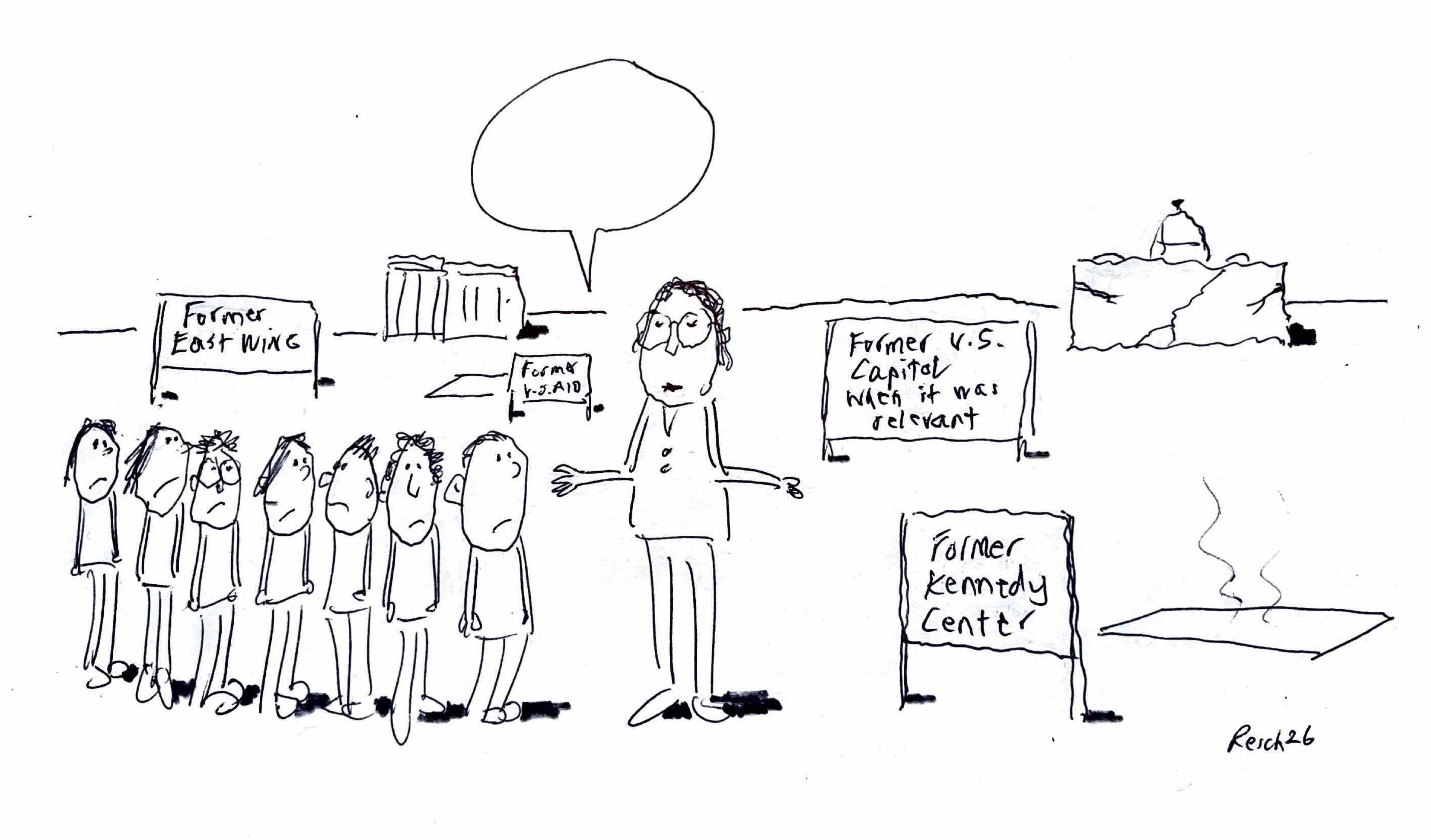
Caption contest: State Dinner

27 September 2026 at 23:00

Friends,

Please submit your caption in the Comments section, and, as before, please use the Comments section only for captions.

Winners will be announced next Sunday. For consideration, please post your caption by Monday at 9 pm PT, 12 midnight ET.

Share

Last week’s winner:

“He is trying to raze awareness of our history.”

(Congratulations, Rachel Brown.)

Runners-up:

“We haven’t seen his fallen arch. Must be near his heel spurs.”

(Congratulations, Mike Hammer.)

“And so we come to the end of our tour and democracy.”

(Congratulations, Vincent from Napa.)

“The Arch of Trump will stand here as the entrance to the Graveyard of Democracy.”

(Congratulations, Linda Gilpin.)

“Unfortunately, D.C. now stands for ‘don’t come.’”

(Congratulations, Rose.)

“Who wants to tell me which of these is President Trump’s greatest achievement?”

(Congratulations, Steven Horowitz.)

“And this, children, is what happened during the apocalypse. Aren’t we lucky to be living now in the time of President Ossoff?”

(Congratulations, Marcia DeFren.)

“This is what can happen if you don’t play well with others.”

(Congratulations, Laurence Hoffmann.)

“Please stay with the group. We’ve lost enough already.”

(Congratulations, Supriya Kang.)

“He turned “history” into ‘HIS story.’”

(Congratulations, Patricia Donahue.)

Share

❌