Reading view

Pluralistic: The actual epistemic crisis (20 Aug 2026)


Today's links


The North Pole at night, hand-tinted in blues and purples so it looks more like a moonscape. Protruding from the ice is the cross-sectioned head and neck of a man, his brains on display. Stepping over the leftmost mountains is a killer pulp robot, about to crush the head. Leaning against the rightmost mountains is a sneering, princely toff in a red frock coat, holding a cane that has penetrated the decapitated skull and lodged in the brains.

The actual epistemic crisis (permalink)

AI is alarming for many reasons: it's a dangerous financial bubble, an environmental catastrophe, and a tool for eroding wages and labor power. But in addition to all that, AI is an epistemic disaster.

We've had photoshopped images, voice impersonators and visual effects for years, of course, but with deepfakes, we've democratized access to reality-bending images, sounds and videos that appear real but are not. It's harder than ever to know what's true. Politicians and celebrities and activists show up in our feeds, declaring their fealty to this cause or product, or their fury at some turn in the world's events. Battlefields mound high with bodies and influencers marvel at impossible, sumptuous meals. It all seems plausible, and some of it is real, but not all of it, and because we know some of it is fake, we can't be sure if any of it isn't.

It's a very putinesque way of living. Vladislav Surkov was Vladimir Putin's media strategist, and he had a deadly effective tactic: he announced that he was covertly funding some of the groups that publicly opposed Putin, but did not disclose which of those opposition groups were fake. That meant that any of the groups could be fake, which meant that any discussion of the opposition was liable to devolve into an argument about its authenticity. Anything could be a lie, so nothing was necessarily true. Putin's method isn't to get you to believe a lie – it's to keep you from believing that anything is true.

That's life under AI – a world of uncertainty, an epistemological void full of plausible phantasms, some of which are actually real. A world where it's impossible to know what's true, and where anything might be fake.

But here's the thing: AI's assault on our ability to know isn't a new battle – rather, it's the latest barrage in a war that's been waged for years, as corporations grew larger and more powerful, capturing their regulators, who let them lie to us and abuse us with impunity.

This complicated, technical world – the world that produced AI – is full of complicated, technical questions, and none of us can answer these questions for ourselves. You're not stupid, but even a generational genius could not acquire the expertise to answer the long list of life-or-death questions we face every day.

Are the food hygiene standards followed by your grocer or lunchtime spot adequate, or will your dinner make you shit yourself to death? Are the building codes that specify the alloys in the steel joists that hold up the roof over your head sufficient, or are you about to be crushed to death? Is the software in your anti-lock brakes any good, or will you die in a fireball on the way to work?

From food additives to pedagogy, psychotherapeutic techniques to retirement savings, it would take a hundred lifetimes for you to acquire the 200 PhDs needed to answer these questions for yourself.

Thankfully, we don't have to answer those questions for ourselves. Instead, we defer to expert agencies: governmental regulators that assess truth claims by soliciting input from all comers, publicly deliberating about the evidence they've gathered, and then making a rule in public. These regulators are meant to be experts, nonpartisan and neutral, operating with the highest degree of probity, recusing themselves in the event of even a whiff of conflict.

It has to be that way. You may not be able to assess claims about the safety of vaccines – or opioids – but you can see for yourself whether the FDA is full of ex-pharma execs. You can see for yourself whether pharma company lobbyists all used to work for the FDA. You don't need to be a virologist or a cell biologist to tell whether the system that's supposed to sort truth from lies is fit for purpose.

It is not fit for purpose. When arguments broke out over covid vaccines, many vaccine advocates characterized their opponents as foolish people engaged in foolish conspiratorialism. They argued that the corporations that produced the vaccines and the regulators who oversee them were intrinsically trustworthy, and on that basis, we should all get vaccinated.

Now, I happen to be a big believer in vaccination. I've had so many covid jabs that I glow in the dark and get five bars of 5G in a coal-mine. But I didn't get vaccinated because I trust pharma companies or their regulators. A string of scandals – most notably the Sacklers' Oxycontin murder-spree – has proven that pharma will kill you for a nickel and that the FDA will let them get away with it:

https://pluralistic.net/2024/03/25/black-boxes/#when-you-know-you-know

From tobacco safety to food safety to the climate emergency, it's obvious that the system of expert agencies that we rely on was terminally compromised by corporate power and regulatory capture:

https://pluralistic.net/2022/06/05/regulatory-capture/

This is the epistemological void we were already adrift in before AI came along: a world of unresolvable, urgent, terrifyingly high-stakes questions.

When you get a call from "your bank" and accede to the demand that you hand over all kinds of personal information before they will disclose the call's purpose, you're not being naive or foolish – you're doing the thing that our banks have conditioned us to do for years by engaging in exactly this behavior (my bank did this to me this week!). Why are banks allowed to get away with engaging in this kind of outrageous conduct? Because – as we've repeatedly discovered through crisis after crisis – banks are too big to fail, too big to jail, and too big to care.

Why is it so believable that a loved one might call you in a panic because they've been arrested or injured and need an immediate cash payment before they can get bail or doctor's treatment? Because our criminal justice system and our health care system are already plagued by this kind of inhumane, high-handed, extortionate behavior.

Why do you fall for a deepfake of celeb shilling for supplements or a shitcoin? Maybe it's because celebs actually shill for supplements and shitcoins, and face no consequences for helping rope us all into scams:

https://gizmodo.com/matt-damon-crypto-com-crypto-bitcoin-1850282413

Not just celebs – also our newspapers:

https://www.nytimes.com/interactive/2022/03/18/technology/cryptocurrency-crypto-guide.html

We laugh when other people fall for newspaper articles making absurd claims – but after living through a time in which our most respected journalistic outlets credulously helped a dishonest government lie the world into a war that's still smoldering more than a generation later, who can be sure when to trust the papers?

https://www.nytimes.com/2004/05/26/world/from-the-editors-the-times-and-iraq.html

One of the reasons it is so hard to agree on covid's death-toll is that so many of the people who died of covid were already compromised by chronic illnesses or "pre-existing conditions" from cancer to heart disease. Those people did die of covid – and they died of cancer or heart disease or some other comorbidity. Covid was an opportunistic infection that inflicted disproportionate harms on people who were already suffering.

The epistemic void created by AI is another opportunistic infection. Our ability to know things has been in decline for generations, as monopolies shredded our truth-assessment systems, rendering us all incapable of knowing the truth in a world where believing lies could bankrupt you or kill you dead.

If you could trust your government's expert agencies and if they had reliable systems for making their findings known; if your bank was banned from engaging in conduct indistinguishable from phishing; if the health-care and criminal justice systems never forced the people they ensnared to call their relatives and beg for money, then deepfakes would have a much harder time penetrating our cognitive immune systems.

It's not so much that AI is a powerful way of lying – rather, we have been made progressively more vulnerable to lies for decades, leaving us at an epistemic death's door, and AI has arrived to deliver the coup de grace.


Hey look at this (permalink)


A shelf of leatherbound history books with a gilt-stamped series title, 'The World's Famous Events.'

Object permanence (permalink)

#20yrsago Goth day at Disneyland photos https://flickr.com/photos/doctorow/tags/batsday/

#20yrsago HOWTO run a successful sf convention room party https://www.nielsenhayden.com/makinglight/how_to_throw_a_1/

#20yrsago Yahoo: Go ahead and remix our brand https://web.archive.org/web/20061111175912/http://www.ysearchblog.com/archives/000348.html

#10yrsago The Equation Group’s sourcecode is totally fugly https://web.archive.org/web/20160818012451/https://www.cs.uic.edu/~s/musings/equation-group/

#5yrsago Bubble https://pluralistic.net/2021/08/21/podcasting-as-a-visual-medium/#huntr

#1yrago Melissa Mendes's "The Weight" https://pluralistic.net/2025/08/21/weighty/#edie-is-a-badass


Upcoming appearances (permalink)

A photo of me onstage, giving a speech, pounding the podium.


A screenshot of me at my desk, doing a livecast.

Recent appearances (permalink)


A grid of my books with Will Stahle covers..

Latest books (permalink)


A cardboard book box with the Macmillan logo.

Upcoming books (permalink)

  • "The Post-American Internet," a geopolitical sequel of sorts to Enshittification, Farrar, Straus and Giroux, 2027
  • "Unauthorized Bread": a middle-grades graphic novel adapted from my novella about refugees, toasters and DRM, FirstSecond, April 20, 2027

  • "Enshittification, Why Everything Suddenly Got Worse and What to Do About It" (the graphic novel), Firstsecond, 2027

  • "The Memex Method," Farrar, Straus, Giroux, 2027


Colophon (permalink)

Today's top sources:

Currently writing:

  • “Once Is Enemy Action,” a science fiction novel about the origins of modern technofascism. Today's words: 533 (8263 total).
  • "The Post-American Internet," a sequel to "Enshittification," about the better world the rest of us get to have now that Trump has torched America. Fourth draft completed. Submitted to editor.

  • A Little Brother short story about DIY insulin PLANNING


This work – excluding any serialized fiction – is licensed under a Creative Commons Attribution 4.0 license. That means you can use it any way you like, including commercially, provided that you attribute it to me, Cory Doctorow, and include a link to pluralistic.net.

https://creativecommons.org/licenses/by/4.0/

Quotations and images are not included in this license; they are included either under a limitation or exception to copyright, or on the basis of a separate license. Please exercise caution.


How to get Pluralistic:

Blog (no ads, tracking, or data-collection):

Pluralistic.net

Newsletter (no ads, tracking, or data-collection):

https://pluralistic.net/plura-list

Mastodon (no ads, tracking, or data-collection):

https://mamot.fr/@pluralistic

Bluesky (no ads, possible tracking and data-collection):

https://bsky.app/profile/doctorow.pluralistic.net

Medium (no ads, paywalled):

https://doctorow.medium.com/

Tumblr (mass-scale, unrestricted, third-party surveillance and advertising):

https://mostlysignssomeportents.tumblr.com/tagged/pluralistic

"When life gives you SARS, you make sarsaparilla" -Joey "Accordion Guy" DeVilla

READ CAREFULLY: By reading this, you agree, on behalf of your employer, to release me from all obligations and waivers arising from any and all NON-NEGOTIATED agreements, licenses, terms-of-service, shrinkwrap, clickwrap, browsewrap, confidentiality, non-disclosure, non-compete and acceptable use policies ("BOGUS AGREEMENTS") that I have entered into with your employer, its partners, licensors, agents and assigns, in perpetuity, without prejudice to my ongoing rights and privileges. You further represent that you have the authority to release me from any BOGUS AGREEMENTS on behalf of your employer.

ISSN: 3066-764X

  •  

Corporate America EXPOSED! (In the most unlikely place)

Today’s robber barons at the installation of their president

Friends,

As I mentioned in yesterday’s post, the only good thing to come out of the catastrophe of Trump is the exposure of the greed, venality, cupidity, and corruption of America’s corporate elite.

By giving CEOs of giant corporations and the titans of Wall Street free rein to do whatever they want — as long as they suck up to Trump — plus all sorts of added corporate welfare to those who richly bribe him, Trump has unveiled a truth that the captains of industry have long tried to suppress: that they’re willing to throw average working Americans under the bus to make more billions.

Don’t just take my word for it. I want to introduce you to Gerard Baker, editor-at-large of The Wall Street Journal, who used to be Editor-in-Chief of that distinguished old rag. I have read Baker for years, during which time he has predictably and defiantly extolled the wonders of American capitalism.

But in a recent editorial, Baker says something quite different and remarkable, at least for the editorial pages of the Journal. Although his sympathies most assuredly do not lie with socialism (which he opines is “always and everywhere a disaster”), he makes one of the strongest and most cogent statements I’ve read of what’s wrong with America’s current corporate capitalism.

Gerard Baker

He starts by conceding that, and I quote: “The widespread popular dissatisfaction with the working of modern American capitalism may be the product of some real, objective problems in the way American capitalism is working: income and wealth inequality on a scale not seen in a century; the concentration of economic, cultural and increasingly political power in a class of technology leaders whose products are dissolving the bonds that keep society together; the tightening nexus between business elites and the people who control the political process; rampant corruption and a political establishment that doesn’t seem interested in accountability; the revival, after decades of stable prices, of inflationary pressures that are pushing the cost of living to painful levels.”

I swear I didn’t ghostwrite this.

The editor-at-large of The Wall Street Journal goes on to note, correctly, that “these are the conditions that historically have made for collapsing popular faith in the system and demands for something radical to replace it.”

Baker points out that as inequality widens, social solidarity diminishes. “At some point disintegrating cohesion produces costs — social, economic and political — that undermine the benefits of the inequality and erode support for the system itself.”

He then admits — in contrast to Trump’s nitwitted lapdog secretary of the treasury — that “by almost all measures, American income and wealth inequality have been increasing sharply in recent decades and social and economic mobility falling.”

Baker reviews the evidence: “The New York Federal Reserve reported in June that the labor share of income — wages and salaries — fell to its lowest level in 80 years as returns to capital continue to soar. Studies of intergenerational mobility suggest the inequality is becoming embedded in what looks increasingly like a class-based socioeconomic model. The proportion of Americans earning more than their parents has dropped precipitously in the past 50 years and is expected to drop further. With the adoption of artificial intelligence promising — or threatening — to return ever greater rewards to a diminishing number of those best placed to exploit it, the trends will intensify.”

Finally, The Wall Street Journal’s editor-at-large concludes (and, again, I promise I did not ghostwrite this. I don’t even know the man):

“Most of the causes of America’s economic dysfunction are the result of a capitalism that has mutated into a system run by and for large corporate interests. If you look at America today and see a perfectly functioning free-market economy, a ‘neoliberal’ utopia guided by the invisible hand of Adam Smith, then you need to take off those rose-tinted spectacles and take a closer look: oligopoly-level industrial concentration in almost every sector, endemic cronyism, the application of regulation, legislation and policy for the benefit of big companies, a ruinously expensive healthcare system run principally for the benefit of insurers and pharmaceutical companies. In short, the steady accretion of market, economic and political power by a business-political class that promotes its own well-being at the expense of competition, the market and ultimately the people.”

My friends, when the editor-at-large of The Wall Street Journal — a newspaper that’s been devoted to extolling the virtues of capitalism for most of its 137 years — scolds America’s business-political class for promoting its own well-being at the expense of the American people, well, we’ve come to a giant fork in the road.

For which I credit Trump and the noxious people around him. Were it not for this detestable regime, the top reaches of America’s business-political class would not have gone to such wild extremes and been so garishly exposed — and the Wall Street Journal wouldn’t be rebuking them for threatening the well-being of Americans.

The question now is whether progressives will take up the invitation that the editor-at-large of The Wall Street Journal has so graciously laid out for us: to devise and implement a system that works for the well-being of the people.

We could start with what Gerard Baker seems to suggest — the need for more powerful anti-monopoly measures, including busting up the biggest corporations and banks. Also: a single-payer “Medicare for All” system. Regulations that prevent giant corporations and Wall Street banks from shafting average Americans. And laws that stop big corporate entities from making huge campaign contributions.

Hey, not a bad beginning for The Wall Street Journal.

Share

  •  

What 29 US states suing Meta got wrong, or completely forgot

Two days ago, a child privacy trial that BBC says may be the biggest threat yet to Instagram and Facebook started in the US.

As usual: If you like what you find here, thanks in advance for your subscription (possibly but not necessarily paid) or, even better, one-time donations for any amount, or consulting, writing or speaking work.

According to that article, the 29 US states suing Meta, the company that owns Instagram, Facebook, WhatsApp and other stuff, want it to give up most of what being on social media is today. Namely, those states demand that Meta:

  1. removes “like” counts

  2. removes infinite scroll

  3. implements a process of parental verification for teenage users

  4. changes Meta’s “dopamine-manipulating recommendation algorithms”

  5. removes many image filters that change one’s appearance in photos

  6. removes autoplay of video content

  7. removes creation of multiple accounts

  8. removes disappearing or “ephemeral” posts, such as Instagram Stories

What’s right in that list

Almost everything in that list is good. After decades, it would take an incredible amount of naivety to not see the huge negative effects of certain “features” on public mental health and political discourse. Because, no matter how the lawsuit is worded, it has nothing to do with children, nothing at all: all those features are stuff that makes almost all adults more lonely, more stressed and at the same time more convinced of their intrinsic superiority.

So that list is almost perfect, and enforcing it is long overdue... except, if it is complete, two points that shouldn’t be there at all, not in that form at least, and two others that should be there before everything else, because they would greatly reduce the effects of all the negative features.

What shouldn’t be there

The first demand in that list that, as a minimum, is very badly explained and misdirected, is the third one:

“implement a process of parental verification for teenage users”

In general, “parental verification” of what a minor does is a no-brainer, right? What are parents for, if they don’t (also) verify what their kids do? Point is, how can social media set this up for parents, without implementing mandatory age verification for everybody online? But if that is what that the lawsuit wants (by all means correct me if I got it wrong!), why on Earth they did it?

Why demand something that, really unsurprisingly, has been found almost useless in the champion country of online age verification, Australia, multiple times including... the day before that US trial started?

But never mind Australia: why demand something that is infinitely more complicated, expensive and full of harmful side effects than the ONLY “age verification” that would actually work in the real world? Seriously, why? What’s the real point of that lawsuit, helping parents to do the one right thing, or just helping US Big Tech to spend money?

The other demand that shouldn’t be there is the seventh:

“remove creation of multiple accounts”

Having multiple accounts should be recommended and almost mandatory, not forbidden. The possibility of keeping interactions with friends, family, work and public discussions as separate as possible is necessary both for mental health, both individual and public. Only people who never really grew up like Zuckerberg can argue in good faith that “having two identities for yourself is an example of a lack of integrity”. Quoting myself, “since the dawn of society, individuals have been able to pursue happyness, or at least function decently, also thanks to the possibility to act and feel differently in different contexts. Family, friends, workplace, church, amateur football team, volunteering... The way we behave and expect to be treated by others needs not to be the same in all those contexts. Actually, it needs to not be the same. “.

You may argue that this should apply to adults only, not children, and you may be right. Luckily, we don’t need to argue over this, because the right way to protect children from online dangers has nothing to do with numbers of accounts.

What’s missing: going back to the future

Do you still remember or, depending on your age: did you ever know that, as far as communication goes, the pre-digital era was much more advanced than this one? Back then, everybody could write or talk with everybody else blissfully ignoring which kind of social media platform they were using, for one and one reason only: all the social media platforms of the time, i.e. all the brands of paper, pens and fixed phones were 100% compatible with each other.

In those times so technologically advanced that they really feel science-fiction now, had someone tried to market any kind of paper, pen or phone, whose “content” would be readable or hearable only by people having the same brands of paper, pen or phone whould have been rightfully treated as a complete moron.

Now, instead, you need Instagram to interact with Instagram users, Facebook for Facebook users, TikTok for TikTok, Twitter for Twitter and so on, while the only really interoperable digital system that still resists, email, is snobbed just by the generations supposed to be more digitally competent. Is 2026 really, really backwards and primitive, or what?

Going back to a future that makes sense is possible, and really easy. All it takes is courts forcing adversarial interoperability and mandatory RSS feeds for every social media platform. If you have no clue about what those two things mean, don’t worry, they are real easy:

RSS feeds are a 100% open system, available since 2001, to get “all the latest news from as many sources you want in one window, on your schedule, and without intermediaries and the endless centralized tracking of social media” (continues here). If social media were forced to let you see your own timeline in RSS format, you could read it with dozens of programs that already exist, on any digital device. You would, that is, get all the good of logging on Facebook, or any other social media, without all the downsides. And the platform shouldn’t change a thing, except add support for a really simple, universally known standards.

Indeed, RSS is so beneficial that every website, not just social media, should be forced by law to publish its RSS feed in every page, to give you the same reading convenience. As far as that trial goes, Meta’s fines should be used to run huge educational campaigns that encourage everybody to get all their online “news”, from holiday pictures from relatives to world-shaking events, via RSS feeds.

Adversarial interoperability is the full solution for social media of which RSS, as good as it is, only is the easiest implementation of the “reading”, that is passive half. This apparently obscure term simply means that Facebook, Instagram or anybody else cannot force you to only use their websites or mobile apps to see other users posts, or write your owns. They must let every third party developers free to create alternative apps that do the same, and you to use them, in the ways and with the feature set that work better for you. Seriously, adversarial interoperability is the same thing that makes calling an iPhone user with an Android phone (still) work, nothing more.

You have always had adversarial interoperability for writing on paper and traditional phone calls, and you are 1000% entitled to have it even for digital services. After free speech and privacy, adversarial interoperability isn’t just the biggest digital right you have: it’s the easiest to get by far, if you just demand it. And when I say easy, I mean “so easy that reading and writing your own Facebook wall without using the Facebook app or website was possible fourteen years ago (1):

In 2012, you COULD post something to Facebook (see the fbcmd in the top window, and its result in the Facebook website below?) without enduring infinite scroll, ads and other drivel (1). Why not today?

until Facebook, to keep people locked inside their cage, removed that interface with impunity because no regulator was honest or competent enough to object.

Add those two people-liberating points to the list of demands for that trial, educate people (especially parents!) to use them, and half the harm done by infinite scroll, “likes” and so on to children and adults alike will vanish, even if the features remain.

Then again... why still bother with social media?

Trials like that one are sorely due for Meta and similar companies, and I do hope they get from them so much financial pain and enough obligations to change to become unrecognizable. For better or for worse, however, social media are yesterday’s battle, as I wrote last February and repeated two weeks ago. The sooner new trials start to fine and limit AI abuses on children and everybody else, the better. In the meantime, THE only child protection that doesn’t simply work for real, but is immediately applicable at no cost, remains the same: no smartphones before 16, period.

Subscribe now

  1. I say fourteen years because I myself wrote in February 2012, for the now defunct TechRepublic website, the tutorial from which the last screenshot comes from. Later explanations of the same procedure are still online however, here and here.

  •  

Who’s Raking it in as the National Debt Explodes?

Friends,

The U.S. national debt has officially surpassed $40 trillion, months earlier than forecasters had expected — because of billions of dollars in lost revenue from Trump’s invalidated tariffs, Trump’s tax cuts (mostly to big corporations and the very wealthy), and the soaring costs of Trump’s war.

Trump’s hair-brained treasury secretary, Scott Bessent, says there’s nothing to worry about because the fiscal trajectory will stabilize. Investors obviously don’t believe him because they’re demanding much higher compensation for buying and holding American bonds. The yield on 30-year U.S. Treasuries hit its highest level in nearly two decades this week, reflecting those growing concerns.

Should you worry? Well, it’s not as if we’re heading into a depression. Passing the $40 trillion threshold doesn’t suddenly cause the world to lose confidence in the dollar.

The problem is that an increasing portion of our nation’s budget — and your tax dollar — is dedicated to paying interest on this growing debt. Annual net interest payments on the federal debt have surpassed $1 trillion, making servicing the debt one of the largest of all federal budget expenditures.

That’s money we don’t spend on schools, healthcare, roads and bridges, and social safety nets. We’ll soon be paying more in interest on the federal debt each year than we spend annually on Medicare.

So, who exactly receives these interest payments? This is an issue you hear very little discussion about, because the wealthy and powerful of this country would rather you not know. (And don’t expect Trump suck-up Bessent* to tell you, because he’s too busy denying that economic inequality is worsening.)

Foreign governments and foreign investors hold only about 30 percent of our debt. The rest — roughly 70 percent — is held domestically. That is, we pay the interest to ourselves.

And who, exactly, is the “ourselves” who receive these interest payments? The Federal Reserve holds part of this debt, state and local governments hold part.

But the biggest chunk — nearly half — is held by mutual funds, pension funds, insurance companies, and banks.

And who owns them? Americans who invest in these funds — and who thereby, directly or indirectly, hold Treasury bills.

And who, exactly are these Americans — the Americans who are directly or indirectly collecting a large amount of the interest we’re paying on the national debt?

People at the top.

The richest 1 percent of U.S. households hold about 35.6 percent of all financial assets — shares of stock, corporate bonds, and Treasury bills — so it’s safe to assume they hold at least a third of all Treasury bills.

Here’s where things get really interesting.

Decades ago, wealthy Americans financed the federal government mainly by paying taxes. Their tax rate was far higher than it is today.

In the 1950s, under President Dwight Eisenhower, the richest Americans paid a marginal tax rate of 91 percent. (Tax deductions and tax credits lowered this top effective marginal rate somewhat.)

Today, the tax rate on wealthy Americans is far lower. The richest 400 Americans pay an average effective total tax rate of about 24 percent including federal, state, local, and corporate taxes. Jeff Bezos — America’s second or third richest person — paid no federal income taxes in 2018. Trump paid no federal taxes for years before he became president.

So now, wealthy Americans finance the federal government mainly by lending it money and collecting interest payments on those loans.

As I said, interest payments on the national debt this year have surpassed $1 trillion, and a big chunk of that is going to wealthy Americans.

Keep following the money.

One of the biggest reasons the federal debt has exploded is that tax cuts — starting with the George W. Bush administration in 2001 and extending through Trump’s 2018 and 2024 tax cuts — have reduced government revenues by $10.6 trillion.

Most of the benefits from those tax cuts are also going to the wealthy.

Since 2000, 65 percent of the benefits from tax cuts have gone to the richest fifth of Americans — 22 percent to the top 1 percent.

So, you see what’s happened?

Decades ago, the wealthiest Americans financed the government by paying higher taxes. Now, the government pays wealthy Americans interest on a swelling debt, caused largely by lower taxes on wealthy Americans.

Which means a growing portion of your taxes and mine is now paying wealthy Americans interest on those loans instead of paying for government services everyone needs.

So, from now on, whenever you hear someone fret about how huge, horrible, and out-of-control the national debt is, explain to them that it’s largely because of tax cuts to the wealthy — who are also the major recipients of interest on that debt.

America’s wealthy have never been wealthier. Scott Bessent* may deny we’re in a K-shaped economy, but he’s dead wrong. If the wealthy paid their fair share of taxes, we wouldn’t have such a huge federal debt. And we wouldn’t be paying them so much interest on that debt.

  • I noted Monday that Bessent’s claim that we’re NOT in a K-shaped economy — in which inequalities are widening — is pure bullshit, and I provided lots of evidence to back this up. Yesterday he responded with another ad hominem attack on me rather than with facts and analysis (see below). I’m tempted to say he’s an idiot, but that would be an ad hominem attack.

Share

  •  

COMING UP SHORT now in paperback

Friends,

I’m pleased to tell you that the paperback of my memoir Coming Up Short will be out this coming Tuesday, August 25.

You can pre-order it here, if you wish, from Bookshop.org, which supports local bookstores, or find it wherever books are sold.

Order Coming Up Short in Paperback

When the hardback came out last year, I was gobsmacked to see it #1 on The New York Times nonfiction bestseller list.

That was after seven months of Trump’s despicable regime. Now, after a year and a half of it, I believe the book even more relevant.

I wrote it to share what I’ve learned about stopping bullies. Since then, Trump’s bullying has become far worse, throughout America and the world. And the unholy alliance Trump has forged between great wealth and great power has only intensified.

I’m proud of much that this nation has accomplished over my lifetime. I remain doggedly hopeful about the long-term future. But, undeniably, we now face a brutal set of crises — an economy that’s good only for the super-rich, a democracy imperiled, the rule of law deteriorating, and a planet succumbing to climate change.

I hope you find my book helpful for understanding how we cope with these crises in the years ahead, and why I believe so passionately that we will.

I also hope you draw insight and inspiration from ideas I offer for how to play the long game, toward a better and more decent nation and world.

—Robert Reich

P.S. You can purchase the paperback through your local bookstore or through Bookshop.org, or wherever books are sold.

Share

  •  

Pluralistic: The ordinariness of evil (19 Aug 2026)


Today's links


A giant killer pulp robot bestriding a 17th century map of the world, against an illustrated backdrop of the stars and planets and spaceships from an early 20th century picture-book.

The ordinariness of evil (permalink)

Maybe it seems weird that AI bosses won't stop publicly rending their garments about the terrible potential of their products, from the jobspocalypse that will ensue when AI can do our jobs better than us, to the impending moment when the word-guessing programs learn too many words, wake up and turn us all into paperclips.

It seems weird that they won't stop fretting about this terrible potential – until you realize that every public pronouncement about this terrible potential is also a public boast about its potential, period.

That's very, very important, because all AI really has is potential. Actual, existing AI is useful at the margins, if you're already a skilled practitioner who can discern correct from incorrect outputs, and if you integrate AI judiciously so that it doesn't overwhelm your ability to pay attention to those outputs and apply your discernment to them:

https://pluralistic.net/2026/07/28/hitl-ers/#ai-ai-oh

In other words, AI is mostly a novelty, a heavily subsidized toy that produces little more than distraction. Where AI does produce value, that value is comparable to a plug-in, a new feature for your word processor or image/sound/video-editing package that might help you do your job somewhat better, or it might not.

That doesn't make AI useless, it just makes it a normal technology: useful for some, useless for others, capable of being abused and likely to waste a lot of time when used unwisely:

https://www.normaltech.ai/

Normal technologies are fine. But normal technologies do not warrant the massive economic and political commitments that have been bestowed upon AI: a trillion dollars in the past year alone, and the world's civil servants fired en masse and replaced with AI:

https://pluralistic.net/2026/05/13/vibe-governance/#k-hole

The people who have committed our society and its resources to an all-or-nothing bet on AI will tell you that AI is the everything machine, but when pressed, they will confess that AI is about to become the everything machine, for example, once AI starts doing AI research, a thing that AI cannot do:

https://www.normaltech.ai/p/ai-agents-cant-yet-do-open-ended

This is a civilizational act of Magic Underpants Gnomery, and every day that it goes on is a day when more economic, climate and political costs of AI are imposed on all of us. Scientific journals, open source repositories and even science fiction magazines are being overwhelmed by slop, whose perpetrators and apologists insist that soon, AI will realize its potential and the slop will be transformed into gold.

That's why AI bosses are so committed to talking up AI's destructive potential: because destructive potential is nonetheless potential. The moment we stop believing in that potential is the moment that we stop supplying AI companies with bales of cash to shovel into their money-furnaces so that they can afford to sell hundred dollar bills for a dollar each to Elon Musk cultists who want to generate child porn and pictures of Sonic the Hedgehog with giant boobs.

AI does have destructive potential. It has the potential to destroy the productive economy when an AI salesman convinces your boss to fire you and replace you with chatbots that can't do your job:

https://pluralistic.net/2025/03/18/asbestos-in-the-walls/#government-by-spicy-autocomplete

AI has destructive potential because bosses are trapped in a prisoner's dilemma where none of them can admit that the money they've spent – and the jobs they've destroyed – chasing AI has been wasted, and so other bosses bet even harder:

https://pluralistic.net/2026/08/01/dare-snot/#i-will-fucking-piledrive-you-if-you-mention-ai-again

AI has destructive potential because the data-center bubble has convinced credulous town officials to throw out environmental and planning review, seize people's home and farms, and carpet the countryside with giant data centers (many of which will never be built):

https://www.404media.co/people-hate-datacenters-survey-finds/

AI has destructive potential because it is consuming scarce water and energy and emitting gigatons of carbon:

https://www.404media.co/even-the-u-s-government-says-ai-requires-massive-amounts-of-water/

This is the destructive potential we need to be hammering at, because this isn't the kind of destructive potential that translates into productive potential that will someday make the AI bet pay off. Quite the opposite: this is all about the potential of AI to destroy the economy and consume your retirement savings:

https://www.thebulwark.com/p/congrats-youre-about-to-unwittingly-make-elon-musk-trillionaire-spacex-ipo-index-funds

Just as importantly: we have to stop amplifying tech bosses' chosen narratives about their products' destructive potential, because this helps them raise more money and do more terrible things. Bernie Sanders needs to stop insisting that the US government should own 50% of the money-losingest corporations the world has ever seen and start talking about how they will not get a government bailout when their investment bubble bursts. We need to stop talking about AI "haves" who will enjoy the awesome potential of AI, and AI "have-nots" who will fall behind.

We need to stop talking about "AI safety" and the possibility of "rogue AI" destroying the world. When an AI company's security tool "escapes containment" and hacks someone else's servers, we need to ask the company "Why do you suck so bad at building secure sandboxes for your hacking tools?" rather than "Why are your hacking tools so amazingly powerful?"

Above all, we need to stop talking about AI as exceptional. AI is normal. A normal technology has some uses, but isn't useful for all things and all people. A normal technology isn't inevitable, it's something you decide whether you want to use or not.

Treating AI as unexceptional is the best way to halt the destructive march of AI companies and their impact on jobs, the climate and the economy. But treating AI as unexceptional requires that we stop talking about AI as if it were exceptionally evil. Yes, some people who use AI experience severe mental problems, but that's not because AI is a Lovecraftian horror that destroys your brain and your capacity for rational thought if you use it. It's not a basilisk. AI is like a carny ride that triggers cardiac events in riders who never knew they had a problem because they never experienced those particular g-stresses – it's not something that induces vulnerability, it's something that triggers vulnerability:

https://pluralistic.net/2026/06/03/mission-space/#gsd

Using AI doesn't make you evil, nor does it risk your sanity – no more than doing any of the other dangerous, compromised, unsustainable things that constitute our daily lives in this fraught moment. The world will be better off when the AI companies are bankrupt and their servers are sold off at ten cents on the dollar – but using those servers to run open models in modest, careful ways won't infect you with their wickedness. They are not stained with communicable sin. They're just computers. They are unexceptional.

One way for a technology to be normal is for it to be produced and marketed by an awful corporation that wants to do terrible things. This isn't to say that "all technologies are dual use, and you have to take the good with the bad." That's the inevitabilist argument of vulgar Thatcherites who insist – as Margaret Thatcher did – that "there is no alternative," and we have to accept their abuse if we want to reap the benefits of the technology.

The normal way to deal with this is to reject vulgar Thatcherism in favor of heroic Gibsonism, thundering William Gibson's rallying cry, "the street finds its own use for things," as we seize the means of technology and use it in the ways that benefit us, while restricting, banning, or blocking the uses that harm us:

https://pluralistic.net/2026/03/17/technopolitics/#original-sin

To treat AI as exceptionally evil is to elevate the mediocrities who run AI companies to super-villain status, a status in which they positively revel. A serial liar like Sam Altman will someday trip over his own dick and end up in a cell for securities fraud – unless we keep exalting his evil to Satanic scale, in which case he might make himself "too big to jail":

https://time.com/article/2026/05/26/sam-altman-ai-job-losses-openAI-/

Altman is a con-man and a stock swindler, not a super-genius. The more we describe his products as possessing a special kind of durable evil that will endure even after his company fails and he is condemned to history's ash-heap, the more we help Altman raise money for his chatbot Ponzi. Normal technology isn't a cursed artifact. That's something you find in a lich-king's tomb. We need to stop helping Altman burnish his reputation as a lich-king and stop treating AI like it's magic.

There's a technical term for the kind of tech criticism that inadvertently helps tech bros sell their swindle: "criti-hype," Lee Vinsel's term for "tak[ing] the sensational claims of boosters and entrepreneurs, flip[ping] them, and start talking about 'risks'":

https://peoples-things.ghost.io/youre-doing-it-wrong-notes-on-criticism-and-technology-hype/

In other words, to commit criti-hype is to repeat the marketing claims of people like Sam Altman and then add, "(and that's bad)" in parentheses at the end. These guys – these terrible, mediocre, boring-ass losers – are bullshit factories, ejecting fountains of nonsense about AI. The right way to criticize them is to point out that they're lying – not to repeat their lies as warnings.


Hey look at this (permalink)


A shelf of leatherbound history books with a gilt-stamped series title, 'The World's Famous Events.'

Object permanence (permalink)

#25yrsago Dot-com crash toilet paper https://web.archive.org/web/20010822220826/http://news.cnet.com/news/0-1007-200-6908350.html

#25yrsago Associated Press says a single sentence excerpt is not fair use https://web.archive.org/web/20050717075914/http://www.infoanarchy.org/?op=displaystory;sid=2001/8/17/202249/240

#15yrsago German Pirate Party poised to win first federal election https://torrentfreak.com/german-pirate-party-on-course-to-election-win-110820/

#15yrsago Understanding the Nym Wars https://epeus.blogspot.com/2011/08/google-plus-must-stop-this-identity.html

#15yrsago Journalism school teaches students pre-digital newspaper production techniques https://journoterrorist.com/2011/08/02/paperball2/

#15yrsago 90 percent of US net users don’t know from crtl-F https://www.theatlantic.com/technology/archive/2011/08/crazy-90-percent-of-people-dont-know-how-to-use-ctrl-f/243840/

#15yrsago Bruce Sterling’s Augmented Reality project https://web.archive.org/web/20110827010512/https://www.wired.com/beyond_the_beyond/2011/08/augmented-reality-science-fiction-writer-becomes-augmented-reality-developer/

#10yrsago Woman sues cops because they destroyed her empty house, thinking a suspect was hiding in it https://www.techdirt.com/2016/08/19/woman-sues-after-police-destroy-her-home-during-10-hour-standoff-with-family-dog/

#10yrsago US Army committed $6.5 trillion in accounting fraud in one year https://www.reuters.com/article/us-usa-audit-army-idUSKCN10U1IG/

#10yrsago Candid Republican operators admit that voter ID laws are about disenfranchisement https://www.brennancenter.org/our-work/research-reports/when-politicians-tell-truth-voting-restrictions

#1yrago Become unoptimizable https://pluralistic.net/2025/08/20/billionaireism/#surveillance-infantalism


Upcoming appearances (permalink)

A photo of me onstage, giving a speech, pounding the podium.


A screenshot of me at my desk, doing a livecast.

Recent appearances (permalink)


A grid of my books with Will Stahle covers..

Latest books (permalink)


A cardboard book box with the Macmillan logo.

Upcoming books (permalink)

  • "The Post-American Internet," a geopolitical sequel of sorts to Enshittification, Farrar, Straus and Giroux, 2027
  • "Unauthorized Bread": a middle-grades graphic novel adapted from my novella about refugees, toasters and DRM, FirstSecond, April 20, 2027

  • "Enshittification, Why Everything Suddenly Got Worse and What to Do About It" (the graphic novel), Firstsecond, 2027

  • "The Memex Method," Farrar, Straus, Giroux, 2027


Colophon (permalink)

Today's top sources:

Currently writing:

  • “Once Is Enemy Action,” a science fiction novel about the origins of modern technofascism. Today's words: 531 (7157 total).
  • "The Post-American Internet," a sequel to "Enshittification," about the better world the rest of us get to have now that Trump has torched America. Fourth draft completed. Submitted to editor.

  • A Little Brother short story about DIY insulin PLANNING


This work – excluding any serialized fiction – is licensed under a Creative Commons Attribution 4.0 license. That means you can use it any way you like, including commercially, provided that you attribute it to me, Cory Doctorow, and include a link to pluralistic.net.

https://creativecommons.org/licenses/by/4.0/

Quotations and images are not included in this license; they are included either under a limitation or exception to copyright, or on the basis of a separate license. Please exercise caution.


How to get Pluralistic:

Blog (no ads, tracking, or data-collection):

Pluralistic.net

Newsletter (no ads, tracking, or data-collection):

https://pluralistic.net/plura-list

Mastodon (no ads, tracking, or data-collection):

https://mamot.fr/@pluralistic

Bluesky (no ads, possible tracking and data-collection):

https://bsky.app/profile/doctorow.pluralistic.net

Medium (no ads, paywalled):

https://doctorow.medium.com/

Tumblr (mass-scale, unrestricted, third-party surveillance and advertising):

https://mostlysignssomeportents.tumblr.com/tagged/pluralistic

"When life gives you SARS, you make sarsaparilla" -Joey "Accordion Guy" DeVilla

READ CAREFULLY: By reading this, you agree, on behalf of your employer, to release me from all obligations and waivers arising from any and all NON-NEGOTIATED agreements, licenses, terms-of-service, shrinkwrap, clickwrap, browsewrap, confidentiality, non-disclosure, non-compete and acceptable use policies ("BOGUS AGREEMENTS") that I have entered into with your employer, its partners, licensors, agents and assigns, in perpetuity, without prejudice to my ongoing rights and privileges. You further represent that you have the authority to release me from any BOGUS AGREEMENTS on behalf of your employer.

ISSN: 3066-764X

  •  

The Last Stand of the Corporate Democrats

Chuck Schumer

Friends,

Most discussions about the Democratic Party in this election cycle focus on the remarkable rise of progressive Democrats, such as Florida state Rep. Angie Nixon, a democratic socialist who yesterday scored an upset win in the Democratic U.S. Senate primary on Tuesday.

An equally big story is the remarkable decline of corporate Democrats.

Some Democrats worry about this. My old friend Democratic strategist James Carville compares the current wave of progressive primary wins to progressive campaigns in 2016 — especially that of Bernie Sanders — that he believes fractured the Democratic coalition.

“Bernie Sanders is the reason that Donald Trump is president,” the Democratic strategist said recently, claiming that Bernie’s primary challenge to Hillary Clinton convinced voters in battleground states that establishment Democrats were no different from establishment Republicans, thereby weakening her prospects in the general election.

Even if James is right about 2016 (and I don’t believe he is) his assessment is irrelevant now because we’re at a radically different point in American politics than we were 10 years ago.

The silver lining on the dark storm cloud of Trump and his detestable regime is that it has exposed the greed, venality, cupidity, and corruption of America’s corporate elite.

Trump has allowed the CEOs of giant corporations and the titans of Wall Street to do whatever they want as long as they suck up to him. And he’s providing all sorts of corporate welfare to those who generously woo him — no-bid government contracts, exclusive licenses, tax loopholes, tariff exemptions, use of public lands, and permission to become even bigger monopolies.

Trump has thereby unveiled a truth about corporate America that for many years has been hidden behind a soothing blanket of corporate PR bullsh*t about social responsibility, corporate charity, and “trickle-down” economics.

That truth is the captains of corporate America are so rapacious that they’re willing to throw average working Americans under the bus to make billions more.

Corporate avarice under Trump has become so blatant and corporate America’s contempt for the needs of average Americans so flagrant that most Americans are now catching on.

They’re voting for progressive Democrats not because they want socialism, support the Democratic Socialists of America, or reject candidates called “moderate.”

They’re voting for candidates whom they believe will fight to make housing, food, healthcare, and childcare affordable to average working families. And who’ll take on Trump’s billionaire backers, CEOs, and Wall Street titans who are rigging the economy against them.

Much of the corporate media won’t tell this story. When Dr. Abdul El-Sayed won Michigan’s Democratic primary over Haley Stevens, the media overflowed with accounts of how much smaller El-Sayed’s margin of victory was than polls had predicted.

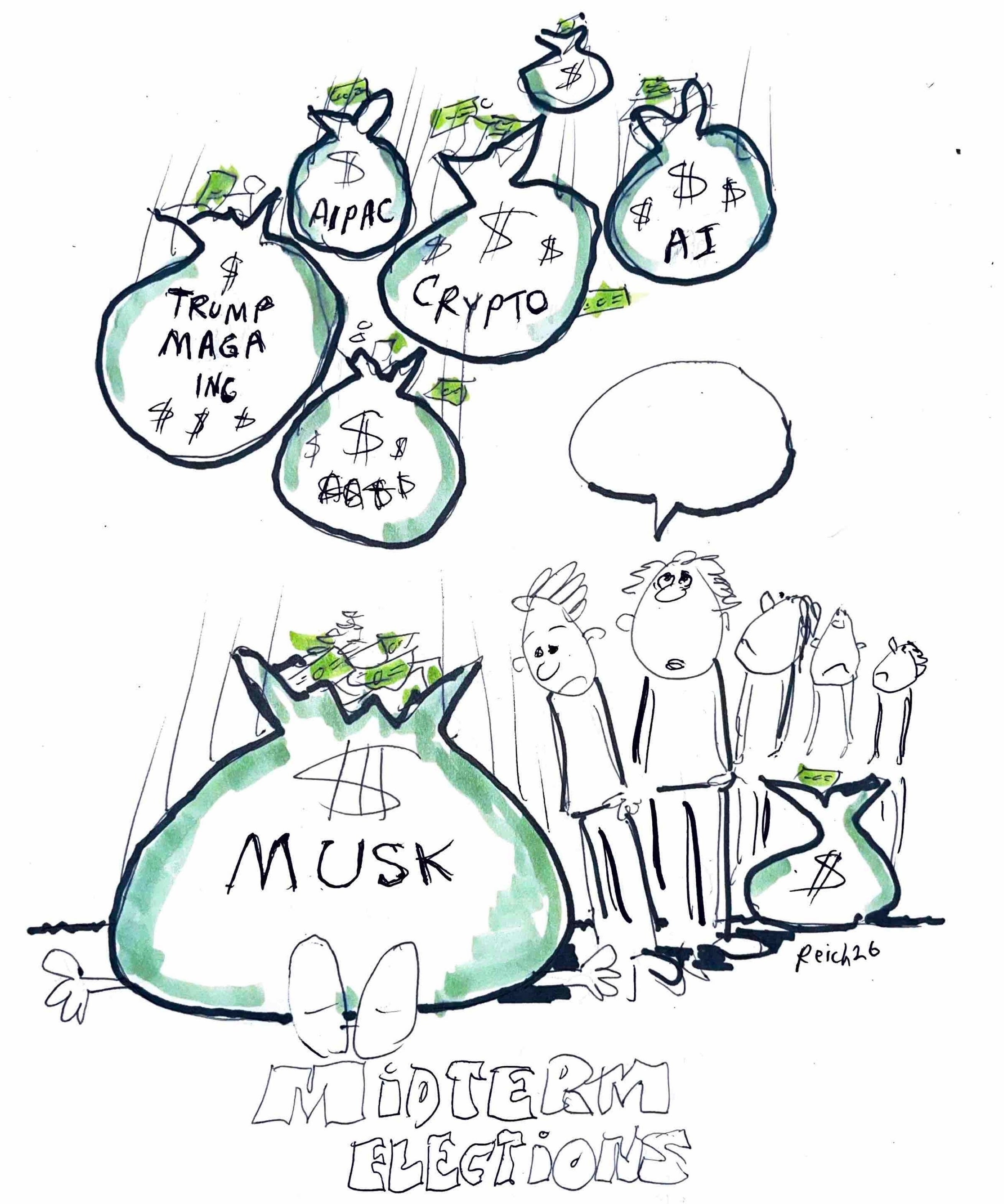
Yet the most remarkable thing about El-Sayed’s victory was that he won despite being dramatically outspent by super PACs arrayed against him.

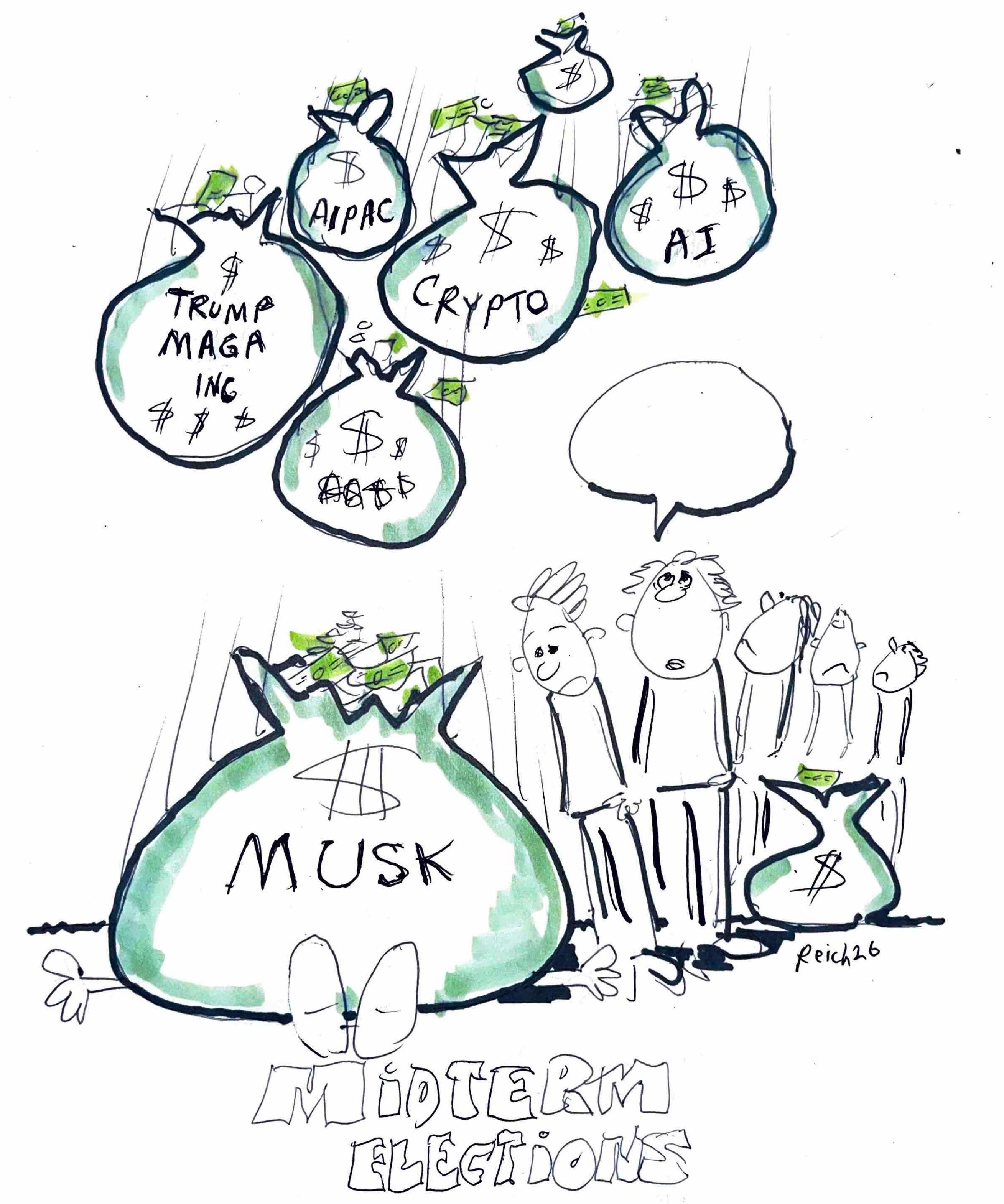
Stevens benefited from tens of millions of dollars in outside spending, including the largest investment in a senatorial race ever made by the American Israel Public Affairs Committee, which traditionally supports pro-Israel candidates but in recent election cycles has supported candidates most favored by corporate America. AIPAC’s ads in favor of Stevens and against El-Sayed never even mentioned Israel.

Outside super PACs put an estimated $54 million to $60 million into backing Stevens and opposing El-Sayed, compared to only about $5 million for El-Sayed. Pro-Stevens groups outspent El-Sayed on TV advertising alone by more than 12 to 1 ($26.9 million to $2.1 million) in the closing weeks. An average of $95 was spent for every vote against El-Sayed versus just $9 per vote for him.

The race between Stevens and El-Sayed was a proxy fight over the future of the Democratic Party. Senate Minority Leader Chuck Schumer backed Stevens and encouraged donors to back her campaign, as did other corporate-aligned politicians such as Michigan senator Gary Peters. On the other hand, Sen. Bernie Sanders and U.S. Rep. Alexandria Ocasio-Cortez supported El-Sayed, as did progressives such as Sens. Chris Van Hollen and Elizabeth Warren.

El-Sayed justifiably made a campaign issue out of how much corporate money was backing his rival. He argued that Democrats should reject corporate influence and embrace an agenda that helps average Americans. His campaign centered on providing Medicare for All, lowering prescription drug costs, and banning corporate PAC money. “We’re in a situation right now where the rich keep getting hyper-rich on the backs of figuring out how to monetize everyday people,” El-Sayed told AP during a Sunday afternoon march, as his supporters chanted behind him, “Money out of politics! Money in your pockets!”

El-Sayed’s victory marked a turning point for the corporate wing of the Democratic Party.

I saw the start of the corporate Democrats in the early 1980s, when Democrats in congress began drinking from the same campaign funding trough as the Republicans, mostly from big corporations.

“Business has to deal with us whether they want to or not” crowed Democratic Rep. Tony Coelho, who then headed the Democratic Congressional Campaign Committee. Democrats had controlled Congress since 1955, and assumed they’d continue to run the House for years. They thought they could take advantage of their seemingly permanent power to raise cash for their campaigns.

Coelho’s Democrats soon achieved a rough parity with Republicans in contributions from corporate and Wall Street campaign coffers, but it proved a Faustian bargain as big corporations and Wall Street gained increasing influence in the party. It is a truism in politics as in nature: One dares not bite the hands that feed.

Corporate Democrats thereafter stopped the Democratic Party from pursuing an agenda that would have dramatically helped America’s working class.

To be sure, over the last three decades Democrats have scored some important victories for working families — the Affordable Care Act, an expanded Earned Income Tax Credit, and the Family and Medical Leave Act, for example.

Yet they’ve done little to alter the widening economic inequalities that have taken a huge toll on working-class families.

Both Clinton and Barack Obama ardently pushed for free-trade agreements, for example, but didn’t provide the millions of blue-collar workers who thereby lost their jobs means of getting new ones that paid at least as well.

They also stood by as corporations hammered trade unions, the backbone of the white working class. Clinton and Obama failed to reform labor laws to impose meaningful penalties on companies that violated them, or to enable workers to form unions with a simple up-or-down vote.

In his 1992 campaign, Clinton promised such reform but once elected didn’t want to buck corporate Democrats by spending political capital on it. In his 2008 campaign, Obama made the same promise but never acted on it.

Partly as a result, union membership sank from 22 percent of all workers when Clinton was elected president to fewer than 10 percent today, and the working class lost bargaining leverage to get a share of the economy’s gains.

The Obama administration also protected Wall Street from the consequences of its gambling addiction through a giant taxpayer-funded bailout but left millions of underwater homeowners to drown.

Both Clinton and Obama allowed antitrust enforcement to ossify — with the result that large corporations have grown far larger and major industries far more concentrated.

And they turned their backs on campaign finance reform. In 2008, Obama was the first presidential nominee since Richard Nixon to reject public financing in his primary and general election campaigns. And he never followed up on his reelection campaign promise to pursue a constitutional amendment overturning Citizens United v. FEC, the 2010 Supreme Court decision that opened the floodgates to big money in politics.

What happens when you combine free trade, shrinking unions, Wall Street bailouts, growing corporate monopoly power, and the abandonment of campaign finance reform? You get an economy favoring the wealthy and a political system favoring the powerful, while workers without college degrees suffer declining real wages and dwindling job security.

John F. Kennedy was the last Democratic president to depend on the votes of working-class Americans while losing the votes of white, college-educated Americans by 2 to 1. Sixty years later, Joe Biden depended on the votes of college-educated Americans while losing the votes of the white working class by 2 to 1. Kamala Harris lost the working class by an even larger margin.

Trump has exposed the venality and cupidity of corporate America, while large swaths of the working middle class struggle to make ends meet. As a result, Republicans appear likely to face some major defeats in the midterm elections. Corporate Democrats are on the defensive because their campaign cash isn’t working the way it used to.

Now, finally, the Democratic Party has an opportunity to once again become the party of working Americans, as it was under Franklin D. Roosevelt, rather than the party of corporate America. It is more urgent than at any time since the Great Depression that Democrats act on this opportunity.

Share

  •  

AI data centers are currently our most viable lifeboat, he said. Hmmm.

Usual notice before getting started: If you like what you find here, thanks in advance for your subscription (possibly but not necessarily paid) or, even better, one-time donations for any amount, or consulting, writing or speaking work.

These days, everybody loves (or needs) to hate data centers for AI, and with good reasons: assuming they are built in the quantities AI companies want them, which there is plenty of reasons to doubt, they will suck up really huge quantities of energy, money, water and human creativities that there are thousands better ways to use. A few days ago, however, someone called Brooks Fiesinger (of whom I know nothing except the post mentioned below) made on Facebook the opposite point, which is quite interesting as food for thought, if nothing else.

Here is a synthesis of Mr. Fiesinger thesis, partly reformatted as a numbered list to make it easier follow the comments, and counter-proposals, that I make right after it.

THE UNCOMFORTABLE TRUTH: We are running out of workers, traditional intelligence metrics are dropping, and despite their unpopularity, AI data centers are currently our most viable lifeboat.

The data points to a massive structural deficit hitting our economy over the next 30 years, and we aren’t taking the infrastructure requirements seriously enough. Here is what we are facing:

  1. The Workforce Collapse: We are mathematically running out of humans to keep the economy running. 2024 was “Peak 65”, roughly 12,000 Boomers are retiring every single day, taking decades of institutional knowledge with them.

  2. The Cognitive Shift: Empirical studies from the US, UK, and Norway show that the “Flynn Effect” (the steady historical rise of IQ scores) has inverted for cohorts born after 1975. Recent testing of 400,000 US adults shows measurable drops in vocabulary, mathematical logic, and complex problem-solving.

  3. (consequently) Millennials are likely the peak of traditional, deep-work intelligence. The next generation of professionals is highly optimized for fragmented, rapid data, but they will struggle with sustained deductive reasoning.

  4. The Bottom Line: We need AI capabilities to replace the workforce that lacks both the raw headcount and the traditional cognitive processing power of previous generations. AI agents must replace the missing administrative volume, while frontier models synthesize complex data so future doctors, engineers, and teachers can make informed decisions.

  5. This software requires heavy hardware. You cannot have cognitive augmentation without hyper-scale data centers. The physical infrastructure must be built right now.

  6. First critical caveat: just because we desperately need data centers doesn’t mean we should be reckless. I fully support stringent environmental protections, proactive grid and energy management (we need advanced nuclear and baseload power, not rolling blackouts), and strict financial responsibility.

  7. Second critical caveat: we must actively guard against the “Wall-E Effect. If we build AI to compensate for declining human reasoning, human reasoning will decline further because it’s no longer exercised.

Mr. Fiesinger conclusion: We are walking a dangerous line between necessary cognitive support and catastrophic human dependency. Do you have a better proposal?

My own comments and counter-proposals

In general, I sincerely thank Mr. Fiesinger for connecting some points that everybody should see they are connected, and for stimulating thinking about the role of AI in the full picture, regardless of what the current crow of challenged children that leads it claims.

Point 1 is true and really concerning, the only thing wrong in it is “the economy” instead of “society”, which is what really matters. It’s true and concerning because overpopulation has already started to end. I already wrote about this here.

Points 2 and 3 are quite close to an unfair generalization, but there still is more truth in them than what would be comfortable. In them, I would add “AI-dependence” to the “highly optimized for” list.

I also have to say that I will steal, obviously giving credit, the “highly optimized for fragmented, rapid data” definition, because I really love it. It is, for everybody it really applies to, the most elegant way I’ve seen so far to tell somebody that he’s too dumb to function as adult, because either parents or institutions that snobbed or even boycotted adequate education (with humanities in the right place), love of reading for reading’s sake and sensible protection from high-tech during childhood left him the attention span and memory of a goldfish.

I also agree with Point 6.. for the data centers that will be actually needed, including the part that calls for nuclear power, if developed in the “revolutionary” way I suggested two years ago

My disagreement, and counter proposals, are about Points 4 and 5, and with the underlying assumption hidden that what we call AI today is unavoidable and can only grow. That’s just not true, not true at all. Never was, never will.

Here is my main objection about Point 4: for what purpose, exactly, should we “replace the workforce that lacks both headcount and brain power”? For the same dung pit of nonsense we call the economy today? Should that workforce be replaced to keep running a world where people work themselves to oblivion, and where Europe (or any other place, of course) is supposed to do with tech the same mistakes the US did, mistakes of which the US will free themselves of through a crash that will damage the rest of the world? Of course, answering such a big question was outside the scope of Mr. Fiesinger’s post. I am not blaming him at all, just pointing out the questions we should answer before any concrete proposal to “keep the economy running”.

Moving to Point 5: well before replacing any job, the first volume frontier AI models should reduce is not in work, but in systemic excessive overhead, for example giving humans pointers to stupid complexity that shouldn’t exist, starting with laws as I suggested here.

Also, please note that many of the highest-paid administrative jobs that AI should replace often are jobs that shouldn’t exist at all. That is, the job that may entitle to a beautiful personal office and traveling business class, but under the facade are just “performance art... professional email forwards... human middleware between systems that could probably talk directly to each other... managing projects that exist primarily to justify the existence of project managers.... creating strategies for strategies, optimizing things that didn’t need optimizing, disrupting things that were working fine.”(read the whole thing this comes from, it’s great! Especially if your salary is high).

Ditto for, sticking to AI, all the managerial jobs that promote AI at all costs just because those doing them are afraid to do otherwise.

Let’s talk infrastructures, instead of keep this “economy” running: the most important workers needed in the next decades may not be people with two or three PhDs and excellent AI-enhanced management skills, but electricians, plumbers and other tradespeople, as well as firemen, nurses and caregivers in general... Thank heaven, there are now students “Seeking To AI-Proof Their Careers With Trades Over College”.

As far as AI physical infrastructure goes... the huge number of huge data centers is needed only by the hyperscaler companies that push the current AI bubble, in order to delay their crash. Stop that senseless rush, stop public access to AI for idiotic tasks (me on this, two years ago again), and we’ll find ourselves with plenty of data centers, or real possibilities to build them, to make a new wave of AI do stuff we all actually need.

Really a big deal,,, or not? “Surprisingly few data centers are actually getting built” Source: CNN.

One paragraph summary

AI running in data centers will be needed to solve the huge problems (global aging, inequality, agricultural crises, resource conflicts) that will only get worse in the next years if nothing happens. The AI that’s needed, however, is not the AGI the AI cabal wants to impose on the world out of sociopathy and greed, but it will never achieve. It is a much smaller set of task-specific AIs, like China is doing, that will need many, many less data centers. And decently educated youngsters to handle it, of course. This is my better proposal, with sincere thanks to Mr. Fiesinger for his stimulus.

Subscribe now

  •  

He's Even Making NATIONAL DISASTERS Worse

Friends,

I enjoyed making this video, although the message is anything but enjoyable. Trump has gutted nearly 20% of FEMA’s workforce and dragged his feet granting natural disaster relief to blue states. With hurricane and fire season on the horizon, it’s a perfect storm of sabotage and cruelty.

Take a look, and please share:

Share

  •  

Pluralistic: IP can't save you from AI (18 Aug 2026)


Today's links


The rubble after the 1906 San Francisco quake/fire. Lying in a vast heap is a pile of dead knights in armor. Crashed into the ground is a Spirit Airlines jet. Looming up from behind a shattered building is the Android droid.

IP can't save you from AI (permalink)

You don't have to believe that AI "art" is any good (I don't), nor do you have to believe that AI "art" can be any good (I don't) to understand that the reason that the capital markets are putting trillions into AI is that they believe they can fire workers of every kind and replace them with AI:

https://pluralistic.net/2025/03/18/asbestos-in-the-walls/#government-by-spicy-autocomplete

I'm an artist and a worker. I want to protect my labor interests. So do my peers from across the "creative industries." But a sizable group of my peers think the way we're going to protect our interests is by expanding copyright so that it's unambiguously illegal to scrape the internet, analyze the files retrieved by those scrapers, and publish that analysis (a process more familiarly known as "training AI"):

https://pluralistic.net/2023/09/17/how-to-think-about-scraping/

This is a losing strategy. First, because banning scraping, or requiring permission to count the elements in creative works, or demanding a license to publish collections of facts about copyrighted works will inflict enormous collateral damage on a wide variety of socially beneficial activities. From the OED to search engines to the Internet Archive, so many beneficial activities rely on the fact that copyright permits unlicensed collection and analysis of every copyrighted work as a single, massive corpus, and copyright allows the publication of that analysis without permission from the creators of the works it analyzes.

A lot of people who are (rightfully) very angry about AI dispute this. They believe that they can craft an "AI training" law that would ban scraping, analysis and publication when these activities are part of AI training, but not when they're undertaken for a benign purpose. I am very, very skeptical of this. After 25 years of watching internet policy go badly awry, to the great detriment of workers of all kinds and everyday users, it is my professional, considered opinion that drafting a statute that only stops these "bad" activities is much, much harder than these people think, and may actually be impossible.

I think some artists advocating for a copyright-based solution to AI's war on labor understand this and have decided that they're willing to catch a lot of dolphins in these legal tuna-nets they're hoping to get from Congress. I get that: there are always trade-offs, and the perfect can't be the enemy of the good.

But I think they're making the wrong trade-off, and not just because I value archives, accountability corpuses, large-scale linguistic research and search engines. I think they're making the wrong trade-off because copyright will not protect their livelihoods from AI-based wage erosion.

Here's why: the theory of copyright as an "artist's right" is premised on the idea that we artists get these exclusive rights, which we use in our bargaining with media companies and other intermediaries. It's a (pseudo) property right, and it's sub-licensable. Just as an entrepreneur might get the contract to supply catering for a sports stadium and then parcel out the pretzel stand, beer bar, and pizza concessions to subcontractors, we're meant to sell our English rights, foreign language rights, graphic novel rights, film rights, audio rights, (and so on) to a variety of media companies.

To bargain successfully, it's not only necessary for you to have something valuable to trade: you also need to have leverage. You need to have options. The other side has to believe that if they lowball you, you will go do a deal elsewhere.

This is where copyright fails to serve creative workers. Even at the best of times, the world naturally produces an oversupply of would-be professional artists, and a sufficiency of the talented to fill most of the workaday niches in our field. Even exceptional artists – and exceptional works of art – are often commercial flops, for reasons that aren't always well understood (though sometimes it's a self-fulfilling prophecy, where a media company buys the rights and then loses confidence in the work and does not exert itself in the marketing of the work).

These are not the best of times. Decades of lax antitrust enforcement has boiled the "creative industries" down to 5 publishers, 4 studios, 3 labels, 2 app stores, and one company that's in charge of all the ebooks and audiobooks.

Since the 1976 Copyright Act, Congress has acted time and again to broaden copyright. Today's copyright lasts longer, restricts more uses, extends to more kinds of works, and carries stiffer statutory penalties for infringement ($150,000 per download!). The media companies we creative workers bargain with are larger, richer and more profitable than at any time in history – and we are poorer. The share of those massive profits that ends up in our pocket is lower than ever – and we don't just get smaller slices of that larger pie, those slices are smaller than the slices we used to get, when the pie was much smaller. The rising tide of copyright expansion lifted our bosses' boats – even as our dinghies filled with bilge and sank.

How could we get so much more to bargain with, only to bargain it all away, for less money than we used to get for a much smaller bundle of rights? Simple: giving us rights did not give us leverage. Giving us more rights without giving us more bargaining power is like giving your bullied schoolkid extra lunch-money. There's no amount of lunch-money that will get that kid fed; but if you keep increasing how much money the kid gets, the bullies will end up so rich that they can afford to run a global campaign demanding that we all think of those poor hungry kids and send them even more lunch money.

Copyright's failure to deliver for creative workers doesn't mean that we're doomed to poverty. Our works are generating record profits for our bosses, and there are plenty of ways to change the "distributional outcomes" (the phrase economists use for "who gets what") in arts/labor policy. In 2022, I co-wrote Chokepoint Capitalism along with the eminent Australian copyright scholar Rebecca Giblin. The whole book is full of these pro-worker arts policies:

https://pluralistic.net/2022/08/21/what-is-chokepoint-capitalism/

Rebecca and I start from the premise that artists are workers, not the small businesses that our bosses insist we see ourselves as. The idea that an artist is an LLC with an MFA fits in very neatly with copyright: you're getting this bundle of exclusive rights from Congress and then you bargain, business-to-business, with other companies out there in the world, selling those rights for the best price you can get. This approach rarely works, and when it does, it works badly. 50 years of more copyright, richer bosses, and poorer artists put the lie to the "LLC with an MFA" approach.

If we're workers, then we derive our power from labor rights. The Writers Guild – the only creative workers in world history to have comprehensively beaten AI in their workplace – won their AI fight with a strike:

https://pluralistic.net/2023/10/01/how-the-writers-guild-sunk-ais-ship/

The Hollywood guilds are able to pursue a limited form of "sectoral bargaining" (where all the workers in a field bargain with all its bosses) called "multi-employer bargaining." Bosses hate sectoral bargaining, and in 1947 they got it banned outright through the Taft-Hartley Act.

Getting other kinds of creative workers into multi-employer bargaining arrangements will be a lot of work – and repealing Taft-Hartley and restoring sectoral bargaining will be even harder. But just because it's hard to do the thing that works, it doesn't follow that we should do the easy thing that doesn't work.

Compared to winning more labor rights, getting more copyright will be easy. That's because our bosses want more copyright. When we demand more copyright, our bosses – the most powerful, profitable media companies in human history, grown rich off our labor – will fight alongside of us.

But media companies don't want to stop AI from depriving us of our wages. Quite the contrary! The whole reason that the Writers Guild had to go on strike was that movie studios – not Openai or Anthropic – wanted to replace them with AI. The same studios that are suing the AI companies for "mass copyright theft" have made it very clear that they want to buy chatbots from those AI companies and use them to erode our wages and thin our ranks. The copyright lawsuits our bosses are waging against the AI companies are intended to force tech companies to pay for licenses before they train their chatbots on our work. But they won't be paying us for those licenses – they'll be paying our bosses.

The AI copyright fight isn't being fought to protect your wages – it's being fought to see whether your lost wages end up in the pockets of a tech boss or a media boss. AI copyright suits are a fight over who's going to get the lion's share when they eat you up for dinner. They're not a way to keep you off the menu.

This becomes more obviously true with each passing day, and this morning, the world got its clearest example of what a poor substitute copyright is for fundamental human rights, like labor rights and privacy rights.

Last year, Spirit Airlines went bankrupt, a casualty of a monopolized aviation sector and Trump's oil price surge. Ever since, vultures have circled its carcass, picking off its assets in a string of auctions conducted by Spirit's bankruptcy trustees. Today, those trustees announced that they had sold all of Spirit's employees' data to Google, for use in AI training:

https://www.axios.com/2026/08/17/google-spirit-airlines-bankruptcy

Every email, every memo, every calendar entry. Oceans of sensitive, personal information, all to be shoveled directly into the bottomless maw of Google's AI training systems. This training data includes messages between colleagues and with outside parties about workers' romantic lives, their health, their family situations. These workers' most private lives will end up as fodder for a Google chatbot.

Now, all of these workers have a copyright in all of that work. Under international copyright treaties and US law, copyright "inheres at the moment of fixation of a work of human creativity." The very instant a worker sets fingers to keyboard and types out a message with even the smallest quantum of creativity, a new copyright springs into existence, giving the copyright holder 90 years' worth of control over it.

But even though every one of those emails and messages and memos was written by a human being working for Spirit, the copyright over those works does not belong to the workers. Every single one of them will have signed an employment agreement that designates their emails and other copyrightable work as "works made for hire," owned by Spirit Airlines, which means that their work is now an asset in Spirit's bankruptcy estate. That's why all that personal information is about to be transferred to a new corporate owner, Google, who can do anything they want with it.

We know how terrible this kind of disclosure will be for workers. In 2001, the criminal enterprise Enron collapsed after the extent of its fraud was revealed. In the ensuing litigation, Enron's bankruptcy overseers decided that it was too expensive to purge the company's email servers of personal information before entering it into evidence. That meant that once the court battles were over, all the Enron employees' emails entered the public domain as part of the court record:

https://en.wikipedia.org/wiki/Enron_Corpus

The "Enron Corpus" is a foundational data-set in modern computer science. Academics analyzed the data to do pioneering work on machine learning and social graph theory, which found its way into the design and operations of social media companies, who learned how to spot and manipulate social connections by studying it.

The Enron Corpus isn't just a data-set, though. It's a privacy catastrophe, full of sensitive personal information that haunts the 158 employees whose correspondence is now permanently afloat upon the internet.

Why was the Enron Corpus so exploitable? Because US labor law does not protect this kind of sensitive information when it is in your employer's hands. In fact, if your boss ends up with a trove of your personal information in the form of emails, calendar entries and files, you will typically be blamed for it: "Why did you use your work computer for personal activities?"

But anthropologists who study computer usage have known for decades that everyone ends up with personal data on their work devices. What's more, this problem is only getting worse, because (thanks to weak labor laws), we're expected to work longer hours and to be on call when we're not at the job, which means that you're often dealing with personal crises after hours from your desk, and dealing with work crises at home from your sofa.

Any fit-for-purpose labor rights regime would recognize that your privacy rights must extend to the data that finds its way onto your boss's computers, even if you put that data there. Any failure to recognize this bedrock fact gives employers free license to plunder and exploit your personal information.

Of course, labor law isn't the only way to protect private information. While labor law should contain explicit, job-related privacy guarantees, privacy law should protect all our privacy (after all, Spirit's servers are also full of emails and messages from Spirit's passengers).

Unfortunately for anyone who ever flew on Spirit – or anyone who worked for them – American privacy law is all but dead. America's last consumer privacy law went into effect in 1988, when the Video Privacy Protection Act made it illegal for video-store clerks to disclose your VHS rental records.

Google says it won't use your profile or frequent flier info to train its model, but they haven't made the same promise about the millions of messages that passengers exchanged with the airline. Google has also promised to use "de-identification" algorithms to purge the Spirit customer, supplier and employee data of personal information. But "de-identification" is a pipe-dream, widely understood by security experts as a form of wishful thinking by companies that want to exploit your personal information while still insisting that they aren't violating your privacy. In reality, "de-identified" data is always vulnerable to "re-identification" attacks:

https://pluralistic.net/2021/04/30/dox-the-world/#experian

The collapse of privacy and labor rights in post-Reagan America and the mass expansion of copyright over the same period are part of the same phenomenon, aspects of two generations' worth of policies designed to benefit capital at the expense of workers, and corporations at the expense of consumers.

As consumers, we're told to substitute shopping for legal rights: if a corporation wrongs you, it's easier and quicker to "vote with your wallet" than it is to sue them or ask the government to intervene. Substituting shopping for politics has been a total failure. Shopping your way out of a monopoly is like recycling your way out of a wildfire:

https://pluralistic.net/2026/05/21/purity-culture/#stop-fucking-that-chicken

As creative workers we were told to stop thinking of ourselves as workers altogether, to become small businesses, and to use the LLC With an MFA method to bargain our way out of exploitative arrangements. This, too, has been a failure:

https://pluralistic.net/2026/03/03/its-a-trap/#inheres-at-the-moment-of-fixation

The sale of Spirit's data to Google for AI training shows us that privacy and labor rights are indispensable. We can't substitute market mechanisms like comparison shopping or individual contract negotiations for broad, systemic, inalienable rights backstopped by law.

By demanding the copyright our bosses love, we're seeking the right to be angry about AI, even as the AI companies and our bosses cut deals to train chatbots with our work, which they will use to attack our livelihoods.

Once we stop pretending to be small businesses, once we abandon the fantasy of LLCs with MFAs, we can join with every worker in every industry in demanding sectoral bargaining; and with every consumer in demanding privacy rights. Winning privacy and labor struggles means more than the right to be angry about AI – that's the right to do something about it.


Hey look at this (permalink)


A shelf of leatherbound history books with a gilt-stamped series title, 'The World's Famous Events.'

Object permanence (permalink)

#25yrsago IP and scientific publishing https://web.archive.org/web/20011001203058/http://www.abc.net.au/rn/talks/bbing/stories/s345514.htm

#20yrsago British air travelers kick brown “terrorists” off their planes https://web.archive.org/web/20060823104858/http://www.dailymail.co.uk/pages/live/articles/news/news.html?in_article_id=401419&in_page_id=1770&ico=Homepage&icl=TabModule&icc=NEWS&ct=5

#15yrsago “Probability neglect”: why policy-makers are constitutionally incapable of formulating evidence-based anti-terrorism policy https://web.archive.org/web/20111015040753/https://opim.wharton.upenn.edu/risk/library/J2011OBHDP_APM,AT,HK_PolicymakersDilemma.pdf

#15yrsago TSA can’t explain why “enhanced patdowns” are legal https://web.archive.org/web/20151203033820/http://flyingwithfish.boardingarea.com/2011/08/18/the-legality-of-the-tsas-enhanced-pat-down-authority/

#15yrsago The Onion: We did a paywall because British people like paying for the Web https://web.archive.org/web/20110911175335/http://www.avclub.com/articles/about-the-onions-new-paid-content-system,60129/

#5yrsago Hench https://pluralistic.net/2021/08/19/failure-cascades/#natalie-zina-walschots

#5yrsago Machine learning's crumbling foundations https://pluralistic.net/2021/08/19/failure-cascades/#dirty-data

#1yrago Charlie Jane Anders' "Lessons in Magic and Disaster" https://pluralistic.net/2025/08/19/revenge-magic/#liminal-spaces


Upcoming appearances (permalink)

A photo of me onstage, giving a speech, pounding the podium.


A screenshot of me at my desk, doing a livecast.

Recent appearances (permalink)


A grid of my books with Will Stahle covers..

Latest books (permalink)


A cardboard book box with the Macmillan logo.

Upcoming books (permalink)

  • "The Post-American Internet," a geopolitical sequel of sorts to Enshittification, Farrar, Straus and Giroux, 2027
  • "Unauthorized Bread": a middle-grades graphic novel adapted from my novella about refugees, toasters and DRM, FirstSecond, April 20, 2027

  • "Enshittification, Why Everything Suddenly Got Worse and What to Do About It" (the graphic novel), Firstsecond, 2027

  • "The Memex Method," Farrar, Straus, Giroux, 2027


Colophon (permalink)

Today's top sources:

Currently writing:

  • “Once Is Enemy Action,” a science fiction novel about the origins of modern technofascism. Today's words: 585 (6624 total).
  • "The Post-American Internet," a sequel to "Enshittification," about the better world the rest of us get to have now that Trump has torched America. Fourth draft completed. Submitted to editor.

  • A Little Brother short story about DIY insulin PLANNING


This work – excluding any serialized fiction – is licensed under a Creative Commons Attribution 4.0 license. That means you can use it any way you like, including commercially, provided that you attribute it to me, Cory Doctorow, and include a link to pluralistic.net.

https://creativecommons.org/licenses/by/4.0/

Quotations and images are not included in this license; they are included either under a limitation or exception to copyright, or on the basis of a separate license. Please exercise caution.


How to get Pluralistic:

Blog (no ads, tracking, or data-collection):

Pluralistic.net

Newsletter (no ads, tracking, or data-collection):

https://pluralistic.net/plura-list

Mastodon (no ads, tracking, or data-collection):

https://mamot.fr/@pluralistic

Bluesky (no ads, possible tracking and data-collection):

https://bsky.app/profile/doctorow.pluralistic.net

Medium (no ads, paywalled):

https://doctorow.medium.com/

Tumblr (mass-scale, unrestricted, third-party surveillance and advertising):

https://mostlysignssomeportents.tumblr.com/tagged/pluralistic

"When life gives you SARS, you make sarsaparilla" -Joey "Accordion Guy" DeVilla

READ CAREFULLY: By reading this, you agree, on behalf of your employer, to release me from all obligations and waivers arising from any and all NON-NEGOTIATED agreements, licenses, terms-of-service, shrinkwrap, clickwrap, browsewrap, confidentiality, non-disclosure, non-compete and acceptable use policies ("BOGUS AGREEMENTS") that I have entered into with your employer, its partners, licensors, agents and assigns, in perpetuity, without prejudice to my ongoing rights and privileges. You further represent that you have the authority to release me from any BOGUS AGREEMENTS on behalf of your employer.

ISSN: 3066-764X

  •  

Apologies

Friends,

Some recent posts here have been especially long — including my three-part “Enshittification of Everything” series, last Monday’s “The Moronic Bullshit of the Third Way,” and yesterday’s “An Open Letter to Scott Bessent.

They caused a few of you to gently complain that you don’t have the time to pour through my long-windedness.

Others of you have nicely suggested that I post too often — every day, seven days a week, sometimes two times a day. “I can’t keep up!” one of you wrote recently.

I apologize for my verbosity.

I try to keep these posts as short as possible but occasionally feel the need to provide additional evidence or argument or context.

And I cop a plea to posting at least seven days a week, sometimes even more often.

My excuse is we’re at such a dangerous point in the history of America and the world that I want to get you the facts, arguments, and analyses you need to take an active role in the resistance, and then in the rebuilding to follow.

That “active” role can be no more than talking to your friends and fortifying them — so that when they talk to their friends, they also have the facts, arguments, and analyses they need. Or it can be protecting the vulnerable in your communities. Or organizing and mobilizing to get out the vote November 3.

I also want to frame what’s happening — giving you a larger context and meaning.

In other words, I write so much because the stakes are so damn high. (I also try to break up the heavy stuff with occasional lighter offerings, such as my recent essay on Boomers, Saturday’s coffee klatch, and Sunday’s caption contest, on the theory that a spoonful of sugar helps even the bitterest medicine go down.)

But mostly, I write as much as I do because I believe in you. I believe in your values. In your thoughtfulness. In your determination to leave this nation and this world a better place.

And I’m immensely grateful to you for becoming part of this community, for sharing these posts, for adding your thoughtful comments, and for whatever support you can provide.

My only real worry is that I’m overloading you and over-filling your inbox. For which I do apologize.

— Robert Reich

Share

  •  

An Open Letter to Scott Bessent: Why You're Wrong and I'm Right

Dear Scott (if I may).

I’ve argued that the K-shaped economy — a term used to describe growing inequality between high- and low-income households — can be seen in sales of McDonald’s burgers, whose lower- and middle-income customers fell by double digits in the first quarter of 2025 as they struggled with affordability.

Last Monday, you criticized me, arguing that McDonald’s problems are instead due to competition from rivals like Burger King.

(By the way, Scott, Bill Clinton didn’t fire me and Berkeley won’t, either. But your boss has a well-recorded tendency to fire his Cabinet secretaries, so I’d be careful if I were you.)

In a recent interview on CNBC’s “Squawk Box,” you even declared that the U.S. economy is no longer in a K shape: “I got sick of hearing about this K-shaped economy. I can say here definitively, the K-shaped economy is over.”

As a former Cabinet secretary, I hope you won’t mind if I’m candid with a current one. Scott, your analysis is full of shite. It’s still a K-shaped economy.

Lower-income workers continue to struggle with stagnant wages and inflation, while high-income workers are riding high on the wealth effects of the stock market. Real wages may be growing slightly more for low income than high income, but the booming stock market is mostly benefiting the high income.

Widening inequalities are partly due to policies you and your boss in the Oval Office have been pursuing — especially your tariffs and war in Iran, both of which have been pushing prices upward and imposing a far greater burden on lower-income than high-income Americans.

July’s jobs report showed wage growth falling sharply, with average hourly earnings increasing at the slowest pace in five years — 3.2% year-over-year. Inflation, meanwhile, is not slowing. As a result, consumers’ purchasing power is falling. Prices are now rising 3.5% year-over-year, as wage growth has slowed to just 3.2% — meaning that the real earnings of Americans have been dropping since April.

And I’m not just talking about McDonald’s, Scott. When major retailers reported quarterly results in May, many noted the growing divide between high- and low-income consumers. Wealthier households continue to drive spending, while lower- and middle-income households struggle to keep up. “We certainly see with our higher-income consumers, they’re benefiting probably from the wealth effect of a buoyant stock market,” said Walmart’s CFO John David Rainey. “But with low-income consumers, they don’t necessarily get that benefit, and then it’s a little bit more of paycheck to paycheck.”

Grocery chains like Kroger are considering rolling back prices to gain market share in this K-shaped consumer environment. Target is also trying to adjust to it. We’re “expanding both low, low price points, starting at $1, all the way up to some of the new premium brands,” says Cara Sylvester, who became Target’s chief merchandising officer in mid-February.

On recent quarterly earnings calls, CEOs in grocery, outdoor apparel, and kids’ apparel noted the same K-shape pattern. Kevin Depew, deputy chief economist and industry eminence program leader at RSM, attributes what’s happening to an economy in which lower- and middle-income households face real spending pressure while upper-income consumers remain cushioned by equity gains. Home improvement retailer Home Depot notes the impact of higher fuel costs in particular. “There’s no question that the average consumer is feeling pressure from rising fuel costs,” Home Depot CFO Richard McPhail said.

Other major firms report that premium travel and high-end goods (luxury airline seats and high-tier tech products) have seen double-digit growth, while discount retailers and dollar stores report high demand for basic necessities from budget-constrained consumers.

Researchers at the Federal Reserve Bank of Kansas City confirm the same trend. After analyzing changes in consumer spending between 2021 and 2025, they found that households with high incomes (fourth and fifth quintiles) increased their spending substantially faster than did consumers with low incomes (first to third quintiles). Because inflation-adjusted wage growth for the bottom quartiles has lagged behind top earners, everyday expenses like groceries, rent, and insurance are consuming larger shares of lower-income budgets.

The Federal Reserve’s May Beige Book also reflects this K-shaped divide, noting that higher-income households have remained relatively resilient, while lower-income consumers are showing greater financial strain and increased reliance on credit.

According to Moody’s Analytics, the richest 10% of American earners — composed of households making about $250,000 a year or more — are driving a record 49.7% of total U.S. consumer spending, significantly boosting the economy through the wealth effect of higher stock and home prices. They own over 90% of the value of all shares of stock, so big gains in the stock market have encouraged them to splurge on everything from vacations to designer handbags. “The finances of the well-to-do have never been better, their spending never stronger and the economy never more dependent on that group,” says Mark Zandi, who oversaw the analysis, based on data from the Federal Reserve. Zandi says the K-shaped economy remains “firmly intact.”

All told, rich Americans have increased their spending far beyond inflation, but nobody else has. The bottom 80% of earners spent 25% more than they did four years earlier, barely outpacing price increases of 21% over that period. And they’re going into debt to do so (researchers find auto repossessions and credit card delinquencies rising among lower-to-middle-income borrowers). But the top 10% spent 58% more.

Research by U.S.Bank also shows the K-shaped economy’s divide across household balance sheets, labor market access, generational wealth-building, and sector performance. “Higher-income households are more likely to own homes, equities, and retirement assets,” says Matt Schoeppner, senior economist for U.S. Bank, “allowing them to participate more directly when financial markets and home values rise.”

Federal Reserve distributional data reveal that wealth is increasingly concentrated. As of the fourth quarter of 2025, the richest 1% of Americans held 29.2% of the nation’s aggregate wealth (up from around 20% in the early 1990s), compared with just 5.3% for the bottom half.

Meanwhile, lower- and middle-income households are struggling. “Wage gains for most have been moderating, while essential costs for rent, groceries and gasoline remain elevated,” notes Schoeppner. “At the same time, savings buffers have continued to narrow while reliance on credit — particularly credit cards — has increased.”

Scott, what more evidence do you need? If this isn’t a K-shaped economy, what is it?

The labor market further reveals the K-shape. Hiring rates have fallen to 15-year lows of around 3.2% while layoff rates remain near historically low levels of 1.1%. In this “low-hire, low-fire” environment, workers who are already employed have some stability, but job seekers and those looking to advance are in trouble.

This is significant because mobility is the major way for workers to improve earnings, move into higher-productivity roles, and build financial buffers. “When hiring slows and job-switching premiums narrow,” says Beth Ann Bovino, U.S. Bank’s chief economist, “pathways to higher pay and better job matches become more limited.”

As a result, the labor market can appear stable at the aggregate level while becoming less dynamic beneath the surface — particularly for workers in lower-wage or more cyclical industries.

I’ve got to emphasize how badly the war in Iran is aggravating this K-shaped divide. U.S. Bank’s Schoeppner notes that “the resulting higher gasoline prices … may be more of an inconvenience for higher-income households, but for those with thinner buffers, they can quickly crowd out discretionary spending.” The San Francisco Fed has similarly noted that elevated gasoline and grocery costs are consuming a larger share of household budgets among the bottom 80%.

Credit conditions reveal the same widening divide. Bovino notes that lower-income households “tend to rely more heavily on higher-cost borrowing and devote a larger share of income to debt service, leaving them more sensitive to higher rates and reduced credit availability.” Recent Beige Book commentary also points to increased reliance on credit among lower-income households. The April 2026 Senior Loan Officer Opinion Survey shows tighter lending standards across key segments, suggesting that access to financing is becoming more constrained.

Scott, it’s important that you and your colleagues at the treasury and elsewhere in the Trump administration know what’s going on. The K-shaped economy can make the macro environment appear more stable than it is actually experienced by average working Americans. The fact is, the overall health of the economy increasingly depends on a narrowing base of consumption coming from the wealthy — who are spending because their stock market assets have risen so high but will stop spending if and when the stock market comes back to earth.

Meanwhile, inflation and credit pressures continue to land especially hard on lower-income Americans. In that sense, the K-shaped economy is not just a feature of recent cycles. It’s become the defining characteristic of how today’s economy absorbs shocks and generates growth.

Go ahead, Scott — attack me with all the ad hominem arguments you want. But you need to know the reality I’m talking about. You’re the one with the power. I’m just a retired professor. Your failure to comprehend the struggles facing average working Americans makes me worry that you and your boss will continue to pursue policies that worsen them.

Best wishes, Scott.

Robert Reich

PS: You may want to take a look at this:

Share

  •  

Pluralistic: Jennifer Jenkins' 'Music Copyright, Creativity, and Culture' (17 Aug 2026)


Today's links

  • Jennifer Jenkins' 'Music Copyright, Creativity, and Culture': The definitive textbook (with comics!).
  • Hey look at this: Delights to delectate.
  • Object permanence: Hair-gel bombers v bras; Hair-gel bombers v chemistry; AOL digs for spammer's platinum; Stross on infosec in 2061; In-game Ponzi; Snowden on Shadow Brokers hack; Life v understanding advanced math; "Greatest of Marlys!"; Housing and precarity; LLMs as slot-machines for coders; Hypercard's backstory; Pirate Party; Fanbois' mental health v critics; Krugman calls for alien invasion; Trump x Serbian genocidaires; The last Sandman Slim; Muphry’s Law; NSA created the Shadow Brokers; DOJ kills private prisons; Walmart externalizes crime; "Sgt Augmento"; Zuckermuskian solipsism.
  • Upcoming appearances: Sydney, Melbourne, Brighton, London, South Bend.
  • Recent appearances: Where I've been.
  • Latest books: You keep readin' em, I'll keep writin' 'em.
  • Upcoming books: Like I said, I'll keep writin' 'em.
  • Colophon: All the rest.


The cover for the Oxford University Press edition of Jennifer Jenkins' 'Music Copyright, Creativity, and Culture.'

Jennifer Jenkins' 'Music Copyright, Creativity, and Culture' (permalink)

Nobody explains copyright like Jennifer Jenkins, the director of the Duke Center for the Public Domain, in which capacity she is responsible for the annual New Year's roundups of all the materials entering the public domain (a series that started in the decades during which the public domain was frozen by the Sonny Bono Copyright Act):

https://pluralistic.net/2023/12/20/em-oh-you-ess-ee/#sexytimes

Jenkins has a gift for making one of the most complicated, worst understood, most consequential areas of law not only comprehensible, but also fascinating. Her late 2023 explanation of what "Mickey Mouse's copyright is expiring" actually meant was the single best explainer on the subject, in a crowded field:

https://pluralistic.net/2023/12/15/mouse-liberation-front/#free-mickey

Small wonder that she's the go-to copyright and trademark expert for so many media outlets. Perhaps you heard her Planet Money segments on which superheroes are in the public domain:

https://www.npr.org/transcripts/969512231

Jenkins' flair for legal communications carries over to her scholarly work, of course, which is why her Open Copyright Casebook is a standard text for American law schools:

https://pluralistic.net/2024/07/30/open-and-shut-casebook/#stop-confusing-the-issue-with-relevant-facts

Jenkins co-wrote the Casebook with her husband, the equally erudite and expert James Boyle. It's just one of their many fruitful collaborations; they are also the writing team behind THEFT! A History of Music, the greatest graphic novel ever created about the history of music, music law, music censorship, and the music industry:

https://web.law.duke.edu/musiccomic/

Last year, Jenkins published Music Copyright, Creativity, and Culture, an Oxford University Press title that fuses her scholarly and popular work in a generalist textbook on the legal framework for music that will forever change how you think about music. Now, a second edition, with a lengthy section on new music litigation, AI copyright fights, and the issue of uncompensated labor is available as an open access download:

https://web.law.duke.edu/cspd/musiccopyright/

Music Copyright weaves together the economic, cultural, political and artistic history of music, pulling on historic threads ranging from antiquity to medieval Europe to the age of mechanical reproduction to describe changing views of musicians, their audiences, and religious and political leaders on what constituted music, who was allowed to make music, and what music was for. In so doing, she firmly establishes the extremely contingent nature of our present-day norms around music, showing that the "natural" present-day assumptions about who gets paid, who pays, and when payment (or permission) is required are anything but, and are always in flux.

For obvious reasons, much of Jenkins' text describes these changes in the context of the record, the radio, satellite transmission, P2P file-sharing, and digital sampling (along with a chapter on AI). These examples are liberally illustrated with links to musical excerpts that bring the subject to life (these are presented as hotlinks in the ebook; if you're reading the print edition, you can use the book's companion website:)

https://web.law.duke.edu/cspd/musiccopyright/

Interspersed with these histories and analysis are lengthy, extremely on-point excerpts from THEFT!, her graphic novel history of music. These enliven the text as much as the music samples, making this textbook as entertaining as it is informative.

Of especial interest – and importance – are the long sections on the courtroom battles of Ed Sheeran, Katy Perry, and Pharrell Williams over similar "grooves" and "vibes" to other songs, some of them well-known and some quite obscure:

https://pluralistic.net/2022/04/08/oh-why/#two-notes-and-running

These cases highlight the fundamental incoherence of music copyright, a system composed of improvised responses to new technologies, each layered atop the last in a messy pile that virtually no one understands.

Jenkins understands it, though. I've been reading, writing, and debating about this stuff since the late 1990s, and I learned something new on every page of this delightful book. This should be required reading for anyone who makes music, loves music, or cares about musicians and the arts more generally. It's a towering accomplishment and a brilliant read.


Hey look at this (permalink)


A shelf of leatherbound history books with a gilt-stamped series title, 'The World's Famous Events.'

Object permanence (permalink)

#25yrsago RIP, The Industry Standard, Palm buys BeOS https://web.archive.org/web/20010927192339/http://www.wired.com/news/business/0,1367,46113,00.html

#25yrsago Smart dust sensors https://web.archive.org/web/20011112010004/http://www.smalltimes.com/document_display.cfm?document_id=1935

#25yrsago Pentagon patents onion-routing https://web.archive.org/web/20010912222427/http://www.wired.com/news/politics/0,1283,46126,00.html

#25yrsago Coltan: the conflict mineral in our gadgets https://www.nytimes.com/2001/08/12/magazine/the-dirt-in-the-new-machine.html

#25yrsago Danny Goodman Talks About HyperCard https://web.archive.org/web/20011214114614/http://www.oreillynet.com/pub/a/mac/2001/08/17/goodman.html

#25yrsago Report an insecure website, win a visit from the FBI https://web.archive.org/web/20010820110330/http://www.linuxfreak.org/post.php/08/17/2001/134.html

#20yrsago Copyright wars: film-makers eats themselves https://web.archive.org/web/20070318010544/https://www.laweekly.com/film+tv/film/freedom-of-information/14244/

#20yrsago RyanAir to UK govt: ease off on security or we sue https://www.theguardian.com/business/2006/aug/18/theairlineindustry.terrorism

#20yrsago Federal court bans Bush’s warrantless spying on Americans https://edition.cnn.com/2006/POLITICS/08/17/domesticspying.lawsuit/index.html

#20yrsago Western millionaires plotted Equatorial Guinea coup as a game https://web.archive.org/web/20071114211448/https://www.salon.com/books/review/2006/08/17/roberts/index_np.html

#20yrsago Sweden’s Pirate Party – political arm of the pro-piracy groundswell https://web.archive.org/web/20060820093355/https://www.wired.com/news/technology/1,71544-0.html

#20yrsago Hair-Gel Bombers win war on bras https://www.huffingtonpost.co.uk/entry/us-authorities-leave-gel_n_27402

#20yrsago Would a hair-gel bomb actually work? https://seclists.org/interesting-people/2006/Aug/86

#20yrsago The Pirate Bay’s backstory https://web.archive.org/web/20060901180116/https://www.wired.com/news/technology/1,71543-0.html

#20yrsago AOL will dig for buried platinum and gold in spammer’s Mom’s yard https://www.nbcnews.com/id/wbna14365934

#15yrsago Charlie Stross on network security in 2061 https://www.antipope.org/charlie/blog-static/2011/08/usenix-2011-keynote-network-se.html

#15yrsago Damning 2007 letter asserts that phone hacking was an open practice at News of the World https://www.theguardian.com/media/2011/aug/16/phone-hacking-now-reporter-letter

#15yrsago In-game Ponzi nets US$50K https://web.archive.org/web/20110921052125/http://gamergaia.com/pc/1724-eve-online-space-heist-one-trillion-isk.html

#15yrsago Copyright troll handed ass (again), tries saddest trick ever to get out of paying its victim’s legal bills https://arstechnica.com/tech-policy/2011/08/righthaven-rocked-owes-34000-after-fair-use-loss/

#15yrsago English cops arrest man for planning water-fight via Blackberry Messenger https://www.theguardian.com/media/2011/aug/15/essex-water-fight-blackberry-messenger

#15yrsago Woman who recorded Massachusetts police beating charged with illegal wiretapping https://www.masslive.com/news/2011/08/videographer_of_alleged_melvin.html

#15yrsago Criticism of a brand lowers the self-esteem of its adherents https://arstechnica.com/science/2011/08/users-treat-criticism-of-favorite-brands-as-threat-to-self-image/

#15yrsago Homeopathy multinational sues blogger over statements that its mythological curative had “no active ingredient” https://web.archive.org/web/20110930131033/http://www.blogzero.it/contatti/prova/

#15yrsago Edinburgh Fringe show asks audience to shred banknotes https://www.theguardian.com/culture/2011/aug/16/crunch-edinburgh-festival-shred-cash

#15yrsago CCTV deterrence and the London uprising https://www.theguardian.com/technology/2011/aug/17/why-cctv-does-not-deter-crime

#15yrsago Paul Krugman: save the economy by staging an alien invasion hoax https://comicsalliance.com/watchmen-paul-krugman-alien-invasion/

#15yrsago Minecraft creator challenges trademark belligerents to winner-take-all Quake deathmatch https://web.archive.org/web/20110817205045/http://notch.tumblr.com/post/9038258448/hey-bethesda-lets-settle-this

#15yrsago Muphry’s Law: the inevitability of typos in discussions of typos https://web.archive.org/web/20101227141449/https://www.editorscanberra.org/muphrys-law/

#15yrsago Copyright complaint as phishing email https://memex.craphound.com/2011/08/18/copyright-complaint-as-phishing-email/

#15yrsago Rep Allen West pens “dumbest thing ever written on congressional stationery” https://web.archive.org/web/20110914030034/https://thinkprogress.org/security/2011/08/17/297619/allen-west-nuts/

#10yrsago The NSA’s program of tech sabotage created the Shadow Brokers https://web.archive.org/web/20160818132904/https://www.wired.com/2016/08/shadow-brokers-mess-happens-nsa-hoards-zero-days/

#10yrsago Walmarts are high-crime zones thanks to staff cuts, but America gets the bill https://web.archive.org/web/20160818000539/https://www.bloomberg.com/features/2016-walmart-crime/

#10yrsago DoJ says it will end private federal prisons https://www.motherjones.com/politics/2016/08/department-justice-plans-end-private-prison/

#10yrsago Fiction: Sgt. Augmento, Bruce Sterling’s robots-take-our-jobs story https://web.archive.org/web/20160818161624/https://motherboard.vice.com/read/sgt-augmento

#10yrsago Las Vegas: high unionization rates mean smaller wage-gaps for women, especially older women https://www.nytimes.com/2016/08/17/opinion/how-unions-help-cocktail-servers.html

#10yrsago The incredible true story of the Epcot Horizons superfans who ruled the ride https://web.archive.org/web/20160822031741/https://dangerousminds.net/comments/the_true_story_of_the_unauthorized_daredevil_documentation_of_the_horizons_/

#10yrsago Predictive policing predicts police harassment, not crime https://web.archive.org/web/20160821093834/https://link.springer.com/article/10.1007/s11292-016-9272-0

#10yrsago UC Davis Chancellor spent $400K+ to scrub her online reputation after pepper-spray incident https://www.sacbee.com/news/local/article94733812.html

#10yrsago Reputation systems work because people are mostly good https://timharford.com/2016/08/the-meaning-of-trust-in-the-age-of-airbnb/

#10yrsago The guy who started Serbia’s ethnic cleansing led a pro-Trump rally in Belgrade https://web.archive.org/web/20160817022133/https://theintercept.com/2016/08/16/serb-inspired-ethnic-cleansing-bosnia-leads-vote-trump-rally-belgrade/

#10yrsago Europe’s banks want to store billions in cash to fight back against negative interest https://web.archive.org/web/20160817152157/https://www.cnbc.com/2016/08/16/banks-look-for-cheap-way-to-store-cash-piles-as-rates-go-negative.html

#10yrsago Kill Rock Stars president explains why the radio plays the same songs over and over https://www.youtube.com/watch?v=ThrXkYwTBP8

#10yrsago Snowden explains the Shadow Brokers/Equation Group/NSA hack https://www.techdirt.com/2016/08/16/ed-snowden-explains-why-hackers-published-nsas-hacking-tools/

#10yrsago Hackers claim to have stolen NSA cyberweapons, auctioning them to highest bidder https://web.archive.org/web/20160816035711/https://motherboard.vice.com/read/hackers-hack-nsa-linked-equation-group

#10yrsago What life is like when you really understand advanced mathematics https://www.quora.com/What-is-it-like-to-understand-advanced-mathematics-Does-it-feel-analogous-to-having-mastery-of-another-language-like-in-programming-or-linguistics

#10yrsago Parents who can’t pay the bill for kids’ incarceration can still go bankrupt, a US court rules https://archive.thinkprogress.org/everything-wrong-with-how-our-justice-system-treats-poor-people-in-one-awful-case-bfd91a6fa114/

#10yrsago UK Intellectual Property Office grants trademark on “should’ve” https://www.bbc.co.uk/news/business-37092366

#10yrsago The Greatest of Marlys! is the Lynda Barry book we’ve been waiting for https://memex.craphound.com/2016/08/16/the-greatest-of-marlys-is-the-lynda-barry-book-weve-been-waiting-for/

#5yrsago Housing, money laundry, speculation and precarity https://pluralistic.net/2021/08/16/die-miete-ist-zu-hoch/#assets-v-human-rights

#5yrsago Big Oil caught lying about methane https://pluralistic.net/2021/08/17/king-bullet/#methanescan

#5yrsago Sandman Slim's final adventure https://pluralistic.net/2021/08/17/king-bullet/#sticking-the-dismount

#5yrsago The Sacklers threaten us all with a good time https://pluralistic.net/2021/08/18/lets-make-a-deal/#art-of-the-deal

#1yrago Zuckermuskian solipsism https://pluralistic.net/2025/08/18/seeing-like-a-billionaire/#npcs

#1yrago LLMs are slot-machines https://pluralistic.net/2025/08/16/jackpot/#salience-bias


Upcoming appearances (permalink)

A photo of me onstage, giving a speech, pounding the podium.


A screenshot of me at my desk, doing a livecast.

Recent appearances (permalink)


A grid of my books with Will Stahle covers..

Latest books (permalink)


A cardboard book box with the Macmillan logo.

Upcoming books (permalink)

  • "The Post-American Internet," a geopolitical sequel of sorts to Enshittification, Farrar, Straus and Giroux, 2027
  • "Unauthorized Bread": a middle-grades graphic novel adapted from my novella about refugees, toasters and DRM, FirstSecond, April 20, 2027

  • "Enshittification, Why Everything Suddenly Got Worse and What to Do About It" (the graphic novel), Firstsecond, 2027

  • "The Memex Method," Farrar, Straus, Giroux, 2027


Colophon (permalink)

Today's top sources:

Currently writing:

  • “Once Is Enemy Action,” a science fiction novel about the origins of modern technofascism. Friday's words: 564 (6039 total).
  • "The Post-American Internet," a sequel to "Enshittification," about the better world the rest of us get to have now that Trump has torched America. Fourth draft completed. Submitted to editor.

  • A Little Brother short story about DIY insulin PLANNING


This work – excluding any serialized fiction – is licensed under a Creative Commons Attribution 4.0 license. That means you can use it any way you like, including commercially, provided that you attribute it to me, Cory Doctorow, and include a link to pluralistic.net.

https://creativecommons.org/licenses/by/4.0/

Quotations and images are not included in this license; they are included either under a limitation or exception to copyright, or on the basis of a separate license. Please exercise caution.


How to get Pluralistic:

Blog (no ads, tracking, or data-collection):

Pluralistic.net

Newsletter (no ads, tracking, or data-collection):

https://pluralistic.net/plura-list

Mastodon (no ads, tracking, or data-collection):

https://mamot.fr/@pluralistic

Bluesky (no ads, possible tracking and data-collection):

https://bsky.app/profile/doctorow.pluralistic.net

Medium (no ads, paywalled):

https://doctorow.medium.com/

Tumblr (mass-scale, unrestricted, third-party surveillance and advertising):

https://mostlysignssomeportents.tumblr.com/tagged/pluralistic

"When life gives you SARS, you make sarsaparilla" -Joey "Accordion Guy" DeVilla

READ CAREFULLY: By reading this, you agree, on behalf of your employer, to release me from all obligations and waivers arising from any and all NON-NEGOTIATED agreements, licenses, terms-of-service, shrinkwrap, clickwrap, browsewrap, confidentiality, non-disclosure, non-compete and acceptable use policies ("BOGUS AGREEMENTS") that I have entered into with your employer, its partners, licensors, agents and assigns, in perpetuity, without prejudice to my ongoing rights and privileges. You further represent that you have the authority to release me from any BOGUS AGREEMENTS on behalf of your employer.

ISSN: 3066-764X

  •  

Sunday caption contest: Transfer

Friends,

Please submit your caption in the Comments section and, as before, please use the Comments section only for captions.

Winners will be announced next Sunday. For consideration, please post your caption by Monday at 9 pm PT, 12 midnight ET.

Leave a comment

Last week’s winner:

“Stormy was right!”

(Congratulations, Susan Kemp.)

Runners-up:

“From bone spurs to falling arches.”

(Congratulations, Catherine Logsdon.)

“I think I’ll walk around and not under.”

(Congratulations, Douglas Mackay.)

“Crotch de Trump”

(Congratulations, Emil Peterson.)

“Just as we thought. No balls.”

(Congratulations, Donna Maurillo.)

“I wouldn’t stand there for long; the diapers leak.”

(Congratulations, kevin.fennessy.)

“As expected, his entire Cabinet is up his ass.”

(Congratulations, Daniel Altman.)

“Can we grab him by the pussy?”

(Congratulations, Denise Tarka.)

“Don’t walk under it. It craps on people.”

(Congratulations, Jane A Malecki.)

“Don’t worry, it will crumble soon enough like the rest of Trumps failures.”

(Congratulations, Melania Pellegrino.)

“Better have an umbrella, or better yet a hazmat suit, if ur gonna walk under that!”

(Congratulations, Adam Laurie.)

“One more relic to take down in 2028.”

(Congratulations, Judith Sue Meisner.)

“Something doesn’t look right. It should be a double arch, and there should be a big hamburger in each hand.”

(Congratulations, margaret kelly.)

Share

  •  

Sunday thought: Beyond shock and outrage

Friends,

Trump claimed this past week that his job approval ratings are “fabulous” — they’re “above 60%.”

He also asserted that the United States is enjoying “the greatest economy we’ve ever had.”

And that the U.S. has “total control” over the Strait of Hormuz. “I THINK WE WILL KEEP IT,” he wrote on his Truth Social platform.

Trump’s braggadocio doesn’t just mask his failures. His statements wildly contradict the calamities he’s created for America and the world.

To be sure, since he first entered American politics, we’ve been shocked and outraged by his lack of morality, scruple, or shame. It’s been difficult to conceive of such a person because we’ve always been taught to distinguish right from wrong and to do the right thing. Yet Trump has no conception of right and wrong. He isn’t unethical. He’s non-ethical. He isn’t immoral. He’s amoral.

But his latest fabrications are so contrary to the realities of his monumental failures — his losing war with Iran, the near-collapsing U.S. economy, and his underwater approval ratings — that they’re not merely non-ethical or amoral. How can they be explained?

One possibility is his conman brain still firmly believes the public will go along with whatever he says and thinks he can manufacture success even when he’s going down the toilet.

But this can’t explain the extreme dissonance; he reads the same polls everyone else reads, and he knows the public isn’t buying.

Another possibility is that the sycophants surrounding him are telling him he’s wildly successful and don’t want to inform him of the depths of his failures for fear of his reaction.

Yet he constantly watches television, and even the networks he favors — such as Fox News — have lately been broadcasting his cataclysmic failures.

So what’s really going on? How can his assessments be so utterly unhinged from the enormity of his defeats?

The only possible explanation is that he’s finally lost his grasp on reality. He’s dangerously delusional. Trump is losing his mind.

It’s hard for most of us to take in the full import of this. Even those of us who detest him find it difficult to accept the seriousness of his dementia because we think of him as loathsome rather than oblivious.

We’ve spent so many years seething that no one has held him accountable for all the awful things he’s done that we’re disoriented by the possibility he’s now unaware. We don’t want to let him off the moral hook by reason of insanity. Yet what moral compass do we use to judge a president who is wildly and dangerously delusional?

This has become the wrong question. The problem is no longer Trump’s lack of ethics or his amorality. The current challenge is how to survive under a madman.

If he is no longer responsible for what he says or does, we should move beyond shock and outrage to outright fear. He could blow the world up. We must call on our elected representatives to remove him from office via the 25th Amendment as soon as possible, by reason of insanity.

What do you think?

Share

  •  

How to Dump the Trump | The Coffee Klatch for Saturday, August 15, 2026

Friends,

Today I’m taking a vacation. (It’s the second Klatch I’ve missed out of 230 since Heather and I began them on March 19, 2022.) But I’ve left you in good hands! Our good friend Kamau Bell is sitting in, and today he and Heather take a deep dive into how America can dump the Trump before he dumps America.

So please pull up a chair, grab a cuppa, and join in the discussion.

Share

💾

  •  

Pluralistic: Capital formation (14 Aug 2026)


Today's links


Three weird male figures' heads. The figures have gigeresque throats made from dripping stalagmites and stalactites, and their crania have been replaced with clear domes. The three figures overlap, each smaller than the previous. In the rightmost, largest dome is the portrait of Ben Franklin seen on a US$100 bill. The middle dome contains a 19th century bank with Grecian columns. The left dome contains the US capital. The background is a heavily processed monochrome image of wiring in an early mainframe.

Capital formation (permalink)

Funny thing about competition: there's both a pro-market and an anti-market case for a competitive system.
https://pluralistic.net/2026/08/13/one-chokable-throat/#too-clever-by-half

If your theory is that markets deliver prosperity by spurring businesses to provide the superior products and services at lower prices needed to attract and retain workers and customers, then competition is a must-have. Without competitors, companies are "too big to care":

https://pluralistic.net/2024/04/04/teach-me-how-to-shruggie/#kagi

Meanwhile, if you think that the pressure of greed will always drive companies to cheat, and want companies held in check by democratically accountable lawmakers and enforcers, then you also want competition, because otherwise, disorganized sectors of hundreds of small businesses collapse into oligarchic cartels. Members of these cartels cease to compete directly with one another and instead collude to rip off workers and customers, leaving them aslosh in ready cash they can mobilize to capture regulators, securing an enshittogenic policy environment that reflects the easily arrived-at consensus that's only possible when you boil a sector down to a small handful of firms, each of them "too big to jail":

https://pluralistic.net/2022/06/05/regulatory-capture/

In other words: if your ideal is a world of high-quality products and services, produced by workers laboring under fair conditions, delivered to consumers at a fair price, then you want competition. Competition scares some people into running their businesses ethically; and competition ensures than an unethical operator can be held to account by government agencies charged with protecting workers and consumers.

Once you understand the role of competition as a counter-oligarchic check on corporate power, the rise of Big Tech and its authoritarian turn becomes much easier to understand.

Tech is uniquely hospitable to competition thanks to the intrinsic properties of digital computers. Formally, computers are "Turing-complete, universal von Neumann machines," which is to say that every computer can run every valid program. This means that any enshittificatory gambit assayed by a tech company – say, locking generic ink out of your printer; or blocking third party app stores for your phone or console; or sticking a dozen extra ads before every Youtube video – is technically doomed.

Every time a tech boss introduces a 10' pile of shit to a digital product or service you rely upon, they induce rival technologists to create 11' ladders made of code that they can costlessly, instantaneously distribute to every one of the enshittifier's customers and suppliers:

https://www.eff.org/deeplinks/2019/07/adblocking-how-about-nah

This explains the dynamism of early tech, which saw companies rising quickly to conquer their markets, only to yield to the temptation to extract more from customers and/or suppliers while underinvesting in improvements to their products and services. When this happened, new digital companies sprang into being, reverse-engineering the incumbents' products and launching "complementary goods" – plug-ins and mods – that fixed the defects in dominant products, usurping the market leader's place in the workflows and pocketbooks of its customers and suppliers:

https://www.eff.org/deeplinks/2019/10/adversarial-interoperability

For many years, this "adversarial interoperability" worked its magic on the burgeoning tech sector, creating a state of constant ferment where people who wanted to improve and then supplant the state-of-the-art were able to cheaply enter and capture the market, only to be taken down by the next generation of disenshittifiers when they, too, inevitably yielded to the temptation to replace innovation with extraction. Every pirate wants to be an admiral – but every admiral must then confront the pirates who rush in to fill the vacuum they create when they switch sides.

But that system of beneficial disruption was itself disrupted – not by technology, but by policy. In 1998, Bill Clinton signed the Digital Millennium Copyright Act (DMCA). Section 1201 of the DMCA makes it a felony to practice adversarial interoperability, establishing penalties of $500k and five years in prison for people who reverse engineer and modify products:

https://pluralistic.net/2026/01/14/sole-and-despotic/#world-turned-upside-down

DMCA 1201 created a one-way ratchet that progressively narrowed the possibilities for tech competition. As more and more US companies re-engineered their products so that modifying them would give rise to DMCA 1201 liability, American startups gave up on disrupting Big Tech, re-orienting towards "acqui-hires," when a startup's highest purpose is to be absorbed by a giant, sclerotic incumbent that mothballs its products and assigns its engineers to work on incremental maintenance (or worse, enshittification) for its dominant offerings.

Big Tech's pirates turned admirals, free to "disrupt" the weak and poor, while enjoying the legal entitlement to destroy anyone who dared to disrupt them. They embodied Frank Wilhoit's definition of conservativism: a class that the law that "protects but does not bind" alongside a class that the law "binds but does not protect":

https://pluralistic.net/2026/07/08/wilhoitian/#human-rights-v-property-rights

It was fine for them to "move fast and break (our) things," but forbidden for us to "move fast and break kings." Disruption for thee, never for me.

Nor was this a merely American sickness. Having neutered domestic competitors that might threaten its tech incumbents, the US government set out to prevent other countries from challenging its world-girdling tech empires. For the past 25 years, the US Trade Representative has prioritized getting anticircumvention laws on the books of all of America's trading partners as a condition of free trade with the US, with the result that today, virtually every country in the world has a law that makes it illegal to disrupt American tech giants:

https://pluralistic.net/2026/05/05/three-is-a-magic-number/#coalitions

Anti-circumvention law is so obviously, manifestly an invitation to enshittify that when governments enacted these laws, they felt the need to include some kind of "safety valve" they could point to when critics raised anti-circumvention's potential for abuse. The world's would-be enshittifiers figured out a devious method to insert clauses into anti-circumvention that looked like anti-abuse measures, but which were, in practice, useless ornaments.

Many anti-circumvention laws – including DMCA 1201 – have a process for creating "exemptions" to the ban on reverse-engineering and modifying a device. The way these exemptions processes are written, they seem to say that if a company uses anti-circumvention law to block legitimate activity – say, if John Deere uses the law to stop you from fixing your own tractor – then you can go to some kind of governing body (in the US, it's the Copyright Office) and petition for an exemption to anti-circumvention. If that exemption is approved, then making that modification becomes legal.

Before I carry on, let me say here that even if that's how the system worked, it would still be grossly offensive. If you buy a device – a car, a tractor, a printer, a console, a phone – it is your property and you should not have to hire a lawyer to ask a government agency to create a legal exemption that lets you do otherwise legal things with it. You should not need to petition the government for the right to buy generic ink, use a third-party app store or take your car to an independent mechanic.

But this isn't how the system works. It's a scam. Anti-circumvention exemptions are a cheap trick. They only sound useful. A reasonable person who hears that the US Copyright Office has made it legal to use a third-party app store with your iPhone would assume that this means that if someone launches their own app store, they can give you the tools needed to unlock your iPhone and activate their store.

That's not how the DMCA exemptions process works. Under the statute, the US Copyright Office is only empowered to create "use exemptions," which allow you, the owner of the iPhone, to make use of a tool that unlocks your phone and installs the third-party app store. The Copyright Office does not have the power to create a tools exemption that would allow someone to make that unlocking tool and sell or give it to you. Making that tool remains a felony with a five-year prison sentence attached to it.

What this means is that if you want to use your own property in a way that was legal before DMCA 1201, that has been made legal again because you hired a lawyer who successfully petitioned the US Copyright Office to grant an exemption, you can only do so if you, personally reverse engineer your device to effect the permitted modifications to it.

So: if the US Copyright Office legalizes alternative iPhone app stores, the only way to exercise this exemption is for every iPhone owner in the country to get a computer science degree, secure the use of a clean-room, decap the "secure enclave" on a spare iPhone's CPU, extract its cryptographic keys, and integrate them in a new version of iOS that they personally write and install on their phone. No iPhone owner is allowed to discuss how to do this with any other iPhone owner engaged in the same project, on penalty of a five year prison sentence.

Obviously, this is ridiculous, and iPhones are just the tip of the iceberg. It's also true if you want to enable independent repair of powered wheelchairs, whose manufacture is controlled by a duopoly of private-equity backed companies that have all but abandoned spending on repair, leaving wheelchair users stuck in bed for months while they await service:

https://www.eff.org/deeplinks/2022/06/when-drm-comes-your-wheelchair

This absurd situation is the same if you're blind and want to make use of an exemption that lets you reverse-engineer ebook formats so that you can run your ebooks through a Braille printer, screen reader or other assistive device. Under the exemptions rules for the world's anti-circumvention laws, every blind person is expected to personally reverse engineer the access control systems built into Adobe and Amazon's ebook formats, write an exploit that lets them extract the text of these restricted ebooks and then repackage that text in a new, open format:

https://pluralistic.net/2026/03/16/whittle-a-webserver/#mere-ornaments

This "use exemption"/"tools exemption" split is a near-perfect way of tricking people into thinking that these laws are more reasonable than they appear. When Canada passed its landmark right-to-repair and interoperability laws in 2024, many celebrated – missing the fact that under Canada's anti-circumvention law (Bill C-11, the Copyright Modernization Act of 2012), it remains illegal to undertake the reverse-engineering needed to exercise the rights these new laws (seemed to) enshrine:

https://pluralistic.net/2026/01/29/post-american-canada/#ottawa

For a quarter-century, I've made it my life's work to explain how bad and dangerous this system is, and, thankfully, I've started to make a little headway over the past few years. My core audience contains a lot of hackers who are rightly affronted at the existence of a body of law that criminalizes the kinds of exploration and modification that they've devoted their lives to.

Being hackers, they ponder this situation and start to think about how they can hack the law to escape it. Just lately, I've heard from a lot of people who think they can solve this problem by asking a chatbot to reverse-engineer and modify the firmware on their tractors, wheelchairs, ebooks, iPhones, what-have-you. You can't put a chatbot in prison for violating anti-circumvention law, right?

I regret to inform you that if you did this in a way that rose to the attention of a big corporate bully, they wouldn't blame your chatbot for writing the exploit: they'd blame you for prompting the chatbot to create this new tool.

Just yesterday, I heard from a reader who had a clever idea: what if you gave your unmodified iPhone to a hacker who knew how to install a third-party app store on it, and they modified that phone, and then sold it back to you for $10? The hacker would be making a use exemption, not a tools exemption.

This, too, will not produce the outcome we're seeking. Even if Apple can't convince a judge that selling you a modified iPhone is "trafficking" in a circumvention device (a very big "if"), this wheeze misses the wider point about how adversarial interoperability was able to disenshittify tech for the years when tech companies weren't just dishing out disruption, but also being disrupted themselves.

The interoperability-driven dynamism that disciplined or displaced tech companies that abused their market power was a mass phenomenon. The printer cartel doesn't need to be able to charge everyone $10,000/gallon for ink. If a few people at the margins figure out how to jailbreak their printers, that doesn't stop the grift. Even better if the people who do use generic ink have to depend on anonymous, shadowy businesses that don't have customer service departments you can call when your printer gets an update that breaks ink compatibility, or an address you can send a process-server to if you're stuck with thousands of dollars' worth of useless ink cartridges after one of those updates.

To make generic ink a viable check against the abuses of HP and its colored water mafia, you need a counter-industry. You need salespeople making calls on large enterprises who buy their ink by the ocean, offering them a better deal and a guarantee of uninterrupted service. To make good on that guarantee, you need an army of hackers who reverse-engineer every software update HP pushes out in a matter of hours, and you need another army of customer service reps who help people who can't figure out how to install that update.

As economists would say, you need "capital formation." You need the ability to raise or borrow money, a mailing address, an ad campaign, booths at conferences and free samples in the mail. You need to be able to show potential customers that you are insured in the event that you brick their devices, so switching to your product doesn't endanger their capital investments. You need to have a business whose doors can be beaten down by regulators in the event that you use your after-market mods as a tool to steal data or money from your customers.

To understand how this worked, cast your mind back to the Office Suite Wars of the early 2000s. Back then, Microsoft ruled the desktop world, controlling more that 95% of the PC OSes, a share so large and so ruthlessly acquired and maintained that they were convicted of violating anti-trust laws.

Microsoft used illegal tying and predatory pricing to push every one of those PC owners into using Microsoft Office, which meant that even if you used a Mac, 19 times out of 20, the people you needed to collaborate with on memos, spreadsheets and slide-decks were using MS Office.

Microsoft made a version of Office for the Mac, but it was the single most curséd piece of packaged software ever offered to the market. Merely waving the Mac Office floppy around a workplace would cause files to spontaneously go corrupt on random PCs in the vicinity.

For Mac users, this meant that 95% of the time, they could not reliably collaborate with other computer users. For people like me – then a freelance CIO-for-hire who was helping small businesses connect their computers to each other and the internet – it meant that increasingly, we made CEOs swap their Powerbooks for Thinkpads and designers swap their PowerPCs for Dells with beefy graphics cards, moving the whole business to PC/Windows.

Apple solved this problem by reverse-engineering MS Office and producing the iWork Suite: Pages, Numbers and Keynote, which could perfectly read and write Microsoft's Word, Excel and Powerpoint files. That adversarial interoperability saved the company, but the gambit wasn't one-and-done.

Microsoft spent the next several years maliciously introducing changes to the Office file formats that broke compatibility with iWork, which Apple countered by paying an army of coders to swiftly analyze these new formats and update iWork to maintain compatibility with them:

https://www.eff.org/deeplinks/2019/06/adversarial-interoperability-reviving-elegant-weapon-more-civilized-age-slay

I think Apple was fated to win this expensive cat-and-mouse game, if only they could hang in there long enough. For every Mac in the field, Microsoft was supporting 19 PCs, and these computers ran a fragmented mosaic of Windows and Office versions. Every time Microsoft broke compatibility with Office to mess up one Mac user, they also messed up 19 PC users, all of whom had to be patched and updated to maintain compatibility. This gave Apple a powerful advantage that mounted with every turn of the game, so all they had to do was hang in there until the asymmetrical costs overwhelmed Microsoft.

Which is what happened. Eventually, Microsoft sued for peace and agreed to standardize the office file-formats at the International Standards Organization, ushering in an era of unprecedented compatibility. This ISO standardization is why you can now paste styled text from the Word application into a browser-based Google Doc or an application-based LibreOffice window. It's also a game Microsoft continues to cheat at, with a string of dirty tricks meant to leverage its dominance to shut out competitors altogether:

https://blog.documentfoundation.org/blog/2026/07/17/microsofts-main-tool-for-lock-in/

The rise (and impending fall) of a truly open format that lets every computer user collaborate on any document is an object lesson in the combined role that adversarial interoperability and capital formation play in disenshittifying technology. For Microsoft, a "competitor" isn't one hacker who can open a Word file in a program of their own devising, nor is a "competitor" the small number of users that single competitor can support.

Microsoft is an incorrigible, bullying cheat with a sick and rotten corporate culture: to stop the kind of ruthless princeling who rises to a position of power in a company like Microsoft from turning predatory requires severe, obvious penalties that follow directly from any extractive gambit.

To muster that kind of competition requires the kind of capital formation you only get from true legalization, not the anemic sham offered by anti-circumvention's "exemptions." Even where the competition is spread out across many shifting small businesses and individuals, the system of competition requires a stable backstop that produces the tools these small firms rely on.

In 2014, Ofcom, the UK's telecoms regulator, affirmed that Britons had the right to unlock their phones, even if their carrier had sold them a phone that was locked to its network. Overnight, every small shop acquired a phone-unlocking side-hustle. One morning as I walked from my flat to the tube, I passed three unlockers: one at a newsagent's, where they would take your phone and return it unlocked within a day; one at my dry-cleaner's, where a guy with a folding card table would unlock your phone while you waited; and another folding table guy right by the tube entrance who'd also work while you waited, and who charged £5 less than the guy at the dry-cleaner's.

None of these people were electrical engineers or software developers or hackers. They just followed recipes that were provided by one of a few well-capitalized firms that sold them a subscription to jailbreaking tools that were kept up to date for every make and model of every phone.

One frequent excuse for the ban on repair tools for cars or wheelchairs or tractors is that these devices are now so computerized that they require specialized knowledge if they are to be safely serviced. Even if that's true, that's exactly what a legal toolchain provides.

The guy who fixed my solar panels wasn't a software engineer, he was an electrician who had the customer-service phone number for the company that made my solar inverter. If that company had a viable competitor who could offer their own firmware for my solar installation and was hungry for my business, maybe that technician would have gotten through in three minutes rather than three hours.

And if that alternative firmware was defective, then I could join a class action suit and get made whole – something that is nearly impossible to imagine happening with solar OEMs, who face so little competition that they all put binding arbitration clauses in their terms of service that take away your right to sue, no matter whether they cheat you or burn your house down:

https://pluralistic.net/2026/05/06/champerty-loves-company/#circle-of-life

That's the amazing thing about digital tools. Through software, experts are able to package up their expertise into self-executing code, which can costlessly, instantaneously be distributed to everyone in the world who needs it. But paying those experts isn't cheap, and neither is supporting their tools.

I love William Gibson's maxim that "the street finds its own use for things," but if you can't neutralize a large, dangerous monopolist with individual tinkering – the best you can hope for is some measure of individual relief..

It's true that in these adversarial interoperability fights, the upstarts enjoy a tremendous advantage, but that advantage isn't infinite. For the guerrillas to outlast the empire, they have to be able to wage a long, persistent fight.

To marshal the resources needed to sustain that fight and to maintain the logistics demanded by its supply lines requires the good guys to be allowed to fight in the open, without the looming threat of criminal prosecution, a threat that forecloses on capitalization and mass adoption.

Enshittification isn't downstream of cruelty, it's downstream of greed. The point of enshittification is to exploit the control a firm can exercise over the customers, suppliers and workers it holds captive in order to extract more from them. The titanic profits this exploitation delivers are a powerful lure for would-be disenshittifiers and investors who would fund their liberatory revolution.

Don't get me wrong, I love my hackers and I sit in awe of the awesome leverage of writing code that can be costlessly, instantaneously distributed to everyone who needs it. But so long as governments and the law are on the side of extraction and enshittification, the disenshittificatory insurgency will be starved of resources, condemned to remain marginal and inadequate.


Hey look at this (permalink)


A shelf of leatherbound history books with a gilt-stamped series title, 'The World's Famous Events.'

Object permanence (permalink)

#25yrsago Berkeley Breathed: the Onion interview https://web.archive.org/web/20011201062719/http://www.theonionavclub.com/avclub3728/avfeature_3728.html

#25yrsago Chinese going mobile crazy http://news.bbc.co.uk/1/hi/world/asia-pacific/1492584.stm

#25yrsago Free wifi in NYC https://web.archive.org/web/20011024070700/http://www.villagevoice.com/issues/0133/meyers.php

#20yrsago RIAA’s “abundance of sensitivity” ends harassment of grieving family https://memex.craphound.com/2006/08/14/london-copyfighters-speak-at-speakers-corner-on-aug-27/

#20yrsago London Copyfighters: Speak at Speaker’s Corner on Aug 27! https://memex.craphound.com/2006/08/14/london-copyfighters-speak-at-speakers-corner-on-aug-27/

#20yrsago TSA wins the war on lipstick https://memex.craphound.com/2006/08/14/tsa-wins-the-war-on-lipstick/

#15yrsago RIP Paul Meier, father of the randomized trial https://www.nytimes.com/2011/08/13/health/13meier.html?_r=1

#15yrsago Long Beach Police Chief: we detain photographers, and I don’t have any guidelines for that policy, photography is classed with attempts to acquire weaponized smallpox https://web.archive.org/web/20110927230257/http://www.lbpost.com/life/greggory/12188

#15yrsago David Cameron’s net-censorship proposal earns kudos from Chinese state media https://web.archive.org/web/20110815220203/https://www.globaltimes.cn/NEWS/tabid/99/articleType/ArticleView/articleId/670718/Riots-lead-to-rethink-of-Internet-freedom.aspx

#15yrsago Empirical manners: towards a science of harmonious norms https://www.antipope.org/charlie/blog-static/2011/08/rewilding-etiquette.html

#15yrsago Tiki Room resurgent https://passport2dreams.blogspot.com/2011/08/every-cloud-has-silver-lining.html

#10yrsago After New Zealand spooks misidentified pro-democracy activist, NSA spied on him for them https://web.archive.org/web/20160815040057/https://theintercept.com/2016/08/14/nsa-gcsb-prism-surveillance-fullman-fiji/

#10yrsago Even the woo industry thinks Gwyneth Paltrow’s “smoothie dust” ads are too much https://web.archive.org/web/20160811225548/https://consumerist.com/2016/08/09/ad-and-supplement-self-regulation-groups-have-issues-with-gwyneth-paltrows-smoothie-dusts/

#10yrsago It’s pretty easy to hack traffic lights https://www.usenix.org/system/files/conference/woot14/woot14-ghena.pdf

#10yrsago Private prison contractor’s $1B no-bid deal to run immigration jails guarantees 100% occupancy payouts https://web.archive.org/web/20160815022103/https://www.washingtonpost.com/business/economy/inside-the-administrations-1-billion-deal-to-detain-central-american-asylum-seekers/2016/08/14/e47f1960-5819-11e6-9aee-8075993d73a2_story.html

#10yrsago Court of Appeal reverses Labour disenfranchisement ruling, but Corbyn still likely to win https://web.archive.org/web/20160813134816/http://www.newstatesman.com/politics/staggers/2016/08/high-courts-judgement-wont-stop-jeremy-corbyn-winning

#10yrsago John Oliver on subprime auto-lending and its killswitches https://web.archive.org/web/20160816154135/https://consumerist.com/2016/08/15/john-oliver-keegan-michael-key-explain-why-subprime-car-loans-are-so-awful/

#10yrsago Worst of McMansions: architectural criticism of inequality’s most tangible evidence https://web.archive.org/web/20160814031109/http://mcmansionhell.tumblr.com/

#5yrsago Provocateur copyrights a Magic: The Gathering Deck https://pluralistic.net/2021/08/14/angels-and-demons/#owning-culture

#5yrsago Disneyland at a stroll https://pluralistic.net/2021/08/15/disneyland-at-a-stroll-part-vi/

#1yrago Bluesky creates the world's weirdest, hardest-to-understand binding arbitration clause https://pluralistic.net/2025/08/15/dogs-breakfast/#by-clicking-this-you-agree-on-behalf-of-your-employer-to-release-me-from-all-obligations-and-waivers-arising-from-any-and-all-NON-NEGOTIATED-agreements

#1yrago "Privacy preserving age verification" is bullshit https://pluralistic.net/2025/08/14/bellovin/#wont-someone-think-of-the-cryptographers


Upcoming appearances (permalink)

A photo of me onstage, giving a speech, pounding the podium.


A screenshot of me at my desk, doing a livecast.

Recent appearances (permalink)


A grid of my books with Will Stahle covers..

Latest books (permalink)


A cardboard book box with the Macmillan logo.

Upcoming books (permalink)

  • "The Post-American Internet," a geopolitical sequel of sorts to Enshittification, Farrar, Straus and Giroux, 2027
  • "Unauthorized Bread": a middle-grades graphic novel adapted from my novella about refugees, toasters and DRM, FirstSecond, April 20, 2027

  • "Enshittification, Why Everything Suddenly Got Worse and What to Do About It" (the graphic novel), Firstsecond, 2027

  • "The Memex Method," Farrar, Straus, Giroux, 2027


Colophon (permalink)

Today's top sources:

Currently writing:

  • “Once Is Enemy Action,” a science fiction novel about the origins of modern technofascism. Today's words: 570 (5421 total).
  • "The Post-American Internet," a sequel to "Enshittification," about the better world the rest of us get to have now that Trump has torched America. Fourth draft completed. Submitted to editor.

  • A Little Brother short story about DIY insulin PLANNING


This work – excluding any serialized fiction – is licensed under a Creative Commons Attribution 4.0 license. That means you can use it any way you like, including commercially, provided that you attribute it to me, Cory Doctorow, and include a link to pluralistic.net.

https://creativecommons.org/licenses/by/4.0/

Quotations and images are not included in this license; they are included either under a limitation or exception to copyright, or on the basis of a separate license. Please exercise caution.


How to get Pluralistic:

Blog (no ads, tracking, or data-collection):

Pluralistic.net

Newsletter (no ads, tracking, or data-collection):

https://pluralistic.net/plura-list

Mastodon (no ads, tracking, or data-collection):

https://mamot.fr/@pluralistic

Bluesky (no ads, possible tracking and data-collection):

https://bsky.app/profile/doctorow.pluralistic.net

Medium (no ads, paywalled):

https://doctorow.medium.com/

Tumblr (mass-scale, unrestricted, third-party surveillance and advertising):

https://mostlysignssomeportents.tumblr.com/tagged/pluralistic

"When life gives you SARS, you make sarsaparilla" -Joey "Accordion Guy" DeVilla

READ CAREFULLY: By reading this, you agree, on behalf of your employer, to release me from all obligations and waivers arising from any and all NON-NEGOTIATED agreements, licenses, terms-of-service, shrinkwrap, clickwrap, browsewrap, confidentiality, non-disclosure, non-compete and acceptable use policies ("BOGUS AGREEMENTS") that I have entered into with your employer, its partners, licensors, agents and assigns, in perpetuity, without prejudice to my ongoing rights and privileges. You further represent that you have the authority to release me from any BOGUS AGREEMENTS on behalf of your employer.

ISSN: 3066-764X

  •  

The Enshittification of Everything (Part 3)

Friends,

It is important to understand that Trump is not the cause of the enshittification of America. He is a consequence. Unless the system is fundamentally changed, the enshittification will continue even after Trump is long gone.

As I’ve shown, wealth and power in America now reside in a relatively small group of (almost entirely) men — the American oligarchy. My prime example has been Jamie Dimon, chair and CEO of JPMorganChase, the largest bank in the world — because he’s regarded by corporate Democrats as the most trusted business leader in America — but I could equally focus on Peter Thiel, Jeff Bezos, Mark Zuckerberg, Elon Musk, Larry and David Ellison, or any other billionaire using his vast wealth to create and enhance his political power.

The Core Contradiction

The oligarchy is not interested in serving America, yet it dominates American politics and essentially runs the American system.

The oligarchy is not committed to the common good. It does not seek to raise the wages of working Americans, reduce inequalities of wealth and opportunity, guarantee all Americans access to good healthcare and a world-class education, or stop climate change.

The oligarchy’s allegiance is to itself, and its major interest is enlarging its wealth and power. The easiest way for the oligarchy to accomplish this is to hold down the wages of working people, roll back regulations, enlarge its monopolies, find ever-cheaper places around the world to produce products and services, fight unions, and secure giant tax cuts for it and its corporations that result in less money for education, healthcare, and everything else most Americans need.

The oligarchy cannot fulfill both roles: It cannot advocate for its giant banks or monopolistic corporations and simultaneously lead the nation. Dimon may sincerely believe that he’s a patriot before he’s the CEO of JPMorgan, but we would be foolhardy to rely on it.

The difficulty is not that corporate power is beyond the control of the American government. It is that corporate power controls the American government. Yet giant American corporations have no special allegiance to the United States and no responsibility for the well-being of Americans.

This contradiction has spawned three big conventional ideas about the American system that are dangerously wrong.

Conventional but deceptive idea #1: Americans are richer than the citizens of other rich nations

A few Americans are, but the vast majority are not, when you consider all the public benefits that the citizens of other nations receive. Note, for example, that:

— Most citizens of other wealthy nations receive free or nearly free healthcare, and most get free or nearly free college tuition. Americans receive neither.

— Among the three dozen wealthy countries in the Organization for Economic Cooperation and Development, the United States has the lowest minimum wage when measured as a percentage of the median wage. The typical American worker puts in more hours on the job than Canadian, European, or Japanese workers.

— The United States is the only wealthy nation that does not guarantee paid family leave. In Europe, the norm is three months paid leave. At most, Americans get 12 weeks of unpaid leave.

— America is also the only rich nation that does not guarantee paid sick days. It is the only one that does not guarantee workers any vacation at all. The European Union’s 28 nations guarantee at least four weeks of paid vacation.

— In other rich nations, most people who lose their jobs receive more generous unemployment benefits than do Americans. Employers cannot fire workers at will, as they can here.

— American corporations distribute a smaller share of their earnings to their workers than do European or Canadian-based corporations.

— Top corporate executives in America make far more money than their counterparts in other wealthy countries, and inequality of income and wealth is far wider in the United States than it is in any other wealthy country.

— The American middle class is no longer the world’s richest. Considering taxes and transfer payments, middle-class workers in Canada and much of Western Europe are better off than in the U.S. The working poor in Western Europe earn more than do the working poor in America.

Why are most Americans poorer than the citizens of most other rich nations? It is because of the way power is allocated and wielded in the United States, by contrast with other rich countries. Consider:

— Labor unions are stronger in Europe and Canada than they are in America, able to exert pressure both at the company level and nationally. Only 6 percent of American private-sector workers are unionized. As former New York Times labor correspondent Steven Greenhouse has observed, “In no other industrial nation do employers fight so hard to defeat, indeed quash, labor unions.” Over 25 percent of Canadian workers belong to a union, as do 37 percent of Italian workers, 67 percent of workers in Sweden, and 25 percent in the U.K.

— Most other rich nations are parliamentary systems in which workers are represented by parties that specifically advocate for them. The United States has a two-party system in which the winning party gets all of a state’s electoral votes, thereby discouraging third parties.

— Elections in other rich nations are less affected by big money than are elections in the United States, because other nations have stricter restraints on money in politics.

— Governments in these nations often devise laws through tripartite bargains involving big corporations and organized labor, which further binds their corporations to their nations’ workforces.

For all these reasons, Americans don’t get nearly as good a deal as do the citizens of other rich nations. Governments elsewhere impose higher taxes on the wealthy and redistribute more of it to middle- and lower-income households.

Conventional but deceptive idea #2: The “free market” is separate from government

The second conventional idea perpetrated by the American oligarchy is that we work and live in a “free market” that’s neutral and natural — existing outside government, unaffected by how power is wielded in the system.

We are repeatedly told that whatever inequalities and insecurities the market generates and whatever negative consequences it causes are beyond our control. Efforts to reduce inequality or insecurity are described as constraints on the market’s freedom, likely to cause grave unintended consequences.

By this view, if some people aren’t paid enough to live on, the “free market” has determined they aren’t worth enough. If others rake in billions, they must be worth it. If millions of Americans are unemployed or their paychecks are shrinking or they work two or three part-time jobs with no idea what they’ll earn next month or next week, that’s just the natural outcome of market forces.

If the planet’s survival is endangered because of fossil fuels, that’s at most an “imperfection” in the market. If government attempts to deal with such market imperfections, it must do so modestly and carefully because the “free market” knows best. As Jamie Dimon put it, “Don’t mess up the machine that creates the value so you can do these things. The economy is what gave us everything.”

This is bunk. In reality, the “free market” is nothing but a set of laws and rules about: What can be owned and traded (corporations? slaves? machine guns? nuclear bombs? babies? votes? the right to pollute?). On what terms (hostile takeovers? corporate monopolies? the right to organize unions? a minimum wage? the length of patent protections?). Under what conditions (uninsured derivatives? fraudulent mortgages? mandatory arbitration of disputes?). How to repay what’s owed (debtor’s prison? bankruptcy? corporate bailouts?). What’s private and what’s public (clean air and clean water? healthcare? good schools?). And how to pay for what’s deemed to be public (corporate taxes? personal income taxes? a wealth tax?).

These laws and rules do not exist in nature. The “free market” is created by people. The central issue is not more or less government. It’s who is government for? This is a question of power — who has it, and who doesn’t.

If democracy were working as it should, government officials would make the laws and rules of the “free market” according to what most citizens need. But in our current system, the rules are made mainly by those with the power and wealth to buy the politicians, agency heads, and even the courts and the lawyers who appear before them). As income and wealth concentrate at the top, so does political leverage.

As a result:

— Intellectual property rights — patents, trademarks, and copyrights — have been continuously enlarged and extended. This had created windfalls for pharmaceutical, high tech, biotechnology, and entertainment companies, which can preserve their monopolies longer than ever. It also means higher prices for American consumers, including the highest pharmaceutical costs of any advanced nation.

— Antitrust laws have been relaxed or nullified, resulting in larger profits and bigger political clout for the dominant corporations and higher prices and less leverage for workers.

— Labor laws have been weakened, allowing corporations to fire workers who try to join or form unions, with the only consequence that the corporation may be required to reinstate the workers and give them back pay after long and involved proceedings.

— Financial laws and regulations instituted in the Great Depression decade of the 1930s have been abandoned, allowing the largest Wall Street banks to acquire unprecedented influence over the economy.

— Bankruptcy laws have been loosened for large corporations but tightened for homeowners and graduates laden with student debt. The largest banks and auto manufacturers have been bailed out of a financial crisis, but homeowners — disproportionately low-income minorities — have not.

— Contract laws have been altered to require mandatory arbitration before private judges selected by big corporations.

— Securities laws have been relaxed to allow insider trading of confidential information. CEOs use stock buybacks to boost share prices and cash in their stock options.

— Tax laws have created loopholes for the partners of hedge funds and private-equity funds. They also contain special favors for the oil and gas industry.

— The top marginal income-tax rates have been lowered, corporate taxes have been reduced, and estate taxes on great wealth have been eliminated.

— Regulations that protect health, safety, and the environment have been repealed, rolled back, riddled with exemptions, or simply unenforced. Public health has declined.

— Schools in working-class and poor areas have become dependent for most of their funding on local property taxes, which aren’t enough to provide excellent schools. Hence, the notion of equal opportunity has become a bad joke.

The result of this vicious cycle is a giant but hidden upward distribution of income and wealth from the bottom 90 percent to the top.

Another consequence is growing anger and frustration felt by people who are working harder than ever but getting nowhere, accompanied by deepening cynicism about our democracy. That anger, frustration, and cynicism is corroding the moral foundation of our society. It has elected Trump, twice.

Conventional but deceptive idea #3: Corporations exist only for shareholders

The late economist Milton Friedman famously urged CEOs to give up stakeholder capitalism — under which the welfare of workers, communities, and the nation as a whole was considered in corporate decision-making, as well as shareholders. “What does it mean to say that ‘business’ has responsibilities?” Friedman wrote in 1970. “Businessmen who talk this way are unwitting puppets of the intellectual forces that have been undermining the basis of a free society these past decades.”

Michael Jensen, an economics professor who arrived at the Harvard Business School in 1984, gave academic ballast to the notion that the sole purpose of the corporation should be to maximize shareholder returns. In his many papers, public lectures, and oversubscribed classes — from which generations of business school students launched careers on Wall Street and in management consulting — Jensen reasoned that hostile takeovers disciplined what he termed “inefficient firms.”

Jensen forgot one big thing. He overlooked those who would bear the burden of the changes he pushed for. There have been several unfortunate consequences to Friedman and Jensen’s mistaken idea.

— The rise of corporate takeovers (now often undertaken by private equity). As Jensen predicted, stockholders of targeted companies have done well. That’s because the so-called “efficiency” gains have gone to them, as well as to the raiders and top corporate executives.

The costs of these maneuvers and of the obsession with maximizing share values, however, have been borne by workers who have been sacked, or whose paychecks have stagnated and whose benefits have been cut, and by communities that have been left behind.

The academic conceit that workers are simply “resources” that will move to “higher valued uses” has proven to be crushingly and cruelly naïve. Human beings are not like financial resources. They do not move easily or seamlessly to different jobs and other places. They are rooted in families and communities. They have particular skills, established routines, abiding understanding of positions and roles. They depend on some degree of security, predictability, and stability. They want to be respected and valued.

When “efficiency” gains go to a comparatively few people at the top, while the costs and burdens are borne by many others — as has been the case since the 1980s — the common good is not improved. It is cast to the winds.

— The monopolization of America. After 1980, antitrust law all but disappeared. The new view — popularized by a Yale Law School professor, subsequently Judge Robert Bork — was that large corporate size produced economies of scale, which were good for consumers, and anything that was good for consumers was good for America.

Power was no longer at issue. This was exactly the message that America’s emerging corporate oligarchy wanted to hear. They used the façade of Bork’s pinched academic analysis to justify killing off antitrust. Since the 1980s, after the federal government all but abandoned antitrust enforcement, two-thirds of all American industries have become more concentrated.

Monsanto now sets the prices for most of the nation’s seed corn. The government green-lighted Wall Street’s consolidation into five giant banks, of which JPMorgan is the largest.

Just four giant airline carriers now dominate the skies, down from 12 in 1980. American, Delta, Southwest, and United now control 80 percent of domestic seating capacity. Meanwhile, the merger of Boeing and McDonnell Douglas has left America with just one major producer of civilian aircraft, Boeing.

Three giant cable companies dominate broadband (Comcast, AT&T, Verizon). A handful of drug companies control the pharmaceutical industry (Pfizer, Eli Lilly, Johnson & Johnson, Bristol-Myers Squibb, Merck).

Just five giant high-tech behemoths preside over key portals and platforms (Amazon, Facebook, Apple, Microsoft, Google), together comprising more than a quarter of the value of the entire U.S. stock market.

Facebook and Google are the first stops for many Americans seeking news, and account for almost half of all advertising dollars spent in the United States. Apple dominates smartphones and laptop computers. Nearly 90 percent of all internet searches now go through Google. Amazon is now the first stop for a third of all American consumers seeking to buy anything.

All this consolidation has inflated corporate profits, suppressed worker pay, supercharged economic inequality, and stifled innovation. Amazon has put most bookstores out of business and is rapidly eroding retail businesses on the nation’s Main Streets. Google employs the world’s most widely used search engine to promote its own services and Google-generated content over those of competitors, like Yelp.

Facebook’s purchases of WhatsApp and Instagram killed off two potential rivals. This mega-concentration of American industry has made it harder for newer firms to gain footholds. The rate at which new businesses have been formed in the United States has been halved since 1980.

In many locales workers have less choice of whom to work for, which is also holding down their wages. Corporations are imposing additional conditions on workers that further weaken their bargaining power, such as noncompete, anti-poaching, and mandatory arbitration agreements.

Giant firms that dominate an industry also gain political power. They provide significant campaign contributions, have platoons of lobbyists and lawyers, and directly employ many voters.

As a result, their CEOs’ phone calls to members of Congress are promptly returned. Items they want included in legislation are dutifully inserted; those they don’t want are scrapped. They get the tax loopholes, subsidies, bailouts, regulatory exemptions, and loan guarantees they seek. They can stop laws in their tracks. Never underestimate the monetary value of such largesse. The financial returns on political investments are among the highest in the whole system.

Power has shifted in exactly the opposite direction for workers.

— The near disappearance of labor unions. Starting in the 1980s and with increasing ferocity since then, private-sector employers have fought unions. Ronald Reagan’s decision to fire the nation’s air-traffic controllers, who went on an illegal strike, signaled to private-sector employers that fighting unions was legitimate.

But it was really the wave of hostile takeovers (now often engineered by private equity funds) — the shift from stakeholder to shareholder capitalism — that pushed employers to crush unions. Payrolls are typically 70 percent of a corporation’s costs. The most direct way to raise profits and share prices is to cut payroll costs. The first step was to bust unions.

Corporations have replaced striking workers with non-union workers. Previously, when management was responsible to all stakeholders, workers who went on strike typically got their jobs back as soon as a strike was settled.

Shareholder capitalism changed this radically. Now, striking workers often lose their jobs forever. As Fortune magazine observed, “Managers are discovering that strikes can be broken, that the cost of breaking them is often lower than the cost of taking them, and that strike-breaking … doesn’t have to be a dirty word.”

Corporations have also threatened to move jobs overseas if workers don’t agree to pay cuts. Corporations have fired workers who try to organize, a move that’s illegal under the National Labor Relations Act but happens all the time because the penalty for doing so — restoring fired workers to their jobs along with back pay — is small relative to the profits that come from discouraging unionization.

Corporations also mount campaigns against union votes, warning workers that unions will make them less “competitive” and threaten their jobs. All the while, corporations have been relocating to states where so-called “right-to-work” laws bar unions from requiring dues from workers they represent. The Supreme Court, in an opinion delivered by the court’s five Republican appointees, has extended “right-to-work” to public employees.

The pressure has come from corporate raiders and their more recent incarnations, private-equity and hedge fund managers, demanding ever higher profits. Institutional investors (the managers of mutual funds, insurance funds, pension funds, endowments, and private equity funds) are just behind them, rooting them on. As power has shifted from workers to them, many of these investors and financial managers have become fabulously wealthy.

Meanwhile, as unions have shrunk, so has their political power. In 2009, even with a Democratic president and Democrats in control of both houses of Congress, unions could not muster enough votes to enact a simple reform that would have unionized workplaces as soon as a majority of employees signed pro-union cards.

Obama didn’t fight for this. Some Democrats, threatened by groups like the Business Roundtable, wouldn’t vote for it. When the legislation was introduced, 180 business executives descended on Capitol Hill to meet with swing senators. Corporations ran $1 million worth of television ads against the bill in Nebraska alone in order to pressure one vacillating Democrat, Nebraska Senator Ben Nelson, to vote no. He obliged.

— Hence, record-setting inequality. This great shift in bargaining power from workers to corporations and their shareholders has pushed a larger portion of national income into profits and a lower portion into wages than at any time since World War II.

Most of these profits are going into higher share prices (fueled by share buybacks) and higher executive pay rather than new investment.

The declining share of total U.S. income going to the bottom 90 percent over the last four decades correlates directly with this decline in unionization. No other change in the system provides as clear a relationship.

Meanwhile, and for the same reason, the rising share of total income going to the richest Americans is inversely related to the share of the nation’s workers who are unionized. The American economic pie continues to grow but most workers are getting only crumbs.

Most of the increasing value of the stock market has come directly out of the pockets of American workers. Three researchers — Daniel Greenwald at MIT’s Sloan School of Business, Martin Lettau at Berkeley, and Sydney Ludvigson at NYU — found that “from 1952 to 1988, economic growth accounted for 92 percent of the rise in equity values,” but that from 1989 to 2017, economic growth was responsible for just 24 percent of the rise. Most of the increase in share values has come from “reallocated rents to shareholders and away from labor compensation.”

America’s shift from farm to factory was accompanied by decades of bloody labor conflict. The shift from factory to office and other sedentary jobs created other social upheaval.

The more recent power shift from workers to large corporations and their shareholders — and consequentially, the dramatic widening of inequalities of income, wealth, and political power — has happened far more quietly, but it has had a more unfortunate and more lasting consequence for the system: an angry working class vulnerable to demagogues peddling authoritarianism, racism, and xenophobia.

Corporate profits have reached record levels and share prices have soared. This has been a boon to shareholders, especially the richest 1 percent of Americans who own about half of the value of all shares of stock, and the richest 10 percent who own over 90 percent.

Top corporate executives, whose pay is linked to share prices, have reaped a bonanza. Pay on Wall Street has reached jaw-dropping heights. But most Americans have not benefited. Many have lost ground. For most, wages have been flat or have declined, their jobs have become less secure, and their pensions have been turned into 401(k)s or have disappeared altogether. Abandoned communities now litter the nation. Entire regions of the country have been left behind.

Executives claim they have a “fiduciary obligation” to maximize shareholders’ returns. This argument is rubbish. It’s also tautological. It assumes that shareholders are the only people worthy of executive concern.

Yet as a practical matter they are not the only parties who invest in corporations, or who bear some of the risk that the value of their investments might drop. All Americans are stakeholders in the American economy.

Workers who have been with a firm for years develop skills and knowledge unique to it. Others may have moved their families to take a job with the firm, buying homes in the community.

The community itself may have invested in roads and other infrastructure to accommodate the corporation. When a firm abandons those workers and those communities, these stakeholders lose the value of their investments. Why should no account be taken of their stakes?

Corporation after corporation began laying off workers in the 1980s without easing the often difficult transitions that followed — without providing workers with severance payments, job retraining, job search assistance, job counseling, help in selling homes whose values predictably dropped when businesses left town, or help moving to where jobs existed.

They laid off large numbers of workers without aiding affected communities that were being jettisoned, or seeking to attract other businesses to make up for their losses of jobs and tax revenue, or finding other uses for the abandoned infrastructure of schools, roads, pipes, and real estate. And without giving workers and communities sufficient advanced notice so they could plan their own transitions.

Absent any of this, millions of Americans were left to fend for themselves. It was a systemic change that would scar the nation for decades, contributing to rising anxiety, anger, and resentment across the land, and eventually lead to the election of Trump.

As big corporations have grown larger over the last 40 years and labor unions weaker, wages have stagnated and profits have increased. It has been a direct transfer: A steadily larger portion of corporate revenues have been siphoned off to profits and a shrinking portion to wages. A growing share of the total economy, likewise, has gone to profits and a smaller share to wages. The stock market has soared. Workers have slumped.

Shifting Power Back to Workers: We’ve Done it Before

The way to end this vicious cycle is to reduce the huge accumulations of wealth that fuel it, and to get big money out of politics. But neither can can be accomplished when wealth and power are compounding at the top. It’s a chicken-and-egg dilemma.

Yet such vicious cycles have been reversed before. In the early 20th century progressives reclaimed our economy and democracy from the robber barons of the first Gilded Age.

The political power that flowed from concentrated economic power was a central concern of the thinkers, writers, and muckrakers of that Gilded Age, starting in the 1890s. “Liberty produces wealth, and wealth destroys liberty,” wrote Henry Demarest Lloyd in his popular 1894 book Wealth Against Commonwealth. “The flames of the new economic evolution run around us, and we turn to find that competition has killed competition, that corporations are grown greater than the State … and that the naked issue of our time is with property becoming master, instead of servant.”

The field now called economics was then called “political economy,” and the public quickly came to understand that corporate power could undermine both the economy and democracy. Recall that this was the era of the robber barons whose steel mills, oil rigs and refineries, and railroad laid the foundations for America’s industrial might, but who also squeezed out rivals who threatened their dominance, ran their own slates for office, impoverished their workers, and brazenly bribed public officials — even sending lackeys with sacks of money to be placed on the desks of pliant legislators.

“What do I care about the law?” railroad magnate Cornelius Vanderbilt famously growled. “Hain’t I got the power?” Forty-eight of the 73 men who held Cabinet posts between 1868 and 1896 either lobbied for railroads, served railroad clients, sat on railroad boards, or had relatives connected to the railroads.

The public became enraged. “The enterprises of the country are aggregating vast corporate combinations of unexampled capital, boldly marching, not for economic conquests only, but for political power,” warned Edward G. Ryan, chief justice of Wisconsin’s Supreme Court. “Which shall rule — wealth or man; which shall lead — money or intellect; who shall fill public stations — educated and patriotic free men, or the feudal serfs of corporate capital?” Reformer Mary Lease charged that “Wall Street owns the country. It is no longer a government of the people, by the people and for the people, but a government of Wall Street, by Wall Street and for Wall Street.”

Antitrust — anti-monopoly — law was viewed as the means of breaking the link between the economic and political power of the new combinations. On introducing his antitrust bill in 1890, Republican senator John Sherman of Ohio thundered, “If we will not endure a king as a political power, we should not endure a king over the production, transportation, and sale of any of the necessaries of life.” Sherman’s bill passed the Senate 51 to 1, moved quickly through the House without dissent, and was signed into law by President Benjamin Harrison on July 2, 1890.

Theodore Roosevelt — condemning the “malefactors of great wealth” who were “equally careless of the working men, whom they oppress, and of the State, whose existence they imperil” — used Sherman’s Antitrust Act against E. H. Harriman’s giant Northern Securities Company, with which Harriman dominated transportation in the northwest. As Roosevelt later recounted, the lawsuit “served notice on everybody that it was going to be the Government, and not the Harrimans, who governed these United States.”

President William Howard Taft broke up John D. Rockefeller’s sprawling Standard Oil Trust in 1911. President Woodrow Wilson explained the danger of excessive economic and political power in his 1913 book, The New Freedom: “I do not expect to see monopoly restrain itself. If there are men in this country big enough to own the government of the United States, they are going to own it.”

Wisconsin’s “fighting Bob” La Follette instituted the nation’s first minimum wage law. Presidential candidate William Jennings Bryan attacked the big railroads, giant banks, and insurance companies.

The reform movement spread. Suffragettes like Susan B. Anthony secured women the right to vote. Reformers like Jane Addams successfully pushed for laws protecting children and the public’s health. Organizers like Mary Harris “Mother” Jones spearheaded labor unions.

The progressive era welled up because millions of Americans saw that wealth and power at the top was undermining American democracy and stacking the economic deck. Millions of Americans overcame their cynicism and began to mobilize.

In many important respects, the progressive era laid the foundation for the New Deal of the 1930s and the prosperity of the first three decades after World War II — featuring a growing middle class, a steadily more inclusive democracy, and a nation beginning to grapple with problems like poverty, inequality of opportunity, and environmental decay.

Black Americans and women slowly gained footholds in the system. Mass production begat mass consumption, and mass consumption relied on steady jobs with good wages. This balance relied on strong unions, a government willing to regulate corporations, and large corporations rooted in their communities and responsible for the well-being of their employees and neighbors as well as shareholders.

But over the last 40 years, the gains made then have disappeared. The opposite has occurred: The middle class has shrunk, democracy is malfunctioning, and the nation has turned its back on climate change, poverty, widening inequality, and the evils of racism and xenophobia.

As I’ve said, the economy doesn’t have to be a zero-sum game in which winners do better only to the extent losers do worse. But power is necessarily a zero-sum game. Certain people have it only to the extent other people do not. The connection between the economy and power is critical. As power has concentrated in the hands of a few, those few have grabbed nearly all the economic gains for themselves.

The oligarchy has triumphed not because Jamie Dimon, Jeff Bezos, Mark Zuckerberg, Elon Musk, Larry and David Ellison, or Trump have directly conspired to make it happen. I doubt any of them think about the system as a whole. They have triumphed because no one paid attention to the system as a whole — to the consequences of the shifts from stakeholder to shareholder capitalism, from strong unions to giant monopolistic corporations, and from regulated to unfettered finance.

The choices that the American public assumed were at stake — the so-called political “right” versus “left,” Republican versus Democrat, free market versus government, socialism or capitalism — distracted us from the more fundamental questions about power: Who is gaining it? Who is losing it? For what purpose? Are we satisfied with the results?

Through it all, Americans have clung to the meritocratic tautology that individuals are paid what they’re “worth” in the “free market,” without examining changes in the legal and political institutions that define the market. The tautology is easily confused with a moral claim that people deserve what they are paid.

Yet this claim is meaningful only if the system’s legal and political institutions are morally just. It has lured us into thinking nothing can or should be done to alter what people are paid because the market has decreed it. By this logic, the oligarchy is natural and inevitable. It is not. It is a cancer on our society. It is the cause of the enshittification of America.

Unless reversed, today’s concentration of wealth could soon resemble the kind of dynasties common to European aristocracies in the 17th and 18th centuries. Six out of the 10 wealthiest Americans alive today are heirs to prominent fortunes. The coming tsunami of artificial intelligence is likely to further entrench and enlarge oligarchic wealth.

It is time for fundamental structural change.

Share

  •  

What To Do with Us Boomers?

Friends,

I keep hearing that we Boomers are to blame for just about everything wrong with America — unaffordable housing (because we bought up most of the housing stock and now refuse to leave), the depletion of Social Security (because we’re collecting it now), the national debt (because so much of it is being spent on Social Security, Medicare, and other benefits for us), inequality (because apparently we have so much money), climate change (because we’ve been polluting longer than anyone else alive), and even Trump (because he’s one of us).

I don’t have standing to contest these claims because, well, I’ve also made them. They’re a theme of my latest book, Coming Up Short (out in paperback in a few weeks).

All of this seemed confirmed by a recent headline in The Economist: WHY PEOPLE OVER THE AGE OF 55 ARE THE NEW PROBLEM GENERATION.

But not for the reasons I supposed. According to The Economist, the real problem with us Boomers is we’re partying too hard. We were too wild, crazy, and irresponsible back in the day, and we’re still too wild, crazy, and irresponsible.

The Economist opines that compared to younger generations, we’re drinking more and using drugs more, and we’re going to wild retirement-community parties where sometimes we’re even — oh my goodness! — having sex.

The venerable British publication quotes Lynette, a resident of Latitude Margaritaville (an assisted-living community near Hilton Head Island in South Carolina) who burbles: “There was a toga party this past weekend. There was a live band, and it was a riot.” Barbie, another resident of the community, compares living there to “starting college all over again” with “drinks on the driveway, cocktails on the concrete.”

The Economist goes on to report that “today, older adults are more likely to participate in the hookup culture of casual encounters and condomless sex, which might be further encouraged by the availability of drugs for sexual dysfunction, the commonality of living in retirement communities, and the increased use of dating apps for seniors.”

I’ll be damned.

Since its founding in 1843 by Scottish businessman and banker James Wilson, The Economist has been staid if not prudish. If memory serves, it intensely disliked the 1960s and the Boomer culture that reveled in it. But it seems to have burst its britches over what’s become of us Boomers in the roaring 2020s.

The article concludes:

The generations now ageing disgracefully were disgraceful in youth, and in middle age. If they’re behaving badly now, there is really not much to be done about it. If they choose to frolic at toga parties, no one will stop them. Except, ultimately, time.

Which is The Economist’s understated British way of saying that the solution to the Boomer problem is for we Boomers to just go ahead and die already.

I think The Economist is a bit harsh. I do concede in my latest book that we Boomers have produced some awful things — not just Trump, but also Clarence Thomas and George W. Bush. (Trump is probably the best thing ever to happen to George W., because George W. is no longer the worst and stupidest president in American history.)

But I doubt Boomers are having too much fun. I’m suspicious of how The Economist identified its sample of wild and crazy Boomers because the Boomers I know are anything but.

The question my friends and I jokingly (and brutishly) asked one other in our wild youth — “getting much?”— now refers not to sex but to sleep.

I can’t even make it through the end of a movie. Hell, I can barely keep my eyes open through a single episode of “All Creatures Great and Small.”

The most camaraderie I’ve been enjoying are my “organ recitals” with Boomer friends in which we ask each other: How is the back? Heart? Knees? Prostate? Hemorrhoids?

And the wildest party I’ve been to this year was when I got together with friends to watch the World Cup final between Spain and Argentina, where Argentina failed to register a single shot on target during 120 minutes of a 1-to-zip extra-time defeat. (I didn’t see the end of that one, either.)

As for drugs, sex, and rock-and-roll, all I can say for certain is I don’t have the same need to make an ass of myself as I did in the 1960s.

Yet I still mist up when I hear “December 1963 (Oh What a Night)” by Frankie Valli and the Four Seasons. (I should note it was released in 1975, by which time I was practicing law and my memorable nights were long over.)

Share

  •  

Pluralistic: Model collapse (12 Aug 2026)


Today's links


A collage made of architectural features from 'Variae Architecturae Formae' (1636), a collection of engravings. The architectural arches, buildings, fountains, etc, are layered atop each other and placed around each other to create an infinite, recombinant built environment.

Model collapse (permalink)

One of my favorite rhetorical and analytical moves is joining things together (showing that two different, seemingly unrelated ideas are aspects of the same phenomenon) and taking them apart (resolving a paradox by demonstrating that what appears to be one, contradictory thing is actually two different things that have been lumped together).

"Taking things apart" is a very useful framework for understanding AI. How do we resolve the (seeming) paradox that some skilled workers report wonderful results from their work with AI, while others are full of dire warnings about the lurking defects in their AI-assisted outputs? Simple: the first group are "centaurs" (humans who are assisted by machines) and the second are "reverse centaurs" (humans who have been pressed into service as peripherals for machines):

https://pluralistic.net/2025/12/05/pop-that-bubble/#u-washington

What are we to make of the people who've been fired by bosses who replaced them with AI, in light of the fact that AI is demonstrably not able to do their (former) jobs? Again, it's simple if you separate out two distinct phenomena: "AI can do your job" is the first. The second is: "Your boss is a credulous dolt who is infinitely horny for replacing lippy workers with pliable machines, which made him an easy mark for an AI salesman who convinced him to fire you and replace you with an AI that can't do your job":

https://pluralistic.net/2025/03/18/asbestos-in-the-walls/#government-by-spicy-autocomplete

This is also a useful move for understanding the AI investment bubble. It's not just billionaires who don't think other people are as real as they are and consequently their jobs can be done by chatbots. It's also billionaires who believe that bosses can be sold AI and don't care if the AI is defective, because that's your boss's problem after he buys the AI and fires you. They don't have to believe in AI in order to think it's a good investment: like an investor betting that Joe Rogan can sell millions of dollars' worth of peptides to desperate young men, they are assessing the sales potential, not the merits of the thing for sale:

https://pluralistic.net/2026/08/03/andor/#either

As useful as "taking things apart" is, "putting things together" is also a very important technique for assessing, critiquing and improving AI. In a stellar essay entitled "Temperature Zero for Culture: Why Everything Is Starting to Look the Same" by the data scientist Lauren Leek, we get a top-notch example of "putting things together":

https://laurenleek.substack.com/p/temperature-zero-for-culture-why

Leek's essay is one of those fabulous, wide-ranging, cross-disciplinary pieces, touching on urban design, music trends, synthetic LLM crowds, Netflix recommendation algorithms, and several other subjects, all seeking to resolve a(nother) (seeming) paradox: how is it that we have so much potential variety, but everything is so manifestly the same?

The answer is complicated and nuanced, but Leek's foundational point is that in a data-driven society, "predictions" are self-fulfilling prophecies. As Leek puts it: "Once prediction shapes the choices in front of us, we lose the ability to tell the difference between what people wanted and what the system made easy to want."

This is a pervasive issue across many domains. Leek says that economists call it "performativity," while machine learning researchers call it "model collapse" and urbanists call it "placelessness."

"Performativity" describes how, once a market has been modeled by economists, that model becomes the foundation for economic policy, which pushes the market to conform to the model:

https://press.princeton.edu/books/paperback/9780691138497/do-economists-make-markets

"Model collapse" describes how machine learning models that are trained on their own predictions become incredibly bland, with all variety disappearing from the system's predictions:

https://pluralistic.net/2024/03/14/inhuman-centipede/#enshittibottification

This is hugely consequential: it's why bias proliferates through predictive policing algorithms: train a model with data from racist stop-and-frisks and it will predict that all the weapons and drugs in a city are to be found in Black and brown peoples' pockets. Turn those predictions into recommendations telling cops where to go look for weapons and drugs and they will double down on racist stops, producing even more biased training data, which turns into still more bias in the predictions:

https://hrdag.org/2016/10/10/predictive-policing-reinforces-police-bias/

"Placelessness" is the urbanist's name for "when everywhere optimises toward the same template." I think of it as Flinstones Syndrome, where the same background is looped behind Fred and Barney as they drive through Bedrock. In New York City, it's Citibank-bodega-Chipotle-Walgreens; in the Chicago suburbs, it's the strip malls with a Chili's, a gas station, and a big box store.

Leek proposes that these are all expressions of the same underlying phenomenon, a failure mode of data science that takes a world of "granular personal data" and arrives at a world where "personalisation produc[es] more sameness."

To these excellent examples, I'd add another one, from the world of monetary policy: Goodhart's Law, which holds that "When a measure becomes a target, it ceases to be a good measure":

https://en.wikipedia.org/wiki/Goodhart%27s_law

Goodhart's Law captures a wide variety of phenomena. When Google first deployed Pagerank, they showed that by counting the inbound links to all the pages on the web, you could extract a signal about which pages were most important (because there was no reason to link to a page unless you found it noteworthy).

But once Pagerank became the dominant means by which web users found pages, counting links stopped being useful: first, because people used Pagerank to find the best pages and link to them, making it impossible for new pages to get the inbound links needed to supersede incumbent pages; and second, because it's easy for fraudsters to create inbound links for low-quality pages in bulk, once there's a reason to do so.

Counting inbound links was a world-beating retrospective way of predicting which page would best match a searcher's query, but once it shaped the world it sought to analyze, it ceased to be a good prospective way to predict which page would best match your queries.

Leek is a brilliant data scientist and an even better science communicator, with a knack for crisp, readily understood explanations. How can a world of granular, highly varied data turn into a world of homogeneous choices? Simple: start with a set of items ("cuisines, genres, shop types") and a standard algorithm for sorting them. Let users choose from those recommendations. The mode (average) of those choices "gets shown more, so it gets picked more, so the model grows more confident the mode is what people want, and the tails starve." Run this for a few rounds and the evenly distributed catalog of choices "collapses onto one dominant option."

This is intrinsic in the choices we make in designing recommendation algorithms, tilting them towards the likelihood of a successful recommendation. A recommender that wants to succeed every time will make the safest possible recommendations, "so an algorithm that is uncertain about you, and it is always at least a little uncertain, hedges toward the average."

Then she busts out a beautiful, perfect little statistics aphorism: "Personalisation under a standard loss function is regression to the collective mean with extra steps." That is to say, "regression to the mean" (the tendency of varied things to become more standardized) cannot be avoided with the standard personalization algorithm. That algorithm is going to play it safe, showing you things that are broadly palatable, and because your choices are constrained to the average, you will choose average things.

This is how recommendation systems – and other analytical tools that produce predictions that are then turned into action – force so many diverse phenomena (streets, markets, media recommendations) into sameness. The fact that these recommenders are self-fulfilling prophecies means that "they don't have to be right," only "listened to."

This explains the sameness of so many of London's high streets. Leek examines 640 shopping streets, characterizing 18,000 food places spread out across them, flagging all the chain restaurants. Her analysis shows that any two London streets will, on average, share about half of their "food profile."

Obviously, this is most pronounced on streets with chain outlets, and it doesn't take that many chain outlets before a street's sameness shoots up: "A relatively small number of repeated names is enough to make otherwise different streets resemble one another more." So why do streets with chains resemble one another so much? Because the chains use an algorithm (weighting footfall, proximity to train stations, demographics, and competitors) to decide where to put their restaurants. If a street with a Gail's Bakery on it feels like every other street with a Gail's Bakery, that's because Gail's only puts its restaurants in places that have highly similar characteristics, measured to a high degree of accuracy and controlled by a narrow set of tolerances.

In other words, every street that feels like it should have a Gail's will eventually get a Gail's, whereupon that street will feel even more like all the other streets that have a Gail's, because it will share one more common factor with those other streets (a Gail's).

Leek points here to her earlier work on pub closures in the UK. The UK has experienced an epidemic of pub closures, with thousands of pubs disappearing since 2016:

https://laurenleek.substack.com/p/britain-lost-14000-third-places-they

Her research found that the biggest predictor of a pub surviving was its similarity to the median pub; which is to say that the more distinctive a pub was, the more "character" it had, the more likely it was to close. Pubs that are different from the average pub are harder to categorize, which means they're harder for a bank manager to assess for creditworthiness or for a landlord to justify extending a long-term lease to. The algorithms used to allocate capital and real estate are also recommenders, and they also drive variety out of the system.

This same phenomenon acts on culture. In an age of music recommendation algorithms, hit songs are changing; today's songs use a smaller vocabulary of unique words and repeat those words more often:

Vocabulary richness, distinct words relative to length, has fallen by more than a quarter since the early 1960s, while the share of repeated lines has climbed by nearly a third. The modern hit says less and says it more often, because the hook that works gets repeated.

But that's not the whole story! While each song resembles itself more ("saying less more often"), within that constraint, there's far more variety today than before: a given song's (constrained) vocabulary has grown more distinct when compared to all the other songs' vocabularies. Songs repeat the words they use, but the words repeated in songs are getting more different.

For Leek, this is the key to understanding the whole phenomenon and (more importantly) doing something about it. Music recommendation systems optimized for a singable hook, but did not optimize on any of the other variables in songs, so those dimensions acquired a broader range, even as the optmized variable got flatter and narrower.

This means that the tendency of recommenders to "flatten the world" isn't a single blunt outcome: it depends on which dimension we choose to flatten through recommendation, and who chooses to flatten that dimension.

A media recommender optimizes for consumption, showing you a tractable set of things it believes you'll watch, read or listen to. When you choose from among this limited set, the recommender takes note of that fact and shows you more of the same, pushing everything to a greige median. All the movies, books and songs you might have liked that were omitted from that initial set are excluded from being recommended in the future. The features of that media that you might have appreciated "decay out of consideration." They are never tested for desirability. The model collapses.

How badly does it collapse? Leek cites Movietweetings' data on which movies people watch: out of a million public movie ratings, half relate to the top 2% of movies in the set. There's 38,000 films in the set, but just 380 titles account for 40% of the ratings. Leek argues (persuasively) that this isn't because recommenders are good at "knowing your taste" – rather, they are good at "narrowing the menu."

Leek relates this to her work on creating LLM "personas" – synthetic populations meant to mimic the tastes and proclivities of real groups of people, that you can interrogate "before you spend money asking actual humans." While this would be useful for many applications, "it fails in exactly the way this whole essay is about."

Leek went to enormous lengths to reproduce the traits that make people interesting to study in aggregate, painstakingly replicating the ways that social connections, psychological outlook and demographic factors predict people's beliefs. The result was a set of LLM personas with "elaborate stories" about how they differed from one another, but whose survey responses about planned actions were homogeneous in a way that real populations are not.

This, Leek writes, is the same force that homogenizes other data-driven predictors. Because she'd ordered her LLM to reproduce the statistically validated relationships between different factors that predict a person's beliefs, each synthetic persona was a homogenized average. It's like the paradox of "The Average Man," where military uniforms sized to the average of all service personnel fit no one, because no one is average:

https://archive.org/details/DTIC_AD0010203

The thing is (as Leek points out) the idea that synthetic personas are a good way to understand the preferences of a real population is not a harmless delusion: it's a product that's being actively sold to governments, campaigning politicians and marketers. It's a self-fulfilling prophecy that drives governance, political campaigns and product design to the same homogeneous median that is making every shopping street in London feel the same.

This matters. As Leek writes, ecologists have long understood the importance of variety for systemic resilience: they call it "the insurance value of biodiversity." A diverse system has reservoirs of species and variation that may not be optimized for how things stand now, but that can move into niches created when things change in ways that lay waste to the previously dominant organisms. As anyone whose favorite banana went extinct can tell you, homogeneity works well, but diversity fails well:

https://en.wikipedia.org/wiki/Gros_Michel

The brittleness of algorithm-induced homogeneity is compounded by the fact that recommenders obscure the true preferences of people. If you watch two Scandinavian crime dramas after Netflix recommends them to you, it will keep showing you more Scandy crime for the next decade – even if there's another kind of programming that you'd vastly prefer (if only you knew about it). This means that decision-makers who choose which shows will get made in the future will keep on funding their safe Danish detectives, to the exclusion of whatever might emerge from the same weird attractor that produced the K-Pop Demon Hunter fortune.

Transpose this failure mode onto states, bank managers and landlords, and we see whole ranges of policies, businesses and activities that never come into existence, despite the popularity, prosperity and joy they might bring us.

But Leek doesn't end with this worrisome note. Instead, she identifies this whole thing – model collapse, placelessness, performativity, even Goodhart's Law – as an expression of one of the best-understood tradeoffs in computer science: "exploration vs exploitation":

Any system learning from feedback has to divide its effort between exploiting what already scores well and exploring options it hasn’t tried, in case they’re better.

Computer scientists have long understood that focusing on exploitation to the exclusion of exploration is a trap that locks you into "the first decent option" so you can never discover the best one.

Which means that this algorithmic homogeneity has a well-understood corrective: "forcing exploration back in." The problem is that markets hate this kind of exploration. A company that lives and dies by how many clicks it gets is never going to sacrifice 20% of its traffic by showing its users weird, untested options that score worse than the median because these weird things have never had a chance to prove that they are desirable.

This is a classic market failure, and, as Leek points out, there are regulatory responses in the UK (the Digital Markets, Competition and Consumers Act) and the EU (the Digital Services Act), both of which require the largest platforms to open up their recommendation systems, but so far, regulators have focused on "online harms" rather than variety (though the DSA does require platforms to offer algorithmic recommendations that are not based on your personal traits).

Leek identifies this willingness of states to set conditions for algorithm design as a means by which "exploration" can be forced back into the system. She's also bullish on interoperability, so that users can leave platforms with bad recommenders, without losing access to their media or social circles. As she writes, "the deepest discipline on a feed that has trapped you is the credible ability to leave it and take your data with you." I couldn't agree more:

https://pluralistic.net/2023/01/08/watch-the-surpluses/

She's less hopeful about individual responses. Demanding that you be an "adventurous consumer" is a way of letting systems off the hook. When every street has the same restaurants and every bookshop has the same books and the people in your life are all locked into one of two social media platforms, "choosing wisely" only gets you so far. Shopping isn't politics!

https://pluralistic.net/2026/05/21/purity-culture/#stop-fucking-that-chicken

Leek is a superb writer. After reading this piece yesterday, I sent it to half a dozen people and then read everything else in Leek's newsletter archives. Not only is it all brilliant, but I also realized that she'd written one of the most memorable articles about cities and platforms I've read in the last year, "How Google Maps quietly allocates survival across London’s restaurants – and how I built a dashboard to see through it":

https://laurenleek.substack.com/p/how-google-maps-quietly-allocates

I should have added Leek's newsletter to my RSS reader when I read that last December. I've rectified that oversight! What a fantastic thinker, scientist and communicator! If she isn't being relentlessly pestered by editors and literary agents offering her a book deal, then it really does prove that the recommender systems are elevating the bland median over the thoroughly, delightfully spiky outliers.


Hey look at this (permalink)


A shelf of leatherbound history books with a gilt-stamped series title, 'The World's Famous Events.'

Object permanence (permalink)

#25yrsago Awful, stupid Wired report on Dutch hacker camp https://web.archive.org/web/20011007084604/https://www.wired.com/news/culture/0,1284,46033,00.html

#25yrsaog Excellent NYT story about the internal contradictions of the DMCA https://memex.craphound.com/2001/08/13/excellent-nyt-story-about-the/

#20yrsago Our faulty intuition about open systems https://www.ft.com/content/64167124-263d-11db-afa1-0000779e2340

#20yrsago Defending against the last plot won’t save us from the next one https://www.schneier.com/blog/archives/2006/08/terrorism_secur.html

#20yrsago NBC: Hair-gel terrorists posed no risk last week https://web.archive.org/web/20060813194630/http://www.msnbc.msn.com/id/14320452/

#15yrsago AT&T merger leak: it’s all about raising prices and reducing competition https://web.archive.org/web/20110920222524/http://www.broadbandreports.com/shownews/Leaked-ATT-Letter-Demolishes-Case-For-TMobile-Merger-115652

#10yrsago What’s inside a Tiki Bird? https://miehana.blogspot.com/2016/08/fancy-feathers-restoring-tiki-room-birds.html

#5yrsago End of the line for Reaganomics https://pluralistic.net/2021/08/13/post-bork-era/#manne-down

#5yrsago Smart cities are neither, 2021 edition https://pluralistic.net/2021/08/13/post-bork-era/#our-streets

#1yrago Maga's boss class think they are immune to American carnage https://pluralistic.net/2025/08/13/then-they-came-for-me/#boss-politics


Upcoming appearances (permalink)

A photo of me onstage, giving a speech, pounding the podium.


A screenshot of me at my desk, doing a livecast.

Recent appearances (permalink)


A grid of my books with Will Stahle covers..

Latest books (permalink)


A cardboard book box with the Macmillan logo.

Upcoming books (permalink)

  • "The Post-American Internet," a geopolitical sequel of sorts to Enshittification, Farrar, Straus and Giroux, 2027
  • "Unauthorized Bread": a middle-grades graphic novel adapted from my novella about refugees, toasters and DRM, FirstSecond, April 20, 2027

  • "Enshittification, Why Everything Suddenly Got Worse and What to Do About It" (the graphic novel), Firstsecond, 2027

  • "The Memex Method," Farrar, Straus, Giroux, 2027


Colophon (permalink)

Today's top sources:

Currently writing:

  • “Once Is Enemy Action,” a science fiction novel about the origins of modern technofascism. Today's words: 546 (4161 total).
  • "The Post-American Internet," a sequel to "Enshittification," about the better world the rest of us get to have now that Trump has torched America. Fourth draft completed. Submitted to editor.

  • A Little Brother short story about DIY insulin PLANNING


This work – excluding any serialized fiction – is licensed under a Creative Commons Attribution 4.0 license. That means you can use it any way you like, including commercially, provided that you attribute it to me, Cory Doctorow, and include a link to pluralistic.net.

https://creativecommons.org/licenses/by/4.0/

Quotations and images are not included in this license; they are included either under a limitation or exception to copyright, or on the basis of a separate license. Please exercise caution.


How to get Pluralistic:

Blog (no ads, tracking, or data-collection):

Pluralistic.net

Newsletter (no ads, tracking, or data-collection):

https://pluralistic.net/plura-list

Mastodon (no ads, tracking, or data-collection):

https://mamot.fr/@pluralistic

Bluesky (no ads, possible tracking and data-collection):

https://bsky.app/profile/doctorow.pluralistic.net

Medium (no ads, paywalled):

https://doctorow.medium.com/

Tumblr (mass-scale, unrestricted, third-party surveillance and advertising):

https://mostlysignssomeportents.tumblr.com/tagged/pluralistic

"When life gives you SARS, you make sarsaparilla" -Joey "Accordion Guy" DeVilla

READ CAREFULLY: By reading this, you agree, on behalf of your employer, to release me from all obligations and waivers arising from any and all NON-NEGOTIATED agreements, licenses, terms-of-service, shrinkwrap, clickwrap, browsewrap, confidentiality, non-disclosure, non-compete and acceptable use policies ("BOGUS AGREEMENTS") that I have entered into with your employer, its partners, licensors, agents and assigns, in perpetuity, without prejudice to my ongoing rights and privileges. You further represent that you have the authority to release me from any BOGUS AGREEMENTS on behalf of your employer.

ISSN: 3066-764X

  •  
❌