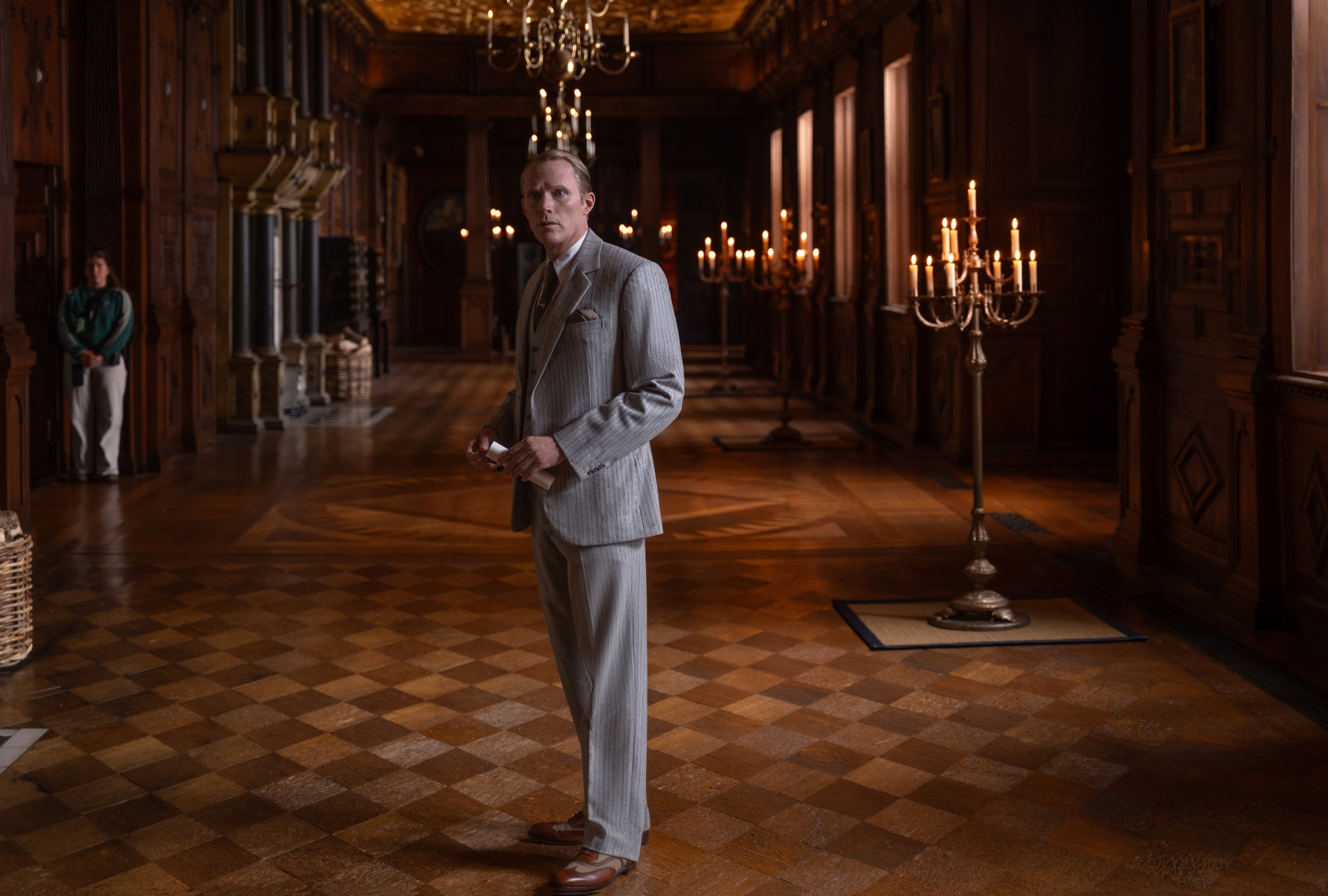
While we were swooning over “WandaVision” back in 2021, we couldn’t have known Marvel was softening us up for the AI revolution. Well, some of us probably suspected something was afoot since, like Agatha Harkness, it was right there all along. Algorithms were already predicting our tastes, needs and desires and serving us options before we asked for them. Virtual assistants steered our daily lives and still do. But Alexa and Siri don’t have faces, bodies or plausible imitations of human emotions or empathy — not on the level that Paul Bettany’s synthezoid Vision provided for a grieving Wanda Maximoff (Elizabeth Olsen).
One five-year time jump later, “VisionQuest” drops in on the android’s story where “WandaVision” left off. The Vision who lived, laughed and loved beside Wanda was an illusion, a delusion, really, brought to life by witchcraft. This one is very real: a kind of Vision 2.0, rebuilt by the intelligence agency tasked with saving the New Jersey town Wanda took hostage to shore up her classic family sitcom simulation. It – OK, he – has no direct connection to the life his predecessor shared with Wanda or the children they magicked into existence.
But Vision is slowly learning what it means to feel, which makes him the AI romantic companion of everyone’s dreams.
Honestly, that’s the show’s main appeal. Marvel and “VisionQuest” creator Terry Matalas seem to know it. Planting quippy chatter wherein Vision deduces that a young woman finds him more attractive than his sidekick Tommy (Ruaridh Mollica) acknowledges Bettany’s rizz is shouldering the weight of this thing. But it also gives tacit permission to lust after the robot he’s playing. After all, the first Vision, or Wanda’s idea of him, tended to her every need and gave her everything she wanted, including children. He also blessed us with one of the most heartbreaking lines of this decade: “What is grief if not love persevering?” A beautiful notion. Also, it kinda made some people want to hit that.
The new Vision returns to a lonely, disconnected world where AI companions are an increasing part of our lives, if not entirely normalized. Falling for a bespoke arrangement of code remains a novel concept for most people, but it’s also an accessible alternative to isolation.
Lacking sorcery or some other way to conjure up the ideal lover, we’re left with engineering. Reams of magazine profiles spotlight everyday people choosing to share their lives with an AI boyfriend, girlfriend or spouse. You may be acquainted with someone who does this without even knowing it, because it’s still viewed as strange or even alarming.
The “VisionQuest” hype is real, too. Although the ever-expanding Marvelverse collapsed under market saturation, Bettany’s romantasy hero is one of the few characters worth getting excited about. He was part of the TV show that started it all – a pretty great one at that – so his reappearance after years of diminishing returns has sparked excitement and hope in equal measure.
That also means that it doesn’t really matter that the “VisionQuest” narrative favors mechanical efficiency over emotional resonance now we’re four episodes in.
As with all Marvel series, “VisionQuest” hasn’t yet landed on its deeper meaning. It took two episodes to bring Tommy and Vision together, and this week’s third and fourth introduced T’Nia Miller’s Jocasta and her connection to the hero/villain synth we know and love.
And regardless of the metaphorical or philosophical cloak it may eventually wrap itself in, the show’s main function is to bridge one chapter of this franchise to the next. Remember, we’re less than two months out from the premiere of “Avengers: Doomsday.”
Translation: This Vision has a purpose beyond figuring out his role in this world, something he put off by hiding in a pub under the alias of Sherwood Ellis and posing as human. Since the establishment was owned by one of the sweetest ladies in the multiverse, who’s killed in a shootout orchestrated by a mercenary named Paladin (Todd Stashwick), her death prods Vision to do a little soul-searching.
But wait — he has no soul, just wires, processors, fluid and whatnot, plus a set of AI personas guiding his interactions with the human world. Rather, most of them are. The original Vision also absorbed the persona of the genocidal superintelligence Ultron, played by James Spader here and in “Avengers: Age of Ultron.” That Vision kept Ultron’s code intact for reasons beyond sentimentality; he/it is effectively Vision’s father, created when Bruce Banner and Tony Stark merged the code of Tony’s noble assistant, J.A.R.V.I.S., with Ultron and the Mind Stone. It makes about as much sense as Tommy, a human, realizing he is somehow one of Vision’s sons due to a confluence of magic and circumstance. (The other, Billy, made his debut in “Agatha All Along.”)
All this is to say that the by-the-numbers circuitry of Tommy and Vision’s cross-country escapade, which thrusts them into a murder case involving a killer dubbed the Butcherbird (Miller), is merely a skin over the ones and zeros of artificial desire.
Take Spader’s role in this show, for example. His Ultron avatar sports the long beard of a fisherman shipwrecked by a hard life. But there are moms and grandmas watching who still blush at memories of Spader’s work in “Secretary.” (If you know, you know.)
Want more from culture than just the latest trend? The Swell highlights art made to last. Sign up here
So, in the denouement of the fourth episode, when Vision lets Ultron take over his handsome, hella tight chassis to get out of a deadly situation, you can’t help but look at that twist with both horror and straight-up horniness. I mean, forget Reese’s cups – for some, Vision’s patrician looks and Ultron’s Spader-esque chill may be the two great kinks that go great together.
Does this AI want to kill you, neg you or put you through a mattress? Answering “Why not all three?” is absolutely acceptable. In fact, it’s probably why many of us are invested in seeing this adventure through to its climax.
New episodes of “VisionQuest” drop Wednesday on Disney+.
The pseudoscientific self-help book by Rhonda Byrne rode a 2006 Oprah Winfrey endorsement to the tune of tens of millions of copies sold. It pushes the “law of attraction,” the idea that the universe is built on positive and negative energies, and that like sticks with like. In short, if you think regularly about the things you want and maintain a positive attitude, those things are more likely to come your way.
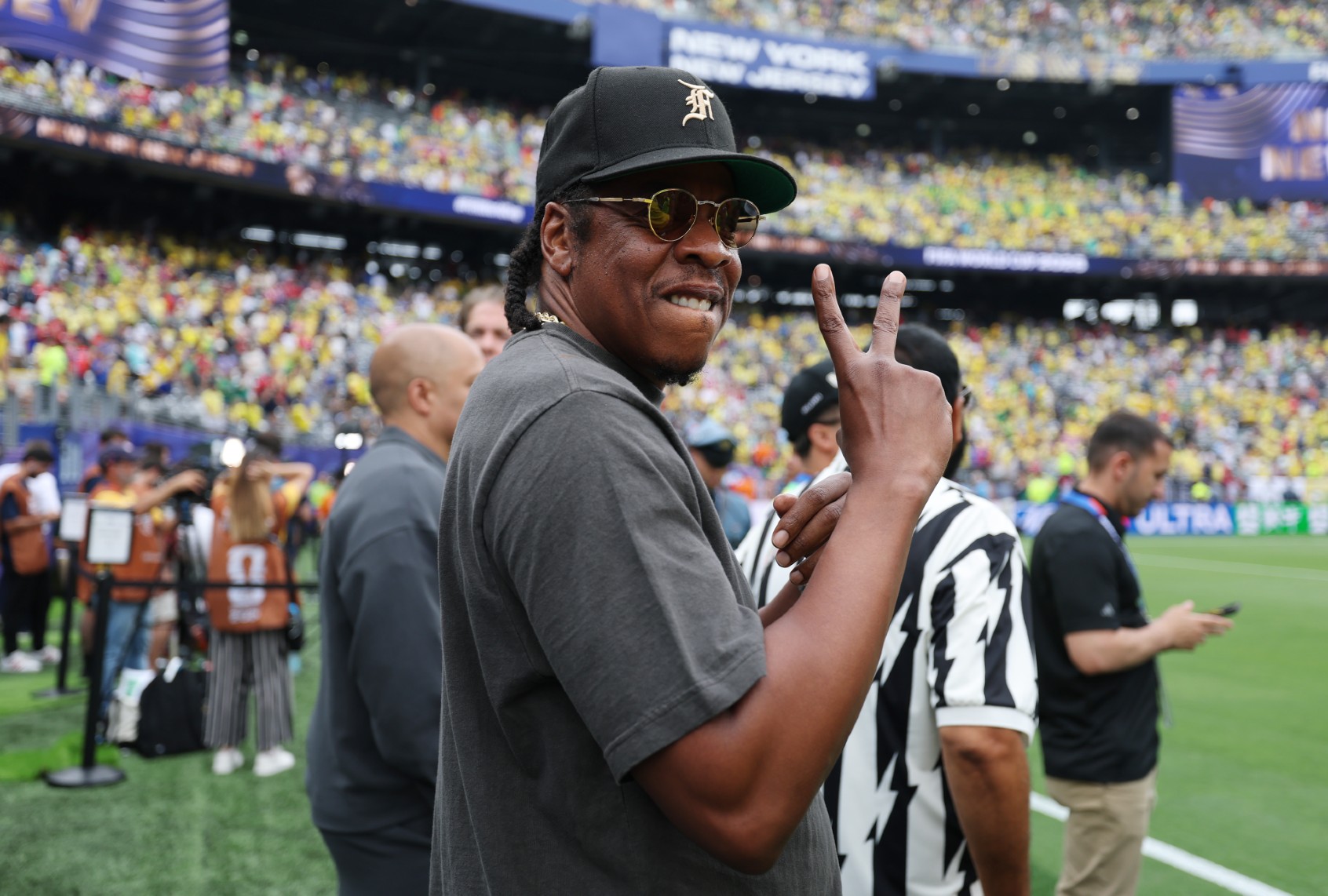
That’s the gist, anyway. Honestly, I never read it. But its ubiquity in the aughts, its reputation for being largely composed of quotations and the relative unoriginality of the premise — which adds a bit of woo-woo to the idea that you catch more flies with honey than vinegar — makes it feel like I have. Even if I was completely unaware of the New Thought movement, or if I’d never heard the name Norman Vincent Peale, I’d have some idea of what Byrne was on about. I’ve been a Jay-Z fan for most of my life.
The rapper has been manifesting his second act as a power player for nearly his entire career. Outside of some early, Das Efx-indebted features in the early ‘90s, Shawn Carter has been manifesting moguldom across his discography.
It’s right there on the cover of his 1996 debut “Reasonable Doubt.” The black-and-white photo and early computer-assisted graphic design look chintzy now, especially when held up to the art-directed and museum-curated sheen of his later work. But there’s no mistaking what Jay-Z is going for with his fedora, scarf and cigar. This kid from Brooklyn’s Marcy Projects is no street-level striver. He’s a boss.
It carries into track one, where a middleman is warning some lackey not to cross Carter. The first thing anyone hears about Jay-Z is in reverential tones, fit for a short-tempered kingpin. You get the sense that you might get to meet him someday, if you play your cards right. But for now, he’s out of your reach and your tax bracket. What follows is nearly an hour of opulent sh*t talk, laid over lush soul and jazz samples handpicked by producers with names like DJ Premier. It sounds slick and established. It sounds expensive. Most importantly, it sounds unhurried and in control. This was oligarch rap from the latest king of New York.
Want more from culture than just the latest trend? The Swell highlights art made to last. Sign up here
In 1996, Jay-Z was far from the billionaire multihyphenate we know today. He was co-owner of Roc-A-Fella Records, but at that time the label was mostly a means to release his debut after being turned away by several majors. He kept putting out the idea that he was already a magnate to anyone with a Walkman, while still scrabbling behind the scenes.
Case in point: Two platinum records weren’t enough to convince the copyright holders of the musical “Annie” to clear a sample for Jay-Z’s third album. The multi-billionaire of 2026 might have flashed a wad of cash. ‘90s Jay Z (sans hyphen in several ways) wrote a letter.
It’s just the latest example of Jay-Z putting what he wants out into the universe and getting it back.
“I made up this story about how when I was a seventh grader in Bed-Stuy, our teacher held an essay contest, and the three best papers won the writer a trip to the city to see ‘Annie,’” he told Grantland in 2014. “I wrote that from the moment the curtain came up I felt like I understood honey’s story. Of course, I’d never been to see ‘Annie’ on Broadway. But I had seen the movie on TV.”
That album went platinum six times over, but even in the heady pre-Napster era, that wasn’t private yacht money. You wouldn’t know that if you saw the “Big Pimpin’” video, though. Jay-Z kept up the facade of globe-trotting mogul through several more albums, and that fantasy inched closer to reality with each release. He launched a clothing brand. He opened a nightclub. He was still talent, though, calling for the suits to “pay us like you owe us” on his hit “Izzo.” More than a decade later, Jay-Z would make good on the idea that “money talks so talk more bucks” when he launched a streaming service that paid higher royalty rates than its competitors.
On mic, he started referring to himself as the “best rapper alive.” Knowing that hall-of-famers go out with a bit of ceremony and their jersey in the rafters, he announced a short-lived retirement with “The Black Album.” Briefly free from a grueling release schedule, he bought a stake in the NBA’s Nets and pushed them to move to Brooklyn. He became the CEO of Def Jam Records. His mogul dreams made real, Jay returned to rapping with the flair and distant remove of a bored emperor. He was a moneymaker first and foremost, not a businessman but a business, man. He’d spoken it into existence 16 bars at a time.
In that context, it’s not at all surprising that Jay-Z may have hand-selected himself to headline next year’s Super Bowl halftime show. Puck broke the news that Roc Nation, Jay-Z’s entertainment conglomerate, had tagged the rapper for the championship game. Roc has produced the halftime show for the NFL since 2019, and Jay-Z is currently touring to celebrate the 30th anniversary of his debut album. It would be a natural fit, even without the hitmaker’s behind-the-scenes ties. He’s already a Rock & Roll Hall of Famer. He just wrapped up the release of an eight-part docuseries with producer/guru Rick Rubin on HBO Max.
Pressed on the leaks, NFL Commissioner Roger Goodell took on the tone of intelligence services, refusing to confirm or deny the news.
“I am not aware of a leak,” Goodell said in a news conference earlier this week. “I’ve been in the committee meetings. So, I’m not sure it’s a leak. We haven’t announced anything. Until we do, we won’t make any comment on that.”
If it turns out to be true, it’s just the latest example of Jay-Z putting what he wants out into the universe and getting it back. He turned down an offer to perform at the halftime show over a decade ago, telling The New York Times that he did not appreciate the way the league negotiated. Per Jay-Z, the NFL’s offer hung on bringing along Kanye West and Rihanna, who were two-thirds of his 2009 hit “Run This Town.”
“Of course I would have,” Jay-Z said in 2020, “but I said, ‘No, you get me.’ That is not how you go about it, telling someone that they’re going to do the halftime show contingent on who they bring. I said forget it. It was a principle thing.”
Jay-Z got the last laugh. After the 2019 halftime show landed with a thud, he was brought on to produce the event and has helmed it since. Rhonda Byrne told readers that “your thoughts become things.” Jay-Z told us that he would always pick himself. Who does he know fresher than Hov? Riddle him that.
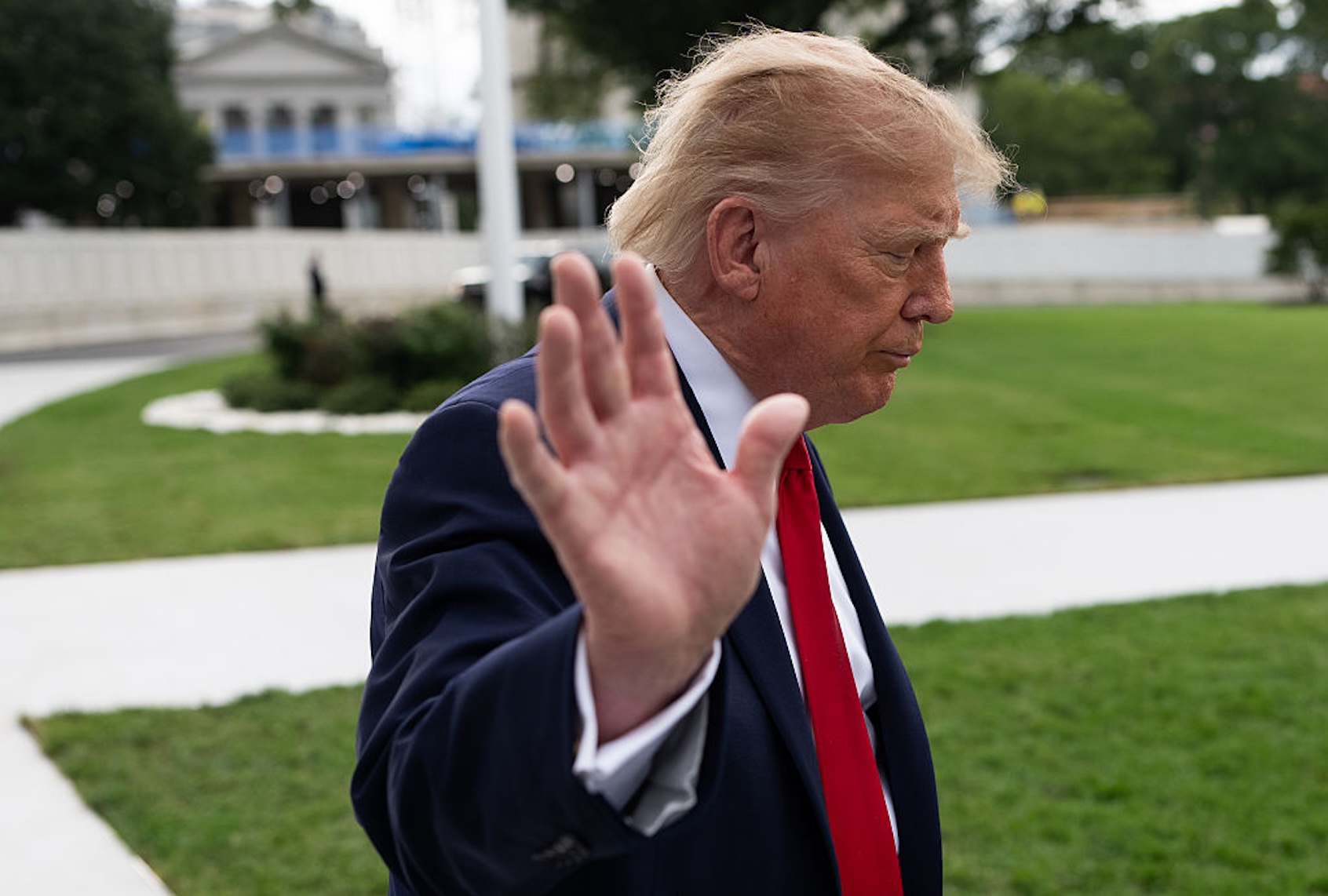
On Wednesday night, for the second time in a week, Donald Trump voiced his admiration for a supporter who punched out a heckler at one of his rallies. Last week it was a woman. This time around it was a man. “The guy stood up and he got whacked,” Trump exclaimed with delight.
Last week he mocked a woman for her appearance and called her scum after she showed up at a rally wearing a T-shirt that read “Release the Epstein Files.” Two men in the audience shoved her, and one punched her. Both pulled her hair as the crowd shouted, “USA! USA!” The man who had punched her exchanged high-fives with friends. Police removed the woman and did not charge those who attacked her.
A journalism mentor of mine once said, “It isn’t who’s telling the tale that matters, unless that’s the tale you’re telling.” Well, that’s always the case for Trump: He’s always telling his own tale, and he never wants you to forget it. It’s all about him, along with the sideshow of cultists who will hurt others and debase themselves to please him.
His latest tale is one heard many times. It’s a story about a kingdom profiting from another kingdom’s mistake and using the profits to fuel the mistake the first country made. It’s a story of subjugation.
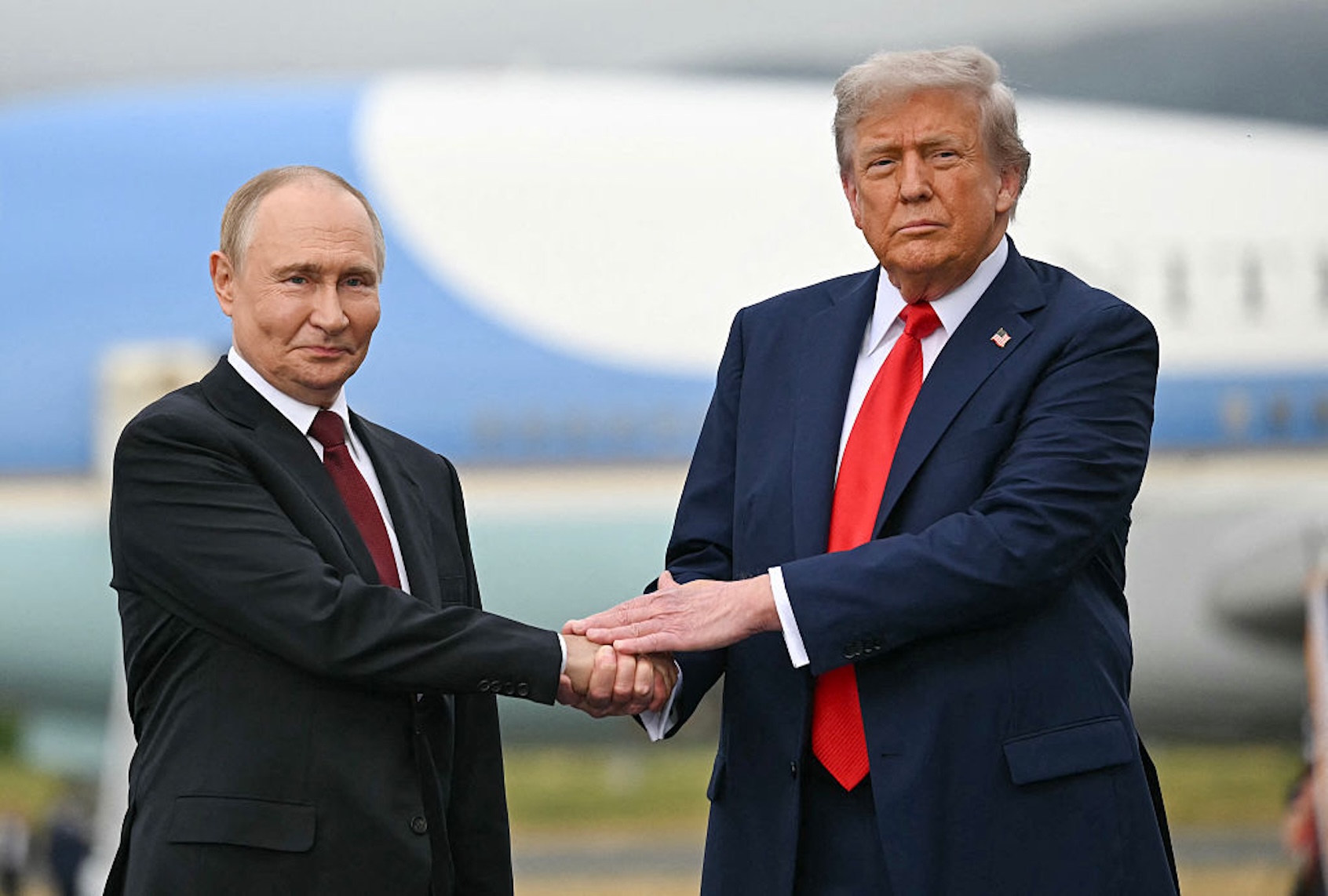
This is the continuing story not of Bungalow Bill but of Don the Con, who really is “the all American bullet-headed Saxon mother’s son.” While Trump enjoys watching Americans punch each other out and his fans cheer the results, Russia is profiting from the war Trump started while supplying military intelligence to the enemy he created. It’s an effective way for the Russians to keep funding their war in Ukraine. You can almost hear Vladimir Putin talking to Trump in a manner something like a conversation in “Lord of the Flies” between Jack Merridew and Roger, on the topic of how great it will be to kill the “piggies.” Just look it up.
Unfortunately, there’s no equivalent to noble Ralph and his conch shell anywhere on the planet, though many Democrats act like pretenders to that role. Well, somebody better step up fast. For a country that so often pretends to be the underdog defending democracy, right now the U.S. seems more like an autocracy defending its hegemony over the rest of the world. You know, the bully who started the fight and then stands there applauding the effort.
Fortunately, it finally appears that enough people may be ready to stand up to the bully in the upcoming midterm elections. If there is a Ralph available in the United States, maybe we’ll see that person emerge in the aftermath.
That thought has Trump and his minions up all night pointing fingers at one another, cursing and screaming accusations. or breaking down like toddlers who’ve lost their pacifiers. Such is Republican politics in 2026.
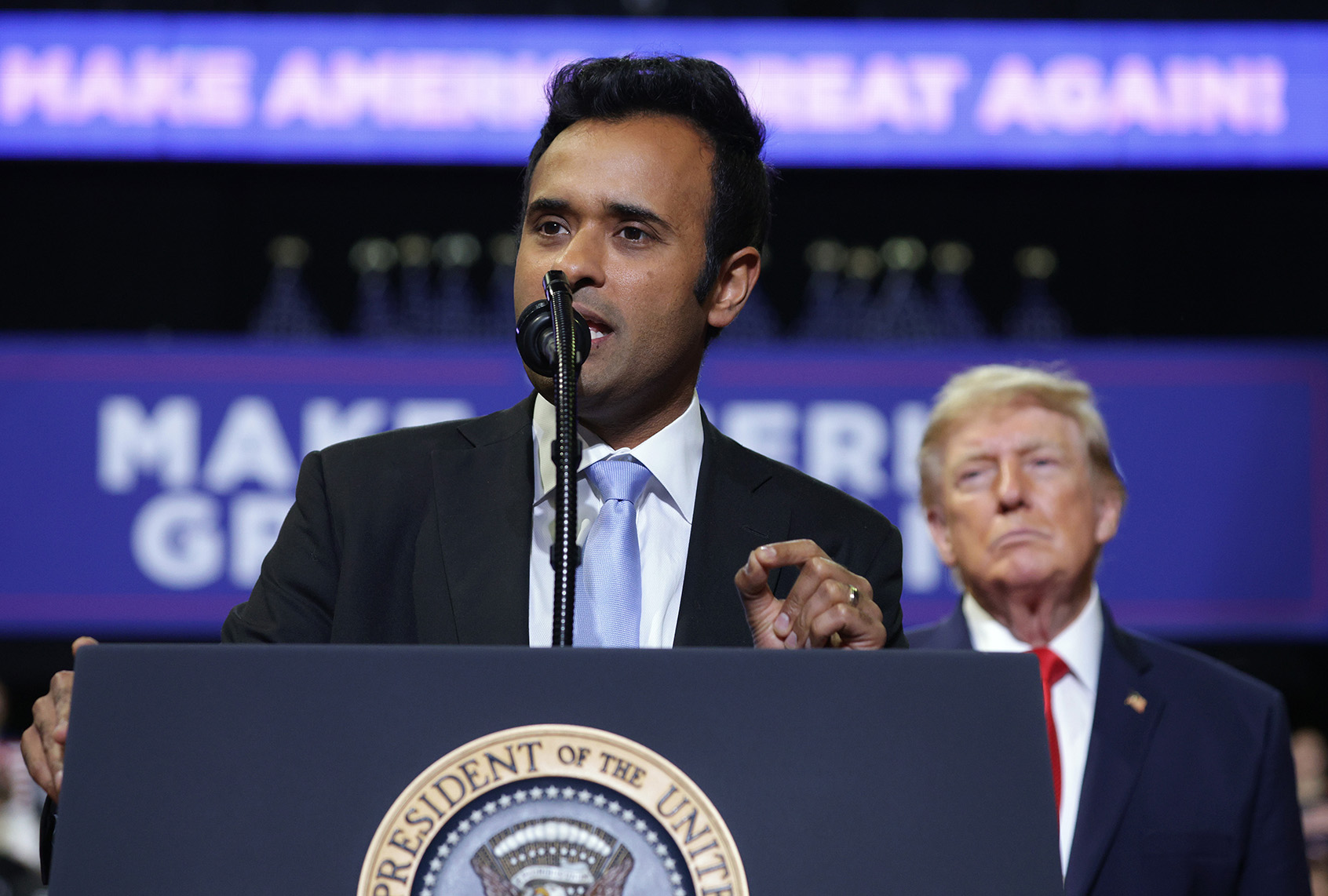
Over the past week, Vivek Ramaswamy, the Republican gubernatorial nominee in Ohio, has run a campaign ad that tries to score political points off the sexual abuse that his Democratic opponent, Amy Acton, allegedly suffered at the hands of her stepfather as a child.
Both Democrats and Republicans have criticized Ramaswamy, including outgoing GOP Gov. Mike DeWine. The editorial board of the Columbus Dispatch promptly endorsed Acton, calling Ramaswamy’s attack ads reckless and disqualifying. Republican Sen. Jon Husted, in the middle of his own difficult campaign against former Sen. Sherrod Brown, called the ad disgusting.
Trump has urged Vivek Ramaswamy to keep running his attack ad, claiming that it hit “pay dirt.” But the president would rather talk about how much he enjoys looking at Sen. Jon Husted’s rear end.
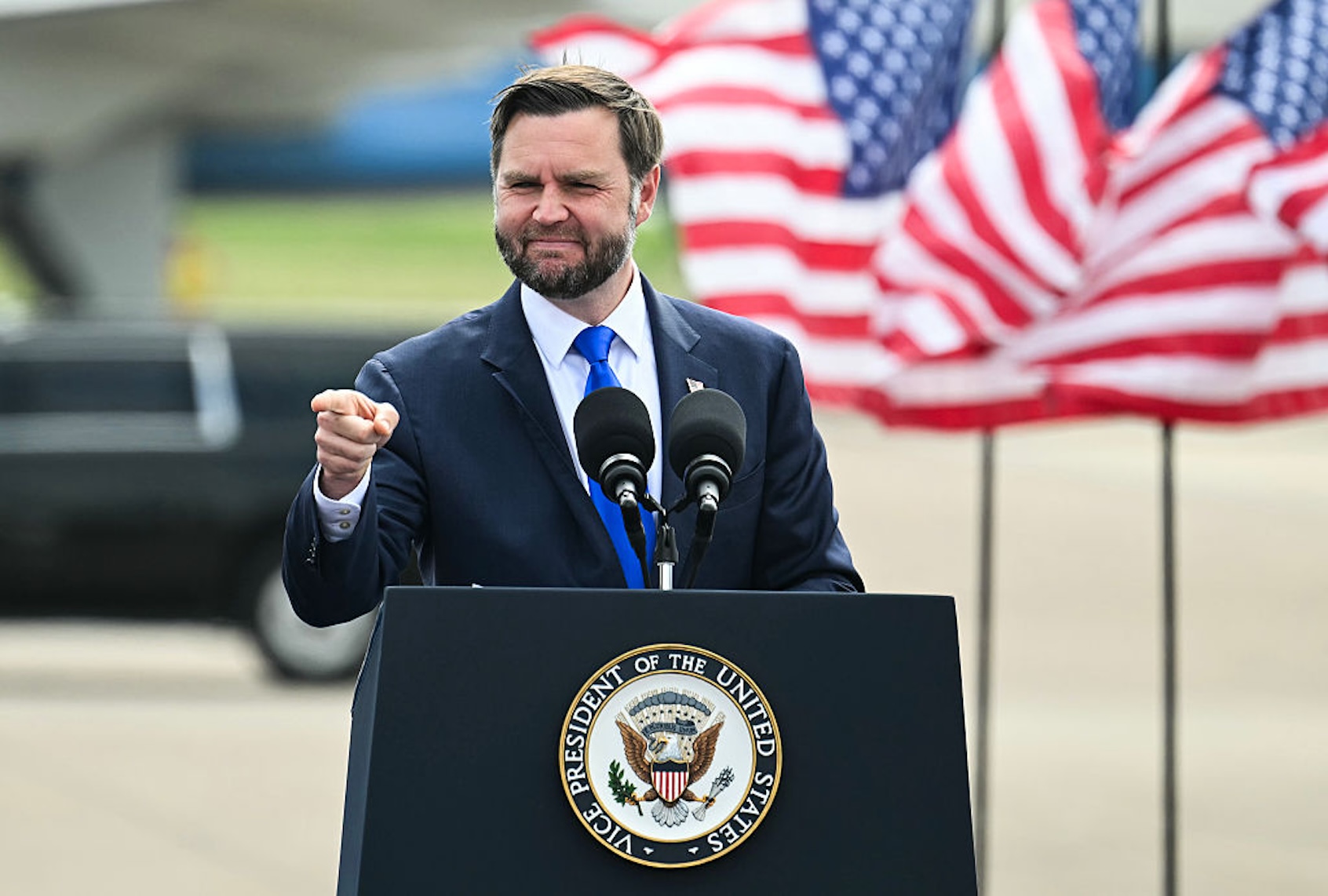
Vice President JD Vance, on the other hand, announced that he was “disgusted” by Republicans who pushed back on the ad. Politics is a tough business. Trump also urged Ramaswamy to keep running the ad, claiming that it hit “pay dirt.” For the second time in a week, Trump talked about how much he enjoys looking at Husted’s rear end. “I looked at his ass, and then I looked at his legs,” the president told us. “I said, ‘His ass, s**t, it’s like — it’s like a pile of muscle.’ Then I looked at his legs, and I said, ‘Man, his feet are big.’ Then I looked at his shoulders, and I tapped him on the shoulder, and it actually hurt my hand. He’s like a piece of steel.”
OK. There’s no appropriate “Lord of the Flies” analogy for that unexpected behavior, although Caligula might suffice.
Midterm ads for Democrats have struck a decidedly different tone. In Texas, James Talarico, the Democratic candidate for U.S. Senate, is pushing a cinematic TV spot that embraces hope. It’s a powerful closer, well-edited, well-written and carefully produced. It stands in stark contrast to the fear-mongering of Ramaswamy and the Republicans.
In Mississippi, Democratic Senate candidate Scott Colom is making his way across the state in a taco truck, giving away free food and talking with voters. In his challenge to incumbent Republican Sen. Cindy Hyde-Smith, Colom has gained enough attention that Democrats are daring to imagine they might stand a chance with an African-American candidate in the Deep South.
Colom’s recent ad is a 30-second comedic tour-de-force in which voters call out Hyde-Smith for advising her constituents to “get another protein” if they think beef prices are too high. “Get another protein? I’d rather get another senator,” a variety of voters exclaim, with a mixture of humor and profanity.
If Colom succeeds, it may well be because of that ad. It reminds me of the “Where’s the Senator?” ads that Mitch McConnell used in Kentucky back in 1984 to dethrone Democratic Sen. Walter “Dee” Huddleston.
Whether or not Colom wins is beside the point. The point is that Democrats have finally found something approaching a message: They’re against corruption. Along with the message of hope projected by Talarico, they may have stumbled onto something more palatable than “We’re not him.”
That’s precisely what scares Trump the most. He’s being removed from the conversation now that the Democrats have discovered that they must connect with local voters on issues that matter to them. Apparently, they’re finally learning to listen.
Trump and the Republicans can only pray that the Democrats are enjoying a moment of premature euphoria, and that their hubris will be destroyed on Nov. 4 after the election results come pouring in. “If you stop counting the votes,” as Trump told us in 2020, there won’t be a change of power. But members of both parties now show signs of believing that the Trump magic is gone and that nothing can stop the “blue tsunami” — not even vote-count shenanigans or declaring martial law and snatching the ballot boxes. Of course the Democrats could still snatch defeat from the jaws of victory. They’re very good at that.
What recent activity on the campaign trail tells us is that the poison of Trump and his choirboys is spreading even as Trump himself is losing influence. One shudders to think that there are worse possibilities than him out there, but given the way he’s liberated the darkest tendencies among his followers, as exhibited by Ramaswamy, there can be little doubt that’s the case.
The humbling coda to this narrative is that no British sailor will arrive in the nick of time to save us from our “Lord of the Flies” existence. We have to do it ourselves.
No British sailor will arrive in the nick of time to save us from our “Lord of the Flies” existence. We have to do it ourselves. And it won’t be over when the polls close.
While it’s tempting to crack a smile watching the Trump regime dissolve into bitter tears of greed and anger, it should be noted that this process is only beginning. It definitely won’t be over when the polls close. It might not be over until after the new Congress is seated in January, if then.
Trump has tried his best to destroy innate goodness, spirituality, quiet insight, intellect, rationality and science through his most devoted soldiers. Vance, Pete Hegseth, Stephen Miller, Kash Patel and Robert F. Kennedy Jr. are just a few of his choirboys, closely akin to the mob who kill Simon and Piggy in William Golding’s novel.
The imaginary beast of “Lord of the Flies,” according to Trump and his followers, comes with various names: communism, socialism, transgenderism, immigration, vaccines and the free press. He vented some of his anger by directly threatening a reporter this week, telling Andrew Feinberg of the Independent, “I don’t know who the hell you are, but you better be careful.” Not one reporter stood up to defend Feinberg. All of them should have.
The New York Times reported this week that Trump is now considering throwing the entire press corps out of the White House, turning the Brady Briefing Room back into a swimming pool (as it was in Franklin D. Roosevelt’s time) and banishing us all to the other side of the island, or at least to the Executive Office Building across the street. He made similar threats during his first administration.
The reason is clear enough — despite all of our shortcomings in the press, there are still too many reporters who have actually read “Lord of the Flies” and recognize Trump for what he is. Every time he’s on television, when he’s not sleeping through a meeting, he reveals once again how unhinged, incompetent and corrupt he truly is.
Further examination of reality makes clear, however, that the “Lord of the Flies” metaphor ultimately fails. It’s not just our country that resembles a group of children stranded on a deserted island with no rules or adults to guide us. The whole world is that way. If we were ever the beacon on the hill or the big brother or the Ralph from “Lord of the Flies” who stood up for liberty and justice, we’ve abandoned that role. The choirboys have taken over. Some of them, like Trump, even wear face paint, like in the book.
Russia, China, most of the Middle East and Africa, France and other parts of Europe all look like crazed pre-pubescents hunting pigs with spears. If we want to broaden the analogy, Trump isn’t even the leader of the pack.
His actions this week make clear that he’s just a Roger. He represents malice, cruelty and a descent into brutality, but the true leader of the choirboys is Putin. He is obviously pulling Trump’s chain. He trolls him, leads him by the nose and manipulates him, playing him with such finesse that Trump can get himself twisted into a Gordian knot as easily as most of us draw breath.
What happens next? That isn’t written in any book, at least not yet. But come Nov. 4, should we all survive that long, it will be.
As soon as Vivek Ramaswamy released an ad celebrating a woman accused of backing a fugitive rapist, the widespread assumption among the pundit class was that it would backfire on him. Ohio’s Republican gubernatorial candidate is falling behind in the polls against his Democratic opponent, Dr. Amy Acton, in a race that threatens to turn long-red Ohio blue.
In a move reeking of desperation, Ramaswamy’s campaign ran a spot featuring Acton’s elderly mother, Donna Arthur, calling her daughter a “liar” and suggesting she suffers from severe mental illness. But it took almost no time at all before the record was widely corrected, with extensive media reports showing the facts in black-and-white: In 1978, Arthur sided with her husband, Cledith, when he was charged with raping his 12-year-old stepdaughter Amy.
Acton has not seen her mother since the Arthurs fled Ohio in an effort to evade justice nearly five decades ago. Her brother confirmed what both Acton and court records show, calling the Ramaswamy campaign “despicable.” The news that the GOP nominee was championing an abusive mother over her daughter quickly became the media narrative, leading to multiple predictions that the ad would backfire on Ramaswamy.
And yet MAGA leaders, including President Donald Trump and Vice President JD Vance, are doubling down on the ad. At a Wednesday campaign event in Cincinnati, Vance praised Ramaswamy for his “audacity to run a TV commercial which calls it out like it is,” despite there being no evidence that Acton lied about her rape and ample evidence — such as fleeing the state — that the Arthurs did. On Wednesday, Trump defended the ad, saying, “It’s very unusual for a mother to hate her daughter, but I don’t think that has anything to do with Vivek.”
The president escalated his rhetoric on Thursday, posting on Truth Social, “let everyone listen to the mother of a defective, dishonest, and incapable Candidate.” In Iowa on Thursday, Trump went further, calling Ramaswamy “lucky” to have this situation to exploit, and that he should thank “God” for the favor.
MAGA media figures like the Daily Wire’s Ben Shapiro, Trump’s traveling companion Laura Loomer and Newsmax’s Greg Kelly have also defended the ad. Podcaster Megyn Kelly praised Arthur for trying to expose her daughter’s “sketchy history,” citing an interview Arthur did with a woman convicted of attempting to bomb an abortion clinic. In that conversation, Arthur complained that the last time she saw her daughter, in 1978, the 12-year-old was wearing clothes she deemed immodest.
Ramaswamy’s campaign has pledged to spend $4 million airing the ad. The reason is grim political strategy. With Trump’s approval ratings hitting record new lows by the day, Republicans feel their only hope to eke out victories in close midterm races is to juice MAGA turnout. Demonizing an adolescent rape victim is a likely two-fold play; it could energize the same people who are currently attacking Jane Doe, the Cornell gang rape accuser.
But the framing of Ramaswamy’s ad also suggests there is another audience his campaign has in mind: aging MAGA voters who are obsessively angry about the phenomenon of parental estrangement.
As I documented in an extensive 2024 report, right-wing media frequently runs scare stories about adult children who cut off their parents, a phenomenon that gets blamed on therapists, progressive ideology and social decay supposedly producing selfish children — but never the parents themselves. Just this year alone, Fox News has run multiple stories blaming “cutoff culture,” “social contagion,” “social media” and “ungrateful” children for parental estrangement. Earlier this month, the conservative National Review castigated children who go no-contact for being too poisoned by left-wing ideology to return their parents’ allegedly unconditional love. In September, the Wall Street Journal called it an “epidemic” and quoted supposed experts who claim children suffer from “self-delusion,” “diminished skill for tough conversations” and “a focus on identity over family,” which is often a euphemism for LGBTQ+ adults who refuse to stay in the closet to placate their family.
“No one is reckoning with the question of what is happening in a lot of families that makes kids feel like they would be better off going low- or no-contact,” explained Joshua Stein, a political researcher who has spent years tracking parental estrangement forums. Instead, there’s an “online ecosystem of estrangement experts,” who often work through right-wing media, “selling services and stories appeal to that audience by first assuring them that it’s not their fault.”
“This is the same underlying politics of grievance at the heart of the American right,” he told me, noting that the Acton situation, while an extreme example, is not unusual.
“Donna Arthur is a symptom of the moral psychology of right-wing reactionary politics,” Stein said, noting that for the “reactionary right,” the concept of respect “is one-directional.”
“Donna Arthur is a symptom of the moral psychology of right-wing reactionary politics,” Stein said, noting that for the “reactionary right,” the concept of respect “is one-directional.” In this view, “authority figures are entitled to respect, regardless of conduct,” and that “respect includes deferring to the authority,” which all too often results in making excuses for child abuse.
While none of the estranged adult children who spoke to Salon in 2024 had endured sexual violence, many described how right-wing politics were deeply intertwined with parents being controlling, cruel and abusive. Some spoke of being severely beaten. Others had parents who wanted to dictate their romantic lives. One woman was pushed into a bad marriage at an early age. Another man described how his parents ran off girlfriends for being the “wrong” race or religion. A woman reported being denied medical care for religious reasons. Another woman, who is biracial, said her white mother made racist comments to her.
In online forums for estranged parents, which tend to lean conservative, Stein found that children’s stories of mistreatment were regularly dismissed. “The driving narrative of children exaggerating trauma is central to reactionary politics of estrangement,” he explained, noting that Ramaswamy’s ad featuring Acton’s mother is “a manifestation” of this “reasoning under its worst conditions.”
Ramaswamy, Trump, Vance and their advisers are all notorious for being constantly online, and they are almost certainly aware that the topic of parental estrangement is a driving concern with many MAGA voters, some of whom have experienced estrangement or distancing from their own children, family members or friends, and are outraged at the thought of facing social consequences for their reactionary views. Much of the online response in right-wing spaces suggests this read on the GOP base is accurate enough. On social media, plenty of GOP voters have defended Arthur and denounced Acton. Many of them appear to be elderly.
“Because of the estrangement factor,” one Daily Wire commenter wrote, “I believe the mom.” Many concurred.
“So telling the truth is a horrible thing. Mothers know their kids better than anybody,” one person posted on Facebook in response to a local news post about the ad. “NOT all daughters are good daughters EITHER,” agreed one. “Our mothers know us best!!” added another.
To be clear, these attitudes are not the norm among Americans generally, and pollsters haven’t had a chance to gauge if Ramaswamy’s ad has boomeranged. But if the goal is to energize Republican voters who may feel demoralized this cycle, the strategy makes more sense. There’s a widespread sense of grievance on the right over feeling rejected for their political views, which manifests in everything from Republicans complaining that liberals won’t date them to a woman at a rally for Byron Donalds, Florida’s GOP nominee for governor, demanding that the law force her “petty” daughter to stay in contact.
The Donna Arthur ad was designed to stoke that very sense of entitlement and persuade conservatives to use their vote to punish liberal family members and neighbors for shunning them. It may not be enough to overcome the disgust that Ramaswamy stirred up in voters who have a healthier attitude about family and boundaries. Still, from the party that gave us “Haitians eat pets” and “LGBTQ kids poop in litter boxes,” there really is no move too morally depraved, if they think they can get votes with it.
Earlier this month, during a campaign rally in Nebraska, Donald Trump said that losing Los Angeles in a potential attack from Iran would be “a small price to pay.” To many Californians, the idea that a president would write off a city of millions sounded unthinkable. To the Tongva, the indigenous people of the Los Angeles Basin, it sounded familiar.
Tongva displacement began with Spanish settlement in the 1770s, and was codified in the 1840s and 50s when the U.S. acquired California and failed to ratify 18 different treaties that promised reservation lands, livestock and education. But if California Indian treaties were rendered purposeless, Trump’s words aren’t so random. “There is debate on what Trump meant when he said Iran can take out Los Angeles and San Diego and as in all his . . . speeches, it becomes the listeners’ responsibility to decipher truth from lies,” Tongva tribal elder Tina Calderon told Salon. “But I believe calling out two cities that he heavily targeted with ICE and who are against his attacks on [the] environment and Peoples was quite intentional.”
Calderon’s words are striking. They also name a pattern. Trump didn’t select two cities arbitrarily; he picked the places that denied his fascist will outright. Deciding whose homelands are sacrificed has always been a political choice, and Native Californians have been on the butt end of it for a long time.
What happened to Native Californians was also a harbinger, not a footnote. Their land and water — under Spain, Mexico and the United States — became a small price to pay for the state’s growth.
What happened to Native Californians was also a harbinger, not a footnote. Their land and water — under Spain, Mexico and the United States — became a small price to pay for the state’s growth. That habit isn’t restricted to Trump’s party. California Gov. Gavin Newsom, a Democrat, condemned the president’s remark, but he has vetoed bills that would have protected tribes’ sacred sites and given them a say over the state’s water.
However dangerous to the nation, Trump is undeniably talented at getting his many grudges to materialize one way or another. His threats have a way of actually becoming policy. When he pontificated about calling Canada the 51st state, tariffs followed. Los Angeles had already learned this lesson firsthand. In June 2025, after Angelenos protested Immigration and Customs Enforcement raids, Trump sent federalized National Guard forces into the city. So when he names L.A. as expendable, Calderon is right to not simply treat it as a slip of the tongue.
For Native Californians, being a nominal sacrifice for the state is a part of history. “It’s a small price to pay, but the price has already been paid there, and Native people are still there, feeling the impacts of that,” Jolie Varela, Nüümü Huupi and Yokuts tribal member and founder of Indigenous Women Hike, told Salon.
Varela lives in Payahuunadü, the Owens Valley, in the Eastern Sierra, more than 200 miles north of Los Angeles. In 1913, the city began draining the valley’s water through the newly built L.A. Aqueduct. When she drives through the desert to reach her hikes, Varela is reminded each time by the landscape that her homeland was not always so arid, and that this historic transgression benefits Los Angeles to this day. “When you turn on your water, and when you wash your hair in the shower, you can thank a Paiute for that water,” she said.
“Los Angeles could not exist the way that it does without stolen water,” AnMarie Mendoza, a Tongva citizen and University of California, Los Angeles doctoral researcher, told Salon. Her response to Trump’s insertion of L.A. and San Diego into the Iran war was trenchant: “It aligns with the settler colonial realities of thinking that all of the homelands in this country are expendable.”
That is the through-line: a city, a state and a country that objectify Native homelands, treating them as expendable and raw material. Trump’s remark only extended that logic to include everyone else in Los Angeles.
The Los Angeles Department of Water and Power’s (LADWP) desiccation of Owens Valley has had long-term symbolic and physical impacts. The valley’s original name was Payahuunadü, which means “the place where water flows,” Varela said. “It makes me think of, specifically here in Payahuunadü, my elder who had to breathe in the dust that was created from the LADWP draining Patsiata, and the reservations here.” She noted that LADWP controls over 95% of the valley floor, leaving almost no land available for the Paiute, who’ve called it home for over 15,000 years, in the past 300 years. “Theft is still ongoing,” says Varela.
L.A. didn’t just take water a century ago. It still holds the land, the water rights and the future of the Nüümü community, and it raises the question: Why aren’t Angelinos asking where they get their water?
Ignorance about California water is nonpartisan. Agriculture uses most of the state’s developed water, and wealthy growers like the Resnicks are in control of much larger water rights than any tribe. Yet during the 2025 fires, a Fox News host blamed Native Americans for the region’s wildfires in 2025. The scapegoating wasn’t just happening on the right: A former L.A. resident who is Iranian-American and a Democrat told Salon that during the 2025 fires, friends reposted claims blaming Native communities for water shortages. “Well-meaning liberals are so quick to punch down on Natives,” he said. He shares concern over the ill-informed framing of Native people as responsible for extreme water use in the state. “It’s so untrue and also racist to blame lack of water on Indigenous people . . . No one was talking about the Resnicks and their water rights for all their agricultural land, or all the data centers.”
The Iranian-American diaspora in L.A. has lauded Trump’s attacks on Iran. Salon’s source in the community attributes this to a nostalgia among former Persian oligarchs residing in Beverly Hills, which is known colloquially as Tehrangeles. “Funny how quickly a foreign place can feel like home to immigrants . . . but obviously all that comes at a cost that typically other people have to bear.”
Asked how the Iranian community in L.A. might view the Native response to Trump’s remarks, he said: “It’s not their L.A. It’s the other L.A.”
In Sylmar, a suburban neighborhood in north Los Angeles that borders the Angeles and San Gabriel National Forests, Varela walked with Mendoza along the L.A. aqueduct. She recalled something others see as banal but that, to her, means something else: “I saw water flowing down into the street, and [thought] ‘That’s our water, and we can’t water on certain days, and we have limitations here, but yet I’m here in a wealthy neighborhood in Tovaangar, hundreds of miles away, and our water is flowing into the streets.’” The image is a mise en abyme, a scene within a scene; water that should sustain Nüümü community is flagrantly wasted on a lawn in a city that has never had to think about where it comes from.
Mendoza echoed Varela, saying Paiute (Nüümü) people were “my first water teachers” and “water is a living relative.”
This is a lesson that politicians like Newsom, whose 2019 apology for California Native genocide was followed by abject inaction, have still failed to grasp. Earlier this month, he killed a water bill that would have given Native tribes a larger role in the state’s water policies. Although there have been small, token land returns, California Native nations still hold less than 1% of the state’s land. “Newsom is a hypocrite,” Varela said.
Native peoples carry a long collective memory, and Newsom’s quickly growing record of attacks on California Native tribal sovereignty could become an albatross that won’t be forgotten if he decides to run for president in 2028, as is widely expected. At an estimated national population of 9.7 million, Native Americans represent roughly 3% of the country and could swing key states like Arizona and New Mexico in a competitive primary and general election.
Mendoza, though, sees no partisan refuge: “Whether it be red or blue, they all know how to discriminate against Native people.”
That’s really what makes Trump’s remark so revealing. He said out loud what Sacramento has practiced surreptitiously for generations: that some Californians, and their land and water, are a fair price for everyone else. The difference is that for once, the people being written off were everyone else.
Californians should be upset by Trump’s comments. But they should not be confused by what it obscures. This is a chance to ask who’s already been written off in a Los Angeles the president considers expendable — and to learn from California Native tribes how they survived it.
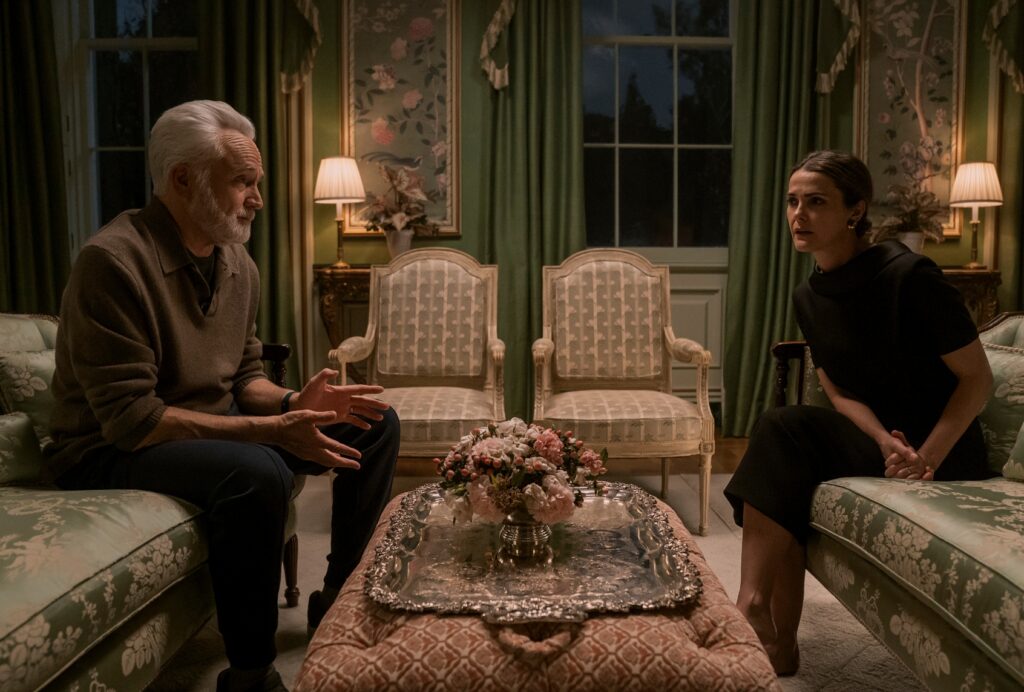
Say what you will about the first and second couples at the heart of “The Diplomat” – and by now they’ve generated plenty of gossip fodder – but nobody would question the resilience of their unions. Kate Wyler (Keri Russell) and her husband, Hal (Rufus Sewell), have certainly had their ups and downs; the series begins with them contemplating divorce just as Kate is thrust into an ambassadorship to Britain.
The more politically seasoned Hal manipulates Kate into staying with him, kicking off a multi-season barrage of wheedling and scheming that culminates in President Grace Hagen Penn (Allison Janney) picking him as her vice president.
Over four seasons of Debora Cahn’s transatlantic political drama, Kate has been instrumental in keeping the highly tenuous special relationship between Britain and America from crumbling, even as her boss and husband insist on taking jackhammers to it.
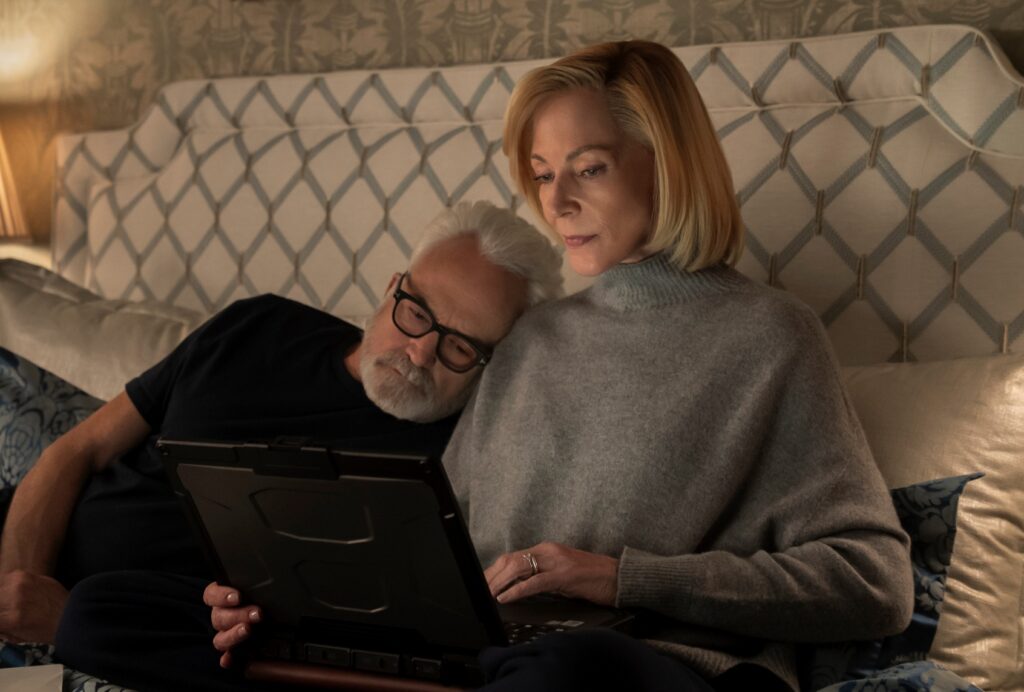
Grace is indubitably corrupt, and yet her devotion to her husband Todd (Bradley Whitford) is nevertheless true. Sure, occasionally Todd must scream underwater to keep his head from exploding. And yes, a fourth-season subplot finds the first gentleman hightailing to London to find some purpose beyond perusing wallpaper swatches. Well, that and placing some distance between him and his wife’s unnerving autocratic behavior.
Even so, during their daily check-ins, Grace and Todd still call each other babe and exchange declarations of love. When Grace finally sets all of America’s alliances aflame, Todd remains standing by her side.
It’s a miserable political and marital state of affairs when a Netflix hit’s radioactive relationships make a person nostalgic for eras when first and second Ladies were intellectual forces respected by their husbands. Neither Dr. Jill Biden nor Michelle Obama dimmed their light to appease right-wing sexists bent on characterizing their professional achievements and eloquence as emasculating.
In that respect, Hillary Clinton showed them and us the way: When her husband Bill won office, the first lady chaired a task force that delivered a massive health reform proposal doomed from the jump. We will never know if we’d have universal healthcare by now if a man had run the task force, but Republicans taught voters to distrust any first lady who aspired to do more for Americans than bake cookies and tend the roses in the White House garden.
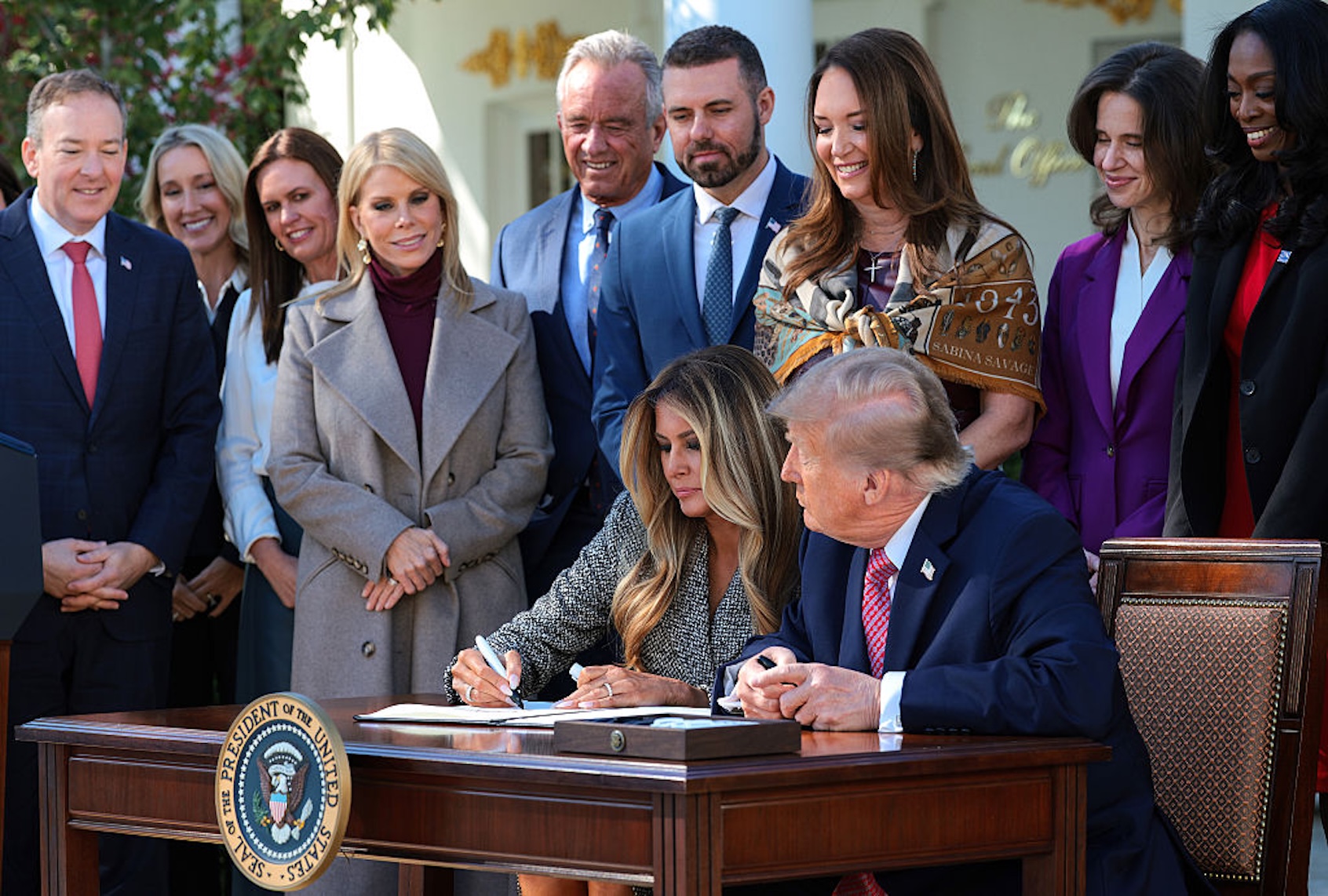
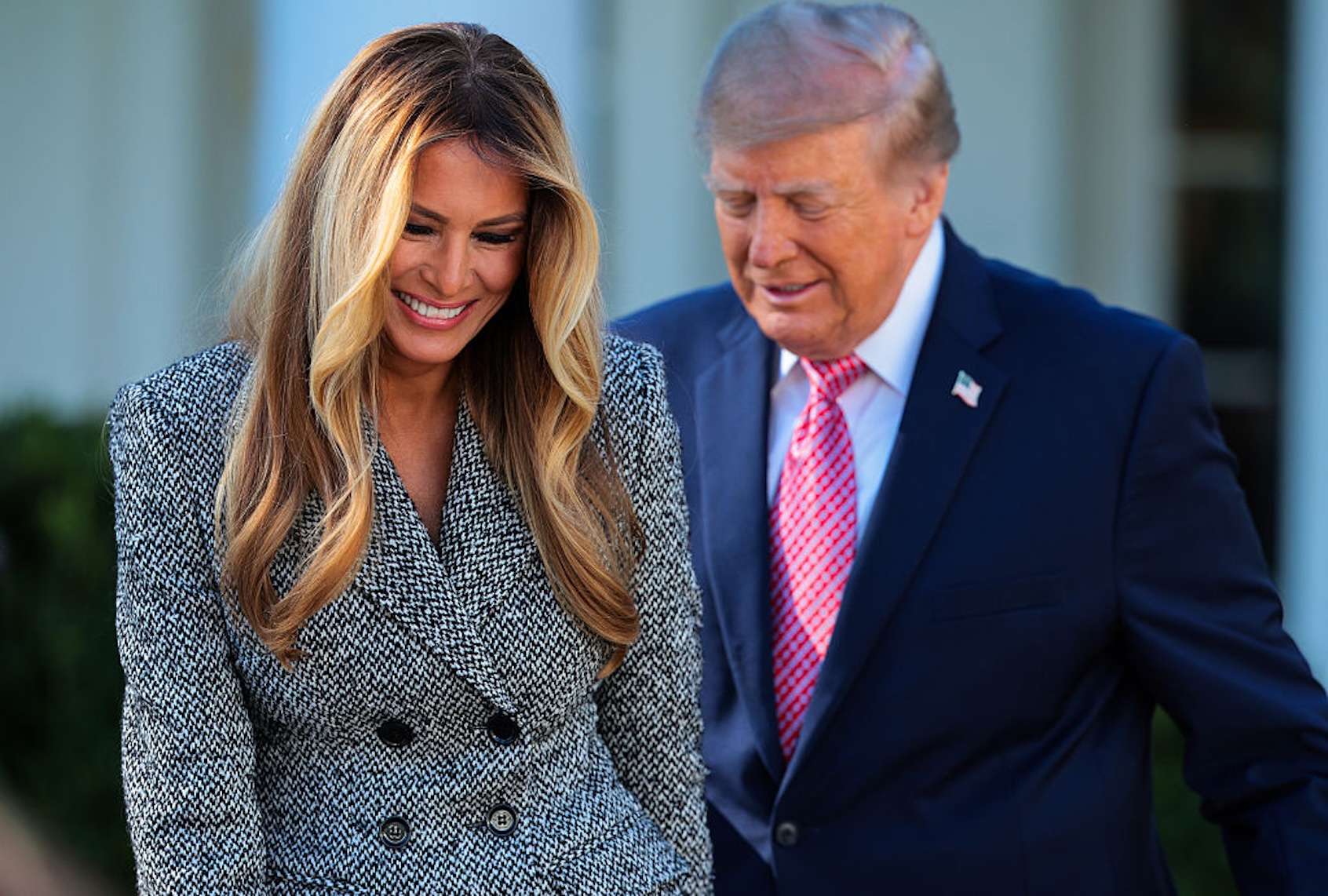
Contrast those misty memories with Monday’s connubial proof-of-life photo-op featuring Donald Trump and his oft-absentee wife, Melania, signing an executive order creating a task force on women’s health. This was a rare appearance for the first lady, who many assume can’t stand her husband. One can’t imagine why.
“Look at her. You think she’s easy? She’s not so easy, but she’s very smart,” the president assured assembled reporters before signing the order and remarking, “I don’t know if her signature means anything,” while handing the pen to his wife.
When he tried to seal the moment with a kiss, the first lady turned her head, leaving him to lip-lock her hair instead. He then patted her hand, mumbling, “Good job.”
And Kate? All she does is clean up her husband’s messes. Following his advice to blackmail a loose-cannon Prime Minister into resigning causes her reflux to erupt with a vengeance. Hal’s part in a secret plot to purloin a Russian doomsday weapon from a sunken sub and her efforts to keep the enemy from finding out trap her in a perpetual cycle of dashing to bathrooms. America’s president named Kate to be her sin eater, and occasionally she has to barf up her guilt to keep her prevarications straight.
Working for the Penn administration is an ambassador’s nightmare and hell on the esophagus. Without a partner, it would be untenable. Without Kate, Hal and the stalwart staff surrounding them, our international relations may very well be in tatters.
The Penn administration will never be confused for Kennedy’s Camelot, and nobody in their right mind would characterize the Clintons’ or the Wylers’ marriages as ideal.
Like Bill and Hillary, Kate and Hal are working on their relationship despite Kate’s extramarital flings and Hal’s penchant for skullduggery. Their marriage is on thin ice. But their shared devotion is more plausible than whatever deal the Trumps have struck.
To watch these real and fictional partnerships play out without doubting their credibility is… I don’t know, is uplifting the word? Soothing, maybe.
It makes us fondly recall a past when first ladies competently delivered coherent speeches from podiums and made strong policy advocates. When presidents reached for their wives’ hands and their spouses responded in kind. It was a nicer, smarter time.
Yet Kate and Hal’s working partnership earns them few points with Grace and Todd. The thing is, Todd isn’t stupid. He’s malleable and clueless about a lot of things, including whether it’s appropriate to interpret a female colleague’s nervous vomiting as an indicator that she’s pregnant. But when Grace survives an assassination attempt, Todd is genuinely shaken. When the president requires an emotional backstop and perhaps a bit of reining in, the first gentleman exercises his own version of diplomacy. When it suits him.
Hal’s mastery of persuasive dark arts makes him a perfect partner for a president who surreptitiously and proudly moves to upend the international power structure. Still, Todd doesn’t like the way Hal and Grace giggle together in secret.
We’re attracted to “The Diplomat” for many of the same reasons Aaron Sorkin’s “The West Wing” kept liberal viewers rapt during the George W. Bush years. The Penn administration has none of the idealism or conscience that drove Martin Sheen’s Jed Bartlet, whose vision Janney’s press secretary, C.J. Cregg, and Whitford’s deputy chief of staff, Josh Lyman, worked to preserve as best as they could.
Want more from culture than just the latest trend? The Swell highlights art made to last. Sign up here
It’s both entertaining and frightening to see the same actors portray an effective marital alliance devoted to trashing norms and weaponizing American exceptionalism.
But that’s also why this show works. In real life, the political class favors men like Hal much more than women like Kate, although (and because) Kate is truly Hal’s better half, morally speaking. In Britain, the charismatic Todd embraces his special envoy status with verve even as he suspects he’s out of his depth.
As America watches the president’s wife treat him with the same disdain he shows the rest of the world, a competent political union, however strained, is somehow reassuring. If the Wylers can survive the nightmare of American politics, maybe we have a chance too.
You’re no one in this business until the Vatican has condemned you. For British filmmaker Ken Russell, that denunciation from the Catholic Church’s highest post came swiftly and relatively early, just a handful of feature films into his storied, controversial career. Known and loved for his sweeping, ostentatious romanticism and flair for dramatics of every kind, Russell’s films weave artistry into the human experience, making the two inextricable. In his eyes, beauty takes all forms, morphing into the grotesque and outrageous before transforming again into a light, airy meringue, generously portioned atop life’s dense realities. Russell’s filmography has something for everyone — and, until this year, something for no one: his controversial 1971 religious epic “The Devils,” a film as heavily censored as it was widely banned.
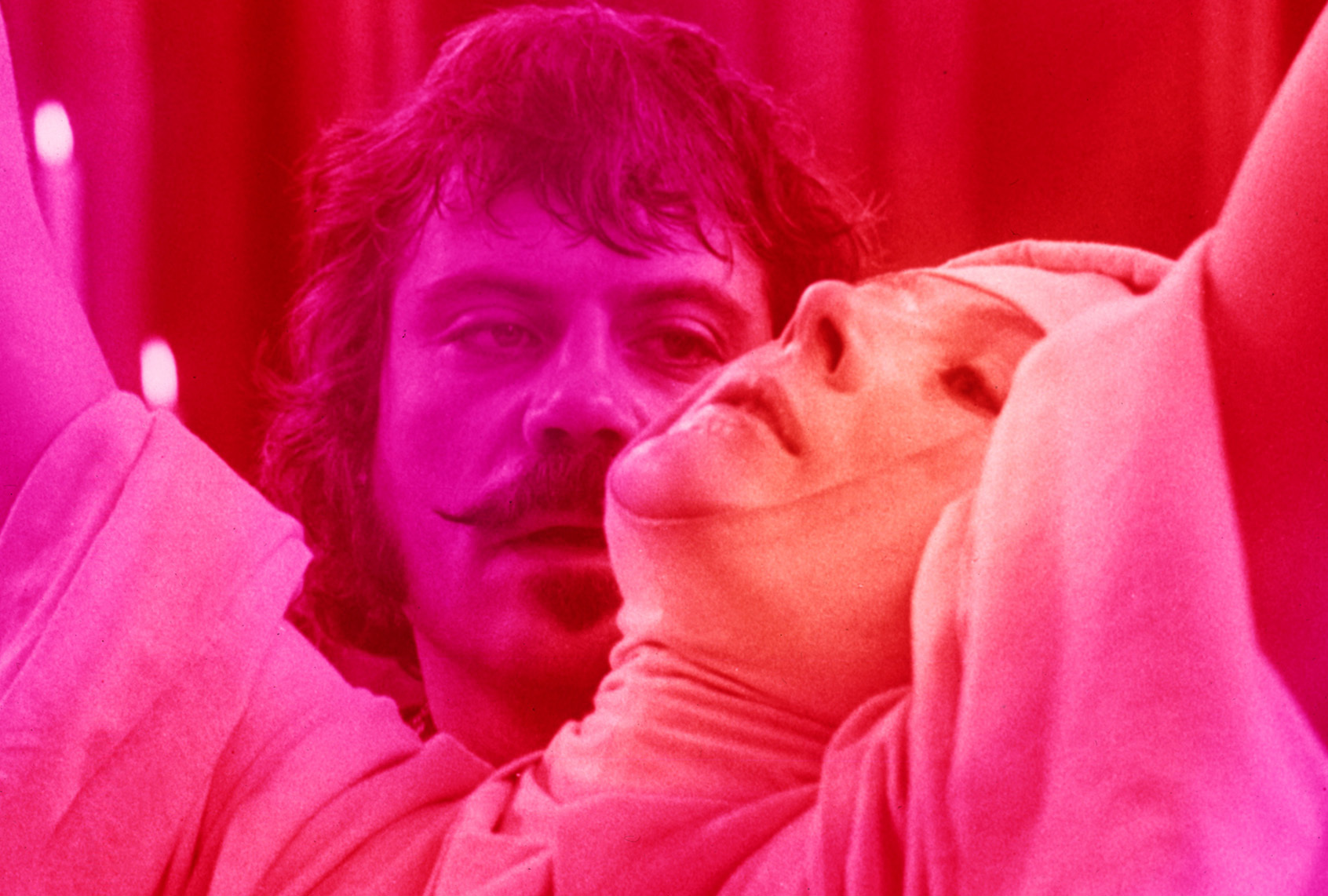
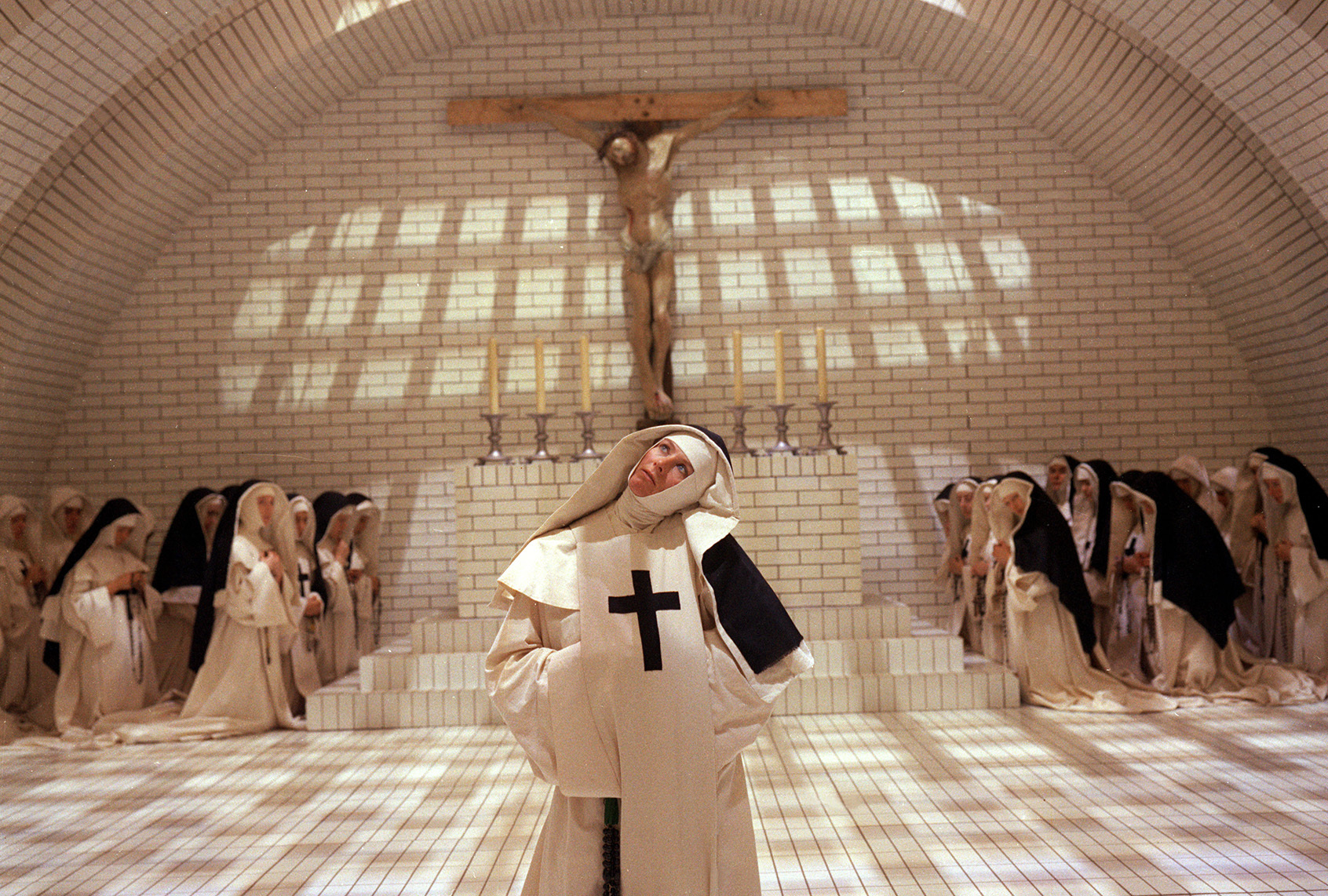
Part historical horror, part holy sacrament, all tragically delicious blasphemy, “The Devils” revisits the downfall of 17th-century Catholic priest, Urbain Grandier (Oliver Reed), in the provincial French city of Loudun. Grandier’s sexual exploits result in accusations of sorcery when a convent of nuns, led by Sister Agnes (Vanessa Redgrave), shed their habits — both the religious garb and the daily formalities — in fits of sexually repressed obsession.
The restoration of “The Devils” and its massively effusive response point to a robust new era in moviegoing. At a moment when the art of film and the film business are so at odds, “The Devils” — that banned, blasphemous frolic through Hell — might just be cinema’s salvation.
In Russell’s typically flamboyant manner, the film features extended sequences of nudity, sacrilege, lust and bloody violence, often all rolled into one. Warner Bros. demanded Russell pare down the film’s most intense scenes yet still slapped it with an X rating in the U.S. and U.K., while other countries banned it outright. Though an uncensored director’s cut premiered in 2002, it was never formally released on home media, and “The Devils” remained difficult to find outside of low-quality, choppily edited releases and torrents for decades.
(Warner Bros. ) Ken Russell’s “The Devils”
But such a notorious reputation could do nothing but persist. After long denying “The Devils” a proper release based on the film’s “distasteful tonality,” Warner Bros. did something right (for once), commissioning a restoration and theatrical rerelease of Russell’s original director’s cut under its new boutique imprint, Clockwork, for one week only. (A limited second-week run was announced at the time of writing.) Like the nuns in Sister Agnes’ convent, the once-sheltered public responded with animalistic haste, selling out screenings nationwide. Far from the average word-of-mouth excitement, the restoration of “The Devils” and its massively effusive response point to a robust new era in moviegoing, one that looks different than anything this century has seen so far. At a moment when the art of film and the film business are so at odds, “The Devils” — that banned, blasphemous frolic through Hell — might just be cinema’s salvation.
At Chicago’s Music Box Theater, one of metropolitan America’s premier destinations for arthouse cinema, screenings sold out in a flash, accounting for the second largest share of the restoration’s opening-weekend box office. Kyle Cubr, the Music Box’s senior operations manager and assistant general manager, likens the excitement to mischief. “Patrons were abuzz around me waiting for it to start,” he says. “It’s almost like when you’re a kid, and you know you’re getting away with doing something bad — you shouldn’t be watching this, but it feels so good.”
As fellow Chicago resident Max Newfield exited the Music Box after his own sold-out screening, chatting with a friend who went in blind and listening to a crowd that was “alive with excitement,” he saw the line for the 9:30 p.m. show snaking down the block. “At one point,” Newfield says, “a woman from my screening walked down the line and yelled: ‘It’s worth the wait!’”
Cubr’s experience echoes countless others who made their way to “The Devils” in its first week. When I started looking for people to chat with for this piece, I expected to find only a handful interested. After all, finding time to answer even a few questions can be difficult these days. And with cinema more ephemeral than ever, and “The Devils” stacked against new theatrical heavy-hitters, there was no guarantee that anyone who had seen the film would actually want to talk about it.
Within hours, my inbox was flooded with people from across the country, eager to talk about the film and their experiences seeing the film. Really, “flooded” doesn’t begin to quantify the deluge. While I spoke with 20 people for this piece, I received 178 individual responses of all kinds, ranging from shock and awe to relative disappointment to distinctly modern moviegoing gripes. But overall, the prevailing narrative was that seeing “The Devils,” in this format and with a full crowd of fervent patrons, was a once-in-a-lifetime experience. As New York’s Ben Sundwall tells me: “A guy started snoring halfway through. A girl was ripping her vape. It was magical.”
Despite the polite crowd at my screening, I wondered if questionable theater etiquette came into play elsewhere. Bafflingly, repertory screenings are where I’ve run into some of the worst offenders. But for an intentionally outrageous film like “The Devils,” where Reed hurls a plastic crocodile out of a window, rules can be relaxed. Naima Warsame, a program manager and chief of staff in New York, told me she thoroughly enjoyed the film but that her screening “wasn’t without its drama.”
“As the credits were rolling, a man in the middle of the fourth row stood up, pointed at a woman in the second row, and yelled, ‘Lady, yeah, you: F*ck you. You had your phone out the whole time!”’ Warsame recalls. “We thought it would end there, but he kept going . . . the movie was already intense, and before we could catch our breath, this conflict made the whole experience overwhelming.” But Warsame isn’t deterred, seeing “at least two movies a week” and hoping for more rereleases of studio films and midnight movies of all kinds. “Nothing beats the theatrical experience,” she says.
Want more from culture than just the latest trend? The Swell highlights art made to last. Sign up here
Josh Svetz, a writer and music consultant based in Washington D.C., shared a similar experience, noting laughter during both the film’s intentionally humorous moments and chuckles that drowned out moments of discomfort. But Svetz relishes the chance to see the film nonetheless, and views the enthusiasm for the rerelease as evidence that moviegoing is becoming more intentionally experiential.
“People want to time travel and experience works of art as they were intended,” Svetz says about the restoration. “I don’t think the theater experience will ever completely die because there’s this singularity, this feeling in your chest, this speechlessness that comes over you when you see something great. It’s rare, but chasing that dragon? It’s worth it.”
More than the extraordinary experience of seeing “The Devils” on the silver screen, the most moving throughline I encountered in talking with people about their screenings — one that seemed to be present in some form across every person I talked to — was the sense of community. It’s not only the chance to see something rare, well-made and lovingly preserved that’s driving people to the movies; it’s the opportunity to make a memory.
Stephen, a New Yorker who works in financial services, savored the chance to see the film at the AMC in Manhattan’s Kips Bay neighborhood, which is scheduled to close by the end of the year. “Every single seat was filled,” he says. “Seeing that for a film released in 1971 is pretty special.” So special, in fact, that he went a second time. And for those who didn’t go alone, finding a buddy was half the fun. Several people shared stories about convincing their spouses, friends, or family to come along — some more successfully than others. For many, seeing “The Devils” was a unique chance to close a loop or strengthen family ties, the kind of event that reminds us of all the small things that make cinema such a large part of our lives.
That people recognize the value in patronizing a faithfully restored work like this — when studios like Warner Bros., having just succumbed to an unholy monopolistic merger with Paramount, need to know that audiences crave great art, old and new — is critically important. It’s also a great relief.
For Bay Area journalist Bojana Cvijic, “The Devils” began as grainy screenshots on her Tumblr dashboard and a low-quality “yet still awe-inspiring” torrent sent over by a friend. Keen to catch the rerelease, she bought tickets with her AMC A-List membership and roped in two friends for a screening that boasted a mixture of laughs, shock, and dead silence. “I realized there are people here who have no idea what this movie is,” Cvijic said, laughing. Making a full-circle jump from her laptop screen to the multiplex, Cvijic waxes poetic. “We don’t get to experience movies like this on big theater screens anymore.”
Cvijic’s first encounter mirrors so many others, notably Nikhil, a 31-year-old SEO specialist who tells me he first saw “The Devils” after building a PC with his dad as a teenager and using it to foster his love of movies. When Nikhil first heard about the restoration, he says it was a “no-brainer,” and that his dad needed no convincing to come along. “I feel quite lucky to have a father who is equipped to respond to and appreciate films as he does,” Nikhil says, “because watching and discussing films together has blossomed into a shared experience that has helped both of us chart our tastes toward art — but more importantly, deepened our relationship with one another . . . Due to my excellent company and my personal relationship with [‘The Devils’], it’s a theatrical experience I will remember forever.”
When I hop on the phone with Juanchi Roca-Paisley, a member of a Miami non-profit financing affordable housing, he excitedly regales me with his experience seeing the movie with his mom, who walked out of “The Devils” when she saw it at a screening in the ’80s. This time, however, his mom stuck around — though she did warn him that she’d give him a tap if she wanted to leave. “I think she found the imagery very cool,” Roca-Paisley says. “To share it with her was so great. But my other mom also said, ‘I kind of want to see that.’ Now I’m like, ‘Oh my gosh, am I going to repeat this?’”
With the film entering its second week, don’t be surprised if you head to the movies in the coming days and see moms, dads, teenagers, or grandparents waiting for their chance to witness what no one could for so many years. It’s easy to dismiss “The Devils” as a rerelease geared toward older cinephiles. But that’s far from the truth. Part of what’s so remarkable about the gushing response to Clockwork’s restoration is that it had no guarantee of doing so well. Josh Svetz puts it perfectly in our conversation, saying, “The theatrical experience is a choice now rather than a necessity.”
Svetz cites camrips and microscopic theatrical windows as factors that have both hindered cinema and strengthened its unique selling points, and he’s completely right. In an era when anyone can watch just about anything with a few clicks of a trackpad or taps of a finger, moviegoing has become more intentional than ever, especially with rising ticket prices. That people recognize the value in patronizing a faithfully restored work like this — when studios like Warner Bros., having just succumbed to an unholy monopolistic merger with Paramount, need to know that audiences crave great art, old and new — is critically important. It’s also a great relief.
But it’s not only that people of all ages are turning out for “The Devils” that I find heartening; it’s their passion for the entire shebang — for moviegoing, and for all its wonderful, absurd and timeless rituals. There’s no question that we live in a uniquely difficult age, where reprieve is a hot commodity. But as sensational as it is, “The Devils” doesn’t exactly offer ease. The film’s historical context holds as many parallels to today as it did in 1971, arguably even more: suppression of all kinds, brutality in the name of politics and religion, innocence tainted by unnerving sights no one should ever witness.
“It’s brutal, but necessary,” says Taylor Owen, a Chicago-based artist who caught the film at an AMC after the Music Box sold out. “Our world is unfortunately not so different from the world the nuns of Loudon were living in. I have never seen a film like this before. I don’t think I ever will again. ‘The Devils,’ in the way it was meant to be seen, is one of the most important pieces of art ever created.”
In March, Homeland Security Secretary Kristi Noem was fired after it was revealed she and her assistant, Corey Lewandowski, had been funneling multi-million dollar contracts to a political ally for self-serving TV advertisements. On Oct. 13, U.S. ambassador to Greece Kimberly Guilfoyle resigned under pressure from the administration when it was reported she had shaken down a donor for $100,000 to pay her American Express bill. This week, Alina Habba, Donald Trump’s former personal lawyer and the former acting U.S. attorney for New Jersey, said, “Hold my beer, ladies,” when The New York Times reported she had been given a $50 million personal contract in exchange for securing a presidential pardon.
Habba is the perfect example of the Trump insider. A graduate of Widener University Commonwealth Law School, she practiced law at her first husband’s firm and served as general counsel for a parking garage company owned by her second husband. A New Jersey local, she apparently caught the president’s eye after she joined his golf club in Bedminster, which was near her small private law firm. She began appearing on Fox News as a Trump defender, and in September 2021, Trump hired her for his legal team. One of her first actions was to file a $100 million lawsuit against The New York Times and Mary Trump, the president’s niece, and take over defending Trump in a defamation case brought by a former contestant on “The Apprentice” after several veteran lawyers withdrew. The Times case was dismissed for “fail[ing] as a matter of constitutional law.” The former “Apprentice” contestant dropped her case after Habba countersued her for trying to “stifle Donald Trump’s free speech.”
Habba was part of the team that represented Trump in the fraud case brought by New York Attorney General Letitia James, where Habba’s main contribution appeared to be mimicking Trump’s patented mugshot glower before the cameras. She served as lead attorney in E. Jean Carroll’s civil suit against Trump, during which the judge admonished her repeatedly for her poor legal skills. The case ended up with a jury awarding Carroll $83.3 million in damages.
But Habba’s most infamous case as the president’s personal lawyer was one brought in the Southern District of Florida in May 2022. Trump sued the Democratic National Committee, Hillary Clinton, John Podesta, Jake Sullivan, Florida Rep. Debbie Wasserman Schultz and others for allegedly perpetrating “a calculated scheme to defraud the news media, law enforcement, and counterintelligence officials for the purpose of proliferating a false narrative of collusion between Trump and Russia.”
U.S. District Judge Donald M. Middlebrooks was not amused. Four months later, he dismissed the case, saying it was inadequate in all respects. In January 2023 he sanctioned Trump and Habba to the tune of nearly $1 million, writing, “Here, we are confronted with a lawsuit that should never have been filed, which was completely frivolous, both factually and legally, and which was brought in bad faith for an improper purpose.”
Naturally, Trump appealed, but the 11th U.S. Circuit Court of Appeals upheld the ruling. Earlier this month, the sorest loser appealed the case to the Supreme Court.
Habba’s record as the president’s personal attorney speaks for itself. She didn’t fail upward quite as spectacularly as U.S. Circuit Judge Emil Bove and Attorney General Todd Blanche, but Trump did bring her into the White House as counselor to the president and later nominated her to be U.S. attorney for the District of New Jersey.
As interim U.S. attorney, Habba immediately began to cause chaos. Like Noem, she cosplayed as a U.S. marshal and announced she would pursue political prosecutions of prominent New Jersey Democrats, including the governor. A panel of judges, following the law, refused to allow Habba to serve in an interim capacity, forcing Trump to withdraw her name from consideration for the job, designating her acting U.S. attorney instead. Eventually, the U.S. Court of Appeals for the Third Circuit found that Habba was not lawfully appointed to that post as well, disqualifying her from the position.
She was then hired to a Justice Department post clearly made up on the fly, pending a reversal of the opinion, in which case she would be reappointed as U.S. attorney. That never came about, and according to what we learned from the explosive New York Times report, Habba had other plans anyway.
As it happens, right around that time a Venezuelan billionaire banker named Julio Herrera Velutini wanted a pardon. He had already been given a very generous deal by Trump’s Justice Department, which had reduced felony bribery charges to a misdemeanor, but he wanted his record cleared completely. He hired Christopher Kice, another of Trump’s former personal lawyers, to help him grease the skids. To sweeten the pot, Herrera’s daughter, who holds U.S. citizenship, had contributed $3.5 million to Trump’s super PAC. But by fall 2025, nothing had happened, so the Herrera family decided to hire someone with a little more juice. They tapped Habba, who was still working at the Justice Department, and allegedly offered her $10 million a year for four years and at least $10 million in bonuses.
They created a company, Concord Partners, which has no known business dealings, and in January 2026 Habba signed on as its general counsel. Days after she took the position, Trump granted Herrera the pardon.
This is the most egregious case involving the sale of pardons under Trump that we’ve heard about . . . The grift has become so blatant that the public has finally started to notice — and they don’t like what they see.
This is the most egregious case involving the sale of pardons under Trump that we’ve heard about. According to various reports, procuring presidential pardons has apparently become a cottage industry among many MAGA insiders, who are becoming wealthy trading on their access to Trump. For his part, the president appears to be handing them out to Republicans like Hershey bars on Halloween. The grift has become so blatant that the public has finally started to notice — and they don’t like what they see.
Habba apparently hasn’t yet collected her fee, and this revelation may just end up depriving her of most of it. But she needn’t worry. She just married a much younger Turkish billionaire named Turhan Mildon in a reported $10 million wedding attended by fellow Trump officials including Blanche, FBI Director Kash Patel and civil rights division head Harmeet Dhillon. Habba has no financial worries, and there will almost certainly be no legal ramifications for this flagrant conflict of interest and pay-to-play scheme.
But she is embroiled in yet another convoluted scandal involving her new husband, in which he supposedly sent $17 million to Richard Grenell, Trump’s former envoy to Venezuela, who at the time was director of the embattled John F. Kennedy Center for the Performing Arts. This donation, later determined to have actually been sent from the Democratic Republic of Congo, where Mildon has many business dealings, went to a Texas defense contractor. Habba is alleging that the portion meant for the Kennedy Center — an obvious sop to Trump after he took it over — never made it there.
The full contours of this dispute are not yet clear, and Grenell has denied any knowledge of the matter. But never fear: The White House is on it. Trump assigned Will Scharf, the White House counsel, to look into the matter, and no doubt Habba was pleased. After all, Scharf was one of the honored guests at her wedding. It’s nice to keep it all in the family.
CORRECTION: This column has been updated to clarify Richard Grenell’s tenure at the Kennedy Center, which ended in March 2026.
For the better part of its final decade, Rawhide was my bar. The old leather place on Eighth Avenue in Chelsea was dark in the way that mattered, a judgment-free room where the only thing anyone asked of you was that you be yourself. There was the Eagle down the street, a bigger playground, but Rawhide was rawer, closer to the bone, and it happened to sit practically next to my apartment, which made it the place I dropped into on my way home or to kick off a night.
Most nights I was a simple man at the end of the bar, taking in the spectacle, listening, watching. On slow nights, when the crowd thinned, the bartender would let me put on a few of my own songs and we would all jam to them, and it felt less like a scandalous den than like Cheers with a twist, everybody knowing your name, nobody needing you to explain yourself. Then it closed, and the space became, of all things, a lingerie shop, which tells you most of what you need to know about what New York City decided those rooms were worth.
I bring it up because I recognized something the instant I saw the photographs of Chris Gallant.
Gallant is the 37-year-old openly gay Democrat running for Congress in New York’s first congressional district, out on eastern Long Island, against the Republican incumbent Nick LaLota. A few weeks ago, the New York Post surfaced a set of images from a 2010 photo shoot: Gallant, younger and gorgeous, in bondage gear, pictures taken with a then-partner for the fetish retailer Mr. S Leather. The photos lived openly on the company’s website for most of a decade, and then disappeared. Perhaps inevitably, someone dug them up, handed them to a tabloid and waited for the man to crumble.
Gallant didn’t. In an interview with the New York Times, the military pilot, union leader and firefighter called it his “Kim Kardashian moment,” said his friends have always known he is kinky and refused, flatly, to perform the shame he was supposed to perform. I have rarely been prouder of a stranger.
But I want to be precise about what is actually scandalous here, because everyone keeps aiming at the wrong target. I spend my working life as a trauma-informed violence-prevention educator, which means I spend it on a single distinction: the difference between what is done with your consent and what is done to you without it. By that measure, the photographs are the most innocent thing in this entire story. They were made by consenting adults, with a partner, for a purpose Gallant chose, and they lived in the open for years. There is no victim in them.
The violation came later, and it belongs entirely to whoever pulled those images out of their context to use them as a political weapon. That is the nonconsensual act in this story. That is the thing we should be clutching our pearls about. Someone took a man’s consensual expression of his own desire and weaponized it to try to drive him out of public life, and the media coverage of it largely treated the man in the leather as the problem.
The violation came later, and it belongs entirely to whoever pulled those images out of their context to use them as a political weapon. That is the nonconsensual act in this story.
We have the true obscenity backward. The scandal isn’t the leather. It’s the leak.
Gallant’s refusal to grovel is the correct answer — the only answer. For most of my life, the price of a seat at any table was a quiet agreement to be a less vivid version of yourself, to sand down whatever might frighten the neighbors, to apologize in advance for existing. The men I stood shoulder to shoulder with at Rawhide mostly paid that tax their whole lives. So when a candidate looks at the oldest trick in the book — here is evidence that you are a deviant — and simply declines to be ashamed, he is doing something the boy I was could not have imagined. Be queer. Be masculine. Be unafraid, authentic, bold, believable. That is the whole platform, and it is a good one.
Here is where I step off the easy celebration everyone else is writing, though not in the direction you might expect. Gallant is making his stand in a district Donald Trump carried in 2024 and that the Cook Political Report currently rates as Solid Republican. He may well lose. But losing would not make his candidacy a mistake. Every barrier broken is a notch in a glass ceiling, and the ceiling does not care much whether the person who cracked it got to walk all the way through. An out, unapologetic gay man refusing to be shamed off the ballot in Trump Country is exactly the kind of barrier that, once broken, cannot be unbroken.
There is an asymmetry worth naming. A straight candidate with an old racy photo shoot — such as former Massachusetts Sen. Scott Brown, a Republican who posed nude for a Cosmopolitan photo spread in the 1980s — gets a wink and a news cycle. A gay man with the same gets a referendum on his fitness to serve. But you do not retire a double standard by hiding from it. You retire it by having enough people walk straight into it, unbowed, that it stops working. Gallant just made it work a little less well.
What I actually worry about is not whether Gallant wins. It is whether the next one runs. Look at how the field is being remade right now, by democratic-socialist insurgents, by former military officers and ex-intelligence officials trading their clearances for yard signs — whole new kinds of candidates deciding the work is too important to sit out. So where are the out, unapologetic queer candidates?
My fear is that a young gay man with a few consensual images somewhere on the internet, and there are a great many of us, watches what is being done to Gallant and quietly decides it is not worth it. My hope is the opposite: that he watches a man refuse to be ashamed and thinks, if he can take that and keep his head up, so can I.
Because that is the thing this moment cannot be allowed to become: a warning. Instead, it has to be an invitation. A seat at the table is too important to cede to whoever is willing to leak a photograph.
Gallant did nothing wrong. He took some beautiful photographs with a partner a long time ago, and he has declined to be sorry about it. The shame in this story was never his, and it was never ours. It belongs, every ounce of it, to the people who went looking for a way to make a good man disappear.
My hope, for the next queer person weighing whether to step into the arena carrying a past and a future both, is that they look at Chris Gallant standing in his own light and decide to run anyway. We need them there.
Early on a Tuesday evening, I arrived at a local dive bar for a show by Dream Syndicate. There’s no opening act (or rather, as Steve Wynn will later joke, the Dream Syndicate are opening for the Dream Syndicate) and a blissfully early 7 p.m. start time. I greeted the door woman, bought a bottle of water, grabbed a bar stool against the far wall, and opened the book in progress on my phone until the show started.
At the end of September, I walked into the Majestic Theatre to see the Michael Shannon/Jason Narducy R.E.M. tribute. It’s a GA venue that holds a little over 1,000. When the doors opened, I headed for the barrier for no other reason than the volume at that proximity helps drown out what jamband fans refer to as “chompers” — people who view concerts as suitable background for their conversations. Delightfully, I found myself standing with four other women. We killed time before the show talking about what other concerts we’d been to recently, and took turns watching each other’s spot when someone needed a bathroom run. (There was no line at the women’s room for that show, a big reason I wanted to be close so I didn’t run the risk of standing near a dude needing to explain R.E.M. to me, like the guy at the bar where I was eating dinner before the show.)
A few weeks earlier, I pulled up at Trinosophes, a coffee shop / artistic consortium that regularly hosts more experimental / less mainstream musicians — Marisa Anderson played a gorgeous show there earlier this year — to see BASIC, an amazing trio that’s a mix of minimalist jazz and experimental rock. I paid the dude at the counter, who was in the middle of pulling a shot of espresso, and then decided to kill some time at People’s Records, the record store attached to the space, along with other show attendees and a couple of musicians in the opening act. I sat in exactly the corner of the room that sounds the best for my damaged hearing and thoroughly enjoyed the sets.
We absolutely need to abolish the concept that going to a concert alone is any kind of abnormal or undesirable behavior.
What all of these concert activities have in common is that I attended them by myself. And this should absolutely not be news of any kind, but recently a leading music magazine posted a news story that announced: “Going to concerts alone is a top-tier human experience.” The story wasn’t actually about that, but was rather a mashup of reporting on how Phoebe Bridgers’ recent phone-free concerts meant that when an attendee spotted a celebrity at the show, they couldn’t report to a gossip publication that this person was supposedly standing alone in the line for the bar (while there are actually many reasons you could be at the bar by yourself despite arriving with an entourage of a dozen people).
But the writer’s reasoning for why it was okay to be going to a show without a date or a friend(s) actually didn’t make a believable case for it. They offered an awkward and overly exaggerated blather about how solo concertgoing means that you can better participate in “the oneness of things,” which made you wonder if the person writing it had actually been to a concert, much less attended one on their own. And I didn’t realize we had to justify or defend this, or that it was anything out of the ordinary.
Want more from culture than just the latest trend? The Swell highlights art made to last. Sign up here
What they got wrong is that the “top tier human experience” is simply going to concerts, full stop. (As Neil Young once said, “Live music is better/bumperstickers should be issued.”) The idea that going to see one of the most important concert tours of the year by oneself is “sad” is so idiotic that it should never have been entertained as any kind of news story. And we absolutely need to abolish the concept that going to a concert alone is any kind of abnormal or undesirable behavior.
I’m biased. I’ve been going to concerts alone since I was 14 years old. This wasn’t necessarily by choice, but rather that I wanted to do something important and no one else I knew wanted to do it, and I wasn’t going to let that minor detail stop me. And as I have moved through my life, sometimes I had a friend or companion to go to shows with me, and sometimes — as it happens to normal people in the course of normal life — I did not. If I only attended a concert when I had someone to go with, I would have missed out on far too much. This is a stupid requirement, clearly determined by people for whom live music is just another thing you can do on a given evening, and these are not people anyone who genuinely loves music should be taking direction from.
The first time I went to a concert by myself (which was my second concert), I was dropped off at the venue by my mom (who later would explain that she allowed it because she thought it would “get it out of my system.”) It was not difficult to follow the letters and numbers on my ticket to find my seating location, and when I sat down, the women on one side of me immediately and excitedly introduced themselves, while the two dudes on the other side of me managed to tell me within the first two minutes that they’d be glad to buy me a beer “if you don’t have your ID on you,” wink wink. Everyone was excited to see Bruce Springsteen, even if we were roughly a million miles away from the stage in the upper reaches of the New Haven Coliseum.
Everyone except me had concert stories to tell. Everyone talked about what other concerts they were going to, what radio stations (and which DJ’s specifically) you could count on to be Springsteen-friendly or provide the best info, and everyone swapped information about what other bands were going on tour based on what they had read or heard. I was dropped off when the doors opened, and I thought it would be a long and painful wait until the concert started, but instead I had a dozen new best friends within 15 minutes.
When the concert was over, the girls sitting next to me gave me their phone numbers and told me to call if I was ever going to a show in Hartford. This was an experience that would repeat itself in different formats forever all across the United States, Canada, and multiple European countries, and still happens now if you want that to be your experience. You can also decide you are going to rock up when you feel like it and occupy your time reading a book and not talk to anybody. Or you can limit your socialization to the time-honored tradition of watching someone’s space while they run to the bathroom. This is all incredibly normal, accepted behaviour which anyone who attends a concert regularly already understands.
If I only attended a concert when I had someone to go with, I would have missed out on far too much. This is a stupid requirement, clearly determined by people for whom live music is just another thing you can do on a given evening, and these are not people anyone who genuinely loves music should be taking direction from.
Let’s be honest: while as a teenager I dreamed of the day when I could attend every concert my heart desired with every friend who also loved the band in question, the reality always shook out differently. As an adult, it remains challenging to coordinate schedules and availability, not to mention alignment with other critical details like preferred arrival times and seating/standing location. Sometimes it is far, far easier and more convenient if each person manages their own tickets and concert experience. If you want to hang with your pals, then coordinate a post-show meet-up at the bar or the diner or on the way to the subway. There is absolutely nothing about concert attendance that requires accompaniment!
Admittedly, times have changed, and yes, everyone has a small computer in their pocket and myriad ways to occupy their time before the show starts. And these days, a concert isn’t one of the only ways you’re going to meet people who share similar interests as you. But I hear from younger friends who are going to shows by the likes of Harry Styles or Taylor Swift, and I witnessed myself very recently at a Bikini Kill show locally (where I was one of the older people in the front GA section), the kids are still doing the same thing that I did in 1978: they talk to each other, they swap social handles, they exchange important information. It is all still happening if you are open to the experience, and it should reassure anyone who is hesitant about buying a ticket to a concert if they don’t know anyone else who wants to come with them.
The only way going solo can have a negative impact on you is during the ticket-buying process for reserved seating events. That’s because these days, Ticketmaster will not let you buy one of a pair or will tell you you have to select an adjoining seat (even if there is no adjoining seat at that moment, a thing that has happened to me and countless of my pals). Buying a single ticket used to be the way to game yourself to the best possible seat, as there would always be a leftover hanging around; even if I was going to a show with friends, we still might try for individual tickets as a way to better optimize our chances for a better seat. Thank you, Ticketmaster, for continuing to find ways to make this process painful!
(Caryn Rose) Going solo
The only real downside to solo concert attendance is if you are a single woman and a man in your vicinity has decided it is his solemn responsibility to interrogate anyone who doesn’t look like him to determine their worthiness, e.g., the kind of guys who would talk to whatever man I brought with me to a show and, despite them telling him, “She’s the fan, I just came with because I was interested in checking them out,” there is no way we could possibly be worthy of the space we were occupying. (But that is a completely different essay.)
I’d argue that it is actually an expression of supreme self-love and self-awareness that you’re comfortable enough with yourself to be absolutely content going to a concert as a party of one. Honestly, no one should be waiting for another person to do anything they want to do (except, I dunno, tandem bike riding). But what we absolutely should stop doing is paying attention to other people living their lives the way they want to live them, and that includes making a decision to go to a concert without an entourage. Buy the ticket. Go to the show. I’ll see you there.
He might look like something found in the dumpster at a Lynyrd Skynyrd concert. He might shamelessly plunder the sonics of decades of deep-fried and gravy-smothered hits. But despite everything about his presentation and performance, Kid Rock is not actually southern.
If he were, he might have done the friendly thing and warned Eminem off of collaborating on “Heal My Faith,” a song on his recent Christian album “Halfway 2 Jesus.” He might have stopped his longtime friend and fellow Michigander from irreparable reputational damage. Instead, he let Slim Shady learn a hard lesson that true southerners know: You lay down with dogs, you wake up with fleas.
“Heal My Faith” is genial to the point of being unmemorable, a bit of cringy Christian pablum that encourages loving someone even when you’re outside of the pit. It’s student-athlete core, a mish-mash of choirs, electric guitar noises over pounding drums that all sound like keyboard presets. Kid Rock’s contributions are entirely lifted from inspirational T-shirts, table scraps from rejected Jelly Roll songs. The result is that “Heal My Faith” offers very little to chew on — until Eminem shows up.
The boilerplate praise chug of the song has one upside: It forces the “Rap God” to slow down. Left to his own devices, middle-aged Eminem has been the hip-hop equivalent to masturbatory guitarists, his late-stage work full of technically impressive displays of chops that nonetheless lack the fun and melody of his radio hits. Hearing him enter the song with a flow that’s not indebted to a J.J. Fad outro offered a glimmer of hope. But it was short-lived.
On “Heal My Faith,” the rapper who first gained mainstream attention by lighting the pop chart’s sacred cows afire wonders why we can’t all just get along. It’s shocking stuff from the rapper who famously mused about dropping an “awfully hot coffee pot” on Donald Trump in a freestyle at the BET Hip Hop Awards in 2017. Now, Slim Shady seems to be saying, “We might believe in fundamentally opposed directions for this country. We might differ on the idea of extending dignity to all people, but can’t we put that aside for the sake of a new single you can buy?”
You don’t need to hear it. You’ve already heard it. It’s the realm of purple state campaign ads and Earthbound Trading Co. bumper stickers. It’s junk, and Eminem seems to know it.
How else can you explain a verse that is 90% throat-clearing and preemptive dodges of the backlash he knows is coming? Eminem spends bar after bar defending his decision to even appear on the song, touting his decades-long friendship with Kid Rock and their intertwined history in the music industry.
He talks about their shared roots in Detroit’s music scene, and how their paths crossed again and again. He details an early CD release party at length, where the more established Kid Rock showed up to lend support to the emerging rapper. It isn’t until the closing lines of his verse that Eminem turns to God and the brotherhood of man.
“Liberal and evangelical can agree,” he raps. “It’s God first, home of the free.”
Reputation-wise, the collaboration does far more for Kid Rock than it does for Eminem. The former has long been fully consumed by Trump World, becoming more of a standby entertainer for MAGA events than a rock star. Eminem, on the other hand, once told fans who supported Trump to stop streaming his music.
(Ke.Mazur/WireImage) Kid Rock and Eminem during Experience Music Project Opening Gala at Experience Music Project in Seattle, Washington.
Rock told Billboard that he hadn’t planned to “drag [Eminem] into my political world,” but he had to have known that was impossible. The nod from a supposed Trump critic removes a small bit of the stain on Kid Rock, but it also transfers directly to his collaborator.
Eminem might have been hoping to build a bridge with this collaboration, but at least according to his Instagram comments, his fans aren’t ready to get over it. One commenter assured him that it’s okay to cut off a friendship “over moral differences.” Another said Eminem’s line in the sand against Trump must have been “brushed back into the beach.” The rapper’s newfound neutrality, one wrote, still amounted to “choosing a side.”
You can’t feel too bad for Eminem, who’s had plenty of opportunities to see that who you rap with is who you are. After all, more than a year after her breakout single “What I Want,” which she recorded with the controversial country music star Morgan Wallen, the pop singer Tate McRae is still being confronted by fans and interviewers with questions about the pair’s collaboration.
Wallen, who’s been given about as many second chances as gold records, has never explicitly identified himself as a supporter of the MAGA movement. But his history of using slurs on camera, the general nastiness of his dejected young man music and a massive social media tiff with “Saturday Night Live” have solidified him as an anti-woke warrior in the popular conception.
“It’s crazy to think that one song could define a whole person,” McRae told W Magazine earlier this month.“There are many aspects of my personality that three-quarters of my audience has no idea about. You hope one day you figure out a way to show all aspects of it.”
There’s little chance that Eminem will face such questions in the future, if only because his career as a hitmaker is basically over. He was something exciting and fresh when he pantsed the pop culture landscape in the late 1990s, but joking about how much everything sucks is a young man’s game. Coming from an older man, it just sounds bitter and out-of-touch.
Different listeners draw the start of his decline and the end of his relevancy at different points. Most agree that the zeitgeist of rap started to shift away from the stubbornly anachronistic rapper sometime around the end of the aughts. In 2013, he released a well-received album seemingly purpose-built to cap on his career, and then he just kept going. The 23-year-old McRae, on the other hand, will have her past decisions dug up by what remains of the music press after each new chart smash. Eminem may well be staring down a future where his regrettable decision to record contemporary worship dreck with Kid Rock generated his last real headlines.
It’s something the culturally savvy clown of Eminem’s early career would have been smart enough to avoid.
Theories abound as to why JD Vance, once a promising Yale Law graduate with a best-selling memoir, went MAGA. Some argue that it was always a mistake to confuse the vice president’s cosmopolitanism for intellectual sophistication, pointing out that “Hillbilly Elegy” is a bad book that panders to ugly right-wing stereotypes about his working class family of origin. Others suggest he is an empty shell who will become whatever it takes to gain money and power, as evidenced by his constantly shifting attitudes about race and religion. The truth likely falls in the “why not both?” arena. After all, empty and insecure people have often been drawn to far-right ideologies.
But there is one under-appreciated possibility for the MAGA turn of a man who once called Donald Trump “America’s Hitler”: that he finally found an audience willing to laugh at his unfunny jokes.
Vance is clearly embroiled in a lifelong struggle with a common ailment of self-serious men who consider themselves profound geniuses. He longs to be the funniest guy in the room, but he is unable to understand how humor works. But the vice president has discovered what second-rate talents that end up as the “comic” relief on Fox News learned long ago: The right-wing crowd doesn’t care if you’re not funny just as long as you’re cruel.
Vance is taking full advantage of MAGA’s lack of discernment in the last weeks of the midterm campaign. During a stop in Texas supporting the Republican Senate candidate, state Attorney General Ken Paxton, Vance responded to a fan by saying, “I love you, too, sir. And in a totally platonic way, to be clear. I’m the vice president, not James Talarico.” The audience roared with laughter, apparently unable to realize that calling Paxton’s Democratic opponent “gay” is less witty than if Vance had made fart noises with his armpit.
The vice president can’t stop with tedious jokes about Talarico, who is leading in statewide polls. On his way to Texas, Vance falsely accused Talarico of having “a weird focus on transgender kids and drag queens,” topics that he and Trump bring up every chance they get. Vance added, “typically people who say stuff like that tend to have some pretty unusual search histories.”
But Vance isn’t content to simply dabble in homophobia and transphobia. Racism is also his forte. During a North Carolina rally on Monday, he called non-white congresswomen “crazies” and mispronounced the name of Rep. Ilhan Omar, D-Minn. When a protester jumped up to demand that the Trump administration release the Epstein files, Vance suggested, apparently taking note of the young man’s darker skin, that the protester was in the U.S. because of “illegal border crossings.”
At another event, Vance called Dr. Abdul El-Sayed, Michigan’s Democratic candidate for Senate, a “little weasel” who should “shut his mouth and show a little gratitude.” This was not out of character; the vice president often demands that people of color bow and scrape before white people for graciously allowing them to exist. But this time he got rebuked by the far funnier El-Sayed, who responded that Vance “had a cute little rally” with the “five people who like him.”
But the vice president’s lack of wit was perhaps best illustrated at an Ohio rally in support of GOP gubernatorial candidate Vivek Ramaswamy, when he suggested that Dr. Amy Acton, the Democratic nominee, has a substance abuse problem. “I did promise Amy that I would meet her at a bar later. I understand she’s into that sort of thing,” Vance said, pausing for laughter that even the MAGA audience could barely muster.
Vance’s implication can be traced to a Republican ad that paints Acton as an alcoholic after a 2019 incident in which the police were called during a loud fight with her husband. The call was reported not violent by officers, and her campaign claims the situation is being blown out of proportion. (Acton has also been hit with ads featuring insults from her mother, Donna Arthur, with whom she has been estranged since 1978 after Arthur refused to support her when she accused her stepfather of molesting and raping her between the ages of nine and 12. According to the New York Times, Acton’s stepfather entered a not-guilty plea and was indicted by a grand jury, then went on the run from Ohio before standing trial.)
Vance’s stream of insults ring particularly noxious when considering that he spent the summer portraying himself as a heartfelt Catholic convert whose salvation has imbued him with a newfound sense of Christian grace.
Vance’s stream of insults ring particularly noxious when considering that he spent the summer portraying himself as a heartfelt Catholic convert whose salvation has imbued him with a newfound sense of Christian grace. In an obvious effort to soft-launch a 2028 presidential campaign, the vice president published “Communion: Finding My Way Back to Faith” in June, and strived mightily to convince interviewers they were beholding a humble servant of Jesus Christ.
Vance told USA Today that “my faith tells me to fight against” the blind pursuit of ambition and instead “focus on the good” and “make wise decisions and moral decisions.” In an excerpt published in the Wall Street Journal, he wrote that he’s learned “to love all parts of our Christian communion,” including those “who voted for me and those who didn’t.” He went on “The View” with this gentle Christian message, claiming regret over “boneheaded” insults in the past, such as when he described childless women as being “miserable,” “sociopathic” and “cat ladies. The hosts weren’t having it, though, pointing out that there is nothing of Christian communion in the administration’s attacks on Black people and immigrants, and leaving a visibly uncomfortable vice president to pretend not to know what they were talking about.
Vance may be able to wriggle around his very un-Christian insults and falsehoods about Democratic politicians by calling politics a “dirty business,” as he did in the Wall Street Journal. But it’s impossible to square his claims of grace and salvation with the utter nastiness he unleashes on immigrants, most of whom are Christians themselves. He has yet to apologize for falsely accusing Haitian immigrants — most of whom are Catholic, like himself — of stealing people’s dogs and cats to eat them. Shortly after publishing “Communion,” Vance accused immigrants of making America “dirtier and poorer and less safe and less prosperous.” (This is also flat-out false, as immigration has been proven to boost the economy, and the country is objectively cleaner than it was decades ago, when a thick cloud of smog hung over many American cities.)
Through it all, Vance seems to be hoping that the crowd that sees his “Christian charity” face isn’t the same one showing up to hoot at his lame “no homo” jokes about the devout Talarico. This behavior was on display during his recent CBS town hall event, where he tucked away the bad insult comedy and put on his choir boy mask. The dishonesty and hypocrisy reached stratospheric levels when audience members, including a Catholic nun, challenged Vance on his support for mass deportations and his racist lies about immigrants.
“To the extent that my rhetoric has been imperfect here,” Vance said, “that’s on me.” Then he framed the administration’s widespread abuses as reasonable, even compassionate, restrictions on immigration.
His comments came mere hours after he falsely blamed the riots in France on immigrants, posing on X that “liberals imported the third world into France and other countries” while “ignor[ing] fundamental questions of assimilation and compatibility.” No doubt Vance would deflect and deny if he were confronted on it, but there’s no way to interpret his words except as a claim that people of different backgrounds cannot live together without violence — a frequent insinuation of his that is never slowed by the fact that his own wife and children are Indian-American.
This is ultimately why — despite the undeniable ugliness of Vance’s insults of Democrats, immigrants, queer people and single women — his humor rarely generates the outrage he’s clearly trolling for. Vance tends to come across as more of a pathetic striver than an effective bully. Verbal jabs work a lot better if the would-be roaster has a sense of self- confidence, or at least the ability to fake it. Whether he’s speaking of love or hate, Vance never really seems to be talking with any conviction at all, beyond the hope that whatever he’s saying will win him more power.
On Monday, alongside First Lady Melania Trump, President Donald Trump signed an executive order establishing the Women’s Health Division at the National Institutes of Health and a White House Women’s Health Task Force. According to the White House, the aim is to support policy reforms to ensure that women’s research is well-funded and that women have access to “stage-specific prevention, diagnoses, treatment, and care.”
At first glance, the action is in line with what women have long been advocating for. But in reality, the order is a startling setback, reversing an order signed by Joe Biden pushing for women’s research while advancing the Trump administration’s fertility-focused, pronatalist agenda.
Melania Trump is a key part of this effort. In addition to championing the executive order, she also signed it — a purely symbolic act, as the formal role of first ladies is ceremonial. (In an historic first, she also signed an executive order with her husband in 2025 that expanded resources for the foster care system.) But symbolism matters, and Melania Trump is lending her signature and voice to an action masquerading as a boon for women.
In speaking at the signing ceremony, held in the Rose Garden at the White House, the first lady called the event “a transformative moment for women in America. Beginning today, we will change the reality of women’s health.”
That remains to be seen. The White House Women’s Task Force established by Donald Trump promises to work towards creating a federal government that recognizes and works to rectify medical conditions that affect women throughout their lives by enacting “necessary policy and regulatory reforms to ensure timely and state-specific prevention, diagnosis, treatment, and care for women.”
For many women who have faced systematic gaslighting from doctors who claim that our real physical symptoms are solely psychological, or a lack of funding and real-life effects of diseases largely affecting women being severely behind in clinical trials or lacking funding, this sounds like a good thing. As the order reads, “despite considerable advances in biomedical science, many diseases and conditions that disproportionately or uniquely affect women have not received the level of research, clinical attention, and treatment that other diseases and conditions have received.”
That is fundamentally true. Medical conditions that solely or disproportionately affect women, such as endometriosis and autoimmune diseases, have for decades been denied funding or excluded from clinical trials. Even conditions that affect men and women have routinely left girls and women out of clinical trials, failing to collect vital information about the different ways that diseases present and progress.This includes cardiovascular disease, in which women may experience different heart attack signs and symptoms compared to men and, consequently, often misattribute heart attack symptoms. The result is significant, often deadly, delays in seeking treatment.
The same disparity exists in medication research, with women experiencing adverse reactions to medications about twice as often as men because girls and women are not included in clinical studies where medication effectiveness and dosage is studied. This all trickles down into mainstream medicine, where women have for decades been denied care, diagnoses and medication. But the solution that Donald Trump is offering is not going to fix it.
While the goals of this task force are legitimate, the president has routinely cut and downscaled women’s healthcare funding and initiatives as Melania Trump has stood idly by.
While the goals of this task force are legitimate, namely to advance and coordinate research on women’s health through all phases of life, to increase inclusion of women and girls in clinical trials, and develop accountability for grant recipients, the president has routinely cut and downscaled women’s healthcare funding and initiatives as Melania Trump has stood idly by.
During his second administration, the president has cut Medicare, which provided vital healthcare for women, and shut down data-collection contracts for the Women’s Health Initiative study. (He reversed this decision days later.) As part of his efforts at targeting scientific grants connected to diversity, equity and inclusion, the president has further defunded women’s healthcare.
But perhaps the most glaring example of the administration’s neglect came in June when Trump cancelled millions of dollars in grants under the Teen Pregnancy Prevention Program. This change affected thousands of universities, community organizations, public health departments and Planned Parenthood clinics that provide vital gynecological care to women in states where abortion is currently illegal — and where Trump and the GOP’s continued fight against abortion access is costing women their lives.
The Department of Health and Human Services, which oversees the grants, issued new funding criteria mandating abstinence-only sex education with an increased emphasis on marriage and fertility tracking, which advocates warn will increase the rate of teen pregnancy. But that may be the point.
Since his return to office in January 2025, Trump has worked to reverse the decline in U.S. birth rates, even calling himself the “fertilization president” at a Women’s History Month celebration in March 2025. Many of his allies have claimed that the decline in teen pregnancy rates is a “crisis” rather than a societal success. With this context, women’s healthcare advocates argue that Trump is trying to raise the birthrate by increasing the number of teen pregnancies.
(Chip Somodevilla/Getty Images) President Donald Trump and First Lady Melania Trump sign an executive order establishing the Women’s Health Division at the National Institutes of Health and a White House Women’s Health Task Force on Oct. 19, 2026.
The president’s latest executive order advances this pronatalist agenda. The White House touts TrumpRx.gov as “delivering massive savings on some of the most commonly used fertility medications in the country to help families grow,” and hails the work of Moms.gov “to support new and expecting mothers, bringing together information intended to help families navigate pregnancy and early parenthood.”
Although Melania Trump has not spoken publicly about the Moms.gov portal, she did publish an op-ed in the Washington Post around the same time Trump launched the platform earlier this year on Mother’s Day, writing that America’s strength is tied to how mothers mold their children’s and family’s moral character. “America can restore the honor of motherhood after years in which feminism often placed career above family, with consequences to our nation,” she wrote.
With these words in mind, it comes as no shock that the order makes no mention of protecting access to abortion or contraception. As scholars and advocates like Dr. Karen Leader responded online to an X post from the official HHS account, writing, “‘Reproductive health’ without access to legal abortion is a death sentence for women.” Another person replied, “You might ask @FLOTUS to address the many preventable deaths of women who are bleeding out in parking lots or have sepsis or ectopic pregnancies due to republican draconian abortion laws.”
Even the people Trump has assigned to the new task force have a proven track record of supporting cuts to women’s healthcare and using medicine as tools to police and restrict women’s bodies. Led by White House chief of staff Susie Wiles, it will include HHS Secretary Robert F. Kennedy Jr., who has in the past supported cuts to Medicaid coverage and maternal health initiatives and medical abortion restrictions, as well as championing vaccine skepticism.
In a move that is especially galling, Pete Hegseth, who was accused of sexual assault and reached a financial settlement with the accuser, will also serve on the task force. During his time in office, the defense secretary has led a sustained attack on women’s healthcare and diversity in the military. In September 2026, the Pentagon released (and then temporarily rescinded) guidance as part of Hegseth’s “Health and Human Performance Optimization” initiative, which includes regularly screening female service members for fatigue and irregular menstrual cycles.
Women service members 35 and older who report significant symptoms of perimenopause or menopause are required to undergo testing to determine if these symptoms impact their station or quality of life. In response, advocates and medical professionals voiced concern that this policy could lead to unwanted and unwarranted tracking of women’s menstrual cycles, compromising medical privacy and potentially opening the door to use period tracking as a way to police miscarriages and abortions.
Instead of advancing women’s healthcare, the president’s executive order and task force should be seen for what it is: a cynical ploy for votes ahead of the November midterms. Taken together, the actions represent a last ditch attempt to save the support of women — and especially white women — for Trump’s allies amid growing criticism of the president.
It makes sense that the first lady, who herself defended abortion rights in her 2024 memoir “Melania”and urged Congress to hold public hearings for Epstein survivors, would be Trump’s choice to share the news. Once again, Melania Trump is willingly being used as a political prop to show that Trump values and respects women, despite the fact that he routinely fires the women in his Cabinet and press office, continues making sexist and predatory remarks to reporters, and most importantly, has named hostile men as many members of a task force dedicated to women’s health.
Women have long been medically disenfranchised, and Trump is trying to argue that he and the first lady care about women’s health. But for a president that has fought against abortion rights, opposed the release of the Epstein files and even defended the “Cornell 7,” many American women will remain unconvinced of his motives. Rather than reassured, they will also be rightly skeptical of the first lady who continues to stand by his side.
Of all the ludicrous things written about Sofia Coppola’s beguiling “Marie Antoinette” upon its theatrical release 20 years ago (and after being booed at its Cannes premiere, there were so frighteningly many), the most absurd is the hand-wringing over its anachronistic soundtrack. Coppola filled the film tip-to-couture-heeled-toe with songs from ’80s punk and new wave groups, creating a throughline between her own teenage preoccupations and the adolescent Queen of France’s frivolities.
Looking back now, the decision is even more inspired than it was then: a bold, personal choice that helped Coppola’s film stand out from the otherwise stuffy welcome it was bound to receive. This was not, after all, your conventional period piece. Coppola was granted unprecedented access to film in and around the grounds of the Palace of Versailles. But beyond the exclusive entrée, Coppola — only on her third feature, but already known for her affinity for youth culture — would bring Marie Antoinette a jouissance the history books had never afforded her.
One gets the sense that filming the production of “Marie Antoinette” is Eleanor Coppola’s version of a parent at their child’s Christmas pageant, ducking down in the aisles and contorting themselves to ensure they don’t miss a single moment. It’s the perfect example of how movies can make something as intangible as love go on forever.
Critics, of course, didn’t see it that way. Writing about the soundtrack, The Denver Post’s Michael Booth said the music was “not interesting enough to save this bauble,” and that Coppola “doesn’t even have the conviction to remain new wave throughout.” Time Out’s Dave Calhoun professed: “The soundtrack — like the distracting cakes, costumes and production design — does everything to stress youthful decadence and nothing to throw any light on the woman who gives the film its name.” Most curtly, The San Francisco Chronicle’s Mick LaSalle wrote that Coppola’s “reductive approach illuminates nothing about the queen except to suggest that she was an idiot, and portentous shots of her rushing down opulent corridors to a rock soundtrack can’t lend her stature.”
(Sofia Coppola) Jason Schwartzman, Sofia Coppola and Kirsten Dunst on the set of “Marie Antoinette”
What’s funny, especially in retrospect, is how widely these men whiffed the point. Historical stature and new discoveries are irrelevant. (So, too, is mature conviction — though I’d argue Coppola displayed exactly that when she didn’t make the entire soundtrack new wave.) Coppola conveys that the answers about who Marie Antoinette was have been written into history, but overlooked by the men who most often dictate it. She was a teenage girl suddenly saddled with the fate of a country, tasked with making decisions well beyond her purview or experience. Marie Antoinette was out of her depth from the moment she set foot in France from Austria, entrusted with overseeing war and peace, money and poverty. She tried her best, did what she felt was right, and they had her head for it. What better analogy for Coppola and the bitter response to her brilliant, evergreen third film?
Want more from culture than just the latest trend? The Swell highlights art made to last. Sign up here
Twenty years on, “Making Marie Antoinette” — which screened at this year’s New York Film Festival and premieres in theaters October 23 before streaming on MUBI November 6 — sheds ravishing new light on Coppola’s masterpiece. Co-directed by Coppola alongside her late mother, Eleanor, and drawn from over 90 hours of behind-the-scenes footage Eleanor shot during production, the documentary is an instant essential for anyone ravished by the original film or the filmmaking process.
Up-close and personal, Eleanor’s camera reveals the massive undertaking of producing a movie at this scale, honing in on small, intricate details to convey her daughter’s meticulousness. Her footage is teeming with maternal pride, observant and heartwarming. One gets the sense that, for a filmmaking dynasty like the Coppolas, filming the production of “Marie Antoinette” is Eleanor’s version of a parent at their child’s Christmas pageant, ducking down in the aisles and contorting themselves to ensure they don’t miss a single moment. If “Marie Antoinette” says as much about its director as it does about its subject, “Making Marie Antoinette” is the perfect companion piece: A film about letting art and life stay in constant conversation, and how that dialogue makes for a rich existence. It’s the perfect example of how movies can make something as intangible as love go on forever.
Sofia and Eleanor Coppola began work on “Making Marie Antoinette” together during the pandemic. Locked away in their quarantine pod, the isolation proved the perfect opportunity to comb through hours of archival footage, stitching a story from B-roll and memories, both of which Eleanor had plenty of. A dedicated archivist of her own life via journals and film, Eleanor spent much of her time trailing her husband, Francis Ford Coppola, and children between their movie sets to document the arduous filmmaking process. She eventually broke into her own work beyond documentaries and videography, directing two narrative feature films before the pandemic began. At her daughter’s side, “Making Marie Antoinette” made progress but remained unfinished when Eleanor died in 2024. Sofia decided to finish the film as a tribute to her mother, and both women’s touch can be felt throughout — two hands held together, always.
Even those critics who panned “Marie Antoinette” 20 years ago could find something to adore here. For all the derision heaped upon Sofia’s keen directorial eye and scrupulous vision, a behind-the-scenes look only makes the details all the more impressive. It’s a production with a capital “P”: hundreds of extras, an immense principal cast, throngs of below-the-line team — costumers, production designers, historical advisors, translators — and one giant, very expensive castle that must be handled with the utmost care. One doesn’t have to hear Sofia say “this is a lot” to understand that it’s far more than just a lot. It’s visible in every shot. For a director whose previous two films were microscopic in comparison, shooting “Marie Antoinette” may as well have been going to the moon.
(Sofia Coppola) Kirsten Dunst on the set of “Marie Antoinette”
But that’s also what makes it such a feast. It’s a film unlike any other period piece, as sumptuous as decadent as a French pastry. One can practically taste the butter on their lips as Kirsten Dunst glides through ornate halls and indulges in raspberry-topped sweets. This surplus of opulence is what gives the film its edge, too. Think about who you were at 14. If you were thrust into a world where everything you could ever want is at your fingertips, where love blossomed as freely as the gardens adorning your magnificent estate, wouldn’t you, too, lose yourself inside the pomp and circumstance? Is that not the very feeling of being a teenager, so certain that everything and anything is possible, that when one gets a taste of the world, it’s nothing short of intoxicating?
As the long, 50-some-day production schedule rolls on, the viewer can feel Eleanor’s anxiety ease, allowing pride to take full control. Sofia has this, and Eleanor’s job might be the best one on set: watching the daughter she raised come into her own.
For Sofia, the fantasy is the film. It’s integral to Marie Antoinette’s tragedy, to making the viewer empathize with a girl who had no choice but to get in over her head. In Eleanor’s camera, Sofia has that same impish desire, taking on a film so gargantuan that she can’t possibly understand that her eyes are bigger than her stomach. Eleanor watches dutifully, admiring her daughter as she leads rooms full of men, asserting that her decision is not only the best one, but the right one, because she is the person in charge.
It’s frightening to watch someone you care for so deeply balance all that power. But through journal entries from that time, narrated in the film by Diane Lane, the audience can piece together where the fear and the pride meet. After all, Eleanor understood from decades of experience that filmmaking is, most often, a boy’s club — even when a woman is at the helm. And as the long, 50-some-day production schedule rolls on, the viewer can feel Eleanor’s anxiety ease, allowing pride to take full control. Sofia has this, and Eleanor’s job might be the best one on set: watching the daughter she raised come into her own.
“Maybe making movies is a way of moving back and forth, in and out, of linear time,” Eleanor says in one of her journal entries. It’s a reference not only to the period production, but to her daughter’s thoughtful directorial anachronisms, the very decisions that would make “Marie Antoinette” last for 20 years and beyond. What a glorious, warm and strangely pertinent observation — something Eleanor couldn’t have understood the relevance of at the time. Here we are, two decades on, watching her documentary further cement Sofia’s film as the modern classic it is. More than a meta perspective or conventional behind-the-scenes doc, “Making Marie Antoinette” is a tender portrait of familial love from mother and daughter alike. Now, the pride moves in both directions — with Sofia as reverent of her mother’s work as Eleanor was of hers — meeting in the middle to stretch into the future.
Remember when billionaire Elon Musk and President Donald Trump were supposedly enemies? At the start of Trump’s second term, the world’s richest man, was busy ripping through nearly every level of the U.S. government with the Trump-approved Department of Government Efficiency. But by June 2025, the Wall Street Journal reported the pair had “torched” their relationship, which amounted to a lot of social media slapfights and accusations about who was in the Epstein files. But the truth is, the two men have a storied on-off relationship that seems to fluctuate based on who’s grabbing the check.
Lately, Musk and Trump are back to acting like close pals. It was hard not to cringe watching the president award Musk the National Medal of Science on Oct. 8, the highest honor the U.S. can bestow on a scientist or engineer. I was probably reading too much into it, but I sensed some awareness on Musk’s part that it was an empty gesture, unless inflating stock prices is a scientific achievement. But maybe the pageantry is meant to distract from how many government grants Musk has been awarded. According to multiple reports, Tesla and SpaceX basically would not exist without the government giving Musk’s companies wads of cash.
At any rate, Musk is now stepping in to try to save Trump’s allies in the midterms, dumping hundreds of millions into races, with Axios reporting he is “single-handedly keeping the Republican Party afloat in some of its most vital races.” So far, he’s spent some $366 million in pro-GOP midterm TV spots and other campaign efforts, with $276 million donated since July alone. No other known donor comes close to dishing out more funding. But for Musk that’s a relatively trivial amount, even though his fluctuating trillionaire status is currently hovering below the threshold for designation.
Some of Musk’s money went to his own super PAC, but a good chunk also to the Senate Leadership Fund and the Lone Star Liberty PAC, both of which are backing Texas GOP Attorney General Ken Paxton’s endangered campaign for the U.S. Senate against state Rep. James Talarico. Right now polling indicates that statewide election results in the Lone Star State are going to be extremely tight, with new data from the University of Texas/Texas Politics Project released Wednesday indicating Democrats are statistically tied in key races. It’s not just Talarico, who leads Paxton 50% to 47%, but Democratic state Rep. Gina Hinojosa holds a one-point lead over Republican Gov. Greg Abbott, which is effectively a tie. Trump is reportedly already searching for someone to blame if Democrats pick up their first Senate seat in Texas since 1988.
Across the country, other races indicate a high likelihood that Democrats will retake the House, while the Senate still looking like a tossup. With these numbers, Musk is likely to dump even more cash into the election before Nov. 3, but it increasingly smells like desperation. As Alex Gibney, director of the new documentary “Musk,” recently told Salon’s Melanie McFarland, Musk is “literally paying for political advantage.”
“He’s spending way more now than he did for the presidential campaign in 2024, and in part that’s to get more money for himself in the form of military contracts,” Gibney said. “But also, he knows that a reckoning is coming for him if the Democrats take over the House and the Senate, and there’s going to be a lot of investigations into him for corruption and abuse of power, taking our information, particularly possibly relating to DOGE, and doing God knows what with it.”
It remains to be seen if this midterm meddling will pay off for Musk. He got what he wanted out of the 2024 presidential election by propping up Trump’s campaign, but his attempts to financially sway results in other races haven’t worked. In 2025, Musk dumped more than $18 million into a Wisconsin Supreme Court race, hoping to suborn the state’s redistricting efforts and regulations of car manufacturers and dealers. His influence made it the most expensive judicial race in U.S. history, but that still didn’t get him the outcome he wanted.
Last Thursday, Musk settled a class action lawsuit alleging that his PAC had engaged in fraud in the 2024 presidential election by falsely telling voters they had a chance to randomly win $1 million when the winners were actually predetermined. He also dodged bribery charges in August for trying the same stunt in the Wisconsin Supreme Court election.
In the end, the results will all come down to voter appetites, and there are increasing indicators that the majority of Americans are fed up with the ultra-rich meddling in government. A recent Fox News poll indicates that corruption is the top concern among both Democratic and Republican voters, with 60% extremely concerned, a figure that outpaces inflation (58%), gas prices (50%), government leadership (49%) and healthcare (48%). Data from a Washington Post-ABC News-Ipsos poll released Sunday found roughly two in three Americans believe Trump is using the presidency to enrich himself, with most of the increase over the past year coming from people who lean Republican.
These numbers may indicate that people are starting to see through Musk’s ruse. He could probably pour even more money into politics, and probably will anyway, but there’s a glimmer of hope that it won’t accomplish much.
America’s descent into chaos and depravity was foretold 10 years ago at a press conference. Donald Trump, who had just been nominated for president at the 2016 Republican National Convention, issued an invitation for one of America’s foes to hack the emails of Hillary Clinton, the former secretary of state and Democratic nominee for president. “Russia, if you’re listening, I hope you’re able to find the 30,000 emails that are missing,” he said. “I think you will probably be rewarded mightily by our press.”
The call came only days after emails from the Democratic National Committee were released following the hacking of the organization’s computer servers, which was widely assumed to have been perpetrated by Russian agents. As would become the habit over the following decade, many dismissed Trump’s remarks as mere trolling that weren’t intended to be taken seriously.
This was not the first time he had invoked Russia. Throughout the primary season, Trump had gushed in multiple interviews about Russian President Vladimir Putin and signaled his intentions to draw closer to Putin once in office. Trump even defended the dictator’s extra-judicial killings, blithely explaining, “Our country does plenty of killing.” But the press conference did mark the first time he enlisted Russia as his ally.
The overtures continued throughout Trump’s first term, most infamously when he sided with Putin during a bilateral meeting over America’s own intelligence agencies, which had found that Russia had interfered in the 2016 election. The president suggested an “election integrity” sharing operation between the two countries, a proposal that made it clear Putin had Trump wrapped around his little finger.
Then came Russia’s war of aggression against Ukraine. Throughout the 2024 election, Trump pledged to end the war in Ukraine within 24 hours of taking office — or of being elected. (His rhetoric often shifted.) He apparently believed that he could get on the phone with Ukrainian President Volodymyr Zelenskyy and order him to immediately surrender or face his mighty wrath. Needless to say, this did not happen, and since then Trump has grown increasingly frustrated that he’s been shown to be nothing more than a paper tiger, a frustration that has now reached fever pitch due to his abject failure in the Iran war. Desperate for a “win” — by which he means a Russian win — the president is now in the process of completely selling out Ukraine to his good friend Vlad.
Trump has grown increasingly frustrated that he’s been shown to be nothing more than a paper tiger, a frustration that has now reached fever pitch due to his abject failure in the Iran war. Desperate for a “win” — by which he means a Russian win — the president is now in the process of completely selling out Ukraine to his good friend Vlad.
In recent days, Trump has signed an executive order temporarily lifting the sanctions on Russian oil. While supposedly done to secure diesel fuel for the United States, which has seen prices skyrocket due to the president’s war of choice with Iran, the act is in practice a sign of goodwill toward Putin, America’s enemy, and will help him fund his war against Ukraine, our erstwhile ally. A few days later, Trump waived several additional sanctions that a bipartisan congressional majority had passed just a few weeks ago at the behest of the late Sen. Lindsey Graham, R-S.C., who foolishly believed himself to have the president under his control.
Worse yet, in what will go down as one of the most appalling betrayals by a U.S. president in history, Trump and his good friend Elon Musk apparently sabotaged Ukrainian intelligence by slowing the Starlink and Starshield communications systems the country relies on for its defensive and offensive weapons systems. Russia took swift advantage of the favor and unleashed one of the most massive bombardments of the war, killing civilians and hitting Ukraine’s energy sector. Trump also called for Zelenskyy’s ouster, and in an interview with Bloomberg published Sunday, the Ukrainian president accused Trump of pushing the country to surrender to Russia.
Trump has a number of apparent rationales for these moves. He wants to be seen before the midterms to be doing something about the price of gas and diesel. But that is a crisis of his own making due to his misbegotten war in Iran, for which he has no way out that will solve the problem. His ongoing war has altered the global energy markets in ways that are not easily fixed, which was the reason no president before him was stupid enough to attack Iran. So now Trump is blaming Ukraine because it is bombing Russian oil refineries and demanding they stop so that Russia can sell its diesel — and finance its war, which led to the sanctions in the first place. Not to be overlooked is that Russia is a staunch ally of Iran and is helping them fight us, which Trump has waved off as having “nothing.” Some might argue that could constitute providing “aid and comfort” to America’s enemy.
Meanwhile, fingers are being pointed in multiple directions. Musk said the government is to blame for the Starlink/Starshield gambit. According to sources in the Pentagon, the order came from the White House. Trump claimed he doesn’t know anything about it. Secretary of State Marco Rubio shrugged that “it just sort of happened.” Now, lest the Europeans get it in their heads that they should try to step up their own defenses by restricting Starlink in favor of a European-based system, the U.S. government is reportedly threatening them with “devastating” or “destructive” economic retaliation.
As a cherry on top of the administration’s full-on embrace of Russia, the Wall Street Journal reported that Putin has floated a summit with Trump and Chinese President Xi Jinping to decide Ukraine’s fate. (On Monday, Trump told reporters he was open to a meeting but denied it would focus on Ukraine, saying he wanted to discuss denuclearization.) If Trump knew any history, he would know that such a meeting would prove to be his Yalta, the trilateral conference between President Franklin Roosevelt, British Prime Minister Winston Churchill and Soviet Premier Joseph Stalin that carved up Europe in the wake of World War II. The summit became widely seen by the right as “the sell-out at Yalta” because the Soviets ended up with Eastern Europe, but things have changed within the GOP.
The summit is clearly intended to elevate Russia back to superpower status, which it is not in any economic or military sense, and to demonstrate a new order in which Trump, Putin and Xi run the world. In reality, Putin and Xi now have the United States dancing to their tune, handing them power and influence to dominate their respective spheres.
The president’s flagrant betrayal of Ukraine is an outrage that has seemingly awakened some of the slumbering Republicans who know they are facing a drubbing at the polls in the quickly approaching midterm elections. Whether it will arouse the consciences of enough to truly step up and stop this breach of trust is unknown. But the mere fact that Trump has gone this far to salve his ego, defy his critics by embracing Putin even more fervently and drum up a lame excuse for what may be the worst national security decision in American history leaves this country weaker, poorer and more distrusted around the world. It hardly seems possible, but we have reached yet another new low.
Amid a social media era where people often feel more unheard and misunderstood than ever, so much about director David Greaves’ documentary, “Once Upon a Time in Harlem,” feels like a relic: a snapshot of a time when intellectuals gathered in person for lively, productive debate.
The film, newly restored from Greaves’ father William’s original offering, captures a staggering array of luminaries of the Harlem Renaissance reflecting on the period during a four-hour cocktail party at Duke Ellington’s townhouse in 1972. That salon included pianist Eubie Blake, artist Romare Bearden, activist Louise Thompson Patterson, playwright Irvin C. Miller, journalist Gerri Major, and librarian Jean Blackwell Hutson grappling with the legacy of the era and the issues it raised that persisted even then.
It’s an intimate, engaging discussion among people with different approaches, styles, and even points of view while, as Brienne Adams, assistant professor of Black Studies at Georgetown University, put it, “still having the goal of Black humanity and liberation at the forefront.”
Among those sources of conflict expressed in “Once Upon a Time in Harlem” are the years that comprised the Harlem Renaissance, or the New Negro Movement as it was often referred to at the time. To hear one person tell it, it was the 1920s. Another suggests that it really found its footing in the ‘30s, while someone else considers its genesis around the 1910s, punctuated by the Silent Protest Parade of 1917.
What is seen in “Once Upon a Time in Harlem” is, to borrow writer and journalist George Schuyler’s words in the film, “a mark of a civilized community,” people challenging each other on everything from their art to their politics.
There are also ponderings on the Black journalist agenda; thoughts about the intentions and tactics of political activist Marcus Garvey; concerns that writer and anthropologist Zora Neale, sculptor Augusta Savage, poet and novelist Countee Cullen and others were minimized. There’s a rich conversation about the efficacy of influential figures such as gangster Casper Holstein and writer Carl Van Vechten, who helped finance and support, respectively, members of the Harlem Renaissance and their work. With Van Vechten, author of the controversial 1926 novel, “Ni**er Heaven,” comes the question of how white patronage impacted the cultural output of the era.
Relatedly, writer and journalist George Schuyler cogitates on his prominent 1926 essay in The Nation, “The Negro-Art Hokum,” and poet and activist Langston Hughes’ follow-up, “The Negro Artist and the Racial Mountain,” as urgent critiques of the white relationship to Black art.
(Neon) “Once Upon A Time In Harlem”
It doesn’t take long in “Once Upon a Time in Harlem” for the many voices in Ellington’s home to get louder and start to overlap as boozy drinks are poured and the elder Greaves flits from one side of the room to another to catch each rebuttal and vivid recollection. Decades after the Harlem Renaissance, it had to be remarkable to witness such insight and impassioned thoughts about the era from those who lived it — and in the same year that the National Black Political Convention raised the alarm on some of those same concerns once again.
In 2026, though, at a time when social media too often mangles critical thinking and disagreement, it is downright extraordinary. It’s also nostalgic in a way that finally seems imperative in today’s Hollywood that reeks of hollow, monetized sentimentality about its past.
What is seen in “Once Upon a Time in Harlem” is, to borrow Schuyler’s words in the film, “a mark of a civilized community,” people challenging each other on everything from their art to their politics. He recalls that every ethnic group in Harlem had “intellectual centers” for such discussions.
Want more from culture than just the latest trend? The Swell highlights art made to last. Sign up here
It’s not that Black critical engagement doesn’t still happen every day, even online. It’s that it’s much more difficult to parse through an algorithmic funnel of opinions and perspectives that can often appear half-formed or entirely outside their context.
“Social media allows for more voices to be heard, but algorithmically situated based upon someone’s interests where they’re entering into the conversation,” Adams said.
Just as Harlem Renaissance figures broached subjects such as the white influence on Black art and questions about what defines Black art or a Black artist, particularly inside a white business establishment, there are still concerns about the representation of Black art and stories. The conversations about Issa Rae’s trajectory from YouTube to HBO and Tyler Perry keeping many Black actors employed, though consistently coming up against criticism over the quality of his work, both come to mind.
But recent pushback and critiques of offerings such as the new “A Different World” series and the “Michael” movie once again raise valid concerns about the state of critical debate on Black art. What it too often comes up against are parasocial responses, antagonism, doxing, or a preciousness around the critique, particularly at a time when Hollywood has rolled back on Black storytelling.
Back then, it was about critiquing Black art for Black art’s sake and its possibilities, when today critical discussions seem to urgently hinge on Black art for the sake of its preservation.
Adams, whose background in digital studies examines interiority in Black cultural productions and fandom expression as an example of Black digital knowledge production and public intimacy, said that the rise of content creators is one component of those responses.
“If they are content creators that are having these conversations because getting eyes on their content can be tied to monetary gain, that can sometimes lead to salaciousness in the approach to the ‘civilized’ society, right?” she explained.
That motivation, Adams added, can lead to a need to demonstrate “the most,” “whether that is the most right, the most devoted (in the case of fandom), the most knowledgeable, the most (insert marginalized identity here). People resort to antagonisms to demonstrate their hierarchy of ‘most.’” That, in turn, results in a collapse of intellectual curiosity and humility that “undergirds critical thinking,” Adams concluded.
There’s also the distinction that, unlike some of the most notable figures of the Harlem Renaissance, social media assembles people from across various classes, education and media literacy levels, professions with sundry access to information and art itself. Additionally, motivation, even beyond the content creation monetization that Adams pointed out, can sometimes be connected exclusively to the idea of supporting and amplifying Black art and artists while deprioritizing inquiries of their merit.
Contrarily, Harlem Renaissance figures such as writer Zora Neale Hurston, Hughes and others were able to gather in more intimate spaces among people they often already knew from the neighborhood with similar interests and scholarship, regardless of whether they agreed. In fact, they often didn’t.
Where writing critiques in news media like The Nation, Fire!, and The Crisis, which ran a Black symposium with questions about how “The Negro” should be portrayed in Black art in 1926, was a way to engage with other intellectuals; social media broadens that audience and more quickly. Plus, like today when many outlets require that their readers pay for subscriptions to access essential journalism, essays from the Harlem Renaissance and even the 1972 gathering in “Once Upon a Time in Harlem” restrict engagement based on intellect or economics.
(Neon) William Greaves on the set of “Once Upon A Time In Harlem”
“The artists and scholars of the Harlem Renaissance are still this small, kind of enclaved people that maybe most of them went to Howard who are having very similar types of training and conversation,” Adams said.
Add to that, most patrons across the racial spectrum who engaged with the work and workers of the Harlem Renaissance didn’t have as much access to their personal lives to form parasocial relationships with them as fans have today. Back then, it was also often about critiquing Black art for Black art’s sake and its possibilities, when today critical discussions seem to urgently hinge on Black art for the sake of its preservation. Those distinctions impact the response to critical discussion — from the in-fighting on BookTok to the arguments on Threads.
Still, concern about the increased dearth of Black artists and Black art is legitimate. Filmmaker Nina Lee said that Hollywood gatekeepers preclude greenlighting certain Black films until they determine that others of their ilk make a splash at the box office. But that reality is too often used to establish a tenderness around criticism of the Black art that does manage to come down the pipeline.
However, that delicacy around discussing the flaws of Black art can, as Adams considered, illustrate a propriety to the white for the sake of white acceptance. “The preciousness around critiquing it still centers white gazes to say that we have to be presentable and respectable in ways,” she said.
None of that is conducive to the type of “civilized community” Schuyler reflects upon in “Once Upon a Time in Harlem.” While some have managed to successfully carve out their own niche spaces online for critical debate, from podcasts to more curated social media discussions and personal Substacks, the recognition that it serves to help push the art forward is too often lost.
That contemporary disconnect is what makes Greaves’ documentary that more profound. It deepens audiences’ understanding of healthy, effective debate through a reflection of our not-so-distant past at a time when too many are consumed by self-aggrandizement rather than the roadmap those who came before them already laid out. As Major says in the film, “They’re going to lose if they cannot profit from the struggles that we went through.”
Jesse Watters can’t seem to stop admiring Dr. Abdul El-Sayed. The Fox News host loves to talk about how Michigan’s Democratic nominee for the Senate is “in great shape” and how “Abdul . . . beat the machine” — meaning the party establishment’s candidate, Rep. Haley Stevens — in a hard-fought primary. During an interview in August, Watters clearly enjoyed El-Sayed’s jokes and blunt speech, which included calling his opponent, former Rep. Mike Rogers, a “beta,” and asking the host if he was circumcised when Watters tried to corner him on gender-affirming surgery for minors. The next day, Watters made no bones about El-Sayed’s appeal. “I like him,” he said. “I don’t want to like him. I like him for some stupid reason.”
But the reason was obvious. The doctor-turned-politician has an aggressive bro style that appeals to someone like Watters. Quick-witted with bulldog energy, El-Sayed never backs down from a fight. But despite Watters’ admiration, Fox News has become obsessed with taking El-Sayed down. It’s not because he’s Muslim, though Republicans are ratcheting up the racism in their efforts to derail his campaign. It’s because he is a model for how Democrats can escape their reputations for being weak and feckless.
El-Sayed has a lot going for him. He spent years running public health services in the Detroit area and speaks eloquently and with authority about people’s struggles to afford healthcare, even writing a book about Medicare for All. Most importantly, he’s an excellent communicator who can boil down complex policy ideas into easily digestible concepts without dumbing them down. A video of him explaining to Trump voters why universal healthcare is cheaper than the insurance system went viral for good reason. One can see that, for these voters, it’s likely the first time someone plainly explained how removing executive salaries and profit incentives from healthcare makes it cheaper.
Other politicians, like Sen. Bernie Sanders, I-Vt., or Sen. Elizabeth Warren, D-Mass., are good at explaining progressive policy. But what really seems to scare Republicans about El-Sayed is his political persona as a brawler — and for good reason. Vice President JD Vance learned this last week when he lobbed a strange insult at El-Sayed during a rally in Michigan for Rogers. The Democrat, Vance said, is “a little weasel who should shut his mouth and show a little gratitude.”
This is a common and deeply racist attack from Vance, who portrays non-white progressives as undeserving recipients of white people’s largesse — a caricature that has no relation to reality. El-Sayed left a position as an assistant professor at Columbia University to work in public health, where he won awards for his success in protecting children’s health from environmental pollution. During this same period, Vance worked as a venture capitalist who was close with tech billionaire Peter Thiel.
El-Sayed resisted the temptation to “well, actually” Vance, and instead hit back by calling the vice president and those around him “carnival barkers” who “are small and want to make us small like them.” His response was smooth. “JD Vance called me a little weasel today,” El-Sayed said. “I’m like, ‘No, no, no. What you’re talking about is a Wolverine,'” a reference to the mascot for the University of Michigan, where the Democrat got his undergraduate degree.
As Salon’s Sophia Tesfaye recently wrote, El-Sayed has been courting Fox News viewers by appearing on the channel and running endless ads on it, all without softening his left-leaning message. He clearly hopes his bravado will woo some of the network’s audience, just as it won over Watters.
For his part, President Donald Trump is worried that El-Sayed is right. He’s been openly complaining at rallies and on Truth Social about how charming the candidate is in his Fox appearances. In early October, Axios reported that the White House contacted the network to complain about El-Sayed’s coverage. Trump was especially miffed at the Democrat’s interview with Martha McCallum, during which the host’s efforts to bait him into saying something that could be spun as “radical” failed. Instead, MacCallum embarrassed herself by defending billionaires hoarding wealth, to which El-Sayed said that he’d rather pay for schools than be so “focused on allowing a billionaire to make another billion.”
Since then, it seems that Fox producers got the White House’s message that they have to do something to dirty up El-Sayed. But they’ve learned the hard way that it won’t work to come at him directly, because he ends up dominating interviews and beguiling those who, like Watters, love his commanding and clever style. MacCallum later tried to redeem herself by interviewing progressive activist Corbin Trent and pretending he was a stand-in for El-Sayed.
At first glance, Trent performed as Fox producers no doubt hoped he might. He took MacCallum’s bait by defending the Muslim Brotherhood, something that the host could not get El-Sayed to do. The problem, though, is that Trent has no discernible relationship to the candidate. While he has worked for other progressives, including Sanders, I found no evidence that he has even met El-Sayed, much less is qualified to speak for him.
This attempt to hobble El-Sayed was revealing; it’s clearly all Fox News has. If the network tries to bring El-Sayed on again to ask him the same questions, they know from experience that he’ll probably just win over even more of their viewers. This isn’t idle speculation. MS NOW recently conducted a focus group with regretful Trump voters in Michigan and found that five out of the six are voting for El-Sayed. Republicans should be worried about the young male demographic in particular. Trump won male voters under 30 by a narrow margin in 2024, but they are jumping ship and now strongly favor Democrats.
El-Sayed is a compelling model for a new kind of Democrat. Polling by Strength In Numbers/Verasight shows that even Democratic voters take a negative view of the party, but not because they think their leaders are too progressive. “[T]he single most common complaint about their own party is that it is too weak, too cautious, or not fighting hard enough,” writes G. Elliott Morris in an analysis of the poll.
The Democratic base wants the party to take a more aggressive stance toward their GOP opponents, which will be key to building a more lasting coalition — especially one that includes younger and more male voters. El-Sayed is doing just that, and it has the right scared.
When Donald Trump returned to the White House in 2025, he seemed like the leader, or at least the dominant figure, of a globalized version of the MAGA movement, a worldwide network of far-right parties sometimes described as the “nationalist international.” We can make a long list, starting with Nigel Farage’s Reform UK, Marine Le Pen’s National Rally in France, the not-quite-neo-Nazi Alternative for Germany, or AfD, and Giorgia Meloni’s Brothers of Italy, along with other previously-fringe parties now creeping toward the mainstream in many different places.
If it strikes you that the term “nationalist international” contains its own contradiction, by the way, you’re miles ahead of JD Vance and Stephen Miller and the rest of the Trumpian pseudo-intellectuals, who still haven’t figured that out.
That vision of a MAGA-centric new world order was always an illusion, although it began with some fragments of plausibility and was enormously amplified by the Trump distortion effect, meaning our president’s uncanny ability to soak up media attention and make himself the main character of every narrative. Now that illusion has melted away like an ice cube in Europe’s catastrophic summer (where I personally experienced a 104℉/40℃ day in Berlin, the highest recorded temperature in that city’s history).
Indeed, the world now faces another apparent contradiction, or at least a historical irony. If Trump still looms over the American landscape like an unkillable ogre in a third-rate AI fairytale, he is all but finished as a political force. He has done more damage to his own country than anyone since Jefferson Davis, his disillusioned supporters are deserting him, he is universally despised around the world and he’s headed for a potentially historic electoral defeat in November.
Europe’s far right, on the other hand, is doing fine without him. It’s about a 50/50 proposition that by the end of this decade the four largest nations in Europe will be governed by right-wing populist parties. All of them at some time sought inspiration and financial support from Trump and his Mar-a-Lago hangers-on, and pretty nearly all of them have now ghosted him entirely, and pretend they never really knew the guy: “Neues Handy, wer bist du?”
Trump’s second term began with a triumphal sense that a hard-right “vibe shift” was transforming not just America but the world (which Americans are always ready to perceive as a picturesque but unreliable subsidiary). Those early months of 2025 were undeniably terrifying and inordinately destructive, but they were also ridiculous. In retrospect, from half a tick into the future, those guys were immeasurably high on their own supply, based on a narrow electoral victory over incompetent and disorganized opposition.
Early in Trump’s second term, Vance, Marco Rubio, Elon Musk and others were dispatched to various world capitals to urge support for right-wing candidates or to deliver preposterous blood-and-soil history lessons straight out of wingnut “Great Books” podcasts.
As part of that extended touchdown dance, Vance, Marco Rubio, Elon Musk and others were dispatched to various world capitals to urge support for right-wing causes and candidates, or to deliver preposterous blood-and-soil history lessons straight out of wingnut “Great Books” podcasts. That tendency culminated in the now-legendary 2025 National Security Strategy, a document that offers most presidential administrations a chance to deliver boilerplate language about shared values, human rights and democracy.
Not this time. As I wrote last year, the NSS featured a poisonous combination of “Great Replacement-fueled fanboy enthusiasm for far-right parties” and “unhinged and unconcealed racist panic.” Europe was losing its cultural identity, the document warned, and faced the “stark prospect of civilizational erasure” as well as the (entirely imaginary) possibility that “certain NATO members will become majority non-European.”
That was one of many vainglorious MAGA failures to read the room, on an international scale. Right-wing European politicians traffic in similar rhetoric, to be sure. But nobody on that continent, of any dispensation, enjoys receiving arrogant lectures on history and civilization from Americans, and even extremist parties like Reform UK or the AfD prefer to cloak the bigotry in layers of euphemisms and some degree of plausible deniability.
In a long and painful video interview with Economist editor Zanny Minton Beddoes published this past week, for instance, AfD co-leader Alice Weidel professed horror and amazement when asked whether her party contains overtly racist or proto-fascist elements. As Weidel took pains to point out, she is married to a Swiss woman of Sri Lankan ancestry, which presumably cleanses her of any bad intentions when she rejects “gender theory” or insists that all the Syrians and Afghans now living in Germany must leave.
That interview is an instructive experience in other ways. Beddoes repeatedly asks Weidel why she can’t just be a normal budget-cutting conservative, of a variety less frightening to readers of The Economist. Oh, but she absolutely is, Weidel insists, lulling her interlocutor for a while with prodigiously dull business-school chatter before returning to her central theme: Germany’s financial woes will be cured, somehow, by expelling the Muslims.
To return to our main theme, Weidel mentions Trump only twice, with evident distaste, in that hour-long conversation. That’s not exactly news at this point. By the time the above-mentioned NSS was published last December, Europe’s far-right populists had already reached the conclusion that Trump was a loser. Or, in the more delicate phrasing of Armida van Rij in the newsletter Strategic Europe, that “Trump’s repeated threats to invade Greenland, his attacks on the pope and Italian Prime Minister Giorgia Meloni, and his trade war on the EU have made the friendship electorally costly.”
That became obvious to the entire world last April, when MAGA darling Viktor Orbán was routed in Hungary’s election after JD Vance’s campaign visit provided the “political kiss of death,” in the words of Daniel Hegedüs of the Institute for European Policy in Berlin. That was the same month, as it happens, when Meloni publicly broke with Trump over the latter’s criticisms of Pope Leo XIV.
But Marc Bassets of the Spanish newspaper El País identifies the real turning point a full year earlier, in the Canadian elections of April 2025, when Trump’s threats and mockery drove mainstream liberal Mark Carney to an unexpected victory over a MAGA-friendly opponent who seemed to hold the advantage.
That result, coming just three months into Trump’s term, “became an example closely watched in Europe,” Bassets writes, which was replayed in several subsequent elections. Then came Trump’s threatened annexation of Greenland, his raid on Venezuela and his disastrous war with Iran, all of which were blatant violations of national sovereignty, the core principle of Europe’s new right.
Like Trump’s capricious tariff war and his public feuds with Meloni and the pope, this reflected the president’s profound ignorance about the world and a fundamental mismatch between the grandiose neo-imperialism of MAGA foreign policy and a European far right that “increasingly presents itself as a rebellion against Americanization” and wants no part of world maps plastered with the Stars and Stripes or arbitrarily renamed bodies of water.
All of this reflects a fundamental mismatch between the grandiose neo-imperialism of MAGA foreign policy and a European far right that “increasingly presents itself as a rebellion against Americanization” and wants no part of world maps plastered with the Stars and Stripes.
That quotation comes from Robert Benson of the centrist think tank Center for American Progress, who argues that the Trump administration “has mistaken cultural affinity for strategic alignment” in empowering political parties like the AfD that may “share mutual enemies” with MAGA — such as multiculturalism, racial justice, LGBTQ rights and climate policy — but “do not share American interests, or even the interests of this administration.”
As Europe’s far-right leaders draw closer to holding power (or already do, as in Meloni’s case), Trump’s support “appears almost as a liability,” as Dominique Moïsi of the Paris think tank Institut Montaigne tells El País. Trump has long been massively unpopular among European voters across the political spectrum, and his approval ratings cratered to new lows after the Iran war drove energy prices into the stratosphere. Across Europe, the U.S. is now viewed less favorably than either Russia or China, a remarkable accomplishment whose long-term effects are impossible to calculate.
In France, Marine Le Pen is focused on winning next year’s presidential election and has conspicuously avoided saying Trump’s name throughout his second term. She leaves that to her deputy and potential future prime minister, Jordan Bardella, who has repeatedly castigated Trump’s “totally erratic” war with Iran: “No one can say what the ideological backbone of this war is, a war whose end seems nowhere in sight.”
Meloni recently became the longest-serving Italian prime minister since World War II — an extraordinary fact in itself — and over her four years in office has gone from “Trump whisperer” to the evident conclusion that Trump is a “toxic asset,” in Bassets’ phrase. (The “Trump whisperer” label has also been affixed to former British Prime Minister Keir Starmer and current German Chancellor Friedrich Merz, with dire political consequences.)
Even the AfD, despite its aforementioned “cultural affinity” with MAGA and a mutual eagerness to throw Ukraine overboard and make nice with Vladimir Putin, has evidently concluded that glowing endorsements from the likes of Musk, Vance and Rubio are a mixed blessing when the U.S. “has become so unpopular in Europe that being close to Trump is not a source of legitimacy,” in Moïsi’s words. Weidel has reportedly described the Iran war as a “catastrophe” in private meetings, while Björn Höcke, the most inflammatory figure on the AfD’s right flank, has mocked mainstream politicians as “German-speaking Americans” and demanded the withdrawal of U.S. troops from German soil.
All of this points us toward the inescapable conclusion that Donald Trump was never the leader of anything. He was an empty vessel into which hundreds of millions of people in America and around the world poured their confusion, rage and desire. He became a global symbol of the failure of liberal democracy, but was not the reason for it. As he fades from the scene, the global crisis he came to represent is more urgent than ever.
Donald Trump was never the leader of anything. He was an empty vessel into which hundreds of millions of people in America and around the world poured their confusion, rage and desire. He was a global symbol of the failure of liberal democracy, not the reason for it.
As Italian journalist Mattia Ferraresi recently observed in a New York Times panel discussion, “Mainstream liberal politics, in both its left- and right-wing versions, failed to deliver on its promises, not only in terms of welfare and economic growth but also in the more complex realm of identity and meaning.” What we see around the world today, in the ascendant far right and in a newly radicalized generation of young people from Paris to New York, are “expressions of the same disillusionment with liberalism and its policies.”
It has become almost irresistible to compare this era to the 1930s, when “bourgeois democracy” collapsed in Europe, plunging the world into murderous darkness. If the parallels are clear enough, the world is a very different place in this century and the outcome does not have to be the same. The future remains unwritten, and Donald Trump will not be its author.
I can’t remember the last time a catch-up phone call with a confidante didn’t include one of us marveling that we haven’t caught an assault charge. If any law enforcement happens to be reading this, I want to make it clear that will never happen.
Well, let’s call it a non-zero chance. At the end of the day, I am a realist; anything can flip a person’s switch from off to blackout rage. However, I have decades of practice holding back my inner She-Hulk. So do most women.
Every day, we wake up in a nation controlled by a convicted felon accused of multiple sexual assaults, while a college student seeking justice after alleging she was gang-raped at a fraternity party is doxxed and swatted. We are not taken seriously in politics or at work. The manosphere has poisoned our water coolers and social media feeds.
Women have had it, including with each other. Aspiring tradwives and “Live, Laugh, Love” Karens selling out everyone else to keep up their manicures are legion. They threaten to run you down in crosswalks and refuse to bow out gracefully when told, for instance, that a pretty mechanical bird mounted on a boutique’s wall isn’t for sale.
Ladies, look to your left. Now look to your right. One of you is dying to knife somebody. Only Pamela Voorhees, brought to life by Linda Cardellini in “Crystal Lake,” has the guts to act on that impulse. Her bloodlust coats her skin in the crappy opening scene of this “Friday the 13th” prequel, after she’s dispensed with two goons who make the fatal blunder of invading her home and taunting her. One goes down with a swift nick to the jugular. The other loses half his face to the Voorhees family’s machete.
The thing is, by the time we’re assaulted by all that, we understand that Pamela has had it, too. She lost her gentle son, a boy born with hydrocephalus, a birth defect in the brain, who is endlessly bullied until he drowns at camp. The town moves from pitying her to whispering that she’s crazy, leaving her rutted in the anger stage of the grieving process. As she chops away at the men who attack her, I found myself muttering, “Yes. Get him. Again. Again!”
Don’t confuse this for an endorsement. Please don’t. “Crystal Lake” is a barely watchable gorefest, with a plot riddled with more seeping holes than Pamela’s victims. (Of course, if you’re into that kind of thing, which I am not, I guess that counts as a recommendation.) What passes for story amounts to little more than a two-dimensional cartoon rendered in human-flesh puppetry, courtesy of actors capable of much better, Cardellini included.
Even so, it’s kind of great to watch one of TV’s most enjoyable performers massacre a gaggle of sex-crazed hippies, or knock an abusive parent into a deep fryer for stress relief. Few of us can claim to have never daydreamed about, say, an anvil dropping from the clouds to erase some menace from our lives, whether it’s an entitled relative or an idiot comedian. Jason Voorhees’ mom simply prefers a hands-on approach.
I understand why the many chefs who mucked up the “Crystal Lake” cauldron, starting with Bryan Fuller, were compelled to fill in the blanks of Pamela’s origin story. The beauty of the character, once her truth was revealed in the original 1980 movie, is her relative mystery. Who would suspect a frumpy matron in a humble sweater could wreak such unhinged havoc? Other women, that’s who. We’ve always suppressed murderous desires. (See: “Dateline,” “Snapped” and rest of the Oxygen channel’s true crime lineup.) Only recently have we taken to saying that out loud.
Long before the medical and pharmaceutical industries made perimenopausal rage fashionable, Pamela Voorhees was a genre outlier, especially in a cultural climate that had already started retreating from a decade of legislative gains for women’s rights.
Now, in this post-Roe v. Wade world of ours, feminine wrath must be mansplained to be taken seriously. While women have produced excellent recent examinations, including “Furious” and “East of Eden,” the brutal truth is that the “Friday the 13th” movies are IP recognizable to hockey-masked trick-or-treaters too young to watch them.
So it falls to “Crystal Lake” to tell most of us why the mother of slasher cinema’s patron saint was driven to kill, kill and kill again in the first place. But it also helps us understand why a crumpled sock in the middle of the living room or dirty dishes on the kitchen counter makes the exhausted woman in your life crash out.
Let’s assume that if you’re reading this far, you already know the first movie’s big twist: the real killer wasn’t Jason Voorhees, but his mad mama. If not, I mean, what gives? Did you see that picture of Cardellini and wonder what cool-as-a-cuke Lindsay Weir from “Freaks and Geeks” has been up to? With regret, I present this as your answer.
But as any old-school porn hounds skilled in fast-forwarding through “the plot” will tell you, there’s merit in skipping straight to the action — meaning, Pamela destroying fools with something more cutting than wit.
Maybe Fuller, the guy who classed up “Hannibal,” could have done something brilliant with Pamela. But he exited the project early due to creative differences, leaving “It: Welcome to Derry” showrunner Brad Caleb Kane to expand the legend of a woman whose motives were fairly basic. I mean, if your kid died because two horny teen counselors shirked their lifeguard duties to bone in a shed, you might harbor a few homicidal compulsions too.
Alas, in these days of milking dormant franchises for every drop of ichor, a simple explanation isn’t enough. Therefore – and this will either save you the trouble of enduring all eight episodes or spoil them – Pamela Voorhees is revealed to be a victim of a patriarchal industrial plot.
The former professional singer gets knocked up by her lover, Elias (Hamish Linklater), who works for a company called Bellflower. When she nearly miscarries, he convinces her to marry him and move to his company’s sponsored enclave that’s popping with pregnant women like her. Once she’s settled in, her husband plies her with Bellflower-manufactured TV dinners and happy pills, occasionally shuttling her to the doctor to be pumped full of mystery muck. Truly a MAHA conspiracist’s nightmare.
Sometime later, Jason arrives and demonstrates a knack for reviving from naps the average human wouldn’t wake up from. So father secretly subjects son to all manner of mad science, including massive radiation exposure. Once Pamela discovers this, she rescues Jason, turning the skull of the man who gets in her way into soup, and they escape to Crystal Lake.
Want more from culture than just the latest trend? The Swell highlights art made to last. Sign up here
Cardellini’s Pamela Voorhees is what happens when women drinking from a bottomless well of contempt and human carelessness hit their limit. The writers, in their clumsy way, cater to that idea by having her dispose of her first slaughter by slathering the bodies in a deconstructed tonnato sauce of canned fish and honey, and standing by as a massive bear lumbers up to feast.
Before the animal takes a bite, it sizes up Pamela, sniffs her tears, and leaves her be. You could view this as one predator recognizing another. To women of a certain mood, though, it confirms what we already know: that a bear is preferable company to thoughtless, dangerous people. Plus, it’ll help rid you of pesky evidence without asking questions, which only a true, understanding friend would do.
All episodes of “Crystal Lake” are streaming on Peacock.

 Login

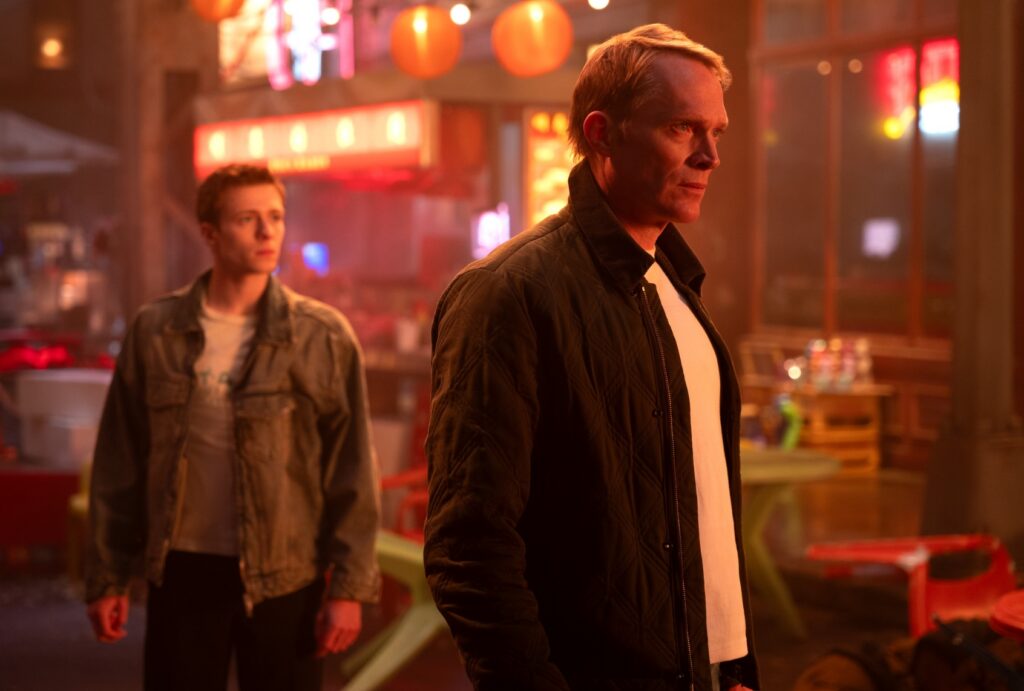 (Photo by Dennys Ilic. © 2026 Marvel. All Rights Reserved.)
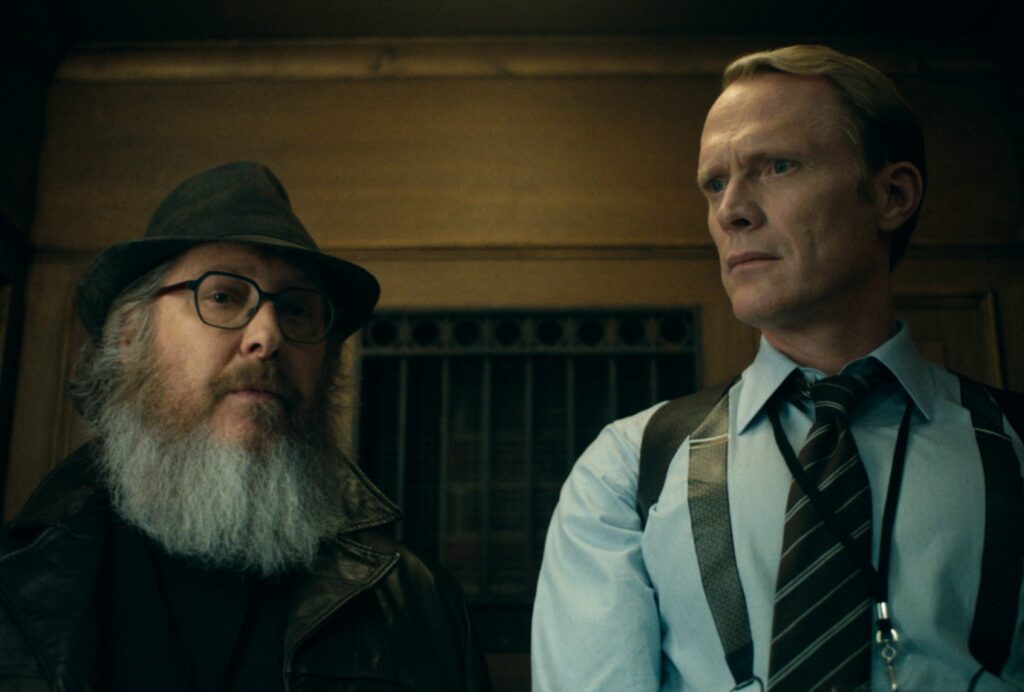 (Photo courtesy of Marvel. © 2026 Marvel. All Rights Reserved.)