❌

Reading view

Top ICC official urges EU to act ‘as soon as possible’ on US sanctions

THE HAGUE — The European Commission should act “as soon as possible” to give clear guidance on U.S. sanctions against the International Criminal Court, its top administrative official told POLITICO in an interview.

Osvaldo Zavala Giler, who oversees the day-to-day functioning of the Hague-based court as the institution’s registrar, said his job became “preparing for sanctions” as the White House imposed an escalating regime of restrictions against it.

The Trump administration targeted prosecutors and judges from the court first in February 2025 before announcing blanket sanctions on Oct. 9 this year. The EU has repeatedly backed the Court against Washington, but it has resisted calls to activate a mechanism that would forbid firms from complying with U.S. laws.

That has agonized senior figures in The Hague. Zavala Giler said the Commission’s “lack of clarity” left private companies and NGOs in the dark over whether they should comply with sanctions decided by Washington — and what risks they face if they don’t.

Zavala Giler’s call to the Commission adds to pressure from EU lawmakers for a swift response after the Oct. 9 announcement. Kallas told the European Parliament on Tuesday that Brussels would use the next few months “to open dialogue” on the issue. The new sanctions are set to take effect in April next year.

“What I would hope is that the space for dialogue is not interpreted as a space for waiting to protect the court,” Zavala Giler said, who spoke from his glass office on the eve of a visit to the Court’s headquarters by the EU’s top diplomat, Kaja Kallas.

Damocles sword

Anticipating sweeping sanctions, the Court spent six months abandoning U.S. tech providers and moving to an open-source software environment, and 20 months to make its financial transactions dollar-proof. That move has been a huge undertaking for Zavala Giler’s team, he said.

The Court initially deepened its reliance on U.S. technology after it was hit by a massive cyber attack in 2023, but what seemed a solution at that time became a problem in the face of sanctions. Even though the current regime includes a carveout for telecommunications, there is no guarantee it will remain the case.

“It becomes a sort of Damocles sword on top of our head that could be revoked at any time,” Zavala Giler said. “I cannot count on U.S. tech companies anymore.”

U.S. platforms operate as entire ecosystems, offering all-encompassing solutions under a single contract. To do without them, “you need to start creating your own architecture and systems that need to speak to each other,” the registrar said.

Financial autonomy was equally hard to achieve. The Court mapped all its suppliers’ transactions to ensure there was no U.S. nexus, meaning that no U.S. person, bank or currency is involved in a payment. “We made all of our staff members have European bank accounts. It was a very detailed process that we had to do, person by person, company by company, making sure that the contracts were in euros,” the registrar said.

The Court also went from working with tens of banks to only “a few,” since only a handful of institutions are comfortable with dollar-proof payments.

Chilling effect

That situation is likely to worsen without clear guidance from EU countries and the Commission. As Zavala Giler put it, “if the International Criminal Court cannot transact in Europe, in euros within the SEPA zone with no U.S. nexus, then there is a bigger question about European financial sovereignty.”

The Court has long called the EU to use a legislative shield — known as blocking statute — that would forbid EU firms from complying with U.S. sanctions. The request was backed by dozens of lawmakers at the European Parliament, which incidentally awarded the court its human rights Sakharov Prize on Thursday.

The blocking statute “becomes an instrument to reassert the minimum space that should not be affected by unilateral extraterritorial sanctions … that minimum space should be, at the very least, the eurozone,” Zavala Giler said. Even without it, the court needs “the reassurances that, at least within the eurozone, [it] can continue to operate,” he added.

So far, however, the Commission has taken a cautious approach, choosing dialogue with the U.S. as a way of “buying time,” as a EU diplomat put it to POLITICO.

In a balancing act, EU heads of state and government backed Brussels’ diplomatic effort at their summit last week, while also committing to do whatever is needed to support the Court.

“I hope that now that the European Council has opened this door, the Commission will feel more comfortable in taking an extra step. And at the very least, providing some kind of clear guidance,” Zavala Giler said.

As an intermediate step, the registrar suggested the use of “comfort letters” reassuring firms that they should not comply with the U.S. measures.

Zavala Giler stressed that sanctions were not only a matter to address for banks and tech operators, as the current uncertainty has already affected NGOs working with the Court. NGOs play a critical role in supporting the work of the Court, for instance “to provide reparations for victims in Uganda” or “to assist the work of the court in providing assistance to victims in Ukraine.”

“This has created an enormous chilling effect,” he said. “They don’t know if they have the legal protections or not, to continue supporting the work of the court.”

The registrar’s office overlooks the moat circling the court’s six towers across the compound’s 46,000 square meters. In one of these buildings, the trial of former Philippine President Rodrigo Duterte over alleged crimes against humanity is due to begin next month. Reporters who will cover the proceeds won’t be allowed to use their phones — only paper and pen.

It is Zavala Giler’s job to oversee this huge institution, which relies on secure communications, cross-border funding for investigations and the contribution of many NGOs.

“This court has for victims the promise of the never again,” Zavala Giler said.

  •  

Can Europe save the world’s war crimes court from Trump?

U.S. President Donald Trump has the world’s war crimes court in his crosshairs.

By sanctioning the entire International Criminal Court, his administration is threatening its ability to function. Europe has rushed to the court’s defense — but can it actually protect it from American financial power? And how far is the European Union willing to go to confront Washington when it still relies so heavily on the U.S. for its own security?

Host Sarah Wheaton is joined by European Parliament lawmaker Dirk Gotink and Atlantic Council sanctions expert Lize de Kruijf to discuss Europe’s options, its dependence on the U.S. dollar and American technology and whether the EU can stand up for international justice.

If you have any questions or comments, send us a message on our WhatsApp here or at +32 491 05 06 29.

  •  

Spain wins landmark victory in decades-long dispute over lost energy subsidies

MADRID — The Spanish government has won a significant victory in a long-running legal dispute with international investors over its decision more than a decade ago to scrap renewable energy subsidies.

This week, a Belgian court overturned a ruling that ordered the Spanish government to pay investors nearly €76 million.

It was a major win for Spain, which has been fighting attempts to freeze its assets around the world from clean energy investors who claim they are owed at least €2 billion in subsidies.

The dispute dates back to 2013, in the middle of the European debt crisis, when cash-strapped Spain, then under a new conservative government, decided to remove subsidies for renewable energy. Investors who had poured money into Spanish renewables said this was a breach, as they had invested on the understanding they would receive the subsidies.

The International Centre for Settlement of Investment Disputes ruled that Spain must pay the money, but the European Commission has told Spain doing so would constitute unlawful state aid.

The standoff has played out all over the world, with investors attempting to freeze Spanish assets in multiple jurisdictions. In June, U.S. investment fund Blasket Renewable Investments LLC issued subpoenas demanding documents from Adidas, Hilton Hotels, and other entities involved in Spain’s Football World Cup participation to help with its bid to freeze Spanish assets.

In the end, the team went back home with its assets intact, along with the World Cup.

Spain also has cases going on in courts in Australia, Germany and the U.S.

In 2023, a British court ordered an embargo on an international school in London owned by the Spanish state. The Belgian court’s original decision was one of the few examples where investors were successful, and the decision this week to overturn it will set a precedent for other challenges.

The case

Spain’s defense persuaded a Belgian court to lift an embargo imposed in 2025 on state-owned air-navigation company Enaire for €75.76 million, according to documents seen by POLITICO.

The case was also brought by Blasket, which bought the dispute from an investment fund called RREEF. The European Commission intervened in support of Spain.

RREEF, which was originally linked to Deutsche Bank, invested in Spanish wind and solar power under a 2007 regulatory framework that guaranteed subsidies for renewable energy. In 2013, amid the economic crisis, the government of then-Prime Minister Mariano Rajoy, of the conservative People’s Party, cut those subsidies to reduce electricity costs.

International investors turned to arbitration, arguing that the Energy Charter Treaty, an international agreement signed in the 1990s, guaranteed them fair and predictable treatment. The funds sought more than €10 billion in compensation, according to sources at Spain’s Environment Ministry.

The International Centre for Settlement of Investment Disputes, part of the World Bank, which handled most of the arbitration cases, ruled against Spain, though it reduced the amount sought in many cases. The total awards came to about €2 billion. In its 2019 ruling, the tribunal ordered Spain to pay RREEF €59.6 million, plus interest and costs.

Most of the claims, including RREEF’s, were sold to Blasket, which began seeking to enforce the awards. The funds have searched for Spanish assets that could be seized to satisfy the claims.

Spain says it cannot pay because the European Commission has determined that doing so would constitute unlawful state aid. The funds invested through companies based in Luxembourg, and the EU’s top court ruled that the Energy Charter Treaty did not apply to disputes between EU investors and EU member states; EU law governed instead.

In August 2026, the Commission opened infringement proceedings against Spain over a €23 million payment on an award involving a Japanese company, which was not based in the EU.

On June 17, 2025, Blasket secured a Belgian court order freezing €75.76 million belonging to Enaire, the state-owned company that manages air navigation in Spain. Enaire receives payments from Eurocontrol, the Brussels-based European organization that collects air-navigation charges from airlines and distributes the proceeds.

That arrangement made it possible to freeze Spanish public funds in Belgium. After a legal dispute, Spain deposited €75,759,538 on May 4, 2026.

The freeze was a high-profile win for investors pursuing Spain. They have secured other attachments in the United Kingdom and are engaged in ongoing U.S. court disputes over enforcement of the awards.

Spain appealed, and the European Commission intervened on its behalf. The Belgian state also argued that the attachment breached EU law. The Belgian court has now ruled in Spain’s favor, lifting the freeze and ordering Blasket to pay the legal costs.

That leaves Spain in a stronger position against international investors seeking to enforce the awards — at least within the EU.

  •  

Why the EU avoids tackling Big Soccer

BRUSSELS — The EU’s influential competition regulators have taken on some of the planet’s most powerful companies, from Google to Gazprom. But they are steering clear of opening a case against the world soccer governing body, FIFA. 

A complaint lodged by the European Leagues professional soccer association in October 2024 accused FIFA of abusing its dominant position by imposing its international match calendar on other sporting stakeholders. It argued that FIFA’s dual role as a governing body and the organizer of its own competitions creates a conflict of interest, through which it enriches itself. The leagues broadened the complaint last month to cover the women’s game — but the Commission has yet to open formal proceedings.

Brussels has left the European Leagues complaint in the “freezer,” one senior EU official with knowledge of the file told POLITICO. 

The episode underscores the Directorate-General for Competition’s long-running reluctance to open investigations into sports federations, which current and former European officials say is due to sport’s special status in EU law — the treaties recognize its social and educational role — but also a deliberate policy choice to swerve potentially controversial cases in an emotionally charged sector.

Now, pressure is building against the competition department over the languishing European Leagues complaint, after a cross-party group of EU lawmakers urged the Commission to use its antitrust powers to rein in FIFA. 

In a letter to European Commission President Ursula von der Leyen, obtained by POLITICO and copied to competition chief Teresa Ribera, MEPs called for action. Bruno Gonçalves and Hannes Heide (both from the Socialists and Democrats) and Bogdan Zdrojewski (from the conservative European People’s Party) asked the Commission to take formal action, including in relation to the complaint lodged by the European Leagues, which represents 53 men’s and women’s professional football leagues across the continent.

The MEPs say the governing body’s application of the calendar “raises concerns about FIFA’s use of regulatory powers to advance FIFA’s own commercial interests,” and that those powers “must be exercised through transparent, objective, non-discriminatory and proportionate procedures, with effective safeguards against conflicts of interest.” The EU’s top court set that test for sports bodies in its landmark 2023 Super League ruling.

“FIFA is both referee and promoter of the show,” Gonçalves told POLITICO. “We have to make sure the referee doesn’t put business before people.”

Representatives for the European Leagues pressed their case in a meeting with Competition Commissioner Teresa Ribera’s Cabinet in late April, but their overtures have so far been fruitless.

“The thinking has always been, on the one hand, that sports has a special status, so it is not a market comparable to others that normally are scrutinized by the competition directorate,” said one former senior EU official, who was granted anonymity to discuss a sensitive file in order to protect relationships. 

“But also, sports cases get very political and the Commission feels that member states tend to take the side of the federations so it’s hesitant to pick this fight up,” the former official added.

The Vestager principles

Over the last 15 years, Brussels has opened blockbuster investigations into Gazprom’s behavior in Central and Eastern European gas markets; whether Google illegitimately hindered the development and market access of rival mobile operating systems; and Apple’s rules for app developers.

But the Commission’s caution on sports is long-standing. 

When then-competition chief Margrethe Vestager ordered the International Skating Union in 2017 to drop rules threatening speed skaters with lifetime bans for joining money-spinning rival events, she said the decision didn’t mean the Commission was “trying to be the referee in every dispute about sport.”

Many disputes, from doping penalties to deciding the precise scheduling of games, have “little or nothing at all to do with competition rules,” Vestager said at the time. National courts and competition authorities, she added, are “usually well placed to deal with competition disputes involving a sport federation.”

Those principles have since come to guide how the Commission’s competition department decides which sports disputes to take on. There is no shortage of candidates, with controversies in sports including tennis, padel and sailing, as well as soccer.

Any investigation would test recent case law. A pair of July rulings on FIFA’s agent rules went largely the governing body’s way. In those cases, the Court of Justice of the European Union accepted that federations can impose restrictions if they pursue legitimate aims proportionately.

Ben Van Rompuy, a competition law professor at Leiden University who helped bring the original ISU complaint, said there would likely be “little appetite” in Brussels to take up the leagues’ case.

When the ISU complaint reached the Commission, courts had said little about how competition law applied to sport. Since then, “we’ve had an abundance of such guidance,” and “national enforcement in front of the courts seems to work,” Van Rompuy said. That leaves less reason for the Commission to step in. The leagues have also sued in a Brussels court, which suggests “they themselves believe that the national courts could protect their rights.”

Measured against the Commission’s own criteria for prioritizing complaints, the case looks weak, Van Rompuy said. Its impact on the EU’s internal market is “extremely limited,” he added.

FIFA declined to comment on the European Leagues complaint and the EU lawmakers’ letter.

Commission spokesperson Ricardo Cardoso said international sports bodies have “a primary responsibility” for organizing global events, and that sport is mainly a matter for national governments, with the EU playing a supporting role.

When sports organizations act as undertakings, the EU legal term for entities carrying out economic activity, they are subject to the rules of competition, Cardoso said. He added that the Commission constantly monitors markets for possible breaches, and that “if any complaint is filed, the Commission will assess according to standard practice.”

Public and political criticism of FIFA has reached fever pitch over the last 12 months due to the governing body’s cozy relationship with U.S. President Donald Trump’s administration and an ultimately aborted plot this summer to sell off parts of the World Cup tournament to private investors.

According to the letter from EU lawmakers, FIFA President Gianni Infantino’s commercial sell-off scheme “exposed serious shortcomings in transparency, accountability and institutional decision-making.”

  •  

‘There is no immunity to Donald Trump’

he world is starting to understand that there is no way to fully and lastingly protect itself from President Donald Trump.

The man just can’t let things go — and he’ll get creative to get what he wants.

The latest blowup over Ukraine is emblematic of Trump’s wily persistence, and it suggests a challenging two years lie ahead for the international set even if Democrats gain some power in the midterm elections.

Not that long ago, Trump seemed to have patched up ties with Ukrainian President Volodymyr Zelenskyy as Kyiv made gains against Russia. Trump signed legislation last month that was championed by his late friend, Sen. Lindsey Graham (R-S.C.), to impose heavy new sanctions and tariffs to punish Russia for its war on Ukraine.

This month, the original Trump — the one who fawns over Russian leader Vladimir Putin and despises Zelenskyy — roared back. He waived many of the legislation’s penalties on Russia, moved to buy Russian diesel and signaled he’s more interested in doing business with Moscow than seeking justice for Kyiv. Ukrainians suspect the U.S. has pressured them by throttling its satellite connections and intelligence-sharing. (The Trump administration disputes much of this.)

“Russia, frankly, has been fine on Ukraine,” Trump said Monday as he welcomed the idea of an arms control summit with Putin and Chinese leader Xi Jinping that might include talks about Ukraine.

The lesson, foreign officials and others steeped in diplomacy tell me, is that you cannot truly change Trump’s mind or stop his overall trajectory. Even if Trump seems briefly chastened or stages a tactical retreat, he will eventually return in new, often-surprising modes to push his original views and goals. He will try to exhaust you into submission.

Imagine how startling it is to be Ukrainian these days as Trump pressures you to make concessions to Russia by blaming you for a global energy crisis he caused by launching a war on Iran. Or what it’s like for officials across European capitals trying to craft a response, knowing there’s never an end to the process.

“There is no immunity to Donald Trump. He makes a deal in order to make a better deal the next day,” one senior European official mused, having been granted anonymity because the topic involves sensitive diplomacy.

It’s hard to blame world leaders who think they’ve learned to manage Trump only to be bewildered by a sudden left hook on his part. Foreign policy is often driven by hope when you lack good options. And Trumpology is a confounding, but still a relatively new, subfield.

Besides, Trump’s messaging is inconsistent, incoherent and nonstrategic — characteristics that can obscure his single-minded pursuit of his goals. So the global actors dealing with him — whether it’s the Gulf Arab states who shower him with gifts or the Canadians furious over his trade and territorial threats — sometimes think they’ve come to terms with him only to find they’re fighting on a newly configured plane.

A Supreme Court ruling that gutted many of Trump’s tariffs earlier this year was good news in many capitals. But since then, the so-called Tariff Man has moved to impose the import taxes under pretexts not considered by the court, including turning to accusations involving forced labor.

The White House doesn’t dispute Trump’s aggressive tactics.

“There is no greater fighter for America First interests than President Trump — and he is willing to look anyone in the eye to deliver wins on behalf of the United States,” spokesperson Anna Kelly told me in a statement.

The Greenland saga shows the limits of trying to mollify Trump.

In his first term, Trump wanted to buy the frozen island. The idea was shelved amid global laughter, but authorities in Greenland and Denmark made it clear to Trump that they welcomed more U.S. investment in the Danish territory.

In his second term, Trump huffed and puffed about an all-out U.S. takeover of Greenland, only to agree in September to an expanded U.S. military footprint that he could have gotten anyway under existing, decades-old diplomatic accords without all the drama. The whole affair has led to lingering anger in Europe about what Canada’s leader called a “rupture” in the global order — but many European officials hoped that the saga had faded away.

Yet, it’s far from certain that Trump has given up on possessing Greenland. Just days ago, he touted on social media plans to start oil, gas and mineral exploration in “our new and beautiful Greenland.”

The use of “our” is more than a little suggestive.

Defying Trump, too, can get you only so far.

Brazilians effectively told Trump to take a hike when he used tariffs and sanctions to punish the country for charging its former president, Jair Bolsonaro, in a coup attempt.

A few months later, as Bolsonaro was about to start his prison sentence, Trump seemed to admit defeat in his effort to help his political ally. “That’s too bad,” he said in November 2025, with little emotion. (“Brazil Defied Trump and Won,” The New York Times declared.)

But Trump wasn’t done with Brazil. He and his team have pursued efforts to undercut the current Brazilian government while quietly backing Bolsonaro’s son, Flávio, in his efforts to win the presidency this year. The runoff election is on Sunday, and it’s tight.

World leaders are doing what they can to make their countries Trump-resistant, if not all-out Trump-proof.

That has meant everything from diversifying their sources of trade and security alliances to joining Trump on ventures that, on the surface at least, can be helpful to them. (Then there are the many countries, especially in Africa, that diplomats privately tell me are happy to be off Trump’s radar.)

My takeaway from watching all of this, though, is that it’s not enough to stay one step ahead of Trump. You have to stay several steps ahead, and you have to be wildly imaginative about the lengths to which Trump and his devoted aides are willing to go to complicate your life.

The second Trump administration is filled with people who have turned to unique, bizarre and clever interpretations of law and reality to push his agenda. It’s not always clear who is behind which move, but it’s hard to imagine Trump isn’t fine with most of what’s happening.

It’s why a teenager is being held in immigration detention for the actions of his grandmother decades ago. It’s why Congress can scream and shout about its spending orders yet Trump ignores it.

Sen. Chris Murphy (D-Conn.) said other nations should not hope that the Republican Party will shed Trump’s worldview, including his disdain for allies, once Trump’s out of power.

“I would love for our allies to know that we have consistent common adversaries that we’re going to work together to fight. I just don’t know that you can make that guarantee,” Murphy, a frequent Trump critic, told me. “That’s painful to say, but given the state of the Republican Party right now, it’s true.”

I understand why Ukraine and the European Union are trying to diversify their sources of intelligence and military industrial bases as Trump keeps chasing love from Russia.

Despite Secretary of State Marco Rubio’s claims, the reality is that the United States can no longer be trusted for such security assistance.

But it’s not enough to find new intelligence partners or weapons manufacturers. You have to ask bigger questions, like, “What are the untapped streams of intelligence that no one knows are out there? What’s a potential weapon no one has considered? How can I acquire what I need before Trump stops me?”

Governments need to have plans — now — for scenarios that seem completely crazy. Better to be wrong than unprepared.

Still, even if you do all of that … “I don’t think it’s possible to stay two or three steps ahead of Trump,” said Charles Kupchan, a former senior national security official during the Obama administration who apparently enjoys raining on parades.

“He acts on impulse,” argued Kupchan, who has a new book out on the crumbling world order. “We need to try to limit the damage he’s causing and ride him out.”

A Democratic win in November’s midterms — one or both chambers of Congress — is unlikely to do much to rein in Trump’s actions abroad during his final years, current and former U.S. and foreign officials tell me.

He still has the veto and has been willing to ignore congressional demands. There’s also the fact that presidents have significantly more power to act in unilateral ways overseas than they do domestically.

Ukraine, the European Union, the world — all will be dealing with a politically wounded Trump who’s likely to double down on what he feels he must have.

“He’s going to be angrier,” Murphy predicted.

  •  

Maybe it’s personal: Europeans worry Trump just likes Putin more than Zelenskyy

In a throwaway comment this week, Donald Trump made clear that he does not regard the war in Ukraine as a conflict with fault on both sides. “Russia frankly has been fine on Ukraine,” the U.S. president said. “They have not been doing that much.”

To residents of Kyiv — who have endured weeks of intensifying bombardment — and Ukraine’s allies across Europe, the remark confirmed a growing impression that the U.S. is taking Russia leader Vladimir Putin’s side in the war.

“American negotiators have been trying to push Ukraine into surrender for already almost two years,” the EU’s top diplomat Kaja Kallas told the European Parliament on Tuesday. The reason Ukraine hasn’t “surrendered on Putin’s terms” so far is because Europe has been providing so much support, she added. 

As they scratch their heads for explanations for Trump’s latest turn against Ukraine, some European officials and diplomats think it comes down to the president’s personal preferences, as much as his country’s political aims.

“I do think it’s a personal thing,” said former British Cabinet minister David Lidington, now distinguished fellow at the Royal United Services Institute, a leading security think tank in London. “Trump is self-centered — his personal predilections for dictators and autocrats, his desire to give opportunities to U.S. businesses … are very important parts of his motivation.”

In private, EU officials agree. “Trump doesn’t like [Ukrainian President Volodymyr] Zelenskyy. He just doesn’t like him,” said one government official who has observed both men closely. “That makes it harder to get the U.S. to help on peace. Everything is a rational business deal with Trump, until it’s not.” 

A diplomat from an EU country — granted anonymity, like others in this report, to discuss sensitive matters — said the inconsistent Trump could change his mind again and reverse recent moves against Ukraine. The U.S. president has chopped and changed on many issues, “except one thing,” the diplomat said. “He seems to be supportive of the Russians.”

“He’s been critical of Ukraine, the EU, NATO, but hardly ever said anything critical about Putin. It is striking. We have to deal with an administration that seems to be more pro-Russian than anything else,” the diplomat said.

The White House didn’t immediately respond to a request for comment.

Mounting losses

For Ukraine and its European allies, the idea that nothing can or will change Trump’s feelings about Zelenskyy is a bleak one. After four-and-a-half years of war, Kyiv is running low on funding, air defenses and — amid swelling support for Europe’s populist right — facing a potential loss of political support in the months ahead. 

Trump’s envoy Steve Witkoff met the Ukrainian president and the leaders of Norway and Finland for talks in Oslo on Tuesday, and will head to St. Petersburg to discuss peace proposals with the Russian leadership on Wednesday as the White House pushes hard for a ceasefire. One option Putin will be offered is a three-way leaders’ summit with Trump and Zelenskyy.

Previous efforts to get the Russian president to attend such a meeting have failed, however, and EU diplomats do not believe Putin is showing any genuine desire for a ceasefire. That is partly what makes Trump’s hostility toward Zelenskyy so problematic.

“There is a clear consensus across Europe that Putin does not want peace,” a second EU diplomat said. “He will need to be forced into peace.”

U.S. President Donald Trump greets Russian President Vladimir Putin as he arrives for talks at Joint Base Elmendorf-Richardson in Anchorage, Alaska, on Aug. 15, 2025. | Andrew Harnik/Getty Images

But instead of making demands of Putin, Trump has ratcheted up his pressure on Zelenskyy, even amid escalating Russian attacks on Ukrainian cities this month. Ukraine’s leader is feeling the strain, as he told his EU counterparts in private meetings in Brussels last week, according to the first diplomat.

In a succession of highly critical comments in recent days, Trump has said Zelenskyy “doesn’t care” and “doesn’t want to end this war;” and should be replaced as leader or as Ukraine’s negotiator. “President Putin would like to see a settlement,” Trump said. “President Zelenskyy could have solved this war, or he could have made a deal, many times.” 

The Oval Office beating

Trump’s animosity may date back to an incident during his first term in 2019, when he urged the Ukrainian leader to help with an investigation into Joe Biden, who eventually defeated Trump in the following presidential election, Lidington said. A succession of hostile encounters in the years since — including in the Oval Office in February 2025 — have reinforced the impression, he said. 

“It was clear that in the infamous meeting in the White House that Trump and [Vice President JD] Vance had planned that public beating-up of Zelenskyy and it struck me then that there was a strong personal element to this,” said Lidington.

“I think there’s another element, which is that if you look at the people Trump tries to court, it tends to be autocratic strongman — and it is ‘man’ — leaders,” Lidington said.

He recalled attending a dinner with world leaders in 2018 to mark the centenary of the end of World War I in Paris. French President Emmanuel Macron and the German chancellor at the time, Angela Merkel, were playing joint hosts “at the top table,” but Trump was not interested in making small talk with either of them, Lidington said.

“It was pretty obvious from the body language that Trump was impatient with them and one of the people he really wanted to talk to was [Turkish leader Recep Tayyip] Erdoğan and other people who were a bit more in that strongman image that he likes to portray himself,” he observed.

‘Strange stories’

A senior official from a European country familiar with the Ukraine talks said Trump’s motives were partly political, partly about calculating what would be profitable and partly about personalities.

“They are currently in an election cycle and need someone to blame for rising prices,” the official said. “In general, Trump tends to like various types of people and leaders. He actually has a fondness for successful and cheerful people.”

In recent days, Zelenskyy has warned his country is suffering more civilian casualties because the U.S. has cut back on support, including Starlink and Starshield services that help Ukraine defend itself against Russian attacks and plan operations. “We still have no explanation for this, just different strange stories,” Zelenskyy told U.S. congressmen on Monday.  

This month, the advanced warnings of incoming Russian missile attacks from U.S. partners have failed to come through as normal. Ukraine is also running low on Patriot missile interceptors, he said. 

The Pentagon has not issued an official comment on the Ukrainian complaints. The U.N. Human Rights Monitoring Mission in Ukraine said 328 civilians were killed and more than 2,000 wounded across Ukraine last month, an 85% increase compared to September 2025. The U.N. said that the first two weeks of October were among the deadliest for civilians in Ukraine in years, driven by increased missile and drone strikes.

The first EU diplomat quoted above said many European governments were irritated that Trump had cut them out of his conversations with Putin so far. “There is probably much more dialogue between the Americans and the Russians than we might know,” the diplomat said. 

Tuesday’s meeting with Witkoff in Norway raised the possibility that direct engagement with Putin might be back on the cards, for Zelenskyy at least. 

“Today was a good day for peace,” Finland’s President Alexander Stubb said after attending the talks in Oslo. “On a substantive and technical level we have actually made a lot of progress under the radar in the past week or so,” Stubb said.

The process is now going in the right direction again, he added. “Hopefully, we don’t do any backtracking.”

  •  

AfD’s Alice Weidel to unveil plan to downsize the EU

STRASBOURG — The far-right Alternative for Germany (AfD) wants to scrap the directly elected European Parliament, shrink the European Commission and let Berlin opt out of common EU policies. That’s according to the party’s policy program, which party leader Alice Weidel will present at the European Parliament on Wednesday.

The AfD’s push comes as far-right parties look to gain ground across Europe. The party’s recent victories in state elections in Saxony-Anhalt and Mecklenburg-Western Pomerania have given it fresh momentum.

Last week, Marine Le Pen was in Brussels to outline her plan for the EU if she becomes French president. She vowed to halve Paris’ contributions to the budget if she gets to power, and to turn the European Commission into a “secretariat” in the service of its member countries.

“I’m not fooled by what the European Commission wants to do. The European Commission wants to turn itself into a state; we do not. And so we will stand in its way,” Le Pen said. 

The AfD policy paper, obtained by Brussels Playbook, says the AfD would not seek to leave the EU or eurozone at first. Instead, it wants to renegotiate the EU treaties and cut the bloc’s powers, institutions and budget. Weidel will present her strategy at an event on Wednesday afternoon entitled “Our new deal for Europe.”

The party wants to replace direct European Parliament elections with delegates appointed by national parliaments, reduce the Commission’s role to purely administrative and transfer decision-making to national capitals. It also wants to replace the EU’s top court with an arbitration tribunal.

The plan calls for slashing and capping the EU budget, freezing staffing numbers and abolishing agencies. The AfD would use its veto power to scrap revenue from VAT and plastics taxes, and threaten to halt Berlin’s contributions to the common budget to force through the reforms it demands.

“If Brussels refuses the path of reform, this veto will be used to block future EU financing legislation and drastically reduce Germany’s contributions,” the AfD plan says.

The AfD also wants to give larger eurozone economies more voting power at the European Central Bank — giving Germany a say in monetary policy — and reject the digital euro.

Berlin should seek exemptions from EU rules on migration, taxation, social policy, defense and common borrowing, the party argues. If the EU’s green policies are not scrapped, and no substantial changes take place to industrial, agriculture, and financial policies, an opt out in these areas would be sought too.

The paper identifies 2029 — when the next European Parliament and German federal elections will take place — as the moment to start implementing the reforms.

“In 2029, something we have scarcely dared to hope for may become reality: a patriotic, right-wing majority in the European Parliament is coming within reach.”

If its reforms fail, the AfD says it would put Germany’s EU membership to a referendum.

  •  

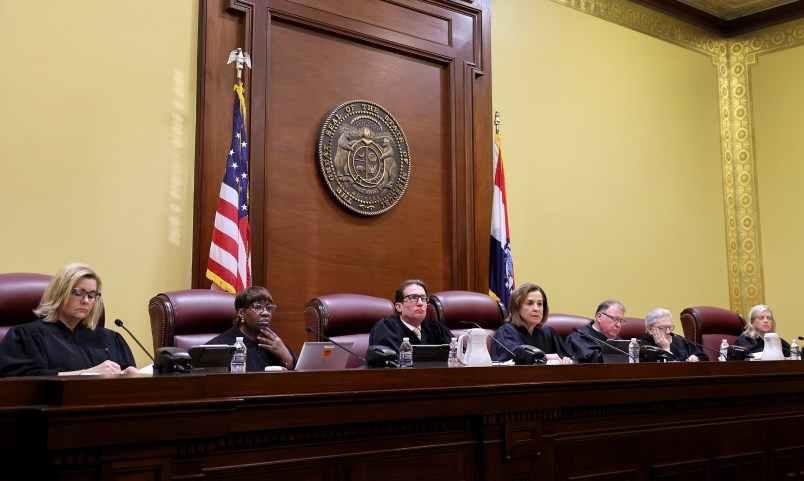
Frustrated by Losses in the Courts, Missouri Republicans Want to Change How Top Judges Are Selected

This story was originally published by ProPublica, a nonprofit newsroom that investigates abuses of power. Sign up for Dispatches, a newsletter that spotlights wrongdoing around the country, to receive their stories in your inbox every week.

Some 86 years ago, Missouri voters enshrined a system for selecting top judges that would remove political influence from the courts. And almost immediately, it came under attack.

Under what has come to be known as the Missouri Plan, lawyers help choose a slate of three candidates from which the governor must make an appointment for the state Supreme Court, appeals courts and, in some populous areas, the circuit courts. 

In the first years after adoption, it faced pushback from party bosses who had historically used judicial seats for political patronage. They said it gave too much power to the lawyers. Voters, though, decisively defeated a repeal measure in 1942. 

More recently, the conservative activist Leonard Leo, who viewed Missouri as a crucial battleground, tried in 2007 to persuade Republican Gov. Matt Blunt to reject a slate of Supreme Court candidates — part of a broader effort to weaken a judicial selection system that had become a model for some two dozen states around the country. 

Blunt resisted and picked one of the three judges from the approved slate. 

Then, in 2012, GOP lawmakers put a proposed overhaul before voters that, if approved, would have given the governor more control. Voters, by a 3-to-1 margin, turned back the plan.

Now the attacks are back, driven by a new grievance. 

  •  

Ex-DUP chief in Northern Ireland given 15-year prison term for sexually abusing girls

NEWRY, Northern Ireland — The former leader of Northern Ireland’s main pro-British party, Jeffrey Donaldson, received a 15-year prison sentence Thursday for sexually abusing two schoolgirls and continuing for decades into their adulthood.

Donaldson, 63, kept his hands clasped together but offered no visible reaction as Judge Paul Ramsey said the former Democratic Unionist Party leader must serve an 11-year sentence for raping one girl and a further 4-year term for sexually abusing another.

Donaldson has been behind bars since June, when a jury found him guilty of 18 counts of sexually abusing the two women — identified in court only as Victim A and Victim B — when they were children. The listed offenses ran from 1985 to 2008.

Ramsey, addressing a packed Newry Crown Court, read from the two victims’ statements, which described abuse that began when they were 7 or 8 years old. One of the victims described recurring nightmares: “I wonder what it is like not to be afraid at night.”

The judge noted how Donaldson, who is appealing the conviction, had “doubled down on his denials” over what he called the veteran politician’s “catastrophic descent into disgrace.”

Donaldson’s former party, which denounced him immediately after his 2024 arrest and scrubbed him from the DUP website, said in a statement Thursday that Donaldson “deserves every day of the lengthy prison sentence he has to serve” for what it described as “vile and disgusting crimes.”

“Our first thoughts are again with the innocent victims who, having suffered such evil, were retraumatized through giving evidence at the trial. They deserve our compassion, support and respect,” the DUP statement said.

Donaldson was an MP representing Lagan Valley from 1997 to 2024, first for the moderate Ulster Unionist Party and then — after belatedly breaking with the party over its support for the Good Friday peace accord of 1998 — as a member of the hard-line DUP.

Donaldson became DUP leader in 2021, when he oversaw the collapse of Northern Ireland’s power-sharing government in a bitter dispute over the region’s peculiar post-Brexit trade rules. Just weeks before his arrest, he again played a key role in reviving the coalition, the cornerstone of the Good Friday peace deal he had once rejected.

In March 2024, Donaldson was arrested in his secluded County Down home and charged alongside his wife, Eleanor. She was subsequently deemed by the Newry judge not mentally fit to stand trial on charges of aiding and abetting his crimes.

The U.K. government in July removed Donaldson from membership in the Privy Council, a body of parliamentary advisers to King Charles III. The king also stripped him of his knighthood.

Donaldson has been placed in an isolated hospital wing at Northern Ireland’s Maghaberry Prison, alongside other convicted sex offenders, to protect him from potential assaults from other prisoners. He reportedly is spending much of his days behind bars doing puzzles and reading the Bible.

  •  

OpenAI employee arrested and charged over hidden recording

Federal authorities arrested a Saudi national employed at OpenAI and charged him with planting a recording device in a company’s executive conference room, the Department of Justice announced Tuesday.

On or around Sept. 30, OpenAI discovered a sophisticated recording device inserted into the back of a television in an executive conference room located in one of its San Francisco offices. The company determined that the device was installed approximately a couple days prior, concealed in toilet paper. The contents of the device were encrypted, according to the DOJ.

The Department of Justice said in a news release that the employee, Abdulrahman Alfozan, 35, was arrested Friday and appeared in federal court Tuesday. OpenAI confirmed the incident on social media and said that it was supporting the FBI’s investigation.

“We used our models to understand the device and where it had come from, identifying that a specific employee had planted it a few days earlier,” OpenAI said in its statement. “At this time, we have no indications of this individual inappropriately accessing or exfiltrating model weights, source code, or customer data.”

Alfozan used a “productivity tool” to inquire about the company’s meeting rooms, calendars, and “leadership and exec” locations, according to OpenAI’s complaint to the DOJ. A chatbot account associated with his spouse also indicated that the user submitted prompts in September relating to installing and remote accessing a recording device.

The DOJ said that CCTV footage showed Alfozan, who had been employed as an engineer by OpenAI since July 2025, near and inside the conference room on multiple occasions before the device was discovered. Meetings in the conference room “frequently involved discussions of highly confidential technical, commercial, and strategic information, including proprietary research, product plans, and business-development opportunities,” according to the complaint.

The company also discovered another recording device in one of Alfozan’s bags left in the office.

“We referred the matter to the FBI, and we’re grateful to the agents and prosecutors who moved quickly to make an arrest,” OpenAI said. “Our security program is designed to protect against a wide range of threat actors, from insider risks to cybercriminals to nation states, and this case is an example of how AI can help address these sophisticated security threats.”

The Saudi national, who has since been fired by OpenAI, faces a maximum penalty of five years in prison, a $250,000 fine and three years of supervised release if convicted, according to the DOJ.

“For us it is a matter of national security,” U.S. Attorney Craig H. Missakian for the Northern District of California said in a statement. “This arrest highlights our relentless efforts in partnership with the FBI to identify and prosecute those who seek to steal our technology, as alleged in the complaint.”

  •  

The next generation of Republican justices will be even more partisan

Supreme Court Justices Neil Gorsuch and Samuel Alito.
The lower federal courts are filled with people who make this guy look like a model of nonpartisan rectitude. | Chip Somodevilla/Getty Images

The Supreme Court ruled on Friday that Missouri may not use a newly drawn Republican gerrymander during the 2026 congressional election. This decision should surprise no one because, about two weeks ago, the Supreme Court ruled that Missouri may not use a newly drawn Republican gerrymander during the 2026 congressional election.

That second decision, moreover, followed an even earlier one by Justice Brett Kavanaugh, which ruled that Missouri may not use a newly drawn Republican gerrymander during the 2026 congressional election. In that matter, Kavanaugh acted alone under a process that allows a single justice to dispose of a case — a process that the justices rarely invoke unless they view a case as so one-sided that there’s no need to formally refer it to their colleagues.

So, for those keeping track at home, that’s three times that the Supreme Court needed to decide the same exact question in less than three weeks. 

This happened because of an extraordinary round of defiance by Republican judges in the lower courts. Just minutes after Kavanaugh determined (for the first time) that Missouri cannot use the Republican gerrymander, a Trump-appointed judge in Missouri tried to countermand Kavanaugh’s decision. Then, after the full Court reaffirmed Kavanaugh’s decision, a panel of three Republican appellate judges again tried to reinstate the new maps that the Supreme Court had already twice rejected.

These judges’ behavior is disturbing. But it is also potentially a window into the future of the Supreme Court — at least if Republicans keep winning elections that allow them to fill seats on the federal judiciary.

The lower federal courts are gravid with ambitious Republican judges who reach conclusions that are either too extreme or too partisan for the current Supreme Court — such as the ones they reached in this case. These courts are also full of plausible candidates for a Supreme Court nomination who have shown unwavering loyalty to Trump, the MAGA movement, or the Republican Party — regardless of whether there are legal arguments supporting the GOP’s preferred outcomes.

Indeed, one lower court, the US Court of Appeals for the Fifth Circuit, now functions as a kind of think tank for MAGA legal theories that less partisan judges would scoff at in disgust. This is the same court, for example, that attempted to pull the abortion medication mifepristone from the market. It’s a court that declares entire federal agencies unconstitutional. Or that orders thousands of lawfully cast ballots thrown in the trash after the Republican Party asks them to do so. The Fifth Circuit is also frequently reversed from the left by the Supreme Court.

That means that, if Republicans hold onto the Senate after the upcoming 2026 midterm elections, Trump will be able to easily identify and confirm Supreme Court nominees who make Justice Samuel Alito, the most partisan member of the current Court, look like an icon of disinterested fairness. And many of these ultra-partisan judges are young enough that they will remain viable Supreme Court candidates in future Republican administrations.

Eliminating judicial filibusters transformed who gets nominated to federal judgeships

About 13 years ago, the Senate fundamentally changed how federal judges are confirmed. Prior to late 2013, senators in the minority party could use the filibuster to block any judicial nominee who couldn’t find 60 senators who would support their confirmation. But the Senate voted in November of 2013 to allow judges to be confirmed by a simple majority vote.

Both parties have their own narratives blaming the other for this development. Republicans often claim that Democrats’ decision to filibuster a handful of President George W. Bush’s lower court nominees — before the second Bush administration, judicial filibusters were rare — was a major escalation in the partisan war over judicial confirmations. Democrats, meanwhile, blame Republicans for a significant uptick in judicial filibusters under President Barack Obama.

In any event, Senate Democrats eventually decided to allow judges to be confirmed by a majority vote after Republicans filibustered all of Obama’s nominees to three vacant seats on the powerful US Court of Appeals for the DC Circuit. That broke a logjam that otherwise would have prevented Obama from filling any of these seats, but it also created a new world where lawyers who wished to become federal judges or justices no longer needed to worry about winning votes from senators in the other party.

This new world was apparent immediately after Trump took office the first time in 2017. There was a vacant seat on the Supreme Court, largely because Senate Republicans had held it open for a year until Trump could fill it. 

During his first term, Trump largely delegated the task of picking judges to the Federalist Society, a kind of bar association for right-wing lawyers. And the Federalist Society was obsessively focused on weakening the power of federal agencies to regulate private business. 

Trump’s eventual nominee for the open seat, now-Justice Neil Gorsuch, secured his new job by advertising his eagerness to advance the conservative legal movement’s top priority. Shortly before his nomination, Gorsuch wrote a pair of opinions laying out his plan to make federal agencies subservient to the judges. And one of these opinions, according to the journalist David Kaplan, “proved decisive in clinching” the nomination for Gorsuch.

In the pre-2013 world, judges with Supreme Court ambitions often avoided making their most controversial views public out of fear that doing so would antagonize other-party senators who they might need to support their confirmation to a higher court. In 2011, for example, Kavanaugh, then a judge, was assigned to a panel considering the constitutionality of Obamacare. But he dodged the key issue in the case, instead claiming that he lacked jurisdiction to rule on whether Obamacare is lawful.

After Gorsuch’s anti-regulatory opinions scored him a Supreme Court seat, however, lower court judges took notice. And the most ambitious Republican judges started looking for opportunities to prove their conservative bona fides to the Trump White House. Before 2017, for example, Kavanaugh had avoided taking a public position on abortion. Months after Gorsuch’s confirmation, however, Kavanaugh gave a speech to a conservative think tank signaling that he would be a vote to overrule Roe v. Wade if he were given a promotion.

The confirmation process, in other words, now favors candidates who audition for judicial jobs by demonstrating that they are dependable votes on issues that drive their political party. This is especially true for Republican judicial candidates, because the Trump White House has shown such favor toward candidates who are personally loyal to Trump. But Democrats who want a judicial appointment also have similar incentives. 

Gorsuch got his seat because Republicans, who controlled the Senate in 2016 when Justice Antonin Scalia’s death opened a vacancy on the Supreme Court, refused to confirm anyone that Obama nominated to fill this seat. It now appears, in other words, that no Democrat can get confirmed to the Supreme Court unless their party controls the Senate. So Democrats with Supreme Court ambitions also have no incentive to make nice with Republicans.

The way to get a high-powered judgeship is to convince your own political party that you will use that judgeship to advance its goals.

Republican judges are openly auditioning for the Supreme Court

Gorsuch and Kavanaugh are hardly the only judges who started advertising their ideological and partisan loyalty in an apparent effort to get ahead. The lower courts are now full of judges who write extreme and often needlessly provocative opinions that seem designed to catch the eye of someone in the White House.

The Ninth Circuit’s Lawrence VanDyke, for example, is a particularly vulgar judge who was reportedly on Trump’s short list for the Supreme Court during his first term. He’s best known for opinions mocking his colleagues and left-leaning litigants in a tone more often found on MAGA podcasts than in judicial opinions. VanDyke began an opinion about transgender women last March, for example, with the line “this is a case about swinging dicks.”

Or consider Andrew Oldham, a Fifth Circuit judge known for his opinions undercutting the First Amendment, attacking voting by mail, and standing up for vaping companies’ ability to sell bubblegum-flavored nicotine products — among other things. Oldham’s chambers is a factory pumping out decisions that even cause many of the Supreme Court’s Republicans to cringe — his vaping opinion was tossed out in a unanimous decision by Alito — but that also align perfectly with the Trump administration’s preferred policy outcomes.

The federal judiciary has become a partisan institution. And that means that the future of the courts is on the ballot every two years.

Or take Judge James Ho, Oldham’s colleague on the Fifth Circuit, who is also known for his trolly opinions attacking liberal shibboleths. Rather than attempt to summarize Ho’s jurisprudence, I will simply refer readers to my 2023 profile of him: “The edgelord of the federal judiciary.”

I could name more judges who behave similarly — I bring up these three largely because they’ve been discussed in the national media as potential Supreme Court candidates if Trump gets to appoint another justice. But there’s no need to belabor the point. The bottom line is that, if a vacancy does open up on the Supreme Court, Trump will have no shortage of judges who appear to have spent their judicial careers looking for opportunities to demonstrate just how eager they are to advance a MAGA agenda, even when that means moving several steps to the right of a Supreme Court dominated by conservative Republicans.

Indeed, the Missouri incident reveals just how widespread these sorts of judicial partisans are within the lower courts. None of the Republican judges who tried to reinstate the Missouri gerrymander after it was rejected by the Supreme Court, for example, have received the same attention that VanDyke, Oldham, and Ho have received as possible Supreme Court candidates. One of them, Judge James Loken, is an 86-year-old George H.W. Bush nominee with no prospects whatsoever of getting promoted.

But the culture in the lower courts has grown so open to partisan decisionmaking that he, along with two younger colleagues, literally tried to give the Republican Party an extra US House seat after the Supreme Court had told them not to do it twice.

Which isn’t to say that every Republican federal judge, or even every Trump appointee, is a partisan hack. One of the most pointed opinions rejecting Trump’s attempt to overthrow former President Joe Biden’s victory in the 2020 election, for example, was authored by Judge Stephanos Bibas, a Trump appointee. But, while Bibas’s opinion in Donald J. Trump for President v. Secretary (2020) was excellent, it also almost certainly guaranteed that he will never become a justice. And it absolutely guaranteed that he will never be nominated by Trump.

There’s no good solution to this problem

The biggest reason why America is stuck in this mess is that its two major parties have polarized on the proper role of judges. Even setting aside the youngest generation of hyperpartisan judges, it’s long been the case that any Republican nominated to the Supreme Court will be a reliable vote against causes like abortion rights, affirmative action, and the Voting Rights Act, and an equally reliable vote in favor of the “unitary executive” and for religious conservatives who seek exemptions from state and federal laws. Any Democrat, meanwhile, will take the opposite position on these, and a whole array of other issues where the two parties have consistent positions.

This is why restoring the old filibuster rules that existed prior to 2013 will not succeed in moderating the judiciary. If anything, allowing the minority party to filibuster judges again would mean that no one would ever be confirmed to the Supreme Court, because any nominee who is acceptable to one party would be radioactive in the other party.

Ultimately, the only effective way to keep people like Oldham, Ho, or VanDyke off the Supreme Court is to elect senators and presidents who do not want them on the Supreme Court. The federal judiciary has become a partisan institution. And that means that the future of the courts is on the ballot every two years.

  •  
❌