❌

Reading view

Top ICC official urges EU to act ‘as soon as possible’ on US sanctions

THE HAGUE — The European Commission should act “as soon as possible” to give clear guidance on U.S. sanctions against the International Criminal Court, its top administrative official told POLITICO in an interview.

Osvaldo Zavala Giler, who oversees the day-to-day functioning of the Hague-based court as the institution’s registrar, said his job became “preparing for sanctions” as the White House imposed an escalating regime of restrictions against it.

The Trump administration targeted prosecutors and judges from the court first in February 2025 before announcing blanket sanctions on Oct. 9 this year. The EU has repeatedly backed the Court against Washington, but it has resisted calls to activate a mechanism that would forbid firms from complying with U.S. laws.

That has agonized senior figures in The Hague. Zavala Giler said the Commission’s “lack of clarity” left private companies and NGOs in the dark over whether they should comply with sanctions decided by Washington — and what risks they face if they don’t.

Zavala Giler’s call to the Commission adds to pressure from EU lawmakers for a swift response after the Oct. 9 announcement. Kallas told the European Parliament on Tuesday that Brussels would use the next few months “to open dialogue” on the issue. The new sanctions are set to take effect in April next year.

“What I would hope is that the space for dialogue is not interpreted as a space for waiting to protect the court,” Zavala Giler said, who spoke from his glass office on the eve of a visit to the Court’s headquarters by the EU’s top diplomat, Kaja Kallas.

Damocles sword

Anticipating sweeping sanctions, the Court spent six months abandoning U.S. tech providers and moving to an open-source software environment, and 20 months to make its financial transactions dollar-proof. That move has been a huge undertaking for Zavala Giler’s team, he said.

The Court initially deepened its reliance on U.S. technology after it was hit by a massive cyber attack in 2023, but what seemed a solution at that time became a problem in the face of sanctions. Even though the current regime includes a carveout for telecommunications, there is no guarantee it will remain the case.

“It becomes a sort of Damocles sword on top of our head that could be revoked at any time,” Zavala Giler said. “I cannot count on U.S. tech companies anymore.”

U.S. platforms operate as entire ecosystems, offering all-encompassing solutions under a single contract. To do without them, “you need to start creating your own architecture and systems that need to speak to each other,” the registrar said.

Financial autonomy was equally hard to achieve. The Court mapped all its suppliers’ transactions to ensure there was no U.S. nexus, meaning that no U.S. person, bank or currency is involved in a payment. “We made all of our staff members have European bank accounts. It was a very detailed process that we had to do, person by person, company by company, making sure that the contracts were in euros,” the registrar said.

The Court also went from working with tens of banks to only “a few,” since only a handful of institutions are comfortable with dollar-proof payments.

Chilling effect

That situation is likely to worsen without clear guidance from EU countries and the Commission. As Zavala Giler put it, “if the International Criminal Court cannot transact in Europe, in euros within the SEPA zone with no U.S. nexus, then there is a bigger question about European financial sovereignty.”

The Court has long called the EU to use a legislative shield — known as blocking statute — that would forbid EU firms from complying with U.S. sanctions. The request was backed by dozens of lawmakers at the European Parliament, which incidentally awarded the court its human rights Sakharov Prize on Thursday.

The blocking statute “becomes an instrument to reassert the minimum space that should not be affected by unilateral extraterritorial sanctions … that minimum space should be, at the very least, the eurozone,” Zavala Giler said. Even without it, the court needs “the reassurances that, at least within the eurozone, [it] can continue to operate,” he added.

So far, however, the Commission has taken a cautious approach, choosing dialogue with the U.S. as a way of “buying time,” as a EU diplomat put it to POLITICO.

In a balancing act, EU heads of state and government backed Brussels’ diplomatic effort at their summit last week, while also committing to do whatever is needed to support the Court.

“I hope that now that the European Council has opened this door, the Commission will feel more comfortable in taking an extra step. And at the very least, providing some kind of clear guidance,” Zavala Giler said.

As an intermediate step, the registrar suggested the use of “comfort letters” reassuring firms that they should not comply with the U.S. measures.

Zavala Giler stressed that sanctions were not only a matter to address for banks and tech operators, as the current uncertainty has already affected NGOs working with the Court. NGOs play a critical role in supporting the work of the Court, for instance “to provide reparations for victims in Uganda” or “to assist the work of the court in providing assistance to victims in Ukraine.”

“This has created an enormous chilling effect,” he said. “They don’t know if they have the legal protections or not, to continue supporting the work of the court.”

The registrar’s office overlooks the moat circling the court’s six towers across the compound’s 46,000 square meters. In one of these buildings, the trial of former Philippine President Rodrigo Duterte over alleged crimes against humanity is due to begin next month. Reporters who will cover the proceeds won’t be allowed to use their phones — only paper and pen.

It is Zavala Giler’s job to oversee this huge institution, which relies on secure communications, cross-border funding for investigations and the contribution of many NGOs.

“This court has for victims the promise of the never again,” Zavala Giler said.

  •  

‘Andy Time’: Why Burnham’s budget isn’t going to deliver a revolution

LONDON — When Prime Minister Andy Burnham arrived a few minutes late to a meeting with regional mayors on Thursday, his Cabinet ally Angela Rayner had a name for it. She joked they were on “Andy Time.”

The rest of Britain is beginning to learn what that feels like.

Burnham entered 10 Downing Street three months ago promising a “new economic model.” However, the prime minister’s first budget next Wednesday will ask voters to wait a bit longer for it.

John Healey, Burnham’s top finance minister, is expected to announce cuts to business regulation, new steps to move power out of Whitehall and targeted cost-of-living help as energy bills surge due to the wars in Iran and Ukraine.

But while London’s banking sector is resigned to a tax rise, Healey is broadly not expected to completely overhaul tax regimes that many in Burnham’s center-left Labour Party have long seen as unfair. These include business rates, which treat high street shops more harshly than out-of-town delivery warehouses; capital gains tax, which charges less on income from assets than from work; and council tax on homes, which is based on valuations from 1991. 

Healey and his allies are already rolling out a pitch for lower-key changes to tax and spending than his predecessor, Rachel Reeves, insisting budgets are about more than their bottom-line “scorecard.” They point instead to thinning the “sludge” of business bureaucracy and helping “bloody-minded” entrepreneurs.

The reason behind this is about much more than war dragging on the British economy and keeping inflation high. Many radical reforms just aren’t ready yet. 

Next Wednesday will mark just 100 days since Burnham took office, after a whirlwind special election that ended the Greater Manchester mayor’s decade-long absence from parliament.

Burnham’s much-touted “10-year plan” to rewire Britain’s public realm is far from finished; its publication date is edging closer to Christmas. And many granular details of his plan for reform — including higher defense spending, welfare reforms and ownership of the water sector — will only come at a multi-year spending review some time in 2027. Healey is still trying to decide when that will happen.

POLITICO spoke to 22 current and former government officials, MPs and people who speak regularly to Downing Street to map out Burnham and Healey’s strategy, most of whom were granted anonymity to speak frankly. 

Several offered the view that Healey’s budget was designed to act as a stepping stone toward the 10-year plan and spending review, while not spooking the bond markets — which Burnham complained Britain was “in hock to” last year. That is despite Britain inching closer to a general election that the prime minister must call by summer 2029.

“They want it to be a non-event,” one person who speaks regularly to both 10 and 11 Downing Street said of the budget. 

Expectation management

This narrative has already left Healey’s allies bristling.

People are “accusing us of not making decisions and kicking the can down the road when actually this budget is incredibly difficult,” said one government official. This person added: “This is the first budget of this country that will have come to the House of Commons for scrutiny while the war in the Middle East is raging and an illegal invasion of Ukraine continues by Russia. The idea that this is by any means small is quite difficult to stomach.”

A second U.K. government official argued the budget would be “as ambitious as possible within the political context.” But a third government official said they believed the budget would be more “steady as she goes” than finished solutions to Britain’s problems.

Ruth Curtice, a former Treasury official who is now chief executive of the Resolution Foundation, a think tank focused on living standards, added: “In some ways it’s quite surprising to have such a small budget, given we have a new prime minister and chancellor and quite a lot has happened in the world since the last one.”

The opposition Conservative Party is preparing to seize on this “deferral budget” theme. Tory strategists are ready to paint it as a cowardly act from an administration they claim prefers sweeping vision to hard decisions. “Why act tomorrow when you can act today?” said one shadow cabinet minister. “Have some balls!”

Cameron Brown, a former Tory special adviser in the Treasury, was more sympathetic. “There’s no need to crystallize any kind of savings or cuts now,” when the spending review is looming anyway, he argued. Brown predicted a “tight and concise” but “intellectually coherent” package: “[Healey] will have some buffer at the end, a nice little cost of living package, Labour MPs will be happy, he’ll target the bad people — gamblers and banks — and he’ll push things down the road a bit.”

A Labour official voiced concern that a cautious budget could lose the goodwill Burnham has built with the public — as happened to his predecessor Keir Starmer, who promised “change” in his 2024 manifesto.

And Reeves’ former Political Secretary Matt Pound urged “caution” on deferring too many decisions to the 2027 spending review. “The truth is that they could end up putting a monumental amount of pressure on that spending review,” he told POLITICO’s Westminster Insider podcast in an interview released Friday. “There are already a lot of pressures they will need to fund.”

Hard to get

“Energy” will be the key thread linking Healey’s messages for the budget, a fourth U.K. government official said — from “breathing space” help with bills to building a more resilient infrastructure network. 

There will also be a “fiscal devolution roadmap” on budget day, setting out terms of how regional mayors can get more power and money and drawn up partly by Burnham’s new Manchester outpost, No. 10 North. Legislation to let them impose tourist taxes will be published in the coming weeks. And officials have talked behind the scenes about procurement and boosting Britain’s heavy industries; the budget needs to find almost £5 billion to plug a hole in a defense investment plan unveiled under Starmer.

Targeted cost-of-living measures appear likely to include scrapping “standing charges” on domestic gas bills, which cost the average household just over £100 a year. Burnham said Wednesday that he had asked Healey to look at the issue — though any help could be eclipsed by a predicted £276 rise in domestic bills this January.

The other message will be that the Treasury can do big, consequential things without raising taxes. Healey will make “a political argument that actually there are other types of budgets that you can have,” said the first government official quoted above, “busting through some of that sludge and ripping up a lot of that red tape.” Cash-strapped chancellors have reached for regulatory reform before, with mixed success.

MPs are looking closely at cost-of-living support. One backbencher in an affluent seat said any help had to be significant, because even their well-off constituents were struggling to take the holidays they wanted. Defense, by contrast, barely comes up on the doorstep: “There are hardly any votes in it, but it’s just something we have to do.”

There has been heavy engagement with Labour MPs, whose detachment from No. 10 helped force Starmer out in July. Treasury ministers Torsten Bell and James Murray are among those engaging while Chief Secretary to the Treasury Emma Reynolds handles tricky negotiations with Cabinet ministers, alongside No. 10 chief of staff James Purnell.

Healey has negotiated with Cabinet ministers and spoken to union leaders, banks and MPs — though not lobbyists. “No one can get to Healey,” said one. “It’s very smart. Let him do his job.”

Markets will look at the “headroom” — a snapshot of the buffer between Healey’s five-year plans and his self-imposed fiscal rules. The fourth official quoted above said Treasury officials have considered having only a small “headroom” buffer compared to the £21.7 billion left by Reeves, as it could be increased in future years. 

Reeves’ former political secretary, Pound, warned against this, telling Westminster Insider: “If the headroom is so low that it’s clear that they can’t clear the defense investment plan, for example, or the wider defense pressures, then I think that that could then start to have a bit of a knock-on effect that would be quite negative.”

However, headroom is merely a snapshot, often out of date by the time it is published. It is likely to be buffeted further by any events in the Middle East arising from the U.S. midterm results on Nov. 3.

And as with all budget briefings, some opposition politicians believe there is an element of expectation management. Conservatives suspect that headroom will come out higher than predicted — which Healey can paint as a victory.

Time is ticking

Then it’ll all be over — and Westminster will immediately start preparing for the next step.

A date was never confirmed for Burnham’s 10-year plan (beyond the latter part of 2026), but some officials believe it has already slipped slightly from the original intention. 

Downing Street and Cabinet Office officials remain determined to publish it in December, though some in Whitehall worry it might be delayed. “Knowing the things on the horizon and how big they are, I genuinely don’t see how you could make space for it,” said one official in another department.

While some Cabinet Office civil servants were first tasked to work on the plan in August, others only joined the team this month as it has grown, according to one person with knowledge of the staffing. Burnham’s ally Louise Haigh, the first secretary of state, is leading three “task forces” ahead of the plan on the cost of living, public control of utilities and the renewal of run-down high streets.

The 10-year plan won’t have all the answers, though. POLITICO reported this week that while it will contain a high-level vision, priorities and principles for the water industry’s future, much of the granular detail of how future ownership models will work is expected in the 2027 spending review. 

One Labour figure who has spoken to the government about the water industry said they believed ministers will choose “different horses for different courses” — an array of ownership models for various firms depending on how stricken they are. A second Labour figure talking to the government said: “You can’t do this in two years.”

The Labour official quoted earlier in this story said they feared the 10-year plan would be a let-down. “These big plans governments are always throwing forward to have a habit of turning out quite thin,” this person said. “At which point we all realize there was never a big plan all along.”

There are other plans to come, including an imminent plan to reform the welfare system by the former Labour Cabinet minister Alan Milburn, and a white paper in December that is due to set out a timetable, legislation and borders for plans to move more power outside Whitehall.

Devolution is one area where Burnham has moved quickly, pleasing many regional mayors. But some officials in the union movement fear that Burnham’s initial focus on devolution risks taking up bandwidth that could have been spent on other issues. A fifth government official added that they were worried all the conversations between different public bodies could crowd out the push for growth. They said: “I sit on Teams calls that are 30 people, all from different arms of the state. Sometimes I think — ‘You do know none of us are making this money?’”

‘Rubber hits the road’

Then there is the 2027 spending review. 

It will set out how the state allocates money across its arms for the next three to five years — turning these plans and the difficult trade-offs they require into reality.

The Treasury has previously confirmed it will set out the entire pathway to lift U.K. defense spending from 2.6% of GDP this year to 3.5% by 2035. It is also likely to address questions about Burnham’s pledge to create a state-funded national service for social care, funded by reducing the rise in the state pension.

There will be months of to-and-fro between Whitehall departments and a Treasury looking for cuts, efficiency savings or both to balance the books.

“The spending review is when the rubber hits the road,” said the fifth government official quoted above. “It’s already beginning. Departments are beginning to work out sacrificial lambs to offer up.”

Three people with knowledge of the conversations said Healey still hasn’t decided when in 2027 he wants to hold the spending review, though it is broadly expected no earlier than the summer. He has been privately musing with allies about the options.

Curtice said Healey’s options are essentially to hold a small fiscal event followed by a spending review next summer, or to hold a spending review with an annual budget simultaneously in fall 2027.

She added: “The big question we’ve posed for this budget — that we’re not necessarily expecting an answer to — is what is the spending total for the spending review that we know needs to come next year? Until we know the answer to that question, we don’t really know whether we can believe the path of tax and borrowing that is set out in the budget.”

Senior Conservatives argue the spending review will be so difficult that Burnham could call a snap election before it is due. He has insisted he will only force it in 2029.

Until then, much of the spending review work will fall to Reynolds. Her predecessor Darren Jones argued the existence of the 10-year plan and spending review meant it would be sensible for next week’s budget to be a little low-octane.

“The prime minister’s been clear that the 10-year plan is going to be the political strategy for the government,” Jones told POLITICO. “So I think it makes sense to do all of your public spending decisions after the publication of the 10-year plan. It would be odd if this October’s budget tried to deal with all the big trade-offs on defense, mayoral budgets, or more ownership of public utilities.

“So I think in many ways, actually the 10-year plan is more interesting this autumn in terms of the political strategy of the government. 

“And then 2027 will be the year in which ministers will have to start thinking about how to implement that strategy operationally, including in public spending decisions.”

Much of that will fall to Burnham himself.

Crowdsourcing

Rayner’s joke about “Andy Time” was not without cause.

Unlike Starmer, Burnham gets into the weeds of an issue even if it derails his schedule. The prime minister chews things over with colleagues so much that some have joked they could just remove his Downing Street desk, said the third government official quoted above. By contrast, Starmer used to retreat to No. 10’s first-floor study to read away from the hubbub.

Burnham’s approach can lead to Downing Street making decisions late in the day. One former No. 10 official said: “A Prime Minister needs to do 80 things in a day and if that goes to 60, then you end up massively behind.”

The flipside is that ministers and officials know what their leader actually wants from them — even if they are left to work out the detail.

“It’s like we’ve woken up from a political coma,” one backbench MP enthused. “I know what the prime minister thinks,” added the third government official quoted above.

Aides used to complain that Starmer, by contrast, tried to be efficient but would end meetings without setting a clear political direction. “Keir was always a stickler for time, even if the issue wasn’t resolved,” as one former colleague put it.

Kemi Badenoch, the Conservative leader, suggested this week that Burnham was failing to flesh out the detail behind his vision. “Talking about it is not making a decision,” she said of social care reform at prime minister’s questions. Burnham was visibly frustrated—insisting he was making the long-term decisions other politicians duck.

And for the prime minister’s allies and most of his MPs, the vibes remain good. The No. 10 environment is more relaxed and open. Junior ministers, in meetings over bacon sandwiches, feel they can share their views and be heard.

“There’s definitely still a buzz,” said the person who talks regularly to Downing Street, who was quoted earlier in this story. “But you don’t want to spend too much time buzzing while Rome burns. There’s a reality check that I feel is going to come imminently.”

Patrick Baker, Sascha O’Sullivan, Esther Webber and Emilio Casalicchio contributed reporting.

  •  

Spain wins landmark victory in decades-long dispute over lost energy subsidies

MADRID — The Spanish government has won a significant victory in a long-running legal dispute with international investors over its decision more than a decade ago to scrap renewable energy subsidies.

This week, a Belgian court overturned a ruling that ordered the Spanish government to pay investors nearly €76 million.

It was a major win for Spain, which has been fighting attempts to freeze its assets around the world from clean energy investors who claim they are owed at least €2 billion in subsidies.

The dispute dates back to 2013, in the middle of the European debt crisis, when cash-strapped Spain, then under a new conservative government, decided to remove subsidies for renewable energy. Investors who had poured money into Spanish renewables said this was a breach, as they had invested on the understanding they would receive the subsidies.

The International Centre for Settlement of Investment Disputes ruled that Spain must pay the money, but the European Commission has told Spain doing so would constitute unlawful state aid.

The standoff has played out all over the world, with investors attempting to freeze Spanish assets in multiple jurisdictions. In June, U.S. investment fund Blasket Renewable Investments LLC issued subpoenas demanding documents from Adidas, Hilton Hotels, and other entities involved in Spain’s Football World Cup participation to help with its bid to freeze Spanish assets.

In the end, the team went back home with its assets intact, along with the World Cup.

Spain also has cases going on in courts in Australia, Germany and the U.S.

In 2023, a British court ordered an embargo on an international school in London owned by the Spanish state. The Belgian court’s original decision was one of the few examples where investors were successful, and the decision this week to overturn it will set a precedent for other challenges.

The case

Spain’s defense persuaded a Belgian court to lift an embargo imposed in 2025 on state-owned air-navigation company Enaire for €75.76 million, according to documents seen by POLITICO.

The case was also brought by Blasket, which bought the dispute from an investment fund called RREEF. The European Commission intervened in support of Spain.

RREEF, which was originally linked to Deutsche Bank, invested in Spanish wind and solar power under a 2007 regulatory framework that guaranteed subsidies for renewable energy. In 2013, amid the economic crisis, the government of then-Prime Minister Mariano Rajoy, of the conservative People’s Party, cut those subsidies to reduce electricity costs.

International investors turned to arbitration, arguing that the Energy Charter Treaty, an international agreement signed in the 1990s, guaranteed them fair and predictable treatment. The funds sought more than €10 billion in compensation, according to sources at Spain’s Environment Ministry.

The International Centre for Settlement of Investment Disputes, part of the World Bank, which handled most of the arbitration cases, ruled against Spain, though it reduced the amount sought in many cases. The total awards came to about €2 billion. In its 2019 ruling, the tribunal ordered Spain to pay RREEF €59.6 million, plus interest and costs.

Most of the claims, including RREEF’s, were sold to Blasket, which began seeking to enforce the awards. The funds have searched for Spanish assets that could be seized to satisfy the claims.

Spain says it cannot pay because the European Commission has determined that doing so would constitute unlawful state aid. The funds invested through companies based in Luxembourg, and the EU’s top court ruled that the Energy Charter Treaty did not apply to disputes between EU investors and EU member states; EU law governed instead.

In August 2026, the Commission opened infringement proceedings against Spain over a €23 million payment on an award involving a Japanese company, which was not based in the EU.

On June 17, 2025, Blasket secured a Belgian court order freezing €75.76 million belonging to Enaire, the state-owned company that manages air navigation in Spain. Enaire receives payments from Eurocontrol, the Brussels-based European organization that collects air-navigation charges from airlines and distributes the proceeds.

That arrangement made it possible to freeze Spanish public funds in Belgium. After a legal dispute, Spain deposited €75,759,538 on May 4, 2026.

The freeze was a high-profile win for investors pursuing Spain. They have secured other attachments in the United Kingdom and are engaged in ongoing U.S. court disputes over enforcement of the awards.

Spain appealed, and the European Commission intervened on its behalf. The Belgian state also argued that the attachment breached EU law. The Belgian court has now ruled in Spain’s favor, lifting the freeze and ordering Blasket to pay the legal costs.

That leaves Spain in a stronger position against international investors seeking to enforce the awards — at least within the EU.

  •  

Data centers could erase decades of air quality gains

Photo collage of a data center.

A rush of new data centers could bring air pollution roaring back to levels not seen since the 2000s in Texas, which has become ground zero for the physical infrastructure behind generative AI.

New and proposed data centers are demanding a tremendous amount of electricity. How developers and utilities meet that demand - with gas turbines or renewable energy - will determine just how dirty things will get. So far, though, things are looking grim.

Tech companies and data center developers are devising new ways to get enough electricity, including building out their own power sources. But if all planned data center projects were to plug into …

Read the full story at The Verge.

  •  

Water sector to wait until 2027 for full details of Burnham’s overhaul

LONDON — Water firms and campaigners are set to wait until next year to see the full details of Andy Burnham’s plans to overhaul the sector in England.

Britain’s new prime minister has promised greater “public control” of the water industry as a centerpiece of his domestic agenda, partly reversing a wave of privatization that began in the 1980s. Ministers are due to unveil more detail in a “10-year plan for Britain” that is currently expected in December.

However, while this 10-year plan will contain a high-level vision, priorities and principles for the industry’s future, much of the granular detail of how future ownership models will work in practice is only expected later, said two people with knowledge of the discussions.

Some of these key details will be laid out in Chancellor John Healey’s multi-year spending review at some point in 2027, added the two people, who were granted anonymity to discuss evolving policy. One said the spending review — a date for which has not been decided — was where the full details would be “nailed down.”

These include any fiscal implications for the Treasury, which could have to find billions of pounds if ministers decided to transfer privately-owned shares to the public purse.

This appears to mirror an approach Burnham has taken to policymaking for decades, first as a Cabinet minister and then mayor of Greater Manchester before he took over 10 Downing Street in July. He is known for setting out a broad direction which his officials can later use to pin down detailed policy, while also seeking buy-in from private industry.

With a general election due by summer 2029, however, any wait will compress the prime minister’s window to enact far-reaching reform before he goes back to the electorate.

‘£40 being added to every single water bill’

England’s privatized water firms also argue that uncertainty over the sector’s future is damaging investor confidence.

The industry trade association Water UK has said the entire industry risks being downgraded by the credit ratings agency Moody’s, which would add £40 to customers’ annual bills.

Water UK Chief Executive David Henderson urged the government to move ahead with reforms suggested last year by former Bank of England Deputy Governor Jon Cunliffe, before ministers decide the overall path of how the sector is owned.

The Cunliffe report “was given to the government 15 months ago and the credit rating agencies are watching,” Henderson told POLITICO. “If the government doesn’t pretty soon decide what it wants to do with that report, then we risk a downgrade, as Moody’s has indicated. And if there’s a downgrade, that would sadly see £40 being added to every single water bill across England and Wales. That’s the last thing anybody wants.”

He added: “We still have no idea how [a proposed] new regulator will look, what status it will have, what its duties will be, which parts of the Environment Agency will stay in the Environment Agency, and which parts will go into the new regulator. That is causing uncertainty … an important consideration for any investor.”

One government official insisted the 10-year plan would contain some finer details of plans to overhaul the water industry, though they accepted that fiscal implications were always dealt with in fiscal events such as the spending review. 

Environment Secretary Angela Eagle is also due to bring a water bill to parliament before Christmas with separate policy, such as closing what Burnham has called “loopholes used to pay excessive bonuses” to water company executives. It will also contain scrutiny powers for regional mayors.

Burnham announced last month that the bill would lift a ban on the government owning more than 3% of shares in any English water firm. But he has also long made clear that he would not fully nationalize the industry, a move the government previously estimated would cost £100 billion for England and Wales together.

First Secretary of State Louise Haigh, one of Burnham’s most powerful allies in government, is leading three task forces including one on public control of water alongside housing, energy and transport.

Officials have been working through a “spectrum of options” for how public control in the water sector will look, a second government official said. They added that ministers are due to begin deciding which option — or combination of options — will be taken forward before the 10-year plan.

  •  

5 things the EU wants to change about its Arctic policy

BRUSSELS — The European Union is beefing up its presence in the Arctic to catch up with neighboring powers carving new trade lanes and drilling for resources under the melting ice.

On Tuesday, the EU unveiled a new plan called Northern Neighborhood. It’s meant to prepare for rising military and commercial activity in the north driven by climate change, and calls for new transport, research and security infrastructure in the region.

“The Arctic is one place where the tectonic plates of geopolitics are colliding. And it’s not someone else’s frontier. It’s part of the European Union,” Commission President Ursula von der Leyen declared as she unveiled the strategy.

She pointed to Russia’s expanding military footprint and the race for emerging shipping routes and critical resources as forces reshaping Europe’s security and economic future.

Climate change is dramatically affecting the Arctic. Planet-warming emissions are making the ice melt faster, disrupting the region’s fragile ecosystems. But where the ice is disappearing, countries like China, Russia and even Canada see an opportunity.

The EU is now scrambling to update its existing policies on the Arctic — once largely focused on environmental protection — to give more importance to security, shipping and extracting resources.

The strategy calls for a rebranding of the EU’s existing partnerships with Norway, Iceland, Canada and the U.K., backed by regular summits to set joint priorities and launch projects.

Here are five things Brussels wants to change about its Arctic policy.

1. Defense and security 

The strategy warns that Russia is rebuilding its military presence in the Arctic and that China has growing strategic ambitions in the region.

The EU plans to set up a pilot research project using satellite and maritime observation in 2027 and share ship-tracking data to help identify Russian shadow fleet vessels.

In the longer term, it wants EU countries to lead on a maritime security hub to pool intelligence on threats ranging from undersea cable sabotage to illegal fishing. It also calls for setting up an Arctic Cable Hub alongside NATO to monitor and protect subsea cables in the North Atlantic and the Arctic. The strategy lacks any information on funding for these projects, however.

Finnish MEP Mika Aaltola of the European People’s Party said the new focus on the Arctic is long overdue.

“Europe hasn’t been thinking about [the Arctic] enough,” Aaltola said. “Because of the ice melting and climate change, it’s becoming kind of the next great game. And if that happens, then what are the European positions when it comes to Russia, China and also the United States?”

2. Access to energy resources

The new policy sticks with EU promises not to drill for fossil fuels in the Arctic.

“The EU remains committed to ensuring that oil, coal and gas stay in the ground, including in Arctic regions,” it reads. Instead, Brussels promises to develop renewable energy projects in the region but drops an old commitment to convince the rest of the world to follow its lead. 

“It is good that the Commission maintains its opposition to oil and gas drilling in the Arctic,” said Delara Burkhardt, a Socialist MEP, but not pressing for a global ban “weakens the EU’s ability to push for stronger international protection and leaves the door open for other countries to exploit one of the world’s most fragile ecosystems.”

The EU’s former Arctic policy — drafted in 2021 — committed the bloc to pursuing an international moratorium on Arctic oil and gas extraction. 

Norway — which supplies a lot of energy to the EU — has made it clear it would still drill in the Arctic regardless of the bloc’s position.

3. Critical raw materials 

The EU is under pressure to secure new supplies of critical raw materials to reduce its dependency on China.

The new strategy says it will continue working with Canada, Greenland, Norway and the United States to develop critical raw materials projects in the region, but insists it will do so while following the “highest social, environmental and governance standards,” and work to the “benefit of local communities in respect of Indigenous Peoples’ rights.” 

Brussels has already labeled several critical raw materials projects, including the Sokli project in Finland and the Per Geijer rare earth deposit in northern Sweden, as “strategic” under EU law, which means they could benefit from faster permitting procedures.  

But some of these projects face serious local resistance from local and indigenous communities, who say the mining plans threaten reindeer herding and protected ecological sites. 

4. New trade routes

Melting ice is opening up new shipping routes in the far north, and the EU is worried that it could be sidelined from the region. But the strategy offers little on that front; its only action is a study on new shipping lanes.

The number of vessels operating in the area covered by the Polar Code — international regulations covering shipping in the Arctic and Antarctic — rose by 40% between 2013 and 2025, while the total distance sailed nearly doubled, said Michael Kingston, a special adviser on polar issues to the Arctic Council on marine protection.

Recent transits by Chinese and South Korean container ships using the Northern Sea Route running along Russia’s Arctic coast show the appeal of a route that is about 20 days faster than conventional routes, he added. 

“Russia builds the infrastructure, China facilitates and funds some of it,” Aaltola said, calling it part of a “grand bargain” between the two.

He complained that the EU is left on the sidelines. “When it comes to the Arctic, there is a vacuum of interest, and there’s also a vacuum of resources and institutions participating.” 

The route is still mostly seasonal for Russian oil and gas tankers, said Ksenia Vakhrusheva, project manager and Arctic project adviser at the environmental group Bellona. Ice, unpredictable weather, increased insurance costs and Moscow’s control over the route make it unlikely to become a mainstream commercial corridor anytime soon, she added.  

Europe also has leverage as the final customer for Chinese shipments, Vakhrusheva said.

“If the EU sends a strong message to China that they do not want goods shipped via NSR, China won’t use this route for transit,” she said. “For NSR to become a valid transit route you need two sides,” she said, “a seller on one side and a buyer on the other.” 

5. Environmental protection 

The strategy is light on measures to shield the Arctic from the impact of global warming. However, it does warn that increased shipping in an “inherently harsh and poorly charted environment” raises the risk of “catastrophic accidents, severe marine pollution” and hybrid interference.  

“Increased shipping in the Arctic both exploits this vulnerability and exacerbates it,” said Dave Walsh, an adviser at the Clean Arctic Alliance NGO, citing carbon emissions, wastewater discharge and noise as some of the impacts of more traffic.

Safety and the environment have not been a priority for Moscow, said Vakhrusheva, and a shortage of high ice-class ships combined with the need to sell oil and gas “to whoever is ready to buy it” raises the risks. 

Protections such as a ban on heavy fuel oil are still negotiated at the International Maritime Organization, where the EU is a key player, she said, adding that such measures will push up the cost of Arctic shipping. 

The strategy says Brussels will push at the IMO to turn measures to limit black carbon — soot emitted by ships that falls on snow and ice and accelerates melting — from voluntary guidelines into binding rules.

It also calls for expanding the definition of Arctic waters to everything north of 60 degrees latitude, replacing the current boundary, which excludes much of the waters around Iceland and Norway from special Arctic shipping rules.

It also promises to keep pressing for compliance with the Polar Code through tools such as an IMO regulation that involves national maritime authorities inspecting foreign-flagged ships in Arctic ports to verify compliance with international safety, environmental and crew-qualification standards. 

The document includes non-binding commitments on biodiversity loss and plans to boost ocean and Arctic research programs. It also promises to launch an “initiative to promote local public and private investment in the Arctic around blue economy sectors.” 

Jakob Weizman contributed reporting.

  •  

The fossil fuel comeback is here

Photo illustration of industrial smokestacks.

The US is building more fossil fuel infrastructure than it has in a decade while renewable energy growth slows down, a new report shows.

Electricity demand is also climbing faster than it has in more than a decade with more data centers, factories, and electric vehicles plugging into the grid. Despite those growing demands, the Trump administration has sought to hobble the wind and solar industries in favor of fossil fuels.

America's energy landscape is already shifting as a result, according to the report published last week by the nonprofit Environmental Defense Fund and research firm Atlas Public Policy. If all the gas projects in the d …

Read the full story at The Verge.

  •  

France, Germany strike bargain on Made in Europe, car emissions

BRUSSELS — France and Germany said Friday they had struck a deal to favor European-made cars under a landmark EU industry bill in exchange for weakening a 2035 vehicle emissions target, ending months of wrangling between the bloc’s two biggest economies.

Under the agreement, Germany would accept stricter “Made in Europe” — or local content — requirements for the automotive industry in the proposed Industrial Accelerator Act, a longstanding French demand, while France would back Berlin’s push to relax the EU’s plan to phase out new combustion-engine cars.

The EU’s current target is for companies to reduce emissions from new vehicles by 100% from 2021 levels by 2035, with the possibility to “earn” 10% of emissions leeway through initiatives like offsets and investments.

France and Germany now want to soften the 2035 target to 90% but without having  to offer investments in alternative fuels to compensate the remaining 10%, as proposed by the European Commission.

“This balanced approach will enable the European Union to pursue its climate objectives while strengthening the technological sovereignty, industrial base and international competitiveness of its automotive industry,” the two countries said in a joint statement.

The agreement, first reported by POLITICO in July, was due to have been announced Thursday, during a meeting of EU leaders in Brussels. But it was held up at the last minute by disagreements within Germany’s governing coalition.

“We hope that this Franco-German dynamic can swiftly lead to an agreement with our partners, for our jobs and our industry,” French President Emmanuel Macron said in a post on social media.

An Elysée official on Friday made clear that, under the Franco-German deal, the scope of Made in Europe for automotive can be extended to the U.K. and Switzerland under certain conditions. — addressing a key concern of Prime Minister Andy Burnham’s government ahead of a Nov. 20 U.K.-EU summit in Brussels.

The agreement was reached after the German Social Democratic Party, the junior partner in Chancellor Friedrich Merz’s coalition government, dropped its opposition.

“This is a modern realignment of German industrial policy that places significantly greater emphasis on preserving jobs and production sites,” said German Environment Minister Carsten Schneider, who is from the SPD.

“The clear expectation for German companies is that they will use these new opportunities to make investments and guarantee jobs here in Germany,” he added.

CORRECTION: This article was updated on Oct. 16 after an earlier version misrepresented the figures in the Franco-German proposal on the softening of 2035 targets.

  •  

EU leaders’ summit descends into 3-hour argument over taxing car emissions

BRUSSELS — It was meant to be a debate on how to curb Europe’s soaring energy prices.

But the first session of talks at an EU leaders’ summit in Brussels Thursday quickly descended into a three-hour fight over whether the EU should put a carbon price on driving cars and heating buildings.

The delay got so bad, the roast veal and fig tartlet lunch awaiting European leaders was driven well into the afternoon.

Countries including Italy, Poland, Czechia and Hungary called for ETS2 — an already-legislated law that will put a carbon price on heating and transport from 2028 — to be delayed for two more years. Estonia suggested it could be scrapped altogether.

The push was rejected by a majority of the bloc, with several EU diplomats telling POLITICO it was, as one put it, an “unacceptable” offer. Another said the ETS2 launch date would never be changed. But the debate reflects a growing sense from right-leaning governments that the EU’s ambitious green agenda runs against their push to bring down energy costs. 

While the main topic of today’s discussion was ETS2, its predecessor, the Emissions Trading System — which puts a price on carbon emissions from factories and power plants — was arguably the real target.

Put together, these two emissions trading schemes will be the EU’s most powerful policy tool for bringing down planet-warming emissions.

A proposed reform of the original ETS is currently being debated in the European Parliament and in the Council of the EU. Italy and Poland have been leading a gang of 10 member-countries which have been railing against the ETS since American and Israeli bombs started falling on Iran in March. 

What they want is for the European Commission’s July review of the ETS to be further weakened, even though the proposal already softens carbon restrictions over the next decade to give industry more time to invest in cleaner production methods.

But by framing the ETS as a scourge on household bills, both Warsaw and Rome have found ready audiences at home and abroad. On Monday, hours before a meeting of EU environment ministers convened in Luxembourg, Poland led a meeting of member countries with concerns on the ETS. Their gang, which originally counted 10 countries in March, had now grown to 16.

While Italy and Poland did manage to get Czechia, Slovakia, Hungary and Greece to back their ask for a “reassessment of the ETS2” and to “further postpone its entry into force until at least 2030,” inside the room of European leaders the position mostly fell flat.

Five EU diplomats granted anonymity to discuss the ongoing negotiations said Nordic countries and the Netherlands were firmly against changes to ETS2 — a position backed by France and Germany.

But Paris and Berlin’s long-term reliability as ETS defenders is in doubt. French President Emmanuel Macron and German Chancellor Friedrich Merz both face threats from the far-right, where the ETS has become a dirty word.

Germany’s far-right Alternative für Deutschland, which is no fan of the ETS, is politically ascendant, having won the largest share of votes in two regional elections in September. In France, with elections only months away in 2027, Marine Le Pen’s far-right National Rally is leading in the polls. 

How Le Pen would deal with the ETS isn’t certain, but Jordan Bardella, the French far-right lawmaker and rising star of National Rally, offered a clue  in recent comments.

“ETS: three letters, an acronym that reeks of detached bureaucracy, with one question that keeps coming up: who’s going to pay?” he said to European Parliament in May.

  •  

Microsoft has a new machine learning tool to improve weather forecasts

Art depicts palm trees over an image of a swirling tropical storm.

Old-school physics-based weather forecasting and even new AI models typically become less reliable beyond two weeks, a problem Microsoft claims to have solved using machine learning.

Researchers with the company say they've found a new, cost-effective way to make more accurate weather forecasts two to six weeks in advance - allowing farmers and emergency responders to plan ahead with greater certainty. The findings were published today in the journal Nature, and the tool is now open-source software.

Microsoft joins Google, Nvidia, and other companies developing AI tools for weather forecasting. Instead of creating a new standalone weather …

Read the full story at The Verge.

  •  

Leave the Greenland sharks alone

The 1975 film “Jaws,” in which a local government hires a shark hunter to protect the town’s tourism industry, delighted me as a 10-year-old. But other than its infamous opening sequence, I don’t recall being scared. My younger sister, however, developed a years-long fear of deep water, even our 11-foot-deep pool. Maybe I’d just cultivated too much shark knowledge, well aware that these apex predators are docile and do not hunt humans like they do in Peter Benchley’s novel. The book and the film — I consumed both and can report that Steven Spielberg’s adaptation is better — only instilled in me a deeper love and respect for sharks. They are still my favorite fish to observe in aquariums or the ocean.

Outside of the movies, shark bounties are uncommon these days. That’s why news this week that Greenland was planning to cull 1,000 Greenland sharks was so alarming to many online. Officials in the Avannaata municipality on the island nation’s west coast approved the plan, offering fishers 300 Danish kroner, or about $45, per shark heart. The government complained that hungry sharks are eating too much Atlantic cod and Greenland halibut, cutting into what humans can bring home and damaging their gear. Lars Erik Gabrielsen, mayor of Avannaata, told The Guardian, “We need to safeguard the income of fishermen and the catch so that we can continue to eat the foods that we have relied on for generations.”

Conservationists and shark lovers were outraged at the proposal. Nick Dulvy, a professor and marine conservationist at Simon Fraser University in British Columbia, called it a “disaster” and said that biologically, the sharks are “the most sensitive species in the ocean to overfishing.” Marine ecologist Spencer Roberts, whose advocacy work includes calling out shark poaching, posted on X that “There is a psychotic sense of entitlement spreading around the world that imagines humans own the fish in the sea and demands retaliatory killing of predators who rely on these fish. Even centuries-old sages of the Arctic Ocean are not safe from this deranged human delusion.”


Start your day with essential news from Salon.
Sign up for our free morning newsletter, Crash Course.


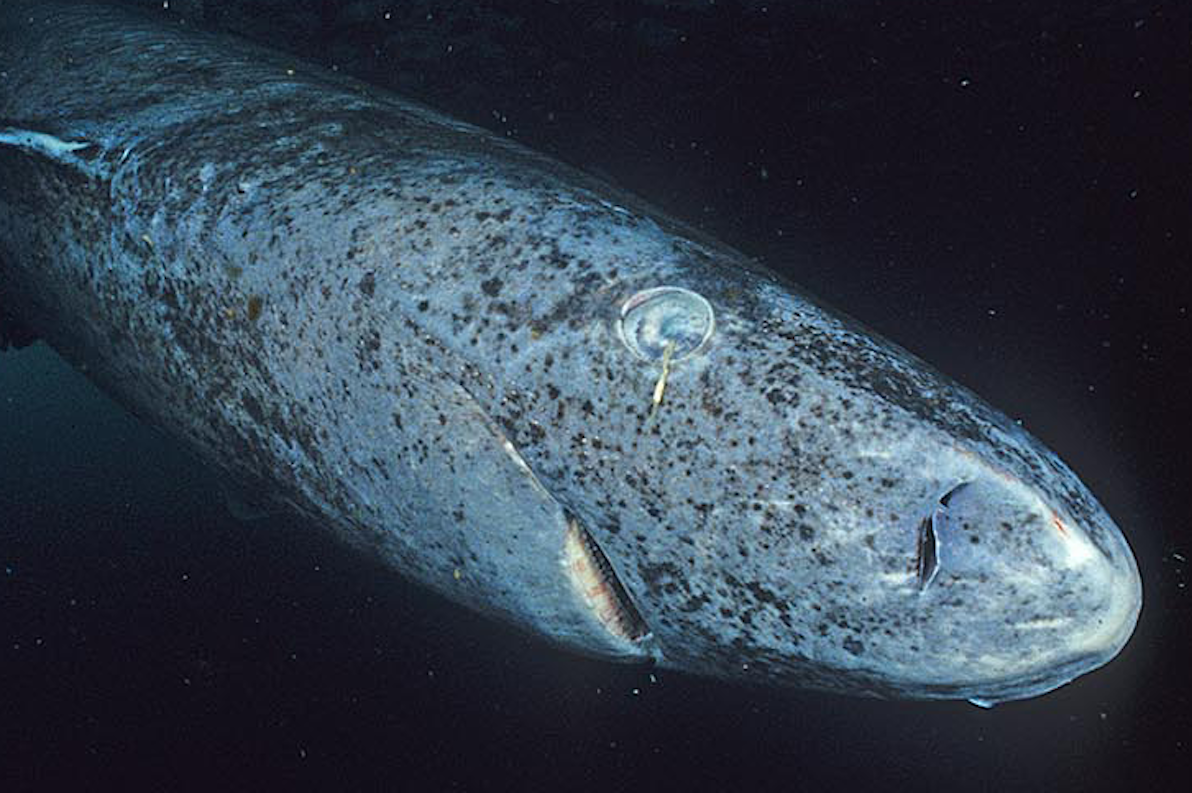
Indeed, the Greenland shark (Somniosus microcephalus) is bizarre and misunderstood, basically being the couch potato of the depths of the North Atlantic and Arctic Ocean, where waters are just above freezing. Known as an abyssal species, it slothfully trawls the shadows like some mournful Lovecraftian being, possessing an especially sluggish metabolism, which isn’t surprising considering its size. Greenland sharks weigh in at one ton and reaching up to 23 feet in length. The maximum lifespan can average 400 years, the longest lifespan of any known vertebrate, meaning there are apparently Greenland sharks that are older than the United States. If that doesn’t blow you out of the water, I don’t know what will. Humans are famously bad at mentally fathoming deep time, so thinking about these ghostly rotund things hiding in the dark of the ocean, outliving empires like an ichthyological Ozymandias, fills me with even more awe than most sharks do.

In a rare spot of good news, the local government dropped the plan after national officials questioned its legality, but a future cull hasn’t been ruled out. Still, it’s worth upholding this turnaround as an example of why speaking out on animal rights can be successful. We don’t need to just sit back and watch the extinction of any species that doesn’t directly benefit us, while of course recognizing that fishers have to eat too. Some have proposed reimbursing fishers or using acoustic deterrents instead of mass slaughter.

But it’s more than just Greenland sharks at risk, with an estimated 79 million sharks dying in fisheries in 2019. At least 25 million of those species are threatened. As coral reefs struggle to survive, many sharks are losing their main food source, but humans are to blame for that one. These animals can be dangerous, same as a grizzly bear or elephant, but people tend to value sharks a lot less. This is in spite of their critical role in a healthy environment. Sharks aren’t monsters, they evolved to fill very specific roles in the ocean — a huge block in the Jenga of life — and if they go, our oceans would dramatically tumble in ways that would negatively impact humans too.

“Jaws” is a fantastic film if you can suspend your disbelief about a great white being the menace of the seas. That’s really us, but it doesn’t have to be.

The post Leave the Greenland sharks alone appeared first on Salon.com.

  •  
❌