❌

Reading view

Return of Spanish right risks reigniting Catalan separatist flame

MADRID — Spain’s election this month risks pushing the explosive issue of Catalan independence right back up the political agenda.

Nearly a decade after a separatist drive in Catalonia plunged Spain into a constitutional crisis in 2017–2018, the topic now lies dormant, barely making the headlines.

But that could change quickly if the conservative People’s Party (PP) and the far-right Vox take power in the vote on Nov. 29, as polls predict. Their staunch brand of unionism could well inflame feelings across the region of 8 million people.

“We know that they are certain to cut back our self-governing powers and intervene in Catalan society in a very heavy way,” Francesc-Marc Álvaro, a candidate for the Senate in the upcoming election for the Catalan Republican Left (ERC), said. “This would amount to throwing gasoline on Catalan society.”

Lawmaker Míriam Nogueras from the pro-independence Junts party said Catalonia had “never been respected by any Spanish regime or government,” and the next would be no exception. “Whatever its political color, the next Spanish government will be exactly the same as the previous one on one fundamental issue: Catalonia,” she said, adding that “the independence movement will regain momentum, and it will do so with renewed strength, because Catalonia’s dependence on Spain makes everyone poorer.”

For Madrid, the stakes are economic as well as political. Catalonia is Spain’s second-biggest autonomous region after Andalusia, representing about 19% of the national economy and 16.5% of the population.

End of Sánchez era

Socialist Prime Minister Pedro Sánchez took office shortly after a failed independence drive in 2017 saw several nationalist politicians flee abroad and nine others jailed.

In contrast to the PP’s uncompromising approach to Catalonia, Sánchez negotiated with pro-independence parties, making concessions in exchange for their parliamentary support.

An amnesty benefiting Catalans involved in the secession attempt angered the Spanish right but helped calm the political atmosphere in the region, eliminating a major nationalist grievance.

Meanwhile, the cross-party unity between separatists that was so instrumental in driving the independence movement a decade ago has dissolved.

Although 43% of Catalans remain in favor of independence, according to the regional government’s statistics institute, the topic has fallen off their list of priorities, behind housing, immigration and crime.

People march in support of jailed Catalan pro-independence leaders, in Barcelona on April 15, 2026. | Lluís Gené/AFP via Getty Images

Carles Puigdemont, the former Catalan president who led the 2017 secession bid, recently admitted that “nine years on, the independence movement is fragmented and weakened.”

Speaking to Catalan news outlet El Punt Avui from Waterloo, Belgium, the separatist said: “What I want is to stop being Spanish. I don’t say this as an act of rejection or contempt. I often compare it to someone who feels like a woman trapped in a man’s body,” adding that he should be able to “cancel” Spanish nationality like any other subscription.

Reviving old traumas

The big question now is to what degree hostility from the PP and Vox could rebuild the movement.

PP leader Alberto Núñez Feijóo, citing Sánchez’s willingness to engage with Catalan nationalists, accused him of leading a government that “has begun a process of separation with and deconstruction of the constitutional system of 1978.”

Vox rose to prominence on the back of its fierce opposition to Catalan separatism. It has called for pro-independence parties to be made illegal and advocates the dismantling of Spain’s decentralized political structure, which it claims is wasteful and encourages regional nationalism.

“We want to make [separatist parties’] life as difficult as possible, because they’ve been making life impossible for Spaniards in general,” said Vox spokesperson José Antonio Fúster. “We are going to work, without a doubt, to make sure that pro-independence parties accept that the unity of Spain cannot be meddled with, is not questioned — otherwise it is clear that they must not form part of the Spanish political landscape.”

For now, however, both the PP and Vox are not taking a directly confrontational approach on Catalonia.

In an interview with Barcelona-based newspaper La Vanguardia, Feijóo insisted that the region had nothing to fear from him. 

“I’m not here to centralize; I’m here to make self-government work and for the Spanish state to have a presence in Catalonia,” he said. He also complained, on the region’s behalf, that budgeted public works were not being carried out there, echoing a longstanding grievance among Catalan nationalists.

The PP leader said he planned to repeal the amnesty law benefiting Catalan nationalists, a move that would not have any practical effect. However, he also pointed to his own Galician background to underline that he understood the “issue of language, the identity- and cultural-based sentiment” associated with coming from one of Spain’s regions. 

So far during the election campaign, Vox has also toned down its rhetoric on Catalonia. Party leader Santiago Abascal has instead prioritized clamping down on immigration, saying that Catalan identity needs to be protected from “Islamism.”

Vox’s relatively muted approach to Catalonia appears influenced by a desire not to antagonize voters of Catalan Alliance (AC), a far-right pro-independence party that will not run against it in the general election.

Wolves in sheep’s clothing

The Socialist Catalan president, Salvador Illa, is one of many who remain unconvinced by the emollient approach from the right during the campaign.

“These wolves are now presenting themselves as little lambs when it comes to regional government,” he said. “We’ve spent 47 years building our regional self-government. And in just one legislature of Feijóo and Abascal, it could all go down the toilet.”

Salvador Illa is seen during a plenary session of the parliament in Madrid on March 25, 2020. | Pool photo by Mariscal via EFE Agency/Getty Images

The policies of a new right-wing government would likely depend on the balance of power between the PP and Vox. Dismantling the system of regional government may be a step too far, as might the outlawing of pro-independence parties, both of which the PP has resisted in the past.

A less dramatic but nonetheless significant move might revolve around the use of the Catalan language, which has previously been a political flashpoint.

Eliminating the use of regional languages — such as Catalan, Basque, Valencian and Galician — during debates in the Spanish Congress might be an easy policy to implement for a PP-Vox administration. It would also, according to Oriol Bartomeus, director of Barcelona’s Institute for Political and Social Sciences, be “a declaration of war” for separatists.

Álvaro, of the pro-independence ERC, sees a prototype for what PP and Vox would be likely to do once in government in Valencia and the Balearic Islands, where the two parties govern together and have introduced measures aimed at reducing the use of those regions’ local languages, which are variants of Catalan. 

“A PP-Vox government will definitely be militantly opposed to the language immersion model” in place in Catalan schools, Álvaro said. He also foresees a right-wing administration cutting back the Catalan government’s financing and powers in areas such as policing.

Feijóo’s willingness to exploit unionist feeling — and rile Catalan nationalists — could depend on his ability to resist the pressure of his likely coalition partner. It could also depend on how his government fares elsewhere.

“The Catalan issue is always there, liable to be used to serve political interests,” said Bartomeus, who sees the PP taking a harder line on the territorial issue if it underperforms in the election. “If you can’t implement, for example, a successful economic policy, you can always wage a culture war.”

If the next Spanish government takes a hardline approach to unionism, that would be more likely to re-energize Catalan separatism.

Puigdemont’s Junts per Catalunya party, which has been struggling in polls and helped trigger the snap election by voting in Congress against housing measures presented by Sánchez, has been awaiting a change of administration in Madrid, according to Bartomeus.

“Junts thinks that a PP-Vox government will favor a revival of the independence movement,” he said. “They are banking on the idea of a Spanish nationalist government in Madrid which is dedicated to screwing Catalonia. The objective is to reproduce the blueprint that led to [the events of 2017].”

Junts’ leader, Puigdemont, recently pointed to the “extreme division” in Spanish politics. Identifying an opportunity for his cause, he said that “even in the most difficult times for the independence movement, Spain generates crises of which we should be prepared to take advantage.”

Puigdemont has been living in Belgium since leading the 2017 independence bid. After a lengthy legal wrangle, the Spanish judiciary has finally declared that the Catalan amnesty can be applied to him.

His return home, expected after the election, could provide a morale boost to pro-independence Catalans just as a Spanish right that abhors separatism enters government.

As he himself puts it: “Even in the most difficult moments for the movement, Spain generates crises that we should be prepared to exploit.”

  •  

Why the Democrats’ midterm blowout is making Burnham’s Labour nervous

LONDON — Democratic wins across the U.S. brought a brief rush of excitement to Britain’s left-wing establishment last week — but worried that the post-midterms hangover contains warnings for Prime Minister Andy Burnham’s government, too.

Labour insiders privately cheered the midterm results, interpreting the outcome as a damning verdict on Donald Trump’s politics and a win for Democrats’ unifying strategy of focusing on living standards, despite ideological differences across their slate of candidates.

It’s left Burnham’s followers cautiously optimistic about his approach so far as prime minister, which has included incremental measures to lower costs, such as reducing food tariffs and offering money off energy bills.

A Labour MP, granted anonymity like others in this article to speak frankly, said their own engagement with Democratic New York Mayor Zohran Mamdani’s team had hammered home “the politics of trying.”

“If people think you’re not even trying, which obviously is what they thought about Trump, then you’re just going to get blown away,” they said. By making small adjustments, the MP argued, Burnham has begun to “develop a coherent argument — which is actually voters have to see you trying on the cost of living.”

Yet beyond this apparent vindication of the PM’s basic strategy, members of his party see clear warning signs for the incumbent British government in the U.S. political shift. An administration only just coming out of a dire stretch in public opinion polls, they worry, could take the wrong lessons from the Dems’ triumph across the pond if they don’t heed the deep anti-incumbent sentiment that drove it.

Reasons to be fearful

Burnham has badged his fledgling administration as a “cost of living government” since he replaced Keir Starmer at the top of Labour earlier this year.

Yet he has faced criticism from some quarters that a government-wide budget unveiled last month lacked real ambition — and now the pressure is on to deliver before a general election, due by 2029.

Claire Ainsley, a former adviser to Starmer who works for the Progressive Policy Institute think tank on both sides of the Atlantic, told POLITICO that, despite arguments about the future direction of the Democratic Party, “what they’ve all had in common is a real focus on affordability.”

“They’ve really focused on bread-and-butter issues for everyday Americans, and clearly that’s the path to be building and hopefully winning in 2028,” she said.

Ainsley highlighted striking moves by a host of prominent Democratic politicians, including Mamdani, who has offered childcare support to New Yorkers, and New Jersey’s Mikie Sherrill — who declared “a state of emergency” on utility bills. Virginia’s Abigail Spanberger has targeted the cost of prescriptions.

“You’ve still got people who are worried here and wouldn’t necessarily say the cost of living is being relieved,” Ainsley warned. “You’ve got interest rates going up and there are lots of warning signs on our dashboard.”

Zohran Mamdani greets a poll worker on the first day of early voting for the U.S. midterm elections, in New York, on Oct. 24, 2026. | Ryan Murphy/AFP via Getty Images

Adam Terry, executive director of the Future Governance Forum think tank, argued likewise that Burnham’s action on the “little things” was part of the answer — but that he has not yet tackled “the big structural questions, namely: why is the economy so sluggish?”

That need to provide deeper solutions to Britain’s woes only raises the stakes for Burnham’s promised ten-year plan and his broader strategy for rewiring the British state, Terry said.

The same Labour MP quoted at the top of the piece — while broadly positive about Burnham’s impact so far — said: “It’s not a coincidence that basically every government in Britain since Brexit has failed usually within 18 months — and I would include in that Keir Starmer’s. Clearly systemic change is definitely required.”

Deborah Mattinson, a Labour member of the House of Lords and pollster who has worked in both the U.S. and U.K., cautioned progressives against believing the age of Trump-style politics is over, “because until things that encourage Trumpism are fixed, it won’t happen.

She added that in the U.S. — and in Germany and France, too — “working people feel the contract that they made with the state has fallen down.”

“The U.K. needs to be really mindful that if you don’t fix those fundamental grievances that people have, then you continue to be in a bind,” Mattinson added.

Up against it

Even those at the top of Labour sense that the PM is up against it if he is to buck the anti-incumbency trend demonstrated by the punishment of Republicans right across the United States.

A senior Labour aide observed that the midterm results strengthened the Democrats as they begin to target the White House in 2028 — but in the meantime they face a similar dilemma of delivery as Burnham.

No.10 Downing Street knows it needs to improve people’s lives, the aide said — but it remains “very difficult” to pull one lever that makes a substantial difference without upsetting financial markets.

Burnham has already been quick to draw a direct line between the U.S. electoral shift and politics closer to home. “I can’t get people’s cost of living pressures down until the conflict in the Middle East is resolved,” he said last week — while urging world leaders to “unite” around efforts to wind down the war.

Here, too, the prime minister may be testing the limits of his own country’s ability to shift the diplomatic dial — while few expect a calmer international picture in which Burnham can really bear down on costs.

Britain will stick to a steady drumbeat of quiet diplomacy for the rest of the year, two people inside government said, including talks with G7 and G20 partners, ongoing contact with Gulf allies, and a bid to maximize the U.K.’s G20 presidency starting in January. 

But a minister in Burnham’s government predicted that when it comes to international relations, and especially military action, Trump’s election drubbing “will not make much difference” to his mindset. 

Anxiety in London over Trump’s next move has certainly not been quelled by initial post-election ripples within the White House, either. Ministers and aides are watching nervously for further news of Secretary of State Marco Rubio’s future — generally seen as a reliable interlocutor with the U.K. — while one serving British diplomat said Stephen Miller’s installation as Trump’s chief of staff represented a “red flag.” 

The senior party official quoted above said: “The U.S.’s relationship with every single country in the world has just been thrown into a level of uncertainty and fluidity.”

  •  

Spain’s conservatives promise to relax climate rules if they win election

MADRID — Spain’s center-right People’s Party has pledged to “put a stop to the imposition of unrealistic timelines” for climate goals if it wins the national elections on Nov. 29, a significant pivot from the Sánchez government’s pro-green policies.

The PP, the favorite to win the vote, said decarbonization is an “essential goal for Europe,” but promised to push for an “orderly, realistic, and fair transition,” according to the energy chapter of the party’s manifesto obtained by POLITICO’s Madrid Playbook.

The manifesto said it’s time “to reassess the pace of progress” in the clean energy transition “without dogmatism,” while conceding there are “environmental, geostrategic and economic reasons” behind the decarbonization strategy.

Spain under Socialist Prime Minister Pedro Sánchez has been one of the bloc’s most influential cheerleaders for ambitious climate goals, advocating to protect key EU policies like the Emissions Trading System, pollution reduction targets and the phase-out of gasoline cars.

But the PP’s manifesto shows that would change if the EU’s fourth-largest economy votes for a conservative government led by PP leader Alberto Núñez Feijóo.

Polls point to a clear majority for a coalition between the PP and Vox, a far-right party which is highly hostile to climate policies and is rising in the polls — potentially giving it significant weight in the next cabinet.

Feijóo’s team advocates assessing and relaxing Spain’s climate policy sector by sector, considering three factors: “What is happening in the rest of the world, the technology that is available at the moment, and changes in demand.”

“We will not impose unnecessary obligations and will remove those that harm competitiveness, industry, or employment,” the document adds.

The PP has taken a more skeptical approach to EU climate policy than many of its fellow conservatives in other countries. In November 2025, for example, it voted against the 2040 climate goal in the European Parliament, breaking ranks with most of the EU’s center-right umbrella group, the European People’s Party.

Alberto Nadal, a former secretary of state for energy and for budget under the previous PP government, is the key figure on energy in Feijóo’s team and the mind behind the manifesto’s energy chapter. According to a PP official, he also considered external contributions to the manifesto from experts.  

In a March interview with public broadcaster RNE, Nadal criticized the EU’s “almost Taliban-like or radical” decarbonization strategy. In a recent interview with ElEconomista, Nadal, seen as a possible minister in a future conservative government, shifted his attention to energy prices and industry, without discussing climate or decarbonization.

Nuclear and data centers

The manifesto also proposes extending the operating lifespans of five nuclear plants “with the approval of the Nuclear Safety Council.”

It also points to a change of direction on data centers if there’s a PP-led government, pledging to resolve issues that “are hindering the grid connection” of data centers within 18 months.

The Socialist government has drafted a decree, expected to be approved before the Nov. 29 snap election, that would tie data centers’ access to the electricity grid to sustainability and digital sovereignty requirements. Nadal has already stated that a conservative government will repeal the decree, which he said represents “the end of Spain’s technological future”.

The document also touched on the thorny issue of the 2025 national blackout and commits to updating the operating rules for the electricity system in the first six months in office. In light of what the PP considers a lack of transparency regarding the nationwide blackout, the party has pledged that “every serious incident” will be the subject of its own report.

On the circular economy, the conservative party signals that it won’t “impose additional obligations, accelerate timelines, or squander the investments, infrastructure, and capabilities that Spain already possesses.” That wording casts doubt over the implementation of the country’s deposit return scheme.

  •  

Ukraine slams French far-left presidential hopeful Mélenchon

PARIS — The Ukrainian government clapped back at French presidential hopeful Jean-Luc Mélenchon on Monday after the far-left leader said a vote could settle territorial disputes.

“‘Referendums’ under occupation are a tool of annexation, not an expression of the people’s will. No civilised, democratic country would ever accept this for its own borders, so it should not be proposed to Ukrainians,” the foreign ministry’s spokesperson Heorhii Tykhyi posted on X. He added that Ukraine previously voted in 1991, and Russia is now looking to change borders with a war.

The backlash came after Mélenchon said at a France Unbowed political rally Saturday that, if in power, he would not back territorial concessions in the war-torn country “without asking the people affected whether they agree to be on one side of the border or the other.”

“The people of Donbas … have the right to decide whether they want to be Ukrainian or Russian,” he argued, referring to a region in eastern Ukraine that is the central territorial dispute of the war with Russia.

It’s not the first time Ukrainian top officials have spatted with France’s presidential front-runners in recent weeks: Last month, the war-torn country’s President Volodymyr Zelenskyy also directly replied to far-right candidate Marine Le Pen’s pledge to cut financial aid to Kyiv.

France’s staunch support for Ukraine could be dramatically overturned if Mélenchon or Le Pen wins next year in a high-stakes presidential election to replace Emmanuel Macron. According to polls, the two politicians could face off in the second round.

Like Le Pen, Mélenchon is often accused by political opponents of being soft on Moscow — accusations that are intensifying as the presidential campaign heats up.

After Saturday’s political rally, centrist Foreign Minister Jean-Noël Barrot described the far-left leader as a “Kremlin spokesperson.” Mélenchon dismissed the accusations.

Muriel Domenach, a former French NATO ambassador now working on the campaign for center-left candidate Raphaël Glucksmann, also slammed France Unbowed’s recently released presidential platform that calls for leaving NATO and mentions Ukraine only briefly. France Unbowed lawmaker Bastien Lachaud replied, saying his party has always backed aid to Kyiv until a peace agreement is reached.

“We have made it clear from the outset of the conflict that, as long as these negotiations remain unresolved, aid to Ukraine must continue without reservation,” he said.

  •  

Marine Le Pen is coming after Kaja Kallas

PARIS — EU diplomatic chief Kaja Kallas has another enemy who wants her out: Marine Le Pen. 

The far-right French leader wants to dismantle, or at the very least drastically reduce, the EU’s diplomatic arm if she wins the 2027 presidential election, according to four National Rally officials. 

“The reality is that [Kallas’s] usefulness is very limited, and she duplicates the diplomacy of member states,” said Charles-Henri Gallois, adviser to National Rally President Jordan Bardella. “No one recognizes her legitimacy, particularly not the United States, nor China.”

The comments reveal growing tensions over the EU’s power as nationalist parties from France to Germany and Poland seek to wrest power back from Brussels, with foreign policy among their top targets. They also put extra pressure on Kallas and the European External Action Service, which has been locked in a protracted turf war on foreign policy with the European Commission headed by Ursula von der Leyen.

The view inside the National Rally is that the EU’s diplomatic service is not only a waste of taxpayer money but also gets in the way of European nations being able to flex their muscles on the world stage. 

One example is Ukraine, on which Kallas and Le Pen are deeply divided — although they have not clashed publicly. The former Estonian prime minister is one of Russian President Vladimir Putin’s fiercest critics and a staunch supporter of Ukraine’s Volodymyr Zelenskyy, while Le Pen is pushing for an international peace conference to settle the conflict and says Europe has run out of money to give to Kyiv. 

Kallas has “used very warrior-like language on Ukraine,” said National Rally MEP Jean-Paul Garraud. “We support Ukraine but if we expressed ourselves like that we would be in total war” with Russia, he said.  

Le Pen has directed her most vicious attacks against von der Leyen, who has long been accused by the far right of exceeding her powers. But it’s Kallas and the EEAS that risk becoming collateral damage under a far-right presidency in France.

Le Pen is the front-runner ahead of next year’s presidential election. In a recent visit to Brussels, she vowed to downsize the European Union if she comes to power. 

“France will no longer accept that the Commission exercises diplomatic competences, and even less military or intelligence competencies,” she told reporters. This shrinking of EU institutions would include snipping the wings of the EEAS, according to the four National Rally officials, who were granted anonymity to speak freely.

The move would put the National Rally on a collision course with pro-European parties, which see the EU’s diplomatic arm as an essential tool as the global stage becomes more competitive and more aggressive. 

Marine Le Pen greets the audience after a campaign rally in Orléans, France on Oct. 25, 2026. | Quentin de Groeve/Hans Lucas/AFP via Getty Images

“If Marine Le Pen becomes president of France, she will quickly realise that … France is a medium-sized country on the global stage,” said Irish Renew MEP Barry Andrews, who chairs the European Parliament’s development committee.

 “Without the collective power of Europe, France has no chance going up against the U.S. or China alone,” he said.

The EEAS snapped back at the criticism. “Across Europe, the far right is against the very idea of European cooperation,” said an EEAS spokesperson. 

“EU diplomacy defends European interests, including those of France. The EU’s global delegation network is a major strategic asset,” the official told POLITICO in response to Le Pen’s comments.

Money matters

The push against Kallas and her diplomats also comes as the National Rally limbers up for a fight with the Commission over France’s EU budget contribution, if they win the election. Last month, the National Rally unveiled its plans for a €11 billion cut to France’s EU contribution for 2027, which is currently expected to total approximately €30 billion. 

POLITICO’s Poll of Polls puts Le Pen on 34% in the first round, well ahead of far-left leader Jean-Luc Mélenchon on 17% and center-right hopeful Edouard Philippe on 16%. Polls also suggest she would beat most of her potential rivals in a runoff.

A large screen displays the results of a vote during a session of the National Assembly on the first-reading examination of the 2027 draft state budget bill in Paris on Nov. 4, 2026. | Ludovic Marin/AFP via Getty Images

While France could not unilaterally cut the EEAS’s budget, the National Rally says it sees allies in Italy, in Spain’s nationalist party Vox (which could end up working with the center-right after this month’s election), and in Andrej Babiš’s Czech Republic. 

The offensive could get nasty as the Commission and Le Pen arm-wrestle over money. 

“The EEAS is great for friends of friends, who want jobs,” said one National Rally official. “The real estate bought or rented by the EEAS is a waste of money. I’m shocked to see the amounts involved in local contracts; it’s unbelievable,” said a National Rally MEP. 

Le Pen’s criticism coincides with criticism from European governments about the efficiency of the EU’s foreign policy apparatus, with France and Germany jointly pitching plans to reform the EEAS.

The concerns voiced by senior diplomats in both countries focus on the fact that the EEAS lacks policy tools to influence foreign relations. The Franco-German initiative suggests integrating the EEAS with the Commission, which has a larger budget as well as control over trade and tech policies.

It also coincides with proposals to severely cut back on the EU’s foreign policy budget. Commission officials have internally simulated slashing the bloc’s Global Europe budget — worth €200 billion in the last long-term budget — by as much as 40% in the next budget.

The EEAS itself, which has an annual budget of close to €1 billion and employs more than 5,200 people globally, is working on internal reforms that Secretary-General Kajsa Ollongren is expected to present to staff later this month.

Major budget cuts would have the effect of gutting the EU’s network of more than 100 global delegations, which are staffed by diplomats as well as Commission personnel from external-facing units like DG MENA (the Directorate-General for the Middle East, North Africa and the Gulf).

International organizations have pushed back forcefully against plans to slash the EU’s development aid budget, with United Nations Secretary-General António Guterres writing to the heads of the Commission and Council and urging them to preserve the funding.

Giorgio Leali contributed reporting.

  •  

The Kremlin call: How talking to Putin exposed Europe’s deepest rift over Ukraine

The Kremlin call:
How talking to Putin exposed Europe’s deepest rift over Ukraine

The leaders of Finland and Norway were slammed for reaching out to Russia — but Europe still can’t find a better way to influence Donald Trump’s peace talks.

By TIM ROSS
in Helsinki

Photo-illustration by Mr.Nelson design for POLITICO

Beneath the chandeliers and oil paintings of his Presidential Palace, Finland’s president Alexander Stubb sat down next to his old friend Jonas Gahr Støre, the Norwegian prime minister, to call Vladimir Putin.

They hoped such a dramatic and direct intervention with Russia’s leader would demonstrate European resolve.

Instead, the conversation on a damp autumn morning in Helsinki triggered the biggest rift among Nordic allies since Putin’s full-scale invasion of Ukraine — and exposed Europe’s wider divisions over how to deal with Moscow at a pivotal moment in the push for peace.

Advertisement

As Russian and Ukrainian negotiators prepare for talks with Donald Trump’s envoys in Abu Dhabi this week, the fallout from the call is still reverberating across Europe. Governments are arguing over who should represent Europe in future negotiations and remain divided over a question at the heart of the debate: Does engaging Putin help deliver peace, or simply reward aggression?

Underlying European anxiety is another dilemma: Can America be trusted to broker a fair deal for them and most of all for Ukraine?

EU leaders will grapple with these questions at an informal summit in Dublin this week. Few involved expect them to agree. 

Ukraine’s President Volodymyr Zelenskyy and his U.S. counterpart Donald Trump in New York, on Sept. 22, 2026. | Brendan Smialowski / AFP via Getty Images

In an interview with POLITICO in Oslo, Støre explained why he and Stubb decided to call a leader waging hybrid warfare on Europe and killing Ukrainian civilians with daily drone and missile strikes.

“We work closely with our European partners in supporting Ukraine, but the only voice reaching Moscow comes from Washington,” Støre said. “And you know, we have good and open relations with the American negotiators, with the American administration, but this [war] happens in Europe. And living month by month, thinking that this war will end by Europe not talking to Moscow, I think, is an illusion.”

Other countries sharing a border — and a history —  with Putin’s Russia profoundly disagree. 

Advertisement

“Europe should not be in a mediator’s position,” Estonia’s Prime Minister Kristen Michal told POLITICO in another interview. “You should not take the role of trying to please the dictator.”

Based on interviews with politicians, diplomats and officials, many granted anonymity to discuss sensitive matters, this is the inside story of a phone call that shook Europe.

The Trump shock

Europe has struggled for influence over the stop-start Ukraine peace process ever since Trump returned to the White House in early 2025, promptly picked up the phone to Putin and ended U.S. financial assistance to Kyiv. 

Trump’s interventions shattered the transatlantic consensus built under his predecessor Joe Biden, offering Putin the prospect of an advantageous ceasefire and a return to the international fold. 

The U.S.-Iran war this year interrupted momentum but Trump returned to the topic of Ukraine again in October, criticizing President Volodymyr Zelenskyy for continuing to attack Russian energy infrastructure, while declaring that Putin’s side had been “fine”. 

Advertisement

Fearing the negotiations were drifting toward collapse, Stubb and Støre intervened. Støre hosted Zelenskyy and Trump envoy Steve Witkoff in Oslo in an attempt to repair relations. Stubb, who also attended, declared the meeting on Oct. 20 had put the peace process “back on track.”

But 24 hours later, Witkoff again stunned European leaders by meeting Putin in St. Petersburg and praising him as a “humanitarian.”

After consulting Zelenskyy, the two Nordic leaders concluded they could not leave Trump, Witkoff and Trump’s son-in-law Jared Kushner as the only Western figures speaking directly to Putin.

Old friends

Stubb and Støre have known each other for years and worked closely on Russian affairs when they both served as foreign ministers. They talk and text frequently — and like to pair up on key files despite coming from different political backgrounds. 

They had quietly explored the idea of a joint call to the Kremlin for months and concluded that reviving momentum would be critical ahead of renewed negotiations in Abu Dhabi.

Europeans, many officials privately acknowledge, no longer trusted Washington to defend either Europe’s interests or Ukraine’s.

Advertisement

“We have to ask the question in Europe if we feel that someone else should have the contact and the discussion on our behalf,” one EU government official said. “Is the feeling that the U.S. should own our objectives?”

“It’s important that Donald Trump is not the only leader from the West who talks to Putin,” another senior European official said. “We need pro-Ukraine leaders putting their messages to Putin too.”

So, almost five years after Russia’s diplomatic isolation began, Stubb and Støre decided to call the Kremlin. The Nordic team reached out to Putin’s officials and agreed parameters for the conversation. Each side would take turns to deliver their prepared messages, without interruption from the other.

Omens in oils

Some of the omens were inauspicious from the start. 

As the leaders sat next to each other at the long cabinet table in Stubb’s plush presidential salon on Oct. 27, two large, gilt-framed oil paintings loomed over them, depicting battle scenes from the Crimean War. One canvas shows an Anglo-French naval force retreating under fire on Finnish territory, a reminder of an era two centuries ago when Finland itself was part of the Russian Empire. 

According to some accounts, Putin shared his own keen interest in Russia’s past with the two Nordic leaders — delivering a lengthy lesson on Slavic history and the origins of the war in Ukraine. 

Advertisement

One senior official familiar with the matter said Stubb and Støre listened patiently during the 90-minute conversation. Other European officials briefed on the call denied that Putin had given the two leaders a history lecture at all, and suggested this claim was Russian spin aimed at humiliating the Europeans. 

Støre himself said: “I was present. He didn’t.” Putin has well-worn arguments about the origins of the war, he added. “But in all fairness, he can give his explanation, and we respond to that.”

For their part, the Nordic pair first gave Putin Zelenskyy’s messages — that territorial boundaries can only be discussed at leader level, face to face, and first there must be de-escalation measures. Stubb and his friend then turned to the matter of Baltic Sea security and the need to keep the waterway open for trade. 

Russia’s President Vladimir Putin chairs a meeting of the Council on Interethnic Relations in Moscow on Nov. 3, 2026. | Sofia Sandurskaya/Sputnik via Getty Images

One reason for holding the call was to try to judge Putin’s state of mind, according to officials. The Norwegian leader said Putin was “rational” and “professional” on the phone. “His arguments were perfectly clearly transmitted.”

Putin took the idea of talks in Abu Dhabi seriously and told the Nordic pair he would instruct his negotiators to prepare for the meeting to explore if progress is possible. “The fact that he picks up that phone, that we have, you know, other ways of reaching, I think that signals, at least that there’s a readiness to sit down.”

But afterwards, Støre was still not convinced that Putin was genuinely open to a deal. Despite their efforts, the Norwegian and Finnish team do not expect a major breakthrough in Abu Dhabi.

Baltic backlash

When Stubb’s office announced the surprise call had happened, the diplomatic blowback played out live in public.

By coincidence, the leaders of Denmark and Sweden, among others, were already gathered in Helsinki for a Nordic Council meeting. Confronted by TV crews, they made little effort to hide their irritation. 

Advertisement

“I’m very skeptical about this Norwegian and Finnish initiative,” Denmark’s Prime Minister Mette Frederiksen told broadcasters. “I think we should keep Europe united rather than going it alone.”

Swedish Prime Minister Ulf Kristersson said peace must come through “strength” rather than “appeasement”. Lithuania also criticized the move. 

In private, some diplomats were even harsher. “There are too many middle-aged men who want to end up in the history books having solved this war,” one EU diplomat said. “Putin is just gaining from opening up a more normalized dialogue with the rest of the world — and continuing to bomb and kill innocent people in Ukraine.” 

European Council President António Costa, Zelenskyy and Danish Prime Minister Mette Frederiksen meet in Brussels on Oct. 16, 2026. | Nicolas Maeterlinck/Belga via Getty Images

Their complaints were not simply over the decision to engage with Putin, but that Stubb and Støre had not properly coordinated with allies beforehand.

Officials familiar with the preparations for the call deny this, insisting that Frederiksen and others including the leadership in France, Germany, and the U.S. were told about the call before it happened. It may just have been that Frederiksen expected more advance warning, and a genuine say over the plan. She said her Finnish and Norwegian counterparts had failed to coordinate the call with “the rest of us.” 

Moscow endorsement

Støre is defiant. “She is right, because I did not ask — we did not ask for permission,” he told POLITICO. “We consult each other in the Nordic family, but it is not a mechanism which is that, you know, doing this requires a yes from all the Nordics or from 27 Europeans or beyond.”

Privately, some officials think Støre aggravated the wound in the immediate aftermath, when he pointed out that the EU had been divided on Russia since the war began. “It’s true — it’s just not his place to say it,” one official said. “Norway is not in the EU.” 

Advertisement

Stubb and Støre say they never sought to speak for anyone other than the countries they lead, which both border Russia. They talked to Zelenskyy at length before the call to agree what to say to Putin and then briefed him again afterwards. 

They had hoped their initiative would bolster Zelenskyy. Instead, the backlash became so intense that the Ukrainian leader stepped in to defend them. “They truly help us,” he said. 

The two Nordic leaders also won an endorsement from Moscow. “I believe it was the right thing to do,” Putin said. “After all, there are some people in Europe who do not want to inflict a strategic defeat on Russia … but seek to establish some kind of constructive dialogue.” 

Norway’s Prime Minister Jonas Gahr Støre welcomes Finnish President Alexander Stubb in Oslo on Oct. 8, 2026. | Ole Berg-Rusten/NTB via Getty Images

Putin’s comments are unlikely to soothe lingering resentments between Nordic neighbors. As one official put it, there may be some lasting “family trauma” for those regional leaders who were not included in the Putin call plan. 

For all the northern angst, the episode also exposed a harder truth for Ukraine and its supporters. Despite Trump’s midterm election defeats, he is still dictating the pace of talks. Europe, meanwhile, has no one to match America’s booming voice when it matters in the room. 

Clea Caulcutt, Hans von der Burchard, Veronika Melkozerova and Laurens Cerulus contributed reporting.

  •  

Wirecard fugitive claimed he toppled Sebastian Kurz in messages to Russian spy

Jan Marsalek, the fugitive former Wirecard executive suspected by multiple countries of spying for Russia, claimed that he had helped to bring down Austrian Chancellor Sebastian Kurz, according to documents obtained by the Axel Springer Global Reporters Network, of which POLITICO is a part. 

Marsalek said he had been involved in an operation that had “successfully toppled” Kurz, who stepped down amid corruption allegations in 2021. 

The messages, detailed in investigation files seen by the Telegraph and the Global Reporters Network, were sent to Orlin Roussev, a spy-ring leader who received instructions from Marsalek and has since been jailed in Britain for espionage. The documents contain no independent evidence of the role Marsalek says he has played in Kurz’s downfall. 

If substantiated, Marsalek’s claims would be a clear indicator of the Russian state interfering directly in the political leadership of an EU country. The Kremlin has long sought to sow division and destabilize governments across Europe, according to assessments by multiple security agencies. 

Marsalek is one of the world’s most wanted men and has been on the run since June 2020 when his company, German tech giant Wirecard, collapsed with a €1.9 billion hole in its books.

Since his escape, he has been accused of working for the Kremlin for more than a decade while British police say he is involved in espionage on an “industrial” scale. He is wanted for fraud and is being investigated for spying in several European countries, including his native Austria.

Kurz was the world’s youngest leader when he first became chancellor of Austria in 2017 at the age of 31. But his stratospheric rise, which saw him hold the post twice, was marred by corruption allegations, including that public money was used for political advertising on his behalf. 

When members of Marsalek’s spy ring, led by Roussev, were arrested in the U.K., police seized hundreds of thousands of messages detailing operations plotted from British soil.

Some of these messages were shared with authorities, including Austrian officials, who are currently investigating whether their spies provided information to Marsalek and, in turn, to Russia.

‘Messy story’

One of the investigative files, examined by the Global Reporters Network, contains messages sent by a man whom authorities have identified as Marsalek, using the alias “Rupert Ticz,” on October 22, 2021.

Marsalek mentions a “guy” who “was actually working for us for a while,” adding: “now he’s the victim of a witch-hunt by the team of the former chancellor.”

He goes on to say that “we’ve successfully toppled” the former chancellor “by confiscating the mobile phone” of a friend of the then chancellor, who, according to Marsalek, was managing his “secret campaign financing.”

Marsalek then shared a link to an article about the corruption allegations against Kurz and the phone which had been seized from one of the leader’s closest associates, Thomas Schmid, a former senior official in Austria’s Finance Ministry.

Schmid’s phone had been seized in November 2019. The extensive communications recovered from the device subsequently became important evidence in several corruption investigations.

In October 2021, prosecutors carried out raids involving Kurz’s government and his political party, the ÖVP, over allegations concerning the misuse of public money for politically favorable opinion polls and media coverage. 

Pressure from the investigation led to Kurz announcing that he was stepping down. Two weeks later, Marsalek wrote to Roussev that it was “quite a messy story”.

Later in the conversation, he referred again to the political consequences of the information recovered from the phone, saying: “And the rest of the chats ‘killed’ the chancellor.”

The documents contain no independent evidence that Marsalek actually organized the seizure of the phone.

Russian ties

Marsalek’s links to Austria’s former domestic intelligence service, the BVT, have been investigated extensively and a number of senior spies and police officers are accused of handing him information for use by the Russian state.

The messages between Marsalek and Roussev are contained in Austrian police files investigating “support for a foreign intelligence service – interference in Austrian politics.” The documents also refer to possible offenses relating to elections, breaches of official duties and corruption.

An assessment of the messages by investigators notes that “Marsalek stated unequivocally that ‘they’ had ‘toppled’ the chancellor in a successful operation.”

“Marsalek thus admitted to Roussev that he had been involved in the confiscation of this mobile phone,” the report continues

The investigators therefore interpreted the conversation as Marsalek claiming involvement in the seizure of a phone that had contributed to the chancellor’s downfall.

The same assessment notes that it remained unclear whether Marsalek’s reference to “the guy” who had worked “for us” meant Wirecard or a Russian intelligence service.

Kurz declined to comment on the messages or the investigators’ assessment.

At the time the messages were sent, Marsalek was living in Moscow and carrying out work primarily for Russia’s Federal Security Service (FSB), British prosecutors have said.  

Roussev was one of a number of Bulgarians arrested in the UK on suspicion of spying on behalf of Russia. They were later convicted and Roussev was jailed for ten years and eight months.

The group organized surveillance operations targeting Kremlin opponents and investigative journalists and discussed kidnapping as well as planning disinformation campaigns.

The network also had access to sensitive Austrian government information. In May 2025, The Telegraph revealed that three mobile phones belonging to senior Austrian Interior Ministry officials had ended up in Russia.

These were different phones from Thomas Schmid’s device, which Austrian investigators seized in November 2019. No connection between the two incidents has been established.

Kurz’s downfall

The reference to a confiscated phone concerns one of the most important pieces of evidence in Austrian political corruption investigations of recent years.

Schmid was a senior figure in the Finance Ministry and a close associate of Sebastian Kurz. He later became head of the state-owned holding company ÖBAG.

His mobile phone was seized by Austrian investigators on November 12, 2019, and police recovered extensive communications, including messages that had previously been deleted.

Those messages later became part of several corruption investigations concerning political appointments, government advertising and allegations about the use of public money for party-political purposes.

On October 6, 2021, Austrian prosecutors searched the Federal Chancellery, the Finance Ministry and the headquarters of Kurz’s Austrian People’s Party.

The searches were part of an investigation into allegations that taxpayer money had been used to finance politically favorable opinion polls and media coverage.

The investigations led to Kurz announcing his resignation as chancellor on October 9, 2021.

Marsalek’s message to Roussev was written 13 days later, nearly two years after Schmid’s telephone was seized.

By then, details of the case including reports about thousands of intimate photographs on Schmid’s phone, which Marsalek joked about, had already appeared in the local press.

Marsalek has been out of reach of European authorities for years, and the Global Reporters Network was also unable to contact him for comment.

“The Russian secret services like causing havoc and chaos and disruption,” Ed Arnold, senior associate fellow at Royal United Services Institute think tank, told the Global Reporters Network. “But even if they don’t cause it, they are more than happy to exploit it and make political disagreements or fissures worse.”

He said Marsalek might have been “overplaying his hand” by emphasizing his role in the downfall of Kurz, adding: “If you want to make a name for yourself in this world as some kind of fixer, you need some kudos.” 

“Russia wants to destabilize our free democracies,” Manfred Weber, the German leader of the EPP in the European Parliament, told POLITICO. “It must be unequivocally ruled out that Russian intelligence services can interfere in democratic and judicial processes … These events must be thoroughly investigated.”

A spokesperson for the Federal Ministry of the Interior said that they could not comment on ongoing investigations into Marsalek’s network. 

The spokesperson told the Global Reporters Network that the “Austrian Criminal Intelligence Service does not provide information or comment on ongoing investigations or proceedings, nor does it disclose information concerning specific individuals”. 

The Axel Springer Global Reporters Network harnesses the resources of the company’s newsrooms to publish ambitious scoops, investigations, interviews, opinion pieces and analysis. It allows journalists — including those from POLITICO, Business Insider, WELT, BILD, Onet, The Telegraph, and Fakt — to collaborate on major stories for an international audience of hundreds of millions across platforms: online, print, TV and audio.

  •  

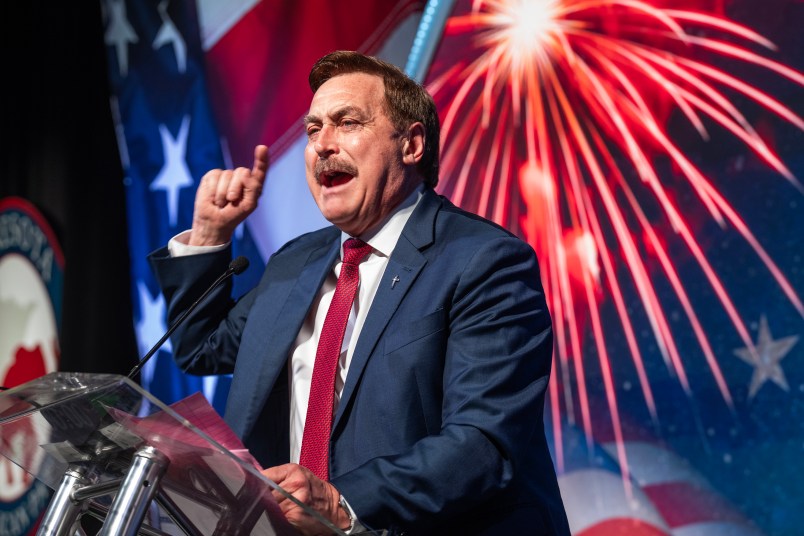
MyPillow Guy Mike Lindell Had The World’s Most Predictable Reaction To The Blue Wave

As we all know, MyPillow entrepreneur Mike Lindell doesn’t really believe in elections — especially when his side doesn’t win them. When we checked in with Lindell last month, he was busy questioning his own loss in Minnesota’s gubernatorial primary. And on Friday, Lindell emailed his fellow true believers to express his doubts on the general election.

“AND YOU AND BOTH KNOW WHAT WE WITNESSED ON NOVEMBER 3rd WAS FAR FROM ORGANIC!” Lindell wrote, ungrammatically and in a bold, all-caps font. 

Lindell, who had a similar crashout over the off-cycle elections in 2023, questioned the surge of people who voted against President Donald Trump and the Republican Party more generally amid the president’s record-low approval rating.

“One claim circulating is that Democrats gained 19 MILLION NEW VOTERS who weren’t there in 2024,” he wrote, adding, “WHO ARE THESE PEOPLE!”

In his email, which was sent to supporters of his “Lindell Offense Fund,” the entrepreneur solicited donations and indicated he wants to demand “answers backed by actual election records!” Lindell also encouraged grassroots efforts to question and challenge the results of the type election conspiracists have engaged in throughout the Trump era. 

“Contact your county clerk or election administrator. Ask how to obtain the legally available voter registration rolls, voter participation history, and election reconciliation reports,” wrote Lindell. “These reports ARE available to the public and although it will be challenging for some states and counties to get this information- we encourage you to stay the course and do not give up!”

Lindell has previously raised funds and spent his own pillow proceeds to mount various outlandish schemes to challenge elections. Back in 2023, he debuted a grand plan that involved drones, a device he called the “W.M.D.,” and supposed command centers. At the time, Lindell insisted his system would expose the fact that America would really be an almost fully red nation if it wasn’t for the “computers” and a shadowy cabal he dubbed “The Evil.”

“We are now the police of our own elections,” Lindell said.

Over the many years of his various allegations questioning voting in this country, Lindell has consistently been debunked. In the past two years and change, he’s settled multiple defamation suits filed by the targets of his claims. Through it all, Lindell hasn’t explained why his elaborate drone system never uncovered proof of the mass fraud he continually insists exists. 

Who are these people indeed? 

  •  

‘I don’t know if it reassured or worried them’: European envoys quiz Le Pen over lunch

PARIS — A group of European ambassadors posted in Paris questioned Marine Le Pen about her plans for France and the EU over a lunch on Wednesday, four officials with direct knowledge of the meeting told POLITICO.

The lunch at the lavish neoclassical Hôtel de Beauharnais — once home to Napoleon’s stepson, and now the residence of the German ambassador in the capital — mainly covered Le Pen’s future EU agenda, officials said.

Le Pen, who is comfortably leading the polls in the 2027 election race, has pledged to fight in Brussels to downsize EU institutions, turn the European Commission into a secretariat that would no longer have any competence on foreign policy, internal security or health, and to drastically cut France’s contribution to the EU budget.  

The group of ambassadors from the eight countries that share a border with metropolitan France —  Germany, Spain, Belgium, Italy, Luxembourg, Switzerland, Monaco and Andorra —  already met with conservative presidential candidate Bruno Retailleau in September. They are planning to host meetings with the other presidential hopefuls, including far-left candidate Jean-Luc Mélenchon, at their respective embassies in the coming months. 

“I don’t know if it reassured or worried them,” said an adviser to Marine Le Pen who accompanied her to the lunch. “What is sure is that they can now report back to their capitals what the National Rally wants to do,” the adviser added. 

Le Pen was mainly questioned about her plans to downsize the EU and on bilateral issues, as well as U.S. President Donald Trump after his seismic defeat in the midterm elections.

While in the past, the National Rally has been supportive of Trump, the party has progressively distanced itself from the U.S. president. The National Rally’s Jordan Bardella on Wednesday said his party was not affected by the result and suggested that Trump’s popularity was undermined by the war in the Middle East and its economic consequences.

Le Pen has also been campaigning for a harsher approach on migration, which would involve stricter checks at the borders, potentially impacting countries whose envoys she met on Wednesday. All of them, apart from Andorra and Monaco, are part of the Schengen free-movement area. 

“There is a general interest on what would her stance be on the key issues of mutual interest and cooperation on which we are working with France,” said one diplomat from a participating country.

“It was a very frank exchange. She told them what she says everywhere and she was able to elaborate on a number of topics a little more at length than she would do on TV,” the same adviser said, adding that Le Pen regularly meets ambassadors.

Back in December, Le Pen and her No. 2 Jordan Bardella also met with U.S. ambassador Charles Kushner. The far-right leaders are also preparing the ground for a possible election win by meeting top French business executives.

Le Pen’s team announced Friday evening that she will meet with the Ukrainian ambassador to France, Vadym Omelchenko, in Paris on Monday, Nov. 16.

Marcelo Wesfreid and Nicolas Camut contributed to this report. 

This article was updated.

  •  

French far left enshrines leaving NATO in official presidential platform

PARIS — Far-left presidential hopeful Jean-Luc Mélenchon’s party set out leaving NATO and nationalizing defense companies in its official platform released Friday.

“Immediately withdraw from NATO’s integrated command and then, in stages, from the organization itself. Reject the tribute demanded by the United States of 5% of GDP devoted to defense spending,” read France Unbowed’s 222-page program.

However, France under Mélenchon would still provide assistance to European Union countries under EU treaties, the document added, echoing what the far-left leader previously told POLITICO.

An increasing number of polls place Mélenchon in second place in next year’s high-stakes election to replace President Emmanuel Macron. The top two vote-getters go on to a second round, which could see Mélenchon facing off against far-right leader Marine Le Pen, who also pledges to take France out of NATO’s integrated command.

Unlike Le Pen’s far-right party, France Unbowed does not explicitly say it would stop providing assistance to Ukraine — but it does insist on the need for a diplomatic solution. Any peace agreement would need to lean on “collective security guarantees, between the belligerents and with the rest of Europe.”

France Unbowed wants more arms regulation, including of lethal autonomous weapons systems and nuclear weapons.

The far-left party is also pushing back against the “space arms race,” including by pledging to close NATO’s space center in Toulouse, but says France should have the means to guarantee its sovereignty. Unlike most other political parties, France Unbowed has strong interest in space policy, and argues in its presidential platform that France should acquire a space shuttle.

France Unbowed lawmakers have previously pushed for France to procure Dassault Aviation’s Vortex, a European reusable orbital spaceplane program spearheaded by the French aerospace manufacturer.

Overall, France should invest more in so-called critical enablers, meaning military equipment in areas such as communications, intelligence and logistics that are currently mostly provided by the U.S. via NATO. “They must be produced as a matter of priority,” the party wrote.

It also wants to nationalize some of the country’s main defense companies including ArianeGroup.

A more detailed platform specifically on defense will be released later, a France Unbowed lawmaker told POLITICO.

  •  

How to curry favor with the next US president — without annoying Trump

LONDON — Donald Trump is badly bruised after this week’s U.S. midterm elections trouncing — but Britain’s diplomatic corps needs to avoid looking like it’s going all-in on the jubilant Democrats.

That’s the advice of Ed Roman, the former director of communications at the British Embassy in Washington. He spent five years on the embassy’s senior leadership team, serving during the Biden and second Trump administrations. It gave him a front row seat as diplomats adjusted to a radical change in U.S. political direction — a task they now face again.

In his first podcast interview since leaving the civil service a month ago, Roman tells POLITICO’s Westminster Insider that British diplomats need to show they can cultivate sophisticated ties with Trump’s possible successors — without provoking the ire of the current White House incumbent. Here are his top tips.

1) Don’t be late to the party

“If you’re doing it now, you’re kind of too late,” Roman says of efforts to schmooze key Democrats who have made it into both the Senate and House this week. The British Embassy has, he says, already been doing its homework, tracking potential Democratic Party contenders throughout the year in anticipation of a wave.

But there’s stiff global competition to build those links first. “The French competitors, the German competitors, the Korean competitors — each embassy is trying to build a network that allows them a level of access,” he says.

In addition to the embassy in D.C., Britain uses its eight U.S. consulates — strategically placed across the country — to help it identify rising politicians outside Washington.

As Roman puts it: “Real politics in America happens in America, out in the states, out in the districts. Knowing those Senate hopefuls ahead of time is always the name of the game.”

2) Don’t put all your eggs in one basket

Roman worked under former British Ambassador Karen Pierce, whose team invested considerable effort in cultivating relationships with Trump’s circle during the Biden administration.

Roman believes that work paid “dividends” for Britain in the years that followed, including in landing a U.K.-U.S. trade deal as Trump slapped tariffs on a host of allies.

But he cautions that the next president might not seem as obvious as Trump — who has had an iron grip on his party for years — did back then. “It’s a complete surprise that you always need to watch [out] for,” Roman notes.

It’s vital to build diplomatic relationships with a broad field — including other presidential hopefuls and figures who might end up in a future Cabinet, White House or national security team.

“Yes, you’re looking to identify the front runner, but you’re also looking to get to know the people around them. And very often they’re the people that are useful to you as an embassy,” he says.

3) Hold your ground — but don’t show off

It’s important not to provoke Trump’s ire by making him feel British diplomacy is already moving on. But Roman argues that embassies must also be prepared to defend their right to engage opposition politicians.

“This is perfectly legitimate business, there’s nothing nefarious about this,” he says.

He points to Trump officials openly engaging with British politicians across party lines.

“That is legitimate diplomatic business and there’s a bit of pushback that you sometimes have to do with administrations to be upfront about that,” he says.

There is, however, a big difference between quietly cultivating a future president and publicly advertising the fact.

Roman warns against the temptation to “grandstand a little bit that you’ve just had this brilliant session with [Gavin] Newsom [the Democratic governor of California] or whoever” on social media after meeting a potential successor. “That stuff does irritate the presidency,” he adds.

A person leavs a polling place in South Carolina on Nov. 3, 2026. | Win McNamee/Getty Images

“Doing it in a discreet way, focusing on the interpersonal rather than the comms bounce that you might get out of it back in London is really key,” he advises.

4) Always big up Britain 

Simply getting a meeting with a rising Democrat isn’t enough. British diplomats need to convince prospective presidents that a strong relationship with Britain will actually be useful to them.

He warns that the next generation of American leaders may have fewer historic connections to Britain, meaning the U.K. cannot assume its traditional “special relationship” status will automatically open doors.

“For each generation politically, you’ve always got to, in effect, restate your offer,” he says.

Roman tells the podcast: “You can’t just tip up and say, you know: Hi, I’m John or James or Karen from the British Embassy, let’s have a chat.

“You’ve really got to dig into what their campaign is about, how are we useful to them? What do they understand about Britain? What do they know about Britain? What is Britain’s offer to them if they are successful and they come into power?”

5) Never assume a return to “normal”

Even if Democrats win the White House in 2028, Roman cautions British diplomats not to assume cultivating ties will automatically produce an easier relationship than it has with Trump.

Each country has its own blunt interests, and Roman recalls that the Biden administration was not an uncomplicated partner for Britain.

“There’s a bit of amnesia going on in the sense that the Biden administration were very challenging to deal with,” he says. “They were not particularly sentimental about Britain.”

And he argues that this week’s midterm results should not be mistaken for a wholesale rejection of Trump’s “America First” worldview.

“It wasn’t an embrace of America as a global policeman,” he says. “It wasn’t an embrace of America’s traditional role presiding over the rules-based international order.”

Economic nationalism and skepticism about America’s global responsibilities could survive Trump, Roman believes — including under a Democratic successor. “We would be, I think, ill-advised to draw the conclusion that any form of normalcy will return,” he says.

Ed Roman was speaking to the Westminster Insider podcast. Listen here.

  •  

US voters’ warning to European politicians

The Democrats scored a resounding victory in this week’s U.S. midterm elections. But will their triumph actually change anything for Europe?

With the balance of power shifting in Congress, could the incoming lawmakers move the needle on issues Europe cares about, from tariffs to support for Ukraine? And what do MAGA’s bruising losses mean for Europe’s own nationalist and populist parties? Are they a warning for Europe’s far right? Or could the very issues that battered Republicans — affordability and the cost of living — end up propelling Europe’s far right into power?

Joining host Sarah Wheaton to discuss this is POLITICO Europe’s Executive Editor Carrie Budoff Brown, who also led our U.S. newsroom during Donald Trump’s first term. We’ll also speak with Gregor Schwung, a reporter at WELT currently on the ground in Washington, D.C., and POLITICO’s Foreign Affairs columnist Jamie Dettmer. 

Questions? Comments? Let us know on WhatsApp here or at +32 491 05 06 29.

  •  

From Madrid to MAGA: How Spain’s Vox forged a right-wing network with global reach

From Madrid to MAGA: How Spain’s Vox forged a right-wing network with global reach

The Spanish party has forged strong links among far-right groups stretching from Buenos Aires to Washington — and is wielding growing influence in Brussels.

By AITOR HERNÁNDEZ-MORALES
in Madrid

Photo-illustration by Ben Tallon for POLITICO

With Hungary’s Viktor Orbán gone, Spain’s nationalist Vox party is set to play an increasingly central role as a bridge linking Europe’s far right to political allies worldwide — from South America to MAGA in Washington.

Unlike Orbán’s Fidesz or Marine Le Pen’s National Rally in France, which have spent decades shaping national and European politics, Vox is a relative newcomer, having only entered Spain’s parliament in 2019.

But it is a force on the march. Pollsters expect Vox to double its parliamentary representation in Spain’s upcoming Nov. 29 election, potentially making it an indispensable partner in a coalition government led by conservative People’s Party chief Alberto Núñez Feijóo.

Advertisement

If the polls hold true, Vox would then arrive in government with an outsized global influence relative to its domestic footprint — all thanks to an international network it has quietly cultivated over the past few years.

Through its Madrid-based Disenso Foundation, the party has established ties with Latin American leaders such as Argentina’s Javier Milei and Chile’s José Antonio Kast, while forging relationships with influential figures in the MAGA movement in Washington.

Though distinct, the movements are bound by a common rejection of the political establishment. “This isn’t about occupying more space. This is a movement,” Jorge Martín Frías, a Vox member of the European Parliament and director of the Disenso Foundation, told POLITICO in Madrid. Vox’s allies, the lawmaker said, “face the same obstacles, the same labels, the same desire to annihilate them … And that’s how a sense of brotherhood develops.”

Vox leader Santiago Abascal and Jordan Bardella, president of France’s National Rally, in Ceuta on Oct. 12, 2026. | Thomas Coex/AFP via Getty Images

That same spirit of cooperation has helped Vox establish itself as a trusted partner to Europe’s right. Its leader, Santiago Abascal, now heads Patriots.eu, the pan-European political group that brings together Fidesz and the National Rally, as well as other far-right parties like Italy’s Lega, Belgium’s Vlaams Belang and Portugal’s Chega.

Frank Furedi, president of the Brussels-based Freedom & Sovereignty Initiative Europe, a conservative think tank formed by the core team behind MCC Brussels, said Vox had “been remarkably effective in carving out a niche for themselves as a movement that’s open to other political forces.”

Guillermo Fernández Vázquez, a political scientist at Madrid’s Carlos III University, said Vox’s strategy had allowed it to amass international influence well beyond what its electoral strength would suggest.

Advertisement

“Vox is an electorally modest party in the European context of the far right,” he said. “But it’s nonetheless become a communications node, a bridge, a hinge between the new Latin American right, the European far right and the Trumpist right.”

Across the Atlantic

Vox has been vocal about its interest in Ibero-America, which comprises Spain, Portugal and the Spanish- and Portuguese-speaking countries of the Americas.

The “continent of hope,” Martín Frías says, is “already ahead of Europe, including in economic terms,” pointing to Milei’s chainsaw approach to deregulation in Argentina and Kast’s efforts to attract foreign investment in Chile through tax incentives and regulatory changes.

Right-wing leaders on the continent “are showing that it is possible to challenge the politics of resignation that have prevailed here — the status quo of the People’s Party and the Socialists,” he added.

Abascal hugs Argentina’s President Javier Milei at a Vox rally in Madrid on May 19, 2024. | Óscar del Pozo/AFP via Getty Images

Through the Disenso Foundation, created in 2020, the party has built an institutional network of conferences, political contacts and training programs. One of its main initiatives, Foro Madrid, brings together right-wing parties, politicians and organizations from across Latin America.

Vox has funneled millions of euros into Disenso over the last six years, giving it substantial resources to nurture its relationships across the pond.

According to political scientist Fernández Vázquez, Vox identified and reached out to figures like Milei and Kast when their respective movements were still relatively small. Those early contacts have since developed into relationships with leaders who now hold power or occupy prominent positions in their countries.

The network has also given Abascal direct access to some of the region’s most prominent political figures, such as Venezuelan opposition leader María Corina Machado. During an April visit to Madrid, she met with the Vox leader while notably declining an offer to meet Prime Minister Pedro Sánchez.

Advertisement

Martín Frías attributed Vox’s success in building an international network to its refusal to simply export a Spanish political model and its ability not to get caught up in disagreements over national interests.

He pointed to Argentina’s support for the EU-Mercosur trade deal, which Vox opposes. “Each country, and each leader, applies its own rules to defend its national interests, which in some cases will be contrary to ours,” he said. “That’s only logical … That’s the game we’re all playing.”

For Vox, Latin America is part of a wider network that includes Washington. Indeed, Martín Frías has taken the party’s message directly to the American conservative establishment, attending the Conservative Political Action Conference in Washington in 2024 alongside Abascal and speaking at events organized by the right-wing think tank The Heritage Foundation, including the 2026 Miami Security Forum.

SPAIN NATIONAL PARLIAMENT POLL OF POLLS

For more polling data from across Europe visit POLITICO Poll of Polls.

Furedi said Vox’s most prominent members have displayed a level of interest in Latin America rarely found among their European far-right counterparts. The party, he argued, was interested not just in building political alliances but in fostering “a more dynamic contemporary Hispanic culture.”

Balázs Orbán, Viktor Orbán’s former political director and a senior figure in Hungary’s MCC, told POLITICO that Vox had been able to forge a transatlantic “connection” through the party’s “sophisticated” approach and its members’ ability to speak both English and Spanish.

Back to Brussels

Vox’s approach to language and identity has undoubtedly given it an edge in Brussels.

The party has taken note of others’ mistakes, including those of Le Pen’s National Rally, whose failure to build strong ties with the wider far right has been partly attributed to its members’ refusal to engage in languages other than French.

“[The National Rally] may speak English, but they refuse to speak English … With Vox, there isn’t this desire to speak Spanish and make a big deal out of the fact that they’re very proud of their language. They’re much more relaxed about it,” Furedi said.

Advertisement

Fernández Vázquez said this had helped Vox position itself as a broker in Europe and led other far-right figures to view Abascal as a safe choice to lead Patriots, capable of balancing Le Pen and Orbán’s rival ambitions.

With Orbán’s fall, many are now competing for the influence he once wielded.

“Fidesz obviously wants to maintain its relevance and authority,” Furedi said. “The Italians — [Brothers of Italy] in particular — are also quite keen, with Meloni wanting to be seen as the equivalent of what Orbán was at a certain point.” But Vox stands out due to its consolidated role as both an “honest broker” and global interlocutor, he added.

Vox’s Martín Frías rejected the suggestion that his group was simply waiting to inherit Fidesz’s mantle. Instead, he said, the goal was to unite like-minded parties against institutions such as the European Commission, which he accused of undermining the European Union — a political project which he described as “a good invention.”

Abascal and other European far-right leaders at a meeting of Patriots for Europe in Madrid on Feb. 8, 2025. | Thomas Coex/AFP via Getty Images

The National Rally’s Jordan Bardella similarly said earlier this year his party would not seek to leave the EU, but instead transform it from within and “change everything without destroying anything.”

Like Martín Frías, Balázs Orbán rejected the notion of a far-right handover and referred to the beginnings of a broader alliance, including Hungary’s former prime minister and his party.

“Viktor Orbán always played a very important role in the patriotic movement. He is the founding father and one of its intellectual leading figures,” he said, adding that now that Fidesz is “no longer in government, we have more time to spend in Brussels and speed things up.”

Martín Frías expressed optimism for what Spain’s upcoming election would mean for Vox’s broader mission in Europe.

Advertisement

“Changes of government in European countries can lead to changes in the European Council,” he said, outlining a vision of an EU made up of sovereign nations that pursue their own interests while cooperating where their goals align. “There is an opportunity there to correct everything that is wrong, and to even regain citizens’ trust in the institutions.”

That shift, he argued, is already visible in the European Parliament, where the center-right European People’s Party increasingly “has no choice” but to work with the Patriots.

“They don’t do it out of principle,” Martín Frías said. “They do it because they’re afraid of the electorate.”

  •  

Don’t try to ‘please the dictator,’ Estonian leader urges Europe about Putin

TALLINN — Europe shouldn’t open a diplomatic channel to Russian President Vladimir Putin, warned the leader of one of the continent’s most exposed nations.

“Europe should not be in a mediator’s position,” Estonia’s Prime Minister Kristen Michal told POLITICO in an interview this week. “You should not take the role of trying to please the dictator.”

European leaders have long feared the U.S. administration under President Donald Trump may pursue a Russia–Ukraine peace deal on terms that sideline Europe and disadvantage Kyiv. The most recent talks between Washington and Moscow have reignited debate in Brussels and national capitals about the need for Europe to have its own direct line to the Kremlin. Finnish President Alexander Stubb and Norwegian Prime Minister Jonas Gahr Støre held a 90-minute call with Putin in late October.

The Estonian premier — whose country of 1.3 million people borders Russia and has been subject to Moscow’s persistent attempts to stoke internal unrest — warned against the idea of direct talks, saying it would weaken Europe’s position with Putin.

“For once, Europe has a plan which is actually working” by suffocating Russia economically with sanctions, Michal said. Being a mediator means “you are willing to lower the standards, for example, for Russia,” including when it comes to imposing and enforcing punitive sanctions, he said.

“You cannot [have] two roles. One role is backing up Ukraine and pressuring Russia. A second one is trying to have a form of mediation,” the Estonian leader said.

“Putin should understand that Europe is strong, keeping together and we have one voice,” he added.

U.S. officials will sit down with Ukrainian and Russian representatives next week. The talks, which will be the first face-to-face negotiations since February, will be held in Abu Dhabi, United Arab Emirates, U.S. Special Envoy Steve Witkoff said Monday.

The Estonian leader said Europeans “appreciate” the Trump administration’s attempts to broker a peace deal, “but the pressure should be very much on Russia,” he said. “The problem [is] sitting in [the] Kremlin. Nowhere else.”

With Trump’s Republican Party in crisis after a major loss in the U.S. midterm elections Tuesday, Europe is closely watching how the shift of power in the U.S. Congress will influence the president’s position on Ukraine.

“Elections have consequence. So this is a good thing in democracy, that you have checks and balances,” Michal said about the election outcome.

He added the electoral shift could move Washington further “to the better side, more value-based side. And when [the] U.S. is more value-based … that probably is a good message to Ukraine and to Europe.”

A woman walks across the border between Estonia and Russia at the Narva crossing on Dec. 15, 2024. | Marko Mumm/AFP via Getty Images

To heap pressure on Russia, Estonia has spearheaded a push — together with Poland and Sweden — to toughen up visa rules for Russians, including former fighters who fought on the battlefields in Ukraine. Tallinn has proposed an outright ban on allowing ex-soldiers from Russia’s armed forces access to the EU at large.

Officials believe the tourist visas allow Russian operatives easy access into the bloc to conduct so-called hybrid warfare campaigns — from flying drones over sensitive security sites to sabotage of infrastructure.

EU officials told POLITICO last month the European Commission is planning to put forward proposals in the new year.

Michal said Europe had no time to waste as hybrid attacks keep disrupting services. “You should not have these kind of people running around Europe. So limit the visas,” he said.

  •  

Farage says he’ll meet Le Pen ‘at some point in time’

LONDON — Nigel Farage insisted on Thursday he will meet Marine Le Pen “at some point in time” as the French presidential hopeful keeps the Reform UK leader waiting for a Paris visit.

The leader of the British right-wing insurgency had been hoping for a jaunt to France before the end of October — but has been kept waiting for now.

Reform had insisted he would meet the president of the far-right National Party before the end of the year — but four of her officials told POLITICO this is not on Le Pen’s schedule.

After a defense speech on Thursday, the Reform leader told reporters: “I haven’t met Le Pen for some years actually. But she’s going to win the next election.

“I will go meet her at some point in time.”

One Le Pen adviser, who like the others was speaking on the condition of anonymity to discuss sensitive party relations, said earlier that “the costs and benefits” of a Farage meeting still needed weighing up.

Le Pen is the favorite to win the first round of France’s 2027 presidential elections — but the Reform leader has suffered a dip in the polls after a series of damaging allegations about his party.

A migration agreement that Farage unveiled early September with the National Rally’s second in command, Jordan Bardella, also created a backlash in France. 

  •  

‘Total repudiation’: The blue wave is about to hit AI

Repeated pattern of voting booths.

On Tuesday night, Democrats made history as they took control of the House and the Senate, and a blue wave swept through traditionally red and swing states - with the nation's first Black woman governor elected in Georgia, the country's first Native American woman governor elected in New Mexico, and a Maine Senator ceding to a Democrat after 30 years in office. In these and other campaigns, one theme kept coming up: holding AI companies accountable to the American people. Now, the AI industry is left considering the prospect of regulation, data center construction slowdowns, and more.

Publicly, most major AI company CEOs have remained silen …

Read the full story at The Verge.

  •  

Tech is about to get hammered in Congress

Capitol Hill

Tech CEO hearings. Tougher AI and data center guardrails. Investigations of Elon Musk's DOGE cuts. The gates are open for Democrats once they regain control of committee gavels come January after a historic win of majorities in both the House and Senate on Tuesday.

"LAWYER UP," the top Democrat on the House Oversight Committee wrote on X in a message aimed at the Trump administration as well as "corporate corruption" shortly after networks like NBC News projected Democratic control of the House. "Subpoenas," Senate Finance Ranking Member Ron Wyden (D-OR) posted. It's clear tech executives will also be caught in Democrats' crosshairs. "They …

Read the full story at The Verge.

  •  

Mélenchon’s mission for his young fans: Debate boomers on Facebook

PARIS — Jean-Luc Mélenchon’s campaign has a plan for winning over older French voters: get his young supporters to sign up for Facebook to talk to their parents.

Mélenchon, 75, may be the oldest candidate in next spring’s race to replace Emmanuel Macron. But his progressive platform and call for a civic revolution have made him a hit with younger voters, who are more likely to scroll through TikTok and Snapchat than through the old-school social network.

“We’re strong [on every other social media platform],” said Antoine Léaument, who handles the Mélenchon campaign’s communication operations. “Facebook is one of the places where the digital battle could be decisive.”

More than 40% of voters younger than 35 plan to vote for Mélenchon, according to a recent Cluster17 poll commissioned by POLITICO. That figure drops to 14% or less across the age brackets over 50 — groups that, if they use social media at all, tend to favor Facebook over its newer rivals.

According to Médiamétrie, France’s leading audience measurement company, platforms like Instagram and Snapchat have 35% more daily users than Facebook among 15-to-24-year-olds.

On TikTok, which skews younger, Mélenchon has about twice the following of any other presidential candidate.

“Their digital campaign is paying off very quickly,” said a strategist from a competing campaign, who was granted anonymity to speak candidly. The strategist also underlined that the share of comments on social media posts describing Mélenchon in a positive light was rapidly rising despite how he’s been vilified by his opponents.

But on Facebook, Marine Le Pen’s far-right National Rally reigns.

Since June, National Rally posts have drawn more than 2 million reactions, more than those of any other French political party, according to data from social monitoring platform Visibrain shared with POLITICO. The page of the National Rally’s local branch in the small region of Vienne alone generated more reactions than the pages of Macron’s Renaissance party.

“Engagement on Facebook is very concentrated,” around the National Rally, Visibrain said.

Listen to the kids

Recent polls show that Mélenchon’s core base of young voters puts him in a strong position to secure a second-place finish in the first round of the presidential election. That would earn him a spot in a runoff against Le Pen, who has held a double-digit lead for first place in surveys for months. (French presidential elections advance to a two-candidate second round if no one wins 50% of the vote on the first try.)

Beating Le Pen, however, will require winning over larger swaths of the electorate. Though pollsters and political scientists urge caution about polling a runoff so early in a campaign, the second-round surveys pitting Le Pen against Mélenchon show the far-left candidate on track for a crushing defeat.

Marine Le Pen speaks at a rally in Orléans, France on Oct. 25, 2026. | Bastien Ohier/Hans Lucas/AFP via Getty Images

Many older voters remain undecided about what they would do when faced with that match-up, so the answer could lie in whether they decide to listen to their children.

Léaument has been rallying activists from Mélenchon’s France Unbowed to share content en masse on the platform via an open WhatsApp channel, which currently counts over 170,000 members, posting calls to action or campaign clips to share on their social media accounts.

“WE MUST RE-ENGAGE WITH FACEBOOK AT ALL COSTS! WE MUST NOT LEAVE ANY GROUND TO THE FAR RIGHT,” he urged activists in a message posted to the channel.

That playbook is partly borrowed from André Janones, the Brazilian lawmaker who used the messaging app to mobilize supporters of President Luiz Inácio Lula da Silva ahead of his surprise reelection last month.

It has at least one obvious limitation: Political parties have no control over social media algorithms. In Brazil, Lula’s campaign alleged that Meta, which owns Facebook, WhatsApp and Instagram, was boosting Bolsonaro and suppressing its content — an allegation Meta denied.

Hadrien Clouet, a France Unbowed MP who closely tracks South American politics, said lessons would need to be drawn on how the Mélenchon campaign can “protect [itself] from the influence of U.S. social networks.”

But the underlying idea of having the young convince — if not pressure — their elders has been pushed by the movement’s leadership for several months already.

At a party event over the summer, Mathilde Panot, France Unbowed’s top lawmaker in parliament, invoked the work of French political scientist Vincent Tiberj, who has studied “inverse socialization,” or how children challenge and sometimes change their parents’ views and politics.

She pointed to the 2024 vote to make abortion a constitutional right in France, saying that several lawmakers were pressured into voting in favor of the proposal by their daughters — a point French media also reported at the time.

“The children need to convince their parents,” Panot said. “We need to do some grassroots work, to go out and convince people one by one, and that starts with our inner circle: parents, brothers and sisters, uncles and aunts.”

  •  

UK hikes rates with eye on Trump’s next Middle East move

U.S. President Donald Trump’s midterm election losses haven’t helped the U.K. economy — yet.

The Bank of England’s nine-member Monetary Policy Committee announced on Thursday it has overwhelmingly voted to increase interest rates to 4% from 3.75%, the first time since August 2023 to combat rising prices driven by the war in Iran.

Unlike the U.S. Federal Reserve and European Central Bank, the Bank of England has been reluctant to raise rates for fear of denting the British economy.

Until now, Governor Andrew Bailey and other MPC members have preferred to wait and see whether higher energy prices spilled over more broadly.

But the Bank was forced to increase rates after U.K. inflation came in at 3.5% in September, while the economy posted better-than-expected growth figures — raising the risk prices could take off.

The MPC on Wednesday voted 8-to-1 to raise rates, arguing the energy shock since the war began has built “sufficient” inflation pressures to justify a hike.

The dissenting vote from Catherine Mann was for a larger increase of 0.5 percentage points.

But Bailey made no secret of the fact that the future health of the U.K.’s economy depends on what the U.S. does in Iran.

“Today’s increase shouldn’t be seen as the first in an inevitable long sequence of hikes,” Bailey said.

“But, unless the conflict in the Middle East is resolved, neither does it seem likely to be the last increase.”

The Bank projected inflation would pick up to nearly 5% by the second quarter of 2027, higher than its previous forecast, with greater spillover into wages and other prices.

Under an adverse scenario, in which prices stay higher for longer and the conflict in the Middle East continues to flare, inflation would hit 6.2% in the third quarter of 2027.

Thursday’s decision, which comes a week after Chancellor John Healey delivered his first budget under the specter of Brits paying the highest energy prices in three years, will further squeeze struggling U.K. households and businesses already hit with higher energy bills and mortgage rates.

The tougher financing backdrop could hurt the Burnham government’s promises to tackle the cost of living. Yet rampant inflation would also undercut that pledge.

Still, the Bank’s top brass also pushed back on market expectations that rates could by hiked to 4.75% or 5% in 2027 — which could help bring down decades-high government borrowing costs.

The Trump factor

The decision comes as the rout of Trump’s Republican Party at the U.S. midterm elections on Tuesday raised the prospect of a peace deal in the Middle East.

A thaw in the conflict could bring down fuel prices by easing pressure on oil supplies and improve the cost-of-living picture for U.K. households.

There were reports Trump could respond to his party’s losses by embarking on a bombing campaign in the Middle East, but the U.S. president appeared to accept on Wednesday that higher petrol prices affected his popularity and struck a more conciliatory tone on the prospect of peace negotiations. 

U.S. Vice-President JD Vance blamed the Iran war for the electoral losses. And U.K. Prime Minister Andy Burnham said Wednesday that the elections create an opportunity to focus on the cost of living.

Oil prices fell sharply on Wednesday, amid expectations Democrats could also limit Trump’s funding for the conflict. The possibility of a ceasefire could yet be subject to Trump’s whims.

Regardless, U.K. consumers will feel the pinch through a rise in the energy price cap in January. 

Even if falling oil prices persist over the next few weeks, the price cap is likely to rise substantially because of a lag in the way it is calculated. 

The Bank forecast the cap will hit £2,150 in the first quarter of 2027. Food price increases, which have so far been muted, could hit 4.75% by mid-2027 as companies pass through higher costs.

Healey’s budget will knock 0.25 percentage points off inflation by the second quarter of next year, the Bank said, while tighter fiscal policy to bring down the deficit would likely detract from growth in the medium term.

  •  

‘Skip the TED talk’: Iran trolls Vance over midterm defeat analysis

A senior Iranian official mocked JD Vance on Thursday for a lengthy social media post in which the U.S. vice president conceded that the American-Israeli war on Iran caused the Republican Party’s midterm election meltdown this week.

“Losing gambler energy, can’t walk away from the table. Boss is prepping the next war phase while America teeters on an Israel-First cliff. Skip the TED talk. Why not say this to your boss?” Mohammad Bagher Ghalibaf, the speaker of Iran’s parliament, shot back at Vance.

In his screed on X, published less than 24 hours after the Republicans suffered an election wipeout, Vance pointed to four things that needed to happen for voters to return to the party in future ballots.

“1) End the war. 2) Focus on cost of living/inflation. 3) Put America First. 4) Change our relationship to Israel,” Vance argued, in a missive that he personally drafted and which marked his first post-election attempt to distance himself from a war that U.S. President Donald Trump has repeatedly defended.

The U.S. and Israel attacked Iran on Feb. 28 this year, decapitating much of its top leadership. But the Tehran regime retaliated by attacking U.S. targets in the Middle East and closing off the Strait of Hormuz — a vital maritime chokepoint for the supply of oil and gas — by threatening ships attempting to traverse the waterway.

The standoff drove up the price of fuels and fertilizer, which raised the cost-of-living in the U.S. and contributed to a brutal electoral environment for the Republicans, who suffered a generational defeat on Tuesday night.

While Vance stated that “the reason we lost is the war,” Trump has been insistent that the conflict is necessary to prevent Iran from obtaining a nuclear weapon.

  •  
❌