Reading view

What if the fascists win in Germany?

When German Chancellor Friedrich Merz finally rose to power in May 2025 after years of political failure and an inconclusive election, he already faced what looked like an impossible situation. He had Donald Trump on one side, a few months into an increasingly erratic and vindictive second term, and the rapid rise of the neofascist far right in Europe, and specifically the Nazi-curious Alternative for Germany party, or AfD, on the other. 

Merz’s party, the center-right Christian Democratic Union, had just “won” a federal election in Germany with 28.5% of the vote, the second-worst result of its entire post-World War II history. The AfD had literally doubled its vote share, to nearly 21%, but enthusiastic support from Elon Musk, JD Vance and other MAGA ambassadors failed to push it over the top (and may even have backfired). Merz was able to forge an awkward governing coalition with the center-left Social Democratic Party, the CDU’s longtime ideological opponents. The “firewall,” an agreement that Germany’s mainstream parties will do everything possible to block the AfD from power, had held for the moment.

If Merz briefly became a leading figure in optimistic media narratives about liberal democracy fighting back against extremism — alongside wounded-duck Emmanuel Macron in France and since-deposed Keir Starmer in Britain — that didn’t last long. After 15 months in power, Merz’s popularity has sunk to sub-Trump levels, while the AfD seems poised to become the largest party in upcoming state elections in Saxony-Anhalt, in Germany’s scenic and historic heartland. 

Merz once vowed to cut the AfD’s support in half, essentially through a combination of appeasement and opposition. He could undercut the far right’s electoral appeal, he suggested, by cracking down on “irregular immigration” but not going all the way to MAGA-style mass deportation, and by shoring up the German welfare state and reducing wasteful spending. (Across party lines, Germans still support a social safety net that seems remarkably generous by American standards.) 

In the judicious language of The Economist

None of this has worked. Irregular immigration has plummeted, but the AfD has simply moved further right, now raging against “culturally foreign” workers and urging “remigration” (a slippery term that can mean anything from deporting asylum-seekers to ethnic cleansing).

The CDU/SDP government is widely seen as inept and bureaucratic, which is exactly what tends to happen in “grand coalitions” between parties with fundamental disagreements about the nature of society. Meanwhile, the AfD has gone from 10% support in 2021 to almost 30% in some national polls this year. 

There’s a growing consensus that the firewall, or Brandmauer in German, has failed, but much less agreement about exactly why that happened or what opponents of far-right nationalism or neofascism should do about it. Although I doubt anyone in Germany is inclined to take history lessons from an American, I would suggest that in both countries the failure to suppress the fascist uprising speaks to fundamental flaws in liberal democracy, and that the bitter lessons of the Trump/Biden/Trump era may prove instructive.

Although I doubt anyone in Germany is inclined to take history lessons from an American, I would suggest that in both countries the failure to suppress the fascist uprising speaks to fundamental flaws in liberal democracy, and that the bitter lessons of the Trump/Biden/Trump era may prove instructive.

What we have perhaps learned during the second Trump term — let me emphasize “perhaps” — is that the only way out is through. The temporary return to “regular-order democracy” and the rule of law under Joe Biden (a tragic and pathetic historical figure, for sure) was a damaging illusion. Forceful resistance to the Trump virus has been crucial, for moral and symbolic reasons as much as anything else, but the only effective cure, it would seem, lies in widespread exposure to its most toxic effects. 

To give Merz credit, he seemed to understand the historical moment and tried to embrace his role as Europe’s last man standing against tyranny. It was “five minutes to midnight” on the continent that had birthed liberal democracy, he announced, and the reawakening of fascism was “the last warning to the political parties of the democratic center” to reach consensus on immigration policy, economic reform, a shared European defense strategy and other thorny issues.

But from the beginning Merz was about the last person you’d pick as defender of democracy, circa 2026. He’s more like a time traveler from the glory days of neoliberalism, a pro-American, pro-business multimillionaire with a wardrobe full of €3,000 suits, a copy of Francis Fukuyama’s “The End of History” under his arm, and an entire career of close ties to transatlantic high finance and the Reagan-era Republican Party. Photoshop him into a 2005 summit meeting alongside Tony Blair, George W. Bush and Jacques Chirac, and he’d fit right in. Today? Not so much.

It’s also true, as German journalist Jörg Lau has observed, that Merz was essentially for Trump before he was against him. He first ran for the CDU leadership in 2018 as an overtly MAGA-friendly candidate, vowing to push the party back toward the right both on immigration and what we might now call “wokeness” after the downfall of longtime Chancellor Angela Merkel. If he didn’t exactly promise to make Germany great again, that was the general idea. 

In short, this was the wrong guy pursuing the wrong strategy, in a manner that should sound familiar to American liberals and progressives: endless triangulation and compromise on right-wing policy goals, while refusing to stand on any bedrock principles except the increasingly shaky proposition that we’re decent people and the other side is dreadful. Furthermore, the mainstream German parties’ efforts to demonize or marginalize the AfD only seem to have activated public sympathy and increased its appeal, much as the congressional investigation of the Jan. 6 insurrection and Jack Smith’s indictments of Trump only hardened his support.  

Friedrich Merz is like a time traveler from the glory days of neoliberalism, a pro-American, pro-business multimillionaire with a wardrobe full of €3,000 suits, a copy of “The End of History” under his arm, and an entire career of close ties to transatlantic high finance and the Republican Party.

One could argue that a more vigorous prosecution of Trump and his allies, or for that matter an outright ban of the AfD, might have produced different results. But as they say, we are where we are. Perhaps the greatest weakness of the German firewall is that since the AfD has never held power anywhere, it can make increasingly outlandish, ultra-MAGA promises with no consequences and no accountability: It will deport literally all “foreigners,” up to and including the second- or third-generation descendants of immigrants, and pour money into the welfare state while reducing taxes and bringing back full employment. 

Very little of that will happen in the real world, presumably. But in another echo of the second Trump regime, the AfD feels no need to compromise or moderate its positions, because its grassroots energy is driven by extremism. “We don’t think about how to make ourselves nice so that the CDU asks us for a coalition,” one AfD legislator told the Economist, while another said that those within the party who advocate moving toward the center have already lost the argument, since “our election results are getting better and better without us being forced to change.”


Want more sharp takes on politics? Sign up for our free newsletter, Standing Room Only by Amanda Marcotte, also a weekly show on YouTube or wherever you get your podcasts.


From this side of the Atlantic, the inescapable conclusion is that Merz’s firewall is doomed, and that sooner or later his party will reach an accommodation with the AfD or simply surrender to it. That’s likely to end his political career and fracture the CDU; see also the current relationship between the British Conservative Party and Nigel Farage’s Reform UK. That’s a prognosis, not a recommendation, and should not be confused with James Carville’s infamous doctrine that Trump-era Democrats needed to “roll over and play dead.” 

What we are starting to perceive in the U.S., I believe, is a more difficult but ultimately more hopeful path forward. It may be necessary for Germany to go through its own period of far-right triumph, which will be especially painful for obvious historical reasons, in order to convince the public that fascism (whether old-style or new) offers no legitimate answers to inequality, alienation or global disruption. Those who stand up for their ideals and principles without compromise, and seek to communicate them clearly, certainly won’t win every election, and they may well suffer for their convictions. But they also have a better chance of turning the tide against tyranny than the professional prevaricators in business suits with bankers standing behind them. We’ve tried that, over and over. It has never worked.

The post What if the fascists win in Germany? appeared first on Salon.com.

  •  

“One Night Only” and the summer of rom-com sex talk

In the dog days of summer, there’s no better place to escape the heat than inside the air-conditioned paradise of a movie theater. Perhaps you’ll even find yourself there with a romantic companion, their uncovered leg grazing against yours as you both tuck your feet in to make room for the annoying person who came in late and is now trying to find their seat in the dark. Your skin touches theirs, trading the dewy moisture of perspiration. How electric; erotic, even. For just a second, the spark between you two is so powerful that it melts away every care outside of that place and time. 

And then, your film — a romantic comedy or dramedy that seems like the perfect date movie — begins, and you’re quickly reminded that no amount of desire can remove you from the context of the world you exist in. The fantasy comes crashing down. Even the fluffy rom-coms are steeped in real life’s anxieties about the social and political, the wars and the wages. But the passion was there; it was real. Maybe the moment was even more charged by the knowledge, somewhere in the back of your head, that these unexpected, carnal joys arrive far less often when so much of our time is spent just trying to make it from one day to the next. Sex, even just the lingering thought of it, can feel like an extravagance. I’d wager that’s a big part of why this summer’s theatrical slate has been so overtly horny: Everyone is trying to figure out how sex fits into this strange modern life.

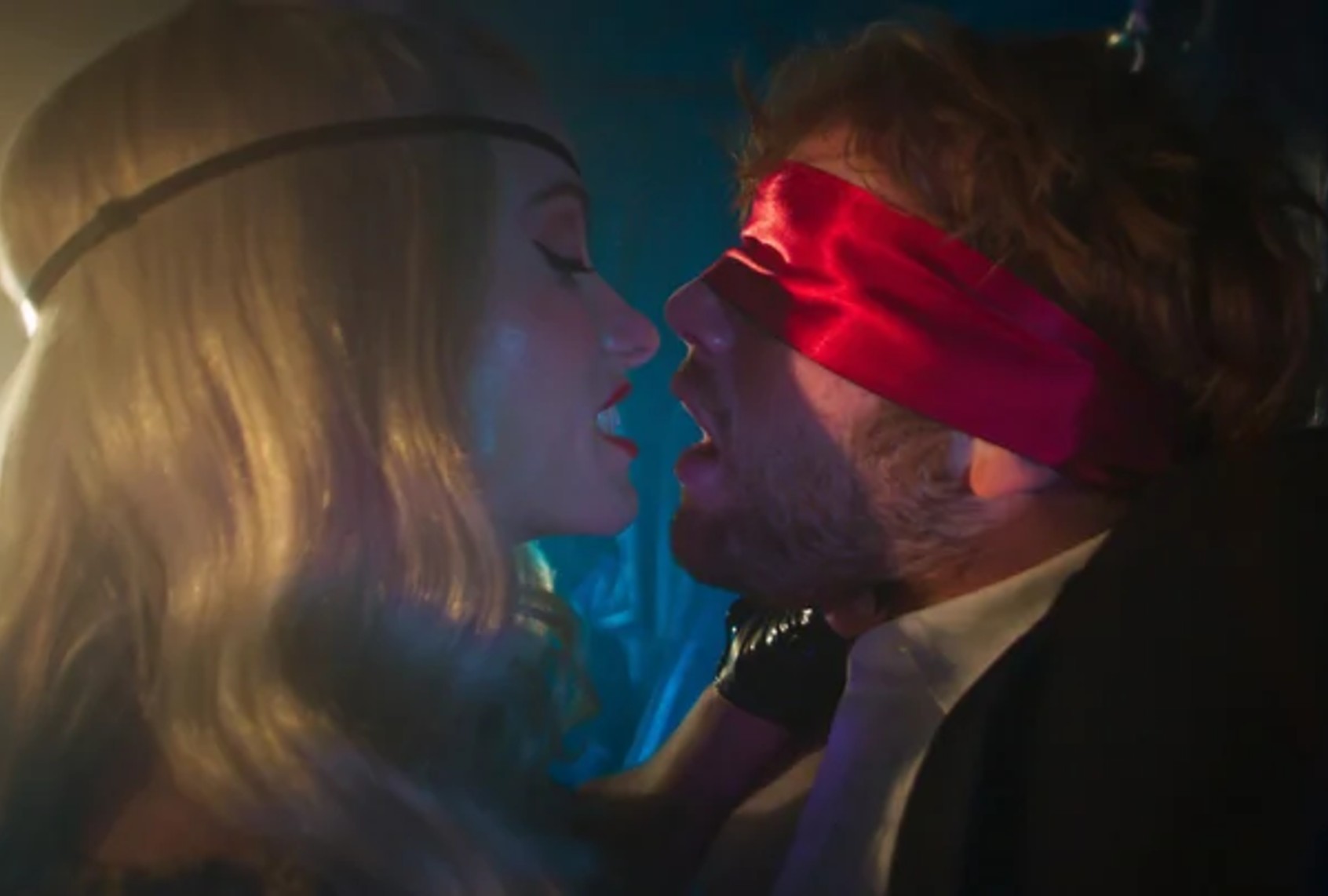
(Nicole Rivelli /Universal Pictures) Monica Barbaro and Callum Turner in “One Night Only”

“One Night Only” encourages a compelling and multilayered dialogue about the role of sex and intimacy amid terrifying political fury. How can we find the joy in all of this? Is, say, one hour of fleeting sexual pleasure enough to combat the 14-some others that we spend in waking dread? The solutions won’t, ahem, come easily.

No film makes that more clear than Will Gluck’s new romantic comedy, “One Night Only,” where, brace yourself here, premarital sex has been outlawed except for one outrageous annual holiday. Think “The Purge,” but for sex — “The Urge” was right there, but whatever — and just as dystopian, though with quite a bit more charm and fewer dead bodies. In the movie, unlucky-in-love strangers Owen (Callum Turner) and Allie (Monica Barbaro) find their paths repeatedly crossing during the 12-hour sex purge window, as both of them seek partners to get it on with. We know the pair will inevitably end up together. But it’s their journey and all the bizarre autocratic municipal rules they have to dance around that make “One Night Only” a clever, peculiar and head-scratching standout from the rom-com crowd.

“One Night Only” also happens to be the discourse darling du jour, with some suggesting that its unusual fusion of genre tropes and political overtones is an insidious embrace of our backslide toward fascism. Indeed, Owen and Allie quibble less about living under a punitive abstinence edict than one might expect, and the film doesn’t have nearly as much fun with, or fury for, the civic regime as it should. 

But like this summer’s “The Invite” and “I Want Your Sex,” Gluck’s film encourages a compelling and multilayered dialogue about the role of sex and intimacy amid terrifying political fury. How can we find the joy in all of this? Is, say, one hour of fleeting sexual pleasure enough to combat the 14-some others that we spend in waking dread? The solutions won’t, ahem, come easily, but there’s really no more appropriate time to ask these questions and search for their answers than summer, when the heat makes us alternate between f*cking furiously and f*cking furious.

Curiously, “One Night Only” is more of the former than the latter. As the film’s title card tells viewers, the movie takes place three years into “the mandate,” as the characters refer to it. “It’s been . . . a lot,” the card continues. Opaque and jokey as it is, this is the only bit of tangible backstory the film provides about the average American’s response to the forbiddance of fornication. Though a few ideological asides do provide some additional color as the night goes on. Owen’s mother (Molly Ringwald) and her partner (LeVar Burton) get into a spat about the mandate’s legislation — “That’s what happens with single-issue voters!”; “No one voted for it, it was passed by Congress!” — that soon turns hot and heavy. 

It’s a silly but reasonably shrewd way to depict how many of us have landed at some level of complacency in a political atmosphere where, most of the time, we have little direct control and negligible impact over the laws that dictate our lives, no matter how oppressive. We bicker about them, but the majority of Americans aren’t in the streets protesting. As neo-fascist as the country’s become, we still live under capitalism, and the ability to regularly protest is somewhat a luxury. But, then again, so is living in America at all (at least to some extent), even when it’s awful. 


Want more from culture than just the latest trend? The Swell highlights art made to last.
Sign up here


I realize I’m probably giving Gluck and screenwriter Travis Braun too much credit when I say these are the kinds of questions they wanted viewers to ask. But I find “One Night Only” to be a far more interesting film because it doesn’t answer everything up front or take the blanket optimist’s route. These characters know that the mandate is awful, but they’ve found screwed-up ways to live with it. Anyone who says that doesn’t reflect the modern American way has their head in the sand. And frankly, a film as pleasant but ephemeral as this isn’t going to push democracy any further into the dark.

What “One Night Only” makes so apparent is that our personal pleasure is at stake in this environment. Constant federal surveillance and deeply rooted institutional corruption are simply not sexy, even if being cognizant and fearful of them absolutely is. (Caring is still hot!) And I’ve always said that there is no better place to work out thorny, complex ideas — the kind that are sometimes difficult to devote time and energy to amid the stress of our day-to-day lives — than at the movies. 

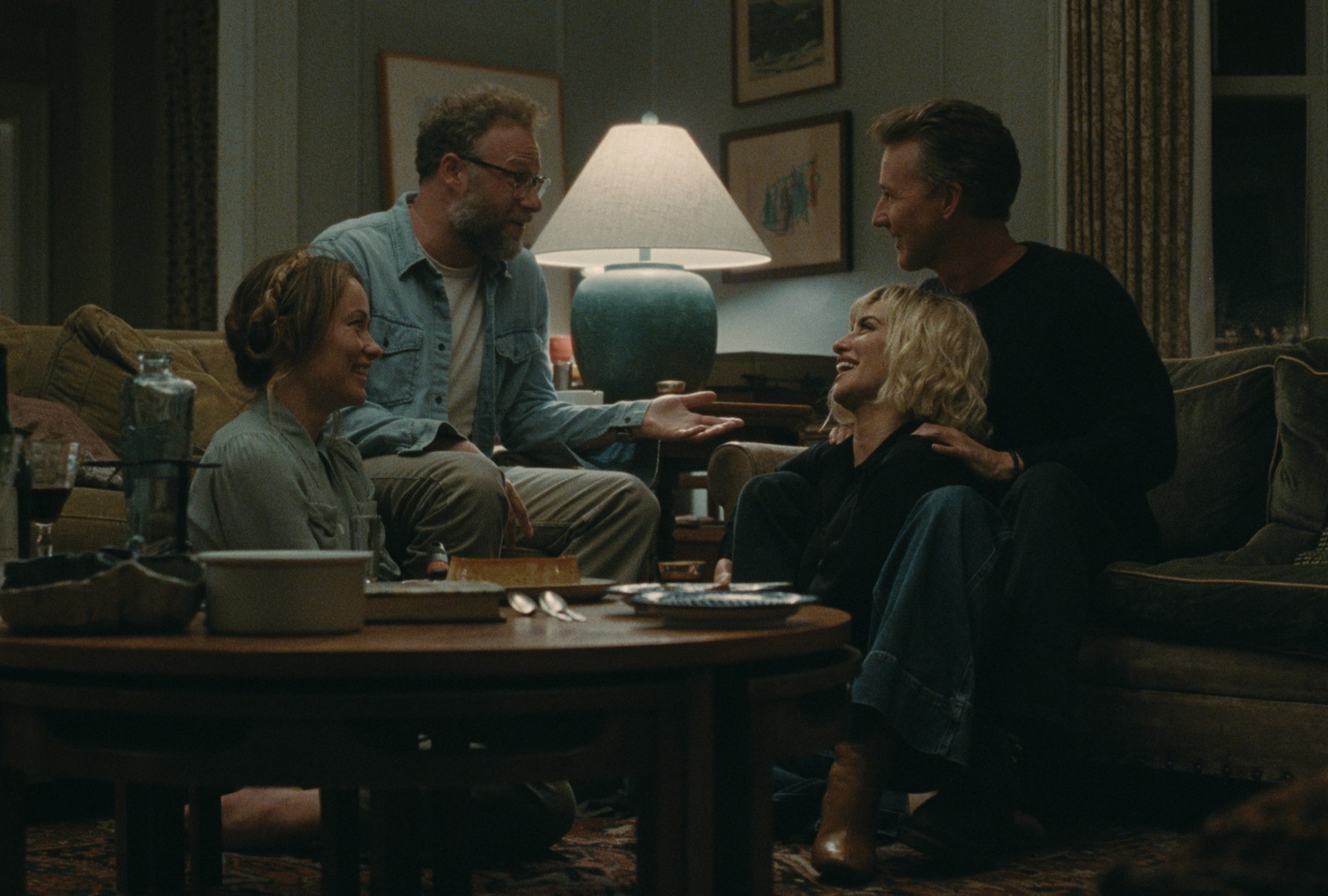
Gluck’s film arrives on the heels of a pair of sweltering summer peers that already laid quite a bit of thematic groundwork in the sex space for audiences to traverse. The stickiest of them all, Olivia Wilde’s terrific chamber dramedy, “The Invite,” just landed on VOD after steadily working its way up from limited to wide theatrical engagements — sort of like cinematic release-schedule foreplay. The film navigates ideas large and small, moving between the casual intimacies, or lack thereof, that make up long-term relationships, and the baseline human carnality that points us toward sex even when those relationships aren’t working. 

(A24) Olivia Wilde, Seth Rogen, Penélope Cruz and Edward Norton in “The Invite”

That’s the glorious thing about going to the cinema: You’re bound to leave any movie with both questions and answers. Occasionally, one such question might be, “Does this movie covertly support fascism by making totalitarian sex mandates cute and manageable?”

Put simply: It’s more difficult to maintain the true intimacy than it’s ever been. The prevalence of dating apps and our ability to follow someone else’s every move on social media have zapped the honeymoon period’s lifespan. Throw in demanding jobs, expensive rugs, rapidly changing social mores, the desire to start or maintain a healthy relationship with your neighbors, and the nagging feeling that everyone in the world is having sex but you, and life gets overwhelming fast. Sex shuffles to the back burner. But though the flame might be small, it remains lit. And “The Invite” attests that it’s never too late to dial up the heat, so long as we’re honest about what we want and what we need from our partners. 

“The Invite” is all about communication and open conversation. And that’s a critical strength in both relationships and in the ways we watch and digest art. That this summer has been replete with dialogues not only about our sexual neuroses and compulsions, but real, steadfast love in all its forms, is a sure sign that love and sex are on our minds more than they have been in a few decades. Much like the influx of grief-laden horror movies that followed the 2016 election, one can trace our preoccupation with intimacy back to political rot. Our government directs so much of our lives that it’s impossible to remove its influence completely. Now, we’ve moved past grieving the lost hope and have the chance to create our own using the spark of romance and physical connection.

(Magnolia Pictures) Olivia Wilde and Cooper Hoffman in “I Want Your Sex”

As Gregg Araki’s playful comedy “I Want Your Sex” asserts, crafting the transient delights of the flesh into something stable and meaningful will take some trial and error, perhaps even some sacrifice. We’re living in a moment where people can easily choose to void sex from their lives or pursue it as a ritualistic part of their existence, and the space in the middle is murky and treacherous. If you have questions about sex and where it fits into your life, Araki’s ardent message is to explore them. The answers may come with regret or heartbreak, but they may also come with glorious satisfaction and unbelievable revelations. More often, the resulting discoveries will sit somewhere in between those two emotional polarities. We can’t live our lives to the extreme all the time, but we can do ourselves a favor and become better acquainted with exactly what we want and how to get it. 

That’s the glorious thing about going to the cinema: You’re bound to leave any movie with both questions and answers. Occasionally, one such question might be, “Does this movie covertly support fascism by making totalitarian sex mandates cute and manageable?” And those are queries that must be addressed because, whether we like it or not, even dystopian rom-coms might point us in the right — or even new — direction. The federal government certainly isn’t trying to orient us toward a brighter, more consistently pleasurable future. Why not take matters into our own hands? Or better yet, put those hands on someone we love and care for, even if only for a night.

The post “One Night Only” and the summer of rom-com sex talk appeared first on Salon.com.

  •  
❌