Login

[Sponsor] Sunnny
All your B2B customer data. In that nice California sunnn. Early access now!

All your B2B customer data. In that nice California sunnn. Early access now!
Barack Obama, in a 430-word essay:
It is a basic principle of American democracy that the government can’t selectively target individuals simply because of their political beliefs or what they say. But that’s exactly what the Trump Administration is doing to Congresswoman Ilhan Omar of Minnesota. [...]
The fact that any president, or any administration, is willing to engage in such transparent efforts to intimidate someone should outrage all Americans, regardless of how they feel about Congresswoman Omar’s political views. Because if this becomes the new normal, there’s no reason to believe it will stop with her — or that future presidents, in either party, won’t do the same.
Thoughtful, sharp, and eloquent as ever.
But Obama posted this essay on X, which, I have been told in the past week, shows that he in fact is a Nazi sympathizer, a fascist, a pedophile, and unconcerned about racism. As surprised as I was to learn those things about myself, I’m equally surprised to learn them about President Obama, whom I heretofore considered a thoughtful statesman and moral compass.
Either that, or, Threads, Bluesky, and Mastodon have relegated themselves into irrelevance by allowing their discourse to be dominated by a fringe of unhinged kooks who want to be angry and want everyone else to be angry.
Back in 2022, I quoted from an interesting post by Ben Schlappig at One Mile at a Time, where he wrote:
I’ve had the opportunity to interact with quite a few senior airline executives over the years, and I find that their knowledge about competitors is typically one extreme or the other:
- Some airline executives literally couldn’t tell you the first thing about their competitors, and have no knowledge of their passenger experience, fleet, etc.
- Some airline executives know literally everything about their competitors, down to being able to tell you how many seats competitors have on specific planes
I find there are very few executives who are just kind of in the middle, as it’s pretty polarizing. Either they know virtually everything about competitors, or nearly nothing. Without naming any names, I’ll say that generally speaking there’s a high correlation between airlines that have a great passenger experience, and airlines that have executives that keep very close tabs on the competition.
And I wrote:
If the CEO’s primary perspective on the company is via spreadsheets — if it’s all just P&L to them — that company is not going to excel at quality. Or if they do excel at quality, they won’t for long.
I think Tim Cook was truly an exception in this regard. He’s not a product guy, and never pretended to be. He is a spreadsheet guy. But he clearly realized that about himself, and he understood that Apple’s entire point is delivering great products and experiences. But I think Ternus is a breath of fresh air in this regard. Apple didn’t immediately switch to decision-making by quantifiable numbers under Cook, but incrementally, year-by-year, decision-making by quantifiable numbers took over.
You simply cannot assign numeric values to everything, and some of those things that cannot be quantified are the most important things. Apple needs a CEO who makes some major product decisions by gut alone.
Greg Joswiak, on X:
Can’t wait to pro and tell next week.
Rumors suggest Apple is planning to debut the new MacBook Pro with an OLED touchscreen display, an M6 entry-level MacBook Pro, an M6 iMac, an iPad mini with an OLED display.
Yesterday I posted the same question to my followers on X, Threads, and Mastodon:1
Poll, only for people who have pre-ordered a Duo. When is your delivery/pickup date?
- October
- November
- December
- January
The results were interesting; I’m glad I asked.
| X | Threads | Mastodon | Total | |
|---|---|---|---|---|
| October | 36% | 38% | 39% | 37% |
| November | 35% | 42% | 45% | 39% |
| December | 10% | 9% | 8% | 10% |
| January | 19% | 11% | 8% | 14% |
| Responses | 1,382 | 1,034 | 449 | 2,865 |
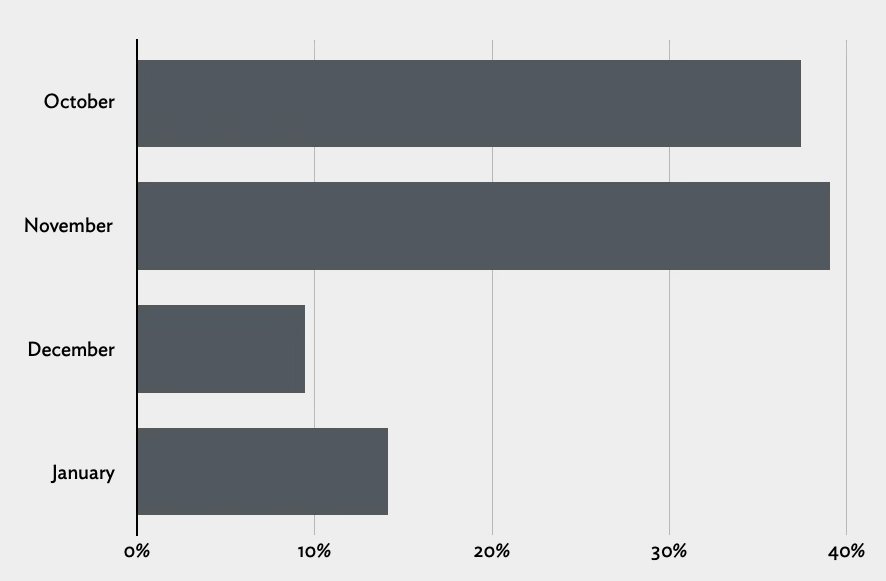
Observations:
There were way more people who successfully got October ship dates than I expected. It’s very close to even with November ship dates.
The fact that there are fewer December ship dates than January, is to me, a sign of Apple’s appreciation for the holidays. I think Apple is only promising “December” for shipments they are 100 percent certain they can deliver by Christmas. I bet a bunch of the orders promised for January will in fact ship in December — albeit perhaps too-late-for-Christmas December.
Apparently some configurations are getting an estimated date of February 1. I wish I’d listed February as an option, but I don’t think it would have made a big difference.
Per MacRumors today, some pre-order estimates are already moving up, like from early December to late November.
No one should mistake my audience as representative of the general public in any poll, but I bet my audience is at least ballpark representative of the general public when it comes to something like pre-ordering, at the crack of dawn, a new iPhone form factor that costs $2000 to $3200.
Anthony D’Alessandro, reporting for Deadline:
Dan Lin is out as film boss at Netflix in a move that has been largely speculated for weeks. Insiders at the streamer have denied that Lin and even Bela Bajaria were on the chopping block, but here we are.
Lin is meeting with his feature staff Monday morning for a post-mortem after the news. Per sources close to the situation, a successor to Lin won’t be named until the arrival of Peter Rice, who is taking over Netflix’s Chief Content Officer role from Bajaria.
Netflix’s movies are worse than their series, which also mostly stink. (As opposed to Apple TV, which somehow makes terrible movies while making the best series in the business.)
it has long been understood that, qualitatively, a “netflix movie” exists in the liminal space between theatrical release and Lifetime production
with some notable exceptions, even the biggest budget productions feel cheap, strange and worst of all, unmemorable
Fred Potter, on LinkedIn:
So if you ever meet someone who tells you, “At Apple, I’m the one who did this,” take it with a grain of salt. They were probably part of the team that made it happen, and that’s already something to be proud of.
Sometimes, when the final product finally comes out, you can recognize a few of the personal touches you contributed along the way. And that, in itself, is immensely rewarding.
Wishing HomeView every success!
Potter’s LinkedIn bio lists his time at Apple as July 2021 through June 2024, and describes it only as “Worked on HomeView”. (Via Christophe Laporte at iGeneration.)
Joe Flint and Jessica Toonkel, reporting for The Wall Street Journal last week:
Netflix is cutting 6% of its staff, or roughly 1,000 positions globally, its biggest round of layoffs since 2022, as it struggles with slowing growth and customer engagement. Co-Chief Executives Greg Peters and Ted Sarandos said in an email to employees Wednesday morning that the bulk of the cuts would be in the streaming giant’s product, tech, legal and human-resources teams.
The layoffs may have hit those teams (including some of the talent that created the excellent Duo support for Netflix’s iOS app), but Peters and Sarandos seem to know where the fundamental problem lies: Netflix has peaked and their content blows.
Flint, in a follow-up report the next day, “Netflix Replaces Content Chief as It Struggles to Engage Viewers”:
Netflix’s Chief Content Officer Bela Bajaria is leaving the company, as it struggles with slowing growth and falling customer engagement.
Yours truly, back in August: “Netflix Has Peaked”.
Andrew Chow, writing for Time:
Just below the broad smile he’s been wearing all morning, John Ternus’ hands are shaking.
On this September day in Silicon Valley, Apple’s new CEO is surrounded by celebrities, tech enthusiasts, and reporters who have flocked to Apple Park from around the world to catch a glimpse of the company’s new and long-awaited foldable phone, the Duo. After Ternus takes a few photos with the device, an Apple PR rep pulls the influencer known as IShowSpeed out of the crowd to meet him. Winning over the 21-year-old isn’t exactly the toughest assignment Ternus has faced in his 25-year Apple career: Speed barks when he sees the phone and then gleefully springs into a backflip.
But IShowSpeed also happens to be livestreaming the encounter to his 61 million subscribers on YouTube. And as Ternus thumbs through the $1,999-and-up phone, attempting to drag a photo into a text-message box, eagle-eyed viewers notice his hands quivering. Ternus later explains that he didn’t sleep much the night before. “I was on such a moment of adrenaline and caffeine and excitement for the day,” he tells Time.
There’s only a glimpse of Ternus’s personality revealed here. To date he’s more of a cipher than even Cook. He’s Apple’s San Francisco sans serif typeface brought to life. Handsome, distinctive, decidedly “Apple” — but plain. That, surely, is not the real John Ternus.
So it’s fitting that his ascension coincided with the announcement of the Duo, Apple’s most radical design change to the iPhone since its 2007 release. Apple has been exploring the concept for years. In 2011, when many people still carried around flip phones, Ternus and five other engineers filed a patent application for foldable electronic devices, exploring what kind of batteries and circuit boards might be needed for such an idea. “It felt clear that we were going to eventually get to a place where OLED displays were going to be flexible,” Ternus says.
The Ternus profile is the cover story for Time’s “Best Inventions of 2026”, which is led by the iPhone Duo. Let us not forget that this esteemed accolade was awarded to Humane’s AI Pin in 2023.
At the end of September, Apple was conspicuously absent when President Donald Trump hosted a luncheon for AI power players like SpaceX’s Elon Musk, Meta’s Mark Zuckerberg, and Google’s Sundar Pichai, who lobbied him on their visions for America’s tech future.
But Ternus and other Apple executives say they aren’t concerned. In the midst of a populist AI backlash, they contend that they are building a modest but personalized and privacy-preserving form of AI that will actually help ordinary people as opposed to merely dazzling Silicon Valley’s “lunatic fringe,” as Greg Joswiak, senior vice president of worldwide marketing, puts it. And besides, Ternus argues, even if other companies succeed in their mission of building super-intelligence, users will still want to talk to it on Apple devices.
This is, I’m convinced, the correct strategy for Apple. They’re smart not even to be ankle-deep in the wild capex spending pool that has all of their peer companies way out in the deep end, where their feet no longer touch the bottom. But this is a bet, and bets carry risk.
Also, I’d bet my bottom dollar that Joswiak is, in fact, a decades-long fan of Lunatic Fringe.
Ruben Bolling’s long-running Tom the Dancing Bug is one of my favorite comic strips. I’ve been a huge fan since the early 1990s, when I started reading it in alternative newspapers. (Newspapers were sort of like websites, excepted they were printed daily or weekly. I swear.) Back in 2012 Bolling — noting that the comic was more widely read than ever yet generating less money than ever — started a subscription membership called The Inner Hive. I love it. Not just because I’m supporting work that I adore and value, but because the extras that members get are so fun. If you’re even half as big a fan of Tom the Dancing Bug as I am, you should join too. There are several options — Patreon, MailChimp, Substack — but in my opinion Patreon is the simplest and the best, and it gets you everything.
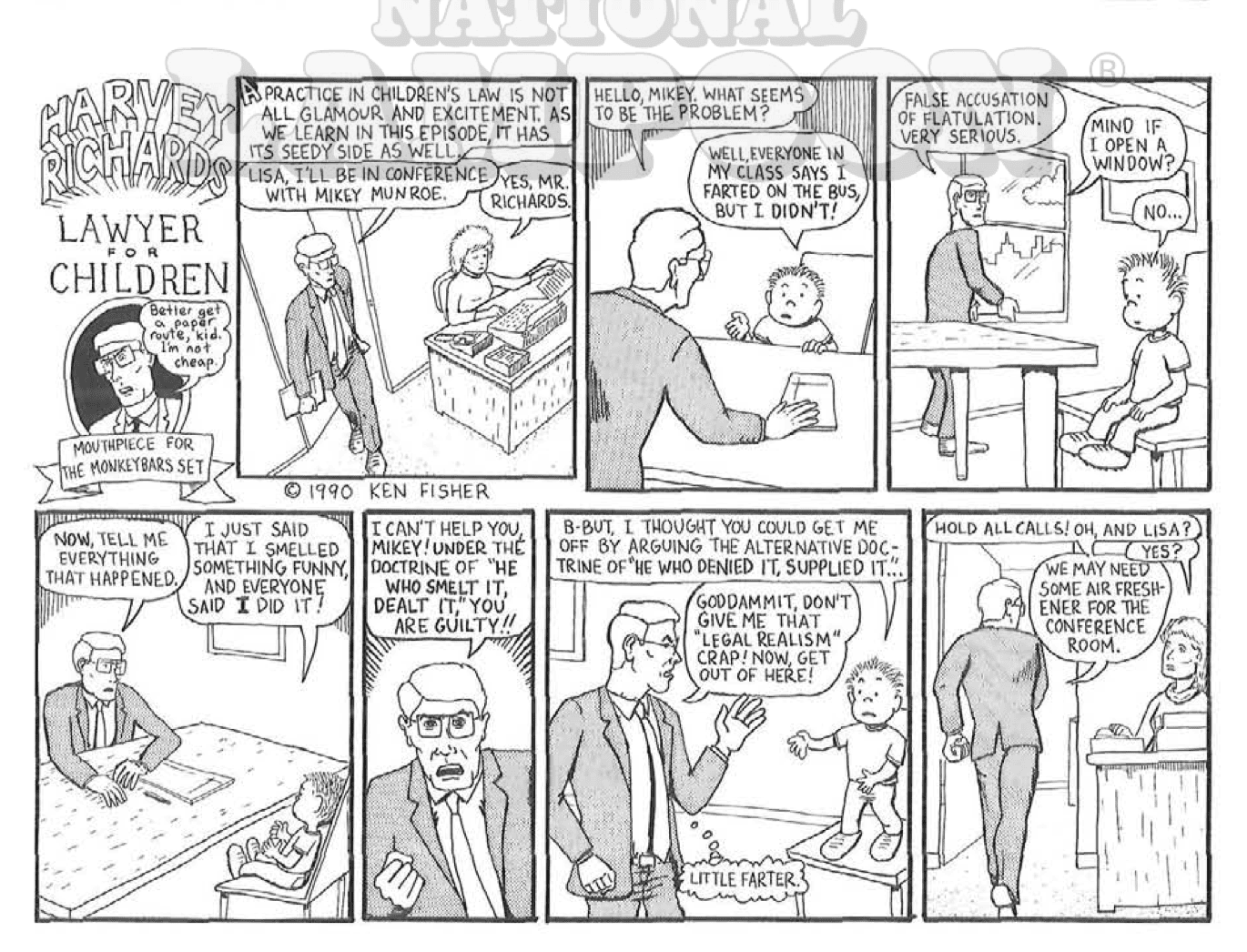
I was reminded to re-endorse The Inner Hive after I wrote a post last night referencing Harvey Richards, lawyer for children — one of the comic’s longest running recurring characters. Tom the Dancing Bug’s entire schtick is premised on a wide array of recurring characters and premises, but Richards is probably my favorite. Here’s an early one regarding the doctrine of “He Who Smelt It, Dealt It” that ran in National Lampoon in 1990. Here’s one from 2012 at Boing Boing (where Bolling is a contributor), and here’s one from 2018 where Richards joins the Trump 1.0 White House, and specifically invokes the “I’m Rubber, You’re Glue, Everything You Say Bounces Off Me and Sticks to You” doctrine that I mentioned as a Richards specialty in my post yesterday.
But the thing is, my earliest memory of Harvey Richards was regarding the “I’m Rubber, You’re Glue” doctrine. It’s the foundation of all of children’s law, obviously. In my memory, it’s the first thing I remember about Harvey Richards in the strip. But I searched the web, and couldn’t find any old strips with it. I asked the LLM robots to search, and they came up with nothing. So I wrote to Bolling, with whom I’ve exchanged occasional correspondence for many years. Bolling not only confirmed that my memory isn’t entirely shot, but he graciously granted me permission to reproduce it here. It’s from 1993, when I know I was already a weekly reader of the strip.

My thanks to WorkOS for sponsoring DF last week. Login looks simple until you’re building password resets, email verification, MFA, social providers, session management, and the enterprise SSO your first big customer asked for last week.
WorkOS AuthKit lets you:
Verizon, in a post headlined “Switch to Verizon and Get the New iPhone Duo Now. No Trade-In Needed.”:
Verizon will support iPhone Handoff, giving customers the flexibility to use a single Verizon phone number seamlessly across two compatible iPhone models. Whether using the pocketable iPhone Duo on the go or iPhone 18 Pro for work, customers can switch active status between devices at any time while keeping full access to Verizon’s 5G network. iPhone Handoff will be available from Verizon for $10/month on compatible iPhones models running iOS 27.
First, the word “now” is doing a lot of work in that headline, given the current January 25 estimate for new Duo orders.
Second, we all know Verizon is the most expensive competent carrier in the U.S. (Maybe AT&T is just as expensive, but I said “competent”.) It feels like a rip that T-Mobile is charging $5/month. Verizon charging double is on-brand but irritating.
Mark Gurman, today, in his weekly Power On column for Bloomberg (gift link):
Without a serviceable version of the new assistant, Apple couldn’t deliver the experience it had envisioned. That left the hardware ready to go, but the software nowhere near finished.
So Apple postponed the HomeView repeatedly — first until spring 2025, then summer, then fall, and then again throughout 2026 before finally unveiling it this past week. And the hardware betrays its age. With thick bezels, an A18 processor and 8 gigabytes of memory, this is clearly a product conceived years ago. Finished units have been sitting boxed up in warehouses for the better part of a year, waiting for the software to catch up.
The A18 chip and 8 GB of RAM aren’t a sure sign of delay; this year’s MacBook Neo has the 18 Pro chip and only 8 GB RAM, and wasn’t delayed. And if a kick-ass MacBook can get by with an A18-class chip and 8 GB RAM, surely a HomeView can too. HomeView only does a fraction of what a Mac can do, and the MacBook Neo is perhaps Apple’s best new product in years, full stop.
But I have no reason to doubt Gurman that this hardware was finished and production started long ago. His reporting on this product has proven out going back two years. Parts of Apple clearly — and disastrously — believed that a credible version of Siri AI would ship in early 2025. You might recall my writing about that. HomeView clearly depends on having a credible version of Siri AI behind it. But Siri AI didn’t ship until last month.
One revealing sign of how long this thing has been in development: I spotted several posts on social media from former Apple employees proudly touting their work on the HomeView. These weren’t people who had just left the company, either. Some hadn’t worked at Apple in quite a while, yet were still able to point to the newly announced device as something they helped create. That tells you plenty about how long ago much of the work was completed.
That’s juicy, but it might have been good to include some links here?
Wayne Ma and Qianer Liu, reporting, wrongly, for The Information in January this year (paywalled; here’s MacRumors’s summary)
Apple’s pin joins a growing portfolio of AI-powered products the tech giant has under development, including AirPods equipped with enhanced sensors, a security camera, smart glasses and augmented reality glasses, according to multiple people familiar with the projects. Apple is also working on a home product featuring a small display, speakers and a robotic swiveling base, designed with a heavy emphasis on AI features. That device could be released as soon as this spring, according to two of the people.
Wrong. So I’d say that the stupid-sounding “AI pin” that these same “people familiar with the matter” told Ma and Liu about is probably equally wrong. (That supposed “AI pin” was the main thrust of the article.)
I love to point out when Mark Gurman is wrong, which is not infrequently, but in the case of HomeView he’s seemingly been right about everything going back to 2025. He reported back in April 2025, with codenames, that the initial HomeView (J490) had no robotics but that a subsequent version (J595) would — or at least might. Two dinguses heard a rumor about J595 and told The Information it might ship six months ago, when in fact it’s something that won’t ship until 2027 or 2028 at the earliest. But The Information ran with it.
The phrase “familiar with the matter” often just means “who heard something about it from someone who goes to the same gym as a guy whose wife works at Apple”. Substitute that longer phrase whenever you see “people familiar with the matter”.
The Financial Times:
Apple had originally promised delivery of the Duo by October 23, but within hours of orders opening, delivery times through Apple’s website had slipped into late January. US mobile carriers also saw delivery times for new orders pushed back.
“The pre-order demand for iPhone Duo, our first foldable iPhone, has been nothing short of extraordinary,” Apple said in a statement. “We are working hard to get this revolutionary new product into customers’ hands as quickly as possible,” it added.
Of course Apple is going to play it this way. I would too. But no one other than Apple’s operations teams knows how low the initial supply is. Just judging from my friends and my social media feeds, I think demand is quite strong for a device that starts at $2000. But I think initial supply is incredibly low.
To that point, Hartley Charlton has a nice scoop for MacRumors:
Apple Store employees told MacRumors that they have been advised that there will likely be no iPhone Duo stock available for walk-in purchases on launch day. Staff have been instructed to discourage customers without pre-orders from coming in expecting to buy the device, warning that they will be disappointed. [...]
Warnings about a constrained launch began well before Apple announced the iPhone Duo. In early September, Nikkei Asia reported that production had reached only a few hundred devices per day in late August. Further production problems emerged in late September.
I suspect this means Apple is going to discourage, if not disperse, anyone attempting to camp out overnight on Thursday outside Apple stores.
That said, a few hours after pre-orders opened Friday morning, ship dates went to January 25. They’re still at January 25, as I write this Sunday afternoon. So it seems Apple expects to greatly increase production in the next two months. I bet a lot of those “January 25” pre-orders wind up delivering weeks before that. Apple has a strong history of under-promising and over-delivering when new products are backordered.
Manton Reece:
All I can come up with is that Apple doesn’t want you to buy the wall-mounted version unless you’re really sure that’s what you need. If the wall-mounted version was cheaper, some people might buy it based on price, then be unhappy because it’s too much trouble to install.
Oh, that clicks for me.
I do see some political content in my feed on X. For example, this extraordinary video posted by Abdul El-Sayed, who seems poised to become the next junior senator from Michigan. You should watch it. It’s so good you might suspect the questioner was a plant, but in fact, he was not. This actually happened. El-Sayed actually handled this heckler this well, on the fly. And he posted it on X, where it’s garnered 9 million views. He posted it on Bluesky too, if you’d prefer that. El-Sayed hands this guy his (red) hat so soundly it’s like something out of an Aaron Sorkin script: “So I think it’s you who needs to understand the Constitution, not me.”
Update: This guy “Tommy” was in fact a plant — a plant from the Republicans. The best way to understand the political re-sorting that Trumpism has created isn’t left/right or conservative/liberal. It’s smart/stupid. There are and always have been stupid people everywhere — on the left, on the right, at the top, at the bottom. But Donald Trump turned the Republican Party into one that celebrates stupidity and ignorance. That this dope Thomas Teepell was a Republican operative whose stunt blew up in his face, Wile E. Coyote style, exemplifies that.
Stephen Nellis and Deepa Seetharaman, reporting Wednesday for Reuters:
An OpenAI employee who left the ChatGPT maker for Apple sent more than 100 files about an unreleased product to a personal account and later made a presentation about the unreleased product to senior Apple leadership, a new filing in the lawsuit between OpenAI and Apple alleges.
In the filing in US federal court in San Jose, California, OpenAI alleged that the presentation happened months ago and that Apple is now making AI products of its own, citing the release of Apple’s HomeView product this week.
“OpenAI is very concerned that its trade secret and confidential information is now circulating inside Apple, where Apple engineers can shape Apple’s upcoming products based on OpenAI’s confidential and innovative work,” OpenAI said in its filing.
I see OpenAI has added Harvey Richards, the world renowned lawyer for children, to their legal team, to present the “I’m rubber, you’re glue” defense.
I’ll start with a nomenclatural sidenote: Apple seems to be going with “Apple HomeView” as the product’s name. E.g., the URL slug for it on Apple.com is apple-homeview/, not just homeview/. Few people notice and no one who doesn’t work in Apple product marketing cares, but they actually do the same thing with Vision Pro — in Cupertino, it’s “Apple Vision Pro” (once again including the URL slug). Yet this week’s new HomePod Mini is just “HomePod mini 2” and the existing 2nd-generation HomePod is just “HomePod (2nd generation)” — not “HomePod 2” or “Apple HomePod”. I certainly intend to just call it “HomeView”.
Apple introduced HomeView with a three-minute introductory film simulating a suburban family’s hectic before-school/work kitchen rush hour, with versions hosted on Apple’s site and YouTube. The most ridiculous aspect of it is that anyone would possibly make their kid French toast in that scenario. I’d have told my son to make his own goddamn French toast with that attitude. Or I’d have made a single serving and eaten it myself right in front of him. Bro.
I do think the basic concept is an intriguing idea. But as an implementation of that concept, my initial impressions are threefold. First, I am unconvinced that anyone in a family would use this for anything other than playing music or podcasts, rather than just using their phones. And if that’s the case, why not just have a HomePod? Apple’s video shows family members taking turns to use the HomeView, rotating it on the kitchen island to face themselves. Why? Why does the mom check her calendar on this, rather than on her iPhone, while the dad is using it to follow a French toast recipe? There’s a real “Why do we need this?” question here and I don’t think Apple’s video answers it, at all. You need to think you want it if you’re going to buy it. And even if you already had a HomeView set up, I’m not sure how often you’d use it instead of your phone, or instead of just talking to it like a screenless HomePod.
Second, all the touching and rotating — in Apple’s own demonstration — makes it seem awkward that HomeView must be tethered to a USB power cable. If you look closely in the video, they do show the USB power cable in some shots, but not many. And if you look really closely, this hypothetical family has drilled a hole in the center of their kitchen island to snake the cable through.
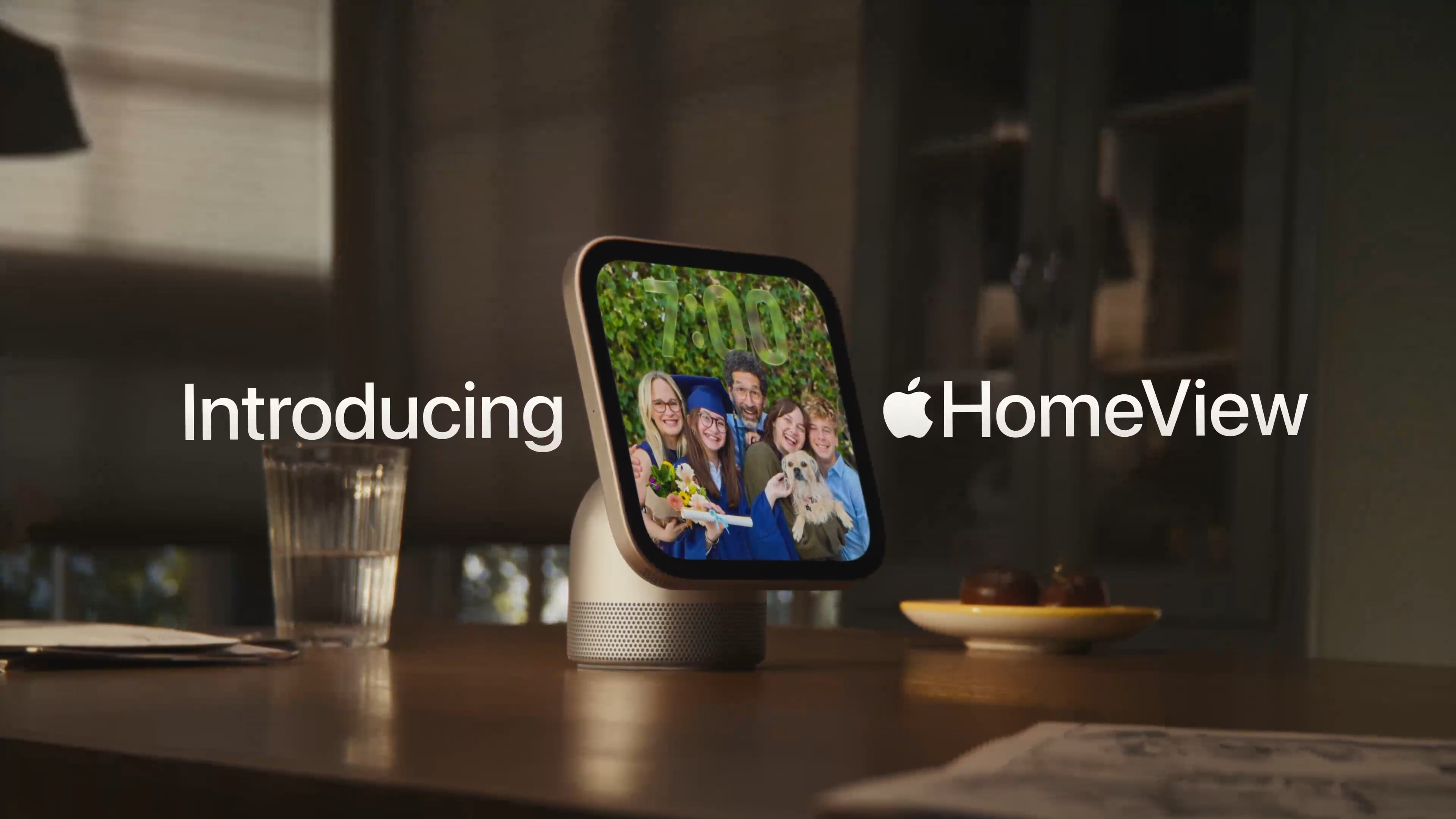
The hero shot introducing the product, of course, does not show the power cable at all:
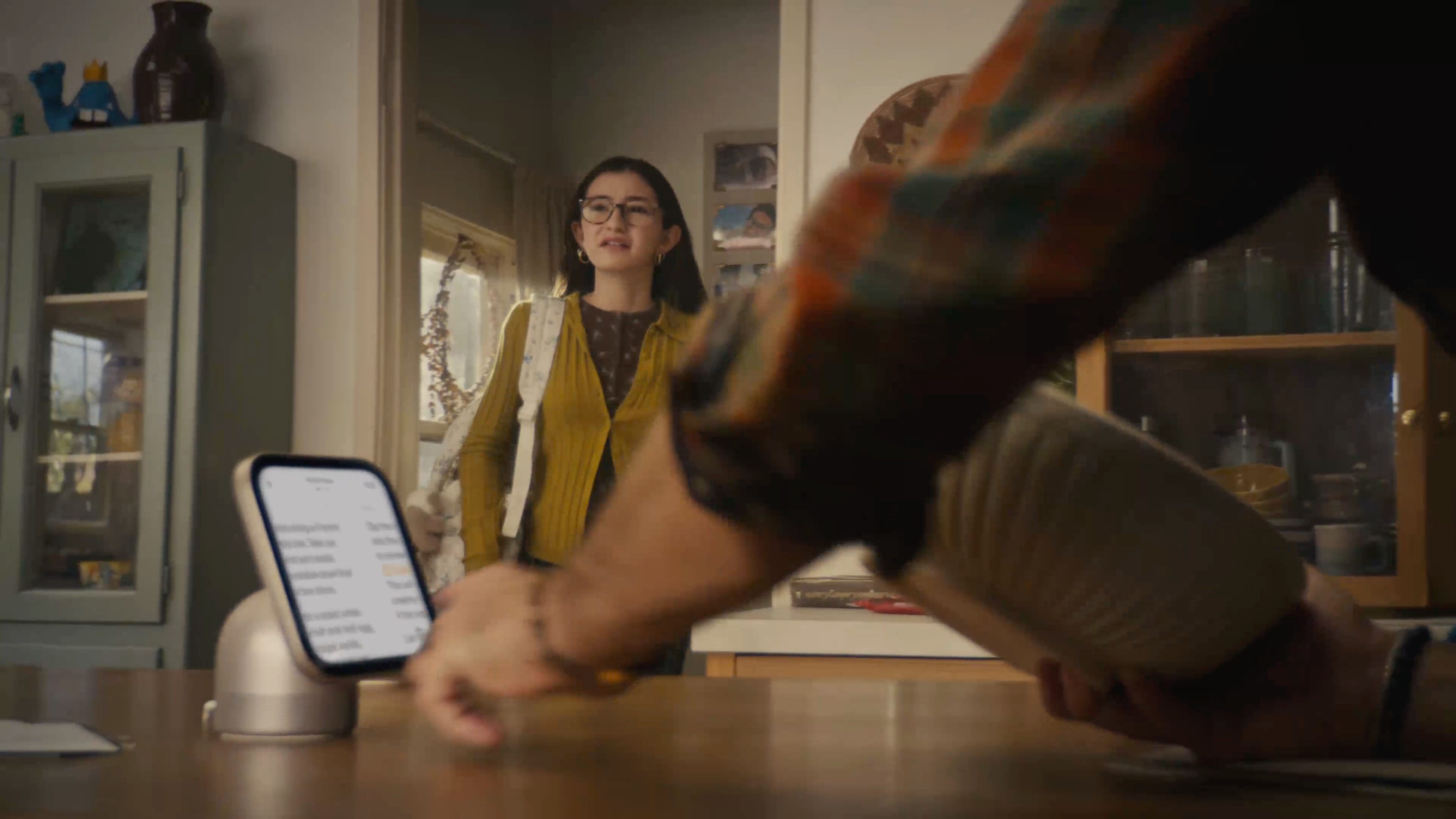
We see a wee bit of the cable when the dad reaches to touch the screen to start the French toast recipe:
And then a few seconds later, after the mom rotates the HomeView to the side, so she can check her calendar (despite the fact that she knows the dad was using it to follow a recipe), we get our most honest shot of the cabling situation:

The above shot is at 0:49. It’s followed by two quick cuts to the dad and then the younger daughter, then at 0:52 we cut back to the mom (curious about her daughter’s new boyfriend situation), and, lo, the shot is now framed in such a way that we no longer see where the cable goes:
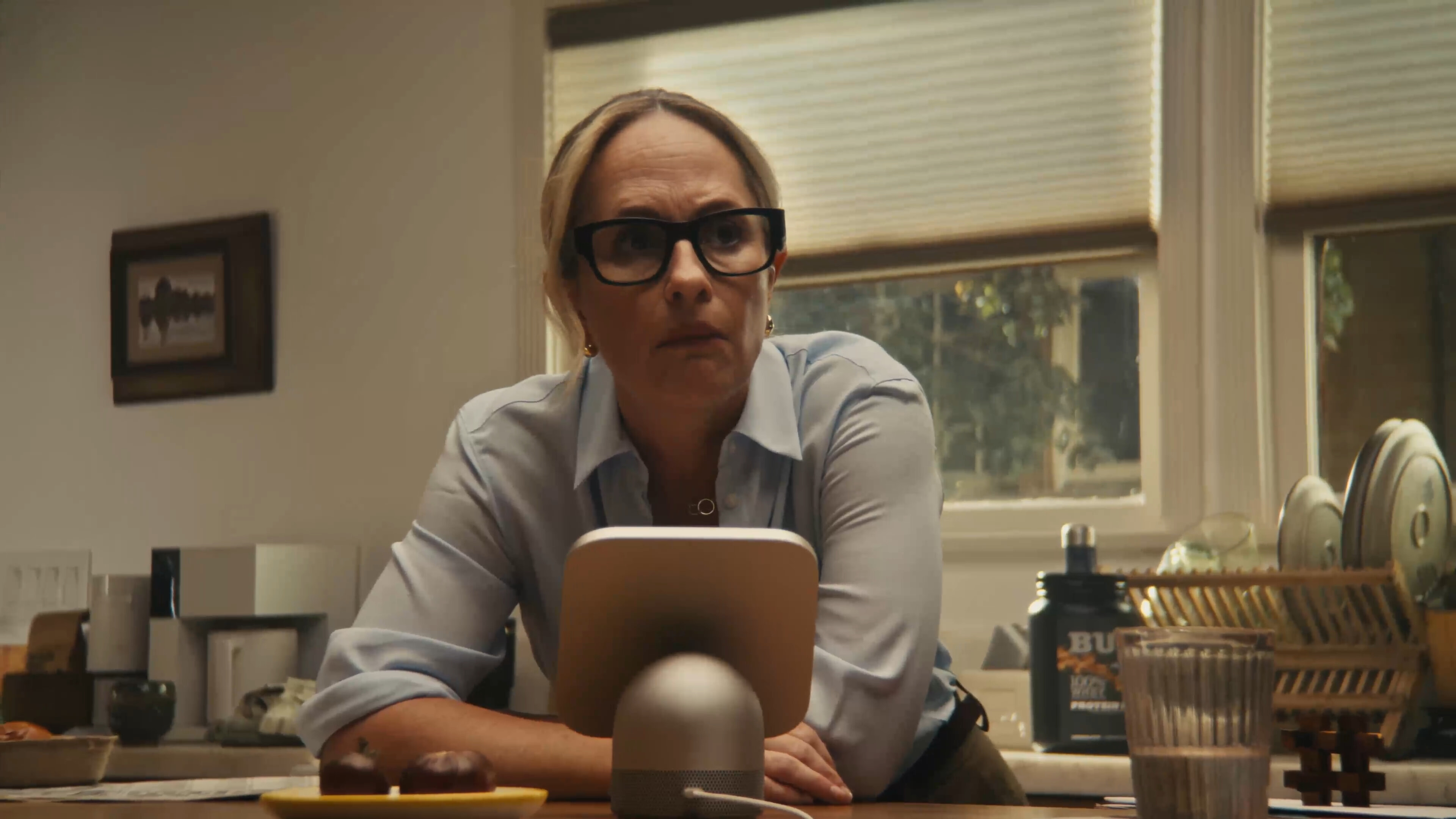
If you think that slight reframing is happenstance, you should stay away from poker tables. Most kitchen islands I’m familiar with — including my own — have power outlets on the sides of the island. I’m sure some people have power outlets on the top surface of the counter, but I can’t recall seeing one. These are kitchen counters, not office desks. But either way, there’d be a long USB-C cable cluttering the countertop. And if you do happen to have a power outlet on the top surface of your counter, there’d be an adapter sticking out of it, all the time, to duplicate this HomeView setup.
This family’s convenient hole in the center of their island countertop is a fantasy. Where does the cable go underneath? How exactly do they have a power adapter plugged in down there? What happens when something spills on the counter? When we custom ordered our kitchen, we weren’t asked if we wanted any holes drilled in our island countertop, and if we had been asked, it would have made me wonder if the guy asking the question had a hole or two drilled in his head.
I know, it’s a marketing video. Marketing videos present products in ideal settings. But the power cable is an essential aspect of the standalone HomeView. I’m not suggesting that it should be battery powered. You’d still need to plug it in every few days, which would mean most people would just leave it plugged in, which gets us back to needing to live with an always-visible cable and power adapter in one of our living spaces. The countertop hole this cable disappears into in this video is less ideal and more dishonest.
The wall-mounted option seems more appealing to me, but now you’re talking about a home improvement project and (for most of us) calling an electrician. And that raises the question of why the wall-mounted version costs the same $300 as the one with the connected base, even though the base provides the subwoofer. And it requires a mount, and the mounts cost $60 (USB-C), $80 (AC wired), or $130 (PoE — and this one is not available yet). So the wall-mounted version, when you include a mount, costs more but sounds worse? This doesn’t make sense.
Those points make me skeptical that there’s a place for HomeView in my home. We have a stereo pair of HomePods in our kitchen. Neither is on the center island, because that would be dumb. They’re on the counters along the outside of the kitchen, each near an outlet on the wall. In the four days since HomeView was announced, I’ve tried to imagine when I’d want to look at something on a screen on either of them. My count remains at zero.
My third early impression is that the display is surprisingly small. I saw HomeView in person in New York on Tuesday, and I think Apple’s video conveys its size very accurately. It’s small and cute. It’s much more like a HomePod Mini with a screen than a full-size HomePod with a screen. For some reason I was expecting the latter. This is not a complaint, simply an observation. I actually think that making it small and cute makes it about as unobtrusive as an ever-present screen could possibly be. That’s good. But because it’s small you need to be close to it to read anything more detailed than large glanceable widgets.
The major difference between a device with a screen and one without is that you can watch video on a device with a screen. But HomeView clearly isn’t intended for that. It can play video but isn’t primarily meant to play video. If it were it would have a widescreen aspect ratio. But instead it has a square aspect ratio,1 which is decidedly unsuited to video, unless, I suppose, you want a screen that is equally unsuited for both widescreen and tallscreen video.
So my skepticism boils down to the question of why anyone would want to add one (or more!) additional ever-present screens to our homes and lives. Phones can stay in our pockets until we need them. Watches remain on our wrists. HomePods can be tucked away unobtrusively in corners, and remain fully useful. HomeView needs to be in a prominent location for its display to serve any practical purpose. Apple’s initial pitch for it doesn’t earn that prominence for me.
In my thoughts and observations column after Apple’s iPhone event last month, I wrote the following regarding the iPhone Duo’s clever 1:1.4 aspect ratio:
Here’s the thing. If you take a 2 : 1 or even 2.2 : 1 aspect ratio phone display and turn that into a book-like foldable, the inner screen comes out square — or so close to square that we might as well just call it square. Nobody makes any device of any sort that just has a square display. Square is a terrible aspect ratio for a phone or a tablet or a laptop or a desktop display. The only square displays on the market are the inner displays for Android foldables from the last decade. Square being a shitty aspect ratio is half the reason almost no one has bought those things.
I will admit that I had the as-yet-unannounced HomeView in mind as I wrote that, given that its square aspect ratio had been rumored for months. HomeView is not a phone or tablet or laptop or desktop display. It’s not a TV either. So maybe square works for this nascent product category (status boards?). But if square does prove to be correct for this purpose, it’ll be the first category I can think of where that’s true. Apple Watch is the closest device I can think of whose screen serves primarily to display status, but even Apple Watch isn’t square. (It varies slightly by model, but Apple Watch displays are around 4 : 5.) ↩︎
Glenn Fleishman:
I wondered what the entry-level, initial price of each Apple TV box at introduction was, from the March 2007 original to the Apple TV 4K (4th generation) announced October 13, 2026, adjusted for inflation. So I charted it.
I suppose this doesn’t mean Apple has given up on making Apple TV content accessible, but the price-accessible path is just using the Apple TV app on the crapware OS your “smart” TV runs.