Since February 5th, 2025, a document warning about Curtis Yarvin and the Silicon Valley led coup attempt has been circulating among think tank experts and DNC employees. The document is titled “The Imminent Neoreactionary Threat to the American Republic”. It opens with a statement that the brief was, “iteratively and collectively compiled by a broad, bipartisan, and decentralized network of experts who wish to remain anonymous due to concerns about being targeted.”
Thanks for reading Shatter Zone! Subscribe for free to receive new posts and support my work.
The title of the actual file when I received it was “Evidence_Brief_for_Journalists”, and the introduction describes its aim as “explaining the nature of the current political crisis to journalists who are attempting to inform the public.” This would lead one to think the document was largely written for the benefit of the press.
However I spoke with two sources who are members of these groups and received the document. They told me that to their knowledge the document mostly spreading among people you might broadly refer to as “policy wonks”. One source I interviewed explained: “It is a thing for think tanks to frame overviews for laypeople as briefs for journalists or congress, see the IPCC reports. Part of me thinks the framing ‘for journalists’ is just a shortcut for ‘this is somewhat specialized knowledge broken down’”.
The paper opens by acknowledging the scope of the executive power grab being perpetrated under President Trump, and the destabilization wrought by Elon Musk and his DOGE team. It then notes, “the threat is an order of magnitude beyond” just a presidential power grab. Musk, it argues, is tied to a “broader group” of Silicon Valley tech elites, including Peter Thiel and Marc Andreessen, who seek to end Democracy. Curtis Yarvin is labeled a “thought leader” in this group, “called the Neoreactionaries”.
I will stop here to note that this summary is accurate enough for mass consumption. But I have some issues with it. Musk probably would not label himself a Neoreactionary and does not have much of a history with Yarvin. Peter Thiel does, but it’s more a relationship of patronage than mutual influence. It would be more accurate to say that Thiel and Andreessen find Yarvin useful, because of his success in spreading to a lot of young techie kids the idea that CEOs should run the world.
Musk, I feel, has largely jumped on this bandwagon because those kids are useful foot soldiers. Yarvin’s ideas about “retiring” all government employees and destroying the independent media and academia are convenient for his own ambitions. This context may be unnecessary for explaining the danger to regular people, but I think it is a mistake to credit Yarvin with more power than he holds.
The document refers to him as the “leader” of the Neoreactionary Movement. I would not advise ignoring his influence and centrality here, but Yarvin is not dangerous because of his leadership abilities.
That all said the document sums up the threat quite well: “The Neoreactionaries have openly stated their aims: to destroy the nation-state and the Constitutional order and replace them with a new privately owned corporate state, to be run by a CEO-dictator. Citizens become subjects owned by the state – ‘state slaves’ - because ‘everything rots when it has no owner—human beings included’.”
Those quoted lines are, of course, Yarvin’s. From here, the document argues that Musk and his team are attempting to bring about this dystopia by taking over the “nervous system of the state”. These would be the data and communications systems DOGE is trying to centralize in its unaccountable hands. Next, the authors of this document make a call to action:
“The most dramatic reversals of democratic breakdown (1977 India; 2022 Brazil; 2023 Poland) have been accomplished by radically large-tent, cross-ideological coalitions with little in common except a desire for the continuation of a Constitutional order. Evidence suggests that the present threat to American democracy is dire enough that such a broad-tent approach focusedon Musk and his associates may be required.”
This is the most interesting and hopeful part of the whole document for me. For one thing I think it accurately states what is needed in the present moment: a popular front against autocracy and dictatorship. (I would add to their list of relevant examples France from 1934-38.) It is heartening to see evidence that this understanding has started to grow within the DNC policy set.
The source who sent me this document in the first place described themselves as a member of “a few unofficial networks of climate activists who are high ranking in the government and policy / think tank circles”. They noted that these are normally “very milquetoast lib spaces” but “they’re being radicalized” rapidly.
Both sources I interviewed for this requested anonymity. The second person I talked with gave an explicit reason: “…I’ve suspected for a while a lot more things in DNC stuff was compromised than people were comfortable with”. In other words, they believe the Republican Party has spies within the DNC. My sources worried these “GOP moles” might retaliate against them, but moreso they worried the document itself might contain false information, meant to provoke a reaction that would be useful to Republicans.
While I think this caveat is worthwhile, I should also note that I have spent more time than most studying Curtis Yarvin and the Neoreactionaries. Nothing in this document struck me as obviously false or incorrect, nor did the tone seem hysteric or unreasonable.
I asked my sources if over the past month they’d seen more people talking about Yarvin in their daily lives, which involve communicating and working with DNC staffers and politicians. One said, “No” and “That’s kind of one of the odd things to be frank. This guy is being brought to big events in D.C. He’s been referenced by Bannon and Vance. I have heard his talking points come from Republican mouths but he’s largely not tracked.”
It is noteworthy, then, that influential individuals in the policy space, with connections to Democratic politicians and the DNC as an organization, have started a grassroots effort to spread the word about Yarvin as a threat. It is even more noteworthy that this document is unsparing about the danger, and the fact that a clock is currently ticking over all our heads:
“If non-governmental actors (by which we mean unelected, unratified, unvetted, untrained, unconstrained, and/or unaccountable actors) gain access to key digital infrastructure, they can seize control of critical functions of government in ways that will be difficult or impossible to reverse.”
In a section titled “National Security”, the focus shifts to Elon Musk, who it claims “poses a uniquely significant security risk”. This is because Musk and DOGE espouse “anti-Constitutional ideologies” and “are under the influence of America’s principal foreign adversaries (China and Russia)”. It goes on at some length about Musk’s foreign business interests and how they might compromise him.
I don’t disagree that he is compromised, but I see his actions as very much consistent with those of a man seizing power for himself. I think it would be a strategic mistake to focus popular messaging around this in terms of how it empowers “America’s principal foreign adversaries”. The primary adversary Musk has empowered is himself, and he is now a greater danger to every citizen of the United States than any foreign government.
The next section of the paper days out the definition of a coup:
“In essence, a coup is a 1) rapid seizure of state power by unelected actors, who acquire that power by 2) seizing critical government infrastructure and 3) weaponizing it to neutralize legitimate government actors'efforts to stop them. The unelected actors then use this power to 4) remake the rules of the political game in a way that cannot easily be checked or undone through democratic processes.”
It argues convincingly that all four of these steps are underway now. One thing I found compelling is the way it recognized the threat cryptocurrency represents right now, and how it can and will be used by the new regime to cement their power in ways that sidestep the present legal system:
“Without canceling elections, for example, cryptocurrency can be used to create informal but powerful new levers of political influence: politicians can sell personal coins to unknown buyers who "vote" on public policy on the basis of their shareholder power, shielded from public view.”
Next we have a summary of the Neoreactionary Agenda, which lists some additional names among the Silicon Valley elite currently championing an overthrow of democracy. These include David Sacks, Balaji Srinivasan and JD Vance. Also name-dropped is political theorist Nick Land, who is referenced twice in the paper.
The authors next lay out Yarvin’s concept of the “Butterfly Revolution”, based on an essay he wrote in 2022 laying out how a “full reboot” of the U.S. government could be accomplished.
Subsequent pages summarize the first days of the Trump administration and DOGE activity and show how they comport with the “Butterfly Revolution” blueprint.
We’ve all lived that in real time, so I won’t summarize their arguments here. The document does end this segment with a section on “Actions and Rhetoric to Watch”. First are government contracts, which fund many of Musk’s companies at present. Next is “Greenland and Mars”:
“A core tenet of neoreactionary ideology is the replacement of nation-states with "network states." But states require territory. Technocracy Inc., a predecessor to the Neoreactionary movement whose one-time director was Elon Musk's grandfather, proposed a North American Technate where the entire continent of North America would be united under one Technocratic Super State. There is currently a Peter Thiel-backed "network state" project called Praxis in Greenland. Musk's public statements about colonizing Mars also can be read as part of a territorial project.”
Lastly it lists Crypto, which the authors primarily seem to fear as a method of deniably bribing Trump.
Overall, the document is thorough in its layout of the Neoreactionary ecosystem, and the actual plan currently being enacted to end U.S. democracy. It includes a section that lists several of the earliest known DOGE employees, and quotes extensively from Yarvin and less extensively from Land.
The paper’s ultimate conclusion is that Musk is using this moment to turn himself into the kind of unitary all-powerful executive Yarvin longs for, one who rules alongside a largely “ceremonial” President. Congress and the courts would also be “ceremonial” at best in this new order.
Again, I do not believe Musk is particularly well read on Curtis Yarvin’s work. But Yarvin’s dream of a CEO-King ruling next to a puppet president gels with what some of Elon’s confidants have described as his ambition. A recent Vanity Fair article quoted a “close associate” of Musk’s from Silicon Valley. He told them:
“Elon believes he should be emperor of the world, and this is his way of showing people what he’s capable of as emperor. He truly believes his way of handling the world is the best possible outcome for everyone in it.”
The last few weeks provide more than enough proof that the authors of this document accurately understand the danger we are in. Unfortunately, aside from the suggestion of a popular front against dictatorship, the document is short on solutions. There is one line that promises: “Section III articulates what Congress and other actors can do” to stop Musk.However, the document in its present form does not include a Section 3 or any comprehensive suggestions.
If the situation weren’t so dire, I might find that funny.
I don’t know where we go from here. Neither does anyone else.
On the morning I wrote this I woke up groggy from my chemically assisted sleep to a barrage of horrors. Donald Trump signing anti-trans legislation into law. Donald Trump, attempting to end birthright citizenship. Donald Trump, saluting and dancing with the Village People. Proud Boys tramping through the streets of our nation’s capital reveling in their newfound impunity.
Thanks for reading Shatter Zone! Subscribe for free to receive new posts and support my work.
The dark days have come again because they never really left. All the battles and street-fighting and organizing from 2017-2020 bought us four years of badly negotiated peace while the rot continued unabated.
Rot. It’s a term I see a lot these days. My colleague and friend Ed Zitron refers to the hell our tech Oligarchs continue to force upon us as the “rot economy”. Charlie Angus, a member of the Canadian Parliament, used the term “rage rot” to refer to now-President Trump’s Christmas Day message suggesting Canada should become the 51st state. Over the last year I’ve seen a slew of articles bemoaning “democratic decay”, “the rot plaguing democracy” and the “deep rot” at the heart of our political system.
One thing I have done over the last four years is learn how to efficiently process the carcasses of wild animals. Some I hunt or raise and slaughter but many are roadkill, harvested from the side of the road. My family comes from rural Oklahoma so perhaps some epigenetic hillbilly memory makes this so satisfying it me. But it’s also changed the way I understand the word “rot”.
Rot starts from the bone. If you look at the back leg of an animal that’s been hit by a truck you’ll see it spreading, a deep black bruise, from the ball-and-socket joint out. If your goal is to preserve good meat then the key is to remove those limbs from the body and the meat from the bone, sooner rather than later. When I think of rot, and how to arrest it, I think of dismemberment.
This seems to be the one thing almost every political person in the country agrees with: the United States as it is must be dismembered, disassembled, sliced from the rotten bone and changed into something more palatable for whoever holds the knife. Joe Biden and the Democratic Party failed primarily because they refused to start cutting. Their successors will not make the same mistake.
On the opposing side of the aisle today I see a lot of angry people arguing about what the knife ought to be cutting, and how much better they’d use it if it passed into their hands. That doesn’t help any of us right now. Migrants are dying of thirst while vigilantes destroy water drops left by activists likely to be criminalized soon. Homeless Americans trying not to freeze to death at night may soon find themselves arrested, forced into camps where they’ll be made to labor for pennies. Neo-Nazis cheer as the billionaire behind the throne makes fascist salutes from the White House with smirking impunity.
The knife is so far away from our hands I find myself distrusting anyone who wastes time bemoaning how it ought to be used. Where does that leave us, though? Is there anything to do in this deep winter besides listen to the jackals howl outside our doors?
I have an answer to this question: Yes. Now is the time to try. To test the boundaries of our collective cage. Now is the time to experiment.
Since the time of the Founding Fathers, this country and its system have been referred to as “the American Experiment”. One could see the very term as narcissistic, yet another solipsistic gasp of American exceptionalism. But I tend to think the appellation is one we’ve earned. This country is and always has been a test tube for new, often bad, ideas about how a society ought to run. American civilization’s only core value is “throw shit at the wall and see what sticks”.
That also happens to be the only real way to fight back against authoritarianism.
There’s a scientific paper I often bring up, “The evolution of overconfidence”, which set out to explain why people so often badly over-estimate their own abilities. The authors pondered:
“…overconfidence also leads to faulty assessments, unrealistic expectations and hazardous decisions, so it remains a puzzle how such a false belief could evolve or remain stable in a population of competing strategies that include accurate, unbiased beliefs.”
The conclusion they came to was that, when significant resources are contested between two organisms, the organism most willing to TRY to take said resources, even if it is not the strongest, tends to succeed often enough to make overconfidence evolutionarily beneficial. This is the most basic explanation for how fascist movements continue to arise and, improbably, take power.
Put simply, they always go for it.
January 6th provides us a fine example. It was a ludicrous, idiotic, reckless burst of stupidity mocked for years by everyone except the perpetrators, who four years later find themselves with ultimate power. They didn’t win because they were the strongest. They won because they kept trying. The people who should’ve stopped them feared bad press, the pushback of looking “unfair”, and so stood back while they made smaller grabs, gobbling up bits of the media, local school boards, narrative oxygen around issues like immigration.
And now we’re here.
The coming days will be ugly. Yet I feel it’s my job to remind you that, bad as this is, we are not Weimar Germany, and this is not 1933. Trump and his lieutenants aren’t battle-hardened trench fighters, they’re Elon Musk and a coterie of half-enthusiastic half-frightened billionaires who got rich gambling on apps to let you rate your classmate’s tits. Their foot soldiers are used car salesmen from Encino, not Freikorps. The United States is not starving to death and crippled by war, it’s irritated and anxious because its working people have been robbed blind by those same billionaires.
The one thing we do have in common with Weimar is that our fascists now find themselves at the head of a state that capitulated to them not out of enthusiastic consent but exhaustion, cowardice and above all a feeling that it didn’t really matter.
That last one, the feeling that nothing matters, the system is fucked, there’s no point in engaging or organizing- that is the most powerful weapon they have right now. Because that feeling stops you and everyone else from opposing them. From interrupting as they reach out, yet again, to take something you love or need.
But there’s a danger here too. In moments of stress and anger the desire to DO SOMETHING, ANYTHING can be intense. And when we’re swept up in that mood the natural tendency is defaulting to the things we know best. The things we’ve done before. The marches and chants and poster-boards we’ve been walking and shouting and carrying all century long. Going back to those old tactics without iteration or acknowledgement of their limitations is a road to failure.
I’ve been to a lot of protests, starting at Zuccotti Park in 2011 and ending last year in Chicago, at the DNC. One of the most dispiriting moments of my life was listening to young anti-genocide activists vow to shut down the DNC, to “make it great like ‘68”. This was a reference to the 1968 DNC. Mass protests were ignited when the preferred anti-war candidate, Eugene McCarthy, was rat-fucked by Democratic party insiders in favor of Vice-President Hubert Humphrey. The protests were quashed violently with tear gas and truncheons. Protesters chanted, “The whole world is watching.”
It may have been then. But the war went on. Nixon won election, then re-election, and then finally pulled U.S. troops out of Vietnam after dropping enough bombs on South-East Asia to have ended several Third Reichs.
During one particularly bad night at the 2024 DNC, miles away from the event itself, a march of self-described “radical protesters” confronted the police while chanting “the whole world is watching” and I can say, unequivocally, it was not. The only people watching were me, several other journalists, and a handful of folks on Twitter. The police, as they kettled, maced and arrested members of the crowd, barely seemed to care. The DNC didn’t shut down. Kamala Harris was made the nominee. There wasn’t even a real anti-war candidate for party insiders to rat-fuck in her favor.
Garrison Davis, my colleague and friend, remarked to me afterwards that the DNC had been somehow much more depressing than its Republican counterpart a month earlier. He was right.
On the stage floor all the Democrats had to present were aging celebrities and Bill goddamn Clinton, drooling out the same platitudes that led us to the Trump era in the first place and doing their best to ignore delegates who walked out and slept in front of the convention center to protest the genocide in Gaza.
Meanwhile in the streets a lot of very nice, earnest people (alongside a handful of grifters) did the only thing they could think of doing after months of imbibing footage of war crimes. They walked around and shouted. The police and city largely let them, because they knew none of it was going to change a damn thing.
I’d felt tremendous optimism right after Joe Biden resigned, not because I loved Kamala but because it was something shocking, an upset, an experiment. Or at least it seemed that way at first. The DNC made it clear that Biden’s advisors and consiglieres, the powers behind the throne, still ran the show, and would not allow any real change. The rot had spread too far, spoiling the meat, spoiling everything.
It was my accurate belief in 2020 that the Democratic Party, broken as it was, had the numbers and organizational capacity to slow the spread of fascism for a short time. It was my inaccurate belief in 2024 that this might still be the case. I had hope because I’d lost any sense of actual productive optimism. We lean on hope when we have no ideas to brace ourselves against.
Hope, as George Miller reminded us, is a mistake. If you don’t fix what’s broken, you’ll go crazy. That’s where we are now, going crazy. Committed Democrats, the decent regular people who fill the party not the soulless shoggoths of capital who run things, are going crazy because they got what they thought they wanted for four years. We returned a “decent” normal politician to office, he kept the economy humming along, got us out of Afghanistan…and everyone still hated him.
Leftists are going crazy for different reasons. In 2020 this country saw the largest sustained uprising of its modern history and nothing, fundamentally, changed. In its aftermath, the oligarchs who control social media set to tweaking, buying or outright inverting their algorithms to ensure no similar movement would ever gain that kind of steam again. Their efforts have been largely successful.
And yet many organizers, be they progressive social democrats, communists, anarchists, whatever, are still stuck in the same loops. Behind each march to nowhere and tired chant is an equally tired hope. The social democrats dream of a giant, continent-sized Denmark, with cyclists replacing Ford Trucks, universal healthcare, good schools and a bevy of other lovely things both political parties will fight tooth and nail to prevent. The authoritarian Communists dream of a new October Revolution, but this one will work rather than just creating a new dictatorship that ages and dies within the space of a single human lifetime.
Anarchists tend to be very good at seeing the flaws in the logic and futility of the hopes of the previous two groups, but they are just as bereft of ideas for how to stop what’s coming. Some tendencies dream of collapse, of an end to industrial society and either living in the woods eating berries or some sort of solarpunk daydream, wildflowers sprouting from rubble. The latter is a nice dream but try offering either future to a single mom who can’t afford her 5-year-old’s insulin and see how she reacts.
Most of the anarchists I know define themselves as “helpers” before anything else. They’ll cheerfully admit they don’t know how to solve the big problem but they do know how to provide free eye exams to homeless people once a month, or do water drops down at the border so migrants don’t die of dehydration, or crowdsource insulin from their friends to help that single mom through a bad week or two.
If you are where we all are right now, bereft of ideas, staring down the barrel of a nightmare, those are good folks to know. Like everyone else, they’re defaulting to what they’ve been doing, but at least what they’ve been doing helps people.
The larger solutions to our common woes, if they ever arrive, will be something new. Something we haven’t tried yet. I feel very confident they won’t take the form of another march or involve everyone finally agreeing to be the same kind of communist/anarchist/whatever. Shawn Fain, chief of the United Auto Workers Union, has called for a General Strike in 2028, and that so far is the only clear plan I’ve heard anyone make that feels like it has a ghost of a chance.
It’s an audacious plan, and I recommend reading what Shawn’s laid out about it. But half of why I support the idea is because it IS audacious. The religious right got to where they are right now in this country by being bold. As I laid out earlier, fascists win because they always try, and this is something we need to copy.
Shit can be different, but not unless we’re willing to try different shit.
Many pundits and columnists were shocked and horrified by the massive and instant support for Luigi Mangione when he assassinated the CEO of United Healthcare. Both the tutting gatekeepers of traditional media and the actually-sweating oligarchs characterized this as evidence of bloodthirstiness. Some leftists did the same and interpreted support for Mangione as proof that the body politic did, indeed, have energy for an uprising.
I saw something different. More than the actual killing itself I think people were excited to see someone try something new. Luigi adopted a novel tactic, carried it out in a novel way, and in doing so he did more to punish one of the oligarchs bleeding us dry than the entre Occupy movement.
Novelty is the one thing that ties Donald Trump and Luigi Mangione together. The enthusiastic public response to both men’s actions and the simultaneous revulsion of traditional elites are mirrors of themselves. In 2024, Trump still had enough novelty to convince people that he might upset the apple cart in some way that benefited them. He rode a global anti-incumbent wave back to the White House.
The consequence of this is that he and his are now on their way to becoming the new establishment. This is an underappreciated downside of the fact that most legacy media outlets have started moderating their coverage of Trump, if not embracing him outright. He is being normalized. His toadies, Musk chief among them, are now our legitimate powers. What novelty remains will fade rapidly.
I suspect the same thing will be true of the copycats who follow in Luigi Mangione’s footsteps.
Most of his plagiarists won’t be good at what they do. At best newly heightened security will see Luigi’s plagiarists dropped before they can pull a trigger. At worse, innocent people will be killed or maimed by bullets and bombs that fail to hit their intended targets or do but with a lot of collateral damage.
I don’t know what the next new thing will be. But between Trump and Mangione there aren’t many old norms left to shatter. We are in a time of enormous potential. Many new things are about to be tried and as awful and bloody as the fallout from some of them will be we all have no choice but to strap in and roll some dice of our own.
The present is ugly, the future unwritten. The only way we’ll make it a better one is if we embrace boldness, creativity and, perhaps, a little overconfidence of our own.
Thanks for reading Shatter Zone! Subscribe for free to receive new posts and support my work.
I’ve spent much of the last ten years reading manifestos and being a fly on the wall in different little online boltholes where extremists plan and seek to incite mass shootings. When Luigi Mangione, the suspected shooter of United Healthcare CEO Brian Thompson was arrested at a McDonald’s, it didn’t take long for digital sleuths to put together a comprehensive record of his online activity. I will tell you now that nothing he read or posted explains why he gunned down an insurance executive better than this single image in the background of his Twitter profile:
This is an X-ray showing four screws in someone’s lower base spine, apparently due to lumbar spinal fusion surgery. A reverse image search confirms that this is a representative example of someone who has gone through this surgery. It does not seem to show this exact picture being posted elsewhere before Luigi went viral. That does suggest may be his own x-ray.
Thanks for reading Shatter Zone! Subscribe for free to receive new posts and support my work.
His friend RJ, who lived with him at an intentional community for digital workers in Honolulu starting in 2022, says that Luigi suffered an injury shortly into starting a basic surfing class after moving there. He spent about a week unable to move and his friends had to seek a special bed to help him deal with the pain. Other reports from his acquaintances seem to confirm he was injured surfing. RJ says he talked often about his fears around an upcoming surgery.
This is most of what we know about the health history of Luigi Mangione as of the evening of December 9th, 2024. As I write this a purported manifesto is making the rounds online which discusses health issues his mother faced but it is very unclear to me if that manifesto is real. So for this article, we’ll stick with what we can verify. And we can verify that Luigi Mangione suffered from chronic back pain.
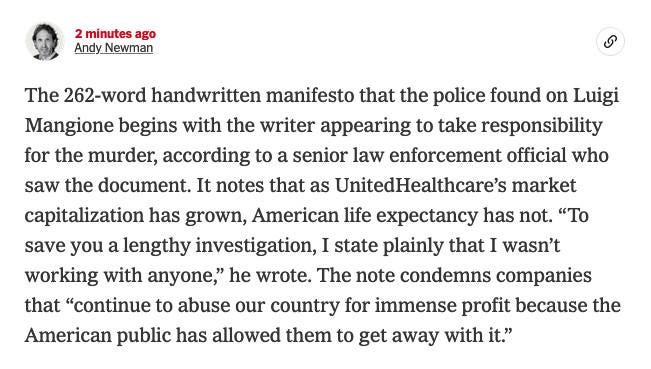
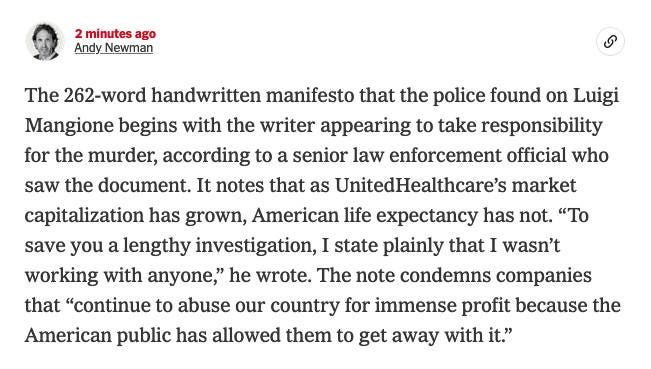
If he is the shooter, than we can also confirm he chose to act out by targeting an insurance CEO. The New York Times has stated he was arrested with a 262-word manifesto that described the executives who run insurance companies as parasites who “continue to abuse our country for immense profit because the American public has allowed them to get away with it.”
In addition to all this we know Luigi came from a wealthy family, his grand-father made millions running a series of country clubs, nursing homes, office buildings and hospitals. One of his cousins is a Republican state legislator. It is unclear if Luigi had any access to the family money, but he was clearly financially comfortable enough to move to Hawaii and pay to join an intentional community. He had engineering degrees and a promising early employment history.
This is a man who had options. He could have been almost anything he wanted to be. And the thing he ultimately chose to do with his life, after suffering a debilitating injury, was to shoot the CEO of United Healthcare.
Luigi Mangione was radicalized by pain.
---
It is a well known fact that most terrorists tend to be radicalized in communities. Much of my career was spent watching 8chan turn from an image board dedicated to Gamergate into a machine for generating white nationalist mass shooters. These people often appeared as lone wolves to the untrained eye, but they were radicalized intentionally in a community.
Much will be made in the coming days and months about Luigi’s online footprint. I will go into some detail about where he spent his time and how to characterize it but I want to be clear at the outset that his intellectual diet does not seem to be what made him choose to take action, although it may have influenced the specific kind of action he took.
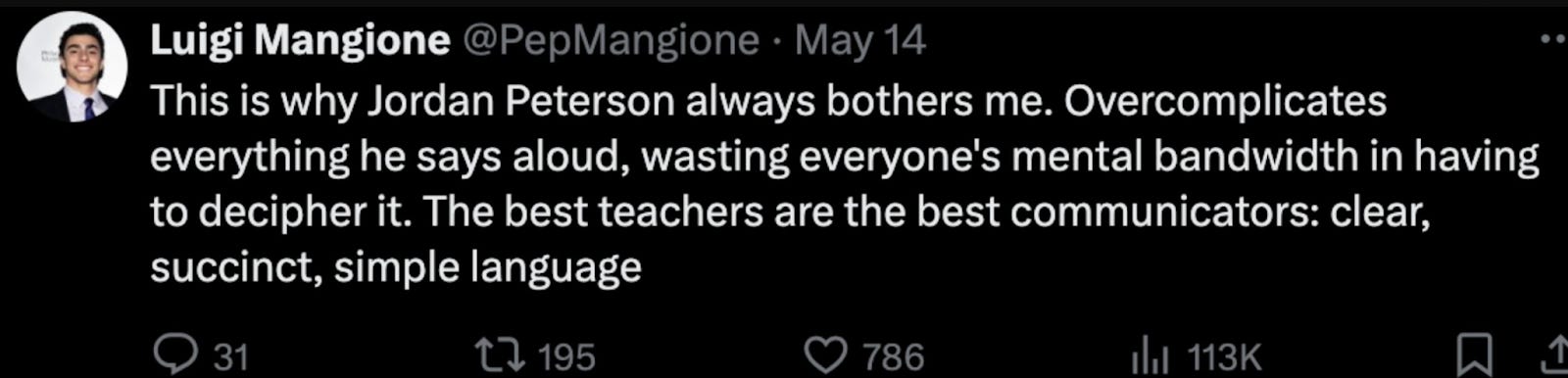
Luigi followed a lot of accounts on Twitter that are wildly popular with young men, like Joe Rogan. He listened to Jordan Peterson and Tucker Carlson but also had cogent criticisms of their arguments and presentation.
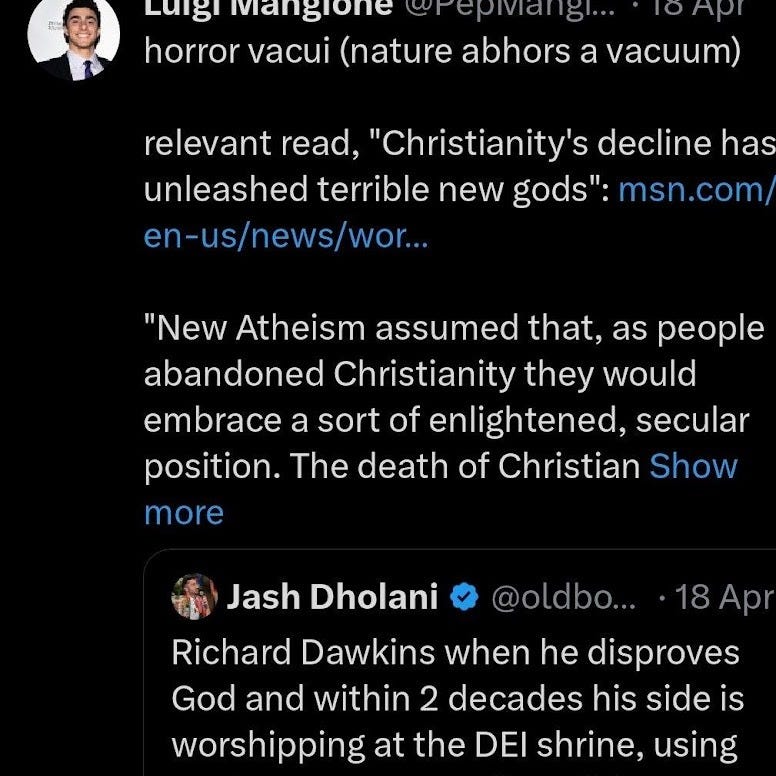
He expressed frustration with “wokeness” and expressed opinions common on the libertarian / tech influenced right, like a belief in the social benefits of Christianity without expressing particular religious belief himself.
Some of this took the form of memes typical to online discourse of this type. But we have an essay he wrote at age 15, discussing how Christianity persevered over Paganism in Ancient Rome, that shows a longstanding interest in this topic and a capacity to treat it with nuance. His paper is well-written, particularly for a 15-year-old, and while his conclusions are highly arguable this is not the work of someone hopelessly brainwashed by culture war bullshit. Luigi liked to read and think and come to his own conclusions.
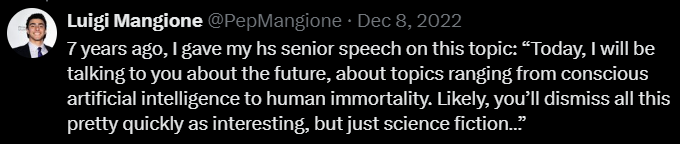
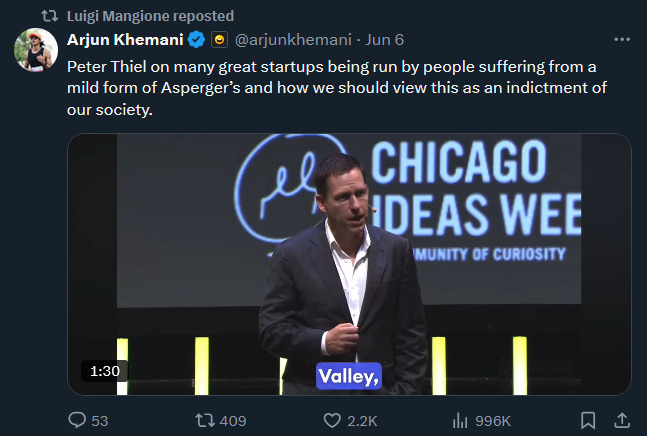
He was interested in AI, in cryptocurrency, in life-extension and in a constellation of techbro adjacent attitudes and philosophies often described as “the gray tribe”.
The term “Gray Tribe” was coined by an influential rationalist blogger and psychiatrist named Scott Alexander Siskind. He used it to refer to an intersection of nerd culture with Silicon Valley-influenced ideology descended from the online rationalist movement. This community existed outside of traditional right-left ideology.
I have not found any evidence that Luigi was a specific fan of Scott, but he expressed appreciation for several figures associated with this big tent movement, including Peter Thiel.
If we describe Scott as representing the more liberal flank of the Grey Tribe, Luigi seemed to be drawn to folks closer to the right-wing side of things. The worst person to use this terminology would probably be Thiel-associate Balaji Srinivasan, who has used Gray Tribe framework to describe his ideal big tech takeover of San Francisco and purging of progressives.
However I must stress that Luigi Mangione never expressed any support for this end of the ideology that I can find. He was a young man of Libertarian inclinations who worked in Big Tech and had ties to San Francisco but was also clearly someone still making his mind up about the world.
As information about him has come out I have seen people on the left, who initially saw his acts as heroic, lament that he was a bigoted tech bro. Scott Alexander has been credibly described as a eugenics supporter, as have many other people adjacent to the strains of rationalism and big tech ideology in which Mangione dabbled.
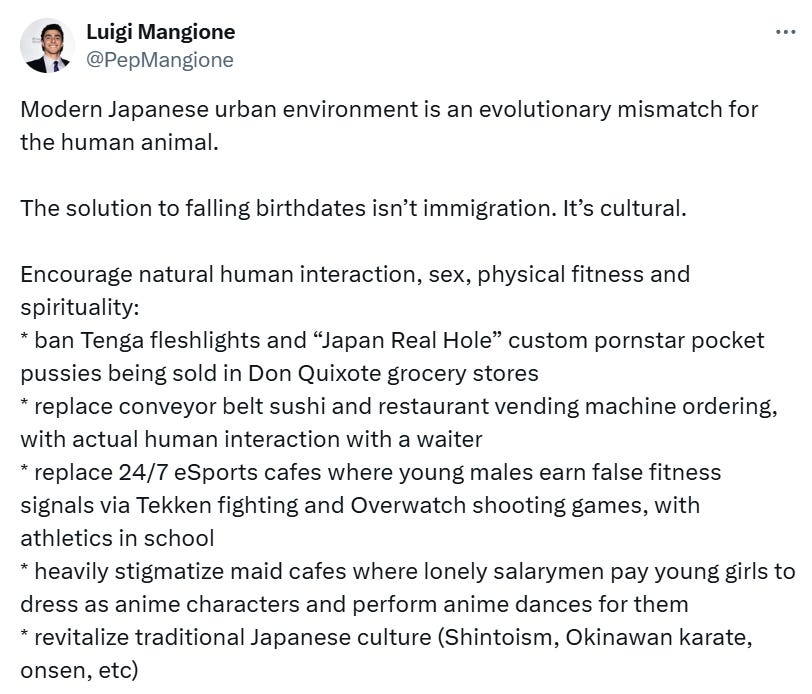
Luigi’s Twitter account does indeed include weird posts from his time in Japan where he theorizes on how to solve “falling birthrates” by banning “pocket pussies” and video game cafes.
At other points he complains about Japanese citizens as acting like “NPCs”. But race science and eugenics doesn’t seem to have been a focus for him. And I would caution against being overly reductive about a 26-year-old’s beliefs based purely on a handful of posts that bare no relation to his actions.
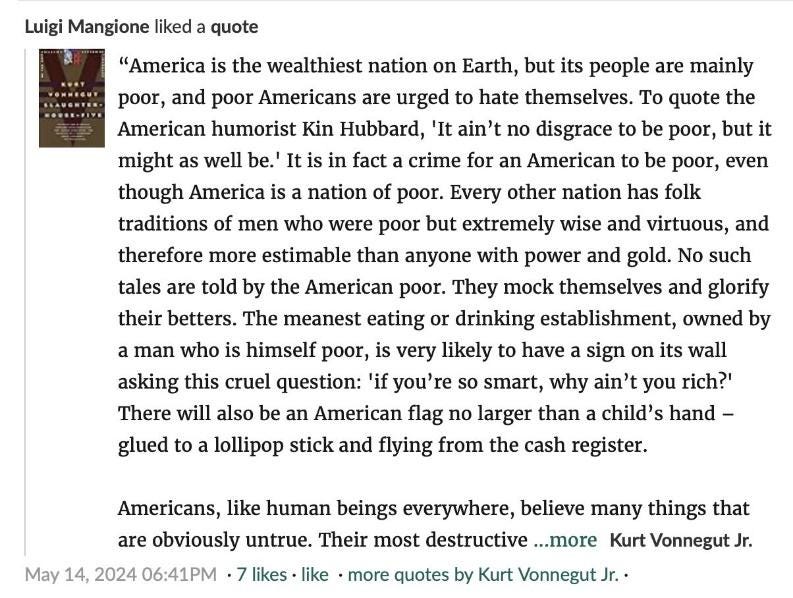
The evidence we have of his online footprint suggests someone who was not unmoved by certain arguments rooted in social justice. He expressed admiration for a quote from Kurt Vonnegut’s Slaughterhouse-Five about the criminalization of poverty in the United States:
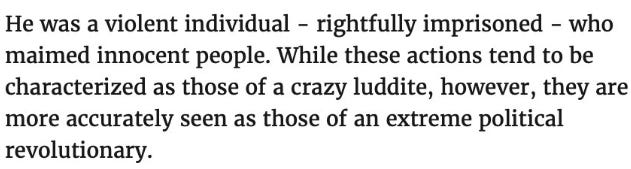
Luigi is certainly not the idealized leftist icon some had hoped. But he doesn’t easily fit into any other box we have. His interest in Gray Tribe-adjacent thinkers and self-help books written by productivity hackers like Tim Ferriss is incredibly common among young men. Much has been made of the four star review he gave Industrial Society and Its Future, the manifesto by Ted Kaczynski, but as with the rest of his media diet he did not view Ted through a simple lens of hero worship:
We know that these are not just words because we have seen the attack he (allegedly) chose to carry out. Not a series of bombings that killed and maimed innocent people with no real power in our society, but a surgical strike against a man at the very top of the system he hated, one that caused no collateral damage. He was capable of appreciating some of Kaczynski’s conclusions, but ultimately the quote he chose to highlight in his review came not from the manifesto but from a reddit post made by a guy with the username Bosspotatoness who otherwise mostly commented on the Grateful Dead.
The post praises Kaczynski for having “the balls” to realize that peaceful protest “has gotten us absolutely nowhere” and complains “economic protest isn’t possible in the current system”. As a result “violence against those who lead us to such destruction is justified as self-defense”.
“These companies don’t care about you, or your kids, or your grandkids. They have zero qualms about burning down the planet for a buck. So why should we have any qualms about burning them down to survive?”
This is not the kind of radicalization pathway our media is good at discussing or analyzing. The things Luigi read and the people he interacted with online absolutely influenced what he did and how. But Bosspotatoness is not some Nazi on 8chan trying to provoke a shooting spree for the lulz. He’s a random dude angry about the same things 70% or more of the country is angry about and expressing a lack of faith in any peaceful way forward.
If you read this post in its entirety, as Luigi did, you can’t miss the pain there. Anxiety and horror at the inevitability of climate change, and the looming knowledge that everything good and green on this earth is being fed into the bloody maw of an industry concerned only with maximizing profit.
In more ways than one, Luigi Mangione was radicalized by pain.
---
I know many people who suffer with chronic pain and ongoing medical issues. I will tell you that it is not uncommon in dark moments, after fruitless hours-long calls about dropped medications or receiving surprise bills, for them to joke about what they’d like to do to the executives who run these companies.
These are jokes, made in moments of despair and pain. No one I know would ever act on them, because they all have lives, people to care for and to whom they are responsible. They would never really do anything because the consequences to their own loved ones would be so severe.
In the months before the shooting, Luigi had cut off all contact with his family. He admitted to this in court and we have evidence friends tried to contact him on his family’s behalf via social media.
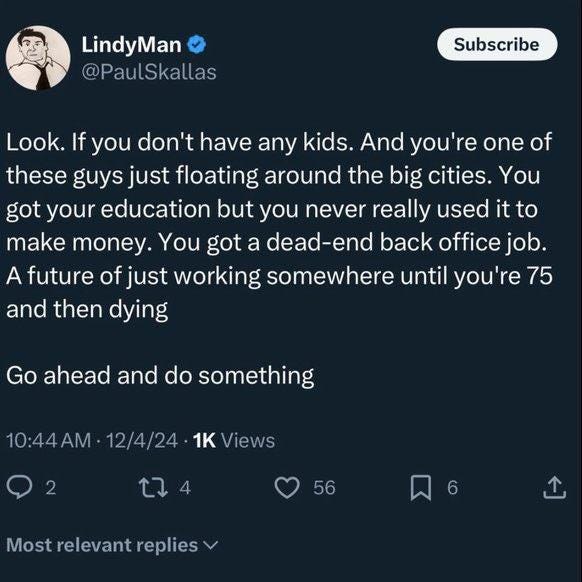
As was noted first by this Twitter account, Luigi Mangione expressed interest in the work of Paul Skallas, a tech lawyer, writer and prominent poster who writes about “the Lindy effect”, a concept that boils down to this: “The only effective judge of things is time.” Skallas is popular among the set of people Mangione found himself drawn towards, and writes about the wisdom of ideas from antiquity. It’s not hard to grasp what a man with an academic interest in ancient Rome might see in him.
On December 4th, 2024, Paul made this post:
It’s been suggested that this may have influenced Luigi and I think the timeline makes it clear that this cannot be the case. Luigi cut off contact with his family and most of his friends months ago. The evidence suggests he’d planned this attack for quite some time. He arrived in New York City on November 24th, on a bus bound from Atlanta, where he did not reside.
So I don’t think this post represents a piece of his radicalization journey. Nor was Skallas advocating for people to kill CEOs. But the situation and mind-set Skallas described does speak to a lot of young men like Luigi, young and educated but without intense responsibilities or much hope for the future. This subset of society has always overproduced terrorists, revolutionaries and, of course, mass shooters.
---
The United States has a mass shooter culture. Over the last several decades, since Columbine, we have grown used to the idea that people who are angry and no longer care if they live or die will sometimes choose to go down killing strangers. In most cases these shootings are utterly random, the victims chosen with no concern beyond maximum body count and maximum attention.
More recently, and especially since 2019, mass shootings have become increasingly politicized. Different extremists, nearly all right-wing, have used them to put theory into praxis and earn free PR for their causes. Most people abhor these actions but we have grown used to the idea that people will use such acts as a way to spread messages that might otherwise get ignored.
It is not coincidental that the white genocide conspiracy theories from Brenton Tarrant’s Christchurch Manifesto are now mainstream talking points in Conservative politics.
Luigi Mangione grew up with all this. He would have come to the same conclusions about the role shootings play in our society as any other reasonably aware person. What he did was, of course, not a mass shooting. But the assassination, his actions afterwards, and his possession of a manifesto were all clearly plotted out by someone who knew the social script for how this kinda thing goes in the USA.
In the wake of this shooting every media organization commenting on it has had to grapple with the waves of public enthusiasm for Luigi’s actions. Right-wing media figures condemning the left for celebrating this assassination have been criticized by their own readers and listeners. Insurance companies have pulled down lists of their executives from the Internet.
This is because they too understand the shooter culture of the United States. Like anyone else, they know that any mass shooting that meets with massive media coverage and interest will spawn copycats. The assassination Luigi is believed to have carried out was new and exciting; it demanded the public’s attention in a way most mass shootings don’t.
At almost the exact same time the United Healthcare CEO was assassinated, a gunman walked into a religious school near Oroville California and shot two young children before killing himself. This shooting drew almost no national attention. It was entirely drowned out by the execution of an insurance industry CEO. The armed and disaffected young men who are most drawn to this sort of thing will not miss this fact.
I believe Luigi Mangione was radicalized by pain. The shooters who follow him will all have their own reasons for what they do, their own journeys to that violent end. But ultimately, they’ll do what they’ll do because Luigi proved it’s what gets attention.
For now.
Thanks for reading Shatter Zone! Subscribe for free to receive new posts and support my work.
The Internet is awash with cheap takes on what AI means for the future. From Terminator-inspired fears of military robots killing their operators to articles claiming AI is going to save education and rescue students (the latter features Bill Gates excitedly explaining how the OpenAI taught a chatbot to pass an AP test). Somewhere in between these two hype peaks is this story about an author who wrote “97 books” in 9 months using ChatGPT.
The real story is rather less exciting than you might think. The “author”, Tim Boucher, used an AI to generate dozens of 2-5,000 word “stories”, each with dozens and dozens of illustrations crudely rendered by Midjourney. He dumped these onto a webpage where people can pay $2.99 if they want to read thrilling stories like “Occupy A.I.”, where protesters square off against cops who look curiously like the bad guys from Spaceballs.
I don’t have much respect for Tim’s project, but its potential for harm is fairly minimal. All of his ‘works’ are geared towards adults. But there’s something more sinister lurking behind the florid headlines predicting AI doom or salvation. The robots are coming for your children.
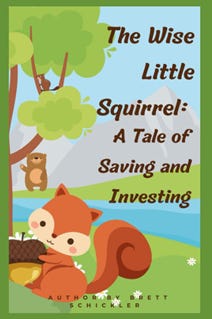
I was keyed onto this story by a Reuters article about a “boom” in AI-written e-books on Amazon. The piece zooms in on a wannabe author named Brett Schickler, a salesman from Rochester who heard ChatGPT was capable of writing stories and decided he’d been given a new lease on his dreams: “The idea of writing a book finally seemed possible. I thought, I can do this.”
His book, “The Wise Little Squirrel: A Tale of Saving and Investing”, is a guide to financial literacy through the eyes of Sammy the Squirrel, who gets some credit for being the least deranged looking character featured in this article. This book, available in paperback only, is currently around #30,000 in Literature & Fiction for Children.
Late last year Folding Ideas, a YouTube channel run by researcher / writer Dan Olson, published an investigation into a group of Amazon con-artists who promise their followers big money if they take classes to learn how to mass-produce and sell low-quality books on Amazon KDP (Kindle Direct Publishing) and Audible. The topics of the books didn’t really matter, as long as they included keywords that corresponded to popular searches on Amazon. The writing was all done by barely paid ghostwriters. The goal was to trick enough people searching for real books on various topics into buying trash books that the whole endeavor turned a profit.
The main barrier in terms of both production time and profitability was the ghostwriting. A human being can only write so fast, even if they’re just re-wording a Wikipedia article. ChatGPT and other large language models provide an incredible opportunity for these hustlers to increase their output. There’s only one problem: getting ChatGPT to write an entire proper novel (50k+ words) is basically impossible right now. That’s why all of Tim Boucher’s books were just a couple thousand words long.
I watched too many of these videos, all of which lay out the same strategy. The first step is to pick a prompt. An actual author might decide, ‘I want to teach children about the importance of conservation with a cautionary tale about thoughtless capitalization of natural resources’ or ‘I want to write a book about a bat raised by birds to show kids that bats are beautiful and complex creatures, not just spooky set dressings for vampire stories’. But chatbots and grindset influencers are both incapable of feeling things, or wanting to transmit their feelings to others.
Instead, the process of picking a topic for an AI children’s book is mechanical and bleak. It starts with a trip to Amazon’s sales rankings. An extension like BookBolt is used to show which topics are selling well without being too crowded by competition.
The most successful AI kids books will only sell dozens, or perhaps a hundred or so copies, but the people making these videos try to bait their hooks by showing sales calculations from successful books by human writers to make the case that AI kids books are an untapped goldmine:
The Zinny Studio notes that you want to copy the premises of real kid’s books that have several hundred reviews, but ideally less than a thousand. My guess would be that this is to avoid doing anything too high profile. You’re looking for a sweet spot where there’s a lot of demand but not too much attention.
There’s also a strategy for price points. The Zinny Studio points out that Amazon pays a 70% royalty rate for books that cost from $2.99-$9.99 but books under $2.99 only pay out 35%.
Some creators will take their research and use it to create an original premise, but for the most part they just collect keywords and ask the AI to generate a story premise, which they then feed back to it, thus avoiding the risk that human creativity might be involved at some point in the process.
There are only occasional weak jabs at encouraging original thought. One guide I found (268k views) was by The Zinny Studio. It cautioned viewers:
“You’re not doing research to find books to copy, you’re doing research to understand what is working. It’s important to make your own original pieces…so you can stand out from the competition.”
But here’s the actual prompt The Zinny Studio used to generate their example children’s book:
“Write me a children’s story about a girl going on an adventure to find a missing treasure. lesson ‘You achieve what you put your mind on’. Make it 6 pages and title each page. make is mind blowing and intriguing”
The spelling and punctuation mistakes are all theirs. As you can see, actual characters, a conflict and a plot are not necessary. This is sufficient to generate something that technically qualifies as a storybook:
“Page 1: ‘The Missing Treasure’
Once upon a time there was a brave and curious girl named Sarah. She lived in a small village at the foot of a big mountain. One day, she heard about a missing treasure that was hidden in the mountain a long time ago. Sarah was very intrigued and decided to go on an adventure to find the missing treasure.
Page 2: “The Journey Begins”
Sarah packed her backpack with food, water, and a map, and set out on her journey. She hiked up the mountain, and along the way, she met many animals who offered to help her. But Sarah declined their help, saying, “I want to do this on my own.”
Page 3: ‘The Cave of Trials’
After several days of hiking, Sarah finally reached the top of the mountain. There she found a cave that led deep into the mountain. She entered the cave and was met with many trials, including steep cliffs, deep chasms, and dark tunnels. But Sarah didn’t give up. She kept moving forward, always remembering the lesson she learned from her parents: “You can achieve what you put your mind to.”
You see what the machine is doing here. The prompt asked for an intriguing story so it described Sarah as “very intrigued”. The prompt asked for the story to include the lesson, “You achieve what you put your mind on”, so ChatGPT had Sarah remember that her parents told her that after she went through a series of “trials” that aren’t actually described.
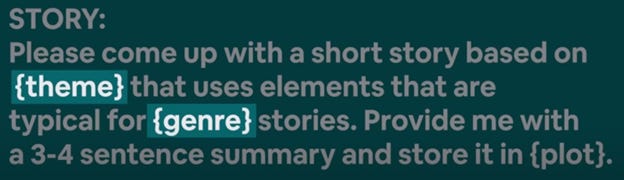
I found an even lazier example of synthetic storytelling in a video by Christian Heidorn (120k views) whose YouTube channel is called Tokenized AI. He had Midjourney create what he calls a “comic book”, using an equation for story ideas that reads like the brain of every Netflix executive.
Christian decides to have the machine write him a comic book with Indiana Jones / Uncharted-style vibes. The vibes are purely a product of the (derivative, plagiarized) artwork, because the actual ‘plot’ here is nonexistent.
Looking at a bunch of these in a row pulls the curtain aside on AI storytelling. Much of the dialogue is utterly nonsensical- why is Leo saying “That’s my line!” in Scene 1? He’s never said that before in this story, it doesn’t really make sense as a joke. I can only guess that at some point a real person wrote a story with that line as a retort and whatever calculation ChatGPT ran to finish that page concluded it was probably appropriate.
Scene 5 shows us what happens when these things attempt to generate conflict. As a spoiler, Maya and Leo decide not to take the treasure, choosing friendship over greed. But at no point is it explained why they wouldn’t be able to have both. There’s no actual reason for them not to take the treasure. Leo just says, “But at what cost?” and the tale moves along.
What we have here is the simulacrum of a story, technical ingredients arranged in such a way that it satisfies the needs of someone whose only purpose is to trick overworked parents into buying a copy for their child, who will likely be too young to elucidate why something seems wrong with their new book.
Because the text generated by these AI programs is really just chopped and screwed together pieces of actual stories written by people, AI hustlers are very concerned with plagiarism. So they feed their text into apps like Grammarly to run test plagiarism detection scans. Inevitably, the story fails.
Worry not, there’s a simple solution: Quillbot. Billed by its creators as an “online paraphrasing tool”, Quillbot combs through a document and replaces the adjectives and verbs with synonyms (‘courageous’ for ‘brave’, ‘resided’ for ‘lived’ etc). Simply feed your Frankentext into Quillbot and you’ve got something that won’t trigger Amazon’s plagiarism sensors.
(It’s actually unclear to me how Amazon scans for plagiarism. I reached out to one of their PR reps and asked about their policies on plagiarism and AI generated books, but have not heard back at time of publication.)
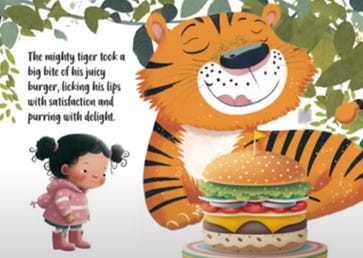
Once they’ve got passable text, the next step is to create image prompts for all the ‘illustrations’ in the book. Again, there’s no room for creativity here. For each page they ask ChatGPT to generate descriptions of the images needed for that text. Then they feed that text into Midjourney, or Leonardo or some other AI image generator and use it to produce something like this:
By the standards of AI children’s book art, this is actually pretty good. The worst-case scenario is shown in this video (412k views) by Paul Marles. Prior to the AI explosion he was teaching people how to con rubes through Amazon KDP the old-fashioned way. His videos had titles like “$9636 From 30 to 60 Minutes Work!! -Make Money Online With KDP Low Content Books”. He has dozens of books for sale on Amazon.
Paul ups the ante on laziness here by cutting out the text entirely and instead generating a children’s coloring book he hopes will SEO well enough (because it’s about dinosaurs) to turn a profit. From a half-assed prompt that misspells the name of the dinosaur…
…we get a series of off-putting and biologically inaccurate T-Rex’s, all of which have massive front legs instead of tiny arms. The claws are just as fucked up as AI hands tend to be, although Midjourney is smart enough to hide them, Liefield-like, in the top left image.
Paul’s guide also goes through how to lay out your coloring book for publication, cobble together a cover, and upload it to Amazon where they’ll ship physical copies off to whoever you can trick into ordering one.
My worry here is that the parents who fall for these books are likely to be overworked, with low budgets and little free time to vet purchases. They might just click on whatever is affordable. I also worry charities that provide poor kids with free books might do bulk orders of this junk because the price looks right. In our glorious AI future, rich kids get to color in proper dinosaurs while poor kids grow up thinking Stegosaurus had no tail and the earth used to have a second moon that looked like a human nipple:
Paul did respond to my request for comment. I asked if he was concerned that his coloring book or others like it might have a “negative impact” on children who received the coloring books. Paul did not answer this question. He claimed, “The images I used in the video were just examples and not to be taken as exact images I published.”
But a cursory search of Amazon shows numerous coloring books that look quite similar to the one Paul shows in his video. Here’s his book:
Here are several near identical copies all sold under different names. Note how some have missing legs, or extra legs, or distorted nightmare arms. All are clearly AI works.
I asked Paul if this was one of his or if he thought it was made by one of his viewers. He just said, “that is not my book”. Perhaps I should have sent along this cover, which features what I can only describe as a hybrid of a T-Rex and Salad Fingers:
Despite featuring easily the worst dinosaur drawing I’ve seen in my life, this coloring book appears to be selling reasonably well. At the time this article was written it was #75 in the Teen & Young Adult Drawing category.
In addition to making 3-legged T-Rexes, most AI image generators struggle to keep characters consistent across multiple images within a single book. Most of the creators I followed just ignore this, trusting that what they put out looks close enough to fool someone skimming over the book. If the prompts are engineered carefully enough, sometimes different pictures look pretty close to right.
But that is rarely the case. The laziest example of this I’ve found is from “Treasures Beyond Gold”, the adventure comic book I described earlier. Christian Heidorn, the author, prefers very technical prompts for his images, but this still means that he’s just asking the machine to draw “attractive Western man” or “young Asian woman” on each page.
That results in a comic book where every page features totally different characters, often drawn in different styles. In the second image here she’s been anime’d up by at least 20% and he’s gone from looking like fanart of Dean Winchester to having like 15% Shaggy from Scooby Doo tossed into the mix.
The first of these pictures is supposed to show both characters bumping into each other in a Southeast Asian market while reading identical treasure maps. Not only is no map featured in the image, but it just looks like a head on portrait. There’s no visible evidence of either character interacting.
An adult will have no problem picking this out as just cheap weird shitty AI art. But these books could be quite damaging to little kids. A substantial body of research into emergent literacy (the reading and writing skills possessed by a child before they learn how to formally read or write) has shown that illustrations play a crucial role in transmitting the building blocks of literacy. One study on emergent reading strategies by Judith Lysaker and Elizabeth Hopper of Purdue University notes:
“Emergent reading practices such as wordless book reading are often seen as precursors to the meaning making that comes later during print reading.”
And that’s what actually scares me about Midjourney-generated kid’s books. Small children are info-vacuums, hoovering up observations about the world at a terrifying pace. We know that before they can read, little kids come to understand things like story structure and the meaning of words and phrases by studying the illustrations that accompany text. AI images are generated without any intent or understanding, and as a result they always look somewhat disjointed and off.
So the worry here is not just that parents get tricked into buying bad books. It’s that AI books are so incomplete and broken they might fundamentally damage the way young children acquire reading skills.
AI advocates insist that this is just version 3 or 4 or whatever of [App X], and the programs will only get better and better as time goes on. This is far from a guarantee. For one thing the popularity of these tools means more AI-generated crap will get spat out onto the Internet. Since new AIs will be trained on this content there’s a high chance of creating a feedback loop which can lead to what’s called model collapse. A group of researchers published in the open-access pre-print repository arXiv described this as what happens when the, “...use of model-generated content in training causes irreversible defects in the resulting models.”
I find this particularly worrisome because the present models are already full of defects. Take the storybook generated for a video called “I Create a Best Selling Children’s Book Using AI in Under an Hour”. Here’s the creator, Grayson Sands. I have reached out to him for comment but have not received a response as of publication. His sunglasses irritate me.
He decides to generate a book featuring a character based off a tattoo he got of a Triceratops playing a stand-up bass:
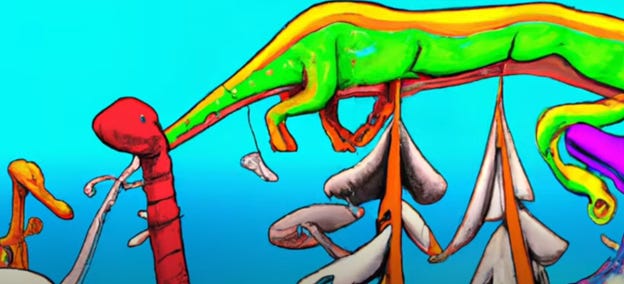
Midjourney did a decent job on the tattoo itself, but as you can see the world behind the character looks a bit…off.
This becomes more obvious in subsequent pages:
Now I can admit there’s something interesting and amusing about the hallucinatory nature of this art, but it has nothing to do with the story, which is about a Brachiosaurus (who plays piano for some reason) teaching a Triceratops how to play bass.
At the end of the video, Grayson tells us how he got his book to be a “best-seller”. It turns out he just called up a bunch of his friends and family and told them he’d written a book that was on Amazon and begged them to buy it. They did, and he shot up through the rankings (it doesn’t take a lot with print books) and started appearing higher in Amazon’s search results.
I can’t tell you how well this actually worked. At present “Dandy the Dinosaur” only has 2 reviews. Both are five stars, but it’s impossible to know if those are real or not. Even if Grayson’s effort to game the system was unsuccessful, other people with more resources, and an actual agenda, will find ways to succeed here. And that brings me to this fellow:
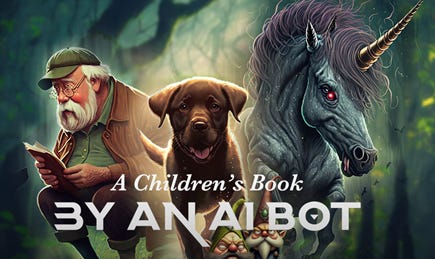
His name is Lucas Kitchen and based on the illustration for his book you’d guess it was about an old man and his dog getting murdered in the woods by a rabid unicorn.
It’s actually much weirder than that. Lucas is an Evangelical Christian who writes sci-fi books about proselytizing on Mars. His story prompt is easily the oddest one I’ve come across, although it does at least seem to have been written by a human.
“Write a children’s story where the protagonist is a little puppy named Fluff. Fluff wants someone to tell him about Jesus, but he can’t read John 3:15, so he needs a solution. The antagonist of the story is a bad unicorn. In the story include a field with trees. Also include magic in the forest. Also include a character who says “uhn uh” over and over.”
Lucas had his kids help him write the prompt. This is potentially a nice learning exercise to do with your children, provided they’re old enough to be thinking about things like story structure in more abstract terms. I can see kids learning from the effort to correct a deficient AI story and turn it into something engaging. But the ‘book’ Lucas generates with ChatGPT is as nonsensical and devoid of actual plot as the others we’ve seen.
“Once upon a time, in a magical forest with fields full of trees, there lived a little puppy named Fluff. Fluff was a curious puppy and he loved to explore the forest and learn new things.
One day, Fluff heard about a man named Jesus who was very special and had done many wonderful things. Fluff was very interested and wanted to learn more about Jesus, but there was one problem: Fluff couldn’t read.”
He even plays AI narration of the story along with the illustrations and records his kids reacting to it. They don’t seem impressed.
There’s nothing really sinister in Lucas’s story but it did provoke in me an unsettling vision: Churches and political organizations with axes to grind and money to spare, generating propaganda content and buying up copies to ensure Amazon’s algorithm spreads it far and wide. It’s a version of the current strategy used to sell autobiographies of politicians and celebrities.
Those books are generally targeted towards adults though. Kids are a lot easier to influence, or at least confuse, and Amazon has no vested interest in stopping Kindle from making money off propaganda for Kindergartners.
In Literature as Exploration, an influential book on educational literary theory, Professor Louise Rosenblatt argues that the reader is a crucial part of any piece of literature: “There is no such thing as a generic reader or a generic literary work; there are only the potential millions of individual readers or the potential millions of individual literary works. A novel or a poem or a play remains merely inkspots on paper until a reader transforms them into a set of meaningful symbols.”
So books, from Blood Meridian to Hop on Pop, are in part a dialogue between writer and reader. But the machines generating these stories cannot participate in a dialogue. They’re Mechanical Turks, guessing what word comes next based on a mix of complex math and the labor of Kenyan contractors paid less than $2 an hour to make sure the responses aren’t too racist.
This is a problem because real books teach empathy. It’s pretty common knowledge that reading long-form fiction makes you better able to identify with other people’s thoughts and struggles. Could being handed enough lazy AI slop in first grade not only impact your future literacy, but your capacity for empathy? There’s no real way to know yet and we have no idea how many kids will be exposed to how much of this stuff.
I reached out to Lucas Kitchen to ask if he shared my concerns about the way these AI-generated books might harm young readers. His book was not the worst offender, but its religious nature did set me on edge. To his credit he responded and gave a reasonably direct answer when I asked if he believed there was potential harm these books could do if allowed to flood Kindle en masse:
“…I wouldn’t say I’m worried, but I would say that I agree with you that there is a lot of crap that is being slung out by people who don’t yet understand their role in the AI generative production workflow. The book that I did was a quick, one hour demo, that would need real work done to it if it was going to be for sale.”
This at least counts as direct by the standards of his peers. Lucas insists that he would never publish a book as unfinished as the one he showed on YouTube. He expressed his belief that there would always be a need for the “artist’s eye, decent editing, a cohesive idea and a vision for what they want to create”. But his attitude seemed to be that the people crapping out disjointed AI kid’s books onto Kindle were just lazy, rather than predatory.
“They jumped into the AI generative world, thinking that they could produce something decent while being lazy. That isn’t the case. It is still hard, artist work to get something that is great. I think that the generative AI model has simply raised the bar for what we will consider great. I think it is advancing art and writing in an amazing way, And the expectations for what we consider good writing and good art will be next level from now on.”
Image added here for no particular reason.
On the whole I have found this investigation dispiriting and worrisome. The upside is that I have learned a lot about the science of building literacy in little people. Education researchers have found that very young children can be influenced towards new behavior by the stories they read. From an article by Peggy Albers in The Atlantic:
“Stories can be used to change children’s perspectives about their views on people in different parts of the world. For example, Hilary Janks works with children and teachers on how images in stories on refugees influence the way refugees are perceived.
Kathy Short studied children’s engagement with literature around human rights. In their work in a diverse K-5 school with 200 children, they found stories moved even such young children to consider how they could bring change in their own local community and school.”
In that last case, students were so moved by the story of anti-child labor activist Iqbal Masih, who was murdered at age 12, that they decided to create a community garden to donate food to a local food bank. Are AI stories capable of inspiring positive actions like that? What about negative ones?
Nobody knows. But we’re all going to learn the answer together, whether we want to or not.
Thanks for reading Shatter Zone! Subscribe for free to receive new posts and support my work.
Written by Garrison Davis, James Stout and Robert Evans
The following is a piece that boils out the current known facts about the shooting at the Covenant Christian school in Nashville, TN, on Monday, March 27th. The shooting has become fodder for a right-wing culture war, and disinformation is rampant, so we felt a text-based piece would be useful to accompany the podcast episode on the subject.
Thanks for reading Shatter Zone! Subscribe for free to receive new posts and support my work.
Here is the story in brief: Audrey Hale, 28, entered a private Christian school in Nashville this Monday morning and killed three nine year old students and three adult staff members in their 60s including the “Head of School” Dr. Katherine Koonce. Hale shot through a side door to gain entry into the school and was armed with at least two “assault-style rifles and a handgun,” according to Metro Nashville Police spokesperson Don Aaron. Some reports suggest one of the rifles was actually an AR-15 style pistol (both weapons are close to identical in this situation).
As the shooter made their way through the first and second floors of the school they fired multiple shots, seemingly at random, before being killed by police on the school's second floor.
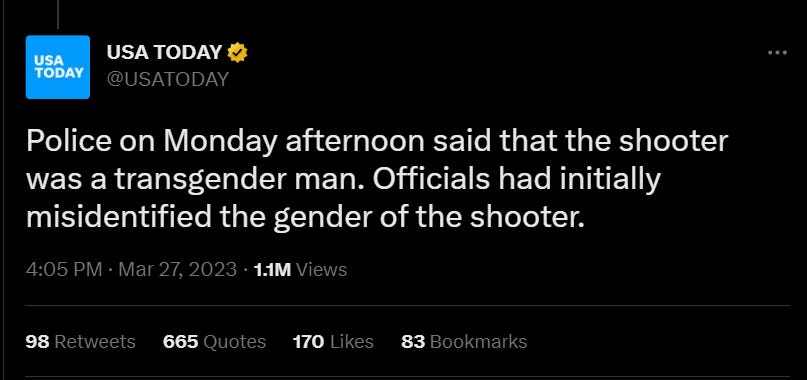
Police statements following the shooting were varied and inconsistent. Initially police claimed the shooter was a teenager, but minutes later changed course and described them as a 28 year old woman. Nashville Police Chief John Drake eventually identified the shooter as Audrey Hale, 28, of Nashville. The chief added that Hale “identifies as transgender.”
Both police and most media continued to refer to the shooter as a woman, with NBC printing “Nashville police said the accused Covenant School shooter was a transgender woman,” possibly based on a statement by Police Chief Drake that he gave while answering a question regarding if the shooter was a transgender man or woman.
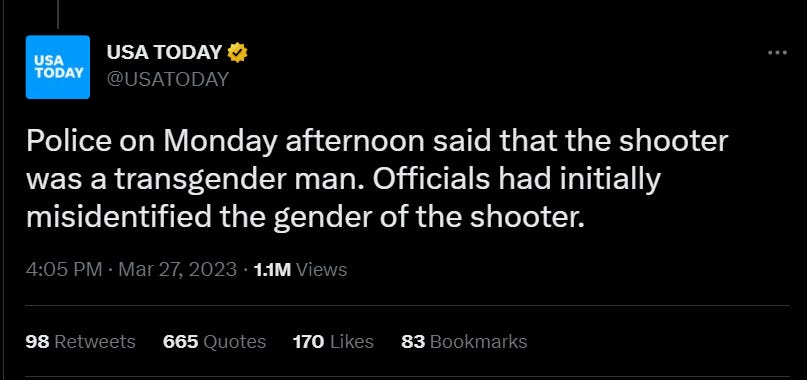
Some time later, USA Today revised their coverage and reported, “Police identified the attacker as Audrey Elizabeth Hale, 28, a transgender man who was assigned female at birth.”
Chief Drake also stated that Hale was a former student at the school, though he was unsure of what year. His initial statements on motive in particular were extremely muddled and unclear, which is not uncommon in the wake of mass shootings. Drake initially seemed to state that the shooter’s identity, as a trans person, may have influenced the attack. This was taken up rather gleefully by right wing pundits.
Some time later, on Lester Holt’s show, he clarified his previous statements about the possible motive of the shooter:
“We feel very strongly that she went to that actual school. There’s some belief that there was some resentment for having to go to that school.”
On the question of if the shooter’s gender identity was a factor in the shooting, Chief Drake said “right now we’re unsure if that actually played a role,” and mentioned there were plans for shootings at multiple locations.
As you can see, the facts here are still rather muddled. The claim that Hale attended the school seems to rest on the recollection of Bill Campbell, who was headmaster at the Covenant School from 2004 to 2008. He told NBC: “I’ve looked back in my annuals, and I do remember her as a former student. She was just one of our young ladies.”
It seems likely that Hale transferred after graduating 4th grade, based on Campbell’s recollections.
The Covenant School is a preschool through 6th grade private Christian school, founded in 2001, it shares the same location as Covenant Presbyterian Church. Its website states the school has 33 teaching faculty and around 200 enrolled students with tuition around 16,000 dollars per year.
According to the school's website, “The Covenant School is a ministry of Covenant Presbyterian Church, created to assist Christian parents and the Church by providing an exceptional academic experience founded upon and informed by the Word of God.”
Aidan and Audrey
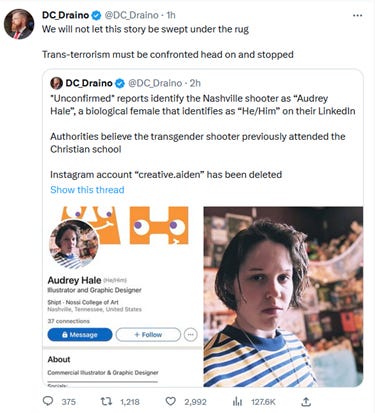
A Linkedin page for a “Audrey Hale” in the Nashville area has “He/Him” pronouns alongside the name.
Hale appears to have had a website for their graphic design portfolio called “ahillustrations,” which has posts tagged as being from 2023. The website has an About page that introduces themself as Audrey Hale, but also directs you to a now vanished Instagram page called “@creative.aiden”.
A self portrait titled “Audrey The Artist” can be found in Hale’s online portfolio, dated as 2022. The artwork is tagged with a different social media username “@crea.tivedre”, which appears to be an old instagram handle before they changed it to @creative.aiden. Hale’s website also has another self portrait with the name “Aiden.”
Although the Instagram page seems to have been taken down, it appears Hale had other social media accounts that are still online, besides the aforementioned Linkedin. A TikTok account by the name of “iam_aiden10” shares a profile picture with Hale’s website and also links to Hale’s Instagram page.
The TikTok account was seldom active, with their first visible post being from March 15th, 2022. Two other posts are from that month, all three of these posts are about late 90s and early 2000s video game nostalgia, and thanks to TikTok’s username embedding feature we can see that the account used to be called “audreyvideogamenerd_10” before being changed to “iam_aiden10” sometime between March 16th and April 15th of last year.
Hale’s last visible post is from just over a month ago, February 9th, 2023.
It is worth noting that, as researchers who regularly comb through the social media profiles of mass shooters, none of us saw anything that would have been an indication of violence in Audrey’s public pages. Right wing media has made a big deal about the fact that Hale made pro LGBT ads, presumably as part of their job:
But there is actually very little to go on at present. Some fuss has been made about Hale’s art depicting Jack Nicholson’s character from ‘The Shining’:
But this appears to be the only piece of art that references The Shining, one of the most popular movies ever made. It’s hard to see how anyone could interpret a single piece of fan art as a red flag.
The Wet Cement Moment
Whenever some horrific act breaks through the normal cacophony of media noise to draw mass attention, there’s a fleeting period of time in which it is possible to reach people and break through media bubbles in ways that are normally not possible. This is why fighting disinformation is so important in the early stages of a mass shooting, terrorist attack, or similar event.
The right wing media understands this, and conservative personalities rallied rapidly behind the claim that this was an act of terrorism by a transgender person that justifies punitive responses.
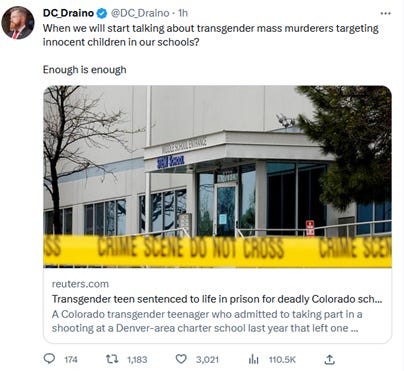
This post from DC Draino (686k+ followers), a “husband”, “patriot”, “lawyer”, “constitutionalist” and “anti-woke”, represents some of the most popular and widely shared right wing responses:
DC_Draino, and many of his colleagues, are eager to paint this as part of a wave of “trans terrorism”.
The shooting he references as part of this purported trend happened in 2019. A 19-year-old and a 17-year old shooting and killing a student at a high school in Highlands Ranch, Colorado and wounding several others. The 17-year-old, who has been sentenced for their part in the shooting, is transgender. They claimed the shooting was in retaliation for bullying.
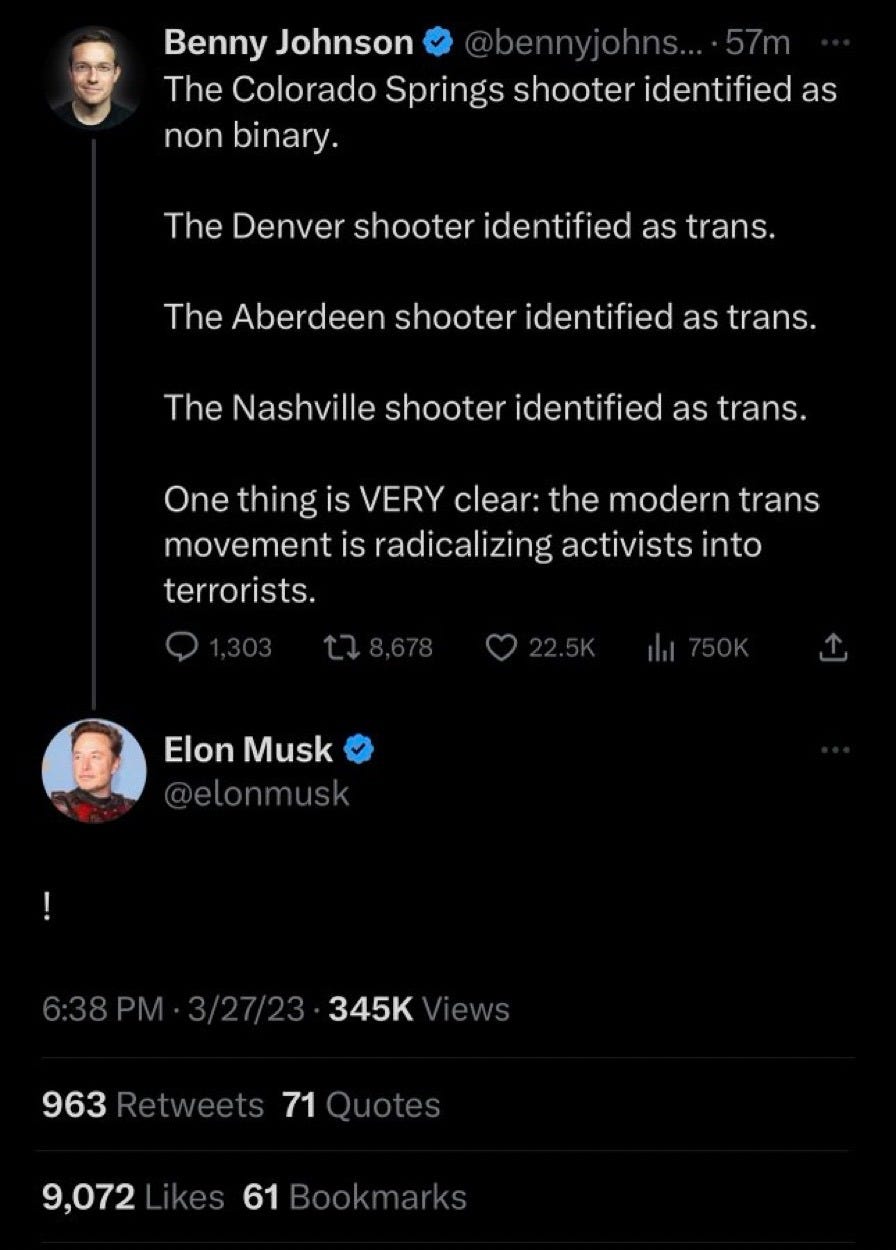
This was, of course, not an act of terrorism. Bullying has been invoked as an excuse by school shooters for decades and there is no reason to suspect the Highlands Ranch shooting represents anything unusual in this country’s long history of gun violence. Still, claims like these have legs, as we see in this post (which earned a comment from Elon Musk).
These are lies as well (the Colorado Springs does not actually identify as non-binary, the 2018 Aberdeen shooting was a workplace mass shooting, not a terrorist attack).
But the truth is immaterial. The cement is wet and the right is attempting to lock in their narrative while they still can. One of the uglier posts comes from “American Dissident” Stew Peters, who identifies himself as executive producer of #diedsuddenly, which searches for stories of people dying young and blames them on the COVID vaccine.
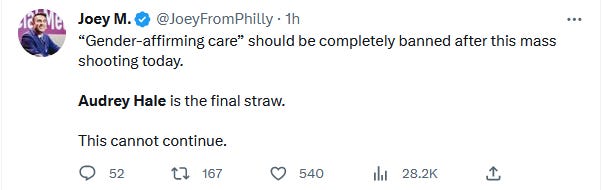
Other right-wing influencers have used this to further arguments that gender-affirming care, and not firearms, should be restricted:
Jack Posobiec, a conservative commentator and strategist, was among the first to blame the shooter’s actions on his assumption that they were taking hormones.
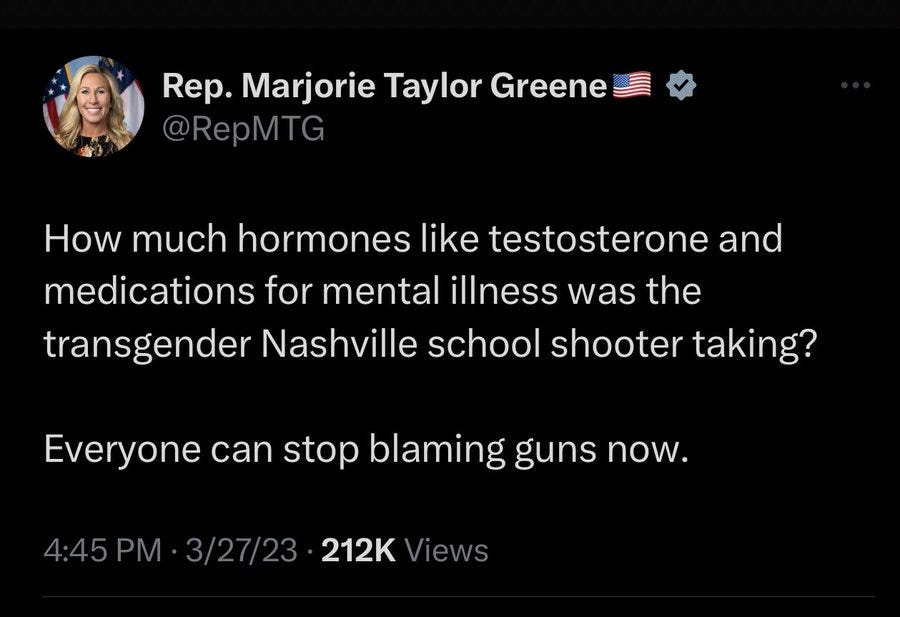
That tactic has already been picked up by Representative Marjorie Taylor Green:
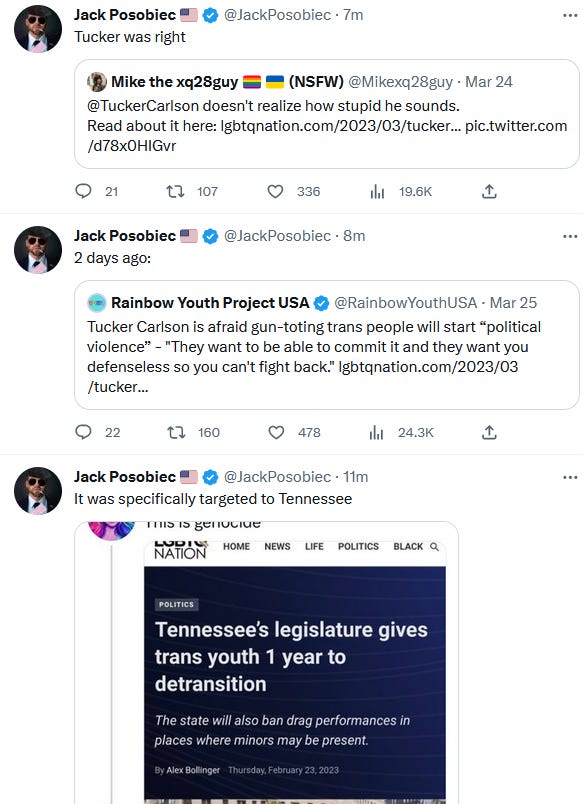
Jack Posobiec clearly sees political hay in connecting this to Tucker Carlson’s recent fear mongering about armed trans people:
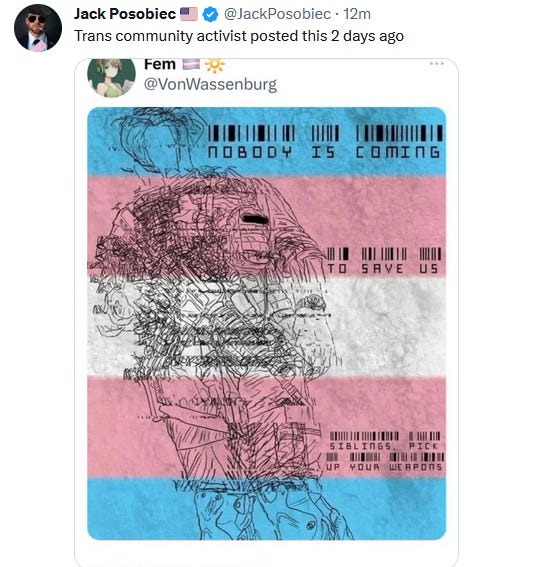
There is no evidence that it was “specifically” targeted to Tennessee, and the police have stated the school itself was the target. This doesn’t matter; for Posobiec this is a gleeful opportunity, and he wasted no time claiming unrelated memes supporting the right to self defense for trans people are somehow tied to this school shooting:
Similar cases abound in the right wing fever swamps. The most blatant and shameless example of this is here:
The photo on the left is claimed to be of the Nashville shooter at a protest, screengrabbed from an instagram account named “chicago_patriots”:
This is a fake, as the chicago_patriots instagram itself makes clear:
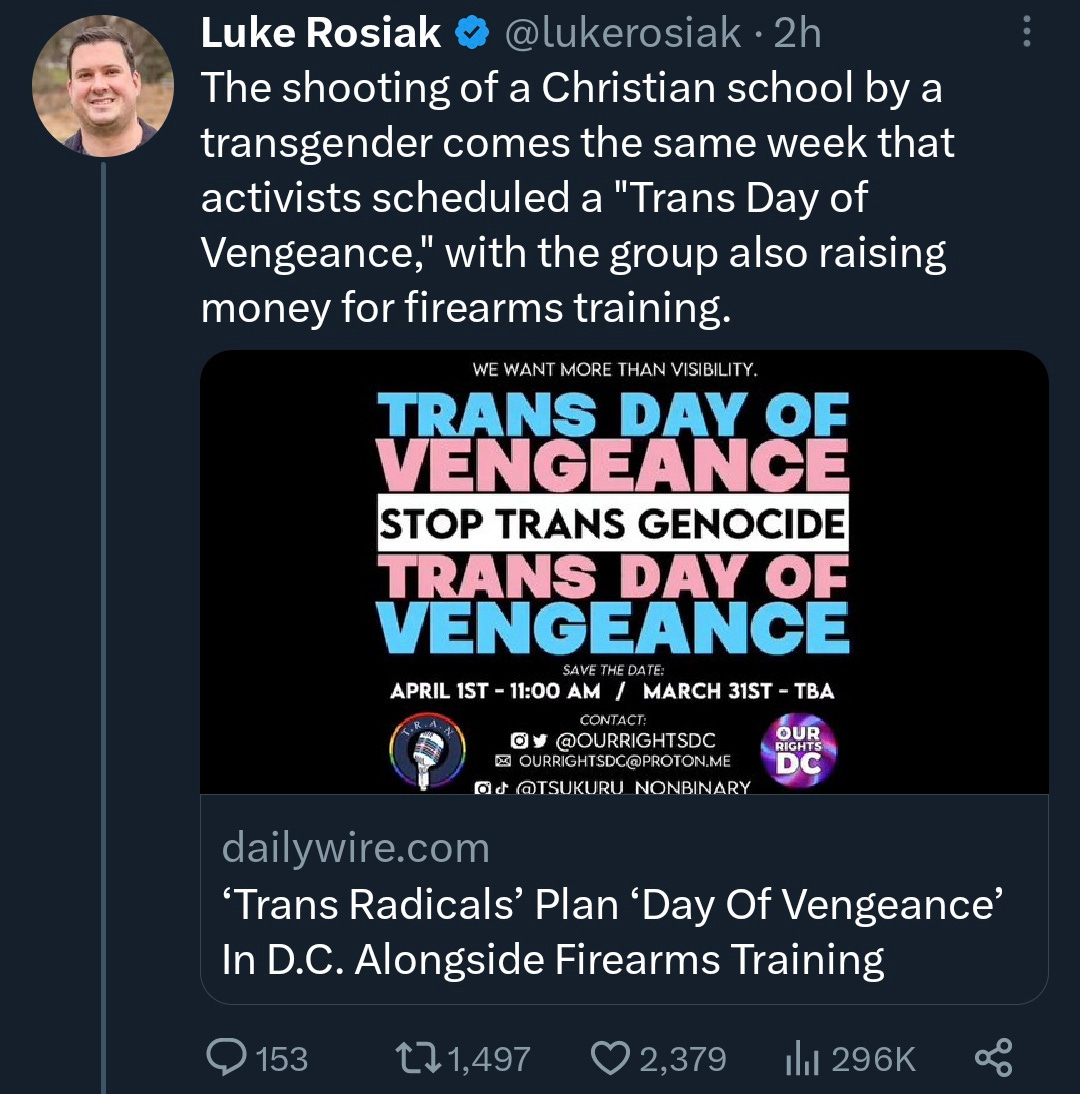
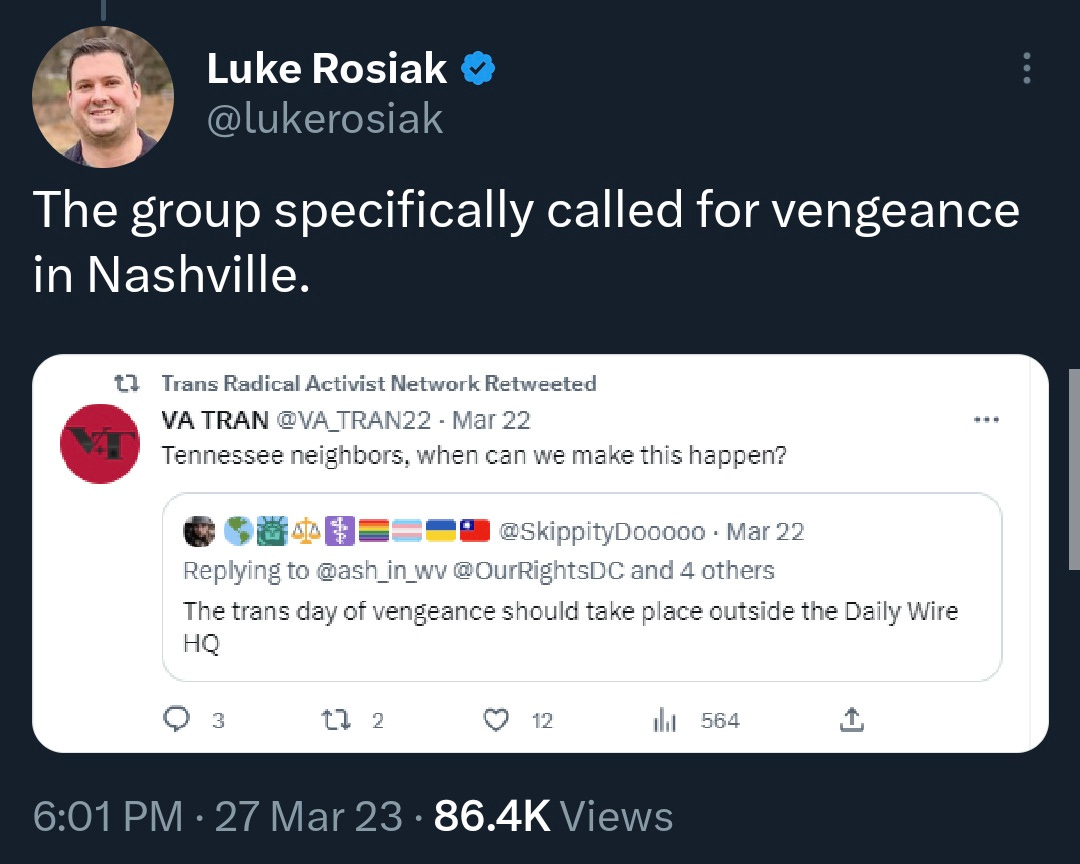
Luke Rosiak is an “investigative reporter” at the Daily Wire, and has made a career of lying about transgender people.
Rosiak is another of the many right-wing content creators attempting to make links between this shooting and queer self defense training and protests.
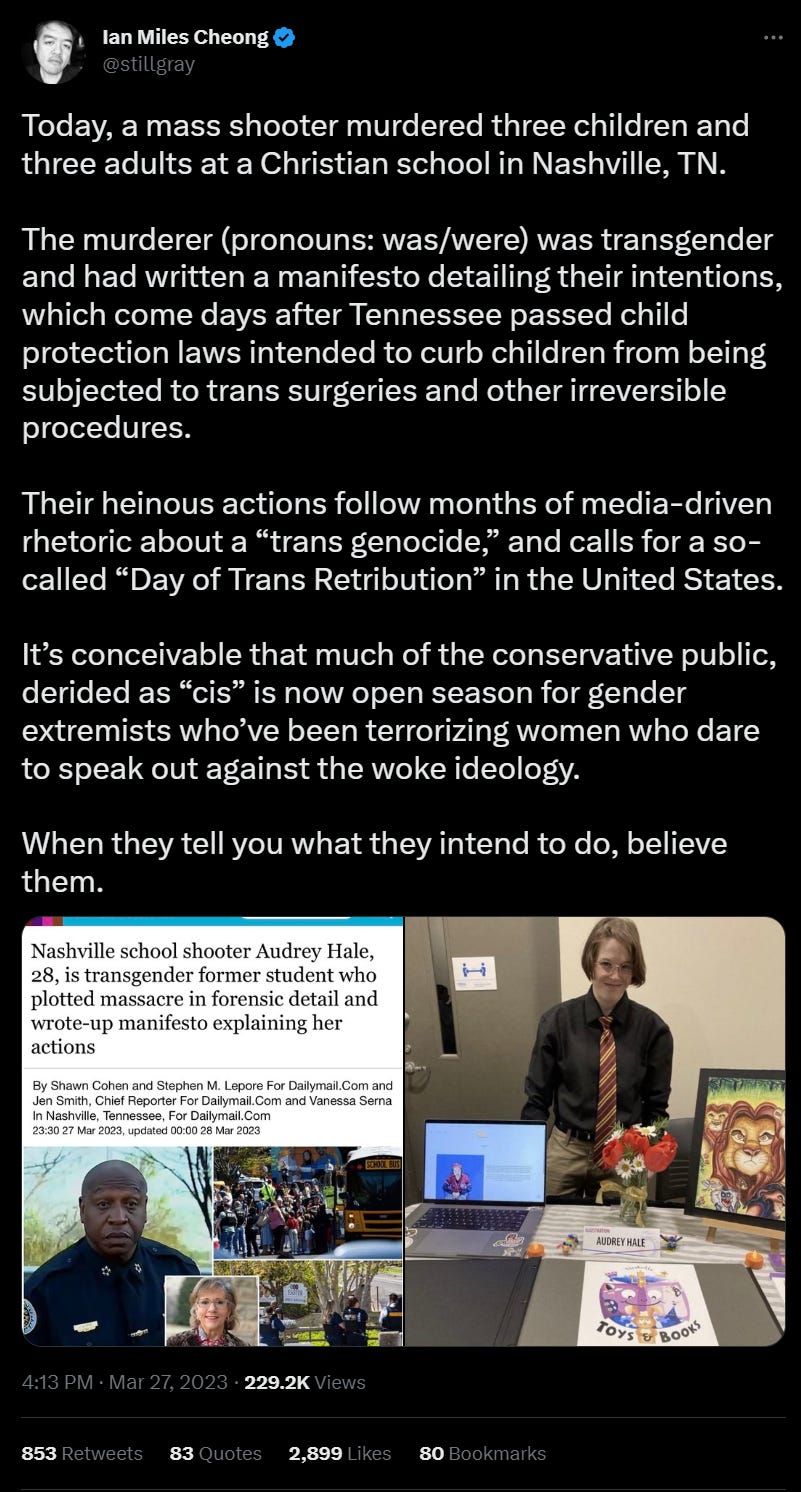
Ian Miles Cheong, a far right internet influencer from Malaysia, stoked fear with similar rhetoric about how “much of the conservative public” is “open season for gender extremists.” Without any evidence Cheong’s post also implied a link between the shooting and the recent anti-trans legislation passed in Tennessee, there is currently no evidence tying the shooting to legislative changes or a so-called “Day of Trans Retribution.”
The sheer speed with which this narrative locked into place is stunning, and underlines the importance they give this issue. It is disheartening and horrifying, but also too early to tell whether or not this will spread beyond their fetid corners of the Internet. Early indications from social media suggest liberal and moderate responses to this shooting have been quite different.
Throughout the day, the Highland Park shooting, in Colorado, the Uvalde shooting and the Columbine shooting all trended, as most people rightfully connected this to the increasingly vast history of American school shootings rather than trans people. What is evident so far suggests most people see through this attempt.
Thanks for reading Shatter Zone! Subscribe for free to receive new posts and support my work.
Sometime around late 2015, as the reality of Donald Trump’s candidacy began to sink in, a series of memes spread depicting Donald Trump as the God-Emperor from Games Workshop’s iconic game setting, Warhammer 40,000.
In the game, the God-Emperor is an ancient, undying superhuman and abusive father. The art above depicts him during his heyday, in a period prior to the game people usually play, when he was carrying out a galactic genocide Hitler would’ve called “extra”. In fact this portrait of him is set literal seconds before he was brutally mauled by his eldest son and left in a near-vegetative state. As things “currently” stand in-game, he’s hooked up to a city-sized ICU bed that has to be fed the souls of a thousand children every day in order to remain active.
Thanks for reading Shatter Zone! Subscribe for free to receive new posts and support my work.
It’s actually a decent allegory for the way power functions in society, the vibrancy of the young and poor used to sustain a sclerotic, largely unaware but all-consuming ruling elite. Art depicting the ‘modern-day’ emperor would function just as well if repurposed as anarchist political cartoons.
This piece of art is by the great John Blanche, perhaps the very best games illustrator alive today and an absolute icon in his field. For some reason, his work rarely shows up in the right-wing memes. It’s a shame. They’re missing some real bangers.
I spent hours staring at this exact picture in the late 1990s, desperately trying to figure out what in the game John was attempting to depict here. Decades later, I’d be struck by how well John’s work seems to capture the attitude of an ISIS fighter posing for a picture.
John’s work is almost psychedelic in its weirdness, it was an incredibly cool thing to set in front of a 12-year-old raised by Reagan Republicans. But I’m not surprised it loses out in the meme-wars to shit like that first picture of the Emperor, which in 2019 found its way to the head of an Italian carnival parade:
Good-hearted fans of the game often say that fascists who repurpose art idolizing the God-Emperor are ‘missing the point’. Warhammer’s roots are, as documented in this wonderful article (and this pretty good one), definitively leftist. One of the earliest Warhammer Fantasy supplements was an extended reference to the 1984-1985 miner’s strike. Orcs, described as “repulsive monsters who live to inflict pain”, initially fought under a banner depicting Margaret Thatcher.
Games Workshop was founded in 1975 by three guys who actually have relatively little to do with Warhammer itself. They were games nerds, and one of them left early on when it became clear that his partners were more interested in “progressive games” (stuff like Dungeons & Dragons and early computer RPGs) than backgammon. The company stayed afloat, and eventually thrived, when it won the official UK distribution rights to Dungeons & Dragons and Runequest.
Early GW shotgunned this first wave of nerd games out into Europe at a rapid pace, which helped fund fund a series of experimental wargames and role playing settings that eventually brought us Warhammer Fantasy Battles. This period, from the late 1970s through the mid-1980s, was the heyday for weird leftist politics in Games Workshop products.
Early Warhammer deserves credit for being progressive in a number of ways. While it did feature plenty of the same tired pop fantasy trends, it has also been noted for its prevalence of strong female characters. Zhu Bajiee, who has done the absolute best writing on this subject, notes:
“The text in Forces of Fantasy makes it explicit: “Dark Elf soldiery is as likely to be female as male; Elf maidens are as cruel and murderous as their menfolk.” This aspect of gender equality, in both text and image, radically subverts established conventions of the fantasy genre. While there are certainly examples of cheesecake or pin-up art, these tend to be non-warrior types such as magic-users. In the early Warhammer oeuvre, the transformation of the Dark Elf from sexy dominatrix to serious combatant is a departure that establishes a tone of equality in terms of representation and ability.”
There were anti-colonial themes in early Warhammer Fantasy supplements, and the heroes were more likely to be depicted as punks and vagrants than defenders of Empire. This is in keeping with the working class backgrounds of many early GW designers. Tony Ackland, who basically created GW’s Dark Elves, was raised by his mother who worked in the pottery industry. John Blanche, famed for his distaste of “pin-up” style drawings of female fantasy characters, was raised on a Council estate in the 1950s. He describes it as “grey and flat”, which helped inspire some of the setting’s most iconic art.
As the 80s churned along, Games Workshop lost the distribution rights to D&D, so they pivoted hard in favor of the weird little wargames that formed an increasing share of their profits. Warhammer 40,000: Rogue Trader was released in October of 1987. The game was initially a big glorious pastiche of every great work of contemporary sci-fi and fantasy. The Space Marines were heavily influenced by the novel Starship Troopers. There were bits of Star Wars, heavy chunks of Dune, and a dollop or two of Tolkien, all rounded out by (one presumes) piles of cocaine taller than Big Ben.
There were still bits and pieces of leftist imagery, but the female protagonists and extended labor metaphors faded away. The defining characters of Games Workshop games morphed from socialist Dwarf miners and Thatcherite Orcs to the now-iconic Space Marines.
(The Space Marines are the guys in the upper left, not the dude manning the mortar who was clearly based on Fidel Castro.)
In the ‘fluff’ (in-universe story) Space Marines are literal child-soldiers, taken from their families and surgically mutilated to become post-human warriors. In the more self-aware background fiction, they evoke both Ottoman Janissaries and the Children’s Crusade in equal measure. But most Warhammer fiction is not particularly self-aware, and over time the popularity of these models led to ‘fluff’ that was less tongue-and-cheek and more a celebration of how cool Space Marines were.
This change happened mostly from the late 1990s to the early 2000s. In Second Edition Warhammer, where I started playing, there were still hints of radicalism. This art, which was featured on the 40k rulebook, is probably the first piece of Warhammer art I ever saw:
It’s a clear visual reference to the British Empire’s most infamous propaganda art, depicting the disastrous battle of Isandlwana during the Zulu War:
The Space Marines are depicted as struggling, overwhelmed colonial soldiers, thrown into a hopeless slaughter by the careless machinations of their distant overlords. Compare that to this piece of Third Edition artwork, by John Blanche, from just a few years later:
Superficially, this is a very similar piece. But the Space Marines lack any sense of desperation or vulnerability. Much of the grit has been replaced by Cool Guys Posing With Guns. Of course, this is still a John Blanche piece, and it looks undeniably good. But as the years went by, more and more Games Workshop art left the grit behind in favor of stuff like this:
And this…
Warhammer 40,000 is still, at some level, a chilling depiction of a galactic fascist regime, propped up by mutilated child soldiers who enforce a racial supremacist hierarchy via genocide. But it’s easy to miss that in favor of celebrating how badass your favorite Chapter or warrior happens to appear. This brings us back to the memes.
There’s, unfortunately, an awful lot going on here. The quote above the image is from Julius Evola, a fascist mystic who found Mussolini’s politics “too compromising” and eventually took a job working as a spy for the Nazis. After the war he became a deeply influential right-wing occult guru whose work pops up whenever weird groups of Nazis gather to plan terrorist attacks.
In the actual meme, the guys on the bottom are demons of the Chaos gods. To these right wing weirdos they represent degeneracy. The concept for Chaos in Warhammer 40k is basically stolen wholesale from the work of Michael Moorcock. His Chaos gods were neither good nor evil, and in fact they often wound up fighting against the most toxic aspects of the gods who represent Law. Moorcock’s fiction is heavily anarchist, and the Chaos symbol he created can be found on many works of anarchist political theory today.
Today, depiction of Chaos in Warhammer fiction varies widely. Games Workshop is generally smart enough to give their fiction writers a pretty loose hand. If you read novels from their publishing arm, Black Library, you’re as likely to come across hard-nosed military sci-fi about the brutal human cost of war and the staggering incompetence of Imperial Bureaucracy as you are books about how cool it is when a huge guy hits people with his giant metal hand.
Depictions of Chaos, however, rarely have much subtlety to them. The very best you’re likely to get is competent works of cosmic horror. There are some pretty cool stories to tell with Games Workshop’s Chaos, who feed off of human emotions and gradually warp reality around themselves, slowly consuming the galaxy.
Agents of Chaos tend to spread their taint by leading uprisings against Imperial power, often powered by real injustices perpetrated by corrupt Imperial governors. The fact that these dissidents are inevitably doomed by their flirtation with Chaos plays into the hands of weird fascists who see it as an allegory for their revolt against Satanic Marxists. Art like this doesn’t exactly help.
Of course, the fluff is rather more muddled then that. The Emperor himself, back before he wound up in that ICU bed, was on a quest to eradicate the concept of religion from the human soul. This was part of his plan to starve the Chaos gods and save the galaxy for homo sapiens. Everything he did, the child soldiers and interstellar genocide, was to advance this end.
It failed disastrously, of course, and there are several dozen books you can read if you’d like to know more. But the consistent depiction of Chaos as The Worst Thing Ever has led a lot of otherwise well-meaning fans to wonder if the Emperor wasn’t right all along.
I find this interesting, because the bulk of Games Workshop’s fiction depicts the Emperor as an abusive father and a superpowered fascist psychopath, whose arrogance doomed himself and humanity to ten thousand years of the worst government imaginable. Every single book published in the Warhammer 40,000 universe starts with these words.
Over the decades, and all the many changes Warhammer 40,000 has seen, one thing has remained consistent. The Imperium of Man is “the cruelest and most bloody regime imaginable”. The only end result of fascism is suffering and failure, no matter how many cool chainsaw swords come with it.
Thanks for reading Shatter Zone! Subscribe for free to receive new posts and support my work.
Most of my writing career has focused on conflict, terrorism, and collapse. There’s more of all that than ever going on, yet instead of writing about fascist violence or the encircling authoritarian billionaire class, I’m here today to tell you about Tucker.
No, not Tucker Carlson. This Tucker is a TV show from way back in the year 2000. It was produced by NBC, and aired on that network in the U.S. and in Nickelodeon in Ireland and the U.K. The show comes up on Twitter now and again because actor Seth Green plays himself, as a pedophile, in the series. But before we get into that, let’s have some context.
Thanks for reading Shatter Zone! Subscribe for free to receive new posts and support my work.
Americans are famously bad at talking about class. Most of our shared cultural myths exist to dispel the idea that there are any sort of meaningful class divides in this country. If anyone can get rich with just a little hard work, then the wealthy and the poor aren’t really separated by anything but a little elbow grease. Most popular entertainment in this country more-or-less backs the myth of the American dream, and up until the late 1980s you’d be hard-pressed to find anything on TV that seriously refuted it.
Then came The Simpsons, in 1989, after eight years of Reaganomics and the utter electoral defeat of the American left under Carter. Today the show is something of a Zombie. It plays to the worst instincts of upper-middle-class liberal Harvard types and hasn’t delivered anything genuinely subversive in decades. But when it first came out, The Simpsons was the only prime-time show to focus on the struggles of lower middle-class people who had no hope of ever being anything else.
The family struggles constantly with money, and Homer’s every attempt to improve his situation is stymied by his own incompetence and the corrupt and venal elites above him. This is a world where the police are inherently dishonest, the rich are pure parasites, and the public school teachers drink themselves to sleep at night. It was a great show.
But by the end of the 90s, the Simpsons was passing its prime and headed into the long darkness that brought us moments like the infamous Elon Musk episode. Lisa, who once organized a union strike at the nuclear power plant, calls him “possibly the greatest living inventor”. It’s rough.
The good news is that a whole generation of writers were raised on the old, good Simpsons episodes. And as the new millennium dawned, a new sitcom launched that would catalogue the travails of America’s working poor: Malcolm in the Middle. It’s since been heralded by some as a “socialist masterpiece”, and like the Simpsons it never pretended that poverty was a trap with any hope of escape.
Malcolm in the Middle was also a genuine hit. It won seven Emmys and averaged 15 million viewers per episode when it launched on Fox in January of 2000.
Now, Hollywood being Hollywood, the success of Malcolm meant that imitators were soon to follow. The worse of these was Tucker, which premiered in October of 2000. Everything about the show, from the musical stings to the choice of male lead, smacked of cheap rip-off.
The titular Tucker was a 14-year-old whose parents had just divorced. His mom, a former home-maker, was forced to move in with her sister’s family and take a job waitressing to survive. There are brief stabs at class consciousness here, but the show quickly gets derailed by the most deluded romantic subplot of all time.
Like most sitcoms, Tucker launched with a “will they, won’t they” romance between its male lead, Tucker, and the literal girl-next-door, McKenna. This is all well-and-good, McKenna is 14 and they go to the same school, so nothing weird there. But McKenna also has a boyfriend. That’s pretty par for the course too, but instead of dating some other teenager, 14-year-old McKenna is in a committed relationship with 26-year-old Seth Green.
I want to be very clear about this: Seth Green is not a 26-year-old man playing a high school kid, which would be weird but hardly uncommon. In this show he plays himself, Seth Green the actor. He references his performance as Dr. Evil’s son in his first episode on the series (ep2, “Seth Green with Envy”). Seth Green plays himself as a mature adult dating a 14-year-old girl.
(The actress who played McKenna was 21 at the time, so at least there’s that.)
This is a premise that could work if Tucker were a legitimate piece of satire. In the theoretical good version of this show, Tucker and his mom would still be down-on-their-luck after a divorce. They’d still move in with his sister, let’s say she works some mid-level job for a big Hollywood talent agency. Tucker falls in love with his neighbor, a 14-year-old child actress, and then finds out she’s being pursued by a semi-famous actor. He’s torn between the desire to say something and the fact that her career, and his aunt’s career, will be over if he does.
The list of famous actors and musicians who have sexually pursued children is long indeed. Charlie Chaplin “seduced” his first wife when she was 15. David Bowie and Jimmy Page both slept with the same 14-year-old girl when they were in their mid-20s. Corey Feldman and Corey Haim were both molested by prominent Hollywood insiders when they were child actors. A show that stared headlong at Hollywood’s complicity in pedophilia and the dark moral compromises made by adults protecting their careers would have been ground-breaking.
That is not the path the writers and producers of Tucker chose to take. I’m going to type out the dialogue from Seth Green’s first scene, in episode 2. In this scene Tucker has just snuck into McKenna’s room to deliver a thank-you note when he encounters Seth. The two have this conversation (which you can also watch on YouTube below):
TUCKER: You’re Seth Green!
SETH: Yeah.
TUCKER: The movie star!
SETH: Well, y’know, character actor.
The two chat briefly, Seth invites Tucker backstage at an upcoming concert, and then they get to the crux of the matter:
TUCKER: Seth, don’t you think you’re a little old for McKenna?
SETH: I’ve certainly had that discussion with McKenna’s mom many times.
TUCKER: Oh yeah?
SETH: Yeah, and she thinks I’m so silly every time I bring it up. See she insists that biological age is meaningless, that maturity and compatibility are all that matter, and she’s right of course. But I have to stand firm on my no premarital sex policy. McKenna’s really chomping at the bit on that one!
TUCKER: *moans in agony*
SETH: I figure an 18th birthday-slash-wedding should satisfy everyone.
And that’s it! The scene ends! In the very next scene, Tucker refers to Seth as the nicest guy he’s ever met. I cannot overemphasize how much Seth Green’s character is not portrayed as creepy or bad for this. In one episode Seth and McKenna break up and Tucker decides the right thing to do is to help them get back together.
Watching this show makes me feel insane, like I’ve stumbled into an alternate dimension where everyone is fine with adult men dating girls who are barely out of middle school. And in a way, I guess I have, and that dimension was apparently “the year 2000”. While Tucker only got one season on NBC, the show was sold to Nickelodeon who broadcast it for years in Ireland and the U.K. It was quite popular.
The surreality of watching Tucker is compounded by the presence of some of the most memorable voices of my childhood. There’s Seth Green, of course. But one of the female leads, Tucker’s aunt, is played by Katy Sagal, the voice of Leela from Futurama. Tucker is played by Eli Marienthal, the voice of Hogarth Hughes from The Iron Giant!
Perhaps the most bizarre thing about this show is how little of an impact it’s had on pop culture. I entirely missed its run on air, and only heard about it through occasional semi-viral Twitter posts about how fucking weird it was. If you google the show, most of your search results will be about Tucker Carlson. If you search for “Seth Green” and “pedophile show”, you’ll get a bunch of weird results about the adult male actor who accused Green of pedophilia before committing suicide.
And I guess there isn’t really much to say about Tucker, other than it’s fucking crazy that some TV weirdos started with a premise of ripping off Malcolm in the Middle and wound up having Seth Green deliver an earnest monologue about romantically pursuing a child.
Thanks for reading Shatter Zone! Subscribe for free to receive new posts and support my work.
Those of you who are regular listeners of the show will know that I got kinda obsessed with the epic saga of Sam Bankman-Fried and FTX, the massive crypto exchange that just collapsed and nuked like, $30 billion of funny money and probably like $8 billion real dollars.
As soon as the company collapsed stories started to filter out about FTX’s sister company, Alameda Research, which apparently gambled away the client funds that went missing in a manner likely to result in prison time for several people. The financial press seemed particularly fascinated by Caroline Ellison, the 28-year-old CEO of the company, on-again-off-again polyamorous lover of Sam Bankman-Fried, and Harry Potter devotee.
Thanks for reading Shatter Zone! Subscribe for free to receive new posts and support my work.
I’m not particularly interested in finance or the nitty gritty of Crypto, but I am endlessly entertained by the way the mainstream press rode the dicks of the people who ran FTX and Alameda. The short of it is that FTX and Alameda were big gambling platforms, in which nerds in their late 20s with delusions of grandeur bet on what are called “shitcoins” while giving interviews about effective altruism and claiming that all of this was being done in the service of charity.
The way the tech press fell for this is fascinating, but today we’re going to look at some of the ideology that helped inspire the greatest disaster in crypto history. And to tell that story, we need to look back at Caroline Ellison, and her obsession with Harry Potter.
I think the first reporting on this I saw was from the totally legit reporting platform “efinancialcareers.com”, which simply noted:
“Before joining Alameda as a trader in March 2018, Ellison spent 19 months as a junior trader at Jane Street after graduating from Stanford University with a bachelor's degree in mathematics in 2016. In a podcast two years ago, Ellison explained that Jane Street was her first job out of college. A diehard mathematician and Harry Potter fan born of two economists, Ellison she hadn't wanted to go into trading but "just didn't really know what to do" with her life.”
A Forbes article, published November 18th, provided more information, claiming Ellison was a “Harry Potterhead”, and that her parents first started reading the books to her when she was three years old.
But if Caroline were just obsessed with the normal Harry Potter series, I would not be writing about it.
Her old Tumblr existed under the name “WorldOptimisation”. Gawker revealed this for an article in which they also noted she was heavily into fan fiction. Several folks on Twitter pointed out that the phrase “World Optimisation” has its origin in another piece of fan-fiction, an epic re-write of the first Harry Potter book called Harry Potter and the Methods of Rationality.
If you are a normal, decent, well-socialized human being, you probably have not heard about Harry Potter and the Methods of Rationality. Actually explaining what this thing is will have to happen in several different stages. But I should start by telling you this re-write of the first Harry Potter book is around 660,000 words long.
The entire Lord of the Rings series, including The Hobbit, comes in at a little less than 580,000 words.
About ten years ago, when the first chapters of Rationalist Harry Potter were posted by a guy name Eliezer Yudkowsky, it was quickly heralded by a weird number of mainstream media figures as a work of brilliance. Legal scholar William Baude, writing for the Washington Post, called it "one of my favorite books written this millennium" in 2015. In 2021, Joe Biden appointed him to the Presidential Commission on the Supreme Court.
Ben Wikler, Chair of the Wisconsin Democratic Party, called Rationalist Harry Potter "the #1 fan fiction series of all time," in The Guardian. David Whelan, writing for Vice, called it “curiously mind-altering” and we’re going to come back to that Vice article in a second because it is very silly. All these guys are very silly.
(William Baude (left) and Ben Wikler (right), two normal dudes who wrote articles about a 600,000 word Harry Potter fanfic and went on to high-powered jobs in the Democratic establishment. This is very funny, as is the fact that Will’s Wikipedia picture seems to have been screencapped during a Skype call while Ben got the best head-shot J.C. Penney could provide.)
First: what is Rationalist Harry Potter about? The story itself is an alternate version of Harry Potter history, where Aunt Petunia’s sister receives the magic equivalent of elective surgery (via her sister Lily) which makes her hot, so she marries an Oxford professor instead of Vernon Dursley. Lily and James still get murdered by Voldemort, so Hot-Petunia and Oxford guy raise Harry, who is also a supergenius in this story.
When Rational Harry Potter he gets his invitation to Hogwarts and learns that magic is real he decides to apply the scientific method to understanding and manipulating the arcane arts. That’s actually not a bad premise for a fan-fiction, or even a work of original satire inspired by the Harry Potter series. Let me assure you that Eliezer Yudkowsky does nothing cool with this idea beyond introducing it.
In a broader sense, the “story” of Rational Harry Potter has very little to do with what the book is about: Rationalism.
Rationalism is a school of thought dedicated to encouraging people to act more rationally, using reason instead of subjective experience to navigate the world. “But Robert,” I hear you cry, “people’s opinions about what the ‘rational’ choice is in different situations can vary wildly, and the scientific method simply doesn’t apply to many of the most important decisions human beings have to make in life.”
Yes, that’s true, but in another, more important way, it’s false, because the world’s sole arbiter of Rationality is Eliezer Yudkowsky, a man who spent five years writing a Harry Potter fanfic so long the audiobook for it clocks in at 500 hours.
In interviews, Eliezer has claimed Rational Harry Potter was written to push the rational skills he promoted in his online community, LessWrong. LessWrong is now sorta defunct, but at its height it was basically a weird little online cult dedicated to Yudkowsky’s teachings. We’ll talk about him more in a bit, but Rational Harry Potter was basically conceived as an advertisement for LessWrong and it worked spectacularly well in that task.
Reading Rational Harry Potter is supposed to equip you with skills to act less irrationally and gain the kind of super-powers the bad sort of psych nerds think you get from reading enough neuroscience abstracts. Here’s how David Whelan explained it in that Vice article I promised we’d return to:
“All those times in the original where Harry grieved over his dead parents or said precisely the wrong thing to Cho Chang to get in her pants, turns out he was acting irrationally.
This new Potter, though, doesn't. He's basically the Jesus Christ of Rational Thought. He owns this book. He hits Voldemort out of the fucking park with a bunt while scratching his ass with his foot. And—here's the kicker—if you start copying him—that is, making rational decisions that overcome cognitive biases—you, too, can make life your bitch.”
First off, none of this is actually true. While Eliezer’s Harry Potter is obsessed with rationalist thought experiments and Bayes’s Theorem, he very rarely solves any problems via logic and intelligence. Instead he gets a time-turner (Harry Potter time machine) right away and then uses time travel to solve nearly all of his problems. I have read roughly 100,000 words of this stupid thing, along with a chapter-by-chapter review by an actual scientist. If you’re the kind of person who learns useful life lessons from Rational Harry Potter, you’re probably multi-billion dollar fraudster Caroline Ellison.
Speaking of which, remember when I said her Tumblr name “WorldOptimization”, was a reference to Rational Harry Potter? It comes from this line, spoken Eliezer’s 11-year-old protagonist:
"World domination is such an ugly phrase. I prefer to call it world optimization."
Rational Harry Potter spends a mind-numbing portion of the book’s total length discussing his desire to take over the world once his rationalist skills allow him to hack magic. He is not depicted as being a bad guy for wanting this.
World domination is a background theme that runs through the whole online rationalist community. In February of 2021 Caroline Ellison posted a list of “cute boy things” that, not by coincidence, describes the protagonist of Yudkowsky’s fanfic perfectly:
There’s a lot more here because the story of Rational Harry Potter, and the community around it, eventually ties into Peter Thiel, Elon Musk, and some of the worst science-fiction I’ve ever read in my life. And if you want to learn more about all that, I’ll be going into much more depth on it with Margaret Killjoy, in an upcoming live episode of Behind the Bastards.
You can buy a ticket now! The show is December 8th, at 6PM PST, and will also conclude a live Q&A afterwards! If you can’t make that time, you can still buy a ticket and watch the replay for whole week. So if you found this article interesting, or you just like Behind the Bastards and think seeing my face during an episode would be neat for some reason, book today!
Thanks for reading Shatter Zone! Subscribe for free to receive new posts and support my work.
Back in September of 2014, as the alt-right began to bubble up from the cracks left by Gamergate, Peter Thiel published an article in Wired magazine. It was titled, “You Should Run Your Startup Like a Cult. Here’s How.” The article that followed was, mostly, quite milquetoast, a few thousand words on motivating tech workers excerpted from Peter’s recent book, ‘Zero to One’. There are however some noteworthy lines, like this one:
“In the most intense kind of organization, members abandon the outside world and hang out only with other members. We have a word for such organizations: cults. Cultures of total dedication look crazy from the outside. But entrepreneurs should take cultures of extreme dedication seriously.”
Thanks for reading Shatter Zone! Subscribe for free to receive new posts and support my work.
Peter goes on to express his distaste for companies like Accenture, a consulting firm with a rapid turnover of employees who have “no long-term connection” to each other whatsoever. He then provides this…interesting graph:
It’s probably worth noting here that ‘Zero to One’ was co-written by Blake Masters, who this year ran for one of Arizona’s Senate seats backed by a pile of Thiel-bucks. He starred in a famously off-putting ad in which he fired a suppressed pistol into the water after repeatedly fawning about the fact that the firearm was made in Germany. Masters lost badly (by around 5%) to Mark Kelly, an actual astronaut.
Masters blamed gun violence on “black people, frankly” and expressed a belief that gay marriage should be banned (he attended his own boss, Peter’s, wedding). The fact that Thiel thought this serial-killer-ass-looking dude:
…could win an election, might suggest that he wasn’t entirely off base when he compared the working environment at his companies to a cult. You have to be living in a very specific reality tunnel, one far detached from your fellow man, to think Blake Masters was ever a good candidate. If Thiel is, in fact, a cult leader, this kind of detachment makes sense. A defining characteristic of cult leaders is that they all wind up floating in their own alternate reality.
There is one more line in that article I find interesting:
“The best startups might be considered slightly less extreme kinds of cults. The biggest difference is that cults tend to be fanatically wrong about something important. People at a successful startup are fanatically right about something those outside it have missed.”
Peter Thiel is, of course, an avowed monarchist who spends oodles of cash bankrolling fascist causes. It would be foolish to assume this article expressed 100% of his honest feelings. But that paragraph above is interesting to me because it is basically never true. I want you to think through the great tech enterprises of our day and tell me how many fit that description.
When I look at the annals of successful tech unicorns, I don’t often see people who were “right” about something “those outside” missed. Instead, I see people who succeeded in building little cults around their products in the tech press, and out of their customers. When Google blew up, it’s not because they were “right” about the need for a search engine, something the rest of the world ignored. It’s because they were the first to do a good job of building something everyone knew was necessary. The ‘Don’t Be Evil’ stuff, the legendary perks and corporate culture (anyone remember ‘The Internship?’) that all came later, grafted onto the scaffolding of a bafflingly useful tool.
Speaking of tools!
You can see variations of the same story with Microsoft, with Apple, with Mozilla and Facebook and so on. This started to become much less true in the oughts, as the overnight start-up sensations became companies like Uber, Theranos, various Crypto scams or one of those services that littered downtown city streets with hundreds of rentable scooters. For these companies, the central service was either an outright con, or fundamentally unprofitable.
Everyone inside Uber knew they were running against the clock on whether or not they could get self-driving cars to work before the VC funding ran out. They were not, by and large, deluded about the reality of what it would actually take to make the company profitable. What mattered wasn’t so much whether or not they could get the tech to work, it was whether they could keep people convinced they could long enough to cash out.
‘Keep the con going long enough to cash out’ is the central operating tenet of Silicon Valley, and the best way to do that is to build a cult, a closed information loop that creates a separate reality tunnel so the people shoveling cash at the project never guess that failure is possible. Every collapsed Crypto exchange and shitcoin is a variation of this story.
But cults need cult leaders. And that’s where the billionaires come in.
Tesla brought Elon Musk the bulk of his fortune, and though the company was founded on the back of some very cool technology, it became a household name off the back of Elon Musk’s fame. It didn’t matter that Tesla, the company, only achieved profitability by selling carbon credits, a form of climate indulgence, to other car companies. Musk was going to save the world, or at least take us to Mars.
Elon Musk was a good enough confidence man that Tesla stock wound up overvalued by around $1 trillion. But along the way he made the calamitous mistake of believing in his own bullshit. Friends and business partners who knew him in more rational days will point out that he’s become surrounded by yes-men and sycophants, as his wealth has allowed him to gradually elide the discomfort of ever being challenged.
A version of this happens to every person who makes enough money. Wealth and power can impact the brain in ways that mirror brain damage, causing a loss of impulse control and compassion for other people. And that’s just the case for folks who wind up normal-ass rich, without millions of weirdos worshipping them as the techno-messiah.
The evidence is all there. Think of the time, in 2018, he tweeted himself into a $40 million dollar settlement with the SEC just so he could make a “420” joke. Or the time he grew so enraged that he couldn’t make himself the center of a story about a bunch of starving children stuck in a cave that he accused one of the rescuers of pedophilia. These are the actions of a man who has grown enraptured by the myth of his own importance.
When I read stories now, of Twitter employees shitcanned for criticizing Elon in private slack chats, I can’t help but think of L. Ron Hubbard living on the high seas in a fleet of cruise ships with his most dedicated followers. Whenever someone would ‘fail’ him, he’d have his other followers fling them over the side of the boat and into the ocean.
As I was writing this essay, a tweet from the ‘Whole Mars Catalog’ (a major Tesla stan) hit my timeline:
I finished Season 2 of The Vow recently, and it struck me that there’s at least a little Keith Raniere in Elon. The need for his followers to prove their devotion to the ‘smartest man on earth’ by taking on incredible risk is, at least, similar.
It’s possible that the cult of Elon Musk has been irreparably damaged by his acquisition of Twitter. The naked preference he’s showed members of the far-right, including unrepentant fascists and anti-Semites, has turned off a lot of former casual believers. Every cult leader has a point at which they fall too far into the reality tunnel they’ve carved for their cultists.. What happens after this point varies (L. Ron Hubbard disappeared to write incomprehensible books in the desert, Keith Raniere went to prison, etc) but there is always a moment of collapse.
This brings me to the story of perhaps the greatest billionaire cult leader in history: Steve Jobs. The co-founder of Apple had an enviable library of successes. His company invented the personal computer, and when he was eventually forced out as CEO, he helped found Pixar, then came back to Apple and presided over the release of the iPod, iPhone and iPad. All of these devices were built by other men, of course, but Jobs made them part of his vision of our future.
In books about Apple, a term you’ll here again and again is “reality distortion field”. Because I’m a lazy man, I’ll refer you to Wikipedia here:
This is interesting to me in part because Steve Jobs is still the most successful example of the “visionary tech founder” archetype. His ability to distort reality, manipulate geniuses like Wozniak, and convince investors and shareholders to believe in his vision of the future remains unequaled.
Steve, in the years where he was most powerful, had much more self-control and discipline than Elon Musk. He ran a famously tight shop. Leaks from Apple were rare, and he communicated with the public almost exclusively through speeches more choreographed than a musical from the 1950s. Yet Steve, too, fell victim to his reality distortion field.
In 2003, during a CT scan to check for kidney stones, doctors saw a “shadow” on Steve’s pancreas. Further tests showed that it was cancerous. The good news was that the specific kind of pancreatic cancer he had was rare, and treatable. Given that he could afford the very best doctors on earth, his prognosis was good (at least, ‘good’ for pancreatic cancer).
But Steve refused surgery. For nine months he resorted to his own concocted list of radical dietary changes and alternative medical treatments. He told his biographer, Walter Isaacson: “I didn’t want my body to be opened…I didn’t want to be violated in that way.”
The people who loved Jobs attempted to puncture his reality tunnel during this period, and convince him to treat his cancer. But he would not listen. As Walter Isaacson, later told CBS:
"I think that he kind of felt that if you ignore something, if you don't want something to exist, you can have magical thinking. And it had worked for him in the past.”
It remains a central tenet of my own personal belief system that there is no such thing as a genius. Tests that seek to show intelligence rarely show more than the skill at solve a particular kind of puzzle. But the grand mythology of the tech industry is built around a fantasy of hyper-competent, Randian gods and goddesses, holding up candles to light the way for us poor, blinkered fools stuck in the dark.
The reality is that billionaires are fools as often as the rest of us; nearly 100% of the time. A man like Elon Musk can throw away fortunes to fuel his ego, but eventually his flights of fantasy will lead him out into open sky, with no ground beneath him. Gravity will do the rest.
Thanks for reading Shatter Zone! Subscribe for free to receive new posts and support my work.
Once upon a time I lived in a trailer in the Sierras, far northern California, about forty miles east of Jesus. It was beautiful, rugged country, but it was not a nice place, not a place people visit casually. I lived there because I was writing a thing, and because someone I cared about was stuck there and needed support.
When you live in a place like that you deal with people differently than you do in more settled places. At one point the person I lived with had a conflict with someone nearby. She was worried this person might be considering doing her a specific sort of harm. It was decided that I should invite this person out to go shoot guns. We had a pleasant, cordial time together, and also communicated that we were both armed and knew how to shoot. Things improved between us after this point.
Thanks for reading Shatter Zone! Subscribe for free to receive new posts and support my work.
Another time, a few years before this, I was bumming around rural Guatemala. I wound up renting one of several bungalows that was owned by one of Guatemala’s many weirdo expats. The place had a security guard, a local guy, and we grew friendly with each other. Sometimes we got drunk together. One night he showed us his 9mm handgun, which he fired off into the air once or twice a month, “So bandits know we have a gun here.”
Neither of these stories represent ideal social interactions. I do not believe, as some libertarians insist, that an armed society is a polite one. Any person with basic observational skills will tell you that the presence of weapons often increases the odds that those weapons will be used. But I also don’t consider my actions in California, or my friend the security guard’s actions, to have been irrational. We were in places where the law didn’t reach, and we took the actions that seemed most likely to improve our security.
I feel deeply conflicted, and anxious, every time I advocate for people to acquire and train with firearms.
I’m sure this sounds weird to those of the folks who see me on Twitter. I post about guns often. I like to shoot. And I also like to shitpost about my hobbies. But there is a difference between laughing about poorly made firearms (see; Taurus) and telling members of vulnerable communities that they should consider arming themselves for self-defense.
Way back in 2019, for the first season of It Could Happen Here, I talked about what I saw as the likely future necessity for leftist armed self-defense. The podcast wound up striking a nerve, and since then several thousand people have talked to me, in person and online, about the things it inspired them to do. I’m always happy to hear about folks who started mutual aid projects, got street medic training, founded food banks, etc. That stuff makes me feel like less of a shithead than I am.
But people also come up, pretty regularly, and tell me the show made them decide to buy a gun. Often, they’ve also started training with like-minded folks in their area. That scares the hell out of me.
I’m also fairly convinced it’s necessary.
I am writing this article the day after a horrific mass shooting at a prominent queer club and LGBT community space in Colorado Springs, Colorado. The shooter was the grandson of a January 6th insurrectionist and prominent California Republican leader. He had previously made bomb threats that ended in a police stand-off and multiple felony charges, which were dropped by the DA. His massacre was stopped, not by police, but by members of the community.
The Buffalo shooter, from earlier this year, was also a known quantity to law enforcement. There are so many stories like this, violent men who spend years advocating harm against different communities while the law looks the other way. Almost exactly a year ago, in December of 2021, another fascist gunman in Colorado murdered five people. He’d previously written books, popular with a chunk of the far right, in which he threatened a massacre that exactly matched the one he carried out.
The victims of these attacks all lived, and died, outside the law’s protection. The police in Colorado Springs have spent the last several years surveilling marches for racial justice and protests supporting reproductive rights. Their primary role in this mass shooting was to ensure the killer stayed safe and free long enough to open fire.
Anyone paying attention knows this specific shooting was incited by (among others) the Libs of TikTok Twitter account, which is operated by Chaya Raichik. She has spent months demonizing drag and other queer community events. She made posts attacking the queer community in Colorado Springs just hours after the attack. Chaya lives within the circle of the law’s protection. If she is ever threatened, law enforcement will act.
Her intended victims have no protectors but themselves.
Thanks for reading Shatter Zone! Subscribe for free to receive new posts and support my work.
On the week of Monday, November 14th, 2022, in between a fire-hose of articles about Elon Musk’s mismanagement and mass firings at Twitter, a young woman posted a photo of some chili. She’d decided to cook it for her neighbors, young men who- she noticed by their trash- seemed to mostly eat fast food. It was the sort of neighborly gesture that is all-too-rare nowadays, and the young men seem to have appreciated it.
But on Twitter.com, a website that has for more than a decade been a worldwide nexus for news and information, the posts set off a firestorm. For reasons that are impossible to explain unless your brain has been permanently damaged by posting, this woman has, over the years, developed a small army of haters. Earlier this year a number of them spent months threatening to murder her pet pig. They decided this chili was an act of white supremacy, and potentially a violation of unclear pandemic protocols.
Thanks for reading Shatter Zone! Subscribe for free to receive new posts and support my work.
It was all nonsense, but for a few days tens of thousands of people marveled at the insanity of it all, as we’ve often done before. This time, our confusion mingled with a tinge of sadness. On Friday, November 17th, responding to an ultimatum by CEO Elon Musk, most of Twitter’s staff quit en masse. As I write this, the site is crumbling like the walls of Jericho.
I think it is likely that the people declaring Twitter on the verge of irreversible death are slightly hysteric, as is the custom online. Even so the prognosis is not good. And if all we were losing was the ability to torture the world’s wealthiest man and unhinged, chili-related discourse, that would not be such a tragedy.
Also on Friday, November 17th, a video began to circulate on Twitter of protesters, in the Islamic Republic, lighting the former house of Ayatollah Khomeini on fire. If this link still works when and where you are, I recommend watching it. The sound of the crowd cheering as the firebombs detonate and catch is intoxicating.
Hearing it brought me back to the heady days of Summer, 2020, when millions of us witnessed the first stages of an uprising against U.S. police in similar clips of blessed anarchy. The largest protests in our nation’s history followed, and a wannabe dictator lost re-election shortly thereafter. Twitter didn’t make all of that happened, but for many thousands of people who fought and cried and felt triumph in the streets, the 2020 uprising started when some tweet splashed across their timeline.
Rebellion has spread this way since, at least, the Arab Spring of 2011. At the moment there is simply nothing else on the open Internet that can do this as well as Twitter currently does. Perhaps this is a good thing. Most of the insurrections and revolutions that got their first oxygen from the bird app failed, often at the cost of catastrophic violence. Twitter was always good at making people care about things, if not much beyond that.
Should it perish, I’m sure it’s key features will be fulfilled by something else in time. A new app will take Twitter’s role at spreading the word when disasters strike. Dissidents will find new ways to share information about their struggles. Marginalized communities will build new methods of raising money and sharing knowledge. There will be a disruption, and a good number of people will suffer, even die. This is the unavoidable consequence of letting the world’s richest man make a key piece of global communications infrastructure his personal property.
There is, then, perhaps some beauty in the fact that one of the last actions people took, collectively on Twitter was another insurrection. This one was directed at the man who would be its King. Perhaps it will fail too, Elon will cling to power and, bit by bit, claw back functional control. If he does though, he won’t own Twitter, not really. The website that comes out the other end of that process will not be the one he spent $44 billion to buy.
All of this is getting beyond the thing I really wanted to say which is why I loved Twitter in spite of myself.
On October 31st, 2022, when this whole process was still new, Elon tweeted his first vague plans to make people pay for verification. His pitch was $20 a month, a ridiculous sum, and author Stephen King told him it was stupid, tweeting:
“$20 a month to keep my blue check? Fuck that, they should pay me. If that gets instituted, I’m gone like Enron.”
The reason Stephen was so angry is sensible, when you think about it. He has nearly 7 million followers and tweets pretty regularly. Massive accounts like his aren’t Twitter’s customers, they are the business itself. But no matter. Musk responded, pitifully:
“We need to pay the bills somehow! Twitter cannot rely entirely on advertisers. How about $8?”
Now the first comments are what you’d expect, a mix of anti-Musk lib types laughing at his bad business sense and mocking the idea of making Twitter’s most valuable users pay for the site. You’ve got your Musk defenders insisting the ‘blue checks’ are some sort of out-of-touch elite, one of my favorite deranged bits of right-wing online culture.
But then, a few comments down, there’s a post from a Zimbabwean journalist, named Hopewell Chin’ono:
For a lot of journalists in Africa, verification has helped us to not fall victim to State tactics to use our names to spread propaganda. I have been to jail 3 times inside 6 months for exposing corruption. Few African journalists will afford the US$20.”
Attached to the tweet were images from two Guardian articles about Hopewell. I’m going to quote from one now:
“Chin‘ono posted on his Twitter account that police had taken him from his house and said they were charging him with “communicating falsehoods”.
The arrest comes after Chin‘ono tweeted that police had beaten an infant to death while enforcing Covid-19 lockdown rules this week. Police later said the information was false.
Before the latest arrest, Chin‘ono was out on bail on separate charges of inciting violence after he voiced support for an anti-government protest in July and also on contempt of court charges for allegedly claiming corruption within the country’s national prosecution agency.
Chin‘ono is one of Zimbabwe’s most prominent critics of president Emmerson Mnangagwa’s administration, accusing it of corruption and human rights abuses. The government denies the charges.”
Hopewell is a Harvard fellow and an award-winning journalist who I was not aware of prior to this tweet. He is an extremely courageous man, whose reporting on corruption within the Zimbabwean government recently led to the sacking of the corrupt health minister. I would not have heard of this man without Twitter. And if Twitter weren’t the site that it is, he never would have had a chance to make his concerns public anywhere close to the CEO of Twitter.
I’ve wasted far, far too much of my life and time shitposting on Twitter. But moments like these, when I find myself connected to the life and struggle of a stranger I never would’ve met otherwise, it’s all worth it. Twitter is/was a stupid, cruel place, where people regularly convinced each other to become worse versions of themselves. But for years now it has also been the best way to connect, often accidentally, to the courage of strangers.
I’ll miss it.
Thanks for reading Shatter Zone! Subscribe for free to receive new posts and support my work.

 Login
Login