Reading view

Colorado Republicans Attack Jewish Gov Candidate With AI ‘Cartoon Devil Horns’ Graphic 

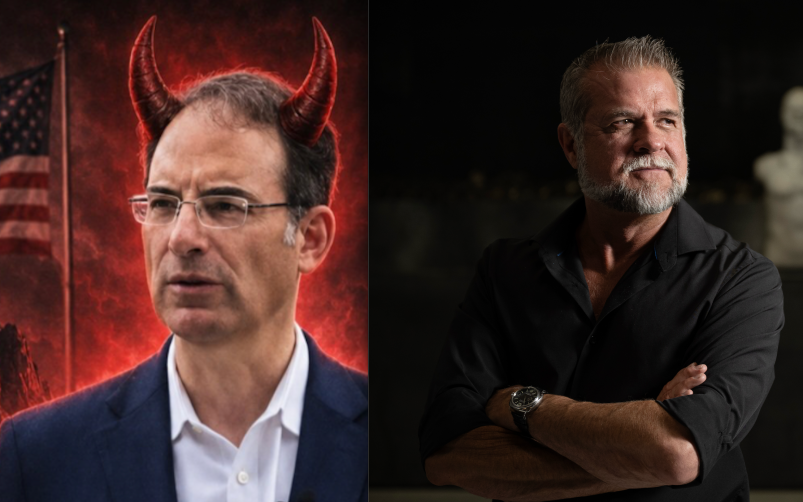
Colorado Republicans are using an image showing Democratic gubernatorial candidate Phil Weiser with “devil horns” to mock him on social media. While a top Democrat blasted the move as a “plainly antisemitic” attack, the GOPer who created the graphic doubled down on Tuesday.

On Facebook, Sean Pond, a Republican county commissioner and former Senate candidate who posted the image, dismissed the furor and called it a “silly picture” of “two cartoon devil horns.”

“Sometimes devil horns just mean the devil. That’s why they show up in cartoons, church lessons, haunted houses, Halloween costumes, emojis, and every costume aisle in America,” Pond wrote in a post on Tuesday afternoon. 

Pond’s graphics, which were posted on both X and Facebook on Sunday and Monday, showed Weiser, who is Jewish, standing in front of fiery skies with red horns atop his head. Depictions of Jews with horns are widely recognized as one of the most common types of antisemitic imagery. They have been used to associate Jews with evil and the devil since the Middle Ages. Pond used them to promote Colorado’s Republican gubernatorial nominee, Victor Marx. 

Pond’s pictures featured all caps text declaring Weiser “THE NEXT THREAT TO COLORADO.” One of Pond’s images touted the GOP candidate and said: “COLORADO NEEDS STRENGTH. COLORADO NEEDS FAITH. COLORADO NEEDS VICTOR MARX.”

Marx, a self-described “high-risk missionary and evangelist” who has made questionable claims about having performed exorcisms by phone and having saved as many as 45,000 women and children from abusive situations, responded positively to one of Pond’s posts on X that featured the “devil horns” graphic. He said Pond’s point about Colorado Republicans needing to unite against the “THREAT” of Weiser was “exactly right.”

“We do have to remember what’s at stake. Colorado can’t afford more division. It’s time to unite, stay focused, and win,” wrote Marx on Monday. 

Pond’s Facebook defending the graphics was directed at Kyle Clark, a journalist with 9NEWS in Denver who had raised alarms about the images and noted “Weiser is outspoken about his mother’s birth in a Nazi concentration camp, his family members killed in the Holocaust, and the threat posed by antisemitism today.”

“Depicting Jewish people with horns is a centuries-old, dehumanizing, antisemitic trope,” Clark wrote in an Instagram post on Tuesday. 

Pond had made an earlier Facebook post in the wee hours of Tuesday morning, announcing that Clark had asked him about the graphics and sharing a lengthy statement. In it, Pond said he made the images “using AI” with a “direction … to portray Phil Weiser as evil and as the next threat to Colorado.” Pond also insisted he was unaware that Weiser, who has been Colorado’s attorney general since 2019, was Jewish.  

“His religion was never considered because I did not know it,” wrote Pond. “There was no reference to Jewish people, no religious message, no dog whistle, and no hidden meaning.”

Pond further argued “Jewish politicians are subject to the same fierce political criticism as Christian politicians, Muslim politicians, atheist politicians, and everyone else seeking public power.” 

“Phil Weiser does not receive immunity from political satire because of a personal fact I did not even know,” Pond added. “I will not apologize for opposing him.”

Both Marx and Pond did not immediately respond to requests for comment. TPM also reached out to Weiser’s campaign and received a statement from Colorado Democratic Party Chair Shad Murib. 

“This is absolutely disgusting from Victor Marx,” Murib said. “That he calls this plainly antisemitic imagery ‘satire’ makes him an even bigger fool than everyone thinks.”

  •  

Trump Launches Into Extraordinary Rant About ‘Disgusting’ Blue Cities: ‘Their Trees Are All Gross’

President Donald Trump went off on a long, strange tangent where repeatedly expressed revulsion at the state of “blue cities” during an event in the Oval Office on Monday afternoon.

“What do they have in common? They’re all dirty. They’re filthy, dirty,” Trump said, adding, “Their streets are dirty. Their streets smell. Their storefronts are broken. Their trees are all gross. Everything about the place is dirty.”

Trump went on to specify that he didn’t “want to mention any specific city.”

“It’s really all of them,” he said. 

Trump’s attack on the homes of a large segment of the American populace came at an event that was ostensibly about a commission for military spouses. After signing an executive order establishing the group, Trump took questions from reporters. His tirade about “blue cities” came when he was asked about the ever-shifting state of talks to end the Iran War. Trump said he is “under no time constraints” to conclude the conflict that he initially predicted would end months ago. He contrasted this with his Republican colleagues who are currently facing elections and said they are running against a “sick ideology.” He rattled off various leftist proposals including Supreme Court reform and abolishing the Senate that he predicted would “destroy the country.” From there, Trump totally went off. 

“These are sick people,” he said. “When a country goes bad, like, look at the blue cities. What do they have in common aside from massive crime? Much more crime. The Republicans have very little crime. But what do the blue cities have? … And also you can see this with nations when they go bad — the blue cities have something in common — crime, high crime, vicious, violent crime.”

Earlier on in the event, a reporter from one of the right-wing outlets that the Trump administration has added to the press corps praised the president’s redecorating efforts in Washington, D.C., which have included the controversial White House ballroom and the algae-plagued Reflecting Pool renovation. 

A reporter also asked Trump if he would consider trying to “federalize” the capital city. Trump mused about the idea while praising his own work in the district. 

“Would I federalize basically, you’re saying federalize D.C.? Well, I’m allowed to do that. Would I do that? If they wanted,” Trump said before trailing off and turning to the changes he has made in the city. 

“We took something that was in deep trouble. It was a graffiti-filled, crime-filled mess.We turned it into Shangri-La. We turned it into a great place,” he said, adding, “Look at the grass in front of the White House being all replaced with the top stuff. … Scott’s Miracle Gro. They’re doing it. … Got to give them a plug because they did the White House for free.”

Trump returned to D.C. later on when he reiterated his disagreement with U.S. Attorney Jeanine Pirro’s conclusion that damage to the Reflecting Pool was caused by shoddy contracting work rather than vandalism. The president repeated his highly questionable claim the pool was targeted and argued Pirro had “choked” by dropping the Justice Department’s case against a former Olympian for allegedly damaging it. He also brought up the capital city during his rant about the “blue cities.” 

“They’re like Washington, D.C. was a year and a half ago with graffiti all over the place, with crime all over the place, with people afraid to be here. You had to be ashamed of your capital,” said Trump. “Some of the most beautiful buildings built in the real time. Like, you look at the Supreme Court building, and they put graffiti on it. The most beautiful columns I’ve ever seen. … You look at those columns, how magnificent and then you see graffiti on the side of the building.”

Data actually shows red states have higher crime than blue states on average. Large cities in red states, many of which have Democratic local governments, have the highest murder rates. However, it’s not as though Trump was doing any kind of detailed analysis. He concluded his screed by declaring the blue city ideology is “not going to happen in our country.”

“The one thing they all have in common: crime. Two things, crime, but they’re disgusting. They’re filthy, dirty,” Trump said, adding, “The streets are dirty. They have people lying all over the street doing you know what.”

  •  

Senate Report Describes ‘Top-Down Culture of Cruelty’ in ICE Detention

A new report from Senate Democratic Whip Dick Durbin (D-IL) details shocking allegations about the conditions inside an ICE detention facility in Texas. The report, which was published on Friday, was based on interviews Senate staff conducted with “approximately 20 family units and approximately 40 women detained in the adult detention unit” at the South Texas Family Residential Center in Dilley, Texas, it said. In a statement released along with the report, Durbin described the findings as part of “an ongoing investigation into medical and mental health care” in immigration detention facilities. He also called for the Senate Judiciary Committee, of which he is the ranking member, to hold a hearing on the issue. 

 “Children and their parents described a top-down culture of cruelty among Dilley staff, including guards deliberately disrupting children’s sleep at night, purposely entering rooms without knocking, and taunting children who are often provided with inedible food by eating candy and pizza in front of them,” Durbin said.  

Steven Owen, the vice president of communications at CoreCivic, a private prison company that operates the Dilley facility, disputed the claims made in the report in an email to TPM.

“The critical characterizations of the Dilley Immigration Processing Center (DIPC) do not reflect the operations, standards or care provided at the facility. DIPC was purpose-built to meet the needs of families, and families are housed together in accommodations designed to support family unity, safety and children’s well-being,” Owen said, adding, “Claims that children are denied care or experience delayed medical assessment are false. DIPC maintains on-site pediatric expertise, and emergency services are activated when a child’s clinical presentation requires off-site care.” The children and their families at DIPC receive health care that is clinically rigorous, federally overseen and delivered with dignity. Residents receive:”

Owen also provided links to material CoreCivic prepared including a primer created response to prior critical reporting on conditions at the Dilley facility.

When reached by TPM, the White House referred all questions about the report to Immigration and Customs Enforcement. ICE did not respond to a request for comment, but an unnamed spokesperson for the Department of Homeland Security, which oversees the agency, provided a statement. The DHS spokesperson stated “any claim that there are subprime conditions at ICE detention facilities is FALSE.” They also claimed “Dilley does meet federal detention standards and actually undergoes regular audits and inspections.”

“Another day and another hoax about the South Texas Family Residential Center. Nearly every single day, this office responds to media questions on FALSE allegations about illegal alien detention centers,” the DHS spokesperson said. “The media is clearly desperate for these allegations of inhumane conditions at this facility to be true.”

Along with the other disturbing claims, Durbin’s report alleges there is “substandard medical care” at Dilley. 

“Poor medical care was the most urgent concern raised by both families and adult women. They described a range of unaddressed health issues and voiced that, because they were not receiving adequate care, those medical conditions are worsening,” the report said. 

Specific issues detailed in the report include a mother and child who were ill yet allegedly “were repeatedly refused blankets to address the extremely cold temperatures in their unit.” The report also described multiple instances where detainees said they were not given care despite “extreme” pain and others who said chronic or troubling conditions were not addressed. 

Along with the allegedly inadequate medical care, the report also claimed facility staff failed to provide detainees with proper meals. 

“One family reported finding worms and a fingernail in their food. Several families said their children refused to eat facility meals entirely,” it said.

A lack of required educational programs is another issue detailed in the report, which said Judiciary Committee staffers found “no evidence that the facility was meeting … basic education standards.”

“One 16-year-old described the education offered at Dilley as ‘drawing in coloring books,’ which was not appropriate for students his age,” the report said.

The lack of school programs was described in the report as part of a pattern of “psychological harm to children” that included “demeaning, dismissive, and abusive behavior by Dilley staff.”

“One parent reported that guards who are perceived as ‘too nice’ are scolded by supervisors and told to be harsher. A guard told the parent: ‘You only have three rights here: drink, sleep, eat.’” the report said.

The report also said Dilley detainees face a lack of access to family members and attorneys.

“Many of them stated they have committed no crimes, have pending immigration cases, have minor children at home, and have lived in the United States for years. They stated repeatedly that they have followed the rules, and they are not criminals—and do not understand why they are being treated as if they are. They are desperate to be reunited with their families and spoke about their efforts to seek release through habeas petitions,” the report explained. 

Dilley has been a hotbed for protests and activism that have taken place around the country in response to ICE and President Donald Trump’s mass deportation agenda. Durbin claimed the Judiciary Committee staff had issues speaking to detainees as part of what the report described as “DHS obstruction.”

“My staff visited Dilley as part of an ongoing investigation into medical and mental health care, solitary confinement, and access to counsel in immigration detention. During that visit, in an attempt to curtail oversight, DHS imposed an arbitrary two-hour time limit on visiting the facility,” Durbin said in his statement.

Other members of Congress have similarly accused DHS and ICE of attempting to thwart lawmakers’ right to conduct oversight in what they have called a violation of legislation. The practice led to a successful lawsuit in federal district court. In his statement, Durbin also suggested some of the things Judiciary Committee staff observed at Dilley violate the Flores Settlement Agreement, a court ruling that sets standards for immigration detention. 

Durbin has previously released reports on conditions at ICE detention facilities in Florida and Louisiana. Overall, his latest report blamed the issues in detention centers on Trump administration policies. 

“The Trump Administration is intentionally subjecting longtime law-abiding residents of our communities and children who have grown up in our communities to neglectful and dangerous detention conditions,” the report said, adding, “In a desperate attempt to meet Stephen Miller’s quotas in furtherance of the Trump Administration’s mass deportation campaign, immigration officials now target law-abiding families attending immigration

court hearings and ICE check-ins.”

Durbin’s report also predicted the issues observed at Dilley will have devastating consequences and that “more people will die in detention without necessary medical care.” 

“Medical care in immigration detention is dangerously inadequate. Immigration detention facility staff routinely deny or defer necessary medical treatment, providing only minimal care until emergency care is required. Without better policies for quickly addressing urgent medical needs, including facilitating release, more individuals, including children, will die in Detention,” the report said. “Thirty-two people died in ICE custody in 2025—the highest number in more  than two decades. Twenty-two people have already died in ICE custody thus far in 2026.”

This story was updated at 9:31 pm with a response from CoreCivic. It was also updated at 4:38 pm on August 1, 2026 with the statement from a DHS spokesperson.

  •  

Are Politicians Ready to Stop Turning Back the Clock?

[Essay]

The Politics of Nostalgia 

In what time would you prefer to live? The question is such a commonly considered hypothetical that how you answer it likely provides a good deal of insight into both your character and your politics. Answers typically tend toward nostalgia for an idealized past — sometimes drawn from lived experiences, but more often inspired by television, movies, books, the media, school, political propaganda, etc. Occasionally you come across someone who would like to live in the future, accommodated by imagined technologies or afforded some exciting new opportunity like intergalactic space travel. These ideas, too, are usually inspired by various media intakes. Rarely do you meet someone who would prefer to stay in the present. This might be because to answer this way cuts against the spirit of the hypothetical. It could also be that for most of the 21st century, the idea of being content in the present has appeared untenable. 

To be fair, it is hard to argue that we are currently living in the best of times. But what are we to make of it when cultural institutions like Hollywood have preferred to spend the last decade-plus mining and regurgitating the past rather than confront the present, and our politics have been dominated by the idea that we need to return to increasingly regressive eras of former glory? That we are a society inundated and overwhelmed by nostalgia is hardly news to anyone. Writing in Harper’s about how the “nostalgic gluttony” of the 1970s bicentennial stacks up against the current semiquincentennial, Thomas Frank explains, “Nostalgia is today a structural feature of our modern world, the emptiness and vapidity at the heart of our culture, the inevitable mass-produced sentiment of a society that permanently feels that everything is constantly going wrong but is chronically unable to identify why.” Viewing nostalgia as a structural feature gives some insight into why we are unable to get out of our current rut. It also provides a basis for understanding how politicians can use it to their advantage.

The fact that time plays a central role in the push and pull of our two-party system is at once obvious and obscure. You see in the underlying ideologies that animate the parties (Republican conservatism vs Democratic liberalism/progressivism), a pitting of the desire to maintain the past against the goal of improving the future. The last presidential election was a contest between “Make American Great Again,” and “We’re not going back.” In reality, of course, this dynamic is less clear cut. The Republican Party under Donald Trump has all but abandoned any pretense of conservatism and the evocations of the past are more in line with fascistic concepts of renewal than conservative reverence for tradition. The Democrats meanwhile appear on the fence about how committed they are to a progressive platform; and while there may be consensus that we can’t go back, they have yet to articulate a compelling vision of where we are going. This has allowed Republicans room to swoop in and lay claim to being the party of both past glory and future innovation. As Frank puts it: “Crisis and renewal are strictly a matter of marketing now, a fiction that permanently assigns the Democrats the role of technocrats managing national decline while Republicans get to stand for muscular optimism and economic expansion. When the GOP holds the White House, America is great; when it doesn’t, it isn’t.”

While this strategy may have been enough to put Trump and the Republicans back in charge of the government, it appears to be cracking under the weight of actual governance. While it was never entirely clear what period of perceived American greatness Trump was referring to the first time he ran for president (likely the Reagan ‘80s but also perhaps the 1950s), his recent highlighting of the McKinley administration as peak America, along with his administration’s repeated attempts to reconstitute more than century-old laws, harken to a time it’s hard to imagine many Americans are wistful for. Worse than the resurfacing of a more menacing and antiquated America is the administration’s embrace of a future dominated by data centers which power a world of unregulated AI, prediction markets, and cryptocurrency; especially considering the AI industry is just as likely to lean into the possibility that they are harbingers of the apocalypse, or at least widescale job loss, as they are to promise future prosperity. This leaves the present mired in cultural and democratic backsliding and facing what seems like a hostile future.

In his Harper’s essay, Frank suggests that one way out of this mess is for politicians to adopt “a kind of counter-nostalgia, reclaiming a mythic past for the forces of tolerance and democratic generosity.” It’s a nice idea, but I’m not sure it’s a good reading of the room. We will always rely on certain traditions and founding principles to define ourselves. Nostalgia is simply an indulgence in the memory of who we are. It can’t be dismissed, but it might be time to give it a rest. Lost in the panic over the end of reading or sex or whatever else The Atlantic is worried about is that there are also lots of new beginnings. It’s exhausting being constantly reminded that everything around you is in decline. When something is broken, it’s good practice to fix it. However, it’s not your only option. You can also build something new. And judging from recent developments in politics, movies, media, etcetera, people are hungry for something new.

On July 14, Bastille Day in France, the House passed the Sunshine Protection Act on an overwhelmingly bipartisan bias. The bill, if it passes the Senate, would make daylight saving time (DST) permanent — answering literally the hypothetical I posed at the start of this essay. While it would be easy to file this alongside other oddball legislation like the recent bill allowing the emergency broadcast system to issue alerts for shark attacks (who says these people aren’t working for your interests), the debate over daylight’s savings time goes back more than a hundred years and has a real constituency that would like to see it made permanent. D.S.T activist Scott Yates went as far as to tell the New Yorker in 2017 that if we could get the government to solve the problem of being forced to change the clocks twice a year it “will empower people to say that this thing we thought was immovable is really fixable. We can fix this.” I agree it’s time to stop turning back the clock, but it would also be nice if our politicians could put forward a positive vision of the future that extends beyond an hour. 

Link Copied

By Derick Dirmaier

[Essay]

What Should Democrats Do With This New Wave of Voters?

Listen, I will be blunt. I did not watch this Fox News interview with the Democratic Socialist of America’s New York City co-chair and come away thinking that this was someone ready to head a major movement or even adeptly fend off predictably disingenuous right-wing cable news attacks. However, I also didn’t see anything incredibly terrifying or dramatic. 

This clip aired on July 18, not long after some of the congressional candidates backed by the DSA won primary victories against more moderate Democrats. All of that came on the heels of the organization adopting a new platform that, among other things, called for a Green New Deal, universal healthcare, abolishing ICE, defunding the Department of War, and ending U.S. military aid to Israel while “prosecut[ing] U.S. and Israeli leaders responsible for the genocide in Gaza.”

Combined, these two developments spurred a wave of histrionics from Democratic operatives and apoplectic coverage from right-wing and more mainstream outlets painting the new candidates as “communists” and even part of a “parasite” project. It’s all a bit much, particularly considering how, in New York City, which has been ground zero for the wins and subsequent freakout, the DSA has recently brought more established Democrats into its ranks and backed some of former Mayor Eric Adams’ moderate agenda. 

The election was even rather widely dubbed a Democratic “Tea Party,” which is pretty obviously hyperbolic since it wasn’t fueled by a racist conspiracy theory. And some of the victorious candidates weren’t DSA members and are decidedly more moderate. But let’s stick with the DSA and its platform for a moment since the organization and its involvement this cycle inspired a majority of the hand wringing. 

We can all sit here and quibble over the specifics including the worst stuff some of the new candidates previously put on social media, the exact proper response to Israeli war crimes in Gaza, some of the more grandiose elements of the platform, including why the DSA or anyone else is still using the “defund” language when it’s such an unnecessary and proven political liability, and, of course, whether anyone on the left who isn’t an extremely gifted sparring partner should even be bothering with Fox. However, the reality is, nothing in this platform is that radical. It’s certainly not communism. And recent data — including the returns from these races — shows the progressive agenda presents a huge opportunity for the Democratic Party. 

Polling has consistently shown that the priorities of young voters mirror the progressive platform. Recent data from Yale, Tufts, and Harvard has shown that young voters’ top priority is the cost of living; they worry about the price of healthcare costs; are concerned about America’s relationship with Israel and foreign wars more broadly; they do not approve of ICE; they support climate action; and they want structural change. This is particularly important for Democrats since the youth vote has long been seen as their key to victory. And, obviously, today’s young voters are poised to become more and more influential in the future. 

But it’s not just young people who seem supportive of progressive priorities. New polling from YouGov released this week shows about half of Americans and nearly three quarters of Democrats support abolishing ICE. A poll released by the Guardian earlier this month showed a whopping 95%  of Americans believe there is an affordability crisis. And a majority of Americans — plus nearly 80% of Democrats — have an unfavorable view of Israel driven by the death and destruction in Gaza. This stuff is not radical or the provenance of the young. It is, in fact, mainstream and even cuts across party lines. 

That’s likely why there are indications in the 2026 primary returns that some of these new progressive candidates were able to bring large numbers of new voters to the polls. In two races in New York City where the DSA-backed candidates beat back fairly well-established political dynasties, the old guard didn’t actually shed support. Rather, the insurgents brought a whole new wave to the polls. 

Those wins aren’t the only indication that Democrats may have opportunities with new voters. The Harvard Institute of Politics survey of young voters found they favor Democrats by nearly 20 points. And data from Pew that we highlighted earlier this month shows that almost half of non-voters are more likely to lean Democrat compared to 37% who lean Republican. That’s a dramatic swing from 2024 when slightly more non-voters leaned to the GOP and the overall demographic was split almost evenly between the two parties. 

There are risks to outsider candidates and different approaches. Failed Maine Senate candidate Graham Platner did indeed attract new voters with a progressive message. However, his campaign infamously imploded amid a series of scandals. Of course, while Platner may have adopted the new left messaging, he didn’t exactly have a real background in progressive politics and centrist establishment Democrats were among his most influential backers

Overall, it is clear that this moment is a major opportunity for Democrats to woo new voters — and elements of the progressive platform could help them do it. Rather than fighting the new wave, they would be well served to find common ground and swim along with it. 

Link Copied

By Hunter Walker

[Bad Posts]

The Internet Was a Mistake

Did not know Idaho’s Mike Simpson was doing TikToks pic.twitter.com/HmbjAJsRbu

— Jake Wilkins (@JakeWilkns) July 21, 2026

Link Copied

By

[Journalism Fund]

We Need Your Help

Thank you to the many members and readers who have already contributed to the Journalism Fund. We are on pace to hit our goal, but as it goes with these things, we have to keep pushing. As Josh Marshall has repeatedly explained, it’s critical to the success of our organization. So if you haven’t yet contributed, plus you have the means and are a fan of what we do, we hope you can take a minute of your time today to help us out. It really only takes a minute and you will have our eternal gratitude.

Contribute to the Journalism Fund

Link Copied

By

[TPM Trivia]

How Much of This Week’s News Do You Remember?

  1. What is the name of Lindsey Graham’s sister who was appointed to serve out the rest of her late brother’s term, and is now running for his seat? 
  2. Which agency is moving to end demographic data collection after 60 years, and what do they do? 
  3. Which Democratic politician recently announced she would pivot to becoming a book influencer after her gubernatorial bid failed?

Answers below

Link Copied

By

[Words of Wisdom]

Home Sweet Home

“I like data centers so much, I wish I lived in one.” – CNBC host Jim Cramer

Link Copied

By

[This Effing Guy]

The Unfathomable Ghoulishness of Tom Homan

The Trump administration’s brutal immigration regime is responsible for deporting more than 590,000 people since he returned to office in January 2025, a majority of whom don’t have criminal convictions. At least 10 people have been fatally shot by immigration officials, and more than 50 have died in immigration detention. How does White House Border Czar Tom Homan summarize all of this? “We’re deportationmaxxing.”

Link Copied

By

[TPM in the Wild]

Sam Alito Has Gone Feral and Trump Has Wrecked the DOJ

Kate on Strict Scrutiny

We’ve all watched as Sam Alito’s brain has congealed into a mass of soft cheese, but TPM’s Kate Riga has had a front row seat. Kate joined Leah Litman of Crooked Media’s Strict Scrutiny podcast this week to break down the biggest decisions out of the recent Supreme Court term, talk about which cases have flown under the radar, and Alito going full Fox News Grandpa. 

Per Kate, “Alito is an old guy who is in this insular world of old, embittered right-wing men; he’s imbibing the same media they imbibe; he’s listening to the people they respect. And you can see it in his opinions on everything from the voter fraud conspiracies to the anti-trans stuff. His brain is pickled ‘cause that’s what he’s stewing in.”

Josh on The Beat With Ari Melber

Josh Marshall joined The Beat With Ari Melber to talk DOJ corruption and Josh Kovensky’s exclusive about the federal prosecutor who marched at January 6 now leading Trump’s task force targeting alleged left-wing political violence.

As Josh put it, “The Department of Justice basically gets whittled down to what serves the immediate whims of Donald Trump, and that is punishing and retaliating against the people he perceives as his enemies; keeping his friends out of prison; and getting in the grill of people who generate headlines that make him feel bad.”

.@joshtpm : The DOJ is just serving "the immediate whims of Donald Trump, + that is punishing + retaliating against the people he perceives as his enemies; keeping his friends out of prison; + getting in the grill of people who generate headlines that make him feel bad.” pic.twitter.com/bXpCtRWakp

— Talking Points Memo (@TPM) July 22, 2026

Link Copied

By

Trivia answers: 1) Darline Graham Nordone 2) The Equal Employment Opportunity Commission, which enforces anti-discrimination laws in the workplace 3) Former congresswoman Katie Porter

Link Copied

By

  •  

A Key House Dem Breaks Down the White House’s ‘Unfathomable’ Iran War Funding Requests

Weeks after the Iran War began, Rep. Joe Morelle (D-NY) predicted to TPM that it would become a billion-dollar-a-day “mess.” Now, with Secretary of Defense Pete Hegseth taking to Capitol Hill to request almost $67 billion in supplemental war funding, Morelle says his fears have been confirmed. And though Morelle is a member of two key committees with oversight of the Pentagon, he claims Congress has been given little information about where all the money is going. 

  •  

From Red Cards to Photobombs, Donald Trump Tried to Make the World Cup About Himself 

Spain Edits Trump Out of Instagram Post

Ahead of the World Cup’s Round of 16, President Donald Trump literally interfered with the U.S. team’s run as he called FIFA boss Gianni Infantino and argued for a controversial red card to be reviewed. And, on Sunday, as the quadrennial tournament came to its conclusion, Trump crashed the stage during the final celebration. 

  •  
❌