Reading view

Midweek gems #59

I’ve yet to fully acclimate to daylight savings time. Have you? If anyone has tips for how to adjust smoothly, please share them! I haven’t gotten a decent good night’s sleep since the time change. I initially blamed it on post-menopause but Rory said that he also had not slept well since we had to move our clocks forward. We know it will pass.

Meantime, Vietnam does not adhere to daylight savings time. My brother, Dan, is vacationing there right now and this morning (his late night), he sent this video of a Hanoi bánh cuốn rice roll vendor:

That is the old school method. It’s tricky and you have to make the rice batter just right and have a special pot rigged up for steaming the batter. The egg is a novelty filling from northeastern Vietnam. Typically, the filling is pork and mushroom, or veggie. My workaround is a much easier rice paper hack published in my book, Ever-Green Vietnamese (see page 77); my mom hailed that bánh cuốn recipe as a game changer.

It’s been a while since I’ve posted Midweek Gems and I’ve been collecting some fun things for your consideration.

💎 Meet me at Viet Book Fest!

Twenty years ago when I wrote my first book, Into the Vietnamese Kitchen, no one organized Vietnamese American authors. That’s drastically changed, thanks to a younger crop of authors and events like the annual Viet Book Fest in Santa Ana, California. I’ll be speaking on this afternoon panel:
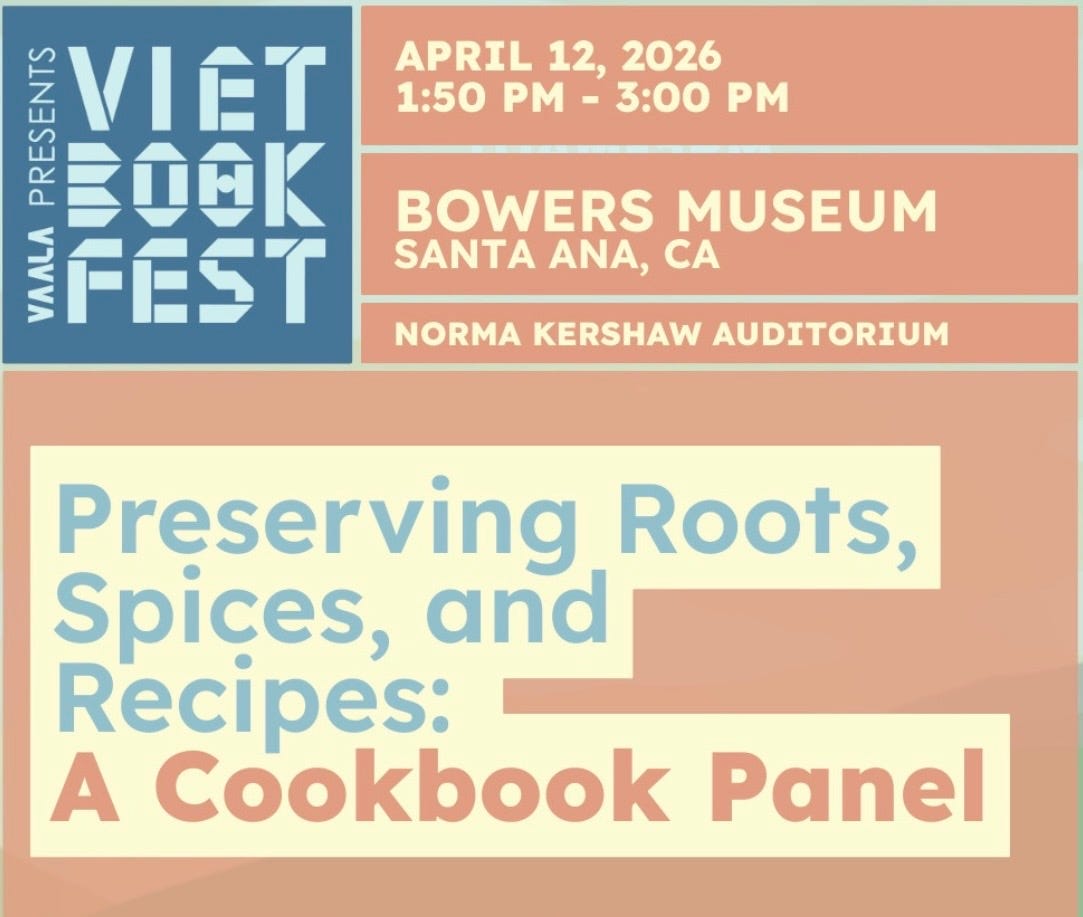
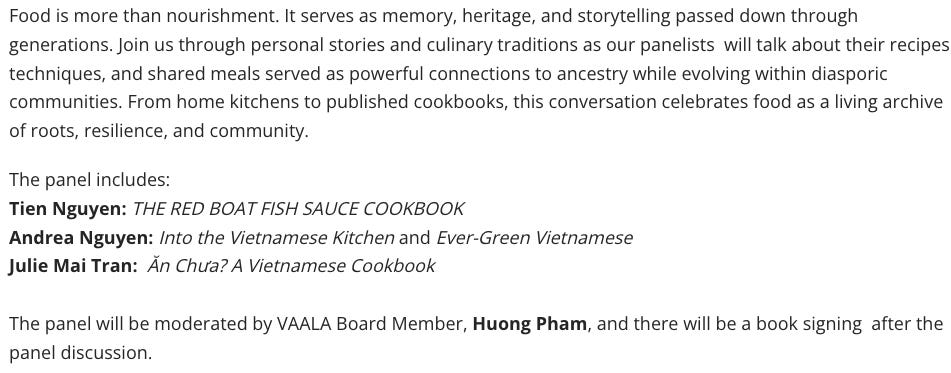
Knowing my fellow authors, it will be a spicy conversation. Join us if you’re nearby.

Check the Viet Book Fest’s full schedule for the full day’s run of show. Organized by the Vietnamese American Arts & Letters Association (VAALA), Viet Book Fest is FREE but please reserve a ticket through Eventbrite.

💎 Eng’s, a 2026 Beard Award Classic

Speaking of Asian American heritage, many of us were introduced to Chinese food through mom-and-pop restaurants serving up Cantonese dishes. Those spots fed us quickly, affordably, and deliciously yet they often are unnoticed and under appreciated.

This year, the James Beard Foundation announced that it is awarding an American Classic award to Eng’s, a 99-year-old Chinese American restaurant in Kingston, a small town in upstate New York.

What is a Beard Classic award about? It is given to longstanding, beloved restaurants that have enhanced their communities. The restaurant business is hard and longevity is rare. If you last for decades, you deserve a medal, at the least.

Operating since 1927, Eng’s was Kingtson’s first Chinese restaurant. Over the years, it has moved and expanded locations and is currently owned and operated by Tom and Faye Sit. They are the parents of a friend of mine, Jennifer Sit.
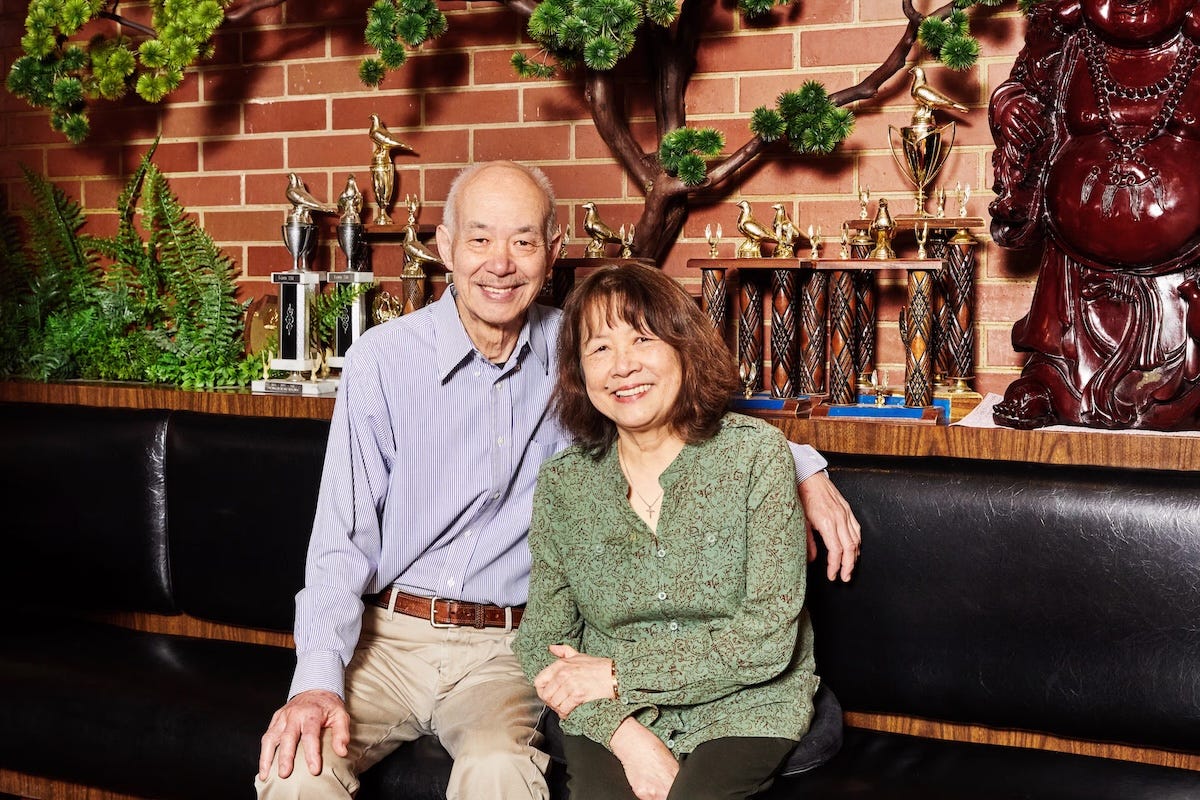
tom and faye sit
Tom and Faye Sit of Eng’s. They look fit and youthful for folks who’ve been in the business for over 50 years. Source: James Beard Foundation.

Jennifer is one of the best cookbook editors around. But she still has time now and then to put in a shift at Eng’s to help with the dinner rush for dine-in and takeout orders. Her parents are aged but they remain engaged with the business, she’s told me.

Leave a comment

engs kingston ny
Eng’s restored midcentury dining room, “smorgasbord” buffet, and signage harken back to a different era. There’s even live music nowadays to draw diners in for sit-down meals. Source: Eng’s restaurant.

What makes a Chinese American classic menu? So many things. For instance, Eng’s menu includes a pu pu platter and tropical chicken on skewers. There are also Cantonese sub gum stir-fries, which feature a main protein supported by a colorful melange of other ingredients. “Sub gum” is similar to the Vietnamese notion of thập cẩm (a well-curated assortment of flavors, textures and color). On modern Chinese restaurants menus, subgum has been replaced by phrasing like “chicken and mixed vegetable stir-fry'“ which lacks pizzazz.

Seeing Eng’s get the national spotlight warmed my heart so much. There are countless restaurants like it all over the country. They make a difference in their communities by keeping flavors and traditions alive.

Read more about Tom Sit from the Beard Foundation’s awards page and check out Eng’s Restaurant if you’re in the area!

💎 What is a combi oven?

Many of you have expressed interest in multi-use compact kitchen appliances. I’ve been thinking about combi ovens because some of my chef friends adore how they cook with steam (wet) and conventional (dry) heat, or both. Professional combis are expensive but Ninja makes a good, affordable unit for home use. Last week, I purchased one and have been playing with it. There are fourteen (14!) functions so my evaluations will take time.

This combi oven is quirky but it shows promise. I’m impressed after a week, though Rory is on the fence. I like the baking and air-frying functions, thus far. I just wrote up my preliminary experiences and made a couple short videos to show you how the combi oven works. Learn more about the combi oven and weigh in at the website.

Support Pass the Fish Sauce! Join us as a free or upgrade to a become a paid subscriber to enjoy 125+ professionally developed recipes, seed new content, and get future class discounts. Thanks for your enthusiasm!

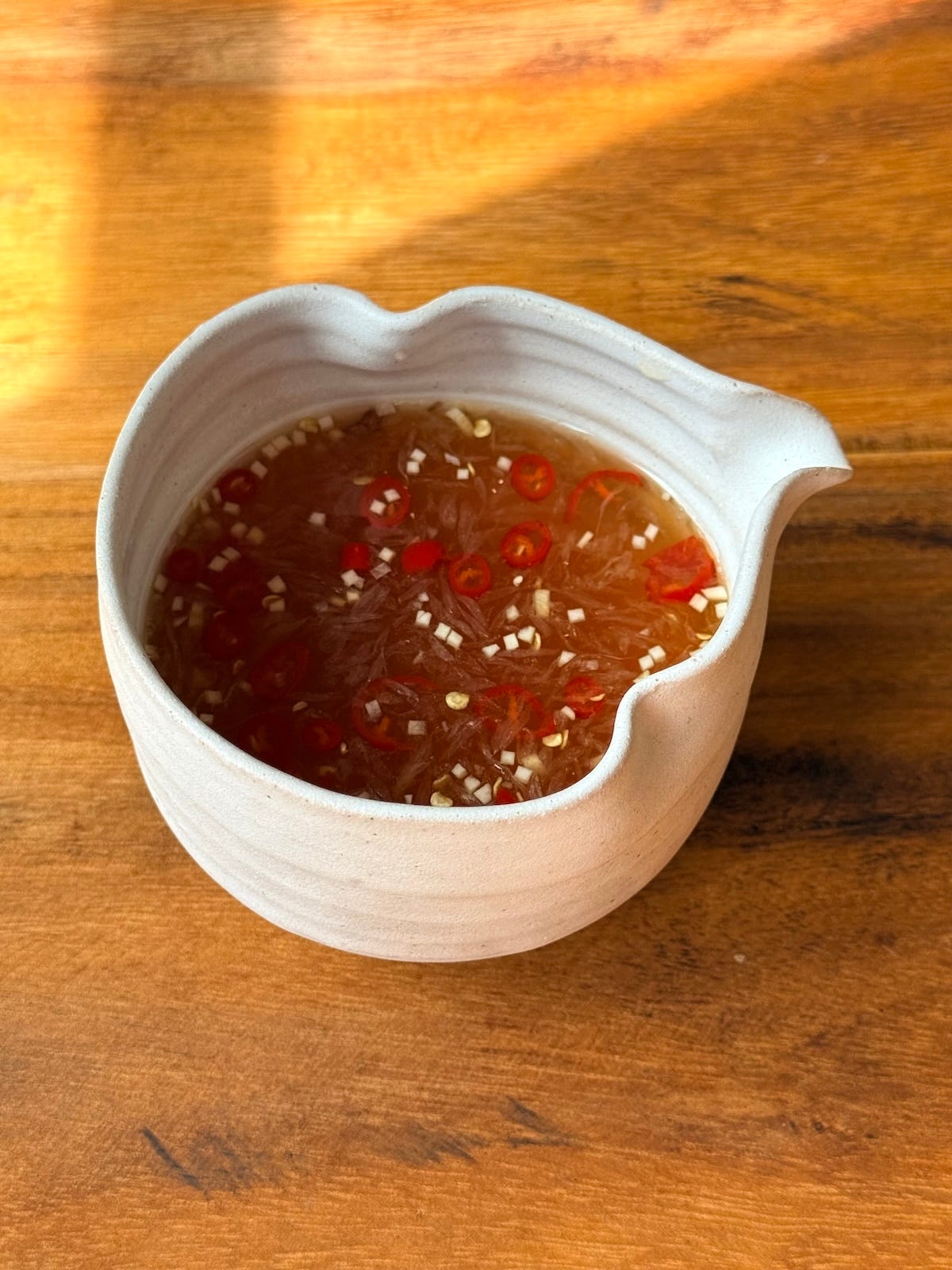
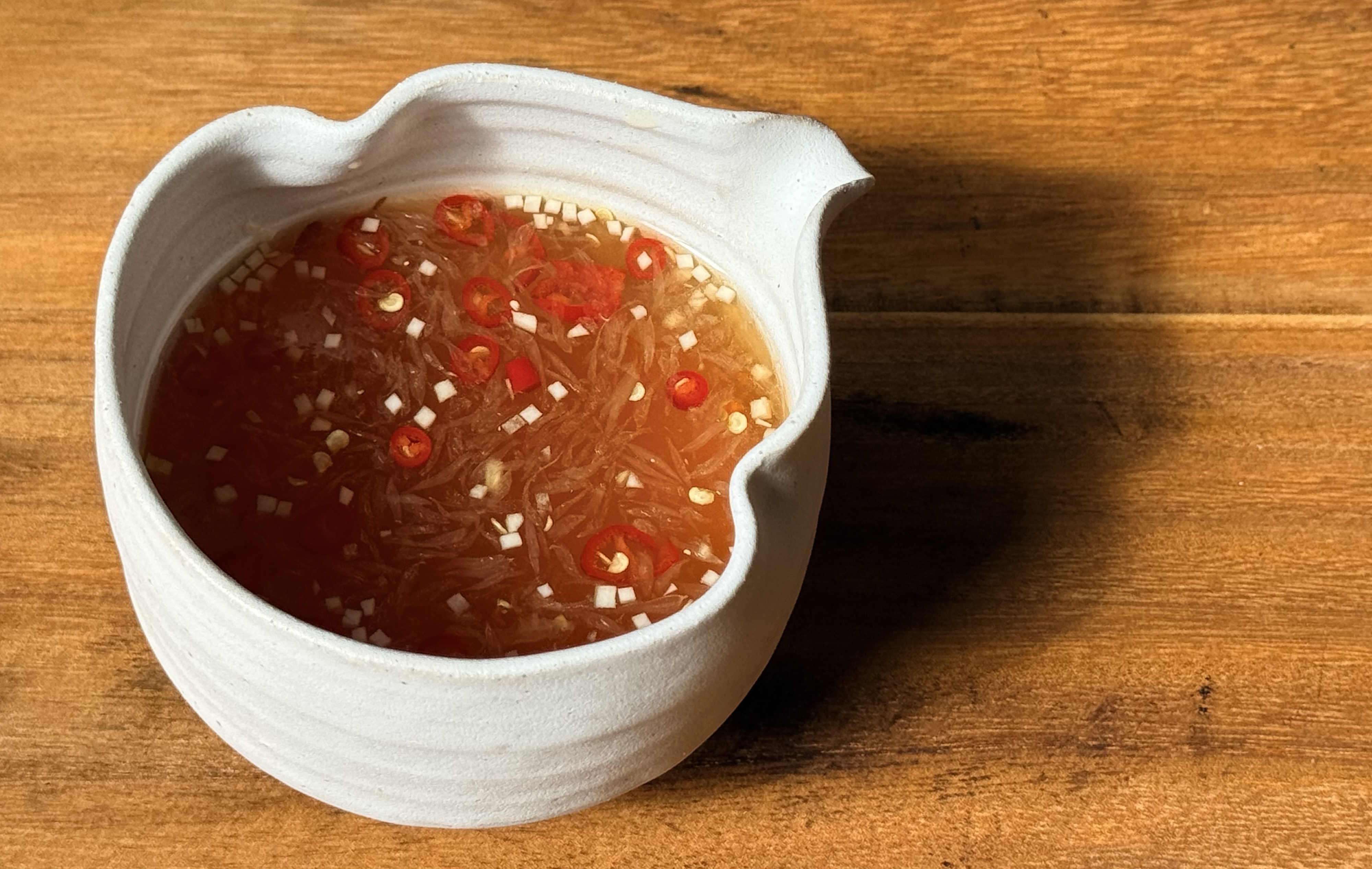
I hope you’ve been thinking about nước chấm since last weekend. Coming this Sunday is something to enjoy with your Viet dipping sauce!


  •  

All You Need to Know about Nuoc Cham, Vietnam's Go-To Dipping Sauce

Phew! We sent Cooking Thai to print this week. Like I usually do, I kissed the last review copy and hit “send”; this time I was wearing red lipstick. It’ll be fabulous to soon have chef Pim’s brilliant recipes and techniques out for you all to use. The release date is August 25, 2026.

So, after what do I do after a lengthy stretch of nearly non-stop work? I spent time in my garden, then cooked and played in my kitchen to spark my brain to be extra curious and creative. I bought a new toy — the Ninja combi steam oven, and have been test driving it. The small appliance has 16 different functions! Yeah, it steams up when it cooks but for good reasons. As I progress in trying it out, I’ll report my experiences via the website.

I also made bún rice noodle salad bowls with grilled pork skewers and shrimp. It’s the cover recipe from Vietnamese Food Any Day (see page 197). It’s healthy, fresh, and versatile. I let the skewered meat marinate overnight and it got more tender. The shrimp were grilled shell-on for flavor; we peeled them at the table before diving in. Yes, those are Trader Joe’s fried shallots and roasted peanuts on top, excellent time savers.

Making the bún bowls got me thinking and then rethinking how to make nước chấm well. I’ve been making it for nearly forty-five years, since about the time I was in junior high school. Out of the blue one day my mom assigned me to do it. She likely said something like, “Mẹ cần con pha nước chấm,” which roughly means “I need you to make the dipping sauce”.

I knew the ingredients but there was little guidance. I don’t know if it was a rite of passage for a Viet girl or a test. But seeing as how my mom was put in charge of overseeing her family’s cooks when she was a tween, she likely looked at me and figured that the least that I could do is make rice and the dipping sauce — two fundamental Vietnamese foods that can make or break a meal. She’d already taught me to use the rice cooker so it was my time to pha nước chấm.

In Vietnamese, the word pha means to formulate, mix, prepare, or to make. I messed up so much at first because I was just randomly mixing stuff together — lime juice, sugar, water, and fish sauce. It did not always taste good but my family always kindly gave me a pass.

Nước chấm (pronounced “nook chahm”) defines the final flavors of countless Vietnamese snacks, salads, lettuce and rice paper wraps, noodle bowls, and rice plates. Even when the table sauce wasn’t officially part of dish, it’s an unspoken truth in Vietnamese cooking that the amber sauce is magical. It can transform mundane ingredients, making them say, “I’m Vietnamese!”

Leave a comment

Drizzle, dunk or toss simply fried, grilled, steamed, boiled, or raw foods in nước chấm and they instantly taste special in a Viet-ish way.

If nước chấm is so tricky to make, can’t you just buy it? It’s silly to buy bottled premade sauce, labeled as “nước mắm pha sẵn”, sold at hardcore Viet markets. Who knows how old that stuff is? Who knows what kind of ingredients were used? And, what if you want to make it low sugar, low sodium, or vegan? What if you don’t have citrus around? What if you wanted to keep it for days? Why let someone else determine how your food tastes? The bottle is likely worth more than its contents. Seriously.

A word on words — nước chấm vs. nước mắm

Though the official name of the sauce is nước chấm (literally dipping sauce), Viet speakers often use the shorthand, “nước mắm” to mean nước chấm. Nước mắm on its own means fish sauce but in the context of “nước mắm pha” or “pha nước mắm”, the phrase signals that fish sauce has been diluted, seasoned, and formulated to serve as a table sauce to accentuate other foods.

You’re safest to say nước chấm to a Viet speaker so they are clear that you’re talking about the dipping sauce; reserve nước mắm for discussing fish sauce. However, if you hear someone talking about nước mắm, they may be talking about the pure condiment or the dipping sauce.

Over the years, I’ve made nuoc cham (let’s omit diacritics from here on in so I can type faster 😄) many ways and talked to others how they finesse theirs. I’ve futzed and finessed it to make it on a whim and have written recipes for it. I’ve got tricks and tips to share with you in this dispatch, which includes:

  • Three recipes in text plus downloadable PDF for:

    • Classic nuoc cham

    • Make-ahead nuoc cham

    • Vegan nuoc cham hack

  • A thorough break down of ingredients so you understand how each functions, how to choose them wisely, how to troubleshoot, plus how to get creative!

To borrow from the Home Depot’s slogan: You can do it. I can help.

Pass the Fish Sauce is a 💯 reader-supported! Support it any way you can. Become a paid subscriber to enjoy The Full Monty of this post along with many others plus other perks! 🙏

Read more

  •  

The time I was told to "Go Back to China" and why I learned Chinese

It’s been a brutal work week because we’re sending Cooking Thai to print very, very soon. This weekend, chef Pim and I are reviewing the book for the final time. Authors work with a team of folks to produce cookbooks, and given that there are countless moving parts (ingredient measurements, instructions, photos, page number references), mistakes may be made. At this stage, we scrub and polish and then practice the art of letting go.

It’s always an exhaustive process at the end but this time, I feel extra energized. That’s because now more than ever, there is incredible openness and interest in Asian cultures. I credit that to phenomena like Korean pop stars and Japanese anime.

Recently, there’s “Chinamaxxing” — a social media trend that has young American TikTokers wanting to ‘become Chinese’ by getting into things like practicing qigong, cooking congee, stocking up on groceries at Asian markets, and wearing slippers around the house. They want to be their “Chinese baddie” best because this is their “Chinese time of life”. (Remember the 1980 hit song, Turning Japanese by the Vapors? It did not result in women running out to buy kimonos.)

The rise of Chinese soft power, mostly among Generation Z, is an unexpected 180-degree turn. It’s uplifting but also ironic, given that there’s been a certain level of suspicion of Chinese goods and services for a long time.

Here at PTFS, we’ve discussed things like the fervent Prop 65 warnings on Asian ingredient labels. A few years back, shared his insights on people’s concerns over French made-in China cookware to empower consumers to thoughtfully choose.

And, remember when some folks nicknamed Covid-19 as “kung flu” and how the pandemic caused a surge in Asian hate crimes and discrimination? Those were good times, right?

Way before the pandemic, looking Asian could be viewed negatively. About fifteen years ago, as Rory and I were taking a walk in our neighborhood, a group of young men drove passed and one of them leaned his head out the window and screamed, “Go back to China!”

I reflexively stopped, raised my middle finger to give them the bird, and screamed back, “Fuck off! I’m not Chinese! I’m Vietnamese!” I stood my ground with minimal fear because we were across the street from a friendly Black-owned barbershop. We could run there for help, if needed.

The car briefly stopped before the young men took off. They surely forgot about the incident. For all I know, in 2026, they may be looking to live their best Chinese lives.

There’s plenty of analysis of Chinamaxxing from TIME magazine and also some humorous-not-so-humorous advice from the South Morning Post, the leading newspaper outlet in Hong Kong, China. I’m usure what to make of the current Chinamaxxing meme and trends, but I do hope that it results in genuine greater cultural appreciation.

Leave a comment

Making Chinese-Vietnamese connections

Chinamaxxing also got me thinking about my own interests in Chinese culture, which started in college when I decided to minor in Chinese languages and culture. I eventually scored a fellowship in Hong Kong, traveled to China and partly built my food writing career on researching and writing about Chinese food.

Why go out of my Vietnamese lane? China is geographically and culturally connected to Vietnam through migration, politics, war, language, and yes, food. The relationship between the two countries has not always been a happy one, but understanding China helped me to better understand my Vietnamese heritage and history.

A temple in Hanoi, Vietnam. Note all the Chinese characters because Vietnamese was once written in a Chinese-character based language system.

For instance, when I was in my twenties, I hung out with Teresa, a gal from Hong Kong whose father used to be film director. Their family lived in Monterey Park and Teresa introduced me to a wonderful Chinese-Islamic restaurant, where I fell for dishes such as fragrant stir-fried lamb spiced with cumin and lots of green onions and a thick, crunchy sesame scallion bread. To this day, I love to eat the two together, stuffing the stir-fry into the bread and wiping up the sauce with even more bread!

Over the decades, I’ve tried all kinds of recipes for a fabulous rendition of the bread recipe and this past Friday, to get my mind off of book proofreading, I made it again and landed on my best rendition yet. Get the sesame-scallion bread recipe and make it sooner than later to enjoy its tender chewy, nutty, rich flavors.

Because Vietnamese and Chinese languages are linked in many ways, when I learned that the sesame scallion bread (zhīma dà bǐng) was a type of bǐng (餠, the Chinese word for bread, pancakes, pies, and certain other doughy foods), I was able to wrap my head around the Vietnamese notion of bánh, a very broad category of food that includes bánh mì, cookies, cakes, dumplings, crepes and other starchy foods.

Subscribe now

Chinese Vietnamese people and food

When I started out writing about food, I befriended Chinese Vietnamese chefs too. The late chef Charles Phan of the Slanted Door was Chinese Vietnamese, for instance. So are my pals, chef restaurateurs Eric and Sophie Banh of Monsoon and Ba Bar in Seattle. Chinese people have been in Vietnam for a long time, so much so that there are countless people who identify as Chinese Vietnamese. They mostly see themselves as Vietnamese but can speak Cantonese and or Teochew.

Knowing about and being able to prepare and share Chinese cuisine is part of Vietnamese culture. In the early 1960s, when my dad was provincial governor in Phan Thiet in South Vietnam, my mom planned dinners that included Vietnamese, Chinese, and French dishes. She employed two cooks — one of whom was nicknamed Chú Năm Bếp (Uncle of Five Kitchens). Mom described him as a charming, talented man whose could cook practically anything; the five kitchens reflected his mastery of five cuisines.

Those factors and many others contributed to my affinity for Viet cha gio fried imperial rolls and bun rice noodle bowls as well as for Chinese fried wontons, lo mai gai sticky rice in lotus leaf, and wonton noodle soup. Hybrid foods like bo kho — the beef stew with star anise, lemongrass, tomato and carrot has southern Chinese Vietnamese roots and is considered an iconic Vietnamese dish. It has evolved over the years and cooks have taken to serve in many ways but it’s still Vietnamese at heart. I felt confident with turning the classic stew into a quick bolognese-style bo kho sauce to enjoy with wide rice noodles or pappardelle pasta. (Along the same vein, what would stop you from putting some in a banh mi roll because or use for a Viet-ish sloppy Joe. Just some suggestions!)

Chinese-ness in unexpected savors

So when I researched and wrote about the history of pho, it wasn’t a surprise that Chinese cooks and language were part of the story, which also includes the French colonials too. I’d always wondered if there was a Chinese pho recipe. ’s cookbook on Yunnan cuisine answered my question with its Chinese beef pho recipe, which you could add pickled mustard greens to, if you want. (The Red River flows from Yunnan eastward through Hanoi and out to the Gulf of Tonkin, so of course there are connections!)

Pho is highly elastic as I’ve written in The Pho Cookbook so you can play around with it with recipes like the beef short rib and vegetable pho. My traditionalist mother may think it’s weird but I like the recipe’s vegetable component, lower cost, and easy cooking in a pressure cooker or Instant Pot.

And, if you survey global cuisines, you’ll see how far Chinese foodways have migrated. Consider how widespread ingredients like tofu, soy sauce and rice noodles are. Chinese la mian noodles begot Japanese ramen. Wok cooking went to Peru and birthed Chifa cuisine and lomo saltado which then went back to Asia and eventually into Vietnam, where it yielded a beef stir-fry served atop fried potatoes. (Make my delicious umami-rich tofu and French fries iteration.)

Pass the Fish Sauce is a reader-supported publication. Get new posts and support my work by becoming a free or paid subscriber.

Finally, if you shop at a Chinese market or online at Weee!, check the frozen food section because you may find frozen peeled Chestnuts from China. As noted in an earlier newsletter, American chestnuts grow on Chinese trees. So you can purchase the Chinese chestnuts, know about their history, and use them in Chinese ways like the Red-Cooked Chestnut Chicken and Braised Chestnuts with Napa Cabbage which hail from Shanghai. These are no longer fall or winter dishes. They can be enjoyed whenever, if you get your paws on frozen Chinese chestnuts!

Today’s world is incredibly economically, politically, and culinarily interrelated. If you consider all the ways that China influences our lives, there is a certain truth to what China calls itself in Chinese: 中国 (中國; Zhōng Guó), which literally means the Middle Kingdom, the center of the world.

As a Vietnamese person who’s gone the extra distance to understand Chinese culture, do I want to become Chinese?

No way! I’m too feisty and proud to relinquish who I am. However, by cooking and looking around to connect the dots, I know that I can be a Chinese baddie on my own terms. I hope you find these insights and ideas to help you add to your knowledge base, if not just sound awesome to a young person. 😆

Back to proofreading the book. Thanks for being here.

  •  

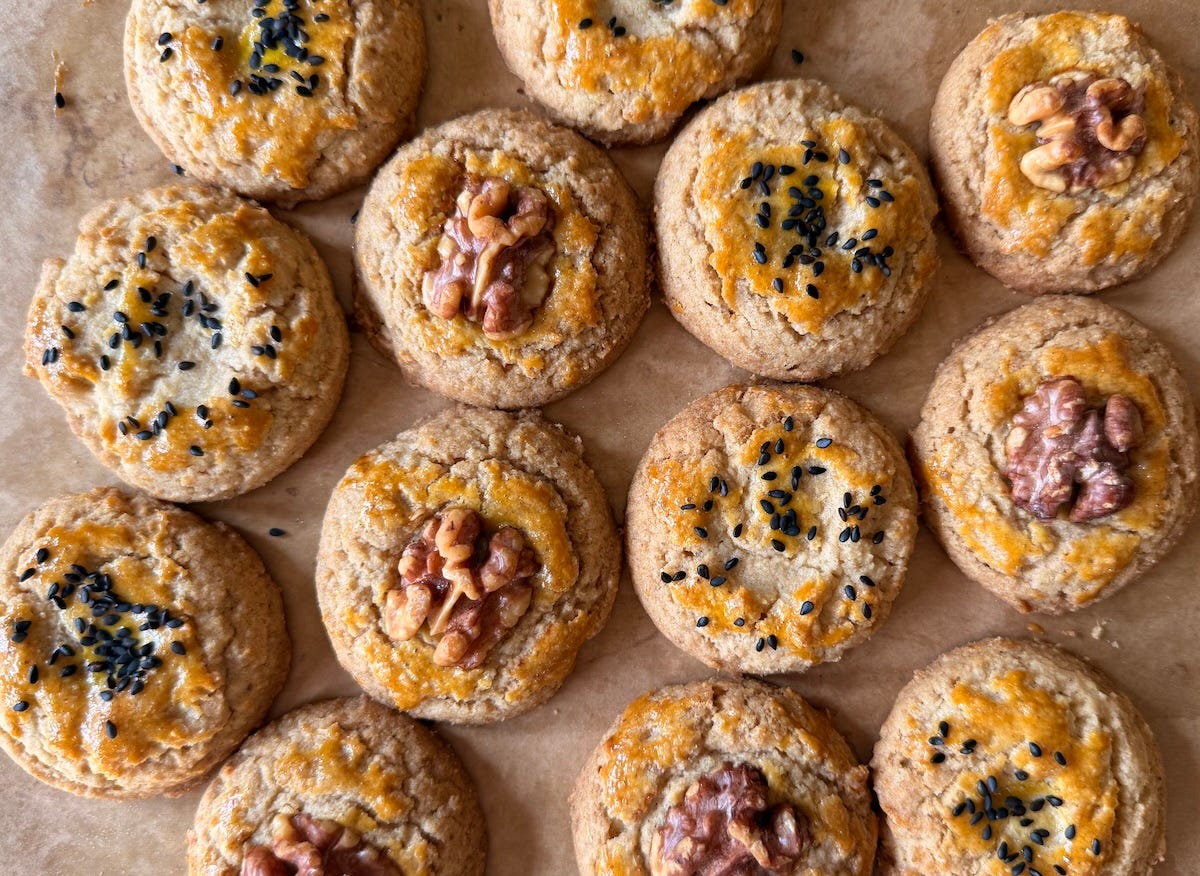
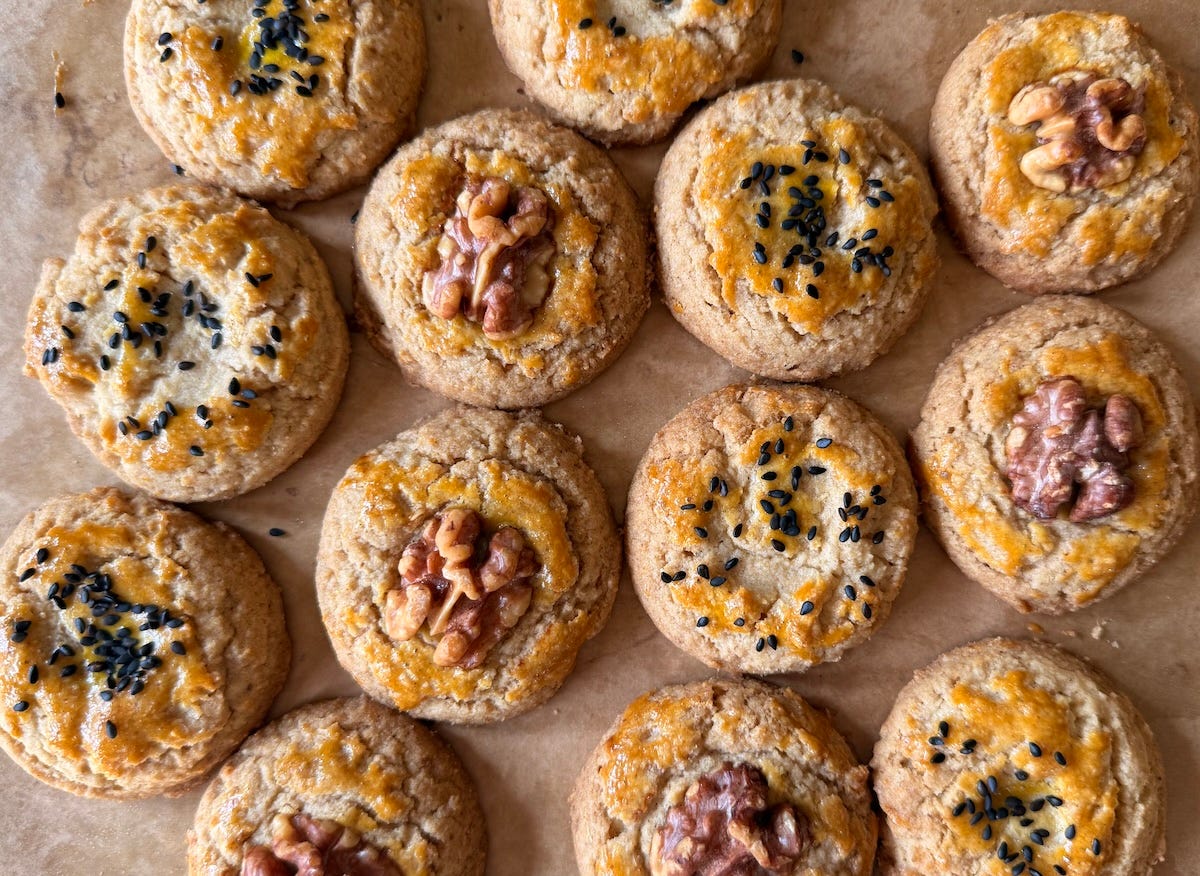
Chinese Walnut Shortbread Cookies, a silver bullet sweet treat

My idea of the perfect cookie is one that’s easy to make in small batches so that they can be enjoyed at freshly-baked peak perfection. And it ought to be light enough so that one or so cookies can satisfy your sweet desire without leaving you feeling weighted down or guilty. I think I found it in this not-too-sweet delightful Chinese walnut shortbread cookie that you can experiment with and take in many directions. Meeting a myriad of needs, it’s kind of a silver bullet.

I’ve been thinking about Asian sweets to share with you because in our 2026 paid subscriber survey, a number of you asked for healthy-ish sweets that are low in sugar and can be made gluten-free, vegan, etc. I thought about those requests and landed on this Chinese walnut cookie, which as you can see, may involve sesame seeds, if you like!

Walnut cookies are popular in northern and southern China, which explains why they are well known in Mandarin and Cantonese (and I’m sure other dialects):

  • Mandarin: 核桃酥 (Hétáosū) and 桃酥饼 (Táo sū bǐng)

  • Cantonese: 合桃酥 (Hup toh soh)

The second character, 桃. roughly means “shortbread,” rather than “cookie”. When Rory tried this cookie, he said, “Oh, it’s a yummy shortbread.”

He ate one and felt happily satisfied. This cookie tastes indulgent but it contains fiber and protein, and is relatively low in sugar and fat. Spurred on by his positive response, I experimented with small batches, changing up the nuts and toppings to yield a recipe that you can scale up for a party or freeze for future baking.

Why walnuts? What about almond cookies?

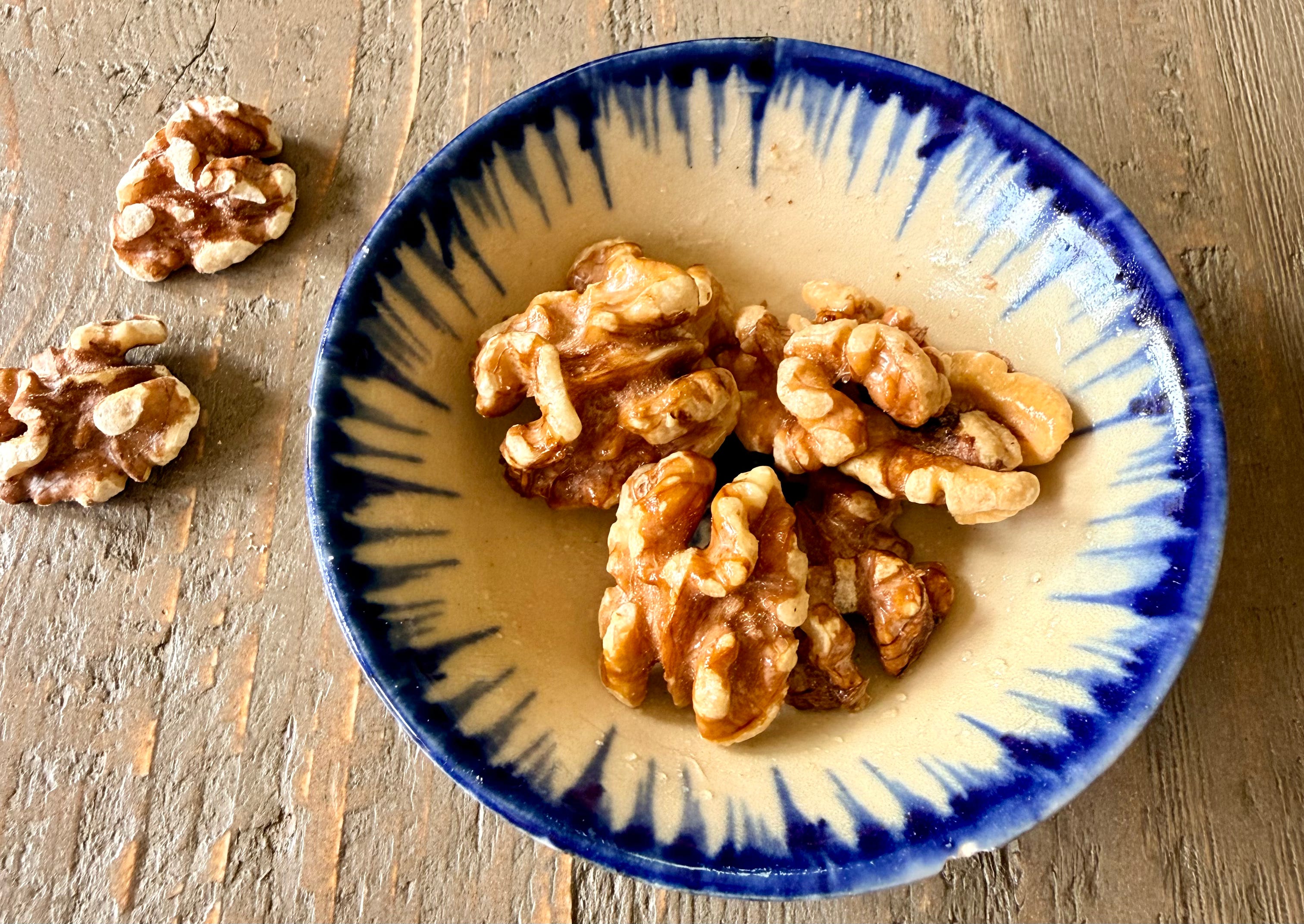
Most of us know of Chinese almond cookies which have been popularized abroad but the traditional Chinese Lunar New Year cookie features walnuts. These walnut cookies supposedly date to the Tang Dynasty (618–907 C.E.) and a guild of potters and ceramicists. As the story goes, one of the potters dealt with a persistent cough by eating walnuts, which he crushed and added to a biscuit-y dough and baked atop the hot kiln surface. The other potters picked up on the tasty, healthy idea and as their wares spread around the country, so did the cookie.

Walnuts are rich in symbolism. For instance, there’s a Chinese notion that eating walnuts ensures happiness in the new year. I’ve also read that because walnuts look like brains, they also symbolize knowledge and good health.

It all sounds like a joke but in actuality, walnuts have been scientifically proven to be good for many things, including heart and gut health. They also figure into the cMIND diet to fend off dementia. Walnuts are a win-win-win food.

At Chinese markets and online, you may spot walnut cookies but I assure you that baking them yourself from this easy recipe using fresh, quality ingredients will make you much happier than if you bought them. Your home will also smell divine and you’ll better ensure good luck, wisdom, and health in this Year of the Fire Horse!

Below you’ll find:

  • The walnut cookie recipe in full text plus downloadable PDF

  • A table of swap suggestions that enables you to plug and play to make the cookies gluten-free, vegan, without refined sugar, without nuts, with seeds, or with extra fiber

  • Lots of bonus ingredient and technical pointers in text and photos so you have plenty of guidance to easily make my recipe yours

A quick note: After this recipe is sent to you, it will be added to the PTFS recipe index. It’s not a perfect index and has to be manually updated. For instance, I just noticed that I forgot to add the Peking duck recipe! Thanks for your patience.

Pass the Fish Sauce is 100% supported by curious cooks, readers, and eaters. Join us at any level. Pitch in as a paid subscriber to help me drive this bus! Thanks for considering.

Read more

  •  

150 fantastic PTFS recipes all in one place

Today’s Sunday Special dispatch is short because the real meat of what I have for you is elsewhere.

First, although I’m not one to praise Whole Foods much, I did notice at my local store that there’s still Lunar New Year signage for “fortune foods” like whole fish at the seafood counter. The store is still running sales on Chinese, Korean, and Vietnamese condiments — soy sauce, gochujang, and fish sauce, for instance. So, in the spirit of continuing the party, at my website, I assembled 25 recipes to help you further usher in the Year of the Fire Horse. Extend the holiday because that’s what Asian people traditionally do!

If you have a Vietnamese banh chung and don’t know what to do with it, I’ve got you covered with a primer and video! Ditto on pickles, noodles, sweets, and other foods to go along with the must-have Tet sticky rice cake (below, top left and center). Or if you just want to cook up a pan-Asian feast to celebrate the new year, the recipes will give you plenty of options. Head to 25 Recipes for Pan-Asian Lunar New Year Menus.

Second, I created a PTFS recipe index for you to more easily explore and find what you need. The index is one of my 2026 ,Year of the Horse goals!

The index includes all the exclusive PTFS recipes for paid subscribers as well as ones that are available for everyone. Since this newsletter started in September 2022, it has fostered a collection of about 150 recipes — the size of two modest cookbooks or one big one!

Get 25% off for 1 year

None of this would have happened if it wasn’t for your enthusiasm for Asian cuisines and cultures and my approach to them. Thank you! In particular, we wouldn’t have this robust, hardworking collection of recipes and audiovisual how-tos without paid subscribers pitching in. Seriously.

Before this newsletter, I thought my food writing career meant I had to deeply bow to the SEO algorithm gods in perpetuity. Pass the Fish Sauce liberated me and I thank you all for your kindness.

Now head over to the NEW RECIPE INDEX and start looking and cooking around.

Click here to jump to the new Recipe Index!

I welcome your feedback on the index because it will continue to evolve.

  •  

PTFS Recipe Index

Hey there, if you’d like to check out the newsletter recipe archive via an index, you’re at the right place. This listing of over 150 recipes covers the first three years of the newsletter from its inception in late 2022. You’ll find PTFS exclusives and free recipes in the newsletter and on my website.

The recipes are grouped in broad categories but are not listed in alphabetical order within the categories. I’ve done my best to cross list them but this is not a professionally done index.

How to use this index

You have 3 basic options: Browse the entire list from top to bottom, use the search function on your computer (⌘ + F on a Mac; Ctrl + F on a PC) to look for specific terms, or click on a link below to jump to particular categories.

Appetizers and Savory Snacks

Bread, Dumplings, and Pancakes

Dessert, Sweets and Drinks

[back to top]

Eggs

Grilled

Meat (chicken, pork, beef, duck, lamb)

[back to top]

Rice and Noodles

[back to top]

Salads and Soups

Sauces, Dressings and Seasonings

[back to top]

Seafood

Stir-Fries

[back to top]

Tofu (without meat)

[back to top]

Vegan, Vegetarian, and Vegetable Sides

[back to top]

  •  

Happy Tet 2026!

Welcome to the first day of the New Year of the Fire Horse! May the next twelve months shower you with blessings such as excellent health, life satisfaction, and abundant prosperity.

I made a special e-greeting for you and the Viet words say:

Chúc Mừng Năm Mới (say “Chook Moong Nahm Moy”) = Happy New Year

Vạn Sự Như Ý (say “Van Soo N-you Eee”) = May You…

Read more

  •  

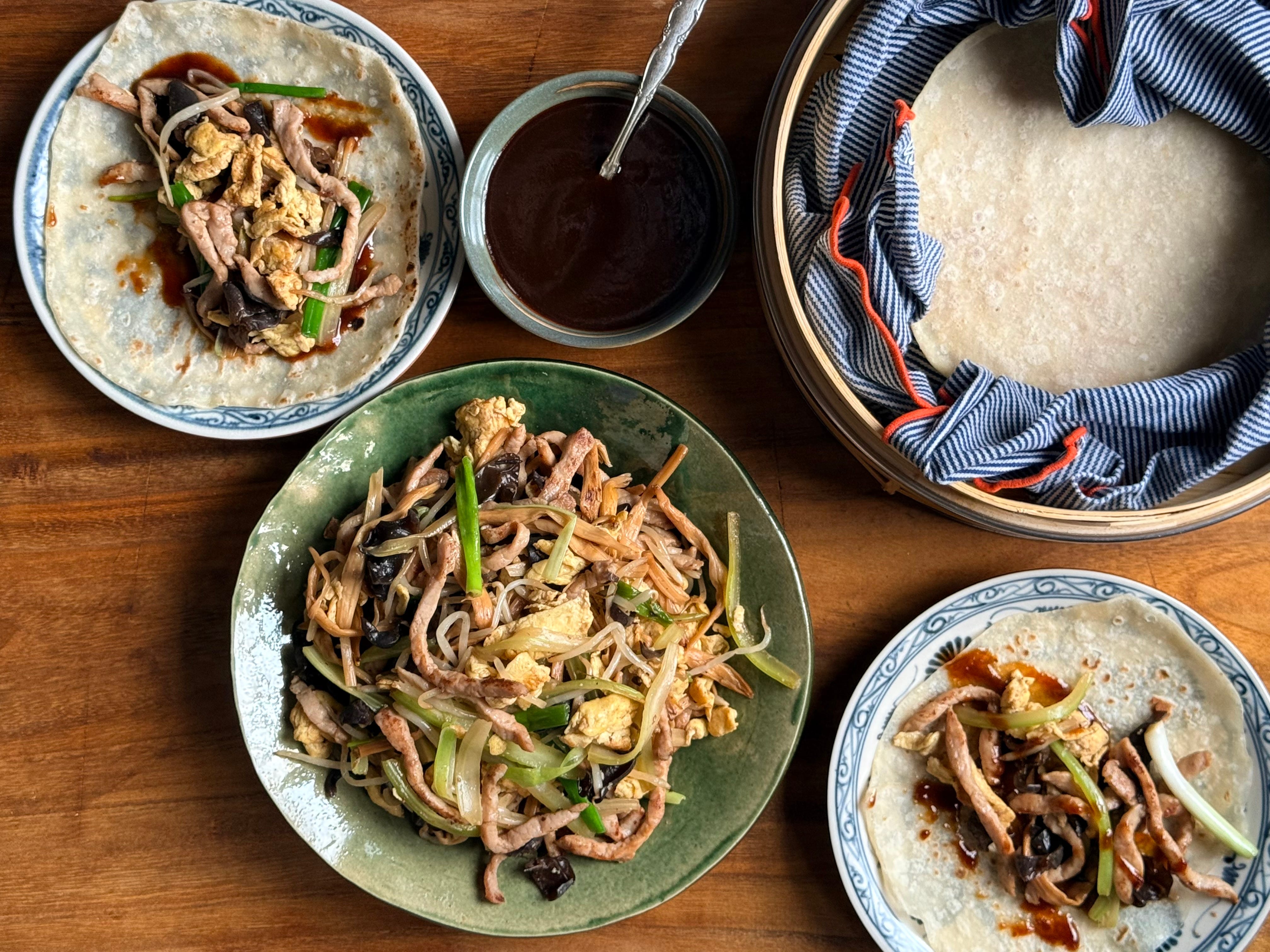
Here are 2 Moo Shu recipes so you can have it your way

There are many great things about Lunar New Year but for me, the most important one is the idea that the holiday is not just one day. It’s more like a festival that lasts many days, weeks, or even a month, depending on how you want to celebrate. In Vietnam, people slow down for for at least a week to ăn Tết (literally “eat the New Year”) because at the center of the celebration is food. People work so hard during the rest of the year that they go home to visit family for rest, relaxation and special food.

Even though the Year of the Horse officially starts on Tuesday, February 17, you can get into the Lunar New Year spirit for weeks! There’s no need to rush. Just learn how to say Chúc Mừng Năm Mới (pronounced “Chook Moong Nahm Moy”) and repeat it to any Viet people you run into during the Tết season to make us extra joyous.

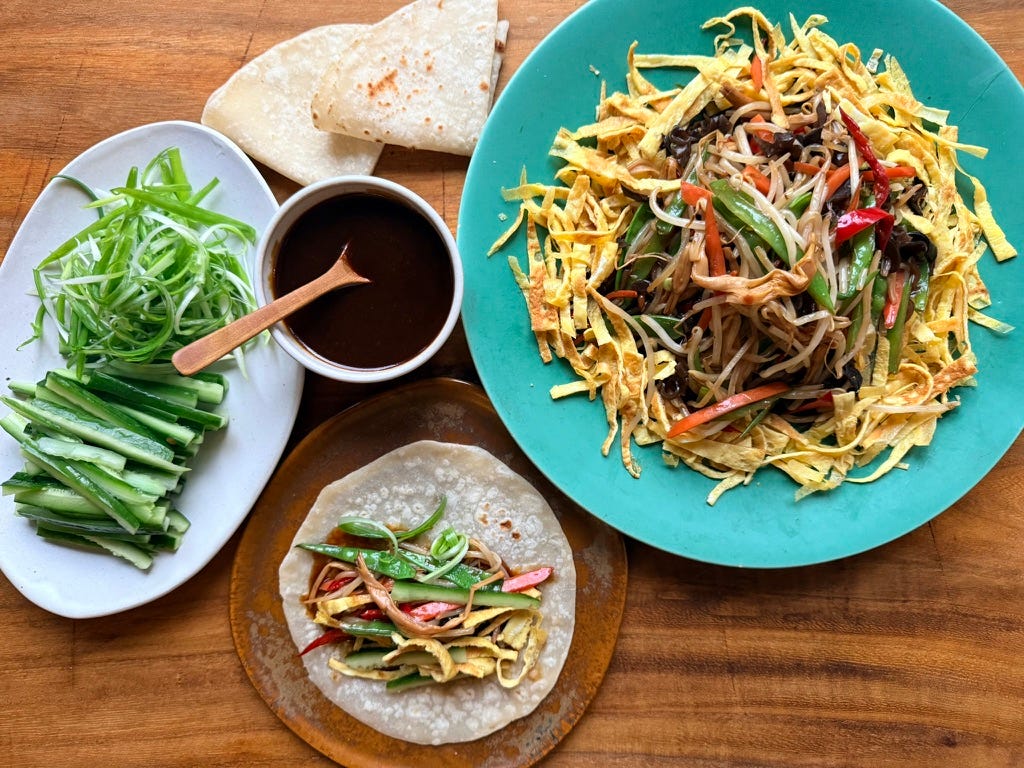
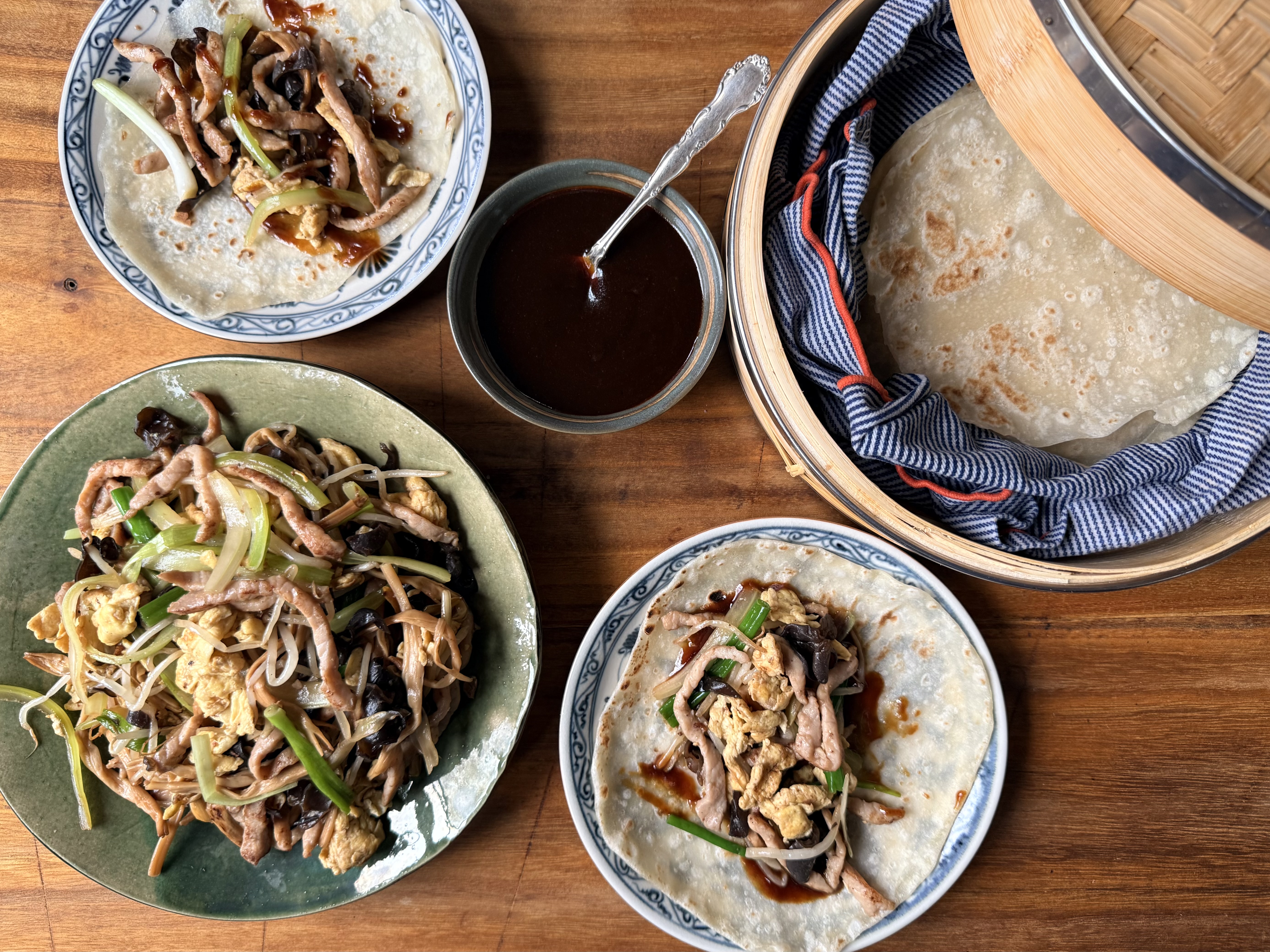
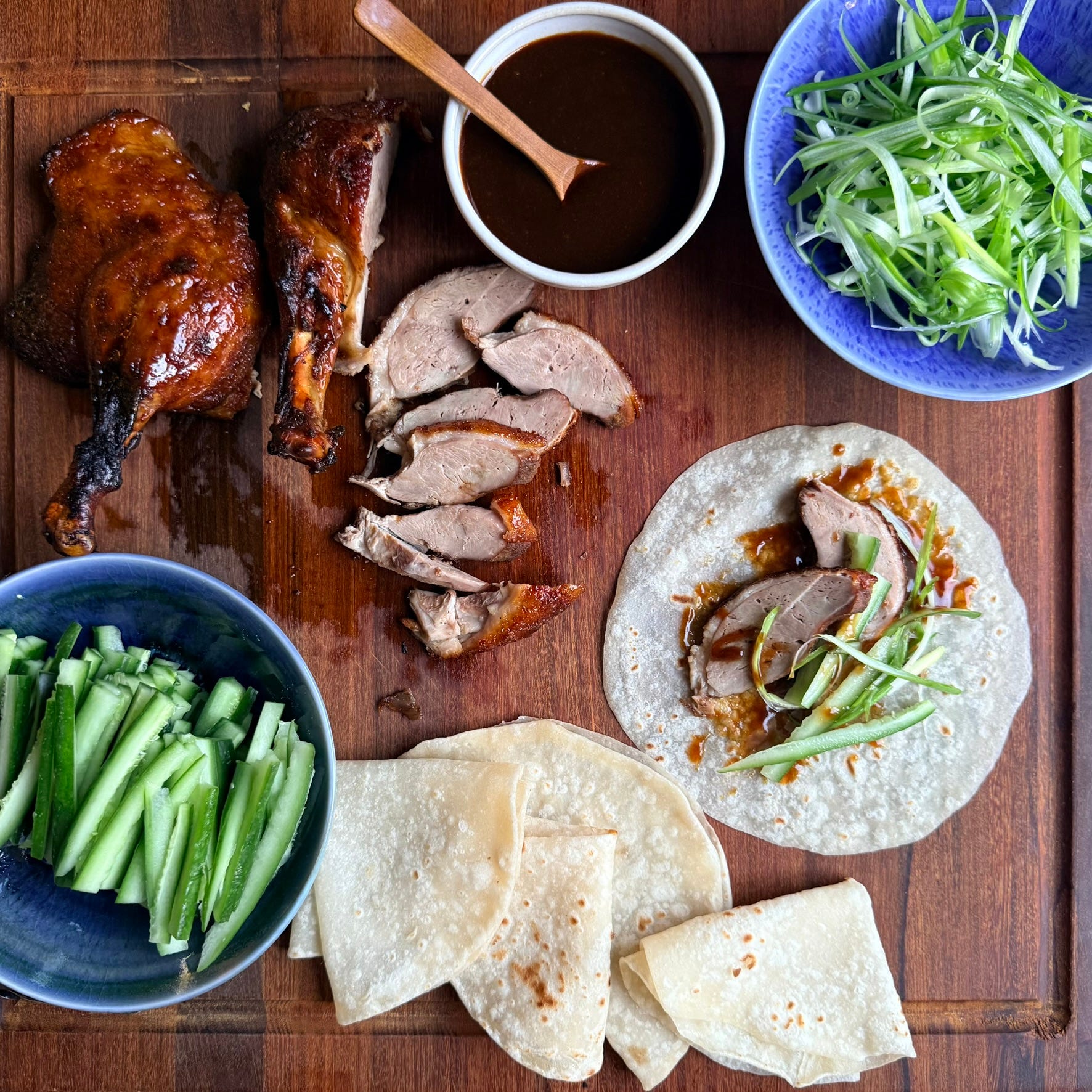
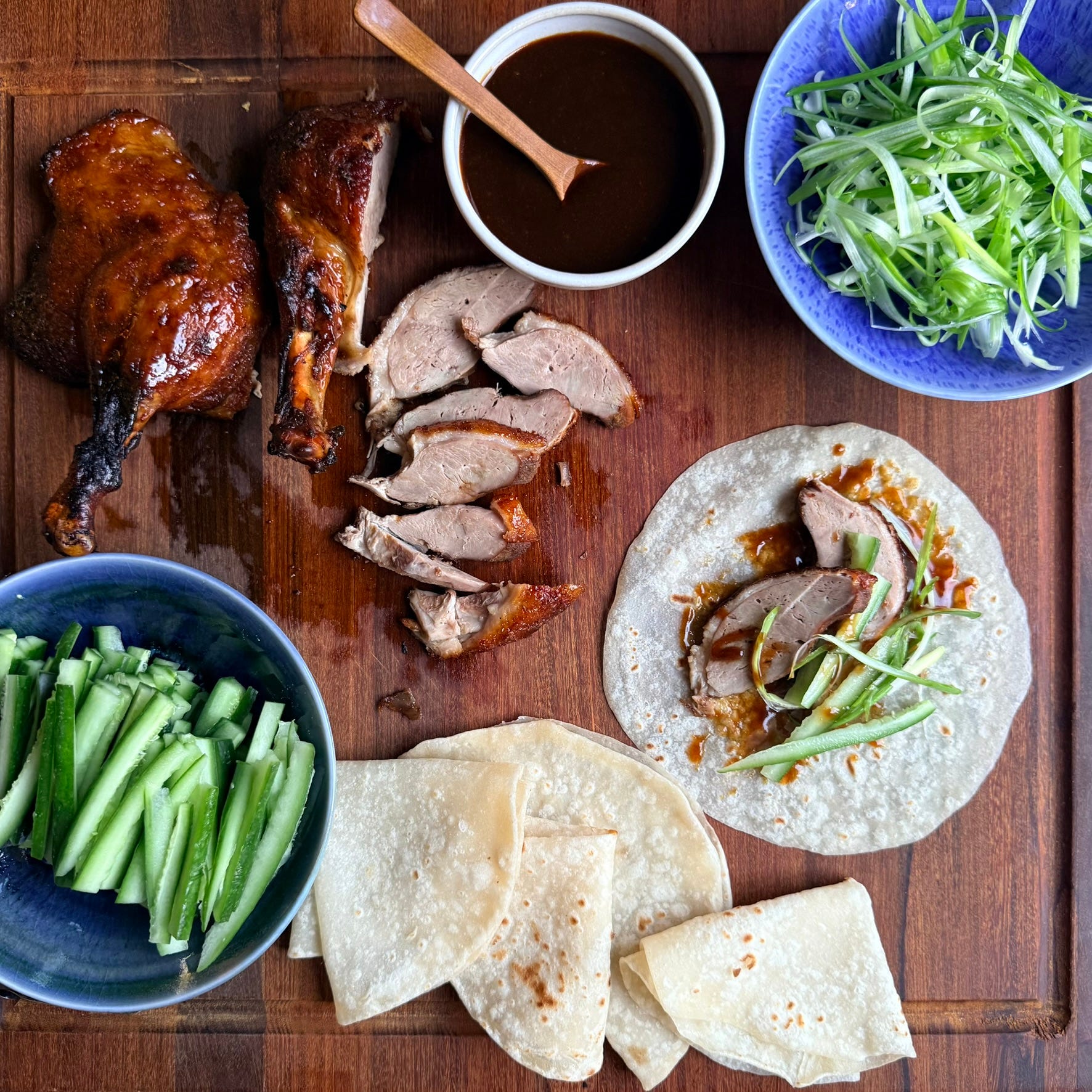
I’m at my mom’s house now for Tet and she’s asked if we were going to have Mandarin pancakes for something. Yup, I brought two stacks that I’d frozen so we can wrap up Chinese roast duck purchased from a barbecue shop and moo shu — a quick stir-fry full of flavors, color, and textures.

Last weekend, for a gateway experience, I led with my Mandarin pancakes mini class plus shortcut duck recipes. Then at midweek I followed up with a homemade Peking duck recipe, in case you want your pancakes to wrap around something super duper and ultra impressive. Today, let’s moo shu with the pancakes!

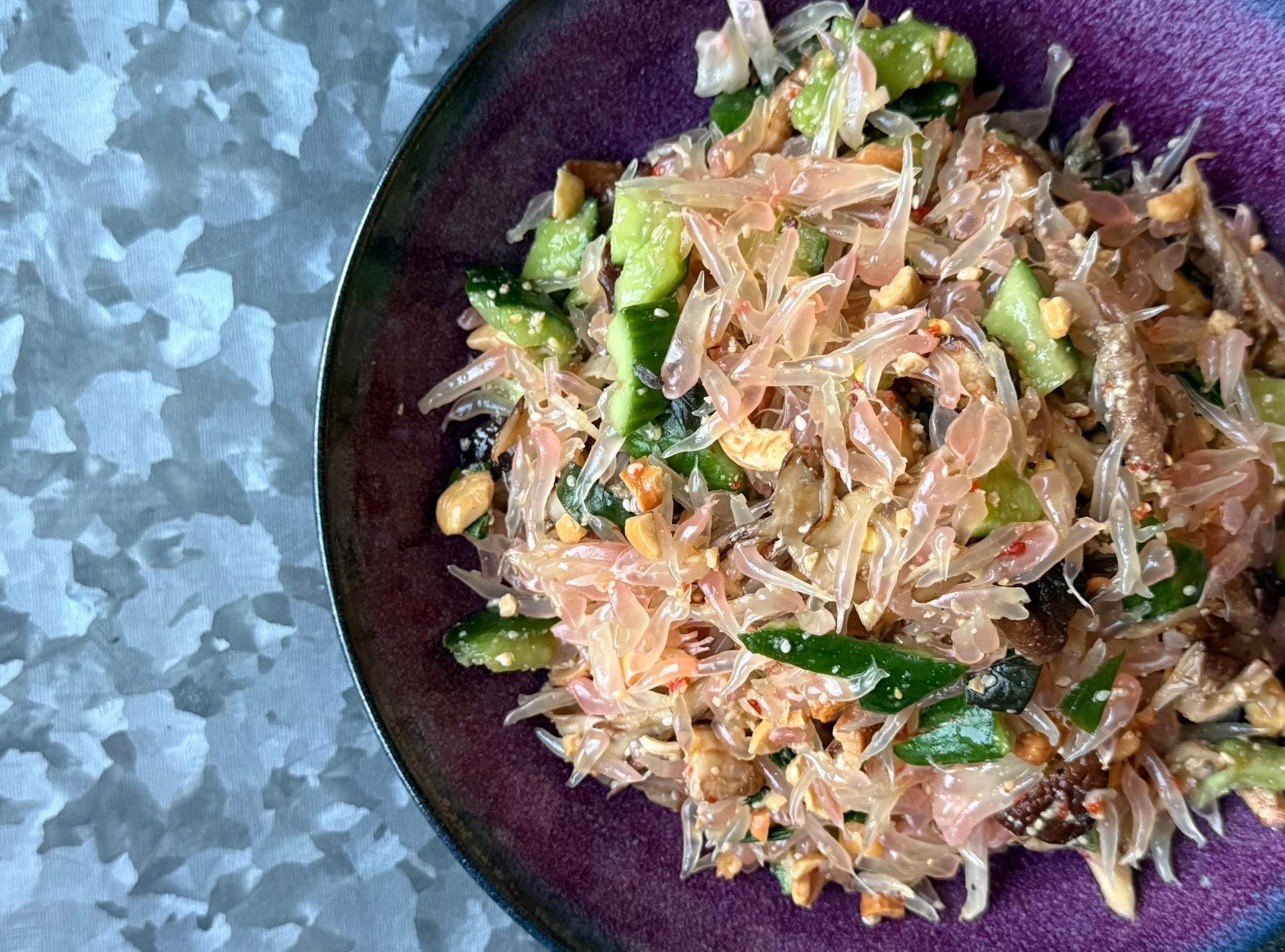
The Moo Shu Any Meat recipe in this post is built for you to do things your way. Add the Vietnamese pomelo salad or a salad dressed with Nuoc Cham vinaigrette for a refreshing companion and complete meal.

If you’ve ordered moo shu (aka mù xī ròu, 木樨肉), at a Chinese restaurant in America, you know that it can be made with different proteins. The dish originated as a simple stir-fry in Shandong, a coastal province in northern China. Shandong is southeast of Beijing and has a peninsula that pokes eastward. When I was studying Mandarin Chinese, a friend joked you can see Korea from the tip of the Shandong peninsula. Stir-fries are a hallmark of Shandong cuisine.

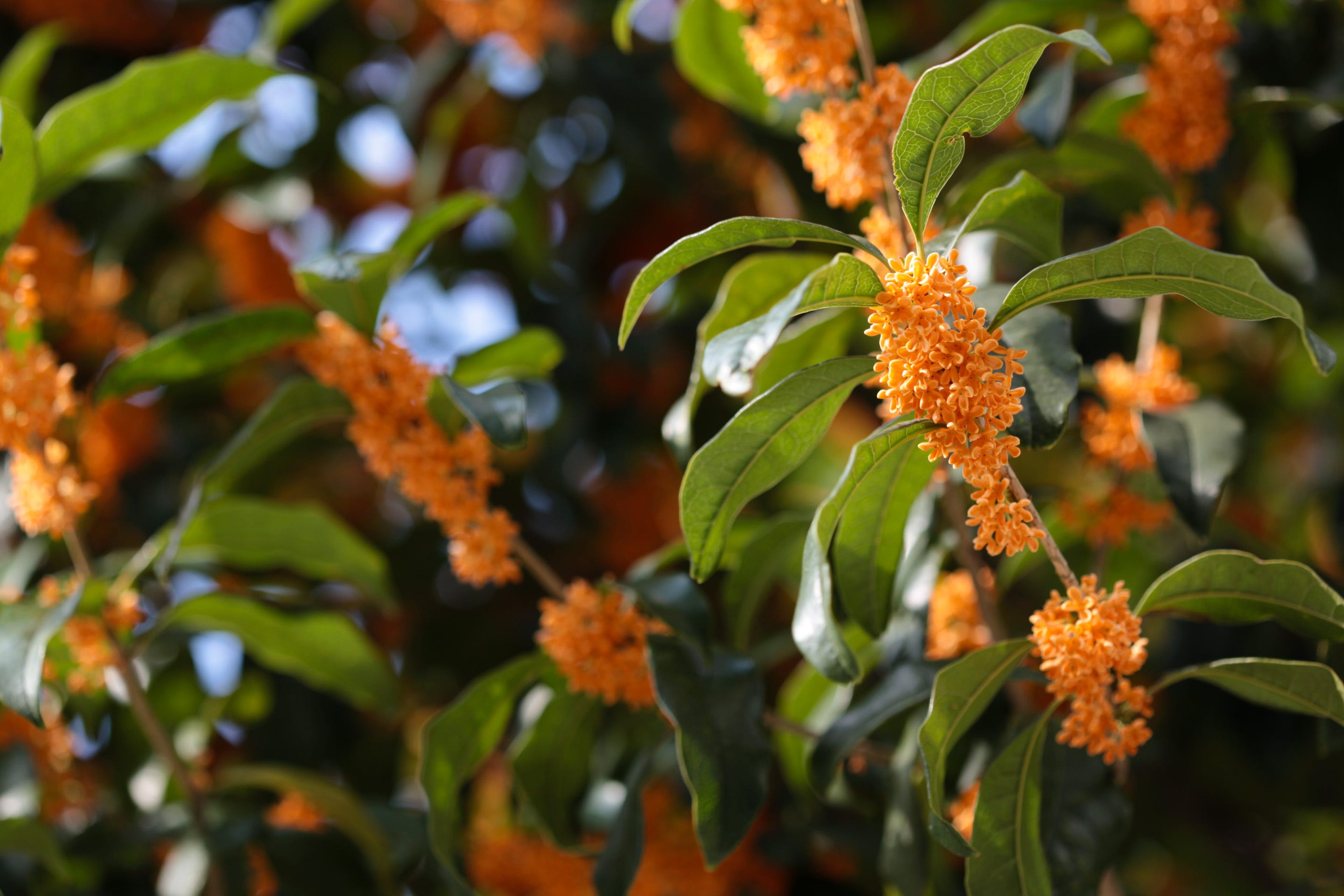
Moo shu usually contains some scrambled egg that are deftly prepared to mimic the delicateness of fragrant sweet osmanthus flowers (Osmanthus fragrans), a symbol of longevity and nobility in Chinese traditions. In the dish’s name, the characters 木樨 (mù xī) refer to the sweet osmanthus. There are folks who say the original characters referred to wood ear mushroom (木耳, mù ěr) which are also in the dish, but in the main, people explain the characters as referring to the flower.

You don’t have to decide. Both egg and mushroom are constants in my moo shu recipes to add harmonious-yet-varied textures and flavors.

Finally, the third character 肉 refers to ròu — meat, which in China and Vietnam, defaults to pork. Traditionally the dish was prepared with pork, egg, earthy bamboo shoot, frilly crunchy black fungus mushroom, and aromatics and simple seasonings. It was a homey stir-fry that people whipped up to eat with rice.

Then, something changed.

Get 25% off for 1 year

Moo shu pork in America

As moo shu was introduced to the U.S. by northern Chinese cooks, the simple stir-fry got wrapped up in Mandarin pancakes and served as an appetizer. That’s to say, moo shu got the Peking duck treatment! When did it happen?

Thanks to a number of women chefs and entrepreneurs in the 1950s and 60s, urban areas on the East Coast had boundary pushing Chinese restaurants. The movers and shakers included noteworthy Chinese restaurant owners like Emily Kwoh and Irene Kuo in New York City and Joyce Chen in Boston.

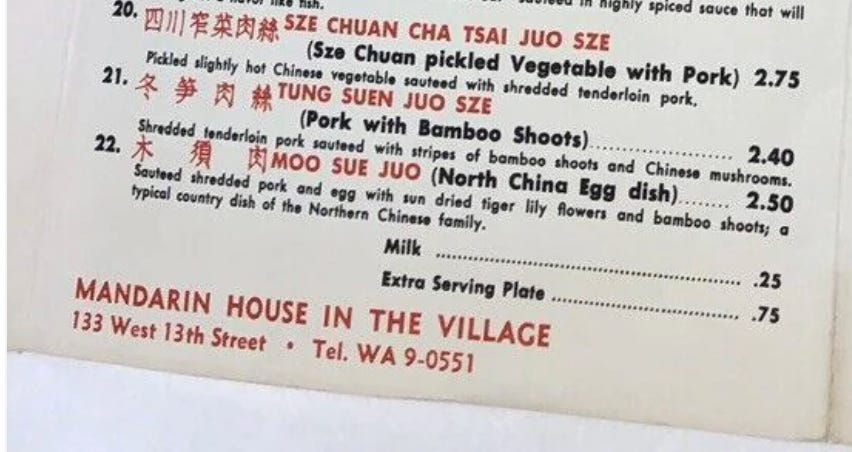
Kwoh opened Mandarin East and Mandarin House in the 1950s. Below is a vintage menu from Kwoh’s restaurant with “moo sue juo” (for moo shu rou) but without the pancakes — yet. The New York Times eventually credited Kwoh as being one of the first to serve moo shu with pancakes at Mandarin House.

Kuo opened Lichee Tree in Greenwich Village in 1960 and Gingko Tree in 1966. Joyce Chen operated restaurants starting in 1958. They were all likely monitoring one another’s menus. The first cookbook to include moo shu with the pancakes was The Joyce Chen Cookbook, published in 1962.

Kwoh, Kuo and Chen were talented chefs and business people. Kuo and Chen were on national TV, hobnobbed with celebrities, artists and intellectuals, and they were not Cantonese. Chen was born in Beijing and Kwoh and Kuo were from Shanghai. They favored northern Chinese over southern Chinese food. Like Cecilia Chiang in San Francisco in the 1960s, those East Coast Chinese women were looking to push the Chinese food envelope before Nixon set foot in China in the 1970s! (Chiang opened The Mandarin in San Francisco in 1960 or 1961; though she had Shandong cooks, I can’t find early mention of moo shu on her menu.)

Get 25% off for 1 year

Have moo shu Chinese or Chinese-American style

This explains why if you go to mainland China and ask for moo shu pork, you’ll likely get a wonderful stir-fry of rich pork, tender eggs, earthy daylily buds or bamboo shoot, crunchy black fungus and perhaps some other vegetables. Mandarin pancakes are not probably going to be on the side for you to wrap up the stir-fry with a smearing of salty-sweet hoisin-ish sauce.

Go vegetarian with the other moo recipe, if you’re not feeling meaty. Yeah, I load mine up with extra raw veggies. Add roast duck or rotisserie chicken and you can have a wrap party! I sometimes add coarsely chopped cilantro for an herby lift.

But if you like moo shu with Mandarin pancakes, know that it’s legit. Kwoh, Kuo and Chen tweaked moo shu for American diners and over time, the dish became redefined and it became a winning idea. Now it’s part of the Chinese-American food experience. Food evolves.

I developed two moo shu stir-fries for you that are fabulous wrapped up in the pancakes or simply eaten with rice. Below you’ll find:

  • 3 recipes + PDF for: Master Moo Shu Recipe Blueprint + Moo Shu Any Meat (feel free to vary the protein!) + Vegetarian Moo Shu (with a vegan option)

  • Audiovisual aids: 2 videos plus process shots to help you manage potentially tricky moves

  • Ingredient guidance and swap tips: Explainers are here for those who want to shop at an Asian market and substitutions are suggested if you just want to use more accessible ingredients

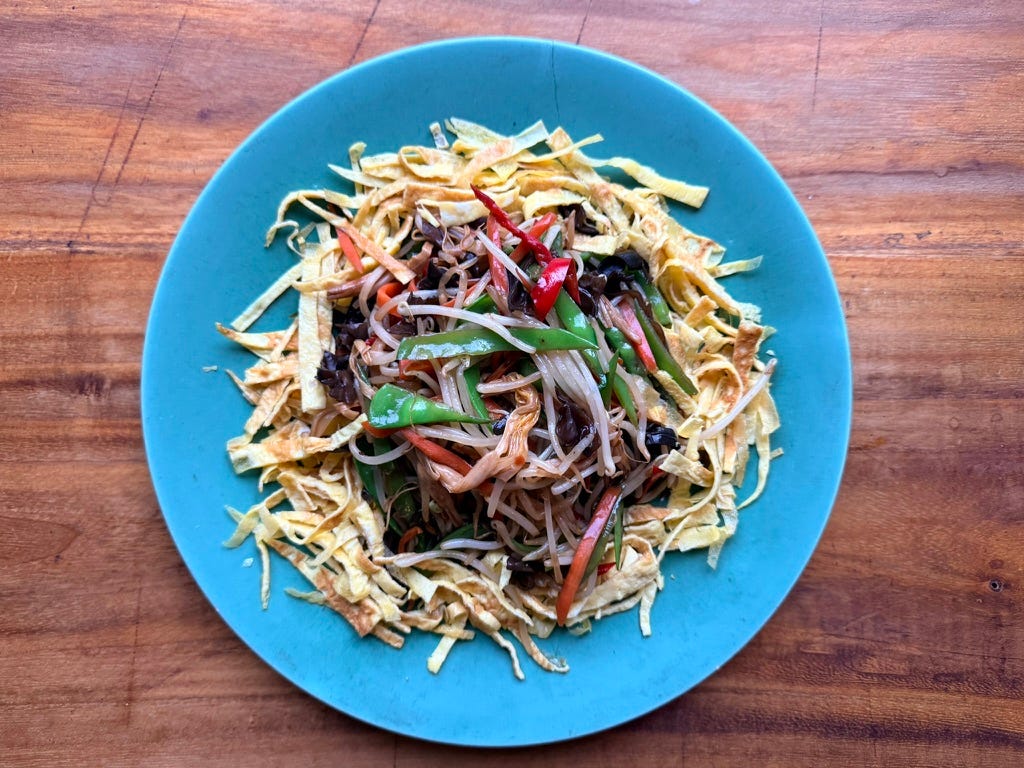
You can plate the Vegetarian Moo Shu with the egg mixed in or on the rim. It tastes great both ways. I couldn’t decide. Yes, there’s a vegan tip below for this recipe too. AND, you can just treat this and the Moo Shu Any Meat as a stir-fry to have with rice.

This culinary deep dive and threesome of Moo Shu recipes were sponsored by paid subscribers. Join us to gain access to these recipes and so many other professionally developed recipes. You’ll also seed new content and enjoy other benefits, including my deep appreciation. I value support at all levels.

Read more

  •  

Midweek gems #58: Birthdays, Valentines, Lunar New Year + Peking Duck recipe

Hello friends,

Politics and economics aside, we’re in an unusual celebratory few weeks right now that’s filled with human physical achievements (the Super Bowl and Winter Olympics — Ilia Malinin! Yuma Kagiyama! ⛸️ 💥), passion (Valentine’s Day 💘), Presidents Day (civic pride, sales, and a long weekend), and Lunar New Year!

I also celebrated a birthday this past Monday. I turned 57. Rory asked what I thought about that and I said — and this is the truth, “I don’t really think about it.” Thankfully, I still have all my original parts and feel better now than I did when I turned 50 and had to endure perimenopause. Things are alright.

Besides, I have my mom as a role model. By her standards, I’m just getting started. Look at the birthday message she sent me. It’s rad. She’s a 91-year-old who didn’t even email until a few years ago.

Instagram reminded me that I had another birthday to celebrate: Vietnamese Food Any Day was released on February 5, 2019. I thought about the book because my friend said she spotted “VFAB” (sic) in the above Instagram post by actress and author Lauren Graham of Gilmore Girls fame. Lauren’s stack of cookbooks also include works by Ina Garten and David Chang. If you have VFAD, you’re in damn good company! Don’t have VFAD yet? Check with a local bookstore, Bookshop.org, the library, Amazon, Barnes & Noble, and Target.

💎 Winged victories

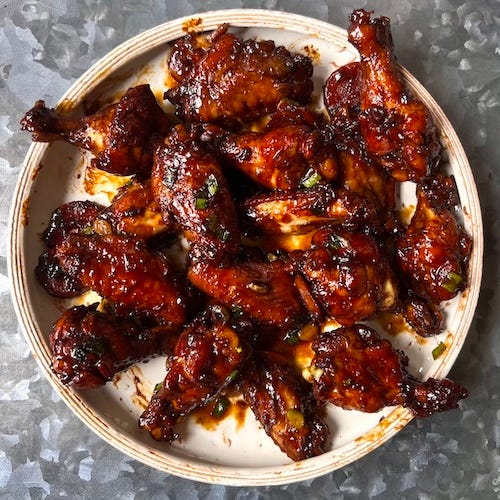
Some of you already jumped on the spicy ginger-orange chicken wings and reported great success. doubled the recipe and cooked the wings in a Dutch oven! The sauce didn’t reduce enough but they loved the wings so much they’re going to do a redo! A note on doubling recipes — not just when using my recipes. You always want to use a bigger pan if you want the same cook time as the original recipe. If that’s not possible, just expect a longer cook time because you’re dealing with a larger quantity of ingredients.

If you have VFAD, the chicken wings coated with chile garlic sauce on page 47 is outstanding too. AND, don’t forget the fantastic vegan Roasted Cauliflower “Wings” on page 48; one of the editors at America’s Test Kitchen said it’s in her rotation.

💎 Lava cakes for chocolate lovers

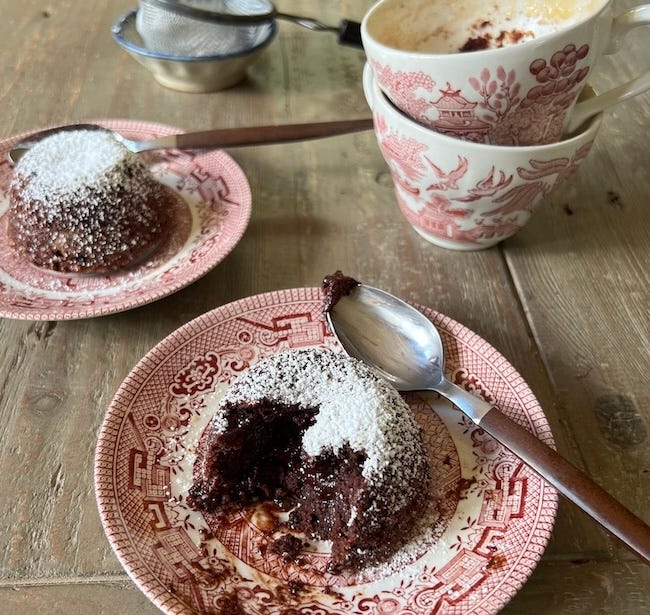
Bake a little something special for your honey for Valentine’s Day — a molten lava cake. My recipe is just for two (2) and you can use regular or gluten-free flour. You can bake them in teacups to get the mountainous shape with ease. The batter comes together pretty quickly too. Here’s the lava cake recipe for you!

💎 Mandarin pancakes follow-up

Susan asked about a gluten-free approach to the pancakes. I don’t have one yet because I’ve not tried a GF flour blend on the recipe; that’s where I’d start. The other suggestion I had for Susan was to offer radicchio, endive, or lettuce leaves instead of the Mandarin pancakes. When I did catering gigs in the 1990s, I made a tasty duck appetizer wrapped in radicchio.

Today, I received a great idea: Duy makes the honey-roasted duck legs from my first cookbook, Into the Vietnamese Kitchen, and wraps the result in rice paper. That is a GRRREAT gluten-free solution to wheat mandarin pancakes!

Additionally, in last Sunday’s post, the Mandarin pancake video summary that I shared didn’t have any audio. Where was my brain?! My apologies. I was trying to cram too much in and was tired after a week of intense book proofreading. So, I added audio to the video so you will have a better sense of what the heck I was doing. Here’s the updated video to go with the Mandarin Pancake Mini Class dispatch. (I also just added a Weee! link to the duck that Costco also carries.)

Support Pass the Fish Sauce! Join us as a free or upgrade to a become a paid subscriber to enjoy 125+ professionally developed recipes, seed new content, and get future class discounts. Thanks for your enthusiasm!
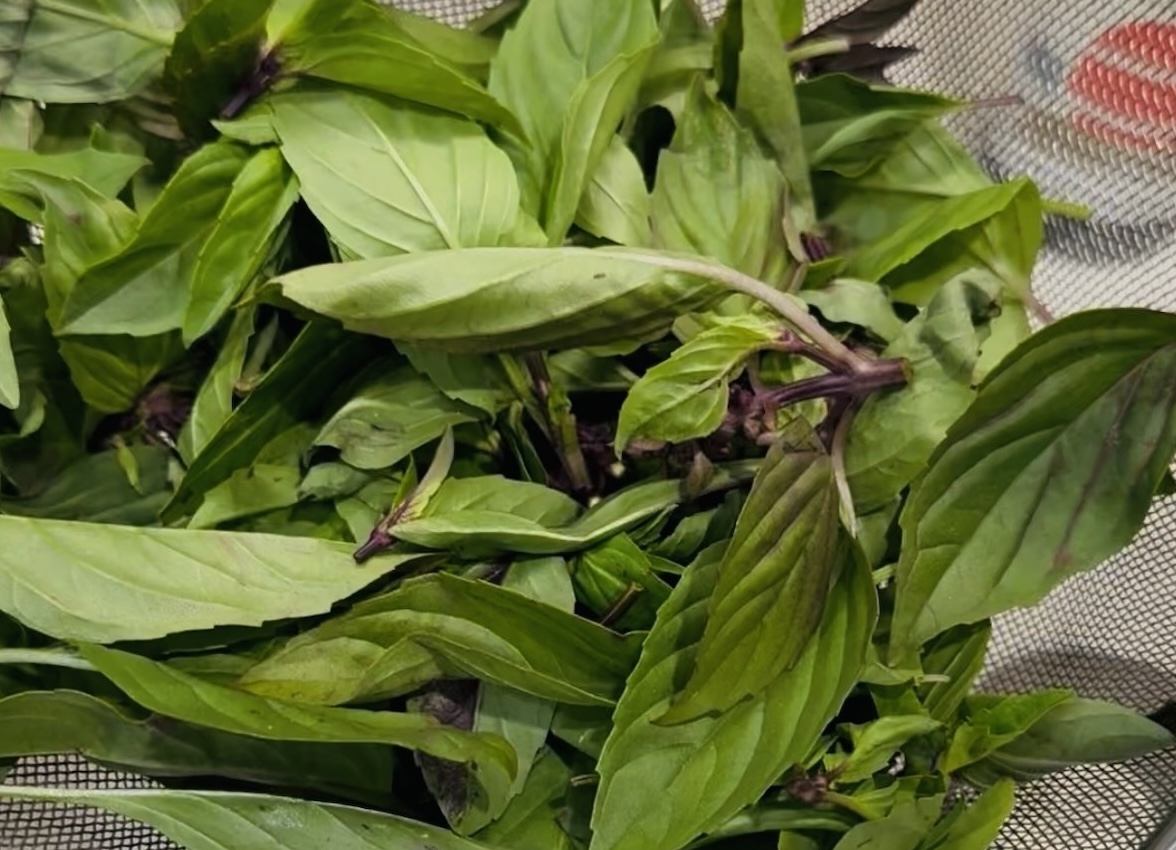
💎 Homemade Peking Duck Master Recipe and Plan for Success

What if roast duck shortcuts and hacks are not your jam? Also in response to the Mandarin pancakes and duck feast dispatch, Sunnie asked about roasting a duck from scratch. Sunnie lives in Europe and doesn’t have an Asian barbecue shop or Costco nearby.

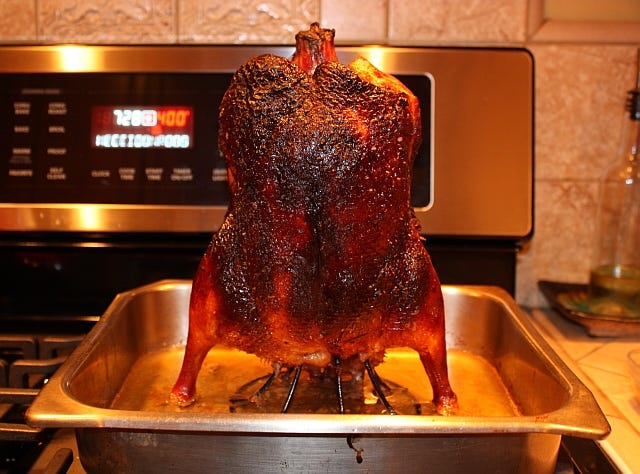
To help Sunnie and any of you want to go the full distance, I put together materials for a Homemade Peking Duck Master Recipe. It’s project cooking that results in a very impressive, glorious meal. I’ve roasted Peking duck over a dozen times and even on the first try, it was darn good — crisp skin and tender flesh.

If you are going to roast your own Peking duck then you must have homemade Mandarin pancakes too. Get my Peking Duck Recipe and the full low down at my website. Then use the duck for the plug-and-play Mandarin Pancake and Roast Duck Feast recipe (just scroll on down in this PTFS dispatch).

Lunar New Year is a time for fun cooking projects with family and friends. The end result is wonderful food and company. So, to help you make the most of the Mandarin Pancakes you have and will make, I’ll be offering two simple recipes on Sunday to go with those pancakes. Omnivores and vegans will be happy!

  •  

Mandarin Pancake Mini Class + a Duckylicious Feast

This past week, Super Bowl party wings sales led me to making a batch of wings that didn’t require deep-frying. They’re simmered in bold seasonings and end up tender, rich, and kinda sticky and messy-fun to eat — what we want from chicken wings, yes? If you’re a wing person get the Spicy Ginger-Orange Chicken Wings recipe at my website.

My week hasn’t been filled with Super Bowl preparations. I’ve been working with chef Pim to prepare the book to go to print in early March. We’re at proofreading phase two out of three. Cooking Thai is looking great and the early reviews and endorsements are remarkable. Phew.

I’m also gearing up for Lunar New Year. No matter how spent I am, I feel giddy about starting anew. Tuesday, February 17 will usher in the Year of the Horse. My dad was born in the Horse year so welcoming this new lunar cycle also honors and celebrates my father. My mom, siblings and I are going all in.

We’re gearing up for a mini family feast this coming weekend. Mom is already making bánh chưng (“baan choong”) sticky rice cakes, a must-have for Tết (“teht”), Vietnamese Lunar New Year. For my part, I’ve been practicing and planing an easy Peking Duck with Mandarin Pancakes, which is partly why today’s post arrived late. To guide I’ve created a mini Mandarin Pancake class for you in this dispatch!

Here’s a summary of my pancake practice plus the duckylicious payoff — which will soon be yours to enjoy too!

Why Peking duck for Tết?

Viet celebrations often combine Chinese traditions because the two cultures have rubbed shoulders for millennia. Pho was initially made and sold by Viet-Chinese cooks, for instance. Viet language used to be based on Chinese pictographs and there are many shared words. The border continues to be porous.

Plus, my Mom adores Chinese roast duck, especially when it is served with delicate, thin pancakes slathered with salty-sweet sauce and accented by cooling cucumber and pungent green onion. Unlike doughy steamed buns, Mandarin pancakes are not sweet; their delicate texture and flavor harmonizes well with roasted meats and many other dishes. We set out all the fixings and make our own roast duck wraps, like at a fancy Chinese restaurant but better because we can have plenty and the flavors are extra fresh. Along with Viet dishes on the table, the duck makes for a very tasty Tết celebration.

Why Mandarin pancakes for spring?

Mandarin pancakes go by two names. On a macro level, they belong to the Chinese food category of báo bǐng / bóbĭng 薄餅, which covers a myriad of thin wrappers used to encase or hold food. Spring roll and lumpia wrappers, rice paper, tortillas, pizzas, and naan can all fit into this category.

Many people also know Mandarin pancakes as chūn bǐng 春饼 because they’re a food often enjoyed to mark the beginning of spring — lichun 立春 in Mandarin, lập xuân in Vietnamese. The actual dates depend on astronomical moves so celebrating spring, aka celebrating the Lunar New Year, officially lasts weeks. This year, lichun goes from February 3 to 18.

Friends you’ve got time to add this pancake tradition to your repertoire. Actually, once you’ve mastered these pancakes, you can enjoy them year round. I made so many pancakes to write up this mini class for you that I’m going to freeze a bunch. And I know how well they’ll go with other roasted meats, stir-fries and many other foods!

Get 25% off for 1 year

Wait up, Andrea. How doable is this at home?

The duck, sauce, and veggies are super easy. I’ve got shortcuts, hacks, and make ahead tips for you! The pancakes do not require any special ingredients or equipment — just a little skill practice.

Some Asian American cooks use flour tortillas as a sub for Mandarin pancakes, and I was going to for this dispatch but honestly, they’re always too thick and never as good as true Mandarin pancakes! I’ve tried Sonora flour tortillas but super thin ones are very hard to find and they’re not fresh. What about frozen? I’ve never enjoyed the taste of frozen doughy foods from overseas. The flour used isn’t as flavorful. I’ve carted back flour from China and was very disappointed.

Mandarin pancakes are a northern Chinese flatbread. You can use them to wrap duck like I do here, or go for quick char siu pork steak or char siu tofu. Stir-fried and sauteed items like chile crisp yuba skin would be glorious in these Mandarin pancakes. Rory even suggested using Mandarin pancakes instead of flour tortillas!

As I’ve worked through this recipe, I’ve noted insights and recorded videos to help you succeed in this too! Below you’ll find a Mandarin Pancake Mini Class containing:

  • Mandarin Pancakes recipe in text and PDF + 5 videos to guide your progress toward success + my mishaps and flubs to help you troubleshoot and create

  • 3 Shortcut Roast Duck Hacks + a magical Glossy Glaze for that Chinese barbecue shop lacquered-look

  • Roast Duck Feast with Mandarin Pancakes recipe + an excellent sauce that you may want to double because it’s just that good

  • Suggestions for swapping out the duck, including going vegan

  • Ingredient sourcing and prep pointers in case this is unfamiliar territory

That’s a lot of content but I really want you to try this out on your own terms. Add a salad for a complete meal.

Paid subscribers sponsored the wealth of knowledge packed into this dispatch, which involved days of effort. To get all the recipes below — and many, many others in the archives, plus more to come — join us as a paid, premium PTFS subscriber. I welcome your support at all levels. 🙏 🧧 🧨

Read more

  •  

Vietnamese pomelo salad, fit for royalty and doable from supermarket ingredients

Hello there! I’ve been gearing up for this for weeks, buying ingredients and thinking through what I wanted to share with you about a delicious and under appreciated fruit. Galloping toward Lunar New Year on February 17 — the Year of the Horse, I’ll be offering menu and cooking ideas for your celebration.

This time of year, people tend to lean into oranges and mandarins but pomelo is wonderfully complex, multidimensional, and fun. When you peel pomelo, the oils release to pleasantly perfume your hands and the air. The pith is plushy and makes a funny sound when you pull it away from the ball of fruit inside. Better yet is when you bite into pomelo’s flesh, you burst its juice sacs to release its mildly acidic, sweet flavor that carries just a hint of bitterness.

Pomelo is wondrous in many more ways than I’ve described, and nowadays, we’re lucky to have access to many kinds. Depending on where you shop, you can find pomelo grown in America, Vietnam, and/or China, for instance.

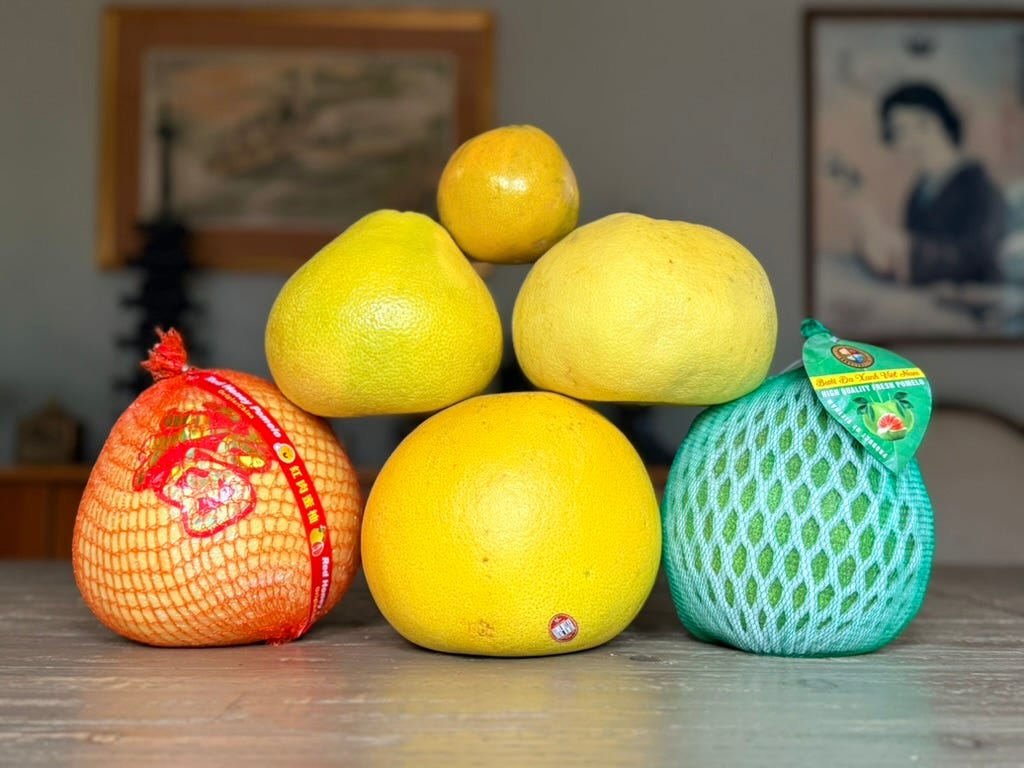
Three grapefruits atop three pomelos.

A lucky, healthful, royal fruit

The size of a volleyball, pomelos (Citrus maxima) symbolize many good things. They come into season in early autumn so Viet people often associate their big, round appearance with the Moon Festival, a time for gratitude and family reunions — completeness. When Lunar New Year rolls around, pomelo is further a regarded as a harbinger of prosperity. Many people include pomelo as an offering to their ancestors.

In Chinese, pomelo is yòu 柚, which sounds like the word to have 有 as well as the world for protection 佑. Combine all those homonyms and pomelo is win-win fruit. If you gift someone a beautiful pomelo, it’s like you’re presenting them with good luck.

In Vietnam, it’s more than just about homonyms. The Luận Văn pomelo grown in the central province of Thanh Hoa has deep rose colored flesh and skin. Its unique lucky red appearance and tasty flesh made it worthy enough to have been presented to royalty in the past. Nowadays, the Luận Văn pomelo is sold nationwide as the ‘royal tribute pomelo’; during Tet when people clamor for specialty foods, premium perfect pomelo can sell for as much as $10 each, which is pricey for Vietnam.

And, pomelo is pretty nutritious. It’s loaded with Vitamin C, fiber, antioxidants, and it may even help weight loss, fight anti-aging, and promote heart health. All that said, like with grapefruit, pomelo’s phytochemicals can cause some drug interactions so do be careful.

Leave a comment

What to do with pomelo?

To kickstart 2026, I gifted myself extra healthful luck by buying three pomelo (called bưởi in Vietnamese)! Along with some grapefruit, our dining table has been full of golden-green orbs of citrus. The pomelos I’ve been buying, whether it’s from Whole Foods or a Chinese or Vietnamese market, are big boys — at least 2 pounds (1 kilo) each!

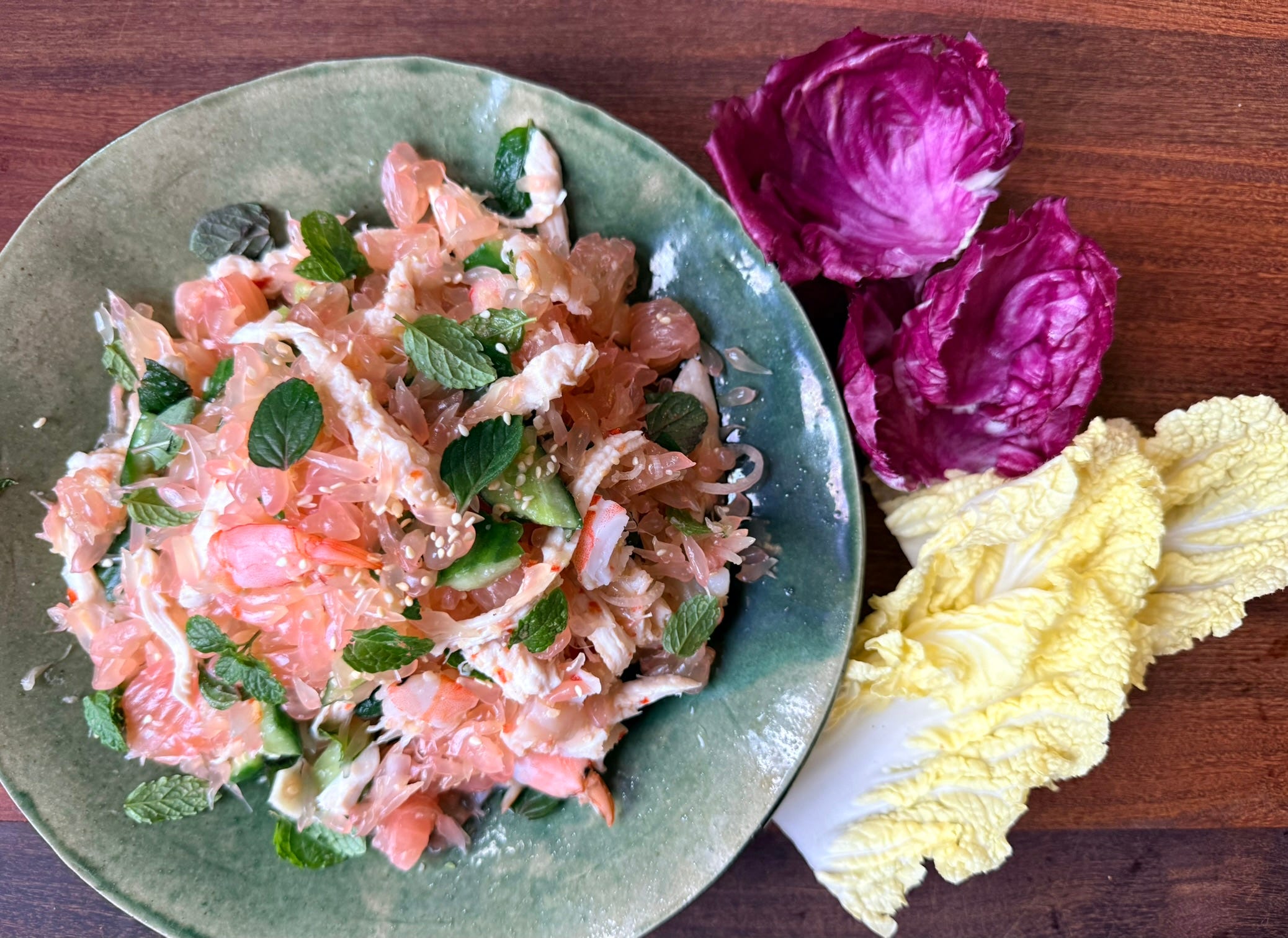
We eat pomelo as fresh fruit but I also make a Vietnamese gỏi bưởi salad. It’s a very special salad worthy of holiday celebrations and dinner parties. It’s easy to prepare and you can prep most of it in advance. However, you have to extract the pomelo flesh from the segments as clusters of juice sacs to allow pomelo to express its best flavors and textures. That’s what makes the salad unique.

Gỏi bưởi is not a salad of chopped or dressed leaves. Much of the prep is done with your finger to pull apart the juice sacs, which are jewel like. Prepping the pomelo requires about 30 minutes, but one pomelo yields enough to serve eigh people, though you could stretch it over the course of a couple days too! To encourage you, I made a how-to video to guide you along!

Made and served with ingredients sourced from Whole Foods, the farmer’s market, and my garden — just to prove that Viet food is doable! No Asian market required. This rendition with shrimp and chicken was dynamite.

Gỏi bưởi (“goy buoy”) used to be hard to prepare well because good pomelos were not available abroad. That has changed so I went to town to prepare the following for your success:

  • Detailed Vietnamese pomelo salad recipe (+ a downloadable PDF) that allows you to make it with or without meat

  • Video tips for prepping the pomelo

  • A pomelo buying guide so you can gauge the pros and cons between different kinds

  • A nifty quick way to cook shrimp and chicken breast so they’re flavorful and not overcooked (it’s fab for other dishes like shrimp cocktail!)

Pass the Fish Sauce connects cultures in the kitchen and at the table. The content of every dispatch is sponsored by paid subscribers so pitch in to make PTFS even stronger! In addition to this pomelo recipe and know-how, you’ll have access to a wealth of other recipes, tips, and travel information. No paywall will stand between us! Your support makes a big impact. 🙏

Read more

  •  

midweek gems #57: Herbaceous basics for making Vietnamese food sparkle

Hello there!

I’ve been digesting all the wonderful comments and suggestions you made in the recent subscriber survey and decided that I’m going to cut down from eight (8) to six (6) dispatches per month. My current pace has been hard to keep up with because I want to ensure quality content for you. Plus, it’s a lot for you to receive in your inbox.

This is what to expect:

  • Midweek Gems will come out twice a month.

  • Sunday Specials will remain steady. Most Sunday dispatches will be paid subscriber exclusives but there will be an occasional all-access dispatch that’s free for everyone.

Thank you so much for supporting my work at all levels!

These days, it seems as if the world is in a mad tailspin and full of precarity. While I pay attention to the news from sources I trust, I’m also carving out time to do things that ground me and give me hope.

Even in the depths of winter, thinking about and cooking with herbs me as I wait for the start of spring, the season for regrowth and the beginning of the bounty of flavors to come. One of the food ingredients that a number of you have expressed interest in are the herbs used for Vietnamese cooking so I’m going to share some essentials and a new ‘discovery’ with you.

💎 MVP herb for Vietnamese cooking

When my family first came to America, we were relieved there was cilantro at the supermarket. We enjoyed many herbaceous Vietnamese meals with just cilantro. Later on, when Dad started growing mint, we’d add it when there was enough. Otherwise, it was mostly cilantro. Survey Vietnamese recipes written in Vietnamese and English and you’ll see that cilantro comes up more than any other herb. In other words, you’ll go a very long way if you just have nice cilantro, which you can purchase at many markets.

If you regularly shop at a hardcore Vietnamese market, you’ll have access to a wide variety of herbs. However, in winter, the herb pickings are slim and spotty. To this day, I basically rely on cilantro during the colder months to make Viet food sing.

When you buy cilantro, you commit to a bunch of it but a recipe doesn’t need that much. How do you keep cilantro perky and ready for action?

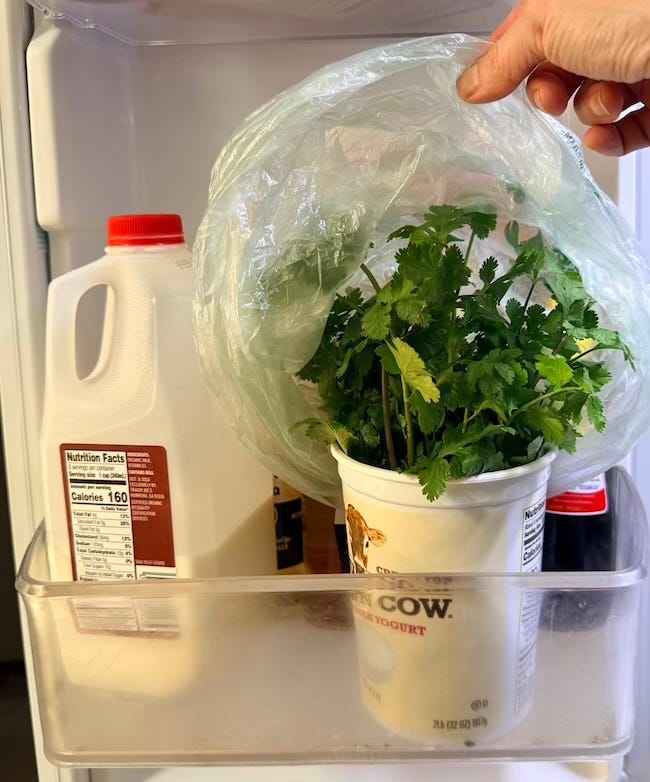
I find the freshest cilantro at our local indie market or farmer’s markets. When I get it home, here’s what I do: Trim the ends by about 1/2 inch (1.25cm), hold on to the stems (like a bunch of flowers), and then give the bunch a quick wash under running water. Then I spread all the sprigs out onto a clean dishtowel, then roll up the dishtowel to more or less dry the herbs.

Any frail short sprigs get put into a container or airtight bag to be used first. The remaining heartier sprigs go into a tub filled with 1 to 2 inches (2.5 to 5cm) of water, then I put a flimsy produce bag over the tub and put the tub in the fridge. The cilantro lasts for 1 to 2 weeks and is ready to use whenever I need it. No washing required. I change the water every few days, if I remember!

What’s in my fridge 90% of the time is a tub of ready-to-use cilantro!

Want to grow your own cilantro? My friends Alec and Michelle live in downtown Los Angeles in a loft and have long championed indoor, countertop gardens like the Aerogarden. My brother, Dan, who lives near Fresno and has harsh winter conditions loves those mini hydroponic gardens too.

Leave a comment

💎 What about Thai basil?

Most people assume that Thai basil is key in Vietnamese cuisine because restaurants serve it to them as a side for pho noodle soup. Truth be told, it’s only eaten with southern Vietnamese-style pho. Northern-style, Hanoi pho is basically about cilantro and a tiny bit of fresh mint on the side, if you want it.

For that reason, Thai basil is top of mind for many people when the think of herbs in Vietnamese cooking. Winter is not when Asian markets have great Thai basil (húng quế, literally cinnamon basil in Vietnamese). But two weeks ago when the weather was warmish here in California, I surprisingly scored two beautiful bags of them!

I ate some with pho and added lots to a chicken and mushroom pad gaprao (pad ka-prao), an iconic Thai stir-fry that’s one of my favorites. What to do with the rest? I needed to preserve it so I ended up turning some into a green herb oil and experimented with blanching and freezing the rest of the leaves.

I wrote up my experiences so you can play with making herb oil and freezing Thai basil. These two preservation methods are not going to yield you the same experience as the fresh herb. But, the oil and frozen leaves allow you to keep a precious herb for the long haul instead of letting go bad. I’ve used the oil to dress salads and to drizzle on silken tofu, creating what Rory described as a savory sundae! The frozen leaves are good added to noodle soup and the like.

And yes, you can make oil with other herbs. All the details and my learnings are available here:

I’m really happy to have both the oil and the frozen leaves on hand. Here in Santa Cruz, it’s rare to find nice fresh Thai basil, until summer when I can grow my own.

Support Pass the Fish Sauce! Join us as a free or upgrade to a become a paid subscriber to enjoy 125+ professionally developed recipes, seed new content, and get future class discounts. Thanks for your enthusiasm!

💎 2 Viet herb primers

While I have you here, if you’re dreaming about other more ‘exotic’ Vietnamese herbs, check out my Quick Guide to Vietnamese Herbs. For those of you who garden and or want to geek out on great details, head to my Mega Vietnamese Herb Primer.

Winter is citrus season and I have three kinds of pomelo and grapefruit looking at me in the kitchen as I write this dispatch. I’m curious about their flavor differences and how they’ll perform in a dish that’s perfect for Lunar New Year, which is coming up on February 17. That’s what’s in store for this coming Sunday Special.

  •  

Check out what's in store for PTFS in 2026

Pass the Fish Sauce is an evolving experiment to build a culinary community for exploring Asian cuisines and cultures. Very few people live and cook in isolation anymore. Many of us are looking to connect with others. We can do that in the kitchen and at the table — even if that’s done virtually. And, I truly believe all that effort will make us better humans. That’s why I started writing about food decades ago and with all of you as part of the PTFS crew, I don’t have plans to stop anytime soon!

Last week, I set up a survey to help me narrow down what kind of information PTFS subscribers want and how they want it delivered. Many took the paid subscriber survey and contributed great suggestions. I’m overwhelmed, to be honest!

A quick note: This is not a random sample but I reckon it’s better than a random sampling because my goal is to focus in on your interests. Paid subscribers weighed in because they comprise the staunch supporters who sponsor PTFS with extra kindness, generosity, and enthusiasm.

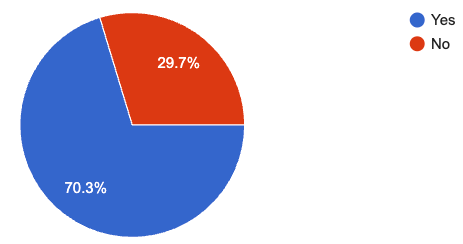
The PTFS survey asked folks to respond to multiple choice and open-ended questions. Below is a summary of the results.

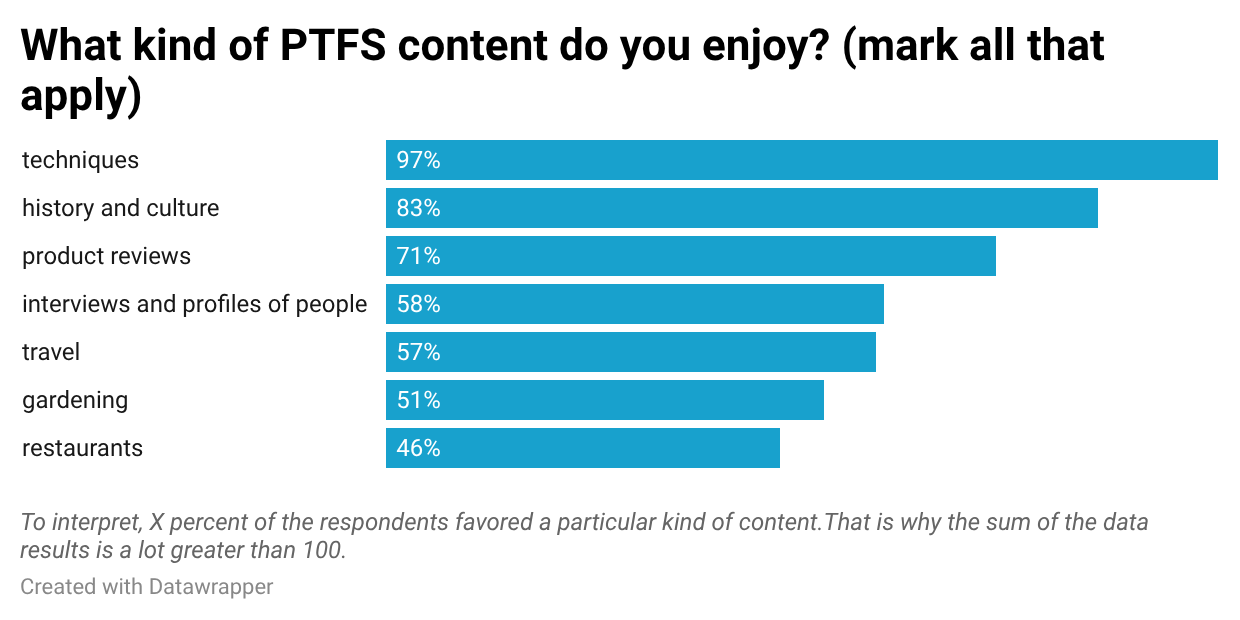
1. What kind of content resonates well?

I grouped PTFS content into eight categories and respondents were able to cast votes in favor of content they found valuable. Here’s the breakdown:

People also expressed keen interest in discussions of whole Vietnamese meals including “what we ate for lunch this week”, the dives into Asian ingredients and Vietnamese ingredients, including substitutions, and my family’s personal history.

2. Cooking basics — what do you need help with?

This was an open-ended question. I led by suggesting knife sharpening, breaking down (cutting up) a chicken, and making perfect rice. I also asked for suggestions.

There was solid support for my three ideas above to help you deal with dull knives and knife selection, whole chicken, and cooking good rice. People offered up extra ideas, such as:

  • working with rice paper

  • how to create staples and building blocks for the freezer

  • quick (30-min?) Viet dinner ideas

  • Viet dishes you might not see in restaurants

  • basics specific to a given cuisine

I’ll re-review all the suggestions to help organize future content! Thanks to all who provided input, thus far.

3. What about healthy cooking?

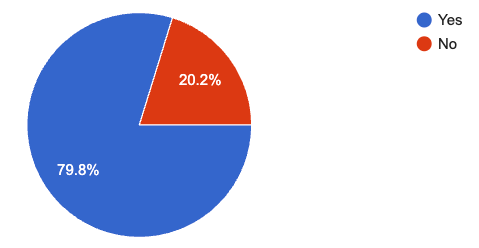
I proposed certain cooking ideas and asked respondents to cast votes in favor of them. Here’s what appealed to people:

While some folks expressed that PTFS recipes are already healthy and that the current mix is fine as it is (🙏), others suggested more content on lowering sodium intake, baking with less sugar, gluten-free and dairy-free desserts, and Asian herbs and vegetables. There are way too many great responses to this question. I’m looking forward to making a thorough list of how we can tackle them this year!

4. What about PTFS livestreams?

Substack has a function to do livestream videos which are recorded and then sent out as a post so you have the recording, in case you cannot attend. PTFFS livestreams may include me demo-ing a technique or basic recipe, answering your questions in AMA (Ask Me Anything) sessions, interviewing people about Asian food and culture, etc. Would you watch or attend a PTFS livestream?

Alright, I’ll get plotting on this branch of PTFS!

5. Are you interested vintage cookbooks?

How do classic Asian cookbooks stand the test of time? Would you be curious enough to be interested in cooking from them? My thought is to recruit a couple of PTFS paid subscribers to cook with me from vintage books (I’d supply the books or recipes) and then we’d all report our feedback to everyone. Does this initiative interest you?

I’m thrilled that this idea got solid 👍.

Join us here at Pass the Fish Sauce! I welcome your support at any level.
6. What ingredient(s) are you curious about or want to figure out?

WHOA, such a wonderful collection of ideas came from this open-ended question. I’m stunned by all the suggestions.

A number of folks asked about tamarind and I realized that I need to better organize content so you can have a bird’s eye level view of what we’ve already covered. I’ve been negligent on that front. My apologies. I seem like an organized writer but I’m only semi-organized!

With regard to tamarind, you can mine the following content at my website and at PTFS for a ton of tamarind information — from basics to condiments to main dishes to one-dish meals.

7. Need advice on certain cooking appliances (small or major), utensils, or tools?

Respondents chimed in to suggest advice on slow cookers, rice cookers, woks, instant pots, and a wealth of other ideas. I’ve amassed an unusual collection of cooking equipment and am often pulled to test driving and learning about more of them. You’ve given me lots of assignments and I thank you!

Any additional suggestions?

Of course there were thoughtful, smart suggestions (how to understand a Viet restaurant menu! using prepared sauces well!). What I didn’t expect were all the big warm hugs and appreciation for what this newsletter offers.

I took this particular suggestion to heart: “You do a great job already. Maybe make life easier for yourself by doing one post a week? Or 6 per month rather than 8?”

You’ve given me so much to think and look forward to. And, if you haven’t done the survey, you can still take it. Your responses and ideas will be read.

  •  

midweek gems #56

I’m not an overly woo-woo person but I do believe in the power of slowing down and taking deep breaths. In fact, when my doctor asked me how I dealt with acid reflux, one thing I listed was slow breathing, which helped to alleviate symptoms.

Rory has meditated for most of his life and nowadays, in social situations, someone ends up talking to him about his transcendental meditation (TM) practice. He’s no proselytizer. Meditation just comes up in conversation. We’re all looking for calm.

Cookbooks are considered works of service and we read them for different reasons. I’ve often likened mine to how-to manuals with recipes that are road maps and stories to lead you along from beginning to end. Hopefully, you’ve gotten some of that from my books.

I’ve read Nigella Lawson’s books for her literary phrasing, cadence, palate, and humor. Her works have often been packed with emotion but are not outright self-help books. That hasn’t been a trend until recently. There have been a handful of cookbooks released specifically about emotional well being. I spotlighted Samin Nosrat’s book in Midweek Gems #44. There have been others and I want to draw your attention to two standouts.

💎 Intentional cookbooks

Just released last week, Mind, Body, Spirit, Food by is designed around cooking with the seasons but also with our emotional needs. She has a vibrant Substack and podcast focused on mindfulness — a term that can seem trite when simply thrown around.

I was taken by Nicki’s book because of its clean design, meditations and versatile recipes, each one accompanied by an intention. Things are written in a concise enough manner so you can read the emotional support part of the equation fast enough and then slide into cooking and enjoying the results.

Nicki is a solid recipe developer and shares her own challenges about healthy eating. The book is healthful in a wholesome way. There are brownie and cake recipes, so it’s not a deprivation diet book. It’s not a cultural book about a cuisine. Rather, Mind, Body, Spirit, Food is filed with easy going recipes for you to practice and get you through the week — something that many of us need when we’re aiming for calm. Nicki’s doing a book tour with a stop in the Bay Area at Omnivore Books, in case you’re in San Francisco.

Remember Helen Goh’s Traveling Speckle Bread (Bara Brith)? The recipe was so delicious that JR made it twice already. I mentioned that I took the recipe for a spin to prep for a podcast interview with Helen about her debut book, Baking & the Meaning of Life. The episode just dropped so you can get the full low down. and I spoke to Helen about the salt, sweet and slightly bitter side of cookbook making, as well as how she combines her psychology training with her baking prowess in a distinctive book.

Leave a comment

💎 Banh pate chaud in Saigon/HCMC

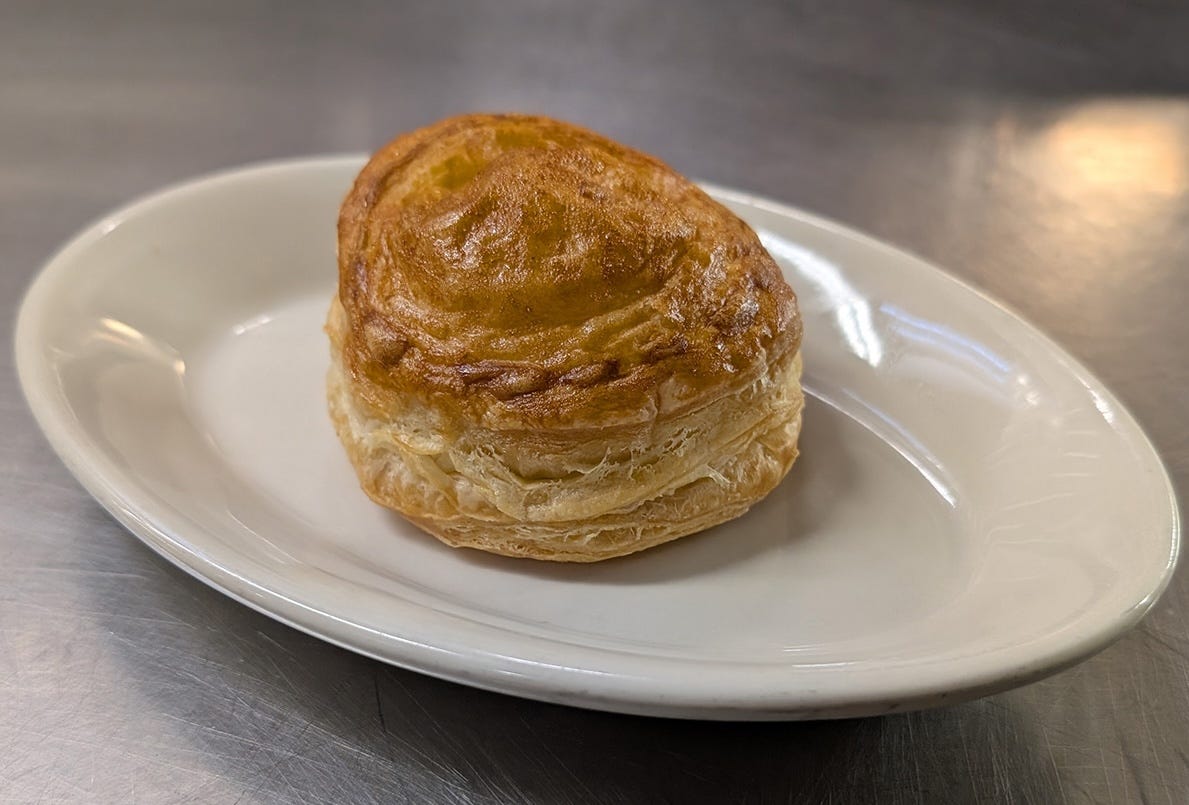
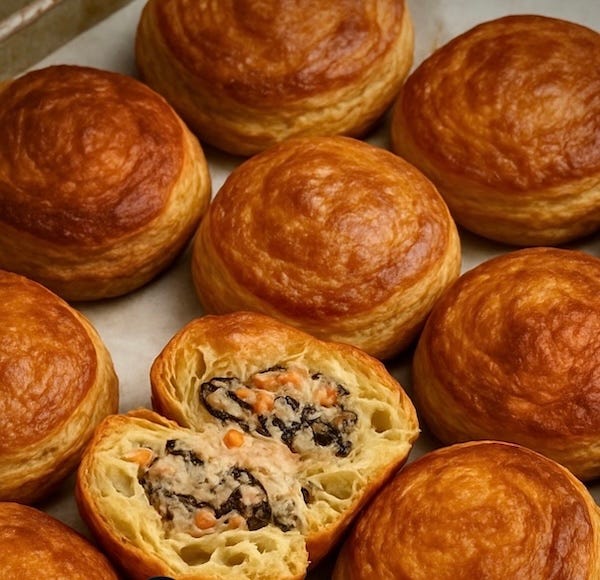
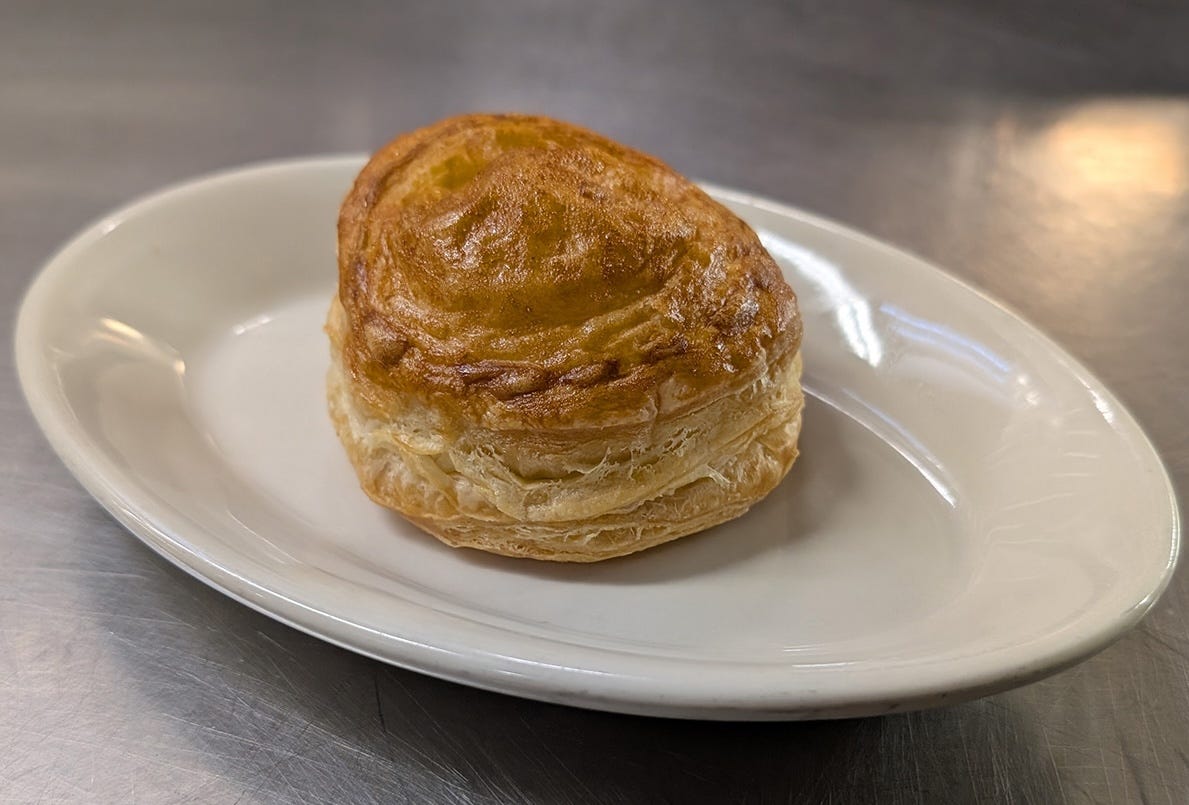
For those of you traveling to Vietnam this year, do look for pâté chaud puff pastries in Saigon (HCMC). After I included a small list of pâté chaud spots in this dispatch about its unusual history, I asked Saigon-based chef Peter Cuong Franklin for extra local pointers. Born in Vietnam, Peter grew up in the U.S. but eventually returned to Saigon, where he opened Ănăn, the city’s only Michelin star restaurant. After dining there, I included it in my 2025 list of interesting spots for you to try while in Ho Chi Minh City.

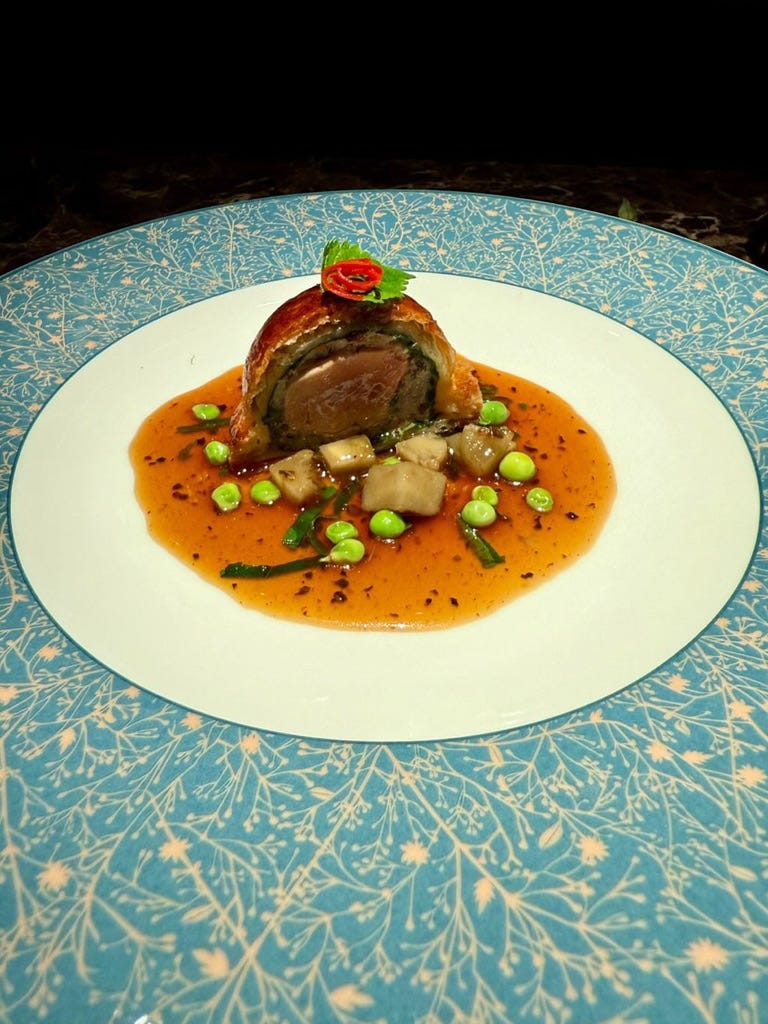
Peter recently opened a high-end spot called Pot Au Phở 2.0 located at 91 Tôn Thất Đạm, Chợ Cũ (Old Market). Peter does tasting menus and for the pho shop, there are dishes such as Caviar Egg Phở, one-bite Molecular Phở, Pâté Chaud, Black Chicken Phở and a Le Pot Au Phở inspired by Paul Bocuse's legendary VGE truffle soup (my less expensive take on Bocuse’s soup is here).

What’s up with his fancy pate chaud? Peter sent photos. There’s foie gras in there! It’s fancy but I like how he’s gone all out to take a Viet street food to new heights.

There’s a certain cultural reclamation happening as he applies French ideas to craft his novel takes on Viet food. It is to say that Viet food is worthy of being on the world stage. Peter knows that his food is pricey and suggested nearby Nhu Lan deli and bakery for more affordable, traditional pâté chaud.

Can’t make it to Vietnam soon? Make pâté chaud (“pah-tey show”) yourself using my recipe, which includes a veggie option too!
💎 Japanese pickled ginger time?

Over the weekend, I found young baby ginger at Mitsuwa market in San Jose. It’s ridiculous to be able to buy it this time of year! It’s a warm weather thing but there it was in the produce department, staring at me. I had to buy a package for a batch of my stir-fried ginger-scallion noodles.

At an Asian market, you typically have to buy a good half pound of young ginger so I pickled the rest. In the process, I edited my longtime, evolving recipe to be a touch less sweet, though you can certain dial it up on the sweetness level if you’ve got extra spicy ginger. Just like magic, the ginger turned a lovely pink overnight and darkened more over the next 48 hours. Here’s the transformation in three photos:

The pink transformation doesn’t happen every time. Maybe it has to do something with the cooler temperature this time of year? Or, perhaps with the pinkiness of the skin in the raw ginger? It had unusually bright pink sections. It’s unclear and the flavor isn’t diminished if the ginger remains a buff color. If Mitsuwa has the ginger, I bet you can find some at other Japanese markets and Korean markets like H-Mart, plus Ranch 99.

Anyway, I now have a jar of pickled ginger to last for the year. I hope you get your paws on some young ginger so you can have a stash of your own. Get the Japanese pickled ginger (gari) recipe.

On Sunday, I’ll report on last weekend’s paid subscriber survey regarding 2026 content. If you have not had a chance, take the survey!

Or, if you haven’t joined us behind the paywall, this is a great time. There’s a little ⚡️ flash sale going on until Saturday night. ⚡️ I’d love as much input as possible and you’ll have open access to all content.

  •  

PTFS 2026: Your input needed!

In the U.S. tomorrow, we’re observing Martin Luther King Day to commemorate an outstanding civil rights leader. It’s a federal holiday so hopefully, things will be quiet. Eight years ago, Rory and I went on a civil rights tour of the American South. It was a somber experience but also empowering, especially with our stops in Atlanta, GA. Highlights included the MLK National Historic Park, the King Center for Nonviolent Social Change established by his wife, Coretta Scott King, and the Ebenezer Baptist Church where Dr. King was baptized and later went on to serve as co-pastor with his father, the Reverend Martin Luther King, Sr.

As compelling as those places were, none rivaled the moving experience in Memphis, TN, at the National Civil Rights Museum. The museum is located at the site of the Lorraine Motel where Dr. King was assassinated.

We’re living in uncertain times, but whenever I think about the challenges that Dr. King faced, his legacy gives me strength and hope for our nation.

On a lighter note, I took inventory of this newsletter and realized that in 2025, there were over 90 PTFS dispatches. I’ve been brainstorming ideas for 2026 but but also want to know about your culinary interests for this year.

The 2025 newsletters covered a lot — from travel and product reviews to food history, health, and recipes. Many of the recipes were low-meat and vegetable forward, or meaty with a vegetarian version. That’s the PTFS vibe — we aim to cook for a variety of moods and dietary needs. We’re a community of people who want to know more than just the usual. We are curious.

To refresh your memory of the kinds of content we had in 2025, here’s a quick run through.

  • Japanese ginger carrot dressing harkened back to Los Angeles in the late 1980s for me. It’s such a good, workhorse dressing to keep for refreshing noodle salads or crisp greens. Right now, its sunny orange-gold color makes great use of winter’s sweet carrots. And, I didn’t know the interesting history behind the dressing until I investigated it for PTFS.

  • Beef short rib vegetable pho showcased how you can build a tasty pho bowl by combining short ribs with flavorful vegetables. It’s less fussy, more convenient and economical, and tasty. Freeze extra for future pho.

  • Wok-Kissed Pho with Beef and its kin, the tofu-mushroom version, are super takes on a northern Vietnamese pho. The easy cooking methods yields fabulous, deep flavors. You rarely find this pho outside of the Hanoi area but every pho lover should know about it!

  • Vietnamese Tamarind Shrimp (or Tamarind Tofu) employ a fruit that’s emblematic of Saigon’s botanical history. The result are the tangy, umami, mildly spicy flavors of southern Vietnam.

I put the above list together in the late afternoon and got very hungry. So many good recipes came out of 2025. There were a lot from prior years too. One of my goals for 2026 is to create a master list of recipes that you can easily browse alongside doing a regular ol’ search.

Back to planning for 2026! Looking forward to the next 12 months or so, what would you like to know more about and cook up — literally and figuratively?

Read more

  •  

midweek gems #55: pineapples, processors and pho

Hello there!

The beginning of the year is such a groggy time for me. I still feel like I’ve not fully awakened or something. To help dispel some of the lethargy, I spent a few cathartic hours pruning out in the garden. Things don’t look great now but hopefully, as the weather warms up, things will green up and or fill out. Tending to the edible plants is my job (we have a low-key gardening service for the rest of the yard). I remain carefully optimistic, despite my negligence.

How does your garden grow?

Leave a comment

💎 Your ginger and pineapple questions answered

A number of you found the tropical fruit information to be of great interest. Ellyce asked about how to grow ginger well on the mainland. I asked my friend Chan for tips and she quickly offered great insights. Check out Chan’s tips in the comments section of last week’s aloha midweek gems; I pinned our conversation to the top of the comments section!

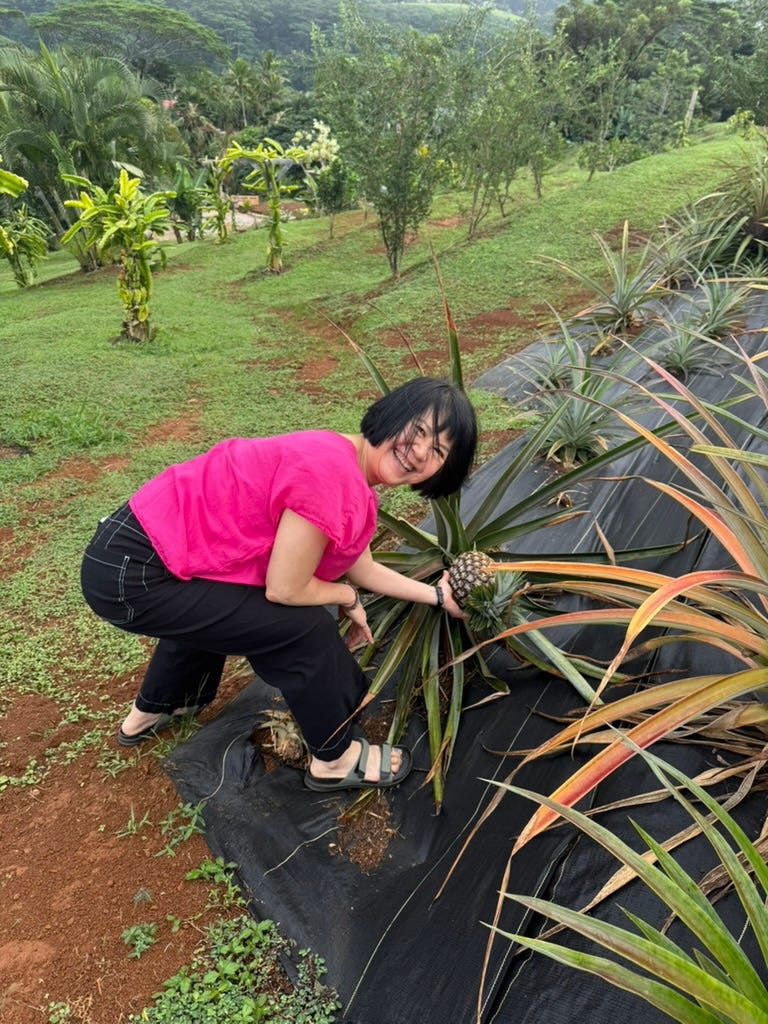
As for how pineapple grows, I found a couple of photos from last week to show you how that Sugarloaf had grown before I harvested it.

Yes, you just then replant and there’s a new plant to make another pineapple!

💎 Co-gardening to share resources and harvest

My neighbor, Adrienne, is a superb gardener. She also has full sun. When one of her lemon trees didn’t work out, I suggested that we co-grow an Italian lemon and a Southeast Asian calamansi tree. Between the two of us, we also have Meyer lemon, Bears lime, and makrut lime.

I bought the trees locally (they’re grown by Four Winds, which ships too) and Adrienne planted them and tends to them. She loves cocktails and calamansi’s unusual tart-sweet (think lime x tangerine) flavor is good for that. I use calamansi for nuoc cham dipping sauce and other Southeast Asian dishes; I also squeeze the juice into soda water for a fizzy drink. Calamansi (Citrus × microcarpa) is often seen in Filipino cuisine but is also native to other parts of the region, including Indonesia and Taiwan.

It’s only been about 3 months but the little calamansi put out fruit already!

Only about 1 1/4 inch wide, calamansi is rare so what I was able to harvest is extra special. If you’re tight on space or if you don’t have the right growing conditions for something, team up with a neighbor!

Pass the Fish Sauce needs your support! Subscribe for free or join us as a paid-subscriber to access all content and get many other benefits. I can’t produce PTFS without your generosity! Thank you.

💎 Food processor reviews

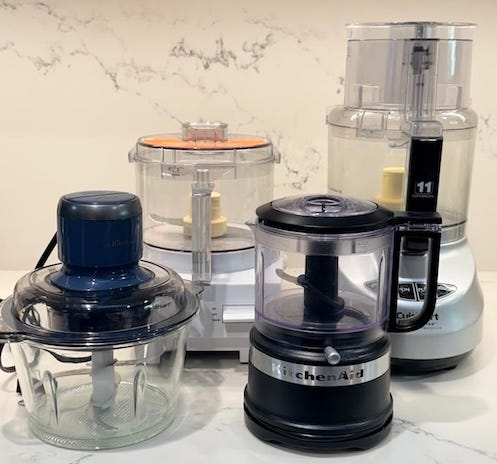
Last year when we were recipe testing the Thai cookbook, Jen in New Zealand shared that the food processor she uses most is a smallish one, though she also has a bigger capacity machine. Jen is a very good cook. I asked my friend Heidi Swanson of 101 Cookbooks and she also has a smallish machine. Were they onto something? Is bigger always better when it comes to processors?

So I got a small processor, then I got another. I’ve been using them all — including big boy and the minis - for about 6 months to figure out what works best for home and why. I just wrote up my assessment on the website. I was surprised by the performance of a $40 processor, so much so that I also made a casual video to show you that it’s worth considering. Check out the new food processor buying guide.

💎 Chicken pho for healing

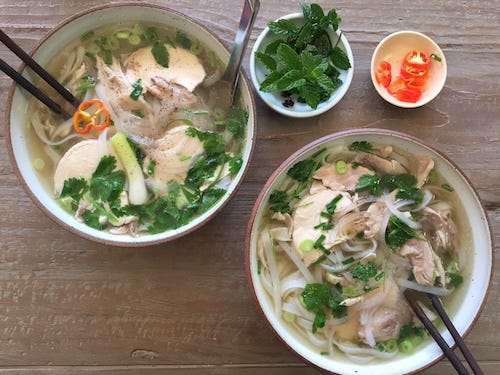
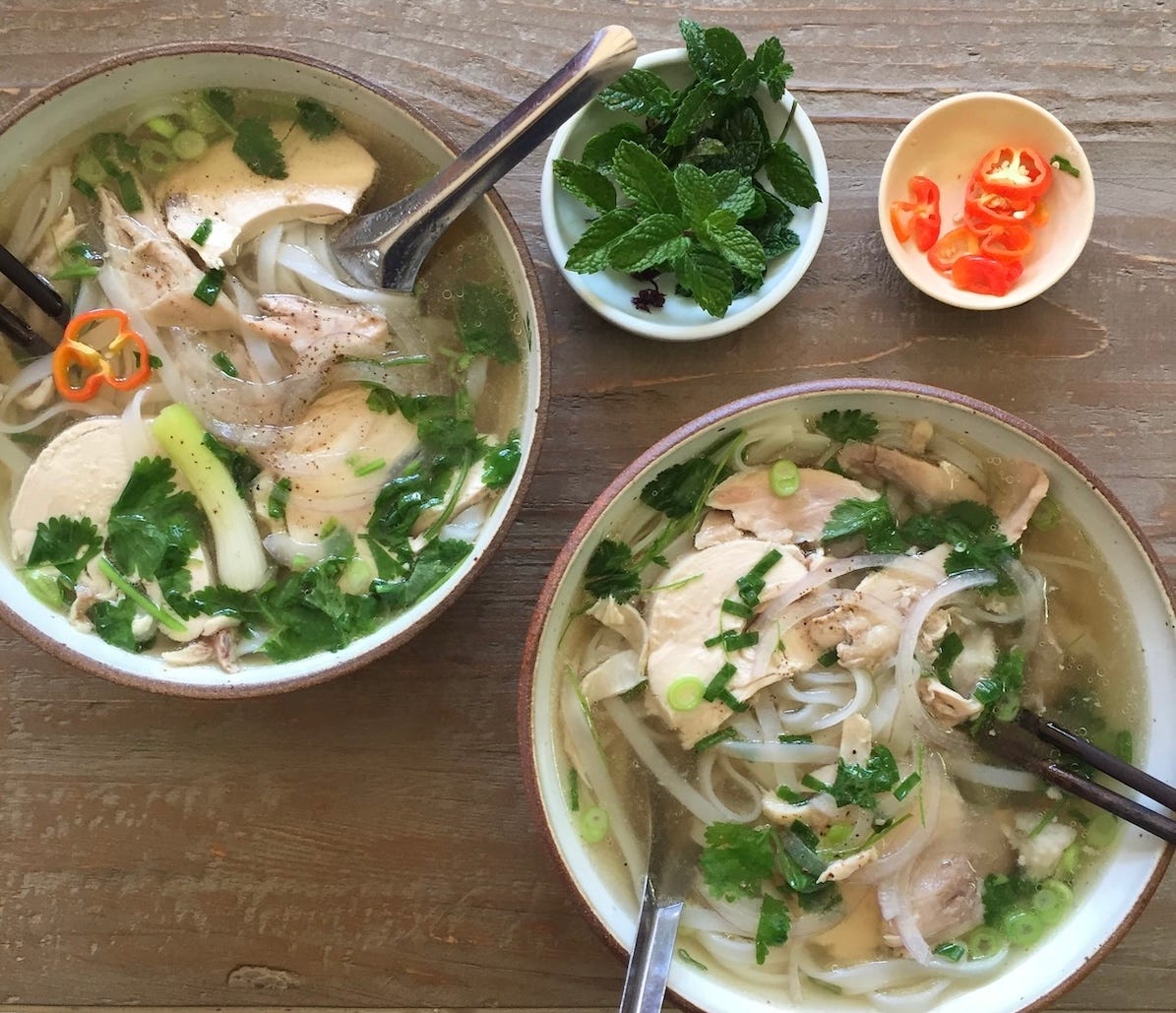
Several friends on the East Coast have reported getting a terrible flu around New Year’s. If you’re in the same boat or are nursing someone back to health, make a pot of chicken pho. Make chicken pho using my Instant Pot chicken pho recipe or the long simmer, more traditional version of phở gà. Both are excellent and it just depends on your equipment. When I’m unwell, the aromatic chicken pho broth and squiggly noodles are extra comforting.

💎 Say 👋

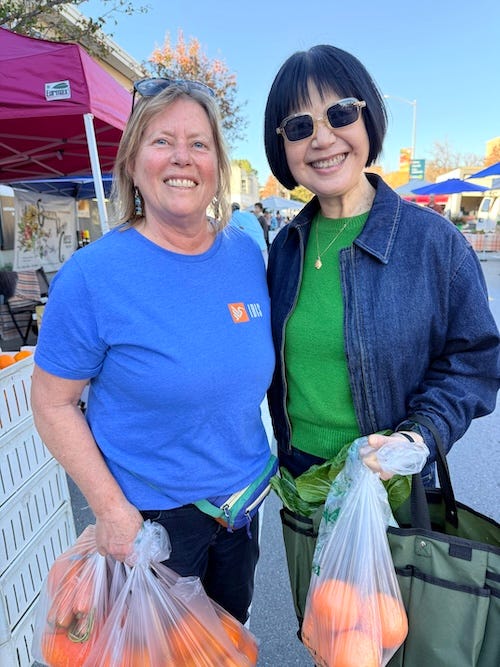
If you see me out and about, don’t hesitate to introduce yourself to me like Meg did this week at the Santa Cruz farmer’s market. We were both shopping for oranges and yes, the weather here this week is heavenly!

Next up — think about what you want to learn and cook in 2026. Paid subscribers — this will be your chance to seed what we do at PTFS this year.

  •  

Nearly Effortless Pâté Chaud in 3 recipes

Years ago, a woman in Vietnam emailed complimenting me, I think. She wrote that my food was old fashioned. She also wrote that food in Vietnam has modernized a lot. Her email made me realize that for many Vietnamese refugees, cooking the food of our heritage is a nostalgic act. We cook to recall the past and feel grounded in who we are because at the end of the cooking, we get to enjoy familiar flavors, even if we feel somewhat alien in our adopted country.

My family cooked up a lot of quê hương (hometown) nostalgia while I was growing up, but we also adapted things to establish roots here in America. As I wrote earlier, my mother was on a pâté chaud journey to master homemade puff pastry, a major Viet-Franco achievement for a good home cook like her. The savory pastries were a favorite in Saigon, where we once lived.

If you missed the pâté chaud backstory, this recent post will fill you in!

We were so well fed that we got chubby. Then my mom started looking for ways to eat healthier without compromising the foods we loved.

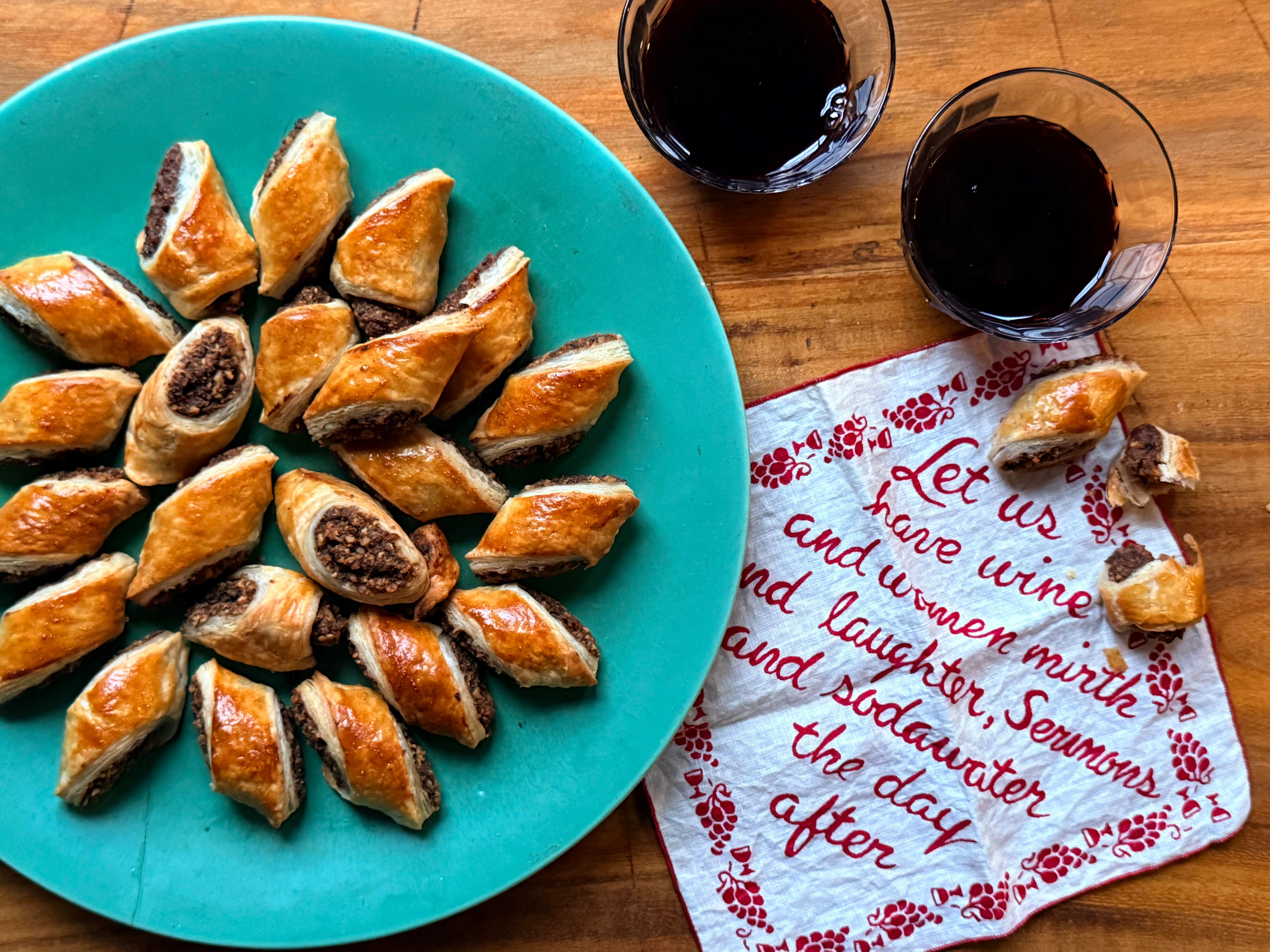
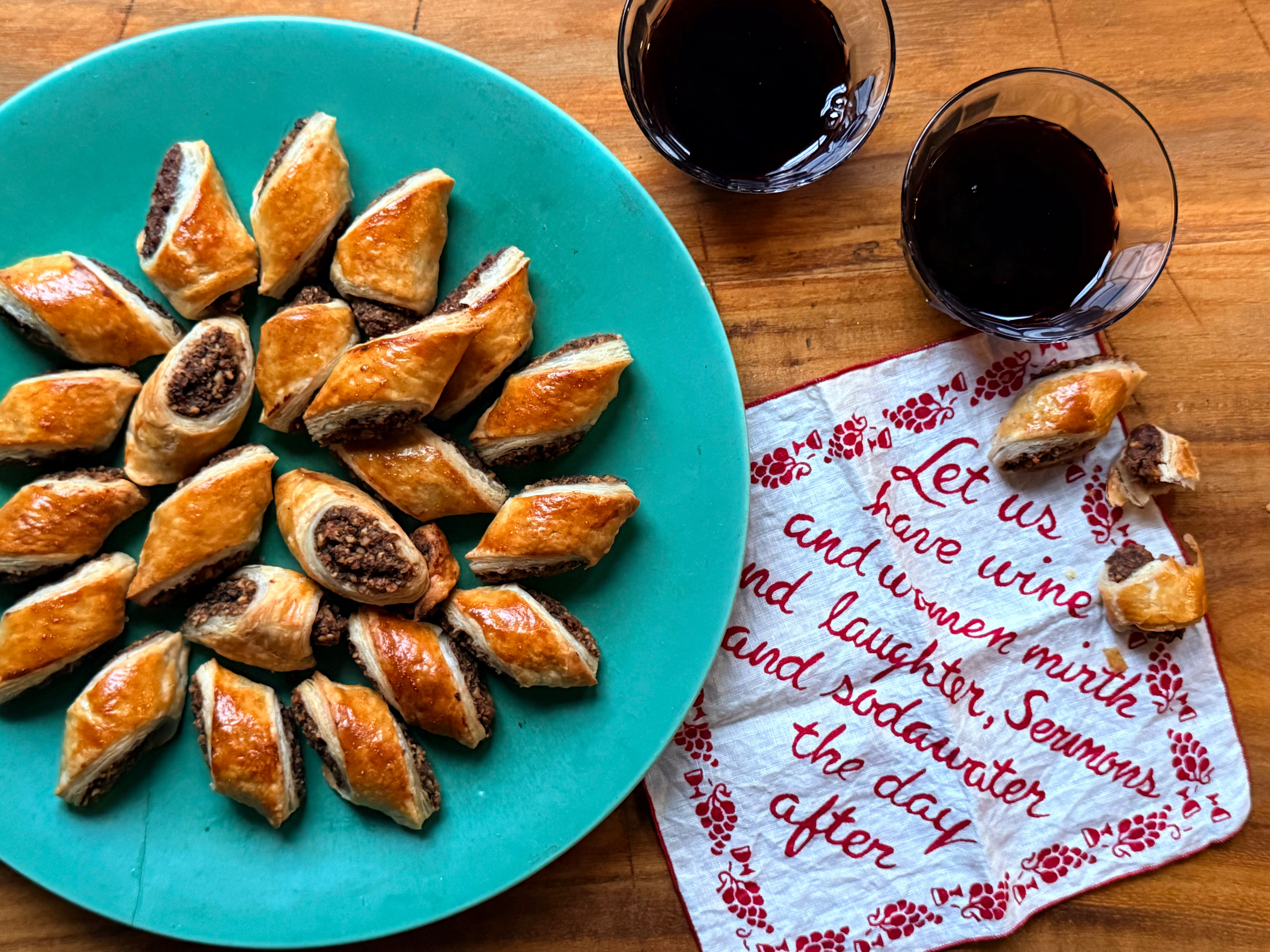
Her solution? She pivoted to creating mini pâté chaud — diamonds of crisp pastry filled with her aromatic filling. They were portion-controlled 2-biters that didn’t get you into trouble, unless you ate too many. Instead of enjoying them as a regular breakfast item, our family served them up as a nosh with drinks. We enjoyed them at Christmas and other indulgent celebrations. She trotted them out of the freezer to impress guests at parties.

I’ve stuck with the minis over the years because it’s a sane and healthy-ish way to enjoy pâté chaud. There’s less pastry and more filling and it’s super easy and fast to prep.

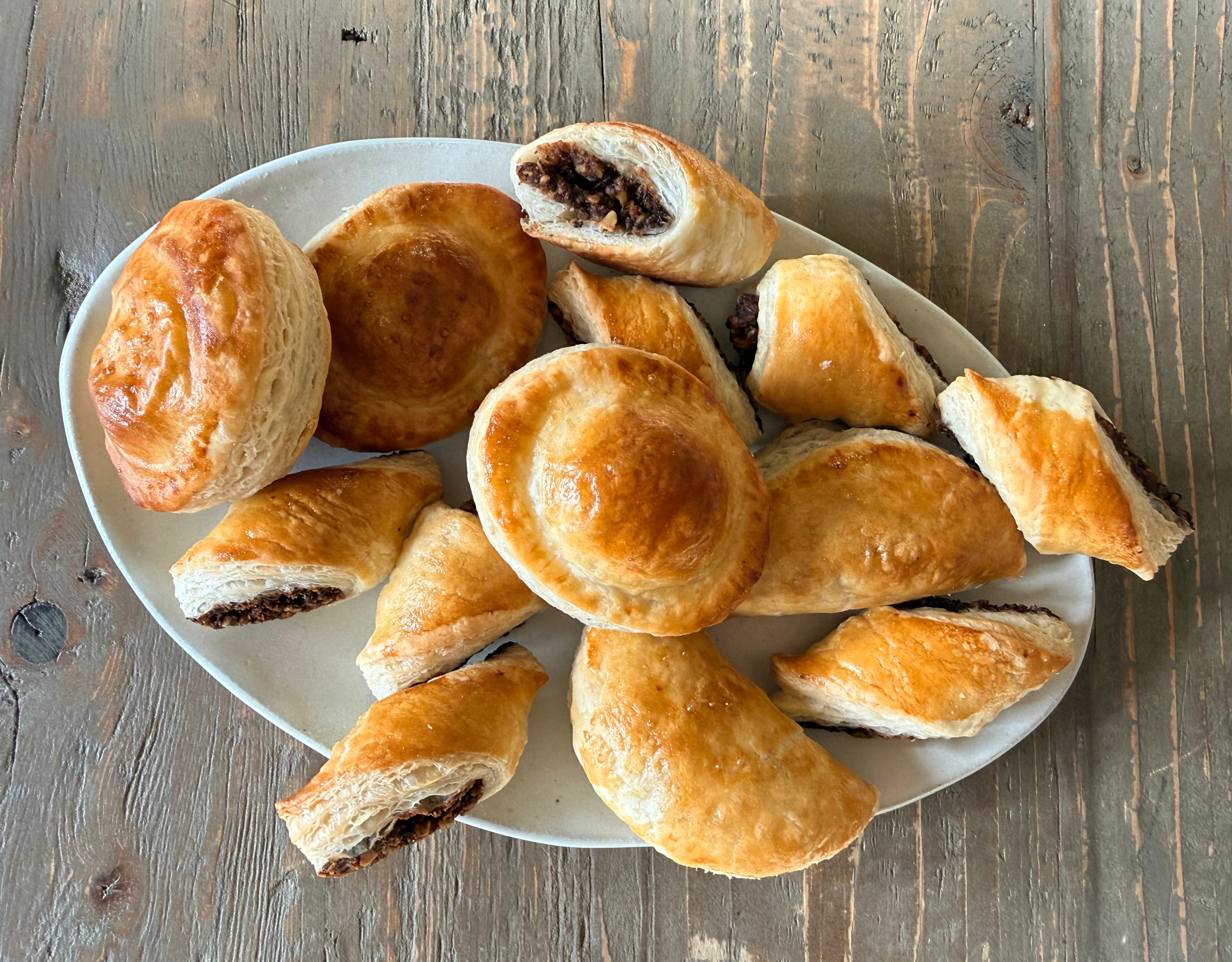
Many Vietnamese cooks abroad still make the traditional round shape but I’ve also spotted squares and half circles too. Modern pâté chaud may contain the traditional pork filling or feature beef or chicken. I’ve seen vegetarian pâté chaud too.

Given all those iterations, I created three recipes for you to play with pâté chaud. Below you’ll find the following:

  • A mini pâté chaud recipe plus instructions for making different shapes

  • Two filling recipes to craft meaty or vegetarian (or vegan) pastries

  • Process shots plus a how-to video to guide your journey

  • FAQ for buying, making, and working with puff pastry

  • Freezing and reheating tips

The pastries are fun to make and even more fun to eat. My brother in law could hardly tell the difference between the vegetarian and meat ones!

I’m hoping that at the end of all this, you’ll be confidently and joyously baking up a platter of something like this:

Nostalgia cooking can be good because cooking up memories can lead to adaptations and innovations. Let’s make pâté chaud!

Curious cooks, readers, and eaters fuel Pass the Fish Sauce. For the full low-down on pâté chaud history, where to buy them, and now, how to make them, join us a paid subscriber! You’ll gain all that information, 100+ recipes, and sponsor my work. I value your support at any level. Your generosity matters. A LOT.

Read more

  •  

midweek gems #54: aloha learnings from the land

Aloha from a 2.5 hour layover at the Maui airport!

I was going to skip this midweek gems but I learned so many things about tropical produce this week that I had to share them with you in a quick recap.

We’re en route back to the mainland from Kauai, where we stayed with our friend, Chan, at her home. She loves to experiment and grow a wide variety of tropical fruits and vegetables. I have no idea what most visitors do in Kauai but we harvest food from her land, process it, improvise, cook it up, eat and and hang out. That’s our Hawaiian vacation routine.

💎 Pineapple cycle of life

A couple years ago, a friend gifted a Sugarloaf pineapple to Chan. Its white, super sweet flesh was extraordinary. When we cut it up, she said to save the crown. Why? To grow a pineapple plant. The next day, she showed me how to plant it. Since then, she’s expanded her pineapple project to about 150 plants.

I had no idea how pineapples actually grew. It’s a weird plant, spiky and almost cactus like. The fruit grows from the center. I missed past harvest season at Chan’s but this year, we spotted one pineapple ripening. The pineapple was so heavy that it made the plant lean. So much stress on the plant! That’s normal, Chan said.

When you buy a pineapple, its stem end is always super hard. So, I asked if we needed a knife to harvest the pineapple.

“No, just twist it off!,” Chan said. I did and it broke free with little effort on my part.

This big boy weighed 5-6 lbs. It’s a white pineapple, a Kaua’i Sugarloaf. The flavor is very sweet, hence the name. We could have left this on the plant for 2 more days but Chan and I could not wait. Pineapple does not ripen further after harvest.

Of course, when she trimmed the pineapple, Chan saved the crown and replanted it! She also planted the crown of a pineapple we bought at Costco! Why not experiment, reuse and see what Nature gives you?

Try the Sugarloaf if you come across one; it’s pricey but highly unusual. We ate most of it raw, dipped in chili pepper salt (for less heat, use Korean gochugaru pepper flakes). Some of the fruit went into a shrimp canh chua, a southern Việt bouillabaisse that you can make from my recipe here.

Leave a comment

💎 Turmeric and ginger processing

I’ve bought plenty of fresh and dried turmeric and ginger but have never harvested the rhizomes before. This is how we did it at Chan’s.

We ended up having three times more turmeric than what was in the basket you see. Everything is washed — with a jet spray from a hose, multiple rinses in water, plus scrubbing with a toothbrush.

The ginger was sliced (thickness doesn’t matter so long as it’s consistent, Chan says), then dehydrated overnight. The skin was thinnish so we mostly left it intact.

As for the turmeric, there were 3 kinds— orange, white, and blue (black). We juiced it to drink and freeze. “Erewhon charges $12 for a tiny bottle of this!” Chan said.

New to all of us, the velvety blue/black turmeric was incredibly bitter, like a super bitter pill. I couldn’t get past a tiny taste and diluting it didn’t lower its potency much. Curcuma caesia is primarily used for medicinal and spiritual purposes. Now I know why!

Subscribe now

What to do with the beautiful solids? Why not dry them to grind up for tea and food? We lined dehydrator trays with parchment (snip holes in the paper for ventilation), then dried the turmeric overnight.

Early this morning, Chan packed up baggies of the dried aromatics for me to take back to the mainland. “Tell the airport people that you have dehydrated vegetables,” Chan advised.

Leave a comment

💎 Rambutan & Bananas

This time of year, rambutans are ripening resembling Dr. Seuss-like ornaments on dark leafy trees in Kauai. You reach up into the tree and pick red or orange-red ones whose color signal ripeness. We got a decent amount and ate them raw as fresh fruit — biting into the skin to cut into it then using our fingers to remove the exterior to reveal the white, juicy flesh. They were deliciously sweet, even the not-yet-ripe ones.

You can use a knife to cut around the equator of the rambutan. That would be more civilized. But mostly, we just bit into them. Yes, we washed the fruit first!

As for that basket of plantains. There was a full bunch of bananas that needed to be harvested before the island’s wild chickens got to them. We boiled the yellow ones — I trimmed the ends and and left the skin on, until they were tender, about 20 minutes. That’s Caribbean style cooking and it was fun. I also used the banana for a Vietnamese coconut and tapioca sweet soup called che chuoi, which is usually made from regular, sweet bananas.

Pass the Fish Sauce needs your support! Subscribe for free or join us as a paid-subscriber to access all content and get many other benefits. I can’t produce PTFS without your generosity! Thank you.

The flight is boarding so I’ve got to run. See you this Sunday for the pate chaud recipe.

  •  

Our favorite stories and recipes of 2025

Aloha from the island of Kauai! The dramatic weather (rain, breeze, and sunshine can be experienced within 15 minutes) here hasn’t deterred us from going out and enjoying nature. We’ve harvested most of the produce we’ve eaten at our friend’s home. Today, I used a meat cleaver to chop a banana tree to get at a bunch of fruit! It’s what you have to do to encourage the plant to regrow, my friend Chan said. Who knew??? Aside from the food, Kauai has plenty of laid back charm as well as humor.

I’m still in vacation mode but still wanted to wish a very happy 2026. Before moving forward, let’s take a look back at some of the best PTFS dispatches of the year. I learned a lot from your engagement with the articles and recipes.

When I started out with this newsletter, I didn’t know how much enthusiasm there would be for lite food history. This year, I leaned in a little more to provide extra tidbits of knowledge so that you can piece together how flavors, techniques, and culture evolved over time. There were three noodle stories, because who doesn’t enjoy noodles? And untangling their history is both fun and interesting!

I had no idea how the longish geeky articles would sit with you but you liked them! Modern life unfolds so fast nowadays that it’s easy to overlook the textures and nuances that make food extra tasty. One of the most fascinating dishes I researched last year was Japanese carrot-ginger salad dressing. I wanted something easy, healthy and delicious to add to your salad repertoire and in the process, reported on its fascinating background.

I wrote a mini series about the Vietnamese diaspora and the article that captivated people most was a story about my family’s departure. When we got to America, one of the foods that was on rotation in my mother’s kitchen was char siu (Chinese barbecue pork). She relied on a marinade mix but I’ve long mixed up the marinade from scratch, which overtime, enabled me to push the envelope a bit to char siu many things.

In 2025, my goal was to help you char siu on a weeknight so that you may quickly get at the salty-sweet-rich flavors of iconic Cantonese barbecue. In the process, I came up with a new vegan take plus two meaty options. Go forth to char siu in 2026. It’s evergreen and year-round favorite.

Long ago, I wrote a proposal for a Vietnamese American museum that included an exhibit of the items that refugees escaped with, after the fall of Saigon in 1975. That proposal went unrealized but I do hope that my story inspires other people to record their journeys.

Curious cooks, readers, and eaters fuel Pass the Fish Sauce. Pitch in to keep it running strong this year! Become a paid subscriber to access all content, seed ideas, and enjoy class discounts. I welcome your support on all levels. Your support makes a big impact.

Vegetables drive my food and dining choices now more than ever. I’m thrilled that you’re on board for this, too. It doesn’t mean an all-or-nothing approach. I love my meat but less often and in smallish quantities nowadays. The trick is to slide in veggies without wiping out the true flavors that define the soul of a dish. At the same time, I wanted to craft versatile recipes that you can easily tweak to satisfy your tastes and needs. The tamarind deep dive included one of my favorite southern Vietnamese dishes, done with seafood and veggies or tofu and veggies.

And, there’s a time and place for project cooking but weeknights is not one of them. In 2025, I offered you two of my favorite hacks.

Finally, you PTFS subscribers seed many ideas for content. For instance, John asked about prop 65 warnings, and that led to this article about the California legislation that impacts so many ingredients we reach for on a regular basis.

My resolutions for 2026 are to cook up more fun and engaging things for you. After Cooking Thai goes to print, I’m hoping to do more online classes too!

I always welcome your suggestions so please don’t hesitate to email or DM me with an idea (or two!). Thank you.

  •  

How pâté chaud, an obsolete French hand pie, endures in Vietnamese culture

Hello there!

Happy Holidays and then some. I hope you’ve not had to spend too much time returning gifts to the store. I’m skipping the upcoming Midweek Gems because we’ll be traveling. Happy early 2026!

But folks, we’re still in 2025, which marks the 50th anniversary of when my family left Vietnam. For that reason, certain foods are top of mind. I’ve been thinking a lot about pâté chaud, a puff pastry snack that has a long history in Vietnam and with my family.

In Vietnamese, we call these treats bánh patê sô — not too far off from the French pâté chaud. I’d like to close out the year with the iconic favorite because it’s a great lens for viewing the modern Vietnamese experience.

Pâté chaud — just imagine the rich, crispiness!

I’ve been researching their history and working on new recipes for them. However, I am not yet satisfied with what I’ve got, despite having baked through three boxes of pastry dough! And the history of the pastries themselves turns out to be more interesting than I had initially thought.

So, I’m going to share what I’ve found out about pâté chaud in this dispatch plus where to buy them. In a couple weeks, when we’re back from vacation and I’ve had a chance to do another round of testing, I’ll share the recipes so you can make your own versions.

January 11, 2026 UPDATE » My Pate Chaud recipe is now available!

My family fled Saigon in April 1975 with few material possessions, but we did bring many food memories with us. One of them was of patê chaud, savory puff pastry hand pies filled with a country-style pâté or meatloaflike mixture. Involving culinary skill plus butter and wheat flour, bánh patê sô were considered a luxe breakfast item in Vietnam, to be enjoyed hot to showcase their crispy pastry shell. The literal meaning of pâté chaud is “hot pastry pie”.

1930s Saigon

Typical Saigon residents went out for them at fancy French-style bakeries, like Givral, which made all-butter puff pastry. Lesser versions relied upon margarine, my mom recalls. Founded by Frenchman Alain Portier, the bakery called Givral opened in 1950 across the way from the Continental Hotel made famous in the Graham Greene novel, The Quiet American. However, bánh patê sô had been in Saigon since around 1930, prepared by clever cooks and entrepreneurs such as Mrs. Pham Thi Truoc, who had a shop specializing in the pastries.

Near the Opera House in Saigon, this postcard image shows the Continental Hotel on the right. Givral bakery is across the street in the curved corner building on the left.

By the time my mother migrated to Saigon from northern Vietnam in 1954, a result of the Geneva Accords that split the country into two, Givral was the place to purchase French pastries and baked goods like patê chaud, cream puffs, eclairs and yule logs. Vietnamese people who opted to go southward felt that North Vietnam was conservative and limiting. South Vietnam was freewheeling, liberal and full of new ideas and foods.

Subscribe now

Pâté chaud is mostly a Saigon specialty. I’ve never spotted it in the northern city of Hanoi or central city of Hue when I visited there. In the early 1960s, Mom, her girlfriends and even my cousin, Bich Tu (who was a teenager then), were rolling out puff pastry dough at home. Butter was expensive and you had to source good wheat flour with enough gluten, my mom said.

Puff pastry needs a relatively cold environment for the dough to behave and develop the hundreds of layers of laminated dough. I have no idea how cooks in tropical Saigon, where the weather is either hot or hotter with humidity, could patiently make pate feuilletée (puff pastry in French). But they were able to do so because they were curious, determined cooks.

Our family arrived at Camp Pendelton Marine Base in Southern California in May 1975 and the temperature was likely in the low 70s. Mom said that the dry, moderate climate was dreamy; she missed her father and sisters but didn’t miss the weather. She had her notebook of recipes, one of her prized possessions that came with us when we left Vietnam. But it didn’t contain a recipe for bánh patê sô.

Soon after we settled into our new home in San Clemente, my mom began to make puff pastry from scratch and baking up dome-shaped bánh patê sô. She knew the recipe by heart and relied upon Julia Child’s Mastering the Art of French Cooking for technical guidance.

As a result, as an elementary school kid, I ate pa tê sô for breakfast, reheated in a toaster oven until the exterior was crisp and the interior was blazing hot! There was liquor in her beef and pork filling so the first bite often gave me a whiff of alcohol. I’d gobble it up and go off to school, oblivious to how different that breakfast was to what my peers had eaten. I also didn’t realize how unusual it was for a home cook like my mom to make puff pastry over and over again.

But that’s what Vietnamese people are like – obsessively working to polish a skill, to mimic and master a foreign notion, and to make it their own.

Curious cooks, readers, and eaters fuel Pass the Fish Sauce. For the full low-down on pâté chaud history, where to buy them, and soon, how to make them, become a paid subscriber! You’ll gain all that information, 100+ recipes, and sponsor my work. This content takes days to develop and I appreciate your support at any level. Your generosity matters. A LOT.

Read more

  •  
❌