Login
Login
midweek gems #54: aloha learnings from the land

Aloha from a 2.5 hour layover at the Maui airport!
I was going to skip this midweek gems but I learned so many things about tropical produce this week that I had to share them with you in a quick recap.
We’re en route back to the mainland from Kauai, where we stayed with our friend, Chan, at her home. She loves to experiment and grow a wide variety of tropical fruits and vegetables. I have no idea what most visitors do in Kauai but we harvest food from her land, process it, improvise, cook it up, eat and and hang out. That’s our Hawaiian vacation routine.
💎 Pineapple cycle of life
A couple years ago, a friend gifted a Sugarloaf pineapple to Chan. Its white, super sweet flesh was extraordinary. When we cut it up, she said to save the crown. Why? To grow a pineapple plant. The next day, she showed me how to plant it. Since then, she’s expanded her pineapple project to about 150 plants.
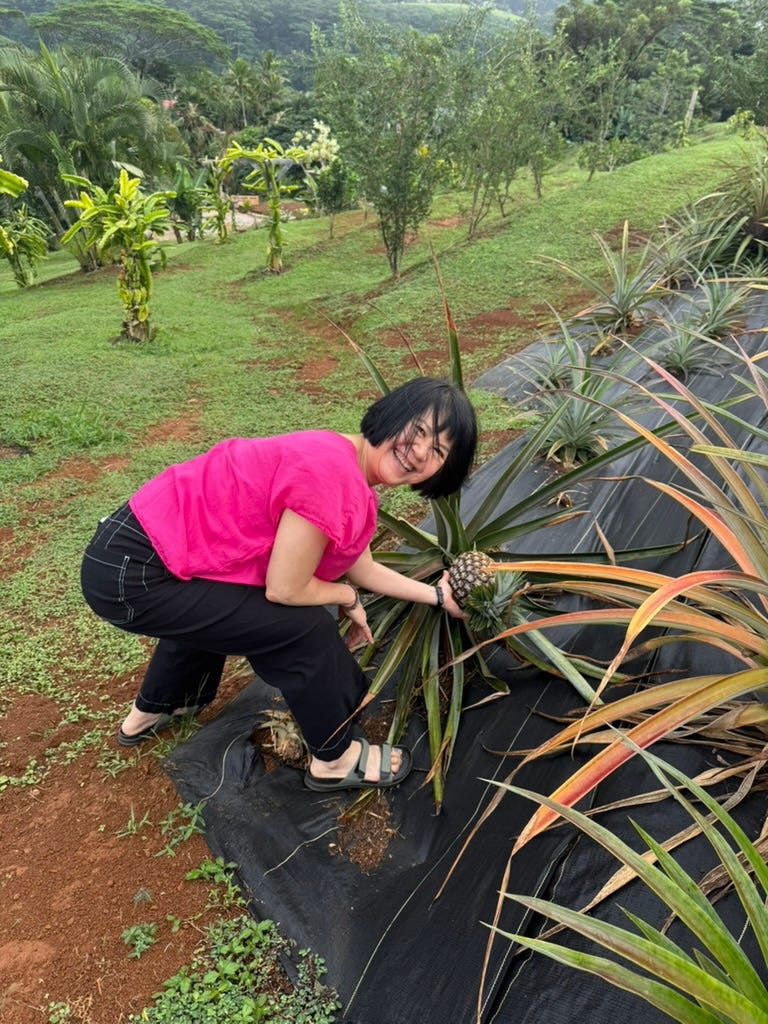
I had no idea how pineapples actually grew. It’s a weird plant, spiky and almost cactus like. The fruit grows from the center. I missed past harvest season at Chan’s but this year, we spotted one pineapple ripening. The pineapple was so heavy that it made the plant lean. So much stress on the plant! That’s normal, Chan said.
When you buy a pineapple, its stem end is always super hard. So, I asked if we needed a knife to harvest the pineapple.
“No, just twist it off!,” Chan said. I did and it broke free with little effort on my part.
This big boy weighed 5-6 lbs. It’s a white pineapple, a Kaua’i Sugarloaf. The flavor is very sweet, hence the name. We could have left this on the plant for 2 more days but Chan and I could not wait. Pineapple does not ripen further after harvest.
Of course, when she trimmed the pineapple, Chan saved the crown and replanted it! She also planted the crown of a pineapple we bought at Costco! Why not experiment, reuse and see what Nature gives you?
Try the Sugarloaf if you come across one; it’s pricey but highly unusual. We ate most of it raw, dipped in chili pepper salt (for less heat, use Korean gochugaru pepper flakes). Some of the fruit went into a shrimp canh chua, a southern Việt bouillabaisse that you can make from my recipe here.
💎 Turmeric and ginger processing
I’ve bought plenty of fresh and dried turmeric and ginger but have never harvested the rhizomes before. This is how we did it at Chan’s.
We ended up having three times more turmeric than what was in the basket you see. Everything is washed — with a jet spray from a hose, multiple rinses in water, plus scrubbing with a toothbrush.
The ginger was sliced (thickness doesn’t matter so long as it’s consistent, Chan says), then dehydrated overnight. The skin was thinnish so we mostly left it intact.
As for the turmeric, there were 3 kinds— orange, white, and blue (black). We juiced it to drink and freeze. “Erewhon charges $12 for a tiny bottle of this!” Chan said.
New to all of us, the velvety blue/black turmeric was incredibly bitter, like a super bitter pill. I couldn’t get past a tiny taste and diluting it didn’t lower its potency much. Curcuma caesia is primarily used for medicinal and spiritual purposes. Now I know why!
What to do with the beautiful solids? Why not dry them to grind up for tea and food? We lined dehydrator trays with parchment (snip holes in the paper for ventilation), then dried the turmeric overnight.
Early this morning, Chan packed up baggies of the dried aromatics for me to take back to the mainland. “Tell the airport people that you have dehydrated vegetables,” Chan advised.
💎 Rambutan & Bananas
This time of year, rambutans are ripening resembling Dr. Seuss-like ornaments on dark leafy trees in Kauai. You reach up into the tree and pick red or orange-red ones whose color signal ripeness. We got a decent amount and ate them raw as fresh fruit — biting into the skin to cut into it then using our fingers to remove the exterior to reveal the white, juicy flesh. They were deliciously sweet, even the not-yet-ripe ones.
You can use a knife to cut around the equator of the rambutan. That would be more civilized. But mostly, we just bit into them. Yes, we washed the fruit first!
As for that basket of plantains. There was a full bunch of bananas that needed to be harvested before the island’s wild chickens got to them. We boiled the yellow ones — I trimmed the ends and and left the skin on, until they were tender, about 20 minutes. That’s Caribbean style cooking and it was fun. I also used the banana for a Vietnamese coconut and tapioca sweet soup called che chuoi, which is usually made from regular, sweet bananas.
Pass the Fish Sauce needs your support! Subscribe for free or join us as a paid-subscriber to access all content and get many other benefits. I can’t produce PTFS without your generosity! Thank you.

The flight is boarding so I’ve got to run. See you this Sunday for the pate chaud recipe.