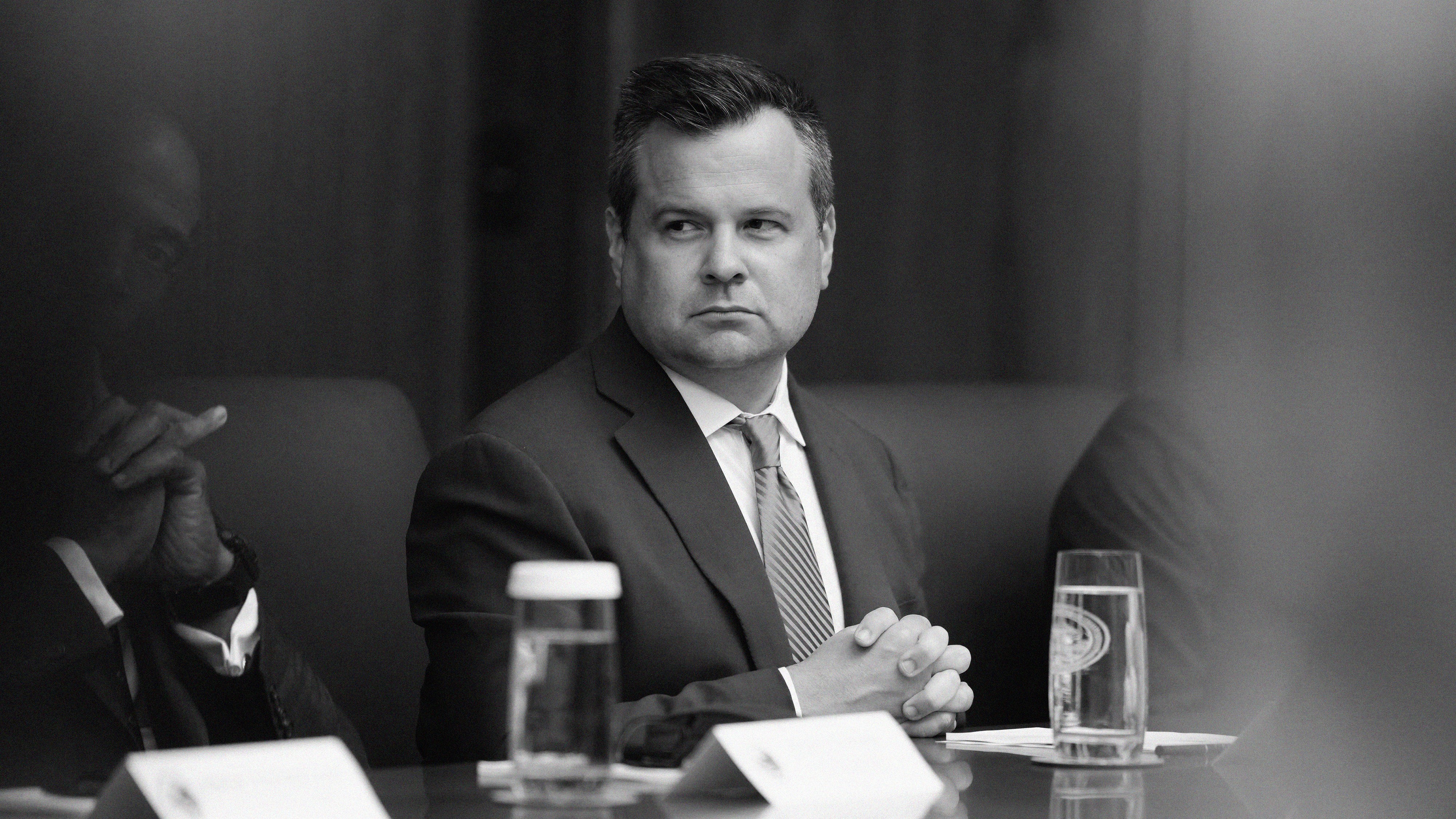
Before becoming a regular travel companion of President Trump’s, the nation’s top housing-finance official and the nation’s top intelligence official for one summer, Bill Pulte was a meme-stock celebrity who was once honored in a livestream with a gag dinosaur trophy inscribed with the words Bill Pulte Fucks on the front and only the young on the back. “That looks pretty badass,” he said upon accepting the bizarro honor.
The 38-year-old heir to a developer dynasty has brought the same raw attitude to his time as a government servant. In his first months at the head of the Federal Housing Finance Agency, he oversaw hundreds of firings at the agency and at Fannie Mae and Freddie Mac, and replaced both organizations’ chief executives. He boasted of overseeing five rounds of layoffs during his six-week stint as acting director of national intelligence that eliminated the staff by about 30 percent at an agency that Trump has long viewed as redundant and adversarial. Then, this week, just days after returning to his old job at FHFA, he fired about a dozen more senior executives at Fannie Mae, a government-sponsored company that guarantees $4.1 trillion in U.S. mortgages, two people familiar with the firings told me.
The bio pages of some of the company’s top executives—Senior Vice President of Capital Markets Devang Doshi, Multifamily Chief Financial Officer Brian Hensen, to name two—were redirecting to 404-error pages yesterday, after announcements were made on Wednesday that they would lose their jobs, according to people involved. The firings were first reported by The Wall Street Journal. Doshi, Hensen, and others who were dismissed did not respond to requests for comment.
One person involved in the effort told me that the firings had been carried out because of an evolution in the business at Fannie and not for any ideological reason. “Mostly it was operational. We just don’t need them anymore, especially in the D.C. office,” this person told me, after requesting anonymity to describe personnel matters. “With the advent of AI and stuff, we have gotten a lot of savings.” Spokespeople for Fannie Mae and FHFA did not respond to requests for comment.
But the lasting impact of the firings may have more to do with Pulte’s positioning of himself as a go-to disrupter in Trump’s senior team. It’s a position that has caused tensions with other White House officials, who see Pulte as a distracting and problematic troublemaker who appeals to Trump’s most reckless instincts. Last year, Pulte proposed a new standard 50-year mortgage, which Trump briefly embraced, prompting a bipartisan backlash from policy makers who worried that Americans would lose out on equity gains. During a single July day in 2025, Pulte posted 15 separate attacks on Jerome Powell, then the chair of the Federal Reserve. “As someone with deep experience in construction, I am requesting to tour the Fed building and the new, ridiculous ‘renovations’, which I believe are riddled with fraud,” read one.
The Government Accountability Office has opened an investigation into Pulte’s use of typically private mortgage data to accuse prominent Trump targets, such as Federal Reserve Governor Lisa Cook, of mortgage fraud. Officials told me that Pulte had pushed Trump to replace the U.S. attorney in the Eastern District of Virginia, Erik Siebert, when he’d failed to indict a Trump foe on mortgage fraud. (The replacement, Lindsey Halligan, was later disqualified by a federal judge, and her major indictments have since been tossed.) When 61 former Fannie employees sued Pulte for defamation after he accused them without evidence of getting “kickbacks” for charitable donations, a judge tossed the case, finding that Pulte’s government position gave him legal immunity.
But Trump has long had a soft spot for the type of advisers he sometimes describes as “killers”—people defined by loyalty and a defiant focus on supporting the boss, even if they sometimes leave controversy in their wake. Trump’s first campaign manager, Corey Lewandowski, who recently left the administration, and his legal adviser Boris Epshteyn both fit that bill. In this way, Pulte continues to wield power, even if he is unlikely to receive another profane dinosaur trophy while serving U.S. taxpayers.
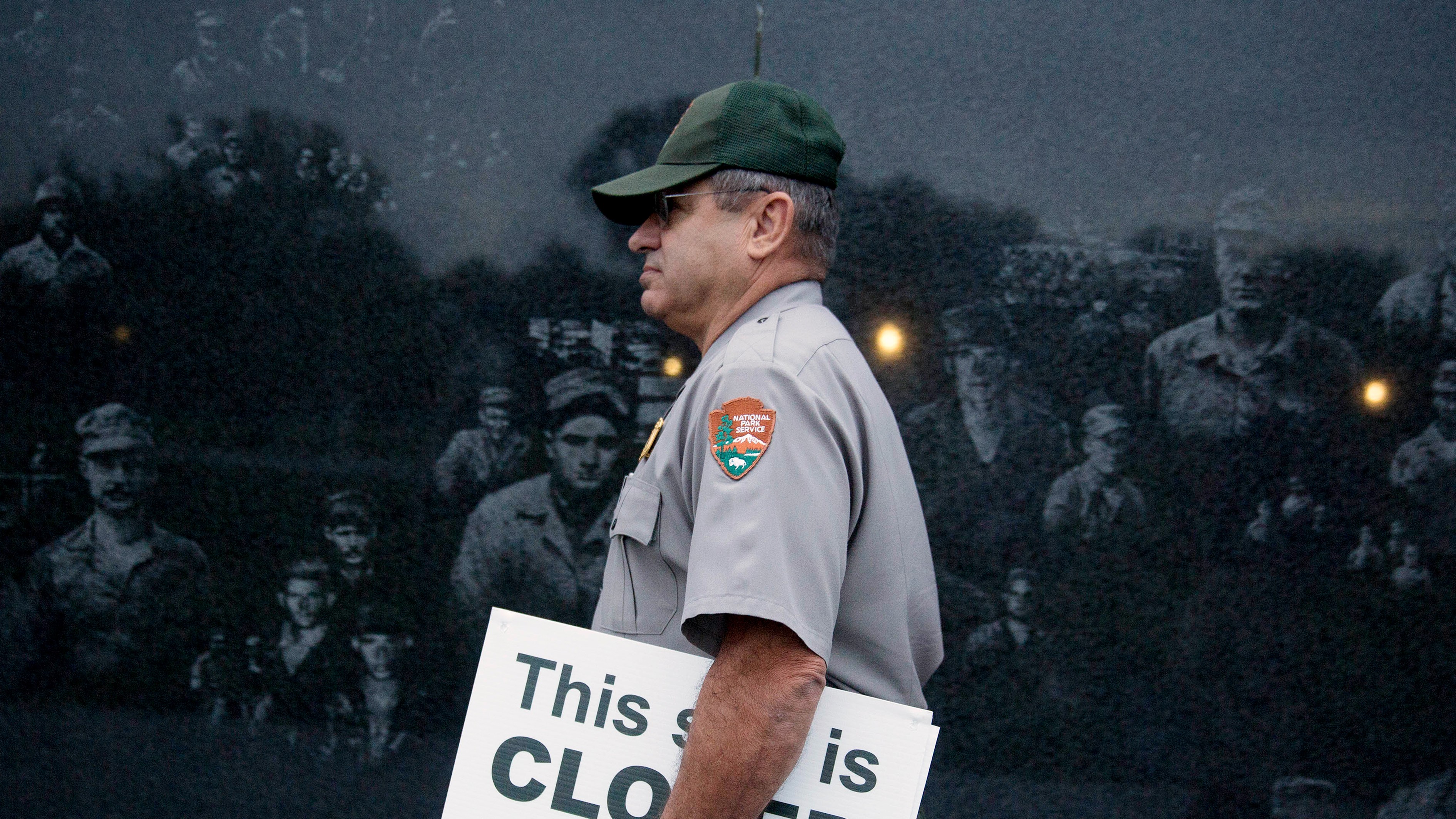
President Trump gets what he wants, when he wants it, from the National Park Service. One and a half million dollars to replace brick pavers in Lafayette Park, across from the White House? Contracting officials at the NPS Washington headquarters found the money within five days last month. A $170,000 request to remove a fence around the Hains Point golf course, preparing the ground for a new “championship-quality” layout? Six days this summer. And the more–than–$5 million project to gild equine statues along the nearby Memorial Bridge? That took 12 days.
The rapid-approval system is specific to projects Trump wants, thanks to a reorganization at the Interior Department led by Secretary Doug Burgum. Trump issued an executive order to make the District of Columbia “safe and beautiful,” justifying the creation of an NPS docket of “White House priorities” that is handled separately from other park projects and is prioritized both for funding and contracting resources, according to documents I obtained and interviews with five current or former NPS officials. Meanwhile, many other projects throughout the nationwide system of parks are languishing.
The list I received includes Trump’s well-known projects on the National Mall and the refurbishment of the White House, along with several lesser-known efforts: The hiring and equipping of 450 new U.S. Park Police officers in the Washington region, and more than $12.8 million—some of which came from the Department of Justice—for police equipment, including new Flock license-plate-reading cameras, radios, tasers, laptops, body cameras, and body armor. Internal documentation for park projects typically includes “Consequences of Failure to Act,” which scores the urgency based on health and safety measures. When work began in January on fountains near the White House, officials described the need for the work in this way: “Such failure will disappoint visitors, as well as residents and employees of the White House.”
The new project-funding system was described by a contracting officer during an April meeting with NPS officials. “There’s three different lists: White House priorities, high priorities, and low priorities,” the official told colleagues on the virtual call, according to a written account that was provided to me. Those on the call, who do not work on White House priorities, were advised that projects on the low-priority list likely would not be completed, so they should attempt to get their needs moved to the high-priority list. White House priorities, meanwhile, were nonnegotiable. As Washington is beautified at great expense, officials told me, vital needs at dozens of national parks are not being filled.
I obtained copies of the high- and low-priority lists that circulated this summer inside the NPS. As of mid-July, that low-priority list included 1,573 projects, including many that officials told me would have been funded under prior administrations. Projects that have not yet been funded from that list, according to a separate national-park database, include requests for new wildlife-resistant dumpsters in Bryce Canyon National Park, snow machines to provide fire remediation in Alaska’s remote Yukon–Charley Rivers National Preserve, and an archaeological survey of recently acquired land at Camp Nelson National Monument, a major Union supply base during the Civil War that trained Black soldiers.
The Interior Department dismissed the concerns over this approach when I reached out for comment and told me that the low-priority list I had obtained included items that had been “mis-prioritized and were corrected.” Interior leaders have also boasted about new funding streams, including revenue from more expensive national-park passes for foreign visitors. “In any year, the National Park Service must prioritize projects most in need,” the press office said in an unsigned statement. “The National Park Service has not only been focused on beautifying the district for the 250th celebrations in our nation’s capital but has also been working on many deferred maintenance projects throughout the country.”
But those working in the parks say that it is not just money holding these projects back. It’s also a lack of staff, after rounds of workforce reductions, who are able to handle contracts, a problem that the contracting official on the April call referred to as “capacity.” When Elon Musk’s Department of Government Efficiency targeted the department last year, many contracting managers at the NPS took buyouts, and many of those who remained found themselves reassigned within the larger department. The NPS had 179 full-time administrative officers in June, a 21 percent decrease from the month Trump took office, according to Office of Management and Budget records. The result is a growing backlog of unfinished projects in far-flung parks, as government employees try to jury-rig temporary fixes, the officials said. “There is very little acquisition support,” one of the NPS employees told me. “This is going to get exponentially worse.”
Spencer Morgan, the site superintendent of the Theodore Roosevelt Inaugural National Historic Site, in Buffalo, New York, told me that his facility is still waiting on this fiscal year’s promised operating-support funding, which needs to arrive before the end of September, or he will have to institute major cuts. He has been told that an additional stream of routine-maintenance funding he was expecting will never arrive. Because the site is run in conjunction with a local nonprofit that pays Morgan’s salary, he said that he was comfortable speaking openly about the struggles his staff faces as funding and resources are instead directed to the White House list. “I am not beholden to hold my tongue at this point,” he said.
Inside the NPS, Morgan said, the staff has been decimated. “I started in this role in April of 2024, and the number of people who are not there since I started is gut-wrenching,” he told me. “There is a whole loss of institutional knowledge.”
Other NPS employees requested anonymity to speak with me because they fear retaliation from their supervisors. One employee told me that their park can’t hire employees to fill vacant slots but also can’t contract out work, because it’s difficult to get on the high-priority list. “We keep being told to be creative,” this employee said. “And we are running into dead ends every time we try to pivot.”
This reduction in spending showed up in budgetary documents I reported on in June. The documents showed a decrease of $854 million, or 68 percent, in spending on projects in park regions outside the Washington area in the first eight and a half months of fiscal year 2026, compared with the full prior fiscal year. During that same period, spending around Washington increased by about $100 million, not counting about $310 million in donations that the NPS received from allies of the president, most of which is going to fund a new White House ballroom.
The frustration over these shifting priorities has been a frequent topic of conversation among park superintendents, who are struggling to maintain services this summer. At another NPS meeting in early July, an employee presented a list of 133 projects, totaling $35.8 million, that they said were ready to go but lacked contracting staff to make them happen, according to a person on the call.
It’s not clear whether all of the projects on the White House priority list will receive funding this fiscal year. The list also includes a $25 million plan to replace the Eagle One helicopter used by the U.S. Park Police (and at least once by Burgum when he was running late for an Air Force One flight), $475,000 to clean and repaint the White House exterior, drones “to support law enforcement” in the Washington region, a new park-police substation for Rock Creek Park, and streetlight replacement along the National Mall. The priority list also includes improvements for parts of the country where Trump is known to travel. The document shows a $77,300 expense to clear brush and plant new trees around Camp David, the presidential retreat in Maryland, as part of a much larger effort to plant 3,000 trees and provide a “security benefit” to the facility.
And Trump continues to add more projects to the list—or expand projects already on it. Take, for example, the brick pavers in Lafayette Park outside the White House gates. In May, Trump said that the park renovation would be funded by “a contribution that I made,” even though internal documentation shows public funds being used. After the Fourth of July celebrations, the NPS agreed to pay an additional $1.5 million to replace more of the brick pavers in that park. Then, in August, the president told reporters in the Oval Office that he was still deliberating on whether the brick pavers were good enough.
“Now we have a big decision to make,” he said. “Do we take the pavers that are red—you know, the red-brick pavers—and do we change them into a granite, to gray granite? They’re beautiful, but they’re not the original. So we’re gonna have to make that decision.” The National Park Service, no doubt, will be ready to follow the president’s lead if he pivots.
The Democratic nominee for Montana’s open U.S. Senate seat, Alani Bankhead, has been telling everyone for months that there is no price anyone can pay to keep her name from appearing on the November ballot. “Why is it you are asking me a question I have been asked a thousand times?” she told me on Monday, when I tried to probe her commitment to the race. “There is nothing that is going to force me from the ticket unless God himself tells me to drop out.”
The lack of divine intervention has challenged Democratic hopes for a big-sky Senate pickup. As it stands, Bankhead will likely split the state’s ever shrinking number of non-Republicans with an independent candidate, Seth Bodnar, who has raised more money and secured more support from senior party leaders who believe he will caucus with Democrats if he prevails. That all but ensures a win for the Republican candidate, Kurt Alme, which has set off a last-minute scramble to push Bankhead from the race before the August 10 deadline for locking the ballot. The state Democratic Party has been preparing for her to leave the race. A national Democratic polling firm, Global Strategy Group, circulated new polling yesterday arguing that she should drop out. And national Democrats have been calling her, seeking meetings. Bankhead told me that former Governor Steve Bullock, a Democrat who has not yet endorsed in the race, called her last week to ask if she would meet him for coffee. She said she did not respond. “It is a very strange process to be in this position where Alani feels more like the independent than the independent,” Jeri Bucy, her communications strategist, told me.
Shannon O’Brien, the head of the state party, convened a meeting of its executive board last Thursday to discuss the possibility of leaving the Democratic line on the ballot empty if Bankhead does leave the race. State law says political parties “shall” appoint a replacement if the nominee bows out 85 or more days from an election. State Democratic party bylaws say that the party central committee “shall” call a meeting and “shall” vote on a replacement. The Montana secretary of state, a Republican, says the state party must follow those words and pick a replacement.
But Jacquelyn Lopez, the general counsel for the Democratic Senatorial Campaign Committee, attended the meeting to argue that the party would likely win in court if it opted not to replace Bankhead, according to three people familiar with the meeting who were not authorized to speak publicly. Under this plan, the party would gloss over the “shall”s in state law and party rules on the grounds that political parties have the power to interpret their own rules and significant right under the First Amendment to do what they please. Someone in the meeting asked Lopez if the Democratic National Committee would fund the inevitable lawsuits that would result from such a move, the three people said. Lopez answered in the affirmative, all three said, including one who referenced written notes of the meeting made the following day. “There was without a doubt comments made that made everyone think the DNC would pay for it,” one of the people told me. “For everyone after the meeting, there was the gist that we were going to have our bills paid for us.”
Lopez, an attorney at the Elias Law Group, told me that she represented the state party and not the DSCC at the meeting. “I did not state that the DNC would fund a lawsuit at any point, and it would be inaccurate to report that,” she told me. She did not respond to follow-up questions. A spokesperson for the DNC, Angelo Fernández Hernández, told me that the national party “has never been approached to pay any legal bills related to candidates dropping out from the election.” A DSCC spokesperson told me the committee was not involved in the meeting.
The discussion only deepened suspicions that national Democrats are conspiring against the state’s Democratic candidate in what is emerging as the clumsiest, if not the most catastrophic, political gambit of the 2026 midterms. “It’s pretty wild out here,” Nancy Keenan, a former Montana Democratic Party executive director, told me. “They call it the Wild West—but holy Toledo.”
The disappear-the-Democrat electoral strategy—a response to the party’s terrible national brand, especially in states Donald Trump comfortably won—has had more success elsewhere. In Nebraska, Democrats nominated a candidate for Senate who pledged to abandon her campaign to clear the way for an independent, Dan Osborn. In Idaho, the Democratic Senate nominee, David Roth, dropped out last week to make way for the independent Todd Achilles. Yesterday Julian Beaudion, the Democratic nominee for the U.S. Senate seat in South Dakota, said he would suspend his campaign to protect “the mental and physical safety of my family,” making way for an independent candidate, Brian Bengs.
Democrats hoped Montana would follow a similar script to clear the way for Bodnar, a former university administrator and U.S. Army Green Beret, who is running on a moderate Democratic platform with a “both parties are to blame” message. As former Senator Jon Tester put it in a text message to fellow state Democrats about supporting Bodnar, “During my last two races the democratic Party was poison in my attempts to get re-elected.”
But that message never filtered down to the Democratic rank and file, a largely populist and freethinking bunch who have watched their state vote for Trump by double digits three times in a row. Party activists have rebelled, saying that there will be downballot repercussions for abandoning the party brand in the premier statewide race this year, and state voters continue to show significant support for Bankhead, a retired Air Force lieutenant colonel and a first-time candidate. Recent Republican and Democratic polling shows Bodnar and Bankhead roughly splitting the non-Alme vote, giving the Republican a significant double-digit lead in a four-way race that also includes a libertarian candidate.
The situation has created a last-minute scramble and deepening paranoia on all sides. Days after Bankhead heard from Bullock, Montanans began getting calls from pollsters, first reported by theWashington Reporter, testing a hypothetical scenario in which Bullock replaced both Bodnar and Bankhead, creating a two-person race between Bullock and Alme. The possibility of Bullock running again for Senate, after losing a bid in 2020, has long circulated in the state, and the funding for the poll has not been disclosed. Bullock did not respond to multiple requests for comment.
To make matters more complicated, Bankhead won her June 2 primary with significant financial backing from apparent Bodnar allies, according to federal records. They sided with Bankhead over another primary candidate, the fierce Bodnar critic Reilly Neill. The Progressive Vet PAC spent $2.8 million to support Bankhead and oppose Neill. Jason Carroll, a tech entrepreneur and Bodnar donor, gave the group $200,000. The other $2.6 million came from a nonprofit called Contours Inc. that has supported other independent-candidate efforts. Bankhead maintained that she had no ties to the group, and had made no pledge to get out of the race if she won. She has held true to that bargain.
The pledges of other Democrats in the state have been a bit more complex. Back in April, O’Brien told me she would “support the Democratic nominee,” and rejected any rumors that the state party was preparing to clear the way for Bodnar. “To my knowledge there is no intention to change the rules to allow for support of anyone else,” she said. State Senate Minority Leader Pat Flowers told me that the idea of secret plotting for a change in rules to allow Democrats to not field a nominee was a “fever dream.”
Days after the executive-board meeting last week, O’Brien sent a four-page legal memo from the Elias Law Group to Democrats in the state. The memo acknowledges that the state party’s bylaws instruct the committee to name a replacement candidate if a nominee withdraws. But it went on to argue that if the party tries to replace a candidate and fails, it would likely survive the resulting lawsuit. “The key question,” the document reads, is how the Montana Democratic Party “interprets its own bylaws and whether a failure to appoint a replacement candidate is defensible as a reasonable interpretation of the party’s own rules.” In one scenario, the state party could construe its rules to put forward a “none of the above” option at its nominating meeting. In another scenario, the state party could require qualifications for a replacement candidate that are so stringent that “no available candidate satisfies those requirements.”
Bankhead has concluded that O’Brien cannot be trusted. “There is only one person in the state Democratic Party that is standing against me, and that is Shannon O’Brien, who has been in Bodnar’s pocket the whole time,” Bankhead told me. O’Brien has previously denied any effort to support Bodnar, but could not be reached for comment for this story. A spokesperson for the state party declined to comment.
Bodnar’s campaign, for its part, says he is prepared to win a four-way contest. A super PAC supporting his campaign began running new ads against Bankhead today, asking, “What else don’t we know about Alani Bankhead?” Bankhead and Bodnar met privately in Helena on Friday, according to three people familiar with the meeting. Bankhead asked Bodnar to drop out and transfer his endorsement and money to her, two people said, which he declined to do. Bankhead told me Monday that Bodnar has not made the same request of her. “He said, I would never ask you to drop out, and I said, Great, because I wouldn’t,” she told me. But both candidates have also made clear that they think the other can’t win, and allies of Bankhead have been calling for Bodnar’s exit. “If there were somebody else who had a pathway to defeat Kurt Alme in this race, I’d step aside in a heartbeat,” Bodnar told supporters in a livestream Monday night.
The pressure is likely to only increase over the coming days, testing Bankhead’s resolve. “Nobody can accurately predict any election,” she told me. “If polls mattered, Hillary would have won. If name ID mattered, Bullock would have won. If money mattered, Tester would have won.”
When she mentioned the Almighty as the only one who might persuade her to abandon her campaign, I asked how frequently she communicated with God. “I am a person of faith,” she said.

 Login
Login