Reading view

The Problem With Child-Led Potty Training

The time has come to admit it: The United States has a potty-training problem. In Utah, a law came into effect last year mandating that, with some exceptions, children will not be allowed to enroll in public school without first being toilet trained. Kansas lawmakers introduced a similar bill in January, and at least one district in Florida is considering a policy change that could force kindergartners to stay home until they are out of diapers.

These directives have come about because growing numbers of children are showing up to school unprepared to use the toilet. And U.S. schools aren’t the only ones confronting this issue. In the United Kingdom, the nationally representative School Readiness Survey found that last year, more than a quarter of children were not toilet trained when they began primary school (which most children do the September after they turn 4). Felicity Gillespie, the chief executive of Kindred Squared, the organization that commissions the annual survey, told me this means that teachers “can never really get into the curriculum, because they’re constantly having to take kids out and change their nappies.”

The shift toward delayed potty training, I learned while reporting this article, has been under way for quite a long time. And the sources I spoke with pointed to a few factors driving it. One is that easy access to disposable diapers—which reduce the mess involved in having a child who can’t reliably make it to the toilet—has made the need for training less pressing. Another is that many families with working parents are short on the considerable time needed for monitoring trips to the bathroom. But from Gillespie’s perspective, the root of the issue is that parents are taking a child-led approach to what should be a “100 percent parent-led activity,” she said. “You don’t sit and wait for a child to say, ‘Do you know what? I think I’d like to try wearing pants today.’”

A desire to empower children as decision makers in their own lives, as well as an underlying wariness about parental authority, manifests in many trending parenting philosophies—and is perhaps most recognizable in “gentle” or “respectful” parenting, which emphasizes guidance and persuasion over rules and instruction. Broadly, this approach is rooted in an admirable desire to respect children as humans. The author of The Sovereign Child, a 2025 book that advocates for rules-free parenting, describes a general philosophy of “taking children seriously.” What it amounts to, though, is going to great lengths to avoid just telling your kid what to do.

[Read: Parenting in America keeps getting more intensive]

Potty training offers a strong case study in how easily the child-led approach can break down amid the realities of modern life.

In the United States, official guidance on toilet training has been through a huge evolution over the past century. In a 1938 guide to infant care, the U.S. Children’s Bureau advised that bowel training should begin at six months or earlier and be completed by the child’s first birthday; bladder training should start at 10 months, and daytime dryness should be achieved by age 2.

Things shifted in the mid-20th century, particularly after the pediatrician T. Berry Brazelton published a paper titled “A Child-Oriented Approach to Toilet Training,” in which he argued that a child needed to reach certain physiological and psychological milestones before their training could begin. Brazelton’s emphasis wasn’t really on starting at a particular age but on allowing the child to direct the process. “Don’t rush your toddler into toilet training or let anyone else tell you it’s time,” he said years later, in a 1998 Pampers commercial. “It’s got to be his choice.”

The child-led approach has had formal backing from established experts, including the American Academy of Pediatrics, since the 1960s. To this day, many American parents are coached to wait for signs of their child’s readiness before kick-starting the potty-training process. (Readiness is a fuzzy term, but it essentially means that a child will, in addition to hitting specific physical and cognitive milestones, ideally give indications that they’re motivated to use the toilet, such as expressing discomfort in soiled diapers and a desire to wear “big-kid” underwear.) A University of Michigan poll last year, of a national sample of parents, found that 75 percent reported initiating training when their child “seemed ready.” Other motivations for beginning—preparation for day care or preschool, the high cost of diapers—weren’t as influential.

All of this waiting for readiness has coincided with the emergence of delayed potty training. According to data from the 1950s, a large majority of kids, 80 percent, had completed bowel training by 24 months; only 5 percent were still bowel training after 34 months. Even within a sample of 1950s children whose parents were advised by Brazelton to use his child-oriented approach, 98 percent were daytime potty trained by age 3. Over the next few decades, this timeline was pushed back. A 2001 study found that close to zero percent of kids had completed potty training by 24 months, and only about half had done so by 36 months. Still, that study found that almost all kids had started training before their third birthday. These days, only 21 percent of kids begin potty training before they hit 2—and about a quarter do not begin until after they turn 3.

In parents’ defense, the readiness framework can be hard to follow. Tinne Van Aggelpoel, a Belgian pelvic-floor physiotherapist who has conducted research aimed at understanding the causes and consequences of delayed toilet training, told me that no consensus exists regarding what ought to count as a sign of readiness or when parents can expect signs to manifest. Some, such as the ability to stably sit on a potty, tend to emerge very young. Others, such as the capacity to walk or dress oneself, develop far later. And some seem unlikely to develop until potty training has begun: A child probably won’t start asking to use a potty chair or demonstrate the ability to sit on it for long stretches unless a potty chair is already in the picture. “If you don’t give your child a bicycle,” Van Aggelpoel said, “then they don’t learn to ride the bicycle, right?”

[Read: This influencer says you can’t parent too gently]

The deeper issue, though, is that readiness does not develop in a vacuum. It is influenced by all sorts of social and environmental factors, including diapers, Van Aggelpoel said. Bodily cues—expressions that a child needs relief—are one common sign that a kid is ready to toilet train. But research by Van Aggelpoel and her colleagues suggests that disposable diapers reduce these signals. Without a diaper on, kids squirm and touch themselves when they need to use the toilet. Kids wearing a disposable diaper mostly carry on playing. And of course, to a great extent, readiness boils down to a child’s dissatisfaction with the diapered status quo—the discomfort of which today’s diapers have been explicitly designed to mitigate.

From Van Aggelpoel’s perspective, there’s no such thing as training too early. Continence, like crawling or walking, is a motor skill that develops over time. Its development relies on sensory feedback acquired through a messy trial-and-error process of exercise and repetition. “You do something, and something goes wrong,” Van Aggelpoel said, “and then you know, This was wrong; I need to do it in another way.” Just as children learning to roll, crawl, and walk need plenty of opportunities to lie on the floor, pull up on chairs, and tumble around, children learning to control their bowels need plenty of opportunities to experience all of the bodily sensations that go along with failing to hold it. Disposable diapers directly inhibit this feedback loop.

In the United Kingdom, experts have lately been departing from the readiness-centric paradigm. This past spring, when I was living in England, a health-care provider examining my then-10-month-old told me that there was no need to put off potty training, and then texted me a link to a site offering parents guidance on how to get started. “Should we wait for ‘signs of readiness’?” the FAQs read. “No!” the answer said. “The idea of readiness is not based on good research evidence.”

In the United States, too, experts seem to be subtly backing away from recommending that parents delay. In 2008, guidance from the American Academy of Family Physicians stated in no uncertain terms that the skills required for toilet training do not emerge until after age 2; it cited research suggesting that children benefit little from starting training earlier than 27 months, because the earlier training begins, the longer it takes. But an updated version of the guidance, published in 2019, acknowledged that kids in a lot of countries are trained much earlier—89 percent of Vietnamese children begin training by six months, and 98 percent are trained by 2, for example—and that normally developing children seemed to experience “no harms from early training.”

As recently as 2022, the American Academy of Pediatrics’ webpage outlining the right age to potty train stated that “child-development experts now believe that toilet training works best for most families if it can be delayed until the child is ready to control much of the process herself.” The current page is far less heavy-handed about children calling the shots, advising parents to “expect hesitancy.”

Dorota Talalay, a Polish writer who has pointed out how odd the delayed approach to potty training looks to many people outside the Anglosphere, acknowledged that training can indeed take longer the earlier that you start. But she told me that this doesn’t necessarily mean the training is harder. When she began plopping her child, at six months old, on the potty every 90 minutes or so, she received little resistance. “You just sit them on the potty,” she said, “and because they can’t walk, they just sit there, they do their thing, and then everybody moves on with their lives.”

By contrast, the current U.S. norm of waiting until kids are at least 2 means that potty training is aligned with a child’s “peak defiance,” Talalay said. She may be on to something. Per the Michigan poll, the most common potty-training difficulty that parents cite is the child “not being cooperative.” Oddly enough, then, if the goal is to avoid urging a child to begin training when they’d rather not, the key may be not to delay—but to start early.


​​When you buy a book using a link on this page, we receive a commission. Thank you for supporting The Atlantic.
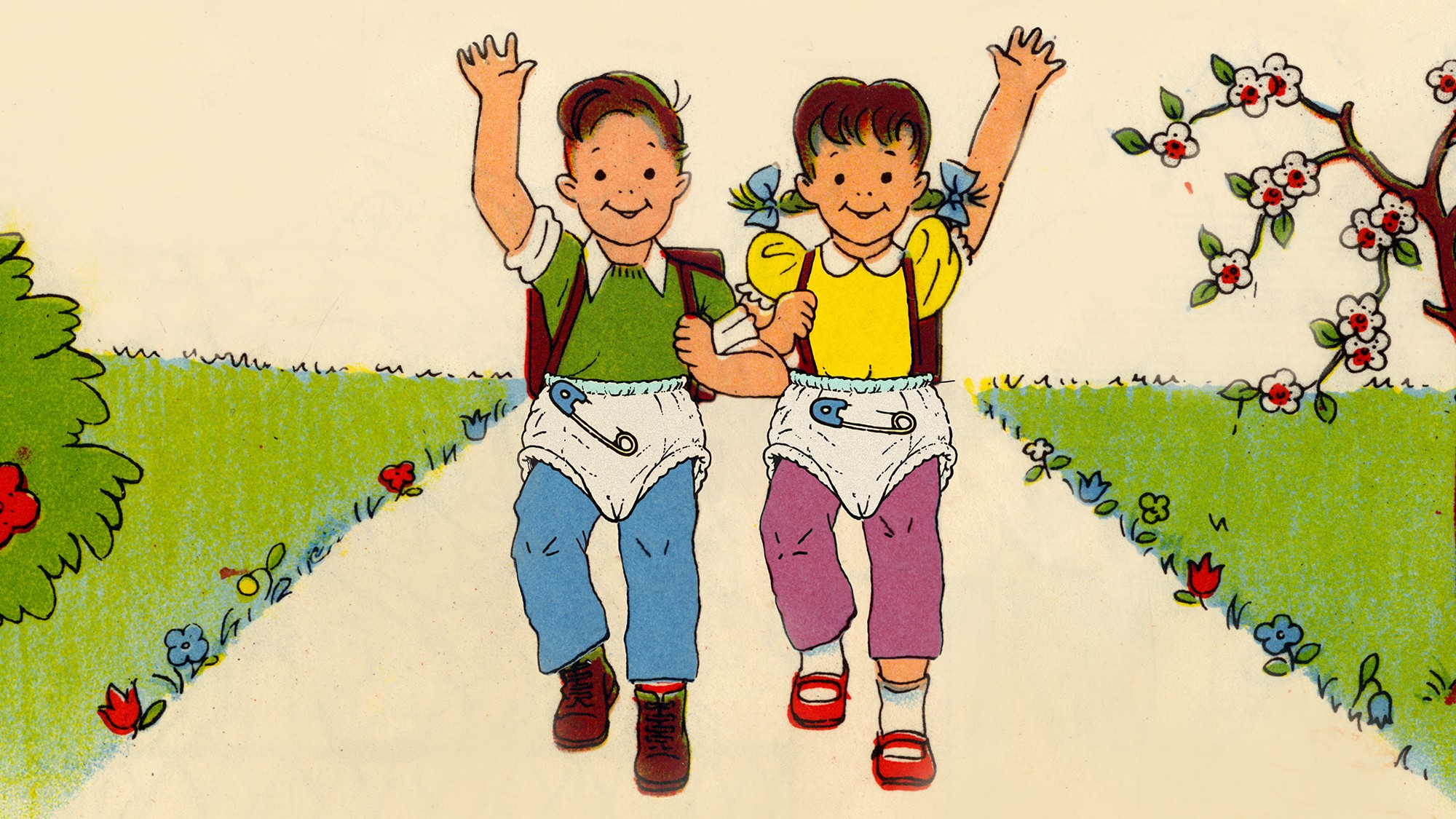
© Illustration by Matteo Giuseppe Pani / The Atlantic. Source: Buyenlarge / Getty.
  •  

The Gravitational Pull of Supervising Kids All the Time

Updated at 4:55 p.m. ET on July 13, 2023

Two Christmases ago, Anna Rollins, a writer based outside Huntington, West Virginia, went on a stroll with her then-5-year-old son. Always itching to do things himself, the boy announced that he wanted to walk alone. When Rollins refused, he countered with a compromise: He would walk on one side of the row of houses, she would walk on the other, and they’d meet at the far end. The trek was only four homes long, in a neighborhood with no through-traffic, so she relented and instructed him to stick to the grass. “This is a good start to independence,” Rollins thought to herself as she walked.

But when she arrived at the meeting spot, her son wasn’t there. She ran around to his side of the block and found it empty. Finally, she spotted him with an elderly couple across the road. “Is this your little boy?” the woman asked as Rollins hurried over. “He was out by himself.” Rollins tried to explain—the boy’s request, the plan, independence—to little avail. “Merry Christmas,” the woman said icily as she handed the boy back. To Rollins, it sounded more like You’re welcome that I rescued your child from your negligent parenting.

Compared with children of generations past, modern American kids tend to live under a high degree of surveillance. That’s not to say they have no autonomy. If anything, children today have more say over what they eat and wear than kids have had through much of history—just very few opportunities for “some degree of risk and personal responsibility away from adults,” as a trio of researchers recently put it.

Many parents have legitimate reasons to worry about their kids wandering. Still, getting out from under close adult supervision is important for child development. Mariana Brussoni, a developmental psychologist and the director of the research center Human Early Learning Partnership, told me that when adults aren’t hovering, children are forced to solve problems and resolve disputes on their own—which can sharpen executive functioning and social-emotional learning, and bolster confidence and resilience.

Independence can also be important for mental health. Separation anxiety, a fear of heights, nervousness about the unknown—those are normal parts of development that serve an evolutionary purpose in keeping kids safe. They don’t dissipate on their own, though; they’re gradually allayed through experiences that draw kids further from parental oversight: spending an afternoon at a friend’s house, climbing a tree, walking to the bus stop by themselves. Learning to cope with the strong emotions that often attend these exploits is valuable. Some psychologists trace the ongoing decline in American children’s mental well-being directly to the constraints on their freedom.

[Read: What happened to American childhood?]

And yet, the vigilant style of American parenting has become not only a norm, but an expectation that can be difficult to defy. In reporting this story, I heard from parents who said that other adults had threatened to call Child Protective Services when they didn’t hold their 3-year-old’s hand as they crossed the street, warned them that their 5- and 7-year-old kids had drifted a little too far from them at a playground, or scolded them for letting their teenage kids walk to school on their own. This social discomfort with childhood independence has become a barrier to it. “I often find myself worrying more about what other people think than I do about my children’s safety,” Rollins told me. “If my children’s safety was the sole thing guiding me, I would probably let them do a lot more.”

This is a common apprehension, Brussoni told me. Parents she speaks with tend to cite three main concerns about giving their children more freedom: cars, kidnapping, and what other people will think or do in response. That creates a vicious cycle: Now that helicopter parenting has become the standard, how does anyone stop?

The decline in children’s independence has complex roots, according to Brussoni. In the mid-to-late 20th century, rising economic inequality undermined parents’ confidence in their children’s future prosperity, spurring an intensive approach to parenting—first among wealthier families, but eventually across classes—in which kids spend more time in structured activities such as violin lessons and hockey practice and less time playing freely. Urbanization and car dominance have made it harder for kids to safely get around on their own, and left fewer opportunities for neighbors to get to know one another, weakening parents’ trust in strangers. The rise of smaller, two-earner families means fewer parents are at home to keep an eye out as kids roam the neighborhood, and fewer older siblings are watching over younger ones. And growing access to frequently fearmongering media has heightened perceptions of the risks that children face in public life.

The resulting encroachment of childhood freedom has had a snowball effect. As kids do less on their own, many of us have come to think of them as less capable of managing on their own, Brussoni said. And with each generation, it becomes harder to imagine that kids can do the sort of things they might have a century ago, because fewer and fewer parents have any memory of having done those things themselves. That’s resulted in a pervasive belief that children require constant supervision into at least their tweens. One recent survey found that more than two-thirds of parents think children should be 12 or older before being left home alone before or after school. Twelve is also the median age at which a kid will be allowed to walk or bike to school or a friend’s house on their own.

Given that so many children are now being accompanied, plenty of adults—parent or not—just aren’t used to seeing young kids on their own anymore; when they encounter a lone child, they often assume, like the elderly couple who pulled Rollins’s son aside, that something’s gone wrong. “We sort of drank the Kool-Aid that anytime a child is unsupervised, they’re ipso facto in danger,” Lenore Skenazy, the president of Let Grow, a nonprofit promoting childhood independence, told me.

[Read: How to quit intensive parenting]

More and more, this reality is reflected in America’s infrastructure for safeguarding children against abuse and neglect, Diane Redleaf, a civil-rights lawyer and legal consultant for Let Grow, told me. Reports of child neglect make up the majority of child-maltreatment cases in America. But laws defining neglect in the U.S. are typically broad and vague. Many reports of neglect involve children who have been left without direct supervision for any length of time. Parents have been reported, investigated, and even charged for letting their kids play outside their apartment, walk the dog, or run laps around their block, or for leaving their kid in the car for a few minutes with the windows rolled down on a cool day. The threat of sanction is ever present—especially for Black parents, who are much more likely to get caught up in the CPS system—and it frequently plays into people’s parenting decisions, Redleaf said.

The helicopter-parenting norm is exacerbated, too, by a common uncertainty about the role we should play in the life of a child we don’t personally know. Even capable kids are still learning. For them to participate in society without a chaperone requires some buy-in from everyone else, not only in the form of tolerance for childlike behavior or confusion, but also in a readiness to help or direct a child if need be. Tim Gill, an advocate for children’s play and the author of No Fear: Growing Up in a Risk Averse Society, suspects that many of us aren’t accustomed to this sort of social contract, given how absent children are from much of public life. “We’re in danger of giving up the notion that it takes a village to raise a child,” Gill told me.

Dixie Dillon Lane, a writer and historian based in Front Royal, Virginia, told me that when she moved to Paris at 11 years old, her parents allowed her to roam the city as she pleased, which was common among her peers there. Lane thinks such autonomy was possible in part because, at least at the time, Parisian adults seemed to have few qualms about instructing an unfamiliar child. On one occasion, when Lane slid into a seat that opened up on a crowded bus, a man standing nearby told her to let an elderly lady sit down instead. In Lane’s experience, many Americans are less certain about the authority they have over a child that isn’t their own. Brussoni said something similar: Bystanders, and especially men, are often wary of interacting with children they don’t know, lest they be suspected of ill intentions. Parents don’t trust strangers, and strangers know it.

[Read: Cities aren’t built for kids]

This “social anxiety about children and their place in society,” as Gill put it, is tricky to walk back. But improving urban infrastructure—narrowing streets to slow down cars, placing family-oriented spaces within walking distance of homes—can make the public realm more child-friendly, Brussoni said. Revising ambiguous child-neglect laws to allow for a reasonable measure of free rein, as eight states have now done, can help ease parents’ hesitation about giving their children some room to roam. Messaging from public-health associations about the importance of childhood independence can influence decisions in schools, libraries, parks, and other public places.

Parents can also try to encourage child autonomy in their own circles. Brussoni, together with several other neighborhood parents, decided to let their children play as they might have in the past. As a result, her kids, who are now in their teens, had much the same childhood she had—spent running around their neighborhood, to the park with their friends, and in and out of one another’s houses. Such a pact can’t encompass everyone who might cross a child’s path, so parents can coach their kids on how to talk to adults they don’t know. This is where Rollins thinks she messed up—she advised her child to avoid the street but didn’t tell him what to say if he encountered a stranger.

Then again, Rollins couldn’t have controlled how other people reacted to her child walking alone. Her experience is part of a larger cultural phenomenon, and cultures don’t shift overnight. For now, giving your child room to take risks might mean taking a risk yourself.


This article originally stated that when someone reports neglect, they typically mean that a child—most commonly between the ages of 5 and 9—has been left without direct supervision. In fact, “lack of supervision” claims do not make up the clear majority of neglect cases, and the most common age range for lack of supervision claims is unclear.

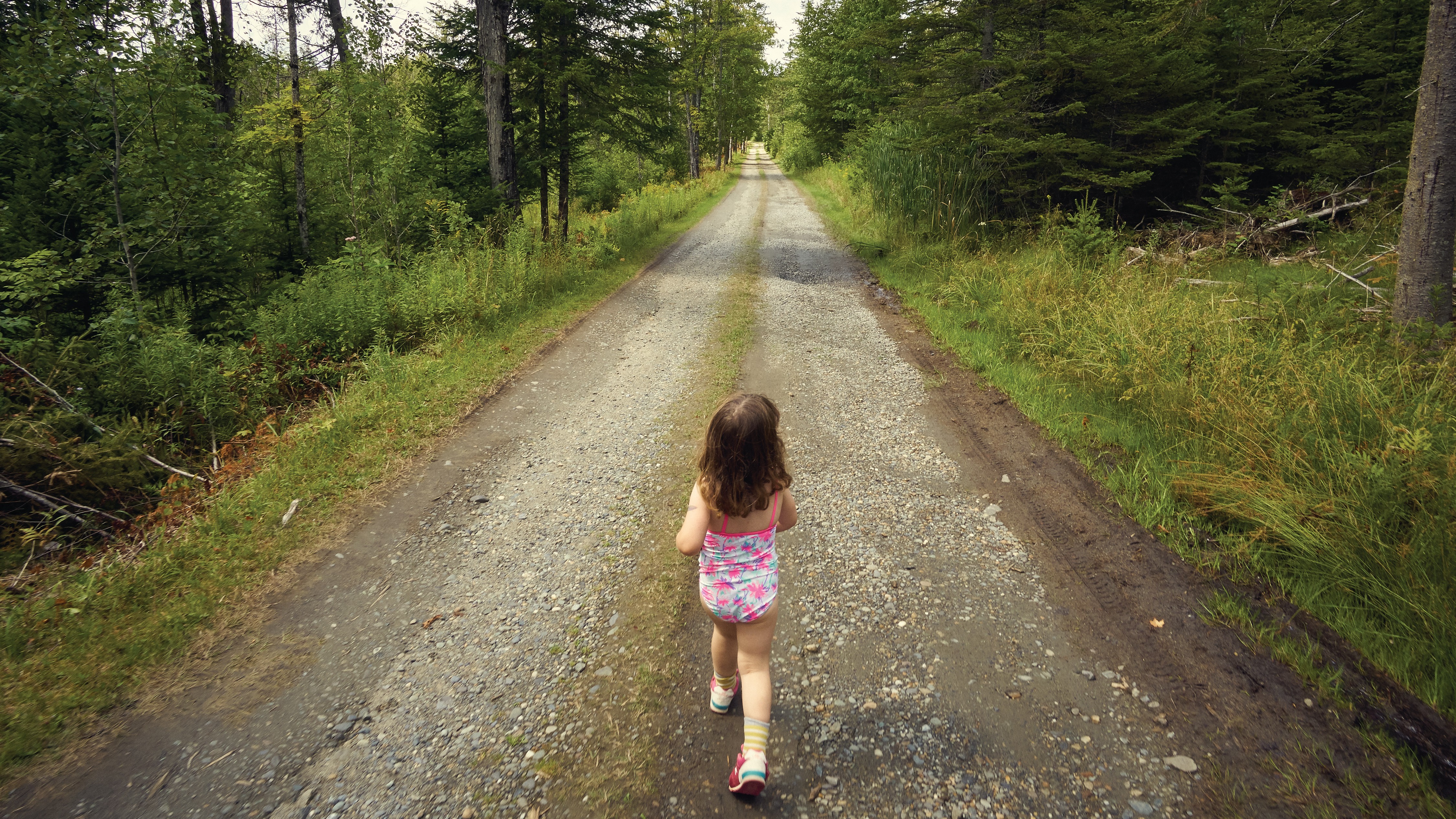
© Corey Hendrickson / Gallery Stock

  •  
❌