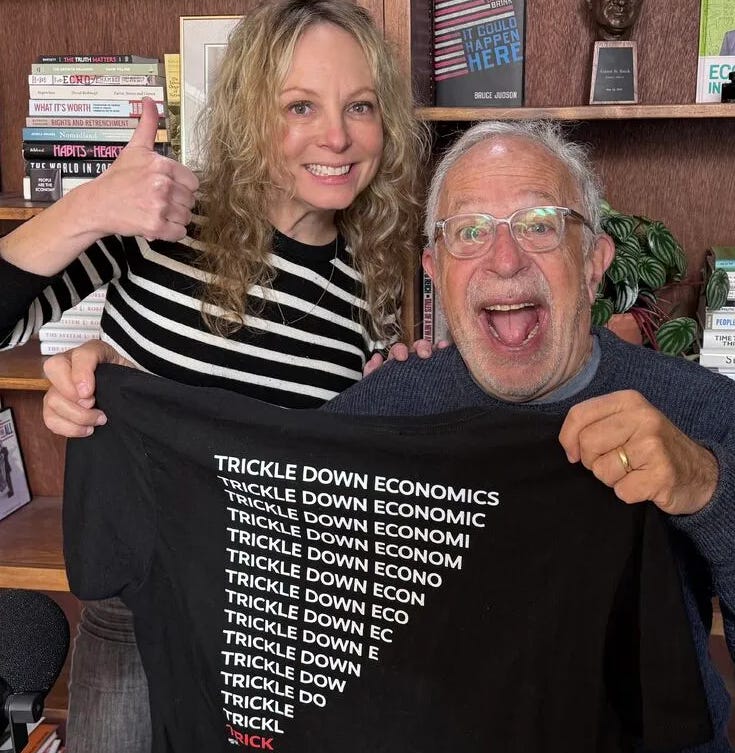
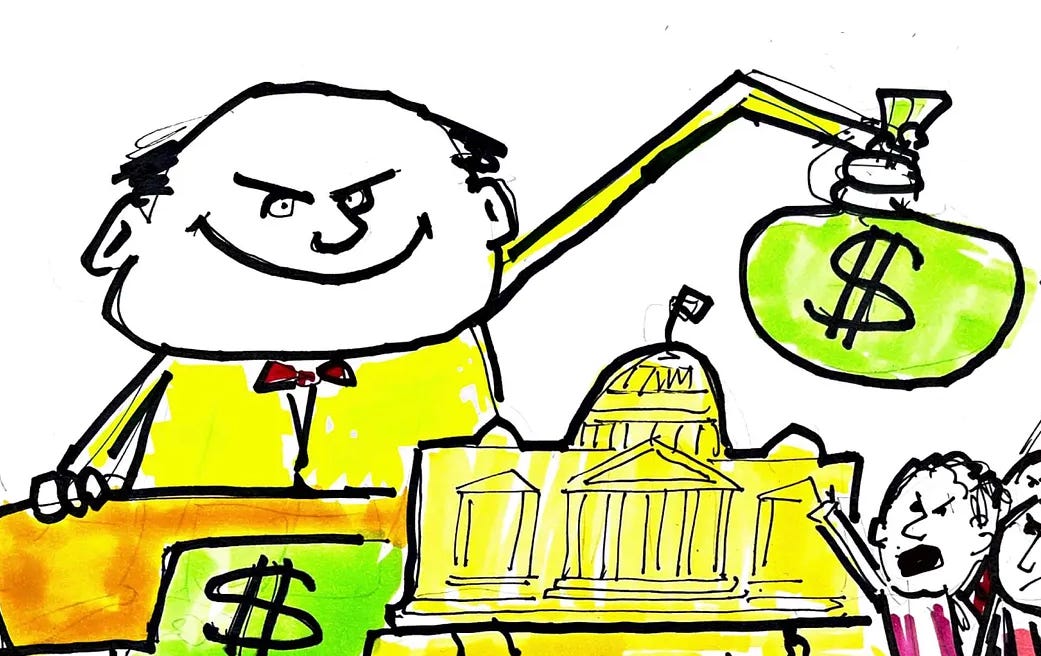
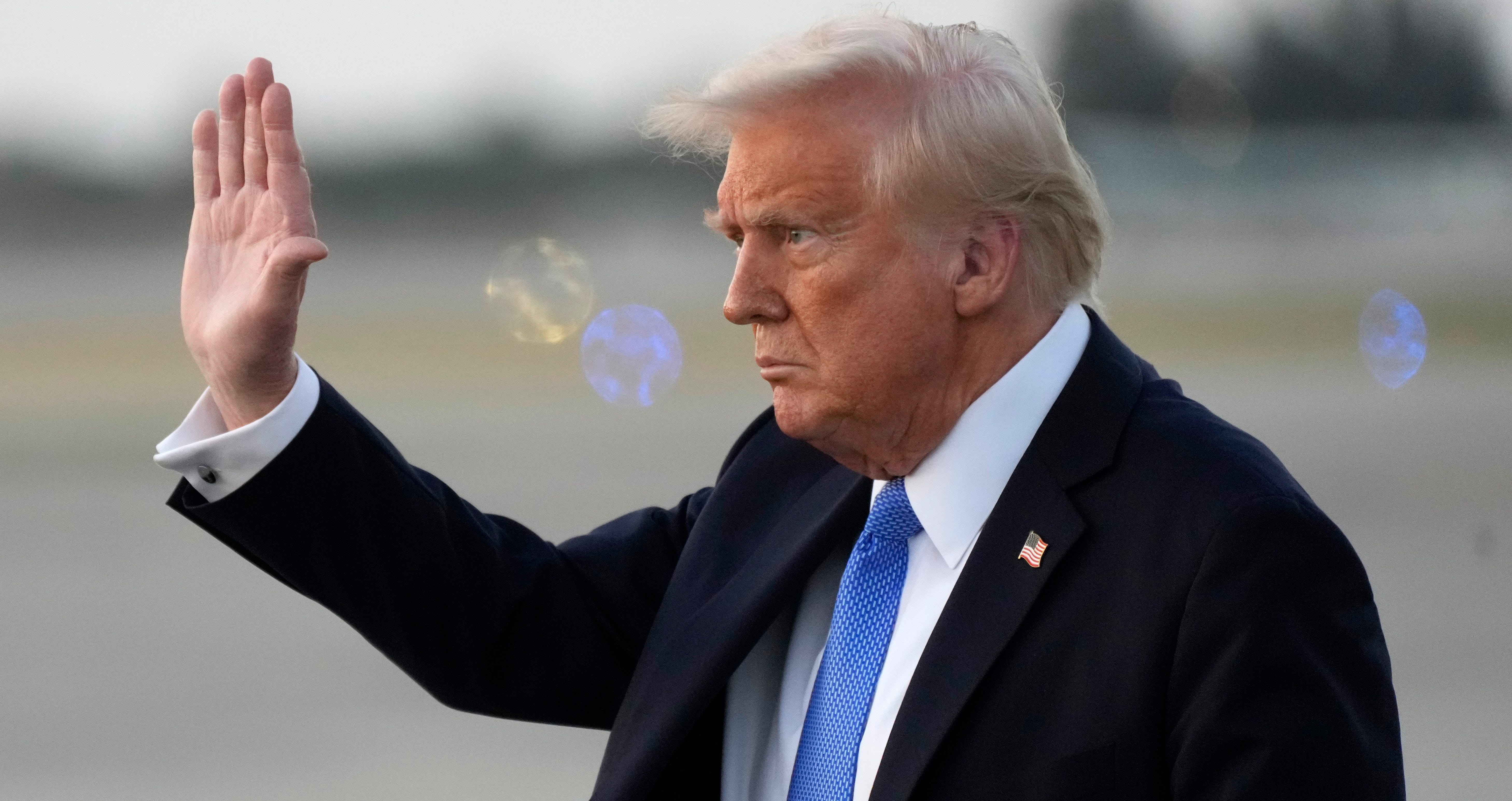
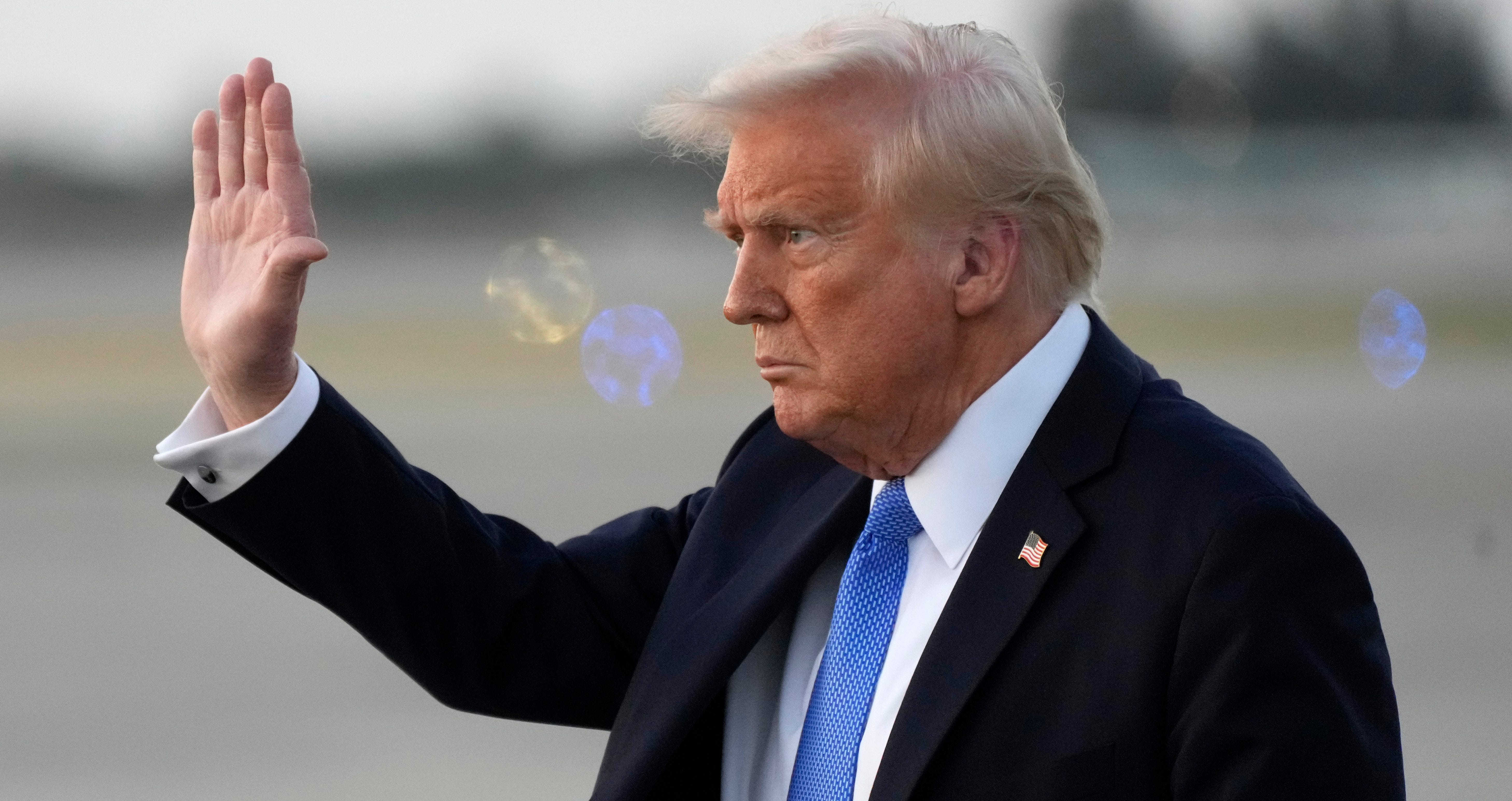
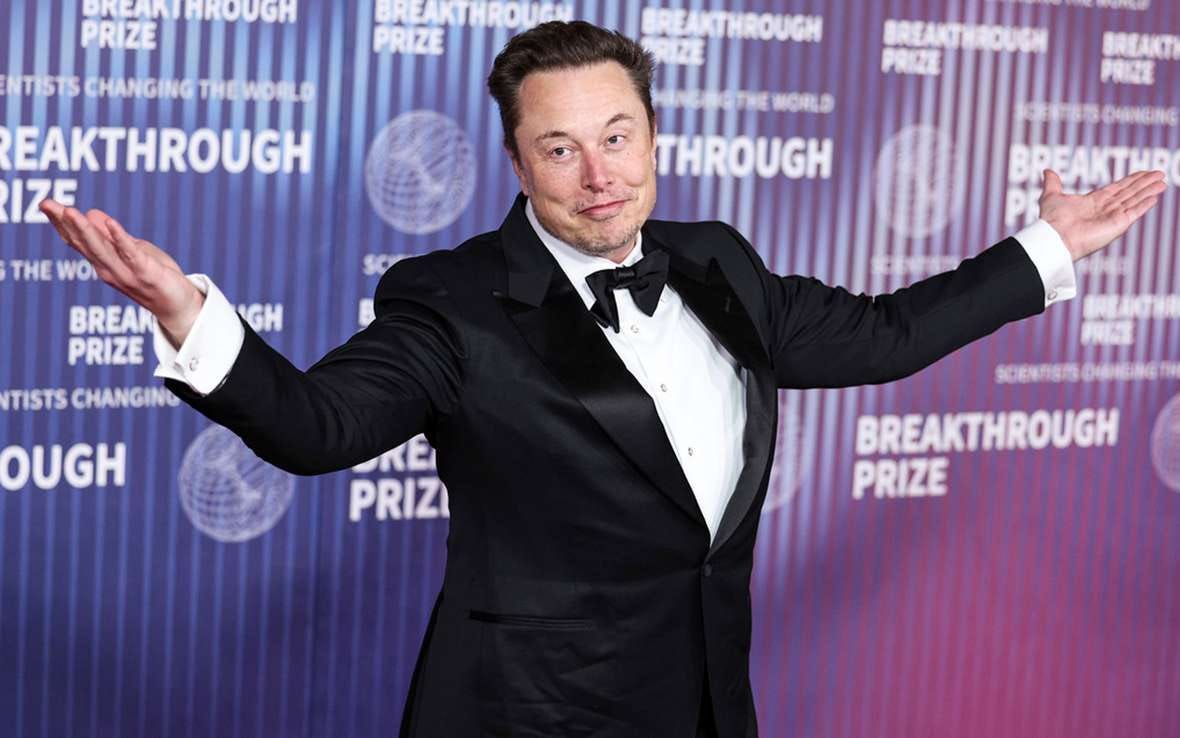
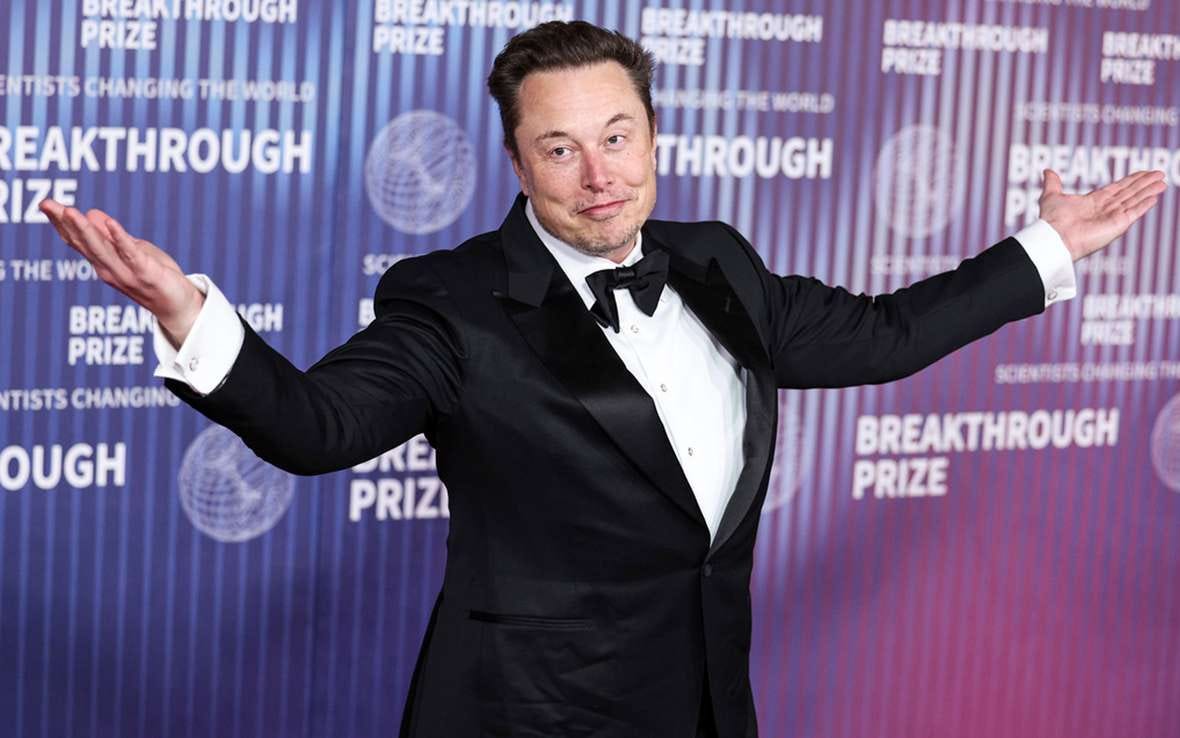
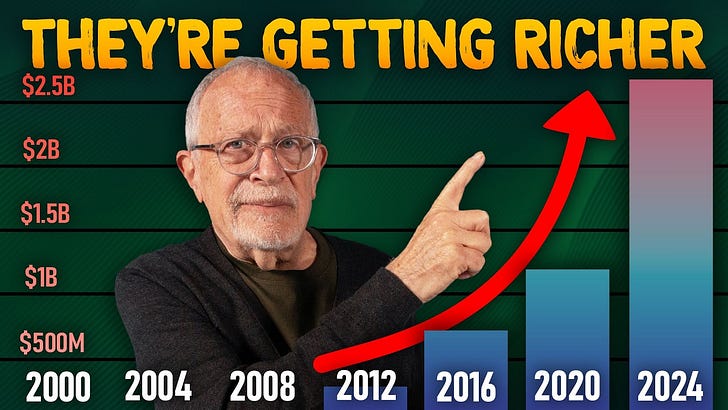
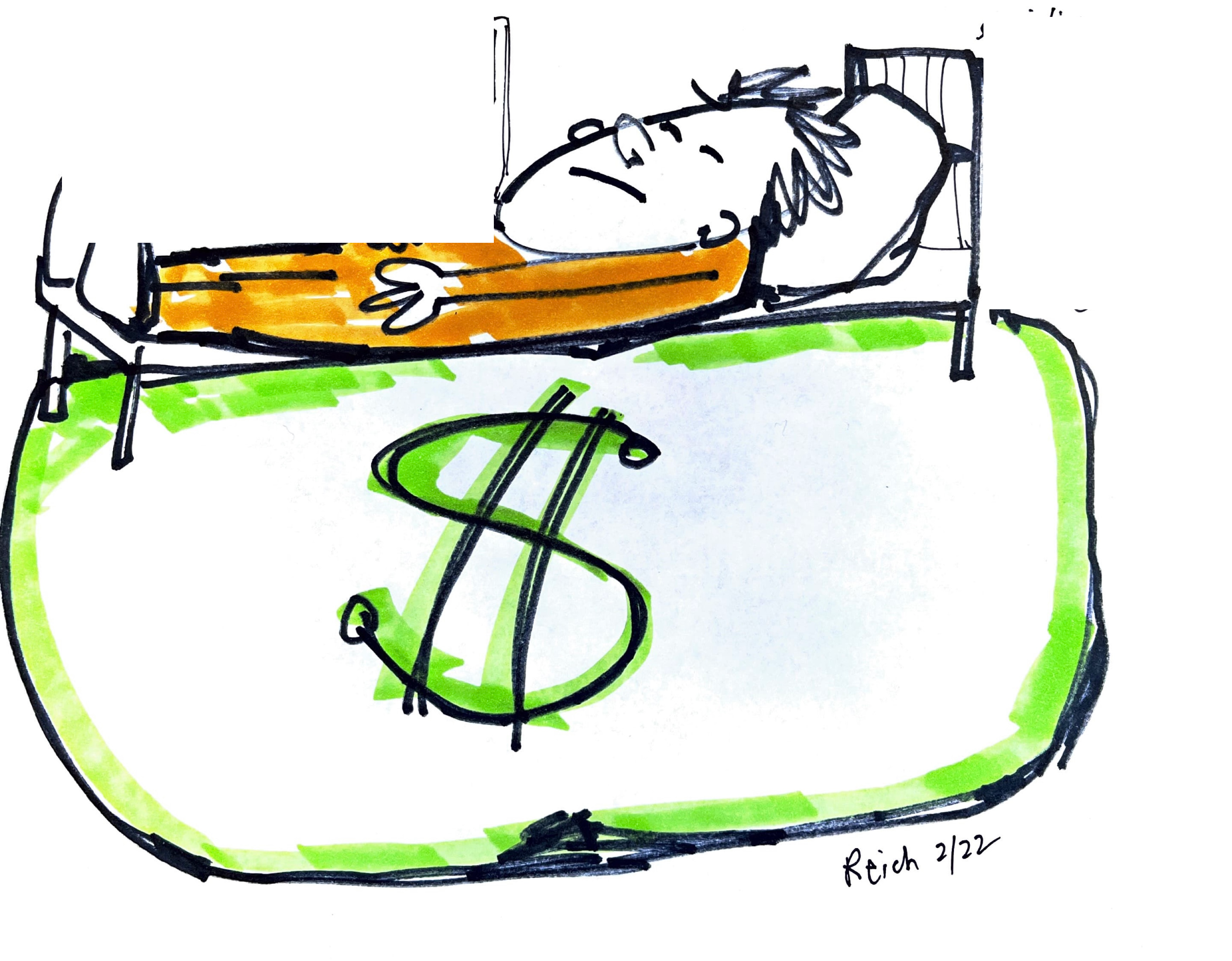
Today Heather and I take a deep dive into Elon Musk’s new status as America’s first trillionaire — worth one thousand billion dollars — and its meaning for the future of American capitalism. How much of SpaceX’s valuation is based on hype? How much on connections in the Trump regime? How much on Musk’s lobbying of major stock index funds? Answer: almost all of it.
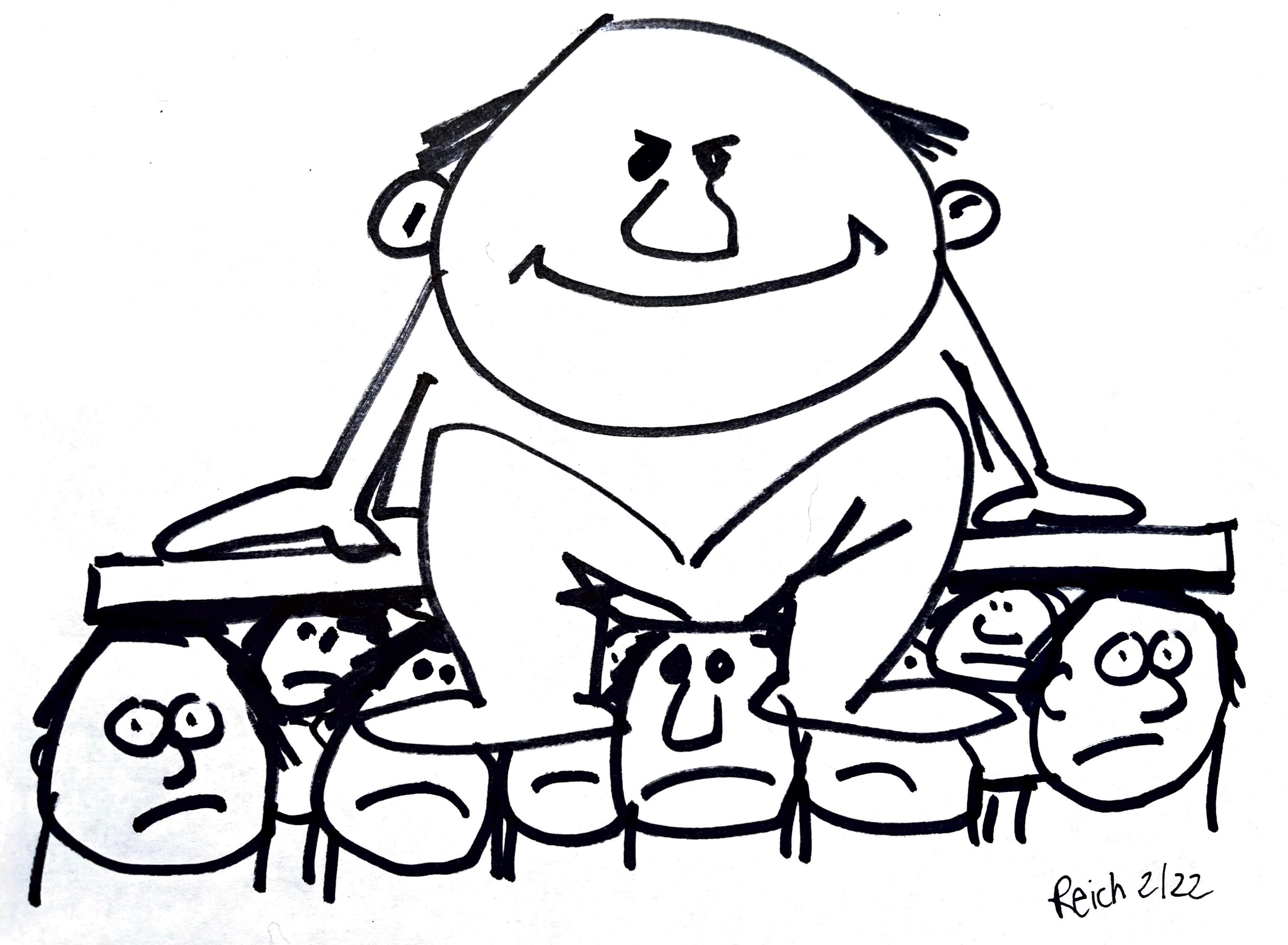
We also look at Musk and Trump’s (and Pete Hegseth’s and Robert F. Kennedy Jr.’s and JD Vance’s) obsession with male virility — where that comes from and how it’s connected to tomorrow’s cage match on the South Lawn of the White House.
So please grab a cuppa, pull up a chair, and join in the conversation.
Sometimes I provide you with information that I hope you’ll find helpful in making arguments with others. I don’t expect that what I share with you will change the minds of committed Trumpers, but the facts and the evidence may have some sway with Republicans and independents who are wavering about whom to support in the midterms.
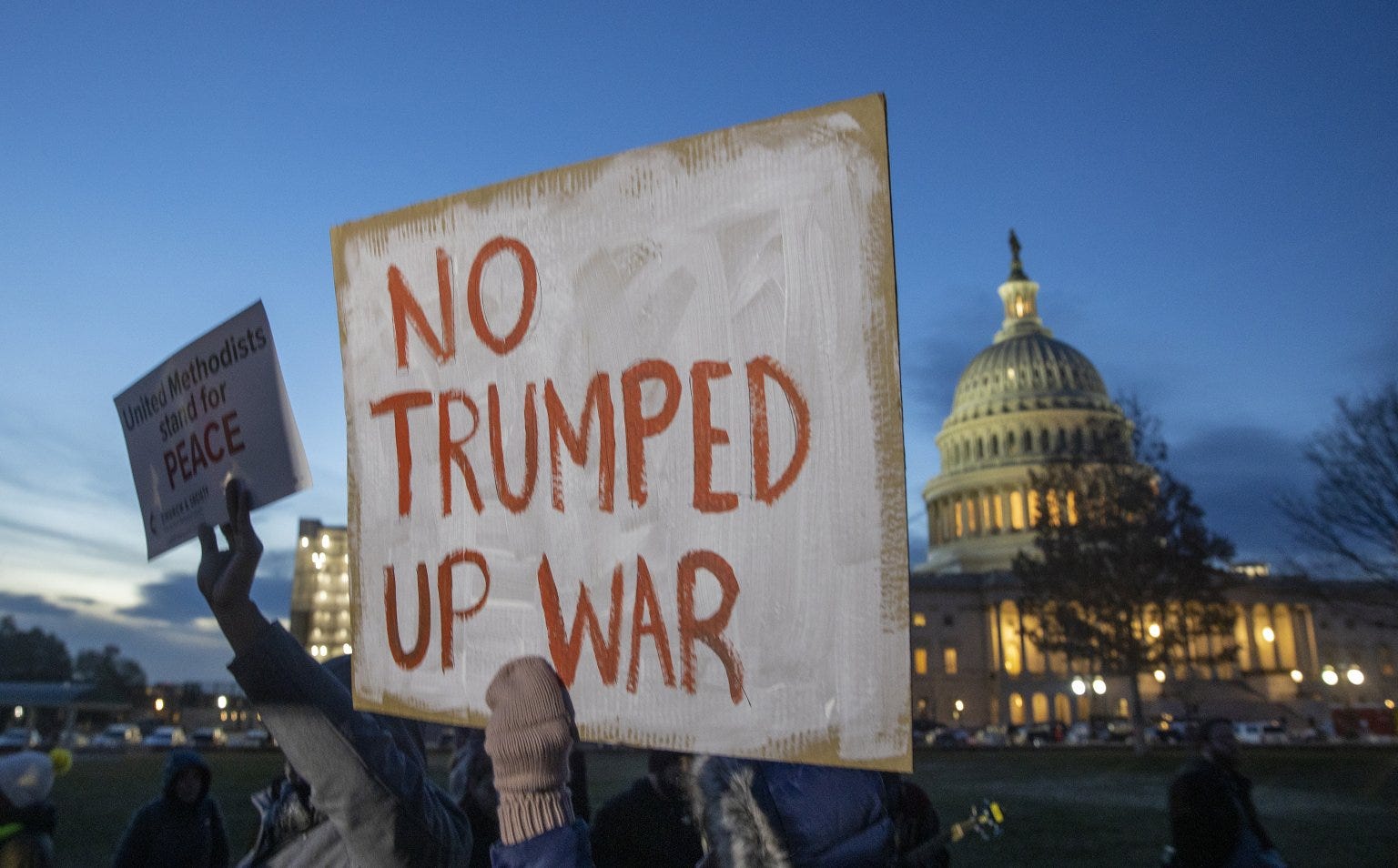
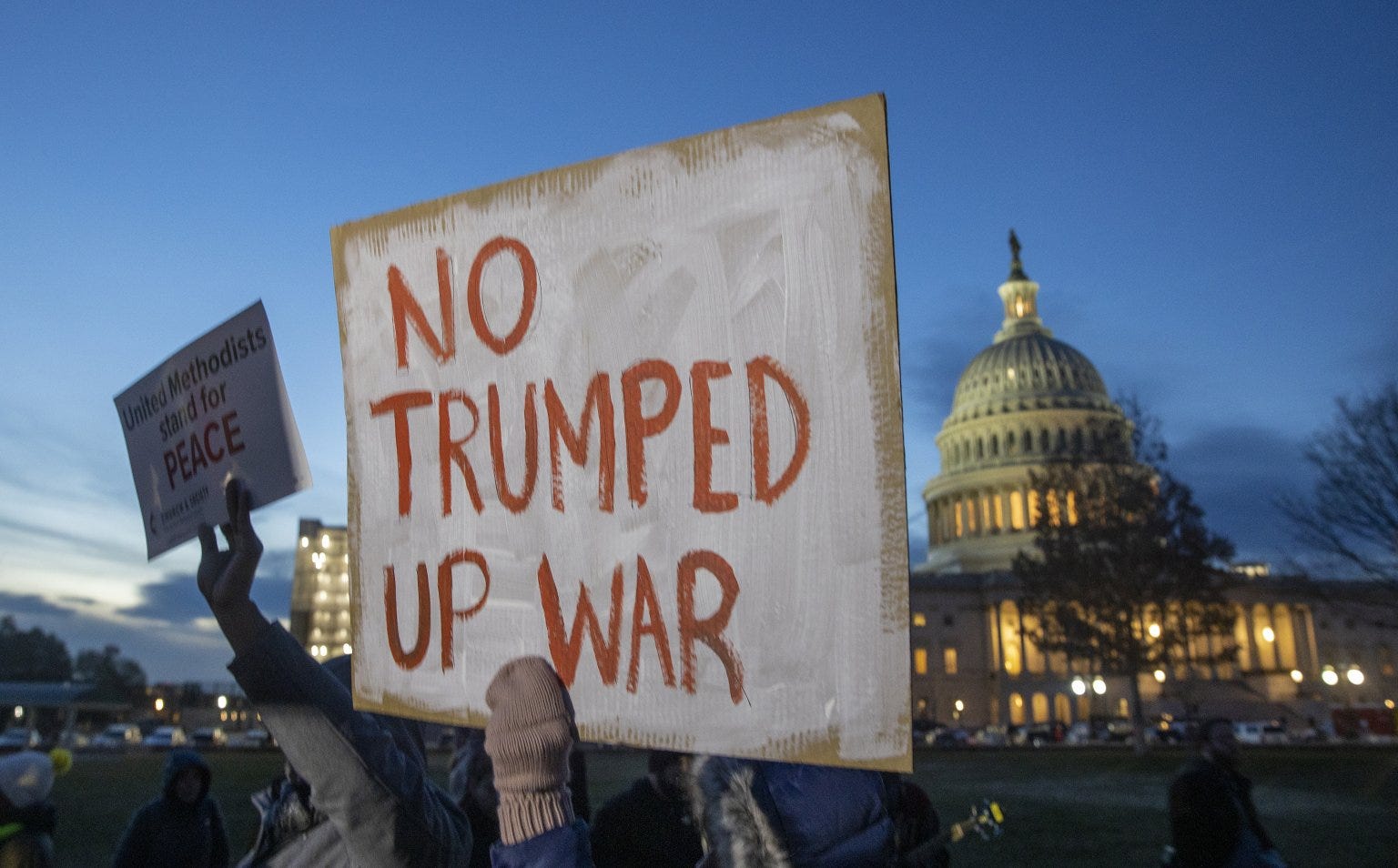
One of the main reasons Trump was elected was his pledge to keep the United States out of wars, especially the kind of “endless” wars America has fought in Iraq, Iran, Syria, and Afghanistan.
Obviously, he broke that pledge. We’re now well into the fourth month of a war he said would be four or five weeks at most.
In addition, the war he initiated in Iran was a war of choice — Iran did not attack the United States, and most specialists in foreign policy say Iran was not close to devising a nuclear weapon at that time. (It’s likely to be closer now, or at least more committed to making one.)
Yet in a lengthy interview with Kristen Welker, the host of NBC’s “Meet the Press,” which aired Sunday, Trump was once again trying to rewrite his own history, He claimed:
“I didn’t guarantee no war. So when you say I promised, I didn’t promise anything. I don’t like these endless wars. This is not an endless war. We’ve been doing this for three months.”
In fact, Trump repeatedly and unequivocally promised during the 2024 election campaign that the U.S. would not have any wars during his second presidency.
Herewith, some examples.
In a June 2024 social media post, Trump described the election as “a choice between STRENGTH or WEAKNESS, COMPETENCE or INCOMPETENCE, peace and prosperity or war and no war.”
In one of the highest-profile speeches of his campaign — his July 2024 address to the Republican National Convention — he said, “With our victory in November, the years of war, weakness, and chaos will be over. I don’t have wars.”
He made the promise again and even more directly during an August 2024 rally in the swing state of Pennsylvania, saying: “Under Trump, we will have no more wars, no more disruptions, and we will have prosperity and peace for all.”
Trump reprised the same pledge in an August 2024 interview with Adin Ross, an online personality. After saying there were no wars during his first administration, he promised, “And we won’t have wars again.”
At another rally that month in the hotly contested state of North Carolina, Trump approvingly cited Viktor Orbán, then the prime minister of Hungary, as supposedly having said, “Make sure that Trump gets reelected president, and you’re not going to have any more wars.” Trump reiterated moments later, “No more wars. No more disruptions. We will have prosperity, and we will have peace.”
Trump told versions of the Orbán story at numerous other events. For example, in the swing state of Wisconsin in October 2024, he said, “Viktor Orbán said, ‘If Trump comes back, you won’t have any wars. You won’t have any wars.’ And he’s about as tough as they get, and he said it loud and clear and he said why. But you won’t have any wars.”
Finally, in his victory address in November 2024, Trump made a clear promise that he would not start a war — even when he no longer had to persuade voters to elect him. He said in that high-profile speech: “Four years, we had no wars, except we defeated ISIS. … They said, ‘He will start a war.’ I’m not going to start a war, I’m going to stop wars.”
In reality, of course, Trump has been one of the most bellicose presidents in modern American history.
His failing war in Iran and his campaign pledge not to start any wars should be held against Republicans in the House and Senate. They’re partly responsible. They have repeatedly refused to stop his wars. They have repeatedly enabled his aggression.
The trustees of the Social Security fund said Tuesday that the fund will be depleted by late 2032, a year earlier than the trustees’ projection last year of 2033. If nothing is done, benefits will automatically be cut six years from now.
The common understanding is that Social Security’s shortfall is due to the huge postwar baby boom, now retiring, and to America’s increasing life expectancy. The usual recommended fix is to reduce Social Security benefits or raise the age of eligibility. As Speaker of the House Mike Johnson, warned Monday, “entitlement programs” like Social Security “have to be adjusted and fixed.” He said Republicans will introduce a plan to do that. Brace yourselves.
I used to be a Social Security trustee, and I call bullsh*t.
The baby boom can’t be blamed for Social Security’s shortfall. The Greenspan Commission, which in 1983 recommended the reforms that Congress then made — raising Social Security payroll taxes and also raising the eligibility age for collecting Social Security benefits — knew all about the baby boom and figured it into its calculations. (Early boomers like me can now start collecting full benefits at age 66; late boomers born after 1960 have to wait until they’re 67 to collect full benefits.)
Americans’ increasing life expectancy isn’t at fault, either. While wealthier Americans are living longer, that’s not the case for lower-income Americans. The Urban Institute estimates that life expectancy in the top 20 percent of income-earners is 91 years for people born in the 1990s, four years more than people born in the 1950s. Yet the life expectancy in the lowest 20 percent of income-earners is fewer than 80 years.
So what’s the real cause of the Social Security shortfall? What did Greenspan’s commission fail to predict? Widening inequality.
Remember, the Social Security payroll tax applies only to earnings up to a certain cap. This year, that cap is $184,500. Earnings at or below this amount are taxed at 12.4 percent. The cap rises every year according to a formula roughly matching inflation.
Back in 1983, the cap was set so the Social Security payroll tax would hit 90 percent of total income in America. That 90 percent figure was built into the Greenspan Commission’s fixes. The Greenspan commission assumed that, as the cap rose with inflation, the Social Security payroll tax would continue to hit 90 percent of total income.
Today, though, the Social Security payroll tax hits only about 83 percent of total income in America. It went from 90 percent to 83 percent because a steadily larger portion of the nation’s total income has gone to the top.
In 1983, the richest 1 percent of Americans got 11.6 percent of total income. Today, the top 1 percent takes in more than 20 percent.
This year, someone earning $1 million in wages stopped paying any Social Security payroll tax at the beginning of March. Jeff Bezos probably stopped a few minutes past midnight on January 1. Elon Musk, a few seconds after midnight on January 1. (In point of fact, Bezos, Musk, and other robber barons of this Second Gilded Age get all the cash they need by borrowing against their fortunes, rather than bother with pesky wages, so they probably pay a pittance in Social Security taxes.)
Logically, then, to get back to 90 percent, the ceiling on income subject to the Social Security payroll tax has to be raised.
If all income in excess of $400,000 were subject to the Social Security payroll tax, Social Security’s solvency would be guaranteed forever. We could also expand Social Security benefits.
So there’s no reason even to consider reducing Social Security benefits or raising the age of eligibility. The logical and necessary response is simply to raise the cap, Mike Johnson and other Republican shills for the oligarchs to the contrary notwithstanding.
Social Security is America’s most effective anti-poverty program. Last year, it lifted 23.5 million Americans out of poverty, including 16.5 million seniors. Before its creation, about half of our nation’s seniors were living in poverty. Today their poverty rate is just 10.3 percent. Without Social Security, nearly 4 in 10 seniors would have had incomes below the official poverty line.
Social Security is also the federal government’s biggest children’s benefit program through its disability and survivors’ benefits. In 2024, 1.7 million children received Social Security benefits, and the vast majority are eligible to receive survivors’ benefits if a parent were to pass away. Additionally, millions more children are part of a household where all or part of the household income comes from Social Security. Social Security is estimated to lift close to 1 million children out of poverty each year.
Other fixes that have been introduced in Congress:
1. The Social Security Expansion Act
Senators Bernie Sanders and Elizabeth Warren have introduced this plan for several Congresses. (It is cosponsored by Budget Committee Members Merkley, Whitehouse, Van Hollen, and Padilla.)
The bill imposes Social Security taxes on wages above $250,000 and applies the same 12.4 percent rate to capital gains and business income. That would boost benefits for almost all retirees by $200 per month, using a more generous measure of inflation to calculate the cost-of-living increase, and setting a minimum benefit at 125 percent of poverty. When estimated in 2023, it achieved 75-year Social Security solvency solely by increasing taxes on incomes above $250,000.
2. Medicare and Social Security Fair Share Act
Sen. Whitehouse and Rep. Boyle introduced this bill starting in the last Congress. Budget Committee Member Van Hollen is a co-sponsor. It adopts the tax increases of the Sanders bill, adjusted to start at $400,000. The bill has no benefit increases, so it significantly overshoots solvency, and there would be extra revenue. The bill achieves 75-year solvency for both Social Security and the Medicare Hospital Insurance trust fund.
I received the following from Richard Gephardt, who represented Missouri in the United States House from 1977 to 2005 and served as House Democratic Leader from 1989 to 2003, and Tim Wirth, who served in the U.S. House and Senate from Colorado from 1975 to 1993 and as the first U.S. Secretary of State for Global Affairs.
I have worked with both and know them quite well. Neither is an alarmist, but they did want me to help spread this alarm. Hence, I’m sharing with you what they wrote to me. (Research is fromKeep Our Republic, a civic education non-profit focused on fair elections.)
***
Between us we have served for seven decades, mostly in elected federal office, through Watergate, the post-Vietnam anti-war demonstrations, years of civil rights marches, Iran-Contra, debates over voting rights, the post-9/11 surveillance debates, two impeachments. We are writing today because we are watching something different from any of these, and because most Americans, including most of our friends in both parties, do not see the big picture.
Many may recognize and be concerned about individual actions or decisions taken by the administration but few have taken a step back and connect the dots. The “rolling coup” is much more than one development, one decision or a single day.
Its language designates as targets of federal counterterrorism authorities Americans whose sponsors are labeled “anti-American”, “ anti-capitalist”, “ anti-Christian” or “hostile to traditional American views on family, religion and morality.”
No statute authorizes the federal government to treat protected political speech as terrorism; NPSM-7 does it anyway. It tasked the FBI, the IRS and the Treasury Department with tracking the funding sources and supporters of organizations suspected of directly or indirectly facilitating political unrest, with no reference to the First Amendment.
Soon thereafter, the FBI organized a Joint Mission Center, drawing hundreds of personnel from ten federal agencies to identify and prosecute the targets of NPSM-7. The Director of the FBI, Kash Patel, subsequently testified [that there was] a 300 percent increase in domestic terrorism investigations. Former Attorney General Pam Bondi testified that thousands of U.S. citizens and non-governmental organizations are now on a secret watch list tied to the Joint Mission Center.
Concurrently the Justice Department has opened grand-jury investigations and indictments aimed at officials of previous administrations including former CIA Director John Brennan and former FBI Director James Comey.
The President’s Deputy Chief of Staff, Stephen Miller, has publicly described political opposition as a “fifth column,” and Trump himself amplified this by declaring “Arrest them all. Prosecute them all. Incarcerate them all… But first, Barack Obama.”
On May 6, 2026, the administration’s Senior Director for Counterterrorism, Sebastian Gorka, released a new National Counterterrorism Strategy that names “violent left-wing extremists,” “anti-fascists,” and certain religious minorities as principal threats to the United States.
Bondi provided a Department of Justice operational order that included a five year plan for retroactive mining of data files and plea interrogations along with the requirement that financial donors be named. The Joint Mission Center uses its $12.5 billion dollar budget to do the targeting. The President’s lead lawyers in the Office of Legal Counsel have preauthorized the use of domestic force.
Meanwhile the administration has appropriated $45 billion for construction of new ICE detention facilities, a 265 percent increase over previous years and more than four times the entire budget of the Federal Bureau of Prisons.
Tom Homan, the President’s “border czar” has overseen the proposal for the acquisition of over 100,000 detention beds above the current capacity of 70,000, with contracts for permanent mega-centers whose scale far exceeds anything an immigration processing operation would require. These are undoubtedly prisons for political prisoners, even as 1974 federal law prohibit the detention of American citizens without an act of Congress.
In the Caribbean and eastern Pacific, U.S. forces have killed more than 200 people across nearly sixty strikes on small boats designated as “narcoterrorists” without indictment, trial or judicial review. The commander of U.S. Northern Command has said publicly he would “definitely” execute lawful orders to apply this same authority on American soil.
The White House has declined to rule out using lethal force against U.S. citizens designated as members of domestic terrorist organizations, while Trump has fired most of the Department of Defense officials responsible for overseeing the legality of military operations.
Trump is seeking yet more funding for what appears to be his private army of ICE and Border Patrol agents, to be deployed in numerous target states, at airports and at urban polling places in the states he lost in the 2024 election, where he has now begun to seize voter roles and ballots.
[The U.S. Senate recently passed a $70 billion supplemental funding bill for Immigration and Customs Enforcement and Customs and Border Protection. The legislation is on track for an upcoming U.S. House vote. The funds aim to finance these agencies through 2029.]
Political prisons, a domestic army, control of the military’s legal apparatus, the seizure of voter roles, and much more presage the potential declaration of a national crisis and the implementation of various of the President’s Emergency Action Documents. These are among the many individual actions and plans of the “rolling coup” which is currently underway.
Unlike what might be recognized as a coup with tanks in the streets, this is not the seizure of power on a single day but the methodical construction of an apparatus designed to identify, arrest, prosecute and if necessary forcibly suppress Americans whose only offense is opposition to this administration, by an executive who has openly declared that opposition itself is the enemy.
Why aren’t more Americans seeing this? Because each step has been incremental. Each has been framed in the legitimate-sounding language of national security or law enforcement. Each was paired with a reassuring denial — we are not deploying the military domestically, we are not declaring an emergency over elections, we are not coming for citizens.
Congress, paralyzed and outnumbered, has not mounted a serious institutional response. Some press has reported stories about the pieces but not on the whole dangerous picture.
The first job of any coup is to make the recognition of it seem premature. That is the trap. By the time recognition is no longer premature, the moment to resist has already passed.
So what is to be done?
Congress must reassert its Article I authority over emergency powers, military deployment on U.S. soil, and the Office of Legal Council’s power to rewrite statute by memo.
Governors and state attorneys general must adopt the protective measures that civil liberties lawyers have already drafted to shield citizens, non-profits and election workers from NPSM-7.
Newsrooms must report the rolling coup architecture as a single big picture story, because that is what it is.
And each of us — in pulpits, in classrooms, in podcasts, in union halls, at work and around kitchen tables — must call this by its name out loud, while there is still time and there is still room.
***
Unless we begin to act with resolve, fortitude and clear-eyed commitment to our democracy, a future election will be lost and our democracy will likely be destroyed by a Presidential declaration of a national emergency and the subsequent implementation of the emergency measures, not authorized by law but drafted and implemented without any Congressional oversight.
We took the same oath of office that every member of the military and every federal officer takes — to defend the Constitution against all enemies, foreign and domestic. The obligation in that oath does not end when one leaves office. We believe that an awake America can stop what a drowsy one will not, but time is short and the challenge is urgent.
— former House Leader Richard Gephardt and former Senator Timothy Wirth
Elon Musk’s SpaceX goes on the market tomorrow. Rather than provide a range and then price the deal based on demand, as is customary in Initial Public Offerings, Musk has set a take-it-or-leave-it price of $135 per share.
He anticipates that the resulting corporation will be valued at $1.77 trillion. That’s an extraordinary amount for a company that generated $18.7 billion in revenue last year and recorded an operating loss of $4.2 billion.
In other words, Musk is offering SpaceX stock at roughly 100 times the company’s total revenue in 2025. This is ballsy, to say the least, given SpaceX’s consistent negative profitability and its failure to meet prior goals. But it’s a great deal for Musk. He comes out of it with nearly a trillion dollars.
Granted, it’s difficult to predict the value of activities that don’t yet exist, such as SpaceX’s stated mission to “extend the light of consciousness to the stars.” Interstellar space travel and interplanetary habitation are inherently speculative endeavors. But before tomorrow’s giant IPO, capitalism had never before put a price tag on something nearly as speculative and as large.
Let’s be clear. SpaceX’s IPO is basically nothing more than a show of faith in Musk. After all, much of SpaceX’s value comes out of a deal Musk negotiated between SpaceX’s and his Artificial Intelligence startup, xAI. Musk essentially made that deal with himself, setting the relative valuations by himself, closing the deal by himself, and unilaterally deciding the value of his own transaction. A magic trick, out of thin air!
The closer you look at the SpaceX IPO, the more it looks like Musk’s ill-fated DOGE. It also bears a striking resemblance to Trump’s takeover of the U.S. government. All of it is arbitrary, based on the will of one man with a giant ego and an insatiable thirst for money and power. It’s built on self-dealing. There’s no accountability. No checks. No balances.
Musk will have total control. Shareholders won’t have any voice whatsoever. Each share held by Musk will have 10 times the voting power of a share offered to the public. SpaceX’s board of directors will engage in a pantomime. They’ll have no meaningful authority. As the editorial board of the Financial Times put it, “traditional governance checks are almost entirely absent…. [Musk] will have a virtually unchallenged grip on voting rights and the board.”
None of this would be particular cause for concern if investors could decide for themselves whether the downside risks and potential upside gains from buying SpaceX stock were worth the price. That’s called a “market.” Caveat emptor.
But many of us, if not most of us, with any savings parked in major stock indices (yours truly included) won’t have any choice. We’re going to end up investing in SpaceX whether we want to or not. That’s because the major indices have been rigged.
Normally, major stock indices have a waiting period before they plow their investors’ money into a newly formed company, in order to test whether that company is worth it. But SpaceX has lobbied index funds to change the rules.
On May 1, for example, the Nasdaq 100 implemented a new “fast entry” rule that will include companies among the top 40 most highly valued companies — which will almost certainly include SpaceX.
Presto! A big chunk of Americans’ retirement savings and pensions (as well as university endowments) will automatically be tied to SpaceX’s market value. At the same time, all that automatic infusion of investment will artificially jack up the value of SpaceX, at least in the short term.
But here’s the real kicker. SpaceX insiders — such as Musk and, reportedly, senior Trump officials — will be able to sell their shares sooner than is usually the case with an IPO, because that’s the way the IPO has been organized. Which means they can enjoy the stocks’ upward tide as the major indices force millions of investors to buy it, and then they can exit SpaceX before the tide goes out.
If this sounds to you like a Ponzi scheme, it does to me, too. Even worse, it’s a Ponzi scheme that’s been rigged by Musk, with the acquiescence of Trump’s Securities and Exchange Commission, to require that I and probably you put some of our savings into SpaceX.
Speaking of the SEC, Senator Elizabeth Warren has raised many of these concerns with Paul Atkins, Trump’s SEC chair. She’s even asked him to delay the IPO to determine whether index funds are adequately protecting investors — warning of “a disastrous scenario where retirees’ and families’ investment accounts take a hit if SpaceX’s valuation falters, with little recourse for any corporate misconduct, while the wealthiest man on earth becomes even wealthier due to a lack of oversight.”
But SpaceX’s takeoff is happening tomorrow, regardless. It’s likely to make Musk a trillionaire but also to shaft a lot of innocent people, perhaps without their even noticing. It will be a huge redistribution from most of us to Elon and his buddies.
I don’t want to sound cynical, but this is the sort of thing that brings out the cynicism in me. It’s the story of American capitalism in this Second Gilded Age.
Either he knows he’s lying — in order to further undermine confidence in our elections and as a prelude to attacking the outcome of the midterms — in which case he needs to be impeached and convicted.
Or he doesn’t know he’s lying — he really believes that our election system is “crooked” and that the major media are “crooked” — in which case he’s seriously and dangerously mentally ill, and the 25th Amendment needs to be invoked to get him out of office.
Take your pick. Either way, he has to be removed from office. And soon.
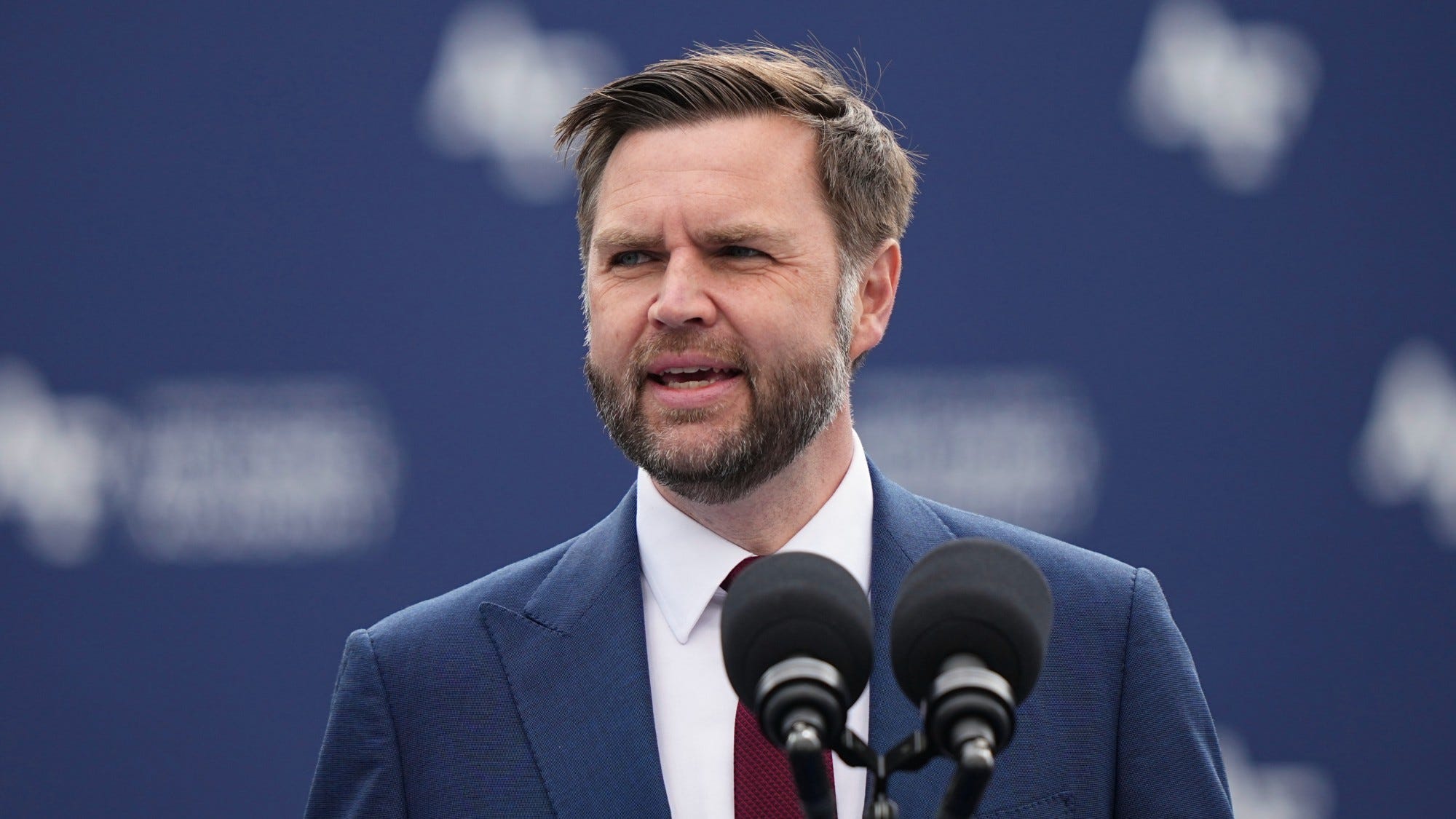
I’ve been watching JD Vance as carefully as anyone can track a snake in the grass, which is to say, with some difficulty. He has seemed uncomfortable with Trump’s grandiose foreign ambitions, especially Trump’s failed war in Iran, but I’ve seen no evidence that JD has spoken out against any of it even inside Trump’s ego-echo chamber.
JD hasn’t carved out a regressive policy specialty for himself, as have some other of Trump’s despicable underlings such as Stephen Miller, Russell Vought, and Harmeet Dhillon.
Nor has JD become much of a spokesperson for Trump. He rarely appears on television or even on social media. Nor has he been visible on Capitol Hill. He hasn’t cinched any deal in Congress.
JD seems to appear when and where a vice president is supposed to, but then disappears again into the daily effluence of Trump.
But there’s one particular area where JD seems to stand out (I was tempted to write “excel,” but it’s impossible to excel at something as execrable as JD’s specialty.) He is the regime’s strangest bigot.
Among all the bigots in the Trump regime — and there are many — JD’s bigotry stands out for a particular lunacy, combining magic realism with a unique ultra-wackiness.
We saw glimmers of this during the 2024 campaign when JD, then a U.S. senator from Ohio, insisted that the pets of upright Americans residing in Springfield, Ohio, were being “abducted and eaten” by Haitian immigrants “who shouldn’t be in this country.”
Despite being informed by city officials that Haitian immigrants were not in fact eating pets, Vance doubled down. He was sure Haitians were eating people’s pets. The publicity surrounding JD’s bizarre claims led to threats against Springfield’s Haitian community.
Not to let a disgusting lie about a minority group go unexploited, Trump amplified Vance’s pet-eating claim during his presidential debate with Kamala Harris.
Finally confronted by irrefutable evidence that Haitian immigrants were not eating pets in Springfield, Vance admitted publicly that he was speaking, shall we say, metaphorically: “If I have to create stories so that the American media actually pays attention to the suffering of the American people, then that’s what I’m going to do,” he told CNN.
Hello?
Now, JD is back.
“Henry Nowak died the same way a civilization dies: abandoned, handcuffed by authorities who neither trusted nor cared for him, and accused of hate crimes he did not commit,” JD declared on X last week. Nowak would still be alive “if the last few generations of European elites had stood their ground against the politics of self-hatred and the mass invasion of migrants, many of whom despise the West and the people who love it.”
If you’ve followed this sad story, you know that an 18-year-old British student named Henry Nowak was fatally stabbed in the British city of Southampton in December by Vickrum Digwa, who falsely claimed Nowak had racially abused him and that Digwa had acted in self-defense. After the truth came out, Digwa was jailed for life on June 1, with a minimum term of 21 years.
That, in turn, prompted JD’s jeremiad against “mass invasion of migrants.”
But inconveniently for JD, Digwa was born and raised in Britain. Which puts JD’s blaming Nowak’s death on a “mass invasion of migrants” roughly on par with his claims about the eating habits of Haitian-Americans in Springfield.
This hasn’t stopped JD, of course, who’s using the Nowak murder to bolster his narrative of Britain as a “once powerful nation” whose elites are now welcoming “migrants” who “despise the West.”
JD has become a mouthpiece inside the Trump regime for assailing what JD repeatedly terms the “decline of Western civilization,” especially in Europe. It’s part of the Trump regime’s increasingly shrill critique of Europe. Trump’s most recent National Security Strategy promises to push “Europe to remain European, to regain its civilizational self-confidence, and to abandon its failed focus on regulatory suffocation.”
In a sense, then, JD has stepped into the bigoted shoes of Viktor Orbán; Nigel Farage, the leader of the right-wing populist Reform UK party; and other resurgent European white Christian nationalists.
But there’s something more to this. JD wants to be the leader of the world’s anti-democracy movement.
Recall that JD would never have become a senator from Ohio in 2022 were it not for the billionaire tech financier Peter Thiel, who staked $15 million on JD’s election — a major portion of all the funds that went into JD’s Senate race.
Thiel knew what he was buying. Before running for the Senate, JD had worked for Thiel’s California venture capital firm and was part of Thiel’s libertarian community of rich crypto bros, tech executives, back-to-the-landers, and disaffected far-right intellectuals.
Because Thiel had been a major funder of Trump’s 2016 presidential run, he had significant influence with Trump when urging him to pick JD for his vice president.
Thiel was such a strong sponsor of JD because Thiel saw in his protege a future leader of a political movement to turn the U.S. away from democracy. “For Peter,” said one of the people familiar with his thinking, “Vance is a generational bet.”
Thiel is a self-styled libertarian who once wrote: “I no longer believe that freedom and democracy are compatible.”
Hello? Freedom is incompatible with democracy only if you view democracy as a potential constraint on your wealth and power.
That’s the point. Thiel and JD — along with Elon Musk, Steve Bannon, tech entrepreneur David Sacks, Palantir co-founder Joe Lonsdale, Palantir adviser Jacob Helberg, Sequoia Capital’s Doug Leone, blogger Curtis Yarvin, and others in the anti-democracy movement — believe that the only way true libertarians can win in the U.S. is for a Caesar-like figure to wrest power from the U.S. establishment and install a monarchical regime, run like a startup.
Yarvin — who’s something of a thinker behind this movement — has written that real political power in the United States is held by a liberal amalgam of universities and the mainstream press, whose commitment to equality and justice is eroding social order.
In Yarvin’s view, democratic governments should be replaced with sovereign joint-stock corporations whose major “shareholders” select an executive with total power, who serves at their pleasure.Yarvin refers to the city-state of Singapore as an example of a successful authoritarian regime.
How to achieve Yarvin’s vision? The first step, as JD offered in a 2021 podcast, is to replace “every single midlevel bureaucrat, every civil servant in the administrative state … with our people. And when the courts stop you, stand before the country, and say” — as did Andrew Jackson — that “the chief justice has made his ruling. Now let him enforce it.”
The next step, apparently, is to foment so much division and bigotry inside the U.S. and within every other major Western nation that people come to view those on the other side of the political divide as the source of everything that’s wrong with their lives. That way, they won’t look upward to see Peter Thiel, Elon Musk, and the other billionaire robber barons, plutocrats, and oligarchs of this second Gilded Age grabbing most of the wealth and power for themselves.
And average people will trade in democracy for strongman autocracy.
Behind JD’s bloopers about Haitian-Americans and British “migrants” is a deadly serious plan to unite the far-rights of America and Europe and rid much of the world of democracy. If JD ever becomes president, he’s intent on finishing the job.
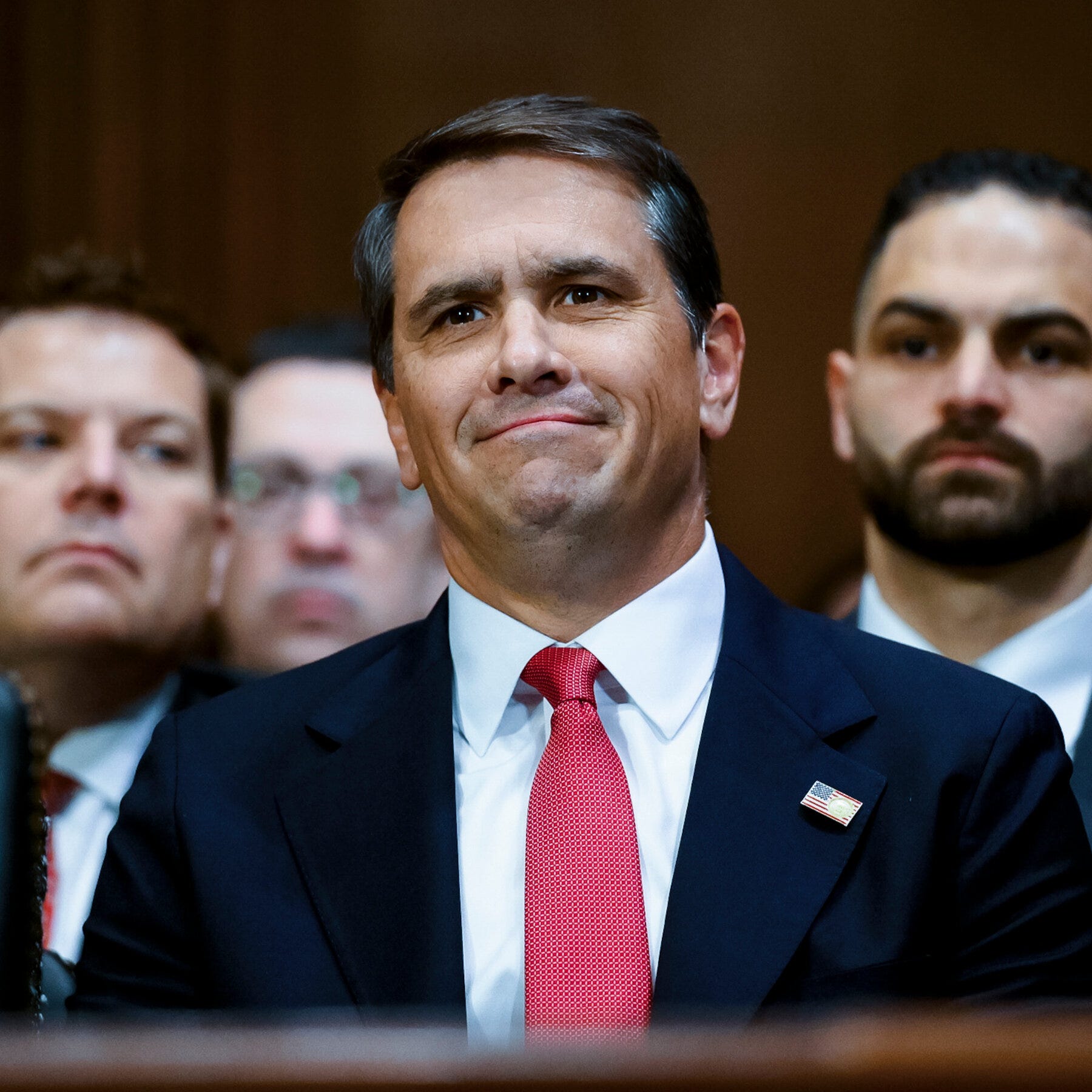
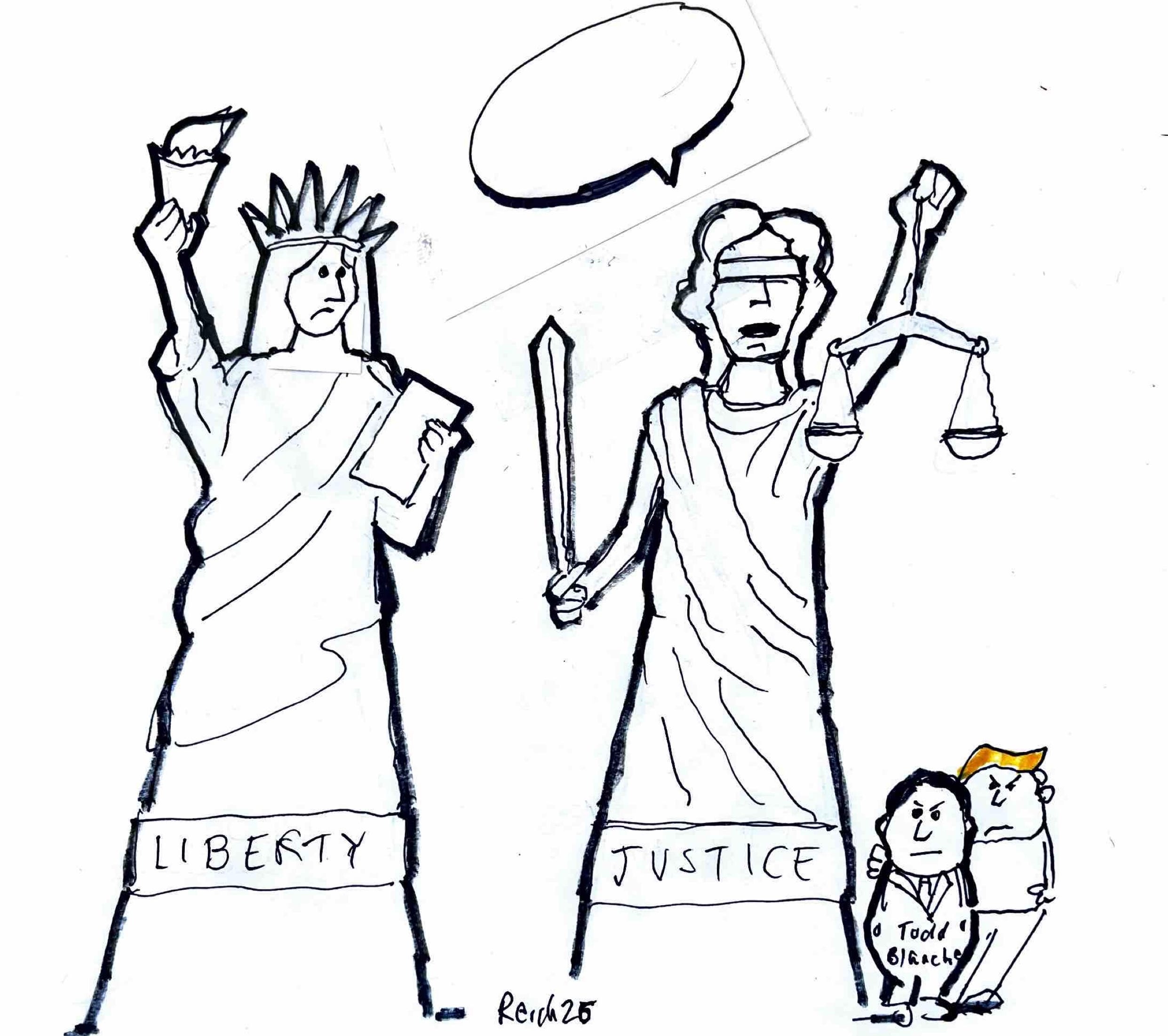
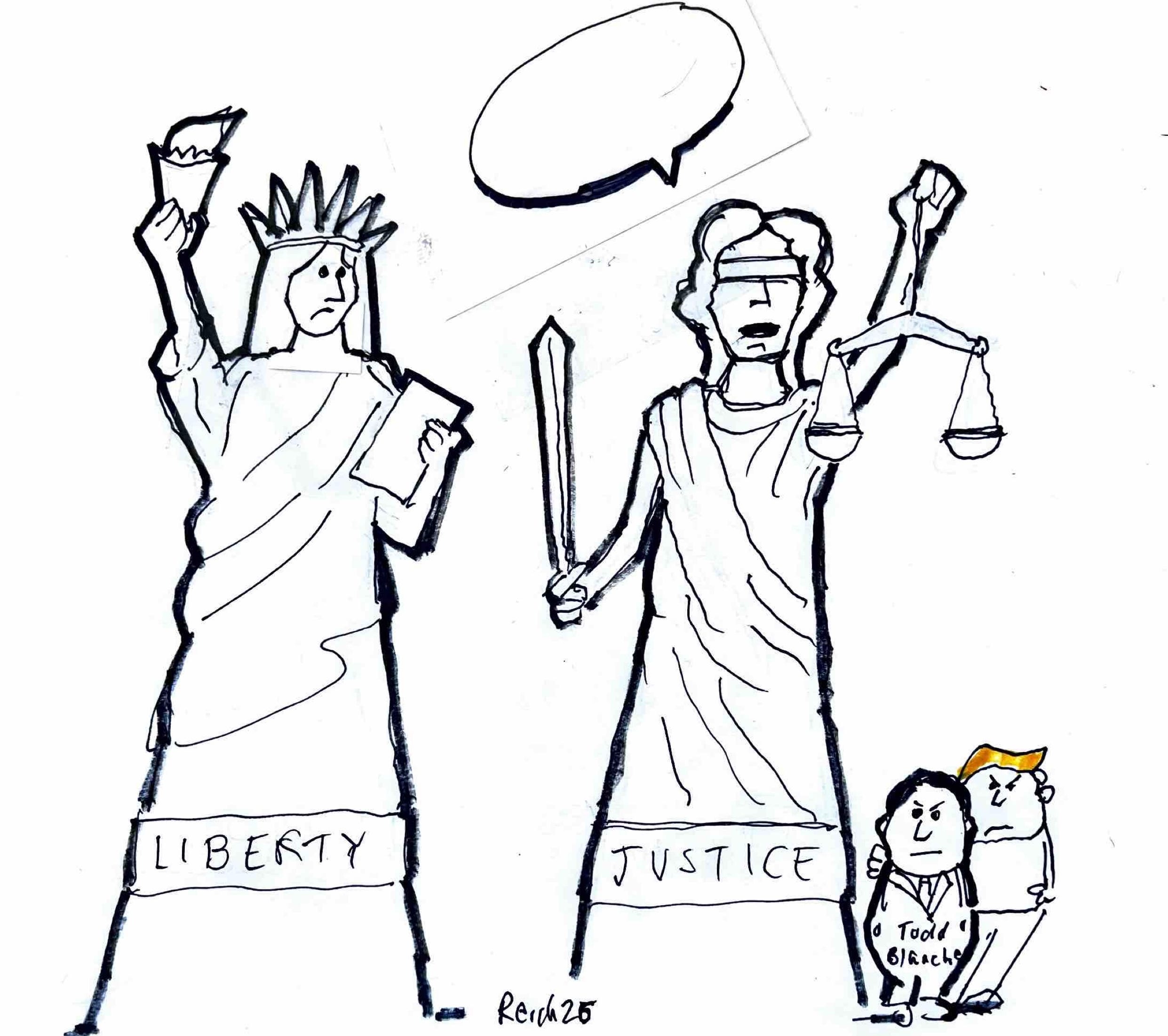
Let me get right to the point. The Senate should not confirm Todd Blanche as attorney general.
Blanche, who used to be Trump’s private lawyer, has treated the Justice Department as Trump’s private law firm. He still believes that Trump — rather than the United States — is his client.
At the very least, the Senate should insist, as a condition of confirming Blanche, that the May 19 deal Blanche devised to immunize Trump and his family from all future prosecutions — which Blanche alone signed — be nullified.
The purpose of that immunity deal — which resulted from Trump’s own bizarre lawsuit against the IRS — should by now be clear. It’s to prevent any future government inquiry into the corrupt dealings of Trump and his family.
The breadth of the so-called “settlement” agreement between Trump and, well, Trump is staggering. Take a look at it, here.
Boiled down to its bare essentials, the deal “forever” protects Trump and his family from “all claims” or “causes of action” or “requests for any relief” including “examinations” that “could have been”asserted by the United States against Trump, his children, “or affiliated individuals” or “parties” which arise out of “any matters” or of “Lawfare and/or Weaponization” or of any matters that “could be pending” before the United States or its agencies and departments.
Put another way, the U.S. government is prohibited from looking into any of the corrupt sh*t Trump or his family have gotten into.
And there’s a lot of corrupt sh*t.
Trump is the most corrupt president in American history. Since being in office for a second time, he’s so far increased his wealth by an estimated $4 billion, and his sons’ and daughters’ wealth by billions more. Some examples:
Trump and his family have created multiple crypto businesses — World Liberty Financial and the $TRUMP meme coin — that have received favorable deregulatory treatment and reportedly generated at least $2.3 billion in income for Trump and his family since he won the presidency.
Six days after a company backed by Eric and Donald Jr. took a 20 percent stake in an American mining group, the group’s parent company received $1.6 billion in federal financing. That’s because the president of Kazakhstan granted the company the right to mine the world’s largest known undeveloped deposit of tungsten, an element used in semiconductors, lightbulbs, and warheads.
In late 2025, Don Jr.’s firm 1789 Capital acquired an equity stake in critical minerals company Vulcan Elements. Shortly after, the White House and the Pentagon awarded Vulcan a $620 million federal loan without competitive procurement or independent technical review.
Eric and Don Jr. have conducted numerous undisclosed meetings with foreign government officials (including representatives from Hungary, the UK, Vietnam, and Qatar) while simultaneously negotiating global real estate deals for the Trump Organization.
Don Jr. serves as a strategic advisor or investor in prediction market firms Kalshi and Polymarket, which have received favorable, deregulatory treatment from the Commodity Futures Trading Commission (CFTC).
Don Jr. is on the board of prescription drug platform BlinkRX, which will benefit from the administration’s promotion of direct-to-patient medicine sales.
Presumably, someone has made a fortune trading stocks and bonds on the basis of insider knowledge of decisions that Trump would announce — about tariffs, his war in Iran, and other news that moved stock and bond markets. The trades occurred just before the announcements.
In May, Trump disclosed that his trust was actively trading individual stocks, an unprecedented practice for a sitting U.S. president in the modern era.
Trump has pardoned some of the most brazen financial criminals in American history, and one can only wonder what he received in return. They include Philip Esformes, convicted in what Trump’s own Department of Justice described as the “largest health care fraud scheme ever charged”; Joseph Schwartz, convicted for a $38 million fraud scheme; and reality stars Todd and Julie Chrisley, convicted for multimillion-dollar bank fraud. He’s granted clemency to Lawrence Duran after a $205 million fraud conviction. He commuted Jason Galanis’s sentence and pardoned Devon Archer, both tied to tens of millions in fraud.
If the “settlement” remains in force, we will never know the details of any of these transactions, because the “settlement” — devised and signed by Todd Blanche — will result in the largest cover-up of presidential wrongdoing and illegality in American history.
Without it, Trump and his family could be required to disgorge their ill-gotten gains.
For his role in this scam, Blanche should not be confirmed as attorney general. At the very least, his confirmation should be conditioned on this so-called “settlement” being deemed null and void.
If you’re with me on this, please contact your senator’s office and tell them to vote NO on confirming Blanche. (At the very least, NO to the immunity deal Blanche gave Trump and his family.)
The Senate switchboard is (202) 224-3121. Elected officials prioritize their own voters, so please share your name and your city/town so the staff knows you live in their state.
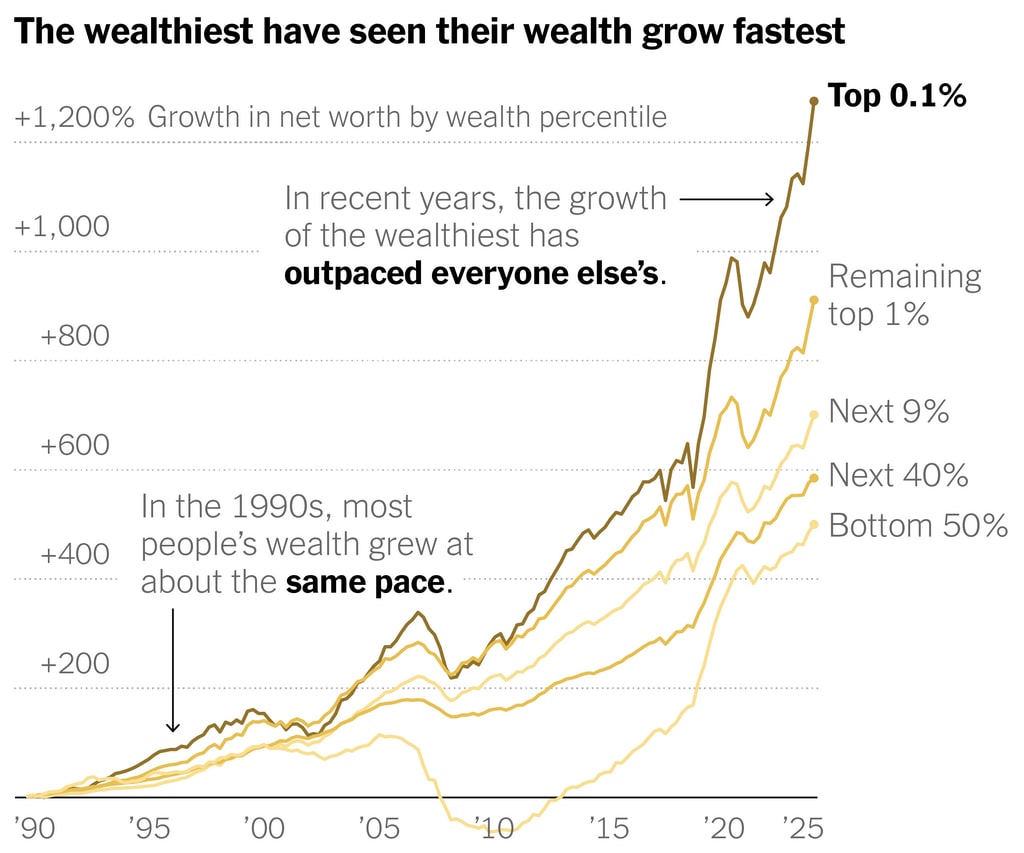
In the 1990s, most Americans’ wealth grew at about the same pace. But after 2010, the top 0.1 percent pulled ahead of the rest of the 1 percent, and everyone else.
2010. Remember that year, because I want to come back to it.
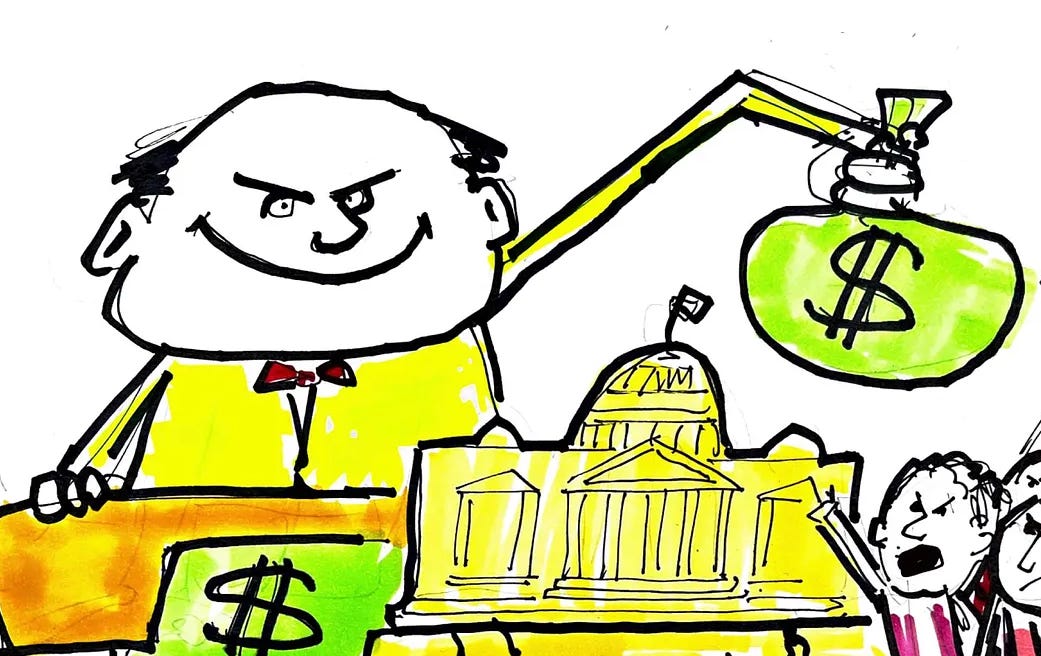
What do they do with all this money? Well, when they’re not just shooting rockets into space or building hideous trucks, they’re spending it on politics.
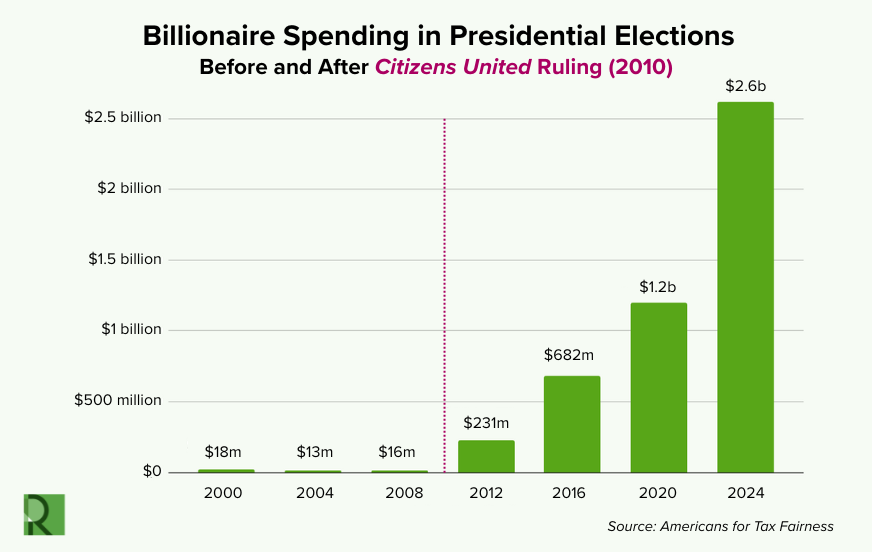
After the Supreme Court’s 2010 Citizens United ruling, it took off.
In the last presidential election, just 300 billionaire families spent roughly $3 billion. Those families gave an average of $10 million each — roughly 100,000 times what an average donor gave.
And the super-rich are getting a big return on their “investment.” They’re getting more tax cuts, more deregulation, and a government that lets them get away with busting unions, exploiting workers, and monopolizing their markets while poisoning the environment.
All so they can get even richer and accumulate even more power. So they can get even richer and accumulate even more power. And so on.
But this vicious cycle is unsustainable, both politically and economically.
When so much of our economy is in relatively few hands, we will inevitably get to the point where consumers cannot buy all the goods and services the economy is capable of producing. This puts the entire economy at risk.
It’s also politically unstable because it’s inherently divisive — pitting losers against winners and laying the groundwork for an authoritarian state — where no one’s future is secure, including the super-rich.
So we ALL have a stake in stopping this vicious cycle.
To do this, we need to raise taxes on the rich — not to punish them but to ensure that the system works for everyone. This means raising their income taxes and taxing their wealth.
And we need public financing for federal elections — matching public dollars to small-dollar donations in order to balance the power of super-rich and corporate donors. Many states and cities are already doing this — and it works.
Finally, we’ve got to undo Citizens United. One way to do that is for states to follow what Montana hopes to do and what Hawaii has already done: take away the power of corporations to make political contributions in the first place.
Look, it’s time to get big money out of politics — for all our sakes.
Yesterday I asked a group of eight specialists who have closely watched Trump over the years — two clinical psychologists, a psychiatrist, two medical doctors, and three political advisers — about their reactions to Trump’s interview that aired on Sunday’s “Meet the Press.”
Here’s the part of the interview I asked them to focus on. For those of you who missed it, please click on the arrow to see it.
Today’s Office Hours discussion will focus on what, if anything, this interview reveals about Trump at this point in his second term.
The views expressed by my panel of medical and political experts were thoughtful and nuanced. For the sake of discussion, I’ve grouped them into the following categories:
Bari Weiss was hired by CBS to be editor-in-chief of CBS News in October 2025, when Paramount Skydance acquired CBS.
Weiss had no television-news experience. She was a New York Times Opinion staffer and founder of The Free Press.
In May, Weiss made Nick Bilton the new executive producer of “60 Minutes.” He has no television experience. He has no management experience, either.
I remember when CBS News was the most admired news organization in America — home to Walter Cronkite and Edward R. Murrow. They spoke truth to power. Cronkite had the guts to challenge Lyndon Johnson’s war in Vietnam. Murrow had the guts to expose Joe McCarthy and his communist witch hunt.
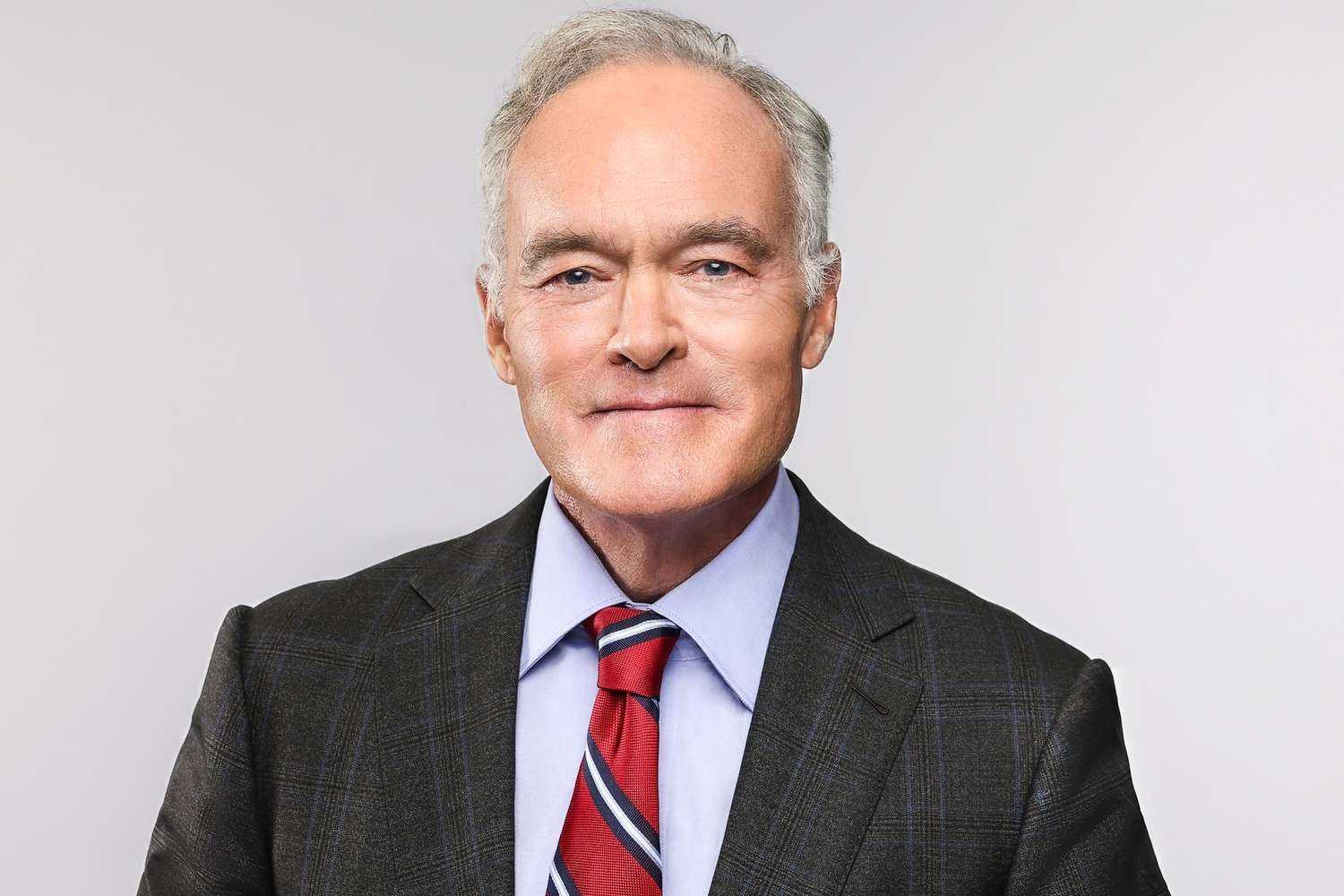
Now, CBS News is a disgraced shell of a news organization that last week fired famed “60 Minutes” senior correspondent Scott Pelley after gutting most of the rest of its team.
Pelley says Weiss repeatedly interfered in stories “60 Minutes” sought to run. When, for example, the show did a piece on the murder of Renee Good in Minneapolis, Weiss wanted to make “the protesters look more violent” and to describe Good “as driving toward the officer,” when videos show her driving away from him.
Pelley concluded that Weiss was trying to put “a thumb on the scale for the President’s version of events that I felt was a level of political influence that I had never seen in 37 years at CBS News. … a thumb on the scale on behalf of the administration. Constantly looking out for the views of the President.”
Why was Weiss doing this? Presumably because her boss, David Ellison, wants to suck up to Trump, and hired Weiss to help him — and she hired Bilton to aid her in doing so. And she fired other staff because they wouldn’t.
Trump, meanwhile, has chosen Bill Pulte to be acting director of national intelligence. Pulte has no background in national security. He was head of Trump’s federal housing agency. His entire professional experience before that was at companies tied to his family’s wealth.
Trump chose Pulte not because he knows anything about intelligence but because of his eagerness to advance Trump’s political revenge campaign. He used his housing office to attack Trump’s enemies, leveling accusations of mortgage fraud against people Trump considers political enemies — Letitia James, Senator Adam Schiff, and Lisa Cook, a Fed governor Trump has sought to fire.
Trump has also chosen Todd Blanche to be attorney general. Blanche’s qualifications? As acting attorney general, Blanche oversaw the Justice Department’s indictment of former FBI director James B. Comey over a photo he posted on Instagram in May 2025 of seashells on a beach that spelled out “86 47,” which the department characterized as a threat to the president.
It was the second attempt by Trump’s Justice Department to prosecute Comey, against whom Trump has vowed retribution for Comey’s alleged disloyalty to Trump during Trump’s first administration — when Comey said Trump pressured him to drop the investigation into former National Security Adviser Michael Flynn, publicly refuted Trump’s allegations that the Obama administration had wiretapped Trump, and publicly challenged Trump’s narrative regarding the Russia probe.
Before becoming Pam Bondi’s attack dog at the Justice Department, Blanche was one of Trump’s personal lawyers.
Speaking of no relevant experience, I can’t resist pointing out that Lindsey Halligan, whom Trump appointed U.S. Attorney for the Eastern District of Virginia, had been a White House aide with no experience as a federal prosecutor before she was appointed. Halligan was tasked by Trump with prosecuting James Comey and Letitia James, after her predecessors as U.S. attorney — Erik Siebert and Todd Gilbert — refused to do it. The ploy didn’t work. The federal courts threw out both indictments.
I could go on — Kash Patel, Pete Hegseth, Robert F. Kennedy Jr. — but you get the point. Under Trump, experience, knowledge, and talent are irrelevant. The only criterion for getting a top job is blind loyalty to Trump.
But now this poison has also leached into the private sector, in vital places such as CBS and CBS News — places where people used to be hired for their experience, knowledge, and talent. Now they’re hired for their willingness to sacrifice their integrity to suck up to Trump.
This is how dictators poison the organizations a free society depends on. Trump is destroying CBS News by putting suck-ups David Ellison and Bari Weiss in charge, just as he’s destroying the Department of Justice and the Office of National Intelligence by putting suck-ups Todd Blanche and Bill Pulte in charge.
Sadly, a dictator will always be able to find people whose blind ambition exceeds their integrity.
But you and I don’t have to accept any of this.
We can boycott CBS News and its sponsors.
And we can do everything within our power to get out the vote in the midterm elections whose mail-in ballots start in four months and put responsible people in charge of Congress who have the courage to stand up to the dictator.
What all this acclaim left out was that wages are falling relative to prices.
Average hourly earnings for private-sector production and non-supervisory workers — that is, for most employees — rose by only 8 cents (or 0.2 percent) in May. That’s the weakest pace of wage growth since 2021.
Meanwhile, prices are rising quickly — by around 3.8 percent annually. Hence, real wages — that is, their actual purchasing power — are dropping. The paychecks of most American workers aren’t covering rising costs. They’re getting poorer.
It’s no cause for celebration that the American economy is adding a lot of jobs that are paying less. Hell, if paychecks keep shrinking relative to prices, there’s no telling how many jobs can be added. June’s job report could top May’s 172,000 new jobs.
There’s no limit to the number of terrible jobs an economy can create. If inflation-adjusted pay keeps dropping, we could see many hundreds of thousands of crappy new jobs per month. But most Americans would be getting poorer and poorer.
Bottom line: Don’t fall for any breezy, celebratory focus on the number of new jobs. Always ask: What about real (inflation-adjusted) wages?
When real, inflation-adjusted wages are dropping, we’ve got a real problem — regardless of how many jobs are being created.
Scott Pelley, the famed CBS “60 Minutes” correspondent who was fired last week by Bari Weiss, the new head of CBS News, gave an interview to The New York Times about what occurred. I reproduce it below because it’s an important indictment of Bari Weiss; of Tom Cibrowski, the president of CBS News; and of David Ellison, who runs Paramount Skydance, the parent corporation of CBS. It shows very clearly that, in effect, Trump fired Pelley because Trump doesn’t want Americans to get the truth about what he’s doing — just as Trump fired Stephen Colbert from the same network because Colbert was telling Americans the truth about Trump, through satire. The question I want to leave you with (and will take up in a later post) is: What are we going to do about this?
Here are Pelley’s words:
“No one saw the Black Thursday massacre coming. This is our entire senior staff. Tanya Simon, our boss, she’s the first woman ever to be executive producer of “60 Minutes.” And she concluded this season with a growth in our audience of nine percent, which is unheard-of in broadcast television, and a growth of our online presence of 190 percent. Last season, we had 2.5 billion views. That’s a third of humanity! So we’re riding high.
The night before, Tanya and I were at the Emmy Awards, and we won two Emmys. Within hours, all of those people have been wiped out, and one-third of our correspondents have been fired. At the same moment, we are informed of our new executive producer. His name is Nick Bilton. I’m sure he must be a wonderful man, but no one had ever heard of him. He has zero experience in television news and no experience in management. So imagine how we feel when someone like that comes into a shop like “60 Minutes.”
Explain to me exactly how you felt. Shock, dismay, impossible to believe, searching desperately for an explanation, knowing that an explanation would be forthcoming and then not seeing that. No executive at CBS News, our editor in chief, Bari Weiss, coming over to explain, to talk with us, to sit with us. That’s a family at “60 Minutes.” My colleagues and I have worked together 10, 20, 30 years. We travel together. We dine together. We go into literal combat together. My former boss and former producer Bill Owens saved my life in a firefight in Iraq. So, these bonds are pretty tight, and when somebody wipes out, murders, a large number of your family members, people are desperate for some explanation, and as you and I sit here today, there still has been none.
CBS leadership says that they tried to get in touch with you to talk about all of those changes before Bilton’s first day and you didn’t speak to them. Why not? I’m almost 69 years old, and if I’ve learned one thing in life, it is not to reflexively react when you feel that way. I thought, I’m going to give it a day. I’m too emotionally wrought up. I am going to say the wrong thing. I am not going to hear what they have to say. This isn’t the moment. So we got through the weekend, and I learned that Nick Bilton was going to speak to the “60 Minutes” staff that next Monday morning. My wife and I had a hiking trip in the Canadian Rockies planned, and I wasn’t going to be able to be at the meeting and she and I talked about it, realized that this was an existential moment for “60 Minutes” and canceled the vacation so I could be there. That was the first time that I had an opportunity to meet Nick Bilton.
At that meeting, you spoke up very forcefully. You asked him why he’d taken the job “knowing that you will never be welcome here.” Why did you decide to have that first interaction with your new boss in public and not behind closed doors? It was behind closed doors. I was with my family in a closed room. None of this was meant to be public. Imagine I’m walking into this room with these people who have devoted their lives to “60 Minutes.” They have not received any kind of explanation. They are waiting for Bari Weiss to walk in the room in the hope that she’s going to explain why this tragedy has occurred and why it was so necessary. I’m waiting to see who comes in and it’s Nick Bilton and one of Bari’s deputies. No Bari. People are a little shocked by this. As we’re standing in there, Nick makes his way to the front of the room and does something absolutely jaw-dropping to me. He pulls out his phone and begins reading a statement off his phone in a room full of 50 heartbroken people. The callousness, the tone deafness of that, you could hear the groan in the room. They put out a big spread of bagels like we were all going to feel better. And also, if I can give you a little bit of context.
Please. What happened a couple of days before the meeting was so critical. Nick Bilton wrote an email to the staff, introducing himself. And it was so insulting. He told us that it wasn’t 1968 anymore, and he helpfully noted that gasoline doesn’t cost 32 cents anymore, suggested that we had all been frozen in amber in 1968 when the program first went on the air, and that nothing had improved. He said in his email that it was “strange” that “60 Minutes” is only on the air at 7 o’clock Eastern time on Sunday once a week, when we’ve been on the air 24-7 globally, online, for well over a decade. It betrayed the fact that Nick Bilton didn’t know anything about us, didn’t know anything about our culture, and yet was being imposed on us as our new leader.
Why did you feel that you were the person that needed to get the answers at that meeting? First of all, our entire senior staff had been wiped out. They’re not there. I looked around the room. I’m the only correspondent there, which surprised me very much. I learned that my colleagues were out shooting stories, as they should be in the month of June, but I’m the only correspondent. And I looked at my friends and colleagues in the room and realized I was the senior person. So when I saw Nick Bilton’s email and then saw him reading to my brokenhearted people off his phone, I felt that somebody had to stand up not just for the broadcast but for the people. There are people in that room who go to war zones when they are pregnant. [Tears up] Newsrooms are sort of like the military or the police or the beautiful people at the FDNY down the street. It is a life-threatening job in many instances. And to have people running CBS News, who don’t know that, have never felt that, and don’t understand it, is a tragedy.
You know, Bari Weiss came into a job with a mandate to evolve and modernize CBS News, to reinvent legacy media. In that meeting, you said Weiss was “murdering ‘60 Minutes,’” language that you’ve used here. Can you explain what you mean? It was the wholesale nature of it. Senior staff wiped out after a triumphal year. One of the things Nick Bilton said in that ill-fated email to the staff was that he was excited — I’m paraphrasing here — to tell the staff about the new crop of correspondents. And when I saw that, I thought, “They’re going to fire all of us, eventually.” So that’s why I use these admittedly, for a journalist, hyperbolic terms. They capture the scale of what happened.
You then have a meeting with CBS leadership after this very contentious interaction [with Bilton]. Did you go in expecting to be fired? Oh gosh, furthest thing from my mind. It hadn’t occurred to me. The president of CBS News, Tom Cibrowski, sent me a note and said, can you come by and talk to us? And I said, absolutely. I scheduled about an hour on my calendar for the meeting. I didn’t know who was going to be there.
It really didn’t occur to you that you could be fired after so many of your colleagues had been let go, and after you’d had this very contentious interaction with your new boss? Some reporter I turned out to be. I just didn’t connect the dots. I mean, was this meeting [with Bilton] contentious? Yes, but “60 Minutes” is known for two things: a ticking stopwatch and hard questions.
There was a screening once with Mike Wallace, and Mike and the executive producer and founder of “60 Minutes,” Don Hewitt, got into a big argument about a script. Wallace jumps up in the middle of the screening, throws his script up in the air and yells at Don, “Well then you write the effing thing!” One of those pieces of paper comes down and slices an associate producer across the face. He’s bleeding now. He’s got a paper cut on his face. That was about a story. The meeting that I was in was about whether “60 Minutes” was going to even survive.
So, you walk in and what was the energy of the room? Hostile, dismissive. Before I can take my seat, Tom Cibrowski said, this is a firing offense. So I sit down, like, OK, let’s talk about it. Tom accuses me of physically abusing Nick Bilton. This is a lie. I didn’t come within 10 feet of Nick Bilton. In my life, I have never put my hands on anyone in anger. And when he was caught in that lie, he said, well, OK, I take that back. And I said, great.
So I’m thinking that the meeting’s going to carry on. We’re going to have a long conversation. Very quickly after the meeting began, Tom Cibrowski said, this conversation is over. I was stunned. I didn’t have a 60-minute stopwatch in that room. I don’t know how long it lasted really, but I think it was about 10 minutes. Cibrowski tells me, you’ll have our answer in a few minutes. I went over to my office, and much to my surprise, all of my guys on my team were still there. They wanted to know what happened in the meeting. What was that all about? Did they explain why our people were fired? And I sat down in my office, it has a big plate glass window that looks out on the newsroom, and there were a whole bunch of people standing out there. I didn’t think anything of it. I’m waiting to find out what my fate is. I explained to my team, “I think I just got fired, but they haven’t told me that.” And then I look up and all those people are still out there, and then it hits me. This is a vigil. Four hours go by, and I go outside and said, “I’m leaving.” I packed up and left just so those people would go home. And not long after that, the email came through and said that I’d been fired.
I want to take a step back because this didn’t happen in a vacuum. The saga at CBS News began when David Ellison, the son of Oracle billionaire Larry Ellison, took over CBS as part of his purchase of Paramount. There was a lot of turmoil around that sale. The longtime previous owner of Paramount and CBS, Shari Redstone, told my New York Times colleague that she sold the company to Ellison in part because, after Hamas’s attack on Israel on October 7, she wanted to devote herself to causes around Israel. I’m sure there were other reasons as well. Did you ever speak to Ms. Redstone about the sale, and how did you feel about it? I didn’t speak to Shari Redstone about the sale. I felt the sale was very necessary. The company was in financial trouble. It wasn’t clear what our path forward was going to be. Mr. Ellison came in with a lot of money, a young man of vision, and I thought this was going to be very good for all of us.
The very last thing that the previous ownership did was pay a multi-million-dollar bribe to the president to settle this frivolous, ridiculous lawsuit. And very shortly after that, somehow the Trump administration approved the sale. That lawsuit against “60 Minutes” had caused a great deal of concern. Paying the bribe broke our hearts. No lawyer thought that was necessary, but they did it to get the sale through. At that point, my colleagues and I thought, great, that’s behind us. We have bright new leadership with financial resources. We’re in better shape than we were before. That was the theory.
Ellison then hires Bari Weiss to run CBS News. Weiss is a former opinion writer at The New York Times who left to start her own publication after claiming bias in the Times Opinion section. I never worked with her, for the record. The Free Press, which she launched, is generally pro-Israel and bills itself as pushing against what it sees as the mainstream media. What did you make of her appointment? I was not familiar with her name, so I did some research and discovered those things that you just outlined. What concerned me was that she had zero television experience and had never managed a large global operation like CBS News. Those were red flags to me, but I thought, David Ellison thinks she’s the right person for the job. We are absolutely going to welcome her, listen to her, and give her the benefit of the doubt.
When Bari comes in, she has a meeting with senior “60 Minutes” staffers, and in that meeting she asked, “Why does the country think you’re biased?” I wasn’t there, but that is what I’ve been told by my colleagues, and they were shocked.
What was the feeling about that opening salvo? “Uh-oh.” She didn’t offer any kind of a metric. Do you have a poll? Is there market research? What are you talking about? We felt that she was making statements that she couldn’t back up and was coming into the news division with hardened preconceived notions that didn’t seem to be thought through.
You’ve now accused Weiss of injecting “falsehoods and bias” into at least one of your politically sensitive stories. What did she specifically ask for? What story? That’s February, and my team and I are doing a story about the protests in Minneapolis against the ICE crackdown there. We’ve interviewed Senator Rand Paul, Republican, because he’s going to hold hearings into this, and the fact that a Republican was going to do that was quite newsworthy. So, we interviewed Senator Paul and then built out a story about what had happened — the killing of Renee Good, the killing of Alex Pretti, the protests. I felt it was very important to identify that the protesters themselves were being very aggressive and that they were half of these confrontations, and so I instructed my producers to find images in which we see the protesters acting aggressively. We found a picture of a protester chest-bumping an officer. We found a picture of an officer being hit in the head with a snowball. We culled together a lot of video of protesters screaming in the faces of officers because we were going to talk about the killing of Pretti and the killing of Good, and it seemed to me important to tell the audience about the entire context. I thought we’d done a really good job with this. We also included a picture of Alex Pretti before he was killed kicking out a taillight on a police car and made a point of saying, this is Alex Pretti and this is what he did.
So, the story goes through screenings. It’s very well received. There are notes as always and we do rewrites as always. But this is on a very tight deadline. It’s Sunday; we’re going on the air that night. And in the case of stories that are, as we say, crashing, our deadline on Sunday is noon. So, we work on all of these things. We get the piece approved by everyone. And about four hours after our deadline, Bari Weiss sends an email to my boss, Tanya Simon. Two of the things in the email include, can we make the protesters look more violent? Now, I’m paraphrasing. I don’t have the quote, but that’s what was communicated to me. And the other thing, Renee Good’s car. You need to describe her as driving toward the officer.
This is not what you see on the video. On the video, you see the officer standing slightly off the front of the car. And you clearly see Ms. Good’s wheels turned completely as far as they will go, away from the officer. But he shoots her in the head, kills her, and says something about her that I can’t repeat in polite company.
We have gone out of our way in our plan from the very beginning to show the protesters for the responsibility that they had. We had already scrubbed the video archives, looking for those scenes. Somehow that wasn’t enough for Ms. Weiss. The video showed that the officer wasn’t standing in front of the car and she wasn’t driving toward him, but that’s what the president said about that, and that’s the way she wanted it described.
Did you do as she asked? I asked my producers, “Did we leave anything out that’s important? Did we make a mistake here? I don’t think so, but go back and look.” And then I sat down with a video editor, and I went over the video of the Renee Good killing over and over again, and realized that the event was not as the president said and not the way Bari Weiss remembered it. And it’s late. Our deadline was noon. It’s now almost 5 o’clock. That’s dangerous as hell. So I decided that I wouldn’t do those things. I wasn’t going to get in a debate about it. I wasn’t going to call Bari Weiss about it. I was just going to refuse to make those changes.
Did you change any language in the broadcast? Anything? Not that I recall based on her notes, but as you probably are aware, when you’re doing a story, especially on deadline, a lot of things happen, there’s a lot of input, and you’re just scrambling to save everybody’s skin because you’re going to have a crash, which is what happened.
Next day I didn’t hear anything. Nobody called, nobody said anything. It occurred to me that maybe Bari Weiss didn’t see the broadcast and didn’t realize that those changes hadn’t been made. But that’s how that happened. There was a thumb on the scale for the president’s version of events that I felt was a level of political influence that I had never seen in 37 years at CBS News.
Could she not have been trying to be fair to the administration at a moment of very high tension? She could have been trying to be fair to the administration, except I felt that the story was abundantly fair to administration and to the ICE officers and to border patrol officers who were caught in that moment.
Is it possible to see this as the system working? She had notes, you felt they didn’t make sense to take, the piece ran, and there was no retaliation. Well, it was the interference that’s a problem, especially in a story that’s been approved by the top editors. And the bigger problem, Lulu, frankly, is not any kind of political influence. The problem was the incompetence. You don’t break a deadline. That episode came within 19 minutes of not making it to air. The entire hour of “60 Minutes”! It was the night of the Grammys. “60 Minutes” was the lead-in to the Grammys, and we almost didn’t have a broadcast. I pledged to myself that no matter what Bari Weiss wanted to do in a story, I would never break the deadline again because we put the entire network in jeopardy.
Why did you think she was asking for these things? I need to be a little bit careful here because I don’t want to be hyperbolic. My impression at the time was that she was putting a thumb on the scale on behalf of the administration. Constantly looking out for the views of the president. We’re reporting those views. There’s nothing wrong with reporting those views, but it was never enough.
Cecilia Vega, who was recently fired, also alleged interference after she was let go. Sharyn Alfonsi as well, and you are now doing the same. CBS has denied any bias or interference, saying in a recent statement that changes and disputes were “the normal back and forth between editor and correspondent that happens in every newsroom.” A more generous interpretation of Weiss’s tenure might be that her missteps have been due to a lack of experience. Could inexperience be the real problem? I think inexperience is the larger part of the problem. The most difficult thing for the staff is trying to make up for all of these missteps in terms of our production and the technical aspects of television. It’s been enormously stressful.
.Another high-profile “60 Minutes” host, Anderson Cooper, declined to renew his contract this year. And at the end of his final show, he went on air and said, “I hope ‘60 Minutes’ remains ‘60 Minutes.’” That was seen as a swipe at Bari Weiss. Did you talk to Anderson about why he did not renew his contact and his reasons for leaving? I did not.
How did you receive that news? Correspondents don’t resign from “60 Minutes.” It’s the greatest job in the world. There is nothing else to aspire to. So, if a person of Anderson Cooper’s stature decides that he has to leave the broadcast, that’s an indication that he has found his role there untenable.
It’s been reported that Bari Weiss was upset that Anderson Cooper’s comments had aired in that way. That’s my understanding.
Do you think that was part of the reason executive producer Tanya Simon was let go? Yes. My understanding from people directly involved in that interaction is that Bari Weiss was quite livid that Anderson Cooper was allowed to say those things and that she, Bari, was not consulted beforehand, which in our normal course of business would not have been done anyway. I believe that was part of the reason Tanya was let go. But she wasn’t let go for cause. She was let go to create a space for the new person, Nick Bilton, to come in.
Tanya was completely blindsided by this. She was told that she was coming into a meeting to discuss the past season and the next season. She walks in; she sits down. And Tom starts the meeting with, the nature of this meeting has changed. We’re letting you go. And told her she was fired and had to get out of her office by 5 o’clock.
Can I give you a little bit of background? The Simon family is legendary at CBS News. Her father was a famous Vietnam correspondent and then Bob Simon covered every single war, everywhere in the world throughout his entire career. I was with him in Kuwait during the Gulf War in 1990. We would stand on the roof of the hotel and watch the missiles come in. He taught me how to be a war correspondent. And then Tanya Simon comes in. She’s at the broadcast 30 years. There is no respect for that. Get out of the office by five o’clock? What company in the world treats their precious people that way? [Tears up] Tanya Simon spent her whole childhood waiting for the call that her father was dead, never knowing if she would ever see him again. Her whole childhood. Get out by 5 o’clock. Make of that what you will.
I can hear how much this has hurt you. Yes, it’s like your spouse being murdered. I don’t care about me. It’s not about me. I am not emotional about this because I have lost this job. I’ve done it for a long time. I’ve had the greatest experiences. But the people I leave behind, treated in this way? That breaks my heart, and it’s going to take me a long time to get over it.
One of the arguments that Bari Weiss has made about “60 Minutes” and CBS News is that they need to be brought into the modern era. Nick Bilton also said in that staff meeting with you that “broadcast is an ice cube that is melting.” Do you think they have a point, even if “60 Minutes” is reaching a huge audience now? Does its metabolism, the kinds of correspondents that it has have to change to reach a younger audience that interacts with media in a completely different way? Of course we have to reach out to a younger and younger audience, but their argument about joining the internet age is just disingenuous. It’s almost as if Bari Weiss and Nick Bilton were sealed in a time capsule in 1990, and it just cracked open. They’ve just discovered the internet, and they’re running around telling everybody how important it is. At CBS News, yeah, join the fight. We started our first “60 Minutes” online show, “60 Minutes Overtime,” in 2010. I shoot TikTok verticals, or I used to shoot TikTok verticals on every assignment. We’re there. We’re everywhere.
Nick Bilton sent a very conciliatory note to the staff this past week. At last.
He promised editorial independence. He praised some of your longtime colleagues, Lesley Stahl, Bill Whitaker, Jon Wertheim. And while we’ve been talking, those three released a statement that they are staying at “60 Minutes.” How does that make you feel? Same reason I was staying. I haven’t talked to them. I assume it’s the same reason. And we have had conversations before this about staying to maintain the principles of the broadcast. If we leave, we can’t help. There have been other times — when Anderson left, when others were fired — that we could have stormed into a meeting and quit, but those very distinguished correspondents and myself did have conversations about this and decided that we were better working on the inside, and that we could influence things for the better. And we did. And it was my intention to stay and do exactly that.
Do you think they can trust those assurances? No. I would venture to say that trust is broken.
Do you think Bari Weiss needs to be removed? Oh, gosh, yes. Look, she’s a lovely person. And her Free Press organization that she founded has been very successful. But television’s not her thing. This is like somebody walking up to me and saying, “There’s a 747, there are 400 people on it, we need you to fly it to Paris.” I’m going to decline because I don’t have a clue. And it would have been so much better if Bari Weiss had been offered this job and said, “Oh, that’s not for me, I don’t know how to do that.”
President Trump reacted to your being fired. Did he?
He went on a podcast and called you a stiff. I’m surprised that the president of the United States would bother to notice, but please tell me. I’m not aware of this.
He said you were part of this gang of “stupid, crooked people that don’t care about your country.” Stupid? I can take that. Stiff? Yeah, probably. Don’t care about the country? I’ve never worn the uniform. But I’ve been in combat for this country, in Afghanistan and Iraq, Kuwait. I’ve been shot at, spent nights in foxholes filling up with water in the desert. I’m not aware that the president of the United States has ever done any of those things for his country. Please correct me if I’m wrong. You become a journalist because you love the First Amendment. You become a journalist because you love the country. And while all the other descriptions that the president used about me might be applicable, not that one. [Tears up] There is no democracy without journalism. It can’t be done. That is why I am a journalist.
***
“There was a thumb on the scale for the President’s version of events that I felt was a level of political influence that I had never seen in 37 years at CBS News. … she was putting a thumb on the scale on behalf of the administration. Constantly looking out for the views of the President. We’re reporting those views. There’s nothing wrong with reporting those views, but it was never enough.” — Scott Pelley about Bari Weiss, whom Trump buddy David Ellison made head of CBS News.
I detest him and everything he does or says. Ditto his despicable aides and Cabinet members, his unprincipled sycophants and suck-ups.
But it’s possible that someday we’ll look back on this horrendous era and say we needed Trump. We needed to see how horrible it could get before America was able to revive its ideals.
Please hear me out.
Even before Trump, we were barreling down the wrong road. Inequalities of income, wealth, and opportunity were worsening. Legalized bribery was soaring in the form of mounting campaign contributions from big corporations and the wealthy. Workers were getting shafted. On Wall Street and in C-suites, fealty to the rule of law was giving way to “greed is good” selfishness. Giant corporations were monopolizing ever more of the economy. America was losing its moral authority in the world (think Abu Ghraib and the torture memo).
We couldn’t have remained on that road. Even if we didn’t know it then, most of us understand that now. Trump has opened our eyes to the consequences of extreme greed, corruption, cruelty, and utter disregard for the Constitution and the rule of law. His brazenness and shamelessness have awakened us to much that we took for granted.
He and his regime are still dangerous as hell, of course. But the American public is catching on. His polls are in the cellar; they continue to fall.
It’s as if the nation has been through basic training in democracy, a stress test in civics, a crash course in the importance of having a decent and good government.
Before Trump, how many Americans understood the importance of “checks and balances” among the three branches of government, as envisioned by the Founders?
Now nearly everyone knows, because we’ve seen what happens when the head of the executive branch usurps the power of Congress and defies the federal courts.
How many of us really knew what “due process” meant when it came to giving people accused by the government an opportunity to defend themselves?
By now most of us have seen videos of people dragged out of their homes in the dead of night by masked agents of the U.S. government and thrown into detention camps without so much as a hearing. And we’ve seen government agents murder American citizens in cold blood on the streets of our cities.
Did we understand the meaning of corruption, bribes, self-dealing, and pay-to-play before Trump extorted corporations and billionaires to contribute millions to his campaign, his PAC, his inauguration, his ballroom, and his 250th birthday party? Now, we surely do.
Did we really know the importance of professional civil servants before Trump fired tens of thousands of them and substituted brainless loyalists? Before he got rid of the head of the Bureau of Labor Statistics because it published truthful jobs data he didn’t like?
Did we understand the importance of expertise before Trump turned his back on career diplomats at the State Department, doctors and epidemiologists at the Centers for Disease Control, and experienced lawyers at the Justice Department and replaced them with loyalist hacks?
Or the meaning of “equal justice under the law” before Trump turned the Justice Department into his own private law firm to prosecute political enemies and pardon supporters?
Did we comprehend the true meaning of freedom of speech and expression before Trump attacked our universities for allowing demonstrations he disliked? Before he got CBS to fire Stephen Colbert for satirizing him and muzzle “60 Minutes” for criticizing him?
Did we know the dangers of oligarchy before Trump authorized Elon Musk to destroy entire federal agencies? Before Trump suck-up Jeff Bezos prohibited the editorial board of TheWashington Post from endorsing Kamala Harris? Before Trump turned over to Larry and David Ellison much of how Americans learn what’s going on — CBS’s broadcast network, its news division, and over 28 local television stations, as well as CNN, TikTok, Comedy Central, Discovery, HBO and HBO Max, and Warner Bros. Studios?
Did we understand the importance of the federal government keeping us safe and healthy before Trump eviscerated health and safety regulations? Before he decimated the Environmental Protection Agency, the Centers for Disease Control, and much of the Department of Health and Human Services? Before he authorized a crackpot with no medical background who opposes vaccines to run the world’s largest and most powerful health agency?
Did we understand why the Federal Reserve needs to be independent of politics? Did we know why the Federal Trade Commission needs to crack down against monopolies? Did we appreciate why the National Labor Relations Board must protect workers’ rights to form unions?
I venture to say, in answer to all of these questions: No, we did not know.
Now, most of us do.
It’s a terrible time. I share your sadness, anger, and fear. But prior to this daymare, too many of us had fallen asleep at the wheel. We had let America barrel down a road that was compromising too many of the ideals we hold in common.
Maybe we needed this horrific wakeup call in order to get back on the road we should have been on. We needed to see how fragile the institutions of self-government are in order to know why we must strengthen them. We needed to be reminded of what America is all about — what it should be about — in order to revive it — and reclaim it, for and by the people.
We will use what we’ve learned. We will fight for a stronger democracy. We’ll demand equal justice and the rule of law. We’ll commit ourselves to the common good. And we will assign Trump and his regime to the dustbin of history.
Today is the 82nd anniversary of D-Day — the Allied invasion of Normandy on June 6, 1944. It’s referred to as “D-Day” after the military term for a day when a secret combat attack or operation is planned.
It was the largest seaborne invasion in history. It began the Western Allied effort to liberate western Europe from Nazi Germany.
Over 2,500 American soldiers, sailors, and airmen were killed during the initial amphibious assaults and airborne operations. All told, there were 4,414 confirmed Allied deaths on the first day of the invasion, which also included troops from the United Kingdom and Canada.
At the time of the invasion, my father was 30 years old, in a tank battalion readying to go to Europe. My mother was 25, working in a factory producing gas masks for the war. Some of their friends participated in the invasion. A few were paratroopers. Others were pilots. Others were soldiers.
As a small boy, I remember trying to talk with my father and my mother about D-Day. I wanted stories. The little I’d heard about it made it seem romantic and exciting. But they were reluctant to talk about it. They answered my questions in short sentences. Their voices were hurried. It was as if I was trying to open a door they’d rather keep closed. They had lost friends, relatives. D-Day, and the war it helped end, had left deep scars.
Eventually they and their generation were called America’s “greatest generation” for their valor and sacrifice. They had fought fascism and won.
Now, 82 years later, we have homegrown fascism. An entire political party seems to have given up on democracy. They’re supporting an egomaniacal “strong man” who cares only about enlarging his own (and his family’s) wealth and power.
His regime is marked by a degree of corruption, cruelty, and criminality never before witnessed in America’s national government.
The firing of so many top brass by Trump and his “war” secretary, Pete Hegseth, can be seen as a way to guarantee the loyalty of other officers to Trump rather than to America. Trump’s proposal to increase the U.S. military budget by nearly 50 percent can be understood as a bribe to officers. He wants them to side with him, if and when he tries to stay in power indefinitely.
He has already tried to turn much of America into a police state.
Public support for him is waning, and the federal courts have fought back. But it is startling and saddening how far Trump and his regime have gotten.
What happened to the bravery and dedication of the greatest generation? What became of the sacrifices my parents and their peers made so that this nation could be free?
How and why did so many Americans succumb to neofascism?
I think it has to do with the anger so many Americans have felt that they and their children haven’t been able to get ahead, no matter how hard they work. Trump and other neofascists have channeled that anger toward immigrants, gay people, transgender people, Muslims, and Black people.
Democrats and progressives should be channeling that anger toward the real culprits — a wealthy elite that’s used their money to gain political power and rig the economy to their benefit and against everyone else.
Another reason so many have succumbed to Trumpian neofascism is the passage of time. Eighty-two years is long enough for a nation to forget, especially a nation whose collective memory is short to begin with. Very few living Americans remember the terror and heroism of our fight against Nazi fascism. The greatest generation has mostly died off.
But we must not forget. Fascism is being born again, in America and in Europe. This time it’s masquerading as white Christian nationalism, but it’s as dangerous as ever.
The best way to remember and honor the men and women who risked everything for us is to fight neofascism — fight for a stronger democracy, fight for the rule of law and social justice, fight against bigotry.
Today’s weather is so beautiful that Heather and I decided to have our coffee klatch outside on the Berkeley campus. Much to talk about — including the giant initial public stock offerings of the Artificial Intelligence behemoths Anthropic, OpenAI, and SpaceX, in coming weeks, expected to generate over a trillion dollars each. AI may create all sorts of fabulous things, but it’s also dangerous as hell, and the window is rapidly closing on what can be done to stop AI from eating our jobs and destroying the human race.
We also talk about Trump’s 10 days — the House voting to end his war in Iran (or get authorization to continue it), the courts ordering his name off the Kennedy Center and pausing his $1.8 billion Thug Fund, entertainers bailing out of his 250th anniversary megalomaniacal show on the mall, his endorsee losing Iowa’s governor’s race — and what it means for the future of his pathetic lame-duck presidency.
So please pull up a chair, grab a cuppa, and join the conversation.
I focused this morning on Chevron and the Big Oil monopoly — and the importance of antitrust enforcement. I’d like to give you a bit more background on what happened to antitrust in America.
Whether it’s Big Oil, Big Ag, Big Tech, Kroger and Albertsons dominating the grocery market, or Big AI (Anthropic, OpenAI, and SpaceX), corporate concentration is on the rise.
And its social costs are growing.
— The typical American household is paying more than $5,000 a year because corporations can raise their prices without fear that competitors will draw away consumers.
— Such corporate market power has also been a major force driving inflation.
— Huge corporations also suppress wages, because workers have fewer employers from whom to get better jobs — limiting the ability of workers to negotiate higher wages and benefits. According to the U.S. Congress Joint Economic Committee, this drop in labor market bargaining power costs U.S. workers more than $1 trillion annually.
— And corporate giants are also fueling massive flows of big money into politics (one of the major advantages of large size).
Yet the federal courts have been slow to do anything about this. And the monied interests — as exemplified on the editorial pages of TheWall Street Journal and The Washington Post — argue that antitrust shouldn’t be enforced. Why? Because of a man named Robert Bork.
I first met Bork in September 1971, when I took his class on antitrust at Yale Law School. I recall him as a large, imposing man with a red beard and a perpetual scowl.
He was only in his mid-40s then, but he seemed impatient and bored with us (also in that class were Hillary Rodham and Bill Clinton).
We kept challenging his view that the only legitimate purpose of antitrust law was to lower consumer prices.
“What about the political power of giant corporations?” we asked.
His retort: “How do you expect courts to measure political power?”
“But what about the power of big corporations to suppress wages?”
“Employees are always free to find better jobs.”
“What about their power to undercut potential rivals with lower prices?”
“Lower prices are good for consumers.”
“What about the sheer power that comes from their gigantic size?”
“Also good for consumers. Large size means lower costs through efficiencies of scale.”
Bork had an answer to each of our objections, but we were never satisfied. He spouted economic theory based on dubious “Chicago School” assumptions that all economic players have perfect information and face no cost of entering or leaving markets (Bork had attended the University of Chicago and its law school).
Even in our mid-20s, we knew this was bullshit.
Bork refused to recognize power — even though antitrust laws emerged from the Gilded Age of the late 19th century, when a central concern was the untrammeled power of giant corporations.
A few years later, Bork wrote a book called The Antitrust Paradox that summarized his ideas. The staff of a conservative California governor bound for the White House read it and passed it along to their boss, and Bork’s book formed a basic tenet of Reaganomics.
Federal judges read it, too. Most judges didn’t (and still don’t) know much economics and hated getting bogged down in interminable and almost incomprehensible antitrust trials that could last for years. They found Bork’s simplicity and cogency helpful in limiting such lawsuits.
BORK’S INFLUENCE over the courts represented the culmination of years of work by the monied interests to kill off antitrust. They’re still at it.
Which is why the new view of antitrust that was pioneered by the Biden administration — through Lina Khan’s FTC and the Antitrust Division of the Justice Department — was so important.
This new view regarded corporate concentration as a problem even if it provides economies of scale that might allow lower consumer prices in the short term. That’s because corporate concentration also means less innovation, more wage suppression, predatory behavior, price-push inflation, and increased political power.
The optimist in me thinks that as the public becomes more aware of the close connections between corporate power, predation, high prices, inflation, wage suppression, and political corruption, the new antitrust movement will eventually succeed.
This won’t happen in the Trump regime, of course, but it should be a central part of the progressive message for the midterms and in 2028.
I rarely share with you anything written about me. But I decided to share this article from the British Prospect because I think it does a decent job summarizing my work (including my recent book “Coming Up Short” and movie “The Last Class”) and because you’re unlikely to come across it on this side of the pond.
Robert Reich is short: 4ft 11in, to be exact. He has multiple epiphyseal dysplasia, also known as Fairbank’s disease, a rare genetic disorder affecting bone growth.
Throughout his career in government and academia, including stints as the United States’s secretary of labour under Bill Clinton and an economic adviser to Barack Obama, Reich has often made jokes about his height. In the late 1990s, he hosted a PBS talk show with the late Republican senator Alan Simpson called The Long and the Short of It (Simpson is 6ft 7in). And when Reich ran unsuccessfully in the 2002 Democratic primaries for governor of Massachusetts, he titled his concurrent book I’ll Be Short. The Boston Herald even ran the front-page headline “Short People are Furious with Reich” for joking about his height on the campaign trail.
From the title Coming Up Short, you might expect Reich’s new book to follow a similar pattern. But this, unlike his more straightforwardly polemical books, is a memoir—and in it, he reveals that his height has not always been a laughing matter. In particular, he details his experiences of severe, traumatic bullying as a child, with his size marking him out to nastier students as an easy target.
Reich recounts the survival tactics he would employ, including finding benevolent older students who could act as his protectors. One such student was Michael Schwerner, whose kindly presence made him feel safer at school. Recruited by civil rights leader John Lewis to volunteer in Mississippi, Schwerner later joined the civil rights movement, and he and his wife helped to register African-American voters during the state’s “Freedom Summer” in 1964.
Months later, aged 24, Schwerner was murdered by the Ku Klux Klan. His body remained undiscovered for 44 days. After hearing of Schwerner’s murder as he started university, something changed in Reich. He saw that there were much more powerful and dangerous bullies in the world than the ones he confronted in the playground. He began to see bullying not just as an interpersonal challenge he had faced, but as a structural condition of society. From politics and economics to gender relations and the law, bullies were everywhere. And, quite often, they won.
“By the time I was a young man,” Reich tells me from his study in Berkeley, California, “I understood that bullying really is a metaphor for all sorts of abuses of power. Men bullying women, or white supremacists bullying black people and brown people, or employers bullying employees.”
His own experiences, he says, solidified his “lifelong conviction that our moral responsibility is to protect the weak from the strong”. He remembers his father, a progressive Jewish Republican, yelling “son of a bitch” at political figures he saw as bullies—such as Senator Joseph McCarthy—when they appeared on his television set.
Meanwhile, Reich became inspired by the legacies of populist Democrats such as Franklin D Roosevelt, whom he saw as the antidote to the bullies of the world. This would set him on a mission into the reformist circles of law and government.
But first, he needed training. The young Reich travelled to New Hampshire to study at the Ivy League Dartmouth College, where he would go on a date with Hillary Rodham from the all-female Wellesley College.
Later, he would meet fellow Rhodes scholar Bill Clinton on a transatlantic ship on their way to the University of Oxford. The young Clinton offered the seasick Reich a comforting bowl of chicken soup. They would later agonise over whether to avoid being drafted to fight in Vietnam, which would have cut their overseas studies short. Reich narrowly missed out due to his height (one inch too short), while Clinton had to manufacture a more complex excuse, one which would later haunt him politically. They later attended Yale Law School together, where Reich introduced Clinton to Hillary Rodham, and the rest is political history.
(Reich with Bill Clinton, 1993. Image: Associated Press / Alamy)
Another of their classmates, Clarence Thomas, now sits as a conservative justice on the Supreme Court. According to Reich, “Clarence’s hand was never in the air. I don’t recall him saying anything, ever.” Meanwhile, “Bill was never in class.”
From there, Reich bounced from government to academia and back again, becoming more progressive as his prominence grew. But with greater access to the halls of power came a creeping sense of alienation from a Washington machine that seemed to be increasingly oiled by large corporate donors and ever more amenable to their demands. He soon became a thorn in the side of such lobbyists.
The tension was encapsulated in the late 1990s by what was dubbed the “battle of the Bobs”, a long-running disagreement between Reich and Robert “Bob” Rubin, Clinton’s treasury secretary. It was far less acrimonious than the press made it out to be—“I liked Bob. We often had dinner together,” Reich writes—but the two officials nonetheless held “two fundamentally different views, not only about what [Clinton] should do but more generally about the role of government”.
Rubin had spent his career on Wall Street, including 26 years at Goldman Sachs. He commuted to Washington from New York by private jet. He emphasised deficit reduction and deregulation of the financial sector, which he held would boost the economy and eventually enable more social spending. Reich, conversely, advocated for rapid public investments in education, childcare and healthcare, and emphasised the need to arrest widening inequality.
Reich argued his side vigorously, often leveraging the fact he was the only cabinet member small enough to fit in the jump seat of Clinton’s limousine in order to lobby him in private. But Clinton generally sided with Rubin on most matters—“not because [he] had better arguments”, Reich writes, but because “Bill was intimidated by Wall Street”.
Reich was the only cabinet member small enough to fit in the jump seat of Clinton’s limousine, where he could lobby him in private
Reich eventually stepped down from Clinton’s cabinet to spend more time with his children, which allowed him to air his concerns more publicly. Yet when recounting his transition from Democratic establishment sage to vocal critic, Reich’s tone is almost brooding. In trying to confront the economic bullies, Reich believes his generation of Democrats “came up short”. This is where his polemical edge returns—his memoir does not retell his life, and through it the recent history of American liberalism, for the fun of it. Instead, it is a cautionary tale for the next generation, whom he believes have been let down by even their well-meaning forebears. Reich’s argument is that, since Ronald Reagan’s election, American liberalism has failed to check the forces of Wall Street—and has too often been seduced by them.
His career has been a lonely struggle to avert this outcome and push the Democratic party’s economic agenda to the left. When telling his story, Reich resists the obvious metaphor of David and Goliath—a small man up against big business. But his ultimate defeat seems to weigh heavily on him. Reich laments the missed opportunities and instances where he could have more effectively changed minds. The fourth section of his book, dedicated to his time in government, is titled simply “Failure”.
This failure, he argues, caused the Democratic party to lose its working-class supporters, many of whom became primed for the demagoguery of the Maga movement.
He puts the price of this failure in unceremonious terms, calling Trump a “neo-fascist” forging a “dictatorship”—“and I use the term dictatorship advisedly”, he tells me. Born to a Jewish-American family in 1946, Reich is filled with the sinking feeling that history is approaching a full-circle moment.
Though he now spends much of his time in rural California (earlier attempts to interview Reich had been thwarted by the intermittent wi-fi, a byproduct of frequent windstorms), Reich maintains a connection with Berkeley, where he taught for 17 years until his retirement in late 2023. His academic career lasted more than four decades, including teaching at Harvard and Brandeis. Surrounded by dusty books and an old globe, he looks and sounds almost professorial again.
But Reich conveys a good deal more feeling than the average public policy professor, which he expresses principally with his hands. In The LastClass, a documentary on his final semester teaching at Berkeley, he laments that too many students are “used to absorbing data to regurgitate on exams”. Instead, Reich tries to use data to tap into their emotions. When the subject is the divergence of the super-rich and everyone else over the last 40 years, who can blame him?
“Since Reagan, American liberalism has failed to check the forces of Wall Street—and has too often been seduced by them,” Reich says.
Now, Reich has turned his attention to raising the consciousness of the next generation—and not merely in the classroom. He starred in the 2017 Netflix documentary Saving Capitalism and even made a cameo on The Simpsons, explaining the decline of the American middle class. And, despite being a near octogenarian, he has become something of a TikTok star, with more than 1.4m followers. For these he has his son to thank—Sam Reich suggested shortform video would be a more effective means than books of communicating his ideas to a younger generation. “I believe, but have no way of proving, that I am the oldest person to fastdance on TikTok,” Reich confesses. The video in question, in which he dances to an audio sample titled “pretty young twerkalator” beneath text reading, “Is he a ‘radical lefty’ or does he just think billionaires should pay more in taxes than schoolteachers?”, has been viewed more than 2.2m times.
Much of his credibility among this younger audience derives from the sense that he was prophetic on the dangers of inequality—or, as he puts it in Coming Up Short, “unfortunately prescient”. The book even contains a memorandum to Clinton, dated 2nd October 1994, in which he wrote: “Profitable companies must share part of the burgeoning profits with their employees.” The memo received no response.
But was Reich really so consistently sceptical of the Washington Consensus as he now suggests? Last year in the American Prospect (no affiliation to these pages), a magazine that Reich helped create, his co-founder Paul Starr wrote, “[Reich] doesn’t say much in his memoir about the considerable change in his politics since he burst into national prominence.” Starr argues that Reich was perhaps more neoliberal in his mindset in the 1990s and more in favour of the North American Free Trade Agreement (Nafta) than it might seem from his book.
When I put this criticism to Reich, he counters that he was “always concerned” about the agreement, which enabled US industries to outsource manufacturing jobs from the Rust Belt to Mexico. But “I couldn’t publicise my concerns because I was secretary of labour in an administration that was supporting Nafta. It’s always a trade-off. When you’re in an administration that is doing something you don’t want, do you resign or do you think that you can do better by staying on, at least for a time? I chose the latter.” Starr argues that Reich advocated strongly for Nafta before he entered Clinton’s cabinet. Though, at that time, it was intended to be coupled with the Reemployment Rights Act to upskill affected workers—an idea which was eventually shelved.
Reich concedes to changing his mind on one thing, however: the causes of widening inequality. “For many years, I thought the major causes were globalisation coupled with technological change,” he tells me. But “I was missing a very big factor, and that was power that came from big money in our election system. [It] was changing the rules of the market in favour of people who were wealthy and against everybody else.”
Throughout our conversation, Reich returns to this core theme with the message discipline of other American progressives such as Bernie Sanders and Zohran Mamdani—the idea that everything, ultimately, comes back to the perversion of the political system by economic elites. Some might consider this reflexive or reductive. But others find it brave and consistent. Whether he had a Damascene conversion or was always ahead of the curve, my impression of Reich is one of almost painful sincerity.
Something his left-leaning supporters might find surprising is Reich’s lifelong friendship with certain conservative Republicans, including the late Alan Simpson. In the book, he calls his bond with Simpson an “illicit affair”, the odd couple slipping out to have lunch together without telling their staffers, who advised against them being seen together in Washington for fear of alienating their respective supporters. I posit that Reich would find it harder to forge such alliances across the aisle in Washington today, and he emphatically agrees: “I respected many [Republicans]. But… they no longer have any purpose other than rubberstamping what Trump wants. He has purged the Republican party of anybody who is not supportive of him personally.”
There is another critique of Reich’s narrative of failure: that he has been quite successful in steering the Democratic agenda in recent years as a commentator, perhaps even more so than he was as a government official. Might he be selling himself short? Are the next generation of progressive Democrats implicitly students of Reich?
“There are a few Democrats who are really stating what needs to be done,” he concedes. “But there are too many Democrats who still believe that what the Democratic party ought to do is move to the centre, like Rahm Emanuel [Obama’s former chief of staff], who really don’t demonstrate any idea of what the real stakes are these days.”
Perhaps his skillset is more as an educator than a bureaucrat or political writer. Reich has never believed he was a great success in government, and the book catalogues a series of minor administrative and public relations blunders. But in The Last Class, he was visibly emotional when giving up his true passion: teaching. I suspect he never really wanted to stop.
In the years before his retirement, Reich found many of his students wracked by pessimism. They were so concerned about the trajectory of economic inequality and growing authoritarianism that he identified, along with rapid climate change and environmental degradation, that some even called themselves members of the “last generation”. But Reich implored them not to let these feelings curdle into nihilism.
He recently gave the commencement address at Berkeley to more than 7,000 graduates. “I told them in no uncertain terms that we are relying on them,” he tells me. “In terms of this battle between democracy and authoritarianism, in terms of making the system fairer.”
“Pessimism is fine and it’s understandable,” he tells me. “But if it dips into cynicism and hopelessness, then I do worry because [those are] the last refuges for people who don’t feel that they have a responsibility, agency or the ability to change the system. And if it’s not going to be young people, I don’t know who it’s going to be.”
If nothing else, Reich’s inside account shows that, despite the areas where his generation failed, the course of history is not inevitable. People can still change the trajectory of politics. And if his students and admirers succeed, he’ll have played his part.
Trump and his Republicans say gas is hugely expensive in California because of state taxes and fees (mostly related to the environment).
Here’s the sign you’ll see at Chevron stations:
This is total rubbish. See my video, above.
Gas prices are higher in California because giant oil corporations like Chevron have more monopoly power in California than they have in other states, which gives them the power to charge higher prices and make a fatter return.
Chevron, by the way, is a direct descendant of the original Standard Oil Trust, which the Supreme Court decided in 1911 was an unlawful monopoly, and busted up. (Chevron used to be called Standard Oil of California, SoCal.) It’s regrown to become one of the largest corporations in the world.

 Login
Login