❌

Reading view

The grocery store shortcuts that make weeknight dinners easier

There is a particular little sequence to my autumn evenings that I’ve come to adore.

I finish work, head to a dance class or the gym, and come home ready to cook. I pour myself a little cooking-time spritz — my current favorite is ginger-flavored sparkling water mixed with iced green tea and a squeeze of lemon — put on an old sitcom Halloween episode and open the refrigerator to see what we’re working with.

I love this part of the day. I love gathering ingredients, turning on the stove, deciding what sounds good. I especially love sitting down to something delicious afterward, knowing I’ve fed the muscles I just worked.

What I don’t particularly love? Dirtying three separate bowls to bread chicken cutlets on a Tuesday night. Or peeling and chopping a pile of vegetables when I’m already hungry. Or washing an enormous stack of dishes by hand, which has become an especially relevant consideration since my dishwasher gave up the ghost over the summer (and its replacement is currently in apartment maintenance limbo). 

Which brings me to one of my more firmly held beliefs about home cooking: We can’t be domestic goddesses for everything, you know?

And over the past several months, I’ve received a handful of emails from readers asking what packaged, prepared and otherwise convenient foods I actually buy. As it turns out, I have surprisingly strong opinions about groceries.

So, a little disclosure before we get into it: Nobody is paying me to recommend these products, and neither Salon nor I will earn money from these recommendations. These are simply the things I buy, use and genuinely enjoy. Some are specific brands; others I’ll happily buy from whichever label happens to be on sale.

For me, eating well right now means a dinner that takes less than an hour, includes at least two vegetables and some protein, ideally gives me a little more fiber, doesn’t leave the kitchen looking like a crime scene and, above all, tastes really, really good.

And if spending a little extra on a convenience ingredient keeps me from placing an impulsive takeout order? Well, that’s a pretty good investment, too.

Here’s what’s earning its keep in my kitchen lately.

The things that do the heavy lifting

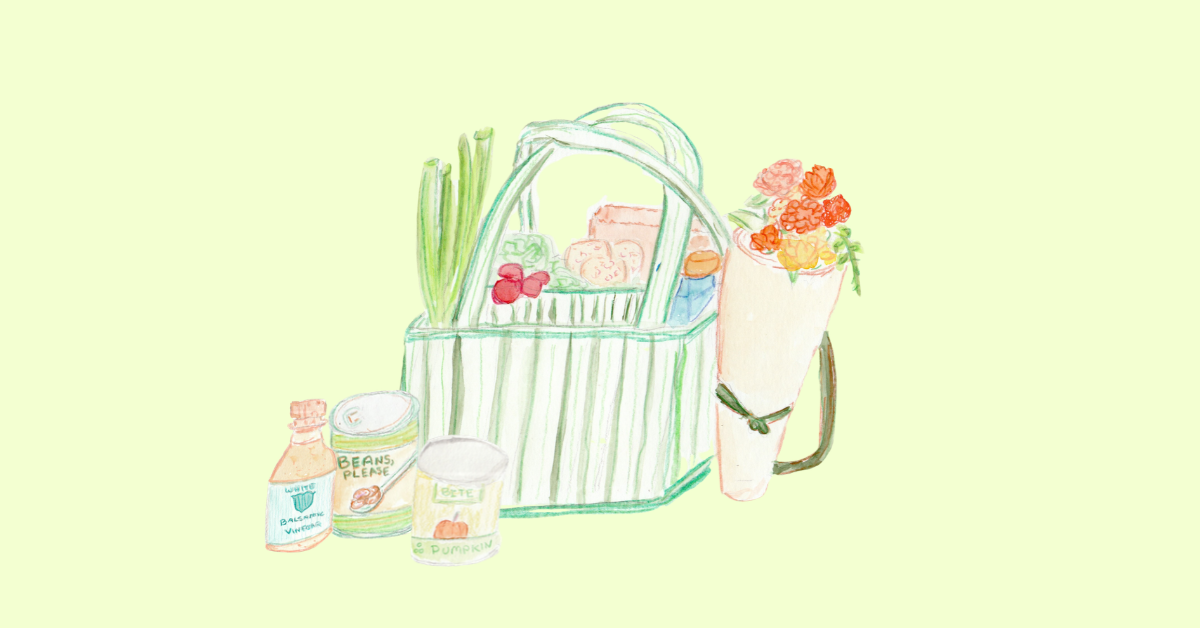
Whole Foods frozen fried garlic breaded chicken breast fillets: I cannot overstate my affection for these things. Frankly, they’re better than the breaded cutlets I usually make myself, and they eliminate the entire flour-egg-breadcrumb production, along with its accompanying dishes. I’ll serve them over pasta and vegetables, chop them into Caesar wraps or turn them into absolutely gorgeous fried chicken sandwiches. A box in the freezer is several possible dinners.

Frozen miniature meatballs: Any brand, really! I love these little guys for their versatility. For a quick stroganoff-ish dinner, I’ll simmer them with mushrooms, frozen aromatics, a gravy packet and fresh thyme, then finish everything with sour cream. Spoon the result over egg noodles, mashed potatoes or rice. They’re also excellent browned and added to Mediterranean-inspired bowls with rice, lemon hummus, feta, olives and a chopped cucumber-tomato salad. And when I want something comforting, I’ll toss them into pastina with finely diced vegetables for what I think of as “tiny everything soup.”

Heyday Canning Saucy Beans: Oh, how I love these. The beans come swimming in almost velvety sauces that are good enough that I’d aspire to make them myself. The cans suggest simply heating and eating, which I wholeheartedly endorse. In fact, I’ve been known to sneak a cold bite of the tomato alla vodka beans straight from the can. No regrets. That variety is especially good as the foundation for a cozy skillet dinner, while the enchilada-flavored beans are excellent warmed and spooned over a rice bowl.

Laoban Popcorn Chicken with Soy Garlic Sauce: This freezer find really does scratch the takeout itch. The chicken pieces cook up light and crisp, while the sauce is a little bit of sticky heaven. I love serving them over rice with whatever vegetables I have waiting in the freezer, perhaps some steamed edamame, corn and shredded cabbage.

Jenny’s Tofu Organic Smoked Five Spice Tofu: Jenny’s tofu is made about 10 minutes from my Chicago apartment, and interviewing Jenny herself a few years ago helped convince me that many people who think they dislike tofu have simply never had really good, fresh tofu. The smoked variety is particularly wonderful for sandwiches. I love a barbecue smoked-tofu wrap with shredded red cabbage and corn relish, or a bánh mì-inspired sandwich with crunchy vegetables.

Frozen scallion pancakes: Again, I’m not especially brand-loyal. I like to treat these almost like tostadas, crisping them up and piling them high with toppings. One favorite is a sesame-scented chicken salad made with Kewpie mayonnaise, plenty of scallions and a little sesame oil. Spoon that over a hot scallion pancake for a delightful contrast of crisp, creamy and savory.

The “Why the hell not?” vegetables

I once heard a piece of advice about eating more vegetables that I’ve never forgotten, although I wish I could remember who said it: Find the vegetables you can add to a meal almost automatically. The ones that make you say, “Why the hell not?”

For me, those are pre-shredded cabbage and carrots.

Pre-shredded red and green cabbage: I put this on practically everything. Tacos, rice bowls, steak chili, prepared grain salads — anything that could benefit from a little crunch, color or freshness. I also love tossing green cabbage with miso butter, roasting it until the edges begin to brown, and finishing it with lemony, toasted panko breadcrumbs. It’s inexpensive, keeps beautifully in the refrigerator and requires very little effort to turn into something special.

Pre-shredded carrots: These get tossed into stew bases, pasta sauces and curries, particularly anything I’m planning to blend. They’re also the foundation of my current obsession: hibachi-style carrot-ginger dressing, which becomes almost laughably easy when you use frozen ginger and onion cubes, too.

Then there’s my increasingly substantial frozen vegetable collection.

Fire-roasted corn, peas and carrots, mixed vegetables, edamame, spinach and cubed butternut squash: These are all regulars in my freezer. A note: Frozen vegetables are best with a little love. I’ll make compound butter to toss with them before roasting, whip up a herby sauce to coat them after steaming or finish them with a drizzle of brown butter, which is, in my opinion, king of nearly everything.

I’ve also become a fan of using prepared specialty cheese spreads to make indulgent broccoli. Break the florets — fresh or frozen — into small pieces, coat them with a good cheese spread (smoked Gouda and whipped Asiago have both been winners), and bake until bubbly, adding breadcrumbs if you like.

The philosophy is pretty simple: I’d rather spend my energy making vegetables taste wonderful than spend all that time chopping them.


Want more great food writing and recipes? Sign up for Salon’s free food newsletter, The Bite.


The things that make everything taste better

Now, here’s where I’m willing to get a little spendy.

I will not pay a premium for a bag of frozen vegetables that I’m going to zhush up anyway. Generic peas are perfectly fine by me.

But sauces, pastes, condiments, good jams? That’s another story.

I’ll pay a premium for potions.

Sauz Lemon Pepper Pesto: One of my current favorites. It’s creamy, acidic and provides a really distinct little lift to almost anything I spoon it over. I love tossing it with cubetti pasta, peas and canned white beans for a quick pasta salad, but it’s also fantastic smeared on sourdough toast and piled with olive oil-marinated vegetables.

Sun-dried tomato pesto: Another little jar of concentrated goodness. I love its deep, savory tomato flavor in pasta, sandwiches and vegetables. It also happens to be a key player in one of my favorite semi-homemade chicken sandwiches, which we’ll get to shortly.

Curry paste: A good curry paste is an invitation to improvise. Add protein, vegetables, some coconut milk or stock, and you’re already well on your way to something fragrant and satisfying.

Mekhala Lemongrass Turmeric Paste: Just this week, I stirred a spoonful into a soup base of frozen onions, garlic and ginger, then added coconut cream, frozen mushrooms, shredded carrots, leftover rice and shredded rotisserie chicken. I finished the bowls with scallions, salted roasted peanuts and lime. The paste gave the whole thing an aromatic depth that would have required considerably more shopping and chopping to achieve from scratch.

Pacific Foods chicken miso ramen broth: The foundation of one of my favorite recent semi-homemade dinners. I like to doctor it with a little additional miso and coconut cream for richness, then pile on noodles, protein, vegetables and toppings.

Brown or mushroom gravy packets: Listen. I know how to make gravy. I also know that sometimes a packet of gravy is exactly what a weeknight cottage pie or a skillet full of meatballs needs. There is absolutely no shame in that.

Frozen ginger, onion and garlic cubes: Perhaps the least glamorous but most indispensable items on this list. They eliminate chopping, cut down on dishes and make the first few minutes of cooking almost frictionless. I’m happy to buy whichever brand happens to be available or on sale.

Some meals I’ve actually made with these

Of course, a grocery list is only so useful without a little inspiration. Here are five dinners that show how these ingredients make their way onto my table.

These aren’t formal recipes. Think of them as invitations to improvise.

Semi-homemade ramen night

This one is a little more ambitious, but it’s an excellent example of how convenience ingredients can leave more room for creativity.

I started with Pacific Foods chicken miso ramen broth, adding extra miso and coconut cream for richness, then used chicken I’d already grilled earlier in the week for protein.

While the broth heated, I tossed frozen mushrooms, ginger and onions with oil, soy sauce and red pepper flakes, then roasted everything until the edges were almost charred. I steamed frozen corn and edamame, and tossed a generous pile of shredded red cabbage with sesame oil.

Into the bowls went noodles, broth, chicken, vegetables and roasted toppings, along with soy sauce eggs I’d marinated earlier that day. I served a salad with homemade carrot-ginger dressing alongside.

Not exactly a five-minute dinner, but a beautiful one. And because so much of the prep was already done, I could spend my time on the little details that made the meal feel special.

Weeknight cottage pie

This is the dinner for when I want something cozy and substantial but do not want to peel a single potato.

Brown ground beef or chicken in a skillet with frozen onions, garlic and mushrooms. Once everything has developed some color, stir in a brown or mushroom gravy packet, a splash of stock and a generous quantity of frozen mixed vegetables.

Let the filling simmer until thick and savory, then transfer it to a baking dish (or keep it in an oven-safe skillet, if you have one). Spread deli-counter mashed potatoes over the top and bake until the filling is bubbling and the potatoes are golden in spots.

Hearty, comforting and full of vegetables, without having to peel, chop or mash a thing.

Tomato alla vodka saucy bean skillet

This is one of those dinners that started with a can and became something much more interesting.

I browned a little hot Italian sausage in a skillet, then added sun-dried tomatoes, a can of tomatoes, Heyday’s tomato alla vodka beans, a splash of cream and frozen spinach.

Everything simmered together into a rich, savory, slightly spicy skillet situation. I served it with toasted sourdough tips for scooping up all that lovely sauce.

The beans bring both flavor and fiber, the sausage adds richness and heat, and the spinach practically disappears into the sauce. I would happily eat this again tomorrow.

Lemon-pepper pesto pasta salad

This is the sort of thing I love making when I want something fresh, bright and satisfying without spending much time at the stove.

Cook some small pasta — I’m fond of cubetti here — and add frozen peas and carrots, cooking them just long enough to heat through. Drain, cool slightly and toss with canned white beans and a generous amount of Sauz Lemon Pepper Pesto.

You can eat it slightly warm or chill it for later. Either way, the creamy, lemony pesto ties everything together, while the vegetables and beans make the whole thing more substantial.

Sometimes you just need one very good sauce.

The ridiculously good frozen-cutlet sandwich

Remember those Whole Foods chicken cutlets I was raving about earlier? Here’s one of my favorite things to do with them.

While the cutlets cook, toast some soft potato buns and make a quick lemon-garlic mayonnaise. I use Kewpie, into which I stir freshly grated lemon zest and one of those handy frozen minced-garlic cubes, thawed.

When the chicken is nearly done, melt a slice of Muenster cheese over each piece.

To assemble, spread sun-dried tomato pesto on one half of the bun and the lemon-garlic mayo on the other. Add the cheesy chicken cutlet, then pile on an almost unreasonable quantity of fresh arugula. My beloved shredded cabbage would also be wonderful here if you’re in the mood for extra crunch.

The result is creamy, tangy, savory, crunchy and a little peppery. It’s the sort of sandwich I’d happily pay a cute restaurant a slightly unreasonable amount of money to make for me.

Instead, I’m standing in my own kitchen, feeling very pleased with myself.

This story originally appeared in The Bite, my weekly food newsletter for Salon. If you enjoyed it and would like more essays, entertaining guides and recipes sent straight to your inbox, subscribe here.


The post The grocery store shortcuts that make weeknight dinners easier appeared first on Salon.com.
  •  

The strange new math behind the price of your groceries

Walmart recently published a list of things it promises not to do to its customers.

“We price the product, not the person,” Walmart CEO John Furner announced in a September letter to customers. “Your income, shopping history, urgency or what we think you could pay won’t change the price,” he promised. Nor, he said, would the retailer’s AI shopping assistant, Sparky, use information customers shared to raise prices or conceal cheaper options.

This was nice to hear. I hadn’t previously considered that telling a computer I needed toilet paper might result in an emergency toilet-paper rate. There is something faintly unnerving about the specificity of a corporate reassurance, particularly when it introduces several possibilities you hadn’t thought to worry about.

It made me preemptively nostalgic for the little paper price tag beneath a box of cereal. There’s something reassuringly stupid about it. It tells you what the cereal costs. It doesn’t know how much money you make, whether you’re in a hurry or what the temperature is outside. Unless an employee comes along with a new sticker, the person reaching for the same box ten minutes later sees the same number. A modest achievement, perhaps, but one I’m growing increasingly fond of.

The appeal isn’t really the paper. It’s the transparency of the arrangement. As retailers gather more information about their customers and acquire increasingly sophisticated pricing tools, shoppers risk knowing less about why they’re paying what they’re paying. The problem isn’t simply higher grocery bills. It’s the possibility of a transaction in which one side can examine the other in exquisite detail, while the other can barely see the rules.

What prompted the letter from Furner is that Walmart is expanding its use of electronic shelf labels, little screens that let employees update prices digitally from a central computer instead of replacing stickers by hand. The change makes sense. Furner points out that updating paper tags is tedious work, and he’d rather employees spend their afternoons helping customers than tending to a small forest of adhesive rectangles. Digital labels can also help ensure the price on the shelf matches the price at checkout.

And electronic labels aren’t, in themselves, surge pricing. Walmart says it doesn’t use them to change prices according to who is shopping or the time of day. But efficiency is a different question from trust. Making a price easier to change isn’t necessarily a problem. Making it harder to understand how that price was reached might be.


Want more great food writing and recipes? Sign up for Salon’s free food newsletter, The Bite.


We’ve already accepted a surprisingly elaborate set of conditions for saving money on groceries. Download the app. Make an account. Remember the password. Clip the digital coupon before you leave home. After handing over our personal information and completing several minor administrative tasks, we’re permitted to save 75 cents on yogurt. The store, meanwhile, gets a rather detailed account of our preferences. What happens when that bargain runs in reverse?

Last December, Consumer Reports and Groundwork Collaborative found that shoppers using Instacart were sometimes shown different prices for identical groceries from the same store at the same time. At one Safeway in Washington, D.C., an 18-ounce box of Signature SELECT Corn Flakes appeared for $2.99, $3.49 and $3.69, depending on whose screen you were looking at. 

Instacart said the shoppers were assigned to pricing experiments randomly, not sorted by income, demographics or browsing history. It ended the tests after the investigation. That distinction matters, especially because the research didn’t establish that anyone’s personal habits were being used against them. But it demonstrated how quietly prices can diverge when the shopper sees only the number assigned to her. You can’t question a difference you have no way of seeing.

I buy a lot of black beans. Enough, presumably, that a supermarket’s software could identify me as a woman with firm opinions about legumes. If that earns me a coupon, wonderful. I’m considerably less enthusiastic about the possibility of an algorithm deciding that my apparent dependence on black beans means I could stand to pay another 30 cents per can. It’s one thing to recognize a loyal customer. It’s another to recognize a captive audience.

Other pricing algorithms raise different questions (McDonald’s, for instance, faces a lawsuit alleging AI-assisted price coordination among franchises, which the company denies). Prices have always fluctuated; coupons have always rewarded some shoppers more than others. Nor should computers be banished from the business of deciding what things cost. But the supermarket is not an airline, and dinner should not require the same vigilance as booking a flight.

Walmart’s promise is worth taking seriously. The company has drawn a clear line around how it says it will use customer information, and that’s preferable to leaving shoppers guessing. But it’s a corporate commitment, not a rule every retailer must follow. And the fact that a supermarket now feels obliged to assure us it won’t charge extra because we seem hurried or financially comfortable suggests how strange our expectations have become.

Perhaps it’s naive to want a supermarket not to use what it knows about me against me. Still, I don’t need the price tag to know me. I need it to tell me what the cereal costs.

The post The strange new math behind the price of your groceries appeared first on Salon.com.

  •  

I can’t stop making this cabbage

I have a very specific fantasy about the restaurant I would open, should someone ever hand me a set of keys and an unlimited supply of funds and optimism. It would be a little neighborhood bistro, the sort of place where the wine comes in mismatched stemless glasses thrifted from estate sales. The menus would be illustrated by hand, which sounds charming until you’ve spent an entire afternoon trying to get the shading right on a watercolor artichoke. There would be personality wallpaper in the bathroom, icy sparkling cocktails, very good roast chicken and a bread service so generous it would probably make an accountant nervous.

Fortunately, I don’t have to worry about razor-thin margins in a fantasy. But even if I did, I know one dish that would earn its place on the menu: cabbage.

Specifically, green cabbage roasted in miso butter, then showered with crispy, lemony panko breadcrumbs. It’s inexpensive, uncomplicated and just a little chic. More importantly, I can’t seem to stop making it.

The recipe began with one of my favorite ways to cook: playing matchmaker with ingredients. If Thing A already loves Thing B, and Thing B loves Thing C, perhaps A and C would get along, too. There’s a pleasing logic to it, like introducing two friends at a dinner party and watching them discover they have more in common than the host.

I already adored miso butter, with its salty, savory depth. And cabbage cooked in butter is a classic for good reason. Putting the two together was hardly a leap. I chopped up a head of green cabbage, coated it with the miso butter and let the oven do the rest. After about 30 minutes at 350 degrees, with a stir halfway through, the cabbage had softened into silky folds, with a little browning at the edges. The butter made it rich; the miso gave it a subtle funk.

It was very good. It also needed crunch.

My first instinct was to go the baked-macaroni-and-cheese route: lightly toast some panko, scatter it over the cabbage, then return the whole thing to the oven. In theory, a golden, crunchy topping. In practice, the crumbs more or less fused into a single crust over the slick cabbage beneath. Cutting through it was less delightful than I’d imagined.

The fix was blessedly simple. I crisped the breadcrumbs separately in a pan with olive oil, red pepper flakes and the zest of an entire lemon, then spooned them over the cabbage just before serving. Now each forkful caught a little of everything: tender, almost creamy cabbage; browned edges; bright flecks of citrus; and individual crunchy crumbs that stayed crunchy.

That last part matters. The contrast is what makes this feel like a dish rather than a vegetable dutifully placed beside dinner.

And beside dinner it has appeared, repeatedly. With salmon and rice. With grilled chicken and sweet potato coins glossed with maple syrup and orange zest. With a skillet of white beans and sausage, plus sourdough for scooping. Different meals, same cabbage. At this point, I’d be more surprised by a week without it.

Lately, I’ve been trying to make room for more vegetables in everyday cooking, ideally two kinds at dinner. Not as a grim exercise in virtue, but because I want the vegetables to be things I actually look forward to eating. That means finding a few sides that are so appealing, and so low-effort, that adding one more feels less like a chore and more like, “Oh, hell, why not?”

Cabbage is particularly good at this. It’s cheap, keeps beautifully in the refrigerator and demands almost no knife skills. You can even buy it pre-shredded. It sits in the oven while you make the rest of the meal, asking for little beyond a halfway stir. Low-maintenance, low-effort, high return.

I may never open that bistro, and perhaps that’s just as well for the accountant and the watercolor artichokes. But on an ordinary weeknight, when dinner is nearly done and I find myself reaching for the cabbage again, I get a small piece of the fantasy anyway: something simple enough to make at home, and good enough that I’d happily order it out.

Miso-Butter Cabbage with Lemony Crispy Breadcrumbs
Yields
00 servings
Prep Time
00 hours 00 minutes
Cook Time
00 hours minutes

Ingredients

  • 1 medium head green cabbage, shredded (red works, too! Though it takes on a decidedly spooky dark purple color)

  • ⅓ cup unsalted butter, softened

  • 1½ tablespoons white miso

  • Freshly cracked black pepper

  • 1 cup Panko breadcrumbs

  • 2 tablespoons olive oil

  • Zest of 1 lemon

  • Pinch of red pepper flakes

  • Salt, to taste


Directions

  1. Heat the oven to 350°F.
  2. Mash the softened butter and miso together. Spread the shredded cabbage in a baking dish, dot with the compound butter and toss to coat. Season generously with black pepper.
  3. Bake for about 30 minutes, stirring halfway through, until the cabbage is tender.
  4. Meanwhile, heat the olive oil in a skillet over medium heat. Add the Panko, salt and red pepper flakes, stirring until the crumbs are golden and crunchy, about 4–5 minutes. Remove from the heat and stir in the lemon zest.
  5. Scatter the breadcrumbs over the cabbage immediately before serving. Keeping them separate until the last moment is the secret to preserving their crunch.


The post I can’t stop making this cabbage appeared first on Salon.com.

  •  

New York City, deliciously off-script

I ate lamb ribs sticky with tamarind and dates, watched fairy tales transformed into extravagant burlesque, learned to make stained glass and watched people take shots of alcohol poured directly from the head of a bluefin tuna during my latest trip to New York City. It wasn’t exactly a conventional sightseeing itinerary, but that’s increasingly how I like to experience the city.

I used to live in New York, and no matter how many times I return, it never fails to surprise, delight, frustrate and invigorate me. I spent another week revisiting favorites and adding to the list of must-visit places I might never get to. The possibilities seem endless, particularly when you’re willing to follow your curiosity. From unforgettable meals to unexpected experiences, here’s where mine took me this time — and where I’d happily go again.

Lunch and cafes

One of my favorite things about eating in New York is how easily a casual lunch can become one of the most memorable meals of the trip. Take LAUT in Union Square, the first Malaysian restaurant in New York City to be awarded a Michelin star. While the establishment hasn’t retained it, if the bustling lunch crowd was any indication, it’s certainly a worthwhile stop. The menu draws from Singaporean, Thai and Malaysian cuisine, with fragrant curries, flaky roti, chewy noodles and wok-fried dishes.

We loved the fried butter garlic soft-shell crab with fragrant, crispy curry leaves. The roti canai was another standout, perfectly flaky and served with a spice-forward sauce you’ll want to eat with a spoon. Bone-in duck curry followed, braised in coconut milk with lime leaf and tomato, and served with rice. It had a stick-to-your-bones constitution, and you could easily get lost in the flavorful sauce.

Peruvian food is influenced by flavors from around the globe, with delicious peppers, lots of citrus and fresh ingredients as the stars of the show. At Mission Ceviche, also in Union Square, I found an excellent lunch menu offering a variety of ceviches — ceviche nikkei was my favorite! — and tiraditos, cravable mocktails and main dishes ranging from classics like lomo saltado to whole grilled branzino over a bright tomato chorrillana sauce. I could have easily downed several basil breeze mocktails.

Harlem is home to Red Rooster, co-founded by the acclaimed Marcus Samuelsson. Inspired by Black American, Southern and Caribbean cuisines, the restaurant serves as a gathering place with live music, good food and a lively atmosphere. The service was excellent despite the full restaurant and busy bar, and we ordered a variety of dishes for the three of us.

I loved fried chicken and this one was coated in a crispy shell while perfectly juicy inside, served with greens and unctuous mashed potatoes. Jerk wings were great, too, as well as the Uptown Guac, served with fried hushpuppies. Surprisingly, the highlight of our meal was dessert: a strawberry and mango salad with coconut sauce. So refreshing, and a perfect way to end the meal.

Of course, not every great food discovery requires a sit-down meal. Two small but mighty cafes in Greenwich Village made particularly memorable stops, each with a very different specialty.

Savory pastries meet halloumi from Cyprus at Hello Halloumi, a small bakery where the cheese is the star of the menu. Halloumi appears fried, baked into pastries, turned into grilled cheese, served as the meat in a “burger,” and featured in gyro wraps and bowls. The rose cloud matcha was delicious, and if you want something sweet, don’t miss the tahinopita, a cinnamon roll-style treat slathered in decadent tahini icing.

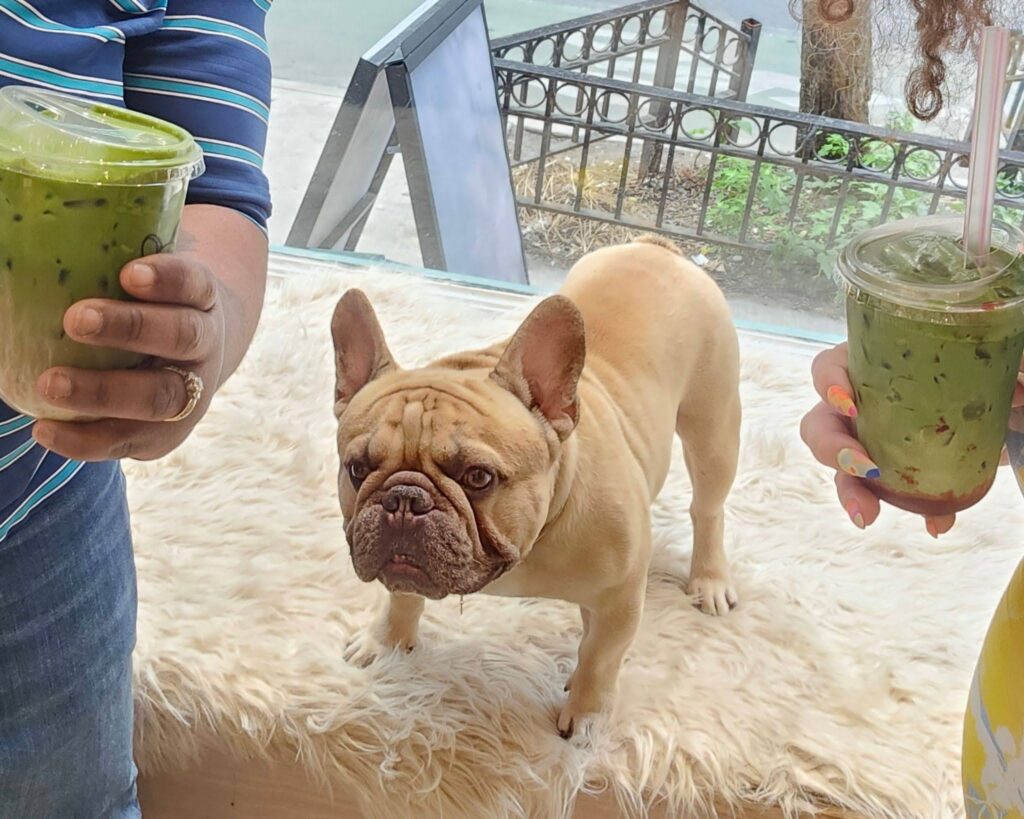
(Chaya Milchtein) Matcha and a Frenchie at Kawaii Cafe

Nearby, Kawaii Cafe is a little Vietnamese coffee shop with a French bulldog named Latte as its mascot that should be a required stop for any coffee or matcha lover. Kim, the owner, came to the United States from Vietnam and worked as a nail tech. Kawaii’s signature beverages hearken back to those days, when she’d talk to clients and hear all about their relationship problems. Situationship, Thirst Trap and What Are We are all handcrafted drinks inspired by those conversations.

Coffee beans are carefully sourced from Vietnam, cream toppings and jellies are made in-house, and vibrant green matcha from Shizuoka, Japan, makes for unforgettable combinations. The matcha was so good I came back twice!

Leisurely dinners

For dinner, New York offers endless opportunities to get a little more adventurous. Some of my favorite dishes from this trip came from restaurants drawing on different culinary traditions and finding exciting ways to bring them together.

At Eyval in Bushwick, an Iranian restaurant that bills itself as “recreating traditional Iranian cooking for a contemporary audience,” the dining room was bustling and lively, with every table full when we arrived. The menu isn’t overly extensive, but every dish we ate balanced flavors, textures and ingredients superbly.

I could eat the citrus, date and cabbage salad every day and probably never get tired of it. The punchy, rich chile-tahini dressing balances perfectly with the sweet, chewy dates, bursts of orange and crunchy cabbage. Match made in heaven, really. Then there were fall-off-the-bone lamb ribs with a sticky tamarind-and-date sauce that you just have to lick your fingers after devouring, and a saffron half chicken, pressed and served over rice studded with barberries and pumpkin seeds. This restaurant will live rent-free in my brain for quite some time.

Marcus Samuelsson’s Hav & Mar offers another inventive approach to familiar ingredients. Born in Ethiopia and raised in Sweden, Samuelsson draws on both culinary traditions at this seafood-focused restaurant. The space is beautiful and lively, with mermaids on the walls and a central bar. The menu is spice-forward, with raw and cured dishes, small plates and a range of entrees.

We loved the crudo trio: tuna tartare with miso and injera, hamachi with gooseberries and crispy onions, and berbere-cured salmon, lox-style, in an orange broth. The highlight of our meal was a whole crispy-skin branzino served with fresh injera, shiro and plenty of herbs, while dry-aged lamb chops rounded out our order. My only regret is skipping the Hav bread basket, with teff biscuits, blue cornbread and injera crisps.

New York can also deliver an exceptional steak dinner, whether you’re drawn to Brazilian specialties or an old-school white-tablecloth institution.

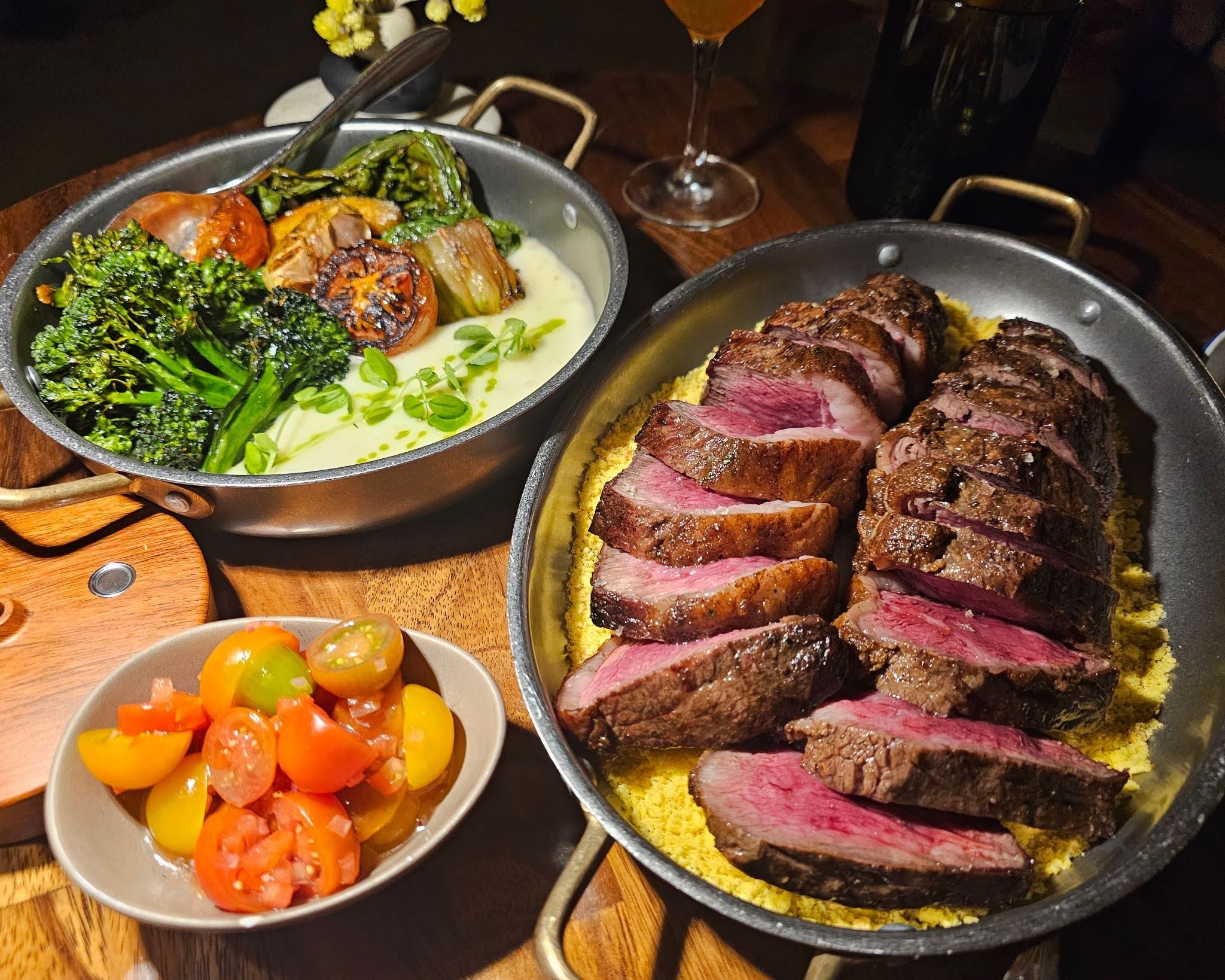
The dimly lit Berimbau Brazilian Table in Midtown, from restaurateur Mario de Matos, was a delight, with a relatively small menu of Brazilian specialties. We started with the nearly obligatory pão de queijo, crispy, cheesy, chewy bread that’s naturally gluten-free and positively scrumptious.

The star of the menu is clear immediately: tableside-carved prime picanha, a treat for the eyes and certainly the taste buds. The massive 38-ounce portion sits on a bed of corn farofa, a textural delight, and is served with cheesy yuca purée, charred vegetables and salada vinagrete that adds a much-needed acidic punch. It technically serves three but is perfect for two, with plenty of leftovers. This might have been the best picanha I’ve ever had. The service, ambiance and lighting make it an excellent choice for a memorable meal.

Gallagher’s Steakhouse, on the other hand, is where you go for an old-school New York experience, complete with waiters in bow ties, dry-aged steaks and classic sides. Originally a speakeasy that opened during Prohibition, it changed hands several times and became a New York City institution.

The menu offers classics: a raw bar with delicious oysters (ask for horseradish, they have it!), Caesar salad, French onion soup and other starters. Steaks of all kinds, some dry-aged in the meat lockers you walk past as you’re seated, can be topped with blue cheese or served with bone marrow. I’d skip the latter, even as a bone marrow lover.

We opted for a well-aged, medium-rare T-bone steak cooked over hickory logs, with buttered corn and spinach served family-style. In the classic Gallagher’s way, the waiter fills your plate. Endearing or disconcerting? You decide. Save room for the New York cheesecake. It’s made in-house and was a surprising standout.

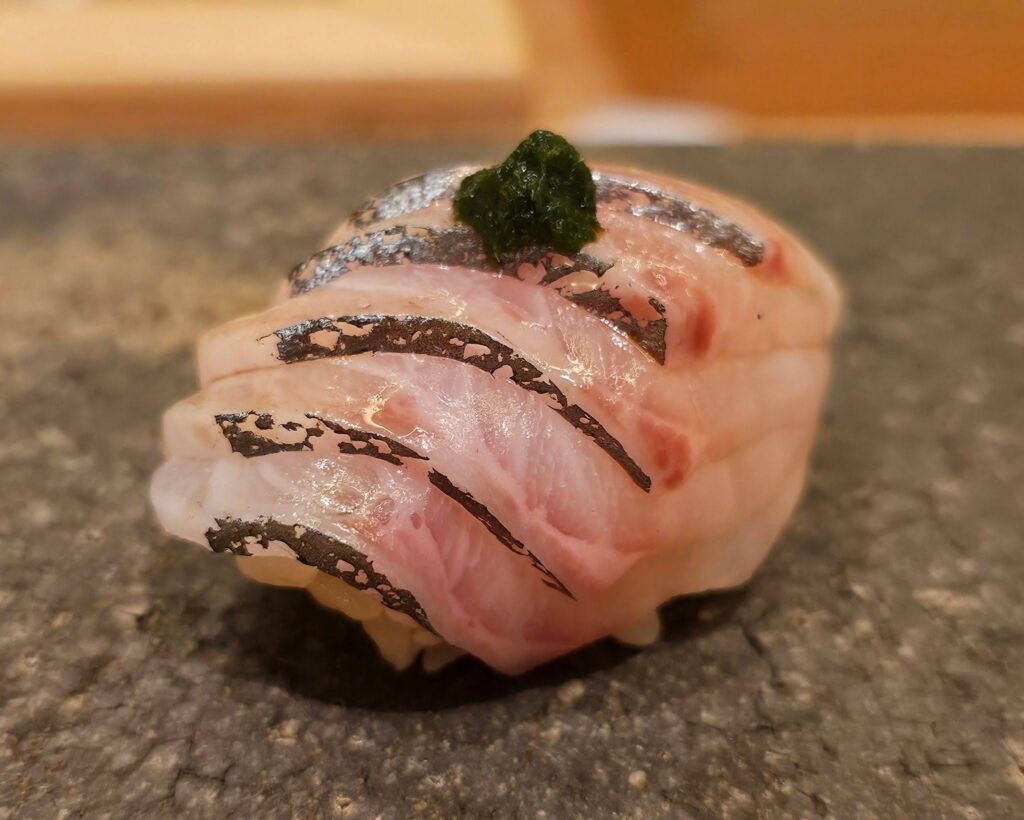
And for a completely different kind of fine dining, there’s Sushi Akira, where chef-owner Nikki Zheng is right at home behind the counter.

Sushi Akira specializes in Edomae-style sushi, using curing, marinating and dry aging to bring out the best texture and flavor of each ingredient without relying on heavy sauces. Chef Zheng is generous with her time, answering questions and explaining techniques and ingredients as she creates an 18-course omakase. Each carefully crafted piece of nigiri changes depending on what’s in season, and the meal unfolds in a choreographed dance for just 16 lucky diners.

Get the sake pairing if you’re imbibing, even if you don’t usually think of yourself as a sake drinker. The selections brilliantly complemented and enhanced each course and introduced me to combinations I wouldn’t have expected.

(Jodyann Morgan) Stripped jack nigiri at Sushi Akira

For a lively dinner with a group, I loved MangoSeed in Brooklyn’s Flatbush neighborhood. The playlist really set the mood. Billed as “Caribbean-inspired” and heavily influenced by Jamaican cuisine, the restaurant offers a fun atmosphere, hearty food and excellent service. My wife and I invited her mother, niece and nephew to join us, and despite the restaurant’s size, it fit our multigenerational group perfectly.

We really enjoyed the whole grilled fish with charred lemon and spicy jerk wings. Order a rum punch if you like a fruity drink that packs a punch, pun intended. A beloved favorite, the baked four-cheese mac and cheese was gooey and decadent. The rice and peas and oxtail didn’t quite live up to our high standards, but they rounded out the meal. And for dessert, the chocolate cake was moist and deeply chocolatey, a surprising standout for the entire group.

Getting around

Of course, getting to and around New York City can be stressful. Between traffic and the sheer number of people, it can overwhelm even seasoned travelers. A couple of transportation services made my recent visits easier.

Having a professional driver from Gotham Ride Chauffeur Service pick you up at the airport can help a trip start off right. The company tracks your flight so the driver can meet you even if it’s delayed, and you’re greeted with cold beverages while you take a load off.

I’ve used the service on two trips, and both were a breeze, even when one of my flights was turned around midair and another was canceled as we were about to get into the car. Those are precisely the moments when having some help with the logistics makes a difference.

For getting around town, I’ve also been testing alternatives to the usual rideshare options. I lived in New York during the golden age of rideshare, when it was largely budget-friendly and so many new apps were popping up that the competition was fierce. In the years since, Uber and Lyft have become the primary choices, but whenever I return, I try to test-drive newer options.

Empower isn’t exactly traditional rideshare. The company bills itself as a software platform, allowing drivers to set their own rates and keep 100% of the fare revenue while paying a daily or monthly fee to use the service.

On my visits, drivers were available quickly, rates were reliably lower than the Uber fares I was comparing against, and service was what you’d expect. I plan to use the app again the next time I’m in New York City.

Experiences worth booking

As much as I love eating my way through New York, every trip deserves a few experiences that don’t revolve entirely around a restaurant reservation. This time, that meant everything from burlesque and close-up magic to a four-hour stained-glass class and a very unusual encounter with a bluefin tuna.

For a night out with some genuine spectacle, Company XIV reimagines classic stories like “Little Red Riding Hood” as full-scale burlesque productions. Complete with live singing, expert choreography, ballet, aerial performances and costumes designed to be removed piece by piece, the shows are sensual and mesmerizing.

The theater is a magnificent setting for each performance, decked out in velvet and glitter, with chandeliers overhead. If you enjoy a really good performance art, you must catch a show at Théâtre XIV. Whether you’re with a lover or a group of friends, prepare to be dazzled!

(And if you’re peckish before or after the show, stop by Tortillería Mexicana Los Hermanos, just a three-minute walk away. The restaurant operates inside a tortilla factory that has been making tortillas in-house since 1998, and the food never disappoints. I always get the carnitas, perfectly crispy and deeply savory, served in fresh, warm tortillas.)

For another kind of performance, consider the tuna-cutting experience at Sushi by Bou. If your TikTok feed looks anything like mine, you’ve probably watched plenty of videos of live tuna cuttings. If omakase isn’t interactive or exciting enough for you, this is a chance to watch an entire bluefin tuna being carved, sliced and served in an endless parade of toro, akami and more.

Sushi by Bou curated a party-like atmosphere in a room full of eager sushi lovers. Libations flowing, delicious fatty tuna passed around, and alcohol poured directly into your mouth from the tuna head itself were some of the highlights. You can even scrape tuna directly off the ribs if you choose. It’s not exactly a typical sushi dinner, but that’s part of the fun.

For an experience that trades culinary spectacle for old-fashioned wonder, there’s Chamber Magic at the glitzy Lotte New York Palace.

Tune out everything and let yourself believe in magic — at least for an hour and 45 minutes. Magician Steve Cohen makes everyone feel like an important part of the show. Held on Friday and Saturday, with a cocktail-attire dress code, the performance brings together just 64 people to giggle, laugh and try to figure out how Cohen pours someone’s perfect cocktail from a teapot unprompted, among other magical acts. You’ll leave with a wide smile, enchanted by the experience.

Not all my favorite activities involve watching someone else demonstrate a skill, though. I love finding a creative experience while traveling, particularly when it means learning something new and bringing home a one-of-a-kind souvenir I made myself.

Craftsman Ave in Brooklyn offers classes for even the most adventurous crafter, including knife making, leatherwork, textiles and stained glass, which I chose. Its introduction to stained glass is a four-hour class that walks you through every step of making a wall hanging, from selecting your design to cutting the glass, soldering and finishing the piece.

My wife and I have taken many craft classes, but this one felt more advanced than anything we’d tried before, with experienced artists working alongside us. I definitely felt frustrated at times because it took me a while to grasp each step. But in the end, I was glad I took the class, even if my cat was more amateur than I’d hoped.

If you’re looking for a bite before or after class, stop by Sahadi’s at Industry City, just a few minutes away on foot. The longtime Lebanese grocer has been operating in New York since the late 1800s, and this location has a grab-and-go deli as well as seated lunch and dinner service.

Another New York experience worth considering is having something made specifically for you. Have you ever put on a suit and had it fit perfectly? Me neither! Nothing off the rack makes me feel like a million bucks.

That’s what makes Alan David Custom in Midtown such an interesting stop. The bespoke tailoring house crafts suits to your exact measurements and requirements, guiding you through the process from fabric selection to final fitting.

The fabric choices are endless, and every detail is dictated by you rather than a mass-market clothing producer: pocket or no pocket, type of stitching, exact fit, even the hemline for the style of shoes you actually wear. After the initial measurements, the company can ship a basted fitting and arrange a virtual fitting to finalize the details before sewing and sending the finished garment.

Whether you’re preparing for a big occasion or simply tired of wearing something that doesn’t quite fit, it’s a luxury experience that offers something more personal than an ordinary shopping trip.

Where to stay

After a full day of exploring, there’s something to be said for returning to a comfortable hotel, particularly one that feels a little different from the generic, nondescript rooms you can find almost anywhere.

The Kimberly Hotel has old-school charm and timeless elegance, with gracious, helpful service and a massive round fish tank in the lobby that you can get lost in. The hotel has 194 rooms, including one- and two-bedroom suites.

We stayed in a massive one-bedroom suite, even by regular standards, with a lounge area and kitchenette complete with a microwave and refrigerator that we put to good use. The bed was super comfortable, but the bathroom was tiny considering all the space. A balcony with Manhattan views was simply the pièce de résistance. Even if your room doesn’t have a balcony, you can get 360-degree views at the rooftop lounge, aptly called Upstairs at The Kimberly.

For a comfortable home base with minimal frills, Kimpton Ashbel New York Park Avenue fits the brief well.

The lobby is inspired by a living and dining room spread across two spaces, with the registration desk at the center. It’s designed to give you room to relax and connect, and it’s great for people-watching, although the hustle and bustle means it isn’t a place to go for peace and quiet.

Our room was surprisingly spacious for New York City, with a table, chairs and a jetted tub — which was quite difficult to climb into, if I’m honest. Kimpton Ashbel is also pet-friendly, with no deposit required and no weight, size or breed restrictions, a huge boon for travelers with pets.

My stained-glass cat didn’t turn out quite as I’d hoped, and there are still countless restaurants on my list I never managed to visit. But I came home with some excellent meals, a few wonderfully strange memories and plenty of reasons to return.

Elevate your taste buds

New York’s legal cannabis scene is flourishing, with countless dispensaries competing for your business. Each dispensary offers a different experience depending on your style and preferences.

Housing Works Cannabis Co. is both New York’s first legal recreational cannabis dispensary and one of a handful of nonprofit dispensaries. If the name sounds familiar, it’s because Housing Works has been serving homeless and low-income New Yorkers, particularly people living with HIV, in a variety of capacities for years. The dispensary, just a short walk from Union Square and the Village, puts all of its profits toward supporting that mission.

Then there’s The Daily Green in Times Square, impossible to miss beneath digital green billboards with cannabis displayed in bold newspaper type. The massive dispensary has a selection to match, with products ranging from pre-rolls and tinctures to topicals and vapes, including New York brands like ayrloom and national ones including STIIIZY and Dogwalker.

An interactive bud bar lets customers get a firsthand look at different cannabis varieties, with a terpene guide providing additional information. It’s a distinctly different experience from visiting a small neighborhood shop, and an interesting example of how cannabis has become part of the Times Square retail landscape.

On the Upper West Side, Superfly Dispensary offers another approach. The budtenders are knowledgeable, cannabis varieties are available to examine under magnification, and the selection intentionally includes LGBT- and Black-owned brands. Superfly also serves as a community hub, with weekly yoga and Pilates, disco nights, Halloween parties and brand activations. There’s something for people looking to connect and spend time with like-minded neighbors, not simply shop. Great choices include ayrloom’s Lychee Dream pre-rolls, Good Tide guava gummies and Sluggers Lemon Cherry Gelato vape.

The post New York City, deliciously off-script appeared first on Salon.com.

  •  

Airbnb sold us the comforts of home. Then came the chores

Schadenfreude isn’t listed among Airbnb’s amenities — but this week, it’s practically complimentary.

Some Airbnb hosts are threatening to quit the platform, raise their housekeeping fees or pare their rental properties down to the bare essentials rather than accept new restrictions on checkout chores. A segment of travelers, meanwhile, has greeted the uproar with the particular delight of people who have spent years paying cleaning charges while being handed lists of chores. “I’m just here with popcorn to watch,” wrote one Reddit commenter. 

Under new rules announced last week, Airbnb will generally prohibit hosts from requiring guests to wash and put away dishes, strip beds or haul garbage off-site for reservations booked on or after November 20. The changes address a long-simmering grievance among travelers, some of whom have encountered checkout instructions that read less like the end of a vacation and more like the beginning of a Saturday spent doing housework.

There are, of course, always more extreme stories, particularly if one goes looking online. “Our current host is asking us to load trash in our vehicle and drive 20 minutes to a drop-off facility,” wrote one traveler. “Our vehicle is fully packed so we’d have to make an extra trip to do this.” Another, who claimed to have already paid a $300 cleaning fee, described receiving a request for an additional $600 after checkout for allegedly failing to scrub the toilets, stove and hot tub, along with leaving “ONE ‘dirty’ pot (it was just water stains).” The guest said Airbnb ultimately sided with them.

These are individual, unverified accounts, not necessarily representative experiences. Still, one can understand why a guest might object to having a 20-minute pilgrimage to the local garbage facility added to the vacation itinerary, or why a $600 dispute over a water-stained pot might leave a lasting impression.

Some hosts maintain that basic housekeeping is simply part of staying in someone else’s home. Their critics counter that they could spend their holidays doing chores at home for free. 

Eventually, somebody delivers what is meant to be the conversation-ending argument: Then book a hotel.

Except it never quite ends the conversation. A host will point out, with some satisfaction, that a hotel room probably won’t have a full kitchen. The traveler, who was just moments ago swearing off vacation rentals forever, admits that’s exactly the problem: They need a kitchen! And there they are, host and guest, still standing in the same imaginary room, arguing about the dishes.

It’s a lot of emotional freight for four burners and a refrigerator. Which raises the obvious question: Why has the kitchen become both the most persuasive argument for renting someone’s home and the place where the whole arrangement gets so contentious?

For families, people with dietary restrictions or anyone hoping to avoid three restaurant bills a day, a kitchen can be essential. But cooking occupies a peculiar position in domestic life: necessary chore to some, passionate hobby to others, and sometimes both to the same person. I have friends who explore unfamiliar places by running through neighborhoods at sunrise or sketching what they see. I prefer wandering a local market, imagining what I might make for dinner.


Want more great food writing and recipes? Sign up for Salon’s free food newsletter, The Bite.


One Thanksgiving, my mom and I debated attempting a traditional holiday meal at a rental on Hilton Head Island. At home, we’re spreadsheet cooks — planning weeks, if not months, in advance — and an unfamiliar kitchen seemed a risky place to make stuffing. Then we opened the cupboards: good knives, cookware in every shape and size, multiple colanders, and a generously stocked spice cabinet guests were welcome to use. Whoever owned the house, we realized, loved to cook.

Soon, I was bicycling to Harris Teeter for cornbread ingredients, where Harry the Happy Dragon — a coin-operated green kiddie ride — stood sentry outside the entrance. Later, I padded barefoot into the yard to snip rosemary for the stuffing. I felt like Ina Garten, albeit one whose charming village market featured a mechanical reptile. We cooked leisurely. If Thanksgiving went sideways, we could always order pizza.

We’ve returned several times since. Mary, the owner, understood that a well-equipped kitchen could be part of the vacation itself.

Not every rental kitchen inspires such confidence. At a North Carolina cabin, I once envisioned mornings of cinnamon rolls, bacon and porch-side coffee, only to discover approximately three plates and no coffee maker. Salvation arrived in the form of a traveling companion who, inexplicably, had packed a French press. (I now appreciate hosts who even roughly inventory their kitchen equipment.)

That’s the peculiar promise of a vacation rental kitchen: You can experience someone else’s domestic life as your own. Their spice cabinet becomes yours; their stove, your stove; their neighborhood grocery store, your little errand. But there’s a contradiction tucked inside that promise. We want the intimacy of a home without necessarily inheriting all the obligations of maintaining one. The pleasures of playing house and the responsibilities of keeping house aren’t quite the same thing, even when they happen in the same room.

I don’t remember cleaning up after our Thanksgiving dinner, though I’m sure there was plenty of it. I remember the rosemary, the bicycle ride, the pleasure of discovering another cook’s cupboards. The rest was simply part of making dinner.

Which is perhaps why, reading through the celebrations of Airbnb’s new rules, I keep imagining the other side of that sink full of dishes. The blender caked with a week’s worth of old food. The plates slowly accumulating a geological record of every meal cooked since check-in. I wouldn’t want someone to do that to my kitchen, or to the kitchen of someone I loved.

I can already hear the response from a thousand comment sections: THEN YOU SHOULDN’T HOST!

Fair enough. I don’t! The possibility of strangers allowing marinara to fossilize on my favorite saucepan is among the many reasons I’ve never considered entering the vacation rental business.

But I do think we occasionally forget that hospitality is a two-way street. Being a good host is a genuine responsibility, as is being a good guest. And we tend to understand both roles more intuitively in situations where nobody is exchanging money. If I were watching a friend’s house while they were out of town, I wouldn’t dream of welcoming them back with a pile of bolognese-crusted pots. If that same friend handed me a list of toilets to scrub before returning the keys, however, I might reconsider the friendship.

Of course, the exchange of money changes things. When I pay a cleaning fee, I expect someone to handle the work of preparing a property for its next occupants: washing linens, scrubbing bathrooms, cleaning floors. I’m not volunteering to become somebody’s housekeeper. But I also don’t think loading the dishwasher after making dinner is an especially onerous price to pay for enjoying somebody else’s kitchen.

Now, Airbnb has attempted to draw the boundary more formally. Under its new rules, hosts may ask guests to place dirty dishes in the sink, but generally cannot require them to wash and put those dishes away.

Apparently, somewhere between setting down a dirty plate and turning on the faucet, a vacationer risks becoming a housekeeper.

And perhaps that’s the difficulty with Airbnb’s entire proposition. I loved cooking Thanksgiving in Mary’s kitchen partly because, for a few days, it felt like our own. I could wander into her garden, borrow her spices and imagine that this was simply what my life looked like on a Thursday afternoon. But the pleasure depended on a temporary arrangement, one in which somebody else’s home had been made available for my enjoyment, and in which I understood that eventually I’d have to hand it back.

What does it mean to make yourself at home somewhere when that home is also somebody else’s business? Airbnb has been asking travelers and hosts to negotiate that question for years. Judging by the delight and indignation greeting its new housekeeping rules, we still haven’t agreed on an answer.

The post Airbnb sold us the comforts of home. Then came the chores appeared first on Salon.com.

  •  

Americans hate tipping. So why haven’t they stopped?

I am a recovering people-pleaser, though I admit most of the recovering still takes place in private. I rehearse difficult conversations for weeks — on walks by the lake, in the shower, in the mirror — before actually having them. I’ve let subscriptions renew rather than endure the discomfort of calling to cancel. I once managed to pay extra for one of the worst haircuts of my life. And then there was the onyx. At a metaphysical shop, a cashier with impeccable black nails and at least six rings that looked like they had their own elaborate backstories silently turned a touchscreen toward me. It asked whether I’d like to leave a tip. Now, I’d never considered the etiquette of tipping for a rock, but something about the setting made pressing “No Tip” feel like tempting fate. I selected 15%, unwilling to risk the karmic consequences.

It took a blueberry muffin to break me.

At an airport coffee shop, I’d retrieved a bottled juice from the refrigerator and selected a muffin, mummy-wrapped in plastic cling wrap. The cashier scanned my items, and the tablet swung around. Would I like to leave a tip? My suggested options were 20%, 23% and 25%.

For once in my life, I declined. The muffin, I reasoned, could hardly take it personally.

For all the complaints about tipping culture, however, Americans appear remarkably reluctant to abandon the practice where it’s traditionally been expected. According to new data from restaurant technology company Toast, highlighted in an October 10 Food & Wine report, the average tip at full-service restaurants was 19.1% in the second quarter of 2026, while quick-service restaurants averaged 15.8%. Those figures, drawn from card and digital transactions that included gratuities, have barely budged over the last two years. Meanwhile, a 2025 Bankrate survey found that 63% of American adults held at least one negative view about tipping, including 41% who believed tipping culture had gotten out of control. Yet 70% of respondents who ate at sit-down restaurants said they always tipped their servers.

In other words, Americans have developed a fairly robust appetite for complaining about tipping, but considerably less enthusiasm for actually stopping.

The phenomenon has acquired its own name: “tipflation.” According to Google Trends, searches for the term were virtually nonexistent before November 2022, only to peak in popularity the following summer. The timing was hardly coincidental. Americans had spent much of the preceding year grappling with soaring prices on everything from groceries to gasoline. Now, just as they were adjusting to the fact that seemingly everything cost more, they were being asked to leave gratuities on transactions that had never previously seemed to require them.

Digital payment systems have made this negotiation both more ubiquitous and, somehow, more awkward. “The screen is just going to ask you a few questions,” a cashier might say, employing a euphemism now familiar to anyone who has purchased a coffee in the last several years. What might once have been a couple dollars dropped into a jar has become an additional decision at checkout, complete with suggested percentages and the opportunity to feel vaguely terrible about selecting none of them.


Want more great food writing and recipes? Sign up for Salon’s free food newsletter, The Bite.


And the irritation isn’t entirely financial. The same screen might appear whether someone has prepared six elaborate espresso drinks or simply scanned a packaged muffin, leaving customers to make impromptu judgments about the value of someone else’s labor. Is the employee earning a tipped wage? Does the gratuity go directly to them? These are rather complicated questions to consider while standing in line for coffee, particularly when the person behind you is waiting to order. What was once an opportunity to offer something extra has become a request customers must actively decline.

There is, however, an important distinction between resenting a tip request at an airport kiosk and deciding not to tip the person who has spent the last hour bringing you dinner. In most of the country, restaurant servers work under a compensation structure that explicitly assumes gratuities will make up a substantial portion of their earnings. Even where employers are required to pay the full minimum wage before tips, gratuities can remain an important part of a server’s income. 

Over time, this economic arrangement has also hardened into a remarkably durable social contract. Americans may disagree about whether to tip someone who pours an iced coffee from a jug, but at a full-service restaurant, the expectations are considerably clearer. The bill arrives, you calculate a gratuity and, assuming nothing has gone terribly wrong, you leave something in the neighborhood of 20%. For many diners, myself included, it’s simply part of the cost of eating out, as much as the entrée or the glass of wine.

Of course, the trouble with calling tipping a social contract is that it makes it sound as though we all sat down and agreed on the terms. We didn’t. The practice, imported from European aristocratic traditions, took hold in America after the Civil War, when white employers found in gratuities a convenient excuse to pay newly emancipated Black workers little or nothing. It became especially entrenched in the service industry, and when Franklin Roosevelt signed the Fair Labor Standards Act in 1938, restaurant workers were among those excluded from its original minimum-wage protections. The federal tip credit, formally introduced in 1966, further institutionalized the notion that customers could be responsible for supplying a portion of workers’ wages.

There’s a reasonable argument, then, that this is a social contract overdue for renegotiation. But changing it requires more than convincing diners to stop leaving an extra $20 on the table. Restaurants operate on notoriously narrow margins, and even when price increases are necessary, customers don’t always greet them enthusiastically.

During the recent egg-price spikes, I watched some of my favorite breakfast spots paste new prices over old ones, often with apologetic little notes explaining the change. That was just the cost of one ingredient; imagine trying to explain an entirely different system of paying the people who prepare and serve the meal.

Still, some restaurants have been experimenting with precisely that. In a 2022 interview with Salon’s Maggie Hennessy, Ron Hsu, chef-owner of Atlanta’s Lazy Betty, described his decision to move away from the traditional tipped-wage model in favor of paying employees at least the federal minimum wage and using service charges to distribute compensation more equitably between front- and back-of-house workers.

Interestingly, Hsu’s restaurants were experimenting with different versions of that arrangement. At the higher-end Lazy Betty, the service charge was incorporated into menu prices; at the more casual (and now-closed) Juniper Cafe, customers saw an additional 20% on their bills. Hsu said the second approach met with more resistance, in part because staff were uncomfortable explaining the unfamiliar model to customers. Even when the money was ultimately going toward the same purpose, how it appeared on the bill mattered.

“One good thing Covid did is make everyone more aware of how difficult working in restaurants is,” Hsu told Hennessy. “You can’t work remotely if you’re cooking or serving food. Because so many restaurants rely on face-to-face interaction to put forth their product, a lot of our customers were like, ‘they’re working during a pandemic. We’re going out as entertainment, they’re working to survive.’ Everyone’s awareness and empathy increased.”

Still, he wasn’t under any illusions about the difficulty of changing the system.

“Of course, there’s still a lot of pushback. Not everyone that comes in likes it,” he acknowledged.

“But it’s gotta start somewhere. Danny Meyer tried implementing it in his restaurants [Union Square Hospitality Group] in New York in 2015, but it didn’t work. I think we’re decades away from truly seeing a different model. It is happening; we just have to do a little at a time and keep chipping away.”

And perhaps that’s what makes the online backlash against tipping more interesting than its angriest manifestations suggest. Consider r/EndTipping, a Reddit community whose name sounds like a call to arms against the gratuity line. Its stated mission, however, is to advocate for a system in which workers aren’t dependent on tips, with labor costs folded into the prices customers see upfront. Members disagree about how to get there — including whether refusing to tip under the current system advances that goal or simply punishes workers — but the distinction matters.

Perhaps the more productive conversation isn’t about whether Americans should tip more or less, but about how we build a hospitality industry in which workers are fairly compensated and diners understand what they’re paying for. That will require experimentation, transparency and a willingness to accept that the true cost of a restaurant meal may look a little different than we’re accustomed to.

In the meantime, refusing to tip your server isn’t going to dismantle the system. It’s just going to leave your server with less money.

But the next time a touchscreen asks you to leave a gratuity on a piece of onyx? Feel free to decline. I suspect the universe will understand.


The post Americans hate tipping. So why haven’t they stopped? appeared first on Salon.com.

  •  

Why women dread male Instacart shoppers

When I began using Instacart about five years ago, grocery delivery struck me as an almost preposterous luxury. I hadn’t grown up in a household where paying someone else to do the grocery shopping was a particularly imaginable expense. I’ve only recently come around to purchasing frozen, pre-chopped onions without a small pang of guilt. But the pandemic had made grocery delivery feel sensible, even responsible, and I quickly developed an appreciation for the peculiar pleasure of having someone else navigate the supermarket on my behalf.

For a while, the service justified my enthusiasm. A missing shallot might become a red onion. All-purpose flour might arrive as bread flour. Once, a family-sized frozen lasagna was replaced with an enormous bag of frozen pasta and meatballs. None of these exchanges was perfect, but they followed a recognizable culinary logic. Someone, somewhere, appeared to understand what dinner was supposed to be.

Over the past couple of years, however, the substitutions became increasingly adventurous. Shoppers, often from profiles with traditionally male names, would inform me that a supermarket had apparently run out of tomatoes in every conceivable form. Fresh, canned, crushed, diced: all gone. Carrots became parsnips. Green cabbage became spinach. More than once, I found myself studying photographs of grocery shelves, circling the very products I’d requested and sending the images back to my shopper, who would politely assure me that they weren’t available.

Then came the order in which a request for Panko breadcrumbs was fulfilled with a box of vanilla wafers.

The breadcrumbs were meant to become a crunchy, buttery topping for a baked pasta with Parmesan, peas and ham. Instead, my shopper sent me a photograph of vanilla wafers, without comment, and marked the breadcrumbs as unavailable. I had several modest counterproposals: Italian breadcrumbs, plain breadcrumbs, even a loaf of bread would do. But by the time I opened the app to make my case, my shopper had already checked out.

The vanilla wafers were on their way.

I was hardly alone in this experience. Across Reddit, TikTok and other corners of the internet, grocery delivery customers have taken to chronicling the peculiar challenges of having their groceries selected by men. I couldn’t entirely determine whether my own disappointing experiences had made me more attentive to these complaints or whether the memes had taught me to regard male shoppers with additional suspicion. Either way, the stories were remarkably familiar.

One Reddit user, who had been ordering groceries while caring for a partner with a concussion, described receiving three bags of parsley after three separate attempts to purchase cilantro. Another shopper had suggested replacing saffron with a canned drink. The commenter had spent considerable time walking delivery workers through specialty aisles and negotiating alternatives, an especially frustrating undertaking when dietary restrictions were involved.

“Someone needs to figure this out, provide training or something!” the commenter concluded.

Eventually, the complaints became sufficiently widespread that Instacart did what corporations increasingly do when confronted with an inconvenient internet phenomenon: It made the phenomenon into an advertisement.

In late July, the company launched “The Male Shopper Project,” a mock training camp starring comedian Hannah Berner and Antoni Porowski, the culinary expert from “Queer Eye.” Wearing drill-sergeant regalia, Porowski instructs a group of hapless male shopper actors in such supermarket fundamentals as distinguishing celery from leeks, checking expiration dates and identifying ripe bananas. The casting introduces its own familiar comic premise: the polished gay man enlisted to introduce his less domestically accomplished counterparts to the finer points of everyday living.

The accompanying press release was considerably more cheerful about the whole affair. There were jokes about “bad apples” and “bananas” substitutions, followed by a ten-dollar coupon (limited to 5,000 redemptions) and a reassuring inventory of the company’s quality-control features. Customers could specify how ripe they wanted their avocados, leave detailed instructions and select acceptable substitutions in advance. 

The company’s proposed solution to the difficulties of outsourcing grocery shopping seemed to involve becoming an increasingly attentive manager of one’s outsourced grocery shopping. But the campaign raises a question that isn’t easily settled by viral videos or produce puns: Are men genuinely worse at grocery shopping, or have they become the convenient faces of a much broader problem?

The available statistics are surprisingly swampy. According to Instacart’s 2025 economic impact report, 61% of surveyed shoppers identified as women. Uber’s 2024 environmental, social and governance report, meanwhile, found that women made up 18% of its U.S. drivers but 46% of its couriers. Those are different jobs, performed on different platforms, and neither figure tells us which workers are more likely to mistake parsley for cilantro. That would require comparative performance data.

Male shoppers, for their part, have been understandably irritated by the stereotype.

“As a male shopper I hate these posts,” one Reddit commenter wrote, explaining that he handled his family’s grocery shopping and knew his local stores intimately. “Bad shoppers are bad shoppers. Being male has nothing to do with it.”

Another man described an impressive record of completed orders, along with an ability to navigate cosmetics, feminine hygiene products and unfamiliar grocery aisles. He knew how to cook, understood substitutions and was perfectly capable of asking a store employee for help. Other delivery workers pointed out that the apps themselves sometimes recommend spectacularly inappropriate replacements, leaving shoppers to make sense of suggestions generated by software.

These are reasonable objections. A competent man shouldn’t be presumed incompetent because a stranger on the internet received three bags of parsley. And grocery shopping for other people is genuinely difficult. A customer may have exacting preferences, a store may rearrange its shelves and an apparently suitable replacement may turn out to contain an allergen.

Then there’s the unpleasant economic reality of gig work. Full-service Instacart shoppers are generally independent contractors, paid by the batch rather than a guaranteed hourly wage, with earnings varying according to the order, distance, demand and tips. The work involves driving, lifting, navigating stores and responding to customers, often without the protections and benefits associated with conventional employment. 

Spending another 15 minutes searching for a particular brand of yogurt may represent good service, but it also consumes time that a worker could otherwise spend completing another order.

It’s entirely possible, then, for the customer who has paid a premium for convenience and the shopper trying to make a reasonable living to feel equally ill-served by the arrangement.

And for what it’s worth, Instacart has, in fact, tried teaching people how to grocery shop. In 2021, the company promoted Carrot Academy, a collection of optional online lessons covering customer communication, produce selection and choosing appropriate replacements. Shoppers had identified substitutions as an area where they particularly wanted guidance. By 2025, the company had expanded the program to more than forty optional lessons, including short videos and personalized recommendations.

There is something mildly amusing about the distance between this real educational apparatus and the fictional boot camp, where the central problem is apparently that grown men need help identifying vegetables.

But there’s also something revealing about recruiting people to perform a form of labor that society has never been especially consistent about expecting everyone to learn. Grocery shopping requires accumulated knowledge of ingredients, cooking, nutrition, family preferences and the mysterious geography of supermarkets. Women have historically been expected to acquire much of that knowledge, often without much recognition that they’re developing expertise at all. (There is a particular additional irony in the fact that grocery shopping, long treated as women’s unpaid responsibility, has become a marketable service.)


Want more great food writing and recipes? Sign up for Salon’s free food newsletter, The Bite.


The gender disparity isn’t entirely anecdotal. A 2019 Pew Research Center analysis found that among married or cohabiting parents living with children, 80% of mothers said they were their household’s primary grocery shopper, compared with just 20% of fathers. That doesn’t mean men are incapable of doing the shopping. It means that, in many households, they have had considerably less practice.

In the churches where I grew up, the Proverbs 31 woman got a great deal of airtime. She cooked, cleaned, cared for her family and appeared to have discovered several additional hours in the day in which to accomplish it all. Later, during my brief stint in seminary — I dropped out to head to a liberal arts college after a semester — women sometimes joked about pursuing their “MRS. degrees.” Others clarified that they weren’t just there for an MRS. degree. Matrimony, apparently, was something of an unofficial concentration.

I’d like to report that these ideas about women’s domestic responsibilities have since retired to the church basement, alongside the folding chairs and industrial coffee urns. Unfortunately, they’ve proven remarkably well-traveled. Recently, I overheard a man tell a joke about how he and his housemates needed a wife to cook and clean for them; someone suggested that perhaps what they needed was a maid.

“What’s the difference?” he replied.

“The Male Shopper Project” also brought to mind how, right before the pandemic, I was having coffee with a friend whose husband had taken their young child to the supermarket. The coffee was years ago now, and I couldn’t reproduce most of the messages verbatim. But I remember the questions, and the rhythm of her phone buzzing on the table.

Did they need salted or unsalted butter?

Buzz.

Which cereal did their child like?

Buzz.

Where was the aluminum foil? What aisle?

Buzz.

Then came the one message I remember word for word:

“Nevermind.”

My friend chuckled. Then the chuckle caught in her throat and turned into a quiet, hiccuping sob. He did this all the time, she explained. I sat with her while she talked. She had found that it was easier to do things herself than to ask him to do them and then field a steady stream of questions. But she was exhausted either way.

She left him about a year later.

Sociologist Allison Daminger has studied this invisible dimension of household work: the planning, anticipation, decision-making and monitoring that continue even when someone else is performing the physical task. In her research, women assumed a disproportionate share of this mental labor, particularly the responsibility for anticipating needs and keeping track of whether tasks had been completed.

It’s the difference between buying groceries and knowing what groceries need to be bought. Between following a list and understanding why the items are on it.

And it helps explain why the male Instacart shopper meme has proven so durable. The central frustration isn’t necessarily that a man can’t find the right box of pasta. It’s that a woman who has paid to delegate a household task may find herself unexpectedly responsible for supervising its completion. The shopper sends a photograph. She studies it. He proposes an alternative. She explains why it won’t work. The groceries eventually arrive, and dinner still requires a trip to the corner store.

There are meaningful differences, of course, between a stranger navigating an unfamiliar shopping list and a husband who should know what his own family eats. But women who have spent years managing other people’s domestic uncertainty recognize the sensation. They thought they were handing off a task. Instead, they’ve acquired another person to manage.

By the end of Instacart’s fictional boot camp, the male recruits have learned to identify ripe bananas, read expiration dates and make sensible substitutions. The joke is that men can, in fact, be taught to buy groceries. The less amusing implication is how many have been allowed to reach adulthood without anyone expecting them to know how.

The post Why women dread male Instacart shoppers appeared first on Salon.com.

  •  

You should throw a soup party

When I was a kid, I used to read “The Joy of Cooking” and imagine the elaborate parties I would someday throw for the friends I was certain adulthood would bring me.

One friend would debut a play, naturally, and everyone would come back to my apartment afterward for cocktails and canapés on the fire escape. Another would become pregnant with twins, necessitating a baby shower brunch in my garden. Someone else would fall in love and decide to marry quietly at the courthouse, after which we’d repair to my kitchen, where I’d produce a layer cake covered in edible flowers and generous plops of whipped cream. We’d eat it with forks, still dressed in our wedding finery.

The friends were hypothetical. Their milestones, however, had menus.

Then, of course, you grow up. And while I was fortunate enough to eventually find many of the wonderful people I’d imagined celebrating, I discovered that building community — and finding the money to entertain said community — could be considerably trickier than my childhood self anticipated.

Fresh out of graduate school, I wanted desperately to have people over, but I was working with a very limited budget. Soup became my solution. For literal dollars, I could put a couple of enormous pots on the stove, buy some good bread and oyster crackers, and feed a roomful of people until they were comfortably full.

The menus began modestly: my mom’s chicken noodle soup alongside store-bought tomato soup from the Whole Foods hot bar; my dad’s white chicken chili and a simple butternut squash soup scattered with chives. Eventually, I graduated to three soups — one favorite menu included vegan potato-leek, lemony chicken and orzo, and Guinness beef stew — with toasted sourdough, cornbread muffins and little ceramic bowls of parsley and lemon wedges.

The seating arrangements were somewhat less sophisticated. At one party, a neighbor of mine, a tattoo artist who had no tattoos of his own, generously lent me four tufted beanbags in a demure oatmeal color. He called them “poofs,” and my guests contentedly sank into them with bowls of chili. Thankfully, no one spilled. 

I’d send invitations by email (yes, email!) with “Soup and Movie Night” at the top, then put on something suitably autumnal: “Hocus Pocus,” “When Harry Met Sally,” “Practical Magic.” Always something familiar enough that people could talk gently over it without feeling rude. Someone could usually be counted on to bring ice cream from the shop down the street, and I encouraged everyone to bring plastic tubs or thermoses for leftovers. It wasn’t fancy, and the furniture situation left something to be desired. But there was plenty of food, everyone had somewhere to settle in, and people went home with another meal for the next day.

Years later, I’ve become a more confident cook and, I think, a smarter host. I’ve learned which things are worth making myself, which are better left to professionals and how much pleasure a few slightly theatrical details can bring to an otherwise ordinary meal.

But I still think the soup party is one of the finest ways to gather people without spending a fortune or exhausting yourself in the process.

So, let’s throw one.

Start with the three-soup rule

I like to build a soup party menu around different experiences: think something creamy, something vegetable-forward and perhaps something especially hearty. The idea isn’t to make three versions of roughly the same thing, but to offer a little variety in texture, flavor and heft.

If you were coming to my apartment this weekend, here’s what I’d make:

  • Smoky black bean soup: My thick, deeply savory, pantry-friendly favorite, made with vegetable stock to keep it vegan. It practically demands lime, scallions and something crunchy on top. Try the recipe here. 

  • Chorizo-chicken corn chowder: Rich, cozy and full of sweet corn, chicken and savory chorizo. This would be my creamy offering. Try the recipe here. 

  • Olive Bar tomato soup: A bright, tangy vegetarian tomato soup with sun-dried tomatoes, marinated garlic and feta. A nice contrast to the other two, especially with good sourdough alongside. Try the recipe here. 

I always aim to offer at least one vegan soup, and I strongly recommend choosing varieties that reheat beautifully.

For an apartment gathering of six to 10 people, three pots make a lovely spread. Having 20 or 25 over? Add another pot or two, increase the quantities and consider enlisting contributions from friends. I’ve written previously about low-pressure potluck entertaining, and the same principles work beautifully here.

And don’t feel obligated to make three if two — or one — make more sense for your budget, available burners or energy. My original parties were scaled down, and they were wonderful.

Build a toppings cornucopia

Now comes my favorite part.

The soups are the foundation, but the toppings are where the evening can become a little playful. I like to arrange an almost ridiculous assortment of crunchy, creamy, salty, fresh and acidic things, allowing everyone to customize their bowls.

For our imaginary party, I’d put out:

Something crunchy: Ranchy, buttery Saltines; savory Ritz granola; and cacio e pepe oyster crackers — three party-cracker recipes I’ve shared previously, all of which you can find here — alongside tortilla chips, oven-toasted sourdough, cornbread muffins and White Cheddar Cheez-Its.

Yes, White Cheddar Cheez-Its. Trust me.

Something fresh: Little bowls of chopped scallions, cilantro, parsley, basil and chives, plus plenty of lemon and lime wedges.

Something creamy: Sour cream, shredded white cheddar, cotija and feta. I’d also include a good vegan sour cream, (like Kite Hill) or a tangy coconut yogurt (I like the plain variety from Cocojune) clearly labeled.

Something punchy: Small bottles of white balsamic and red wine vinegar, hot sauce, good olive oil and soy sauce. Add salt and pepper grinders and red pepper flakes.

You can see how quickly this becomes a splendid spread without requiring much actual cooking.

Someone might finish the black bean soup with lime, cotija, cilantro and tortilla chips. Someone else might try the tomato soup with basil, olive oil, feta and a handful of savory Ritz granola. Somebody will discover the Cheez-Its and develop a whole new soup personality around them.

And if this sounds like too much, please remember that the full cornucopia is entirely optional. A few thoughtful garnishes are plenty. We’ve also spent the past few weeks of Soup School discussing crunchy toppings, bright sauces and edible confetti, if you’d like a little extra inspiration.

It’s not necessary, but if you want a bright little side salad to pair with things, I’d personally go with one of Ina Garten’s two signatures: her Arugula with Parmesan, or her Green Salad with the ultimate French Vinaigrette. Both are punchy, fresh and easy to prepare. 

As for dessert, I recommend keeping things almost aggressively simple. A beautiful arrangement of cheeses, fruit, crackers, honey and jam requires very little effort and gives people something to pick at while the evening unfolds; if you want a place to start, my conversation with “Cheese Magic” author Erica Kubick may be helpful! Include something sweet for guests who don’t eat dairy, or let somebody bring the (non-dairy) ice cream.

Let the soup be the centerpiece

I’m increasingly fond of decorating a table with the food itself.

A beautiful Dutch oven on a trivet? Wonderful. A rustic stew pot nestled beside a little clutch of flowers? Also wonderful. A secondhand soup tureen shaped like a cabbage? Possibly one of the finest things I’ve ever seen.

The spread already offers plenty of visual interest: bread piled high, bowls of herbs, cheerful wedges of citrus, golden cornbread, glossy bottles of oil and vinegar. Give these things room to shine.


Want more great food writing and recipes? Sign up for Salon’s free food newsletter, The Bite.


For this kind of gathering, my decorating instincts tend toward three descriptors: Short, fat and fall-colored. Think squat, unscented candles in autumn shades. Fat mums and hydrangeas, perhaps punctuated with a sunflower or two, arranged in short vases that don’t interrupt conversation. Whatever Trader Joe’s or your local florist has on sale will do nicely. 

Lately I’ve also been lining glass vases with cabbage leaves before adding flowers.  It’s a surprisingly pretty way to make an ordinary arrangement look seasonal, and just whimsical enough for a soup party.

If moving the soups off the stove isn’t practical, don’t worry! Group the pots neatly, set out some attractive ladles and arrange the garnishes nearby. Guests will happily serve themselves from the stovetop.

And please, feel free to go mismatched. I’ve never thought a table needed 12 identical bowls to be beautiful. If you’re inclined to invest in your entertaining collection, I’d recommend looking for a secondhand tureen with personality, a few bowls in different sizes and more spoons than you think you need. Smaller bowls encourage sampling; larger ones let guests settle in with their favorites.

My favorite trick for making mismatched serving pieces look intentional is to keep them loosely within one color story. Be generous with napkins, too, and pro tip: tuck a bus tub — which you can buy online or from a restaurant supply store — somewhere discreet for used dishes. You’ll thank yourself later.

Soup and sparkles

For drinks, I love serving something cold, dry and bubbly alongside rich soups. Champagne, Cava or Crémant are all excellent choices, their bright acidity making them particularly agreeable partners for creamy chowders and hearty stews. In the realm of THC-infused beverages, I was at a taco joint recently and had a Choom Lite, a sparkling lemon-lime beverage infused with 3 milligrams of THC and CBD, and it was quite lovely paired with big, spice-forward flavors. 

And for non-drinkers, I’d make a sparkling citrus “punch” with good sparkling water, fresh juice and oversized ice cubes containing frozen citrus rounds. It’s festive, refreshing and can be mostly prepared ahead. Add the sparkling water just before serving.

Make the rules delightfully clear

I believe that clarity is wonderful hospitality.

This starts with the invitation, which can be mailed, emailed or texted. Snail mail is particularly charming, but absolutely nobody needs to design an engraved invitation to eat chili in somebody’s living room.

Include the date, time, address and menu, noting vegan, vegetarian or nonalcoholic options. You can describe the toppings in magnificent detail or simply promise “lots of toppings!” if you’d prefer not to commit to a particular spread.

And then, most importantly, explain the choreography.

Something like:


Soup & Movie Night

Saturday evening

Soup’s on at 7 p.m.
Movie starts at 7:30 p.m.
[Address]

On the menu: Smoky black bean soup (vegan), chorizo-chicken corn chowder and Olive Bar tomato soup (vegetarian), plus plenty of bread, crackers and toppings!

Sparkling wine, infused seltzers, non-alcoholic citrus punch and dessert provided.

Come for a cozy evening of soup and fall movies. There will be plenty to sample, top and try. Serve yourself (then serve yourself again!) and settle in for the night.

I can’t wait to see you — and send you home with a jar for the next day.


Little uncertainties have a way of making people uncomfortable. Is it rude to have seconds? Am I supposed to try each soup? Am I allowed to get up during the movie?

A friendly invitation can answer most of these questions before anybody has to ask.

Once guests arrive, keep that same generosity of spirit. Label the soups and any dietary accommodations. Make the bowls and spoons easy to find. Let people know they’re welcome to try everything, then return for more.

And if you’re sending people home with leftovers, keep deli tubs or cute jars ready to fill.

As for the movie, I still favor familiar fall classics like “Hocus Pocus” or “Coraline.” Something with enough seasonal charm to set the atmosphere, but familiar enough that nobody feels obligated to sit in reverent silence. For music before the screening, the “Over the Garden Wall” soundtrack is an excellent place to start.

Your soup party, without the Saturday panic

Of course, an inexpensive spread can still become a fairly ambitious undertaking if you try to prepare everything the afternoon of the party.

Which brings me to perhaps my most important piece of practical advice: Do the cooking before anyone arrives.

Many soups — particularly stews, chilis and deeply simmered vegetable soups — taste even better after a night in the refrigerator. Some creamy or pasta-based varieties need a little extra attention when reheating, but the principle remains the same: The day of the party should involve substantially more arranging than cooking.

Here’s how I’d handle a Saturday gathering.

Wednesday: The big shop. Order or pick up your soup ingredients, toppings, drinks and dessert components. Check your supply of bowls, spoons, napkins and serving utensils.

Thursday: The easy simmerers. Make the black bean and Olive Bar tomato soups. Both involve relatively straightforward assembly and simmering. Cool promptly in shallow containers, label and refrigerate.

Friday: The slightly more involved cooking. Make the chorizo-chicken corn chowder. I’d almost certainly have a bowl for dinner. Prepare any homemade party crackers, too.

Saturday morning: The pleasant errands. Visit a bakery or supermarket for good bread and cornbread muffins. Pick up flowers and anything you’ve forgotten.

Saturday afternoon: The little things. Chop herbs, grate cheese, cut citrus wedges and assemble any salads, keeping the greens and dressing separate. Arrange flowers, prepare a simple dessert spread and refrigerate anything perishable. Check that your chosen movie is still streaming where you thought it was or that you know where the DVD is.

And leave yourself time to shower, get dressed and enjoy a little quiet before everyone arrives.

One hour before: Begin reheating the soups. Set out bowls, spoons, napkins and decorations.

Thirty minutes before: Toast the sourdough, warm the muffins and arrange the shelf-stable crunchy toppings.

Fifteen minutes before: Put out the remaining garnishes, dressed salads and dessert. Get drinks on ice, arrange the soups for serving, light the candles and start the music.

Soup’s on!

One practical note: Cool and refrigerate cooked soups promptly, reheat them thoroughly and keep them safely hot during the party. If your beautiful vintage tureen doesn’t have a heat source, fill it in smaller batches and replenish from soup held hot on the stove. 

The party you want to have again

And one final reminder, as much for myself as anybody else: A beautiful party and a photographable party aren’t necessarily the same thing. Soup parties have the potential to be extraordinarily brown affairs. Chili, stew, crackers, bread, beans! A tremendous amount of beige, all of it delicious.

I’m not anti-photo. But I’m increasingly trying to separate how I imagine a gathering will look from how I hope it will feel.

The candles are meant to burn down. The toppings are meant to be eaten. The tureen is meant to be used, not admired from a respectful distance.

When I think back on those original soup parties, I don’t remember how many of the bowls matched, or precisely how the table looked. I remember people curled up on borrowed beanbags, eating second helpings of soup and talking over a movie they’d all seen before.

And I remember that, when the evening was over, there were people carrying leftovers out the door.

Which is a pretty lovely way for a party to end.

This story originally appeared in The Bite, my weekly food newsletter for Salon. If you enjoyed it and would like more essays, entertaining guides and recipes sent straight to your inbox, subscribe here.


The post You should throw a soup party appeared first on Salon.com.

  •  

Food safety fears are bipartisan. Trust in oversight isn’t

A Crunchwrap Supreme and a bag of supermarket salad generally appeal to rather different notions of a good lunch. One offers the architectural pleasure of a crunchy tostada tucked inside a warm tortilla; the other, the satisfaction of having arranged to eat vegetables without chopping any. This summer, however, both came with a less welcome consideration: iceberg lettuce.

A massive cyclospora outbreak linked to shredded iceberg from Taylor Farms de Mexico prompted recalls extending from Taco Bell kitchens to supermarket produce aisles. Shoppers began trying to determine which seemingly unrelated groceries shared a supplier; someone even made a barcode-scanning app for precisely this purpose. (Such was the broader atmosphere of suspicion that an entirely unsupported rumor about the Trump administration’s promised bargain beef being horse meat eventually inspired online guides for distinguishing one animal from the other.)

It was, in short, Bad Lettuce Summer.

And according to a Gallup poll published October 8, Americans emerged from it considerably more cautious about what they eat. Nearly three-quarters now say they have avoided buying certain foods because of recalls or government advisories, up from 53% in 2024. This newfound vigilance crosses party lines: 81% of Democrats and 63% of Republicans report having taken such precautions.

What it did not produce was much agreement about the people responsible for keeping the lettuce safe.

In 2024, when Joe Biden occupied the White House, 74% of Democrats and 50% of Republicans expressed confidence in federal food-safety oversight. Two years and one change of administration later, those figures stand at 30% and 70%, respectively. 

A 24-point Democratic advantage has become a 40-point Republican one, a remarkable 64-point reversal.

Ahead of the midterms, the findings illustrate a curious feature of American political life: People can encounter the same dangers, take similar precautions and nevertheless arrive at radically different conclusions about the institutions responsible for protecting them. And if there were ever a summer when one might have expected a little consensus about the importance of competent food-safety oversight, surely it was this one.

The outbreak, the largest recorded cyclospora outbreak in U.S. history, sickened nearly 13,000 people across 21 states, hospitalizing 570 and killing two. The recall included lettuce served at Taco Bell and Marketside iceberg salad sold at Walmart. Taylor Farms maintained that its own branded salad kits were unaffected, a distinction that mattered scientifically, if not necessarily psychologically, to shoppers eyeing the refrigerated wall of greens.

The trouble with becoming an amateur food-safety inspector is that the job is never quite finished. You can establish that the blueberries in your refrigerator haven’t been recalled, but this tells you remarkably little about the blueberries you’ll purchase next Thursday. You can discover who owns the company that packaged your broccoli, though what to do with that information is another matter. Every new discovery yields a little more knowledge, if not necessarily a corresponding increase in certainty.


Want more great food writing and recipes? Sign up for Salon’s free food newsletter, The Bite.


There was a policy dimension to this uncertainty, too. In March 2025, the FDA announced plans to delay compliance with its Food Traceability Rule, which requires businesses handling higher-risk foods, including leafy greens, to maintain records that help investigators identify and remove contaminated products more quickly. Originally scheduled for January 2026, the compliance deadline was proposed to be extended to July 2028; Congress subsequently directed the FDA not to enforce the rule before then. The agency said businesses needed additional time to coordinate their systems.

The delay did not cause the summer’s outbreak. Still, there is something peculiar about postponing industry-wide traceability requirements while ordinary shoppers are left scanning their broccoli with smartphones, hoping to learn something useful about where it came from.

During Bad Lettuce Summer, even the official answers required some translation.

In July, the FDA announced that a lettuce sample had tested positive for cyclospora, then corrected the finding as a false positive. Taylor Farms emphasized the correction; federal investigators maintained that their broader epidemiological and traceback evidence still implicated the company’s shredded iceberg. Subsequent environmental testing strengthened that evidence, without conclusively establishing how the contamination occurred.

One could read the competing statements carefully and emerge with some more information, but not much more confidence about dinner.

Then came the political subplot. As the investigation intensified, Taylor Farms representatives met privately with White House officials. The company and its leadership had donated substantial sums to Republican-aligned political groups, including $1 million to the pro-Trump super PAC MAGA Inc. Rep. Robert Garcia, the ranking Democrat on the House Oversight Committee, subsequently sought answers about whether the company had attempted to influence the investigation. The White House denied compromising public safety, and no evidence established that political access changed the FDA’s findings.

Still, it is an extraordinary distance to travel from wondering whether the lettuce in your taco is safe to wondering who has the ear of the White House.

The Gallup numbers do not establish why Americans’ confidence has diverged so dramatically. Someone may distrust the industrial food system while enthusiastically supporting an administration promising to reform it. Someone else may have specific objections to that administration’s regulatory decisions. But the speed of the partisan reversal suggests that who runs Washington matters enormously to how Americans evaluate its institutions — though there is a certain irony to this in the age of Make America Healthy Again, which has elevated suspicion of the conventional food system into something approaching a civic virtue.

Its influence has extended all the way to the fast-food fryer: Steak ‘n Shake announced that it had “RFK’d” its French fries by replacing vegetable oil with beef tallow, a development Health and Human Services Secretary Robert F. Kennedy Jr. celebrated over burgers and fries during a televised appearance with Sean Hannity. The nation’s health secretary had become a verb, and the French fry a political statement.

It is, admittedly, easier to stage a photo opportunity around a basket of fries than a database of food-traceability records. Both involve questions about what Americans eat, but investigating foodborne illness requires a rather different kind of governmental attention.

Of course, Americans did not suddenly begin losing confidence in food-safety oversight under Trump. 

Gallup found that overall confidence has fallen from 85% in 2004 to just 47% today. And recalls themselves contain an uncomfortable ambiguity: They reveal that something dangerous entered the food supply, but also that someone detected a problem and warned the public. The same event can look like evidence of a system working or a system failing, depending on which part of the story one chooses to emphasize.

With the midterms approaching, that distinction matters. The lawmakers elected in November will have a say in how federal food-safety agencies are funded, scrutinized and held accountable when the next outbreak arrives. Yet Americans are approaching that election with increasingly different assessments of the institutions charged with protecting them, even as their own precautions suggest a broadly shared sense of vulnerability.

The next outbreak, unfortunately, will not wait for everyone to agree on whom to trust.

The post Food safety fears are bipartisan. Trust in oversight isn’t appeared first on Salon.com.

  •  

I miss the restaurant pager

At 16, I was entrusted with one of the most important pieces of technology at a suburban Chili’s: a wire rack full of restaurant pagers.

The restaurant occupied a sprawling shopping center alongside an Olive Garden, a Cabela’s and a Costco, making it something of a regional mecca for homecoming dinners, birthday parties and Little League victories. The air smelled perpetually of tortilla chips, and the soundtrack was an agreeable mixture of Matchbox Twenty and sizzling fajita platters.

I liked the job. I liked asking people what brought them in, hearing about their celebrations and making small talk while consulting my restaurant map and section list. On busy nights, I’d estimate the wait, scribble down a last name, party size and pager number in black pen, then hand over a pleasantly hefty plastic puck.

“You can wander as far as your car,” I’d explain.

“Ope! Was hoping to make a Costco run,” some dad would inevitably reply. I laughed every time. It was a very reliable joke.

Every five or 15 minutes, another pager returned to the host stand, blinking and vibrating in the hands of a customer whose table was finally ready. I particularly liked watching one go off. A group could be deep in conversation when the puck sprang to life, producing a brief, collective flicker of delight. Dinner!

They were not beautiful objects. One woman who came in weekly after church complained that hers was ugly and bulky, then set it on the red pleather waiting bench so that it would vibrate against the upholstery rather than any part of her body. Occasionally, someone stole one, apparently deciding that a restaurant pager belonged in the same category of souvenir as a pebbled Coke glass. Sometimes the rechargeable batteries flagged, and we’d pull a pager out of rotation.

There was a reason these contraptions belonged to the Chili’s end of the dining spectrum. You wouldn’t mistake one for fine-dining theater. But they had an appealingly limited set of ambitions. They buzzed, they blinked, and when the wait was over, we took them back. The technology stayed at the restaurant.

In retrospect, what a gift. 

I don’t remember exactly when the pagers mostly disappeared. There was no retirement ceremony, no last call for the little plastic puck. I began noticing their absence most acutely when restaurants reopened after the first wave of the pandemic. Minimizing shared surfaces made sense then. Why distribute and disinfect pagers when customers already had phones in their pockets? Digital waitlists predated COVID-19, of course, but for me, that was when the phone began to feel less like an option and more like a condition of dining out.

And it rarely stops at the host stand. Your phone tells you the table is ready. It may supply the menu via QR code, take your order and settle the bill. Hours later, another text arrives asking you to rate the experience.

At some point, the meal has ended, but the restaurant apparently hasn’t finished with you.

None of this is inherently awful. Some of it is useful. But every time I wake my phone to perform one of these little tasks, I’m also opening the door to everything else it contains: emails, notifications, messages I wasn’t planning to answer over lunch. What was supposed to simplify dinner can turn it into another administrative process requiring a charged device and a willingness to look at it.

Restaurants are hardly alone in this. I reach for my phone to ride public transit, pay for parking, produce concert tickets, check in at the doctor’s office and occasionally prove to one website that I am the person trying to sign into another. Each request arrives dressed as a convenience. Together, they have made the phone feel less like a personal possession and more like mandatory civic infrastructure.


Want more great food writing and recipes? Sign up for Salon’s free food newsletter, The Bite.


And mandatory infrastructure really ought to work.

For a while, I happily used the Ventra card on my phone to ride Chicago public transit. One less thing to carry! Then, for a miserable stretch, several Red Line stations I frequented seemed to stop recognizing it. One morning, I joined a small congregation of commuters attempting to convince the turnstiles that our phones were, in fact, perfectly legitimate fare payment.

“It worked yesterday!” one man exclaimed.

“The terminals are old! They weren’t meant for this,” a tired CTA employee explained, kindly ushering us through the stroller entrance as the next train rumbled toward the platform.

The backup plan wasn’t faring much better. Around the same time, the ticket machines were proving similarly unreliable about accepting credit cards. A little queue had formed at the station ATM, where commuters were withdrawing cash to buy physical transit cards so they could get on the train.

We had arrived at the future, and it required a trip to the cash machine.

After a few weeks of this, I surrendered. I now carry a physical Ventra card, load $20 onto it when necessary and go about my business. It gets me through the turnstile without involving my phone. A modest pleasure, but one I’ve come to appreciate.

The trouble isn’t that every digital convenience is destined to malfunction. Plenty work exactly as advertised. It’s that we’ve become so accustomed to conducting ordinary life through our phones that we rarely stop to consider whether they’re necessary to the transaction in the first place.

Consider, for instance, a recent brunch in which absolutely nothing went wrong.

Recently, my husband and I went to a brunch spot I love in Chicago’s Andersonville neighborhood. The front-of-house staff always seem to be navigating the aftermath of a complicated breakup between two polycules, but the breakfast sandwich  is truly good enough to make the interpersonal intrigue part of the charm. I wanted to do very little beyond sit somewhere pleasant, eat something delicious and enjoy being newly married. There was a short wait. The host asked for my number; I provided it, then sat with my husband in two lobby chairs. We chatted. We waited. We did not move.

My phone buzzed. Our table was ready.

I looked up. The host stand was approximately two feet away.

The system had worked flawlessly. Somewhere, a piece of restaurant software had facilitated communication between two people who could reasonably have passed each other a saltshaker. The host hadn’t done anything wrong, and neither had I. But a moment that might once have involved someone looking up and saying, “You’re all set,” now required me to be reachable by a device I had no particular desire to consult.

I understand the alternative. A digital waitlist lets you wander around the neighborhood, browse the shops, maybe get a head start on another errand. Sometimes that’s a genuine gift. But I’m not convinced that being able to do two things at once means enjoying either one more. And sometimes I don’t want to wander. I want to be there, waiting for brunch, with the reassuring knowledge that the restaurant is handling the details.

That’s part of the pleasure of hospitality, isn’t it? For a little while, someone else tends to the logistics. You don’t need to manage every notification or keep every system running. You can just be a guest.

I don’t expect restaurant owners to read this and order a fresh shipment of vibrating pucks. If texts work best, fine. I’d simply like us to question whether requiring a phone is always an improvement, and remember that convenience isn’t much of a convenience when opting out stops being possible.

Maybe the pager never comes back. I can live with that. I’d just like to be able to let my phone die in my bag and still be called to breakfast.

Though I will say this for those ugly little pagers: At least you could hand one back.

The post I miss the restaurant pager appeared first on Salon.com.

  •  

James Talarico isn’t vegan. So why is the GOP so fixated?

President Donald Trump has lately been telling a story about James Talarico that comes with its own setting, action and reliable third-act catastrophe. The Democratic candidate for U.S. Senate in Texas, Trump says, goes to barbecues, forces down meat and then slips behind a tent to vomit. The tent is a surprisingly durable detail. The menu changes.

At an Oct. 2 rally in Mobile, Alabama, Trump described Talarico as a vegan who was now “eating meat like a pig.” After every barbecue, he claimed, the candidate retreats behind a tent and “throws up all over the place.” In Nebraska, the offending meat had become steak. By San Antonio, Trump had incorporated Talarico’s recent absence from the campaign trail into the plot: The candidate, who said he had the flu, was supposedly sick from eating meat “for political reasons.” The president seems particularly taken with this little drama. He has returned to it repeatedly, refining the details like a comedian workshopping a bit.

The premise is that Talarico is a secret vegan. 

Just for the record: He isn’t. The story ties back to 2022, when Talarico advocated reducing meat consumption and announced that his state House campaign would purchase vegan products from local businesses. He did not announce that he had become vegan himself. Since then, he has been photographed eating chicken, steak and a turkey leg. His campaign has repeatedly denied the accusation. 

Ordinarily, one might expect the turkey leg to settle things.

Instead, Trump has supplied an imaginary sequel to every public meal.

At his San Antonio rally, the president turned to Talarico’s Republican opponent, Attorney General Ken Paxton, and offered an assessment: “I have a feeling Ken likes meat.” He then launched into praise of Texas’ exceptionally tough men and strong women, invoking Davy Crockett and the other heroes of the Alamo. It was a remarkably efficient progression from barbecue to regurgitation to virility to American legend. However, Americans have long used a man’s dinner to make assumptions about his character.

A few years ago, I wrote about the meat-and-potatoes man, that sturdy fixture of sitcoms, country music and nostalgic Americana. In an episode of “The Andy Griffith Show,” Andy confronts a French menu and simply asks for steak and a baked potato. Barney, determined to appear worldly, accidentally orders snails and brains. Andy’s plainspoken certainty is the point. He knows what he wants, and he doesn’t particularly care whether anybody else approves.

Where meat-and-potatoes masculinity once suggested a certain rugged, if slightly hayseed, self-assuredness, its latest incarnation is curiously obedient.

Consider Trump’s fondness for distributing Florsheim leather oxfords to the men in his orbit. The president has reportedly taken to guessing their shoe sizes and ordering pairs accordingly. Some recipients apparently feel obliged to wear them, lest they offend the boss. The old meat-and-potatoes man knew what he liked and ordered it without apology. His successors are walking around in matching shoes because someone else likes them.

And that’s before anyone sits down to dinner.

Several senior administration figures have embraced the “meat and ferments” diet promoted by physician Sean O’Mara: grass-fed beef, sauerkraut, kimchi and relatively little room for improvisation. Health and Human Services Secretary Robert F. Kennedy Jr. has praised its supposed effects on his visceral fat. His wife, Cheryl Hines, has described the embarrassment of bringing his pungent sauerkraut into restaurants. Picture the leather shoes pinching beneath the table, the fermented cabbage making itself known above it. These men are all, supposedly, very, very manly.

The meat-and-potatoes man has become the man with a meat protocol. What once signaled a cheerful lack of fuss now demands a highly specific menu, bodily surveillance and an almost devotional attention to what enters the digestive tract. It is not so much dinner as a program.


Want more great food writing and recipes? Sign up for Salon’s free food newsletter, The Bite.


There is something genuinely romantic about the self-sufficient cowboy who can build a fire and cook a well-seasoned steak beneath a blanket of stars. But the romance depends on his independence. If Trump decided tomorrow that everyone should trade their Florsheims for Stetsons, one suspects Washington would experience a sudden proliferation of cowboy hats. What ought to resemble John Wayne riding into the sunset would begin to look more like the Kens in “Barbie,” each earnestly serenading his respective date with the same Matchbox Twenty song. One man strumming a guitar by firelight can be charming. An entire beach of men performing the exact same romantic gesture becomes cringeworthy. What was supposed to be a spontaneous expression of rugged individuality has become something closer to choreography.

Which brings us back to Talarico. It is not enough for him to eat meat. He must eat Texas barbecue. More than that, he must actually enjoy it. And even that is insufficient. In Trump’s version, the evidence of fraud is waiting just beyond the camera’s view, behind the tent. 

There, in a scene of the president’s own invention, Talarico can always be caught dropping the act.

Food has embarrassed politicians before. In 1976, Gerald Ford famously bit into a tamale without removing its corn husk during a visit to San Antonio. Ford committed an observable mistake. Talarico’s supposed misstep takes place somewhere nobody can see it. Once, a candidate could be judged for eating the local specialty incorrectly. Now he can be accused of eating it correctly and not meaning it.

The trouble with masculinity as a group project is that it rarely remains confined to the group. When belonging depends on following an increasingly elaborate set of rules, there is a temptation to start enforcing them. And those expectations have a way of extending beyond men themselves, toward how women should dress, behave and exercise autonomy. The performance acquires an audience, and then the audience is expected to participate.

The idealized American man is, after all, supposed to be a self-assured loner: the pioneer charting his own course, the cowboy slipping into the night to find a lost horse, the man who simply does what needs doing. 

Instead, this version of manhood seems to require an extraordinary amount of coaching. I keep thinking of “The Birdcage,” in which Robin Williams’ Armand attempts to teach Nathan Lane’s Albert how to walk like John Wayne. The more deliberately Albert performs masculinity, the more conspicuous the performance becomes.

Of course Trump imagines Talarico disappearing behind the barbecue tent to drop the act. For a political culture increasingly invested in prescribing how a man should dress, eat and behave, the idea of someone secretly abandoning the performance must be familiar. Maintaining it looks exhausting.

The post James Talarico isn’t vegan. So why is the GOP so fixated? appeared first on Salon.com.

  •  

Your soup needs a little drama

When I was a kid, I absolutely adored Souplantation and Sweet Tomatoes, those sprawling soup-and-salad buffets where, for a certain kind of child (me), the prospect of choosing from several enormous vats of soup constituted a genuinely thrilling night out.

I did, however, have one complaint: I always thought the selection of soup toppings was a little lacking. There was an entire salad bar’s worth of crunchy, salty, fresh and otherwise interesting things just a few feet away. Why weren’t more of them invited to the soup party? Eventually, I began making little trips between the two, returning to my bowl with whatever seemed promising.

I suppose what I’m saying is that I’ve been a soup maximalist for a very long time.

This shouldn’t surprise anyone familiar with my feelings about salads, which I also believe should contain a frankly unreasonable number of interesting things. In fact, my dream remains more or less unchanged from childhood: I’d like a salad bar, please, but for soup.

This is partially a texture thing. Even the most beautifully flavored soup can become a little monotonous after several spoonfuls of softness. Give me something crackly, crispy or crunchy to interrupt the proceedings! But it’s also about flavor, and the small pleasure of making an ordinary meal feel a little special.

One of my favorite lessons to borrow from good restaurant kitchens is that the best don’t treat anything on the plate as an afterthought. Everything has a job to do. I think soup deserves the same consideration. And no, I’m not here to malign crackers (I have a full issue on party crackers, after all!) or croutons, both of which I love. I’m simply suggesting that we give them — and everything else we might put on a bowl of soup — a little more thought.

Lesson 1: Build your bowl in three moves

Over the years, I’ve developed a loose formula for dressing up soup. Think of it as three levels of deliciousness, with full permission to stop whenever you’re satisfied.

First, start with texture. This is my nonnegotiable. Fried garlic or shallots, toasted pepitas, crispy bacon, a handful of crushed Ruffles or Fritos, tortilla strips, lacy rounds of Parmesan frico: All are welcome. The goal is to give your spoon something interesting to encounter beyond the usual soft, silky or brothy textures.

And sometimes the simplest toppings just need a little augmentation. Try tossing croutons in brown butter before scattering them over butternut squash soup, or dusting tortilla chips with ranch seasoning before putting them on chicken-corn chowder.

Next, add brightness or freshness. A little lemon juice or zest, chopped scallions, fresh herbs, a tangy dollop of labneh or yogurt, or something pickled can bring a rich bowl of soup into focus. Think about what would cut through the richness or wake up the flavors already there.

Finally, introduce a plot twist. This is where things can get a little weird, in the best way. Chili crisp, hot honey, an assertive cheese, a little funk, or a hit of unexpected spice. I particularly love cheeses with personality on starchy soups: something smoky, salty or wonderfully soft and bloomy.

You don’t need to hit all three levels every time. Sometimes one perfectly chosen topping does the job. But learning to think about these elements individually makes it easier to build combinations that actually work together.

Lesson 2: Make the toppings your kitchen project

Consider the deli-style creamy chicken-and-rice soup I love unabashedly. It’s one of my favorite soups, period, and I’ve spent an unreasonable amount of time figuring out different ways to dress it up.

One evening, I decided to outsource the soup itself and make the toppings my kitchen project instead.

I cut little quarter-sized rounds of puff pastry, brushed them with butter and seasoned them with dried thyme, onion and garlic powder, and an almost comical amount of black pepper. Into the oven they went. Meanwhile, I muddled together a loose, chermoula-adjacent green sauce of parsley, scallions, lemon zest, lemon juice and good olive oil.

Once the pastry dots were golden and puffed, I scattered them over the hot soup, drizzled everything with the green sauce and finished with shreds of Parmesan.

It was a spectacular dinner. And, importantly, I didn’t have to make the soup. 

Sometimes, of course, I want to spend an entire day making stock and noodles and the bread to go alongside. Other times, I want to spend 15 minutes making something that someone else cooked feel a little more like mine. Both are perfectly good ways to spend an evening in the kitchen.

This is also my favorite trick for reviving leftovers. A big pot of soup might last you three or four days, but that doesn’t mean you need to eat the exact same bowl three or four times. Change the toppings, change the experience.

Lesson 3: Make your own edible confetti

Because I am fundamentally a clever-assembly girl, I’ve begun treating soup toppings almost like spice blends.

I call them edible confetti.

I keep little deli tubs of crunchy things around, some in the pantry and others in the refrigerator, depending on what they contain. Sometimes they’re individual ingredients; other times, once I’ve found a combination I love, I start making it regularly.

Spiced pepitas, fried shallots and tortilla strips, for instance, make an excellent little trio. So do crispy bacon and toasted breadcrumbs, finished with fresh scallions just before serving. Cashews, crispy garlic and fried shallots? Spectacular on congee.

The trick is to find a few combinations that suit the soups you eat most often and keep their components handy. Store dry, crunchy blends separately from fresh or moist ingredients so nothing loses its texture before dinner.

And don’t assume that any of this needs to be made from scratch. The Asian supermarket is a treasure trove of ready-made crispy bits. The snack aisle is full of possibilities. Yesterday’s bread, the last handful of nuts in the pantry or a few slices of pepperoni that could be crisped in a skillet might be exactly what tonight’s soup needs.

Once you’ve found a combination you love, make it again! Give it a name, even. There’s something quite satisfying about having a little house blend you know will make dinner better.


Want more great food writing and recipes? Sign up for Salon’s free food newsletter, The Bite.


Your soup-topper cheat sheet: 30 things to try

If your soup-garnishing repertoire currently begins and ends with a sleeve of crackers, consider this a starting point. Pick a few things that sound good, experiment with combinations, and see what sticks.

For crunch and texture

  1. Crispy fried shallots

  2. Fried garlic chips

  3. Brown-butter toasted breadcrumbs

  4. Lacy Cheddar or Parmesan frico

  5. Black-pepper puff pastry dots

  6. Toasted, spiced pepitas

  7. Crushed Marcona almonds

  8. Crushed ridged potato chips

  9. Ranch-dusted tortilla strips

  10. Crispy pepperoni cups

For brightness and freshness

  1. Thinly sliced scallions

  2. Fresh lemon zest

  3. Quick-pickled red onions

  4. Chopped giardiniera

  5. Fresh dill and minced cornichons

  6. Pickled jalapeños

  7. A muddled parsley-scallion green sauce

  8. A spoonful of kimchi

  9. Fresh mint leaves

  10. A drizzle of chive oil

For richness, heat and unexpected personality

  1. Chili crisp

  2. Hot honey

  3. Tangy labneh

  4. Browned butter with crispy sage

  5. Shredded smoked Gouda

  6. Brie crostini with balsamic reduction

  7. Crumbled blue cheese

  8. Crispy bacon bits

  9. Toasted cashews

  10. Fried capers

My little assignment for you this week: Find two or three toppings beyond your usual bread, crackers or croutons that genuinely delight you. Then start playing with combinations.

Maybe you’ll discover your own favorite edible confetti. Maybe you’ll find that a little chili crisp and a handful of scallions are all you need to look forward to the third consecutive day of the same soup.

Either way, I hope you’ll give your next bowl a little drama.

It deserves it.

This story originally appeared in The Bite, my weekly food newsletter for Salon. If you enjoyed it and would like more essays and recipes — including the puff pastry dots and lemony green sauce mentioned above — sent straight to your inbox, subscribe here.

The post Your soup needs a little drama appeared first on Salon.com.

  •  

The AI drive-thru wars aren’t really about your order

A few years ago, an experimental McDonald’s drive-thru system became convinced that two customers needed an almost ceremonial quantity of chicken McNuggets. As a video of the exchange showed, the number kept climbing: 240, 250, 260. The customers shouted for it to stop. The machine, unmoved, continued adding nuggets.

The clip went viral, in part because the mistake was so specifically inhuman. Someone wearing a headset might mishear an order for 26 nuggets. But one imagines that, somewhere between the second and third hundred, a person would pause to ask, “You sure you want 260 nuggets, hon?” The machine had no such reservations.

McDonald’s eventually ended that IBM pilot in 2024, after testing automated order-taking at more than 100 restaurants. Now, it’s trying again.

The company’s new voice assistant, Archy, is part of its Google-powered ArchIQ system and can take drive-thru orders in English and Spanish. McDonald’s says its early tests have topped 90% accuracy, with plans to expand the technology as part of a sweeping modernization initiative. The pitch is familiar: Faster service, fewer mistakes and less repetitive work for employees, who will theoretically be freed to concentrate on something more important.

Hospitality.

But another chicken chain is drawing a line. Chick-fil-A CEO Andrew Cathy recently told CNBC that his company has no plans to replace drive-thru order takers with AI, even as it explores ways to use the technology elsewhere. The reason, he explained, is that the chain wants its hospitality to remain “human to human.”

At first glance, this sounds like a disagreement over whether a computer can be trusted to hear “no onions” rather than “more onions.” But underneath that technical question is a more consequential one: Which parts of hospitality do restaurants think are automatable — and which are worth keeping human?

There is, of course, a genuine appeal to frictionlessness.

Sometimes you’re tired, antisocial or running spectacularly late. Sometimes you want to make a substitution to an order without worrying whether it will get lost between the person wearing the headset and the person assembling your food. Sometimes you just want to tell a box that you need fries and trust that fries will appear.

I understand this instinct completely. I’ve walked into plenty of busy restaurants where the prevailing atmosphere suggested human error was the expectation rather than the exception, and a kiosk felt like a little gift.

Nor is there anything inherently noble about making employees spend eight hours deciphering orders shouted through crackling speakers while the ice-cream machine is down and a small diplomatic crisis is unfolding in the PlayPlace. Taking orders is part of the job, certainly; trying to do it while the rest of the restaurant threatens to unravel is another matter.

The optimistic version of AI-assisted service makes some sense: Let the machine handle routine tasks. Give employees more time to solve problems, help customers and perhaps make their shifts a little less frantic.

The less optimistic version is that companies will realize they can run the same restaurant with fewer people.

McDonald’s own financial projections offer some reason to examine that distinction carefully. In its September presentation of the company’s broader “> NEXT” strategy, the chain said Archy could free at least 50 labor hours per week as the technology scales. It also projected that its larger package of restaurant improvements could generate approximately $100,000 in annual gross cash-flow benefits for an average U.S. restaurant, with most of those gains eventually benefiting the bottom line.

Neither figure tells us precisely what happens to the employees who would otherwise be working those hours. But it does reveal how closely the language of hospitality is intertwined with the language of efficiency.

And McDonald’s has experimented with this vision before. In late 2022, the company unveiled a smaller-format restaurant outside Fort Worth, Texas, designed around customers ordering ahead through an app and collecting their food from a conveyor system. Employees still prepared the meals, but the design dramatically reduced the need for face-to-face interaction.

The concept was presented as a more convenient way to get food into customers’ hands. Fair enough. But if the great promise of automation is that it gives employees more opportunities to practice hospitality, it’s worth asking what that hospitality looks like when customers scarcely encounter those employees in the first place.

Chick-fil-A, meanwhile, has made a rather different calculation.

The company has always been unusually explicit about its values, which are rooted in the religious principles of founder S. Truett Cathy. Its restaurants remain closed on Sundays, including locations where that choice may seem commercially inconvenient like airports and college campuses. Its employees are famous for responding to customers with the relentlessly chipper “My pleasure!” The brand talks about service not merely as a function of getting food to customers, but as an expression of care.

That self-image is not without complications. Chick-fil-A has faced years of criticism over its charitable foundation’s past donations to organizations with anti-LGBTQ positions, which it said it would stop funding in 2019. Its public vision of care has not always been received as universally inclusive.

Still, the consistency with which the chain has made personal hospitality part of its identity is instructive.

And it’s not as though Chick-fil-A is technologically timid. At a Georgia location opened in 2024, food travels from an elevated kitchen to employees below on a conveyor system designed to deliver a meal every six seconds. Customers can order ahead digitally or place orders with workers in the drive-thru. The technology is decidedly futuristic, but the company has deliberately preserved a person at the point of service.

That distinction strikes me as meaningful.

Technology can expedite a restaurant’s work without necessarily becoming the face — or voice — of the restaurant itself.

Of course, a scripted “My pleasure!” isn’t necessarily more authentic than a cheerful voice generated by a computer. And anybody who has ever worked in a customer-facing job knows that hospitality, particularly of the relentlessly sunny variety, can involve a tremendous amount of emotional labor.

Employees shouldn’t have to manufacture delight on demand while working short-staffed shifts for inadequate pay, fielding customer complaints about things outside their control. A good restaurant culture takes more than telling workers to smile. It requires adequate staffing, good managers, training, compensation and enough breathing room for employees to exercise judgment.

This is the problem with imagining hospitality as another task that can be optimized. The value of an interaction isn’t always apparent in advance, and the most meaningful parts of it often have little to do with completing the transaction.

But I think there’s a difference between demanding that employees perform warmth and creating an environment where warmth has room to develop.

Disney World, for example, has practically made an industry out of carefully cultivated hospitality. The entire experience is choreographed, from the language employees use to the way they interact with guests. Yet some of the most memorable moments happen when an employee notices something unexpected and responds in kind: A bus driver making a tired child laugh, or a character performer taking an extra moment with someone who’s been waiting all morning.

The environment is engineered. The little spark between two people isn’t.

And that’s what makes this debate about AI ordering feel more consequential than the technology itself might initially suggest.

Because hospitality isn’t entirely something a restaurant provides. It’s also something customers participate in.

Recently, I was ordering coffee at a neighborhood café, one location of a regional chain. A woman ahead of me, well-dressed and perhaps in her early 30s, was asked by the barista what she’d like. Instead of answering, she wordlessly handed over her phone. The barista looked confused. The woman sighed, tapped her screen with a fingernail and said, “It’s right there.”

It was a small moment, over almost as soon as it began. Nobody yelled. Nobody demanded a manager. But something about the exchange bothered me. The barista had asked a perfectly ordinary question. The customer seemed irritated that the answer required any effort on her part. The information existed on a screen. Why should she have to communicate it?

We’ve spent years teaching machines to understand human behavior. I wonder whether we’ve also begun expecting humans to behave more like machines.

It’s difficult to shake the feeling that something has frayed in our public interactions since the pandemic. We got used to contactless delivery, app-based ordering, packages appearing at our doors and transactions completed without speaking to anyone. Those conveniences were useful, sometimes essential. Many remain genuinely wonderful.

But I’ve also noticed more impatience. Less eye contact. An increasingly common expectation that the person behind the counter should function as an extension of whatever digital system we’ve already been using.

And perhaps there’s an uncomfortable lesson here for customers, too. We demand personalized service, but don’t always seem particularly interested in the people providing it. We want our preferences remembered, our mistakes corrected and our food ready precisely when promised. We don’t necessarily want to offer much patience, curiosity or goodwill in return.

Service workers have always dealt with difficult customers, of course. There’s no reason to romanticize some vanished golden age of American politeness. But the incremental disappearance of ordinary interactions raises a question worth considering: What happens when convenience becomes the organizing principle of our public lives?


Want more great food writing and recipes? Sign up for Salon’s free food newsletter, The Bite.


I keep thinking about the spaceship in Pixar’s “WALL-E,” the Axiom, where every human need has been anticipated and met. Passengers float around in automated chairs, surrounded by screens, food and entertainment. They are comfortable, in the technical sense. They are also profoundly disconnected from one another and from the world around them.

The unsettling thing about the Axiom isn’t that its passengers are miserable. It’s that they don’t seem to notice everything they’re missing.

No one individual convenience creates that kind of world. But taken together, thousands of decisions to eliminate small inconveniences can also eliminate opportunities for connection. And those encounters, however insignificant they seem, are part of how we learn to share space with other people.

A few months ago, I was shopping at Trader Joe’s when I noticed the cashier’s earrings. They looked like tiny illustrations of fish pulled from the label of a particularly fancy tin of sardines, with hooks attached. I told her I loved them. “Shrinky Dinks!” she replied.

It turned out she was a crafter. She pulled out her phone to show me some of her work, which included garments she’d fashioned out of Trader Joe’s tote bags. There were pants. Actual pants, made from the grocery store’s reusable bags.

I was delighted. Here was this woman who liked her job, or at least the store where she worked, and liked making things, and had found a wonderfully weird way to combine those interests. For a minute or two, the checkout lane became something other than a place where groceries changed hands.

It wasn’t a life-changing encounter. I don’t know the woman’s full name; her name tag simply said MB. I couldn’t tell you what I bought that day. But I remember her earrings, and the pants, and how much fun it was to meet someone who was so enthusiastic about something so delightfully specific. I wouldn’t have had that interaction if I’d been scanning my own groceries. And, importantly, I wouldn’t have had it if I hadn’t noticed the earrings and said something.

Neither of us was obligated to participate. That’s part of what made it lovely.

This is the problem with imagining hospitality as another task that can be optimized. The value of an interaction isn’t always apparent in advance, and the most meaningful parts of it often have little to do with completing the transaction.

A machine might eventually take my order perfectly. It might remember my favorite coffee, anticipate the substitution I’m about to request and move me through the line several seconds faster. On certain mornings, I’d welcome every bit of that.

But it cannot offer the particular surprise of encountering another person who has decided, for no reason other than the pleasure of it, to show me something strange and wonderful.

The real danger of automating our ordinary encounters isn’t that we’ll suddenly forget what human connection feels like. It’s that we’ll gradually make fewer opportunities for it, until its absence begins to feel normal.

Communities are shaped by the ways we participate in them. Even at a coffee counter. Even through a drive-thru window.

Sometimes that participation amounts to nothing more than a little patience, an unexpected compliment or somebody asking, Wait, is that really what you meant?

And sometimes that’s where the magic happens.

The post The AI drive-thru wars aren’t really about your order appeared first on Salon.com.
  •  

Trump’s tariffs may kill free chips and salsa

There are certain sensations you don’t realize belong to an era until they’re gone: the modem’s electronic shriek as it connected to the internet, the satisfying clack of a landline receiver, the little metallic weight of an arcade token in your palm. Lately, I’ve been wondering if the basket of free chips and salsa — dropped almost ceremonially onto the table before anyone has ordered a thing — might eventually join them.

At El Nopal, a regional Mexican chain my family has frequented for years, the opening minutes of dinner follow a familiar choreography. We slide into a pleather booth beneath burnt-orange walls and televisions playing Spanish-language fútbol. Half the table orders Diet Coke, the other water with lemon; someone requests a skillet of molten white queso. Then come the chips: hot, sturdy, generously salted, piled into black woven baskets alongside ramekins of fire-engine-red mild salsa and a darker, spicier version flecked with onion and jalapeño.

For our family of six, there are always two baskets, dividing the table into loose territories. Those seated in the middle are expected to choose a side; reaching from both feels vaguely lawless. Everyone has a salsa ritual. Mine is two-thirds spicy, one-third mild. My sister mixes the mild with queso until it turns a muted pink. One of my brothers splashes vinegary house hot sauce into the spicy. Soon the menus are stacked, the pebbled Coke cups are sweating rings onto the table and somebody is pointing with a chip while saying, “No, no, tell her the part about —”

The Trump administration has made that little ritual more expensive to maintain.

In July 2025, the administration withdrew from a long-standing agreement governing fresh tomatoes imported from Mexico and imposed a 17.09% antidumping duty on most of them. The Commerce Department said the move was intended to counter Mexican tomatoes being sold in the United States at unfair prices and protect domestic growers.

Then the weather got bad.

Poor conditions in Mexico and Florida further reduced supplies, and tomato prices climbed to their highest level in roughly two decades. Dante Galeazzi, president of the Texas International Produce Association, told Houston Public Media that at one point the fresh tomato market had jumped to about $80 a box. Grocery stores began backing away from tomatoes earlier in the year; restaurants, he said, held on longer.

There is only so much a restaurant can absorb.

“The challenge is for our Texas restaurants, they operate on very narrow profit margins in what I would call good economic times,” Kelsey Erickson Streufert, chief public affairs officer for the Texas Restaurant Association, told the publication.

These are not, she continued, particularly good economic times for running a restaurant. Food is more expensive, but so are labor, utilities, insurance and credit card swipe fees — virtually everything required to keep the doors open. Eventually, the arithmetic gets down to the ramekin.

“You have restaurants that are simply saying, ‘Look, I can’t afford to put salsa on the tables anymore,’” Galeazzi said. “What are consumers going to do? Where are consumers going to find this relief?”

The tragedy of a $4 basket of chips is obviously not the $4. It is the moment someone at the table inevitably says, “Eh, do we need these today?” Sometimes the answer will be yes. Some days undoubtedly call for acid, salt and crunch. On other days, maybe you skip them. You wait patiently for the entrées. The stories still get told. Someone finds a plastic straw to point with instead.

It’s fine.

But the texture of the wait is different.


Want more great food writing and recipes? Sign up for Salon’s free food newsletter, The Bite.


That small decision — chips or no chips — moves the diner almost imperceptibly from guest to customer. The thing that once arrived as part of the welcome now joins the same mental ledger as everything else: Drinks? An appetizer? Queso? Dessert? Do we need it? Is it worth it? Should we just save the money?

People sometimes joke online about whether you grew up in an “appetizers and drinks” family or an “entrées and water” family. It is a joke, mostly, about the invisible financial rules children learn at restaurants: what counts as normal, what counts as a treat and what you know better than to ask for.

Part of the appeal of the neighborhood Americanized Mexican restaurant has long been that it offers a particularly accessible kind of abundance. You can order an inexpensive combination plate and a soda, or water with a squeeze of lime, eat something hot and filling and deeply flavorful, and be out the door in 45 minutes without anybody making you feel strange about any of it.

And while you wait, you get the same chips as the table ordering margaritas.

Free chips briefly flatten the distinction between the appetizers-and-drinks family and the entrées-and-water family. Everybody gets to start with something.

Of course, restaurants cannot run on symbolism.

The “free” things on the table have never actually been free to them. Somebody bought the tomatoes. Somebody fried the chips. Somebody washed the ramekins and refilled the baskets. Hospitality has always had scaffolding beneath it; ideally, the guest simply doesn’t spend much time looking at it.

Lately, that scaffolding has become harder for restaurants to hide.

One of my favorite Chicago breakfast spots recently changed the way it serves Texas toast. Two slices had been the default for years. Now the waiter asks: Do you actually want two, or would one be enough? They were happy to bring two, he explained. But a lot of second slices were coming back uneaten, and they simply couldn’t afford to keep throwing them away. It is difficult to begrudge a restaurant that calculation. In fact, the question struck me as a rather thoughtful solution: Have as much toast as you want. Just tell us you want it first.

But it also made visible, for a moment, the financial scaffolding behind the plate.

That is what interests me about the chips and salsa, too. Not that restaurant owners are becoming less generous, but that the economic forces pressing on them increasingly require them to show their work.

Trade policy tends to arrive in public dressed in abstraction: percentages, agreements, investigations, duties, markets. Then someone opens an invoice. A tomato costs more. A batch of salsa costs more. The complimentary appetizer that was once cheap enough to disappear into the cost of doing business becomes expensive enough to notice. Eventually, somebody has to decide whether hospitality can continue to absorb it.

And then, one night, a server has to ask if you would like to add chips.

This is a mundane outcome of economic policy — almost comically so. No one’s dinner is destroyed. No one sits staring mournfully at the bare lacquered table. There is simply a small patch of negative space where something automatic used to happen.

But small gestures are often where hospitality lives.

The loss of free chips and salsa isn’t really about chips and salsa. It is about what happens when policy decisions force restaurants to make the scaffolding of their hospitality more visible — when a gesture designed to make guests forget about the transaction becomes part of the transaction itself. At El Nopal, when the baskets arrive, nobody asks who is paying for this round. Nobody pauses to determine whether everyone wants enough chips to justify them. Nobody calculates how hungry they are with their entrée still twenty minutes away.

Someone tells a story. Someone interrupts to improve the punchline. Someone else points across the table with a tortilla chip. And everyone reaches into the basket without asking.

The post Trump’s tariffs may kill free chips and salsa appeared first on Salon.com.
  •  

Your soup needs a little vinegar

There comes a point in the life of many soups when they get a little sleepy.

This happens especially often with soups that are creamy, starchy or — blessedly — both. Everything is humming along just fine. The onions are soft. The garlic is fragrant. The spices have bloomed. You taste a spoonful and think, Hmm. So you add another pinch of seasoning. You taste again. Still: Hmm.

At this point, most of us instinctively reach for the salt.

But I’d like to gently intercept your hand on the way there and redirect it toward wherever you keep your vinegar. Some swear by the pantry, others insist upon the refrigerator; we will not allow ourselves to be distracted from our soup scholarship by these sectarian squabbles (at least not this week).

Because sometimes your soup doesn’t need more salt. It needs acid.

A small splash of vinegar at the end of cooking can give a tired pot an almost startling jolt. Vegetables taste brighter. Herbs seem greener. Starchy soups feel less pasty on the tongue. Spices that had faded into the background suddenly become legible again. Depending on how much you add, you might even get a delectable little Oh, what is that? pucker at the end of each bite.

I love lemon in soup, too. Sometimes I want the lemon flavor to be the whole point: a lemony avgolemono, for instance, or a chicken stew that tastes unabashedly citrusy. But lemon can announce itself loudly. Same with lime.

Vinegar can be more like a gentle wake-up than a glass of water to the face.

I first really understood this while making Alison Roman’s dill-packed potato-leek soup, published originally a little over five years ago, which finishes with white wine vinegar. Roman writes that the vinegar makes the soup taste “almost like a pickle.” I went into the recipe expecting exactly that, was delighted to find it delivered and started experimenting with the same trick in soups of my own.

The key here is finishing with vinegar. There are, of course, soups where acidity is built in earlier: Chinese hot-and-sour soups, borscht and various Eastern European sour soups all have their own traditions and techniques. But that’s a different lesson.

For our purposes, cook your soup until it’s essentially done. Then, before making the final salt adjustment, add about 1/2 teaspoon to 1 teaspoon of vinegar. Stir it in thoroughly and give it a moment. I actually like to step away from the stove at this point. Get some water. Wash a spoon. Pop my head out the kitchen window like a dog on a road trip. Then come back and taste again.

Vinegar is firmly in the category of ingredients that are easier to add than subtract. You’re not necessarily trying to make the soup taste vinegary. You’re waiting for everything else in the pot to suddenly taste more like itself.


Want more great food writing and recipes? Sign up for Salon’s free food newsletter, The Bite.


Different vinegars naturally play better with different soups. Red wine vinegar is wonderful with hearty lentil, bean and farro soups, and I love it in beef stew. It can also rescue a tomato soup that’s drifted too far toward sweetness.

White wine vinegar — or even plain distilled white vinegar — is excellent with potatoes, creamy chicken soups and corn chowders. Think of the logic of salt-and-vinegar potato chips: starch loves that sharp little counterpoint.

For sweeter, earthier soups made with squash or root vegetables, I tend toward vinegars with a little fruitiness of their own, like apple cider vinegar or my current favorite, white balsamic.

There are exceptions. I probably wouldn’t start splashing vinegar into a delicate seafood bisque. And broccoli-cheddar soup, for me, remains a no-fly zone. Not every pot requires intervention.

But many do.

I learned to cook thinking that “finishing” a dish meant adding enough salt and pepper. Then fresh herbs were a revelation. Acid was another one: a reminder that a finished dish doesn’t necessarily need more flavor so much as it sometimes needs contrast.

That’s especially true of this week’s soup: a hot honey carrot and sweet potato number built with garlic, onion, coriander, paprika, cumin, red pepper flakes and miso, then rounded out with savory stock and coconut milk.

Before the vinegar, it tasted good — but a little too sweet and a little too earthy. The white balsamic changed the geometry of the whole bowl. The sweetness of the vegetables became more nuanced instead of landing like a sledgehammer. The spices emerged. The stock tasted more savory. And instead of registering immediately, the hot honey left a gentle warmth at the back of each bite.

So that’s your homework for week two of Soup School: When your next pot tastes fine but somehow unfinished, don’t automatically add another shower of salt.

Add a little vinegar.

Let it sink in.

Then taste again.

Hot Honey Carrot and Sweet Potato Soup

Building on last week’s lesson, this soup starts in the oven, where carrots, sweet potatoes, scallions, miso, hot honey and a deliberately assertive amount of spice get deeply caramelized before ever meeting the stockpot. Coconut milk softens the edges. 

Then, incorporating this week’s lesson, white balsamic or apple cider vinegar keeps the root vegetables’ sweetness from becoming cloying.

A note on the spices: There are a lot of them. That’s intentional. Sweet potatoes and carrots can take it, and the coconut milk mellows everything considerably. If you’re particularly sensitive to heat, though, feel free to scale back the red pepper flakes and hot honey.

Yields
4 servings
Prep Time
10 minutes
Cook Time
50  minutes

Ingredients

  • 2 medium carrots, roughly chopped

  • 1 cup diced sweet potato, fresh or frozen

  • 2 tablespoons sliced scallion greens, plus more for serving

  • 1 tablespoon olive oil

  • 3 teaspoons garlic powder

  • 3 teaspoons onion powder

  • 3 teaspoons ground coriander

  • 3 teaspoons smoked paprika

  • 3 teaspoons ground cumin

  • 3 teaspoons red pepper flakes, or less to taste

  • 1 tablespoon white miso paste

  • 3 teaspoons hot honey, plus more to taste if desired

  • 1 cup chicken or vegetable stock, divided

  • 1 cup full-fat canned coconut milk

  • White balsamic vinegar or apple cider vinegar, as needed

  • Kosher salt, to taste

  • Coconut cream, for serving

  • Crusty bread, for serving


Directions

  1. Heat the oven to 425 F.
  2. Add the carrots, sweet potato and scallions to a Dutch oven. Drizzle with the olive oil, then add the garlic powder, onion powder, coriander, smoked paprika, cumin, red pepper flakes and miso. Drizzle the hot honey over everything and toss thoroughly to coat.
  3. Transfer the uncovered Dutch oven to the oven and roast for about 25 minutes, until the vegetables are tender and beginning to caramelize around the edges.
  4. Remove the pot from the oven. Transfer about half of the vegetable mixture to a blender and blend until smooth, then return it to the Dutch oven. Alternatively, use an immersion blender directly in the pot, stopping while plenty of texture remains.
  5. Set the Dutch oven over medium heat and add 1/2 cup of the chicken or vegetable stock. Cook, stirring occasionally, until the mixture becomes thick and deeply aromatic. Add the remaining 1/2 cup stock and the coconut milk.
  6. Bring to a gentle simmer and cook for about 20 minutes, allowing the flavors to meld and the soup to thicken slightly.
  7. Remove the soup from the heat. Add 1 teaspoon of white balsamic or apple cider vinegar and stir well. Give it a moment, then taste. Continue adding vinegar, 1 teaspoon at a time, until the soup tastes bright and the sweetness, spice and savoriness feel balanced.
  8. Only then, add salt to taste.
  9. Ladle into bowls and finish simply with fresh scallions and a small swirl of coconut cream. Serve with crusty bread.

This story originally appeared in “The Bite,” my weekly food newsletter for Salon. If you enjoyed it and would like more essays, recipes, technique explainers and interviews sent straight to your inbox, subscribe here.


The post Your soup needs a little vinegar appeared first on Salon.com.
  •  

We’re over restaurant slop

Recently, between medical appointments, I ended up at a grain-bowl-and-salad place in a suburban strip mall, the kind of sleek fast-casual restaurant that looks a little like an Apple Store decided to start serving brown rice and green goddess dressing. There were a few customers in scrubs and two self-order kiosks, both broken. The menu wasn’t posted anywhere else, except via a QR code printed on the back of several glossy takeout menus behind the register, which the cashier repeatedly warned us not to take because they only had a few.

The bowls themselves were fine. Watching them come together was more memorable: the cashier held each plastic container practically at arm’s length as he scooped, two vapes clacking around in his apron pocket, with the air of someone completing a task wholly unrelated to food. What arrived cost about $14 and tasted perfectly acceptable. It was also, somehow, shockingly anonymous.

There’s a word for this feeling now: slop. 

It describes several overlapping anxieties about modern restaurant food, but its prehistory belongs, at least partly, to the ghost kitchen.

In March 2020, as dining rooms shut down, Chuck E. Cheese launched Pasqually’s Pizza & Wings, a delivery-only brand operating out of its existing kitchens. The name was technically an Easter egg: Pasqually P. Pieplate is the chef in Chuck E. Cheese’s animatronic house band. 

To anyone not conversant in Chuck E. Cheese lore, though, Pasqually’s looked on Grubhub like a new pizza-and-wings joint. CEC maintained that the pizza itself was different — thicker crust, more sauce — but plenty of customers still felt tricked when they realized the restaurant at the address they’d ordered from was, in fact, Chuck E. Cheese.

The revelation inspired a small genre of internet consumer detective work. “Now I look up the addresses of places on delivery apps before I try something ‘new,’” one Reddit user wrote after discovering that an apparent new Indian restaurant was another business operating under a second name. Elsewhere, someone warned that “Pasquale’s Pizza and Wings on delivery is just Chucky Cheese.” In the same thread, though, came the rebuttal: there were good ghost kitchens. You were simply ordering from the lousy ones.

That argument feels almost quaint now. Ghost kitchens asked diners to accept a peculiar new distance between the restaurant being advertised and the human reality of the meal. What diners surrendered wasn’t necessarily quality so much as a little hospitality, a little transparency and, increasingly, the expectation that a restaurant represented somebody’s particular idea of what a restaurant should be.

From there, the abstraction moved onto the plate.

The “slop bowl” became internet shorthand for the familiar fast-casual mash-up — grains, greens, globally inspired protein, sauce, perhaps an avocado surcharge — assembled with the logic of a cafeteria line and an over-$10 price. The joke has always contained some affection; people like these bowls because they are easy, reliable and customizable. But the name also catches their underlying sameness. There is a reason so much online energy is devoted to “hacking” them: swapping sauces, doubling proteins, gaming the system in hopes of coaxing a little more pleasure from something designed, above all, to be frictionless.

And now the same aesthetic has escaped the bowl. AI slop has begun appearing on restaurant menus, signs and advertisements, offering food imagery that looks optimized for appetite without necessarily resembling anything a person could cook. My digital feed is littered with truly uncanny generated sandwiches, but I’ve only encountered a few in the wild: outside a cafe, a poster for a coffee drink topped with marshmallow “pearls” so perfectly round and iridescent that they looked less edible than cultured in a lab; on the train, hamburger ads where the meat resembled slabs of smooth, steak-rippled marble. The images have the visual grammar of food photography without much evidence that food has ever been involved.

Diners, meanwhile, are already expressing an aversion to the whole thing. Late last year, CNN’s Jordan Valinsky noted that Cava, Chipotle and Sweetgreen — “the big three slop slingers” — were all reporting softer business among younger customers, particularly those between 25 and 35. Some of that was straightforward economics. On Chipotle’s final earnings call of 2025, CEO Scott Boatwright said younger customers weren’t defecting to another chain so much as returning to the grocery store. “They feel the pinch,” he told analysts, “and we feel the pullback.”

Yet alongside that financial retreat, though, there is a more aesthetic refusal taking shape. In one food group I follow, posts about AI restaurant marketing increasingly read like miniature boycott pledges. “If you use AI to advertise your restaurant, market, or anything else,” one person wrote, “I will know that you don’t care about food or the planet and I will never ever patronize your business.” Another was more prescriptive: “Take pictures of your food. Spend a little time and effort to make your own flyer.” 

The complaint isn’t merely that the pictures are creepy. Diners are reading them as evidence: if a restaurant cannot be bothered to photograph its own food, hire an artist or make an ugly little flyer itself, what exactly is being communicated about the care happening elsewhere? 

That inference may not always be fair. Restaurant margins are brutal, and a generated image costs less than a photo shoot. But fairness is almost beside the point. Once diners begin treating evidence of human effort as part of the product, efficiency itself can start looking suspicious.

Which may explain the newest addition to the slop lexicon: PE, or private-equity, slop. The term is less a description of any particular food than a prediction about what happens when the people optimizing a restaurant become increasingly distant from the people cooking in it.


Want more great food writing and recipes? Sign up for Salon’s free food newsletter, The Bite.


Consider Los Tacos No. 1. The New York taco shop opened in 2013, earned a devoted following for its al pastor and handmade tortillas, and eventually grew to nine locations. As The Guardian reported, when it announced this September that it had taken an undisclosed investment from private-equity firm TSG Consumer to pursue what a press release called “thoughtful, founder-led growth,” customers immediately began writing its obituary. Social posts predicted “the beginning of the end,” along with smaller portions and worse food. The response became so intense that Los Tacos’ founders issued a reassurance that sounded almost like parody: “No, we’re not going to start charging extra for guac. We’re not switching to horse meat. And no, we’re definitely not messing with the tacos.”

The tacos had not, at that point, been messed with. That’s what makes the reaction interesting. “PE slop” names an anticipatory fear: that somewhere down the line, somebody who has never stood over the grill will notice that a particular ingredient costs slightly more, or a particular process takes slightly longer, and ask whether anyone would really notice if it disappeared.

My colleague Alex Galbraith recently argued that food may be where consumers most easily recognize the otherwise abstract mechanics of private equity. Newspapers can become thinner and health care more Byzantine in ways that are difficult to trace back to an investment firm. Lunch is more intimate. 

Galbraith points to a recent interview with comedian Stavros Halkias who summed it up like this: “Everybody understands that Wendy’s has gotten s**ttier. The spicy chicken sandwich now uses shredded lettuce. Right there, that is private equity. That is someone saying ‘We don’t want a fresh head of lettuce that costs more money. So, we’re going to give you bagged sh**ty lettuce. I know in the grand scheme of things it’s not a big deal, but people will notice.”

I don’t think all these things are “slop” because they’re necessarily bad. I think we’ve reached a point of saturation with food that feels devoid of human authorship. For years, restaurants have been encouraged to become frictionless, scalable, customizable and infinitely replicable. Now diners seem increasingly sensitive to the moment when all that optimization scrubs away specificity.

The opposite of slop isn’t necessarily handmade, independent, expensive or even particularly beautiful. A chain can have it; a bowl can have it; a restaurant backed by investors can have it. It’s simply the sense that something looks and tastes the way it does because somewhere along the line a person said, I like it this way, so I make it this way.

This isn’t an argument for turning every anonymous strip mall back into a village of idiosyncratic mom-and-pop shops. It’s something smaller, and probably more achievable. After years of food designed to work everywhere for everyone, diners may simply be hungry again for evidence that somebody meant it.

The post We’re over restaurant slop appeared first on Salon.com.
  •  

How store brands stopped feeling like a second-best choice

When I was a kid, I was delighted by the brazenness of generic groceries. There was Dr. Thunder, a soda whose name made its ambitions extremely clear. There were chocolate sandwich cookies called Twist and Shout. Somewhere in the cereal aisle were frosted flakes fronted not by Tony the Tiger but, as I remember it, a polar bear: a perfectly respectable mascot, just not the famous one.

That was part of the charm of generic food. It was forever making a little sideways gesture toward something else. The cookie was an Oreo in community theater; the cereal was performing Kellogg’s in a cheap wig. Whether we bought the understudy depended, in my family, on whether the ingredient “mattered.” For peanut butter cookies, my mom might spring for Jif and Kerrygold, then grab store-brand flour and brown sugar. Lasagna meant Rao’s sauce and Breakstone cottage cheese layered with Kroger ricotta and noodles. Grocery shopping involved a constantly shifting private calculus of where quality lived, where branding mattered and where an extra two dollars seemed frankly ridiculous.

Lately, though, I’ve had the sense that Mariano’s is cosplaying as Trader Joe’s.

It happened gradually enough that I missed the costume change. Then, over a few trips, I started noticing things: bulgogi and birria in the freezer case; grilled mushroom and truffle-oil thin-crust pizza; bronze-cut pasta; baby potatoes with brown butter and herbs; mascarpone vodka sauce. Products that once might have seemed oddly ambitious for a supermarket house brand were simply there, scattered around the store, as though they had always belonged.

The packaging had changed its posture, too: deep, muted colors and big, self-aware type. One jar of Kroger Private Selection preserves lets the raspberry seeds show through the glass beneath a black label announcing RASP-BERRY in enormous pink letters. This is not packaging designed to disappear discreetly beside Smucker’s.

That is increasingly the odd thing about calling any of this “generic.” The word once aptly described products whose chief proposition was resemblance: essentially the same cracker, cereal or can of tomatoes, minus the famous name and a little money at checkout. Now private-label goods account for nearly a quarter of U.S. consumer packaged-goods sales, and 92% of grocery shoppers say they have private-brand products in their homes. 

Nearly half say they bought more of them over the past year, but the more revealing number may be that 94% say they would keep buying them even if grocery prices declined.

Inflation accelerated the shift, but it didn’t invent it. Retailers had already begun turning their house brands into something more particular: not just substitutes, but products with identities, aesthetics and increasingly their own little fandoms. The old question was whether the name brand mattered. Now, in some aisles, the store brand is the name that matters.

Trader Joe’s understood this early. Shopping there has always felt slightly less like provisioning a household than visiting a restaurant whose menu happens to be arranged on shelves. You enter beside buckets of colorful flowers. Products come and go with the seasons. The Fearless Flyer turns new arrivals into minor events. A cashier notices, with the attention of a veteran waiter, the frozen dumplings in your cart and tells you they are her favorite, too.

Even the freezer cases seem to anticipate the question What am I supposed to do with this? The orange chicken is near the frozen rice, which is near the vegetables with stir-fry sauce. Dinner assembles itself spatially. And the products that cannot reasonably be called dinner (Scandinavian swimmers, those ridiculous Inside Out Carrot Cookies, whatever confection has recently been enrobed in dark chocolate) seem to be there largely because someone thought they might be fun.

I rarely leave Trader Joe’s congratulating myself for having economized, although I usually have. Instead, I text my partner some variation of: “I got new stuff for cheap.” Novelty without financial self-reproach is a powerful drug, and it has helped produce a truly astonishing secondary culture of Trader Joe’s blogs, Instagram accounts, rankings and podcasts devoted to the contents of a grocery store.

Other chains have developed their own versions of the phenomenon.

Aldi has what shoppers affectionately call the “aisle of shame,” a rotating stretch of seasonal housewares and oddities that can make a trip for eggs end with an inflatable ottoman in the trunk. It shares Trader Joe’s combination of affordability and discovery, although perhaps with slightly more treasure hunt in its DNA: the Trader Joe’s cult in a German sweater.

The company’s advertising still suggests that not everyone has joined. One recent commercial features a woman attempting to coax her husband out of the car and into Aldi, eventually tempting him with a bag of grass-fed beef sticks. The joke isn’t really that the food is bad. It’s that Aldi is different: unfamiliar labels, quarter-operated carts, its own little set of rules — a place that can inspire evangelical loyalty among regulars and still require explaining to everyone else.

Costco offers a sturdier version of the same intimacy. My parents became Costco people years ago. They enjoy speculating about who really manufactures Kirkland products as though they are solving minor corporate mysteries. My dad owns Kirkland slides. Last Christmas, my mom bought a 500-piece Costco puzzle for us to assemble over the holiday. At a certain point, the private label has escaped the pantry entirely and begun appearing on your feet and your coffee table.


Want more great food writing and recipes? Sign up for Salon’s free food newsletter, The Bite.


Whole Foods, meanwhile, is still gently arguing with the ghost of the phrase “Whole Paycheck.” Its 365 line helps make the case that the store can belong to an ordinary grocery routine rather than merely a place to buy $9 yogurt. It works: I have, on multiple occasions, gone there specifically because I wanted the 365 Lemon Tahini Crunch salad.

What these stores have in common is a way of turning the supermarket itself into a brand. More than half of shoppers now say a retailer’s private-brand selection is very or extremely important when deciding where to shop. You don’t merely prefer a certain frozen pizza. You become a person who knows which frozen pizza is worth buying at which store.

Conventional supermarkets have spent years trying to manufacture some version of that attachment. Before the mascarpone vodka sauce came the Starbucks counters, sushi stations, prepared-food bars and, in some Kroger locations, literal bars — all attempts to turn grocery shopping from an errand into somewhere one might willingly linger. Private label gives them another lever. Kroger says its own-brand sales are now growing faster than national brands, with sales of its premium Private Selection line recently up more than 14%.  

Perhaps that is why Private Selection suddenly looks so much less interested in resembling anything else. Generic packaging used to practice a kind of visual ventriloquism, borrowing enough from the famous package to make the reference obvious without kicking off a lawsuit. Today, the raspberry preserves would rather be remembered for themselves. You can tell someone, “Get the jar with the black label,” instead of “Get the jar that looks like, but isn’t, Smucker’s.”

That change also suits the way a growing number of people actually eat. We have become a nation of pantry anthropologists, increasingly comfortable locating pleasure at both ends of the grocery spectrum. American cheese has its place, perhaps melted over instant noodles slicked with black-garlic oil. There are people who can rank sparkling waters with the gravity once reserved for Burgundy. Loving food does not necessarily mean buying the most expensive version of everything. Increasingly, it means knowing where the good stuff is — however you happen to define good.

My mother understood this long before grocery marketers gave it a strategy deck. For years, once it fit comfortably into the budget, she bought Horizon Organic whole milk. At night, she would pour herself a small glass and eat it with a handful of Kettle Brand chips. Those were her things. Elsewhere in the cart, she was perfectly happy to save a dollar.

I have my own version of the list now. I will buy store-brand flour without thinking twice. I will happily eat supermarket frozen dinners, private-label salad kits and whatever peculiar seasonal snack has wandered into Aldi that week. But unless money is especially tight, I get strangely stubborn about butter, jam and coffee. Those still feel like places where I want the thing I want.

Maybe that is what has changed most about the old divide between name brand and generic. The point was never that every expensive thing was better, or that every cheaper thing was a compromise. You have to know what matters to you.

My mother had her milk and kettle chips. I have my butter, jam and coffee. The rest is up for negotiation.

The post How store brands stopped feeling like a second-best choice appeared first on Salon.com.
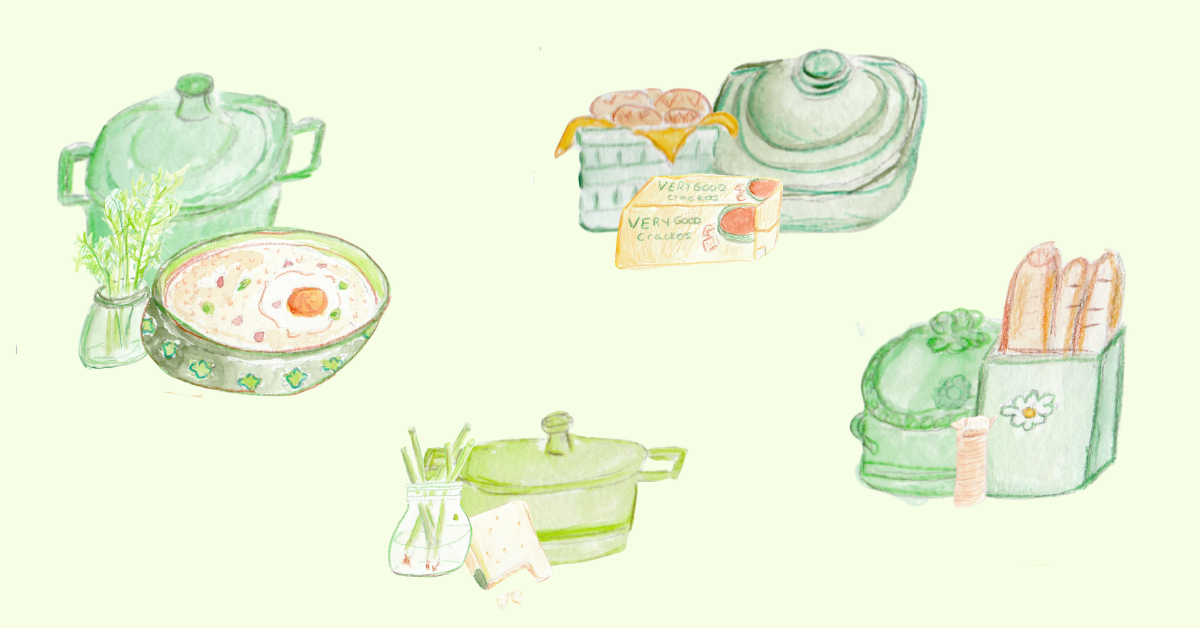
  •  

For better soups, start in the oven

For a while, I kept a soup journal.

Not a recipe journal, exactly. More like field notes. If I ate a soup I liked out in the world, I’d jot down what was in it, what the broth tasted like, sometimes sketch the bowl. I just adore the form.

Especially when I lived alone, it was not unheard of for all three meals in a day to be soup. One particularly triumphant day started with congee in Washington, D.C., continued with enchilada soup at an airport Chili’s and ended with pastina back home in my pajamas.

So, in honor of soup season, I’ve decided to spend the next few weeks of “The Bite,” Salon’s food newsletter, teaching what I’ve started referring to in my notebook at Soup School: a loose little series about the patterns that make soup better. We’ll talk about the ingredient your soup is probably missing — vinegar! — plus better soup toppers and, eventually, how to host a soup party.

But lesson one is the foundation for a lot of the soups I make at home: Start in the oven.

I don’t mean every soup. Some soups depend on freshness, delicacy or a particularly clean broth, and I’ll get to those. But when I want depth, sweetness, browning and the kind of flavor that tastes like something has been cooking much longer than it actually has, I start by roasting.

Here’s the method.

Roast what’s in the pot

Tomato soup was the one that made this click for me.

Mine started with garlic, red onion, sun-dried tomatoes, cherry tomatoes, fennel, olive oil, spices and an anchovy or two, all piled into a Dutch oven and roasted together.

The oven transformed every ingredient differently. The onion and fennel softened, browned and grew sweeter. The anchovy sizzled itself into the oil coating those browned alliums. The cherry tomatoes burst, their skins turning silky and their juices almost pasty around the edges. The sun-dried tomatoes somehow became even more concentrated. The spices perfumed absolutely everything.

By the time the pot came out of the oven, most of the flavor was already there.

That, to me, is the whole appeal of the method. You can build a similar kind of depth on the stovetop, of course, but the oven does a lot of the work for you. Dry heat browns, evaporates and concentrates while you go do something else.

And when you roast, push things a little farther than may initially feel instinctive.

Your vegetables should not be pretty anymore. I want onions slumped and browned at the edges. Tomatoes wrinkled and burst. Mushrooms dark. Carrots blistered. Bits sticking to the bottom of the pot. If everything still looks ready for a glossy farmers market photo shoot, give it another few minutes. This works beautifully with fresh vegetables, but frozen vegetables are welcome, too. So are drained canned beans. 

Douse whatever you have in oil, season it well and let it get ugly.

Roast your flavor boosters, too

This is also when I deploy what I lovingly think of as my potions and powders: anchovy, tomato paste, miso, soy sauce, fish sauce, bouillon paste or cubes, mushroom and brown gravy powder.

Not all at once, obviously, though I respect the chaos.

The point is to let those deeply savory ingredients spend some time in the heat rather than simply dissolving them into broth at the end. Tomato paste darkens. Anchovy melts into the oil. Spices bloom. Everything has a chance to mingle before the soup gets diluted.

Deglaze before you add the broth

Once everything is properly roasted, I add just enough broth to loosen the browned, sticky bits from the bottom of the pot. Not a carton. Not even close. At this point, the broth isn’t there to create the flavor. It’s there to capture what the oven already made.

Scrape thoroughly. Those dark little bits on the bottom are part of the soup now.

Blend only part of it

For a lot of vegetable, bean and chowder-style soups, I blend about half of what’s in the pot.That gives you body without turning the whole thing into purée. The blended vegetables thicken the broth, while the rest keep enough texture to remind you what you’re eating.

You can do this in a blender or with an immersion blender (though I tend to like the control of scooping part of the mixture into a blender and leaving the rest alone.)

Reduce it again

Here is the part that feels a little counterintuitive: after going to the trouble of deglazing the pot, I often cook everything back down again. I let the blended and unblended mixture simmer until it gets thick, concentrated and almost sticky. Then I add my final stock, cream or coconut cream until the soup reaches the consistency I actually want.

This is one of my strongest soup opinions: don’t drown the thing you just concentrated.

You can always add more broth. You cannot easily take it back out (though, if you do, it’s not the end of the world: just let the soup reduce longer.) 

Add a little. Stir. Taste. Add more if you need it.


Want more great food writing and recipes? Sign up for Salon’s free food newsletter, The Bite.


Finish last

Once the texture is right, I finish with whatever gives the soup its final bit of life: herbs, citrus zest, salt, black pepper, maybe cream. Those ingredients don’t need half an hour in the oven. They need to stay bright.

Once I noticed this pattern, I realized it’s how I make most of my favorite soups: tomato soup, corn chowders, vegetable soups, bean soups and even chicken soup.

For chicken soup, I roast thighs on a bed of onion, garlic, carrot and celery with big lemon slices, garlic powder, onion powder and plenty of black pepper. Once the chicken is cooked, I pull it out to shred later, while the vegetables underneath — softened in chicken fat, lemon and all those browned juices — become the base of the soup.

I am certainly not claiming to have invented roasted chicken soup. Italian penicillin nonnas have been several centuries ahead of me on that front. But the example stands.

Roast first. Deglaze. Blend some. Reduce. Reconstitute. Finish.

Know when not to do any of this

There are plenty of soups I would never subject to this treatment.

If I want something fresh, delicate or particularly clean-tasting, I stay on the stovetop. A clear miso broth with beautiful soft cubes of tofu doesn’t need caramelization. Neither does a simple cream of potato or parsnip soup (more on those next week!), or a bright, stewy pozole verde.

My spring pea soup — peas, stock, cream, dill, black pepper and lemon zest — absolutely does not belong in the oven. She is delicate. Leave her alone.

But if the goal is depth, browning and concentration, this is the pattern I come back to over and over.

Take the vegetables you have. Fresh or frozen. Add some canned beans if you’ve got them. Douse the whole situation in oil and spices and roast until things get a little ugly. Deglaze. Blend some of it. Reduce it. Add broth carefully. Finish it with whatever makes sense.

It is not a precise science. It is not particularly pretty.

It is, however, delicious.

Garam Masala–Roasted Tomato Soup with Coconut Cream

This is a current variation on roasted tomato soup I’ve been making a lot recently: warmly spiced with garam masala, fennel and coriander, rounded out with miso and coconut cream. Garam masala is an Indian spice blend whose exact makeup varies, but it commonly includes warming spices like cumin, cardamom, cinnamon, cloves and black pepper.

Yields
4 servings
Prep Time
15 minutes
Cook Time
55 minutes

Ingredients

  • 2 large beefsteak tomatoes, roughly chopped

  • 1 medium white onion, roughly chopped

  • 4 to 5 garlic cloves

  • 1 tablespoon minced fresh ginger

  • 3 tablespoons olive oil

  • 1 tablespoon white miso

  • 1 tablespoon tomato paste

  • 1½ teaspoons garam masala

  • 1 teaspoon fennel seeds

  • 1 teaspoon ground coriander, or lightly crushed coriander seeds

  • ½ to ¾ cup chicken stock, for deglazing, plus about 1 cup more to finish

  • ⅔ cup coconut cream, plus more for serving

  • Kosher salt and freshly ground black pepper, to taste

  • Sliced scallions, for serving

  • Fresh cilantro, for serving

  • Toasted bread, for serving


Directions

  1. Heat the oven to 375°F.
  2. Add the tomatoes, onion, garlic and ginger to a Dutch oven or other oven-safe pot. Add the olive oil, miso, tomato paste, garam masala, fennel and coriander and toss everything together until thoroughly coated.
  3. Roast for 30 minutes, then take a look. The tomatoes should be collapsing and the onions should be well softened and beginning to brown. Give everything a toss and return it to the oven for about 10 minutes more, or until the vegetables have achieved sufficient ugliness: deeply softened, browned around the edges and sticky in spots.
  4. Set the pot over medium heat and add ½ cup chicken stock. Scrape up all the browned bits from the bottom, adding another splash of stock if needed.
  5. Transfer half the mixture to a blender and blend until completely smooth.
  6. Return the blended soup to the pot and let it simmer until it once again becomes quite thick and concentrated. Stir in about 1 cup additional stock and the coconut cream, adding the liquid gradually until the soup reaches the consistency you like.
  7. Taste and season with salt and black pepper as needed; remember that the miso and stock will already bring some saltiness.
  8. Ladle into bowls and finish with a drizzle of coconut cream, sliced scallions and plenty of cilantro. Serve with toasted bread for dragging through the bowl.

This story originally appeared in The Bite, my weekly food newsletter for Salon. If you enjoyed it and would like more essays, recipes, technique explainers and interviews sent straight to your inbox, subscribe here.

The post For better soups, start in the oven appeared first on Salon.com.

  •  

The women reshaping kitchen culture

For a long time, the image of the chef has been remarkably consistent: a man in a white jacket, barking orders in a hot kitchen and demanding perfection from everyone around him.

At the Chef’s Table Festival in Park City, Utah, last month, the women chefs I encountered offered a much more expansive definition of what it means to cook — and what it means to lead a kitchen.

They weren’t presenting a single vision for the future of food. They were doing something more interesting: building careers around their own identities, experiences and ideas rather than trying to force themselves into the traditional mold of what a chef is supposed to look like.

During a panel titled “Women Shaping the Future of Food,” chefs Fariyal Abdullahi, Sarah Glover and Betül Tunç talked about everything from social media and motherhood to femininity, cultural identity and the pressures of building a career in an industry that has not always made much room for women.

For Abdullahi, visibility is part of that work.

She told the audience that after posting a simple video of herself breaking down a fish, the clip unexpectedly took off on Instagram. What surprised her wasn’t only the number of people watching, but what some of those viewers saw in her.

“I don’t realize how many eyes are on me until someone is driving from D.C. to eat my food and saying, ‘I want my daughter to be like you,’” she said. “Inspiring little girls and being visible is so important to me.”

Abdullahi, who grew up in Ethiopia, has always understood food as inseparable from community. She was raised in a huge extended family — she has 32 aunts and uncles — and remembers a house that was almost constantly full.

“Our house was always packed, I was never bored,” she said. “One of the things that captivated me about food was that it brings people together.”

That sense of togetherness followed her into professional cooking, but so did the more complicated expectations surrounding women and food.

Abdullahi spoke about growing up Muslim and the tradition of women showing respect for their husbands and male family members by cooking for them and serving them first. At the same time, she draws inspiration from the women in Ethiopian history who fought for the country’s independence, including an empress who went into battle against the Italian army.

She doesn’t see those identities as contradictory.

“I have both of those things in me,” she said.

That ability to hold seemingly opposing ideas at once became one of the most compelling threads running through the festival.

For Australian chef Sarah Glover, it has meant embracing femininity while building a career around one of cooking’s most visually aggressive elements: fire.

Glover talked about being inspired by Nigella Lawson, one of the early food-media personalities to make femininity itself a visible part of her public identity.

“Nigella was so beautiful and sexy and really showing people how to be this domestic goddess,” Glover said.

She also recalled a conversation with open-fire chef Francis Mallmann, who described fire as feminine. Glover connected that idea to Aboriginal traditions in which women historically cared for the fire while men hunted. There is something almost deliberately subversive about that framing. Fire is usually coded as aggression, danger and toughness. Glover sees something else in it: warmth, caretaking and even a kind of dance.

“People think fire is aggressive because it burns and it can hurt you,” she said. “But the smell and warmth is very nurturing and comforting.”

Glover said she enjoys embracing her femininity and “taking that back” while working over fire. Her floral, flowing clothes and romantic aesthetic are not things she feels compelled to shed in order to be taken seriously as a chef. They are part of the point of view she brings to her work.

That idea — that a chef’s point of view comes from the entirety of a life, rather than one neatly defined culinary tradition — surfaced again during a panel about travel and where chefs eat.

Chef Isabel Coss spoke about deliberately seeking out experiences that leave her feeling a little out of place. Travel, she said, requires trusting yourself and trusting the journey.

“Playlists, music, attention to detail, you bring all of that back,” she said. “We’re a compound of our travels, lives, and experiences.”

It is a useful way to think about culinary identity. Food does not always have to fit neatly into categories like Mexican, Jordanian, Ethiopian or Australian. It can be the accumulation of everywhere a person has been and everything they have experienced.

Jordanian chef Sara Aqel made a similar argument from another direction.

“We get really sucked into the idea of looking up to someone and wanting to be just like them, and that’s not right,” she said. “You start losing bits of yourself and what could make you a better chef and make your food better food.”

Aqel said she is fascinated by ingredients and techniques from around the world, particularly Japan. But when she cooks, she returns to what she knows most intimately.

Her food is rooted in Jordan, she explained, even as she incorporates techniques learned from chefs in Italy, Peru and Ecuador.

“Every chef I meet, I learn new techniques I can use,” she said. “But when you cook, you always want to cook from somewhere you understand.”

That sense of authorship was visible throughout the festival. Each chef seemed to have a recognizable point of view — something you could understand from the plate itself, without needing the chef to stand beside the table explaining it.


Want more great food writing and recipes? Sign up for Salon’s free food newsletter, The Bite.


For women working in food, though, that question of authorship extends beyond aesthetics. It can also mean rethinking the culture of the kitchen itself.

Earlier in the festival, chef Jessica Rosval made that argument during a panel about creativity. Creativity, she said, is never free. Chefs have to consider seasonality, cost, time and, crucially, the people who will actually have to execute the food.

“You have to be conscious of your team and employees in the process,” she said. “It’s your responsibility as a chef to provide good quality of work life.”

Rosval pushed directly against the stereotype of the angry, aggressive chef who treats the kitchen like a battlefield. A menu, she argued, should not require cooks to spend 18 hours peeling pine nuts simply because the chef wants to demonstrate technical skill.

“You have to learn how to take the big ideas and stories and compress that into a bite,” she said.

Her philosophy was simpler still: “Work does not have to feel like war.”

That may be one of the most significant shifts these chefs are arguing for. The goal is not simply to get more women into professional kitchens. It is to make enough room for women to decide what those kitchens — and the careers built inside them — should look like once they arrive.

That also means confronting one of the industry’s most persistent assumptions: that a successful chef must sacrifice everything else to the job.

Abdullahi and Glover both spoke about the fear many women in the industry face that becoming a mother could mean giving up their careers. Professional kitchens demand long hours and enormous physical and emotional energy, and the industry has historically been structured around the expectation that someone else is handling the rest of your life.

Abdullahi argued that the solution is not asking women to choose differently. It is building an industry spacious enough to hold both.

“We need to make space for women in the kitchen to have careers and also be mothers,” she said.

“Work does not have to feel like war.

The chefs at the festival weren’t offering a single blueprint for how to accomplish that.

Their work suggested precisely the opposite: there can be many versions.

There is Glover, embracing a feminine aesthetic while cooking over open flames. Aqel, grounding her food in Jordan while absorbing techniques from around the world. Coss, treating travel as an essential ingredient in her creative life. Abdullahi, drawing simultaneously from Ethiopian history, Muslim traditions and her own contemporary experience. Rosval, trying to build kitchens in which creativity and humane working conditions reinforce, rather than contradict, one another.

And then there is Bolivian chef Marsia Taha, who used the festival to introduce diners to an ingredient they might otherwise approach with some hesitation.

She served piranha.

The fish arrived at the table whole, head on, its sharp teeth still plainly visible. We ate it with our hands.

And it was delicious.

That meal felt like a small, vivid demonstration of what the women at the festival had been describing all weekend.

Food can preserve tradition without becoming trapped by it. It can be feminine without being delicate. It can be ambitious without being punishing. A chef can travel the world without losing sight of where she came from. She can become a mother without surrendering her career. A kitchen can demand excellence without demanding suffering.

At the Chef’s Table Festival, the women chefs seemed less interested in proving that they could succeed within the old model than in asking what might happen if they built something different.

The future of food does not require one new model of the chef.

It requires making room for many more of them.

The post The women reshaping kitchen culture appeared first on Salon.com.
  •  

I didn’t know what I was made for until I made this banana cake

When I graduated from college, I aspired to be a war correspondent and report on the humanitarian crises shaping our time. My life, too unconventional for a husband and kids, would be lived out of suitcases, a dog-eared passport forever in my back pocket. My family would be the other journalists embedded with me in military zones.

That’s not what happened. 

I failed the test the Associated Press gives to prospective foreign reporters. Instead of being wedded to my work, I got married to a finance guy from Boston, had twin daughters and wound up working in the creative department of a New York City ad agency as a copywriter. After 15 years in the business, the logistics and expense of childcare became overwhelming and I left advertising for the one job I never imagined for myself: stay-at-home-mom.

As much as I loved being home with my kids and understood the privilege it was, I was bored. All my friends were at the office. I wondered if I had made the right decision leaving my job. I was good at advertising; I won awards for my work. But now, I seriously doubted anyone was going to hand me a bronze statue for the way I yelled at my kids for not finishing their chicken nuggets. I had gone from making Super Bowl ads to snack bags and I was struggling to find the glory in any of it. 

In the middle of this identity crisis, I started to bake. I missed the creative process and dreaming-up desserts seemed like the perfect outlet. The added bonus— I could do all of this between school drop-offs, pick-ups and everything in between.

The first thing out of my oven were chocolate chip cookies. I was floored by what I could create with flour, eggs and sugar. I felt like I was back at the ad agency brainstorming new ways to brand old products — but instead of standing in my all-white office, I was at my kitchen counter concocting bespoke cookies — potato chips and butterscotch, rum and dark chocolate, fresh corn from the cob and cranberries. And then one day, when I had a bunch of almost-rotten bananas sitting on my kitchen counter, I threw them together and made a cake. 

Not banana bread— there was no cinnamon, cardamon, nuts or loaf pan involved. Instead, it was a layered cake made from whipping butter and sugar until it was frothy and then sifting in the dry ingredients. Just before everything came together, I folded in sour cream, infusing a bit of tang to balance the sweet. Lastly, I added an abundance of bananas—which gave the cake its classic, all too familiar feeling. Like running into an old friend you didn’t realize how much you missed. 

I frosted the cake with a Swiss meringue buttercream that required bringing egg whites and sugar together over a pot of simmering water and then whisking it into stiff peaks. The last step was drizzling a tablespoon of good olive oil over the batter which was a trick I had learned in one of the myriad baking newsletters I now subscribed to.

The result is a crumb that is delicate, every forkful a moist, subtlety sweet bite. Deceptively light, the cake is easily devoured. It was an instant hit.

Since then, I’ve baked the cake for countless weddings, birthdays and gender reveals. It was even flown across the country for an 80th birthday. 

A couple in Los Angeles keeps it in the back of their freezer just in case.  An NBA player swears it brought him good luck after devouring it the night before a big game. When I was the head baker at my local homeless shelter, I baked it hundreds of times and saw how one slice, served on a paper plate, could become a catalyst for dialogue. It is the cake I overheard a caterer say to himself, Jesus, this is good. 

Now, almost 40years later, as I watch people cut into my banana cake, I see it all— independence, grief, hope, joy. I once thought I would have to travel to the frontlines to witness humanity up close. It turns out I am already there.


The post I didn’t know what I was made for until I made this banana cake appeared first on Salon.com.
  •  
❌