❌

Reading view

The dark paradox of Israel’s election — and ours

Benjamin Netanyahu didn’t win last week’s election in Israel. But he didn’t exactly lose it either. The real loser may have been Israel’s fragile democracy, already corrupted from within, perhaps past the point of no return, by Netanyahu’s decades-long death-grip on power.

On the eve of a momentous election in the United States, the parallels are both inexact and unavoidable. Israelis must now decide what kind of country they will have, or at least what kind they aspire to have. They must decide whose votes actually count, and whether some citizens are more equal than others. 

Those same questions also confront Americans, both in this week’s midterm elections and, in a more general sense, on the larger political and historical stage. No doubt it is tempting for liberals and progressives to express outrage at the blatant flaws and contradictions of Israeli democracy. But to invoke the Christian tradition here, it might be better to remove the plank from your own eye before trying to remove the speck from your brother’s. 

On the surface, the electoral arithmetic in Israel appears straightforward. Parties opposed to Netanyahu’s far-right government won 67 of the 120 seats in the Knesset, Israel’s parliament. So a majority coalition of anti-Netanyahu forces is clearly achievable, right? You would think so, except that 19 of those 67 seats were won by Israel’s “Arab parties,” an all-time high, and that startling fact has thrown the entire political system into confusion.

Netanyahu and his allies have spent the last week airing groundless allegations that the election was fraudulent or rigged, a refrain that Americans are likely to hear a great deal in coming days. What the Zionist far right means is that too many Israeli Arabs — meaning the Palestinian population that remained in Israel after the state was created in 1948 — decided to vote this time, an outcome that no one expected, and that none of the parties representing the Jewish majority particularly wanted. 

Now, in a masterstroke of historical or perhaps biblical irony, Israel’s Arab minority — which is not a monolithic group in political or cultural terms, and until now has never been electorally significant — holds the balance of power, and perhaps the nation’s future, in its hands. 

In a masterstroke of historical or perhaps biblical irony, Israel’s Arab minority — which is not a monolithic group in political or cultural terms, and until now has never been electorally significant — holds the balance of power, and perhaps the nation’s future, in its hands.

Gadi Eisenkot, the former general who leads the centrist-Zionist opposition to Netanyahu, promised during the campaign not to form a government with Arab support. Over the last several nights, thousands of demonstrators in Tel Aviv and Jerusalem have urged him to do precisely that, since the only realistic alternative is the grim default setting of Israeli politics: another wobbly right-wing government headed by Netanyahu, which means more brutality and destruction in Gaza, more war with Iran and more settler violence in the West Bank. 

As Gideon Levy of the left-leaning Israeli newspaper Haaretz explains it, 

The future of Israel now depends on its Arab citizens and on the attitude of its Jewish citizens toward its Arab ones. Eighty years after the Nakba and the establishment of the Jewish state, Israeli Palestinians may determine its fate. Is there greater historical justice than that?

The election’s unexpected results are “a cause for rejoicing,” Levy writes, in that they have presented Israelis with a clear choice “between a government led by Benjamin Netanyahu and a government that includes the Arab parties.” If the “change bloc” within the Zionist majority cannot accept a coalition with Arab Israelis, he continues, “they will make it clear that they are actually the same as Netanyahu, that they prefer even the devil Netanyahu over repressing their racism. … [E]veryone will know that racism is the supreme value in this country, across the board, above any other value.”

That ferocious language certainly does not represent mainstream Israeli opinion, but it’s fair to say the strong emotion beneath Levy’s words is far more widely felt. I don’t think it’s possible for a non-Jewish observer (such as myself), however well educated or sympathetic, to understand the anguish felt by Jewish people — wherever they live, and whatever their political views — at the enormous distance between what Israel originally represented to the world, or claimed to represent, and what it represents now.

I’m old enough to remember when most American liberals and progressives viewed the state of Israel in overwhelmingly positive terms, as a locus of charismatic or heroic renewal for the people Hitler couldn’t kill, infused with the spirit of European socialism and, not far below the surface, the collective guilt of the Holocaust. I grew up in one of the most left-liberal corners of America, surrounded by educated adults who supported the civil rights movement, opposed the Vietnam War, hated Richard Nixon and loved Israel. Golda Meir and Moshe Dayan were beloved celebrities; the Six-Day War of 1967 and the Yom Kippur War of 1973, as narrated by U.S. media, were straight-up battles between the forces of light and darkness. 

That says more about the moral blindness or willful innocence of American liberalism, I must admit, than it says about Israel. In any event, when I saw Joe Biden’s fateful bear hug with Netanyahu on the tarmac of Ben Gurion Airport in the aftermath of the dreadful Oct. 7 attack, I understood it. I recognized the country Biden was coming from, because I came from there too: It was the Democratic majority of the not-so-distant past, when Israel was embraced as a light to the nations and left-wing radicals who brought up the Palestinian cause were being unreasonable hotheads, if not openly antisemitic and a little bit Nazi. 

What Israel has become during Netanyahu’s long and destructive reign is now clear to most of the world, and most of all to the many Jewish or Israeli critics who have been speaking difficult truths for many years, often at enormous personal cost. I am disinclined, however, to judge too harshly those who cling to the vision of Israel as an exceptional nation — one that has stumbled, perhaps, but may yet regain its true path. 


Want more sharp takes on politics?
Sign up for our free newsletter, Standing Room Only by Amanda Marcotte, also a weekly show on YouTube or wherever you get your podcasts.


Like I said earlier, we should mind the plank in our own eye first. Isn’t that the same vision that many Americans still cling to? That somehow, on the other side of this dreadful phase of our history — yes, a full decade of Donald Trump, but I’m afraid the damage goes back a lot further than that — the “indispensable nation” variously articulated by Abraham Lincoln, John F. Kennedy and Barack Obama is still there, still retrievable, still bending its moral arc toward justice.

Americans and Israelis are conjoined by history, for better or worse, and now see each other as distorted reflections, through a glass darkly, as the King James Bible puts it. We face versions of the same decisions this week, about whose votes count and whether the highfalutin words of our constitution apply to everyone. About whether to see terror and tyranny for what they are, and turn the page.

The post The dark paradox of Israel’s election — and ours appeared first on Salon.com.
  •  

Trump’s Iran war could escalate. Is anyone paying attention?

Barely noticed among all the talk in the election campaign about great asses, shithouse countries and commie jihadists running for the Senate was a report from The New York Times warning of “heightened levels of tension and risk” surrounding Israel’s parliamentary elections, slated for today, and America’s Nov. 3 midterms due to the countries’ war with Iran, which has “entered a new phase.” They also offered this bracing observation: “This is how countries can escalate into full-scale war, several diplomats and outside experts noted.”

How’s that for a wake-up call?

In fairness, Donald Trump has mentioned in passing that he plans to “finish the job” after the midterm elections, with CNN reporting that the president “appears to be leaning toward major action.” On Oct. 15, the outlet revealed that the U.S. is considering using the “mother of all bombs” on Iranian energy infrastructure and nuclear facilities. (They admit that such a strike would be “performative,” since it would not actually accomplish anything, but would supposedly allow Trump to declare victory.) 

If anyone had the idea that a midterm election campaign would be the place where serious people of goodwill debate the major issues of the day, they were mistaken. For the most part, the war with Iran has hardly come up, and to the extent that it has, it’s been in the context of high gas prices.

If anyone had the idea that a midterm election campaign would be the place where serious people of goodwill debate the major issues of the day, they were mistaken. For the most part, the war with Iran has hardly come up, and to the extent that it has, it’s been in the context of high gas prices, not the possibility of the conflict turning into a major conflagration from which the United States will not be able to walk away after putting on a fireworks show. We may be at a turning point, and nobody’s paying attention.

The U.S. has received credible intelligence, according to the Times report, that Iran has “advanced” plans to attack Americans at home and abroad. According to Reuters, the State Department has ordered non-emergency government employees and their family members to leave ‌U.S. diplomatic ⁠missions in Saudi Arabia and has reduced staff in Lebanon, the United Arab Emirates, Qatar and Jordan. NBC News revealed that “the U.S. military has been quietly scaling back its troop presence at bases across the Middle East as well.” It certainly sounds as if something is afoot, which the Times characterized in fairly alarming terms:

The fact that Prime Minister Benjamin Netanyahu of Israel and President Trump are facing critical elections that could dramatically affect the balance of power in their countries feeds into the complex set of calculations that all sides are making. Even if he is defeated on Tuesday, Mr. Netanyahu could decide to launch one last strike that he may believe his successor would hesitate to execute. Similarly, Mr. Trump, who knows how unpopular the war is even among his strongest supporters, may want to show that at least when it comes to his powers as commander in chief, his authority is undiminished.

Trump has claimed dozens of times that we have already won the war. This is not out of character; his habit is to prematurely declare victory in everything, apparently assuming that the force of his declaration makes it a reality. In the lead-up to the U.S. and Israel’s Feb. 28 attacks on Iran, Trump was apparently so pumped up by his historic political comeback and success at cruel mass deportation, murder on the high seas and the conquest of Venezuela, an oil-rich country, that he assumed he could succeed at what every former president knew was a fool’s errand: take over Iran, seize its oil and dominate the world’s oil supply. And, as Haberman and Swan reported in their book “Regime Change,” Trump had been convinced by whom he called a presidential historian (actually a caddie for Gary Player) that he was “the most powerful man who’s ever existed on the planet by far” — more powerful than Mao, Alexander the Great, Stalin, Hitler, all of them.

What Trump has succeeded in doing is making Iran a global power, capable of re-ordering the world through control of one of the most important waterways on the planet. In the process, he has exposed the U.S. as a second-rate military power, at least compared to the country’s previous reputation, by insisting on fighting an unnecessary war of choice without a strategy while being low on munitions and proving that it lacks the capability of fighting on more than one front. Having let down our Middle Eastern partners who assumed that by allowing bases in their countries they could count on America to defend them — not to mention the administration’s destructive tariffs and abandonment of Ukraine — the world knows that the U.S. is unreliable, and they are looking elsewhere for alliances and economic partnerships.

All this brings to mind historian Barbara Tuchman’s “The March of Folly.” Published in 1984, the book examines tragic wars of choice that needn’t have been fought but, because of hubris and ignorance, were waged anyway, despite being against the best interests of the countries that started them. As Tuchman put it:

To qualify as folly for this inquiry, the policy adopted must meet three criteria: it must have been perceived as counter-productive in its own time, not merely by hindsight . . . Secondly a feasible alternative course of action must have been available . . . third . . . the policy in question should be that of a group, not an individual leader.

The war with Iran ticks all those boxes. 


Want more sharp takes on politics? Sign up for our free newsletter, Standing Room Only, written by Amanda Marcotte, now also a weekly show on YouTube or wherever you get your podcasts.


Among the conflicts Tuchman chronicled in the book are the errors of the Catholic Church that led to the Reformation, as well as King George III’s epic misunderstanding of the dynamics driving the colonists (and England’s other enemies) to rebel against the British Crown. She also turned her keen historical eye to the big kahuna of her era, Vietnam, in which the U.S. squandered its power and moral authority on a war that began as an ideological experiment, escalated for political reasons, and ended in failure and embarrassment only 51 years ago. You’d think that lesson would still be fresh enough that we wouldn’t indulge in such a folly again.

But, of course, we have. While Afghanistan had at least the fig leaf of justification after 9/11, Iraq and now Iran have both demonstrated that the U.S. has learned nothing from its own recent history. Eight months in, Trump’s misadventure in the Islamic Republic has proven even more irrational than the others. As with all the follies, Trump indulged his fantasies, failed to understand the adversary and ended up working against his country’s own interests.

A delusional, psychologically unfit president started a war based on shifting rationales, finally landing on the idea that Iran was pursuing a nuclear weapon. This was the same country that had been complying with an agreement not to pursue a nuclear weapon, but which this president tore up simply because it had been negotiated by the man he succeeded in office. 

We don’t yet know whether these latest threats will lead to an escalation by either party. But either way, the deed is done. The world has been fundamentally changed by Trump’s daft decision to start this war, and there is no going back. That’s how all these follies end, and it’s very rarely a happy ending for the countries that started it.

The post Trump’s Iran war could escalate. Is anyone paying attention? appeared first on Salon.com.

  •  

Trump wades into Israel’s election to back ally Netanyahu

President Donald Trump endorsed Israeli Prime Minister Benjamin Netanyahu for reelection Sunday, warning Israeli voters against choosing the “wrong Leader” just nine days before the country’s national election.

In a lengthy Truth Social post, Trump praised Netanyahu as a “Great Warrior Prime Minister” and a partner in confronting Iran, while suggesting that electing someone else could complicate future U.S. military action against Tehran.

“If Israel has the wrong Leader, which would be anyone other than Bibi, America will have to do this work ourselves, and I am not inclined to do so,” Trump wrote.

Trump also threatened to “soon finish the job” against Iran unless its leaders “change their ways, rapidly.”

The endorsement marks a shift for Trump, who had spent months declining to publicly back Netanyahu despite their longstanding alliance. Earlier this month, when asked whether he supported Netanyahu’s reelection, Trump told Time magazine, “I’m not involved in politics anymore.”

Their relationship has been strained by disagreements over the nearly eight-month war with Iran, Israeli military operations in Lebanon and efforts to negotiate a ceasefire in Gaza.

Netanyahu welcomed Sunday’s endorsement.

President Trump, my friend Donald – thank you for your extraordinary endorsement. Israel has never had a greater friend in the White House. Together we will never let Iran’s regime get nuclear weapons. Thank you for your clarity, courage and unwavering support.

@realDonaldTrump https://t.co/GqaOVB74Dj

— Benjamin Netanyahu – בנימין נתניהו (@netanyahu) October 18, 2026

“Thank you, President Trump, for the tremendous support and work together,” Netanyahu wrote on X. “Together we will complete the mission!”

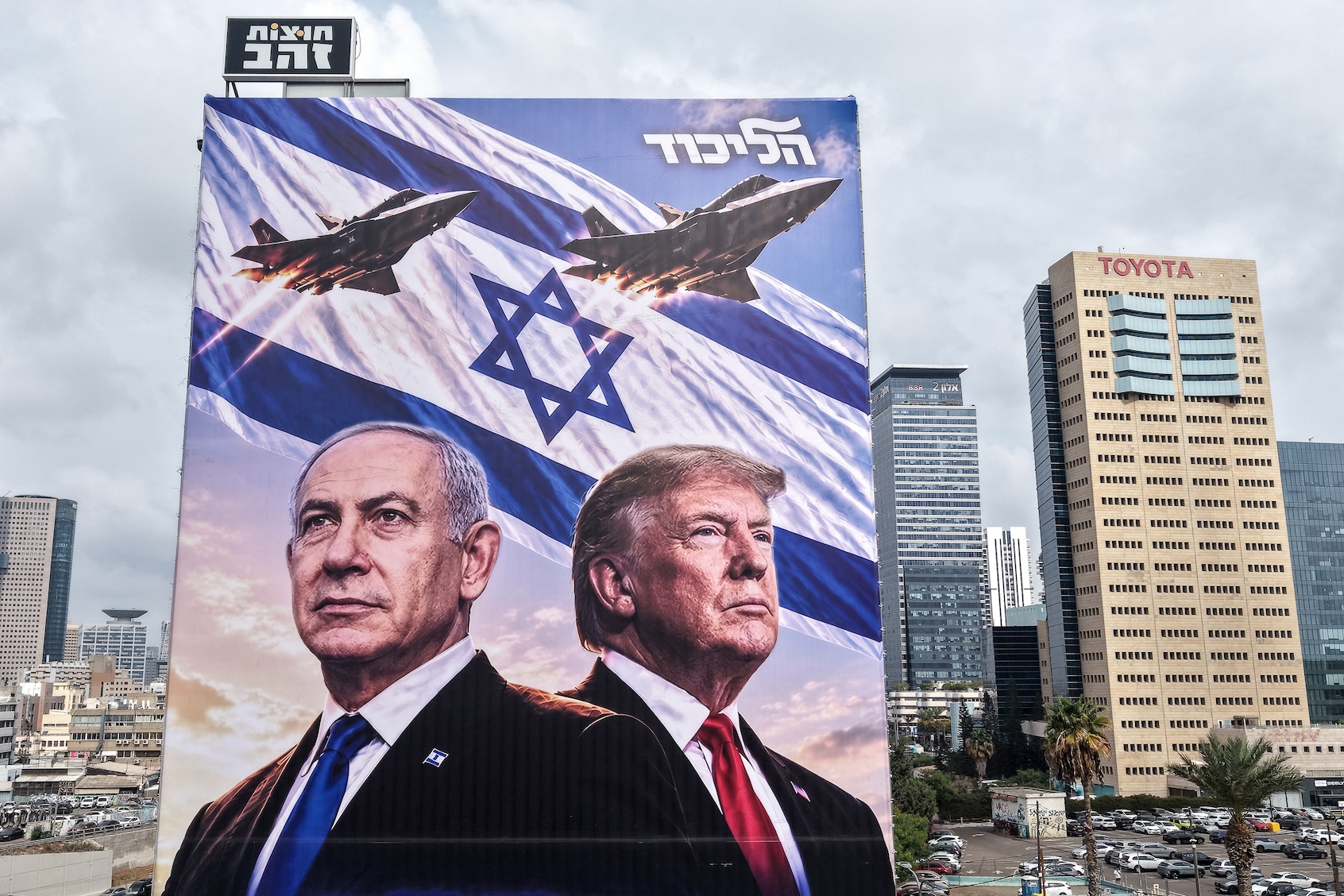
His Likud party also circulated a campaign video featuring the two leaders.


Start your day with essential news from Salon.
Sign up for our free morning newsletter, Crash Course.


Netanyahu faces a competitive election against opposition parties led by figures including former military chief Gadi Eisenkot and former Prime Minister Naftali Bennett. Recent polls suggest Netanyahu’s governing bloc could fall short of the 61 seats needed to command a majority in Israel’s 120-member parliament.

Trump has increasingly departed from the traditional U.S. practice of avoiding explicit endorsements in foreign elections, backing candidates in countries including Hungary, Japan and Argentina.

Israelis vote Oct. 27 in their first national election since Hamas’ October 2023 attack.

The post Trump wades into Israel’s election to back ally Netanyahu appeared first on Salon.com.

  •  
❌