President Donald Trump continued to claim the United States and Iran were in active peace talks on Monday, despite denials from Iranian and U.S. officials.
“Iranian Leadership is unbelievably duplicitous!” Trump wrote on Truth Social. “They ask for a meeting, some would say’ beg,’ talks begin, with more scheduled in the immediate future, and they say, openly and proudly, that they’re not having any discussions, that nothing is being talked about, and they’re only dealing with ‘Oman.'”
Trump told reporters over the weekend that Iran came to the U.S. hat in hand to avoid further airstrikes. The president said that the Pentagon had planned “the biggest attack since World War II.”
“It would have been disastrous for them,” he said. “They didn’t want us to do it, and frankly, Saudi Arabia didn’t want it either.”
Trump called the denial a bit of “their usual bather.” He said that Iran needs to reach a deal with the U.S. or surrender unconditionally. Speaking to a reporter in the Oval Office on Monday, Trump said he was offering Iran “every last chance before decapitation.”
“Very tough to do what we have planned, still planned,” he said. “We’ll see what happens.”
No popular music genre despises the present as much as country music. Through quirks of form and function, all other radio-ready music is incredibly focused on its immediate surroundings. Pop has trendiness in its very bones, and its songwriters’ striving for universality tends to create songs focused on broad, current feelings: the sharp sting of a fresh heartbreak, the effervescence of new heartbreak, the joy of dancing in this club right now.
Rap is usually made quickly by impossibly young stars for an equally young audience, so it tends toward today’s fashion. Micro-trends in production, slang and topics come and go quickly. Last month was another era. Last year might as well be prehistoric.
Country music, though, is a different animal, born out of the urban migration of the 1930s as a way to sell a slice of an idealized past on wax to newly minted city-dwellers longing for home. Sonic trends — from the slick countrypolitan in the 1970s to the neo-traditionalist 1990s and on through the trap-indebted 2010s — have come and gone. Demographics on the dial have shifted. Stars are younger and more male than they’ve ever been. But that focus on greener pastures is as persistent as the apparent blood feud between Texas and Tennessee.
The average country listener wants to have their past misremembered for them, whether it’s the Judds asking Grandpa about the good old days or Tim McGraw missing the nebulous “back when.” The biggest hits sand down the rough-hewn edges of Mama’s metaphorical front porch to up their resale value, perhaps never funnier than Luke Bryan’s bullet-point summer vacation on “Fish, Hunt, Golf, Drink.” All that cornpone Luddism floating around made Gillian Welch’s “Everything Is Free” feel remarkable upon its release 25 years ago.
The concerns of the track from 2001’s “Time (The Revelator)” are topical and immediate. Welch responds to the then-new phenomenon of online music piracy with practical concerns. How am I going to pay my bills if no one wants to pay me for my music? How do I put gas in the car right now? Nearly a decade before the launch of Spotify, Welch saw clearly that someone was bound to “hit the big score” off of the new model — it just wouldn’t be her.
“Everything is free now, that’s what they say. Everything I’ve ever done, gonna give it away,” she sings, before immediately shifting toward plans to make money elsewhere so that she can keep performing.
A quarter century on from the song’s release, the U.S. economy is overrun with people who believe that nothing should come with a price tag.
A quarter century on from the song’s release, the U.S. economy is overrun with people who believe that nothing should come with a price tag. The finance industry is dominated by private equity firms that offload the debt of their corporate acquisitions onto other companies, the better to walk away clean when those companies collapse. The biggest players in Silicon Valley are building data centers to more efficiently run copyright-infringement machines built on terabytes of pirated material.
The journalism industry was hollowed out by the same forces that sliced up Welch’s catalog, leaving few journalists to report on the graft and theft this post-payment class of billionaires are carrying out across the country. The Jeff Bezos-owned Washington Post, once a world-class newspaper, has turned into a shell of its former self following a conservative reorientation of its opinion pages and a corporate downsizing that saw over 300 of newsroom journalists laid off in February, representing about 30% of its total staff.
More recently, Louisiana officials recently inked a secret agreement with Meta to build a five-mile-long data center in the state. The New York Times eventually sniffed out the backroom deal. The local papers were too busy covering the hors d’oeuvres at Mark Zuckerberg’s celebratory luncheon.
At the same time, the ham-fisted hollowing out of regulatory agencies by the Trump administration has had predictable results. Outbreaks of new livestock diseases, parasitic produce and slower responses to global crises followed the Department of Government Efficiency’s wild budget-slashing even as Elon Musk, the man who helmed that project, is richer than anyone else in the history of earth — and he’s gearing up to throw millions into the 2028 presidential and congressional elections.
It would be a stretch to say that Gillian Welch saw all this coming. But listening back now, it’s hard not to marvel at how timeless this timely track feels. You can’t help but sympathize with her desire to skip the coming crisis in her industry. She “never minded working hard,” she sings, but she had a lot of concern about “who I’m working for.” Seeing into the future that she’d soon be asked to work for pennies while someone else got obscenely rich, she passed.
“If there’s anything you want to hear,” she says, “you can sing it yourself.”
If only we all could have opted out in a similar fashion.
For a good portion of “Spider-Man: Brand New Day,” we watch all versions of the film’s namesake arachnid-juiced hero (Tom Holland) — full leotard, half leotard, sans leotard —cyberstalking Ned (Jacob Batalon) and MJ (Zendaya), his best friend and love interest, respectively, who now have no memory of him at all since the last time Spidey put them both in harm’s way, in 2021’s “Spider-Man: No Way Home.”
Romantic threads are a standard given annoyance in these films, put in so there’s something for everyone, to advance the plot when there is no more plot to be had, and to give me the opportunity to jump into the debate of: “They’re just men when they’re not saving the world, they should be allowed to date” with an emphatic: No they shouldn’t!
If you’re new to the Spider-verse, or you’ve forgotten the details of what took place in “No Way Home,” Spider-Man called upon Doctor Strange to wipe the memories of MJ, Ned and the rest of the world during a tear in the multiverse in which Peter Parker’s identity was made known, which was obviously bad news for him and everyone around him. Shortly before this spell is cast, Parker makes a promise to MJ that once things stabilize and there’s no longer the threat of a dimensional collapse, he’ll find her and make her remember not only who he is, but that she’s in love with him. At the end of the film, we see Parker pay a visit to a donut shop MJ is working at and make the choice to leave her be, rather than tip her for his coffee and cruller by backflipping onto the counter and throwing a posterboard with “YOU LOVE ME” written on it in her face.
But flash forward just short of five years, and here he comes again, putting the woman he claims to love in harm’s way just as she’s gotten settled into a relatively danger-free life without him, newly graduated from MIT and nuzzled up with a boyfriend who, while considerably less exciting, will almost definitely not get her killed.
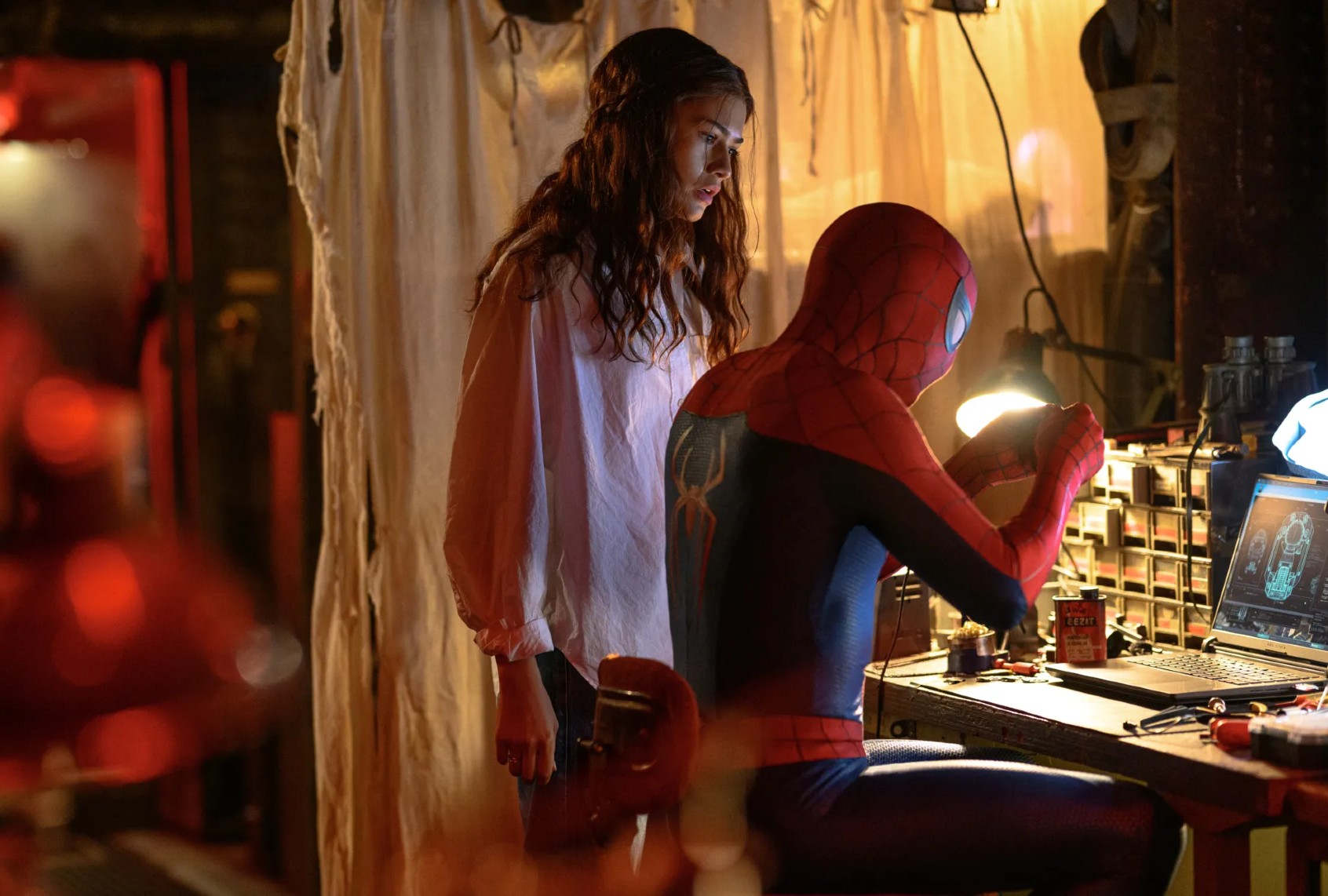
(Sony Pictures) Tom Holland in “Spider-Man: Brand New Day”
What is the plot of “Brand New Day?” You may be asking yourself this regardless of whether you’ve already seen the film or not. Well, given the amount of Marvel Cinematic Universe hooey thrown into this thing . . . what isn’t the plot? But don’t worry, amidst all of the flippin’ and swingin’ and jizzy web-shootin ‘, MJ and other women characters such as a movie-saving Jean Grey (Sadie Sink) and Black Widow (Florence Pugh) are given a few lines so that, regardless of what’s going on, men in the audience will receive flashes of someone to fantasize about saving or showing their pepperoni nipples to.
Sometimes the best way to love someone is by leaving them the hell alone.
The fact that superhero movies always cram in a love story element is both annoying and ridiculous, but it makes sense. Big-budget films of the “Superman,” “Batman,” “Spider-Man” variety need to make sure they turn a profit by getting butts in seats, and that means layering on whatever (and however) they’ve determined each and every one of those butts will be expecting to see in order to make it seem worth tapping their cards for the price of admission and concessions. Romantic threads are a standard given annoyance in these films, put in so there’s something for everyone, to advance the plot when there is no more plot to be had, and to give me the opportunity to jump into the debate of: “They’re just men when they’re not saving the world, they should be allowed to date” with an emphatic: No they shouldn’t!
Want more from culture than just the latest trend? The Swell highlights art made to last. Sign up here
Batman has a crush on someone? Cool! She’s probably gonna die. Superman has been in love with Lois Lane for years? Awesome, she’s never gonna be safe again because every one of his enemies is going to try and throw her off a building. Spider-Man finds time to haunt MJ’s Instagram stories amidst all manner of chaos breaking out in the streets of New York and beyond? Well, sure, let’s just do whatever, at this point. Just like the average moviegoer likes to chuck some Reese’s Pieces in their tub of popcorn to get that salty and sweet action going, most people like for their eyeballs to get breaks from the stomach kicking and face punching by watching implied or actual grab-ass. We’re a simple species. And that’s OK. Still ridiculous though.
(Sony Pictures) Zendaya and Tom Holland in “Spider-Man: Brand New Day”
In “Brand New Day,” as Spider-Man is dealing with his genes mutating in a way that increases his powers, gives him migraines and makes it so that he no longer needs the use of synthetic webs because real (real gross) ones now shoot from his wrists, there’s so much else going on in this still, somehow, pretty boring movie.
Extras are flash-mobbing in the background as Jean Grey telepathically hops from body to body to do a mixed-bag of whatever she wants: infiltrate the Department of Damage Control, mess with Spider-Man, look for her sister who’s dead. The Punisher (Jon Bernthal) is grunting and groaning around, helping Spidey and providing elbow-jab opportunities for guys in the audience to turn to their dates and loudly whisper: That’s me. Black Widow is holding meetings in a Russian bath. The Hulk (Mark Ruffalo) is like, “Did I kill anyone?” And where’s Spider-Man? Putting flowers on Aunt May’s grave each day and pouting when MJ is finally like “Thanks for saying you love me . . . I don’t know you.”
How about this? Maybe in the next Spider-Man movie, and every superhero movie to follow, we put to rest this shoehorned lovey-dovey nonsense and leave viewers with the big takeaway that sometimes the best way to love someone is by leaving them the hell alone and that, in certain circumstances — especially if you’re tasked with saving the world on a daily basis — your job actually is more important.
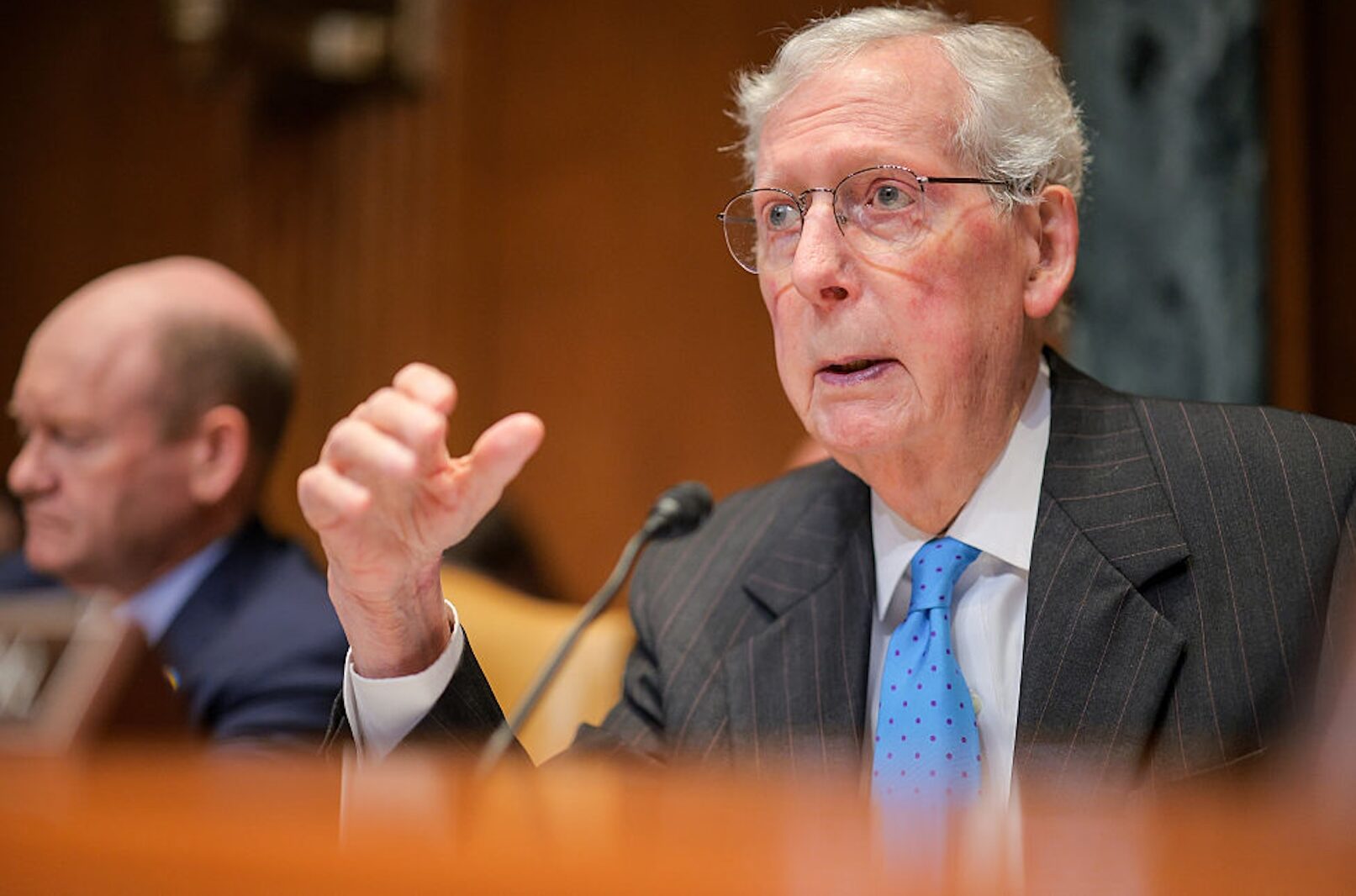
They must have hoped the photos would dispel conspiracy theories that he’s dead, or at least incapacitated. But the two proof-of-life pictures taken of Sen. Mitch McConnell and his wife, former Labor Secretary Elaine Chao, purportedly from his room at a rehabilitation center, have only generated more speculation about what has really happened to the 84-year-old Kentucky Republican, who hasn’t been seen or spoken in public since being hospitalized in mid-June. In both pictures, the typically sharp-minded senator is staring with a vacant smile at the camera, while the 73-year-old Chao has a firm grip on his arm that reads less as affection and more like direction.
In the first, taken July 12, McConnell holds the day’s newspaper, a tradition familiar more commonly seen in hostage photos. Even that pretext was dropped from the second picture, released July 27, which was accompanied by a note from the Senate attending physician insisting that McConnell is working “to rebuild strength and reduce the risk of future falls.” This followed the senator’s continued refusal to say much about what happened besides that he fell down and was “briefly unconscious.”
McConnell has a long history of dirty tricks — culminating in functionally stealing a Supreme Court nomination from then-President Barack Obama and holding it for Donald Trump — so it’s not surprising that many progressives suspect the former Senate Majority Leader has sinister motives in refusing to step down from his seat. There has also been boundless speculation that he’s using this to gain some illicit power for Republicans. The rumors have gotten so bad that Andy Beshear, Kentucky’s Democratic governor, publicly demanded that McConnell “directly and verbally address the people of Kentucky and provide proof of your capacity to serve, or resign.”
Despite the chatter, it’s almost certain that McConnell isn’t doing this to benefit Republicans in the Senate. In commentary for MS NOW, independent journalist Lindsay Beyerstein pointed out the senator’s absence means “the GOP is down a vote in a closely divided Senate.” Trump’s struggle to get his attorney general nominee Todd Blanche across the finish line is a reminder of how every vote counts for the party.
But it’s hard to fault conspiracy theorists when it really does seem that McConnell — or whoever is making decisions for him — is hiding something. Efforts to convince the public that he is communicative backfired when people noticed that the Republicans claiming to have spoken with him appeared to be working from the same script. As Beshear noted last week, even McConnell’s doctor noticeably avoided addressing whether the senator can “speak, reason, or carry out” his duties. Already set to retire at the end of the year, it’s becoming clear that McConnell is never coming back to the Senate chambers.
Despite the conspiracy theories, the likeliest reason to conceal McConnell’s condition is more pathetic than calculating: It’s hard for these powerful old men and their families to let go of power.
Despite the conspiracy theories, the likeliest reason to conceal McConnell’s condition is more pathetic than calculating: It’s hard for these powerful old men and their families to let go of power.
In their controversial book “Original Sin: President Biden’s Decline, Its Cover-up, and His Disastrous Choice to Run Again,” Jake Tapper and Alex Johnson examined the role that ego and status play in keeping politicians in office long after they’re capable of doing the job. The writers uncovered evidence that Biden’s delusions were bolstered by both his family and his top staff, who seemed loathe to give up the elevated status and power that comes from being close to the president. This impression has only deepened in recent weeks, as Biden’s son, Hunter Biden, has been on a bizarre media tour for no other apparent purpose than squeezing his famous last name for one more bout of attention.
This is why there’s been such a focus on Chao’s role in her husband’s health drama, starting with the clothes she’s wearing in the proof-of-life photos which are being examined and analyzed for clues.
“I can’t imagine Elaine, one of the most put-together people in existence, releasing a pic wearing a thin shirt over a visible black bra, UNTUCKED,” writer Jeff Yang, who claims to know the Chao family, argued on Bluesky about the second photo taken from McConnell’s hospital room. Others argued that the shirt is too cheap-looking to be something Chao, who is every inch the wealthy socialite, would wear.
To be fair to Chao, she is a private person; most of our perception of her fashion comes from glimpses of her at public events. In the real world, people don’t typically dress to visit a medical facility the same way they do for work. Nonetheless, internet sleuths sussed out that the shirt Chao is wearing on the July 26 photo appears to be the same one she was seen wearing on July 15. But whatever her level of responsibility, it’s not surprising that McConnell’s wife is the center of many conspiracy theories. It wasn’t that long ago that then-First Lady Jill Biden was engaged in ham-fisted efforts to deny and downplay her husband’s inability to do his job.
Like the aging politicians themselves, family members often benefit from the status and power they get through their famous relatives. Chao is no different. Not only did she serve in the Cabinets of Trump, George W. Bush and George H.W. Bush, Chao was also appointed to government positions by Ronald Reagan, and she continues to engage in power-brokering around the world. When McConnell was rushed to the hospital in June, she was in China having meetings with high-ranking officials, including the country’s vice president Han Zheng. The trip was so important that she didn’t cut it short to return to her husband’s side. Whatever dealings she has with foreign leaders, she surely gains leverage from her connection to such a powerful man.
We don’t have any specifics on what McConnell and Chao are hiding or why, but after the Biden debacle, it’s silly to pretend such these cover-ups are implausible. If anything, they’re starting to feel like the norm. The late Dianne Feinstein, who served as senator from California for 31 years, faced intense scrutiny and accusations about her obviously failing health before her death in September 2023. The following year, it was revealed that GOP Texas Rep. Kay Granger had been absent from Congress and living in a dementia ward for months. Earlier this year, Rep. Tom Kean Jr, R-N.J., disappeared for months with no explanation, and when he returned, he only shared vague details about a mental health episode after the growing outrage became impossible to ignore. In the past year, six members of Congress have died in office, and while a couple were surprises, most of them had health issues they minimized or ignored until it was too late.
It’s hard not to feel some sympathy for these politicians, and even for McConnell, who has long been especially private and, as reporter Andrew Egger noted on a recent Bulwark podcast, “had a very stage-managed political presence even when things were doing great.” Rare is the person who faces impending mortality with total grace and humility, and being in denial about it, at least some of the time, is a normal part of aging. But McConnell, like Biden and others before him, has a level of presumption that is not acceptable in what is supposed to be a democratic system. Politicians on both sides of the aisle get so accustomed to the power and privilege of their office that they seem to forget it doesn’t actually belong to them, but to the people they are elected to serve.
This is especially troubling when we have an 80-year-old president who is clearly in decline but yearns to be regarded as a king or even a god, and apparently to serve an illegal third term in office. The Trump situation is not helped when so many other politicians, including the previous president, have acted entitled to hold office well beyond what’s reasonable. Dying in office should be a rare and surprise occurrence, not a norm that our authoritarian president can exploit.
Matt Long stood before the Granbury City Council at an April zoning meeting to oppose the influx of proposed data centers in Hood County, likening them to a spiritual abomination.
“I’d consider us a Christian city inside a Christian county,” said Long, a member of the county’s development commission who lives near Granbury. “As Christians, do we think that trading 2,100 acres of natural beauty for godless technological complexes is moving us closer to the creation, or further away?”
“Do we think that entering into negotiations with Google, Meta and Amazon are closer to making a covenant with God, or making a deal with the devil?” he asked the council.
Christians, Long concluded to applause, must stand up to data centers.
Controversy surrounding data center construction has roiled Texas in recent months, fostering a bipartisan coalition of opposition, particularly among rural and suburban residents. With at least 248 planned data center projects and 335 in operation, Texas is poised to become a leader in data center development.
Opposition has also coalesced around religious appeals from a theologically diverse group of residents, leaders and politicians who see data center development as an affront to their most sacred values.
Much of the opposition focuses on environmental impact and the large amounts of water and power needed by massive facilities that operate AI applications.
Clayton Tucker, a Democrat running for Texas agriculture commissioner, is a leader in the anti-data center movement. A Catholic, he wonders if data centers are akin to the apple in the Garden of Eden.
“If we take a bite of that apple of knowledge, is that what’s going to kick us out of this blue marble of Eden … that we call Earth?” Tucker said.
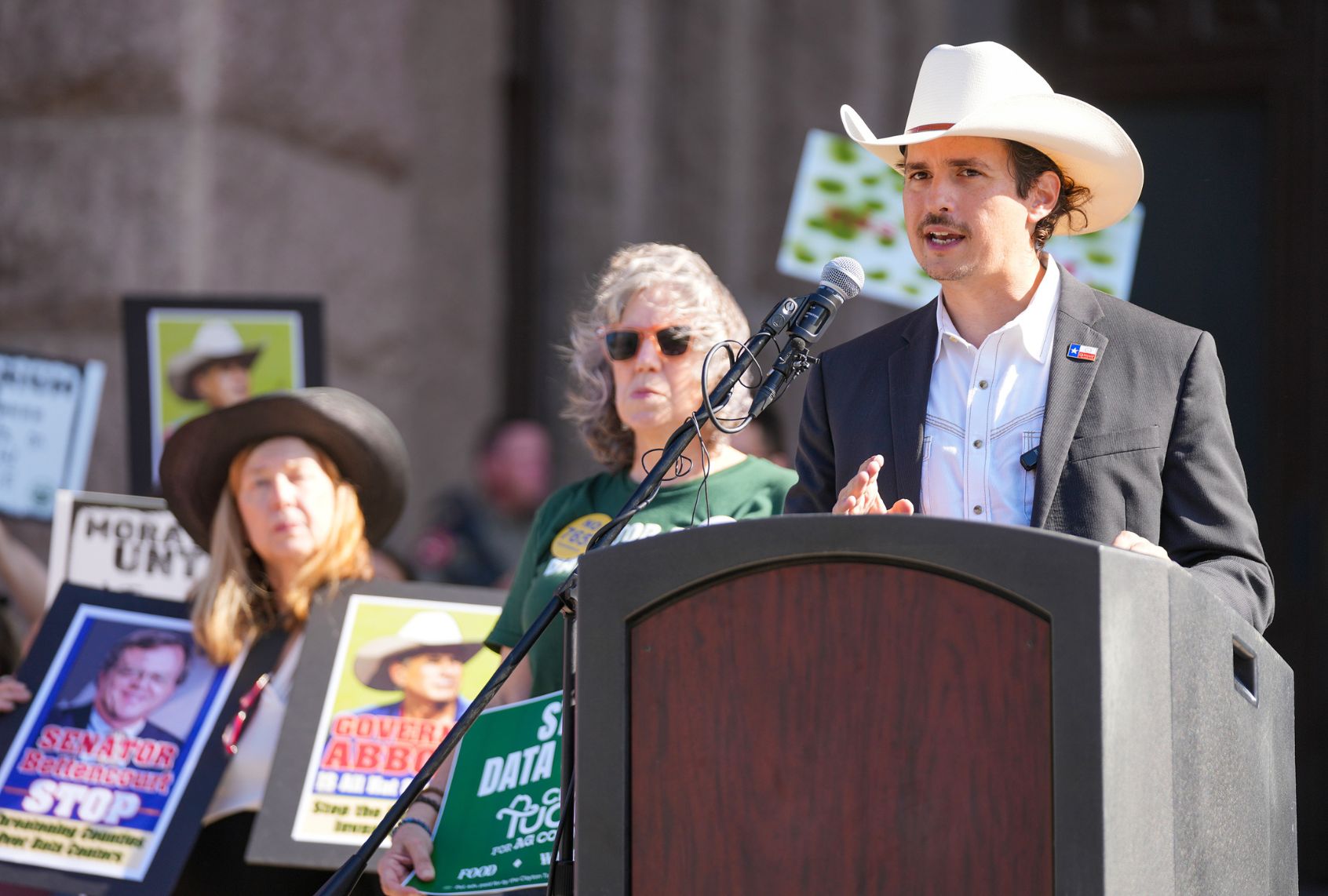
Agriculture commissioner candidate Clayton Tucker speaks at a rally against data center development in Texas on the Capitol grounds in Austin on July 27, 2026.
Religion isn’t solely the domain of the opposition. Texas Railroad Commissioner Wayne Christian, a Republican, said he supports data center construction because “throughout history, Christians have embraced innovations that improve lives, from the printing press to modern medicine.”
“We should approach data centers the same way: embracing their benefits while ensuring they’re built responsibly,” Christian said in a statement.
For Long, biblical passages such as Daniel Chapter 2 and Revelation Chapter 13 reveal that there are spiritual implications to replacing God’s creation “with things created by man.”
The books of Daniel and Revelation, known as apocalyptic literature, have been interpreted in some theological circles as warnings about the misuse of technology — such as artificial intelligence — in ways that threaten God’s intended order and vastly increase the government’s ability to conduct surveillance.
“They’re going to be able to track where we go, they’re going to track our money. … You’re going to have to essentially stay in line socially,” said Long, who believes this generation will be judged by its response to data centers.
“I just don’t want to read that everybody complied, everybody gave in, everybody quit. I want to hear about this small contingent of people that stood on their principles, that saw it coming from a mile away, and said, ‘We’re not budging,’” he said.
Joseph Locke, a professor of Texas and American religious history at the University of North Texas, said he was not surprised that Texans were making religious arguments against data centers.
“Texans have often drawn on religion when they want to enact social or political change,” he said in a statement, adding that “the rhetoric of spiritual warfare is pretty common, especially among today’s Christian nationalists and their conservative allies.”
Long has hosted well-attended prayer meetings in his home and taken his fight online, where he is not alone. Religious arguments are a periodic feature of comments on several dozen Facebook groups dedicated to opposing data center development.
Last month, Clarendon resident Maria Miller asked members of the Texans United Against Data Centers Facebook group to pray against data centers.
Miller said she sees parallels between the rapid development of data centers and the story of the end times told in the Book of Revelation at the end of the New Testament. “It’s kind of a no-brainer,” she said in an interview.
“People of faith feel a moral duty”
Not all religiously grounded opposition sees data centers as apocalyptic or part of a larger cosmic battle between good and evil.
“People of faith feel a moral duty to make sure that people have the things they need to live lives of dignity and thriving, and so water and energy are really important for that,” said Rev. Dr. Becca Edwards of the interfaith policy advocacy group Texas Impact.
“We’re called to be stewards of creation, which means caring for the world as God does. And I think what we see in the creation story is that the world was created to be a place of fruitfulness and plenty,” Edwards said.
Locke said many Texans have drawn on their faith “to attack inequalities, provide for the needy and, yes, advocate for environmental protections.”
In addition, conservative Christians have been “generally supportive of Texas’ conservative economic and environmental policies,” Locke said.
“The oil industry, for instance, has long been wed to conservative Christianity,” he said. “Billy Graham was backed by Texas oilmen, and George W. Bush, who helped bring Texas’ religious politics to Washington, D.C., was rooted in the oil industry.”
Texas churches also spoke out against inequality during the Gilded Age — a late 19th-century period of rapid industrial growth that produced extreme wealth inequality, Locke said. Evangelical leaders “helped to organize the Populist revolt of the 1880s and 1890s” and others “urged Texans to see the sins of our economic system,” he said.
“Texas’ conservative Christian nationalism may win the most headlines, but Texas religion contains multitudes,” Locke said.
Tucker, the Democratic candidate for agriculture commissioner, is a fifth-generation Texan who ties his campaign to Texas’ populist movement and focuses on issues that receive the most petition signatures on his website.
A petition on data center development has been a top performer, and as long as it remains popular, “that’s gonna be our top issue,” Tucker said while driving between anti-data center meetings, many of them held in churches.
“Had you told me a year ago that running for agriculture commissioner, I’d be talking mostly about data centers, I would have looked at you funny,” he said, adding that the facilities’ high-volume water use caught his eye.
“If we run out of water, nothing else really matters,” he said.
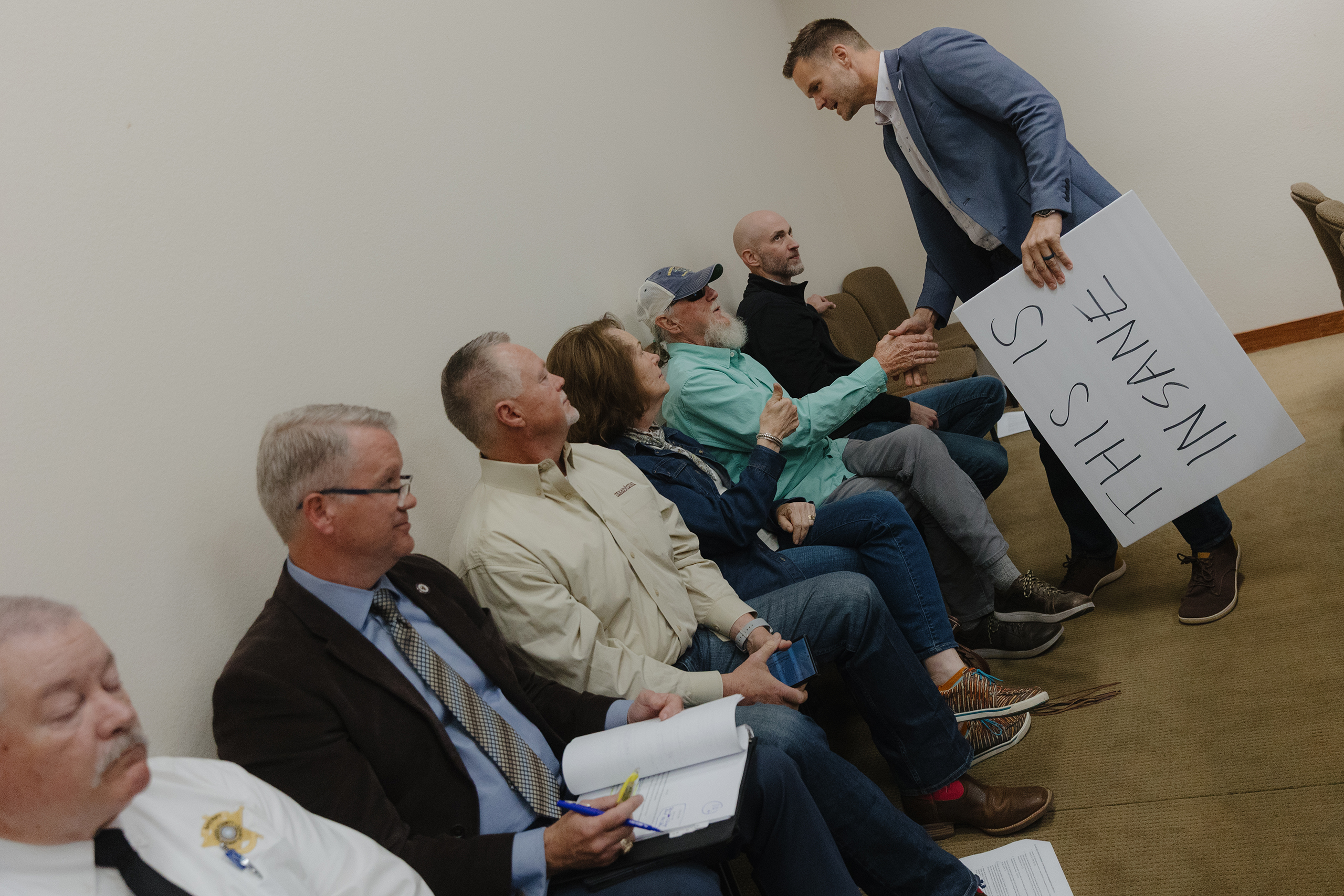
Matt Long shakes hands with attendees while holding a sign that says “This is insane” at a Hood County Commissioners Court meeting in Granbury on Feb. 23, 2026.
Long, who identifies as a conservative-leaning libertarian, said Tucker, although a Democrat, is “the only politician that is saying anything negative about data centers.” Older Republicans, he added, “don’t understand, like, the good versus evil fight that I believe we’re in.”
Polls show in many cases opposition to data centers transcends political partisanship. According to a June poll by the Texas Politics Project, 71% of registered Texas Democrats and 44% of registered Texas Republicans oppose data centers, with only 14% of Republicans strongly in support. National polls indicate even greater bipartisan alignment: a May Gallup survey found that 63% of Republicans and 75% of Democrats oppose data centers.
Long said he’s also found himself in a surprising alliance over data centers with some “liberal white women.”
“After the meeting … we’re hugging, and we’re all on the same page, trying to fight this,” he said.
“Humanity over injury and profit”
Elizabeth Dempsey Beggs, a Democrat running for the U.S. House in Virginia, called opposition to data centers a “unifying factor” that crosses political lines. Virginia is home to the world’s largest data center market, with about 685 operating or planned, and Texas advocates have looked to the state as a cautionary tale.
“I guarantee you Jesus would be outside right now flipping tables,” Beggs said in a recent public testimony against data centers.
People “deserve a place that is safe to raise their children, and we know the harm that data centers are doing,” Beggs said in an interview. “That’s not something you can tolerate as a mother, as a citizen, and as a Christian.”
Long, who has nine children, said in testimony earlier this year that data centers create “a sacrificial zone” that negatively harms children. It is ironic, he said, that Hood County adopted a “sanctuary for the unborn” ordinance while not being a sanctuary for the born.
Hood County commissioners bow their heads in prayer at the beginning of a Hood County Commissioners Court meeting in Granbury on Feb. 24, 2026. The meeting included a vote on a moratorium that would pause construction of eight proposed data centers.
Some Jewish leaders have also based their opposition on religious grounds.
“At the core of most religious traditions is a recognition of the sanctity of life and humanity over injury and profit,” Rabbi Jennie Rosenn of the Jewish climate advocacy group Dayenu said in a statement.
Rosenn said data centers are an affront to Judaism’s most foundational teachings of “life, not death (bacharta bahayim), protect creation (shomrei adamah), pursue justice (tirdof tzedek), not waste (bal tashchit), protect the most vulnerable (shomer ger yatom v’almanah), and ensure that life can continue l’dor v’dor (from generation to generation).”
“If this sounds like Judaism’s greatest hits, it’s because it is,” Rosenn continued. “That is how fundamentally the explosive growth of data centers across our nation threatens the values we — and many other people of faith — hold most dear.”
Jane Bannor, treasurer of Unitarian Universalists for a Just Economic Community, a progressive advocacy group, said Unitarian Universalists around the nation are calling for moratoriums on data center construction based on a “respect for the interdependent web of life of which we are all a part.”
“We want to see businesses benefit not just corporate shareholders, but also the surrounding population,” Bannor said.
Tucker hopes religious-based opposition can affect the data center debate in Texas.
Faith appeals carry extra weight, he said, “when you can kind of tie [data centers] to those stories that are foundational to Christianity, that are foundational to a lot of our worldviews.”
(Mark Weinberg / Food52)Flowers are silhouetted against lights from the Stargate data center in Abilene on May 2, 2026.
This story is published through a collaboration between The Texas Tribune and Religion News Service.
Disclosure: Amazon, Facebook, Google, Meta and University of North Texas have been financial supporters of The Texas Tribune, a nonprofit, nonpartisan news organization that is funded in part by donations from members, foundations and corporate sponsors. Financial supporters play no role in The Texas Tribune’s journalism. Find a complete list of them here.
An Australian library has welcomed home a book roughly 150 years overdue after it was discovered inside a tea crate bricked into a sealed fireplace.
Ross Simmons found the water-damaged copy of “The Antiquities of Athens” while renovating a house in the seaside town of Kiama, south of Sydney. The book was published in 1858 and carries the number 506, placing it among the roughly 1,000 volumes held when the Kiama Library opened in 1872.
Simmons believes the book may have been borrowed by his great-great-grandfather, John Simmons, who owned the house when the library first opened. The library’s original borrowing records have been lost, however, leaving the identity of the delinquent reader — and the reason the book was sealed inside a fireplace — a mystery.
Had the library applied the overdue rate printed in the volume, the theoretical fine would have reached approximately 28,000 Australian dollars, or about $19,500 in U.S. currency. Fortunately for the Simmons family, the library no longer charges late fees and has no intention of pursuing a 19th-century borrower’s descendants.
The old lending rules discovered with the book offered another glimpse into library life during the 1870s. A household needed at least three people capable of reading before borrowing, and patrons were prohibited from collecting a book while intoxicated.
Despite some water damage, the volume survived its century and a half inside the fireplace and has now been added to the library’s local history collection.
It will not, however, be returning to circulation.
“We’re not going to allow it to go back out again,” library manager Michelle Hudson said, joking that staff did not want to wait another 150 years for its next return.
The discovery gives Kiama Library an unusually complete local mystery: an unidentified borrower, a hidden fireplace, a theoretical five-figure fine and, after approximately a century and a half, a very late happy ending.
A Florida English professor is suing her former public college, alleging she was fired after its president objected to an award-winning short story she assigned in a freshman literature course.
Vinita Prabhakar filed a federal lawsuit against South Florida State College President Fred Hawkins and the school’s board of trustees, arguing her dismissal violated her First Amendment rights and academic freedom. The lawsuit seeks reinstatement, damages and a declaration that the college acted unlawfully.
Prabhakar had assigned “Bettering Myself,” a short story by acclaimed author Ottessa Moshfegh, in her Freshman English II course. The award-winning story follows an alcoholic Catholic school teacher whose increasingly self-destructive behavior illustrates themes of addiction, alienation and moral decline through the perspective of an unreliable narrator.
According to the complaint, Prabhakar had taught the story for nearly a decade without incident and used it in a unit on unsympathetic and unreliable narrators alongside works by Ernest Hemingway and Raymond Carver. The story won the Paris Review’s 2013 Plimpton Prize for Fiction and has appeared on syllabuses at other universities.
One student reportedly told Prabhakar that the material made them uncomfortable. Prabhakar discussed the story with the student, who later said they felt better about the assignment, according to the lawsuit.
Hawkins nevertheless summoned Prabhakar to a meeting, called the story “political” and ordered her not to teach it again, the complaint alleges. Prabhakar said her department chair, dean and a college vice president supported her explanation of the story’s academic purpose.
The next day, she was placed on administrative leave and told her contract would end after the semester. Prabhakar alleges she received no formal complaint, hearing or explanation of which college policy she had violated.
The Foundation for Individual Rights and Expression, which is helping represent Prabhakar, argues that public colleges may establish curriculum requirements but cannot punish professors merely because administrators dislike ideas expressed in relevant course material.
The allegations have not yet been tested in court. The lawsuit places the latest Florida education dispute at the intersection of academic freedom, faculty discretion and the authority public institutions exercise over classroom instruction.

 Login
Login