❌

Reading view

What Could be Next for Knife Steel?

New Patreon Supporters

Thanks to new Knife Steel Nerds Patreon supporters David, A.P. McC., Brunhard, Sal Glesser, Richard Airey, Dan Cifer, Matt Cheresh, and Mark Decherd. Your contributions mean more experiments on knife steel!

Video

There is a video version of the following information as well:

Properties

When it comes to knife steels there is a whole range of properties that we might want to achieve, such as:

  • Hardness
  • Toughness
  • Wear Resistance
  • Corrosion Resistance
  • Cost
  • Forgeability
  • Grindability
  • Polishability
  • Sharpenability
  • Availability
  • Marketability

Some of these properties are desirable to the end user, but some are mostly for the manufacturer. For example, properties like hardness, toughness, wear resistance, corrosion resistance, and sharpenability are all things you want in your knife steel. Some properties are desired by both buyers and makers, such as low cost. However, the costs are different for the maker than the buyer. A large part of the cost for the manufacturer is grinding and polishing. A steel may be relatively inexpensive but difficult to grind and finish and thus end up relatively expensive to use.

A few properties are things we may not think about regularly, such as availability and marketability. It can sometimes be an advantage to use a steel no one has ever heard of, perhaps pushing the exclusivity of the steel. However, there are generally advantages to a steel that is already well known and well regarded. It takes work to have to educate customers about why their unusual or unique steel is a good choice.

Availability is another aspect of steel that knife buyers typically do not think about. There are many, many steels that have been made over the years and many of them are no longer made. Finding it in a catalog somewhere doesn’t mean that you can buy it. Even when a company is making a steel, often those steels are not available in the sizes necessary for knives. Hot rolling steel to the thin sizes needed for knives is relatively uncommon. And some steels are widely available in certain countries or to certain customers but not to others. For a long time people were requesting that I test the common Chinese knife steel 8Cr13MoV, but it is primarily sold to knife companies (not individual knifemakers) in China (where I do not live). So despite 8Cr13MoV being very common in cheap knives, it is not as easy to get a bar of it as an individual living in the USA. And there are costs to importing steel from another country, such as shipping and tariffs. If a knife company or maker wants to market their knives as “Made in USA” they will want to use USA-made steel or they will have to market it as “Made in USA with foreign materials” instead.

We would love to have a knife steel that is a 10 out of 10 for every property – the unicorn steel that has ultimate hardness, toughness, wear resistance, corrosion resistance, is easy to forge, grind, and polish, and is super cheap at the same time. Of course we know it isn’t possible. So when developing and engineering a new steel it is a question of tradeoffs and which ones we are willing to make.

The Matched Set Method

Sometimes knife buyers get caught in the budgeting and minutiae of all of the different steel choices out there. Worrying about whether to use Elmax or S30V is about two choices within the same “category.” Often it is the bigger jumps that are significant, such as whether you need a steel with high toughness to resist breaking and chipping or high wear resistance for slicing edge retention. The first time I am aware of where a steel company made this clear was Carpenter with their “Matched Set Method” which they introduced in 1935 [1], and is described in the 1937 book Tool Steel Simplified.
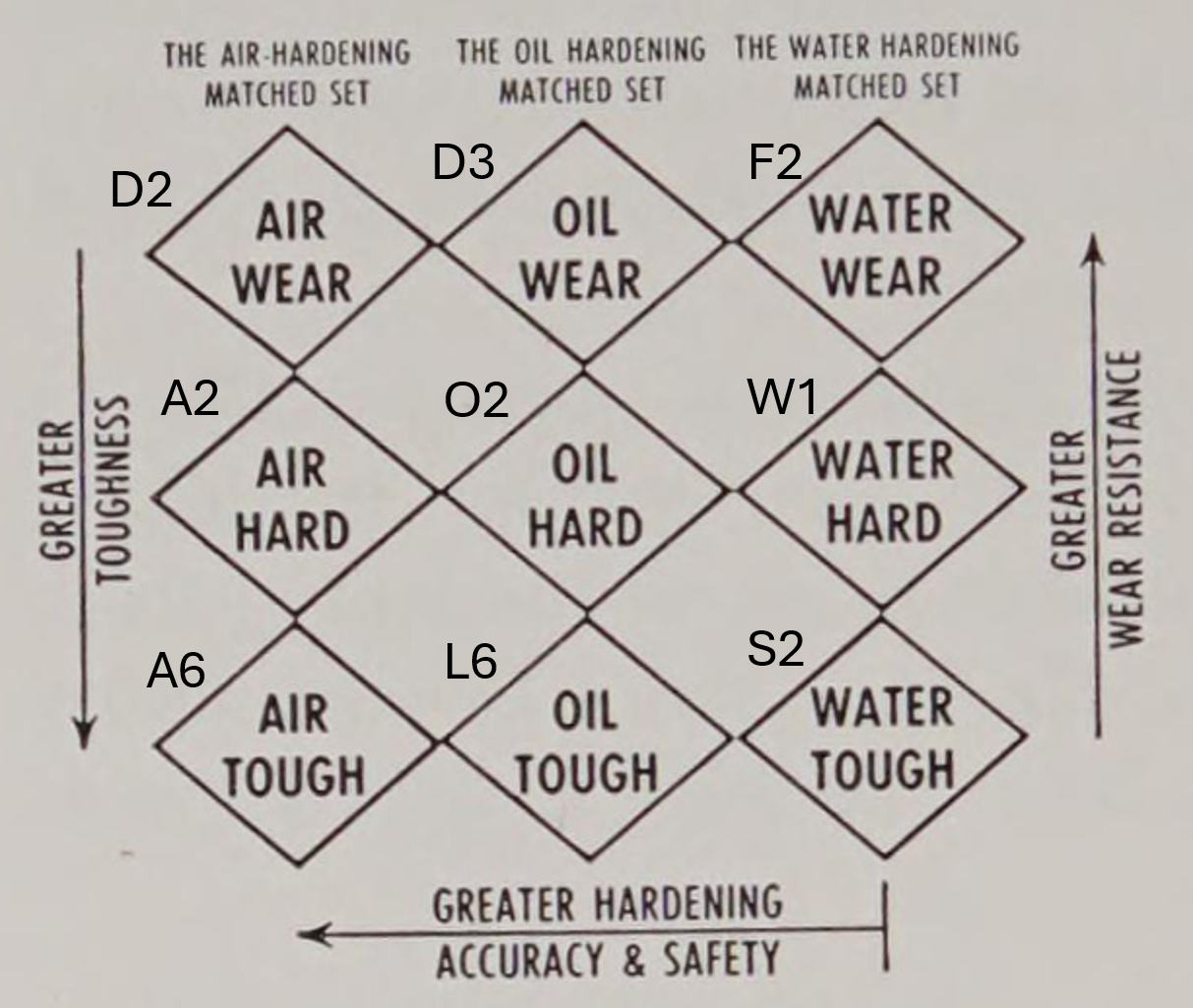
In the chart above I labeled each with their AISI designations (A2, D2, etc.) but otherwise it is unmodified from 1937. The categorized steels by high wear resistance (wear), high toughness (tough), and balanced properties (hard). To get high wear resistance you have to give up some toughness and vice versa. And they are also categorized by “hardenability,” which is a measure of how fast you need to quench a steel to achieve full hardness, either water, oil, and air for the quenching medium required. Water hardening steels were cheaper but required fast quench speed, were prone to distortion because of those fast quenches, and couldn’t be used for larger tools requiring through-hardness. In the knife world, water or oil hardening grades are favored by forging bladesmiths because of how easy it is to forge them.

Generational Breakthroughs

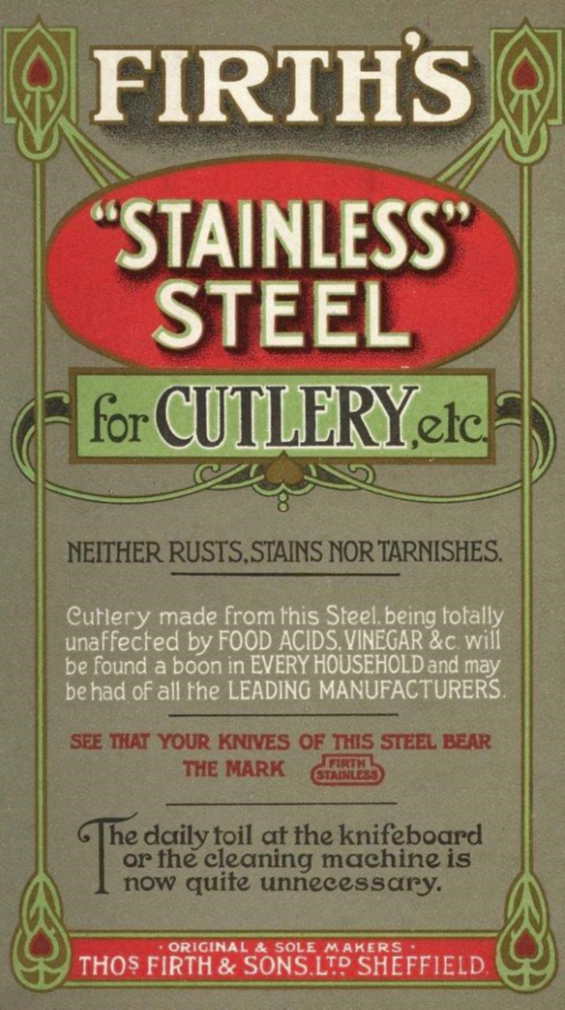
Of course I don’t mean to imply that there is never a reason to develop improved versions for different categories, or to create steels that sit in the middle between two different categories. There were generational improvements just to lead to the original Matched Set Method. For example, before the late 1800s all steels were “carbon steels” as carbon was the only element really added to them. “Water wear” F2 tool steel was developed by adding 3.5% tungsten to form hard tungsten carbides for wear resistance. Air hardening steels came by adding significant chromium additions, which also led to higher wear resistance from the formation of chromium carbides. The discovery of alloying was one of the most important transition points in steel history, which you can read more about in my book The Story of Knife Steel. The existence of high chromium steels also led to the development of stainless steels, very important to knives of course. The first stainless steel ever commercialized was intended for use as a knife steel. To understand what I mean by generational improvements and to get a feel for what is possible for future improvements I am going to discuss several prior improvements in this article.
Another important breakthrough occurred in the 1960s and 1970s with the introduction of powder metallurgy technology. With powder metallurgy they solved the issue of large carbides and inconsistent properties in steel by skipping the part where the liquid steel slowly cools down in a mold. Instead, the liquid steel comes out of a nozzle in a stream that is sprayed with gas so that it rapidly solidifies into fine grains, or “powder” steel. The powder is then placed in a steel can under high temperature and pressure, called hot isostatic pressing (HIP) to turn it into a solid ingot. Crucible Steel in New York and Pennsylvania developed this process and they found great improvements in toughness without any reduction in wear resistance by refining the microstructure with this process.
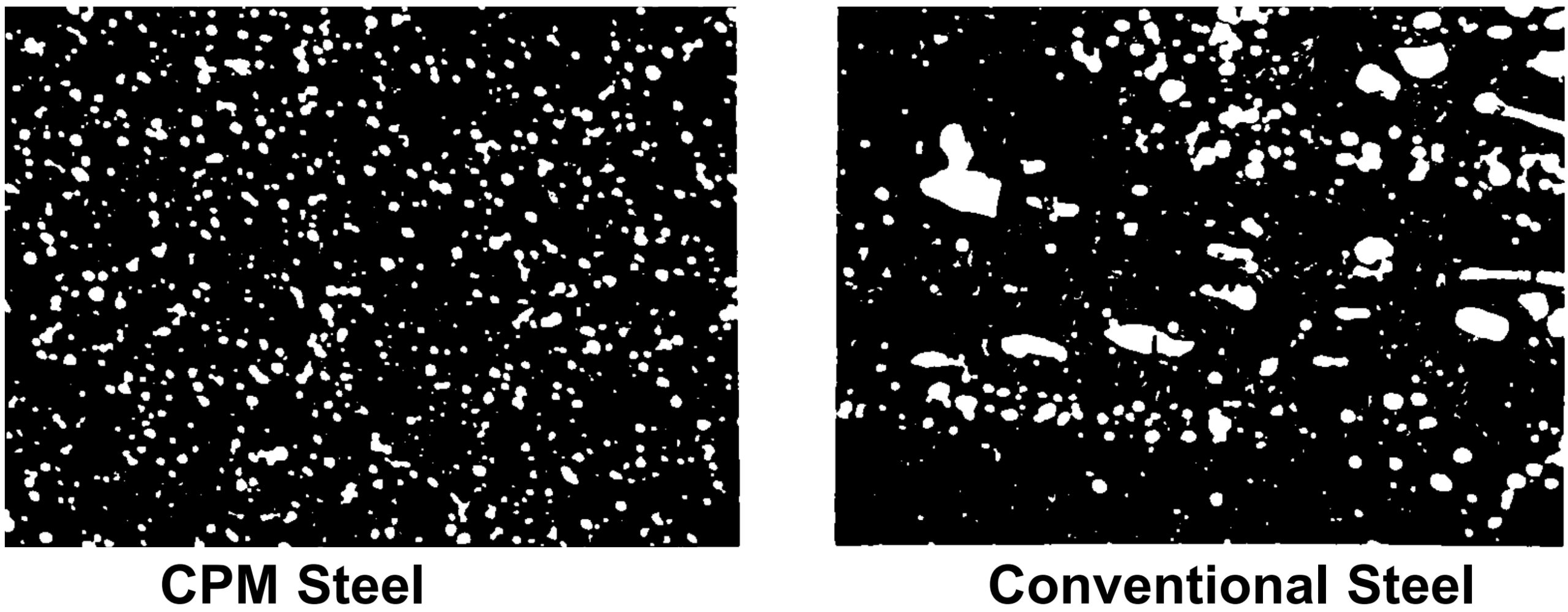
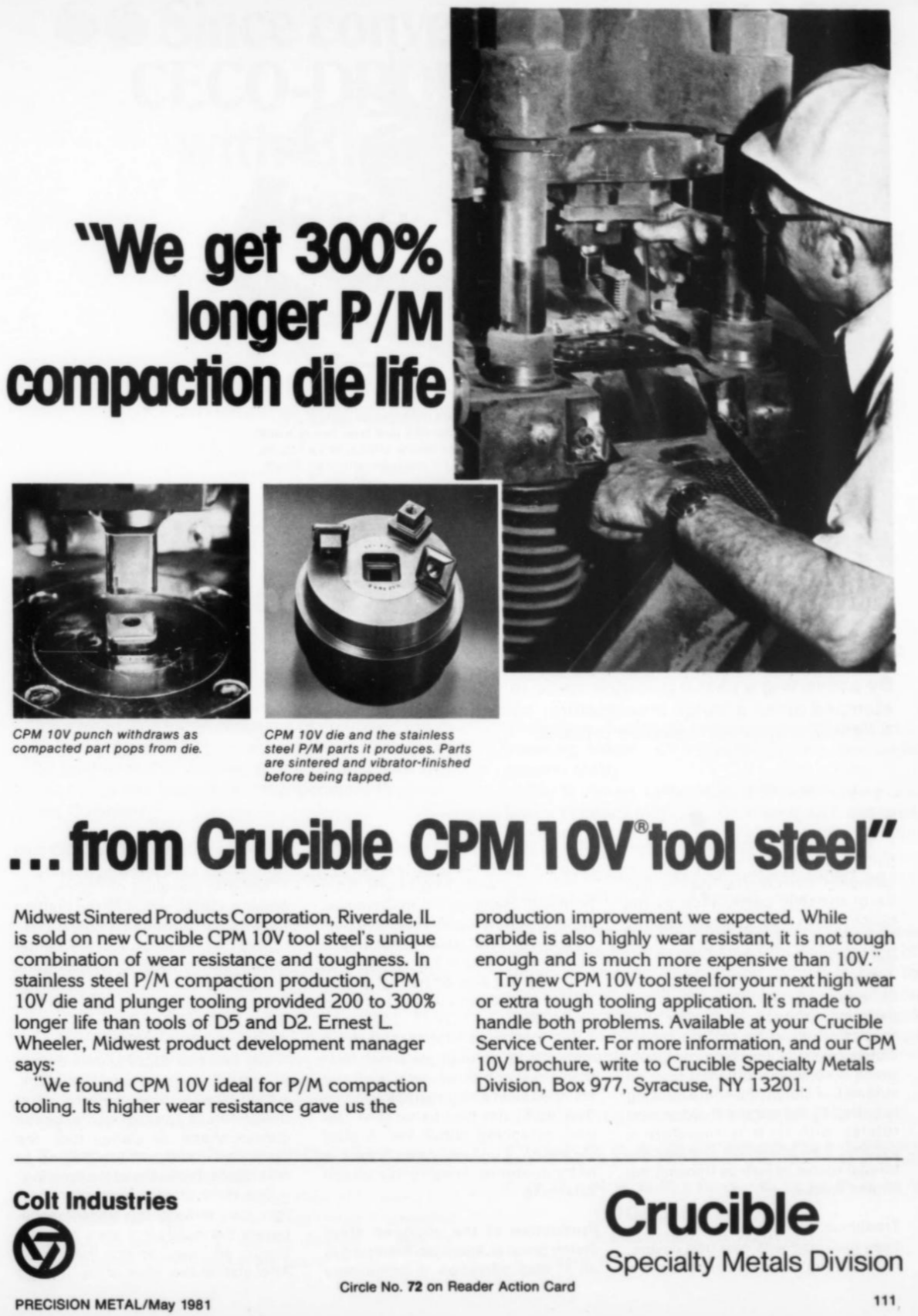
The technology wasn’t the only significant advancement, however. They also found that steels could be optimized for the PM process, as the best alloys for powder metallurgy were different than those optimized for conventional steelmaking. They first realized this when they found that M4 high speed steel went from being among the lowest toughness conventional high speed steels to the very toughest CPM high speed steel. They discovered that the high vanadium content went from being a liability to an asset. Vanadium carbides would form at high temperatures in solidification leading to large, brittle carbides. However, because powder metallurgy keeps the carbides small in solidification, it is the growth rate of the carbides that is important instead. Vanadium carbides are more stable than chromium (M7C3 and M23C6) and molybdenum/tungsten (M6C) carbides and so would grow at a slower rate during high temperature processing like HIPing and hot rolling. Vanadium carbides are also among the very hardest and thus contribute more to wear resistance than chromium and molybdenum/tungsten carbides. So the combination of high hardness of vanadium carbides (wear resistance) and small size (toughness) led to high vanadium steels having excellent properties. This eventually led to the development of CPM-10V in 1978 which was a tool steel with ~10% vanadium for incredibly high wear resistance while still maintaining equal better toughness than the popular D2 tool steel.
Powder Metallurgy Stainless Steels

Crucible used their knowledge of vanadium alloying in the development of CPM-440V (now called CPM-S60V), a modification of 440C with 6% vanadium and extra carbon to go with it. This steel was released around 1983. However, this steel did not have especially excellent toughness because it still had a large amount of chromium carbide, softer and larger carbides which were detrimental to the toughness-wear resistance balance. In 1995 CPM-420V was released (now called CPM-S90V), patented by William Stasko, Kenneth Pinnow, and John Hauser. They reduced the chromium content from 17 to 14%, and increased the vanadium content from 6 to 9%. This led to an improvement in both toughness and wear resistance vs S60V. CPM-S30V, released in 2002, used the same concept as S90V but reduced the vanadium to 4% for higher toughness (and lower wear resistance). S30V also utilized increased Mo (2% rather than 1%) and partially replaced carbon with nitrogen (0.2%), both for better corrosion resistance, ideas explored in the S90V patent but not ultimately used in the commercialized version. CPM-S110V and CPM-S35VN were released around 2009-2010 and these steels used niobium to refine the microstructure. Niobium was also found to improve corrosion resistance in S110V because it does not increase the amount of chromium carbide like vanadium does. Micrographs of how much finer the microstructure is of S110V than S90V can be seen below:
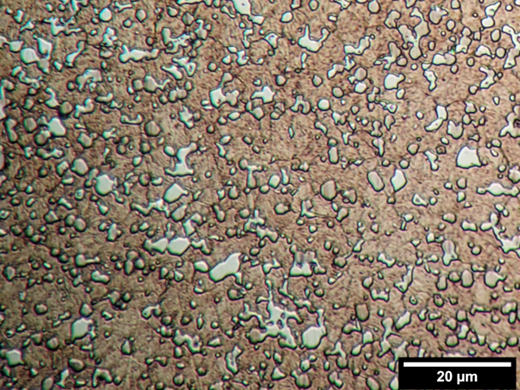
CPM-S90V
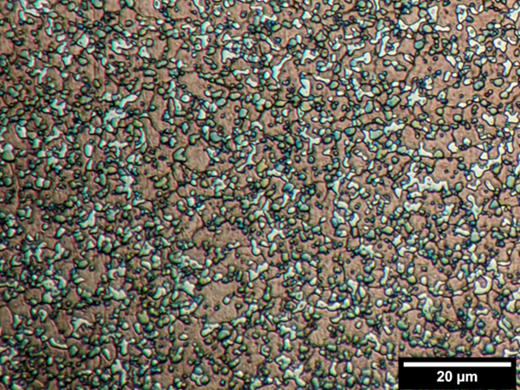
CPM-S110V

MagnaCut

MagnaCut used all of the previous developments in its design as long as one more – a further reduction in chromium. The above steels had about 10-12% chromium “in solution” which is the chromium that is not tied up in carbides and thus can contribute to corrosion resistance. So these steels still had more chromium than was strictly necessary for corrosion resistance with 14% chromium. And I also knew that the properties had been greatly improved by reducing Cr from S60V to S90V. So for MagnaCut I intentionally designed the steel to have sufficient chromium for good corrosion resistance and then balanced the rest of the composition to avoid chromium carbide formation. It used a combination of niobium and vanadium for small, hard carbides for wear resistance. This gave significantly improved toughness because the carbides were much smaller than those found in high chromium stainless steels. And the corrosion resistance was also greatly improved because chromium carbides were eliminated. Those chromium carbides act as sites for corrosion to initiate, because they create locally reduced chromium content in solution around each carbide.
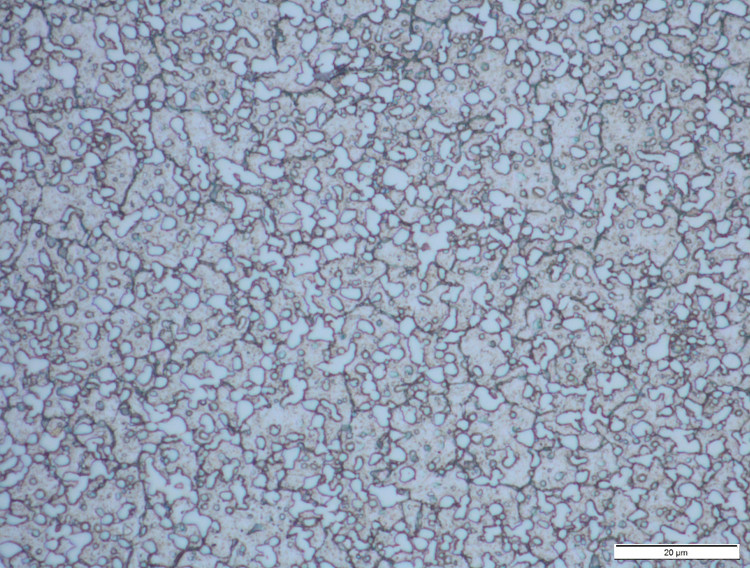
M390 – high chromium stainless powder metallurgy steel with relatively large carbides
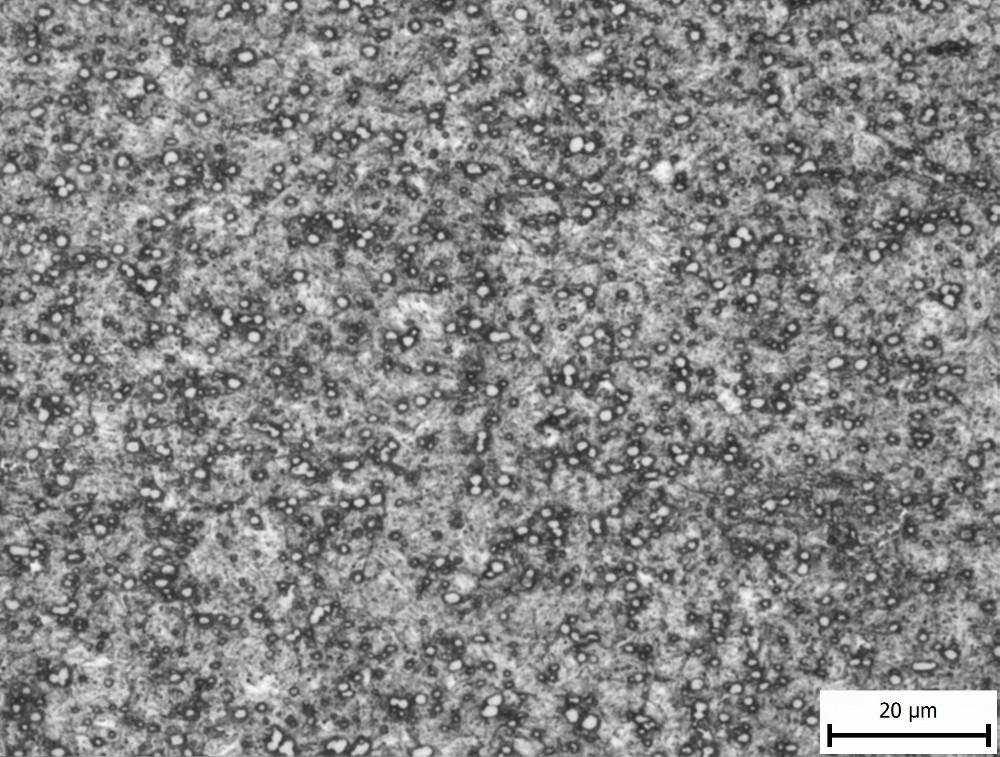
MagnaCut – much smaller carbides

This improved toughness-wear resistance balance from the microstructure improvement of MagnaCut gives it properties similar to the best non-stainless PM steels:
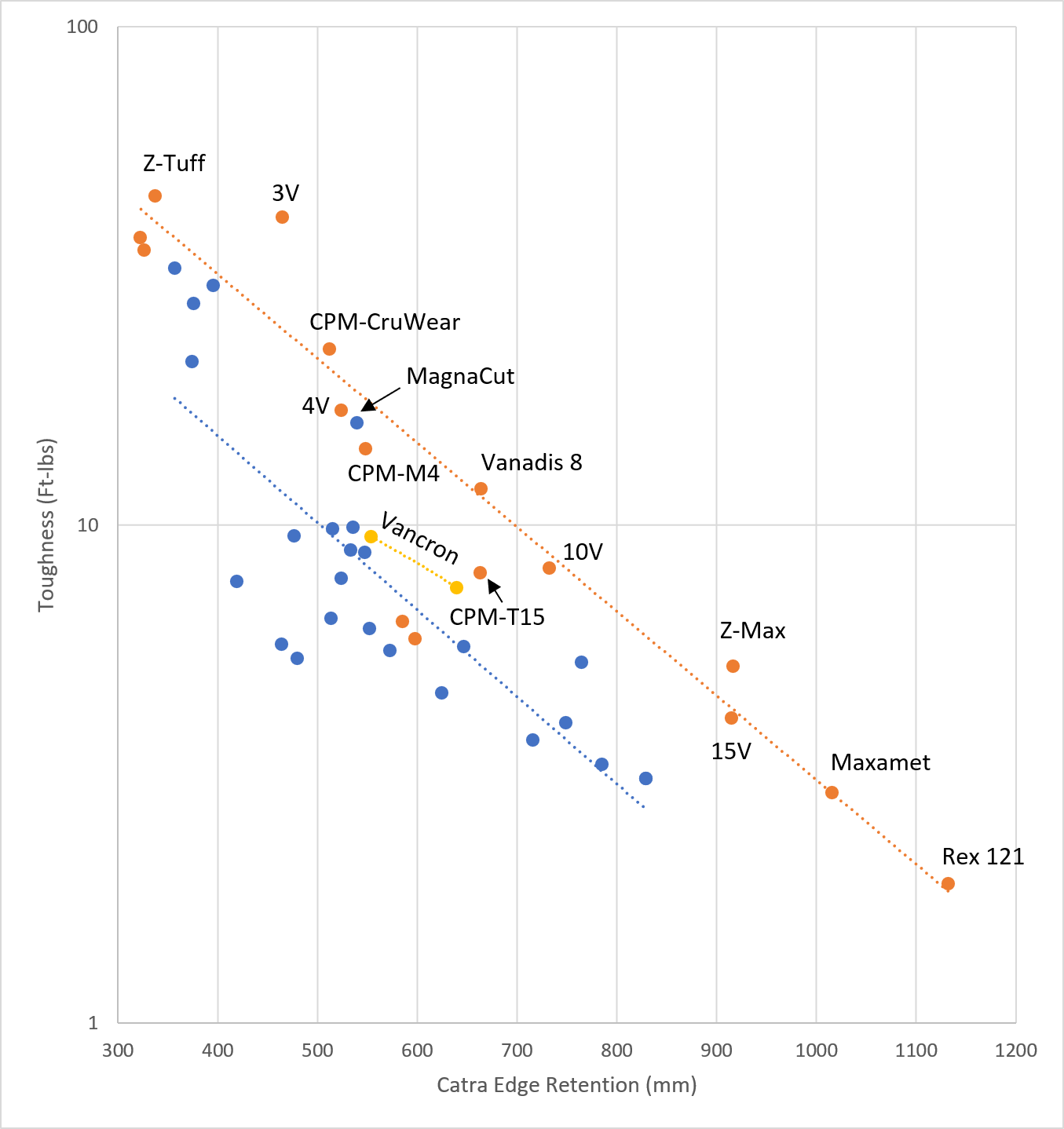
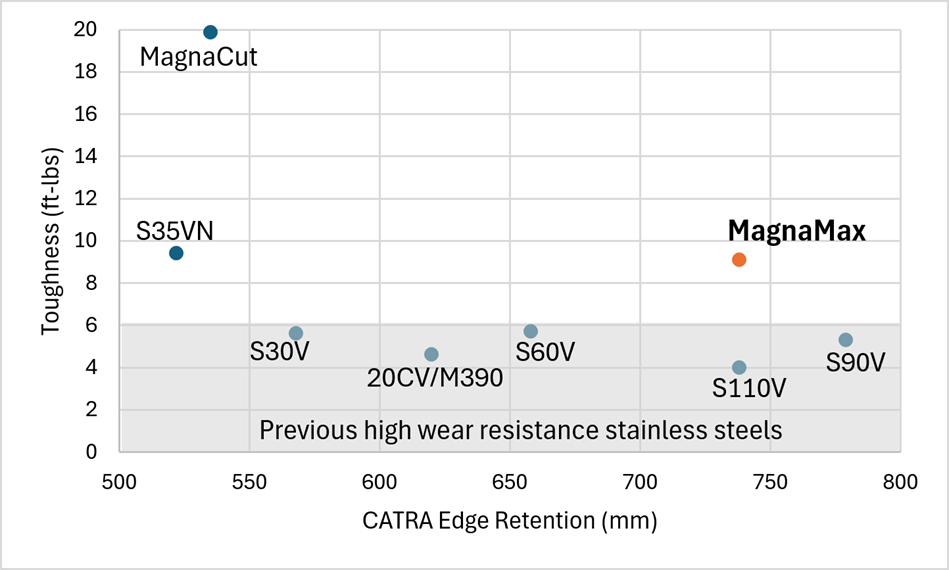
The chart above shows orange dots for non-stainless steels and blue dots for stainless PM steels. You can see that the toughness for a given level of CATRA edge retention (edge wear) is significantly lower for the stainless steels, apart from MagnaCut which overcame this previous gulf in properties. This was the result of a series of generational improvements, a simplified version of which being 420 -> 440A -> 440C -> S60V -> S90V,S30V -> S110V,S35VN -> MagnaCut. Big improvements in steel come when we can move up and to the right at the same time, an improvement in both toughness and wear resistance. When you add another constraint such as corrosion resistance or hot hardness, that makes it more difficult to achieve the highest balance of toughness and wear resistance. I have images in The Story of Knife Steel that show the evolutionary tree of different steel types such as this one for stainless knife steels:
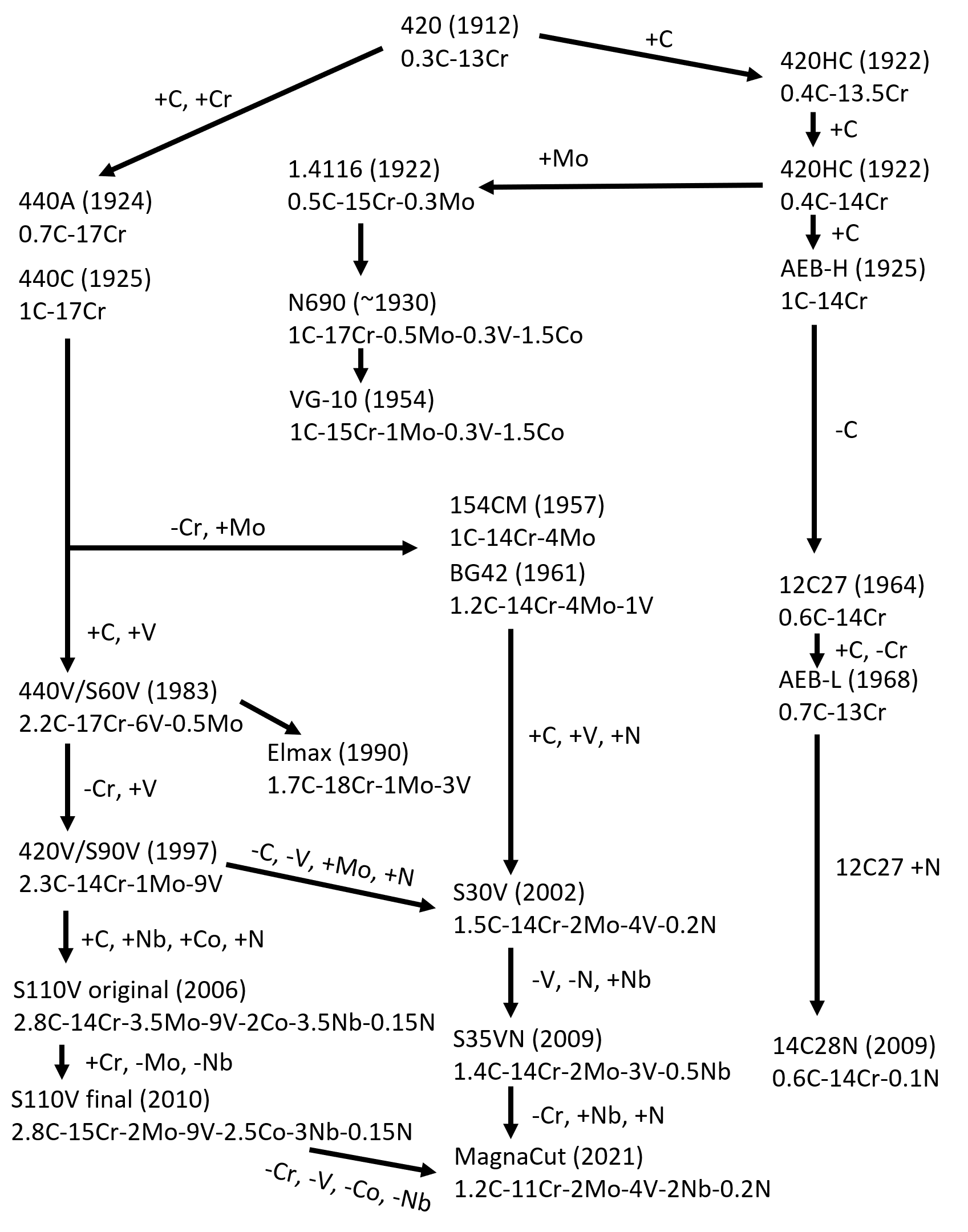
Not all of those grades (S60V, etc.) were an improvement in every category, but in general there was an improvement over time in terms of the balance of toughness, wear resistance, and corrosion resistance. It is difficult to improve all of these at the same time, or even two of the three at the same time, without affecting the others. But a true generational improvement comes when engineers figure out how to break through previous barriers, such as when MagnaCut managed to make it to the same toughness-wear resistance balance as the non-stainless PM steels.

MagnaMax

I chose to make MagnaCut a “balanced” steel in the realm of CPM-4V and CPM-CruWear. This meant it filled a niche that had not previously been filled. However, the alloy concept of avoiding chromium carbide and using only hard vanadium/niobium carbides could be used for other combinations of toughness and wear resistance. When I first proposed MagnaCut to Crucible and Niagara I also said that we could make a stainless version of CPM-10V with the same idea. That eventually led to MagnaMax which was recently released. MagnaMax has double the carbide of MagnaCut for significantly greater wear resistance.
Magna-Family Steels

MagnaMax was the first addition to the “Magna-Family” of grades. I call it a family despite only having two steels because there are many other options. To be clear, I am not currently announcing new additions and none are coming in the short term. But the same concept could be used for a higher toughness version of MagnaCut, for example. Essentially the opposite direction of MagnaMax. Another balancing act in steels I have not yet discussed, however, is the balance between hardness and corrosion resistance.
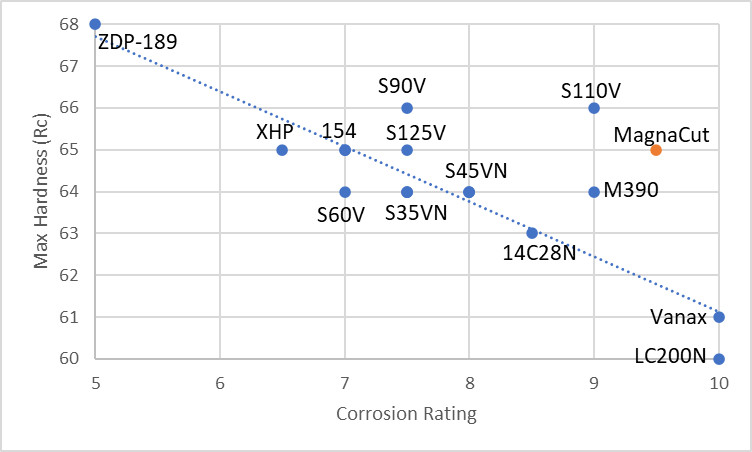
You can see that in general, higher hardness leads to lower corrosion resistance and vice versa. However, this is true when comparing steels, not for comparing hardness within a single steel. A steel can be heat treated to maximize hardness and corrosion resistance at the same time, as I have explained in the past. MagnaCut had improved hardness for its level of corrosion resistance because of its lack of chromium carbide. But modified versions could be made for higher hardness and reduced corrosion resistance or improved corrosion resistance at the cost of some hardness. Thus we would have a new “matched set” for the potential family of Magna-series steels:
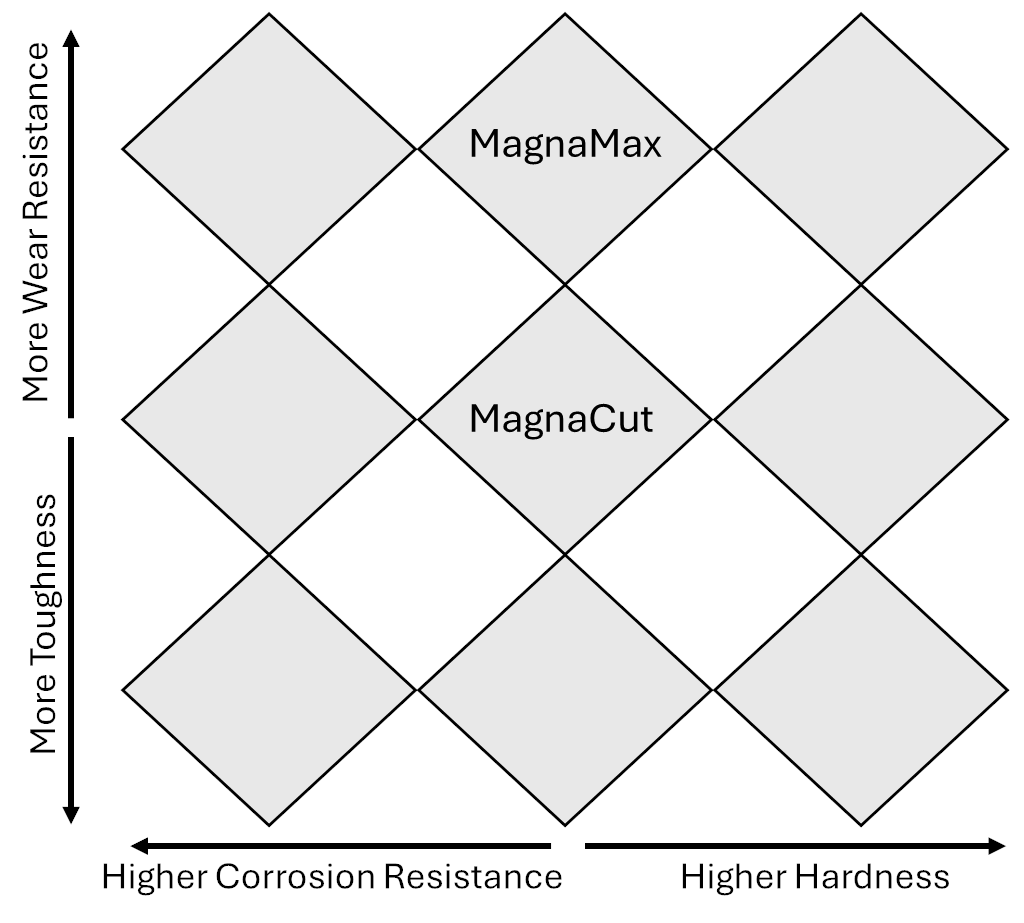
Again, I must be clear that I don’t actually believe we will release all of these. In fact, perhaps only the center steels will ever be released, since we hit a very good balance between hardness and corrosion resistance for MagnaCut and MagnaMax. However, it could be interesting to make the other versions for specific applications, either for high hardness stainless steels or to make improved “saltwater” stainless grades.

How Small of a Niche Can We Fill?

As I said when it comes to all of the potential variations of MagnaCut, just because we can fill a niche doesn’t mean we can or should. Having too many available grades can make things confusing to customers and increase logistical complexity. Unfortunately I don’t have the power to eliminate old steels to replace with the new better ones to lead to a simpler market. With too many available grades there can also be a situation where it doesn’t make monetary sense to make certain niche products. It costs money to develop a new product and the return on investment may not be worth it if the resulting sales are not great enough. So unfortunately there are often real-world limitations to just how many steels it is possible to develop and release.

Copies and Small Modifications

When I see people complaining about “too many new knife steels” often this is partly out of confusion. They don’t realize that many of the “new” steels are several (or more) years old and were not well known for knives prior. Many “new” steels are older steels released under a new name by a different company or in a different country. And many consumers have a hard time keeping up with all of the compositions and names, and don’t know how to interpret a steel composition to know when something is the same. I have seen many knife enthusiasts on forums or social media where they misunderstood that a small difference in published silicon, or a minor element like manganese not being listed, does not mean that the steel is different. But even outside of straight copies, many new steels are only small modifications of prior products. Here is a list of new steels over the past decade (outside of steels I have developed):

The degree of change for each of these varies, with some being very tiny to a few being relatively significant. The majority are small to medium modifications of prior grades. This list does not include any “new” grades which are simply copies. I don’t think I would characterize any of those grades as “generational improvements.” Those are difficult to achieve, of course. But when it comes to predicting the future of steel development, the majority of it is going to be products like those above, and many of the new grades will be copies and minor modifications.

Grades for Forging

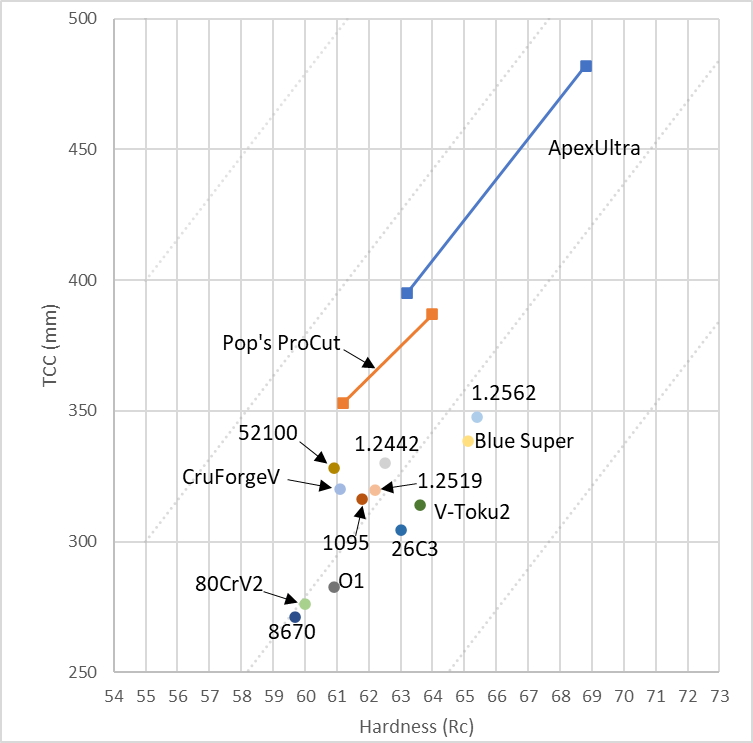
The pace of change for low alloy grades for forging has been pretty slow, and the majority of grades were developed over 50 years ago. One exception was CruForgeV, released in 2009. However, that grade was released at the same time as a Crucible bankruptcy and none has been made since. Some of it is still out there but in some ways it serves as a cautionary tale. I have been able to develop two grades for forging, Pop’s ProCut and ApexUltra. I do believe that both of these grades were able to deliver “generational improvements.” Pop’s ProCut used nickel alloying plus tungsten/vanadium alloying to deliver a new combination of high toughness with wear resistance that wasn’t previously available. Past high toughness forging grades like 15N20, 8670, and 5160 have extremely low wear resistance. ProCut was able to break through this barrier. It also provided a uniquely easy to heat treat design, with an austenitizing window that is over 200°F wide. This gave it a great combination of properties while also being “beginner friendly.”
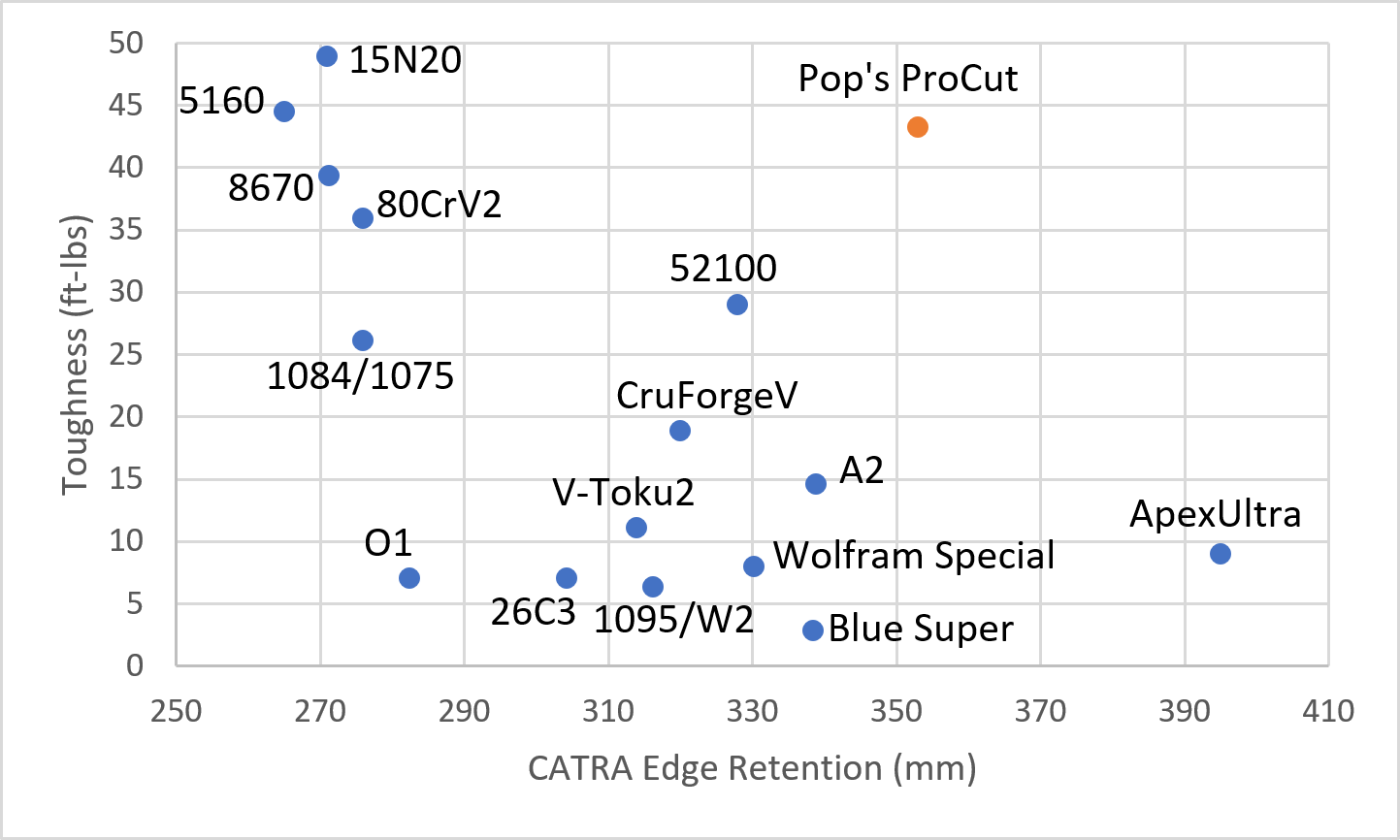
ApexUltra took a different track where the goal was to make a forging grade that maxes out cutting performance – achieving higher wear resistance and good toughness at high hardness than previous grades like Blue Super and 1.2562/F2. I had noticed that 52100 had a better toughness-edge retention balance than many other low alloy steels that are forgeable. The difference is in the 1.5% chromium content. The chromium has two major effects – 1) the iron carbides are enriched in chromium which increases their hardness and they contribute more to wear resistance. 2) the chromium decreases the amount of carbon in solution, making “plate martensite” less of an issue which makes steel brittle. So ApexUltra used the 1.5% Cr from 52100 in combination with the tungsten/vanadium additions of Blue Super to achieve edge retention greater than past low alloy steels.
More Grades for Forging?

There are different opportunities for forging grades but they might all suffer from the too-small-niche problem. Some possibilities include:

Powder metallurgy forging grade – A 2-4% vanadium PM low alloy steel would be interesting. It could offer even higher wear resistance than ApexUltra, likely with higher toughness as well. However, forging bladesmiths are historically very price conscious and they don’t like vanadium steels because of the extra difficulty in finishing. So ApexUltra is likely to be as good as it gets for now.

Hamon steels – To make a good hamon requires the steel to have very low hardenability with low Mn and no Cr or Ni additions. The standard choices are 1095, W1, and W2. Potentially hamon steels with different levels of toughness and edge retention could be made but again this application is likely too niche. Hamon steels are difficult to heat treat because of their low hardenability so outside of a hamon they are not really desirable.

Damascus – Pop’s ProCut works great in Damascus as a bright layer because of its high nickel – it can even be paired with ApexUltra for a high performance Damascus. A steel that matches the properties of ProCut generally but without nickel would be good for an easy to heat treat Damascus that offers relatively high toughness. However, the nickel-free version wouldn’t be better, it would just be good for a Damascus combo. So again the niche is likely too small.

A Modern Knife Steel Matched Set Recommendation

I first gave recommendations for knife steels in different categories in 2019. I updated these in Knife Engineering and again in the second edition. My current recommendations are as follows:

The grades in bold are those that I developed. This chart also gives us a place to discuss potential holes and areas that perhaps could be improved. Some holes that are still present:

The obvious one is the high wear resistance “extra stainless” category, which is the category I use for saltwater steels. Some knife companies have used MagnaCut in their knives designed for saltwater though I would prefer the corrosion resistance was even higher for those applications. Uddeholm used to make a Vanax 75 which had higher wear resistance than the current Vanax. A good solution for this category could potentially be a higher corrosion resistance version of MagnaMax.

Vanax and LC200N are pretty good steels. However, a higher corrosion resistance version of MagnaCut would have better toughness than Vanax.

I think it would be difficult to improve on Vanadis 8/K390/10V and CPM-CruWear. They have excellent toughness-wear resistance balances. Improving over that would require a generational improvement that we haven’t seen in the non-stainless PM space for several decades. It might require exploring unique solutions in terms of the matrix composition and carbide types.

The very high toughness non-stainless steels like Z-Tuff could use some improvements. All of those available have softer carbides such as chromium carbides or tungsten/molybdenum carbides. CPM-3V is very good and only has vanadium carbides but it could be argued it is more in the balanced properties than truly the maximum toughness category.

AEB-L/14C28N are excellent steels though we could have higher wear resistance in this category through a powder metallurgy steel with vanadium and/or niobium carbides. The high toughness Magna-family grade would fit this category.

Expanding the Envelope

My categories do not cover all possibilities. For example, there are higher wear resistance steels than those in my “high wear resistance” category. Examples would include steels like CPM-15V, Maxamet, CPM Rex 121, CPM S125V. We have been hearing that some of these may be going away like 15V and Rex 121. From what I know they never liked making S125V. The reason they may go away is that the temperatures required for making them are very high or carbides will form in the liquid, either leading to a large carbide size (not desirable with powder metallurgy of course) or even creating manufacturing issues like clogging the nozzle. The temperatures get high enough that the ceramic refractory is eroded by the liquid steel, requiring frequent relining. Not all steels are in danger of going away; I haven’t heard anything about Maxamet being in danger. But one thing that could be done would be to redesign steels around a certain temperature limit to try to make similar high wear resistance steels that do not have these manufacturing issues.

In terms of steels that have even higher toughness than my “high toughness” category I am not too interested in those. There have always been high toughness grades out there but at some point the wear resistance and/or hardness is low enough that it is not particularly useful for knives.

Steels Designed for Grinding and Finishing

Grinding and finishing are very important to knifemakers and manufacturers. High wear resistance steels and large carbide steels have low grindability. Finishing and polishing are especially sensitive to large carbides and high hardness carbides. Vanadium carbides are harder than typical abrasives like aluminum oxide. For highly finished and mirror polished knives, it is better to avoid significant vanadium and niobium additions. Since this limits us to softer carbide types the potential for generational improvements is limited. Here are my recommendations for steels that are easy to grind and polish:

There are many gaps in this table though that may not be a bad thing. Very high wear resistance steels with only soft carbides end up with very low toughness because they have so much carbide. I put ZDP-189 in the “high alloy” category rather than the “stainless” category because my corrosion testing showed very poor tests with this steel. A ZDP-189 that is actually stainless could work, especially in Japan. An “extra stainless” balanced steel – a more corrosion resistant CPM-154, may have some uses.

Cost and Conventionally Produced Steels

Many of the best steels in terms of properties are produced with powder metallurgy. However, this significantly increases the cost of producing these steels. Another factor for cost is that cost of abrasives and time in polishing can often exceed the cost of the steel. Here are my recommendations for low cost steels:

I struggled a bit with some of these categories. The high toughness S7 is somewhat limited in hardness, generally under 60 HRC. The biggest debate in my mind internally was what to put for “balanced” stainless and ended up with 8Cr13MoV. It gives up quite a bit of toughness to get a small wear resistance improvement over AEB-L and 14C28N. I think significant improvements could be possible in this category. For example, I worked on a grade called NioMax in lab-sized quantities even before working on MagnaCut. In small quantities it had similar toughness to AEB-L/14C28N but with enhanced wear resistance. As of yet it has not been released.
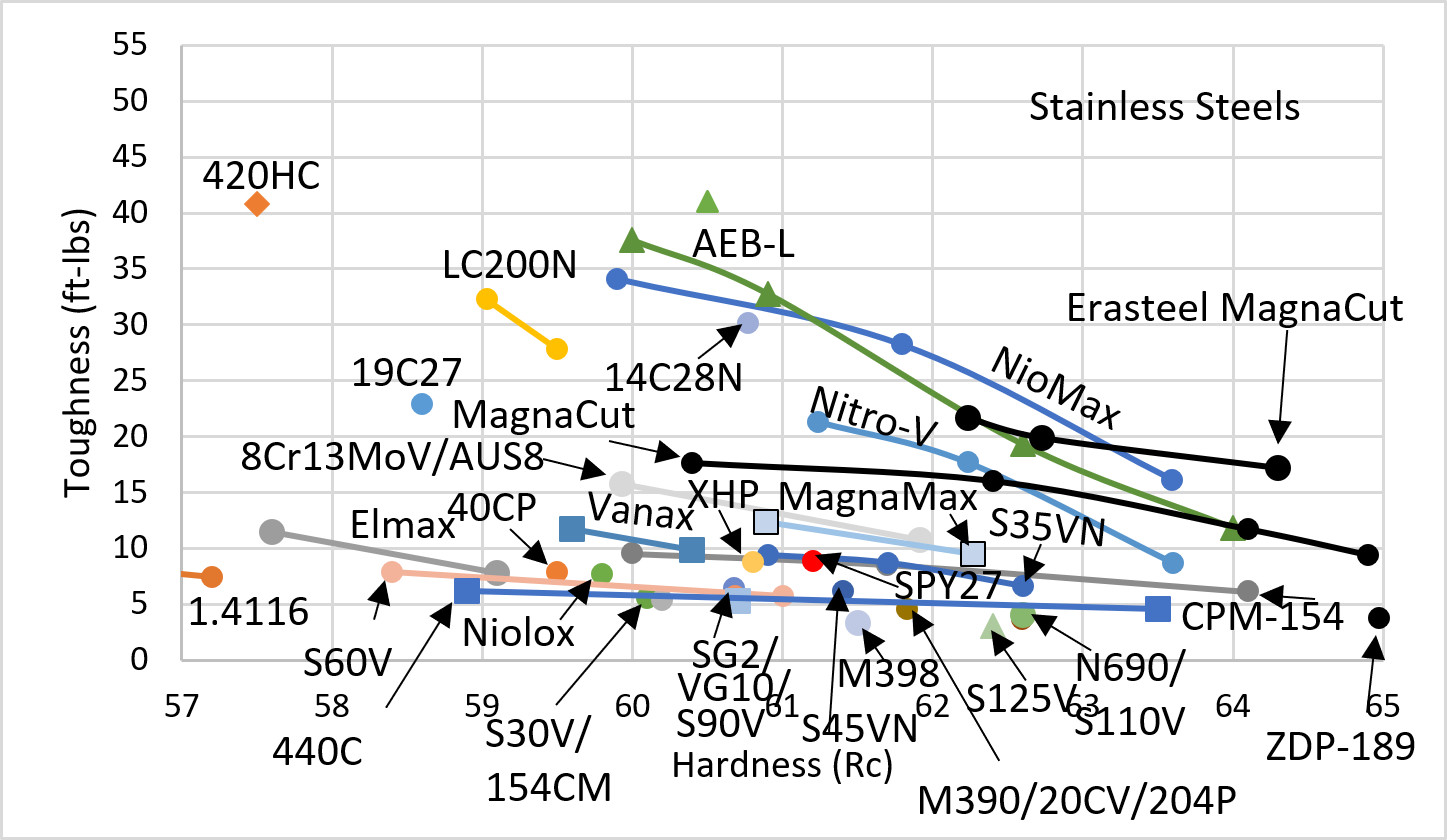
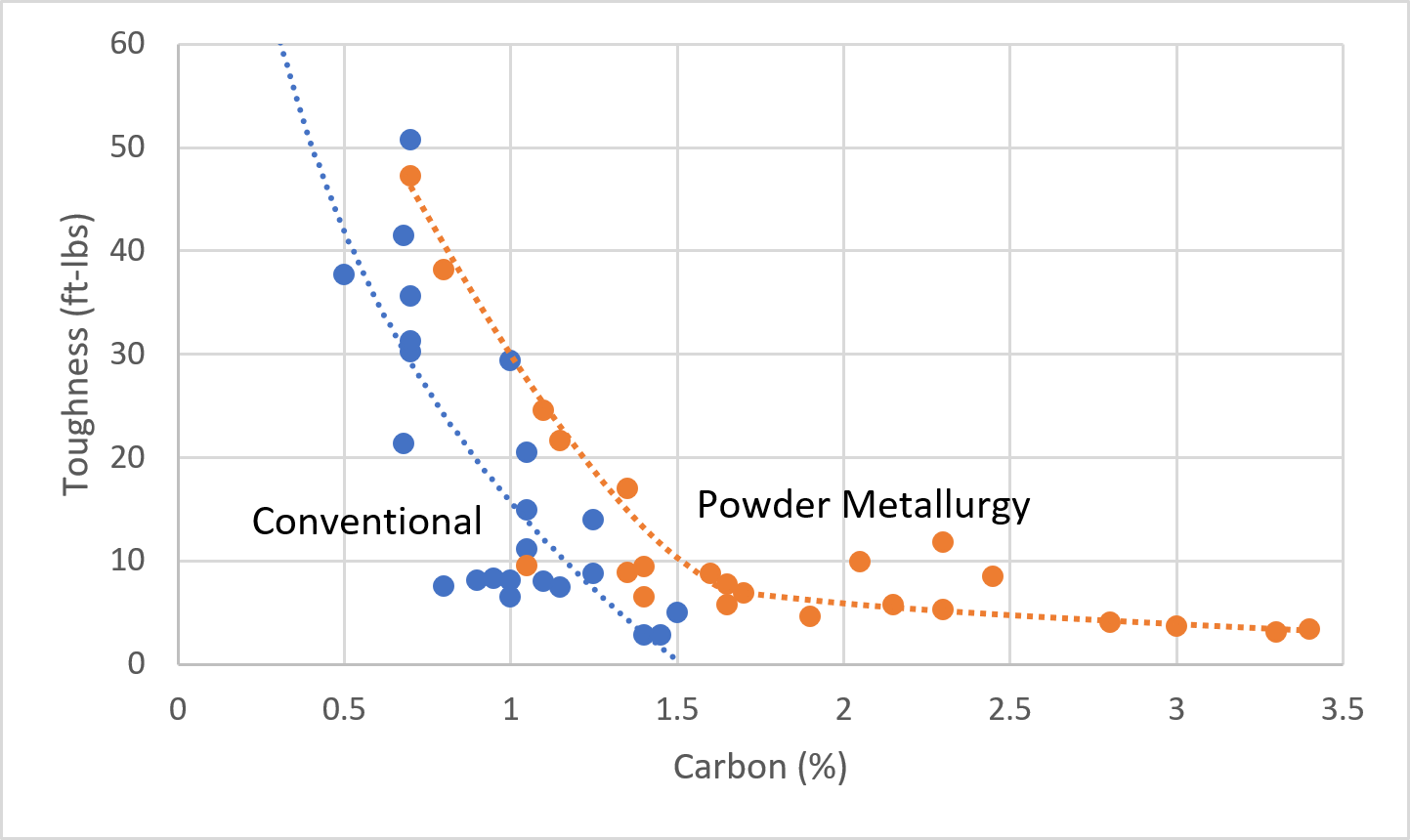
The limitations are much greater when not using powder metallurgy. The drop-off in toughness is a lot more rapid as wear resistance and carbon content is increased. There have been fewer generational improvements in the conventional steel space and I think there are opportunities there.
Summary and Conclusions

If you want to learn more about the past generational improvements and what led to different steels being used in knives, make sure you read my book The Story of Knife Steel: Innovators Behind Modern Damascus and Super Steels. Understanding the past gives us a better idea of what is possible in the future. As to what is possible in the future for knife steel, I laid out some possibilities above, and I can’t really be sure which will happen. I would like to make more Magna-family steels and to work  on improving conventionally produced steels, but some may be too niche to be commercially viable. But the thing I can be sure about is that more copies and minor modifications of prior steels will definitely come out.


[1] Machinery vol 42. 1935, p. 64.

The post What Could be Next for Knife Steel? appeared first on Knife Steel Nerds.

  •  

Moran vs Loveless – Knife Steel Edition

Bill Moran and Bob Loveless are the most influential knifemakers in the modern era. They were two key figures in the rise of custom knifemaking, which began in 1970 with the formation of the Knifemakers Guild. Both predated the Guild and had fully formed philosophies on knifemaking before its formation. There are an impressive number of dichotomies between Loveless and Moran. For two men who were influential in a similar time period for making the same product – knives – they had surprisingly different philosophies. Both men served as president of the Knifemakers Guild in the early years: Moran from 1972-1973, and Loveless from 1971-1972 and again from 1973-1974. B.R. Hughes wrote about the two knifemakers in 1986 [1]:

Future knife historians should be aware that Loveless and Moran had little in common. Loveless was an advocate of the stock removal method of making knives using stain-resistant steels, while Moran was a champion of the traditional forged blade. There were other, deeper differences. Loveless felt that quality should not be a condition of membership and that requirements should be as loose as possible to encourage new members. Moran was of the opinion that the Guild should have moderately strict guidelines and that members should be responsible to the Guild for unethical behavior… Be that as it may, the two, not friends by any means, ‘buried the hatchet,’ at least publicly, for the welfare of the Guild.

But looking at Moran and Loveless and how they viewed knifemaking is not only of historical interest. The arguments they were making decades ago are similar to those you can still find between some forging bladesmiths and stock removal knifemakers. And while they weren’t the only knifemakers making those arguments back then, they were two of the most influential voices. So it is valuable to examine the origins of these arguments to understand why some knifemakers still can’t agree.

Moran and Studying the Ancients

Moran was splitting time between a dairy farm and knifemaking from the 1940s. Moran found the book Bowie Knife, published by Raymond Thorp in 1948. Moran recalled [2]: “I must have read that book at least fifty times, and it certainly had a tremendous impact on me. It was during this same period that I began to attend gun shows in the Baltimore area. I was the only knifemaker who exhibited at these shows… People would stop at my table at a gun show back in the 50s and they would like my work, but when they discovered that I wanted $15 or so for a knife, they’d almost run away!” He sold the farm in 1960 and built a new shop, going full time as a knifemaker. Moran emphasized in his 1960 catalog how the study of ancient blades was key to his methods [2]:

I am the only maker of classical ancient blades… I do not make any wild claims that these knives can be used for cutting bolts or metal as a test of the knife’s quality. Moran Knives have long been acclaimed by many leading authorities as being the finest made today. They are probably the most expensive knives made because of the painstaking craftsmanship that goes into them. However, this results in a superior quality that one is unable to obtain in any other way. These knives will be collector items of future years… To my knowledge these knives are the only ones made today that are completely hand forged, hand tempered, and handmade in every respect… An immense amount of research and study of blades and forging techniques from ancient times until today has been required… The tempering process alone can only be learned by many years’ experience. This technique is the same as that used by the blade smiths of the seventeenth century. It was this tempering that enabled those blades to withstand such severe strain in combat.

Moran believed that ancient blades were better than modern knives, which is why he attempted to learn from them, as he said in his 1975 catalog [2]:

We must remember that the finest blades which have ever been made were developed at a time when one’s life depended on his blade. Anyone who does not believe this is true should make a study of ancient blades. It soon would be apparent to them that these were the finest ever made. I have tried to follow the methods and techniques used by the ancient smiths. These methods have worked out quite well for me. In all the years I have been making knives I have never had one returned with a broken blade.

Early Moran Knives. Weyer photo.

Moran Steel Choices

When it came to steel choices, Moran also believed that simpler was better, as he said in 1975 [2]:

Today, we hear a great deal about new and super steels. In over 30 years that I have been engaged in knife making, I have of course tried most all of the steels available in search of a superior steel. It is true that the corrosion resistant steels of today are far superior to the old stainless steels, but, what most people do not realize is that these steels were designed to hold their hardness at a high degree of heat. This of course, is unnecessary in a knife. Most of the high alloy steels have 12 to 18 percent chrome. This is a very definite drawback to good edge-holding qualities. It is true that this steel does have some advantages, such as being corrosion resistant, and this can be important to some people who do not have the time to wipe and oil their blade… Any steel manufacturer will tell you not to use the complex high alloy steels unless you need tools that allow you to cut under high heat, etc. For most tools and especially knife blades, one should stick to the high grade carbon steels. I myself, have found after 30 years of experimentation that the steel with the best all around qualities for a blade is in the straight carbon range. The high alloy steels have far more drawbacks than they have advantages.

Moran’s Differential Heat Treatments

Moran would heat treat his blades to have a hard edge but a “spring” tempered spine and soft tang. In 1960 he said [2] that this gave the blades “a combination of strength and edge holding quality that is unattainable from production made blades.” Again he made an appeal to ancient techniques [3]: “Of course this was a method used hundreds of years ago – especially in Europe – to make a better blade.”

Moran and Forging

Of course Bill Moran was famous for promoting forged blades. He believed that this was an important part of the ancient process, and claimed that it led to improved performance. In 1950 he said [2]: “The bar of steel is heated in a specially designed field stone forge … and forged by hand on the anvil. Every blade is heated and reheated, then forged dozens of times before the forging operation is finished. This hand forging greatly improves the quality of the blade.”

Moran believed that the performance improvement was due in part to the (now discredited) technique of “packing” as he said in 1975 [2]: “I use a technique known as hammer hardening or packing. This is an important step that unfortunately is understood by only a few smith’s. After the blade is forged almost to the finished shape, the blade is then hammered at a rather low heat with rapid, light blows. This causes the grain to be better aligned and the steel to be far more compact. This should only be attempted by a smith with a great deal of experience.” While “packing of molecules” is rarely claimed by bladesmiths anymore (iron atoms cannot be forced closer together), there are some that still perform cold or warm forging techniques for other purposes, so this could just be a case where Moran did not understand the metallurgy though there can be small benefits to the technique anyway.

Moran bowie. Weyer photo.

Moran and the Reintroduction of Pattern-Welded Damascus

Moran popularized pattern-welded Damascus in the early 1970s. This was due to his studies of ancient blades [4]: “Ever since I can remember, I, like all who love fine blades, have been fascinated with the beautiful Damascus blade. Many legends abound throughout history pertaining to the wonderful quality of these remarkable blades. After years of study and research, I felt I would like to try making them.” Moran would claim that Damascus blades had better properties [5]:

No one was more surprised than I, when I found this steel did have most unusual qualities. I found these blades could be left as-quenched and still have good flexibility, they also would hold a very good edge. Indeed I am now convinced that many of the old legends concerning these blades are true. These blades were far superior to any other blade because of the hundreds of alternating layers of iron and steel. The principle is the same as plywood or the laminated bow. I am now convinced that Damascus blades stopped being made so long ago for the same reason the wonderful composite bows of the Turks died out; that reason being they were so terribly difficult to make and after the fall of the Saracen empire, man went back to the self-bow which was made from a single piece of wood. The same being true for the Damascus blade; it was so much easier to make a blade from a single piece of steel.

Moran presented his first Damascus blades at the 1973 Knifemakers’ Guild Show in Kansas City. Knifemakers and collectors alike were very impressed. Butch Winter wrote [6]: “In those days the Guild Show crowds weren’t that big. There were a few people looking at Moran’s knives but they more or less were agog and didn’t understand what he’d done. The other makers were saying, ‘I wish I could do that,’ or ‘How’d he do that?'” Moran said that pattern-welded Damascus was key to bringing back forging and making his business sustainable [7]:

[T]he first year I showed my Damascus blades in Kansas City, I took in the most money I had ever made at any one show. For the first time, it occurred to me that it just might be possible to earn a decent living making knives. However, making Damascus cut my production by about two-thirds, and as I get older, it seems that I can’t make knives as quickly as I once did, and I was never a very fast bladesmith.”

Early 1970s Moran Damascus dagger. Weyer photo.

Loveless and Knife Design

Bob Loveless first attempted making knives after reading an article about Randall knives in 1953. He tried to buy one from Abercrombie & Fitch (then a sporting goods store) but the salesperson was rude and said it would be many months to be able to purchase one. Loveless made his own knife and returned to Abercrombie to show the rude sales clerk. He found instead that the clerk had been fired, but the floor manager was impressed with his knife and began ordering dozens of them.

Loveless is perhaps best known for his unique design sense. However, early on his knives looked a lot like Randall’s [8]:

[My first knives] looked a lot like knives that Bo Randall produced. The knives all had narrow tangs, single guards, leather washer handles with finger grooves and an aluminum pommel. Looking back, there is really no comparison between what we produce now and those early knives. They might have been good, solid edged tools, but they were lacking in aesthetics. Thankfully, over the years I’ve been able to break out of that early mold and create knives that not only are functional, but also look good.

Early Loveless knives. Weyer photos.

Loveless felt that first the knife must look good, and then when the customer picks it up it has to feel good [9]:

Eye appeal is the very first thing – it has a bearing on whether or not the knife will be accepted… If it is not appealing to the eye, then the prospect won‘t pick it up. If he doesn’t pick it up – you’re lost. But for the intelligent outdoorsman, you have got to get him to pick up the knife.

A knife must feel good in a man’s hand. Whether we realize it or not, our sense of touch is very critical to us. We get a lot of our input from our fingertips … it has to feel good … since we are directing our effort to the user’s hand primarily … it’s important to the knifemaker to understand the function of the hand… The knife designer, if he’s good, realizes that the human hand defines everything from the guard on back, in his work.

Loveless believed that having real experience was important to designing his knives [10]:

Unless you’ve had field experience, you can’t make hunting knives. I see knives with cutting edges that are too thick. With blades that are too long… With awkward and ill-shaped handles. Too many knife makers don’t understand their own hand. Their knives are not user friendly. You can’t teach a guy to make a good hunting knife if he’s never been in the woods, shot a deer, and been up to his elbows in deer guts. It’s like giving a typewriter to a man who is illiterate.

Loveless’s more developed style. Weyer photo.

Loveless and Steel

Loveless saw his process as iterating and improving to develop a knife that was better than any before it [10]:

Knife making can be thought of as an endless chase after perfection in design and execution – an ongoing pursuit of better steels and materials, and, of course, of working hard enough and being lucky enough to realize the measure of success that will give us a decent living. Some of us keep at it, often working long hours into the night after the demands of a regular day job. Sometimes, it becomes too much and we drop out. Yet it keeps calling us back – perhaps later when we can afford a better shop – to try again.

Loveless did not believe in forging of blades, and performed stock removal instead [8]:

I had no idea that flat stock in the steel of my choice (Jessop 139B) was available. When I ran out of steel, I contacted the manufacturer. The woman who answered the telephone suggested that I try their flat stock. I realized right then and there that I’d forged my last knife. Her suggestion was what you might call “a light bulb moment.” When that light came on in my head, I realized that there was no point in beating a piece of round steel stock flat, when you can buy it flat already. No matter what the forging community believes, you can’t improve a piece of steel by heating and beating on it.

While Moran used very simple steels, Loveless was looking for a modern alloy that would enhance performance. Loveless had started with a high nickel steel, Jessop 139B, relatively similar to 15N20 with 2.5% nickel. He liked the steel for its high toughness and found the nickel to improve the corrosion resistance. Next he tried the high silicon shock resisting steel S5 because it had a very high toughness rating according to the steel information he managed to find. The S5 made good knives with excellent toughness and good edge holding but he had issues with sudden fractures in the knives because of the fast brine quenching specified by the datasheet [11]:

S5 has almost 2% Si and 1% Mn, and when everything went just right, we got some very fine working knives out of it. Very high toughness of course, but also very good edge holding. But it was a Brine-quenching steel, and with S5 two problems were never licked: sudden, brittle fracture during testing, and rusting that seemed to pop out of the blade before my eyes. The brittle fracture just shouldn’t have happened, and two out of three times it didn’t. But the third time, I would put knife after knife in the vise for a simple bending test, and watch the damned things bust with very small bends. I hollered at metallurgists, kicked the dog, my kids wouldn’t bring me their report cards, my internist was pulling his hair, and my Old Lady was making me eat out in the shop.

Loveless even managed to request a “special modified melt of slightly different Silico-Manganese Shock steel” [11]. But he still had issues with the knives fracturing because of the severe brine quenching [6]:

I’d end up mumbling to myself, watching the moon go down and the sun come up trying to figure out what was going wrong. Never did, either. So I have a bad taste in my mouth over this kind of steel, which has been recognized for years as the best stuff to make chisels out of…the properties of the Shock steels intrigued me, and still do. But there was the rusting, and I got tired of having to hone my knife everytime I started out hunting, so I began wondering about things like that.

Loveless made a wish list of his ideal steel and eventually found it in 154CM stainless steel, as he wrote in his 1972 catalog:

So all during those years I was building in my mind a picture of what the perfect Loveless Knife steel would be, and what it would offer: working hardness exceeding Rc 62, working ductility and toughness at that hardness, and finally rust-resistance equal to the usual Knifemaker’s 440C, which I had tried but rejected due to poor edge-holding. During the summer of 1971, I learned of a steel made by a leading Tool Steel producer in the East (Crucible). They had developed it for service in the high-temperature regions of the fan-jet engines on the 747 aircraft, and it was alloyed to hold strength at 700 deg. F. My examination of the alloying, and a study of the heat-treating procedures suggested by the maker, led me to think it might be a candidate for fine hunting knives.

I ordered a quantity of 500-lbs, which was delivered in August. Test knives were made immediately, and placed in the hands of friends here in the West and in Canada, and I began hearing from these men, all critical knife users, within two weeks, with their comments. Previously knife buyers had to make a choice when they ordered a knife. The knifemakers, this one included, could offer edge-holding, or rust-resistance, but not both qualities, in the same knife. Typically, those of us who valued field performance preferred to make our knives from one of the better medium or high-carbon Tool Steels, in the judgment that edge-holding was the main reason for the existence of the benchmade knife. But two things were immediately apparent, in the letters commenting on the new knives. First, they did hold their edge, better than did my previous alloy. And second, they didn’t rust, in normal service, even if not cleaned up right away. We had to unlearn some things, and learn some new things, in the way of Shop practice, in making these new knives. But it was soon quite apparent that we had found a new kind of steel, and that this new steel was yielding the results I had been looking for. Knives made from Grade 154CM are indeed fine working knives… Exposure to blood acids in big game stains the blade slightly, if anything, but badly-pitted blades just don’t happen, and even the staining is rare. And the cutting edge holds up better than did the older Silico-Manganese Alloy knives. Blades are put in service at a working hardness of Rc 62-64, and are quite ductile and tough at that hardness… All Loveless Knives made since September of 1971 are of this fine new steel. We have almost 300 knives in the field now, and the results have exceeded my early hopes. The 154CM Alloy has brought new and better quality to Loveless Knives, and it’s the kind of steel I had hoped to find for years.

Weyer photo.

154CM and the Japanese version ATS-34 would become a standard for stock removal makers for decades (and is still used by companies like Emerson). Knifemakers also continue to use CPM-154 and RWL-34 (The RWL stands for Robert W. Loveless). Loveless enjoyed learning about steel and metallurgy. He wrote [11] that his copy of Tool Steels by Roberts, Hamaker, and Johnson was “well-thumbed and beloved.” Loveless wrote an article about metallurgy in 1975 which wasn’t too bad (according to this PhD metallurgist) [11]:

Eight thousand words or so ago, I set out to tell you something about steel, and knifemaking. Whether I succeeded or not is up to you, and how hard you want to work at knowing the world of fine knives. You won’t learn it all from an article, and may never learn it all in one lifetime for all I can see. But that’s what makes it interesting, even challenging, and yes … fun. There’s a little more to it than you thought there was. Right?

Loveless did not believe in “secret” heat treatments, in his article about heat treating he described his process and said sarcastically [11]: “[I]f you’ve ever wondered what goes on behind closed doors at the dark of the moon get ready!” He used modern heat treating methods rather than a forge or torch. He laid out his heat treatment steps for 154CM including a furnace, a cold treatment, and multiple tempers. He summarized the process afterward [11]: “If there’s any ‘secret’ to making knives like this, I’ve given it above, and I encourage you to try for the same results.”

Tradition vs Modernism Continues to This Day

Loveless and Moran seemed to disagree in almost every possible way. However, their fundamental philosophical differences seem to come down to tradition vs modernism. Moran found inspiration in ancient blades and thought that the secrets to superior blades was in the study of those blades. Loveless felt that through iterative design improvements and the use of new steels developed by modern science that superior performance could be obtained. Of course, this is somewhat simplistic. Moran developed new techniques and designs himself, and Loveless said that his tapered tangs could be found on blades from the 1800s.

Moran would take his love for the forged blade and found the American Bladesmith Society in 1976 along with Don Hastings, Bill Bagwell, and B.R. Hughes. This organization continues to this day and has continued to have a strong influence on those that forge blades. It remains relatively uncommon for bladesmiths to forge stainless and high alloy tool steels. While it is true that those steels are more difficult to forge, this is not the only reason why they remain uncommon. After all, it is also more difficult to use these steels with stock removal techniques but they are used much more frequently by those makers. The ABS founders did not believe that new steels were better, as Bill Bagwell said [12]:

Frequently, I note in some bit of literature that so-and-so is using a fantastic jet-age steel for his blades. Frankly, just because a given steel is great when used for the turbines of jet aircraft engines doesn’t necessarily mean that it is the ultimate cutlery steel. A blade that is forged, however, is made from steel that the smith has in effect manufactured expressly for a knife, and this makes possible the toughest, strongest, most effective cutting edge possible, but at the same time this blade will be relatively easy to sharpen once it gets dull.

The ABS bylaws specified (and continue to specify) that a JS or MS stamp cannot be used on a stainless blade, even if forged [13]. They justified this rule by claiming that stainless steels are inferior [13]:

[T]he Society discourages the continuous use of stainless steel for forging blades unless and until forged stainless steel blades have been proven, to the satisfaction of the Board, capable of being forged into quality blades that will consistently pass the standard ABS cutting and bending tests.

The ABS cutting and bending tests are much easier to pass with simple carbon steels since they require a differential heat treatment, which is difficult to perform with a stainless steel because of its high “hardenability” (air cooling leads to full hardness). It isn’t even possible to pass the Journeyman Smith cutting tests with a stainless steel, as the JS cutting test says that “Only forged blades of homogenous carbon steel are allowed.” I think that san-mai and other laminated type construction are ideal for the ABS bending tests, which would work very well with stainless steels. This would also demonstrate forging skill rather than only heat treating skill. The differential heat treatment can be performed with low alloy steels that have not been forged, so they are not an indicator of forged blade performance but only heat treatment. Stainless san-mai has become much more common over the past 10-15 years (though more commonly it is stainless “sides” with a carbon steel core).

The ABS board also claimed that stainless steels do not benefit from forging like carbon steels do. I have continued to hear this claim from many bladesmiths. B.R. Hughes wrote in 1977 [14]:

440C, D2, and 154CM are all … stain resistant steels, and all three will take and retain an edge for long periods of time even under heavy usage. It was not, incidentally, feasible to attempt to forge such sophisticated steels as those mentioned in the last two paragraphs, and the [common] view that many modern cutlers take of forging may in large measure be due to the fact that a few misguided souls even tried to forge 440C and even D2 by guess and by gosh, and the results were mostly awful.

Of course there have been a few brave bladesmiths who have used stainless steel despite the heavy social pressure of the ABS to avoid it, but they have remained a small number. For those who are brave, I have an article on how to effectively heat treat stainless steels that have been forged.

Nick Rossi knives in forged AEB-L

Another big difference between now and then is that the most common stock removal steels were 440C, D2, and 154CM, as Hughes mentioned. Those steels were very different than simple carbon steels. They have much higher carbide volume and thus higher wear resistance, but toughness is limited from those carbide structures. The chromium carbides were also relatively large which also limited toughness. So these steel choices led to very different properties, on the one end were low wear resistance simple steels with good toughness and ease in sharpening, used primarily by forging bladesmiths. On the other end were steels with high wear resistance and relatively low toughness (and some complained about sharpenability), used primarily by stock removal makers. Things have changed since then, such as the rise in popularity of AEB-L. Ironically, that steel dates back to the late 1960s, before the formation of the Knifemakers Guild, but did not become common in USA custom knives until the 2010s. AEB-L was designed for razors, and it has a much finer microstructure and much higher toughness than grades like 440C, D2, and 154CM. It has a much more similar performance profile to a low alloy steel favored by forging bladesmiths. And of course there are now a wide array of powder metallurgy high alloy and stainless steels available with a wide range of properties at different levels of wear resistance, toughness, and corrosion resistance.

I do think that claims from bladesmiths about the superiority of forged blades have slowed down. It was still relatively common in the 1990s and early 2000s but I don’t see it as much anymore. From my perspective the divide between forging bladesmiths and stock removal makers is smaller than ever. I do not see as much arguing about superiority as happened decades ago. It is most common for knifemakers to choose the method that is most appealing to them without making judgments about superiority (or inferiority) of the other method. So I think that improvement should be celebrated.

More History of Knives and Steel

Did you enjoy learning some history of knifemakers and the steels that they used? Then you will love my book The Story of Knife Steel. It is full of stories direct from the mouths of knifemakers, knife company owners, and metallurgists. Learn the development of steels, how they were introduced to knives, and the development of Damascus patterns and techniques. It is available in PDF, paperback, or hardcover. It is also available as a PDF bundle along with Knife Engineering 2nd edition.


[1] Hughes, B.R. “The Knifemakers Guild: Beginnings.” Blade Magazine. August 1986.

[2] Hughes, B.R. and C. Houston Price. Master of the Forge, William F. Moran, Jr. and His Classic Blades. 1996.

[3] McEvoy, Harry K. “A living legend in modern cutlery William F. Moran, Jr.” Knife World. February 1979.

[4] Material handed out at the 1973 Knifemakers Guild Show written by Bill Moran.

[5] Moran Knives brochure 1973.

[6] Hughes, B.R. “Happy 25th, Damascus!” Blade Magazine. November 1998.

[7] Hughes, B.R. “William F. Moran Knifemaker Profile.” American Blade Magazine. April 1979.

[8] Hollis, Durwood. Knifemaking with Bob Loveless. 2010.

[9] Spangenberger, Phil. “R.W. Loveless: Leader in the Field.” Guns & Ammo Guidebook to Knives & Edged Weapons. 1974.

[10] Williams, Al and Jim Weyer. Living on the Edge: Logos of the Loveless Legend. 1992.

[11] Loveless, R.W. “Steel and Knives: A Bladesmith’s Bible.” Knife Digest. 1975.

[12] Hughes, B.R. “Interview: Bill Bagwell.” Knife World. February 1978.

[13] https://www.americanbladesmith.org/wp-content/uploads/2021/03/ABS-ByLaws-2-7-2013-Signed.pdf

[14] Hughes, B.R. “Steel.” Knife World. December 1977.

The post Moran vs Loveless – Knife Steel Edition appeared first on Knife Steel Nerds.

  •  

Buderus Steel Mill Closing? Yes, But Also No

Video

There is a video version of the following information:

What is Buderus?

Buderus is a steel mill in Germany. They have several of their own knife steel products, including Nitro-V, Nitro-B, and Nitro-X7. They have also produced a wide range of standard grades, including 1095, 80CrV2, 15N20, and W2.

Buderus was purchased by Bohler-Uddeholm in 2005, which was then purchased by voestalpine in 2007, meaning Buderus was then owned by voestalpine (voestalpine is not supposed to be capitalized) [1]. Buderus was sold by voestlpine at the end of 2024 [2], and that process was completed in February 2025 by Mutares SE &Co. [2]. The previous owner, voestalpine, stated that they were selling Buderus because they were “concentrating its product portfolio on the technologically demanding high performance materials segment, while simultaneously reducing its share of standardized tool steel and high-grade engineering steel production, the price of which is coming under increasing pressure due to greater competition from outside Europe” [3].

At the time of the sale, Buderus had 1,100 employees and units capable of making steel from beginning to end, including melting, casting, forging, hot rolling, and cold rolling [4]. Mutares is a soulless private equity company, so of course, they did not hold on to Buderus for long. They began the process of selling the hot rolling mill and heat treat facility to GMH Gruppe in August 2025 [5]. Mutares also sold the drop forging unit to a subsidiary of itself, FerrAl United Group (no, corporate business doesn’t make sense). Mutares said this would secure 670 jobs for Buderus, and GMH Gruppe said their two units would account for 300 of those 670 employees [6].

What happened to the other ~450 employees? Those were let go because the steelworks was shut down by Mutares [7], meaning no more melting and casting of steel for Buderus. Electric steelmaking was apparently difficult to make profitable in Germany due to high energy costs [8]. We were also told that the cold rolling mill would shut down. Cold rolling allows steel to be rolled down even thinner than a hot rolling mill, and also gives a better surface finish and tolerances.

GMH Gruppe is also a steel company, so they announced [6] that the acquisition of the Buderus hot mill “closes an existing production gap … expanding product range to dimensions of up to 300 mm square. This enables access to new markets – including those beyond the traditional passenger-car combustion-engine segment.” With the steelworks shut down Buderus can continue to make steel but they will be sourcing ingots from other facilities within GMH Gruppe – these include Georgsmarienhütte GmbH, Stahlwerk Bous, Schmiedewerke Gröditz, and Pleissner Guss [6].

Will Buderus Cease Production of Knife Steel?

I contacted Buderus and asked if they would continue to offer knife steel with these changes. Christian Simon, the head of sales responded, confirming that they would continue to source ingots from the sources within GHM Gruppe listed above, also mentioning Energietechnik Essen GmbH, the company that makes Cronidur 30 (sold as LC200N by Zapp). He then added information specifically about knife steels:

“Based on our billet and strip rolling mills, we can now offer you hot strip from Wetzlar in an even broader range of materials. You can, of course, continue to obtain our popular NITRO grades from us as hot strip. And whether ingot casting, continuous casting, or ESU grades – our modern electric arc furnaces are already producing Green Steel for a sustainable future.

For the time being, Buderus Edelstahl operates under the name GMH Precision Machining GmbH. We will soon provide further information about the new Buderus Edelstahl brand within the GMH Group.”

Sven Kunzer, Managing Director, added in a separate email:

“[N]ow the things are getting clearer. We are offering our knife grades like Nitro-V, Nitro-X7 and Nitro-B as hot rolled strip.”

In other words, no longer available as cold rolled strip, but hot rolled steel will be available. Buderus metallurgist Clemens Trinks sent me a document about their new production route which confirmed that they will be offering steel as thin as 2 mm (0.079″) which is likely thin enough for the majority of applications. Though Clemens also mentioned potential limits for width depending on the grade and that is likely even more so for the very thinnest sizes. The annealing available has also changed due the restructuring, and they have now moved to open air annealing box furnaces. To remove scale they are using shot blasting.

How Are People in the Knife Industry Responding?

There is confusion in the knife industry about what exactly is happening with Buderus. New Jersey Steel Baron has been selling Buderus steel to knifemakers for many years now. Their official communication [9] about Buderus said only that Buderus is permanently closing and says that these steels will not be returning. I believe that New Jersey Steel Baron did not know that Buderus is continuing and will continue to offer knife steel. Or perhaps they were ready to move on from Buderus. NJSB is correct that Buderus has been an important supplier of knife steel in recent years. Several difficult to obtain steels like W2 were regularly available in good sizes and prices due to Buderus. Other knife steel suppliers should pick up the slack from NJSB if they decide to no longer purchase these grades from Buderus.

There is also a recent Blade Magazine article [10] that interviewed a few people in the knife industry. They seem to all be under the impression that Buderus is closing for good. So we should get the word out that Buderus is still making knife steel.

Summary and Conclusions

There were some troubling reports about Buderus going away but those were premature. The recent statements I got from Buderus employees about continuing to produce knife steels in hot rolled strip are very positive. They should be able to continue making it through the new group’s steelworks to provide ingots and slabs for hot rolling. I don’t think it should be understated just how many different knife steel grades have been produced by Buderus in recent years, and hopefully for many years in the future.


[1] https://www.voestalpine.com/specialtymetals/en/about-us/history/

[2] https://mutares.com/en/mutares-has-completed-the-acquisition-of-the-business-of-buderus-edelstahl-gmbh-from-the-voestalpine-ag/

[3] https://www.voestalpine.com/group/en/media/press-releases/2024-10-23-voestalpine-sells-buderus-edelstahl-to-mutares/

[4] https://www.buderus-steel.com/en/company/about-us/

[5] https://mutares.com/en/mutares-portfolio-company-buderus-edelstahl-has-signed-an-agreement-to-sell-two-business-units-to-gmh-gruppe/

[6] https://www.gmh-gruppe.de/en/news/acquisition-of-buderus-edelstahl-gmbh-business-units-legally-completed/

[7] https://www.marketscreener.com/news/buderus-edelstahl-to-be-broken-up-after-mutares-takeover-hundreds-of-jobs-affected-ce7c50dedd8af725

[8] https://www.ffh.de/nachrichten/hessen/mittelhessen/442556-buderus-edelstahl-in-wetzlar-das-wars.html

[9] https://newjerseysteelbaron.com/steel-signals-1-on-the-closures-of-crucible-and-buderus/

[10] https://blademag.com/knife-news/buderus-mill-closure-threatens-10xx-carbon-steel-supply-for-knifemakers

The post Buderus Steel Mill Closing? Yes, But Also No appeared first on Knife Steel Nerds.

  •  

Knife Engineering 2nd Edition – Expanded and Updated

11/18/2025: I added that the book is now available in South Africa from SD Knives & Supplies.

Links to buy are at the bottom of the article!

Video

Knife Engineering

In recent years, I have been mostly known as the “MagnaCut man,” but before MagnaCut, my biggest success was probably with Knife Engineering. When I started my website, Knife Steel Nerds, I hadn’t thought about writing a book because I thought I was doing a website instead. But I soon realized that a website works better for individual articles than it does for introducing an entire subject. So that led me to writing the book Knife Engineering: Steel, Heat Treating, and Geometry. That allowed people to learn the subject in order with all of the appropriate introductory material. The book has been a big success with many copies sold and many rave reviews from knifemakers and knife buyers alike. I tried very hard to make the subject as easy to understand as possible, and so it has been gratifying to hear people say that the book was exactly that.

The Second Edition

So why a second edition? There are a lot of reasons:

1. Since the first edition, I have tried to do as many experiments as possible in areas that I only had prior scientific journal articles to reference for those subjects. These included studies I performed on thermal cycling of both carbon and stainless steels, comparing different types of quench oils, and the performance of Damascus steels. There is an extra chapter in the second edition from one of these studies, all about forge heat treating. I always learn new things by conducting experiments for myself, and of course, I can test knife steels that are currently popular among knifemakers and knife companies. This significantly improved those sections of the book as the data was more directly applicable, and I could compare different types of heat treatments to give better recommendations.

2. One thing that surprised me a bit was that many knifemakers bought Knife Engineering just to see the heat treatment recommendations in the book. So I improved that section by including recommended forging, normalizing, and annealing temperatures for each. Before, those temperatures were only found for select steels in other parts of the book. I also updated each recommendation with whatever new testing I had done since the first edition. The new recommendations section also has its own table of contents with all of the steels listed.

3. New formats and wider availability – since the first edition was published I now have the option of printing the book in hardcover. I have seen some very tattered looking paperbacks of Knife Engineering! I also am publishing a PDF digital copy to Payhip. So the book will be available in paperback, hardcover, and PDF. The PDF edition also means that the book is available anywhere in the world. Before if you were in a country where print on demand was not available the book could be costly to import.

4. There are also many miscellaneous figures and experiments sprinkled throughout the book that make it significantly better when it comes to supporting information. It would be a bit tedious to list them all, but several of them haven’t even appeared on my website. In the first edition I restricted my own heat treating experiments primarily to a later chapter called “Practical Aspects of Heat Treating.” I moved most of those into the relevant chapters including many new experiments – annealing, austenitizing, tempering, etc. That way the new stuff is incorporated into the book and also the reader can learn about it within the chapter rather than a disconnected place later in the book. Overall the text is about 15% longer in terms of word count.

5. An index – the most requested missing thing from the first edition was an index. This was surprisingly painful to make. I had to double-check each page number, and it took forever. I think this is like smoking a pack of cigarettes, where each one removes 28 minutes off the end of your life. That definitely happened when I double-checked the index.

6. Improved formatting – I learned a lot about formatting books while working on my other book, The Story of Knife Steel: Innovators Behind Modern Damascus and Super Steels. There is a lot of extra white space in the first edition, and I wanted to make it look more professional. There are a bunch of charts and figures that look washed out, and so I redid them all to give them more contrast.

7. References – the first edition has the references I used at the end, but I did not include reference numbers within the text. This was a decision I made to improve the flow of the book and so as to not scare away general readers. But I regretted it almost immediately. Readers wouldn’t know which references are backing up which points, so figuring out which to read would be very difficult. I also knew that adding them back in would be way more work than including them in the first place. The references are small “superscript” numbers and I don’t think they have affected the flow of the book at all.

How to Buy

I spent 18 months working on the second edition. I thought it would take me a few weeks and get it knocked out. But it turns out making a new edition of a book is nearly as much work as writing a whole new one. Sometimes it felt like more! So I am excited for people to read it and hear what they think about the new and improved book.

Here are links to buy:

Worldwide

PDF: https://payhip.com/b/98jgz

There is also an available PDF bundle for $10 off if you get both Knife Engineering and The Story of Knife Steel: https://payhip.com/b/XFyLU

I have not put any DRM or anything on the PDF. There is a tiny watermark at the top of the page that gives an order and name so that if the PDF is distributed we know who did it. Please don’t steal the book.

United States

Paperback: https://www.amazon.com/dp/B0FYWBPFWF

Hardcover: https://www.amazon.com/dp/B0FYW8DRGX/

If you don’t see your country below I recommend the PDF.

South Africa: Paperback

United Kingdom: Paperback, Hardcover

Germany: Paperback, Hardcover

France: Paperback, Hardcover

Spain: Paperback, Hardcover

Italy: Paperback, Hardcover

Netherlands: Paperback, Hardcover

Poland: Paperback, Hardcover

Sweden: Paperback, Hardcover

Belgium: Paperback, Hardcover

Ireland: Paperback, Hardcover

Japan: Paperback

Canada: Paperback, Hardcover

Australia: Paperback

Comparisons

The hardcover is definitely my favorite version. I’m glad that is an option now. The PDF is great if you have an iPad or can’t get the book in your country.

If you never got a copy of The Story of Knife Steel make sure you get one of those as well!

The post Knife Engineering 2nd Edition – Expanded and Updated appeared first on Knife Steel Nerds.

  •  

Testing Super High Speed Steel Vanadis 60

The following is a collaboration project between myself and Malachi Chou-Green. He obtained the Vanadis 60, did some heat treating experiments, and also did metallography including some fancy electron microscopy. He also heat treated and machined the CATRA knife that I tested. His original experiments were published some time ago on his Patreon, so if you want to see what he is up to I recommend visiting his Patreon page and becoming a supporter.

Video

The following information is also available as a video:

Background of Super High Speed Steels and Vanadis 60

High speed steels with greater than 2% vanadium for wear resistance were developed in the late 1930s  and early 1940s leading to M4 high speed steel and T15 high speed steel. I have written a short article on the history of M4 steel, and my recent book The Story of Knife Steel has a more etensive history if you are interested in reading further. Previously vanadium was found to lead to very hard carbides for very high wear resistance but when the additions exceed ~2% the steel would not harden. The breakthrough in the 1930s was that they learned that more carbon was necessary in conjunction with the vanadium, to compensate for the carbon that was being tied up in the vanadium carbides. However, vanadium was still limited to about 4-5%, otherwise the carbides would become too large and the steel would fracture during forging and/or rolling.

Another development occurred in the early 1960s when it was discovered that greater control over carbon content and cobalt addition could be used to make high speed steels that could be heat treated to 70 Rc. Several steels were patented within only a few years by different companies, with the most common being VASCO Hypercut patented in 1963, given the standard designation M42. You can read more about the history of these steels in this article. The compositions of these steels are shown in bold, and the older lower carbon versions of each are shown below each of the bold compositions in the “M40” series.

Around the same time Crucible developed powder metallurgy technology which was capable of creating finer microstructure in tool steels by avoiding the slow solidification associated with conventionally cast alloys. They began producing these steels for commercial scale in 1970. You can read more about how powder metallurgy works and its history in this article. At the beginning Crucible used this technology to improve performance of existing steels like M2 or T15, but they also began designing steels specifically for the technology. The first of these was CPM Rex 76, patented in 1972, which was a high hardness high speed steel with 3% vanadium.

Shortly after Crucible introduced their powder metallurgy technology, Stora in Sweden introduced their own version of the technology. This led to a legal battle that Crucible would eventually win, requiring Stora and Uddeholm to pay fines. Stora developed a higher vanadium 70 Rc high speed steel called ASP 60 which was introduced by 1975. It had 6.5% vanadium for higher wear resistance than Rex 76. Uddeholm purchased Stora in 1976. In 1978 Crucible published results of their experiments [1] comparing Rex 76 and ASP 60 which they claimed showed that higher than 3% vanadium did not lead to better performance in high speed tools. They also made a 6% vanadium version of Rex 76 and they demonstrated that it had no better tool life than the standard 3% vanadium version.

J.H.G. Stake of Uddeholm was not happy with these claims. He said [1], “I represent the firm that sells the steel mentioned which is available commercially, the ASP steels by the ASEA-STORA process. It is very difficult to comment on the slides shown here regarding the comparison between ASP 60, Rex 76, and Rex 76 with 6% vanadium. The main reason is that the trials have been done without any coolant and that is very unusual in commercial application in general practice. We prefer to go to the toolmaking industry and have the trials made there.”

Uddeholm would eventually begin selling ASP 60 under the name Vanadis 60 instead, and Erasteel which also had historical connections to Stora, would sell it under the name ASP 2060. Both have the same composition. Despite Crucible’s earlier claims about 3% vanadium being as much as is necessary, they would later release higher vanadium versions of Rex 76. The 9.5% vanadium version called Rex 121 was released in 1998 [2]. The 5% vanadium version is known as Rex 86 (Zapp sells it as Z-Max) which was released in 2005 [2]. Other high vanadium 70 Rc powder metallurgy high speed steels would be released by other companies, many of which are shown below:

For more exciting knife steel and tool steel history, plus a history of the modern knife industry including custom knives, high-end production knives, and Damascus, see my book The Story of Knife Steel.

Composition and Microstructure

As mentioned above ASP 2060 (Erasteel) and Vanadis 60 (Uddeholm) are identical in composition. They have molybdenum and tungsten (and to a lesser extent chromium adn vanadium) added for “hot hardness,” the ability for a steel to maintain its hardness at high temperatures. This is important for machining operations where the tools are run at “high speed” and thus heat up due to friction. Hot hardness is created through a phenomenon called “secondary hardening” where the precipitation of very tiny carbides causes the steel to further harden when tempering at high temperatures, which you can read about in this article. The vanadium content of Vanadis 60 is relatively high at 6.5% for wear resistance. Cobalt is added to further improve hot hardness by affecting how the carbides form in secondary hardening (as opposed to forming carbides such as molybdenum and tungsten). You can read more about cobalt in this article.

The toughness and wear resistance of high speed steels is largely controlled by the carbides. Where increasing carbide volumes and sizes tend to decrease toughness, increased volumes of harder carbides increase wear resistance. Each of the above mentioned steels forms some M6C carbides (tungsten/molybdenum carbides) and MC carbides (vanadium carbides). With this in mind, vanadium carbides are generally more desirable because they are harder and smaller than the tungsten/molybdenum carbides. Therefore the vanadium carbides are less detrimental for toughness while also contributing more to wear resistance.

Below I have calculated carbide contents using Thermo-Calc for Vanadis 60, Rex 86, Maxamet, and Rex 121. Importantly these are “equilibrium” calculations, meaning they assume an infinite hold time. Each is calculated for the austenitizing temperature that was used for the CATRA knife coupons I tested.

So based on total carbide volume alone we would expect Maxamet to have the highest toughness (it has the lowest carbide volume), followed by Rex 86, Vanadis 60, and finally Rex 121. Maxamet and Vanadis 60 have similar MC content but Vanadis 60 has higher M6C, so we would expect Vanadis 60 to have higher wear resistance than Rex 76, Rex 86, and Maxamet, but less than Rex 121.

Below are the micrographs for these steels to compare with Malachi’s Vanadis 60 micrograph.

Maxamet austenitized from 1975°F

Z-Max/Rex 86 austenitized from 2150°F

Rex 121 austenitized from 1925°F

Looking at the micrographs above, the carbide volume of Vanadis 60 appears to be similar to that of Maxamet, but the carbides are a bit smaller. Z-Max has a similar carbide size to Maxamet but a lower carbide volume. Rex 121 has the most carbide and the largest carbides as expected based on its composition.

We measured the carbide volumes of each steel using a simple method called “point counting” to compare with the Thermo-Calc estimates. The total carbide volume measured was significantly lower in Vanadis 60 and Rex 86/Z-Max than the equilibrium estimate. This is relatively unusual as equilibrium carbide volume estimates ten to underpredict the true carbide volume because it assumes an infinite hold time at austenitization temperature. Maxamet and Rex 121, both had carbide volume a few points above the Thermo-Calc equilibrium estimate which is more typical.

Malachi also took scanning electron microscope (SEM) micrographs of Vanadis 60 austenitized at 1900 and 2125˚F using the “backscatter” imaging technique where contrast is partially generated from composition differences within the sample. Heavier elements scatter more electrons back into the detector leading to bright areas. Thus vanadium carbides show up as grey while the tungsten/molybdenum carbides are white, due to the relative atomic weights of the carbide forming elements (V < Mo < W).

Vanadis 60 austenitized from 1900°F

Vanadis 60 austenitized from 2125°F

Using different colors he point counted the volume of M6C, and total carbides and compared them against the Thermo-Calc predictions. The measured M6C (tungsten/molybdenum) carbide volume was lower than Thermo-Calc, while the measured MC (vanadium) carbide volume was high. So it appears that Thermo-Calc is overpredicting M6C carbide and underpredicting MC carbide stability in Vanadis 60. Perhaps similar differences are leading to the overprediction of carbide volume in the Z-Max, and imply that the MC carbide volume of Z-Max may also be greater then Thermo-Calc predicts. This could partially explain why Z-Max preformed better in CATRA testing than my equation suggested it would.

Hardness and Heat Treating of Test Coupons

The ASP 2060 datasheet has a better heat treatment hardness chart than the Vanadis 60 datasheet so I have included it below:

Malachi reported that he got 70.5 Rc with 2125-1000°F (1160-540°C) and 68.8 Rc with 1900-1000 (1040-540°C). He also austenitized the CATRA coupon from 2025°F (1100°C) which I tempered at 1000°F (540°C) for a hardness of 68.4 Rc. Malachi reported to me he later measured the temperature of the furnace he was using and found it to be reading too high, (thus the furnace temperature was lower than 2025°F), which may explain why the hardness was lower than his previous 1900-1000 coupon. I also heat treated toughness coupons using 2025-1000°F and the resulting hardness was 69.0 Rc. As expected Vanadis 60 is capable of very high hardness.

Edge Retention

To test the edge retention, Malachi heat treated and machined the CATRA knife for testing. I performed the final sharpening and tested for slicing edge retention:

Somewhat surprisingly the resulting edge retention was only slightly higher than Z-Max after compensating for hardness, and was significantly below Maxamet. This was puzzling because Maxamet and Vanadis 60 have similar vanadium and carbon, while Z-Max is somewhat lower in both elements.

Based on our carbide volumes measurements, both the Maxamet and Vanadis 60 CATRA knives should have carbide volumes around 22%. However, as discussed previously Thermo-Calc seems to underpredict vanadium carbide and overpredict tungsten/molybdenum carbides in Vanadis 60 so perhaps the same thing is happening in Maxamet. This could be compounded by the difference in “tungsten equivalent” contents between the steels. Tungsten equivalent is calculated by multiplying the molybdenum content by two and adding it with the tungsten content, to account for the difference in atomic weight between the two. Since tungsten and molybdenum form M6C carbide, steels with higher tungsten equivalent contents are more prone to M6C carbide formation. The tungsten equivalent of Maxamet is 13% and Vanadis 60 is 20.5%, so perhaps the structure of Maxamet is mostly MC type carbides. We would need to do backscatter imaging with the Maxamet to confirm if there is indeed more MC carbide in the Maxamet than Thermo-Calc predicts.

Toughness

I heat treated and machined the Vanadis 60 charpy toughness coupons using the same 2025-1000°F heat treatment as the CATRA coupon, resulting in 69 Rc:

As expected by the very high hardness (69 Rc) and the relatively high carbide volume (~22%), the toughness was fairly low at 2.7 ft-lbs. Zooming in on the high hardness steels I added a trendline showing the approximate change in toughness with hardness for CPM T15, CPM Rex 45, CPM Rex 76, and Z-Max. Vanadis 60 looks like it has toughness a notch down from those steels while being more in line with Maxamet. This makes sense given that Maxamet has about the same carbide volume while those other steels have have lower carbide volumes ranging from 14-18%. Carbides are very hard particles and so they are detrimental to toughness. You can also see that as hardness goes up the difference between the highest and lowest toughness steels decreases. So at 61.5 Rc we have measured values all the way from ~4 ft-lbs to 45 ft-lbs. But at 67 Rc it only ranges from 2.6 to 5.9 ft-lbs. Thus it seems the higher the hardness the less influence the carbides have on the measured toughness.

One interesting thing to note is that the spread in toughness was particularly high for the Vanadis 60 coupons, coming out at 3.4, 2.1, and 2.6. This spread is especially apparent when we look at the 95% confidence intervals of the toughness measurements of other high hardness steels shown below. I am not sure what led to the variation, perhaps it was merely chance.

While it is hard to predict toughness trends, it seems that at the same hardness we would expect Vanadis 60 to have toughness between that of Z-Max and Maxamet, leaning more towards the Maxamet end of the spectrum. As mentioned above, the Vanadis 60 and Maxamet samples tested have similar carbide volumes but Vanadis 60 has finer carbides. Usually, we would expect finer carbides to lead to better toughness, however in this case the improvement seems somewhere between quite small and non-existent. Toughness in steels is determined by two factors, crack initiation and crack growth. In tool steels, the ductility is low enough that usually, crack initiation is the controlling factor, in these cases smaller carbides are harder for cracks to initiate on, leading to better toughness. However, crack growth is generally easier with a smaller interparticle distance (the distance between carbides). So while crack initiation is usually the controlling factor, maybe as the carbide volume increases, improvements to toughness caused by finer carbides are mitigated by their risk of increasing crack propagation.

Summary and Conclusions

Our testing of Vanadis 60 found toughness about where you would expect given its high carbide volume and very high hardness, and as expected it is capable of very high hardness and has excellent wear resistance. However, the slicing-edge retention was lower than we predicted based on the composition, testing more similarly (but still a bit higher) than Z-Max rather than the more compositionally similar Maxamet. We also explored the interesting history of Vanadis 60; while several other 5%+ vanadium 70 Rc powder metallurgy steels have come since then, Vanadis 60 was the first.


[1] Kasak, A., and E. J. Dulis. “Powder-metallurgy tool steels.” Powder Metallurgy 21, no. 2 (1978): 114-123.

[2] https://www.crucible.com/Products.aspx?c=7

The post Testing Super High Speed Steel Vanadis 60 appeared first on Knife Steel Nerds.

  •  

Testing Chinese Knife Steel 8Cr13MoV/8Cr14MoV

Thank you Patreon Supporters!

Thank you to my Patreon supporters who help make these studies happen. Patreon funds were used for purchasing two ultimately useless knives, and some steel. Patreon supporter Marcus Ho even sent me some steel all the way from China which also ended up not working out. And I used Patreon funds to pay Shawn Houston (also a Patreon supporter) to do microscopy and grind two CATRA knives for me. So when I say that Patreon makes the study happen I don’t mean in an abstract sense. If you want to help fund more knife steel research please come join us on Patreon where you can get articles and videos early. Or if you sign up for the highest tier you can even get a sweet Knife Steel Nerds mug.

Video

Video version of the following information:

History of 8Cr13MoV/8Cr14MoV

To cover the history of 8Cr13MoV we have to go back to Japan, or even further back to Europe. Hitachi in Japan came out with their own stainless tool steels called “Gingami” meaning “silver paper” with three different designations. All three of these steels were copies, or nearly so, of stainless steels available in Europe. They were released somewhere in the 1933-1951 time period. In 1960 Fukami Steel Company was founded in Japan and they introduced AUS-4 and AUS-6 in 1968. AUS-4 was a 420/420HC type steel and AUS-6 was similar but with higher carbon and a small molybdenum and vanadium addition. AUS-6 was very similar to Gingami 2, and also other European steels such as Sandvik’s 12C27. AUS-8 was introduced in the 1970s which was AUS-6 with increased carbon up to ~0.8%. AUS-6 and AUS-8 became very common in Japanese factory knives, such as Kershaw’s imported knives introduced in the late 1970s. You can read more about all of this history (including citations) in my book The Story of Knife Steel.

8Cr13MoV, also called 8Cr14MoV, is a generic Chinese designation for AUS-8. They have identical composition. The naming scheme is pretty self-explanatory, I think, but maybe it makes sense to describe it explicitly. The first number designates the carbon content, so “8” refers to ~0.8% carbon, Cr13 means 13% chromium, Mo means a small molybdenum addition, and V means a small vanadium addition. So 7Cr17 means 0.7% carbon and 17% chromium, 9Cr18 means 0.9% carbon and 18% chromium, and 9Cr18MoV is the same with molybdenum and vanadium. Another steel that seems to be building in popularity is 10Cr15CoMoV which is 1% carbon, 15% Cr, plus cobalt, molybdenum, and vanadium; a copy of Takefu’s VG-10. I have heard these designations sometimes referred to in a derogatory way as “Chinese alphabet soup” though I think it should be known that these designations are a slight modification of an earlier European designation system. For example, 9Cr18MoV has existed for a long time in Europe as X90CrMoV18, also referred to by another European designation system as 1.4112. This is the European version of 440B which has some small differences with the American AISI 440B, such as higher chromium (18 vs 17%) and molybdenum (1-1.3% vs <0.75%). 7Cr17 is the same as AISI 440A. To the average consumer I’m sure all of the numbers are somewhat mystifying and steel names tend to be more memorable.

I don’t know when 8Cr13MoV was first used, but it was first advertised in knives by Spyderco in 2005 with their new “byrd” line of knives produced in China. Spyderco had requested their new knives be produced in 440C and tests of the knives were positive. However, Sal Glesser requested they check the composition of the steel and found it to be identical to AUS-8, not 440C as the factory told them. They learned the steel was designated as 8Cr13MoV in China and advertised the knives as such [1]. There is no distinction between 8Cr13MoV and 8Cr14MoV, all published compositions I have been able to find are the same, apart from Spyderco’s composition table which lists the chromium content only as 13.0%, rather than other published ranges I have found which show 13-14.5% chromium.

My History with 8Cr13MoV/8Cr14MoV

Because of how common AUS-8 and 8Cr13MoV knives are, I was interested in testing the steel for some time. However, despite how common it is in factory knives, obtaining individual bars of it was actually pretty difficult. Japanese and Chinese steels are pretty difficult to obtain in the USA to begin with, as most of it is sold directly to knife companies in their respective companies. Furthermore, because they are known as “budget” or even “low end” steels custom knifemakers in the USA are not exactly clamoring for it so the knife steel supply companies were not trying to get any.

My first solution was to purchase two “Schrade Leroy” choppers made in 8Cr13MoV which have large flat areas. This would allow me to anneal (soften back to the steel factory state) the steel and then heat treat it how I want. The flat areas mean I could make steel coupons for testing such as toughness coupons and potentially CATRA knives. That gives me control over the heat treating and geometry of the steel so I am not limited to available knives.

The knife had easily removable handles so I annealed one of them and posted to my Patreon that I would soon be testing the steel. One of my Patreon supporters, Marcus Ho, contacted me and offered to purchase some 8Cr13MoV bar stock so I wouldn’t have to use my more complicated method for obtaining the steel. Marcus is a knifemaker in Hong Kong so he had experience with sourcing steel in China. You can follow him on instagram under his company name HK.Knifeworks. He sent me a bar of steel along with a very official composition certification.

So I set the Schrade knife aside and started working with the new bar of steel. I started with developing hardness curves with different temperatures, which looked about where I expected them to be. But then I tested the toughness and it was worse than I expected, being more in line with 1% carbon stainless steels like 154CM or 440C. I then looked at the microstructure and it had too much carbide in it, looking again like 154CM or 440C. So I tested the composition of the bar and it was indeed 440C. This was an ironic reversal of the situation that Spyderco saw with their byrd knives. I was so disgusted with this whole debacle and all of the time I had wasted on a bar of 440C that I stopped working on the steel altogether.

More recently I learned that Aus Maker Supplies in Australia had obtained some 8Cr14MoV to sell to knifemakers and I asked if they could send me some. This time I actually got a bar of real 8Cr13MoV/8Cr14MoV and I am happy to report that I have actually tested the real thing.

Hardness

I tested the heat treatment of 8Cr14MoV with a range of austenitizing temperatures after soaking for 15 minutes, plate quenched, and tempered at 300 or 350°F. For half of them I used a cryo step in liquid nitrogen after the quench but before the temper. I didn’t find any published information on heat treating the steel, but Aichi has a recommendation for AUS-8 of 1050°C austenitize and 180°C temper (1925°F/350°F).

As with any steel, cryo led to higher hardness, and a higher austenitizing temperature from which peak hardness was obtained. Without cryo peak hardness was from 1950°F, so the recommendation for AUS-8 of 1925°F is good I think. It is dangerous to heat treat close to the peak hardness, because austenitizing above the peak means that there is excess “retained austenite” dropping the hardness which leads to worse performance. These are small coupons so in an industrial environment with slower quenching speeds the hardness may be somewhat lower. 61 Rc with the 1925-350 heat treatment is pretty good. Also the steel can achieve relatively high hardness, up to 64.5 Rc with a low 300°F temper. A more conservative 350°F you can still get into the 62.5-63.5 Rc range.

Microstructure

8Cr13MoV has a generally fine carbide structure but has many larger carbides mixed in. Sandvik and Uddeholm razor steels 13C26, 14C28N, and AEB-L seem to have about the limit in terms of carbon and chromium content before large carbides become unavoidable without more expensive manufacturing such as powder metallurgy. I have AEB-L below as a comparison to see what I am talking about, along with the higher carbon 440C and VG10 which have even larger carbides.

8Cr13MoV 1925°F-350°F Area 1

8Cr13MoV 1925°F-350°F Area 2

8Cr13MoV 1950°F-350°F Area 1

8Cr13MoV 1950°F-350°F Area 2

AEB-L

440C

VG10

In terms of grain size we also did an etch to reveal prior austenite grain boundaries. It is notoriously difficult to reveal grain boundaries so they are somewhat difficult to see. However, it is apparent that there was some grain growth with 1950°F when compared with 1925°F.

8Cr13MoV 1925°F-350°F

8Cr13MoV 1950°F-350°F

We also observed broader “segregation” and carbide stringers on a macro scale, especially in the 1925°F CATRA knife, which is shown below with two different angles. We also had a surface defect from the carbide stringers, which is seen as a shadow in the darker of the two. This happens when a carbide stringer is big enough that it breaks out during grinding. Segregation and carbide stringers are not unique to 8Cr13MoV, they are relatively common with ingot cast steels (as opposed to powder metallurgy). This is especially the case with higher carbon conventional steels like 440C and 154CM. The carbide stringers are parallel to the edge, perpendicular to the “grind lines.”

Toughness

For toughness tests I heat treated two conditions: 1925-350°F without cryo (roughly matching factory knife heat treatments), and 1950-350°F with cryo (higher hardness and closer to a custom heat treatment). These resulted in about 60 Rc and 62 Rc, respectively.

As expected based on the presence of some larger carbides, the toughness of 8Cr13MoV is significantly lower than AEB-L, 14C28N, LC200N, and Nitro-V. However, the toughness of 8Cr13MoV is still better than most other conventional high carbon stainless steels like 440C, VG10, and 154CM. It is also better toughness than most powder metallurgy stainless steels, even Vanax, XHP, and S35VN (though not MagnaCut). So overall 8Cr13MoV/8Cr14MoV has pretty good toughness despite its reputation as a low end steel. AUS-8 would also be similar.

CATRA Edge Retention

For CATRA edge retention coupons I used the same heat treatments, though they both came out slightly harder at about 61 and 62.5 Rc. However, one interesting thing is that the 1925-350°F heat treatment, the softer of the two, measured higher for edge retention, with an average after four tests of 395 mm of cardstock cut in the CATRA test. The 1950-350°F instead measured 376 mm. The 1950 coupon tested very consistently with values of 370, 382, and 377 mm. The 1925, however, seemed to do better the more I retested it with 357, 399, 389, and 429 mm. After puzzling over this I think the reason is that we had more carbide stringers near the edge with the 1925-350°F CATRA coupon, as discussed in the microstructure section. So perhaps what happened is that I was sharpening into a more carbide-rich region leading to the higher values. This is part of the inconsistency of conventionally cast steels, leading to more variable microstructure and therefore properties. Powder metallurgy steels are typically more consistent. To be kind to 8Cr13MoV I plotted only the higher 1925 coupon on the chart below:

The steel tested about where it was expected to fall, a bit above the lower carbon AEB-L and Nitro-V, but below higher carbon steels like 440C, VG10, and 154CM. When compensating for hardness it did very similar to LC200N and 14C28N. Both of those steels (LC200N and 14C28N) tested a bit better than I expected based on their composition, as I expected them to be closer to AEB-L and Nitro-V. So I am curious if I were to test three knives if they would still end up where they did (as opposed to resharpening the same knife), or if there are other features of those steels that cause them to test a bit higher. But we are talking relatively small differences, it’s not as if the steels were competing with S30V.

Comparison with My Original Ratings

I had been running Knife Steel Nerds for a few years before I finally did my ratings of knife steels. I wanted to have experimental results before rating them. One of the few steels I gave a rating for without testing it was 8Cr13MoV/AUS-8, in part because it is so common and many people asked me to rate it. So I gave my best guess in the table which I reproduced below:

I guessed that the toughness would be a “6,” in between 5’s like Vanax and S35VN and the 7 of MagnaCut. And indeed the steel ended up in between those. The edge retention I gave a “3,” the same as AEB-L, LC200N, and 14C28N, and it tested similarly to those steels. So I pointed all that out to pat myself on the back for my predictive abilities based on educated guesses and everything I’ve learned about steels over the years. It’s fun to brag sometimes. I didn’t test corrosion resistance of the steel, it gets a 7 because it is largely a carbon-chromium steel (with a little Mo and V), and so should fall in line with other steels of similar carbon-chromium ratio. If everyone is really clamoring for corrosion resistance tests of these types of steels I will think about doing another round of salt spray tests.

Summary and Conclusions

8Cr13MoV started as a copy of the Japanese steel AUS-8. I told the complicated and boring story of why I have had such a hard time getting this steel so I could actually test it. I think the obtainable hardness of the steel is pretty good, it can be heat treated up to 64 Rc or so, and is very easy to heat treat into the 60-61 region without cryo and 62-63 Rc region with cryo. The 1925-350°F (1050-180°C) heat treatment recommended by Aichi for AUS-8 is a good starting point for a cryo-free heat treatment. With cryo you can austenitize up to the 1975-2025°F range for high hardness if desired. 300°F is as low as I typically recommend tempering, though 350°F gives more balanced properties. The microstructure is disappointing if you are comparing to AEB-L and 14C28N though looks pretty good when compared with higher carbon conventional steels like 440C, VG10, and 154CM. The toughness was better than those 1% carbon steels but not as good as the fine AEB-L and 14C28N, but quite respectable either way. The edge retention wasn’t much better than AEB-L for the toughness deficit, but with the good hardness 8Cr13MoV can have it isn’t too bad. Luckily for me I didn’t have to modify the ratings I had already given the steel in each category because my predictions were pretty good. If you are in Australia 8Cr14MoV/8Cr13MoV is a good low cost steel to purchase from Aus Maker Supplies. And if you are buying knives in the steel you don’t need to worry about the steel itself being “junk,” there are a lot worse choices. Of course that assumes the knife company is heat treating it properly.


[1] https://forum.spyderco.com/viewtopic.php?f=2&t=14579&p=140419

The post Testing Chinese Knife Steel 8Cr13MoV/8Cr14MoV appeared first on Knife Steel Nerds.

  •  
❌