ROME — Former paratrooper General Roberto Vannacci portrays himself on social media as a Roman legionary and charioteer. He has declared he prefers women “without skirts” and posted an AI-generated image of a female junior minister with exaggerated cleavage.
None of these projections of masculinity and anti-woke culture are clumsy gaffes. The insurgent far-right star of Italian politics is making a deliberate play to the so-called manosphere to transform himself from an internet provocateur into a heavyweight political force.
For Italy’s first female prime minister, Giorgia Meloni, Vannacci now poses a serious problem as she needs to decide whether he is an asset or a liability. With elections expected next spring, his National Future party is polling at about 8%, making him a potentially crucial factor in building a right-wing coalition.
“It is disgusting to think you can manipulate the image of a woman for such deplorable propaganda,” the center-right junior minister in Meloni’s coalition whose image was manipulated, Matilde Siracusano, told POLITICO. “I don’t think we have ever sunk this low, especially from someone aspiring to be a national political leader.”
Vannacci’s provocations may look like familiar trolling from a politician who has built his reputation on saying the unsayable. But behind them lies a broader political project, tapping into the grievances of young men who feel alienated by feminism and progressive culture.
Emanuele Pozzolo, a National Future parliamentarian who defected from Meloni’s Brothers of Italy, believes young men have become increasingly constrained in their relationships with women.
“I think young Western men are very often almost castrated in their instinct for dealing with women,” he said, arguing that even legitimate romantic approaches risk being treated as aggression.
“The cultural problem is that sometimes everything seems to be harassment, everything abuse, everything violence,” he added, while stressing that genuine abuse must be punished.
Mediterranean patriarchy
Vannacci combines inflammatory online messaging and an alpha-male persona with a political program that promises to restore traditional roles for men and women. National Future even has a name for its preferred social order: “Mediterranean patriarchy.”
Its political program calls for the formation of “strong men” capable of controlling their emotions and passions, protecting women and sacrificing themselves for society. It opposes the recently introduced crime of femicide, condemns feminism, and declares the defense of life “from conception to natural death” and the “natural family” among its non-negotiable values.
The architect of this vision and principal author of the program is Lorenzo Gasperini, a conservative Catholic philosophy teacher from Tuscany, who has opposed vaccines and abortion rights on social media and blamed feminism for violence against women.
The result is a political offering that combines different traditions: conservative Catholic ideas about family and sexuality, older Italian ideas of virility and the much newer online politics of male grievance.
Giorgia Meloni speaks at a press conference in Prague on Sept. 29, 2026. | Milan Kammermayer/AFP via Getty Images
The manifesto seeks to put traditional family values into practice with proposals to pay parents who leave work to raise children, and reward parents of large families with tax exemption and public sector jobs.
Some proposals echo Benito Mussolini’s fascist-era “Battle for Births,” which offered similar incentives while promoting motherhood as a patriotic duty.
Luca Sforzini, a former Vannacci ideologue who has since broken with him, said the Mediterranean label was a clever piece of marketing.
“It’s like talking about the Mediterranean diet,” he told POLITICO. “You think of Italian food, mozzarella, tomatoes, olive oil.” The result, he said, was to conceal a patriarchal model with men above women behind “bucolic, positive images. It’s monstrous,” he said.
Pozzolo rejected the suggestion that the program advocates for male supremacy.
“It is exactly the opposite,” he said. “When we talk about Mediterranean patriarchy, the main idea is to recover, preserve and pass on the responsibilities of being a man within the family and society.” Men, he argued, had a duty to show women respect, love and protection, while rejecting violence or coercive control.
He defended the “without skirts” remark as “extremely funny” — picking up on a reference to Deputy Prime Minister Antonio Tajani advocating long skirts — and not remotely offensive, comparing Vannacci’s ability to connect with ordinary Italians to Silvio Berlusconi’s.
At a recent rally in the Umbrian city of Orvieto, Vannacci defended the Mediterranean patriarchy concept as not “oppression and possession” but “duty, fidelity, sacrifice,” and said it was the family model that had allowed “us to prevail over the last 2,000 years.”
Elisa Ercoli, president of the women’s rights organization Differenza Donna, condemned the program as “a return to the supremacy of the white, cisgender alpha male, and the woman as his handmaiden.”
Appealing to alphas
Vannacci, who served in Iraq and Afghanistan, became a media sensation in 2023 with the self-published book “The World Upside Down,” a broadside against immigration, feminism and homosexuality. In it, he told gay people: “You are not normal, get over it.”
Lionized by fans as a defender of common sense against progressive politics, he received more than half a million votes as a candidate for the anti-immigration League in the 2024 European elections, before founding National Future in February.
Polling analysis suggests that about 62% of National Future’s prospective voters are male, including strong support among manual workers and the unemployed.
Vannacci speaks during the National Future’s constituent assembly in Rome on June 14, 2026. | Filippo Monteforte/AFP via Getty Images
Pozzolo denied National Future was deliberately targeting male voters, insisting the party’s ambition was to reach Italians of all backgrounds who felt unrepresented.
Federica Formato, a lecturer at Brighton University in the U.K., who studies gender and the far right, said Vannacci was “testing the waters” to see whether he can reach a younger male audience, tapping into what she described as the “aggrieved entitlement” of young men.
A career soldier, he has repeatedly portrayed himself through images of physical strength, competition and military prowess. On social media, AI-generated versions proliferate of Vannacci as an ancient Roman in scenes recalling the Ridley Scott epic Gladiator.
For Formato, the Roman imagery projects “virility and hyper-masculinity,” while Vannacci’s army background itself helps construct the image of an “alpha male.”
Humor, memes and deliberate provocation are particularly effective with a younger online audience, Formato said, allowing relatively complex ideological messages to be reduced to instantly comprehensible images. “He is not naive,” she said. “He says things to provoke and get more attention.”
That presents Meloni with a headache. Vannacci’s party is drawing voters from her Brothers of Italy and Matteo Salvini’s League, while offering a more uncompromising platform on immigration, social issues and foreign policy.
Yet Vannacci has opened the door to an alliance with Meloni if she needs his votes. He has described National Future as a natural partner for the center-right, while insisting that any deal must respect his party’s principles. With Italy’s new electoral law offering a parliamentary majority bonus to coalitions winning at least 42 percent of the vote, those votes could matter.
That presents Meloni with an uncomfortable choice: Keep Vannacci outside the coalition, or bring into her government a movement whose appeal rests partly on the grievances of men who believe feminism has gone too far.
For Formato, Vannacci is exploiting a space in Italian politics that has so far lacked a figure capable of turning those grievances into an organized political constituency.
Vannacci, with his promises to restore traditional masculinity, appears determined to occupy it.
Liechtenstein’s Hereditary Prince Alois vetoed a bill on Tuesday that would have legalized abortion during the first 12 weeks of a woman’s pregnancy, blocking a citizens’ initiative co-signed by a quarter of voters and passed in the micro-state’s parliament.
Performing an abortion is currently illegal in the principality, unless the pregnancy presents a severe risk to the pregnant woman’s health or if it is the result of a sexual assault. Women seeking an abortion usually travel to clinics in neighboring Austria or Switzerland, which campaigners say adds uncertainty and an unnecessary financial hurdle to the process.
The bill was introduced by the Fristenlösung citizens’ initiative, which collected almost 5,000 signatures — about a quarter of the state’s registered voters. It proposed decriminalizing abortion up to 12 weeks’ gestation, and to lift a ban on providing information about abortion.
The bill “is not suitable for adequately protecting unborn life as a central legal interest,” a statement from the princely house reads. Alois had already indicated in June he would veto the proposal on these grounds.
“We’re disappointed, but not really surprised,” Tatjana As’Ad, a campaigner for the initiative and a co-managing director for the Free List, Liechtenstein’s progressive opposition party, told POLITICO. “It was clear his decision was fixed in June and that there was no way we would change it.” She added campaigners met Alois on Tuesday morning, but that there was no indication he would announce his veto shortly after.
“We are frustrated because it feels like everything we did since June was decorative,” As’Ad said.
Liechtenstein, a small Alpine principality of about 40,000 people, has an atypical political system associating referendum-led direct democracy with a monarchy where the reigning prince retains extensive executive powers. Alois’s absolute veto right was itself confirmed by a 2012 referendum. He used it for the first time to block the abortion bill.
“The promise of dualism” between democracy and the monarchy “that the Liechtensteiners are trusting has got some cracks,” As’Ad said.
She added that the parliament’s decision to vote through the bill and send it directly to Alois for assent, instead of calling for a referendum, “spared” the hereditary prince from a “conflict” with his people.
She said her campaign’s biggest win was a clarification from Liechtenstein’s government that the ban on “information” about abortion was in effect a ban on “advertising” the practice.
“In the end, everything is going to be the same,” she said. “Women affected are still here. There is a majority in favor and it’s still here. Abortions are still going to happen, and [Alois] just decided where they would be going to happen.”
Liechtenstein’s princely house did not immediately respond to a request for comment.
On Monday, alongside First Lady Melania Trump, President Donald Trump signed an executive order establishing the Women’s Health Division at the National Institutes of Health and a White House Women’s Health Task Force. According to the White House, the aim is to support policy reforms to ensure that women’s research is well-funded and that women have access to “stage-specific prevention, diagnoses, treatment, and care.”
At first glance, the action is in line with what women have long been advocating for. But in reality, the order is a startling setback, reversing an order signed by Joe Biden pushing for women’s research while advancing the Trump administration’s fertility-focused, pronatalist agenda.
Melania Trump is a key part of this effort. In addition to championing the executive order, she also signed it — a purely symbolic act, as the formal role of first ladies is ceremonial. (In an historic first, she also signed an executive order with her husband in 2025 that expanded resources for the foster care system.) But symbolism matters, and Melania Trump is lending her signature and voice to an action masquerading as a boon for women.
In speaking at the signing ceremony, held in the Rose Garden at the White House, the first lady called the event “a transformative moment for women in America. Beginning today, we will change the reality of women’s health.”
That remains to be seen. The White House Women’s Task Force established by Donald Trump promises to work towards creating a federal government that recognizes and works to rectify medical conditions that affect women throughout their lives by enacting “necessary policy and regulatory reforms to ensure timely and state-specific prevention, diagnosis, treatment, and care for women.”
For many women who have faced systematic gaslighting from doctors who claim that our real physical symptoms are solely psychological, or a lack of funding and real-life effects of diseases largely affecting women being severely behind in clinical trials or lacking funding, this sounds like a good thing. As the order reads, “despite considerable advances in biomedical science, many diseases and conditions that disproportionately or uniquely affect women have not received the level of research, clinical attention, and treatment that other diseases and conditions have received.”
That is fundamentally true. Medical conditions that solely or disproportionately affect women, such as endometriosis and autoimmune diseases, have for decades been denied funding or excluded from clinical trials. Even conditions that affect men and women have routinely left girls and women out of clinical trials, failing to collect vital information about the different ways that diseases present and progress.This includes cardiovascular disease, in which women may experience different heart attack signs and symptoms compared to men and, consequently, often misattribute heart attack symptoms. The result is significant, often deadly, delays in seeking treatment.
The same disparity exists in medication research, with women experiencing adverse reactions to medications about twice as often as men because girls and women are not included in clinical studies where medication effectiveness and dosage is studied. This all trickles down into mainstream medicine, where women have for decades been denied care, diagnoses and medication. But the solution that Donald Trump is offering is not going to fix it.
While the goals of this task force are legitimate, the president has routinely cut and downscaled women’s healthcare funding and initiatives as Melania Trump has stood idly by.
While the goals of this task force are legitimate, namely to advance and coordinate research on women’s health through all phases of life, to increase inclusion of women and girls in clinical trials, and develop accountability for grant recipients, the president has routinely cut and downscaled women’s healthcare funding and initiatives as Melania Trump has stood idly by.
During his second administration, the president has cut Medicare, which provided vital healthcare for women, and shut down data-collection contracts for the Women’s Health Initiative study. (He reversed this decision days later.) As part of his efforts at targeting scientific grants connected to diversity, equity and inclusion, the president has further defunded women’s healthcare.
But perhaps the most glaring example of the administration’s neglect came in June when Trump cancelled millions of dollars in grants under the Teen Pregnancy Prevention Program. This change affected thousands of universities, community organizations, public health departments and Planned Parenthood clinics that provide vital gynecological care to women in states where abortion is currently illegal — and where Trump and the GOP’s continued fight against abortion access is costing women their lives.
The Department of Health and Human Services, which oversees the grants, issued new funding criteria mandating abstinence-only sex education with an increased emphasis on marriage and fertility tracking, which advocates warn will increase the rate of teen pregnancy. But that may be the point.
Since his return to office in January 2025, Trump has worked to reverse the decline in U.S. birth rates, even calling himself the “fertilization president” at a Women’s History Month celebration in March 2025. Many of his allies have claimed that the decline in teen pregnancy rates is a “crisis” rather than a societal success. With this context, women’s healthcare advocates argue that Trump is trying to raise the birthrate by increasing the number of teen pregnancies.
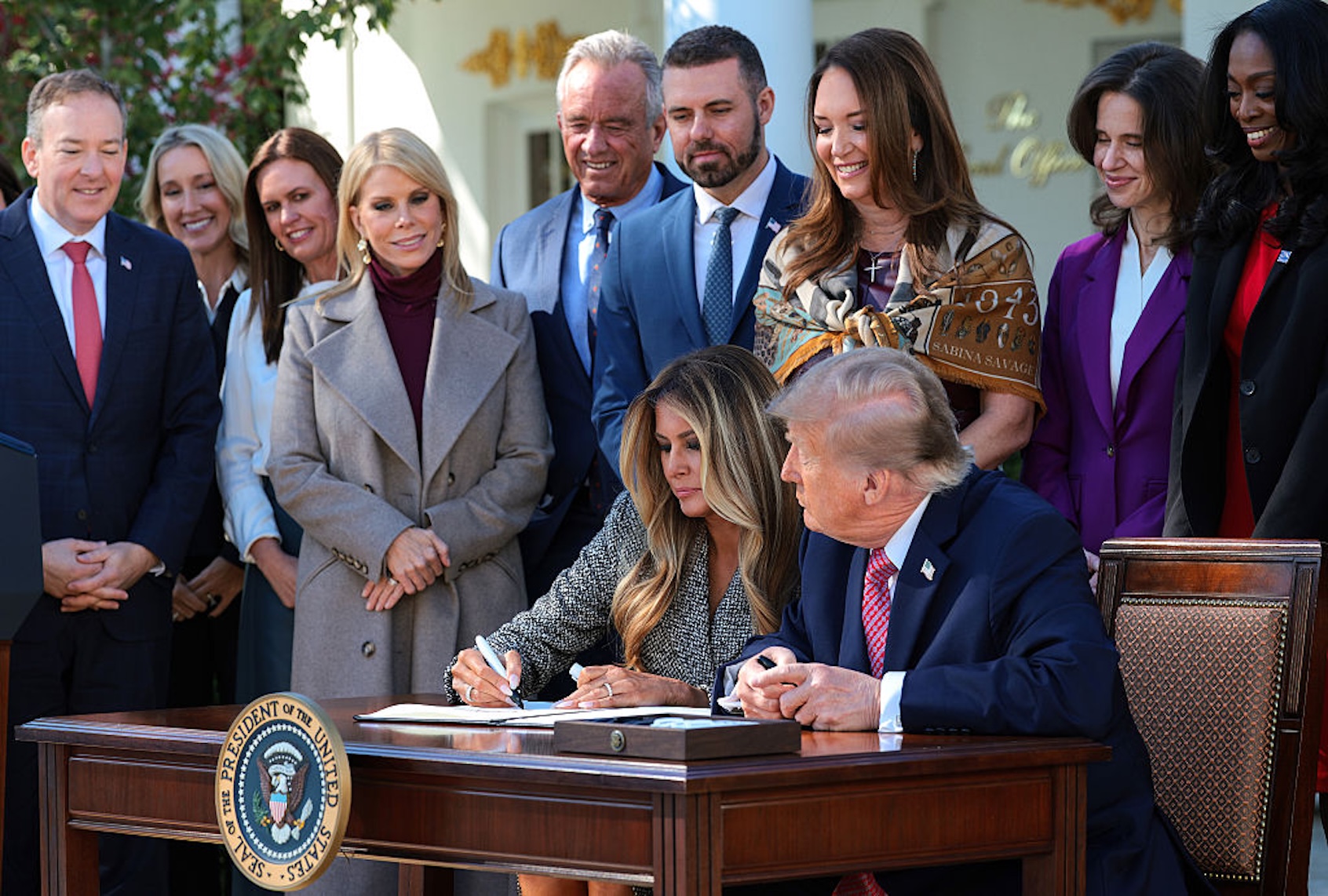
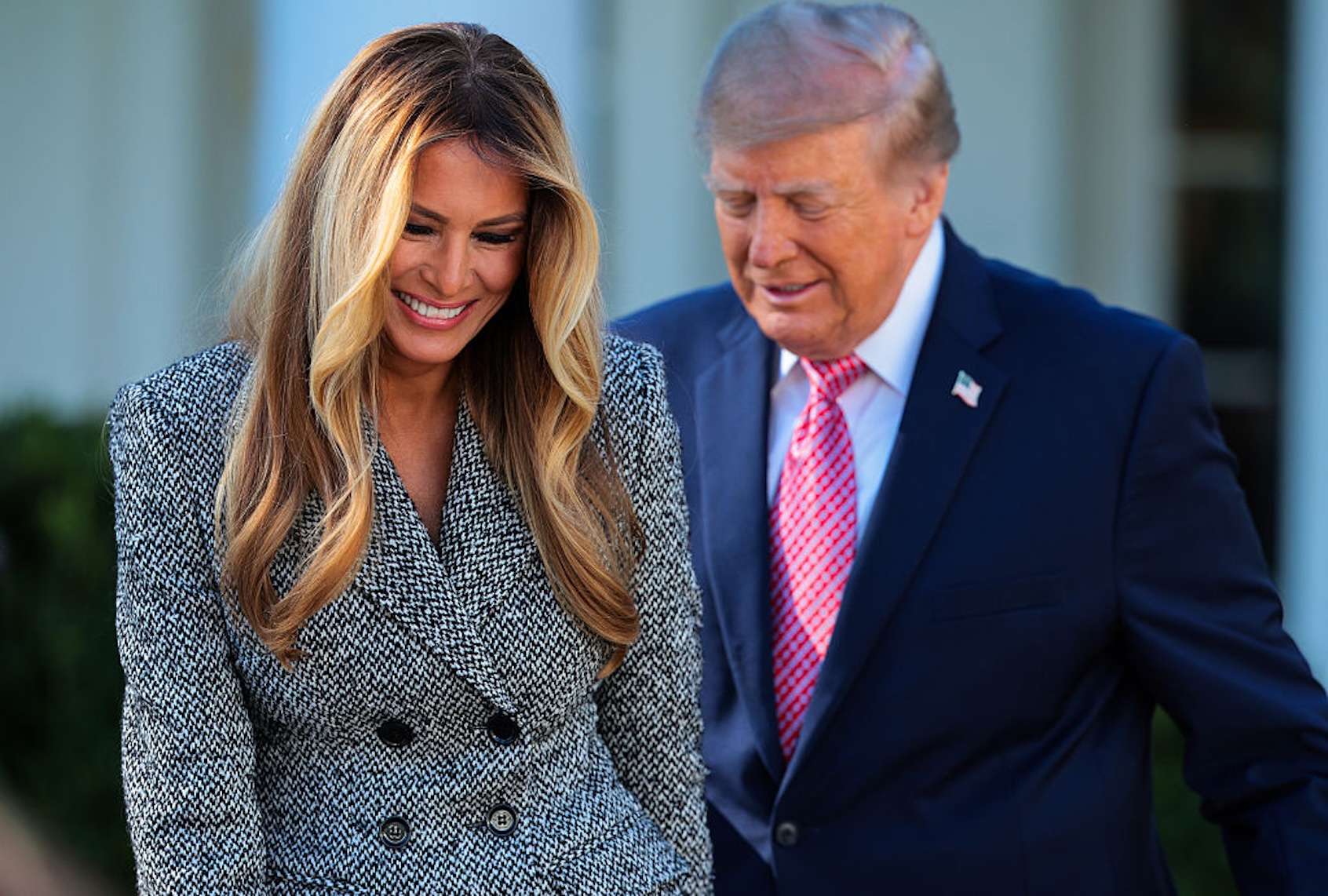
(Chip Somodevilla/Getty Images) President Donald Trump and First Lady Melania Trump sign an executive order establishing the Women’s Health Division at the National Institutes of Health and a White House Women’s Health Task Force on Oct. 19, 2026.
The president’s latest executive order advances this pronatalist agenda. The White House touts TrumpRx.gov as “delivering massive savings on some of the most commonly used fertility medications in the country to help families grow,” and hails the work of Moms.gov “to support new and expecting mothers, bringing together information intended to help families navigate pregnancy and early parenthood.”
Although Melania Trump has not spoken publicly about the Moms.gov portal, she did publish an op-ed in the Washington Post around the same time Trump launched the platform earlier this year on Mother’s Day, writing that America’s strength is tied to how mothers mold their children’s and family’s moral character. “America can restore the honor of motherhood after years in which feminism often placed career above family, with consequences to our nation,” she wrote.
With these words in mind, it comes as no shock that the order makes no mention of protecting access to abortion or contraception. As scholars and advocates like Dr. Karen Leader responded online to an X post from the official HHS account, writing, “‘Reproductive health’ without access to legal abortion is a death sentence for women.” Another person replied, “You might ask @FLOTUS to address the many preventable deaths of women who are bleeding out in parking lots or have sepsis or ectopic pregnancies due to republican draconian abortion laws.”
Even the people Trump has assigned to the new task force have a proven track record of supporting cuts to women’s healthcare and using medicine as tools to police and restrict women’s bodies. Led by White House chief of staff Susie Wiles, it will include HHS Secretary Robert F. Kennedy Jr., who has in the past supported cuts to Medicaid coverage and maternal health initiatives and medical abortion restrictions, as well as championing vaccine skepticism.
In a move that is especially galling, Pete Hegseth, who was accused of sexual assault and reached a financial settlement with the accuser, will also serve on the task force. During his time in office, the defense secretary has led a sustained attack on women’s healthcare and diversity in the military. In September 2026, the Pentagon released (and then temporarily rescinded) guidance as part of Hegseth’s “Health and Human Performance Optimization” initiative, which includes regularly screening female service members for fatigue and irregular menstrual cycles.
Women service members 35 and older who report significant symptoms of perimenopause or menopause are required to undergo testing to determine if these symptoms impact their station or quality of life. In response, advocates and medical professionals voiced concern that this policy could lead to unwanted and unwarranted tracking of women’s menstrual cycles, compromising medical privacy and potentially opening the door to use period tracking as a way to police miscarriages and abortions.
Instead of advancing women’s healthcare, the president’s executive order and task force should be seen for what it is: a cynical ploy for votes ahead of the November midterms. Taken together, the actions represent a last ditch attempt to save the support of women — and especially white women — for Trump’s allies amid growing criticism of the president.
It makes sense that the first lady, who herself defended abortion rights in her 2024 memoir “Melania”and urged Congress to hold public hearings for Epstein survivors, would be Trump’s choice to share the news. Once again, Melania Trump is willingly being used as a political prop to show that Trump values and respects women, despite the fact that he routinely fires the women in his Cabinet and press office, continues making sexist and predatory remarks to reporters, and most importantly, has named hostile men as many members of a task force dedicated to women’s health.
Women have long been medically disenfranchised, and Trump is trying to argue that he and the first lady care about women’s health. But for a president that has fought against abortion rights, opposed the release of the Epstein files and even defended the “Cornell 7,” many American women will remain unconvinced of his motives. Rather than reassured, they will also be rightly skeptical of the first lady who continues to stand by his side.
WARSAW — Poland’s lower chamber of parliament approved two bills that would loosen the country’s strict abortion restrictions Tuesday evening, marking a breakthrough for Prime Minister Donald Tusk’s coalition nearly three years after it took power, promising to restore reproductive rights.
The measures, which are likely to be vetoed by opposition-aligned President Karol Nawrocki, would end criminal penalties for helping a woman obtain an abortion and re-legalize terminations involving severe fetal abnormalities, undoing one of the crucial elements of Poland’s near-total abortion ban.
“The state trusts women. A woman who terminates her own pregnancy is already exempt from criminal punishment. It’s time to stop punishing everyone who loves us, worries about us and respects our choices,” Katarzyna Kotula, Poland’s government equality commissioner and a lawmaker from the Left, said on X.
Still, neither bill would allow abortion on request up to 12 weeks of pregnancy, as Tusk’s Civic Coalition promised during the 2023 election campaign. The multi-party coalition includes many conservatives and lacks agreement on the liberalization going this far.
Both bills now move from the lower chamber, or the Sejm, to the Senate, where they seem poised to pass, but their eventual fate remains uncertain. President Karol Nawrocki, an ally of the nationalist Law and Justice (PiS) party, said before his election in 2025 that he would not sign legislation easing abortion rules.
“By refusing to sign [the abortion] legislation, the president is hurting people,” Włodzimierz Czarzasty, speaker of the Sejm, said Tuesday before the votes. “If he wants to hurt women, he will hurt them. I think women will see that and hear that.”
Tusk’s coalition government will likely keep turning up the heat on the president and PiS if Nawrocki blocks the liberalization, as he has said he would.
Overriding a presidential veto requires a three-fifths majority in the Sejm that the Tusk-led coalition doesn’t have. The proposals that passed Tuesday lingered in a parliamentary committee for two years before surfacing, spurred by the campaign heating up 12 months before the next general election, slated for late 2027.
Overturning restrictions
At the parliamentary level, ending criminal penalties for helping women with abortion passed with 217 votes in favor, 213 against and three abstentions. The other bill won a slightly clearer majority of 233 for, 203 against and a single abstention.
The first bill would decriminalize assisting or encouraging an abortion performed outside legally permitted grounds, an offense which currently carries sentences of up to three years in prison. It would also protect doctors, nurses and midwives from prosecution when they terminate a pregnancy because of a threat to the woman’s life or health or strong indications of a serious, irreversible fetal condition.
The second bill would restore the right to terminate a pregnancy when doctors identify a severe and irreversible fetal abnormality or an incurable illness threatening the fetus’s viability. It would also set deadlines for hospitals to provide lawful abortions and require written explanations for refusals.
Women’s rights organizations were skeptical about the bills being a breakthrough, saying the reforms fall far short of granting Polish women the access to abortion available in most of the EU, where pregnancies can generally be terminated on request during the first trimester.
“What does this mean for women who need abortions now? Nothing, because none of these projects would help them,” Legalna Aborcja (Legal Abortion) NGO said on X.
Education Minister Barbara Nowacka, acknowledging the incremental nature of the change, said she believed women should be able to decide, unconditionally, whether and how many children they have.
“But I voted for it and will always vote for every change, even the smallest one, that brings Polish women closer to full rights over their own lives.”
Poland does permit abortion where pregnancy threatens a woman’s health or life or results from a criminal act, including rape or incest. In October 2020, the Constitutional Tribunal, dominated by judges appointed under the PiS government, struck down the additional ground for serious fetal abnormalities, which one of the bills passed tonight restores.
The ruling, effective from January 2021, prompted huge street protests and dealt a lasting blow to PiS’ standing in the polls, contributing to the party’s eventual loss of power in the 2023 election.
Reversing the restrictions became a defining issue for Tusk’s pro-European camp ahead of the October 2023 election. But the governing agreement with the more conservative Polish People’s Party (PSL) and Poland 2050 prevented that. Some PSL and Poland 2050 lawmakers voted against the two bills tonight.
In July 2024, the Sejm rejected an attempt to decriminalize assistance with abortion by 218 votes to 215, after most PSL lawmakers joined the right-wing opposition in voting against it.
Republicans running for governor across the country are backing away from abortion bans they once endorsed.
U.S. Rep. Tom Tiffany, the Republican candidate for governor in Wisconsin, calls his state’s 20-week abortion limit “settled law.” Just three years ago, he co-sponsored a bill that would have banned abortion six weeks into pregnancy.
Stacy Garrity, the GOP’s candidate in Pennsylvania, has said during her campaign that she would “respect” the state’s current law, which allows abortion until 24 weeks of pregnancy. Four years ago, she called on abortion opponents “to engage and make a difference” in state laws after the fall of Roe v. Wade.
In Kansas, where abortion is legal until 22 weeks, Republican Ty Masterson has demurred when asked if, as governor, he would support a statewide referendum to eliminate the Kansas constitution’s abortion protections. Masterson had previously spoken at protests in opposition to reproductive rights and won the backing of state and national anti-abortion groups.
The candidates’ retreat suggests that, even as reproductive rights fade from the national spotlight and polls show voters are far more likely to prioritize cost-of-living concerns, the political ramifications of pushing for new abortion restrictions remain substantial. The rhetorical distancing also moves political conversations away from an issue that overwhelmingly energizes Democrats.
“That might be their strategy there, to try to demotivate Democratic turnout in the state to take abortion off the table as a voting issue,” said Ashley Kirzinger, a pollster at KFF, a nonpartisan health policy research, polling and journalism organization. That’s especially true in tighter races such as those in Wisconsin and Kansas, she said.
Tiffany’s, Garrity’s and Masterson’s campaigns did not reply to requests for comment. The 19th contacted multiple Republican-aligned pollsters who also did not immediately respond.
About 60 percent of Americans believe that abortion should be legal in most or all cases, including about two-thirds of independents, according to a poll from The 19th and YouGov.
That said, pushing for abortion restrictions has never been broadly popular. Even before Roe v. Wade was overturned in 2022, Republicans seeking general election typically would not campaign overtly on abortion bans, said Molly Murphy, a pollster and president of Impact Research, a Democratically-aligned polling firm.
“It would get discussed in donor meeting hot mics, endorsement questionnaires, etc, but candidates wouldn’t run on the fact that they’d ban abortion,” she wrote in an email.
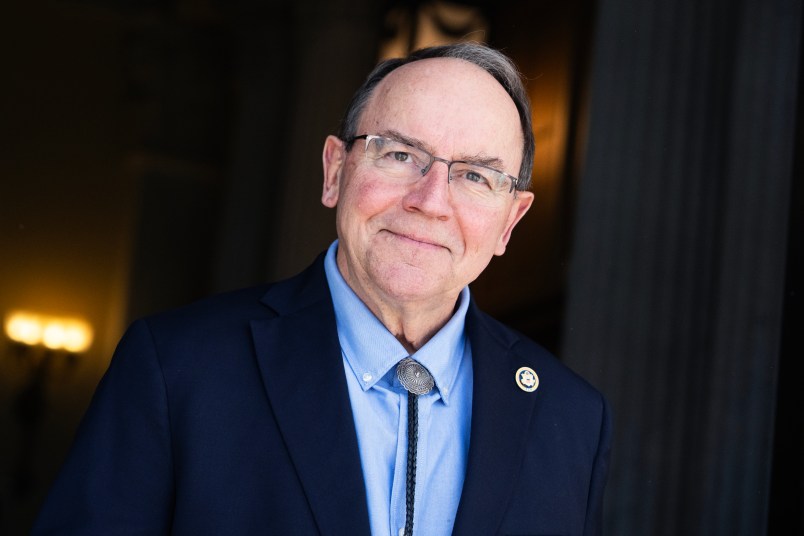
Wisconsin Republican gubernatorial candidate Tom Tiffany is now calling his state’s 20-week abortion limit “settled law”, when only three years ago he co-sponsored a bill that would have banned abortion six weeks into pregnancy.
(Scott Olson/Getty Images)
Voters largely don’t consider abortion to be “settled law,” said Celinda Lake, a longtime Democratic pollster, noting that the share of voters opposing abortion bans has increased since the fall of Roe. “They feel like, ‘Wait a minute, it can be taken away again.’”
In some races, Democrats and their allies are trying to push abortion rights back under the microscope — a strategy geared toward energizing liberal voters, Kirzinger said.
Wisconsin’s Democratic nominee for governor, David Crowley, has said that, if elected, he would work with the state legislature to enshrine abortion rights into the state constitution — though it’s not clear how expansive that protection would be or whether it might supplant the state’s 20-week cutoff.
Pine Tree State Prosperity, a political action committee associated with the national Democratic Governors Association, is running advertising in Maine that highlights anti-abortion remarks made by Bobby Charles, the state’s Republican pick for governor. The Democratic nominee, Hannah Pingree, has led by double digits in recent polls. Charles’ campaign did not reply to a request for comment.
Planned Parenthood’s super PAC, called Planned Parenthood Votes, has focused its resources in states such as Michigan, where the Republican candidate, U.S. Rep. John James, has said that abortion is “decided.” Four years ago, James said he opposed abortion in all cases, and he has compared the practice to genocide. His campaign did not reply to a request for comment.
James’ running mate, Jay DeBoyer, recently suggested leveraging a state constitutional convention to enact a 12-week abortion ban in Michigan, according to recordings of the remarks reported by The Detroit News and Michigan Advance. DeBoyer has since said publicly that abortion is a “settled” issue in Michigan, where voters in 2022 amended the state constitution to protect abortion before fetal viability.
Some gubernatorial candidates are still pushing for abortion restrictions, albeit far less ambitious ones.
In New Mexico, where Democrats are expected to keep control of the governor’s mansion and already control both legislative chambers, Republican candidate Gregg Hull said he was “fully committed” to working with Texas Gov. Greg Abbott to reduce the number of Texans coming to the neighboring state for abortions.
Hull has repeatedly called himself “pro-life” but also said that he would not change the state’s abortion law, which imposes no time limits on the procedure, without legislative support. His campaign did not respond to a request for comment.
Abortion opponents are trying to revive the issue in a handful of states. SBA Pro-Life America, one of the nation’s leading anti-abortion groups, is pushing ads that characterize Democratic candidates for governor as well as the U.S. Senate and House of Representatives as extreme on the issue, including in Ohio, Wisconsin and Michigan.
But generally, voters are less likely to trust conservatives on abortion, Lake said. And talking about abortion, she added, is more likely to generate enthusiasm among key Democratic voting blocs, particularly young women and college-educated women, who typically support reproductive rights.
“We have in our research people who say, ‘I used to be pro-life, I didn’t support abortion, I would never get one, but I think this is a decision that needs to be made by a woman and her doctor,’” Lake said. “People now feel this is just way too dangerous. This has gone way too far.”
The Trump Justice Department has mapped out its coming attack on mifepristone — much thirsted for by anti-abortion advocates, but deliberately delayed to avoid midterm backlash — in a new court filing.
The first step to imposing new restrictions (or reimposing ones previously lifted) is to conduct a “safety review.” Experts often point out that there are few drugs that have been studied and scrutinized as much as mifepristone, making the pretense of discovering some heretofore unknown risk factor fairly absurd.
“FDA is on track to obtain study results by mid-December 2026,” DOJ wrote of its review. “FDA will then need to review and evaluate/interpret the results and draft a report. FDA expects to complete that process not later than March 2027.”
The agency will then use those “findings” to justify a change to mifepristone’s REMS — Risk Evaluation and Mitigation Strategy — or restrictions meant to police the use of highly dangerous drugs. Mifepristone’s safety profile has never justified these restrictions, but the anti-abortion movement’s decades of smearing the drug as unsafe has successfully made it harder to get under Republican and Democratic FDAs alike.
The Biden administration took the largest strides yet in removing some of these barriers. Most importantly, it lifted the in-person dispensing requirement, which has allowed patients even in red states to be prescribed the medicine over telehealth by doctors in blue ones, and receive it in the mail. So far, blue state shield laws have protected those providers from prosecution by red states, though a massive legal reckoning on these state jurisdictional issues is certainly coming.
That Biden-era REMS change is the crux of a Louisiana lawsuit against the FDA seeking to restrict mifepristone, with the state arguing that allowing the drug to be remotely prescribed and mailed undermines its abortion ban and forces it to expend money on Medicaid patients that have mifepristone-related complications. This week’s filing is part of that lawsuit. Historically, these lawsuits have struggled to amass legitimate examples of such mifepristone-related injuries, and Louisiana’s complaint leans heavily on state sovereignty.
The DOJ filing stated that the FDA is looking at the in-person dispensing requirement in particular.
“Following completion of its study and review, FDA will decide whether changes to the Mifepristone REMS Program are necessary and, if applicable, initiate any such changes in accordance with established processes,” it said. “FDA anticipates that it will be able to provide an update to its estimated date of completion as more information becomes known, particularly in March 2027 when it expects to complete its report on the final study results.”
This filing is as much a signal to the anti-abortion movement as it is an attempt to get Louisiana to cool it until the midterms are safely finished and the FDA can do the dirty work itself. Activists have been outraged at the lack of movement in President Donald Trump’s second term, though they were somewhat assuaged when he nominated Heidi Overton — who has called mifepristone “dangerous to women” and celebrated Dobbs — as the new FDA commissioner. She has not yet received a confirmation vote.
GLADSTONE, Missouri — The right to an abortion in Missouri is on the verge of disappearing, again.
It’s a threat that loomed over Tiffany early on a recent September morning, when she drove into Gladstone, just north of Kansas City, for her abortion.
The 26-year-old mother of three made the two-day trip to reach the clinic just a couple of weeks after finding out she was pregnant. Despite living in Springfield, a city of about 170,000 near the Arkansas border, she couldn’t find an appointment for an abortion at her local clinic until late October, near the end of her first trimester.
Instead of waiting, she decided to spend the night at a friend’s house halfway between her home and the Planned Parenthood in Gladstone — the first clinic that could take her — hours away. After her appointment, she planned to drive back home in time to meet her children when the bus dropped them off.
“I love kids so much,” she said, sitting on an exam table, waiting to see the doctor. This abortion, she explained, “has everything to do with loving my own children, that I already chose to have.”
But in November, the rights of Missourians including Tiffany to get such care — which has been slowly becoming more available across the state after a 2024 vote to enshrine abortion rights in the state constitution — may come screeching to a halt.
A proposal known as Amendment 3 would reverse that vote and ban abortion in the state constitution, allowing the procedure only in rare cases: when pregnancy constitutes a medical emergency, upon the discovery of a fetal anomaly or before 12 weeks in cases of rape or incest. It would also ban gender-affirming care for transgender minors, even though such care is already illegal in Missouri.
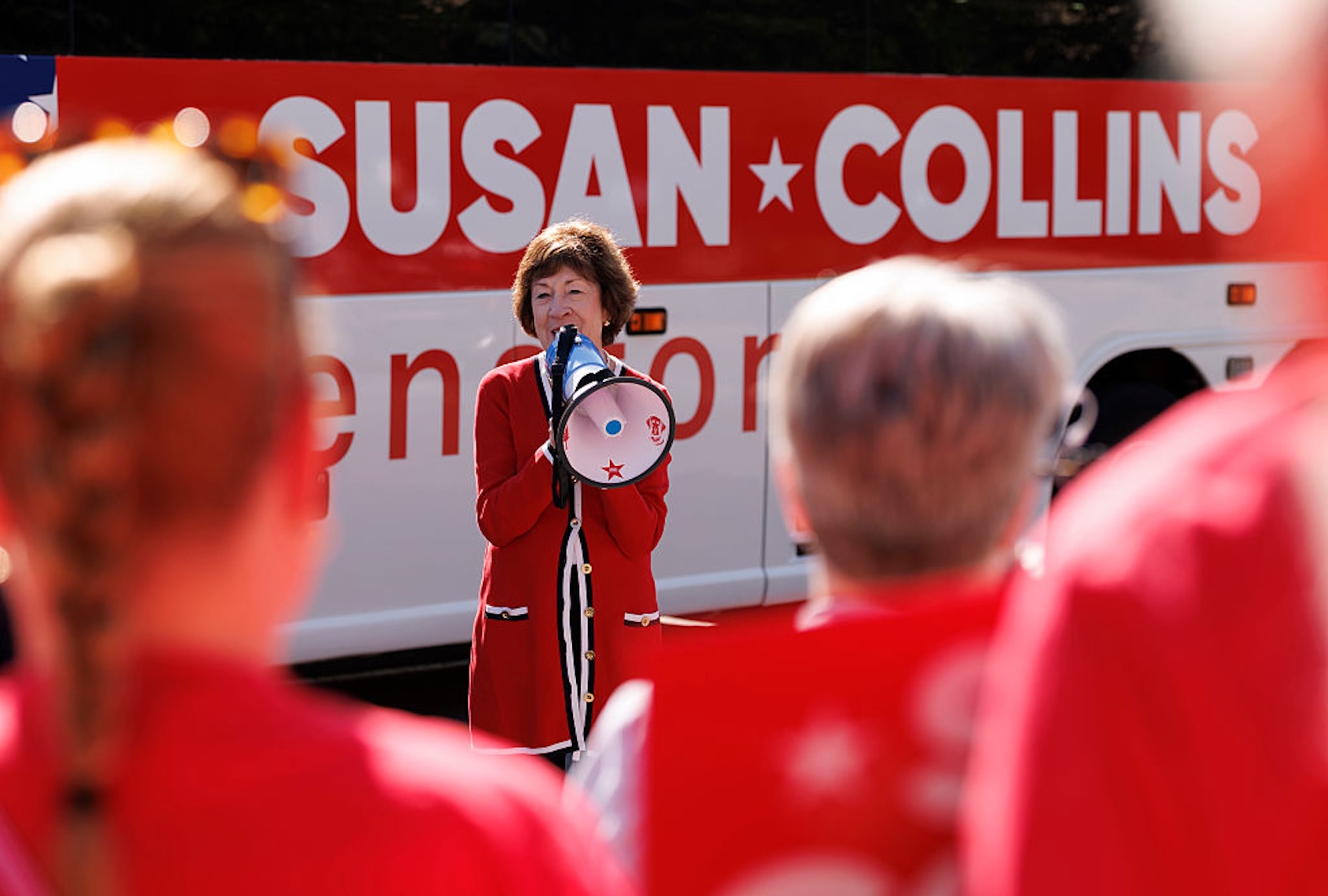
Susan Collins is very concerned — and she should be. As a politician who has only run for one office in her life and held the same seat for nearly 30 years, the Maine senator is facing a possible loss in what looks more and more like a big blue wave coming in November’s midterm elections. As the rare GOP senator representing a blue state, she should be the first one caught in that undertow. But Collins is a rare creature: a virtual Houdini who has always managed to fend off defeat during tough elections. Whether she will somehow work her magic again is one of the biggest questions of 2026.
At the start of this election cycle, Democrats had two competing strategies about how to beat her. Senate Minority Leader Chuck Schumer was convinced that because more women than men vote in the state and Collins wins most of them, the answer was to find a Democratic woman that closely matched Collins’ profile. So he persuaded the popular Democratic Gov. Janet Mills, 79, to run for the seat. A progressive faction took the opposite approach, believing that a younger, male populist outsider would provide the contrast Mainers were looking for. So they recruited a oyster farmer, Graham Platner. It soon became clear that Schumer’s bet was the wrong one, and that Platner’s persona and message were more appealing. Mills’ heart wasn’t really in the race, and she dropped out fairly quickly. But then, after Platner was forced to withdraw from the race due to credible allegations of sexual assault, he was replaced with another salt-of-the-earth working man type. Troy Jackson, a fifth-generation logger who once served as president of the Main Senate, was well-known in the state and became something of a compromise candidate. Collins is currently trailing Jackson in most polls, although the revered New York Times/Portland Press/Siena poll, released Thursday, showed her with a small lead.
While no one is counting their chickens, the environment appears to favor Democrats. This is the first election for Collins since the Supreme Court’s Dobbs ruling, which overturned Roe v. Wade and decades of access to abortion. Since the senator had effectively cast the deciding vote to confirm Brett Kavanaugh to the Supreme Court in 2018, vouching for his mainstream credentials and assuring Americans he considered Roe “settled law,” the case also severely damaged her reputation as a moderate among many Maine voters, most of whom — remember — are women. Collins has since claimed she was “misled” by Kavanaugh, but she has refused to repudiate her vote.
What had once been one of the senator’s selling points — her position on choice — is now a liability. But it doesn’t stop there. According to analysis by Planned Parenthood, Collins has subsequently supported 95% of Trump’s judicial nominees — to be fair, that percentage is roughly on par with her votes in previous administrations — including for anti-choice judges. She has also voted against the Equality Act, which would add sexual orientation and gender identity to civil rights laws, legislation she had previously co-sponsored. For some voters who backed her before, this is a deal breaker.
Collins’ other selling point to Mainers of all political stripes has been her dedication to bringing home pork for the state as the chair of the powerful Appropriations Committee. While that power has been somewhat curtailed by both parties in recent years after revelations of such schemes as former GOP Alaska Sen. Ted Stevens’ infamous “bridge to nowhere,” Collins has managed to keep the tradition going, albeit with a more subtle application.
Throughout the campaign, Jackson has portrayed Collins as a tool of the corrupt GOP swamp, tying her to Trump and the party’s overwhelming corruption. While it’s hard to know how much traction Jackson has been getting on that issue, last week he was handed a gift in the form of a Pro Publica story alleging that Collins engaged in suspicious pay-to-play arrangements via a high-powered Washington lobbyist who is close to her and her husband. (Reporting by the New York Times supported the claim.)
In a nutshell, the former CEO of a defense contractor told the FBI that he created a shell company to hide a $150,000 donation to a super PAC supporting Collins in exchange for her help in obtaining millions in contracts, which he received. There is evidence that she not only knew about it, but worked with others to make it happen. After a preliminary FBI investigation in 2023 didn’t lead to any charges, new evidence was apparently leading the bureau to a larger investigation when the Trump Justice Department quashed it as part of their purge of the agents and lawyers who were working political corruption cases.
Collins maintains she was cleared of any wrongdoing, but there is a big cloud over her head at the exact moment voters are increasingly concerned about government corruption writ large. It doesn’t help that she has enabled Trump and his administration all along the way. She might vote with him less than other Republican senators, but that’s not saying much, since many of them are barely sentient rubber stamps. And Collins certainly hasn’t been a crusader against his unconstitutional usurpation of Congress’ power of the purse, which is only going to get worse now that the president is entering his lame duck period. Among her confirmation votes was one in favor of budget director Russell Vought, the main author of Project 2025, who continues to make the case that Trump has the power and right to cancel congressional appropriations he doesn’t like.
Collins’ big pitch to the people of Maine is her perennial favorite — that she has seniority and power, and that she will use it for their benefit. But she has shown little appetite for using any of it to stop the worst consequences for Maine and the country-at-large. In the end, it may come down to whether Mainers care more about Collins’ record of bringing home the bacon or about saving the country from a malignant administration.
UPDATE: This column has been updated to reflect Graham Platner’s job as an oyster farmer.
Sen. Susan Collins during a Senate Health, Education, Labor, and Pensions Committee confirmation hearing in Washington, DC, on September 16, 2026. | Daniel Heuer/Bloomberg via Getty Images
Nationally, abortion has faded as a campaign issue. Four years after it helped Democrats stave off a red wave, candidates in battleground races are focusing their attention on cost-of-living issues, immigration, and policing. As of mid-August, abortion was mentioned in less than 5 percent of Democratic Senate ads, a key difference from the past two cycles, according to the Wesleyan Media Project.
Maine is different. As of September 16, Democratic advertisers had spent roughly 15 percent of their $40.8 million broadcast TV and streaming dollars on ads focused on abortion rights, according to Nate Schwartz from AdImpact. It’s one of the biggest topics there, he told me, after ads about President Donald Trump and healthcare. Planned Parenthood’s political arm is also making its biggest ad buy of 2026 against Susan Collins, at $600,000, and WinSenate, a super PAC aligned with Senate Democratic leadership, has spent 70 percent of its TV, streaming, and digital money in Maine on abortion-focused ads.
The target is Collins, the only Republican senator up for reelection in a state Trump lost in 2024, and one of Democrats’ best chances to flip a seat. Seeking her sixth term, Collins is running in a year when Democrats lead the generic congressional ballot by about 9 points. It’s also the first time she will face voters since Roe v. Wade was overturned — a decision Justice Brett Kavanaugh helped deliver after Collins, who has long described herself as “pro-choice,” cast the pivotal vote to confirm him in 2018.
Key takeaways
Abortion has receded as a campaign issue nationally, but Democrats in Maine are spending heavily on it against Susan Collins, who cast the pivotal vote for Supreme Court Justice Brett Kavanaugh’s confirmation.
Few Maine voters name abortion as their top issue, but Democrats believe Collins’s Kavanaugh vote can motivate their base and persuade older women who have supported her before.
A Collins loss would let abortion rights groups argue the issue still moves voters. A win would likely be explained by other factors, leaving the question unresolved.
For the abortion rights movement, this is the race that has to work. Groups are pouring their biggest investments of the cycle into a state where fewer than half a percent of voters call abortion their top issue, in a year when Democrats have opportunities to win nearly everywhere. If a blue wave arrives and lifts every Democrat except the one running to avenge Roe v. Wade and remove the senator who famously sealed its fate, the organizations will have a harder time telling donors the issue still moves voters, and a harder time arguing that Republicans will pay a political price — even in blue states — for votes that restrict access to abortion.
“We know that abortion is the number one negative in Maine voters’ mind,” Lisa Margulies, a Maine spokesperson for Planned Parenthood Votes, told me. “It’s really the No. 1 dealbreaker.”
Collins has made that her defense. The Dobbs v. Jackson decision, she said in June, “has not had an impact on the state of Maine in that Maine actually expanded its law.” Advocates call that the central misunderstanding.
“There’s this perception — and Sen. Collins herself has said it — that somehow Maine is immune, and that’s just not true,” Margulies said, pointing to their state-level efforts to keep access intact and to federal Medicaid cuts that have already hit Maine providers.
Also muddying the waters is the senator’s Democratic opponent. Collins is facing off against Troy Jackson, a longtime fixture in Maine politics who rose from the state House to the Senate presidency but fell short in bids for Congress in 2014 and governor this year. Early in his career, Jackson said that abortion “should never be legal” and that women should be required to view an ultrasound if they want to end a pregnancy. He has since renounced those positions and has earned 100 percent ratings from Planned Parenthood since 2017. (Jackson replaced Graham Platner, the original Democratic Party nominee, who quit the race after being accused of rape, an allegation he denies.)
While Collins prevailed for reelection in 2020 despite voting to confirm Kavanaugh, Democrats say her decision is much more salient for voters now that Americans live in a post-Roe world, one where more than 15states have near-total abortion bans.
If Collins loses, Democrats and abortion rights groups will say her Kavanaugh vote is no doubt partly why. A win for Collins would be harder to read, though the explanations that leave out abortion are already being prepared, including a messy nomination process that produced a candidate fewer voters were excited about, and a “unicorn” incumbent with decades of personal relationships across a small state and a long record of bringing federal money back home.
The abortion rights bet hinges on two things: that the Kavanaugh vote cost Collins something on top of what an unpopular president and rising gas prices already have, and that voters will judge Jackson by the positions he’s renounced rather than the ones he once held.
The vote Collins won’t apologize for
When Collins voted to confirm Kavanaugh, she said she believed his assurances that he considered Roe v. Wade settled precedent. She had previously said that she would not vote for any nominee who expressed “hostility” toward the 1973 decision that established the constitutional right to an abortion.
As many observed at the time, Kavanaugh’s record gave strong signals that he would in fact vote to overturn Roe v.Wade. In her floor speech announcing her vote, Collins dismissed those warnings, suggesting opponents had been whipped into a “frenzy” by advocacy groups. When he ultimately did side with the conservative majority in Dobbs, Collins issued a statement calling the ruling “ill-considered.”
Four years later, though, Collins is doubling down on her vote for Kavanaugh, telling local media this summer that she does “not regret” it. “Given what subsequently happened to Roe, I don’t think that simply fades into the background,” Robert Glover, a political scientist at the University of Maine, told me.
Democrats are zeroing in on the fact that Collins has continued to confirm anti-abortion federal judges, even as recently as this month. Last fall she voted to confirm Joshua Dunlap, a Maine attorney, to the US Court of Appeals for the First Circuit over objections from 20 Maine organizations citing his record on abortion and marriage equality.
“Susan Collins says she has no regrets about confirming the judges who overturned Roe v. Wade, and has proved it by continuing to vote for Trump’s right-wing judges,” Maine Democratic Party spokesperson Misha Linnehan told me in an emailed statement. “Now, her approvals are underwater, and she’s trailing with women voters because Maine women have had enough of being betrayed.”
George Hill, the president and CEO of Maine Family Planning, told me Collins “defied” them with her vote for Kavanaugh, causing “irreparable harm” across the country. He emphasized how vulnerable Mainers are if Republicans retake control of state government.
Blake Kernen, a spokesperson for Collins’s campaign, dismissed the criticism about anti-abortion judges, emphasizing that her pro-choice boss also voted for 188 judges nominated by President Joe Biden, including Julie Rikelman, who served as litigation director of the Center for Reproductive Rights. Collins, she noted, is the only Republican who voted to confirm all three of the court’s liberal justices, and she voted against Amy Coney Barrett.
Margulies rejects this accounting. “We deserve better than, ‘Well, she’s not as bad,’” she said. “When it comes to reproductive rights, she’s not a moderate anymore.”
While her judicial votes are facing scrutiny, Collins has also spent decades building up a brand as a Republican willing to buck her party on abortion when the issue comes up in the Senate.
In May 2025, Planned Parenthood Maine Action Fund published a memo online titled, “Senator Susan Collins’ long history of supporting Planned Parenthood and access to essential health care.” Among other things, the memo highlighted Collins for speaking out against proposed Medicaid cuts, for co-sponsoring a bill in 2022 to codify Roe v. Wade, and for opposing a 20-week abortion ban bill in the Senate. This past summer, the memo was quietly taken down from their website.
Asked about the removed page, Margulies didn’t say when or why it was taken down, but pointed to what she described as a sharp shift in Collins’s record over the past year, particularly on judicial confirmations. “There are times when she’s been true to her word and put Mainers ahead of politics, but she closed that chapter this year,” she told me.
“Because she is a Republican, the national groups continue to twist themselves into a pretzel to support these male candidates with terrible records,” Kernen said, referring to Platner and Jackson.
So far, Mainers appear to have split Collins in two in their minds: There’s the dedicated public servant who puts her state first on one side, and the partisan Republican who sometimes disappoints them on the other. A University of New Hampshire poll over the summer found Collins rated far better on bringing federal dollars home to Maine than on her Supreme Court confirmation votes. Maine voters, Glover said, “have historically been willing to separate Collins from the national Republican Party and evaluate her through a broader lens of incumbency, independence, and constituent service.”
The turnout math
Even if Democrats can win the argument on abortion around Collins, it’s an open question how much it will move votes. “Right now, I feel quite confident that affordability, healthcare, and good jobs trump abortion access by a long shot,” Dan Shea, a political scientist at Colby College, told me.
But abortion rights advocates believe the ranking obscures how the issue actually works. Mini Timmaraju, president of Reproductive Freedom for All, said her group has spent years testing how to talk to voters about abortion, consistently finding that it overperforms as an attack. “If you go to a voter in Maine and you say, what are your top three or five issues, they may not name abortion,” she told me. “But if you say to them, Susan Collins took the following vote — and one of them is Brett Kavanaugh, which led to overturning Roe — it is extremely salient, and it moves that voter.”
The Kavanaugh vote works, she argued, as a character verdict — “an indicator that you’re willing to side with extremism over your own constituents.” That, she said, is the piece that’s missing in the analysis of what voters say they care about. “It is one of the most salient attacks in Maine and in a lot of other parts of the country.”
Ashley Kirzinger, a pollster at KFF based in Maine, said priority rankings are a weak guide anyway, noting “the economy” means different things to different voters, and issues compete with candidate dynamics and party loyalty. What has changed since Roe’s overturn, she told me, is who the single-issue abortion voter is.
“Before the Dobbs decision, abortion was a motivating issue for Republican conservative voters,” Kirzinger said. “Now what we’ve seen is a complete shift.” Those voters are more likely to be Democrats, younger women and women of color, and include more people who don’t reliably show up in midterms.
Abortion messaging, therefore, is doing two jobs. The first is turnout. Kirzinger said the Kavanaugh vote is aimed at Democratic women “who are not as enthusiastic about Jackson as a candidate” and who “may be more motivated to turn out as a vote against Collins’ record on abortion rather than for Jackson.” In a tight race inside the margin of error, a couple of points of turnout could make the difference.
The second job is persuasion, and the target is older women, who reliably vote. Women made up nearly 60 percent of Maine’s turnout in 2020, and Collins won them by 3 points. What Democrats need from them is a switch, which is why many of the abortion ads are built around regret. One Planned Parenthood ad features a woman who voted for Collins and “will not make the same mistake twice”; WinSenate’s features a voter who “felt [Collins] was the better choice” and doesn’t anymore.
Jackson’s change of heart
Complicating the race is Collins’ opponent, Troy Jackson, who is in some ways a mirror image of her own political persona: a Democrat with a history of culturally right-leaning positions to appeal to voters in the other party.
Jackson, who started his political career in the rural and fairly conservative county of Aroostook, used to earn 100 percent ratings from Maine Right to Life. In 2010, as CNN’s KFILE reported, when he filled out the group’s candidate questionnaire saying he thought abortion should never be legal, he declined to say whether there should be exceptions even to protect the life of the mother, for rape or incest, or because of fetal disability. Maine Right to Life, which has not issued an endorsement in the Senate race, did not return requests for comment.
Jackson told MS NOW he evolved on the issue thanks to “a lot of conversations over time” with women, doctors, and community members. “It became more and more clear to me that abortion access was healthcare,” he said.
In 2023, while serving as Senate president, he co-sponsored a bill allowing abortions after fetal viability when a physician deems them necessary, one of the most expansive such laws in the country. In 2024, he shepherded through the Senate a shield law protecting Maine providers and patients of reproductive and gender-affirming care from other states’ bans, despite bomb threats that emptied the statehouse and a letter from 16 Republican attorneys general threatening to sue. “Troy stood up for and never wavered in his commitment to reproductive rights during some really harrowing moments,” Margulies said, “when it would have been a lot easier to step down.”
“I’m rock solid on this now, and Susan has been the opposite,” Jackson said in an interview with Maine Public Radio this summer. Kernan, Collins’s spokesperson, has charged Jackson with flip-flopping for “political convenience.”
The national environment is looking strong for Democrats, and Jackson has been narrowly ahead in recent polls, though all have been within the margin of error. A CNN poll released this month found nearly two-thirds of Mainers feel negatively about the Dobbs decision, including about half saying it makes them angry. A Fox News poll in August found 55 percent worried Collins votes with Trump too often.
Whatever happens, the explanations are ready. If Collins loses, abortion rights groups will cast it as proof that the issue still moves voters even where it doesn’t top their lists, and as a warning to all Republicans running in 2028. Timmaraju previewed the argument in our conversation: A loss would signal “a crack in the armor” of so-called moderates, and show that voters “are not going to tolerate” incumbents complicit with an extremist administration.
If Collins wins, the groups that spent millions on abortion ads are unlikely to conclude that doing so was a mistake. Kirzinger pointed to the turmoil that followed the Democratic primary and the late swap of Platner for Jackson, which she said benefited Collins “in a way that is hard to capture in polls.” Glover, the political scientist, noted the things Mainers have always weighed alongside her votes, including decades of relationships, the Senate Appropriations gavel, and federal money. Even Timmaraju, the abortion rights leader, offered the same hedge in advance: A Collins win, she told me, “says more about Susan Collins and Maine than it does about 2028.”
A win wouldn’t show that judicial votes carry no consequences, Glover added. But if Collins holds substantial support among voters who support abortion rights despite the Kavanaugh vote and the fall of Roe, “that would certainly suggest limits” for retrospective accountability for downstream consequences of Supreme Court confirmations.
Though the race is supposed to clarify whether voters will punish elected officials for taking actions that restrict abortion access, it probably can’t — at least not definitively. It will decide, though, who holds the seat, and reproductive rights leaders have been clear that without a Democratic Senate, nothing they want gets a vote.
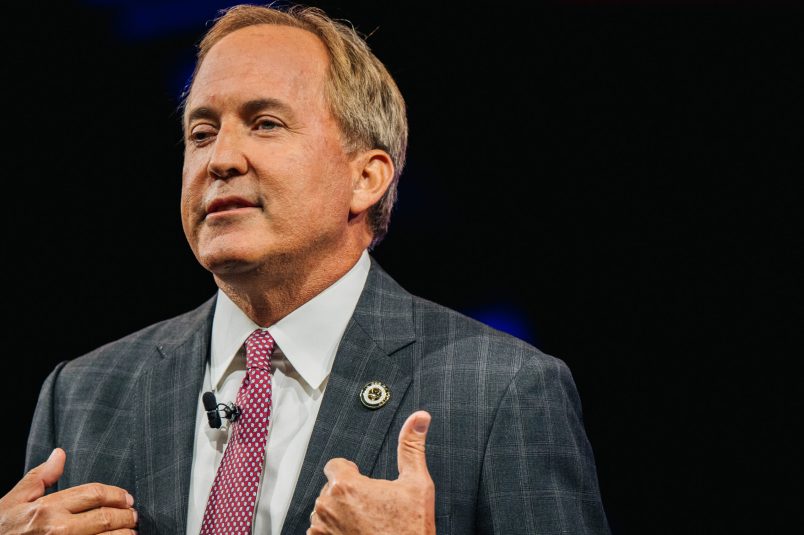
The family of a woman who died after she could not get an abortion in Texas is suing doctors and state officials including Attorney General Ken Paxton. It is the first lawsuit over a death linked to an abortion ban.

 Login