The pseudoscientific self-help book by Rhonda Byrne rode a 2006 Oprah Winfrey endorsement to the tune of tens of millions of copies sold. It pushes the “law of attraction,” the idea that the universe is built on positive and negative energies, and that like sticks with like. In short, if you think regularly about the things you want and maintain a positive attitude, those things are more likely to come your way.
That’s the gist, anyway. Honestly, I never read it. But its ubiquity in the aughts, its reputation for being largely composed of quotations and the relative unoriginality of the premise — which adds a bit of woo-woo to the idea that you catch more flies with honey than vinegar — makes it feel like I have. Even if I was completely unaware of the New Thought movement, or if I’d never heard the name Norman Vincent Peale, I’d have some idea of what Byrne was on about. I’ve been a Jay-Z fan for most of my life.
The rapper has been manifesting his second act as a power player for nearly his entire career. Outside of some early, Das Efx-indebted features in the early ‘90s, Shawn Carter has been manifesting moguldom across his discography.
It’s right there on the cover of his 1996 debut “Reasonable Doubt.” The black-and-white photo and early computer-assisted graphic design look chintzy now, especially when held up to the art-directed and museum-curated sheen of his later work. But there’s no mistaking what Jay-Z is going for with his fedora, scarf and cigar. This kid from Brooklyn’s Marcy Projects is no street-level striver. He’s a boss.
It carries into track one, where a middleman is warning some lackey not to cross Carter. The first thing anyone hears about Jay-Z is in reverential tones, fit for a short-tempered kingpin. You get the sense that you might get to meet him someday, if you play your cards right. But for now, he’s out of your reach and your tax bracket. What follows is nearly an hour of opulent sh*t talk, laid over lush soul and jazz samples handpicked by producers with names like DJ Premier. It sounds slick and established. It sounds expensive. Most importantly, it sounds unhurried and in control. This was oligarch rap from the latest king of New York.
Want more from culture than just the latest trend? The Swell highlights art made to last. Sign up here
In 1996, Jay-Z was far from the billionaire multihyphenate we know today. He was co-owner of Roc-A-Fella Records, but at that time the label was mostly a means to release his debut after being turned away by several majors. He kept putting out the idea that he was already a magnate to anyone with a Walkman, while still scrabbling behind the scenes.
Case in point: Two platinum records weren’t enough to convince the copyright holders of the musical “Annie” to clear a sample for Jay-Z’s third album. The multi-billionaire of 2026 might have flashed a wad of cash. ‘90s Jay Z (sans hyphen in several ways) wrote a letter.
It’s just the latest example of Jay-Z putting what he wants out into the universe and getting it back.
“I made up this story about how when I was a seventh grader in Bed-Stuy, our teacher held an essay contest, and the three best papers won the writer a trip to the city to see ‘Annie,’” he told Grantland in 2014. “I wrote that from the moment the curtain came up I felt like I understood honey’s story. Of course, I’d never been to see ‘Annie’ on Broadway. But I had seen the movie on TV.”
That album went platinum six times over, but even in the heady pre-Napster era, that wasn’t private yacht money. You wouldn’t know that if you saw the “Big Pimpin’” video, though. Jay-Z kept up the facade of globe-trotting mogul through several more albums, and that fantasy inched closer to reality with each release. He launched a clothing brand. He opened a nightclub. He was still talent, though, calling for the suits to “pay us like you owe us” on his hit “Izzo.” More than a decade later, Jay-Z would make good on the idea that “money talks so talk more bucks” when he launched a streaming service that paid higher royalty rates than its competitors.
On mic, he started referring to himself as the “best rapper alive.” Knowing that hall-of-famers go out with a bit of ceremony and their jersey in the rafters, he announced a short-lived retirement with “The Black Album.” Briefly free from a grueling release schedule, he bought a stake in the NBA’s Nets and pushed them to move to Brooklyn. He became the CEO of Def Jam Records. His mogul dreams made real, Jay returned to rapping with the flair and distant remove of a bored emperor. He was a moneymaker first and foremost, not a businessman but a business, man. He’d spoken it into existence 16 bars at a time.
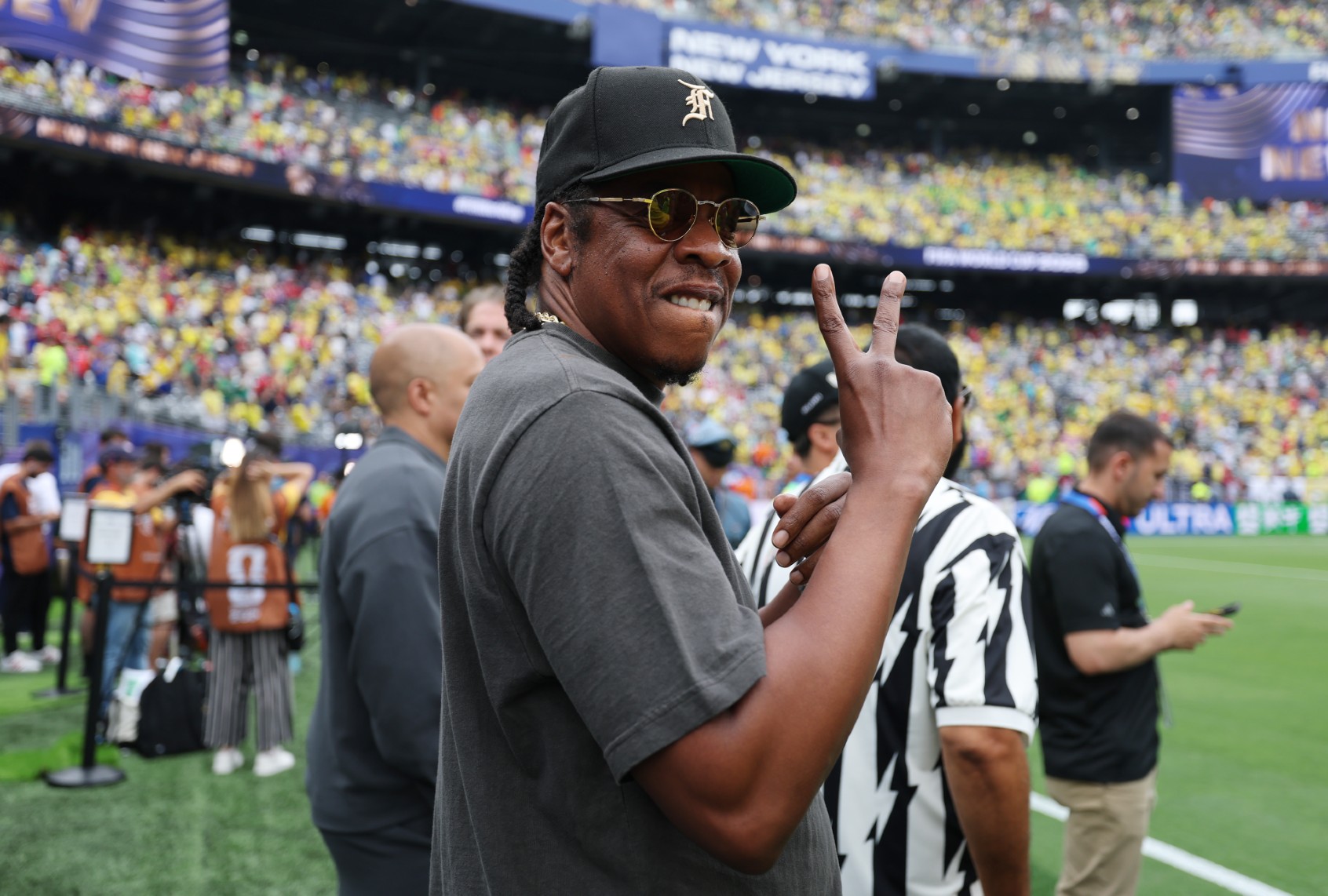
In that context, it’s not at all surprising that Jay-Z may have hand-selected himself to headline next year’s Super Bowl halftime show. Puck broke the news that Roc Nation, Jay-Z’s entertainment conglomerate, had tagged the rapper for the championship game. Roc has produced the halftime show for the NFL since 2019, and Jay-Z is currently touring to celebrate the 30th anniversary of his debut album. It would be a natural fit, even without the hitmaker’s behind-the-scenes ties. He’s already a Rock & Roll Hall of Famer. He just wrapped up the release of an eight-part docuseries with producer/guru Rick Rubin on HBO Max.
Pressed on the leaks, NFL Commissioner Roger Goodell took on the tone of intelligence services, refusing to confirm or deny the news.
“I am not aware of a leak,” Goodell said in a news conference earlier this week. “I’ve been in the committee meetings. So, I’m not sure it’s a leak. We haven’t announced anything. Until we do, we won’t make any comment on that.”
If it turns out to be true, it’s just the latest example of Jay-Z putting what he wants out into the universe and getting it back. He turned down an offer to perform at the halftime show over a decade ago, telling The New York Times that he did not appreciate the way the league negotiated. Per Jay-Z, the NFL’s offer hung on bringing along Kanye West and Rihanna, who were two-thirds of his 2009 hit “Run This Town.”
“Of course I would have,” Jay-Z said in 2020, “but I said, ‘No, you get me.’ That is not how you go about it, telling someone that they’re going to do the halftime show contingent on who they bring. I said forget it. It was a principle thing.”
Jay-Z got the last laugh. After the 2019 halftime show landed with a thud, he was brought on to produce the event and has helmed it since. Rhonda Byrne told readers that “your thoughts become things.” Jay-Z told us that he would always pick himself. Who does he know fresher than Hov? Riddle him that.
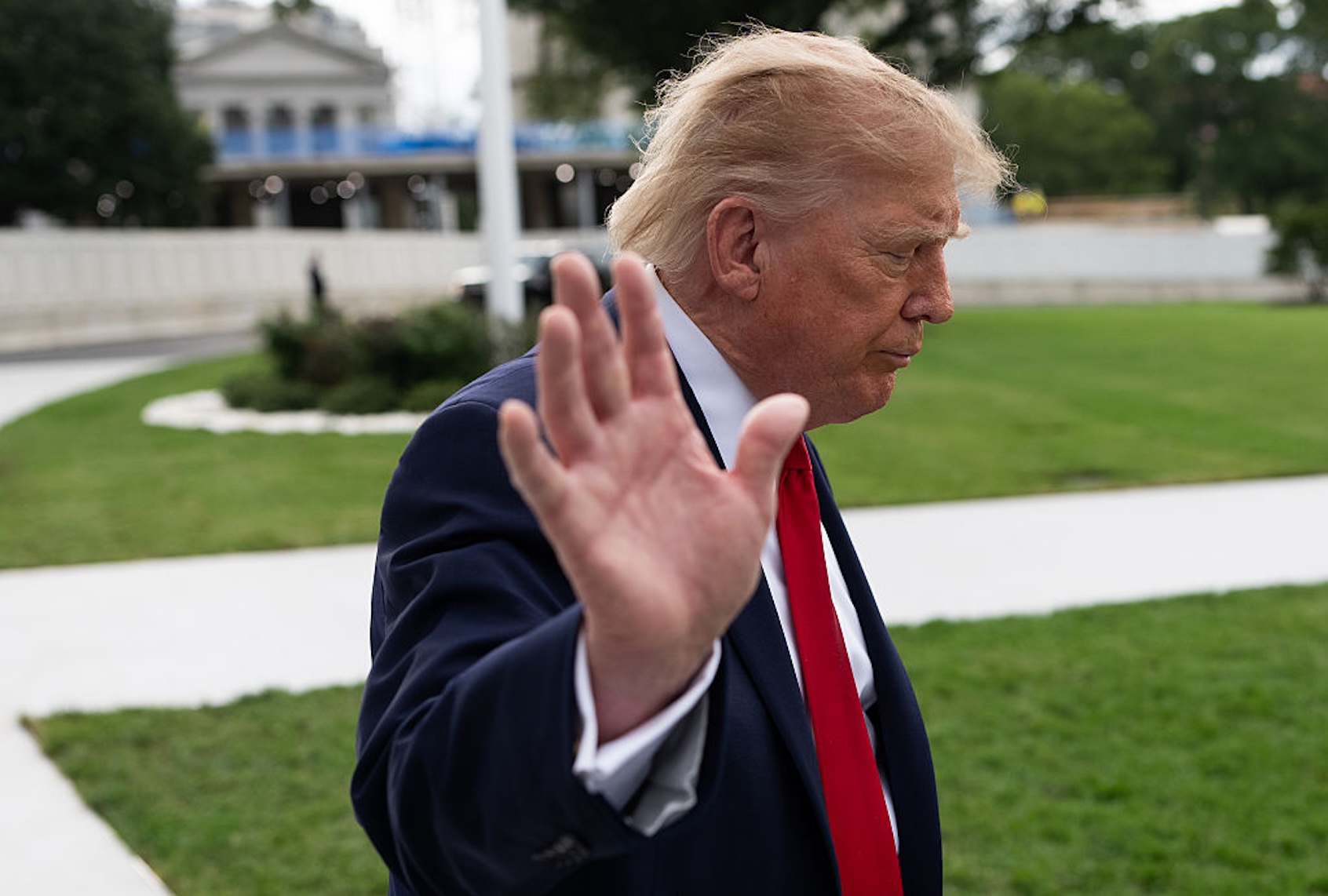
On Wednesday night, for the second time in a week, Donald Trump voiced his admiration for a supporter who punched out a heckler at one of his rallies. Last week it was a woman. This time around it was a man. “The guy stood up and he got whacked,” Trump exclaimed with delight.
Last week he mocked a woman for her appearance and called her scum after she showed up at a rally wearing a T-shirt that read “Release the Epstein Files.” Two men in the audience shoved her, and one punched her. Both pulled her hair as the crowd shouted, “USA! USA!” The man who had punched her exchanged high-fives with friends. Police removed the woman and did not charge those who attacked her.
A journalism mentor of mine once said, “It isn’t who’s telling the tale that matters, unless that’s the tale you’re telling.” Well, that’s always the case for Trump: He’s always telling his own tale, and he never wants you to forget it. It’s all about him, along with the sideshow of cultists who will hurt others and debase themselves to please him.
His latest tale is one heard many times. It’s a story about a kingdom profiting from another kingdom’s mistake and using the profits to fuel the mistake the first country made. It’s a story of subjugation.
This is the continuing story not of Bungalow Bill but of Don the Con, who really is “the all American bullet-headed Saxon mother’s son.” While Trump enjoys watching Americans punch each other out and his fans cheer the results, Russia is profiting from the war Trump started while supplying military intelligence to the enemy he created. It’s an effective way for the Russians to keep funding their war in Ukraine. You can almost hear Vladimir Putin talking to Trump in a manner something like a conversation in “Lord of the Flies” between Jack Merridew and Roger, on the topic of how great it will be to kill the “piggies.” Just look it up.
Unfortunately, there’s no equivalent to noble Ralph and his conch shell anywhere on the planet, though many Democrats act like pretenders to that role. Well, somebody better step up fast. For a country that so often pretends to be the underdog defending democracy, right now the U.S. seems more like an autocracy defending its hegemony over the rest of the world. You know, the bully who started the fight and then stands there applauding the effort.
Fortunately, it finally appears that enough people may be ready to stand up to the bully in the upcoming midterm elections. If there is a Ralph available in the United States, maybe we’ll see that person emerge in the aftermath.
That thought has Trump and his minions up all night pointing fingers at one another, cursing and screaming accusations. or breaking down like toddlers who’ve lost their pacifiers. Such is Republican politics in 2026.
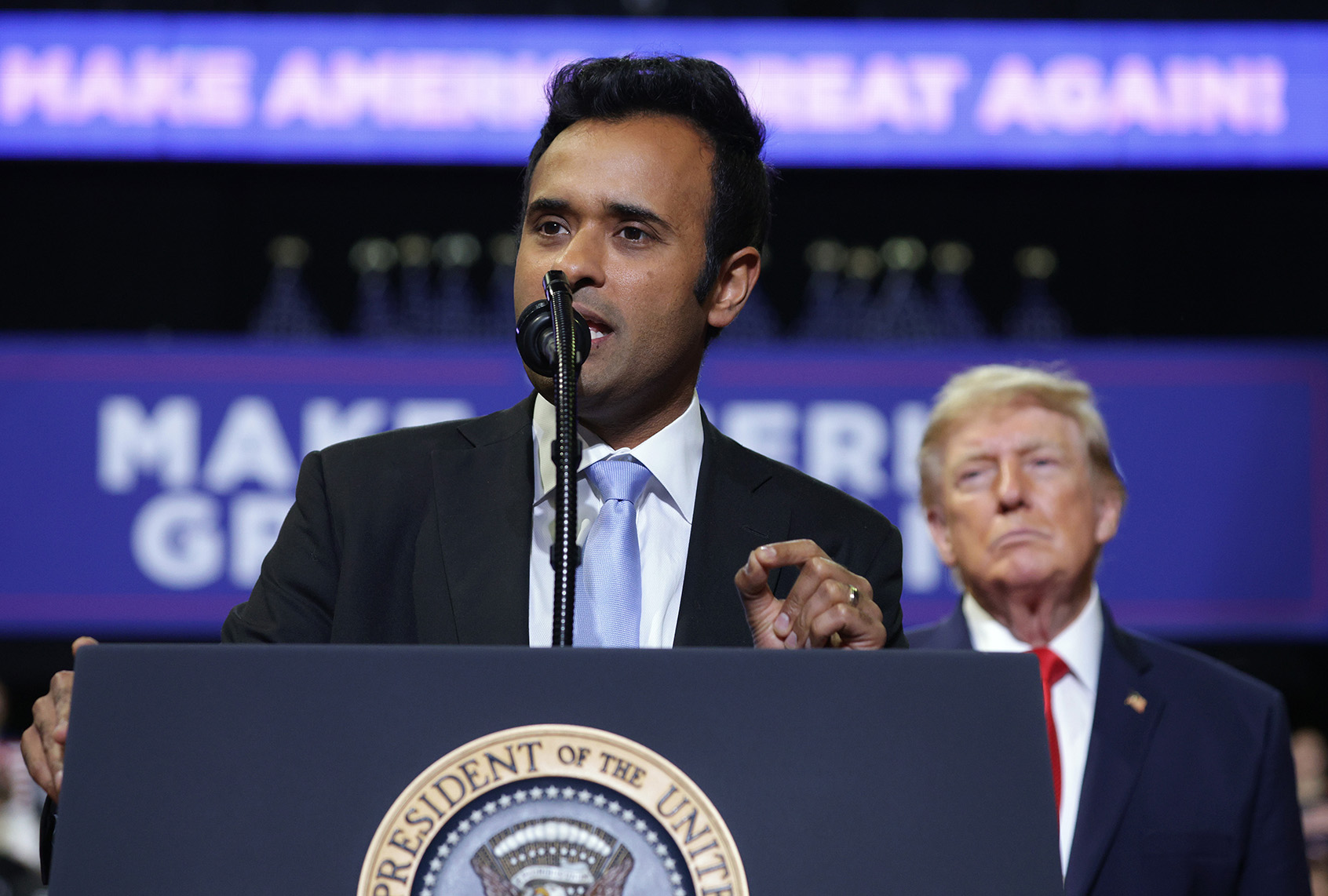
Over the past week, Vivek Ramaswamy, the Republican gubernatorial nominee in Ohio, has run a campaign ad that tries to score political points off the sexual abuse that his Democratic opponent, Amy Acton, allegedly suffered at the hands of her stepfather as a child.
Both Democrats and Republicans have criticized Ramaswamy, including outgoing GOP Gov. Mike DeWine. The editorial board of the Columbus Dispatch promptly endorsed Acton, calling Ramaswamy’s attack ads reckless and disqualifying. Republican Sen. Jon Husted, in the middle of his own difficult campaign against former Sen. Sherrod Brown, called the ad disgusting.
Trump has urged Vivek Ramaswamy to keep running his attack ad, claiming that it hit “pay dirt.” But the president would rather talk about how much he enjoys looking at Sen. Jon Husted’s rear end.
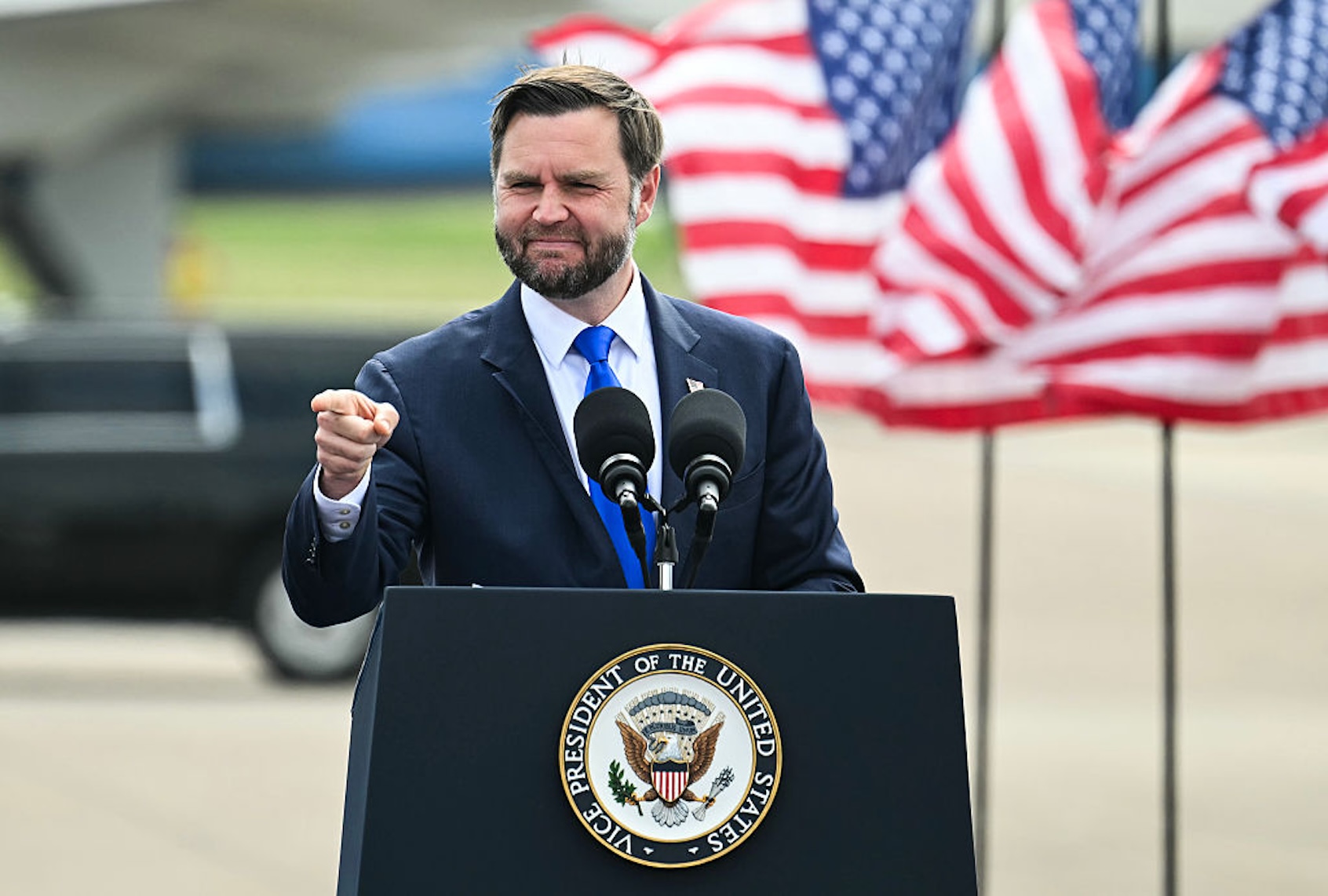
Vice President JD Vance, on the other hand, announced that he was “disgusted” by Republicans who pushed back on the ad. Politics is a tough business. Trump also urged Ramaswamy to keep running the ad, claiming that it hit “pay dirt.” For the second time in a week, Trump talked about how much he enjoys looking at Husted’s rear end. “I looked at his ass, and then I looked at his legs,” the president told us. “I said, ‘His ass, s**t, it’s like — it’s like a pile of muscle.’ Then I looked at his legs, and I said, ‘Man, his feet are big.’ Then I looked at his shoulders, and I tapped him on the shoulder, and it actually hurt my hand. He’s like a piece of steel.”
OK. There’s no appropriate “Lord of the Flies” analogy for that unexpected behavior, although Caligula might suffice.
Midterm ads for Democrats have struck a decidedly different tone. In Texas, James Talarico, the Democratic candidate for U.S. Senate, is pushing a cinematic TV spot that embraces hope. It’s a powerful closer, well-edited, well-written and carefully produced. It stands in stark contrast to the fear-mongering of Ramaswamy and the Republicans.
In Mississippi, Democratic Senate candidate Scott Colom is making his way across the state in a taco truck, giving away free food and talking with voters. In his challenge to incumbent Republican Sen. Cindy Hyde-Smith, Colom has gained enough attention that Democrats are daring to imagine they might stand a chance with an African-American candidate in the Deep South.
Colom’s recent ad is a 30-second comedic tour-de-force in which voters call out Hyde-Smith for advising her constituents to “get another protein” if they think beef prices are too high. “Get another protein? I’d rather get another senator,” a variety of voters exclaim, with a mixture of humor and profanity.
If Colom succeeds, it may well be because of that ad. It reminds me of the “Where’s the Senator?” ads that Mitch McConnell used in Kentucky back in 1984 to dethrone Democratic Sen. Walter “Dee” Huddleston.
Whether or not Colom wins is beside the point. The point is that Democrats have finally found something approaching a message: They’re against corruption. Along with the message of hope projected by Talarico, they may have stumbled onto something more palatable than “We’re not him.”
That’s precisely what scares Trump the most. He’s being removed from the conversation now that the Democrats have discovered that they must connect with local voters on issues that matter to them. Apparently, they’re finally learning to listen.
Trump and the Republicans can only pray that the Democrats are enjoying a moment of premature euphoria, and that their hubris will be destroyed on Nov. 4 after the election results come pouring in. “If you stop counting the votes,” as Trump told us in 2020, there won’t be a change of power. But members of both parties now show signs of believing that the Trump magic is gone and that nothing can stop the “blue tsunami” — not even vote-count shenanigans or declaring martial law and snatching the ballot boxes. Of course the Democrats could still snatch defeat from the jaws of victory. They’re very good at that.
What recent activity on the campaign trail tells us is that the poison of Trump and his choirboys is spreading even as Trump himself is losing influence. One shudders to think that there are worse possibilities than him out there, but given the way he’s liberated the darkest tendencies among his followers, as exhibited by Ramaswamy, there can be little doubt that’s the case.
The humbling coda to this narrative is that no British sailor will arrive in the nick of time to save us from our “Lord of the Flies” existence. We have to do it ourselves.
No British sailor will arrive in the nick of time to save us from our “Lord of the Flies” existence. We have to do it ourselves. And it won’t be over when the polls close.
While it’s tempting to crack a smile watching the Trump regime dissolve into bitter tears of greed and anger, it should be noted that this process is only beginning. It definitely won’t be over when the polls close. It might not be over until after the new Congress is seated in January, if then.
Trump has tried his best to destroy innate goodness, spirituality, quiet insight, intellect, rationality and science through his most devoted soldiers. Vance, Pete Hegseth, Stephen Miller, Kash Patel and Robert F. Kennedy Jr. are just a few of his choirboys, closely akin to the mob who kill Simon and Piggy in William Golding’s novel.
The imaginary beast of “Lord of the Flies,” according to Trump and his followers, comes with various names: communism, socialism, transgenderism, immigration, vaccines and the free press. He vented some of his anger by directly threatening a reporter this week, telling Andrew Feinberg of the Independent, “I don’t know who the hell you are, but you better be careful.” Not one reporter stood up to defend Feinberg. All of them should have.
The New York Times reported this week that Trump is now considering throwing the entire press corps out of the White House, turning the Brady Briefing Room back into a swimming pool (as it was in Franklin D. Roosevelt’s time) and banishing us all to the other side of the island, or at least to the Executive Office Building across the street. He made similar threats during his first administration.
The reason is clear enough — despite all of our shortcomings in the press, there are still too many reporters who have actually read “Lord of the Flies” and recognize Trump for what he is. Every time he’s on television, when he’s not sleeping through a meeting, he reveals once again how unhinged, incompetent and corrupt he truly is.
Further examination of reality makes clear, however, that the “Lord of the Flies” metaphor ultimately fails. It’s not just our country that resembles a group of children stranded on a deserted island with no rules or adults to guide us. The whole world is that way. If we were ever the beacon on the hill or the big brother or the Ralph from “Lord of the Flies” who stood up for liberty and justice, we’ve abandoned that role. The choirboys have taken over. Some of them, like Trump, even wear face paint, like in the book.
Russia, China, most of the Middle East and Africa, France and other parts of Europe all look like crazed pre-pubescents hunting pigs with spears. If we want to broaden the analogy, Trump isn’t even the leader of the pack.
His actions this week make clear that he’s just a Roger. He represents malice, cruelty and a descent into brutality, but the true leader of the choirboys is Putin. He is obviously pulling Trump’s chain. He trolls him, leads him by the nose and manipulates him, playing him with such finesse that Trump can get himself twisted into a Gordian knot as easily as most of us draw breath.
What happens next? That isn’t written in any book, at least not yet. But come Nov. 4, should we all survive that long, it will be.
As soon as Vivek Ramaswamy released an ad celebrating a woman accused of backing a fugitive rapist, the widespread assumption among the pundit class was that it would backfire on him. Ohio’s Republican gubernatorial candidate is falling behind in the polls against his Democratic opponent, Dr. Amy Acton, in a race that threatens to turn long-red Ohio blue.
In a move reeking of desperation, Ramaswamy’s campaign ran a spot featuring Acton’s elderly mother, Donna Arthur, calling her daughter a “liar” and suggesting she suffers from severe mental illness. But it took almost no time at all before the record was widely corrected, with extensive media reports showing the facts in black-and-white: In 1978, Arthur sided with her husband, Cledith, when he was charged with raping his 12-year-old stepdaughter Amy.
Acton has not seen her mother since the Arthurs fled Ohio in an effort to evade justice nearly five decades ago. Her brother confirmed what both Acton and court records show, calling the Ramaswamy campaign “despicable.” The news that the GOP nominee was championing an abusive mother over her daughter quickly became the media narrative, leading to multiple predictions that the ad would backfire on Ramaswamy.
And yet MAGA leaders, including President Donald Trump and Vice President JD Vance, are doubling down on the ad. At a Wednesday campaign event in Cincinnati, Vance praised Ramaswamy for his “audacity to run a TV commercial which calls it out like it is,” despite there being no evidence that Acton lied about her rape and ample evidence — such as fleeing the state — that the Arthurs did. On Wednesday, Trump defended the ad, saying, “It’s very unusual for a mother to hate her daughter, but I don’t think that has anything to do with Vivek.”
The president escalated his rhetoric on Thursday, posting on Truth Social, “let everyone listen to the mother of a defective, dishonest, and incapable Candidate.” In Iowa on Thursday, Trump went further, calling Ramaswamy “lucky” to have this situation to exploit, and that he should thank “God” for the favor.
MAGA media figures like the Daily Wire’s Ben Shapiro, Trump’s traveling companion Laura Loomer and Newsmax’s Greg Kelly have also defended the ad. Podcaster Megyn Kelly praised Arthur for trying to expose her daughter’s “sketchy history,” citing an interview Arthur did with a woman convicted of attempting to bomb an abortion clinic. In that conversation, Arthur complained that the last time she saw her daughter, in 1978, the 12-year-old was wearing clothes she deemed immodest.
Ramaswamy’s campaign has pledged to spend $4 million airing the ad. The reason is grim political strategy. With Trump’s approval ratings hitting record new lows by the day, Republicans feel their only hope to eke out victories in close midterm races is to juice MAGA turnout. Demonizing an adolescent rape victim is a likely two-fold play; it could energize the same people who are currently attacking Jane Doe, the Cornell gang rape accuser.
But the framing of Ramaswamy’s ad also suggests there is another audience his campaign has in mind: aging MAGA voters who are obsessively angry about the phenomenon of parental estrangement.
As I documented in an extensive 2024 report, right-wing media frequently runs scare stories about adult children who cut off their parents, a phenomenon that gets blamed on therapists, progressive ideology and social decay supposedly producing selfish children — but never the parents themselves. Just this year alone, Fox News has run multiple stories blaming “cutoff culture,” “social contagion,” “social media” and “ungrateful” children for parental estrangement. Earlier this month, the conservative National Review castigated children who go no-contact for being too poisoned by left-wing ideology to return their parents’ allegedly unconditional love. In September, the Wall Street Journal called it an “epidemic” and quoted supposed experts who claim children suffer from “self-delusion,” “diminished skill for tough conversations” and “a focus on identity over family,” which is often a euphemism for LGBTQ+ adults who refuse to stay in the closet to placate their family.
“No one is reckoning with the question of what is happening in a lot of families that makes kids feel like they would be better off going low- or no-contact,” explained Joshua Stein, a political researcher who has spent years tracking parental estrangement forums. Instead, there’s an “online ecosystem of estrangement experts,” who often work through right-wing media, “selling services and stories appeal to that audience by first assuring them that it’s not their fault.”
“This is the same underlying politics of grievance at the heart of the American right,” he told me, noting that the Acton situation, while an extreme example, is not unusual.
“Donna Arthur is a symptom of the moral psychology of right-wing reactionary politics,” Stein said, noting that for the “reactionary right,” the concept of respect “is one-directional.”
“Donna Arthur is a symptom of the moral psychology of right-wing reactionary politics,” Stein said, noting that for the “reactionary right,” the concept of respect “is one-directional.” In this view, “authority figures are entitled to respect, regardless of conduct,” and that “respect includes deferring to the authority,” which all too often results in making excuses for child abuse.
While none of the estranged adult children who spoke to Salon in 2024 had endured sexual violence, many described how right-wing politics were deeply intertwined with parents being controlling, cruel and abusive. Some spoke of being severely beaten. Others had parents who wanted to dictate their romantic lives. One woman was pushed into a bad marriage at an early age. Another man described how his parents ran off girlfriends for being the “wrong” race or religion. A woman reported being denied medical care for religious reasons. Another woman, who is biracial, said her white mother made racist comments to her.
In online forums for estranged parents, which tend to lean conservative, Stein found that children’s stories of mistreatment were regularly dismissed. “The driving narrative of children exaggerating trauma is central to reactionary politics of estrangement,” he explained, noting that Ramaswamy’s ad featuring Acton’s mother is “a manifestation” of this “reasoning under its worst conditions.”
Ramaswamy, Trump, Vance and their advisers are all notorious for being constantly online, and they are almost certainly aware that the topic of parental estrangement is a driving concern with many MAGA voters, some of whom have experienced estrangement or distancing from their own children, family members or friends, and are outraged at the thought of facing social consequences for their reactionary views. Much of the online response in right-wing spaces suggests this read on the GOP base is accurate enough. On social media, plenty of GOP voters have defended Arthur and denounced Acton. Many of them appear to be elderly.
“Because of the estrangement factor,” one Daily Wire commenter wrote, “I believe the mom.” Many concurred.
“So telling the truth is a horrible thing. Mothers know their kids better than anybody,” one person posted on Facebook in response to a local news post about the ad. “NOT all daughters are good daughters EITHER,” agreed one. “Our mothers know us best!!” added another.
To be clear, these attitudes are not the norm among Americans generally, and pollsters haven’t had a chance to gauge if Ramaswamy’s ad has boomeranged. But if the goal is to energize Republican voters who may feel demoralized this cycle, the strategy makes more sense. There’s a widespread sense of grievance on the right over feeling rejected for their political views, which manifests in everything from Republicans complaining that liberals won’t date them to a woman at a rally for Byron Donalds, Florida’s GOP nominee for governor, demanding that the law force her “petty” daughter to stay in contact.
The Donna Arthur ad was designed to stoke that very sense of entitlement and persuade conservatives to use their vote to punish liberal family members and neighbors for shunning them. It may not be enough to overcome the disgust that Ramaswamy stirred up in voters who have a healthier attitude about family and boundaries. Still, from the party that gave us “Haitians eat pets” and “LGBTQ kids poop in litter boxes,” there really is no move too morally depraved, if they think they can get votes with it.
Earlier this month, during a campaign rally in Nebraska, Donald Trump said that losing Los Angeles in a potential attack from Iran would be “a small price to pay.” To many Californians, the idea that a president would write off a city of millions sounded unthinkable. To the Tongva, the indigenous people of the Los Angeles Basin, it sounded familiar.
Tongva displacement began with Spanish settlement in the 1770s, and was codified in the 1840s and 50s when the U.S. acquired California and failed to ratify 18 different treaties that promised reservation lands, livestock and education. But if California Indian treaties were rendered purposeless, Trump’s words aren’t so random. “There is debate on what Trump meant when he said Iran can take out Los Angeles and San Diego and as in all his . . . speeches, it becomes the listeners’ responsibility to decipher truth from lies,” Tongva tribal elder Tina Calderon told Salon. “But I believe calling out two cities that he heavily targeted with ICE and who are against his attacks on [the] environment and Peoples was quite intentional.”
Calderon’s words are striking. They also name a pattern. Trump didn’t select two cities arbitrarily; he picked the places that denied his fascist will outright. Deciding whose homelands are sacrificed has always been a political choice, and Native Californians have been on the butt end of it for a long time.
What happened to Native Californians was also a harbinger, not a footnote. Their land and water — under Spain, Mexico and the United States — became a small price to pay for the state’s growth.
What happened to Native Californians was also a harbinger, not a footnote. Their land and water — under Spain, Mexico and the United States — became a small price to pay for the state’s growth. That habit isn’t restricted to Trump’s party. California Gov. Gavin Newsom, a Democrat, condemned the president’s remark, but he has vetoed bills that would have protected tribes’ sacred sites and given them a say over the state’s water.
However dangerous to the nation, Trump is undeniably talented at getting his many grudges to materialize one way or another. His threats have a way of actually becoming policy. When he pontificated about calling Canada the 51st state, tariffs followed. Los Angeles had already learned this lesson firsthand. In June 2025, after Angelenos protested Immigration and Customs Enforcement raids, Trump sent federalized National Guard forces into the city. So when he names L.A. as expendable, Calderon is right to not simply treat it as a slip of the tongue.
For Native Californians, being a nominal sacrifice for the state is a part of history. “It’s a small price to pay, but the price has already been paid there, and Native people are still there, feeling the impacts of that,” Jolie Varela, Nüümü Huupi and Yokuts tribal member and founder of Indigenous Women Hike, told Salon.
Varela lives in Payahuunadü, the Owens Valley, in the Eastern Sierra, more than 200 miles north of Los Angeles. In 1913, the city began draining the valley’s water through the newly built L.A. Aqueduct. When she drives through the desert to reach her hikes, Varela is reminded each time by the landscape that her homeland was not always so arid, and that this historic transgression benefits Los Angeles to this day. “When you turn on your water, and when you wash your hair in the shower, you can thank a Paiute for that water,” she said.
“Los Angeles could not exist the way that it does without stolen water,” AnMarie Mendoza, a Tongva citizen and University of California, Los Angeles doctoral researcher, told Salon. Her response to Trump’s insertion of L.A. and San Diego into the Iran war was trenchant: “It aligns with the settler colonial realities of thinking that all of the homelands in this country are expendable.”
That is the through-line: a city, a state and a country that objectify Native homelands, treating them as expendable and raw material. Trump’s remark only extended that logic to include everyone else in Los Angeles.
The Los Angeles Department of Water and Power’s (LADWP) desiccation of Owens Valley has had long-term symbolic and physical impacts. The valley’s original name was Payahuunadü, which means “the place where water flows,” Varela said. “It makes me think of, specifically here in Payahuunadü, my elder who had to breathe in the dust that was created from the LADWP draining Patsiata, and the reservations here.” She noted that LADWP controls over 95% of the valley floor, leaving almost no land available for the Paiute, who’ve called it home for over 15,000 years, in the past 300 years. “Theft is still ongoing,” says Varela.
L.A. didn’t just take water a century ago. It still holds the land, the water rights and the future of the Nüümü community, and it raises the question: Why aren’t Angelinos asking where they get their water?
Ignorance about California water is nonpartisan. Agriculture uses most of the state’s developed water, and wealthy growers like the Resnicks are in control of much larger water rights than any tribe. Yet during the 2025 fires, a Fox News host blamed Native Americans for the region’s wildfires in 2025. The scapegoating wasn’t just happening on the right: A former L.A. resident who is Iranian-American and a Democrat told Salon that during the 2025 fires, friends reposted claims blaming Native communities for water shortages. “Well-meaning liberals are so quick to punch down on Natives,” he said. He shares concern over the ill-informed framing of Native people as responsible for extreme water use in the state. “It’s so untrue and also racist to blame lack of water on Indigenous people . . . No one was talking about the Resnicks and their water rights for all their agricultural land, or all the data centers.”
The Iranian-American diaspora in L.A. has lauded Trump’s attacks on Iran. Salon’s source in the community attributes this to a nostalgia among former Persian oligarchs residing in Beverly Hills, which is known colloquially as Tehrangeles. “Funny how quickly a foreign place can feel like home to immigrants . . . but obviously all that comes at a cost that typically other people have to bear.”
Asked how the Iranian community in L.A. might view the Native response to Trump’s remarks, he said: “It’s not their L.A. It’s the other L.A.”
In Sylmar, a suburban neighborhood in north Los Angeles that borders the Angeles and San Gabriel National Forests, Varela walked with Mendoza along the L.A. aqueduct. She recalled something others see as banal but that, to her, means something else: “I saw water flowing down into the street, and [thought] ‘That’s our water, and we can’t water on certain days, and we have limitations here, but yet I’m here in a wealthy neighborhood in Tovaangar, hundreds of miles away, and our water is flowing into the streets.’” The image is a mise en abyme, a scene within a scene; water that should sustain Nüümü community is flagrantly wasted on a lawn in a city that has never had to think about where it comes from.
Mendoza echoed Varela, saying Paiute (Nüümü) people were “my first water teachers” and “water is a living relative.”
This is a lesson that politicians like Newsom, whose 2019 apology for California Native genocide was followed by abject inaction, have still failed to grasp. Earlier this month, he killed a water bill that would have given Native tribes a larger role in the state’s water policies. Although there have been small, token land returns, California Native nations still hold less than 1% of the state’s land. “Newsom is a hypocrite,” Varela said.
Native peoples carry a long collective memory, and Newsom’s quickly growing record of attacks on California Native tribal sovereignty could become an albatross that won’t be forgotten if he decides to run for president in 2028, as is widely expected. At an estimated national population of 9.7 million, Native Americans represent roughly 3% of the country and could swing key states like Arizona and New Mexico in a competitive primary and general election.
Mendoza, though, sees no partisan refuge: “Whether it be red or blue, they all know how to discriminate against Native people.”
That’s really what makes Trump’s remark so revealing. He said out loud what Sacramento has practiced surreptitiously for generations: that some Californians, and their land and water, are a fair price for everyone else. The difference is that for once, the people being written off were everyone else.
Californians should be upset by Trump’s comments. But they should not be confused by what it obscures. This is a chance to ask who’s already been written off in a Los Angeles the president considers expendable — and to learn from California Native tribes how they survived it.
In late August, President Donald Trump announced what he called the “biggest oil deal in world history.” Since then, the full text of the accord — which grants the U.S. sweeping access to Venezuela’s oil reserves — has been one of the most sought-after secrets in Washington, D.C.
ProPublica has reviewed a copy of the 18-page strategic partnership agreement signed for the United States by Secretary of State Marco Rubio and Defense Secretary Pete Hegseth. The document reveals carefully constructed terms that favor U.S. interests at every turn and cements the power of a small group of people handpicked by the Trump administration to govern and profit from the deal. The role of the Venezuelan government and the potential benefits to its people are largely absent from the text.
One of the most criticized aspects of Trump’s announcement has been his choice of a partner: Alejandro Betancourt, a globe-trotting Venezuelan oligarch who has faced money-laundering investigations in three countries.
The Trump administration is taking a 35% stake in Betancourt’s firm, North American Blue Energy Partners, by acquiring shares in a Barbados-registered parent company. The deal document provides little information about the owners and investors behind the parent company, who could receive enormous wealth from the arrangement.
The agreement also safeguards Betancourt’s position as chief executive of NABEP and says the U.S. government will work with the parent company to appoint a powerful seven-member board to govern the venture for an initial 15-year term. Those aspects of the deal, according to people with knowledge of how it came together, were designed to prevent future U.S. and Venezuelan leaders from dismantling the enterprise.
Orlando Alvarado, a name not disclosed by the Trump administration as a party to the accord, signed the agreement on behalf of the parent company, alongside Betancourt, Hegseth and Rubio. Alvarado has held senior roles in multiple Betancourt businesses, including as chief financial officer of an energy firm that became embroiled in scandals a decade ago. According to the Miami Herald, federal prosecutors identified Alvarado as an unindicted co-conspirator in a scheme to embezzle money from Venezuela’s national oil company.
NABEP spokesperson Terry Wade said that “neither Mr. Betancourt nor Mr. Alvarado has ever been charged with any crime in any country, and any claims against them are baseless.”
Key aspects of the plan differ from the Trump administration’s public pronouncements. Trump has said the deal will secure America’s energy dominance for the next century. But the text indicates that U.S. purchasing rights expire in half that time and that the underlying operating rights appear to run afoul of Venezuelan laws limiting oil concessions to 25 years.
The agreement does ensure the United States a deep discount from fair-market value on 20% of NABEP’s oil, as Trump has said. It does not, however, explicitly guarantee that Betancourt’s company is obligated to pay the estimated $200 billion in royalties and tax payments to Venezuela that the White House has said would benefit the country.
There are also significant caveats related to Trump’s central selling point to Americans — that the deal will bring a gusher of low-cost oil imports.
The agreement gives the U.S. the right to purchase 20% of NABEP’s oil at a discounted rate of $30 a barrel, or less than a third of what oil has sold for in recent months, according to one of three supporting documents reviewed by ProPublica.
But this fee does not account for the cost of getting Venezuela’s oil out of the country. Much of Venezuela’s raw crude is so thick that it won’t flow through pipelines unless it is first blended with 20% or more of oil thinner products. Under the deal, the potentially significant cost of importing millions of barrels of those blending materials is not included in the price.
The White House, the State Department, the Pentagon and the energy company NABEP all defended the agreement, saying in statements that their new public-private venture will provide meaningful and lasting economic benefits to both countries that cannot be captured in a legal document.
“This historic deal marks a major step toward stabilizing Venezuela’s economy after years of hyperinflation and almost no new investment, while more than doubling the United States’ oil reserves,” said White House spokesperson Taylor Rogers.
Wade emphasized that NABEP was chosen because of its track record of expanding oil production in Venezuela in recent years and that the agreement was between the company and the U.S. government, not Venezuela.
“Thanks in large part to the agreement,” Wade said, “there is a surge in confidence about the future of Venezuela’s oil industry and, as a direct result, substantial new investments are flowing into the country.”
He added that much of NABEP’s oil comes from fields that require little or no blending materials and that blending costs would not meaningfully impact the price of production. “Our barrel economics are strong.”
The newly revealed details of the agreement are nonetheless likely to raise more questions about whether the unorthodox marriage of the United States and a foreign energy baron can bring lasting benefits to either country — and which private parties might benefit along the way. Trump’s oil deal is likely to face scrutiny in both the United States and Venezuela, especially if Democrats win one or both chambers in the midterm elections, according to former U.S. diplomats and congressional staff.
“Question number one in a new U.S. Congress will be: Why Betancourt?” said former Ambassador James Story, who served as the top U.S. diplomat in Caracas from 2018 to 2023, in an interview. “Why did he get this deal? And was he involved in criminality? It seems reasonable to have a congressional hearing about those questions.”
“Question number one in a new U.S. Congress will be: Why Betancourt?”
James Story, former U.S. ambassador to Venezuela
In public comments, Delcy Rodríguez, who won the backing of the Trump administration to serve as Venezuela’s interim president, praised the accord as “historic.” She has asserted that Venezuela will retain sovereignty over its natural resources and defended the choice of Betancourt.
People with knowledge of the Trump administration’s behind-the-scenes decision-making and negotiations with Betancourt spoke to ProPublica on condition of anonymity because they were either not authorized to do so or were fearful of retribution.
One reason that the precise terms of the deal have remained hidden until now is that the signed agreement is marked as a “sensitive” government document. That classification is commonly used to shield a variety of federal records from public release, including those containing personnel information, details about ongoing law enforcement operations and matters protected by attorney-client privilege. The document also contains a confidentiality clause barring Betancourt’s company from disclosing the “existence and terms” of the U.S. government agreement.
One person familiar with the deliberations said that people close to the Trump administration seemed keen to partner with Betancourt’s company because of the privacy and flexibility it offered. That appeared to give NABEP an advantage over publicly traded oil companies, which would be obligated to shareholder reporting requirements.
“For example,” the person said, “Chevron couldn’t give 35% of their shares to the Pentagon.”
The Deal
The oil deal is sensitive partly because of likely resistance in Venezuela, where critics have already described it as a U.S. takeover of the country’s precious natural resources.
A ProPublica analysis shows that its terms favor American interests at nearly every turn and try to enshrinethe Trump administration’s imprint indefinitely.
The document states that a majority of the seven-member board must be U.S. citizens at all times, and the U.S. government can appoint one “non-voting observer” to join the group. Betancourt, who will serve as the chief executive, is the only board member named by the agreement. The initial board will establish the process for choosing new members.
“Throughout the evolution of the deal, it was clear that the governing structure was intended to ensure maximum control by the people making the deal and to insulate them from future administrations seeking to reverse the agreement or call it into question,” a person familiar with the negotiations said.
There is no requirement for any Venezuelan government participation in the board.
The agreement also offers long-lasting protections for Betancourt and unnamed investors. It requires a supermajority vote of five to oust Betancourt as CEO, change the board composition or execute any transactions with a shareholder that isn’t the U.S. government, an indirect equity holder, director, affiliate or “immediate family members.”
The board will determine compensation for Betancourt in his role as chief executive, the document says. As structured, the deal does not appear to require any public disclosures about pay or distribution of shares to executives.
The agreement does not say which shareholders, affiliates or family members have been approved to transact with Betancourt’s company. Under Barbados corporate law, there is almost nothing that can force those interests to be revealed publicly.
The agreement does, however, require the company to maintain “anti-money laundering controls,” submit to external audits and inspections of its records by the U.S. government, and provide the U.S. government with an annual budget and quarterly unaudited financial statements. It is unclear if these reports will ever be made public.
It could be some time before the company produces enough oil to fulfill a significant share of U.S. demand. Betancourt’s company currently produces about 200,000 barrels per day — or about as much over the course of a year as the United States uses in three days.
NABEP aims to increase its production to 500,000 barrels per day by the end of 2028, according to recent reports.
In addition to securing a discount on 20% of NABEP’s oil, Washington also has “first priority” to purchase all of the company’s remaining oil production for the next 50 years, including an irrevocable right to buy its entire oil supply in the event the U.S. declares a national emergency.
The U.S. also receives a “most favored nation” status that requires Betancourt’s firm to disclose any other business agreements it signs, and, if they are favorable, to grant Washington matching terms.
One person who reviewed parts of the contract was surprised at the tangible benefits for the U.S. compared with the lack of binding commitments to Venezuela: “I gave you 20% of my production at ‘cost plus,’ fine. I gave you all of my production if there’s a national emergency, OK. … So what do I get in exchange?”
A U.S. official said Rodriguez had granted NABEP 100-year oil concessions to operate there, although this figure is not referenced in the accord and appears to contradict Venezuelan law.
In the event of a dispute, Venezuela can’t challenge the deal in its own courts. The agreement dictates that any conflict between the company and the United States must be settled under U.S. law, not Venezuela’s. The two sides even spelled out that any civil case or arbitration must be argued before the United States District Court for the Northern District of Texas, where Trump’s Justice Department has turned, time and again, for favorable rulings.
Where U.S. law does not apply, Texas state law governs, the agreement states.
A Pentagon office has been tasked with someday executing the financial transaction to capitalize on the U.S. government’s 35% share in the venture. The document shows that the U.S. will pay nothing upfront but plans to acquire its stake in Betancourt’s company by paying $0.01 per warrant share. Those terms are set to expire on the 75th anniversary of the closing date.
In a White House statement last month, Trump touted those shares as potentially worth “hundreds of billions,” plus dividends. But Democrats on the Senate Armed Services Committee said they believe the Pentagon office does not have the legal authority to execute an agreement with a foreign entity operating in a country under U.S. sanctions.
Pentagon press secretary Kingsley Wilson said that the Defense Department conducts “extensive due diligence” before extending capital assistance. Wilson declined to comment on any of the legal considerations or further technical aspects of the deal “to protect the integrity of the process.”
Several other detailed aspects of how the company will operate are currently under negotiation among the Trump administration, Betancourt and the parent company, the partnership documents show. The agreement repeatedly cites a set of “Implementation Documents” that will finalize the U.S. ownership stake and the rights of unnamed investors.
The full force of the deal will not take effect until both parties have complied with its closing conditions, which the agreement indicates could happen within months.
Last month, Senate Democrats blasted what was known of the oil accord and demanded details in a letter to Rubio, Hegseth and Secretary of Energy Chris Wright.
“It is unclear why the American public should support this attempt to entangle the United States with a relatively unknown foreign oil company that lacks the capacity or credibility to develop oil fields of the magnitude described and whose leadership has faced international criminal investigations,” four ranking senators said in the letter.
They asserted that most of the “oil fields are nowhere near ready for production” and that it could “take up to a decade before global oil markets are meaningfully impacted and the American people see any tangible benefit.”
A Willing Partner
Almost immediately after U.S. special operations forces seized President Nicolás Maduro in January and airlifted him out of Venezuela, Trump left little doubt that his larger goal was to restore American access to Venezuela’s oil reserves two decades after most U.S. firms had been ejected from the country.
By early spring, an obscure cast of energy officials, lawyers and lobbyists had started to craft plans to deliver on Trump’s America First energy agenda. One person familiar with the deliberations said that U.S. officials had considered backing an idea for publicly held American oil companies like Chevron, Exxon and Conoco to carve up and rehabilitate Venezuela’s aging oil sector. Another potential route went through Betancourt’s company, which is the second largest private oil firm operating in Venezuela. Working with the Venezuelan state company, Petróleos de Venezuela, SA, was never really an option due to its underlying debt and history of corruption, the person said.
The option of turning to large multinational oil companies quickly stalled. In some cases, oil executives balked at jumping back into the complexity of the Venezuelan market; in others, firms struggled to get more than “lip service” meetings in Washington and Caracas, according to media reports and people familiar with the deal.
“NABEP was given priority,” one person said. “Exxon, Conoco and the others were treated as second class.”
Betancourt’s star was rising in the Trump administration. He had served as an interlocutor for Washington with the Maduro government and had ties to some leaders of the Venezuelan opposition, according to current and former U.S. officials. He had also provided information that helped the U.S. forces seize Venezuelan oil tankers and that aided strategy and planning before the capture of Maduro, Reuters reported.
In addition, Betancourt had developed a good relationship with Rodríguez, whom Trump had backed as the country’s interim president. And Betancourt had done so despite the fact that her influential brother, National Assembly President Jorge Rodríguez, had accused him of corruption in a televised speech in 2020, according to former U.S. officials and press reports.
U.S. officials also saw practical reasons to partner with Betancourt, several people said. He and his then-business partner in the U.S., Harry Sargeant, a Trump supporter, appeared to be a rare success story in a battered industry, operating some of the only active oil fields in the country.
“The main thing I found promising is that the fields are producing in Venezuela,” said a former State Department official who analyzed the company’s activities. “I think it’s particularly important that you buy into fields that are producing. … If your policy goal is to raise production quickly, this makes sense.”
But partnering with Betancourt posed major challenges.
For starters, the 46-year-old billionaire was confined to house arrest on his 300-acre Oxfordshire estate in England, fighting off a Swiss extradition request tied to an international money-laundering probe. Betancourt could fly to his $46 million London residence by private helicopter — but his Venezuelan and Italian passports were locked down, and British authorities had barred him from driving on public roads, according to media reports about the special bail arrangement.
Betancourt’s legal problems stemmed from his role in troubled Venezuelan energy projects during the corrupt rule of former President Hugo Chávez. Several of Betancourt’s known or alleged associates were charged or convicted in a major U.S. money-laundering investigation known as Operation Money Flight. Betancourt surfaced as a suspect in the U.S. case and is still under investigation for suspected money laundering by authorities in Spain, according to former U.S. and European officials and press reports.
The most popular leader of the Venezuelan opposition in exile, María Corina Machado, recently described Betancourt as having been involved in “obscene corruption” that caused great suffering for the Venezuelan people, according to a recent New York Times interview.
Betancourt has not been charged in any country. His lawyer has maintained his client’s innocence, saying Betancourt has been unfairly maligned because people associate him with a group of wealthy young Venezuelans, some of whom have been accused of wrongdoing, according to press reports.
Many Venezuelans see Betancourt as a “totemic, emblematic, corrupt figure,” said Brian Naranjo, a former senior U.S. diplomat in Venezuela, in an interview.
“He is not really an oil man,” Naranjo said. “The talent he brings is that he’s a new person in a long line of Venezuelan businesspeople who deal in influence. Their big lever is connections and influence. It is know-who, not know-how.”
In a recent interview with Spanish language media, Rubio defended Betancourt, praising his oil company’s work in Venezuela and his support for factions of the Venezuelan opposition in exile.
Rubio downplayed the legal scrutiny Betancourt has faced, saying a review conducted with U.S. law enforcement agencies indicated “there were no investigations of him in our system.”
“The talent he brings is that he’s a new person in a long line of Venezuelan businesspeople who deal in influence. … It is know-who, not know-how.”
Brian Naranjo, former U.S. diplomat
It remains unclear exactly how Betancourt shed the travel restrictions imposed by European authorities. But The Washington Post reported that senior Trump administration officials, including Deputy Secretary of State Christopher Landau, former Attorney General Pam Bondi and then-Deputy Attorney General Todd Blanche, petitioned their foreign counterparts to allow Betancourt to travel freely and to close their investigations into him and his business ventures.
The Trump administration’s next hurdle to working with Betancourt was figuring out how to legally invest. The government’s $200 billion investment agency, the International Development Finance Corporation, was created to do just that but is currently barred by U.S. law from operating in Venezuela.
At different points through the summer, aides to Office of Management and Budget Director Russell Vought stepped in, pressing Defense and State department officials to consider alternate financing paths, according to one person familiar with the deal’s progression.
By July, the Pentagon’s Office of Strategic Capital, headed by David Lorch, emerged as a potential solution.
Lorch, who had moved to the Pentagon from Deputy Defense Secretary Steve Feinberg’s private equity firm, Cerberus Capital, quickly embraced the idea, according to people familiar with the deal. Lorch and other Pentagon and State Department officials flew to Caracas in the final days of that month and agreed in principle to a deal. The details would be hammered out back in Washington, the people said.
A Pentagon spokesperson said Lorch declined to comment.
On Aug. 5, Betancourt strode into a conference room behind the art deco facade of the old Greyhound Bus Terminal in downtown Washington that houses an auxiliary Pentagon office. The assembled Defense Department officials gave the Venezuelan billionaire the red carpet treatment, lining up to shake his hand, according to people familiar with the meeting. But some in the room were stunned to discover that the U.S. government was preparing to do business with Betancourt, the people familiar with the meeting said.
Betancourt was accompanied by Jacob Hirshman, the chief executive and co-founder of Erebor Bank, the first new bank chartered after Trump returned to office, according to people familiar with the meeting. The bank, backed by Trump supporters and investors Peter Thiel and Palmer Luckey, has vowed to reconnect Venezuela to the world economy.
Hirshman did not respond to a request for comment.
Lorch told the group, which included dozens of former Wall Street associates he’d hired into the office, that the alliance with Betancourt was a major “opportunity” to fulfill one of the Trump administration’s top goals, securing benefits to the United States and Venezuela for decades to come.
The meeting touched off a month of around-the-clock calls and video conferences.
People familiar with the deal’s progression said Lorch soon became involved in structuring key aspects of the deal beyond its financing, including how the board would sit for 15 years and choose its successors. One said he put an explicit premium on setting up the venture in a way that it could not be undone by Trump’s successor.
The months of work on the deal burst into public view on Aug. 28 with a Trump announcement on Truth Social.
“The United States of America has just entered into an Agreement with the Country of Venezuela on, THE BIGGEST OIL DEAL IN WORLD HISTORY!” Trump posted on a Friday night.
Two days later, Hegseth, Rubio, Betancourt and Alvarado signed the deal.
President Donald Trump is currently suing the BBC for defamation to the tune of $10 billion, accusing the British news outlet of “false, defamatory, deceptive, disparaging, inflammatory, and malicious depiction of President Trump.” At issue is how the BBC clipped together parts of one of his speeches before the Jan. 6 riots in a documentary that aired in 2024.
Even though the news segment never aired in the U.S., Trump claimed he was damaged by it and accused the BBC of deceptive and unfair trade practices. A spokesman for Trump’s personal legal team told Reuters the lawsuit intends to hold the BBC accountable for defamation and “reckless election interference.”
On Thursday, U.S. Magistrate Judge Enjolique Lett ordered Trump to sit for a videotaped deposition to take questions from the BBC’s lawyers by Dec. 11. Earlier this month, Trump cancelled a deposition scheduled Oct. 16, citing conflicts with his presidential duties, or “other matters of national importance,” as his team put it. The BBC’s legal team has balked at that excuse, pointing to the fact that Trump was campaigning in Georgia that day. Charles Tobin, attorney for the BBC, told the Associated Press that “He was participating in party politics and prioritized that over sitting for the deposition.”
If Trump refuses to sit for this deposition, he could face sanctions, including dismissal of the case, according to reporting from The Guardian. The BBC’s legal team has accused Trump’s side of dragging their feet throughout the legal process, with Tobin telling a Miami courtroom “We still have a completely lopsided [situation] here on discovery. They have produced absolutely nothing of any substance.”
The BBC has subpoenaed the testimony of former U.S. special counsel Jack Smith, who had been involved in the federal prosecution of Trump for election obstruction. “The whole case is boomeranging against him and coming to focus on January 6,” law professor and attorney Harry Litman posted on X.
When my book “Occult America,” a history of supernatural religions in the U.S., appeared in 2009, I was surprised to receive an admiring phone call from a conservative documentarian and financier. He professed deep interest in the book’s themes, and encouraged me in my next work, “One Simple Idea,” an exploration of positive-mind metaphysics in American life. His name was Stephen K. Bannon.
Although the media have characterized Bannon as the Disraeli of the dark side following his rise to power in the Trump administration, I knew him, and still do, as a deeply read and erudite observer of the American religious scene, with a keen appetite for mystical thought.
Ronald Reagan, a hero of his, was not dissimilar. As I’ve written in the Washington Post and elsewhere, Reagan, from the start of his political career in the 1950s up through the first term of his presidency, adopted phrasing and ideas from the writings of a Los Angeles-based occult scholar named Manly P. Hall (1901-1990), whose 1928 encyclopedia arcana “The Secret Teachings of All Ages” is among the most influential underground books in American culture.
President Trump himself has admiringly recalled his lessons in the mystic art of “positive thinking” from the Rev. Norman Vincent Peale, the Trump family’s longtime pastor, who popularized metaphysical mind-power themes in his 1952 mega-seller “The Power of Positive Thinking.”
What in the cosmos is going on? New Age and alternative spirituality are supposed to be the domain of patchouli-scented aisles of health food stores and bookshops that sell candles and pendulums, right? Well, not exactly.
There is a long-standing intersection between mysticism and conservatism in America. This marriage extends back to the late 19th century when globetrotting occultist and Russian noblewoman Madame H.P. Blavatsky depicted America as the catalyst for a revolution in human potential in her 1888 opus “The Secret Doctrine.” “It is in America that the transformation will take place,” Blavatsky wrote, “and has already silently commenced.”
Generations of occult writers echoed Blavatsky’s theme of America as a Holy Grail among nations, possessed of a “secret destiny,” as Manly P. Hall put it, and thus married esoteric spirituality to patriotic ideals. This partnership has flourished out of view of most mainstream observers—and significantly impacted American culture, including the look of our currency.
In 1935, then-Secretary of Agriculture Henry A. Wallace, a former Republican and mystical seeker who went on to become Franklin Roosevelt’s second vice president, approached FDR with a novel idea: mint a coin with the mysterious reverse side of the Great Seal of the United States—the eye-and-pyramid surrounded by the Latin maxim “God Smiles on Our New Order of the Ages.” Both men were Freemasons with a taste for portentous imagery—and were on the lookout for epic, unifying symbols for the recovering nation. (Wallace had spoken of the need for a “New Deal of the Ages.”) Roosevelt was so taken with the 1782 image, with its Masonic undertones and message that worldly achievement is incomplete without higher ethics, that he personally supervised its installation on the back of the dollar bill, making a previously arcane insignia into an indelible symbol of the republic.
President George H.W. Bush brought new attention — and unintended infamy — to the concept of a “New World Order.” In his Sept. 11, 1990, speech to a joint session of Congress, Bush sought to celebrate the possibilities of international trade and cooperation that could follow a swift victory in the first Gulf War: “Out of these troubled times, our fifth objective—a new world order—can emerge … An era in which the nations of the world, East and West, North and South, can prosper and live in harmony.” Little was he aware that his use of the term would inspire a generation of conspiracy theorists to notions of a hidden, sinister global plan.
Conservative metaphysics extend beyond geopolitics. One of Richard Nixon’s confidants — in addition to the Rev. Peale, whose church he also attended—was insurance magnate W. Clement Stone, a right-wing activist, benefactor of the famous ESP lab at Duke University, and collaborator to Napoleon Hill, author of the mind-metaphysics classic “Think and Grow Rich.”
Most liberals and centrists find these kinds of associations jarring and a bit creepy. Thoughtful people are suspicious of mixing Rasputin-like intrigue with American politics. And with good reason. As Vice President Dan Quayle once put it—and he was specifically referring to Rasputin — “people that are really very weird can get into sensitive positions and have a tremendous impact on history.” (It should be noted, however, that the “mad monk” soberly cautioned the tsar against getting entangled in World War I.)
Critics fear that a sense of spiritual preordainment can produce reckless or dangerous policy choices. Yet such episodes in American history have traditionally had less to do with religious impulses than the kinds of hubris that once drove “the best and the brightest” into Vietnam, or moved senators from both parties to support President George W. Bush’s tragic rush into Iraq, based on the cynical calculus that a quick and tidy war would net a political victory.
Rather than fomenting secrecy or subterfuge, America’s embrace of esotericism is often characterized by a chin-out earnestness, something that many observers and conspiracy-mongers miss. “You can call it mysticism if you want to,” Reagan told the Conservative Political Action Conference in 1974, “but I have always believed that there was some divine plan that placed this great continent between two oceans to be sought out by those who were possessed of an abiding love of freedom and a special kind of courage.” In announcing his candidacy in 1979, Reagan declared: “To me our country is a living, breathing presence, unimpressed by what others say is impossible . . . and that man is capable of improving his circumstances beyond what we are told is fact.” Reagan often returned to such themes, echoing Hall’s 1944 book “The Secret Destiny of America.”
This rhetoric may sound flighty, but that, too, is part of our heritage. Historically, I prefer the cadences of offbeat idealism to the rampant ugliness of our current president’s Twitter insults, or the low-octane, visionless speechmaking that burdened Hillary Clinton’s campaign.
Conservative presidencies have not cornered the market on the otherworldly. During the 2016 campaign, I was surprised that no one revisited an episode from Bill Clinton’s first term, when then first lady Hillary Clinton was accused of holding “séances” in the White House—a term misapplied to her visioning sessions with New Age teacher Jean Houston, a pioneer of the human-potential movement. Houston, whom I’ve published, didn’t quite know how to explain to reporters that when she guided the first lady in dialogues with her political hero Eleanor Roosevelt, they were not summoning spirits but rather conducting creativity and value-defining exercises. President Clinton was cool toward these tête-à-têtes. Houston told me that the president once sat in on one of their sessions. When the guru told him he was an “undeveloped shaman,” he stood up and left the room.
Bill Clinton took a similarly dim view of parapsychology. During a period of post-Cold War cost cutting in 1995, he eliminated the CIA’s budget for its psychic-spying program. Jimmy Carter, by contrast, admired the “remote viewing” operation. The year of Clinton’s cuts, Carter told a group of Emory University students that during his presidency, clairvoyant spies helped identify the coordinates of a crashed Soviet spy plane in Central Africa, netting a significant intelligence gain.
Off-the-grid practices should come as no surprise to students of politics. People in power always import values, customs and attitudes from their backgrounds—sometimes the religious conservatism of a Mike Pence and other times the Southern Californian vibes of a Ron and Nancy Reagan, with their enthusiasm for astrology, psychics and UFOs (Reagan reported sightings as both an actor and governor). Reagan alone was at ease swapping stories with New Age neighbors at Hollywood pool parties, while simultaneously maintaining a sincere, and mutual, affection for evangelicals. He was the model American religionist.
Even conservative evangelicals today borrow from American mysticism. When Pat Robertson speaks of the “Law of Reciprocity” (did you miss that in Scripture?) he is reprocessing the “Law of Attraction,” a concept popularized by the book and movie “The Secret,” but rooted in an American mystical tradition extending back to 1854, when a spirit medium named Andrew Jackson Davis coined the term.
Davis’ career illuminates how historically deep these entanglements go. Called the “Poughkeepsie Seer” for his Hudson Valley, New York, hometown, Davis was naturally controversial—with one prominent defender, who attested that his channeled trances were an authentic telegraph to the spirit world. The medium’s advocate was a Rev. George Bush, a first cousin, four times removed, to the Bush presidential family. The Rev. Bush caused a stir in 1845 by leaving the Presbyterian Church to become a minister in the Church of the New Jerusalem, an ecclesiastical body based on the ideas of Swedish mystic-scientist Emanuel Swedenborg. Bush wrote admiringly of Davis, and attended his séances (a term Davis also coined in its occult sense) along with a dubious journalist named Edgar Allan Poe.
Today, cable television producers and radio hosts often urge me to postulate some kind of occult “pact” between the Bushes and the dark side (cue up Skull and Bones). But such things are fantasy. The truth is, Americans have always been, well, a little strange. As a historian, I feel affection for that aspect of American life. Shadowy figures have long hung around the fringes of power in many nations; but rarely have they done so with the ingenuousness and transparency of those I’ve been considering.
If there is a central principle in American life, one valued across our political spectrum, it is a belief in the protection of the individual search for meaning. The presence and persistence of esoteric and unusual religious ideas in our political culture, including in its most conservative quarters, serves as evidence that that core principle is still working. In the U.S. military, religiously observant service members and veterans can now choose among more than 65 “emblems of belief,” including pentagrams, druidic symbols and every variety of mystical insignia. We are truly one nation under many gods — a fact that unites us across our fractured political divide.
Say what you will about the first and second couples at the heart of “The Diplomat” – and by now they’ve generated plenty of gossip fodder – but nobody would question the resilience of their unions. Kate Wyler (Keri Russell) and her husband, Hal (Rufus Sewell), have certainly had their ups and downs; the series begins with them contemplating divorce just as Kate is thrust into an ambassadorship to Britain.
The more politically seasoned Hal manipulates Kate into staying with him, kicking off a multi-season barrage of wheedling and scheming that culminates in President Grace Hagen Penn (Allison Janney) picking him as her vice president.
Over four seasons of Debora Cahn’s transatlantic political drama, Kate has been instrumental in keeping the highly tenuous special relationship between Britain and America from crumbling, even as her boss and husband insist on taking jackhammers to it.
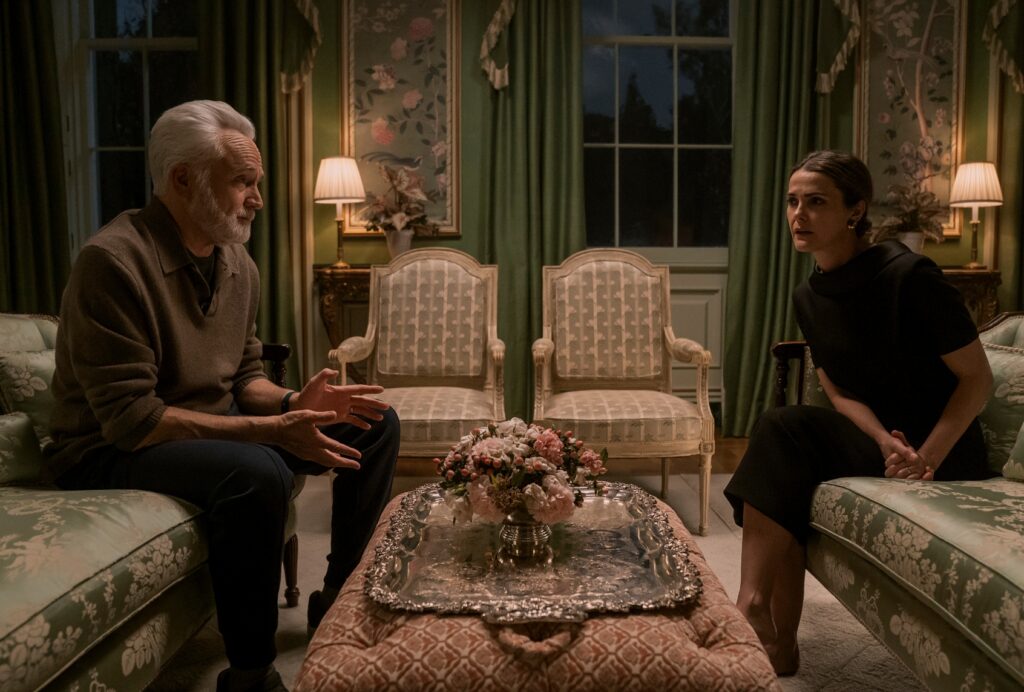
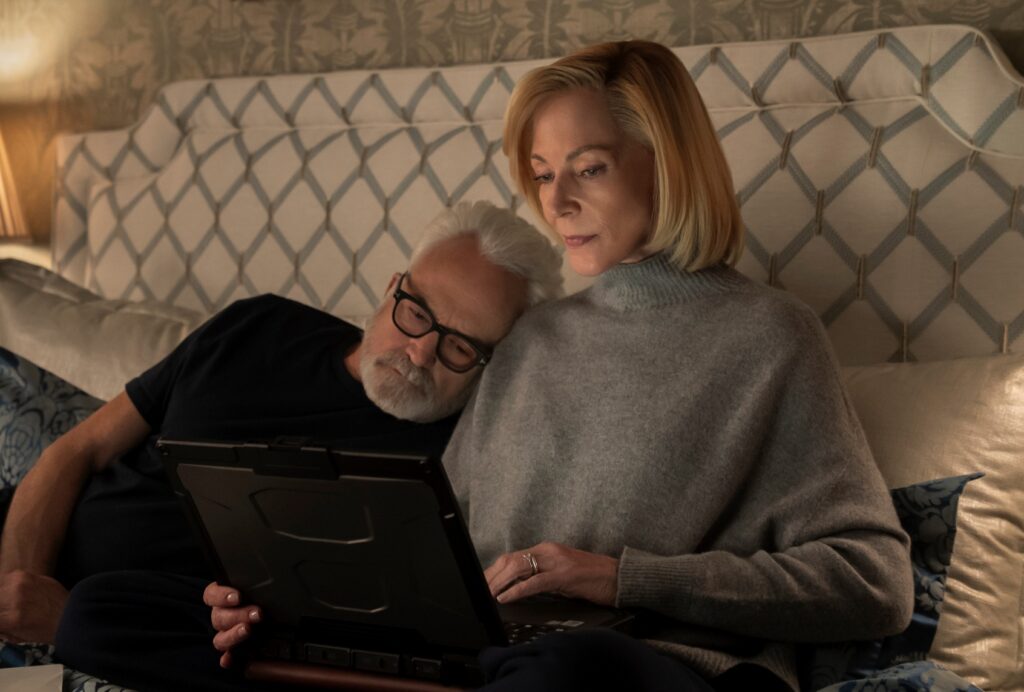
Grace is indubitably corrupt, and yet her devotion to her husband Todd (Bradley Whitford) is nevertheless true. Sure, occasionally Todd must scream underwater to keep his head from exploding. And yes, a fourth-season subplot finds the first gentleman hightailing to London to find some purpose beyond perusing wallpaper swatches. Well, that and placing some distance between him and his wife’s unnerving autocratic behavior.
Even so, during their daily check-ins, Grace and Todd still call each other babe and exchange declarations of love. When Grace finally sets all of America’s alliances aflame, Todd remains standing by her side.
It’s a miserable political and marital state of affairs when a Netflix hit’s radioactive relationships make a person nostalgic for eras when first and second Ladies were intellectual forces respected by their husbands. Neither Dr. Jill Biden nor Michelle Obama dimmed their light to appease right-wing sexists bent on characterizing their professional achievements and eloquence as emasculating.
In that respect, Hillary Clinton showed them and us the way: When her husband Bill won office, the first lady chaired a task force that delivered a massive health reform proposal doomed from the jump. We will never know if we’d have universal healthcare by now if a man had run the task force, but Republicans taught voters to distrust any first lady who aspired to do more for Americans than bake cookies and tend the roses in the White House garden.
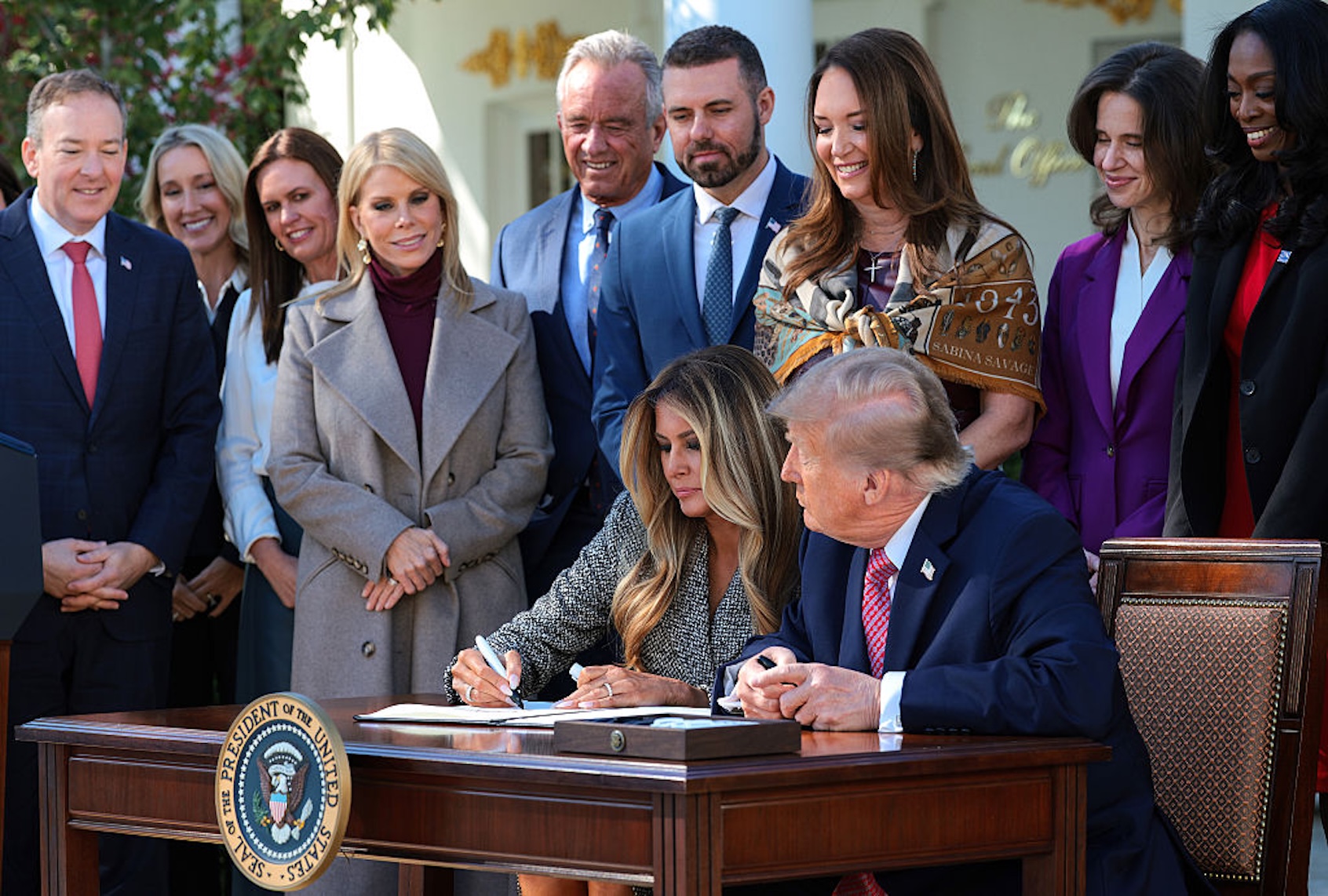
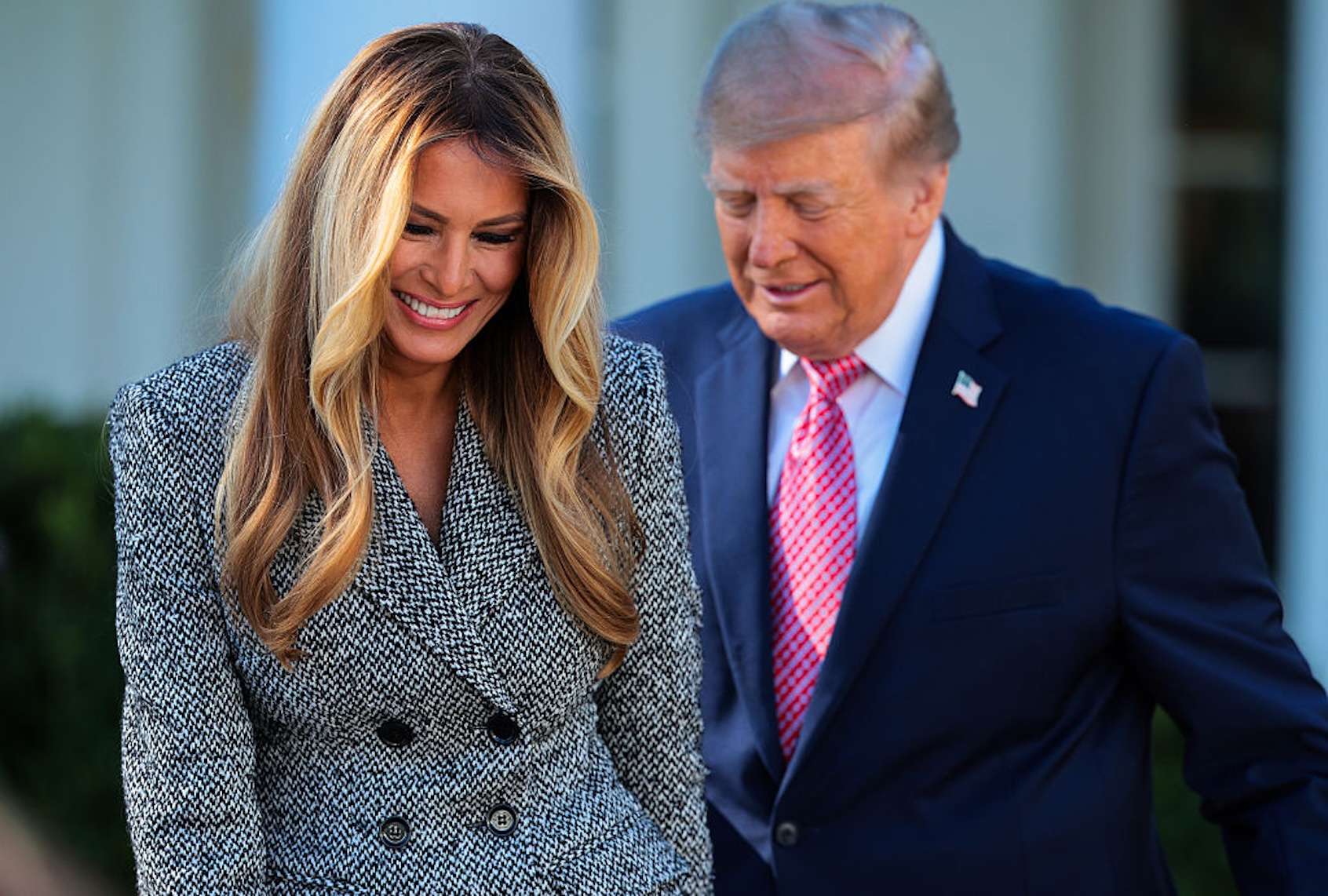
Contrast those misty memories with Monday’s connubial proof-of-life photo-op featuring Donald Trump and his oft-absentee wife, Melania, signing an executive order creating a task force on women’s health. This was a rare appearance for the first lady, who many assume can’t stand her husband. One can’t imagine why.
“Look at her. You think she’s easy? She’s not so easy, but she’s very smart,” the president assured assembled reporters before signing the order and remarking, “I don’t know if her signature means anything,” while handing the pen to his wife.
When he tried to seal the moment with a kiss, the first lady turned her head, leaving him to lip-lock her hair instead. He then patted her hand, mumbling, “Good job.”
And Kate? All she does is clean up her husband’s messes. Following his advice to blackmail a loose-cannon Prime Minister into resigning causes her reflux to erupt with a vengeance. Hal’s part in a secret plot to purloin a Russian doomsday weapon from a sunken sub and her efforts to keep the enemy from finding out trap her in a perpetual cycle of dashing to bathrooms. America’s president named Kate to be her sin eater, and occasionally she has to barf up her guilt to keep her prevarications straight.
Working for the Penn administration is an ambassador’s nightmare and hell on the esophagus. Without a partner, it would be untenable. Without Kate, Hal and the stalwart staff surrounding them, our international relations may very well be in tatters.
The Penn administration will never be confused for Kennedy’s Camelot, and nobody in their right mind would characterize the Clintons’ or the Wylers’ marriages as ideal.
Like Bill and Hillary, Kate and Hal are working on their relationship despite Kate’s extramarital flings and Hal’s penchant for skullduggery. Their marriage is on thin ice. But their shared devotion is more plausible than whatever deal the Trumps have struck.
To watch these real and fictional partnerships play out without doubting their credibility is… I don’t know, is uplifting the word? Soothing, maybe.
It makes us fondly recall a past when first ladies competently delivered coherent speeches from podiums and made strong policy advocates. When presidents reached for their wives’ hands and their spouses responded in kind. It was a nicer, smarter time.
Yet Kate and Hal’s working partnership earns them few points with Grace and Todd. The thing is, Todd isn’t stupid. He’s malleable and clueless about a lot of things, including whether it’s appropriate to interpret a female colleague’s nervous vomiting as an indicator that she’s pregnant. But when Grace survives an assassination attempt, Todd is genuinely shaken. When the president requires an emotional backstop and perhaps a bit of reining in, the first gentleman exercises his own version of diplomacy. When it suits him.
Hal’s mastery of persuasive dark arts makes him a perfect partner for a president who surreptitiously and proudly moves to upend the international power structure. Still, Todd doesn’t like the way Hal and Grace giggle together in secret.
We’re attracted to “The Diplomat” for many of the same reasons Aaron Sorkin’s “The West Wing” kept liberal viewers rapt during the George W. Bush years. The Penn administration has none of the idealism or conscience that drove Martin Sheen’s Jed Bartlet, whose vision Janney’s press secretary, C.J. Cregg, and Whitford’s deputy chief of staff, Josh Lyman, worked to preserve as best as they could.
Want more from culture than just the latest trend? The Swell highlights art made to last. Sign up here
It’s both entertaining and frightening to see the same actors portray an effective marital alliance devoted to trashing norms and weaponizing American exceptionalism.
But that’s also why this show works. In real life, the political class favors men like Hal much more than women like Kate, although (and because) Kate is truly Hal’s better half, morally speaking. In Britain, the charismatic Todd embraces his special envoy status with verve even as he suspects he’s out of his depth.
As America watches the president’s wife treat him with the same disdain he shows the rest of the world, a competent political union, however strained, is somehow reassuring. If the Wylers can survive the nightmare of American politics, maybe we have a chance too.
You’re no one in this business until the Vatican has condemned you. For British filmmaker Ken Russell, that denunciation from the Catholic Church’s highest post came swiftly and relatively early, just a handful of feature films into his storied, controversial career. Known and loved for his sweeping, ostentatious romanticism and flair for dramatics of every kind, Russell’s films weave artistry into the human experience, making the two inextricable. In his eyes, beauty takes all forms, morphing into the grotesque and outrageous before transforming again into a light, airy meringue, generously portioned atop life’s dense realities. Russell’s filmography has something for everyone — and, until this year, something for no one: his controversial 1971 religious epic “The Devils,” a film as heavily censored as it was widely banned.
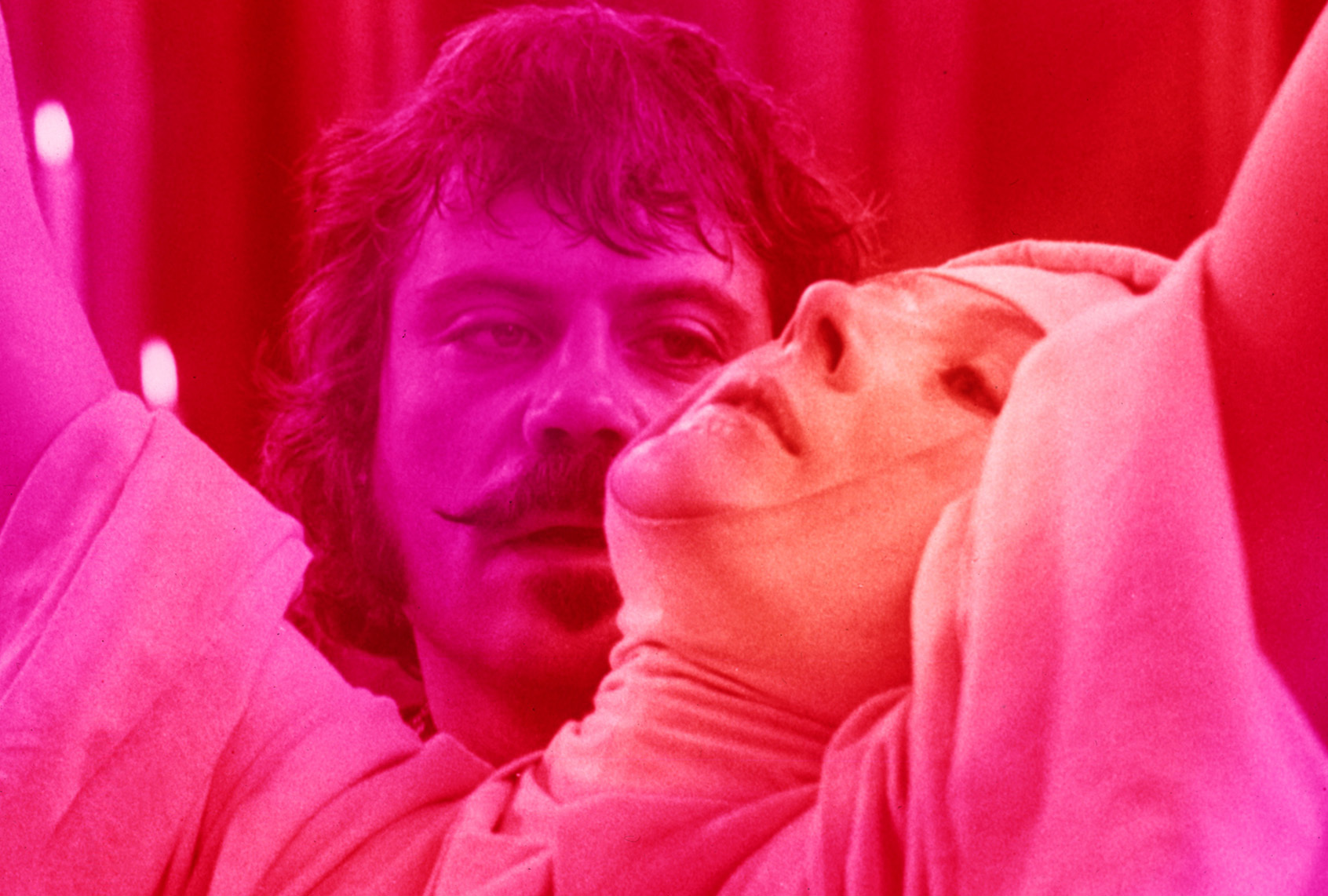
Part historical horror, part holy sacrament, all tragically delicious blasphemy, “The Devils” revisits the downfall of 17th-century Catholic priest, Urbain Grandier (Oliver Reed), in the provincial French city of Loudun. Grandier’s sexual exploits result in accusations of sorcery when a convent of nuns, led by Sister Agnes (Vanessa Redgrave), shed their habits — both the religious garb and the daily formalities — in fits of sexually repressed obsession.
The restoration of “The Devils” and its massively effusive response point to a robust new era in moviegoing. At a moment when the art of film and the film business are so at odds, “The Devils” — that banned, blasphemous frolic through Hell — might just be cinema’s salvation.
In Russell’s typically flamboyant manner, the film features extended sequences of nudity, sacrilege, lust and bloody violence, often all rolled into one. Warner Bros. demanded Russell pare down the film’s most intense scenes yet still slapped it with an X rating in the U.S. and U.K., while other countries banned it outright. Though an uncensored director’s cut premiered in 2002, it was never formally released on home media, and “The Devils” remained difficult to find outside of low-quality, choppily edited releases and torrents for decades.
(Warner Bros. ) Ken Russell’s “The Devils”
But such a notorious reputation could do nothing but persist. After long denying “The Devils” a proper release based on the film’s “distasteful tonality,” Warner Bros. did something right (for once), commissioning a restoration and theatrical rerelease of Russell’s original director’s cut under its new boutique imprint, Clockwork, for one week only. (A limited second-week run was announced at the time of writing.) Like the nuns in Sister Agnes’ convent, the once-sheltered public responded with animalistic haste, selling out screenings nationwide. Far from the average word-of-mouth excitement, the restoration of “The Devils” and its massively effusive response point to a robust new era in moviegoing, one that looks different than anything this century has seen so far. At a moment when the art of film and the film business are so at odds, “The Devils” — that banned, blasphemous frolic through Hell — might just be cinema’s salvation.
At Chicago’s Music Box Theater, one of metropolitan America’s premier destinations for arthouse cinema, screenings sold out in a flash, accounting for the second largest share of the restoration’s opening-weekend box office. Kyle Cubr, the Music Box’s senior operations manager and assistant general manager, likens the excitement to mischief. “Patrons were abuzz around me waiting for it to start,” he says. “It’s almost like when you’re a kid, and you know you’re getting away with doing something bad — you shouldn’t be watching this, but it feels so good.”
As fellow Chicago resident Max Newfield exited the Music Box after his own sold-out screening, chatting with a friend who went in blind and listening to a crowd that was “alive with excitement,” he saw the line for the 9:30 p.m. show snaking down the block. “At one point,” Newfield says, “a woman from my screening walked down the line and yelled: ‘It’s worth the wait!’”
Cubr’s experience echoes countless others who made their way to “The Devils” in its first week. When I started looking for people to chat with for this piece, I expected to find only a handful interested. After all, finding time to answer even a few questions can be difficult these days. And with cinema more ephemeral than ever, and “The Devils” stacked against new theatrical heavy-hitters, there was no guarantee that anyone who had seen the film would actually want to talk about it.
Within hours, my inbox was flooded with people from across the country, eager to talk about the film and their experiences seeing the film. Really, “flooded” doesn’t begin to quantify the deluge. While I spoke with 20 people for this piece, I received 178 individual responses of all kinds, ranging from shock and awe to relative disappointment to distinctly modern moviegoing gripes. But overall, the prevailing narrative was that seeing “The Devils,” in this format and with a full crowd of fervent patrons, was a once-in-a-lifetime experience. As New York’s Ben Sundwall tells me: “A guy started snoring halfway through. A girl was ripping her vape. It was magical.”
Despite the polite crowd at my screening, I wondered if questionable theater etiquette came into play elsewhere. Bafflingly, repertory screenings are where I’ve run into some of the worst offenders. But for an intentionally outrageous film like “The Devils,” where Reed hurls a plastic crocodile out of a window, rules can be relaxed. Naima Warsame, a program manager and chief of staff in New York, told me she thoroughly enjoyed the film but that her screening “wasn’t without its drama.”
“As the credits were rolling, a man in the middle of the fourth row stood up, pointed at a woman in the second row, and yelled, ‘Lady, yeah, you: F*ck you. You had your phone out the whole time!”’ Warsame recalls. “We thought it would end there, but he kept going . . . the movie was already intense, and before we could catch our breath, this conflict made the whole experience overwhelming.” But Warsame isn’t deterred, seeing “at least two movies a week” and hoping for more rereleases of studio films and midnight movies of all kinds. “Nothing beats the theatrical experience,” she says.
Want more from culture than just the latest trend? The Swell highlights art made to last. Sign up here
Josh Svetz, a writer and music consultant based in Washington D.C., shared a similar experience, noting laughter during both the film’s intentionally humorous moments and chuckles that drowned out moments of discomfort. But Svetz relishes the chance to see the film nonetheless, and views the enthusiasm for the rerelease as evidence that moviegoing is becoming more intentionally experiential.
“People want to time travel and experience works of art as they were intended,” Svetz says about the restoration. “I don’t think the theater experience will ever completely die because there’s this singularity, this feeling in your chest, this speechlessness that comes over you when you see something great. It’s rare, but chasing that dragon? It’s worth it.”
More than the extraordinary experience of seeing “The Devils” on the silver screen, the most moving throughline I encountered in talking with people about their screenings — one that seemed to be present in some form across every person I talked to — was the sense of community. It’s not only the chance to see something rare, well-made and lovingly preserved that’s driving people to the movies; it’s the opportunity to make a memory.
Stephen, a New Yorker who works in financial services, savored the chance to see the film at the AMC in Manhattan’s Kips Bay neighborhood, which is scheduled to close by the end of the year. “Every single seat was filled,” he says. “Seeing that for a film released in 1971 is pretty special.” So special, in fact, that he went a second time. And for those who didn’t go alone, finding a buddy was half the fun. Several people shared stories about convincing their spouses, friends, or family to come along — some more successfully than others. For many, seeing “The Devils” was a unique chance to close a loop or strengthen family ties, the kind of event that reminds us of all the small things that make cinema such a large part of our lives.
That people recognize the value in patronizing a faithfully restored work like this — when studios like Warner Bros., having just succumbed to an unholy monopolistic merger with Paramount, need to know that audiences crave great art, old and new — is critically important. It’s also a great relief.
For Bay Area journalist Bojana Cvijic, “The Devils” began as grainy screenshots on her Tumblr dashboard and a low-quality “yet still awe-inspiring” torrent sent over by a friend. Keen to catch the rerelease, she bought tickets with her AMC A-List membership and roped in two friends for a screening that boasted a mixture of laughs, shock, and dead silence. “I realized there are people here who have no idea what this movie is,” Cvijic said, laughing. Making a full-circle jump from her laptop screen to the multiplex, Cvijic waxes poetic. “We don’t get to experience movies like this on big theater screens anymore.”
Cvijic’s first encounter mirrors so many others, notably Nikhil, a 31-year-old SEO specialist who tells me he first saw “The Devils” after building a PC with his dad as a teenager and using it to foster his love of movies. When Nikhil first heard about the restoration, he says it was a “no-brainer,” and that his dad needed no convincing to come along. “I feel quite lucky to have a father who is equipped to respond to and appreciate films as he does,” Nikhil says, “because watching and discussing films together has blossomed into a shared experience that has helped both of us chart our tastes toward art — but more importantly, deepened our relationship with one another . . . Due to my excellent company and my personal relationship with [‘The Devils’], it’s a theatrical experience I will remember forever.”
When I hop on the phone with Juanchi Roca-Paisley, a member of a Miami non-profit financing affordable housing, he excitedly regales me with his experience seeing the movie with his mom, who walked out of “The Devils” when she saw it at a screening in the ’80s. This time, however, his mom stuck around — though she did warn him that she’d give him a tap if she wanted to leave. “I think she found the imagery very cool,” Roca-Paisley says. “To share it with her was so great. But my other mom also said, ‘I kind of want to see that.’ Now I’m like, ‘Oh my gosh, am I going to repeat this?’”
With the film entering its second week, don’t be surprised if you head to the movies in the coming days and see moms, dads, teenagers, or grandparents waiting for their chance to witness what no one could for so many years. It’s easy to dismiss “The Devils” as a rerelease geared toward older cinephiles. But that’s far from the truth. Part of what’s so remarkable about the gushing response to Clockwork’s restoration is that it had no guarantee of doing so well. Josh Svetz puts it perfectly in our conversation, saying, “The theatrical experience is a choice now rather than a necessity.”
Svetz cites camrips and microscopic theatrical windows as factors that have both hindered cinema and strengthened its unique selling points, and he’s completely right. In an era when anyone can watch just about anything with a few clicks of a trackpad or taps of a finger, moviegoing has become more intentional than ever, especially with rising ticket prices. That people recognize the value in patronizing a faithfully restored work like this — when studios like Warner Bros., having just succumbed to an unholy monopolistic merger with Paramount, need to know that audiences crave great art, old and new — is critically important. It’s also a great relief.
But it’s not only that people of all ages are turning out for “The Devils” that I find heartening; it’s their passion for the entire shebang — for moviegoing, and for all its wonderful, absurd and timeless rituals. There’s no question that we live in a uniquely difficult age, where reprieve is a hot commodity. But as sensational as it is, “The Devils” doesn’t exactly offer ease. The film’s historical context holds as many parallels to today as it did in 1971, arguably even more: suppression of all kinds, brutality in the name of politics and religion, innocence tainted by unnerving sights no one should ever witness.
“It’s brutal, but necessary,” says Taylor Owen, a Chicago-based artist who caught the film at an AMC after the Music Box sold out. “Our world is unfortunately not so different from the world the nuns of Loudon were living in. I have never seen a film like this before. I don’t think I ever will again. ‘The Devils,’ in the way it was meant to be seen, is one of the most important pieces of art ever created.”
Fox News’ closing argument for the final midterm elections of Donald Trump’s political reign is increasingly frantic. The network promised its viewers prosperity. With early voting underway in most states, its best pitch now is footage of burning streets in France.
During the 2024 presidential campaign, Fox repeatedly sold Trump’s return to office as the cure for high prices. As economic indicators began to disappoint toward the end of 2025, the network pivoted to promises that 2026 would bring an economic boom. Once again, that prosperity has failed to materialize. Now, with the year nearing its end and Fox’s leading personalities struggling to explain why voters should reward Republicans for their stewardship of the country, the network has changed its pitch: Forget what Republicans promised to do for you. Be terrified of what Democrats will supposedly do to you.
Jesse Watters said the quiet part out loud on “The Five” on Oct. 15. Polling, he explained, shows the MAGA base is engaged and locked in, while “the non-MAGA faction and independents” are where Republicans are exposed. He cited an interview with Caroline Sunshine, a former Disney star turned MAGA operative, who told him the GOP could not simply sell the great stuff Trump had done because accomplishments “don’t motivate.”
“You got to go out and have fear porn,” Watters concluded. “You have to say, ‘These people are going to take your healthcare, they’re going to let in the Third World, they’re going to jack up your taxes,’ and that’s what’s going to get people to come out to vote. You have to say, these people are scary and dangerous.”
His fellow host, Greg Gutfeld, apparently delighted, replied, “Good for you, fear porn!”
Fox’s fear-mongering is a performance for the converted, intended to escape the studio through Trump’s Truth Social feed and whatever the mainstream press can be induced to cover.
Notice whom Watters said he was worried about. MAGA is engaged. It is the “non-MAGA faction and independents” who trouble Republicans — precisely the voters least likely to be persuaded by the insular world of “The Five.” Fox’s fear-mongering is a performance for the converted, intended to escape the studio through Trump’s Truth Social feed and whatever the mainstream press can be induced to cover.
The result is a campaign by the network that has the instability of an advertising operation testing different nightmares. The targets change, but the pitch remains the same. One day it is rioting in France. The next it is a Democratic senator’s comments about prosecuting officials who break the law. Now Fox is turning its cameras toward the home of Rep. Ilhan Omar, scrutinizing her family’s movements and encouraging speculation about her whereabouts. The instruction never changes: Your dissatisfaction with the people in power must not become a vote against them.
Sean Hannity has called this “the single most important, consequential midterm election in our lifetime,” warning that Democrats would “shred your Constitution” on behalf of a “radicalized leftist democratic socialist communist movement.” Republicans, Hannity conceded, may be “imperfect” and even “pathetically weak,” but “Democrats are completely insane.” He has also claimed Democrats want to abolish the family and seize control of Americans’ assets, food and healthcare. Laura Ingraham warned Wednesday that Democrats want the public to “submit or be crushed.”
Coincentedally, Fox’s October surprise arrived on cue. What began as student protests over conditions at a high school north of Paris has expanded into a broader protest movement, with large demonstrations across France. Although the overwhelming majority of demonstrators have marched peacefully, scattered violence over the weekend gave Fox the footage it needed. Media Matters tallied at least five hours and 18 minutes of network airtime devoted to the unrest between Saturday and Wednesday morning. Monday alone accounted for two hours and 22 minutes, with the subject raised in every hour of programming from 5 a.m. until midnight.
Ingraham called the footage a “reality check” for anyone who doubts the stakes of the midterms, claiming a Democratic victory would bring the same chaos to the United States. Brian Kilmeade, co-host of “Fox and Friends,” warned viewers that “this type of stuff is coming here.” Hugh Hewitt was even blunter: “It’s coming here.” Kayleigh McEnany, the former Trump press secretary now collecting a Fox paycheck, called the scenes “very instructive” as Americans decide who should lead the country.
The argument presented by Fox hosts was as crude as it was consequential: French unrest became evidence of what American Democrats supposedly intend to unleash at home. The network offered little reason to believe that the political circumstances in France were transferable to the United States. It did not need to establish that connection. It needed viewers to feel it.
Then came the feedback loop that has defined the Trump era. The president, who often posts in real time while watching Fox, declared Sunday morning that “France is burning” and demanded that the U.S. close its borders. By Monday evening, footage of the protests had made its way into his stump speech for embattled Sen. Roger Marshall in Kansas, where video clips had already been screened for rallygoers. Trump described France as a nation being conquered by migrants, jihadists and communists hostile to Christianity and Western civilization. Democrats, he claimed, wanted to bring the same destruction to America.
House Speaker Mike Johnson joined the pile-on, posting that France was “descending into chaos because they wanted OPEN BORDERS.” POLITICO reported that Republican operatives saw the story as a potential jolt for their campaigns, with party sources saying that linking the perceived anarchy to Democratic policies would be a focus of the GOP’s closing message. Fox News Digital further amplified the narrative by publishing an investigation identifying what it called “a transnational network of communist and socialist organizations” linked to the French movement.
The process is familiar: Fox finds a frightening story, strips it of context and recasts it as a warning about Democrats. Trump amplifies the coverage, giving the story the authority of the presidency. Republican operatives then convert the resulting panic into a campaign message, which Fox can cover as a political development in its own right.
This is a campaign-season ritual. In 2014, the fearmongering centered on Ebola. In 2018, it was migrant caravans. In 2020, the Hunter Biden laptop became an obsession. In 2022, Fox returned to the old-fashioned panic over “America’s crime crisis.” In 2024, it was Kamala Harris being for “they/them.” Each story was presented as an urgent national threat with implications for the election.
This year’s French panic, however, appears to have sputtered. While Trump continued invoking the unrest on the campaign trail, by Wednesday morning Fox’s coverage had fallen sharply. The network was already moving on to its next outrage: days-old comments from Sen. Elissa Slotkin, a Michigan Democrat and former CIA analyst.
At a University of Chicago event on Oct. 13, Slotkin discussed how Democrats might hold Trump administration officials accountable if they regained power. She said she wanted to pursue significant cases against officials who enabled unlawful conduct and to make prospective employees think carefully about the legal risks of working for the administration.
“I want young people coming out of school to say, ‘Should I go work for the Trump administration? Like, that sounds fun, I might get an opportunity,’” Slotkin said. “I want them to be like, ‘Lord, that might be buying myself a ton of problems that I don’t want, and so let me avoid participating in that.’ I want that deterrence message.”
There is a legitimate debate to be had about how Democrats would exercise investigative and prosecutorial powers if they regain control of Congress, and politicians should be careful not to imply that public servants are presumptively guilty because of whom they work for. But Slotkin’s stated target was officials who enable unlawful conduct, not young conservatives as a class. Her remarks concerned the prospect of legal accountability, not a blanket prohibition on conservative participation in government.
Fox seized on the comments as evidence that Democrats intend to intimidate young conservatives out of public service. Slotkin pushed back, arguing that the Supreme Court’s grant of presidential immunity did not extend to people who commit illegal acts at a president’s direction.
So then the network turned its attention to Omar, exposing just how selective its concern about intimidation can be.
Earlier this month, federal agents searched Omar’s home near Washington under a judicially authorized warrant. Citing unnamed sources, Fox reported that the investigation concerned immigration paperwork completed by Omar’s late father when she was a child. The allegations remain allegations; the existence of an investigation does not establish wrongdoing by the congresswoman.
Fox did not merely cover the search. Its reporters were at her door on the morning it happened. On Oct. 20, Fox News Digital published an article centered on Omar’s daughters arriving at the residence. The report described her eldest daughter, Isra Hirsi, pulling into the driveway after dark and carrying a bag into the house.
The headline read, “Omar’s daughters show up at scene of DC raid as rumors swirl about embattled rep’s location.” A promotional post on X asked, “Where is Ilhan Omar?” and explained that the congresswoman had not been spotted publicly since the search and that Fox was “tracking new activity at the residence.” It described her daughters’ arrivals and noted that her husband had continued to appear outside the home.
The framing was unmistakable. Fox was not simply reporting on the status of an investigation. It was inviting viewers to treat the movements of Omar’s family as clues in a mystery, while encouraging speculation about the congresswoman’s whereabouts. One of the daughters, when approached by Fox News Digital, responded with a pointed question: “What’s your problem?”
It is a fair question. The public has a legitimate interest in allegations involving an elected official. That interest does not automatically extend to tracking her children’s movements or turning their arrival at a family home into a political spectacle. Fox’s reporting made the family part of the story without establishing why their ordinary activities were relevant to the investigation.
The episode also exposes the hypocrisy of Fox’s Slotkin coverage. The network wants viewers to believe that Democrats’ talk of accountability will intimidate young conservatives into avoiding public service. Yet its own reporters are making the movements of a Democratic official’s children into content, inviting public harassment and targeting.
Fox’s fixation on Omar has long gone beyond policy criticism. Its personalities have repeatedly invoked her Somali background and Muslim identity to cast her as an alien presence in American politics.
Fox’s fixation on Omar has long gone beyond policy criticism. Its personalities have repeatedly invoked her Somali background and Muslim identity to cast her as an alien presence in American politics. Kilmeade recently seized on an account of the congresswoman being disappointed by the homelessness she encountered in New York after arriving in the United States to accuse her of being ungrateful. The implication was that Omar’s criticism of the country was itself evidence of a defective character.
That framing makes the doorstep surveillance more disturbing. Omar is not simply a politician whose positions can be challenged. She is a perpetual outsider whose loyalty is always in question and whose private life is treated as fair game. When Fox’s cameras turn toward her family, the distinction between political journalism and political harassment becomes harder to defend.
The network’s rapid succession of panics reflects the problem at the heart of the Republican campaign. Trump promised to make Americans more prosperous. Fox helped sell that promise. But with voters still confronting the cost of living and increasingly skeptical of the administration’s performance, the network has little incentive to dwell on whether Republicans have delivered. It is far easier to insist that the alternative would be worse.
Fear can be a powerful political tool. But it has limits. It works best when voters have little direct evidence with which to test the claims being made to them. Fox’s message is competing with a reality its audience can see for itself: The economy is not delivering the uncomplicated prosperity Trump promised, and dissatisfaction with the direction of the country is creating opportunities for Democrats.
The network can show its viewers burning streets in France. It can portray a senator’s comments about legal accountability as a threat to an entire generation of conservatives. It can turn a congresswoman’s family into the subject of a lurid guessing game. None of that answers the basic question now facing voters: Have Republicans earned another two years in power?
In March, Homeland Security Secretary Kristi Noem was fired after it was revealed she and her assistant, Corey Lewandowski, had been funneling multi-million dollar contracts to a political ally for self-serving TV advertisements. On Oct. 13, Ambassador to Greece Kimberly Guilfoyle resigned under pressure from the administration when it was reported she had shaken down a donor for $100,000 to pay her American Express bill. This week, Alina Habba, Donald Trump’s former personal lawyer and Acting U.S. Attorney for New Jersey, said, “Hold my beer, ladies,” when The New York Times reported she had been given a $50 million personal contract in exchange for securing a presidential pardon.
Habba is the perfect example of the Trump insider. A graduate of Widener University Commonwealth Law School, she practiced law at her first husband’s firm and served as general counsel for a parking garage company owned by her second husband. A New Jersey local, she caught the president’s eye when she joined his Bedminster law firm and soon appeared on Fox News, where she defended him in the way that pleased him. In September 2021, Trump hired her for his legal team. One of her first actions was to file a $100 million lawsuit against The New York Times and Mary Trump, the president’s niece, and take over defending Trump in a defamation case brought by a former contestant of “The Apprentice” after several veteran lawyers withdrew. The Times case was dismissed for “fail[ing] as a matter of constitutional law.” The former contestant dropped hers after Habba countersued her for trying to “stifle Donald Trump’s free speech.”
Habba was part of the team that represented Trump in the fraud case brought by New York Attorney General Letitia James, where the lawyer’s main contribution appeared to be mimicking Trump’s patented mugshot glower before the cameras. She served as lead attorney in the E. Jean Carroll case, during which the judge admonished her repeatedly for her poor legal skills. The case ended up with a jury awarding Carroll $83.3 million in damages.
But Habba’s most infamous case as the president’s personal lawyer was one brought in the Southern District of Florida in May 2022. Trump sued the Democratic National Committee, Hillary Clinton, John Podesta, Jake Sullivan, Florida Rep. Debbie Wasserman Schultz and others for allegedly perpetrating “a calculated scheme to defraud the news media, law enforcement, and counterintelligence officials for the purpose of proliferating a false narrative of collusion between Trump and Russia.”
U.S. District Judge Donald M. Middlebrooks was not amused. Four months later, he dismissed the case, saying it was inadequate in all respects. In January 2023 he sanctioned Trump and Habba to the tune of nearly $1 million, writing, “Here, we are confronted with a lawsuit that should never have been filed, which was completely frivolous, both factually and legally, and which was brought in bad faith for an improper purpose.”
Naturally, Trump appealed, but the 11th U.S. Circuit Court of Appeals upheld the ruling. Earlier this month, the sorest loser appealed the case to the Supreme Court.
Habba’s record as the president’s personal attorney speaks for itself. She didn’t fail up as spectacularly as U.S. Circuit Judge Emil Bove and Attorney General Todd Blanche, but Trump did bring her into the White House as counselor to the president and later nominated her to be the U.S. Attorney for the District of New Jersey.
As interim U.S. attorney, Habba immediately began to cause chaos. Like Noem, she cosplayed as U.S. Marshal and announced she would pursue political prosecutions of prominent New Jersey Democrats, including the governor. A panel of judges, following the law, refused to allow Habba to serve in an interim capacity, forcing Trump to withdraw her name from consideration for the job, designating her acting U.S. attorney instead. Eventually, the U.S. Court of Appeals for the Third Circuit found that Habba was not lawfully appointed to that post as well, disqualifying her from the position.
She was then hired to a post clearly made up on the fly, pending a reversal of the opinion, in which case she would be reappointed as U.S. Attorney. That never came about, and at least according to what we learned from the explosive New York Times report, Habba had other plans anyway.
As it happens, right around that time a Venezuelan billionaire banker named Julio Herrera Velutini wanted a pardon. He had already been given a very generous deal by Trump’s Justice Department, which had reduced felony bribery charges to a misdemeanor, but he wanted his record cleared completely. He hired Christopher Kice, another of Trump’s former personal lawyers, to help him grease the skids. To sweeten the pot, Herrera’s daughter, who holds U.S. citizenship, had contributed $3.5 million to Trump’s super PAC. But by fall 2025, nothing had happened, so the Herrera family decided to hire someone with a little more juice. They tapped Habba, who was still working at the Justice Department, and allegedly offered her $10 million a year for four years and at least $10 million in bonuses.
They created a company, Concord Partners, which has no known business dealings, and in January 2026 Habba signed on as its general counsel. Days after she took the position, Trump granted Herrera the pardon.
This is the most egregious case involving the sale of pardons under Trump that we’ve heard about . . . The grift has become so blatant that the public has finally started to notice — and they don’t like what they see.
This is the most egregious case involving the sale of pardons under Trump that we’ve heard about. According to various reports, procuring presidential pardons has apparently become a cottage industry among many MAGA insiders, who are becoming wealthy trading on their access to Trump. For his part, the president appears to be handing them out to Republicans like Hershey bars on Halloween. The grift has become so blatant that the public has finally started to notice — and they don’t like what they see.
Habba apparently hasn’t yet collected her fee, and this revelation may just end up depriving her of most of it. But she needn’t worry. She just married a much younger Turkish billionaire named Turhan Mildon in a reported $10 million wedding attended by fellow Trump officials including Blanche, FBI Director Kash Patel and civil rights division head Harmeet Dhillon. Habba has no financial worries, and there will almost certainly be no legal ramifications for this flagrant conflict of interest and pay-to-play scheme.
But she is embroiled in yet another convoluted scandal involving her new husband, in which he supposedly sent $17 million to Richard Grenell, Trump’s former envoy to Venezuela who was serving then as director of the embattled John F. Kennedy Center for the Performing Arts. This donation, later determined to have actually been sent from the Democratic Republic of Congo, where Mildon has many business dealings, went to a Texas defense contractor. Habba is alleging that the portion meant for the Kennedy Center — an obvious sop to Trump after he took it over — never made it.
The full contours of this dispute are not yet clear, and Grenell has denied any knowledge of the matter. But never fear: The White House is on it. Trump assigned Will Scharf, the White House counsel, to look into the matter, and no doubt Habba was pleased. After all, Scharf was one of the honored guests at her wedding. It’s nice to keep it all in the family.
CORRECTION: This column has been updated to clarify Richard Grenell’s tenure at the Kennedy Center, which ended in March 2026.
For the better part of its final decade, Rawhide was my bar. The old leather place on Eighth Avenue in Chelsea was dark in the way that mattered, a judgment-free room where the only thing anyone asked of you was that you be yourself. There was the Eagle down the street, a bigger playground, but Rawhide was rawer, closer to the bone, and it happened to sit practically next to my apartment, which made it the place I dropped into on my way home or to kick off a night.
Most nights I was a simple man at the end of the bar, taking in the spectacle, listening, watching. On slow nights, when the crowd thinned, the bartender would let me put on a few of my own songs and we would all jam to them, and it felt less like a scandalous den than like Cheers with a twist, everybody knowing your name, nobody needing you to explain yourself. Then it closed, and the space became, of all things, a lingerie shop, which tells you most of what you need to know about what New York City decided those rooms were worth.
I bring it up because I recognized something the instant I saw the photographs of Chris Gallant.
Gallant is the 37-year-old openly gay Democrat running for Congress in New York’s first congressional district, out on eastern Long Island, against the Republican incumbent Nick LaLota. A few weeks ago, the New York Post surfaced a set of images from a 2010 photo shoot: Gallant, younger and gorgeous, in bondage gear, pictures taken with a then-partner for the fetish retailer Mr. S Leather. The photos lived openly on the company’s website for most of a decade, and then disappeared. Perhaps inevitably, someone dug them up, handed them to a tabloid and waited for the man to crumble.
Gallant didn’t. In an interview with the New York Times, the military pilot, union leader and firefighter called it his “Kim Kardashian moment,” said his friends have always known he is kinky and refused, flatly, to perform the shame he was supposed to perform. I have rarely been prouder of a stranger.
But I want to be precise about what is actually scandalous here, because everyone keeps aiming at the wrong target. I spend my working life as a trauma-informed violence-prevention educator, which means I spend it on a single distinction: the difference between what is done with your consent and what is done to you without it. By that measure, the photographs are the most innocent thing in this entire story. They were made by consenting adults, with a partner, for a purpose Gallant chose, and they lived in the open for years. There is no victim in them.
The violation came later, and it belongs entirely to whoever pulled those images out of their context to use them as a political weapon. That is the nonconsensual act in this story. That is the thing we should be clutching our pearls about. Someone took a man’s consensual expression of his own desire and weaponized it to try to drive him out of public life, and the media coverage of it largely treated the man in the leather as the problem.
The violation came later, and it belongs entirely to whoever pulled those images out of their context to use them as a political weapon. That is the nonconsensual act in this story.
We have the true obscenity backward. The scandal isn’t the leather. It’s the leak.
Gallant’s refusal to grovel is the correct answer — the only answer. For most of my life, the price of a seat at any table was a quiet agreement to be a less vivid version of yourself, to sand down whatever might frighten the neighbors, to apologize in advance for existing. The men I stood shoulder to shoulder with at Rawhide mostly paid that tax their whole lives. So when a candidate looks at the oldest trick in the book — here is evidence that you are a deviant — and simply declines to be ashamed, he is doing something the boy I was could not have imagined. Be queer. Be masculine. Be unafraid, authentic, bold, believable. That is the whole platform, and it is a good one.
Here is where I step off the easy celebration everyone else is writing, though not in the direction you might expect. Gallant is making his stand in a district Donald Trump carried in 2024 and that the Cook Political Report currently rates as Solid Republican. He may well lose. But losing would not make his candidacy a mistake. Every barrier broken is a notch in a glass ceiling, and the ceiling does not care much whether the person who cracked it got to walk all the way through. An out, unapologetic gay man refusing to be shamed off the ballot in Trump Country is exactly the kind of barrier that, once broken, cannot be unbroken.
There is an asymmetry worth naming. A straight candidate with an old racy photo shoot — such as former Massachusetts Sen. Scott Brown, a Republican who posed nude for a Cosmopolitan photo spread in the 1980s — gets a wink and a news cycle. A gay man with the same gets a referendum on his fitness to serve. But you do not retire a double standard by hiding from it. You retire it by having enough people walk straight into it, unbowed, that it stops working. Gallant just made it work a little less well.
What I actually worry about is not whether Gallant wins. It is whether the next one runs. Look at how the field is being remade right now, by democratic-socialist insurgents, by former military officers and ex-intelligence officials trading their clearances for yard signs — whole new kinds of candidates deciding the work is too important to sit out. So where are the out, unapologetic queer candidates?
My fear is that a young gay man with a few consensual images somewhere on the internet, and there are a great many of us, watches what is being done to Gallant and quietly decides it is not worth it. My hope is the opposite: that he watches a man refuse to be ashamed and thinks, if he can take that and keep his head up, so can I.
Because that is the thing this moment cannot be allowed to become: a warning. Instead, it has to be an invitation. A seat at the table is too important to cede to whoever is willing to leak a photograph.
Gallant did nothing wrong. He took some beautiful photographs with a partner a long time ago, and he has declined to be sorry about it. The shame in this story was never his, and it was never ours. It belongs, every ounce of it, to the people who went looking for a way to make a good man disappear.
My hope, for the next queer person weighing whether to step into the arena carrying a past and a future both, is that they look at Chris Gallant standing in his own light and decide to run anyway. We need them there.
Republican Vivek Ramaswamy is closing out one of the nastiest races of the 2026 cycle by suggesting that Democrat Amy Acton, his opponent in the Ohio governor’s race, has lied about the well-documented childhood sexual abuse she experienced for political gain.
In a contest marked by sharp personal attacks and partisan rancor, Ramaswamy’s latest attempt to paint Acton as unfit for office came in the form of a minute-long ad that began circulating Monday night featuring Donna Arthur, Acton’s estranged mother. It was widely condemned on both sides of the political aisle. President Donald Trump and Vice President JD Vance, however, both defended the ad as an appropriate one to run in the closing days of a campaign.
Arthur lost custody of Acton and her younger brother in 1978 after her second husband, Cledith Arthur, was arrested, charged and indicted for raping then 12-year-old Acton. In the ad, Donna Arthur said her daughter has “lied her entire life.”
“Amy has a serious problem, she is a liar, she lies about her past. She says she grew up living in a tent, none of that is true. She’s lied her entire life. My daughter needs help. And she can’t help you if she needs help herself,” Arthur said.
Acton, a pediatrician and former health director under Ohio’s current Republican Gov. Mike DeWine, has spoken openly during her campaign about facing abuse and neglect as a child, while in her mother’s custody. Acton has said that for a time the family lived in a tent before she and her brother moved in with their biological father.
Court records and local media reports at the time confirm key details of Acton’s story and contradict Donna Arthur’s suggestion that her daughter lied about the abuse.
“My birth mother did nothing to protect me. I’ve always known that she was deeply sick and unwell,” Acton wrote on Tuesday in a Facebook post responding to the ad. “It’s sad to see Vivek Ramaswamy exploit her all for his own political gain.”
Cledith Arthur did not show up for a court hearing following his 1978 indictment. He and Donna Arthur left the state, and there were warrants out for his arrest. The Arthurs remained married until Cledith Arthur’s 2004 death in Pennsylvania.
Acton has said the last time she saw her mother was in the courtroom after her stepfather was charged, when her mother rebuffed her kiss. “That was the last time I ever saw her,” Acton told the Vindicator, her hometown newspaper in Youngstown, when she was selected by DeWine as the state’s health director.
Ohio’s gubernatorial race is one of the most competitive in the country despite the Midwestern state solidly backing Republican Trump in all three of his White House bids. Acton is vying to be the state’s first elected woman governor and the first Democrat elected to the office since 2006.
The most recent reliable nonpartisan polls show her with a 4-to-9 point lead over Ramaswamy, a biotech entrepreneur and failed Republican presidential candidate.
The contest has been notably light on policy. Though Acton and Ramaswamy have staked out different positions on everything from reproductive rights to data centers, neither candidate faced a competitive primary that compelled them to outline their policies in detail. Acton has tightly controlled media access at her events and declined to debate Ramaswamy in the general election.
The ads blanketing the battleground state have therefore largely been personal attacks. Acton has suggested Ramaswamy is an out-of-touch billionaire and a biotech fraud. Ramaswamy and others in his orbit have sought to portray Acton as unfit to lead Ohio, zeroing in on a 2019 incident when Acton’s daughter called police and said her mother and stepfather were arguing — and that Acton had been drinking.
The disagreement had ended by the time police arrived. Acton’s husband has taken responsibility for starting the argument and said that his wife had a single drink. Ohio’s Republican Party nevertheless posted a computer-generated image of Acton’s Jeep with the license plate: “Drunk Mom.”
Previous Ramaswamy-aligned ads have suggested that the childhood abuse Acton experienced — and her response to it — should be disqualifying.
Childhood abuse is common. At least one in seven children in the country experience abuse or neglect each year, according to the Centers for Disease Control and Prevention, and rates of child abuse and neglect are higher among families experiencing poverty or economic insecurity.
Ramaswamy in April shared a video on the social media site X of a speech in which he said Acton had no positive vision to lead Ohio, “other than to complain about what someone else did to her,” seemingly referring to her childhood abuse.
Ads run by the Ramaswamy-aligned V-PAC — the name stands for Victors, not Victims — highlighted Acton’s disclosure on her medical licensing application that she sought therapy to process childhood abuse. V-PAC is funded by a group of out-of-state billionaires that includes Elon Musk, the owner of X, Tesla and SpaceX.
“I won’t normalize somebody who said my childhood is just something I’m complaining about,” Acton said in a Tuesday appearance on Spectrum News.
Acton added that Ramaswamy has shown a “pattern” of using his opponents’ family dynamics for political attacks. She pointed to Ramaswamy’s comment directed at Nikki Haley in a 2016 Republican presidential primary debate that she should “take care of your family first” during an exchange over TikTok and her adult daughter’s use of the video-sharing platform.
When the video with Acton’s estranged mother initially surfaced on social media Monday night, it did not state who paid for it or which candidate it supported, as is legally required for a political ad to air on television. By Tuesday evening, Ramaswamy confirmed to an ABC affiliate in Columbus that his campaign was responsible for it and defended its contents. Axios reported early Wednesday that Ramaswamy’s campaign will drop $4 million to get the ad in front of Ohio voters in the final stretch before Election Day.
His Tuesday night campaign event was interrupted when an attendee attempted to confront him over the ad. Television personality Meghan McCain, the daughter of late GOP senator and Republican presidential nominee John McCain, wrote on X that the Ramaswamy spot was a “dastardly ad” that “never should have been created.” Democrat Sherrod Brown, who is vying to reclaim his former U.S. Senate seat representing Ohio, called the ad “disgusting.” The conservative National Review obtained court records that corroborated Acton’s account. A Republican member of DeWine’s cabinet denounced the advertisement.
Trump told ABC News on Wednesday that he wasn’t aware of the ad’s specifics, but he didn’t “think that has anything to do with Vivek,” after being informed at least twice that the ad had been made by Ramaswamy’s campaign. Vance, campaigning in his hometown of Cincinnati on Wednesday, told reporters that Republicans should “stop whining about an advertisement and go win the race.”
“Whether the ad was appropriate or not is not really my concern,” Vance added.
Acton’s campaign released a response ad featuring her younger brother, Phil Stearns, who has said that Acton shares their childhood abuse not to complain but because it is “something that informs who she is and builds this core of strength that she has.”
“She was 11- and 12-years old, and to think that’s somehow a talking point? Shame on Vivek. It’s the contempt he has for Amy, it’s the contempt he has for Ohio. He’s not fit to lead,” Stearns said in the ad.
To check your voter registration status or to get more information about how to vote and what’s on your ballot, visit vote.org.
Earlier this month, the California coast was hit by a Kelvin wave, a deep ocean wave that can raise sea levels, but to most people, it wasn’t immediately visible. Named after Lord Kelvin, the mathematician who discovered them in the late 19th century, these waves don’t roll and crash along the shore like a tsunami or hurricane. They are slow-moving, mostly flat, waves of warm water that can stretch thousands of miles across the Pacific Ocean.
“It’s like an enormous bathtub sloshing around,” Mark Cane, professor emeritus of earth and climate sciences at Columbia University, told NPR on Monday. Kelvin waves are totally natural, forming throughout the year from warming ocean water and usually not impacting coastlines by a noticeable amount. But this year’s record-shattering El Niño climate pattern threatens to make Kelvin waves a little more intense throughout the winter, potentially inundating hundreds of thousands of Californians with up to two feet of elevated sea level, Daniel Swain, a climate scientist at the University of California, told USA Today. He called it “pretty significant.”
It’s not just more Kelvin waves headed for California. The state predicts the colder seasons will bring extra powerful storms that risk bringing damage and floods. In September, Democratic Gov. Gavin Newsom issued a statewide emergency declaration in preparation for the unpredictable conditions.
The Trump administration’s response to this is essentially to say “don’t expect help.” On Tuesday, Federal Emergency Management Agency Administrator Cameron Hamilton told state officials to prepare to pay out of pocket for disasters without federal assistance. “Every state must have the appropriate financial reserves” and other abilities “to ensure that recovery efforts can start immediately and not necessarily be held up simply because of the federal [disaster] declaration process,” Hamilton said, according to a recording of his remarks obtained by Politico. He added that “A future that I hope we would shoot for is one where we wouldn’t require as many disasters because the capability of states is so high and so substantial,” referring to presidential authorizations of disaster aid.
California officials are taking Hamilton at his word. On Wednesday, the Washington Post reported the state is “ramping up resources to help communities across the state prepare for potentially devastating storms and flooding spurred by a record ongoing El Niño.”
“They swore an oath to serve this country and protect the American people. Now they’re abandoning FEMA’s mission and telling Americans in states across the country to fend for themselves,” Newsom said in a press release. “When disaster strikes, Americans help one another regardless of politics.”
Early on a Tuesday evening, I arrived at a local dive bar for a show by Dream Syndicate. There’s no opening act (or rather, as Steve Wynn will later joke, the Dream Syndicate are opening for the Dream Syndicate) and a blissfully early 7 p.m. start time. I greeted the door woman, bought a bottle of water, grabbed a bar stool against the far wall, and opened the book in progress on my phone until the show started.
At the end of September, I walked into the Majestic Theatre to see the Michael Shannon/Jason Narducy R.E.M. tribute. It’s a GA venue that holds a little over 1,000. When the doors opened, I headed for the barrier for no other reason than the volume at that proximity helps drown out what jamband fans refer to as “chompers” — people who view concerts as suitable background for their conversations. Delightfully, I found myself standing with four other women. We killed time before the show talking about what other concerts we’d been to recently, and took turns watching each other’s spot when someone needed a bathroom run. (There was no line at the women’s room for that show, a big reason I wanted to be close so I didn’t run the risk of standing near a dude needing to explain R.E.M. to me, like the guy at the bar where I was eating dinner before the show.)
A few weeks earlier, I pulled up at Trinosophes, a coffee shop / artistic consortium that regularly hosts more experimental / less mainstream musicians — Marisa Anderson played a gorgeous show there earlier this year — to see BASIC, an amazing trio that’s a mix of minimalist jazz and experimental rock. I paid the dude at the counter, who was in the middle of pulling a shot of espresso, and then decided to kill some time at People’s Records, the record store attached to the space, along with other show attendees and a couple of musicians in the opening act. I sat in exactly the corner of the room that sounds the best for my damaged hearing and thoroughly enjoyed the sets.
We absolutely need to abolish the concept that going to a concert alone is any kind of abnormal or undesirable behavior.
What all of these concert activities have in common is that I attended them by myself. And this should absolutely not be news of any kind, but recently a leading music magazine posted a news story that announced: “Going to concerts alone is a top-tier human experience.” The story wasn’t actually about that, but was rather a mashup of reporting on how Phoebe Bridgers’ recent phone-free concerts meant that when an attendee spotted a celebrity at the show, they couldn’t report to a gossip publication that this person was supposedly standing alone in the line for the bar (while there are actually many reasons you could be at the bar by yourself despite arriving with an entourage of a dozen people).
But the writer’s reasoning for why it was okay to be going to a show without a date or a friend(s) actually didn’t make a believable case for it. They offered an awkward and overly exaggerated blather about how solo concertgoing means that you can better participate in “the oneness of things,” which made you wonder if the person writing it had actually been to a concert, much less attended one on their own. And I didn’t realize we had to justify or defend this, or that it was anything out of the ordinary.
Want more from culture than just the latest trend? The Swell highlights art made to last. Sign up here
What they got wrong is that the “top tier human experience” is simply going to concerts, full stop. (As Neil Young once said, “Live music is better/bumperstickers should be issued.”) The idea that going to see one of the most important concert tours of the year by oneself is “sad” is so idiotic that it should never have been entertained as any kind of news story. And we absolutely need to abolish the concept that going to a concert alone is any kind of abnormal or undesirable behavior.
I’m biased. I’ve been going to concerts alone since I was 14 years old. This wasn’t necessarily by choice, but rather that I wanted to do something important and no one else I knew wanted to do it, and I wasn’t going to let that minor detail stop me. And as I have moved through my life, sometimes I had a friend or companion to go to shows with me, and sometimes — as it happens to normal people in the course of normal life — I did not. If I only attended a concert when I had someone to go with, I would have missed out on far too much. This is a stupid requirement, clearly determined by people for whom live music is just another thing you can do on a given evening, and these are not people anyone who genuinely loves music should be taking direction from.
The first time I went to a concert by myself (which was my second concert), I was dropped off at the venue by my mom (who later would explain that she allowed it because she thought it would “get it out of my system.”) It was not difficult to follow the letters and numbers on my ticket to find my seating location, and when I sat down, the women on one side of me immediately and excitedly introduced themselves, while the two dudes on the other side of me managed to tell me within the first two minutes that they’d be glad to buy me a beer “if you don’t have your ID on you,” wink wink. Everyone was excited to see Bruce Springsteen, even if we were roughly a million miles away from the stage in the upper reaches of the New Haven Coliseum.
Everyone except me had concert stories to tell. Everyone talked about what other concerts they were going to, what radio stations (and which DJ’s specifically) you could count on to be Springsteen-friendly or provide the best info, and everyone swapped information about what other bands were going on tour based on what they had read or heard. I was dropped off when the doors opened, and I thought it would be a long and painful wait until the concert started, but instead I had a dozen new best friends within 15 minutes.
When the concert was over, the girls sitting next to me gave me their phone numbers and told me to call if I was ever going to a show in Hartford. This was an experience that would repeat itself in different formats forever all across the United States, Canada, and multiple European countries, and still happens now if you want that to be your experience. You can also decide you are going to rock up when you feel like it and occupy your time reading a book and not talk to anybody. Or you can limit your socialization to the time-honored tradition of watching someone’s space while they run to the bathroom. This is all incredibly normal, accepted behaviour which anyone who attends a concert regularly already understands.
If I only attended a concert when I had someone to go with, I would have missed out on far too much. This is a stupid requirement, clearly determined by people for whom live music is just another thing you can do on a given evening, and these are not people anyone who genuinely loves music should be taking direction from.
Let’s be honest: while as a teenager I dreamed of the day when I could attend every concert my heart desired with every friend who also loved the band in question, the reality always shook out differently. As an adult, it remains challenging to coordinate schedules and availability, not to mention alignment with other critical details like preferred arrival times and seating/standing location. Sometimes it is far, far easier and more convenient if each person manages their own tickets and concert experience. If you want to hang with your pals, then coordinate a post-show meet-up at the bar or the diner or on the way to the subway. There is absolutely nothing about concert attendance that requires accompaniment!
Admittedly, times have changed, and yes, everyone has a small computer in their pocket and myriad ways to occupy their time before the show starts. And these days, a concert isn’t one of the only ways you’re going to meet people who share similar interests as you. But I hear from younger friends who are going to shows by the likes of Harry Styles or Taylor Swift, and I witnessed myself very recently at a Bikini Kill show locally (where I was one of the older people in the front GA section), the kids are still doing the same thing that I did in 1978: they talk to each other, they swap social handles, they exchange important information. It is all still happening if you are open to the experience, and it should reassure anyone who is hesitant about buying a ticket to a concert if they don’t know anyone else who wants to come with them.
The only way going solo can have a negative impact on you is during the ticket-buying process for reserved seating events. That’s because these days, Ticketmaster will not let you buy one of a pair or will tell you you have to select an adjoining seat (even if there is no adjoining seat at that moment, a thing that has happened to me and countless of my pals). Buying a single ticket used to be the way to game yourself to the best possible seat, as there would always be a leftover hanging around; even if I was going to a show with friends, we still might try for individual tickets as a way to better optimize our chances for a better seat. Thank you, Ticketmaster, for continuing to find ways to make this process painful!
(Caryn Rose) Going solo
The only real downside to solo concert attendance is if you are a single woman and a man in your vicinity has decided it is his solemn responsibility to interrogate anyone who doesn’t look like him to determine their worthiness, e.g., the kind of guys who would talk to whatever man I brought with me to a show and, despite them telling him, “She’s the fan, I just came with because I was interested in checking them out,” there is no way we could possibly be worthy of the space we were occupying. (But that is a completely different essay.)
I’d argue that it is actually an expression of supreme self-love and self-awareness that you’re comfortable enough with yourself to be absolutely content going to a concert as a party of one. Honestly, no one should be waiting for another person to do anything they want to do (except, I dunno, tandem bike riding). But what we absolutely should stop doing is paying attention to other people living their lives the way they want to live them, and that includes making a decision to go to a concert without an entourage. Buy the ticket. Go to the show. I’ll see you there.
Jalen Hurts, the Philadelphia Eagles’ starting quarterback, is out for the season to recover from a deep vein blood clot, found after arriving in London for the game in which Hurts played between the Eagles and the Jacksonville Jaguars.
A Philadelphia sports columnist argued a few years ago that if Brock Purdy, the San Francisco 49ers quarterback, were the Eagles quarterback, he “would be a god in Philadelphia,” because of his underdog story. Hurts is an underdog as well. The difference is that Hurts is Black and Purdy is white. But like Michael Jordan’s flu game in the 1997 NBA Finals, where he played sick, playing a football game after being diagnosed with a blood clot and getting little to no rest seems godlike enough to cancel that columnist’s point.
However, questions have largely landed on Hurts. Questions about his leadership, aptitude, and attitude as the Philadelphia Eagles’ quarterback, and now about the severity of a blood clot and his commitment to the season amid roster challenges. The most egregious came from Michael Robinson of the NFL Network, who said that, in relation to Hurts’ current injury, Hurts seemed to be saying, “If everybody’s hurt, then I’m hurt too.”
But Hurts has a blood clot. Initially, it was diagnosed as a superficial vein clot, and now it is a series of deep vein clots that have since traveled to Hurts’ lungs. He’ll miss the rest of the season while he receives treatment but is expected to fully recover according to his agent Nicole Lynn. Hurts didn’t make his condition up. It wasn’t a cop-out for a season that seems to have gone down the drain. It’s the truth. Sadly, Hurts hasn’t been given the benefit of the doubt.
Hurts is perhaps one of the most disrespected players in the NFL as, in commissioner Roger Goodell’s words, a “face of the league.” National media pundits, Philadelphia media pundits, and even some Philadelphia Eagles fans disrespect him. Of course, Hurts has a cheering section, but their voices are often drowned out by the chorus and echoes of criticism. The narrative was that the 2026 season was make-or-break for Hurts, after a season when some were all too eager to offer “evidence” of Hurts’ share of the team’s offensive woes.
However, that same make-or-break standard hasn’t been applied to many of Hurts’ peers, even those who have accomplished less than Hurts. And while a contingent of Eagles fans wants Eagles head coach Nick Sirianni fired, it’s not a make-or-break season for him. Even after hiring his friend as offensive coordinator, who was clearly incompetent, or after showing himself to be inept as an offensive mind.
So what about Hurts engenders so much criticism and makes him such a polarizing figure? Last month, ESPN pundit Dan Orlovsky said Los Angeles Chargers quarterback Justin Herbert (compared to Hurts) is “what it should look like.” What about Hurts doesn’t look like how a quarterback is supposed to look? I thought a quarterback should look like a Super Bowl MVP? A better question is: how would any ex-backup quarterback, paid to define what a good, great, or elite quarterback looks like, know what that quarterback actually looks like? I assume because they’re familiar with what it doesn’t look like, but I digress.
It can’t be because he’s not a pocket passer, checked out of plays, or stoic and cryptic. It could be because women find him very attractive, making the manliest of men very insecure. Maybe it’s because some folks believed any part of the AJ Brown nonsense. But I suspect it is deeper than that. You probably won’t like the answer I am about to give, but you know what’s coming: Racism.
Racism has long been a part of the NFL’s history: long before Colin Kaepernick and Brian Flores; long before the league’s history of race-norming to prevent Black retirees from accessing concussion settlement claims. The racism goes as far back as 1933, when the league instituted a ban on Black players. Once allowed back in the league in 1946, a sorting process known as racial stacking was instituted due to the widespread belief that Black athletes weren’t smart enough to play quarterback.
The city of Philadelphia doesn’t get a pass on its racist history simply because more Black quarterbacks have started games than white quarterbacks for the Eagles over the last 40 years. Randall Cunningham, Donovan McNabb, and Michael Vick have all faced their share of racism disguised as criticism at the position. It’s Hurts’ turn to receive some of that same criticism, I suppose, but what fuels it is especially disgusting.
“They play a game, but they aren’t here to play games.”
Hurts isn’t an Allen Iverson-like figure whose tattoos, cornrows, and “posse” make him easily labeled as a “thug.” He isn’t a Joel Embiid-like figure whose struggles on the court and history of missed games make him easily labeled as “lazy.” He’s not a womanizer, he’s not violent, and he’s not unintelligent. He’s none of the easily identifiable tropes placed upon Black people.
Hurts is, however, unapologetically Black.
The unapologetically Black person wears their Blackness every day, regardless of who is offended or discomforted by it. They aren’t fazed by narratives designed to devalue their accolades and their acumen. They embrace themselves and their culture. They’ll speak, behave, relate, and respond in ways unfamiliar to the mainstream, soliciting criticism from a lens filtered by whiteness, labeling anything but white as a failure to meet a standard of posture and decorum. In short, they’re not here to make white people comfortable.
Hurts is proud to be a Black man. He makes crawfish, listens to Frankie Beverly and Maze, and doesn’t ingratiate himself with the sports media machine, largely a white institutional space. He doesn’t yell at officials in a display of passion like Tom Brady, only to be treated like Dez Bryant. He doesn’t respond to media questions the way some journalists believe he should; he doesn’t “scratch where [he doesn’t] itch, and laugh when [he wasn’t] tickled.” He isn’t happy to be in front of the media, like so many more “appreciative” athletes posit themselves to be. As Hurts has said himself, he had a purpose before everyone had an opinion. That goes for white and Black sports media talking-heads alike, whether Emmanuel Acho, Doug Gottlieb, Linda Cohn, or Stephen A. Smith.
The unapologetically Black person may be the most threatening entity to the current social order of the sports industry. They’re threatening because they’re not consumed by the traditional effort to posit themselves as “respectable” in an industry predicated on Black athletes “knowing their place.” They’re not consumed by a desire to appear thankful for the privilege to make money from playing sports. They play a game, but they aren’t here to play games.
However, we live in a culture of hot-take artists who want the immediacy of fame rather than building a record of credibility and significance. The talking heads are all too willing to critique Hurts and others like Kyrie Irving and Angel Reese, only to eat crow each time they accomplish something on the field or on the court. For example, Angel Reese’s critics are eating crow after she became only the 3rd player in WNBA history to post 30 points and at least 15 rebounds in a WNBA Finals game. Reese had 30 points and 16 rebounds.
Nevertheless, racistly-coded commentary disguised as asinine takes will continue, because those takes continue to fuel the careers of formerly respectable journalists while establishing new careers for former athletes whose trajectory mirrors that of their playing days, serviceable at best, but likely missing the mark. That commentary vis-à-vis Hurts is the only reason some of these folks are relevant. But when it comes to Hurts, the only relevant thing is that he played a football game with a condition that became life-threatening, and the only critique worth levying and entertaining is that, against the Philadelphia Eagles, there was negligence in their handling of Hurts’ health. As for Hurts’ haters, his performance against the Jaguars in London under the circumstances we now know will be praised. It has already started.
I guess all it took was almost dying … godlike behavior. But Black people working to death in exchange for white acceptance is a rite of passage imposed on Black folk. It’s the American way.
He might look like something found in the dumpster at a Lynyrd Skynyrd concert. He might shamelessly plunder the sonics of decades of deep-fried and gravy-smothered hits. But despite everything about his presentation and performance, Kid Rock is not actually southern.
If he were, he might have done the friendly thing and warned Eminem off of collaborating on “Heal My Faith,” a song on his recent Christian album “Halfway 2 Jesus.” He might have stopped his longtime friend and fellow Michigander from irreparable reputational damage. Instead, he let Slim Shady learn a hard lesson that true southerners know: You lay down with dogs, you wake up with fleas.
“Heal My Faith” is genial to the point of being unmemorable, a bit of cringy Christian pablum that encourages loving someone even when you’re outside of the pit. It’s student-athlete core, a mish-mash of choirs, electric guitar noises over pounding drums that all sound like keyboard presets. Kid Rock’s contributions are entirely lifted from inspirational T-shirts, table scraps from rejected Jelly Roll songs. The result is that “Heal My Faith” offers very little to chew on — until Eminem shows up.
The boilerplate praise chug of the song has one upside: It forces the “Rap God” to slow down. Left to his own devices, middle-aged Eminem has been the hip-hop equivalent to masturbatory guitarists, his late-stage work full of technically impressive displays of chops that nonetheless lack the fun and melody of his radio hits. Hearing him enter the song with a flow that’s not indebted to a J.J. Fad outro offered a glimmer of hope. But it was short-lived.
On “Heal My Faith,” the rapper who first gained mainstream attention by lighting the pop chart’s sacred cows afire wonders why we can’t all just get along. It’s shocking stuff from the rapper who famously mused about dropping an “awfully hot coffee pot” on Donald Trump in a freestyle at the BET Hip Hop Awards in 2017. Now, Slim Shady seems to be saying, “We might believe in fundamentally opposed directions for this country. We might differ on the idea of extending dignity to all people, but can’t we put that aside for the sake of a new single you can buy?”
You don’t need to hear it. You’ve already heard it. It’s the realm of purple state campaign ads and Earthbound Trading Co. bumper stickers. It’s junk, and Eminem seems to know it.
How else can you explain a verse that is 90% throat-clearing and preemptive dodges of the backlash he knows is coming? Eminem spends bar after bar defending his decision to even appear on the song, touting his decades-long friendship with Kid Rock and their intertwined history in the music industry.
He talks about their shared roots in Detroit’s music scene, and how their paths crossed again and again. He details an early CD release party at length, where the more established Kid Rock showed up to lend support to the emerging rapper. It isn’t until the closing lines of his verse that Eminem turns to God and the brotherhood of man.
“Liberal and evangelical can agree,” he raps. “It’s God first, home of the free.”
Reputation-wise, the collaboration does far more for Kid Rock than it does for Eminem. The former has long been fully consumed by Trump World, becoming more of a standby entertainer for MAGA events than a rock star. Eminem, on the other hand, once told fans who supported Trump to stop streaming his music.
(Ke.Mazur/WireImage) Kid Rock and Eminem during Experience Music Project Opening Gala at Experience Music Project in Seattle, Washington.
Rock told Billboard that he hadn’t planned to “drag [Eminem] into my political world,” but he had to have known that was impossible. The nod from a supposed Trump critic removes a small bit of the stain on Kid Rock, but it also transfers directly to his collaborator.
Eminem might have been hoping to build a bridge with this collaboration, but at least according to his Instagram comments, his fans aren’t ready to get over it. One commenter assured him that it’s okay to cut off a friendship “over moral differences.” Another said Eminem’s line in the sand against Trump must have been “brushed back into the beach.” The rapper’s newfound neutrality, one wrote, still amounted to “choosing a side.”
You can’t feel too bad for Eminem, who’s had plenty of opportunities to see that who you rap with is who you are. After all, more than a year after her breakout single “What I Want,” which she recorded with the controversial country music star Morgan Wallen, the pop singer Tate McRae is still being confronted by fans and interviewers with questions about the pair’s collaboration.
Wallen, who’s been given about as many second chances as gold records, has never explicitly identified himself as a supporter of the MAGA movement. But his history of using slurs on camera, the general nastiness of his dejected young man music and a massive social media tiff with “Saturday Night Live” have solidified him as an anti-woke warrior in the popular conception.
“It’s crazy to think that one song could define a whole person,” McRae told W Magazine earlier this month.“There are many aspects of my personality that three-quarters of my audience has no idea about. You hope one day you figure out a way to show all aspects of it.”
There’s little chance that Eminem will face such questions in the future, if only because his career as a hitmaker is basically over. He was something exciting and fresh when he pantsed the pop culture landscape in the late 1990s, but joking about how much everything sucks is a young man’s game. Coming from an older man, it just sounds bitter and out-of-touch.
Different listeners draw the start of his decline and the end of his relevancy at different points. Most agree that the zeitgeist of rap started to shift away from the stubbornly anachronistic rapper sometime around the end of the aughts. In 2013, he released a well-received album seemingly purpose-built to cap on his career, and then he just kept going. The 23-year-old McRae, on the other hand, will have her past decisions dug up by what remains of the music press after each new chart smash. Eminem may well be staring down a future where his regrettable decision to record contemporary worship dreck with Kid Rock generated his last real headlines.
It’s something the culturally savvy clown of Eminem’s early career would have been smart enough to avoid.
Theories abound as to why JD Vance, once a promising Yale Law graduate with a best-selling memoir, went MAGA. Some argue that it was always a mistake to confuse the vice president’s cosmopolitanism for intellectual sophistication, pointing out that “Hillbilly Elegy” is a bad book that panders to ugly right-wing stereotypes about his working class family of origin. Others suggest he is an empty shell who will become whatever it takes to gain money and power, as evidenced by his constantly shifting attitudes about race and religion. The truth likely falls in the “why not both?” arena. After all, empty and insecure people have often been drawn to far-right ideologies.
But there is one under-appreciated possibility for the MAGA turn of a man who once called Donald Trump “America’s Hitler”: that he finally found an audience willing to laugh at his unfunny jokes.
Vance is clearly embroiled in a lifelong struggle with a common ailment of self-serious men who consider themselves profound geniuses. He longs to be the funniest guy in the room, but he is unable to understand how humor works. But the vice president has discovered what second-rate talents that end up as the “comic” relief on Fox News learned long ago: The right-wing crowd doesn’t care if you’re not funny just as long as you’re cruel.
Vance is taking full advantage of MAGA’s lack of discernment in the last weeks of the midterm campaign. During a stop in Texas supporting the Republican Senate candidate, state Attorney General Ken Paxton, Vance responded to a fan by saying, “I love you, too, sir. And in a totally platonic way, to be clear. I’m the vice president, not James Talarico.” The audience roared with laughter, apparently unable to realize that calling Paxton’s Democratic opponent “gay” is less witty than if Vance had made fart noises with his armpit.
The vice president can’t stop with tedious jokes about Talarico, who is leading in statewide polls. On his way to Texas, Vance falsely accused Talarico of having “a weird focus on transgender kids and drag queens,” topics that he and Trump bring up every chance they get. Vance added, “typically people who say stuff like that tend to have some pretty unusual search histories.”
But Vance isn’t content to simply dabble in homophobia and transphobia. Racism is also his forte. During a North Carolina rally on Monday, he called non-white congresswomen “crazies” and mispronounced the name of Rep. Ilhan Omar, D-Minn. When a protester jumped up to demand that the Trump administration release the Epstein files, Vance suggested, apparently taking note of the young man’s darker skin, that the protester was in the U.S. because of “illegal border crossings.”
At another event, Vance called Dr. Abdul El-Sayed, Michigan’s Democratic candidate for Senate, a “little weasel” who should “shut his mouth and show a little gratitude.” This was not out of character; the vice president often demands that people of color bow and scrape before white people for graciously allowing them to exist. But this time he got rebuked by the far funnier El-Sayed, who responded that Vance “had a cute little rally” with the “five people who like him.”
But the vice president’s lack of wit was perhaps best illustrated at an Ohio rally in support of GOP gubernatorial candidate Vivek Ramaswamy, when he suggested that Dr. Amy Acton, the Democratic nominee, has a substance abuse problem. “I did promise Amy that I would meet her at a bar later. I understand she’s into that sort of thing,” Vance said, pausing for laughter that even the MAGA audience could barely muster.
Vance’s implication can be traced to a Republican ad that paints Acton as an alcoholic after a 2019 incident in which the police were called during a loud fight with her husband. The call was reported not violent by officers, and her campaign claims the situation is being blown out of proportion. (Acton has also been hit with ads featuring insults from her mother, Donna Arthur, with whom she has been estranged since 1978 after Arthur refused to support her when she accused her stepfather of molesting and raping her between the ages of nine and 12. According to the New York Times, Acton’s stepfather entered a not-guilty plea and was indicted by a grand jury, then went on the run from Ohio before standing trial.)
Vance’s stream of insults ring particularly noxious when considering that he spent the summer portraying himself as a heartfelt Catholic convert whose salvation has imbued him with a newfound sense of Christian grace.
Vance’s stream of insults ring particularly noxious when considering that he spent the summer portraying himself as a heartfelt Catholic convert whose salvation has imbued him with a newfound sense of Christian grace. In an obvious effort to soft-launch a 2028 presidential campaign, the vice president published “Communion: Finding My Way Back to Faith” in June, and strived mightily to convince interviewers they were beholding a humble servant of Jesus Christ.
Vance told USA Today that “my faith tells me to fight against” the blind pursuit of ambition and instead “focus on the good” and “make wise decisions and moral decisions.” In an excerpt published in the Wall Street Journal, he wrote that he’s learned “to love all parts of our Christian communion,” including those “who voted for me and those who didn’t.” He went on “The View” with this gentle Christian message, claiming regret over “boneheaded” insults in the past, such as when he described childless women as being “miserable,” “sociopathic” and “cat ladies. The hosts weren’t having it, though, pointing out that there is nothing of Christian communion in the administration’s attacks on Black people and immigrants, and leaving a visibly uncomfortable vice president to pretend not to know what they were talking about.
Vance may be able to wriggle around his very un-Christian insults and falsehoods about Democratic politicians by calling politics a “dirty business,” as he did in the Wall Street Journal. But it’s impossible to square his claims of grace and salvation with the utter nastiness he unleashes on immigrants, most of whom are Christians themselves. He has yet to apologize for falsely accusing Haitian immigrants — most of whom are Catholic, like himself — of stealing people’s dogs and cats to eat them. Shortly after publishing “Communion,” Vance accused immigrants of making America “dirtier and poorer and less safe and less prosperous.” (This is also flat-out false, as immigration has been proven to boost the economy, and the country is objectively cleaner than it was decades ago, when a thick cloud of smog hung over many American cities.)
Through it all, Vance seems to be hoping that the crowd that sees his “Christian charity” face isn’t the same one showing up to hoot at his lame “no homo” jokes about the devout Talarico. This behavior was on display during his recent CBS town hall event, where he tucked away the bad insult comedy and put on his choir boy mask. The dishonesty and hypocrisy reached stratospheric levels when audience members, including a Catholic nun, challenged Vance on his support for mass deportations and his racist lies about immigrants.
“To the extent that my rhetoric has been imperfect here,” Vance said, “that’s on me.” Then he framed the administration’s widespread abuses as reasonable, even compassionate, restrictions on immigration.
His comments came mere hours after he falsely blamed the riots in France on immigrants, posing on X that “liberals imported the third world into France and other countries” while “ignor[ing] fundamental questions of assimilation and compatibility.” No doubt Vance would deflect and deny if he were confronted on it, but there’s no way to interpret his words except as a claim that people of different backgrounds cannot live together without violence — a frequent insinuation of his that is never slowed by the fact that his own wife and children are Indian-American.
This is ultimately why — despite the undeniable ugliness of Vance’s insults of Democrats, immigrants, queer people and single women — his humor rarely generates the outrage he’s clearly trolling for. Vance tends to come across as more of a pathetic striver than an effective bully. Verbal jabs work a lot better if the would-be roaster has a sense of self- confidence, or at least the ability to fake it. Whether he’s speaking of love or hate, Vance never really seems to be talking with any conviction at all, beyond the hope that whatever he’s saying will win him more power.
On Monday, alongside First Lady Melania Trump, President Donald Trump signed an executive order establishing the Women’s Health Division at the National Institutes of Health and a White House Women’s Health Task Force. According to the White House, the aim is to support policy reforms to ensure that women’s research is well-funded and that women have access to “stage-specific prevention, diagnoses, treatment, and care.”
At first glance, the action is in line with what women have long been advocating for. But in reality, the order is a startling setback, reversing an order signed by Joe Biden pushing for women’s research while advancing the Trump administration’s fertility-focused, pronatalist agenda.
Melania Trump is a key part of this effort. In addition to championing the executive order, she also signed it — a purely symbolic act, as the formal role of first ladies is ceremonial. (In an historic first, she also signed an executive order with her husband in 2025 that expanded resources for the foster care system.) But symbolism matters, and Melania Trump is lending her signature and voice to an action masquerading as a boon for women.
In speaking at the signing ceremony, held in the Rose Garden at the White House, the first lady called the event “a transformative moment for women in America. Beginning today, we will change the reality of women’s health.”
That remains to be seen. The White House Women’s Task Force established by Donald Trump promises to work towards creating a federal government that recognizes and works to rectify medical conditions that affect women throughout their lives by enacting “necessary policy and regulatory reforms to ensure timely and state-specific prevention, diagnosis, treatment, and care for women.”
For many women who have faced systematic gaslighting from doctors who claim that our real physical symptoms are solely psychological, or a lack of funding and real-life effects of diseases largely affecting women being severely behind in clinical trials or lacking funding, this sounds like a good thing. As the order reads, “despite considerable advances in biomedical science, many diseases and conditions that disproportionately or uniquely affect women have not received the level of research, clinical attention, and treatment that other diseases and conditions have received.”
That is fundamentally true. Medical conditions that solely or disproportionately affect women, such as endometriosis and autoimmune diseases, have for decades been denied funding or excluded from clinical trials. Even conditions that affect men and women have routinely left girls and women out of clinical trials, failing to collect vital information about the different ways that diseases present and progress.This includes cardiovascular disease, in which women may experience different heart attack signs and symptoms compared to men and, consequently, often misattribute heart attack symptoms. The result is significant, often deadly, delays in seeking treatment.
The same disparity exists in medication research, with women experiencing adverse reactions to medications about twice as often as men because girls and women are not included in clinical studies where medication effectiveness and dosage is studied. This all trickles down into mainstream medicine, where women have for decades been denied care, diagnoses and medication. But the solution that Donald Trump is offering is not going to fix it.
While the goals of this task force are legitimate, the president has routinely cut and downscaled women’s healthcare funding and initiatives as Melania Trump has stood idly by.
While the goals of this task force are legitimate, namely to advance and coordinate research on women’s health through all phases of life, to increase inclusion of women and girls in clinical trials, and develop accountability for grant recipients, the president has routinely cut and downscaled women’s healthcare funding and initiatives as Melania Trump has stood idly by.
During his second administration, the president has cut Medicare, which provided vital healthcare for women, and shut down data-collection contracts for the Women’s Health Initiative study. (He reversed this decision days later.) As part of his efforts at targeting scientific grants connected to diversity, equity and inclusion, the president has further defunded women’s healthcare.
But perhaps the most glaring example of the administration’s neglect came in June when Trump cancelled millions of dollars in grants under the Teen Pregnancy Prevention Program. This change affected thousands of universities, community organizations, public health departments and Planned Parenthood clinics that provide vital gynecological care to women in states where abortion is currently illegal — and where Trump and the GOP’s continued fight against abortion access is costing women their lives.
The Department of Health and Human Services, which oversees the grants, issued new funding criteria mandating abstinence-only sex education with an increased emphasis on marriage and fertility tracking, which advocates warn will increase the rate of teen pregnancy. But that may be the point.
Since his return to office in January 2025, Trump has worked to reverse the decline in U.S. birth rates, even calling himself the “fertilization president” at a Women’s History Month celebration in March 2025. Many of his allies have claimed that the decline in teen pregnancy rates is a “crisis” rather than a societal success. With this context, women’s healthcare advocates argue that Trump is trying to raise the birthrate by increasing the number of teen pregnancies.
(Chip Somodevilla/Getty Images) President Donald Trump and First Lady Melania Trump sign an executive order establishing the Women’s Health Division at the National Institutes of Health and a White House Women’s Health Task Force on Oct. 19, 2026.
The president’s latest executive order advances this pronatalist agenda. The White House touts TrumpRx.gov as “delivering massive savings on some of the most commonly used fertility medications in the country to help families grow,” and hails the work of Moms.gov “to support new and expecting mothers, bringing together information intended to help families navigate pregnancy and early parenthood.”
Although Melania Trump has not spoken publicly about the Moms.gov portal, she did publish an op-ed in the Washington Post around the same time Trump launched the platform earlier this year on Mother’s Day, writing that America’s strength is tied to how mothers mold their children’s and family’s moral character. “America can restore the honor of motherhood after years in which feminism often placed career above family, with consequences to our nation,” she wrote.
With these words in mind, it comes as no shock that the order makes no mention of protecting access to abortion or contraception. As scholars and advocates like Dr. Karen Leader responded online to an X post from the official HHS account, writing, “‘Reproductive health’ without access to legal abortion is a death sentence for women.” Another person replied, “You might ask @FLOTUS to address the many preventable deaths of women who are bleeding out in parking lots or have sepsis or ectopic pregnancies due to republican draconian abortion laws.”
Even the people Trump has assigned to the new task force have a proven track record of supporting cuts to women’s healthcare and using medicine as tools to police and restrict women’s bodies. Led by White House chief of staff Susie Wiles, it will include HHS Secretary Robert F. Kennedy Jr., who has in the past supported cuts to Medicaid coverage and maternal health initiatives and medical abortion restrictions, as well as championing vaccine skepticism.
In a move that is especially galling, Pete Hegseth, who was accused of sexual assault and reached a financial settlement with the accuser, will also serve on the task force. During his time in office, the defense secretary has led a sustained attack on women’s healthcare and diversity in the military. In September 2026, the Pentagon released (and then temporarily rescinded) guidance as part of Hegseth’s “Health and Human Performance Optimization” initiative, which includes regularly screening female service members for fatigue and irregular menstrual cycles.
Women service members 35 and older who report significant symptoms of perimenopause or menopause are required to undergo testing to determine if these symptoms impact their station or quality of life. In response, advocates and medical professionals voiced concern that this policy could lead to unwanted and unwarranted tracking of women’s menstrual cycles, compromising medical privacy and potentially opening the door to use period tracking as a way to police miscarriages and abortions.
Instead of advancing women’s healthcare, the president’s executive order and task force should be seen for what it is: a cynical ploy for votes ahead of the November midterms. Taken together, the actions represent a last ditch attempt to save the support of women — and especially white women — for Trump’s allies amid growing criticism of the president.
It makes sense that the first lady, who herself defended abortion rights in her 2024 memoir “Melania”and urged Congress to hold public hearings for Epstein survivors, would be Trump’s choice to share the news. Once again, Melania Trump is willingly being used as a political prop to show that Trump values and respects women, despite the fact that he routinely fires the women in his Cabinet and press office, continues making sexist and predatory remarks to reporters, and most importantly, has named hostile men as many members of a task force dedicated to women’s health.
Women have long been medically disenfranchised, and Trump is trying to argue that he and the first lady care about women’s health. But for a president that has fought against abortion rights, opposed the release of the Epstein files and even defended the “Cornell 7,” many American women will remain unconvinced of his motives. Rather than reassured, they will also be rightly skeptical of the first lady who continues to stand by his side.
This column first appeared in The Amendment, a newsletter by Errin Haines, The 19th’s editor-at-large. Subscribe today to get early access to her analysis.
Most people had no idea who Angie Nixon was until a few months ago.
Maybe the three-term Florida state legislator came onto their radar in April, after her one-woman protest in a pink jumpsuit and matching bullhorn on the House floor against the special session to gerrymander the state just hours after the Supreme Court’s decision to gut the Voting Rights Act went viral.
Perhaps it was Nixon’s stunning and decisive primary win in August that made a progressive Black woman the face of the Democratic Party’s political fortunes in Florida. Or maybe it was another viral moment, courtesy of Vice President JD Vance, who suggested at a rally earlier this month that she should “get the hell out of here” and that she doesn’t belong in America if she calls herself a socialist.
But Nixon, who now seems to be everywhere, did not come out of nowhere. Her improbable rise to become Florida’s Democratic nominee for U.S. Senate is the result of a decade of preparation meeting political opportunity, challenging notions of electability in a state that’s increasingly moved toward Republicans. In the final weeks of the race, Nixon’s virality and scrappy approach are getting attention and may be paying off, as donors have given the campaign a much-needed boost.
“People are pissed. They’re struggling,” Nixon said in an interview. “They want to feel like they can talk to elected officials and they are listened to. But Donald Trump and Ashley Moody, they’re turning their back on folks. I believe the government should work for people, but right now it’s actively working against them. And so I am running because we need to send someone to Washington, D.C., that’s going to stand up to Donald Trump and make him listen and do right by everyday Floridians and Americans in this country.
If elected, Nixon would become Florida’s first Black senator and could be one of a record four Black women senators serving simultaneously. Her candidacy has expanded the political imagination of her state and country about who can win statewide — and who gets to claim Florida’s future.
There are a lot of variables that create an Angie Nixon moment, said Glynda Carr, president of Higher Heights for America, a political action committee that works to put more Black women in office and has endorsed Nixon.
“What makes her a compelling candidate is when she tells her personal why, and why that has driven her to be an advocate, an organizer and a legislator — that speaks to people,” Carr said. “She may be being outspent — Democrats are being outspent in most places, and Black women are always outspent. What she has said is people can’t outwork her.”
Nixon faces an uphill battle headed into November. Republicans have 1.5 million more registered voters in Florida, and President Donald Trump won the state in 2024 by 13 points. While Nixon remains competitive in the final weeks of the general election, most polls show her still trailing her opponent, Republican incumbent Sen. Ashley Moody, by several points. Only one Black woman, former Lt. Gov. Jennifer Carroll, has ever won office statewide in Florida.
The odds are not lost on Nixon, who campaigned last week in Monticello, on the Georgia-Florida border, about 45 minutes outside of Tallahassee. When she took the stage, Nixon was met with a wave of enthusiasm whose energy she matched. She made her case to the Jefferson County audience of mostly older, White voters in a city with a 43 percent Black population and a county that Trump won by 19 points in 2024.
“We’re working so hard and then they tell us, ‘You’re not working hard enough.’ Meanwhile, they’re working less and less and less and getting richer,” Nixon told the crowd as they nodded in agreement.”
“We have the opportunity to do something different in these next 250 years,” she continued as the audience clapped and cheered. “We have the opportunity to build a new vision for our country, y’all. One where everyone can be healthy, prosperous and safe, and experience rest and joy.”
Afterward, as volunteers broke down the room at the Monticello Opera House around her, Nixon stopped to chat and take pictures with the voters — old and young, moms and children, of different backgrounds and races.
“My coalition needs to be diverse,” Nixon said in an interview. “I can’t just go have conversations with Democrats. I have to have conversations with independents, with Republicans, with members of any other third party. And we have to work hard on talking to them, cutting through the noise, and letting them know we hear them, we care about them, and we’re going to help provide some relief.”
On the stump, she has been focused on affordability, centered on issues that are popular among many voters. Her platform includes paid family and sick leave, a national rent freeze and moratorium on evictions, a universal jobs program and Medicare for All — some of the same policy priorities of the Democratic Socialists of America. Nixon is a member of the progressive group but has said she is not completely aligned with all of the group’s policies.
While Nixon is a progressive candidate, she knows it will take a broad coalition of Floridians — including some who may not have been open to voting for a Democrat, a Black woman or both — to win in November. Her message aims to appeal to voters’ interests and not just their ideology, a rejection of the idea that she’s someone who doesn’t belong in this country.
“Her biggest asset is her ability to be in front of voters,” Carr said. “She’s building a grassroots, final drive that is a blueprint. We’re going to see more candidates that look, talk, and believe in the values that Angie Nixon believes in. She’s not an anomaly.”
Voters may be getting to know Nixon, but she has spent years getting to know them.
For two decades, she has been an organizer in Florida, and she was first elected to the state legislature in 2020. On her campaign website, she touts her record as the former executive director of Florida for All, a statewide coalition of progressive groups that has helped register tens of thousands of voters.
As a sitting state legislator who knows how to run local elections as an organizer and candidate, Nixon has a résumé that has prepared her for Washington, said Carr.
“That is certainly a skill set that should be welcomed in Washington. She’s going to hit the ground running and understand the process. It’s not just like, ‘Oh, here’s this woman who is inspiring, who people are interested in what she has to say, she wears pink, she has a bullhorn.’ She has all of that — and she also has the experience.”
What can look like a surprise candidacy to some is the culmination of years spent building relationships and registering voters. In the decade that Nixon has contemplated her run, the political landscape has also changed.
In 2016, Kamala Harris became only the second Black woman elected to serve in the U.S. Senate. Her election came 20 years after that of the first Black woman senator, Carol Moseley Braun of Illinois. A decade after Harris’ election, there are two Black women senators — Democrats Angela Alsobrooks of Maryland and Lisa Blunt Rochester of Delaware — making history as the first Black people elected as senators from their respective states and the first Black women to serve simultaneously in the Senate. In November, Illinois Lt. Gov. Juliana Stratton is poised to join them, meaning at least three Black women would be serving in the Senate together. Nixon’s path is more challenging, but she could become the fourth.
“In a decade, that’s a lot of movement in the highest chamber,” Carr said. “And that Black women are starting to chip away at this thought that Black women can’t run statewide. She didn’t have permission. For all intents and purposes, she shouldn’t have even filed. It’s Florida; it’s a Black woman.”
For much of the race, Nixon’s campaign was strapped for cash and didn’t have much support from PACs or wealthy donors. She raised $975,000 during the primary, largely from small donors and social media, against an opponent who raised more than $16 million. But the latest campaign finance reports show that Nixon outraised Moody in the third quarter, with the candidates reporting fundraising totals of $7.6 million and $5.8 million, respectively. Moody holds the overall advantage, with a total haul of more than $14 million, and has so far outspent Nixon by 32 to 1.
Nixon is among the increasing number of Black women who are running for statewide office up and down the ballot. They are expanding their ambition beyond what has already been proven — the mayor’s office, seats in Congress — and running difficult races in difficult states, courting voters and challenging the institutional status quo. Slowly, they are normalizing whose candidacies should be considered by claiming their right to contest their place and power in our democracy.
“I love my state, and so I’m going to fight for it, because it’s mine,” Nixon said. “It’s everyone’s here in the state. It’s our Florida.”

 Login