❌

Reading view

Andy Burnham’s cost-of-living COP

LONDON — Andy Burnham jets off to the latest global COP climate summit early next week. The last time he went to this annual meeting of the world’s climate diplomats, he didn’t like what he saw. 

“I’m just back from two days at COP26 and officially worried about the state of the climate debate,” Burnham, then the mayor of Greater Manchester, wrote in 2021, after a trip to that year’s U.N. conference in Glasgow. 

This year’s edition, COP31, kicks off in Antalya, Turkey next week, with a focus on protecting countries hit hardest by the impacts of global warming and setting goals for electrifying world economies.

Burnham will be there — now as British prime minister. And that little-noticed article, published five years ago in the Evening Standard newspaper, says plenty about his political instincts on climate change. 

2021 was the high point of the U.K. consensus on net zero. But the then-future prime minister criticized the summit for giving a “pulpit” to billionaire Jeff Bezos (who had earlier that year “burnt more carbon in a trip to space than most people consume in a lifetime”) and took aim at protesters “with the time to glue themselves to roads … reprimanding ordinary people under work and time pressures for using their cars.” 

Burnham backed climate action, he insisted. But with its technocratic focus on “percentages and far-off dates, with remarkably little reference to the struggles of ordinary families,” there was a danger COP would send the wrong message: “That the drive to net zero will mean cost and inconvenience for ordinary people.” 

Several years and one big job change later, those views have not changed. 

Interviews with more than a dozen advisers, government officials, pollsters and MPs around Burnham reveal a PM convinced of the dangers posed to Britain and the world by runaway global warming — yet whose first instinct, sometimes to the frustration of climate advocates, is to prioritize cost of living and energy security worries at home. 

“I think Andy does get the big picture climate emergency, the urgency with which we need to act,” said Dale Vince, a clean energy entrepreneur and former New Age traveler who has advised Burnham on energy. But “millions of people in our country are asking: ‘How do I pay the bill?’” 

Many politicians are “out of touch with that,” Vince argued. “Andy doesn’t forget it.” 

Mr Pragmatic 

Burnham has been putting that approach into practice since taking power in July. 

Like his predecessor Keir Starmer, he believes the long-term solution to Britain’s cripplingly high energy costs is cutting dependence on expensive, foreign-controlled fossil fuels. But Burnham is also readier to drive down costs associated with the net-zero transition, many of which also end up on voters’ bills. 

U.K. Chancellor of the Exchequer John Healey, left, Burnham meet constituents at a Westminster community center on Oct. 28, 2026. | Pool photo by Richard Pohle via WPA/Getty Images

In last month’s budget, Burnham’s Chancellor John Healey announced a new mantra: “first and foremost cheaper energy.” Renewables projects like solar and wind farms must now show how they’ll bring down bills if they want to get government support. A subsidy pot for low-carbon electric heat pumps was cut by up to £2.5 billion. Healey has promised to overhaul how energy costs are paid via bills in the new year. 

Most controversially, Burnham has presided over the decision by Energy Secretary Miatta Fahnbulleh to approve a new gas field in the North Sea, Jackdaw. Ministers argued more gas drilling off the Scottish coast would give a short-term boost to energy security, with some of its tax revenues routed into developing clean power.

A decision on the oilfield Rosebank, where climate-damaging emissions will be even higher, is expected by the end of the year. 

There is a big difference, Burnham told MPs last month, between the “ideological” opposition of his anti-drilling Green Party rivals and his own “pragmatic approach.” 

The team of rivals 

Next week, Burnham will find out how that message plays on the global green stage. 

He will be accompanied by Foreign Secretary Ed Miliband, a prominent climate advocate. A Labour MP, granted anonymity to speak frankly, said Burnham’s choice of Miliband to run the Foreign Office — even as he lets Healey cut some green spending at home — was a deliberate “team of rivals” ploy to balance Labour’s progressive and centrist wings on climate. 

“That’s the kind of the ideological fault line in the Cabinet, and it does run through climate, very much so,” the MP said.   

Burnham’s visit to COP is expected to be a short one. 

Those briefed on government planning expect him to attend for no more than a day. Emmanuel Macron, the French President, and German Chancellor Friedrich Merz — both also facing a backlash against the cost of living at home — are skipping the summit entirely. 

While in Antalya, Burnham should try to land his message that letting energy costs spiral higher and higher is the quickest way for countries to lose political support for climate action, say supporters of his agenda. 

“Bringing bills down would help the climate cause more than any speech,” argued Sunny Hundal, a former adviser at Britain’s biggest energy supplier Octopus and now boss of the Cheap Clean Energy Alliance campaign group. Nonetheless, he added: “If Britain is to not become a cautionary tale for the rest of the world, it has to show that the path to cleaner energy is through cheaper energy.” 

‘Betrayal’ 

The U.K. is seen by countries on the deadly frontline of climate change as a key ally in COP negotiations — particularly around weaning the world off fossil fuels. 

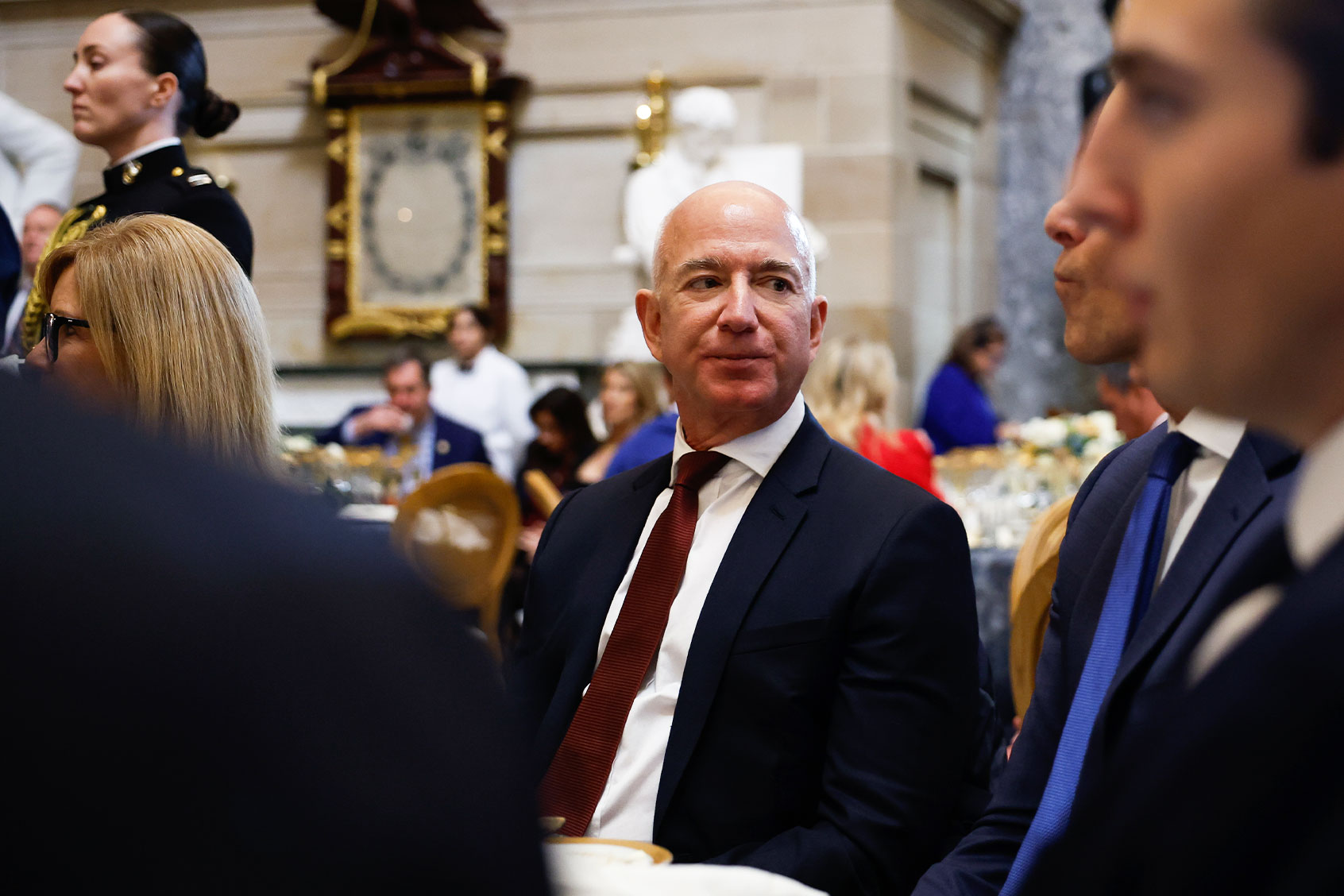
Blue Origin’s New Shepard rocket lifts off from Van Horn, Texas, carrying Jeff Bezos, his brother Mark Bezos, Oliver Daemen and Wally Funk on July 20, 2021. | Joe Raedle/Getty Images

That means Burnham’s North Sea policies might get a cool reception, said Mohamed Adow, director of the Nairobi-based climate and energy think tank Power Shift Africa. 

“Jackdaw has certainly been noticed,” Adow said. “From Africa, it is deeply frustrating to see a wealthy country like Britain approve more fossil fuel production while asking developing countries to pursue a cleaner path. Decisions taken in London have consequences for people facing droughts and floods thousands of miles away.  

“Andy Burnham should be under no illusion: approving Rosebank would be a betrayal of the communities he will hear from at COP31.” 

Bill Esterson, a Labour MP and chair of the House of Commons Energy Security and Net Zero Committee, now expects Rosebank to get the go-ahead. Another Labour MP, the same quoted above, said Healey’s Treasury was “really pressuring” Fahnbulleh to approve the project because “it wants the tax revenue.” 

Burnham’s decision to show off some climate consciousness by attending COP at all is, the same MP said, partly a move to placate Labour’s more green-minded backbenchers in advance of approving Rosebank. 

“You get the feeling there’s political space being made for this shittier decision,” they said. 

Esterson took a more generous view of Burnham’s agenda. “He recognizes the [climate] imperative, but he also recognizes the reality of taking people with [him]. I think that’s at the heart of his whole approach to being prime minister, actually.” 

Political threats 

Political rivals spy an opportunity. 

“You can’t claim to be serious about climate leadership when you’re making it harder and more expensive for people to move away from fossil fuels,” said Pippa Heylings, energy security and net zero spokesperson for the Liberal Democrats, attacking the “incoherence” of Burnham’s approach to climate.  

Carla Denyer, a Green Party MP and former co-leader of her party, pointed to Jackdaw and the looming call on Rosebank. “The change Andy Burnham promised has so far failed to materialize when it comes to tackling the climate crisis,” she said. 

Alienating voters worried about the climate carries political risks for Burnham, who has restored Labour’s lead in national opinion polls primarily by attracting Labour/Green swing voters, said polling analyst Steve Akehurst, director of Persuasion UK. 

“None of the individual policy tweaks or changes to net zero are likely to matter on their own, but if they add up to an overall picture of backtracking on climate action it will present a big opportunity for [Green leader] Zack Polanski,” said Akehurst. 

Taking climate “pragmatism” too far could alienate Labour’s existing voters, too. According to new Persuasion UK and YouGov polling shared with POLITICO, 22% of Labour’s 2024 voters list climate and environment in their top three priorities — but only 4% think Burnham does.  

“It’s one of the few policy areas that Labour voters prioritise but don’t currently sense that the PM does,” Akehurst said. 

But allies including Vince think Burnham’s strategy can head off a different political threat, this one coming from the right. 

Heat pump subsidies, he argued, were only helping households that could already afford the additional costs of switching to clean heat. “Middle class subsidies is what we’re about at the moment in the pursuit of net zero, and I think it’s been a gift to Reform,” said Vince, referring to Nigel Farage’s right-wing party, which along with the Conservatives say they would scrap the U.K.’s 2050 net zero target. 

“Icecaps and polar bears [are] all very well,” said Vince. “But when people are struggling to pay their energy bills — it’s not the primary thing that will persuade them.” 

  •  

What’s bad for Trump is good for Le Pen

What’s bad for Trump
is good for Le Pen

Anger at the rising cost of living spells danger for incumbents everywhere.

By MARION SOLLETTY
in Paris

Photo-illustration by Gibson Kochanek for POLITICO

Beware the angry voter. That’s the message Europeans are taking from the crushing defeat suffered by Donald Trump’s Republicans in the U.S. midterm election. 

The fury over the cost of living that helped propel the U.S. president to power has now turned against him. And with elections looming in heavyweight EU countries like Spain, Italy, France, Greece and Poland, Trump’s fate is a warning for incumbents across the continent.

Growing anger over rising prices and unaffordable housing is likely to spell trouble for Italy’s Prime Minister Giorgia Meloni, who has already faced waves of protests over the cost of fuel.

Advertisement

The blowback in the U.S. shows what happens when right-wing populist leaders take charge and then don’t deliver on their promises, said Irene Tinagli, an Italian member of the European Parliament from the opposition Democratic Party. 

“Trump came up with the promise of lowering the cost of living. He was attacking the previous administration for the inflation. He promised to bring back quality jobs,” Tinagli said. “This didn’t happen.” 

Surveys show voters focused on economic concerns, said Mathieu Gallard, research director at polling firm Ipsos. 

Demonstrators protest against rising housing prices in Barcelona on Oct. 5, 2026. | Manaure Quintero/AFP via Getty Images

In Spain, affordability is already a major issue in the campaign for an election scheduled for Nov. 29. Most polls predict the far-right Vox party, which has been accusing Socialist Prime Minister Pedro Sánchez of failing to meet citizens’ basic needs, will gain enough seats to enter into government for the first time as a coalition partner to the conservative People’s Party.

Whatever their political stripes, incumbents are vulnerable, Gallard said. 

“The far-right or radical right [leaders], when they arrive in power, find themselves in the same situation as traditional parties and have the same difficulties,” he added, pointing to this year’s defeat of Hungary’s Viktor Orbán and a sharp drop in support for the far-right Sweden Democrats.

Advertisement

For insurgents like France’s Marine Le Pen and her far-right National Rally party, however, voter discontent offers opportunity. 

The cost of living “will be the major issue in the campaign,” said Alexandre Loubet, a lawmaker for the National Rally and a key architect of Le Pen’s economic platform. “The advantage [for us] is that we are very consistent on this issue. It’s a bit like immigration — we are already in people’s minds on these subjects.” 

Le Pen, who is the frontrunner in next spring’s presidential race, has long made cost-of-living a central issue for her platform and is capitalizing on the government’s current economic and fiscal woes.

She made affordable housing a central theme in her first campaign appearance and has doubled down on her promises to shield pensioners from upcoming budget squeezes. The far-right veteran is also campaigning on lowering energy taxes, brushing aside criticism that her proposals are unaffordable. 

The blocked entrance of the Saint-Sernin high school in Toulouse on Nov.2, 2026. | Matthieu Rondel/AFP via Getty Images

At her party congress last week, Le Pen pushed a message of change and hope, adopting her rival President Emmanuel Macron’s catchword, “Renaissance,” as her campaign motto. 

The positive tone “was intentional,” said Loubet. “There’s a sense of gloom in the country. We need to offer a little hope, a vision, a direction.”

The recent protest movements that have swept Spain, France, Italy and, to a lesser extent, Germany, have centered around complaints about the cost of living, especially for the young. They echo anger in the U.S., where polls showed young Americans felt their economic situation was deteriorating as the country headed in the wrong direction. 

Advertisement

“The affordability debate in the United States breaks on class lines,” said Penny Naas, a senior vice president at the transatlantic think tank German Marshall Fund. “If you’re an American and you are not well off and energy plays a much bigger part in your household income, you’re feeling much more hurt by the current situation.” 

“There are some similarities with what’s going on in Europe,” she added, pointing at school protests in France that started in the relatively poor outskirts of cities. 

So far, centrist candidates have struggled to find the right messaging on the issue. Le Pen’s top centrist challenger, former Prime Minister Edouard Philippe, has struggled to gain traction with a pitch centered on economic realism. 

A protest to demand more funding for schools and support for housing, on Oct. 30, 2026 in Rome. Filippo Monteforte/AFP via Getty Images

In Germany, Chancellor Friedrich Merz’s conservative Christian Democrats are also feeling the squeeze after suffering a series of electoral defeats, losing to the far right in eastern states and the radical left in Berlin.

“What this election shows is that if you want to win the hearts and minds of citizens, you cannot fight populism by trying to be the defender of the status quo,” said Sigrid Friis, a 32-year-old member of the European Parliament from the Danish Social Liberal Party. 

“Those who have won this campaign are the young, the progressives, the forces that really are the forces of change,” she added. 

Advertisement
  •  

Hundreds of thousands of protesters march across France for third week in a row

Hundreds of thousands of people gathered in France to protest against the rising cost of living and deteriorating school conditions as youth-led protests spread to Italy and Germany.

With six months to go until the presidential election, France’s largest cities including Paris, Lyon and Marseille saw marches for a third consecutive Saturday.

The French interior ministry said 320,000 people took to the streets across the country on Saturday in what were largely peaceful protests. Student unions put the figure at half a million, including 200,000 in Paris.

Arrests were significantly lower than during previous demonstrations, although tensions and clashes emerged in Marseille, Paris and Lyon as marches dispersed.

French authorities described the situation nationwide as “generally calm” in the early afternoon. France deployed 70,000 police officers to contain what it feared would be another day of unrest.

Many protesters wore Halloween costumes despite French Interior Minister Laurent Nuñez warning that face coverings could result in fines of €150.

Other European cities including Rome, Milan, Berlin and Frankfurt also experienced a day of youth-led protests against the cost of living and, in Germany, military spending.

The protests in over 30 German cities were ignited by a youth-led initiative called Gen Z regelt (Gen Z gets things done) and remained largely peaceful despite the police cancelling a planned march in Cologne after some participants wore face coverings and set off smoke bombs.

In Italy, the police carried out 60 searches across 23 cities targeting people suspected of inciting violence a mass demonstrations on Friday, according to news agency ANSA.

  •  

Zohran Mamdani Is Brushing Off The Backlash Against His Public Grocery Stores

New York City Mayor Zohran Mamdani knows what they’re saying about his grocery plan. 

Conservative media outlets and right-wing commentators have, for more than a year, been practically apoplectic about Mamdani’s push to open five municipal stores to sell discounted food. Local Republicans have responded to the initiative by comparing Mamdani to Fidel Castro and Hugo Chavez. Last year, as Mamdani made the plan a central plank of his campaign, Fox Business published a dramatic piece featuring interviews with “descendants of socialism” from Eastern Europe and Cuba suggesting Mamdani’s agenda was reminiscent of the “vivid memories,” “tales of woe” and “scars” they experienced. 

Now, the plan is underway. The first store is set to open its doors by the end of next year, and Mamdani is thoroughly unmoved by the backlash. In a conversation with TPM last week, the mayor dug into the details of his grocery store plan and brushed off the critics. 

“If I listen to that commentary every day, I would become afraid of my own shadow,” Mamdani said with a laugh. “And I think, for too long, we have allowed the right to dictate the entirety of the discussion. And we have limited ourselves to a response to a landscape that they have created.” 

As he sat in the Governor’s Room of City Hall, Mamdani emphasized his words by tapping his hand against the large conference table. It’s a gesture that would go unnoticed if it were not for his signature silver rings gently rapping against the wood. The sound served as periodic punctuation as he expressed his frustration with the limitations of Democratic politics as usual and his enthusiasm for the city-run stores.

“It is time for us to ask ourselves, what is our party for?” he asked. “And to me, the answer has to be the working class. It’s the only majority in this country. And then what can we do to materially change the lives of those working class New Yorkers or Americans?” 

Those are the people who inspired Mamdani’s groceries initiative. The mayor explained that he settled on the idea during his campaign last year based on conversations with city residents.

“If you ask New Yorkers, .. what are the costs that you’re reckoning with as part of the skyrocketing cost of living crisis in our city? … What is pushing you to reconsider if you should be living in this city? … Again and again, you hear about housing, childcare, groceries,” Mamdani said. “We’d hear about public transit, we’d hear about other things, but groceries would always be up there.”

Data shows it’s gotten far more expensive to eat in New York City. A report released by the state comptroller last year showed food prices in the metropolitan area were up over 25 percent since 2019. And as Mamdani and his advisers looked at ways to confront the issue, they became adamant new approaches were needed. 

“When everyone is telling you that prices are too high, the common refrain is therefore we should subsidize the private market further,” said Mamdani. “And yet, what we’ve seen is that we’ve explored those kinds of strategies here in New York City. They have not had a substantial impact on the cost of groceries.”

The plan is rooted in a very New York “tradition.” Mayor Fiorello La Guardia, a progressive New Deal Republican who steered the city through the Great Depression, opened public markets that gave street vendors support and space for their businesses. That vision has continued with Essex Market, a warren of shops and restaurants on the Lower East Side that the city has operated since the 1990s. 

Mamdani describes La Guardia as “an inspiration each and every day.” One of New York’s five new grocery stores is being constructed at La Marqueta in East Harlem’s El Barrio, a site that was home to one of the original 1930’s markets. More recently, a similar public grocery store initiative has begun in Atlanta. 

Despite the histrionics — including dire warnings from Fox News and right-wing think tankers that Mamdani’s stores could cause widespread food shortages — the actual plan is fairly limited in its scope. There will just be five stores (one in each of New York City’s boroughs). In addition to La Marqueta, another is planned for a city-owned site at Hunts Point in The Bronx. That store, which has been dubbed The Peninsula, is slated to be the first to open towards the end of next year. The other three locations, which will be in Brooklyn, Queens, and on Staten Island, have not been identified yet. Mamdani has pledged to open all of them by the end of his term in 2029. 

Inside the stores, a slate of items that Mamdani’s team has dubbed a “core basket” will be offered at a 30 percent discount that will be adjusted monthly and pegged to the market rate. This includes produce, meat, seafood, dairy, and a selection of pantry staples. Other items will be on sale at standard prices. The city estimates this will save customers roughly $90 per month.

Those market rate costs for the majority of goods in the grocery stores are hardly in line with the visions of Havana spun by the right. The “government-run” moniker conservatives have slapped on the project is also an exaggeration. Mamdani’s grocery stores are actually a public-private partnership. The New York City Economic Development Corporation currently has proposals out looking to rent privately owned sites for the final three stores. They also have accepted bids from experienced operators to run all of the venues. 

Some of the criticism of the plan has been based on its potential cost to taxpayers. The city initially invested $70 million to cover construction and real estate expenditures associated with the five sites. According to officials, with solicitations for sites and operators ongoing, the final annual cost of the program is not clear. However, they are confident having the spaces paid for will be sufficient incentive to enable the store operators to offer the “core basket.” If necessary, the city may also provide further subsidy beyond covering real estate capital costs to ensure operators can stock the discounted items. Furthermore, they expect the NYCEDC’s competitive bidding process will help identify companies who can keep the stores’ overhead low. 

In the interview with TPM, Mamdani insisted the plan will be “sustainable.” And, thus far, the mayor has a track record of managing the costs of his ambitious programs. This year, Mamdani, who inherited an approximately $12 billion deficit when he took office in January, balanced the city budget. While much has been made of the fact that the feat required some help from the governor’s mansion and a delay in pension payments that will need to be dealt with down the road, Mamdani made up nearly half the difference by finding new revenue through taxes on the wealthy and cost-saving measures like cutting unnecessary overtime. 

Joseph Hernandez, the Republican candidate for state comptroller, has been one of the more vocal critics of Mamdani’s municipal grocery stores. He’s unveiled estimates claiming the plan could cost $200 million. There are some issues with that figure. Along with the initial $70 million in construction costs and an estimated $106 million in projected operating costs, Hernandez’s tab includes a supposed $30 million that he says will be lost by other businesses from competing with the stores. 

“We can absolutely afford it,” Mamdani said with a laugh. “We are a city budget that has significantly north of $100 billion on an annual level — and we already spend about $850 million in programs that seek to address food insecurity, ranging from our school system to funding food pantries.”

“What we’re talking about here is a drop in the bucket of what the city already spends,” he added. “But one that will be felt by every single New Yorker who goes to these stores.”

Mamdani further argued that those who raise questions about the price of social programs “prefer not to see the cost today” of the underlying issues those initiatives seek to address. 

“We are dealing with the costs of food insecurity every single day. We’re sitting down to talk in the wealthiest city in the wealthiest country in the history of the world and yet one in four New Yorkers are in poverty,” Mamdani said. “It is not tenable, it is not acceptable.”

For the mayor, the situation calls for a different kind of politics. He described himself as “unwilling” to simply point at the problem “and then hope that somebody comes up with a solution.”

“This is a city of innovation. It’s a city of imagination. It’s time we bring those kinds of ethos to our politics as well,” Mamdani declared. 

The idea that the new stores will hurt other businesses has been one of the more persistent arguments from critics of the plan. A group of minority-owned bodegas and supermarkets has even sued to stop the initiative. Yet Mamdani argues his stores are fundamentally different, particularly from bodegas which typically offer ‘round-the-clock service and core items that won’t be available in the municipal shops. 

“The biggest things that drive revenue for bodegas are tobacco, lottery tickets, and alcohol. We’re not selling those,” Mamdani explained. “Our goal here is not to compete with fundamental parts of New York City.”

Mamdani, who noted there are thriving bodegas in the immediate vicinity of the existing public Essex Market, also framed it as fairly simple math. 

“We’re speaking about a city that has north of 10,000 bodegas, north of a thousand different grocery operators. We’re talking about five city-run grocery stores,” he said emphatically as his ring tapped against the wooden table. 

As they select locations for the stores, city officials are looking for neighborhoods where there isn’t much competition. They are aiming for locations with insufficient grocery store options as well as a high rate of residents accessing public benefits. Though the goal is to ensure the discounted food will be easily accessible for lower income New Yorkers, the stores will be available to anyone who wants to shop at them. 

“These are stores for everyone,” Mamdani said.

In building out his vision for the municipal grocery stores, Mamdani named his chief of staff, Elle Bisgaard-Church, who he calls his “left hand,” as a key force behind the project. He also pointed to Deputy Mayor for Economic Justice Julie Su, the highest ranking City Hall official with the stores in their portfolio, and NYCEDC Executive Vice President Jamie Horton as being among the key officials overseeing the plan. 

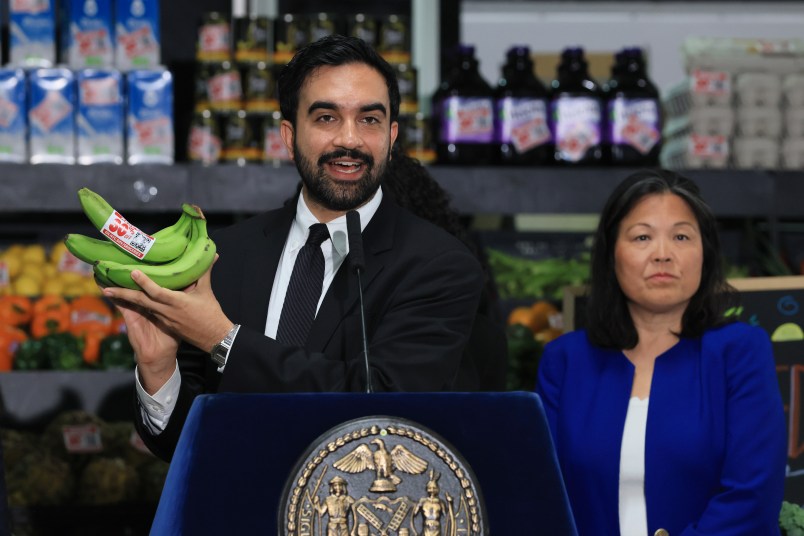
New York City Mayor Zohran Mamdani at a food distribution center on July 27, 2026. Mamdani announced that the five upcoming city-owned grocery stores will offer a 30 percent discount on produce, meat, bread, and milk when they begin to open next year. (Photo by Spencer Platt/Getty Images)

Speaking to TPM, Horton said one key aspect of the program for Mamdani is ensuring that the stores will be a “pleasant experience” without “stigma.” The solicitations for operators and sites specify the visual language and design elements that will be part of creating an elevated environment inside the shops. 

“It’s really important that this is an example of public excellence, that the public sector can deliver a high quality experience. It’s also about providing a service … that treats folks with dignity, that this isn’t a handout for folks, it’s that the government is delivering for its people,” Horton said. 

Overall, Mamdani said a core goal of the project is making a real change in the environment for city residents. 

“I am tired of the fact that politics has increasingly become an act of describing working peoples’ struggles as opposed to putting forward what you will do about those struggles,” he said, before asking, “How are you going to deliver them a different reality?”

That ethos and desire to take concrete steps to address cost of living has been the central plank of Mamdani’s platform. As he ran for office last year, the grocery stores were one of the highest profile parts of his campaign along with a partial rent freeze and a plan for fast, free city buses. Mamdani delivered on the rent freeze for certain stabilized units in June. While the plan for free buses has run into legislative opposition, in July, Mamdani and Gov. Kathy Hochul unveiled a road map to speed up service. 

At every turn, Mamdani’s various proposals have faced backlash and questions about costs. The criticism has been amplified by Mamdani’s membership in the Democratic Socialists of America. All of this has, for better or worse, made Mamdani a national figure who has received both positive attention and ire from President Donald Trump. Last June, after Mamdani won the Democratic primary en route to City Hall, Trump took to social media and blasted him as “a 100% Communist Lunatic.” Less than five months later, after Mamdani was victorious in the general election, the two had a warm meeting in the Oval Office where the president heaped praise on the new mayor. 

“I met with a man who’s a very rational person. I met with a man who wants to see — really wants to see — New York be great again,” Trump said, adding, “I’ll be cheering for him.”

Along with the rhetoric, Trump’s allies have also played their part in the opposition to Mamdani’s grocery plan. One of the legal complaints from store owners was filed with the America First Policy Institute, a right wing dark money group chaired by Larry Kudlow, the former director of the National Economic Council in the Trump White House. 

Mamdani smiled broadly as he offered some choice words for Kudlow. 

“Larry must love paying a lot of money for eggs,” Mamdani said, adding, “There will always be opposition wherever there is innovation and wherever there is imagination. And we welcome it. We are fully confident in the legality of this program and even more so than the legality, the urgent necessity of it.”

While the mayor clearly has his critics, Mamdani and the swirl of national buzz around his rise helped turn “affordability” into one of the major talking points of this election cycle. And, in New York, the most recent polling shows his popularity has surged to nearly 70 percent favorability. 

Mamdani believes his fellow Democrats need to be less preoccupied with their detractors. 

“I think you simply have to prepare and expect for this kind of backlash. What it is, is a backlash to any kind of change. And if you want to avoid backlash, then all you will do is just steward the status quo. And that is exactly what has gotten us to this point,” he said. “It is critically important that we stop the act of constructing an ever-lowering ceiling on our ideas.”

For Mamdani, his grocery stores epitomize this ambitious, unafraid vision and approach. 

“That is what is so exciting to me,” he said. “Politics so often is something that has to be translated to someone who lives outside of the political world. There is no translation required about cheaper groceries. You understand it when you’re checking out.”

“For too long, politicians have had things to say and they haven’t had anything to do,” he added. “And it’s time to make this city an example of what we can do for people.” 

  •  

5 things Westminster doesn’t know about the UK economy (but probably should)

LONDON — Britain’s government runs on numbers — but what if they’re a shot in the dark?

From tepid economic growth to squeezed household incomes, this week’s budget from Chancellor John Healey was packed with grim figures about the state of play in the U.K. — and a host of costly measures to try and turn things around.

Yet it’s almost certain that the budget forecasts Healey relied upon Wednesday will be revised by the time the next fiscal event rolls around.

In this week’s episode of the Westminster Insider podcast, POLITICO unpacked the numbers that govern the U.K. — and found out just how many doubts there are about the information the country relies on.

1. True levels of immigration

Few issues divide Brits like immigration — but grappling with hard data on the issue has proven to be a repeated challenge to governments of all stripes.

For decades, immigration into the U.K. was calculated by the International Passenger Survey (IPS) — essentially people with clipboards at airports, train stations and ports asking people about their intention to stay in the U.K.

The Eurostar platform is pictured at St. Pancras station in London on Nov. 14, 2007. | Cate Gillon/Getty Images

But between 2012 and 2020, the number of European Union nationals coming into the country was off by 76% — or 93,000 people a year. The Office for National Statistics (ONS) only discovered this error after trialing a new approach to counting immigration that focused less heavily on the IPS, which was dropped altogether in 2025.

The ONS now uses this new measurement — relying on a combination of Home Office data, information from the Department for Work and Pensions and tax receipts.

But this was again wrong in the year to June 2023 — by 234,000 people.

The original numbers published by the ONS in November 2023 said net migration to the U.K. was 672,000. A year later, the ONS admitted there had been a mistake and said it was in fact 906,000.

Laura Gilbert, who ran data science in No. 10 Downing Street until last year, told POLITICO that net migration numbers are often incredibly misleading — and even the way we calculate those numbers is “highly spurious.”

Gilbert says the quality of the numbers on immigration normally improves months later, sometimes by “quite a lot.” But she warned, “if politicians are making a decision based on exact numbers, often they are using the first number that comes out, which is the worst one.”

2. The scale of unemployment

Healey and Prime Minister Andy Burnham have vowed to get welfare spending down “but in a Labour way.” Much of this will rest on getting young people into work, the subject of a 217-page report by Tony Blair-era minister Alan Milburn.

But Britain’s workforce — and the number of young people out of work — is counted by the Labour Force Survey (LFS), an ONS measurement beset with issues.

For example, between 2019 and 2024, the LFS missed 1 million workers because people with full-time jobs are less likely to answer the phone to surveyors during the week, according to the Resolution Foundation think tank.

The Office for Budget Responsibility (OBR) admitted just this week that the survey is too unreliable to measure productivity. “In recent years, falling response rates have significantly affected the quality of the LFS, making it more difficult to estimate reliably the number of workers and the hours they work,” the watchdog said.

Gilbert says Healey’s claim that there are “1 million young people out of work” is unlikely to be accurate.

The number of NEETs — people not in education, employment or training — is also based on figures from a subset of the LFS, which is particularly susceptible to inaccuracies.

Healey leaves No. 11 Downing St. in London to present the budget to Parliament on Oct. 28, 2026. | Peter Nicholls/Getty Images

“I think being within 50,000 on either side of that number is very unlikely to be the sort of level of accuracy that you’re at,” Gilbert said. “It’s entirely spurious, if I’m completely honest, but it’s a big number, you write it down, and everyone reads the papers.”

Ben Warner, who set up 10DS, Downing Street’s data science unit, says the LFS can’t accurately measure the number of entrepreneurs arriving in the country, either, making it difficult for ministers to know if decisions — such as a much-hyped tax relief for founders — are actually encouraging people to come to the U.K.

“I’m willing to bet you a hundred quid [we don’t have accurate numbers] at the level that you would need to make thoughtful policy around this,” Warner said. “I am sure there are people who have very, very good knowledge of the economic statistics. But if you’re a minister, you don’t necessarily have access.”

3. Where inflation and GDP sit

These are hugely important measures for a government: Are costs rising for households — and is the British economy growing?

But buried inside this week’s budget assessment by the OBR was a startling admission: There is a one in five chance inflation in 2027 will come in at over 4.5% … and the same chance it will be under 2.5%. They are profoundly different outcomes for the cost of living, a top political issue.

Warner told POLITICO, “The whole thing is mental. We are discussing the uncertainty of the numbers and pretending that these are real.”

Gilbert says there are knock-on effects at play: problems with net migration numbers and workforce data bleed into inflation and GDP projections.

“Understanding migration tells us about the demographics of the country, and when we look at how many people are in work, and that is wildly undercounted, it looks like there are more people who are unemployed, which has a knock-on effect on GDP and inflation,” she explained.

4. The number of kids on free school meals

The number of pupils in England on free school meals is just over 2.2 million, according to government statistics from the start of this year. That’s more than a quarter of all children in the country.

But Gilbert warns that these numbers are likely to be overestimated because schools “game the system” when census data is collected. “So for anyone who has children in school they may have received a text message that says don’t send them to school with a packed lunch — because the schools get funding based on how many children are on school meals,” she said.

5. The number of rough sleepers on the streets

One of Burnham’s flagship promises when he became prime minister was to end homelessness in the U.K., and Wednesday’s budget put £432 million towards precisely that promise.

Yet the way rough sleepers are counted in the U.K. varies according to each council, with some areas relying on an estimate and others on a street count — sending workers out to physically count the number of people on the streets on a particular day in autumn.

Tents line the side of Euston Road in London on Nov. 13, 2025. | Dan Kitwood/Getty Images

Some councils have swapped between methods — which can make it look as though they have dramatically reduced their rough sleepers from one year to the next.

For example, in 2017 Brighton and Hove Council used an estimate of rough sleepers which put that number at 176. The following year, the council used a street count — but this took place on a snowy night, so the number fell to 68.

This made it appear as though the number of people experiencing homelessness had been more than halved.

  •  

What Trump can learn from Lula and Netanyahu

At some point, maybe around the time Joe Biden declared on the debate stage that he “finally beat Medicare,” Washington got the idea that defeating an old man in an election was easy.

Not always.

Just days before an American election viewed by many voters as an opportunity to neuter an unpopular 80-year-old president, voters in Brazil and Israel delivered a vivid reminder that an old man in his country’s highest office usually didn’t get there by accident.

In Brazil, a decisive majority of voters on Sunday returned left-wing President Luiz Inácio Lula da Silva for a fourth term, defying expectations that Brazilians were ready to discard the fiery trade unionist as yesterday’s man. In Israel’s Tuesday election, Prime Minister Benjamin Netanyahu — the longest-serving premier in his country’s history — lost his parliamentary majority but may have thwarted his opponents from electing a viable governing coalition.

Lula, 81, and Netanyahu, 77, have almost nothing in common except their age and political resilience. They have towered over their countries for more than a generation, outfoxed prosecutors and humiliated electoral rivals, enraged and entranced Washington. They have done it with the loyal support of voters on the left and right who view each man in heroic terms, as a tireless champion of their interests and a shield against the most fearsome enemies.

President Donald Trump has, at times, shared those political traits. If he has one more escape act left in him, it would look more like what we’ve just seen in Israel and Brazil than anything in Trump’s second term so far.

Since returning to office in 2025, Trump has failed to deliver policy victories that most voters can feel in their own lives, while shedding some of the most important parts of the political identity that forged his populist base. He ran for president in 2024 pledging to whip inflation and railing against needless foreign wars. Trump’s signature acts this term — passing the One Big Beautiful Bill Act, waging a global trade war, attempting regime change in Iran — have made health care, consumer goods and energy more expensive.

What is his closing message in the midterm election? Trump makes one argument consistently: that Democrats are crazy. But you’d be hard-pressed to find a convincing through line in a series of campaign-trail monologues boasting about the economy, trashing individual Democratic candidates as weirdos and subversives, musing about renaming oceans, defending the Cheesecake Factory and admiring Jon Husted’s rock-hard bod.

Compare this to what voters heard in Brazil and Israel: relentless, ruthless, shameless appeals to the political coalitions that Lula and Netanyahu forged over decades.

In Brazil, Lula tapped into the regional and class-based divisions that have defined his electoral career, while offering a buffet of new economic promises to voters in his base. He hiked welfare payments, promised voters free public transit on weekends and endorsed a shorter workweek. His 45-year-old opponent, Flavio Bolsonaro, stumbled in the final days with a dismissive comment alluding to an accident Lula suffered as a young metalworker — a remark apparently taken by many voters as a gratuitous sneer at the working class.

In Netanyahu’s fight for political survival, the Israeli leader delivered an apocalyptic message aimed at polarizing the electorate to his advantage. He posted an AI-generated image of a nuclear strike on Tel Aviv, branded his challengers as soft on Iran and derided Arab political parties as an enemy within. Israeli and American news outlets have reported that Netanyahu pushed the military for a new wave of attacks on Iran before the election, an escalation that might have reshaped the campaign’s final days.

If Trump had approached the midterms with Lula- or Netanyahu-like focus and vigor, he would probably still be a very unpopular president. But he might be a very unpopular president with a firm grip on the red states that control the Senate, instead of scrambling in October to defend Kansas and Mississippi.

Trump’s populist campaign tactics have been comparatively slapdash and unresponsive to voters’ real needs. He floated giving away $5,000 checks to Americans if Republicans keep control of Congress, only to see lawmakers from his own party pan the idea as a budget buster. He has handed out locally tailored goodies — new funding pledges for a pipeline in Alaska, tariff exemptions as a gift to Maine — that might make a difference on the margins but can’t substitute for a national message on the cost of living.

And Trump has not made a concerted effort to heal the breach within the MAGA base over the war in Iran. He has toggled between Bibi-like warnings about nuclear attacks on Southern California and assurances that the war will end after the November election, all while fuel prices stay painfully high for the people who put him in office.

It may add up to the least effective campaign ever for the man who has overwhelmed American politics for 11 and a half years.

And yet, the midterms are not the end of the story.

Even a broad defeat for Republicans next week would leave Trump with half a term to work with. Two more years to recover his footing, return to political basics, reconnect with his base and fight, fight, fight for relevance and recovery. There is a bag of tricks available to him, if he were to get serious about salvaging his presidency.

For Trump’s opponents, the warning from abroad remains: Beware the old man in a hurry.

  •  

Burnham’s budget blasts British baked beans

LONDON — Andy Burnham’s love affair with beans is well documented.

Asked what items he would stockpile in case of an emergency, the prime minister picked the store-cupboard staple, together with soup and Twiglets.

Now bean producers are screaming betrayal.

As part of a stream of “everyday fixes” aimed at easing the cost of living, Chancellor John Healey said the government would suspend tariffs on more than 100 products, including imported chocolate, marmalade and Burnham’s beloved baked beans.

An analysis of the list — published in full today — reveals that tariffs of 16% will be removed on an array of finished bean products imported from around the world, many of which are also manufactured in the U.K.

While the raw beans used to make products like baked beans are mostly imported, the U.K. boasts a major bean processing industry which food executives fear could now be undermined by exporters such as China and the U.S.

Karen Betts, chief executive of the Food and Drink Federation, said the budget did “nothing to ease the pressures food and drink manufacturers are under.”

“Instead, one of the chancellor’s flagship announcements, removing tariffs from some food and drink products, will have no meaningful impact on consumer prices,” Betts said. “But it will undermine British factories and their workers, grappling with much higher costs, producing the same products.

“The Treasury in particular has persistently failed to recognise the importance of food and drink manufacturing to jobs and prosperity the length and breadth of the U.K.,” Betts added.

Instead of making it easier to import rival products, Betts said the government should be addressing the “acute pressures” the sector is facing, including high energy costs and “overly complex” regulation.

A spokesperson for Princes Group, which produces Branston Baked Beans in the U.K., said removing tariffs on imported finished baked beans was “unlikely to have a meaningful impact on prices, particularly as there are currently no tariffs on the imported haricot beans used by U.K. manufacturers and no tariffs on EU imports.” 

“We believe measures that help address the higher costs of manufacturing food in the UK, particularly energy costs, would have a greater impact for both consumers and British businesses.”

According to the government, the move, together with existing tariff suspensions announced earlier this year, will reduce consumer costs by between £245 million and £595 million a year, saving households up to £21 on their food shop annually.

In response to a consultation on the changes, the government said it had taken the decision to exclude several products from the initial list “due to concerns about the impact on domestic production, developing countries, international considerations and other government policies.”

“The government recognises that for some remaining products, there may be some limited impacts on domestic producers of goods which will be able to be imported tariff-free for the specified period. However, the government considers the benefits of this to consumers, through reduced costs, outweigh those risks.”

The U.K. government did not respond to a request for comment.

  •  

US inequality is getting worse in ways you might not expect

The buzzword of the 2026 U.S. midterm elections may be affordability, but growing anger over inequality is behind the sentiment.

A Pew Research survey released in October 2026 found that roughly 6 in 10 Americans – including 4 in 10 Republicans – believe there’s too much inequality in the U.S. And a growing share from both major political parties state that the economy needs to be fundamentally rebuilt to address this.

This sentiment has, however, been difficult to convert into political results. Public support for California’s proposed wealth tax on billionaires has been waning ahead of the midterms, for example, and in 2025, Republicans passed President Donald Trump’s sweeping legislation that included tax cuts for the wealthy while cutting safety net programs.

I’m an economist who has been studying inequality for about two decades. My research confirms the trend of rising inequality since 1980, driven by the wealthiest pulling away not just from the middle class, but also from the “merely wealthy.” Overall, recent research underscores how policy choices – including taxation and public spending – enabled this 40-year rise in inequality.

Some policies enacted more recently appear to be accelerating this trend. An analysis by the Institute on Taxation and Economic Policy, a nonpartisan research organization, concluded that policy changes since the start of 2025 have imposed higher costs on everyone except the top 1%.

Inequality by the numbers

Recent federal data shows that wealth inequality continues to grow. The top 1% saw their share of wealth increase from 31.7% to 32.5% just between the first and second quarters of 2026, a jump of over $8.5 trillion. That caps a steady climb from 30.9% in the last quarter of 2024 – and from 27.4% in 1999.

These recent gains come at the expense of the middle class – the 40% between the bottom half and the top 10% – who hold only 28.8% of all wealth despite being a group that’s 40 times larger than the top 1%. And the middle’s share is shrinking, down from 32.9% in 1999 and 30.2% at the end of 2024, according to the data.

But the ultra-wealthy, those in the top 0.1%, are pulling away even from the rest of the rich, the data shows. This tiny elite owns 15% of all wealth – almost half of all the wealth of the top 1%. Both the top 0.1% and the next 0.9% saw their share of wealth increase, but the top 0.1% captured two-thirds of the gains between the first and second quarters of 2026.


Start your day with essential news from Salon.
Sign up for our free morning newsletter, Crash Course.


Even within the highest echelons of wealth concentration, these two groups are on different trajectories.

Crucially, the wealth of the top 0.1% is disproportionately boosted by corporate profits, which are up sharply overall. The top 0.1% reap the most from this growth because their portfolios’ value has soared on the promise of future increased profitability that’s driving up stock prices – especially thanks to the tech and artificial intelligence boom.

How taxes play a role

Since President Ronald Reagan’s tax cuts in the 1980s, the U.S. tax code has become less and less progressive, often through policy changes supported by both Republicans and Democrats.

The common argument for tax cuts is that they stimulate growth, but a growing body of research – including international studies – doesn’t back that up. A 2025 Brookings report notes that U.S. tax policy has gone through massive changes throughout history without any discernible effect on growth.

Nonetheless, congressional Republicans used their narrow majorities in 2025 to pass Trump’s sweeping policy and tax bill, which included provisions making most of his 2017 tax cuts permanent. Those included the historically low top-income tax rate and the lowest corporate tax rate since 1940.

It’s also important to understand that the top 0.1% have a different tax exposure from the rest of the top 1% because the composition of their wealth is different. They own as much in stocks and mutual funds as the next 0.9%, a group that is nine times larger, and those holdings are where most of their recent gains came from.

Furthermore, roughly three-quarters of the top 0.1%’s wealth portfolio consists of corporate and business ownership, allowing them to benefit from the Trump tax cuts in multiple ways – including lower tax rates and more opportunities to defer or avoid tax liability. Their massive holdings of stock mean that they can borrow against it for cash, usually tax-free, rather than having to sell shares.

By contrast, below that elite, real estate is a much more important component of wealth, while corporate equity is a smaller and smaller share. For the middle class, nearly two-thirds of wealth is held in their homes and retirement savings, while corporate and business ownership accounts for only 15%.

The new drivers of inequality

Much of the inequality debate focuses on the role that taxation has played. But other recent policy changes have shifted different kinds of costs on to low- and middle-income earners, while leaving the wealthy relatively unscathed.

One example is a provision in Trump’s 2025 legislation that allowed federal healthcare subsidies through the Affordable Car Act to lapse. Insurers and analysts expect the number of people signing up for coverage through ACA plans to drop by about 5 million due to higher premiums and face much higher out-of-pocket costs.

The spike in energy costs, including gasoline, diesel and heating oil, is another case in point. They disproportionately affect low- and middle-income consumers but barely dent the budgets of the wealthy – while boosting the profits of companies engaged to the extraction, processing and transportation of oil. This divergence has been especially pronounced since the start of the conflict with Iran in February 2026, which has pushed up the global price of oil.

Then there are tariffs, which are fundamentally a consumption tax on imports. Economists at the New York Federal Reserve have found that these levies have inflicted a heavy hit on many common consumer goods. They estimated that prices for these items, which make up a much larger share of household budgets among the nonwealthy, would have fallen on average by 1% over the year without the tariffs. Instead, they have risen by 2.9%.

This acceleration in the redistribution of wealth from the middle class to the very top, in short, has an array of drivers. But they’re not inexorable forces of history. As economist Thomas Piketty put it in “A Brief History of Equality,” published in 2022: “Inequality is first of all a social, historical, and political construction.”

Markus Schneider, Associate Professor of Economics, University of Denver

This article is republished from The Conversation under a Creative Commons license. Read the original article.

The post US inequality is getting worse in ways you might not expect appeared first on Salon.com.

  •  
❌