❌

Reading view

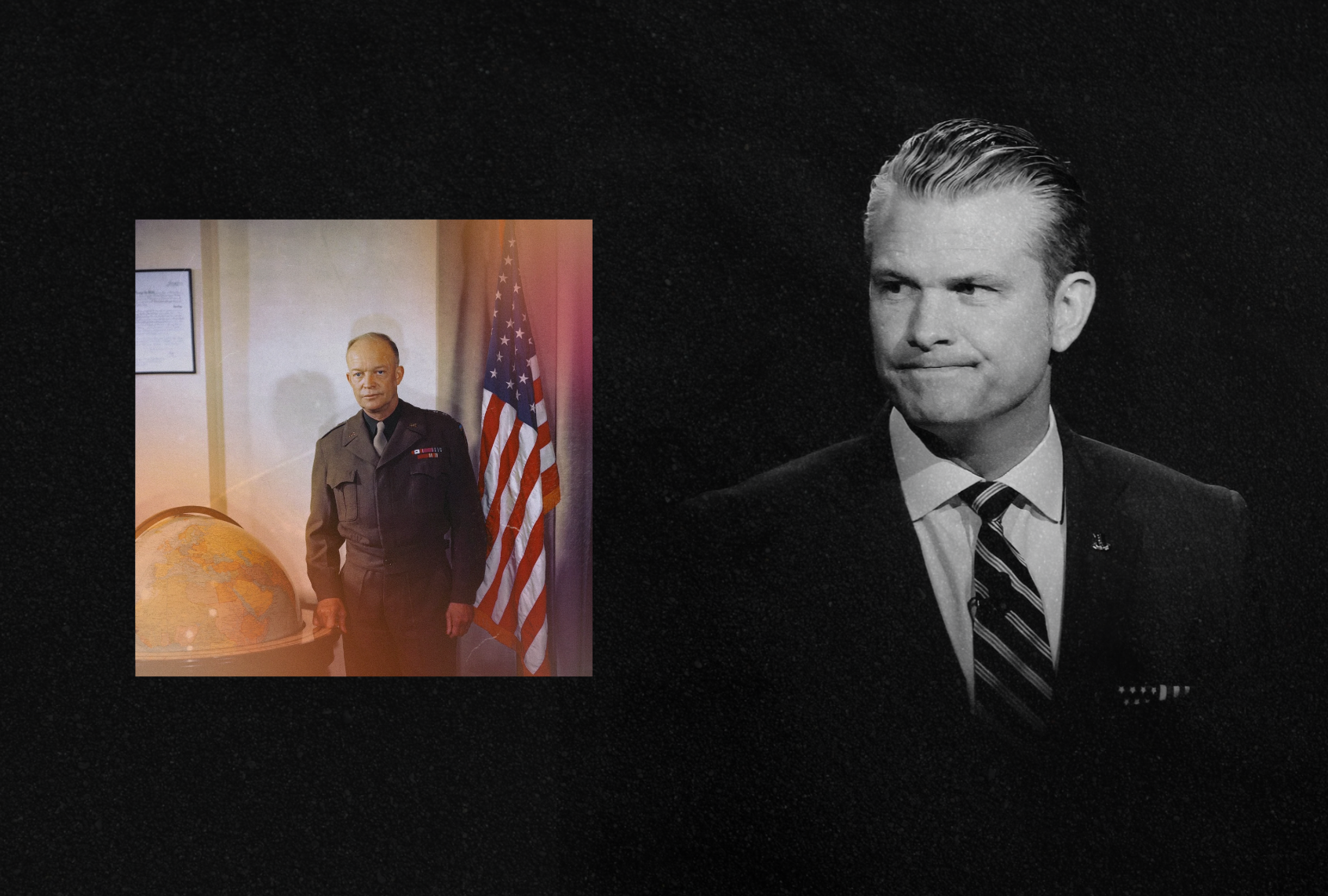
How Hegseth shattered the world Eisenhower made

Gen. Dwight D. Eisenhower was not buff, at least to our knowledge. He didn’t exercise in public or show off his abs, and there is no record of him ever leading his troops in calisthenics or challenging his peers to a pull-up contest. As far as we know, he didn’t even have any tattoos. 

Eisenhower may not have been a “beardo” or a “weirdo,” in the recent words of Pete Hegseth, but were he alive today he would in all likelihood call the defense secretary a wimp and possibly even a radical. The 34th president would almost certainly not see him as a “warrior,” a term Hegseth uses as shorthand for a muscled, tough bully who is ready to engage in hand-to-hand combat with the enemy at a moment’s notice. 

Despite this, Eisenhower remains one of America’s most celebrated generals, the man who led the Allied invasion of Europe, served as Army Chief of Staff, helped create NATO and served as its first Supreme Allied Commander. While he never served in combat, Eisenhower rose in the ranks because of his exceptional talent for strategy, logistics and diplomacy, skills which used to be held in high regard in the military. 

Not too long ago, it was once understood that, in the modern world, a “warrior ethos” is more a matter of brains than brawn, and it was Eisenhower’s gift for coalition management, logistical organization, discipline and strategic patience that made him a successful war-time leader. 

But those qualities are now out of fashion. When Donald Trump tapped Hegseth, the “Fox and Friends Weekend” co-host, to be his defense secretary, it was largely because the president thought Hegseth looked like he came out of “central casting” — a square-jawed, Sgt. Rock-style cartoon hero. They had become acquainted when Hegseth had taken up the cause of a group of men accused of war crimes, and persuaded Trump to intervene on their behalf, which he did over the loud objections of the military brass. 

Hegseth had the attitude Trump wanted to lead the military, a man who wouldn’t feel restrained by all those rules and regulations that had made America, in his view, a weak, loser country under previous presidents. Once installed at the Pentagon, the secretary began modeling his “warrior ethos” very quickly by personally leading the charge on the front lines of America’s most important battleground: the culture war. He vanquished diversity, equity and inclusion policies one by one, and got rid of any of the women and people of color who had been promoted over the butch white men. He called all the brass to sit and listen to him lecture them about what a true military leader should be. After all, Hegseth has served as a platoon leader in the National Guard and as a prison guard for a little while, so he knew what he was talking about. And he has demonstrated time and again that he is in pretty good physical shape by doing jumping jacks and jogging with enlisted men wherever he goes, which is apparently the only authentic test of military leadership. 

Meanwhile, Hegseth has presided over a policy of murder on the high seas, ordering the military to summarily kill people in small boats in the Caribbean and Western Pacific who, according to the Pentagon, are suspected of running drugs. He is also in charge of the military that is losing the war in Iran, a conflict to which he seems oddly disconnected, busy as he is with planning a (later canceled) public execution, holding prayer meetings, mandating testosterone testing and all that jogging. 

Even though Hegseth would surely have fired Eisenhower long before the future president ever became a five-star general for lacking the proper “warrior ethos,” he does seem to like the idea of basking in the reflected glow of the monumental victory Eisenhower led in World War II.

Even though Hegseth would surely have fired Eisenhower long before the future president ever became a five-star general for lacking the proper “warrior ethos,” he does seem to like the idea of basking in the reflected glow of the monumental victory Eisenhower led in World War II. The secretary is also clearly entertaining the idea of running for president, which Eisenhower successfully did twice, after helping to rebuild Europe. (Incidentally, Eisenhower fully endorsed changing the name of the War Department to the Defense Department in 1949, a decision Hegseth and Trump have attempted to reverse.) 

Hegseth obviously sees himself as a modern leader of similar stature to Ike. According to The Washington Post, when Hegseth assumed the office, he spied a relic that once belonged to Eisenhower: a handmade globe the general had reportedly used during the war, which even bore some markings he may have placed there himself. Hegseth demanded that it be moved to his office. He had furloughed people who handled such things during the partial government shutdown over immigration, and since he famously lacks patience, Hegseth sent a couple of flunkies to retrieve the historic object immediately.

Not realizing its weight, and with no experience in caring for precious artifacts — or, according to the report, listening to words of caution — the crew dropped the globe and broke it. They ended up just leaving it where it stood, with a huge hole in it. 


Want more sharp takes on politics? Sign up for our free newsletter, Standing Room Only, written by Amanda Marcotte, now also a weekly show on YouTube or wherever you get your podcasts.


There are metaphors, and there are metaphors, but this one is just too on the nose. Eisenhower and America helped rebuild the world after World War II, understanding that to survive in the nuclear age, the old, primitive ways were just too dangerous. They used diplomacy and alliances to build a bulwark against the kind of aggression that Germany and Japan had unleashed on the world, and despite some marked abuses and exceptions, that order largely held for 70 years. 

Then Trump and his acolytes like Hegseth came along. With little care for the vast responsibility they held to keep the fragile planet stable and safe, and with no knowledge or experience of how to do so, they have broken the world order that Eisenhower led and represented. And it doesn’t seem as if they think it matters.

These are reckless people who think the government is cosplaying reality television, where all that matters is looking tough and projecting strength through cartoon clichés and cheap propaganda. The symbolism of that globe and what it meant completely escapes them, just as Eisenhower’s legacy has been dismissed by them wholesale.

Other than winning D-Day and commanding NATO, Eisenhower’s most famous moment was perhaps his January 1961 farewell address as president, when he warned about the military-industrial complex, which he said could sap resources from the public, threaten democratic governance and social balance, and put profit ahead of national security. His warnings were realized long ago, but now the Trump administration is taking it to an entirely different level. Hegseth is demanding a total of almost $1.5 trillion dollars for the Pentagon in 2027, calling it a “generational investment.” And Elon Musk, with his Starlink system, now appears to be operating more or less on his own, putting global security at severe risk. 

Sometimes a cigar is just a cigar — but sometimes it isn’t. This administration has broken the world, and nobody knows whether it can be fixed. But even if it can be pieced back together, it will never be the same. 

The post How Hegseth shattered the world Eisenhower made appeared first on Salon.com.

  •  

Tensions flare up across France as marches come to an end

Police in France fired tear gas to disperse protesters in multiple cities Saturday, as tougher policing measures aimed at preventing violence and looting appeared to avoid major incidents but drew criticism from unions and left-wing leaders.

The fresh wave of demonstrations came a week after numerous scenes of looting and clashes between police and protesters on the sidelines of peaceful marches over the cost of living and school conditions.

According to the Interior Ministry, 410,000 people participated in demonstrations across France, though unions said the figure was twice that. The ministry said Sunday morning that it had been a “calm night,” adding that police made 1,314 arrests on Saturday, compared to 2,025 last weekend.

Authorities said the march in Paris, which drew 110,000 people, remained calm through Saturday afternoon, but tensions flared as demonstrations came to an end in multiple cities.

In Lyon, France’s third-largest city where gatherings were banned in parts of the city, the police used tear gas to disperse protesters. Forty people were arrested in Nice, where the protests were banned, while tear gas was used against protestors in Marseille, French broadcaster BFMTV reported.

Tensions also escalated during the afternoon in Toulouse, Lille, Nantes and Rennes, according to media reports, with protestors throwing projectiles at police and officers using water cannons to disperse them. Authorities in Lille, where about 15,000 people protested according to early estimates, extended their curfews for minors through Monday.

Nuñez, the interior minister, told police forces to be “uncompromising” with potential rioters earlier on Saturday, ahead of a day of protests that is leaving the country on edge.

“Today’s key words will be mobility, responsiveness and adaptability, so we can really act against high-risk groups… We must be absolutely uncompromising and hyper, hyper, hyper-responsive,” he said during a visit Saturday morning to the National Police Academy in Vincennes.

Nuñez was heavily criticized for his handling of last Saturday’s protests, and has been accused of underestimating both the number of protesters and the potential for violent incidents. He announced on Friday that 70,000 police officers would be deployed, 10,000 more than last weekend.

The government has since imposed local curfews and banned public demonstrations in several cities including Lyon and parts of Nice and Lille. Macron also instructed local authorities to ban protests on Saturday except those organized by unions.

The move drew backlash from unions, left-wing parties and human rights groups such as Amnesty International, which called the bans “serious restrictions of the right to protest,” and warned against a “slide toward authoritarian practices.”

Authorities in Paris changed the march’s route late on Friday to redirect protesters away from the capital’s city center in an attempt to protect businesses looted last weekend. Far-left presidential candidate Jean-Luc Mélenchon said the move was aimed at discouraging and sowing confusion among protesters. 

“Everything is made to trigger an explosion,” said Mélenchon as he marched with protesters in Paris. French President Emmanuel Macron “will realize that this is going to happen every week,” he added.

“We are the country of democracy, the country of human rights, and today this government is trampling on them. And that is very serious,” said Ryad Rani, president of the Union Syndicale Lycéenne, a high school students’ union.

Authorities said that more than 10,000 people took part in an authorized anti-far-right march in Orléans, the Loire Valley city where Marine Le Pen’s National Rally is holding a party conference over the weekend. A banned protest is also expected on Sunday, when the far-right leader is set to formally launch her presidential bid.

“Power prefers to barricade itself behind armored vehicles rather than listen to the legitimate demands of citizens,” said Manon Aubry, an MEP from Mélenchon’s left-wing Unbowed party, in a post on social media. The party supported the school protests in the run-up to last weekend’s riots, but sought to distance itself from the violence. 

France was also rocked by a deadly drive-by shooting in Trappes on Friday, which prosecutors are investigating as a terrorist hate crime. A 12-year-old girl was among those injured, according to local authorities.

“This is a turning point because it is the first time there has been a terrorist act planned to kill our fellow citizens, our children, because of their skin color or the religion attributed to them,” Macron said after visiting the scene on Friday evening. 

His remarks quickly sparked criticism from several leading political figures, who slammed his description of it as the “first” terrorist act motivated by a person’s skin color or religion.

Cost-of-living demonstrations have swept parts of Europe in recent weeks, with similar grievances bringing people to the streets in Spain, Italy and Albania.

This article was updated.

  •  

Inside the cyber flaw scramble that brought the AI threat to life 

The exposure was immense, with AI multiplying the risks — and yet time-tested global cybersecurity procedures appeared to be functioning. Then suddenly, it all broke down.        

The decision by a cybersecurity company on Wednesday to prematurely release information about a flaw in the popular PHP computer programming language left much of the web exposed to hackers, triggering a panic that brought to life months of warnings of how the AI-powered era could cause widespread damage.

The flaws in PHP, discovered using AI tools through a months-long process coordinated by OpenAI, caused cyber agencies across Europe, the U.S., the U.K., Australia and Canada to post urgent warnings Wednesday. Numerous governments took websites offline as a precaution.

While no major hacking damage was immediately apparent, the way the incident unfolded over 72 hours showed how easily cybersecurity processes can break down and the outsized consequences of cyber risks in the AI era.

The man who set off the chain reaction with the early release — Chainguard’s CEO Dan Lorenc — quickly apologized in a LinkedIn post. But on Thursday, in an interview with POLITICO, Lorenc said he’d shared the information ahead of time because the flaw was already being exploited. Though others disputed that, Lorenc said he believed he’d seen enough evidence to invalidate an embargo set up to allow time to find a fix for the flaws. 

While he disputed that his actions would have caused problems for other defenders, Lorenc conceded that the evidential threshold in these coordinated cyber defense systems is a “grey area.” 

The revelation of the PHP flaw brings out into the open what cyber officials have been bracing for since the arrival of the most powerful tools of artificial intelligence, which not only can be used to discover vulnerabilities but also to exploit them at scale. 

The cybersecurity world’s long-established protocols helped prevent disaster scenarios, in which hackers would have successfully exploited the vulnerabilities to take control of numerous websites and access their data. But now the scale and end-of-days potential of AI-driven cyber risks are visible for the world to see. 

This “is what happens when AI turns up a flaw that’s been hiding for years,” said Eylam Milner, co-founder and chief technology officer at cybersecurity start-up Echo. The vulnerabilities, he added, are “about as serious as it gets for the web.”

Origin story

Understanding how this week’s emergency unfolded offers a glimpse at how companies and authorities are working to stave off attacks — and how much risk they face going forward. 

The origins of the incident can be traced back as far as April when top frontier AI firm Anthropic unveiled Mythos, leading some in the cybersecurity world to worry that systems would quickly be overrun by advanced artificial intelligence, with potential for catastrophic events to ensue.

But while researchers did find more flaws in computer systems in the months after Anthropic and other AI firms like OpenAI released those models, they had little impact in the real world. Even the Hugging Face incident, a widely discussed hack that saw OpenAI’s autonomous AI agents go rogue during an internal security evaluation, related more to the level of control AI companies exert over their models than their power to break into systems worldwide. 

A figurine is pictured in front of the Anthropic logo in Paris on Feb. 13, 2026. | Joel Saget/AFP via Getty Images

That changed this week after researchers unveiled the vulnerability in PHP, a coding language estimated to be integrated into some 70% of the web.

The process by which information about flaws is released among cybersecurity officials and affiliated companies is crucial. Through a longstanding practice known as coordinated disclosure, researchers and companies that identify flaws can find a fix and share it confidentially with agencies and others before releasing to the public, meaning they don’t hand malicious hackers the gift of a hole without a fix.

In the case of the PHP flaw, that process worked well, but not perfectly. Information about the bugs started to circulate ahead of the planned release time. Then, according to the PHP Foundation, Chainguard “unilaterally broke the embargo,” which “disregarded weeks of work by many parties toward a coordinated disclosure.” PHP Foundation executive director Elizabeth Barron told POLITICO by email that while it was “disappointed” with Chainguard, it hopes to “rebuild trust with them in the future to ensure we can continue to collaborate effectively.”

After the leak— which meant information about the bugs was in the open before the fix was ready — confusion quickly ensued, with government bodies and private companies choosing to temporarily shut down their websites rather than risk potentially damaging breaches to their data and the sites themselves.

Early Thursday, Matthew Prince, the CEO of Cloudflare, an internet services company that is widely used by websites to block cyberattacks, giving it a high level of visibility over what hackers are doing, said in a post on X that it had seen “millions” of attempts to exploit the flaw.

Cloudflare saw thousands in the 10 hours before the flaw was publicly announced, then tens of thousands in the 45 minutes after the announcement, hundreds of thousands within two hours, and now millions, Prince said.

Amazon’s cloud division also said the flaw is “now being broadly exploited in the wild.”

One senior U.S. government cyber official said that federal authorities have been overwhelmed — and not just by PHP. The same day the world was racing to address PHP, they were also dealing with bugs in node.js, a widely used JavaScript framework, Fortinet, GitHub and Oracle.

“The fire department is fighting multiple fires at once,” the official said, adding: “The good news is they’re all one-story structures on fire, which the fire department deals with all day, every day.”

Matthew Prince, CEO of Cloudflare, speaks during the Semafor World Economy conference in Washington, on April 17, 2026. | Mandel Ngan/AFP via Getty Images

More to come

Dauntingly, OpenAI said there’s more on the way. “These bugs are among several significant vulnerabilities we’ve already found and are working to fix, and we expect similar findings to increase sharply in the coming months,” the company said Wednesday in a statement.

Matthijs van Amelsfort, head of the Dutch cybersecurity agency, said in an interview that the job of keeping computer systems safe has been transformed by the advancement of AI. “As soon as the frontier models came out, that’s exactly what we said, this will be the trend,” he said. “And actually that’s happening now.”

Thomas Caspers, vice president of Germany’s cyber agency BSI, concurred: “We expect that [to be] happening more and more during the coming months.” 

AI also ramps up the risks once the flaws are out in the open. Cyber agencies’ recommendation that organizations take their websites offline was “really a drastic measure,” Caspers said. “We wouldn’t have done that a few years ago or so.” But because AI has made it quicker and easier to exploit flaws, “we had to do that,” he said. 

At the same time, the use of advanced AI to detect the flaws may create a new level of protection against malicious hackers looking to take advantage of them. Caspers said that though his German agency has also seen attacks, it has not seen any successful use of the flaw by hackers.

“It seems a little bit more complicated than expected to exploit,” he said. 

Despite the fact that AI offers a new way to discover flaws, the work involved in keeping systems protected is more quotidian, with cyber agencies urging organizations to install the fix shared by the PHP Foundation, in a process known as patching.

“There are three things that you have to do right now,” said van Amelsfort from the Dutch agency. “And that’s patch, patch, and patch.” 

John Sakellariadis contributed to this report.

  •  

‘Andy Time’: Why Burnham’s budget isn’t going to deliver a revolution

LONDON — When Prime Minister Andy Burnham arrived a few minutes late to a meeting with regional mayors on Thursday, his Cabinet ally Angela Rayner had a name for it. She joked they were on “Andy Time.”

The rest of Britain is beginning to learn what that feels like.

Burnham entered 10 Downing Street three months ago promising a “new economic model.” However, the prime minister’s first budget next Wednesday will ask voters to wait a bit longer for it.

John Healey, Burnham’s top finance minister, is expected to announce cuts to business regulation, new steps to move power out of Whitehall and targeted cost-of-living help as energy bills surge due to the wars in Iran and Ukraine.

But while London’s banking sector is resigned to a tax rise, Healey is broadly not expected to completely overhaul tax regimes that many in Burnham’s center-left Labour Party have long seen as unfair. These include business rates, which treat high street shops more harshly than out-of-town delivery warehouses; capital gains tax, which charges less on income from assets than from work; and council tax on homes, which is based on valuations from 1991. 

Healey and his allies are already rolling out a pitch for lower-key changes to tax and spending than his predecessor, Rachel Reeves, insisting budgets are about more than their bottom-line “scorecard.” They point instead to thinning the “sludge” of business bureaucracy and helping “bloody-minded” entrepreneurs.

The reason behind this is about much more than war dragging on the British economy and keeping inflation high. Many radical reforms just aren’t ready yet. 

Next Wednesday will mark just 100 days since Burnham took office, after a whirlwind special election that ended the Greater Manchester mayor’s decade-long absence from parliament.

Burnham’s much-touted “10-year plan” to rewire Britain’s public realm is far from finished; its publication date is edging closer to Christmas. And many granular details of his plan for reform — including higher defense spending, welfare reforms and ownership of the water sector — will only come at a multi-year spending review some time in 2027. Healey is still trying to decide when that will happen.

POLITICO spoke to 22 current and former government officials, MPs and people who speak regularly to Downing Street to map out Burnham and Healey’s strategy, most of whom were granted anonymity to speak frankly. 

Several offered the view that Healey’s budget was designed to act as a stepping stone toward the 10-year plan and spending review, while not spooking the bond markets — which Burnham complained Britain was “in hock to” last year. That is despite Britain inching closer to a general election that the prime minister must call by summer 2029.

“They want it to be a non-event,” one person who speaks regularly to both 10 and 11 Downing Street said of the budget. 

Expectation management

This narrative has already left Healey’s allies bristling.

People are “accusing us of not making decisions and kicking the can down the road when actually this budget is incredibly difficult,” said one government official. This person added: “This is the first budget of this country that will have come to the House of Commons for scrutiny while the war in the Middle East is raging and an illegal invasion of Ukraine continues by Russia. The idea that this is by any means small is quite difficult to stomach.”

A second U.K. government official argued the budget would be “as ambitious as possible within the political context.” But a third government official said they believed the budget would be more “steady as she goes” than finished solutions to Britain’s problems.

Ruth Curtice, a former Treasury official who is now chief executive of the Resolution Foundation, a think tank focused on living standards, added: “In some ways it’s quite surprising to have such a small budget, given we have a new prime minister and chancellor and quite a lot has happened in the world since the last one.”

The opposition Conservative Party is preparing to seize on this “deferral budget” theme. Tory strategists are ready to paint it as a cowardly act from an administration they claim prefers sweeping vision to hard decisions. “Why act tomorrow when you can act today?” said one shadow cabinet minister. “Have some balls!”

Cameron Brown, a former Tory special adviser in the Treasury, was more sympathetic. “There’s no need to crystallize any kind of savings or cuts now,” when the spending review is looming anyway, he argued. Brown predicted a “tight and concise” but “intellectually coherent” package: “[Healey] will have some buffer at the end, a nice little cost of living package, Labour MPs will be happy, he’ll target the bad people — gamblers and banks — and he’ll push things down the road a bit.”

A Labour official voiced concern that a cautious budget could lose the goodwill Burnham has built with the public — as happened to his predecessor Keir Starmer, who promised “change” in his 2024 manifesto.

And Reeves’ former Political Secretary Matt Pound urged “caution” on deferring too many decisions to the 2027 spending review. “The truth is that they could end up putting a monumental amount of pressure on that spending review,” he told POLITICO’s Westminster Insider podcast in an interview released Friday. “There are already a lot of pressures they will need to fund.”

Hard to get

“Energy” will be the key thread linking Healey’s messages for the budget, a fourth U.K. government official said — from “breathing space” help with bills to building a more resilient infrastructure network. 

There will also be a “fiscal devolution roadmap” on budget day, setting out terms of how regional mayors can get more power and money and drawn up partly by Burnham’s new Manchester outpost, No. 10 North. Legislation to let them impose tourist taxes will be published in the coming weeks. And officials have talked behind the scenes about procurement and boosting Britain’s heavy industries; the budget needs to find almost £5 billion to plug a hole in a defense investment plan unveiled under Starmer.

Targeted cost-of-living measures appear likely to include scrapping “standing charges” on domestic gas bills, which cost the average household just over £100 a year. Burnham said Wednesday that he had asked Healey to look at the issue — though any help could be eclipsed by a predicted £276 rise in domestic bills this January.

The other message will be that the Treasury can do big, consequential things without raising taxes. Healey will make “a political argument that actually there are other types of budgets that you can have,” said the first government official quoted above, “busting through some of that sludge and ripping up a lot of that red tape.” Cash-strapped chancellors have reached for regulatory reform before, with mixed success.

MPs are looking closely at cost-of-living support. One backbencher in an affluent seat said any help had to be significant, because even their well-off constituents were struggling to take the holidays they wanted. Defense, by contrast, barely comes up on the doorstep: “There are hardly any votes in it, but it’s just something we have to do.”

There has been heavy engagement with Labour MPs, whose detachment from No. 10 helped force Starmer out in July. Treasury ministers Torsten Bell and James Murray are among those engaging while Chief Secretary to the Treasury Emma Reynolds handles tricky negotiations with Cabinet ministers, alongside No. 10 chief of staff James Purnell.

Healey has negotiated with Cabinet ministers and spoken to union leaders, banks and MPs — though not lobbyists. “No one can get to Healey,” said one. “It’s very smart. Let him do his job.”

Markets will look at the “headroom” — a snapshot of the buffer between Healey’s five-year plans and his self-imposed fiscal rules. The fourth official quoted above said Treasury officials have considered having only a small “headroom” buffer compared to the £21.7 billion left by Reeves, as it could be increased in future years. 

Reeves’ former political secretary, Pound, warned against this, telling Westminster Insider: “If the headroom is so low that it’s clear that they can’t clear the defense investment plan, for example, or the wider defense pressures, then I think that that could then start to have a bit of a knock-on effect that would be quite negative.”

However, headroom is merely a snapshot, often out of date by the time it is published. It is likely to be buffeted further by any events in the Middle East arising from the U.S. midterm results on Nov. 3.

And as with all budget briefings, some opposition politicians believe there is an element of expectation management. Conservatives suspect that headroom will come out higher than predicted — which Healey can paint as a victory.

Time is ticking

Then it’ll all be over — and Westminster will immediately start preparing for the next step.

A date was never confirmed for Burnham’s 10-year plan (beyond the latter part of 2026), but some officials believe it has already slipped slightly from the original intention. 

Downing Street and Cabinet Office officials remain determined to publish it in December, though some in Whitehall worry it might be delayed. “Knowing the things on the horizon and how big they are, I genuinely don’t see how you could make space for it,” said one official in another department.

While some Cabinet Office civil servants were first tasked to work on the plan in August, others only joined the team this month as it has grown, according to one person with knowledge of the staffing. Burnham’s ally Louise Haigh, the first secretary of state, is leading three “task forces” ahead of the plan on the cost of living, public control of utilities and the renewal of run-down high streets.

The 10-year plan won’t have all the answers, though. POLITICO reported this week that while it will contain a high-level vision, priorities and principles for the water industry’s future, much of the granular detail of how future ownership models will work is expected in the 2027 spending review. 

One Labour figure who has spoken to the government about the water industry said they believed ministers will choose “different horses for different courses” — an array of ownership models for various firms depending on how stricken they are. A second Labour figure talking to the government said: “You can’t do this in two years.”

The Labour official quoted earlier in this story said they feared the 10-year plan would be a let-down. “These big plans governments are always throwing forward to have a habit of turning out quite thin,” this person said. “At which point we all realize there was never a big plan all along.”

There are other plans to come, including an imminent plan to reform the welfare system by the former Labour Cabinet minister Alan Milburn, and a white paper in December that is due to set out a timetable, legislation and borders for plans to move more power outside Whitehall.

Devolution is one area where Burnham has moved quickly, pleasing many regional mayors. But some officials in the union movement fear that Burnham’s initial focus on devolution risks taking up bandwidth that could have been spent on other issues. A fifth government official added that they were worried all the conversations between different public bodies could crowd out the push for growth. They said: “I sit on Teams calls that are 30 people, all from different arms of the state. Sometimes I think — ‘You do know none of us are making this money?’”

‘Rubber hits the road’

Then there is the 2027 spending review. 

It will set out how the state allocates money across its arms for the next three to five years — turning these plans and the difficult trade-offs they require into reality.

The Treasury has previously confirmed it will set out the entire pathway to lift U.K. defense spending from 2.6% of GDP this year to 3.5% by 2035. It is also likely to address questions about Burnham’s pledge to create a state-funded national service for social care, funded by reducing the rise in the state pension.

There will be months of to-and-fro between Whitehall departments and a Treasury looking for cuts, efficiency savings or both to balance the books.

“The spending review is when the rubber hits the road,” said the fifth government official quoted above. “It’s already beginning. Departments are beginning to work out sacrificial lambs to offer up.”

Three people with knowledge of the conversations said Healey still hasn’t decided when in 2027 he wants to hold the spending review, though it is broadly expected no earlier than the summer. He has been privately musing with allies about the options.

Curtice said Healey’s options are essentially to hold a small fiscal event followed by a spending review next summer, or to hold a spending review with an annual budget simultaneously in fall 2027.

She added: “The big question we’ve posed for this budget — that we’re not necessarily expecting an answer to — is what is the spending total for the spending review that we know needs to come next year? Until we know the answer to that question, we don’t really know whether we can believe the path of tax and borrowing that is set out in the budget.”

Senior Conservatives argue the spending review will be so difficult that Burnham could call a snap election before it is due. He has insisted he will only force it in 2029.

Until then, much of the spending review work will fall to Reynolds. Her predecessor Darren Jones argued the existence of the 10-year plan and spending review meant it would be sensible for next week’s budget to be a little low-octane.

“The prime minister’s been clear that the 10-year plan is going to be the political strategy for the government,” Jones told POLITICO. “So I think it makes sense to do all of your public spending decisions after the publication of the 10-year plan. It would be odd if this October’s budget tried to deal with all the big trade-offs on defense, mayoral budgets, or more ownership of public utilities.

“So I think in many ways, actually the 10-year plan is more interesting this autumn in terms of the political strategy of the government. 

“And then 2027 will be the year in which ministers will have to start thinking about how to implement that strategy operationally, including in public spending decisions.”

Much of that will fall to Burnham himself.

Crowdsourcing

Rayner’s joke about “Andy Time” was not without cause.

Unlike Starmer, Burnham gets into the weeds of an issue even if it derails his schedule. The prime minister chews things over with colleagues so much that some have joked they could just remove his Downing Street desk, said the third government official quoted above. By contrast, Starmer used to retreat to No. 10’s first-floor study to read away from the hubbub.

Burnham’s approach can lead to Downing Street making decisions late in the day. One former No. 10 official said: “A Prime Minister needs to do 80 things in a day and if that goes to 60, then you end up massively behind.”

The flipside is that ministers and officials know what their leader actually wants from them — even if they are left to work out the detail.

“It’s like we’ve woken up from a political coma,” one backbench MP enthused. “I know what the prime minister thinks,” added the third government official quoted above.

Aides used to complain that Starmer, by contrast, tried to be efficient but would end meetings without setting a clear political direction. “Keir was always a stickler for time, even if the issue wasn’t resolved,” as one former colleague put it.

Kemi Badenoch, the Conservative leader, suggested this week that Burnham was failing to flesh out the detail behind his vision. “Talking about it is not making a decision,” she said of social care reform at prime minister’s questions. Burnham was visibly frustrated—insisting he was making the long-term decisions other politicians duck.

And for the prime minister’s allies and most of his MPs, the vibes remain good. The No. 10 environment is more relaxed and open. Junior ministers, in meetings over bacon sandwiches, feel they can share their views and be heard.

“There’s definitely still a buzz,” said the person who talks regularly to Downing Street, who was quoted earlier in this story. “But you don’t want to spend too much time buzzing while Rome burns. There’s a reality check that I feel is going to come imminently.”

Patrick Baker, Sascha O’Sullivan, Esther Webber and Emilio Casalicchio contributed reporting.

  •  

Prosecutor searches far-right group offices in EU Parliament

STRASBOURG — Officials acting on behalf of the European Public Prosecutor’s Office searched the offices of staff of the far-right Patriots group in the European Parliament on Wednesday morning.

The searches are part of an investigation into allegations that the now-defunct Identity and Democracy group mismanaged EU funds. In 2025, the Parliament’s finance department found that ID misspent €4.3 million between 2019 and 2024 in irregular donations and public tenders. The EPPO, which investigates financial crimes involving the EU budget, opened a probe based on the Parliament’s reports. 

“Since this morning, searches have been underway at the European Parliament in Strasbourg — where we are currently located — targeting the offices of staff members of the former Identity and Democracy Group,” said France’s National Rally chief in the Parliament, Jean-Paul Garraud. 

The EPPO confirmed it carried out searches in the Parliament’s buildings in France and Belgium “as part of an ongoing investigation into the use of European funds by a former political group in the European Parliament.”

The searches took place at the group’s secretariat offices, according to two officials, granted anonymity to speak about the ongoing investigation.

When ID dissolved in 2024, many of its staff moved to the Patriots, including lawmakers from France’s National Rally, Austria’s Freedom Party, Hungary’s Fidesz, Spain’s Vox, Belgium’s Flemish Interest and Czechia’s ANO 2011.

In their statement, the group insisted “there is no legal continuity with the ID Group” and that “it is not involved in the ongoing investigations.”

The allegations of mismanagement of funds relate to the budget allocated annually by the Parliament for political groups to spend on administrative and operative costs. EPPO is probing whether ID made irregular donations to regional organizations in several EU countries, and whether the group breached tender rules in contracts awarded to companies friendly to the group.

In 2025, the finance department ordered the Patriots to give back €276,967 in EU funds it says the group misused during the second half of 2024, related to similar irregular tender procedures.

“As always when requested Parliament cooperates with relevant authorities — we don’t have additional comment,” a Parliament spokesperson said via a text message.

This story was updated.

  •  

How Trump’s ‘Grand Conspiracy’ Investigation Failed to Become the New QAnon

In Rough Edges, Mike Rothschild writes about fringe groups, conspiracy theories and how the Internet broke our brains. This column is part of TPM Cafe, TPM’s home for opinion and news analysis.

People love a grand conspiracy. The bigger the scheme is, the more people get drawn into it. And the more details and players that are involved, the more believable it seemingly becomes. After all, who would go to the trouble of making up something so complicated? It must be true.

And nobody loves a conspiracy more than President Trump. He and his inner circle especially seem to have fallen in love with what has literally been dubbed “The Grand Conspiracy.” It’s a hopelessly complex, entirely unevidenced theory claiming that a high-ranking group of political figures have been plotting in the shadows for years to stop Donald Trump from making America great again through investigations, indictments and impeachments. It has all the hallmarks of the type of grandiose schemes that Trump supporters especially fall for: countless players, sprawling plots, intricate secrets, and a total lack of evidence that it actually took place.

Despite lacking cogent answers to foundational questions such as “what it is” and “who is doing it,” revenge for the Grand Conspiracy has been a driving force in the administration, prompting an investigation that has trundled along over the last year and a half, involving dozens of officials looking for some reason to indict the president’s enemies.

And there are many, many enemies. They include a greatest hits of Trump’s obsessions and grievances, from former special counsel Jack Smith to minor players like former FBI agent Peter Strzok, and even former President Barack Obama himself. According to Grand Conspiracy believers, they are all powerful Deep State figures who supposedly worked together in a single, years-long scheme to destroy Trump and undo the will of the people. 

Precisely what these conspirators have actually done remains unclear — even, seemingly, to the prosecutors themselves, who, per the Wall Street Journal, complained to the Justice Department that they weren’t getting much guidance from the local U.S. attorney. The probe is now being run out of Washington, where it continues to baffle those assigned to move it forward. 

In the last few weeks, there have been a host of indications that DOJ efforts to prosecute these figures — and tie them all together into one grand scheme — are falling apart. And, as the Grand Conspiracy prosecution flails at DOJ, the claims also aren’t doing much in the court of public opinion, where Republicans are looking for anything they can find to shore up their crumbling midterm prospects.

  •  

The Trump Admin Is Undermining a SCOTUS Ruling Granting Disabled People the Freedom to Live Outside of Institutions

This story was originally reported by Sara Luterman of The 19th. Meet Sara and read more of their reporting on gender, politics and policy.

More than 25 years ago, Lois Curtis called a lawyer with the Atlanta Legal Aid Society from a pay phone in a hospital hallway. She had an intellectual disability and wanted help to get out of the state hospitals where she had lived for most of her life. Instead of spending her days heavily sedated and shuffling between the day room and the place where she slept, she wanted to be in her own apartment, to make her own decisions about what to do with her days. 

“She’d say, ‘Get me out of here. Would you please get me out of here? When am I getting out of here?’” recalled the lawyer, Sue Jamieson, in an oral history for the Atlanta Legal Aid Society.

With representation from the legal aid group, Curtis and her co-plaintiff, fellow Georgia resident Elaine Wilson, brought a challenge to the U.S. Supreme Court, which ruled in their favor in 1999. In Olmstead v. L.C., which stands for Lois Curtis, the majority held that the 1990 Americans with Disabilities Act guarantees that people with disabilities have a right to live outside the walls of asylums, state hospitals and nursing homes. 

More than two decades later, that right is under threat. In June, President Donald Trump’s Department of Justice published a memo stating that the federal government has no obligation to enforce Olmstead. In August, the DOJ began withdrawing from cases where it had previously been defending people with disabilities (and their families) who wanted to receive care in their own homes.

  •  

Pete Hegseth’s holy war on “weirdos” targets most Americans

Pete Hegseth is odd. This isn’t just a personal opinion, though there’s no doubt that he gets widely mocked for his carefully cultivated public persona, which is a mix of megachurch preacher, gym rat and Robert Duvall’s napalm-huffing character in “Apocalypse Now.” The fact that the defense secretary is different is simply a statistical reality.

It’s not just that he’s a white evangelical Christian, a group that, according to PRRI, makes up only 13% of the population. Hegseth’s church, the Communion of Reformed Evangelical Churches, is extreme even for the right, with a leader who argues against women’s suffrage and teaches that slavery was the height of “mutual intimacy and harmony” between the races. Even within MAGA, those remain fringe positions, despite great efforts by some Christian nationalists to reignite “debate” on such long-resolved issues. 

All this means it’s hard not to laugh when Hegseth pontificates about his hatred of “weirdos.” Although he has a war to fight in Iran, somehow he finds time to focus his attention on what he clearly sees as the greater battle: remaking the military according to the demands of his very white, very male, very right-wing vision.

“No fatties, no t******s, no beardos, no weirdos, no wimps, no radicals,” Hegseth said during a Sept. 30 speech at the U.S. Marine Corps Base Quantico in Virginia. He didn’t explicitly say “no women,” but his kicker — “with testosterone testing on top” — made the implication plain. The “no beardos” demand may seem strange, but as Jamelle Bouie of the New York Times explained, it’s coded racism. Hegseth ended medical exemptions that allowed beards for people, mostly Black men, with certain skin conditions. This may explain why he has no problem when white men have beards, as seen on his church leader, Doug Wilson, or the many celebrities the defense secretary likes to take photos with. (Hegseth himself sported a beard in 2018.) 

“Wimps,” “radicals” and “weirdos” are more ambiguous pejoratives, but Hegseth’s recent actions suggest his definitions are expansive enough to cover the vast majority of Americans. He’s been on a firing spree, demanding a 20% cut of the Pentagon’s top brass in an apparent effort to expunge those he deems “woke.” The move comes after nearly two years of blocking promotions for and pushing out Black and female military leaders. Hegseth also rewrote the list of religions recognized by the Pentagon, narrowing from over 200 faith categorizations to a mere 31 — 22 of which are Christian. He claims this is to simplify the bureaucracy, but his motives are likely more disturbing: to stigmatize non-Christians and restrict the definition of “Christian.” The Air Force is already forcing service members to register their religious beliefs under the truncated list, drawing criticism from atheists and others whose belief systems are not included as options. 

Last week, Hegseth upped the ante by announcing the formation of the Office of Religious Affairs “to strengthen the moral, ethical and spiritual readiness of our warfighters.” Despite boilerplate claims that this action will not “compel religious participation” or “diminish the free exercise rights” of service members, both the policies and pomp surrounding the announcement made it clear that the goal is to promote Hegseth’s version of Christianity — and shame anyone who does not adhere to it. The office will be run by the defense secretary himself and, in ominous language, promises to fund “research, technology, and analytical tools to support and assess spiritual fitness,” which sounds like a data-gathering operation to ensure troops meet Hegseth’s esoteric views on proper religious practice. 

“Our department is, you might say, putting on the full armor of God,” Hegseth said in his announcement, using language from the Book of Ephesians that will be sure to resonate with Christian evangelicals. 

Taken together, this purge helps clarify what Hegseth means when he’s talking about “weirdos” and “wimps,” as well as other slurs like “t******s.” He’s hostile to women, the LGBTQ+ community, people of color and anyone who doesn’t adhere to his vision of conservative Christianity — although it’s worth noting that with his message of peace and love, Jesus Christ himself would not be accepted by Hegseth as a Christian.

The secretary may have gone to Princeton University, but he hasn’t yet grasped the concept of irony. The people he deems “weirdos” far outnumber those in his narrow category, presumably of non-weirdos, many times over. 


Want more sharp takes on politics? Sign up for our free newsletter, Standing Room Only, written by Amanda Marcotte, now also a weekly show on YouTube or wherever you get your podcasts.


Hegseth has tried to justify his position and rhetoric by arguing that a proper military should only contain “the real 1%” of supposedly superior people. But as Eliot Cohen of The Atlantic notes, this claim is ignorant of history. You need large numbers to win wars, which inherently means that armies can’t be elitist institutions.

Hegseth has a real math problem on his hands. His “real 1%” of alleged non-weirdos is just not enough people to staff a modern military, especially in times of war. His solution appears to be to hit the road, trying to recruit more mini-Hegseths to enlist. On Sept. 19 he embarked on the Send Me Tour in an effort to reach out to people in white evangelical-heavy parts of the country with a Bible-heavy pitch about how Jesus wants them to fight for their country. Both the tour’s name and the secretary’s stump speech rely heavily on Isaiah 6:8; Hegseth equates God’s call to the prophet to be faithful with his own plea for evangelicals to join the military.

In a response video, Sen. Raphael Warnock, the Democrat from Georgia who is also an ordained minister with multiple theology degrees, didn’t mince his words. “Pete Hegseth is busy twisting the scriptures yet again . . . When Isaiah answers that call, it is not a call to go into battle.” Instead, Warnock said, “Isaiah challenges corruption” and “those who would crush the poor.”

Those objectives, of course, are not remotely Hegseth’s. His creation of a hierarchy that places white, straight men at the top and relegates everyone else into an underclass of “weirdos” and “wimps” ignores the Bible’s historical context — and actual meaning. Anyone who doubts that can simply examine his behavior in office and his monomaniacal focus on sorting America’s service members into a worthy-unworthy dichotomy, based solely on how much they adhere to his own self-serving ideals of what a soldier should look like.

The post Pete Hegseth’s holy war on “weirdos” targets most Americans appeared first on Salon.com.

  •  

The dark reasons behind all the Richard Nixon worship

I suppose a Richard Nixon revival was inevitable. After all, the 37th president was the modern model of the corrupt, abusive presidency that is currently being perfected by Donald Trump and his corrupt administration. In fact, much of the legal theory of the unitary executive under which the current administration operates sprang from the bowels of right-wing think tanks smarting from Nixon’s fall from grace. 

Many of the norms, rules and laws that governed the executive branch until Trump and his loyalists systematically threw them in the White House dumpster originated in the aftermath of Watergate, so reimagining Nixon as the first victim of the so-called deep state serves as a perfect rationale for what is happening today. For conservatives, the long-awaited historical payback has finally come.

In July, the Wall Street Journal reported that Nixon is suddenly all the rage among young conservatives who are “Nixonmaxxing” all over social media and sporting merch with sayings like “Nixon now, more than ever” and “Pretty girls for Nixon.” One young fan mused, “Is Nixon pulling off the greatest posthumous political comeback in history?” 

Maybe so. This new interest among the Gen Z crowd is actually a well-designed public relations campaign by The Nixon Foundation, which used social media in 2018 to celebrate the 50th anniversary of his presidency. Short-form videos featuring Nixon saying “I am not a crook” over gangster rap, along with clips from “Mad Men” showing Jon Hamm-as-Don Draper saying, “Kennedy, I see a silver spoon, Nixon, I see myself,” went viral. 

But the fandom is more than just vibes. Podcasters like Joe Rogan and Tucker Carlson have both recently called Watergate a setup, never mind the evidence or admissions by Nixon’s accomplices like H.R. Haldeman in his diary. Even Vice President JD Vance is in on the act, comparing himself to Nixon in June during an event to promote his memoir at the Richard Nixon Presidential Library and Museum: “Young senator, vice president, writes some bestselling books, is hated by the media.” (He’s not wrong.) 

“I’ve always liked Richard Nixon,” Vance said, calling him a political genius. The vice president praised Nixon’s foreign policy acumen, giving him props for the opening of China and the Vietnam peace process, while conveniently leaving out the part about bombing Cambodia. Vance also denigrated the Watergate hearings and investigations that eventually brought Nixon down, saying, “If Watergate happened tomorrow, it would be a 12-hour news story. The idea that it would have taken down a presidency is crazy.”

Nixon didn’t have the right-wing media machinery that now excuses Trump’s criminality and spreads conspiracy theories — like the trope that the “deep state” is out to get the president. That alone has managed to keep the MAGA base and Republican officials on board with Trump.

Sadly, he’s probably right. Nixon didn’t have the right-wing media machinery that now excuses Trump’s criminality and spreads conspiracy theories — like the trope that the “deep state” is out to get the president. That alone has managed to keep the MAGA base and Republican officials on board with Trump, which is why he was acquitted in two impeachment trials during his first term. After all, Nixon didn’t resign until he was told that he had lost his base in the Senate and faced certain conviction and removal from office. That wasn’t the case in February 2021, of course, when the Senate refused to convict Trump for “Incitement of Insurrection.”

But there is also evidence that even Nixon had his limits. Yes, he grossly abused the office of the presidency, treating the executive branch like his private fiefdom. He ordered the FBI and the CIA to commit crimes. He bribed, blackmailed and paid off potential witnesses against him. But he didn’t burn the tapes, and he dutifully turned them over when the Supreme Court ordered him to do so. And although there was that infamous “19-minute gap” on one of the tapes that would have sealed his fate, many of the conversations revealed a profane, corrupt president. 

But even as Nixon’s overall approval rating sank to 24% during the week before his resignation on Aug. 9, 1974, Republicans — 62% of them — still supported him. These were undoubtedly some of the die-hards who eventually began pushing to roll back the reforms that were enacted in Nixon’s wake.

During a post-presidency with British television presenter David Frost, Nixon famously said, “When the president does it, it’s not illegal.” Those words sounded then — and sound now — like an authoritarian gaffe. But in reality, the idea was based on a very real concept popular among right-wing Republicans, who believed that the president should have unfettered power to enact policies to “protect” the nation. 

After that interview, Nixon penned a 2,500-word essay explaining he didn’t believe the president is above the law, but that the nation’s executive must be granted “some faith in his judgment” and given “room for maneuver.” 


Want more sharp takes on politics? Sign up for our free newsletter, Standing Room Only, written by Amanda Marcotte, now also a weekly show on YouTube or wherever you get your podcasts.


“His powers are not unlimited,” Nixon wrote. “But neither can be existing law — in a limited way, and at times of special need — and still meet these larger responsibilities.” Apparently, “special need” could be defined as whatever the president says it is, and therein lies the unlimited power. 

This notion forms much of the logic of the unitary executive theory that has been growing among thinkers on the right for decades, and with court cases beginning in the early 1980s, the presidency has been granted more and more such power. This, of course, culminated in Trump v. United States, the 2024 Supreme Court ruling that gave the president near total immunity from prosecution for anything done in office. (The president had already been granted immunity from civil liability by the Court in Nixon v. Fitzgerald in 1982.) Now, the idea that presidents are above the law is gaining steam with yet another “investigation of the investigation,” this time into the special prosecutors who scrutinized Nixon back in 1974.

The Wall Street Journal reports that the Trump Justice Department is now officially looking into that case based upon the conspiracy theories promulgated by Geoff Shepard, a former Nixon aide turned historical revisionist and conspiracy theorist who presented “a two-hour presentation at Justice Department headquarters called ‘Watergate As Lawfare,’” making the argument that, you guessed it, the deep state took down Richard Nixon.

There’s a method to all this madness, and it’s best illustrated by the fact that Vance is the one leading the charge. Any ambitious Republican official thinking about the future has to find some way to excuse their complicity in Trump’s corrupt — and likely illegal — behavior. If they have any hope of being elected to national office, their only choice is to try to maintain these MAGA fictions and arcane conspiracy theories after Trump is gone by continuing to deny the reality of what he’s done. One way to do that is to convince people that it was never just about Trump; the deep state has been out to get Republicans ever since Nixon.

If they can’t convince people that their complicity was actually righteous resistance to a secret cabal of bureaucrats and dirty cops fighting to keep Republicans from enacting their righteous agenda, then potential GOP presidential candidates like Vance are likely going to have a hard time overcoming what is likely to be a massive revolt against Trumpism once he is out of office. 

We’re seeing the edge of it now — and it’s not just about the price of gas. The air is finally going out of MAGA, and every single Republican politician who took advantage of it will be held accountable by the voters for what they have done. The GOP’s only hope is to find a Republican somewhere who hasn’t been touched by Trump and MAGA. 

Good luck with that.

The post The dark reasons behind all the Richard Nixon worship appeared first on Salon.com.

  •  

First-time U.S. passport applicants will soon be able to apply online

BlueRockThrush, CC BY-SA 4.0, via Wikimedia Commons

New U.S. passports are coming, and first-time applicants can apply online. Digital selfies will also be allowed, making the process easier than ever. Passports are currently mailed in paper envelopes. New ones will come in a white box with the golden seal. — Read the rest

The post First-time U.S. passport applicants will soon be able to apply online appeared first on Boing Boing.

  •  

Trump DOJ Doubles Down on Attacking Judges

Blanche Targets Minnesota Judges

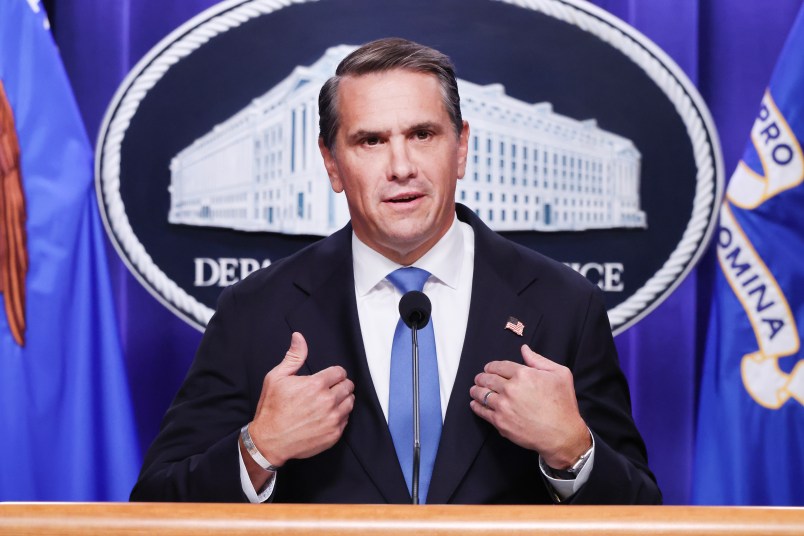
Under the pretext of an ethics complaint against all but one of the active federal judges in Minnesota, Attorney General Todd Blanche signaled yesterday that not only will the Trump administration continue to run roughshod over the judicial branch but that judges had better shut up about it. 

The complaint filed by second and third highest ranking DOJ officials with the uber-right-wing 8th Circuit Court of Appeals is ostensibly about an admittedly unusual decision by the federal judges who bore the brunt of Operation Metro Surge to sit for an interview with the New York Times for a story that ran Sept. 17.

In the interview, the judges — including Patrick Schiltz who was the chief judge during the peak of the flood of mass deportation cases swamping the Minnesota federal court — defended the rule of law, provided a civics lesson on the role of the courts, and described the structural and institutional challenges they had faced. They refrained from talking about individual cases, but they did speak in broad terms about the habeas cases in general, Operation Metro Surge and the conduct of the Trump DOJ.

The complaint — signed by acting Deputy Attorney General Trent McCotter and Associate Attorney General Stan Woodward — accused the judges of pandering to the press and engaging in unethical behavior that “flagrantly violated” the canons of judicial ethics. It specifically called out Judge Schiltz and Judge John R. Tunheim — who were both quoted by name in the NYT article — for what it called “particularly egregious” misconduct.

The Trump DOJ asked the 8th Circuit to appoint a special committee to conduct an investigation of the judges for their allegedly improper behavior and to order Judges Schiltz and Tunheim to recuse themselves from any cases involving DHS.

Blanche: "Today, we're also announcing that just a few minutes ago the DOJ filed a judicial misconduct complaint with the 8th Circuit Court of Appeals against all but one district court judge in the District of Minnesota for violating various judicial canons."

— Aaron Rupar (@atrupar.com) 2026-09-30T15:40:45.087Z

The Trump DOJ getting on its high horse about legal ethics is a lot to take on its own. But it’s also striking that the complaint leans into what DOJ officials see as a friendly audience on the 8th Circuit. It emphasizes, for instance, the appeals court’s own decision upholding the Trump administration’s mass detention policy without bond — one of only two appeals courts to do so — in which it overruled the Minnesota judges.

Traditionally, Article III judges have been free to speak publicly on matters of judicial administration, the Constitution, democracy — civics, if you will. They have been free to lobby for more funding, better security protection, restructuring of the judiciary, and reform measures without running afoul of ethics requirements. 

But the Trump DOJ — which has defied orders left and right, hidden its worst conduct behind unprepared junior lawyers, botched cases, fired huge numbers of experienced attorneys, and made a hash of the distinguished department — now wants to clamp down on the ability of judges to stand up against what may be the most sustained assault on the judiciary in the nation’s history.

SCOTUS Takes Up Mass Detentions

As expected, the Supreme Court will take up the Trump administration’s policy of mass detention without bond that the circuit courts have split on, but which dozens of judges in thousands of cases have found to be unlawful.

Renee Good’s Family Sues

The family of Renee Good who was shot and killed by ICE in January during Operation Metro Surge has filed two civil lawsuits against the Trump administration arising from her death. 

Broadview Six Hearing This Afternoon 

A federal judge in Chicago this afternoon will hear arguments over whether to conduct a further inqury into alleged misconduct into Trump’s DOJ’s handling of the grand jury in the Broadview Six case and the aftermath of that now-abandoned prosecution of ICE protesters. 

As Bad as It Gets

The Supreme Court’s prior handling of the third-country removal case was already the most troublesome emergency docket case, Georgetown law professor Steve Vladeck argues, then came this week’s unexplained decision in the case: 

“There have certainly been rulings on the emergency docket that I believe to be more clearly and obviously wrong on the merits. And there have been rulings on the emergency docket that have produced even more harmful effects domestically and/or to the separation of powers. But there’s something profoundly ugly about the D.V.D. case that, unfortunately, was on display again on Tuesday.”

Cannon Wiggles Out of Bind

Give her credit: Judge Aileen Cannon has gotten out of the pickle she was in on Volume II of former Special Counsel Jack Smith’s report. She struck a motion from FBI agents who investigated the Mar-a-Lago documents case and are now being targeted by the Trump DOJ seeking clarification on her order sealing Volume II. Her reason: The lawyers had failed to confer with the co-defendants in the underlying criminal case about their motion before filing it.


808 
PAPERLESS ORDER striking for lack of conferral 806 Motion to Intervene and Seek Clarification of Court Order. S.D. Fla. L.R. 88.9(a). Signed by Judge Aileen M. Cannon on 10/1/2026. (sm1) (Entered: 10/01/2026)

11th Circuit Stirs to Action

In the Volume II case which is on appeal, the 11th Circuit the appeals court rescheduled oral arguments yet again but moved them earlier for the first time after months of kicking the can down the road. Instead of January of next year they’re now scheduled for the first week of November. Nothing much going on that week.

Reflecting Pool Case Dismissed With Prejudice

Ruling that “no crime occurred,” a DC judge has ruled that the already-dismissed Reflecting Pool case against David Hearn should be dismissed with prejudice, meaning the Trump DOJ can’t bring the case against him again in the future.

Quote of the Day 

“This event is the worst we’ve seen and unlike any other botched execution in the modern era. There is no precedent.”—Robin Maher, executive director of the Death Penalty Information Center, on last night’s horrific attempted execution of Christa Pike in Tennessee.

Pike remains hospitalized this morning. Gov. Bill Lee (R) has halted executions through the end of the year.

  •  
❌