❌

Reading view

The Worst People On Earth Are the Ones You Meet Traveling

Earlier this year I unexpectedly found myself in Thailand on a luxury hotel chain press trip. It was a sharp (though not unwelcome) departure from the way I usually travel. As I watched an American woman stick a fork in and send back an omelette no less than five times, I made a passing comment about American tourists to one of my fellow journalists. Unfortunately, she was also American, and told me that everyone should cut them some slack because the people in the rest of the world wouldn’t be able to survive without the money her compatriots spend while on holiday. It did not seem to occur to her that this power dynamic, and the mindset behind it, is why half the planet now resembles a giant strip mall.

Almost every time I encounter an American abroad, I am torn between two opposing thoughts: wishing they would travel more so they might understand their way of life is an anomaly that’s destroying the rest of the world, and wishing they would stay in their godforsaken air-con unit of a country and spare the rest of us from having to interact with them. In my ten-plus years of interrailing, backpacking, sofa-surfing, petsitting, remote working, press-tripping, and holidaying across Earth, I’ve done enough boots-on-the-ground research to say this: Contrary to what you may have been led to believe by “wanderlust aesthetic” Instagram accounts, some of the worst people you’ll ever meet are those you come across while following the road less traveled. And it’s not just Americans.

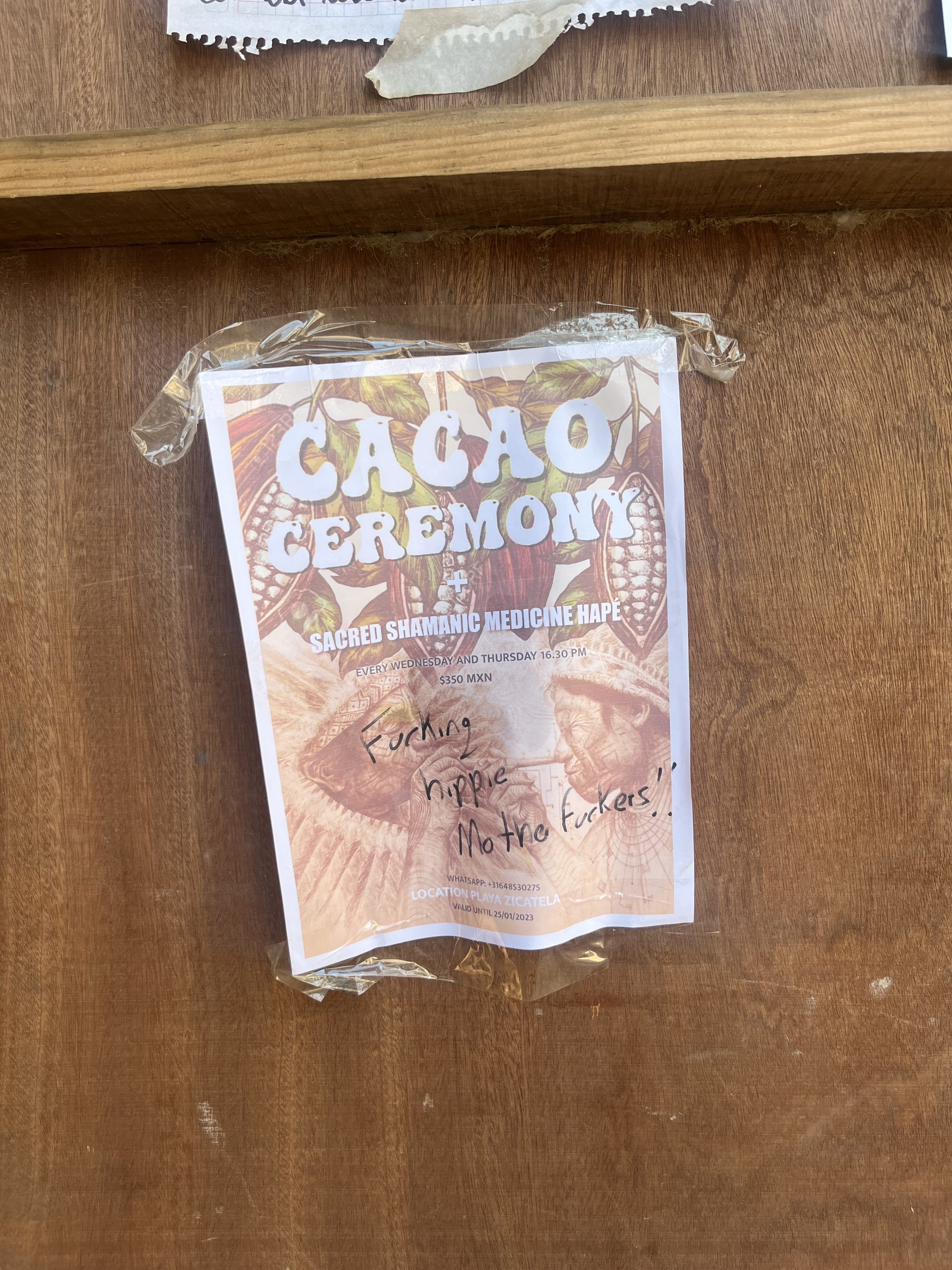
Before I go any further, let me clarify for those of you who are already getting angry that it is obviously OK to go traveling. It can even be good—for example when I, the world’s only good and perfect tourist, do it. The point is that stamps in your passport don’t make you a better person, that frequent flyer miles and photos of you in front of waterfalls are not a substitute for a personality (sorry to 80 percent of the men on Hinge), and that, rather than being curious and open-minded, a lot of people who pride themselves on how many countries they have “checked off” have zero curiosity about the countries they are visiting. Others have a little too much curiosity, jet-setting from one ancestral healing practice to which they have no ancestral ties to another, until they finally find one they can repackage and sell to other spiritually bereft Westerners. Basically, what I’m saying is that while it is possible to travel like the late, great Anthony Bourdain, a lot of people are doing it in a way that is actually closer to Christopher Columbus if he had a smartphone.

Long-term travel was once the reserve of hippies with bad hygiene practices, students on their gap year, and wealthy bohemians, but the rise of remote working has birthed a new modern-day travel monster: the digital nomad. Almost always working in tech or helming a pyramid scheme, this demographic is driven to travel entirely by a desire to do exactly what they would at home but for cheaper, with better weather, and higher prospects of casual sex with anti-vax somatic healers. I once shared a living space with one such man in Mexico, who I could only surmise had been sent as a test from God to teach me something about my own endurance abilities. He spent every day working on his Burning Man-inspired luxury “festival fashion” startup at the local expat-owned co-working space (none of these words are in the Bible, etc), returning in the evenings to cook himself a big bowl of foul-smelling protein slop and tell me about how the best bet for America’s future was a presidential ticket featuring Mark Cuban and Tulsi Gabbard. His approach to “experiencing” Mexico was by no means unique. Where once free spirits journeyed to foreign lands in order to spend months taking heroin and writing era-defining literature, the modern travel landscape consists mostly of aspirational entrepreneurs who have little interest in their surroundings beyond whether the WiFi connection is strong enough for Claude to optimize their intermittent fasting plan.

In my time in the wanderlust mines, I have met a white Canadian who referred to jazz and blues as “N-word music”—with a hard R—when asked what kind of music he liked; a British couple in Marrakech annoyed that people were trying to sell them things in the bazaar; a Belgian coder / life coach who framed her silence on social justice issues as “choosing to ignore low vibrational topics”; Canadian techbros on $150k salaries arguing with Mexican waiters over a $2 tip; an American offended by the sight of a Hindu swastika on a temple in Thailand; an Arab man who said feminism was bullshit for weak, lazy women because his own mummy did everything in the house and never once complained (oh I bet); Swedish reggae lovers who’d come to Jamaica and were annoyed that the country had moved on from Bob Marley to dancehall; a Dutch boy who “joked” about spiking my drink; and too many kinds of fascist neo-hippie to name. I won’t even begin to list the things I’ve seen Israelis do and say.

The worst offenders in this crowded field of dickheads are those who also perceive themselves to be “spiritual” while actively spending their days leaving the world a worse place than they found it, while training AI models to use even more of the earth’s dwindling fresh water resources. Due to the fact that many of these people are coincidentally also highly sensitive empaths, they unfortunately cannot engage with politics or any of the negative impacts of their lifestyle, which is why they must instead release their trauma through ecstatic dance and being rude to service staff who make less money in a year than they spend on nootropic supplements.

Perhaps the problem is that travel has been culturally depoliticized and turned into an aesthetic while remaining inherently political

Perhaps the problem is that travel has been culturally depoliticized and turned into an aesthetic while remaining inherently political. Who gets to travel, who gets to share their narrative, who has the freedom to explore the world until they “find themselves,” and who has to feed their family by serving the self-actualization of foreigners are all subjects that are easier to ignore when making free-spirit content. I’m not saying that you shouldn’t travel, but that you should try and bring some self-awareness to it, which means paying up instead of arguing when the local taxi driver charges you tourist fares because you are a tourist.

Despite ostensibly traveling for the purpose of new and exciting experiences, a huge proportion of tourists—from lobster-hued Brits tucking into full English breakfasts at Irish pubs in Malaga, to the Australian reiki healer eating avocado toast on gluten-free bread in a millennial-branded coffee shop in Bali—now expects everywhere on Earth to function the same way it does back home, leading to exasperated temper tantrums when the market in Guatemala doesn’t accept Apple Pay. Over time, this has the flattening effect of turning the whole world into an architectural rendering of what constitutes a “good life” under ouroboros-capitalism, and destroying all the things that made somewhere worth visiting in the first place.

At the tail end of my recent trip, I spent an afternoon wandering through the streets of one of Thailand’s beautiful islands. The main strip was overlooked by a backdrop of lush forest and mountainside, which had been hacked into to make space for a lurid drag of sports bars, strip clubs, weed shops, and other places for tourists to get hammered for cheap somewhere exotic without experiencing any kind of culture shock. As I walked past another construction site, I was reminded of the scene in First Reformed where the protagonist, haunted by the weight of human environmental destruction, asks “Will God forgive us for what we’ve done to this world?” The more I travel, and the more people I meet who define themselves by doing so in the most self-serving way possible, the more unsure I become that he will.

Follow Niloufar Haidari on Instagram @niluthedamaja

The post The Worst People On Earth Are the Ones You Meet Traveling appeared first on VICE.

  •  

10 Soul-Destroying Modern Pursuits

This feature is from THE SELF-DESTRUCTION ISSUE of VICE magazine. Find it in a store near you, or get 4 issues each year sent straight to your door, by subscribing.

SHIBARI

What goes through your head when the dirty-fingernailed warehouse dwellers pull your hogtied body up from the floor with a butt load of Japanese kink rope? Obviously we’re sex positive here at VICE, but who else is going to warn you that some things just can’t be enjoyed in a vacuum? First it’s the kink rope, then it’s the property-guardian polycule, and before you know it the most important knot in your life is leashed around a maudlin three-legged staffy named Swampy. Mark our words: it’ll be your neck next.

MIND-ALTERING PSYCHEDELIC EXPERIENCES VIA APP

The tripsitter you found on TikTok. The ayahuasca “shaman” you can only book through Telegram. The DMT amuse-bouche on your neighborhood coke dealer’s WhatsApp menu pdf. Is it good that you can acquire a mind-altering psychedelic experience the same way you’d order Chinese take-out? It’s not an age-old question, is it? And therein lies your answer. Communing with the hidden mechanisms that create our shared reality via gas-station vape pen makes the machine elves sad and angry.

REWILDING YOURSELF

As with most things in life, there’s the question of how far you should take it. Tell your friends you’ve “gone paleo” and they’ll still be there when you admit you dropped it after three agonizing days of total bowel paralysis. They might not be, though, when you return from that meet-up with the prominent “barefooting” influencer having been brutally feral-mogged by the lad who’s spent six months full quadrupedal. He calls it “gorilla mode.” Why the fuck didn’t you think of gorilla mode?

ILLUSTRATION BY JOHNNY RYAN

REFERRING TO ANY ASPECT OF YOUR LIFE AS A ‘PROTOCOL’

Wiping your sweaty forehead with a beer-soaked sleeve as you feel your teeth go numb from the bump you just did in the toilets. Smoking cigarette upon cigarette, pulsating with the knowledge that you and the man you just met will go home and fuck. Turning the sand-crusted page of some shit thriller, gazing out at the Aegean, before summoning the tanned waiter for another beer. It all sounds lovely, doesn’t it? It’s called “life,” and you can forget about having one if you refer to any aspect of it as a “protocol.” Bryan Johnson might have the vascular function of a teenager, but is he happy? What does he seem more like, a credible person or a husk? Handing your soul over to “metrics” is the first step on the road to measuring your son’s erections every night. There shouldn’t be any steps on that road.

POLYAMORY

Like communism and movies starring Jacob Elordi, polyamory is a nice idea in theory. A quest to blow clean through the glass ceiling of monogamy by fucking and love-bombing a bunch of people at once with the full knowledge and consent of everyone involved? ‘Awesome,’ you might think. ‘Tell me more.’ Well, the catch is that it actually takes quite a lot of admin to tend diligently to one relationship, let alone five. Whether you genuinely believe the cadre of farmers’ market enthusiasts unbuttoning their Lucy & Yak dungarees to finger each other senseless after a crazy night of tabletop board games are your soulmates, or simply see yourself as a conniving Don Draper type on the make, is irrelevant. Ultimately, you will end up in a group chat arranging “radical honesty” sessions whenever someone leaves the toilet seat up and an org chart for everyone’s alternative milk preferences.

BECOMING A MILITANT

Before parasocial relationships, ADHD hyperfixations, and autistic special interests, I had what we used to call an “obsession” with @PissPigGranddad—a Twitter leftist who left America to fight ISIS. I was working a desk job in a government office and passed the time cheering for Brace Belden (aka LeninLover69) as he advanced on Raqqa. At the time, my idea of a struggle was getting the office printer to work—and here was a punk musician from San Francisco battling Islamofascism. I followed with religious devotion as Brace, and the other international volunteers, faced down an army of jihadi chauvinists who had fled lives of comfortable humiliation in Europe and the United States to establish some kind of video-game caliphate in Syria and Iraq. These opposing militias represented two sides in an epic battle of good against evil, which felt more real than the mindless, repetitive activities that made up my days. I looked at photographs of Brace posing with stray puppies and an AK-47 and thought, ‘This is what I would do if I wasn’t too much of a coward to even quit this job I hate.’ We’ve always needed militants to provide us with a little perspective; while you’re agonizing over which electric toothbrush to buy, they’re fighting for a socialist revolution; while you’re hanging out the washing, they’re strapping themselves to C4 and getting ready to do a human-rights violation. And perspective is useful, to everyone who isn’t dead.

SYNTHOL

Synthol is one of those great ideas that appears to have emerged directly from the teenage unconscious (see also: “What if having sex could be my job?”). The dubious muscle-boosting serum is made up of oil (often sesame, walnut, or paraffin), the local anesthetic lidocaine, and benzyl alcohol—ingredients that can be found, variously, in vegan protein bars, head lice shampoo, and industrial paint. Maybe there’s some logic here: in a culture of instant gratification, where petrochemicals are used to make clothes, grow food, and produce the microplastics that have turned your balls into bean bags, it makes a certain amount of sense to simply become oil. But while synthol might be a shortcut to a bulkier appearance, it won’t make you any stronger. This modern pursuit is strictly for those who regard their body as a machine that converts vanity into permanent muscle damage. As well as the health risks that come with introducing Diddy party levels of lubrication to your own bloodstream, Synthol also gives you this weird, unnaturally swollen look. There’s a reason why bodybuilders have historically preferred to risk the shrunken testicles and rage fits that come with steroids.

ADOPTING A FLESH-TEARING WILD ANIMAL FOR SOCIAL MEDIA CLOUT

If you’re gonna learn anything from anyone in this world, learn it from someone who got their face ripped clean off by a chimpanzee. The fate of Charla Nash is not one any of us should be forced to endure, yet all over social media, wannabe Dr Dolittles are forcing creatures programmed only to shit, fuck, and kill into difficult choices. The jaguarundi does not want to sit on the couch watching Schitt’s Creek with you; it wants to be nose-deep in 5000 grams of pulsing armadillo flesh somewhere in the jungles of Surinam. The slow loris is not your friend. Pretending so might snag you followers in the short term, but no one’s sticking around for the face transplant recovery journey photos. 

ILLUSTRATION BY JOHNNY RYAN

COVETING A LOFT-STYLE APARTMENT

Catch you on the flip, David Mancuso. In 2026 the only people who think living in a loft is cool are spiders and Australians. 

GOOD OLD-FASHIONED ALCOHOLISM

Ketamine addiction this, can’t stop tugging it to videos of anime girls’ boobs exploding in size until they bust the windows out of an office block that—why not just hit the bottle? Like a real loser? Alcohol is the highly social, highly charismatic person’s poison of choice. Just look at what the abuse of it has given the world—Tennessee Williams, Marguerite Duras, Robert Downey Jr. in his Natural Born Killers era. Yeah, buddy. You could be the last of the big-time drunks. And the best thing about that would be that there are no other big-time drunks left for you to have to listen to and smell.

Follow Amber, Adam, Emma, and Kevin on Instagram: @amberrawlings, @yungtolstoi, @emmaggarland, @kevinleekharas

This feature is from THE SELF-DESTRUCTION ISSUE of VICE magazine. Find it in a store near you, or get 4 issues each year sent straight to your door, by subscribing.

The post 10 Soul-Destroying Modern Pursuits appeared first on VICE.

  •  

Tokyo Sunset: Golden Age Turns to Gilded Cage for the Yakuza

This feature is from THE SELF-DESTRUCTION ISSUE of VICE magazine. Find it in a store near you, or get 4 issues each year sent straight to your door, by subscribing.

The Yakuza is shrinking.

From approximately 180,000 members in the 1960s, an official 2024 estimate placed numbers closer to 18,000. Aggressive legislation has isolated members economically, removing their bank accounts and restricting where they can live and travel. Once inside the crime organization’s rigid structures, leaving is nearly impossible, and the traditional irezumi full-body tattoos that once symbolized endurance and status have become social shackles as owners have been banned from public spaces including baths and gyms. Today, the Yakuza exist in what some describe as a “golden cage,” bound by loyalty and trapped by regulation. All the while, Japan is changing, through technological acceleration, demographic decline, and increasing influence from outside cultures. So, how exactly does an ultra-traditional criminal brotherhood established in the 17th century survive the emerging world?

Part of the answer lies in combat sports. For the new Yakuza generation, MMA provides visibility, legitimacy, and a route to wealth, as well as an arena where gang ties help rather than hinder. Fighters’ entourages arrive openly sporting crime-family crests and cash-filled envelopes circulate before bouts. In a combat context, the elements of Yakuza culture that have fascinated observers for centuries—the mythology, the symbolism, the ceremony, the tattoos—all add to the theater.

My entry into this world of competitive Yakuza fighters came through Mario Luciano. A New York-born Italian allegedly descended from “Lucky” Luciano, one of the founding fathers of the American Mafia, Mario arrived in Japan in his early twenties. He now owns a members-only Italian restaurant in Tokyo, which is exactly as you would imagine: checkered red-and-white tablecloth, Dean Martin over the speakers, walls lined with framed photos of politicians and celebrities. But other pictures show him fraternizing with high-ranking Yakuza bosses, including figures affiliated with the Yamaguchi-gumi—Japan’s largest and most powerful Yakuza syndicate. At one point, while reaching for a glass, I noticed a Carl-Gustaf rocket launcher concealed by a row of bottles. Outside, Mario’s brand new Bentley had a bulletproof vest in the back seat.  

Through Mario, I met Miyamoto-san, a former member of the Sumiyoshi-kai, Japan’s second-largest Yakuza family. He had performed yubitsume: the ritual severing of part of a finger as penance. “He’s not a good pianist anymore,” joked an acquaintance. Today, he manages the promising MMA careers of his son Ryuko and daughter Rei, as well as a fighting organization called Kiokushikai, which is growing fast.

He invited me to his home. The walls were reinforced with steel to deflect bullets. Inside, he showed me his collection of bōsōzoku motorcycles and openly discussed his ambitions in cinema. He was affable and charismatic.

As the traditional syndicates contract, something looser is emerging. Decentralized groups—fluid, digitally coordinated, less formal—are taking shape. These networks lack the theatrical visibility of the old guard. No elaborate sake ceremonies. No public-facing headquarters with brass nameplates. No irezumi, which in the glory days of yore were created with toxic pigments and unsanitary methods to which some older Yakuza attribute their liver disease. Instead: encrypted chats, financial scams, and temporary alliances between criminals hiring through small job websites. The term used to describe this new breed is Tokuryū: anonymous, semi-organized actors operating in the gray area between gang and network. The transformation is not cinematic. It is bureaucratic, digital, and quiet.

For younger generations, it makes increasingly less sense to submit to a lifetime of surveillance and restrictions when digital anonymity offers faster profits with less risk. The mythology of the Yakuza—immortalized in film and romanticized abroad—belongs to a fading structure. The question is not whether organized crime in Japan will survive. It is whether the Yakuza can survive in a world that rewards invisibility.

The age of the tattooed patriarch may be coming to an end. The age of anonymity has already begun.

Arnaud’s new VICE documentary about the Yakuza, Tokyo Sunset, is coming late 2026.

This feature is from THE SELF-DESTRUCTION ISSUE of VICE magazine. Find it in a store near you, or get 4 issues each year sent straight to your door, by subscribing.

The post Tokyo Sunset: Golden Age Turns to Gilded Cage for the Yakuza appeared first on VICE.

ARNAuD DIEMER

ARNAuD DIEMER

ARNAuD DIEMER

ARNAuD DIEMER

ARNAuD DIEMER

ARNAuD DIEMER

ARNAuD DIEMER
  •  
❌