Reading view

Pete Hegseth is Trump’s favorite kind of failure

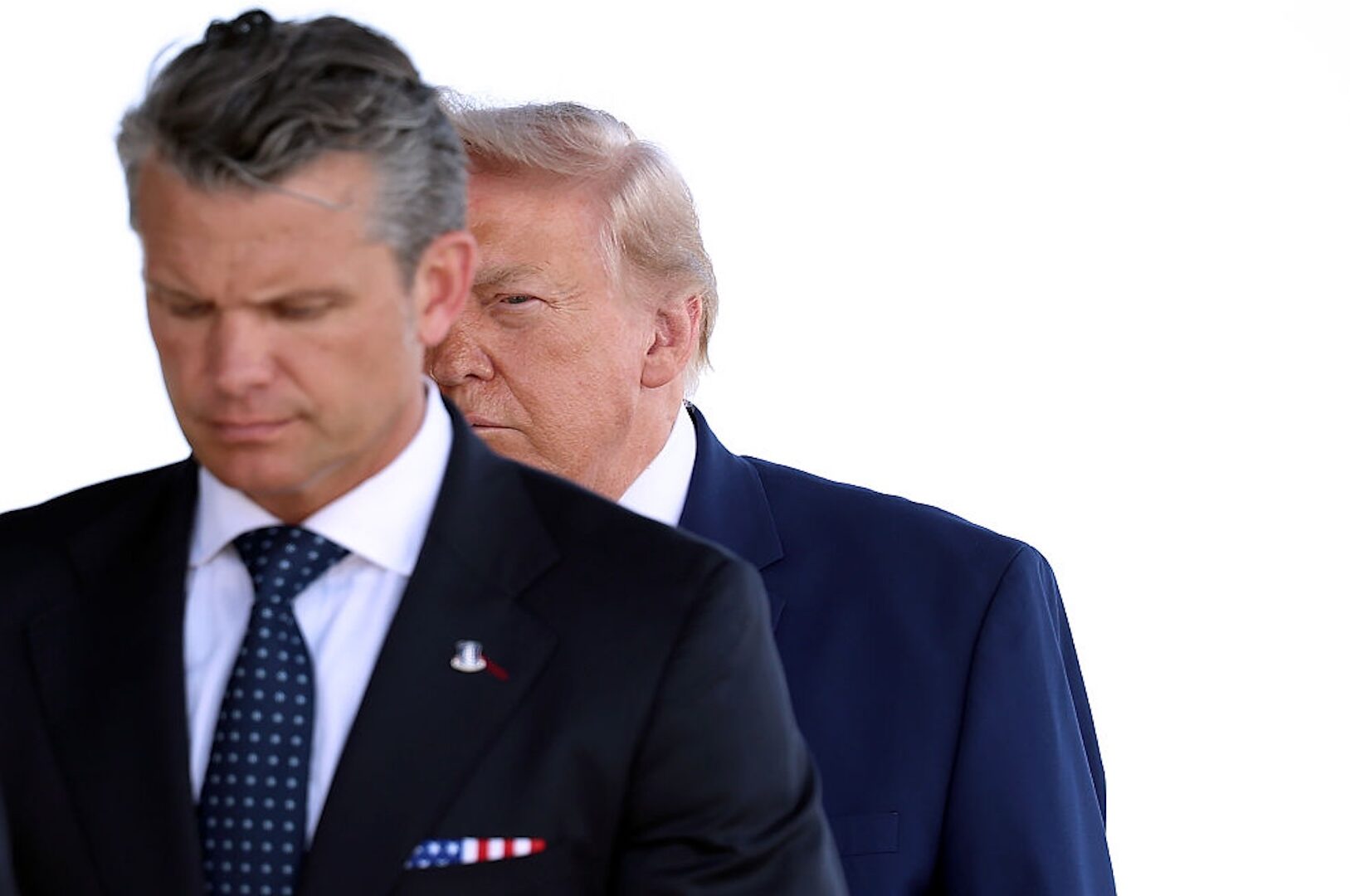
The tale of Donald Trump sneaking off Air Force One in a catering truck captured public attention for many reasons. It was a reminder that, for all his tough talk, the president harbors a sense of fear. Hiding away in a glorified ice chest would also have been a blow to the 80-year-old’s dignity. But the charade, which was first revealed by the Washington Post, also gave us insight, as political scientist Scott Lemieux wrote, “into who he considers his actual inner circle.”

Left behind on the decoy plane were Secretary of State Marco Rubio, Treasury Secretary Scott Bessent, White House deputy chief of staff Stephen Miller and other administration officials and aides. The only people deemed worthy of saving from Iran’s reported threat were people whose full-time jobs are tending the president’s body and, more importantly, his ego: Natalie Harp, who writes Trump love letters, and whose main job is showing him flattering social media posts. Body man Walt Nauta. Dan Scavino, Trump’s former golf caddie. Oh yeah, and Pete Hegseth. 

The defense secretary’s inclusion on this list does not suggest he is an especially well-regarded or important person, especially when other prominent Cabinet members — not to mention White House reporters — were left vulnerable to the rumored assassination threat. On the contrary, his inclusion in Trump’s flock of flatterers is another sign that Hegseth’s main skill is fluffing up the narcissist-in-chief. It helps explain how Hegseth — unlike former Cabinet members such as former Attorney General Pam Bondi or former Homeland Secretary Kristi Noem, who recently lots their jobs — seems in no danger of losing his job, even as his manifest incompetence is a big part of the reason Trump is losing the war with Iran. He may be bad at running the military, but Hegseth is good at lying to (and attacking) the press and stroking his boss’s ego, which are the only skills that count in Trump’s White House. 

Recent news about the ongoing disaster aboard the USS Abraham Lincoln is another reminder of why Hegseth may indeed lead the highly competitive race to be the most hated man in Washington. Both Stars and Stripes and the Military Times reported that multiple service members had attempted to jump off the aircraft carrier, which has been deployed for over eight months without any real breaks. Sailors are reportedly “struggling with exhaustion and declining morale, including reports of suicidal thoughts,” explained Alison Bath of Stars and Stripes.

The details coming from family members offer a chilling illustration of how little regard Hegseth has for the actual well-being of service members, even as he releases videos implying they have low testosterone levels or berates them for being “fat” or “beardos.” Sailors have reported being fed “rotten” food or barely being fed at all, and desperate family members have been begging the Navy for relief. The wife of one sailor told MS NOW’s Priya Sidhar that the company is working 12-14 hour days and that her husband “said that he was exhausted working on the flight deck.” He also raised safety concerns with his superiors. “His prescription contact lenses had expired,” Sidhar reported, “and he told his chain of command that he couldn’t even see what he was doing, and he was worried about causing accidents.”

Hegseth, though, is shrugging off the concerns, telling reporters the issue is “completely misrepresented” and that the service members have “everything we can provide them at every single moment.”

Trump was even more callous and dishonest about the suffering of the sailors, saying that the deployment was “not nearly long enough,” even though, at over 260 days, it has set a record for the longest deployment. (On Friday, the acting Navy secretary announced the ship would be returning to the U.S. and replaced by the USS George Washington.)

Trump and Hegseth clearly share a disregard for the lives of the very service members they are asking to wage war on Iran. But the debacle also reveals how Hegseth’s twisted priorities appear to have endeared him to his boss, seemingly above every other sycophant surrounding the president. Beyond operating in the Northern Arabian Sea to aid in logistics and serve as a deterrent to Iran, it seems like the reason the USS Lincoln is being held in this Kafkaesque hell is to shore up the illusion — or perhaps even Trump’s delusion — that the war with the Islamic Republic will be over soon.  

The president, desperate to keep stock markets afloat and MAGA voters on the hook, has been playing a game for months where he announces a “deal” with Iran to end the war, usually timed to the market’s opening bell, buoying stock prices. But the news invariably turns out to not be true. The danger for Trump is that investors might finally wise up and stop falling for false promises. Swapping out a major aircraft carrier deployed in the Middle East, as the Pentagon is now planning to do, could blow the whole game up, as it is a tacit admission that the war is not ending in the next few days, as we’ve been told is happening for months. Sunday’s news, reported by the Wall Street Journal, that Iran is secretly planning to “escalate the war” will also not help matters.


Want more Amanda Marcotte on politics? Sign up for her free newsletter, Standing Room Only, now also on YouTube or wherever you get your podcasts.


This pattern suggests Hegseth is far more concerned about his boss’s fixation on stock prices and media coverage than he is about listening to the advice of admirals, who have been bearing the brunt of complaints from families of service members over the USS Lincoln. Even by the low standards of Trump appointees, Hegseth has shown an eagerness to back up the president’s every lie and delusion, not matter the cost. This dubious distinction is no doubt why, even as he is shepherding what may turn out to be Trump’s most notable entry in a long list of failures, Hegseth was included in the small club of people Trump opted to save from a possible attack on Air Force One. 

The secretary may be in Trump’s good graces, but in the real world, his reputation — which was never good to begin with, since he was comically unqualified for this job — is in the toilet. The American public loathes Hegseth. As CNN’s Harry Enten recently explained, at 22 points under water, Hegseth’s approval ratings are “the lowest of the low.” 

Hegseth is also widely loathed by fellow Republicans on Capitol Hill, even as they held their noses and voted for him to pacify Trump. As POLITICO reported, Hegseth has been “regularly trekking to the Hill in recent weeks and hobnobbing with lawmakers,” asking them to pass the largest defense spending bill in history. This request — asking Republicans to spend lavishly on weapons — should be as easy as talking Hegseth into another round of martinis at breakfast. But GOP members are worried about the midterms, and they don’t want to answer for the Iran war or the equally unpopular defense secretary. 

Hegseth is likely to stay, though, even as Trump posts on Truth Social that he’s “extremely happy with the job that Pete Hegseth is doing,” including “getting rid of DEI.” Sure, the secretary has mismanaged the military to the point that sailors are reportedly attempting suicide. But he has blocked the promotions of talented leaders who annoy MAGA by being women or Black, and that’s what really counts.

One sailor who reportedly jumped overboard is only 19 — practically still a kid. The terror and trauma Hegseth is inflicting him and his fellow service members in this losing war points to a man with no moral character at all. No wonder Trump loves him. 

The post Pete Hegseth is Trump’s favorite kind of failure appeared first on Salon.com.
  •  

Malta leads fight against EU bid to tax Big Gambling

Malta leads fight against EU bid to tax Big Gambling

The tiny Mediterranean island is clashing against the European Parliament and former football legend to oppose the levy.

By GREGORIO SORGI
in Paceville, Malta

PhotoIllustration by Natália Delgado/POLITICO

Brussels is bracing for an unusual fight between the EU’s smallest country and a British ex-footballing legend.

Peter Shilton, the England goalkeeper who conceded the “Hand of God” goal from Diego Armando Maradona in 1986, has started a new life as an anti-gambling advocate after overcoming a decades-long addiction.

Despite being a diehard Brexit supporter, he’s become the poster boy of the European Parliament’s push to tax online betting in a bid to raise some much-needed funds to finance the bloc’s next €2 trillion budget.

But the campaign has run into strong opposition from Malta. The tiny island in the Mediterranean Sea, with a population of just over half a million people, is home to a burgeoning betting sector. It says that higher taxes will cripple its gambling industry, boost illegal operators and drive firms outside the bloc.

“[Malta] will not accept the introduction of any EU-level taxes designed to sustain the bloc’s spending,” the country’s Prime Minister, Robert Abela, told the Maltese Parliament in June.

But Shilton, who lost more than £1 million in betting on horse racing over 45 years and now runs his own gambling addiction charity, dismisses the arguments by Malta and the gambling lobbies as “window dressing.” He’s in favor of higher taxes as he wants to shrink advertising revenue that is used to lure in new gamblers.

“Deep down they’re after everybody’s money. Simple as that,” he told POLITICO during a visit to Brussels in June.

Former England goalkeeper Peter Shilton lost more than £1 million in betting on horse racing over 45 years and now runs his own gambling addiction charity. | David Cannon/Allsport/Getty Images

The topic has split the EU’s 27 governments, pitting gambling-heavy Southern European countries against their more supportive Western European peers, led by France. Capitals are already fighting even though the Commission hasn’t yet issued a formal proposal for the possible tax, which would ultimately need to be unanimously approved by governments.

It’s one of numerous budget battle lines being drawn, with Ireland — which is steering the talks as chair of the rotating Council presidency — set to restart negotiations to facilitate an overall deal on the EU budget before the end of the year.

That’s no mean feat given Dublin’s task to mesh competing spending priorities into a single budget — financing everything from farmers’ subsidies to foreign aid — that is acceptable for each of the EU’s 27 governments.

National capitals will have to unanimously approve new EU-wide taxes — known as own resources — to pay for soaring defense spending and post-Covid debt repayments if they want to avoid drastically increasing national contributions to Brussels.

Supporters of the gambling levy point to the fact that it would rake in over €13 billion throughout the next budget cycle and — for some, more importantly — address a serious public health issue. An estimated 80 million adults globally have experienced a gambling addiction, according to experts.

“We look on it [gambling] as an illness. It’s something that’s inborn in you and that can be ignited,” Shilton said.

Malta’s game plan

Malta has invested heavily in the gambling industry — including lotteries, betting and casinos increasingly operating online — which now accounts for around 12 percent of its gross domestic product.

These firms have relocated to Malta because of its light-touch licensing regime, business-friendly tax regime and balmy weather.

The country is “as dependent on the online gambling industry as Germany is on cars,” said an EU diplomat, granted anonymity to speak freely.

While gambling firms need local authorization to operate in most other European countries, securing the Maltese license is crucial to access banking services and gain a foothold in the EU market.

Malta-based firms dominated the German and Austrian online gambling markets before national regulators cracked down. This has prompted the Maltese government to refuse to recognize some court rulings and sanctions issued by other EU countries against its gambling firms.

Betting lobbies say they oppose higher gambling rates on the grounds that they will fuel appetite for the illegal market. | Photo illustration by Graeme Robertson/Getty Images

Given its influence, it is hardly surprising that the gambling industry has found a friendly ear among Malta’s politicians in Brussels.

The Maltese president of the European Parliament, Roberta Metsola, last year gave the opening speech at an international gambling conference in Rome that also featured Italian Foreign Affairs Minister Antonio Tajani.

“I’m more than a little proud that it started in my island home of Malta,” she said, referring to SiGMA, a Maltese events company that focuses on online gambling founded by Eman Pulis, a university friend of Metsola.

Betting lobbies say they oppose higher gambling rates on the grounds that they will fuel appetite for the illegal market, away from the grasp of EU rules.

“A higher tax would lead to worse odds for the customers … and it is relevant because access to the illegal markets in Europe is, obviously, one click away,” said secretary general of the European Gaming and Betting Association, Maarten Haijer.

Nicola Matteucci, an economist at the Università Politecnica delle Marche in Italy who has undertaken extensive research on the gambling sector, argued there is a “point where prices exceed a certain level and the demand [for gambling] diminishes. But it’s not as immediate as suggested by the industry.”

Matteucci said that most gamblers will be undeterred by slightly higher taxes and worse odds as they are not fully rational consumers.

Anti-gambling groups reason instead that higher taxes will reduce the sector’s spending on commercials, preventing would-be punters from getting sucked in to gambling in the first place.

“Higher taxes will therefore mean less gambling advertising overall and many people would regard that as a public benefit,” said Derek Webb, the founder of the Campaign for Fairer Gambling advocacy group.

Club Med joins Malta

Malta has joined forces with fellow Mediterranean countries — Italy, Portugal and Spain — to challenge the mooted tax which was first proposed by the Parliament’s socialist lawmaker Victor Negrescu, said four diplomats with knowledge of the discussions.

According to the European Commission’s estimates, seen by POLITICO, a 3 percent tax on the net turnover of the online gambling sector would generate an estimated €1.9 billion per year.

With its big online gambling market, Spain is expected to be among the biggest financial losers, should the tax go ahead. It is estimated to be on the hook for €414 million per year, almost a quarter of the total amount. That compares to a projected bill of €165 million per year for Malta— a disproportionality high amount for such a small country.

Portugal is also reluctant to back the levy. It fears that higher taxes would eat into revenue brought in by state-run betting and lotteries that is currently channeled to the charity Santa Casa da Misericórdia de Lisboa‘s healthcare and youth support programs, said a Portuguese official.

Meanwhile, given the relatively low uptake of online gambling, Italy’s misgivings have surprised anti-betting advocates. Rome is expected to pay a mere 7 percent of the proposed new levy — a significantly lower proportion than its regular EU budget contributions.

However, Prime Minister Giorgia Meloni’s Brothers of Italy party has previously been receptive to the gambling industry. Last year its MPs passed a resolution encouraging the reversal of a ban on professional football clubs advertising gambling firms.  

  •  

He disclosed ketamine therapy in a trust exercise. Netflix fired him.

Netflix ketamine lawsuit — Coolcaesar / CC BY-SA 3.0 (Wikimedia Commons)

Netflix billed the January retreat as a "Vulnerability-Trust exercise," held at Sendero Ranch, a company property in Northern California. Kevin Baillie, then head of creative at Netflix's Eyeline Studios, used his turn to disclose that he'd taken supervised ketamine at a Santa Barbara clinic in late 2022 to treat clinical depression after his mother's death. — Read the rest

The post He disclosed ketamine therapy in a trust exercise. Netflix fired him. appeared first on Boing Boing.

  •  

Can knowing less make you happier?

person vacuuming up papers, computers, books, looking overwhelmed
But maybe I know too much, or…too little about how much to know? | Pete Gamlen for Vox

Hi readers! Shayla Love here, science journalist and longtime fan of Your Mileage May Vary. I’m honored to be subbing for Sigal Samuel while she’s out on parental leave. I’m diving into your questions as a way to help understand human nature and our choices through multiple lenses: philosophical, psychological, and beyond. Please send in any emotional, body/brain, sociological, perceptual, or other kind of life quandaries you might have.

I’m swimming in information. I have tracking apps to keep tally of my daily steps, minutes online, my calories, my sleep. Throughout the day, I am awash with data — some “actionable” and some useless. I find it a struggle to prioritize. I find myself looking up the latest betting odds for a Senate race in a state where I don’t live. (I didn’t bet on the race.) What I want to know is: What should I know less about? I’ve heard that ignorance is bliss, though I don’t often find that to be the case. But maybe I know too much, or…too little about how much to know?

Dear Un-blissfully Aware,

As a fellow know-it-all, I relate to your impulse to gather as much information as possible. I used to obstinately reject the idea that ignorance was bliss. Even if I learned something that was unpleasant, wouldn’t it be much worse not to know it? 

But, as you may suspect from sharing my temperament in this arena, this approach to life can lead to hoarding knowledge like a frantic animal preparing for winter. You’re acquiring information as if it’s a scarce resource (which it’s not) and as if choosing to know something is neutral (it isn’t). What helped me understand the implications of this sort of approach was learning about the cases when people decided not to know, or the study of “deliberate ignorance.” 

Have a question you want answered in the next Your Mileage May Vary column?

Fill out this anonymous form! Newsletter subscribers will get my column before anyone else does and their questions will be prioritized for future editions. Sign up here!

Several years ago, a psychologist, Ralph Hertwig, and lawyer, Christoph Engel, who both work at the Max Planck Institute in Berlin, examined what happened in the early 1990s, when the archives of East Germany’s secret police, the Stasi, opened to the public. Any person who had been living in the German Democratic Republic could check if they had been spied on. There was a pretty substantial catch, though: The spies were often “unofficial collaborators” — friends, family, teachers, or lovers who had been tasked with covertly collecting information. When the files were opened, many elected not to look. Hertwig and Engel estimated that potentially more people chose not to know what their files contained than those who did. 

This goes against what we think we know about humans and how you have described yourself. Even Aristotle seemed quite certain that “all men naturally desire knowledge.” In the 1980s, the psychologist George Miller followed along in this line of thinking. He described humans as informavores: creatures with minds that constantly seek out and consume information. So, it can feel surprising to hear about occasions when people didn’t start grabbing for every available datapoint like squirrels dashing for acorns as the first winds of fall arrive. 

But, as Hertwig and Engel — who collaborated on an entire book called Deliberate Ignorance: Choosing Not to Know — point out, we’re surrounded by people choosing ignorance all the time. They avoid looking at their bank statements, they skip doctor’s appointments, and they cover their ears and say “no spoilers” if someone is talking about a movie they haven’t yet seen. 

Even Nobel Laureates do this. When James Watson, one of the co-discoverers of DNA’s double helix, had his own genome sequenced, he requested that a specific gene be left out: ApoE4, which can reveal an increased Alzheimer’s risk. Watson’s grandmother had Alzheimer’s, and her experience clearly made an impression on him. (Then, many in the scientific world tried to remain ignorant to Watson’s increasingly misogynistic and racist comments, until it was unignorable.) 

Why do people choose not to know? The most common reason: Ignorance can be an extremely effective way to regulate any emotions that might crop up in response to knowledge. You can minimize negative feelings by, for example, not knowing that your otherwise friendly neighbor had been reporting on your comings and goings. 

In a study about romantic relationships, a majority of people said they didn’t want to know if their partner had ever thought about cheating on them (but never acted on it). Other research showed that most people wouldn’t want to know the exact time of their death. Alternatively, someone could cultivate the feelings of joy and surprise by waiting to find out the sex of a baby until it’s born.

Deliberate ignorance can also be used to protect us from our biases. Scientists do blinded studies, because the knowledge of what drugs are being used can unwittingly change the outcomes or research. When orchestras implemented blind auditions, more women musicians were accepted. 

Of course, deliberate ignorance can be problematic when it causes harm to yourself or others, like failing to gather basic information about your financial or physical health. In some cases, for instance, about 10 percent of people who got tested for HIV didn’t come back for their results — which could lead to further spread of the disease. 

But when skipping out on knowledge doesn’t endanger you or those around you, it’s worth asking: How would this information make me feel? 

This sounds like a question that’s missing from your information-ingestion habits. You don’t have to — and shouldn’t — ignore everything that comes across your desk. But your deliberate ignorance filter is turned entirely off; seemingly anything passes through it. To take just one of your examples, you mentioned fitness wearables. It can be useful to be aware of your general activity levels and your sleep, but honestly, don’t you already know enough from your memories of a workout class and how rested you feel in the morning? A quest for more detailed knowledge like this can backfire, making people more anxious, and disconnected from their actual physical experience. 

It’s not just about how much knowledge to take in, it’s also about what kind. The breadth of information that you’re seeking out makes me wonder if you’re not already using knowledge to regulate your emotions by favoring superficial knowledge over the meaningful. When we face difficult tasks (even if they’re important, and we want to get them done), that’s usually when, suddenly, a Senate race in a far-off state starts to become interesting, or you find yourself scrolling a high school acquaintance’s wife’s Instagram. 

In the 1990s, two technology researchers proposed the concept of “information foraging,” which was inspired by early user behavior on the web. A few years later, Webster’s dictionary announced that their word of the year was “infosnacking,” or mindless grazing for useless knowledge online in order to pass the time. 

Snacking sometimes is fine, but you’ll start to suffer if you only eat chips for every meal rather than something more nutritious. I suspect you might be avoiding the slightly more challenging task of taking in other, more nutrient-dense knowledge. If you cut out the step tallies, screen minute totals, and news headlines scrolling, what could you choose to know instead? 

What I’ve learned about myself is that I will always lean towards being an informavore. I can’t help it. I am hungry to know, and there is no need to totally overhaul this valuable part of who you are (as I also tell myself!). This means you don’t need to replace your infosnacking with zenfully staring at the ceiling or emptying your mind through meditation. You can still put new things into it! But you could worry less about your daily information calorie intake and spend more time thinking about the nutrition content of your knowledge diet. 

Take a lesson from our many deliberately ignorant friends, and try disregarding some of the little stuff — the body tracking, the random factoids — for a period of time. But, at the same time, increase your knowledge about other subjects: a neglected hobby or a nonfiction book collecting dust on your shelf. Have a long conversation with your best friend and ask each other questions you’ve never asked before or interview an older relative about their childhood. 

And remember that all of this knowledge relates back to your emotional life. Rather than asking yourself what you should or shouldn’t know, examine how you might be using knowledge to alter how you feel. Knowledge changes us. It can make us happy, anxious, excited, or sad; it impacts our decisions and how we see ourselves and other people. 

In some of your newfound spaces of intentional ignorance, you may find just some surprising moments of bliss.

Bonus: What I’m reading

  • The ostrich may be famous for its head-burying ignorance, but that’s actually a myth dating back to the ancient Romans. Ostriches don’t hide their heads, but, rather, bury their eggs underground. I highly suggest flipping through the book Ostrich by Edgar Williams, professor of cardiopulmonary science at the University of South Wales, for a natural and cultural history of our largest living bird that is way more interesting than it needs to be. 
  • In a moving essay in the China Books Review, poet and writer Zhang Er remembers growing up during the Cultural Revolution and receiving “torn books,” or sections of forbidden books, to read from a family member. Even with incomplete knowledge, “my world expanded with each torn book,” she writes. 
  • Not a book, but a powerful story on the ripple effects of being exposed to new information in East Germany: the 2006 movie The Lives of Others, from director Florian Henckel von Donnersmarck, which I recently saw for the first time. A Stasi officer listens into the life of a playwright, whose own fragile ignorance about his situation in the GDR is becoming challenged.

  •  
❌