❌

Reading view

GOP Abandons Republican Incumbent Who Broke With Trump on Blue State Retribution
Subtle Trump Distancing May Not Be Enough

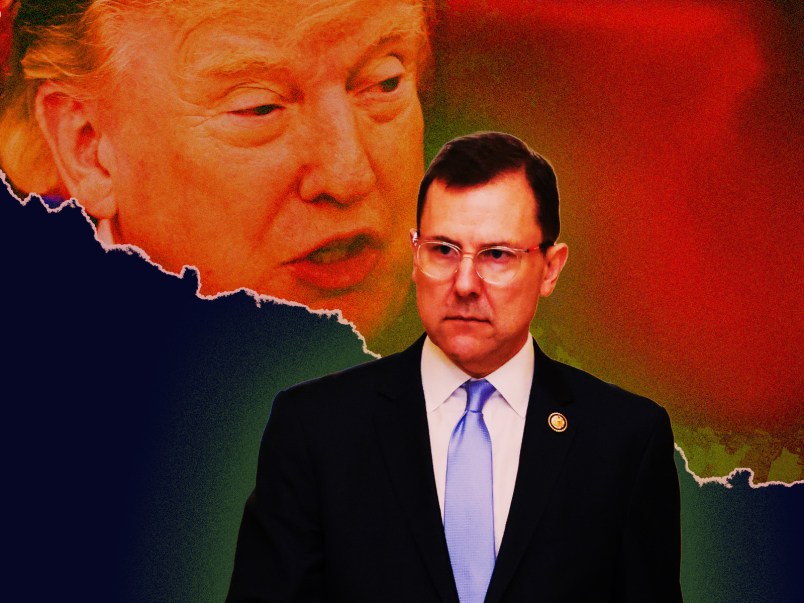
Republican Rep. Thomas Kean Jr (R-NJ) may be best known on the national scene as the son of the former New Jersey Gov. Thomas H. Kean and the Republican member of Congress who piqued curiosities when he missed months of votes earlier this year, later to reveal he had been hospitalized for depression. He’s also the Republican incumbent in a key battleground House race coming up next month where he faces an increasingly popular Democratic candidate in a race that the Cook Political Report now rates as “lean Democratic.”

Projections about the race started to shift in mid-September. While Kean was able to flip New Jersey’s 7th Congressional District back in 2022 (mind you, after the seat went to a Democrat for the first time in decades in 2018) and he won reelection by five percentage points in 2024, President Trump won the district by just about 1 point the same year. So, it was hardly an exercise in bravery when he decided to aggressively break with Trump on a few key issues during debates with his Democratic challenger Rebecca Bennett last month.

But Kean was one of the first Republican candidates this cycle to break with Trump on an issue that TPM has been following closely throughout Trump’s second term, as he innovates on the idea of political retribution against his perceived political foes and those who did not vote for him for president. I wrote about Kean breaking with Trump in detail here, but, in essence, Kean, on the debate stage, stood up for the infrastructure projects that Trump’s White House decided to shut down as part of some Russ Vought-led anti-DEI retribution campaign against blue state and city officials in the New York City/New Jersey area.

“I will challenge anybody who gets in my way, including this president,” Kean said last month, when asked about the Trump administration’s freeze on federal funding for the Gateway rail tunnel project — a $16 billion infrastructure renovation plan for the tunnels that connect Manhattan to New Jersey.

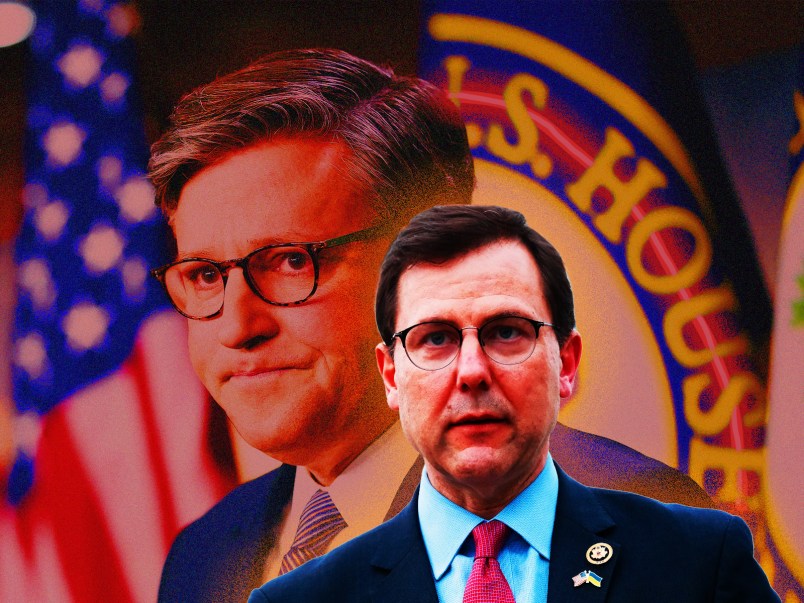
But the distancing from Trump may not be enough. It appears that Republican congressional leadership has all but written off his reelection campaign as a lost cause. While both House Speaker Mike Johnson (R-LA) and House Minority Leader Hakeem Jeffries (D-NY) have traveled to District 7 to stump for Kean and Bennett, respectively, the New York Times reported last week that there is a pretty glaring sign that the Republican Party has abandoned Kean’s bid. Per the Times:

Top Republican super PACs aligned with President Trump and congressional Republican leadership are cutting off financial support for two Republican House members seeking re-election, according to three people with direct knowledge of the plans.

The decision represents the first instance this cycle of national Republican groups abandoning incumbents as the party scrambles to prevent more widespread losses in the midterm elections.

Officials with the two super PACs decided to cancel all remaining advertising booked for Representative Thomas H. Kean Jr. of New Jersey and Representative Mariannette Miller-Meeks of Iowa over the weekend after internal G.O.P. polling had showed their re-election chances dimming.

The Congressional Leadership Fund, the political action committee aligned with Johnson, is reportedly “redirecting $10 million from the seats it is effectively ceding in Iowa, Michigan, New Jersey and Ohio and spreading it across 16 new districts, two of the people said,” in the Times’ words.

Campaign finance filings from last week show that Bennett out-raised Kean by more than $2 million last quarter, though Kean still holds a cash advantage overall. Despite signs of a potential flip, Kean’s campaign is projecting confidence he’ll hold the seat.

“This is still a very well-funded effort that will be at parity with our opponents,” Harrison Neely, a spokesperson for his campaign said. “And historically, that hasn’t been the case in this district, we’ve always been outspent.”
  •  

Russ Vought Takes a New Path Toward Overriding Congress

Programming Note

I’ve been gone for two days! I forgot to say on Thursday’s edition that I’d be taking a long weekend to hike Mount Marcy, New York’s highest peak, with friends. More on that further down. For now, I’m back, and pretty much here through the election. Which is in … just 35 days.

A New Reason for Susan Collins to Show ‘Concern’

I wrote earlier this month about the White House scheme to subject National Institutes of Health grants to a panel of political appointees who would ensure that each had been scrubbed of all wokeness. That plan seems to be on ice for now (though I expect it to be revived in some form after the midterms, depending in part on how the midterms go). Now White House Office of Management and Budget Director Russ Vought has a new scheme to mess with Congress’ ability to appropriate funds. It’s one he tried exactly a year ago: “pocket rescissions.”

A “pocket rescission” is a maneuver in which the White House notifies Congress that the fiscal year is ending without it spending funds Congress told it to spend. It is styled as a request for Congress to “rescind” the funds — a term that usually applies to a congressional vote to undo a previous spending law. But in the case of a pocket rescission, the White House is submitting its rescission request without leaving Congress time to vote on it before the funds expire at the end of the fiscal year. Thus, the year ends without the executive branch spending the funds the legislature told it to spend, and without Congress having a say in it.

“Pocket rescissions,” embraced by this White House, are widely considered to be illegal. The Government Accountability Office, a legislative watchdog agency that vets how congressional appropriations are or are not spent, has said so multiple times. But so far, that issue has not been extensively litigated.

Vought’s most recent “pocket rescission” details nearly $1 billion in funding that the White House did not spend, including money for refugees and immigrants and other programs that the reactionaries around Trump have deemed to be too “woke.” Some Republican lawmakers joined Democrats in squealing about Vought’s move. It’s particularly painful for Sen. Susan Collins (R-ME), the head of the Senate Appropriations Committee, which writes the spending bills the White House is now flouting. “We’re already looking at whether there’s language we can put in the next set of appropriations bills that would prohibit this from happening,” she said yesterday. “But it’s going to take some legal work.”

These dust-ups between Congress and the White House allow Collins, who is fighting for reelection, to make a show of taking a stand. But this has all happened before, and the Republican-led Senate did not do much to prevent the White House from repeating the maneuver. Vought even brazenly told Democrats in Congress in June he “had no plans” to engineer another “pocket rescission.” And yet, right on schedule, with the end of the fiscal year days away, he did again.

This stuff is a bit in the weeds, but we cover it because it’s a small piece of the larger Article I crisis in which we find ourselves. The White House continues to take actions, particularly when it comes to spending, that stomp on Congress’ powers under the Constitution. The sprawling war in Iran, which Congress has yet to approve in any form, is the most dramatic example. But in ways large and small, the White House is steamrolling Congress’ power of the purse — its constitutional power to decide how taxpayer money is spent — zeroing out programs that legislators wrote into law while pouring money into airing Trump campaign ads on television. Congress could reassert its power in myriad ways, but does not.

As a coda to that point, here’s Senate Majority Leader John Thune (R-SD), hemming and hawing his way to a non-answer on what the legislative body he leads will do here: “Whether you agree in substance or not with what they did, you can argue that they be good stewards, and some of these things may be things many of us agree with, but the process by which they did it is gonna be, I assume, subject to a lot of discussion and probably some litigation.”

Two Key Figures in Georgia Ballots Probe Leave Administration

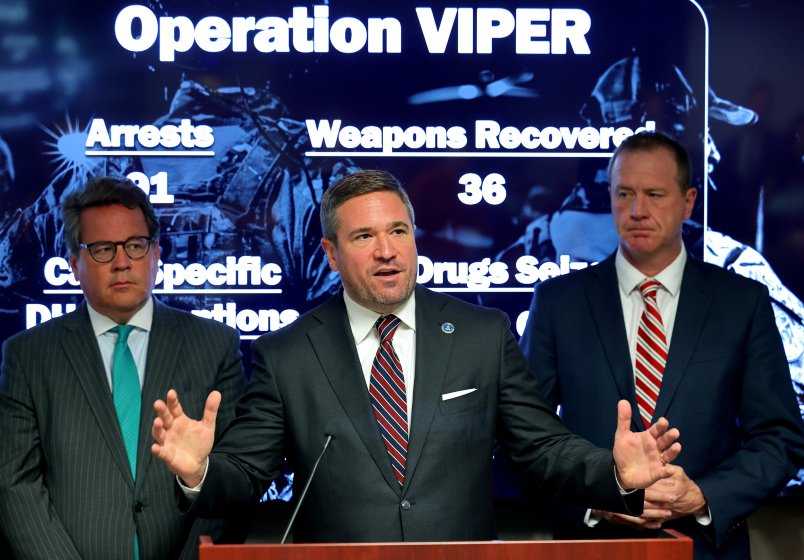
FBI Co-Deputy Director Andrew Bailey addresses the media during a press conference at the St. Louis FBI office on Tuesday, May 26, 2026, about results from the St. Louis-area surge of Operation VIPER. Operation VIPER (Violence Intervention, Proactive Enforcement & Response) is an FBI national initiative that focuses on violent crime reduction. (David Carson/St. Louis Post-Dispatch via Getty Images)

Andrew Bailey, the deputy director of the FBI, and Kurt Olsen, who once worked as Trump’s director of election security and integrity, have reportedly left their roles. Both were key figures in the raid on Fulton County, Georgia’s election office earlier this year.

  • Bailey was at the raid.
  • Olsen, a temporary government employee, made the referral to prosecutors that led to the raid.
  • Both are staunch conservative warriors. Bailey was the attorney general of Missouri — an office that tends to spearhead lawsuits that engage in various culture war issues — when he was tapped to become co-deputy director of the FBI, helping out Dan Bongino.
  • The New York Times reports that Bailey and FBI Director Kash Patel did not get along. His work in Georgia was one of his most visible moments as deputy director.
  • Olsen, a prominent 2020 election denier and former attorney for Kari Lake, has also reportedly left the DOJ, where he had worked for months on the “grand conspiracy” case against Trump’s enemies. Olsen faced issues obtaining a security clearance, the Times reports.
  • That case appears to have been an attempt to paint an overarching narrative that rolled together the many first term investigations into Trump’s misdeeds into one investigation of the investigators. But the wheels seem to be coming off: You’ll recall the lead prosecutor, conservative warrior Joseph diGenova, quit earlier this month, telling the New York Post, “If you want indictments where there’s no evidence, you have an ethical problem.”
  •  

Vulnerable GOPer Breaks With Trump’s Retribution Crusade Against Blue States

‘I Will Challenge Anybody Who Gets in My Way’

My colleagues and I have been tracking the creative ways in which vulnerable Republicans up for reelection in November have been distancing themselves from President Trump in recent weeks, as his approval rating craters — due to his war in Iran and rising gas prices, the ongoing affordability crisis generally, his inhumane immigration crackdown, and the role he’s played in ushering in a new Big Tech oligarchy, among other reasons.

This has taken different forms. Only half of the Republican candidates running for office or up for reelection this fall showed up to his Trumped-up party convention in Dallas earlier this month. Others have edited or scrubbed language from their campaign sites to put some daylight between themselves and Trump’s political toxicity. Others have tried to walk a very narrow line between backing the president’s agenda, while distancing themselves from his most unpopular actions this term. This has taken its most colorful, entertaining form in the data center dance some Republicans are performing.

We’ve got a new example of a vulnerable Republican contorting himself to distance himself from Trump this weekend that also converges on a theme that TPM has been focused on during Trump’s second term, as he weaponizes the executive branch for his own political aims. Condemning Trump’s retribution crusade, both against his perceived political enemies and blue states and municipalities as a whole, has been a regular talking point for Democrats the last two years. You don’t really catch Republicans talking about it — or acknowledging it for that matter. And while Rep. Tom Kean (R-NJ) did not directly criticize the retribution campaign the Trump administration has waged against New Jersey, he distanced himself from it during a debate on Sunday night.

Kean, you may recall, was absent from Congress for months earlier this year as his office cryptically attempted to keep his hospitalization due to depression under wraps. He acknowledged his situation bravely and publicly when he returned to Congress after missing more than 100 votes, and was roundly mocked for his honesty by the far-right, rage baiting congresswoman, Rep. Lauren Boebert (R-CO) and others.

Kean is facing a tough reelection challenge from Democrat Rebecca Bennett, a former Navy helicopter pilot, in a race rating that Cook Political Report recently switched from a “toss up” to “lean Democratic.”

During the debate on Sunday evening, Kean broke with Trump on the Lake America drama, and some key issues, including announcing his opposition to the Trump administration’s plan to open an Immigration and Customs Enforcement immigrant detention center in his district. He also vowed to fight the administration’s blockade on funding for the Gateway rail tunnel project — a $16 billion infrastructure revamp to build a new train rail tunnel beneath the Hudson River and to make repairs to the 100-year-old tunnel that currently connects New Jersey to Manhattan.

In February, the Gateway Development Commission sued the Trump administration for withholding funding for the project, and in June a federal judge permanently blocked the Trump administration from freezing the funding.

But it is all tied to an early-in-Trump-II endeavor by Trump’s Office of Management and Budget Director Russ Vought to punish New York City — and specifically, the Democrats who represent the city’s constituents. Officially, Vought announced in September 2025 that the Trump administration would withhold “roughly $18 billion” in federal funding from New York City for infrastructure projects, claiming “unconstitutional DEI principles” followed by the construction companies completing the projects. Per a Politico report from October 2025:

The Department of Transportation had written New York to inform the state the two projects were under administrative review to determine whether the state was subsidizing infrastructure contracts with taxpayer money based on discriminatory principles, referring to DOT’s Disadvantaged Business Enterprise Program.

However, it was around this time that the government shut down for the first time in Trump’s second term, primarily because Republicans refused to negotiate with Democrats on how to address the unfolding health care crisis spurred by then-expiring Affordable Care Act (ACA) subsidies. It would later become the longest government shutdown in modern history. Trump administration officials quickly found a way to show their cards — revealing that the frozen funds for the project was less about some amorphous use of woke DEI hiring practices and more about punishing Democrats and the people they represent.

“Until USDOT’s quick administrative review is complete, project reimbursements cannot be processed, including a $300 million disbursement for the 2nd Avenue Subway. The remaining federal funding for these projects totals nearly $18 billion,” a Department of Transportation spokesperson told Politico at the time. “Thanks to the Chuck Schumer and Hakeem Jefferies shutdown, however, USDOT’s review of New York’s unconstitutional practices will take more time. Without a budget, the Department has been forced to furlough the civil rights staff responsible for conducting this review.”

And so, on Sunday, when he was asked about the funding freeze, Kean did not, of course, get into the Trump administration’s broader retribution assault, but he did try to plow some middle ground in defending the project and breaking with the president.

“I will challenge anybody who gets in my way, including this president,” Kean said.

  •  
❌