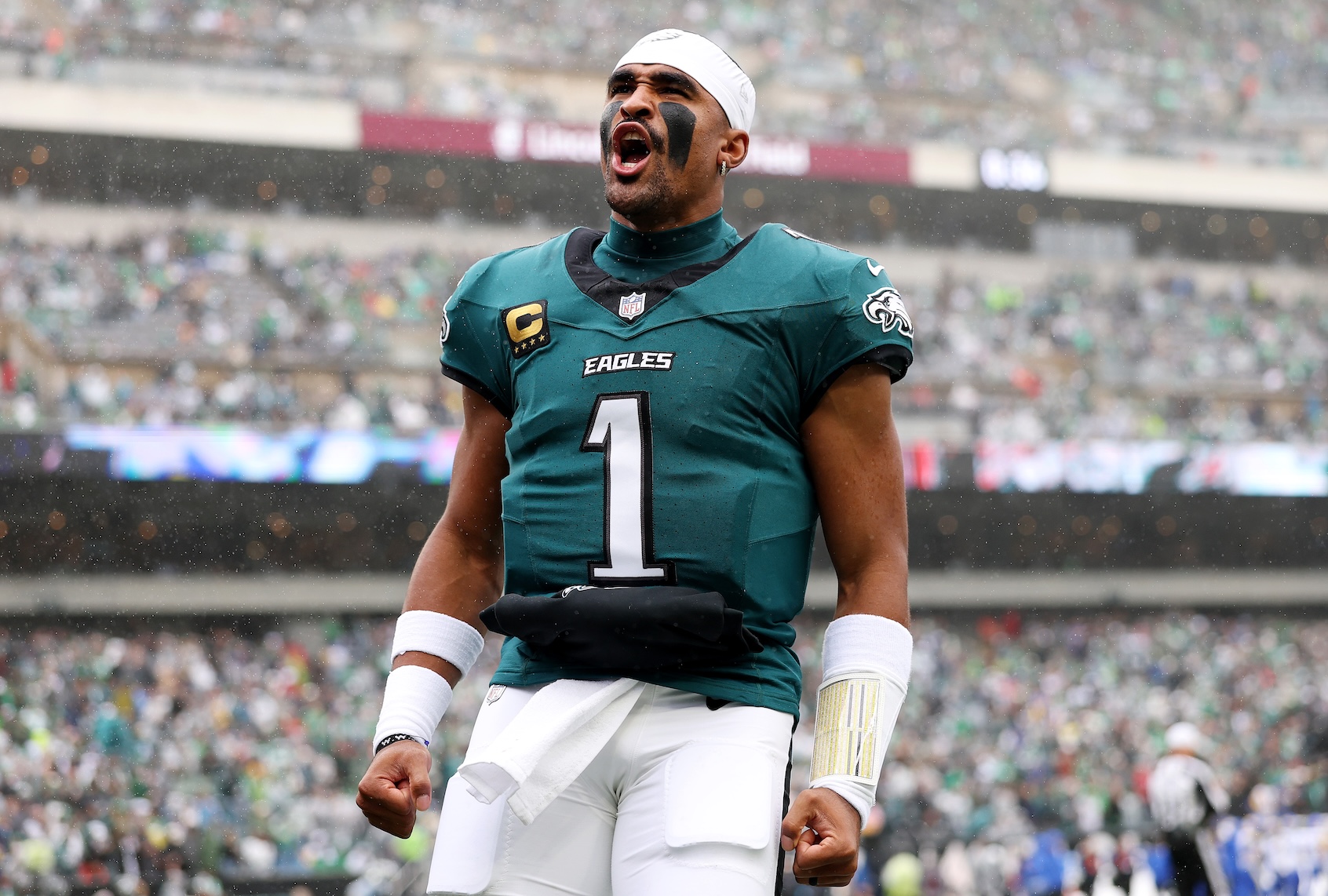
Jalen Hurts, the Philadelphia Eagles’ starting quarterback, is out for the season to recover from a deep vein blood clot, found after arriving in London for the game in which Hurts played between the Eagles and the Jacksonville Jaguars.
A Philadelphia sports columnist argued a few years ago that if Brock Purdy, the San Francisco 49ers quarterback, were the Eagles quarterback, he “would be a god in Philadelphia,” because of his underdog story. Hurts is an underdog as well. The difference is that Hurts is Black and Purdy is white. But like Michael Jordan’s flu game in the 1997 NBA Finals, where he played sick, playing a football game after being diagnosed with a blood clot and getting little to no rest seems godlike enough to cancel that columnist’s point.
However, questions have largely landed on Hurts. Questions about his leadership, aptitude, and attitude as the Philadelphia Eagles’ quarterback, and now about the severity of a blood clot and his commitment to the season amid roster challenges. The most egregious came from Michael Robinson of the NFL Network, who said that, in relation to Hurts’ current injury, Hurts seemed to be saying, “If everybody’s hurt, then I’m hurt too.”
But Hurts has a blood clot. Initially, it was diagnosed as a superficial vein clot, and now it is a series of deep vein clots that have since traveled to Hurts’ lungs. He’ll miss the rest of the season while he receives treatment but is expected to fully recover according to his agent Nicole Lynn. Hurts didn’t make his condition up. It wasn’t a cop-out for a season that seems to have gone down the drain. It’s the truth. Sadly, Hurts hasn’t been given the benefit of the doubt.
Hurts is perhaps one of the most disrespected players in the NFL as, in commissioner Roger Goodell’s words, a “face of the league.” National media pundits, Philadelphia media pundits, and even some Philadelphia Eagles fans disrespect him. Of course, Hurts has a cheering section, but their voices are often drowned out by the chorus and echoes of criticism. The narrative was that the 2026 season was make-or-break for Hurts, after a season when some were all too eager to offer “evidence” of Hurts’ share of the team’s offensive woes.
However, that same make-or-break standard hasn’t been applied to many of Hurts’ peers, even those who have accomplished less than Hurts. And while a contingent of Eagles fans wants Eagles head coach Nick Sirianni fired, it’s not a make-or-break season for him. Even after hiring his friend as offensive coordinator, who was clearly incompetent, or after showing himself to be inept as an offensive mind.
So what about Hurts engenders so much criticism and makes him such a polarizing figure? Last month, ESPN pundit Dan Orlovsky said Los Angeles Chargers quarterback Justin Herbert (compared to Hurts) is “what it should look like.” What about Hurts doesn’t look like how a quarterback is supposed to look? I thought a quarterback should look like a Super Bowl MVP? A better question is: how would any ex-backup quarterback, paid to define what a good, great, or elite quarterback looks like, know what that quarterback actually looks like? I assume because they’re familiar with what it doesn’t look like, but I digress.
It can’t be because he’s not a pocket passer, checked out of plays, or stoic and cryptic. It could be because women find him very attractive, making the manliest of men very insecure. Maybe it’s because some folks believed any part of the AJ Brown nonsense. But I suspect it is deeper than that. You probably won’t like the answer I am about to give, but you know what’s coming: Racism.
Racism has long been a part of the NFL’s history: long before Colin Kaepernick and Brian Flores; long before the league’s history of race-norming to prevent Black retirees from accessing concussion settlement claims. The racism goes as far back as 1933, when the league instituted a ban on Black players. Once allowed back in the league in 1946, a sorting process known as racial stacking was instituted due to the widespread belief that Black athletes weren’t smart enough to play quarterback.
The city of Philadelphia doesn’t get a pass on its racist history simply because more Black quarterbacks have started games than white quarterbacks for the Eagles over the last 40 years. Randall Cunningham, Donovan McNabb, and Michael Vick have all faced their share of racism disguised as criticism at the position. It’s Hurts’ turn to receive some of that same criticism, I suppose, but what fuels it is especially disgusting.
“They play a game, but they aren’t here to play games.”
Hurts isn’t an Allen Iverson-like figure whose tattoos, cornrows, and “posse” make him easily labeled as a “thug.” He isn’t a Joel Embiid-like figure whose struggles on the court and history of missed games make him easily labeled as “lazy.” He’s not a womanizer, he’s not violent, and he’s not unintelligent. He’s none of the easily identifiable tropes placed upon Black people.
Hurts is, however, unapologetically Black.
The unapologetically Black person wears their Blackness every day, regardless of who is offended or discomforted by it. They aren’t phased by narratives designed to devalue their accolades and their acumen. They embrace themselves and their culture. They’ll speak, behave, relate, and respond in ways unfamiliar to the mainstream, soliciting criticism from a lens filtered by whiteness, labeling anything but white as a failure to meet a standard of posture and decorum. In short, they’re not here to make white people comfortable.
Hurts is proud to be a Black man. He makes crawfish, listens to Frankie Beverly and Maze, and doesn’t ingratiate himself with the sports media machine, largely a white institutional space. He doesn’t yell at officials in a display of passion like Tom Brady, only to be treated like Dez Bryant. He doesn’t respond to media questions the way some journalists believe he should; he doesn’t “scratch where [he doesn’t] itch, and laugh when [he wasn’t] tickled.” He isn’t happy to be in front of the media, like so many more “appreciative” athletes posit themselves to be. As Hurts has said himself, he had a purpose before everyone had an opinion. That goes for white and Black sports media talking-heads alike, whether Emmanuel Acho, Doug Gottlieb, Linda Cohn, or Stephen A. Smith.
The unapologetically Black person may be the most threatening entity to the current social order of the sports industry. They’re threatening because they’re not consumed by the traditional effort to posit themselves as “respectable” in an industry predicated on Black athletes “knowing their place.” They’re not consumed by a desire to appear thankful for the privilege to make money from playing sports. They play a game, but they aren’t here to play games.
However, we live in a culture of hot-take artists who want the immediacy of fame rather than building a record of credibility and significance. The talking heads are all too willing to critique Hurts and others like Kyrie Irving and Angel Reese, only to eat crow each time they accomplish something on the field or on the court. For example, Angel Reese’s critics are eating crow after she became only the 3rd player in WNBA history to post 30 points and at least 15 rebounds in a WNBA Finals game. Reese had 30 points and 16 rebounds.
Nevertheless, racistly-coded commentary disguised as asinine takes will continue, because those takes continue to fuel the careers of formerly respectable journalists while establishing new careers for former athletes whose trajectory mirrors that of their playing days, serviceable at best, but likely missing the mark. That commentary vis-à-vis Hurts is the only reason some of these folks are relevant. But when it comes to Hurts, the only relevant thing is that he played a football game with a condition that became life-threatening, and the only critique worth levying and entertaining is that, against the Philadelphia Eagles, there was negligence in their handling of Hurts’ health. As for Hurts’ haters, his performance against the Jaguars in London under the circumstances we now know will be praised. It has already started.
I guess all it took was almost dying … godlike behavior. But Black people working to death in exchange for white acceptance is a rite of passage imposed on Black folk. It’s the American way.
He might look like something found in the dumpster at a Lynyrd Skynyrd concert. He might shamelessly plunder the sonics of decades of deep-fried and gravy-smothered hits. But despite everything about his presentation and performance, Kid Rock is not actually southern.
If he were, he might have done the friendly thing and warned Eminem off of collaborating on “Heal My Faith,” a song on his recent Christian album “Halfway 2 Jesus.” He might have stopped his longtime friend and fellow Michigander from irreparable reputational damage. Instead, he let Slim Shady learn a hard lesson that true southerners know: You lay down with dogs, you wake up with fleas.
“Heal My Faith” is genial to the point of being unmemorable, a bit of cringy Christian pablum that encourages loving someone even when you’re outside of the pit. It’s student-athlete core, a mish-mash of choirs, electric guitar noises over pounding drums that all sound like keyboard presets. Kid Rock’s contributions are entirely lifted from inspirational T-shirts, table scraps from rejected Jelly Roll songs. The result is that “Heal My Faith” offers very little to chew on — until Eminem shows up.
The boilerplate praise chug of the song has one upside: It forces the “Rap God” to slow down. Left to his own devices, middle-aged Eminem has been the hip-hop equivalent to masturbatory guitarists, his late-stage work full of technically impressive displays of chops that nonetheless lack the fun and melody of his radio hits. Hearing him enter the song with a flow that’s not indebted to a J.J. Fad outro offered a glimmer of hope. But it was short-lived.
On “Heal My Faith,” the rapper who first gained mainstream attention by lighting the pop chart’s sacred cows afire wonders why we can’t all just get along. It’s shocking stuff from the rapper who famously mused about dropping an “awfully hot coffee pot” on Donald Trump in a freestyle at the BET Hip Hop Awards in 2017. Now, Slim Shady seems to be saying, “We might believe in fundamentally opposed directions for this country. We might differ on the idea of extending dignity to all people, but can’t we put that aside for the sake of a new single you can buy?”
You don’t need to hear it. You’ve already heard it. It’s the realm of purple state campaign ads and Earthbound Trading Co. bumper stickers. It’s junk, and Eminem seems to know it.
How else can you explain a verse that is 90% throat-clearing and preemptive dodges of the backlash he knows is coming? Eminem spends bar after bar defending his decision to even appear on the song, touting his decades-long friendship with Kid Rock and their intertwined history in the music industry.
He talks about their shared roots in Detroit’s music scene, and how their paths crossed again and again. He details an early CD release party at length, where the more established Kid Rock showed up to lend support to the emerging rapper. It isn’t until the closing lines of his verse that Eminem turns to God and the brotherhood of man.
“Liberal and evangelical can agree,” he raps. “It’s God first, home of the free.”
Reputation-wise, the collaboration does far more for Kid Rock than it does for Eminem. The former has long been fully consumed by Trump World, becoming more of a standby entertainer for MAGA events than a rock star. Eminem, on the other hand, once told fans who supported Trump to stop streaming his music.
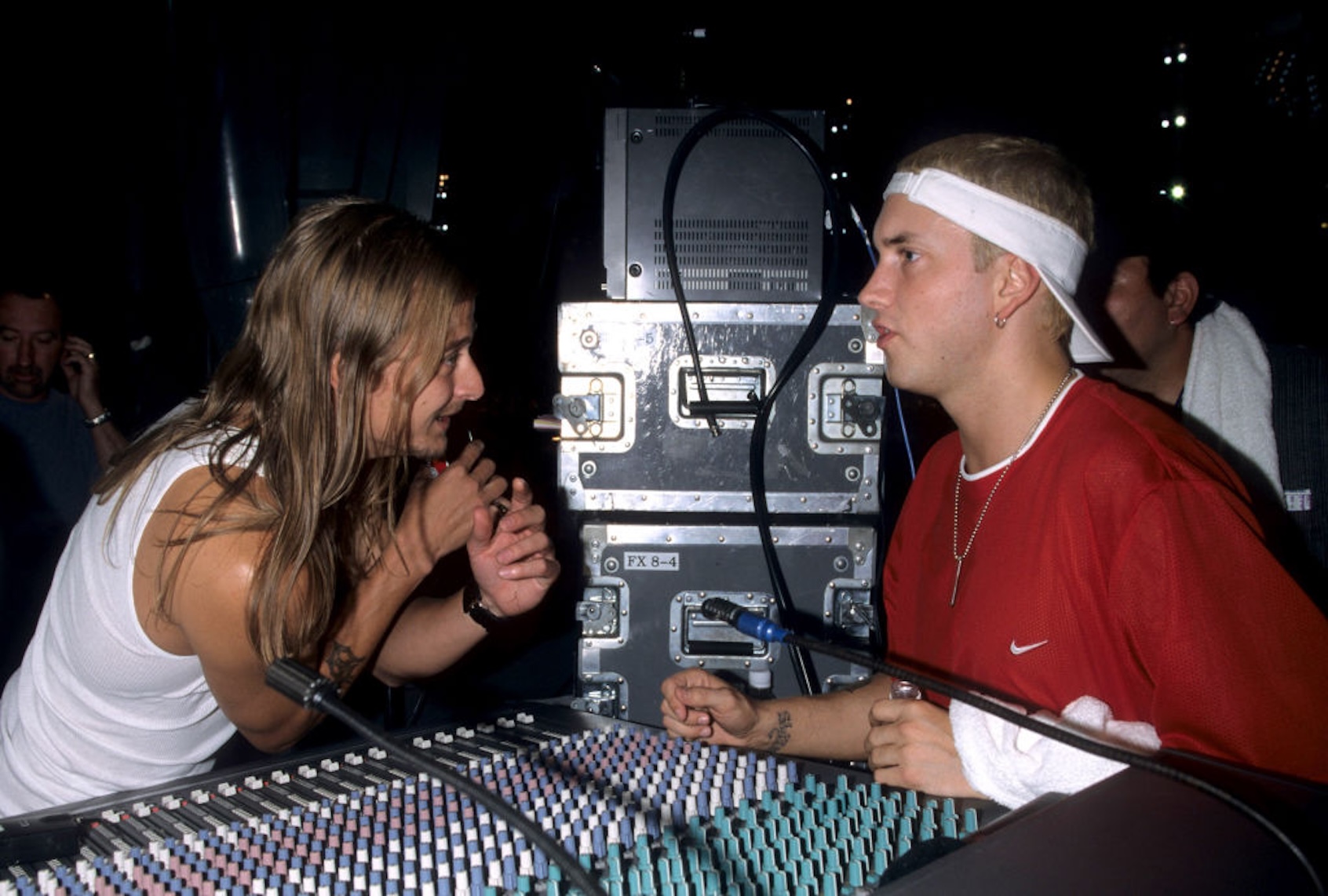
(Ke.Mazur/WireImage) Kid Rock and Eminem during Experience Music Project Opening Gala at Experience Music Project in Seattle, Washington.
Rock told Billboard that he hadn’t planned to “drag [Eminem] into my political world,” but he had to have known that was impossible. The nod from a supposed Trump critic removes a small bit of the stain on Kid Rock, but it also transfers directly to his collaborator.
Eminem might have been hoping to build a bridge with this collaboration, but at least according to his Instagram comments, his fans aren’t ready to get over it. One commenter assured him that it’s okay to cut off a friendship “over moral differences.” Another said Eminem’s line in the sand against Trump must have been “brushed back into the beach.” The rapper’s newfound neutrality, one wrote, still amounted to “choosing a side.”
You can’t feel too bad for Eminem, who’s had plenty of opportunities to see that who you rap with is who you are. After all, more than a year after her breakout single “What I Want,” which she recorded with the controversial country music star Morgan Wallen, the pop singer Tate McRae is still being confronted by fans and interviewers with questions about the pair’s collaboration.
Wallen, who’s been given about as many second chances as gold records, has never explicitly identified himself as a supporter of the MAGA movement. But his history of using slurs on camera, the general nastiness of his dejected young man music and a massive social media tiff with “Saturday Night Live” have solidified him as an anti-woke warrior in the popular conception.
“It’s crazy to think that one song could define a whole person,” McRae told W Magazine earlier this month.“There are many aspects of my personality that three-quarters of my audience has no idea about. You hope one day you figure out a way to show all aspects of it.”
There’s little chance that Eminem will face such questions in the future, if only because his career as a hitmaker is basically over. He was something exciting and fresh when he pantsed the pop culture landscape in the late 1990s, but joking about how much everything sucks is a young man’s game. Coming from an older man, it just sounds bitter and out-of-touch.
Different listeners draw the start of his decline and the end of his relevancy at different points. Most agree that the zeitgeist of rap started to shift away from the stubbornly anachronistic rapper sometime around the end of the aughts. In 2013, he released a well-received album seemingly purpose-built to cap on his career, and then he just kept going. The 23-year-old McRae, on the other hand, will have her past decisions dug up by what remains of the music press after each new chart smash. Eminem may well be staring down a future where his regrettable decision to record contemporary worship dreck with Kid Rock generated his last real headlines.
It’s something the culturally savvy clown of Eminem’s early career would have been smart enough to avoid.
Ultra Right Beer, a brand launched in 2023 by MAGA political consultant Seth Weathers, has vanished from the internet with many deliveries unfulfilled.
In so-called normal times and under business-as-usual administrations the job of White House Press Secretary doesn’t lead to renown or infamy. Those terms — normal, business as usual — don’t apply to Donald Trump’s tenure in the Oval Office, and his press secretaries have become household names mostly for the wrong reasons.
Sean Spicer’s claim to fame is being a terrible liar and an even worse dancer. Sarah Huckabee Sanders distinguished herself by reducing the once-frequent White House press corps briefings to very occasional insult exchanges peppered by lies. Her successor Stephanie Grisham, meanwhile, spends her time appearing on the One America News Network, Sinclair Broadcast Group stations, and Fox News instead of serving as a liaison between the press corps and the Oval Office.
More than 300 days have passed since the White House has held a news conference with reporters. In light of the recent saber-rattling between the U.S. military and Iran, that number is stunning. Times such as these require an official briefings from the White House and the military, who are charged with a duty to convey information to citizens via the press corps with clarity.
Such times also present tremendous opportunities to spin the administration’s actions in a persuasive light, leading citizens to have confidence in its actions. Indeed, Ari Fleischer used his position as George W. Bush’s press secretary to sell a war that has been dragging on now for 17 years.
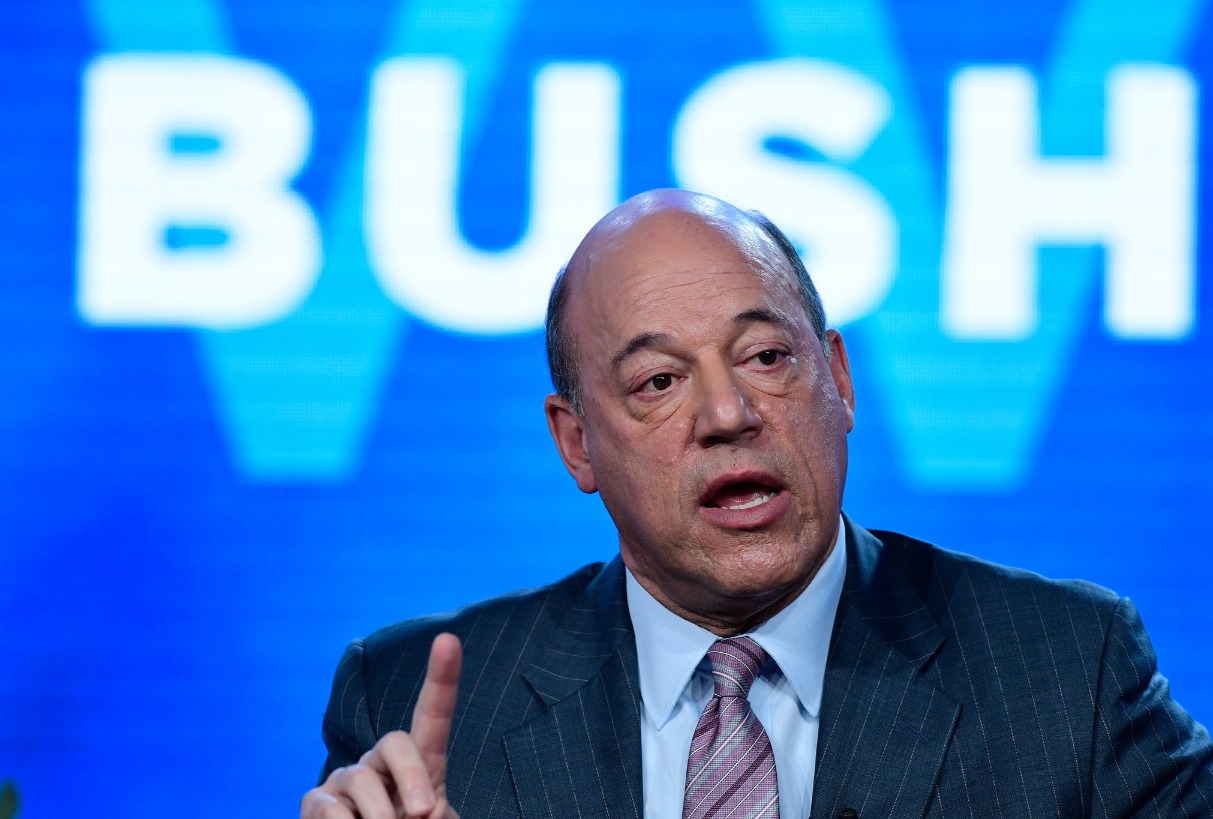
On Friday, Fleischer appeared in Pasadena to talk about the upcoming “American Experience” profile “George W. Bush,” part of PBS’ day of press conferences at the Television Critics Association winter press tour. This is where Salon sat down with him for an interview that took place before the “American Experience” panel.
Right around the same time, 13 former White House press secretaries, military and foreign service officials published a letter on CNN calling for the restoration of regular press briefings.
“An informed press corps strengthens our ability to govern,” the letter states. “Yes, presidents are now able to communicate directly via the internet, social media and tweets. But most Americans will learn about the work of the White House in the reports they see, read, and hear in what we collectively call ‘the press.'”
The statement then observes that regular White House briefings generally lead to better and more responsible reporting, later adding, “In times of military conflict and international crisis, these briefings take on even more importance. Americans want to know the latest developments and seek the truth. On social media, wild rumors can fly, and our adversaries can manipulate disinformation to their advantage. This is now well documented.”
“For that reason, among many, the country needs trusted sources of information delivered on a timely and regular schedule. That is the fundamental responsibility of people who serve as spokesmen and women for presidents, cabinet secretaries and other high-ranking government officials.”
White House spokesman Hogan Gidley responded to the letter by calling its writers “D.C. establishment swamp creatures.”
Among those who signed are Victoria Clarke, who worked under Defense Secretary Donald Rumsfeld, and Scott McClellan, who worked under Bush as his press secretary.
Missing from that list are McClellan’s fellow Bush-era press secretaries Dana Perino and Fleischer. Perino is now a Fox News anchor, and Fleischer is a contributor at Fox News.
In this one-on-one conversation with Salon, Fleischer talked about his view of the press’ relationship with the White House in the current climate and was asked to reflect on his time as press secretary to the second President Bush, specifically with regard to conveying false information about Saddam Hussein possessing weapons of mass destruction that led us to the U.S. invasion of Iraq in 2003.
Please note that this interview has been lightly edited for clarity and length.
I don’t know if you read the recent Twitter challenge from authors Don Winslow and Stephen King to Stephanie Grisham.
No, I haven’t.
They stated that if she would hold a press briefing, they’ll give $200,000 to St. Jude’s Charity. This was a serious offer, speaking to the fact that there has not been a White House press briefing for more than 300 days.
Yeah.
You held that job and observed the traditional means of operating as an information bridge between the White House and the press corps. So what do you think about the fact that the last couple of press secretaries have been not only less approachable, but granting less access to official information coming out of the White House?
I’m a traditionalist, so it concerns me a lot and there’s a tremendous value to the briefing. There certainly was during the Bush era, and historically now, the advantage to a president is you have people reinforce his message and buttress what he says. The advantage to the country is it gives reporters a chance to ask more probing, longer follow-up questions.
But everything’s changed now in this era of hostility between President Trump and the press. And I’ve never seen such rancor and hostility in both directions. And so as much as I’m a traditionalist and see the benefits of the briefing, I don’t know that if they brought the briefing back in this current environment, it would serve the press, the public or the press secretary any good cause. I just think it would turn the room into nothing but a TV show that was full of nasty arguments both directions.
I’m not going to disagree with the partisan rancor in this country. That is abundantly clear. But I do not believe that what you’re saying about the animosity in terms of the press, particularly the actual people in that briefing room, is justified.
I say that because there is a habit nowadays, as we’re consuming media, of conflating the people who are on the ground and in that room doing their job as journalists and asking questions, with punditry. You know this. You’re a pundit. So I understand that you’re going to have a viewpoint on this topic that’s going to be a bit skewed. But I just want to say that when you’re blaming both sides, I need to disagree with that.
The questions that are being asked are probing and they’re certainly pressing tough issues with the president. But I would also say that the reaction the president has had, and the press secretaries from Sean Spicer to Sarah Huckabee Sanders and now what we seen of Stephanie Grisham, that is where the rancor has showed up. And you can call me biased on the behalf of those journalists, but when I’m watching the news, the rancor is really elevated from the [White House] side.
Just one other factor I’ll mention – and I’ll come back to that. But there’s another big factor here that’s changed things. And that’s the accessibility of the president himself versus President Obama, President Bush, President Clinton. No predecessor has been as open and accessible to the press as the president himself. And that is the primary job of the White House press corps, is to ask the president hard questions. So he’s doing it on virtually a daily basis, whether it’s a good day for him or a bad day —
As he’s getting on a helicopter with very loud rotors where he limits amount of time spent answering questions.
—that matters. I mean, if you’re, if you’re sitting there, they’re getting seven, eight, nine, 10 questions —
They’re getting in a couple of questions repeated seven, eight, nine, 10 times…And he’s not really answering those questions.
I don’t think that’s the case.
I’m just saying that there’s a difference between those formal briefings, which as you know, you have a controlled environment that you, as the press secretary, used to your advantage. Just in terms of being able to distill information accurately and effectively to the press. What you did, and I’m not saying this was right, but you distilled the message to the press, and the press gave it credibility and repeated it. I’ll also say the press should have questioned you even more. I would say that to every press secretary.
But the role that the press secretary plays carries a certain level of respect with the press. By saying Trump is more accessible, that doesn’t necessarily mean that the press is getting a better value in the information he’s sharing.
That’s on the press, not on the president. They have daily access and the press can get out of it whatever they seek. And I don’t think venue matters. They have access to the president, which is an improvement over prior White Houses for the press. So given the fact that the president is so accessible, I still wish as a traditionalist there were the briefing, but I’m realist enough to know that that rancor, that hostility would turn into a nasty red hot TV show where the few grandstanders in the room will spoil it for the lot of them, particularly print reporters who really do just want to get questions answered.
[CNN White House correspondent] Jim Acosta, for example. He acts like a pundit when he should be a correspondent. He states his opinion. He tells the White House what they should be concluding, and I think it’s that type of grandstanding along with the breakdown of the media in the modern era that has led to such polarizing media outlets. We used to have a much more dedicated, neutral fact-finding press corps and now, in both directions, the press takes stands for and against. And I think that’s a reality that’s going to live long after President Trump as well. There’s just been a breakdown on what the media represents that’s changed with this polarization. All of it in the Trump era leads me to think that as traditional as I am, and as constructive as the briefing can be, it makes little to no sense to fiddle with the Trump administration.
At the same time you have to also consider who is that in that room. You’re talking about the breakdown in the media. But there are people in that room who aren’t actually, and I am saying this politely, traditional media. They’re not even really media at all. The White House has invited propaganda machines into that room.
They’ve always been there.
So you’re saying this is normal, that you let in the likes of One America News, conspiracy bloggers ,and newsletter writers, you let those in during the Bush era?
Oh yeah. I mean, my approach during the Bush era was the press secretary should not be the person who decides who was or who was not media. There were people who worked for me who made that decision based on logistics and Secret Service reviews. I don’t think it’s helpful for the press secretary to decide you are acceptable as a journalist. That’s a thin line on thin ice. So I had people in there who were far, far left pundits and then far, far right pundits. That’s the way it goes. I’d spend most of my time taking questions from the front couple of rows, which is where the traditional mainstream outlets sit.
The difference now is that when Trump has appeared and asked questions, he’s gone to the “friendlier” outlets that aren’t actual news organizations. And that’s something as press secretary when you would brief Bush, my guess is, and you can clarify this, but I suspect you encouraged him to take questions from the traditional news outlets that carried the most weight.
He did, regularly. What really changed is the internet and social media has created profound changes in the way the media operates. And then breakdown of the media in terms of the polarization that the rest of the nation is going through as well.
When I was there, there was no Facebook, there was no Twitter, it was the dawn of the social media internet era. Toward the end of the Bush years, Twitter existed and Facebook existed, but I remember thinking if we ever wanted to produce a White House video, we would have released it through government channels and I’d have been hammered for creating government propaganda.
Technology changed, and the Obama administration regularly released YouTube videos and it was widely accepted. It was measured then by how many clicks it got as a measure of whether it was popular, whether it was successful. Gone was the notion that this could be propaganda even though the only difference was who carried it: YouTube versus the government channel.
Technology has really changed everything for the media probably in many ways that are positive in many ways that are negative and we’re still flushing that out.
Let’s talk about that. A lot of your tweets and recent interviews have been quoted. You are getting on Fox News and saying a lot of things in the moment, that you’re having thrown back in your face and you’re being asked to defend yourself.
I’m talking about everything that’s happening in Iran, the missile strikes in Iraq, and all the reaction around this new conflict in the Middle East. People have taken issue with your recent initial reaction of “we’ll be greeted as liberators,” which is what you said in 2003. After that, there were marches in the streets of Iran showing that not to be the case.
Looking at this part of a 17-year war – one which you had role in starting – it’s curious to me that now, 17 years later that you wouldn’t look back and observe that maybe we shouldn’t be doing this, maybe we shouldn’t be increasing tensions with Iran.
Yeah, I’d do it the same way I always have. And that’s to say what I believe. It’s not complicated.
Not even in hindsight?
First off, you have to make the distinction between the military operation, the war itself, and then the occupation. The aftermath fact is from March of 2003 till roughly July, August of 2003, we were greeted as liberators. You could go to cafes and downtown Baghdad, sit outside and have meals. It was a peaceful city. People welcomed the Americans. Starting in the fall of 2003 predominantly, that’s when the occupation turned terrible. And that’s when we start to lose many more lives. And that’s when the tide turned.
So two things can be right at the same time. We were greeted as liberators, and then a guerrilla war became a highly successful guerrilla operation. And we didn’t handle the occupation, right? We handled the military invasion. We didn’t handle the occupation.
But I’m talking about the information that was dispensed to the press before the war.
I’ll get back to that. The other big thing was the issue of weapons of mass destruction. This is an entirely legitimate issue. Of course, I faithfully and accurately reported to the American people precisely what the CIA concluded. The CIA concluded the Saddam had weapons of mass destruction, biological or chemical, no if, ands, or buts.
And the UN investigators went in and didn’t find any conclusive evidence of WMDs.
The CIA said that he had them. That was the CIA’s conclusion. And that was what the president relied on when he made the decision to go to war.
Now, tragically, that intelligence turned out to be wrong, and we all acknowledge that that’s what led to the creation of the war. They called the Robb-Silberman Commission, a bipartisan investigation into how and why it went wrong. Their conclusion was it was an intelligence failure. That’s the heart of it.
And to this day, I’m certain that if the CIA had said to President Bush, “We don’t know. We’re not sure if he has weapons of mass destruction or not,” there never would have been [a war].
And the tragedy is the information turned out to be wrong and we went to war based on a wrong conclusion by the CIA.
Famously, you said that you didn’t support Trump in the election. But you do now. At what point do you look at the events that are either connected to Trump or that he’s precipitated in terms of tensions not just between party but also between the people of this country and say to yourself, “Enough is enough”? Or, “You know what? Looking back, I might not have been correct in this initial assessment”? At what point do you maybe reassess and actually say in public, “Maybe I wasn’t correct?”Do you apologize for anything?
In the primary, I voted for somebody else. I wanted to be for him in the general against Hillary Clinton. And as I watched it all unfold, I ultimately left my ballot blank at the presidential level and voted for him all the levels below president. And as I have watched President Trump, there are many times I have criticized him and there are many times that I have praised him. I’m not afraid to be independent and call it as I see it.
I regularly defended [Special Counsel Robert Mueller] because I know Bob Mueller. I know what a man of integrity is. I was one of few, if not the only person, on Fox News from start to finish to defend Bob and Bob Mueller’s honor and integrity and how he conducted that investigation. And I’ve never hesitated to criticize the president on Twitter or on Fox News.
. . . So I don’t hide what I think or say. And I think one of the highest duties you have having once worked at the White House is no longer to be a spokesperson for any one president or cause. That’s what I used to do with tremendous pride. Now the more important thing is to try to shine a light on what’s right, what’s wrong, what worked, what didn’t, and explain it.
And that’s what I’ve tried to do with President Trump. There are things that he’s done that . . . I don’t support his manner. His style is not mine. It’s not like that any of the people that I’ve worked for. It’s too truculent. It’s too offensive.
But I’ll also point out that many of the criticisms against him are too truculent and too offensive. He’s been called Adolf Hitler, he’s been called Mussolini. As soon as he was the president-elect, a movement [arose] that was based on the word “resistance,” which was the word used against the Nazis in France. . . . Talk about going beyond the norms. These are all actions beyond the norms.
But do you believe that he has been a normal president? You’ve worked for a man who I think people would say operated within the social contract of what we expect from a president.
He’s the president that the American people through the electoral college elected. And I see a lot of people who rejected that, who tried to overturn it in the electoral college, if they could have, who are now trying to overturn it through impeachment if they can. And I think that is equally, if not more so, violative of the norms that I believe are important to the traditions that George Bush represented and the people that I used to work for represented. So I think there’s way too much hostility in the system. But it’s on every side. It’s not just President Trump.
Just to clarify, what would you say those norms are?
To treat people you disagree with, with respect. When President Obama was reelected in 2012 I tweeted the next morning, congratulations to President Obama. He’s my president and he’s all our president. I think that’s the way we should all be. That’s how you show respect for the American people and the decisions made within our constitutional system. I didn’t vote for President Obama. I voted for Mitt Romney, but I recognized he’s my president. As soon as President Trump was elected, you had this massive movement on Twitter and social media saying, “not my president.”
That same thing happened with Obama.
But not by me. You’re asking me questions of me. That’s why I said to you, I instantly tweeted, he’s my president. I wanted to strike that civil tone that much more representative of the Bush family’s tone. So if you’re asking about my behavior, I can just tell you what I’ve done. And that’s represented by what I believe about President Bush. and how you treat people, and how you should be civil with people even if you disagree with them.
You’re a contributor to Fox News and a lot of people have pointed out that Fox is one of the less respectful, less civil, less considerate proponents of discourse right now, particularly in politics. So when you’re talking about respect and civility — obviously they employ you, so there’s only so much you can say — but what do you see that they’re contributing to this conversation?
Well, I think you have to make a distinction between opinion shows and news shows.
Viewers don’t make that distinction.
But I think there is a distinction between the opinion shows and the news shows, and the news shows are superb. I think Bret Baier’s show at six o’clock is one of the best, most fair shows in journalism, and their daytime shows as well. I wake up in the morning, I watch CNN in the morning, and I watch Fox in the afternoon because I like the balance. I want to hear what all parties are saying and I think you can make many of the same points you made about Fox, about CNN and certainly about MSNBC.
So that’s part of that polarization, the breakdown in the media that I was talking about. But I also suggest if you see the things that I say on Fox, it is very much an independent voice and a voice that reminds people about the importance of civility.
This is the point I was making to you about Bob Mueller and I could give you dozens of examples where I’ve said things that were critical of the president and said things that are supportive of the president. I don’t have to be polarizing.
The “American Experience” two-part biographical profile “George W. Bush” with Fleischer airs Monday, May 4, and Tuesday, May 5 at 9 p.m., on PBS member stations.
The plaintiffs in the case K.M.K. v. Washington Interscholastic Activities Association effectively want the Supreme Court to bar trans women from women’s sports teams at high schools and universities. | Heather Diehl/Getty Images
One of the last decade’s most consequential changes to how the Supreme Court operates is the growth of the so-called shadow docket — a process that allows the justices to decide cases unusually quickly, and often without full briefing or oral argument.
Historically, the Court would typically allow contentious legal issues to percolate in the lower courts for months or even years before the justices agreed to decide one of those issues. Then they’d spend months reading briefs, hearing arguments, and debating the case amongst themselves before they finally issued an opinion. This slow process existed because the Supreme Court is the final word on many legal questions — the Court can even override Congress if it claims a law is unconstitutional — and so it should be cautious before it hands down a decision that cannot easily be displaced.
A new case, which recently arrived on the Court’s shadow docket, embodies all the reasons why America’s highest Court should act carefully and slowly. K.M.K. v. Washington Interscholastic Activities Association involves a highly contentious issue — the plaintiffs in the case effectively want the Supreme Court to bar transgender women from women’s sports teams at high schools and universities, even in states that support trans inclusion in sports.
It also involves an appalling sexual assault allegation. One of the plaintiffs in the case is a high school women’s team wrestler who is identified only by her initials because she is a minor. She claims that one of her wrestling opponents, who is transgender, “forcefully” penetrated the plaintiff’s vagina with her fingers during a match.
As a memo from the local prosecutor’s office points out, if these allegations are true then K.M.K. is the victim of a very serious crime — rape in the third degree. The prosecutor’s office, however, decided not to prosecute because it concluded that it could not prove that a sex crime was committed beyond a reasonable doubt. Among other things, prosecutors spoke to the referee who officiated the match, and he said that “nothing stood out to him during the match” and that “after watching the video of the match, he could not say that the suspect’s hand placement was ‘anything out of the ordinary.’”
The school district, meanwhile, says that it has reviewed video of the match, interviewed both competitors, and that its investigation into the allegation is “still ongoing.”
K.M.K., in other words, is exactly the sort of case that the justices should step away from, sending it back down to the lower courts to gather more information and to fully think through the difficult legal issues presented by the case. Setting aside the horrifying allegations against her one-time opponent, K.M.K.’s lawyers — most of whom work for a Christian right law firm, the Alliance Defending Freedom (ADF) — make novel legal arguments that ask the Court to make broad pronouncements that go far beyond its previous precedents.
One of their arguments, if taken seriously by the justices, could potentially make it impossible for any school athletes, whether cis or trans, to participate in competitive sports of any kind.
There is a very real risk, in other words, that the Supreme Court will, if it moves too quickly in this case, harm millions of school athletes throughout the country. The factual question of whether a particular wrestler committed a crime is separate from the legal question of whether federal law strips states of their authority over trans participation in women’s sports. And this legal question deserves more deliberation than the Court can give it if it decides this case on the shadow docket.
So what are the actual legal issues in K.M.K.?
In West Virginia v. B.P.J. (2026), the Supreme Court warned that judges should not be given the power to decide which athletes may compete on a women’s sports team. “The legislatures and the schools are better equipped — and under the Constitution, are the more appropriate entities,” Justice Brett Kavanaugh wrote for his Court, “to assess the competing medical and scientific considerations and draw appropriate lines.”
B.P.J., of course, was a loss for transgender rights. The Court rejected a constitutional challenge to state laws that forbid trans women from playing on school sports teams within that state. But the legal question in B.P.J. was whether laws barring trans women from women’s sports are allowed — a question that the Court’s Republican majority answered in the affirmative. A victory for the plaintiffs in K.M.K., by contrast, would likely establish that no state may permit trans women to compete on women’s sports teams, regardless of what the people of that state want.
This Court is often skeptical of claims by trans rights advocates, and it almost always resolves disputes between cultural liberals and religious conservatives in favor of the religious right. That said, this Court has thus far respected states’ rights on another contentious issue that is a high priority for the religious right: abortion. Although the Court’s Republican majority overruled Roe v. Wade and eliminated the constitutional right to an abortion, it has rejected some attempts to restrict abortion in blue states — including by repeatedly ruling against litigants who seek to ban the abortion medication mifepristone.
So it is, at least, possible that this Court will follow a similar path in K.M.K. and conclude that the question of which team trans women should play on should be answered by the states and not the Supreme Court.
Broadly speaking, ADF raises two legal arguments against Washington state’s policy allowing trans women to play on women’s sports teams. It claims that Title IX, a federal law that bars “sex” discrimination by most schools, implicitly requires those schools to have sports teams that only cisgender women may play on. It also claims that the Court’s recent decision in Mirabelli v. Bonta (2026), which requires public schools to out trans students to their parents even if the students wish to keep their gender identity secret, also requires those schools to exclude trans women from women’s sports.
There’s no reason for the Supreme Court to decide either of these questions now, however. As Chief Justice John Roberts wrote in Lux v. Rodrigues (2010), when a party that lost in the lower courts seeks an injunction from a Supreme Court justice before their case is fully litigated in those lower courts, they must demonstrate that “the legal rights at issue are ‘indisputably clear.’” This rule, like many old rules disfavoring shadow docket decisions, exists to prevent the justices from rushing into a decision that may later prove unwise.
There is no plausible argument that Title IX “indisputably” bars trans women from women’s sports. That’s because, just a few months ago in B.P.J., the Court held that it was not deciding the question of “whether, under Title IX and the Equal Protection Clause, schools may allow biological males who identify as female to participate on girls’ and women’s sports teams.” So that’s a recent Supreme Court precedent holding that the answer to this legal question remains open.
Moreover, as the school district points out in its brief, the Court has never held that a parent’s right to direct the upbringing of their child includes a right to dictate which rules will be used by school sports teams. If such a right existed, a parent might insist that a school bar players of a particular race. Or they might demand that their child be allowed to play football without being tackled.
Competitive team sports simply cannot exist if one player’s mother is allowed to demand changes to the rules that neither the league nor the other players support.
In any event, at this stage in the litigation it should be enough for the Court to say that the unique right claimed by K.M.K.’s mother — the right to dictate which rules a multischool competitive sports league will use — is not “indisputably clear” under current law.
What should happen when the Court eventually decides whether blue states may allow trans women to play on women’s teams?
It is, to borrow from Lux, indisputably clear that the Court should not give the K.M.K. plaintiffs the sweeping policy change that they seek in a shadow docket ruling. But the justices cannot avoid, forever, the question of whether federal law forbids trans women from playing on women’s teams. So how should they resolve this question when it is more properly presented to them?
Let’s dispose of the plaintiffs’ Mirabelli argument first. While the Court has held that parents have some right to direct the education of their children, prior to Mirabelli, this right was construed narrowly. One older case held that states may not forbid parents from sending their children to private schools. Another held that the government may not bar teachers at these schools from teaching the German language.
Prior to the Court’s barely explained decision in Mirabelli, however, the Court had never held that parents may dictate how public schools operate, and the school district’s brief in K.M.K. cites several court decisions warning against giving parents too much authority over public schools. (The Court did hold, in Mahmoud v. Taylor (2025), that parents who object to a school’s curriculum on religious grounds may opt their children out of certain lessons. But the K.M.K. plaintiffs do not raise a religious objection.) As the Supreme Court said in Prince v. Massachusetts (1944), states may “restrict the parent’s control by requiring school attendance, regulating or prohibiting the child’s labor and in many other ways.”
It’s clear from Mirabelli that the Court’s Republicans do not share this caution about judicial control over public schools. But, because Mirabelli was so thinly reasoned, it’s also impossible for outside observers to determine why these justices want an unprecedented amount of control over public schooling, or whether they have good reasons for asserting this new power.
I will simply reiterate the school district’s objection that, once the Supreme Court opens the door to parents dictating which rules will be used in school sporting competitions, the lawsuits will not end with parents seeking to kick trans women out of women’s sports. The next parent may object to their child wrestling Black people. Or they may demand that their child be given protective gear that gives them a competitive advantage. Some parents may also demand rules changes that conflict with changes demanded by other parents. And there is no principled way to distinguish these requests from a request to exclude trans women.
There are myriad problems, meanwhile, with the K.M.K. plaintiffs’ Title IX argument. That statute provides that schools that receive “Federal financial assistance” may not exclude individuals from “any education program” on “the basis of sex.” This statute has long been read to require equal treatment of men’s and women’s sports by schools that receive federal funds.
But, as the school district argues in its brief, Washington schools do not discriminate on the basis of “sex” — which the Court has defined to mean sex assigned at birth in this context. Instead, they classify athletes on the basis of gender identity. There is one team for all people who identify as male, whether trans or cis, and another team for all people who identify as female. Social conservatives may object to this arrangement, but it does not classify students based on their sex assigned at birth at all.
The K.M.K. plaintiffs’ argument is also undermined by federal regulations implementing Title IX. Those regulations provide that schools generally should not separate women and men in sports, but that they “may operate or sponsor separate teams for members of each sex where selection for such teams is based upon competitive skill or the activity involved is a contact sport.” It is quite a stretch to read regulations saying that schools “may” have sex-segregated teams to say that schools must ensure that their teams are strictly sex segregated.
Finally, recall that Title IX only applies to schools that accept federal funding — schools have the option of rejecting Title IX’s requirements if they also forego federal grants. This matters because, as the Court recently held in Landor v. Louisiana Department of Corrections (2026), “Congress must clearly and unambiguously alert a grant recipient to any condition on federal funds.”
Thus, if there is any ambiguity about whether Title IX requires schools to exclude trans women from women’s sports, that ambiguity must be resolved against imposing any requirements on public schools. Title IX may only be read to ban trans women from women’s sports if it “clearly and unambiguously” does so.
Again, there’s no reason for the justices to resolve either of these questions because, at this early stage in the litigation, the Supreme Court should simply decline to decide K.M.K. because the plaintiffs’ legal rights are not “indisputably clear.” But this Court is often impatient, especially in cases involving culture war issues. Mirabelli was also a shadow docket case, but that didn’t stop the Court’s Republicans from inventing a new legal rule compelling teachers to out their trans students.
There’s a serious risk, in other words, that this Court will rush to decide K.M.K. before it fully considers the legal arguments on either side, or even learns whether the genuinely shocking allegations raised by the plaintiffs have merit.
Of all the ludicrous things written about Sofia Coppola’s beguiling “Marie Antoinette” upon its theatrical release 20 years ago (and after being booed at its Cannes premiere, there were so frighteningly many), the most absurd is the hand-wringing over its anachronistic soundtrack. Coppola filled the film tip-to-couture-heeled-toe with songs from ’80s punk and new wave groups, creating a throughline between her own teenage preoccupations and the adolescent Queen of France’s frivolities.
Looking back now, the decision is even more inspired than it was then: a bold, personal choice that helped Coppola’s film stand out from the otherwise stuffy welcome it was bound to receive. This was not, after all, your conventional period piece. Coppola was granted unprecedented access to film in and around the grounds of the Palace of Versailles. But beyond the exclusive entrée, Coppola — only on her third feature, but already known for her affinity for youth culture — would bring Marie Antoinette a jouissance the history books had never afforded her.
One gets the sense that filming the production of “Marie Antoinette” is Eleanor Coppola’s version of a parent at their child’s Christmas pageant, ducking down in the aisles and contorting themselves to ensure they don’t miss a single moment. It’s the perfect example of how movies can make something as intangible as love go on forever.
Critics, of course, didn’t see it that way. Writing about the soundtrack, The Denver Post’s Michael Booth said the music was “not interesting enough to save this bauble,” and that Coppola “doesn’t even have the conviction to remain new wave throughout.” Time Out’s Dave Calhoun professed: “The soundtrack — like the distracting cakes, costumes and production design — does everything to stress youthful decadence and nothing to throw any light on the woman who gives the film its name.” Most curtly, The San Francisco Chronicle’s Mick LaSalle wrote that Coppola’s “reductive approach illuminates nothing about the queen except to suggest that she was an idiot, and portentous shots of her rushing down opulent corridors to a rock soundtrack can’t lend her stature.”
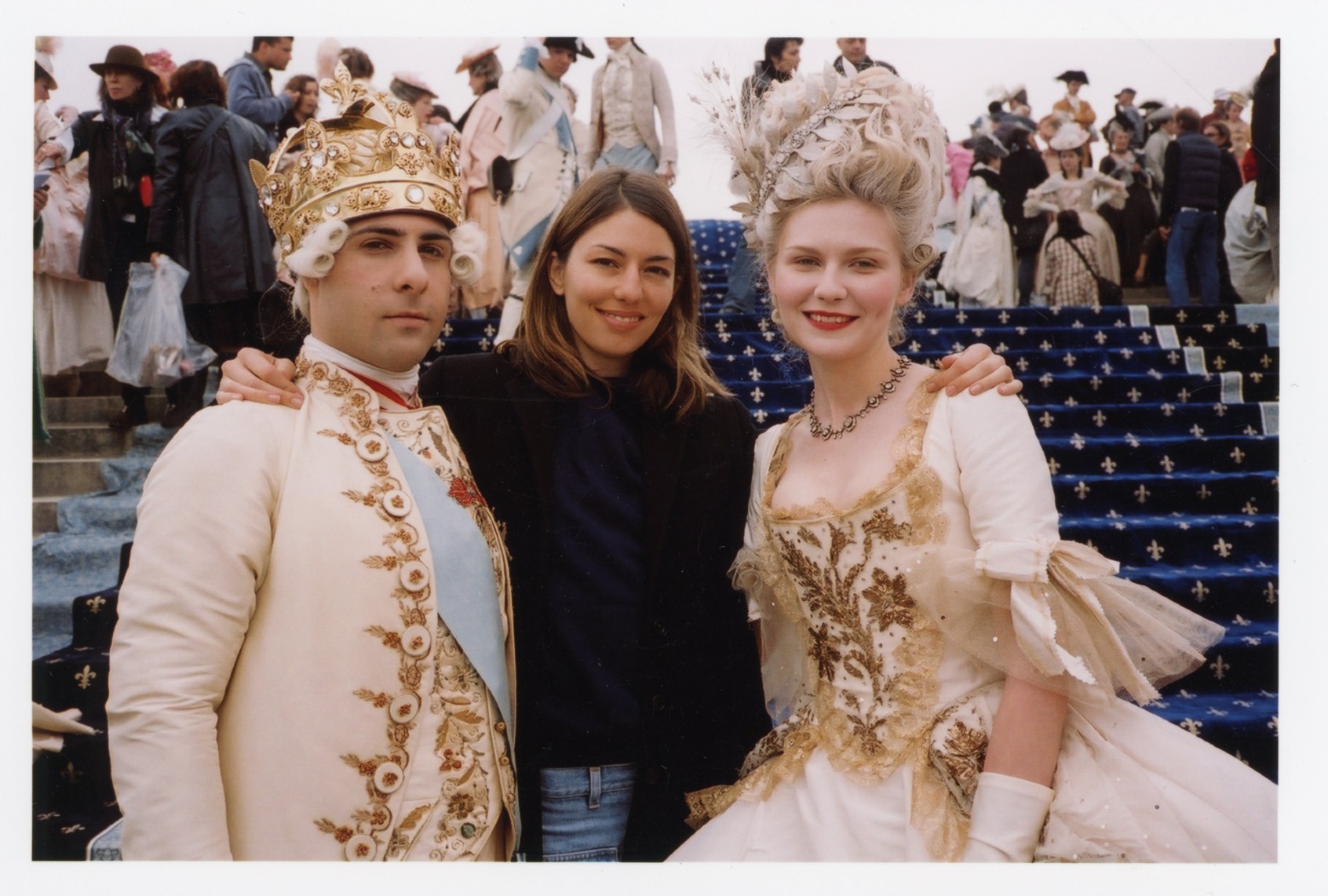
(Sofia Coppola) Jason Schwartzman, Sofia Coppola and Kirsten Dunst on the set of “Marie Antoinette”
What’s funny, especially in retrospect, is how widely these men whiffed the point. Historical stature and new discoveries are irrelevant. (So, too, is mature conviction — though I’d argue Coppola displayed exactly that when she didn’t make the entire soundtrack new wave.) Coppola conveys that the answers about who Marie Antoinette was have been written into history, but overlooked by the men who most often dictate it. She was a teenage girl suddenly saddled with the fate of a country, tasked with making decisions well beyond her purview or experience. Marie Antoinette was out of her depth from the moment she set foot in France from Austria, entrusted with overseeing war and peace, money and poverty. She tried her best, did what she felt was right, and they had her head for it. What better analogy for Coppola and the bitter response to her brilliant, evergreen third film?
Want more from culture than just the latest trend? The Swell highlights art made to last. Sign up here
Twenty years on, “Making Marie Antoinette” — which screened at this year’s New York Film Festival and premieres in theaters October 23 before streaming on MUBI November 6 — sheds ravishing new light on Coppola’s masterpiece. Co-directed by Coppola alongside her late mother, Eleanor, and drawn from over 90 hours of behind-the-scenes footage Eleanor shot during production, the documentary is an instant essential for anyone ravished by the original film or the filmmaking process.
Up-close and personal, Eleanor’s camera reveals the massive undertaking of producing a movie at this scale, honing in on small, intricate details to convey her daughter’s meticulousness. Her footage is teeming with maternal pride, observant and heartwarming. One gets the sense that, for a filmmaking dynasty like the Coppolas, filming the production of “Marie Antoinette” is Eleanor’s version of a parent at their child’s Christmas pageant, ducking down in the aisles and contorting themselves to ensure they don’t miss a single moment. If “Marie Antoinette” says as much about its director as it does about its subject, “Making Marie Antoinette” is the perfect companion piece: A film about letting art and life stay in constant conversation, and how that dialogue makes for a rich existence. It’s the perfect example of how movies can make something as intangible as love go on forever.
Sofia and Eleanor Coppola began work on “Making Marie Antoinette” together during the pandemic. Locked away in their quarantine pod, the isolation proved the perfect opportunity to comb through hours of archival footage, stitching a story from B-roll and memories, both of which Eleanor had plenty of. A dedicated archivist of her own life via journals and film, Eleanor spent much of her time trailing her husband, Francis Ford Coppola, and children between their movie sets to document the arduous filmmaking process. She eventually broke into her own work beyond documentaries and videography, directing two narrative feature films before the pandemic began. At her daughter’s side, “Making Marie Antoinette” made progress but remained unfinished when Eleanor died in 2024. Sofia decided to finish the film as a tribute to her mother, and both women’s touch can be felt throughout — two hands held together, always.
Even those critics who panned “Marie Antoinette” 20 years ago could find something to adore here. For all the derision heaped upon Sofia’s keen directorial eye and scrupulous vision, a behind-the-scenes look only makes the details all the more impressive. It’s a production with a capital “P”: hundreds of extras, an immense principal cast, throngs of below-the-line team — costumers, production designers, historical advisors, translators — and one giant, very expensive castle that must be handled with the utmost care. One doesn’t have to hear Sofia say “this is a lot” to understand that it’s far more than just a lot. It’s visible in every shot. For a director whose previous two films were microscopic in comparison, shooting “Marie Antoinette” may as well have been going to the moon.
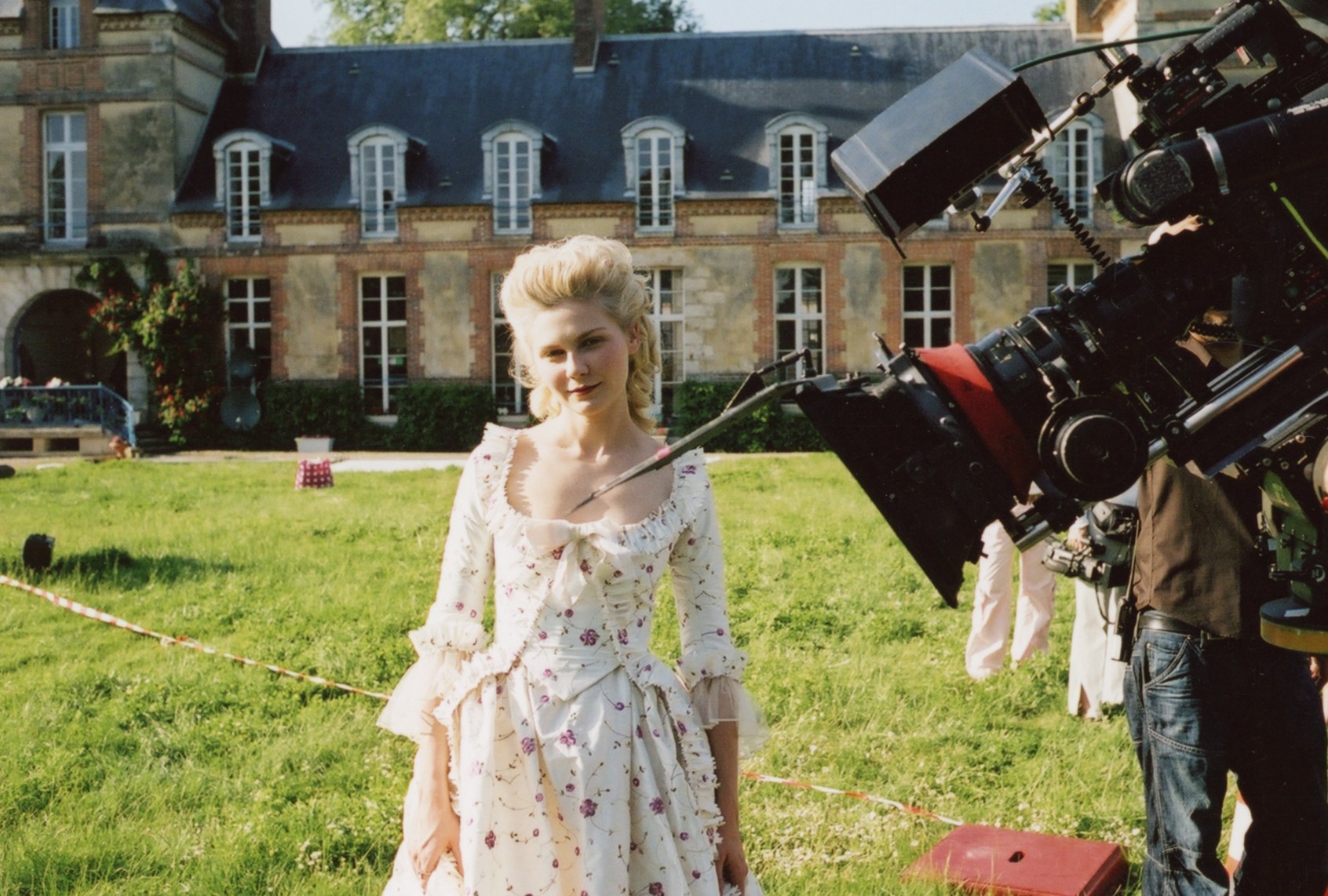
(Sofia Coppola) Kirsten Dunst on the set of “Marie Antoinette”
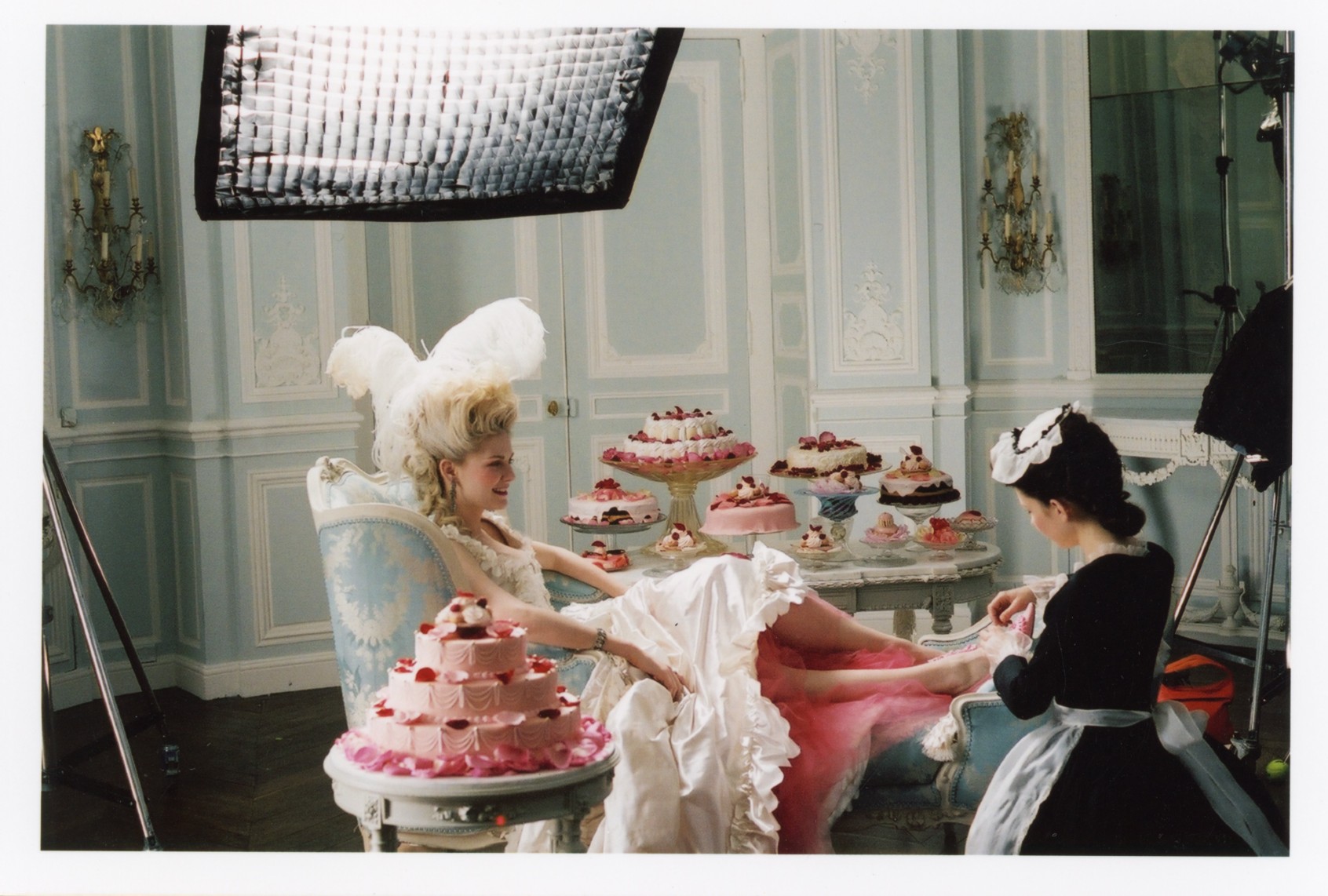
But that’s also what makes it such a feast. It’s a film unlike any other period piece, as sumptuous as decadent as a French pastry. One can practically taste the butter on their lips as Kirsten Dunst glides through ornate halls and indulges in raspberry-topped sweets. This surplus of opulence is what gives the film its edge, too. Think about who you were at 14. If you were thrust into a world where everything you could ever want is at your fingertips, where love blossomed as freely as the gardens adorning your magnificent estate, wouldn’t you, too, lose yourself inside the pomp and circumstance? Is that not the very feeling of being a teenager, so certain that everything and anything is possible, that when one gets a taste of the world, it’s nothing short of intoxicating?
As the long, 50-some-day production schedule rolls on, the viewer can feel Eleanor’s anxiety ease, allowing pride to take full control. Sofia has this, and Eleanor’s job might be the best one on set: watching the daughter she raised come into her own.
For Sofia, the fantasy is the film. It’s integral to Marie Antoinette’s tragedy, to making the viewer empathize with a girl who had no choice but to get in over her head. In Eleanor’s camera, Sofia has that same impish desire, taking on a film so gargantuan that she can’t possibly understand that her eyes are bigger than her stomach. Eleanor watches dutifully, admiring her daughter as she leads rooms full of men, asserting that her decision is not only the best one, but the right one, because she is the person in charge.
It’s frightening to watch someone you care for so deeply balance all that power. But through journal entries from that time, narrated in the film by Diane Lane, the audience can piece together where the fear and the pride meet. After all, Eleanor understood from decades of experience that filmmaking is, most often, a boy’s club — even when a woman is at the helm. And as the long, 50-some-day production schedule rolls on, the viewer can feel Eleanor’s anxiety ease, allowing pride to take full control. Sofia has this, and Eleanor’s job might be the best one on set: watching the daughter she raised come into her own.
“Maybe making movies is a way of moving back and forth, in and out, of linear time,” Eleanor says in one of her journal entries. It’s a reference not only to the period production, but to her daughter’s thoughtful directorial anachronisms, the very decisions that would make “Marie Antoinette” last for 20 years and beyond. What a glorious, warm and strangely pertinent observation — something Eleanor couldn’t have understood the relevance of at the time. Here we are, two decades on, watching her documentary further cement Sofia’s film as the modern classic it is. More than a meta perspective or conventional behind-the-scenes doc, “Making Marie Antoinette” is a tender portrait of familial love from mother and daughter alike. Now, the pride moves in both directions — with Sofia as reverent of her mother’s work as Eleanor was of hers — meeting in the middle to stretch into the future.
Mary Anne Franks has spent years fighting against online abuse. When people are abused with impunity, she says, the message becomes “We do not care about women’s voices.”
The comedian sees being online as similar to visiting the zoo. “I don’t need to interact with that,” he says. “It’s just a thing that I enjoy, and then I walk away.”
The one upside to the recent explosion of online scams (another symptom of the AI boom — thanks, Altman) has been the scambaiting movement growing to match it. There is nothing more cathartic than watching someone take an unsuspecting scammer for a ride, wasting their time, energy and occasionally AI tokens. — Read the rest
No, I don't mean the kind of 'sunset' games like Concord or Highguard get. Rather, the big glowy thing in the sky. Who among us hasn't stopped every once in a while to take in the probably-toxic Los Santos sunset?
Fruitless and hubris-fueled as humanity's attempts to digitally recreate the splendor of the natural world around us may be, we have come pretty close. — Read the rest
Amid a social media era where people often feel more unheard and misunderstood than ever, so much about director David Greaves’ documentary, “Once Upon a Time in Harlem,” feels like a relic: a snapshot of a time when intellectuals gathered in person for lively, productive debate.
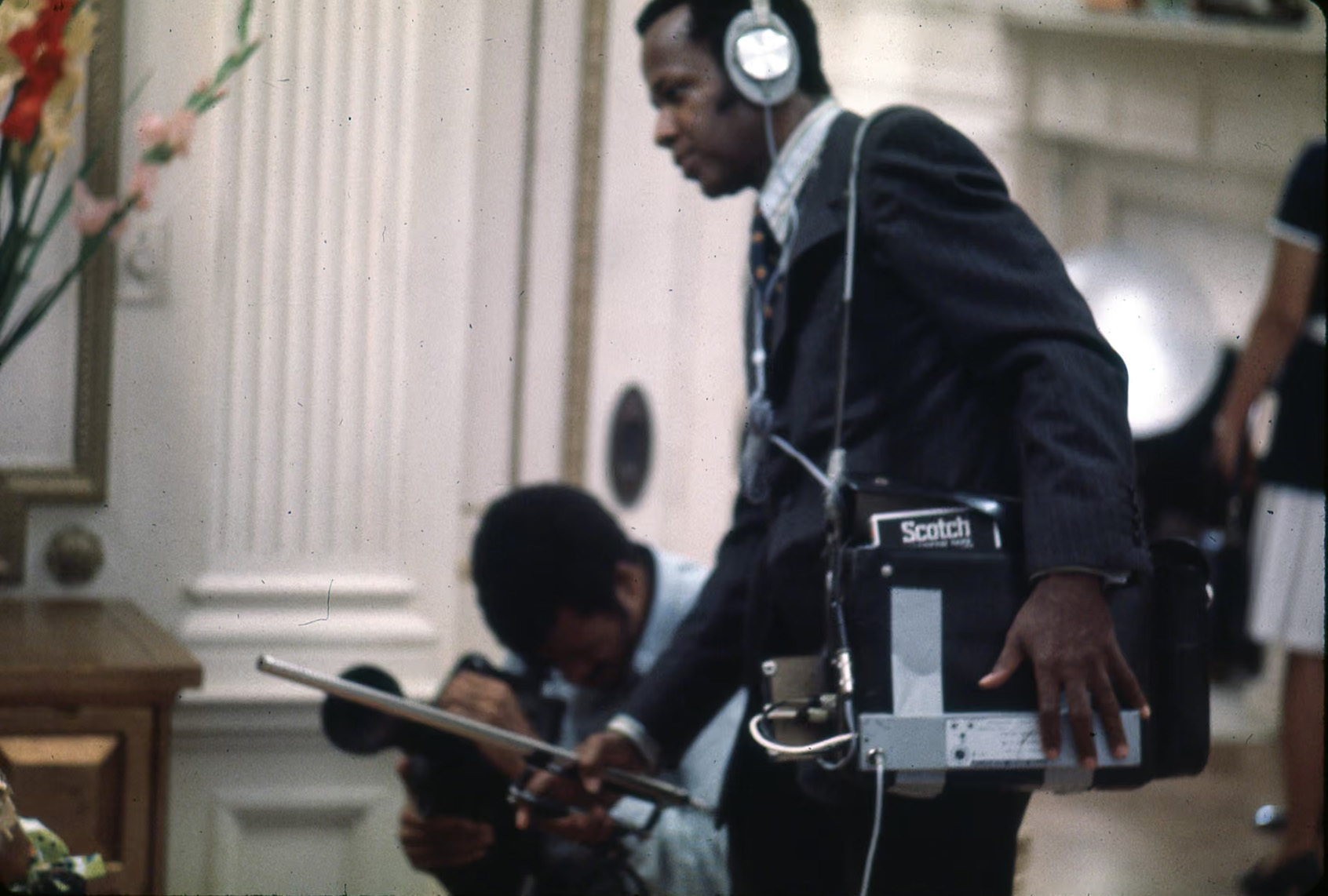
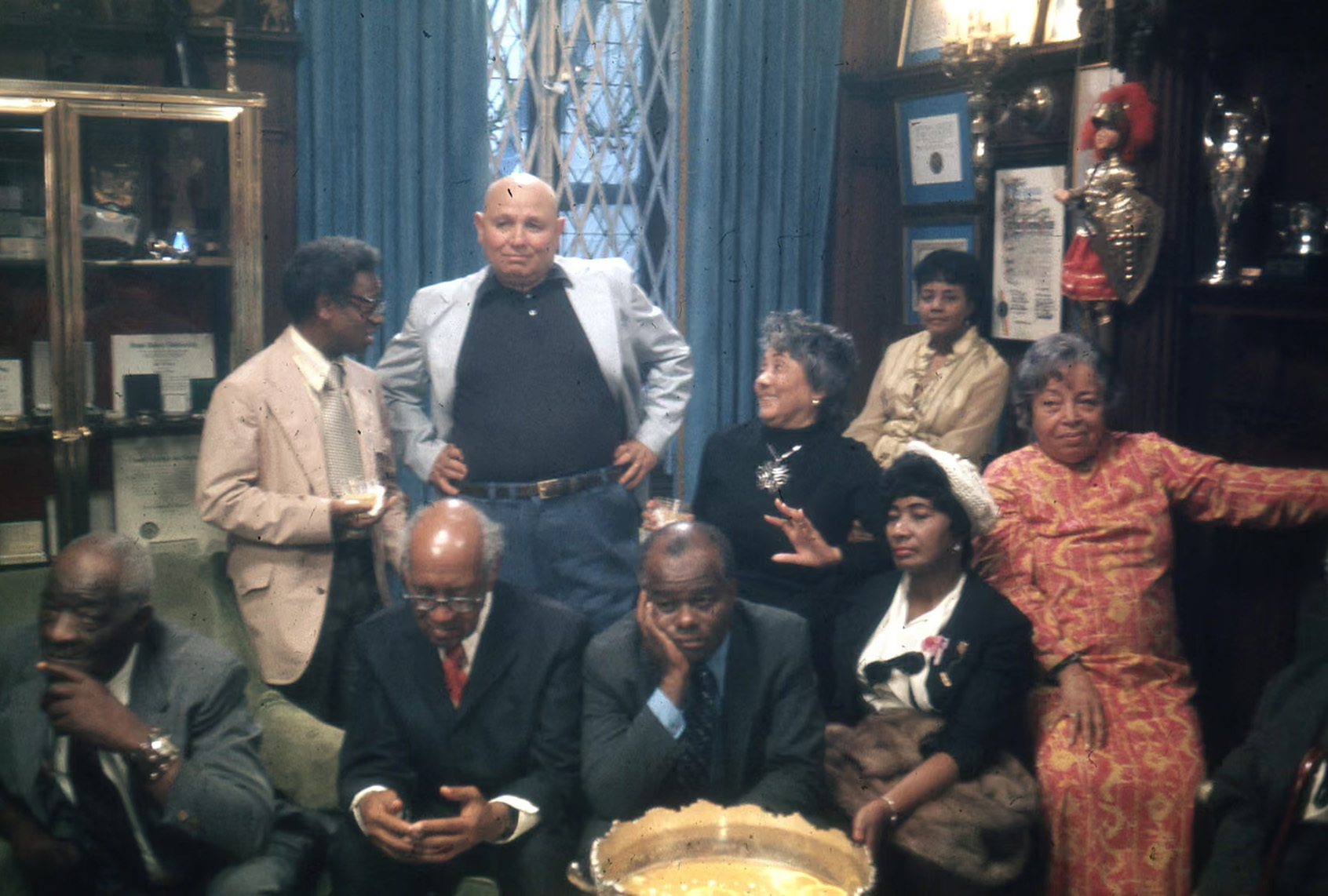
The film, newly restored from Greaves’ father William’s original offering, captures a staggering array of luminaries of the Harlem Renaissance reflecting on the period during a four-hour cocktail party at Duke Ellington’s townhouse in 1972. That salon included pianist Eubie Blake, artist Romare Bearden, activist Louise Thompson Patterson, playwright Irvin C. Miller, journalist Gerri Major, and librarian Jean Blackwell Hutson grappling with the legacy of the era and the issues it raised that persisted even then.
It’s an intimate, engaging discussion among people with different approaches, styles, and even points of view while, as Brienne Adams, assistant professor of Black Studies at Georgetown University, put it, “still having the goal of Black humanity and liberation at the forefront.”
Among those sources of conflict expressed in “Once Upon a Time in Harlem” are the years that comprised the Harlem Renaissance, or the New Negro Movement as it was often referred to at the time. To hear one person tell it, it was the 1920s. Another suggests that it really found its footing in the ‘30s, while someone else considers its genesis around the 1910s, punctuated by the Silent Protest Parade of 1917.
What is seen in “Once Upon a Time in Harlem” is, to borrow writer and journalist George Schuyler’s words in the film, “a mark of a civilized community,” people challenging each other on everything from their art to their politics.
There are also ponderings on the Black journalist agenda; thoughts about the intentions and tactics of political activist Marcus Garvey; concerns that writer and anthropologist Zora Neale, sculptor Augusta Savage, poet and novelist Countee Cullen and others were minimized. There’s a rich conversation about the efficacy of influential figures such as gangster Casper Holstein and writer Carl Van Vechten, who helped finance and support, respectively, members of the Harlem Renaissance and their work. With Van Vechten, author of the controversial 1926 novel, “Nigger Heaven,” comes the question of how white patronage impacted the cultural output of the era.
Relatedly, writer and journalist George Schuyler cogitates on his prominent 1926 essay in The Nation, “The Negro-Art Hokum,” and poet and activist Langston Hughes’ follow-up, “The Negro Artist and the Racial Mountain,” as urgent critiques of the white relationship to Black art.
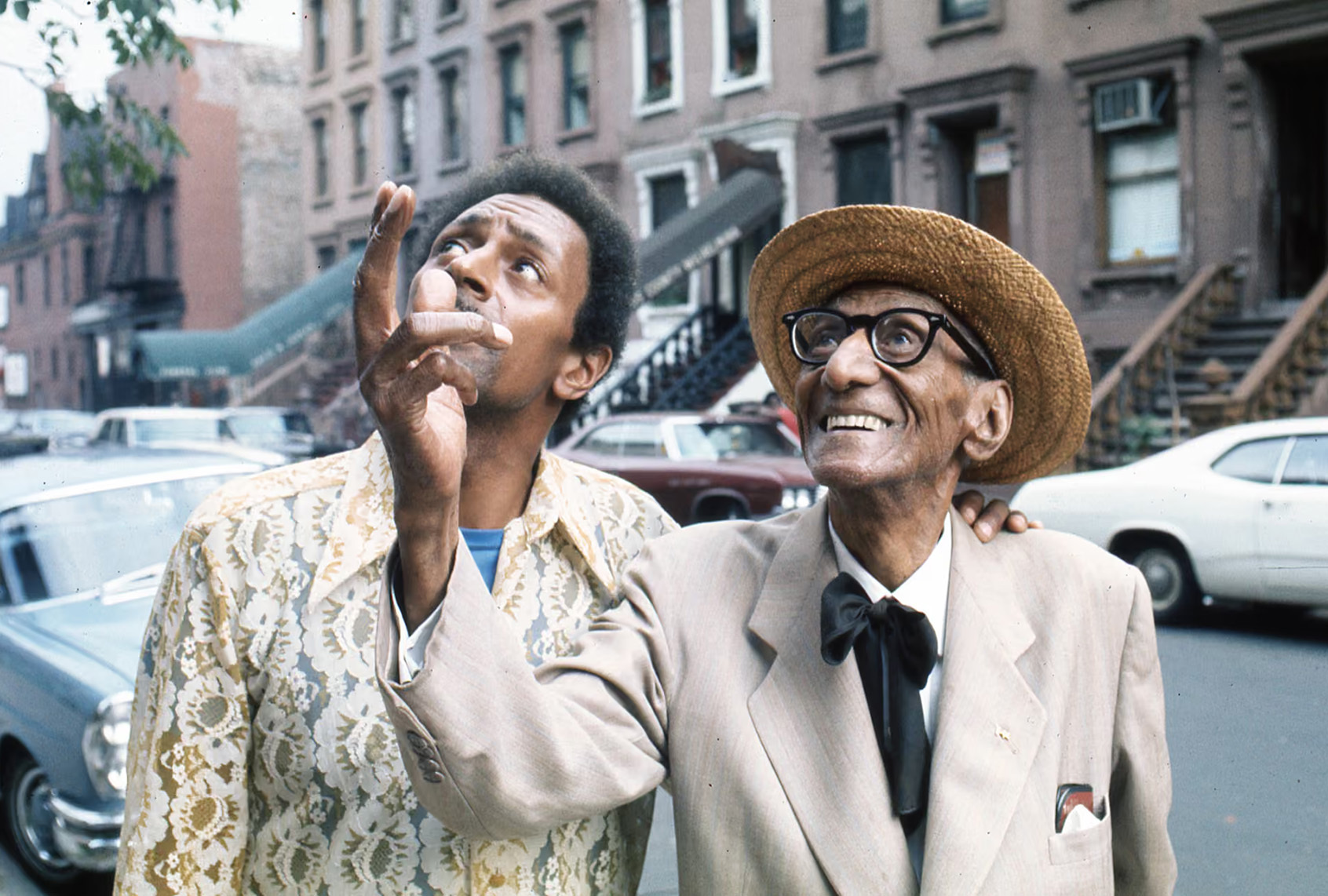
(Neon) “Once Upon A Time In Harlem”
It doesn’t take long in “Once Upon a Time in Harlem” for the many voices in Ellington’s home to get louder and start to overlap as boozy drinks are poured and the elder Greaves flits from one side of the room to another to catch each rebuttal and vivid recollection. Decades after the Harlem Renaissance, it had to be remarkable to witness such insight and impassioned thoughts about the era from those who lived it — and in the same year that the National Black Political Convention raised the alarm on some of those same concerns once again.
In 2026, though, at a time when social media too often mangles critical thinking and disagreement, it is downright extraordinary. It’s also nostalgic in a way that finally seems imperative in today’s Hollywood that reeks of hollow, monetized sentimentality about its past.
What is seen in “Once Upon a Time in Harlem” is, to borrow Schuyler’s words in the film, “a mark of a civilized community,” people challenging each other on everything from their art to their politics. He recalls that every ethnic group in Harlem had “intellectual centers” for such discussions.
Want more from culture than just the latest trend? The Swell highlights art made to last. Sign up here
It’s not that Black critical engagement doesn’t still happen every day, even online. It’s that it’s much more difficult to parse through an algorithmic funnel of opinions and perspectives that can often appear half-formed or entirely outside their context.
“Social media allows for more voices to be heard, but algorithmically situated based upon someone’s interests where they’re entering into the conversation,” Adams said.
Just as Harlem Renaissance figures broached subjects such as the white influence on Black art and questions about what defines Black art or a Black artist, particularly inside a white business establishment, there are still concerns about the representation of Black art and stories. The conversations about Issa Rae’s trajectory from YouTube to HBO and Tyler Perry keeping many Black actors employed, though consistently coming up against criticism over the quality of his work, both come to mind.
But recent pushback and critiques of offerings such as the new “A Different World” series and the “Michael” movie once again raise valid concerns about the state of critical debate on Black art. What it too often comes up against are parasocial responses, antagonism, doxing, or a preciousness around the critique, particularly at a time when Hollywood has rolled back on Black storytelling.
Back then, it was about critiquing Black art for Black art’s sake and its possibilities, when today critical discussions seem to urgently hinge on Black art for the sake of its preservation.
Adams, whose background in digital studies examines interiority in Black cultural productions and fandom expression as an example of Black digital knowledge production and public intimacy, said that the rise of content creators is one component of those responses.
“If they are content creators that are having these conversations because getting eyes on their content can be tied to monetary gain, that can sometimes lead to salaciousness in the approach to the ‘civilized’ society, right?” she explained.
That motivation, Adams added, can lead to a need to demonstrate “the most,” “whether that is the most right, the most devoted (in the case of fandom), the most knowledgeable, the most (insert marginalized identity here). People resort to antagonisms to demonstrate their hierarchy of ‘most.’” That, in turn, results in a collapse of intellectual curiosity and humility that “undergirds critical thinking,” Adams concluded.
There’s also the distinction that, unlike some of the most notable figures of the Harlem Renaissance, social media assembles people from across various classes, education and media literacy levels, professions with sundry access to information and art itself. Additionally, motivation, even beyond the content creation monetization that Adams pointed out, can sometimes be connected exclusively to the idea of supporting and amplifying Black art and artists while deprioritizing inquiries of their merit.
Contrarily, Harlem Renaissance figures such as writer Zora Neale Hurston, Hughes and others were able to gather in more intimate spaces among people they often already knew from the neighborhood with similar interests and scholarship, regardless of whether they agreed. In fact, they often didn’t.
Where writing critiques in news media like The Nation, Fire!, and The Crisis, which ran a Black symposium with questions about how “The Negro” should be portrayed in Black art in 1926, was a way to engage with other intellectuals; social media broadens that audience and more quickly. Plus, like today when many outlets require that their readers pay for subscriptions to access essential journalism, essays from the Harlem Renaissance and even the 1972 gathering in “Once Upon a Time in Harlem” restrict engagement based on intellect or economics.
(Neon) William Greaves on the set of “Once Upon A Time In Harlem”
“The artists and scholars of the Harlem Renaissance are still this small, kind of enclaved people that maybe most of them went to Howard who are having very similar types of training and conversation,” Adams said.
Add to that, most patrons across the racial spectrum who engaged with the work and workers of the Harlem Renaissance didn’t have as much access to their personal lives to form parasocial relationships with them as fans have today. Back then, it was also often about critiquing Black art for Black art’s sake and its possibilities, when today critical discussions seem to urgently hinge on Black art for the sake of its preservation. Those distinctions impact the response to critical discussion — from the in-fighting on BookTok to the arguments on Threads.
Still, concern about the increased dearth of Black artists and Black art is legitimate. Filmmaker Nina Lee said that Hollywood gatekeepers preclude greenlighting certain Black films until they determine that others of their ilk make a splash at the box office. But that reality is too often used to establish a tenderness around criticism of the Black art that does manage to come down the pipeline.
However, that delicacy around discussing the flaws of Black art can, as Adams considered, illustrate a propriety to the white for the sake of white acceptance. “The preciousness around critiquing it still centers white gazes to say that we have to be presentable and respectable in ways,” she said.
None of that is conducive to the type of “civilized community” Schuyler reflects upon in “Once Upon a Time in Harlem.” While some have managed to successfully carve out their own niche spaces online for critical debate, from podcasts to more curated social media discussions and personal Substacks, the recognition that it serves to help push the art forward is too often lost.
That contemporary disconnect is what makes Greaves’ documentary that more profound. It deepens audiences’ understanding of healthy, effective debate through a reflection of our not-so-distant past at a time when too many are consumed by self-aggrandizement rather than the roadmap those who came before them already laid out. As Major says in the film, “They’re going to lose if they cannot profit from the struggles that we went through.”
“The other day” is one of those phrases everyone uses and no one’s ever defined. To some people, it means yesterday. To others, it covers most of the Obama years.
And people actually have strong opinions about this. In an r/AskUK discussion, one person insisted a week was the absolute limit, arguing that “two months ago is not the other day; that is just poor calendar management.” Another figured it could mean anything from yesterday to sometime in the last decade.
One commenter said their dad uses it for events that happened “anywhere between last Tuesday and 1994.” Which feels very “dad.”
The Internet Can’t Agree on What ‘The Other Day’ Means
Dr. Luke Jones, who studies how people perceive time at the University of Manchester, told Metro that we’re “not very good at remembering exactly when things happened.” Especially the boring stuff. Most of us can barely remember what we had for lunch a few days ago, let alone when we last went grocery shopping or made a phone call. That’s where “the other day” comes in.
There’s also a psychological explanation for why something from years ago can feel surprisingly recent. It’s called the telescoping effect, and it describes how we misremember when events happened. Older memories can seem much closer than they are, explaining how someone can swear they went to a certain restaurant “the other day” only to discover it closed in 2019.
The opposite can happen with recent memories, too. Human beings are extremely unreliable at remembering dates, which has caused headaches for researchers trying to figure out when people last visited a doctor or bought something.
Age might also have something to do with the increasingly generous definition of “recent.” People commonly report that time seems to pass quicker as they get older, so a few years can feel like a much shorter stretch. Which could explain why your dad still talks about a vacation from 1994 like everyone should remember what happened.
Most of the time, an exact date isn’t necessary anyway. If you’re telling a friend about something weird that happened at the grocery store, “the other day” gets the point across just fine. But when the timing actually matters, therapist Rebecca Mackillop told Metro that asking a follow-up question is a better approach than assuming everyone uses the phrase the same way.
And if someone’s story involves a Blockbuster membership, you have every right to question their view of time.
Since 2016, Netflix’s Stranger Things has shown fans a much darker side of Indiana. Although the show had its series finale last year, it remains a huge fixture of pop culture. But 25 years before The Duffer Brothers introduced millions to Hawkins, Indiana, and The Party, NBC aired its own sci-fi show, Eerie, Indiana.
‘Eerie, Indiana’ walked so ‘Stranger Things’ could run
Eerie, Indiana follows teenager Marshall Teller, who has just moved to a small Midwestern town. The more he explores, the more he realizes there’s strange paranormal activity. With the help of his friends, they investigate the urban legends and supernatural events plaguing the town.
Although it only aired 19 episodes, Eerie, Indiana has developed a cult following. It dared to be different in a time when conventional television was the way forward. Shows like Eerie proved that oddball stuff had a place too, inspiring many shows we see today. It directly inspired Disney’s beloved animated series, Gravity Falls. “I was obsessed with Eerie Indiana,” Gravity Falls creator Alex Hirsch wrote on X. “Gravity Falls was literally just me as an adult trying to reboot my favorite cancelled show from when I was a kid.”
They both follow groups of children who uncover supernatural elements and otherworldly creatures in the heartland of America—unassuming Midwest towns. They also have the nostalgic factor. While Stranger Things is a modern interpretation of the ‘80s, Eerie, Indiana was filmed in the ‘90s, making it an authentic time capsule for the 90s babies.
They share a lot of similarities, but their biggest difference is their format. Stranger Things is a serialized sci-fi drama, while Eerie, Indiana leans into comedy and surrealism. Stranger Things isn’t an exact copy of Eerie, Indiana. However, for sci-fi fans, it fills the void that the Netflix show leaves behind.
how to watch ‘eerie, indiana’ for FRee
Unlike other shows from the era, Eerie, Indiana is free to watch. You can stream all episodes on Tubi, PLEX, The CW app, and Pluto TV. Other childhood favorites can be streamed for free on sites like Tubi, including Goosebumps, Are You Afraid of the Dark?, The Nightmare Room, and Tales From the Cryptkeeper.
I can’t remember the last time a catch-up phone call with a confidante didn’t include one of us marveling that we haven’t caught an assault charge. If any law enforcement happens to be reading this, I want to make it clear that will never happen.
Well, let’s call it a non-zero chance. At the end of the day, I am a realist; anything can flip a person’s switch from off to blackout rage. However, I have decades of practice holding back my inner She-Hulk. So do most women.
Every day, we wake up in a nation controlled by a convicted felon accused of multiple sexual assaults, while a college student seeking justice after alleging she was gang-raped at a fraternity party is doxxed and swatted. We are not taken seriously in politics or at work. The manosphere has poisoned our water coolers and social media feeds.
Women have had it, including with each other. Aspiring tradwives and “Live, Laugh, Love” Karens selling out everyone else to keep up their manicures are legion. They threaten to run you down in crosswalks and refuse to bow out gracefully when told, for instance, that a pretty mechanical bird mounted on a boutique’s wall isn’t for sale.
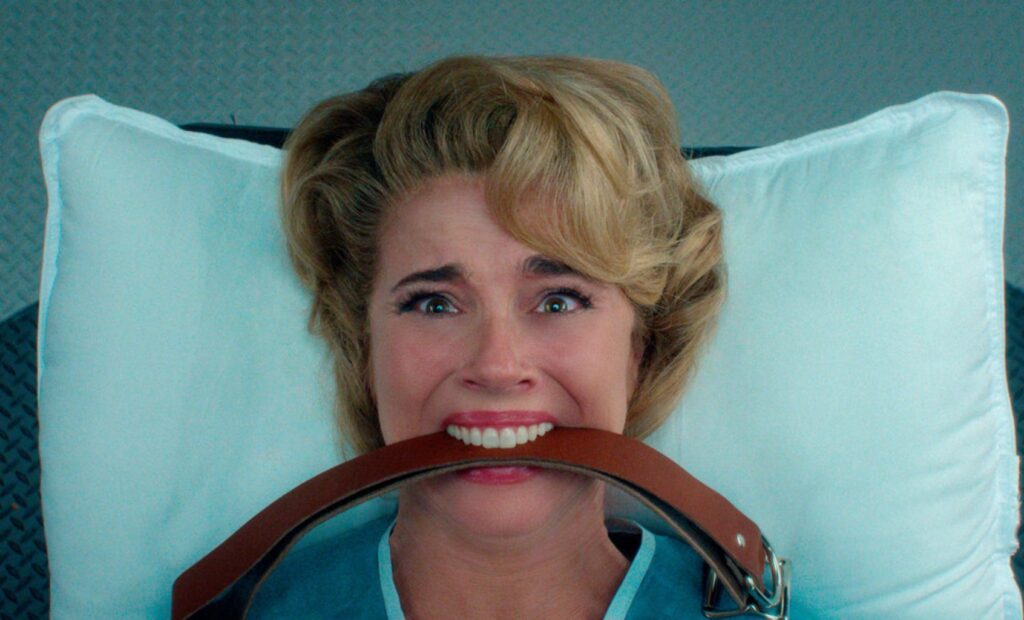
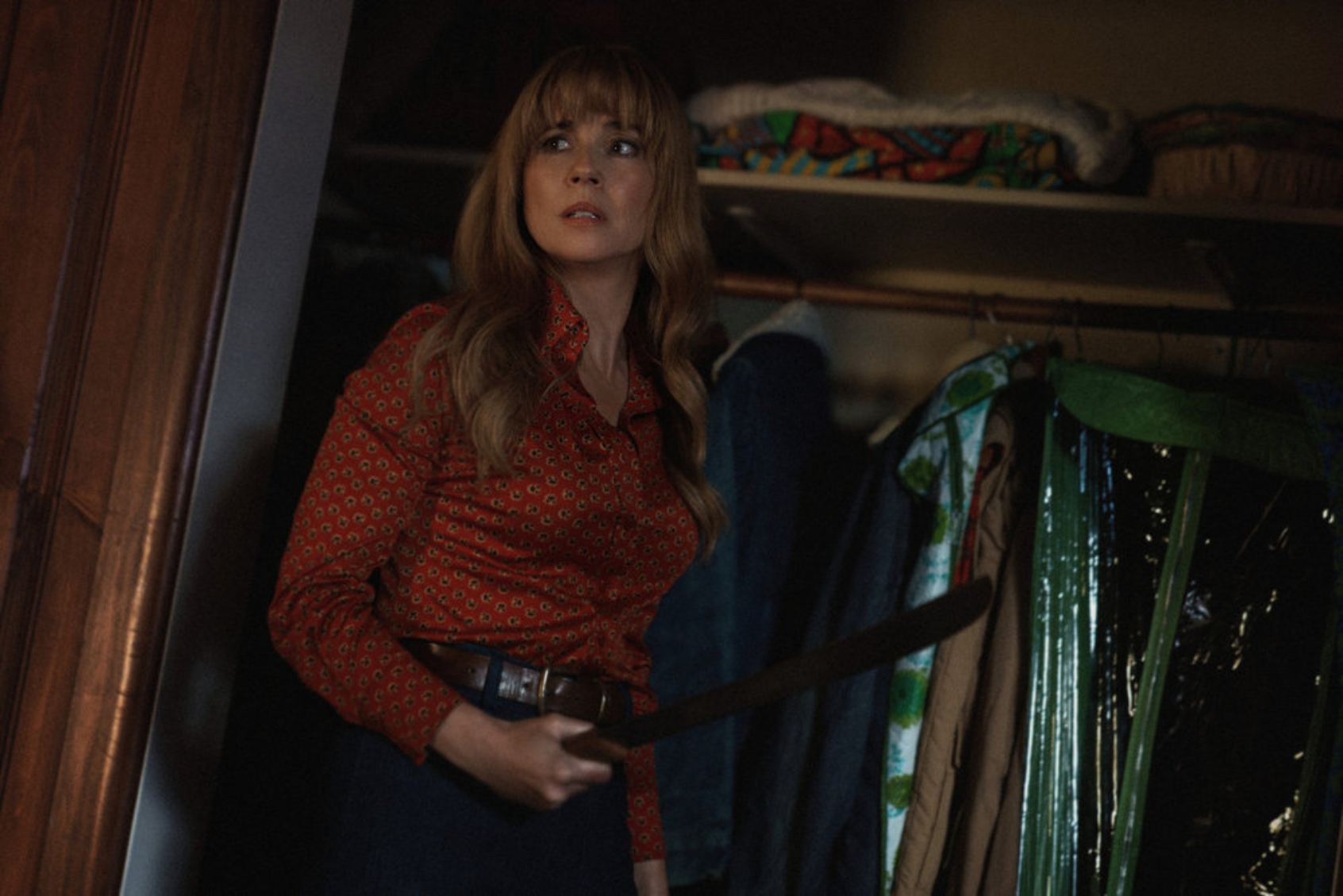
Ladies, look to your left. Now look to your right. One of you is dying to knife somebody. Only Pamela Voorhees, brought to life by Linda Cardellini in “Crystal Lake,” has the guts to act on that impulse. Her bloodlust coats her skin in the crappy opening scene of this “Friday the 13th” prequel, after she’s dispensed with two goons who make the fatal blunder of invading her home and taunting her. One goes down with a swift nick to the jugular. The other loses half his face to the Voorhees family’s machete.
The thing is, by the time we’re assaulted by all that, we understand that Pamela has had it, too. She lost her gentle son, a boy born with hydrocephalus, a birth defect in the brain, who is endlessly bullied until he drowns at camp. The town moves from pitying her to whispering that she’s crazy, leaving her rutted in the anger stage of the grieving process. As she chops away at the men who attack her, I found myself muttering, “Yes. Get him. Again. Again!”
Don’t confuse this for an endorsement. Please don’t. “Crystal Lake” is a barely watchable gorefest, with a plot riddled with more seeping holes than Pamela’s victims. (Of course, if you’re into that kind of thing, which I am not, I guess that counts as a recommendation.) What passes for story amounts to little more than a two-dimensional cartoon rendered in human-flesh puppetry, courtesy of actors capable of much better, Cardellini included.
Even so, it’s kind of great to watch one of TV’s most enjoyable performers massacre a gaggle of sex-crazed hippies, or knock an abusive parent into a deep fryer for stress relief. Few of us can claim to have never daydreamed about, say, an anvil dropping from the clouds to erase some menace from our lives, whether it’s an entitled relative or an idiot comedian. Jason Voorhees’ mom simply prefers a hands-on approach.
I understand why the many chefs who mucked up the “Crystal Lake” cauldron, starting with Bryan Fuller, were compelled to fill in the blanks of Pamela’s origin story. The beauty of the character, once her truth was revealed in the original 1980 movie, is her relative mystery. Who would suspect a frumpy matron in a humble sweater could wreak such unhinged havoc? Other women, that’s who. We’ve always suppressed murderous desires. (See: “Dateline,” “Snapped” and rest of the Oxygen channel’s true crime lineup.) Only recently have we taken to saying that out loud.
Long before the medical and pharmaceutical industries made perimenopausal rage fashionable, Pamela Voorhees was a genre outlier, especially in a cultural climate that had already started retreating from a decade of legislative gains for women’s rights.
Now, in this post-Roe v. Wade world of ours, feminine wrath must be mansplained to be taken seriously. While women have produced excellent recent examinations, including “Furious” and “East of Eden,” the brutal truth is that the “Friday the 13th” movies are IP recognizable to hockey-masked trick-or-treaters too young to watch them.
So it falls to “Crystal Lake” to tell most of us why the mother of slasher cinema’s patron saint was driven to kill, kill and kill again in the first place. But it also helps us understand why a crumpled sock in the middle of the living room or dirty dishes on the kitchen counter makes the exhausted woman in your life crash out.
Let’s assume that if you’re reading this far, you already know the first movie’s big twist: the real killer wasn’t Jason Voorhees, but his mad mama. If not, I mean, what gives? Did you see that picture of Cardellini and wonder what cool-as-a-cuke Lindsay Weir from “Freaks and Geeks” has been up to? With regret, I present this as your answer.
But as any old-school porn hounds skilled in fast-forwarding through “the plot” will tell you, there’s merit in skipping straight to the action — meaning, Pamela destroying fools with something more cutting than wit.
Maybe Fuller, the guy who classed up “Hannibal,” could have done something brilliant with Pamela. But he exited the project early due to creative differences, leaving “It: Welcome to Derry” showrunner Brad Caleb Kane to expand the legend of a woman whose motives were fairly basic. I mean, if your kid died because two horny teen counselors shirked their lifeguard duties to bone in a shed, you might harbor a few homicidal compulsions too.
Alas, in these days of milking dormant franchises for every drop of ichor, a simple explanation isn’t enough. Therefore – and this will either save you the trouble of enduring all eight episodes or spoil them – Pamela Voorhees is revealed to be a victim of a patriarchal industrial plot.
The former professional singer gets knocked up by her lover, Elias (Hamish Linklater), who works for a company called Bellflower. When she nearly miscarries, he convinces her to marry him and move to his company’s sponsored enclave that’s popping with pregnant women like her. Once she’s settled in, her husband plies her with Bellflower-manufactured TV dinners and happy pills, occasionally shuttling her to the doctor to be pumped full of mystery muck. Truly a MAHA conspiracist’s nightmare.
Sometime later, Jason arrives and demonstrates a knack for reviving from naps the average human wouldn’t wake up from. So father secretly subjects son to all manner of mad science, including massive radiation exposure. Once Pamela discovers this, she rescues Jason, turning the skull of the man who gets in her way into soup, and they escape to Crystal Lake.
Want more from culture than just the latest trend? The Swell highlights art made to last. Sign up here
Cardellini’s Pamela Voorhees is what happens when women drinking from a bottomless well of contempt and human carelessness hit their limit. The writers, in their clumsy way, cater to that idea by having her dispose of her first slaughter by slathering the bodies in a deconstructed tonnato sauce of canned fish and honey, and standing by as a massive bear lumbers up to feast.
Before the animal takes a bite, it sizes up Pamela, sniffs her tears, and leaves her be. You could view this as one predator recognizing another. To women of a certain mood, though, it confirms what we already know: that a bear is preferable company to thoughtless, dangerous people. Plus, it’ll help rid you of pesky evidence without asking questions, which only a true, understanding friend would do.
All episodes of “Crystal Lake” are streaming on Peacock.
Conservatives have long pitched their project as a return to normalcy, a way to set right a world that’s gone off its axis. In theory, it’s an understandable goal. Who doesn’t react to getting older and more removed from the engine of culture with an initial feeling that the next generation is doing it wrong?
In practice, the right’s message is more of a respectable veil covering the fact that they want the power to beat up on minorities and buy anything they want. But there’s one arena where the right might actually be bringing back an honest-to-goodness return to tradition: the multiplex.
The lines between television and the movies used to be rather rigid. There were movie stars and there were television actors, and rarely did the twain meet. Actors without matinee idol looks or sufficient draw could make a living as character actors. Faded stars could scrape out a second act in B-movies and lesser studio offerings without losing the prestige of the silver screen. Television actors traded that type of cachet for steady work and wider audiences. A movie star appearing on television was a sign of terminal decline.
The rise of prestige television and streaming shook up the established hierarchy. If television could hit something approaching the same cinematic highs and emotional depths as a Hollywood movie, even if rarely, then the stigma of going episodic couldn’t last. The prestige TV gold rush inspired plenty of marquee stars to jump ship, taking roles from deep-pocketed streamers for niche audiences. (Somebody must be watching Reese Witherspoon and Billy Crudup on Apple TV’s “The Morning Show,” but I can’t say I’ve ever seen them.) The old order and the connotations of each medium had gone post-modern and topsy-turvy.
Enter Ben Shapiro.
The Daily Wire co-founder and conservative political commentator has made several attempts to break into Hollywood. Over the years, he has repeatedly alluded to a script he wrote as a young man at the behest of the late ABC executive Leonard Goldberg, while his dramedy about a conservative student at Harvard never got off the ground. But that hasn’t deterred Shapiro. He’s used his political commentary outlet as a springboard to produce a series of execrable comedies and thrillers, from 2023’s irredeemable and laughless “Lady Ballers,” which centers on a group of former high school basketball players reuniting to compete in women’s basketball by posing as transgender women, to the semi-competent and bloody hatefest “Run Hide Fight: Infidels.”
Shapiro’s films haven’t made much of a dent in Hollywood, let alone the wider culture. But that is likely to change with The Daily Wire’s upcoming film “Confession.”
Shapiro’s films haven’t made much of a dent in Hollywood, let alone the wider culture. But that is likely to change with The Daily Wire’s upcoming film “Confession.”
Written by Shapiro, “Confession” follows an academic in Moscow under the rule of Joseph Stalin. He’s brought in for questioning after allegedly conspiring with a dissident priest, only to find that his interrogator is a former student. In less ideological hands, the film could be an interesting examination of loyalty and state overreach. Coming from the man who accused Baron Harkonnen, the villain in the “Dune” science-fiction franchise, of being a communist, we aren’t holding our breath.
Still, the announcement of “Confession” made a splash, less for its logline than its topline. The cast is chock full of former Oscar nominees and one-time A-listers. The participation of James Franco, Rob Lowe, Brad Dourif and Emile Hirsch make this the most star-studded production Shapiro has ever produced. Beyond the musty Cold War paranoia and production design straight out of the “Command & Conquer: Red Alert” video game, the film is small-c conservative in its appeal to a bygone tradition: giving disgraced actors a mid-budget springboard from which to launch their career revivals.
Franco was once a megawatt star, but his career faltered shortly after several women accused him of sexual misconduct in 2018. In the late aughts, with a Screen Actors Guild-nominated turn in “Into the Wild,” Hirsch was positioned to be the next big thing. But the belly flop of “Speed Racer” and a 2015 assault of a female Paramount Pictures executive at the Sundance Film Festival put his career on ice. Lowe’s scandal-plagued days are long behind him, but he’d settled into a career as a reliable network television star. Most recently, the star of “The West Wing” has been a mainstay on Fox’s campy disaster series “9-1-1.” “Confession” sees him trying out long atrophied dramatic acting muscles, taking a tentative step into Hollywood. Dourif has never generated any significant controversies to our knowledge, but his appearance is notable because it contradicts his 2024 retirement announcement.
Taken with the blink-and-you’ll-miss-it starring turn from Jonathan Majors in “Infidels,” The Daily Wire’s gambit becomes clear. In reaching out to disgraced or out-of-fashion actors, the company is getting notable names for their bargain-basement productions. The actors, in turn, can add a few performances for their sizzle reels that post-date whatever controversy pushed them out of the limelight.
It’s not a bad deal for either party. From the actors’ perspective, they’re just following the B-list trails blazed by actors like John Travolta and Nicolas Cage, stars who spent decades cranking out direct-to-video duds while seeking the right role to catapult them back into notoriety. What’s new is the ideological bent of a studio like Shapiro’s. Typically, appearing in outwardly conservative fare was the mark of an inwardly conservative star. Think Kirk Cameron’s Christian schlock or Kevin Sorbo’s post-Hercules output. When a name like Jim Caviezel shows up in QAnon-adjacent thrillers, it’s a bit of a “fork found in kitchen” situation.
Shapiro’s comeback machine is something slightly different. Given what we’ve seen from the films he has worked on in the past, the machine is likely to be clunky — but that won’t matter to either party if it works.
Conservatives’ belief that “cancel culture” has gone too far, that men chastised for behaving badly are really victims of a radical mob run amok, allows them to take on names that are not welcome in Hollywood. If the ploy works, it’s proof that they were right all along — that cooler heads prevailed and the initial controversy was an overreaction.
With the Daily Wire’s film arm, Shapiro is bringing back the B-list for a cancel culture age, offering dimmed stars the chance to bide their time until the unistudio of Paramount/Warner Bros. comes calling.
Since news about the lawsuit against the “Cornell 7” broke, the internet has been rife with discourse about how Millennial parents are “raising sons differently.” That doesn’t just mean teaching young boys about consent. As Tomika Anderson wrote in Essence recently, “I want to raise a son who understands that his responsibility to another human being doesn’t end with, ‘I didn’t do it.'”
“Masculinity isn’t aggression, and being a good man isn’t about never having anger or difficult emotions,” one mom said. “It’s about learning what to do with those emotions without making somebody else pay for them.”
From online influencers to Reddit threads and group chats, it’s not the first time discussions have sparked around whose responsibility it is to teach young boys about consent, boundaries and rape culture. As a Millennial boy mom myself, I’m deeply familiar with this discourse. And as an American mom living in Italy, we aren’t free of gender-based violence. In September, Italy saw its seventh alleged femicide since mid-August. But instead of the conversation focusing on consent, this generation of parents appears to be expanding it to teaching young boys to be willing to speak up. Curious, I asked parents what they’re doing differently, and then I asked a few psychologists if it might be working.
Stephanie Janét is a Millennial mother of two boys. But since she had her first child when she was 19, she said she’s seen firsthand how the cultural conversations around boys, masculinity, respect and boundaries have evolved over the years. From a young age, she would start to introduce empathy with her sons by simply saying, “Mommy doesn’t like this,” or asking, “How do you think that would make somebody feel?” Janét said she’s also tried to communicate that masculinity isn’t synonymous with aggression.
“Masculinity isn’t aggression, and being a good man isn’t about never having anger or difficult emotions,” she said. “It’s about learning what to do with those emotions without making somebody else pay for them.”
For 35-year-old Katie Mills, she said raising her sons differently means that they know not to be afraid “to ask for help.” That they “understand their own mental health and know that becoming an adult doesn’t mean having to face everything alone.”
Want more from culture than just the latest trend? The Swell highlights art made to last. Sign up here
Indeed, reframing masculinity is a big part of the conversation among Millennial parents — and research supports this shift in mindset among generations. According to a Pew Research poll, Millennials were more likely than Boomers to say it’s a good thing for parents to encourage young boys to play with toys and pursue activities normally associated with girls. The same poll found that women are more likely than men to think both boys and girls should be encouraged more to share their feelings.
Diana Chu, a licensed marriage and family therapist and executive coach in California, said she thinks Millennials are the first generation of parents to parent with a vocabulary for feelings— something, she said, that many of them learned in therapy as adults.
As for the “consent talk,” Chu said, it is not enough on its own. She said that parents need to think about how to teach their sons the ability to “break from the group.” In her own work as an executive coach, Chu has observed how men who run companies are afraid to break from the group when they’re in a room with people they want to like them. “They learned early that staying in step with the group was safer than being right, and the cost of questioning values and ethics is high,” she said. “The question parents are asking after Cornell is really how to raise a boy who will take the risk and leave the room.”
Chu said teaching young boys to become men who aren’t afraid to break from the group can start at home, at a young age, with low stakes. For example, letting a six-year-old say no to you and watching the no “hold.” She added that young boys also learn from seeing their parents disagree and repair.
“If a son never hears his father say ‘I was wrong’ or ‘I’m scared,’ he learns that men don’t, and the boys who can’t say a small true thing are the ones who go quiet when a big one is happening,” Chu said.
Stephonia Llewellyn, a therapist who works with children, adolescents and families, said when it comes to raising today’s boys “differently,” it’s important to focus on helping them develop emotional intelligence, empathy and accountability from an early age. “We should be creating environments where they can express sadness, fear, disappointment and vulnerability without being shamed or told to ‘toughen up,’” she said. “At the same time, emotional expression needs to be paired with responsibility—children should learn that having strong emotions is okay, but hurting others or violating someone’s boundaries is not.”
Llewellyn emphasized that fathers and other male role models have an especially meaningful role to play. “Children learn a great deal from what they observe,” she said. “When boys see the men in their lives communicate openly, apologize when they are wrong, respect others, manage frustration appropriately, and treat women and other people with dignity, those lessons can be incredibly powerful.”
“The question parents are asking after Cornell is really how to raise a boy who will take the risk and leave the room,” says Diana Chu, a licensed marriage and family therapist.
Christopher Everett, a father of a four-year-old boy, said he is obviously not sitting his son down to discuss the details of the Cornell 7 lawsuit today. But stories like these do make him think deeper about what he’s teaching long before these conversations can occur.
“For me, raising a boy differently has less to do with telling him what kind of man he should become and more to do with what we allow him to practice now,” Everett told me. “I want him to be able to say when he’s scared, hurt, embarrassed or wrong without feeling like those things diminish him.”
Everett added that he wants to teach him that strength and being gentle “are not opposites.”
“I want him to learn that another person’s boundaries matter even when he doesn’t understand or agree with them and that kindness isn’t something you perform only when adults are watching,” he said. “A lot of that begins in very small moments.” For example, how he treats his little sister, how they handle conflict at home, and whether Everett apologizes when he gets something wrong.
Everett said he doesn’t believe one generation of parents gets to declare they have figured out how to “raise boys correctly,” but he’s seen his peers trying to give their sons a larger emotional vocabulary than they inherited. “Without confusing emotional openness with an absence of responsibility or discipline,” he added.
A New Mexico judge has dismissed child sexual abuse charges against Timothy Busfield, best known for playing Elliot Weston on the ABC drama “thirtysomething.” But the ruling, which cited prosecutorial misconduct, does not prevent prosecutors from seeking a new indictment against the actor.
State District Judge Joseph Montano ruled Friday that prosecutors improperly prevented grand jurors from hearing testimony from witnesses they had requested, compromising the integrity of the proceedings.
“The prosecuting attorney failed to act in a fair and impartial manner,” Montano wrote, finding that the state’s actions effectively withheld witnesses from the grand jury.
Busfield, 69, was indicted in February on four counts of criminal sexual contact with a minor. The allegations stemmed from his work directing the Fox series “The Cleaning Lady,” where he was accused of inappropriately touching a young actor on set between 2022 and 2024.
The actor and director, also known for his acting roles in “The West Wing” and “Field of Dreams,” has consistently denied the allegations and pleaded not guilty.
Although the indictment was dismissed, Montano explicitly left the door open for another prosecution. The Bernalillo County District Attorney’s Office said it was evaluating its options.
Busfield’s attorney, Amber Fayerberg, said her client was “relieved and grateful,” but acknowledged the legal fight might continue.
“We know this may not be the end,” Fayerberg said. “If the State chooses to try again, Tim is ready, and so are those witnesses.”
The allegations have also placed Busfield’s marriage to “Little House on the Prairie” star Melissa Gilbert under public scrutiny.
Gilbert, who married Busfield in 2013, has steadfastly defended her husband. In an April interview with ABC’s “Good Morning America,” she described the allegations as devastating to their family and his career.
“Our life as we knew it is done,” Gilbert said, adding that she believed Busfield would be exonerated.
Following Friday’s dismissal, Gilbert shared a news report about the ruling on social media, signaling her continued support.
For now, the indictment is gone, but the possibility of renewed criminal proceedings remains.

 Login