The cautionary Theranos tale takes on a new significance in the AI era, when companies that have never turned a profit are raising capital at trillion-dollar valuations.
“You Can See Everything” is not your standard documentary. Nathan Fielder and Lance Oppenheim’s film isn’t the first nonfictional chronicle of Elizabeth Holmes’ enigmatic psyche, but it is the most revealing. Any director pointing their camera at Holmes — before or after she was convicted of fraud for her bogus Theranos blood-testing device — won’t capture the whole truth. That’s what happens when a subject is obscured by layers of semi-permeable barriers of their own making: Eventually, the image distorts. Fielder, the film’s ringmaster, has no choice but to forgo conventional documentary tactics and seek detours. Perhaps if he takes his own unorthodox approach, the two will cancel each other out, leaving something substantial behind.
But, then again, what is a “standard” documentary? In recent years, streaming’s popularity has significantly impacted the genre and how audiences perceive it. Once executives realized there was an endless cash cow to milk in true crime and tawdry scandal, a deluge of rushed, ineffective documentaries and docuseries hit the top platforms like a string of hydrogen bombs, leveling their audience’s standards and turning their taste to ash.
Everything was and is fair game. Murder victims, abuse survivors, pyramid and multilevel marketing schemes, unsavory business practices, music festival scams, campus life, cult leaders; you name it, you can probably find a documentary on it. The sad thing is, this boom produced legitimately compelling offerings and important stories, told well, too. But that doesn’t matter when the market’s not only crowded, but recycling its wares every week. In this era, powerful, complex stories of the intrepid human spirit sit next to ephemeral tales of cheaply made, mildew-ridden leggings. And guess which option the algorithm favors?
Once executives realized there was an endless cash cow to milk in true crime and tawdry scandal, a deluge of rushed, ineffective documentaries and docuseries hit the top platforms like a string of hydrogen bombs, leveling their audience’s standards and turning their taste to ash.
In just shy of three weeks, “You Can See Everything” has taken a sledgehammer to this era of cobbled-together documentaries. The film is on track to become the most successful theatrically released documentary ever, staring down two Michaels (Jackson and Moore) and two nature docs (“March of the Penguins” and “Earth”) as it climbs the ranks before its international release.
More importantly, the film has ignited endless conversation thanks to its capricious subject and equally unpredictable experimentation with form, garnering chatter about whether it may be the first documentary nominated for best picture at next year’s Oscars. As another taxing year nears its end, the popularity of “You Can See Everything” reflects audiences’ desire to go deeper than the surface level most streaming documentaries are content to skim. But the film is also testing those who see the genre as one specific thing, made one specific way.
Fielder’s film is one of many from this year reconfiguring the wider idea of what documentaries can and should look like, away from the style monopolizing the genre of late and toward something more varied and essential. Considered alongside an excellent lineup of contemporaries, “You Can See Everything” stresses that the genre isn’t about uncovering truths, but playing with our subjective relationship to them.
That notion isn’t always easy to remember when, to many, “documentary” remains somewhat of a cinematic pejorative. Whether by a diet of snoozy docs shown in history class on a wheeled-in television from the AV room, or the genre’s reputation for being innately less thrilling than narrative filmmaking because it contends with reality over fiction, documentaries simply don’t have the best rap. Their audience generally skews older, and for some, an older crowd’s curiosities skew boring. This is partly why those ripped-from-the-headlines streaming documentaries are so popular: They reflect stories that are buzzy but fleeting, perfect for those whose attention spans are already shot.
But the idea that a documentary that isn’t detailing some recent or mysterious event is inherently tedious is a gross misconception. Documentaries are about life, and as such, their relevance is evergreen. The past informs both the present and the future. And dismissing the past as unimportant in the face of, let’s say, some hot new documentary about a man who stole $10,000 worth of orange juice from a local supermarket last Tuesday means we won’t have a present worth loving or a future worth living. The hypothetical orange juice documentary sounds interesting, but it has no value unless it can do more than regurgitate a Wikipedia article or a news story with a few worthless talking heads thrown in. Documentaries can take many forms; being an arm of journalism is just one, and often it’s not very compelling.
Want more from culture than just the latest trend? The Swell highlights art made to last. Sign up here
Occasionally, I’ve come across friends, family and acquaintances who don’t have a strong relationship to the genre, but are curious about how to forge one. In response, I like to give two pieces of advice. The first comes from Carolyn Strachan, a filmmaker and professor who taught an ethnographic films course I took in college, and changed my relationship to the genre with one simple sentence: “The only rule of a documentary is to press record.” The second comes from me, many years later: every best-of-the-year film list should include one documentary, if not more. Once someone remembers to consider docs alongside their narrative companions, that attention reshapes their connection to the genre.
Institutions also play a role in fostering that love, too. That a documentary has never been nominated for the best picture Oscar is cuckoo bananas, pure and simple. How can such a premier establishment as the Academy claim to revere filmmaking if they’re unwilling to prop up all forms of the art? There are dozens off the top of my head, released this decade alone, that should’ve been in contention — documentaries as important and memorable, if not more, than the narrative movies nominated in the category. The double standard is why “You Can See Everything” having legitimate chances at multiple top awards next year is so exciting. This could be a watershed moment. We might witness history being made in real time, like we did when “Parasite” became the first non-English film to win the top Oscar in 2020. While such an accolade might not reroute the dire timeline we’ve lived in since then, it could open countless doors and even more minds, and deservingly so, for a film as mercurial and labyrinthine as Fielder and Oppenheim’s.
A filmmaker and professor who taught an ethnographic films course I took in college changed my relationship to the genre with one simple sentence: “The only rule of a documentary is to press record.”
But “You Can See Everything” is far from the only doc that should be in contention, either for best picture or your own best-of list. This year has been decent for film as a whole, but fantastic for documentaries, which have surpassed 2026’s mainstream narrative films in many ways. Right now, “Once Upon a Time in Harlem,” a new-old film from the great American icon William Greaves, is expanding into more theaters. It’s both an account of the past, peering into an intimate gathering of Black luminaries during the Harlem Renaissance, and a tale for right now — funny, moving and pertinent, even if it was originally filmed in 1972. Just as applicable to the present is “NAZA,” the harrowing film uncovering the extent of Israeli surveillance and war crimes, which stands to dictate which way the world will spin.
Historical events a little reminiscent of stereotypical docs? Want something guaranteed to cheer you up? First, don’t be so quick to dismiss. But also, try John Wilson’s “The History of Concrete” or “Paralyzed by Hope: The Maria Bamford Story,” two very different films helmed by two very funny people, that have as much to do with how we operate as people as they do with zany subject matter. Or, let’s say “You Can See Everything” has opened your eyes to all of the different, strange and unwieldy forms a documentary can take.
Maybe you’re craving another doc that will turn itself inside-out, revealing an underbelly of broken mirrors. Brace yourself for “Remake,” Ross McElwee’s magnificent story of fatherhood and filmmaking forced askew. It’s my personal favorite of the year, sitting just above “You Can See Everything.” Make it a double feature if you so wish, but you might need to lie on the floor and stare at the ceiling after.
But if you want facts, plain and simple, you won’t find them in any of those films. You will, however, find truths, and many of them. That’s the wonderful thing about documentaries: They might deal in reality, but the genre uses nonfictional perspective to highlight the difference between fact and truth. Reality exists in the middle, somewhere in the opaque. The thrill comes from the squint — the desperate, reflexive need to make out something in the haze. What’s laid before the viewer will never be the whole picture. Any documentary that tells you otherwise has more in common with narrative filmmaking. As it turns out, truth is indeed stranger than fiction.
Somewhere in the last two decades, the spoiler became a cottage industry. While some journalists twisted their movie and television coverage around major plot events, others tackled them head-on, writing “ending explained” and “twist revealed” articles for readers who wanted to skip to the point. But like every staple in modern life, spoiler anxiety didn’t turn ubiquitous overnight, even if it might seem that way. Capitalism’s slowly tightening grip bound us to spoiler culture. As the economy became increasingly unstable and demanded that moviegoers and television aficionados devote more time to their jobs, the average viewer naturally had less bandwidth for their cultural hobbies. Combine that bleak outcome with the advent of DVR and social media — where any event can be discussed in depth, immediately — and boom: Bye bye, watercooler.
Anyone vigilant about spoilers has adapted their own methods of avoiding them. But occasionally, there’s just no way to keep something a secret once it’s out in the world. Case in point: The second-act surprise in Nathan Fielder and Lance Oppenheim’s documentary, “You Can See Everything.” Given the film’s unprecedented access to notorious Theranos scammer Elizabeth Holmes before her 11-year prison sentence, it was already going to be a talker. But it’s a credit to the directors’ ingenuity that Holmes is simply the film’s introductory selling point. In reality — something that is already under constant speculation in the movie — it’s everything that happens after Holmes surrenders, slightly less than halfway through the three-hour runtime, that reveals “You Can See Everything” as the contemplative, shape-shifting chimera it is.
This spoiler isn’t a spoiler at all. Seyfried’s presence sets fire to all the ideas the film juggles up until her introduction. Gazing into that fantastic blaze, every viewer will see something different, something new with each watch. Holmes might be the person on the poster, but “You Can See Everything” isn’t anything without Seyfried.
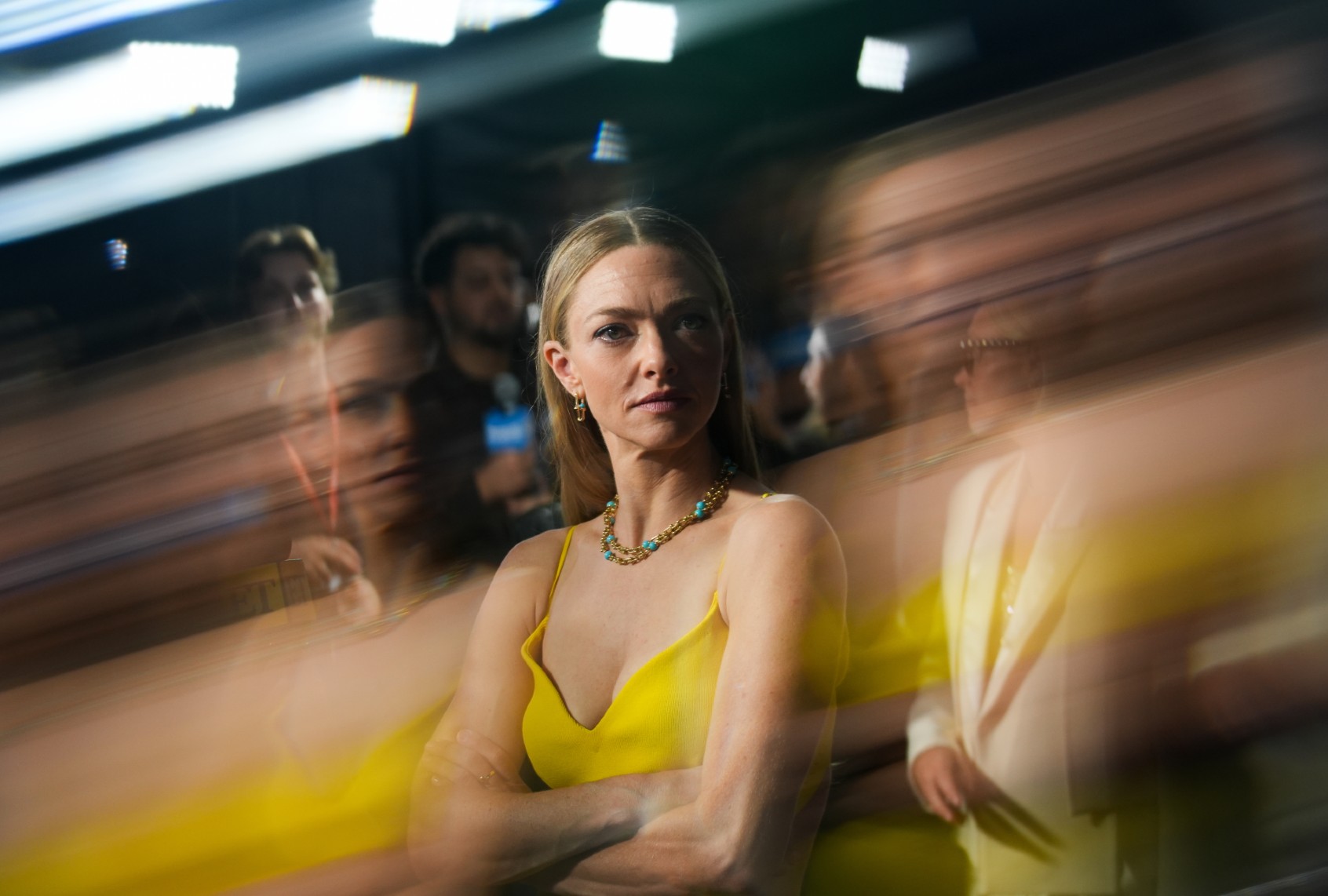
When the documentary premiered in semi-secret at this fall’s Telluride Film Festival, viewers were asked not to reveal certain aspects in their reviews and reactions. This was, of course, unfeasible. In 2026, one can’t bring Amanda Seyfried, star of “The Dropout,” into the process of a Fielder-led documentary, show it to the public and expect that Seyfried’s presence will stay under wraps.
But this is simply another way for Fielder to toy with the viewer’s perception, lifting questions about secrecy, deception and the nature of truth from the heart of the film and dispersing them into the ether, like a kid blowing on a dandelion to make a wish. For what it’s worth, I don’t think there’s any such thing as a spoiler for “You Can See Everything.” The movie’s narrative turns are so self-contained that you could know every beat of the film and still be flabbergasted by how it all unfolds. Knowing this documentary exists — that a slippery figure like Fielder is going toe-to-toe with the equally shifty Holmes — is its own “spoiler.” Assuming that would be the case, I sought out the film’s “twist” in an early review, wanting to confirm if my suspicions about Seyfried’s involvement were true.
It turns out that sitting on that knowledge for a month only aided in my experience with the movie. Knowing Seyfried will eventually show up lets the viewer watch without shock, processing every moment she’s on screen without the last-minute textual analysis that would otherwise accompany a surprise like this. This spoiler isn’t a spoiler at all. Seyfried’s presence sets fire to all the ideas the film juggles up until her introduction. Gazing into that fantastic blaze, every viewer will see something different, something new with each watch. Holmes might be the person on the poster, but “You Can See Everything” isn’t anything without Seyfried.
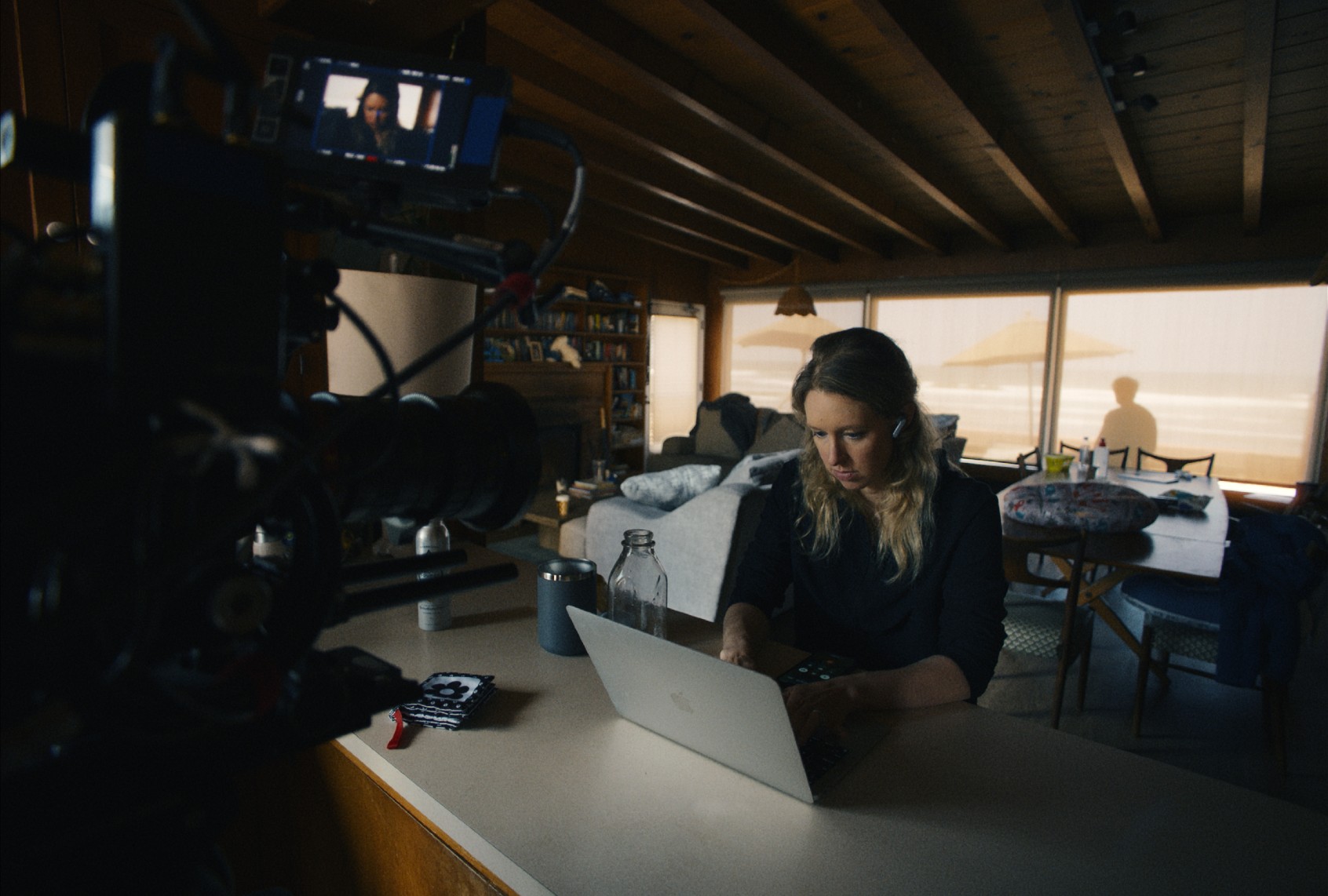
While the film would’ve been compelling if it were composed entirely of the 30-some days Fielder and Oppenheim spent with Holmes and her egomaniac partner, Billy Evans, in their San Diego beach rental, it would’ve only scraped the surface of Holmes’ psyche. In that relatively short time, we come to understand many things about Holmes and Evans. She is specious (perhaps unintentionally so) and charming, sitting atop a transparent partition that separates her from reality, trying unsuccessfully to reach the atmosphere below. He is governing and loathsome, with a knack for manipulation that merely foreshadows what audiences witness in the film’s second half.
This dual character study alone would give viewers plenty to contemplate in light of what they already know or assume about Holmes — most importantly that her fraud is unquestionably a product of being a woman in a violent, dehumanizing world. But as soon as she surrenders into custody, the rumination would halt. It would be much easier for someone to project their version of the truth onto Holmes. At the end of the day, that hypothetical version of the film would make for a very special, feature-length episode of Fielder’s “The Rehearsal”; little more than a cultural curiosity, as opposed to the pool of lucid, viscous quicksand it is. But Fielder and Oppenheim wisely chose to wait it out, to see what they could uncover in time, even if it was nothing at all.
(A24) Elizabeth Holmes in “You Can See Everything”
Two years later, enter Seyfried, who watches Fielder’s footage of Holmes watching Seyfried in “The Dropout” for the first time. Years removed from the project, her curiosity is clearly piqued. But what more is there to do besides lend additional color to the documentary? Fielder answers that question with his own questions, held over from the initial shoot. He wants to use Seyfried’s experience in playing a character to further investigate motive, reason, identity and truth. He wants to know more about why Holmes has chosen Evans, and what they both get from their relationship. But more than anything, he wants to understand Holmes as much as one person can possibly understand another — a patently impossible yet all-too-enticing undertaking.
As one of the finest, most challenging and surprising actors of her (or any) generation, Seyfried is game. An actor’s Faustian pact is that, by becoming someone else, they become more deeply acquainted with their true self and the nature of authenticity, a pursuit that can easily descend into rampant narcissism or crippling mental health crises. For Seyfried, who normally takes care to draw clear boundaries between her life and work — living on a farm and avoiding the usual trappings of celebrity — the task is ambitious and hazardous. And that risk is part of what makes “You Can See Everything” so gripping. By agreeing to whatever Fielder has in store, Seyfried willingly blurs the lines between art and reality. She’s engaging in a piece of phantasmagoric performance art with two raging megalomaniacs, suspecting humanity buried beneath their easygoing subterfuge. It’s both the opportunity of a lifetime and a descent into a pitch-black basement with nothing but the glow of her soul to light the way.
Want more from culture than just the latest trend? The Swell highlights art made to last. Sign up here
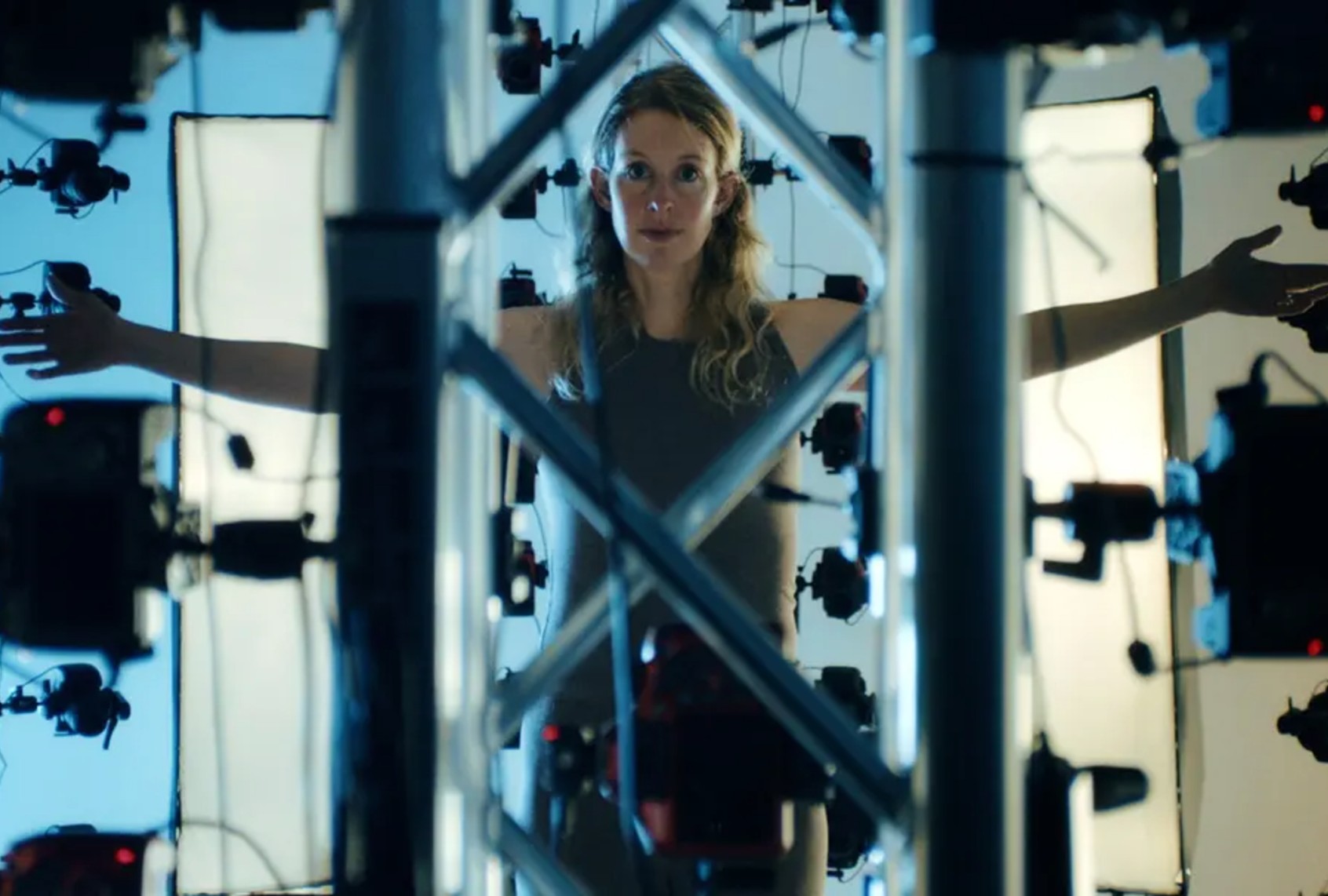
Seyfried’s first order of business is to step back into the role of Holmes, recreating scenarios Fielder experienced with Holmes during production to explore the various, mercurial states of mind Holmes might’ve been in — or at least that’s what Fielder leads us to believe. Like “The Rehearsal,” the question of fact haunts these recreations. The lines he provides for Seyfried are not transcripts; they’re scripts. Seyfried and the audience must trust Fielder, while questioning that trust at every moment. Both are essential to scraping past the layers of artifice Holmes and Evans have built around themselves. Once faith hangs in the balance, Fielder can navigate the viewer and Seyfried through its opaque boundaries, taking all of us to Evans’ house for an uncomfortably intimate dinner. Here, Seyfried makes her first-ever contact with Holmes over a phone call from prison. After some time spent with Evans, her fear is as visible as her empathy for Holmes. She’s not quite sure what this means for any of them, much less herself.
By agreeing to whatever Fielder has in store, Seyfried willingly blurs the lines between art and reality. She’s engaging in a piece of performance art with two raging megalomaniacs. It’s both the opportunity of a lifetime and a descent into a pitch-black basement with nothing but the glow of her soul to light the way.
Seyfried’s willingness not only to go to those uncomfortable places but to stay there is one of her great strengths as an actor. Plenty of performers will wax poetic about their methods, saying what they hope to achieve in their work — how hard they worked to identify with their character. But few convey those efforts as Seyfried can. Refusing to stop at investigating her characters alone, she’s interested in humanity as a whole, and where those roles fit into how our species operates.
In the film’s final act, Fielder stages one last recreation, another scenario that may or may not have actually happened between him and Holmes during visiting hours at a Texas prison. Fielder shrewdly pairs the recreation with footage of Seyfried reading the script for the first time, intercutting between the two. There are no major revelations, yet the sequence is an edge-of-the-seat climax thanks entirely to Seyfried, wrestling with her work, her complicated feelings toward Holmes and her family, this project, womanhood, selfhood and identity’s fragility — all in real time.
Here, Seyfried’s participation poses new and obscenely complex questions about the intersection of fame and infamy. She wonders whether her performance as Holmes is instructive, destructive, or some form of both. What responsibility does she have for how Holmes is treated in prison, by the press, or by the public? None, she argues for a moment, until she peels away another layer.
It’s critical to remember that Seyfried and Holmes are the only two women at the heart of this film. They are its entire feminine perspective. Both are mothers. Both are, to differing degrees, actors. And Seyfried — having seen the first half of the film before agreeing to participate in its latter portion; having spent time with Holmes’ repugnant partner — knows patriarchy is a key component of Holmes’ story, a tie that binds them. She might not have a responsibility to Holmes, but that doesn’t mean she can’t practice empathy toward her.
Perhaps that’s a line other actors might not want to cross. But it’s another risk Seyfried is willing to take. A greater good is at stake beyond her own edification. What we learn is that it doesn’t particularly matter whether the interaction between Holmes and Fielder in the prison actually happened. After all this time spent pondering what’s real, Seyfried’s portrayal of Holmes emphasizes something imagined: a world that is kinder and more considerate — a universe where we can get closer to one another by leading with compassion, regardless of whether that compassion is reciprocated. Neither you nor I, nor Fielder or Oppenheim or Evans, can see everything. It’s all obscured by layers upon layers of fact, fiction, perception and question. Only Seyfried can get close enough to make out the reality underneath it all, and truth concerns her little. What matters most to her is the only thing that allows any of us to see each other: trust.
In the first episode of his hit HBO series, “The Rehearsal” — a show about evaluating the outcomes of hypothetical real-life situations — comedian Nathan Fielder admits, “I’ve been told my personality can make some people uncomfortable, so I have to work to offset that.” For Fielder, who is equal parts lovably strange and dryly hilarious, offsetting other people’s discomfort can be a sizable task. It’s not easy to go through life in a double consciousness, hyperaware that one’s behavior might offend or unease. “Humor is my go-to instinct,” Fielder says about trying to reassure others. “But every joke is a gamble.”
Consider, then, the overlap between Fielder and someone like Elizabeth Holmes, founder of the bogus blood-testing company Theranos, who was convicted of swindling hundreds of millions of dollars from investors with her purportedly revolutionary blood-analysis device. Even before her downfall, Holmes drew the media’s attention with her wide, unblinking eyes, bold red lip, deep voice and stilted speech — all of which became parody-ready upon her indictment. But all the more perplexing was Holmes’ reticence to admit guilt when caught with hands as red as her lipstick, talking herself in circles in pursuit of her truth. Her statements always seemed misaligned with the evidence, as if she were so convinced of her company’s virtue that she didn’t care about the eerie dissonance between her reality and the world’s. If Holmes was indeed playing a character she made up, as many people speculated, she was a skilled method actor.
As Fielder gains steady footing on the margin dividing observation and manipulation, aiming the camera at either side, he uncovers something deeply, cosmically sad: Holmes can’t seem to tell the difference between the two.
Sitting just inches apart around a San Diego beach rental’s dinner table in Fielder and co-director Lance Oppenheim’s magnificent new documentary, “You Can See Everything,” Fielder and Holmes look decidedly comfortable with one another. They share an ease and rapport neither has readily exhibited on camera before — certainly not around virtual strangers. But while they may not share many overt similarities, the strange duo align in their mutual slipperiness.
Before them lie components of Theranos’ blood-analyzer, which Holmes hopes to turn into a new product after her 11-year prison sentence, set to start 34 days after filming begins. Trying to explain the device, and how her claims of its efficacy were misread by investors and the public, Holmes once again can’t translate her thoughts into words that make sense to Fielder. Instinctually, Fielder makes a joke. “Isn’t it funny that I hosted a show about business scams, and now you’re in trouble for a business scam?” Holmes remarks that she hadn’t thought about it until now, and the tension lifts as her frustration dissipates. Despite his well-intentioned wisecrack — or perhaps because of it — Holmes can relate to her new associate. Somehow, Fielder can see her.
But which version of her Fielder — and, by extension, the audience — sees, and which version is the truest, remains up for debate. The title “You Can See Everything,” taken from a text Holmes sent to Fielder during production, is an obvious red herring. This documentary is about a woman notorious for her deception. We, of course, can’t really see anything.
And yet, it’s all on display. Fielder, Oppenheim, and the viewer share the task of putting those pieces together legibly, to tell Holmes’ story in a way that hasn’t already been done for her by the media, Hulu’s limited series “The Dropout,” and Holmes’ muddled observations. As the film plays out, its three-hour runtime gliding by in a flash, it becomes painfully clear that this is what Elizabeth Holmes has wanted all along: for someone to tell her story in a way she can’t — not because she doesn’t want to, but because she herself is unclear about what that story is. Breaking through Holmes’ tight circle of dubious companions, Fielder pulls at every thread he can, attempting to unravel a greater truth from life’s gnarled yarn. As he gains steady footing on the margin dividing observation and manipulation, aiming the camera at either side, Fielder uncovers something deeply, cosmically sad: Holmes can’t seem to tell the difference between the two.
That does not, however, mean she doesn’t want to try. Holmes is intent on letting the cameras see as much of her life as possible, not only to prove the innocence she’s maintained all along, but to show that she has nothing to hide. She understands that the world sees her a certain way, a way she doesn’t understand — or, in the case of the infamous photo of her holding a vial of blood between two fingers, outright refutes — but that people’s perception is entirely out of her control. Maybe emerging from hiding for the first time in seven years with a full-scale documentary team isn’t such a bad idea. Five weeks out from a decade in prison, what’s the worst they could uncover?
“You Can See Everything” isn’t so much about big, jaw-dropping revelations as it is about the people behind them, and the assortment of personality and/or neurodevelopmental disorders fueling their actions. Holmes raves about her husband, San Diego hotel-chain heir William Evans, whose ego takes up most of the space in their beachside rental. When Fielder asks how he and Holmes met, Evans relays murky details of a 2017 party where the two spoke for an hour before he realized who Holmes was, even though he’d toured the former Theranos building the day before.
Later, during a visit from Holmes’ parents, Fielder asks Holmes’ father, Christian, about her former lover and Theranos business partner, Sunny Balwani. Evans immediately interjects, trying to halt and redirect the conversation. Persisting, Fielder asks Christian to pinpoint a turning point in his daughter’s life. “That’s an easy one,” Christian says, confessing that the turning point came when Holmes was sexually assaulted at 19, a crossroads that Holmes admits had a hand in her dropping out of Stanford and starting Theranos.
Want more from culture than just the latest trend? The Swell highlights art made to last. Sign up here
When Evans derails the conversation again, a new question pops up — an occurrence in this film as natural and frequent as breathing. Is Holmes’ husband trying to maneuver the situation because he cares for his wife, or because his behavioral patterns mirror those of Balwani and Holmes’ assailant? All three men directly impacted Holmes at vulnerable points in her life, and from the film’s outset, it’s clear Evans savors controlling the narrative, whether through Holmes’ life’s work or simply the way she whisks eggs for scrambling. What’s constantly baffling is how much affection Holmes has for her repugnant husband, no matter how much he twists stories or alienates the film crew. One could say the two share a talent for deception, but it always feels more complex and tricky than that, as if it would be too easy to say that Holmes and Evans get along because they’re both hucksters, skilled in fabrication. They both get something out of this relationship. Whether it’s love is anyone’s guess.
What’s brutally, painfully clear, beyond a shadow of a doubt, is that Holmes has not yet learned how to use her own voice. She knows how to speak, dictate orders and ideas. (And, obviously, how to fool powerful people.) But Holmes doesn’t grasp where her ideas end, and someone else’s influence begins. She personifies a complete lack of identity, so irrevocably tied to her inventions, physical or otherwise, that, compared to Fielder — whose work is marked by his own keen self-awareness — she looks like the diametrical opposite. Holmes is the tragedy to his comedy. Naturally, the two are intrinsically connected.
Many things about Elizabeth Holmes aren’t certain. But what’s irrefutable is that she knows how lonely it is not to be able to communicate the world inside her head, and how painful it is not to understand others the same way. It’s no wonder that, when she meets someone who can bridge that gap, she wants to make a monument of it.
All of the questions about who’s running Holmes’ show take new, thorny form as the film blossoms in its latter half — the portion that, thanks to a surprise guest, makes the movie one of the most startling and memorable exercises in metafiction ever concocted. But the film’s most heartbreaking and pivotal scene comes in its first third, before Holmes surrenders for her prison sentence, when Fielder gathers her and Evans on the couch to show them Abbott and Costello’s famous “Who’s on First?” act.
Fielder tells Holmes that he was reminded of the bit the day before, when Holmes tried to describe the science and intention of Theranos in front of its deconstructed prototype. Holmes has never seen the routine, and gives it a few chuckles. But when Fielder asks her to explain the joke — that “Who” is the name of the baseball player on first base, yet sounds like a question, confusing the two men — and why it’s funny, she can’t. As Fielder clarifies the punchline, Holmes breaks down in tears across from him, frustrated that she can’t understand.
In this moment, Fielder conjures a world of empathy for his subject, again posing questions about what gets lost between two people who believe they’re being perfectly clear, yet aren’t making sense to one another. Many things about Elizabeth Holmes aren’t certain. But what’s irrefutable is that she knows how lonely it is not to be able to communicate the world inside her head, and how painful it is not to understand others the same way. It’s no wonder that, when she meets someone who can bridge that gap, she wants to make a monument of it — be it a business, a marriage, a film or a profession of love.
Though the questions persist: Is this all part of Holmes’ master plan? Is she letting the cameras in to dupe us, to make us feel sorry for someone whose actions caused real harm? Maybe. Those seeking clear answers will leave with nothing more than new questions, but that’s the glorious part of “You Can See Everything.” In an era when documentaries are made for everything and nothing, it’s critical to remember that searching for reason in something as immense as the human condition is a fool’s errand.
Fielder might be fascinated by motive and rationale, but he’s primarily interested in circumstance, and he understands Holmes’ circumstances perfectly. His film is a self-reflexive study of the inability to act as people expect — of masking and deception. How much of life is a performance? Can anyone truly be themselves when society’s bylaws not only dictate proper human behavior but also how successful anyone can be in something as complicated and unknowable as life itself? In seeking the truth, all one finds is more differences, more judgment. Sure, we can see everything. But whether we really should is another question entirely.

 Login